Photo by Husein Syed
MONSOON
CONTENT CO N T EN T CONTENT
06 08 10
A Reflection on the Portrayal of Rape in the South Asian Cinema Industry Shruthi Subramanian Warli: Indigenous Western Indian Art Sampada Agarwal
12
African Diaspora in South Asia Swaycha Goli
14
Disruption and Destruction Maya Theresa Gopal
16
Not Exactly a Brown Skinned Girl Maya Theresa Gopal
18
Aah Ko Chahiye: A Ghazal (Poem) Translated by John Caldwell and Afroz Taj
20
4
Editor’s Letter Juhi Modi & Maydha Devarajan
Silence is Violence in the Face of Islamophobia Safa Ahmed
26 28
Craft and Perspective: Interview with Local Artist Vishal Kasula Swaycha Goli More Than a Voting Bloc Maydha Devarajan
31
Reflections in Color Rashmi Patwardhan
32
Landscapes of Life Soumitra Ronnie Sarkar
34
Violence Against Dalits Sujata B. Chhetri
KALEIDOSCOPE KALEIDOSCOPE KALEIDOSCOPE KALEIDOSCOPE
24
Chole: A Family Recipe Eesha Desai & Eve Golecruz
38
Zoom University: First Years Finding Family in South Asian Dance Teams Sara Raja
40
Memorializing Victims of Anti-Asian Hate Kaitlyn Dang
5
6
Rashmi Patwardhan
Soumitra Sarkar
This year has changed us. From a nationwide reckoning of racial injustice to a global pandemic that’s swallowed up the lives of millions, we’re grappling with what it means to experience loss. Loss of time, loss of boundaries, loss of life. We’ve all lost community members to both COVID-19 and hate-driven violence this year. The often unspoken collective grief is something many are currently experiencing, and we deeply empathize. Coupled with the difficulties of a virtual lifestyle and online school, this year has been exacting to say the least. Simultaneously, individuals and communities have found ways to be resilient. The combined power of research, science and the countless (and often thankless) hours of frontline essential workers have delivered us some reassurance and the promise of a brighter future. The organizing work of BIPOC activists is the reason the names of white supremacists will be stripped from UNC’s campus buildings and that this country’s electorate has diversified tenfold. This work is a reminder that we can challenge systems of corruption and that there is power in collective action. We must also remember that oppression and injustice have existed since the beginning of the “creation” of this country, and people have always revolted in the daily and the macro. The mass attention last summer around the murders of Black people by the police was catalytic for non-Black people to finally show concern. Still, the cycle of apathy continued after a few short months. Months surely filled with action and solidarity, but also performative activism, the emergence of reductive infographics, and too many book lists. Fighting for an anti-racist, anti-oppression society is long-term, daily work that does not stop after one season. We need to posit ourselves to work in solidarity and not charity. We must extend honor the struggles and activism that came before to continue ahead. This year, we set out with the intention of restarting Monsoon, of holding a space for South Asians at UNC to explore our identities while addressing forms of hate in our community. The constraints and expectations of an almost entirely virtual year have stretched us all thin, but the commitment and drive of our team is the reason you hold this issue in your hands today. In this issue, we explore reflections, literal and symbolic, the politics of distorted realities, the kaleidoscope of lived experiences in our diaspora, and the ultimate complexity and beauty of it all. We hope this composition will offer some respite and space for reflection.
Juhi Modi and Maydha Devarajan
7
A Reflection on the Portrayal of Rape in the South Asian Cinema Industry By Shruti Subramanian The past decade has given South Asian movie lovers an opportunity for reflection as an incredible onset of taboo-breaking movies have been released, particularly when it comes to the discussion of sexual assault. When considering movies that critique culture with emboldened voices, the Hindi film “Pink” comes to mind. Directed by Aniruddha Roy Chowdhury, “Pink” follows the journey of three girls, Minal, Falak and Andrea, as they battle for justice following harassment and sexual assault. Minal, played by Taapsee Pannu, is the victim of sexual assault and is charged with the murder of her pepetrator Rajveer Singh, who is played by Angad Bedi. The film focuses on the court case in which lawyer Deepak Sehgal (played by Amitabh Bachchan) attempts to bring Minal justice, and eventually succeeds. “Pink” received its fair share of praise and awards from the Bollywood industry, as one of very few Bollywood movies to tackle sexual assault head on. A movie worthy of praise is also worthy of criticism, and “Pink” is not an exception to this rule, as there are faults in the way that it portrays sexual assault. Unfortunately, these faults are reflective of the South Asian cinema industry as a whole. A notable fault lies with the director of the movie, Aniruddha Roy Chowdhury. Often times, movies about women’s rape are directed by men: “Mom” directed by Ravi
8
Udyawar, “Lakshmi” directed by Nagesh Kukunoor, “Ponmagal Vandhal” directed by J.J. Frederick, “Nabab LLB” directed by Anonno Mamun, to name a few. In “Pink” and similar movies, the victim’s narrative is skewed by the perceptions of a male director who cannot empathize with a woman’s experience with sexual assault. In India, a rape occurs every 15 minutes. In Nepal, 98% of women report harassment. In Bangladesh, only five out of 4,372 rape cases were brought to conviction. In Sri Lanka, 90% of women experience sexual harassment. Though people of all gender identities can experience sexual harassment and assault, women are still disproportionately affected by sexual violence. A line in “Pink” shows a lack of complexity in storytelling, when Minal says, “We are normal working girls!” (53:09). Minal says this emotionally-charged sentence when she goes on trial to prove her story is true. This line implies that only a certain type of woman faces the risk of sexual assault; “normal working girls” are not included in this “type” illustrated by South Asian media and culture. Due to strict gender roles and a conformist Indian society, Bollywood male directors may only know a limited breadth of female characters that they can use to play out these stories over and over again. Stereotypes are reinforced when the audience sees the bold, independent woman with tattoos and modern values raped. Yes, this woman is targeted, but she isn’t the only
one; male directors fail to recognize this. Across South Asia, women are treated as the vessels for their family’s honor and pride. Even in the modern world, rape culture is closely linked to the power dynamic of the average South Asian family, especially since a woman’s virtue is traditionally espoused as her most divine attribute. In “Pink,” a male police officer tells Minal how women are perfectly safe in the world until they mess it up for themselves, prioritizing her decency over her safety (29:39). Additionally, oftentimes, a girl in a South Asian movie is raped after she’s done something outside of the societal norm, like partying late at night, smoking, drinking or picking a fight. The repetitiveness of this plot along with the ideals of conservative, “traditional” men, normalizes the notion that women are dealt consequences when they live life on their own terms. To illustrate this example in “Pink”: One night after having fun at a rock concert, the women are harassed, leaving the movie to portray harassment as their punishment for an act that wasn’t consequence-worthy in the first place. A shift in focus to the plotline in “Pink” shows a clear disregard for the sexual assault victims Minal, Fazal and Andrea. Instead of the young women themselves playing a major role in moving the plot forwards, their lawyer Deepak Sehgal steals the spotlight and spearheads their path to justice. With little focus on the girls’ trauma, the movie is more about the court case and how their lawyer makes sure justice is administered. When Minal’s charges are dismissed, the movie ends with an optimistic still of the
three girls watching the sunrise from their balcony. This kind of ending addresses rape as a case that can be closed for life. When a rape case is brought to justice, loose ends can’t be wrapped up with a pretty bow, and the victim often can’t move on to live life as per normal; significant trauma follows an assault. There’s rarely dialogue between the women in “Pink,” leaving important emotions unaddressed. Lawyer Deepak Sehgal initiates some dialogue, but he is a man accepting a woman’s trauma. It’s a disrespect to sexual assault victims watching this movie to diverge the focus from the victim onto the “savior.” “Pink,” as praised as it was, has serious problems that others may not notice in a first watch due to its near-unanimous approval by critics. Just like other South Asian movies about rape that are directed by men, this movie’s natural storyline is adjusted for the best monetary and entertainment purposes under the guise of bringing awareness to social justice issues. When given the choice, people would naturally prefer to see a movie and imagine a life where everything works out in the end with minimal losses along the way. If South Asian movies don’t sooner address the brutal realities of rape and women’s trauma, then there will be little change made in the patriarchal mindsets of traditional viewers. Rape is becoming a pervasive storyline in South Asian movies, and male directors, whether accidentally or purposefully, are exploiting it through careless displays of sexual assault and its aftermath. With careful reflection, anyone can see that the portrayal of rape in the South Asian cinema industry requires deliberate change.
9
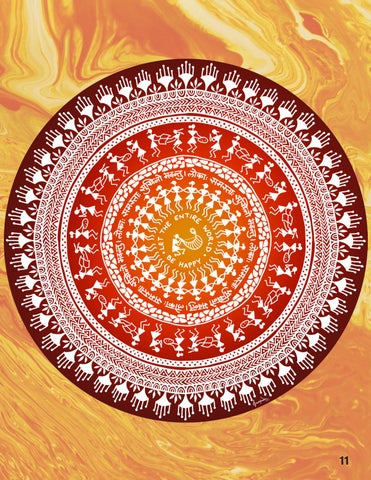
Warli is an indigenous tribal art from Western
India that uses minimalistic forms and patterns to portray everyday lives and events. The basic graphic vocabulary of lines, circles, and triangles, which these Warli paintings use is quite expressive and has remained unchanged through the ages. Traditionally painted in white on brown mud backgrounds, these monochromatic paintings bring an element of freshness to the day-to-day events that they symbolize. A circle has no beginning and no end, a metaphor for the endless cycles/series of events that unfold on earth, bringing us from cradle to grave, through ups and downs, love and misfortune, and so on. These circles are famously popular in the Warli art world, depicting the tarpa dance. This piece uses symbolism to portray knowledge, philanthropy and togetherness. In one of the circles, people are sharing knowledge (books/literacy) and food, two key inputs needed for human mental and physical growth. In the other, they are all joining hands to support each other in adversity and sharing joy in dance!
Art by: Sampada Agarwal. Sampada is a folk artist living in Morrisville, NC since 2006. Mostly self-taught, her work has strong reflections of culture and traditions from India, a place where she was born and brought up. Sampada can be reached via linktr.ee/ansimit.
10
11
The African Diaspora in South Asia A look into histories and cultural traditions
By: Swaycha Goli
Asia has many different faces. When the average non-Asian person thinks of “Asian” as a descriptor, they most likely only imagine East Asians and are unaware of the vastly diverse inhabitants of the Asian continent. Similarly, when people think of the term “South Asian,” they may imagine only Brown people, not Black people. Afro-South Asians, often referred to as “Sidis,” hold a unique historical significance in the subcontinent. Their stories are woven into the patchwork of different ethnicities, religions and backgrounds that constitute South Asia. According to the History Workshop, Sidis were forcibly brought to South Asia over the course of a thousand years (900 AD to 1900 AD) through the Indian Ocean slave trade. Sidis originate from countries such as Mozambique, Goa, Madagascar and Portugal. After being taken to South Asia, they were subjugated to the roles of servants, soldiers, and mistresses for Europeans, who were colonizing and expanding their global markets. The origins of Sidis can also be traced
through African merchants as well, who traveled to South Asia for business purposes. Some decided to stay in South Asia, and ended up ruling smaller islands such as Janjira and cities such as Sachin in Gujarat until India gained independence. Today, there are still many people of African descent in South Asia. The History Workshop states that some Afro-Indian spiritual healers became Sufi saints, and their shrines are revered by Hindu, Zoroastrian, Muslim and Christian people. One group of South Asians with African descent is the Kaffirs, who reside in Sirambiyadiya, Sri Lanka. In Sri Lanka, “Kaffir” is a self-described term for those of East African ancestry, and the word has no racial connotations In other parts of the world, such as South Africa, the term is offensive and derogatory. The Kaffirs are facing population decline, according to a YouTube documentary by British-Sri Lankan filmmaker Kannan Arunasalam. East Africans that arrived in Sri Lanka hundreds of years ago have since intermarried with Tamil and Sinhalese people, and many converted from Islam to Roman Catholicism.
Unfortunately, much of their African heritage and cultural traditions have been erased through assimilation. One cultural treasure that remains is Kaffir music, which has an infectious rhythm and unique style.
photos: kiptra.com
I was raised listening to bhajans led by soloists and amplified by audiences with clapping, repetition, and whistling. As it turns out, Kaffir music sounds quite similar. The website Afropedea notes that Kaffir music includes three well-known styles: Manja, Kaffrinha, and Baila. Manja has few lyrics, is sung in Sri Lankan Portuguese Creole, utilizes various rhythms, and is enhanced by percussive instruments. Kaffrinha is one the oldest traditional styles and means “a little African” in Portuguese. The music style is very upbeat and syncopated, using 6/8 time. Lastly, Baila is a derivation of Kaffrinha and is sung in Sinhalese. It was started by Wally Bastiansz (a man of Dutch and Sinhalese ancestry.) I highly recommend that you search for Kaffir music on YouTube. The syncretic nature of the music style is enchanting!
13
14
15
NOT EXACTLY A NOT NOT EXACTLY AA NOT EXACTLY NOTEXACTLY EXACTLYA A BROWN SKINNED GIRL BROWN BROWN-SKINNED GIRL BROWN SKINNED GIRL BROWNSKINNED SKINNEDGIRL GIRL
by Maya Theresa Gopal
When I was young, I rarely questioned the way I grew up. Attending both the church and the temple was commonplace, as was joining a Bollywood dance team, traveling to India and celebrating both Catholic and Hindu holidays. It was only once I entered high school that I digested the apparent contradictions in practicing two religions and began to realize how my biracial identity has impacted my life. In particular, dance, which originally brought me joy and a sense of community, became a source of anxiety. I found myself more uncomfortable as I grew up, percieving myself as less natural, less elegant than my Indian peers. I fretted over whether the sea of Indian families in the audience wondered why a girl with pale skin was dancing to Bollywood music. While I tended to get compliments after our annual performances, I was more concerned with the implicit, uninformed judgements embedded in these comments. I interpreted “You were great up there!” as “You were great for a white girl doing the dance of a culture that isn’t yours.” I wished I could broadcast a disclaimer message to everyone in the audience informing them that I’m half Indian, but of course, this was impossible.
Covert judgements show up in many other parts of my life as well. My dad, who came from Hyderabad, India to the U.S. for graduate school, and my younger sibling both have brown skin, while my mom and I have white skin. When I walk into a restaurant with my dad, I fear people think that our relationship is one besides father and daughter. When we go to Hyderabad to visit family and friends, I hate the stares I get from strangers on the street. In one particularly traumatic incident, I went to the Taj Mahal with my friends and their parents on an insufferably hot day. I ended up getting a heat stroke. While they went to get water for me, a group of strangers walked up and asked to take a picture of me. Covered in sweat, red as a tomato and dying of dehydration, my seven-year-old self didn’t have the energy or confidence to refuse. On the inside, I was furious that instead of offering to help me, they wanted to capture me at one of my most vulnerable moments in an extremely degrading way.
16
Religion is another source of conflict for me. My dad and his family are Hindu. The beliefs of my mom, who was raised Catholic, are a bit more complex; upon attending an International Society for Krishna Consciousness (or ISKCON) temple with some of her Indian friends, she decided that all religions reflect the same divinity. At the temple, she met my dad and fell in love. Subsequently, I was raised on the path to Confirmation, but I also spent every Sunday at the temple, praying to Krishna. When I turned 14, my parents enrolled me in a Catholic high school with required religion classes. That is when I began doubting the way I was raised with two religions. I felt like I had to pick one over the other. After reflecting on myself and my spirituality, I realized that I am agnostic. While this took some pressure off, I still feel conflicted about the aspects of both religions I still participate in that are more cultural than spiritual. By far, the worst part about being biracial for me is the guilt of not knowing enough about your cultures. Imposter syndrome kicks in when I visit my Indian friends’ houses. If I don’t know what a food is, I’m too afraid to ask, fearing my lack of knowledge will prove that I’m not “Indian enough.” Yet, conversely, I feel offended when I’m asked if I know what a basic dish is. These conflicting feelings grow worse when I realize I would probably act the same way if I was in their place. Moreover, because I am white-passing, I feel guilty talking about my guilt. My younger sibling has brown skin and experiences more directly hateful things than I do, so what right do I have to complain? When I got to college, I joined an organization for mixed Asian students. In one meeting we talked about our experiences with guilt. After it ended I almost burst into tears; I realized I’d never said these things out loud to other people before that day. I was shocked at how incredibly sad that is. Thankfully though, I now have a community that I can reach out to for advice and validation. Going forward, I’m working on forgiving myself for not knowing everything about my culture. If I wasn’t introduced to something, I can’t be expected to know it. That does not detract from my identity in any way. After all, if I invalidate the whole Indian half of myself because of my guilt, then logically I have to invalidate the Italian half of myself as well. If I’m neither of those things, then I am nothing at all. And I know I’m not nothing. Artwork by Maya Theresa Gopal
17
Aah Ko Chahiye: A Ghazal Originally written by Mirza Asadullah Khan ‘Ghalib’ (1797-1869) Translated from Urdu-Hindi into English by John Caldwell and Afroz Taj (preserving the original meter and the ghazal rhyme scheme) Original meter: = - = = / - - = = / - - = = / = = Modified to: --==/--==/--==/--=
Original first couplet (in transliteration): “Āh ko chāhiye ik ‘umr asar hone tak Kaun jītā hai tirī zulf ke sar hone tak” 1. Since a sigh requires a lifetime for its influence to run When your tresses get the message my existence will be done 2. Every wave’s net holds a hundred crocodiles’ cruel circling maws For a drop to turn to pearl see what a gauntlet it must run 3. Lovers must have long endurance and their yearning know no bounds Till my heart melts into life’s blood can I teach it to have fun? 4. I’ve accepted you’ve relented, you’ll acknowledge I exist By the time you get the news though there’ll be no one left to shun 5. Shall the sun’s ray teach the dewdrop how to vanish into air? Till your kind glance falls upon me even I too am someone 6. The interval of our existence is no more than but a glance Like the brief warmth of a spark’s spin in our midst, o heedless one 7. For the torment of existence, Asad, death’s the only cure Burns the candle every color ere the rising of the sun
18
Maya Theresa Gopal
19
Artwork by Maya Theresa Gopal
20
Silence is violence
In the face of Islamophobia
BY SAFA AHMED
T
he story of Jodha and Akbar is one of those legends that almost every Indian kid has heard of.
Jodha was a beautiful Rajput princess, and Akbar was a Mughal emperor. She was Hindu, he was Muslim. The world would’ve expected them to be enemies; instead, they became friends, fell in love, and learned to respect each other as equals. Jodha-Akbar is the quintessential Indian love story, so much so that the song “Jashn-e-Bahara” has become an anthem for weddings all over South Asia. The music video also happens to combine pure poetry with beautiful visuals of Aishwarya Rai in fancy sarees, so I like to watch it on loop on YouTube whenever I’m trying to procrastinate. To me, the story of Jodha-Akbar feels like a relic of an era that had a better grasp on what it means to be Indian. “Why [can’t we all] respect others like Akbar and his wife?” asked one commenter on the “Jashn-e-Bahara” video, followed by, “Hindu Muslim brothers forever.” But, of course we can never have nice things, especially in the YouTube comment section. It’s rare to find comments that promote Hindu-Muslim unity. And there are at least three replies that declare, in no uncertain terms, that “Akbar was not Muslim” — either that he was a follower of his own religion, or that he was a sort of diluted Hindu.
Akbar was in fact Muslim, and he never renounced Islam, according to historical records. Encyclopedia Britannica states that he did, however, take “an active interest in the various religions of his realm, including Hinduism, Zoroastrianism, and Christianity” in order to promote religious tolerance. But for some Hindus in India today, the thought of ascribing any sort of good to a Muslim ruler is like spitting on the flag. It’s blasphemy against the nation. If you’re a true nationalist, you don’t do it. That’s because a common perception is that Muslims are not Indian. Instead, they’re Pakistani or Afghani, Arab or Turkish.
(As I write this, sitting next to my closet full of Hyderabadi shalwar khameez and my jewelry stand with its tikas and jhumke, waiting to eat my mom’s Bangalori daal, I can’t help but laugh loudly and derisively.) At best, it’s a hateful thing to erase the religious identities of almost 200 million people who are, in fact, native to India (and who can trace their Indian bloodlines past the arrival of the Mughals). At worst, it’s the rhetoric of genocide — the othering, the fear-mongering, the slow path towards extermination. This is an example of the extremist form of Hinduism, also known as Hindutva, which
21
has become the core philosophy of Modi’s nationalistic movement. It’s not an entirely new phenomenon — Hindutva was formed almost a century ago, according to an article in Economic and Political Weekly, modeled off the fascism of Mussolini. Nathuram Godse, the man who killed Gandhi, was a firm believer in it. And in modern times, its 4 million devoted volunteers have grown more violent by the day. The atrocities committed against Muslims between 2019 and 2020 alone are too many to number in this article alone, but I’ll list some of the worst of them. Kashmir, a disputed territory that is the only Muslim-majority region in India, was put under military occupation last year. The Citizenship Amendment Act was passed in 2019, a discriminatory bill that effectively excluded Muslims as being worthy of fast-tracked citizenship documentation (unlike other Indian minority groups). The majority of the 53 people killed in the subsequent Delhi riots were Muslim, some of them as young as teenagers. Peaceful student and female-led protests were met with tear gas and police batons. Mosques
22
have been burned down. Muslim-owned shops and homes have been destroyed. The BBC’s Geeta Pandey reported on photographs of Muslim men being beaten — some of them to death — while their attackers taunt them, demanding that they chant “Jai Sri Ram” or sing the national anthem. The list goes on. Hindutva mobs have roamed Delhi in groups of up to 50 people, armed with metal rods and cricket bats. They chant, “Shoot the traitors to the nation!” — a phrase used openly by BJP politicians. Muslims get lynched, and the police are either bystanders, or encourage the brutality, as noted by the Human Rights Watch organization. Several states have either introduced or passed “Love Jihad” laws, which make marriages between Muslim men and Hindu women illegal, even if they are consensual. More than one couple has been forcibly separated in Uttar Pradesh, with the Telegraph reporting the case of one woman forced into an abortion while her husband was arrested.
My own aunt gets called “terrorist” as she walks down the streets of her hometown in Hassan in Karnataka.
“Everyone talks about Gandhi as the founding father of this country. Now the ideology [that killed him] is being used as the symbol for what India should be,” my friend Rahim said. As someone who converted from Hinduism to Islam in college, he has a more nuanced perspective than most. “India wasn’t founded on religion. It wasn’t a Hindu republic - it was India,” he said. Social media might be inclined to debate him on this. Muslims aren’t oppressed, they like to say. Mughals were colonizers. Muslims have committed atrocities against Hindus, too. While the latter is certainly true in Indian history, it does not by any means justify the mobs, the lynchings, and the systemic brutality enforced by Modi and the BJP. Especially when multiple human rights organizations — including Amnesty International, Human Rights Watch, and the Coalition Against Genocide — have all released reports on India’s anti-Muslim problem. Hindutva isn’t limited to just India, however. The diaspora has exported it to the West, as was evident when a crowd of 50,000 showed up for a “Howdy Modi” event in
Dallas, featuring a guest appearance from none other than Donald Trump. Facebook is a breeding ground for anti-Muslim hatred in Hindu extremist groups, yet moderators still balk at banning such groups from the platform for fear of national outrage. And it’s no hyperbole to say that anti-Muslim propoganda has become one of India’s main exports, with the consequences woefully undercovered by global media. By contrast, my personal brushes with Hindu supremacy are fairly tame. I was called “Indophobic” for an Instagram post I made in 2020, in which I explained why I can’t feel
hashtag, but then [they] do some other bigoted stuff.” “I try to talk about it,” said another of my friends, Zak, who uses his platform on TikTok and Instagram to raise awareness not just about issues faced by Muslims, but Dalits and Sikhs as well. “With a lot of Hindu Indians, you see a lot of the same narrative pushed forth,” he added. “That Muslims are colonizers, that we’re brutal people.” I know that Muslims in India do have Hindu allies — many of whom are incredibly vocal about the injustices faced by all minorities. I have nothing but respect for them and
“What’s baffling to me as a Muslim Indian-American is the hypocrisy.” proud to be Indian in the face of not just Islamophobia, but also anti-Sikhism and casteism. And I got into a Zoom fight with Indian classmates who claimed that they supported Kashmiri occupation because “it has a bright side.” Tame, sure, but still infuriating. What’s baffling to me as a Muslim Indian-American is the hypocrisy. These same people were so quick to speak out against Trump and his fascist, divisive policies, as they should be. And yet, when it comes to Modi — a man who openly calls Trump a friend — the silence is deafening. “I just hope to see some form of acknowledgment that Muslims are Indian,” Rahim said. He’s also noticed the silence among his family and friends: “Desis [tend to] just go with the trend. It’s easy to post BLM as a
their immense bravery. But if the power of the BJP is any indication, they can’t carry the burden of allyship all on their own. Indian minorities are in desperate need of help, and Modi’s government needs to feel the diaspora’s disdain before anything can change. Which brings me back to Jodha Akbar, that sweet and timeless story of a Muslim king and Hindu princess. It’s a tale about mutual respect and love between two people who could not be more different — and are yet so similar, and so Indian, at the same time. As a Muslim and Indian, I need more people to stop hiding behind the fear of controvery. There should be no controversy in supporting the minority, especially when it means acknowledging the privilege of being able to stay silent. As a Muslim and Indian, I need more people to speak up.
23
CHOLE A warm comfort food that’s spicy in all the right ways By: Eesha Desai and Eve Golecruz
Ingredients • 250 grams dry garbanzo beans/ chickpeas • 2 tea bags (of any near-neutral flavor) • 1 big onion (crushed) • 4 tomatoes (crushed) • 1 inch ginger • 2 green chiles • 2 tbsp whole coriander • 1 tbsp cumin • 4 to 5 cloves • 8 to 10 black peppercorns • 1 cinnamon stick • 1 whole dry chile (kashimiri chile) • ½ tsp cardamom • ½ tsp poppy seeds • 3 to 4 bay leaves • 1 tsp dried mango powder (am chur) • ½ tsp turmeric • ½ tsp powdered fenugreek • 1 cup water
24
Directions 1. Soak the chickpeas in water for 5 to 6 hours. 2. Drain the water and rinse the chickpeas. In a separate pot, heat up water ( just enough to cover the chickpeas) until it reaches boiling point. 3. Add 2 tea bags, salt to taste, & the chickpeas to the boiling water. 4. Once the chickpeas are tender, turn off the stove, drain the water, dispose of the tea bags, and rinse the chickpeas well. Then, keep them aside. 5. In a separate pan, add the coriander, cumin, cinnamon, cloves, back pepper, bay leaves, cardamom, kashmir chile and poppy seeds. Toast the spices on the stove on medium heat for 4-5 minutes while stirring occasionally. 6. Turn off the heat for the spices. Once the spices have cooled down, grind them up in a blender. 7. Put 2 tbsp of oil in a separate pan. After it heats up, add the diced onions, ginger and chopped green chiles. 8. Once the onions have browned, add the crushed tomato and ½ tsp turmeric. 9. Add the toasted chile and 1 tsp of dried mango powder. Let everything saute together for 2-3 minutes. 10. Put the chickpeas in the pan, and add ½ tsp powdered fenugreek and 1 cup of water. 11. Cover the pan and let it cook on the stove at medium heat for 5-7 minutes. 12. Done!
25
Craft and Perspective An Interview With Local Artist Vishal Kasula by Swaycha Goli
How does your music connect to your experience as a South Asian? I have always involved myself around other Indian or South Asian artists, with my music, like, with my band, MODUM. The bass guitarist for MODUM was Indian. Over the winter, we had a drummer who was also Indian. It was really cool, just jamming and connecting. Even though the music wasn’t Indian, we were. We played whatever the hell we wanted. We did connect with the fact that we were related on a personal level, because we were of the same ethnicity. However, being Indian was never really culturally apparent in my music. I like blues, jazz, rock, and that sort
of stuff, which isn’t generally South Asian in culture. When I released my song, all the uncles and aunties were spreading it around. They were like, “Oh, very nice.” I got a lot of support from the Indian community. I’m very glad that the community was a part of that experience. Are there challenges for you in the music scene due to your South Asian-ness? Well, I feel like being not white in America already poses a challenge to anything you do. I feel like if I was white, I mean, it would inherently be easier to do what I wanted to do in America. Especially with the type of music that I make; I’m sure people were like, “Is this Indian kid playing guitar?”
26
So there are disadvanta- ges, but there’s also advantages to it. I mean, which other Indian kid is playing gui tar I feel most other Indian kids like me, who are into music, aren’t as active in the relative styles that I
do. So, I think that it does set me apart. I guess it does add some flavor that I am Brown, you know, and I’m doing what I’m doing. I view it as a good thing. I try not to get bogged down by any of the disadvantages. Because once you start thinking about that, you’re, like, insecure. And then you’re like, “Is my music even worth it?” Is there anything you’re looking forward to in the future with your music? Yeah, over the winter, I’m planning on producing with the guy who helped me produce “Who’s Staying Here.” His name is Ayman and he’s basically, like, 70%, producer, 30% musician. On the other hand, I’m, like, 70% a musician, 30% producer. Ayman taught me a lot of things about producing. He happens to be Lebanese, actually. It always seems like I’m working with other people who are ethnic, first-generation immigrants, which I think is pretty cool. I don’t know why, I guess I can connect inherently with those types of people musically. You have to connect with them as a person to be able to connect with them musically.
How was your experience with your parents and their opinions about your artistic aspirations? Was it challenging? Yeah, I mean, it was like a slow rise for my parents to actually start accepting me as an artist. When I first started, it was always just a hobby. I would sing at my friends, like sweet sixteens. The first time I did that, I was like, 12 or something. I think the adrenaline of being onstage and being live, like it really fuels my passion and it makes me remember why I want to do what I want to do. So during these times with COVID, I guess releasing the song kind of conveyed that passion, in a way; but there’s nothing like performing and connecting with human
beings straight up, face to face. There’s nothing like it. My parents definitely saw that and I think after those performances, they were like, “Okay…” you know, the “oh, oh,” definitive moment when my mom was like, “Okay, yeah, you can do this.” It really became apparent when we went to India, a couple years ago. My grandfather is conservative, staunch Hindu. My thought was, “Every single guy in my family is a doctor.” Almost every guy in the family, except for my cousin who’s working now. But he’s still making bank, you know, so every single guy in the family is like, up there, financially. And then there’s me! I want to do music.
My grandfather was like, “You know what? You should do music. I think you should do music. I think you’re talented. You can do it.” And even my mom was surprised when he said that. She was like, “What?” Because, that was a very liberal thing for him to say. My grandpa said it, so it meant something. It really did. That really meant something to me too. And he said that, and I think that was honestly a definitive moment. I always knew that I wanted to do it, but my parents accepting it really pushed my passion forward.
27
More than a VOting Bloc The growing power and presence of South Asians in politics By
Maydha Devarajan
Rajiv Bhateja is an “accidental activist.” Initially, the 64-year-old’s foray into American politics was limited. Bhateja, who moved to the U.S. from India in 1978, remained largely on the periphery of the action — the extent of his participation only as an occasional volunteer in the first of Barack Obama’s presidential campaigns. Now, more than a decade later, Bhateja heads They See Blue, a progressive political action group founded in 2018 with the goal of mobilizing South Asian voters in California. That year, They See Blue’s volunteer efforts helped to flip two House seats in the midterm election.
“We didn’t really plan for this,” the retired engineer said. “We just sort of stumbled into, ‘Well, we got to do something, what can we do? What should we do?’” They See Blue (a play on “Desi”), has since grown from 200 members to 5,000, and from a few chapters to 24
28
across the U.S. Galvanized by the results of 2018, They See Blue looked to the 2020 presidential election, saw the opportunity to oust Donald Trump and seized it. “There’s just a litany of mind-numbing miscarriages of policy and justice (in the past four years),” Bhateja said. “So I think there’s a natural revulsion on the part of many, many people to get involved and do something.” During the Georgia runoff election earlier this year, They See Blue volunteers across the country handwrote more than 60,000 postcards, mailed 30,000 flyers, sent 1,000,000 text messages and made hundreds of thousands of phone calls to South Asian voters, Bhateja said. But while the charged 2020 election and Georgia runoff are in the rearview, 2022 looms ahead as an opportunity to build on the momentum of voter engagement and organizing work for Democrats.
The power and complexity of nonwhite voting groups, in particular Asians and Hispanics, were thrust under the microscope by political pundits after the election — especially when razor-thin margins helped deliver Joe Biden to the presidency, and minority voting populations in key states exceeded those margins.
for my son and daughter, it really signifies and symbolizes that we have a state that truly recognizes and appreciates the importance of representation and celebrates diversity,” Chaudhuri said.
According to the Pew Research Center, Asian Americans are the fastest growing racial or ethnic group among the U.S. electorate. In the last 20 years, the number of eligible Asian American voters grew by 139%.
His hope is that over the next five to 10 years, more South Asians will capitalize on their position in the state and run for political office.
Additionally, just within North Carolina, a News & Observer analysis found that Asian Americans had a 72% voter turnout rate in the 2020 election. N.C. State Senator Jay Chaudhuri said tapping into the power held by Asian Americans voters — specifically South Asians — is crucial in the “battleground of battleground states” like North Carolina. Chaudhuri, a Democrat who represents District 15, is the first state legislator of Indian-American descent. In the last decade, North Carolina has seen the successful elections of other IndianAmerican representatives like Charlotte City Councilwoman Dimple Ajmera and Morrisville Council members Steve Rao and Satish Garimella. Chaudhuri, who grew up in the largely white town of Fayetteville, N.C. during the 1980s, said seeing the political evolution of the state’s Indian-American community has been significant.
“For younger Indian-Americans, and
“At the end of the day, there is no substitute for electing more South Asian Americans, whether it’s for school board or for the United States Senate,” Chaudhuri said. Grassroots organizing can be at the center of that shift, said Shruti Parikh, voter engagement director with nonpartisan group North Carolina Asian Americans Together (NCAAT) in Action. Like They See Blue, NCAAT spent much of 2020 engrossed in efforts to engage and register Asian Americans to vote. The most effective means of reaching their target audiences came through efforts to meet voters where they were at, Parikh said. For example, NCAAT in Action’s South Asian working group sat at tables outside Indian grocery stores in the Triangle and sent out materials in languages like Hindu and Urdu. “We’re able to talk to them about issues that are important to our communities in a way that some other people may not be able to,” she said.
Parikh, who immigrated to the U.S. when she was a child, said she’s always been an active voter. When she entered the voting booth last year, seeing Kamala Harris — the first vice president of Black and South Asian descent — on the ticket was an empowering moment. “As an Indian woman that’s grown up in this country…I never thought I would see an Asian woman’s name on the ballot for president in my lifetime,” she said. “And to see that, it was emotional.” Parikh’s childhood was spent in the suburbs of Detroit during the 1970s, and the value of minority representation is not lost on her. Her American media representation came in the form of racist caricatures like Apu from “The Simpsons.” Now, she said, to witness the ascension of South Asians to high-profile political positions is significant. “To me, it means that I and my children can really do and be anything now in this country,” Parikh said. “We’re not relegated to just being doctors, lawyers and engineers anymore.” This also rings true for Manisha Dass, who served as the North Carolina director for South Asians for Biden in 2020. Dass said a lot of Democratic South Asian women, many of whom had never participated in volunteering efforts before, approached her strictly out of a desire to elect Harris to office. And a run for political office is not quite off the table for herself, Dass said, especially as she considers the work yet to be done to reach different members of the community.
30
“We have so many (South Asians) who can’t vote, who aren’t citizens yet, who have lived here probably longer than they’ve lived in their home countries,” she said “…I think about how I would love to be representative of them; we live in this community, their voices really matter, too.” Parikh similarly said maintaining the momentum from 2020 has to be a concerted effort on all fronts in the South Asian community. NCAAT in Action is currently planning engagement workshops and developing more working groups targeted at subethnic communities to address voter engagement. Ultimately, the goal is to help South Asians understand that voting is a lifelong commitment, not just something that happens every four years, Parikh said. “I can’t tell you the number of times I heard that…‘Oh, I don’t like either candidate so I’m just not going to vote,’” Parikh said. “And that can’t be our attitude, we have to view voting as the privilege that it is.”
And Parikh knows, from the obsessive volunteers to the accidental activists, every vote counts.
R A S H M I
P A T W A R D H A N
31
32
b y S o u m i t r a R o n n i e S a r k a r
33
Violence Against Dalits in Nepal By Sujata B. Chhetri
On May 24, 2020, two Dalit boys, Nawaraj Bishwakarama (BK) and Tika Ram Sunar, were found dead on the Bheri riverbank in Southern Nepal. Non-profit organization Global Voices reported that three other bodies were later discovered, while another young man is still missing. The main explanation for their deaths was considered to be an inter-caste love relationship. Nawaraj, a 21-year-old man from Jajarkot, was born into a Dalit family. He was in love with Sushma Malla, a 17-year-old upper caste girl. Nawaraj and his family received repeated threats to stay away from her when Sushma’s family heard about their relationship. He was even reported to the police, Global Voices reported.
After I read about this incident online, I was shook. Quite literally. I was disgusted at the perpetrators. I was disappointed. I felt angry. I felt sad. As a flood of emotions swept over me, all I could think was, “It’s 2020.” I was in utter disbelief that something like this could happen today. I cannot understand how one sane human being could commit such an atrocious crime against another human being. For what? For falling in love. Part of me wished that this was all a sick joke or simply just a bad dream. Alas, the reality is something completely different from what I wished.
Dalits in Nepal are a historically marginalized minority, excluded from mainstream national growth due to the Despite their forbidden love, the two caste system and extremist Hinduism lovers made plans to elope on the night for centuries. The International Dalit of May 23. That night, Nawaraj, along with Solidarity Network states that Dalits make 18 of his friends, went to Sushma’s village, up 13.6% of the total population in Nepal oblivious of the tragic fate ahead of him. based on the 2011 census, though other When they arrived, they were chased, sources say the number could be much beaten and stoned to death. higher. According to Global Voices, out of the 18 friends, some managed to escape, but Nawaraj and five others were not so lucky. One survivor later described how seriously injured Nawaraj was. He was unable to move and was thrown in a nearby river, in such a condition that he couldn’t even swim to save himself.
34
According to the Nepal National Dalit Social Welfare Organization (NNDSWO), the caste system was implemented in Nepal by King Jayasthiti Malla around 700 years ago. The National Civil Code of 1854 defined the system as a legal framework, outlining specific punishments for inter-caste conduct and
the limitations of social mobility. Over time, such hierarchical policies that legalized discrimination have led to a long-held belief structure and mentality still prevalent in every sector of society. NNDSWO states that this has furthered the idea of “untouchability” and other forms of caste-based discrimination, even though it is legally forbidden in Article 18 of Nepal’s Constitution. Dalits today also continue to face continuous social prejudice in violent forms, from hate speech and abuse to rape and murder. The International Dalit Solidarity Network states that Dalit women have little autonomy with land and money, and thousands of Dalit girls are forced into prostitution on an annual basis. Global Voices points to stories of young Dalit girls forced into marrying their upper-caste rapist and being murdered after. In one case, a young Dalit man was found dead shortly after getting married to his upper-caste girlfriend. By the time his family arrived at the scene, the police had already “taken care” of the case, with no proper investigation, and declared the death a suicide. Despite the country announcing itself an untouchability-free nation in 2006, rules and regulations are not strictly enforced, and many instances of caste-based discrimination are overlooked. Additionally, other social practices deny Dalits of their basic human rights. As
Wikimedia Commons
stated by the Asia-Pacific Human Rights Information Center, Dalits still face discriminatory practices involving food and drink. For example, if food or drink happens to come into contact with a Dalit, the upper castes refuse to consume it. Other sources of disrimination include being barred from entering houses, temples and the use of other public amenities. Moreover, untouchability is also maintained in schools; children are often neglected by their teachers and may be discouraged from pursuing higher education. Poverty along with these factors make it very hard for Dalits to break the cycle of social exclusion, and gain personal as well as political autonomy. The Asia-Pacific Human Rights Information Center states that Dalits are forced to do caste-based work, such as blacksmithing and working as shoemakers and street cleaners. Dalit women and children also often do not get justifiable wage for their work. Those working in bonded labor or forced labor
35
do not even earn any money. Instead, all they can hope for is something to fill up their stomach. The list can go on, but the way Dalits are treated is jarring and inhumane. As a Nepali, it is truly frustrating to see such injustice toward other Nepalis. I remember feeling so ashamed and confused when I first learned about the caste system and Nepal’s disgraceful history regarding this matter. However, today I feel hopeful that we can slowly but surely dismantle this flawed system and eradicate the mentality that still plagues many Nepalis across the country. After the murder of Nawaraj, various human rights organizations and Dalit leaders have been pressuring the government to take immediate action on the case and provide justice to the victims’ families. Many are working to ensure that this does not just become another story lost in the pile. I feel hopeful when I read about resilient and inspiring women, such as Bishnu Maya Pariyar. Pariyar is a human rights activist who is originally from a lowcaste family. In 1996, she founded an organization called Empower Dalit Women of Nepal, or EDWON, which continues to impact thousands of women today by providing them with opportunities to pursue higher education. The oppression against the minority group in Nepal is not a matter to be taken lightly. It is simply unacceptable, dehumanizing and deprives people of their dignity. There is no doubt that a lot of work
36
“I dream of a day where the tragic stories we hear today are a part of the past. A day where the countless stories of injustice against Dalits just becomes a part of Nepal’s dark history, and not a reality in which millions of people have to live with fear.” has yet to be done. But by spreading awareness, engaging in more conversations, educating others around us, bridging the communication gap between local communities and the central government and continuing to push for change in society, I dream of a day where the tragic stories we hear today are a part of the past. A day where the countless stories of injustice against Dalits just becomes a part of Nepal’s dark history, and not a reality in which millions of people have to live with fear.
Soumitra Sarkar
37
Zoom University: First Years Find Friendships and Family Through South Asian Dance Teams by Sara Raja
UNC Chapel Hill’s class of 2024 did not expect to start their college experience during a global pandemic. Transitioning from high school to college is difficult under normal circumstances, but the added layer of COVID-19 has made it even harder to form friendships and build community. First-year Pallavi Maladkar spent her first semester at home in Waxhaw, North Carolina. She said attending classes online was emotionally draining. “All of the work of college was there and none of the fun part of college was there,” Maladkar said. “It was just like every day felt the same, like you wake up, go to your classes, do your work until you have to eat dinner and go to bed.” To make friends, she said she attended different online
38
club meetings that interested her and tried to reach out to people in her classes. Anjali Keyal, a first year from Cary, North Carolina, found herself in a similar situation. She also spent her first semester at home, trying to find friends through clubs and FaceTiming with her intended suitemates. One of the clubs Keyal joined was Bhangra Elite. UNC is home to a large community of South Asian dancers — Bhangra Elite is just one of four South Asian dance teams at the university. Every year, Sangam, UNC’s South Asian awareness organization, holds an intercollegiate dance competition called Aaj Ka Dha
maka (AKD), which draws teams from across the country. In 2019, AKDxDRD board member and UNC senior Zara Mehta developed an initiative called “Aaj Ki Dosti” (Hindi for “today’s friendship”) as a way to encourage mutual respect and support between teams at the AKDxDRD competition. to college, and how relationships and friendships on dance teams have supported people in this time of Covid.” Keyal has loved dancing since she was young and had been doing Bhangra for a couple years prior to coming to UNC, so auditioning for Bhangra Elite was a no-brainer, she said. She made the team and began attending Zoom practices twice a week, where she got to know her teammates. But when in-person competitions were put on hold, Mehta said the
Photo courtesy: Anjali Keyal
initiative wasrefocused to instead foster community for first-years involved in South Asian dance at UNC. “A lot of us, when we came into college, found Aaj Ka Dhamaka or we found dance teams where we got that community and support,” Mehta said. “We wanted to focus on how first-years are coping with that transition “It’s been one of the highlights of my first year because it’s given me a group of friends and a group of people who all share the same interests as I do,” Keyal said. “I think without joining BE I would have been pretty lonely and I wouldn’t have had a good way to express myself physically and artistically.” Besides dancing together twice a week, Bhangra Elite also holds Zoom game nights, she said. Junior Aayush Purohit is one of the co-captains of Bhangra Elite. He joined the team as a first-year, and said it was a huge factor in forming his friend groups. “I think it would have been really tough if I didn’t have that community,” he said. “It kind of just became like a family. The people I met, my team members, they became people I saw two or three times a week, so because of that we got to know each other really, really well.” Becoming captain of the team was something Purohit had always wanted to do, but he never imagined doing it during a pandemic, he said. He said the team took the challenge in stride and found ways to make practices work.
“We fell into a rhythm of how we wanted to do things, me and the other two captains, and I feel like the entire team was able to improve really, really well,” he said. Helping the first-years on the team find a community was something he and the other co-captains wanted to focus on, Purohit said. “We really wanted to give them the community that we felt we had when we ourselves were firstyears,” he said. He said holding game nights and watching videos of Bhangra performances together was a way to interact with the first-years. “We wanted to make sure they at least had this community, this team as a group that they could depend on and go to,” he said. AKDxDRD recently held a game night inspired by the Aaj Ki Dosti initiative. It was open to students involved in South Asian dance and anyone else who wanted a chance to relax and make new friends, Mehta said. “The game night was really emblematic of what we’re trying to do this year with Aaj Ki Dosti,” she said. “Just to have a space where we’re developing friendships, and especially focus on people who may not already have that established support team, which for us was first-years.” Maladkar, who like Keyal joined a South Asian dance team, UNC Chalkaa, said her team also
Photo courtesy: Pallavi Maladkar
has regular practices and social events like game nights. She said joining the team has had a positive impact on her mental health. “It gives me something to look forward to and something to do that isn’t schoolwork and writing,” Maladkar said. Her advice to first-years who are trying to find a community is to join many clubs and see what sticks. “Just go to Heel Life and sign up for a bunch of clubs and at least go to their first couple meetings to see what they’re about,” she said. “Once you get that first glimpse, you’ll know what you like and what you don’t like, and then you’ll be able to form more of a community through there.”
In Memoriam Since March 2020, 3,800 hate-related incidents have been perpetrated against the Asian American community. Stop AAPI Hate reported that more than 68% of those acts of violence were verbal harassment, while 11% were physical. Women reported incidents 2.3 times more than men. Though anti-Asian hate has received renewed media attention in the past year, we know racism targeted against AAPI communities has long been a part of U.S. history, from the Chinese Exclusion Act of 1882 to a spike in hate crimes after 9/11. Still, media outlets were hesitant to label the recent Atlanta spa shootings a hate crime, with a Cherokee County police officer even stating the shooter had “a really bad day...and this is what he did.” Monsoon stands with our Asian communities as we issue a call to protect those who have been and continue to be oppressed by the institutional racism and hatred that stands at the center of our society. It is imperative we speak up and actively fight against the racial prejudice that taints our ideologies and policies so that we can start to build a better future for all. 40
Rest in power to those who lost their lives to anti-Asian violence.
Xiaojie Tan, 49 Daoyou Feng, 44 Hyun Jung Grant, 51 Soon Chung Park, 74 Suncha Kim, 69 Young Ae Yue, 63 Christian Hall, 19 Ke Chieh Meng, 64 Vicha Ratanapakdee, 84 Angelo Quinto, 30 and others who have not been identified or reported.
41
Contributors WRITERS
EDITORS
John Caldwell Sujata B. Chhetri Kaitlyn Dang Eesha Desai Maydha Devarajan Eve Golecruz Maya Theresa Gopal Swaycha Goli Sara Raja Shruthi Subramanian Afroz Taj
Kaitlyn Dang Maydha Devarajan Maya Theresa Gopal Ariba Huda Lasya Kambhampati Jasmine Kaur Sindhura Kondaveeti Juhi Modi Avani Saraswatula
ARTISTS
DESIGNERS
Sampada Agarwal Maya Theresa Gopal Swaycha Goli Rashmi Patwardhan Soumitra Sarkar Husein Syed
Kaitlyn Dang Maydha Devarajan Maya Theresa Gopal Juhi Modi Hemali Patel Rashmi Patwardhan Avani Saraswatula
SPONSORS
Student Congress of UNC-CH Parth Shah
Monsoon is a magazine and advocacy platform that seeks to hold a space for the UNC South Asian diaspora to explore and express our identities. We aim to do so while reckoning with the history of racism and other forms of hate within our community through education, artistic expression, and mobilization.
monsoonmag.org
@uncmonsoon
@UNCMonsoon