OPINIONS
8 | March 30, 2023
ultravires.ca
Call Me by My Name
A rose by any other name would NOT smell as sweet AMY KWONG (2L) I am sick and tired of U of T professors messing up the names of racialized students. At the beginning of every semester, friendly professors love to proudly tell the class that they will learn everyone’s names. They want this class to be engaging, not one where they’re just lecturing to blank faces. They claim that this fosters a better learning experience, one where students feel welcome to participate. They happily identify students who have been in their previous classes. They might throw in a joke that it will take them a couple of weeks, that they’re getting old and their memory isn’t what it was when they started teaching, or that this was easier on Zoom when everyone’s name was conveniently displayed under their videos. But as the weeks pass, it’s easy to notice which names get picked up quicker and which ones are still a struggle. More often than not, professors struggle to remember and pronounce the names of racialized students. It’s even worse for students who have non-English names, as professors flounder in their attempts at pronunciation or just give a vague gesture in the student’s direction while calling on almost every other student by name. This isn’t just the cute forgetfulness of a busy professor. Let’s call this what it is: a microaggression.
This microaggression comes in several fun flavours. There’s the classic forgetting, where the prof simply does not remember your name, even though you’ve helpfully reminded them multiple times. There’s mispronunciation, where the prof can’t seem to nail the inflections required of your incredibly exotic, incredibly foreign language. There’s misordering, where profs are baffled by the first/middle/last name dichotomy, despite the class list sitting right in front of them. And perhaps most depressing of all, there’s misidentification, where the prof will go through the name of every other racialized student in the class (and there probably aren’t that many!) until they stumble on yours. “But profs mess up everyone’s names! They have so many students, and they’re so old!” one might counter. I acknowledge that some profs cheerfully mess up everyone’s names and that certain profs mess up more often than others. But the fact that misnaming happens disproportionately to racialized students indicates that profs as a whole have difficulties with students and names that are non-white and non-English. Others might counter that I’m taking this too seriously. After all, it’s just a name and it’s not like the profs are being intentionally racist. But names are important! Names identify us as individuals. It’s a show of respect to recognize someone and pronounce their
name correctly. In a classroom setting, a properly pronounced name shows that the prof values our presence and our input as intelligent, capable students worthy of being in the class and at U of T Law. This isn’t just about ~feelings~ either. In classes with participation marks, I’m always left wondering if profs can correctly identify students who have participated, especially if the prof has consistently confused them with other students or has never even acknowledged them by name. Even though participation marks have always been ephemeral at best, it would be nice to have some assurance that the prof is taking participation seriously. Unfortunately, the name games don’t just stop after law school. The Law Society of Ontario (LSO) grappled with the problem of mispronounced names at last year’s call to the bar ceremony. In a memo dated May 9, 2022, the LSO proposed hiring a professional name reader, “whose training is oriented around linguistics and diverse pronunciation,” to read candidates’ names at the call ceremony. Unfortunately, the LSO passed a motion on May 6, 2022 that for the June 2022 ceremony, “the names of the individual Candidates for Admission shall be read out by Benchers of the LSO, and by no other person.” The seconder for the motion, Bencher Murray Klippenstein, dismissed the issue as a
symptom of “never-ending, round-the-clock, turbocharged identity politics” or “whacky wokism” in Canadian society and the LSO. If U of T really is “committed to ensuring that [the] law school is accessible to and inclusive of talented students from all segments of society,” it can demonstrate that inclusivity by encouraging professors to make committed efforts to learn the names of racialized students in the classroom. And professors can take ownership of their mistakes, recognize that they do disproportionately misname racialized students, and make efforts to do better. They may choose to adopt a variety of strategies in their classrooms, like asking students for correct name pronunciations and taking notes, requesting that students bring name tags, or acquiring class lists with student photos from E.Legal. These are all strategies that I’ve actually seen professors use, by the way—so it is possible! When professors say they want to create better, more welcoming learning experiences, I really want to believe them. Properly recognizing all students in the classroom is the first step they can take toward that goal.
An Ode to UV A graduating student and former-EiC’s plea that students carry on UV’s legacy SABRINA MACKLAI (3L JD/MI) This is my last article for Ultra Vires, our law school’s beloved student newspaper. Since starting classes at the Faculty in the fall of 2020, I’ve made an effort to write at least one article per issue. Now, three years later and nearing the end of my law school journey, I have written or contributed to nearly 60 articles for UV. I’m honestly a bit sad. While I am generally very ready to graduate, I will miss aspects of student life—especially UV. UV is the best kind of extracurricular this law school has to offer. What other student activity lets you write virtually anything you want an hour after the deadline? Not only do you get to experience the joys of publishing (in print, no less!), your hard work gets compensated with free donuts and a chance to piss off some of your favourite people at the school. In an institution filled with career-daunting, pressure-inducing activities, UV is a low-stakes, high-reward haven tucked away in the basement dungeon of Falconer Hall. Contributing to the law school newspaper is also a surefire way to meet the coolest and most down-to-earth people. I started law school during the pandemic year, which made it even harder to forge friendships. Joining UV as an Associate Opinions Editor in my 1L year made all the difference in creating relationships that have lasted me to this day. At the very least, it kept me up-to-date on the law school tea (imagine the newsroom the day the IHRP scandal broke). More than just a fun bonding experience, I’d like to think that UV has made a difference. Of course, it publishes its annual recruit special. In addition to providing the Canadian legal community with important statistics, the publication increases the transparency and accountability of an otherwise opaque recruit process. But while the recruit special is important and hard volunteer work (trust me when I say getting yelled at by a partner of a firm who did not want to disclose
their hiring numbers was not top of my bucket list), UV does more than churn out numbers. In my first year on UV, I co-wrote an article on a law student’s posthumous call to the bar, the first time the Law Society of Ontario permitted such calls, and one student’s story of resilience in advocating for this result. This represents just one of the many dives into investigative journalism that UV has supported. Last year, when I was co-Editor-in-Chief, we ran an article on a student’s human rights claim against the Faculty and an in-depth investigation into the Faculty’s budget, penned by your current co-Editor-in-Chief, Harry Myles (3L). Tuition is a hot topic at UV; from the Tuition Special in 2013 to the countless articles on the subject, UV has contributed to holding this school accountable for rising tuition costs with seemingly inadequate justification. Even way back when, in 2001, UV worked to be the first to expose the grades scandal at U of T Law that shocked the legal community. And, although it’s been recently characterized as mere complaining (I’m looking at you, Follies), I am very proud of the opinion articles UV has published and continues to publish. To me, they represent the heart and soul of this paper. In my past life as an Opinion Editor for McMaster University’s The Silhouette, I wrote a totally-not-self-promoting piece on why students should write opinion articles and a final article on why students have a responsibility to hold their institutions accountable. Both hold true today. Students should contribute to all aspects of UV (please do!) but I’m going to make a special case for opinion articles. I know you pesky law students are brewing with hot takes. Please share them with UV! In the best-case scenario, your opinion article sparks a change or inspires ongoing advocacy. I’ve seen it happen before. For example, though I’ve argued the Faculty’s current lecture recording policy is still suboptimal, the policy up until late last
year was an outright ban. When making yet another plea for lecture recordings, I found similar requests in the UV archives dating back to at least 2016. Though it took six years, a global pandemic, and tons of student advocacy outside of UV for the new policy to come into place, those articles served to support proposals for change and now provide documentation on how the process took place (and an indication of how long it took). In the worst-case scenario, your article does just that: it joins the UV archive and helps form part of an important historical record in a place where the institutional memory is so short. I can’t tell you the number of times I’ve sat down to start drafting an article, searched the UV archives, and learned that the same concern I’ve had has been echoed by those decades before me. Preserving your thoughts in UV is not only a great outlet to express your concerns and form solidarity (or healthy debate) with your peers, but allows you to connect with those who have already graduated. Contributing to UV really lets you become part of this ever-expanding community. I echo the words of a wise former Editor-in-Chief of Volume 13, who I had the privilege of interviewing last year: “I’m not worried about the fucking journal continuing because absolute keener, kiss-ass, resume-stuffers are always going to want to volunteer for that pointless job. But UV is an institution that is really just there to augment the joy of student life. It’s not good for the resume; it has no ancillary benefit other than making U of T Law a great place to go and a fun place to be a student.” I agree. You can painstakingly review the McGill Guide to edit citations for an article that a handful of people, at best, will read. You can also spend hours preparing to moot fake problems for fake court that will largely make no impact on anyone but yourself, if that. Having done both of those activities, I can guarantee that you’ll have much more fun, and likely make a
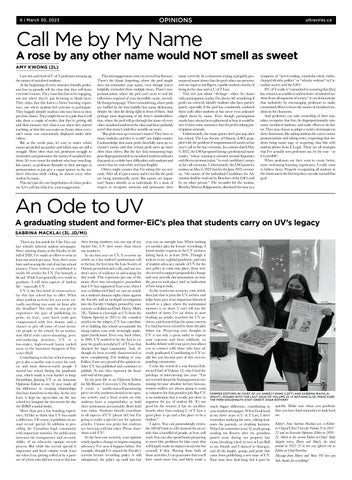
FORMER EDITORS-IN-CHIEF OF UV, ANNECY PANG (LEFT) AND SABRINA MACKLAI (RIGHT), POSING WITH THE LAST ISSUE OF VOLUME 23. IF NOTHING ELSE, MAKE SURE THE FREE DOUGHNUTS STAY! CREDIT: SHAE ROTHERY
much bigger difference, contributing to your student newspaper. When I look back at my three years at U of T Law, I don’t remember studying for torts, editing footnotes for journals, or drafting factums. What I do remember is my 1L study group sending me flowers after my grandma passed away during our property law exam, breaking a heel (or two) at Law Ball as my friends and I danced to bhangra, and all the laughs, gossip, and pride that came from publishing a new issue of UV. Your time here feels long, but it goes by
quickly. Make sure when you graduate that you have fond memories to look back on. Editor’s Note: Sabrina Macklai was co-Editorin-Chief of Ultra Vires for Volume 23 in 2021– 22 and an Associate Opinions Editor in 2020– 21. Much to the current Editor-in-Chiefs’ likely chagrin (sorry, Harry and Shae!), she stuck around in 2022–23 in her very official role as Editor-in-Chief Emeritus. Message from Harry and Shae: We love you Sab, thanks for everything!