F 26
LEAVING A MARK ON IDAHO A U of I graduate paints her way across the state
CONTENTS HWHI F 26
The university’s standing as a respected institution of higher education was affirmed in 1908 when the nation’s premier landscape architects, the Olmsted Brothers of Massachusetts, developed a master plan for U of I that complemented the newly completed Administration Building. A yearslong effort to honor U of I’s architectural and cultural heritage has brought the Moscow campus one step closer to recognition as a historic district on the National Register of Historic Places. Read the story on page 34.
34
MORE THAN BRICK AND STONE A historic district nomination could make U of I’s Moscow campus Idaho’s only higher education institution recognized on the National Register of Historic Places.
In every issue
2 FROM THE
PRESIDENT
4 GEMS 12 BRIEFS 39 ALUMNI Class Notes In Memoriam Future Vandals Marriages
Front cover Professional artist Mikaela Herrick ’23 has “Vandalized” prominent structures across Idaho, including this boathouse on Lake Coeur d’Alene. Melissa Hartley
Back cover
6
BUILDING AN AI LEGACY Strategic investments in leadership, data systems and education position U of I to lead in the rapidly evolving world of AI.
8
VANDALS UPGRADE THE INTERNSHIP MODEL An innovative internship model combines targeted AI training with hands-on industry projects.
10
18
TAKING INNOVATION TO MARKET U of I inventors leave the lab for the World Ag Expo, where conversations with growers help shape the future of their innovations.
22
A GLOBAL CLASSROOM A new online course connects scientists worldwide to improve understanding and management of diseases spread by mosquitoes, ticks and other organisms.
THE ROBOT IN THE ROOM
23
U of I is among the first programs in the nation to use AI-powered robots to observe, support and train future teachers.
An art graduate is painting Vandal pride on barns, boathouses, grain bins and other landmarks across the state.
LEAVING A MARK ON IDAHO
14
26
The online environmental science master’s program allows students to conduct research in their own communities while advancing their careers.
A customized path through Idaho Law helps one graduate combine engineering, military service and legal training for a career in nuclear law.
A DEGREE WITH REACH
16
TRAINING THE ARCHITECTURAL EYE A student researcher uses generative AI to transform how students study, compare and interpret architectural designs.
Students walk down the steps in front of the Niccolls Home Economics Building at U of I. Garrett Britton
SIGN UP FOR THE ONLINE MAGAZINE Online subscriptions reduce waste and save money. Email advserv@uidaho.edu to opt out of the print edition and get the online magazine delivered to your email inbox. Read it online at uidaho.edu/ui/current-hwhi-magazine.
CHARTING UNCOMMON TERRITORY
32 HELPING IDAHO SOLVE PROBLEMS UI Extension puts university research to work for Idahoans, continuing a 116year tradition of service.
36
REIMAGINING RURAL LIFE Architecture and design students bring fresh ideas to Bovill, helping residents visualize modernization and resilience-based updates.
FROM THE PRESIDENT
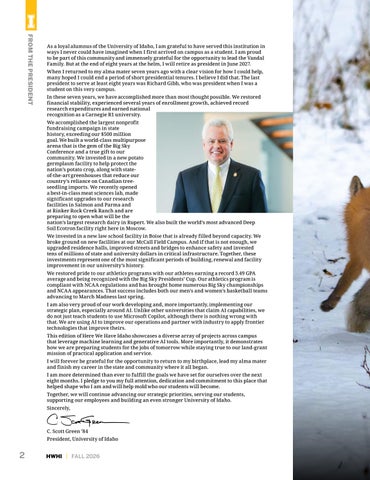
As a loyal alumnus of the University of Idaho, I am grateful to have served this institution in ways I never could have imagined when I first arrived on campus as a student. I am proud to be part of this community and immensely grateful for the opportunity to lead the Vandal Family. But at the end of eight years at the helm, I will retire as president in June 2027. When I returned to my alma mater seven years ago with a clear vision for how I could help, many hoped I could end a period of short presidential tenures. I believe I did that. The last president to serve at least eight years was Richard Gibb, who was president when I was a student on this very campus. In these seven years, we have accomplished more than most thought possible. We restored financial stability, experienced several years of enrollment growth, achieved record research expenditures and earned national recognition as a Carnegie R1 university. We accomplished the largest nonprofit fundraising campaign in state history, exceeding our $500 million goal. We built a world-class multipurpose arena that is the gem of the Big Sky Conference and a true gift to our community. We invested in a new potato germplasm facility to help protect the nation’s potato crop, along with stateof-the-art greenhouses that reduce our country’s reliance on Canadian treeseedling imports. We recently opened a best-in-class meat sciences lab, made significant upgrades to our research facilities in Salmon and Parma and at Rinker Rock Creek Ranch and are preparing to open what will be the nation’s largest research dairy in Rupert. We also built the world’s most advanced Deep Soil Ecotron facility right here in Moscow. We invested in a new law school facility in Boise that is already filled beyond capacity. We broke ground on new facilities at our McCall Field Campus. And if that is not enough, we upgraded residence halls, improved streets and bridges to enhance safety and invested tens of millions of state and university dollars in critical infrastructure. Together, these investments represent one of the most significant periods of building, renewal and facility improvement in our university’s history. We restored pride to our athletics programs with our athletes earning a record 3.49 GPA average and being recognized with the Big Sky Presidents’ Cup. Our athletics program is compliant with NCAA regulations and has brought home numerous Big Sky championships and NCAA appearances. That success includes both our men’s and women’s basketball teams advancing to March Madness last spring. I am also very proud of our work developing and, more importantly, implementing our strategic plan, especially around AI. Unlike other universities that claim AI capabilities, we do not just teach students to use Microsoft Copilot, although there is nothing wrong with that. We are using AI to improve our operations and partner with industry to apply frontier technologies that improve theirs. This edition of Here We Have Idaho showcases a diverse array of projects across campus that leverage machine learning and generative AI tools. More importantly, it demonstrates how we are preparing students for the jobs of tomorrow while staying true to our land-grant mission of practical application and service. I will forever be grateful for the opportunity to return to my birthplace, lead my alma mater and finish my career in the state and community where it all began. I am more determined than ever to fulfill the goals we have set for ourselves over the next eight months. I pledge to you my full attention, dedication and commitment to this place that helped shape who I am and will help mold who our students will become. Together, we will continue advancing our strategic priorities, serving our students, supporting our employees and building an even stronger University of Idaho. Sincerely,
C. Scott Green ’84 President, University of Idaho
2
HWHI | FALL 2026
Here We Have Idaho The University of Idaho magazine Fall ʼ26 Executive Director, U of I Alumni Association Vicki Sell ’89
Alumni Association President Erin Jessup ’05, ’10
University of Idaho Foundation Chair Clint Marshall ’97
University of Idaho Foundation CEO Ben McLuen
Managing Editor Jodi Walker
Editor
Joy Bauer ’98
Designer
Hannah Kroese ’08
Stories
Ralph Bartholdt Caiti Bobbitt David Jackson ’93 John O’Connell Danae Lenz Todd Mordhorst Jodi Walker
Photos
Idaho Visual Productions Garrett Britton Melissa Hartley Leah Reitcheck Rio Spiering Hannah Ruth Pettyjohn
Illustrations
Noah Kroese ’04
For detailed information about federal funding for programs mentioned in this magazine, see the online version of the relevant story at uidaho.edu/ui/currenthwhi-magazine. University of Idaho is an equal employment opportunity employer, including veterans and individuals with disabilities. © 2026, University of Idaho Here We Have Idaho magazine is published twice per year. The magazine is free to alumni and friends of the university. University of Idaho has a policy of sending one magazine per address. To update your address, visit uidaho.edu/alumni/get-involved or email alumni@uidaho.edu. Contact the editor at UIdahoMagazine@uidaho.edu.
A pair of red foxes play in Shattuck Arboretum. Photo by Leah Reitcheck
3
Here are some shining examples of U of I’s impact
NEWS
and excellence.
GEMS FALL ’26
Read more articles at
1
uidaho.edu/newsroom or follow University of Idaho on FACEBOOK, INSTAGRAM and X.
$1.87
Jane Vandal, U of I’s AI chatbot, provides prospective students with answers to their questions — even after hours and on weekends.
million
raised during Vandal Giving Day 2026, surpassing the previous record by 45%.
Thank you for your generosity!
3
Artificial intelligence degree pathways
launching this fall, including a bachelor’s degree and two graduate degree options.
4
HWHI | FALL 2026
1
No.
U of I has been named the Best Value Public University in the nation by U.S. News & World Report.
Years since Joe Vandal became a Vandal icon. He celebrated his 70th birthday on Sept. 22.
12,750 square feet Size of the Meat Science and Innovation Center Honoring Ron Richard, dedicated in April to support Idaho’s growing beef industry.
No. 2
1,330
Bachelor’s degrees awarded during Spring 2026 Commencement.
$2.7 $2. 7
MILLION
Department of Defense award supporting U of I research into how mosquitoes and ticks communicate at the cellular level, advancing new approaches to pest management.
Ranking of U of I’s Special Collections and Archives among Idaho’s largest archival repositories, behind only the Idaho State Archives in Boise.
18
Students in the inaugural Microchip Engineering and Security Alliance cohort, a partnership with Hiroshima University in Japan that provides international experience and career preparation in semiconductors, artificial intelligence and energy. Read more on page 13.
$6 million
125 YEARS
since the College of Agricultural and Life Sciences was established to advance agricultural innovation, education and research in Idaho.
Grant supporting U of I-led research to breed stronger, higher-yielding cereal crops that withstand damaging winds and environmental stress.
5
FEATURE
BUILDING AN
AI
LEGACY
U of I builds leadership and infrastructure to support emerging technology Story by Jodi Walker Illustrated by Noah Kroese
6
HWHI | FALL 2026
V
andals don’t do anything halfway. Determination drives them to push boundaries, lead innovation and, as President Scott Green likes to say, “punch above our weight.”
manage a fast-moving technology that often draws public criticism.
Even before the recent wave of artificial intelligence breakthroughs dominated headlines, University of Idaho leadership invested in systems that positioned the university to fully embrace AI capability.
Hunter said he receives a lot of questions from employees about how and when to use AI. Some have jumped headlong into the technology, while others are wary.
“Unrelenting nerdiness.” That’s how Barrie Robison, director of the Institute for Interdisciplinary Data Sciences (IIDS), explains the early development of an AI-driven workflow tool that streamlined grant administration at U of I. The Vandalizer, as this tool was aptly named, quickly garnered interest from more than 100 universities nationwide.
“I know some people who are going to hate it,” he said. “But it is our job, as leaders, to show the positive use of the technology — to enhance research and advance medical breakthroughs. We are being thoughtful about this. We want to lead ethically.”
U of I’s collaboration with Idaho National Laboratory and access to its Falcon supercomputer showed U of I leaders what is possible with enormous computing power, leading to their investment in IIDS. “We were a bunch of nerds focused around supercomputing,” Robison said. “That was a deliberate institutional priority. When AI hit, we all started tinkering. That tinkering put us in the position to keep going. It wasn’t long before we realized AI could do real things.” The researchers quietly investigated, experimented and ultimately built an AI tool that has already increased efficiency, created cost savings and earned national recognition. A $4.5 million National Science Foundation grant not only helped fund the work but also provided the structure to keep the team focused on developing a tool with practical applications. Quantifying the savings can be staggering. Tasks that once took 20 minutes now take 20 seconds. Do that several hundred times a month and the results add up.
Foundation for success Establishing leadership to guide the implementation of a new technology is pivotal to its success. Enter Ben Hunter, dean of U of I Libraries, chair of the U of I AI Working Group and an advocate for responsible AI use. Named chief data and AI officer this summer, Hunter is the yin to the Office of Information Technology’s yang, Vice President of IT Dan Ewart. Hunter oversees the university’s data strategy, AI governance, analytics and institutional modernization. Ewart leads technology and infrastructure, including cybersecurity, universitywide systems and the technical foundation necessary to support AI-enabled strategies. Together, they provide the oversight and structure needed to
“The goal is not to replace people,” Ewart said. “We want people to be able to do what we hired them to do.”
Leading with purpose is part of that. Planning for the future means planning for AI, which is reflected across all five pillars in U of I’s 2026-30 Strategic Plan. “We must make this a priority. If we don’t engage from the beginning, we will be left behind and that is not what Vandals do,” Green said. “We are leading the way and we are making sure our students enter the workforce ready to build the tools industry needs to solve problems.”
Not just technology U of I has long led in cybersecurity training. But the flood of AI capabilities tests the security of U of I systems and data every day. What information can and should be put into a large language model? How can research be conducted while keeping data secure? U of I has not only invested in building the technology but also in data sovereignty — the ability to safely store data within its own ecosystem. That foundation is critical to realizing AI’s full potential. Training and adoption come next. Hunter convened a faculty boot camp for a cohort of early adopters who worked together to explore how to use and teach AI. U of I developed a bachelor’s degree, two master’s degree paths and several certificates, all of which launch this fall. These programs teach students not only how to use AI but how to build it. “We aren’t just teaching Copilot here,” Green said, referring to a Microsoft AI assistant that helps users complete tasks. “We are building AI tools to solve real problems. Students here will be part of that.” The technology is evolving quickly and the possibilities are endless. U of I remains committed and focused on developing impactful AI tools and educational paths. “This is not just about the technology,” Robison said. “What matters to me is when it makes a difference for a person.”
7
FEATURE
VANDALS
UPGRADE THE INTERNSHIP MODEL
A new internship experience combines AI education with hands-on industry training Story by Todd Mordhorst Photo by Garrett Britton
A
s interns at Profit Recovery Partners (PRP) this summer, Aaron Guevara ’26 and Syed Sakib set out to eliminate timeconsuming tasks for their colleagues. A University of Idaho boot camp equipped them to meet the challenge of streamlining PRP’s paperworkprocessing system. Before arriving at PRP in Santa Ana, California, in late May 2026, Guevara and Sakib piloted a new internship training model. They spent two weeks on the Moscow campus working under the guidance of U of I employees. Dan Ewart, U of I’s vice president of information technology and chief information officer, worked with PRP leadership to understand the company’s needs and relay them to U of I’s team of AI experts, who helped prepare the students for the project. “Once we had PRP’s buy-in and selected the students, we rapidly set up a boot camp, which was the first stage of the internship,” Ewart said. “They worked
8
HWHI | FALL 2026
with U of I employees and learned the tools that they needed to do the AI coding. They went through a business process analysis and then worked with the Institute for Interdisciplinary Data Sciences (IIDS) team on real-world automated projects. They quickly proved they were ready to take on the internship.” After the rigorous training, Guevara and Sakib headed to Orange County. By day two on the job, they were exploring solutions to PRP’s paperwork dilemma. The company works with businesses across the country to reduce expenses, saving clients more than $11 billion since its founding 30 years ago. PRP receives large volumes of data from hundreds of clients each month, all of which must be collected, organized and formatted correctly. “They get a lot of raw data from clients and they have to conform it,” said Guevara, who earned his bachelor’s degree in cybersecurity in May. “Right now, they’re entering data by hand. We’re making an agentic AI-enabled app so that clients can put in data and then it comes out in a formatted table.” Agentic AI systems are designed to analyze information, make decisions and complete tasks with minimal human intervention. By automating
Syed Sakib (left) and Aaron Guevara ‘26 hit the ground running for their internship at Profit Recovery Partners after spending two weeks in an AI boot camp under the tutelage of U of I employees.
a complex, time-consuming process, the app could save PRP employees hours of manual work.
software for. They’re also building experience dealing with budgets and timelines.”
Sakib said the two-month internship required climbing a steep learning curve, but their prep work at U of I set them up for success.
Outside the PRP office, Sakib and Guevara roamed the scenic beaches minutes from their apartment in Costa Mesa and sampled the area’s many restaurants. They return to campus this fall with new excitement for their studies.
“The biggest challenge was understanding the data and their whole process,” said Sakib, a doctoral student in computer science from Bagerhat, Bangladesh. “With my academic work, we handle a lot of data, but it’s already clean. With this internship, we’re getting our hands on actual data, and it is very noisy, so we come up with real solutions. This experience will be very helpful in my career, as well as my research.” Colin Addington, senior projects manager for IIDS, guided the interns through their on-campus training, where they learned how to filter datasets and extract only the necessary information. “We’re all trying to do more with less, and PRP’s proposal was a great opportunity for our students to gain industry-based experience with coding tools,” Addington said. “They’re getting exposed to things like standard software development life cycles and learning how to speak to a client you’re developing
“This internship is an amazing opportunity, and using real-world AI like this is a really cool experience to have under my belt,” said Guevara, who is beginning work on his master’s degree in cybersecurity at U of I. “I’m really excited to see what we cook up for my graduate research.” After seeing the initial cohort of two thrive, Ewart envisions using the boot camp approach as a model for future internships. “The goal was always to make this a repeatable, scalable process,” Ewart said. “Now, we can go out to any business or organization and show them this model. Bringing on interns adds value to these companies, and the students gain tremendous experience. That’s our whole job as a university.”
9
FEATURE
THE
ROBOT
IN THE ROOM U of I adopts AI-driven tools to observe and support student teachers Story by John O’Connell Photo by Hannah Ruth Pettyjohn
H
aving an artificial intelligence-assisted robot as a teacher’s aide has its perks.
University of Idaho agricultural education major Kaycie Thuerer often turned to her M2 unit for help with classroom tasks, including setting timers for classroom activities, while student teaching in Spring 2026 at Mackay High School in Idaho’s Lost River Valley. Her M2’s access to knowledge also helped Thuerer nail down details about incubating emu eggs for a lesson. But classroom assistance is a secondary benefit of the technology. The primary reason U of I’s Department of Agricultural Education, Leadership and Communications (AELC) acquired a pair of the robots was to observe student teachers in action and give them data-informed feedback to help them improve their teaching performance. While M2s have been used in U.S. classrooms for a couple of years as teaching aids, AELC is among the first programs in the country to pilot them as tools for observing, evaluating and training aspiring teachers. Manufactured by Swivl, the M2 robots stand about 2.5 feet tall and feature an anthropomorphized display screen with blinking digital eyes mounted on
10
HWHI | FALL 2026
a mobile stand. The units record high-quality audio and video and autonomously follow the movements of the teacher, who wears a small tracking device. Beyond recording lessons, the robots can display text for visual learners, translate instructions into several languages, divide a class into small groups, assign writing prompts and monitor classroom engagement to flag when student attention begins to wane. The robots are preprogrammed with a body of teaching knowledge, and AELC has updated them with its own program content and standards, enabling M2s to offer feedback similar to what department instructors provide. They have also been trained to emphasize the importance of hands-on activities, which are the hallmark of agricultural education. “They offer additional help and support that’s very similar to us being there,” said Kasee Smith, an associate professor in AELC. “And the recording quality is wonderful, so it allows us to virtually join classrooms rather than having to be there in person.” Travel savings made possible by relying on M2s are significant, given that the program places
student teachers in schools throughout the West. Prior to using the robots, AELC faculty traveled twice per semester to observe each student teacher in person. The M2s now cover one of the two observation periods. “If we can use a robot for one of those visits and keep that relationship with the student intact during the other visit, I think it really helps a young teacher feel like someone has looked out for them,” Smith said. “Is this a good enough solution? That’s the question we’re asking ourselves. I personally prefer to be on site, but this has impressed me more than I thought it would.” The department purchased the robots in 2025 and spent that fall testing them. AELC used them as teaching assistants for fall courses to allow agricultural education students to become familiar with the technology before using it in classrooms. The first eight AELC students to use M2s as teaching aids and for classroom observations recently concluded their student teaching assignments.
Thuerer found her M2’s observations on her teaching performance helpful. “I liked the feedback because I have a really hard time with self-analyzing,” Thuerer said. “I remember reading some of its reflections and thinking, ‘This thing is right.’” Thuerer was less impressed by M2’s contributions as a teacher’s assistant, finding its suggestions were too vague and did more to distract the class than advance the lesson. AELC students using M2s at schools with limited bandwidth also reported connectivity challenges. In addition to M2s, AELC has developed an AI chatbot, called Ag Ed Expert, designed to help student teachers develop curriculum and to answer their course-related questions. Smith considers M2s a physical embodiment of the chatbot. “Our hope is to find funding for additional robots,” Smith said. “We do think they make a difference.”
Kasee Smith, an associate professor in the Department of Agricultural Education, Leadership and Communications (AELC), poses with an M2 robot. AELC is using the M2 units to observe student teachers in action and provide data-informed feedback.
11
BRIEFS
Luke Sheneman, director of research computing and data services at U of I. Researchers statewide can access Lemhi remotely using their university credentials, allowing them to complete computing tasks in hours or days that might otherwise take weeks or months on a standard computer. The partnership builds on the universities’ use of Falcon and extends the value of INL’s major investments in advanced computing by making resources available for academic research. “Scientific computing and artificial intelligence are critical enablers of Idaho’s leadership in research and engineering,” said Eric Whiting, senior advisor of scientific computing and AI at INL. “University access to capable computer systems such as Lemhi will continue to elevate Idaho’s scientific reputation and create positive impacts for both the state and INL.”
Lemhi, a supercomputer housed at Idaho National Laboratory’s Collaborative Computing Center in Idaho Falls, provides highperformance computing resources to researchers at U of I, Boise State University and Idaho State University.
Supercomputer expands research capabilities statewide Story by Danae Lenz A powerful supercomputer is expanding highperformance computing for researchers across Idaho through a partnership between Idaho National Laboratory (INL) and the state’s public research universities. The system, known as Lemhi, serves researchers at University of Idaho, Boise State University and Idaho State University. It replaces the Falcon supercomputer, delivering faster performance and improved efficiency for research in fields including artificial intelligence, energy systems, engineering, health sciences and natural resources. “Access to this level of computing helps us attract top faculty and graduate students, compete for federal research funding and tackle problems we could not address without this kind of infrastructure,” said
12
HWHI | FALL 2026
U of I partnership aims to expand physician training in Idaho Story by Caiti Bobbitt University of Idaho is advancing a new medical education partnership aimed at expanding physician training in Idaho and strengthening the state’s physician workforce, particularly in rural and underserved communities. Following approval by the Idaho State Board of Education, U of I and the Spencer Fox Eccles School of Medicine at the University of Utah entered into an agreement to begin developing an undergraduate medical education program in the Treasure Valley. “This initiative represents an exciting opportunity for Idaho to expand medical student education right here at home,” said Rayme Geidl, interim co-director of U of I’s School of Health and Medical Professions. “By building another strong partnership and training students in Idaho communities, we can help meet the state’s growing need for physicians.” The initiative builds on U of I’s decades of experience educating future physicians through Idaho WWAMI, a partnership with the University of Washington School of Medicine. The proposed program with University of Utah would complement Idaho WWAMI and expand the number of students who can receive medical training in the state. If fully approved, the new program would enroll Idaho residents, with classroom instruction and
The program is open to students worldwide and responds to growing demand for electrical engineers, particularly in fields related to microchips, artificial intelligence and energy systems. Its structure and cost may be especially attractive to nonresident and international students, while donor-supported scholarships will help offset costs for Idaho students. Industry estimates show more than 1 million semiconductor-related jobs will need to be filled worldwide by 2030. Idaho WWAMI students receive medical training at U of I, which is building on more than 50 years of medical education experience through a new partnership with University of Utah.
most clinical rotations taking place in Idaho. Students would commit to practicing medicine in the state for at least four years after completing residency or repay the state’s investment in their education. The partnership follows legislation passed in 2025 directing the state to pursue additional opportunities for medical student training. The proposed program remains subject to additional approvals.
U of I, Hiroshima University launch global engineering pathway Story by Danae Lenz
“We don’t have enough electrical engineers to meet the demand for technologies like AI and semiconductor production,” Long said. “This program is one way we can help close that gap.” MESA builds on a decades-long relationship between the two universities — one that began in the aftermath of World War II. In 1951, Hiroshima University President Tatsuo Morito asked institutions around the world for help rebuilding after the atomic bombing. U of I was one of only a handful of U.S. institutions to respond. Forestry Professor Merrill Deters sent tree seeds, a book on forestry and a $3 donation. That early act of goodwill has grown into an academic collaboration focused on education, exchange and shared learning, with MESA creating new opportunities for students while helping meet workforce demands.
University of Idaho students now have the opportunity to spend two years studying electrical engineering in Japan before completing their degrees in Moscow through a new partnership with Hiroshima University. The Microchip Engineering and Security Alliance (MESA) creates a four-year degree pathway designed to prepare students for careers in the semiconductor, artificial intelligence and energy industries. “MESA is a powerful partnership, connecting handson experiences in U of I’s state-of-the-art fabrication, manufacturing and artificial intelligence laboratories with Hiroshima’s deep technological knowledge in materials and device engineering,” U of I College of Engineering Dean Suzie Long said. The first MESA cohort began in August. Students will spend their first two years studying in English at Hiroshima University before transitioning to U of I’s Moscow campus. They will be U of I students throughout the program, receiving university support while studying in Japan.
Hiroshima University hosts U of I students for the first two years of the new Microchip Engineering and Security Alliance degree pathway before students complete their degrees in Moscow.
13
FEATURE
A DEGREE WITH REACH U of I’s online Master of Science in environmental science empowers students to study while working in the field Story by Ralph Bartholdt Photos courtesy of Jacob Cheeseman, Elizabeth Van Camp and Charlee Musiakiewicz
A
s a 20-year-old cadet, Jacob Cheeseman was aboard a U.S. Coast Guard cutter that seized 5,000 pounds of cocaine.
Cheeseman steered the ship in the waters off San Diego during the operation that netted drugs valued at $78 million. He said the action made him proud to belong to a team that helps make a difference. These days, Cheeseman is still in the “make a difference” business. As part of an online University of Idaho graduate environmental science program, the U.S. Coast Guard lieutenant plans to earn a master’s degree while researching how long industrial pollutants remain toxic to humans after being released into the environment during emergency incidents. “It’s important to me to create public awareness around some of these potentially toxic chemicals that pollute, either on land or in the ocean, following spills across the country,” he said. U of I’s Master of Science in environmental science caters to students from across the globe who want to earn graduate degrees but can’t attend courses on campus. It attracts students with a wide array of professional goals in areas such as waste management, environmental pollution, policy and law, water science, land use and energy systems, as well as natural history and ecology. Cheeseman belongs to a Coast Guard hazardous materials crew, leading a team that responds to spills and similar incidents. Through the online master’s program within the College of Natural Resources, he will earn a degree tailored to his interests. “Idaho is known for its online environmental science program,” he said. “There aren’t a lot of these programs out there, so University of Idaho is leading the way.” Another student in the U of I program, Elizabeth Van Camp, collects waterborne DNA in the estuaries of Milan Bottoms, Illinois. Her water samples are tested in a lab to determine the presence of
14
HWHI | FALL 2026
Blanding’s turtles, a native species whose habitat is threatened by large-scale construction along the Mississippi River. On the Atlantic seaboard in Beach Haven, New Jersey, Charlee Musiakiewicz shows people how to catch blue crabs in wire mesh traps called pots. Her master’s project includes developing a middle school curriculum around Atlantic Coast crustaceans that she will use in the classroom when she becomes a teacher. “These environmental science projects are standard for our students, whose interests are often in their home region and who want to make a difference in their communities,” said Professor David Roon, the assistant director of the environmental science program. The graduate program has a thesis option, which must be completed on the Moscow campus, and a nonthesis option for online students. Roon, who has taught the online program for three years, said its success is due in part to its flexibility. “The online master’s program is very studentcentered and allows students to choose both classes and project options in a way that supports their unique goals and professional objectives,” he said. “This structure ensures that the degree is both focused and rigorous, but it also gives students enormous leeway to select courses that align with their personal journey as a scholar.” Since elementary school, Van Camp, who lived along the Mississippi River, has loved learning about the swamp, muck and animals found in the big river’s estuaries. She earned a social science degree, worked in the medical field, participated in research projects and led nature groups in her time off. She first encountered Blanding’s turtles through her work as a nature tour guide in the estuaries. “I knew I wanted to be more involved in environmental education and research,” she said.
Learning whether Blanding’s turtles will be affected by future developments is consistent with her academic goals. “I wanted to do research in biology, but more on the environmental side,” she said. “When I heard about the commercial development in the wetlands, my objective was to make sure that Blanding’s turtles are protected.” Musiakiewicz’s interest in aquatic life was piqued in a seventh-grade marine science class. Growing up along the Atlantic where she caught blue crabs for the family table and started her own business teaching others to catch them — from cutting bait to setting crab pots — she realized many people on the East Coast knew very little about the ocean’s crustaceans.
Charlee Musiakiewicz
Musiakiewicz, who earned a teaching degree with a science emphasis, will use U of I’s Master of Science in environmental science to develop a curriculum to teach students about marine life. “Everything I do revolves around marine biology, and I wanted my master’s so I could be better informed,” she said. “This idea of starting an afterschool program to teach about marine life is really what I am focused on for my graduate school project.” Roon said scores of students have graduated in environmental science during his tenure and gone on to advance their careers in environmental fields, including one student who worked as a marine guide in the Galápagos Islands when she enrolled at U of I. The student parlayed her master’s work into a research position in Hoi An, Vietnam, running marine conservation projects. Another student, an Alaska Native, focused her project on the water quality impacts of the TransAlaska Pipeline System. “For her, the master’s degree was a pathway to greater job security and mobility,” Roon said.
Elizabeth Van Camp
She later used the credential to further her career within an environmental agency in Alaska. As a professor in the program, Roon provides logistical help — mentoring students as they select classes, build a study plan and complete project requirements. Through one-on-one meetings with each person, he helps them define and refine their goals for the master’s degree and identify professors to oversee their projects. Van Camp said she chose the U of I program because it checked all the boxes: it was online, rigorous and research-oriented, with a lot of one-on-one mentoring. Cheeseman considers the program the top online master’s in the nation. It also made the No. 1 slot on Musiakiewicz’s list. Jacob Cheeseman
“It was my first choice, so as soon as I got accepted, I quit looking,” she said.
15
Arshia “Ash” Alizadeh Moghadam ’26
FEATURE
TRAINING
THE ARCHITECTURAL
EYE Research project uses AI to give students a new way to study, compare and interpret design Story by David Jackson ’93 Photos by Garrett Britton
16
HWHI | FALL 2026
I
n his early days as an architecture student, Arshia “Ash” Alizadeh Moghadam ’26 sometimes struggled to identify architectural styles in images.
His 2025 project through the Office of Undergraduate Research’s Summer Undergraduate Research Fellowship program explored whether artificial intelligence could help other architecture students sharpen those skills. Working with Lori Smithey, an assistant professor in the College of Art and Architecture, Moghadam used generative AI to create a composite image combining four architectural styles. Smithey is studying how such images could be used as a teaching tool. “I feel like you learn more from seeing multiple designs in one image,” Moghadam said. “Creating this image was like putting a puzzle together. The hope is that students can deconstruct the puzzle and identify the individual design elements.”
Intelligent design Smithey wanted to investigate using AI to blend architectural styles to help students engage more deeply with architectural history and invited Moghadam to collaborate with her. “Traditionally, analyzing images in architecture history meant showing two slides next to each other and asking students to compare and contrast them,” Smithey said. “I thought this might be an interesting way to take a step into generative AI and see if studying a composite image would help students develop deeper analytical skills.” After they researched the best ways to approach the project, Moghadam began his initial attempts. He quickly realized, however, that no matter how specific he was with the prompts, the resulting images were underwhelming. “Whenever I gave it just two images, the results ended up being mostly one design with just a few small differences,” Moghadam said. “I needed an image with more examples.” After several attempts, he obtained better results using four photos to create his composite. “When I started using four images, it produced more of what I hoped,” he said. “A structure that didn’t look mashed together but showed equal representation of each photo and had very visible design features.” Moghadam presented his results, including the blended image, at the Idaho Conference on Undergraduate Research in 2025.
Moghadam prompts his AI-powered application with examples of four distinct architectural styles to create an image that incorporates pieces of each style.
Putting AI in architecture Moghadam’s research confirmed Smithey’s idea about the use of AI in architecture. “There are some areas of architecture where AI likely won’t do a great job because the ideas are too complex,” Smithey said. “But I think Ash’s project is unique in that we’re using it as a tool to discuss history and help students develop their skill set.” She integrated some of Moghadam’s composite images into her course during the Fall 25 semester — not to replace traditional slides but to supplement them and encourage students to analyze rather than memorize. Smithey presented her research, including Moghadam’s work, at the Association of Collegiate Schools of Architecture’s research conference on AI design practices in 2025. “In a class where we are lecturing, students are sitting back and receiving information,” Smithey said. “When Ash and I discussed the images he created, we weren’t just identifying features; we were having a conversation about what we saw. It opened up the possibility of using these composites not just to teach architectural vocabulary, but to engage students in visual analysis, interpretation and critique. That’s central to developing visual literacy.” Moghadam’s work also helped Smithey imagine future assignments in which students might generate their own AI composites, deepening their understanding through creative experimentation. “AI is rapidly developing, and we’re still testing out its place in the field — what it is and isn’t good for,” she said. “But the results really depend on what the student brings to the project. Students are the creative, human, critically informed part of architecture.”
17
FEATURE
TAKING INNOVATION
Associate Professor Jae Ryu (left), of the College of Agricultural and Life Sciences, is one of the U of I researchers who attended the World Ag Expo in Spring 2026.
18
HWHI | FALL 2026
Associate Professor Matthew Swenson, of the Mechanical Engineering Program, explores equipment and speaks with vendors during the World Ag Expo.
TO MARKET
Each year, the World Ag Expo in Tulare, California, brings together more than 1,200 exhibitors and 100,000 attendees from around the world for education, networking and business opportunities.
Vandal researchers gather insights from farmers and industry professionals at World Ag Expo to shape the future of their inventions Story by Ralph Bartholdt Photos by Garrett Britton
19
M
atthew Swenson has a product. He also has a patent on that product.
To learn how marketable his product is, without revealing what it is, Swenson recently went undercover — sort of. The associate professor of engineering was among a group of U of I researchers with patented products — or inventions seeking patents — who attended the World Ag Expo in February 2026 in Tulare, California. He visited the expo to chat with product manufacturers, fellow inventors, developers and other visitors at the event, which resembles a giant state fair. Swenson and his fellow U of I professors are affiliates of the National Science Foundation (NSF) Invention Corps, or I-Corps, an entrepreneurial training program that helps scientists and engineers identify potential markets for their patented NSF-funded research products. What they and some of their students were doing at the expo is called customer discovery — an investigative process and a step on the path to commercialization. The World Ag Expo is the world’s largest annual outdoor agricultural exposition, boasting over 1,200 exhibitors and a yearly attendance of more than 100,000 people, so it was a good place to start. “To determine if there is a potential market for the product we’ve invented, we’re basically wandering around the show talking to as many people in the field as we can to understand whether they have pain
It’s actually good every once in a while to step outside, touch the grass and talk to humans, not just computers. DAVIS ONYEOGUZORO, DOCTORAL STUDENT, U OF I COEUR D’ALENE
points that the product we’ve developed potentially addresses,” Swenson said. The professors with patents weren’t showing their inventions, pitching them or even talking about the products they developed.
Ryu learns about drone application systems from a vendor at the expo.
20
HWHI | FALL 2026
“We were just getting people in the field to talk about their experiences to ascertain whether we have a solution that could help them, without ever telling them about the solution,” Swenson said. Archibald Harner, U of I’s assistant vice president for research and director of the NSF I-Corps Hub for the region, said it’s important for the university to send researchers to events like the expo to learn about market trends and needs. Their products are intended to benefit agricultural producers directly by making operations more efficient and cost-effective. “Most scientists are trained in research and discovery, not in market analysis or business development,” Harner said. “Without guidance on how to identify a customer base or scale a prototype, many inventions would simply remain as patents on a shelf rather than becoming products that benefit the public.” The I-Corps program requires professors to carry out their customer discovery requirements, said Mary Everett, associate director of the Center for Intelligent Industrial Robotics at U of I Coeur d’Alene. Her group’s invention, the Sensor Collection and Remote Environment Care Reasoning Operation (SCARECRO), is a data-collection station that can be placed in a farm field — like a scarecrow — to monitor growing conditions. It’s fitted with a series of sensors to track information on soil moisture, temperature and humidity. The system can be accessed remotely, allowing growers to assess crops and fields from a distance. “We talked to farmers and technology providers about how technology is used in the agricultural space — what it’s good for, where it’s being used, what people would like to see and where the industry is going,” Everett said. “We plan to use the insights from those conversations to help improve the wireless sensor network technology we’re developing.”
More than 130 patents and plant variety protection certificates — including protections for potato and wheat varieties — have been filed on behalf of U of I during the past 20 years. Although plant varieties took a front seat early on, technology patents have surged in recent years, Harner said. “Since 2022, there has been a distinct shift toward computer science, robotics and advanced medical devices,” he said. “There is a consistent trend of partnership with the Idaho National Laboratory, specifically in nuclear reactor safety, flow meters and cyber-physical state awareness.” Not only did students and professors learn what farmers needed at the expo, but the trip gave them a chance to stretch their legs. “It’s actually good every once in awhile to step outside, touch the grass and talk to humans, not just computers,” Onyeoguzoro said. Thirty-eight U of I teams have completed the I-Corps program since 2023. Swenson said attending the expo as part of the NSF I-Corps program was a valuable and necessary step in determining whether their products would fill a genuine market need. “The research and invention part is already done,” he said. “The question is, ‘Do we want to put more effort into trying to go to market with this?’ So, these conversations are really informing whether we have something that’s worth moving forward with.”
Researchers from several U of I departments attend the expo to conduct customer discovery and learn what farmers need for their operations.
Davis Onyeoguzoro, a doctoral computer science student from U of I Coeur d’Alene who is on the SCARECRO team, attended the expo to assist in customer discovery. “I learned what farmers actually need for their farms,” Onyeoguzoro said. “Most of the companies were trying to solve a water problem, and the second thing was how government regulations affect farmers and organizations.” Everett and her team are using the SCARECRO in a vineyard in Virginia and an agricultural operation in Sandpoint. “We’re interested in how it can be continuously improved and refined,” she said. “We are also looking at how to make the technology easier to set up and interact with for farmers interested in precision agriculture.”
21
FEATURE U of I researchers are using online education to connect scientists around the world, sharing expertise and advancing collaboration on the study and management of vector-borne diseases.
U of I uses online education to link scientists worldwide to improve disease understanding and management Story by John O’Connell Photo by Rio Spiering
A
new online class offered by University of Idaho’s Institute for Health in the Human Ecosystem (IHHE) shares knowledge to support scientists worldwide combating vector-borne diseases. IHHE’s course, Biology of Vector-borne Diseases, first offered in Spring 2026, features video lectures from 24 internationally recognized experts. A vector-borne disease is an illness caused by pathogens transmitted to humans or animals through the bite of an infected organism, such as a mosquito, tick or flea. The course drew 56 participants — including graduate students, postdoctoral fellows, early-career faculty and advanced professionals — from multiple countries. Many participants said they planned to apply what they learned to improve disease management and research. “I believe the knowledge gained from this course will help me contribute more effectively to surveillance, research and decision-making in vector-borne disease studies moving forward,” said Yora Permata Dewi, senior research assistant with the Emerging Virus Group in Jakarta, Indonesia. Shirley Luckhart and Edwin Lewis, both professors in U of I’s Department of Entomology, Plant Pathology and Nematology, are co-directors of IHHE, which prepares the next generation of leaders to develop solutions to complex global challenges posed by emerging and re-emerging diseases affecting plants, animals and humans. “I think the big draw for people to take this course is the expertise of the instructors,” Luckhart said.
22
HWHI | FALL 2026
All of the virtual program’s instructors previously helped teach the in-person IHHE vector-borne diseases course offered from 2018-25. Lecturers recorded 63 presentations for the online course, organized into weekly modules, along with related reading assignments. The online course takes a holistic approach to vector-borne diseases, examining the host, pathogen, vector and all facets of the environment as an interconnected pathosystem. Lewis believes researchers too often work in isolation when studying disease transmission, focusing on a single aspect of transmission while overlooking others. IHHE seeks to evaluate these issues from multiple perspectives and identify commonalities. “Someone who does public health for humans might never talk to a plant pathologist, for example,” Lewis said. “Many of the mechanisms we work with are common to different pathosystems. There are a lot of parallels, and they can use each other’s tools and approaches, but sometimes they are not aware of those tools. We try to make them more commonly known.” For example, research into arthropods has shed considerable light on human biology. “Scientists drastically improved their understanding of human immunity by studying fruit flies,” Luckhart said. The online course is offered through U of I’s Continuing Adult and Professional Education program, which provides access to a variety of learning opportunities.
FEATURE
LEAVING A
MARK ON IDAHO After earning a bachelor’s degree in studio art and design, Mikaela Herrick ’23 launched a career “Vandalizing” structures around the state with U of I’s logo.
A brush with fate led a Vandal to a thriving mural career Story by Ralph Bartholdt Photos by Melissa Hartley
23
I loved my time at U of I, and if I had not failed that first exam, I might have a completely different career. MIKAELA HERRICK ’23
M
ikaela Herrick ’23 found success as an artist before she called herself one professionally.
As a teenager in Kooskia, Herrick painted a picture of a moose that was displayed in the office of an Idaho legislator. Other paintings hung in businesses around the Clearwater Valley, where she graduated from high school as a three-sport athlete before earning academic and general scholarships to attend U of I. Although she planned to earn a business degree as a Vandal, she flunked her first business exam — a failure that changed Herrick’s degree path. It was the brush with fate that gave her a new perspective. “Since I had my education paid for, I thought I may as well study something I like,” she said. Now, as a muralist who paints the sides of barns, bars, boathouses, galleries and grain bins, often with the Vandal logo, Herrick has traveled all over the state displaying her dedication to University of Idaho and the Vandal community with her art. “I loved my time at U of I, and if I had not failed that first exam, I might have a completely different career,” she said. Herrick, who now lives in Coeur d’Alene, earned a bachelor’s degree in studio art and design with emphases in ceramics, painting and graphic design. After graduating in 2023, she fell into a job that many naysayers describe as the obvious outcome of an art degree: She worked as a barista. But her love of art kept calling.
24
HWHI | FALL 2026
“I got contracts to paint the side of houses and buildings and knew I couldn’t keep asking for weeks off from work each time I got another project, so I had to make a decision,” she said. She made the leap to full-time artist, and it has turned into a sustainable career. One large-scale project, part of her senior capstone, included painting a mural on the Prichard Art Gallery along Highway 95 in downtown Moscow. It got noticed. “I started getting calls to paint murals as far away as southeastern Idaho,” she said. On a two-story wooden farmhouse in Dubois, a town of about 600 residents along Interstate 15 in eastern Idaho, she painted the Vandal logo. “I had painted all my life but never at that scale,” said Herrick, who had to get certified as a scissor lift operator to paint the murals. After she accepted the Dubois job, the homeowner sent her pictures and measurements, and she used a computer program to create the design. “I loaded up all the paint and materials into my car and drove seven hours to the job,” she said. The mural took a week to complete.
Barns, bars, boathouses and grain bins have all served as Herrick’s canvases.
Painting at mural scale wasn’t something Herrick thought would become her bread and butter. And the job comes with its own challenges. Summer heat turns the metal canvases of shops, roofs and barns into broiler plates. “They get really hot fast, so I have to use special paints and primers,” she said. Her lack of success as a business student required her to take another swipe at learning the transaction end of being an artist. “I was taught some of the business aspects of being an artist at U of I, and I am so thankful for those lessons I learned in my classes,” she said. She is immersed in it now, and it’s still a learning process, she said. She charges by the square foot and takes into consideration the environment, climate, travel expenses and difficulty of the project. “I’ve lost money, but that’s how you learn,” she said. Art and Design Professor Delphine Keim remembers her student as multitalented. “Mikaela had her hands in everything — painting, graphic design, ceramics — all of it,” Keim said. “She had wonderful breadth.” That breadth, taken literally, can be seen in most of her recent works. She spent a week branding a boathouse on Lake Coeur d’Alene with the Vandal logo.
She was called to paint two steel-sided grain silos along Highway 26, near Gooding, which led to more jobs, such as the Vandal mural completed in the summer of 2025 along Highway 95 at Nezperce. “That’s the biggest one I’ve done so far,” she said. “It took over a month to do.” John Barnhart, senior director of Marketing and Creative Services and co-chief marketing officer at U of I, was among those who noticed Herrick’s talent for big paintings. As a means of promoting the university, Barnhart hired Herrick to “Vandalize” large, highly visible structures — barns, grain bins, buildings — in strategic locations across the Gem State. “Our Vandal Family reaches out to us to offer grain bins, barns, houses and so much more as a canvas to ‘Vandalize,’ and we’ve taken advantage of this generosity,” he said. “Mikaela is an immensely talented artist, so no matter what we throw at her, we know she will make us look good.” As a kid, Herrick was encouraged by her family to paint and draw — an aunt in Wisconsin is also a freelance artist — and she immediately found her niche with a brush and tubes of paint.
“That one was tough, even though I had done the logo many times and had a good idea of how to lay it out,” Herrick said. She often uses a giant projected image at night to paint the initial logo to scale, but projecting the image onto a boathouse that moves on a liquid surface was untenable. “It was summer and there were so many boats going by it rocked the boathouse, so it was moving constantly,” she said. “I did a lot of that by hand.” Less driven painters may have thrown up their hands at a project that required creativity, out-ofthe-box thinking and a consistent passion to get it right, said Keim. “She has a great ability to incorporate feedback, show up consistently, revise thoughtfully and see things through,” Keim said. “It’s a magical combination of drive, creative vision and genuine responsibility.” Herrick’s contract with U of I to promote the Vandal community with paint and brush keeps her busy, but she also spends time with plein air art, commissioned works, commercial projects and just fun stuff. “I wouldn’t be doing any of this if it wasn’t for the encouragement I got from my professors and the Vandal community,” Herrick said. “I am really grateful to be doing the work that I love.”
25
FEATURE Cody Harrison ’26
CHARTING
UNCOMMON TERRITORY A customized path through Idaho Law prepares one graduate for a specialized career in nuclear law Story by David Jackson ’93 Photos by Melissa Hartley
I
t makes sense that Cody Harrison ’26 would build a career related to nuclear energy. Growing up in Pocatello — about an hour from Idaho National Laboratory, where several of his family members worked as engineers — he understood the industry. Although he earned a degree in nuclear engineering, Harrison’s career interests lie on the legal side of nuclear energy, a field that is still emerging. Harrison graduated from University of Idaho College of Law (Idaho Law) in Spring 2026 and began work in September as a general civil litigation associate with the nationwide law firm Gordon Rees Scully Mansukhani (Gordon Rees). His long-term ambition is to specialize in nuclear regulatory and safety law.
26
HWHI | FALL 2026
With a background in science, 10 years of service in the U.S. Navy — including four years aboard a nuclear aircraft carrier and three years on a nuclear submarine — and a Juris Doctor with emphases in business law as well as natural resources and environmental law, Harrison feels prepared to pursue this developing field. “Cody has put in a tremendous amount of work to combine all of his different skills and interests to create a really unique idea,” said Marie Callaway Kellner, assistant clinical professor at Idaho Law. “He followed a very specialized path to be able to have this opportunity and that path was created here at Idaho Law.”
Uncharted waters Harrison’s path to becoming a nuclear lawyer was a gradual process. He joined the Navy three years after graduating from Century High School in Pocatello, intending to become a chaplain while enlisted. The Navy had other ideas about his true calling. “I took an aptitude test and scored highly on nuclear and engineering metrics,” he said. “I was encouraged to join the nuclear program, fell in love with that work and eventually earned an engineering degree while still serving in the Navy.” He began contemplating a career in law after noticing that many decisions affecting engineering and technology were being made by people without technical training.
Harrison, left, receives valuable advice from Idaho Law faculty members such as Tim Murphy, right, while attending U of I College of Law in Boise.
“I saw an opportunity to bridge engineering and law, which led me to seek a law school with faculty having scientific backgrounds,” Harrison said.
Their simplified designs incorporate advanced safety features, and some models can be cooled with air instead of water or can use nuclear waste as fuel. SMRs are attracting growing interest worldwide and are under development in the United States.
Harrison enrolled at Idaho Law and met Assistant Professor Tim Murphy. They quickly bonded over their shared engineering training and Navy service. Regular conversations during Murphy’s office hours eventually led to discussions about Harrison’s long-term plans.
Harrison sees strong potential for SMRs to power facilities with relatively small footprints but high energy demands, such as data centers. He believes their safety features and clean-energy potential will drive growth, even if broader public acceptance takes time.
“Having that shared background in the Navy was pretty helpful,” Murphy said. “I think it allowed him to feel comfortable asking me questions about his interest in power systems and maybe someday specializing in nuclear law.”
“I think people in the U.S. might still be wary about nuclear power because of Three Mile Island,” Harrison said, referring to the 1979 partial meltdown at a Pennsylvania nuclear reactor that led to stricter nuclear regulations in the U.S. “But that was more than 40 years ago. SMR technology is inherently better than older technology, and results so far have been promising.”
According to Murphy, few, if any, U.S. law schools offer a dedicated nuclear law track. To prepare for a career in the field, Harrison worked with his advisors to pursue dual emphases in areas that address many of the issues he will face in the nuclear energy field.
Power and possibility Nuclear law may not be widely practiced in the U.S. yet, but Harrison is confident demand for attorneys with that expertise will continue to grow. His outlook is based in part on what he learned while attending the invite-only 2026 Nuclear Energy Summit in Paris in March. As one of only 83 attendees — and the conference’s only college student — Harrison learned about the growing interest in small modular reactors (SMRs), deepening his expertise in the field. SMRs are nuclear fission reactors that are up to onetenth the size of traditional nuclear power plants.
Harrison notes that while SMRs are gaining traction worldwide, many existing international treaties do not specifically address the technology. He believes that gap will raise new legal questions involving patents, copyrights and other regulatory matters. Those evolving legal questions are the type of work he hopes to tackle at Gordon Rees as the firm opens its Boise office, giving it a presence in all 50 states. Harrison is grateful to Idaho Law for helping him pursue a dual emphasis that blended his interests and expertise. The determination he brought to that path was evident to Kellner throughout Harrison’s time at Idaho Law. “Having a dual emphasis is not something we see a lot of here,” Kellner said. “But he was able to do it because of his drive and the desire to learn more. You’re not going to find anyone who works harder than Cody.”
27
IGNITING STUDENT SUCCESS
Through donor generosity, the possibilities are extraordinary
There is a reason Claire Shelton knows exactly why she wants to become an ear, nose and throat physician. Her motivation didn’t come from a classroom or laboratory. It’s rooted in a childhood experience overcoming a speech impediment and a lifetime of managing Type 1 diabetes, which taught her the importance of compassionate, knowledgeable healthcare. Those experiences shaped her desire to support others facing their own medical challenges. At University of Idaho, that purpose found room to grow. Shelton graduated in May 2026 with bachelor’s degrees in medical sciences and pre-veterinary animal science. During her time as an undergrad, Shelton immersed herself in opportunities far beyond the classroom. She served as an Idaho FFA state officer, president of the Panhellenic Council, a College of Science ambassador and a peer mentor in the Honors College and the College of Agricultural and Life Sciences. “College is not just about the degree,” Shelton said. “It’s about the experiences you have along the way. I gained community here, and it’s made my U of I experience awesome. Without scholarships, I would have to be working to support myself, and I wouldn’t be nearly as involved on campus.”
“The Warren scholarship was the first one I’d seen that recognized students who have accommodations through CDAR have additional challenges,” she said. “Type 1 diabetes definitely makes things harder, but this scholarship has made a huge difference for me.” More than a century after Warren graduated from U of I, his generosity continues to open doors for students he would never meet. Since its creation, the scholarship has supported 417 Vandals and will continue changing lives for generations to come. Across campus, Lynara Bennett tells a similar story. When she pictures her U of I experience without scholarship support, she cringes — not because she imagines graduating with more debt, but because she sees everything she would have missed. Scholarships allowed Bennett to pursue opportunities that transformed her education into something much larger than earning a degree. She split her time between the College of Business and Economics and
Among Shelton’s many honors and awards, one scholarship affirmed that someone understood the additional hurdles she faced. The George T. Warren Scholarship, established through the estate of Warren, a 1914 and 1917 U of I graduate, supports students who receive accommodations through the Center for Disability Access and Resources (CDAR) and recognizes that disabilities can present obstacles both inside and outside the classroom. For Shelton, that affirmation meant everything.
28
HWHI | FALL 2026
Claire Shelton
Lynara Bennett
the Martin Institute in the College of Letters, Arts and Social Sciences. Along the way, Bennett studied abroad in Barcelona, Spain, completed internships near her hometown of Gooding and elsewhere in the country, and found mentors who helped her explore the intersection of business, economics and international affairs. She graduated in May 2026 with bachelor’s degrees in business economics and international studies. Because of her academic success and campus involvement, Bennett earned several scholarships, including awards available to upperclassmen — critical support that often helps students persist through their final years on the path to graduation. “Scholarships have been so vital to my experience,” Bennett said. “Usually, when you’re a junior or senior, the scholarship opportunities diminish. But thanks to scholarships, I could keep myself afloat and have experiences I’ll carry with me forever.” Stories like Shelton’s and Bennett’s embody U of I’s vision for the future. The university’s 2026-30 Strategic Plan begins with a priority to Ignite Student Success — a commitment to ensuring every student has access to a transformative education, meaningful experiences and the support they need to thrive from their first day on campus through graduation. Donor generosity makes that vision possible every day. Investing in student success does more than make a college education possible—it creates the freedom for students to fully embrace the U of I experience. By funding flexible support like all-access scholarships and student emergency funds, donors help ensure that talented students can pursue their education regardless of their financial circumstances.
HELP IGNITE STUDENT SUCCESS Every Vandal’s story begins with potential. For some, a scholarship provides the freedom to pursue research, leadership opportunities or study abroad. For others, it makes the difference between attending college or putting their dreams on hold. Together, donor support helps create a university where every student has the opportunity to learn, lead and thrive. If Shelton’s and Bennett’s stories inspired you, consider making a gift to support U of I students. Whether you choose to invest in scholarships, student experiences, student-athletes, the Vandal Marching Band or another area of need, your generosity helps ignite student success for the next generation of Vandals. Scan the QR code or visit go.uidaho. edu/scholarshipgiving to make your gift today. Because when students have the opportunity to say “yes” to their future, the possibilities are extraordinary.
These investments open doors to undergraduate research, study abroad, internships, student leadership, performing in the Vandal Marching Band, competing as a student-athlete and countless other experiences that help students discover their passions, prepare for meaningful careers and lead lives of service and impact. Every scholarship carries a message for students: You belong here. Receiving a scholarship means someone believes in their potential before they have fully realized it themselves. And because of that belief, students like Shelton and Bennett leave U of I not only with an exceptional education but also with the confidence, experiences and purpose to make a lasting impact on Idaho and the world.
29
WHAT YOUR SUPPORT MAKES POSSIBLE The impact of philanthropy is best told by the students whose lives it changes. Here are just a few of the voices representing the thousands of U of I students whose futures have been transformed through donor generosity.
30
HWHI | FALL 2026
This scholarship allowed me to accept a research internship without financial strain. Thank you for supporting my education and making opportunities like my AI research internship possible, inspiring me to give back and support others in the future.
JIAXIN LIU, 2027 FINANCE, COMPUTER SCIENCE MERIDIAN This year, I went on a trip to Boise to visit leading businesses in our industry and network with peers and recent university graduates. This was made possible because of the tremendous financial support through the Graue Scholars Program. I am forever grateful for the opportunity you have afforded me to gain valuable skills as I prepare for the real world. Thank you!
BEAU GARWOOD, 2027 FINANCE COEUR D’ALENE
Being a Vandal has been such a positive experience for me, and the professors and friends I have met have made every second so worth it. Because of the support I’ve received through scholarships, I’ve been able to fully commit myself to strengthening my passion for child development and early education. Your generosity has opened doors to experiences that have shaped who I am, both personally and professionally. Your investment in students like me truly changes lives, and I am deeply grateful.
MACIE GRANTHAM, 2026 CHILD DEVELOPMENT, PSYCHOLOGY MERIDIAN Thanks to scholarships, I have been able to allocate time to design competitions, including one that that led to an internship. This internship at a Boise firm allowed me to engage in architectural design projects before finishing my degree, furthering my passion for design.
My Vandal experience has been nothing short of incredible! I’ve connected with a community unlike any other, and it’s been transformative in many unforeseen ways. I don’t take a single moment for granted because I know it’s a result of the generosity of others. I only hope that someday I can pay it forward and give other people the same blessings.
JAMES CORNELIUS, 2028 FINANCE, MARKETING SANDPOINT All the opportunities I have received at U of I have been made possible by scholarships. Thank you for giving me support that has opened countless opportunities, relationships that will last a lifetime, an education that inspires me and much more.
HADLEY MACCONNELL, 2028 AGRICULTURAL ECONOMICS, AGRIBUSINESS ARCO
EMMA YAKIMCHUK, 2026 INTERIOR ARCHITECTURE AND DESIGN MERIDIAN
31
FEATURE
Barbara Petty served as associate dean in the College of Agricultural and Life Sciences and director of UI Extension before retiring in August.
HELPING IDAHO
SOLVE PROBLEMS
UI Extension turns university research into practical solutions for communities across Idaho, a role it has filled for more than a century Story by Danae Lenz Photo by Leah Reitcheck
F
or 116 of the nation’s 250 years, University of Idaho Extension has helped Idahoans apply university research to their farms, businesses, homes and communities. That work is central to U of I’s mission as a landgrant institution bringing university expertise to the public. UI Extension began serving Idahoans in 1910, four years before the Smith-Lever Act formally established the nationwide Cooperative Extension System. Today, it supports communities through education and resources related to agriculture, natural resources, nutrition, mental health, community development and youth leadership. Barbara Petty, who served as associate dean in the College of Agricultural and Life Sciences and
32
HWHI | FALL 2026
director of UI Extension before retiring in August, explained how Extension puts university research to work throughout the state in this interview adapted from “The Vandal Theory” podcast.
Extension serves all
44 Idaho counties,
with physical offices in 42 and three reservations.
Idaho has
10 Research and Extension Centers.
What does Extension look like in Idaho today? Extension is alive and well in Idaho today. We have grown so much from those early days of just Ada and Canyon counties. We have a faculty of about 135, plus about 100 Extension associates and support staff in our county offices, Research and Extension Centers and tribal locations. We are often referred to as a small army meeting the needs of the people of Idaho.
More than
75,000 Idaho youth had a 4-H experience in 2025. We work in five main areas: agriculture, community development, family and consumer sciences, natural resources and, of course, our 4-H Youth Development Program. What does it look like when Extension works directly with the public? How people interact with us differs depending on their needs. We are not trying to sell them anything, and we don’t represent any companies. Our 4-H program is more hands-on. We offer day camps and club programs. In adult education, we deliver noncredit education. We may offer a class series or a one-day pesticide applicator training where participants can become certified. People also interact with us through social media and our publications. Years ago, people would come to an Extension office and ask for a bulletin or publication. Now it’s all online. We are even converting publications into podcasts. If you’re driving a tractor or driving across the state, you can listen to a podcast.
At our Research and Extension Centers, a producer who is having a problem with a crop — stripe rust in wheat, for example — may bring in a sample. A plant pathologist can look at it, help diagnose what is going on with the crop and give the producer recommendations. Can you give an example of Extension’s impact on people’s lives or businesses? Part of the responsibility of our faculty is to evaluate their work. They have to answer the question, “So what? I taught all these classes — so what? What has been the impact?” One example that I think is very impactful for the potato industry is the work of Extension Specialist Nora Olsen to minimize bruising and the resulting reduction in potato quality. She recognized that a lot of potatoes were being rejected, so she developed five training videos. The equipment training videos have been viewed more than 2,600 times, and peer-reviewed articles have been downloaded more than 2,000 times. In the first year after she provided this education through Extension, there was a 26% reduction in the volume of rejections that could be partially attributed to the bruise-mitigation education and research. If the industry saw a 25% reduction per year, that could mean $6.2 million in savings from rejection losses each year for the U.S. potato industry.
UI Extension made face-to-face contact with more than
476,000 Idahoans in 2025.
What do you most want people to know about Extension? I want people to know that we are their local, trusted resource. We are here to serve the people of Idaho, and we are here to help people solve problems, develop skills and build better lives. This Q&A is adapted from an episode of “The Vandal Theory” podcast. Listen to the full episode and others at go.uidaho.edu/theory.
33
FEATURE
MORE THAN
BRICK & STONE U of I’s Moscow campus moves toward national register recognition as a historic district
T
he National Register of Historic Places was established in 1966 to identify and protect sites of historic or artistic significance. Historic preservation gained momentum a decade later during the nation’s 1976 bicentennial, when increased public interest and government investment prompted Americans to reflect on the country’s built heritage. More than 1,000 listings in Idaho help tell the story of the state’s rich history. Thanks to the efforts of graduate students and current and retired university faculty members, U of I’s Moscow campus may soon join them. In May 2026, the Idaho Historic Sites Review Board unanimously advanced the
34
HWHI | FALL 2026
The U of I historic district spans more than 120 years of architectural history, including the mid-20th-century rise of the International Style, which shaped the design of the Art and Architecture Building, shown under construction in 1966.
A panoramic view of the U of I campus, circa 1917. The campus will become the first college or university district in Idaho recognized on the National Register of Historic Places if its official listing is approved.
(Above left) The Memorial Steps are dedicated June 1, 1934. Salvaged from the original Administration Building, the steps are among the campus features included in the nomination as contributing elements to its historic integrity. (Above right) Life Sciences South, photographed around 1930, exemplifies Collegiate Gothic architecture, one of the most recognizable styles represented in the U of I historic district.
nomination to the National Park Service. Work on the effort began in 2022 in anticipation of America’s semiquincentennial, or 250th birthday. The U of I Library’s Special Collections and Archives played a key role in supporting the historic district nomination. Records, photographs, blueprints and other materials preserved in the archives helped build the case for the campus’ importance. The proposed recognition acknowledges the campus’s historic significance to Idaho and the nation. It honors the contributions of architects, planners and maintenance staff while highlighting the value of a beautiful, historic residential campus. If approved, U of I’s Moscow campus would be the only higher education institution in Idaho with this designation. This circa 1945 map of U.S. Navy occupation reflects the campus’s role in national wartime training. Though many of the buildings no longer exist, it illustrates the longstanding connection between the land-grant university and military preparedness.
The district’s official listing had not been finalized as of press time. Images courtesy of U of I Library Special Collections and Archives.
35
FEATURE
REIMAGINING
RURAL
LIFE Architecture and design students built models to help illustrate their ideas to Bovill city officials and business owners.
Architecture and design students team up to help Bovill address infrastructure upgrades and wildfire mitigation Story by David Jackson ’93 Photos by Garrett Britton and College of Art and Architecture
P
erhaps best known as the town travelers pass through on their way to Elk River for snowmobiling in the winter and fourwheeling in the summer, Bovill is one of those small Idaho communities where the elevation (2,874 feet) tops the population (191, according to the 2020 census).
“We have a lot of people coming through this area, and it would be nice if we could make some changes to encourage more people to stay here longer,” said Christine Jewell, Bovill’s city clerk and treasurer. “We’re not going to grow into a big city, but I think if we make it a little more user-friendly, it would benefit the whole community.”
But that doesn’t mean the city isn’t interested in making improvements.
Over the past year, Jewell, other city officials and local business owners partnered with students
36
HWHI | FALL 2026
Students work on designs as a group, presenting their ideas both in person and online to their clients.
from University of Idaho’s College of Art and Architecture (CAA) to share their vision for the city. In Spring 2026, the students presented concepts aimed at improving city infrastructure and reducing potential wildfire risk. “I love this project because we get to involve multiple CAA departments as well as our Center for Resilient Communities (CRC),” said Shauna Corry, CAA dean.
Park city CAA students developed ideas for city improvements during the Fall 2025 and Spring 2026 semesters. Through on-site tours and evaluations of potential architectural projects, they explored opportunities to enhance the community, which culminated in an online presentation in March with city officials. Jewell said they were impressed by the ideas U of I groups delivered, even though some of the bigger projects will likely have to wait. “Their ideas are stunning — the creativity they showed was amazing,” Jewell said. “But at the end
of the day, we’re a small town with limited funds, so we’ll likely start small.” According to Jewell, the two most likely starting points are Caroline Park, a small recreational area next to Bovill City Hall, and an RV park on the south side of town. Grayson Bornhoft, a senior studying landscape architecture, said that in addition to expanding the RV park, CAA students proposed upgrades to make the park more appealing for longer stays, including during the winter. “We’ve designed a couple of examples of permanent buildings where they could have things like laundry facilities, toilets, showers or locker rooms,” he said. “There are a lot of long-term visitors to the area, so having a more permanent facility would make things more comfortable for them.” For existing buildings, interior architecture and design students envisioned interior refurbishment of two treasured structures — the Bovill Opera House and the Hotel Bovill, both listed on the National Register of Historic Places. The opera house is a particular focus for the community due to its long
37
will help prevent damage from wildfire,” said Sean Moon, CRC’s community and government liaison. “The great thing is that it also provides a unique opportunity for CAA students to work on a realworld project with direct impact to Idaho.” Fire prevention is no longer strictly a seasonal topic — it’s become a year-round discussion. In one proposal, CAA students designed a bioswale around the RV park, a landscaped channel that would move stormwater away from the site. In addition to reducing flood risk in the park, the bioswale would direct stormwater into a retention pond, where it would soak into the ground, helping keep the surrounding area wetter and less susceptible to fire damage.
The Bovill Opera House, built in the early 1900s, is listed on the National Register of Historic Places.
history as a gathering place and its interior murals painted by Joseph “Cowboy Joe” Breckenridge. In addition to keeping Bovill’s rural character intact, the student groups developed ideas to capitalize on seasonal tourism in the area. “One of the ideas they asked about was additional parking because they get a lot of people coming into town for the Fourth of July and other events,” said Pablo Garcia ’26, who majored in architecture. “So, one of our designs was to add parking spaces around the opera house that could also be used for things like a farmer’s market.”
Risky business Working with the city of Bovill is the latest project for the CRC, which was established in 2014 to help communities across Idaho and the West tackle social, economic and environmental challenges by researching the connections between people and their environment. Through the CRC, the Bovill project is also supported by the National Science Foundation-funded Where We Live award, which helps rural communities adapt to wildfire, drought and heat. “We’re assisting Bovill by developing plans for civic improvements that are environmentally wise and
38
HWHI | FALL 2026
Jeremy Ritter, owner of Camas Prairie Winery in Bovill and a member of the Bovill Improvement Group, said the students came up with other fire mitigation ideas, such as removing excess brush around the area and creating water storage solutions that could be used to fight fire. Ritter, who is also working with a group of CAA art and design students on possible branding ideas for the city, said the student presentations not only got his attention, but also made an impression with others in Bovill as well. “I think what the students have come up with has kind of opened up the eyes of some city council people and shown them what’s possible,” Ritter said. “I think the response has been very positive, and hopefully we can use some of these ideas to improve our city.”
The students’ models showed minute details to help city stakeholders see their vision.
1970s
1990s
David F. Johnson ’73 received the
Jeff Tucker ’90 received the 2026
Rhodium Award for screenwriting in the 2026 Nature Without Borders International Film Festival. The screenplay is an adaptation of “Cougars on the Cliff” by U of I Professor Emeritus Maurice Hornocker ’56, ’57.
James B. Goodman ’75 was
inducted into the Maine Senior Games Hall of Fame Class of 2026 as a Masters Swimmer. He also won gold, silver and bronze medals at the 2025 National Senior Games in Des Moines, Iowa.
James Haas ’75 retired from the National Park Service in December 2025 after 46 years of federal service.
1980s Marilyn Denis ’80 retired after
40 years from CHUM 104.5 radio in Toronto, Canada, where she hosted The Marilyn Denis Show. In 2017, she was awarded an honorary Doctor of Humane Letters from U of I.
Jenifer Johnson ’85 received the
2026 C. Scott Elliott Development Professional of the Year Award, which honors those at PBS member stations for outstanding work in corporate support, membership and philanthropy efforts in their communities.
Ed Ulman ’89 received the Dan Miller Station Leadership Award from PBS, which recognizes public media managers who have inspired their colleagues and created lasting impact in their communities.
Patrick Butler National Advocacy Award from America’s Public Television Stations for his work in building relationships and support for the five-station public network.
Judge J.C. Ynchausti ’90
received the Utah 2025 Outstanding Service Award for education work with judges and the 2026 Justice Court of the Year Award for excellent public service.
Robert Nagel ’96 retired from
the US Forest Service as a wildlife biologist after 25 years at five national forests.
2000s Travis Silvers ’05 was awarded
tenure and promoted to professor of guitar and world music at Modesto Junior College in California.
Nick Duda ’06 self-published
“Sawyer’s Reach: The Battle for Tomorrow,” a science fiction novel that reached No. 31 on the Amazon Cyberpunk Science Fiction chart.
2010s Joshua Cantrell ’11 led the first
team from the Pacific Northwest to participate in the PGA Helping Our Patriots Everywhere Secretary’s Cup, a competitive nine-hole golf match honoring military veterans.
Sara Pence ’12 was recognized
as one of Kootenai County’s Young Professionals Top 30 Under 40 for 2025.
ALUMNI
CLASS NOTES
U of I congratulates these Vandals on their achievements.
Conner Farley ’14, Hailey (Knox) Farley ’14 and Conner’s cousin Austin Kindall ’19 all
received doctorate and are employed as research scientists in the pharmaceutical industry.
William B. Chapman ’16 was awarded an honorary Doctor of Divinity degree, the highest-level ministerial title in the Universal Life Church in Ft. Lauderdale, FL. Courtney Kersten ’16 published the book “Follow the Signs: Searching for Linda Goodman, America’s Forgotten Astrology Queen,” through University of Iowa Press.
2020s Kelsi Marie Houchin ’21
accepted a position as a livestock inventory specialist for Braum’s Dairy Farm in Tuttle, OK.
Katelyn Hettinga ’23 is attending Harvard Law School this fall with plans to earn her Juris Doctor degree in 2029.
To be featured in Class Notes: Submit your news at uidaho. edu/class-notes. You can also email your information, including your graduation year, to alumni@uidaho.edu, or via regular mail to Class Notes, Alumni Relations, 875 Perimeter Drive, MS 3232, Moscow, ID 83843-3232. Please limit your submission to fewer than 50 words.
39
IN MEMORIAM Arthur E. Humphrey ’48, ’50
U of I extends its condolences to the family and friends of our departed Vandals.
Dirk Kempthorne ’75
Scarborough, ME, March 21, 2026
Boise, April 24, 2026
Norman D. Barber ’51
From ASUI president to statesman: Honoring the legacy of Dirk Kempthorne
Boise, May 31, 2026
Joann J. (Jacobs) Mink ’53 Payette, March 26, 2026
Victor H. Ransom ’54 Idaho Falls, June 27, 2025
Gilbert F. Stromvall ’54 Gainesville, VA, March 4, 2026
Judith A. (Hachler) Aguilar ’57 Turlock, CA, Feb. 28, 2026
James O. Coleman ’57, ’58 Boise, Nov. 21, 2025
Craig R. MacPhee ’66 Indian Wells, CA, Jan. 5, 2026
Ron J. Twilegar ’66 Boise, March 5, 2026
Max L. Powell ’70 Salem, OR, July 28, 2025
James S. Cash ’71 Los Angeles, CA, July 25, 2024
Randy S. Jetter ’75 Roseville, CA, March 17, 2026
Marion C. (Reuther) Gust ’76 Ridgefield, WA, April 18, 2026
Katherine M. (Nelson) Tate ’85 Mercer Island, WA, March 31, 2026
Nancy Margaret Hampel ’90 Tangier, Morocco, May 24, 2026
Andrew Dylan “Drew” Simon ’13 Boise, May 31, 2026
EMPLOYEES Diane Burke Walker Moscow, March 2, 2026
Melynda Willis Pierre, SD, April 29, 2026
40
HWHI | FALL 2026
The story of Dirk Kempthorne’s extraordinary life of Idaho public service was launched on the Palouse. Long before he became mayor of Boise, a U.S. senator, governor and cabinet ASUI President Dirk Kempthorne, left, and Vice President Rick Smith, 1974. secretary, Kempthorne was a University of Idaho student discovering his voice as a leader. After transferring to the university and changing his major from pre-med to political science, he immersed himself in campus life and, in 1974, was elected president of the Associated Students of the University of Idaho — his second successful political campaign. It should be noted his first successful campaign was to be elected student body president of San Bernardino High School in California before moving to Idaho and adopting it as his home. It was in Moscow that he met Patricia Merrill, the fellow student who would become his wife and lifelong partner. Their college romance led to a sunrise wedding atop Moscow Mountain and a partnership that would sustain him through decades of public service. Kempthorne often fondly recalled his student years, including practicing speeches before herds of cattle near the university’s agricultural facilities. The story reflected the humility, humor and determination that would define his leadership style. After graduating in 1975, Kempthorne embarked on a remarkable career in public service. Elected mayor of Boise in 1985, he helped guide the city through a period of growth and revitalization. Idaho voters later sent him to the U.S. Senate, where he earned a reputation for pragmatic leadership and bipartisan collaboration. He returned home to serve two terms as governor before being appointed by President George W. Bush as the 49th U.S. Secretary of the Interior. Despite his many accomplishments, Kempthorne never forgot where his journey began. He frequently credited U of I with shaping his values of service, civility and leadership. In recognition of his contributions, the university awarded him an honorary doctorate in 2017 and its President’s Medallion in 2025. His legacy is measured not only by the offices he held, but by the example he set — demonstrating that leadership begins with service, listening and a commitment to making communities stronger. For generations of Vandals, his life remains a powerful reminder that extraordinary journeys often begin right here on the Palouse.
FUTURE VANDALS
1.
2.
MARRIAGES
1.
William Ethan Wold, grandson of Matthew Gerhardt ’91, ’08, ’24
2.
Grace Becker, daughter of Ryer ’14, ’22 and Sophie (Kopp) Becker ’14, ’24
3.
Callum Janett, son of Chase ’22 and Lynne (Crowe) Janett ’22
3.
University of Idaho wishes these Vandal newlyweds lots of love and happiness.
Jane White ’69 to Karl Groth
Jenna Gardiner ’22 to Ben Bertram ’22
June 2025
April 2026
S 25
5 F2
S 26
URE E FUT ING THarheads aerialent MAPPof I drone lab speand em manag U rangel ring for monito
d rse me mesnfronrt of m I fla ers copowe in o writental
FORGED
IN PRID
E
A new Joe Vandal statu celebrates e decades of ASUI support and the momentu of Vandal achieveme m nt
Sign up for the online magazine Online subscriptions reduce waste and save money. Email advserv@uidaho.edu to opt out of the print edition and get the online magazine delivered to your email inbox. Read it online at uidaho.edu/ui/current-hwhi-magazine.
h m Ida e ele st th e We th
41
Moscow, ID 83844-3232
uidaho.edu/unstoppable