WINTER 2019
AHS MAGAZINE FOR ALUMNI AND FRIENDS OF THE UIC COLLEGE OF APPLIED HEALTH SCIENCES
The long journey home Alumnus Patrick Ojok works toward a more inclusive and accessible Africa for people with disabilities
PLUS: ENDOWMENT SHOWS FAMILY’S DEVOTION | KN ALUMNA SERVES ON WARSHIP
Message from the Dean
Service without borders “Astronauts, seeing our planet from space, exclaim how rivers, forests and mountains ignore the strictures of manmade maps. “We are one world,” said astrophysicist JohnDavid Bartoe, viewing Earth from the space shuttle. But borders are not just functions of geography. They can also be limits imposed on an individual by culture and society. In our roles as educators, discoverers, collaborators and advocates in the College of Applied Health Sciences, we strive to transcend boundaries of all kinds. In his long journey to become a scholar and educator, Patrick Ojok ’15 phd ds overcame barriers of poverty and marginalization. He also traveled the hemispheres, gaining knowledge to improve the lives of people with disabilities in Uganda, his homeland. He continues these collaborations with others around the world (including at UIC), proving that knowledge and compassion know no borders. Velma Russ Reichenbach ’55 bs ot ’`81 ms transcended borders of a different kind: the ones that discouraged women who were wives and mothers from having a career. She loved being an occupational therapist and continued to improve her practice through graduate studies and continuing education. Her husband and children are so proud of her, they have established an endowment in her memory. Genelle Arandia ’18 bs kines is another AHS graduate who triumphs over boundaries. At 22, she travels the seas as an ensign on a Navy warship. The auxiliary officer on board, she manages an 18-person crew responsible for many of the tasks that keep the 24,900-ton ship operating. In this issue, you’ll read about other examples of the way AHS transcends borders. Our new minor in life sciences visualization, student projects to help the underserved, and multidisciplinary research to improve athletic performance are just a few. “There are no nations! There is only humanity,” said author, scientist and visionary Isaac Asimov. Our work, here in AHS, proves that every day.
AHS MAGAZINE Winter 2019 EDITOR Erika Chavez Director of Marketing and Communications DESIGN Kimberly Hegarty UIC Creative and Digital Services CONTRIBUTING WRITERS Sonya Booth, Jacqueline Carey, Francisca Corona, Sharon Parmet, Kayla Toulabi CONTRIBUTING PHOTOGRAPHERS UIC Creative and Digital Services 2019 University of Illinois at Chicago. All rights reserved. Published by the Office of the Dean, UIC College of Applied Health Sciences, 808 South Wood Street, 169 CMET, Chicago, Illinois 60612-7305. ©
Telephone Fax E-mail Website
(312) 996-6695 (312) 413-0086 advanceahs@uic.edu ahs.uic.edu
Views expressed in this publication do not necessarily reflect the opinions of the editor, the college or university.
You might notice abbreviations throughout this issue. They correlate to academic units in the College of Applied Health Sciences. AT
Athletic Training
BHIS Department of Biomedical and Health Information Sciences BVIS Program in Biomedical Visualization DHD Department of Disability and Human Development DIS Programs in Disability Studies HI
Program in Health Informatics
HIM Program in Health Information Management KINES
Bo Fernhall Dean, UIC College of Applied Health Sciences
Programs in Kinesiology
KN Department of Kinesiology and Nutrition MLS
Medical Laboratory Sciences
NUT
Programs in Nutrition
OT Department of Occupational Therapy PT
Department of Physical Therapy
RS
Programs in Rehabilitation Sciences
WINTER 2019
AHS MAGAZINE TABLE OF CONTENTS 4
FEATURES 12
Paying it forward Endowed lectureship honors alumna’s devotion to mentor, profession and family
16
The long journey home Alumnus Patrick Ojok works toward a more inclusive and accessible Africa for people with disabilities
12
20 Of service Kinesiology alumna an ensign on USS New York, built with steel from wreckage of the World Trade Center
DEPARTMENTS NOTEBOOK 4
PT clinicians offer alternative to opioids
8
Two AHS students awarded Schweitzer fellowships
20
11 Readmission rates higher in for-profit hospitals
PEOPLE 22
AHS Connection: Highlights from alumni gatherings 22
On the cover: A Ugandan child who was born with bilateral cataracts stands before a blackboard he received for his homework and training. © CBM
Notebook AHS NEWS AND NOTES
Photo: Robert Gould
Exchange with Uganda
From left to right: Esther Allen Nakamwa, Robert Gould and Peter Ogik.
Two fellows from Uganda spent four weeks in the Department of Disability and Human Development through an international exchange program related to the employment of people with disabilities.
Learning more about U.S. culture, including a homestay experience, was a key part of the exchange program. The fellows stayed in the homes of professors Tamar Heller, Fabricio Balcazar and Yolanda Suarez-Balcazar.
Working under the supervision of DHD clinical assistant professor Robert Gould, Peter Ogik and Esther Allen Nakamwa completed an intensive four-week program to learn about U.S. policy and workforce development issues related to disability.
The exchange was made possible by the Association of University Centers on Disabilities Professional Fellows Program, sponsored by the U.S. Department of State.
Ogik is the chairperson and co-founder of Source of the Nile Union of Persons with Albinism in Jinja, eastern Uganda. Nakamwa is the principal of Heritage Kindergarten and Daycare in Kampala and a human resources manager at the solar energy company Power Trust Uganda.
2
AHS MAGAZINE
WINTER 2019
The department plans to continue its collaborations with Ogik and Nakamwa, supporting them in their work to build more inclusive employment systems in Uganda.
The art of science
Anatomical figure by Melinda Whitmore.
AHS now offers a new minor in life science visualization that allows students to combine their passions, learn highly marketable skills and get a taste of the master’s program in biomedical visualization. “This is something a lot of students have been looking for,” said Samantha Bond ’16 ms bvis, who is coordinating the minor as associate program director for undergraduate education in biomedical visualization. “Many emerging careers combine the life sciences and the arts. With this new minor, we bring together science, art, education, programming and design.” The new minor can also prepare students for the graduate program in biomedical visualization, the largest and second-oldest of four such accredited programs in North America. John Daugherty, BVIS program director, said the new minor will help science majors become better researchers and teachers, improve their ability to visualize scientific concepts and learn to create
illustrations and diagrams used in publications and presentations. He said art majors will learn new media and creative technologies such as 3D digital sculpture, animation, interactive visualization, virtual reality and augmented reality. They’ll also improve their skills in drawing with detail and accuracy and diversify their portfolios. The first courses, offered spring semester, are: Life Science Visualization Techniques 1, taught by Carolina Hrejsa ’07 ms bvis; Biological Illustration Techniques, Christina Wheeler ’16 ms bvis; and Constructing the Anatomical Figure, Melinda Whitmore and David Jamieson, Vitruvian Fine Art Studio. The life science visualization minor has been many years in the making, Daugherty said. “We’re very excited to see it finally come to fruition,” Bond said.
WINTER 2019
AHS MAGAZINE
3
Notebook
Photo: Lloyd DeGrane
Alternative to opioids
Adam Wielechowski (left) and Deb Davey (right) want to educate physicians about physical therapy as an effective alternative to opioids.
For people suffering from persistent pain, opioids might seem like a quick and easy answer.
says PT visiting clinical professor Adam Wielechowski ’12 dpt.
But physical therapy offers a safe alternative to medication, according to AHS physical therapists.
“We help patients understand what persistent pain is and why it’s happening, and explain non-pharmacologic options such as physical therapy that may help to manage it.”
Managing pain can involve physical therapy exercises, as well as educating patients about stress management, sleep management and nutrition, says PT clinical assistant professor Deb Davey. “Stressors—such as emotional or social issues—can heighten pain perception,” Davey says. “We tell patients that they may always have some pain, but they can live more independently through the activities and resources we give them.” “Physical therapists take the time to capture patients’ stories of pain and how it is interfering with their lives,”
4
AHS MAGAZINE
WINTER 2019
Wielechowski and Davey hope to educate primary care physicians about physical therapy as an alternative to opioids. They want to change patient perceptions that physical therapy is difficult and their persistent pain is inevitable. “Instead of focusing on pain, we try to focus on function and work with patients to set goals that are important to them,” Davey said. “We emphasize quality of life.”
Appointment booked Renée Taylor, OT professor and former UIC vice provost for faculty affairs, has agreed to serve as AHS associate dean for academic affairs. “Dr. Taylor combines innovative academic leadership with active research and a student focus,” said AHS Dean Bo Fernhall. “We are pleased with her in this new role, as well as her continuing position as professor of occupational therapy.”
Renée Taylor
As vice provost, Taylor helped establish and implement policies that supported faculty governance, work-life balance, diversity and professional development. These include the cluster hire initiative, faculty mentoring, promotion and
tenure workshops and the Center for the Advancement of Teaching-Learning Communities. Taylor’s research areas include epidemiology of fatigue, patient-provider communication and psychosocial adaptation to severe disability. She is co-investigator on a new Howard Hughes Medical Institute-funded project to promote STEM learning for underrepresented students. She is director of the UIC Model of Human Occupation Clearinghouse, a resource for research and scholarship on the internationally known model of occupational therapy practice.
Checking boxes Ashley Hughes, BHIS assistant professor, is lead author of the paper, published in the International Journal of Training and Development. Hughes said the checklist could help ensure that the knowledge, skills and attitudes learned in training are transferred to the work environment and job performance.
Ashley Hughes
UIC researchers have created a checklist for organizations to use when developing, implementing and evaluating training programs for their employees.
“Training transfer is vital across all industries, but among healthcare organizations the stakes are arguably higher,” Hughes said. “Staff training— which includes continuous incorporation of new care guidelines, proficiency with new or updated equipment, and an understanding of evolving safety protocols— relates directly to patient care and health outcomes.”
The checklist is divided into three sections: before, during and after training. For each item on the checklist, users are asked to answer “yes” or “no.” The “before” section assesses whether the training program will meet the organization’s needs. “During” addresses training content. “After” tests for retention and the need for additional training. Hughes said she hopes the checklist will “eliminate unnecessary training; enable more motivated, engaged and effective staff; and, perhaps, serve as a gateway for cultural change within an organization.” Read the complete paper at go.uic.edu/TrainingTransfer.
WINTER 2019
AHS MAGAZINE
5
Notebook
Smart pills dumb down medicine send wireless messages to devices, like smartphones or tablets, outside the body when they are ingested. Photo: Proteus Biomedica
Proponents say the technology will help track drug regimen compliance and increase patient adherence, which could save between $100 billion and $300 billion annually in the U.S. Others have expressed concerns about patient privacy, consent and data sharing.
Enthusiasm is growing for the smart pill, an emerging digital health tool. But AHS researchers caution healthcare providers and policymakers to slow down when it comes to using this technology in patient care. Smart pills, or digital pills, are prescription medications equipped with edible electronic sensors that
In a recent paper published in the American Journal of Bioethics, AHS faculty members Eric Swirsky and Andrew Boyd say neither side is asking the right questions. “We need to know if smart pills are going to actually improve patients’ lives, which is much more complicated than compliance or privacy,” said Swirsky, clinical associate professor of biomedical and health information sciences.
Smart pills should be evaluated based on clinical efficacy against standard-of-care drugs, like any other intervention, and there is no evidence yet to suggest they benefit patients, Swirsky said. The use of such data-based technology should not outpace public policy and legislation regulating how the data is shared, used or purchased by companies, said Boyd, associate professor of biomedical and health information sciences. “There is nothing more personal than our health, and as healthcare strives for high-tech innovation, we cannot do it at the expense of trust between provider and patient,” Boyd said. Read the complete paper at go.uic. edu/SmartPills.
Saying ‘yes’ to opportunity Alan Sadural, a senior with dual majors in RS and DHD, was named UIC’s 2018 Lincoln Academy Student Laureate. The competitive award is given to seniors from each university in Illinois who follow in the path of former President Abraham Lincoln by committing themselves to leadership and positive social change. Sadural received his award Nov. 17 during a ceremony at the Old State Capitol in Springfield, where he was asked to be the student speaker for the event. Sadural is the AHS representative on the UIC’s Provost Student Advisory Board and an active member of the Pre-Occupational Therapy Club. As an officer of the Colleges Against Cancer
Alan Sadural 6
AHS MAGAZINE
WINTER 2019
student group, he helped organize UIC’s first Relay for Life, which raised more than $11,000 for the American Cancer Society. He was an undergraduate teaching assistant in the kinesiology department and a research assistant at Shirley Ryan AbilityLab. He has spent hundreds of hours volunteering in pediatric units at Chicago rehabilitation hospitals. “There were so many times when I was really nervous about saying ‘Yes’ to a certain opportunity, going to a meeting, or presenting in front of other people,” said Sadural, who plans to go to graduate school to become a pediatric occupational therapist. “When I did do it, afterward, I felt that I grew as a person.”
Photo: Jenny Fontaine
Swimming lessons
UIC collaborators (from left to right) Jarrad Hampton-Marcell, Rachel Poretsky and Craig Horswill are studying how the diet, training and changes in the gut of UIC swimmers impact their athletic performance.
There’s something living in the gut, and for athletes, it could be one reason why they’re better competitors.
be keeping weight gain at bay while stalling fatigue and improving performance.
A team of UIC researchers in kinesiology and biology is studying UIC swimmers to see if changes in exercise influence microbes, and how microbes impact athletic performance.
“There seems to be an inverse relationship between some of the organisms, where one is growing and the other is actually decreasing simultaneously,” HamptonMarcell said.
Craig Horswill, KN clinical associate professor, is collaborator on the project led by Jarrad HamptonMarcell, a Ph.D. student in biological sciences and scientist at Argonne National Laboratory.
This is the first time researchers have followed a shift in athlete training as reflected in the microbiome of the intestines, said co-collaborator Rachel Poretsky, assistant professor of biological sciences.
In two pilot studies, Hampton-Marcell tracked the student athletes during their training seasons, focusing on intensity, yardage, body composition and changes happening in their gut.
The team is pulling data about athletes from universities and organizations around the world to learn more about this energy-fueling microbiome in athletes from different populations with different dietary habits.
Researchers found that, contrary to expectations, athletes who didn’t change their diet while tapering off their training did not gain weight.
Eventually, the team hopes to do a treatment study, using placebo and a specific fiber or probiotics to determine if and how well the “good” bacteria can be maintained in athletes.
Athletes could be naturally cutting back on calories, Horswill said. Exercise and the microbiome could also
WINTER 2019
AHS MAGAZINE
7
Notebook
Helping the underserved OTD student Andrea LeFlore will partner with Facing Forward to End Homelessness to empower women with disabilities as change agents through the development of targeted programs and interventions that address issues specific to this population.
Yue Xu (fourth from left) poses with participants of a session she led on transition options after children with intellectual and developmental disabilities graduate from high school.
Named in honor of humanitarian and Nobel Laureate Dr. Albert Schweitzer, the fellowship encourages exceptional students in health and human service fields to serve the most vulnerable members of society, including the uninsured, immigrants, the homeless, returning veterans, minorities and the working poor. The UIC students will each design and implement year-long projects to improve health and access to care.
Two AHS students are among nine students at UIC who were awarded Schweitzer fellowships, a service learning program for health professional students committed to helping Chicago’s underserved. DS doctoral student Yue Xu will create an educational program for Chinese immigrant caregivers of individuals with intellectual and developmental disabilities called “Planning for Better Physical and Mental Health of the Whole Family.” This intervention will provide education on service planning and offer resources and peer support for family caregivers.
Andrea LeFlore (second from right, standing) poses with participants of a citizen-driven mentorship outing she cofacilitated.
Alternative schooling Community organizers Miguel Ángel Rodriguez and Euree Kim led a group of about 45 UIC students, faculty and community partners in the discussion.
RS student Michelle Moy participates in a workshop activity.
The UIC Mental Health and Disability Alliance, in partnership with the AHS Student Council, hosted a workshop on “Alternatives to Calling the Police During Mental Health Crises” Nov. 10. 8
AHS MAGAZINE
WINTER 2019
The workshop was held to highlight the harmful impact of law enforcement intervention, bring awareness to the criminalization of mental illness (particularly for communities of color), and explore community alternatives to responding. Participants had an opportunity to practice strategies for de-escalation and gain resources for community support.
The workshop was organized by Asha Rao, alliance president and a senior majoring in RS, with support from Leah Goodman, OT visiting clinical instructor and the group’s faculty adviser. MHDA works to enhance mental health and disability awareness at UIC, improve the availability of mental health resources on college campuses, and develop creative initiatives for enhancing student support. For more information on the UIC MHDA, sign up at go.uic.edu/MHDA.
A life well-lived Donald Hellison, 80, professor emeritus of kinesiology and former faculty member in the College of Education, died June 6.
Honors he received during his career included UIC teaching awards, the Gulick Medal from the Society of Health and Physical Educators, and the International Olympic Committee President’s Prize. He was inducted into the National Association for Sports and Physical Education Hall of Fame in 1999.
Hellison was known for using physical education, sports and physical activity to teach children social skills and responsibility, improving the lives of at-risk youth.
“It indicates some recognition for my work,” Hellison said about the honor in a 1999 interview with UIC News, “but it only means that whatever you’re doing has kicked up enough dust that someone has noticed.”
He joined UIC in the late 1980s Don Hellison as a professor of kinesiology in what was then the College of Health, Physical Education and Recreation. He taught physical education at the undergraduate and graduate levels and directed the Urban Youth Leader Project for underserved children and youth in Chicago.
Educators still use his model and strategies in their classrooms. Two of his books, Youth Development and Physical Activity: Linking Universities and Communities and Teaching Personal and Social Responsibility through Physical Activity, are considered must-reads for professionals in urban schools and programs. “Don’s work has international impact,” said John Coumbe-Lilley, KN clinical associate professor and Hellison’s last teaching assistant before his retirement. “His students and collaborators have used his work to enhance the experience of thousands of children.”
Inclusion through art metaphor for the experiences of people with disabilities who “have historically been uprooted, discarded, segregated and excluded from society.” “When I tell people my favorite flower is a dandelion, I’m often corrected,” Stober said. “I’m told, ‘Dandelions aren’t flowers. They’re weeds.’ Despite similarities to other commercial desirable flowers, these ‘weeds’ are seen as nuisances, they are devalued.
Kaitlin Stober paints a 6-foot-tall lighthouse for the “Lighthouses on the Mag Mile” exhibit.
“Just as the label ‘weeds’ prevents the profitability of dandelion bouquets, so does the stigma of varying disability labels cloud our appreciation for what this substantial community of people has to offer the world,” she said.
Fifty-one lighthouse sculptures lined a stretch of Gold Coast Michigan Avenue this summer for Lighthouses on the Mag Mile, a public art display celebrating access and inclusion for people with disabilities.
The exhibit was presented by the Chicago Lighthouse, Huber Financial Advisors, the Magnificent Mile Association and others. Its goal: encourage pedestrians to ask, “How can I be part of access and inclusion for people with disabilities?”
One sculpture, outside the Four Seasons Hotel, was designed by DHD research specialist Kaitlin Stober. Stober said the six-foot-tall sculpture, with images of dandelions growing out of an aging brick wall, is a
“Misplaced and misunderstood connotations are a barrier, not the labels themselves,” Stober said. “In a different light, such labels can breed celebration—be seen as beautiful and proudly displayed as art.”
WINTER 2019
AHS MAGAZINE
9
Notebook
Deportation, immigration create a public health crisis The deportation and forced separation of immigrant families crossing into the United States is creating a public health crisis that affects entire communities, according to a statement by the Society for Community Research and Action. The society is a division of the American Psychological Association. The statement was published in the American Journal of Community Psychology, with co-authors who included Yolanda Suarez-Balcazar, professor and head of occupational therapy in AHS, and Dana Rusch, research assistant professor of psychiatry, College of Medicine. The report, which looked at scientific literature on U.S. immigration policy
and are affected by psychological and social trauma, which can have life-long impacts. This is also inhumane and not consistent with our moral values.”
from the last 30 years, described the negative psychosocial and economic impacts of deportation on children, families and communities. “Separating families and deporting adults has an incredible toll on youth and families,” said Suarez-Balcazar. “These children are growing up without their parents and loved ones
When immigrants are fearful of being targeted for deportation, they are less likely to report abuse, seek medical or mental health treatment, or access other needed programs, Rusch said. The statement called for comprehensive immigration reform that provides permanent protection for 11 million people who lack the authorization to remain in the U.S. Read the complete report at go.uic. edu/DeportationEffects.
Photo: Roberta Dupuis-Devlin
Daily fast helps weight loss, blood pressure
Krista Varady (right) weighs a study participant.
Daily fasting is an effective way to reduce weight and lower blood pressure, says a new study by UIC researchers. The research, published in the journal Nutrition and Healthy Aging, is the first to study time-restricted eating 10
AHS MAGAZINE
WINTER 2019
for weight loss in obese individuals. Called the 16:8 diet (for 16 hours of fasting and eight hours of “feasting”), the diet limits food consumption to certain hours each day.
intermittent fasting diets. She said the 16:8 diet may be easier to follow, since fewer participants dropped out of the study compared to studies of other fasting diets.
The 12-week study found that participants consumed fewer calories, lost weight and had improvements in blood pressure.
Further research is needed to determine if the 16:8 works better than other diets, she said.
“The take-home message from this study is that there are options for weight loss that do not include calorie counting or eliminating certain foods,” said Krista Varady, KN associate professor and corresponding author for the study. Varady said the results align with previous research on other types of
“The 16:8 diet is another tool for weight loss that we now have preliminary scientific evidence to support,” Varady said. “When it comes to weight loss, people need to find what works for them because even small amounts of success can lead to improvements in metabolic health.” Read the complete study at go.uic. edu/TimeRestrictedFeeding.
Some is better than none experts selected to update the 2008 guidelines. The advisory panel spent two years reviewing research and public comments for the report. One important recommendation: “doing some amount of moderateintensity physical activity throughout the week is better than doing none,” Marquez said in an interview on WTTW’s “Chicago Tonight” Nov. 13.
David Marquez
It’s never too late to become more physically active for better health— and any amount of physical activity is better than none. These are among the recommendations in the 2018 Physical Activity Guidelines for Americans, released Nov. 13 by the U.S. Department of Health and Human Services. KN associate professor David Marquez was one of 17 national
The report recommends adults do 150 to 300 minutes of moderate exercise weekly, but says health benefits will result from any level of activity. “If people say, ‘I can’t do that much,’ it’s OK,” Marquez said. “Do some. There are documented health benefits to doing some.” Benefits of physical activity include better sleep and brain function, reduced symptoms of anxiety and depression and lower risk of obesity and dementia. Some benefits occur almost immediately.
The report recommends 60 minutes of moderately vigorous activity daily for kids 6-17. Children 3-5 should be active all day. Seniors should add activities that promote balance to their 150-300 weekly minutes. The report also includes activity guidelines for pregnant and postpartum women, for people with chronic health conditions and those who have disabilities. Another finding: too much sitting is bad for your health. Even people who have been sedentary most of their lives will benefit from increasing their amount of physical activity, the report said. “It’s never too late to start,” Marquez said. “There is evidence to show, if you start exercising midlife, you have a decreased risk for many diseases later in life.” View Marquez’ interview on Chicago Tonight at go.uic.edu/PAguidelines.
Readmission rates higher in for-profit hospitals Patients who receive care in a for-profit hospital are more likely to be readmitted than those who receive care in nonprofit or public hospitals, according to a study by UIC researchers. The study, published in PLOS ONE, analyzed readmission data for 20122015 from the national Hospital Readmission Reduction Program for six common major diseases. The researchers compared readmission rates and categorized the hospitals by public, for-profit or nonprofit. For all six major diseases, researchers found that hospitals with fewer readmissions than expected were primarily public and nonprofit. Hospitals with more readmissions
than expected were predominantly for-profit. “It is remarkable to see such clear data in a study like this,” said BHIS associate professor Andrew Boyd, the corresponding author. “There is not a single category in which for-profit hospitals shined when it came to readmissions. It was also surprising to see that the trend existed independent of geography.” The data does not provide any reasons for these findings, the researchers said. Possible reasons include a lack of resources at forprofit hospitals due to higher taxes and a focus on maximizing profit that may decrease investment in staff or medical technology.
Read the complete study at go.uic.edu/ReadmissionRates.
“This study shows an important national trend to which policymakers, healthcare providers, researchers and patients should pay attention, especially in light of a changing health care landscape marked by discussions on reimbursement rates and network consolidations, which are occurring across all types of hospitals,” Boyd said. Co-authors were AHS research associate professor Chih-Hsiung Edward Wang, University Library associate professor Abigail Bogen and Manish Mittal, research assistant professor of pharmacology, College of Medicine.
WINTER 2019
AHS MAGAZINE
11
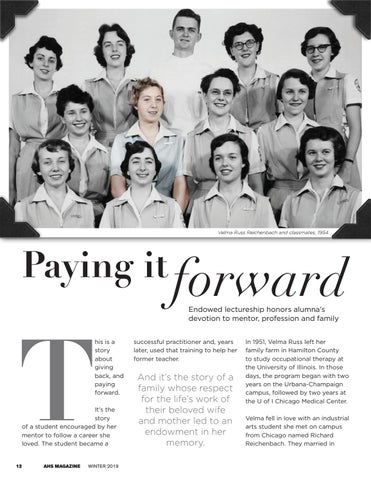
Velma Russ Reichenbach and classmates, 1954.
Paying it
T
his is a story about giving back, and paying forward.
It’s the story of a student encouraged by her mentor to follow a career she loved. The student became a
12
AHS MAGAZINE
WINTER 2019
Endowed lectureship honors alumna’s devotion to mentor, profession and family successful practitioner and, years later, used that training to help her former teacher.
And it’s the story of a family whose respect for the life’s work of their beloved wife and mother led to an endowment in her memory.
In 1951, Velma Russ left her family farm in Hamilton County to study occupational therapy at the University of Illinois. In those days, the program began with two years on the Urbana-Champaign campus, followed by two years at the U of I Chicago Medical Center. Velma fell in love with an industrial arts student she met on campus from Chicago named Richard Reichenbach. They married in
1952—a marriage that lasted more than 64 years—but kept it secret from OT director Beatrice Wade. It was not customary then for married women to have careers, and Miss Wade had made it clear she didn’t want to waste her time training students who didn’t intend to practice. “I think she knew, though,” Richard says with a chuckle. “She was a smart cookie, Miss Wade.” Occupational therapy was a small program and Wade took a personal interest in her students. Wade “had the amazing ability to recognize the potential in each of her students, and somehow set up opportunities where that potential could be achieved,” recalled Velma’s classmate, Nedra Gillette, in a letter read at Velma’s memorial service in 2017. “For Velma, it was in working with the elderly, and she became absolutely superb in that role.”
The Reichenbach family (left to right): Cheryl, Velma, Richard, Mike and Steve.
After she graduated in 1955, Velma was a staff member and consultant at nursing homes and home healthcare agencies in the Chicago area. She devised ingenious adaptive equipment for her patients, often with help from her husband, by then an industrial arts teacher. Besides creating practical devices like adaptive silverware, Richard remembers making a toy flock of geese that bobbed their heads with the wave of a wand, pulled on a string. “She was always trying to make things better for her patients,” he says.
Devotion to duty Velma never stopped learning, taking continuing education courses even after the family expanded to include three kids (Mike, Steve and Cheryl).
Velma with Richard at his graduation.
It’s no surprise that in 1979, she was one of the first students to enroll in the college’s new graduate program, master of associated medical sciences with specialization in occupational therapy.
She was motivated by “the attitudes toward aging, lack of care, and lack of occupational therapy involvement in this field where it is so obviously needed,” she wrote in her application. Velma was in the forefront of research and practice for occupational therapy in home healthcare, says Gail Fisher, clinical professor and associate department head of occupational therapy. She was one of the first to focus on using OT to treat incontinence for older people. After completing her master’s degree in 1981, Velma was director of an adult outreach program, then manager of occupational therapy home health services at Medical Personnel Pool. She was a consultant at longterm care facilities and presented her work at conferences and in classrooms all over the country. She was named Occupational Therapist of the Year by the Illinois Occupational Therapy Association, as well as a fellow of the American Occupational Therapy Association. “She always felt, because she was a pioneer in this area, that it WINTER 2019
AHS MAGAZINE
13
Former UIC OT department head Gary Kielhofner presents Velma with the Beatrice D. Wade Award at the UIC OT 60th anniversary celebration.
was important to educate others about the role occupational therapy could have,” Fisher says. Her oldest son, Mike, is still amazed at the energy and devotion his mother gave to family, friends and career. “She was incredibly dedicated,” he says. “She would leave in the morning at 7, grabbing a handful of dry oatmeal to eat on the way to her car. She would be home at 5 or 5:30 and have dinner on the table at 6:30.”
A lasting connection Velma never forgot the role Beatrice Wade played in launching her into the career she loved. Years later, she learned that Miss Wade, then 90, had been hospitalized. She hurried to the hospital, where she found her weak, overmedicated and discouraged. “Velma’s care as a therapist and caring as a friend made all the difference,” said Nedra, and within a week their former teacher was out of the hospital. Velma helped organize a letterwriting campaign to lift Miss Wade’s spirits, asking OT alumni to say how she had affected their lives. 14
AHS MAGAZINE
WINTER 2019
Velma retired in 2010 after a stroke, but she remained connected to AHS. In 2016, a year before her death, she invited Fisher and faculty members Joy Hammel and Ashley Stoffel to her home to accept a gift: 50 years’ worth of documents, as well as a personal interview about her long career, to be included in the archives of the department and the American Occupational Therapy Association. At Miss Wade’s memorial service in 1995, Velma announced a fund in her mentor’s honor for an OT lecture series. That fund became the seed for the Velma Russ Reichenbach Endowment, recently established by her family with a $25,000 gift. The fund will be used for a national-level speaker at the department’s Scholarship of Practice Day, an event for students, alumni and area clinicians. With the endowment, her family honors Velma and her loyalty to the department and Beatrice Wade, Fisher says. “They’re paying it forward.” n
During the 2017-18 fiscal year AHS received $1,101,247 in donations and utilized those funds to subsidize travel to professional conferences and international service trips for one in every eight students; provide nearly $160,000 in need- and merit- based scholarships; bring exciting speakers to campus; upgrade teaching and study spaces; and fund research.
“I’m grateful for my AHS scholarship because it helped support my UIC education, but even more so, I’m proud to talk about my award and what it stands for. AHS is committed to supporting diverse students from various cultural backgrounds, sexual orientations, and disability identities. My award is a proud badge of honor to diversity. ” –Kristen Salkas, AHS Class of 2021
“The timely monetary support I received thanks to the generosity of alumni and donors not only alleviated much debilitating financial stress in my life but also instilled in me a sense of empowerment. These scholarships are evidence that current professionals have faith in me and in my dedication to learn, to innovate and to serve our communities with newly acquired expertise and passion.” –Hannah Kwekel, AHS Class of 2020
“Due to the generosity of donors who support the AHS Scholarship Fund, I have been able to be both a student and a mother. Their support has made it possible for me to be the kind of role model I wish for my children to see; to go after your dreams, always strive for more, and have a passion for learning. I hope to one day be on the other side, donating to support other students along their journey.” –Kelsey Gabel, AHS Class of 2015 and 2021
WINTER 2018
AHS MAGAZINE
15
The long journey home
Patrick Ojok works toward a more inclusive and accessible Africa for people with disabilities
P
atrick Ojok’s resume is impressive. His life’s journey is extraordinary.
Ojok ’15 phd ds is head of community and disability studies at Kyambogo University, the second-largest university in Uganda. He is probably the only person in his country with a Ph.D. in his field. A funded researcher with a long list of awards, publications and presentations in the U.S., Europe and Africa, Ojok is working to improve education and employment opportunities for people with disabilities in Africa, and speaks
16
AHS MAGAZINE
WINTER 2019
of running for elective office one day. For Ojok, getting this far meant overcoming almost-impossible obstacles. “In my village, to people who know where I came from, my story is both amazing and puzzling,” he says. Ojok is an international scholar with a bachelor’s degree earned in Uganda, a master’s from the University of Oslo in Norway and a Ph.D. from UIC. But his introduction to education in his home village of Awach was not exactly telling.
He headed off to school for the first time at age 8, shirtless and without school supplies. His uncle, embarrassed, ordered him home, and young Ojok refused to return until the next year. “I dropped out of school the first day I went to school,” he remembers. After secondary school, his education was interrupted by his mother’s serious illness and death. A year later he was accepted to a teacher training college, but couldn’t start classes—his previous school wouldn’t release his transcript because of unpaid fees.
Photo above: When he returned to Uganda, his village held a graduation celebration with decorations in UIC colors for Patrick Ojok, shown here with his wife, Akidi Florence.
“Financial difficulty was the most insurmountable challenge of my educational path,” he says. He was about to give up when a relative he had never met stepped in to help. Ojok graduated at the top of his class—“a life-changing turning point,” he says. He was a primary school teacher for nine years in the Karamoja region of northeast Uganda, an area formerly wrecked by gun violence, with harsh climate and resistance to formal education. All the while he continued his own studies with the help of scholarships, earning a diploma in special needs education and a bachelor’s in education at Kyambogo University. Then, with top class rankings and recommendations from university faculty, he was awarded a fellowship from Norad, a Norwegian government agency, to study at the University of Oslo.
An Awach primary school classroom where Ojok was a student in the 1980s. Despite its dilapidated condition, the classroom is still in use.
When he returned from Norway, Kyambogo University offered him an adjunct position in the department of community and disability studies. Later his university sweetened the deal: a tenure-track faculty position, contingent on earning a Ph.D. in the field, and an offer to continue his job with pay until he returned. The salary eased worries about supporting his wife and children while he was in the United States. “I must thank Kyambogo University for granting me study leave with pay at a time when I was still a staff member on probation, who was not yet entitled to such a leave,” he says.
The international students were close friends; Ojok hopes to collaborate on future projects with several former classmates.
With a Fulbright Junior Staff Development Award, Ojok headed to the internationally known doctoral program in disability studies at AHS.
“There is a strong culture of scholarship and intellectual engagement at DHD,” Ojok says. “I was exposed to different academic and social events which helped me to know and appreciate Chicago and the U.S.” WINTER 2019
AHS MAGAZINE
17
Ojok delivers a motivational talk to Abim Secondary School students.
DHD faculty were immediately impressed with Ojok.
of research in the Great Lakes ADA Center.
“He was really driven. He knew what he wanted to do,” says Randall Owen, DHD research assistant professor and associate director of the Institute on Disability and Human Development.
His research collaborations with DHD faculty have continued since he returned home. The connection also helped facilitate a recent visit to UIC by two Ugandan disability rights advocates, through a fellowship funded by the U.S. State Department.
“I feel very confident he’s going to make a big difference in Africa for people with disability, with his passion and intelligence and his capacity to advocate,” says Tamar Heller, DHD professor and head, who was Ojok’s dissertation adviser. Ojok worked in the research lab of DHD associate professor Sarah Parker Harris, whose studies focus on employment issues for people with disabilities. He became friends and colleagues with Robert Gould, director 18
AHS MAGAZINE
WINTER 2019
“I really loved that professors at DHD were so approachable and friendly to students,” Ojok says. “I met and made lasting connections with some very wonderful and resourceful people.” Still, being away from his family was difficult. “I can’t forget the tears on my kids’ faces when I sat them down to seek their consent for me to study in the U.S.,” he says.
Ojok was 41 when he completed his Ph.D., and he has wasted no time since returning to his country. He is principal investigator or co-PI on three research projects, two related to education for children with disabilities, the other on self-employment for people with disabilities. He has just received a short-term consultant appointment to the World Bank’s Disability Inclusive Education in Africa Program and is a member of the advisory task force overseeing the ongoing development of a national policy on inclusive education. Ojok was also tapped by the Inter-University Council for East Africa to help develop a quality assurance policy on disability for higher education institutions in East Africa.
“Disability studies scholarship is dominantly Eurocentric and North American,” Ojok says. “I want to help bring about the emergence of an Afrocentric discourse of disability, cognizant of the sociocultural and political dynamics of Africa.”
Encouraging education among youth from poor and underrepresented regions is a priority for Ojok.
with life like I did, and prove to them that it is possible to break through,” Ojok says.
He led the development of his department’s first graduate program, a master’s in disability studies and inclusive development. The program, the first of its kind in East Africa, is expected to launch in August 2019.
“I narrated my education story to the crowd and pledged to champion education in our land henceforth.”
“I would like to see disability studies take root in African universities by starting graduate programs, researching and publishing in the field,” he says. When he returned to Uganda, his family held a huge party in his grandparents’ compound, decorated in UIC blue and red. “Celebrating the Ph.D. in the village was to me an imperative—to inspire the young people who are struggling
To make good on his pledge, he helped found the Awach Alumni Association, which recently donated a photocopier and generator to the village school. He helped start another mentoring organization, Karamoja Mentoring Network, to encourage young people in an area known for its extreme poverty. “Given my rough and long journey to education, I am passionate to inspire others to succeed like me—or even exceed the heights I climbed,” Ojok says. n
“Celebrating the Ph.D. in the village was to me an imperative,” says Ojok, who wants to inspire other young people to aspire to higher education.
WINTER 2019
AHS MAGAZINE
19
Of service Kinesiology alumna an ensign on USS New York, built with steel from wreckage of the World Trade Center
20
AHS MAGAZINE
WINTER 2019
Genelle Arandia ’18 bs kines was a kindergartner when the Twin Towers fell on Sept. 11, 2001.
“It’s definitely leading in a culture where we look out for each other like family, and work together to get the job done.”
Now she’s Ensign Arandia, serving on the USS New York, a Navy warship built partly of steel from the wreckage of the World Trade Center.
As junior officer, she also pulls a daily watch on the bridge. In addition to her other responsibilities, she’s working on her Surface Warfare Officer qualifications, which require multi-year training in seamanship, warfighting skills and leadership.
The ship’s motto is “Strength forged through sacrifice. Never forget.” “It’s a constant reminder of why we serve and what our ship means,” Arandia says. Just weeks after receiving her degree in kinesiology last May, Arandia, 22, was aboard the USS New York. As the auxiliary officer on board, she is in charge of the maintenance, repair and operation of shipboard hydraulic systems, including the ship’s galley and laundry equipment, small boats, A/C and refrigeration. She manages the work of 16 machinist mate sailors and two chiefs. “Management is such a broad term here, though,” she says. “Because, while I make sure maintenance is completed on time, I also work closely with my chiefs to make sure my sailors have all the resources they need to be successful professionally and personally, whether that means getting paperwork or approval for a job, or helping with financial or family issues.
Arandia’s ultimate ambition is a career in physical therapy, preferably in the Navy. Her parents, Manuel and Gemma Arandia, are a big influence: her mom worked in physical rehabilitation for the Department of Veterans Affairs and her dad retired from the Navy as chief petty officer.
“I knew since fifth grade that I wanted to become a physical therapist,” she says. “I wanted to pursue an occupation in the medical field, one that would let me repay our servicemen and women for their sacrifices.” Arandia says she misses Chicago every day.
“I grew up in Grayslake but my family never really visited Chicago, so I wanted to go to UIC, literally having the city of Chicago as my campus,” she says. She attended UIC on a scholarship through Navy ROTC, which “gave me so much and now allows me to serve.” Arandia says UIC and NROTC were great preparation for where she is now, helping to keep a 24,900-ton warship in operation. “UIC itself, with its huge emphasis on diversity and inclusion, really exposed me to different cultures and people, and the Navy is full of people from all walks of life,” she says.
Photo: U.S. Marine Corps by Sgt. Randall A. Clinton
“Hard work at UIC translates to hard work on the USS New York. Every day is an opportunity to work hard, learn something new, make someone smile and have an adventure, and know that you’re all the better for giving everything your all.” n The USS New York passes the World Trade Center and National September 11 Memorial. WINTER 2019
AHS MAGAZINE
21
People
AHS Connection The second half of 2018 brought opportunities for alumni to celebrate and connect.
#AHSmingles
BVIS dinner at AMI2018 July 20 Newton BVIS alumni, students and friends attending the Association of Medical Illustrators (AMI) 73nd Annual Conference in Newton, Massachusetts, met over dinner to network and reconnect. Every year, the Program in Biomedical Visualization organizes a dinner during the conference.
BVIS students sneak a group photo between AMI conference sessions.
ASAP staff reunion
August 16 Chicago Former Academic Support and Achievement Program staff and faculty were in attendance at the first reunion to celebrate more than 10 years of supporting AHS undergraduate students.
(From left to right) Iliana Amador ’16 bs kines, Maria Kokkinias ’16 bs kines, Mary Schuster ’16 bs kines, Shannon O’Neill ’16 bs kines, Patricia Dziedzic ’16 bs kines and Abbey Breckling ’16 bs kines, ’18 ms kines.
22
AHS MAGAZINE
WINTER 2019
Paola Solis ’14 bs kines (left) and former KN faculty member Mary Lou Bareither (right).
(From left to right) KN visiting clinical associate professor Karrie Hamstra-Wright, Jason Sikorski ’10 bs kines, Christyne Ghiselli ’12 bs kines, and Elizabeth Mooney ’14 bs kines.
Spirits with Sparky September 20 Chicago UIC alumni and friends gathered at AceBounce for an evening of food, drink and ping-pong to connect with classmates and welcome the newest members of the UIC alumni community.
Annie Li ’15 bs him (left) and Paige Parola ’15 bs nut (right).
UIC Urban Health Program 40th Anniversary Gala September 22 Chicago The UIC Urban Health Program marked 40 Years of making higher education accessible for underrepresented minority students in their pursuit of health careers. The event celebrated the 7,000 health professionals of African American, Latino, and Native American descent who have been supported through the program, and recognized the individuals who made it possible.
AHS awardees and honorees included (left to right) AHS UHP director Kenneth Morgan, Eric Meredith ’12 ms nut, KN associate professor Angela Odoms-Young, Jihad Muhammed ’72 ms bvis, Patricia Walker, UIC vice chancellor for health affairs Robert Barrish, Evelyn Alston ’94 bs ot and former AHS UHP director Jeff Brown.
AHS reception at AHIMA18 September 24 Miami AHS was front and center at the American Health Information Management Association Conference and Exhibit. AHS alumni took a break from the conference to catch up over appetizers and drinks.
HIM students (left to right) Elena Ivanova, Tiara Hughes, Gabriela Arroyo and BHIS clinical assistant professor Lois Hitchcock.
WINTER 2019
AHS MAGAZINE
23
People
2018 Frank Armitage Lecture Series October 19 Chicago The 2018 Frank Armitage Lecture Series examined the evolution of full color anatomical illustration from the 16th century through simulation technology of the 21st century, as well as an in-depth exploration of the work of Paul Peck. Presenters included Mike Doyle ’83 bs bvis, Scott Barrows ’76 bs bvis and Raffaele De Caro, president of the University of Padua Medical School in Italy.
(From left to right) BVIS students Caitlin David and Norman Luo, Eliza Knipscher ’18 ms bvis and Kelly Cloninger ’18 ms bvis.
(From left to right) BVIS students Annebelle (From left to right) Casey Garr, Shariwa Oke, Sarah Wang, Madison Rice and Sarah Davis. Quattrocki, Isabel Romero Calvo, Logan Weihe and Alex Cook.
HIM In-Service
UIC Alumni Association in Los Angeles
October 19 Chicago
October 26 Los Angeles
The HIM Class of 2019 proudly presented this year’s HIM In-service, “Health Information Management: Embracing the Future.” The daylong continuing education event brought together professionals from throughout the Chicagoland area. Each year, HIM graduating students lead the planning of an in-service.
Robert Winn, director of the University of Illinois Cancer Center, updated alumni on UIC’s unique approach to battling cancer, which has caught the attention of the National Cancer Institute. After the update, attendees shared memories and toasted personal milestones.
David Haehnel ’04 bs physed (far right).
24
AHS MAGAZINE
WINTER 2019
Rehabilitation Sciences Club 2nd Annual Power Hour November 12 Chicago
Photos: Dave Moy
Over 30 AHS students, staff and alumni attended the Rehabilitation Sciences Club’s 2nd annual Power Hour. Alumni Kia Burks ’18 bs rs (pictured left) and Dean Stoyanov ’18 bs rs (pictured right) shared details of their post-graduation endeavors with students, while doctoral students shared their experiences in their respective programs.
Kia Burks ’18 bs rs
From left to right: Assistant dean for student affairs Eileen Doran, RS student Michelle Moy and director of the Academic Support and Achievement Program Viviana Kabbabe-Thompson.
Dean Stoyanov ’18 bs rs
Student Alumni League/Student Alumni Ambassadors Reunion November 17 Chicago SAL/SAA members returned to campus to enjoy the view of the Chicago skyline from the UIC Curtis Granderson Stadium at a luncheon with Chancellor Michael Amiridis. Guests followed lunch with a tour of the campus and capped the afternoon with a boat cruise aboard the Odyssey.
Luncheon attendees pose for a group photo in Granderson Stadium.
WINTER 2019
AHS MAGAZINE
25
AHS MAGAZINE University of Illinois at Chicago Office of the Dean (MC 518) College of Applied Health Sciences 808 South Wood Street, 169 CMET Chicago, Illinois 60612-7305 Address Service Requested
Nonprofit Org. U.S. Postage PAID Chicago, Illinois Permit No. 4860
Wednesday, April 24 Venue West, 221 N. Paulina St. CONNECT with health professionals and award-winning alumni REFLECT on 40 years of excellence in scholarship, research, advocacy and community engagement LEARN from one of Chicago’s leading public health experts dedicated to health equity SPECIAL GUEST SPEAKER JULIE MORITA, MD Commissioner, Chicago Department of Public Health
2019 AHS ALUMNI AWARD RECIPIENTS MARY MIRABELLI ’79 BS OT Distinguished Alumni Achievement Award KAREN PATENA ’75 BS MRA Loyalty Award CARRIE SHAW ’16 MS BVIS New Alum Award
Visit go.uic.edu/AHSCELEBRATES to register.