Teaching Teachers
UHD Program Develops Learning Strategies for Middle School Math Teachers By: Mary Ann Cozza Albert Einstein said, “The only source of knowledge is experience.” Today, professors at UHD are using this theory as a model for a leadership project that develops inquiry-based instructional strategies for middle school math teachers. The Teacher Quality Mathematics Leadership Project, a collaborative effort between the Department of Urban Education and Department of Mathematics and Statistics, is funded by the Texas Higher Education Coordinating Board Teacher Quality grants program and is in its second year.
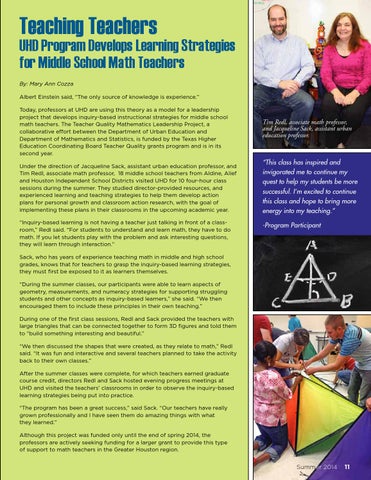
Tim Redl, associate math professor, and Jacqueline Sack, assistant urban education professor.
Under the direction of Jacqueline Sack, assistant urban education professor, and Tim Redl, associate math professor, 18 middle school teachers from Aldine, Alief and Houston Independent School Districts visited UHD for 10 four-hour class sessions during the summer. They studied director-provided resources, and experienced learning and teaching strategies to help them develop action plans for personal growth and classroom action research, with the goal of implementing these plans in their classrooms in the upcoming academic year.
“This class has inspired and invigorated me to continue my quest to help my students be more successful. I’m excited to continue this class and hope to bring more energy into my teaching.”
“Inquiry-based learning is not having a teacher just talking in front of a classroom,” Redl said. “For students to understand and learn math, they have to do math. If you let students play with the problem and ask interesting questions, they will learn through interaction.”
-Program Participant
Sack, who has years of experience teaching math in middle and high school grades, knows that for teachers to grasp the inquiry-based learning strategies, they must first be exposed to it as learners themselves. “During the summer classes, our participants were able to learn aspects of geometry, measurements, and numeracy strategies for supporting struggling students and other concepts as inquiry-based learners,” she said. “We then encouraged them to include these principles in their own teaching.” During one of the first class sessions, Redl and Sack provided the teachers with large triangles that can be connected together to form 3D figures and told them to “build something interesting and beautiful.” “We then discussed the shapes that were created, as they relate to math,” Redl said. “It was fun and interactive and several teachers planned to take the activity back to their own classes.” After the summer classes were complete, for which teachers earned graduate course credit, directors Redl and Sack hosted evening progress meetings at UHD and visited the teachers’ classrooms in order to observe the inquiry-based learning strategies being put into practice. “The program has been a great success,” said Sack. “Our teachers have really grown professionally and I have seen them do amazing things with what they learned.” Although this project was funded only until the end of spring 2014, the professors are actively seeking funding for a larger grant to provide this type of support to math teachers in the Greater Houston region.
Summer 2014
11