SANITATION
Toolkit Urban Ecological Planning ACTogether

 Abigail Turinayo Berekteab Hailu Wondesen Kanutte Næss Mari Sjaastad Marcin Sliwa Megan Bodine Prier Patrick Okia Veronica Hellebergshaugen




HYT
Directorate of water Development
Services Foundation
Haileybury Youth trust
Jinja Municipal council
Kampala Capital City Authority
chairman
Non-Governmental Organization
National Slum Dwellers Federation of Uganda
university of science and technology
Water and Sewage Corporation
Project Management Committee
Slum Dwellers International
Transforming the Settlements of the Urban Poor in Uganda
Ecological Planning program
AB i TAT
United Nations Human Settlements Programme
Ventilated Improved
Latrine
This toolkit was developed as part of the field work of students from the Urban Ecological PlanningMaster’s Program at NTNU, in collaboration with the Makerere University, the Slum Dwellers Federation and the local NGO ACTogether. The students were divided into six groups, which worked on different issues, including housing, land sharing, market upgrading, building material training centre and sanitation. These projects were identified by local communities and are meant to propose realistic solutions and provide recommendations to real-life problems of slum dwellers in Uganda.
The team working on the Sanitation topic consists of seven students (five from NTNU and two from Makerere University) as well as an engineer consultant from the Engineers Without Borders organization. The group is working in two different locations – four students were based in Kampala and three in jinja. There is a mix of cultural and professional backgrounds.
We have architects, engineers and planners working together and sharing their experience for the benefit of the project.
The respective student groups in Jinja and Kampala analyzed the existing sanitation situation through case studies of sanitation units and meetings with relevant stakeholders in the community and government. Lessons learned from this analysis have informed the creation of a set of criteria for implementation of sanitation projects for long-term success. Failures we have witnessed in case studies can be attributed to missing one or more criteria.

The criteria drive our designs of sanitation technology and maintenance packages. designs are also informed by questionnaires and discussions with community members, that gave us insight into existing challenges, needs and wishes, and practical examples of successful projects elsewhere in the world.
The first section of this report gives a background to sanitation in Jinja and Kampala and specific lessons learned from case studies during our field study in Uganda. These lay the base for the development of seven criteria for success in sanitation projects. Most of the criteria are not design specific but highlight the need to consider the socio-economic context into which projects are placed and to plan for long-term management.
The second section provides a brief introduction to types of toilet technology. Technology details and recommendations are included in Appendix. We then introduce the packages with a matrix of site characteristics and packages that can be used to identify potential packages for a given project. The following eight packages each include technology details and sizing, superstructure design, material
suggestions and cost estimates for initial and annual cost. Packages are meant as preliminary designs to enable comparison and discussion between several options. Assumptions and details for technology sizing and cost estimates can be found in Appendix C and D.
Because of the importance of long-term maintenance, we have included three maintenance frameworks for residential, market and public sanitation units. Each design package can be paired with a maintenance framework.
Appendix A shows a site-specific example of how to use the toolkit to identify and discuss different package options. The second example is neighborhood scale and discusses site location and scaling of units.
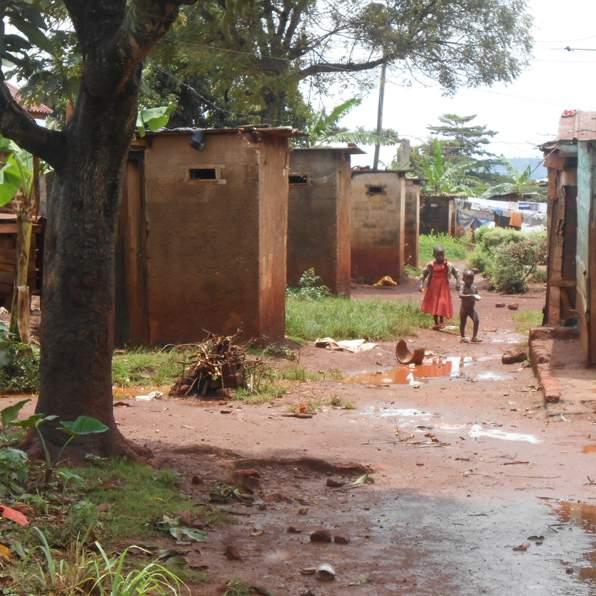
The issues related to sanitation in Kampala are closely related to its topography. The city was initially developed on seven central hills, yet over time the built area spread over to other hills as well as to the valleys in between. The development in the low-laying areas was predominantly unplanned and uncontrolled, which means that most of the urban poor settle or squat in wetlands and valleys, with high ground water table and severe and frequent flooding. The drainage system is defective, which causes stormwater staying in those areas many days after each rainfall.
The majority of the city population relies on on-site sanitation facilities that are very difficult to construct and maintain in those living conditions.
The most common toilet facilities in lower-income areas include traditional pit latrines.
total share is over 90% of all toilets (UN Habitat, 2007).
Water-borne flush toilets connected to the sewer can be found mainly in some centrally-located areas and in slums adjacent to those parts of the city (see map).
On top of that, it is estimated that around 22% of the households in slums are practicing open defecation (see map), and around 20% use the bucket system.

The distribution of water in Kampala is fairly good, with a large majority of the residents having access to it, although there are some problems that need to be resolved, including the cost and quality of piped water as well as the repairs of aging infrastructure (KCCA, 2012).
An enumeration report conducted by ACTogether in Jinja’s poor settlements found limited access to water and sanitation. The report concludes that only 18 percent of low income earners have access to a toilet close to their home. While some have shared pit latrines, many deal with sanitation through open defecation, hand-dug holes outside their home, or flying toilets (ACTogether, 2012).
The Municipality’s stance on sanitation is to expand the centralized water and sewerage line operated by the public company National Water and Sewerage Corporation (NWSC) to provide waterborne toilets to all residents of the city (Health inspector, 2013). The Municipality believes that sanitation is its responsibility, but because of limited funds and the high initial and running costs of waterborne toilets and network expansion, they are forced to wait until outside funds become available. There is little interest in the Municipality to explore less expensive, decentralized alternatives and little effort to use international donor funds efficiently when they do become available. nstead, the Municipality has adopted a slow plan for gradually and ad-hoc building arguably over-priced toilets for a limited number of users when external funds become available.
An example of external funds is the TSUPU programme initiated by the Ugandan government in collaboration with a variety of international partners that funds projects proposed by community savings’ groups (Keene, 2011). Jinja is currently in the second phase of TSUPU and has chosen a list of prioritized projects that includes four sanitation units (Joseph, 2013). The World Bank has emphasized community contracting to increase transparency and community involvement, but there is a disagreement between the World Bank demands and the Ugandian PDA law prohibiting community contracting in projects over 500,000 shillings (TSUPU Engineer, 2013). Because of a failure to reach an agreement and pressure to use donor funds as fast as possible it is likely that the jinja projects will be forced to use municipal contracting despite interest and capacity for community contracting (Joseph, 2013).
The environmental conditions in Jinja make proper sanitation particularly important. The majority of the town is close to the shores of Lake Victoria, with many shoreline settlements, livelihoods dependent on the lake and water drainage that flows into the lake. The Lake is also the primary water source for shoreline communities and the NWSC water supply network (DWD, 2010).
in order to provide recommendations and guidelines for urban sanitation systems, we conducted an in-depth analysis of the existing sanitation situation with site visits to recent and proposed projects, consultations with experts, discussions with local communities and relevant stakeholders and a review of enumeration data and literature research. The following are the main lessons from each case study in jinja and Kampala.
Community contracting improves sense of ownership. Successful experimentation with new building method shows promise for new technologies. Multi-functionality of sanitation units improves financial viability.


Location and appropriate sensitization is essential to ensure that people come to toilets. Smaller, accessible units clustered inside the settlement better response to community demands than a large unit located on the outskirts of the settlement. Sensitization is also essential to convince paying for safe sanitation, especially where there is a habit of flying toilets and open defecation.
Technical faults can be avoided with appropriate design and site surveying and show lack of municipal contract professional ability. Poor communication between contractor and PMC, especially where there are cost discrepancies, creates mistrust and resentment.
Communities involved in financing and maintenance are more likely to take better care of toilets. Toilets appropriated to specific families increases sense of ownership. Communities are willing to contribute labor and money for new toilets and are able to collectively save a significant amount of money.
cultural barriers to new technology can be bridged; long-term planning for maintenance activities and funds are necessary to sustain a project. New technology is vulnerable to stereotypes and secondary (financial, building maintenance) faults that prevents its scaling.
There needs to be a balance between accessibility and centralization of toilet units. The unit in Kisenyi was so large and centralized that residents converted two sections into housing. A community member told us she would prefer smaller units scattered throughout the settlement.


A long-term financial management plan and monitoring is required to sustain projects. Mistakes in construction should inform later projects in Kalerwe, improper maintenance and poor financial planning caused the failure of many sanitation units. Ecosan units were repeatedly constructed with too deep pits causing flooding.


Our analysis of this background research led us to develop the following criteria for success.
Sanitation units should be scaled and located carefully to encourage continued use and financial feasibility. There needs to be a balance between large, centralized units and accessible smaller units. Günther et al. (2012), who conducted a study in Kampala, found a correlation between the number of users and toilet cleanliness and suggest that toilets be shared by a maximum of four households to ensure cleanliness. Time and care should therefore be taken to find a realistic balance between financial return, accessibility, ownership and cleanliness. it is essential that the local community is included in these decisions through participatory design methods.
Location should be chosen for proximity to residences, safety and security especially at night and in poor weather, handicapped accessibility, and truck access to empty the pit or tank. To prevent smell, toilets should be separate and downwind from residences. Land ownership, soil conditions, water table, and water and sewerage lines should all be considered.
Because of limited funding, both initial construction and long-term maintenance costs must be minimized and a maintenance plan developed to manage running costs (Günther et al., 2012). it is often unclear who should take responsibility for the payment and how costs should be divided between stakeholders. it is essential that a management committee and plan are established from the beginning to determine how long-term costs
are managed, who is responsible for paying what, and how profits from public toilets are divided. initial design and technology should be chosen based on a long-term perspective, with an understanding of the associated running costs. However, initial costs should be conservative when loans are taken to minimize the payback period (Günther et al., 2012). Where capital is available, additional initial costs may be valid if they reduce running costs. Community contracting, when done correctly, is also a useful way of reducing construction costs.
Cost estimates and long-term financial planning should be conservative and regularly evaluated to ensure profitability. Additional sources of funding by expanding the functionality of the sanitation unit should be explored to increase financial viability (UNESCAP). it is also essential that there is proper communication between the community and experts writing revised bills of quantities and designs to prevent mistrust and increase transparency.
Creating and maintaining a sense of local ownership encourages proper and continued maintenance (Pervaiz et al., 2013). Our observations and literature suggest that communities involved in planning, financing, implementation and maintenance, tend to take better care of toilets compared to toilets financed and planned by external parties (Pervaiz et al., 2013). Where there is a strong social structure and available supervision, community contracting is a good way to build a sense of ownership from the beginning (Günther et al., 2012).
Protection from vandalism and stealing is a risk, especially with the use of high-cost technology and building materials including light bulbs, ceramic sinks and all kinds of metal objects. illegal collection of water directly from the tank has also been an issue. This is solved by security gates on large projects and padlocks on small-scale latrines. Security gates and fences to prevent theft increases project cost, but creative floor layout can reduce the number of gates needed. A more holistic solution replaces high-cost items that might be stolen with more cost-effective and practical alternatives. Minimal security is then only needed for the water tap.
Cultural challenges to different toilet technology must be acknowledged and handled (Eales et al., 2013). This is especially necessary for the implementation of ecosan and biogas toilets, but may also be necessary for waterborne toilets in communities that traditionally use pit latrines. However, implementing new technologies is difficult in communities that are transient and may be more applicable in areas where at least part of the population is stable. Basic sanitation and hygiene sensitization should be incorporated with all toilet projects to improve general practices and encourage residents to use and pay for safe toilets compared to the common practice of open defecation, bucket toilets, or unsafe pit latrines.
Because improving public health is the basic goal of sanitation projects, it is important that health and hygiene are prioritized throughout the process. improper use of sanitation facilities, for example dumping trash in pit latrines or improperly emptying septic tanks, risks further endangering public health. it is essential that the community and caretaker are properly trained to use the toilet and that an expert is available for consultation if needed during the maintenance phase of the project.
From the site visits we made, we found numerous opportunities for implementing new toilet technologies with additional benefits outside of improving safety of waste removal. However, in all cases implementation has to be done inside a network of partnerships and relevant stakeholders to provide support for technical design and construction, problem consulting, training and sensitization and financial support for loans and business models (Andrews, 2013). Multi-agent partnerships should be made between the government, public and private organizations and the community to share responsibility where local governments have limited financial and management capacities (UNESCAP, 2005). Community participation is essential for sustainability (UNESCAP, 2005). Communication and collaboration between stakeholders, especially the community and municipality, is essential to prevent mistrust and confusion (Pervaiz et al., 2008).
To establish a sustainable sanitation system, where water resources and nutrients are re-used, conventional wastewater management needs to be revolutionised. There is a wide range of ecological sanitation options out there, but some links are often missing in order to close the loop. For example, they may require more space than what is available, and there might be different socio-cultural challenges related to the implementation of such technologies.
during our research we looked into a wide range of technologies to identify suitable solutions for Kampala. Because of the mentioned missing links, lack of space and transient population, the ecological solutions are often challenging to implement, but in the long run they should be the first choice. in the end we identified the following technologies as the most relevant or applicable for low-income settlements in Kampala.
Superstructure for privacy and a hole or seat over a pit where excreta is disposed.
Limitations: Problems with smell, flies & mosquitos. Has a tendency to be left when full. contaminates ground when not sealed. Not possible to connect to sewer line. Not possible with an offset system. Advantages: No need for water Easy to build and use
Same as traditional pit latrine, but with a ventilation pipe connected to the pit.
Limitations: Same as traditional pit latrine, except the smell, flies and mosquitos.
Advantages: Pipe eliminates smells and traps flies Same as traditional pit latrine


An alternative to water borne toilet. Connected to septic tank, sewer line or pit.
Limitations: Requires water and manual pouring can easily be clogged with solid waste Advantages: Requires less water than water borne can be connected to sewer
Two pits connected to the pan and converde at an inspection chamber forming a “Y”.
Limitations: Takes up slightly more space
Advantages: in case of high water table, it might be better to dig two shallow pipes With two years resting time all pathogens are dead, so waste is removed safely
Connected to sewer or septic tank.
Limitations: is dependent on large amounts of water Septic tank requires periodical emptying Advantages: No flies or smell Safe and pleasant to use
Returns nutrients from urnie and faeces insted of disposal.
Limitations: Requires a lot of space Needs extensive management
Needs education and training cultural challenges for reuse of compost Requires skilled labour for construction
Advantages: Environmentally friendly Possibility of extra benefit from compost

in the process of the development of the toolkit, we identified some of the most representative settlement and user profiles for Kampala and Uganda in general, which then were matched with recommended sanitation options. We categorized them into the so-called “packages”, which include selection of appropriate technologies, cost estimates, sample designs with floor plans for low-cost structures, recommendations on maintenance and ideas for additional income generating functions. The packages are categorized based on a number of criteria, including the density of a settlement (high, medium and low), water table level (high, low)

and the profile of users served (i.e. private households, communal toilets).
The purpose of this section is to help communities find appropriate option that is affordable, has appropriate scale, is financially feasible and provides a realistic scheme for maintenance and management. It needs to be noted here that the solutions described here are flexible, and the readers may consider combining some of the ideas from different packages into one option that meets their needs best.
Flood-prone
high-density
Low-density
Environmental benefits
Economic benefits
Can be connected to sewer
market/Public residential
temporary/eviction prone
Fragile community
[the table shows in with situations the different packages in the toolkit are appropriate]
Having in mind all the lessons learned from our site visits and the analysis of the available technology solutions, the next step was to propose applicable sanitation options for slums in Kampala. This was done by matching appropriate technologies and proposed unit designs to a set of representative informal settlement types and user profiles in Kampala and Uganda in general.
The diagram is a very simplified model that explains how those characteristic categories of settlements or users could be identified and shows example of proposed solutions. For example, if we were commissioned to design a toilet for private households in a high density
informal settlement with a low eviction risk and high water table that is not connected to sewer, we would probably need to limit our options to elevated ViP toilets or elevated pour flush with pit. Biogas or composting toilets may be a better fit for more stable community that lives in a lower density area. It is important that the designs for all of those options should allow for the possibility for upgrading, especially in areas that are not connected to sewer or with lack of security of tenure. The table summarizes the results of our analysis. It includes example locations for private and public toilets, main issues, proposed technology options as well as some recommendations for maintenance and management.
High den sity
Informal
High water table Swamps
Low-laying Slums, e.g. Bwaise, Kalerwe, Katanga, Kisenyi, Katwe, Butabika
• Frequent Floods
• Sinking soil
• Wastewater pooling
• Rubbish dumping
• Poor pit maintenance
• Water affordability
• Transient community
• Groundwater contamination
• Poor drainage
• Elevated V P
• Elevated pour flush toilets with pit
• Low flush waterborne toilets con nected to sewerage and rain water harvesting system for flushing
• Four households per stance, with key access
• Shared ownership
• Hygienic (vacuum) pit or tank emptying
• Refuse collection ar eas to prevent mixture of solid waste in pits
• Dry surface cleaning
• Strategic location for pit emptying (truck access)
• Pit lining to prevent ground water pollution
• Use illustrations to sensitize
• Easy to clean surfaces
• Negotiation with authori ties for emptying subsidies
Residential
High densi
ty Informal
Low water table Slope
High-laying slums: Kinawataka, Kagugube Kivulu, Kasubi, Nankula bye, Nyago
• Limited space • Occasional flooding
• Garbage dumping
• Poor infrastructure and accessibility
• Water affordability
• Transient community
• Pour flush toilets connected to shared septic tanks
• Low flush water borne with sewer age and rain water harvesting
• Regular cleaning
• Hygienic (i.e. vacu um) tank emptying sys tem through chamber
• Smaller units due to space limitation (min 2 stance)
• Strategic location for truck accessibility
• Easy to clean surfaces
• Connect to sewer if pos sible
High
Residents (Private) Density
Water Table
Public (Open) Type Medium
High Low
User Profile Illegal Squatters Low Eviction Risk Low
High Community Instituti
Markets
High or Medium density Illegal Squatter Settlements
Low or Medium density
Informal
Undeveloped mailo land, Open ‘free’ space Public land
• Eviction risk
• Clustered settlements
• Water access and affordability
• Transient community
• Unsafe construction
• Cheap and easy to construct with possibility for up grading
• Regular cleaning
• ideal ownership by local authority (e.g. KCCA)
• Undertaken with the local authority and community to ensure adequate lifespan of the facility and secure ownership
Kampala suburbs, other municipali ties in Uganda
• Poor infrastructure
• Water access and affordability
• Limited sewerage access
• EcoSan (UDDT)
• Bio gas
• Low flush waterborne with sewerage or shared septic tank
• Regular cleaning
• Hygienic emptying and transfer system
Public
communal Taxi parks
Public parks
institutions Schools churches community centres
Work places
Market Marketplaces, e.g. Kinawataka, Kalerwe, Nakawa
• Large number of users
• Maintenance issues
• Security & vandalism
• Large number of users
• Need for exceptional hygiene
• Large number of users
• Non-regular users
• Accessibility to water
• Bio gas
• Low flush waterborne with sewerage
•Low flush waterborne with sewerage or shared septic tanks
•Ecosan
• Low flush waterborne with sewerage or shared septic tank
• Regular cleaning
• Onsite caretaker
• Require payment on use
• Regular cleaning
• Need for responsible person for cleaning and education
• Regular provision of technical information and advice
• Marketing strategies to find markets for compost and bio gas
• Skilled construction labour
• Usage monitoring required
• Ensure long opening hours
• Lighting for security
• include community hall
• institution responsibility for maintenance
• Combine with environmen tal education and sensitiza tion
• Pay per use
• Onsite caretaker
• include space for laundry or kiosk
Burnt or interlocking brick
Pit
Burnt or interlocking brick with concrete slab

U NIT SI z E
5 stances, assumed 120 users per unit (4 families per stance)

P IT l I f E
2 years
P IT d EPT h
3,6 meters
c ost Do UBLE PI t C om P o S t IN g
Intital cost 4,5 to 5,5 mill
Annual costs 0 UGS( self-emptying and re-use
10 year cost 4,5 to 5,5 mill
This composting toilet has a permanent superstructure and connected pits separated by a solid wall. Each toilet stance has two toilet holes and the community must take care to close the toilet holes not in use. Pits fill in two years, giving enough time for the filled pit to safely decompose. The pit has an accessible manhole and depth of only 3.6 meters facilitating self-emptying with traditional methods. Cost differences are due to different material options, with burnt brick increasing initial cost by more than 20 percent. These toilets can be easily modified to separate waste, by diverting urine into a barrel. This increases the efficiency of solid waste composition and produces an additional source of liquid fertilizer.

PACKAGE
Plywood, papyrus, recycled jerrycans, ferrocement, canvas, etc. stretched on a wooden frame
Pit
Burnt or interlocking brick with concrete slab
U NIT SI z E
5 stances, assumed 120 users per unit
(4 families per stance)
P IT l I f E
2 years
P IT d EPT h
2,5 meters
contracting
c ost Do UBLE PI t C om P o S t IN g
Intital cost 3,8 to 4,9 mill
Annual costs 0 UGS( self-emptying and re-use
10 year cost 3,8 to 4,9 mill
Similar to the double-pit permanent, this option offers a less expensive alternative that is faster and easier to build. The temporary superstructure is moved from pit to pit as they fill and each pit has a permanent slab with manhole and pit hole covers. It is especially applicable for communities at risk for eviction, because superstructures can be easily dismantled and moved to another location. community contracting is particularly useful in these situations because toilet building and maintenance knowledge and training can be easily transported and used to self-build latrines in new locations. Materials for the superstructure are chosen to be light-weight, inexpensive, locally available and easily fit to a wooden frame.


MM
PERMANENT S UPERSTRU c TURE
Burnt or interlocking brick Pit
Burnt or interlocking brick with concrete slab

U NIT SI z E
5 stances, assumed 120 users per unit (4 families per stance)

P IT l I f E
5 years
P IT d EPT h
m
IT d IMENSI o NS
m
Co S t ( U g S) V ip
Intital cost (community contracting) 4,1 to 5,0 mill

Intital cost ( municipal contracting) 5,5 to 6,6 mill
Annual costs 675 000 UGS
10 year cost 38 to 39 mill
contracting
The ViP is an ungraded latrine with a deep, lined pit that protects surface water from waste and has a ventilation pipe to reduce insects and smell. The deep pit only requires emptying every five years, reducing running costs. However, because it is emptied before waste has safely decomposed, it should be removed by an external company, incurring higher running costs. Still, this is an option for communities not interested or willing to participate in pit emptying and waste reuse or where the community is transient and training and sensitization is difficult. it could also be used as an immediate intermediate solution.

Burnt or interlocking brick
Pit

Burnt or interlocking brick with concrete slab

U NIT SI z E
4 stances(1 handicapped),
assumed 200 users per unit
2 showers
P IT l I f E
1,5 years
P IT d EPT h
5 meters
Intital cost (community contracting) 6,3 to 7,5 mill
Intital cost ( municipal contracting) 8,4 to 10 mill
Annual costs 0 UGS( self-emptying)
10 year cost 6,3 to 10 mill
This composting toilet is a less expensive alternative to waterborne or biogas toilets. Urine diversion can be added to improve the composting process and produce an extra resource that can be sold as liquid fertilizer. The toilet caretaker should ensure that users use the right hole for the active pit. composted waste can be sold directly to customers or farmers coming to the market or combined with organic solid waste. Note that municipal contracting raises initial costs by about 33 percent compared to community contracting due to added VAT and higher labor costs.
P ERMANENT S UPERSTRU c TURE
Burnt or interlocking brick
SEPTI c TAN k MATERIA l S
burnt or interlocking brick with concrete slab
S EPTI c TAN k d IMENSI o NS :
2.2m x 5m x 2m (w x l x d)
So A k PIT d IMENSI o NS :
0.9 m (radius) x 3 m (depth)


U NIT SI z E
3 stances(1 handicapped), 1 urinal assumed 200 users per unit 2 showers
A NNUA l co STS
water and sewage fees to NWSc, septic tank desludging
ugs a nnual costs 10-y E ar C o S t
Pour flush sewage 2,5 mill 30 to 35 mill
Pour flush septic 1,5 mill 22 to 28 mill
Waterborne sewage 6,3 mill 70 to 75 mill
Waterborne septic 3,4 mill 42 to 50 mill
ugs c o MM unity contracting pit co M posting
Pour flush sewage 5,5 to 7,0 mill 7,3 to 9,4 mill
Pour flush septic 7 to 9.8 mill 9,3 to 13 mill
Waterborne sewage 7,3 to 8,8 mill 9,7 to 11,8 mill
Waterborne septic 8,8 to 11,6 mill 11,7 to 15,4 mill
c o MM unity or Municipal contracting
While the waterborne options have similar initial costs to the composting option, the running costs are significantly more expensive. Proper longterm financial planning is necessary to ensure the profitability of these options if they are chosen despite expensive costs. Pour flush provides a less expensive option that is easier to maintain and closer to the traditional pit latrines. Septic tanks are an option where there is access for desludging truck access and no nearby sewerage line. communal septic tanks could offer a less expensive option for a group of households in outerlying areas.
Burnt or interlocking brick
Pit
Burnt or interlocking brick with concrete slab
U NIT SI z E
2 stances, assumed 50 users per unit
2 showers
P IT l I f E
2 years
P IT d EPT h
2 meters (0,8 under ground)
Co S t ( U g X) VIP D o UBLE PI t
Intital cost (community contracting) 4,1 to 4,9 mill
Intital cost (municipal contracting) 5,4 to 6,5 mill
Annual costs 0 UGX (self-emptying)
10 year cost 4,1 to 6,5 mill
The elevation and compactness of this toilet design makes it appropriate for areas with high water table and issues related to lack of space. The unit may be developed incrementally with rain water harvesting tanks and shower facilities added later, according to the needs. The unit requires little maintenance, which means that it can also be applied in settlement with transient population. Nevertheless, this proposal should not be viewed as an ultmate solution to the sanitation issues and communities should opt for more advanced options if possible.


P ERMANENT S UPERSTRU c TURE
burnt or interlocking brick
SEPTI c TAN k MATERIA l S
burnt or interlocking brick with concrete slab
S EPTI c TAN k d IMENSI o NS :
2m x 2m x 2m (w x l x d)
So A k PIT d IMENSI o NS :
0.5 m (radius) x 3 m (depth)
A NNUA l co STS
water fees to NWSc, septic tank desludging
U NIT SI z E
4 stances, assumed 100 users per unit (4 households per stance)
Co S t ( U g X) Po U r FLUS h D o UBLE PI t
Intital cost (community contracting) 7 to 8,2 mill
Intital cost ( municipal contracting) 9,4 to 10,9 mill
Annual costs 450 000 UGX (water cost and septic truck)
10 year cost 12,6 to 16,8 mill
This slightly bigger unit has more possibilities for additional income, if a full-time caretaker is present. Harvested rain water can be used for flushing and hand washing, and can save up to 100 000 UGX per year. The unit includes space for a small store for water vending, selling sanitary products or airtime. There is also a provision of space for advertising


and a health awareness board. To ensure that the technology works properly, some training may be required. it is important that the users don’t dispose of anything but water and soft tissue paper into the pour flush toilet. The design provides for the option of sewer connection in the future.

Co S t ( U g X) p ublic biogas
Intital cost (community contracting) 15,7 to 19,3 mill
Intital cost ( municipal contracting) 20,9 to 25,6 mill
Annual costs 1,3 mill (water cost)
10 year cost 15,7 to 25,6 mill
P ERMANENT S UPERSTRU c TURE burnt or interlocking brick
B I o GAS MATERIA l S burnt or interlocking brick
BI o GAS d IMENSI o NS
12 m3 digester, 5 m3 gas chamber
A NNUA l co STS
water fees to NWSc
U NIT SI z E
5 stances (1 handicap), assumed 250 users per unit
2 showers, 2 urinals, 2 sinks
The design of this communal toilet is incremental, which allows for horizontal expansion in the future.


A full time caretaker is required for management and operation of the biogas tank. The recovered bio gas can be used to lit security lights at night. This unit may act as a centre for activity and environmental learning for children. Additional space for storage is also provided. Harvested rain water can save up to 200 000 UGX per year.

This section discusses design additions to sanitation units that can reduce running costs and increase the functionality and benefits of the unit. This increases the number of users, reputation of the unit, and longterm financial sustainability. It facilities connecting the sanitation unit with existing systems such as solid waste management. Additions should be chosen based on the specific physical and social characteristics of a given site with a site-specific cost-benefit analysis.

Greywater reuse from showers to toilets can save up to 40 percent of running costs in waterborne toilets. This process can be manual for pour flush toilets with a bucket collecting shower drainage water and piped for waterborne toilets.
For dry toilets, shower greywater can either be collected in a bucket for toilet cleaning or drained into a simple garden with an underlying “filter” of gravel, sand and mulch soil layers. This elevates drainage challenges, cleans greywater, and provides excess nutrients to plants. A more temporary alternative for areas with unclear land ownership is potted plants, bag plants or a greywater “tower” irrigated with greywater.
Rainwater collection is an option where the sanitation unit has a larger roof area or there are nearby building that can be used for catchment. A roof area of at least 80 square meters saves about 300,000 UGS per month and can pay back a 10,000 L storage system costing 3.3 million UGS in about 10 years.
For smaller catchments, a 1500 L brick tank can be built for roof catchments between about 350,000 UGS and save about 60,000 UGS per year in water costs.
Initial cost for a 1500 L tank: 350,000 UGS (community contracting)
Initial cost for a 10,000 L tank: 3 to 4 million UGS
in all packages showers do not drain into the septic tank, pit or sewerage line. Two shower units cost between 1 and 2.2 million UGS for market/public sanitation units. Where there are existing superstructures for showers or old toilets, they can be renovated into showers at a cost of between 500,000 and 650,000 UGS for two shower units.
To promote basic hand washing, hand-washing should be included in toilet units. in waterborne options a sink with piped water is included but for pour-flush or composting latrines a simple hand-washing station can be constructed with a jerrycan, tap and stand connected to the side of the superstructure.
Depending on the functions of the site, additional structural elements can be added to the sanitation unit to increased functionality and profits. Examples included a covered meeting space, night-time storage lockers, water vending and on-site composting station.
greywaTer garden
[rainwater harvesting with greywater garden]
Small-scale agriculture/garden
[integration of additions]
Because of limited financial resources in settlements and often unreliable external funding, sanitation in residential areas can be initiated incrementally as funding becomes available and or as the community savings’ group collects money. initial steps should be shared by the entire community and treated as pilot projects to test new technology and design. Lessons learned in this first pilot stage should then inform revised designs for additional implementations.
Where the community has a strong social structure and willingness to contribute time and labor to construction, community contracting is an opportunity to transfer knowledge and strengthen a sense of ownership. However, it is essential that expert oversight is provided both during the construction phase and afterwards for physical and technical repairs. Community contracting is especially important when eviction is a risk: sanitation construction and management knowledge can also be easily transported and used to construct and maintain new toilets in a new location.
Sensitization and training should be conducted before implementation, when the toilets are first emptied, and throughout the project lifespan as necessary. They could be conducted by the Government’s Health Department or a local NGO and should include:
· Handwashing and hygiene
· Composting toilets – how to use, how to empty, how to remove and reuse waste safely
· Rainwater harvesting – how to build system, clean and repair, safely use water
· Danger of open defecation and flying toilets
· Management of waste for children, elderly or sick who are unable to use the latrines and how to modify latrines for handicapped accessibility if necessary
· Construction building training and building repair maintenance
Regular toilet cleaning should be shared among the users through a plan organized and regulated by an existing leader in the community. A small monthly fee should be collected by the local chairman (LC1) or the other community leader that can be used to buy cleaning supplies and water for toilet cleaning. An additional savings fund should be collected on a regular basis to pay for large long-term maintenance costs such as pit emptying and major building repairs.
Families should be assigned to a particular toilet stance to use and toilets should be locked. One individual should keep the key and the other families sharing the toilet could collect the key to access the toilet. This promotes both a sense of shared ownership and reduces the risk of vandalism. The goal for residential toilets should be four families sharing one stance. Incremental implementation of new toilets in a neighborhood would slowly reduce the number of families sharing each stance.
Long-term maintenance should be coordinated by the local community leader (LC1) and paid for with the savings fund created from the monthly maintenance fee. A consultant within the municipality or local organization should be available to connect the community with experts as needed during the building lifespan for maintenance or modifications as needed.
in a market setting, municipal contracting is most appropriate, unless there is a strong surrounding community willing to contribute construction labor. Existing and non functional units should be officially closed or, if possible, renovated or recycled to reuse building materials in the new construction. This prevents the continued, free, use of old toilets instead of the safe, new unit and reduces construction costs by recycling existing material resources.
As with residential areas, sensitization is essential in market sanitation units to introduce new technology, emphasis the importance of basic hygiene and using safe sanitation, teach construction and maintenance practices, etc. Both vendors and the surrounding communities should participate in the sensitization. The toilet caretaker should have a more thorough training. Sensitization can be conducted by the Government’s Health Department or an external NGO.
While a market sanitation unit is owned by the municipality, the market community should feel a shared sense of ownership to encourage use and maintenance. This can be facilitated by incorporating the community in the design process, community contracting if the surrounding community is involved, employing a reliable caretaker from within the community, and providing additional functions of benefit to the community, such as free handwashing, meeting space and storage space.
in a market setting, a business model with a caretaker and user payment is appropriate for maintenance: vendors in a market are able and willing to pay a small fee for toilet use.
Still, fees should be minimized to encourage use within the means of the community. Alternative payment methods can be experimented including monthly and family memberships or adding toilet fees to monthly fees vendors pay to the market. The exact fee should be collectively decided by the market community before opening the toilets. Sensitization is also critical to ensure that people understand that paying toilet fees are worth the public health benefits.
The caretaker should collect and record toilet usage and transfer the money to the market committee. The committee in turn should be responsible for supervising the caretaker and using toilet profits to pay NWSC bills (waterborne toilets), municipal taxes and fees and the caretaker’s salary. The caretaker’s salary should be a percentage of the profits to encourage the caretaker to maintain the toilets throughout the day. A percentage of the profits should also be saved for long-term building maintenance and pit or septic tank de-sludging.
Toilet fees can be reduced by the design additions discussed in the first section of the case studies. Toilet profits can be increased by adding secondary functions to the toilet unit including: showers, water vending, attached kiosk selling airtime, advertising on the toilet wall, selling compost back to farmers, rented storage or community space, etc.
The caretaker should be chosen carefully. An ideal caretaker would come from the market and be a reliable, well known member of the community. The community and market committee should nominate someone for the role. if desired an existing water vendor or other vendor could combine their regular tasks with the toilets for extra earnings.
Maintenance of the toilets should be shared between the caretaker for daily maintenance and the market committee for long-term maintenance. The market committee should supervise the activities of the caretaker and act as a liaison between the community and the Municipality or outside experts.
it is essential that an evaluation be conducted during the maintenance phase by an external, independent committee to evaluate the success of the project based on the criteria outlined previously in this report. All relevant stakeholders should be represented in this community and the conclusions from the evaluation should inform future projects. The success of the maintenance scheme should be included in the evaluation and changed as determined appropriate.
Some of the toilet technologies suggested in this toolkit require specific maintenance practices. Ecosan, composting and biogas all require a trained caretaker supervising the number of users and the way in which they use the toilets to ensure proper functioning and ability to reuse the waste safely. The caretaker should be trained by an organization or expert in the new technology and should be able to consult an expert with questions and problems during the maintenance phase.
For a toilet in public areas such as a taxi stop, municipal contracting is most appropriate, because there is usually not an immediate community that would use the toilet. However, it is essential that there is proper monitoring of the municipal contractor by an independent individual or organization to ensure proper practice. Any existing units should be evaluated for potential renovating or material recycling. if a new structure is decided, the old building should be officially closed to prevent unsafe use.
Training and sensitization of the caretaker is essential for proper maintenance and to allow the caretaker to act as an ambassador of knowledge. Regular customers, such as taxi and boda-boda drivers, should be sensitized in new toilet technology, basic hygiene, etc. The caretaker would be responsible for briefly sensitizing one-time users in correct toilet use. correct use could also be facilitated with simple posters inside explaining the technology and how to use it.
A public toilet would likely be owned by the municipality, but regular users should feel a sense of ownership. This can be created by incorporating them in design decisions with participatory design methods, employing a reliable caretaker from the community and providing additional functions of benefit to regular users. There could also be a monthly discounted membership.
in a public toilet, a caretaker and user payment business model is more appropriate. Most people working or passing through a taxi station have money to pay for toilets, but still the fees should be minimized to encourage use. The exact fees should be collectively decided by the community before project opening and with a realistic long-term financial planning analysis. Sensitization of regular users will encourage use despite fees. Sensitized and satisfied regular users will informally encourage one-time users to come to the sanitation unit.
The caretaker should collect and record toilet usage and take responsibility for dividing profits between his salary, municipal taxes, NWSC bills (waterborne toilets), a cleaning fund and a maintenance fund. A contact within the Municipality should be responsible for supervising the caretaker and reviewing financial records and money flow. The caretaker’s profit should be proportional to the number of users to encourage proper cleaning. Profits can be increased with secondary functions such as showers, water vending, attached kiosk selling airtime, advertising on the toilet wall, selling compost (composting toilet), etc. These offer potential for both increasing the caretaker’s profits and increasing benefits to users. The should be chosen based on the existing functions on the site.
A reliable and trusted caretaker should be chosen in collaboration with regular users. They should be regularly evaluated by both their supervisor in the municipality and the users.
With public toilets, the caretaker is responsible for the majority toilet management and maintenance, but the municipality and/or external organization should take responsibility for supervision, sensitizing, evaluation and consulting for problems. The caretaker should be responsibility for daily monitoring of the toilet technology and building and should notify their municipal contract when major maintenance is needed (pit emptying, septic tank desludging, roof repairs, etc.). The Municipal contact can then contract an external company using pre-allocated funds.
As with the other toilets, it is essential that toilets are evaluated during the maintenance phase by an independent committee. Relevant stakeholders should include regular toilet users and sample one-time users. Maintenance changes should be made according to the evaluation and physical evaluations should inform future toilet projects in other locations.

We hope that this sanitation toolkit can be used to activate and inspire the design and implementation of sanitation units in Uganda. This toolkit presents preliminary designs and maintenance frameworks that offer several options for different types of poor settlements. Packages provide information on alternative technologies to conventional waterborne toilets that are more logistically and financially viable for low income earners. Designs, cost estimates and discussions simplify comparison between options and can be used in participatory community meetings and discussions with municipal officials. We hope to inspire a critical self-reflection of the conventional practice of sanitation provision and assist governments and communities in finding alternative, sustainable methods of safe sanitation that are more appropriate for the informal context.
We hope to inspire a redefining of human waste as a resource and re-engineering of the conventional linear waste management system into a cyclical resource management process. it is essential that waste management is seen as a holistic, long-term process of construction, financial planning and management that is tailored to the specific characteristics of each site and host community.
ACTogether (2012). Jinja slums: Enumeration report, 2012. Kampala: ACTogether.
Andrews, M. (2013). Who really leads development?, Cambridge: UNU World institute for Development Economics Research.
Bachmayer, G., Schermbrucker, N. (2013). Toilet Report. Slum Dwellers international. Kampala.
Bamutaze, A.B.N. (2013). Fossa alterna latrine. Kampala: Appropriate Technology center.
Bob, R. (2013). Pour-flush latrines. Loughborough:Water, Engineering and development centre.
Boot, N. (2007). Ecological sanitation - a concept. Warwickshire: Practical Action.
Buxton, D. (2010). Using biogas technology to pit latrine waste disposal problem, Warwickshire: The Schumacher Centre for Technology and development.
Cotton, A., Franceys, R., Pickford, J. and Saywell, D. (1995). On-plot sanitation in low-income urban communities, Loughborough: Water, Engineering and Development centre.
Dahunsi, S. O. and Oranusi, U.S. (2013). “Co-digestion of food waste and human excreta for biogas production”, British Biotechnology Journal, 3(4), pp. 485-499.
DWD, Ministry of Water & Environment, (2010). Jinja. pp. 135-141.
Eales, K., Blackeet, i., Siregar, R., Febriani, E. (2013). Review of community-managed decentralized wastewater treatment systems in indonesia. Water and Sanitation program: Technical Paper. Washington D.C.: The World Bank.
ESF (2007). Training manual on biogas sanitation. Maharashtra: Eocan Services Foundation.
Farmer, S. (2002). Ventilated improved pit latrine, Warwickshire: Practical Action.
Günther, i., Niwagaba, B.C., Lüthi, C, Horst, A., Mosler, H.J. and Tumwebaze, K.i. (2012). When is shared sanitation improved sanitation?: The correlation between number of users and toilet hygiene. Urban-Affordable Clean Toilets.
Harvey, P. (2007). Excreta disposal in emergencies: A field manual. Leicestershire: Water, Engineering and Development Centre, Loughborough University.
Jha, P.K. Recycling and reuse of human excreta from public toilets through biogas production to improve sanitation, community health and environment. New Delhi: Sulabh international Academy of Environmental Sanitation.
Jinja Municipality (2012). Bills of Quantities for Construction of waterborne toilet block with 5-stance and 3-stance bathrooms and a urinal at Masese Landing Site. Jinja: Jinja Municipality.
KCCA. (2012). Kampala Physical Development Plan. ROM Transportation Engineering Ltd., Shapira-Hellerman Planners, Larry Aberman & Associates, Tzamir Architects and Planners Ltd. & Ofek Aerial Photography Ltd.
Keene-Mugerwa, L. (2011). The operational manual for the secondary cities support programme for transforming settlements for the urban poor in Uganda (TSUPU). Kampala: Ministry of Lands, Housing and Urban Development.
Netherlands Water Partnerships (2006). Smart Sanitation Solutions. S.l.: Partners for Water.
NSDFU (2012). Call for funds: Rubaga. NSDFU.
NSDFU (2013). Community bills of quantities: TSUPU proposals. Jinja: NSDFU.
Oewieja, S.M. (2010). Life cycle thinking assessment applied
to three biogas projects in central Uganda. Master’s thesis: Michigan Technological University.
Pervaiz, A, Rahman, P., and Hasan, A. (2008). “Lessons from Karachi: the role of demonstration, documentation, mapping and relationship building in advocacy for improved urban sanitation and water services”, Human settlements: Discussion paper series, London: international institute for environment and development.
Sandec. (2008). Sandec Training Tool 1.0 – Module 4: Sanitation Systems and Technologies, Dubendorf: Eawag/ Sandec.
Thomas, T. H. and Martinson, D. B. (2007). Roofwater Harvesting: A Handbook for Practitioners. Delft: iRC international Water and Sanitation Centre.
Thye, Y. P., Templeton, M. R. and Ali, M. (2009). Pit Latrine Emptying: Technologies, Challenges and Solutions, London: imperial College London and Practical Action.
UNESCAP. Low carbon green growth roadmap for Asia and the Pacific: Fact sheet decentralized wastewater management. Bangkok: UNESCAP.
UNESCAP (2005). improving the lives of the urban poor: Case studies of the provision of basic services through partnerships. Bangkok: UNESCAP.
UNHABiTAT (2009). interlocking stabilised soil blocks: Appropriate earth technologies in Uganda. Nairobi: UNHABITAT.
Wilkins, G., 2002. Technology Transfer for Renewable Energy: Overcoming Barriers in Developing Countries. S.l.:Royal institute int’l. Affairs.
A4architect (2013). Percentage of cost breakdown between labour, materials and contractor profit in construction, Available at: http://www.a4architect.com/2013/04/26/ percentage-of-cost-breakdown-between-labour-materialsand-contractor-profit-in-construction/ (Accessed: 28 November 2013).
HYT (2012). interlocking stabilised soil blocks. Available at: http://hytuganda.com/index.php/Our-Technology/theinterlocking-stabilised-soil-block.html (Accessed: 1 October 2013).
Hesperian Health Guides (2013). Chapter 7: Building toilets. Available at: http://en.hesperian.org/hhg/A_Community_ Guide_to_Environmental_Health:Chapter_7:_Building_ Toilets (Accessed 1 November 2013).
UN Habitat. (2007). Situation Analysis of informal Settlements in Kampala. Available at: http://www.unhabitat. org/pmss/listitemDetails.aspx?publicationiD=2335 (Accessed 10 December 2013).
WaterAid, (2013). Rainwater harvesting. Available at: http://www.wateraid.org/~/media/Publications/Rainwaterharvesting.ashx (Accessed: 1 November 2013).
Joseph, NSDFU. interviewed by: Hailu, B.W., Hellebergshaugen, V., Prier, M (24 October 2013).
TSUPU Engineer. interviewed by: Hailu, B.W., Hellebergshaugen, V., Prier, M (28 October 2013).
iNST i TUT i ONS AND C ONTACTS
Mr. Jude Byansi - Sanitation Engineer - 0794661089
NWSC Kampala
Mr. John Bosco Otema - 0717316754 - john.otema@ nwsc.co.ug
Lubigi Treatment Plan construction team
Mr. Moses Okwel - Construction Engineer
Appropriate Technology centre for Water and Sanitation - Mukono
Ms. Ashabrick Nantege Bamutaze - 256 414 690 806ashabrn@yahoo.co.up
Mr. Charles Niwagaba - Ag. Chair/Head of Department of Civil and Environmental Engineering- 256-(0)772335477 - cniwagaba@tech.mak.ac.ug
JiNJA
F EDE rat I o N :
Umar – 0700501885
Joseph – 0713650009 or 0772902779
Loco chairman
Walukuba East Market Chairman (Edward –0752638383) & Market Committee
Walukuba West Market Committee
Kimaka Market Committee
Municipality:
TSUPU Engineer – Nyende Ramathan - 0752535342
TSUPU Coordinator (Community Development Officer)
Municipal Engineer Mohamed - 0701488836
Municipal Architect - 0772063916
Head of Health department
Mukono Appropriate Technology Center -0414690806
APPendix
APPendix
APPendix
APPendix
The Loco housing estate on the outskirts of Jinja is home to more than one thousand people. The estate consists of ten residential blocks and is organized with a savings’ group, building leaders and LC1. Original waterborne toilets have long-since deteri orated and are currently being used as make-shift showers. Residents share three pit latrines with a combined 10 stances, so about twenty families share each stance. Maintenance is organized with a clean ing plan monitored by block leaders and each stance is locked with a simple padlock.


We visited Loco and discussed the existing toilets and future wishes with the residents and LC1. Res idents are largely satisfied with pit technology, but need more. A recently implemented solid waste sorting program has also been successfully adopted and maintained.
Land ownership is Loco is uncertain creating a threat of eviction and preventing many interna tional donors from funding projects. However, the community is consistent, strong, and well organized and has expressed both desire for more toilets and a willingness to contribute labor or money.
Because of the risk of eviction, uncertain availabili ty of funds and limited internal finances, sanitation improvements should occur in incremental steps as funding becomes available or internal savings become sufficient. Initial implementations should

Phase i (Pilot)
Phase II
Phase III
NWSC Water lines
Showers
2- PI t PE rm 3,8 to 4,9 mill 11 to 11,7 mill
V ip 4,5 to 5,5 mill 4,5 to 5,5 mill
2- PI t t E m P 3,8 to 4,9 mill 3,8 to 4,9 mill
be shared and seen as pilot projects to inform the following implementation steps. Because of the strength of the community, community contracting holds large potential in Loco to reduce initial costs and transfer knowledge to the residents that they can carry with them in the case of eviction.
Residents in Loco are mostly pleased with pit tech nology and only need more latrines within their fi nancial and logistic means. For that reason, the three most applicable packages are a temporary or perma nent double-pit composting latrine and a long life VIP. The VIP has significantly higher running costs due to pit emptying conducted by an external com pany. Although the Loco community is currently managing to collect enough funds to empty existing latrines, double pit composting latrines offer a less expensive option and turn waste into a resource that can be used to promote small-scale urban agricul ture. Savings can then be accumulated for construc tion of new latrines.
Maintenance in Loco should follow the residential maintenance package included in this report. Ini tial sensitization and training should be completed by the Jinja Municipality Health Department, who can also serve as a contact for any additional train ing or sensitization needed later in the project lifes pan. Because the existing maintenance and owner ship scheme in Loco with locked toilets allocated to specific families and shared cleaning supervised by block leaders is functioning, it should only be modified to include new toilets.
Flooding
High population density
space
infrastructure
waste management

insecurity
common structure

Clustered settlement with courtyards.


Informal and unplanned.
Narrow passageways.
Kisenyi comprises of three parishes: Kisenyi i, Kisenyi ii and Kisenyi III. It is located in the South Western part of the Central Division of Kampala, close to the Central Business District and west of the Civic Centre. Eviction threats in parts of Kisenyi are serious and the share of temporary structures is relatively high (25-40%), comparing to permanent buildings.
# area total
K
# population
# density
common building materials


Roofing: iron sheets 90%
Walls: bricks 64%
Flooring: cement 76,7%

Most of Kisenyi’s inhabitants live in extremely close quarters, with sub-standard services and poor sanitation. They are often exposed to risks regarding their health and hygiene. The area is very flood-prone, something that virtually all of its inhabitants have a personal experience with. Flooding causes a lot of distress and can lead to loss and damage of personal property and the water can get contaminated and spread disease. The lack of space and risk of flooding can be identified as the main issues affecting the design of a sanitation unit in this area.
in Kisenyi iii the NSDFU constructed a sanitation unit in 2003 (in use since 2006). Originally, the ground floor was planned to contain separate men’s, women’s and childrens charters, but today only the women’s charter is used as planned. The other parts were turned into dwelling units and the open staircase was filled in with bricks to accommodate people living underneath it. In general it seems like the need for housing or shelter was greater than the need for this many toilets in Kisenyi, and the inhabitants say that they have no problem sharing the facilities because they all know each other so well. After a long process of lobbying and direct action, the inhabitants managed to connect the units to sewer.
in our analysis, we identified two main issues related to sanitation in Kisenyi; the first being freequent flooding, while the second is related to the mismatch in scale and estimation of the currently functioning unit compared to the real needs of the settlement. in general, issues that have to be taken into consideration include: high density of the area, flood prone terrain, need for more spread out units, personal relations (they know each other well) and housing needs as the main priority. Therefore, we suggest the construction of smaller shared elevated toilets in empty spaces, scattered around the entire area. if eviction threts Kisenyi were resolved, it may be suitable to implement more ecological solutions, such as biogas, especially for medium-size and larger toilet units.


Additional features of the unit include community spaces meant for church meetings, adult education classes, community assemblies and as meeting offices. The unit is large, and it is a long walk for some households to get there, which can feel unsafe, especially at night.
This attachment describes the general technology behind the packages in the catalogue and is a part of the toolkit on finding the appropriate sanitation unit for a specific case scenario. It describes some of the on-site sanitation technologies normally applied in low-income areas.
Some general technical guidelines are applicable to all of the packages described in the toolkit. These implementations can ease the maintenance, improve the security and reduce costs. construction of the different sanitations packages in the toolkit is not discussed in this attachment because it depends on each specific case.
The packages in the toolkit suggest several types of sanitation that are normally applied in low-income areas. In this chapter the basic technology behind this sanitation types is described and some of the limitations and advantages with each technology are considered.
A pit latrine consists of a superstructure to provide users privacy, a hole or seat set into a slab which covers the pit and a pit beneath the slab where excreta is disposed. Conventional pit latrines are dry systems and receive only a small amount of water. Generally the pit is not sealed, so it allows liquids to seep out to the existing ground. (Cotton, et al., 1995)
The most common problems with conventional improved pit latrines are smell, flies and mosquitos. ViP (ventilated improved pit) latrines eliminate smell and flies through air circulation. A ventilation pipe is fitted to the pit/latrine and odours rises through the pipe and disperses. Flies that enter through the squat hole will search the strongest light source and try to escape through the ventilation pipe. Blocking the end of the pipe with wire will prevent the flies from escaping until they eventually die and fall back into the pit.
in situations where the water table is high or the ground has presence of solid rock the latrine can be elevated to get sufficient depth to the pit.
Another way of eliminate smell and flies is by using water as a physical barrier. Instead of water borne toilet, pour-flush can be an option. A collection pan is fitted to the floor slab and leads the waste to a water trap. From the trap the waste is diverted through a connection pipe to a pit, a septic tank or a sewer line.
By using pour-flush latrines the pit can be placed offset to the toilet. This has several advantages because the access to the pit is concealed from the toilet. It is also easier to access an offset pit when need for emptying. (Bob, 2013)
The gradient of the connecting pipe depends on the material and size of pipe. The amount of water needed for flushing depends on the design of the connecting pipe system (roughness, dimension, gradient and length of the pipe, shape of trap and changes in direction for the pipe). A roughly amount of water needed can be 1 litre for direct system, 2 litres for offset system and 3-4 litres for a twin-pit. (Bob, 2013)


[Elevated VIP latrine ( part of pit underground should be > 1,2m]
Not possible with an offset system
The ventilated system reduces/removes smell and flies
A latrine can also have two pits instead of one. In case of for example rocky conditions or high water table it is easier to dig two shallow pipes than one deep one. A twin-pit system consists of two pits used alternately. The pits are connected to the pan and converge at an inspection chamber forming a “Y”. When one pit is full the waste is diverted to the other pit. Resting time for a full pit should be two years, which is sufficient time for all pathogens, including roundworm, to die. After this period the waste can be removed safely. (Cotton, et al., 1995)
Pour-flush latrines are sensitive to solid waste like newspapers and menstrual hygiene materials, and users must be educated before use. Since pour-flush toilets can be connected to sewerage system, it can be an appropriate technology for making a flexible system if there are plans on developing waterborne sewerage system in the area.
cannot be connected to sewer line
No need for water
Easy and well-known technology
a) direct pour-flush latrine b) offset pour-flush latrineLimitations advantages

Supply of water and sometimes a person to pour the water
More pleasent visually Feel safer for children Easier to empty
can be connected to sewer Education of users not to dispose solid material Water trap removes smell
Will only function where water and soft tissues are used
inspection chamber
pit pit
[Twin-pit plan]
The principle of ecological sanitation, or ecosan, is to return the valuable nutrients from urine and faeces back to the environment instead of waste disposal like the conventional sanitation technologies. (Boot, 2007)
In an ecosan system the excreta is collected and contained in sealed vaults and/or stored at shallowdepth. This reduces the chances of environmental pollution with no seepage into the ground water. Ecosan is an appropriate technology in areas with rocky ground or high water table because it does not require ground excavation as a pit latrine construction. (Netherlands Water Partnersip , 2006)
The storing of the waste reduces pathogen content of faeces prior to removal and reduces the risk for the local community and workers that in conventional systems are engages in remove excreta. If the ecosan unit is operated correctly it will have a less smell than conventional sanitation technologies and attract fewer flies. (Boot, 2007)
There are many different types of ecosan systems and the types can be divided in two categories; dehydration and composting. This chapter will concentrate on the systems proposed in the sanitation packages in the toolkit, u.d.d.t and biogas.
This type of ecosan system is based on dehydration to reduce the pathogen content in human excreta. First the urine is separated from excreta, and then ash (and lime) is added to increase the pH (above 9.5). Dry soil and sawdust can also be added to absorb moisture. The high pH and the dry waste combined with the time left in storage, eventually causes all pathogens to die. The dry environment in the storage also makes it difficult for flies to breed. (Boot, 2007)
When urine is separated from the faeces it can be used as a fertiliser without treatment. in rural areas it can be applied directly on land. The community’s willingness can be a challenge. in some societies the idea of using human waste for food production is not
an accepted solution. The main risks with UDDT are poor construction of the toilet or bad management like letting liquids mix with excreta or not allowing enough storage time.
When pathogen levels are not reduced to a safe level if creates health risks for the local community, farmers and consumers. Public awareness on how the technology works is therefore crucial for the sanitation unit to work. When implementing an ecosan unit it is important that people are correctly educated on how to operate and maintain the system. It is also important to have a place for using or storing the compost, which make the sanitation type not appropriate in high density urban areas.
Sneed for area to use fertiliser and compost Appropriate in areas with high water table and hard ground
Users must be educated before use Environmental friendly
People may not be willing to use compost from human excreta
Skill labour required for construction

Can give user and economic benefit from seiling fertilizer and compost
It used correctly it is safe remove waste [limitations and advantages with urine diversion dry toilets]
A way of reducing the waste disposal problem from standard pit latrines is by using biogas units. Biogas is based on composting to reduce the pathogen content in human excreta. Waste is moved to the biogas tank (the digester) for treatment. Biogas is the by-product of anaerobe digestion, organic material breaking down in the absence of air. The gas is rich in methane, and can be used for generating electricity and cocking. (Buxton, 2010)
The waste can be directly connected to the digester as shown in figure 5 or the waste can be transported to the digester when the pit is full. The methane production is decreasing with the amount for time before the sludge reaches the digester. To make a system with no direct connection to the digester work the pit has to be regularly emptied (Buxton, 2010).
Possible challenges with the design and maintenance of a biogas unit are the pressure from the gas and the concentration of nitrogen in the digestion process. Construction of a biogas sanitation unit requires skilled labour to avoid problems with these challenges. A biogas unit requires a certain amount of space and the technology is therefore not appropriate for high density areas.
As for the urine diversion toilet there are some social and cultural difficulties when implementing a biogas unit, as for example a community’s unwillingness to use the biogas from human waste for cooking.
Limitations advantages
Space demanding Possibilities for extra economic benefit
Users must be educated before use Environmental friendly
People may not be will ing to use biogas from humans waste
Recycling instead of disposal
[limitations and advantages with biogas]
Inlet for animal wastes
Biogas tank

[Biogas latrine]
[biogas plant Mukono: appropriate technology centre]

– regarding all packages in the toolkit
There are some general technical guidelines that are applicable to all of the packages described in the toolkit. Simple implementations, like the ones mentioned below, can improve the maintenance, security and reduce costs.
Location of the toilet Figure 6 shows minimum distances to water table, rivers and streams. it is important to keep the distances to avoid polluting ground water and other water sources. (Change figure or remove it. No need for distance to houses because it is different for market situation etc.). Other criteria to have in mind before deciding the location of a toilet:
• Should be placed downstream a water source
• A sanitation unit should be centralized
• Wind direction should be thought of to minimize smell
• A septic tank or a pit should be placed on the sunny side of the construction if possible, because sunlight accelerates the decomposition processes in the pit
• The sanitation unit should be close to a ditch to be able to lead greywater and stormwater to drainage
• A toilet should if possible be located close to a sewer system to have more options for choice of sanitation technology
Large pits and septic tanks have many advantages, and research in East Africa has shown that pits deeper than 4 metres never fill up. (Cotton, et al., 1995)
A pit should at least be 1.5 metres deep. It has proven
to be more effective with one deep pit than two shallow pits. (Cotton, et al., 1995) deciding the volume of a pit depends on the amount of users and who the users are. What is used for anal cleansing should also be considered when deciding the size of the pit. Volume per person per year can be about 0.6 -1.0 m3
Circular constructions are more stable than square ones, but on the other hand more difficult to construct. Design of construction depends on several factors, as for example the volume needed, type of soil and topography. Where bricks, stones or masonry is used, the top 0.5 metres of the pit should be made fully mortared to support the slab or floor. if the soil is sufficiently permeable and the water table is low, the rest of the pit can be left unmortared to let liquids infiltrate in the surrounding soil.
There is a need for alternative solutions when constructing an on-site sanitation unit connected to septic tanks or pits in difficult conditions like high groundwater table, bad soil percolation, rocky ground or steep slopes. If the water table is high or the ground has presence of solid rock, the toilet can be raised to get a pit with sufficient depth. Two pits are also an option when it often is easier to dig two shallow pits than one deep. implementing sanitations units in difficult terrain like steep slopes require planning to reduce the amount of forces applied on the substructure. if an offset system is used, it is important that the connecting pipe has sufficient gradient to minimize the risk of blocking. The inlet to the tank should be laced in top of the tank to utilize the entire volume of the tank.
Choice off materials for constructing the substructure to the sanitation unit depends on several factors; type of soil, material cost, local availability and access to labour. Bricks are often produced locally and can be cheapest option. Other used materials are concrete, sand, gravel and cement

The quality of the materials can vary a lot. Therefore a control of the materials should be implemented, especially for the ones used in constructions. in situations where there are possibilities of polluting the ground water through seepage, the substructure has to be made watertight. it can be easier to make a watertight construction using interlocking bricks than normal bricks.
To minimize the costs of building materials the superstructure can be made simple and with costefficient materials. if there is no second floor, there is no reason for building thick walls. To reduce smell and heating the super construction can be an open construction to get ventilation. To keep the temperature conditions inside the toilet pleasant one should avoid using materials that conduct heat like corrugated aluminium sheets. A sanitation unit will be in heavy use, even though the superstructure is made simple the materials has to be strong and durable.
The floor or slab inside the sanitation unit should have a smooth surface and slope towards the hole to provide easy drainage for urine and water used for cleaning. Some materials, like porcelain or tiles, can look valuable for people to steel and might therefore not be appropriate. To make it easier for users of the toilet at night it is possible to add a raised structure to the floor so that user can feel the location of the toilet.
A large amount of littering and spillage in the sanitation facilities is likely to happen after dark. Sufficient light will facilitate the maintenance and improve the security. Because of the expenses with using electricity and the challenges associated with power shortage, solar power can be a more appropriate light source. Biogas technology can also be a source of electricity for lightning. Steeling of solar panels and other components of the lightning source can be a problem as they are easily transported and have good resale value.
The lights can for example be protected with physical barriers to prevent access for steeling. Another way of protecting the lights can be by electronically coding each of the components and connecting it to a central unit. In that way all of the components have to be connected for the system to work. If all of the components are moved together, the code is needed for the system to work. (Wilkins, 2002)
Natural daylight also has an impact on the general impression of the sanitation unit, so the open superstructure suggested above can make the environment more pleasant for the users during the day.
A tank for rainwater harvesting should be implemented if possible. in addition to collecting water for toilet, cleaning and other needs the tank will improve the flood resilience in the area. Water catchment from roof collection via gutter run-off is connected to the top of the tank.


Small tanks can be made out of storage volumes made for other purposes like oil drums or food cans. Bigger tanks are normally made of concrete, Ferrocement and PVc. These tanks should have an outlet in the bottom for emptying the tank and an inspection chamber for cleaning and maintenance. (Thomas & Martinson, 2007)
A sanitation unit can be connected to the sewage system if there is an existing sewer line close to the unit. It is important to determine the depth and location of the existing pipe before deciding which sanitation unit to implement. This is to make sure the connecting pipe has sufficient gradient and to decide the right pipe dimension. Responsible authorities should be contacted for guidelines and acceptance for the planned connection. Fee for connection, and if any annual costs, should be clarified and integrated in the cost estimate for the sanitation unit.
An inspection chamber is a construction with direct access to a pipe system. It is normally made by the top of a manhole, so that users can open the cover to perform maintenance or reparations of the pipe system without having to dig or destroy parts of the system. For wet sanitation units that include a pipe system an inspection chamber should be placed between toilet and the connected tank, pit or sewer line. it can
also be a good idea with inspection possibilities at every change of pipe direction. inspection chambers simplify the maintenance of the system and will have a significant impact on the maintenance costs in case of any unblocking or repairing of the system.
When a pit latrine is full, emptying is often the only solution. Several technologies have been developed, but most of them have their limitations. it has proven to be difficult to develop a technology that is able to access the highly densely slums, empty dense sludge and dispose of them at an appropriate location, and at the same time remain affordable and easy to operate and maintain. Emptying a pit can cause serious
health hazards to workers and the local community, and should be a part of the maintenance plan before constructing the toilet. in table 5 some technologies for emptying are presented with some of their advantages and disadvantages.
To avoid need for demolishing parts of the sanitation unit when emptying, pits or sewage tanks should have an opening that is accessible for manual emptying or hoses from vacuum tankers. Figure 8 shows some existing solutions of accessible openings for emptying pit latrines. The openings should be covered with concrete or any other material that cannot be removed easily. If possible there should be open space around for performing the emptying job.
Manual emptying digging the sludge out with simple hand tools such as spades, shovels and buckets.
Cheapest option
Service and tools available within community
Hand pump connected to bucket.
Vacatug Gasoline powered tank with vacuum pump. Smaller and slower than a vacuum tanker, designed for densely populated areas.
Vacuum tanker
Conventional method. A tank mounted on a truck with a vacuum pump connected to the tank to sucl the sludge.
Cheap option
No problems with accessibility can be produces locally in most areas
Safe removal for both workers and community
Small, can access most areas
Causes little odour
Safe removal for both workers and community Causes little odour
Can empty the whole pit/tank
can produce odours Still need for final disposal can have problems emptying thick sludge
can cause serious health hazards to workers and the local community Manual workers exposed to violence Still need for final disposal Often need for demolishing latrine Manual desludging with hand pump
Expensive can have problems accessing some areas Cannot empty the whole pit/tank a once Slow speed, cannot reach all the way to treatment plant
Expensive Problems with accessing dense areas or poor roads
Cost approximations were developed to provide a comparative base on which to discuss design and technology options for sanitation units. The costs estimates are not final bills of quantities and would need to be developed for site-specific designs and updated unit costs. However, they are used here to give a rough idea of initial cost that can be used for comparison.
Extra plumbing, substructure bracing in weak soil and superstructure foundations needed when the substructure can not co-function as the superstructure foundation are not included. An extra 10 percent is added to the final material costs to reflect the additional fees incurred and create a conservative estimate of costs.
costs are approximate and based on both the bills of quantities developed by community savings’ groups for TSUPU proposals and the Municipality’s bill of quantity for the Masese toilet (NSDFU A, 2013 and Jinja Municipality, 2012). Where material costs were included in both bills of quantities, the community’s quote was used.
The range in initial costs shown in this report reflect a comparison of different material options for substructures and superstructures between burnt and interlocking bricks. Bricks are prioritized over concrete because they are available and produced locally and several of the savings’ groups expressed a desire to use materials produced within the community.
Brick unit costs are taken from community proposals (NSDFU A, 2013) and HYT (2012). Number of bricks needed per square meter are based on UNHABiTAT
(2009) and HYT (2012). Cost estimates for materials used in temporary superstructures are based on costs from projects constructed at the Appropriate Technology center in Mukono outside Kampala (Bamutaze, 2013).
Sizing of the various types of pits, septic tanks and biogas digester are based on the assumed number of visitors for the different site. Slab designs are based on Farmer (2002), septic tank design on Harvey (2007), pit latrines on Sandec (2008) and Hesperian Health Guides (2013), rainwater harvesting on WaterAid (2013), and biogas on ESF (2007) Jha, and Dahunsi and Oranusi (2013).
For community contracting, labor is assumed to be 15 percent of the materials costs as it was with the Rubaga market project (NSDFU, 2012). Labor for municipal contracting is assumed to be 35 percent (A4architect, 2013) and VAT 18 percent.

calculated running costs include the cost of pit emptying and septic tank or biogas desludging by an outside company based on quotes given to us in an interview with a private septic tank company. NSWC fees for water and sewage are included for pour flush and waterborne toilets. Water savings from greywater reuse and rainwater for latrines assumes that water is purchased from a private water vendor at 100 shillings per jerrycan. Fees for cleaning supplies and toilet paper, etc. are excluded, as they are the same across all options.
inflation is not taken into account, so the estimates here are conservative.
(CP = community proposals
MB = Munic pal bill of quantities)
(w. mortar & 15mm plaster (4:1 sand:cement) & paint cover) Cost/[m2]
Burnt brick single layer 28241 UN-HABITAT, 2009 & CP
Interlocking brick single layer 24582 HYT, 2012 & UN HABITAT, 2009 & CP
Door, frame, hinges, latch, lock (per door) 105750 CP
Security gate (1.2m) 300000 MB
3. vent pipe cost (w. bracket & mesh) 48500 CP
Toilet (pan, 100mm PVC bend, tee bend) 53800 CP
Urinal (3 bowels w. trap & fittings, PVC bend) 363400 MB
Cost/2 showers renovation (paint, plaster, door, door frame, latch, hinges, locks) 4315000 CP
Water connection 420000 NSWC, 2013
5. Added plumbing waterborne Cost/unit
Toilet (pans, PVC bend, cistern, pipes) 135800 CP
Cost/urinal (3 bowls, cistern, PVC bend) 863400 CP
Water connection (w. 1000L tank & tank stand) 960000 NWSC, 2013 & MB
Showers (Floor trap, PVC, gulley trap) 64000 MB
Sink 56000 CP
6. Roof
iron sheets /m2 roof 8333 CP
6X2 wood length [/m] 3000 CP
4X2 wood length [/m] 2000 CP
Roofing nails [/m of wood] 430 CP
(0.08 m thick, 8mm bars, 250mm spacing)
Reinforced concrete slab (UGX/m2) 34036 CP
Manhole 80000 MB
1. Pit & septic walls
Burnt brick double layer open [UGX/m2] 23245 UN HABITAT, 2009 & CP
Burnt brick double layer sealed [UGX/m2] 42726 UN HABITAT, 2009 & CP
Interlocking brick open [UGX/m2] 18240 HYT, 2012 & UN HABITAT, 2009 & CP
Interlocking brick closed [UGX/m2] 19990 HYT, 2012 & UN HABITAT, 2009 & CP
2. Pit base
Burnt brick [UGX/m2]
42726 UN HABITAT, 2009 & CP
Interlocking brick [UGX/m2] 19990 HYT, 2012 & UN HABITAT, 2009 & CP
3. Soakpit
Gravel [UGX/m3] 59701 CP
Drain pipe 60000 CP
Sewage connection 210000 NSWC, 2013
12 cubic m 3528000 Oewieja, CP
30 cubic m 3822000 Oewieja, CP
17 cubic m
ESF, 2007, CP
10,000 Crest tank 4,385,200 CP
Concrete tank w. base 2,584,200 WaterAid, 2013, CP
Self made system for one tank (gutters, gutter hooks, brackets, screws, downpipe w. coupling, first flush, water pipe, water tap, water valve) 985,200
WaterAid, 2013, CP
OR walls: interlocking brick 19990 33.24 664474
Base: burnt brick 42726 11.02 470922
OR base: interlocking bricks 19990 11.02 220332
Soakpit 59701 7.348 438687
Drain pipe 60000 1 60000
Purchased system 1,195,200 WaterAid, 2013, CP
1500 L brick rainwater jar with base 154,000 WaterAid, 2013, CP
Example Design and Cost Analysis for Market Pour-flush, septic tank:
handicapped toilet, 2 toi ets, 1 urinal, 2 showers, septic tank
Septic Tank Pour flush waterborne
200
COST [UGS] POUR FLUSH, SEPTIC Unit cost No. Total cost
Walls: burnt brick 42726 33.24 1420201
Reinforced concrete slab 34036 19 635105
Manholes (2 / septic tank) 80000 2 160000
Burnt brick 28241 51 1441421
OR Interlocking 24582 51 1254665
Iron sheets 8333 20 166667
6X2 wood 3000 28 84000
4X2 wood 2000 20 40000
Roofing nails 429 20 8572
Doors 105750 6 634500
Security gate 300000 1 300000
Vent pipe 48500 1 48500
Toi et 53800 3 161400
Urinal 363400 1 363400
2 showers 64000 1 64000
Water connection 420000 1 420000
Sub total substructure
MIN MAX 1383493 2389810
Sub total superstructure (with slab) MIN MAX 4229279 4527564
Total Material Cost MIN MAX 5612772 6917374
Added Buffer for extra pipes, foundations, etc. 10% MIN MAX 6174050 7609111
Total Community contracting 15 % MIN MAX 7,100,157 8,750,478
D values Average air temperature
T [years] >20 deg C all year Between 10 and 20 deg C < 10 deg C in winter
1 1.3 1.15 2.5
1.0 1.15 1.5
1.0 1.0 1.27
Total Municipal contracting +
VAT 35 % + 18 % MIN MAX 9,446,296 11,641,940
N = number of users
T = pit life [years]
V = pit volume [m3]
S = sludge accumulation rate [L/p/yr]
S=40 (wet environment w th degradable anal cleaning material)
S=60 (wet environment w th non degradable anal cleaning material)
S=60 (dry environment with degradable anal cleaning material)
S=90 (dry environment with non degradable anal cleaning material)
V = (N x S x T)/1000 (Sandec, 2008)
N=Number of users / day (to lets
Dpour f ush=3 [L/flush]
Dwaterborne= 10[L/f ush]
F = Daily Flow = N*D/1000 [m3]
R = retention time [hours]
=24 (when F < 6 m3)
T = sludge emptying time [years]
S = rate of sludge and scum accumulation [L/p/yr]
S=25 (waste only)
S=40 (waste and sullage)
D = Sludge digestion factor
1.0 1.0 1.15
1.0 1.0 1.06
>6 1.0 1.0 1.0
A = clear liquid retention time [hours] d = tank depth min= 1.2 m ideal = 1.5 m max = 3 x w l1 = length, compartment 1 l2 = length, compartment 2 l = total length = l1 + l2
A=liquid retention volume [m3] = F x R/24
B = S udge storage capacity [m3] = N x T x D x S
Vsept c = A + B = w x d x l l1 = 2 * l1
Vsoakp t = (1/3) x Vsep ic (dsoakpi dea = 3m) (Harvey 2007)
· Biomass/p/day = 2 L and biogas/p/day = 40 L
· 1 kg of organic waste produces 200 L of biogas
· 120 L of biogas is consumed per lamp per hour
R = Hydraulic Retention time = 30 days
· Biogas production is evenly distributed throughout the day.
1. Assume 5 biogas lamps are functional for 12 hours at night:
Demand = 120 L/hr x 5 amps x 12 hours = 7200 L/day = 300 L/hour
2 Assuming N = 200 users / day
Supply = 200 people x 40 L/person = 8000 L/day = 335 L/hour
3. Added surplus at the night [L] = Demand Extra supply = 120L/lamp * 5 lamps 335 L = 265 L/hr
265 L/hr x 12 hours = 3180 L added at night
4 Daytime storage need [L] = 335 L x 12 hours = 4020 L
5. 1.25 x max (3 and 4) = 1.25 x 4020 L = 5025 L = Vgas chamber
N= number of users (Assume 2L waste/p/day) Digester is designed as a ha f dome.
Vdigester = N x 2L [waste/p/day] x R[days]
=200 x 2 x 30 = 12,000 L = 12 m3
V otal = Vd gester + Vgas chamber = 12m3 + 5m3 = 17 m3
(ESF, 2007, Jha, and Dahunsi and Oranusi 2013)
The biogas digester needs a constant and consistent flow of waste to function well. If toilet users are low, to let waste can be supplemented with organic waste. The caretaker should be responsible for monitoring the amount of waste and supp ementing with organic waste as necessary.
Waste from 1 person/day produces 40 L biogas ; 40L/(200L/kg) = 0.2 kg waste/p/day Caretaker must therefore add 0.2 kg organic waste for every user less than 200 per day. (ESF, 2007)
