232
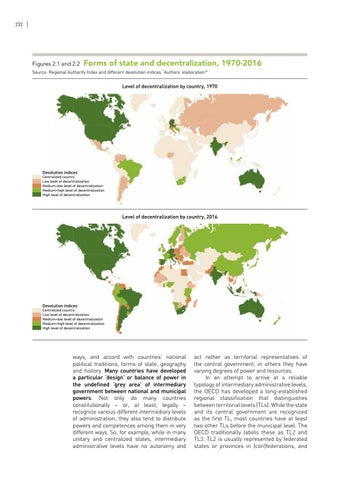
Figures 2.1 and 2.2
Forms of state and decentralization, 1970-2016
Source: Regional Authority Index and different devolution indices. ‘Authors’ elaboration17
Level of decentralization by country, 1970
Devolution indices
Centralized country Low level of decentralization Medium-low level of decentralization Medium-high level of decentralization High level of decentralization
Level of decentralization by country, 2016
Devolution indices
Centralized country Low level of decentralization Medium-low level of decentralization Medium-high level of decentralization High level of decentralization
ways, and accord with countries' national political traditions, forms of state, geography and history. Many countries have developed a particular ‘design’ or balance of power in the undefined ‘grey area’ of intermediary government between national and municipal powers. Not only do many countries constitutionally – or, at least, legally – recognize various different intermediary levels of administration, they also tend to distribute powers and competences among them in very different ways. So, for example, while in many unitary and centralized states, intermediary administrative levels have no autonomy and
act rather as territorial representatives of the central government, in others they have varying degrees of power and resources. In an attempt to arrive at a reliable typology of intermediary administrative levels, the OECD has developed a long-established regional classification that distinguishes between territorial levels (TLs). While the state and its central government are recognized as the first TL, most countries have at least two other TLs before the municipal level. The OECD traditionally labels these as TL2 and TL3. TL2 is usually represented by federated states or provinces in (con)federations, and