图书在版编目(CIP)数据 他山之“城” : 第二届广州国际城市创新奖参评案例分析与经验借鉴 : 英文 / 广州国际城市创新研究会编著 . — 广州 : 南方日报出版社 , 2016.12 ISBN 978-7-5491-1393-4 Ⅰ . ①他… Ⅱ . ①广… Ⅲ . ①城市经济-国家创新系统-研究-英文 Ⅳ . ① F29 中国版本图书馆 CIP 数据核字 (2016) 第 284982 号
出 版 人:周洪威 出版统筹:周山丹 责任编辑:阮清钰
杨柳青
装帧设计:邓晓童 责任技编:王
兰
责任校对:王
燕
实习编辑:李可奕
TASHAN ZHI CHENG
他山之“城”——第二届广州国际城市创新奖参评案例分析与经验借鉴(英文) 编 著:广州国际城市创新研究会 出版发行:南方日报出版社 地
址:广州市广州大道中 289 号
经
销:全国新华书店
印
刷:广州市岭美彩印有限公司
开
本:889×1194mm
印
张:15
字
数:203 千字
版
次:2016 年 12 月第 1 版
印
次:2016 年 12 月第 1 次印刷
定
价:68.00 元
1/16
投稿热线:(020)87373998-8503
读者热线:(020)87373998-8502
网址:http://www.nanfangdaily.com.cn/press http://www.southcn.com/ebook
发现印装质量问题,影响阅读,请与承印厂联系调换。
Five Cities Won the 2nd Guangzhou International Award for Urban Innovation
The Awarding Ceremony of the 2nd Guangzhou International Award for Urban Innovation
Editorial Board Director: Liu Baochun Deputy Directors: Zeng Qingchun Zhu Xiaoyi Lei Weiju Ma Manhe Editors in Chief: Deng Changxiong Liu Liu Wu Xiaoling Yang Zeliang Editors: Chen Ming Huang Shaohuang Publishing House: Nanfang Daily Press
Guangzhou Institute for Urban Innovation
Honorary President: Chen Jianhua President: Liang Guiquan Vice Presidents: Wang Yongping / Li Jiangtao / Gu Jianqing Secretary General: Liu Baochun
  The Guangzhou Institute for Urban Innovation was established under the framework of the Guangzhou Award. The Institute is conceived as an international network of experts and institutions dedicated to furthering urban innovation concepts, tools and methodologies. Its members include research and academic institutions, professional associations, community-based organizations, industry leaders and individual experts.
Preface
001
Preface
Guangzhou International Award
Christchurch (New Zealand) emerged
for Urban Innovation (Guangzhou
to the top and won the awards. In
Award), jointly established by the city
addition, Hangzhou was recognized as
of Guangzhou, United Cities and Local
the "Online-popular City", Bristol, the
Governments (UCLG) and the World
"Media-focused City", and Antioquia,
Association of Major Metropolises
the "Public-recommended City".
(Metropolis), fully demonstrates global
Creative ideas and wisdom of
cities’ creativity and responsibility amidst
cities are pooled together for collective
the wave of global urbanization. The
benefits and a win-win outcome.
2nd Guangzhou Award was brought to a
The Urban Innovation Database is
successful conclusion in Guangzhou in
a treasure trove of a vast number of
November, 2014, a high-profile event
lively urban innovation initiatives,
that involved 209 innovative initiatives
which offer visionary perspectives
from 159 cities of 55 countries
on urban governance and sustainable
and regions across six continents.
development for cities around the
Five initiatives, respectively from
world. Members of Guangzhou
Antioquia (Colombia), Bristol (the
Institute for Urban Innovation have
UK), Dakar (Senegal), Hangzhou
conducted field trips over the past
(the People’s Republic of China) and
year to fourteen shortlisted cities of
002
Learning From Cities—— The 2nd Guangzhou International Award for Urban Innovation
the 2nd Guangzhou Award, along
different development paths. On the
with associated experts and reporters.
course of exploring the paths to urban
Their in-depth analysis and first-hand
innovation, we can always discover
experience have found their expression
the glory of human characters and
in a variety of case study reports,
the immense power of wisdom. For
which are now compiled into this book
instance, Bristol of the UK paints a
entitled Learning from Cities ——
blueprint of what a smart city can look
The 2nd Guangzhou International
like; Antioquia of Colombia reveals
Award for Urban Innovation . Delving
the meaning of education for life;
deeply into fourteen shortlisted
Christchurch of New Zealand shows
initiatives, this book is designed
the world local people’s resilience
to showcase what global cities can
and wisdom against a natural disaster;
accomplish through innovation and
Hangzhou of China revolutionizes its
creativity and to provide cities and
public transportation model; Dakar of
local governments with invaluable
Senegal achieves win-win situation
inspiration on urban planning,
beween social development and
development and governance.
economic benefits. It is our belief that
Cities around the world present
the lively initiatives listed in this book
distinctive features and follow
will surely inspire us to think more
Preface
003
about the future development of cities.
innovation ecosystem and culture and
We look forward to more wisdom
pool together resources for innovation
and creative ideas from participating
and designating innovation-driven
initiatives of the 3rd Guangzhou
development as the core strategy for
Award.
the city’s development.
A city’s charm and cultural identity
Let us join hands together in this
can be reflected in its innovation
grand innovation endeavor for a better
initiatives, and innovation represents
future.
the most powerful driving force behind the advancement of the times. With the dashing and enterprising
Editorial Board
spirit, we will move on to make
December, 2016
innovation the centerpiece of our development programs, never relenting our efforts to nurture a pro-
CONTENTS
Brief Introduction of Guangzhou International Award for Urban Innovation / 002 Report of the Technical Committee (TC) 2014 Guangzhou International Award for Urban Innovation / 006 List of 15 Shortlisted Initiatives of the 2nd Guangzhou International Award for Urban Innovation / 010
European Line >> Great Britain Bristol — Smart City / 014 Germany Hamburg — The International Building Exhibition (IBA) Hamburg and its “Climate Protection Concept Renewable Wilhelmsburg” / 028 Sweden Linköping — Carbon Neutral 2025 / 040
Asian-African Line >> China Hangzhou — Urban Public Bicycle Sharing Program / 052 Korea Kwangju — Greenhouse Gas Emissions Program in Household Carbon Bank in Gwangju / 068 United Arab Emirates Abu Dhabi — Estidama Program / 078 Indonesia Jakarta — The Pluit Reservoir Revitalization Project / 096 Senegal Dakar — Municipal Finance Program / 114
Australian-New Zealand Line >> Australia Melbourne — 4°C Cooler: Using Green Infrastructure to Build a Climate Resilient and Prosperous Melbourne / 124 New Zealand Christchurch — Our Ever Evolving City: Public
Participation in Post-Disaster Construction / 140
The North American Line >> The United States of America Boston — Youth Lead the Change: Participatory Budgeting Boston / 164
The South American Line >> Columbia Antioquia — Educational Parks for Youth / 176 Brazil Rio de Janeiro — Rio Operation Center: Integrating Data and Monitoring Public Utilities in a Truly Intelligent System / 188 Argentina Buenos Aires — Collaborative Roundtable for Innovation and Creativity / 204 Annex: List of 30 Deserving Recommended Initiatives of the 2nd Guangzhou International Award for Urban Innovation / 220
Linköping Bristol Hamburg
Boston
Kwangju Hangzhou The Emirate of Abu Dhabi Dakar Antioquia Jakarta Rio de Janeiro
Melbourne Buenos Aires
Christchurch
001
002
Learning from Cities— The 2nd Guangzhou International Award for Urban Innovation
Brief Introduction of Guangzhou International Award for Urban Innovation
I. Mission and Objective
II. About the Guangzhou Award
The Guangzhou International Award for Urban Innovation (the Guangzhou
1. Award Set-up
Award) is co-sponsored by the United
Presented biennially, the Guangzhou
Cities and Local Governments (UCLG),
Award is discerned to 5 city initiatives
the World Association of the Major
in public policy, public management,
Metropolises (Metropolis) and the City of
partnership and citizen participation,
Guangzhou. The aim of the Guangzhou
smart cities, sustainable development and
Award is to recognize innovation
other areas for each award cycle. Each
in improving social, economic and
of the winning initiatives will receive a
environmental sustainability in cities
USD 20,000 cash prize, a trophy and a
and regions and, in doing so, to advance
commemorative certificate designed for
the prosperity and quality of life of their
the award.
citizens. Presented biennially, the award encourages innovation in public policy, projects, business models and practices.
2. Eligibility
The Guangzhou Award is open to all
Brief Introduction of Guangzhou International Award for Urban Innovation
003
cities and regions worldwide, including members of UCLG and Metropolis.
3. Selection Process
The assessment of initiatives of the
An initiative that is entered for
Guangzhou Award is carried out by the
the Guangzhou Award should meet the
assessment institutions — a Technical
following eligibility criteria:
Committee (TC) and a Jury which consist
a) It should be an original undertaking such as a new policy, project, business
of experts with extensive experience in different domains.
model or practice that promotes social,
The Guangzhou Award strictly
economic and/or environmental
abides by the principles of impartiality,
sustainability in a city or region;
equitability and openness, in an effort
b) It should be an ongoing or recently
to ensure operational transparency and
completed initiative (within the past two
independence. For each award cycle,
years);
the TC will establish a list of qualifying
c) It should provide evidence and/
initiatives based on compliance with the
or indicators of substantial impact and/or
submission guidelines. After that, the TC
success in meeting the initiative’s stated
will identify no more than 45 outstanding
objective(s).
initiatives and, from those 45, a list of 30 deserving initiatives and 15 shortlisted
004
Learning from Cities— The 2nd Guangzhou International Award for Urban Innovation
city initiatives. An independent Jury will
deserving initiatives and 15 shortlisted city
make a final selection of up to 5 award
initiatives. In November, 5 winning cities
winning cities or regions from the shortlist
of the 1st Guangzhou Award were selected,
of 15 outstanding initiatives. This step
including Kocaeli (Turkey), Lilongwe
will involve an evaluation based on the
(Malawi), Seoul (South Korea), Vancouver
presentation of each of the 15 short-listed
(Canada) and Vienna (Austria).
cities during the Guangzhou International Urban Innovation Seminar.
In 2014, the 2nd cycle of the Guangzhou Award received 259 initiatives from 177 cities, 57 countries and regions in 6 continents
III. About Previous Guangzhou Awards
around the world. The initiatives range from the city to the metro-region scale and covered a wide range of the fields
The 1st Guangzhou Award was held
including urban resilience and post disaster
in 2012, with 255 initiatives from 153
reconstruction, urban and environmental
cities across 6 continents and 56 countries
planning, smart city and smart mobility,
and regions around the world. In October,
housing and transportation, infrastructure
a Technical Committee comprising urban
and social services, partnerships and civic
innovation experts made a list of 30
engagement, etc. The Technical Committee
Brief Introduction of Guangzhou International Award for Urban Innovation
005
Meetings of the 2nd Guangzhou Award
more worldwide awareness and
was held in Guangzhou from September
participation in urban innovation, the
25 to 29. By the principles of impartiality,
Organizing Committee of Guangzhou
equitability and openness, the TC chose
Award decided to recognize up to three
30 deserving initiatives and 15 shortlisted
of the short-listed initiatives for their
city initiatives. In November 2014, five
popularity with netizens, the media and
winning cities of the 2nd Guangzhou
participants attending the Guangzhou
Award cycle were selected, including
International Urban Innovation
Antioquia (Colombia), Bristol (UK),
Conference. In 2014, the online-popular
Christchurch (New Zealand), Dakar
city went to Hangzhou (China) while
(Senegal), Hangzhou (China).
Bristol (U.K.) was the preferred city of
In addition, in order to promote
the media and Antioquia (Colombia) the
public involvement in the Guangzhou
preferred city-region by the attendants to
Award selection process and to promote
the Conference.
Learning from Cities— The 2nd Guangzhou International Award for Urban Innovation
006
Report of the Technical Committee (TC) 2014 Guangzhou International Award for Urban Innovation (Guangzhou, China, 25-27 September 2014)
I. Introduction The TC met in Guangzhou from
sharing of lessons learned from urban innovations between cities, regions, countries and thematic areas.
25 to 27 September 2014 to select
The TC wishes to express its
outstanding and deserving initiatives with
appreciation to the City of Guangzhou,
a view to enhancing the implementation
the United Cities and Local Governments
of sustainable urban development
(UCLG) and Metropolis for their vision in
through inspiration and knowledge
establishing the Guangzhou International
sharing. It took into consideration the
Award for Urban Innovation.
goal of the Guangzhou International
It wishes to thank the City of
Award for Urban Innovation (Guangzhou
Guangzhou for its generous hospitality to
Award) to recognize innovations in
the TC. The TC commends the secretariat
improving the social, economic and
for the Guangzhou Award in the way
environmental sustainability in cities and
it handled the call for submissions,
local governments worldwide and more
the transparency in its guidelines and
specifically: To highlight exemplary
processes. It further commends the City
models of innovative policies and
of Guangzhou for its intention to invite
practices; To motivate cities and local
all 15 shortlisted cities to present their
authorities to further promote innovation;
initiatives to the International Seminar
To improve city governance. The TC took
on Urban Innovation as was the case in
also into consideration the objectives of
2012, and to allow the Jury to make its
the City of Guangzhou to promote the
final decision after the seminar.
Report of the Technical Committee (TC) 2014 Guangzhou International Award for Urban Innovation
007
The TC reviewed all 209 initiatives
• Effectiveness: the extent to which
submitted from 159 cities and from
the initiative has achieved its stated
55 countries and regions. Of these
objective(s) and other socially desirable
209 initiatives, 45 were identified as
outcomes;
deserving initiatives. It further selected 15
• Replicability: the value of the
submissions of excellence from the 45.
initiative in inspiring others to adopt new
These are considered of comparable merit
ideas, policies or practices, including
and constitute the shortlist of cities to be
replication in other locations of the city,
submitted to the Jury for its consideration
region or country for greater impact and
and final selection of 5 award-winning cities.
sustainability; • Significance: the importance of the
II. The Evaluation Process
initiative in addressing problems of public concern.
The TC assessed each submission using the main criteria established by the Guangzhou Award for Urban Innovation, namely:
III. Selection Procedure for the Short-listed Initiatives
• Innovativeness: the extent to which
In its first plenary session, the TC
knowledge and information has been
divided into three groups (A, B and C).
applied to develop new policies, practices
Each group reviewed about one third of
and/or business models to address major
the submissions on a regional basis with
urban issues and challenges;
a view to determining the qualifying
Learning from Cities— The 2nd Guangzhou International Award for Urban Innovation
008
initiatives. The work of the three groups
15 shortlisted cities. The draft agenda is
resulted in a consolidated list of 77
contained in a separate report.
initiatives from 71 cities and regions.
The TC commends the leadership
In its second plenary session, the
of Guangzhou for organizing study
members of the TC re-organized into
tours to all of the 15 shortlisted cities of
two groups (D and E) with the purpose
the 1st cycle of the Award and strongly
of identifying 45 outstanding cities.
recommends that it continue this practice.
Each group came up with a list. The two lists were compared in plenary. Those common to both lists were unanimously admitted to deserving initiatives list. Those remaining were discussed in plenary until consensus of the final list of 45 cities was reached. In its third plenary session, the members of the TC were re-organized into Groups F and G with the purpose of identifying 15 outstanding cities. The same methodology was applied and resulted in the shortlist. The TC also came up with a draft agenda for the International Seminar on Urban Innovation which will feature the
V. TC Members 1. Mr. Qiu Baoxing (China), Chair of TC Former Deputy Minister of Ministry of Housing and Urban-Rural Development of the People’s Republic of China (MOHURD) 2. Ms. Sue Brownill (UK), TC Member Reader in Urban Policy and Management Department of Planning, Oxford Brookes University 3. Mr. Zengke He (China), TC Member
Report of the Technical Committee (TC) 2014 Guangzhou International Award for Urban Innovation
009
Deputy Director of National
Senior Researcher of Centre for
Research Center of Innovation, Peking
Strategic and International Studies (CSIS)
University; Doctorate in Political Science
8. Mr. Stefan Schurig (Germany),
4. Mr. Eric Huybrechts (French), TC Member Responsible for International Affairs at the Regional planning agency of Paris/ Ile de France region (IAU-IDF) 5. M s . F e r n a n d a M a g a l h a e s (Brazil), TC Member Senior Urban Specialist of InterAmerican Development Bank 6. Mr. Neal Peirce (America), TC Member Founder of Citiscope (Global news site on innovation in cities), Editor and Writer 7. M r. Vi d h y a n d i k a P e r k a s a (Indonesia), TC Member
TC Member Director Climate Energy at the World Future Council 9. Ms. Wandia Seaforth (Kenya), TC Member Former Chief of Best Practices Programme of the UN-Habitat 10. Ms. Geci Karuri-Sebina (South Africa), TC Member Executive Manager of South African Cities Network 11. Ms. Azza Sirry (Egypt), TC Member Director of UTI at Housing and Building National Research Center, Professor of Urban Planning
Learning from Cities— The 2nd Guangzhou International Award for Urban Innovation
010
List of 15 Shortlisted Initiatives of the 2nd Guangzhou International Award for Urban Innovation (By Alphabetical Order)
City
Initiative
Abu Dhabi (UAE)
Estidama Program
Antioquia (Colombia)
Educational Parks for Youth
Boston (USA)
Youth Lead the Change: Participatory
Budgeting Boston Bristol (UK) Smart City Buenos Aires (Argentina)
Collaborative Roundtable for Innovation and
Creativity Christchurch (New Zealand)
Our Ever Evolving City:Public Participation
in Post-Disaster Construction Dakar (Senegal)
Dakar Municipal Finance Program
Eskisehir (Turkey)
City Memory Museum
Gwangju (South Korea)
GHGs Emission Program in Household
Carbon Bank in Gwangju Hamburg (Germany)
The International Building Exhibition (IBA)
Hamburg and its “Climate Protection Concept Renewable Wilhelmsburg”
List of 15 Shortlisted Initiatives of the 2nd Guangzhou International Award for Urban Innovation
011
Hangzhou (China)
Urban Public Bicycle Sharing Program
Jakarta (Indonesia)
The Pluit Reservoir Revitalization Project
LinkĂśping (Sweden)
Carbon Neutral 2025
Melbourne (Australia)
4°C Cooler: Using Green Infrastructure to
Build a Climate Resilient and Prosperous
Melbourne Rio de Janeiro (Brazil)
Rio Operations Center: Integrating Data and
Monitoring Public Utilities in a Truly Intelligent
System
European Line
014
Learning from Cities— The 2nd Guangzhou International Award for Urban Innovation
Great Britain
â–Ą Overlook of Bristol
/ Bristol / Smart City A historic city beset by problems of
form of government. Bristol's innovative
congestion, an aging population, climate
approach to becoming a smart city is
change and energy resilience, Bristol is
based on people and not on technology:
making itself a place set apart by new
a Public-Private-People approach. It
initiatives. It voted to become one of the
has two primary aims: To contribute to
few cities in England to adopt a mayoral
the reduction of Bristol's CO2 emissions
European Line
015
by 40% by 2020 from a 2005 baseline;
Bristol is advanced under the the Bristol
To use projects to ensure sustainability
Climate Change and Energy Framework
placed at the heart of community concerns
(which provides climate change solutions
and to make sustainability an integral
including strategic activities in 19
way of improving individual 's lives.
dimensions). The program is delivered under the auspices of the Covenant of Mayors (The Covenant of Mayors is the mainstream European movement involving local and regional authorities, voluntarily committing to increasing
Name of City: Bristol
energy efficiency and use of renewable
Name of Country/Region: Great Britain
energy sources on their territories).
Geographic Region: Western Europe
Moreover, the city was awarded European
Population: 442,500 (2015)
“Green Capital” status for 2015.
Surface Area: 110 km2 Population Density: 3,892 people/km2 GDP per capita: GBP 27,100
Background of the Initiative
Title or Slogan of the Initiative: Smart City Bristol Start Date of the Initiative: 2011 End Date of the Initiative: in the Process Thematic Area: Society, Economy, Environment Technology
Similar to other large cities, Bristol faces a series of challenges of climate change, energy resilience, congestion, health and well-being of a diverse, aging population and the transition to the low carbon economy. As the 7th largest city in England, Bristol faces additional challenges around a “super diverse” population and increasing inequality of society-economy deprivation between areas of the city. Bristol’s Smart City Program therefore aims to utilize innovative solutions to help tackle some of these major issues. The novelty of the approach
□ Bristol former mayor George Ferguson is at the scene of the Event Make Sundays Special
is to focus on public-private-people
Learning from Cities— The 2nd Guangzhou International Award for Urban Innovation
016 partnerships, promoting innovative
opportunity to drive the smart city agenda
solutions through the smart deployment
forward.
of information and communication
Finally, and most crucially, the
technology (ICT) and digital connectivity.
individual projects being delivered under
There have been a number of
the smart city agenda and the Green
significant social-political changes in
Capital program have been brought
Bristol in the last two years which have
together under the overarching objective
served as a spring-board for the further
of increasing the city’s resilience to
action. For example, having recently
challenges posed by a large urban area.
been awarded “Green Capital” status
A major flood and infrastructure
for 2015, Bristol is about to embark on
failure (energy, ICT, transport and tap
an ambitious program of showcasing
water) pose the most significant risks for
Bristol’s achievements as a “smart city”,
Bristol in the short term, whilst in the
as well as using this as an opportunity to
long term, the city systems will become
attract further inward investment.
increasingly stressed on account of energy
In 2012, the city voted for its
security, disrupted food systems, public
first directly-elected mayor, therefore
health risks and economic vulnerability.
providing greater leadership and
Population growth and increased
□ Bristol former mayor George Ferguson guides the students how to plant a tree
European Line
017
demographic diversity will present many
application of renewable energy sources,
other challenges to the city’s resilience.
the increase of energy efficiency and
Bristol sees “city resilience” as more
the control of energy demand. In each
than a quick response to the status quo;
of these three areas, it is possible and
It’s an opportunity to transform our social
practical to improve upon what has
and economic systems in the long term
already been built to achieve overall
to achieve social justice and well-being
enhancement and renewal. Against the
within the environmental limits.
background of a globalized, information-
Building the resilience of Bristol is
based and networked world, public
central to the Mayor’s plans for the city,
policies will be hard to be implemented
which has strong engagement, cooperation
in real sense if they are disconnected with
and input from a wide spectrum of
the real needs of the people. In the case of
stakeholders.
Smart City Bristol, efficient energy usage
As above, the strength of the city’s
is placed at the center of carbon emission
approach is in its ability to combine
control, with specific purposes including
expertise and deliver activities in
the reduction of unnecessary energy
connection with a variety of public,
demand, the improvement of energy
private and “third sector” organizations.
efficiency and the incentives for the
Till now, Bristol has delivered activities
application of renewable energy sources.
with over 50 partners to secure positive
Specific measures include the reduction
outcomes for each of Bristol’s citizens.
of carbon emissions in commercial buildings, transportation vehicles and industries by fostering cooperation
Implementation of the Initiative
between citizens, social organizations and
Every city has its own history and
providing incentives for green technology
natural endowments. The growth of a
innovation by enterprises, has set up the
city lies in its constant self improvement
Bristol Prize, a new annual award for
and self upgrading, rather than in
the best new clean technology. The city
the abdication of its traditions for
has launched an international festival for
utter revamp and regeneration. The
Clean Technology Business, for a number
success in building a low-carbon city
of high profile sectors which have the
is predominantly dependent on the
greatest scope for boosting growth. The
enterprises. In terms of industry-related emission control, Bristol, in addition to
018
Learning from Cities— The 2nd Guangzhou International Award for Urban Innovation
â–Ą Bristol has become the first City of Bicycle in Great Britain
European Line
019
city has also held a series of international
led; Every program under the initiative
high profile summits on Climate Change,
is gauged and appraised on the basis
which were attended by the Prime
of whether it is in conformity with
Minister, other leading politicians and top-
public interests and whether it is able
level global climate change stakeholders.
to draw citizens, businesses and social
As regards the reduction of emission in
organizations into the implementation
industries, commercial buildings and
process. This is critically important in that
energy supply, Bristol mainly adopts
it can determine the success and failure
improvement and upgrading measures of
of the overall endeavor of building a low-
economical nature, which can be vividly
carbon city through partnership systems.
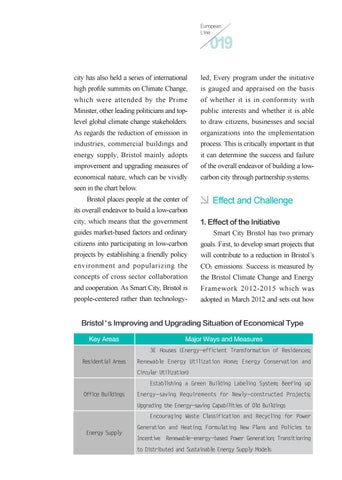
seen in the chart below. Bristol places people at the center of its overall endeavor to build a low-carbon city, which means that the government
Effect and Challenge 1. Effect of the Initiative
guides market-based factors and ordinary
Smart City Bristol has two primary
citizens into participating in low-carbon
goals. First, to develop smart projects that
projects by establishing a friendly policy
will contribute to a reduction in Bristol’s
environment and popularizing the
CO2 emissions. Success is measured by
concepts of cross sector collaboration
the Bristol Climate Change and Energy
and cooperation. As Smart City, Bristol is
Framework 2012-2015 which was
people-centered rather than technology-
adopted in March 2012 and sets out how
Bristol s Improving and Upgrading Situation of Economical Type Key Areas
Major Ways and Measures 3E Houses (Energy-efficient Transformation of Residences;
Residential Areas
Renewable Energy Utilization Home; Energy Conservation and Circular Utilization) Establishing a Green Building Labeling System; Beefing up
Office Buildings
Energy-saving Requirements for Newly-constructed Projects; Upgrading the Energy-saving Capabilities of Old Buildings Encouraging Waste Classification and Recycling for Power
Energy Supply
Generation and Heating; Formulating New Plans and Policies to Incentive Renewable-energy-based Power Generation; Transitioning to Distributed and Sustainable Energy Supply Models
Learning from Cities— The 2nd Guangzhou International Award for Urban Innovation
020 the City Council will work with partners
Accomplishments include:
to reduce the city’s CO2 emissions by
◆
Securing an additional GBP
40% by 2020 from a 2005 baseline, and
7million in funding for Green Capital
how the city will adapt to climate change.
activity
Second, to use projects and the green
◆
Becoming one of the inaugural
capital status to ensure that sustainability
100 Resilient Cities, a pioneering
is placed at the heart of communities,
initiative funded by the Rockefeller
working in partnership with public and
Foundation
private organizations and using ICT and
◆
digital connectivity to support this. The aspiration is to ensure that sustainability
Achieving the 20% energy
reduction target as part of 3E Houses ◆
Decreasing in energy consumption
issues become an integral way of
by schools and council offices as part of
improving individuals’ lives, supporting
the “smart space” project
and enriching experiences rather than being at odds with them.
◆
Increased awareness and
engagement with climate change issues
□ Colorful Hot Air Balloons Bristol Amazing the Sky in the Bristol International Balloon Fiesta
European Line
021
via smart city projects in general.
to support and protect life and enable
The city plans to create resilient
commerce. The city is using a system led
systems—more decentralized, less prone
approach to build in capacity, flexibility,
to cascade failure—and will future-proof
safe failure, and constant learning. Being
investment decisions. Bristol has already
a resilient city is central to the Mayor’s
been the most energetic and waste-
vision.
efficient major UK city, and we plan to meet future needs by managing resources
2. Challenge of the Initiative
even more efficiently. The city aims to
During the advancement of smart
empower individuals and communities
city projects, one of the major obstacles to
to help themselves, support capacity
success is ensuring good communication
building and local decision making, and
with the project customers. It needs to be
protect local amenities. Many building
done in a way that means something to
stocks are old, but the city is working to
them and so they understand the benefits
enable owners to future-proof buildings
and their role. One way of ensuring the
022
Learning from Cities— The 2nd Guangzhou International Award for Urban Innovation
project stakeholders are engaged with
increase efficiency. Then the government
the goals of the program is to formulate
has provided a more effective service for
and devise an effective dissemination and
Bristol’s citizens.
communication strategy. By linking the smart city agenda to Bristol’s status as Green Capital, the profile of the various projects has been raised significantly
Practice and Innovation
on a national level. At a local level, the
1. Progressive and Revolutionary
election of a directly-elected mayor has
Innovation
helped distil messages about the necessity
Smart City Bristol is remarkable
for a “smart city” approach to carbon
in that it combines evolutionary and
reduction.
revolutionary aspects.
When it comes to the employment of
Smart city Bristol is evolutionary
innovative technological solutions, there
in that it builds upon the lessons learned
are a number of political sensitivities
from previous projects. A good example
to consider, especially in the context of
of this is the “smart metering” suite
decreasing authority budgets and the
of projects that has been deployed in
perception that smart city projects are
Bristol, beginning with a project called
somehow non-essential expenditure. This
“DEHEMs” (2008—2011) and further
cynicism has been largely overcome by
developed in “3E Houses” (2011—
establishing successful links with other
2014). Both projects were funded under
internal council departments, securing
European Commission funding initiatives,
buy-in from senior managers as to how
with DEHEMs trialling the use of smart
the technology in question can actually
meters in council-owned properties. The lessons from this project were used to inform the 3e houses work, which used smart metering in combination with a user “interface” to enrich the user experience and increase levels of participation and engagement. Again, the learning from this project has been used to develop a bid for a further smart metering project which
□ Bristol former mayor George Ferguson drives the electric vehicle for energy conservation and environment protection
aims to develop smart metering “apps”. It is hoped that this project will be funded
European Line
023
under the new Horizon 20:20 programe.
permanent initiatives (Traffic Control
It is revolutionary in that the
Centre and Freight Consolidation
projects being delivered are innovative
Center). Bristol is advantageou in that
and are applied within a Bristol context
its companies in microelectronics,
using our own approach to smart cities,
environmental technology and digital
putting people at the heart of a smart city,
creativity collaborate with the community.
rather than centering on technology. For
For example, Bristol’s Living Lab in
example, the So La Bristol smart grid
Knowle West consists of a group of
project is the first in the world to use
people actively involved in the creation
bespoke technology in residents’ homes
and evaluation of technologies which they
to connect solar photovoltaic power
will ultimately use.
generation to battery storage units. The
The city was awarded European
smart city approach places people and
“Green Capital” status for 2015. The
communities at the center of technological
European Green Capital 2015 programe
innovation as the city believes that it is
will also contribute to these targets,
how people interact with technology that
promoting Bristol as a center for
helps inform behavior change and helps
innovation in Green technology. Some
City to achieve its aims. To that end, the
of the projects which will be funded and
So La Bristol project works with a local
delivered as part of the Green Capital
community based on charity with the
2015 include:
specific aim of stakeholder engagement.
◆
The Bristol Prize: a new annual
Furthermore, Bristol’s Green Capital
award for the best new clean technology.
status will allow the city to revolutionize
This will help deliver solutions for cities
its approach by raising the profile of
to dealing with and alleviating climate
Bristol on a wider international scale
change.
and attracting investment in innovative technologies within the city.
◆
A sustainable living program in
UK schools to educate up to 4.5 million children about climate change and about
2. Characteristics
Smart City Bristol was launched in 2011 focusing on Smart Energy, Smart
how cities can contribute to tackling this issue. ◆
An international festival for Clean
Transport and Smart Data. It includes
Technology Business, in Bristol, for a
pilot projects (smart metering, smart grid,
number of high profile sectors which have
electric vehicles, open data), alongside
the greatest scope for boosting growth.
024
Learning from Cities— The 2nd Guangzhou International Award for Urban Innovation
□ Bristol International Balloon Fiesta is now one of the largest in Europe. Various hot air balloons decorate Bristol as the colorful sea full of hot air balloons
The Grass Roots Catalyst Fund,
prepare and deal with the influx of visitors
to incubate and develop sustainable urban
during its tenure as the European Green
living initiatives which can be scaled up
Capital in 2015.
◆
and applied to cities across the world. ◆
A series of international high
profile summits on Climate Change with the attendees including the Prime Minister, other leading politicians and toplevel global climate change stakeholders.
Highlight Bristol is using smart technologies to help meet its target to reduce CO2
A volunteer program to SMEs
emissions by 40% which is a significant
and frontline businesses to help Bristol
challenge as our population is rising twice
◆
European Line
025
and opportunities for innovation. We are leveraging local partnership and absorbing new investment to make Bristol a Low Carbon City. Meausres include investment in digital infrastructure (Council’s citywide fibre network and GBP 11 million Government investment in Broadband and Wi-Fi), energy devices in 500 plus offices and 28,000 homes owned by the Council and a £2.5 million grant from the European Investment Bank to develop a Bristol energy service company and citywide investment program, as well as through transport schemes and business inward investment and innovation. The European Green Capital Award was launched in 2008 by the European Commission to promote and reward the efforts of cities and their local authorities to improve the environment. All recipients of the award have a consistent record of achieving high environmental standards; the UK average. Bristol has a Climate
They are committed to on-going and
Change and Energy Security Framework
ambitious goals for further environmental
and has reduced CO2 emissions by 15%
improvement and sustainable
from 2005-2009, against a 6% population
development; They can act as role models
rise. But the 2020 target is a real challenge
to inspire other cities and promote best
requiring significant action and we see
practices to all other European cities. Past
smart technologies as integral to make
winners include Stockholm, Hamburg,
further reductions. We recognise smart
Vitoria-Gasteiz, Nantes and Copenhagen
technologies bring new opportunities i.e.
(2014).
integrating complex systems, opening up
Bristol has been awarded the title
information supporting better governance
of European Green Capital (EGC) for
026
Learning from Cities— The 2nd Guangzhou International Award for Urban Innovation
2015 due to its ability to demonstrate
“European Green Capital” status. By
rapid progress and continuing ambition,
connecting about a hundred companies
across a wide range of quality of life,
of varying sizes, “Bristol Green Capital
environmental and green business criteria.
Partnership” has created a cooperation
In addition, Bristol is developing its
platform that brings together people from
own energy company which will form an
different sectors, who aspire for exchange
independent entity from the authority in
of views on the building of green cities.
January 2015.
The platform also brings companies with
By being selected to become a
similar business and functions together
member of the 100 Resilient Cities
for brainstorming, in-depth discussion,
network, Bristol has demonstrated an
promotion and seeking opportunities. As
understanding and commitment to
an indispensable part of the innovation
building urban resilience, the desire to
system, the platform is created by the
actively engage multiple-stakeholders
government for the overarching purpose
across the city and to positively impact
of achieving the effective flow and
upon the lives of poor and vulnerable
integration of technology, information
residents.
and capital needed for building a lowcarbon city. For instance, in terms of city health issues, “Bristol Green Capital
Experience and Inspiration
Partnership” launched Healthy City
1. Establishing Broad-based and
program, initiatives were taken to contact
Multi-layered Public-private-
companies and social organizations
people Partnerships
involved in the health industry, promote
Week Program. In the early stage of the
One of the prominent features of
their activities on Bristol Green Capital
urban administration in the UK lies in
Partnership’s official website and
the employment of small-sized teams for
distribute promotion brochures. Bristol
accomplishing big projects, which means
Green Capital Partnership may seem
setting up organizational platforms and
like a large organization both in concept
deploying volunteers to do more things
and in practical work it has done, but
with lower costs. A typical example of this
in reality, it is an organization run by
is “Bristol Green Capital Partnership”,
only two formal staff members, who are
an organization launched by Bristol
responsible for contracting partners and
seven years ago when it was applied to
keeping its daily operation. It is thanks
European Line
027
to the dedication and commitment of
the Bristol Walking Tour in April, Bristol
many interns and volunteers that the
Food Connections and Bristol Art Festival
organization has been able to handle such
in May, Shaun the Sheep during summer
a heavy work load. The organization will
vacations, etc. These thematic events are
continue doing its work after Bristol is
not sponsored by Bristol 2015 Limited.
awarded the “European Green Capital”
Rather, they were sponsored and held
status. Another striking example of
by large organizations in relevant fields,
small-sized team operation in Bristol is
which were given greater freedom and
Bristol’s Living Lab in Knowle West,
leeway, while Bristol 2015 Limited played
which is based on a specific community
the role of recruiting volunteers and event
and mainly involves volunteers and
promotion. Bristol 2015 Limited has set
community representatives.
up a studio and an exhibition hall in the busiest pier area of the city, in which a
2.Setting up Project Companies
thematic green activity and a workshop
through Public-private
are held on a weekly basis. With only
Partnerships between Social
one permanent manager, the exhibition
Organizations and National
hall is operated mainly by the volunteers
Organizations
on a daily basis. The partnership system
A typical example of such endeavor
has been able to pool the strength and
constitutes Bristol 2015 Limited, a
wisdom of all stakeholders together at the
company established for “European
minimum cost possible, for revitalizing
Green Capital” status appraisal. When the
the economy and coordinating social
appraisal work was completed in 2015,
development through low-carbon city
all of the employees were required in
programs, including the European
principle to leave the company. After it
Union, non-governmental organizations,
was founded, the company helped make
enterprises, local communities and
possible low-carbon social events under
volunteers.
different themes each month, including
028
Learning from Cities— The 2nd Guangzhou International Award for Urban Innovation
Germany
□ Cityscape of Hamburg
/ Hamburg / The International Building Exhibition (IBA) Hamburg and its “Climate Protection Concept Renewable Wilhelmsburg” In 2005, Hamburg decided to support
climate change. Wilhemsburg has 55,000
the redevelopment of the Wilhelmsburg
inhabitants living in an island on the
neighborhood through hosting the
Elbe vulnerable to flooding. It is also
International Building Exhibition (IBA)
an ethnically diverse and low-income
and the International Garden Show, for
community with an environment affected
which over 70 projects were developed
by industrial and transport infrastructures.
around 3 themes including cities and
The building of this island has become
European Line
029
a new urban development program of the City of Hamburg, called “Leap over River Elbe”. Hamburg established an energy efficient scheme from 2008 to 2010, maximizing the use of local energy resources such as energy savings and energy efficiency thereby strengthening the local economy. The aim is 100% local renewal supply by 2025 and 100% renewable heat by 2050, making the Elbe Islands carbon neutral. The IBA provided an opportunity and structure to further the scheme, which brought 150 private companies and the local community together to build an“IBA Partnership”. To implement the IBA project, the Hamburg government spent 90 million Euros and Name of City: Hamburg
private investors have spent 700 million
Name of Country/Region: Germany
Euros. Hamburg undertakes to continue
Geographic Region: West Europe
the project and launches new projects
Population: 1774,242 (2015)
after 2013. The present projects are
Surface Area: 755.26 km2
expected to generate a renewable power
Population Density: 2,300 people / km2
production of 54% and a renewable heat
GDP per capita: EUR 62,000
production of 14% of the overall demand
Title or Slogan of the Initiative: Hamburg
by the end of 2015.The IBA Hamburg
International Architectural Exhibition (IBA) and Climate Protection Concept “Renewable Wilhelmburg” Start Date of the Initiative: September 1st, 2006 End Date of the Initiative: November 3rd, 2013 Thematic Area: Environment
Model and the Climate Protection Renewable Wilhemsburg’s strategy have already been used in other parts of the City. Additionally, the IBA is sharing the knowledge generated with other partner cities.
030
Learning from Cities— The 2nd Guangzhou International Award for Urban Innovation
Background of the Initiative To s u p p o r t t h e n e w u r b a n development program of Hamburg, “Leap over River Elbe”, and to connect the city centre with the southern administrative regions, the Hamburg Senate decided in 2005 to present the International Building Exhibition (IBA) and the International Garden Show (IGS) in Wilhelmsburg. In order to realize the coordinated organizing, the Hamburg government founded two city-owned companies cooperating in structure and management in 2006. In 2013, to facilitate the development of over 70 projects in Wilhelmsburg, IBA specified three themes and one of them is “cities and climate change”. This theme is selected based on the following considerations: first, it’s concerned with governance; second, 55,000 inhabitants are living in an Island near the Elbe which suffered from the flood in 1962.
□ Cityscape of Hamburg
The foundation for making the IBA area a more energy efficient environment
renewable energy and at the same time
is the “Climate Protection Concept
to considerably improve the utilization
Renewable Wilhelmsburg”, which
efficiency of local energy consumption.
was implemented by an international committee of experts in collaboration with IBA from 2008 to 2010. The idea behind the resulting “Energy Atlas” is that we need to utilize the city’s (or district’s) local energy resources to supply
Implementation of the Initiative The major part of “Climate Protection
European Line
031
Concept Renewable Wilhelmsburg”
space for residents and improving the
was impemented by an international
utilization efficiency of daylight, hence
committee of experts in collaboration
reducing the consumption amount of
with IBA from 2008 to 2010. It is
electricity.
estimated by this project team that the
Energy Bunker is transformed from
population in the island will grow from
a deserted air raid bunker which is built in
55,000 up to 73,000. The initiative’s aim is 100% local renewal electricity supply
WWⅡ as residents’ shelter from air raid, aircraft port and antiaircraft battery. With
by 2025 and 100% renewable heat by
a height of 42 meters, and a thickness
2050, making the Elbe Islands carbon
of 4 meters on top and 3 meters of outer
neutral. The goal can only be realized
wall, it can accommodate 20,000 people.
by adequately exploiting local energy
The bunker was demolished by Allied
resources and renewable energies, and
Forces in 1947. However, due to its
by substantially improving the utilization
strong main structure and the huge cost
efficiency of local energies. For this
of demolition, the main part of the bunker
end, the project team is committed to
remained intact but abandoned since
the survey of Hamburg itself and draws
then. In 2006, Hamburg International
“Energy Atlas”, which analyzes future
Building Exhibition Company and
energy demands, energy saving potentials,
Hamburg Energy Company proposed the
renewable energy utilization in distinct
program of Energy Bunker and launched
building environments within Hamburg,
the building in 2011 with the funding
and strategic measures of energy supply.
of European Regional Development
For instance, in the security housing
Fund and Climate Protection Concept
community of Wilhelmsburg, the roofs
Organization. The top and side walls are
in the community are all covered with
covered with solar panels and solar hot
solar panels, and the supply of heat and
water facilities of 3,000 square meters,
electricity is additionally supported from
and the interior was equipped with two
the nearby renewable Energy Bunker and
sets of cogeneration systems fueled by
Energy Hill for wind power generation
waste wood and marsh gas. Additionally,
transformed from a toxic waste landfill;
the waste heat from nearby factories
and in terms of energy conservation, the
is transported there to heat the water
old community has added closed balcony
tower with a capacity of 2 million liters,
and specially-designed window which
producing and storing heat. At present, as
makes sunlight rooms, offering more
one of the most representative community
032
Learning from Cities— The 2nd Guangzhou International Award for Urban Innovation
□ Energy and Network Center in Wilhelmsburg, Hamburg
renovation projects in Hamburg, Energy
following are some distinct concept
Bunker can not only meet the heating
buildings launched by Hamburg
requirements of around 3000 households
International Building Exhibition
and the electricity needs of around 1000
Company:
homes, but also become a technology and history tourist attraction with anti-war memorial, tourist center, roof café and sightseeing deck.
Seaweed House
A prospective building with transparent algae breeding boxes is as
The prospective green-concept
the component of the external wall.
architectural group includes various
The small algae in the tanks produce,
commercial residential buildings as
through photosynthesis, bubbling
symbols of the idea of low carbon. The
methane from the bottom, which moves
European Line
033
the green algae just like a dynamic jade
light energy conversion of this building
screen. Meanwhile, the methane is then
reaches 10%, and light heat conversion
transported to the generator under the
efficiency is 38%.
building which produces electricity for the heating and lighting of the house. The
Tidal House
production of methane by algae is 5 times
This reinforced concrete building
more efficient than by the traditional
built on a gigantic floating concrete
vegetations. The present efficiency of
platform moves up and down along the tides of Elbe. This design brings a new idea to the architecture in flood-frequented areas. The energy generated by the tidal fluctuation can meet the requirement of heat supply and refrigeration of the whole building while the solar photovoltaic panels and the solar heating equipment on the roof can supply the remaining needs of heating and electricity.
□ Seaweed House
Sunflower House
The whole building consists of wood structure duplex apartments whose sun blinds over the roofs and balcony are covered with solar hull cells, which can move progressively along the direction change of sunshine to realize □ Wood Cube
the maximum conversion efficiency. The sun blinds can absorb additional sunlight and can send off heat when the indoor temperature drops, just like an airconditioner. Other Commercial Residential Buildings of Renewable Concept
□ Green Smart House
Some buildings are made from light
Learning from Cities— The 2nd Guangzhou International Award for Urban Innovation
034
□ The International Building Exhibition (IBA) Hamburg brings out three-layer Dock building, floating up and down as the Elbe's tide rises and ebbs.
precast slabs whose indoor space can be
or rented well, marking its popularity
adjusted within hours; For example, a one-
among the new community residents.
bedroom apartment can be transformed into a three-bedroom apartment. Some are totally made from plywood and are specially capable of heat preservation and energy saving. Some change colors of
Effect and Challenge 1. Effect of the Initiative
outer walls to absorb natural heat. Some
The already realized or already
are transparent on all sides, offering a
scheduled projects in 2013 were expected
sunshine home office. Some look like
to generate a renewable power production
Rubik’s cube, the projecting direction
of 54% and a renewable heat production
of which can be designed personally by
of 14% of the overall demand by the end
the resident. These houses, with a higher
of 2015.
price than ordinary ones, have been sold
After the realization of the IBA
European Line
035
projects, a new “Implementation Plan” will be the second Action Plan until 2020 or 2025. The Plan includes:
2. Challenge of the Initiative
The financial situation of house owners prevents even highly-economically
◆
continuing on-going IBA projects
efficient refurbishments or technical
◆
starting the schematized projects
installations, for which IBA delivered
◆
transfering existing IBA structures,
information and consultancy to facilitate
concepts and networks into a “post IBA period”
the implementation of the measures. Another barrier is the risk of
◆
developing totally new projects
investments in district heating grids in
◆
attending the general German and
existing areas with a great number of
Hamburg development
house owners. IBA organized a number of
After the Implementation of the
round table discussions as well as joint and
IBA projects, we will step into a brand
integrated planning workshops to achieve
new development stage where different
best resolution and ensure the interests for
situations have to be met.
all stakeholders.
Practice and Innovation 1. Progressive Innovation
After the realization of the IBA exhibition in 2013, a follow-up organization has used the existing competence and network to develop and market several new development areas, both within the borders of the exhibition area (central Wilhelmsburg area) and in areas located outside the former area. Combined with the evaluation and monitoring concept, the lessons learned from IBA will be used to upgrade and adjust the “Climate Protection Concept Renewable Wilhelmsburg” to reach the □ The Firstly Built Energy Box in Hamburg
goals in 2050.
036
Learning from Cities— The 2nd Guangzhou International Award for Urban Innovation
2. Characteristics
The IBA Hamburg examines ways in which maximum use can be made of local renewable energy sources within the border of the city or districts, such as energy savings and energy efficiency, and how local economies can be strengthened as a result. The working group undertaking the
□ Energy Box of the International Building Exhibition (IBA)
study “Energy Optimisation of the IBA Hamburg Model Region”(University
the relevant studies were working on a
of Applied Sciences Nordhausen)
district level and analyzed future energy
analyzed the following factors: future
demand, potentials for energy savings,
energy demand, the potentials for energy
increased efficiency, and the use of
savings, increased efficiency, the use of
renewable energy in the various types of
renewable energy in the various types of
urban building environment on the Elbe
urban building environment on the Elbe
Islands, and the strategic measures for the
Islands, and strategic measures for energy
optimization of energy supplies.
supplies.
The working group undertook a concrete examination of two different reference scenarios, applying Germany-
Highlight The main objective of the “Climate
wide trends in renovation, efficiency and the introduction of renewable energy to the Elbe Islands.
Protection Concept Renewable
Two so-called excellent scenarios
Wilhelmsburg” is to tackle the challenges
were developed as alternatives to the
of global climate change by the
reference scenarios to advance the
development and the implementation of
concrete implementation of IBA projects
measures within the border of the city
and also to monitor different areas of
or districts, energy savings and energy
emphasis in renewable energy supplies.
efficiency, the use of local renewable
The two scenarios share the fact that
energy sources and how local economies
they are local and decentralized solutions
can be strengthened as a result.
adapted to the special local ability to
The working group undertaking
achieve autonomy in renewable energy.
European Line
037
The results of the study, undertaken
sources by 2050 even if the population
in close cooperation with the IBA’s
will grow from 55,000 up to 73,000.
specialist Energy and Climate Advisory
In detail, a 100% supply by renewable
Board, form the most important basis for
power is possible until 2025, a supply of
the “Energy-Atlas” of the Elbe Islands,
85% renewable heat until 2050, to make
and represent the strategic instruments
the Elbe Islands nearly carbon neutral
and projects of the Elbe Islands’ future
until 2050.
energy supply systems. The aim is the
The first project like “Energy
presentation of a spatial energy model for
Bunker”, the conversion of a former
the IBA’s demonstration region.
World War II aircraft shelter into a
In fact, the results of the study
power station and heat storage and
demonstrate the possibility to supply the
“Energy Hill”, the transformation of a toxic
Elbe Islands by local renewable energy
landfill into a location of wind turbines and
□ The Firstly Built Energy Mountain in Hamburg
Learning from Cities— The 2nd Guangzhou International Award for Urban Innovation
038 PV as well as a public park , have been
development, and such strategy shall be
realized in close cooperation with local
upgraded as policy to lead the low-carbon
people and will be continued.
development of the entire industry and region. The prevalence of low-carbon office
Experience and Inspiration
building in Europe is attributed to the
1. Low-carbon Buildings based
At the very beginning, the government
on Technology Optimization
actually did not enforce any policy or
guidance and promotion of governments.
The core of the low-carbon city
law to regulate the specifications of low
and society is low-carbon technology.
carbon technology. Instead, they gradually
We shall focus on the research &
enhanced the industry entry barriers after
development and application of low-
being approved by the public affairs
carbon technologies. Specifically, high-
ministry, private organizations and
tech strategy shall be undertaken with
citizens. For this end, the government
certain mature high technology as the
and companies have spared no effort
breakthrough making a new example of
to make investment in new low-carbon
â–Ą Citizens participate in the International Building Exhibition (IBA) Hamburg programs
European Line
039
2. Ideally-planned Low-carbon Development
Due to the shortage of capital and technology, most cities choose the development of demonstrative lowcarbon community and low-carbon industry park to gradually advance low-carbon development. However, in terms of requisites for the establishment of a low-carbon city, the reduction of carbon dioxide emission is a complex □ Energy Atlas IBA Hamburg GmbH
technology.
systematic project, and for an effective implementation, low-carbon development must be multidimensional and shall
In brief, low-carbon urban
be integrated into all aspects of urban
development in Germany is to build urban
development. Otherwise, the costly
image, local identification and national
green technology and products may be
cultural capital through “earth-friendly”
swamped and crowded out by rudimentary
clean technologies. A high-tech industry
technologies. In this sense, the ideally-
benchmark is established to foster an
planned low-carbon development
urban environment attractive for global
represented by Hamburg’s new district
investment capital, offering numerous
can foretell a good achievement, though
opportunities of development and revival
abundant capital, technology support and
for enterprises, cities and nations against
long-term investment are needed.
the global economical recession.
040
Learning from Cities— The 2nd Guangzhou International Award for Urban Innovation
Sweden
□ Cityscape of Linköping
/ Linköping / Carbon Neutral 2025 Linköping has a bold goal: to
networks. The municipality has sought
become an absolutely carbon neutral
to lead by example: it uses renewable
city by 2025. The city council’s road to
fuels (over half of its vehicles use
that goal was launched through broad-
biogas); it specifies climate criteria in
based collaboration and partnership with
its procurement processes; it regularly
residents, employers, universities, other
communicates climate and environmental
cities and national and international
issues to its employees and residents;
European Line
041
Name of City: Linkรถping Name of Country/Region: Sweden Geographic Region: North Europe Population: 150,202 (2013) Surface Area: 1,436 km2 Population Density: 130 people / km2 GDP per capita: USD 54,240 Title or slogan of the Initiative: Linkรถping Carbon Neutral 2025: Concept Revival Start Date of the Initiative: 1990s End Date of the Initiative: in the process to 2025 to realize of carbon neutral Thematic Area: Society, Environment, Governance/Management
and it works closely with Linkรถping University to develop methods and technologies to reduce CO2 emissions and to establish a Biogas Research Centre. Two new combined heat and power plants have been built, with 95 percent of homes already connected. Buses are fueled by biogas produced from livestock manure and food waste. The results are already emerging: CO2 emissions are down by 25 percent since 1990, energy consumption in schools and hospitals have been reduced by 5 percent and are on a trend for further reductions.
โ ก Long-term Strategic Sustainable Development Plan of Linkรถping
Learning from Cities— The 2nd Guangzhou International Award for Urban Innovation
042 Background of the Initiative Linköping Municipality has a long tradition of pro-active climate and environmental work. In 1993, a crossparty group was established to develop a local Agenda 21 plan, resulting in the “Plan of Action for a Sustainable Linköping in the Long Term” in 1998. In
□ Urban Public Transportation in Linköping utilizes the methane from livestock manure and dumped food
2011, the Municipal Council adopted its long-term climate goal to make Linköping a carbon-neutral community by 2025. For the urban area, this goal is
on the EU’s “Waste Hierarchy” ◆
The collaborative contribution of
based upon the long-term climate and
local government departments, residents
environmental strategy that has been
(over 2000 residents assisted in the
an important part of the municipality’s
formulation of Agenda 21 plan) and
political ambition since the 1970s.
local businesses as the key to achieve the
Reflected in all policies, it acts as the basis
climate goal.
for a number of policy documents. The Municipal Council has therefore adopted a range of programmes for environmental development: ◆
Long term strategic plan for
sustainable Linköping ◆
General Plan for Physical Planning
including Traffic Strategy ◆
Climate Strategy to Reduce
Greenhouse Gas Emissions ◆
Nature Conservation Programme
to Preserve and Promote Biodiversity
Implementation of the Initiative 1. Energy
Municipal Council collects food waste as the primary supply for producing biogas, which acts as the power source for city buses and the bio-fertilizer can be used to produce organic food. Most of the gas, produced mainly from livestock
Action Programme for Improved
manure, industrial food waste and
Air Quality with Special Focus on
slaughterhouse waste, fuels the city’s 70
Particulates
public transport buses. Garbage trucks
◆
◆
Waste Management Plan based
and approximately 1,000 other vehicles
European Line
043
also run on the gas. The Council works
2. Sustainable Housing
closely with Linköping University to
The Environmental and Quality
develop methods and technologies to
Programme for Vallastaden designs a
reduce CO2 emissions and to establish
footpath and bicycle path convenient for
a Biogas Research Centre. Two new
travelling. For climate issues, routine
combined heat and power plants have
communication and advertisement
been built, with 95 percent of homes
with employees and residents have
already connected. In 2012, the Municipal
been conducted. They offer free advice
Council introduced sorting at source for
for house owners, undertake mobile
domestic food waste. Placed in a special
management, make energy survey and
bag that is separated from other fractions
advice for local enterprises, and hold
by an optical sorting process, food waste
contests for children and adolescents on
is a substrate for biogas production and
energy and climate knowledge.
agricultural bio-fertiliser. 80% households sort food waste at source.
3. Local Economic Development
Östra Valla, a former industrial area, is earmarked for sustainable redevelopment. There will be residential premises here, but primarily Östra Valla will be a business incubator for small and medium-sized enterprises and serve as a platform for entrepreneurship and innovation, and a testing ground and demonstration area for sustainable solutions in environmental technology.
Effect and Challenge 1. Effect of the Initiative
The long-term climate and environmental initiatives have had many □ The well-designed Cycle Track in Linköping makes it convenient for people to go out
positive effects: ◆
Annual waste per capita waste has
Learning from Cities— The 2nd Guangzhou International Award for Urban Innovation
044
emissions from treated wastewater have decreased by 60% and 35% respectively since 2001 ◆
Nitrogen dioxide concentrations
in urban environments have fallen from 29 μg/m3 to 8 μg/m3 in the air since the late 1980s ◆
The number of kilometres driven
per vehicle/year has decreased from 13,000 to 12,000 km over the past 10 years ◆
50% increase in new “green car”
registrations ◆
56% of all the electricity used is
produced locally from renewable sources □ Citizens in Linköping classify the kitchen garbage
and in a climate efficient way ◆
25% reduction in CO2 emissions
between 1990 and 2010 2. Challenge of the Initiative
First, garbage classification, including the sorting of food waste in households, takes a long time to be widely accepted in the entire society. To advertise such □ Enterprises have close cooperation with the universities to develop the new technologies and measures to reduce the CO2 emissions
environmental concept and deeds, it needs the contribution of manpower and resources of the government,
fallen from 305 kilos to 208 kilos since
primary and secondary schools and local
1992
resident administrations. Meanwhile, the Waste fractions sorted at source
government fund is also required to boost
and collected from households as paper,
the advertisement, making sustainable
plastic, metal, batteries, light bulbs and
development concept rooted in people’s
electronic equipment have increased
mind.
◆
◆
Nitrogen and phosphorus
Second, companies, especially those
European Line
045
technology-based companies of waste
green innovation and sustainable
treatment and energy supply, need the
development.
financial support of government and the technology support of institutions at their preliminary development stage. Otherwise, if too much time and manpower of their own are spent in the
Practice and Innovation 1. Progressive Innovation
preliminary stage, their productivity
The most important factor behind
and market share may be impaired, thus
the success of Linköping’s climate and
damping their initiative of performing
environmental work is the combination of
□ The basic facilities like the gas pipeline in Linköping develop well and there are five public gas-filling stations
046
Learning from Cities— The 2nd Guangzhou International Award for Urban Innovation
a long-term approach, a highly innovative driving force, broad-based collaboration and high political consensus, in which areas Linköping leads Sweaden and even the world. Collaboration and partnership with residents, trade and industry, other municipalities, universities, authorities and national and international networks has high priority in Linköping’s sustainability efforts. 2. Characteristics
In close cooperation with Linköping University, this project is featured by
□ Teknika Verken, a public serving company own methane production factories and gas-filling stations in many municipal districts
the reduction of carbon dioxide by developing technology and processes.
large-scale investment has attracted two biogas companies active in the Swedish and international markets to
Highlight
Linköping, thus becoming a regional hub for the development of biogas. The
In 1997, one of the world’s largest
utility company Tekniska Verken owns
facilities for producing biogas for vehicle
production plants and filling stations in
fuels opened in Linköping. Most of the
several municipalities.
gas, produced mainly from livestock
In 2012, the Municipal Council
manure, industrial food waste and
introduced sorting at source for domestic
slaughterhouse waste, fuels the city’s 70
food waste. Placed in a special bag that
public transport buses. Garbage trucks
is separated from other fractions by an
and approximately 1,000 other vehicles
optical sorting process, food waste is
also run on the gas.
a substrate for biogas production and
Biogas, a renewable fuel, currently supplies 6% of Linköping’s vehicle
agricultural bio-fertilizer. 80% of the households sort food waste at source.
fuel needs. The infrastructure is well
The Environmental and Quality
developed with gas pipelines and
P r o g r a m m e f o r Va l l a s t a d e n w a s
five public gas filling stations. This
approved in 2013. Vallastaden’s first
European Line
047
450 apartments, reflecting ambitions
infrastructure is 100% recyclable. Space-
for resource efficiency and social
saving culverts mean plot ratio can be
sustainability, are scheduled for
increased. Also, subsequent servicing
completion by 2017. This unique area is
of utility infrastructure will not require
conceived as an eco-village; everything
excavation work that disturbs the
is within easy reach and social interaction
environment or consumes resources
is stimulated by making it simple to
unnecessarily.
move around on foot or by bicycle.
Vallastaden lays the foundations for
Central road space is reserved for a car
building tomorrow’s society. Throughout
park. Infrastructure for charging electric
the entire planning process citizens’
vehicles will be in place throughout. In
dialogues have been held with residents,
a unique solution to the challenge of
builders and researchers.
minimising the space needed for utility
Another innovative initiative is Östra
infrastructure, all electric cables, fibre
Valla, a former industrial area earmarked
optics, district heating, water, sewerage
for sustainable redevelopment. There
and vacuum waste collection systems
will be residential premises here, but
are bundled in a single, prefabricated
primarily Östra Valla will be a business
culvert (2.5 metres in diameter). Cables
incubator for small and medium-sized
and conduits are prefabricated so the
enterprises and serve as a platform for
□ Long-term Strategic Sustainable □ The cooperation among the government, enterprises and universities in Linköping promote the sustainable development and innovation Development Plan of Linköping
048
Learning from Cities— The 2nd Guangzhou International Award for Urban Innovation
entrepreneurship and innovation, and a
incineration of unrecyclable wastes
testing ground and demonstration area for
into fuel energy. This eliminates the
sustainable solutions in environmental
impact of urban waste management
technology.
upon the environment, and decreases the dependence of urban public transport on chemical fuel, making a win-win situation.
Experience and Inspiration 2. Advance of the Innovation in 1. Acceleration of the Development
Sustainable Development Sector
and Utilization of Renewable
through the Cooperation Mode
Energy and Adjustment of
of “Government + University +
Energy Consumption Structure
Enterprise”
Since 2001, Linköping has made
Linköping takes the operation mode
various classifications of rubbish and
of state-owned enterprise. That is, the
constantly improved its ability of waste
government makes investment to build
recycling, including the degradation
facilities and renovate massive waste
of kitchen waste into biogas, and the
incineration and biochemical treatment
□ The diversified garbage classification can become the lifestyles and cultural tradition for the common citizens
European Line
049
3. Improvement of the Utilization Efficiency of Energy
The most important energy source of Linkรถping is two combined heat and power plants which generate electricity and supply centralized heating very efficiently. Centralized heating started from 1954. Now 95 percent homes are already connected with the centralized heating system. The most distinctive feature of Linkรถping energy supply is resource efficiency, and its energy system can be listed among the most energyโ ก Technology is changing our life
efficient systems in the world. The energy in households and commercial wastes are reused in cogeneration plant to produce
facilities, which are then handed
heat and power for most of local needs.
over to solely state-owned company Tenkniska Verken for operation. In
4. Making Waste Sorting
terms of technology innovation of waste
a Lifestyle and Tradition of
classification and treatment, Linkรถping
Common People
established a municipal Environmental
As the education in childhood
Center co-funded by the government,
and adolescence is extendable for the
university and enterprises, which serves
whole lifetime, the integration of a right
as a scientific research platform based
development value into their elementary
on mutual help for waste treatment
education can both help establish the
companies and research organizations,
sustainable development ethics deep into
making the waste treatment technology
their mind for a lifetime and influence
of Linkรถping forerunning in Sweden. A
their parents and the whole family
proof is that the city is sufficiently capable
lifestyle. This is a best advertisement
of receiving the waste of other countries
mode for sustainable development,
like Britain to both make money out
low-carbon development and green
of treating their wastes but also supply
development.
enough fuel for heating in cold winter.
AsianAfrican Line
052
Learning from Cities— The 2nd Guangzhou International Award for Urban Innovation
China
□ Hangzhou and the West Lake integrate in harmony
/ Hangzhou / Urban Public Bicycle Sharing Program With 80 percent of residents and
system. Run by the newly-formed
commuters identifying a serious traffic
Hangzhou Public Bicycle Development
problem in the city, Hangzhou launched
Company, it represents a model of
China ' s first public bicycle project.
government-led enterprise, claimed to be
Serving some 280,000 passengers
the world’s largest bike-sharing program
daily, the system (free for the first hour)
that doesn’t require government funding
complements the city’s extensive bus
beyond initial capital. Beyond fees on
Asian-African Line
053
bike use (imposed after an hour of use), the company raises significant private funds through selling advertising space on the bike docking station kiosks. A key feature is that partnerships provide technology supports and improving recommendations. .
Background of the Initiative In recent years, with the rapid social and economic development and the acceleration of urbanization, the increasing urban population has resulted in a rising demand for outdoor trips year by year. In spite of more investment by local governments, the urban construction still lags behind remarkably the public demands for urban traffic resources. The Name of City: Hangzhou
pressure of urban traffic keeps growing
Name of Country/Region: People's Republic
to give rise of the problem of “Two
of China Name of Province or State: Zhejiang Geographic Region: Asia Pacific
Difficults” in urban traffic (“difficult to drive” and “difficult to park”). In order to relieve the traffic
Population: 7,969,500 (2012)
congestion and reduce the public travel
Surface Area: 16,645 km2
costs, the CPC Hangzhou Committee
Population Density: 479 people / km2 GDP per capita: RMB 113,063 Title or Slogan of the Initiative: Urban Public Bicycle Sharing Program Start Date of the Initiative: March, 2008 End Date of the Initiative: in the Process
and Hangzhou Municipality have given strong policy support to bus companies and financed them on the basis of their service quality. After years of effort, public transport in Hangzhou has made great progress in facilities such as vehicles and service quality, taking a leading
Learning from Cities— The 2nd Guangzhou International Award for Urban Innovation
054 position in public transport in China. The passenger share ratio of Hangzhou’s public transportation increased to 22.2% in 2007 from 7.8% in 1987, making great contribution to the social and economic development of Hangzhou. Nevertheless, a survey conducted by local organizations indicates that 80% of the interviewees are still unsatisfied with the current traffic situation of Hangzhou and 84.74% of them think the traffic congestion has lowered their life quality. Such public opinions thus make a new way of convenient, economic, and safe public transportation extremely urgent. The CPC Hangzhou Committee and Hangzhou Municipality started to plan a public bicycle program in March, 2008, which was for the first time in China, so as to alleviate the “Two Difficults” problem in urban traffic.
□ Citizens and travelers cycle along the beautiful West Lake
Public Bicycle Service Development Co., Ltd. (abbreviated as “Hangzhou Public Bicycle Service”) in April, 2008. The company is responsible for the total construction, operation and service management of Hangzhou’s public bicycle system, introducing the practice of free rent within one hour and staged rent beyond one hour. The first row of 61
Implementation of the Initiative 1. Planning and Preparation
(1) The Founding of Hangzhou Public Bicycle Service Development Company (in 2008) Coordinated by Hangzhou Public Transport Group Co., Ltd., the CPC Hangzhou Committee and Hangzhou Municipality established Hangzhou
public bicycle service outlets was open to the public in May 2008 and a total of 2800 public bicycles were put on trial. (2) Making Long-term Public Bicycle Development Planning (2008 to 2010) The CPC Hangzhou Committee and Hangzhou Municipality developed the Opinions on Strengthening Construction and Management of Public Bicycle System and Opinions on Further Practice of Preferential Development Strategy of
Asian-African Line
055
Public Transport and Building of “Quality
central area of these five counties should
Public Transport” in 2008 and in early
afford 200 to 400 public bicycles from
2010 respectively. According to the
10 to 20 outlets. By 2015, the number of
Opinions, the 1st-stage of the construction
public bicycles in Hangzhou should total
program would be completed at the end
up to 90,000 and the outlets reach 3,500,
of 2009 with up to 1,000 renting outlets
of which the central area of these five
in main urban districts of 50,000 bicycles.
counties should be home to 500 public
By 2010, the public bicycle system should
bicycles from 25 outlets. It is planned
be extended to Hangzhou Economic &
that there will be 175,000 public bicycles
Technological Development Area (Xiasha
at least in Hangzhou and the sum is
District), Hangzhou Hi-tech Development
expected to be 200,000 if possible.
Zone (Binjiang District), Xiaoshan
(3) Exploring the Sustainable
District and Yuhang District. By 2012,
Development of Public Bicycle (in 2009)
the system should cover all five counties
To ensure the sustainable development
with a total of 60,000 public bicycles
of public bicycle, at the very beginning,
from 2,400 renting outlets, of which the
the government has put forward a plan
□ Public Bicycle Serving Spots in Hangzhou
056
Learning from Cities— The 2nd Guangzhou International Award for Urban Innovation
of financial support to infrastructure
large recreational areas, large residential
construction of the system and the rest of
quarters, scenic spots and sports venues.
costs should be covered by enterprises so
Hangzhou Municipal Bureau of City
as to reduce the financial pressure of the
Administration is responsible for the
government. However, the government
coordination among departments such
will give preferential policy on trial,
as traffic police, civil affairs and sub-
including the commercialization and
district administrations, the collection
the development of service outlets. The
of public opinions on site location and
model of “public financing and corporate
the coordination work of site location,
management” lays a sound foundation for
providing its support to the early
the sustainable development of Hangzhou
construction of the public bicycle system.
public bicycle system.
(2) Hang zh o u P ub lic B icy cle Company, a subordinate to Hangzhou
2. Coordinated Participation
(1) The governing authorities at all levels, including Hangzhou Urban and Rural Construction Commission, Hangzhou Urban Planning Bureau and Hangzhou Municipal Commission of City Administration and Law Enforcement, provide great support to the development of service outlets. Hangzhou Urban Planning Bureau laid out the plan of service outlets and developed the plan connecting the public metro system. As for those places where public bicycle service outlets are to be placed, according to the urban planning, Hangzhou Construction Committee requests the designers to specify the land for public bicycles in the engineering designing and pre-empt the space for the development of public bicycle system when examining projects such as stations,
□ Lingering Charm of the West Lake Bathed Under the Spring Dew
Asian-African Line
057
Public Transport Group, is in full charge
potentials. At the early stage, there were
of the project.
only 61 outlets with 2,800 public bicycles
Since its establishment, Hangzhou
and the highest daily rent times are about
Public Bicycle Company has been
5,000. After six years of development, the
engaged in continuous innovation in
system boasts 3,111 outlets with 78,000
service, management and operation
public bicycles by July 2014, making
under the great support from the local
the plan of the distance of 300 meters for
governing authorities at all levels. Based
every single outlet. The highest daily
on the high technology, it has been
rent of bicycles reached 411,400 times
continuously improving the quality of the
and the accumulated quantity for the
system by developing general planning,
past six years up to 410 million times.
giving standards, creating new models,
The ratio of public free use is 96% and
optimizing services and exploring
the survey shows 95.09% of the public
058
Learning from Cities— The 2nd Guangzhou International Award for Urban Innovation
□ The serving spot of east railway station in Hangzhou is the first one to utilize the turnstile facility in China
are satisfied with it.
exempted and reduced the cost of road occupancy for the renting outlets, which
3. Resource Utilization
greatly reduced the operating costs.
(1) Financial Source: Stable
(2) Technical Support: Cooperating
Financing Through Municipal Supporting
with Colleges & Universities to Improve
Funds
Intelligent Management
At the time of the establishment of
Through cooperation with colleges
Hangzhou Public Bicycle Company in
& universities such as Hangzhou Dianzi
2008, the CPC Hangzhou Committee and
University and Zhejiang University
the Hangzhou Municipality proposed to
of Technology, and by means of data
support the infrastructure construction
analysis, we have developed systems
of public bicycle system with public
for smart bicycle scheduling, rent
investment and all the other resources
management and system to identify
and the advertisement and service outlets
possible mechanical failure to achieve
should be developed by enterprises for
the intelligent management of the public
free while the income should be used for
bicycle system and provide technical
the operation of the system. Meanwhile,
support for the challenge of “difficult to
the central and local governments also
drop off” and “difficult to repair”.
arranged great financial supports for
(3) Human Resources: Colleges &
green energy characteristics of the public
Universities, Communities and Social
bicycle system, and Hangzhou Municipal
Elites Participate in Voluntary Activities
Bureau of City Administration also
According to the agreement jointly
Asian-African Line
059
signed by seven colleges & universities,
and primary schools are now active in
including Zhejiang Gongshang University
voluntary activities.
and Hangzhou Public Bicycle Company, the Collegiate Volunteer Service Center for Public Bicycle System will be set up with volunteers participating in cleaning and maintenance of public bicycles,
Effect and Challenge 1. Effect of the Initiative
promoting green travel concept, and
Since the traffic service system of
guiding and encouraging green travel.
public bicycles in Hangzhou was put into
With the promotion of voluntary services
operation, through analysis on the public
and the scale expansion of public bicycles,
reaction it can be conluded that the results
all kinds of communities, middle schools
are far beyond the original intention
â–Ą Citizens and travelers cycle along the beautiful West Lake
060
Learning from Cities— The 2nd Guangzhou International Award for Urban Innovation
of solving the problems of “the last
(2) To further improve the share
kilometer after bus travel” and relieving
rate of the bus trip and alleviate the “two
the two problems of “the urban
difficults” of urban traffic
traffic”. Certain outcomes have been
Combine the favorable terms of
achieved, such as in promoting energy
public bicycle rental with bus trip to
conservation and emissions reduction,
attract more people to choose buses and
constructing low carbon cities,
improve the share rate of bus trip. At
advocating green travel, improving the
present, the highest day rent amount of
urban grade, advancing the city image
public bicycle is up to 411,400 times with
and improving the physical quality of
an accumulative total rent amount of more
the citizens.
than 410 million times in six years. The
(1) Integration with the public
share rate of bus trip is increased further,
transport system of the city basically
which plays a certain role in reducing the
solves “the last kilometer after bus travel”. Through the positioning of public welfare of bicycle transport system along with technology, the autonomous service of renting a public bike at one place and returning at another has been realized, which is combined with the existing public traffic system. At present, analyzing from the situation of public bicycle rental, the lease area has been transferred from scenic areas to urban areas and renting period also begins to focus on travel peak in the morning and evening (accounting for about 45% of daily rents), suggesting that public bicycle rental has transferred from the initial visit in the scenic spot to the normal travel. It is proved from this change that traffic system of public bicycle can solve the problem of “the last kilometer after ‘bus trip’”.
□ Seeking Dreams in the North Street
Asian-African Line
061
pressure of urban road traffic, improving
compared with bus trip; and save 50,900
road traffic conditions and easing the two
tons of standard coal and reduce137,400
problems of traffic.
tons of carbon dioxide emissions
(3) To advocate green travel and
compared with sedan cars. If each car
promote the development of urban low-
carries two persons on average it means
carbon economy
that 141,400 cars are decreased every
According to statistics in 2013,
day. And the fuel charge saved in a year
the annual average daily rent amount
is equivalent to all the investment of the
was 282,800, the average rent time 33.6
government for public bicycles and it is
minutes and the average trip distance
incalculable for the demonstration of city
about 3.0-5.0 km, which could save
ecological construction and guidance
12,600 tons of standard coal and reduce
effect.
34,200 tons of carbon dioxide emissions
(4) P u b l i c t r a v e l s h o u l d b e convenient and reduce the cost of public transportation The traffic service system construction of public bicycles in Hangzhou through scientific and technological innovation has effectively reduced the system running costs, has reduced the trip cost of hirers to an extreme and carried out a policy that citizens can rent public bicycles for free in an hour after getting off the bus. According to statistics, more than 96% of the public bicycle rental has been free since this system was released. At the same time, the company also associated the favorable terms of free rent for public bicycles with conventional public bus trip and formulated a measure that the free time transferred from regular bus to public bicycle is extended to one and a half hours so as to attract more and more
062
Learning from Cities— The 2nd Guangzhou International Award for Urban Innovation
□ Happy Public Bicycle Riding Activity in Hangzhou
people to choose bus trip.
problem. To find a solution, the local government adopted a method of planning
2. Challenge of the Initiative
in advance and had put the public bicycle
In the process of practice we have
space into consideration in the early years
come across five major problems, namely
of urban rail transit and the newly-built
“difficult to distribute”, “difficult to
community planning.
return”, “difficult to react”, “difficult to
(2) Difficult to return
repair” and “difficult to manage”.
As the public bicycle project
(1) Difficult to distribute
became widely recognized, more and
The outlets of public bicycles in
more people are dedicated to low carbon
Hangzhou are all on sidewalks. Because
travel and therefore the riding time has
of the limited urban road resources, the
been concentrated on the peak time in
outlet distribution gradually became a
the morning and evening. Because of
Asian-African Line
063
the systematically unattended operation
“difficult to repair” has become a major
and renting at one place and returning
problem in operation. To find a solution,
at another and the peak “tide” in the
the company appoints maintenance
morning and evening, a problem of
staff at the service outlets to repair and
“difficult to return” came into being. To
maintain bicycles, resets the bicycle after
solve this problem, people are assigned
being dismantled that has been used for
to the manual service in more than 100
a certain fixed number of years, makes
service outlets to help customers rent
industrial improvement and improves the
and return bicycles and at the same time,
quality of the bicycles.
the information technology is applied to
(5) Difficult to manage
establish a real-time dynamic scheduling
Most of the public bicycle projects in
management mechanism to strengthen the
other cities are supported by the long-term
vehicle scheduling, and a mobile phone
fiscal subsidies from the government. It
APP was developed to guide people to
brings a great burden to the government
return bicycles to the nearest place.
when the system completely depends
(3) Difficult to react
on the fiscal subsidies at the same time.
Of the 3000 plus outlets only some
However, the system in Hangzhou
100 have been staffed with people on
adopts a model of “government invests
duty, so people who have problems in the
and companies manage”. After the
process of bicycle rental cannot get direct
government completes the disposable
and quick response. What they can do is
investment of construction funds, the
merely consult with the hotline for help
company through the marketing operation
and such a way of reaction has negative
meets the public welfare demand. That
affection on efficiency. To improve it, the
is the major innovation for the public
company has opened an official website,
bicycle system in Hangzhou, but how to
upgraded the hotline platform and opened
maximize the use of existing resources
SMS and Wechat platform to strengthen
becomes a difficult problem troubling
the communication with citizens to
the company. For this problem, in 2010
improve the reaction.
Hangzhou Public Bicycle Service
(4) Difficult to repair
allowed, through public bidding, the 1035
Along with the increasing
booths, tents and the 50,000 bicycles to
dependence on public bicycle, as well as
be coated with advertisements at a price
the rising frequency of use that causes
of 28 million RMB per year (an average
continuous damage of these bicycles,
annual increase of 10%). Meanwhile, the
064
Learning from Cities— The 2nd Guangzhou International Award for Urban Innovation
service pavilion increases the construction
development of this system. On this basis
of commercial services such as tourism
the company continues to be innovative
consulting, selling beverages and
in management in 2014 by developing
packaged food, and selling lottery tickets.
Yinting in cooperation with banks and
It also served as registration sites for car
exports their service to other domestic
training, achieving a goal of “one pavilion
cities to increase revenue.
with multi-purpose”, and the advertising is put on the service pavilion to raise more funds. In 2011, the financial report of the public bicycle system showed the basic balance and thus laid a foundation for sound operation and sustainable
□ Melted Snow Mirroring the Three Pools
Practice and Innovation 1. Revolutionary Innovation
The Program, to some extent, is
Asian-African Line
065
revolutionarily innovative. Borrowing the
based on the Chinese characteristics.
idea from Paris, Hangzhou Public Bicycle
The innovation program has formed its
Company has not ever been to France
unique characteristics and Hangzhou
or had any email exchanges at the early
characteristics in target, system,
stage. The company merely downloaded
construction, management, operation,
pictures of Paris’ public bicycles from
technology, policy, etc.. Playing a leading
the Internet and then independently
role in the program, the government
developed “YAO Guofang” lock device
sets up professional teams based on
with many national patents and Hangzhou
the public transport and guarantees
Public Bicycle Intelligent System and
the non-profit service by means of
changes the means of travel of many
commercialized operation of resources,
Hangzhou citizens. Ten riding routes are
laying a foundation for sound operation
promoted to provide a more leisure travel
and sustainable development of the public
to visitors who can ride to visit the West
bicycle service system. This system is
Lake and ten old City Gates. Meanwhile,
recognized as “the Hangzhou Model”
the development scale, service modes
by the peers and the media at home and
and results achieved in the later period go
abroad and has a broad influence.
beyond those of many cities in the world. According to the “Activity Time”, an American Professional Outdoor Activity Website, analysis and contrast have been
Highlight
made on public bicycle programs of 553
In recent years, the project of sharing
places around the world in Oct. 2013,
public urban bicycles has been promoted
and the comprehensive scores based on
in a growing number of cities and most
six criteria made Hangzhou the top one
cities have achieved excellent results in
among the 16 places with the highest
the promotion; However, most of the
scores.
successful cases tend to be based on the unlimited financial investment of urban
2. Characteristics
government at sectors. Although, to a
Hangzhou public bicycle innovation
certain extent, it alleviated the urban
program is originated from Paris yet it
traffic congestion and improved the urban
only borrows its concept of “Public”
air quality, it also can be seen that with
and makes improvements on specific
the expansion of projects and aging of
management, service and operation
facilities, government need to invest more
Learning from Cities— The 2nd Guangzhou International Award for Urban Innovation
066 and more, resulting in heavier and heavier
enterprises are oriented by public welfare.
burden, which will eventually restrict the
The rent is basically for free and the ratio
quality of the urban public bicycle project
is over 96%. Being market-oriented, it
in the promotion. Take the public bicycle
transfers the right of management of
system in Wuhan for example. To reduce
service booths and advertisement on
financial stress when promoting the public
bikes to the private sectors and explores
bicycle project, the local government fully
to establish kiosks. The operation
delegated the right of management of the
income is spent for system maintenance,
public bicycle project to the local private
labour costs and vehicle maintenance.
enterprises. In the absence of government
After realizing a basic balance in 2011,
leading, enterprises pursue profits blindly,
they gradually make earnings, without
making the “Wuhan model” of public
spending a penny from taxpayers any
bicycles paralyzed and reformed in April,
more.
2014, thus giving rise to the loss of stateowned assets. The business model of public bicycle in Hangzhou completely avoids the above
Experience and Inspiration
problems. After the government makes a
1.Government Leading, Scientific
one-off financial input to public bicycle
Planning
infrastructure, it mainly administrates
Hangzhou Municipal Government
from planning and regulations while
integrated the cycling lanes into its urban
□ Public Bicycle Sharing Facility
Asian-African Line
067
transportation planning and accelerates
computer management system, database
its construction in parallel with the
management system, IPC management
construction and transformation of urban
system, monitoring system and identification
roads and riversides improvement. In
system. These measures offer not only
addition, the government made a one-
self-service for people to rent bicycles,
off investment in the infrastructure and
but also effective system management,
new bicycles and entrusted Hangzhou
realizing the concept of “no one on duty,
Public Bicycle Service Development
self-service, renting at one place and
Company for implementation. The
returning at another, convenient and
company operates by itself and affords
smart�.
the costs for labour, vehicle and system maintenance. The government supervises
3. Non-profit Position, Market-
and supports in terms of planning and
oriented Operation
policy, etc., scientifically distributing the
The public bicycle system in
outlets, strictly authorizing and regulating
Hangzhou is regarded as a public
other commercial bicycle renting, and
product and thus gains a special fund
prohibiting bicycle renting if it occupies
for its own construction. Citizens could
the public resources like roads.
rent bicycles for free within one hour and this preferential policy extends to
2.Advanced Technology,
the transfer between bicycle and bus
Regulated Management
trips within one and a half hours. This
The public bicycle system in
measure attracts more people to take
Hangzhou operates in three layers,
the bus, which reduces the running cost
containing six functional modules like
for the company and the transportation
renting, network, monitoring, etc., 14
cost for renters to the largest extent. To
sub-systems and 3 affiliated systems.
guarantee its sustainable development, the
It applies IoT technologies integrated
public bicycle program turns to market-
with FRID, ICT, automatic control and
oriented operation, making full use of
search, management, account settlement,
advertisement on bikes and service booths
etc. to support the systematic operation,
to realize the maximum interest, so as to
including developing lockup device,
reach a financial balance.
068
Learning from Cities— The 2nd Guangzhou International Award for Urban Innovation
Korea
□ Kwangju City Hall
/ Kwangju / Greenhouse Gas Emissions Program in Household Carbon Bank in Gwangju Can a government-initiated program
indicates a strong “yes.” Initiated in 2008,
to spark voluntary carbon-saving steps
it has expanded participation by some
by citizens actually generate significant
330,000 households, representing 1.5
returns? Gwangju’s Carbon Bank system
million Gwangju citizens, accounting
Asian-African Line
069
from non-industrial sectors, including Name of City: Kwangju
emissions from home and business.
Name of Country / Region: South Korea
It is an urgent need for Kwangju to
Geographic Region: Asia-Pacific Population: 1,477,780 (2014) Surface Area: 501.24 km2 Population Density: 2,900 people / km2 GDP per capita: USD 24,520 Title or Slogan of the Initiative: GHGs Emission Program in Household Carbon Bank in Gwangju
reduce greenhouse gas emissions from households. In addition, in terms of greenhouse gas emissions, the nonindustrial sector is more likely to succeed than the industrial sector, which also shows the urgent need to implement an effective project of greenhouse gas emission reduction in local area. In order to transform public
Start Date of the Initiative: April 10th , 2008
awareness and induce the public to
End Date of the Initiative: 2012
actively participate in greenhouse gas
Thematic Area: Environment
reduction activities, Kwangju signed a climate change model city agreement with the Ministry of Environment on April 10th, 2008, with the target of reducing greenhouse gas emissions to 10 percent (66.1 tons) that of 2005 (661.5 tons) by 2015. The city also introduced
for 62 percent of the city’s population.
the “carbon bank system”. “Carbon bank”
While the city paid for educational and
is a system that pays for participated
operating costs, a Green Star Network
families the points which are converted
was responsible for implementing the
by the amount of reduced carbon dioxide
education and promotion activities.
due to the saving energy (electricity, gas
Greenhouse gas emissions have decreased
and water supply Lines). This system can
each year, most recently by 135,000 tons.
reduce the cost of water and electricity by energy conservation; Families can also get bonus points; The earth can be
Background of the Initiative
healed, as well. They can be regarded as
In Kwangju, more than 40 percent
“Carbon Bank” points are compared with
of all greenhouse gas emissions come
the average amount of the same period
“killing three birds with one stone” effect.
070
Learning from Cities— The 2nd Guangzhou International Award for Urban Innovation
within the previous two years. The energy savings of the current year are converted into points, and the Kwangju Bank would pay to carbon green card issuers once a year.
Implementation of the Initiative 1. Planning and implementation
In order to build a model city which can adapt to climate change, Kwangju introduced the carbon bank system. Carbon bank system calculates the reduced carbon dioxide emissions through
□ Wonhyosa Temple is located under the Wonhyo Peak, the northern foot of Mudeungsan Mountain in Kwangju
spontaneous energy saving behaviors within the family (including electricity, city gas or water, etc.) and converted them
2. Multilateral Collaboration
into points. Points will then be returned
Kwangju is responsible for the
to the involved families. Each household
operation of carbon bank system. 62% of
can reduce certain fees according to the
the families in the city have participated
number of points. Kwangju Bank issued
in the Carbon Bank project. Kwangju
the carbon green card to participated
Bank offers points to participated families
families, which is used to record points.
while the data is provided by the three
Kwangju carbon bank project is an
institutions (Korea Electric Power
innovative environmental policy.
Corporation, Kwangju water company,
By taking advantage of the carbon
Hae Yang city gas company). “Green On”
bank system, Kwangju is able to
Alliance (including 31 non-governmental
analyze and evaluate the reductions of
organizations) is responsible for the
greenhouse gas emissions each year and
promotion and publicity of the system. In
can constantly promote the development
addition, local organizations, including
of the system through continuous
local community Leaders Union,
monitoring.
Saemaeul Women’s Union and carbon
Asian-African Line
071
management and operation. The city takes the responsibility for promotion expenses, and “Green On” Alliance is responsible for concrete implementation of promotion and publicity. Since 2012, the Ministry of Environment, Republic of Korea (50%) and Kwangju (50%) takes charge of the cost of conversion points.
Effect and Challenge 1. Effect of the Initiative
Domestic greenhouse gas emissions can be effectively reduced by the Carbon Bank project which has been emissions coordinating organizations, all
widely promoted by local governments
encourage residents to actively participate
worldwide. In Korea, the banking system
in the project.
has laid the foundation for the country's
From 2008 to 2012, the Kwangju
carbon point system.
Bank is responsible for the cost converted
Carbon Bank system allows
through points in the carbon bank project.
Kwangju to become a “carbon neutral
Kwangju is responsible for system
city”, adapting to climate change, which is
□ The Sparkling Kwangju River
072
□ Classified Waste Collection of Kwangju Residential Areas
Learning from Cities— The 2nd Guangzhou International Award for Urban Innovation
□ According to the point system of Carbon Bank, Kwangju residents use the facility to separate the kitchen garbage
also a global trend to local governments.
systematic data. In order to realize that,
The system allows Kwangju citizens
the government has to obtain personal
to enhance their ability of adapting to
information of the residents and this
climate change. The operation manner
also leads to residents’ unwillingness of
of the system also consolidates the
participating.
cooperation between organizations, which
To solve these problems, Kwangju
jointly promote urban development. In
vigorously promotes the project of carbon
the end, the flow of carbon points has
bank via television or radio ad, the ad city,
undoubtedly stimulated local economic
metro or bus banners, residential elevators
development.
labels, brochures and other forms. These promotional practices through multi-form
2. Challenge of the Initiative
and major efforts have achieved good
Carbon Bank project encourages
results, and the number of local residents
active participation of local residents.
to participate in the carbon bank project
Initially, many local residents have not
greatly increased.
realized the importance of adapting to
Another obstacle is to ensure that the
climate change, so it is very difficult
project can effectively reduce emissions.
to attract them to participate. Also, it
The analysis of related data in the year after
is a very critical part to make sure that
the implementation of the project has shown
the government can obtain reliable
that effective results have been achieved in
Asian-African Line
073
reducing greenhouse gas emissions.
that number has risen to about 330,000 (62% of households in the city), greatly improving the public’s participation.
Practice and Innovation
In all families participating in the project, 60% of them have successfully
1.Progressive and Revolutionary
completed their emission reduction targets.
Innovation
Accordingly, greenhouse gas emissions are
Carbon Bank system, as a policy is not only progressive, but also innovative.
also reduced year by year. The emission has been reduced by 135,000 tons till now.
Every year, people would make an
The project is also an innovative one.
assessment of the implementation results
Organizations, responsible for providing
and continue to improve it. In 2008, the
the data of family carbon reduction,
number of families participating in the
cooperate with each other closely, so that
project was about 20,000. In five years,
the project can proceed smoothly.
â–Ą Kwangju World Cup Stadium once served as one of the World Cup stadiums
074
Learning from Cities— The 2nd Guangzhou International Award for Urban Innovation
□ Bustling Night of Kwangju
2. Characteristics
applied in the world, so this project is very
Carbon bank system is managed
unique. In the process of implementing
by a unique approach, with members of
the project, the cooperation with “Green
the public spontaneously participating in
Star network” is very important, for it can
activities adapting to climate change.
ensure the supply of financial resources.
The involvement of Kwangju Bank
Meanwhile, the annual assessment
effectively solves the most important
of the project guarantees continuous
issue — financial resources. Kwangju
improvement of the project.
Bank is committed to building “Green Star Network” (including 31 nongovernmental organizations). Carbon points are issued through the carbon green card, and such management is first
Highlight In the process of adapting to climate
Asian-African Line
075
Project, which is a trading system, can be extended to non-industrial sectors. The project focuses on collaborative operation to encourage local communities to strengthen communication and cooperation. Local banks are also involved in the project, creating a “green bank” image, stimulate the local economy and effectively reduce emissions. Spontaneous participation of the public and effective combination of local resources is an important factor in the success of the project. As all the conditions are ripe, carbon bank project is an important part of urban innovation.
Experience and Inspiration 1. “I want” Defeats “Want me”
change, cities play a key role. But those
Although Kwangju carbon bank
urban projects which can effectively
was initiated by the government, it is a
reduce greenhouse gas emissions can be
project that benefits the people of the
counted. Kwangju Carbon Bank Project is
city. When implementing the carbon
a fruitful public project which encourages
bank project, Kwangju did not push it
citizens to participate in actions of
strongly as it were an administrative
emissions reduction voluntarily.
order, and instead, the government
If a city wants to build a Clean
waited for the public to take the initiative
Development Mechanism, the projects
to follow after they saw real benefit,
regarding reduction of greenhouse gas
changing from “want me” to “I want”.
emission in non-industrial areas are
The implementation of the project greatly
very important. Based on a reliable
reduces the expenses of everyday life of
data system, the Kwangju Carbon bank
the people, and the people also obtain
076
Learning from Cities— The 2nd Guangzhou International Award for Urban Innovation
□ Time-honored Hwanbyeokdang Pavilion
additional carbon credits concessions.
In addition, Kwangju has appointed a
In the implementation process, the
number of “carbon coordinators”, who
representatives of the residents offer their
are assigned to various communities,
willingness, and they construct after vote;
assisting the implementation of emission
in promotion, the government tended
reduction. While bringing benefits to
to use flexible promotional tools, such
the public, the city has also successfully
as television or radio advertisement, the
reached the goal.
city advertisement, metro or bus banners, residential elevators labels, brochures and
2. “Multilateral” Defeats
so on. During the five years from 2008
“Unilateral”
to 2013 since the implementation of the
During project planning and
project, the number of families involved
implementation, members of the public
in the project increased significantly.
consciously participated in decision-
Asian-African Line
077
making process. Apart from that, the
(50%) that are responsible for the cost of
government also takes full account
conversion points.
of the role of civil institutions in formulating policies, changing from
3.“Extended”Defeats“Closed”
“unilateral” to “multilateral”. In this
If a city wants to build a clean
way, the government achieves a great
development mechanism, projects
success while also reducing its burden.
regarding the reduction of greenhouse
In addition to the government and the
gas emission in non-industrial areas
public, parties involved in the project are
are very important. Based on a reliable
Kwangju Bank, Korea Electric Power
data system, the Kwangju carbon bank
Corporation, Kwangju water company,
project, which is a trading system,
Hae Yang city gas company, “Green On”
can be extended to the non-industrial
coalition (including 31 non-governmental
sectors. In contrast, the carbon bank
organizations), local community Leaders
enjoys great ductility, and can add more
Union, Saemaeul women’s Union
content compared to some of the specific
and carbon emissions coordination
policies. As in the original energy saving
organizations. During the Five-year period
fields such as electricity, city gas, water,
from 2008 to 2012, the Kwangju Bank is
etc., carbon bank continues to include
responsible for the cost converted through
food waste recycling program. In the
points in the Carbon Bank Project. The
future, it will be further expanded from
city takes the responsibility for promotion
the household sector to 315 schools,
expenses, and “Green On” coalition is
36,855 commercial enterprises and 4,280
responsible for concrete implementation
manufacturing facilities. The system plans
of promotion and publicity. Since 2012,
to cover all areas except the traffic, and
they are the Ministry of Environment,
each individual item is included in the
Republic of Korea (50%) and Kwangju
system at a low cost.
078
Learning from Cities— The 2nd Guangzhou International Award for Urban Innovation
United Arab Emirates
□ Abu Dhabi——the International Metropolis
/ Abu Dhabi / Estidama Program
In one of the world’s most rapidly
more environmentally responsible
growing cities, a new government-
and sustainable. The program targets
mandated program—Estidama
energy use reduction of 31 percent,
(Arabic for “sustainable”) aims at
water use saving of 37 percent, and 65
making all new buildings in UAE
percent construction waste diverted
Asian-African Line
079
from landfill. There’s a mandatory audit procedure for each project. The rules
Background of the Initiative
ran into initial resistance from industry
As the capital of the United Arab
groups that feared increased costs and
Emirates, Abu Dhabi has maintained
more difficult project approval. But
a fast pace of economic growth by
independent analysis has confirmed
tapping into its rich reserves of oil
that cost increases are negligible.
and natural gas, with its GDP per capita amounting to US$ 49,600. In recent years, the government of Abu Dhabi has launched a series of pro-sustainability programs, which are designed to help build up a new socio-economic development model
Name of City: Abu Dhabi
featuring low energy consumption and
Name of Province/State: Emirate of Abu
sustainability.
Dhabi Name of Country/Region: United Arab Emirates Geographic Region: North Africa and Middle East Population: 2,490,600 (2012)
Previously, the region followed a predominantly nomadic herding, fishing and pearl diving culture, with date and vegetable plantations contributing to the local economy. Bedouin life, whilst hard and without many of today’s material comforts, required little from
Surface Area: 972 km2
the land and made little impact in
Population Density: 947 people / km2
return. Wasting nothing, the Bedouin
GD per capita: USD 49,000
way of life was truly sustainable, but
Title or Slogan of the Initiative: Estidama
it is now unadaptable to the needs
Program Start Date of the Initiative: 2008 (Mandated 2010) End Date of the Initiative: in the Process
of socio-economic development in the modern times. Abu Dhabi has undergone a dramatic change in the last fifty years, with the economic rewards
Thematic Area: Society Economy
from oil and gas reserves propelling it
Environment Governance / Management
from a backward region into a modern
Technology
megalopolis today. Despite such extraordinary progress, Abu Dhabi still
Learning from Cities— The 2nd Guangzhou International Award for Urban Innovation
080
Subsidies provided by the Abu Dhabi Government for the Public Affairs Agriculture Government/School Business/Industry Residence (Non-citizens of United Arab Emirates) Residence (Citizens of United Arab Emirates) Residence (Remote Region) Water
Electricity
0 20 4060 80 100 Subsidy(%)
faces many challenges going forward,
to businesses, resulted in the UAE
most prominently natural and resource
having one of the largest carbon
constraints.
footprints internationally.
The first challenge facing Abu
The second challenge is the huge
Dhabi constitutes a harsh climate and
government operational costs induced
water scarcity. Abu Dhabi Emirate
by the government’s massive subsidies
is located in a desert environment
for public utilities. In recent years,
and experiences a climate that is
the number of government funded
extremely hot, and simultaneously
projects, which include housing
humid and arid, for much of the year.
for citizens, represents 72% of all
Temperatures range from 10-48 degrees
new development. The total cost to
Celsius, summer humidity levels are
government for these projects includes
near 100% and average rainfall is less
capital and a significant proportion
than 100mm/year. Water scarcity is
of operational expenditure as a result
severe – virtually all potable water is
of the substantial subsidies. Statistics
desalinated from the Arabian Gulf –
show that the electricity subsidy in
and the challenge of providing human
residential buildings ranges from 55%
comfort, both within buildings and
to 99% and the water subsidy ranges
for pedestrians, is extensive. Lack of
from 79% to 100%. In this connection,
resource management, from individuals
reducing energy consumption and
Asian-African Line
081
government spending is a key factor
improvement.
supporting the business case for
The ultimate goal of Estidama is
sustainable development in Abu Dhabi.
to preserve and enrich Abu Dhabi's
To respond to these challenges,
physical and cultural identity, while
the Urban Planning Council (UPC)
creating an always improving quality
has developed “Vision 2030”, a plan to
of life for its residents on four equal
evolve the city into a vibrant metropolis
pillars of sustainability: environmental,
with global reach, teaming with world
economic, social, and cultural. This
class industry, commerce, education,
touches all aspects of life in Abu
healthcare, transport and tourism.
Dhab — the way we build, the way
It represents a holistic framework
we resource, the way we live, the
that enables the implementation of
choices we make—all in an effort to
sustainability principles to all scales
attain a sustainable state of living. By
of development and promotes a new
working closely with all stakeholders,
mindset for building a forward thinking
Estidama has already improved the
global capital. It is the symbol of
mind-set and implementation practices
inspired governance and community
of the construction industry and will
□ Urban Climate Sensor Model
082
Learning from Cities— The 2nd Guangzhou International Award for Urban Innovation
continually develop to encourage
implementation task was undertaken
improvement for all of society.
by the UPC alone. In this connection, it was of critical importance for Estidama to win the endorsement at the regional
Implementation of the Initiative
level of Abu Dhabi, which was
A set of effective working mechanisms
close alignment with “Vision 2030�,
and rating systems have been put
so the Pearl Rating System (PRS), the
in place during the implementation
centerpiece of Estidama Program, received
process of Estidama Program, as is
Abu Dhabi Government mandate in
vividly indicated in the success story of
July 2010, immediately after it was
building Masdar City.
submitted by the UPC as a policy
granted at last. As far as Abu Dhabi is concerned, Estidama Program is in
proposal. 1. The Working Mechanism: Multi-party Collaboration
Second, collaboration between public and private sectors. Although
Given its nature of being an
Estidama Program is able to produce
extremely complex project, it would
tangible socio-economic benefits
be difficult for Estidama Program
in the long term, the enforcement
to be effectively advanced single-
of the compulsory Pearl Rating
handedly by the government or by
System inevitably results in a short-
the private sector. Therefore, from
term increase of engineering and
the outset of its implementation,
management costs. Therefore, the
the Urban Planning Council (UPC),
government of Abu Dhabi faced a
as the initiator of the program, has
challenge of how to communicate this
acknowledged the importance of multi-
trade-off between short-term and long-
party collaboration.
term benefits to the business community
First, intra-governmental
in a way that would not discourage
collaboration. As sustainable development
their investment in urban construction.
bears on the interests of every citizen
In regard to costs, the government of
and involves all governmental
Abu Dhabi decided to reduce subsidies
departments, it would be practically
for construction projects of all sorts,
impossible to make speedy headways
which was conducive to incentivizing
in advancing Estidama Program if the
businesses to incorporate as many
Asian-African Line
083
the requirements of the Pearl Rating System. Moreover, although Estidama is a government-led program, some of its larger-scale projects are left to the private sector to be advanced. For instance, Masdar City is undertaken by Masdar, a subsidiary company of Mubadala, while Saadiyat is developed by TDIC. â–Ą Pearl Rating System of Abu Dhabi
Third, collaboration between government and trained consultants and
energy-efficient designs and materials
experts. Estidama Program needs the
as possible during the construction
government to bring trained consultants
process, a move that, if adopted, would
and experts from various fields
cut operational and management costs
together. Particularly important is that
in the later stage of a project. In terms
before projects are officially incepted,
of gains, the government of Abu Dhabi
stakeholders, such as designers and
promised more land development
builders should be brought to the table
rights to developers that would meet
for an in-depth exchange of views. This
Differences between Integrated Development Process and Conventional Design Process Integrated Development Process
Conventional Design Process
Team members engage in the process from the get-go.
Team members engage in the process only when necessary
Time and energy is committed in early stages.
Little time, energy and cooperation is committed in early stages.
Decision-making is highly influenced by team members.
Decisions are made by just a few members.
Regenerative processes
Lineal processes
Holistic thinking
Isolated thinking
Seeking synergy
Few opportunities for synergy and collaboration
Life cycle costs
Emphasis on preliminary costs
Processes continue even after the completion of construction.
Processes come to an end when construction is completed
084
Learning from Cities— The 2nd Guangzhou International Award for Urban Innovation
is because enabling these stakeholders
vast majority of ordinary citizens. In
(oftentimes with divergent views and
this sense, it is of particular importance
visions on how to advance a project)
to educate the public on details of
to agree on a plan that meets the
the Pearl Rating System. On top of
requirements of Estidama Program is
education and training, the government
a crucial step towards the successful
also encouraged public involvement in
implementation of the project. Pearl
discussions before launching Estidama
Qualified Professionals (or PQR)
Program, with a view to winning public
are often brought in to facilitate the
understanding and support.
collaboration between government and experts. Well-versed in various PRS
2. The Evaluation Mechanism:
requirements and with a high degree of
The Pearl Rating System (PRS)
independence, these PQRs can serve as
To support and to accelerate
facilitators of communication among
the implementation of sustainability
experts and between government
principles, a key component of the
and experts. It is also important for
Estidama program is the Pearl Rating
the government to help local experts
System (PRS), which received
develop a more internationalized
government mandate in July 2010.
vision. To this end, the government
Adherence is therefore compulsory
encouraged local experts to make a
to ensure that all new projects and
comparison between the PRS and
communities are in compliance with at
LEED (Leadership in Energy and
least the minimum requirements of the
Environmental Design) to see which
PRS. Meanwhile, competition among
set of standards are more favorable for
projects is boosted to incentivize real
sustainable development and in which
estate developers to pursue higher
aspects. In this way, the local experts
goals pertaining to sustainability. In
could develop a better understanding
actuality, in the early phase of devising
of the adaptability of these rating
the Pearl Rating System, the UPC
standards to local conditions.
just expected it to become suggestive
Fourth, collaboration between
norms governing new projects. To the
government and ordinary citizens. The
UPC’s surprise, upper-level authorities,
success of Estidama Program relies,
deeming the PRS to be of paramount
in the final analysis, on the ideals of
importance, decided to implement it as
sustainability being accepted by the
a mandatory regulation all across the
Asian-African Line
085
be granted a higher rating if it meets the requirements in the innovative practice section. A striking example in this regard is Masdar City Project, which has been granted one pearl in terms of innovative practices, mainly because free PRS training is provided to employees working for the project. As for the construction waste, the PRS requires a project to recycle at least 30% of its construction waste. The Executive Council Order of May 2010 states that all new applicable buildings must meet the one Pearl requirements starting in September 2010, while all government funded buildings must achieve minimum of 2 â–Ą Microclimate Design
pearls. Three rating stages have been established under the PRS, namely,
region of Abu Dhabi.
design, construction and operational
All aspects of sustainable
stages, for the overarching objective
development pertinent to Abu Dhabi
of making sustainability run through
are encompassed in the PRS, namely,
the entire life cycle of a project.
the integrated development process,
PRS requirements have already been
natural systems, livable buildings,
implanted into the first two stages
precious water, resourceful energy,
(design and construction), while the
stewarding materials and innovative
third stage (operational) is still in a trial
practices. A unique emphasis is placed
period. As of 2010, PRS requirements
on energy and water saving, which
became compulsory and bound with
makes up a 50% share in the overall
the issuance of construction licenses.
scoring system. Requirements in all
Four on-site audits are conducted
sections except the innovative practice
during the construction stage to reduce
section are compulsory. A project will
defects and liability issues and removes
086
Learning from Cities— The 2nd Guangzhou International Award for Urban Innovation
instances of non-compliance. This
for both Design and Construction
in turn improves the efficiency of
stages. To be an PQP, the individual
the construction process and reduces
must pass and exam which will test
maintenance and operational costs.
their administrative and technical
The Pearl Operational Rating System
knowledge of the Pearl Rating System.
(PORS) is another unique element
All pearl rating procedures must be
to Estidama and the Pearl Rating
undertaken by a certified PQP, who is
System. Resource use during buildings
regarded as a mediator between the
operation far outweighs that during the
project team and the Urban Planning
design and construction phases. The
Council. As an integral member of
continual efficient operation of building systems is critical to ensure that the resource savings calculated during the design process become real. The first on-site audit is to lay a solid framework and foundation for a project; the second audit is to establish the top-level and exterior structures; the third audit is for internal maintenance and MEP (mechanics, equipment and pipelines) engineering; the fourth audit is for readjustment and document transfer. On-site audits are carried out jointly by UPC staff members and Pearl Qualified Professionals. If a project fails to pass an on-site audit, the UPC will mandatorily put a stoppage on the project and convene a meeting, in which all stakeholders will attempt to detect the crux of the matter and work out a proper solution. The Pearl Qualified Professional (PQP) is a member of the design team who facilitates the Pearl Rating System
â–Ą Knowledge Sharing Globally
Asian-African Line
087
a project team, a Pearl Qualified
Pearl Rating System credits and their
Professional facilitates the Pearl Rating
application to projects.
System throughout the development process. Generally speaking, a PQP’s responsibilities are: ◆
Ensure technical quality
control on documentation submitted
◆
Guide and lead the integrated
development process ◆
Submit Credit Clarification
Requests as appropriate ◆
Facilitate the Pearl Rating
for assessment, including calculations,
process (attending and recording
drawings and specifications.
evaluation meetings or on-site audits,
◆
Provide expert advice on the
for example) Overall, in comparison with other green rating systems, the Pearl Rating System displays several distinctive characteristics. The Pearl Rating System is highly adaptive to the local conditions as it is tailored for Abu Dhabi in light of its unique climate, culture and reform ambition. It receives government mandate, with all its requirements embedded into all new buildings. From the moment of its inception, it emphasizes integrated designs and incorporates an integrated development model rather than a conventional design model. It is expanded on the basis of regular rating systems to encompass not just the economic, ecological and social aspects, but also the cultural aspect, thus acknowledging the importance of traditions, religions and social values.
088 Estidama is advanced by the government across the entire
Learning from Cities— The 2nd Guangzhou International Award for Urban Innovation
(2) Significant Improvement of Buildings’ Hygienic Conditions
construction sector to ensure that
Estidama buildings have designed
all projects are included and receive
energy use reduction of 31% and
necessary assistance. Training is also
designed water use reduction of 37%.
actively provided to raise awareness
More impressively, 65% of construction
among people working in the
waste has been diverted from landfill.
construction industry and the general
There are unquantifiable impacts
public.
such as improved health of buildings and quality of life for residents due to mandatory reduction of unhealthy
Effect and Challenge 1. Effect of the Initiative
materials and the encouragement of passive design measures. These and many other improvements occur at
After several years of implementation,
all scales from single homes to whole
Estidama has evolved from a vision to
communities through the Pearl Rating
an accepted sustainability framework.
Systems for Villa, Building and
(1) Effective Pearl Ratings and Personnel Training
Communities. Take Masdar City as an example.
Since Estidama Program was
A s i t s t a n d s n o w, M a s d a r C i t y
incepted, it has included over 1,100
Free Zone has been home to over
projects either under construction or
250 corporations, most notably
already completed. The Pearl Rating
International Renewable Energy
System has engendered positive
Agency, GE, Siemens, Mitsubishi, SK
changes to over 1,000 buildings, with
Energy, Lockheed Martin. Located
the gross floor area amounting to 11.3
in the heart of Masdar City, Masdar
million square meters; 1,250 villas have
Headquarters constitute an energy-
been rated with pearls, with the gross
efficient building characteristic of zero
floor area reaching 4.9 million square
waste and zero carbon emission, a
meters. Over 10,000 individuals have
groundbreaking project designed by an
received training pertinent to Estidama
integrated design team that comprises
Program, and 1,750 individuals have
leading architects from Adrian Smith
been certified as Pearl Qualified
+ Gordon Gill Architecture (AS+GG).
Professionals.
Masdar Headquarters is designed in an
Asian-African Line
089
they delineate courtyards that serve as entrances, orientation points, and giant intakes to bring ground-source cool air into the building. In between, they siphon warm air up and out of the building and allow diffused daylight from the rooftop into the office floors below. In addition, to reduce energy consumption in the construction process, the photovoltaic rooftop and cooling tower have been completed ahead of schedule, thus ensuring that follow-up work could be advanced under the overriding principle of □ Abu Dhabi prepares for the next generation
putting environmental friendliness first.
environment-friendly way that enables
Covering a floor area of 18,000
it to utilize only 30% of water used
square meters, Siemens Middle East
in other same-level buildings while
Headquarters is the home of over 700
generating its own energy, so that
Siemens employees. The building
dependence on outside power sources
delivers amazing results in terms
can be reduced and surplus energy can
of resource-efficiency and waste
be supplied to power adjacent projects.
reduction: 60% reduction in energy
The eight-story Masdar Headquarters
demand; 40% reduction in water
building includes offices, retail space,
demand; 90% construction waste
shaded public gardens and direct
diversion from landfill. Siemens
access to the city’s transportation
Headquarters has received LEED EB
systems. The building’s signature
rating and a 3-Pearl Estidama rating.
architectural feature is a collection
The IREA (International Renewable
of eleven towering, glass-enclosed
Energy Agency) Headquarters also
wind cones that perform many critical
feature cutting-edge designs that
functions. At the top, they provide the
enable it to massively save energy and
structural support for the building's
water usage. It has received a 4-Pearl
curvilinear roof. At the ground plane,
Estidama rating.
090 (3) Full-fledged Data Management and Training Systems
Learning from Cities— The 2nd Guangzhou International Award for Urban Innovation
and all at no cost for the user or end client. Free training is provided
Early empirical studies were
that introduces even non-technical
commissioned by Estidama to
individuals to sustainability principals
understand the cost implications
and how implementing Estidama
and to support industry in early
will improve the built environment.
implementation of Estidama. Resource
An extensive website provides all
use is measured in the design process
information required and encourages
using multiple tools developed by
communication between Estidama and
Estidama. These include MS Excel
design teams. As Estidama develops
b a s e d E n e rg y M o d e l Te m p l a t e ,
inLine with Abu Dhabi’s E-Government
Water Calculator, Waste Calculator
initiative, it will become even easier
and U-value (thermal performance)
for project teams to submit projects
Calculator.
for approval and knowledge sharing to
A pearl Qualified Professional is an individual who has passed official exams that test their administrative
facilitate continual improvement. (4) Extensive Influence and Spillovers
and technical knowledge of the PRS
Estidama is revolutionary as it
and is responsible for submitting
is the only sustainability program
calculations and specifications during
designed and implemented in the
the design process. All design data is
middle east and has many unique
logged by Estidama so predictions of
features that other rating systems do
resource use can be determined. As
not have. It has been mandatory for all
Estidama requires the measuring of
buildings from day one. Estidama has a
actual resource use in new buildings,
primary focus on delivering results on
empirical data will be used as soon
the ground to safeguard the prosperity
as sufficient information has been
of future generations and also
collected from buildings that will lead
represents Abu Dhabi’s contribution
to even greater improvements in the
to the global sustainability agenda.
design and operation of buildings.
Echoing the ideals of its founders’
In addition to calculation tools,
ecological and cultural principles, Abu
multiple training, support and
Dhabi is well on its way to nurturing
submission documentation has been
a first generation green society.
developed by Estidama for industry
Innovation has been required for
Asian-African Line
091
multiple aspects of Estidama Program
facilitate compliance and demonstrated
and has been shared with multiple
through independent empirical analysis
stakeholders. These include global
that increased costs were negligible.
stakeholders, and the World Green
Early resistance has given way to
Building Council recently awarded
acceptance and support for the program
Estidama the Regional has Leadership
and benefits can be demonstrated
Award recognizing the impact it is
through evidence of resource savings
having on the Emirate of Abu Dhabi
and improved design.
and the MENA region. As Estidama becomes more recognised, it is also being implemented in other Emirates and countries in the region including Bahrain and the Seychelles.
Practice and Innovation 1. Revolutionary Innovation
Estidama is both evolutionary and 2. Challenge of the Initiative
revolutionary. There are sustainability
One of the key challenges facing
rating systems implemented all over
Estidama Program is policy constraint,
the globe that Estidama was able to
as many of the existing policies are
learn from and it also evolved from
outdated, failing to reflect the reality of the day and the development needs
Abu Dhabi’s founding fathers' original vision for the Emirate to be sustainable
for the future. Another challenge lies in
and responsible with resources to
how to make stakeholders realize the
benefit not just today’s society but
feasibility of the program, which is a
generations to follow.
very critical step leading to the success
Estidama is revolutionary as it
of Estidama. Challenges were identified
is the only sustainability program
during the initial role out of policies
designed and implemented in the
and regulation in the first 2 years
Middle East and has many unique
of implementation. Early resistance
features that other rating systems do
came from the industry sector who
not have. Estidama has been mandatory
believed that new sustainability
for all buildings from day one so that
requirements would increase costs and
bore potential significant risks and
make approval for developments more
required a significant shift in attitude
challenging. Estidama extensively
by a rapidly developing and ambitious
supported new developments to
construction industry.
092
Learning from Cities— The 2nd Guangzhou International Award for Urban Innovation
â–Ą Knowledge Sharing Globally
E-Governance Program that will enable 2. Characteristics
improved connectivity for commerce
As a holistic sustainability
and citizens. Estidama and the PRS
program, Estidama requires innovation
are in the process of migrating to this
in government strategy and policy
online platform that will integrate
and also in the planning, design and
with all other government services for
implementation of all development
improved performance and customer
projects. Innovation is required in the
service that is truly innovative.
operation of buildings as Estidama will also implement an Operational Rating System that will require innovative technology and behavioral change.
Highlight
The Government of Abu Dhabi
A unique and innovative feature
is also committed to improving the
of Estidama is the Construction Audit
management of services through its
Protocol, a mandatory element of the
Asian-African Line
093
PRS. To ensure technical compliance
savings calculated during design
with original design intent during the
become empirical numbers and do not
construction stage, construction audits
remain theoretical.
are carried out at five key stages. These are:
The PORS set out policies and procedures for the building owners and
◆
Site set-up and Substructure
operators. Guidance is also provided
◆
Superstructure and Building
for facilities management teams and
Envelope
building users to undertake tasks
◆
Internal Fit-out and Services
on a regular basis throughout the
◆
Commissioning & Documentation
lifetime of the building. These include
◆
Final Site Visit & Sign Off
continual monitoring of building
The technical features of
performance through mandatory
sustainable buildings are increasingly
operational maintenance protocols and
complex and the design and
procedures for remedial works. All
construction process requires
building performance data is supplied
verification of systems to ensure the
to Estidama for monitoring purposes
design intent is realised during the
and is fed back into the application of
operation of buildings. On-site audits
the design tools to ensure continual
of the construction process reduce
optimization of the design, construction
defects and liability issues and removes
and operation processes.
instances of non-compliance. This in turn improves the efficiency of the construction process and reduces maintenance and operational costs.
Experience and Inspiration
The Pearl Operational Rating
In recent years, the Chinese
System (PORS) is another unique
government has been advocating
element to Estidama and the PRS. It
for building a sound ecosystem,
is widely understood that resources
placing equal emphasis on economic
used during a building's operation far
d ev el o p m en t an d en v i ro n m en t al
outweighs those during the design and
friendliness. Estidama Program from
construction phases. The continual
Abu Dhabi offers great food for
efficient operation of building systems
thought on how to balance economic
is critical to ensure the original design
growth against ecological protection
intent is realised and the resource
for green and sustainable development.
094
Learning from Cities— The 2nd Guangzhou International Award for Urban Innovation
1. It is economically viable to
3. Integrated development
strive for a future that is both
processes that run through the
green and commercially vibrant
life cycle of a project should be
There is no trade-off between
adopted
environmental protection and economic
When it comes to urban planning
development. An environment-
and construction planning, a pro-
friendly economic model is conducive
sustainability plan should start at the
to propelling the development
design phase. It is critical to make an
o f e n e rg y - s a v i n g i n d u s t r i e s a n d
evaluation of the currently-demanded
new energy sectors as well as to
costs and the costs for maintenance
facilitating industrial restructuring and
in the future. On-site audits should
upgradation. To put it another way,
be delegated to independent
environmental protection should not be
environmental experts, which shall
pushed to the extreme where economic
decide which part(s) of a project will
vibrancy is damaged, because continual
be the most energy-consuming. These
economic growth is fundamentally
independent environmental experts
significant for the achievement of
shall have no converging interests
ecological sustainability.
whatsoever with the project designers. All-dimensional and holistic thinking
2. Striving for sustainability can
should be embedded into the entire
produce extra costs, which
project process, from conception to
seem insignificant as measured
completion, so that the most viable
against long-term benefits
e n e rg y r e d u c t i o n t a rg e t s c a n b e
Shifting to a new economic
achieved.
growth model driven by low-energyconsuming and eco-friendly industries
4. Collaboration and synergy
will inevitably result in an increase of
should be fostered between
economic costs, but such extra costs
government, businesses and
are temporary in nature and will be
civil society
cancelled out by the saved costs in
While formulating policies
the later stage of a pro-sustainability
for sustainable development, the
economic model.
government should adopt a visionary and farsighted approach on one hand
Asian-African Line
095
â–Ą Endorsed by Leadership
and take into full account the interests
on not-so-costly projects. The entire
of businesses and ordinary citizens on
rating process should be free of charge
the other hand. During the process of
to ensure that the efficacy of green
policy implementation, the government
rating standards is utilized to the
should work jointly with businesses
fullest. Moreover, the government
and civil organizations to ensure that
should provide training to construction
the ideal of sustainability wins broad-
industry practitioners and a wide
based acceptance and recognition.
range of non-technical individuals to popularize the ideals of sustainability.
5. It is necessary to enforce a
To encourage compliance with green
viable, mandatory green rating
rating standards, the government
system
shall bring all stakeholders of a
Enforcing a green rating system is
project together from the get-go and
no easy task, a feat that takes multiple
grant proper rewards to businesses
steps to accomplish. This should start
and developers that comply with the
by enforcing green rating standards
standards.
096
Learning from Cities— The 2nd Guangzhou International Award for Urban Innovation
Indonesia
/ Jakarta / The Pluit Reser voir Revitalization Project Lying in the delta of 13 rivers,
improve drinking water quality, Jakarta
Jakarta, with 40% of the land below Sea
has made arduous efforts, which can
Level, is confronted with the servere
be represented by the Pluit Reservoir
crisis: flood, water bloom, and water
Revitalization Project. The project aims
pollution problems. In order to improve
to improve the water storage, relocate
water storage, reduce urban flood and
3000 shack-dwellers on both sides of
Asian-African Line
097
Name of City: Jakarta Name of Province/State:Daerah Khusus Ibu Kota Jakarta Name of Country/Region:Indonesia Geographic Region:Asia-Pacific Population: 9,607,787(2010) Surface Area: 66,233 km² Population Density: 13,000 to 30,000 per km2, unevenly distributed GDP per capita: USD 12,600 Title or Slogan of the Initiative: The Pluit Reservoir Revitalization Project: SociallyInclusive Coastal Protection Today and for 2030 (Climate Adaptation and Resilience in Jakarta) Start Date of the Initiative: 2012 End Date of the Iinitiative: 2015 Thematic Area: Society Environment Governance/Management □ Independence Square, also called Dataran Merdeka, is located in the center of Jakarta
the reservoir, and change these places into parks and other public open place of good quality. The project starts now and
Background Information of the Initiative
continues until 2030, so as to copy with
As the Indonesia's capital, Jakarta,
climate change in a socially responsible
with a population 9,607,787, has 66,233
way. Involving the cooperation between
square kilometers of land area and
government and enterprises, this project
69,775 square kilometers of sea area.
strives to reduce threats to environment
In terms of economic structure, Jakarta
through innovative development modes
mainly relies on financial services, trade
with the help of public support.
and manufacturing industries. In 2008,
098
Learning from Cities— The 2nd Guangzhou International Award for Urban Innovation
finance, stockholding company and business services accounted for 29% of Jakarta's GDP. Due to the electronics, a u t o m a t i o n , c h e m i c a l i n d u s t r y, mechanical engineering and biomedical industries, manufacturing industries are very diverse in Jakarta. At present, Jakarta’s GDP per capita is USD 12,600. As to the geographical conditions, Jakarta, the junction of South-East Asia
□ The National Monument is in the centre of Merdeka Square, Central Jakarta, symbolizing the fight for Indonesia
and Oceania, is located in Jakarta Bay along the north coast of Java Island.
Dense rivers, abundant rainfall as
Jakarta is in a low and flat basin, with
well as lowland structure make Jakarta
an altitude ranging from -2 meters to 50
vulnerable to urban inland inundation.
meters (an average of 8 meters above
More severely, Jakarta itself is sinking.
sea level). 40% of Jakarta, especially
Brinkman, the engineer of Academy of
the northern region, are below the sea
Water Resources in Delft, Netherlands,
level. On the contrary, the south is more
believes that although the rise of sea level
mountainous. Jakarta lies in the delta
is caused by global warming, but the
where 13 rivers converge with rivers
main reason for Jakarta invaded by sea
flowing from Puncak Highlands towards
water is the over development of the city,
the north into the Java Sea. Among them,
resulting in the subsided ground under
the most important river is the Ciliwung,
the unbearable weight of buildings. In
which divides the whole city into two
fact, except for the pressure of buildings,
administrative districts—the eastern part
factories, hotels and wealthy squatters
and the western one. Jakarta belongs
of Jakarta have extracted underground
to tropical rainforest climate, with the
water in an uncontrolled way, which
average temperature of 27°C. Under the
has further aggravated the problem. Dr.
influence of the equator, there will be west
Shaffwan, the researcher in Institute
monsoon season from November to the
of Academy of Sciences of the Earth
next April and the east monsoon season
Science and Oceanography Research
from May to October. The average annual
Center in Bandung, Indonesia, said
precipitation is 2000 millimeters and the
according to the measurement from 1925
highest rainfall happens in January.
to 2003, sea level in Jakarta has risen by
Asian-African Line
099
0.5 cm per year on average. Meanwhile,
sink by 40-60 centimeters. In accordance
during the past 30 years, several ground
with a research report released by World
planes in Jakarta have sunk by 5 to 12
Bank, if no preventive measures have
cm each year, thus a number of areas are
been taken by the Indonesian authorities,
inundated by sea water. Dr. Hashanuddin,
by December 6, 2025, sea water will
an expert in geodesy at Bandung College
advance five kilometers towards inland.
of Science and Engineering, said based
By then, the historical city in the north of
on the results of his research from 1982
Jakarta will be completely submerged.
to 2010, some places in Jakarta have
Because of the heavy rainfall, lowland
sunk by 1-15 centimeters per year on
structure and ground subsidence, Jakarta
average, some even by 20-28 centimeters.
has to face the urban inland inundation
Allegedly, during nearly 30 years, some
almost every year. Consequently, it is
places in Prewitt (Pluit), Jakarta have
particularly important to establish and
sunk by 1.8-3 meters; the rise of sea level
maintain completed the water facilities. In
has flooded some luxury residential areas
terms of water resource system, canals in
at the Pearl of the North Coast, with the
the lowland areas of Jakarta were initially
inundated part below the ground deepest
built on the basis of the system originating
to 80 centimeters.
from the colonial period in Netherlands.
According to the prediction of
However, it has already expanded to
United Nations Intergovernmental
become a fairly complicated system.
Panel on Climate Change, by 2025, sea
Jakarta is responsible for the building of
level will only rise five centimeters. But
some canals, irrigation and water gate,
Brinkman believes that Jakarta would
while Indonesian Ministry of Public
â–Ą 75% area of Pluit Reservoir is covered by algae
â–Ą A large number of sediments in Pluit Reservoir
Learning from Cities— The 2nd Guangzhou International Award for Urban Innovation
100 Works takes charge of the rest part. As an
gridlock and power failure, which led to
increasing number of foreign population
the suspension of the affairs for many
live along the reservoir, and production
government departments, business for
and domestic waste are thrown into
enterprises and shops, and the supply of
reservoirs and rivers, the state of water
daily necessities for the people was cut
facilities, out of repair for a long time in
off. Data from police station show that
Jakarta, is not ideal.
because of the heavy floods in Jakarta,
Flood disaster has caused great
340,000 people there fled from their
damage to Jakarta’s production and
homes and 36 people were killed. River
people’s life. Take January 2013 as an
blockage led to poor drainage, making the
example. At that time, the continuous
whole city filled with a pungent smell. In
heavy rain within just two days made
the aftermath of the flood, squatters there
more than 50 blocks in Jakarta sufferfrom
saw the outbreak of many diseases due to
devastating floods in Jakarta, three-
the contact with pollution brought by the
fourths of urban area ponded. More than
flood.
20,000 homes were flooded, and even
Apart from the climate, geology and
the Presidential Palace was waterlogged
engineering, another important cause
for the first time. Worse still, people there
for the flood in Jakarta is the excessive
also have to be confronted with the traffic
urbanization. On one hand, population
□ Jakarta’s residents take part in the resettlement program
Asian-African Line
101
task for the administration innovation in Jakarta city. Against this backdrop, Jakarta began to implement the Pluit Reservoir Revitalization Project since 2012, trying to improve the city's capacity in fighting against climate change and mitigating flood disasters.
▥ Jakarta’s residents take part in the resettlement program
explosion enforces the government to
Implementation of the Initiative
change its pre-settled urban planning.
The main purpose of launching the
An urban forest covering an area of 130
innovative project of Pluit Reservoir
hectares was cut down and replaced by
Revitalization is to restore and reinforce
high-rise buildings, resulting in the loss
its capacity of water drainage and storage
of water storage function for the forest.
capacity. Covering the catchment area
The marine outfall for rivers in Jakarta
of 2,083 hectares in North Jakarta
used to be a large area of marshes with
originally, the reservoir is, however,
the role of regulating rainwater. But the
currently surrounded by the thousands
changes in urban planning made this area
of illegal houses (squatters), nearly 75%
a wealthy residential area now. On the
of the reservoir covered by algae, and
other hand, a large number of poor people
sediments in the river with the poor
swarming into Jakarta who could not find
water performance. Thus, the reservoir is
a safe haven in the city centre had to build
vulnerable to fight against the flood.
houses along the rivers and reservoirs,
The Pluit Reservoir Revitalization
leaving the space increasingly narrow.
Project can improve the living quality
And the drainage and water storage
of 15,000 households currently besides
functions of rivers and reservoirs are thus
the reservoir banks. The government
largely curtailed.
provides proper subsidized apartments
Obviously, the flood disaster has
nearby in order that these households are
become a bottleneck for the development
able to maintain their social and economic
of Jakarta. How to effectively solve the
activities. It seeks to rejuvenate the area
flooding problem is the most troublesome
through the integrated blue and green
102
Learning from Cities— The 2nd Guangzhou International Award for Urban Innovation
infrastructures for a more sustainable
play an important part in its development.
living where people can have close
Actually, the main performers for the
contact with nature.
project are government-controlled companies, who take full charge of the
1. Think tank takes part in the
planning and organizing for the project.
policy-making consulting and
In addition, private enterprises, especially
puts forward project alternatives
those in property business, and the local
Think tank plays a pivotal role in the
state-owned enterprises also participate in
process of making modern public policy.
the project in several ways.
The Pluit Reservoir Revitalization Project
Private companies with real estate
is promoted by Jakarta Research Council,
licenses have an obligation to participate
a think tank in Jakarta. Jakarta Research
in the project under the cross-subsidy
Council is a policy research institute set
scheme. According to the corporate social
up by the Governor of Jakarta, involving
responsibility, they can donate furniture
the research of common questions, such
or equipments for the settlement housing.
as transportation and garbage treatment,
In order to gain government’s approval
as well as some matters of urgency.
for real estate development, the private
Jakarta Research Council is the only think
enterprises are always willing to join in
tank directly accountable to the governor
the activities like reservoir dredging and
and belongs to the statutory body. The
the development of surrounding areas.
think tank has long been concerned with
In addition, the government assigns the
water issues. After research, it has put
person to communicate with the local
forward the Pluit Reservoir Revitalization
community leaders who are also invited
Project together with Region Planning
to talk and discuss with the Governor,
Board and won great supports from the
realizing the two-way communication.
provincial government.
Community leaders play an essential role in this project. They are invited
2. Multiple subjects participate in
for dinner by the government leaders,
the project and put forward the
even including the president. It can be
effective measures
considered that the citizen engagement
Although the Pluit Reservoir
is the key component to the success of
Revitalization Project is dominated by the
this project since the main challenge was
government, the enterprises, communities
to persuade the squatters to relocate to
and non-governmental organizations also
the legal new subsidized housing. Some
Asian-African Line
103
non-governmental organizations also
the bank of reservoir greatly reduces
join voluntarily or at the request of the
the reservoir’s capacity in flood storage.
government in convincing squatters,
The main purpose of this reservoir
so that there won’t be any violations
revitalization project is to advise these
to human rights during the process of
illegal dwellers to leave. In order to carry
resident relocating.
out the project in a smooth way, the government does not simply drive these
3. Government invest in low-rent
people away. Instead, it tries to invest and
housing building and rent out to
build a number of affordable housing to
the reservoir immigrants at a low
provide shelters for these immigrants in
cost
reservoir. After these immigrants move
Pluit Reservoir is originally used
into the affordable housing, the first three
for flood storage, but the inhabitation
months are free. After that, they only
of a large number of immigrants along
need to pay USD one per month as rent.
â–Ą the Favorable Green Environment after the completion of Pluit Reservoir
104
Learning from Cities— The 2nd Guangzhou International Award for Urban Innovation
â–Ą Jakarta Residents in the Newly-built Pluit Reservoir
Besides, the government tries to relocate
4. There are frequent contacts
them in the places not far from where they
between government leaders
used to stay, so as to provide convenience
and squatters, so as to increase
for their working. Of course, affordable
social support for the project
housing is not allowed to be sold and can
A strong leadership is the crucial
only be leased for an indefinite period.
point for the project to be proceeded.
Necessary facilities are available in
Over the past 20 years, it has been a
these new communities, such as schools,
difficult project to relocate the squatters
markets, health care facilities, and thus
without harassing their human rights.
the squatters’ overall life quality can be
Reservoir dwellers are mainly fishermen
improved and more jobs can be created
or fishing workers, who belong to low-
in the meantime. Also, the provincial
income groups. They live on the bank of
government has promised that 50,000
the reservoir and are unwilling to move
affordable housing will be provided by
away not only because they can use the
the year 2017. And 80% of the cost comes
land for free (in fact illegal), but also
from the government and the 20% is from
because they can make money by renting
social financing.
out the house they built.
Asian-African Line
105
Besides, because the public do not
one is canal-digging project. The severe
trust the government, it is no easy to
accumulation of dirt has reduced the
persuade them to accept the project led
water resources management capacity of
by the government. In fact, the local
many rivers and canals. In cooperation
residents resist forcefully to cooperate
with the central government as well as
with the government in the initial phase
with the help of the World Bank and
and ask for unreasonable compensation
the government of Netherlands, Jakarta
fees. The crucial steps to overcome this
is carrying out a major canal-digging
barrier lie in the frequent contact between
project, involving 13 river channels and 5
the government leaders and the dwellers
reservoirs.
to improve the public recognition for the
The project is committed to reducing
project. The governor himself directly
the coverage of flood danger in the region
came and consoled the people, listened
from 203 square kilometers down to 144
to their problems and aspirations as
square kilometes. Besides, the government
well as communicated frequently. At
of Jakarta Special District provided about
the same time, he called on the private
USD 6.2 million for the construction
sectors to donate furniture for the new
of water wells, embankments and other
housing to attract the residents. In
flood control infrastructure. Specifically,
terms of explaining the importance of
there are six major measures: First,
maintaining the reservoir area, he spared
accelerating the recovery of three long
no efforts to do various work. Through
rivers (Ciliwung River, Pesanggarahan
communication, the government managed
River and Sunter River), which currently
to persuade reservoir dwellers finally and
only have a width of 15 meters, but
eliminate their resistance, thus setting a
will be expanded to 50-60 meters in the
good example for other similar projects.
future. Second, building a new drainage system in the city. Third, building large
5. Overall Strategy Layout for
reservoirs, such as Ciawi and Cimanggis.
Water Control
Fourth, building soakaways. It plans to
Pluit Reservoir Revitalization
build 20,000 wells with a width of over
Project constitutes only a part of the
one meter. These soakaways will quickly
overall strategy layout for water control
absorb water within 4 hours. Fifth,
in Jakarta. Whether the project can be
building a multifunctional tunnel, which
truly effective or not depends on the
can be used as a water storage facility in
coordination of other projects. The first
rainy season and as the road or highway
106
Learning from Cities— The 2nd Guangzhou International Award for Urban Innovation
in dry season. Sixth, water pump, shall be
water, but also nutrients for the soil,
used as much as possible.
thus creating an improved agricultural
Specially, it needs to be stressed on
environment; the other way is to spray
the project of Ciliwung River, also known
processed river water on buildings, which
as Ciliwung River Revitalization Project
can increase the humidity of lower-floor
(CRP for short). Its main purpose is to
buildings, facilitate the growth of plant
restore the river and remove all houses on
and create a new ecological system.
the shore. In particular, the purification
In the meantime, Jakarta also
project of Ciliwung River consists of the
encourages the construction of green
following three major steps:
belt, especially mangrove forests along
First, the polluted river water should
the coast. Mangrove forests can fight
be guided into the filter area by using
against a large-scale tidal flooding and
the pipeline. In this section, trash will be
provide necessary vegetation for the city.
cleaned out of the river, with the organic
It must be pointed out that the vegetation
wastes used as fertilizer for soil on both
coverage in Jakarta has decreased from
sides of the river. Then, the river water
28.8% in 1984 to 10% in 2012, which
with no trash will go into the second
is also one of the important causes for
step or back into the river. The second
frequent flooding in Jakarta.
step is to purify pollutants and increase
Land gained through river or
the beneficial mineral elements in the
reservoir dredging will be used for a
river. In this way, it will be safe for
large coastal reclamation/development
surrounding squatters to use the water.
project, known as “coastal development
Dwellers on both sides of Ciliwung River
project of national integrated capital”.
will be accommodated in CRP building.
This project will be carried out in three
Relocating people in the slums alongside
phases, covering more than 32 kilometers
the river helps to beautify Ciliwung River.
of coastline. First stage is a short-term
After slums being removed, more green
coastal protection (until 2020); the
areas on both sides of the river will be
second stage is the integrated sea dike
added to Jakarta and it will be better for
construction and reclamation of new
preventing Ciliwung River from flooding.
land (until 2030); the third stage is a
Finally, river water after processing will
multi-objective dike construction for
be led into the bank of Ciliwung River in
Jakarta Bay (until 2030). This coastal
two ways. One is through underground
development concept provides a ground-
“capillaries”, which can not only bring
breaking solution. Acting as a natural
Asian-African Line
107
reservoir, it not only prevents the North
is Jakarta’s integrated water resources
Jakarta from floods, but also provides
management strategy. As a part of blue
investment opportunities like tolls in
green infrastructure development plan, it
terms of roads, railways, sea ports, land
reflects Jakarta's vision for 2030, that is to
reclamation, and urban redevelopment
build a safe, comfortable and sustainable
there.
city. The project has improved people's living environment. The application of sewage treatment equipment in the suburb
Effect and Challenge 1. Effect of the Initiative
has bettered the water quality. Reservoir dredging project has elevated its capacity in water storage and drainage. Pluit
After several years’ efforts, Pluit
Reservoir has regained 7 million cubic
Reservoir Revitalization Project and other
meters of water storage capacity. Better
related water projects have achieved
water conditions has greatly perfected
obvious resuits, greatly improving eco-
Jakarta’s capacity to fight floods.
environment and residents’ living quality.
(2) Restored Eco-system
(1) Greatly Improved Water Conditions
Pluit Reservoir Revitalization Project
Pluit Reservoir Revitalization Project
contributes to water ecosystems (such
□ Jakarta’s Pluit Reservoir
Learning from Cities— The 2nd Guangzhou International Award for Urban Innovation
108 as lakes, rivers, canals, estuaries and mangrove forests) that have been damaged or lost. These ecosystems are restored to a
severely damaged. (3) Properly Relocated Reservoir Dwellers
large extent with water content increased
The core work of Pluit Reservoir
by 5% and this is also the target of the
Revitalization Project is to move the
city. With the renovation of reservoir
residents living along the reservoir to
and relocation of surrounding dwellers,
new resettlements free from flood threat
beautiful parks and vacant space have
and ensure that their standard of living
been built beside the river bank for the
can be raised, so that social, economic
residents’ convenience of entertainment
and ecological benefits will be gained
and relaxing. The park covers an area
at the same time. With the help of the
of 20 hectares. There are over 10,000
government, more than 2,500 residents
trees, which can absorb a large amount
were eventually relocated in the newly-
of carbon dioxide and greatly improve
built affordable housing. New housing
people’s living environment. In summary,
has provided them with a better living
the project has become the model for
environment with less threat of floods and
restoration of other reservoirs and rivers
other diseases. Municipal government
whose water resource ecosystem has been
has offered employment opportunities
□ The People in charge of the Jakarta's Pluit Reservoir program introduced the reservoir's conditions
Asian-African Line
109
for them in the settlement area as well.
the government fails to complete the
Besides, government leaders frequently
construction of all low-rent housing.
communicate with local squatters and
The main difficulty is that it is hard
listen to their wishes.
for the government to find new land to build affordable housing for immigrants,
2. Challenge of the Initiative
(1) Increase of Living Cost for Reservoir Immigrants
because in Jakarta, the land is privately owned and very expensive. Besides, overexploitation in the urban area has
Although moving to low-rent
almost occupied all of the city’s idle
housing will enable squatters to have
lands. For the Government, whether
access to better living environment and
enough lands can be found for the
be free from flooding and the threat of
building of affordable housing is the
other diseases, many squatters argued that
key condition for the sustainability of
their living cost will be largely increased
the project.
after moving. Although the rent for every month is only USD one, they used to live on the river bank for free with no cost of property management and they could even make money by renting out extra
Practice and Innovation 1. Revolutionary Innovation
houses. In addition, affordable housing
The project is revolutionary. A strong
is not allowed to be sold and squatters
leadership is the crucial point. Over the
no longer have property rights. They
past 20 years, the main challenge is to
believe that at least the houses on the
relocate the squatters without harassing
river bank are owned by them. Therefore,
their human rights so that the physical
many squatters were actually unwilling
improvements should be done. The
to relocate, and they once organized
solution lies in the governor himself
themselves to go to the provincial
directly consoling the people, listening
government for protest.
to their problems and aspirations, and
(2) Difficulties for the Government to Find Settlement Area for Immigrants
communicating with them frequently. At the same time, he also called on
Although more than 2,500 people
the private sectors to donate furniture
have been properly relocated, there are
for the new housing and explained the
still at least more than 10,000 people
importance of maintaining the reservoir
needing to be resettled. However,
area to the residents.
Learning from Cities— The 2nd Guangzhou International Award for Urban Innovation
110 2. Characteristics
It is expected that social and economic benefits are also gained through
the new living complex for realizing an overall improved quality of life as well as new job creation.
the development of this project. In the new subsidized apartments, inhabitants have better living environment as they are less vulnerable to flood risks and related
Highlight
health problems. The city is also seeking
The project is innovative due to
opportunities to satisfy the employment
a strong leadership centering around
needs of these relocated inhabitants. The
the governor of special district and the
city officials keep close contact with
involvement of relative stakeholders.
squatters, considering their aspirations and
During the past 20 years, the main
relocating them to new housing located
challenge is to relocate the squatters
nearby so that squatters can maintain their
without harassing their human rights so
current jobs. Facilities (schools, markets,
that the physical improvements could be
health care facilities) are also provided in
done. The key to overcome this barrier is
â–Ą Leaders of this initiative take photo with the residents in Jakarta
Asian-African Line
111
that the governor himself directly came
can be applied in other sectors. It is also
and consoled the people, listened to their
possible to expand the implementation of
problems and aspirations. He also calls
this concept not only within Jakarta area
on the private sectors to donate furniture
but also to the wider surrounding region
for the new housing, so the people would
(Greater Jakarta).
be willing to move there. In the end, the significant resistance disappeared and this project became an model for other projects in the city.
Experience and Inspiration
The private-public partnership
1. A comprehensive strategy for
(PPP) scheme has been implemented at
water environment treatment
project in which the private companies
should be put forward and it can
that hold property development permits
also promote the city's ability to
are obliged to participate in the project
tackle climate change
under the cross-subsidy scheme. The city
Many cities are facing the threat of
is preparing several funding schemes, of
floods and the following diseases. To
which the main concept is to minimize
overcome these problems, policy makers
the government spending and optimize
and urban planners need a comprehensive
public investment. The return, instead of
strategy for water environment treatment,
cash, are reflected in humanity, technical
which helps improve urban water
or managerial resources.
infrastructure construction, thereby
There are several environmental
reducing urban vulnerability and
goals that can be obtained by this project,
improving resistance to combat climate
such as climate adaptation to make
change.
Jakarta more conscientious of and friendly towards the environment, in effect
2. Effective indicator system
allowing policy maker and city planner to
to assess the effectiveness of
take steps to reduce vulnerability; reduced
water environment treatment
annual urban flooding; enhanced city
should be set up
resilience against climate change, where the goals can be achieved.
The following indicators have been adopted to assess the result of water
The model of the project is not
management in the Pluit Reservoir
limited only to urban flood control or
Revitalization Project: the duration of
water management, but wider than that, it
flood period, flood depth and affected
112
Learning from Cities— The 2nd Guangzhou International Award for Urban Innovation
area, the number of people threatened
program, private companies with real
by the flood, the number of homeless,
estate development licenses have an
casualties number, number of people
obligation to participate in the project
living in places vulnerable to floods,
of water environment treatment. Jakarta
death toll and number of damaged
currently has several self-service schemes,
houses, social and economic loss caused
of which the main concept is to reduce
by floods (including damages caused to
government spending and optimize public
city’s basic facilities, interruption to daily
investment. During the process of urban
life, disease outbreak, reduction of visitor
governance process, government alone
number). The project uses the concept of
is not enough. All parties, especially
“vulnerability” to test the applicability
enterprises and other social capital must
of the policy system as a whole, and at
be fully mobilized.
the same time develops scenarios/path by using various scientific methods, in
4. Synergic cooperation between
order to integrate current into long-term
the cities should be reinforced
vision. Indicators of monitoring and
to jointly combat the threat of
detecting the effectiveness of projects
climate change
have been ensured. Fiscal policy has been
In the past, in face of floods,
improved to support the project. Close
authorities of Jakarta used to blame
contact has been maintained between
each other and shirk responsibility.
project performer and squatters involved.
However, with the overall water
In this sense, the project is not only a
management strategy and Pluit
ecological project, but also a social one.
Reservoir Revitalization Project, the
The test and relevant indicators are jointly
government has realized that in order
made by the project parties, Jakarta
to solve the urban floods completely,
environmental management authority,
local governments in the surrounding
and Jakarta planning administration after
area must be united together to create
researches. Thus, it will shed lights on water
synergies. Forest conservation needs
environment treatment for other cities.
to be promoted upstream, and river dredging outlets should be added
3. The projects with public-
downstream. Water conservancy is
private partnerships should be
a systematic problem. Cities shall
implemented
form alliance in dealing with regional
In Jakarta, under cross-subsidy
governance so as to work together to
Asian-African Line
113
â–Ą Pluit Reservoir
improve the ability to combat climate
their human rights so that the physical
change.
improvements could be done. The key to overcoming this barrier is that the
5. The government should
Governor himself directly came and
strengthen its interaction with
listened to inhabitants’ aspirations and
the public and increase the
communicated frequently, and at the
project’s social supports
same time gathered participation from
One prominent feature of Pluit
the private sectors to donate attractive
Reservoir Revitalization Project is the
furniture for the new housing, so the
strong leadership of the Governor and the
people would be willing to move there.
involvement of multi stakeholders. Over
In the end, the significant resistance
the past 20 years, the main challenge is to
disappeared and this project became an
relocate the squatters without harassing
inspiration for other projects in the city.
114
Learning from Cities— The 2nd Guangzhou International Award for Urban Innovation
Senegal
â–Ą Dakar is the biggest seaport in the West Africa
/ Dakar/ Municipal Finance Program With rapid growth in its urban
more convenient and hygienic conditions
population, a large portion of Dakar's
for consumers. To finance the project,
population works in the informal sector.
Dakar decided to access capital markets.
There was a pressing need for a central
Not only is it the first city to do so in
marketplace to accommodate its street
sub-Saharan Africa (outside South
vendors so as to improve their social
Africa), it is also one of the few cities in
and economic situation and to provide
a developing country to do so without
Asian-African Line
115
goals. With this breakthrough, there is now a precedent for other cities across
Name of City: City of Dakar
Africa to benefit from lower transaction
Name of Country/Region: Senegal
costs and lower credit terms as well as
Geographic Region: Africa (Sub-Saharan)
less skepticism from investors as they
Population:1,256,000 (2013)
seek mainstream sources of finance for their respective capital projects.
Surface Area: 82.83 km
2
Population Density: 15,246 people / km
2
GDP Per Capita: USD 1,900 Title or Slogan of the Initiative: Dakar
Background of the Initiative
Municipal Finance Program: Accessing the Power of Capital Markets to Improve the
Facing rapidly increasing urbanization
Quality of Life for the Urban Disadvantaged
(more than 3% per year), a growing deficit
Groups
in infrastructure and urban facilities, and
Start Date of the Initiative: October, 2011 End Date of the Initiative: December, 2016 Thematic Areas: Society Economy Governance / Management
a limited annual budget (of approximately USD 75 million annually), the City of Dakar’s leadership was seeking an alternative financing tool to meet its long-term development goals. Under the leadership of the Municipal Council of Dakar, the Dakar Municipal Finance Program (DMFP) has been developed to enable the City of Dakar to gain access to
the benefit of full guarantees from the
capital markets for its investment needs.
central government. It enlisted financial
Through the launch of a bond to build
and technical supports from a wide range
a strategically-located marketplace for
of organizations including the Bill and
relocated street vendors, Dakar Municipal
Melinda Gates Foundation, the World
Finance Program’s central project has
Bank, the United States Agency for
a direct impact on the lives of 6,000
International Development and Cities
households (around 35,000 people). With
Alliance. A total of USD 4 million was
the engagement of other private and
raised for the project. Equally importantly,
public parties, especially the financial
the city now has access to a new financing
assistance of the Bill and Melinda Gates
mechanism to achieve its development
Foundation (USD 5.5 million over four
116
Learning from Cities— The 2nd Guangzhou International Award for Urban Innovation
years) and the United States Agency for International Development (USD 1 million), the DMFP plans to mobilize USD 40 million on the financial markets to fund this project with substantial benefits for informal sector vendors and the citizens of Dakar.
Implementation of the Initiative Although there is a global tradition of bond issuance to fund capital-intensive projects, this initiative represents the first usage of bonds for a city in sub-Saharan Africa (outside of South Africa) that is executed without the full guarantee of the central government. The DMFP involved innovations on several fronts, namely,
□ Independence Square in Dakar
□ Facing the Dakar, Goree Island is the earliest colony exploited by the Europeans in the West Africa
Asian-African Line
117
resources come from appropriated funds of the central government, but such resources are sufficient enough only for sustaining the daily operation of the Municipal Government and there is hardly any funding left for supporting innovative activities and programs. Financial resources for innovative programs mainly come about in forms of bank loans or lending by foreign
亚非线
foundations. It is therefore a novel and creative attempt to access the capital markets to acquire funding for the DMFP. Because of the novelty of the bond insurance process, the DMFP has enabled the leadership of City of Dakar to enhance its strengths in the following ways: (1) amplifying the voice of the urban poor through the institutionalization of the public participation process; (2) developing a long term strategic complying with the strict accountability
plan; (3) developing a comprehensive
and transparency demands of the bond
communication campaign to disseminate
market; experimenting with a new fund-
the city’s strategic plan and to encourage
raising tool; planning and building a new
investment in the future of the city
central market with guaranteed access by
through the purchases, on a retail basis,
poor street vendors in a strategic location;
of bonds at primary issuance; (4) building
building the capacity within city hall
capacity through intensive training in
to become creditworthy through good
financial management, transparency
governance, sound financial management
and good governance; (5) purchasing
and public participation.
technology for enhanced financial
The bulk of Dakar City’s financial
tracking and budget forecasting.
118 Effect and Challenge
Learning from Cities— The 2nd Guangzhou International Award for Urban Innovation
change the power of municipalities in an increasingly-decentralized world.
1. Effect of the Initiative
As a result of the DMFP, the City of
2. Challenge of the Innitiative
Dakar now has access to a new financing
A challenge that the management
mechanism that can be instrumental
team faced was in selecting an appropriate
in helping the city to achieve its social
investment project that met the twin goals
and financial goals for capital-intensive
of social development (which means the
investments. Additionally, in terms of
needs of the urban poor) and economic
this issuance, the DMFP plans to track
profitability (the expectations of
the impact of the construction of the
investors). After months of consideration
marketplace on a cross-section of vendors
and focus group sessions bringing
through a variety of social indicators.
together members of civil society and
Ultimately, although the direct benefit is to
elected politicians, the team proposed
the City of Dakar and its population, this
the long-considered marketplace as an
program can be easily replicated across
appropriate project for the municipality’s
sub-Saharan Africa and dramatically
deliberation and approval.
â–Ą Senegal President Official Mansion
Asian-African Line
119
Practice and Innovation 1. Revolutionary Innovation
Highlight The Dakar Municipal Finance
Although there is a global tradition
Program is a remarkable innovation for
of bond issuance to fund capital-intensive
sub-Saharan Africa; It signifies one of
projects, this initiative represents the first
the first instances that a city has seized
usage of bonds for a city in sub-Saharan
control of its financial destiny and directly
Africa (outside of South Africa) that
approached private investors, through
is executed without the full guarantee
the capital markets, to source funds for
of the central government. Amongst
investment projects. The program itself
its many risks, the DMFP faced initial
was fraught with a number of risks as
risks (including the selection of an
identified above, and many skeptics in
appropriate project balancing investor
the international development community
and developmental expectations and
had doubts as to its likelihood of success.
the attraction of a sufficient number
These skeptical views are predominantly
of investors through demonstrating
linked to the pioneering nature of the
creditworthiness) and ongoing operational
program and the fact that it had not been
risks (including the fulfillment of its debt
attempted by any other city without
service obligations to avoid default).
the full faith and credit of the central government as an explicit guarantee of
2. Characteristics
payment to investors.
The DMFP involved innovations
Because of the success of the DMFP,
on several fronts, such as in financing
other cities across the continent will face
(testing a new fund-raising tool), social
lower barriers to entry (including lower
aspects (constructing a new marketplace
transaction costs, less skepticism from
for street vendors in a strategic location
investors and central governments, etc.)
in accordance with the city’s long-term
and will be able to pursue bond finance
development strategy), planning (it is part
as a means for funding capital-intensive
of a long-term strategic plan named 2025
projects. This program has created untold
Vision) and governmental and administrative
opportunities for other cities, and has
aspects (building capacity in city staff to
changed the face of development finance
enhance creditworthiness through good
in the global South.
governance, financial management and public participatory processes).
120
Learning from Cities— The 2nd Guangzhou International Award for Urban Innovation
Experience and Inspiration
to finance the buildup of a central
First, urban construction projects
vendors, the transportation and hygienic
should be designed for improving
conditions of City of Dakar have been
people’s wellbeing. The Dakar Municipal
significantly improved.
marketplace to accommodate street
Finance Project represents a wellbeing-
Second, democracy does not
enhancing project oriented towards
necessarily translate into wellbeing
people from the low strata of society.
enhancement. The DMFP has received
Under the realization that people from
extensive acclaims from all quarters of
the low strata of society make up a large
society, mainly because partisan politics
portion of Dakar’s population and in
was set aside to make the launch of the
adherence to the ideal of “putting people
initiative a reality. As is clearly shown
first”, the government of City of Dakar
in the success of the DMFP, democracy
has incorporated wellbeing improvement
does not necessarily translate into an
into the overall framework of urban
improvement of people’s quality of life.
construction, considering it to be a vital
Excessive and unchecked democracy
tool for boosting city development.
might even generate negative impacts
Thanks to the DMFP, which is incepted
on people’s wellbeing. Open elections
□ Evening in the Senegal
Asian-African Line
121
and democracy can be seriously
underwriter of the DMFP, providing USD
considered as a viable pathway to
$5.5 million over 4 years), United States
improve people’s livelihood, but in
Agency for International Development
many cases, this pathway often leads
(to act as the bond’s guarantor and as a
nowhere. This has been the path taken
donor, subsidizing the transaction costs
by a number of countries in Asia, Africa
associated with the bond issuance by
and Latin America after their declaration
USD 1 million), Moody’s Ratings and
of independence. The elites in these
Bloomfield Ratings (the city’s external
countries have attempted to follow the
ratings agencies), and CGF Bourse (the
model of Western-style democracy,
financial intermediaries to the local
aspiring to boost people’s quality of life
market regulators). Institutional parties
through the democratization processes,
include the Cities Alliance (to provide key
but most of such endeavors ended up
technical expertise and knowledge and
failing to catapult their countries onto the
the task manager for the Bill & Melinda
track of economic prosperity.
Gates Foundation), the World Bank /
Third, cooperation leads to a win-
PPIAF (to assist in scoping of the city’s
win outcome. The City of Dakar, as
financial strengths and weaknesses as well
the lead agency and umbrella for the
as the optimization of the city’s taxes), the
DMFP, has engaged other parties, both
French Development Agency (to analyze
private and public, to assist at various
the city’s financial abilities and act as the
points. These parties include the Bill &
city’s first lender) and the CREPMF (the
Melinda Gates Foundation (the primary
local market regulatory body).
AustralianNew Zealand Line
124
Learning from Cities— The 2nd Guangzhou International Award for Urban Innovation
Australia
□ Overlook of Melbourne
/ Melbourne / 4°C Cooler: Using Green Infrastructure to Build a Climate Resilient and Prosperous Melbourne Facing extreme climate challenges,
urban landscape irrigation, which has led
Melbourne were not initially aware of
to significant reduction of green areas.
the importance of ecological systems,
As climate change becomes increasingly
thereby eliminating water supply for
fierce, Melbourne's Government began
AustralianNew Zealand Line
125
to realize the need to develop a long-term
Urban Innovation and became one of
strategy. In 2010, it launched the initiative
the 10 nominated cities for the second
of “4°C Cooler: Using green infrastructure
Guangzhou Award.
to build a climate resilient and prosperous Melbourne”. It formulated two strategies for urban development: Urban Forest Strategy; Open Space Strategy. In 2014,
Background of the Initiative
the initiative of “4°C Cooler: Using green
Melbourne, located in the south-
infrastructure to build a climate resilient
east of Australia, is a port city. As the
and prosperous Melbourne” stood out
capital of the state of Victoria, the second
from 259 global candidate items for
largest city of Australia Commonwealth,
Guangzhou International Award for
with per capita GDP of USD167660, it is the fastest developing city in Australia, covering a large area of 8831 square kilometers. In a narrow sense, Melbourne means the downtown district of Melbourne, with an area of 37.7 square
Name of City: Melbourne
kilometers. The space area mentioned
Name of Province/State: Victoria
below refers to Melbourne central urban
Name of Country/Region: Australia
area in a narrow sense.
Geographic Region: Asia and Pacific
From 1995 to 2009, Melbourne
Population: 4,529,500(2015)
witnessed extreme hot weather, leading
Surface Area: 9,990.5 km
to severe drought, lack of water and heat,
Population Density: 453 people / km2
leaving 374 people dead. Relevant climate
GDP per capita: USD 167,660
change study showed that Melbourne
Title or Slogan of the Initiative: 4 C
will more frequently suffer droughts, hot
2
Cooler:Using green infrastructure to build a climate resilient and prosperous Melbourne Start Date of the Initiative: 2010 End Date of the Initiative: in the Process Thematic Area: Society Governance/Management
Environment
weather and floods in the future. During the drought, the city proposed to reduce the demand for water supply by 90% in the center of the city, thereby removing the irrigation of urban green landscape, and making substantial reduction in urban green areas. 40% of trees for urban landscaping are planned to be transplanted
Learning from Cities— The 2nd Guangzhou International Award for Urban Innovation
126 in the next 15-18 years. In addition, as
directly or indirectly. Specifically, there
the process of urbanization accelerates,
are facilities of two major types: one
ecological land is gradually eroded.
is green facilities, such as urban forest
Faced with the growing issue of extreme
system made by trees, and flora and
weather, the current mainstream view of
fauna, waterways and wetland; the other
water resources management believes
is artificial green facilities, including
that Melbourne has underestimated the
green open spaces, such as park, garden,
value of green spaces and failed to realize
natural reserve, and greenway, as well
the importance of ecosystem services.
as green buildings, such as green roof
The old development ideas and methods
and green wall, and green technology,
of reducing water supply for urban
for example, rain collection devices, and
landscape irrigation seem more extensive,
permeable road.
which cannot effectively solve the problem. Melbourne needs to formulate a strategic plan so as to combat a series of climate problems and maintain economic prosperity and development at the same time.
Implementation of the Initiative Launched in 2010, the project is a
In 2010, Melbourne made a shift
significant shift on Melbourne’s journey
in thinking. The City Council appointed
to respond to extreme climate change
a new team of urban green landscape,
and rapid urbanization. The launch
responsible for solving the above
of the project shows that Melbourne
problems. The team developed
Government has broken away from
two strategies and proposed urban
the old way of thinking. The urban
development plans: Urban Forest
development goal has not only been
Strategy; Open Space Strategy. In order
targeted at economic growth, but also
to fulfill the targets, the team of urban
at sustainable development. Through
green landscape implemented green
the full implementation of urban green
infrastructure project, mainly for the
infrastructure projects, Melbourne plans
building of downtown area in Melbourne.
to build itself into a model of new livable
Green facilities include providing facilities
eco-green city in the future, so as to
of ecological services as well as those
realize the great vision of a city in the
that will help improve urban adaptability
forest.
AustralianNew Zealand Line
127
1. On the Level of Implementation
(1) Effectively meeting the
“green-wedge” districts during urban construction and development.
requirements of urban development
Melbourne urban center, as an
strategy to build urban forest ecological
important controlling “green-wedge”
structure
district, has linked and implemented
Published in 2002, 2030
relevant requirements of urban strategic
Sustainability Plan for Melbourne
plan during its construction and
has provided a long-term plan for the
development. With the implementation
development of Melbourne and its
of two public policies, “Urban Forest
surrounding places. According to the
Strategy”, and “Open Space Strategy”,
plan, in the next 30 years, Melbourne will
replying on Yarra River natural water
be built into a livable city, a prosperous
system, green belts alongside the river
city for enterprises to thrive as well as
have been built to link cultural facilities,
a charming city for tourists to visit. The
such as exhibition center (Federal
strategic plan emphasizes the overall
Square), gambling city, as well as concert
direction of Melbourne, outlining 12
hall. Large green areas as well as urban
“green-wedge” areas, which belong
open space, such as Royal Botanical
to 17 local governments respectively.
Garden, Carlton Park, Olin Olympic
Their area is more than half of the total
Park, and Fitzroy Park, have surrounded
area of Melbourne. Strict control and
and divided the urban center. By perfect
development has been implemented in
planning and arranging open space
□ Wind Turbine
Learning from Cities— The 2nd Guangzhou International Award for Urban Innovation
128 and green belts, such as large space of
practice in a targeted way.
waterfront green land as well as urban
In order to achieve the strategic
ventilation corridors, good urban forest
objective of reducing temperature by 4°C,
ecological structure with clear ecological
an urban forest area that is diversified
texture has been formed, which plays a
and highly adaptable needs to be built
significant role in regulating urban micro-
so as to maximize the function of
climate and reduce urban heat island
ecosystem. To this end, a series of urban
effect.
forest management project has been
(2) Combining theoretical research with expertise, and formulating practical program based on strategic objectives
implemented. To realize the strategic goal of increasing vegetation coverage and
Melbourne innovation project
expanding the green space network by
pays much attention to theoretical
7.6%, the city needs to make a plan of
research and practical application
tree-planting project each year. In order to
concerning climate change as well as
plant trees in a strategic way, 7 key forest
urban green space construction. On
areas in the city have been delimited to be
the scientific and solid foundation of
planted in the next 10 years.
academic research, in accordance with
In order to achieve the strategic goals
strategic goals of the project, it has made
of collecting 50% of required water and
reasonable implementation plans for
increasing the permeability of the city, the
relevant programs so as to put high-tech
municipal government needs to plan and
professional science and technology into
implement the construction of a rainwater
Key Content of Melbourne Innovation Plan and Implementation Program Strategic Goal
Planning Concept
4°C Cooler
Urban Forest Health Management Project
Doubled Urban Vegetation Coverage Increasing Green Space Area by 7.6%
Key Forest Area
Collecting 50% Needed Water Improving City’s Penetrability
Rainwater Collecting Network
Key Technology Guidance on the Diversity of Urban Forest Green Building Design Adaptive Model of Comprehensive Climate Change Streetscape Micro-climate Model Green Plant Information Management Thermal Image Analysis Laser Radar Data and Shadow Casting Technology Drawing the Map for Open Space Penetrating Sidewalk Rainwater Collecting Device “Electronic-water Music” Software
AustralianNew Zealand Line
129
â–Ą Citizens participate in the jointly designed Urban Forest District Plan Project
collection network. By collecting rain
construction of project to build a series
water, 25% of green irrigation water
of major model projects. For example,
demand can met each year. Even during
with the design concept of wetland of rain
the drought season, the network can still
processing type in Melbourne Royal Park,
work at a low cost and in an efficient way
an artificial wetland and rain recycling
to ensure municipal water supply.
system project has been proceeded.
(3) Emphasizing the application
Also, on Collins Street, sewage filter
of green technology, with a focus on
processing device, water for spray, rain
building green demonstration project
recycling device, as well as underground
Melbourne city construction, with
sewage pipeline have been perfectly
going green and harmony as the theme,
combined to water trees along the street.
has innovatively integrated new concept,
Among them, the most impressive one
materials, and technology into the
is a six-star green building of the No. 2
Learning from Cities— The 2nd Guangzhou International Award for Urban Innovation
130 city government office building (Council
regional planning”. Mainly, in the way
House 2, CH2). There are innovative
of professional team work division and
applications in CH2 in terms of lighting,
encouraging public participation, a series
ventilation, environmental protection,
of integrated innovation measures have
energy saving, as well as waste water
been taken and multiple pilots have been
recycling.
established. According to geographic and climate conditions, 38 species have been
2. On the Level of Management
chosen to build urban forest with species
and Guarantee
diversity and high adaptability, so as to
(1) Enhancing public support for urban forest through creative operation of
create a pleasant living space for animal species.
public projects
These activities and projects have
Melbourne innovation project needs
witnessed strong Melbourne media
to get support from general community
coverage and promotion, in which
and the public. Therefore, the municipal
the exposure of urban forest planning
government has launched a citizen
has been increased significantly. It has
participation project lasting for up to
received wide acclaim and support.
4 years to invite all communities to
When actively participating in the
participate in the design of “city forest
construction of urban green infrastructure-
□ Roof Garden in the Burnley Campus of Melbourne University
AustralianNew Zealand Line
131
related projects and activities, citizens
5-year phased and long-term development
have improved their awareness of
strategy of “4°C cooler”, to provide strong
environmental responsibility.
support for the city to achieve the cooling
(2) Making full use and combining
goal and sustainable development.
expertise of various types, so as to
(3) Actively seeking financial
effectively promote the process of urban
support from governments and all sectors
green infrastructure
of the society to guarantee the sustainable
Melbourne government has worked
operation of innovation project
together with various professional power
The successful implementation of
to jointly carry out related research and
Melbourne's innovation projects will not
close cooperation, mainly in the respects
do without substantial financial support,
of developing monitoring device for
in particular the continued long-term
green environment data, build economic
financial assistance. In order to guarantee
framework for green basic facilities,
the normal operation of the project,
wisdom city as well as city elasticity.
since 2010, this project has gained $40
For example, a joint research has been
million in financial support from the
carried out with Melbourne University,
City Council, State Government and
which aims to understand the effect of
the Federal Government. Except for
climate changes on trees in Melbourne
continued funding support from the City
technology in an in-depth way through the
Council, the project has also developed
technology of dendroarcheology, the first
an amendment for planning scheme,
case in the country; a study of “economic
established the “framework of open
assessment on green basic facilities”
space” to attract private-sector investment
has been jointly conducted by Victoria
in green infrastructure. In order to ensure
University, the state of Victoria and the
private-sector investment in an effective
other local governments. The study will
and orderly fashion, scientific evidence
establish innovation framework, so as
needs to be cited to promote public and
to assess the economic benefits of green
political agenda to attract long-term
infrastructure, including service value of
investments in green infrastructure. In
ecosystem service and effect on health,
this sense, the municipal government
etc. In summary, in the process of urban
of Melbourne advocated to cooperate
green infrastructure, Melbourne has fully
with the University of Victoria for the
taken advantage of professional expertise
establishment of economic framework to
of various types to form and improve
evaluate the economic and social value
132
Learning from Cities— The 2nd Guangzhou International Award for Urban Innovation
brought about by green infrastructure and ecological system. In addition, a 4-year project of public participation has educated and mobilized the citizens, thus receiving great support from the general public and community organizations.
Effect and Challenge 1. Effect of the Initiative
(1) Renewing the traditional thinking of combating extreme urban
□ Prince Park in Melbourne
climate, highlighting the importance of green infrastructure in urban construction
technology, and fully displayed the role
So far, Melbourne is the first city
of urban green infrastructure, so as to
to propose the goal of reducing urban
build Melbourne into an efficient, smart,
temperature by 4°C. Through the two
and eco-international metropolis. At the
established strategies and specific
moment, Melbourne is now promoting
development objectives, “Urban Forest”
green infrastructure plan at national and
and “Open Space”, as well as the design
global levels and providing reference
of a series of implementation plans, the
and inspiration to relevant cities with
city has guaranteed the smooth operation
its successful experience of urban
of urban green infrastructure project.
construction and development.
Currently, $40 million has been invested
(2) Promoting pilot demonstration
in Melbourne’s green infrastructure
projects in a comprehensive and orderly
project based on the entire eco-system,
way, bringing achievements in the
which is the first in Australia. The
practice of building urban forest
construction of green infrastructure in
In order to reach the city’s goal
Melbourne, different from that of carbon-
of reducing urban temperature by 4°C
intensive infrastructure in the city’s green
and decrease energy use in this regard,
area, has taken full advantage of functions
Melbourne has invested a large sum
of nature through a series of projects,
of money in two aspects, including
used relevant high-tech professional
technology for planning and practical
AustralianNew Zealand Line
133
operation.
澳新线
a city image of boldness, vision, and
First, in terms of technology for
sustainable development, featured by
planning, the municipal government of
livability, green, and ecology. Thus,
Melbourne has established 7 regional
it has won the prize of “Best Specific
plans for urban forest, and complied “A
Environmental Initiative” in 2013 given
Guidance for Urban Forest Biodiversity”.
by Australia United Nations Association,
Secondly, at the practical level,
Banksia Foundation Australia Climate
relevant pilot projects have been set
Adaptation Award 2013, and become one
up, including the construction of urban
of the finalists for the 2014 C40 Cities
forest and shrubs, protection waterways
International Cities Award Category for
and wetlands, as well as green space,
Climate Change Adaptation. Melbourne’s
rainwater irrigation, infiltration sidewalks,
influence and competitiveness in the
green buildings and green spaces and so
global cities have increased dramatically.
on. (3) Creating a livable ecology green city of new model to enhance the city’s brand image and influence
2. Challenge of the Initiative
(1) Cash-strapped problem threatening project sustainability
Thanks to local and national media
The construction of green
coverage, the innovative project has not
infrastructure includes not only natural
only attracted native scholars in Australia,
green infrastructure, but also artificial
researchers in South America and United
green infrastructure. Projects and
States to come for study, but also inspired
technologies involved in the initiative
many cities in Australia, including cities
are very diverse and complex. Since
such as Brisbane, Darwin and Perth. In
this project is the very first in Australia,
the forms of government meetings, field
its early fund mainly relies on the fiscal
trips and other activities, it has shared its
revenue of Federal Government and the
knowledge and experiences with local
State Government. However, relying
governments in other cities. Meanwhile,
solely on the government cannot maintain
it has also brought inspiration to 12
the subsequent long-term operation,
parliaments in Victoria. In this sense,
which requires a lot of community,
the innovated project has increased its
private-sector investment. Yet, compared
reputation all over the world, with its
with other facilities, green infrastructure is
model effect continuously expanded.
difficult to bring direct economic income
Currently, Melbourne has actively set
for developers; the market prospects on
134 green infrastructure investment are not
Learning from Cities— The 2nd Guangzhou International Award for Urban Innovation
workers workshop, and forums.
clear. The economic value and benefits have yet to be proved. It can be known that private-sector investment under market economy is still at its early stage. Long-term funding has not been
Practice and Innovation 1. Revolutionary Innovation
completed, which will bring the follow-
Traditionally, cities are designed to
up operation of the innovative project into
function in a way that excludes nature.
a certain cash-strapped predicament.
Green Infrastructure (GI) planning in
(2) Development ideas of urban
many cities has been negatively affected
green infrastructure needs to be promoted
by institutional failures to acknowledge
In the traditional city development
the benefits that ecosystem services
concept, urban green infrastructure
provide. As a result, green infrastructure
would pay more attention to aesthetic
is often treated one-dimensionally — that
value, to the neglect of the ecosystem
it is something nice to have instead of
services value and other socio-economic
providing critical ecological and social
value. Actually, reasonable planning and
functions. This type of thinking led to
construction of green infrastructure can
the withdrawal of water for Melbourne’s
effectively reduce the city’s dependency
urban forest during the drought and it
on grey infrastructure, save input in
triggered the unprecedented decline of the
national public resources, reduce people’s
tree population.
sensitivity towards natural disasters. It
Our new perspective is to consider
has a very close relationship with city
green infrastructure as the city’s most
ecological system health and the human
important and vital infrastructure. This is
health, and it is a necessary “basic facility”
revolutionary for following reasons:
in maintaining natural life process.
Our holistic, ecosystem based
In this sense, green infrastructure has
approach accompanied by a demonstrated
played a key role in city transformation
multi-million dollar investment beyond
development. In the future, it is necessary
business as usual investment in green
to strengthen awareness and support of
infrastructure is the first of its kind
citizens, communities, as well as all social
for a city in Australia. As opposed
sectors for green infrastructure, based on
to implementing carbon intensive
the strategic goal of “4°C cooler”, through
infrastructure interventions in the
multiple forms, including media, and
landscape, we focused on harnessing the
AustralianNew Zealand Line
135
benefits of nature and demonstrated the
benefits for society and the city.
capacity of urban landscapes as green infrastructure using a broad range of projects. No other city or municipality has a goal to cool the city by 4°C. We are leading and driving a policy
2. Characteristics
This innovation is being applied in policy, strategy, research planning and implementation.
shift, nationally and internationally,
(1)Policy and Strategy ◆ Urban Forest Strategy—doubling
towards recognizing green infrastructure
the municipal canopy cover from 20%
as a crucial asset that provides multiple
to 40% and expanding the stormwater harvesting network to capture 50% of required water ◆
Open Space Strategy—increasing
the permeability of the city and expanding the green space network by 7.6% (2) Planning ◆
We have developed 7 Urban
forest Precinct Plans to guide tree planting for the next 10 years. ◆
Our “Growing Green Guidelines”
is Australia’s first comprehensive technical reference guide for constructing green roofs, walls, and facades in a city context (3) Implementation ◆
We have planted 15,000 new trees
since 2010 and we are planting 3000 new trees each year ◆
Investing $250,000 for passive
irrigation systems in parks ◆
Investing $5 million for
streetscape adaptation to retrofit 40 streets to increase permeability and introduce □ Ecological Livable City—Melbourne
water sensitive urban design
Learning from Cities— The 2nd Guangzhou International Award for Urban Innovation
136
□ Melbourne—City in the Forest
◆
Delivering the world’s first in-
road stormwater harvesting system at Darling Street ◆
green space by converting a street into a park (4) Research and partnership
Investing $20 million to build
◆
Our joint research with the
a stormwater harvesting network from
University of Melbourne, using
2011–2014 contributing to securing
dendrochronology techniques to
25% of the water required for landscape
understand the impacts of climate change
irrigation annually
on Melbourne’s trees, is the first of its
◆
A four year citizen engagement
program to develop public awareness
kind for a city ◆
Our “Integrated Climate Change
about the impacts of drought on the urban
Adaptation Model” will, as Australia’s
forest
first city climate decision making tool,
◆
Delivering the 200m green roof – 2
“The Venny” ◆
Investing $5 million for Errol
Street Park which involved expanding
enable us to use local data and make strategic decisions about the locations of green infrastructure interventions for the municipality
AustralianNew Zealand Line
137
◆
Our “Assessing the economic
urban forest.
value of green infrastructure” research in
We understand the success of the
partnership with Victoria University, State
target delivery also requires long term
and other local governments will enable
financial commitment which usually is
us to develop an innovative framework to
challenging. Since 2010, we have secured
assess the true economic value of green
investment of $40 million from the
infrastructure, including the value of
Council and in partnerships with the State
ecosystem service and health benefits that
and the Federal government.
have been traditionally neglected.
Besides the on-going dedicated
Our Elm Genetic Diversity Program
budget from the Council, we have
was the first in Australian cities to engage
also progressed in a planning scheme
citizen foresters in collecting local
amendment introducing the “open space
scientific data for our future landscape
contribution framework” ensuring private
management.
sector developments financially contribute
◆
to green infrastructure provision. We understand the need for scientific
Highlight
proof to drive the public and political agenda towards long term investment
Our innovative aspect is that we
on green infrastructure. Hence, we are
are using an ecosystem based climate
currently working with the Victoria
adaptation approach using green
University on developing an economic
infrastructure to cool our city by 4°C
framework to assess the economic
degrees by 2040.
value of our green infrastructure and its
Despite the fact that no other city in
ecosystem and social benefits.
the world has ever set up such ambitious target, we are confident this can be achieved by doubling tree canopy from 20% to 40% and maintaining the health and resilience of our urban forest.
Experience and Inspiration 1. Using scientific, rational top-
We take a holistic approach to ensure
level design and integrating
successful delivery of this target is worth
green infrastructure into urban
sharing with fellow cities and regions. In
construction
addition, a series of measures have been
T h e s u c c e s s o f M e l b o u r n e ’s
taken to improve citizens’ awareness of
innovation is closely related to its
138
Learning from Cities— The 2nd Guangzhou International Award for Urban Innovation
scientific, rational top-level design. To put it simple, two strategic plans have been worked out from the development goal of the project, and specific targets have been developed based on strategic plans. And then, based on specific target, a comprehensive and systematic implementation plan has been designed from two aspects, including theoretical research and professional technology. The operation of the project has been guaranteed though funds, labor, and policy, thus forming a complete system of urban green infrastructure that combines theory and practice, and providing a vivid demonstration sample for urban development and construction. The construction model of Melbourne’s urban green infrastructure, with the establishment of a “green infrastructure” system of comprehensiveness and connectivity as the core, integrates urban greening, rainwater collection network, irrigation and drainage system, green open space, green buildings, as well as penetrated sidewalk.
□ Artificial Green Infrastructures in Melbourne
2. Creating green infrastructure with multiple technology to
of city development. It has reflected the
support the building of an eco-
concept of practicing circular economy,
livable city
low-carbon economy and sustainable
In the basic design of a modern
development. Specifically, ecological
c i t y, t h e b u i l d i n g o f e c o l o g i c a l
infrastructure construction must be
infrastructure is the necessary direction
emphasized, including woodland, and
AustralianNew Zealand Line
139
open space, grassland, park, as well as
and by taking advantage of natural light
river corridor. Through the imitation of
and ventilation, energy technologies,
natural system, the function of regulating
building walls, green roof, and increasing
air quality, water, micro-climate and
the overall green area of buildings, so as
management energy resources has been
to achieve green development in the city.
given to the full play. In addition, we need to emphasize the application of
3. Emphasis on community
green technology in all aspects, especially
participation and cooperation,
in energy, water supply and drainage
leveraging the national power
facilities and environmental protection
in promoting urban green
facilities, new energy, pollution control,
infrastructure
environmental monitoring, and the use
Urban green infrastructure
of green technology, so as to support the
involves different stakeholders, usually
building of eco-cities, livable cities, as
involving all levels of government
well as environmental protection model
regulatory agencies, research and
cities.
educational institutions, landowners,
The experience of Melbourne’s urban
environmental groups, communities and
innovation project can be drawn upon
other stakeholders, who have different
by relevant cities. For example, in the
backgrounds and needs. In order to
design of a sponge city, green stormwater
guarantee the smooth development of
infrastructure can be built. Effort has
urban green infrastructure planning
been made to make full use of natural
and implementation, it is necessary to
conditions and, applying simulation
emphasize the participation of official
of nature through a series of technical
and non-governmental organizations, as
measures, to control urban stormwater
well as popular participation, to think
runoff pollution, reduce flood, use water
highly of its assets so as to evaluate on
resources in a scientific way, protect water
public support and social capital needed
environment, and promote urban healthy
to achieve the features of green asset and
water cycle. In addition, green building
benefits needed. And this shall be included
design has become a trend in architectural
in the entire planning and implementation
design. To strengthen the application of
process, thus becoming an important
green technology in modern buildings,
basis for determining the direction, goal,
measures can be taken through the
as well as program implementation.
application of green building materials
140
Learning from Cities— The 2nd Guangzhou International Award for Urban Innovation
New Zealand
/ Christchurch / Our Ever Evolving City: Public Participation in Post-Disaster Construction From 2010, a series of earthquakes
Following the Canterbury earthquakes,
and aftershocks devastated large parts of
Christchurch City Council launched the
Christchurch city, causing great casualties
Share an Idea community engagement
and massive damage to properties.
process, in which the public submitted
AustralianNew Zealand Line
141
Name of City: Christchurch Name of Province/State: Canterbury Name of Country/Region: New Zealand Geographic Region: Asia and Pacific Population: 375,000 (2016) Surface Area: 1,426 km2 Population Density: 260 people / km2 GDP per capita: NZD 49,447 Title or Slogan of the Initiative: Christchurch: Our Ever Evolving City Starti Date of the Initiative: April 2011 End Date of the Initiative: in the Process Thematic Area: Society Economy Environment Governance / Management
□ Sea View of Christchurch
ideas for the Christchurch rebuild. The public feedback formed the basis of the
Background of the Initiative
Christchurch Central Recovery Plan,
1. A series of earthquakes
which included A Transitional City. In
left trails of destruction and
2014, the Transitional City program stood
desolation across Christchurch
out among the 259 entries vying for the
The Christchurch urban area lies on
2nd Guangzhou International Award for
the east coast of the South Island in New
Urban Innovation (Guangzhou Award)
Zealand, well-renowned as the “Garden
and was selected as one of the five
City”. Home to a population of 375,000
winning initiatives.
people, Christchurch is the third most
142
Learning from Cities— The 2nd Guangzhou International Award for Urban Innovation
populous urban area in New Zealand,
some 15,000 households; the seismic
second only to Auckland and Wellington.
shock waves caused the ground of some
It is also the largest city in the South
suburban parking lots to liquefy and turn
Island. Located along the Pacific Ocean’s
into mudflats; the central city was closed;
Ring of Fire and sandwiched between
communities, schools and enterprises
Pacific Plate and Indo-Australian Plate,
were forced to relocate somewhere.
Christchurch is frequently struck by low-
With the city in tatters and with trails of
intensity earthquakes.
destruction seen everywhere, the urgency
The Canterbury Earthquake (also known as the Darfield Earthquake) struck
of rebuilding Christchurch City could not be overstated.
the South Island of New Zealand (about 40 kilometers to the west of Christchurch)
2. The Christchurch Central
with a moment magnitude of 7.4 at 4:35
Recovery Plan based on public
a.m. local time on September 4th, 2010.
involvement
Despite the fact that the earthquake caused
Confronted with a series of
no casualties, it did wreak havoc on
earthquake-induced problems,
Darfield Town and its surrounding areas.
Christchurch City Council launched the
After the Canterbury Earthquake erupted,
“Share An Idea” community engagement
Christchurch was struck successively by
process, a program designed to galvanize
over 10,000 earthquakes and aftershocks,
Christchurch citizens’ enthusiasm
including several ones with massive
and wisdom for the post-earthquake
magnitudes. The most severe one erupted
rebuild. As a result, the public submitted
on February 22nd, 2011, recorded with
over 100,000 ideas and suggestions
a magnitude of 6.3, which claimed 185
concerning the Christchurch rebuild. The
lives and injured thousands of people.
community’s vision was for a livable,
As a result of frequent occurrences
vibrant, green and prosperous city.
of earthquakes, land, infrastructure
The public feedback formed the basis
and buildings were critically damaged.
for the Christchurch Central Recovery
80% of the buildings in the city center
Plan, which included the Transitional
were demolished; certain sections of
City Program, to be led by Christchurch
Christchurch Cathedral were devastated;
City Council. Envisioned to be fulfilled
electric wires in certain areas of the
within 20 years’ time, the Christchurch
eastern suburbs fell to the ground,
Central Recovery Plan drew strengths
resulting in a blackout that affected
from successful practices from around
AustralianNew Zealand Line
143
□ Post-earthquake Site of Christchurch
the world and was fully considered in the
and low amenity, which created a so-
Life in Vacant Spaces report. Through
called “Island Effect” as businesses re-
the successful implementation of the
established. Worse still, the road network
Christchurch Central Recovery Plan, a new
and other facilities were torn apart by the
city is now rising from the earthquake-left
earthquakes, resulting in the disconnection
ashes, phoenix-like. The earthquake-torn
of communities to the heart of the city and
Christchurch is being reinvigorated under
in the severing of emotional connections
a well-devised blueprint for rebuild, which
among people.
will surely lay the foundation for a bright future of this time-honoured city.
With local community residents suffering great losses in both lives and properties, they found their daily life
3. Strengthening public involvement
and work constantly disrupted by the
in the Christchurch rebuild to
lingering memories of the earthquakes.
re-establish community-based
Some local residents of Christchurch
emotional bonds
found themselves afflicted with “post-
While rebuild plans were made,
earthquake disorder”, a form of disorder
Christchurch City was confronted by
that falls into the category of “post-
large desolate areas of vacant land
traumatic disorders” (PSTD). Symptoms
144
Learning from Cities— The 2nd Guangzhou International Award for Urban Innovation
of “post-earthquake disorder” include: feeling distressed & frustrated throughout the day, feeling unwilling to speak out, being obsessed with religious teachings, staying outside the house for long, being afraid to fall asleep at nights and suffering from hyperaesthesia. When conditions get worse, the person afflicted with “postearthquake disorder” may even lose his or her mind, or may even attempt to commit suicide. Healing and hope were needed while people faced large-scale loss and on-going disruption to daily life. The Christchurch City Council needed to galvanize initiatives that brought people together. Specifically, the council needed to involve people into the cause of Christchurch rebuild, support business recovery, infuse people’s ideas and suggestions into the rebuilding process, reshape the memories
□ People in Christchurch have great passion for the activities held by the government
of the city, reconnect people to their city and restore a sense of safety, belonging,
Transitional City Program, which
pride and identity.
included support for recovery in three areas – community rehabilitation, sense of place restoration and business revival.
Implementation of the Initiative
The overarching objectives of the
1. Setting up reasonable goals in
rejuvenate the city’s business.
key areas and taking responsive & effective approaches
The Christchurch Central Recovery Plan was implemented to launch the
initiative were to reshape a stable social fabric, restore people’s sense of place and (1) Supporting community heeling and rehabilitation by reshaping a stable social fabric The earthquakes not only caused
AustralianNew Zealand Line
145
Strenuous efforts were also exerted to provide psychological therapies to community residents suffering from postearthquake disorder, so that they could have their sense of pride and identity restored. Voluntary activities were properly organized in local communities to foster volunteering. Local residents were brought closer together through such volunteering activities as helping and caring for people most affected by the earthquakes. These volunteering activities served as a catalyst for the healing and rehabilitation process of communities, both physically and psychologically. Moreover, public ideas and suggestions concerning community rebuild were solicited from all sides. Residents with novel and foresighted ideas were offered support and favorable conditions regarding land, venues and funding, so that the public could test the feasibility of untold losses to local residents’ properties
these new ideas and find out whether they
and wealth, but also left indelible wounds
could be adopted for the long term.
on their hearts. In response, Christchurch City Council encouraged the public to
(2) Supporting recovery of sense of place and developing a sustainable city
involve in the rebuild process, taking into
Faced with trails of destruction,
full consideration local residents’ ideas
Christchurch launched a well-devised
and suggestions concerning city rebuild.
urban design plan to create a city
At the center of the rebuild program was
environment that helped restore people’s
the effort to restore historical memories
sense of place. The objective in this regard
and build new positive memories,
was to build a safe, livable, vibrant, green
so that the emotional bonds between
and prosperous city for local communities
communities could be reconnected.
and to explore, test and create new sense
146 of place and identity.
Learning from Cities— The 2nd Guangzhou International Award for Urban Innovation
its distinct function and all for the purpose
The post-earthquake rebuild process
of providing the services that people
for Christchurch was advanced under
greatly needed. These projects included:
the guiding principle of functional
weekend marketplaces, commercial
zoning. The central business district of
plazas, ice cream vehicles, bicycle renting
Christchurch was rebuilt and expanded
and repair, exchange of home potted
southeastward along the Avon River.
plants, 3D model printing and mini-sized
Efforts and resources were concentrated
golf courses, coupled with large-sized
on rebuilding major infrastructural
community-based activities that were
facilities, including the convention center
held on an irregular basis.
and the central library. Large sections of
In general, in the rebuild process,
vacant land were put to proper use in the
great importance was attached to the
rebuild process, while citizens, social and
following respects: using recyclable
non-governmental organizations were
and anti-seismic construction
encouraged to involve in the creative
materials; improving traffic conditions
reconstruction process. As a result, a
for pedestrians by opening up new
variety of transitional city projects with
pavements and increasing transportation
distinctive features sprang up, which helped to restore people’s sense of place and regenerate the city’s vitality. (3) Supporting business recovery to reinvigorate the city’s vitality A series of earthquakes and aftershocks devastated Christchurch’s business and disrupted people’s daily life and work. Business constitutes a city’s lifeline. As a number of commercial buildings were damaged to varying degrees by the earthquakes, there was an urgent need to restore these buildings for the recovery of business. Given the urgency of the situation, the Transitional City Program was infused with a variety of pilot projects, each with
□ Temporary Music House in the Christchurch after the earthquake
AustralianNew Zealand Line
147
The Relative Organizations after the Christchurch's Earthquake Organizations
Missions
Christchurch Central Development Unit (CCDU)
Founded on the “Share An Idea” campaign, CCDU is committed to bringing about the reinvigoration of Central Christchurch.
Earthquake Commission (EQC)
EQC provides disaster insurance covering home properties, manages natural disaster fund and offers financial assistance to educational and research institutes dedicated to mitigating the impacts of natural disasters.
Stronger Christchurch Infrastructure Rebuild Team (SCIRT)
SCIRT is founded to rebuild infrastructural facilities in Christchurch in the postearthquake period.
Canterbury Earthquake Recovery Agency (CERA)
CERA is a government-led agency committed to coordinating efforts from all sides for the rebuild process.
Christchurch Transport Network
Christchurch Transport Network is responsible for developing special networks that help users find the speediest and safest roads.
Greater Christchurch Urban Development Strategy
Responsible for formulating steps and actions plans for the future development of Christchurch.
Future Christchurch
Responsible for releasing the latest reports and information.
accessibility; encouraging young people
2. A government-led initiative
to start their own businesses, creating jobs
that involves extensive public
for young people and increasing creative
participation and multi-actor
sectors; shaping a safe, livable and green
collaboration with non-profit
city image; promoting the development of
organizations as the key actors
local tourism by attracting more domestic
The innovation of the initiative lies in
and international tourists to Christchurch.
multi-partner collaboration for post-crisis
In a nutshell, a variety of approaches
rebuild, involving local governmental
and measures were taken to rejuvenate
organizations (Christchurch City
the city’s vitality and to reinvigorate its
Council), government agencies (including
modern appeal.
Canterbury Earthquake Recovery
148
Learning from Cities— The 2nd Guangzhou International Award for Urban Innovation
▥ Temporary Green Buildings and Artworks in the Christchurch’s Cathedral Square
Authority) and non-governmental
taking effective measures to reduce
organizations (including community-
safety risks affecting arts facilities and
based organizations like Gap Filler
public activities and providing speedy
Trust). The key functions of the local
project approval services; promoting
government, government agencies and
the prosperity and development of local
private sector are as follows:
creative industries (by means of setting
(1) Local Government
up Creative Industry Support Fund);
As the central authority for
acting as an intermediator between
Christchurch post-earthquake rebuild,
project managers; gaining support
Christchurch City Council is responsible
from the central government, Maori
for implementing and supporting the
residents, tourism-related and commercial
Transitional City Program on behalf
organizations. Other governmental
of the general public; providing funds
organizations also played a crucial
for the advancement of transitional city
role in the rebuild process, including
construction projects and the installation
Christchurch Central Development Unit
of permanent infrastructural facilities;
(CCDU) and Earthquake Commission
AustralianNew Zealand Line
149
(EQC).
and enabling temporary social activation
(2) Government Agencies
projects; Greening the Rubble Trust,
Government agencies included
responsible for delivering and enabling
Canterbury Earthquake Recovery
temporary landscape projects; Life in
Authority, a special organization led by
Vacant Spaces Trust, responsible for
Christchurch City Council and charged
matching temporary projects with suitable
with the responsibility for advancing and
vacant sites by legal agreement, lowering
coordinating efforts from all sides for the
risks and barriers to participation, and
post-earthquake rebuild process. Another
connecting other support.
key government agency was the Stronger
Other non-governmental organizations
Christchurch Infrastructure Rebuild Team
included: Christchurch Transport
(SCIRT), which was responsible for
Network, Greater Christchurch Urban
advancing post-earthquake infrastructural
Development Strategy and Future
recovery.
Christchurch. In general, this initiative,
(3) Private Sector
ever since its very inception, has been
The private sector in this regard
infused with the concept of public
mainly included non-governmental
involvement. A variety of approaches
organizations, which were key
were adopted to galvanize public
coordinators for the implementation
enthusiasm for involving in the rebuild
of the Transitional City Program in
process, like launching the “Share
Christchurch. These non-profit non-
An Idea” Project, setting up relevant
governmental organizations included: Gap
trusts and non-profit organizations and
Filler Trust, responsible for delivering
organizing a series of activities (including
Estimated Cost Source of Post Earthquake Costs in Various Fields
Billion USD
Proportion (%)
Housing
12-18
60
Infrastructure
2-3
10
Commerce
2-3
10
Government
2-3
10
2-3
10
Community Property Total
20-30 billion USD
Indicative Funds Private Insurance Company Earthquake Commission Company Local government and others
Proportion (%)
30 40 20 10
150
Learning from Cities— The 2nd Guangzhou International Award for Urban Innovation
Art Box and Beat Box, the Festival of
Program on an unprecedented scale.
Transitional Architecture, Rekindle,
The essence of the Christchurch Central
Audacious Festival of Sonic Arts, etc.)
Recovery Plan lies in establishing a
The Established Organizations after the Earthquake in Christchurch
socially coordinated comprehensive prevention mechanism based on strong public involvement. Under this
3. Establishing an innovative,
mechanism, holistic and long-term
coordinated and comprehensive
approaches are being taken to facilitate
prevention mechanism to crack
the process of city rebuild, city renewal
the conundrum of sustainability
and sense of identity restoration. This
facing Christchurch in the post-
mechanism is the key to effectively
earthquake period
cracking the conundrum of sustainable
The Christchurch Central Recovery
development facing Christchurch in the
Plan should be considered revolutionary
post-disaster period. In general, the social
in nature. Christchurch City Council is
coordinated comprehensive prevention
implementing the “Transitional City”
mechanism demonstrates innovation in
□ Business District in the Christchurch
AustralianNew Zealand Line
151
澳新线 □ Community Innovational Life after the Earthquake in Christchurch
the following areas:
which with broad community representation
(1) Organizational Structure
and support, are able to reflect the wishes
All partners are brought closely
and will of the majority of community
together to jointly advance the post-
residents. Through these non-profit trusts,
earthquake Christchurch rebuild efforts
residents are able to bring their new ideas
and to build a safe, livable, green, creative
to life and to activate vacant sites for
and prosperous new city. Collaborative
landscaping and social activities.
approaches are used to align partners
(3) Strategy
around a new concept for the city,
Under the leadership of Christchurch
including local Maori, property owners,
City Council and community
businesses, tourists, event organisers, the
organizations, urban regeneration and
arts community and local universities.
recovery planning is advanced in a way
(2) Governance
that allocates transitional architectures for
New non-profit trusts are established
holding various temporary activities and
(with broad community representation),
volunteering events.
Learning from Cities— The 2nd Guangzhou International Award for Urban Innovation
152 (4) Administration
Industries Support Fund) at a very
Broker organizations (such as Life
challenging time for Christchurch City.
in Vacant Spaces) are set up to de-risk
(6) Public Involvement
the use of public and private spaces for
Extraordinary innovation in this
temporary activation, cut bureaucracy
regard is demonstrated by the number and
and red tapes and relax planning
range of projects and events delivered
regulations for approvals. This ensures
by the community. In terms of projects,
that community residents are able to
public opinions from all sides are solicited.
bring their ideas and suggestions into real
For instance, as a consensus fails to be
practice and that their sense of happiness,
reached on how to use a commercial land
belonging and identity can be greatly
plot in the city center, the land plot is
enhanced.
temporarily defined as public spaces not
(5) Financing
for immediate development. In addition,
A co-funding approach is adopted
in 2014, Christchurch held International
for community grants (Transitional
Congress on Adaptive Urbanism, an
City Projects Fund for example) and for
event that further promoted community-
boosting local creative industries (Creative
wide sharing and exchanges of ideas and
â–Ą Business Innovation District in the Post-earthquake Christchurch
AustralianNew Zealand Line
153
promote Christchurch’s post-disaster reconstruction, which eventually resulted in the achievement of strategic outcomes in the three dimensions of the Transitional City Program: community recovery, recovery of “sense of place” and business recovery. (1) Community recovery Since 2010, led by the government and operated by non-profit organizations, at least 325 community events have been organized; Over 10,000 volunteer hours □ Business Innovation District in the Post-earthquake Christchurch
have been given by the community; The community continues to test new ideas for the future; Numerous positive media
strengthened public involvement in the
articles and supportive responses have
Christchurch rebuild efforts.
been received. These series of events and
(7) Business
efforts have greatly mobilized the general
Extraordinary innovation in
public and soothed local residents’
this regard is demonstrated by local
psychological wounds inflicted by
entrepreneurs testing new goods
earthquakes.
or services in a low cost, low risk
(2) Recovery of sense of place
environment, embracing new transitional
During the post-disaster reconstruction
business opportunities and partnerships.
process, nearly 100 vacant sites have been activated 450 times with over 150 creative projects; Transitional city projects are
Effect and Challenge 1. Effect of the Initiative
now recognized by the community and visitors as symbols of hope and recovery; Our Ever-evolving City Program
In the wake of the earthquake in
connects people to spaces and businesses
September 2010, under the leadership
throughout the city; Numerous activities
of Christchurch City Council and
reflect the past, present and future of
with vibrant support from all parts
Christchurch, thus strengthening citizens’
of the society, efforts were exerted to
sense of identity and belonging for the
154 city under post-disaster construction.
Learning from Cities— The 2nd Guangzhou International Award for Urban Innovation
released by the government, due to a high
(3) Business recovery
degree of uncertainty, reconstruction costs
Effective means and measures have
with decoration included could reach
been taken to promote the timely recovery and construction of urban business functions. High levels of corporate
USD 40 billion. Estimated Cost Source of Postearthquake Recovery in Christchurch
sponsorship and in-kind support have
(2) The advancement of urban
been received, with reconstruction focus
construction projects hindered under risk
placed on boosting business clusters
perception.
and community hot-spots. In addition, a
In an uncertain environment, the
number of artists and entrepreneurs have
perception of risk and inconvenience
been chosen to move to Christchurch
to landowners has been an obstacle to
for the opportunity to participate in the
unlocking vacant land in private as well as
creative spirit.
local and central government ownership. Some of the related city recovery and
2. Challenge of the Initiative
(1) High cost of post-disaster urban recovery and reconstruction
reconstruction work has been delayed for a long time for no proper place can be found to carry out those programs.
Insurance losses caused by Christchurch Earthquake are considered to be the third-largest in New Zealand's history (Swiss Re., 2012). The losses caused by the earthquake account for 19%
Practice and Innovation 1. Revolutionary Innovation
of New Zealand’s GDP. The table shows
The Transitional City Program
that the total capital cost of Christchurch’s
should be considered revolutionary.
reconstruction in 2012 is estimated to
Christchurch is undertaking this program
reach approximately USD 20-30 billion.
on an unprecedented scale and is taking
And in the mix of indicative funds in
a revolutionary holistic and longer-term
all fields, the Earthquake Commission
view of its potential for recovery, urban
formed by the local government after
regeneration and city identity.
the earthquake accounts for 40%, while private insurance accounts for 30%. As
2. Characteristics
more accurate information becomes
The Transitional City Program
available, according to the data newly
demonstrates innovation in the following
AustralianNew Zealand Line
155
â–Ą Post-earthquake Christchurch Government provides Recreational Activities for Citizens
areas:
planning includes Council and
(1) Governance
community-led transitional architecture
Collaborative approaches have
and temporary activities for the city.
been used to align partners around a new
(3) Administration
concept for the city including local Maori,
Initiatives have been taken to de-
property owners, businesses, tourists,
risk the use of public and private spaces
event organizers, the arts community
for temporary activation through the
and local universities. Support has been
creation of a broker organization (Life in
rendered for the establishment of new not-
Vacant Spaces) and by cutting red tape
for-profit trusts (with broad community
and relaxing planning regulations for
representation) to activate vacant sites
approvals.
with landscaping and social activities. (2) Implementation Strategy Urban regeneration and recovery
(4) Financing A co-funding approach has been adopted for community grants
Learning from Cities— The 2nd Guangzhou International Award for Urban Innovation
156 (Transitional City Projects Fund) and for
partners.
boosting local creative industries (Creative
(2) Transitional City Projects Fund
Industries Support Fund) at a very
This fund encourages and enables
challenging time for the city.
temporary projects in vacant spaces which
(5) Community Involvement
support recovery. To lower barriers, the
Extraordinary innovation has been
fund runs short cycles, enabling projects
demonstrated by the number and range
to develop quickly. Normal funding
of projects and events delivered by the
requirements were relaxed, enabling
community.
individuals and businesses to apply.
(6) Business
The Transitional City Projects
Extraordinary innovation has been
Fund supports up to 50% of project
demonstrated by local entrepreneurs
value, which encourages partnership.
testing new goods or services in a low
To recognize volunteering, pro-bono
cost, low risk environment, embracing
and in-kind contributions, a budget tool
new transitional business opportunities
was developed which values non-cash
and partnerships.
contributions in monetary equivalents. (3) Creative Industries Support Fund This fund aims to retain and
Highlight
strengthen our creative talent as the city recovers. The fund supports
The multi-layered and integrated
entrepreneurship, social enterprise
framework adopted by Christchurch is
models, increased collaboration and
replicable to other cities. The approaches
financially viable partnerships across the
below are of particular importance.
creative industry. This approach has been recognized as an innovative arts recovery
1. Local Government Innovation
(1) Council leadership and creative use of public spaces Supportive leadership is critical to
and urban regeneration tool. Creative NZ recently adopted this model to deliver the new Community Arts Development Fund across New Zealand.
adopting new ways of working, to test new ideas and to take risks. The Council
2. Community Innovation
employs a Transitional Projects Advisor
(1) Life in Vacant Spaces (LiVS
to build internal capacity for this program
established and co-funded by the Council)
and to build relationships with delivery
A not-for-profit trust delivers vacant
AustralianNew Zealand Line
157
activity on vacant spaces. Gap Filler aims to encourage a wide range of positive community interactions, making the city more vibrant and fun. (3) Greening the Rubble (co-funded by the Council) A not-for-profit trust delivers temporary community-initiated landscaping and ecology projects in vacant sites, with native plants, pocket parks, green roofs, and food-producing community gardens. Greening the Rubble aims to increase biodiversity and □ Streetscape of Colombo in Christchurch
voluntary participation in local initiatives.
space brokerage services that provides
3. Business Innovation
a single point of contact for anyone
(1) Restart Mall
wanting to lead a temporary project, test
The Restart temporary container
an enterprise idea, or offer space rent-free
mall was established by the Central City
while it’s not needed. LiVS lowers risks,
Property and Building Owners to breathe
matching projects to suitable spaces.
new life into Christchurch’s central city.
LiVS can umbrella others in its public
Re:START now hosts 50 businesses
liability insurance policy, and offers
and includes regular market stalls, street
simple legal access agreements. Purpose-
performers and buskers.
built for Christchurch, LiVS is supported
(2) EPIC
by local government, utility and pro bono
EPIC (Enterprise Precinct and
partners, and a cross-sector advisory
Innovation Campus) is a two-stage
group. LiVS aims to become a permanent
development to create a world class
part of the urban fabric of the new city.
innovation campus and hub for local
(2) Gap Filler (co-funded by the Council) A not-for-profit trust delivers temporary community-initiated installations, art and creative/social
technology companies. Stage 1, called Sanctuary, is a temporary building housing 20 companies and 300 staff which opened in September 2012.
Learning from Cities— The 2nd Guangzhou International Award for Urban Innovation
158 Experience and Inspiration
Besides, it is also critically important
A review of “Christchurch Central
and coordination between organizations
City Recovery and Reconstruction
and partners, and among various
Plan”and the “Transitional City Program”
reconstruction projects. The second factor
(advanced by Christchurch City Council)
is co-financing, which means tailoring
reveals that the success of an innovative
financial support projects for project
project depends on the following key
applicants in light of actual financial
factors. The first factor constitutes
demands encouraging the acts of seeking
the importance of stressing public
resources from local communities. The
participation and coordination, which in
third factor is de-risking the use of public
Christchurch’s case means promoting
land and eliminating bureaucracy and
extensive public participation in post-
red tapes involved in the application and
disaster city reconstruction by launching
approval of public land use, so that public
the movement of “Share an Idea”.
land resources are placed under the direct
to put great emphasis on collaboration
management of local communities. The fourth factor is incentivizing land owners, which means providing tax cuts or exemption on the land used for the “Transitional City Program”. This innovative project offers lessons and experience and for urban development and construction in the following three dimensions: 1. Devising reasonable action plans and aligning them with city visions
Christchurch’s success story shows that a local government must have a clear vision for its city. Specifically, a local government shall avoid □ Community Innovational Life after the Earthquake in Christchurch
the shortsightedness of lopsidedly emphasizing short-term and partial
AustralianNew Zealand Line
159
â–Ą Sea View of Christchurch
interests while devising a long-term
and enhance cooperation is a question
action plan for city development based
that must be considered by every local
on detailed, comprehensive and scientific
government. Local governments should
surveys and studies. Piecemeal measures
have a clear positioning of their roles.
that address the symptoms instead of the
More energy should be channeled into
root causes will only lead to inefficient
promoting public participation in local
use of financial resources and a waste
governance, and local public resources
of taxpayers’ money. In terms of the
should be used for public services.
relationship among local government,
This will also help to increase public
central government, stakeholders, and
confidence in local government and
community residents, in any large
promote fairness and justice, thereby
country, it is featured by both conflict
increasing the legitimacy of local
and cooperation. How to reduce conflict
government, maintaining social harmony,
Learning from Cities— The 2nd Guangzhou International Award for Urban Innovation
160
â–Ą The Contrast Picture of Church Before and After the Earthquake
and catapulting local government onto the
citizen participation. Secondly, correct
track of sound governance.
guidance and regulation of citizen participation. If there is no unified
2. Actively Promoting Citizen
leadership, strict rules and regulations,
Participation in Urban Macro
civil action may also be out of control. For
Management and Control
that matter, government must work out
First of all, local government should
effective preventive measures to ensure
change their notions. Government must
citizen participation carry out within
recognize the significance of citizen
the framework of the law in an orderly
participation and be clear that good
manner. Finally, an institutional guarantee
relationships between government and
must be provided for citizen participation.
citizens are the result of active citizen
Government should improve and
participation. Government must fully
implement existing participation system
respect the legitimate rights of citizens,
so as to provide institutional approaches
acknowledge the subject status of citizens
for local citizen participation in local
in local governance, and recognize that
governance. In addition, local institutional
the key to effective local governance is
innovation and new model of management
AustralianNew Zealand Line
161
(governance) should be encouraged in
results. Local government understand
order to facilitate citizen participation.
people’s needs and receive public opinions
In a sense, only when citizens can be
through communities, associations
better involved in local affairs, can social
and non-governmental organizations.
prosperity be constantly promoted,
Communities, associations, and non-
eventually creating a livable, harmonious,
governmental organizations obtain
and vibrant city.
more supports from the government by encouraging more residents to participate.
3.Emphasize a Comprehensive
Overall, through collaboration among
Collaboration Mechanism among
various institutions, local government
Institutions
can not only improve public service, but
The innovation project of
also reduce the cost of investment, gain
Christchurch emphasizes that citizens
more human resources and science and
are the main body of the city. It also
technology support, thereby expanding
points out that communities, associations
the coverage of the service. City’s public
and non-governmental organizations
sector can take the lead in conducting
play an important role in post-disaster
inter-institution collaboration on
reconstruction and transitional city
major issues concerning city’s future
planning projects. Firstly, communities,
development. When conditions permit,
community organizations and non-
non-governmental organization, and
governmental organizations have actively
non-profit community organizations
engaged in post-disaster reconstruction
and private sectors should be introduced
and help local government save
to participate in the practice of public
resources. Secondly, local governments
decision and public services, as a way of
and communities, associations and
reducing the coordination costs of public
non-governmental organizations have
sector in private field, increasing service
established a good relation of interaction
content, and enhancing service efficiency.
and cooperation, thus achieving win-win
The North American Line
164
Learning from Cities— The 2nd Guangzhou International Award for Urban Innovation
The United States of America
□ River Bank of Boston
/ Boston / Youth Lead the Change: Participatory Budgeting Boston Boston’s mayor sought a way to
the city’s capital budget. Through this
empower the youth at the age of 12 to
participatory budgeting program, youth
25 to become active participants in civic
had the opportunity to collect ideas for
affairs. To this end, the City created
capital projects, distill those ideas into
the “Youth Lead the Change” program
concrete proposals, hold a city-wide vote
as part of the process for allocating
to determine which projects get funded,
The North American Line
165
ballot and 7 were selected by the youth as Name of City: Boston
winners for implementation. In 2014, this
Name of Province/State: Massachusetts
initiative of Boston stood out among 259
Name of Country/Region: United States of
initiatives vying for the 2nd Guangzhou
America Geographic Region: North America Population: 667,137 (2015)
International Award for Urban Innovation and was shortlisted as one of the 10 nominated initiatives for the Award.
Surface Area: 125.41 km2 Population Density: 13,841 people / km2 GDP per capital: USD 858,000 Title or Slogan of the Initiative: Youth Lead
Background of the Initiative “Young people are our future
the Change: Participatory Budgeting Boston
leaders.” To achieve this objective, the
Start Date of the Initiative: December, 2013
City initiated Youth Lead the Change
End Date of the Initiative: July, 2014
and included this program in the city’s
Thematic Area: Society, Economy,
capital budget. Through this participatory
Environment, Governance / Management,
budgeting program, the youth had the
Technology
opportunity to collect ideas for capital projects, distill those ideas into concrete proposals, hold a city-wide vote to determine which projects get funded, and ultimately, directly determine how USD 1 million is spent to improve Boston for its
and ultimately determine how USD 1
people.
million was spent to improve Boston for
Boston is committed to providing
everyone. The goal was to teach the youth
young people with a platform to express
about city building and budgeting process,
themselves and welcoming them to
to gain leadership and professional skills.
participate in government decisions.
Boston thus became the first American
Youth Lead the Change creates a pathway
city in which the youth have been
for lifelong civic engagement and
empowered to decide on a portion of
participation. Best practice in Boston
their city’s capital budget. Over 450 ideas
about youth programming and policy is
were generated, over 1,500 young people
to include young people in the decision
cast a vote, 14 projects made it to the
making and planning so as to ensure that
166
Learning from Cities— The 2nd Guangzhou International Award for Urban Innovation
programming can accurately reflect the
profit consultant organization. The content
target population’s needs. This initiative
and training materials and promotion
inspires young people to engage in the
supports are also supplied by it. Co-
public decision-making in real sense and
chaired meeting of the steering committee
display their true creativity. Moreover,
was established by the Mayor’s Youth
the initiative allows young people to
Council, and Urban College of Boston
contribute to the urban infrastructural
(non-profit) became its Co-Chair. Harvard
planning and construction in the City of Boston, thus providing the youth with a strong sense of ownership in the community.
Implementation of the Initiative The initiative received tremendous supports from both governmental and non-governmental sectors. Boston Mayor’s Office approved and sanctioned the Youth Lead the Change Initiative while Department of Youth Engagement
□ Martin J. Walsh(left), the Boston Mayor, supports actively the participatory budgeting program
and Employment provided day-today supports and oversight. It is also responsible for the project management and promotion agendas for the initiative. Office of Budget Management offered professional opinions about the project eligibility and coordinated city department supports. Office of New Urban Mechanics provided technical supports. In terms of project management, supports were provided by one of the participatory budgeting projects, a non-
□ Youth Working Assembly in Boston
The North American Line
167
Kennedy School, a private university,
were young people themselves and thus
guided the data collection, effect
the youth can enjoy a strong sense of trust
assessment and categories estimation.
and ownership.
Northeastern University, a private university sponsored, community events and meetings. The Citizinvestor.org (private) built this website responsible for
Effect and Challenge
the online idea collection and mechanisms
1. Effect of the Initiative
commencement. Boston Centers for Youth and Families (government) hosted
①It improves the civic engagement and openness of the government. Over
community meetings and voting activities.
1,500 young people cast votes. For many,
Through collaboration with Mobile
it was their first time to engage in a voting
Commons, interested parties at any
process.
phase of the project could connect with the initiative by sending text messages
②Idea Collection Assembly helps the youth have a better understanding of
to the designated numbers and would
the civic budgeting and capital planning.
be able to voice opinions, learn about
Throughout the process, over 450
upcoming events and receive updates
ideas have been submitted to improve
on the process.
Boston’s development. Unfeasible ideas
In designing Youth Lead the
for execution through this process were
Change, full consideration had been
forwarded to various city departments for
taken into—all materials had to be
future projects and planning.
adapted to social media, web interfaces, and mediums that young people use.
③ It inspires the youth to pay more attention to the infrastructure’s
The goal was to enable the participants
construction in the city. Youth Lead the
to have the frequent communications.
Change encouraged residents to review
Voting locations and promotion strategies
their communities and consider projects
covered local schools, public transit
based on the people’s need, plan’s
stations, community centers, and youth
feasibility and sustainability. Projects
programs across the city. The project
were designed to improve community
steering committee was comprised of
conditions and better the safety of the
diverse youth-serving organizations
public safety, outside environment and
which ensured that decision makers who
school environment.
were writing the rules of engagement
④ It can reduce barriers for the
168
Learning from Cities— The 2nd Guangzhou International Award for Urban Innovation
participation to participate the public determination. Materials were translated into different languages as often as possible and idea collection assemblies were held in accessible venues. Target included people who are traditionally underserved. ⑤ Many participants reported gaining specific skills including leadership, teamwork, social contact, communication and other professional fields. Many participants also expressed feelings of power of control ,that is their
□ Guangzhou Award delegation visit Boston Department of Youth Engagement & Employment
voices had truly been heard. Youth Lead the Change has been proven conducive to encouraging youth
in idea collection assemblies, project development and eventually voting.
engagement in public policy making processes and to bringing young people’s creativity into full play. 2. Challenge of the Initiative
Practice and Innovation 1. Revolutionary Innovation
One obstacle was how to improve
The innovation of this initiative
the community’s trust in the government.
is revolutionary, which has been
As the project began, some community
applied through policy, design and
members questioned whether they
implementation. Never before have
would truly have an opportunity to
young people at the age of 12 to 25 been
decide how funds would be spent. A
empowered to directly decide how a
steering committee of youth serving
portion of an entire city’s capital budget
organizations provided liaisons between
would be spent.
communities and created an avenue of trust between community members
2. Characteristics
and local government. As the project
In designing Youth Lead the Change,
progressed, members of the community
all materials had to be adapted for the
became more active as they participated
population with special consideration
The North American Line
169
around the use of social media, web
was focussed on diverse youth serving
interfaces, and mediums that young
organizations. This ensured that decision
people use. The goal was utilize the
makers who were writing the rules for this
participants’ familiar medium tools to
process were young people and allowed
have a better communication. Voting
them to take ownership of various aspects
locations and promotion strategies
of the design of the process.
covered local schools, public transit stations, community centers, and youth programs across the city, including the agencies for homeless and disconnected youth.
Highlight 1. Youth Lead the Change has
Through collaboration with Mobile
created an innovative pathway
Commons, interested parties at any phase
for young people to get involved
of the project could connect with the
with City Government here in
initiative by sending text messages to the
Boston
designated number and would be able
From the launch of the project to the
to voice opinions, learn about upcoming
end of the year, young people were not
events and receive updates on the process.
only the driving force behind the project’s
The design of the steering committee
success, but also the generators of the
□ Renovation programs of the parks in the Paris □ The young people take part in voting Street include the newly built square facilities and the accessible fountain and battery charging equipments for the youngsters
Learning from Cities— The 2nd Guangzhou International Award for Urban Innovation
170 movement. Through surveys and focus
2. An assembly of the steering
groups with the Mayor’s Youth Council,
committee was convened,
city leadership was able to understand the
marking the official inception of
desire for young people to contribute
the initiative
to the decisions that are being made
Members of the steering committee
around them and also understand the
established the close communication
benefit and strength of having young
with youth serving organizations. It was
people participate in real decision
important to make sure that young people
making.
on the steering committee were supported
â–Ą Harvard University, the world-renowned school, lies in Boston
The North American Line
171
empowering way that promotes real change and ownership in communities. 4. Change agents applied to serve to transform ideas into capital projects based on community need, project feasibility and project impact in the community
Change agents worked with city departments to examine the ideas and approve proposals. Throughout this â–Ą These young people take part in the Youth Lead the Change: Participatory program
process, the young change agents had an opportunity to collaborate and learn with adults in city leadership.
by the adults who allow the youth to have development space and establish
5. Once projects proceeded to
the intentional relationship with the
the ballot process, only young
adults. This cohort of young people and
people could decide how funds
supporting adults created the rules that
would be spent
would govern the process with a focus on the voices of young people.
14 projects made it to be the ballot project in the first year and 7 projects were selected by young people
3. Once the rules were written,
as winners. Those projects would be
the steering committee members
implemented. This sort of real and
began the promotion affiairs and
tangible process empowered youth to get
facilitated idea collection through
engaged in their communities, indicating
the assembly
that they can affect real change in their
Locations for idea collection
communities. The goal is that this
assemblies had a focus on traditionally
initiative promotes civic engagement,
underserved neighborhoods. As ideas
changes social behaviors, increases trust
were collected in person and through
and communication between youth and
an online platform, young people and
local government and promotes education
residents had the opportunity to interact
about budgetary and democratic
with local government in a positive and
processes.
172
Learning from Cities— The 2nd Guangzhou International Award for Urban Innovation
Experience and Inspiration
challenges that arise from the complex
1. A Transition from Urban
circumstances, the urban governance
Administration to Urban
theory is gaining traction from the general
Governance
public. In comparison to the urban
urban public affairs system. Under such
The acceleration of urbanization
“management” theory in the old days, the
has caused great discrepancies among
urban governance theory lays great stress
different social groups and has intensified
on promoting dialogues, consultation and
the diversification of interests. The top-
cooperation among a diversity of actors,
down model of government being the sole
suggesting that all actors bring what
administrative actor becomes outmoded
they can offer to the table and make the
and anachronistic against this backdrop,
most of all social resources available for
as governments are finding it increasingly
delivering public goods.
difficult to single-handily address
□ Boston in the Evening
Urban management and urban
The North American Line
173
governance differ only by one word, but
of project implementation, a process that
such a difference implies a shift in roles
covers the selection of members of the
and accentuates the responsibilities to be
steering committee and the finalization
borne by the government, by citizens and
of evaluation plans. In such a framework
by the society. Urban governance based
where the government formulates the
on mass participation is able to pool the
rules and social organizations advance
wisdom and resources of people from all
project implementation, the sense of
walks of life for resolving issues arising
public engagement is incentivized, which
amidst urban development, and therefore
is a prerequisite to ensure that the project
is conducive to creating a vibrant and
produces desired outcomes.
harmonious society and boosting the competitiveness of cities.
3. Boosting Public Enthusiasm for Participation
2. Strengthening Top-level
When Youth Lead the Change was
Design for Encouraging Public
still in its infancy, some community
Participation
members questioned whether they would
Boston’s Youth Lead the Change
truly have an opportunity to decide how
offers great reference on how to
funds would be spent. As the project
incentivize public engagement in urban
progressed, members of the community
governance. The most eye-catching aspect
became more invested as they participated
of the initiative is its meticulous and well-
in idea collection assemblies, project
arranged top-level design, which puts
development and eventual voting.
non-governmental organizations in charge
The South American Line
176
Learning from Cities— The 2nd Guangzhou International Award for Urban Innovation
Columbia
□ Educational Thematic Park in the Antioquia
/ Antioquia / Educational Parks for Youth A network of 80 educational
which is designed to make up for what
parks has been built around Antioquia.
Medellin’s traditional education system
Aspects of this program are based on a
has failed to achieve and to enable young
widely-acclaimed experimental project
people to tap into their innate potential
in Medellin, the capital of Antioquia,
and talent. The Medellin Project, which
The South American Line
177
parks are designed not to replace the Name of City: Antioquia Name of Country/Region: Colombia Geographic Region: Latin America & Caribbean Population: 6,299,886 (2013) Surface Area: 63.612 km2 Population Density: 99 people / km2
formal educational institutions, but to complement public and private formal and informal educational programs as well as to attract talented and highlyskilled young people and to advance ideals of peace and civic duties along the way. In 2014, the Educational Parks for Youth Project stood out among 259
GDP per capita: USD 6,740
initiatives vying for the 2nd Guangzhou
Title or Slogan of the Initiative: Educational
International Award for Urban Innovation
Parks—A Space for Citizens in the 21st Century
and was eventually selected as one of the
and a New-Style Education through Creative
5 winning initiatives.
space and Programs so as to Develop Local Harmonious Cultural Environment Start Date of the Initiative: June, 2012
Background of the Initiative
End Date of the Initiative: Undecided (estimated by the government to have it
Antioquia is the second largest
completed in December, 2014, but a political,
contributor to Colombia’s GDP; However,
social and economic framework is being built to
the gap in terms of human development
ensure it a part of urban public policies)
and economic growth between Medellin,
Thematic Area: Society Governance / Management Technology Education
the capital of Antioquia and the rest of the department is still obviously wide. The quality of education is one of the fundamental reasons for this inequality. Tests results in the nine sub-regions of Antioquia are well below the national
has resulted in the building of urban
average in math, science and literacy.
infrastructure like Park Libraries in
Approximately half number of the
areas hardest hit by poverty, is a vivid
children in the nine sub-regions drop out
expression of the great importance that the
of schools, and only one tenth of them
local government attaches to improving
are able to receive a higher education.
the skill sets of residents in poverty-
Consequently, territorial development is
stricken communities. The 80 educational
hindered, and migration from sub-regions
Learning from Cities— The 2nd Guangzhou International Award for Urban Innovation
178 to the city is seen as the only alternative. The governor, Sergio Fajardo, has always believed in education being the engine of social transformation. It is founded on the belief that education plays a key role in generating city’s power and opportunities for a more equitable and sustainable development. Public education is understood in a broad sense, from early childhood till entrepreneurship, i n t e gr ating culture, science a nd innovation. The 80 Educational Parks that are being built are the embodiment of this idea. What started out as a competition for each municipality to “win” their Educational Park, turned into a large social mobilization around education in 109 different territories where local mayors were brought together with educators, youth groups and several other representatives of the local population, to think about strategies to improve the
□ Façade of Educational Thematic Park in the Antioquia
quality of education in their municipality An independent panel of renowned
the quality of formal education, but also
academics, educators and businesspeople,
offer alternative educational opportunities
selected the 80 winning municipalities.
to the wider community and become
The Parks do not replace formal
centers for developing community
educational institutions, but seek to
relations and citizenship, much needed
articulate and complement public and
in areas affected by violence and social
private formal and informal educational
ruptures.
programs, catalyzing innovation,
Although it is part of a four-year
creativity and change in the educational
development plan, it is a long-term
system. They aim not only at improving
project that will be part of a new policy
The South American Line
179
Implementation of the Initiative These educational parks do not replace formal educational institutions, but seek to attract local talented and highly-skilled young people and to promote the concept of learning peaceful coexistence and civic values. Park libraries are being set up even in some of the poorest neighborhoods of Antioquia. The local government has been advancing the educational parks program under the belief that residents in poor communities are entitled to opportunities to improve their skills through education and training. Antioquia has created a necessary standardized degree in a wide range of areas, including in the educational programs, the operating and financing mechanisms, and the decision-making processes. Given the great economic, social, ethnic and geographical differences among different municipalities, each park framework and be implemented in
is built in a way that reflects the unique
collaboration between the public, private
characteristics of each municipality,
and social/community sectors. The
with some parks designed as a place to
private sector has financed some of the
enhance social cohesion and others as a
construction and educational contents.
place centered on economic development
Local authorities co-finance the project in
like the quality coffees and ecotourism,
cash and human resources. The majority
etc.
of funding comes from the government
With the cooperation with the public
and is guaranteed through the policy
and private universities, a proposal is
framework.
being developed to design and implement
Learning from Cities— The 2nd Guangzhou International Award for Urban Innovation
180
□ Construction of an Educational Thematic Park in the Antioquia
a full monitoring and evaluation system
parks teams, and evaluation strategies are
that will evaluate results on a short (1
subjected to adjustment in response to
year), medium (3 years) and long-term
changing circumstances. As the Network
(5—10 years) basis. Given the multiple
is developing to its full-fledged shape,
elements included in this innovation,
evaluation efforts are being stepped up. A
several quantitative and qualitative
round of evaluation actions is carried out
aspects will be measured: the institutional
by local park committees on a monthly
framework, the governance, operational
basis.
and financial models, the educational outcomes of the programs that take place in the parks, the levels of social mobilization and appropriation of the Parks (Park Culture) and the Parks as
Effect and Challenge 1. Effect of the Initiative
models for building a citizenship culture
The first Educational Park that
and a culture for peace. The evaluation
began operation is in Vigia del Fuerte, a
work is undertaken by local and central
historically alienated area of Antioquia, in
The South American Line
181
a conflict-ridden zone, where institutional
centered on promoting a “Park Culture”,
capacities are weak. The fact is that
understood as civic values and caring
this is the first Park to operate is highly
for the Park as a “public good”. Basic
symbolic. Although most Parks are still in
indicators are reported weekly, such as
construction (30) and design (49) phases,
the number of people attending the Parks
the program has already showed the
and its daily program, early results of
results in terms of promoting community
these programs for teachers, students
participatory processes, raising interests
and the wider population and qualitative
for educational issues, and creating local
indicators regarding people’s perception
institutional capacities around education.
and satisfaction.
There are 80 local Educational Parks committees where around 2,000
2. Challenge of the Initiative
representatives of different communities
Some political groups resisted this
meet on a monthly basis to discuss,
initiative, claiming that it was better to
socialize and plan their Parks. In
invest money in the traditional system.
each municipality, around 40 social
This has been overcome by the local
mobilization activities have taken place,
government and community’s supports
□ Citizens in the Antioquia have a better understanding of Park Culture through community activities
182 and the investment in the formal
Learning from Cities— The 2nd Guangzhou International Award for Urban Innovation
identity and diversity.
schooling system has continued. In
The Educational Parks program
addition, concern for sustainability has
should be considered revolutionary.
been expressed and managed by building
Aspects of the program are based on
a public-private institutional framework to
experiences in Medellin (when Fajardo
guarantee public funds and co-financing,
was mayor), where building urban
to establish long-term alliances and to
infrastructure like Park Libraries in
insist on the continual social mobilization
marginal areas of the city catalyzed a
and appropriation of each Park.
number of social processes. However, the
Practice and Innovation 1.Revolutionary Innovation
More than just buildings, the Educational Parks are conceived as public places for citizens of the 21st Century, a model for building capacities and opportunities through education. The formal and alternative educational programs that will be developed within these spaces will promote science, technology, research, innovation, connectivity, and entrepreneurship, as well as develop cultural and artistic practices as a means for enhancing citizenship, diversity and identity. Each Park, between 500-600 square meters in size, has been designed by national architects of all ages who competed to be part of the process, and thus gives each municipality a unique identity. Each design was considered with various community who “dreamt their park”, building on notions of local
□ Citizens in the Antioquia have a better understanding of Park Culture through community activities
The South American Line
183
Parks model contains new elements that
2.Characteristics
were not identified in other experiences.
The operational model is also an
The wide social mobilization process can
innovation. The 80 Parks will function as
be considered as an innovation in and of
a Network and operate through a public,
itself. Now, several cities in Colombia
private and community partnership.
and a few in Latin America are interested
Despite the social, economic, ethnic
in learning about the experience.
and geographical differences in each municipality, the Network creates a necessary degree of standardization in the educational programs, operating and financing mechanisms, and decisionmaking processes. However, a balance is realized between these unifying standards and developing the unique “character� of each Park, as a reflection of each particular context. In some areas, the Parks will be a place to build social cohesion, in others, a place centered on economic development like quality coffees, ecotourism, etc.
Highlight The educational parks are public, comprehensive and fun urban space of symbolic significance, where citizens are able to enrich and enhance themselves in terms of innovation, education, culture, corporate management, science, technology and civic rights and duties. An educational park might be an ordinary functional facility for many other cities, but it constitutes one of the
Learning from Cities— The 2nd Guangzhou International Award for Urban Innovation
184 most important forms of infrastructure in Antioquia (second only to churches and central squares) as well as the newest landmark facility. The educational parks are designed mainly to improve the quality of education, facilitate the implementation of local educational and cultural programs, boost local socio-economic development, attract talents and create a place for harmony and for civic values. Seven Lines are developed by a number of organizations and universities, which are:
□ Students have access to various kinds of knowledge in the educational Parks
Teacher training to improve
◆
pedagogy and knowledge in math,
developed into strategies and projects.
science and literacy
The detailed program of each park is
Complementing primary and
developed with each local committee,
secondary schooling in basic areas and
with full consideration given to their
improving technical and vocational
priorities. Community participation and
training
empowering and creating local capacities
◆
◆
Opportunities to access higher
education
have been an essential part of the process and a guiding principle. This is an
Access to ICTs (information
innovation in the public sector, which
and communications technologies) as
often works under top-down processes
educational tools and a means to connect
between regional and local governments
to the world
and communities.
◆
Creating a culture for
◆
entrepreneurship
Using local communication networks and social media to promote
Environment culture, art and
the educational parks project has been
sports for education and citizenship
an important tool, generating social
building
appropriation in the municipalities and
◆
◆
Learning foreign languages in the
fun and applicable ways Each component has been
placing the regions of Antioquia on the public agenda. The gap between the metropolitan area and the rest of the region
The South American Line
185
is so wide that a majority of people in Medellin do not discuss regional projects
Experience and Inspiration
or see them as a source of innovation. The
1. Close Collaboration between
nine regions are usually associated with
the Public and Private Sectors
being backward, remote and a source of
The whole process of building the
migration. This project is offering a new
educational parks, from their conception
vision of the regions as potential poles
and design to construction, operation
for development. The educational parks,
and management, has never been
even under construction, are starting to
undertaken by the government alone,
become tourist attractions because of their
but has involved a great number of non-
innovative architecture and social driving
governmental organizations and citizens,
force.
which is the reason why the project has
â–Ą Students have access to various kinds of knowledge in the educational Parks
186
Learning from Cities— The 2nd Guangzhou International Award for Urban Innovation
â–Ą The Learning Situation of Educational Park
produced desired outcomes. What started
opportunities to the wider community
out as a competition for each municipality
and become centers for developing
to win their educational park, turned into
community relations and citizenship. An
a large social mobilization campaign
alliance with NGOs is formed to advance
around education in 109 different
the project, which can serve as a model
territories, where local mayors were
for cooperation between governments and
brought together with educators, youth
NGOs in other areas.
groups and representatives of the local
Although it is part of a long-term
population to jointly devise strategies
development plan, the educational park
to improve the quality of education in
project has been incorporated into a new
their respective municipality through the
policy framework and implemented in
parks. An independent panel of renowned
collaboration between the public, private
academics, educators and business people
and social / community sectors. The
selected the 80 winning municipalities.
private sector has financed some of the
These educational parks are designed
construction and educational contents.
not only to improve formal education,
Local authorities co-finance the project in
but also to offer alternative educational
cash and human resources. The majority
The South American Line
187
of funding comes from the department
and advance extensive promotion of the
and is guaranteed through the policy
project. Extensive promotion has become
framework.
an essential part of this innovative educational park project in Antioquia.
2. Extensive Promotion and
Now, several cities in Colombia and a few
Communication
in Latin America are interested in learning
When the project was still in its
about the experience.
infancy, some political groups resisted it, claiming that it was better to invest
3. Integrating Educational
money in the traditional system. This has
Parks into Urban Construction
been overcome by the local government
Strategies
and community’s supports for the project
As a supplement to the overall youth
and the investment funds into the formal
educational undertaking of Antioquia,
schooling system would continue.
the Educational Parks for Youth Project
Eventually, political groups originally in
has been proven conducive to boosting
objection to this project were convinced
the all-round development of young
by the fact that the educational parks
people. The project looks like China’s
did not replace formal educational
youth palace program, but with certain
institutions. Moreover, there was public
distinctive characteristics in the sense
concern for the sustainability of the
that these educational parks are woven
project. To ease such concern, a public-
into the urban tapestry and are developed
private institutional framework has been
into public facilities as well as tourist
built to guarantee public funds and co-
attractions. Some of them have become a
financing, establish long-term alliances
place for leisure and fun.
188
Learning from Cities— The 2nd Guangzhou International Award for Urban Innovation
Brazil
â–Ą The Scenery of Rio de Janeiro
/ Rio de Janeiro / Rio Operation Center: Integrating Data and Monitoring Public Utilities in a Truly Intelligent System Rio de Janeiro has been hit hard by
metropolis and are prone to devastating
repeated Atlantic storms imperiling the
landslides. Following a vicious storm
city. This especially affects the mostly
in 2010, Rio de Janeiro decided to
low income settlements that are located
create a center that operates 24 hours
on the high slopes surrounding the
a day, staffed by officials from 30 city
The South American Line
189
the day-to-day management of the city. Name of City: Rio de Janeiro Name of Province/ State: Rio de Janeiro State Name of Country/Region: Brazil Geographical Area: Latin America/ Caribbean region
Traffic emergency response time has been reduced significantly as citizens are alerted about traffic snarl ups and accidents and redirect to the best routes. Data gathered for the center also enables the identification of neighborhoods with
Population: 6,320,446 (2015)
higher dengue fever infection rates. In
Surface Area: 1,224 km2
planning the facility, Rio officials visited
Population Density: 13ďźŒ841 people / km2
alert centers in Madrid, Seoul and New
GDP per capita: USD 14,823
York, and have since forged cooperation
Title or Slogan of the Initiative: Rio de Janeiro
with Johannesburg as it plans a similar
operating center—real smart system integrating data and monitoring instruments
system. This project stands out from 259
Start Date of the Initiative: December, 2010
initiatives vying for the 2nd Guangzhou
End Dateof the Initiative: in the Process
International Award for Urban Innovation,
Thematic Area: Governance/ Management
and was shortlisted as one of the 10
Science and Technology
nominated initiatives for the Award.
Background of the Initiative For a very long time, the Atlantic storms have threatened Rio de Janeiro and departments. This center has become
it has been a very precarious situation,
a global model showing the benefits
and the city has been badly battered by
that can be derived from collaboration,
the storms. Particularly, the low-income
alignment and data sharing across city
communities are severely hit and the
divisions. Since the facility went on-line,
majority of the community is located at
employing some of the latest information
the high slope around the city, and easily
communication technology and weather
encounter destructive landslide. In April,
forecasting systems, there have been
2010, Rio suffered an attack of rainstorm
no deaths caused by landslides. The
(the precipitation exceeds 304 millimeters
model has had many other benefits for
in 24 hours), which cost the life of 68
190
□ Christ the Redeemer of Rio de Janeiro
Learning from Cities— The 2nd Guangzhou International Award for Urban Innovation
The South American Line
191
people. Emergencies do not only cause huge casualties and economic loss, but also reflect the underlying problems in the
Implementation of the Initiative
operation of social systems. Moreover, it
After the disaster of debris flow in
changes the value of the society members
2010, Rio decided to set up Center of
to a certain degree. Faced with various
Operation Rio (COR). COR assumes the
emergencies which still keep popping up,
following three functions: prevention and
the government should act as the core,
management of risks, city operation and
either in prevention and early warning
large scale events. This is a successful
or the response to the emergency as
exploration involving trans-department
well as the afterward restoration and
cooperation in city governance.
reconstruction. But in dealing with the emergency, the government might not be
1. Smart Management: In-depth
able to do all things on its own such as
Cooperation with the Technology
removing hazards, controlling the signs
Company
of danger, monitoring the situation and
The development and application
conducting reconversion. Most resources the government needs come from other governments or departments, enterprises and social forces. Whether or not these different forces can aggregate to form a resultant force against emergencies mostly relies on whether the government can effectively coordinate these subjects and their related resources. In a word, this depends on the coordination capability of the government. It is a pressing problem for the municipal government to adopt emergency measures and coordinate with all parties when facing with unexpected disasters.
▥ COR manages city’s traffic
Learning from Cities— The 2nd Guangzhou International Award for Urban Innovation
192 of information technology and the
workflow, and soon will drive significant
information system in government
reforms of government management
organizations have provided strong
and operation models, thus improving
impetus and technological support for
the government efficiency and then
“recreation of government” movement
further facilitates social and economic
which increasingly rises throughout
development widely.
the world and ignites people’s infinite
In the practical operation of COR, the
imagination of the future “virtual
strong information technology supports
government”. People believe that
from the technology company plays an
the broad application of information
extremely important role. Cooperators
technology will exert deep influence
such as IBM, Billfinger, Cisco, Samsung
on the idea of governance, function
and Google provide their expertise and
of government, structure of powers,
technology to help COR obtain, share
organization structuring, management
and deliver information in a faster
model, operation mechanism and
way. In particular, the establishment of geographical coordinate data system which is related to the needed properties in Rio’s daily operation, better helps Rio government to deal with emergencies in the city. In the operation of the geographic coordinate system data, Oi and TIM (telecom companies), which are responsible for implementing the links of data transmission, play a crucial role. In addition, in order to improve the traffic of Rio de Janeiro, the City Hall installed a large number of new surveillance cameras, intelligent traffic lights, electronic and transport meters within the city. In information technology, the Rio government targets to build a new data center and implement structural systems in 2016.
□ Façade of COR
COR is also very advanced with
The South American Line
193
â–Ą COR establishes the coordinated and operated mechanism
regards to office facilities. The municipal
and Itautec provides a computer network
government has spent a total of
for staff in the operation center.
approximately USD 8.9 million to
These advanced technologies and
build a three-story building (including
equipments greatly enhance the ability of
equipment). The control room, which
the Rio in dealing with crisis. For instance,
serves as the heart of the project, has
in terms of the efficiency of urban
200 controllers with three classes and
management, the emergency response
monitors the city in real-time 24 hours
time is reduced by 30 percent. When a
around the clock. The city control room
traffic accident is confirmed, incident
receives daily image data from more than
management team will immediately rush
900 cameras transmitted through 30km
to the accident site for processing. City
optic cable. The 60-square-meter (24
map with more than 80 digital images
meter x2.50 meters) video wall, which
can display all the information such as
is located in the control room, consists
the city image including all vehicles and
of 80 46-inch monitors provided by the
equipment of real-time location. For
Billfinger and Samsung. In addition,
example, in summer when preventing
Cisco also offers telepresence systems,
dengue, geographical analysis of medical
194
Learning from Cities— The 2nd Guangzhou International Award for Urban Innovation
â–Ą 1746 Hotline of COR
records makes it possible to position
and internal communication and
the highest rate of infection residential
dissemination of information because
area. Municipal government uses this
of the lack of cooperation. In front of
information to implement appropriate
natural disasters such as a landslide, early
preventive measures. The first morning
warning prevention, disaster response,
when we visited, a community was
there is the insufficient response and the
caught a fire. The mayor immediately
city government is unresponsive and
obtained all the information and dealt
stagnated. In addition to bad performance
with it in a timely manner.
in disaster response, the government also shows lower efficiency in traffic accidents
2. Collaboration among Multiple
and urban management; The emergency
Departments: a Large Platform
response time is too long, and urban
Integrating Multiple Many
traffic congestion problem is serious.
Sectors
Therefore, the innovatively
Before COR was founded, the
established COR gathers nearly 30
professional departments are seriously
municipal departments, public agencies,
lagging behind in both the external
public utility companies as well as
The South American Line
195
government representatives. Efficient
department obtaining information while
communication of information helps
keeping in touch with other departments.
all departments work well. COR is
Such cooperation is a continuous process
an innovative one. Although there are
in which people can have a try to learn
some urban management centers in
every day.
the world which have similar effects,
In June 2013, the municipal
such as the CISEM in Madrid, Spain,
government of Rio established a big data
which coordinates the police, fire service
department called “PENSA-Ideas Room”,
and fire engines, COR is unique in its
which is used to process all data generated
coordination of public services and the
by COR. The new department is designed
number and scale concessionaire.
to improve the level of service provided
COR is not a vertical organization
to the public through searching, analyzing
system, and in a parallel architecture,
and comparing the evaluation of different
the interaction of these departments
databases so as to determine the relevance
and representatives of the parties grows
and influence of the events. “PENSA”
deeper. COR integrates aspirations
has the channel to enter all sector-wide
and interests of all parties, with each
databases. Big data management can
□ There are 400 people accepting the stimulated training
196
Learning from Cities— The 2nd Guangzhou International Award for Urban Innovation
achieve model and analysis which can
receive corresponding information
not be completed by a single sector.
from the same departments, COR can
Therefore, it also enhances the scientific
disseminate information through mass
nature of the policy planning. Now, the
media, radio and television, so the public
data generated from traffic operation and
will be able to have access to information
management can be used as references
in a faster and more accurate way.
to enact public transport planning and transport policies.
In risk prevention, COR has a scientific system which includes four meteorologists and seven technicians
3. Two-way Communication:
to monitor weather conditions around
Fast and Convenient Political-
the clock. The entire meteorological
Social Information Interaction
technology system is connected with the
The original intention of establishing
National Institute for Space Studies. The
COR is for risk management and crisis
weather radar owned by the municipal
response, so it is natural that COR
government outputs the updated images
will release information to the public.
every two minutes, and these images
Communication with the media is a two-
identify humidity, rainfall areas, thus
way exchange of information. In terms of
providing references for displacement
information dissemination to the outside,
and intensity. Rainfall monitoring
thanks to its capacity of collecting
network is composed of more than 100
information and efficient operation, COR
measuring instruments, covering a radius
can always manage to release real and
of 250-square-kilometer movement. It not
effective information in the first time to
only predicts precipitation (updates every
the public through the mass media. A
15 minutes), information of lightning and
media room in COR facilities is the place
wind speed, but also determines more
where it serves as a media representative
specifically the area that might suffer
to release continuous warning to the
from the greatest impact.
public in real time. For traffic information,
When COR identifies landslide risk
for example, information about traffic
areas, the local residents will receive
problems or traffic recommendations is
notice immediately through SMS,
firstly being noticed to COR. Since all
Twitter, Facebook. And an alarm will be
sectors and transport concessions have
triggered for the most dangerous areas, so
their representatives in COR, and field
the local residents can be transferred in
representatives also can automatically
advance to an alternative accommodation.
The South American Line
197
The official of COR said: “Slums are not forgotten and ignored. The poorest areas of Rio de Janeiro are also installed alarms, so it can guide people in time of crisis and tell people where to take refuge when the flood is coming.�
Effect and Challenge 1. Effect of the Initiative â–Ą Video Wall of COR
E m e rg e n c y r e s p o n s e t i m e i s reduced by 30%. Once the accident is confirmed, incident management team
Shelter residents with disabilities will
will immediately rush to the accident site
be determined with the reference of
for processing. City maps with more than
geographical coordinates, so that social
80 digital images display the real-time
workers will be able to arrive in time to
location information of cars such as all
help them evacuate.
vehicles and equipment.
On the other hand, if the public
On road maintenance, the center
report atypical events, the media can
is responsible for coordinating with
also be kept informed of the COR.
municipal and concession groups to repair
In addition, COR sets up a special
traffic management control.
hotline 1746 for connecting municipal
Another example is embodied in the
channels of communication and urban
high incidence of dengue which is spread
services reported by the public, through
by mosquitoes in summer. Geographical
which the public can request, make
analysis of the medical records makes
complaints and obtain information
it possible to target the residential areas
related to debt, fines, license, and even
of the highest infection rate. Municipal
information about tourism. In practice
government uses this information to
of information strategy, the government
implement appropriate preventive
also pays attention to the transparency
measures.
of government information and fosters
The Centre also contributes to
the awareness of public participation.
improving the management efficiency of
198
Learning from Cities— The 2nd Guangzhou International Award for Urban Innovation
the city in many other ways, among which
Others include the daily bulletin of the
public transport is one example. Traffic
main events on three COR websites.
is one major challenge to megacities like
These announcements are released 24
Rio de Janeiro. The efficiency and high
hours a day by COR via SMS, Twitter,
utilization of public transport is essential
Facebook, radio and television.
for sustainable urban development. Bus rapid transit, ferries corporations all have their representatives in the COR.
2. Challenge of the Innitiative
COR faces several challenges,
Communication strategies are
including challenges from human
essential as for providing the public with
resources. Among its employees, 400
alerts regarding these events and the
people receive ongoing training and
timely and proper placement of the public.
simulation training, resulting in program
Waze (a socialized map application) is
inefficiency, while increasing training
one of the tools applied to this project.
costs over time.
▥ Convenient Traffic of the Rio de Janeiro’Center
The South American Line
199
At the same time, another challenge
2. Characteristics
involves the background information of
Large scale of data collected by COR
every sector and the concession acquirers.
and 1746 hotline are also used in other
Over the years, each party has developed
practice.
its own standard procedures. In decision-
1746 hotline is a communication
making process, there are cases that the
channel connecting the municipal
parties have different views. In most
government, through which the public
cases, the exchange is mutual. Problems
can report about the problem of urban
about differences between departments
services, make their requests and
and information retention must be
complaints and obtain information about
resolved. By integrating the interests
debt, fines, licenses and travel. In the
of all parties into one single position,
practice of information strategy, it also
different departments can get information
enhances the transparency and the digital
at the same time and stay in touch with
participation of the public.
other departments. Such cooperation is
The municipal government sets up
a continuous process of trying to learn
a big data department called “PENSA-
every day. COR is not a vertical structure,
Ideas Room” in June 2013, which is used
therefore, these interactions are constantly
to process all data generated by COR.
improved and upgraded. A protocol rule
This new department aims to search,
of coordinating more than 150 kinds of
analyze and assess the relevance, and
events has been established.
through comparing different databases to determine the impact of the event; It can enhance the level of service to the public.
Practice and Innovation 1. Revolutionary Innovation
“PENSA” has the channel of entering all databases. Big data management can do the research of mode and analysis that
Rio Operation Center is of
other channels fail to complete. Therefore,
revolutionary innovation. Other similar
it becomes possible to make policy
centers in the world, such as Madrid,
planning based on correct information.
Spain CISEM, serve for the coordination
Now, data generated from operation and
of police, fire and fire trucks. The COR
management of daily traffic can be used
is unique in its coordination of public
as references for enacting public transport
services and the number of concession
policy and transport planning.
acquirers.
200 Highlight
Learning from Cities— The 2nd Guangzhou International Award for Urban Innovation
guidance to the public regarding how to avoid potential problems. Departments
COR runs in three areas: risk
and concessionaires provide public
prevention and management, city
services in COR for offering information
operations and large-scale public events.
of events that take place in Rio and
Risk prevention and management
respond to unforeseen events.
is committed to saving lives. This aspect
Communication with the media
includes weather forecasts, rainfall
is a two-way exchange of information,
monitoring and general defensive
which also strengthens the exchange of
measures. The integration of data and
information with municipal authorities,
human resources has made the COR
thereby increasing its effectiveness of
at the core of the city which has been
micro-governance and recommendation
subjected to heavy rains and floods in the
on residents. If there are people reporting
history.
an atypical event, the media itself can also
In daily operations, the operation
be kept informed of the COR.
center gets to know all events affecting
COR facilities include a control
the daily operation of the city through
room, where operators in the control
intelligent monitoring tools and direct
room work on a video wall. Crisis
contact with field operation staff, then
chamber is used to open an emergency
to make necessary response and give
meeting with various departments, which
â–Ą Surfing and Kite-flying in Rio de Janeiro
The South American Line
201
is also connected to two other crisis
allocation of resources within government
rooms. One of them is in the mayor’s
departments. Different departments
office and the other is at the Civil Defense
within the government should follow the
Service. The media room is where
continuity and integrity of the business
media representatives release real-time
process, and achieve collaboration and
continuous warning to the local people.
consultation within cross-sectoral, cross-
The establishment of communication
functional boundaries. From the point of
channels helps to improve the quality
the actors, there are vertical cooperation
of public policy, and also guarantee
between the higher and lower levels of
the transparency, accountability and
government, and horizontal cooperation
credibility. As part of the innovation
between governments at the same level,
in high efficiency management of the
or the different departments of the
municipal government, these projects are
same government hierarchy, as well as
necessary tools for Rio de Janeiro to be a
cooperation between inter-regional and
smart city in the future.
inter-governmental in concentrated form.
In an urbanizing world, for a city
As Rio established COR, it aims at
like Rio de Janeiro which faces many
solving defensive risk management, urban
challenges, such as the traffic which
operation, large-scale events, gathering
constraints more and more people, the
nearly 30 municipal departments, public
consequences of climate change and the
institutions, utility companies and
extreme weather conditions caused by a
government representatives. Buenos Aires
series of events, an operating center can
has set up an innovation and creativity
serve as a major strategic tool for Rio to
cooperation committee, which is a lateral
become a smart.
mechanism that is jointly participated by a plurality of cross-cutting areas of the government. Departments that conduct
Experience and Inspiration
cooperation in public policy innovation
1. Materialization of cross-
economy, department of entrepreneurship
sectoral cooperation
guidance, department of science and
projects are departments of innovative
Cross-sector governance aims at
technology guidance, department of
integrating the decentralized power
foreign trade guidance, secretariat
within the government which is separated
of residential sectors and inclusive
due to specialization, optimizing the
department, department of information
202
Learning from Cities— The 2nd Guangzhou International Award for Urban Innovation
and open government guidance, smart
COR, strong IT support from technology
city project steering department,
companies plays a very important
department of e-government guidance,
role. In terms of cooperation between
department of science and technology
government and society, Buenos Aires
education guidance, department of
is a good exampel. On one hand, it
international relations and cooperation
builds a platform like “the round-
guidance, Deputy Minister of resident services, Deputy Minister of transport, department of planning and management control guidance, department of strategic planning guidance. It is a very comprehensive flagship program about sectoral cooperation. 2. In-depth participation of the Public
Cooperative governance is not limited to the coordination and reconstruction of functions within and between the governments, but also should be realized in a greater field in the government, the market, and the Field of Social realization. Social organizations, enterprises and the public by virtue of their respective advantages participate in the supply of public services and social management process and build healthy partnerships between government and market, government and society and jointly cope with complex social problems. In terms of cooperation between government and market, Rio makes a good attempt. During the operation of
â–Ą Jardim in Brazil
The South American Line
203
table negotiations� to convey public
and the establishment of communication
opinions, and on the other hand, it sends
channels has improved the enactment of
government agencies into the community
public policies, and also has enhanced the
to guide and foster social organizations,
efficiency of government in emergencies.
and leads the public to participate
COR constitutes an operation
effectively in public affairs which is
mechanism which coordinates more than
connected with their own interests.
30 government departments through the use of sensors, satellites, video systems
3.Enhancement of management
and GPS systems to collect real-time
quality of smart city
traffic information, weather, lighting,
Information sharing among
power, and other parameters. Then, this
government departments is needed
information will be used to manage
to further develop e-government. It is
traffic flow through the computerized
also the best way to increase the value
traffic lights, to change the traffic flow in
of information, avoid the waste of
traffic accidents areas and surrounding
resources, and improve the efficiency of
areas of traffic congestion, and also
information resources. Before COR was
this information can provide effective
established, due to the lack of factors
navigation services for ambulances.
such as equipment and technology,
Apart from helping to solve the traffic
information of various departments of
problem, the city can take advantage of
the Rio can not achieve quick and easy
the sensor data to ensure that discarded
communication and sharing, so the
garbage is picked up in a timely manner.
relevant partments are not able to share
The city can provide extreme weather
the accurate information on climate or the
warnings through face book (Facebook),
occurrences of emergencies. This may
Twitter (Twitter) and SMS, etc. These
cause huge losses to Rio. Therefore, in
measures have strengthened the accuracy
the face of disasters, the establishment
and forsights in terms of the urban
of the COR is in line with the need of
management at large degree.
intergovernmental information sharing,
204
Learning from Cities— The 2nd Guangzhou International Award for Urban Innovation
Argentina
□ Buenos Aires
/ Buenos Aires / Collaborative Roundtable for Innovation and Creativity
Like many local government
These included too many fruitless
administrations, Buenos Aires faced
meetings, confusing lines of initiative
a wide range of bureaucratic barriers.
and lack of accountability. Buenos
The South American Line
205
Aires decided to reform its governance
the municipality and its citizens
system with a management initiative
and to stimulate imaginative and
called “Collaborative Roundtables
innovative actions by senior officials.
for Innovation and Creativity.” The
The varied initiatives which emerged
central idea of these roundtables is
include “Schools of the Future”
to engage in frank dialogue between
focused on robotics and 3D printers; an “Enterprise Academy” to deepen entrepreneurial potential; a “WiFi for Inclusion” initiative to close
Name of City: Buenos Aires Name of Country/Region: Argentina Geographical Region: Latin America/ Caribbean region Population: 2,890,151 (2010) Surface Area: 203.3 km2 Population Density: 14,216 people / km2 GDP per capital: USD 38,000
the technology gap for less affluent citizens; and a platform to unlock the potentials of foreign market enterprises. This project stands out from 259 candidate items of Guangzhou International Award for Urban Innovation, and boasts as one of the 10 nominated cities of Guangzhou Award.
Title or the Slogan of the Initiative: Buenos Aires City’s Collaborative Roundtable for Innovation and Creativity Start Date of the Initiative: 2013 End Date of the Initiative: in the Process Thematic Areas: Governance / Management
Background of the Initiative Large-scale transformation of the city center and large-scale construction of infrastructure constitute the main trend of the urban development. While in this huge process of urban construction, major cities like Buenos Aires encounter such phenomena as street violence, fragmentization of communities and heavy pollution, which implies that in city planning, we have not managed to obtain and
□ Colorful Buenos Aires
contain the idea and value of the
Learning from Cities— The 2nd Guangzhou International Award for Urban Innovation
206
□ Buenos Aires Investigation teams talk about the innovation issues
public.
public policy-making, but also take
As a result, it becomes a major
into consideration the basic roles of
topic to be discussed in urban
municipal government and the public.
management as to how to integrate
Buenos Aires has made successful
the idea and value of the public
exploration in this aspect through
into city planning, construction and
reconstruction of governance in order
relevant decisions. Nonetheless,
to facilitate public participation.
symbolic public participation and non-participating public participation are always seen in practice. Cheryl Simrell King and many other scholars have pointed out that effective public
Implementation of the Initiative
participation not only means to
1. Innovation and Creativity
find an appropriate instrument and
Cooperation Committee
technology with regards to expanding
Firstly, Buenos Aires conducted
the scale of public participation in
an action named “Innovation and
The South American Line
207
Creativity Cooperation Committee”.
stimulate senior officials to take
The committee is jointly participated
imaginative and creative actions. The
by multiple cross-cutting regional
contribution of committee in terms
governments. They cooperate with
of constructing public participation
each other in creative projects of
mechanism comes from two aspects:
public policy-making, and mainly deal
one is the construction of route in
with the shortage of coordination in
obtaining information from top to
carrying out creative policies. As a
down; the other is the construction of
transverse organization, the committee
platform sending information from
does not respond to any department,
down to top. As to obtain information
aiming at breaking the logic of
from top to down, senior officials of
partitioning structure, no longer being
the committee (mayor, cabinet minister
subject to the government structural
and senior officers of the municipal
organization.
government) and experts will conduct
One of the major purposes of
inspection in relevant places, and
setting up “Innovation and Creativity
convene meetings at regular intervals.
Cooperation Committee” is to facilitate
Often, they would be inspired by the
the frank dialogue between municipal
situation of places being inspected,
government and citizens, so as to
and then make corresponding policies. Apart from that, they always report local and international news to mayor, cabinet minister and senior officers of the municipal government, which serves as the basis of decision making. The committee members solicit public opinions through field research, and then discuss the information they obtained or further report the information to integrate public opinion into decision making process. In this way, a route of information transfer is formed from down to top.
□ Collaborative Roundtable of Buenos Aires members have a meeting with the president of Cabinet
On the other hand, the committee, through promoting or stepping in
Learning from Cities— The 2nd Guangzhou International Award for Urban Innovation
208 projects regarding public participation,
do to make Buenos Aires a better place
drives the objective effect of
to live?”
information transfer from down to
Innovation and Creativity
top. For instance, in “City of Ideas”,
Cooperation Committee has achieved
the committee manages to let the
the two-way transmission of public
public express their opinions freely
opinion in vertical direction through
through two activities: First of all, the
its own operation and the projects
committee collect citizens’ thoughts
involved. Based on public opinion, the
with respect to how to deal with the
government has introduced many a
issue. They achieve the following
service item which is to the interest of
answer after the preliminary trial.
the public. For example, the committee
Regarding the question “From your
contributes the project “En Todo Estás
perspective, how can we improve the
Vos Card”, which is a comprehensive
traffic situation in Buenos Aires?”, more than 5000 taxi drivers are contacted directly, generating about 1000 ideas. (Among which, 90% is through feedback and 10% is through online feedback.) In considering the question “What will you do to make Buenos Aires more modern.” more than 300 answers are from university students and these students also take part in the workshop in their schools. 500 registered users contribute to making the city a more sustainable one through an eight-hour network platform. Secondly, the committee convenes public participated meetings to directly discuss common issues and seek solutions of improvement. At last, the public can also take part in “Night in Museum”, so that they can put their 800 answers regarding “What you can
□ Puerto Madero Port of Buenos Aires
The South American Line
209
instrument that can be used to new-
2. Direct Guidance of Community
type transaction, subsidy and the
Management by Villa 20
acquisition of cultural products and
Community Management Office
simplified procedure. 400,000 cards are
In 2011, Buenos Aires SECHI
issued in 2014, and it is projected to
designed and implemented an array of
produce new benefit and will achieve
policies aimed at strengthening citizens’
the integration with subway system.
cultural development, community
Apart from the above, the project of
identity and participation when
“ecological bicycle” is also adopted.
confronted with fragile community
Namely, citizens can borrow and
environment. Specific steps are that
return the bicycle automatically at 200
the government sets up normal office
stations through mobile application or
in this community, and generates more
En Todo Estás Vos Card.
sustainable and long-term relations with local citizens, NGO and enterprises through the office. This office plays a guidance role in the reconstruction of the community, mainly lying in following aspects: First, as a permanent representative of the government in this community, it creates conditions of direct and mutual dialogue between the government and the citizens. Second, it mobilizes community citizens to participate in normal “round table meetings”, and conducts brainstorm with respect to community safety and environment. Besides, it also subsidizes NGOs in the field of sports and culture, and organizes public sports and cultural activities. By doing that, they hope to encourage the citizens to adopt healthy pursuit of outdoor sports and enhance neighborhood relationship among citizens.
210
Learning from Cities— The 2nd Guangzhou International Award for Urban Innovation
□ Avenida 9 de Julio of Buenos Aires
The representative organization
helps to foster the participation ability
in community, on one hand, serves
of the citizens. At the individual
as a bridge between government and
level, the office gathers together
society and also plays an important
distributed citizens through “round
role in facilitating information
table meetings” to discuss how to
transmission between two parties so
reuse deserted public space. In this
as to help form a stable government-
process, government regulators help
community relationship, which
the public to take part in “debating
undoubtedly constitutes the foundation
communication”. Exchanges beginning
of a sustainable governance. On the
with indecision and constant conflicts
other hand, the organization also
will always end with a decision-
The South American Line
211
making process which is better based
the above, the process of discussing
on consensus of two parties, and
public affairs and wide participation of
deliver a stronger and more inclusive
outdoor cultural and sports activities
neighborhood relationship. Thus, on
makes citizens care more about the
the organization level, government
community.
organization pays more attention to exploring and strengthening social
3.The public as the main body in
organizations among the community,
daily decision-making process
to entrusting the social organization to
Compared with election by voting,
carry out sports and cultural activities
the participation of daily decision-
and offer them financial assistance.
making process stands as an important
Up till now, Villa 20 is witnessing
mark of the identity of the citizens.
less pollution, less insecure problems
During the practice of Buenos Aires,
and more sports and cultural activities
fields that citizens participate in are
in public areas. The improvement of
not those big events related to politics,
hardware environment, diversity of
but those regarding the promotion
spiritual life and promotion of safety
of welfare. For instance, in the
help citizens to gain more sense of
community of Barrio Parque Donado
identity of the community. Apart from
Holmberg, citizens negotiate on the legality of poor resident’s house. Previously, unilateral settlement of the issue always all ended with failure. But in 2009, all relevant parties were called together, and residents and family organizations wielded their influence through public hearing. The administrative subjects of the city take proactive actions to contact representatives of the residents, to seek the best solution according to their own situation. House inhabitants, all residents who are affected by house acquisition (organized by NGOs),
▥ Street Performance in Buenos Aires
lawmakers from all departments,
212
Learning from Cities— The 2nd Guangzhou International Award for Urban Innovation
▥ Business District of Buenos Aires
municipal interest bodies of multiple
Under the guidance of the
parties, will affect the policy process
government and with the cooperation
and the decision result with a timely
of the social organizations and the
and equal chance. And the citizens
participation of community residents,
are now at the center of decision
Barrio Parque Donado Holmberg
making and are directly relevant to
community has achieved great
the issue. After the discussion by
success in improving infrastructure,
multiple parties and when two parties
reducing environment pollution and
reach a consensus on the legal frame
enhancing social security. Currently,
of housing, the proposal is passed
the community is constructing
with unanimous approval at later
a teacher training college for
municipal congress and put into effect
kindergartens, primary schools and
immediately.
higher special education schools.
The South American Line
213
Two new underground passages and
(3) Monthly regular meetings
a 1500-meter bikeway have been
participated by mayors, cabinet
completed. 30% of greenbelt has been
departments, and municipal
adopted into the community and the
government senior officials. Results
frequency of street patrol police has
of these meetings are of great benefits.
increased by 100%.
As the cooperation committee is not institutionalized, monthly regular meetings replace the cooperation
Effect and Challenge 1. Effect of the Initiative
committee held by cabinet departments per month. (4) The close contact with government
(1) Periodical meetings participated
exchange group shifts innovation
by referents and experts in this area.
into one of the basic instrument of
Experts visited benchmarking places
government exchanges.
and organizations. The periodical meetings are only designed for
2. Challenge of the Initiative
and managed by mayors, cabinet
(1) Regarding the space of convening
departments, and senior officers of
these meetings, it becomes gradually
Buenos Aires municipal government.
crowded in terms of the intern meeting
These meetings are of great success,
space held each week.
for they produced a great many of
(2) It becomes increasingly difficult to
seniors officers with lots of creative
organize work which focuses on result
projects. And these senior officers are
and output. Although the committee
inspired when visiting the creative
can deliver multiple comments and
places.
suggestions (brainstorm), it is hard to
(2) Real-time communication
integrate all the opinions so as to select
submitted to mayors, cabinet
the right solution and then put into
departments, and senior officials of
implementation and management. The
municipal government. Real-time
committee should formulate reasonable
communication is of great help for it
criteria through discussion, which can
not only includes news related to local
be transferred into quantized index,
and international innovation, but also
so as to conduct future meetings in a
it changes the language of officers
more effective manner.
receiving the communication.
214 Practice and Innovation 1. Revolutionary Innovation
Learning from Cities— The 2nd Guangzhou International Award for Urban Innovation
organization with no corresponding management departments. As a result, both its working mode and
The innovation committee provides
output are innovative. The committee
a platform to enrich ideas, accelerate
is changing the way in which
development and cooperate in projects
Buenos Aires government conducts
with regards to innovation in public
innovation.
policies.
What is more, officials offer
The innovation committee by nature
suggestions by taking advantage of
is a revolutionary measure, as it serves
their qualification and experience.
as a novel strategy in dealing with
Obviously, people need to take an
public policies. Different from other
a u d a c i o u s a n d c o u n t e r- i n t u i t i v e
departments in the world which
attitude when considering innovation
aims at propelling innovation, the
for development, and that is just where
innovation committee is a horizontal
the main merits of the committee lie.
▥ Business District of Buenos Aires
The South American Line
215
2. Characteristics
Despite the fact that the means adopted in work within the committee
get to know the major requirements and procedures with regards to doing business in foreign markets.
are innovative strategies, the measures proposed by the committee are also proved to be of great innovation. (1) “ F u t u r e S c h o o l ” : T h i s
Highlight
measure helps to introduce educational
The purpose of setting up a
innovation and new technology (robot
committee is that the municipal
and 3D printing) to public schools in
government of Buenos Aires is
the city.
aimed to build it into an innovative,
(2) “ B u e n o s A i r e s S c h o o l o f
pioneering, creative, sustainable and
Entrepreneurs”: it provides training
inclusive oriented city. It realizes that
programs which aims at strengthening
risk might occur when carrying out
the potential of entrepreneurs and
innovation at this level. Therefore,
these programs are taught by training
in order to reduce the risk, it took
instructors from Kauffman Foundation.
the following measures targeted
(3) “ N I D O ” : I t r e f e r s t o a
at strengthening cooperation and
development area for manufacturing
influence. Here are summaries of the
enterprises with great potentiality
measures:
enjoyed by residents from Villa 1-1114. In this area, there is a kindergarten,
1. Meaningful Learning
an activity center which welcomes
The projects which are used for
social entrepreneurs as well as an
entrepreneurship means to transfer
auditorium which is built with the help
the spirit of entrepreneurship into
of advanced technology. Functional
a compulsory course that would be
buildings cover an area of 4,800 square
taught in all public schools in Buenos
kilometers, benefiting 80,000 people.
Aires. During the preliminary test in
(4) “Wi-Fi Coverage”: This measure
2014, 31 pilot schools were involved,
provides people with an access to the internet
with 800 trainers, 31 kinds of school
by using less resources, so as to narrow the
utensils and one virtual classroom. In
digital gap.
2015, this measure is implemented to
(5) “ B u e n o s A i r e s E x p o r t e r s Platform”: This project helps people
cover all the public schools within the city.
216 2. Planning your Future
This program has got the permission of “Code College” with
Learning from Cities— The 2nd Guangzhou International Award for Urban Innovation
would provide classroom courses. It is estimated that about 5,000 residents registered in online courses.
the purpose of designing developer ecosystem. Students majored in
3. Accelerating Organization and
information science can use this
Seeding Capital Fund Project
permission and ordinary students and
This project helps to set up certain
all citizens also can use it freely. From
organizations which will select targeted
February to December 2012, the Sixth
enterprises and provide them with fund
group (200 students) students majored
and work space and give them guidance
in information science accepted
so as to accelerate their development.
training. Online courses would open to
From January to September 2014, it
4,000 students, and 25 middle schools
is predicted that there would be five
□ Streetscape of Buenos Aires
The South American Line
217
accelerator organizations.
contacted more than 5,000 drivers who contributed about 1,000 ideas. When
4. Creative Fields
considering the question “What will you
In 2014, this project planned to utilize
do in order to build Buenos Aires a more
its current 4,000 square meters of solid
modern city?”, about 3,000 answers
space in order to facilitate cooperative
were from university students, who
work and provide the community with the
have also participated in the workshops
instrument they need, with which they can
in their school. Through an eight-hour
develop their specialized items, molding
online platform, 500 registered users
machine, office location and internet for
contributed their ideas on how to make
instance. Some of the alternatives fall to
the city more sustainable. What is more,
soft loans permission and financing from
two meetings were convened during the
municipal banks, operational cost and
buffet in community No.13 and No.2,
national preferential policies. Besides, the
during which about 150 residents in that
government has always been encouraging
area discussed the common issues so as
to create new space. A total of 167 items
to improve their living conditions. At last,
had been carried out in 2013, which offers
the public can also take part in “Night in
a usable land of 2,450 square meters. And
Museum”. The Museum provides one
these programs created 501 jobs.
wall of the building to the residents, so they can post their 800 answers regarding
5. Buenos Aires Identity Card
This project is a digital identification
“What you can do to make Buenos Aires a better place to live?”
of each resident, constituting the digital property of the city. It plans to gain 1 million users in one year.
7. En Todo Estás Vos Card
It is a comprehensive tool that can be used for new trade interests, subsidies,
6. City of Ideas
obtaining cultural products and simplified
At the tendering platform, residents
procedures. 400,000 cards were issued in
can voluntarily express their ideas
2014 and it was predicted that it would
on how to deal with difficult issues.
generate new benefits and the card would
The preliminary test has achieved the
be integrated with the subway system.
following results: Regarding the question “How do you think we can improve the traffic in Buenos Aires?”, we directly
8. Ecological Bicycle
Residents can automatically
218
Learning from Cities— The 2nd Guangzhou International Award for Urban Innovation
borrow and return bicycles at 200
urban planners and educators, who
stations by taking advantage of mobile
provide technological guidance
application and En Todo Estás Vos
on issues such as how to plan the
Card.
community wasteland and how to set the layout. Apart from that, the elites also support and provide technological
Experience and Inspiration
training for the public who also take
1.Technological Decision-
so as to guarantee that the public and
making with the Assistance of
community organizations can drive the
Elites
negotiation of public affairs in a more
Elites play the important role
part in the decision-making process,
effective manner.
of technology guide in the decisionmaking process of public affairs by
2. Social Organizations as
taking advantage of their expertise. To
Partners
what degree will the elites participate
Social organizations can aggregate
the decision-making process of public
decentralized citizens through common
affairs depends on the level of expertise
interests and value. This agglomeration
of the decision makers compared with
effect on one hand can help citizens
experts. In the practice of Buenos
with common interest act as a whole,
Aires, the participation of elites can
so as to exert greater influence on
be seen both in high level decision-
the participation of public affairs. On
making and community discussion.
the other hand, it is more convenient
In “Innovation and Creativity
for the government to identify the
Commission”, senior officials of the
common interests, and then bring
committee (mayor, Cabinet minister
more benefits to the community with
and senior officers of the municipal
the help of social organizations.
government) hold meetings regularly
With regards to concrete affairs,
with experts; in the building of
social organizations play important
community Villa 20, multi-disciplinary
roles in the implementation and the
groups drive the decision-making
supervision of public policies. In
process of community affairs. The
the management of Villa 20, SECHI
project group consists of elites from
subsidizes local sports and cultural
many industries including architects,
NGOs to carry out the planning of
The South American Line
219
▥ Streetscape of La Boca, Buenos Aires
regular sports and cultural activities in
as to guarantee the transparency in the
the newly cultivated space. Moreover,
process of the project. As to cultivateing
the evaluation of the renovation of
people’s capacity of autonomy, cultural
community Barrio Parque Donado
and sports social organizations of
Holmber is conducted by the urban
community Villa 20 are recognized by
development departments, and it
the government as positive leaders. In
submits reports at the fixed period to
that way, the government manages to
urban legislative institution housing
empower the community and help to
committee. And this committee also
strengthen the building of community
contains civil and social organizations so
network.
Learning from Cities— The 2nd Guangzhou International Award for Urban Innovation
220
— Annex — List of 30 Deserving Recommended Initiatives of the 2nd Guangzhou International Award for Urban Innovation (By Alphabetical Order)
City Initiative Bogota (Colombia)
Zero Waste Program: a focus in reuse with social
inclusion Bremen (Germany)
Livable Streets – Livable City! Sustainable Mobility
and Car-Sharing – Key for reclaiming street space
Brussels (Belgium)
CLTs, an innovative and participative home
ownership model Budapest (Hungary)
Coming Soon!– Rögtön Jövök!
Büyükçekmece (Turkey)
Our disabilities don’t have to stop us!
Changwon (South Korea)
Resident-led Urban Planning “Building the
Best (Eutteum) Neighborhood” Project Dubuque (USA)
Smarter Sustainable Dubuque
Galle (Sir Lanka)
“Make Green & Clean Bio Energy City in Galle”
Kisumu (Kenya)
Waste to Wealth
Kunming (China)
Free Bus Service by the Elderly in Kunming
Laiwu (China)
Respect the Low-Income Citizens' Right of
House Selection Lisbon (Portugal)
Lisbon Local Development Strategy for Neighborhoods
or Areas of Priority Intervention(BIP/ZIP)
Annex
221
Lusaka (Zambia)
Know Your City—A 2030 City Without Slums
Malmö (Sweden)
Climate Smart Hyllie
Mexico City (Mexico)
“Calle Completa” Línea 5 de Metrobús
Ottawa (Canada)
Ottawa’s Innovative Spirit: Transforming an
Economy through Diversification and
Entrepreneurship Petaling Jaya (Malaysia)
Greening the Grassroots—A journey for
Sustainability Petaling Jaya
Phitsanulok (Thailand)
Phitsanulok: Low Carbon City with Integration of
Stakeholders by Taking Activities on Reducing
Green House Gas Emission and MRV System to
Sustainability Environment City Porto Alegre (Brazil)
Datapoa—The Open Data Project of the City of Porto Alegre Recife (Brazil)
Recife Pact for Life—Urban Security and Violence
Prevention City Plan Rostov (Russia)
In Step with the Time: Socially-oriented Project for
Adaptation of Elderly People to Information
Technology Sabadell (Spain)
Sabadell Smart City as a Catalyst for Building the
City of the Future SĂŁo Paulo State (Brazil)
State Program for Prevention of Natural Disaster
and Mitigation of Geohazards Seoul (South Korea)
Anti-corruption Clean Construction System
Surabaya (Indonesia)
Community-based Independent Waste
Management Sylhet (Bangladesh)
Building a Water-logging Resilient Sylhet City
Tallinn (Estonia)
Free Public Transport for the Residents of Tallinn
Tel Aviv (Israel)
The Tel-Aviv-Yafo Municipality Citizens Club
Vancouver (Canada)
West End Community Plan
Vienna (Austria)
Wien Mags Wissen—Making Public Sector
Knowledge Management Work: Creating Engagement with Value Based Management
The Guangzhou Award Official Website
The Guangzhou Award Wechat Account
The Guangzhou Award Facebook Website
International Urban Innovation Database
定价:68.00 元