

The Anteater
Diana Ramos, EMBA ’20: California’s Surgeon General
Lauds & Laurels: Recognizing Extraordinary Achievement
Kababayan: Oldest Student Cultural Group Turns 50


From the President
Dear fellow Anteaters,
This past year, my first as president of the UC Irvine Alumni Association, has been rewarding, to say the least. Every event I attend, every interaction I have with our amazing students and staff, and every interaction I have with fellow alums leaves me feeling one way: I’m more excited than ever to be an Anteater. The energy that’s in the air right now at our alma mater is exciting, inspiring and contagious. And to be honest, despite our age, it feels like we’re just getting started.
As UC Irvine approaches its 60th anniversary, there is much for us to take pride in. Together with the community, we are transforming healthcare and wellness, advancing the American dream through student success, accelerating world-changing research, and illuminating the human experience.
I am delighted to welcome you to the inaugural edition of The Anteater, the official magazine of the UC Irvine Alumni Association. This publication marks a significant step in the evolution of the association as it matures to serve more than 256,000 Anteater alumni.
The Anteater is more than just a magazine. It’s a platform for celebrating and connecting our diverse and dynamic alumni community. It’s a way of sharing our stories and achievements, our challenges and opportunities, our memories and aspirations. It’s a reflection of our Anteater spirit and our pride and passion for UC Irvine.
In addition, the magazine will showcase university history and traditions, explore groundbreaking research taking place here, spotlight our exceptional faculty, and promote some of the exciting events coming to campus.
We hope you enjoy reading The Anteater and find it informative and enriching. As with all new endeavors, it will be a work in progress, and your input is valuable. Please share your feedback and suggestions for improving the magazine by emailing us at anteatereditor@uci.edu.
Thank you for being an integral part of our Anteater family and for your continued support and engagement. We look forward to hearing from you and –I hope it goes without saying – seeing you at one of our upcoming events.
Zot! Zot!
Derek Sabori ’95, MBA ’02 President, UC Irvine Alumni Association

Zot!
PHOTO: Hayley and Miranda Young ’11


The Campus at 60
From a presidential ceremony on a barren field to a thriving campus with nearly 200 buildings and 37,000 students, UC Irvine has changed exponentially since it was dedicated in 1965. Travel through a timeline of significant campus additions over the past decade — expansion that makes a difference.
California’s Top Doc Diana Ramos, EMBA ’20, the state’s second surgeon general, discusses what she learned from business school and her vision for public health.

Kababayan, UC Irvine’s oldest student cultural group and one of the largest collegiate Filipino American organizations in the state, marks 50 years of promoting tradition and heritage. 14

Home Away From Home
On the Cover: One of several new residential projects completed in the past decade, the Mesa Court Towers are a hub of student activity at twilight. The three six-story buildings received the 2017 Project of the Year award from the Design-Build Institute of America, which cited the structures’ “learn to live” environment and “understanding that learning does not stop after students leave the lecture hall.”
Steve Zylius / UCI
Distinguished. Outstanding. Extraordinary. A
& Laurels program honors UC Irvine’s shining stars.

The Anteater
Volume 1, No. 1
The Anteater is a publication for all alumni of the University of California, Irvine.
Chancellor Howard Gillman
Vice Chancellor, Advancement Services and Alumni Relations
Brian T. Hervey
Associate Vice Chancellor, Advancement Services and Alumni Relations
Shante Carter
Editor Marina Dundjerski
Design
Vince Rini Design
Copy Editor Kymberly Doucette
Advisory Committee
Daniel Allen, Janna Donoghue, Kate Klimow and Robby Ray
Contributing Writers
Christine Byrd, Victoria Clayton, Alan Gibbons, Greg Hardesty, Cathy Lawhon, Amy Paturel, Ilene Schneider and Jim Washburn
Produced by the UC Irvine Alumni Association, The Anteater is published in October, February and June.
Subscriptions
For address updates, email addresschanges@uci.edu.
Advertising Send inquiries to alumni@uci.edu.
The Anteater is printed with soy-based inks on a recycled paper stock certified by the Forest Stewardship Council. Please recycle.
We Want to Hear From You
To submit a Letter to the Editor, email: anteatereditor@uci.edu.
The Anteater
UC Irvine Alumni Association 450 Alumni Court Irvine, CA 92697-1225 (949) 824-2586
Origins Origins Traditions Anteater
Beloved emblem embodies the uniqueness of UC Irvine
By Jim Washburn
It would hardly seem fitting to launch a magazine named The Anteater without giving a nod to the mascot that has stood by UC Irvine for six decades, through thick and thin, win or lose. It’s a time to look back and ponder – as perhaps new students do every year – where Peter the Anteater came from.
The history of UC Irvine’s mascot began on the other side of the United States in rural New York, where cartoonist Johnny Hart originated the caveman-centric “B.C.” comic strip in 1957. It became one of the most popular newspaper strips of its time and is thought to have inspired the wildly successful “Flintstones” TV series.
“B.C.” attracted a college-age audience with its flippant, absurdist sense of humor, kinetic drawing style – which influenced the work of California surfing magazine cartoonists – and use of ridiculous soundeffect words.

One of the most popular characters in the strip was Peter the Anteater, based on a giant anteater, who had a signature sound effect – ZOT! – whenever his tongue snared an ant.
In the summer of 1965, while waiting for UC Irvine’s first classes to begin that fall, Newport Beach lifeguard and soon-to-be water polo team member Pat Glasgow decided that Peter the Anteater was his idea of an inspiring mascot. Interviewed in 2016 for UCI News, Glasgow recalled: “I was at the beach thinking about how we were going to be UCI’s charter students and how we needed a mascot. I was part of the ’60s generation that questioned everything, so I wasn’t thinking about a traditional mascot, like Tommy Trojan or a bear. Don’t ask me how or why, but ‘anteater’ just came to me.”

Once the school year started, he convinced his teammates, including Bob Ernst, and other buddies to subscribe to the idea. Word spread, and – Zot! – when a vote was held that November, Peter the Anteater emerged triumphant, beating out an eagle, a unicorn and other suggestions.


Even the campus’s founding chancellor, Daniel G. Aldrich Jr., who initially opposed the idea of an anteater mascot, came around, Glasgow said: “After the election, Dr. Dan came to one of our water polo games, and he was shouting ‘Zot!’ the loudest.”
Before long, “Zot! Zot! Zot!” became the athletics chant. And as the years passed, “Zot!” became ubiquitous. The campus convenience store was named “Zot-n-Go” (a play on the Stop-n-Go markets of the time). When email came along, campus messages were called ZotMail.
Cartoonist Hart, who never attended college, was evidently pleased to have made his mark on higher learning. He sent the campus drawings of his anteater in UCI attire and, according to his daughter Patti Pomeroy, was thrilled that the university had asked to adopt his cartoon creation as its mascot. Hart himself never had occasion to visit UC Irvine before he died in 2007, but his grandson Mason Mastroianni, who continues to draw the “B.C.” strip, stopped by in 2011. He participated in several events, including a session in Aldrich Park teaching children how to draw his grandfather’s famous anteater.


Where can one see anteaters represented on campus?
Just about everywhere.
Above the intersection of Mesa Road and West Peltason Drive, you’ll find a massive thermal storage tank with an accordingly massive Johnny Hart anteater painted on it. Just across the street, on the walkway to the Bren Events Center, stands an almost true-to-size bronze anteater by sculptor Billy Fitzgerald that was a gift from the Class of 1987. And there’s also an anteater silhouette on all four street signs at the intersection, as well as on nearly every street sign on campus.
At the Student Center, you’ll find four more metal sculptures, with the most notable one being about as anthropomorphized as an anteater can get: seated on a bench, in sunglasses, tank top, shorts and sandals, while scrolling on a laptop.
And there is, of course, the beloved mascot, whose appearance highlights many a sporting event and other campus activities like homecoming.

“Everyone loves seeing the anteaters,” says Ethan Fisher ’05, director of the Santa Ana Zoo, which is home to the real-life Peter the Anteater. “Most of our guests have never seen one before and don’t know how big and exotic they look.”

Common name: Giant anteater
Genus/species: Myrmecophaga (to eat ants) tridactyla (three toes/fingers)
l In the wild, giant anteaters normally eat ants, termites and sometimes fruit. In zoos, they feast on a mix of insects, fruit, spinach, eggs and omega-3 supplements.
l They do not have teeth. Their sticky tongue can extend 2 feet and flick about 150 times per minute to obtain prey, which they can recognize by smell.
l Anteaters will sleep up to 15 hours a day.
l They prefer dry land but are excellent swimmers –using their long snouts as snorkels.
l Fully grown, an anteater weighs about 120 pounds –topping out around 140.
l There is evidence that anteaters existed 20 million years ago!
Around the Ring

A Fresh Perspective

UC Irvine Admits Record Number of Californians
A record number of in-state first-year and transfer students were offered admission to UC Irvine for the fall 2024 quarter.
More than 19,000 California high school graduates have the choice to become Anteaters in September, which is 1,500 more than last year’s record tally. In addition, nearly 9,000 students from the state’s community colleges can, if they wish, continue their education at UC Irvine, an increase of over 400 from last year.
What’s more, UC Irvine has accepted applications from 7,100 first-generation, in-state first-year students and 7,250 in-state first-year students from underrepresented groups. For this year, UC Irvine was able to meet the campus goal of sustained growth in admission offers to California’s first-year and transfer students. More than 45,000 first-year and transfer students were accepted for the 2024-25 academic year.
The impending start of a new academic year brings in-person orientation accompanied by an introduction to student resources, academic advising for the fall 2024 quarter and lots of opportunities to make new friends. Left: Incoming freshmen head to the Anteater Learning Pavilion for course registration sessions during the mandatory one-and-a-half-day Student Parent Orientation Program at UC Irvine in August.
Right: SPOP staffers and new students share a laugh while breaking out into groups.
PHOTOS: Steve Zylius
FIFTH ANNUAL
ANTEATERS IN SERVICE DAY SEPT. 7, 2024


More than 260 passionate UC Irvine alumni, students, family and friends fanned out across the country – and in the U.K. – to donate their time and energy for the Fifth Annual Anteaters in Service Day. Since 2020, UC Irvine alumni have rallied together on this day to launch simultaneous service projects in their communities, continuing the university’s mission to better the world. While some participants partnered with the Surfrider Foundation to clean up Bolsa Chica State Beach in Orange County, others worked with CoastSweep to clear Tenean Beach in Boston. Volunteers served food to the unhoused at Blanchet House in Portland, Oregon. Across multiple locations, they sorted thousands of donated shoes and clothing items, as well as collected and assembled educational materials for schoolchildren. At the Second Harvest Food Bank of Orange County, Anteaters packed thousands of apples. Says Claudia Keller ’87, the food bank’s CEO and a board member of the UC Irvine Alumni Association: “UCI has an ethos of service, and we have a mission that touches people’s hearts. I was telling some of the volunteers that what they’re doing is critical to our mission of getting food out to food pantries. But the experience that folks have here is that they also learn a little bit about food insecurity. They talk to our staff, they commune with each other, and you leave a little bit different every time you volunteer here or anywhere.”
“There are many organizations that can benefit from the helping hand of a volunteer. I encourage you to learn how you, as an Anteater, can make an impact on your local community.”
– Ethan Martinez, ASUCI president
SERVICE DAY SNAPSHOT
A total of 263 Anteaters participated, contributing over 700 hours of volunteer service, at 11 Southern California locations, plus seven regional events across the U.S. and the first-ever international project – in London. Some of the impact highlights:
7,400 pounds of food was processed for food banks
1,200 senior food packages were prepared
200 meals were served
95 pounds of trash was collected while clearing more than 2 miles of shoreline
925 STEAM kits were prepared for schoolchildren
400 trees were pruned or otherwise cared for
500 gently used donations were sorted and organized
500 essential items were collected for local shelters
1,000 water bottles were served to marathon runners
18 attorneys trained community members to provide local pro bono services
Ahead of the Curve
Rosemary May Fight Addiction by Affecting Brain’s Gatekeeper
A UC Irvine-led team of researchers has discovered that an antioxidant found in rosemary extract can reduce volitional intakes of cocaine by moderating the brain’s reward response, offering a new therapeutic target for treating addiction. The study, recently published online in the journal Neuron, describes researchers’ focus on a region of the brain called the globus pallidus externus, which acts as a gatekeeper that regulates how we react to cocaine. They discovered that within the GPe, parvalbumin-positive neurons are crucial in


controlling the response to cocaine by changing the activity neurons releasing the pleasure molecule dopamine. “There are currently no effective therapeutics for dependence on psychostimulants such as cocaine, which, along with opioids, represent a substantial health burden,” says corresponding author Kevin Beier, UC Irvine associate professor of physiology and biophysics. “Our study deepens our understanding of the basic brain mechanisms that increase vulnerability to substance use disorder-related outcomes and provides a foundation for the development of new interventions.”
Novel Measure of Resident Health in Ethnic Neighborhoods
The number of sociocultural institutions within ethnic enclaves may play a significant role in positively influencing the health of immigrant Asian American and Hispanic populations, according to recent research led by UC Irvine public health experts. For the study, published online in the journal Social Science and Medicine, researchers created and validated two novel measures – Asian- and Hispanicserving sociocultural institutions – to identify the different mechanisms that link majority minority neighborhoods to health outcomes. They discovered a larger percentage of residents in a majority Asian tract who had received an annual checkup and fewer current smokers in both majority Asian and majority Hispanic tracts when there were more sociocultural institutions. “Further studies will be conducted to examine the impact that economic resources, social capital and the built environment have on positively influencing community-level well-being,” says Brittany Morey, associate professor of health, society and behavior in the Joe C. Wen School of Population & Public Health.
Nano Material Acts As a Temperature Mood Ring
UC Irvine scientists recently discovered a one-dimensional nanoscale material whose color changes with the temperature. The team’s results appear in Advanced Materials. “We found that we can make really small and sensitive thermometers,” says Maxx Arguilla, UC Irvine assistant professor of chemistry, whose research group led the study.
“It’s one of the most applied and translatable works to come out of our lab.” Arguilla likened the thermometers to “nanoscale mood rings,” referring to the jewelry that changes color depending on the wearer’s body temperature. But the changes in the color of this material “can be calibrated and used to optically take temperature readings at the nanoscale,” Arguilla says. “The need to measure temperature is important because a lot of biological and industrial processes depend on tracking minute changes in temperature,” he adds. “We may now have thermometers that we could try poking into the cells.”

With the help of a microscope, UC Irvine postdoctoral scholar Dmitri Cordova inspects a sample of the crystal used to discover the new nanoscale material that can be used as a thermometer.
Health & Wellness
Alkaline Water Doesn’t Necessarily Protect Against Kidney Stones
By Amy Paturel
Interest in alkaline water, also called high-pH water, has been steadily increasing in recent years, with consumption rates jumping more than 12% each year since 2013. Marketed as a healthier alternative to “regular water,” alkaline water boasts a pH in the range of 8 to 10, compared to 7.5 for tap water. The pH is a measurement of acidity; a pH of 7 is “neutral.”
Above 7 is alkaline and below 7 is acidic.
“When urine is too acidic (low pH), substances like uric acid and cystine are more likely to crystallize and form stones,” explains Dr. Roshan Patel, director of UCI Health’s Kidney Stone Center. “Since making urine more alkaline helps prevent stones from forming, raising pH is a key strategy for people who have a medical or family history of kidney stones.”
Unfortunately, the gold standard treatment for raising urine pH, potassium citrate tablets, can come with gastrointestinal side effects. In fact, Patel says, about half of patients who receive a prescription for the medication don’t take it.
With so many different types of alkaline water on the market, he and his colleagues set out to uncover whether drinking alkaline water could produce benefits similar to those of potassium citrate tablets but without the expense or side effects.
Tips to Prevent Kidney Stones
“Our goal was to create a comprehensive list of beverages and supplements that can effectively alter pH for urologists to share with their patients,” Patel says. “In addition to five popular brands of alkaline water, we analyzed the impact of juices, sodas, lemon water and synthetic drinks on urine pH.”
The study, published in The Journal of Urology, found that drinking alkaline water doesn’t significantly change urine pH or prevent kidney stones but that other commercially available products, including baking soda and orange juice, do have the potential to increase pH.

Both those options, however, have drawbacks: Baking soda is high in sodium, which can be problematic for patients with salt sensitivity and high blood pressure. Orange juice is loaded with sugar, which can create complications for people who have diabetes and metabolic syndrome, as well as for those who are watching their sugar intake.
“Since dehydration is the most common cause of kidney stones, staying hydrated is the single best way to prevent stones from forming,” Patel says. Aim for 100 to 125 ounces of fluid daily (3 to 4 liters), and prioritize water when you can, since it helps support healthy kidney function.
If drinking alkaline water encourages you to take in more fluid because you like the taste, you’ll be doing your kidneys a favor, Patel says. Nevertheless, his study adds to a growing body of research suggesting that alkaline water offers no substantial benefits over the tap.
• Increase your fluid intake: Aim for 100 to 125 ounces every day (3 to 4 liters). “If you start and end your day with a 16-ounce beverage, you’re already one-third of the way there,” says Dr. Roshan Patel, director of UCI Health’s Kidney Stone Center. Water is preferred since it helps support healthy kidney function, but other drinks like coffee or tea also work. Just steer clear from sugar-laden beverages and those with high phosphate (like dark colas).
• Limit red meat and processed foods: A whole-foods diet that is high in fruits and vegetables and low in processed foods and snacks may help ward off kidney stones. “What’s good for your heart is good for your kidneys,” Patel says.
• Pay attention to the four pillars of health: Eat a balanced diet, get sufficient sleep (seven to nine hours for most people), exercise regularly and step out into the sunshine.
Faculty Focus
Quinton Smith, Assistant Professor of Chemical and Biomolecular Engineering

FThe ‘Organsmith’
orget the Petri dish. The two-dimensional medium once essential to biomedical research has gone the way of the landline, at least in Quinton Smith’s lab.
On the second floor of UC Irvine’s Engineering Hall, the assistant professor of chemical and biomolecular engineering instead nurtures stem cells in threedimensional gel molds to create organs-on-a-chip. These miniaturized, simplified “organoids” mimic the functional, structural and biological complexity of human organs.
“We have this idea,” Smith says. “Can we actually replace animal studies and create a body-on-a-chip to study how tissues interact?” So far, so good. His work earned him a spot on Popular Science’s recent Brilliant 10 scientists list. Editors said Smith is “on the cusp of changing the world.” He was also named a 2023 Pew Scholar in Biomedical Sciences, a distinction that recognizes early-career scientists and provides four years of funding.
Smith’s lab currently focuses on nonalcoholic fatty liver disease (cirrhosis) and preeclampsia research. To better understand how human metabolism contributes to liver disease, Smith reprograms skin cells into pluripotent stem cells. Then, with a chemical cocktail, he turns them into liver cells and feeds them a “Western junk food diet” to create the kind of fatty cells present in a diseased organ.
Smith researches preeclampsia by growing stem cells into miniature placentas and studying their interactions with blood vessels on a chip. The approach could lead to the discovery of early biomarkers for the disease. Usually presenting in the 20th week of pregnancy, preeclampsia is characterized by abnormal placenta implantation with a limited vascular supply from the mother, impeding the transfer of nutrients to the fetus.
Now 35, Smith got his start in chemical engineering at the University of New Mexico, graduating in 2007. He earned a doctorate in 2017 at Johns Hopkins
University and conducted postdoctoral research at the Massachusetts Institute of Technology.
Arriving at UC Irvine in 2021, Smith has recruited postdocs and grad students who are as excited as he is about interdisciplinary research that blends biology and engineering. He sat down with The Anteater contributor Cathy Lawhon to discuss his pioneering stem cell research.
Your research is complicated. Let’s start with the basics. What is a pluripotent stem cell?
PSCs are specialized cells that can self-renew forever and can be manipulated to develop into any cell or tissue in the body. They allow us to study patientspecific development and disease causes in a controlled lab setting.
How new is organoid and lab-on-a-chip technology?
The field is reinventing itself. Microfluidic or chip technology dates back to the semiconductor industry in the early 1990s. But the cool part is leveraging this technology to study cell biology. Stem cell research has evolved too, as we have integrated organoids. Early on, we had this idea that we could take a skin cell, reprogram it to an embryonic state and coax it into becoming a liver cell to eventually grow an organ. However, reprogramming cells is very challenging, and finding the right ingredients to mature them into various adult tissues in the body is an important, exciting research challenge.
What are the advantages of organoids over animals?
They eliminate the ethical concerns of animal studies. But they also give us more control and high precision. A mouse is not a human. For example, we can cure cancer in mice, but we can’t do it in humans. By using human tissues, we can be much more precise.
Your work touches on diseases that affect communities of color. Could you elaborate?
My work is a marriage of my Ph.D. in vascular research and my postdoc in liver tissue engineering. Hispanic Americans have the highest incidence of fatty liver disease in the United States. Preeclampsia is interesting in that there seems to be a large health disparity based on ancestry. For example, while preeclampsia affects 5% to 8% of all pregnancies, the rate of preeclampsia in African American women is 60% higher. Furthermore, African American women are three to four times more likely to die of pregnancy-
related complications in the U.S. than white women, according to the Centers for Disease Control and Prevention. Interestingly, a study from Johns Hopkins found that in Boston, Black women not born in the U.S. had a 27% lower risk of preeclampsia. But Black immigrants who reside in the U.S. for more than 10 years face an increased risk. This research suggests that more than ancestry plays a role in maternal health. There are limited biomarkers for preeclampsia until the 20th week, when the only treatment is to deliver the baby early. We can’t conduct studies on pregnant humans, but we are hopeful we can use stem cells to recapitulate this critical developmental process.
“[Organoids] eliminate the ethical concerns of animal studies. But they also give us more control and high precision. A mouse is not a human. For example, we can cure cancer in mice, but we can’t do it in humans. By using human tissues, we can be much more precise.”
What is your biggest challenge?
Our approaches are complex and interdisciplinary. We have to understand stem cells, human biology, materials science and engineering micron-sized devices before we can even begin to ask the relevant questions.
What’s the most meaningful career/life advice you’ve received?
It’s interesting that all my mentors have been women, and the best advice came from my mother, who said: “There are people who make excuses and people who make a way.” I had a lot of imposter syndrome. When I applied to grad school, I was wait-listed at first. People will say you can’t do it. Throughout my career, I’ve found a way.
What’s the last book you read?
Fierce Conversations, by Susan Scott, talks about negotiation and becoming a leader. As a mentor with two postdocs, seven graduate students and seven undergraduate researchers, I aspire to create a healthy research environment. Communication is important. To do this you need a team. We all stand on the shoulders of giants.
Anteater Spotlight The Arts
By Alan Gibbons
Piano Man

Jermaine Griggs ’05, social ecology
Often described as a Renaissance man, Jermaine Griggs is an entrepreneur, a musician, a community advocate and more, but he still seems surprised that a kid from Long Beach developed into all this.
Griggs taught himself to play the piano at age 7 – on an upright his grandmother had won on “The Price Is Right” – and, by the time he was a teen, was already teaching other kids in the neighborhood. Griggs enrolled at UC Irvine in 2001, while continuing his passion project: Hear and Play, an online company that teaches people to play piano and guitar by ear.
The turning point, he says, arrived in spring of his freshman year: “I got my marketing and messaging right. I created books and started shipping them out from my UCI dorm room.” He hired his peers at Mesa Court housing complex, including Brian Hall, who has worked with Griggs ever since. “It’s like our version of Def Jam Recordings,” Griggs says. “They started at NYU. We started at UCI.”
His grandmother – who now lives in the house Griggs bought for himself before graduating – pushed him for a decade to go to law school. “But I chose my passion,” Griggs says, which paid off; his now-
multimillion-dollar company has influenced more than 2 million musicians worldwide with books, DVDs, apps and Zoom coaching.
Griggs has continued his involvement with UC Irvine, including serving on the boards of the Alumni Association and Beall Applied Innovation. In 2017, he returned to his alma mater as the School of Social Ecology’s commencement speaker.
Over the years, hundreds of thousands of aspiring musicians have downloaded Griggs’ free online lessons or enrolled in his premium courses, enabling him to fund various philanthropic efforts, including Operation Jump Start, a nonprofit mentoring group in Long Beach that helps disadvantaged students get into and graduate from college.
He credits the environment at UC Irvine with his own ability to flourish. “I grew up in a rough area of Long Beach,” Griggs says. “When I got to UCI, it was this serene place. It gave me peace of mind to focus and be distraction-free. If you’re a first-generation student like me, trying to change your trajectory, UCI gives you that perfect environment to focus on where you want to take your life.”
PHOTO: Turville Photography
On Broadway

Jenn Colella answers emails during intermission of Suffs, this year’s Tony Award-winning musical about the women’s suffrage movement in which she stars. A highly acclaimed actress doing eight shows a week, a teacher of acting at Columbia University and a mom (with wife Mo Mullen) to a 5-month-old daughter, Colella knows how to make the most of every minute.
“Morrison was 5 days old when I started rehearsals for Suffs,” Colella says. “It’s kind of like giving birth to two babies at the same time. It’s terrifying and amazing, equal parts.”
Most fans know Colella – who earned an M.F.A. at the UC Irvine Claire Trevor School of the Arts in 2002 – from her originating role as Capt. Beverley Bass in Come From Away, which netted her a Drama Desk Award and Tony nomination. “To finally be in a hit changed the course of my career,” Colella says.
Despite being in the business for 20 years prior, Colella says that Come From Away is her favorite show – not just because it was a hit and her first Tony nod, but primarily for its message. “It’s a true story about kindness, which is kind of my religion,” she says. “To have this thing that I believe in so completely be
mirrored in the show felt like a true moment of alchemy for me.”
In Suffs, Colella plays Carrie Chapman Catt, who was president of the National American Women’s Suffrage Association for 20 years and represents an old-school approach. Catt meets Alice Paul, a fiery upstart ready to make some noise.
“It’s a beautiful look at how two generations fighting for the same thing can come at it in totally opposing ways,” she says, her upbeat nature palpable.
Colella has been portraying bold characters since her UC Irvine days, when she played the dual lead role in Victor/Victoria
“I was really nervous because I had to sing and dance and act,” she recalls. “But I just felt so supported by my colleagues and the faculty. That was the springboard into my professional life.”
Colella’s warmth and appreciation radiate when she describes her feelings about being an Anteater.
“The best thing I learned was to trust that I am enough,” she says. “They weren’t trying to mold me into a certain type of actor. They gave me a bunch of tools and said, ‘Choose which ones resonate, and fly.’”
Jenn Colella, M.F.A. ’02, drama

:
Expansion That Makes a Difference Campus at The 60
By Jim Washburn
More than 15,000 people gathered in a sparse field on June 20, 1964, to hear President Lyndon B. Johnson and other dignitaries dedicate UC Irvine’s campus. Many drove or walked down the narrow, two-lane dirt road that connected the site with the outside world. When the first 1,589 students arrived a year later, they would find visionary architect William Pereira’s partially completed circular hub of buildings waiting, with a design that promised, “This is what the future here will look like.” The present-day campus, recognized repeatedly as home to one of the top 10 public universities in the nation, boasts over 37,000 students and nearly 200 buildings. In the past decade alone, more than a dozen significant construction projects have altered not only UC Irvine’s landscape but its very fabric. They seem to express a new message: “This is the future. Let’s fulfill its promise.” On the following pages, we highlight a few of those more recent additions.

“In the years to come, a great university and community will rise at Irvine. It will have been built by people with vision and with faith in the future — all of the people of California.”
Gov. Edmund G. “Pat” Brown


2015

Newkirk Alumni Center: On the northwest edge of campus, the center is home to the UC Irvine Alumni Association and serves as a welcoming gateway for visiting alumni. The building is certified LEED Platinum for energy efficiency, one of 23 such buildings on campus – a record among U.S. universities.
2018
Anteater Learning Pavilion: Offering 72,000 square feet of innovative learning environments – including lecture halls, classrooms, computer labs, tutorial spaces and casual gathering spots – this building stresses active and team-based education for students.


2020
Susan & Henry Samueli Interdisciplinary Science and Engineering Building: This six-story, 205,000-square-foot structure is home to several departments from The Henry Samueli School of Engineering, the Donald Bren School of Information & Computer Sciences and the School of Physical Sciences and is devoted to fostering collaboration and scientific discovery among faculty, researchers and students in those disciplines. The building houses key wet and dry laboratory facilities, as well as high-tech conference spaces.
“What we hope is that we can make a positive impact on the lives of people, whether it’s with a research building, a residence hall, a dining commons or our many medical projects. If it’s a research facility, building it to be as functional and inspiring as possible might make the difference between researchers having a cancer breakthrough or not. If we make residence projects as livable as can be, students will carry those memories forever.”
– Brian Pratt, associate vice chancellor and campus architect
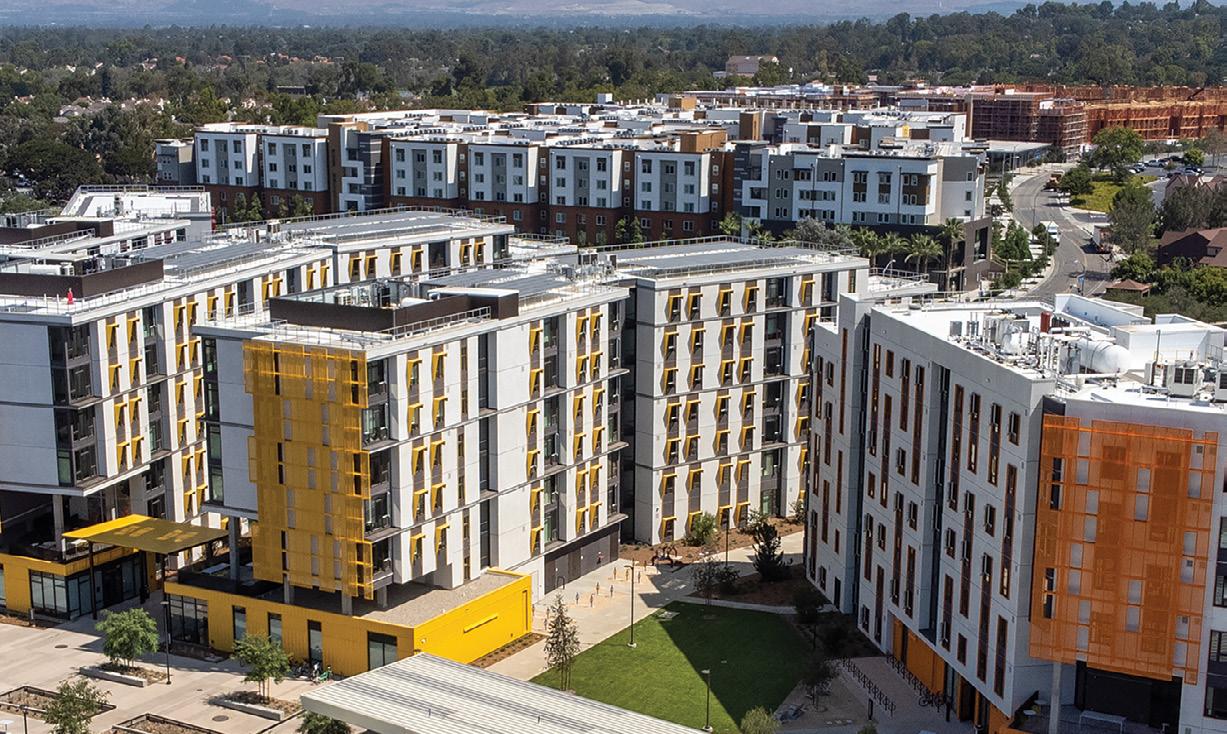
Verano 8 Graduate Student Housing: This project added five residential towers and a community center for graduate students, with room for 1,055 beds in studio, two-bedroom and four-bedroom units. As with other housing expansions, the towers have more stories – following UC regents’ guidelines for maximizing the use of space and contributing to UC Irvine’s goal of creating housing for 100 percent of its graduate students.

GOLDEN REFLECTIONS
Earlier this year, members of the founding UC Irvine alumni classes from 1974 and prior were inducted into the Golden Anteaters Society in a special ceremony. UC Irvine’s first graduates, the Golden Anteaters know firsthand just how much the campus has grown in the past 60 years. Three of them share their memories and observations in their own words just below and on the following pages.
For more info on the society, email ucireunions@uci.edu.

Kathy Houts Miller ’69
One June afternoon in 1964, Laguna Beach High School student Kathy Houts took a ride to her future, though it didn’t look like it at the time.
“The family piled into our station wagon, and we were soon on a dusty two-lane road headed to the middle of nowhere,” she recalls. “We parked, joined thousands of people in folding chairs, saw President [Lyndon B.] Johnson’s helicopter land, and listened to speeches about a university that wasn’t there yet. You could look in every direction and there was no skyline, just wide-open spaces. But I wondered, ‘How exciting would that be – to be in UCI’s first class?’”
She found out, as one of 1,589 students at the university’s launch in October 1965.
“It was a great little campus for learning, though very different from today,” Houts Miller says. “There were no paved paths in what’s now Aldrich Park, and sometimes the fog was so thick you couldn’t see your hand in front of your face. I initially lived in Mesa Court, where there were five girls’ dorms and five for boys, and they were locked down at night. For every five rooms, there’d be a shower and restroom area, and each building had a rec room with a refrigerator. Having an actual meal required a long walk to the cafeteria across from Langson Library.”
She graduated in 1969 with a B.A. in social science, returned in 1986 to obtain her paralegal certificate, then taught in UC Irvine Extension’s paralegal program for more than 30 years.

2022
Susan & Henry Samueli College of Health Sciences: Located at California and Bison avenues, the landmark 9-acre health sciences complex is home to the Joe C. Wen School of Population & Public Health, the School of Pharmacy & Pharmaceutical Sciences and the Susan Samueli Integrative Health Institute. This five-story building contains research areas, instructional spaces, student support facilities and other sites devoted to integrative health practices.

2022

Sue & Bill Gross Nursing and Health Sciences Hall: This four-story facility is designed to train and advance the next generations of nurses. It features a high-tech simulation center for team-based interprofessional exercises. The hall is connected by common space with the Susan & Henry Samueli College of Health Sciences building to encourage interdisciplinary collaborations.
Christine Duranceau ’71, Ph.D. ’76
When Christine Duranceau was choosing which university to attend in 1967, one deciding factor was a leg injury that left her unable to drive for a year, though she could walk. “UCI already had a strong reputation in the sciences,” Duranceau says, “and I found I could get around, slowly, without a car, so I chose it.” She lived in the Mesa Court dorms her first year and got to know UC Irvine well during her days on foot.
“William Pereira’s buildings were so different, and I liked the novelty of that,” Duranceau says. “The park wasn’t a great place then to relax or study because most of the trees were no higher than your waist. There was a small place across Campus Drive where you could get a beer, but my main distraction was a coffee cafe called Patogh [“hangout” in Farsi] between the Physical Sciences and Computer Science buildings. There was almost always a bridge game going on, and you could join in at any time.”
After earning B.A.s in physics and mathematics in 1971, “I was on the other side of the swamp, earning my 1976 Ph.D. in developmental genetics and working in prefab buildings called the West Campus,” she says. “And when I’ve gone back to UCI for its 50th anniversary and Golden Anteater events, it’s grown so much that I’ve had to use GPS to get around.”

Peter Bowler, Ph.D. ’74
Many students coming to UC Irvine in its early days thought they were out in the sticks. When grad student Peter Bowler arrived in 1970, he had the opposite impression.
“I’d lived in rural Idaho and then at Bard College in the New York woods,” he says. “UCI was like arriving in civilization, maybe even on another planet, given these stark, strange-looking buildings.”
But Bowler soon learned that UC Irvine wasn’t all that civilized. Even in the 1970s, one didn’t have to walk far off campus to come across cattle herds – “and some even on campus,” he says. He recalls someone selling UCI T-shirts depicting cows instead of anteaters.
Bowler was delighted to discover the San Joaquin Marsh Reserve adjacent to North Campus, which practically became his second home for half a century – he was one of the marsh’s de facto caretakers, including in his official roles at various times as academic coordinator, manager and co-director. Except for two years away as a postdoc after earning his biology Ph.D. in 1974, he was at UC Irvine, chiefly teaching, until retiring in 2022. Bowler was voted ASUCI Professor of the Year in Biological Sciences eight times and still gets called back to teach labs. Today, he continues activities related to preserving, funding and teaching about the marsh.

2024
Chao Family Comprehensive Cancer Center & Ambulatory Care:
This 225,000-square-foot, five-story building includes 52 private exam rooms and eight outpatient operating rooms. It offers advanced specialty services in oncology, neurology and neurological surgery, orthopedics, spine issues, and digestive diseases. One of its unique features is an infusion center with 26 infusion bays, several of them available on a terrace, where patients can receive their lengthy treatments outdoors, overlooking the scenic wonders of the San Joaquin Marsh Reserve.

Joe C. Wen & Family Center for Advanced Care:
The five-story, 168,000-square-foot outpatient facility provides adult and pediatric specialty care and urgent care, as well as comprehensive laboratory services and radiology imaging. It also houses the Center for Autism & Neurodevelopmental Disorders.
On the Horizon
Change is inevitable, and UC Irvine will continue to grow and innovate as it heads into the next decade. There are multiple projects in planning phases or already under construction, ranging from the UCI Jack & Shanaz Langson Institute & Museum of California Art to additional student housing that continues the transformation of the campus from its earlier days as primarily a commuter school into a robust residential community. Below are several projects that aim for completion next year, including the UCI Health — Irvine hospital, which will ultimately bridge the academic research institution and the university’s medical enterprise – all on campus.
As UC Irvine founding Chancellor Daniel G. Aldrich Jr. said: “Irvine is not conceived as an isolated academia but as an institution that plays an active role in the transfer of learning to life.”

Falling Leaves Foundation Medical Innovation Building: At 215,000 square feet, it will be among the largest buildings on the West Coast dedicated to conducting basic, translational and clinical research in spaces

“Our recent 3.8 million-square-foot expansion for health teaching, research and service along with our distinctive commitment to lifelong wellness ensure nation-leading, patient-centered care for our community today as well as world-changing breakthroughs.”
– Dr. Steve Goldstein, vice chancellor for health affairs
UCI Health — Irvine: Rising at the corner of Jamboree Road and Birch Street, the state-of-the-art, seven-story, 144-bed acute care hospital will offer a 24-hour emergency room. It will be the first medical campus powered by an all-electric utilities plant in the U.S. and will connect with the UCI Health primary care network throughout Orange County, part of the region’s only health system supported by a premier academic research institution.
California’s Top Doc
By Victoria Clayton
Not everyone comes to a life-changing epiphany by witnessing her mother play Candy Crush and her son log hours on Minecraft. Of course, not everyone is Diana Ramos.
You might recognize Dr. Ramos through her official role: California’s surgeon general. Appointed by Gov. Gavin Newsom in 2022, she is California’s leading spokesperson on the state’s most pressing public health issues, and is responsible for driving solutions to address those challenges. In Anteater terms, however, she is a 2020 graduate of the UC Irvine Paul Merage School of Business executive MBA program.
Before becoming California’s top doctor, Ramos held the position of assistant deputy director of chronic disease prevention for the California Department of Public Health and was a practicing Southern California Kaiser Permanente OB-GYN. She applied to UC Irvine’s MBA program while working full time in public health and delivering babies part time because she was chasing a dream. In her spare time (whenever that was), Ramos was conceiving her next venture: a company she launched in 2018 – inspired by her family’s fascination with video games and a pivotal experience she’d had years earlier working at the Los Angeles County Department of Health.
In 2010, Ramos had developed an innovative program for L.A. County involving text messaging new mothers to remind them of healthy life choices, like drinking more water, walking and breastfeeding.
“This was back when no government agency was really texting people, so it was exciting,” she recalls. In the pilot program, 97% of the moms who received the text messages lost their extra pregnancy weight in three months compared to the two years it took the average new mother to lose pregnancy and postpartum weight gain. The experience opened her eyes wide to the power of technology to improve health.
“I came to the MBA program because I wanted to do more with tech and health – I wanted to know how to create and run a startup,” explains Ramos, who lives with her family in Orange County. The school
appealed to her because it offers an entrepreneurship track with a healthcare management emphasis. Once accepted, she received some welcome news. UC Irvine awarded Ramos a scholarship acknowledging her public health leadership. “I was so surprised,” she says. “All I could think is, ‘I’m going to be a part of a school that really believes in me.’”
Except for having to learn Excel, Ramos describes the executive MBA program – which meets for one weekend every three weeks for 21 months and requires students to complete plenty of out-of-class projects – as “a wonderful experience.”

“I got to meet all kinds of people who do startups,” she says. “I was able to listen to others’ experiences and get peer-to-peer support. It was fantastic, and the professors were amazing.” Ramos was even fortunate enough to travel to China with her MBA cohort in September 2019, just months before the pandemic would make that impossible for the foreseeable future.
During her time at UC Irvine, she developed Teen MindGames, a video game designed for teens that screens for signs of depression. That app won the UCI Entrepreneur Class Shark Tank competition. Ramos also developed CovidBlast, an app that helped users determine how to safely navigate the pandemic. And then she got the call: “I was asked if I might be interested in the California surgeon general position.” Ramos’ unwavering commitment to public health meant she couldn’t turn down the opportunity. After a successful vetting process, including a confirmation hearing that she describes as even more taxing than taking the oral exam to become a board-certified OB-GYN, Ramos was appointed the second-ever California surgeon general. (There are only five states in the U.S. that have surgeon generals.) She’s the first Latina to hold the position. Ramos describes her life as a Cinderella story: She’s a first-generation college graduate who grew up in South Central Los Angeles with a single mom who often worked multiple jobs just to make ends meet. She earned a medical degree from USC’s Keck School of Medicine in 1994 and a master’s in public health from UCLA in 2004.
Ramos doesn’t take her responsibility lightly: “It’s an incredible honor to impact the lives of so many people.” And being bilingual in English and Spanish offers her a way to connect with individuals who don’t feel represented. “I want everyone to see that if I can do it, anyone can do it,” Ramos says. Hands down, the most rewarding experience of being California’s surgeon general has been when people reach out to say she’s inspired them. Says Ramos: “They come to me – sometimes crying – saying, ‘I can’t believe that there’s a Latina woman doing this.’”
A member of UC Irvine’s Dean Leadership Circle, Ramos delivered the Merage School of Business commencement address in 2021 and has recently joined the UCI-OC Alliance, a group that seeks to advance UC Irvine as a Latino-thriving university through engaging and supporting Latino students, faculty and staff.
Her current priorities as California’s surgeon general are maternal health, mental health and adverse childhood experiences. Right now, she’s laser-focused on Strong Start & Beyond, a statewide effort to reduce maternal morbidity and mortality.
“We know that Black moms are dying more than all other races and ethnicities,” Ramos says. “Most of these deaths are preventable.” Toward the end of the year, Ramos’ office – in collaboration with major health tech companies – will roll out an evidence-based, seven-question quiz, called PRIMA, which will help empower Californians to better understand their maternal health risks.
She predicts the quiz will become ubiquitous: “If someone is using an app to see when they’re ovulating, it will be there. If someone is using a health and well-being app, it’ll be there.” Ramos has prioritized public-private partnerships because she understands that public health advocates “can’t expect people to come to us; we have to go to where people already are.”
She says that what she learned in business school has been a major asset: “I can communicate and connect with people in the business world. We’ve studied the same Harvard Business School cases. We speak the same business language. Sometimes I can even give them advice,” she says jokingly.
“It’s an incredible honor to impact the lives of so many people.”
While Ramos has put her company on the back burner as she focuses on her job as California’s surgeon general, she acknowledges that there’s still an entrepreneurial fire burning. What might the far-out future hold?
“I think I’d like to enter an era of being completely on the creation side,” Ramos muses. “Maybe something like an innovations officer.”
But for now, she’s focusing on public health. In fact, she’s excited about UC Irvine’s recent launch of the Joe C. Wen School of Population & Public Health.
“The school’s timely debut is critical in developing the public health workforce as well as being a partner in Orange County, California and beyond,” Ramos says. “My office looks forward to cross-collaboration.”
She’s also counting her blessings. “I never would’ve been able to do what I have without my mom and my husband pitching in with my son – I’m grateful to them,” Ramos says.
And she’s thankful for her experience at UC Irvine: “The school is really committed to the community and to helping people access higher education. UCI has been instrumental in elevating so many people –including me.”


HOME AWAY HOME HOME AWAY HOME FROM
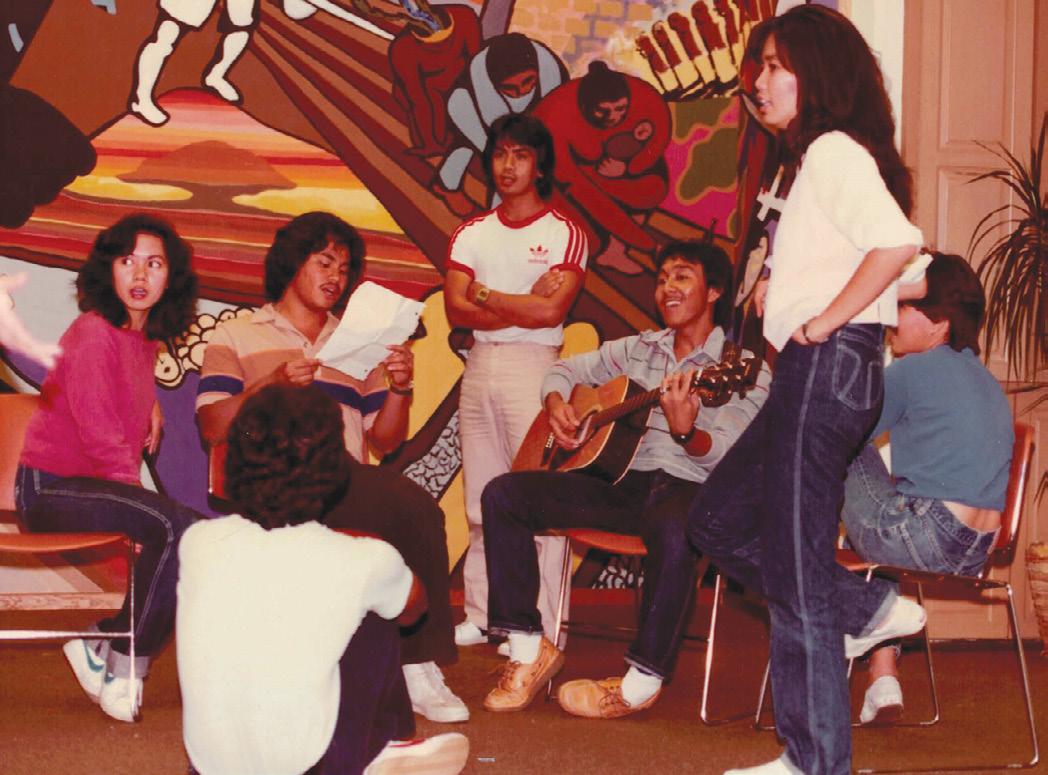
Kababayan celebrates 50 years of promoting Filipino culture while fostering lifelong friendships
By Ilene Schneider
“My first memory of Kababayan was in 2002, when I attended Pilipino Cultural Night as a high school junior,” recalls Xavier Hernandez ’07 in describing the Filipino/Filipino American umbrella student organization at UC Irvine. Now the diversity education officer for UC Irvine’s School of Medicine, he “was mesmerized and speechless to see over 300 Filipino American students act so comfortable in their own skin, express themselves and our culture so unapologetically both on- and offstage. At that moment, I knew I wanted to go to UCI and be a part of this community, this family. That moment was the turning point of my educational and personal life.”
Kababayan has touched others similarly. Because “there were so few Filipino students at UCI, and we felt so isolated,” Florante Ibanez ’77 co-founded the group in 1974 to serve as an extended family. “Most of us were affirmative action students who knew each other from Los Angeles, and we wanted a presence on campus,” he says.
Meaning “my fellow countrymen” in Tagalog, Kababayan offers students a network of Filipino/ Filipino American organizations and advocates for the community’s needs. Predating the Asian American Club, the Chinese Club and even the Cross-Cultural Center, it later participated with other cultural groups in demonstrating folk dances and selling ethnic food. Today, after 50 years, Kababayan is one of the largest cultural organizations in California. Promoting awareness and enrichment of Filipino culture, tradition and heritage within the community, it emphasizes the academic, cultural, political and social aspects of Filipino life. Kababayan remains true to its original
mission, partly because generational leaders have remained on campus to share their experiences with students. When the organization marks its 50th anniversary on Oct. 12, it will celebrate the many flavors of Filipino culture, the development of lifelong friendships, and the ability to evolve and change.
Ernelyn Navarro ’82, a member of Kababayan from 1978 to 1982, served as president and scholarship chair. “At the time the founding members had graduated, we were fortunate that Florante Ibanez worked on campus, and we were able to keep the club going,” she says. “In 1978, we had about 10 members, and there were probably less than 20 Filipino students on campus.”
Kababayan leaders sought to recruit more Filipinos to attend UC Irvine and create a larger community where students felt a sense of belonging, according to Navarro. Ibanez connected them with UCLA’s Filipino student organization. After attending one of UCLA’s Pilipino Cultural Nights, Kababayan members hosted
one at UC Irvine. “PCN [now called PACN] is one of the longest traditions of the club,” Navarro says. “In the early days, we invited UCLA’s dance troupe to perform at our PCN, and our choir sang Tagalog songs. We also invited local Filipino poets and singers. This annual event has become a key aspect of the cultural landscape at UCI.”
In 1982, Kababayan awarded its first scholarship to an incoming freshman at PCN. And the group hopes to raise money at its 50th reunion to add to the newly established scholarship endowment and increase the number of students who can receive scholarships.

Another growth spurt for Kababayan happened when the children of original members were looking for colleges to attend.
According to Edgar Dormitorio ’97, a Kababayan president in the 1990s who now serves as UC Irvine’s assistant vice chancellor and chief of staff for student affairs: “Immigrant communities steered their children to go to colleges locally or close by. UCI became an ideal place for Filipinos. We sometimes had 600 people at events.”

During that time, the club branched out to meet the career needs of students. Kababayan also began to reflect the Filipino American experience, with presentations on ways that Filipinos are part of the fabric of American history and ingrained in the culture of the university. Even the dance program, which had originally mirrored the cultural diversity of the Philippines, now includes the ever-popular hip-hop. In fact, the urban collegiate dance group Kaba Modern – featured on the first season of MTV’s hit show “America’s Best Dance Crew” –was founded in 1992 by student Arnel Calvario ’97 for PCN.
“Kababayan has provided cultural identity, pride and direction to Filipino students,” says Dormitorio. “It helped me and
others to solidify our career paths and create lifelong friendships. I’m proud to be part of its legacy and look forward to helping create 50 more years of celebrating Filipino culture on campus.”
Adds Hernandez: “In my current job, the core spirit of Kababayan still rings true. I always tell students to pursue the pathway that allows them to embrace their authentic selves. My friends from Kababayan – many of whom are now my family (both formally and in spirit) and professional colleagues – and I have been able to thrive in our respective avenues in life because Kababayan gave us so many opportunities to learn about our identity and our very humanity.”

“Kababayan has provided cultural identity, pride and direction to Filipino students. It helped me and others to solidify our career paths and create lifelong friendships.”


Distinguished. Outstanding. Extraordinary.
Lauds & Laurels tradition honors UC Irvine’s shining stars
By Christine Byrd
Lauds & Laurels has been called the Academy Awards of UC Irvine. But actors, Broadway stars and Foley artists are far from the only ones feted by the UC Irvine Alumni Association. Since their founding in 1971, the awards have been bestowed on more than 900 students, alumni, faculty, staff and community members who’ve made a significant impact on the university – from groundbreaking neurosurgeons to pioneering fashion designers and from acclaimed authors to Nobel laureates.
“The honorees represent the positive impact that UC Irvine has had not just locally, not just statewide, but internationally,” says Laura Yeager ’86. After serving twice on the UCIAA committee to select the recipients, Yeager – herself a retired two-star general – believes the awardees’ accomplishments can make anyone feel like an underachiever. “They might be living 25hour days,” she says with a laugh.
Though the award categories can vary somewhat from year to year, the 2024 Lauds & Laurels, celebrated on Oct. 10 at the Hyatt Regency Irvine, recognize one distinguished alum from each of the campus’s 15 schools as well as an outstanding athlete alum, young alum, faculty member, staff person, and undergraduate and graduate student. And then there’s the ultimate honor: Extraordinarius.
“All of the Lauds & Laurels recipients have amazing academic achievements and careers, but the thing that really moved me was the impact that they had in the community through things like volunteer work and
mentorship,” Yeager says. “They are selflessly working to bring up the next generation behind them.”
Alumnus and UC Irvine retiree Michael Arias ’11 has attended dozens of Lauds & Laurels award ceremonies over the years, from when they were small, informal affairs held at the University Club to more recent celebrations at upscale hotels with hundreds of guests bringing an “electric” energy. Arias was honored twice, once in 2001 for staff achievement and again in 2019 as Extraordinarius. He concedes that joining the impressive list of Extraordinarius recipients was a big deal to him personally. “I think I was a little taller that day,” Arias says.
The annual event has become part of the unique experience of being an Anteater alum, with the ceremony and dinner bringing together hundreds of alumni, family and friends for performances by student artists, heartfelt acceptance speeches and spirited camaraderie.
UCIAA scholarship recipients – who directly benefit from funds raised through the event – also attend, getting an inspiring look at where a UC Irvine degree and sky’s-the-limit thinking can take any Anteater.
Adds Yeager: “You go on to have a family and a career, and your college experience sort of recedes in the background – you forget how special it is. Lauds & Laurels rekindles that pride you have to be an Anteater and brings back great memories of your time on campus.”

The UC Irvine Alumni Association’s highest honor, the Extraordinarius award, has been bestowed since 1971 on highly accomplished individuals for their significant contributions to the university community – and the world at large. Here are two representative honorees from each decade. You can meet all of this year’s Lauds & Laurels recipients at: http://engage.alumni.uci.edu/lauds. Read a Q&A with this year’s Extraordinarius recipient, Nobel laureate David W.C. MacMillan, on Page 32.

David W.C. MacMillan, Ph.D. ’96
Received the 2021 Nobel Prize in chemistry; knighted by Queen Elizabeth II in 2022

Michael R. Gottfredson
Executive vice chancellor and provost from 2000 to 2012 who was instrumental in establishing UCI Law

Meredith Khachigian Orange County civic leader who served on the UC Board of Regents from 1987 to 2001


Carol Choi ’85 and Eugene Choi ’86, MBA ’01
Successful entrepreneurs who give time and talent to advance current Anteaters

Joseph L. White
UC Irvine professor, psychologist and beloved mentor who’s considered the “godfather of Black psychology”

Athalie R. Clark
Philanthropist and influential advocate for the establishment of the Irvine campus


Thomas C.K. Yuen ’74
Co-founder of several successful technology companies who supported UC Irvine research

Jack and Suzanne Peltason
Second UC Irvine chancellor and 16th UC president who, with his wife, helped build UC Irvine’s community

Arnold O. Beckman
Prolific inventor of scientific instruments and a philanthropist who co-founded UC Irvine’s Beckman Laser Institute

(right)
Marjorie Cesario One of five women on the founding faculty, she taught chemistry on campus for 25 years
L.E. Cox
First staff member and former Army engineer who oversaw the campus’s construction
Bernard Gelbaum (left) Founding chair of mathematics and UC Irvine’s first commencement speaker
Planting Seeds for the Future
By Christine Byrd
In her classes, Jessica Pratt, Ph.D. ’13, professor of teaching in ecology and evolutionary biology, introduces students to the Japanese philosophy of ikigai. The concept helps people identify their life’s purpose by looking at the intersection of skills, passions, job opportunities and what the world needs. Pratt’s life purpose has driven her to spend two decades at UC Irvine as a first-generation student, researcher, teacher and scholarship supporter.
“For me, it’s motivating the next generation of Earth stewards,” she says. “The greater the number of people on the planet who connect to nature, care about the Earth and are paying attention to our impacts, the better our chances of adapting to and mitigating the results of climate change.”

Growing up, Pratt spent ample time outdoors in rural Michigan fishing, camping and hiking. Her home was nestled between a cornfield and a forest that served as an idyllic playground – until developers cut down her woodland paradise to build a huge housing tract. Not only did the trees disappear, but so did the animals that lived there. The experience – when Pratt was just 8 or 9 – changed her life.
“It was very personal,” she remembers. “That was the moment when I became aware of how humans can change nature so quickly, and my values around caring for nature and preservation started.”
Pratt was the first in her family to go to college, and although she gravitated toward science, she had no idea what kinds of careers a science degree could lead to besides healthcare. In her junior year, Pratt landed in ecology and conservation courses and enjoyed them enough to start asking her professors about opportunities in the field. They guided her to a master’s in zoology at North Carolina State University. Her first encounter with UC Irvine came, unexpectedly, nearly 3,000 miles away from the campus. On an eight-week tropical biology program in Costa Rica
that draws researchers from around the world, Pratt met a UC Irvine doctoral student in ecology and evolutionary biology. Their romance bloomed and, after finishing her master’s in 2005, Pratt moved to Irvine, where she worked as a lecturer for several years before embarking on a doctorate in ecology and evolutionary biology at UC Irvine. In 2007, she married fellow Anteater Riley Pratt ’09.
Her early research explored how Artemisia californica, or California sagebrush, was responding to climate change. A staple of the state’s coastal ecosystems, the aromatic bush supports countless insects, birds and other wildlife and often plays a central role in habitat restoration projects. Pratt wanted her research to help guide those efforts. Her work found that Southern California’s coastal sage scrub may be more resilient than similar vegetation farther north and that the plants’ adaptations had led to unexpected impacts on insects and other wildlife up the food chain.
“One of the things we’re trying to do as conservationists is future-proof our projects instead of solely restoring to some historical baseline,” Pratt explains.
“When we began that research, we wanted to know if we could restore California sagebrush that’s resilient for the future – the future that we’re now living through.”
From the get-go, she was an exceptional graduate student, receiving a Newkirk Center for Science & Society Graduate Fellowship, a Public Impact Fellowship and a prestigious U.S. Environmental Protection Agency Science to Achieve Results Graduate Fellowship. In the final year of her doctoral program, Pratt earned a Chancellor’s Club Fellowship.
Reserved for first-generation college students, Chancellor’s Club Fellowships provide stipends for “academically superior doctoral and M.F.A. students – those who exhibit outstanding promise as scholars, researchers and public leaders.”
For Pratt, the funding came at a crucial moment: She had just welcomed a baby and needed childcare so that she could focus on finishing her dissertation and applying for academic positions.
As luck would have it, a teaching professorship opened up at UC Irvine, and Pratt was the perfect fit. She’s been here ever since, anchored by the students she trusts will be good stewards of the environment, as well as the lush beauty of the campus itself.
“I feel like UCI is not just my place of employment or my alma mater; it’s literally where I’m raising my family. And that makes you think about it differently,” she says. “Having the natural open space around us and Aldrich Park, with all the green trees, makes it a pleasant place to be, especially since I’m such a nature-connected person.”
As a Chancellor’s Club Fellow, Pratt attended the organization’s events featuring speakers from corners of the campus she might otherwise never have discovered. She and her husband, Riley, now an environmental scientist for California State Parks, joined the Chancellor’s Club as young alumni. A decade later, they are still members. While they relish the events and speakers, it’s the fellowship recipients who remain closest to their hearts.
“Because of my own connection to the fellowship, and having now heard other Chancellor’s Club Fellows share their work and their stories of how meaningful the support was for them, I decided I wanted to give back to UCI and support first-gen students,” Pratt says. “And since we’re invited to meet and listen to the students present their work and hear about the impact of their fellowships – that really keeps me motivated.”
Since it was established in 1972 by founding Chancellor Daniel G. Aldrich Jr., the Chancellor’s Club has raised over $11 million to support more than 400 students. Just as Pratt once presented her own research to the group, she now gets to hear a new generation of students present their work. “Even if you
think what you do is important, you realize it’s just one of dozens and dozens of equally important things that funders and policymakers are being asked to think about every day,” she says.
Today’s students grew up watching the consequences of climate change unfold all around them. Pratt finds that their awareness makes it possible to spend more class time discussing how to mitigate the effects of climate change and adapt to life on a warming planet, rather than simply explaining what the future impacts will be. This focus on solutions gives her hope.
“I feel like UCI is not just my place of employment or my alma mater; it’s literally where I’m raising my family. And that makes you think about it differently.”
But Pratt is sensitive to the despair that some experience when studying the devastating effects of climate change. Her newest work, in collaboration with UC Irvine psychologists and education researchers, aims to help students cope with eco-grief and climate anxiety in the classroom – especially since emotions influence learning outcomes. She recently received funding for this work from the Newkirk Center for Science & Society, which first funded her graduate research 15 years ago.
Pratt understands that the “why” behind any work is just as important as the “how.”
At the beginning of each quarter, she asks her students to think about a place in nature that they love: a beach, a lake or a forest like the one she once played in. From that personal connection to the environment, her students’ commitment to the coursework grows, whether it’s a class for the general education requirement, the minor in global sustainability, or the master’s in conservation and restoration science, which Pratt helped create. From there it sometimes blossoms into a lifelong commitment to protecting the environment.
“For my students, it’s not enough to give presentations about their projects to each other in the classroom,” Pratt says. “They want to go out in public; they want to talk to kids; they want to know that what they’re doing is going to matter in the world.”
Like her, they want to live their purpose.
Join the Chancellor’s Club, UC Irvine’s longest-standing philanthropic community, and be a catalyst for change. Your support empowers first-generation students through scholarships and fellowships, directly shaping their futures and the university’s legacy. Learn more at https://ucifund.uci.edu/chancellors-club.
OLYMPIC HEIGHTS
5 alum athletes at Paris Games continue a Summer Olympics trend for Anteaters
By Greg Hardesty
Anteaters have a long tradition of participating in the Olympic Games. At least four UC Irvine athletes have been selected for various national teams in each of the last 13 Summer Olympics. And this summer, four more UCI alumni athletes represented three different countries (United States, France and Australia) in three different sports (men’s indoor and beach volleyball and women’s water polo). And one additional alum represented the U.S. in the Paralympics, in paracycling.
“It was nice to see the whole Olympic experience rejuvenated after Tokyo,” says four-time Olympian David Smith ’08 of the U.S. men’s indoor volleyball team, which won a bronze medal this summer. “It was some of the best volleyball we played.”
Tara Prentice ’20, M.A. ’21 and ’22, the first female Anteater water polo player to participate in an Olympics, reflected on her journey to get to the Summer Games in a conversation with former coach (and fellow Olympian)
Dan Klatt ’01 just before competing in Paris: “I would not be an Olympian if I did not come to UCI,” Prentice noted. “I felt so supported here. I really love the UCI community.”

Kevin Tillie ’13 (center, raising box)
Men’s indoor volleyball, competed for France Medal/place: Gold
The former two-time UC Irvine men’s volleyball All-American made his third Olympic appearance – bringing home gold. He also helped France win gold in men’s indoor volleyball in 2020 in Tokyo while being coached by his father, Laurent.
Tillie was a member of the UCI team that won back-toback national championships in 2012 and 2013.
Tara Prentice ’20, M.A. ’21, M.A. ’22
Women’s water polo, competed for U.S. Medal/place: Fourth
Prentice is the first Anteater to represent women’s water polo at the Olympic Games.
The four-time All-American finished her UCI career as the all-time leading scorer in program and Big West history, with 242 goals.
Prentice is also the only Anteater woman to score firstteam All-America status twice: in 2020 and 2022. She was named Big West Player of the Year during her final season at UC Irvine, in 2022.

PHOTO: (Tillie) Getty Images Sara Stier
Thomas Hodges ’17 (left)
Men’s beach volleyball, competed for Australia Medal/place: Lucky Loser Round

Hodges was an All-American member of UC Irvine’s 2015 indoor volleyball team that went 28-5 and made an NCAA appearance. He played three years for the UC Irvine men’s team.
Hodges won a bronze medal at the U21 Asian Beach Volleyball Championships. He also participated in the U21 and U23 World Beach Volleyball Championships.
David Smith ’08
Men’s indoor volleyball, competed for U.S. Medal/place: Bronze (below at right)
Smith made his fourth Olympic appearance at the Paris Games, earning a bronze medal and becoming one of four Anteater men to have made four Olympic teams.
In 2012, along with Brian Thornton, Smith became the first men’s volleyball Olympian from UC Irvine. He won a bronze medal at the Rio Olympics in 2016. The U.S. team finished fifth in 2012 and 10th in 2020.


Bryan Larsen ’12 Paracycling track, competed for U.S. Medal/place: Sixth
At UC Irvine, Larsen – the first Paralympian Anteater since 2008 – helped run the bike club. He discovered paracycling after suffering a nerve injury to his vertebrae during a 2019 race.
Larsen, who was born with a clubfoot, began riding bikes at age 12. He found cycling to be a perfect outlet because it was exhilarating and didn’t tax his foot.

Cumulative Summer Olympic Medals by UCI Athletes Since 1976
Gold: 8; Silver: 16; Bronze: 3
Cumulative Summer Paralympic Medals by UCI Athletes Since 1984
Gold: 14; Silver: 2

Year of the Anteater

UCI Athletics savors one of its finest overall seasons in history


ABy Greg Hardesty
chievements by Anteater athletes last year were among the finest in their history of Division I competition. “It was a remarkable 2023-24 season,” says UC Irvine Athletics director Paula Smith. “You can’t overstate the importance of the success we had this past year with all the different sports.”
The accomplishments began in the fall with the women’s soccer team winning its third-straight Big West Championship and the men’s squad winning its fifth ever. The women upset a ranked team for the third year in a row and made it to the Sweet 16 for the second consecutive year.
The men’s water polo team then won a conference title for the first time in 23 years and made its first NCAA Tournament appearance in 30 years. “The goal was to get back to championship competition – and we achieved that,” says Dan Klatt ’01, head coach of men’s and women’s water polo.
The men’s volleyball team made an NCAA appearance as an at-large selection and advanced to the semifinals buoyed by the national player of the year, Hilir Henno.
The women’s basketball team, which went 23-9 overall, made its second-ever NCAA appearance as the No. 13 seed, capturing its second Big West Championship. The men’s basketball squad won the Big West regular- season title and notched a huge accomplishment by securing an at-large bid to the NCAA’s National Invitation Tournament.
For its body of work, the baseball team earned an at-large bid to its 10th NCAA Division I regional, and men’s tennis captured its second Big West
Championship in the last three years on its way to an NCAA automatic selection. The spring also saw Josh Farmer advance to the NCAA Outdoor Track & Field Championships in the decathlon, where he earned All-American honors. In all, seven Anteater squads made NCAA Tournament appearances.
Proving that UC Irvine is competing at a high level nationally, the Anteaters were ranked No. 4 among non-football schools for athletics achievements in the Learfield Directors’ Cup standings – a points-based test of an athletics department’s wide-ranging strength.
Says Smith: “It’s broad-based success. It’s not an easy feat and is something to celebrate.”
By the Numbers
UCI Athletics 2023-24
7 team NCAA appearances
12 All-Americans
1 National Player of the Year
3 Big West Players of the Year
6 teams in final national rankings
4th in the Directors’ Cup for D-1AAA Non-Football Schools
Upcoming Events
2024
5th – “End of the Range”
• This Langson IMCA exhibition explores the artistry of Charlotte B. Skinner (1879-1963), renowned for her vibrant depictions of California’s Sierra Nevada and Owens Valley desert country.
25th – Anteater Family Weekend
• Enjoy sessions with faculty and campus resource units, meet fellow UC Irvine parents, and experience the rich diversity of our campus.
November
October 2024

4th – Dia de los Muertos Celebration
• Sponsored by the School of Social Ecology, the second annual free event will feature student-created altars; performances by Aztec, Folklorico and flamenco dancers; a concert by Grammy-winning Mariachi Divas; face painting; free food; and more.
4th – Women’s Basketball vs. New Mexico
• Pack the Bren Events Center for the UC Irvine women’s basketball season home opener.
5th – Hockey Fights Cancer Night
• UCI Health is a proud sponsor of this National Hockey League event at the Honda Center that unites the hockey community in support of cancer patients and their families.
14th – Cross-Cultural Center 50th Anniversary Gala
• This milestone event is an opportunity to honor the center’s rich history and its enduring commitment to fostering diversity and inclusivity on campus.
21st – Public Health Movie Night
• Get ready for the first of three public health film screenings and post-film faculty-led discussions hosted by the Joe C. Wen School of Population & Public Health.
26th – UCI Symphony
• Join the UCI Symphony Orchestra for an evening of renowned orchestral music and pre-concert conversation at the Irvine Barclay Theatre.
December
2024
5th – Connect the Zots
• Join us for a night of Anteater meetups around the world. Connect with fellow Anteaters in your city, reminisce about your cherished UCI memories, and expand your personal and professional networks.
5th – Men’s Basketball vs. Cal State Bakersfield
• Cheer on the Anteater men at the team’s Big West Conference home opener in the Bren Events Center.
January
Events
2025
21st – Lunar New Year Celebration
• Experience a daylong multicultural Lunar New Year celebration – where the spirit of togetherness flourishes.
27th – Medicine in Our Backyard
• Join UCI Health gastroenterologist Kiran Sachdev, M.D., for “Integrative Health, Nutrition, Food Allergies and You!”


Events subject to change. For updates and additional information, scan the QR code or go to: https://engage.alumni.uci.edu/magazine-events.
Through the generosity of alumni, parents and friends –like you – we are transforming healthcare and wellness, advancing the American dream, accelerating worldchanging research, and exploring the human experience.
Ways to Get Involved
Make a gift online: https://secure.give.uci.edu
By phone: 949-824-6136
By mail: UC Irvine Giving, 100 Theory, Ste. 250, Irvine, CA 92617 Explore alumni opportunities: engage.alumni.uci.edu

AThe Inside ZOT!
Are you a lark or a night owl?
David W.C. MacMillan, Ph.D. ’96, James S. McDonnell Distinguished University Professor of Chemistry, Princeton University; 2021 Nobel Prize in Chemistry
Owl when I was younger; since I hit 40, I’ve become a lark (awake by 5:30 a.m.).
When and where do you think best?
Two different times: 1) When I am very relaxed, which means in the shower or lying in bed; or 2) When I am up against a deadline. The need to think on demand, I believe, is something that everyone can cultivate.
Q &What was your best “lightbulb” moment?
The idea that led to the Nobel Prize occurred when I was literally standing at a chalkboard with a graduate student. The idea popped into my head, and I drew it on the board for him. My immediate response to the idea was, “There is no way this will work.” Fortunately, it did.
What is your most influential read?
George Orwell’s 1984. I have always found it to be both prophetic and a statement of the times.1984 also highlighted the fact that large numbers of people (i.e., society) can be, and often are, susceptible to “group think” rather than thinking for themselves. As a statement about the world, it seems as relevant now as when it was written in 1948.
What is your favorite spot on the UC Irvine campus?
I really love all of the original white campus buildings that are still around, with that ’60s architectural style (like the administration building). I also get a huge kick out of seeing these buildings in their original form in movies like “Planet of the Apes.” I also love Rowland Hall, as I spent six years there, and it has a huge number of great memories for me. Last, I love the sand volleyball court in University Hills, as we would sneak out of lab to play volleyball there. There really is nothing better than clandestine volleyball on a beautiful Irvine afternoon.
What is your favorite UC Irvine memory?
So many good ones to choose from. Probably being a T.A. for the [organic chemistry] labs when I first arrived from Scotland. UC Irvine, like the U.S.A. as a country, represents a melting pot of representation from many national and international ethnicities and cultures. As a newcomer to the U.S.A. from Scotland, I really had not been exposed to such a diverse group, and it was truly mind-blowing to get to know all of these cool new people. The great part is that many of those under graduates from my earliest days at Irvine remain some of my closest friends. It was a real-life lesson that no matter where individuals are from, people really do want to make it all work out.
Who is your hero?
I have two: my mum and dad. Both passed away before I won the Nobel, and they would have been incredibly proud of the whole thing. But regardless, they were just incredibly good, supportive, happy people, and I learned an awful lot from them about how to live.
What is your most treasured possession?
My mum passed away from cancer while I was in my second year of graduate school at Irvine. During the last 18 months of her life, she would send me letters detailing the comings and goings of our family life back in Scotland that were extremely sweet, funny and incredibly inspirational. Every year or so, I go back and read those letters, and they refill my emotional batteries.
What is the best advice you’ve ever been given?
It’s not the solutions you come up with that are important; it’s the questions you are trying to address that are important (or not important). Don’t spend your time working on things that you are not that excited about. Focus on questions that you genuinely believe, if solved, will impact the way you view the world.
What is the best advice you could give?
Take your career, your research, your profession seriously … but do not take yourself too seriously. Try to laugh out loud every single day.

PHOTO: Corinne Strauss Photography
Simple Planning, Brilliant Results
As a UC Irvine undergraduate, Dr. Marlene Godoy ’76 held four jobs and even helped her parents financially. Still, she dreamed of someday assisting other UC Irvine students. Later, as a dentist, she did just that by establishing the Dr. M. Marlene Godoy Endowment Fund. For the past 20 years, annual gifts and multiple bequest commitments from her estate have grown the endowment. Thanks to brilliant planning, Dr. Godoy is now helping students in the Charlie Dunlop School of Biological Sciences attend international conferences and further life-changing research. Leaving a portion of your estate to UC Irvine is one of the easiest ways to create a lasting legacy. With a little planning, you can make a big impact. Learn more at m.uci.edu/godoy.


