Climate warming and salmon fisheries – a game of double jeopardy
P
ACIFIC SALMON (Oncorhynchus spp.) support the most valuable commercial and recreational fisheries in western Canada generating over $1 billion of revenue annually. They are also an important component of aquatic food chains, are integral to mythology, spiritual integrity, and local economies of Pacific coast First Nations, and are icons for the general public, with abundant salmon confirming healthy and pristine environments.
Since 2002, Hinch’s group along with management agencies and private partners, have used biotelemetry to study the success of river migration to spawning grounds for 1000s of sockeye from several Fraser stocks
Photo courtesy Pete Rand, Wild Salmon Center.
For the past 10 years, research lead by Dr. Scott Hinch (Department of Forest Sciences, and, Institute
for Resources, Environment and Sustainability) and his graduate students, post doctoral fellows and colleagues has assessed the impacts of climate change on sockeye salmon (O. nerka) in the Fraser River, Canada’s most productive salmon system. Most stocks of Pacific salmon now encounter warmer rivers during their spawning migration than in any time since records were kept. The Fraser River (as well as several other BC salmon systems) have experienced a >1.5°C average increase in peak summer water temperature over the past 40 yrs. Eight of the past 10 summers have been the warmest on record and climate models predict even warmer peak temperatures in the near future. Because of climate warming and a change in migration river-entry timing by several of the large stocks, segments of all Fraser sockeye stocks are now encountering river temperatures >19°C during a portion of upstream migration. This temperature encounter has profound evolutionary significance because no sockeye stock any where in the world is known to have initiated river migration at 20°C.
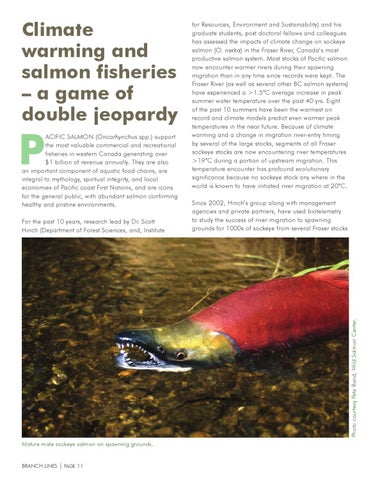
Mature male sockeye salmon on spawning grounds. BRANCH LINES
PAGE 11