Tracking sockeye salmon THE OCEAN TRACKING Network (OTN) is a $168 million conservation project, headquartered at Dalhousie University. The project unites leading ocean scientists around the globe through tracking of marine animals and assessing how climate change influences animal movements. As part of this initiative, OTN Canada is an integrative research network funded by the Natural Sciences and Engineering Research Council of Canada. This network uses cutting edge technologies and infrastructure to understand changing marine ecosystems across Canada and to demonstrate how we can learn about continental shelf ecosystems and how we can contribute to global observation of coastal and ocean ecosystems. OTN Canada’s Pacific research program is co-led by Drs Scott Hinch (UBC, Forest Sciences Department) and Steve Cooke (Carleton University). The program focusses on studying linkages among behaviour, environment, and physiology of Pacific salmon to better understand their movement, migrations, and survival. The program is being undertaken by a broad network of investigators that spans several academic institutions, government groups (Pacific Salmon Commission, DFO Science Branch), non-government environmental groups (Pacific Salmon Foundation, Canadian Wildlife Federation, Vancouver Aquarium-POST), and private company partners (Kintama, LGL). Collaborations also span several disciplines, including behavioural ecology, physiology, genomics, epidemiology, oceanography, electronic engineering, and fisheries harvest management. To date, research results have identified mechanisms for reducing mortality of fish that are released by anglers, identified locales of migration mortality, and improved our understanding of the important role of temperature and disease (river and now ocean). One of the first projects completed was an assessment of how tag size and mass affected the behaviour and swim performance of juvenile sockeye salmon. This work was carried out by Alison Collins, an MSc student under the supervision of Dr Scott Hinch. One of the most important questions a biologist needs to ask prior to interpreting tagging data is whether or not the surgical procedures for the implantation of the tags, or the presence of the tag itself, were detrimental to the tagged animal. Several studies have challenged the “rule of thumb” that tag burden (ratio of tag mass to fish body mass) should not exceed 2%. To address this issue, Alison studied tag burden and tag size thresholds for salmon smolts. Over 250 hatchery-reared Cultus Lake sockeye
salmon were implanted during their pre-smolt phase with one of 3 sizes of dummy acoustic tag to assess how tag burden (1.3-13.6%) influenced swimming performance, relative growth, survival, and post-surgical wound healing in freshwater and during initial stages in seawater. Tagged fish were compared with surgical shams (surgery but no tag implantation) and nonsurgery control groups. Fish with tag burdens of 8% or more had shorter swimming durations than fish with burdens of less than 8%, and fish implanted with the smallest tags had longer swimming durations than fish with the largest tags. No effects on fish growth were observed. Incisions associated with smaller tags healed more quickly than those with the largest tags. Mortality was nil when tag burden was <6%, and survival remained high (≥93%). Survival for all tagging treatments was ≥88% in seawater. Based on these results, we can recommend that tag burdens should not exceed 8% in juvenile, hatcheryreared sockeye salmon. Work is on-going to examine tag burden effects in wild juvenile sockeye salmon, which have different body shapes. These results provide a scientifically defensible threshold for tagging, and enable researchers to retrospectively examine the conclusions of previous telemetry studies that have studied the migration survival and behaviour of sockeye smolt. For further information contact Dr Scott Hinch at scott.hinch@ubc.ca. Parts of this article were reprinted with permission from the Ocean Tracking Newsletter Volume 1 (Issue 11) December 2011, Dalhousie University, Halifax, Canada.
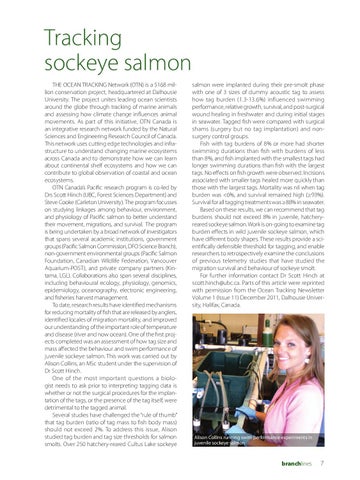
Alison Collins running swim performance experiments in juvenile sockeye salmon
branchlines
7