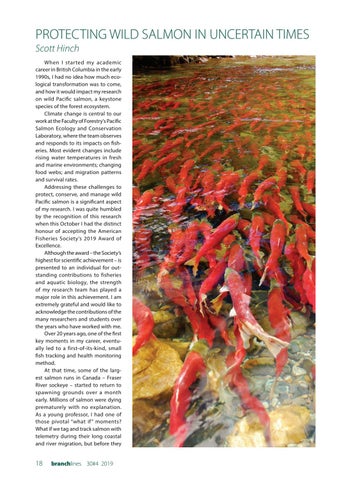
PROTECTING WILD SALMON IN UNCERTAIN TIMES Scott Hinch When I started my academic career in British Columbia in the early 1990s, I had no idea how much ecological transformation was to come, and how it would impact my research on wild Pacific salmon, a keystone species of the forest ecosystem. Climate change is central to our work at the Faculty of Forestry's Pacific Salmon Ecology and Conservation Laboratory, where the team observes and responds to its impacts on fisheries. Most evident changes include rising water temperatures in fresh and marine environments; changing food webs; and migration patterns and survival rates. Addressing these challenges to protect, conserve, and manage wild Pacific salmon is a significant aspect of my research. I was quite humbled by the recognition of this research when this October I had the distinct honour of accepting the American Fisheries Society’s 2019 Award of Excellence. Although the award – the Society’s highest for scientific achievement – is presented to an individual for outstanding contributions to fisheries and aquatic biology, the strength of my research team has played a major role in this achievement. I am extremely grateful and would like to acknowledge the contributions of the many researchers and students over the years who have worked with me. Over 20 years ago, one of the first key moments in my career, eventually led to a first-of-its-kind, small fish tracking and health monitoring method. At that time, some of the largest salmon runs in Canada – Fraser River sockeye – started to return to spawning grounds over a month early. Millions of salmon were dying prematurely with no explanation. As a young professor, I had one of those pivotal “what if ” moments? What if we tag and track salmon with telemetry during their long coastal and river migration, but before they
18
branchlines 30#4 2019