Intergenerational effects of stress in sockeye salmon Photo: Natalie Sopinka
by Natalie Sopinka
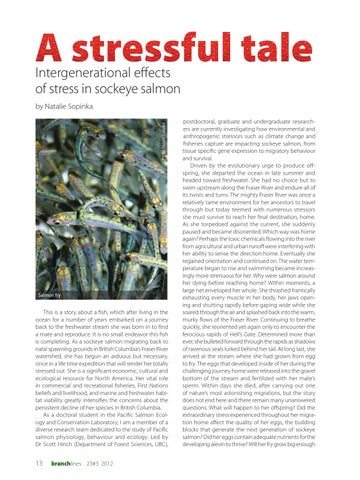
Salmon fry
This is a story about a fish, which after living in the ocean for a number of years embarked on a journey back to the freshwater stream she was born in to find a mate and reproduce. It is no small endeavor this fish is completing. As a sockeye salmon migrating back to natal spawning grounds in British Columbia’s Fraser River watershed, she has begun an arduous but necessary, once in a life time expedition that will render her totally stressed out. She is a significant economic, cultural and ecological resource for North America. Her vital role in commercial and recreational fisheries, First Nations beliefs and livelihood, and marine and freshwater habitat viability greatly intensifies the concerns about the persistent decline of her species in British Columbia. As a doctoral student in the Pacific Salmon Ecology and Conservation Laboratory, I am a member of a diverse research team dedicated to the study of Pacific salmon physiology, behaviour and ecology. Led by Dr Scott Hinch (Department of Forest Sciences, UBC),
13
branchlines 23#3 2012
postdoctoral, graduate and undergraduate researchers are currently investigating how environmental and anthropogenic stressors such as climate change and fisheries capture are impacting sockeye salmon, from tissue specific gene expression to migratory behaviour and survival. Driven by the evolutionary urge to produce offspring, she departed the ocean in late summer and headed toward freshwater. She had no choice but to swim upstream along the Fraser River and endure all of its twists and turns. The mighty Fraser River was once a relatively tame environment for her ancestors to travel through but today teemed with numerous stressors she must survive to reach her final destination, home. As she torpedoed against the current, she suddenly paused and became disoriented. Which way was home again? Perhaps the toxic chemicals flowing into the river from agricultural and urban runoff were interfering with her ability to sense the direction home. Eventually she regained orientation and continued on. The water temperature began to rise and swimming became increasingly more strenuous for her. Why were salmon around her dying before reaching home? Within moments, a large net enveloped her whole. She thrashed frantically exhausting every muscle in her body, her jaws opening and shutting rapidly before gaping wide while she soared through the air and splashed back into the warm, murky flows of the Fraser River. Continuing to breathe quickly, she reoriented yet again only to encounter the ferocious rapids of Hell’s Gate. Determined more than ever, she bulleted forward through the rapids as shadows of ravenous seals lurked behind her tail. At long last, she arrived at the stream where she had grown from egg to fry. The eggs that developed inside of her during the challenging journey home were released into the gravel bottom of the stream and fertilized with her mate’s sperm. Within days she died, after carrying out one of nature’s most astonishing migrations, but the story does not end here and there remain many unanswered questions. What will happen to her offspring? Did the extraordinary stress experienced throughout her migration home affect the quality of her eggs, the building blocks that generate the next generation of sockeye salmon? Did her eggs contain adequate nutrients for the developing alevin to thrive? Will her fry grow big enough