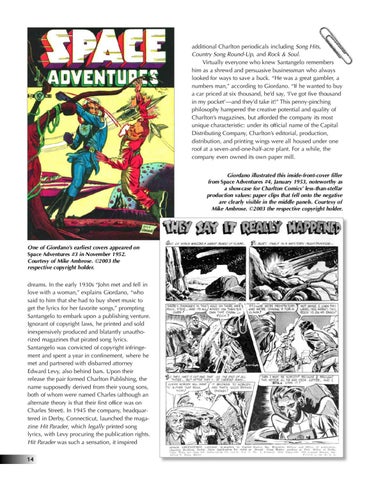
additional Charlton periodicals including Song Hits, Country Song Round-Up, and Rock & Soul. Virtually everyone who knew Santangelo remembers him as a shrewd and persuasive businessman who always looked for ways to save a buck. “He was a great gambler, a numbers man,” according to Giordano. “If he wanted to buy a car priced at six thousand, he’d say, ‘I’ve got five thousand in my pocket’—and they’d take it!” This penny-pinching philosophy hampered the creative potential and quality of Charlton’s magazines, but afforded the company its most unique characteristic: under its official name of the Capital Distributing Company, Charlton’s editorial, production, distribution, and printing wings were all housed under one roof at a seven-and-one-half-acre plant. For a while, the company even owned its own paper mill. Giordano illustrated this inside-front-cover filler from Space Adventures #4, January 1953, noteworthy as a showcase for Charlton Comics’ less-than-stellar production values: paper clips that fell onto the negative are clearly visible in the middle panels. Courtesy of Mike Ambrose. ©2003 the respective copyright holder.
One of Giordano’s earliest covers appeared on Space Adventures #3 in November 1952. Courtesy of Mike Ambrose. ©2003 the respective copyright holder.
dreams. In the early 1930s “John met and fell in love with a woman,” explains Giordano, “who said to him that she had to buy sheet music to get the lyrics for her favorite songs,” prompting Santangelo to embark upon a publishing venture. Ignorant of copyright laws, he printed and sold inexpensively produced and blatantly unauthorized magazines that pirated song lyrics. Santangelo was convicted of copyright infringement and spent a year in confinement, where he met and partnered with disbarred attorney Edward Levy, also behind bars. Upon their release the pair formed Charlton Publishing, the name supposedly derived from their young sons, both of whom were named Charles (although an alternate theory is that their first office was on Charles Street). In 1945 the company, headquartered in Derby, Connecticut, launched the magazine Hit Parader, which legally printed song lyrics, with Levy procuring the publication rights. Hit Parader was such a sensation, it inspired
14