by
Ed Catto
She was a strong, striking woman with a purpose. She was oftentimes overwhelming, frequently intimidating, and always interesting. She’s part Ronda Rousey, part quintessential tall supermodel. She could be as frightening as a sudden thunderstorm. And she could bring issues of gender equality to the forefront in a fresh and important way. Well… that last part, maybe not so much. At first glance, there are many echoes of Wonder Woman in Thundra. Both warriors come from a distant matriarchal society. But when Thundra burst onto the scene, she embodied everything scary, yet interesting about mainstream America’s view of the 1970s Women’s Movement. She was demanding. She was driven and strong. She had “had enough and wasn’t going to take it anymore.” And while Thundra was aggressively confident, she was statuesque and beautiful. Thundra, the warrior woman from the far-flung future, was full of unrealized potential. And for a woman of the future, as a Marvel heroine she might have simply been before her time. So, to best understand Thundra, we need to start with another character. And as is often the case with so much of comics history, it starts with Jack Kirby.
BIG AND BEAUTIFUL
Former Marvel Comics editor-in-chief Roy Thomas reveals that Thundra’s pop-cultural antecedent was Kirby’s Big Barda, For Thomas, creating Thundra was “a kind of casual response to a character like Kirby’s Big Barda—not that anyone was especially calling out for such. But I wanted a woman who’d give the Thing a tussle, and Thundra fit the bill. I had that bandolier (the ammunition belt strung over her shoulder) because a few ardent feminists of the time were affecting such things. The name was probably inspired by the Magazine Enterprises hero Thun’da [King of the Congo, a Tarzan clone].” Who was this Big Barda, and why is understanding her important to the origins of Thundra? Big Barda was created by Jack Kirby as part of his visionary Fourth World saga, published by DC Comics in the ’70s. She was the female lead in Mister Miracle. Unlike many of the heroines of the time that may have used weapons, magic lassos, or martial arts to overcome opponents, Barda was all about brute strength. She was a towering woman— beautiful and strong. And like Thundra, Barda “wasn’t from around here.” Big Barda was raised on the distant planet Apokolips by the cruel Granny Goodness to become the ultimate warrior woman. In fact, she was an “Alpha Female,” leading the Female Furies, a group of battle-ready women. While the word “furies” has historical and mythological origins, the implied notion is that women who are blinded by rage, i.e., their fury, are dangerous and out of control.
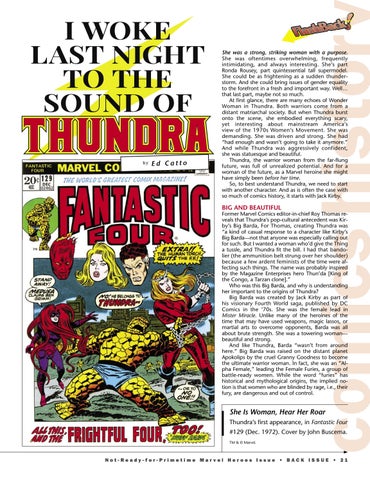
She Is Woman, Hear Her Roar Thundra’s first appearance, in Fantastic Four #129 (Dec. 1972). Cover by John Buscema. TM & © Marvel.
Not-Ready-for-Primetime Marvel Heroes Issue • BACK ISSUE • 21