RED, WHITE AND PINOT NOIR


TOURING

$4.95US FEBRUARY/MARCH 2023 ISSUE 55
IN THE 209
Dancing
THE EMERALD CITY PRO SKI TOUR COMES TO BEAR VALLEY




Therapeutic massage with Rose/Lavender Foot Salt Scrub
$160/60 minutes or $240/90 minutes
Add-ons to massage:
Sparkling Cider in champagne flute, fresh strawberries, Belgian Chocolate $25
Infrared Sauna for 2 immediately following 30 min -$45


Therapeutic massage with Rose/Lavender Foot Salt Scrub
$80/60 minutes or $120/90 minutes

Add-ons to massage:
Sparkling Cider in champagne flute, fresh strawberries, Belgian Chocolate $12
Infrared Sauna immediately following $35/minutes









Naturally boost hydration & replenish the skin’s moisture barrier in 60 minutes for smooth, glowing, and radiant skin. Receive a long-stemmed Rose. $110/60 min

Add-on: Microdermabrasion & Rose/Lavendar foot scrub - 15 min. $25






Your health needs don’t follow a schedule, so why should you? With the Kaiser Permanente mobile app and website, you’re able to schedule routine appointments, email your doctor’s office with non-urgent questions, refill most prescriptions and view most test results. So you can stay closer to what you need. Together we thrive. Learn more at kp.org.







Irving Berlin had it right when he wrote “The Best Things Happen While You’re Dancing.” The dance performed by Danny Kaye and Vera-Ellen to the song in “White Christmas” is still part of American culture 70 years later. While the days of couples going out for dinner and ballroom dancing every weekend may be a thing of the past, dancing itself is still alive and well in the 209. Those looking to spice up their Valentine’s Day plans or those seeking a special someone can find inspiration with dance lessons and clubs around the area.
The Hammon Senior Center in Patterson is hosting beginner salsa classes for anyone 50 years and older. Salsa is a dance for all ages, shapes, sizes and ethnicities, emphasized the instructor.
TWO TO TANGO
Tango can easily become an obsession, with a passion for the dance keeping aficionados returning, which is certainly true for members of the Modesto Tango dance group.
A need for partner dance lessons in the area is what motivated Gabrielle Forrest to open Alegria Dance Studio in Turlock nine years ago. Today, the studio offers a variety of dance classes for those looking to shine on the dance floor.
36 37 38


Hank
Kristina Hacker
MANAGING
Sabra Sta ord
Je Benziger
Christopher Correa
Kristina Hacker
Teresa Hammond
Marg Jackson
Matt Johanson

Sarah Lawson
Candy Padilla
Julie Rose
Virginia Still
Frankie Tovar
Dennis Wyatt
Harold L. George
Chris Castro
Beth Flanagan
Rich Matheson
Karen Olsen
Corey Rogers
Melody Wann
Charles Webber
Larry Dovichi
While many across the country attribute the late winter months with freezing rain and snow, here in the 209 we are blessed to have February herald the start of our early spring.
e annual Almond Blossom Festival in Ripon is not only a celebration of one of the area’s top agricultural products, but also the start of outdoor festival season.
February and March are some of the best months to get out and explore the area with mild temperatures making outdoor adventures enjoyable without the tra c that usually brings tourists travelling through on their way from the Bay to Yosemite or from areas east to San Francisco.
In this issue, you’ll nd stories previewing the Almond Blossom Festival and the Dos Rios Ranch restoration project, as well as how to get a start on spring garden plantings.
As always, we are featuring local restaurants and bars and a new co ee shop coming to Newman that will also pay tribute to a local K9 o cer. ose looking to spice up their Valentine’s Day plans should check out our dancing feature and information on the West Side eater. ank you for taking the time to read 209 Magazine. We welcome your comments, calendar events and stories. We hope you will support the businesses and charities that have chosen to partner with us. We appreciate them and look forward to being the most relevant magazine in your home, a place called 209.
 Hank Vander Veen Owner/Publisher hvanderveen@209magazine.com







 with FRANKIE TOVAR
STUDIO209 is a weekly magazine-style video series lmed in the heart of the Central Valley. Join us every Thursday and enjoy a wide range of coverage from community events to personal pro les and more. ftovar@morrismultimedia.com
Keeping in line with our cover story, we’re bringing you another op�on when it comes to dancing in the 209 and taking it back to square one with a visit to a local Square Dancing club in San Andreas. With mee�ngs almost weekly, these old �mey enthusiasts were more than willing to show how they cut a rug.
bit.ly/209PodcastApple






The Stockton Whimsy Market is taking the phrase “Un�l death do us part” and flipping it on its heart ahead of Valen�ne’s Day. Replacing the more commercialized aspects of the Valen�ne’s like cute teddy bears and red roses for bloody valen�ne dolls and gothic gi�s, this one-of-a-kind market is a mustsee on Miracle Mile.
bit.ly/209PodcastSpotify

WE’VE GOT THE 209 COVERED
When we heard the Twisted Pig was throwing an all-day St. Patrick’s Day party we knew Studio209 was going to be there! From the restaurant to the parking lot, this first annual Modesto celebra�on is one you don’t want to miss with local bands and DJ’s to go along with green beer, games and delicious food of all kinds.
HIRE US TO FEATURE YOUR BUSINESS!

























• Dell’Osso Family Farm
• Oa�ield MX Park
• Board and Brush





• Ten Pin Fun Center
• Indigeny Reserve
• Nutcher Milk








• Smart Axe






• Escape Modesto
• Bistro 234
• Toscana’s Ristorante
HIRE US TO PREVIEW YOUR EVENT!

• Calaveras Grape Stomp Fes�val


• Modesto American Graffi�
• Santa HQ at Vintage Faire Mall
• UC Merced’s Yosemite in the Park
• Zombie Escape at Snelling’s Ranch of Horror
• 209 Beatdown
• Emanuel Cancer Center Women’s Cancer Night



HIRE US TO COVER YOUR EVENT!
• Central Valley Brewfest
• StocktonCon
• San Joaquin Valley Portuguese Fest
• Stanislaus County Fair
• Dancing with the Turlock Stars
• Cowchella
• Stockton Greek Food Fes�val
• Rhythm on the Range
• Dust Bowl Oktoberfest
• Turlock Top Chef Compe��on


• Jumping Frog Jubile
Contact our 209 Mul�media sales representa�ves or our Mul�media Producer to learn more about sponsored content opportuni�es with Studio209!

The First Congregational Church of Murphys is hosting A Heavenly Chocolate Festival from 1 p.m. to 4 p.m. Feb. 11. Tickets are $15 for adults and $5 for kids under 8 years to sample the variety of chocolate treats. Adults can also purchase wine by the glass for $5. Tickets will be available at the door.

The church is located at the corner of Church and Algiers Street in Murphys.
For more information call (209) 728-3141
The Stockton Symphony will host a tribute to the music of Ray Charles with guest conductor Victoria Bond on Feb. 11. The performance is from 7 p.m. to 8 p.m.

All Stockton Symphony Concerts are performed at Warren Atherton Auditorium at San Joaquin Delta College, 5151 Pacific Avenue, Stockton. For tickets visit stocktonsymphony.org.
The Combat Veterans of America Association will host their 8th annual crab feed on Feb. 18.
There will be food, dancing, raffles, prizes and vendors.
The cocktail hour is from 4:30 p.m. to 5:30 p.m. and dinner is from 6 p.m. to 8 p.m.

Tickets are $65 and parking is free.
The feed will be at the Robert Cabral Agricultural Center at 2101 E. Earhart Avenue in Stockton.
For tickets call (209) 922-6292.
San Joaquin County Parks and Recreation and the Delta Fly Fishers will present the 20th Annual Bob McMillen Memorial Fishing Tournament on March 4 at Oak Grove Regional Park in Stockton. Approximately 2,000 pounds of Rainbow Trout (including trophy-size fish) will be stocked in Oak Grove’s 10- acre lake prior to the event.

The tournament will be open to all ages and feature three competitions: Youth (ages 10 and under), Teen (ages 11 - 17) and Adult (ages 18 and over). Each competition will measure the individual heaviest weight of one trout caught by the participating contestant. Prizes will be awarded in each of the categories following the tournament.
Food will be available for purchase. Park gates will be open at 6:15 a.m., registration closes at 10 a.m. and the last weigh-in is at 12:30 p.m. Prizes will be awarded shortly thereafter. There is no registration fee for the event; however, a $5 fishing permit fee and valid California Fishing License is required for anyone 16 years of age or older. A $6 vehicleparking fee will also apply. All State Fish and Game laws apply. Participants must supply their own fishing equipment.
For more information, please call San Joaquin County Parks and Recreation at (209) 331-2050 or log onto www. sjparks.com. Oak Grove Regional Park is located on Eight Mile Road and Interstate 5 in Stockton.
Come cuddle and snuggle some baby goats and help get them ready for bed.
Spenker Family Farm is hosting Goodnight Goats from 6:30 p.m. to 7:30 p.m. on March 16, 17, 18, 23 and 30. Read them a story, snuggle, or play with them to help them get sleepy before we put them away for the night. This event includes approximately 30 minutes of baby goat time followed by milk and cookies (for the people).

Goodnight Goats is open to all ages. Children under 15 must be accompanied by a paid adult. One ticket per person. Children under 3 years are free. Those four years and over must have a paid ticket to enter. Tickets are $25.
Wine and cheese tasting are available afterward but not included in the ticket price. You must be 21 or over to participate in wine tasting.
For tickets or more information call (209) 367-0467 or visit www.spenkerwinery.com.
















During the pandemic and having to stay indoors many people found new talents and hobbies to keep them busy. Among the areas seeing growth, yarn stores became very popular during the pandemic, as people were able to turn their hours into productive cra sessions. ere are a handful of stores that have been able to open the doors fully and get back to o ering in person knitting classes due to mandates being li ed.
One store is in Turlock called Needful ings; the shop is at 2243 Geer Road and owners are sisters Christina and Casandra Carroll. ey took over the store three years ago from the previous owners and since then have been hard at work growing the store’s potential.
For about a year now they have been o ering knitting classes from 6 p.m. to 8 p.m. on ursdays and made them open call classes. Meaning anyone, of any age and level of knitting can come without having to make an appointment or register.

Most people bring their own materi-


als to the class but the store does o er supplies for purchase at a discounted rate. e classes highlight how to crochet and knit and o er assistance with a beginner’s pattern or customers can come in with their own project.
“We like to teach the washcloth pattern, because if there are any holes or messy areas, no one ever said the washcloth wasn’t used or torn,” Christina explained of the dual purpose beginner’s pattern.

Being able to see the excitement and enjoyment when the students understand a pattern or nish their project is why the sisters continue to o er classes. ey are open 11 a.m. to 6 p.m. Tuesday through ursday and noon until 8 p.m. Friday and Saturday and can be contacted at 209-669-9009. ey also sell the yarn and materials on their website shopneedfulthings. com.
Another store where all knitting needs can be satis ed is Village Yarns in Patterson. ey are at 32 S. ird St., and the shop is owned by Samantha Taylor.
She has owned this must stop knit shop for 22 years and has a passion to not only teach but also spread the love for knitting.
Knitting classes are o ered during all business hour,s which are 10 a.m. to 6 p.m. Monday through Wednesday, 10 a.m. to 6 p.m. Friday and Saturday and closed ursdays and Sundays. To make an appointment or call for questions about beginning a knitting class, the store can be reached at 209222-1772.
Since COVID, Taylor began to o er classes on the customers’ own schedules rather than a speci c day and time, creating very exible classes. e sessions are $10 each and all materials are o ered in store but customers are still encouraged to bring their own if they would like.
“I always suggest we start classes making scarves, they are my favorite to teach,” Taylor explained.

Gaining knitting experience is available with shops scattered all over the 209, and taking that rst step into starting a hobby in knitting is only a loop and a stitch away. ●


It’s not too hard to figure out why the Ripon Almond Blossom Festival on Feb. 23-26 is a perennial favorite for many in the 209.
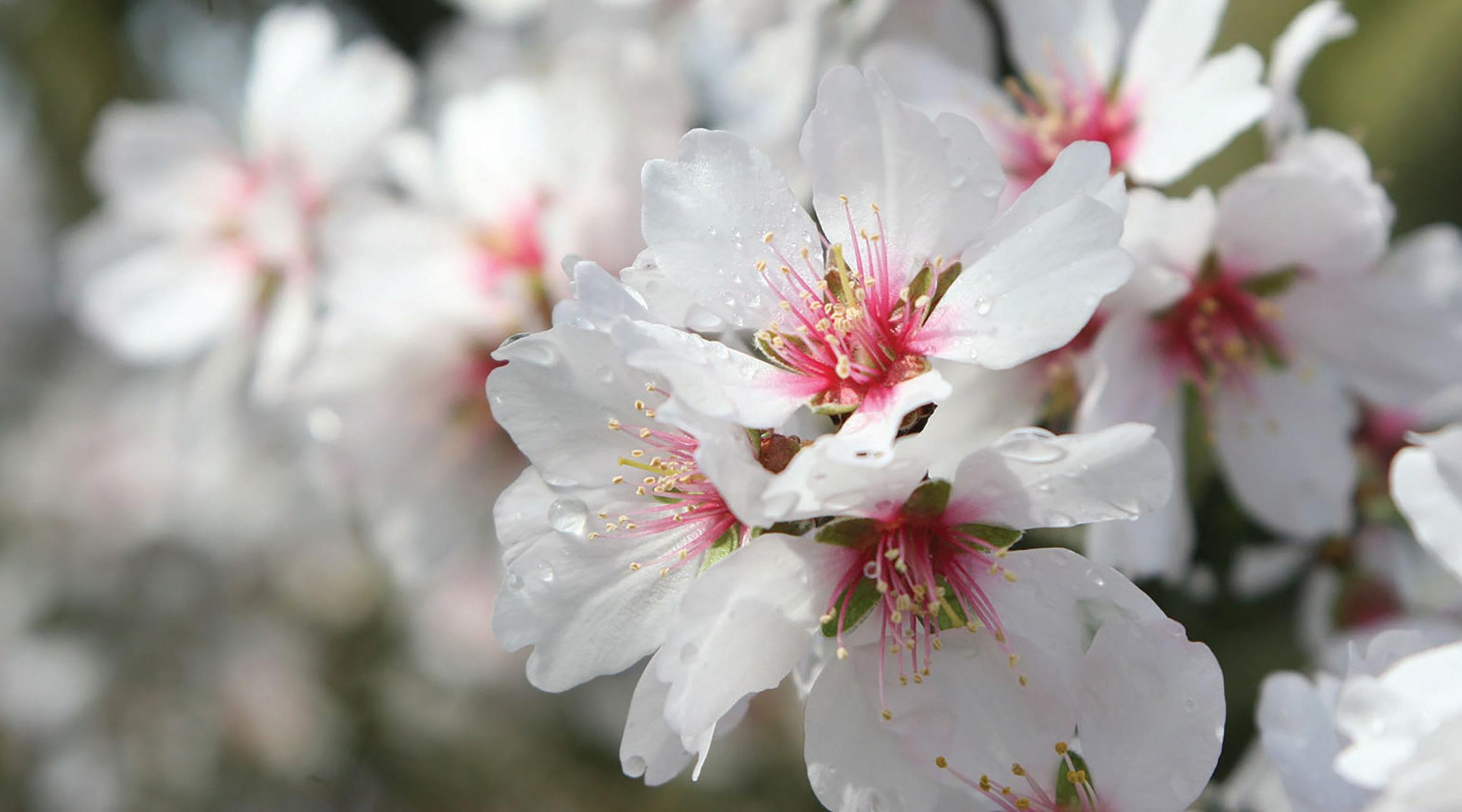
The 61st annual event kicks off the outdoor festival season in the Northern San Joaquin Valley. It’s a chance to meander outside among vendor booths under welcoming skies whether it is sunny with fluffy clouds floating above an endless sea of almond blossoms or subdued shades of gray.
Winter is in the run and spring is coming. And what better way to savor it than with a low-key, family friendly event.
For Ripon residents — present and former — it is a massive homecoming especially the day of the parade. Front yards will be lined with chairs — and even tables with picnic style spreads — long before the 1 p.m. start time on Feb. 25.
The parade itself is small town San Joaquin Valley-style on display. Its appeal and associated community events from a fun run to three community breakfasts and even a diaper derby are all crowd pleasers.
The biggest appeal, though, for those with no direct ties to Ripon is the festival itself at Mistlin Sports Park on River Road off Jack Tone Road north of the Highway 99 exit below the imposing 15-story water tower that’s top is painted like a gigantic soccer ball.
It is an appropriate setting surrounded on three sides by acres upon acres of almonds in the full glory of pink and white blossoms.
Admission is free although there is a $5 parking fee for those opting to park on the festival grounds. Hours are Friday, Feb. 24, from 4 to 10 p.m.; Saturday, Feb. 25, from 10 a.m. to 8 p.m. and
Sunday, Feb. 26, from 11 a.m. to 5 p.m.
The carnival is open Thursday, Feb, 23, from 5 to 10 p.m.; Friday, Feb. 24, from 4 to 10 p.m., Saturday, Feb. 25, from 11 a.m. to 10 p.m., and Sunday, Feb. 26, from 11 .m. to 5 p.m.
There is a Saturday fun run. Community stage entertainment on the Saturday and Sunday, a teen night with live music at the park on that Friday.
On the weekend local groups stage various breakfasts, dinners, dance, and even bake sales throughout the community.
The event is staged by the Ripon Chamber of Commerce that is celebrating its 100th anniversary this year.
For more information go to riponchamber.org/almond-blossom-festival.
Mistlin Sports Park is accessed by taking the Jack Tone Road exit on Highway 99 in Ripon and heading north to River Road and the festival site. ●
Olympic, professional and collegiate skiers from around the globe will be coming to the 209 when the World Pro Ski Tour (WPST) makes a pit stop at the Skyline Bear Valley Resort in Bear Valley. e two-day event –which will take place from Saturday, Feb 11. to Sunday, Feb. 12 – will be the rst professional event hosted by the venue since the early 1970s.
“The mountain crew at Bear Valley is building two racecourses on a run known as Feather Duster. Creating a world class race run begins months ahead of the race. Bear Valley crews are already trimming foliage, grooming, and making snow,” the organization shared in a press release. “Snowcats will coax the snow into rolls and jumps that shape the terrain and make downhill races so difficult. This landscaping also requires Forest Service
approval and under their watchful eye, the runs will be carefully tended all the way to race weekend.”
Jon J. Franklin, CEO of the WPST, explained that a major reason why the organization decided to return to Skyline Bear Valley Resort and Lodge was the incredible scenery of the Central Sierra Nevada Mountains.
“When we saw Bear Valley this summer, we were blown away by the vertical runs, the 360 views at the top and the professionalism of the staff,” Franklin said. “We are so excited to be back at Bear Valley which was always a highlight of the venues on the historic Pro Tour.”
The World Pro Ski Tour is a nationwide tour of four events for both men and women. The professional skiers race side-by-side in a single elimination format. Prize money and an overall World Pro Ski Tour title



has attracted skiers from around the world in years past, most notably Olympic silver medalist Billy Kidd, gold medalist Jean Claude Killy, and gold and silver medalists Phil & Steve Mahre.
On top of being able to get an up close look at the latest generation of skiing superstars, there are also opportunities to get on TV, as the event will be subject to a replay broadcast on CBS Sports Network a week later. Additionally, the organization’s reality show and docuseries, “Life In Between the Gates,” airs on NBC Sports, Amazon Prime, OutsideTv, AT&T Sports and other streaming services two weeks after the event.
To purchase parking passes, view lodging options, sign up for volunteering opportunities or for more general information, head to www. bearvalley.com/world-pro-ski-tour. ●



Between 1935 and 1939, Lange took her camera to migrant camps in states like Colorado, Texas, Oklahoma and Arizona, but spent much time photographing the poor in California and its Central Valley – the bread basket of the world.
The towering eight-story steel frame of what will soon become the Stanislaus County Courthouse now dominates an entire city block of downtown Modesto. Residents are celebrating the long overdue replacement of the cramped and outdated 1960 courthouse.
The new courthouse, however, has evicted Modesto history.
The huge building shadows the northeast corner of Ninth and H streets which looks vastly different than in March 1937 when accomplished Depression-era photographer Dorothea Lange visited with her Graflex Super D camera. On this corner she captured iconic images of idle men who were among the quarter of Americans who were jobless – and nearly out of hope for a better life.
The San Francisco photographer was in Modesto as part of her assignment by the U.S. Farm Security Administration to document the heartbreaking conditions of a country in the throes of the Great Depression. Between 1935 and 1939, Lange took her camera to migrant
camps in states like Colorado, Texas, Oklahoma and Arizona, but spent much time photographing the poor in California and its Central Valley – the bread basket of the world.
Lange snapped a series of photos on this corner, giving us a historic context of a Modesto of 86 years ago. One can see the Turner Hardware & Implements store building in the background of Lange’s iconic photo, “Men on Skid Row.” The store’s footprint occupied the northwest area of the block where courthouse construction is taking place.
Turner’s began as Wood and Turner in 1874 and was a mainstay in sleepy Modesto, which had grown to about 14,000 residents by 1930. Not far away was J.S. West, which supplied grain to area farmers and ranchers. Turner’s was remodeled over the years and after the business closed, fell to other uses until it was eventually bulldozed around 2017 to clear the block for the courthouse. Up until the end the building was a common place where homeless huddled in its recesses– a reminder that the Valley
hadn’t shaken its unfortunate distinction of being home to some of the most impoverished Californians.
Lange’s photos captured a number of down-and-out men – dressed formally by today’s standards – standing around with hands in pocket, idle for a lack of work. In the era of FDR, Ninth Street was a hangout for vagrants and known as Modesto’s skid row.

One man, leaning against the mail box affixed to the stop sign pole at Ninth Street, shoots Lange a look of distrust from beneath the bill of his cap. His hard glare at the camera mirrors the hardness facing Americans.
The Great Depression began shortly after the 1929 stock market crash and wouldn’t end until the late 1930s. At one time, nearly 25 percent of the country’s total workforce of 12.8 million was out of a job. Making matters worse was a series of droughts in the Midwest and the resulting loss of farms from the dust storms of the 1930s. In 1935 many farming families had no choice but to pack up their belonging onto jalopies and made the trek westward on Route 66 to the rich agricultural jobs in the Central Valley. Many weren’t welcome but there was work – paying only paltry wages but they fed families.

In the background of Lange’s photos, one can make out ornate two-story brick buildings to the north of Turner Hardware, long since razed from the Modesto landscape. One was the IOOF Hall and the other once occupied by Majestic Furniture.
Lange’s “skid row” series was believed taken in March 1937, a month after Lange snapped her most famous work in Nipomo, the iconic “Migrant Mother” photo. Her camera found Florence Hill Thompson, a destitute mother surrounded by her young daughters huddled in a lean-to canvas tent. In short time, the image of the haggard and worn face of Thompson, tugging at the corner of her

mouth in worry, would represent the starvation experienced in an economically broken country. In Thompson’s case, a cold snap in San Luis Obispo County had destroyed the peas and claimed any chance for a job.
Lange saw firsthand the suffering in the camp and others like it. For years she crisscrossed the Valley at the same time when John Steinbeck was living among the migrants and collecting stories for his ground-shaking novels, “The Grapes of Wrath” and “In Dubious Battle.” The works of both Lange and Steinbeck stirred public support to help the poor and downtrodden.
A block away, across Ninth Street, Lange had snapped more photos and found two men – dressed in suits
and wearing hats – snoozing midday on the concrete slab next to the railroad tracks. The image has been popularly credited as being shot in San Francisco because of the name of a business in the background. It’s an understandable mistake for those who don’t know the context that the San Francisco Fruit Market was operating between Eighth and Ninth Streets in Modesto to the northeast of the tracks. Eventually San Francisco Fruit Market became Angelo’s Market. There is also no disputing the presence of the distinctive Modesto arch in the background as well as the Strand Theater which once stood on 10th Street (later replaced by the Brendan Theater). ●
A block away, across Ninth Street, Lange had snapped more photos and found two men –dressed in suits and wearing hats – snoozing midday on the concrete slab next to the railroad tracks.


















The West Side Theater is an iconic performing arts venue located in the heart of downtown Newman.

Built in 1940 as a premiere movie house, the locale now features live bands, stage plays and a variety of community arts events.
The West Side Theatre is thriving today as it was in its prime decades ago.
Aug. 1, 1940, was an exciting day in Newman. The day, or rather evening, when the newly constructed movie house named the West Side Theatre was opened to the public with grand anticipation. The comedy film “The Boys From Syracuse” was presented to a full house that opening night. The audience was in awe of the beautiful architecture, art deco design, stadium seating, state of the art lighting and amazing acoustics as they enjoyed the show. From the first sighting of the grand neon marquee, to the illuminated lobby welcoming patrons to the front entrance, to the spectacular grand opening event inside, the whole experience was reported to be phenomenal and one to remember.
The owners of the modern movie house, Charles Gray and James Stephens, continued to bring newly released feature films to the westside community for four decades. The building became a town landmark.
Residents from Newman, Gustine and nearby towns have fond memories of their cinema days at the beautiful West Side Theatre. Those include seeing the novel marquee with the unique square bulletin board that an-
nounced the current films. The 45-foot vertical sign that cast light upon the facade with artfully coordinated hues, became a centerpiece of downtown Newman.
Multi-screen movie complexes became popular in the 1980s. The owners of the small town theatre could not keep up with the competition. The Oscar nominated drama “Terms of Endearment” played in Newman on March 29-31, 1984. The tear-jerker was the last English language feature film at the West Side Theatre.
There were attempts to keep the facility running. Spanish films were shown on Sundays for a short time. A skating rink opened in 1988 and stayed open for a few years but eventually closed. The attempt to find a long time solution seemed impossible. The interior of the auditorium had been changed by various business endeavors and the exterior over time lost the brilliance it once had. Something needed to change before the theatre was destroyed and became only a memory of good days gone by.
1995 was the year that change began. A group of hometown performing arts supporting super heroes came up with a plan to reclaim Newman’s shining star.
Farris Larsen, David Larsen, David Reed and Jim Tacheira speerheaded the campaign.
The two key elements were purchasing the building and earning the funds for the restoration. The vision was for the West Side Theatre
to be a performing arts center operated by volunteers. All the funds generated through event sales would go directly to the renovation costs. The group knew it would be a long, challenging road but were committed to bringing life back to the venue.
The building was for sale when Farris presented the proposal to the Newman City Council. The city could buy the building and community volunteers would restore the theatre to its original purpose which was to provide entertainment for the Westside community. And that’s what eventually happened.
The city of Newman purchased the building in 1995 as part of their downtown revitalization projects. The volunteers formed a non-profit organization named West Side Theatre Foundation to operate the theatre and restore it.
Farris remembers getting the keys the summer of 1996 and everyone getting to work. The basics were tackled first, enough to get the doors open. Cleaning, deep cleaning, painting, stage building, and seating. The original sloped stadium seating had been removed with the skating rink requiring a flat floor. Cabaret style seating with various tables and chairs were put in place for the first events. And from there, the to-do list of projects were tackled as money came in from ticket sales of local play productions and live concerts.
Returning patrons and performers could see the transformation happening through the years. The art deco style has been “returned” so to speak and the early era ticket booth was restored as well. Some of the improvements are subtle, not noticed right away but the feeling of familiarity is present. “There is always something to be done,” Farris noted.
One project gets done and another begins. Some have a bigger impact than others but all have the same intention-to create the best theatre experience for both the audience and the performers.
For example, replacing the bolstering on the auditorium walls was a huge undertaking well worth the challenge. No more echoing with sounds bouncing off the walls. The acoustics the material provides is priceless. Having the roof redone after rain revealed a huge hole, was definitely a job needed. The city took care of that bill. Grants have helped
pay for some costly projects. Funds from a PG&E grant, for example, were used in 2000 to get the neon marquee working again. That was a big night for the westside community, a grand re-opening of sorts after four years of working towards the moment of turning those lights on again. The symbol that the West Side Theatre is back in action.
Since then, volunteers have continued to spend countless hours of their own “spare” time bringing the historic venue back to its original beauty.
Community members offer to use their skills in particular projects, others volunteer to staff event nights as ticket takers, greeters, snack bar crews, bar servers, waiters and waitresses. Volunteers also gather to clean and do odd jobs as needed. All involved are like a big family who enjoy the work they’re doing.
“Performers like coming here because we treat them like part of our family,” Farris shared. She and her husband David Larsen host the visiting performers. “We treat them well. We feed them before the show. We’re genuinely happy they are here,” Farris added. There will always be projects on the to-do list to keep improving the facility. The major electrical project has been completed. The new sound system is done. Next on the list is a lighting upgrade.
People visiting the theatre for the first time would not know the work that has and is being done there. They will see the marquee and make their way inside, be greeted with a smile, get comfortable, order a drink and a snack and enjoy the show.
“I believe both performers and audiences walk through these doors and can feel the magic of this place,” Farris expressed. They leave knowing they’ll be back again.
The first event following the COVID shutdown was in the summer of 2021. David Larsen had booked James Garner- Johnny Cash Tribute. The house was packed and it continued to be for all the shows that year.
“Our attendance was twice the size than any year prior,” Farris remarked. And the trend appears to be staying.
Little by little, booking to booking, ticket to ticket, nearly 30 years of dedicated and selfless community effort, the West Side Theatre is once again the beautiful performing arts venue it was meant to be. ●
The theatre is located at 1331 Main St, Newman CA 95360
Phone (209) 862- 4490
Email info@westsidetheatre.org
Follow West Side Theatre on FaceBook for the latest updates on concerts, plays, art exhibits, tickets and more information.
Visit westsidetheatre.org to view a calendar of events and get ticket information.
Please note - tickets purchased at the box office are paid by cash only. Credit card purchases are made online through Ticket Leap.
Upcoming concerts include:
• Unauthorized Rolling Stones Feb. 4
• Chicago The Tribute Feb. 11
• Mariachi Serenade Feb. 18
• Beer Drinkers & Hell RaisersZZ Top Tribute March 4
• Alan Iglesias and Cross FireStevie Ray Vaughn Tribute March 11
• Carnavale- The Santana Tribute March 25
• *House of Floyd- Pink Floyd Tribute April 1
• Doors open at 7 pm; concert at 8 pm
General seating $20; Reserved $25
*General seating $25;
*Reserved $30
The West Side Players will be presenting “The Last Night of Ballyhoo” on the theatre stage at the end of April. Showtime, dates, and ticket prices to be announced soon.



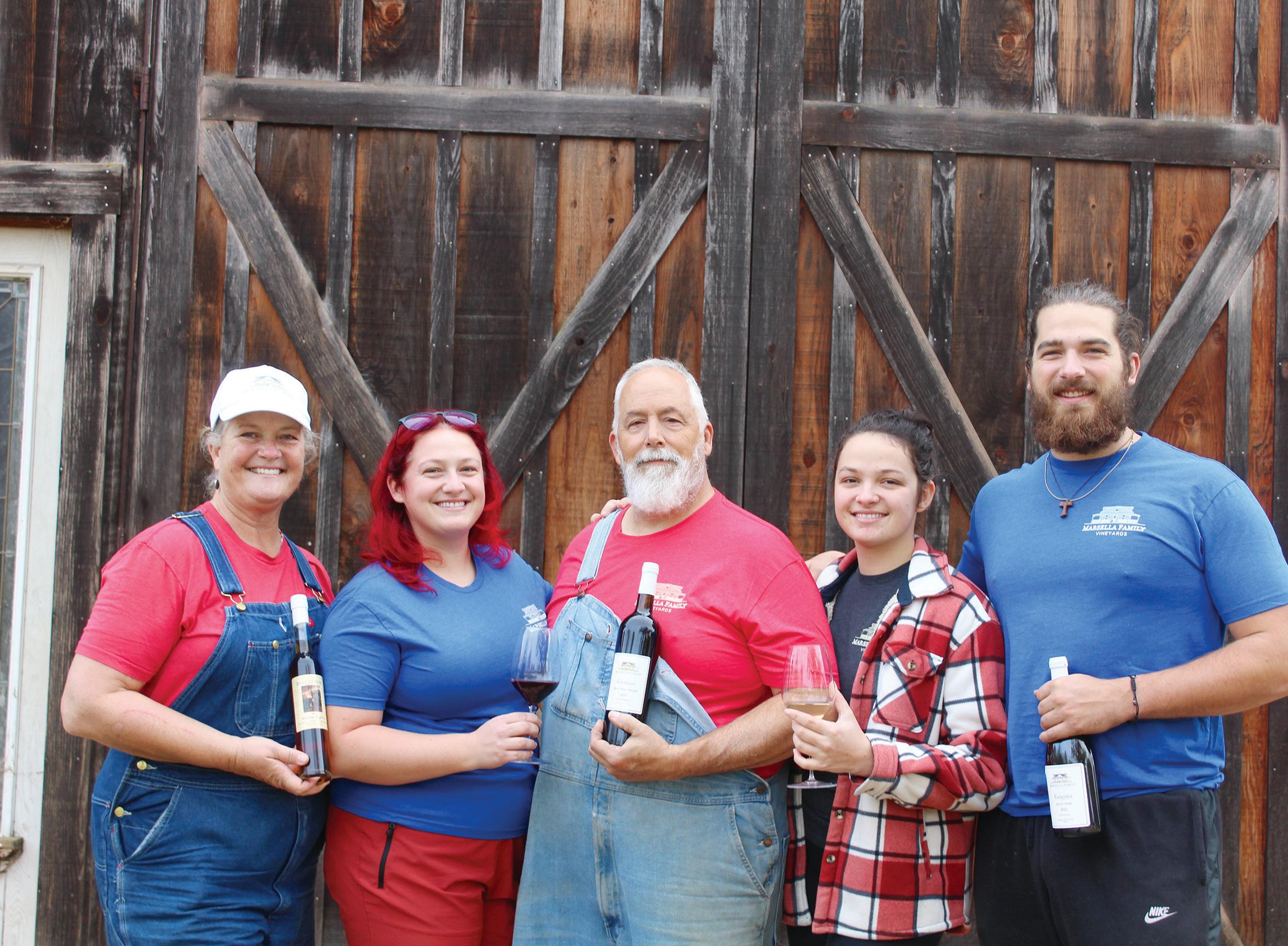
We are going to have a good local draw and we want that; we want to draw families in to bring their dogs and loved ones and just hang out and have a good time.The Marsella family from left to right: Kristi, Kate, John, Liza and Louie. Not pictured is the other daughter Alex.
—Kristi Marsella
Home is where the wine is for Marsella Family Vineyards, which has officially opened the barn doors to invite in visitors and wine aficionados from the surrounding areas. The winery is located at 13480 Orange Blossom Rd., east of Oakdale, and offers a scenic atmosphere to pair with a variety of their in-house wine and an all-inclusive experience for all ages.
Owners John and Kristi Marsella bought the property nine years ago and saw how rocky the soil was and knew that they could either plant potatoes or grapes and decided to go down the grapes route. John, or Farmer John as he is known now, began clearing the land to prepare for the process of planting the grapes. Within a few years of moving in, the vineyards were thriving and the focus turned toward making wine.
The couple had been interested in the wine making business for as long
as they can remember they said but the real attraction to the wine scene began when they joined a wine club called Woof Woof 28 years ago. Members of the club would all go together to other vineyards and had the chance to buy plots of vines, learn to pick grapes and how to make the wine.
Kristi found the club during the 25 years she put in working for Gallo. Their four children also have followed the same path, with Kate, 29; Alex, 27; Louie, 24; and Liza, 22, all playing a part in the new family winery venture, spreading the love for family and wine to everyone who comes to visit.
Not only does the family make all sorts of wine but they also are working with other spirits that they hope to incorporate in the future of the vineyard for selling. The first bottles of wine from the family vineyards were for their own consumption or for gifts but that even-


During their grand opening they were selling wine flights that included an enigma white wine 2020, Giorgio red blend 2020, primo vino pinot noir 2020, mission angelica san Giovanni 2021 and mission angelica beelzebob 2021.
tually gave way to bottling and selling, recording their first sale this year. The very first wine they produced was called Angelica, named for a wine made originally by Spanish friars and the Marsella Family version borne out of some neglected vines that a friend offered to Farmer John. To this day it is one of the most popular drinks they offer.
The Orange Blossom location, the family believes, sets them up as a great destination for those looking for a relaxing place to visit.
“We are going to have a good local draw and we want that; we want to draw families in to bring their dogs and loved ones and just hang out and have a good time,” Kristi stated.
The kids’ also have their favorites; Kate is partial to the Giorgio, a drinkable and versatile red blend that was named after their late dog. For Louie, it is the Beelzebob, one of the types of
Angelicas, while for Liza it is the Angelicas in general because she prefers a sweet dessert wine.
The winery’s business hours are by appointment or event; they encourage booking the barn for events such as work parties, birthdays or weddings. Bookings can be made by calling Farmer John at 209-602-8031. During your visit, you can enjoy a Full Flight for $10 that includes two-ounce pours of three table wines along with half-ounce pours of two dessert wines. Individual wine tastings are $2 and there are also soft drinks and hot chocolate available for $2 for under age visitors. The Wine Shop on site also features items from local producers and artisans and you can purchase the Marsella Family Vineyards wines by the bottle or by the case.
Everyone in the family agreed that the three best words to describe their winery are joyful, simple and authentic, and Farmer John made sure to add in his own fourth word as ‘family-palooza.’ The best way to keep updated on future events happening at the Marsella Family Vineyards, is through all of their social media such as Instagram: mfvineyards, Facebook: Marsella Family Vineyards and on their website: www.MarsellaFamily. com. ●

Everyone in the family agreed that the three best words to describe their winery are joyful, simple and authentic, and Farmer John made sure to add in his own fourth word as ‘family-palooza.’














The St. Patrick’s Day celebration at Ollie’s Pub in downtown Lodi on March 17 is sure to be awfully good. St. Patrick’s Day is the Pub’s biggest day of the year and falling on a Friday this year the party will be turned up in the 209.

















Owners Sean and Ashlee Guthrie and Justin and Dawn O’Byrne partnered up 12 years ago to keep the neighborhood bar on School Street bustling as it has been for over 50 years.
“We are local boys so we decided to take it over and it is where it is now,” said Guthrie. “It keeps growing and it is a machine of itself really. My partner is the Irish one, well I am Irish too but he is full Irish. His dad is from Ireland. We wanted to open up a pub and we saw the advantage and Lodi needed a spot so we just kind of fell into it and started from scratch. We ran it like a business instead of a bar; that is how we are successful.”
In traditional Irish pub fashion, the lighting is low, there is a large Guinness mirror, dark wood throughout, Jameson signs, an assortment of Irish whiskeys
and, of course, Guinness on tap. ey o er several Guinness blends like the Blacksmith which is Guinness and Smithwicks, Snakebite with Magners, and the Badger with Smirno Ice.

In their corporation they have over 20 employees and their lead bartender Miguel Razo noted that they are a great company to work for and that they treated everyone like family.
“We have been pretty lucky with the clientele, everyone in Lodi pretty much comes







here and knows of it,” stated Guthrie. “Our support system is the best. It is all about the sta . ey do a great job. Our door guys do a great job. It is just a big family here. You are not an employee, you are family.”
ey do not have a happy hour nor do they o er food but if “the craic is 90” which is Irish slang for “a fantastic, brilliant time” then Ollie’s Pub is the place to be, especially on St. Patrick’s Day.


“We have really become a destination which is great for the Valley,” remarked Guthrie. “We have been recognized by a lot of the other small little pubs. We do well here as far as recognition and so forth. We have received all kinds of awards. We get a lot of locals that have become family. We sell a lot of Guinness here.”
e weeklong celebration will begin with pre-St. Patty festivities including specials with Guinness, Jameson, Proper 12, and Tullamore Dew as well






We have been pretty lucky with the clientele, everyone in Lodi pretty much comes here and knows of it.PHOTOS BY VIRGINIA STILL/ 209 Magazine
as Irish events leading up to Friday. On Friday, March 17, Ollie’s will open at 8 a.m. with music around noon and by 2 p.m. or 3 p.m. the place will be buzzing with people and it will likely be hard to get in … so get there early.





















ey will have a bagpipe player and live music. e liquor reps and distributors will be on hand and they will pass out swag.
ere will be a whole lot of Irish whiskeys being poured and Guinness being served up as well as Irish car bombs, black and tans and shots. ey also plan to have some food o erings for guests to hopefully prevent getting “ uthered” which is another Irish word that means “very, very, drunk.”


Guthrie shared that his favorite parts of being an owner of Ollie’s are “being a staple of Lodi and the people.”
In the bar industry there are always drink


trends and currently energy drinks and alcohol seem to be a real crowd pleaser. At Ollie’s the top three shots are the Superman, Starburst, and Pink Taco. Razo created the Cool-Aid shot that customers can enjoy as well. ey can also make the shots into a drink if that is preferred over taking a shot.
“I like serving drinks,” expressed Razo. “People are my favorite thing about bartending. I have been bartending for 17 years. Come get a perfect Guinness. ey take their Guinness really serious around here.”


Razo explained that there were a couple guys that received a certi cate for serving Guinness the right way





and they taught them how to do it.

Ollie’s Pub has a lot of outdoor space for those that would prefer to be outdoors. ey have a patio in front and back and an outdoor venue in the back parking lot. ey o er live music on the weekends which draws a crowd and they have an award-winning Bloody Mary garnished with bacon that is purchased from a local deli.
“We welcome everybody,” mentioned Guthrie. “It is a good spot to hang out. It is not a night club. It is a great drinking establishment.” ●
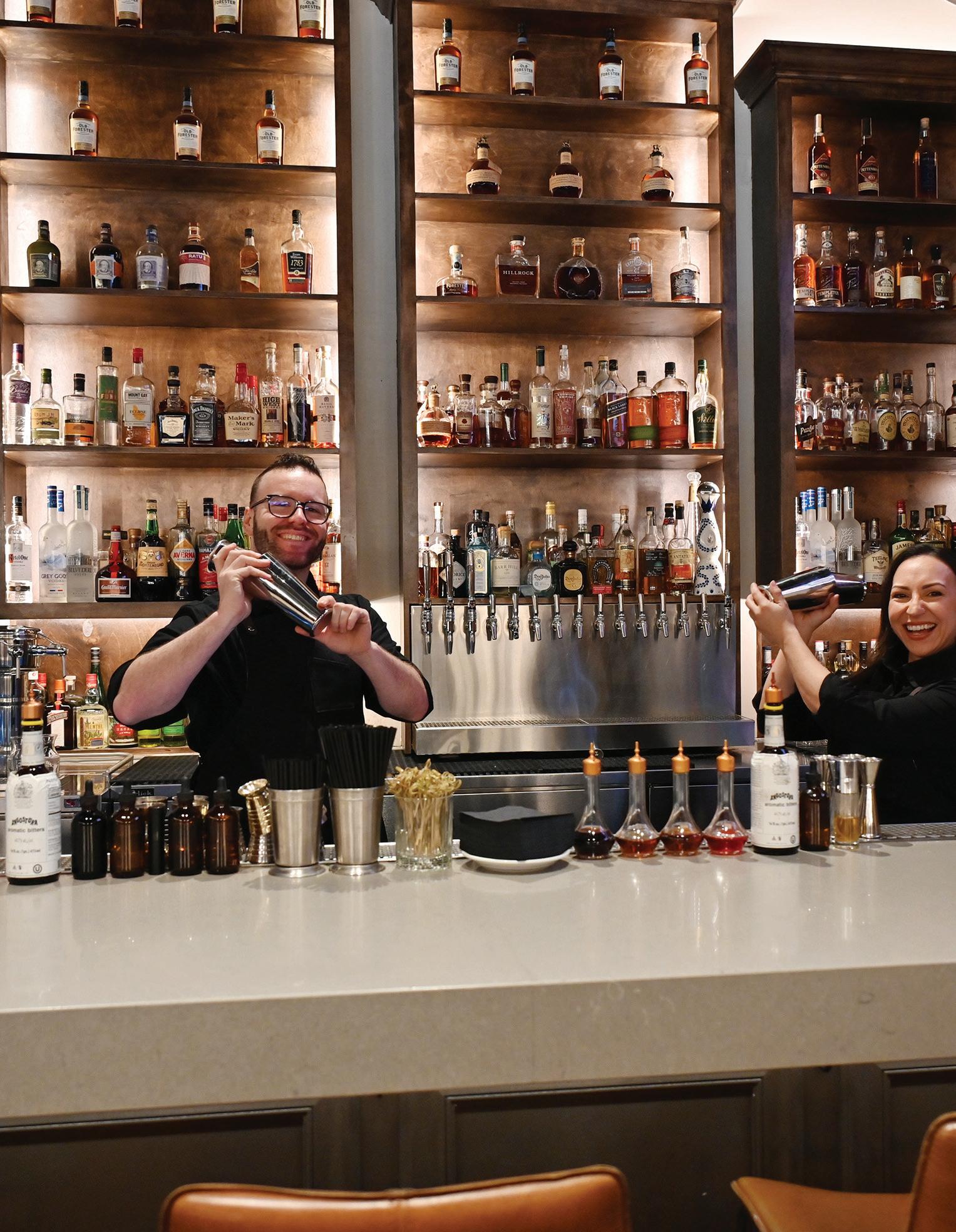


There is a new steakhouse in the 209 that specializes in bringing an exceptional experience to guests; located in downtown Turlock, this must-visit restaurant is called Cuts Steakhouse. It is truly all in the name as Cuts o ers patrons steak options like the let, ribeye, and Tomahawk along with their choice of preparation, butter compounds, and sides.
e custom 10-foot doors open into a captivating restaurant with a few di erent seating options including the large family style table, a couple high top tables overlooking the outside patio, or private booths for an intimate date night.
e ritzy bar is located in the back with wingback chairs and private booths giving it a real classy cigar lounge feel.

e patio area has seating available for those that would like to dine outdoors or enjoy a cocktail.
Veteran Owner Jerry Powell and Managing Partner Devin Hill collaborated to bring the 209 a high caliber steakhouse like no other. ey did their research, traveling to establishments in Las Vegas, Alaska, Sacramento, and Southern California as well as other places in the surrounding area. is gave life to Cuts in July 2021. ey did extensive upgrades but the bar, restrooms, and kitchen stayed where they were.
“We built and designed something that we wanted to eat at,” said Hill. “So, we went to great lengths. Jerry and I traveled a bit and designed everything from the colors to the chairs, the custom booths, and custom doors. e
private booths were purposeful and intentional.”
Bar Managers Chianne Castillo and Joshua Wilson have some premier cra cocktails in the full bar for people to delight in like the Manhattan, Old Fashioned, Bulldog Cooler, dra beers and wines.
“ e folks that we have working in this bar are dedicated to their cra ,” stated Hill. “ ey are serious about it. ey care about it which is very rare in this industry. Our cocktails are remarkably consistent. ey are a good strong pour and down to a science. I think it shines as bright as anything in the Bay area or southern California or major market. I don’t say that lightly.”
Executive Chef Nicolas Patire serves up steaks with three types of preparations, wood re, char-broil, and pan seared. Guests can select black tru e, bone marrow, and herb for their butter compounds to go on their cut of steak. In true steakhouse fashion, the let and ribeye are the top sellers. All Cuts
are USDA Prime Beef.
“I wanted to o er three styles of cooking,” Hill pointed out. “So, I could keep coming here and have my favorite cut of steak but with totally di erent preparation styles and butter so you could have in a small section with nine items many di erent varied options and change your plate. I really wanted to give people some options in this culture. You have freedom to choose and build your own plate.”
Hill created the original menu and now it has about 70 percent of the items he created. ere are a variety of options like salads, soups, sandwiches, burgers, pasta, pork, chicken, salmon and specialty meats like Wagyu and 21-day dry aged ribeye. e cooking style and methods are still under Hill’s direction. rough the year-and-a-half they have been open, they have had a few di erent chefs that have made signi cant contributions to the menu.
“I have a particular way I like things done I like them to look a certain way and have a certain texture and be plated a certain way so those rules that I have written stand,” added Hill. “But the creativity that these chefs have far outweighs my abilities or my interest at this point. I try to give the chefs a lot of latitude for specials as long as it looks a certain way and it is the Cuts culture.”
In the spring there will be some changes to the menu due to the seasonal bounty of edibles that will mostly a ect the soups, salads, sides, and desserts. e main entrees will remain the same.
We built and designed something that we wanted to eat at.
—Devin Hill
“The thing about food and crafting a plate of food and an experience is that when someone gets a plate of food which is essentially a piece of art that comes from the chef’s hands. They have a very intimate relationship with it because they actually take it inside their body and it nourishes them and feeds them. So, if you can have that experience with a customer where they are happy with the ambiance and the process of their dinner and they love their food, it is a very intimate relationship to have with a client. It is meaningful.”
Front of the house Manager, John Jacob has been with Cuts since September and said that they have a great team and great leadership and a supportive staff that really care.
“People love the steaks,” remarked Jacob. “Eighty-five percent of people order steaks and the showstopper is our Tomahawk. When they carry it out, it is all eyes on the Tomahawk. People share it but we have seen cowboys come in and tear it up by themselves.”
The compliments from customers that they have received like “this is the best steak I have ever had and this place is great, and they love the environment, the service and they are very happy, is very rewarding,” Hill shared.
He added, “It (compliments) is very meaningful for somebody that has put a lot of time and effort in crafting an experience for people. It is very meaningful to both Jerry and I when we hear that kind of stuff.”
They are currently open Tuesday through Saturday for dinner and plan to revamp their brunch offerings by early April. Hill noted that they are open to possibly reintroducing lunch at some point.
“I want people from all sorts of economic walks to be able to take their girlfriend or boyfriend or whatever somewhere nice and have the option to pick what they want,” expressed Hill. “The big 10-foot custom doors I think makes people think expensive. But we really did craft the menu so that it was attainable for a lot of different folks. I was trying to be thoughtful of the average dude.” ●




































Have you watched others on the dance oor and wondered if the salsa could be your dance? Are you willing to give it a try? Are you 50 years or older? For those answering yes, there is a class in Patterson for you.
e Hammon Senior Center is hosting beginner’s salsa classes for anyone 50+. e classes are scheduled for Tuesdays from 1 pm - 2pm through mid-March.


e salsa instructor, Denise, said this rst session block is a pilot. If the interest is there to advance, additional sessions may be added a er March.
Salsa is a dance for all ages, shapes, sizes and ethnicities the instructor emphasized. e dance style o ers a gentle all body workout that she nds is easier on her joints than some other workouts.


e salsa is a smooth dance with graceful movements and an etiquette of respect and kindness between the leader and the follower. As the dance is developed, the two reach a harmony and their moves naturally become in sync.
Salsa is a dance for all ages, shapes, sizes and ethnicities the instructor emphasized.
Some people may see the dance and think they could never keep up. Denise assures you don’t need to know 100 moves to successfully salsa. e process starts with learning the basic four or ve. And that’s the idea of these beginners classes.


Students will be working on the basic fundamentals and the musicality; feeling the rhythm and working with a partner. Please note- individuals do not need to bring a partner to join the class.

When Denise was rst introduced to the Latin dance years ago, she fell in love with it almost instantly. She found it helped boost her mood and her endorphins. e dance is social and engaging. e music is exciting and fun. And people just wanted to dance.

To take the classes, which are free of charge, participants need to ll out a membership form with the senior center prior to attending.
ere is no fee for membership.
Drop-ins at class times are permitted or you can stop in at the center weekdays 8am3pm. Please allow about 10 minutes for the paperwork. Each class will begin with a warm-up of fundamentals, so new-comers can join right in.
e salsa community is a large one lled with friendly, polite people who are eager to dance and willing to teach others. Denise is excited to introduce people to the dance she loves. Who knows where the experience may take them. “Maybe to that dance oor on your next cruise,” she concluded. ●
IF YOU GO
WHERE: The Hammon Senior Center is located at 1033 W. Las Palmas Ave, Patterson 95363
PHONE: (209) 895-8180

The essence of dancing the tango is to create a connection with your partner. ere’s the embrace and the eye contact that can create a level of intimacy, however, to really get into sync with your partner, much like in life and love, there is no handy Arthur Murray footsteps to follow. Rather it is a readiness to improvise and surrender to the moment.
“Tango is a paradox,” said Carol Bennett, one of the early members of Modesto Tango. “You’re maintaining a control of your body, when it comes to posture and balance but you’re surrendering everything else to your partner.”
For those who have fallen under the spell of Argentine tango, it can become an ever-elusive mission to try and master all the intricacies, but a passion for the dance is what keeps the a cionados returning, which is certainly true for the members of Modesto Tango.


For more than a decade now the members of Modesto Tango have been striving to share and pass along their love for the dance.
A lifelong dancer, Mary Menz’s rst

introduction to the national dance of Argentina came on the silver screen when she saw a showing of “Tango.”
“I was immediately thinking that I needed to learn that dance,” Menz said.
She got her opportunity later during a vacation at a Mexican resort where an Argentine instructor happened to be giving tango lessons.
“ at’s where I had my rst lesson,” said Menz, who is now an instructor herself. She, along with friend Pat Paul started taking tango lessons in Sacramento, before forming the local Modesto group.
The reasons people are drawn to learn tango are just as varied as the moves of the dance. Bennet enjoys it because she said it’s an opportunity for her to “get out of my own head and only think about the physicality of it.”
Steve Hibbard, a board member of Modesto Tango, had his introduction to tango through his friendship with Mary and thought at rst he might like it just for the mere exercise bene t. Instead, he was drawn to the responsibility of being a leader. In
tango, the roles are de ned — the man will lead the dance and the woman will follow.
“If I’m dancing, then I’m in charge and I look through my tools and say this is how I’m going to do this and this is how I will move us here,” Hibbard said. “She’s following my lead, but I’m also reacting to her moves. It’s an exchange.”
The shutdown over the last year and a half interrupted Modesto Tango’s progress in teaching more people about the dance, but now they are headed back on track, Menz said. The class meets the second and fourth Saturdays of each month from 11 a.m. to 12:15 p.m. Each session usually has a guest instructor from the region who goes over a particular lesson before turning it over to the class to practice. The cost is $20 per person per class and there is an option for private lessons for $90. The classes are held at Studio V Pilates and Fitness at 4459 Spyres Way, suite A in Modesto. To sign up for a class or for more information call Mary Menz at (209) 522-1571. ●














 By KRISTINA HACKER
Greg and Priscilla McCrea met while dancing salsa. e couple, now married, decided to start out 2023 by getting back on the dance oor together, this time learning how to swing dance.

“We’re trying to reconnect with something new,” said Priscilla during a recent swing dance lesson at Alegria Performing Arts Academy in downtown Turlock.
At the same swing dance lesson were Chris and Morgan omas. ey’ve been country swing dancing at Alegria since 2020. Chris and Morgan were just friends when they started dance lessons at the same time, and now they’re happily married; something they both attribute to their connection on the dance oor.
“It’s the best place to come and learn. It’s not a bar setting. You can really get down and lose your pride,” said Chris. e connections these couples have while on the dance oor are not surprising to Alegria owner Gabrielle Forrest. She opened her rst dance studio in Turlock in 2014 because she saw a need for adult partner dancing lessons.
Forrest started ballroom dancing in her teens and later became an instructor for an Arthur Murray dance studio. While her studio has since changed locations since it opened nine years ago and expanded to include lessons for youth and competition dance groups, partner dancing is still her rst love.







Forrest continues to teach ballroom to couples and during special workshops, but the partner dancing classes o ered at her studio are more in line with what type of dancing is popular in the area.
“So, for partner dancing there are places for country swing and line dancing and salsa. at’s why we teach those classes primarily and not really ballroom anymore. People want to be able to use it and what they’re going to use in this area, a 40 to 50-mile radius, are salsa, bachata, line dancing and country

swing,” said Forrest.
Bachata is Dominican in origin and has gained popularity in the past decade.


One of the ways that Forrest keeps on top of what dances are popular in the local bar and nightclub scene is by bringing in dance instructors who are part of the local dance community, like Top Shelf Dancing’s Lexxi Kuhse, Joslyn Mendez and Colton Camara.

top of what dances are popular in the lo-






 — Lexxi


Forrest saw that these dancers were creating swing dance how-to videos for their social media pages and then going out to local bars and teaching classes.


ey were creating a lot of positive buzz for partner dancing and Forrest saw an opportunity for a partnership.
Kuhse and Mendez have been dancing for 10 years and have really gotten into swing the past three years or so.
“We’re hoping to make (swing) more popular. We started teaching as a group in July. And that’s our goal, is to grow the community,” said Mendez.
“I like the connection that it brings with other people,” said Kuhse. “You can meet new dancers all over the place and you can pretty much go into any country
KuhseTop Shelf Dancing instructors Lexxi Kuhse and Joslyn Mendez pose with Maverick Bennett and Scott Lange Chris and Morgan Thomas began dancing together two years ago as friends and continue to do so as a married couple.
connection that it brings with other people. You can meet new dancers all over the place and you can pretty much go into any country bar and make a new friend.during swing class.
bar and make a new friend.”
Mendez said everyone should learn how to swing dance for the “friendships, the community and the constant learning.”


“I have never stopped learning progressions since I started this. It’s a constant hobby that you can meet people, socialize and also learn and progress. I don’t think there’s any better hobby,” she said.















Forrest has made it easy for adults to jump into dancing lessons. Individuals or couples can just drop in for a class and pay $20 each. Alegria does, however, o er a discount for those who make a reservation for a class beforehand at $16 per class. ere are also discounts for signing up for monthly class passes or purchasing punch-cards, allowing for participants to come to classes when it’s convenient and still save money.


For more information on Alegria dance classes, nd them on Instagram or call (925) 980-5683. ●


stopped learning since I started this. It’s a constant hobby that you can meet people, socialize
progressions and also learn and progress.










The new year is still in its infancy, but let’s be honest – it’s already time for a break from the daily 209 grind. Sure, spring break is on the horizon, but few things can beat a spontaneous four-day getaway. And if you’re looking for a quick, painless trip, few destinations can beat the Emerald City.
Don’t let the rainy reputation keep you away from Seattle and all its offerings. Just a hop, skip and two-hour jump from the Sacramento airport, this gem of a city is at the top of my list of places to revisit.
Seattle is a big city with close to two dozen neighborhoods to explore. With that in mind, you’ll need to visit more than once just to scratch the surface. Consider this a guide for your first trip.
Set up homebase in Capitol Hill for its centralized location and take advantage of the city’s light rail system, known as the Link, to complete each leg of your city tour. Don’t forget to explore before you branch out, though. The densest of all Seattle’s neighborhoods, Cap Hill might also be its most diverse, which is reflected in the restaurants, cafes, and shops that dot the streets.
Make sure to walk 15th Avenue to find local shops and tasty snacks, like the macaroons at Bakery Noveau and Duck Poutine at Smith. Other places to keep in mind include Italian sister restaurants Artusi and Spinasse,
Oddfellows Café + Bar, and Rachel’s Ginger Beer.
Also in this neighborhood: the Jimi Hendrix statue, Bruce Lee’s gravesite, and Elliot Bay Books.
Trying to see the city through the eyes of a Seattleite is fun, but the more ‘touristy’ adventures are also a must. And when most people think of touring Seattle, the first thing that comes to mind is Pike Place Market. Peruse the various vendors and experience the fish throw at the market before ordering street eats at Mee Sum Pastry to eat along the Puget Sound.
Now that you’re along the Waterfront, it’s time to explore the many piers that are home to attractions like the Seattle Great Wheel, Seattle Aquarium, Lumen Field, and the Washington State Ferries.
The Puget Sound is the inlet of water that separates Seattle from Bainbridge Island.
My first order of business when visiting a new city is to seek out delicious food I can’t find back home. When researching the culinary options of the Pacific Northwest, locals, online communities and YouTube personalities consistently recommended one neighborhood in particular – the ID. Harbor City Restaurant is my recommendation for authentic Chinese Dim Sum and should keep you more than occupied during brunch. Walk off the delectable dumplings and check out hobby shops along with the Uwajimaya Asian Food & Gift Market where you can find Asian-exclusive snacks, stationary, and more. If you’re still hungry, stop by Chung Chun Rice Hot Dog before you leave to try the infamous Korean corndogs and donuts.
The award-winning Hing Hay Park and its ornate Grand Pavilion is located in this neighborhood.
What trip to Seattle would be complete without the Space Needle,
Don’t let the rainy reputation keep you away from Seattle and all its offerings. Just a hop, skip and two-hour jump from the Sacramento airport, this gem of a city is at the top of my list of places to revisit.















right? To sightsee this historic landmark, you’ll have to visit the Seattle Center in lower Queen Anne where you will also nd the Seattle Children’s Museum, International Fountain, and Seattle Center Amory.



The Museum of Pop Culture is also located at the Seattle Center and boasts exhibits that will celebrate the likes of Jimi Hendrix, Nirvana, and Pearl Jam as well as other pop culture niches like indie gaming, horror cinema, and hip hop history.



e Seattle Center was home to the 1962 Seattle World’s Fair. ●

In the Capitol Hill neighborhood of Seattle stands a statue of guitar god Jimi Hendrix. Unveiled in 1997, the bronze likeness shows Hendrix on his knees shredding on his guitar. The Hendrix statue was created by local artist Daryl Smith based on photos from the 1967 Monterey Pop Festival.
























 By SABRA STAFFORD










At the point where the Tuolumne and San Joaquin rivers converge about 10 miles southwest of Modesto, River Partners has been leading the decade-long e ort to turn the clock back for the 2,100 acres at Dos Rios Ranch. What was a working dairy and almond orchard has been transformed into an environment resembling the natural habitat it once was, long before the soil was ever tilled.
Dos Rios Ranch was designated in this year’s budget to become the rst new state park created in California in more than a decade. It will also be the rst state park accessible within Stanislaus County.


River Partners is the largest riparian habitat and oodplain restoration group in California, having completed nearly 300 projects with another 50 under way. ey began acquiring the Dos Rios property in 2011 when rancher Bill Lyons sold the Ranch.


To create the preserve, River Partners removed old nut trees and invested millions in planting native trees, bushes and grasses like cottonwood, Valley Oak, milkweed and elderberry bushes. ey also joined e orts with Heritage Growers and California Native partners to plant a native
use garden with sedge, deergrass, dogbane and other native plants for basketmaking and additional cultural uses.


River Partners modi ed berms to allow oodwater to ow freely across the area and in doing so, created the largest oodplain restoration project in California history. ey used the same irrigation techniques found on nearby farms to ensure the plantings took root. President of River Partners Julie Rentner said oodplains provide a host of bene ts to birds, that o en migrate thousands of miles to spend the winter and spring in the Valley.
Recent studies prove that oodplains are essential to the survival of threatened sh species. Juvenile salmon use them like tness centers, putting on muscle as they prepare to swim through the Delta to the Paci c. Currently, striped bass in the Delta eat 97 to 99% of all juvenile salmon exiting the San Joaquin River; stronger salmon would have a better chance of survival.
Across the restored oodplain, the Tuolumne oodwaters will spread out and slow down. at will take pressure o fragile levees protecting downstream
communities like Lathrop, Manteca and Stockton. It will also increase groundwater storage in aquifers, bene ting communities like Grayson, Westley and Patterson.

Assemblyman Adam Gray was instrumental in getting funding and lending support to the project. “We’re not just getting a state park,” he said, “we’re creating a template for future parks. We’re looking at ful lling multiple conservation and water objectives that are crucial to saving our Valley. Restored oodplains will bring us more water, more wildlife and lessen ood damage.”
It will take at least a decade for Dos Rios Ranch to become a state park, but already larger animals are arriving like blacktailed deer and beavers.
“ is approach that River Partners so e ectively demonstrates is the future of conservation in California,” says Wade Crowfoot, California Natural Resources Secretary, who was able to tour the area during an open house in October. “It’s not sh versus farms, north versus south, urban versus rural. It’s coming together and guring out we need to restore our environment. Projects like Dos Rios give us hope.” ●
We’re looking at fulfilling multiple conservation and water objectives that are crucial to saving our Valley.



Those seeking winter wonder without the crowds and traffic of Lake Tahoe can find an attractive alternative at Kings Canyon National Park. Striking scenery and moderate trails in the Grant Grove area provide rewarding day trips for beginning and advanced cross country skiers and snowshoers.

Grant Grove Village, with a visitor center and store, makes a perfect starting point. Highway 180 leads directly there from Fresno. Visitors can find parking, trail maps, rental gear, food and supplies. Most of our marked snow trails begin here, too. Here are a few favorites listed from easiest to more challenging.
This four-mile outing, which takes two to four hours, leads through a wondrous grove of giant sequoias. General Grant Tree, the best-known of these, boasts numerous distinctions: it’s the largest tree in the park and second-largest in the world. Pres. Coolidge named it the national Christmas tree and Pres. Eisenhower declared it a shrine to the nation’s war dead. Ulysses Grant, the 18th president and Civil War general, never laid eyes on the tree or the park. Still, he fought to end slavery, making him more worthy of tree-naming than others so honored.
Follow green trail markers north past the stables. After about a mile, the trail splits as the loop begins. Turn left for the shortest trip to General Grant Tree. From here, you can simply return the way you came, but why not continue the clockwise loop for the full experience.

This trail leads to a spectacular vista at Panoramic Point on its way to a second rewarding view at the more distant Park Ridge Lookout. Most visitors trek to Panoramic Point and return, making a five-mile outing in two to four hours. The full journey to Park Ridge Lookout and back covers ten miles, taking six to eight hours.
Yellow trail markers lead the way. The park does not groom trails, but if you’re lucky, a snowcat may
have compressed the powder for part of the way.
These two vistas show off Hume Lake and distant High Sierra summits of Kings Canyon and Sequoia national parks.
Buena Vista Peak
This outing does not appear on the park’s ski trail map but provides a fun adventure for those willing to explore without trail markers. To climb the little mountain that deserves its name requires two miles of cross country travel and about two hours. Be advised, this trailhead may be inaccessible during and after heavy snowfall.
Drive about four miles southeast on Generals Highway from the Y intersection and park at the Kings Canyon Overlook. Cross the road and walk 500 feet south to a trailhead sign (which may be snowed over).
Trek south past jeffery pines, incense cedars and large granite boulders. Our route curves slightly east as the summit comes into view; it’s more of a dome than a peak. Avoid the steep north-facing slope. Instead, traverse clockwise around the dome to its gentlest southeast face.
Buck Rock Fire Lookout may be visible to the northeast, as are many grand Sierra summits. This spot has particularly good views of Redwood Canyon and Redwood Mountain, home of the largest of all sequoia
groves and the largest area of oldgrowth sequoia trees.

Big Baldy
To climb this modest mountain that looks like a bald hiker’s head involves a 4.5 mile outing and two to four hours. The approach trail traces Big Baldy Ridge which minimizes elevation gain needed to achieve the summit. This trailhead may also be inaccessible during and after heavy snowfall.


Drive about 6.5 miles southeast on Generals Highway from the Y intersection to find the signed trailhead. Red trail markers show the way. The route begins in a vibrant forest and ends on an exposed granite summit with excellent views in all directions. This trail skirts the national park boundary, so expect to see skiers, snowshoers and connecting trails from the nearby Montecito Sequoia Lodge.
Some stop at a nice vista about a half mile short of the peak, but if you’re after the true summit, keep going because you’re almost there. From the top, we see Redwood Canyon and Redwood Mountain Grove to the west and High Sierra peaks of the Great Western Divide to the east.
Kings Canyon attracts just a small fraction of the visitors who flock to Lake Tahoe and Yosemite. An even smaller number enjoy the park in
winter, but those who do enjoy snowy solitude, sequoias, slopes, summits, often by themselves. That’s an experience worthy of kings, or queens. ●
KINGS CANYON NATIONAL PARK charges a $35/week entrance fee. During winter, carry chains and prepare for adverse weather. Generals Highway, which connects Kings Canyon and Sequoia National Parks, closes for the winter between them. Access on its northern end, which leads to our Buena Vista Peak and Big Baldy trailheads, depends on weather and snow conditions.



























Part of the University of California, Agriculture and Natural Resources, there are Master Gardeners and UCCE (University of California Cooperative Extension) Coordinators throughout the 209 area.
Among them is Anne Schellman, who serves as the UCCE Master Gardener Coordinator for Stanislaus County.
“The Master Gardeners we have number about 52, from all around the Stanislaus County area,” Schellman explained. “Other neighboring counties have their own programs and a coordinator like myself.”
She is a staff of one, but with the support of the Master Gardeners who are available on a regular basis to help people with all types of gardening questions and concerns.
With the arrival of spring just around the corner on March 20, this is the perfect opportunity to review getting ready for spring planting, as well as learning some tips and tricks about how to make your garden – vegetables or flowers – grow.
The 209 Magazine put together a “Q &A” format with Anne Schellman to cover some of the basics.
Stanislaus County is a great place to grow food almost year-round. This year, soils are

very wet, so wait until they dry out before working the soil. Working wet soil causes compaction and creates dirt clods that are difficult to break up later.
To prepare the garden for vegetables, add 3-5” of compost and work it into the soil before planting. If adding manure, choose composted manure and
work it in a few weeks before planting.
In February, plant beets, carrots, peas, leafy greens like lettuce, collards, and Swiss chard to harvest in spring. In late winter, start seeds indoors for crops like tomatoes, peppers, eggplant, and cucumber so they are ready to plant in the garden in early April when soil is warm.
To know when to start the seeds, read the back of the seed packet.
ARE THERE DIFFERENT TIME FRAMES FOR PLANTING LANDSCAPES, PRIMARILY FLOWERS, AS OPPOSED TO GETTING READY FOR A VEGETABLE GARDEN?

There are two seasons from annual plants and flowers. For example, if you want to
grow zinnias, plant them in spring. For pansies, you would plant them in fall. In terms of vegetables, it can be a bit more flexible. Perennial flowers can be planted anytime.
WHAT IS THE SPECIFIC PREP NEEDED FOR EACH TYPE OF PROJECT, DECORATIVE VS. PRODUCTIVE?
Fruit trees and vegetables produce food, which is why
FOR GARDENERS NEW TO GROWING VEGETABLES, USE MAINLY TRANSPLANTS FROM LOCAL NURSERIES OR GARDEN CENTERS INSTEAD OF SEEDS TO GET STARTED.
soil preparation and fertilization are important. Trees, shrubs, and flowers benefit from well-prepared soil, but it’s not necessary to add fertilizer, unless they are grown in a pot.
DO YOU SEE MORE PEOPLE COMING TO UCCE FOR ASSISTANCE NOW, AS PEOPLE LOOK AT FRUITS AND/OR VEGETABLES AS A WAY TO HELP THE FAMILY’S BOTTOM LINE BY GROWING SOME FOOD FOR THEIR OWN USE?
Yes! We’ve had calls from gardeners who specifically mention they want to grow their own food because of rising prices.
WHAT ASSISTANCE ARE YOUR MASTER GARDENERS ABLE TO PROVIDE, WHETHER THAT IS HANDS ON OR ADVICE GIVING?
Our volunteers are available on Wednesdays from 9 a.m. to 12 p.m. in person or on the phone to answer questions. We are located at the Ag Center in Modesto on the corner of Crows Landing and Service Roads in the Stanislaus Building. Samples of plants or pests can be dropped off during office hours Monday – Friday 8:00 a.m. to 4:30 p.m. We can also be contacted online, using our “Ask a Master Gardener” form: http://ucanr. edu/ask/ucmgstanislaus
We are also giving monthly classes on various topics at local libraries. (Native plants will be featured in March classes, Citrus in April.)
In addition to our in-person classes, we have a YouTube Channel with videos on how to compost, grow fruit trees, vegetables, or herbs, information about native plants, pollinator plants, water-wise plants,
and more at http://ucanr.edu/youtube/ ucmgstanislaus
ARE THERE SPECIFIC VEGETABLES/ FRUITS THAT ARE RECOMMENDED FOR NOVICE GARDENERS, THOSE THAT WANT TO TRY IT FOR THE FIRST TIME, THAT WOULD BE EASY TO GROW AND TEND?
Yes! The easiest fruit trees to grow are citrus, as they need the least amount of care. For gardeners new to growing vegetables, use mainly transplants from local nurseries or garden centers instead of seeds to get started. If you decide to grow something from seed, pay close attention to the requirement planting depth, and keep the soil moist.
WHAT FLOWERS OR PLANTS ARE BEST SUITED FOR THOSE WISHING TO CREATE A PLEASING ORNAMENTAL AESTHETIC AT THEIR HOME OR BUSINESS?
Instead of specific plants, first decide on the “bones” of the landscape. Sometimes we get excited while shopping for plants and choose one of everything (I’m speaking from experience!) which leads to a chaotic looking landscape.
Once you have a design in mind, pick out a large accent plant for a specific location, and evergreen perennial shrubs to create the main structure. Then,
choose perennials that lose their leaves. Plant most of these plants in groups of odd numbers like 3 or 5. If you have time to maintain it, create a bed of annuals you change out every year.
HOW DID YOU GET INVOLVED IN THE MASTER GARDENER PROGRAM?
My grandfather inspired my love of gardening, and in high school I worked at Scenic Nursery. I attended Modesto Junior College and discovered horticulture could be a possible career, so I went on to Cal Poly State University to earn a bachelor’s degree. In 2007, I was hired with UC Cooperative Extension to work for Ed Perry, the Environmental Horticulture advisor. That was the first time I heard about the Master Gardener Program, but it would not be until 2018 that I was hired for what has become my dream job.
WHAT, IN YOUR OPINION, IS THE BIGGEST BENEFIT TO GARDENING?
Being outdoors, observing insects and other pollinators, feeling the sun on my face, eating food grown in the garden, and surprising someone with a homegrown bouquet. ●
Anne Schellman is the Coordinator for the University of California Cooperative Extension Master Gardener Program in Stanislaus County. The office is at 3800 Cornucopia Way, Suite A, Modesto, CA 95358 and the phone number to reach the Master Gardener program is 209-525-6802.
IF YOU DECIDE TO GROW SOMETHING FROM SEED, PAY CLOSE ATTENTION TO THE REQUIREMENT PLANTING DEPTH, AND KEEP THE SOIL MOIST.







Over the past year, architectural design saw a surge in natureinspired, earth tones, such as calming shades of blue and green. Homeowners can expect this trend to continue into the coming months, but with warmer, richer colors.
is ongoing interest in warm neutrals with earthy undertones and pink and blush shades is likely to be increasingly popular in 2023 as homeowners become more adventurous with their color choices as a form of creative expression.
Selecting the right colors for your home project is o en in uenced by both your personal preferences and the latest design trends. Some contemporary options to consider include:
EARTH TONES: Warmer, naturallooking earth tones are versatile, working seamlessly with just about any design or architectural style of home. Some trending hues include muted terracotta, green, yellow and plum.
WARM NEUTRALS: Although they’re not typically used as statement colors, warm neutrals bring a sense of comfort while also o ering an inviting, blank canvas to let individuality ow freely. On-trend options include shades of dark brown, caramel, tan or o -white.
RICH, DARK COLORS: ese deep, saturated hues can make a house stand out and look more modern while still o ering a nod to warmer hues. Chocolate brown, brick red or dark jade are popular choices for those who prefer rich hues.
PINK AND BLUSH SHADES: Various shades of pink, rose and blush will be increasingly popular choices for homeowners exuding a greater sense of self-expression. In home design, look for these colors to appear in coral, pink, red-orange, raspberry or blush tones.
SWEET PASTELS: ere are signs homeowners are ready to bring colors back into their homes. Expect to see sweet pastel shades like so pink, mint green and light purple in furniture, decor and accessories.
With warm neutrals and earth tones dominating the color palette, both interior and exterior design will depend heavily on texture to add de nition. More design choices will move away from faux nishes and instead focus on natural and authentic looks, many of which can be achieved through brick and stone.
Brick and stone give designers options for adding depth and dimension, integrating a play on light and shadows with a variety of textural elements.
Brick carries a sense of tradition, character and timelessness while also serving as a popular choice for homeowners due to its design exibility. Qualities such as low-maintenance, resilience, durability, sustainability and beauty make brick an option that allows homeowners to balance function with appearance.
Try a virtual design tool like Picture Perfect, which can help you visualize projects, or nd other style inspiration at glengery.com.
Brick is o en selected for its functional bene ts, but it’s also an appealing building product due to its versatile color, texture and size combinations. Color can evoke a certain mood and assist in achieving a desired outcome.
O en, architects and designers even incorporate multiple colors or create custom looks by using multiple brick colors and styles. ●
BRICK AND STONE GIVE DESIGNERS OPTIONS FOR ADDING DEPTH AND DIMENSION, INTEGRATING A PLAY ON LIGHT AND SHADOWS WITH A VARIETY OF TEXTURAL ELEMENTS.By TERESA HAMMOND
You’ve gotta nd a way to keep the glass half full.
at’s what I realized recently, as I re ected on the end of the 2022 year and all that it was, as well as wasn’t.
Truth be told, I’m a glass half full or (at times) over poured glass kinda girl. I’m not sure why or how and quite honestly as I grow older and experience different personality types in most cases I think it’s just how we are built.
Oh sure, life isn’t perfect and I have plenty of down moments. ose are the moments made for those who know me best and can process the vulnerability and simply let me vent.
Before expanding further on said “glass,” I feel it’s important to dispel the myth.
Recently at the conclusion of an interview, the person I had met and I were having some candid conversation about life in general and blessings. Her words to me (as someone I had just met) o ered me new perspective. As she proudly spoke of a struggling single mom she had just helped, she followed it with acknowledging yours truly with a comment of, “well you are an accomplished, successful woman, which I understand. Sometimes we need to help those who are struggling.”
Now, this wasn’t said with venom or disdain, as it might be read. It was a simple, innocent comment said in passing. However inaccurate it may be, in fairness it was her perception of the person who had arrived to interview her.
Some may not know this, but those of us in print
journalism are not rollin’ in the ‘Benjamins.’ Quite to the contrary, I recently shared with a friend that I o en think of my career as one of service. Most of us do it for the love of varying things: storytelling, the chase, the community or a bit of all of the above. If you cross someone in print doing it for the love of money, well please drop my name because that’s someone I’d like to network with.
So, for those who may have a similar or varied perception of this recount, from what I share in these pages or what you have heard, let me o er some additional insight.
I am (and have been) a single mom for close to 12 years. Like many others in our community, there is no knight in shining armor paving the way for myself and my two teens. From March of 2020 to present day, I continue to battle a diagnosis of Stage 3 Triple Negative Breast Cancer. Since that diagnosis, weeks before the shutdown of the pandemic (might I add), there have been plenty of things in my life which have not gone as I might have hoped. I mean, cancer should be enough, right? But that’s not life.
Additionally, if you’ve followed this column space you know I’m a runner and running, crazy as it may seem, brings me the greatest joy. In 2020 I was to run the Chicago Marathon; a bucket list item and my sixth full marathon to date.

Since my diagnosis I had to defer my entry and as of this year I had to give that up completely as I won’t be well enough to train. Now to some that’s no big deal, but to me it is. A dream postponed ‘til who knows when. Similar to a dream vacation never realized because of nancial setback or loss of a loved one.
Life is a roller coaster of ups and downs, goods and bads.
I’ve always believed that we gain our greatest lessons during the hard times or in athlete terms, we learn more
You can choose to see the weed as a weed or you can choose to see the blossom which stems from it.
from the losses than the wins. Facts.
Looking back on my version of 2022, yeah it’s not so great quite honestly, but for me – it’s everything.
ere weren’t a lot of “goals” accomplished for yours truly in 2022. It was truly a year of survival and as a cancer ghting warrior raising two teens, I’m here to tell you, hallelujah and amen for survival!
at being said, if someone sat me down and asked how would you sum up this past year, the word which comes most to mind is “joy” closely followed by “heartache.” Welcome to life.
e thing about a half full glass, which I feel not enough of us talk about, is we recognize simply that; it’s half full. We see what’s missing, we understand void, we ‘feel’ just like everyone else. Yet in spite of it all we celebrate, embrace joy and remain grateful for what is there, what is le , what lls our glass.
So yes, in 2022 I continued a journey with cancer. My medical team continues to grow and for those who love me, so too does the worry.
But ya know what – we had one heck of a year.
e year of 2022 allowed some great memories with some really special people. Road trips to San Francisco to see the doctor or receive treatment with some of my most favorite people. Celebrations of hurdles cleared. My kids went back to school full time without masks and our o ces were able to reopen without plastic between us and the community. Several of our o ces relocated as well,
which gave us each a fresh new start under our, not so new name, of 209 Multimedia.
We were able to put our feet in the sand a few times as a family and document it for preservation. And while we may not have made it on a plane, that plan’s to come in 2023, no doubt. e kids and I will travel again and more memories will be made.


Mostly we were able to feel joy and love, as well as give it, because at the end of the day when we nd ourselves faced with heartache what better medicine is there?
Oh, sure, I see you pessimists shaking your head and I wish you good luck. Because you see, at the end of it all, it all boils down to something I began preaching to my children when they were toddlers. It’s about choice.
You can choose to see the weed as a weed or you can choose to see the blossom which stems from it.
I’m grateful for the blossoms, even when surrounded by weeds. So, here’s to a year which brought a few unexpected and new weeds and the blossoms which grew as a result.
Isn’t life funny? e reality is simple. Whether you view the glass as half full or half empty, the fact still remains … you’re blessed to have a glass. Better yet, as a friend recently shared with me when having this “glass” discussion, “For you it seems, it doesn’t matter if the glass is half full or empty. You always have a pitcher at the table!”
Cheers to it all: the glass, the pitcher and the months to come for an epic 2023. ●
Maintaining a healthy body and level of fitness does not have an age limit. Contrary to much of the mainstream focus, the older one gets the more important a healthy body is. Multiple studies have shown that physical wellness as one ages is not only good for body and overall wellness, but good for the mind as well.
Kelly Frederick, personal trainer/ movement specialist and owner of Modesto’s Studio Fit 50+ not only knows this but believes in it so much she opened a studio for this demographic five years ago.
Beginning her career in the medical field at Memorial Hospital, Frederick first experienced the benefits of a good workout when going through her own personal challenges and turning to fitness for an outlet.
Describing herself as one who always enjoyed fitness and the body, it was in her 40s when she came to realize the effects and benefits of exercise when she would go to the gym.
“With that pattern, then I started seeing results,” she said of making workouts a priority as she worked through that tough period in her life. “I started feeling better physically and mentally. I just never stopped, because I was scared to death of losing the habit.”
One key approach she learned was to continue to “switch up” her workout so as not to lose the interest or passion.
This eventually led her to personal training at Gold’s Gym part-time. A gig
she described more as a hobby than a career at that time. A decision she came upon, when looking for a trainer herself and unable to find one that suited the needs of her non-20-something body.
As she maintained her job at Memorial in Pulmonary/Cardiac Rehab, she began her training and journey as a personal trainer.
“That was in the days when you did not go online to do your training. I’m so glad I did it then,” she said, describing a big book sent to her and then attending a conference over a full weekend where she was tested.
“I had no idea where it was going to take me, I just knew I loved it,” Frederick added.
She shared she had such a passion for the body and overall fitness and that is what led her to her position at Memorial as well.
“I moved over to Pulmonary Rehab,
because I loved the idea of fitness. I really didn’t know what the program was about,” she shared of her 15-year long position.
While in that job she noticed a correlation between exercise, mental health, wellness and how people thrived after moving just a little bit.
“It enhanced my personal training clients, because I had no idea I was going to be working with the older adult,” she said of the experience and her side gig. “It wasn’t a set plan, it just kind of went together.”
It was a layoff from her part-time position at Memorial, however, that would catapult the fitness fan to a new and much in demand career.
The personal trainer/movement specialist noted when she was laid off, she realized she did not want to do inhome training 100 percent of the time and began brainstorming on where she could serve best. Given her experience and knowledge she felt the more mature demographic was best suited for her.
Today she runs small group classes three times a week, several times a day in her Modesto studio. She does in-home training on Tuesdays and Thursdays.
“We can’t forget about the mental part of it,” Frederick said of the benefits of movement, “because the brain does … it’s proven, our brain starts to slowly shrink as we get older.”
Recognizing that nutrition is equally important, the trainer shared that’s a bit tougher to guide in the 50-plus crowd,
I started feeling better physically and mentally. I just never stopped, because I was scared to death of losing the habit.
as many of them have seen and tried all the trends and fads.







“I just want you to take one piece at a time and don’t tell yourself you’re going on a diet,” she said. “Take it one small piece at a time. Go to the store and buy some healthy foods.”
e overall bene ts, she said, can’t be denied.



“De nitely for the mental and physical part of it,” she added of the importance of tness. “When people get sick and they’ve been exercising and suddenly they get some terrible disease. You are able to thrive through that much better than the sedentary person, especially as you get older. As you get older, you have that urge. Now I know what it feels like to be strong and feeling good and I want that feel-
ing back. e reason you want to stay t, is because if you have any type of illness you are going to prolong that disease. Women can go out and get Botox or you can go in and get exercise.”








As people look to the New Year and potential new goals, Frederick o ered some manageable wisdom.
“Write it down, whatever you’re thinking, put it on paper,” she said of big and small goals. “Write down one new goal that you’d like to accomplish that week, whatever that might be.”
Breaking it down to small steps is key.
“ e big one will happen as a result of the small one,” she continued on goal setting. “And then get

people that can help you. You should never have to do it by yourself. Keeping it simple is really true, it takes the stress away.”

To contact Frederick on personal services or classes visit the website studio t50.com or call (209) 499-3125. ●



 By TERESA HAMMOND
If one is looking for Alex Shoob to stand around and boast about his accomplishments, they’ll be waiting a pretty long time.
First, good luck to an individual getting five free minutes of Shoob’s time. Fortunately for us at the 209 Magazine, amidst a number of things going on, Shoob was able to pause for a moment and share a bit of his story.
Alex Shoob is “the” Shoob of Shoob Photography. The Modesto-based photography business which was first started in Turlock in 1918 by Shoob’s grandfather. His father Alex Shoob, Sr., acquired the business in 1945 and in 1976, Alex took the reins.

“I attempted to run away from it,” Shoob admitted of the family business.
He attended college at Cornell University, with thoughts of teaching or something along those lines. A return trip home to the 209 his junior year of college, however, altered his course and he’s been capturing smiles for families ever since.


“I got involved in it and never went back,” he said.
The magic captured at Shoob Photography is a very specific niche. His staff of 25 photographers reports to schools throughout the 209 and now some into the Bay Area to take the always-coveted school portraits for schools and their families. They don’t do weddings, commercial work or anything of the sort. Shoob is strictly school photography.
“We are just overwhelmed with work,” Shoob said of current business demands. “It’s a little stressful right now but we’re getting through it bit by bit.”
There are, though, no complaints about work or even what comes with it. The long-term business owner shared a transition from site software to software in “the cloud” has added a kink in the fine-oiled machine he’s been at the helm of for going on 47 years.
As the developer of the original software 30
to 40 years ago, the transition was needed.
“The software we used to use evolved over 40 years and it dealt with all the little ins and outs of school and now transitioning that to the web, a lot of things had to be redone,” Shoob shared.
And while he confesses to working an exorbitant amount, Shoob does find time to spend with his growing family as well as take in a run – or three –each week.
“I enjoy what I’m doing. It’s a challenge,” he said of the business. “As stressful as this fall has been, it’s been very exciting to develop all this new software and do things.”
While work is his passion, something years later he still honestly enjoys the challenge of, at the age of 60 he realized something had to change. A visit with his doctor showed the busy business man, husband and father had packed on 40 unwelcome pounds. His health was not good. After some discussion with his doctor, it was decided he could prescribe a number of medications or Shoob could lose some weight. He decided to try the latter.
“All of us know that stuff, but somehow it just clicked
with me,” he said of his doctor’s frankness. “I got very lucky. I started going to the gym and ran into a trainer I had a good rapport with. I started running and ran into a group of people that were with Shadow Chase running group.”
The running connection has proven to be the most beneficial.
“They’ve been just wonderfully supportive,” Shoob continued. “At first I couldn’t keep up with them and I got stronger and faster and went out ahead of them.”
When Shoob first joined the group, many were running marathons, so he decided to give it a try as well. Starting with a few half marathons and eventually qualifying for the Boston Marathon in 2010. He has run Boston six times to date, including 2013 when the Boston bombing occurred.
Since first beginning, the avid runner shared he’d always set goals for himself. One being to qualify for Boston, another to break the 4-hour finish time at Boston.


Yet age somehow catches us and Shoob had some heart issues which resulted in the placement of a couple of stints. His fastest Boston time, 4 hours, 4 minutes.
“I’ve never run really well since then,” he shared of continuing his hobby post-surgery. “Sort of depressing. My odds of getting back to Boston are slim to none, but I continue to run 10 to 15 miles a week. The amount you have to do to be healthy is pretty minimal.”
Shoob shared he still enjoys his time running with the Shadow Chase crew.
“Running is one of the few sports that has a very social side. You can’t chat when you’re in the pool swimming,” he said laughing.
“It’s just very, very exhilarating when it goes well,” he continued, speaking of running a certain pace or achieving a time goal.
Tips for future runners or even someone looking to start moving to drop some unwanted weight, Shoob offers, “I would say find a group. Find a group of people to run with and then have a schedule with them.”
As someone who works seven days a week, 10- to 11-hour days, the hobby gets him outside and among friends.
“It gets me away from the business,” he confessed. “I’m very wrapped up in the business. It’s very, very good for me to get out of here.” ●
I got very lucky. I started going to the gym and ran into a trainer I had a good rapport with. I started running and ran into a group of people that were with Shadow Chase running group.





The co ee shop in Newman known as But First, Coffee is soon reopening with new owners and a new name.
Once the city approvals are complete, the sta is hired and last minute preparations are nalized, Bravo’s Break will be open for customers.
Owners Donna and Brianna Anthieny anticipate their door o cially opening by March at the latest.
e plan is to start the business with most of the same menu previous owner Michelle Gomez o ered with the possibility of expanding the menu down the line.
Donna said when they heard the co ee shop was closing and people were sharing how they enjoyed going there and how much they’d miss the business, they decided to buy it and keep it open as it is.
Both Donna and Brianna were raised in Newman and appreciate the importance of being involved in their community, to see familiar faces in town, and contribute to keeping the community strong. “We are investing in the community and investing in our future,” Donna explained.
e decision to purchase the business was a simple one for them. Making that decision a reality has been more challenging as far as the timing.
ey purchased the business mid-December. e co ee shop closed Christmas weekend. A new year reopening was not realistic.







Turned out the Anthienys would need a little more time to get all the necessary permits, licenses, and inspections than they rst expected. In addition, during this transition time, Donna’s service dog and Turlock Police K9 Bravo suddenly passed away; in turn, she and Brianna decided to change the name of their business to Bravo’s Break.
e name honors the K9 O cer’s service with the Turlock Police Department while also re ecting the vibe of his handler’s new business.


“Essentially, we want you to come in, relax, enjoy a hot or cold drink, and take a break,” Donna described.
e name has changed, the decor has changed a bit but the location and menu remain.
Returning customers will discover the selection of hot and cold drinks they became accustomed to will still be available. “We plan to have wa es, mu ns, and packaged snacks, too,” Donna assured. Flights of co ee may also be o ered.
e place is still being set up to create a welcoming vibe for all of the community, no matter the age or the preference of orders.
“Come in and have a cup of co ee and sit down for some conversation, or get comfortable and read a book. Join with friends, stop by on your way to work or on your way home from school,” Donna invited.
e plan is to have the co ee shop open 7 days a week. Ultimately, the goal is to be open weekdays 5:30 a.m. to 4 p.m. and weekends 8 a.m. to noon.
“We’d like to be open early enough for commuters to stop by and for weekend customers to enjoy the menu, too,” Donna noted.
All of that will be determined by securing sta to cover those hours. Both Donna and Brianna work full time, so they will be looking to hire committed sta .
Donna is a Turlock Police O cer, and Brianna is a Newman Animal Services O cer. ey will be managing the operations of Bravo’s Break and will be working behind the counter as schedules allow.
Information will be posted at the business site and online. ●
“Come in and have a cup of coffee and sit down for some conversation, or get comfortable and read a book. Join with friends, stop by on your way to work or on your way home from school.”
— Donna AnthienyOfficer Anthieny and Bravo visit with Will and Samantha Stapler at the Turlock Public Safety Open House in October 2022. K9 Officer Bravo was partnered with Officer Donna Anthieny on June 15, 2020 and began official duties on Aug. 12, 2020. In December, Bravo died unexpectedly while at home. PHOTOS BY KRISTINA HACKER & AMANDA ROSE/ 209 Magazine


2 ¾ cups gluten-free flour (can be substituted for regular all-purpose flour)

1 cup granulated white sugar



½ tsp salt

2 tsp almond extract
1-1/2 tsp vanilla extract
1 egg

S&J Blanched Almonds
1 egg yolk
½ tsp baking soda





1 cup (2 sticks) cold salted butter
The traditional Chinese Almond Cookie is a tender, buttery, sweet cookie. Eat alone or with ice cream.


Instructions: Preheat oven to 325 degrees F and prep baking sheet. In a medium-size bowl, whisk together flour, sugar, salt, and baking soda. Cut the cold butter into cubes, then use a pastry blender (or whisk) to cut the cubes into the dry ingredients until it is evenly crumbly.
In another bowl, combine the almond and vanilla extracts, egg, and egg yolk. Stir together until combined. Pour the egg mixture over the dry ingredients,
then stir until the dough comes together and will hold when squeezed. You might need to mix with your hands to further combine. Roll the dough into 1-1/2-inch balls and place them on the prepared baking sheet. Flatten the balls with the bottom of a glass to ½ inch thickness. Press a blanched almond in the center of each cookie. Bake for 15 minutes until they are set. Do not over-bake. Remove from the oven and transfer to a cooling rack to cool completely.
Enjoy!
Store