TUFTS





OBSERVER REJUVENATION ISSUE 1 VOL CLI

TABLE OF 2 LETTER FROM THE EDITOR Leditor - Sabah Lokhandwala 4 A MASS EXODUS FEATURE - Anthony Davis-Pait 8 HURRICANE FIONA NEWS - Ivana Delgado 10 GLOBAL LEADERSHIP FINDS A LOCAL HOME CAMPUS - Liani Astacio 13 ON LEARNING, UNDERSTANDING, AND THE BELIEF WE CAN BE BETTER OPINION - Leah Cohen 16 AMONG THE FRAY VOICES - Layla Kennington 18 TIED LOVES POETRY & PROSE - Layla Landrum 19 YOUR TURN IS - B297 POETRY & PROSE - Andres Arevalo 20 RESTORATIVE FILMS REJUVENATE US ARTS & CULTURE - Seun Adekunle 22 A NEW CHAPTER CAMPUS - Millie Todd 24 DÉPAYESEMENT VOICES - Linda Kebichi 28 QATAR AND THE PERFORMANCE OF CARING OPINION - Arpan Barua CONTENTS


EDROT I
DEAR READER,


My housemate Aarushi tells me to get a desk for all my little trinkets, she says I like collecting things Whenever Sarah is in my room she’ll point to a painting or a pair of earrings and go “what is that,” or “that’s prettyyyy,” like a child dazed by something sparkly. Nancy and I have an affinity for cute things, our teddy bear-shaped wine glasses sit in our kitchen. Our house is a collage of all the memories I hold tight: art from sapac friends, my baby photo of me praying, Islamic impressionist paintings, or my jhumkis I’ve collected from various little Indias. Some things are silly, like the ping pong ball I stole from a house party or the apple I ac cidentally won at a high school debate tournament. All these little things serve as a reminder of the times I’ve had the privilege to smile.
I started saving bookmarks, stickers, and postcards from places because they tell a story. I can point to my wall and gush over the moments I’ve had in Somerville and more. But I think it all stems from my parents. My dad has minimal photos from his college days in the U.S. Despite this, he is able to paint pictures of himself and his friends from Pakistan roaming around the U.S. in the 80s. His accounts range from avoiding the KKK to driving across the country to a restaurant for food that reminded him of his mother. My favorite photo he does have is outside the White House dripped out in a white suit. He tells me America was different then. He laughs and says the grass was actually greener.
My mom on the other hand doesn’t have any photos at all from college. For me, the documentation of her life starts on her wedding day, wearing a white lengha and red lipstick. In the 80s she never even thought of coming to America, too absorbed with becoming the first doctor in our family and helping her community in Karachi. Even when I tell her my life aspirations, she tells me she hopes I make my country better. The one thing from her youth I do have is a pair of gold earrings my nanu gave to her as a child after her first fast in Ramadhan. These earrings sit in a small copper case, next to a pile of my Tufts Observer magazines.
I recently bought plastic liners for all my Observer magazines, the one you see comic book nerds enthuse over in the movies. The O serves as a memory of my time at Tufts—a period of pandemics, political polarity, and passions. It is for me, and many others, a pulpit for what we love and hate at that moment. Freshman year I did a project at the Tufts archive, and I opened dozens of old Observer magazines. I saw students write against nuclear bomb research at MIT and how women should be allowed in men’s dorms. I laughed a little bit as the archivist said the Observer was known as a hipster, alternative publication at Tufts.
It made me think of my parents, the way nothing is documented for them while the stories of white, rich students got to sit safely in vaults. I started saving my magazines, praying I won’t lose them as I pack up every year. I want there to be a day when I sit next to my children and they unwrap the plastic seals and read what their mother wrote. I want them to marvel over the designs Bao, Julia, and Ines spent hours on. I want them to ask what the word emeritus means above Aroha’s name and ask who Melanie is. Most of all, I want them to see the beautiful community that supported my work.
No leditor is complete without a slew of thank yous—thank you Bota, Josie, and Aroha for showing me the ropes. Thank you, mostly to Myisha, for taking in a small, overzealous freshman. Thank you, Julia, Ines, Bao for bringing life to our words. Thank you Melanie for doing this with me and going through all the MAB Lab’s post-it notes. Thank you umma and pappa for giving me everything from two cultures, to Islam, to love, to the privilege of being here. Thank you Apoorva and Lexi for giving me years of editing practice, and Vinaya for running a newspaper with me for the first time. Thank you, Sarah, Aarushi, and Nancy for letting me hold all my little things at home.


Most of all, thank you to you, our readers! The is always open to hold your sto ries; we would love to add them to our own vault. Either way, we hope you have a restful and rejuvenating semester.
 With love, Sabah Lokhandwala
A MASS EXODUS
 By Anthony Davis-Pait
At least 17 staff and faculty of color have left Tufts between 2021-2022, according to current faculty, staff, and students. Staff and faculty of color have touched the lives of countless stu dents, and their departures have left a gap within the Tufts community.
Concern regarding turnover of staff and faculty of color is not a new phenomenon. From 1995 to 2000, 24 tenure or tenure-track faculty members of color left Tufts, and in 2000, eight Black faculty members left in one se mester. These turnover rates continued into 2018 when an additional 11 staff and faculty members of color left the university within a month. Patterns in retention rates of faculty and staff of color invite concern over what has in fluenced these departures.
A “CLIMATE OF HOSTILITY”
Faculty and staff of color endure harmful working environments, mak ing working at Tufts difficult. Erin Seaton, Faculty Senate’s Diversity Eq uity Inclusion and Justice Committee member and a senior lecturer in the De partment of Education said, “Faculty of color who have left Tufts have described a climate of hostility that impacted their decision to leave the university.” How
ever, Tufts Executive Director of Media Relations Patrick Collins said in a writ ten statement to the Tufts Observer, “[T]he university works to be a wel coming and supportive environment for faculty.”
Roxana Woudstra, former director of graduate school admissions, resigned in April 2022. She wrote in her resigna tion email that her departure was, “to gain some respite from experien[ing] unrelenting discrimination.” Wouds tra’s resignation came after 15 years on staff and attending Tufts as both an un dergraduate and graduate student.
“I DESERVE TO EXIST WITHIN A WORK ENVIRONMENT THAT IS NOT TOXIC AND/OR HARMFUL PHYSICALLY, EMOTIONALLY, OR MENTALLY.”
Woudstra spoke of issues with an associate dean, but no action occured to her knowledge. She said, “I was told that unfortunately, there really are no accountability procedures in place for managers to follow. This means no one will ever have to be held accountable.”
The Observer inquired as to wheth er the university had heard complaints from faculty and staff of color and if they had made any changes to try to retain faculty and staff of color; Collins did respond for comment on this issue.
As an institution, Tufts, “expects its staff to keep our heads down under paid, understaffed, and overworked to produce revenue, while a DEI mission is used for marketing, and leadership purposely turns a blind eye to ongo ing, repeatedly reported discrimination amongst staff and faculty,” Woudstra wrote in her resignation email.
S. Rae Peoples, an associate direc tor of diversity & inclusion education who is currently on leave, echoed this sentiment in a written statement to the Observer, “[T]he truth is that Tufts is not structurally prepared or capable to support staff members.” The neglect of staff and faculty of color as well as “the institution’s ineptness reinforces an internal environment that perpetu ates many forms of oppression—most notably racism, sexism, and classism— all of which disproportionately impact the trajectory of women at Tufts who identify as Black or a person of color,” Peoples said.
FEATURE 4 T UFTS OBSERVE R OCTOBER 11, 2022
TUFTS’ FACULTY AND STAFF OF COLOR LEAVE TUFTS
Collins wrote to the Observer, “We strive to provide opportunities for fac ulty members to be both professionally and personally fulfilled.”
FINANCIAL HARDSHIPS AND POWER DIFFERENTIALS
A lack of sufficient pay has also pushed some professors and staff to leave the university. This fall, Joan Navi yuk Kane, an Indigenous professor, left her position as a lecturer in the Depart ments of Race, Colonialism, and Dias pora and English. She said, “[As a sin gle mom] the pay, even after teaching at Tufts for three years, was probably a third of what I would need to get paid in order to support my family.” When she received a better offer to teach only four classes this year at another university, she took it. “I couldn’t continue teach ing five classes for less than $40,000 a year,” she said.
Collins acknowledged these finan cial hardships. In a written statement to the Observer, he said Tufts is attempt ing to address these issues, “through a series of programs intended to assist with home buying… the cost of hous ing affect[s] faculty of color dispropor tionately, so we believe these remedies are urgently needed.”
Kane said she likely would have stayed at Tufts if it had been financial ly viable, but “as the system stands, it makes it impossible for people who re ally want to be at Tufts to stay.” She con
tinued, “While the union for part time faculty does a lot of good things I think, essentially, Tufts is an institution, not unlike many others, that gets by on a lot of underpaid labor by highly qualified academics and really skilled teachers and professors.”
“I COULDN’T CONTINUE TEACHING FIVE CLASSES FOR LESS THAN $40,000 A YEAR.”
In addition to lower pay, staff deal with an added layer of power struggles. Unlike faculty, staff do not have a union to mediate power differentials. “It is a problem at every [primarily white institution]… If you speak to a staff member, and in any office, they can talk about how the faculty and students are placed at a higher strata than the staff,” said Woudstra.
Kane said, “[If Tufts] wishes to re ally be anti-racist [it] needs to contend with the economic hardship that faculty of color face.”
THE PARADOX OF DEIJ
Staff of color have recently spoken out about the work they are asked to do and the conditions they are forced to do it under. In 2020, Tufts committed to being an anti-racist institution. How ever, Woudstra believes Tufts neglects complaints, “in hopes that the people
who are reporting these issues will just leave out of frustration to get some type of mental, physical, and emotional re lief from the continuous oppression that they receive daily.”
In response to a question about how Tufts turnover rates compare to that of other academic institutions, Col lins wrote, “Our schools do everything possible to retain faculty and staff,” and that Tufts is actively trying to increase diversity. Due to time constraints, the Observer did not inquire about specific DEIJ initiatives.

Tufts’ promotion of insufficient DEIJ efforts has contributed to many faculty and staff of color’s exhaustion. Peoples said, “There is a saying among Black women that I hear constantly at many PWIs which is that they are ‘sick and tired of being sick and tired.’ This is a clear statement of being exhausted from working, navigating, and surviv ing in an institutional environment that expects us to make things right at the same time that we are being wronged.” Peoples continued, “It is in appropriate to say that we are engaged in anti-racist work or even becom ing anti-racist” if DEIJ efforts “do not fundamentally transform [the univer sity’s] internal conditions.”
Seaton, a former member of Tufts for Black Lives, spoke of the need to center the leadership of those doing meaningful DEIJ work at Tufts. She said when Tufts launched its anti-racist

FEATURE
DESIGN BY HAMI TRINH, ART BY UMA EDULBEHRAM
initiative, “nobody called on faculty en gaged in this work to be a part of that conversation… That seems like such a dismissal, but also, in some ways, kind of a silencing of the real conversations that are out there.”

Hope Freeman, the senior direc tor of the Women’s Center and LGBT Center, echoed this sentiment. “There is a lot of talent within [the Division of Student Diversity and Inclusion], and we want to figure out ways to move that talent into Ballou,” she said. Within the DEIJ office, as it stands, there have been allegations of a “lack of transparency in the provost’s office and a culture that runs contrary to the university’s antiracism principles,” according to a Tufts Daily article.
BIPOC FACULTY AND STAFF’S IMPORTANCE TO STUDENTS
Despite the varying reasons facul ty and staff of color leave Tufts, many have wanted to stay. Kane said, “I was really, really amazed with the conver sation, thoughtfulness, and enthusi asm of the students… I think I have not had the opportunity to work with students so eager to learn and to re ally be advocates for the kinds of truly anti-racist education that I think Tufts students really want.”
Representation is important at a university where white faculty

comprise 71%, 74%, 82%, and 90% of the total faculty in the Humanities, So cial Science, SMFA, and Science/Math respectively. Senior Bella Hwang spoke to the lack of representation in a written statement to the Observer, “Only three of the 32 courses I’ve taken at Tufts were taught by faculty of color. Of those three faculty members, only one had a permanent position as a professor (the other two were lecturers).” They elabo rated, “To this day, I still remember the warmth, empathy, and understanding they showed to me after I expressed the uncertainties and frustrations that come with being a POC at Tufts, not to mention the diverse and vibrant per spectives they brought to class.”
Junior Sabrina Rangwani spoke about the importance of her relation ship with Dr. Zarin Manchanda in the Departments of Anthropology and Biology in a written statement to the Observer. She said, “I think that if [Dr. Manchanda] were to leave Tufts, first of all, we would lose that diversity in the Biology Department, which is already very dominated by white men. And honestly, she is the first person that I’ve seen in academia who looks like me.”
For BIPOC students, it’s “important to see people who look like you in aca demia and other
fields, so that you can see your own potential in that person,” said Rangwani.
A NEW UNIVERSITY
Despite the challenges of existing within the university, current and for mer faculty and staff also spoke to the ways Tufts could create a more hospi table work environment.
Nandi Bynoe, former Associate Dean of Diversity and Inclusion, just left Tufts last June. Freeman spoke to some of the work Bynoe was doing to improve retention rates for faculty and staff, specifically by trying to improve areas of growth and advancement into new roles.
Freeman asserted promotions are often based on exclusionary qualifi cations. She said being able to value lived experience over particular qual ifications comes “from a space of antiracism.” She said higher education in stitutions typically value the number of degrees when hiring. but “lived ex perience goes a really, really long way. And I personally feel like personal experience isn’t always prioritized in hiring practices.”
Seaton, along with Henry Wortis, a fellow member of the Faculty Senate’s DEIJ Committee and Professor in the Graduate School of Biomedical Sci ences, called attention to the fact that despite Tufts announcing a

6 T UFTS OBSERVE R OCTOBER 11, 2022
university-wide faculty survey in January 2022 called the “C-Change Faculty Survey” to “find effective ways to optimally support, develop and engage all University faculty.” There has been no follow-up or in formation about how this data will be used.

The Tufts administration did not provide the Observer with the reten tion rates for all faculty and staff of color. However, Collins provided the Observer with the A&S DEIJ Strategic Plan which tracks retention rates for only tenured faculty. Based on the Fac ulty Senate’s data and reports by other faculty, the Observer knows of at least twelve former faculty who have left in 2021-2022.
The Pan Afrikan Alliance used to track retention rates for faculty of color, and the Faculty Senate is currently try ing to track retention rates, but there are limitations. Seaton and Wortis spoke to the need for faculty retention data to be recorded by Tufts and published, saying, “If Tufts was committed
to being an anti-racist university this would be something that was tracked.” Wortis said, “Here we are two years, at least, into Tufts as an anti-racist institu tion, and none of this has been worked on and made public.”
“[IT’S] IMPORTANT TO SEE PEOPLE WHO LOOK LIKE YOU IN ACADEMIA AND OTHER FIELDS, SO THAT YOU CAN SEE YOUR OWN POTENTIAL IN THAT PERSON.”
“I deserve to exist within a work environment that is not toxic and/ or harmful physically, emotionally, or mentally,” said Peoples. “I deserve a work environment where I can fully trust and be genuinely supported by the leaders of the organization.”
When the Observer reached out to present and former staff of color for comment, multiple declined, citing
safety concerns and fear of retaliation in their professional lives, even when offered anonymity.
After the “mass exodus” in 2018, two students described their feelings and desires in an Observer article, “We, as two students of color, are tired of see ing our professors and staff who support us treated as un-valuable commodities.” They continued, “We will stand firm as we demand that Tufts commit to hiring, supporting, and retaining faculty and staff of color.”

Students have the ability to pres sure the university to do right by its faculty and staff of color. Tufts Labor Coalition said in a written statement to the Observer, “The administration is afraid of our strength when students and workers come together to organize on campus.” An anonymous faculty member said, “Students have so much power. The university will not run with out you.”

DESIGN BY HAMI TRINH, PHOTOS COURTESY OF TUFTS DIGITAL LIBRARY FEATURE OCTOBER 11, 2022 TUFTS OBSERVER 7
HURRICANE FIONA
ALL TOO FAMILIAR PLIGHT
Editor’s Note: This article contains a quote from a person directly affiliated with the author. This does not affect the validity of the reporting nor the credibility of the source.
Days before the fifth anniversary of Hurricane María, Puerto Rico was hit by another storm: Hurricane Fiona. Despite being a lower category hurricane than Maria, Fiona razed the island, causing great damage and hardships for Puerto Ricans that ranged from an islandwide blackout to multiple casualties. The island—still not fully recuperated from María’s devastation—now faces another natural disaster, this time with an already debilitated infrastructure, a crumbling economy, and an unreliable electrical system. All of these factors are exacerbated by the institutional neglect and corruption that occurred after Hurricane María hit the island. In a written statement to the Tufts Observer, junior Mariana Janer-Agrelot expressed a sentiment of hopelessness re garding the devastation. She said, “I just feel tired and numbed to all the news; the government is just not po litically righteous enough to get us out of another mess.”

While Fiona was smaller in size and power, when the country’s infrastructure has been stripped to its foundation, any climate event can cause severe damage and chaos. Media outlets have generally attributed natu ral disasters as the cause of a country’s collapse, but, for Puerto Ricans, the real underlying issue is poor infra structure development. Valerie Infante, senior and pres ident of the Puerto Rican Student Association at Tufts, said, “At the end of the day, it is overarching themes like colonialism, capitalism, US imperialism, and lack of preparedness.” Although the storm didn’t devastate the country with the same power as Hurricane María, the
By Ivana Delgado
Puerto Rico of today is not the same as the Puerto Rico of six years ago. Fiona has caused a major crisis within the country, resulting in a water and power outage, mul tiple casualties, and a diesel shortage that threatens the hospitals, supermarkets, and telecommunications on the island.
Locals agree that despite the different magnitude scale between María and Fiona, Fiona still caused sig nificant damage to the already poor infrastructure of the island. Mayra Matos, a local Puerto Rican woman living in Utuado, a town located in the central mountainous zone of the island, said, “Everything is fine. There are no trees on the roads, no electricity cables, or no lighting posts. This was not María. Yet nobody knows why there is no water or power.”
Puerto Rico’s energy crisis predates Hurricane Fiona. The grid system had already been on the verge of collapse, which was further aggravated when the electric company was sold to a private institution: the American-Canadian power company LUMA Energy. The company fired the previous expert workers who were most familiar with the island’s power grid and has since handled energy infrastructure poorly, disregard ing the inner workings of Puerto Rico’s electrical grid system. The lack of preparation brought on by the en ergy crisis has resulted in a nationwide blackout after the hurricane, and, as of October 4, service still has yet to be restored. Janer-Agrelot expressed the frustration people on the island feel against the power company. She said, “I do believe Puerto Ricans will continue to go to the streets to protest against finishing the contract with LUMA.” In fact, many citizens, including town mayors, have taken over the responsibility of restoring power to their communities,showing resilience in difficult cir cumstances.
NEWS 8 T UFTS OBSERVER OCTOBER 11, 2022
AN
Hospitals, supermarkets, and telecommunication towers rely on power generators to keep the island run ning. Power generators have also become a staple in al most every Puerto Rican household. However, they are unreliable and dangerous; they can explode and emit carbon monoxide. Among the several casualties of Fio na, at least one person is recorded to have died due to carbon monoxide poisoning, demonstrating how the island’s unstable and corrupt electrical system proves not only frustrating for civilians, but fatal.
On the other hand, cargo ships with diesel have been unable to dock in Puerto Rico, exacerbating a shortages across the island, threatening institutions essential to the citizens’ wellbeing and safety. The two principal institutions in danger here are hospitals and supermarkets since they depend primarily on fuel gen erators for power. In this manner, Hurricane Fiona has devastated the country to the point where citizens are at risk of losing access to food, telecommunications, and safe healthcare.

Amidst all the chaos and uncertainty, Puerto Ri cans are resilient and taking matters into their own hands. From past experiences, they know that their survival depends on each other, not the federal or local government.
Along these lines, Véronica Méndez, a Puerto Ri can student at Tufts, in a written statement to the Ob server, said, “I believe our survival as an island should be celebrated and rewarded with equality, just treat ment, and proper funding to prevent the collateral damage of these events. I suggest that instead of con gratulating a Puerto Rican on merely surviving colo nization, people should advocate and stand alongside us. Nothing will be solved if we continue to be stuck as a US unincorporated territory any longer.” Mén dez alluded to how Puerto Ricans feel their resilience
wearing thin; they want to have a quality of life equal to the one preached about in the country presiding over them, not to be congratulated for merely surviving.
Janer-Agrelot said, “I think the whole resilience situation is incredibly exhausting… Puerto Ricans are done being resilient, we just want stability and cer tainty.” For the sake of their mental health, Puerto Ri cans feel a need for stability instead of stress and fear triggered by hurricanes. Infante echoed this sentiment when she said, “It is the PTSD that is occurring... It is a deeply severe form of mental illness that should be treated,and a lot of Puerto Ricans simply do not have access to a psychiatrist.”
Despite not being at the site of the storm, mem bers of the Puerto Rican diaspora are affected by cir cumstances like these. Infante stated, “It is something that is incredibly traumatizing, and the worst part is that you can’t really escape it. I’ve seen this with Puerto Rican diaspora students who feel very guilty about the whole thing… completely burying themselves in work, for example, or the opposite, only talking about the hurricane and trauma dumping. People have different ways to cope.”
Instead of congratulating Puerto Ricans for their resilience in the face of struggle, some Puerto Ricans believe people should show their support for the island by donating money and supplies to local organizations. As Méndez suggested, “The Puerto Rican diaspora, as well as others, can help by supporting local organi zations (not government funded) and spreading the message that Puerto Ricans have always been treated unfairly, thus demanding just and fair treatment from the colonizers.” In order to truly help Puerto Ricans, others need to amplify their voices and call out these injustices. Applauding their strength and perseverance further perpetuates the state of decadence instead of alleviating it.
DESIGN AND ART BY JULIA STEINER OCTOBER 11, 2022 TUFTS OBSERVER 9 NEWS
GLOBAL LEADERSHIP FINDS A LOCAL HOME
By Liani Astacio

This past July, Tufts announced their decision to dis band the Institute of Global Leadership (IGL) and rehouse select IGL programs under the Jonathan M. Tisch College of Civic Life. The decision shocked students involved with the IGL and led to student and alumni backlash. However, this choice also represents the integration of two values of Tufts: thinking about global issues and civic engagement.
The decision to dissolve the IGL came from the Office of the Provost after a regular, quinquennial review of all university programs and institutes. The IGL houses a total of 28 programs related to inter nationalism, including its flagship program, Educa tion for Public Inquiry and International Citizenship (EPIIC), a year-long course curating a conference related to global affairs. The IGL’s programs also in clude student-led research groups such as the Mid dle East Research Group (MERG), the South Asian Regional Committee (SARC), the Latin Ameri can Committee (LAC), and the Alliance Linking Leaders in Education and the Services (ALLIES).
Tisch College, on the other hand, houses re search, scholarship, and student-facing programs regarding civic engagement. Tisch runs the Civ ic Studies department and research hubs such as the Center for Information & Research on Civic Learning and Engagement (CIRCLE). They also are home to many student-led clubs and activi ties involving civic engagement, political discussion and participation, and critical community service.
The disbandment of the IGL came as a shock to many students involved in its programs, who discov ered the news through a July 2022 TuftsNow article. Senior Carolina Hidalgo-McCabe, a former EPIIC student and president of MERG, said, “It was very unexpected for me, at least as a student. And there was no information that came out with it. It was just a TuftsNow article that just all of a sudden got sent around... I was so confused as to why this would be announced this way… Why weren’t we being let in on this?” Beyond the confusion about how Tufts shared the news, students were also confused about the reason for the dissolution. Sophomore Seif Zrelli said, “Transferring [IGL programs] to Tisch College should be a solution to a problem, except I don’t see the problem… And maybe we don’t know enough as students.” Provost Caroline Genco wrote in a state ment to the Tufts Observer, “While some IGL pro gramming continued to have an impact—the insti tute was facing other challenges, such as a mission that overlapped with other university entities (Tisch College in particular), difficulty growing enrollment,
10 T UFTS OBSERVER OCTOBER 11, 2022 CAMPUS
THE QUESTION OF HOW TISCH COLLEGE WILL INTEGRATE THE IGL EXPANDS BEYOND HOW THEIR RESPECTIVE MISSIONS WILL COLLABORATE WITH EACH OTHER, BUT ALSO HOW TO RESTORE TRUST BETWEEN THESE COMMUNITIES.
insufficient infrastructure and marketing resources due to its lack of an academ ic ‘home,’ and additional issues around funding predictability and governance.”

Since the announcement, many stu dents and alumni have questioned how these programs would be integrated un der Tisch College and whether or not they should be. While in the July 2022 TuftsNow article Tufts assured that EPIIC would continue to be offered through Tisch, it was uncertain what the future of the po sitions of IGL faculty and of student-led programs such as MERG, LAC, and SARC would be. Junior Arjun Bagur, president of SARC, said, “The IGL is SARC’s sole institutional home, [because] we are not TCU-recognized. [We reacted with] a mixture of shock [and] confusion [to the announcement].” After the release of the TuftsNow article, students and alumni came to gether to save the IGL and its core programs. This initially took form through a 200-per son Zoom call that included both students and alumni from around the world. Hidalgo-Mc Cabe explained, “We sent hun dreds of emails, alumni held their donations, [and] alumni used all their connections to sway the university. No matter where we were, no matter what timezone, we came together and we showed the power of the IGL.”
For 35 years, the IGL has provided students with opportunities to engage in international relations and global issues through research, scholarship, travel, and internships. Zrelli, reflecting on their op portunity to conduct research in Cyprus with MERG, said, “[As] an international student and a low-income student here, some of the opportunities that the IGL gave me and is giving me today I could never just expect.” According to Heather Barry, the associate director of the IGL, programs such as MERG, LAC, and SARC were started by students seeking to learn about regions not fully represented in the Tufts academic curriculum. Alumni also recounted their positive experiences with the IGL. Daniel Mandell (A ‘05), a Council on Foreign Relations International Affairs Fellow in Tokyo, remarked on how the IGL
impacted his life trajectory: “The programs that IGL put on, demonstrated that I, you, whomever, can actually make a difference.”
In a September town hall meeting, Provost Caroline Genco and Dean Dayna Cunningham of Tisch College confirmed that, despite student fears, many of the student-led programs, including MERG, LAC, and SARC, would still receive fund ing from Tisch College. Cunningham said, “I want to be very careful to cap ture, preserve, lift up, and support all of the strengths of the IGL. I want to make sure that we are working very collabora tively with the staff of IGL so that actually their knowledge base becomes our knowl
Despite their fears about the IGL’s dissolution, students also acknowledged potential avenues for growth for both the IGL and Tisch College in their futures as a united front. Zrelli said, “Tisch College is also a great community and a great alum ni network… maybe [IGL students] will have access to more opportunities [under Tisch College].” Zrelli also acknowledged that “[the absorption of the IGL] is also going to make Tisch College more global and international because in [their] opin ion Tisch is very domestic [focused].” Hi dalgo-McCabe echoed these statements, noting the importance of collaboration between members of both organizations. She stated that under Tisch she hopes that “[the IGL will] still be able to do the research and work that we do and that Tisch will be able to do the work they do and that [they] can teach Tisch stuff and Tisch can teach them stuff.”
However, despite the prom ise that Tisch will continue to run IGL programs as usual, stu dents still have doubts about its transfer to Tisch College. Zrelli said, “I think putting them un der [Tisch] might cause… almost like economies of scale, which is when a company is too big and it’s too much bureaucracy.”
edge base. And their strengths become our strengths. So for me, this is building strength on strength.” In a written statement to the Observer, Provost Genco explained, “[Tisch’s absorption of the IGL] is an op portunity to further extend Tisch College’s mission and work in the global sphere.” Cunningham elaborated on how Tisch College and the IGL’s mis sions will complement each other and add nuance to questions about active citizenship. She said, “[Tisch] asks the question, how do citizens strengthen, uphold, and advance de mocracy and the responsiveness of their government to their wants and needs? In the context of IGL, that question becomes more complex and more interesting. In some ways, it becomes: How do citizens con nect with citizens across borders?”
In order to ease the transition of IGL programs to Tisch Col lege and build a relationship be tween the two distinct communities, Taina McField, the associate dean of strategy at Tisch College, and a group of IGL stu dents will be assembling a student working group that will inform the future of how many of these programs will operate in their new academic home. Hidalgo-Mc Cabe, who is a Tisch Scholar in addition to an IGL student, plans on being involved in the student working group. The question of how Tisch College will integrate the IGL expands beyond how their respective mis sions will collaborate with each other, but also how to restore trust between these two communities. Hidalgo-McCabe said, “I bridge these two worlds that are coming to gether right now. And it’s like what does it look like? What is Tisch going to do? What is the university going to do to earn the re spect back of an institute that the Tufts Uni versity provost office tried to disband?”
DESIGN BY JOHN DOE, ART BY JANE DOE OCTOBER 11, 2022 TUFTS OBSERVER 11
CAMPUS DESIGN BY ANGELA JANG, ART BY JIANMENG LIU
CARINA LO

DESIGN BY
ALPINE
EVE, JACK ROGEN, DIGITAL PHOTOGRAPHY
ON LEARNING, UNDERSTANDING, AND THE BELIEF WE CAN BE BETTER
By Leah Cohen
Last fall, I wrote an essay about how much I despise the discourse sur rounding “cancel culture.” Not the act of cancellation, per se—autonomous collective sanction that transcends the ineffective, overly punitive, and utterly corrupt criminal justice system and is deliberated and delivered by the commu nity can be a crucial part of social justice movements. I wanted to highlight how the Right’s claims of “cancel culture” pale in comparison to the all-out assault on public education, public history, and the safety and well-being of trans kids, Black students, and anyone the fascist right deems “Other.”


What I failed to do is offer a reflec tive self-indictment of liberal/progressive spaces’ complicity in creating this envi ronment. Regardless of my attempts at clarity, I imagine I will inevitably be mis interpreted (or “(d)isinterpreted”). I am not saying that liberals and progressives are at fault for the movement spawned by the Far Right to expunge discussions about race, gender, and sex from class rooms. Whatever fault the liberal side of the aisle bears for this phenomenon cannot account for the mass devastation caused by these bans. However, I do think it is useful to interrogate that the carceral logic of social coercion—the ways in
which we watch each other’s language and behavior, just waiting for a slip-up or error that we can loudly call out—is not a uniquely right-wing phenomenon. We have to be honest about the hand we’ve played in creating societal structures that are built around punishment, put-downs, and the fear of speaking up.


I have this memory that I can’t shake of checking Sidechat one day last spring and happening upon a post that read something to the extent of “girl in my philosophy class was arguing in favor of eugenics today.” Accompanying this post was a comment thread of more than 75 guesses, asking “the girl with the red hair

DESIGN BY ANASTASIA GLASS, ART BY EMMELINE MEYERS OCTOBER 11, 2022 TUFTS OBSERVER 13 OPINION
who usually sits in the second row?” “the girl who wears that green scarf?” “oh I KNOW you’re talking about the annoying one from New Jersey.” On and on the thread went, each anony mous user eager to identify and indict the philosophy student and accused eugeni cist. You may notice that the words she used were never offered as evidence, nor was the class section identified, but none theless, everyone wanted to identify Eu genics Girl and clearly demonstrate that they disapprove of her words (whatever they were) and do not associate with her (whoever she is).
This is the natural progression of the digital panopticon we’ve built for our selves through social media—judgment, exclusion, demonstrated moral authority, and cultural congruence are social capi tal. The internet is effectively ubiquitous, decentralized, and permanent. Anything you say—or anything someone says about you—lives forever on the World Wide Web. Not that the formal criminal justice system is remotely functional, but in the online world punishment is essentially completely unregulated—there are no tri als, no juries of peers, no court of appeals, no record expungement or redemption or reintegration; there is just sanction, and it is eternal and unmitigated. As I’ve start ed to reflect on these instances of online public shaming—unique from cancel cul ture because of its predisposition to affect the non-elite, the everyman—I’ve started to wonder if this tactic has any place in leftist politics and organizing. Is indefi nitely branding people as unfixable and therefore not even worth engaging with how we build a coalition, a movement that endures, a cultural shift?
Let me be very clear: I am not say ing it is anyone’s responsibility to be more understanding of bigotry, and I am especially not saying that marginal ized and minoritized people should feel empathy towards individuals that engage in harmful, violent, vindictive behavior. However, I think there are many among us—particularly in our Tufts community, and primarily white people—who are not directly harmed by acts of symbolic vio
lence and perhaps should feel compelled to engage in preventative or transforma tive conversations with harm-doers who act unintentionally or out of ignorance. This is a burden that rests on the shoul ders of the collective community, not the individual targets of individual acts.
Now that I have begun research on digital frameworks of sanction and on line public shaming, I notice this behavior everywhere. At dinner with my friends, I hear about the girl who was racist to an other girl backstage at a campus perfor mance; no one can recall the exact remark, but doesn’t she totally seem like the type who would do that? What we don’t hear is whether there was an attempt to find clarity with this girl. Did she know what she said was problematic? Did she under stand how it impacted the people around her? Did anyone attempt to intervene and make the situation safer for the individual harmed and help the transgressor learn?
Sitting at The Sink between classes, I’m told about the International Relations bro who was rude to my friend, and when his name is repeated, three more stories pop up about his casual misogyny. Are they thinking about the same guy? Are there multiple IR bros who have stumbled over multiple comments, in a major decid edly dominated by a patriarchal logic that surely influences their behavior in class?
I’m guilty of it too: I tell my friends about a boy I met at a party who made an inadvertently antisemitic comment to me, and how when I confronted him about it in an attempt to explain why that type of remark is harmful, he grew red-faced and defensive. My friends re spond with stories they’ve heard, from friends of friends, about the same per son (maybe) being kicked out of parties or playing devil’s advocate one too many times in class. In ten minutes, we’ve all successfully branded him among our so cial circle as an antisemitic, misogynistic asshole. I’d like to imagine that we could have chosen a different path. I’d like to believe that this boy who I share this campus with is not beyond repair, and that, had I been more intentional about operationalizing my personal values of transformative justice, we could have reached a different conclusion.


There must be a reasonable limit to forgiveness and understanding, and some acts of hatred truly are black-and-white, but I do think we have a culture of over correction that is facilitated by how social media governs our interactions with each other. Digital interactions breed opacity; there is little room for nuance, for critical intervention, or for clarity. We read things online and we decide what they mean to us with a sense of finality that does not al low room for growth.
What I’m worried about is this: as of right now, in half of this country, stu dents do not speak in classrooms because they are afraid of sanction by the state, and in the other half of this country, stu dents do not speak in classrooms because they are afraid of the permanization of their misjudgements by their peers. I’ve spent a lot of my time and energy fight ing back against the state-sanction side; the peer-retaliation is trickier. What is most frightening to me is that students will overcorrect and not ask questions when their brains are still forming. As they receive social cues and ideologies taught to them by their parents, the in ternet, and popular media, they will have no place to unpack questions they have and will harbor ideologies that they cannot voice, resentments they cannot name, and curiosities that will harden into fixations. Young people need to have a proactive and collaborative space to unlearn white supremacy, heteropatriar chal logic, transphobia, ableism, and all of the other societal ills that are woven into the fabric of American culture.
What’s taught me most about the unnecessary and overly indulgent cru elty of online public shaming as it per tains to educational settings has, in fact, been teaching. For the past month, I have served as an adjunct faculty member of the Women’s Studies department at the University of New Hampshire teaching an underclassmen course on reproductive justice. My students are mainly femmeidentifying sophomores: kind, bright, young people who are wonderfully en thusiastic about the course materials and eager to learn how to be better activists and accomplices in the fight for reproduc tive justice in their communities. They are also students at a public university in New
OPINION 14 TUFTS OBSERVER OCTOBER 11, 2022
Hampshire, one of the 20 or so states cur rently operating under a ban on teaching critical race theory. They have been un derserved by an underfunded public uni versity in a constant battle with the state. They grew up in conservative towns and were dragged to Sunday school by their parents, and they are eager to unlearn the white supremacist, patriarchal ideas force-fed to them for the duration of their childhood, but they cannot unlearn it all overnight. They make mistakes.
On the first day of class I told them my number one rule for this course, and it is this: I do not allow recordings of my class discussions, and if I see any student post about a comment made by a class mate online, I will remove them from the course. I welcome students to record my lectures, and take handwritten or typed notes on their classmates’ contributions, so long as they do not distribute these materials. The classroom space is for learning and unlearning. The classroom space is the perfect place to make mis takes, where students are able to come to resolution and understanding with out the elevated stakes of adult life. The classroom space is where students should misstep, challenge themselves, be bravely curious, and speak more, not less. In or der for that to occur, we all need to re commit ourselves to the belief that people are more than their actions and words and that everyone deserves the chance to apologize, redress harm, and redeem themselves for wrongdoings.
Sarah Schulman wrote in Conflict is Not Abuse, “[A] heightened rhetoric of threat that confuses doing nothing, normative conflict, and resistance with actual abuse, has produced a wide prac tice of overstating harm. And that this overstatement of harm is often expressed in ‘shunning,’ a literal refusal to speak in person with another human being,
or group of people.” We have become so concerned with branding wrongdoers and extrapolating missteps to be indica tive of a person’s whole character that we have enabled an all-out assault on public education in this country. We demand perfection of everyone, and sanction any one who fails to meet that bar. Perhaps we can meet this moment with more grace, more understanding, and a belief that we are all capable of being better, with the necessary support.
AS I’VE STARTED TO REFLECT ON THESE INSTANCES OF ONLINE PUBLIC SHAMING—UNIQUE FROM CANCEL CULTURE BECAUSE OF ITS PREDISPOSITION TO AFFECT THE

NON-ELITE, THE EVERYMAN—I’VE STARTED TO WONDER

IF THIS TACTIC HAS ANY PLACE IN LEFTIST POLITICS AND ORGANIZING

OPINION DESIGN BY ANASTASIA GLASS, ART BY EMMELINE MEYERS OCTOBER 11, 2022 TUFTS OBSERVER 15
AMONG THE FRAY
By Layla Kennington
It is difficult to recall my first meeting with AB in any amount that exceeds a vignette. To be fair, my memories always turn fuzzy when any degree of alcohol is involved. That night we met in his favorite un derground bar, Le Boudoir, a setting that teetered on the edge of cool and seedy. It wasn’t the sort of place you’re supposed to remember clearly the next day. My next few weeks of sum mer were to play out on and off the stage of Lan Kwai Fong, Hong Kong’s historic lane known for its bars and clubs that cater to expats, and he was to be my guide of sorts.
I’ve always felt that there are three outcomes of two people of col or meeting in a sea of those not like them. There is either outright elation, muted competition, or—as it was for



AB and I—a combination of the two. Both brown, college undergrads on a decaying velvet booth in the farthest corner of the room, our conversation flowed like a melody being played by one who doesn’t know all the notes yet. In a crescendo, there were mo ments that were achingly relatable, and we swapped stories of being brown in Hong Kong, coming out to parents as the firstborn child, and the politics of our respective American liberal arts colleges.
And yet there were also times when a sour note was hit, and I would remember that I did not properly fit in this space. Sitting across from me was a graduate of Hong Kong Inter national School, the premier school on the entire island, with students so rich that when I’d asked someone
what the school was like the only words I received were “rancidly privi leged.” When this note was played, I’d be brought back to the fact that this man was testing me. Was I worth speaking to? Who were my parents? Did I have at least two passports? By the end of the night, some lie had eventually rolled off my tongue about having been to the same parties as Sa sha Obama while in high school.
Originally from Mumbai, India, AB spent his formative years—13 through 18—in Hong Kong. His un derstanding of self is intrinsically en meshed with the city, his memories scattered across its red taxis, moun tains, beaches, and crowded streets. The only time AB and I ever hung out in the daytime, we walked the con tours of Wan Chai and he pointed out
16 T UFTS OBSERVE R OCTOBER 11, 2022 VOICES
the especially striking buildings that lit tered our path. “How do you think they came up with that?” he asked me, and I couldn’t respond, my appreciation of architecture falling significantly short of his. He would later tell me that the ur ban fabric of a city is how he stays con nected to it once he leaves, a sentiment that is rooted in a complex and amor phous understanding of home.
It struck me, his ability to have feel ings about the banal. All summer, his Instagram stories were filled with imag es of parties and mountains and sunsets, each doctored with a filter that made them seem as if out of a vintage film. He’d captured the beauty in the ordinary so well that you’d almost be convinced you hadn’t been in the same room. I’d figured there is either beauty everywhere he goes or he is determined to make sure all his memories are beautiful. The lat ter was a premise that stuck with me even after we both left the island.
If a sense of ephemerality ema nates from this story, then it is being portrayed correctly. In the past two years, Hong Kong has been a city plagued by change. While enduring the repercussions of CO VID-19, like all cities throughout the world, Hong Kong found itself at the be hest of an increasingly aggressive China. The historic principle of “one country, two systems” is evermore challenged. Hong Kong continues to fall steadily on the Democracy Index, and in the af termath of the 2019 - 2020 protests, the increased police presence is palpable. Change is newly interwoven into the spirit of the city, which continues to suf fer a mass exodus. It’s not uncommon to hear “this might be my last time in the city”, or “I don’t know when I’m coming
back” in conversation, words that AB himself echoed to me.
The same day he revealed himself to me as a burgeoning architect, AB admit ted his lack of relationship with Hong Kong politics. It seemed to be a trend that carried throughout his high school friends, all of whom attended HKIS. I immediately took it at face value: the ca sually rich aren’t forced to pay attention to politics. But AB chalked it up to his expatriate identity.
a high bar of entry, one raised by nonwhiteness, an inability to speak Canton ese, and failure to attend its consortium of private schools. Yet AB unknowingly helped me navigate this barrier. While part of an untouchable orbit, he re mained the first person I called after my throat started bleeding from smoking, a habit that began and ended in the back rooms of Le Boudoir that same summer.

The last time we called, each at our respective American colleges far from the sounds and smells of the city, our conversation took on the silhouette of a goodbye, one tinged with politics, archi tecture homework, and acceptance. “I feel really nostalgic for a period of Hong Kong that I wasn’t even remotely alive for, in the ’70s and ’80s. Those moments from Wong Kar Wai films, those moments when you truly fall in love with the city, [moments with] this certain sort of energy…”
He would tell me later, “Who am I to speak on behalf of a city I do not truly belong to?”. Yet it must be noted that this relationship has evolved, as relation ships so often do. Whether it be due to college or new friends, he recently pro fessed that his earlier sentiment doesn’t befit the love he has for the city: “Having no position is ultimately a disservice.”
For most of that summer, I viewed AB as a safe space, albeit relative and alien. Hong Kong remains a place with
The call discon nected briefly, and while waiting for the sound of his voice to return, the stark dif ference in our current realities compared to our first meeting occurred to me. On BeReal, AB had posted an image of himself in a deep green sweater paired with matching eyebags and architectural sketches in front of him. I wondered what buildings would be embedded in his memories from college.
“...[Hong Kong] is never going to be a place that I cannot love in the pres ent, and only love in the past. But I think it's becoming harder and harder to find those moments. Maybe it's because I’m changing as a person. Maybe it's be cause the city is changing.”
OCTOBER 11, 2022 TUFTS OBSERVER 17 VOICES DESIGN BY MADISON CLOWES, ART BY AIDAN CHANG
ti e d
lov e s
By Layla Noor Landrum
i’d surrender my whole heart to you, every chamber, ventricle, string.
promise me we’ll knot ourselves together, artery to vein, skin & organs, a single soul spliced into two.

thought i’d never know the feeling, that searing heat, bone-deep, something you can’t quite place.
convinced my heart was too weak, blood spilling through canals, faint murmur ballad.
so you filled the rooms of my heart, poured kintsugi through the cracks, what once was hidden now filled with gold, into beautiful brokenness, subject of my heartsong.

the greeks used to say humans were eight-limbed, two-faced, whole-hearted, so the gods split us apart, each body destined to aimlessly wander until finding our other half, & the two parts become whole again, carrying the distant familiarity of a vessel once shared.
two souls, hearts, & minds blended, until the echoes sound the same.
i’ll be the one who kisses you at dawn, tracing the moon on your back until daybreaks, & our hearts emerge again, tied.
18 T UFTS OBSERVE R OCTOBER 11, 2022 POETRY & PROSE
DESIGN BY YIMENG LYU, ART BY HEATHER HUANG
YOUR TURN IS - B297
Para Adriana
At the end of the room, a white wall holds a portrait of the president, wearing a
Smile while I check my documents again:
Evidence of employment I-20 form F-1 Visa Valid passport
Mi madre told me to look and act confident: Show them tu valor, mijo. Three years have gone by, four more secured.
My fingers slip through papers and folders; I want to belong here, I want to be one of them.
The Government Officer does not speak; I get back my papers assured by a number that I’m part of the system. Now

Para Adriana
I walk out of the building like a baby out of a hospital: Reborn and worthy.
By Andres Arevalo
DESIGN BY YIMENG LYU, ART BY MARI PORRAS OCTOBER 11, 2022 TUFTS OBSERVER 19
POETRY & PROSE
RESTORATIVE FILMS REJUVENATES US

 By Seun Adekunle
F
or the last four centuries, the Western world has devised a myriad of methods and systems to aid its subjugation of marginalized peoples, namely the devel opment and dissemination of persistent ideologies through varying art mediums.

Tufts students reflected on ways whitecentric media pervades their sense of self and the world, and how best to combat these intrusions.
Sophomore Aileen Guo wrote in a statement to the Tufts Observer, “White

supremacy has set up a whole value framework where everything good and valuable gets associated with whiteness.”
She continued, “There’s a sense that there’s no place for non-white people or communities and ideas to just exist on their own and be equally valuable in any way to whiteness.”
As white supremacy embedded itself into the collective Western mindset, namely American society, artists working in these environments inevitably projected
these damaging biases onto their work.
In a written statement to the Observer, sophomore Kevin Pham recalled films that utilized stereotypes to appeal to their white audience.
Pham argued, “The treatment BIPOC face in the media is downright outrageous. I honestly feel like most stories… cater towards white supremacy,” and that a lot of these representations leave non-white people “pressured to fit into these roles/ stereotypes which may be harmful.” He
20 T UFTS OBSERVE R OCTOBER 11, 2022 ARTS & CULTURE
cited Gone With the Wind which, despite romanticizing the Antebellum South and its horrors, remains a highly regarded classic to the American public.
Films ranging from The Birth of a Nation to Mandigo to The Passion of the Christ became classics of American cinema despite, or perhaps because of, the way they leverage demonizing stereotypes of those whose lives are outside of whiteness. Their effects on marginalized peoples’ psyches are incalculable, leaving many to interrogate whether their impressions can ever be reversed.
Tufts students also recognize recent attempts to reclaim art and media from white supremacy through telling the stories of marginalized folks using their voices and perspectives. In a written statement to the Observer, sophomore Priyanka Anand said, “[Storytelling] has a distinctly special influence on people’s psyche.” She argued that the most healing stories possess “a certain universality and relatability,” while still highlighting the identities and unique struggles of the communities central to them. Guo concurred that stories that “explore a different value system or worldview” can be “very uplifting and relieving.”
Stories from marginalized communities can serve rejuvenating art’s ultimate mission by validating the experiences of communities and countering their dominant portrayals in mainstream media.
Anand pointed to Bend it Like Beckham as an example of this sort of powerful storytelling. In this sports comedy-drama, audiences are introduced to the protagonist, Jesminder “Jess” Bhamra, who navigates ubiquitous struggles as she attempts to resolve conflicts between cultural ideals, familial obligations, social relationships, her personal desires, and her sexuality. However, the film also spotlights her British Indian identity as well as her Punjabi culture, featuring a traditional Sikh wedding which acts as a vehicle for plot-driving conflict.
The film especially shines in its depiction of the protagonist’s alienation as a member of the Indian diaspora. The audience watches as she carves a distinct culture for herself out of the two clashing predominant ones, breaking and altering the rules of both in order to reach her objectives, acting in many ways as the movie’s title suggests.
Restorative films, like Bend it Like Beckham, can deeply influence how diasporic citizens are impacted by their displacement. Freshman Jason Wang highlighted the consequences of the absence of diasporic stories within the Asian American community. He wrote in a statement to the Observer, “Things like the loss of a cohesive identity and cultural isolation among many Asian Americans are trivialized, and now many people’s connections to their ethnic culture have been basically subsumed into commodities like boba tea or anime.”
Restorative film can also help maintain cultural values. Guo believes The Farewell acts in this way. She said, “[The movie is] explicitly about a different social value system (whether or not you tell someone with a terminal diagnosis about it) and it doesn’t value one perspective over another (the American perspective being to tell them because they have a right to know, the Chinese perspective being not to because why stress them out and even worsen their health with a death sentence).” She argued that although they showcased the tension between the two perspectives, they never proposed that one was superior to the other, ultimately demonstrating that “everyone just wants the best for their family.”
Works like this do not only serve to humanize marginalized peoples and highlight them in mainstream media—they also challenge notions of inferiority in the minds of people of color because aspects of their culture are not demonized and relegated to positions below whiteness.
Instead, they are
shown to be deserving of appreciation and respect.
Although these examples, and restorative films as a whole, have been shown to have great power in healing psychological wounds, many still retain debilitating tenets of white supremacy that sabotage and undermine their restorative efforts. Guo held that “there’s practically not a place in the world that hasn’t been affected by white supremacy, and it’s so baked into reality that even films that are trying to combat it, that barely have any white characters, that take place in a non-white country end up still falling into some of the same traps.” She called attention to some criticisms of Crazy Rich Asians “being more about rich people’s culture than any other kind,” as well as some of its over-the-top display of wealth not being “very useful or empowering for the vast majority of non-white people.” She continued that this made the movie seem, “very much ‘beating the white people at their own game.’”


Guo’s analysis brings up interesting concerns about the nature of representation and identity politics. She argued, “Also, media doesn’t erase reality. You can have non-white astronauts or doctors in movies, which makes everyone think of it as a possibility, but that doesn’t get rid of workplace discrimination and a whole host of other things.”
Restorative films, and more generally art, can help start or accelerate the healing of minds from the injuries affected by white supremacy. Regrettably, it itself is not free from the influences of white supremacy and, through the carrying of its mission, it might inadvertently cause more harm. However, this does not dilute its importance. On the contrary, it augments it. The consequences of white supremacy are too widespread and detrimental to be afforded breathing space. It must be combated with racially-conscious art just as we must analyze the biases within ourselves to prevent them from coming through our art.

ARTS & CULTURE
OCTOBER 11, 2022 TUFTS OBSERVER 21DESIGN BY MICHAEL YUNG, ART BY UMA EDULBEHRAM
A NEW CHAPTER:
EXPLORING THE TUFTS TRANSFER EXPERIENCE
Approximately one-quarter of all col lege students enrolled at four-year institutions will transfer schools. The choice to change colleges is a daunting one, with new transfer students expected to acclimate to new social, educational, and work environments simultaneously. The college admissions process is filled with stress, excitement, and pressure to choose a school that provides students with the best opportunities. Yet plenty of people arrive to begin their freshman year and realize their school may not be the place for them. Transfer students are entering pre-established spaces, mak ing administrative support essential for students to feel welcome and prepared. In 2019, Tufts welcomed a transfer class of 167 students out of 1154 applicants; each year, a large group of students in our community experience the process of adjusting to Tufts as a transfer.
Jennifer Welsh is a senior who transferred to Tufts her sophomore year from Villanova University through an “emotion-driven” process. Welsh never felt completely comfortable with her original college choice. She had the op portunity to visit friends at Tufts and see how comfortable they seemed in their environment, making her confident in her decision to choose Tufts. Another transfer student, a current sophomore, came to Tufts for several reasons, one of them being the financial aid available at each school. After being accepted to their freshman year institu tion through early decision, they did not have the op portunity to weigh different financial aid packages from other schools. It was only later that they were able to look at schools that would offer them more substantial financial aid. Apart from
By Millie Todd


financial aid, they mentioned that their previous school “wasn’t the fit for [them] in the way [they were] hoping it would be… [they] also potentially wanted to ma jor in international relations and wanted a school that could really provide a good curriculum for that.”
Matthew Bellof, the associ ate dean of undergraduate advis ing, wrote to the Tufts Observer that “A&S transfer students navigate on line modules as part of Academic Essen tials over the summer, prior to matricula tion in September. This process helps to educate students about degree re quirements, how advising works at Tufts,
and major exploration.” Transfer stu dents are offered guidance regarding class selection and interest in any ma jors or minors prior to their start at Tufts, and their previous courses are
22 T UFTS OBSERVER OCTOBER 11, 2022 CAMPUS
reviewed in order to transfer credits from their freshman-year institu tions. The sophomore student said they felt supported in their transi tion to Tufts academically; they had two meetings with their pre-major adv isor and were guided through the Tufts curriculum and the vari ous requirements they would need to meet during their time at Tufts.
While transfer students receive support for various academic needs, finding social support has been a great er challenge for some, especially dur ing COVID. This was an issue senior Hayley Sullivan encountered. Sullivan transferred to Tufts from Pitzer College as a sophomore in 2020, at the height of the pandemic. Sullivan mentioned that fitting into pre-established social spaces involves “a mental block” that students just have to get over. Tufts did not provide Sullivan with many oppor tunities to meet other transfer students or returning students such as transfer mixers or orientation events that facili tate meeting new people. Sullivan ex plained, “I feel like socially there was no ‘here’s a way for transfers to meet each other’ [from the Tufts administration].”
However, members of the Tufts administration claim they provide suf ficient support to new students in the community. Richard DeCapua, the se nior associate dean of student affairs, outlined in a written statement to the Observer how the administration assists transfer students in adapting socially to life at Tufts. “Once transfer students ar rive on campus for orientation, signa ture group meetings with all incoming transfer students led by current Tufts students, who were transfers them
selves, are held.” These meetings during orientation are the only concrete measures DeCapua mentioned to help students fit in as they begin at Tufts, as well as email correspondences and webinars used to
THE NEWEST TRANSFER CLASS HAS BEEN ABLE TO EAT DINNER WITH PEERS IN THE DINING HALLS, SIT WITH FRIENDS IN ACADEMIC BUILDINGS, AND BE IN CLOSE CONTACT WITH CLASSMATES.
ing to DeCapua, “Like every other program at Tufts, we are continuously evaluating how we engage with stu dents in a post-pandemic world. We are confident that we have the correct protocols and procedures in place.”
“ensure that transferring students know what they will need as they transition to a new institution and environment.”
In practice, these measures to sup port transfers socially may not be as productive as the administration hopes. Welsh recalled that the day before she moved in, a group of transfer students “had a socially distanced lunch, but [she] wasn’t on campus yet… so [she] missed that and then nobody ever really met again.” COVID restrictions made it even more difficult for transfers to meet people, and, to Welsh, the Tufts admin istration did not provide much formal support to facilitate social assimilation.
Tufts hopes to adapt to the changes brought on by the pandemic. Accord


While Sullivan and Welsh had the additional difficulty of making friends during the pandemic, the newest trans fer class has been able to eat dinner with peers in the dining halls, sit with friends in academic buildings, and be in close contact with classmates. The sopho more student had a relatively different experience than those of Sullivan and Welsh, since COVID restrictions have lessened for the current academic year. This year, pre-orientation was held for transfer students, yet the sophomore student felt the program was more of a repeat of what they had done for orientation freshman year at their old institution rather than an opportunity to meet other students. Even without the cloud of COVID hanging over the transfer process, some students feel that the Tufts administration still does not provide enough social support.
Despite these limitations, students have emphasized the kindness and openness of the Tufts community. The sophomore student said, “Everybody has been so friendly and open to be ing friends with me. They don’t care that I’m a transfer; they’re more than happy to introduce me to more people and help me feel like I’m part of the community.” In the post-COVID era especially, students are eager to meet more people without the restrictions of the pandemic and are welcom ing new students with open arms.
DESIGN BY JOHN DOE, ART BY JANE DOE OCTOBER 11, 2022 TUFTS OBSERVER 23 CAMPUS
DESIGN BY ANGELA JANG, ART BY OLIVIA WHITE
DÉPAYESEMENT
By Linda Kebichi
My first few days at Tufts were filled with so many new faces and places. I loved the constant feeling of excitement, always standing at the precipice of some thing new. I couldn’t wait to become famil iar with every inch of our campus, and, in time, I did. I grew to love it and the com fort it gave me—the comfort of knowing where I’m going to eat, who I’m going to see, which trees I’m going to hammock between. But, even then, I felt I had not finished building a home because, for me, home is not a place but the people around me. Home is being vulnerable with friends who know my fears, the ones I confide in and share my life with. I found myself reminiscing about high school as if it were some vanished Eden. I missed my old friends, who were all off at college now, liv ing their respective lives in different states and countries.
I set out to meet as many people as I could. I joined more clubs than I can remember and
struck up conversations everywhere—in class, in line for coffee, the mailroom—and it was all very promising at first. I learned what people wanted to study, where they were from, and what clubs they had joined. But after a while, I became jaded by those trite conversations. I was bent on making a massive volume of connections until I realized all the superficial things shared in passing amounted to nothing. I was home sick not for a place, but for people, and I was exhausted from showing up every day to a place I was supposed to, but could not, call home.
Tufts was not the haven I wanted it to be, and it demanded all my strength to try to make it one. I needed a change. And so I found myself, in December of last year, applying to Tufts in Talloires. At the start of the summer, I would be packing my bags for six weeks to live with a host family

and study in a tiny town in the French Alps. It was an impulsive deci sion, and, in retrospect, I don’t know why I thought moving to a foreign country for a stint of time would make me feel more at home, but I consider it one of my happiest accidents to date. On May 17, as the plane lifted me away, I saw my freshman year be hind me, growing smaller in the distance, and a second chance on the horizon.
My first day at the priory, my flight had been delayed, so I was alone while the rest of the program was with their host families. I explored the place that would become my home for a little while. I re member being enamored by the view of the lake from the balcony, clear waters shim mering in the bright light of day. From the garden, you could see the mountains that reached for the
VOICES 24 T UFTS OBSERVE R OCTOBER 11, 2022
sky, decorated in equal parts by clouds and paragliders, and I wondered if I would ever
certainty is that being in a foreign country makes someone vulnerable.
life in me, but rather the way that unfa miliar environment allowed me to build

DESIGN BY MADISON CLOWES, ART BY AIDAN CHANG VOICES OCTOBER 11, 2022 TUFTS OBSERVER 25
Relax
Relax Rest Rest
Recover
Relax
Rest

Recover
Recover
DESIGN AND PHOTOS BY CARINA LO RIGHT: ART BY MICHELLE ZHANG
QATAR AND THE PERFORMANCE OF CARING
 By Arpan Barua
In protest of human rights abuses in flicted during preparation for the World Cup, the Danish national foot ball team hid their logo in an all-black design for their jersey, described as “the color of mourning.” This decision was in remembrance of the migrant workers who died constructing the stadiums for the 2022 World Cup in Qatar. The Dan ish sports brand behind the design is Hummel, and their move fits squarely in line with some of the other performative activism teams and companies involved in the World Cup have shown. In this context, performative activism is actions taken to increase or uphold social status rather than activism specifically commit ted to its respective cause.
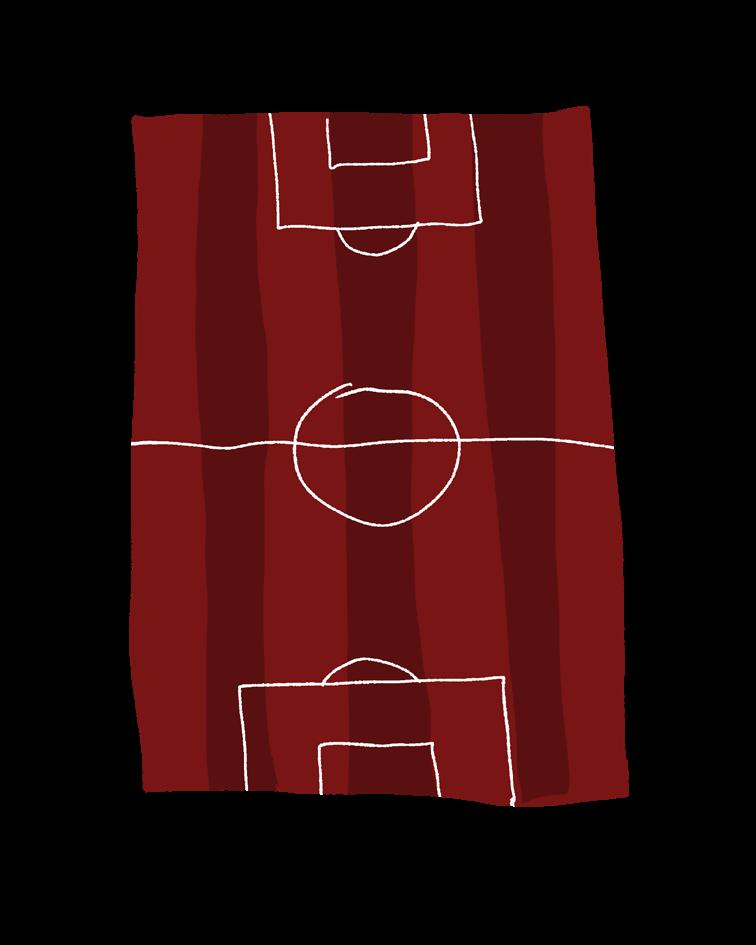
Just last month, a collection of Eu ropean national teams that includes some of the powerhouses of the game, announced their captains will wear armbands that include a rainbow heart. This design choice is in support of antidiscrimination campaigns focusing on the LGBTQ+ community in Qatar. Ad ditionally, ahead of a World Cup qualifier in March 2021, the Norwegian national team wore shirts that said “human rights – on and off the pitch” to show support for the migrant workers who died in the
preparation for a tournament for which they would attempt to gain eligibility mere seconds later. These are all perfect examples of how performative activism appears in sports with teams brandish ing symbols of progress and justice but doing little to achieve those goals. From the outset, it appears that the deaths the Danish team mourns for and the Nor wegian team protests against do not out weigh the lure and prestige of participat ing in a World Cup.
The stories coming out of Qatar for the better part of a decade would sug gest an abundance of reasons to engage in activism much deeper than what has been offered. Since the small nation was awarded hosting duties in 2010 for this year’s World Cup, 6,500 migrant work ers, mainly coming from countries such as Bangladesh, India, Nepal, Pakistan, and Sri Lanka have died. Those who have survived have faced a slew of inhu mane labor violations, the most visible of which is unpaid labor for hours of gru eling work. Qatar’s injustices don’t end with its labor conditions, as the selection of Qatar as a host for the World Cup also brought attention to its criminalization of same-sex marriages.
What is most disappointing is that the footballing world has had over a de cade to prepare a response to these con ditions; the threat of human rights abus es was well documented ahead of the selection, but Qatar was able to success fully bribe FIFA into selecting them to host the tournament. Yet the best anyone could collectively come up with is a rain bow armband and a black jersey, a jersey that will likely be sold for profit around the world. There should be no irony lost that, as these jerseys and similar perfor mative actions continue, no player nor team has recused themselves from the tournament; everything will proceed as it normally would, just with some slight changes in the attire.
Even for fans like myself, despite all my own criticisms, I am one of billions counting down the days awaiting the tournament’s kickoff. What teams, com panies, and quite honestly, I as a fan, of fer in response to such blatant injustices is nothing more than a performance. For the Norwegian and Danish national teams, to protest the treatment of mi grant workers while actively participat ing in the event perpetuating such treat ment is to solidify a hierarchy of needs where ultimately, the participation in
28 TUFTS OBSERVER OCTOBER 11, 2022 OPINION
the sporting event and the prestige it comes with is more impor tant than the loss of life this event has in curred. The miniscule steps of armbands and jerseys instead of a full boycott prove that in practice, the issues surrounding the 2022 Qatar World Cup are simply seen as not im portant enough to stop the sport in its tracks. $42 million for the winner and eternal heroic status in one’s respective country appear to be too much for teams to give up, and for fans, the col lective joy of the event is too significant to let go of as well. As members and consum ers of the footballing world, we continue to treat this as legitimate and normal, proving that this can and will be done all over again.


Performative activism is nothing new, but the takeaway is that the 2022 Qatar World Cup presents us with yet another opportunity to reflect on our in dividual complicity in its injustice. One can argue that as individuals, our par ticipation will not make much of a differ ence; whether one fan watches the World Cup or not will not change the fact that it is happening. While this is true, what I focus on here has less to do with igniting a movement than it does with our own relationship to morality. Namely, what purpose does it serve to care when it does not reflect any sort of stance, and are we okay with that position?
The lessons we take from this win ter, especially for those of us with privi lege, like the US and other European countries who claim to be concerned, stretch far beyond the World Cup. Much closer to home, as members of the Tufts community, we will always have to con tend with the fact that our institution puts out an image of prioritizing justice, while in practice continuing to act in ways that prove directly counter to those values. When students make calls for a more just institution, these are often dead on ar rival, with an inefficient process at Tufts Office of Equal Opportunity and a blatant
disregard for student referendums—be it campaigns to end the Deadly Exchange or Tufts’ investment in private prisons. No institution should put anyone in a posi tion where the endeavors we find valuable involve us in immoral practices, but when our world is built on the back of injustice, we find no other way. We are in the peril ous position of needing to sacrifice justice for joy, or joy for justice.
As we move through life and find more of the things we love intertwined with the wrong side of morality, I wonder whether attempts at the performance of caring hold any value. At the end of the day, there are things we care about enough to make sacrifices, and there are others we find too im portant to give up. The question we must ask ourselves is, at what point do we give up and accept our fate as ac tive players in the legitimization of grow ing institutional immorality? To engage in the performance of caring is merely a way to convince ourselves and others that we do indeed carry empathy, that despite our actions potentially enabling the situation’s immorality, be it a World Cup covered in the deaths of workers or the abhorrent treatment of various activist groups on this campus, things are not so black and white. Do we care enough to stop in our tracks and acknowledge the lack of normalcy in this reality? And globally, do we care about the deaths of migrant workers enough to give up a collective celebration? The answer appears to be a resigned no. We may not have power over a global event like the World Cup but our own choices and actions on this campus hold magnitude; there are several activ ist groups who engage in protest against issues salient to campus, from solidarity with workers to fighting against the uni versity’s complicity in apartheid. There are always opportunities to join causes and
amplify voices, meaningfully disrupting an unjust status quo.
Our institutions’ connections to in justices and their attempts to project the appearance of change are facets of our modern lives, and we must ask ourselves whether we are members of the audi ence or part of the show. Here, we have a choice to either continue to be complicit or to walk away. In truth, what should have happened in all these years before the World Cup is a boycott, among both players and fans. This boycott would treat the 2022 World Cup as it is: glaringly un just. We should have refused to watch or involve ourselves in an extraordinary dis play of injustice and moved our attention
AS WE MOVE THROUGH LIFE AND FIND MORE OF THE THINGS WE LOVE INTERTWINED WITH THE WRONG SIDE OF MORALITY, I WONDER WHETHER ATTEMPTS AT THE PERFORMANCE OF CARING HOLD ANY VALUE.
to finding joy in other things. More of us should have taken those lessons to our own campus to question the legitimacy of the university’s decisions. But these are all shoulds. This winter, despite the attempts to walk away, I, along with others, will find myself accepting the fact that I too can be a part of the performance at times, that my actions have carried weight, and with it, consequences. I hope we do not forget this as choices continue to arrive.

OCTOBER 11, 2022 TUFTS OBSERVER 29
OPINION DESIGN BY ANASTASIA GLASS, ART BY AIDAN CHANG
maximumcapacity!