





JUMBO THE STORIES OF TUFTS, NOT JUST THE STATS ADMISSIONS.TUFTS.EDU FALL 2022
/
Building One Atomic
These pages were written by Tufts students. Flipping through them should feel like taking a stroll through campus. You’ll meet professors and students; they’ll share with you what excites them. You’ll drop into a class on an unfamiliar topic and leave inspired, dig into some fascinating research, or hang out in a residence hall with potential classmates. Along the way, you might decide that Tufts feels like the right place for you. If that happens, this magazine is also for you—flip to the back where we’ve broken down the basics on applying: deadlines, financial aid, and our advice. This is Tufts; explore it.


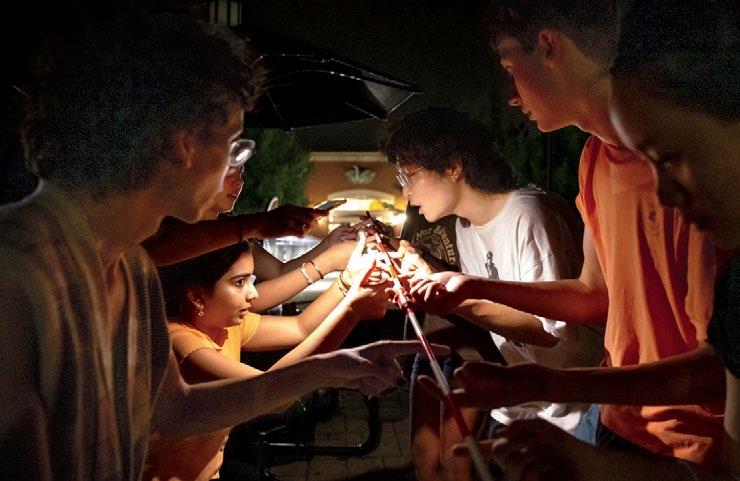
ONE LATE SUMMER EVENING, as the sun begins to set, the Tufts first-year class gathers on the Prez Lawn, the grassy hillside between the President’s House and Tisch Library, for the Illumination Ceremony, an annual tradition held during Orientation Week. Student and staff speakers reflect on their experiences at Tufts, setting the stage for the various adventures that await the incoming class. As the ceremony concludes and the sun dips below the horizon, each first-year student lights a candle until the hillside is a universe of bright stars. And with that, the adventure begins for our newest Jumbos.
This issue of Jumbo Magazine is dedicated to adventure. After all, that is what college is and should be—a chance to learn and experience new ideas, new ways of thinking, and potentially new parts of the country or world. The students who come to Tufts eager for that adventure, ready to take advantage of the opportunities and resources we provide,
excel during their time on the Hill. Success in college often relies on a willingness to expand one’s horizons, a willingness to be vulnerable and open to new experiences, and a commitment to valuing and enjoying the journey, not just the destination.
If you’re reading this, then you might be wondering what kinds of adventures await you at Tufts. This issue of Jumbo Magazine shares just a few of those possibilities with you. You will learn about our many wonderful Pre-Orientation programs where incoming first-year students find community and discover Boston and the Medford/Somerville area before classes begin. You will hear from some incredible professors and students at Tufts, like how Corlene Rhoades ’22 was able to complete research in applied photonics during the pandemic, or how Professor Allen’s first forays into global medicine helped her decide to focus her research on inequities in healthcare. You will see our unique Mountain
Loj in New Hampshire, where Tufts students can spend their weekends exploring Mount Washington and the White Mountain National Forest with their peers.
I hope our admissions committee will have the opportunity to learn more about you, and what you hope to make of your Tufts adventure. I encourage you to visit our website, take a virtual tour, and engage in any of our inperson or virtual programming that helps you make the best decision for your educational journey. And perhaps we will see you at next year’s Illumination Ceremony.
Best,

Dean
 of Admissions
Most of what you’re about to read was written by these Tufts students. Listen for their voices as they introduce you to the Tufts community, page by page.
OFFICE OF UNDERGRADUATE ADMISSIONS
Tufts University / Bendetson Hall 2 The Green / Medford, MA 02155 617.627.3170 / admissions.tufts.edu

“SUCCESS IN COLLEGE OFTEN RELIES ON A WILLINGNESS TO EXPAND ONE’S HORIZONS, A WILLINGNESS TO BE VULNERABLE AND OPEN TO NEW EXPERIENCES, AND A COMMITMENT TO VALUING AND ENJOYING THE JOURNEY, NOT JUST THE DESTINATION.”


Hark! Before you begin your journey down this illustrious path of higher education, it is best to inform yourself of some of the opportunities ahead. Read on and get a hint of what lays before you. But be warned! What you read here may fill you with the urge to take that next step into the unknown.
Adventure awaits!

The Tisch College of Civic Life’s Summer Fellows program is perfect for a bit of adventure with minimal travel. Students are paired with nonprofits and government agencies to serve as a force for good, with mentoring and networking to round out the experience.


There’s nothing an adventurer needs more than energy. With multiple on-thego spots and two full dining centers featuring many gluten- and allergen-free options and a nutrition specialist on staff, Tufts is committed to meeting all students’ needs. Might we recommend a smoothie from Kindlevan or a burrito from Hodg to fuel your next adventure?


The Experimental College offers innovative courses taught by visiting lecturers and Tufts undergraduate students interested in sharing their unique expertise in small, collaborative environments. With topics ranging from ecomusicology to the ethics of voluntourism, who knows what you’ll find?

Open to undergraduates and alumni, the Career Center is the perfect spot for any adventurer preparing for the next steps in their journey. Whether it’s major advising or Career Communities based around professional interests, they’re here to support you wherever you are in the process.
28 varsity, 28 club, and even more intramural teams make athletics ideal for seeking out adventure. You’ll cheer “Go ’Bos!” whether supporting friends as they add another national championship to the Tufts’ collection or trying out flag football on the weekend.


THE NEW Center for Black Maternal Health and Reproductive Justice (CBMHRJ) at the Tufts University School of Medicine is to be led by founder and director Professor Ndidiamaka Amutah-Onukagha. As the Julia A. Okoro Professor of Black Maternal Health, her work has been invaluable in advancing the School of Medicine’s Strategic Plan, which includes a commitment to antiracism, inclusion, and health justice. Professor Amutah-Onukagha is also the founder and director of the Maternal Outcomes for Translational Health Equities Research (MOTHER) Lab, which includes students from the undergraduate to the post-doctoral levels.

THE ELIOT PEARSON Children’s School at Tufts recently celebrated its 100th birthday! Founded in 1922 when an American educator named Abigail Eliot witnessed the difference between early childhood education in England and the States, it was officially connected to Tufts in 1951 and has been breaking ground and supporting educators and children ever since.
PHILOSOPHY professor Erin Kelly’s latest book Chasing Me to My Grave: An Artist’s Memoir of the Jim Crow South is a thoughtful recollection of the life of African American artist Winfred Rembert. Recounting his arrest while participating in the Civil Rights Movement, Rembert eventually began chronicling his experiences through art using leather tooling. Masterfully told and timely, this is not a memoir to miss.


LONG-TIME Tufts faculty member and recent dean ad interim Kyongbum Lee was recently named the permanent dean of the School of Engineering. A proponent of the school’s two-fold mission to educate students and to benefit society, Dean Lee embodies the socially conscious and intellectually rigorous attitude that Tufts engineers bring to their practice.


TUFTS ALUM AND HARDCORE FOODIE Dan Pashman ’99 recently created a brand new pasta shape called cascatelli. Considered perfect for keeping sauce on pasta, the new shape is a groundbreaking achievement of delicious proportions. A two-time James Beard award winner for his long-time podcast, Pashman clearly knows his way around food—and are we ever grateful for an excuse to celebrate!
ASTRONOMER and Tufts staff member Carie Cardamone will teach a course this fall about how human beings across time and culture have interpreted the stars in the night sky. From astronomy and physics to mythology and tradition, get excited to learn new ways of viewing something we so often take for granted.

When Zineb Ouardaoui was in the midst of the col lege application process, she did not think that Tufts was going to be the school for her. Despite wanting to attend college somewhere close to home and her tight-knit community, her brother had attended Tufts…making the idea unthinkable. Flash forward a few months. She toured Tufts’ campus and attended Jumbo Days (our admitted student open house), try ing her best to dislike it. “I eventually gave up that thought and realized I could definitely see myself going here,” she recalls. Upon meeting a group of first-generation, low-income students like herself and learning about the resources available through the FIRST Center, Zineb decided to enroll at Tufts—a mere fifteen-minute drive from her home along the Medford-Malden border.
The transition from high school to college was not without its challenges. Zineb recalls experi encing imposter syndrome throughout her first semester, particularly in an advanced chemistry course, in which she was one of the only students of her background. She later decided that the gen eral level of that chemistry class, which had a more sizable first-gen student population, was a better fit for her. “I saw a disparity between these two classes. In the advanced class, there were these frontier lectures where people from different Tufts labs would come in to talk about their research. Students could introduce themselves and say they were interested in their work—the regular chemistry class didn’t have this opportunity,” she explained. The desire to create more inclusive opportunities

for her classmates and herself drove her to contact the Chemistry Department’s leadership team, which invited her to express her concerns and join its Diversity, Equity, and Inclusion (DEI) Committee. “I was able to get this position simply by speaking up. The faculty have been very open to my ideas and addressing this disparity is in the works,” she notes.
While overcoming imposter syndrome, Zineb found that her group of fellow first-gen, low-income friends was an incredible comfort. She fondly recalls staying up all night with her friends to watch the sunrise on the Tisch Library roof—sharing laughs, eating snacks, and waiting for the moment they could go back to their beds and recuperate from the night. With a strong support system she could count on, Zineb was able to take advantage of all that Tufts and the Chemistry Department have to offer, especially with her wide variety of interests. “I personally think of myself as more of a creative per son. I love photography, I love art. When you typically think of chemistry, you don’t think much of creativity, but it’s actually a lot more creative than you would think,” she explains. Zineb is currently interested in formulation chemistry, which is used in the creation of beauty and hair care products. She is also con sidering becoming a physician’s assistant. Through chemistry—which she has wanted to pursue since high school—she has found the freedom to explore. Currently, she is a scientific research intern at BioAgilytix, a contract research organization that specializes in molecular bioanalysis.
Zineb sits on the Chemistry Department’s DEI Committee, the Arab Student Association’s execu tive board, and the Pre-Physician Assistant Society’s executive board. Her job site at BioAgilytix is in the Allston neighborhood of Boston, which requires a considerable commute. With various personal pas sions, including doing street photography on her film camera, and a full course schedule, it can be difficult to imagine that she would boast a good work-life bal ance. However, Zineb strikes that balance. “I do all of my work, go to my job, and have time to hang out with both my on-campus friends and my community of friends outside of Tufts. Because I’m so close to home, I’m able to go back and forth between these two worlds easily.”
When asked about any advice she has for prospective students, Zineb highlights what she believes is one of the standout features of the uni versity. “To the Muslim community and also the first-gen, low-income community—don’t feel over whelmed by the fact that Tufts is a predominantly white institution. We have such a strong community for both of these groups; you’ll have such a strong support system.” In the summer, Zineb will be work ing for a pharmaceutical company and exploring organic synthesis. The experience, she claims, will help her narrow down her various options for the future—a future bound to be bright no matter the path she takes.
—VALERIA VELASQUEZ’23

“When you typically think of chemistry, you don’t think much of creativity, but it’s actually a lot more creative than you would think”
With the majority of applicants to Tufts (and schools like Tufts) being academically qualified, most of my time will be spent on the voice portion of your application. That includes everything from your extracurriculars to your recommendations to your personal statement to your Tufts-specific short answer questions. Essentially anywhere where we learn about that human element of you. Your per sonality. Your identity. Your belief systems. How you think about the world around you. What matters to you and why.
I know that sounds like a lot. Because it kind of is! Applying to college requires reflection and honest conversations with yourself about who you are and what you want. But I’m also here to say that the purpose of your college application is not to capture the entirety of your existence for the past 16 or 17 years. What the application does do is provide you with different ways to strategically share the core parts of yourself as you see them—showcasing your voice.
The places that you have the most direct control over sharing your voice are in school-specific short answer questions, your personal statement, and the extracurricular section.
*Insert record scratch sound effect here.*
Yes, I did just write the extracurricular section. You might be thinking, “But how do I have control over the extracurriculars from earlier in my high school career now?” You have control over how those things are shared with the admissions com mittee. First off, you don’t need to order them chronologically on your application. You can put them in order of importance, so we get that quick snapshot of what matters most to you.
The application also provides a short space for you to describe each activity. And this is where there is a small but impactful way for you to share more. The number of times that a student has used that space to explicitly describe “camp coun seling” is, let’s just say, more than one time. What I care about is how you saw yourself as a counselor and why it was an experience that mattered to you. “Led macaroni art sessions for eleven-year-olds
daily as lead art counselor and prioritized Taylor Swift sing-alongs to cure homesickness for the entire camp” tells me a lot more about you than a generic description of what it literally means to be a camp counselor.
This same idea of being specific and true to yourself then carries through to writing your essays.
Colleges that have school-specific short answer questions (Tufts has two!) allow you quite a bit of real estate to share new information with us over the course of multiple essays. When I open your application, I want to learn something new from each essay. Focus on one topic for each essay. Yes. One. In personal statements especially, I see appli cants wanting to share everything about their lives. But remember what I said earlier? The purpose of the college application is not to capture the entirety of your existence. If you try to include A LOT of information in your essays, it ends up diluting the message you are sharing with us! When you go so broad, you end up speaking in generalities that don’t highlight you as an individual. You end up telling me that you are optimistic and resilient and independent without showing me.
Honing in on one topic in each essay gives you the breathing room to go deep. To be super specific. To push past the surface level. To share what goes on in your mind and how you think about the world around you. And the life of the mind is very impor tant to a college admissions office—you are here to learn, first and foremost. You can write strong college essays about virtually any topic; dramatic and traumatic are not requirements. Nor is writing about something you think is THE singular most unique thing about you. Yes, I’ve read strong essays about a student competing at the Olympics. Or work being done at NASA. Quote unquote unique experi ences. But I’ve read far more strong essays about family dinners. And long car rides with friends. And independent passion projects completed in the wee hours of the morning (this is not an endorsement to stay up until 4am every night). Quote unquote everyday experiences.
Beyond learning something new about you in
each essay, my admissions officer heart flutters when I read a voice in those essays that is so authentically you. Being honest and authentic is a cliché in the realm of admissions advice for a rea son. We can tell when you are writing how you speak. We can tell when you actually care about what you share with us. This is not a five-paragraph hamburger essay for English class or a DBQ response for your AP US History course. In this article alone, I have used countless “ands” to start sentences, and I still debate between semicolons and em dashes when typing. Admissions commit tees want to come away with a clean image of who you are after reading your application, and authen ticity and honesty in essays often leads to just that.
There are two helpful ways to know if you’ve tapped into that authenticity in your essays. The first is to imagine handing your essay in a stack of 25 to your best friend. If they could pull out your essay every time, then you’ve nailed it. The second is to give your essay to a teacher or friend who knows you, but doesn’t know you know you. Ask them to read your essay and share what their take aways are. Ask them to describe who you are. If they relay something not quite what you wanted, it’s back to editing. If they get it, then trust that the admissions committee will too.
This past year at ‘Bo Days (our admitted student event—and yes, I promise this seemingly tangential story relates directly to the above paragraph), an enrolling student was chatting with my colleagues and said, “I want to meet the person who writes all of the emails to us!” That person is me. I got a text from my colleague to head to the main tent to chat with that student, and we ended up talking for a while! At the end of the conversation she said, “You really do talk and sound exactly like how you do in those emails. It’s like I’ve already met you!” My friends, when I see you at ’Bo Days in the spring of 2023, I want to have that moment with you. I want to exclaim, “You sound exactly like how I imagined from your application! It’s like I’ve already met you.”
Voice. A word that admissions officers love to use when discussing the selection process. At many selective schools, we talk about the two main parts of an application being data and voice. But what does it mean to have a “voice-y” application—where an admissions committee is drawn in and connects with you?

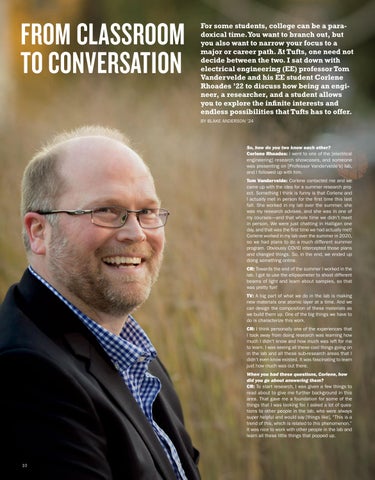
For some students, college can be a paradoxical time. You want to branch out, but you also want to narrow your focus to a major or career path. At Tufts, one need not decide between the two. I sat down with electrical engineering (EE) professor Tom Vandervelde and his EE student Corlene Rhoades ’22 to discuss how being an engineer, a researcher, and a student allows you to explore the infinite interests and endless possibilities that Tufts has to offer.
 BY BLAKE ANDERSON ’24
So, how do you two know each other?
Corlene Rhoades: I went to one of the [electrical engineering] research showcases, and someone was presenting on [Professor Vandervelde’s] lab, and I followed up with him.
Tom Vandervelde: Corlene contacted me and we came up with the idea for a summer research proj ect. Something I think is funny is that Corlene and I actually met in person for the first time this last fall. She worked in my lab over the summer, she was my research advisee, and she was in one of my courses—and that whole time we didn’t meet in person. We were just chatting in Halligan one day, and that was the first time we had actually met! Corlene worked in my lab over the summer in 2020, so we had plans to do a much different summer program. Obviously COVID intercepted those plans and changed things. So, in the end, we ended up doing something online.
CR: Towards the end of the summer I worked in the lab. I got to use the ellipsometer to shoot different beams of light and learn about samples, so that was pretty fun!
TV: A big part of what we do in the lab is making new materials one atomic layer at a time. And we can design the composition of these materials as we build them up. One of the big things we have to do is characterize this work.
CR: I think personally one of the experiences that I took away from doing research was learning how much I didn’t know and how much was left for me to learn. I was seeing all these cool things going on in the lab and all these sub-research areas that I didn’t even know existed. It was fascinating to learn just how much was out there.
When you had these questions, Corlene, how did you go about answering them?
CR: To start research, I was given a few things to read about to give me further background in this area. That gave me a foundation for some of the things that I was looking for. I asked a lot of ques tions to other people in the lab, who were always super helpful and would say [things like], “This is a trend of this, which is related to this phenomenon.” It was nice to work with other people in the lab and learn all these little things that popped up.
Prof. Vandervelde, how do you go about sup porting students in the lab with this curiosity? Is that exciting for you?
TV: Definitely! I think that anyone who comes to work at a university does so because they really enjoy working with students. You know, those “aha!” moments are great. I love it in research as well as the classroom, which is one of the things that really sustains you as a professor.
CR: I remember one meeting I had with a grad stu dent. They were showing me a film they had made for a calc class to show off some theorem…and they had a lightsaber duel, and I thought that was hilari ous. Some of that “informal” time was really fun. What exciting things are going on in EE at Tufts, both as chair and as a student? What drew you to EE? What piques your interest?
CR: I entered college knowing that I kind of liked EE. I had learned a little bit about circuits, and I had found that really exciting, and I had always liked math and physics. I like that in EE you can’t see everything–it’s these tiny bits of physics. I took some classes, and I was doing lots of work that I really loved. And I loved the culture of the department. I remember during my first year there was a yoga event during finals week for electrical engineers. And in one of our intro courses we would always chalk a little eel on the board and write “E.E. Eel” underneath it, and the eel became our unofficial mascot. I really enjoyed those little cultural things.
TV: EE is one of the least well understood majors. When I talk with a lot of the first-year students who say that they want to do EE, I find that almost all of them have an electrical engineer in their immediate family! It’d be great if more people knew what it was. Electrical engineering is half applied physics, half applied math. It involves renewable energy, robots, image processing, machine learning, artificial intel ligence, biomedical sensors and tools, electronic materials, computer architecture, and cybersecurity. I could keep going on—it’s a huge deal. And I’ve probably only named 5% of the things that are cov ered in our department.
Lastly, what drew you both to Tufts?
TV: What it really comes down to is asking “What is the best fit?” Research-wise, but it’s also cultural. Tufts is one of the smallest R1 universities—R1 has to do with research rankings. It ends up being a university that is big enough to do research, but small enough to still care about teaching. Anyone who ends up coming here cares about teaching. We make that a very central focus. I wanted to find that “Goldilocks” university that would allow me to be a teacher and a researcher. Tufts ended up being that spot for me.
CR: I knew going in that I wanted an engineering school, and I was also really interested in going to a school that would allow me to still have access to the liberal arts. In my free time I do lots of “artsy” things like drawing. That liberal arts mindset is something I found really attractive about Tufts. This semester, I am in two arts courses. I am in an ani mation course where I go over to the SMFA campus and explore. And I am in another course where I am making a video game and doing a lot of art for it while still getting my engineering education.


Without a doubt, there is a “buzz” surrounding education abroad at Tufts. After all, about 45% of Tufts students study abroad. Students meticulously plan their schedules to make room for a full year or a semester abroad. They daydream of the day when they can finally culturally immerse themselves in the language they have been studying for years, or perhaps a lifetime. For a student who didn’t plan to study abroad (but in many ways wishes she had), I knew very little about the nitty-gritty details. Why does a student choose to study abroad? What does it entail? Is it not daunting? Is it a semester-long break from arduous academics or something more complex—an opportunity for students to immerse themselves in a new environment and enlarge their perspective of the world? There is a lot to consider and a lot to prepare for when studying abroad, particularly amidst the COVID-19 pandemic. With the help of Associate Dean and Senior Director of Tufts Global Education Mala Ghosh, here I present an informal collection of questions and answers to demystify the study abroad experience and learn more about global education at Tufts.
BY VALERIA VELASQUEZ ’23
Students hoping to study abroad should explore the Tufts Global Education office, which is part of the School of Arts and Sciences and the School of Engineering. Global Education facilitates study abroad for students through Tufts Programs Abroad, which are operated and managed by Tufts or Tuftsaffiliated faculty, and external programs which are operated by other colleges, universities, or outside organizations. There are ten Tufts Programs Abroad locations: Beijing, Chile, Ghana, Hong Kong, Japan, London, Madrid, Oxford, Paris, and Tübingen. It is important to note that while Tufts operates these programs, no two are alike, allowing students to choose between different models of learning. For example, through Tufts-in-Oxford, students directly enroll in Pembroke College within the University of Oxford and pursue an indepth study of one subject. They are directly supported by Tufts faculty while being fully immersed in the Oxford experience. In other locations, such as Chile and Paris, students enroll and attend classes in various partner universities. In contrast, in Madrid, students are based in a center and taught courses by local faculty and may also take courses at Complutense University of Madrid. Some students may want to study abroad through an external program or have dreamed of studying in a location that Tufts Programs Abroad may not offer. With the help of the Global Education team, students are able to explore programs around the world through an external study abroad program.


Planning to study abroad can seem like a daunting and complicated task. For engineers or students with intense major requirements, Global Education is increasing its flexibility and working towards launching more short-term programs. Students have historically started preparing for studying away as early as their first year in order to do so as juniors. However, in order to accommodate different academic goals or other commitments such as involvement in sports or student organizations, Global Education is helping more and more
sophomores and seniors study abroad. In addition, new study abroad models are in development. Tufts recently launched Tufts-in-Pavia, a short six-week program focusing on Italian language and data science. Students took courses in computer science and Italian at the University of Pavia and went on various excursions and culturally immersive experiences with their faculty advisor and cohort. This program, which is especially geared toward computer science majors and engineers, gave students an academic and international opportunity that they may have otherwise not been able to experience. Short-term programs can also aid students who are unsure about leaving the United States for an extended period of time by giving them a taste of the international experience in a supportive, structured environment. An additional short-term program will take place in the winter in Aix-en Provence, France this December and will focus on classics and archaeology. Students will spend two and a half weeks looking at archaeological sites, doing research field studies, and working alongside faculty. Global Education is seeking to expand these short-term opportunities and research-focused study abroad experiences to ensure that anyone at Tufts—regardless of their major—can study abroad.
For students interested in Tufts Programs Abroad, your financial aid will travel with you when you study abroad. Tufts students receiving financial aid at Tufts continue to receive their awards while enrolled in Tufts Programs Abroad. For many first-generation, low-income students, this means that studying abroad is not only possible, but also comprehensive and affordable. For external programs, students do not pay Tufts tuition or Tufts room and board. This means that Tufts financial aid, scholarships, or grants do not apply. We encourage students to work with their financial aid counselor and Tufts Global Education to pursue other types of scholarships and loans. Aside from financial aid, Global Education has other programs to offset additional costs associated with studying abroad. One of these programs provides financial scholarships to help students obtain their flights and their visas. The Global Education department also emphasizes being attentive to students’ needs while they’re abroad
“Making sure all students are prepared and at ease while abroad—academically financially, physically, and emotionally—is a top priority.”
— MALA GHOSH, ASSOCIATE DEAN AND SENIOR DIRECTOR OF TUFTS GLOBAL EDUCATION
and keeps a close eye on global trends, inflation rates, and any other factors that might play into students’ experiences abroad. If students find themselves on a tight budget or find that inflation is increasing in their host countries or feel financially unstable, they are strongly encouraged to reach out to their program staff as well as their financial aid counselor. Students may access resources ranging from extra meal stipends to funds covering transportation to additional scholarships for travel. Global Education also helps students in their research for scholarships outside of Tufts, such as the Benjamin A. Gilman scholarship, a cultural-exchange program that funds the abroad experiences of US undergraduates with financial need. Beyond providing support and guidance around finances, Global Education staff members regularly meet with all students one-on-one to discuss the different types of support services available to them and how to deal with a multitude of events, such as health concerns or family emergencies. Additionally, Global Education representatives are on call 24/7 to meet any student needs, answer last-minute questions, or walk students through any unexpected event. Making sure all students are prepared and at ease while abroad—academically financially, physically, and emotionally—is a top priority.
currently studying abroad who are part of our Global Ambassador program. The ambassadors assist with peer-advising, group information sessions, and preparing resources for students’ time away from the Tufts campus. Global Education also offers workshops to answer some of the most pressing questions: What does it mean to be a first-generation and low-income student abroad? How will being a person of color shape my experience? What is it like being LGBTQIA+ abroad? Students go abroad not only aware of their finances and logistics, but also of the various implications, challenges, and adjustments they may make when immersed in a completely new culture and environment.



Pre-departure for a study abroad experience is just as important as incountry support. Many students abroad have never traveled alone, and for some, this may be their first time outside of the United States. For students of color or members of the LGBTQIA+ community, living abroad may come with some unique experiences and challenges. Tufts Global Education partners with all eight of the Division of Student Diversity and Inclusion identity-based resource centers and returning students to educate and prepare students for their time abroad. Throughout the year, Global Education hosts a variety of programs to educate students on budget planning, managing mental health abroad, and adjusting to a new culture. These programs are hosted by a wide variety of people, including faculty leaders and staff, and also study abroad program alumni and students
During the pandemic, students abroad had to be evacuated from their host countries, sometimes in a matter of days. The Global Education team worked hard to ensure that all students were evacuated within a week’s time. Students returned home, and all students—whether their studies were through Tufts or through external programs—were able to complete their studies and earn credit virtually. As global circumstances change and the pandemic progresses, Global Education is relaunching more and more locations abroad. In order to accommodate the pandemic and its special challenges, various changes have taken place. Though circumstances differ from country to country, some of the changes include moving students into individual residence halls instead of living with host families, reducing the sizes of the classrooms, covering students’ COVID-testing costs, and organizing isolation strategies. Tufts Global Education is in constant contact with various international organizations and offices to keep track of any contingencies and ensure that they can provide students with the most up-to-date information and accommodations. Though adapting to COVID-19 has been an incredible challenge, Global Education has stepped up to the plate and is making study abroad possible for students while ensuring that their health and safety come first.

Which aspects of the Tufts undergraduate experience prompt your application?
In short, “Why Tufts?”
Hailing from a small school in Suffield, CT, Vaughn has found his time at Tufts to be unforgettable. He met some of his best friends through a spontaneous lunchtime outing, passed hours in the Tisch Library with a tightknit study group preparing for their organic chemistry final, and even binge-watched the entire Lord of the Rings trilogy on a projector on a third floor of the Science and Engineering Complex (and you can bet the candy selection was bountiful)! There are so many ways to get involved and to find your people at Tufts, something which Vaughn treasures greatly. Read on to find out more about his experience as a Jumbo.
Stepping out of my car, the familiar warmth of the sun against my face contrasts the frigid air. “When will I find time to eat,” I wonder, looking up. Peers pour two-ways from Dewick, one of Tufts’ main dining halls. Swiping my card, I dart to the allergen-free station, meeting Redha— his beaming smile is evident through a black mask. “Out again today—lab work?” he asks, to which I nod and extend a hand, meeting a fist bump. “I’m in a rush—experiments await me!” We laugh; my routine is the same every day. Redha fills a plastic container to the brim with delicious food which I know is safe for my plethora of allergies—one less worry for a busy day. Off I go, infected by Redha’s casual joy, contemplating during which incubation period I will eat. Why Tufts? It’s the little things which add up to something jumbo.
It’s cool to love learning. What excites your intellectual curiosity? It’s 10pm on a Saturday. Within me, an indescribable feeling burns—one which needs to know My mind races; for the past two weeks of long experiments, was I able to prevent any errors? Now is the time when I find out. “It is a learning experience either way,” my conscience lies, knowing that the disappointment of uncovering ambiguity after so much work would ruin my week. I care, for what I could find is not trivial. The translucent piece of polyvinylidene difluoride in which my proteins lie is mysterious—to the naked eye, nothing, but under infrared light, bands glow neon red and green. The machine clicks and hums rhythmically, reminding me of an MRI. Slowly, an image appears in the monitor from the bottom up. The fifteen minutes it takes to fully populate seems to be hours, but finally, a complete picture is before me. It worked! A beautiful immunoblot inspires my fatigue to scurry away like it’s been hit with a morning coffee. Excitedly, I capture the images and think I’ll analyze them thoroughly tomorrow. The answer is evident, though—my hypotheses were correct. Chasing answers to complex questions has driven me since I can first remember—I embrace challenges with open arms. Harmonious with coursework, my experience in the lab is an enlightening one for me now, but also hopefully soon for those facing one of the most difficult pieces of news one could ever hear: you have brain cancer, and a year left to live. Before me lies an infinitely complex cellular landscape, begging to be discovered—and I am a discoverer.
To see the 2022–23 Tufts short-answer questions, visit http://admissions.tufts.edu/apply/essay-questions
BEAST is a Pre-O program specifically designed for first-generation, low-income, undocumented, or other similarly situated students coming into Tufts—enrollment is free, and the week is spent pro viding participants with resources and skills they can use to navigate life at college as well as fostering empowerment and self-awareness. With the guid ance and mentorship of peer leaders and the community of other first-years, BEAST students come into their first semester of college with an amazing foundational support system.


CREATE seeks students who want to do just that: create! The fourday program provides an introduction to the creative disciplines offered at Tufts, moving between the Fenway and Medford/Somerville cam puses to explore local museums and performance halls as well as Tufts’ own studios. Students can meet other people interested in the arts and work on projects in a fun, low-stakes environment. No need to be intimidated, either: incoming students of all levels of artistic experience are welcome to join the program and learn to create!
The CAFE program is centered around the exploration of identity, antiracism, interfaith understanding, and community organizing. It aims to provide a space for incoming students interested in these topics to share experiences and learn from one another. CAFE makes great use of the Tufts campus and the greater Boston area—there are visits scheduled to important organizations and spiritual centers all over, providing students with plenty of opportunity for engagement with other participants and their community in the pursuit of positive change and understanding.
If health and sports are more your thing, check out FIT, a program that takes a nutrition and fitness approach to introducing students to Tufts. It begins with placement into a group of around 10 other incoming students and 2 or 3 upperclass mentors. Each day of the program provides an opportunity to exercise and to get to know each other and the campus. Whether or not you’re joining an athletic team at Tufts in the fall, FIT is the perfect way to find a sporty community to keep up with throughout the year.
One of the most popular ways incoming students begin their Tufts careers is by participating in a Pre-Orientation (Pre-O) program. These optional programs run the week before first-year orientation and are each centered around interest or identity themes. They are great opportunities to meet other people entering Tufts as well as current students and staff who are equally excited about the same things you are. Students who participate in a Pre-O program often come away with new leadership skills, great friendships, and an appreciation for clever acronyms. Read on to learn about the different programs Tufts offers. BY
SUSANNAH MURRAY ’24
Although the acronym might be a bit of a stretch, FOCUS is one of the most popular Pre-Orientation programs at Tufts. Students who sign up share a passion for community service and work on a local service project in a specified area of interest, choosing from service themes like homelessness, the environment, LGBTQIA+ advocacy, racial justice activ ism, and so many more. After spending time with their local groups, students come back to campus to spend time with each other, building intense bonds and community. It’s a known fact that if you’re on campus during Pre-O you’ll hear their call everywhere: “Fo-what?” “FOCUS!”
Students’ Quest for Unity in the African Diaspora
SQUAD is led by current students and runs through Tufts’ Africana Center. Incoming students who join the program spend time explor ing the intersections of various facets of identity within the African Diaspora through talking with each other, interacting with campus resources and support systems, and engaging with historic Black perspectives. By both deliberately fostering consciousness and creating a social space to find fun and unity, SQUAD aims to ready and support students as they prepare to traverse the challenges specific to the African Diaspora on campus and throughout their lives.

SQUAD
Tufts has a huge international population, and GO is a great way for incoming students to form connections and friendships intercul turally with people from all around the world. Every activity during GO is designed to build community: students spend the week together taking trips into the city, playing games on campus (like an Amazing Race-themed scavenger hunt!), and eating out on the Prez Lawn. No matter where in the world GO participants are coming from, they’ll find common ground and camaraderie during the days leading up to Orientation Week.

GO TWO
Last but not least is TWO, the Pre-O program for everything outdoors. Every TWO participant joins a small group on a five-day excursion in the wilderness with two (trained!) upperclass leaders. There are trips for all kinds of interest and experience levels (you can go backpacking, canoe ing, camping, or do some trail work) as well as new affinity trips like a POC trip, a women’s trip for female-identifying and gender non-conforming students, and an LGBTQIA+ trip. TWO trips are great for outdoorsy students looking for hiking buddies as well as anyone just looking to try it out for the first time! No matter what your background or the trip you choose, you’re guaranteed to come away with invaluable friendships and memories from the backcountry.

“This is your time. This is your space.”
After settling into your new home-away-from-home at Tufts, you’re eager to connect with all of the kind, outgoing, and supportive students around you! First, you check in with your resident assistant (RA), an upperclass student motivated to connect first-year students to campus resources and support their personal and academic growth, to hear about upcoming floor programming events. From crafts nights, sundae socials, and DIY boba to academic resources and time-management presentations, your RA is charged with cultivating a sense of community in residential spaces. Often, the relationships developed in residential spaces emerge as some of the most defining and enriching connections for students.
The undergraduate residential experience is a central component to college life. At Tufts, we aim to enhance student experiences by offering a range of dynamic housing options for students, from traditional residence halls to apartment style, suite, and themed housing. While living on-campus for your first two years is both guaranteed and required, Tufts supports students throughout all of their undergraduate years as they continuously develop community on-campus. Many students share that residence halls are some of the most formative social and community spaces on campus. Are you ready to explore what it means to live at Tufts? If so, keep reading!
BY JOSH COHEN ’24Looking for other opportunities to build connections in your residential community, you connect with your hall’s Scholar in Residence. Faculty mem bers with an interest in interacting with and supporting students outside of the traditional classroom setting are invited to live among students in residence halls, and they provide students with an intellectual and academic component to their residential experience. Scholars will host events such as “are you smarter than a professor?” trivia nights, faculty panels, and even invite students to share meals!
Exploring your options for continuing student housing, you are presented with several enticing living arrangements and residential communities to select from! While most residence halls follow a traditional layout, many special interest and themed housing options allow students the opportunity to live among peers in small, wood-frame houses around campus. From identity, religion, and language-centered living communities, you will have the unique ability to select into a range of affinity spaces. Often, students living in these communities cook meals together, share in the activities and practices they value, and sponsor events open to the greater campus community. Are you interested in creating your own living community based on a shared interest? If so, Tufts offers continuing students the opportunity to create their own themed house revolving around a shared interest and to connect with other students through these intentional spaces. Now, the decision is in your hands…where do you see yourself living at Tufts?
Boston has been easily accessible to Tufts students through the Davis Square station since December 8, 1984. Fast forward to 2022, and the Massachusetts Bay Transportation Authority (MBTA) has almost completed the Green Line Extension, which extends the northern end of Lechmere Station to College Avenue in Medford— right by Tufts’ new Joyce Cummings Center! Now, students can explore more of East Somerville and its various “squares”—neighborhood centers with businesses, restaurants, shops, and other services. Though Tufts’ proximity to Boston is convenient and exciting, there are many places to explore and things to do in Tufts’ host com munities of Somerville and Medford. Here is a list of places Jumbos should visit on the new Green Line Extension.
BY VALERIA VELASQUEZ ’23 UNION SQUARE DONUTS UNION SQUARE
Union Square Donuts is an award-winning donut company that specializes in creating unique, excit ing flavors and experimental donuts that are made with high-quality ingredients. The donuts are made with a brioche-inspired dough base, making them airy and light. Exciting flavors include Vietnamese coffee donuts, guava and cream cheese donuts, and a golden milk latte donut. They also specialize in more traditional donut fare, including a classic Boston cream and a “sugar raised” donut meant to highlight the bakery’s signature dough.
The Center for Arts at the Armory is a nonprofit organization that resides in the Somerville Armory building. It provides a community arts center for Somerville residents and hosts various events ranging from music performances, dance classes,
fitness classes, and open mic sessions. Some noteworthy dance classes include Queer Tango and Forró, a regional Brazilian dance. The Armory also has its own coffee shop, ROOTED Cafe, which hosts various events such as Songwriters in the Round, where songwriters take the stage, trade songs, and engage with the audience. Getting involved with Armory events is a great opportunity to engage with the local community and take advantage of the local arts scene!
Oliveira’s Steakhouse is the perfect restaurant for meat lovers: vegetarians beware. This restaurant specializes in Brazilian BBQ (think different cuts of meat paired with hearty sides and vibrant salads) and has an all-you-can-eat option as well as by-thepound takeout! Now easily accessible, Oliveira’s is the perfect place for a date night or a celebratory dinner with friends.

Ria Brodell is an institution at the School of the Museum of Fine Arts (SMFA) at Tufts. Originally attending graduate school here, they have since taught a multitude of courses over the years. “I started out as a graduate student, I think my thesis show was in 2005, and I graduated in 2006. At the time when I was looking for graduate school, I was looking for a place where I could work interdiscipli narily because I was coming out of undergrad as a sculptor and a painter and a printmaker. Most of the programs I was looking at wanted to silo you to either the printmaking department or the painting department, and you couldn’t really work between them. Then I found SMFA—where I could basically design what I wanted, so that was perfect for me.”
Interdisciplinarity is one of the core tenets of the SMFA educational experience. With all students graduating with a Bachelor of Fine Arts in interdis ciplinary art, undergraduates are both encouraged and expected to work across artistic mediums and techniques to forge their own path. Students always have support in this process, of course, which Ria very much understands. “I combine my work with writing and a lot of research—I definitely bring that into my classes. I think that resonates with a lot of my students, especially the combined degree students, that I share that research aspect of my
work and then they learn how to integrate research into their work.” Students in the combined degree program spend five years earning both a BFA from SMFA and a BA or BS from the School of Arts and Sciences. Our combined degree students often combine their areas of study within the School of Arts and Sciences with their artistic practice within SMFA.
For Ria, that included history, theology, and painting in their Butch Heroes book. “It started as a painting series, and then after ruminating on what queer history was like, I started to do research. I really wanted to keep the paintings and stories and all the research together. I knew that I wanted to cre ate a book pretty early on.” The series began as an exploration of their childhood growing up Catholic, and Ria discovered that many of the historical fig ures they researched entered the religious world at some point in their life. Each painting is done in the genre of Catholic holy cards to pay homage to this fact. After the first exhibition of the series, it was picked it up as a book, the second volume of which is currently in progress. Paintings from the series are still in exhibition as well, including one of Rosa Bonheur in a retrospective of her life at the Musée d’Orsay which runs from October 2022 to January 2023.
Ria has served on a variety of faculty commit tees and programs within SMFA, most recently on the Senior Thesis Faculty where they worked along side other staff members to support a cohort of students planning their senior thesis exhibitions. Now a member of the Painting and Drawing Faculty, they will largely be designing and teaching courses. “Last spring I designed a class called Flora and Fauna which was really interdisciplinary. We were doing all sorts of things. [Students] were making games, they were making books, they were making paintings and watercolors. It was a very cool class.”
In terms of future plans, outside of the next volume of Butch Heroes coming soon, Ria is col laborating with another professor on an anthology titled Gender, Violence, Art, and the Viewer: An Intervention, where they discuss their teaching prac tices and the artists whose work they find pertinent to the discourse. As for future applicants to Tufts, their advice is straightforward: “Don’t be afraid to try totally different things and push yourself out of your comfort zone. Dive into things you want to learn or have never heard of before.” With support from professors like Ria at SMFA, there’s never been a better time to do exactly that.

“I combine my work with writing and a lot of research—I definitely bring that into my classes”
The school year can be a hectic time—between classes, student organizations, sports, social engagements, and everything else in between, it can be difficult to find the time and energy to pursue something scholarly, no matter how pas sionate you are about the topic. This is where the Summer Scholars program comes into play—rising juniors and seniors with an idea for an in-depth research project can apply for funding to pursue a ten-week independent research project over the summer. Both living expenses and research expenses are covered with stipends, and students find faculty mentors who will help to guide their research for the duration of the project. There is also ample room for community and collabora tion with a cohort of passionate, research-driven students (those the Summer Scholars web page affectionately calls “like-minded nerds”) conduct ing their own projects across disciplines.
After a full summer of research, students will conclude by presenting their work at a two-day conference at the end of the second summer ses sion, at a poster presentation once the school year begins in the fall, and finally at the Undergraduate Research and Scholarship Symposium the fol lowing spring. Although these presentations are concluding events for the Summer Scholars pro gram, many students are only just getting started and find that the summer provided the perfect launching point for continued research into a senior thesis and beyond.
However, it’s not at all true that Summer Scholars research is limited to traditional aca
demic pursuits, conducted in white lab coats or historic archives. While there is plenty of opportu nity for a STEM or humanities-based project, the Summer Scholars program also funds students from the School of the Museum of Fine Arts pur suing artistic projects. These projects can really look like anything, depending on the student’s pre ferred medium and topic of exploration. So long as you have an artistic vision, cohesive theme, and driving purpose, you can pitch your project to the board. One current senior did her proj ect in textile arts entitled “My Mother’s Closet: Politicizing Color in White Spaces.” Another stu dent this past summer created (and is continuing to work on) her project called “Exploration on the Use and Combination of Unconventional Painting Materials.” She conducted material tests with unconventional painting materials and fillers in the form of Hebrew letters and then photo graphed those pieces in nature. In all, the pieces tell a story of her culture and ancestry—one of exile, immigration, tradition, and spirituality.
The moral of the story is that the possibilities are truly endless; the only requirement is that the student has a true passion for their topic and a plan to see it through. If you’re thinking that a long-term, funded, and mentored artistic endeavor might be right up your alley, this pro gram is definitely for you! The world needs more people to push the envelope of what research can and should look like, and Summer Scholars provides a great opportunity for undergraduate students from artistic disciplines to do just that.
Developing your artistic practice takes time, energy, and resources. At Tufts, there are many ways of actually bringing that to fruition including our unique Summer Scholars program. Jumbos can come up with their own research projects, including different forms of artistic research and practice. Read on to learn more!
MURRAY ’24
 By Blake Anderson ’24
Nestled in the woods near Woodstock, New Hampshire lies a rustic and timeless Tufts hideaway: the Loj (lɑdʒ, but you can just pronounce it like “lodge”). In its rural environment—juxtaposed with Tufts’ suburban undergraduate campus—the Loj provides peace and relaxation that is unique to the great outdoors. Many students recall their best memories at Tufts in the mountain retreat and endearingly reflect on their time there. And after decades of excursions up to the north, it appears that the charm of the Loj has only grown. Truly, nothing quite unearths one’s inner adventure more than a trip to the Loj.
 PHOTOGRAPHY BY KATHLEEN DOOHER
quick history lesson on the Loj will convey the resilience and timelessness of this place. It has truly survived it all and withstood the test of time. The original Loj was purchased in 1940 for a mere $15,000. Being over 100 years old when it was purchased, this repurposed farmhouse became the hub for adventurous Tufts students to flee to whenever they wanted. It truly became a home away from home. Then, in 1962, this building tragically burned down in a fire. Using the insurance money from the fire, the Loj rebounded and was rebuilt. But this did not last long. The United States Government was paving the way for I-93, and sights were set on the site of the Loj. So, after a federal buyout, the new building was demolished, and another Loj would take its place––this time being built on Potato Hill Road in Woodstock, New Hampshire, where it stands today. In the late 1980s, the Loj got its infamous three-letter moniker. All this goes to say that the Loj has survived the overwhelming challenges placed before it, a testament to the sense of adventure all Tufts students find at the Loj.
Despite all of this history, the Loj is unassuming; it looks like any other wooden cabin you would find in the area. However, the magic of this place exists within the memories made and the joy felt by its visitors. This bunk-style cabin has provided generations of Jumbos with the ability to unwind and unplug from the hectic lives many face. It is no wonder that so many students are eager to plan return trips to the Loj once they have had a visit. Thankfully, through student organizations like the Tufts Mountain Club (TMC, if you’re in-the-know), these return trips are easy to partake in.


The Tufts Mountain Club is Tufts’ largest student organization, with over 300 members. Their motto is joyful, playful, and to-the-point: “Go Outside.” This group is for every tree-hugging, nature-loving Tufts student or general outdoors enthusiast. After a long week in lecture halls, TMC leads groups up to the White Mountains region of New Hampshire for a weekend in the wilderness. They lead hiking excursions, play board games, go kayaking, volunteer with environmental nonprofit organizations, and


otherwise enjoy their time away from the hustle and bustle of our beloved campus.

“Once you’re there, it’s easy to forget about everything else,” TMC vice president Mayura Thomas ’23 said. She spoke highly of her experiences at the Loj. Thomas recalled early-morning debates over which breakfast place is better and trips through the scenic White Mountains in vivid detail. As Vice President, she gets to help coordinate trips and social events for TMC. Logistically, Thomas estimates that 30 students go on any given weekend, but the Loj can sleep up to 75 students. Regardless of the group’s size, one thing is for certain: A fun time will be had by all. “This is my time not to stress,” Thomas concluded.
The Loj also provides many groups the ability to gather and grow closer together. Different affinity groups, united by a common identity, belief, or sense of kinship, often head to the Loj in order to facilitate a deeply meaningful retreat. These student groups, such as the trans/non-binary affinity group or the Garden Club, have used the Loj as a space to foster connections in their respective communities. In this space, the members of these groups get to grow closer together. Their chance to unplug from power cords and computer screens allows them to enjoy their experience—and the people around them—that much more.
Andres Baja ’24 visited the Loj for the first time last year and recalled the events of his experience fondly:
“The Loj was a nice two-hour ride from Tufts. The vibes were immaculate because I went with the Philippine Student Union. The overnight was a great way to escape the stressful events of campus and indulge in the fresh air in the middle of the woods in New Hampshire. We mostly bonded by cooking meals together and playing card games. On the second day, we hiked along a nearby mountain. If you are looking for a nice brunch place to cap off your relaxing trip, check out The Common Man. Great bites!”
All that stands between Jumbos and their mountain paradise is a two-hour-long car ride. To get there, students hop into TMC’s shuttles or friends’ cars, put on an epic road trip playlist, and enjoy all the sights and sounds that rural New England has to offer. Jumbos love to get outside and explore the great outdoors. To Tufts students, there is no shortage of adventure.

Tufts students are adventurous. They love seeing the beautiful sights that the world has to offer, and they love seeing these sights with people whom they love and care deeply about. When you come to Tufts, you should definitely make a visit to the Loj.


“ONCE YOU’RE THERE, IT’S EASY TO FORGET ABOUT EVERYTHING ELSE.”
Dr. Allen leans into community-based research approaches where researchers acknowledge that community members have expertise about their own communities

From the age of five, Dr. Jennifer Allen knew exactly what she wanted to do when she grew up—she wanted to be a nurse. As a child, she would fre quently wear a family member’s nurse badge and cap. Determined to improve patient outcomes at the clinic level, Dr. Allen went on to obtain a Bachelor of Nursing degree, which presented her with an opportunity to develop clinical skills abroad in medically underserved populations in Kingston, Jamaica. Drawing on her nursing education, Dr. Allen was hopeful to make a difference in the lives of her patients through compassionate care and health education. Soon, however, she understood that “not only was [she] not being effective, [she] was actually potentially doing harm.”
Remembering an encounter with a patient expe riencing a diabetic foot ulceration as a result of their uncontrolled condition, Dr. Allen provided her very best health education and counseling. But she soon realized that this individual was living in conditions that would prevent them from engaging in any of the health behaviors Dr. Allen advised. Reflecting on this eye-opening observation, she admits, “We can do the best that we can in a clinical setting to address the acute issues that are in front of us, but the kind of issues that put people at risk are well outside of the clinic. Those are the social determinants of health.” In an effort to more com prehensively address these social determinants, Dr. Allen received both master’s and doctoral degrees in public health.
Now at Tufts, Dr. Allen is a professor in the Department of Community Health where she supports students exploring the major. Uniquely interdisciplinary by nature, the community health major integrates the theories, skills, and practices of other disciplines into understanding what indi viduals need to attain in order to maintain their health and well-being. She points out, “If we can understand patterns in the health of communities and populations, and understand why those things come about, then we can act on them. It’s very much married to the idea of social justice—that health is a human right.” In her own intervention research, Dr. Allen leans into community-based research approaches where researchers understand that community members have expertise about their own communities. Working in partnership with
community stakeholders, Dr. Allen develops commu nity-driven solutions to a broad spectrum of health issues such as cancer control and prevention, vaccine uptake, and mental health. By definition, this work leads her to non-traditional settings for healthcare including workplaces, neighborhoods, and most recently faith-based organizations— places where people spend their time and which have great influence on their health.
Another important theme that runs through Dr. Allen’s work, and one that she cares about deeply, is health equity. “Our department is very commit ted to issues of equity,” she says. “We have always included a focus on issues of structural racism and structural inequalities, looking at factors and try ing to address the kinds of underlying structural issues that create these differences in health status among disadvantaged people.” Dr. Allen co-leads the Tufts Initiative on Equity in Health, Wealth, and Civic Engagement with leadership from the Tisch College of Civic Life, the Department of Public Health and Community Medicine on the Tufts Health Sciences Campus, and the Department of Child Study & Human Development. At Tufts, Dr. Allen describes, “We have a lot of ongoing work across campus on issues of equity, but we wanted to bring people together and start thinking about these issues across those interrelated domains.”
Having conducted several waves of data collec tion, the initiative has the unique ability to look at longitudinal relationships across these domains. Ultimately working towards creating a center at Tufts to serve as an academic hub for this scholarship, Dr. Allen aims to continue expanding nationwide relationships to put what she is learning to action on both the investigator and community levels.
Looking forward to her future research pros pects, Dr. Allen remains devoted to working with communities in active partnership and solidarity to develop targeted interventions that empower communities with the tools they need to achieve health. The evolving cycles of health inequity that burden so many of our communities requires the full commitment of knowledgeable, compassionate, and supportive practitioners like Dr. Allen who lift all of us up.
—JOSH COHEN’24
 PROFESSOR OF COMMUNITY HEALTH
Did you know that Tufts has a buzzing innovation and entrepreneurship scene?
In the last academic year alone, over 600 undergraduate students took at least one course in our award-winning entrepreneurship program, administered by the Derby Entrepreneurship Center at Tufts (DEC), which is part of the Tufts Gordon Institute.
The entrepreneurship (ENT) minor is the most popular minor on campus. Students learn to work and think like entrepreneurs through five courses taught by practicing innovators and entrepreneurs. The ENT minor helps you develop the mindset and skillset that will help you succeed everywhere—in school, in a startup, in a company, in a nonprofit, even in government.
Our academic program is supported by programs and activities outside the classroom that help students learn—including 1x1 coaching, work shops and events, competitions and prizes, and a full-time summer venture accelerator.
In the past two years, we have been hard at work redesigning our academic and co-curricular content to meet the diverse interests and needs of our rapidly growing student base in an equitable manner. In recognition of our efforts, the DEC received the 2022 Excellence in Curriculum Innovation in Entrepreneurship Award from the Deshpande Foundation for our work to increase access to entrepreneurial education.
This introductory course is designed for students curious about how to unleash their creative spirits to solve big problems with innovative solu tions. You will learn a variety of skills, including ideation techniques, design thinking, and more to help stimulate brainstorming and creativity. You will apply these skills in rapid ideation workshops, where you will repeatedly challenge your brain to come up with out-of-the-box solutions to real world problems in startup, corporate, nonprofit, and government settings. You will develop creative problem-solving capabilities that can help you succeed in personal and professional settings.
—Wendy Grossman, Co-founder, Creative Re/Frame; Avital Shira, Director of Strategy and Engagement, Creative Re/Frame
There is not one path to entrepreneurship. In this course, students learn and unlearn what it means to be an entrepreneur and the various paths one can take. Whether starting in a traditional corporate job, joining a startup, creating content as an influencer on social media, working on a social problem, or monetizing your side hustle, students will learn from experts in the field how to leverage their experiences at Tufts and beyond to progress towards their goals. Students will engage in discussions and workshops to understand their narrative and envision their entrepreneurial future.
—Phillip Ellison, Serial Entrepreneur & Consultant; Alex Ocampo, Founder, Stealth Startup
There is no better way to understand how to create, plan, and run a business than to learn how to start one. This course introduces the core mindset and skillset behind new venture creation. Students will learn how to systemati cally explore their own passions and desire for impact to find problems worth solving, team up with other students with similar industry or sector interests, and learn how to build a new, standalone venture by building and pitching one during the semester. The mindset and skillset you will learn will form a strong foundation for you to further explore additional topics in innovation, entrepreneurship, and leadership.
Learn more about the Entrepreneurship Program and the entrepreneurship minor: https://go.tufts.edu/entminor
—Elaine Chen, Professor of the Practice, Entrepreneurship and Founder and MD, ConceptSpring; Tina Weber, Founder & CEO, A Starting Line

Sports are just one of the many ways that students stay active and live healthy lives while at Tufts. But not everyone has the time or inclination to be a varsity athlete. Lucky for you, Tufts offers many ways to be involved and stay active! Club and intramural sports teams are two great ways of finding community, getting exercise, and staying competitive while in college. Read on to learn more about these opportunities and how Jumbos get their game on.
BY SUSANNAH MURRAY ’24Looking for the opportunity to engage in some of your favorite sports, without the level of commit ment of collegiate varsity competition? For many Tufts students, participating in athletic competition was an important feature of their high school expe riences. For many other Jumbos who may just be curious about finding an outlet for physical activity and creating community, Tufts is proud to offer a range of both club and intramural sports for stu dents during the academic year.
Let’s break it down. Club sports, unlike intramu rals, are an opportunity for students to represent their Jumbo pride and compete against other New England-area colleges and universities. Most club sports require more of a time commitment than intramurals and may implement a try-out process. They are often an ideal opportunity for those with some experience or athletic background to continue to develop these skills in a low-pressure environ ment. On the other hand, intramurals are open to all members of the Tufts community, regardless of experience, to compete against other Tufts students in a relaxed, friendly, and supportive environment.
Can’t find a club sport that speaks to your inter ests? Do you want to share your unique athletic passion with the Tufts community? Each year, the Office for Campus Life supports students seeking to establish new student organizations and engage in activities that bring them meaning here on the Hill. Current club sport offerings include baseball,
cheerleading, climbing, marathon running, eques trian, taekwondo, skiing, and spikeball, among many others! Seasonal intramural sports such as flag football, soccer, tennis, basketball, volleyball, corn hole, and dodgeball are open to students.

Many students share that club and intramural sports have been an important outlet in making Tufts feel that much more like home. Elitsa Ilieva ’24, a member of the marathon team, reflects on how her club sport experience has contributed to her sense of belonging at Tufts. “I joined the marathon team because I had the goal of running a marathon in my lifetime, and when I found out about the marathon team at Tufts, it felt like the stars were aligning and I had to participate.” She adds, “People from all running backgrounds and experiences are welcome to join, and we value cel ebrating each member of the team when we finish runs. It’s the kind of commitment I look for in my schedule—you show up, you can run!”
A competitor in the taekwondo club, Asha Bulusu ’24 shares, “Right from the get-go, it was made really clear that we didn’t need any experi ence to join, and the club leaders really encouraged me to try it out!” She reaffirms, “The environment was totally not intimidating at all and everyone is there to have a good time. Sometimes, alumni of the program will come back and volunteer to coach us—we have a really strong community that exists beyond the four years of college.”

Free Application for Federal Student Aid (FAFSA)* https://fafsa.ed.gov/ Tufts code: 002219 Cost: free
College Scholarship Service (CSS) Profile https://cssprofile.collegeboard.org/ Tufts code: 3901 Cost: $25 initial fee plus $16 for each additional college. Fee waivers are avail able for students who qualify for an SAT fee waiver or whose family incomes are below $45,000. Non-Custodial Profile (NCP): if your par ents are divorced or separated. The requirement may be waived by the Tufts Financial Aid Office under very specific circumstances.
BY THE DEADLINE:
Federal Income Tax Returns
Applicants should submit all documentation to IDOC (idoc.collegeboard.org/idoc), an electronic imaging service of the College Board. Your account will be created at idoc.collegeboard.org once you submit the CSS Profile. Please do not send tax returns directly to Tufts
With nearly 150 majors and minors, 30 interdisciplinary programs, and the courses of the Experimental College, Tufts’ offerings require more than a brief skimming, so you can find an expansion of this quick list on our website. But in the meantime, skim away. Just note that Tufts’ undergraduate programs are offered in three schools: Arts and Sciences, Engineering, and the School of the Museum of Fine Arts. Students may take classes across schools, and many students do.
Africana Studies
American Studies Anthropology Applied Environmental Studies Applied Mathematics Applied Physics Arabic Archaeology
Architectural Studies Astrophysics Biochemistry Biology Biomedical Sciences1 Biopsychology Biotechnology1 Chemical Physics Chemistry Child Study and Human Development Chinese Civic Studies1 Classical Studies Clinical Psychology Cognitive and Brain Science Community Health Computer Science Economics Education1 English Environmental Geology Environmental Studies1 Film and Media Studies French Geological Sciences German Language and Cultural Studies German Studies Greek Greek and Latin History History of Art and Architecture
1 Available only as a co-major
2 Available only to students enrolled in the School of Engineering
3 Available only to students enrolled in the School of Arts and Sciences
Human Factors Engineering
Interdisciplinary Studies International Literary and Visual Studies
International Relations Italian Studies
Japanese Judaic Studies Latin Latin American Studies Mathematics Middle Eastern Studies Music, Sound, and Culture Philosophy Physics Political Science Psychology
Quantitative Economics Race, Colonialism, and Diaspora Studies Religion Russian and Eastern European Studies
Russian Language and Cultural Studies Science, Technology, and Society1 Sociology
Spanish Cultural Studies Spanish Literature Theatre and Performance Studies
Women’s, Gender, and Sexuality Studies
ABET ACCREDITED
Biomedical Engineering Chemical Engineering Civil Engineering Computer Engineering Computer Science Electrical Engineering Environmental Engineering Mechanical Engineering
ADDITIONAL DEGREE OPTIONS
Architectural Studies Data Science
Engineering Engineering Physics Engineering Science Environmental Health Human Factors Engineering
All BFA students at SMFA at Tufts focus in interdisciplinary art. They may explore many of the following areas of study while pursuing this interdisciplinary art education.
Animation Book Arts Ceramics Digital Media Drawing Fibers Film Graphic Arts Illustration Installation Jewelry Metals Painting Papermaking Performance Photography Printmaking Sculpture Sound Video Virtual Reality
Tufts/New England Conservatory: BA or BS and Bachelor of Music Arts & Sciences/SMFA Combined Degree: BA or BS and Bachelor of Fine Arts MINORS
Africana Studies
American Public Policy Analytical Chemistry Applied Computational Science3 Arabic
Architectural Engineering3 Architectural Studies
Asian American Studies Astronomy Astrophysics Biological Anthropology Biophysical Chemistry Biotechnology Chemical Engineering2 Chemical Mechanism and Structure Chemical Physics Chemistry Chemistry of Life Child Study and Human Development Chinese
Cognitive and Brain Science Colonialism Studies Comparative Government Computational Chemistry Computer Science Cultural Anthropology Dance Economics Education Engineering Education2 Engineering Management English
Entrepreneurship Entrepreneurship for Social Impact Environmental Science and Policy2
Film and Media Studies Finance
Food Systems and Nutrition Foreign Policy Analysis French Geology2 Geoscience3 Geosystems German Language and Cultural Studies German Studies
Greek Greek Archaeology Greek Civilization Hebrew
History of Art and Architecture
Human Factors Engineering2
Italian Studies
Japanese Judaic Studies
Latin Latin American Studies Latinx Studies
Leadership Studies Linguistics Materials and Surface Chemistry Mathematics Medical Anthropology Medieval Studies Middle Eastern Studies Multimedia Arts Museums, Memory, and Heritage Music
Music Engineering
Native American and Indigenous Studies
Peace and Justice Studies Philosophy Physics Political Economy Political Science Political Thought Portuguese Religion Roman Archaeology Roman Civilization Russian Language and Cultural Studies Science, Technology, and Society
Social Justice Anthropology Sociology Spanish Studio Art Theatre and Performance Studies
Urban Studies
Visual and Material Studies Women’s, Gender, and Sexuality Studies
Tufts is a student-centered research university, which means that we like to dig into our passions deeply and figure things out for ourselves—whether that involves using silk to regenerate tissue or spending a fully-funded summer exploring the political implications of Shakespeare’s plays through the Summer Scholars program. Students and professors come together, across disciplines, to ask questions and create meaning.
Jumbos use their skills and ideas to better people’s lives, whether they are teaching engineering in local elementary schools, creating sustainable busi nesses, or spending a semester in Peru or the American Southwest immersed in social and environmental justice as part of the Tufts Civic Semester. They understand that they are citizens of a global community, and they embrace that responsibility.
…in a lot of things. Tufts students don’t limit themselves: they combine biology with philosophy, compete as nationally-ranked D-III athletes, pursue Bachelor of Fine Arts degrees in studio art at our School of the Museum of Fine Arts, and solve problems as engineers. They’re part of a community that embraces the unconventional and the uncategorizable.
This is a place where students are as excited to debate fan theories as they are to apply mathematical theorems—as intellectually playful as they are powerful. We believe that ideas can have a profound impact on the world, and those ideas can be born around the seminar table but also in the residence hall common room.
Sound about right? Read the stories here to learn more. Also check out our website: admissions.tufts.edu
Tufts does not discriminate in admissions, employment, or in any of its educational programs or activities on the basis of race, color, national or ethnic origin, ancestry, age, religion or religious creed, disability or handicap, sex or gender (including pregnancy, sexual harassment and other sexual misconduct including acts of sexual violence such as rape, sexual assault, stalking, sexual exploitation, sexual exploitation and coercion, relationship/intimate partner violence and domestic violence), gender identity and/or expression (including a transgender identity), sexual orientation, military or veteran status, genetic informa tion or any other characteristic protected under applicable federal, state or local law. Retaliation is also prohibited. Tufts will comply with state and federal laws such as M.G.L. c. 151B, Title IX, Title VI and Title VII of the Civil Rights Act, the Americans with Disabilities Act, Section 503 and 504 of the Rehabilitation Act of 1973, the Age Discrimination in Employment Act, the Vietnam Era Veterans Readjustment and Rights Act, Executive Order 11246 and other similar laws that prohibit discrimination, all as amended. Tufts is an equal employment opportunity/affirmative action employer. More detailed Tufts policies and procedures on this topic may be found in the OEO Policies and Procedures page.
Any member of the Tufts University community has the right to raise concerns or make a complaint regarding discrimination under this policy without fear of retaliation. Any and all inquiries regarding the application of this statement and related policies may be referred to: Jill Zellmer, MSW, Executive Director of the Office of Equal Opportunity, Title IX and 504 Coordinator, at 617.627.3298 at 196 Boston Avenue, 4th floor, Medford, MA 02155, or at Jill.Zellmer@tufts.edu. Anonymous complaints may also be made by reporting online at: tufts-oeo.ethicspoint.com. As set forth in our policies, individuals may also file complaints with administrative agencies such as the U.S. Department of Education, Office for Civil Rights (“OCR”). The contact information for the local office of OCR is 617.289.0111 at Office for Civil Rights, Boston Office U.S. Department of Education, 8th Floor, 5 Post Office Square, Boston, MA 02109-3921. The email address for OCR is OCR.Boston@ed.gov.
 PHOTO BY ALONSO NICHOLS/TUFTS UNIVERSITY
NONPROFIT
U.S. Postage PAID Burlington, VT Permit No. 149
