
AN EDUCATIONAL STUDY GUIDE

When you step out into the bright sunlight from the darkness of the Bernard B. Jacobs Theatre after attending THE OUTSIDERS with your students, we hope there will be two things on your mind. No, not Paul Newman; nor, hopefully, your bus/subway ride home. But rather how you can make the most of your students’ experience of THE OUTSIDERS on Broadway and how you can use the show to further inspire them to explore and embrace S.E. Hinton ’s timeless themes as well as the powerful impact of theatre and the many career possibilities it holds.
This study guide is designed to bring you inside the world of THE OUTSIDERS , by giving you and your students a behind-the-scenes look at the making of this musical from those who created it. It will also provide you with various discussion prompts, writing exercises, and other classroom activities following your attendance of the show. We recognize that students of all ages will be attending the show. This study guide is a resource for you, and we hope you will feel free to pick and choose the sections that are most relevant to your classroom and tailor them to your curriculum as you see fit. We have provided a brief exercise key below for ease of reference.
THE OUTSIDERS was written by a teenager about teenagers for teenagers. We hope that seeing this beloved story live on stage will further kindle their creativity, ignite their passions, and encourage their compassion, tolerance, acceptance, and empathy, so that hopefully they can “stay gold” just a bit longer.
WE LOOK FORWARD TO WELCOMING YOU TO THE SHOW!

The Outsiders Study Guide conceived and developed by Rachel Weinstein.


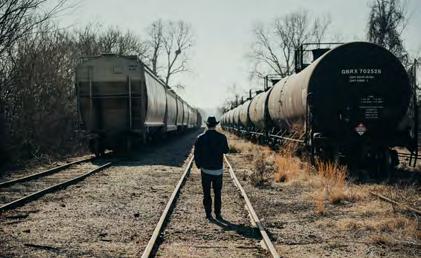

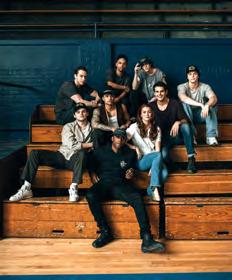


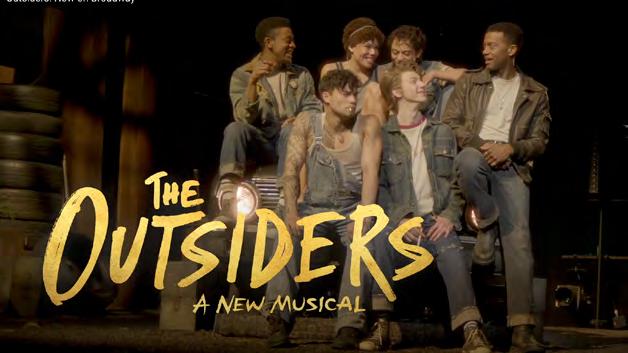
In Tulsa, Oklahoma, 1967, Ponyboy Curtis, his best friend Johnny Cade and their Greaser family of “outsiders” battle with their affluent rivals, the Socs. THE OUTSIDERS navigates the complexities of self-discovery as the Greasers dream about who they want to become in a world that may never accept them. With a dynamic original score, THE OUTSIDERS is a story of friendship, family, belonging…and the realization that there is still “lots of good in the world.”
The winner of the Tony Award® for Best Musical is THE OUTSIDERS. Adapted from S.E. Hinton ’s seminal novel and Francis Ford Coppola ’s iconic film, this thrilling new Broadway musical features a book by Adam Rapp with Justin Levine , music and lyrics by Jamestown Revival ( Jonathan Clay & Zach Chance) and Justin Levine, music supervision, orchestration, and arrangements by Justin Levine, choreography by Rick Kuperman & Jeff Kuperman, and direction by Tony Award® winner Danya Taymor.
“Tulsa ‘67” ....................... Ponyboy, Johnny, Company
“Grease Got a Hold” . . Dally, Sodapop, Two-Bit, Darrel, Greasers
“Runs in the Family” ............................... Darrel
“Great Expectations” ................... Ponyboy, Company
“Friday at the Drive-In” . .
. Cherry, Bob, Company
“I Could Talk to You All Night” ............ Cherry, Ponyboy
“Runs in the Family” (reprise) ..................... Darrel
“Far Away from Tulsa” ........... Ponyboy, Johnny, Company
“Run Run Brother” ......... Dallas, Ponyboy, Johnny, Company
“Justice for Tulsa” .......................... Full Company
“Death’s at my Door” ..................... Ponyboy, Johnny
“Throwing In the Towel” .......... Darrel, Sodapop, Ponyboy
“Soda’s Letter” ................... Sodapop, Ponyboy, Darrel
“Hoods Turned Heroes” ......... Two-Bit, Sodapop, Greasers
“Hopeless War” ............................ Cherry, Ponyboy
“Trouble” ............................ Dallas, Greasers, Socs
“Little Brother” .......................... Dallas, Company
“Stay Gold” .............................. . Johnny, Ponyboy
Finale “Tulsa ‘67” ....................... Ponyboy, Company

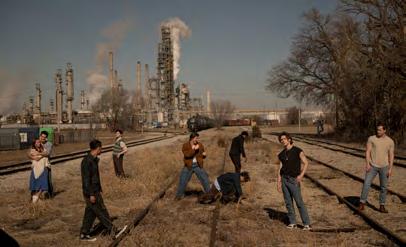


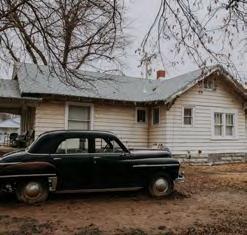

According to the 1960 U.S. Decennial Census, Tulsa was the second largest city in the state of Oklahoma with a population of 261,685 (about 4 times the capacity of an average professional football stadium).
The city’s growth began at the turn of 20th century with the discovery of oil in the state, which brought a flood of laborers, speculators, and financiers to the area. After three decades of prosperity, Oklahoma’s oil industry collapsed at the same time that The Great Depression hit. During WWII, the city’s industry shifted to defense; Tulsa became the leading manufacturer of military aircraft and a training ground for American, British, and Canadian pilots. This aeronautical industry led to great prosperity.
During the 1960s and 1970s Tulsa, like other American cities, experienced suburban sprawl, in which real estate developments — housing tracts and shopping centers — quickly spread into more rural areas, creating new suburbs. This suburbanization happened largely as a result of the flight of wealthier whites to the south and east, creating a segregated Tulsa: North Tulsa was predominantly African American, West Tulsa stayed primarily working class, East Tulsa grew with an expanding middle class, and South Tulsa was predominantly upper class.
These divisions led people to socialize with people they lived near, fostering inequality and contributing to the rise of social groups that would be later dubbed, “gangs.”
The city of Tulsa has a long history of violence, most notably against people of color specifically African Americans and Native Americans. While race is not directly addressed in the novel of The Outsiders , the cast of the musical hails from a diverse variety of racial backgrounds. It is important and helpful to understand the diverse histories that have shaped the region in the decades leading up to the writing of The Outsiders , which would have certainly impacted these characters.
As part of the Indian Removal Act of 1830, five Native American groups were forcibly removed from their ancestral lands in the southeast to present-day Oklahoma. The Cherokee, Creek, Choctaw, Chickasaw, and Seminole were rounded up and forced to march over 1,000 miles to a designated “Indian Territory.” The journeys were incredibly difficult, often lasting several weeks, with shortages of food, supplies, and wagons. Many groups were marched the entire distance, with little shelter, even during winter months. Thousands died due to disease and malnutrition. These difficult journeys became referred to as the “Trail of Tears.”

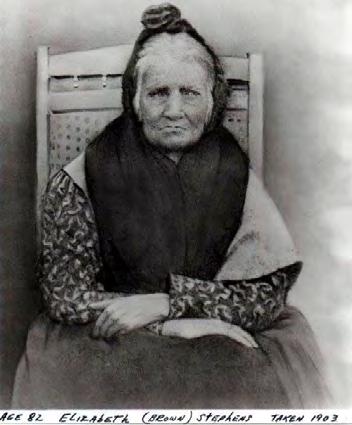

Elizabeth “Betsy” Brown, a Cherokee Indian who had journeyed on the “Trail of Tears” (taken 1903).
The Tulsa Race Massacre is amongst the worst incidents of racial violence in the history of the United States, where white supremacists killed dozens of African Americans, injuring hundreds and imprisoning thousands, and destroying more than 35 square blocks of a prosperous neighborhood that took years to build, but just 24 hours to tear down.
At the end of World War I, the Greenwood District of Tulsa was recognized as having one of the wealthiest African American communities in the United States. This thriving business district and surrounding residential area, often referred to as “Black Wall Street,” was home to approximately 10,000 people.
On May 3, 1921, Dick Rowland, a 19-year-old black man was arrested, accused of assaulting Sarah Page, a white 17-year-old woman in the elevator of an office building.

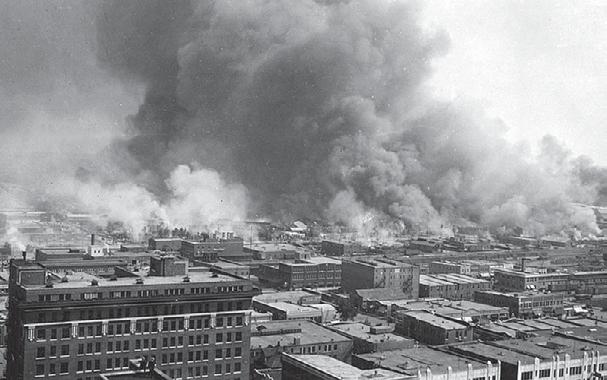

The local newspaper, the Tulsa Tribune, printed an inflammatory article that called for the lynching of Dick Rowland. A mob of hundreds (and in some reports thousands) of angry white men gathered near the courthouse where Rowland was being held; they were met by a group of 75 Black men who came to protect him. Soon, violence erupted with gunfights in the streets.
To contain what they referred to as “a Black uprising,” civil officials deputized white civilians, including many of those perpetrating the violence, sanctioning their actions by providing them with firearms and empowering them to arrest African Americans.
Then began the looting, vandalism, and arson. The white rioters and deputized militia set businesses ablaze and prevented the Tulsa Fire Department from putting out the fires. The mob then moved into residential areas, destroying homes, and rounding up and interning families. There were even reports of planes flown by white men dropping firebombs on buildings and shooting as families as they fled.
Governor James Brooks Ayres Robertson declared martial law and sent in the National Guard to help extinguish the fires and take control of the area. They imprisoned all Black Tulsans not already interned. Over 6,000 people were held at the Convention Hall and at the Fairgrounds, some for as long as eight days.
Twenty-four hours of violence left millions of dollars in property damage, more than 800 admitted to hospital and dozens reported dead, although historians now believe as many as 300 people may have died. The financial devastation extended beyond the property damage and encompassed the loss of inheritance, the loss of wealth that might have shaped the futures for Black generations to come.
In 1996, 75 years after the massacre, the Oklahoma Commission to Study the Tulsa Race Riot of 1921 was formed. The commission’s final report, published in 2001, states that elected officials and members of law enforcement conspired with the racist mob that destroyed Greenwood. The report recommended a program of reparations to survivors and their descendants. The state passed legislation to establish scholarships, encourage the economic development of Greenwood and develop a park in memory of the victims of the massacre. However, none of the criminal acts perpetrated that day have ever been prosecuted or punished by government at any level: municipal, county, state, or federal.
To delve deeper into the details of the Greenwood massacre, encourage your students to explore The New York Times interactive map and timeline, which includes a 3D model of the neighborhood.

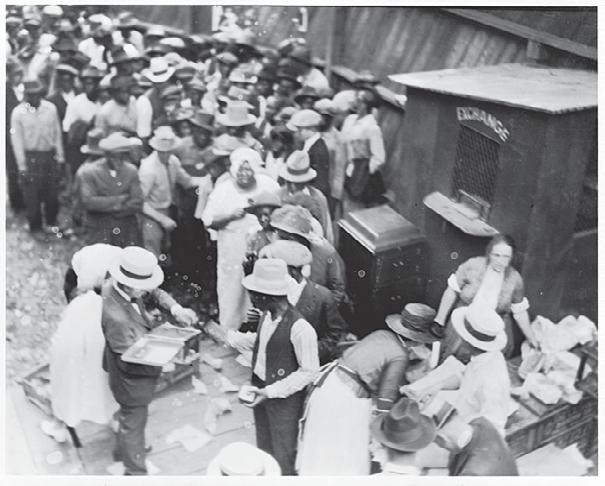
Tulsa, Oklahoma

June 1, 1921.
Jim Crow laws, a collection of state and local statutes that legalized racial segregation, which Oklahoma adopted shortly after becoming a state in 1907, were designed to marginalize African Americans by denying them the right to vote, hold jobs, get an education, or benefit from other opportunities.
The laws affected almost every aspect of daily life, mandating segregation of schools, parks, hospitals, libraries, drinking fountains, restrooms, buses, trains, building entrances, theatres, restaurants, and more. “Whites Only” and “Colored” signs were constant reminders of the enforced racial order. African Americans were not allowed to live in white neighborhoods, which is why in Tulsa, most resided in the Greenwood District.
Those who attempted to defy Jim Crow laws often faced arrest, fines, jail sentences, violence, and death. These laws lasted for decades.
In the fall of 1958, Katz Drug Store in Oklahoma City was the setting of a pivotal moment in the nation’s civil rights movement. Clara Luper and 13 African American children (aged 6 – 13) participated in a sit-in, silently and nonviolently protesting segregation at the store’s lunch counter. There, they experienced angry mobs who hurled racial slurs while punching, kicking, spitting at, and scalding them with hot grease.
The sit-in lasted for two days, until finally they were served, and it was amongst the first protest of its kind, soon to be replicated across the country.
These forms of protest in the 1950s and 1960s helped lead to the passage of Civil Rights legislation in 1964 and 1968.
What is the work of an anthropologist?
Anthropology in the simplest sense is the study of human society — anthropos is from the Greek meaning human or mankind and logos meaning science. It can be the study of ancient civilizations or of a specific group of people in a distant part of the world who are removed from Western society. Anthropology is often associated with the study of “exotic” or far-flung societies in rural parts of the globe. But ultimately, the insights anthropologists have gathered demonstrate just how much all human societies share. For example, we all have notions of the sacred; we all have a conception of family and nurture dreams and aspirations for the future. We all think about intergenerational tensions, and we all share resources — sometimes better than others. These basic questions of economy, religion, and family are shared from one society to another. Maybe the best definition of anthropology is to understand the discrepancy between how people talk about a society and how that society is organized (for instance, in matters of economy or politics): The role of an anthropologist is to understand and expose tensions between that perception and reality.


What has been your role on The Outsiders?
My role on the show initially began as a researcher, helping the director and the performers understand the world of Tulsa 1967; in which the novel is set. In this iteration of the play, there is also diverse casting especially in terms of the Greasers. Many of those people were part of Tulsa in 1967; they just weren’t necessarily highlighted in S.E. Hinton’s novel. Part of my job was to help everyone think through what the experience of different characters who belong to different ethnic or racial groups might have been like in that moment and to help the performers better understand the tensions their characters are trying to navigate.
What was Tulsa like in 1967 and how does that play into our story?
In the early 20th century, Tulsa was a huge oil center. There were wealthy families who made even more money through their investment in oil and other families who never had before known that kind of wealth. A broad range of people built and fortified the oil industry infrastructure, like
mechanics, engineers, and other technicians. By 1967, there was a question of just how much longer the oil money was going to continue and whether Tulsa would continue to hold its place in the broader economic landscape. You can see that dynamic in The Outsiders . The Socs are wealthier, more privileged, more well-connected, and the Greasers seem to be more marginal, low-income. The group with privilege is fiercely defending their privilege without knowing how much longer it is going to last.
Tulsa in 1967, like much of the US, was racially stratified, but there was also evidence of racial transformation and change in that moment. There were a lot of firsts around that time for African Americans in Tulsa the hospital system was desegregated that year and influential doctors like Charles James Bate would finally serve the general public. Charles L. Owen became the first black judge in Oklahoma the following year. There were also major historic events like the Civil Rights Act of 1964, the Voting Rights Act of 1965, as well as the assassinations of John F. Kennedy, Robert F. Kennedy and Martin Luther King, Jr, all of which took place around the time that this story was written. These were major events in America with huge political ramifications, and our characters are inhabiting this world as they are also navigating the more specific and immediate tensions and crises associated with high school and coming of age. By casting in a more diverse way, the play captures something that was not explicit in the book — this time of transformation — and allows us to talk both about the specifics of the story and the context at the same time.
The other thing to note is that there was also a very strong indigenous presence in Oklahoma in the 20th century. In 1967, local newspapers reported that the will of an Osage princess was being contested, which is a reminder that diverse groups of people had access to wealth
and influence including Osage and Cherokee leaders. The indigenous presence has always been substantial in this region even if they have not always controlled formal sectors of society.
The cycle of violence is a major theme in The Outsiders . Violence — and in particular racial violence — is very much a part of Tulsa’s history. How did that history inform some of the characters as they have been cast in this musical version of this story?
Let’s take the character of Dally. In the novel, it is mentioned he has lived in New York and has had encounters with the criminal legal system; but then, in the casting of the musical, an African American man plays the role. That casting resonates with the present era of mass incarceration and news stories about police killings of unarmed African Americans. There has been a lot of attention paid to what it means to have performers from different racial backgrounds play specific roles. We do not want to traffic in stereotypes and reproduce harm, but we do want to make sure the play is available for tough conversations. For the play to have pedagogic purpose and provide insight about our society, it has to feel authentic and resonate with the world around us. There have been tough conversations amongst the writers and directors, producers, and performers, about specific dialogue and specific events in both the original story and the musical — and about how to make sure we approach these themes with a lot of care and nuance.
What can you tell us about the family structure of the Greasers?
On the surface, it looks like the Socs have these wonderful lives and the Greasers are struggling; but actually, the Greasers are very tight-knit, and they
have a lot of attentiveness and care in their family structure even if it is untraditional. Alternatively, you see a lot of anxiety and alienation amongst the Socs, even though they have more resources. The story of the Greasers is one of family, camaraderie, and care, but there is no doubt that the stress and tensions of struggle show up in the Greasers sociality. They have a lot of tense conversations, violence is routine whether they are fighting off the Socs or even amongst themselves. The Greasers have non-normative views about how to socialize; it is rougher than normal, because they live rougher lives. But what holds them together is their care and appreciation for one another. Some of this comes from necessity. We do not see much about their home lives. We just know that they seem to have a lot of time to themselves. They seem not to have a lot of people who are keeping tabs on them or trying to account for their whereabouts or their well-being; these dynamics suggest that either their parents are absent or perhaps busy working multiple jobs and juggling multiple priorities.
Anthropologists often study groups across eras. What if any parallels do you see between the Greasers and Socs of 1967 to teenager groups today and what group dynamics have transcended time?
I observe some parallels between the Greasers and skateboarders of today. You see the same kind of camaraderie, care, and rebellion. They are a subculture unto themselves that people outside of their group do not always understand. Or, consider the fact that what might be called a gang is just a group of young people who don’t really fit in anywhere sticking together. On the flip side, shows like “Gossip Girl” or “Laguna Beach” resonates with the Socs. The characters all go to elite schools, and they are privileged, but they still get into trouble. An interesting shift from 1967 to now is the rise in Black elites, who
are well-connected and influential. So, while in the book the Socs are all white, now there are other ethnicities of elites. Stacy Dash’s character Dionne Davenport in Clueless is African American but nonetheless is a Soc, in that sense.
Whether we are talking about skateboarders, nerds, jocks, or socialites, we can see that people often have fears and anxieties about what it means to allow others in. In the context of wealthy elites, we have the added dimension of banding together to protect resources and influence. There are all kinds of ways in which privilege gets inscribed and reinscribed, and we get these forms of inequality despite people’s best intentions despite knowing the lessons of history. There are a lot of parallels about where wealth and privilege get concentrated, and how there are forms of exclusion. For every era and every generation, we need to learn to break down and dissect those forms of exclusion or else we will simply reinscribe them.
Part of creating a character is understanding his/her environment and developing a backstory. Choose a character from The Outsiders . Through photos and/or drawings, build a vision board to depict your character’s bedroom. Are there any floor or wall coverings? If so, what do they look like? Are there windows? What kind of bed does your character have? Does your character share the space, and if so, with whom? What if anything does your character collect? Be specific in your choices. Think about color/texture/space/light. What does the room reveal about his/her economic standing, family life, values, and interests.
What are groups that band together to defend their own privilege? Who do they exclude? Why?
This is your first musical and first stage adaptation, what has that been like for you and how has your process been different from the way in which you usually work?
It was difficult for me. First, I never studied the form of musical theatre. My brother was in a bunch of musicals, and I knew those through him, but I, myself, was not a musical theatre person. In fact, I was a jock. Second, I’m often the main artistic creator and decision-maker on my projects. I write and direct most of my work, and I generally control everything that I do. Usually when I’m conceiving a theatre piece, I’m thinking of the entire world of it, the entirety of the audience experience, not just the dialogue or the stage directions. So, I was not used to being one of five people making decisions. But in television, a writers’ room is a chorus of ideas, a conversation around a table, and if you have a good room, best idea wins. That’s what we figured out how to do for The Outsiders that way of working as a creative unit of authorship, and Danya (director of The Outsiders ) has been terrific at centering herself within that as an audience advocate.


Was it daunting to adapt such an iconic story?
The adaptation process was psychologically tricky at first. I read the novel when I was 15 years old. I was really drawn to it. I have a lot of reverence for S.E. Hinton, for the worlds that she created and how she affected young people. My first several novels that were published were edgy Young Adult (YA) novels. I love writing about teenagers. I always have. I had a difficult childhood that shaped who I am today, so I really related to the characters in The Outsiders , who came from broken homes, from the blue-collar world, not fully educated in some ways, but beautifully articulate in other ways. I felt like that was something I could relate to. The intimidating factor was, “Am I going to screw this up?” When I approached the material, I wanted to consider the adult experience of the story, because I knew they would be ticket buyers and we wanted to appeal to both adult and kids. So, I leaned into the more adult subject matter of the novel: the violence and intensity in the novel, the thoughts of suicide and lovelorn broken homes. These are very serious themes. There is an operatic finale in the book that ends in a double death. The stakes are high, and it was important to me to take the beautiful template that S.E. Hinton
created in her teen book and flesh it out in a way that was complex and at times difficult.
What do you think makes this story timeless and why does it still resonate today?
The notion of “am I going to make it in the world?” hits all of us at some at some age — 12, 13, 14 — when we start to become sentient beings who can evaluate our moral compass and figure out what we want from the world. Are we going to be good people? Are we going to be bad people? Those are enormous questions that hit all of us around puberty. There is this huge life ahead of us, and there is something so profound about trying to discover who you are and who you will become — which is Ponyboy’s central pursuit.
Ponyboy has grown up in a broken home, with grief all around him I think a lot of us do but there is something hopeful about his making a choice to find a way to belong in the world and his discovery of art and writing as a way to tell his story.
The idea of chosen family is also powerful. The Greasers are a chosen family. They lead with toughness but love sometimes it’s tough love; they really care about each other and look out for each other. I think it a testament to lower class in America where you have to fend for yourself, but you also have to find who your family really is because sometimes we don’t come from families that are intact. It is something that I think Susie tells beautifully.
For the stage adaptation of The Outsiders, there was a choice to cast in a racially diverse way, which was not a choice for the film nor explicit in the novel. Can you talk a little bit about that choice?
We did lot of research about Tulsa. There was the massacre of 1921 and then later the city
was rebuilt to figure out how it was going to function socioeconomically, politically, racially. We didn’t want to color blind cast it. We knew the Socs would be white. That was a very accurate depiction we did research on. We asked Susie directly, if she intended for all the Greasers to be white. She did say that there were people of color in her community, but that she didn’t write about them explicitly because it didn’t occur to her to do so at that age. However, it could be compelling now. In the novel, she refers to Johnny as having a darker complexion. It didn’t feel like that was code for anything, but it did feel like it was a portal to look through to see if there was potential for diversity. It felt like it made sense in terms of the town where I grew up in Joliet, Illinois, which was a former steel town, a smaller version of Tulsa. I grew up in an apartment complex called Cedar Wood Apartments. We were one of very few white families. When Danya, Justin, Zach, Jon, and I started really discussing who the Greasers could be, we saw an opportunity to tell this story about America with a more defined look at race and at class because that is a huge part of America and especially in Tulsa.
Initially we weren’t sure who would be cast as Dally. In one of our early workshops before Broadway, the part of Dally was played by a terrific actor who was Black, and we saw the opportunity to lean into the racial element. We loved his relationship to Johnny, as a person of color, and we thought we could further create space for diversity with some of the Greasers. It worked, so we became attached to the idea of Dally being played by a Black man. He is the outlier of the group; he is from another part of the country. It all made sense to us in a way. We reached out to Susie and asked her how she felt about it, and she was completely behind it. I’m proud of the courage of the creative team to stand by this idea, but it did really require us to look at the end of the story.
Yes, Dally’s fate in the stage version of The Outsiders departs from the book. Can you shed some light onto that choice for that change?
It was debated back and forth. We really wanted to honor the book and the film and Susie’s vision of a guy taking on the system. In her novel, Dally baits a cop with an empty gun and it’s a powerful, urgent, and tragic life ending act for a boy who is struggling with grief and madness. We didn’t want to lose that, but we felt that if we had a character, who we cast as black, taking on the police, it would have tilted the musical into an event that’s so loaded that it would have created an imbalance in the musical. Suddenly, we would be talking about a young person of color who baits a cop into killing him, and not about Ponyboy’s story. And while I was not personally afraid of that conversation, in fact I think the theatre is always a great place to have a conversation when you are facing difficult matters, we felt like it was just too loaded right now, too triggering, and too traumatic. We discussed it with a lot of the creative team, especially after some of our designers of color brought it to our attention. Ultimately, we felt like the theme of the train, Ponyboy’s relationship to trains with his parents being killed by a train, would coalesce with Dally’s fleeing and reinventing his life by getting
on freight trains (at least in our version of the story) could provide a way for him to take on the system without it being a cop. That felt like a way for us to have a very tragic and intentional suicide, without skewing the conversation into a current affair. Ultimately, we didn’t want to push the musical into a direction where that would be all that people would talk about when they left. We wanted people to talk about the holistic experience, Ponyboy’s journey, and this community of people.
What would you say to someone who says this is a lot for young people to handle?
I believe teens and preteens are so much smarter, more sophisticated, and more daring than we give them credit for. I think there are a lot of gatekeepers in the literary community and in our culture that are afraid of exposing kids to the truth of the world. I see it as honoring them. I believe that they can have really powerful reactions to these kinds of stories. They see the news and the internet with all kinds of horrors on it. They are seeing things in their own neighborhoods. It’s almost disrespectful to think that they can’t have conversations about these issues. I think it’s their right to be exposed to it and to have their own imagined world within it. And theatre is an excellent way to provoke those conversations.
“ Teen-agers know a lot today. Not just things out of a textbook, but about living. They know their parents aren’t superhuman, they know that justice doesn’t always win out, and that sometimes the bad guys win. They know that persons in high places aren’t safe from corruption, that some may have their price, and that some people sell out. Writers needn’t be afraid that they will shock their teen-age audience. But give them something to hang onto. Show that some people don’t see out, and that everyone can’t be bought. Do it realistically. Earn respect by giving it.”
Excerpted from “Teen-agers Are for Real,” by Susan Hinton
The New York Times , August 27, 1967.
Broadway musicals, even those that are being adapted from existing stories, can take years to create. At what point did you get involved and what has been your role in the development process?
The development process for The Outsiders began about 8 years ago, but I didn’t join the team until 2021, when Adam Rapp, the book writer, saw a show that I directed on Broadway called Pass Over, that also examines the pressures our society puts on young men and the ways it limits their ability to express their fullness. Adam asked if I had any interest in directing a musical and I told him that it would depend on what it was. He told me about the project, about Jamestown Revival and Justin Levine who he had been collaborating with. And he told me it was based on a young adult novel called The Outsiders , and that the music moved him to tears every time he listened to it. That certainly got my attention. I had definitely heard of the book, but somehow, I had never read it. So, my first exposure to the story was through their incredible music and script. Then I read S.E. Hinton’s breathtaking book, which I was completely stunned by. I started immersing myself with the writers, asking them a lot of questions, developing the script and score. We did a developmental lab in New York in the summer of 2022, where we had a chance to stage a stripped-down version of this show. Even though it was a bare-bones

staging, the result of the lab was powerful, and we were able to perform it in front of an audience and experience their reactions. After the lab, we continued our work developing the script and then we took it to La Jolla Playhouse in San Diego, where we did an out-of-town production, which was invaluable. We were able to truly see what we had created and hone it throughout the preview process in front of live audiences. We learned what worked and what didn’t, and now we are taking that information and entering a movement and design workshop as well as a script and score workshop, getting ready for Broadway.
So, this is your first musical?
Yes! It’s amazing and unbelievable. I am so grateful for this opportunity.
What do you think makes THE OUTSIDERS so timeless?
The Outsiders is so powerful because it was written for teenagers by a teenager. Susie Hinton was 16 years old when she wrote the book, and she didn’t hold back on telling the truth, and people respond to her honesty. We were all teenagers at some point, and for many of us those were the most tumultuous years of
our lives, full of visceral experiences that shape who we will become forever. The authenticity of Susie’s voice and the story she tells is why The Outsiders continues to resonate it is a no-holds-barred account of what it feels like to be a teenager. Sure, the technology changes, what clothes are cool changes, but the feelings don’t change. I think that unadulterated voice is what makes The Outsiders so special and what we seek to bring to audiences in our adaptation.
What to you as a director is the most exciting part of developing a new musical and what do you find most challenging?
The most exciting part to me is collaboration. That’s true with plays, but with a musical it’s a million times more. There are so many more people involved, so many more departments and modes of storytelling. You’ve got the music, book, choreography, scenic design, lights, projections, actors. The thrill of directing a musical is coordinating all these different departments and people to create one shared vision, one shared language, and I love that so much. Bringing out the best in people and harnessing the energy of a group towards a shared vision is what inspires me as a director. The most challenging part is the same as the most exciting part: It’s a lot of work! I also relish that; it is a privilege and an honor to do it, but it’s not for the faint of heart. There are a lot of moving pieces that all must be united to achieve something that ultimately feels effortless, inevitable, and undeniable.
In the development of new work, how do you know when a scene, or a song, or a moment isn’t working? How can you distinguish if it’s something that needs to be reworked in the script or if it’s a performance that needs to be redirected?
It’s such a good question. Playing around. Trying the scene in different ways. Asking questions.
And I think through that exploration, hopefully the piece will tell you what it is, rather than the other way around. There have been times when we adjusted a performance or attacked a scene in a different way, we found what it was meant to be. There are other times when you realize that a scene can be cut or needs to change. There’s no magic answer. It’s really just about experimenting and not being afraid to try something in a totally different way. For instance, maybe a song is orchestrated for the piano, but if you change it to the guitar, it might crack something wide open. I think trying to be innovative and coming at it from a lot of different perspectives can reveal what needs to shift.
Did you always know you wanted to be a director? What was your path to this career?
I didn’t always know I wanted to be a director, but I was exposed to theater at an early age. When I was about 6 years old, my mom took me to the children’s theater in my town and encouraged me to audition for the musical, which was The Wizard of Oz . I was cast as a Munchkin. I just loved the whole atmosphere. Later on, my high school theater teacher, Kristen Lo, introduced me to directing. She announced that the spring show would be a series of one-acts created by the students. She told us, “Everybody is going to write, direct, build the sets, stage manage, and act, and every job is as important as every other job. There is no one job that is better or more prestigious. They are all important.” And I think her love of theater and her belief that we could do anything was when I first started to feel that feeling of, “Ooh, I like directing. I feel more free doing this than I feel when I’m on stage.” She really championed that exploration for all of us, no matter which department we took an interest in, and her influence had such an impact on me.
Then I went to Duke, which is not known as a theater school, but which has some great theater professors and a lot of resources. I auditioned for
the play my first year, and I remember when the cast list came back, I was listed as the assistant director. And I was like, “Huh?” I wanted to be in the play, but the director must have noticed something in me. I think if I had been at a more traditionally competitive theater school, I might not have had all the opportunities to try and fail that I did at Duke. While I was there, I also had the chance to work with a lot of people who had never ever been in a play before and certainly didn’t plan to be in the theater for their careers, and that in a way was the best training for me. You don’t necessarily need formal training to be a great actor, director, or theatermaker. Theater and storytelling are primal.
Ultimately, I think working in many different aspects of the theater makes you better at the thing you want to do. If you do want to be an actor, directing will give you a different appreciation of that craft. One of my first jobs out of school was working as the administrative assistant to an artistic director at a non-profit and it made me appreciate what all of the people who work in administration do, and how that is an art in and of itself.
What is your advice for young, aspiring directors?
Try it all, and also take in as much theater and art as you can so that you can understand what you like. Discover your own taste and sense of aesthetics. I think as a director, one of the skills that you need is to be able to receive a lot of different input and keep your true north, keep your spine, keep your vision. Let what wants to come in influence it, but also know that ultimately you can only make something that you think is good. And in terms of getting your foothold, I think stage management is a great way in. Early in my career, I had a residency at the Flea Theatre, and we had to stage manage for six months before we were allowed to direct, and
it gave me an appreciation for rigor and how it all works. I think working backstage or front-ofhouse and all these other jobs can help you to become a director. Being around the thing you love, in whatever way you can, that’s the key.
What do you hope students will feel when they leave the show?
It’s hard for me to want to dictate what anyone “should” feel. I just hope that the story might be able to unlock pent-up whatever that needs to find a way out. I think for different people that’s going to be different things. Some people might not know how to express tenderness or love and hopefully this will unleash those feelings and the ability to express those feelings. For others, it might be how to process through grief what to do when you are feeling low, and you are having scary thoughts how to get through something like that and get to the other side of it. How could I prescribe what anyone should feel? All I hope is that you feel and feel deeply.
Watch this video to hear about how Danya first encountered The Outsiders , what it has been like directing her first Broadway musical, and how this production will honor the legacy of S.E.
“We refer to the scenography as a ‘memory playground for lost boys.’ The set is grounded in historical research and is inspired by drive-ins and outdoor communal spaces like parks, lawns, and junkyards.
The landscape evokes Ponyboy’s internal life. Fragments of architecture and objects remain present in his mind as he reflects on the love and the losses he experienced on his journey to becoming a writer.
The wall structure is modeled after the back of a drive-in movie theater screen and sits on a dirt floor; wooden boards, a jungle gym structure, tires, junkyard objects, and two cars — one for the Greasers, and one for the Socs are featured as emblems of the two groups.
At the beginning of the play, the back wall of the set is solid, echoing the socioeconomic confinement of the Greasers. As the show unfolds, openings begin to appear in the back wall, removing the limits between Tulsa and the rest of the world. There is more access to the sky, and the air, and to the possibilities that lay beyond. The colors and textures are charred, and a church window is revealed. The death of Johnny as a result of the fire and their heroism are forever imprinted in Ponyboy’s memory.”
— Tatiana Kahvegian Scenography by AMP featuring Tatiana Kahvegian

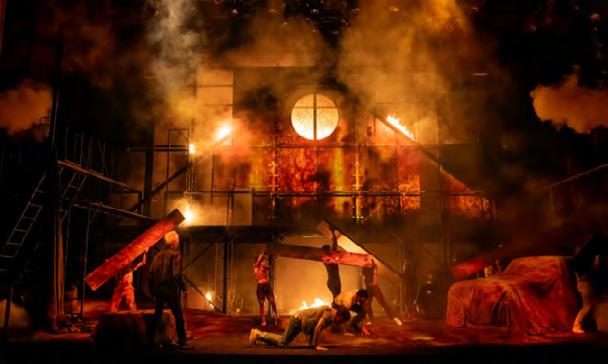
“One of the things we’re keying into with lighting is using restraint in color. We use a tight palette of color rooted in reality. The color of incandescent light and of daylight. The other colors of light are motivated by actual things on the set — the red that you would see in taillights and the white that you would see from headlights of the period. And then there’s the sky, which we see more and more as the piece goes on.
The set starts as a very enclosed dark space that gets perforated with light and slowly opens up; I think that parallels what happens to the kids — Ponyboy and Johnny — who are growing and maturing. The role of the lighting is literally to ‘illuminate’ so that the audience can see, but it also creates a spiritual illumination. Just like painting and photography can be poetic, lighting can also be poetic. Stage pictures can be poetic. This is a great piece because it asks us to be ugly as well, emotionally ugly. At the same time, there can still be a beauty to it; it’s got teeth, but it also has heart. What’s happening in this story is a memory of something real, so that memory can inform emotional triggers both good and bad.
At the same time, there is also the idea of Tulsa as this dream space, and that is experienced through the color gold, which appears in three key moments; it peeks through at the movie theatre, at the church, and then is full out at the end. Last color to fill the space is gold.”
– Brian MacDevitt Lighting Designer

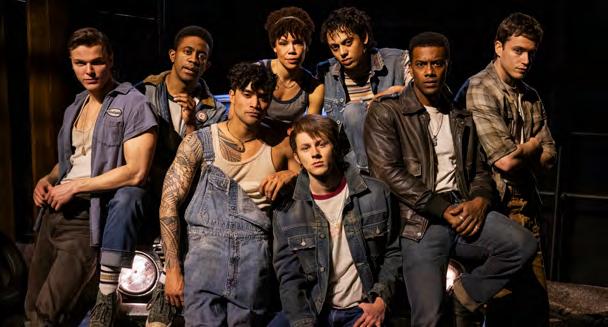
“The world of The Outsiders is sorted into groups the way that society likes to label and identify people to tell them where they ‘belong.’ So, we have the Socs the haves and the Greasers — the have-nots.
The idea of the memory play, in which we see everything through Ponyboy’s lens, informed our costume design. The first time we see the Socs, we see them as the epitome of prep. The epitome of what it means to have to have homes, to have closets, to have wealth to buy clothes — so they are crisp, they are vibrant, they are shiny-looking, almost in an intimidating way. In contrast, the Greasers’ uniform is t-shirt and jeans, but it also expresses individuality in the way that each Greaser styles what they have.
To enhance the idea of memory, every single character wears just one costume throughout the play; it is the essence of who that person is and how Ponyboy remembers that person. Because there is only one costume per actor, we can really focus on the details.
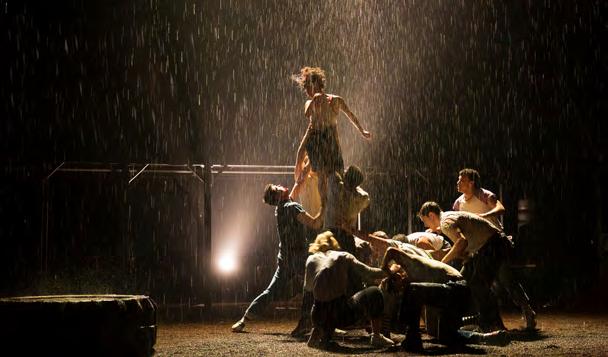
By the end of the play, when we reach the rumble, the colors of the Socs costumes recede in all the elements that are happening on stage the rain, the dirt, the lighting, and the projections. All the expectations that society puts on these characters get stripped away; it’s just kids and bodies so that audiences can see that at their core, maybe they are not all that different.”
– Sarafina Bush Costume Designer

“We are using a Spatial Audio system by L’Acoustics called L-ISA. As opposed to the typical Left/Right/Center speakers in musical theater, we use five arrays across the proscenium. With this, we separated the vocals and band to fill the room more to make it sound more realistic. We can source the vocals to realize where they are onstage and separate the band across the arrays to get a more even sound. It also enables us to move sound effects around the room so that no matter what seat you are in, even if you are in the back in the corner, you are feeling everything. For the band, we are staying very analog, very true to the instrument sound and not digitizing them to keep a rich full tone.”
– Cody Spencer Sound Designer
“The key characteristic of projection design is that they are very ephemeral, but at the same time, they can be more concrete than lighting because we’re also incorporating specific images. In the case of The Outsiders, we’re using projection as an expression of energy. Ponyboy is a young man with an active imagination. The projections help us access his point of view — his dreams and memories — in a way that tries to capture what he sees and what he feels.”
– Hana Sooyeon Kim Projection Designer
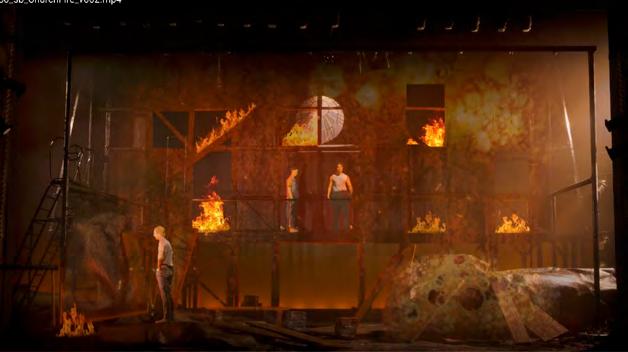
“ Special effects add an extra layer of storytelling and realism on stage — that bit of extra theatre magic to help push the story forward. For this show, we have helped to create all the elements — the rain, the fire, the smoke, the blood.
Our process started with a conversation with Danya, our director, to get an understanding of her vision. From there, we devised the systems to deliver and integrate those effects in the theatre setting. Safety is our number one priority. Always. Above everything else. And sustainability. Our effects need to work eight shows a week, hopefully for a very long time, so the systems need to be robust, and they need to be easily maintained. After we devised the ideal systems, we entered a Research and Development phase. We set up tests; we shot demo videos; we invited creatives into our studio space, and eventually we moved into the theatre. Time is always our biggest constraint, and we were continually refining throughout the preview process.
All our work is inspected by the New York City Fire Department Explosives Unit and the local battalion. Backstage for every show, we have a licensed pyrotechnician, who operates the fire extinguishers and oversees putting anything out. Our stage manager, who is also fire guard certified, is in front of house, with additional fire extinguishers. Communication is key and this includes the actors. I always tell them, ‘If you see something, say something. You are empowered to stop this show if it’s a question of safety.’”
– Lillis Meeh Special Effects Designer

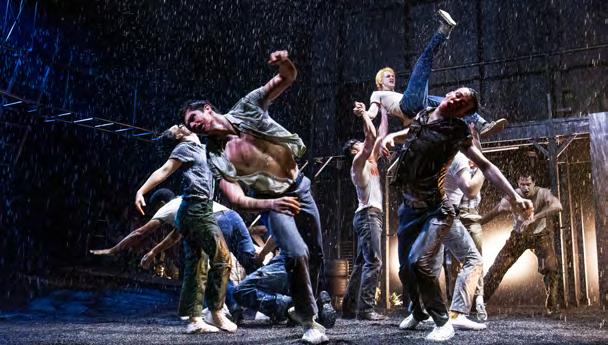
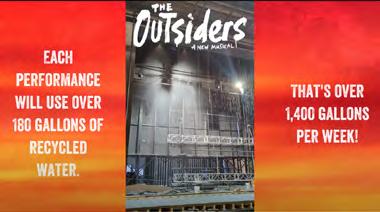
One of the most iconic scenes in The Outsiders is the rumble at the end of the story. Achieving this effect on stage in live performances involves both art and science. Engineers, lighting designers, plumbers, and environmental conservationists are amongst the many experts who help to build, design, and maintain the rain system and make it look authentic on stage.
Here is a behind-the-scenes video from our pre-Broadway run at the La Jolla Playhouse in San Diego that shares some of the complexities behind creating this exciting moment on stage.
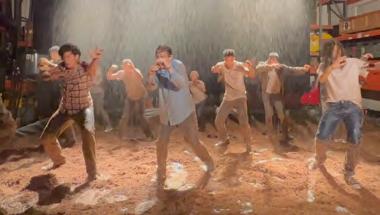
Here is some additional footage workshopping special effects in the studio.
You wear a lot of hats on this production. Can you talk a little bit about all those roles and how they come together on this production?
I often tend to be a multihyphenate on shows that I work on. I think it has its advantages and disadvantages. Making a musical is such a holistic experience because you are telling a story through music, dance, spoken word, movement, and design. One of the advantages of being one of the composers as well as one of the book writers is that it allows me to be right at the heart of both the writing and creative processes. This mitigates some of the challenges that often come with writing musicals, like having to marry song with spoken word, working out transitions, or figuring out what should and shouldn’t be underscored. A challenge that I often face is the fact that it’s very difficult to look at something through just one of those lenses. Even if I am having a conversation about, say, the book, I am also looking at it as a composer, orchestrator, or, in some cases, music supervisor. But what I will say is that I love collaboration, and I rely on this team of people who are truly the best at what they do. I feel like having five jobs on a show is only possible by having a lot of collaboration in that process.

What was your training?
My formal education is in theater, not music. I grew up in a very musical family. I was playing music from the time I was three years old, but I didn’t study music. As a result, I’m not a very good sight reader; most of my music and playing is by ear. My training was quite holistic within theater — I was a performer, I was a writer, and I had learned about design, dramaturgy, and directing. When people knew that I had a musical background and inclination, they would at times ask me to compose music for plays or write a song. Sometimes, if they were looking for an actor or musician, they would hire me. In fact, the theater that The Outsiders is playing in now is where I made my Broadway debut in a show called Bloody, Bloody Andrew Jackson . I was in the cast of that show and also the music director; that was the first show on which I had an orchestration credit.
How would you describe the role of songs in musicals?
Someone once said to me that music is a metaphor in a musical. What I took that to mean
is that there are certainly well-worn paths for how music functions inside of a musical, but those are just some of the many paths through which music can tell the story. Often, you hear people say that within musicals, a song comes when someone’s emotions are so great that they can’t say it anymore; so they sing it; that’s one way that music can function. But also, a lot of times in a musical, the music takes us inward. We can go deeper; we can get more intricate. It can move the plot forward. Or it can just be moving to a different state of mind or a different emotional place. I am often most drawn to projects where it’s not always obvious how the story will be musicalized. So, in fact, the thing we see as an obstacle is the very thing that draws me in.
What do you think music adds to this story in particular?
I think the music adds to the story in several ways. My collaborator, Adam Rapp, once described some of these characters as “beautifully inarticulate,” in the sense that they are not used to expressing themselves verbally. Often, they lead with either aggression or emotionality. As for many of us, it’s not easy for these characters to put into words how they’re feeling or what they’re thinking, so music is a great way to do that. It also gives voice
Watch this video to hear more about Jamestown Revival’s process in composing the music for The Outsiders.
to characters that may not otherwise have that voice. If, for example, you have a character that is perhaps a bit more introverted, we still get to know what’s in their heart through music. There’s an electricity to the world that we’re building, and the ability to convey that through music is exciting. This is a show where I feel like music and sound design work beautifully together because there are a lot of sonic landscapes that interact with music and sound to create textures for this world.
How would you describe the musical score of The Outsiders?
My best elevator pitch for the sound of this show has to be Americana, with a capital “A” in the sense that Tulsa, like America, is a melting pot and cultural crossroad for music. It is an amalgamation of various styles. You have soul, rock ‘n’ roll, country, blues, gospel, bluegrass, and so many other influences. So, The Outsiders is not really a genre-based musical, and the same is true of the work of my musical collaborators, Jamestown Revival, as a band. When you listen to a Jamestown record, you hear tunes that sound like they are from Appalachia, Louisiana, and the Southwest. We are pulling from all those different American traditions and influences.
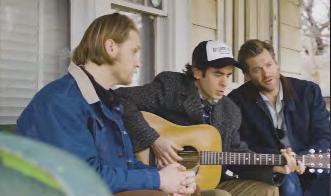
Beyond entertainment, songs that have a dramatic function are an integral part of musical storytelling; they help to develop character, advance plot, explore themes, and share emotion.
Characters often break into song when the emotional stakes have become so high that they can no longer express themselves through ordinary speech. Through music, characters can reveal their innermost thoughts, fears, hopes, and dreams, as well as realizations about themselves and the world around them.
“I Want” songs usually come early in the first act of a musical, when one or more of the main characters sing about the key motivation or desire that will drive the dramatic action and propel everyone — including the audience — through the show. “Great Expectations” is the “I Want” song in The Outsiders
Study the lyrics for “Great Expectations.” What does Ponyboy want? Do those aspirations align with others around him? What are the obstacles to him achieving his dream?
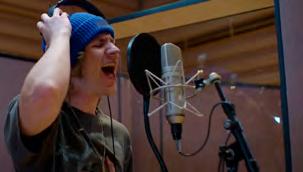
To get a taste of the music from The Outsiders , watch Brody Grant (Ponyboy) singing “Great Expectations” in the recording studio.
DARREL WAS ON HIS WAY UP IN THE WORLD, EV’RYONE KNEW HE’D GO FAR. LIFE CAME ALONG AND HAD DIFFERENT PLANS, HOW QUICKLY A DREAM FALLS APART
JOHNNY HAS NO KIND OF CHANCE IN THIS WORLD NOT FROM WHERE HE’S HAD TO START. WHO KNOWS HOW FAR IN THIS LIFE HE COULD GO IF HE PLAYED A DIFFERENT PART. I LOOK AROUND AT ALL OF MY FRIENDS AND STILL I FEEL ALONE. I WOULD FOLLOW THEM TO BATTLE, BUT THEIR STORY’S NOT MY OWN.
THEY SAY THERE’S STRENGTH IN NUMBERS, BUT THEY NEVER THINK AT ALL ABOUT A PATH THAT LEADS YOU OUT BEYOND THE CITY WALLS I’VE GOT
GREAT EXPECTATIONS. GREAT EXPECTATIONS. GREAT EXPECTATIONS. GREAT EXPECTATIONS.
TORN BETWEEN WHAT IS AND WHAT COULD BE IT’S HARD TO WRITE THE STORY WHEN THE STORY’S WRITING ME WHEN THIS GREAT EXPECTATION MEETS THIS GREAT REVELATION MAYBE THIS COVER’S NOT YOURS WHEN YOUR BOOK’S FUN OF CREASES AND YOU SEE THAT THE GREASE IS TELLING A STORY, BUT YOU’VE READ THAT ONE BEFORE SO YOU FIGHT JUST TO SHOW THEM THAT WE’RE NOT ALL THE SAME THAT UNDER THE COVER, THERE’S MORE
Musical theatre lyrics use many poetic devises including rhythm, rhyme, repetition, figurative language, symbolism, and metaphor.
Read the lyrics from “Stay Gold,” which Johnny sings to Ponyboy on his deathbed at the end of the show and compare them to Robert Frost’s poem, “Nothing Gold Can Stay.” How do the lyricists weave references to Robert Frost’s poem into the song? What poetic devices do they use?
How does Johnny interpret Robert Frost’s poem at the end of the story? Where does he find “gold?” How does this differ from Ponyboy’s earlier interpretation? How has Johnny’s attitude about life shifted? Why? Why is this pivotal moment shared through music?
“NOTHING
ROBERT FROST
Nature’s first green is gold, Her hardest hue to hold. Her early leaf’s a flower; But only so an hour. Then leaf subsides to leaf. So Eden sank to grief, So dawn goes down to day. Nothing gold can stay.
I HAVE HAD SOME TIME FOR THINKING SWORE I WASN’T READY TO DIE TURNS OUT I WAS WRONG IT MIGHT SOUND CRAZY, BUT HEAR ME OUT IT MAY TAKE ME TO THE GRAVE BUT I KNOW WHAT YOUR POEM’S ABOUT
I HAVE SEEN A POOL OF BLOOD RUN CRIMSON RED AND I’VE SEEN THE SUNRISE COMING OVERHEAD
FINDING BEAUTY IN THE FOLD
IT’S THE ONLY WAY TO KEEP FROM GROWING OLD MY FRIEND, STAY GOLD
WHEN YOU’RE YOUNG AND THE WORLD IS NEW IT’S EASY TO FORGET WHEN YOU’RE TRYING JUST TO MAKE IT THROUGH
LIKE THE MORNING LIGHT AND THE DAWN IT BRINGS YOU SEE THE WORLD FINDING BEAUTY IN THE SIMPLE THINGS
I HAVE LOOKED INTO A THANKFUL FATHER’S EYES TELLING ME I SAVED HIS DAUGHTER’S LIFE I’D DO IT ALL AGAIN ‘CAUSE I HAVE FOUND THE BEAUTY IN THE FOLD MY FRIEND, STAY GOLD
LOOKING BACK AT THE LIFE I’VE HAD I HOLD ON TO THE GOOD ‘CAUSE I MADE MY PEACE WITH ALL THE BAD
SIXTEEN YEARS, LOOK AT ALL WE’VE DONE WOULDN’T TRADE IT FOR THE WORLD CAN’T YOU SEE THAT WE’RE THE LUCKY ONES
I HAVE KNOWN A LOVE THAT MANY NEVER KNOW AND THAT LOVE LIVES ON NO MATTER WHERE I GO WE ALL WILL MEET OUR END NO MATTER IF WE MEET IT YOUNG OR OLD MY FRIENDS, STAY GOLD
FINDING BEAUTY IN THE FOLD
IT’S THE ONLY WAY TO KEEP FROM GROWING OLD MY FRIEND, STAY GOLD.
In The Outsiders , Ponyboy is reading Charles Dickens’ Great Expectations . There are many parallel themes and characters across both stories.
Compare Ponyboy to Pip from Great Expectations . Discuss their role as narrator. How does their perspective shape each story? How are the characters similar in their aspirations? How do they diverge? Consider their relationship to other characters such as Dallas/Abel Magwitch or Cherry/Estella. How are those parallel? How do they differ?
What does “stay gold” mean to you? What in your day-to-day life inspires you to “stay gold?” Using any medium you like, create a piece of art that reflects your inspiration. We invite you to draw, paint, sculpt, make a collage, shoot a film, take photographs, write a song, or surprise us with an original creation of your own.
We hope you will help us inspire others to “stay gold” by sharing your creations on social media! If you feel so inspired, please tag us @outsidersmusical #staygold
See some footage from The Outsiders cast research trip to Tulsa, scored by Sky LakotaLynch (Johnny) and Brody Grant (Ponyboy) singing, “Stay Gold.”
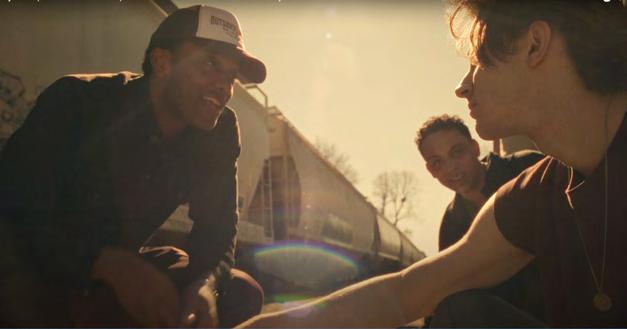
In “Grease Got a Hold,” the composers use acrostic poetry as a literary device in the lyrics to show how different characters define what it means to be a Greaser. For Dally, it’s being tough and intimidating. For Sodapop, its having charm and swagger.
Write your own acrostic poem. Take each letter of the word G-R-E-A-S-E-R and write a phrase beginning with that letter to capture what you think makes up the essence of a Greaser. Or, if you belong to another kind of club or affinity group and you prefer, write an acrostic poem to encapsulate that group.
PONYBOY, I THINK IT’S TIME YOU LEARN THAT GREASE ISN’T GIVEN, IT’S SOMETHING THAT YOU EARN SOME OF US ARE SMOOTH LIKE JAMES DEAN SOME OF US ARE COLD AND A LITTLE MORE MEAN TIME TO BE TOUGH AND QUICK ON YOUR FEET THERE AIN’T NO WAY A BOY CAN MAKE IT OUT ON THE STREET
UNLESS YOU’RE MEAN AS A FIGHTER AND YOU’RE SHARP AS A BLADE PLAY IT COOL, LITTLE BROTHER, AND YOU’LL HAVE IT MADE NO, WE AIN’T GOT MONEY, BUT WE GOT SOMETHING TO PROVE YOU’RE A GREASER NOW AND YOU AIN’T GOING BACK YOU’RE AN EASTBOUND TRAIN ON A GREASED-UP TRACK LET IT BE KNOWN THAT THE GREASE GOT A HOLD ON YOU
G IS FOR GETTING A LICK AND NOT GIVING A SHIT ‘CAUSE YOU’RE TOUGH ON THE CHIN R IS FOR YOUR REPUTATION BECAUSE IF YOU LOSE IT THEN YOU’LL NEVER WIN E IS TO EVEN THE SCORE WHEN THE SOCS COME AT YOU WITH ALL THAT THEY GOT A : YOU’RE AN ANIMAL, S : YOU’VE GOT STAMINA, E IS EMBRACING YOUR LOT
NO, NO, IT’S NOT ABOUT GETTING YOUR LICKS... IT’S ABOUT LICKING YOUR GETS. CHICKS LOVE A BUSTED-UP FACE
G IS FOR GETTING THE GIRLS EVERY TIME ‘CAUSE YOU GOT IRRESISTIBLE CHARM R IS FOR REELING THEM IN AND THEN KEEPING THE PRETTIEST ONE ON YOUR ARM
E IS FOR EFFORTLESS SWAGGER, THE KIND THAT THE LADIES CAN NEVER DENY A FOR AFFECTED BUT NOT TOO S ELECTIVE, AND E IS FOR CATCHING THEIR EYE
In the novel, The Outsiders, the character of Darrel is described through Ponyboy’s perspective. In the musical, Darrel has two songs “Runs in the Family” and “Throwing in the Towel” that give us greater insight into his emotions, motivations, and challenges.
Study the lyrics from “Runs in the Family.” What has happened to Darrel’s life over the past year? How has his plan been altered? How does he feel about his new life?
HARD TO BELIEVE IN LESS THAN A YEAR, HOW IT ALL FELL APART AND I FOUND MYSELF HERE.
I HAD DIFFERENT PLANS I HAD PLACES TO GO. IT ALL FELT SO SURE BUT WHAT THE HELL DID I KNOW.
SO I DROPPED OUTTA SCHOOL ‘CAUSE I HAD TO EARN A DOLLAR NOW I’M STUCK BETWEEN THE ROLE OF A BROTHER AND A FATHER SOME PEOPLE TOLD ME THAT I THREW IT ALL AWAY NOW I WONDER IF THEY’RE RIGHT AT THE END OF THE DAY. I GET TIRED OF WORKING MY HANDS TO THE BONE, I GET UP BEFORE THE SUN IN THE MORNIN’, GET BACK AFTER MIDNIGHT, CAN’T GET A BREAK MY BACK ALL DAY THEN I BUST MY ASS AT HOME I KEEP TREADING WATER BUT I SINK JUST LIKE A STONE GUESS I’M PROBLEM PRONE. IT RUNS IN THE FAMILY.
I DID EV’RYTHING RIGHT, BUT EV’RYTHING WENT WRONG. THAT’S WHY I’M SCRUBBING THIS KITCHEN, WHY I’M SINGING THIS SONG. I WAS BORN A GREASE, SO GREASE IS ALL THAT I GET, ANOTHER HARD KNOCK LESSON THAT I’LL NEVER FORGET.
EITHER WAY I’M LOSING NO WHICH WAY THAT I GO DON’T KNOW WHAT THEM BOYS WOULD EVER DO WITHOUT ME AND WHAT WOULD I DO ON MY OWN TRYING TO KEEP THINGS MOVING BUT THERE’S NOWHERE LEFT TO GO WE WERE DAMNED FROM THE BEGINNING NOW WE’RE WAITING FOR THE FINAL BLOW FOR ONE LAST THING TO SHOW THAT IT RUNS IN THE FAMILY
In the opening song of the show, “Tulsa ‘67,” Ponyboy and Johnny sing about how hard it is to be a Greaser, how they are judged for how much money they have and how they look.
Johnny sings: THIS TOWN IT ONLY HOLDS YOU DOWN THERE’S JUDGEMENT EVERYWHERE AND PEOPLE THINK THEY KNOW YOU BY THE WAY YOU WEAR YOUR HAIR
Many times, others judge us based on our appearance or a group that we belong to. Rather than seeing the things that make us similar, they focus on the things that make us different and hold those differences against us.
What does it mean to have prejudice or bias? As a class, make a list of things for which people are judged.
At the end of the show, Ponyboy says, “I love bein’ a Greaser. And I love Greasers… but I ain’t just a Greaser. I got a lot more inside me than just Grease.”
What does Ponyboy mean that he has a lot more inside than just Grease? In general, what makes up one’s identity? Together as a class, make a list of the characteristics that make us who we are. Can we have multiple identities? What does it mean to be an individual, but also be part of a group? Do these two identities ever conflict?
Explore with your student the intersection of their social identities using this exercise courtesy of University of Michigan LSA Inclusive Teaching. Please note the different approaches to this activity and choose the one that works best for your classroom.
Our perception of any given situation is very much tied to our identity and how we move through the world. Each of us has our own truth and sometimes, that truth differs from those around us, creating conflict. This is especially important to remember when developing characters on stage and creating dramatic tension.
In The Outsiders, Ponyboy keeps a journal in which he shares his innermost thoughts and feelings. As the narrator of the story, he also shapes how we experience the events as they unfold on stage.
Choose any character from The Outsiders and write a journal entry in their voice. You may write about ones of the events that takes place in the story or one that you imagine taking place in their life that might not be represented in the story. Try writing from the perspective of one of the supporting characters like one of Ponyboy’s brothers, or maybe one of the Socs, like Cherry or Bob. How does your perception of that event change when looking at it from another point of view?
In “I Could Talk to You All Night,” Cherry and Ponyboy share how hard they feel it is to be their true selves with their respective groups of friends. They feel they’ve “gotta fake it to belong” and to uphold an image that’s expected of them. They sing:
IT’S LIKE YOU’RE ALWAYS JUST PRETENDING IT’S JUST A PART YOU HAVE TO PLAY FEELS LIKE THE PRESSURE’S NEVER ENDING THERE’S GOT TO BE A BETTER WAY
Do you have a different public and private self? Do you feel you’ve “gotta fake it to belong?” Do you feel the pressure to behave a certain way? What if any feelings/ hobbies do you hide from your friends? Is there a person (or persons) with whom you can be completely yourself?
Using any medium you like — drawing, painting, filmmaking, collage — create a piece of art that captures your public versus private self.
After Ponyboy is jumped by the Socs at the playground, the Greasers officially anoint him as part of their group by greasing his hair. This ritual is a rite of passage and a form of initiation.
In “Grease Got a Hold” they sing: PONYBOY, I THINK IT’S TIME YOU LEARN, THE GREASE ISN’T GIVEN IT’S SOMETHING THAT YOU EARN.
What are some other examples of life rites of passage that include ritual? What are examples where ritual can be used for initiation? What is the purpose of that initiation? Discuss how an initiation might be beneficial and how it might be harmful.
Systemic violence and hatred are an unfortunate reality of our world. Class conflict, racial tension, religious strife, and domestic abuse have existed through the millennia. As a 15-year-old teen, S.E. Hinton
was deeply aware of this enduring violence and its futility. It is a prominent theme in her novel and the musical.
In “Hopeless War,” Cherry sings: BUT THIS WAR IT EATS YOU UP INSIDE TIL YOU’RE BLINDED BY YOUR FOOLISH PRIDE WHEN YOU ONLY SEE THE WORLD ONE WAY IT’S ONLY BLACK AND WHITE BUT NEVER GRAY ONE BY ONE WE FALL IN LINE THE SAME MISTAKE A THOUSAND TIMES DOING WHAT WE’VE ALL BEEN RAISED TO DO…
IT’S A HOPELESS WAR, WE’RE FIGHTING AND WE DON’T EVEN KNOW WHAT FOR THE TRUTH IS, EVEN IN THE END EVEN IF YOU WIN, IT DOESN’T CHANGE A THING
How do Cherry, Ponyboy, and the others feel about the ongoing feud between the Greasers and Socs? Why do they say it’s hopeless? Do you agree? If it is hopeless, why do they continue to fight? Why is it so hard to break the cycle of violence? How might they forge a different path? What other books have you read/movies have you watched that manifest this same cycle of violence? How do these cycles of violence manifest in the world around us? What do you think it would take for us to break these cycles of violence?
What is your process for developing movement and choreography for a musical?
JEFF: One of the first things we do is read the script and listen to the music, and we do that a few times until it is bouncing around our head. Then we’ll create our own documents of free association for certain musical numbers. At that point, we come together and identify the number for which we have the clearest vision, and we’ll start there. We’ll really investigate that one piece in a studio together to start to develop the movement language for the show. Once we have a sense of that vocabulary, everything else comes together organically for us. For The Outsiders , that piece was the rumble. We were thinking about how to make the rumble as impactful as it is on the page. One of the first things we responded to was Adam Rapp’s stage direction about it being the brutal sound of “fists detonating into flesh.” That image the ripple of violence sparked an idea. So much of the way we interpret violence is aurally and if we could be faithful to that stage direction, then we’d be able to make a successful rumble.


Can you talk a little about movement as a form of storytelling? What makes it unique and how does it elevate the story of The Outsiders in particular?
RICK : Storytelling through movement has a very long tradition, and there is a ton of opportunity to communicate nuance through physical movement. In The Outsiders , the choreography gives us access to Ponyboy’s memories. The linear nature of experiencing life moment to moment morphs as the mind encodes memories. Certain moments have a huge amount of real estate in our minds the heightened moments, the important moments, the traumatic moments — so choreography helps give us that feeling of what Ponyboy’s memories might be like. In addition, choreography can transport us across time and space. For example, when Ponyboy and Johnny run away from home and hop on a train to hide from the police, there is a sense of anxiety, urgency, and travel. There is one way to express that in a novel, another way to express it on camera, and choreography is a helpful tool to give us that sense on stage.
JEFF: This is also true of the rumble. The rumble starts like a real fight, so we immediately get a sense of the stakes, but then it evolves into something more expressionistic. The movement vocabulary unlocks an even greater violence and an even greater ability to express the pain and the uselessness of the fight. The entire storytelling modality of this show incorporates movement. Sometimes it’s dance, like in the scene at the drive-in; sometimes it is character exploration like in “Grease Got a Hold.” And then there are moments where characters are entering and exiting, carrying planks, and transforming scenery; it’s not dance, but it is choreography, and it is movement. The way that this ensemble breathes together is another way you sense movement, but you don’t necessarily lock into it. It’s happening subconsciously. Movement is informing the way that you are absorbing the piece.
How can movement inform character and how was movement used in character development of The Outsiders?
RICK: There is, to some degree, a bit of demarcation between how the Socs move and how the Greasers move. And, at the same time, they are all teenagers in Tulsa in 1967, so we didn’t want to lean too far into that cliché of red team/ blue team. So even though they have their own identities and their own way of moving, there is also an overall language of Tulsa, 1967 that keeps it unified.
JEFF: Warm up was a huge part of the process. Spending time together, warming up, seeing each other, and moving together in a way that didn’t have anything to do with the show, was certainly an extremely important part of the way that the company bonded together and found who their characters were within the context of the larger group. Danya led a lot of mirroring exercises so
that people could understand their relationship to one another — from an angry Soc who might drink too much to a Greaser who had a tough background — and explore that relationship even though they might not say any words to each other in the entire show. They still have a relationship, and you can feel that in the work. We also did some Viewpoints* exercises so that we could sync up in terms of the speed and quality of our movement when we are moving through the show and changing place and time. We also included a bit of martial arts training to get those punches looking real and to teach how to harness and redirect force so that we didn’t have to fake force.
RICK : The goal of Viewpoints* and associated exercises is to help an ensemble move together, to develop a proprioception of individual members of an ensemble so that they have an awareness of where their other team members are at any given moment. It comes in handy, certainly in the rumble when we have that many bodies so close to one another on a limited stage space, but also, in terms of how the ensemble manipulates the cinder blocks and planks and other scenic elements that help us move from place to place.
What makes a good artistic collaboration and what advice would you give to aspiring choreographers?
JEFF: One of the reasons why I love working on this show is because the entire creative team doesn’t necessarily feel siloed into their own disciplines. What I think makes a good choreographer is the ability to think not only about movement, but about how movement fits into the larger piece and how it can elevate the form as opposed to being a contained part of it. It’s important to learn about lighting, sound, acting, direction, and music — all of it — so that you can be an equal collaborator.
* Read more about Viewpoints on page 38.
RICK : Another piece of advice: Just do it! Get in the studio and do it as much as you can. Don’t think about it. And go see as much as you can, because it will help you figure out your taste. What you respond to and what lights you up. Go see as many shows as you can. If you don’t have access to live performance, go on YouTube and find the choreographers that speak to you and see who they’ve learned from and who their influences are. Don’t be shy to put in the work of understanding the lineage of a particular style that excites you.
JEFF: To be a good collaborator as a choreographer also means having a plan and doing a lot of prep work, and being willing to throw it all out the window once the rubber meets the road. You need to have a vision which isn’t to say that you can’t experiment in the room — especially when you are working on certain timelines. You need to know what you want and how to adapt that to the reality.
Watch [this video] to learn more about how the Kuperman brothers’ personal experience shaped their work on The Outsiders and why they think the story continues to resonate today.

Viewpoints is a movement training and improvisation technique that helps performers and directors articulate time and space on stage and construct narratives by harnessing the power of movement. The theory was initially conceived in the 1970s by dancer-choreographer Mary Overlie and greatly expanded upon by director Anne Bogart and SITI Company.
PHYSICAL MOVEMENT VIEWPOINTS INCLUDE:
• SPATIAL RELATIONSHIP: distance between bodies, props, and other objects
• KINESTHETIC RESPONSE: the ways in which performers respond to forms of movement
• SHAPE: the way that a body appears in space
• GESTURE: a movement or expression that has a beginning, middle, and end
• REPETITION: when a performer recreates or mimics another
• ARCHITECTURE: the physical environment surrounding a performer
• TEMPO: the speed at which movements unfold
• DURATION: the length of a movement
• TOPOGRAPHY: the ways in which movements create patterns or designs
VIEWPOINTS THEORY:
• Emphasizes physicality
• Encourages performers to rely on their instincts
• Fosters collaboration
BYU Theatre Education offers robust Viewpoints lesson plans. Try playing Shape Tag with your students to explore spatial relationship with your students, or adapting this Viewpoints of Time lesson plan to a script you are working on in class.
One of the central themes of The Outsiders is the idea that despite their socioeconomic status, at their core, the Socs and Greasers are very much the same.
The mirror exercise is an acting improv technique designed to build trust and synchronicity between actors. It was used in the early days of rehearsal for The Outsiders . It can also be used in the classroom to strengthen connection, promote teamwork, heighten awareness, and elicit empathy.
Break the class up into pairs and ask them to face each other. Have them decide who will lead and who will follow. The follower must “mirror” the movements of the leader. The goal is for them to try follow the movements as precisely as they can and to be completely in sync with their partner. Coach the leader to move slowly. Coach the followers to let their bodies follow the movements without thinking too much. After a few minutes, have the students switch roles. Repeat. Then coach the students to try staying in sync with no leader and no follower.
Reconvene the class. Choose one pair of students to “mirror” in front of the class. Have them silently decide who will be the leader and who will be the follower. Cue them to begin “mirroring.” Ask
the rest of the class to guess which person is leading and which is following. The goal is for the pair to sync so closely that the class cannot tell. Call up a few other pairs.
Follow-up questions for the group:
• How did this exercise make you feel?
• Did you find it challenging? If so, why?
• Did you learn anything new about yourself of your partner?
• Did anything surprise you?
Pony refers to Dallas as the alpha of the wolfpack. What are wolf traits? How do wolves move? How do they behave with younger pups? How do they react to threats?
Studying animal behavior and movement is an acting technique that can be used to develop the physicality of a character. It is a technique popularized by the actor/director/acting coach Lee Strasberg, in which an actor identifies an animal that they believe embodies their character, studies that animal, and then attempts to incorporate that animal’s movements and behaviors into their character.
Choose another character from The Outsiders . If they were an animal, what animal would that be? Study that animal by watching videos online or in the world around you. How does that animal move? Quickly or slowly? Smoothly or skittishly? How does that animal behave when it encounters another animal of the same species or other species? Is it comfortable or scared? Timid or fierce? Use what you learn about your animal to develop a physicality for your character. Practice walking around the room as that character. What happens when you encounter your classmates embodying other animals/characters? Does it change from character to character? If so, how?
Use the following prompts to spur dialogue on your way home from the theatre, in a Socratic Seminar and/or to elicit written responses from your students about their experience of the musical, especially as it relates to the novel.
• How does the musical of The Outsiders compare to the S.E. Hinton’s novel? Did the live performance mesh with what you imagined when you read the novel? Why or why not? What if any differences did you find? How did the storytelling change? How did being in such close proximity of the story affect you?
[ Note to educators: If you’ve also watched the film with your students, you can expand the conversation to a comparison of all three genres.]
• How did the music add to the story? Were there particular songs/lyrics that resonated with you?
• In the novel, all the characters are portrayed from Ponyboy’s perspective. In the musical, these characters come to life independently and share their own points of view. Were any of the characters different than you imagined? Did any of them surprise you?
• How is family defined in The Outsiders? How would you define family?
• Ponyboy, Johnny, and Dally are celebrated as heroes for saving the kids in the church. Are there other “unsung heroes” in The Outsiders? Who are they? What makes them heroes?
• S.E. Hinton’s book was published in 1967, what about the book still feels urgent and/or present in your life?
• There is so much loss and grief in The Outsiders . Do you also find the story hopeful? If so, how?
THE OUTSIDERS MUSICAL INCLUDES SCENES INVOLVING SUICIDE, DOMESTIC ABUSE, AND VIOLENCE. If you find these topics challenging before or after viewing the show, The Outsiders has partnered with Crisis Text Line to make support available.
Simply text HOME to 741741 to reach a LIVE Volunteer Crisis Counselor, or you can connect with us via web chat at crisistextline.org . It’s 24/7, free, and confidential. Remember, you are not alone.

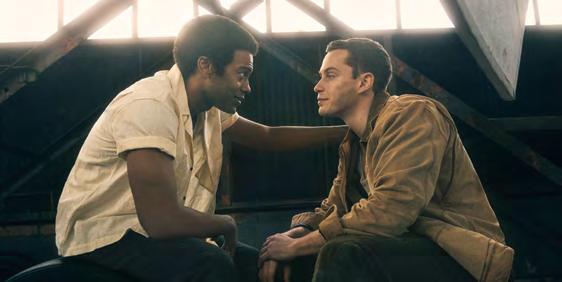
LYRICAL ANALYSIS
I WANT SONG
de Giere, Carol. “Writing ‘I Want Songs’ for Musicals.” MusicalWriters.com. Archived from the original on 2014-06-02. Retrieved May 31, 2014. https://web.archive.org/web/20140602201129/http:/www.musicalwriters.com/write/stephenschwartz/songs/i-want-songs.htm
INSIDE THE MOVEMENT VIEWPOINTS
https://www.backstage.com/magazine/article/viewpoints-acting-training-guide-76450/ https://tedb.byu.edu/?page_id=501 https://dramatics.org/understanding-viewpoints/ https://tedb.byu.edu/page-id-505
https://tedb.byu.edu/page-id-503
http://plainshumanities.unl.edu/encyclopedia/doc/egp.ct.052#:~:text=The%20suburbanization%20 resulted%20largely%20from,Tulsa%20remained%20predominantly%20upper%20class.
https://www.okhistory.org/publications/enc/entry.php?entry=TR003
1921 TULSA RACE MASSACRE
https://www.tulsahistory.org/exhibit/1921-tulsa-race-massacre/ https://www.nytimes.com/interactive/2021/05/24/us/tulsa-race-massacre.html https://archive.org/details/ReportOnTulsaRaceRiotOf1921/page/n15/mode/2up
PAGE 6
Elizabeth “Betsy” Brown Stephens, a Cherokee woman who walked the “Trail of Tears.” Image Source: Lmaotru. https://s36500.pcdn.co/wp-content/uploads/2018/06/Elizabeth-Brown-Stephens-ZinnEducation-Project.jpg
PAGE 7
The “Little Africa” section of Tulsa, Oklahoma in flames during the 1921 race riot. Source: Library of Congress. https://commons.wikimedia.org/wiki/File:Tulsa_race_riot_inflames-1921.jpg
PAGE 8
Tulsa, Oklahoma race riot, June 1, 1921.
Photo by Alvin C. Krupnick Co., courtesy of the Library of Congress. https://commons.wikimedia.org/wiki/File:Tulsa,_Oklahoma,_race_riot,_June_1,_1921)_-_ photo_by_Alvin_C._Krupnick_Co.,_Tulsa,_Okla_LCCN91796047.jpg
CAST, PRODUCTION, AND ADDITIONAL PHOTOGRAPHY
Photos of cast, creative team, and Tulsa locations by Andy Henderson, 2024. Photo of set on fire and additional production photography by Matthew Murphy, 2024. Photo of the rain scene by Rich Soublet.


Exercises in this study guide meet the following educational standards.
LANGUAGE
CCSS.ELA-LITERACY.L.6-8.5
Demonstrate understanding of figurative language, word relationships, and nuances in word meanings.
READING
CCSS.ELA-LITERACY.RL.6-8.1
Cite textual evidence to support analysis of what the text says explicitly as well as inferences drawn from the text.
CCSS.ELA-LITERACY.RL.6-7.2
Determine a theme or central idea of a text and how it is conveyed through particular details; provide a summary of the text distinct from personal opinions or judgments.
CCSS.ELA-LITERACY.RL.8.2
Determine a theme or central idea of a text and analyze its development over the course of the text, including its relationship to the characters, setting, and plot; provide an objective summary of the text.
CCSS.ELA-LITERACY.RL.8.3
Analyze how particular lines of dialogue or incidents in a story or drama propel the action, reveal aspects of a character, or provoke a decision.
CCSS.ELA-LITERACY.RL.6.4
Determine the meaning of words and phrases as they are used in a text, including figurative and connotative meanings; analyze the impact of a specific word choice on meaning and tone.
CCSS.ELA-LITERACY.RL.7.4
Determine the meaning of words and phrases as they are used in a text, including figurative and connotative meanings; analyze the impact of rhymes and other repetitions of sounds (e.g., alliteration) on a specific verse or stanza of a poem or section of a story or drama.
CCSS.ELA-LITERACY.RL.8.4
Determine the meaning of words and phrases as they are used in a text, including figurative and connotative meanings; analyze the impact of specific word choices on meaning and tone, including analogies or allusions to other texts.
CCSS.ELA-LITERACY.RL.6-7.7
Compare and contrast the experience of reading a story, drama, or poem to listening to or viewing an audio, video, or live version of the text, including contrasting what they “see” and “hear” when reading the text to what they perceive when they listen or watch.
CCSS.ELA-LITERACY.RL.8.7
Analyze the extent to which a filmed or live production of a story or drama stays faithful to or departs from the text or script, evaluating the choices made by the director or actors.
CCSS.ELA-LITERACY.RL.6.9
Compare and contrast texts in different forms or genres (e.g., stories and poems; historical novels and fantasy stories) in terms of their approaches to similar themes and topics.
CCSS.ELA-LITERACY.W.6-8.1
Write arguments to support claims with clear reasons and relevant evidence.
CCSS.ELA-LITERACY.W.6-8.3
Write narratives to develop real or imagined experiences or events using effective techniques, relevant descriptive details, and well-structured event sequences.
CCSS.ELA-LITERACY.W.6-8.4
Produce clear and coherent writing in which the development, organization, and style are appropriate to task, purpose, and audience.
CCSS.ELA-LITERACY.W.6-8.9
Draw evidence from literary or informational texts to support analysis, reflection, and research.
CCSS.ELA-LITERACY.L.9-12.5
Demonstrate understanding of figurative language, word relationships, and nuances in word meanings.
READING
CCSS.ELA-LITERACY.RL.9-10.2
Determine a theme or central idea of a text and analyze in detail its development over the course of the text, including how it emerges and is shaped and refined by specific details; provide an objective summary of the text.
CCSS.ELA-LITERACY.RL.9-10.3
Analyze how complex characters (e.g., those with multiple or conflicting motivations) develop over the course of a text, interact with other characters, and advance the plot or develop the theme.
CCSS.ELA-LITERACY.RL.9-10.4
Determine the meaning of words and phrases as they are used in the text, including figurative and connotative meanings; analyze the cumulative impact of specific word choices on meaning and tone.
CCSS.ELA-LITERACY.W.9-12.1
Write arguments to support claims in an analysis of substantive topics or texts, using valid reasoning and relevant and sufficient evidence.
CCSS.ELA-LITERACY.W.9-12.2
Write informative/explanatory texts to examine and convey complex ideas, concepts, and information clearly and accurately through the effective selection, organization, and analysis of content.
CCSS.ELA-LITERACY.W.9-12.3
Write narratives to develop real or imagined experiences or events using effective techniques, well-chosen details, and well-structured event sequences.
CCSS.ELA-LITERACY.W.9-12.9
Draw evidence from literary or informational texts to support analysis, reflection, and research.
VA:Cr1.2.1a: Use observation and investigation in preparation for making a work of art.
VA:Cr.1.2.2a: Make art or design with various materials and tools to explore personal interests, questions, and curiosity.
VA:Cr.1.1.6a: Formulate an artistic investigation of personally relevant content for creating art.
VA:Cr1.2.IIa: Choose from a range of materials and methods of traditional and contemporary artistic practices to plan works of art and design.
MA:Cr2.1.I: Apply aesthetic criteria in developing, proposing, and refining artistic ideas, plans, prototypes, and production processes for media arts productions, considering original inspirations, goals, and presentation context.
TH:Cr1.1.4a: Articulate the visual details of imagined worlds, and improvised stories that support the given circumstances in a drama.
TH:Cr.1.1.5a: Identify physical qualities that might reveal a character’s inner traits in the imagined world of a drama/theatre work.
TH:Cr.1.1.4c: Imagine how a character might move to support the story and given circumstances in a drama.
TH:Cr.1.1.5c: Imagine how a character’s inner thoughts impact the story and given circumstances in a drama/ theatre work.
TH:Cr.1.1.lc: Use script analysis to generate ideas about a character that is believable and authentic in a drama/theatre work.
TH:Pr4.1.7a: Consider various staging choices to enhance the story in a drama.
TH:Pr4.1.la: Examine how character relationships assist in telling the story of a drama/theatre work.
TH:Pr4.1.6b: Experiment with various physical choices to communicate character in a drama/theatre work.
TH:Pr5.1.6a: Recognize how acting exercises and techniques can be applied to a drama/theatre work.
TH:Pr5.1.7a: Participate in a variety of acting exercises and techniques that can be applied in a rehearsal or drama/theatre performance.
TH:Pr5.1.8a: Use a variety of acting techniques to increase skills in a rehearsal or drama/theatre performance.
TH:Pr5.1.la: Practice various acting techniques to expand skills in a rehearsal or drama/theatre performance.
TH:Re.9.1.8a: Respond to a drama/theatre work using supporting evidence, personal aesthetics, and artistic criteria.
TH:Re9.1.lb: Consider the aesthetics of the production elements in a drama/theatre work.
• Articulate thoughts and ideas effectively using oral, written, and nonverbal communication skills in a variety of forms and contexts.
• Listen effectively to decipher meaning, including knowledge, values, attitudes, and intentions.
• Use communication for a range of purposes (e.g., to inform, instruct, motivate, and persuade).
• Collaborate with others.
• Demonstrate ability to work effectively and respectfully with diverse teams.
• Exercise flexibility and willingness to be helpful in making necessary compromises to accomplish a common goal.
• Assume shared responsibility for collaborative work, and value the individual contributions made by each team member.
• Develop, implement, and communicate new ideas to others effectively.
• Be open and responsive to new and diverse perspectives; incorporate group input and feedback into the work.
• Demonstrate originality and inventiveness in work and understand the real-world limits to adopting new ideas.