The Journal for High Pressure Water Applications
NOVEMBER 2026 • $8.00 US
www.cleanertimes.com
NOVEMBER 2026
Vol 38 No 11 COVER: Cover design by Joey Phelps
6
12 16
CONTENTS
4 6 10 12 16 22 28 32 34 38 44 48 50 52
Editor’s Note
Tariff Update: Uncertain and Unsettled
Industry News
Workflow in Cooler Weather CETA Edge: Awards Winners— PowerClean® 2026
Minimizing Environmental Impacts
Industries Served: Construction
Product News Advancements in Eco-Friendly Techniques Getting Business on Track After a Disruption Financial: Successful Succession Planning
Service Center Directory Products & Services Directory Advertiser’s Index/ Subscription Form
28 Cleaner Times • November 2026 • 3
EDITOR’S NOTE
PUBLISHERS Richard Johns Dana Johns
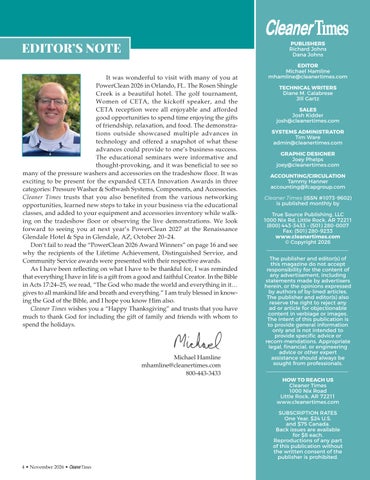
It was wonderful to visit with many of you at PowerClean 2026 in Orlando, FL. The Rosen Shingle Creek is a beautiful hotel. The golf tournament, Women of CETA, the kickoff speaker, and the CETA reception were all enjoyable and afforded good opportunities to spend time enjoying the gifts of friendship, relaxation, and food. The demonstrations outside showcased multiple advances in technology and offered a snapshot of what these advances could provide to one’s business success. The educational seminars were informative and thought-provoking, and it was beneficial to see so many of the pressure washers and accessories on the tradeshow floor. It was exciting to be present for the expanded CETA Innovation Awards in three categories: Pressure Washer & Softwash Systems, Components, and Accessories. Cleaner Times trusts that you also benefited from the various networking opportunities, learned new steps to take in your business via the educational classes, and added to your equipment and accessories inventory while walking on the tradeshow floor or observing the live demonstrations. We look forward to seeing you at next year’s PowerClean 2027 at the Renaissance Glendale Hotel & Spa in Glendale, AZ, October 20–24. Don’t fail to read the “PowerClean 2026 Award Winners” on page 16 and see why the recipients of the Lifetime Achievement, Distinguished Service, and Community Service awards were presented with their respective awards. As I have been reflecting on what I have to be thankful for, I was reminded that everything I have in life is a gift from a good and faithful Creator. In the Bible in Acts 17:24–25, we read, “The God who made the world and everything in it… gives to all mankind life and breath and everything.” I am truly blessed in knowing the God of the Bible, and I hope you know Him also. Cleaner Times wishes you a “Happy Thanksgiving” and trusts that you have much to thank God for including the gift of family and friends with whom to spend the holidays.
Michael Hamline mhamline@cleanertimes.com 800-443-3433
EDITOR Michael Hamline mhamline@cleanertimes.com TECHNICAL WRITERS Diane M. Calabrese Jill Gartz SALES Josh Kidder josh@cleanertimes.com SYSTEMS ADMINISTRATOR Tim Ware admin@cleanertimes.com GRAPHIC DESIGNER Joey Phelps joey@cleanertimes.com ACCOUNTING/CIRCULATION Tammy Hanner accounting@fcapgroup.com Cleaner Times (ISSN #1073-9602) is published monthly by True Source Publishing, LLC 1000 Nix Rd, Little Rock, AR 72211 (800) 443-3433 • (501) 280-0007 Fax: (501) 280-9233 www.cleanertimes.com © Copyright 2026 The publisher and editor(s) of this magazine do not accept responsibility for the content of any advertisement, including statements made by advertisers herein, or the opinions expressed by authors of by-lined articles. The publisher and editor(s) also reserve the right to reject any ad or article for objectionable content in verbiage or images. The intent of this publication is to provide general information only and is not intended to provide specific advice or recom-mendations. Appropriate legal, financial, or engineering advice or other expert assistance should always be sought from professionals. HOW TO REACH US Cleaner Times 1000 Nix Road Little Rock, AR 72211 www.cleanertimes.com SUBSCRIPTION RATES One Year, $24 U.S. and $75 Canada. Back issues are available for $8 each. Reproductions of any part of this publication without the written consent of the publisher is prohibited.
4 • November 2026 • Cleaner Times
by Diane M. Calabrese
6 • November 2026 • Cleaner Times
G
ood, bad, or inconsequential? Our view of tariffs depends heavily on our vantage. Do we buy, sell, or manufacture products affected by sudden tariff changes? What if these are changes that immediately make our supply chain position less sustainable? That is the situation for many. Most of us also hold a view of tariffs that takes us into the realm of general economics. For instance, we want our neighbors to have jobs and the economy to be strong so job seekers can find employment. And we wonder whether tariffs can actually help our nation’s businesses compete in a fair sphere. Tariffs—in both reality and theory— test us. Yet perhaps the thing that tests us the most is uncertainty. We like to know that if an item or service costs “X” today, it will not cost “X” + 50 percent tomorrow. A price rise is one thing. A huge jump (or drop) is another. As we write at the beginning of September, the debate over tariffs has Canada and the United States imposing tariffs on each other. In day-to-day dealings, members of our industry must put their philosophies of economics aside and just deal with what’s happening—often abruptly. So abruptly that consulting the Office of Tariff Affairs & Trade Agreements (TATA) at the U.S. International Trade Commission (USITC.gov) for the most up-to-date information confirms only that there is a lag time in establishing a record of clear guidance. The most up-to-date information (which is also fluctuating information) comes from fact sheets released by the White House (WhiteHouse.gov). For example, on September 8, 2026, the White House released a fact sheet to explain the import bans on dairy products and alcohol-containing beverages originating in Canada beginning on September 29, 2026. (All may change by the proposed start date.) The question of whether a tariff is on or off is often difficult to answer.
The dramatic nature of bans on dairy and alcohol draws media attention. Changes in tariffs affecting components and raw materials imported (or exported) by our industry get less public notice. Still, the complexity they add to planning is just as serious. Veteran members of industry carry on. Perspectives from a few of them reveal the can-do approach required to fortify the industry.
ups and downs of tariffs, but all members—contractors, distributors, and suppliers—of our industry must also contend with the changes as they occur. Clint Reynolds, the owner of HydroTech Solutions in Lake Mary, FL, and the president of the PWNA [Power Washers of North America], has a wide view of how tariffs affect
PERSPECTIVES
“The biggest challenge with tariffs right now isn’t simply the added cost—it’s the uncertainty,” says Aaron Lindholm, CEO of Veloci Performance Products in Burnsville, MN. “Businesses can adjust to a known cost structure, but it becomes much more difficult to plan inventory, pricing, and purchasing when the rules can change quickly.” Of course, tariffs become a factor whether the United States imposes them on imports, or a nation to which U.S. goods are shipped imposes tariffs. The cycle of retaliatory tariffs we find ourselves immersed in adds to the challenge. “For companies like ours that operate in a global supply chain, tariffs have become another variable that has to be actively managed,” says Lindholm. “We’ve seen them put pressure on margins and ultimately contribute to higher prices throughout the supply chain.” Again, it’s the quick changes that are the most difficult to manage— quick and often dramatic changes. “Looking ahead, my concern is less about any one specific tariff rate and more about continued volatility,” explains Lindholm. “I think most businesses would welcome greater predictability. “Give us a reasonably stable set of rules, and we’ll adapt, compete, and find ways to become more efficient,” continues Lindholm. “Constantly changing the rules makes that much harder.” Manufacturers might seem to be those most directly affected by the
IT IS WORTH REMEMBERING THAT OUR 47TH PRESIDENT RELIES HEAVILY ON THE RECIPROCAL TRADE AGREEMENTS ACT OF 1934 (RTAA) TO IMPOSE TARIFFS. THE ACT GRANTED THE PRESIDENT AUTHORITY TO ALTER TARIFFS AS NEEDED (UP TO PLUS OR MINUS 50 PERCENT) TO MEET THE CHANGES MADE BY A TRADING PARTNER. contractors. It’s a view that encompasses some pluses. “I would characterize the current tariff environment as another area where businesses need to remain informed, flexible, and prepared to adapt,” says Reynolds. “Like many industries, exterior cleaning is affected by changes in the cost of equipment, components, steel, aluminum, and other materials, so tariffs can have an impact throughout the supply chain. “At the same time, there is a positive side to encouraging stronger domestic manufacturing and a more Cleaner Times • November 2026 • 7
resilient U.S. supply chain,” continues Reynolds. “Anything that helps strengthen American manufacturers, creates greater availability of products here at home and reduces long-term dependence on overseas supply can ultimately benefit our industry.” In some ways, adjusting to tariffs is like adjusting to any factor that impacts a business plan, explains Reynolds. “There is always some uncertainty when policies and costs are changing, and businesses will need to continue watching how those changes affect pricing and availability. However, our industry has proven to be very adaptable.” The adaptability is illustrated by the strength of the industry, explains Reynolds. “Manufacturers, distributors, and contractors are accustomed to finding solutions, adjusting operations, and continuing to serve their customers.” As for the future with tariffs, whether in flux or stable—what does
8 • November 2026 • Cleaner Times
this look like? “Looking ahead, I am optimistic that our industry will continue to adapt and find opportunities regardless of how tariff policy develops,” says Reynolds.
UNSETTLED
Finding the correct word to convey the ongoing situation with tariffs isn’t always easy. But Gus Alexander, the CEO of FNA Group in Pleasant Prairie, WI, uses “unsettled,” and it seems a good one. Good because it allows us to discuss tariffs and their impact on businesses without getting into the pros and cons. “As of August 21, 2026, I would characterize the tariff situation as less sweeping than it was in 2025, but still unusually restrictive, fragmented, and unpredictable,” says Alexander, who commented on that date. “The Supreme Court invalidated the broad emergency authority tariffs, and the replacement 10 percent surcharge expired July 24.”
Invalidation and expiration both yielded some stability. “Nevertheless, numerous sector and country-specific tariffs remain, and new measures continue to appear, including recent duties on Canadian dairy products and imported drones,” explains Alexander. “The Congressional Budget Office (CBO) estimated the effective tariff rate at roughly seven percent after the court decision, compared with about 2.5 percent in 2024, although that estimate excludes subsequent changes,” says Alexander. An increase that is approaching three times more in two years surely gets noticed. “I would describe the current tariff environment as unsettled rather than resolved,” says Alexander. “Although the broadest tariffs have been curtailed, substantial targeted tariffs remain, and policies continue to change rapidly.” In addition to leading his company, Alexander is the current president of CETA, the Cleaning Equipment Trade
Association. As part of its mission, CETA monitors government and regulatory changes that affect member companies, which include manufacturers, distributors, and suppliers. “I firmly believe that the tariffs imposed are severely hurting American businesses,” says Alexander. “The resulting cost increases are forcing companies to raise prices, which has already affected equipment sales and will continue to suppress demand.” From Alexander’s perspective, the unsettled nature of tariffs has created an unsettling reality for businesses. The short of that reality is that no one is exactly sure what will happen next. “I am concerned about what comes next because persistent uncertainty makes it difficult for businesses to price products, manage supply chains, and commit to investment,” explains Alexander. “Further escalation or retaliation could raise costs for consumers and domestic manufacturers, weaken sales, and
keep inflation and interest rates higher for longer.” And Alexander punctuates his assessment by emphasizing the constellation of issues tied to dealing with tariffs. “My principal concern is not simply the existence of tariffs, but an open-ended and frequently changing approach without clear objectives, stable rules, or a credible path toward resolution.”
REVISITING THE RATIONALE
An article in the July 2025 issue of Cleaner Times reviewed some of the history of tariffs in the United States. See it to refresh your memory regarding the Hawley-Smoot Act (1930) and the Fordney-McCumber Tariff (1922). The description of tariffs in that July 2025 article as “in flux” still applies. For businesses trying to keep pace, the knowledge that the history of our nation included many periods when tariffs-challenged businesses can be reassuring.
Are tariffs the best way to protect industrial and agricultural products made within our nation, thereby encouraging more production within U.S. borders? That’s an unanswered question. The definition of “fair trade” generates enormous debate. Many suggest all nations agree to a notariffs policy, and things will sort themselves out nicely. Others see disaster in such a policy. It is worth remembering that our 47th president relies heavily on the Reciprocal Trade Agreements Act of 1934 (RTAA) to impose tariffs. The Act granted the president authority to alter tariffs as needed (up to plus or minus 50 percent) to meet the changes made by a trading partner. Therefore, a retaliatory approach to tariffs often leads to more tariffs. Country-by-country trade agreements provide a quieter and more gradual approach to working toward an equilibrium point in international trade. CT
Cleaner Times • November 2026 • 9
INDUSTRY NEWS
PROPULSE, A SCHIEFFER COMPANY WINS TOP WORKPLACES CULTURE EXCELLENCE AWARD FOR EMPLOYEE APPRECIATION 2026
ProPulse, a Schieffer Company, has announced today that it is a 2026 Top Workplaces Culture Excellence winner. The Top Workplaces program has a 19-year history of surveying and celebrating people-first organizations nationally and across 60 regional markets. This is the fourth consecutive year that ProPulse has been awarded this honor. Top Workplaces Culture Excellence awards recognize organizations that excel in specific areas of workplace culture. Employee Appreciation This award celebrates organizations that demonstrate gratefulness for the efforts of employees, and whose employees reciprocate by being motivated to give their best at work. Top Workplaces awards are based on feedback from a research-backed employee engagement survey facilitated by Energage at www.energage.com. Details about how ProPulse, a Schieffer Company, builds a great workplace
10 • November 2026 • Cleaner Times
culture are available on Top Workplaces at topworkplaces.com/company/ propulse-a-schieffer. “Earning a Top Workplaces award is a badge of honor for companies, especially because it comes authentically from their employees,” said Eric Rubino, Energage CEO. “That’s something to be proud of. In today’s market, leaders must ensure they’re allowing employees to have a voice and be heard. That’s paramount. Top Workplaces winners do this, and it pays dividends.” “Our employees are what make ProPulse special. Being recognized as an Iowa Top Workplace for the fourth year in a row tells us we’re continuing to build the kind of culture we want, one where people feel valued, supported, and connected to what we’re accomplishing together.” — Jeff Theis, President & CEO. ProPulse is incredibly thankful to its employees for this award. “This recognition reflects the people who make ProPulse what it is. We’re proud to have you on our team,” Theis concludes. About ProPulse ProPulse, A Schieffer Company, is a hose manufacturer located in Peosta, IA. We are dedicated to superior quality; 100 percent on-time delivery; custom USA manufacturing, engineering, and
design expertise; and outstanding customer care. Our core values of integrity, flexibility, safety, growth, and service inform the way we treat both our customers and our employees. For more information visit our website at www.power movingforward.com. About Top Workplaces / Energage Top Workplaces, powered by Energage, is one of the nation’s most credible employer-recognition programs. Organizations are recognized based on anonymous employee feedback, with no cost to participate or win. CT
WORKFLOW IN
by Diane M. Calabrese
COOLER WEATHER
A
blizzard, an ice storm, or just a record snowfall disrupt workflow. No matter which shipment should be leaving a plant, which delivery is expected, or which customer is waiting for a cleaning team to arrive, the priority for any business switches to safety. And safety begins with waiting for good visibility, ice removal, or just digging out. Even without a significant weather event, manufacturers, distributors, and contractors must adjust their workflow in cooler weather to be certain what they are making and selling—including services—matches the needs of their customer base. “Generally we see a modification in sales volume per market(s)” in 12 • November 2026 • Cleaner Times
cooler weather, says Dennis Black, president of McHenry Pressure Cleaning Systems Inc. in Frederick, MD. The modification does not necessarily mean scaling back sales expectations. “Certain business types generate more sales than others in winter,” explains Black. “In our area most outside property maintenance cleaning stops when temperatures go below freezing.” The stop affects the property management and contract cleaner markets that Black serves. “Sales of gas engine equipment can be affected to some extent, and generally sales in these markets are less,” he explains. At the same time, new needs arise because of cooler weather. “Since we have snow and inclement weather, municipality fleets, trucking fleets, and
companies that push snow must wash to remove salt, usually after every event,” says Black. “So, what we call ‘inside cleaning’ will increase depending on temperatures and flow of weather,” explains Black. “Our best scenario for business is small snowstorms followed by days with temperatures above freezing and the repeating of that cycle.” Persistent subfreezing temperatures can create challenges, though. “Temperatures below 20 degrees Fahrenheit for extended periods with no snow have the worst effect on business,” says Black. Still, there is a bit of a positive. “These cold temperatures do help the sales of portable heaters, which are a diversification item for us,” explains Black, who adds the sales volume for
Photo by iStockphoto.com/diatrezor
the heaters can be tied directly to the low temperatures. Black says that if there is a slowdown in activity, there are productive ways to fill the time. “Some business is generated by building custom rigs for customers preparing for the next spring cleaning season,” says Black. There are changes that any business can make to align more perfectly with workflow that slows. It’s all about thinking through the possibilities and implementing ideas that work. For example, since sales of gas engine equipment and accessories decrease in cooler weather, Black says his company attempts to adjust inventory accordingly. Similarly, sales of accessories like undercarriage cleaner systems and
attachments increase, so inventory must follow, explains Black. Then, there’s the opportunity for adding to the service center sales. “Service work can increase due to damage caused by freezing temperatures,” says Black. “All equipment repaired and/or serviced in our shop must be properly winterized and protected before leaving.” Volume of sales for chemicals follows a seasonal pattern, and adapting to it means the company is ready to meet the needs of buyers. “Sales of certain chemicals such as salt neutralizer products increase and are not sold as much in other times of the year,” says Black. “Generally, business is a little harder to conduct in cooler weather,” says Black. “Equipment starts harder
and items freeze and break easier. Let’s face it, working on something that uses and sprays water is tough when temperatures go below freezing.”
WINTER IN EARNEST
The average low temperature in January and February in Rapid City, SD, is 17°F. In December the average low is 18°F. And a daytime temperature that reaches 40°F in any one of the three months is not the norm. Yet it’s not just the sustained cold temperatures that pose a challenge. “Temperatures that are too hot or too cool can affect productivity, as in our region,” says Terry Lee Bosma, president of Pressure Services Inc. in Rapid City, SD. “We see temperature swings that are drastic,” says Bosma. “Spearfish, Cleaner Times • November 2026 • 13
SD, located 44 miles from our facility, had a record temperature swing on January 22, 1943.” How drastic? “It featured a 49degree rise in two minutes and a 58-degree drop in 27 minutes,” says Bosma. “So, the answer is to be prepared for all conditions.” That preparation includes not only adjusting to the workflow generated by customers but also acknowledging the way cooler, or even frigid, conditions affect employees. “Efficiency changes based on how comfortable versus uncomfortable any person is,” says Bosma. “Inside our facility I have air conditioning with overhead fans in my first two-story warehouse bay, which houses two levels of chemical storage, two levels of parts, a main level shipping area, and a main level photo area; and the second two-story warehouse bay houses the workstations, shop equipment, and service office for our technicians,” explains Bosma.
14 • November 2026 • Cleaner Times
“We have a third warehouse bay which houses two levels of chemical storage, but because of the limited time spent in that warehouse, we just utilize an overhead fan,” says Bosma. “In addition to our front offices, all warehouse bays have heat that is individually controlled, and additional offices within warehouse bays have heat controlled separately from the warehouse they are in.” The preparation for temperature includes auxiliary support. “We also have floor fans if needed,” says Bosma. Smooth workflow depends upon employees who can meet the elements safely. “For outside work we furnish caps, winter covers, short-sleeve and long-sleeve shirts, lightweight jackets, insulated Carhartt coats, and coveralls,” explains Bosma. “In addition, we have LP [liquid propane] and kerosene fired portable heaters.” Bosma holds a clear-eyed view about what the vagaries of weather mean. “Our staff works many times in dirty, harsh,
hot, humid, cool, and extreme cold environments,” he says. “We can’t control the weather, but we can control to an extent how it impacts productivity and morale. “Whenever possible, on extreme hot or cold days we try to keep technicians doing in-shop work,” continues Bosma. “If they are installing equipment in extreme heat, we encourage them to purchase water or Gatorade, or take one of the company drink coolers on site and fill it with ice and water or Gatorade and place the expense on their company credit card.” The credit card policy for ensuring employees are properly hydrated works well. “We have never had any staff abuse this privilege, and preventing our staff getting sick from cold or hot conditions is far less expensive than a trip to the urgent care,” says Bosma.
TIME USED WISELY
Leave discontent in winter to Shakespeare. Members of our industry refresh, renew, and refine.
“Unlike contractors whose businesses may be impacted by seasonal weather, HydraMotion Cleaning Systems experiences less of a slowdown because we manufacture products that are distributed nationwide,” says Bruce Tassone, president of the company headquartered in Pottstown, PA. “While colder temperatures may reduce activity in one region, work continues elsewhere in the country, allowing us to support distributors and service customers year-round,” explains Tassone. “In many ways, there’s always work being done somewhere.” Yet seasons do change in the Commonwealth of Pennsylvania and even in places like the Sunshine State. If that means there’s a bit of extra time, it should be used wisely. “Seasonal shifts give us a chance to focus on the future,” explains Tassone. “During the slower winter period, our engineering team devotes more time to research, product testing, and continuous product improvements.” Filling a seasonal (cooler weather) ebb in workflow with efforts trained on continuous improvement is important, explains Tassone. “This lets us introduce refinements that improve product performance, reliability, and ease of maintenance before the next busy season.” Of course, it’s not just the products themselves that get attention. Processes in manufacturing can always be improved even slightly to gain a competitive edge. “One of the biggest changes we make during cooler weather is shifting more focus toward engineering projects and internal business improvements,” says Tassone. “Our engineering team tests new product enhancements, refines manufacturing processes, and develops new cleaning chemistries and equipment. At the same time, our administrative group upgrades accounting packages, evaluates new vendors, and improves databases to strengthen tools that drive our sales and marketing efforts.” The effort to extract every bit of improvement possible from all facets of a business is a prudent way—but
not a unique way—to take advantage of the time afforded by a slower pace of work. Tassone explains that what’s going on at his company is mirrored across the company’s customer base. “Many of our customers focus on equipment maintenance, make year-end equipment and product purchases as part of their tax planning, and stock replacement parts in preparation for the spring season,” says Tassone. There’s significant opportunity in that knowledge.
“We support those customer efforts by maintaining inventory, providing technical assistance, and ensuring replacement parts are readily available through our national distributor network,” explains Tassone. “By the time spring arrives, we have not only met our customers’ needs throughout the winter but also introduced improvements that make their businesses more productive and profitable.” CT
Cleaner Times • November 2026 • 15
CETA EDGE
AWARD WINNERS
16 • November 2026 • Cleaner Times
POWERCLEAN® 2026 by Diane M. Calabrese
E
ach day members of CETA, the Cleaning Equipment Trade Association, serve not only their industry but also their communities, all while actively immersed in the business of their companies. Taking the time or making the time is what the individuals do without a second thought—and certainly without the thought of garnering an award. Even so, the three CETA awardees recognized at PowerClean® 2026 do serve as models of what can be accomplished by those with an unwavering spirit. Indeed, the three award recipients model some specific things (and many others). They show us how to carry on with seriousness of purpose and full engagement even after a personal loss (Judy Bowers, Lifetime
Achievement Award); how to keep doing more because there’s always something to be done (Jeff Burros, Distinguished Service Award); and how to find creative and fulfilling ways to help those in need (Karl Loeffelholz, Community Service Award). It’s always a good idea to pause and take note of some of the significant contributions of CETA members because their efforts become an example to everyone else. We do just that here by sharing words from each 2026 award recipient, as well as words from individuals who nominated each awardee. The saying “show, don’t tell” defines each of the three awardees. They stand as a 2026 trio of CETA doers who get out there every day and quietly show us how it’s done.
LIFETIME ACHIEVEMENT JUDY BOWERS
(OWNER AND CEO, RJ BOWERS DISTRIBUTORS INC.)
Judy Bowers—“Receiving the Lifetime Achievement Award is a very special moment in my life. For 43 years I have been part of the pressure-washing industry through RJ Bowers Distributors Inc. “Richard Bowers and I started the business, and together we built something that became a very important part of our lives. Five years ago Richard left this earth, and continuing
the business became both a responsibility and a way to honor everything we had together. There were difficult days, but with the love and support of my family and employees, I found the strength to keep going. “To me this reward represents much more than years in business. It represents dedication, perseverance, family, friendships, and a lifetime of memories.
“I am deeply honored to receive this award and grateful to CETA, which has been part of my journey.” Nominator Brenda Purswell— “When I considered candidates for the Lifetime Achievement Award, Judy Bowers was the first person who came to mind. Years ago, I nominated her to serve on the CETA board. After her election she served Cleaner Times • November 2026 • 17
with integrity, diligence, and dedication to the industry. “Judy worked alongside Richard Bowers in every aspect of their distributorship until his passing, and she has continued to lead the business with the same commitment and compassion. She is truly deserving of this honor and embodies everything the award represents.” {Brenda Purswell is a former coowner of Alklean Industries.) Nominator Gus Alexander—“I chose to present Judy Bowers’ nomination to the CETA board because I have witnessed her extraordinary commitment to CETA and our industry since 1985. “For more than four decades, Judy has led by example by serving on CETA’s boards, helping establish Women of CETA, supporting education and training, and helping build RJ Bowers into a respected CETA Certified Distributor. She also helped open doors for women in an industry where few held leadership roles at the time. “Judy’s lasting impact on the association, the industry, and the people she has encouraged embodies the purpose of the Lifetime Achievement Award. I believe her contributions deserved to be formally recognized.” (Gus Alexander is the CEO of FNA Group.)
DISTINGUISHED SERVICE JEFF BURROS (VICE PRESIDENT OF SALES, ALKOTA CLEANING SYSTEMS) Jeff Burros—“What an honor it is to receive the CETA Distinguished Service Award from my peers and friends at CETA. Receiving this award makes it especially meaningful to me. It reminds me that this journey has always been about more than business. “The journey is about the people you meet, the lives you touch, the relationships you build, and the difference you make along the way. Thank you to my CETA family, my friends, my customers, my business partners, and everyone who has been part of this incredible journey. “I am truly honored, truly grateful, and very humbled to receive this award.” 18 • November 2026 • Cleaner Times
Nominator Scott Hansen— “I was inspired to nominate Jeff Burros because of the tremendous impact he has made on the high-pressure cleaning industry throughout his career of more than 40 years. Jeff has dedicated his professional life to this industry, building businesses, developing products, strengthening distributor relationships, and helping companies like Alkota grow and succeed. “What stands out most, however, is the impact Jeff has had on people. He has always understood that this is a relationship-driven industry, and he has spent decades building lasting relationships with distributors, customers, vendors, and coworkers. Jeff has always been willing to share his knowledge and experience with others. “When we look at the length of service, leadership, and commitment to the industry, I felt Jeff represented exactly what the CETA Distinguished Service Award is intended to recognize. I am proud to have nominated him and believe this recognition is well deserved.” (Scott Hansen is the president of Alkota Cleaning Systems.)
Cleaner Times • November 2026 • 19
COMMUNITY SERVICE KARL LOEFFELHOLZ
(CHANNEL SALES MANAGER, MI-T-M CORPORATION)
20 • November 2026 • Cleaner Times
Karl Loeffelholz—“I was very pleasantly surprised and truly honored to receive the CETA Community Service Award. “What makes it especially meaningful to me is knowing that this started as a simple golf outing 29 years ago with coworkers, friends, and families. Over the past 14 years it has grown into an opportunity to help people who are going through difficult times. “With the help of so many great people, we’ve been fortunate enough to raise tens of thousands of dollars and provide assistance to 14 different individuals and their families. Seeing how grateful they were and knowing that could make even a small difference in someone’s life is a feeling that’s hard to put into words. “I’m very proud of what everyone has accomplished together. This award means a great deal to me, but the real reward has always been that we were able to help someone when they needed it most.” Nominator Aaron Auger—“I can’t think of a more deserving individual to be recognized for being involved and giving back to the community than Karl Loeffelholz. “Having worked closely with him for over 25 years, I have seen countless examples of Karl helping others out. Not only does the golf tournament he puts on every year give Mi-T-M employees an opportunity to get together in a social setting, but also Karl raises funds for a worthy cause in the community each year. It’s amazing how he’s grown this over the years from a reason to get together on a day off into doing something special for a deserving individual in our local community.” (Aaron Auger is the Water Treatment Division Manager at Mi-T-M Corporation.) CT Cleaner Times • November 2026 • 21
MINIMIZING ENVIRONMENTAL IMPACTS by Diane M. Calabrese
22 • November 2026 • Cleaner Times
Photo by iStockphoto.com/Ravikanth Bora
W
e all know what to do—more with less. That’s less in every direction. Use fewer natural resources such as water, fuel, and raw materials. Then, release fewer pollutants into air, water, and soil. It’s a goal to which our industry gives a big assist. Moreover, the assist is built into the industry, which captures the power of water. It captures the power to clean or to accomplish some tough tasks like cutting and abrading. Power-washing contractors who clean residential and commercial structures get a lot of scrutiny from environmental regulators. Is it deserved? If regulators commit to doing everything possible to ensure compliance with environmental rules, then monitoring must be applied to all. Sometimes, however, it seems that the easier a sector is to monitor, the more attention it receives. Municipalities might be plagued by aged water pipes, sewage leaks from pipe breaks, and overflows for which there are no quick fixes. Regulations then get waived. At some junctures in their professional lives, power washing contractors may feel like they are the person who steps off a curb at a busy city intersection and gets reprimanded by a traffic policeman while a car speeds through a light turned red at twice the speed limit. Equal enforcement is the ideal, not the reality. Yet the disparities in enforcement are only one trouble spot in the quest for a sustainable—and healthy—environment. Imbalance in rulemaking is another. Take slaughterhouses. The short of it is that slaughterhouses and rendering facilities do not operate under strict standards for water pollution control. The Environmental Protection Agency (EPA) never published rules that apply to all such facilities. Because of the spotty rules, millions of pounds of phosphorous and nitrogen, and other pollutants like heavy metals, are released into the surface waters of the nation. Many environmental groups have urged the EPA to produce rules for all slaughterhouses and rendering facilities. Instead of clearer rules, the EPA announced in September 2025 that it was abandoning its effort to modernize rules for slaughterhouses and rendering facilities. Litigation from environmental groups ensued, and nothing has been resolved yet in the court system. According to the EPA’s own tally, 60 million people live within one mile of streams that contain pollution generated by slaughterhouses. When meatpacking facilities use water to wash down slaughter floors, process meat, and clean animal carcasses, the resulting wastewater contains dissolved and suspended organic matter, including animal blood, grease, fat, bone, muscle fragments, and fecal matter—the EPA tracks these contaminants primarily as nitrogen and phosphorus (nutrient pollution)—which enter public waterways through industrial wastewater discharge. For power washing contractors committed to collecting wash wastewater and disposing of it properly, the contradiction is Cleaner Times • November 2026 • 23
stark. Dirt and some chemicals, as well as plants, algal and fungal residue, bird droppings, and the like, may be immersed in their wastewater. But it’s quite a different group of biologicals that leaves the slaughterhouse. Still, best practices are about doing what can be done, not second guessing why rules vary. Whether there were federal, state, and local policies in place for members of the contract cleaning and high- and ultra-highpressure water tools industries, businesses would be seeking out and following best practices. Commitment to minimize environmental impacts benefits society. On a practical level, it also benefits a business as more business patrons— individuals or other businesses— want to verify that commitment before buying. Doing what can be done as well as possible is the nature of best practices. It’s a commitment that fits into a much larger context of societal well-being.
24 • November 2026 • Cleaner Times
“When most people think about professional power washing or pressure washing, they picture a freshly cleaned storefront,” says George Erskin, co-owner of Cyclone Eco Power Wash in Sacramento, CA. “But here in California, where public health, environmental responsibility, and community safety intersect daily, the real story goes much deeper.” Indeed, the “real story” gets to issues of health and safety. “One of the most important ways the powerwashing industry minimizes environmental impacts is by eliminating harmful bacteria, pathogens, and biological hazards from the surfaces our communities share every day,” explains Erskin. “Here in California, eco-friendly power washing removes disease-causing organisms from streets, commercial properties, and public spaces, preventing those contaminants from spreading illness or washing into our waterways,” says Erskin. “People often focus
on the visual result, but the clean is just a byproduct. “What Cyclone Eco Power Wash and companies like ours are really doing is protecting public health and the environment, one job at a time,” says Erskin. In other words, doing what can be done. And as such, setting the example, or serving as a standard bearer. In terms of minimizing environmental impacts, our industry stands with the leaders.
HELPING ACROSS THE SPECTRUM
Treading as lightly as possible on the environment begins with the sourcing of raw material that manufacturers use to make their products. It continues through the manufacturing and distribution processes. By the time a piece of equipment is deployed by an end user, it either has or has not been made and moved in ways that reduce impact on the environment. Everything from the source of power for a manufacturing plant to
the choice of a contract hauler for distribution comes into play. The more everyone thinks through every process and how it can be made better, the more the environment is protected from preventable stress. Analogous thoughtful procedures in design also lead to products that reduce impact on the environment. “There are many great CETA [Cleaning Equipment Trade Association] manufacturers and suppliers that continue to focus on cleaning equipment technology to reduce emissions, improve practical performance of batterypowered technology, and lower our overall carbon footprint,” says Chad Reiffer, the distribution program manager at Hydro-Chem Systems in Caledonia, MI. “Speaking from my experience in the chemical and fleet-industrial cleaning industry, one of the most important ways we can minimize environmental impacts is through water preservation,” says Reiffer. That’s not just water quantity but the essential water quality that must be preserved. “The fleet-industrial cleaning industry is exposed to many hazards and special considerations,” explains Reiffer. “These include chemical detergents, hydrocarbons, petroleum residue, PFAS, hazardous waste, biosecurity contaminants, and more.” PFAs, the acronym for polyfluoroalkyl substances, have been getting a great deal of attention in recent years and are colloquially referred to as “forever chemicals” because they degrade so slowly. In addition to their persistence, PFAs are so widespread— both in the environment and in biological tissue (e.g. human blood)— there’s concern they harm in ways yet to be determined. It’s difficult to study the effects of PFAs on human tissue because so many varieties may be present in a natural sample at a single point in time. The EPA is engaged in an assessment with the aim of developing recommendations and more direct information. In the meantime, the protocol for dealing with PFAs and the other substances Reiffer mentions is the same:
“Preventing these materials from entering freshwater supplies or ground water, or receiving improper treatment is a must.” When thinking about freshwater and its importance to the sustainability of the ecosystems on planet Earth, there are many approaches. All are valuable in moving us forward, “I would consider water preservation through two lenses: consumption of fresh water and protection of
fresh water supplies,” says Reiffer. “Consuming less freshwater can be achieved by introducing more efficient cleaning methods to reduce wash times as well as easier rinsing detergents that require less water to disperse.” Using less and doing more is always good and merits the repetition. “For larger-scale cleaning operations, wash-water reclamation and recycling will reduce freshwater consumption rates,” says Reiffer.
Cleaner Times • November 2026 • 25
“Depending on geography and climate, customers and distributors have also reported using larger-scale rainwater collection systems as a fresh water source,” explains Reiffer. “Protecting freshwater supplies involves greater awareness and continued compliance with the Clean Water Act (CWA).” The EPA provides an excellent history of the 1972 CWA on its website. (See https://www.epa.gov/ laws-regulations/history-cleanwater-act). An important part of the CWA was the funding it granted for sewage treatment plants. Before we go too far down the path of lamenting the waste leaving slaughterhouses, it’s important to remember that for two-thirds of the last century, much polluted effluent went into streams, rivers, and lakes. That has all changed. “Contact your local EPA offices to determine proper compliance and any permitting that may be required,” says Reiffer. The EPA is there to offer guidance. “For mobile pressure washing applications, preventing water from entering storm drains and water sources is a must,” says Reiffer. “This may require covering storm drains, containment berms, filtration material, and/or water recovery systems. These recovery systems may allow you to filter and reuse wash water or to safely store contaminated wash water for safe disposal.” Design advances that make it easier to conserve and preserve water keep emerging. Among the structural and functional advances are enclosed wash bays, floor drains, trenches, oil-water separators, and portable containment systems. Need help with making choices? Reiffer recommends CETA suppliers and distributors as good sources of information as well as environmentally friendly equipment. Take advantage of the tools and the help. CT 26 • November 2026 • Cleaner Times
INDUSTRIES SERVED:
by Diane M. Calabrese
CONSTRUCTION Photo by iStockphoto.com/Smileus 28 • November 2026 • Cleaner Times
T
here were lots of eyes on the sky with the stratospheric rise of SpaceX in June. But don’t lose sight of investment in the Earth-bound construction industry that keeps the world sheltered, supplied with fuel and water, and moving. It’s an investment the federal government tracks through the Value of Construction Put in Place Survey (VIP). The VIP covers construction work done each month. New construction and improvements to structures—public and private—are tabulated in the survey. Survey results for a particular month get released on the first of the second following month. On June 1, 2026, results were released for April 2026. Construction spending for April was $2,172.4 billion, 0.9 percent higher than April 2025 spending. The monthly report from VIP breaks spending into private and public. And, of course, it incorporates seasonal adjustments for efforts such as highway construction. The VIP is authorized by the United States Code of Federal Regulations, Title 13. It’s just one of the reports and compilations about construction activity that can be retrieved from the U.S. Census Bureau via Census.gov. The voluntary and confidential aspects of the VIP are detailed at the Census Bureau’s website. The data (monthly and annual) about construction activity in the United States are available going back to 1993. The data about construction spending may not lift industry members into space, but it is uplifting. Economic activity generated by the construction industry is strong. Companies that provide services to the industry find many opportunities. What about cleaning up following natural disasters? The cleanup itself does not get tallied as spending on construction, but the rebuilding of a structure razed as part of the cleanup does. On the other hand, repairs to damaged homes do not get tallied. The VIP indicates the enormous amount of money that moves because of the construction projects that sustain society. Directly or indirectly, companies that use tools that deploy water under pressure serve the construction industry.
SERVICES OF ALL KINDS
Waterjetting enables trenchless cleaning, descaling, and obstruction removal in sewer lines and pipes. Hydrodemolition competes favorably in certain places with jackhammering to break up existing concrete pavements (and more). And every piece of heavy equipment—offroad or on—must be cleaned. Cleaning heavy equipment is about much more than removing mud. Remember the grease and oil. Power-washing contractors ready to tackle the worst of grime on heavy equipment are equipped with hot-water pressure washers and steam units. They also must be ready to use degreasers. The size of the pressure washer needed to target large earth-moving machines means that contractors require
skid units. The units themselves can be mounted to a truck or trailers. Serving the construction industry with cleaning services can be profitable, but there’s a level of investment in equipment required, one that fledgling power-washing companies may not be ready to make. Of course, construction companies have their own washing bays, cleaning, and wastewater recycling systems. But power-washing contractors do find opportunities to serve small contractors who own a skid steer or the like.
CONTRACTORS WHO DO WANT TO GET INVOLVED CLEANING CONSTRUCTION EQUIPMENT SHOULD BECOME VERSED IN THE DESIGN OF OFF-ROAD AND HEAVY ON-ROAD MACHINES BEFORE GETTING STARTED. IN 2026, THE SENSITIVITY OF EQUIPMENT DERIVES FROM MORE THAN HYDRAULIC LINES PROVIDING POWER; IT ALSO STEMS FROM THE SOPHISTICATED INTEGRATED DIGITAL SYSTEMS. IN THE PAST, CAUTION AROUND RADIATORS WAS NEEDED. TODAY, IT’S ABOUT MUCH MORE THAN RADIATORS. Many homebuilders have a few small pieces of earth-moving equipment, such as excavators. They can clean their own machines. But within a community, power washing contractors may find that cleaning trucks and equipment for such builders on a routine or emergency basis can bring in significant work. Some on-road equipment presents special challenges to cleaning contractors. For instance, tar is not easy to remove. Power-washing contractors who clean construction equipment know that they are helping to maintain the machines they clean. Clean machines operate at lower temperatures, enough of a difference—especially on a hot day—to take some of the stress off the engine. Contractors that clean construction equipment try to price service according to the difficulty of the job. An excavator in need of cleaning following swamp work will take more time than an excavator that was digging a basement in dry soil in summer. Cleaner Times • November 2026 • 29
Dust, cement, and asphalt all challenge contractors cleaning construction equipment. Another challenge is adhering to the many regulations for use of chemicals required for removal. The junctures at which power-washing contractors provide services to the construction industry vary with region. Environmental rules often constrain companies in our industry from adding services such as hydrodemolition. Although hydrodemolition promises less noise and dust with more control over what’s removed (than jackhammering), the process must be coupled with a viable way to collect wastewater. The investment in collection equipment required may not make the addition of such a service feasible. Backing up, though, a cleaning contractor who cleans concrete driveways as part of a residential roster of services can remind customers about how routine cleaning increases longevity of the substrate. That in turn increases the interval of service before replacement is needed. Many power-washing contractors provide services to construction companies by cleaning the buildings and parking lots at headquarters and staging areas. Such service meshes with the experience they have in the commercial sector. Contractors who do want to get involved cleaning construction equipment should become versed in the design of off-road and heavy on-road machines before getting started. In 2026 the sensitivity of equipment derives from
30 • November 2026 • Cleaner Times
more than hydraulic lines providing power; it also stems from the sophisticated integrated digital systems. In the past, caution around radiators was needed. Today, it’s about much more than radiators.
PUSHING BOUNDARIES
All along the construction continuum, from standing timber to completed structures (usually wood plus other materials), research and trials into how to do things better—more efficiently—never cease. Consider wood planing. Could a waterjet tool be developed into a viable way to plane wood? Perhaps. But how much water would be used, and what about the amount of water introduced to the wood fiber? Optimal moisture content in wood ensures a good fit in finished products. Similarly, using a waterjet instead of a band saw for cutting does work, but results get mixed reviews from those putting the pieces together because of the issue of adding moisture. (There’s no doubt regional variation in the perception of the condition of wood pieces, variation affected by ambient conditions.) Innovation keeps leading to improvements. Thus, discounting planing or cutting wood, except in limited applications, would be a mistake. So, too, would ruling out hydrodemolition becoming acceptable in the context of rigid rules for water use.
Trenchless pipe and sewer placement, as well as the previously mentioned trenchless cleaning, has been made viable (and quite safe) thanks to robotics. Robotic “eyes” (cameras) give the equipment operator a remote view of what’s happening. Cross bore or running lines through existing lines (mixing gas and water,)— and sometimes within them—is a persistent worry. A remote view alleviates the concern. The construction industry, like all industries, endeavors each day to use less water, use less energy, and accomplish all work safely. From rainwater collection to gray water collection and reuse, building projects increasingly incorporate structural arrangements that result in water conservation. The focus on conservation by builders (of everything from highways and bridges to high-rises) means that any company providing services to the construction industry will be expected to demonstrate conservative measures in the use of water. In other words, use less and collect all for treatment. Waterjet machining of materials is an area that continues to grow. Results from this approach serve the construction industry by making components of finished structures less costly. Self-resonating nozzle designs were a notable innovation in waterjet machining. The self-resonating nozzle made more precise cutting possible thanks to increased focus of the pulsed jet. Waterjet-based equipment has served for some time in grouting. It has been used, too, to clean hazardous chemicals off substrates and in a unique trial to remove radioactive elements after a nuclear accident. Bet on innovation. The adage that necessity is the mother of invention is largely forgotten. It ought not be. The need to save water (for potable and irrigation uses) and the need to conserve energy (to expand access to habitable communities) both lead to innovation. With AI, the simulation and evaluation of building procedures has accelerated the innovative ideas that reach actualization.
Things are happening so fast in the realm of AI control and determination of processes—and best practices—that it’s not certain how fast. But readers can get some idea by posing a question to an entity like Gemini (Google product). For instance, try, “What would make off-road equipment easier to clean?” Top answer is modular design. That’s interesting because a modular design would make many types of
equipment easier to clean as well as move. If the modules could serve more than one piece of equipment, even better. Yes, this is all going on now, as in using the same battery in an electric mower and a weed whacker. Modular buildings constructed from subunits are nothing new. This is nothing new but just the beginning. Easy separation—and then quick reassembly—of parts of an earth-moving vehicle simplify and speed cleaning. CT
Cleaner Times • November 2026 • 31
PRODUCT NEWS COXREELS® OFFERS A VARIETY OF STAINLESS STEEL
Coxreels® is pleased to offer various stainless-steel grade choices to our customers, ideally servicing exact specification needs. Coxreels offers complete stainless-steel reels and powder-coated steel reels with stainless-steel fluid paths. Now customers can choose between 316- and 304-grade stainless steels for their fluid paths on many reel types to best match the necessary corrosion resistance of their reel according to the application. Coxreels stainless-steel reel spools and frames will remain 302/304-grade stainless and are optionally available in an electro-polished finish for additional corrosion resistance. The two primary stainless-steel types used in the reel industry are 302/304 and 316. With inherent metallurgical differences, each category offers different levels of corrosion protection and cost. The 302/304 are the most commonly used stainless steels and are found in most applications where corrosion resistant steel is required, such as for food and beverage, sanitation, dairy, pharma, appliances, and sinks. The 316-grade stainless steel is commonly considered the most corrosion resistant of the stainless-steel grades and can be up
32 • November 2026 • Cleaner Times
to four times more resistant to corrosion than 302/304. Selecting the proper stainless grade for the application is important to balance the cost vs needed corrosion resistance. The 316 grade is usually recommended for marine applications, some acidic fluids, and chemicals that end in “ine” (such as chlorine, bromine, etc.) and is also often specified when long-lasting appearance is desired. Regardless of your specific application, Coxreels has the stainless material to meet your needs. Coxreels has remained steadfast and focused on manufacturing highquality, industrial-grade hose, cord, and cable reels with leading industry innovation since 1923. Offering a full product line serving the industry
in every channel and application, Coxreels takes great pride in designing, building, and supporting each and every product made exclusively in the U.S.A. Coxreels offers both grades in several of the larger series. Most series have a default standard that can be altered through the custom reel (CP) process. For further information on the Coxreels stainless-steel product line, contact customer service at 800-269-7335 or visit www.coxreels.com. Note: Product News submissions should be emailed to jkidder@cleanertimes.com. Please be sure that your product announcement is accompanied by a high-resolution photo of the product. CT
B
eing ahead of the curve is a good thing, but it can have unintended consequences. Take the lowhanging fruit that often ripens faster. It also gets picked sooner because it’s easier to reach. In the realm of technological solutions to environmental problems, our industry is both ahead of the curve and sometimes a low-hanging fruit, when regulators are doing the picking. It’s a good place to be. True, sometimes it seems not to be. But if scrutiny by rule makers does anything, it motivates us to do our best. In the more with less category— less water, less fuel, and fewer raw materials—our industry leads. 34 • November 2026 • Cleaner Times
We all know the advice to reduce, reuse, and recycle. The three Rs offer a prudent way to eliminate many environmental problems. Reduction is built into the design of pressure washers as well as high- and ultra-high-pressure water tools—tools that do the most with the least water. In addition, methods for recycling and reusing water continue to improve. With improvement and ease of use come wider acceptance and more deployment of tools. “As both the owner of HydroTech Solutions in Florida and president of the Power Washers of North America (PWNA), I’ve seen eco-friendly technology evolve from being a niche selling point to becoming the standard for
professional contractors,” says Clint Reynolds, whose company is based in the town of Lake Mary, Florida. “One of the most noteworthy advancements has been the development of more precise chemical application systems,” says Reynolds. “Today’s soft-wash equipment, proportioning systems, and downstream injectors allow contractors to apply the exact amount of cleaning solution needed for the job. That means less product waste, less runoff, and better protection for surrounding landscaping while still delivering outstanding cleaning results.” Of course, there’s always more that can be done and is being done. “Another area that’s made significant
Photo by iStockphoto.com/zlikovec
by Diane M. Calabrese
strides is water recovery technology,” says Reynolds. “Portable recovery and filtration systems have become more practical and affordable, allowing contractors to reclaim wash water and comply with environmental regulations on commercial and sensitive job sites. As more municipalities adopt runoff requirements, these systems are becoming an important part of a professional contractor’s toolbox.” For best outcomes, the best tools must be coupled with knowledge, and they are. “What excites me most, however, isn’t just the equipment—it’s the education behind it,” says Reynolds. “The industry has made tremendous progress in teaching contractors how to choose the least aggressive cleaning
method, properly dilute products, and protect the environment without sacrificing results. Sustainability isn’t achieved by a single piece of equipment; it’s achieved by knowledgeable professionals using the right methods.” More about sustainability in the next section. It is enough to write that we all have more to learn (and assess) about how to tread as lightly as possible in our environment. “How is the industry preparing contractors to meet growing environmental expectations while maintaining the high level of cleaning performance customers expect?” is an overarching question, says Reynolds. “The answer is education. As technology continues to improve, contractor training will
remain the key to protecting our environment while delivering professional results safely and responsibly.” Excellent tools and expert tool users are two of the three significant variables in the sustainability equation that we work to balance each day. The third is enforcement. John Cloud, president of Gorilla Kleen in Sarasota, FL, reminds us that rules work only if they are consistently enforced. (Based in Maryland, which has rules as stringent as those in California, this writer can attest to the vagaries in enforcement.) “Our laws state that nothing can go down a storm drain except rainwater, but it is seldom enforced,” says Cloud. “When remediating oil spills, Cleaner Times • November 2026 • 35
a garbage truck broke a hydraulic line and dumped something like 50 gallons of hydraulic fluid on the roadway.” The spill is an example of the sort of tough jobs Cloud’s company steps in and helps remediate. “We do our best to break down the oils and use absorbent socks to pick up oil,” he explains. Cloud says that in the Sunshine State there is considerable practicality to the enforcement that occurs. “In another state such a spill might be an ‘ecological disaster,’ but here we just try and ‘clean ‘er up’ and keep moving along.” Indeed, here in the Free State (Maryland), the disaster label would be applied and hazmat suits probably pulled out, traffic stopped, and so on. That’s if it were a slow news day. The imbalance in enforcement is striking, and contractors across the country can recount similar stories. Consistency in expectations and consistency in enforcement will give a huge boost to solving environmental problems.
36 • November 2026 • Cleaner Times
WHY IT MATTERS
An industry that leads in sustainable practices serves as a model to other sectors. While think tanks, corporate entities, and others strategize about renewable energy technologies like solar, wind, hydro, and geothermal, the practitioners at jobsites of every kind are working in ways that will either contribute to or disrupt sustainability. Unlicensed contractors working where licensure is required, the use of equipment that does not conform to existing emission rules, and so on are familiar to professionals in our industry. Again, without enforcement the situation will not change, and the environment will suffer more preventable degradation. Efforts in the Golden State (California) to reduce air pollution through the reduction of emissions have received much attention in these pages because rules for small off-road engines (SORE) have affected the
manufacture of pressure washers. But as much as the requirements add to the costs of production for manufacturers who will sell machines in California, the rules do move toward a goal of cleaner air. Balance and rebalance. The dynamic nature of the environment allows it to achieve considerable self-renewal. Self-renewal takes time. And when the environment becomes heavily loaded with pollutants, we get algal blooms in water and smog in air. Technology provides much help in solving environmental problems. Yet it’s easier to reduce the amount of wastewater produced than to ramp up the amount of treatment. It’s also less costly. Analyzing the costs and benefits accurately helps everyone to make informed decisions about the tradeoffs in spending more to pollute less. The analysis must be all-inclusive and begin with the raw materials used to make components. Unfortunately,
comprehensiveness of cost/benefit analyses is often not the reality. Had we better analyses, it would be easier to compare the cost to bioremediation of soil and water. Arable soil and clean (potable) water are as essential to healthy societies as healthy air. We hear a lot about environmental problems from environmentalists, some of whom are considered alarmist. Under the current administration in Washington, the Environmental Protection Agency (EPA) has taken a more tempered view when presenting information about materials, waste, and recycling. EPA’s data collection and compilation priorities vary with each administration. But we can gain an appreciation of how significant the stressors on the environment are from a national overview still available at the EPA.gov website. Municipal solid waste was made up of 66.54 percent paper in 2018. With the accelerated move to digital
storage, it is the one place we expect a significant decrease in eight years. The decrease comes with a tradeoff in the energy (and water) required to run the cloud storage and access devices for information that was once committed to paper. Other EPA categories of recycled/ recyclable waste are rubber, leather, and textiles; wood; plastics; metals; and glass. Food and yard trimmings are big contributors to the municipal waste stream (close to 30 percent). The problem for the environment is that about two-thirds of the waste still heads to landfills that are on or off U.S. shores. The waste in landfills will affect the surrounding area, including water, in a negative way over time. Power generation from waste, reclamation of metals, etc. are good approaches. But the scale at which they are being done cannot match the amount of waste generated. Where does it all go? That’s a question many of us ask when we put our
trash and recycling and green barrels for pickup. Much of it still goes to landfills. A big environmental problem is that we have shortened the lifespan of a durable good—the EPA defines a durable good as one that has a lifespan of three years or more. The cell phones and electronic devices being replaced frequently, the packaging on abundant prepared dinners that grocery stores sell, the packaging on deliveries, etc. must go somewhere. Recyclers in many regions cannot accept more plastic and glass. Reuse in 2026 is much kinder to the environment than recycling. But reuse will only work if longevity is built into equipment. So, while end users of equipment do their part to use less water and fuel, manufacturers must make machines and ancillaries that last as long as possible. A tall order? Maybe. But not as large as trying to bring our environment into a sustainable balance. CT
Cleaner Times • November 2026 • 37
S S E N I S U GETTING B A R E T F A K ON TRAC by Diane M. Calabres
e
Photo by iStockphoto.com/lerbank 38 • November 2026 • Cleaner Times
I
s it all smooth sailing? That’s a great metaphor. But like most images we use to describe the good, the bad, and the in-between of life, it glosses over the day-to-day complexity. We may say we are “having a bad day” because we are tired and not accomplishing everything planned. Overall, however, each day without serious disruptions is a good day. Serious disruptions may be related to one’s health, the economy, or the weather, and even they do not all meet the same level of seriousness. A one-day power outage presents less difficulty than the loss of a roof. Perspective gets us through the lesser challenges and builds up experience that fortifies us for the bigger ones.
Cleaner Times • November 2026 • 39
Fortunately, we need not all experience the same disruption to learn. We can tap into the experience of others to gain some insight into how to get back on track. “’It comes down to one’s focus,” says Phil Petty, general manager of Williams Cleaning Systems, with locations in Bakersfield and San Luis Obispo, CA. “When times get tough, for whatever reason, companies try to adjust to the current state.” But the adjustments necessary should be done in context, explains Petty. Companies must retain their “focus on what has made them who they are.” Petty shares an example. “In our case we had been trying to keep up with the weak economy; we thought we had to be price sensitive and lower our profit margins, plus bring in lesser products.” But the strategy to accept lower profit margins and sell lesser products did not work well, says Petty. “It didn’t help us provide the service needed to keep a viable and reputable business open for the long run.” Abandoning the strategy that was not working coincided with a return to focus, says Petty. “We put our focus into what has made us who we are.” And what did the return to core principles involve? “We got
40 • November 2026 • Cleaner Times
rid of all the other brands—lesser products—and went back to quality,” says Petty. “Even though we want everyone’s business, we focused on the customers that wanted and need what we offered,” explains Petty. “Even when times are good, it’s easy to lose focus.” Commit to staying focused on essential components of a business, says Petty. Essential components include employees, customers, services, financials, etc.
PLAN FOR THE WORST
“If a business has been proactive enough to make contingency plans for a particular type of setback, that is obviously ideal,” says Jim Voss, director of sales and marketing at Hydro-Chem Systems Inc. in Caledonia, MI. “At our company we have been working on a number of plans, whether succession in nature or having key processes documented to help us be better prepared for some surprise disasters.” How does the company know which plans merit attention? “We have continuous evaluation processes that point internally and externally to try to surface correctable needs as early as possible,” explains Voss.
No one can plan for every contingency. Try to plan for the worst and most likely scenarios first. “We won’t think of everything, but we’re doing what we can,” says Voss. “When we have had previous downturns or setbacks, one of the most beneficial things that we have done is to have consistent, authentic communication amongst key stakeholders early and often.” “Being forthright about the challenges and the options at the first sign of trouble provides more time and flexibility to take action,” says Voss. “Also, coming together to solve issues, rather than to assess and allocate blame, is important.” Responding to any problem means not losing sight of what the problem is. Trying to figure out who—if anyone—caused a problem takes valuable time away from dealing with the problem. “Ego and protectionism can keep the right plans from even surfacing, let alone being implemented,” says Voss. Root cause analysis—how the problem came to be—is useful, but it can wait until a crisis or difficult situation has been dealt with. “Being honest with the greater team, when time is proper, is also important,” says Voss. “The team
needs to trust that leadership has the organization’s needs at heart, and people need to be confident in their own futures to give themselves fully to the mission at hand.”
SOMETHING WILL HAPPEN
Every business is going to face setbacks at some point,” says Doug Rucker, owner of Doug Rucker Store (DougRuckerStore.com) in Porter, TX. “I’ve been in business for over 35 years, and I’ve learned that it’s usually not one thing that gets you through it—it’s a combination of things.” Rucker tells us about three of those things. Preparation, relationships, and the willingness to adapt. “First, preparation matters,” explains Rucker. “You don’t wait until a crisis happens to start planning for one.” The preparation includes several dimensions. “Having some cash reserves, keeping your debt under
control, and not depending on one customer for all your income can make a huge difference when something unexpected happens,” says Rucker. “Second, relationships matter,” explains Rucker. “Build good relationships before you need them.” Build good relationships with everyone. “That includes your banker, accountant, mentors, other business owners, employees, vendors, and customers,” says Rucker. How do good relationships help? “Those are the people who can offer advice, support, or even opportunities when times get tough,” explains Rucker. “Finally, you have to be willing to adapt,” says Rucker. One of the biggest mistakes I see is business owners hanging on to ‘the way we’ve always done it.’” It’s not always easy—or ever entirely easy—to change, but often it’s the only good option. “Sometimes
you have to make hard decisions, cut expenses, change your marketing, or even change part of your business,” explains Rucker. “The businesses that survive are usually the ones that adjust the quickest.” A realistic outlook also helps. “At the end of the day, setbacks are part of business,” says Rucker. “They’re not the end unless you let them be. Stay prepared, surround yourself with good people, and be willing to adapt when circumstances change.”
PERSPECTIVE
“After more than four decades in business, I’ve come to believe that setbacks are inevitable,” says R. Calvin Rasmussen, CEO of Royce Industries L.C., which has its corporate headquarters in West Jordan, UT. “They come in many forms: economic downturns, supply chain disruptions, regulatory changes, labor shortages, or the unexpected loss of a customer or key employee.”
Cleaner Times • November 2026 • 41
What’s the best course given the inevitability? “While we rarely get to choose the challenge, we do get to choose how we respond,” says Rasmussen. “People often ask whether recovery begins with preparation or with having a strong support system,” says Rasmussen. “My answer is ‘yes’, but I’d add a third ingredient that may be even more important: a willingness to learn.”
42 • November 2026 • Cleaner Times
Let’s go deeper into the ingredients. “Preparation gives you options,” explains Rasmussen. “Good financial discipline, thoughtful planning, diversified revenue streams, and measuring the right business metrics create resilience before adversity ever arrives,” says Rasmussen. “At our company we’ve found that one of the greatest tools for
preparation has been CETA’s benchmarking program.” CETA, the Cleaning Equipment Trade Association, offers the option of participation in benchmarking as part of membership. “Benchmarking gives us objective data that helps us identify weaknesses before they become problems and opportunities before they become obvious,” explains Rasmussen. “Support systems matter just as much as preparation,” says Rasmussen. “Every successful business should surround itself with people who challenge, encourage, and strengthen it.” Who is included in that group of people? “For me that includes our employees, customers, bankers, accountants, manufacturers, fellow distributors, and the relationships we’ve built through CETA,” says Rasussen. “One of the greatest lessons I’ve learned is that some of the best advice you’ll ever receive comes from someone who has already faced the challenge you’re experiencing,” explains Rasmussen. “But if I had to identify the single greatest factor in recovering from a setback, it would be perspective.” Rasmussen encapsulates his admonition about perspective for us. “Every setback asks the same question: Will this define us, or will it refine us?” Refine? Yes. “Some of the best decisions we’ve made were born out of difficult circumstances,” says Rasmussen. “Those moments forced us to reevaluate old assumptions, improve processes, strengthen customer relationships, and become more intentional in how we operated. Looking back, many of those setbacks became turning points.” Just as a sailor does not abandon a vessel when becalmed or in choppy seas, a business owner finds a way to resume smooth sailing. “I’ve always believed that business is a journey of continuous improvement,” says Rasmussen. “Success isn’t about avoiding difficult seasons; it’s about emerging from them wiser, stronger, and better prepared for the future.” CT
FINANCIAL
SUCCESSFUL
SUCCESSION by Mark E. Battersby
PLANNING
Photo by iStockphoto.com/Kaliel 44 • November 2026 • Cleaner Times
W
hat is going to happen to that pressure cleaning business built up and nurtured over the years when the owner retires? Who’s going to lead the business in the years ahead? Will ties with the business be severed, or will it be used as a source of retirement income for the departing owner? A succession plan can ensure that a closely held or family pressure washing business, however big or small, will continue to operate successfully when the owner or owners exit, retire, pass away, or are suddenly incapacitated.
SUCCESSFUL PLANS
Succession planning is a strategic roadmap for transferring ownership of the business to a successor. It minimizes business interruption, reduces taxes, and ensures the owner’s legacy. Without it, a business owner risks undervaluing his or her life’s work and leaving employees and family in limbo. There are several transition strategies that should be addressed in any succession plan, including the following: Founder Transition—How long does the owner plan to stay involved in the pressure cleaning business, and what are his or her retirement plans, if any? Family Transition—If the plan is to leave the business to family members, how will roles and power relationships change? How will family harmony be maintained through the transition? Business Transition—How will business operations and customer relations be impacted or maintained through the transition? Management Transition—Will management consist of family, nonfamily, or both? How will the operation’s new leadership be evaluated, and on what schedule will control of day-to-day decisions be transferred? Ownership Transition—How will ownership be transferred? Will it involve a sale to management, a sale to
employees, a sale to a third party, or a sale or gift to children? Succession planning offers several options for transitioning the pressure cleaning business for continued operations and minimal taxes for both the departing owner and the business. One option involves selling the business to its employees. An Employee Stock Ownership Plan (ESOP) is an employee benefit plan that gives workers an ownership interest in the business in the form of stock shares. About two-thirds of ESOPs are used to provide a market for the shares of a departing owner’s closely held business. Many of the remainder are used either as a supplemental employee benefit plan or as a means to borrow money in a tax-favored manner. By controlling the pressure cleaning business through a “family limited partnership” (FLP), owners get the added benefit of gifting shares at considerable discounts. An FLP can also assist in transferring a business interest to family members. First, a partnership with both general and limited partnership interests is created. Then, the business is transferred to this partnership. A general partnership interest is retained for the owner, allowing a continuation of control over the day-to-day operations of the business. Over time the limited partnership interest is gifted to family members. Some succession plans involve outright gifts rather than selling or transferring an interest in the business. Outright gifting is usually limited to business owners who do not need the proceeds from selling their interest in the business. An outright gift is the least complex but most inefficient way to transfer wealth. An annual gift of $19,000 for individuals or $38,000 for married couples can be made to multiple parties without affecting lifetime exclusions necessary to avoid paying estate taxes. Obviously, any pressure washing business with significant value would require years to give away. Fortunately, many business owners can use their lifetime exclusions,
Cleaner Times • November 2026 • 45
which currently amount to $15 million or $30 million for married couples, with no gift tax bill. The so-called generation-skipping transfer (GST) tax is an additional tax on a transfer of title to a property that skips a generation. Created to prevent families from avoiding the estate tax for one or more generations by making gifts or bequests directly to grandchildren or greatgrandchildren rather than to their
children, the same exclusions apply before the GST tax kicks in. Selling the pressure washing business outright remains an option although one with many potential stumbling blocks and a number of tax consequences. Among the strategies are buy-sell agreements. The buy-sell agreement is a legally binding agreement that requires one party to sell and another party to buy a particular ownership interest in a
business when a so-called “triggering event,” such as the death or disability of an owner, occurs. In other words, a buy-sell agreement is an excellent way to cope with events that otherwise might create significant turmoil. A buy-sell agreement usually stipulates how much will be paid to the seller’s estate, heirs, or the business itself should a triggering event occur, as well as outlining the specific method for valuing the business at that time. Unlike a sale with a buy-sell agreement, a regular sale can be structured to substantially reduce the tax bite. Tax savings usually result when the owner transfers an interest in the business in exchange for a promissory note. So long as the promissory note includes interest payments at the applicable federal rate and is conducted at “arms-length” with a nonrelated party, it qualifies as an installment sale. Installment sales allow the profits resulting from the sale to be reported— and subjected to the capital gain tax— as each percentage of the sale price is received each year. Naturally the buyer must demonstrate that the funds are available to complete this transaction, with the seller having an option to recover the ownership in the business should a default occur.
OPTIONS
An increasingly common question in both estate tax and succession planning is, should the business be owned in a trust? Not so surprisingly, there are many answers to this question, with every situation being different. Among the considerations when evaluating the benefits and potential pitfalls of having a trust own a portion of the equity in the business are the following: Control—Transferring a portion of the equity of the business ensures the family will continue to own the business even if nonfamily members run it. Often an owner will transfer the nonvoting interest to a trust and maintain control by keeping the voting interest in his or her name. Continuing Cash Flow—A common concern with business succession 46 • November 2026 • Cleaner Times
planning is providing cash flow to a surviving spouse. Having a trust own a portion of the pressure washing business can help address this. Asset Protection—Assets gifted to a trust are no longer owned by the business owner and may be protected from his or her potential creditors. Going one step further, assets left to children in trust rather than outright may be protected from the child’s potential creditors. Estate Taxes—Yes, estate taxes. Even though a separate consideration, the business owner may make a gift of a nonvoting interest in the business to a trust for the benefit of his or her family, as the gift removes the asset’s value from the owner’s taxable estate. All future appreciation in the value of the business may also be removed from the owner’s estate and may, in fact, result in the actual value of the gift being discounted due to a lack of control and a lack of marketability. Income Taxes—A trust is often used as an income tax planning tool. Much like a Family Limited Partnership, trust income is distributed among the business owner’s children, and the income may be taxed at lower tax rates. Trusts may also be structured in a manner that produces tax savings on the state level. Obviously there are many other options the owner of a pressure washing business might consider, with all being dependent on what the owner expects, desires, or hopes to achieve. A merger is one such option, since joining with a competitor or related business enhances the businesses’ survival and growth. On the same path, a pressure cleaning business that is acquired by another may not produce the results desired by the acquired business’s owner. An option such as an outright sale of the business usually results in the seller cutting all ties to his or her business. Being acquired, on the other hand, might mean continued involvement with the operation with severance occurring down the road.
transition of ownership or leadership, prevents a rushed fire sale, and protects the business’s value. It provides a structured strategy—whether you plan to pass the business to family, sell to employees, or exit to a thirdparty buyer. Despite the number and the complexity of the options available, succession planning is critical to ensuring the continuation of any family-owned business. An effectively
developed succession plan provides a smooth transition in management and ownership with a minimum tax bite. The most common mistake in succession planning, however, is procrastinating or entirely failing to plan. Keeping in mind that succession planning is a contingency plan and not a one-time event, truly effective succession planning requires time and the assistance of outside advisers. CT
PLANNING FOR THE FUTURE
A pressure washing business succession plan ensures a seamless Cleaner Times • November 2026 • 47
ZONE 7
Dultmeier Sales 13808 Industrial Rd. Omaha, NE 68133 402-333-1444 www.dultmeier.com Your Source for Parts, Equipment & Solutions
Omega Industries, Inc. 11317 W 47th St. Minnetonka, MN 55343 (952) 988-8345 http://omegaindustriesinc.com Sayers Wash Systems 21020 Cambodia Ave. Farmington, MN 55024 (800) 456-9840 www.SayersWashSystems.com Servicing Virtually All Brands of Pressure Washers. ZONE 8
Michigan Power Cleaning 2101 Palmer Avenue Kalamazoo, MI 49001 (269) 349-3656 MichiganPowerCleaning.com 35y+ Parts/Service Cat General Hydrotek and Other Brands. ZONE 9 ZONE 1
American Waterworks, Inc. 13250 Weidner St. Pacoima, CA 91331 818-252-0706 www.americanwaterworks.net Custom trailer system sales & service.
Nor Cal Pressure Washer Equipment 250-G S. Maple Ave. S. San Francisco, CA 94080 (866) 554-6601 www.norcalpressurewash.com Hydro Tek Sales & Service, Industrial/Commercial.
Pacific Bay Equipment 609 G Street Modesto, CA 95354 (209) 578-3925/fax (209) 578-3120 www.pacificbayequipment.com SF Bay area: 28301 Industrial Blvd. Hayward, CA 94545 ZONE 3
Dultmeier Sales 13808 Industrial Rd. Omaha, NE 68133 402-333-1444 www.dultmeier.com Your Source for Parts, Equipment & Solutions ZONE 4
Pressure Systems, Inc. 1646 E. Jefferson Street Phoenix, AZ 85034 (602) 253-9579 48 • November 2026 • Cleaner Times
www.pressuresystemsinc.com Experience Makes a Difference. Working With Water & Finding Solutions Since 1965. Superior Cleaning Equipment 4422 E. University Dr. Phoenix, AZ 85034 602-257-1357 sceclean.com ZONE 5
American Cleaning Systems 5261 W. 42nd St. Odessa, TX 79764 (800) 205-7797 www.amcleaning.net Pressure Washers, Soaps, Degreasers, Hot Shot
Alklean Industries, Inc. 2111 Catalina Dr. Pasadena, TX 77503 (281) 479-5966 www.alklean.com Hotsy, Mi-T-M, Hydro Tek, Alkota, KEW, Alto, plus many more. POWERWASH.COM 2313 Cold Springs Rd. Fort Worth, TX 76106 (800) 433-2113 www.Powerwash.com Pressure Washer Sales & Service, Parts, Chemicals. River City Pressure Cleaning Equipment 7306 NE Loop 410 San Antonio, TX 78219 (888) 889-WASH (9274)
www.rcpce.com Industrial Pressure Washer Sales, Service, Parts, Detergents, & Diesel-Powered Equip. Available.
Sellers Sales Co. Inc. Pumps & Equip 1904 So. Loop Drive Waco, Texas 76704 (254) 754-5761 info@sellerspump.com Cat Pumps dist for 50 years. Pump Sls/Parts/Repairs/Cstm Built Pump Pkgs ZONE 6
AaLadin Central Pressure Washers & Supplies 2339 East Front Street Kansas City, MO 64120 (816) 221-1007 www.aaladincentral.com Aaladin Elite Dist. Sales, Service, Parts, Soap for all brands.
Chappell Supply & Equipment • CETA Certified Distributor 6509 W. Reno Ave. Oklahoma City, OK 73127 (405) 495-1722 service@chappellsupply.com 1-Stop-Shop for Industrial Cleaning Equip. Needs. KO Pressure Supply 2950 E. Division Springfield, MO 65803 (888) 301-3005 www.kopressuresupply.com Quality Parts, Equipment, Chemicals, and Service.
Pressure Washer Supply Center 480 Hylton Rd. Suite D Richmond, VA 23238 804-708-9851 pressurewashersupplycenter.com Commercial Pressure Washer Sales, Service, Parts, Chemicals & Repair. ZONE 10
American Water Works East 3000 Nuzzo Ln. Conway, SC 29526 843-399-1055 www.americanwaterworks.net Delco of Knoxville 6675 Clinton Hwy Knoxville, TN 37912 (865) 938-4486 Sales. Parts. Service. Rentals.
Etowah Chemical Sales & Service • CETA Certified Distributor 1706 Rossville Ave. Chattanooga, TN 37408 (423) 756-5763 www.etowahchemicals.com Quality Chemical & Equipment Solutions Since 1980. Etowah Chemical Sales & Service • CETA Certified Distributor 5720 A Middlebrook Pike Knoxville, TN 37921 (865) 584-7477 www.etowahchemicals.com Quality Chemical & Equipment Solutions Since 1980.
ZONE 11
Etowah Chemical Sales & Service • CETA Certified Distributor 878 Davis Dr. (Atlanta) Conyers, GA 30094 (770) 760-7031 www.etowahchemicals.com Quality Chemical & Equipment Solutions Since 1980. Etowah Chemical Sales & Service • CETA Certified Distributor 206 5th Ave. SW Cullman, AL 35055 (256) 734-1208 www.etowahchemicals.com Quality Chemical & Equipment Solutions Since 1980. Etowah Chemical Sales & Service • CETA Certified Distributor 7688 Spanish Fort Blvd. (Mobile) Spanish Fort, AL 36527 (251) 621-1901 www.etowahchemicals.com Quality Chemical & Equipment Solutions Since 1980. Etowah Chemical Sales & Service • CETA Certified Distributor 3521 Richard Arrington Blvd. Birmingham, AL 35234 (205) 323-6441 www.etowahchemicals.com Quality Chemical & Equipment Solutions Since 1980.
Etowah Chemical Sales & Service • CETA Certified Distributor 2618 Forrest Ave. Gadsden, AL 35904 (256) 547-7527 www.etowahchemicals.com Quality Chemical & Equipment Solutions Since 1980. Etowah Chemical Sales & Service • CETA Certified Distributor 1624 ½ Hamilton Road LaGrange, GA 30240 (770) 668-6319 www.etowahchemicals.com Quality Chemical & Equipment Solutions Since 1980. GCE, Georgia Chemical Equipment 1580 Beaver Ruin Road Norcross, GA 30093 (770) 921-0397; (800)762-7911 https://georgiachemical.com Sales, Service, Chems, Rentals Repairs on Nat Brands. North Georgia Airless 2126 Hilton Drive Gainesville, GA 30501 (770) 532-4442 www.NorthGeorgiaAirless.com Trusted Sales, Rental, Parts and Repair Center. Power Cleaning Equipment, Inc. 5020 Hwy 157 Florence, AL 35633 (800) 423-8605 joe@power-cleaning.net Full-service P.W. Dist & Chem. Mfg. (TN also)
ZONE 12
Faitella Enterprises • CETA Certified Distributor Ft. Pierce, FL (800) 874-0607 www.faitellaenterprises.com Since 1976, Sales & Service at Your Location or Ours. Florida Pressure Washing Equipment & Supplies 663 Progress Way Sanford, FL 32771 (407) 688-4532 www.floridapressurewashing equipment.com Mi-T-M Dist. Seal´nLock, PW Sales, Service, Parts. ZONE 13
ETS, Equipment Trade Service Co. Inc. 20 East Winona Ave. Norwood PA. 19074 (610) 583-7657 www.etscompany.com All PW’s! Sales, Repairs, Rental, Parts, Chems, Since 1970. Hydro-Spray 2928 Washington Avenue Clearfield, PA 16830 (800) 528-5733 www.hydrospray.com A full-service car wash & pressure wash equip provider.
Kepner Equipment, Inc. 2365 Firehall Rd. Canandaigua, NY 14424 888-895-2632 www.kepnerequipment.com Helping You Clean Up Your Act Since ‘92! Sales, Service, Detergents Portage Power Wash 814 736-6288 217 Main St. Portage, PA 15946 www.portagepowerwash.com We are a family-owned business that has over 40 years of experience. ZONE 14
New England Cleaning Equipment (formerly Cape Cod Cleaning Systems) 49 North Main Carver, MA 02330 96 Moore Road Weymouth, MA 02189 508-947-0570 rnissi@registeredchemicals.com Since 1948 now covering all of New England. Sales, Parts & Service Center. Also extensive Chemical offering. ZONE 15
PSC Pressure Systems Company, Inc. 3300 Steeles Ave. W Concord, ON, L4K 2Y4 www.pscclean.com (800) 246-9689 Manufacturing, Sales, Parts and Service, since 1969.
Cleaner Times • November 2026 • 49
PRODUCTS AND SERVICES DIRECTORY ACCESSORIES
Accessories: Schedule 80 Aluminum Wands, cut & threaded. Call for price, 800-874-0607.
ITD Chemical: 800-472-1233; www.itdinc.biz.
FITTINGS
FLEET WASHING
Steel Eagle: 800-447-3924; www.steeleagle.com.
Hydro-Chem Systems: 7616531-6420; https://hydrochemsystems.com.
ACCESSORIES AND PARTS
Barens, Inc.: 800-676-0607; www.barens.com.
FRANCHISING
ASSOCIATIONS
CETA: 800-441-0111; www.ceta. org.
BURNERS
R.W . Beckett: 440-327-1060; www.beckettcorp.com. BUSINESS FOR SALE
Vector Chemicals: 800-3310347; vectorchemicals.com. COILS
Coils-R-Us: 479-549-3880; www. coils-r-us.com.
Dominator Cleaning Systems: 504-232-5729; https://dominatorcs.com. GRAFFITI REMOVAL
Equipment Trade Service Co.: 877-824-7763; www.taginator.com.
PSC Cleaning Systems: 800246-9689; www.pscclean.com.
EQUIPMENT
Veloci Performance Products: 952-746-4825; https://www. vppdealers.com. CHEMICALS
Etowah Chemical Sales & Service: 800-848-8541.
Hydrus Detergents: 712-7651060; https://www.hydrus detergents.com.
Graffiti Solutions: 651-777-0849; www.graffitisolutions.com. HEATERS—SPACE
J.S. O’will Inc: 360-226-3637; https://jsowill.com.
JTI Trade, Inc.: 360-226-3637; www.val6.com. Sunfire Heaters: 855-251-1649; https://sunfireheaters.com. HOSE REELS
Coxreels: 480-820-6396; info@ coxreels.com; www.coxreels.com. INSURANCE
CSC Insurance: 724-929-2300; cscinsurance.com. MISTING
Pressure Systems Inc.: 602-2539579; www.pressuresystems inc.com. NOZZLES
Arthur Products Co.: 800-3220510; www.arthurproducts.com. 50 • November 2026 • Cleaner Times
PRESSURE WASHERS
Alkota: 800-255-6823; https:// alkota.com.
Pressure Systems Innovations: 561-249-2830; https://pressure systemsinnovations.com.
AhatTek: 508-459-9420; www. ahattek.com.
Klee-Rite Corp: 800-233-3873; www.kleen-ritecorp.com.
Chappell Supply & Equipment Company: 405-495-1722; www. chappellsupply.com.
Karcher North America: 303738-2400; www.kaercher.com.
Carlin Combustion Technology: 203-680-9401; https://carlin combustion.com.
Aaladin Industries: 605-356-3325; www.aaladin.com. American Washall: 833-645-4275; AmericanWashall.com. BE Pressure Supply, Inc.: 800663-8331; www.bepressure.com. Cam Spray: 800-648-5011; www.camspray.com. Dultmeier Sales: 402-333-1444; www.dultmeier.com. Epps Products: 888-826-9191; www.eppsproducts.com. Mi-T-M Corporation: 800-5539053; www.mitm.com. PowerJet Pressure Cleaning Systems: 877-765-9211; www. powerjetpressure.com.
PARTS AND ACCESSORIES
Dyne Power Packs: 772-332-1662.
COMBUSTION SYSTEMS
DRONES
CAR WASH
PARTS
Midland Industries: 800-8215725; www.midlandmetal.com.
PA SpA: +39 0522 623 611; www.pa-etl.it.
PWNA: 800-393-7962; www. pwna.org.
Powerwash.com: 800-433-2113; www.powerwash.com.
Ramteq: 713-983-6000; www. ramteq.com/en.
Spraymart: 800-752-0177; www. spraymart.com.
Ultimate Washer: 866-858-4982; www.ultimatewasher.com. VPW Enterprises LLC: 540-8792180; vapressurewasher.com. PUMPS
Valley Industries/Comet USA: 800-864-1649; www.comet pump.com. PUMPS AND ACCESSORIES
AR North America: 763-3982008; www.arnorthamerica.com. STEAM CLEANING
Steamericas: 844-877-8326; https://steamericas.com. SURFACE CLEANERS
Whisper Wash: 727-577-1292; www.whisper-wash.com. THERMOSTATS
Cotherm North America: www. cotherm.com.
TRAILERS
VALVES
Universal Trailer: 818-252-0706; www.americanwaterworks.net.
Midland Industries: 800-8215725; www.midlandmetal.com.
TRAINING
WASTEWATER CAPTURE SYSTEMS
WASTEWATER CAPTURE RECLAIM SYSTEMS
Vacu-Boom | Spartan Mfg. Corp.: 336-996-5585; www.smcwashers.com. WATER TREATMENT
Scaltrol, Inc: 800-868-0629; https://scaltrolinc.com. WOOD STAINING
Wood Defender: 817-658-KOTE (5683); wooddefender.com.
WATERJETTING DIRECTORY ASSOCIATIONS
WJTA-IMCA: 314-241-1445; www. wjta.org. WATER BLASTING
Cleaner Times • November 2026 • 51
ADVERTISER’S INDEX Advertiser. . . . . . . . . . . . . . . . . . . . . . . . . . . . . . . Page Aaladin Industries. . . . . . . . . . . . . . . . . . . . . . . . 14 AhatTek | Buzzy Rocket. . . . . . . . . . . . . . . . . . . 1 AR North America . . . . . . . . . . . . . . . . . . . . . . . 42 AR North America . . . . . . . . . . . . . . . . . . . . . . . BC Barens Inc. . . . . . . . . . . . . . . . . . . . . . . . . . . . . . . . 25 BE Power Equipment. . . . . . . . . . . . . . . . . . . IFC Cam Spray. . . . . . . . . . . . . . . . . . . . . . . . . . . . . . . 26 CETA. . . . . . . . . . . . . . . . . . . . . . . . . . . . . . . . . . . . . 46 Chappell Supply . . . . . . . . . . . . . . . . . . . . . . . . . 42 Coils - R - Us. . . . . . . . . . . . . . . . . . . . . . . . . . . . . . . 8 Coxreels Inc. . . . . . . . . . . . . . . . . . . . . . . . . . . . . . 26 Dominator Cleaning Systems. . . . . . . . . . . . 20 Dultmeier Sales. . . . . . . . . . . . . . . . . . . . . . . . . . 27 Epps Products. . . . . . . . . . . . . . . . . . . . . . . . . . . 41 Etowah Chemical Sales. . . . . . . . . . . . . . . . . . 24 Hydrus Detergents. . . . . . . . . . . . . . . . . . . . . . . 40 ITD, INC | Meyer Lab, LLC. . . . . . . . . . . . . . . . . . 30 J.E. Adams Industries. . . . . . . . . . . . . . . . . . . . . .9 J.S. O’will, Inc. . . . . . . . . . . . . . . . . . . . . . . . . . . . . 33 Mi-T-M Corp. . . . . . . . . . . . . . . . . . . . . . . . . . . . . . 31 P.A. NAM. . . . . . . . . . . . . . . . . . . . . . . . . . . . . . . . . 15 PowerJet Pressure Cleaning Systems. . . . . .5 PWNA. . . . . . . . . . . . . . . . . . . . . . . . . . . . . . . . . . . . 36 Ramteq. . . . . . . . . . . . . . . . . . . . . . . . . . . . . . . . . . 21 Steel Eagle. . . . . . . . . . . . . . . . . . . . . . . . . . . . . . . 19 Sunfire Heaters. . . . . . . . . . . . . . . . . . . . . . . . . . . . 2 Udor USA Inc. . . . . . . . . . . . . . . . . . . . . . . . . . . . . 45 Ultimate Washer. . . . . . . . . . . . . . . . . . . . . . . . . 37 Universal Trailer. . . . . . . . . . . . . . . . . . . . . . . . . . 51 Valley Industries/Comet USA. . . . . . . . . . . . . 49 Whisper Wash Inc. . . . . . . . . . . . . . . . . . . . . . . . 11 Whisper Wash Inc. . . . . . . . . . . . . . . . . . . . . . . IBC Wood Defender / Standard Paints. . . . . . . . 39