REVIVING AN ECONOMY 2022/23
Giving our clients the confidence to grow sustainably in this rapidly changing market.
Deloitte refers to one or more of Deloitte Touche Tohmatsu Limited (“DTTL”), its global network of member firms, and their related entities (collectively, the “Deloitte organization”). DTTL (also referred to as “Deloitte Global”) and each of its member firms and related entities are legally separate and independent entities, which cannot obligate or bind each other in respect of third parties. DTTL and each DTTL member firm and related entity is liable only for its own acts and omissions, and not those of each other. DTTL does not provide services to clients. Please see www.deloitte.com/about to learn more. © 2022. For information, contact Deloitte Touche Tohmatsu Limited


When I look around me and I see businesses working hard to regain their place in our economy, not only do I feel proud, but also excited for what the future holds. If we as a nation can overcome the effects of a pandemic and the challenges that came with it, with its ripple effects still evident after two and a half years, we can overcome anything. What further provides peace of mind is that we also know we are not alone in this fight. The whole world has been fighting with us and will continue to do so. Based on this it was only fitting to choose a theme that can bring forth positivity, hope and motivation: ‘Reviving an economy’… Reviving OUR economy!
If we were to dissect the words of our theme, the word ‘economy’ is defined as the system according to which money, industries and trade is organised. To revive is to ‘regain life’, to ‘give new strength or energy to’. In our pursuit of reviving the economy, Namibians would have to take action by giving it new strength and energy to become active and successful again.
We need to challenge ourselves to think about how we are going to revive our industries, our interests, talks, fortunes and employee wellbeing. We see tourists returning to our beautiful country, we see creativity that Namibians birth daily to make a living, we see change all around us when it comes to leadership and employee wellness. We know that our workforce was highly impacted by the pandemic. The 2021 Deloitte Namibia Human Capital Covid-19 Flash Survey Report under the subheading ‘Unpacking the impact of Covid-19 on the employee experience’ illustrates how differently each Namibian organisation has
been impacted by the pandemic, but despite the unique nuances each organisation holds, the data suggested key similarities in the challenges we have to solve. Employee wellbeing and the needed support from leadership was highlighted. Leaders need to change how they think about, engage with and manage teams.
An article of 19 June 2020, by Jan Bellens, EY Global Banking & Capital Markets Sector Leader, and George Atalla, EY Global Government & Public Sector Leader, asks whether the road to recovery will lead to an economy that is revived or reimagined. According to the authors, the World Bank forecasted the global GDP to shrink by 5.2% in 2020 with recession in both advanced and emerging market economies. This would make the crisis following the pandemic the worst recession since the Great Depression and far worse than the Global Financial Crisis, which led to a 1.8% drop in global GDP in 2019. Countries around the world have responded to the immediate need to manage the Covid-19 crisis with extraordinary levels of effort and rising fiscal support.
We have to agree with the above article from EY, that “While every crisis is different, we can learn important lessons from how previous crises were managed. Governments, financial institutions and businesses have a strategic opportunity to shape the recovery and the future economy in a way that will reframe the future to deliver a more sustainable and more equitable revival.” We share these sentiments, and it is our passion at Namibia Trade Network and our hope for Namibia. We look forward to this journey.
In the PwC Namibia 25th Global CEO Survey of 17 January 2022 it states: “As we near the two-

year mark of the pandemic, the global economy has rebounded from the depths of mid-2020. The 4,446 CEOs from 89 countries and territories who responded to the 25th Annual Global CEO Survey display optimism about continued economic resilience.” In our continuous drive to build a stronger Namibian business sphere, we wish to encourage all businesses to share leadership articles, reports, podcasts, motivational talks and much more, which we can re-share during the coming year to contribute to ‘the optimism and continued economic resilience’ which would all contribute to REVIVING AN ECONOMY.
Follow us on social media platforms and refer to our website for up-to-date and relevant information on our comprehensive business network.

TEXT CONTRIBUTIONS
Willie Olivier Namibia Investment Promotion and Development Board (NIPDB)
IJG Securities
COVER PHOTOGRAPHS
Venture Media



PRINTERS
John Meinert Printing (Pty) Ltd Windhoek
CONTACT
+264 81 297 7634 daleen@venture.com.na www.namibiatradedirectory.com
We acknowledge that information, addresses and contact persons may change from time to timethe information provided is what the publisher had available at the time of going to print. We appreciate being advised of any changes, omissions, updates and improvements. Amendments for the purposes of the Namibia Trade Network can be forwarded to daleen@venture.com.na.
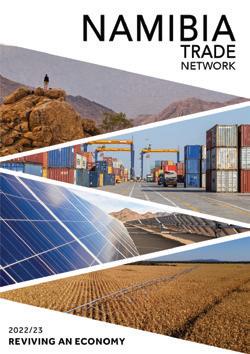









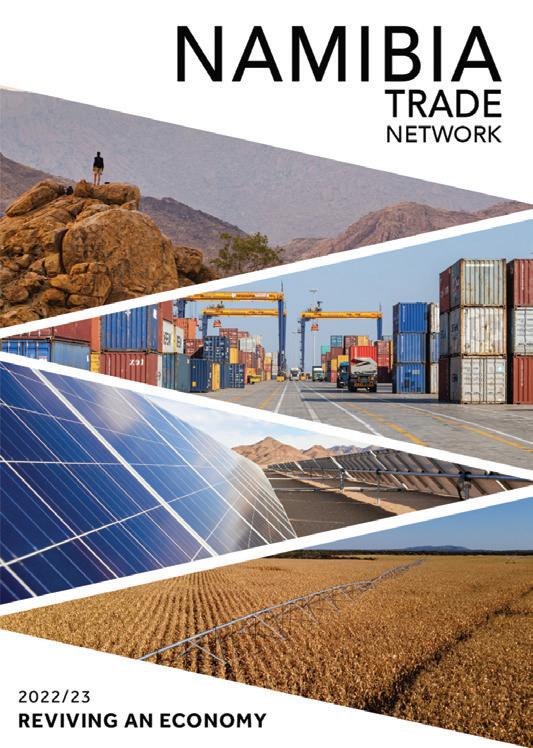
It is my distinct pleasure to present to you the 31st edition of the Namibia Trade Network (NTN) 2022/2023. This year’s theme, “Reviving an Economy”, is timely and relevant as it comes at a time when the country is making great strides towards economic recovery. It also signifies the role played by various stakeholders to realise the much-needed aggregate economic restoration and growth. It is therefore important to acknowledge the interventions made by the Namibian government to mitigate the impact of the Covid-19 pandemic on the economy through a combination of support measures as well as other assistance provided by various stakeholders. These actions largely cushioned the economy from the worst effects of the crisis.
The Namibian government recognises the importance of public and private sector engagements in responding to the various challenges facing our economy, including spearheading private sector development and shaping the country’s developmental agenda and aspirations. It is therefore worth noting that there are indicators which suggest that the economy is buoyant and recovery is taking place post the lifting of Covid-19 restrictions by the government, while being cognisant of the challenges posed by the Ukraine-Russia war with growing concerns about commodity shortages. Fuel prices, in particular, have underpinned the rise in inflation across countries, including Namibia, and the resulting rise in the prices of basic commodities has put pressure on households and businesses whose incomes have already been hit by a series of shocks.
The recovery of key sectors, such as tourism, mining and agriculture, and the resumption of major trading activities with large multiplier effects on the rest of the economy are crucial in driving economic growth. Equally, new diversification initiatives such as green energy, manufacturing, logistics and services have a lot of potential, while ICT and digital transformation present new opportunities that must be exploited in the economic recovery process.
Our “Growth at Home” strategy emphasises the need for increased value addition to our locally available resources and inputs for greater socio-economic benefits at home where such resources originate. This is also crucial for self-sustenance and increased exports. The government has thus resolved to support commodity-based industrialisation by putting the right policies and regulatory framework in place, which can serve as a launching pad for long-term product diversification and competitiveness.
In this regard, the implementation of economic revival initiatives, including the diversification of economic activities such as exports opportunities, may lead to positive spillover effects. There is thus a need to support businesses, especially MSMEs, and ensure informal sector development. It is further vital to enhance targeted investment promotion from both domestic and foreign sources, as well as skills development in highly sought fields. The combined efforts of private and public sector stakeholders are critical for Namibia’s recovery. This will go a long way
toward instilling optimism and increasing investor confidence.
This year’s edition of the NTN provides vital information on the Namibian business landscape and I wish you a pleasant read as we are recovering as a country from the economic hard knocks.
Iipumbu, Minister of Industrialisation and Trade
Brand Namibia belongs to us all 28 Mapping Namibia’s post Covid-19 economic recovery 29
Thinking out of the box can contribute towards economic recovery 30 Using alternative building materials to revitalise growth in the construction sector 31
Penduka Social Enterprise: Playing their part in reviving the Namibian economy 32
Business and Intellectual Property Authority (BIPA) 50
Namibia Employers' Federation (NEF) 51
Susan Nel 51
Research@Tribefire 52
Dr Weder, Kauta & Hoveka Inc 53
Kalahari Holdings (Pty) Ltd 54 Francois Erasmus and Partners 56
Namibia University of Science and Technology (NUST) 60
University of Namibia (UNAM) 61
African Leadership Institute (ALI) 62 Learn on One 63
Bank of Namibia 66 Development Bank of Namibia (DBN) 69
Allan Gray Namibia 70 Alexander Forbes 72 NAM-MIC Holdings 73 Capricorn Group 74 M&G Investments 76 EY 78
FNB Namibia 80
Government Institutions Pension Fund (GIPF) 82
Königstein Capital 84 Nedbank CIB 86
Old Mutual Namibia 88 RMB 90 Standard Bank 92
Namibia Fish Consumption Promotion Trust (NFCPT) 96
Erongo Marine Enterprises 98 Gendev Fishing Group 98 Etosha Fishing 100 Hangana Seafood (Pty) Ltd 100
Renaissance Health Medical Aid Fund (RMA) 102
EMed Rescue 24 104
Namib Laboratories 106
Medipark Ongwediva 107
Windhoek Eye Centre 108
Medical Rescue Africa (MRA) 109 Olympia Eye & Laser Centre 110
The Communications Regulatory Authority of Namibia ( CRAN) 114 Green Enterprise Solutions (Pty) Ltd 116 MultiChoice Namibia 118 MTC 119 PowerCom (Pty) Ltd 120 Telecom Namibia 122
TOURISM
Vital Contacts 146
Ongava Game Reserve 147 Namibia Wildlife Resorts (NWR) 148 Journeys Namibia 149
Guans Packaging (Pty) Ltd 126 Neo Paints 128 Namib Mills (Pty) Ltd 129
Debmarine Namibia 132 NAMCOR 134
Dundee Precious Metals Tsumeb 135 NAMDEB 136
Namibia Power Corporation (NAMPOWER) 138
Oshakati Premier Electric (Pty) Ltd 142
FP du Toit Transport Group 152 Manica Group Namibia 153 MVA Fund 154
Namibian Ports Authority (NAMPORT) 156 FlyNamibia 157 The Logistics Company Namibia 159 Pupkewitz Motors 160 Walvis Bay Corridor Group 162 Westair Aviation 165
Namibia Investment Promotion and Development Board (NIPDB) 167 MSME Listing 170
Vital Contacts 171
Index 179 Omake Moments 181
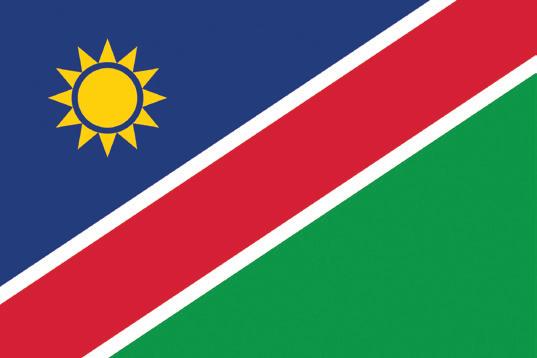
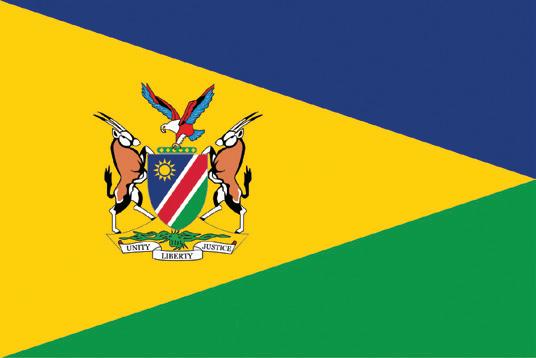
Namibia is ranked amongst the world’s most politically stable countries. The Namibian government is committed to stimulating economic growth and employment through the attraction and retention of investments.
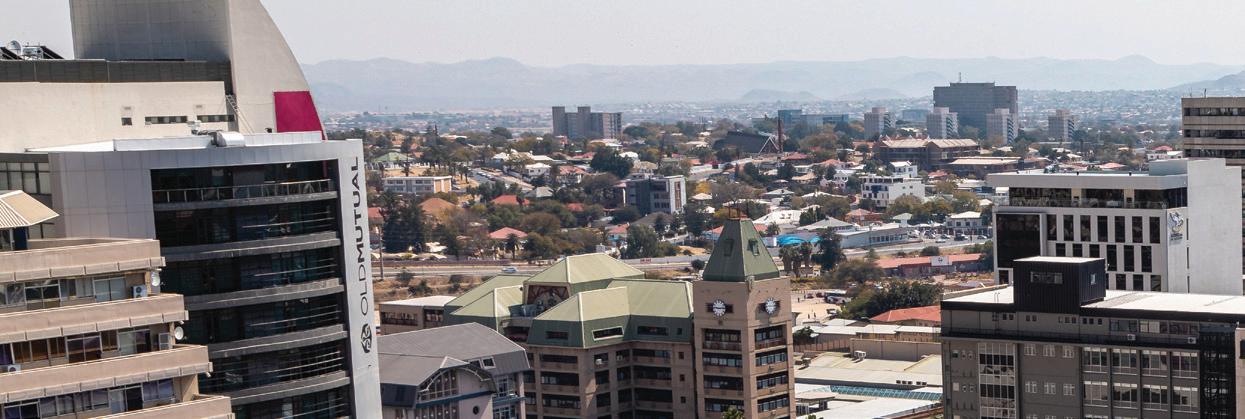
Namibia is strategically located on the southwestern coast of Africa and serves as a quintessential trade conduit with the rest of the world for landlocked neighbouring countries such as Botswana, Zambia, Zimbabwe and the Democratic Republic of Congo through the port of Walvis Bay. Compared to other ports in the region, the congestion-free port of Walvis Bay offers shipping lines time savings of up to five days to Europe and the Americas, and is a springboard into the Southern African Development Community (SADC) trade block, with a market access of 330 million people.
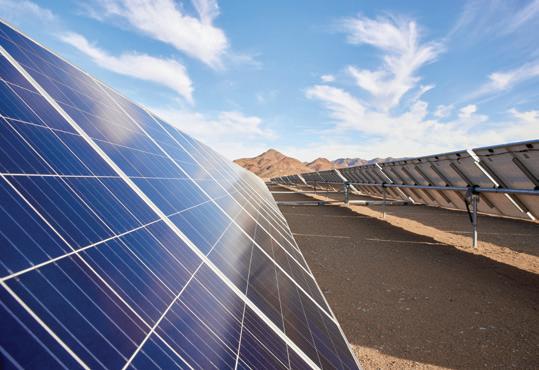
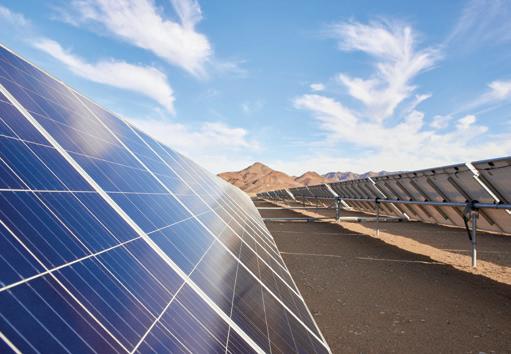
Namibia is endowed with natural wind and sun resources, and is considered to be amongst the most competitive (solar and wind energy) destinations in the world with the potential to become a producer and exporter of green hydrogen, reckoned to catalyse the decarbonisation of the planet.
Namibia’s primary infrastructure is well-developed and modern, with the road infrastructure quality ranked the best in Africa, an efficient communication system with global cellular networks and globally competitive broadband, as well as a sophisticated financial sector. The economy is mostly export-driven, with mining, tourism, fishing and agriculture being Namibia’s key sectors.
• African Continental Free Trade Area (AfCFTA)
• African Growth and Opportunity Act (AGOA)
• Namibia-Zimbabwe Preferential Trade Agreement
• Southern African Customs Union (SACU)
• Southern African Customs Union (SACU) - European
• Free Trade Association (EFTA)
• Southern African Customs Union (SACU) -
• Common Market of the South (MERCOSUR)
• SACU - Mozambique - United Kingdom (UK) Economic
• Partnership Agreement (EPA)
• Southern African Development Community (SADC)
• Southern African Development Community (SADC) - European Union (EU) Economic Partnership Agreement (EPA)
• World Trade Organisation (WTO)
The Namibia Investment Promotion and Development Board (NIPDB) serves as the first-point contact for potential investors and provides comprehensive services from the initial consulting stage to the operational stage. The NIPDB also provides general information and advice on investment opportunities, incentives and procedures.
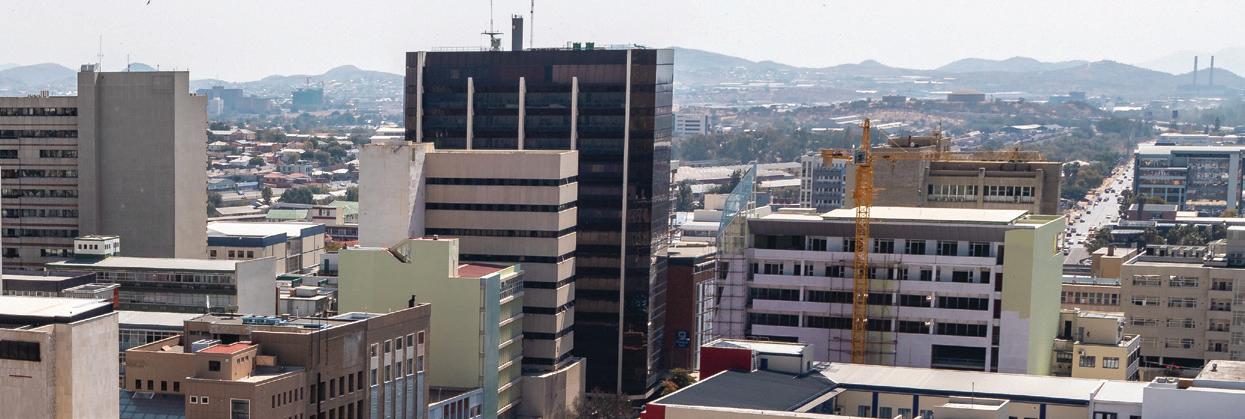
The task of the NIPDB is to help investors reduce red tape by liaising with government departments and regulatory agencies, including obtaining work visas for foreign investors. The government of Namibia, therefore, welcomes and encourages foreign investment to help develop the national economy for the benefit of the people.
• 2nd in Africa, World Press Freedom Index – Reporters Without Borders (2022)
• 1st in Africa for the past five years, Quality and Connectivity of Road Infrastructure, Global Competitiveness Report – World Economic Forum (2019)
• 1st in Africa (6th globally), Global Gender Gap – World Economic Forum (2021)
• 6th in Africa, Corruption Perception Index – Transparency International (2021)
• 7th in Africa, Good Governance – Mo Ibrahim Foundation (2020)
• Top 10 in Africa, Investment Attractiveness Index, Annual Survey of Mining Companies – Fraser Institute (2021)
Fraser Institute Annual Survey of Mining Companies Ranking, 2021
WORLD
Policy perception 2 29 Political stability 1 20 Security indices 1 30 Geographical database 1 22
Namibia’s foreign investment policy is governed by the Foreign Investment Act No. (27 of 1990 - FIA). The aim of the Act is to address and stimulate foreign investment in Namibia. The Namibia Investment Promotion Act (NIPA) is currently under review and will replace the FIA.
Since 2016, Namibia has been hit by a series of negative events, including a commodity price downturn, an extended sub-continental drought and, like the rest of the world, the Covid-19 pandemic. The combination of these negative trends has amplified the cyclical nature of Namibia’s economy.
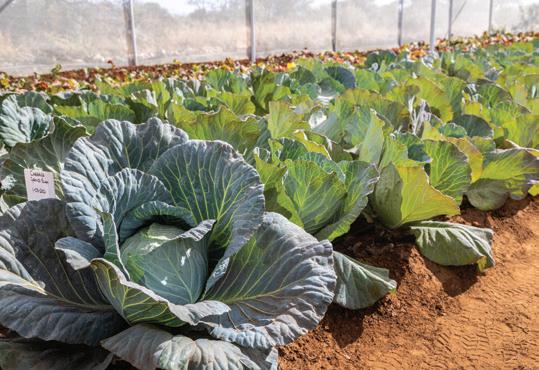
As part of a high-level intervention to reduce the impact of these events, the government of Namibia engaged the Harvard Kennedy School’s Growth Lab in 2019 with the aim of creating a roadmap to more sustainable economic development and growth. A joint team of representatives from the Bank of Namibia (the country’s central bank), Ministry of Finance and Public Enterprises, the National Planning Commission, Ministry of Industrialisation and Trade, and the Harvard Growth Lab has been shepherding the process alongside other Namibian stakeholders.
The work Namibia has been doing with the Harvard Growth Lab predominantly focuses on:
• Diagnosing structural deficiencies in the economy
• Assessing and understanding the country’s economic complexity shortcomings
• Identifying specific strategies which could address the lack of economic depth
One of the major objectives that emerged from this research and analysis was the development of the Country Economic Diversification Strategy to address core issues impacting Namibia’s economy. The strategy is expected to:
• Reduce exposure to commodity price fluctuations and cycles
• Develop new sectors and products in the economy
• Focus on services and the economic value they create
• Increase economic complexity by facilitating the conversion of primary products from the commodities sector into secondary products
• Create new sectors and industries that will support the country’s energy transition ambitions, making Namibia a continental leader in the green economy
Economic
•
Tourism and hospitality have become synonymous with Namibia. The contribution of tourism to the national GDP was about N$7 billion, the third largest contributor after mining and agriculture. Conservation is a cornerstone of the Namibian experience, as Namibia was the first African country to incorporate protection of the environment into its constitution.
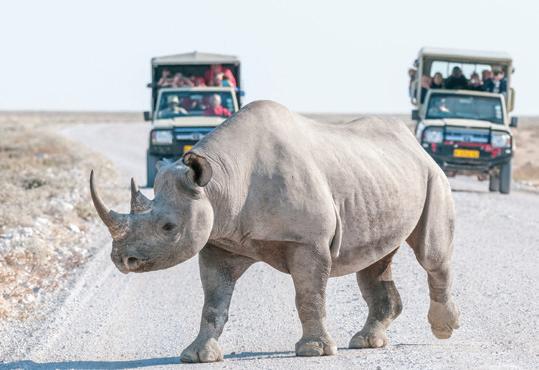
Natural resources, especially in the form of natural beauty, are abundantly available.

SERVICES (DIGITAL & GLOBAL BUSINESS)
Areas of investment opportunity
• Call centres, training centres, and business process outsourcing centres
Why invest?
• Advanced digital infrastructure
• Excellent national connectivity
• Linguistic prowess
• English as the only official language – many
• citizens also fluent in German, Portuguese,
• French, Spanish & Mandarin
Areas of investment opportunity
• Top 10 producer of diamonds
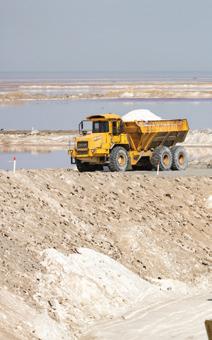
• Fourth largest exporter of non-fuel minerals in Africa and fourth largest producer of uranium oxide
• Significant natural resources
• Very well established local & regional mining industries
• Established salt & plastics industries
• Green hydrogen developments
• Oil & gas finds
• Diversification & quality employment
Areas of investment opportunity
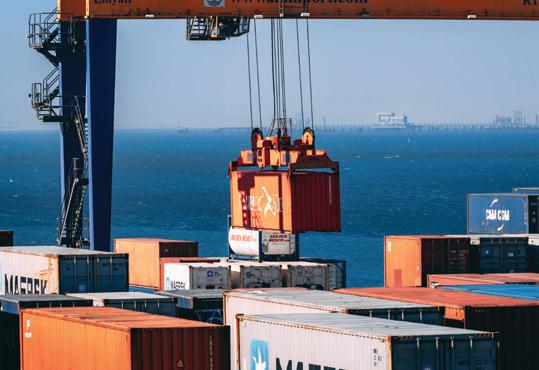
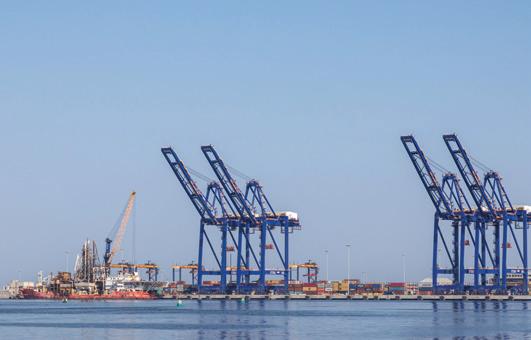
The transportation and logistics industries have always been lucrative and are expected to grow exponentially as both the local and regional economies grow and become even more interconnected.

Why invest?
• Market access
• Logistical hub
• Available workforce
• Regional resources
• Diversification & quality employment
The Namibia Investment Promotion and Development Board (NIPDB) exists to unlock opportunities that enable a better quality of life for all Namibians. We do this by facilitating trust relationships to attract and retain sustainable investment for private sector-led and inclusive economic growth. As part of our statutory mandate, the Board also aims to improve Namibia’s competitiveness score, develop the required skills for sustainable investments that lead to job creation, and create an enabling ecosystem for MSME’s to thrive and scale.
The Namibia Investment Promotion and Development Board (“NIPDB”), is a Non-profit association incorporated under section 21 of the Companies Act, Act No. 28 of 2004 (“the Companies Act”). The Board was established as an autonomous entity in the Office of the President and is declared a Public Enterprise in accordance with section 2 of the Public Enterprise Governance Act, Act No 1 of 2019.
The Board commenced operations in January 2021, taking over the functions of its predecessor, the Namibia Investment Centre (under the Ministry of Industrialisation and Trade) to become the lead investment promotion agency for Namibia.
The NIPDB is mandated to promote and facilitate investment by foreign and Namibian investors, and coordinate MSME activities across all levers of the
economy, with the aim of contributing to economic development and job creation. In terms of investment promotion, the Board serves as the first point of call for potential investors wanting to do business in Namibia. Our aim is to make Namibia the investment destination of choice by improving the ease of doing business here and improving the country’s competitiveness. In the MSME space, the Board coordinates and implements programs and policies that will create an enabling ecosystem for MSMEs & Startups.
The NIPDB is mandated with the following functions, amongst other things:
• Promote and facilitate investment by foreign and Namibian investors and New Ventures that contributes to economic development and job creation;
• Implement Namibia Investment Policy and attendant Strategy;
• Review and propose policy reforms and measures to support trade and investment promotion, conducive labour market policies, improve the country’s Competitiveness and the Ease of Doing Business;
• Develop and implement branding interventions that promote Namibia as an attractive investment destination;
• Develop institutional mechanism and assume lead coordinating role across all levers for SME Development nationally;
• Implement the National MSME Policy of 2016;
• Promote regional Special Economic Zones that leverage the geographic comparative advantages of each region; and
• In collaboration with relevant stakeholders, facilitate collaborative roles between the Government and private sector to stimulate the growth, expansion and development of the Namibian economy.
Unlocking opportunities: enabling a better quality of life for all Namibians
Ms. Kauna Ndilula



Martin Shipanga Ms. Hilger Vendura Mr. Hans Gerdes Ms. Dagmar Honsbein



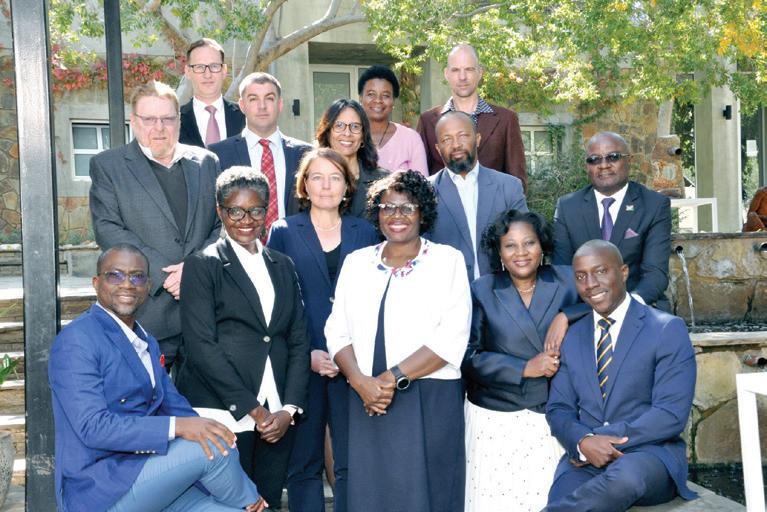
Mr. Vetumbuavi Mungunda Mr. James Mnyupe Mr. Stefan Hugo
 Advisory Board
Ms. Nangula Uaandja Chairperson and Chief Executive Officer
Mr. Francois van Schalkwyk Executive Director: Investments and New Ventures
Mr. Dino Ballotti Executive Director: MSME Development, Innovation & Acceleration
Mr. Richwell Lukonga Chief Operating Officer
Ms. Jessica Hauuanga Head of Department: Investor Experience, Retention and Aftercare
Ms. Margareth Gustavo Executive Director: Strategy and Branding
Advisory Board
Ms. Nangula Uaandja Chairperson and Chief Executive Officer
Mr. Francois van Schalkwyk Executive Director: Investments and New Ventures
Mr. Dino Ballotti Executive Director: MSME Development, Innovation & Acceleration
Mr. Richwell Lukonga Chief Operating Officer
Ms. Jessica Hauuanga Head of Department: Investor Experience, Retention and Aftercare
Ms. Margareth Gustavo Executive Director: Strategy and Branding
The Namibia Trade Forum (NTF) is an agency of the Ministry of Industrialisation and Trade (MIT) whose main mandate is to institutionalise public-private dialogue and cooperation with emphasis on international and domestic trade and investment policies as stipulated by the National Development Plans.
The role of the NTF is to act as the main consultative body representing private sector views to the government. We drive smart dialogue between the public and private sector in order to influence trade policy, economic growth and a conducive business environment.
The NTF thus serves as the highest public-private dialogue institution on international and domestic trade and investment matters of government. It achieves this function through various means such as workshops, seminars, trade negotiations, meetings ,media releases etc.
+264 61 235 237 info@ntf.org.na www.ntf.org.na
A broad range of financial products, as well as financing for PPPs engaged in developing infrastructure, is provided by the Development Bank of Namibia (DBN) for priority development projects.
+ 264 61 290 800 info@dbn.com.na www.dbn.com.na
Expect more.
The NCCI’s brand promise is to be “A premier voice for business in Namibia.” Its core functions include: Outgoing and incoming business missions Certificates of Origin
The Chamber provides trade and investment facility related advisory services to its members and non-member institutions. The service is rendered through consultancy to individual business leaders and covers, amongst others:
• Business support by providing accurate and up to date information regarding export- import regulations, investment requirements, licensing requirements and more.
• Business matchmaking like B2B or B2G meetings
• Support in trade missions and exhibitions
• Industry representation in international trade negotiations or facilitation meetings
+264 61 228 809 info@ncci.org.na www.ncci.org.na
The Walvis Bay Corridor Group is a facilitation centre and one-stop shop coordinating trade along the four Walvis Bay Corridors linking Namibia and the ports of Walvis Bay and Lüderitz to the rest of the SADC countries.
+264 61 251 669 marketing@wbcg.com.na www.wbcg.com.na
One is too small a number to achieve greatness.
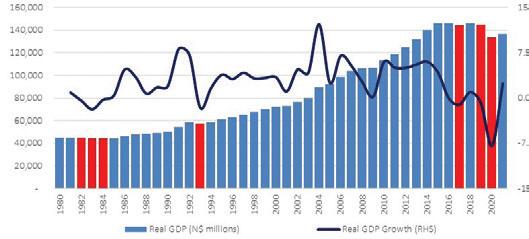
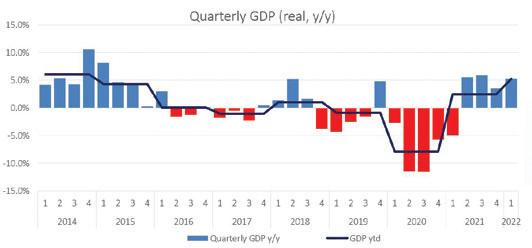
Preliminary National Accounts data from the Namibia Statistics Agency shows that Namibia recorded real GDP growth of 2.4% in 2021. While this is the quickest annual growth rate since 2015 it is lacklustre in the context of the low base set in the prior year. The NSA revised up real output for 2020 in the latest National Accounts release, bringing the contraction for the pandemic year to 7.9%, the deepest on record. The hard lockdown measures implemented in 2020 resulted in almost all sectors of the economy contracting, bar water supply (with the completion and inflows into Neckartal Dam), healthcare services and information and communication services. Output in 2021 benefitted from a less restrictive operating environment but was more severely impacted from a healthcare perspective. Supply chain challenges and reduced tourist numbers added to the drag on activity during the year.
from-home” trend as well as increased internet usage in general. Financial Intermediation contracted by 20.6% in 2021, with banks suffering from margin compression, while Insurance services posted growth of 11.6%. Real estate and business services growth was inline with that of the economy as a whole, a further symptom of the lacklustre business and consumer demand already noted.
Public Administration and Defence, or government output ex health and education, remained relatively flat in 2021, growing by just 0.5%. This mirrors guidance provided in the budget documents for the year. Fiscal consolidation remained in effect during the year and the freeze on hires and salaries remained in place. Education posted growth in line with the overall economy as well, while healthcare services expanded by 4.5%, with overall government expenditure on healthcare buoyed by the vaccination drive and increase in personnel needed to this regard. Finally, Taxes (less subsidies) posted a strong recovery, growing by 17.1%, off an admittedly very low base in 2020.
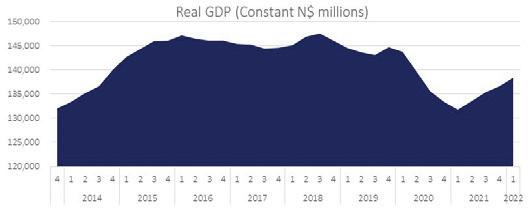
As is evident in the below figure, GDP remains below peak levels and may take some time to reach the high-water mark recorded in 2018 (which was only slightly above that of 2015). Present levels of output were last seen in 2014, illustrating the extent to which the extreme measures implemented to reduce the spread of Covid-19 impacted the economy.
Source: NSA, IJG SecuritiesMuch of the growth recorded in 2021 was as a result of growth in mining output as a recovery in global demand and supply chain disruptions pushed commodity prices to elevated levels. Within the sector growth came primarily from uranium, gold, lead, salt and marble production. Notably, uranium production almost reached 2018 levels, and the value of uranium exported surpassed 2018 levels as prices in both the spot and long-term market improved significantly. Agriculture, Forestry and Fishing was a slight drag on overall growth, with fishing and crop farming performance weighed down by a slight contraction in the livestock sector.
Secondary industries all recorded contractions with manufacturing output dropping by 6.2%, while electricity and water contracted by 5.7% and construction slumped 10.2%. The contraction in Manufacturing output was due to the beneficiation of basic non-ferrous metals coming to a halt as the Skorpion Zinc mine and smelter was put on care and maintenance. Bar this subsector manufacturing outperformed 2020 modestly. The construction sector has been particularly hard hit since the government embarked on its fiscal consolidation exercise, recording six years of consecutive contractions. In real terms the sector’s output in 2021 was only 30% of that of 2015.
Tertiary industries, although slow to recover, posted moderate growth in 2021. Importantly, wholesale and retail trade posted positive growth for the first time since 2016, indicating a potential floor in consumer sentiment was reached during the pandemic from which further recovery is likely. Output for the sub-sector was however still below 2013 levels, illustrating the depth of the contraction in consumer demand. The Hotels and Restaurants subsector recovered with an increase in tourist activity, although such recovery was still impacted by the prevalence of the Delta variant in Southern Africa. Information and Communication continued to benefit from the “work-
Source: NSA, IJG SecuritiesThis does however not mean that the Namibian economy has not posted a reasonable recovery in recent quarters. On the contrary, a closer analysis of the data shows that Namibia has recorded four consecutive quarters of growth on a year-on-year basis as at 1Q22, with three of these quarters posting growth of over 5.0%. Of concern rather is the fact that the Namibian recovery has lagged the rest of the world.
 Source: NSA, IJG Securities
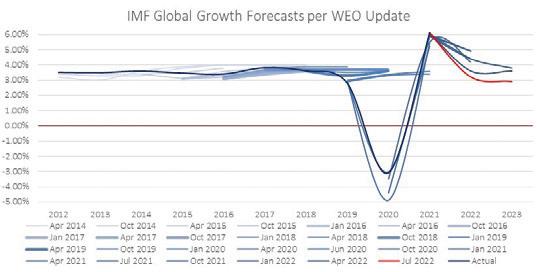
The IMF estimates global GDP growth of 6.1% in 2021, a significantly quicker pace of recovery than that experienced domestically. This was despite global supply chain challenges and some not insignificant restrictions on
movement. Part of the reason for the rapid recovery lies in the fact that many countries did not experience as deep a recession as Namibia did. Many countries, especially in the developed world, embarked on expansive fiscal policy, supporting businesses and individuals to a much greater extent than was possible in Namibia after years of tight fiscal conditions and low revenue growth. Similarly monetary policy was pushed to the extremes in many markets, with central banks emboldened by the relative success of such measures implemented during the decade following the global financial crisis. The lack of fiscal capacity in Namibia to deal with crises has long been warned about and the impact thereof is evident in the slow relative pace of recovery currently being experienced.
internally and lower production for export, both of which are expected to put further downward pressure on commodity prices. Exacerbating this outlook is a drop in global demand due to tighter monetary conditions brought about by unyielding inflation. Further concerns stem from risks that the continuation of lockdown measures and slowed growth in China pose on the Chinese property market. A full-blown property crisis in China would be felt across the globe.
A third key theme in terms of the global macroeconomic outlook is inflation. The US, UK and Europe are all experiencing multi-decade high inflation at present and central banks are tightening monetary policy in response. The historically low interest rates applied to economies ravaged by governments’ reactions to the pandemic are now a thing of the past. At least in the short term. The US Federal Reserve has embarked on a rate hiking cycle, as has the Bank of England and the European Central Bank. Inflation, last year dismissed as transitory by these central banks, has remained and gained further steam. The implications of this are tighter monetary policy and higher interest rates globally, at least in the short term. The South African Reserve Bank (SARB) and Bank of Namibia (BoN) have already embarked on monetary tightening in order to prevent excessive currency depreciation and the cost push inflation it drives.
A few short months ago a more rapid Namibian recovery seemed imminent. Global demand was driving commodity prices ever higher and Namibia, already a beneficiary of much renewed interest in mineral exploration, was ideally positioned to take advantage of elevated zinc, tin, copper, gold and uranium prices. A new Debmarine diamond mining vessel further added to the mining sector outlook for the year. Agriculture was set to benefit from one of the better rainy seasons of the last decade. A rebound in manufacturing activity was taking place with various sub-sectors well placed to benefit from growth in primary sector activities. The outlook was decidedly rosier than had been the case for some time.
On the 24th of February that outlook turned uncertain when Russia invaded Ukraine. The consequences of this action were not immediately evident and commodity prices and financial markets did not initially overreact to the increased geopolitical tensions. Russia’s invasion was met with a host of economic sanctions by most western countries, but military intervention was largely limited to Ukraine’s own efforts supported by arms from the US and a host of European countries. Ukraine’s leadership successfully rallied much support from Western leaders and sentiment has thus far favoured increased Western action against Russia. Russia however held two trump cards up its sleeve, namely Europe’s dependence on Russian gas and the sympathies of a number of key non-Western countries that continue to support Russian trade, such as India and China. Thus, the conflict has become an economic headwind which may take some time to blow over. Thus far the impact has largely been negative for Europe where energy prices have skyrocketed. This in turn has negatively impacted consumer demand and business input costs and production. The immediate implication for Namibia is that commodity prices, especially copper, zinc and tin, have declined substantially from their recent highs.
Another key theme with regard to commodity prices has been the continuation of lockdowns and production halts in China on the back of Covid-19 outbreaks. These measures are expected to lead to a sharper decline in growth in China this year which means slower demand growth
Thus, the global macroeconomic environment has deteriorated since the start of 2022, and the global headwinds that plagued early 2021 have reemerged to give context to Namibia’s economic outlook. Interest rates are rising, commodity prices have retraced, recessionary concerns have emerged in the US and Europe, geopolitical tensions have escalated into conflict and the world’s second largest economy, China, is showing signs of instability. The global macroeconomic environment and growth outlook thus exhibits significant downside risks which inform the outlook for the domestic economy.
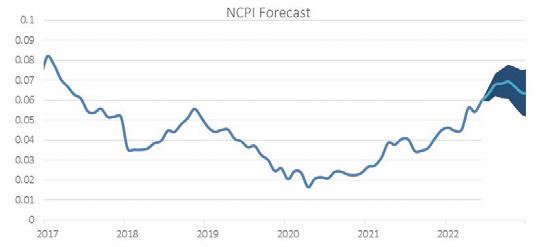
While global inflation has pushed up to multi-decade highs, Namibian Consumer Price Inflation (CPI) has remained within the SARB’s target band of 3.0% to 6.0% for the first six months of 2022. June CPI printed 6.0%, the highest rate of inflation since 2017 but by no means extraordinary for Namibia. For the most part “Food and non-alcoholic beverages” and “Transportation” have been the drivers of inflation during the year. Housing costs have tethered overall inflation somewhat as the largest CPI basket item only experienced price increases of 1.4% y/y. There is certainly more inflation to come though as higher transport costs filter through via second round effects on the prices of other goods and services, but runaway domestic inflation is unlikely. Elevated levels of inflation are detrimental to demand, especially when higher costs are driven by external factors, but current forecasts are tempered by a deterioration in the global outlook and as such should not act as a major drag on economic activity. We do expect inflation to reach 7.0%, or even higher, before the end of the year after which it is likely to taper if global economic headwinds remain.
 Source: NSA, IJG Securities
Central banks globally are responding to high inflation by tightening monetary policy. The US Federal Reserve hiked rates for the first time in three years in March this year, while the Bank of England embarked on its rate hiking cycle in December last year. The European Central Bank has been slow to the party, hiking rates in June, the first hike in eleven years in the Eurozone. Developed market central banks are prioritising efforts to slow inflation over supporting growth. The implication of this is the spill-over of higher interest rates into emerging market economies in an effort to support currencies and negate supply side inflation.
The SARB hiked rates for the first time in this cycle in November 2021, and has subsequently hiked four more times bringing the repo rate to 5.5% in July from 3.5% in October last year. The SARB’s proactive rate hike in November caught many by surprise but has been supportive of the currency, with subsequent hikes of larger magnitude bringing benchmark rates closer to pre-pandemic levels. By historic standards benchmark rates in both South Africa and Namibia are still accommodative with Namibia’s repo rate set to rise in August to a level in-line with the bottom of the global financial crisis induced rate cutting cycle, previously the most accommodative interest rate levels seen since independence.
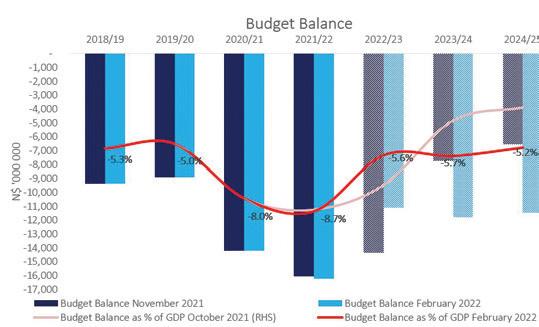
Fiscus and the Budget Government’s fiscal position for 2022/23 looks somewhat rosier than was the case in 2021/22. For the 2022/23 budget year the Ministry of Finance and Public Enterprises expects to receive N$59.68bn and spend N$70.77bn. Revenue expectations for the year starting April 2022 are up by 10.8% from the 2021/22 mid-year budget review, and 11.7% higher than in 2021/22. Expenditure is budgeted to grow by 3.8% versus prior expectations, or some 1.6% more than what was spent in 2021/22, this excludes the recently announced increase in the public sector wage bill, which is expected to amount to N$924m. The deficit for 2022/23 is thus expected to decline to N$11.09bn (N$12.4bn should the wage bill increase be funded through debt) or 5.6% of GDP, a significant improvement from the 7.3% deficit expected in last year’s mid-year review.
Source: BoN, SARB, IJG SecuritiesThus, while monetary policy is tightening domestically, interest rates remain accommodative and debt servicing costs cheap. Interest rates are expected to continue their upward trajectory over the short term, but are unlikely to put much pressure on Namibian economic activity unless the magnitude of hikes necessary to maintain the rand at reasonable levels pushes interest rates past pre-pandemic levels. This is unlikely in the context of slower global growth. And while some developed market central banks have been unexpectedly hawkish in favouring more rapid monetary tightening, this sentiment may shift quite quickly in the event that global GDP growth underperforms expectations.
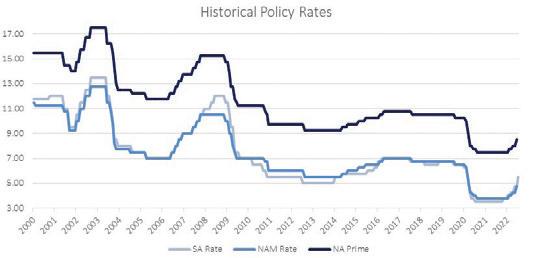
Interest rates returning to pre-pandemic levels will also have a positive impact on bank margins in Namibia. Banks have been particularly cautious in the very low interest rate environment brought on by the pandemic, and some margin expansion may allow increased credit extension and a willingness to apply capital accumulated over recent years. Non-performing loans remain high and impairment charges may continue to be elevated when compared to historic measures, but moderately higher interest rates should still be positive for credit extension which would aid domestic investment as well as consumption.
On balance the interest rate environment is tilted ever so slightly to the negative as domestic monetary conditions tighten along with global monetary policy, but interest rates are unlikely to be a major drag on economic activity unless developed market central banks pursue more aggressive than expected policy in the face of growing uncertainty.
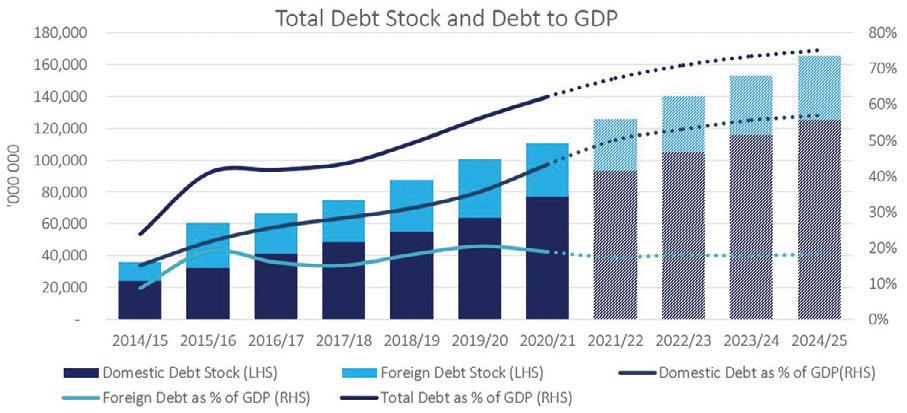
Source: MoF, IJG SecuritiesThe funding requirement for the current year is N$19.38bn, significantly lower than the N$30.40bn requirement in 2021/22, but still substantial. After debt rollovers are accounted for N$11.03bn in net debt is expected to be raised in the domestic market which will push up domestic debt stock to N$104.60bn. This is assuming that the recent wage increase will be accommodated within the current expenditure ceiling. Government debt is expected to reach N$140.19bn or 71.0% of GDP in 2022/23 after accounting for foreign debt. This is largely in line with prior expectations. The quantum of debt, however, continues to raise some difficult questions. Over N$100bn worth of debt has been raised in just eight years, and there are few productive assets to show for it.
Government’s budget ceiling has not expanded much over the years that fiscal consolidation was implemented. While described as pro-growth fiscal consolidation by the Ministry of Finance and Public Enterprises, the lack of growth in the expenditure ceiling has not contained growth in the operational portion of the budget but rather resulted in a decreased allocation to the development budget. Thus, while government was cautious to not act as a drag on economic activity, large deficits in combination with a shrinking allocation to productive expenditure has resulted in a large debt burden, growing debt costs and little increase in productive public assets as an enabler of economic activity. Yes, government has not put the brakes on the economy, but the fiscal consolidation exercise has resulted in a structurally less productive budget. As a result, government is not equipped to mitigate economic shocks. It is also unlikely to be a major driver of economic activity in the medium term despite reasonably strong revenue expectations for the current budget year.
Any evaluation of future economic activity would be amiss if not accounting for the recent offshore oil discoveries. In January, Shell announced encouraging early results from the Graff-1 exploration well, establishing the presence of a working petroleum system with light oil. Although no official estimates were provided on the size of the discovery, some researchers believe that the find could hold upward of 700 million barrels of oil equivalent.
A few weeks later, TotalEnergies announced that it too made a significant discovery of light oil with associated gas at the nearby Venus-1X prospect. Unofficial initial estimates suggested that the 2,700 sq. kilometre area could hold volumes of around 3 billion barrels, while others later claimed that recoverable reserves could exceed 10 billion barrels of oil equivalent. Appraisal drilling results are expected towards the end of the year and should provide a more accurate estimate of the actual reserves. Regardless of the exact size of the finds, the discoveries could have a profound effect on the size of the Namibian economy towards the latter part of the decade when extraction is expected to start.
In the near term however the discoveries are likely to impact government budget ceilings and allocations as certainty regarding the viability of exploiting the resource improves. Potential future windfall revenues remove some of the pressure on government to minimise debt issuance. Thus, as certainty improves around the viability of oil extraction it is likely that government could start playing an expansionary role in the economy once again. This should be prudently managed of course as the viability of oil production remains susceptible to production delays due to a complicated and expensive extraction process, macroeconomic shocks and future decarbonisation efforts.
It is unlikely that we will see the recent oil discoveries result in government playing such an expansionary role in 2022, but it is possibly a tailwind that might boost activity in subsequent years. The results of the planned appraisal processes at both discoveries could provide some implied guidance on government spending going forward and will be closely followed by both investors as well as creditors.
Economic growth for the year is forecast to come in at 3.3% in 2022, accelerating from the lacklustre growth of 2021. Much of the growth is expected to come from the primary sectors, with diamond mining providing for a substantial portion of the expansion. The new Debmarine vessel, the MV Benguela Gem, is projected to increase diamond production by roughly
500,000 carats per year. And while the outlook for commodities is less positive halfway through 2022, the increase in diamond production alone is enough to push the sector’s growth rate to over 10%.
Livestock production is also contributing meaningfully to growth in the current year, with the first half of the year already posting 20% growth in cattle marketed versus the prior year. The herd restocking exercise is yielding fruit and good rainfall has supported production, at least with regards to cattle. Smallstock is expected to be a drag on the sector with early reports indicating a marked contraction in the sub-sector. The improvements in number of cattle marketed should buoy the sector overall though.
Secondary industries, while expected to grow somewhat, are not expected to reach levels of output seen before the pandemic. Water and electricity production should grow modestly, and manufacturing continues to recover slowly while construction activity remains relatively stagnant.
Tertiary industries are exhibiting mixed performance with sectors such as tourism recovering from an extremely low base in prior years while wholesale and retail trade struggles to gain momentum as unemployment increases brought on by recession and the pandemic are slow to reverse. High inflation, primarily due to fuel prices and transport costs, is likely to temper demand in the second half of 2022, but despite this we expect a modest expansion in wholesale and retail trade and other consumer driven sectors. Real incomes in Namibia have been under pressure for more than half a decade now and consumption growth has languished as a result.
Headwinds to a more rapid expansion in the second half of 2022 and thereafter are, as mentioned before, global inflation and monetary tightening which threaten to close the taps on the accommodative post pandemic environment that was in place until early this year. The Russian invasion of Ukraine is likely to be a medium-term theme, adding to energy costs and creating uncertainty with regard to global food production. Namibia’s economy is often referred to as small and open and the potential for economic shocks has grown. The Namibian economic recovery remains under threat and the fiscus has few tools with which to protect against economic shocks. The outlook is uncertain and warrants prudent management by fiscal and monetary authorities in the near term. The longer-term outlook is likely to be significantly better if the recent oil discoveries translate to oil production.
Eric van Zyl | Managing Director Designate Danie van Wyk | Sales and ResearchGroup Chairman
Mathews Hamutenya Tel: +264 (61) 256 699
Managing Director Designate




Eric van Zyl
Tel: +264 (61) 383 530 eric@ijg.net
Equity & Fixed Income Dealing
Leon Maloney
Tel: +264 (61) 383 512 leon@ijg.net
Group Managing Director Mark Späth Tel: +264 (61) 383 510 mark@ijg.net
Group Financial Manager Helena Shikongo Tel: +264 (61) 383 528 helena@ijg.net
Financial Accountant
Tashiya Josua Tel: +264 (61) 383 511 tashiya@ijg.net
Financial Accountant
Gift Kafula Tel: +264 (61) 383 536 gift@ijg.net
Managing Director René Olivier Tel: +264 (61) 383 520 rene@ijg.net
Wealth Administration Lorein Kazombaruru Tel: +264 (61) 383 521 lorein@ijg.net
Managing Director
Jakob de Klerk Tel: +264 (61) 383 517 jakob@ijg.net
Managing Director Herbert Maier Tel: +264 (61) 383 522 herbert@ijg.net
Portfolio Manager Ross Rudd Tel: +264 (61) 383 523 ross@ijg.net
Wealth Administration Madeline Olivier Tel: +264 (61) 383 533 madeline@ijg.net
Business Analyst
Mirko Maier Tel: +264 (61) 383 531 mirko@ijg.net
Settlements & Administration
Maria Amutenya Tel: +264 (61) 383 515 maria@ijg.net
Sales and Research Dylan van Wyk Tel: +264 (61) 383 529 dylan@ijg.net
Group Compliance Officer Zanna Beukes Tel: +264 (61) 383 516 zanna@ijg.net
Sales and Research
Danie van Wyk Tel: +264 (61) 383 534 danie@ijg.net
Sales and Research
Josh Singer Tel: +264 (61) 383 514 josh@ijg.net
Money Market & Administration Emilia Uupindi Tel: +264 (61) 383 513 emilia ijg.net
Wealth Manager Wim Boshoff Tel: +264 (61) 383 537 wim@ijg.net
Wealth Manager
Andri Ntema Tel: +264 (61) 383 518 andri@ijg.net
Director Jolyon Irwin Tel: +264 (61) 383 500 jolyon@ijg.net
Broker
Ursula Gollwitzer Tel: +264 (61) 383 535 ursula@aldesnamibia.com
Broker
Richard Hoff Tel: +264 (61) 383 500 richard@aldesnamibia.com
Business Analyst Lavinia Thomas Tel: +264 (61) 383 532 lavinia@ijg.net
Value Add Analyst Fares Amunkete Tel: +264 (61) 383 527 fares@ijg.net
Photography credit: Namibian Presidency, Parliament of Namibia
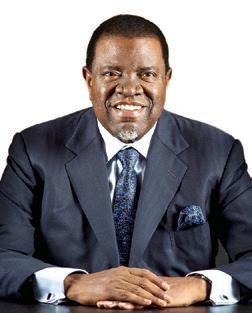
H.E. PRESIDENT DR. HAGE GEINGOB
State House, 1 Engelberg Street, Auasblick Private Bag 13338, Windhoek +264 61 270 7878 www.op.gov.na
EXECUTIVE DIRECTOR
Amb. Claudia Grace Uushona +264 61 270 7787 / 7789
Grace.Uushona@op.gov.na / Laimi.Nembia@op.gov.na
Mr. Moses Pakote +264 61 270 7430 Moses.Pakote@op.gov.na
MINISTER IN THE PRESIDENCY
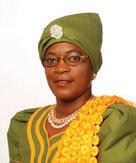
Hon. Christine //Hoebes
State House, 1 Engelberg Street, Auasblick Private Bag 13339, Windhoek +264 61 270 7829 / 245 989 Ivan.Chilinda@op.gov.na
Private Sector Interface
Mrs. Inge Zaamwani-Kamwi
+264 61 270 7783
Inge.Zaamwani@op.gov.na
Policy Implementation and Monitoring Vacant
+264 61 270 7808 Penny.Akwenye@op.gov.na
Press Secretary
Dr. Alfredo Hengari +264 61 270 7812 Alfredo.Hengari@op.gov.na
OFFICE OF THE FIRST LADY Madam Monica Geingos
1 Engelberg Street, Auasblick Private Bag 13339, Windhoek +264 61 270 7806 flon.admin@op.gov.na
PUBLIC RELATIONS OFFICER
Mr. Dennis Shikwambi +264 61 279 7431 +264 81 256 3526 dshikwambi@op.gov.n a
LIAISON OFFICER
Ms Yvonne Amukwaya +264 61 270 7544 +264 81 156 7801 Yvonne.Amukwaya@op.gov.n a
VICE PRESIDENT
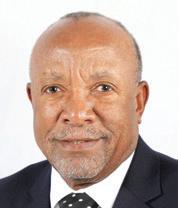
H.E Dr Nangolo Mbumba
Old State House, Robert Mugabe Avenue Private Bag 13338 Windhoek +264 61 270 7202 Elina.kamalanga@op.gov.na
Youth Matters & Enterprise Development
Ms Daisry Mathias
+264 61 270 7811 Daisry.Mathias@op.gov.na
Community Co-ordination and Liaiso n
Vacant
+264 61 270 7918 Mavara.Shikongo@op.gov.na
Economic Adviser
Mr. James Mnyupe +264 61 270 7815 James.Mnyupe@op.gov.na
PRIME MINISTER
Rt. Hon. Dr. Saara
Kuugongelwa-Amadhila
Private Bag 13338
Robert Mugabe Avenue Parliament Gardens +264 61 287 9111 +264 61 287 2002 / 2082
Eveline.Shoongo@opm.gov.na / Salome.DuPlessis@opm.gov.na www.opm.gov.na
DEPUTY PRIME MINISTER
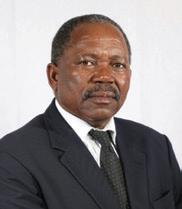
Hon. Netumbo Nandi-Ndaitwah
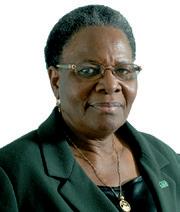
Robert Mugabe Avenue Green Office Park +264 61 282 2146
ppaulus@mirco.gov.na / tamkongo@mirco.gov.na
Mr I-Ben Natangwe Nashandi +264 61 287 2004
PS@opm.gov.na / Heidi.Isaac@opm.gov.na
MINISTER
Hon. Doreen Nampiye Sioka

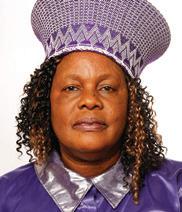
Private Bag 13359, Windhoek Juvenis Building Independence Avenue +264 61 283 3206 / 3111 Doreen.Sioka@mgecw.gov.na / Emilie.Sivhute@mgecw.gov.na www.mgecw.gov.na
DEPUTY MINISTER
Hon Bernadette Maria Jagger +264 61 283 3208 David.Kulunga@mgecw.gov.na
EXECUTIVE DIRECTOR
Ms. Esther Lusepani +264 61 283 3122 Miyaze.Walubita@mpesw.gov.na
PRESIDENCY DISABILITY AFFAIRS
Deputy Minister
Hon. Alexia P.T. Manombe-Ncube +264 61 296 3112/3056 Wilma.Bruwer@mova.gov.na
MARGINALISED COMMUNITIES
Deputy Minister
Hon. Royal /Ui/o/oo +264 61 283 3272/3 Royal@mova.gov.na
MINISTER
Hon. Albert Kawana Private Bag 13338, Windhoek Cohen Building, Kasino Street +264 61 292 2051 / 2111 Minister.Pa@mha.gov.na

DEPUTY MINISTER Hon. Daniel V. Kashikola +264 61 292 2016 frieda.hamukoto@mha.gov.na
MINISTER
Hon. Frans Kapofi
Private Bag 13307, Windhoek Bastion 1, Sam Nujoma Drive Tel: +264 61 204 2005 / 9111 min@namdefence.org www.mod.gov.na
DEPUTY MINISTER
Hon. Hilma Ndinelago Nicanor
Tel: +264 61 296 3021 depmin@namdefence.org
EXECUTIVE DIRECTOR
Mr. Etienne Maritz Tel: +264 61 292 2017 executive.director@mha.gov.na
EXECUTIVE DIRECTOR
Commissioner (rtd) Trephine P Kamati Tel: +264 61 204 2055/6 ps@namdefence.org
MINISTER Hon. Iipumbu Shiimi Fiscus Building John Meinert Street Private Bag 13295, Windhoek +264 61 209 2930 / 9111 / 2931 secretary.minister@mof.gov.na www.mof.gov.na
DEPUTY MINISTER Hon. Maureen HindaMbuende +264 61 209 2933
EXECUTIVE DIRECTOR
Ms. Ericah B. Shafudah +264 61 209 2829 / 2929 erica.shafudah@mof.gov.na
MINISTER
Hon. Lucia Megano Iipumbu Private Bag 13338, Windhoek Block B, Brendan Simbwaye Square, Cnr of Dr David Kenneth Kaunda & Goethe Street Tel: +264 61 283 7334 / 9111 Lucia.Iipumbu@mit.gov.na www.mti.gov.na
DEPUTY MINISTER Hon. Verna Sinimbo +264 61 283 7329 Verna.Sinimbo@mit.gov.na
EXECUTIVE DIRECTOR
Mr. Sikongo Haihambo +264 61 283 7332
Sikongo.Haihambo@mit.gov.na
MINISTER Hon. Calle HG. Schlettwein Private Bag 13338 Government Office Park Luther Street +264 61 208 7111 www.mawf.gov.na

DEPUTY MINISTER Hon. Anna Ndahambelela Shiweda +264 61 208 7644 +264 61 208 7729

MINISTER Hon. Erastus Amutenya Uutoni Private Bag 13338, Windhoek Government Office Park, Block D Luther Street +264 61 297 5215 / 5111 pkayoko@murd.gov.na www.murd.gov.na

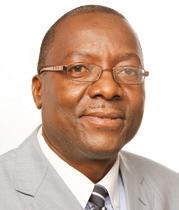
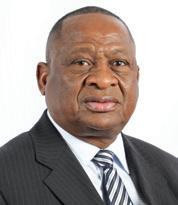
DEPUTY MINISTER Hon. Natalia /Goagoses +264 61 22 5712 deputyminister@murd.gov.na
EXECUTIVE DIRECTOR
Mr. Percy Misika +264 61 208 7648 ED@mawf.gov.na
MINISTER Hon. Dr Kalumbi Shangula Private Bag 13338, Windhoek Old State Hospital, Harvey Str Windhoek West +264 61 203 9111 / 2010 minister.secretary@mhss.gov.na www.mhss.gov.na
DEPUTY MINISTER Hon. Esther Utjiua Muinjangue +264 61 203 2010 d.minsterpa@mhss.gov.na
EXECUTIVE DIRECTOR
Mr. Nghidinua Daniel +264 61 297 5181 ndaniel@murd.gov.na akahamupembe@murd.gov.na
EXECUTIVE DIRECTOR
Mr. Benetus Nangombe +264 61 203 2019 Ben.Nangombe@mhss.gov.na
MINISTER
Hon. Anna Ester Nghipondoka
Private Bag 13186, Windhoek Government Office Park, Luther Street +264 61 293 3369 / 3111 / 3345 Sec.Minister@moe.gov.na www.moe.gov.na
DEPUTY MINISTER
Hon. Faustina Namutenya Caley +264 61 293 3307 Sec.DepMinister@moe.gov.na

EXECUTIVE DIRECTOR
Ms. Sanet L. Steenkamp +264 61 293 3524 ps.secretary@moe.gov.na Sanet.Steenkamp@moe.gov.na
MINISTER
Hon. Dr. Itha Kandjii-Murangi Private Bag 13338, Windhoek Government Office Park Luther Street +264 61 293 3111 / 435 6333 Secretary.Minister@mheti.gov.na

MINISTER
Hon. John Mutorwa Private Bag 13341, Windhoek 6719 Bell Str, Snyman Circle Rebother Road +264 61 208 8812 Maureen.Meyer@mwt.gov.na www.mwtc.gov.na
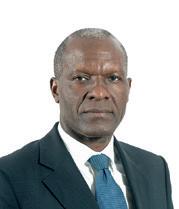
DEPUTY MINISTER
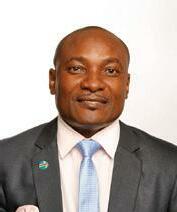
Hon. Veno Kauaria +264 61 435 6000 secretarydepminister@mheti.gov.na
EXECUTIVE DIRECTOR
Dr. Alfred Van Kent +264 61 435 6008/7
Anthea.Dewee@mheti.gov.na / Alfred.Vankent@mheti.gov.na
DEPUTY MINISTER Hon. Veikko Nekundi +264 61 208 8810
EXECUTIVE DIRECTOR
Ms. Esther Kaapanda +264 61 208 8822
Monica.Uupindi@mwt.gov.na
MINISTER Hon. Pohamba Shifeta Private Bag 13306, Windhoek Philip Troskie Building Dr. Kenneth Kaunda Street +264 61 284 2335 / 2111 privatesecretary.minister@met.gov.na www.met.gov.na
MINISTER
Hon. Tom K. Alweendo Private Bag 13338, Windhoek Mines & Energy Building 6 Aviation Road +264 61 284 8111 / 8318
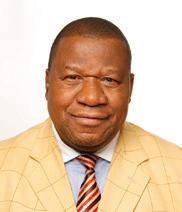
Tom.Alweendo@mme.gov.na info@mme.gov.na www.mme.gov.na
DEPUTY MINISTER Hon. Heather Sibungo +264 61 202 3607
EXECUTIVE DIRECTOR
Mr. Teofilus Nghitila +264 61 284 2333 pa.ed@met.gov.na
DEPUTY MINISTER Hon. Kornelia Kashiimbindjola Shilunga +264 61 284 8314 Kornelia.Shilunga@mme.gov.na
EXECUTIVE DIRECTOR
Mr. Simeon N. Negumbo +264 61 284 8219
Simeon.Negumbo@mme.gov.na
MINISTER
Hon Derek Klazen
Private Bag 13355, Windhoek Brendan Simbwaye Square Cnr Kenneth Kaunda and Goethe Street +264 61 205 3101 / 3084 gregentia.shikongo@mfmr.gov.na
MINISTER
Hon. Yvonne Dausab
Private Bag 13248, Windhoek Justicia Building, Independence Ave Tel: +264 61 280 5262 / 281 9111 Minister@moj.gov.na www.moj.gov.na
DEPUTY MINISTER
Hon. Silvia Makgone +264 61 205 3104 Silvia.Makgone@mfmr.gov.na
EXECUTIVE DIRECTOR
Ms. Annely Haiphene +264 61 205 3007 / 2106
Annely.Haiphene@mfmr.gov.na
Ms. Felicity Owoses +264 61 280 5344 felicity.owoses@moj.gov.na
MINISTER Hon. Utoni Daniel Nujoma
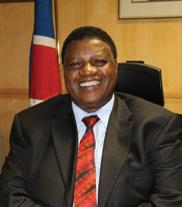
Private Bag 19005, Windhoek 32 Mercedes Str, Khomasdal +264 61 206 6111 / 6321 / 6305 Anna.Salkeus@mol.gov.na annemarie.johannes@mol.gov.na www.mol.gov.na
DEPUTY MINISTER Hon. Hafeni Ludwigh Ndemula +264 61 206 6326 bernathe.situde@mol.gov.na
EXECUTIVE DIRECTOR
Mr. Bro-Matthew Shinguadja +264 61 206 6324
Bro.Matthew.Shinguadja@mol. gov.na
MINISTER Hon. Agnes Basilia Tjongarero Private Bag 13391, Windhoek NDC Building, 4 Goethe Str +264 61 270 6510 / 6111 minister.Secretary@msyns.gov.na www.msyns.gov.na
DEPUTY MINISTER Hon. Emma KantemaGaomas +264 61 270 6535 dmin.Secretary@msyns.gov.na
EXECUTIVE DIRECTOR
Dr. Audrin Mathe +264 61 270 6528 ps.secretary@msyns.gov.na ED.Secretary@msyns.gov.na
MINISTER
Hon. Dr. Peya Mushelenga
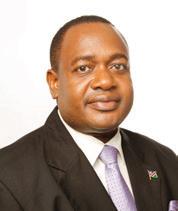
Private Bag 13355, Windhoek 2nd Floor, West Wing Government Offices, Love Street +264 61 283 2388 / 9111 Peya.Mushelenga@mict.gov.na www.mict.gov.na
DEPUTY MINISTER

Hon. Emma Theofelus
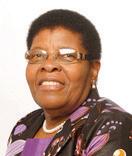

Tel: +264 61 283 2346 Emma.Theofelus@mict.gov.na
EXECUTIVE DIRECTOR
Mr. Mbeuta Ua-Ndjarakana +264 61 283 2387
Mbeuta.Ua-Ndjarakana@mict. gov.na
DEPUTY PRIME MINISTER & MINISTER
Hon. Netumbo NandiNdaitwah
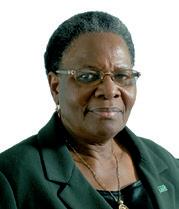
Fourth Floor, West Wing Dr. Theo-Ben Gurirab Building Private Bag 13347, Windhoek +264 61 282 2146 / 9111 minister@mirco.gov.na www.mirco.gov.na
DEPUTY MINISTERS
Hon. Jennelly Matundu +264 61 282 2140 jmatundu@mirco.gov.na
EXECUTIVE DIRECTOR
Mr. Pendapala Naanda +264 61 282 2150/2 headquarters@mirco.gov.na
NATIONAL PLANNING COMMISSION
Ms. Annely Haiphene +264 61 2834225/195 AHaiphene@npc.gov.na CFrans@npc.gov.na
ANTI CORRUPTION COMMISSION
Hannu Shipena +264 61 435 4047 hshipena@accnamibia.org
OFFICE OF THE JUDICIARY
Ms. Rolanda van Wyk +264 61 435 3405 ps@jud.gov.na PA.PS@jud.gov.na
PRESS SECRETARY
Dr. Alfredo Tjiurimo Hengari +264 61 270 7812 Alfredo.Hengari@op.gov.na
OFFICE OF THE AUDITOR-GENERAL
Mr. Junias Etuna Kandjeke
123 Robert Mugabe Avenue. Windhoek Namibia P/Bag 13299, Windhoek +264-61-285 8000 info@oag.gov.na
NATIONAL ASSEMBLY
Ms. Lydia Kandetu +264 61 2882502/1/3 L.kandetu@parliament.na p.frederik@parliament.na
CHIEF ELECTORAL COMMISSION
Theo Mujoro +264 61 376 203 tmujoro@ecn.na
NATIONAL COUNCIL Adv. Tousy Namiseb +264 61 202 8014/5 tnamiseb@parliament.na m.walenga@parliament.na m.karongee@parliament.na
OFFICE OF THE FORMER PRESIDENT
54 Robert Mugabe Avenue Private Bag 13338, Windhoek 264 61 377 704
OFFICE OF THE FOUNDING PRESIDENT
54 Robert Mugabe Avenue Private Bag 13220, Windhoek +264 61 377 700
The Ministry of Industrialisation and Trade is charged with the responsibility to develop and manage Namibia’s economic regulatory framework, promote economic growth and development through the formulation and implementation of appropriate policies to attract investment, increase trade, develop and expand the country’s industrial base and enable equitable participation in the domestic and international markets.
To create an enabling environment for increased domestic and foreign direct investment (FDI), trade and industrial development, and to position and safeguard the interests of Namibia in the regional and global economy. The Ministry of Industrialisation and Trade is responsible for the development and management of Namibia’s economic regulatory regime, the basis on which the country’s domestic and external economic relations are conducted. It promotes growth and development of the economy through the formulation and implementation of appropriate policies to attract investment, trade, as well as develop and expand the country’s industrial base.
To be the leading ministry in the drive towards industrialisation, the realisation of an export-driven economy and making Namibia a preferred FDI destination to achieve increased and sustainable economic benefits and employment for Namibians and to be able to compete internationally.
Brendan Simbwaye Square, Block B
Cnr. Dr. Kenneth Kaunda & Goether Streets +264 61 2837223
Elijah.Mukubonda@mit.gov.na www.mit.gov.na
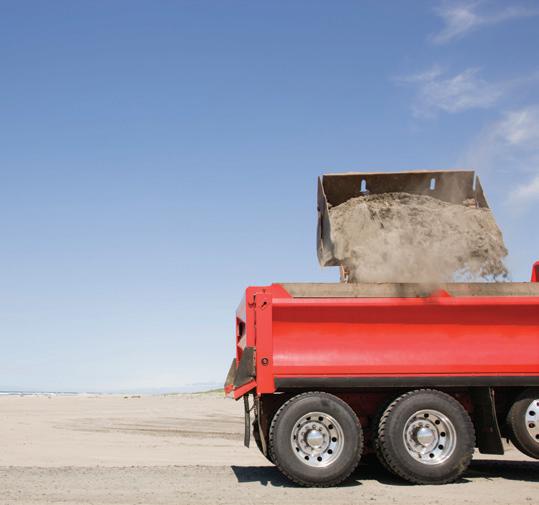
This segment seeks to advance inculcating service areas offered by the ministry to its stakeholders (internal and external). These include support services for micro, small and medium enterprises (MSMEs), such as liquor licencing, SME certification, business plan applications, feasibility studies, product development and testing, skills development, group training, mentorship, environmental impact assessments, market research, and the provision of information on trade and industrialisation statistics.
By extension, these services also embrace all programmes designed to assist MSMEs, including but not limited to:
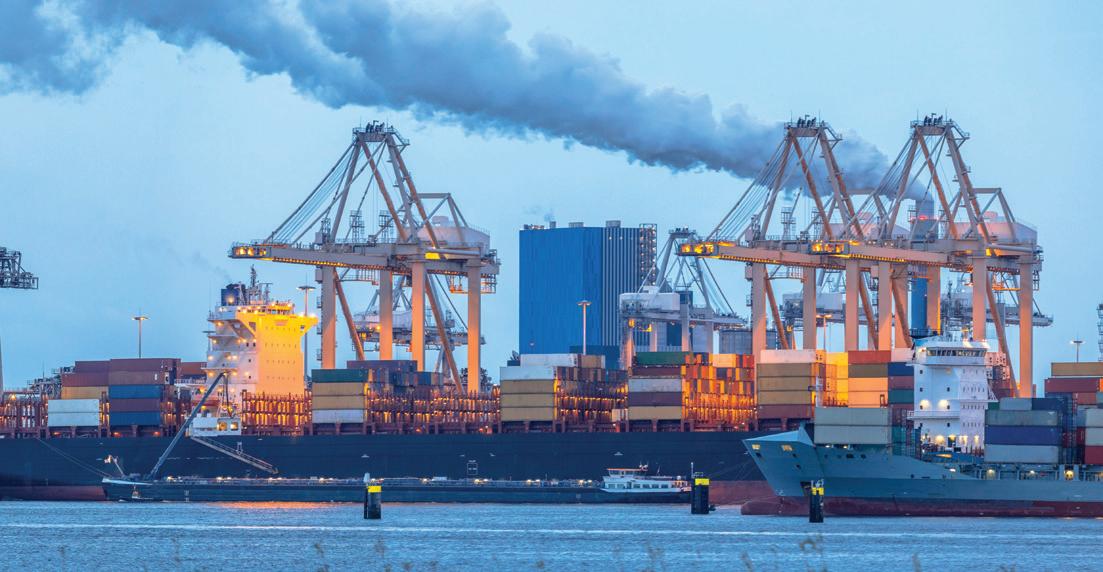
(a) StartUp Survival Grant: Aimed at supporting various start-ups and small growing businesses to endure most of the Covid-19 pandemic.
(b) SDG Impact Facility: Providing mentorship grants and debt financing to women and youths in business, social enterprises and MSMEs, as well as addressing one of the key challenges faced by MSMEs, which is access to affordable finance.
(c) Empretec: The Government of the Republic of Namibia and United Nations Development Programme (UNDP) identified the need to support entrepreneurs in the country with the establishment of EMPRETEC Namibia for the development of entrepreneurship skills for enterprise expansion. The overall objective for EMPRETEC Namibia is to support entrepreneurship and enterprise development in the country using the EMPRETEC model’s best practice.
d) IUMP: A grant scheme designed to enhance productivity and competitiveness of selected firms, focusing on firmlevel diagnosis
The mandate of the NIPDB is quite extensive, she shares. However, according to her, two elements are critical, namely an increase in employment in the country as well as the improvement of Namibia’s trade account. ‘“And that, of course, comes with two (further) things: Number 1 is really to promote investment; to bring investment to Namibia; to promote local investment and to promote Namibia as a preferred investment destination.
“Number 2 is to support our start-ups, small and medium-sized enterprises (SMEs) and make sure that we coordinate SME activities in our country across all levers of the economy. There are a lot of supporting activities but in brief that is our mandate.”
She is a fervent believer in collaboration and cooperation. Therefore Uaandja believes that every Namibian has a role to play in fulfilling the NIPDB’s mandate. “I consider my team to be the entire Namibia. One of my favourite authors, John Maxwell, says: ‘One is too small a number to achieve greatness.’ If we want to achieve greatness, we need all Namibians on board to help make sure that we make this mandate a reality.”
Using the analogy of a bleeding patient arriving in a casualty ward, Uaandja says under those circumstances, there is no time to establish what had caused the bleeding: you just have to stop the bleeding.
She and the team have hit the ground running and are continuing to do so. “While we all want the luxury of time to first put in place policies, structures and frameworks, we don’t have that luxury.”
Uaandja attributes another analogy 'The Sand Box Concept' to the Governor of the Bank of Namibia (BoN), Johannes Gawaxab, which just means that we should be in a live experiment at present. “You do and as you do, you put the policies in place, and with that of, course, there is a number of mistakes that one can make, but you need to make sure that you learn from your mistakes and that you collaborate with other people so that they can support you.”
Nangula Nelulu Uaandja, the chief executive officer (CEO) at the Namibia Investment Promotion and Development Board (NIPDB), says someone recently captured the essence of the concept of resilience: the ability to bounce back fast after a setback.
Known for her direct and no-nonsense approach, the former managing partner of auditing giant PricewaterhouseCoopers (PwC) says resilience starts with policy agility. “One of the discussions that we are having in the economic sphere is how do our policies, how does our economy support the bouncing back of companies.”
As a case in point, she says, a closer look needs to be had at Namibia’s current insolvency and business rescue policies and legislation.
She acknowledges that there is room for improvement, especially as far as it relates to business rescue support. Given the high-level priority which this enjoys, the head of state, President Hage Geingob has recently established a committee that would be directly tasked with business rescue, Uaandja says.

Another critical component that capacitates business and economic resilience relates to the scope and magnitude of the country’s and the company’s reserves to help it withstand pressure and shocks. “Even the ants store food and our ability to bounce back depends on our reserves,” she says.
Testimony to her approach to her roles and responsibilities, Uaandja says resilience equally depends on one’s spirit. According to her, one’s personal push and one’s leadership approach are key in building resilience of spirit.
It is no secret that 2020 – as a result of the Covid-19 pandemic and resultant regulation to arrest its further spread – has had a devastating impact – not only on the local economy but on the global economy, Uaandja emphasises.
This has resulted in a decrease of approximately 11% in foreign direct investment (FDI) in subSaharan African countries, she says.
Before the advent of the pandemic, Namibia had already been struggling regarding FDI, she admits, especially since 2015. By 2019, Namibia’s FDI had recorded a negative figure, following a downward trajectory.
Since then, efforts to turn the situation around are slowly starting to bear fruit, Uaandja says. Notwithstanding the devastation given rise to by the Covid-19 pandemic, Namibia’s FDI has seen some improvement over the last year in particular, Uaandja says. According to her, positive FDI to the tune of N$250 million has been recorded during the last quarter of 2020.
Due to the restrictions in place to curb the further spread of the pandemic, having in-person conversations with prospective investors has without a doubt been a challenge, she states.
Fortunately, for her and her team, virtual engagements were already the order of the day by the time they hit the ground running at the start of 2021, Uaandja says. “So, yes, 2020 has been devastating to our economies, but as a people, we have definitely bounced back, and we are thinking of different ways on how to attract investment (to the country).”
Hope is on the horizon, though, she says. As matters stand at present, several potential investors have their eyes set on Namibia, according to her. During the times that they have been able and allowed to do so, regulations permitting, the Board has brought some of these potential investors to Namibia, shown them around in the country and engaged them in constructive conversation.
Part of their work also involves ironing out bureaucratic processes that could be dealt with more efficiently, the NIPDB CEO says. These have a direct impact on the country’s ability to secure FDI. “We have also been quite busy, working with various ministries and government departments, looking at some of the bottlenecks that investors might experience.”
These bottlenecks relate to but are not limited to delays with the issuing of permits, visas, or licences to enable the investors to operate businesses in the country. “We need to help them get those permits faster than they normally would.”
This would boost investment activities and support the growth of the economy, she says. “So, it has been quite an exciting journey, actually.”
Uaandja acknowledges that Namibia is not a perfect landscape. Challenges abound relating to unemployment, inequality and levels of poverty. For this purpose, we need all Namibians to alleviate the impact of these challenges and build the country’s economy, she pleads.
Building on her clarion call to every citizen in the Land of the Brave, Uaandja says Namibians who have a job or access to opportunities must give it their all and appreciate their privilege keeping in mind that one Namibian might have to go to bed hungry. She concluded: ‘I believe there is a lot of hope for Namibia. I believe that Namibia has a lot of potential, but that potential cannot be realised without the support of every one of us.”
On 22 February 2022, the Bank of Namibia hosted a seminar titled Mapping Namibia’s Post-Covid Economic Recovery, which advanced key strategies to address challenges impeding Namibia’s economic recovery. As a result, the seminar outlined specific evidence-based solutions for revitalising Namibia’s economy in the short to medium term. Covid-19 hit Namibia harder than South Africa and its peers because the country was already in a prolonged recession when Covid-19 struck. As a result, the entire economy experienced significant contraction and a slow recovery, particularly in tourism and manufacturing.
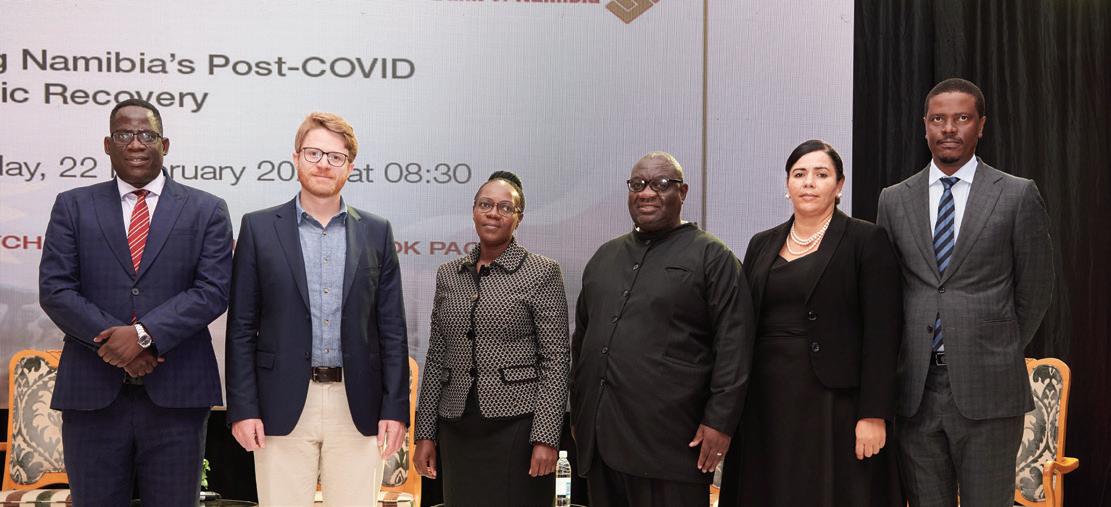
The seminar highlighted the barriers to structural economic transformation. These include a misaligned skills profile, and a relatively high tax burden for individuals and corporations compared to other countries. Other challenges identified include business-inhibiting regulations, access to capital, labour-market reforms, communal land reform, and the ease of doing business in Namibia.
The seminar emphasised the importance of Namibia optimising its natural resource stewardship, revamping the role of the public sector as an enabler for private sector-led growth, and creating opportunities that include Namibians in the growth process. Although not stimulating growth in the short run, the seminar noted that fiscal consolidation is required to restore fiscal stability.
Furthermore, the recovery of existing capacities, such as tourism postCOVID-19, and existing tradable activities with large multiplier effects on the rest of the economy, such as mineral resources and agriculture, must drive growth. Similarly, new diversification initiatives such as green energy, parts of manufacturing, logistics, and services have a lot of potential while the ICT and digital transformation are key enablers and represent new opportunities that must be exploited in the economic recovery process.
In this regard, Namibia’s recovery is dependent on how it implements the diversification plan of its economy currently being spearheaded by the government and the Harvard University Growth Lab. The seminar acknowledged that key products with export opportunities in food, metals, mining and adjacent industries, chemicals and basic materials, machinery and electronics, transportation and logistics identified through the diversification plan, can facilitate structural economic transformation.
The seminar identified access to financing and interventions aimed at preserving SMEs and putting them on a sustainable footing in order for them to thrive in a post-Covid-19 environment. Other recommendations include SME and informal sector development, targeted investment promotion from both domestic and foreign sources, as well as skills development.
Ensuring accountability in all government investments and achieving greater efficiency in government spending should be underscored. This can be accomplished through better prioritisation, which includes restructuring, liberalisation, and, if necessary, the closure of non-performing stateowned enterprises. The seminar also emphasised the importance of Namibian stakeholders cooperating and coordinating their efforts. This will foster a shared understanding of what needs to be done to address the challenges and aid in the recovery. The combined efforts of private and public sector stakeholders are critical for Namibia’s recovery. This will go a long way toward instilling optimism and increasing investor confidence.
The event brought together policymakers, business leaders, experts, representatives of civil society, professionals from local and international organisations, as well as academic institutions.
Ensuring accountability in all government investments and achieving greater efficiency in government spending should be underscored.Left: Dr. Postrick Mushendami, Mr. Rowland Brown, Dr. Emma Haiyambo, Mr. Sylvester Mbango, Ms. Leonie Dunn, Mr. Salomo Hei
Birgit Hoffmann is an internationally registered professional executive coach, as well as an industrial and organisational psychologist and a chartered public relations practitioner. Birgit combines over 20 years’ in-depth business knowledge with global training and accreditation as a professional certified coach (PCC) to bring her clients the benefits of fresh thinking and hands-on experience. It also brings a special quality and depth to her coaching.
As an ICF-credentialled coach, Birgit uses the integral coaching method. This compassionate way of coaching helps leaders through selftransformation while holding them accountable for their own development.

Birgit explains, “Fulfilment is a deeply felt experience that what we are doing, how we are living, and who we are becoming is meaningful and worthwhile. Steeped in wisdom from philosophy to neuropsychology to cognitive science and beyond, my way of working with clients is profoundly compassionate, grounded, and effective.”
The economic downturn and the Covid pandemic have led to a dramatic impact on health and psychological wellbeing overall and presents an unprecedented challenge to the world of work. The economic and social disruption caused is devastating.
To develop capacity in dealing with these challenges, coaching builds awareness, empowers choice and leads to change, in business and in life. Coaching is a key technique to consider when we might be looking for new direction. It gives individuals, companies and policymakers the permission to have a long, hard look at themselves and their way of doing things. Its non-judgemental approach and thoughtful two-way communication allow for out-ofthe-box thinking. Coaching is the ideal enabler of transformation and change, at individual, corporate or policy level.
An executive coach is a qualified professional that works with clients to help them gain selfawareness, clarify goals, unlock their potential, and act as a sounding board. The executive coach can be instrumental to the success of a company’s team since he or she will help concentrate a company’s development and improvement efforts. A coach with extensive knowledge and experience in organisational behaviour and rigorous psychological training will yield topmost results. When done well, executive coaching is a powerful and rewarding tool to improve the performance of executives and their organisations and will likely be well worth the investment.
Executive coaching is perhaps the most powerful approach to leadership development and transformation for senior leaders and high potentials who aspire to grow their careers. It is one of the most – if not the most – individually tailored practices in talent development as it involves a close and confidential relationship between the coach and the person being coached.
To understand what executive coaching is, it is helpful to look at the definition of coaching. According to the International Coach Federation (ICF), coaching is defined as “a partnership with clients in a thought-provoking and creative process that inspires them to maximise their personal and professional potential”. Key elements in this definition are partnering, thoughtprovoking, and maximising potential. These are the fundamentals that differentiate professional coaching from other forms of development. The value of a coach lies in his or her ability to serve as an insight-provoking partner, supporting the client to design his or her own actionable and sustainable strategies for success.
It is impactful in supporting people to develop skills that are effective in managing themselves in uncertainty, or a changing or challenging environment, by opening up new ways of thinking through self-reflection and collaborative dialogue. Through this, it brings new insights, growth and awareness, enabling an increase in the client’s reach, influence and impact.
In short, it helps the client focus on becoming a different observer, allowing him or her to take new and powerful action to take care of what matters most. When a country or organisation is under pressure, its players benefit from grounded, mindful reflection on its desired direction instead of continuing to do things in old, familiar ways.
Workplace coaching can be used in nearly any situation: to support organisational transformation, deal effectively with uncertainty and change, performance and career management, leadership development, personal wellbeing and effectiveness, strategic and policy dialogues, and deep reflection.
Executive coaching helps people find the resources within themselves to create sustainable transformation. Good coaches support delivering measurable bottom-line results at the same time. This makes it different to mentoring, consulting, or training. Leaders can transform their performance through working with a professional coach who offers both support and challenges.
Coaching is grounded in science and drives real behavioural change. According to the ICF, coaching improves work performance, team effectiveness, communication skills, executive presence, time management skills, and more. And the vast majority of companies agree that they at least made back their investment in coaching.
Coaching can develop inspirational leaders who are authentic – who can think deeply, reflect and use their understanding, awareness and confidence in themselves and others to unify groups, initiate action and catalyse development and progress.
Coaching is about making changes in behaviours that matter. It helps us achieve our purpose. And through that, achieving higher levels of performance and contributing to change.
Far beyond what we thought was possible…
www.coachfederation.org/find-a-coach/ benefits-of-coaching
flow requirements. This picture highlights the significant role that this sector plays in supporting the flow of money in the economy, particularly within the informal sector where there is high proliferation of micro and small-medium enterprises.
past. Proponents of alternative building materials also argue that timber is believed to be quite durable, with a lifespan of at least 50 years without any need for maintenance if done correctly.
Frans Uusiku | FNB Market Research Manager
Construction is a goodsproducing industry which supports both backward and forward linkages in the mainstream economy. In the Namibian context, however, the construction sector is highly vulnerable due to its historic overdependence on government development budget spending. The reduction of government development expenditure over the past five years due to the implementation of fiscal consolidation has done more harm to the sector than good, resulting in six consecutive years of contraction. Consequently, the sector’s contribution to national income dropped from 5.5% in 2015 to 1.8% in 2021. Despite its vulnerability to fiscal developments, the construction sector remains responsible for a relatively high share of overall formal employment in Namibia, estimated at 6%. What is more interesting to note is that most of these workers are classified as low-skilled workers, who may otherwise find it difficult to secure employment elsewhere, besides in the agriculture sector which also employs a large number of low-skilled workers. It is therefore unsurprising that the construction sector also accounts for a relatively high share (5.4%) of overall private sector credit extension, which stood at N$5.4 billion towards the end of 2021, due to high capital intensity and cash
Given this backdrop, the use of alternative building materials is one avenue through which to revitalise the sector through reductions in the cost of building, particularly for residential construction. The cost of building materials is known to account for the highest share in the total cost of building a house, with an average of about 60% of the total cost for building a new residential house. This points to the emergence and adoption of new technology with regards to building and the cost implication associated with such. According to the First Capital Building Cost Index, the building cost inflation accelerated to 7.1% in December 2021, reaching a five-year highest price level. In effect, high inflationary pressures have been observed on imported materials, such as steel, due to supply disruptions which are aggravated by rising fuel prices and overall production costs. With the housing supply in Namibia falling short of demand due to affordability issues and limited stock of affordable houses, this calls for innovative thinking around the application of building methods that aggressively support the mass housing development initiative.
The fundamental question, however, is: what are alternative building materials? There are divergent views on what constitutes alternative building materials. Some classify alternative building materials as traditional materials or materials that are not modern or conventional in nature. However, the simplest definition of alternative building materials is building materials that are alternative to conventional building materials in the form of total or partial substitution of the materials or its constituents for the purpose of reducing the cost, addressing environmental issues, or dealing with a lack of conventional materials. For instance, property developers could use timber for roof trusses instead of steel, given that the price for steel and/or anything with ore has gone up drastically in the recent
The use of alternative building material, therefore, holds significant potential to not only address the housing backlog in the country, but also in revitalising growth in the construction sector – which supports the large number of low-skilled workers in Namibia. Furthermore, residential construction contributes to the overall economy, both directly and indirectly through its linkages to employment and demand in financial and other services, as well as other goods-producing industries and utilities.
The simplest definition of alternative building materials is building materials that are alternative to conventional building materials in the form of total or partial substitution of the materials or its constituents for the purpose of reducing the cost, addressing environmental issues, or dealing with a lack of conventional materials.
When following global business news, it tends to be the mega enterprises which dominate the headlines. But bigger, as the saying goes, is not necessarily always better or more important, and small business is quite frankly big business, especially in developing countries where small social enterprises can form the backbone of the economy. According to the European Commission, the social entrepreneurship sector currently employs around 40 million people and engages over 200 million volunteers globally – and is growing. (Financier Worldwide 2022)
These businesses combine societal goals with an entrepreneurial spirit and focus on achieving wider social or community objectives. Advantages include the creation of sustainable jobs (reducing unemployment), particularly in rural areas or smaller communities where they provide innovative services and products not otherwise available through state or formal private sector involvement. While making a substantial contribution to help keep people at risk of social exclusion attached to the labour market by providing training and integration, social enterprises also help to build a resilient and pluralistic social market economy.
Following on the theme of social enterprises locally, Penduka, situated on the banks of the Goreangab Dam, is an ongoing success story, crafted by female hands. As one of the first social enterprises in Namibia focusing exclusively on serving and empowering women suffering the effects of unemployment and poverty, this proudly Namibian organisation was founded in 1992. Penduka employs social enterprise as a model with the sole aim of developing creative potential amongst women.
The name “Penduka” was appropriately chosen, as it originates from the Otjiherero and Oshiwambo languages and translates into “Wake up”. Penduka strives to encourage and propel women to take initiative to help themselves, increase their self-worth and confidence and in turn help break the cycle of unemployment.
Through following a holistic approach and establishing a positive and nurturing environment where women can develop and hone their unique inherent craft skills to create extraordinary handmade creations, these women have a real chance of joining the local economy and be able to provide for themselves and their dependents, whilst uplifting the broader community.
Currently, local impoverished women who, for the lack of capital, proximity or background – such as living in the rural areas without electricity and basic tools and who would not otherwise be able to enter the job market –are patiently taught hand-intensive techniques using very basic tools that enable them to generate income and establish self-worth.
Stubbornly committed to creating a long-standing impact in communities, Penduka endeavours to create a sustainable income and inclusive growth for each and every artisan with whom they collaborate.
Despite competing interests, artisan craft remains the second-largest employer in developing countries and is one of the main sources of income for both men and women who seek a sustainable livelihood.
Apart from its income-generating and creative aspects, practising crafts has proved to be an effective antidote to the stresses and pressures of
everyday life. In addition to being a practice in “mindfulness”, crafting is increasingly sought after for its mental and even physical health properties.
Accordingly, the skills taught and practised at Penduka aim to purposefully serve both as diversional therapy while at the same time developing creative skills towards empowering women. Penduka is therefore not only geared towards remedying social injustices, but also actively working towards a fortified state of mind, able to deal with the typical mental and emotional burdens brought on by enduring hardship.
In addition to creating and selling marvellous products, Penduka is also about telling the stories behind the items we produce, and the people who make them. We take immense pride and care in crafting each piece for our customers, understanding the value and significance that they hold. Our product line comprises a unique line of handmade homeware and embroidered products created with passion and dedication. We put meticulous effort into our work and firmly believe that our quality speaks for itself.
Fundamentally we uphold Fair Trade principles and our artisans reuse, reclaim and recycle materials wherever possible. In a world proliferated by industrialised products, we offer a different aesthetic option that is unique – no two pieces are exactly alike – and each article is lovingly created by human hands. We serve those who seek meaning in what they buy.
At Penduka we firmly believe that sustainable economies are developed from businesses which operate fairly and ethically and endeavour to maximise social impact alongside economic returns for beneficiaries. As a result, women who have accrued the necessary entrepreneurial skills are encouraged and continuously supported to start up their own enterprise.
Looking forward, Penduka ventures to expand our operations by increasing the number of women benefitting from the initiative while at the same time serving as a community centre and networking hub doling out advice on health, nutrition, family matters, recycling, alternative energy, and more.
As a social enterprise, Penduka continues to nurture existing and develop special new relationships with local women in marginalised communities throughout Namibia. Through empowering women, we inspire and enable them to cultivate lasting, positive transformation not only for themselves but also their families and the broader community in which they function.
However, and in as much as we celebrate social enterprises, we must also take a sober look at the challenges that are holding them back. The potential of social enterprises to contribute to economic growth depends to a large extent on a broader system of different layers in the society to influence and increase impact as a change agent. Their contribution can be enormously increased by policies in favour of their growth and the efficiency of the sector in general. The focus of these policies should be on providing the right environment in which social enterprises can thrive, as well as activities to promote social entrepreneurship and improve the legal and regulatory framework, financing, access to markets, services for business development and support structures, training and research. Against this background, much can still be done to support social businesses in Namibia and to create an enabling ecosystem for them.

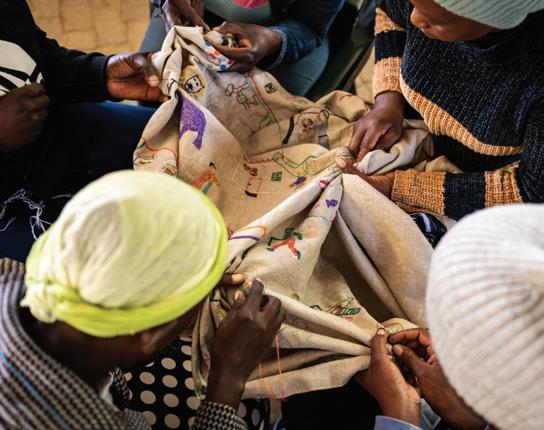
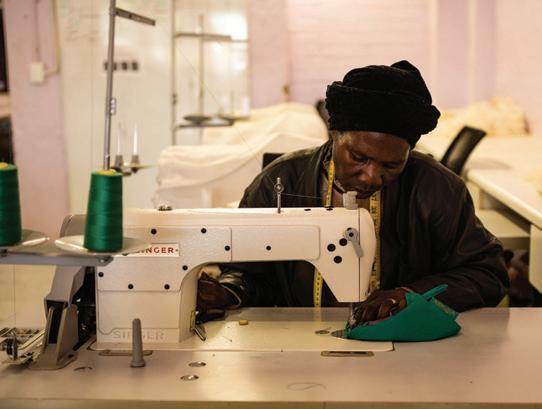
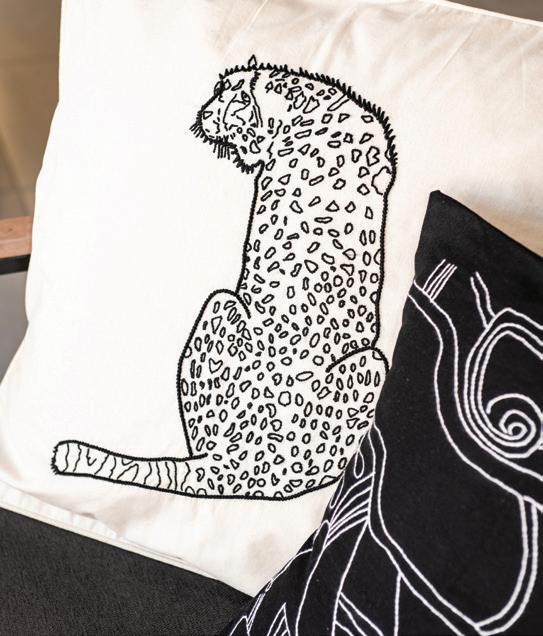
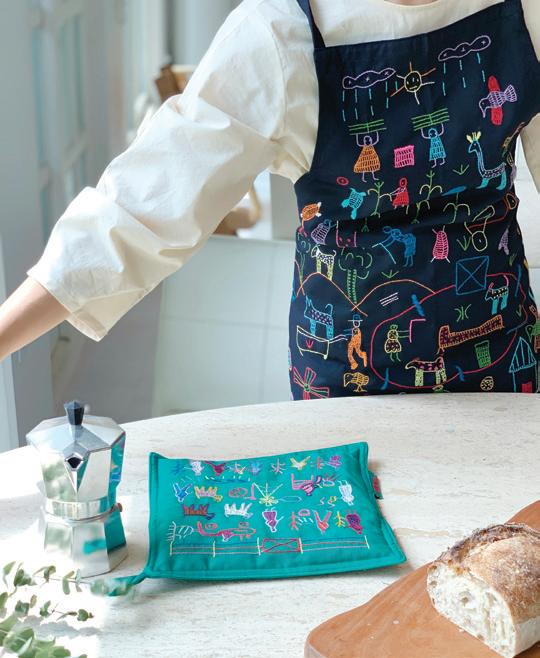
Freedom of the press and other media is enshrined in Article 21 (1) (a) the Namibian Constitution. Namibia ranks 18th out of 180 countries on the 2022 World Press Freedom Index compiled annually by Reporters without Borders.
Namibia improved its ranking on 2022 World Press Freedom Index from the 24th position in 2021 to the 18th position with an overall score of 81.84 – an improvement on the overall score of 80.28 in 2021. The country, however, lost its number one spot as the freest country in Africa in terms of media freedom to Seychelles which was ranked 13th. South Africa occupies the third spot in Africa with a ranking of 35th.
Namibia Media Trust (NMT) Chairperson and veteran journalist Gwen Lister expressed the view that Namibia would have retained the number one spot if the long-awaited access to information law had been passed and if the government spoke out on global media freedom and rights-based issues.
The Access to Information Bill, which was reintroduced in the National Assembly in September 2021, is yet to be promulgated. Information and Communication Technology Minister Peya Mushelenga tabled the bill in the National Assembly in June 2020, but it was referred back for amendments following public consultations. The bill was, however, never passed as a result of restrictions of parliamentary sessions due to Covid-19 lockdowns in 2020.
The bill will, amongst others, give individuals a right to access information held by the government or a private entity if the information may assist in the exercise of protection of any fundamental right or freedom. The bill, however, also sets out instances in which public and private entities are permitted to refuse access to information requests under specific categories of justification. It also requires the president to appoint “an independent and impartial person as Information Commissioner to promote, monitor and protect the right of access to information in Namibia.”
Namibia hosted World Press Freedom Day on occasion of the 30th anniversary of the 1991 Windhoek Declaration on Promoting an Independent and Pluralistic Press. The event was attended by over 100 participants in the capital and followed by more than 3 000 virtual participants from over 150 countries from 29 April to 3 May 2021. The United Nations Educational, Scientific and Cultural Organisation (UNESCO) subsequently endorsed the principles contained in the Windhoek+30 Declaration on Information as a Public Good at its 41st General Conference in November 2021. The declaration highlighted three key challenges: the economic viability of journalism, opacity of Internet companies, and the need to improve media and information literacy among citizens to foster informed engagement with digital communications issues.
Newspapers operate is an environment free of statutory restrictions, except for a requirement to register with the Ministry of Information and Communication Technology in terms of the Newspaper and Imprint Registration Act (Act 63 of 1971).
Declining circulation as more people resort to social media to access news, dwindling advertising revenues, rising printing costs and a sharp increase in the price of fuel continues to place the profitability of newspapers under severe pressure. Maintaining extensive newspaper distribution network over long distances has been hit adversely affected by the skyrocketing increases of fuel prices. Petrol prices increased by 55% between June 2021 and June 2022 while diesel prices increased by nearly 63% during the same period.
Readers continue, however, to have a choice of print editions of four daily (Monday to Friday) commercial newspapers in English, Afrikaans and German, a state-owned daily newspaper, an Oshiwambo weekly and a community newspaper published twice a week for the central coastal communities of Walvis Bay, Swakopmund and Henties Bay. In addition to print editions, newspapers have also increasingly relied on social media platforms and online editions to disseminate news to their followers. Several newspapers have, however, migrated from print to online editions only.
Broadcasting services in Namibia are regulated by the Communications Regulatory Authority of Namibia (CRAN) which has as its mandate the regulation, supervision and the promotion of the provision of telecommunication services, broadcasting and postal services. The authority is also responsible for the allocation and use of radio spectrum in Namibia. CRAN was established in terms of the Communications Act, No. 8 of 2009.
The CRAN announced in April 2022 that it is temporarily suspending the awarding of new telecommunication and broadcasting licences for the
period 1 October 2022 to 30 September 2023. The authority said the suspension was necessitated by a study to determine the current market level of competition, market saturation and any existing barriers to entry.
The authority’s Chief Executive Officer, Emilia Nghikembua, said after preliminary research, “… it was determined that the envisaged market study on the telecommunication and broadcasting markets must be based on a fixed data set, particularly the number of Telecommunications and Broadcasting Service Licensees currently in the market. Therefore, it is apposite that CRAN maintain a still market, in terms of market players, while conducting the study.”
With a reach of 80% of the population, the state-owned broadcaster, the Namibian Broadcasting Corporation (NBC), dominates the electronic media in Namibia. Radio broadcasts are provided by the National Service, which broadcasts in English, and eight language services.
Radio listeners, however, continue to have a wide choice of commercial, community, online and religious radio stations servicing listeners with formats ranging from news, talk and sport to music and request programmes. Desert Radio, the radio station of The Namibian newspaper took to the air in November 2021. The station broadcasts news, information, documentaries and current affairs programmes.

The NBC also dominates the television media in terms of reach and the number of viewers. Namibia also has two private television stations that provide alternative news and programming to NBC, One Africa TV and Network Television. One Africa TV, the country’s first freeto-air commercial station was launched in 2004. Its programming includes, educational content, local and international news, sport and entertainment programmes. Network Television (NTV) was launched by Namibia Media Holdings (Pty) Ltd in February 2020. NTV broadcasts a variety of news and current affairs, educational, sports, youth, talk shows and entertainment programmes. MultiChoice Namibia offers two pay TV services: DStv, a digital satellite service and GOtv, a digital terrestrial service which provides affordable family entertainment.
• Namibia is ranked second in Africa for media freedom and 18th in the world
• Newspapers: three English, one Afrikaans and one German; two weekly newspapers; several online newspapers
• Broadcasters: 21 commercial and 15 community licensed broadcasters; NBC (nine radio stations)
• Television: NBC (three stations); Multichoice Namibia (digital subscription television); GoTV (terrestrial digital television); One Africa (free to air television), NTV
Namibia ranks 18th out of 180 countries on the 2022 World Press Freedom Index compiled annually by Reporters without Borders.
Editors Forum Of Namibia
P O Box 26463, Windhoek +264 81 338 4610 info@efnamibia.org www.efnamibia.org
Film Makers Association
P O Box 40731, Windhoek +264 63 265 314 filmmakersnamibia@gmail.com
NAMPA - Namibia Press Agency
P O Box 26815 news@nampa.org www.nampa.org
NBC - Namibia Broadcasting Corporation
P O Box 321, Windhoek +264 61 291 3111 NBCNewsMediaRelations@ nbcuni.com www.nbcnews.com
Namibia Film Commission
P O Box 41807, Windhoek +264 61 381 900 marketing@teamnamibia.com
Namibia Media Holdings
P O Box 3436, Windhoek +264 61 297 2000 republikein@republikein.com.na www.nmh.com.na
Media Institute Of Southern Africa Regional Secretariat
Private Bag 13386, Windhoek +264 61 283 2665 info@misa.org www.misa.org
Allgemeine Zeitung
P O Box 3436, Windhoek +264 61 297 2300 azinfo@az.com.na www.az.com.na
Informanté
P O Box 3436, Eros +264 61 275 4363 news@informante.web.na www.informante.web.na
Kundana +264 65 238 990 hshaanika@nepc.com.na
Namib Times
Walvis Bay
P O Box 706,Walvis Bay +264 64 205 854
Swakopmund +264 64 461 866 admin@namibtimes.net www.namibitimes.net
Namibia Economist
P O Box 49, Windhoek +264 61 221 925 reception@economist.com.na www.economist.com.na
New Era
Private Bag 13364, Windhoek +264 61 208 0800 fnakatana@nepc.com.na www.newera.com.na
Republikein
P O Box 3436, Windhoek +264 61 297 2000 www.nmh.com.na www.republikein.com.na
The Confidente
P O Box 5033, Ausspannplatz +264 61 246 136 loidemoses@confidentenamibia.com www.confidentenamibia.com
The Namibian
P O Box 20783, Windhoek +264 61 279 600 info@namibian.com.na www.namibia.com.na
The Namibian Sun
P O Box 86829, Eros +264 61 297 2000 azinfo@az.com.na www.namibiansun.com
The Villager +264 61 402 102/ 3 news@thevillager.com.na www.thevillager.com.na
Windhoek Observer
P O Box 2255, Windhoek +264 61 411 800 editor@observer.com.na www.observer.com.na
99 FM +264 61 383 450 contact@99fm.com.na www. 99fm.com.na
Base FM
P O Box 70448, Windhoek +264 61 263 726 manager@basefm.com.na www.basefm.com
36 www.namibiatradedirectory.com
Caprivi News +264 66 253 162
Channel 7/ Kanaal 7
P O Box 20500, Windhoek +264 61 420 850 kanaal@k7.com.na www.k7.com.na
Energy 100fm
P O Box 676, Windhoek +264 61 256 378 info@energy100fm.com www.energy100fm.com
Fresh FM +264 61 247 262 info@freshfm.com.na www.freshfm.com.na
Hitradio Namibia
P O Box 11025, Windhoek +264 85 344 4111 info@hitradio.com.na www.hitradio.com.na
Katutura Community Radio P O Box 74088, Windhoek +264 61 263 729
Kosmos 94.1
P O Box 9639, Eros +264 61 255 985 info@kosmos.com.na www.kosmos.com.na
Namibia Community Radio Network +264 61 236 069
NBC Afrikaans Radio
P O Box 321, Windhoek +264 61 291 2007/8 pr@nbc.na www.nbc.na
NBC German Radio
P O Box 321, Windhoek +264 61 291 2330 pr@nbc.na www.nbc.na
NBC National Radio and Rukavango Radio
P O Box 321, Windhoek +264 61 291 2003 pr@nbc.na www.nbc.na
NBC Oshiwambo Radio and Damara/ Nama Radio
P O Box 321, Windhoek +264 65 220 451 pr@nbc.na www.nbc.na
NBC Otjiherero Radio
P O Box 321, Windhoek +264 61 291 2457 pr@nbc.na www.nbc.na
NBC Tswana Radio and Lazi Radio
P O Box 321, Windhoek +264 81 669 1668 pr@nbc.na www.nbc.na
Omulunga Radio
P O Box 40789, Windhoek +264 61 234 567 info@omulunga.com.na www.omulunga.com.na
Radio Antenna Namibia
P O Box 11849, Windhoek +264 61 225 182
Ecclesia
P O Box 11525, Windhoek +264 61 259 639 marketingecclesia@sapo.ao www.radioecclesia.org
Radio Kudu
P O Box 5369, Windhoek +264 61 242 350 ct@futuremedia.com.na
Radio Live (Community Radio Rehoboth)
P O Box 1426, Rehoboth +264 62 525 421
Radio Wave +264 61 242 350 info@radiowave.com.na www.radiowave.com.na
UNAM Radio
Private Bag 13301, Windhoek +264 61 206 3111 info@unam.na www.unam.edu.na
NBC Television (Namibia Broadcasting Corporation)
P O Box 321, Windhoek +264 61 291 3111 tvlicence@nbc.na www.nbc.com
One Africa Television
P O Box 21593, Windhoek +264 61 383 450 contact@oneafrica.tv www.oneafrica.tv
We' re fo c used on telling and sharing STORI E S T H AT M AT T E R ac ro ss o u r vario u s mag az i nes and digital plat fo rms. J o in t he j our n ey a n d s h a re yo ur s tori e s w i t h audie n ces t hat und e rstand an d v al u e w hy cer t ain thi n gs ma tter
W hy eth i cal busines s co nservati o n, tourism, p e ople an d commu n iti e s ma tter H ow these el e m e nts in ter rela te a n d h ow we ca n br i ng abou t chan ge co nt ribu te to t h e world and s u p p ort e ach o t h er. Wh e ther for an e nti re n atio n , a n i n d u str y, a co mmu n i ty or ev e n j ust an individual
This is us. p ub li s her s
Travel News Namibia is a high-quality glossy Namibia travel and lifestyle magazine tasked with promoting Namibia to the world. Travel News Namibia is published quarterly in English and annually in German.

The Namibia Holiday & Travel is an annual tourism directory with over 170 pages of updated information on the country, regions, people, activities and wildlife.
The Namibia Trade Network is an annual trade and industry portfolio and is the pillar of information dissemination to the private-sector and the promotion of foreign investment.
Conservation and the Environment in Namibia, an annual special edition of Travel News Namibia, is published in close cooperation with the Ministry of Environment and Tourism.
Huntinamibia has an English edition for distribution in the USA and a German edition for distribution in German - speaking European countries. It consists of a minimum of 60 pages and is available as a online magazine.
FlyNamibia Magazine magazine of FlyNamibia, scheduled passenger airline. It showcases Namibian lifestyle, art, businesses and people like never before.
ww w.venture.com.na or email us at info@venture.com.na for a curated proposal.
a v id c a mpe rs edi t o rs
p h ot o g r aphe rs fil m m ak e r s
c ha t te rs
s o ci a l m e d ia fun d ies . blo g ge rs .
c o nt e nt c re a to rs d es igne rs write rs
ma nage rs a p si r in g rhi n o s a v e r s
c o ffe e d r in k er s s e lfi e t a k er s r u le b r ea k e r s .
s n a pc hat t e r s tra v ell e r s ex p lo r er s
The agriculture industry is one of the most important sectors of the country’s economy. About 70% of the Namibian population depends directly or indirectly on the agricultural sector which is also the largest private sector employer in the country.
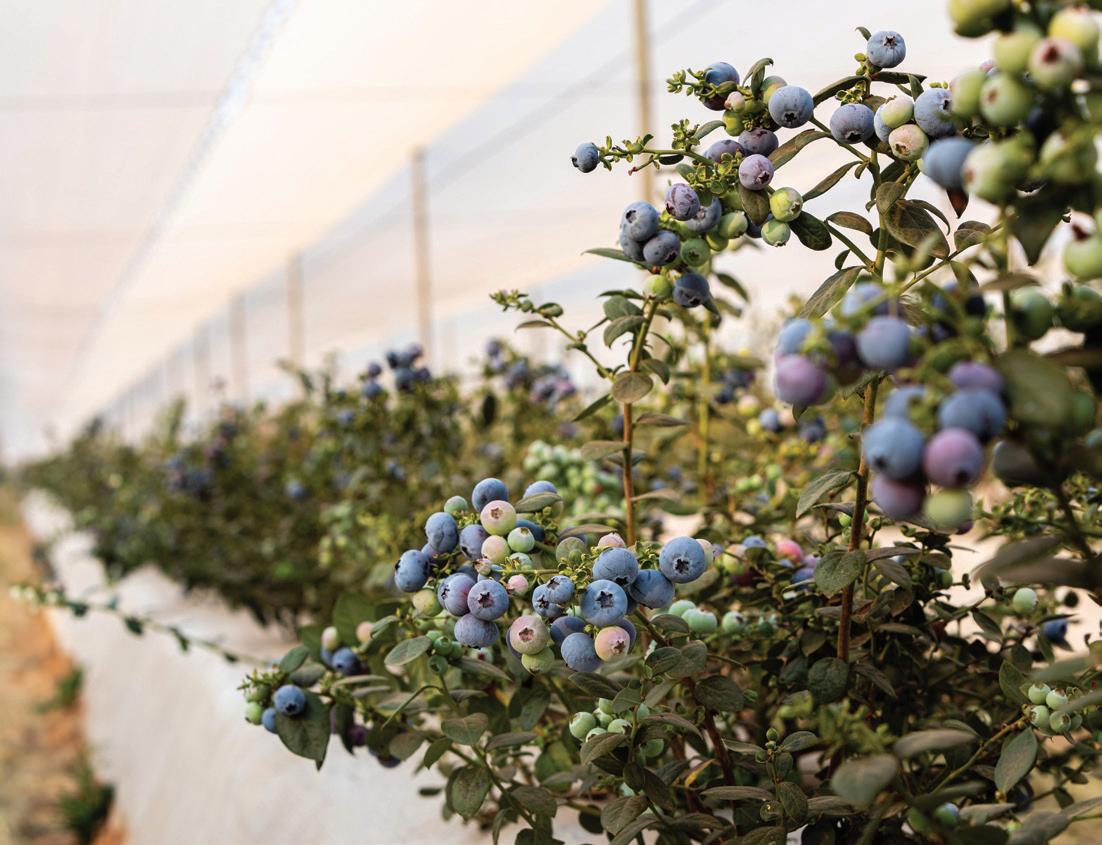
The agricultural sector is expected to rebound in 2022 following good rains over much of the country during the 2021/2022 rainy season which broke an almost decade-long drought. The Bank of Namibia (BoN) projects growth of 3.1% for the agriculture, forestry and fishing sector during 2022, but expects growth to remain low as a result of continued low livestock marketing. Despite the good rains and rising producer prices, the industry faced the highest increase in inflation since 2016. Agriculture inflation increased from 3.1% in the fourth quarter of 2020 to 10.8% in the fourth quarter in 2021.
Livestock production accounts for approximately 40% of the agricultural industry. The total number of cattle marketed during 2021 declined from 266,457 to 226,697 cattle – a decrease that has been attributed to producers having to restock their herds. Live exports accounted for 60% of the total number of cattle marketed in 2021 with South Africa accounting for nearly 98% of cattle-on-the-hoof exports.
Cattle were imported from neighbouring Botswana to meet the demands of the local beef market, while local cattle were slaughtered for the lucrative export markets. Beef exports declined by 9% from 8,422 tonnes in 2020 to 7,634 tonnes in 2021. South Africa accounted for 28% of beef exports, followed by the European Union with 27% and Norway with 26.7%.
Following good rains in most of the country’s cattle-producing areas during the 2021/22 rainy season and higher producer prices, livestock marketing is expected to improve in 2022. The rebuilding of depleted cattle numbers is, however, expected to take several years.
The sheep sub-sector performed relatively well in 2021 with live exports growing by nearly 26%. Live exports increased its market share from 61% to 73% with most exports destined for South Africa. The sub-sector’s performance is likely to be affected by an outbreak of brown locusts in southern Namibia, the country’s main small stock producing area, in early 2022. The outbreak, the worst recorded outbreak of brown locusts, invaded over 1.2 million hectares of grazing.
The pork sub-sector continues to enjoy protection under the Pork Market Share Promotion Scheme (PMSPS) which has resulted in pork production increasing by 57% since the implementation of the scheme in 2012. A total of nearly 45,000 pigs were slaughtered by Meat Board-registered abattoirs in 2021 – a minimal decrease of 0.05% compared to 2020. Imports (excluding processed meat) comprised 56% of consumption, while the local market produced 44% of local consumption.
The poultry sub-sector grew strongly for the third consecutive year with the estimated production value for broilers and eggs increasing by about 13.4% to N$1.2 billion in 2021. Local producers supply about 1,700 tonnes of chicken meat a month which still falls short of the monthly demand of 3,000 tonnes. As Namibia is an importer of poultry feed, the sub-sector continues to be challenged by the high prices of feed, which comprises around two-thirds of the total cost of producing a chicken, and the importation of cheap chicken meat.
The six large commercial egg producers are mainly situated in Windhoek and Okahandja, about 70 km north of the capital. Although local producers can supply the demand for eggs, an influx of cheaper imported eggs resulted in a decline of the egg sub-sector’s contribution by 19% in 2021. As a result, egg producers reduced their production stock by 20%.
The dairy industry recorded a 12.3% decline in production value in 2021 and remains in the grip of a serious crisis. Raw milk producers have been faced with skyrocketing fodder costs, which account for 70% of production costs, as well as cheaper imported dairy products, especially from South Africa, following the expiry of the infant industry protection scheme for the local dairy industry. This resulted in the number of producers declining from 45 two decades ago to less than ten, while raw milk production plunged from about 24 million litres in 2018 to an estimated 12 million litres in 2021.
As a result of the shortage of locally produced milk and the increased demand for Ultra High Temperature (UHT) milk, Namibia Dairies, the country’s single largest milk producer, outsourced the production of its UHT milk to South Africa in November 2020. Following good rains during the 2021/22 season and the increased raw milk supply locally, the company relocated the production and packaging of its UHT milk ranges to its factory in Windhoek in June 2022.
Although horticultural producers received good rains, heavy rains caused crop damage in some areas. The production value of the subsector grew by 30% between 2020 and 2021 to N$529 million. The production value of fresh fruit and vegetables grew by 10% during this period. Grape production decreased by 13.6% in 2021 following a bumper harvest in 2020, while blue berry, citrus and date production for export markets has shown consistent growth over the past few years.
Namibia is a nett importer of white maize and wheat and although good rains at the start of the planting season are likely to ensure an aboveaverage harvest, it could fall short of the record-breaking harvest of 90,000 tonnes in the 2021/22 season. Wheat production was expected to increase to 19,800 tonnes in 2021/22 which is only 14% of the projected demand of 137,300 tonnes.
The government has decided to lease green schemes, covering a total of 27,000 ha, and yet-to-be-developed green schemes, to local and international private investors following a decision to liquidate the non-performing Agricultural Business Development Agency.
A request for proposals for four yet-to-be-developed green schemes on a Build, Operate and Transfer basis was issued by the Ministry of Agriculture, Water and Land Reform issued in May 2022.The four schemes are the 5,000 ha Neckartal and the 500 ha Tandjieskoppe schemes in the Karas Region, the 1,000 ha Zone Green in the Kavango West Region and the 1,000 ha Katima-Liselo scheme in the Zambezi Region. A request for proposals for the Uvungu-Vungu Dairy Farm in the Kavango East Region was also issued. Requests for proposals will also be issued during the course of 2022 for green schemes that have already been developed along the country’s northern boundary rivers, the Orange River in the south and the Hardap Green Scheme.
Addressing the Namibia Investment Summit at the Dubai Expo 2020 in March 2022, Agriculture, Water and Land Reform Minister Calle Schlettwein said in addition to the green schemes there are also investment opportunities in desalination, hydroponics and urban agriculture, value chain activities, particularly meat processing and industries such as canning, tannery, and leather products. The provision of veterinary services and the production of animal vaccines and medicine have also been identified as viable investment opportunities.
• Agriculture is one of the government’s three priority areas.
• The agriculture industry is the largest employer in the country.
• Around 70% of the population depends directly or indirectly on agriculture.
• Main agricultural sectors: Livestock, horticulture, poultry and agronomy
• Real growth of livestock farming contracted by 4.7% in 2021, but is expected to grow by 4.6% in 2022.
The agriculture industry is one of the most important sectors of the country’s economy.
Namibia’s natural environment tells the story of its red meat. About 70 000 square kilometers of the country’s total surface area of 824 300 square kilometers are suited for agriculture, of which 52% is utilised by cattle farmers and 33% by small-stock farmers. Namibia’s red meat (beef, mutton, goat and game) is produced by animals that feed on natural vegetation, without the use of growth stimulants, antibiotics or animal by-products.
The safety, health and high quality are verified by tracing the product all the way from the farm of origin through to the consumer. This is achieved through the implementation of Africa’s first comprehensive farm assurance scheme, the Farm Assured Namibian Meat Scheme (FANMeat), which is managed by the Meat Board. The use of the FANMeat logo confirms that Namibian export meat is produced according to standards laid down by our trading partners in a single scheme.
Namibia’s excellent beef originates from top-quality animals. The most popular breeds are the Brahman, Simmentaler and Bonsmara as well as the indigenous Sanga varieties. Crosses of these breeds are well adapted to Namibia’s environmental conditions. They are bred according to market requirements, that is taste and tenderness. The main breeds of sheep are the Dorper and the indigenous Damara, which are well adapted to Namibia’s sensitive grazing conditions.
Namibia has several abattoirs that are certified to export to South Africa. Three abattoirs are also certified to export to the European Union. Meatco is the largest meat processor in Namibia with abattoirs and meat-processing facilities as its core business.
Ultimately, Namibia is proud to serve retailers and consumers natural meat of the highest quality, which is traceable, safe, tasty and tender.
The Meat Board of Namibia is a statutory body which came into existence in 1935 and facilitates the export of livestock, meat and processed meat products to importing countries. The Meat Board regulates the meat industry through managing annual production of livestock and meat, as well as import and export control. It further implements projects on behalf of the industry, Meat Board and government, with or without external financiers to develop the industry.
The Strategic Charter of the Meat Board was developed based on the following building blocks:
a healthy, disease-free meat industry quality Namibian meat export growth and market diversification a respected, world-class regulatory organisation profitable, advanced and cohesive meat industry active stakeholder engagement an effective, autonomous and self-sustainable.
The vision of the Meat Board of Namibia is to be an internationally recognised organisation that promotes a profitable, vibrant, quality-driven Namibian meat industry in local and international markets.

The mission of the Meat Board of Namibia is to promote a conducive environment for sustainable livestock production, market growth and diversification for livestock, meat and meat products; and to maintain standards and quality assurance by way of appropriate regulatory intervention.
At the Meat Board we strive to uphold the core values of integrity, teamwork, fairness, independent thinking, pro-activity and accountability.
the need to have sound regulatory systems in place to control mandated standards and quality assurance around production, processing and marketing the need to promote export diversification by increasing market access to competitive markets the need to strengthen relations with government and key stakeholders leading towards improved collaboration and partnerships the need to ensure the Meat Board remains a self-sustainable organisation the need to advocate animal health and welfare as a first step in being globally competitive
EXPECTED OUTCOMES
sustainable financial position sound reputation nationally and internationally
EXPECTED OUTCOMES
regular consultations with Meat Board and stakeholders and vice versa on industry matters meat Board respected as the authority on meat matters in industry
EXPECTED OUTCOMES
existing markets maintained new markets developed
EXPECTED OUTCOMES
improved compliance with regulations more detailed management information on the Namibian meat industry
EXPECTED OUTCOMES
increased financial viability of livestock production more informed and educated producers, processors and consumers better collaboration with Directorate Veterinary Services improved animal health status in Northern Communal Areas (NCA) to attain international recognition maintenance of animal health status south of the Veterinary Cordon Fence
Ms Patricia Gurubes ChairpersonAs a truly Namibian manufacturer, Feedmaster has provided Namibian farmers with high-quality livestock feed with a variety of over 50 animal feed products since its establishment in 1983.




Feedmaster is invested in extensive research and is intensively involved in organised agricultural activities in Namibia through SME development, training and much more. It is our mission to create optimal and economical feeding strategies for everyone.
Feedmaster educates and consults with farmers revisiting their management practices to ensure financial sustainability for the near future. These practices will increase the carrying capacity of farms to increase financial returns and unlock agricultural efficiencies continuously.
We provide farmers with various products for cattle, sheep, goats, poultry, horses and quality pet foods. These goods are available countrywide, making Feedmaster a proudly Namibian enterprise.
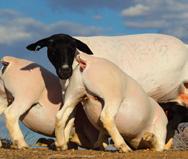
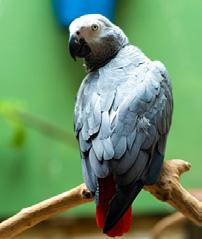



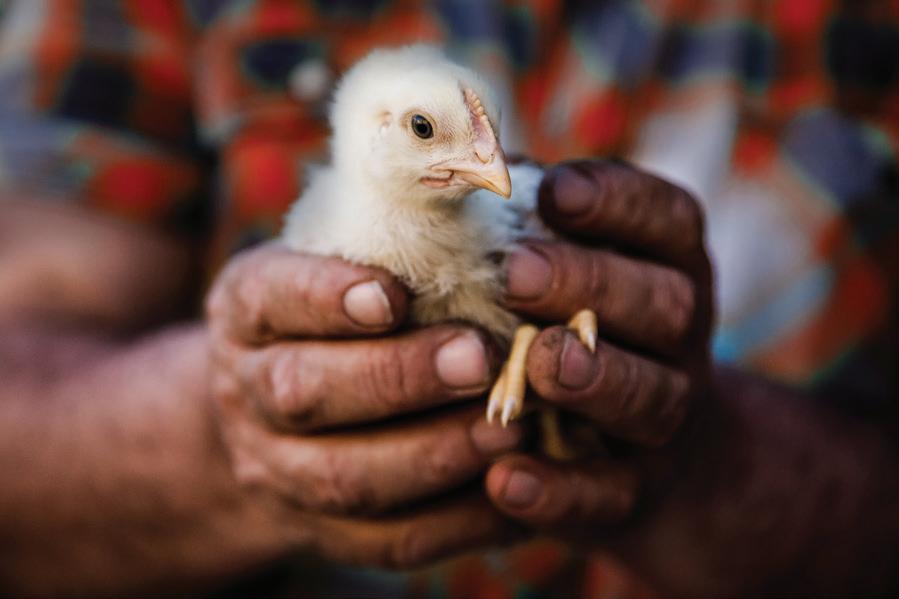
These goods and services include:
direct agricultural production inputs such as fertilisers, seeds, and pesticides animal feeds, animal health and pet-related products
• fuels, oils, lubrication, and tyres
• industrial and domestic gas
• gardening and agricultural irrigation equipment related products, such as wire and poles building materials, such as cement, timber, paint, corrugated iron and plastic horticultural supplies like tools, fertiliser and chemicals
• DIY items like tools, ladders, screws, and accessories
• camping equipment and related accessories for the outdoor enthusiast food, cleaning agents and clothing, which includes protective clothing financing of these products and services delivery services
Kaap Agri Namibia is a private company of which 50% shareholding is Namibian owned by the Pupkewitz Group of Companies.
Agrimark include a chain of retail stores that offer direct agricultural production inputs and related products.

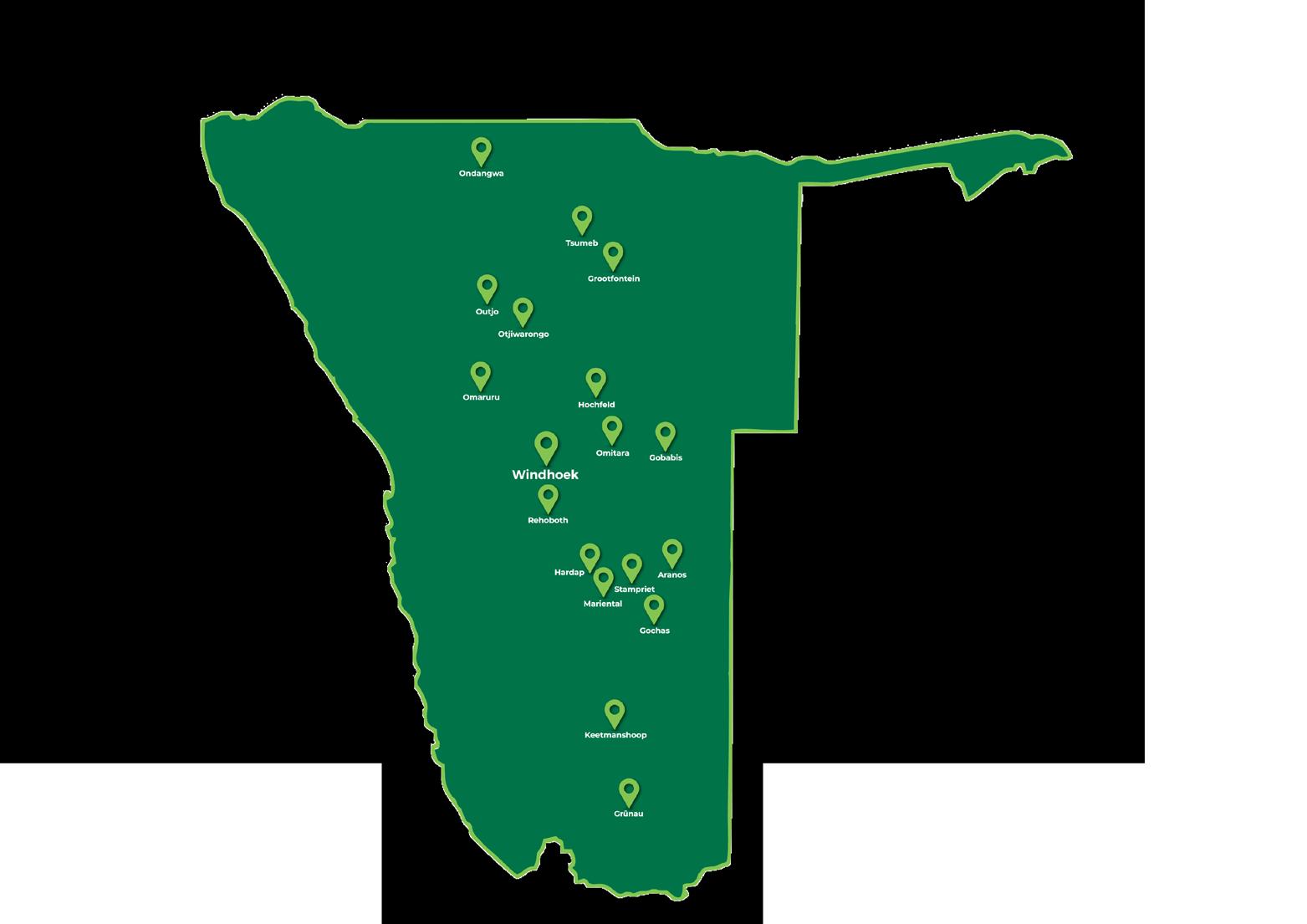
This entails a fuel and convenience offering to the general public.
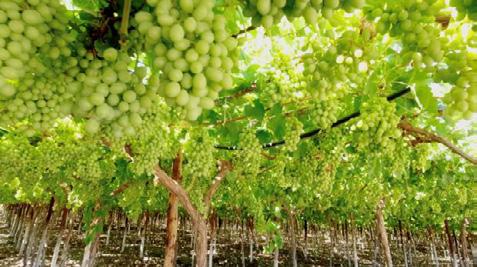
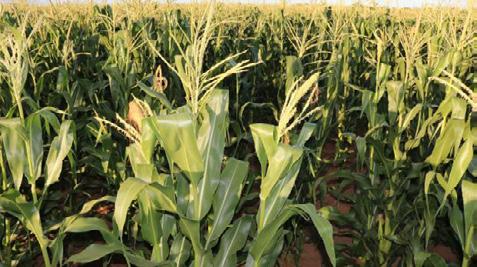
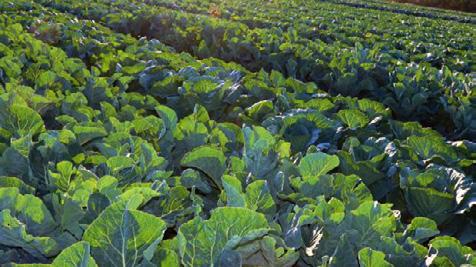
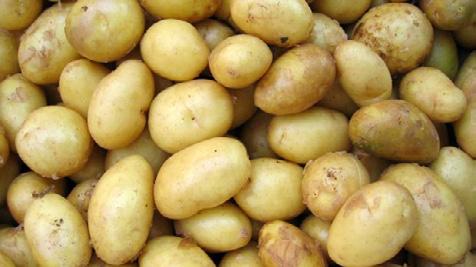
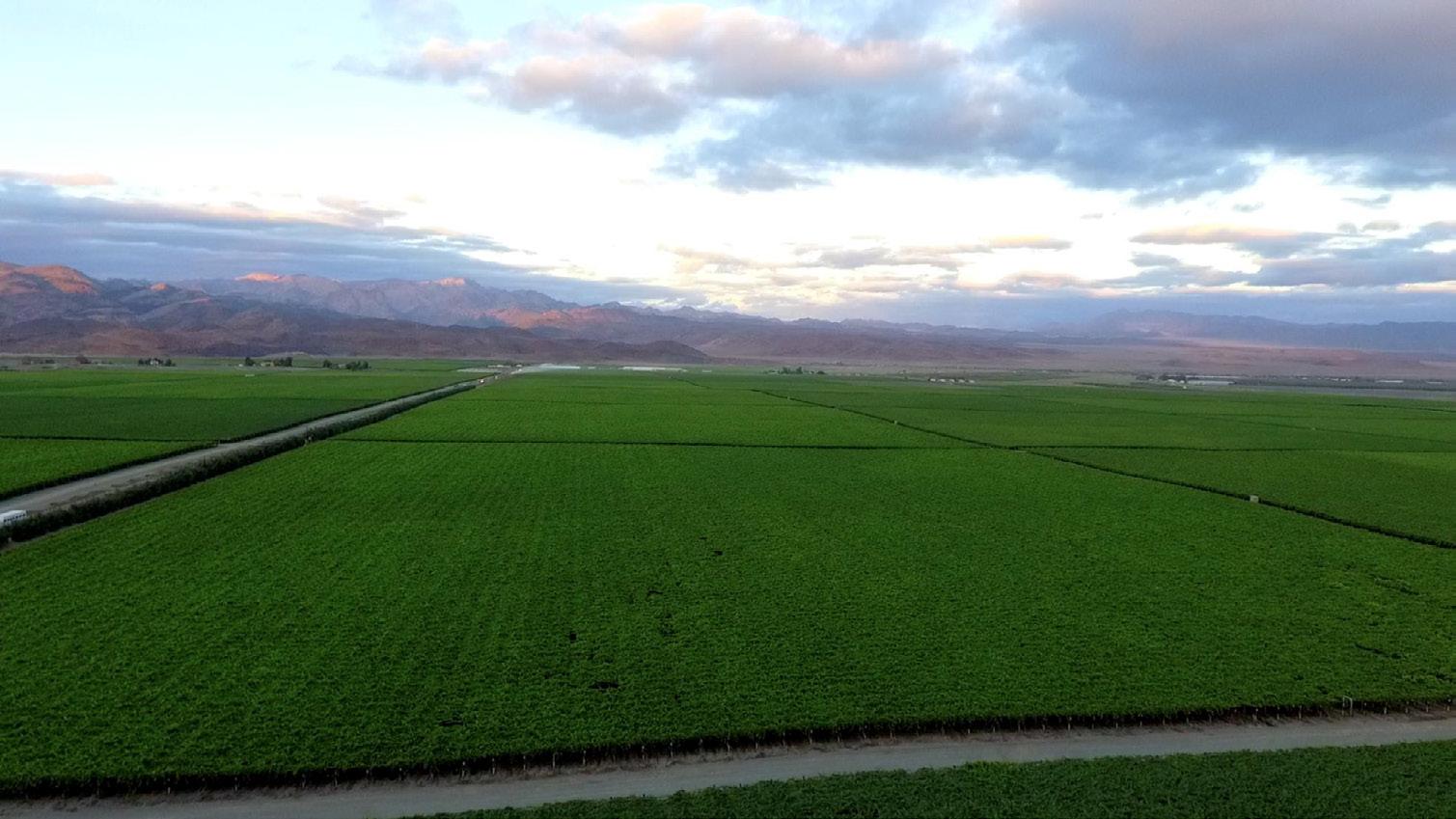
The private business sector has continued to provide a full range of services despite the disruptions brought about by Covid-19 and the sluggish economy during the past few years.
Services offered by the private sector range from professional and technical services, finance and insurance, real estate and transport and logistics, to communication, hospitality and restaurants and wholesale, health care and the retail trade.

The Ministry of Industrialisation and Trade (MIT) is responsible for the development and management of Namibia’s economic regulatory regime, while the Namibia Investment Promotion and Development Board (NIPDB) is mandated to promote, attract and retain domestic and foreign investments. The NIPDB also oversees micro, small and medium enterprises (MSME).
The interests of the private sector are represented by various voluntary members’ associations, including the Namibia Chamber of Commerce and Industry (NCCI) and the Namibia Employers’ Federation (NEF), the largest employers’ organisation. There are also several voluntary members’ associations representing various sectors of the economy.
Businesses are required to comply with legislation that is generally applicable such as the Labour Act, and the Social Security Act, register with the Namibia Revenue Agency (NamRa) with regard to tax payments and the payment of value-added tax (VAT). Companies, businesses and institutions identified in certain acts are also required to comply with their obligations under the acts. This includes registration with the
Namibia Training Authority (NTA), designated employers defined in the regulations of the Employment Services Act, No. 8 of 2011 and the Affirmative Action (Employment) Act, No. 29 of 1998.
Public services are delivered at three levels: the central government through 23 ministries, the 14 regional councils and by local authorities (municipalities, town councils and village councils). Functions identified for decentralisation from the central government to regional governments and local authorities include primary health care, pre-primary and primary education, rural electricity distribution, vehicle testing and licensing, business registration and the provision of housing. At local authority level, businesses are required to comply with regulations applicable in the various local authorities. This includes, amongst others, building plans, trading licenses, health regulations and noise-control regulations.
NamPower has retained its number one spot on the 2021 rankings of 20 commercial state-owned enterprises by the Institute for Public Policy Research. NamPower achieved a score of 98, while Mobile Telecommunications (MTC) and NamPost improved their 2020 rankings with a score of 98. Seven public enterprises received a score of below 50, while
three enterprises (Henties Bay Waterfront, Zambezi Waterfront and the Roads Contractor Company) were scored 0 due to the lack of information.
The Ministry of Public Enterprises is to be disbanded over the next few years in line with the recommendations made by the High-Level Panel on the Namibian Economy which was appointed by President Hage Geingob in 2019. The ministry’s functions will be integrated into the Ministry of Finance and Public Enterprises – a process which is expected to take between three and five years.
Following public consultations with key stakeholders, the government is finalising amendments to certain provisions of several acts to address shortcomings and public concerns:
• National Equitable Economic Empowerment Bill (NEEEB).
• Public Procurement Act, No. 15 of 2015.
• Special Economic Zone Bill which will replace the Economic Processing Zone which has been phased out.
March 2022 at the Expo 2020 Dubai. The Namibian stand attracted close to 400,000 visitors, while nearly 200 leads for possible investments are being followed up.
President Hage Geingob delivered the keynote speech at the Namibia Investment Summit held on 23 March under the theme Namibia, Advancing Sustainable Investments for a Diversified, Export-driven Economy. The summit focused on five key areas: green hydrogen development, agribusiness, tourism, infrastructure, logistics and transport and mining (mineral beneficiation and adjacent industries.
The Namibia Investment Promotion and Development Board (NIPDB) is compiling a comprehensive report on the activities and achievements of the Namibian Pavilion at the expo. The report will first be presented to Cabinet and then made available to relevant stakeholders. NIPDB spokesperson, Catherine Shipushu, said, “… the accountability reporting to stakeholders is scheduled to run from 1 May and will be completed by the end of June 2022.”
Namibia was one of 192 countries that participated from 1 October 2021 to March 2022 at the Expo 2020 Dubai.
• The Namibian Investment Promotion Act was promulgated and gazetted in August 2016 but has not yet come into force following public concerns.
The Namibian Investment Promotion and Facilitation Bill was tabled in the National Assembly by Trade and Industrialisation Minister Lucia Iipumbu in November 2021. The bill was, however, subsequently withdrawn after objections and is yet to be tabled again.
Namibia was one of 192 countries that participated from 1 October 2021 to
ESAMI- Eastern and Southern Africa Management Institute
P O Box 1836, Windhoek +264 61 23 6965/6 esamiwhk@mweb.com.na www.esami-africa.org
NACC - Namibian Competition Commission
P O Box 2104 ,Windhoek +264 61 224 622 dina.gowases@nacc.com.na www.nacc.com.na
Namibia National Reinsurance Corporation (NAMIBRE)
P O Box 716, Windhoek +264 61 422 800 info@namibre.com www.namibre.com
NIBA - Namibia Insurance Brokers Association
P O Box 2445, Windhoek +264 61 384 029 antoinette.vanwyk@minet.co.na www.nibanam.com
NIPAM - Namibia Institute Of Public Administration And Management Private Bag 13218, Windhoek +264 61 296 4700 kipinge@nipam.na www.nipam.na
NASRIA - National Special Risks Insurance Association
P O Box 417, Windhoek +264 61 229 207 anna@nasria.com.na www.nasria.com.na
Namibia also showcased the country’s investment opportunities at the annual meeting of the World Economic Forum in Davos, Switzerland, in May 2022. The Namibian delegation presented 33 projects at the forum including green schemes, desalination plants, solar parks and the development of tourism parks to stimulate foreign direct investment in the country.
In a presentation delivered at the annual general meeting of the Economic Association of Namibia (EAN) in November 2021, Namibia Investment Promotion and Development Board (NIPDB) chief executive officer, Nangula Uaandja identified several potential investments in the service sector. This includes: Business consulting, IT service provision, Marketing, Research services, and Virtual assistance services.
NSA - Namibia Statistics Agency
P O Box 2133, Windhoek +264 61 431 3200 www.nsa.org.na www.nsa.org.na
PSC - Public Service Commission
Private Bag 1338, Windhoek +264 61 287 2002 info@opm.gov.na www.opm.gov.na
Security Enterprises & Security Officers Regulation Board
Private Bag 12024 , Windhoek +264 81 304 5623 adminsan@iway.na www.securityassociationnamibia. com
SSC - Social Security Commission
Private Bag 13223, Windhoek +264 61 280 7251 corporate@ssc.org.na www.ssc.org.na
Trust Fund For Regional Development & Equity Provisions
P O Box 23160, Windhoek +264 61 227 880 amutero@murd.gov.na www.murd.gov.na
TKCS - Trans Kalahari Corridor Secretariat
P O Box 23017, Windhoek +264 61 25 0071 admin@tkcmc.com www.tkcmc.com
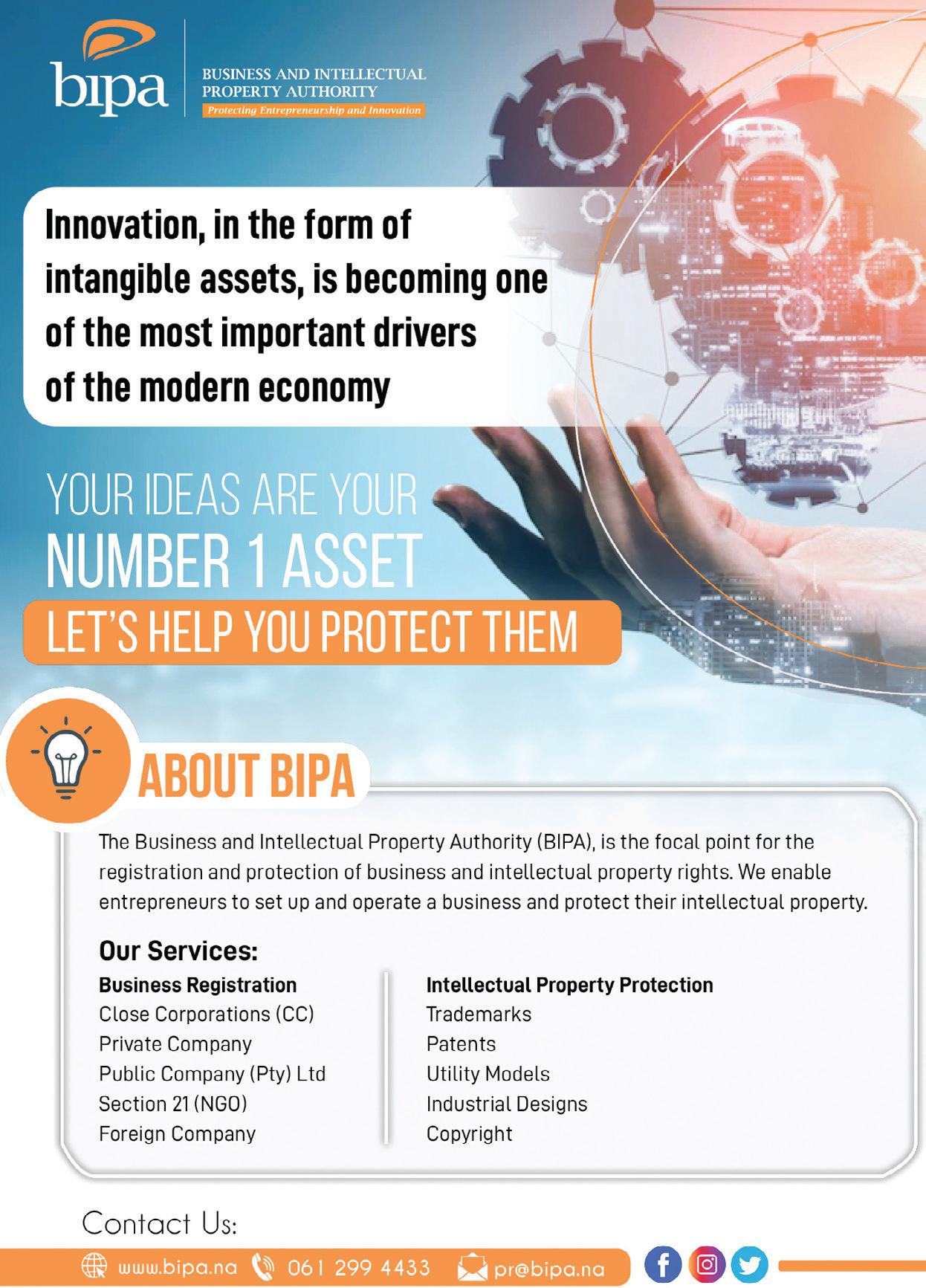



F o c u s e d o n c o l l e c t i n g h u m a n p e r s p e c t i v e s t o d r i v e d e c i s i o n - m a k i n g & b u s i n e s s g r o w t h i n :
P u b l i c R e l a t i o n s M a r k e t P e r c e p t i o n D e v e l o p m e n t o f n e w p r o d u c t s / s e r v i c e s P r o m o t i o n s a n d a d v e r t i s i n g P r i c i n g M a r k e t c o n d i t i o n s B r a n d i n g


T h e M a r k e t R e s e a r c h i n d u s t r y i s g r o w i n g
M a r k e t r e s e a r c h i s o n e o f t h e m o s t i m p o r t a n t t o o l s t o u s e f o r b u s i n e s s s u c c e s s
R e l i a b l e i n f o r m a t i o n i n s i g h t s c a n d r i v e e a s i e r d e c i s i o n - m a k i n g p r o c e s s e s
M a r k e t r e s e a r c h i s t h e v o i c e o f c u s t o m e r s
F r e e s o c i a l m e d i a d a t a d o e s n o t a l w a y s e q u a l i n e x p e n s i v e r e s e a r c h
h t s d a l e e n @ t r i b e f i r e s t u d i o s c o m T e l : + 2 6 4 6 1 3 8 3 4 5 0

4 4 H y p e r M o t o r C i t y , M a x w e l l S t r e e t , W i n d h o e k w w w t r i b e f i r e s t u d i o s c o m

B R A N D R E S E A R C H C A M P A I G N E F F E C T I V E N E S S
O M P E T I T I V E A N A L Y S I S
N S U M E R
N S I G H T S
A T I S F A C T I O N S U R V E Y
U S T O M E R S E G M E N T A T I O N
P R O D U C T D E V E L O P M E N T
E M P L O Y E E S U R V E Y S
Dr Weder, Kauta & Hoveka Incorporated brings together a unique synergy of professional expertise, experience and skills, offering clients a comprehensive range of legal services by focusing on the clients’ needs and expectations. The firm currently operates from offices in Windhoek, Ongwediva, Swakopmund, Walvis Bay and Grootfontein, and is widely respected and recognised for its professionalism and excellence in service delivery. Our strength and commitment lie in the diversity and experience of our professional staff. We pride ourselves in understanding our clients’ requirements for quality legal services. Dr Weder, Kauta & Hoveka Inc’s unique professional ethos is derived from over 70 years’ combined legal experience within Namibia. This wealth of experience is enhanced by a modern approach and appreciation of the contemporary legal setting. The partners of the erstwhile Dr Weder, Kruger & Hartmann and the directors of Kauta, Basson & Kamuhanga Incorporated merged with effect on the 1st of September 2006. Both firms thereafter commenced to practice under the name of Dr Weder, Kauta & Hoveka Incorporated. The merger of these two prominent legal firms was a first for independent Namibia, which now constitutes a truly empowered provider of professional legal services. It represents our aspiration to create and maintain a Namibian entity which meets the national transformation brief and makes a meaningful contribution to the development of the country.
By combining the unique strengths and rich heritages of these two legacy firms, Dr Weder, Kauta & Hoveka Inc has been able to increase its capacity, not only in terms of its workforce, but also its various fields of expertise, experience and infrastructure. The result is a large practice with a singular focus, which enables and delivers service excellence to its ever increasing and diverse client base.
Founded in 1989, Kalahari Holdings (Pty) Ltd is a diverse and dynamic company actively participating in the socio-economic development of Namibia. Kalahari Holdings currently invests in sustainable development projects in the primary, secondary and tertiary industries, which have yielded consistently positive returns.
Founded in 1989, Kalahari Holdings (Pty) Ltd is a diverse and dynamic company actively participating in the socio-economic development of Namibia. Kalahari Holdings currently invests in sustainable development projects in the primary, secondary and tertiary industries, which have yielded consistently positive returns.
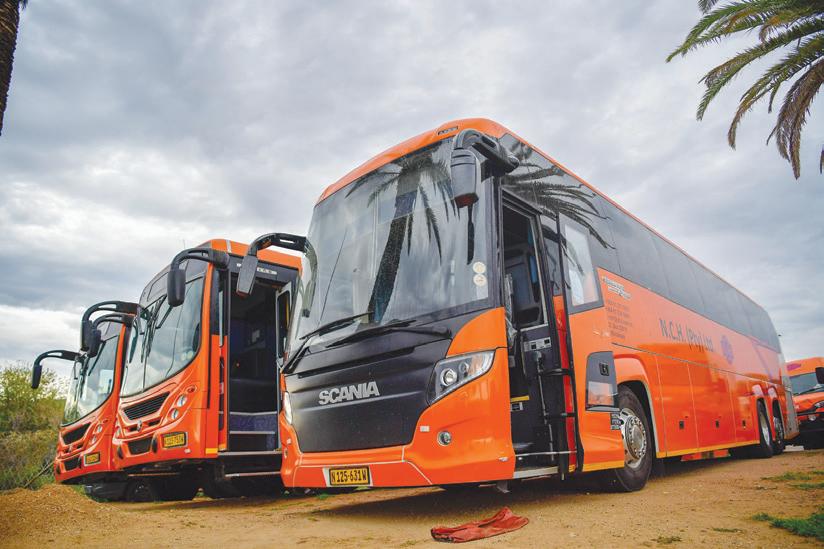
Located 12 km west of Grootfontein, Farm de Rust contributes to food security with the goal to sustain the livelihoods of all Namibian people. The farm has opened doors to the production of different horticultural produce throughout the years, and is proud to have been nominated as Maize King 2021 by the Grootfontein Farmers’ Association.
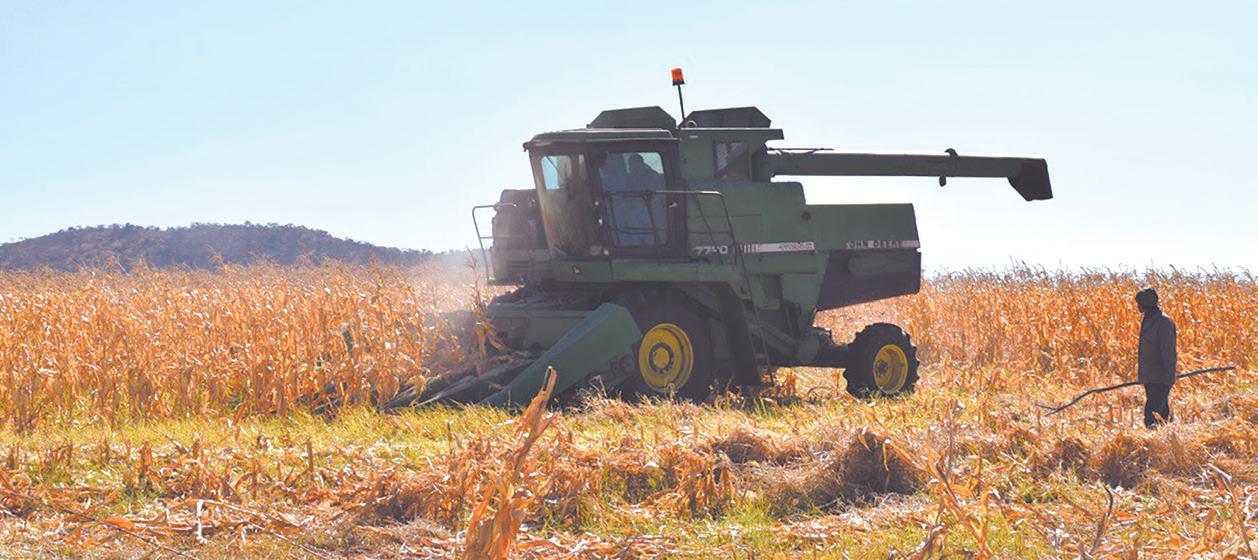
Kalahari Holdings’s main activity is the acquisition and development of commercial properties. The impact of such investments has made a significant difference in the lives of the Namibian people. In addition to the economic benefits to the nation, social benefits in terms of employment creation and the alleviation of poverty are perceptible and remain high on our agenda.
Kalahari Holdings’s main activity is the acquisition and development of commercial properties. The impact of such investments has made a significant difference in the lives of the Namibian people. In addition to the economic benefits to the nation, social benefits in terms of employment creation and the alleviation of poverty are perceptible and remain high on our agenda.
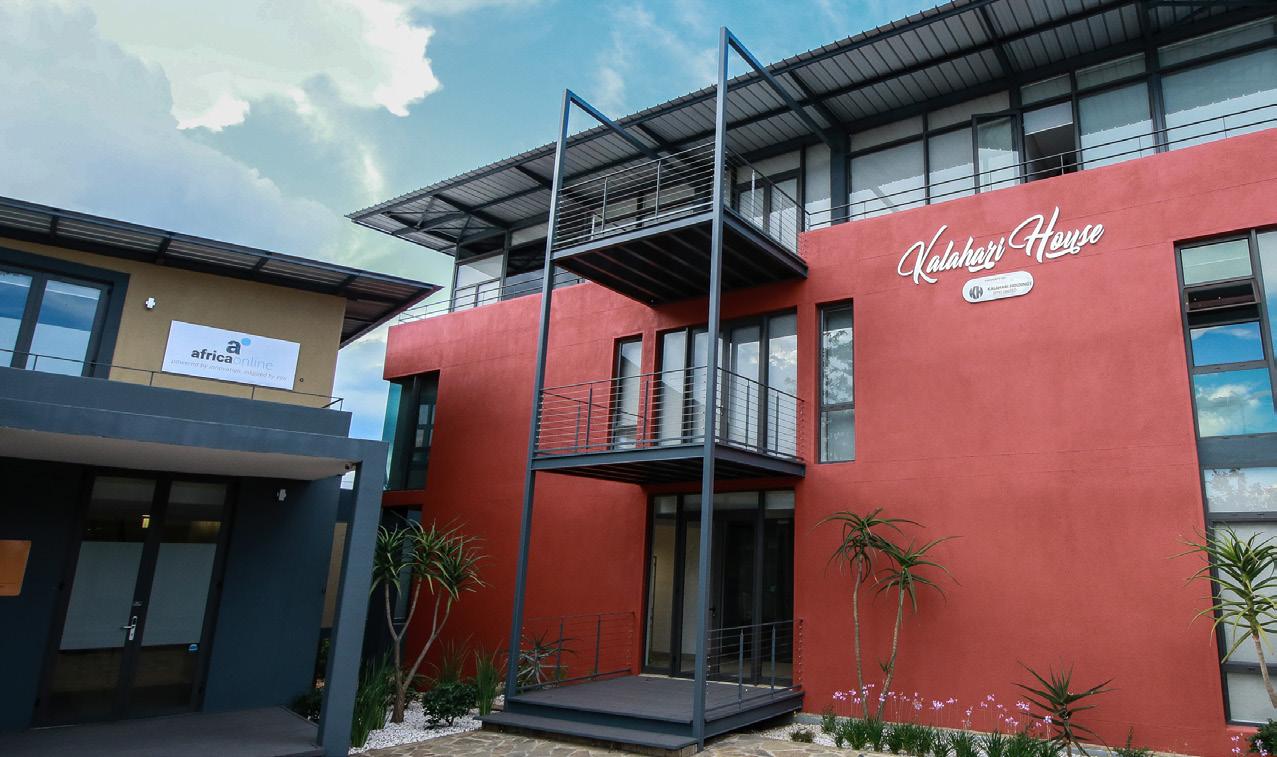
Kalahari Holdings (Pty) Limited
Kalahari Holdings (Pty) Limited
36A Promenaden Road, Eros
36A Promenaden Road, Eros
Tel: +264 (0) 61 225 333
Tel: +264 (0) 61 225 333
Tel: +264 (0) 61 233 447 kholdings@mweb.com.na www.kalahariholdings.com
Tel: +264 (0) 61 233 447 kholdings@mweb.com.na www.kalahariholdings.com

Namibia Protection Services (NPS), with its head office Windhoek, was founded in 1989 by the SWAPO party’s leadership upon their return to the country. The company was transferred to Kalahari Holdings (Pty) Ltd in 2017 in order to run it as an independent entity. NPS organises and controls security activities in 14 national branches.
Namibia Protection Services (NPS), with its head office Windhoek, was founded in 1989 by the SWAPO party’s leadership upon their return to the country. The company was transferred to Kalahari Holdings (Pty) Ltd in 2017 in order to run it as an independent entity. NPS organises and controls security activities in 14 national branches. NPS currently specialises in the following divisions:
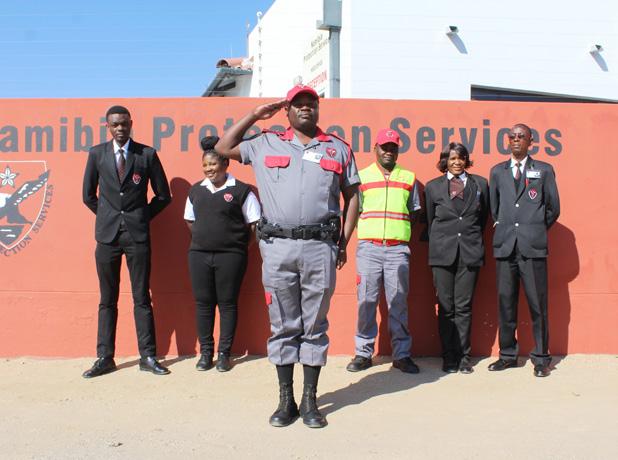
NPS currently specialises in the following divisions:
Founded in 1989, Namib Contract Haulage (Pty) Ltd, operates passenger transport services from Windhoek to the northern regions of Namibia. Its transport fleet is popularly known as the ‘yellow buses’ or ‘SWAPO buses’. The reputation of the bus service has been earned through its timeliness, reliability, safety, comfort and competitive pricing. The company has realigned its focus towards commuters, bus hire and long-distance transportation.
Founded in 1989, Namib Contract Haulage (Pty) Ltd, operates passenger transport services from Windhoek to the northern regions of Namibia. Its transport fleet is popularly known as the ‘yellow buses’ or ‘SWAPO buses’. The reputation of the bus service has been earned through its timeliness, reliability, safety, comfort and competitive pricing. The company has realigned its focus towards commuters, bus hire and long-distance transportation.
Namprint offers printing services to the public sector, a broad spectrum of businesses in the private sector as well as individuals. It is one of the certified security printing companies in the country and operates in accordance with the Cheque and Magnetic Ink Character Recognition (MICR) Standards Authority. Being equipped with advanced printing technologies, facilities, and professional expertise enables the company to provide its clients with quality printing services. Namprint has expanded its business scope covering security printing, commercial printing, packaging printing, web printing, digital printing, book printing, and more.
Namprint offers printing services to the public sector, a broad spectrum of businesses in the private sector as well as individuals. It is one of the certified security printing companies in the country and operates in accordance with the Cheque and Magnetic Ink Character Recognition (MICR) Standards Authority. Being equipped with advanced printing technologies, facilities, and professional expertise enables the company to provide its clients with quality printing services. Namprint has expanded its business scope covering security printing, commercial printing, packaging printing, web printing, digital printing, book printing, and more.
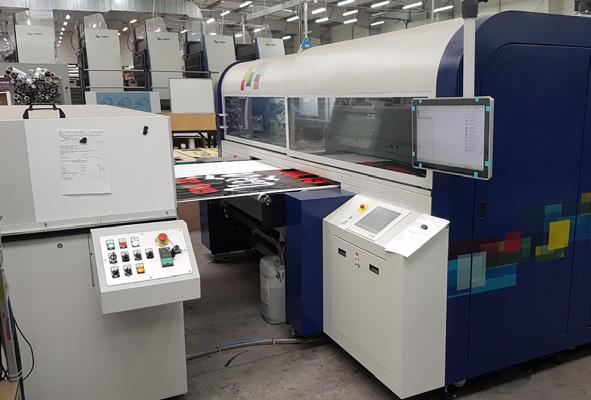
www.kalahariholdings.com
Organises and controls security activities in the 14 branches spread throughout the country
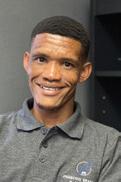
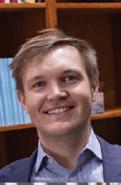









Francois Erasmus and Partners is a boutique legal practice centrally situated in the capital within 5 minutes walk from the High Court and Advocates’ chambers.


We cater for a wide range of clients. We pride ourselves to deliver an efficient, costeffective array of focused legal services matched by a personal touch and excellent service history. Use of the latest technology ensures a smooth and user-friendly accounting and communications experience.
For the last decade we have specialised in civil litigation in the Supreme and High Courts of Namibia and attending to the corporate and conveyancing needs of our diverse clientele. Our specific areas of expertise and success relate to constitutional, construction, banking and insurance law, company and labour matters.



We embrace the modern concepts of mediation and arbitration as alternative dispute resolution methods, saving clients money and time. Our primary focus is on service levels, achieving early results for our clients. At Francois Erasmus and Partners our staff represents the demographics of the Namibian society. Clients experience a warm, friendly, but professional environment when interacting with our skilled staff. We invest in the community and believe that we have a responsibility to uplift and empower disadvantaged fellow citizens. Our track record speaks for itself.
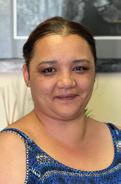


• Commercial and civil litigation – Supreme Court, High Court and Lower Courts
• Conveyancing and Bond registration

• Advice and assistance on commercial, civil, labour, banking and regulatory matters

• Building industry and related matters
• Short term and Life Insurance Matter
• Registration of Companies, Close Corporations and Trusts
• Contract law
• Estate administration

• Debt collection
Tel: +264 83 332 5300 Email: info@ferasmuslaw.com.na
“Namibia’s overall spending in education remains relatively high and above international targets, averaging 8% of GDP and 19% of total budget. However, this high level of spending has not translated to quality education outcomes …” UNICEF
An amount of N$14.1 billion was allocated to the Ministry of Education, Arts and Culture for the 2022/23 financial year, which represents 19.9% of total government expenditure and the highest appropriation to any ministry. The allocation is 1% less than the N$14.0 billion allocated to the ministry for the 2021/22 financial year.
Speaking during the delivery of the 2022/23 budget, Finance Minister Iipumbu Shiimi said the allocation, “… reflects the Government’s commitment to continuously invest in the youth of Namibia and underscore our belief in human capital development as the central driver for sustainable development and poverty reduction over time.” Personnel expenditure accounts for 77% of the ministry’s budget, leaving only 23% for other operational expenditure.
Despite the large annual budgetary allocation, the ministry is faced with an increase in the numbers of learners and a declining capital budget which poses major financial and technical challenges for the provision and maintenance of schools and hostels, especially in far-flung rural areas.
There are currently 822,574 pre-primary, primary and secondary learners enrolled in 1,947 public schools countrywide. Although over 6,100 classrooms have been built since 2016, the ministry needs about N$2.5 billion to build an additional 4,479 classrooms. There are 17 specialised libraries, 66 public libraries and 503 functional school libraries countrywide.
About 65,000 pupils are accommodated in 237 hostels countrywide, but according to the ministry there is a backlog of over 1,176 hostel blocks,
especially in rural areas. It was reported that the ministry is faced with a shortage of 15,000 beds at hostels in all 14 regions.
A total of N$190 million has been budgeted for the ministry’s universal education allowance for the 2022/23 financial year. The allowance for pre-primary and primary learners currently stands at N200 per learner and N$300 for secondary school learners – compared to N$400 and N$500 a few years ago.
A total of 97 ablution facilities and 121 new units were constructed by the Ministry of Education, Arts and Culture during the 2020/21 financial year in addition to the renovation of 36 school hostels and the construction of 35 additional hostel units or expansion at schools. The capital budget has been reduced by 25% from almost N$399 million in 2021/22 to N$300 million in 2022/23.
The effects of Covid-19 had a marked effect on the results of learners who wrote the Grade 11 full-time and part-time examinations at the end of 2021. Although the number of full-time learners increased from 21,648 in 2020 to 46,977 in 2021, only 8,817 Grade 11 full-time candidates who wrote the Namibia Senior Secondary Certificate Ordinary Level (NSSCO) examinations qualified with a C symbol or better in three subjects to continue with Advanced Subsidiary level subjects.
The ministry attributed the poor results to unannounced school closures, the death of 112 teachers as a result of the Covid-19

pandemic, the psychological effect of the pandemic, as well as the leaking of several Grade 12 NSSCO – legacy) and Grade 11 NSSCO new examination papers which disrupted the examinations.
The results of the first cohort of just over 5,000 learners who wrote the Namibia Senior Secondary Certificate Advanced Subsidiary Level (NSSCAS) examinations in 2021 were welcomed. Compared to the 2020 National Senior Secondary Certificate Higher Level (NSSCH) examination, more A and B symbols were achieved in terms of percentage, while a C or better symbol was achieved in more than half of the subjects. A total of 7.7% of the subjects were ungraded, compared to 8.8% in 2020.
The United Nations Children’s Fund (UNICEF) said in its 2020/21 analysis Namibia’s overall spending in education remains relatively high and above international targets, averaging 8% of GDP and 19% of total budget. The agency, however, expressed concern that the high level of spending did not translated to quality education outcomes. UNICEF pointed out that pre-primary education received a disproportionately small share (approximately 3%) of the 2020/21 education budget, while adding, “The Development Budget suffers from both low allocation and low execution, with average implementation of 70%, undermining the adequacy and quality of education infrastructure.”
UNICEF further said, “Whilst the need for spending efficiencies cannot be over-emphasized, there is need for a diagnostic study to unpack the underlying bottlenecks to enhance the correlation between spending and outcomes."
Centre For Global Education
P O Box 21324, Windhoek +264 61 228 773 info@centreforglobaleducation.com www.centreforglobaleducation.com
Institute For Management And Leading Training
P O Box 22524, Windhoek +264 61 230 555 imlt@imlt.org.za
Junior Achievement Namibia
P O Box 1596, Windhoek +264 61 221 140 info@janamibia.com www.aflatoun.org
NAMCOL - Namibia College Of Open Learning
Private Bag 15008, Katutura Tel: +264 61 270 9100
Namibia Association for Literacy and Adult Education (Rössing Foundation)
P O Box 20746, Windhoek Tel: +264 61 280 9111 RUL.communications@rossing.com.na www.rossing.com
NIMT- Namibia Institute of Mining Technology Private Bag 5025, Swakopmund +264 64 511 800 ho@nimt.edu.na www.nimtnam.com
NANSO- Namibia National Students Organisation
P O Box 22013, Windhoek +264 61 685 2424 info@nanso.org www.nanso.org
NSFAF- Namibia Student Financial Assitance Fund
P O Box 22013, Windhoek +264 61 434 6000 studentsrelations@nsfaf.na www.nsfaf.na
NQA- Namibia Qualifications Authority
Private Bag 13247, Windhoek +264 61 384 100 marketing@namqa.org.na www.namqa.org
Education, Training and Innovation will receive N$3.3 billion for the 2022/23 financial year. The allocation includes provisions of N$840 million for the University of Namibia (UNAM), N$455 million for the Namibia University of Science and Technology (NUST) and N$1.4 billion for the Namibia Students Financial Assistance Fund (NSFAF).
The Namibia Students Financial Assistance Fund (NSFAF) disbursed N$7.5 billion on loans and grants to 131,000 Namibians between 1997 and 2019, but has largely been unsuccessful to recover loan repayments. With total outstanding debt reported to stand at N$5.2 billion, the fund announced in July 2021 that it was taking steps to recover the outstanding loan repayments from 52,000 beneficiaries.
President Hage Geingob announced a temporary 12-month amnesty for NSFAF loan beneficiaries during his State of the Nation Address in April 2022. Geingob said the NSFAF has also been ordered to waive interest on all loans during the amnesty period. During his speech, the president said, “We are aware that many NSFAF beneficiaries are finding it difficult to pay back their loans, due to a scarcity of economic opportunities and other challenges. In this regard and to provide some relief, I announce the amnesty.”
NCHE - National Council For Higher Education
P O Box 90890, Windhoek +264 61 307 012 info@nche.org.na www.nche.org.na
National Examinations And Assessment
Private Bag 13186, Windhoek +264 61 29 34437 /4435 www.dnea.gov.na
NIED - National Institute For Educational Development Private Bag 2034, Okahandja +264 62 50 9000 eshikongo@nied.edu.na www.nied.edu.na
TUCSIN - The University Centre For Studies in Namibia
P O Box 11174, Windhoek +264 61 22 4840 info@tucsin.org www.tucsin.org
UNESCO - United Nations Educational Scientific and Cultural Organisation
Private Bag 13406, Windhoek +264 61 435 6013 windhoek@unesco.org www.unesco.org
WVTC - Windhoek Vocational Training Centre
Private Bag 13334, Windhoek +264 61 211 742 reception@wvtc.edu.na www.wtc.edu.na
Namibia Training Authority
P.O. Box 70407, Khomasdal, Windhoek +264 61 207 8550 info@nta.com.na
Namibia Business School at the UNAM (Main Campus)
Private Bag 16004, Pionierspark, Windhoek, Namibia +264 (0)61 413 500
WhatsApp: +264 816587773 info@nbs.edu.na
Whilst the need for spending efficiencies cannot be overemphasized, there is need for a diagnostic study to unpack the underlying bottlenecks to enhance the correlation between spending and outcomes .
Congratulations graduates! You are officially now a NUST alumni. It is a title you will carry for the rest of your life. We are inviting those that have not joined yet to take advantage of this opportunity and register with the institution’s alumni association. Joining the Association is an excellent way to network and connect with other alumni. These reconnections could open doors to several opportunities. Additionally, the University has also established a foundation that will support and raise money for the student welfare fund, scholarship and bursary programmes The Foundation will also assist in raising funds for the University, among others, to also constructing better facilities and campus amenities.
To become a member of the NUST Alumni Association, you need to sign up and pay your membership fee. Joining the association can be done manually or electronically. The Alumni Association allows graduates to network with current students, the faculty, and potential employers. Services such as postgraduate career advice will be provided to facilitate alumni employment opportunities. Local and regional chapters will be established to cater to those residing in the various regions of Namibia.
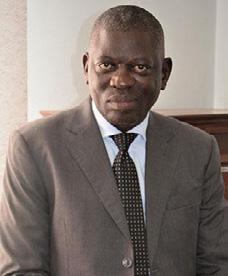

The alumni association will hold multiple events, which include motivational public lecturers and seminars, gala dinners, homecoming events and class reunions. Other proposed benefits of joining the alumni association include:

• Discounts at the bookshops
Access to the University’s library system, which is a valuable resource for those who need to carry out work and post-graduate research
•
Access to online Alumni newsletters. That will keep you informed on-campus activities, events, faculty developments and many more activities.
University of Namibia is proud to be celebrating its 30-year anniversary in 2022.
It is a significant age to celebrate the University’s history and acknowledge the vital role it has played in the social and economic transformation of a growing ambitious African region.
Formally constituted on 31 August 1992, the University has grown to be one of the world’s leading and the largest university in Namibia. With over 28 000 students, 2 500 local and international staff, and a cohort – both locally and globally – of more than 60 000 alumni.
Join us to celebrate three decades of achievement:
» 30 years of educating talented individuals to make a difference in the world.
» 30 years of embracing internationalisation in education.

» 30 years of promoting academic excellence.
» 30 years of meaningful academic research.
» 30 years of expansion across Namibia.
» 30 years of giving back to society.
To pick up a conversation with us on an opportunity or programme, please send us an email at info@unam.na or call: +264 (0)61 206 3111.
The African Leadership Institute exists to equip and develop leaders to transform Africa.
For Namibia to move from peace and stability towards prosperity, we need more people moving from passivity to productivity, from standing on rights to taking up responsibility.
Leaders who can do that are those with soft hearts, tough minds, skilful hands and upright characters. We need leaders like that in all spheres of society.
Our mission is to train individuals to be such leaders.
Training takes place at the Rock Lodge, Okahandja and is available for any individual who has a desire to make a difference – transforming yourself, your relationships, performance at the workplace and your community. The curriculum focuses on developing both human and social capital, which includes emotional intelligence.
ALI is registered as a Private Higher Education Institution with the Ministry of Higher Education, Training and Innovation VET levypaying companies can claim ALI training fees back from NTA.
ALI offers the following NQA-accredited qualifications: CERTIFICATE IN TRANSFORMATIONAL LEADERSHIP (Level 5) DIPLOMA IN TRANSFORMATIONAL LEADERSHIP (Level 6) CERTIFICATE IN ENTREPRENEURSHIP (Level 4)
Certificate in Transformational Leadership (N$ 23 000):
Face-to-face training at The Rock Lodge offered in three block sessions of one week at a time
One relational weekend seminar
Shared accommodation and meals at The Rock Lodge
Training notes plus prescribed books
Weekend seminars presented by ALI:
Marriage Enrichment, Relationships, Parenting Seminars
Finance seminar - How to master your money
Executive seminar - For leaders in senior positions
Effective management towards productivity
Contact details: admissions@ali.com.na www.ali.com.na
Tel: +264 061 250
Please contact us for more information on our sophisticated conference facilities contrasted by the splendid solitude of the Namibian bush.
Location: 82 km outside Windhoek on the B2 to Swakopmund.
The Rock Lodge can luxuriantly accommodate 76 people and our Rock Training Centre can accommodate 140 people.
We provide activities such as team building, obstacle courses, sports and adventure camps, as well as seminars on conflict management, leadership, life, family and marriage enrichment.
Tel: +264 62 50 6000
Cell: +264 81 725 5991 info@rocklodge.com.na www.rocklodge.com.na
To inspire and enable individuals to lead powerful transformation.
#LearnOnOne is a window of opportunity to empower Namibians through supplementary education on broadcast television. Children and adult learners can tune in to #LearnOnOne and invite learning in
#LearnOnOne is a not for profit division of One Africa TV, funded by sponsorships from partners who believe in the power of education. By enabling learning for children through #LearnOnOne content, sponsor organisations strengthen their brand stature and awareness as a socially responsible brand that supports national development through education Sponsors will be acknowledged on lesson opening and closing billboards Be part of the education movement in Namibia!
With your help, more learners will be able to access #LearnOnOne lessons. Pledge your contribution and help us by including the #LearnOnOne initiative in your CSI contributions.
How
- N$ 150 000 (77 lessons)
- N$ 100 000 (51 lessons)
- N$ 50 000 (26 lessons)
- Other: monthly or once-off amount
Contribute to platform evolution costs
Join information distribution campaigns (e.g on product packaging)
Namibia’s economy has been projected to grow by between 2.9% and 3.4% in 2022, compared to an estimated 0.9% in 2021.These projections were, however, made before the downturn in the global economy following Russia’s invasion of Ukraine in late February 2022.
In its February 2022 Economic Outlook, the Bank of Namibia (BoN) attributed the expected growth of 3.4% for 2022 to “… the anticipated better growth rates across all industries, with diamond mining expected to register robust growth rates.” The bank, however, said the construction sector is expected to remain in contraction in 2022 before recording growth in 2023.
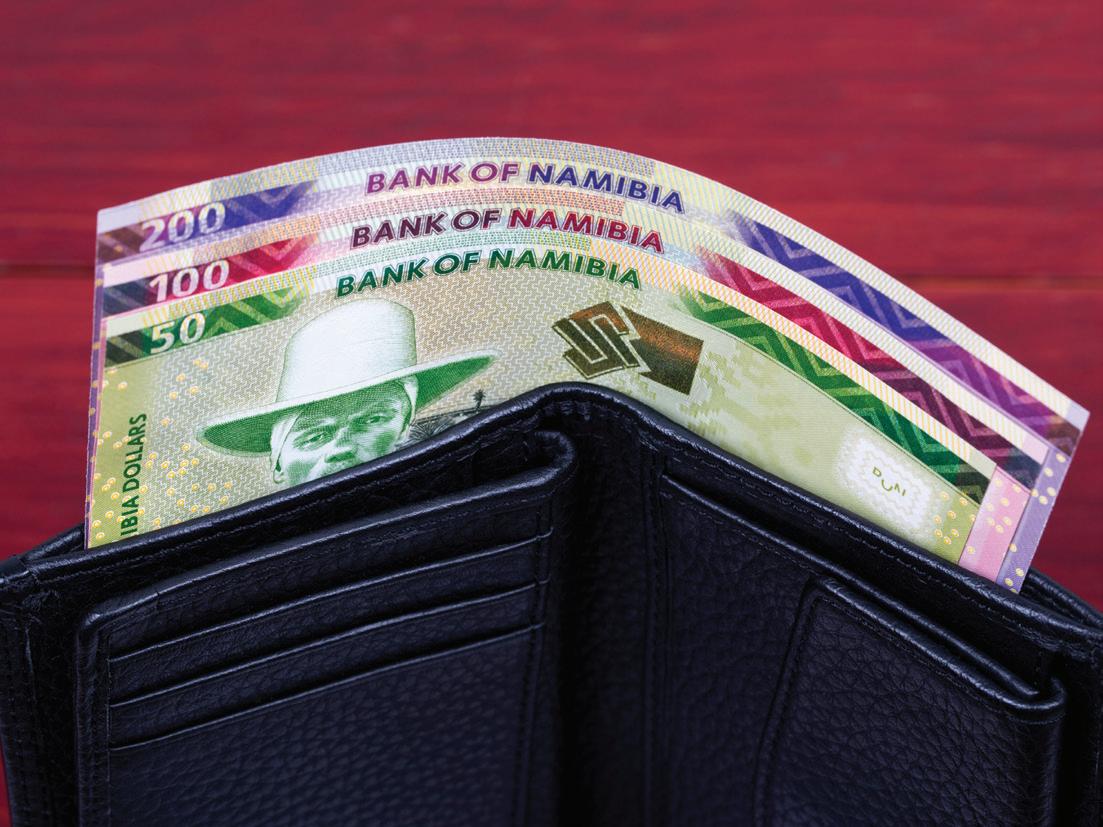
According to the BoN, “Risks to domestic growth are dominated by possible new waves of coronavirus infections, vaccine hesitancy, supply chain disruptions and the slow pace of vaccinations in Namibia,” adding that “High prices for fuel and gas, global supply disruptions and irregular rainfall patterns which might impact negatively on agriculture are other notable risks to the domestic growth outlook.”
The BoN’s projection was considerably more optimistic than that of Finance Minister Iipumbu Shiimi who said during his 2022/23 budget speech he expected the economy to grow by 2,9% in 2022.
President Hage Geingob reappointed Johannes !Gawaxab as governor of the Bank of Namibia for a five-year period with effect from 1 January 2022. !Gawaxab was appointed as governor in June 2020 for an 18 month period following the appointment of Iipumbu Shiimi as Finance Minister.
The Namibian government launched the long-awaited sovereign wealth fund, known as the Welwitschia Fund in May 2022. The fund will receive an initial injection of N$262 million and will be funded by a portion of royalties from the sale of mineral resources, tax revenues, money raised by the government divesting from its public investment holdings and contributions from identified state-owned enterprises. An investment of 2.5% of its portfolio will be invested locally to bridge the country’s infrastructure financing gap. It will be managed independently by the Bank of Namibia (BoN).
Speaking at the occasion, President Hage Geingob said, “We are looking forward to the prospects and opportunities that will emanate from the recent discoveries of oil and the green hydrogen energy, which have the potential to further boost the fund’s capital.”
The annual inflation rate for April 2022 stood at 5.6%, the highest annual percentage change above 5% since November 2018. The increase was largely driven by transport (2.7%) which accounts for 14% of the NSA consumer basket, following an increase of 20% in the petrol price between February and April 2022, while diesel prices increased by nearly
2018/19 2019/20 2020/22 2021/22 (EST) 2022/23
PUBLIC DEBT N$87, 050 BN N$100,399 BN N$110, 608 BN N$125,825 BN N$140, 185 B
PUBLIC DEBT AS % OF GDP 46.3% 56.10% 62.10% 67.30% 71.00%
27% over the same period as a result of global oil prices which reached their highest level since 2008. The inflation in food and non-alcoholic beverages (1.1%) was largely due to increases in the price of oil and fats. Analysts expect food prices to continue increasing as a result of the war in Ukraine and rising production and transport costs.
The BoN increased the repro rate from its historically low level of 3.75% since the beginning of 2020 to 4.0% in February 2022, followed by another 25 basis points increase in April 2022. The Monetary Policy Committee (MPC) said the April decision is a step, “… towards normalising the negative real interest rate environment and establishing a positive real interest rate that is conducive to long-term economic growth. The decision is appropriate to safeguard the one-on-one link between the Namibia Dollar and the South African Rand, while meeting the country’s international financial obligations.” The South African Reserve Bank increased the repro rate to 4.75% in May 2022 and analysts expect more repro rate increases during 2022.
Finance Minister Iipumbu Shiimi tabled the 2022/23 budget in the National Assembly under the theme “Reimagining, a better future for the youth” on 24 February 2022. In his speech, Shiimi highlighted several youthfocussed programmes and initiatives the government is spearheading. The 2022/23 budget makes provision for total revenue of N$59.7 billion, while expenditure was projected at N$70.7 billion, leaving a deficit of N$11 billion or 5.5% of GDP. Education, Arts and Culture and Higher Education, Training and Innovation received N$17.4 billion or 24.6% of the budget, while Health and Social Services has been allocated N$8.35 billion
BAN - Bankers Association Of Namibia
P O Box 195, Windhoek +264 61 299 2116 Davel.Botha@capricon.com.na www.ban.na
EAN - Economic Association Of Namibia
P O Box 21459, Windhoek +264 61 220 2181 info@ean.org.na www.ean.org.na
ICAN - Institute Of Chartered Accountants Namibia P O Box 21459, Windhoek +264 61 220 2181 secretariat@ca-nam.com www.ican.com.na
Financial Intelligence Centre
P O Box 2882, Windhoek +264 61 283 5287 helpdesk@fic.na www.fic.na
(11.8%) of the budget. Transport’s budget allocation increased by 6% from N$2.4 billion to N$2.6 billion. Public service personnel expenditure remains high, accounting for nearly 43% of total expenditure.
In his budget speech, Shiimi expressed concern about the high level of public debt which is expected to increase to N$140.2 billion or 71.0% of GDP during the 2022/23 financial year, adding “Government is committed to redirect much of the revenue increases in the coming years, as the economy recovers, towards debt redemption and reducing the borrowing requirement. At the same time, we recognize that the scope for further expenditure consolidation has thinned significantly, and we thus shift the policy focus towards entrenching sustainable economic growth.”
Moody’s Investor Services downgraded Namibia’s long-term issuer and senior unsecured ratings from Ba3 to B1 in April 2022. The agency said, “The B1 rating captures the economy's reduced shock absorption capacity and the continued increase in the debt ratio projected over the next three years, to 75% of GDP in fiscal year 2024. Stagnating trend growth and income levels point to persistent social spending pressures, including to mitigate the fallout from higher food and energy prices triggered by the Russian invasion of Ukraine, thereby increasing the risk of fiscal slippages.”
However, Moody’s, changed the outlook from negative to stable as it is of the view that the government’s efforts to consolidate fiscal accounts over the next three years would eventually prove effective notwithstanding the rigid spending structure.
NIPA - Namibia Institute Of Professional Accountants
P O Box 90756, Windhoek +264 61 38 2700 reception@nipa.com.na www.office@nipa.com.na
NSE - Namibia Stock Exchange
P O Box 2401, Windhoek +264 61 227 647 info@nsx.com.na www.nsx.com.na
PAN - Payments Association of Namibia
P O Box 134, Windhoek +264 61 41 5420 info@pan.org.na www.pan.org.na
2022–2024
To support sustainable economic development through effective monetary policy and an inclusive and stable financial system for the benefit of all Namibians.
To be a leading central bank committed to a prosperous Namibia.
The Four Pillars
1
Maintain a stable and inclusive financial system
Maintain price and monetary stability
Ensure the sufficiency of supply and the integrity of currency
Operate as fiscal advisor to and banker for the Namibian government
Manage reserves prudently
Promote financial sector growth and economic development
Promote a positive reputation ▪ Enhance stakeholder awareness and confidence ▪ Maintain pro-active public engagement
▪
▪
Promote potential through talent transformation
▪
▪
Employer of Choice
Future-fit capacity building
▪ Foster visionary and collaborative leadership
▪ Promote a staff culture of integrity, agility, excellence and performance
Effective and pro-active risk management ▪
Deliver responsive and innovative solutions ▪
Develop a sustainable and green organisation ▪
Effective financial management ▪ Enhance operational capability and value maximisation ▪
Strengthen resilience through good governance and compliance ▪ Adopt data-driven solutions and decision making

The success of your enterprise contributes to development.
That’s why the Development Bank of Namibia provides a range of 12 private sector financing products that help you make a success of your business’ expansion or start-up.

Product Purpose
Contract (Tender)
Based Finance
Guarantees
Asset-Backed Finance
Bridging Finance
Business Finance
Invoice Discounting
Business Acquisition Finance
To meet short-term cash flow needs of a business, where there is an underlying contract or off-take agreement to carry out a certain activity
For a guarantee to a contracting employer to pay a certain amount of money in the event of damages due to under-performance
To acquire movable asset(s) for a business
To satisfy short-term cash-flow needs of a business to carry out a certain activity
To satisfy medium to long-term enterprise financial needs
To provide capital for a borrower (business) against due and payable invoices of other businesses
For a buy-in (acquisition of interest by external managers) or buy-out (acquisition of interest by existing internal managers)
Commercial Property Finance
Property Development Finance
Franchise Finance
Project Finance
Private Public Partnership (PPP) Finance
For acquisition or construction of immovable commercial property or making improvements to fixed commercial property
For development of low to middle income residential property, and industrial and commercial property
For acquisition of franchise rights and operationalisation of a franchise business
For privately owned infrastructure projects
For a legally recognized partnership between a public and private enterprise, for the development of public infrastructure
The Development Bank of Namibia was established in 2004, in terms of the Development Bank of Namibia Act. Its shareholder representative is the Minister of Finance.
The core of its mandate is to provide finance on a commercial basis to the private and public sectors for projects that have a high impact on Namibia’s socio-economic development. The commercial nature of its finance allows it to grow its assets by recovering capital and interest. The multiplying financial resources are used to finance more projects, provide returns to investors in the Bank and a portion is allocated to prudent financial reserves.
Additional facets of its mandate include local and international raising of capital, and development of money and capital markets.
Creation of employment opportunities is one of the most important measures of the Bank. The Bank also targets spread of economic activity across Namibia’s regions, and sectoral stimulus, particularly manufacturing, tourism, and transport and logistics, as these sectors are identified in the Fifth National Development Plan (NDP5) as having an important role to play in Namibia’s economy.
The Bank also has a transformational agenda, to address economic imbalances. This agenda includes economic participation of previously disadvantaged Namibians, women entrepreneurs and youth entrepreneurs.
The Bank specialises in finance for projects with higher risk profiles that would not ordinarily be financed by commercial banks. Not only can the Bank service enterprises with perceived higher risk levels, such as SMEs, but it can also develop pioneering finance solutions. In the past, the Bank has pioneered finance for independent power producers, as well as contract (tender) based finance. By taking a lead through exercise of its risk appetite, the Bank shows the way for commercial sources of finance.
The Bank is able to manage and mitigate a higher degree of risk through its enterprise-wide risk management framework, which responds to external and internal risks. The Bank also actively manages the environmental and social impacts of its lending though its Environmental and Social Management System (ESMS).
In terms of the goals of its finance, private sector enterprise delivers sustainable results with development impact. By fostering the entrepreneurial ambitions of enterprises, and individuals, with finance, the Bank is able to further the interests of enterprises, their stakeholders and beneficiaries of employment and development impact, while providing for its own sustainability and growth.
Risk mitigation is rooted in a robust due diligence process which appraises the business plan, cash-flow projection, skills and experience of
management and collateral availability and owner’s contribution. The Bank requires a clear indication of viability of projects that it finances, in addition to development impact.
Decisions are taken by several committees which examine the viability of the application, the credit risk and compliance with the regulatory environment. Depending on the amount requested, the application may be escalated to an overall management committee and/or a board committee.
In cases where the Bank determines that a project has a high development potential, but is not yet bankable, the Bank may deploy the Project Preparation Fund (PPF), which assists with developing further aspects that contribute to viability, including funding for various studies. The PPF is deployed at the Bank’s discretion.
As SMEs have a higher risk profile, and as the Bank receives finance from external investors, SME finance is ring-fenced and managed by a separate function within the Bank.
As SMEs are an important source of economic activity, the Bank provides dedicated services and assistance to SMEs through its SME Centre in Windhoek and its branches in Ongwediva, Rundu and Walvis Bay. It also provides mentorship, general business training and technical training through its Client Support function.
Larger enterprises are financed from the Enterprise Portfolio, which is a repository for interest-bearing finance raised locally and internationally.
The Bank routinely provides finance for large-scale infrastructure projects. These projects are often initiated by state-owned enterprises. The Bank also finances local authorities and public private partnerships (PPPs).
When a pressing economic issue emerges that can be addressed by an enterprise and/or infrastructure the Bank strives to make an impact through provision of finance. The Bank has been able to make impacts on the shortage of affordable land and housing through provision of finance to local authorities, PPPs and private enterprises that construct affordable housing. It has also made an impact on the national electricity deficit by providing finance for privately owned renewable energy generation. In addition it has financed numerous private education and health facilities. In addition, it has been able to provide Covid-19 relief.
The Bank has adopted a path of using its profits to provide additional finance for more or larger projects. This has led to steady growth of its balance sheet. As a result of its excellent record of governance and risk management, the Bank attracts tranches of finance locally and internationally, lines of credit from various commercial banks and investment under its Namibian Stock Exchange (NSX)-listed bond programme.


















































































As a privately-owned investment manager, which has been managing assets for Namibian clients since 1984, Allan Gray Namibia remains committed and well-positioned to leverage the opportunities emerging from the ongoing turbulence in global financial markets. We form part of the broader Allan Gray Group, which was established in South Africa in 1973, and is the continent’s largest privately owned investment management firm. Headquartered in Cape Town, the Group also has a presence in Gaborone, Botswana, in addition to our office in Windhoek. Through our offshore partner, Orbis, we offer a range of global investment products for African investors.
In just two years, major world events have run a terrifying course, from a health pandemic and ensuing market and social distress to a geopolitical threat turned full-scale war in Ukraine. The tragedy has been significant, and our thoughts are with all of those who have lost loved ones or had their lives severely disrupted.
World events of this scale introduce heightened risk and volatility to financial markets and can lead to significant market downturns and related drawdowns in investment portfolios. In the context of longterm investments, such events, and their ensuing volatility, have less of a long-term impact on investment outcomes than one may think because, as history shows, markets correct themselves.
In situations of extreme market volatility, our job as an investment manager is to remain disciplined and assess the impact on the fundamental value of businesses. While many investors use share prices and media reports to pick the companies they want to invest in, at Allan Gray Namibia, we work hard to establish the true value of a business as a whole, including its ability to make a sustainable profit over time and under different conditions.
Our focus on bottom-up research enables us to identify exceptional businesses that have a competitive edge and trade at a discount to our assessment of their intrinsic value. We buy these assets at a discount and sell them when they reach our estimate of their true value.
We are a value-orientated investor, and our contrarian investment philosophy naturally leads us to out-of-favour areas of the market. We do not limit our research to fast or slow growth, high or low quality or big or small companies, and we do not avoid shares simply because they trade on high valuation multiples. We aim to identify shares that trade significantly below what we think they are truly worth today, factoring in the expected future growth potential. As such, we are opportunistic, and our flexible approach enables us to take advantage of whatever types of opportunities the market presents.
Our tried-and-tested investment philosophy has stood the test for almost five decades. At Allan Gray Namibia, we remain resolute on building wealth for our clients over the long term.
Environmental, social and governance (ESG) issues have dominated headlines for the last few years and are front of mind for many investors as they start to think more critically about the environmental and social impacts of companies in which they invest and demand more purpose-driven, sustainable and stakeholder-centric behaviour.
Integrating ESG factors into our research has always been an intrinsic part of our investment philosophy and we continuously strive to further enhance our ESG approach, research and engagement processes.
We focus our research and engagement efforts on ESG issues that are most material to each company, rather than applying a cookie-cutter approach. ESG risks play an important role in assessing whether a company is a suitable investment.
For over a decade, the Allan Gray Orbis Foundation has contributed to long-term nation-building and economic transformation on the continent by identifying prospective high-impact entrepreneurs at an early stage, nurturing their entrepreneurial spirit and funding their education.
The Foundation has awarded more than 100 full scholarships to Namibian learners and students. Furthermore, capital has been reserved to support the businesses founded by our fellows.
At Allan Gray Namibia, our business is built on our people. We believe that diversity of ideas and experiences breeds the best investment solutions, and we remain focused on developing and drawing on fresh talent. We have therefore assembled a dedicated team with a depth of talent and experience.
The team is led by Birte Schneider, who is both managing director and portfolio manager, having joined the Group in 2011 as an investment analyst. Allan Gray Namibia is fully resourced and capable of meeting our clients’ needs in an everchanging financial landscape. Other members of the team include:
Danny van Wyk: Institutional Client Services manager
Helmudien Slinger: Office manager

Etienne le Roux: Senior Business Development manager
Ray-Ann Isaacs: Retail Client Services consultant
Tuyeni Akwenye: Investment analyst
Minette van Wyk: Personal assistant
Werner Nahole: Compliance officer
Joseph Mukendwa: Institutional Client Services manager
+264 61 221 103 info@allangray.com.na www.allangray.com.na
+264 61 258 214 gavinf@allangrayorbis.org www.allangrayorbis.org
The goals you set yourself to achieve define the impact you want and the impact you make. As an individual, it may be a life of purpose, a legacy left for family, or a retirement filled with ambition. As a business, it may be to enable the very same for employees, which in turn results in a better, more resilient organisation.
At Alexforbes, we pioneer insight to provide you with advice that connects your decisions of today to the impact you want tomorrow.



The Namibia Mineworkers Investment Holdings Company (Pty) Ltd was incorporated on 7th July 1997 and is wholly owned by Namibia Miners Investment Trust (NAMIT). The beneficiaries of the Trust are defined as former and current Mineworkers Union of Namibia MUN (members), their dependents and the communities they hail from. NAM-MIC Holdings was created to enter into business joint ventures with credible and visionary partners to jointly service identified emerging markets and at the same time empowering the previously disadvantaged groups of the society by creating capacity that will enable them to develop new industries and broaden the economic base that will lead to new job opportunities.







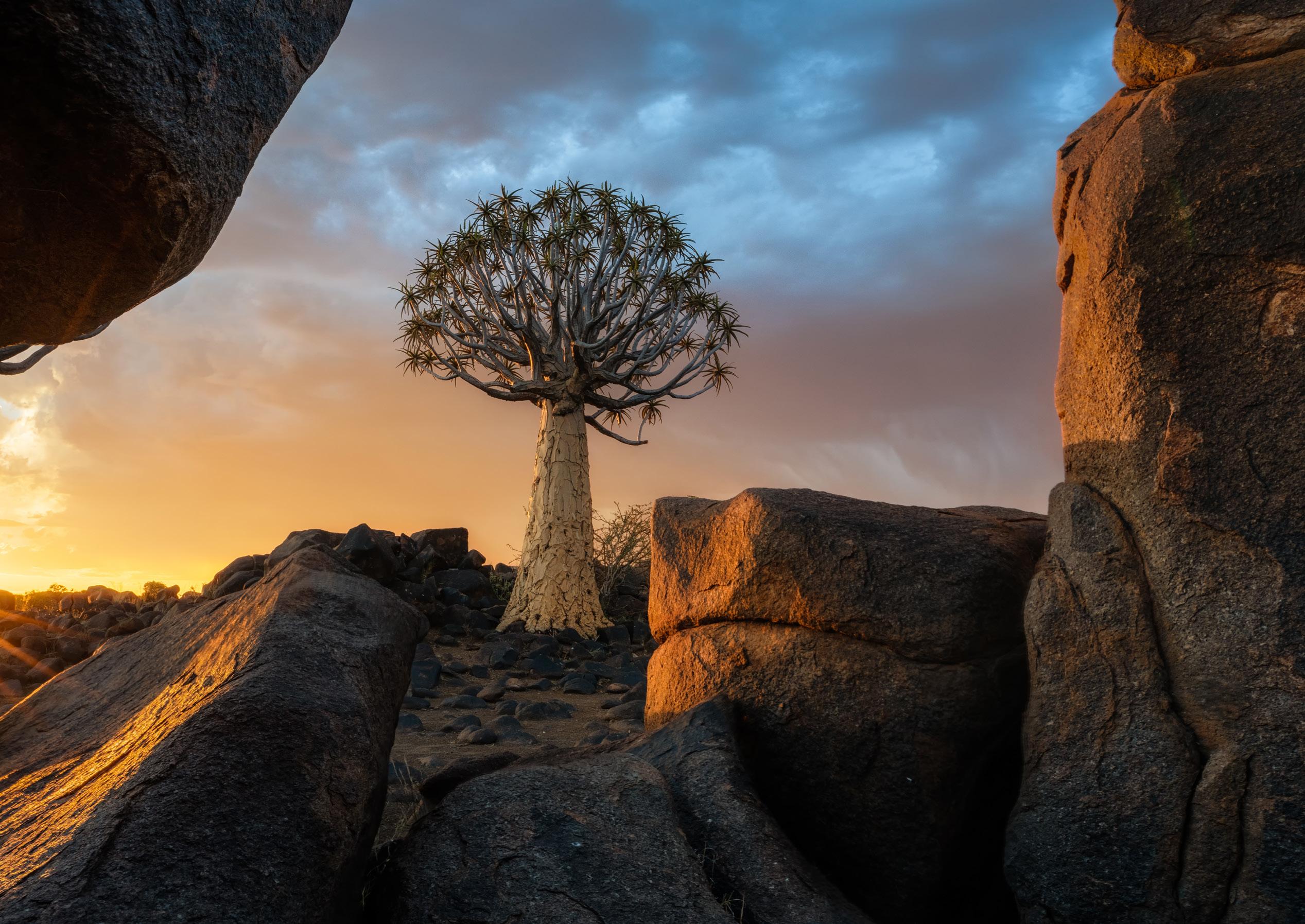
Ideal partnerships initiate the energy that creates positive change. Capricorn Group is well positioned to help you find the right connection.
When you are connected you have more support, more resources and more opportunity. At Capricorn Group, we believe in being Connectors of Positive Change. Through our diversified portfolio and reach, we bring our stakeholders closer to their goals so they can realise their dreams.
To learn more about the Capricorn Group visit Capricorn.com.na
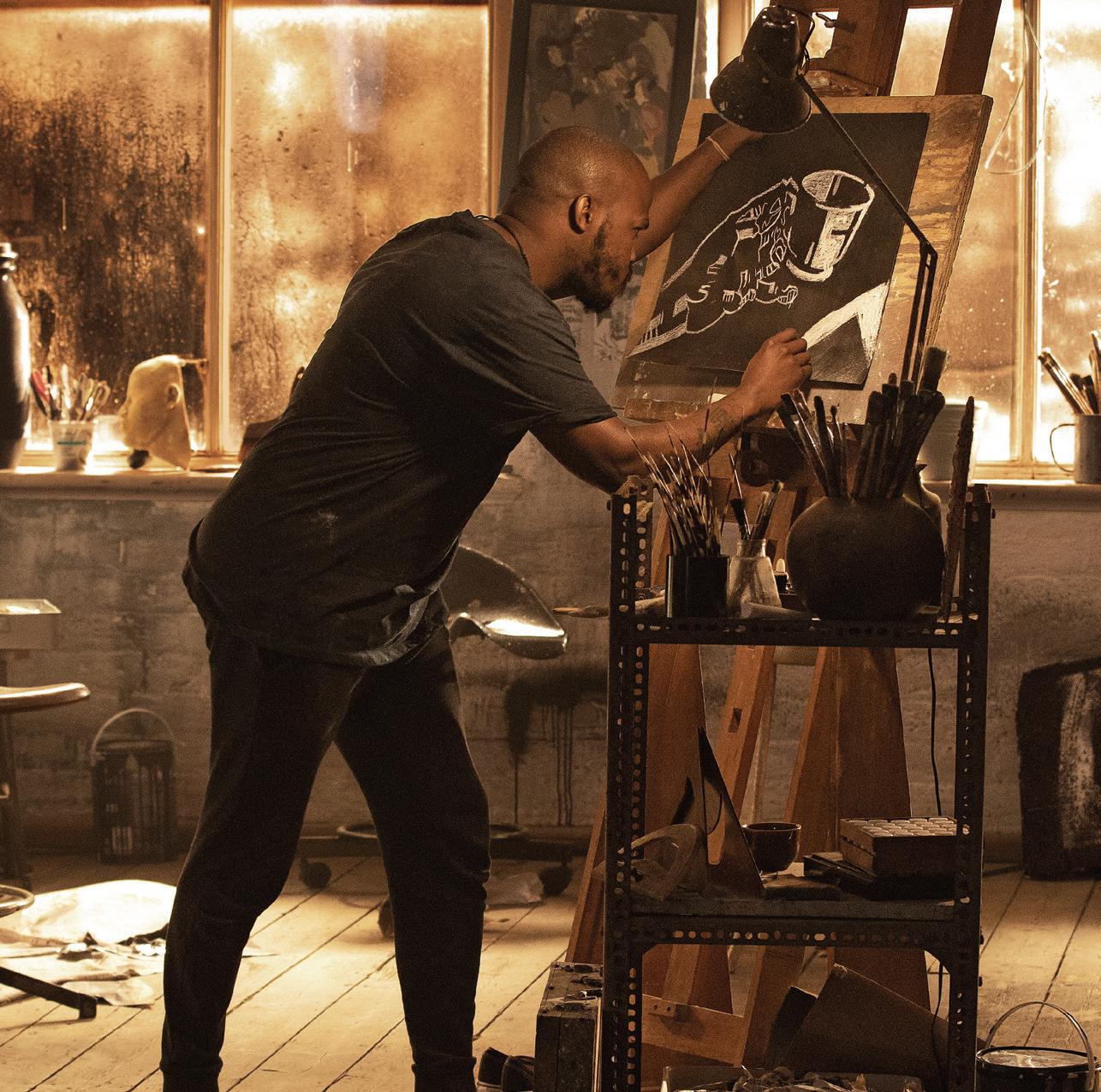
The road to extraordinary isn’t easy. And it isn’t short. But if you keep going, the rewards will come.
Invest in consistency mandg.co.za
Previously Prudential Portfolio Managers MandG Investments (Namibia) (Pty) Ltd is a licensed financial services provider.M&G Investments Southern Africa (M&G Investments) is a South African asset manager with a special focus on South African and Namibian markets.
Our close ties with Namibia go back to 1996, when we were the very first international asset management company to establish an office in Windhoek.
We cater for both retail and institutional investors and manage over R323 billion of our clients’ savings (as at 31 March 2022), making us one of South Africa’s top 10 largest investment managers.
We are part of the wider M&G plc group, one of Europe’s largest active asset managers. M&G plc has £370 billion in assets under management (as at 31 March 2021), over five million clients, and operates in 28 markets around the world.
In South Africa and Namibia, we use M&G plc’s global reach and expertise in managing our clients’ portfolios and ensuring international best practice.
Since our founding in 1994, we have consistently used our rigorous, prudent valuation-based approach in managing all of our portfolios.
We focus on company valuations (“bottom-up”) instead of broad investment themes (“top-down”) and only buy an asset if it is priced below its long-term fair value. We are risk-conscious, aiming to both protect and grow our clients’ savings over time.
We believe that our philosophy and unemotional application of this process will lead to consistent investment outperformance over time. Consistency is key to successful investing – this is our investment edge.
We are committed to transformation in our business, recognising the imperative of achieving greater socio-economic equality in all aspects of our society.
Our Namibian business is 75% owned by M&G Investments Southern Africa, 15% by Horizon Investments (our Namibian black empowerment partner), and 10% by staff via the M&G Staff (Namibia) Trust.
Excluding the strategic holding by M&G plc, 63% of our shareholder base within M&G Investments Southern Africa is black-owned, collectively by Thesele Group and our black staff.
We know that there is still much to be done. However, transformation remains one of our highest business priorities over the near term.
We have long been a champion of active shareholder involvement on many levels, from directly engaging company management to challenging takeover bids.
We consider ESG factors as part of our fundamental investment analysis, since we recognise that these issues can carry risks that could affect our environment and the broader economy, as well as diminish potential investment returns for our client portfolios.
We are a signatory to the United Nations Principles for Responsible Investment and subscribe to the principles of the Code for Responsible Investing in South Africa (CRISA). In fact, we actively participated in drafting CRISA.
Our product range takes advantage of our core skills and is designed to meet the specific requirements of our clients. Across the globe, we have proven, dedicated and skilled teams managing funds across a diverse range of assets.
Our equity offerings are managed according to a specific investment objective or the bespoke investment requirements of our clients. We currently have three broad equity mandates for institutional investors: Houseview Equity, Select Equity (client-specific mandates) and Other Equity (niche mandates). For retail investors, we have the M&G Equity and Dividend Maximiser Funds.
In partnership with M&G Investment Managers (UK), our global funds were launched with the aim of bringing South African and Namibian clients an optimised offshore investing solution. These include our US dollar or rand-denominated global equity, property and fixed-income building blocks, as well as our multi-asset global solution funds.
Our multi-asset offerings take full advantage of our expertise in both strategic and tactical asset allocation. Our two institutional categories are Balanced and Real Return, while retail investors have access to a selection of South African and Namibian multi-asset funds.
We offer a range of fixed-income offerings to suit client-specific requirements, including our high-yield bond, money market, income and inflation-linked bond mandates.
Our property offerings provide investors with exposure to the South African property sector through our enhanced indexation or fundamental active approach to stock selection within the sector.
We were one of the first investment companies to offer TAA as a standalone service, both in the UK and South Africa, and as a result we have one of the most experienced asset allocation teams worldwide.
We are serious about the responsible stewardship of our clients’ assets and providing excellent client service.
We believe responsible corporate behaviour is essential in maintaining successful relationships with our clients, our staff and our communities. Understanding our stakeholders’ needs today, can help us innovate in ways that create both commercial and social value in the future.
M&G Investments
+ 264 61 256 166 info@mandg.com.na www.mandg.co.za

We are living through a period where the pace of change has got faster, from fast-tracking the adoption and use of technology and new ways of working, to the need to pivot quickly to keep up with changing markets and consumer expectations. The new landscape forces reinvention, and at EY, we believe that only bold ambitions, and a commitment to accelerating transformation using technology, data and experienced teams, will enable organisations to achieve unprecedented levels of growth, out-run competitors and achieve long-term value creation.
So, how can your organisation reframe its future? Where are the as-yet-unseen opportunities that will generate future growth? How can your organisation rebuild and operate, not for business as usual, but for business as better?
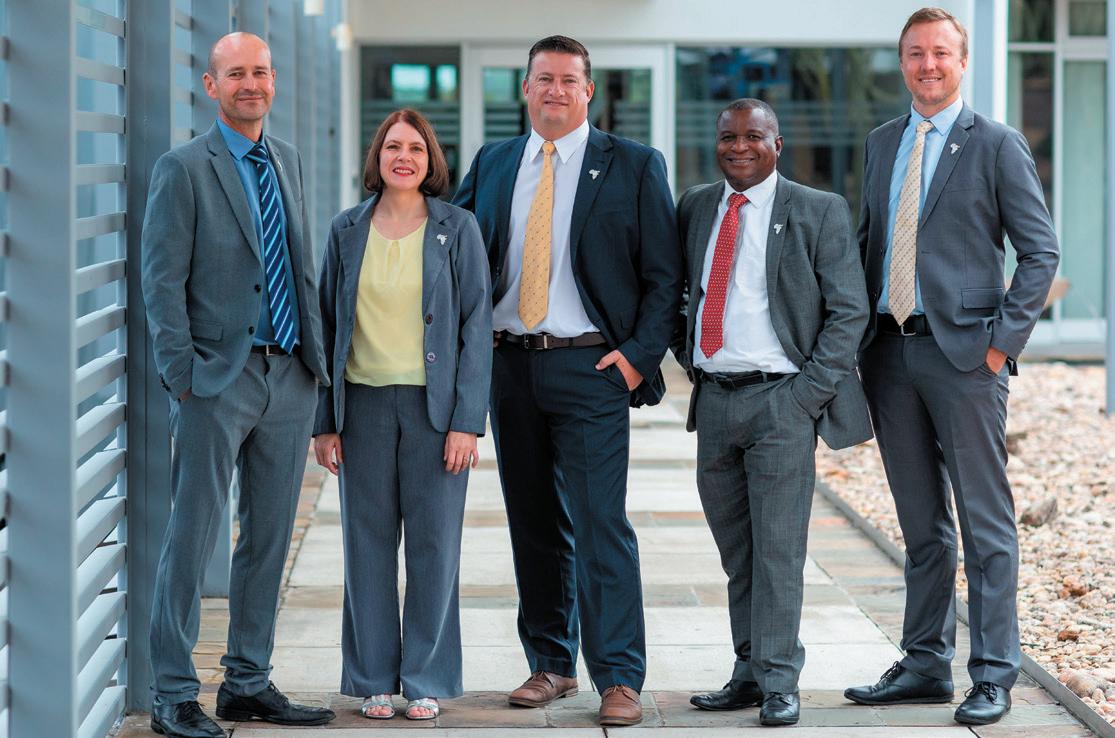
Realising your ambition today requires you to take a radically different approach to connecting transactions, transformation and technology where design and delivery inform each other at every step.

EY reimagines the most critical components of your organization, from workforce to operations, technology to customer, delivering innovation across the value chain and providing a 360-degree perspective from design to delivery. Our highly experienced teams are trusted to deliver successful business transformations, with a holistic view that creates value at every level of the enterprise unlocking new opportunities to reframe your future –and help us all build a better working world.
Find out how EY can help rethink transactions, business transformation and technology, so that ideas and implementations are interwoven to realise your ambitions. Realise your ambition





Is your strategy tied up in business as usual or tied to your ambitions?
FNB’s launch of Forex on App introduces a better way to make cross-border payments, international payments and transfers to anywhere in the world.

With just a few taps on the FNB App, customers can now make foreign exchange payments safely and securely using their mobile devices, which not only makes this innovative solution more convenient, but also ensures a better customer experience.
Forex on App is just one of the many capabilities that the bank will be rolling out in 2022 which seek to change the way FNB customers do banking for the better. This drive will include enhancing the value offering across both digital and mobile banking platforms.
“We are excited to introduce this new innovation because the benefits to our customers are vast. They will be able to make cross-border and international payments and transfers on their mobile devices on the go,” said Dawid Shikongo, Foreign Exchange Specialist.


The innovative solution comes at no additional cost to customers
The Foreign Exchange solution is not new to FNB customers who have experienced the benefits of Forex Online for years. With Forex Online, customers have been able to not only transact in a foreign currency but also save in a wide range of foreign currencies and transfer funds between foreign currency accounts. All these capabilities are now accessible
The introduction of Forex on App is FNB’s way of ensuring easier, better and more seamless transactions when customers are making payments beyond our borders. Not so long ago, the bank embarked on a drive to migrate its customers from manual Forex transactions to Forex Online. This convenient change was embraced by most of the bank’s Retail and Commercial customers. “Having walked the journey with customers as they moved from manual Forex processes to Forex Online, I could see first-hand how they experienced the ease and convenience. I believe this next step in our Forex payments evolution will make an even bigger difference, and I can’t wait to see it”, said Morne Husselman, eForex Specialist.
“Seeing as a significant base of FNB’s customers have links to family, friends and colleagues living beyond the borders of Namibia, the need for seamless cross-border and international transactions is not a nice-to-have but a must-have and we are happy to create a solution that meets these needs.”
Husselman added that although the solution is available now for Retail customers, the bank is working to ensure that its Commercial customers can soon experience the same convenience and ease when they do their own business transactions.

“We are working towards introducing Forex on the FNB
App for Business for our Commercial customers. In the meantime, they can continue to use Forex Online which has recently been enhanced, adding in new features that ensure a better digital journey for the customer. So, although the process is easy for our Commercial and Corporate customers as it stands, our goal is to make sure that we partner with them in always moving ahead of the curve and solutioning differently so that they can continuously bank better.”
We always ask ourselves – how can we help make banking easy?
“FNB has always led the provision of innovative solutions to its customers, both for digital and mobile banking solutions, and Forex on App is just one of the products that FNB customers will see being rolled out in the year across all platforms.” This was said by Neville Ntema, Head of Foreign Exchange Product House who emphasised the bank’s commitment to being not just a bank but a banking partner to all its customers.
“We always ask ourselves – how can we help make banking much easier for our customers? And, in asking this question, we are able to see what enhancements our current offering requires to ensure that it meets customer needs and goes even further to exceed these. The introduction of Forex on App is a result of this constant probing. So we are pleased to now introduce this next phase of cross-border and international payment solutions that is changing the way our customers will do global transactions,” said Ntema.
• If you import goods and need to pay for them:
o You can make an advanced payment in this regard; or o You can pay for the goods once they’ve arrived in Namibia Pay for travel (flights, accommodation and other expenses)
• Fund your offshore account for your holiday spending
• Pay for your tuition
• Pay for your child’s subsistence allowances when studying abroad
• Pay for other international payment obligations
• Send a financial gift abroad to a loved one
• Convert funds received from abroad (individuals who are paid in foreign currency can convert from their foreign currency account to their NAD account)
Whether you are sending a gift, paying for services rendered or imports, funding offshore investments, paying tuition or securing your holiday accommodation, do it all on the FNB App from the comfort of your home or office.
Access the exchange rates of 17 foreign currencies right in the palm of your hand. Whether you want to sell or buy any of the foreign currencies, you will find suitable rates on the FNB App.
Easily convert funds from any of your foreign currency accounts (US Dollars, British Pounds or Euros) into your local currency account using Global Transfers on the FNB App.
Click on the Forex icon
Select Global Payments
Select Once-Off Payment on the bottom right and click on Continue
Select the type of beneficiary being paid: Individual or Business
Complete the address details of the beneficiary. Scroll down
Select the beneficiary’s resident country. Type in the first 3 letters of the country and select the correct one
Complete the beneficiary’s banking details. Click on the toggle bar to save the beneficiary for future payments. Click on Continue
Scroll through the From accounts to select the account to transact from. Tap on Specify amount in
This is where you specify how the rate conversion will be done, e.g. USD to NAD or NAD to USD. Select the currency to be converted from
Insert the amount and your own reference to appear on your bank statement. Scroll down If a deal is available that matches the criteria
of this application, the pre-booked screen will display. Click on the deal
Click on Use Deal and continue
Select how the bank charges will be distributed and then select the account to bear the bank charges. Click on Continue
Tap on the Add BoP code to select the reason for this payment. Scroll through the options to find the most appropriate reason
Depending on the BoP code selected for your payment, additional information will be requested. Complete the requested fields. Click on Save
Click on Continue
Tap on the tick boxes to agree to the regulatory declaration above and accept the terms and conditions. Click on Continue
Review all the information. Click on Edit to change any information or Confirm that all the information is correct
Accept the quote displayed on the screen. If you are not satisfied with the rate, Decline and try again later
When the Thank You screen displays, the payment is complete. Click on Finish
Voted the Best Bank in Namibia for the third year in 2022 by Global Finance, First National Bank (FNB) is well placed to drive current and future trends in the financial services sector in Namibia.
The winners of this year’s awards are those banks that attended carefully to their customers’ needs in difficult markets and accomplished strong results while laying the foundations for future success. They also embraced change by finding new ways for customers to bank without interruption, providing much-needed stability in a time of uncertainty.
Recognised for providing customers with an innovative, contextual and agile banking experience, FNB invests greatly in understanding what customers require from us, and we are diligent in ensuring that we deliver to their needs.
To this end, FNB has placed a lot of focus on expanding its offering on its banking app through a strategy of continuously innovating and adding rich functionality across all digital interfaces, including online banking.
Furthermore, we proudly introduced another first in the market by allowing customers to do foreign transactions on the FNB app – all from the comfort of their home or office and on their smart phone.
We have introduced the FNB DigiPlus account, which is completely cardless and free of monthly account fees, created by the customer and managed through USSD. This differs from traditional banking where a customer needs to go to a branch to open and manage an account. The DigiPlus account does not require a bank card for a customer to make withdrawals or deposits. FNB’s DigiPlus allows the account holder to receive and send funds from FNB and other banks, make transfers between accounts (including the FNB Savings Pocket), buy prepaid electricity and airtime, send eWallets, and make cardless cash withdrawals and deposits at any CashPlus agent. FNB’s commitment to drive financial inclusion is widely recognised as an important cornerstone of improved economic and social outcomes and will help build a globally competitive Namibia, with the understanding of all the social and economic challenges.
Digital banking interfaces are also increasingly becoming a one-stop shop for customers to access services beyond mere traditional banking. In support of
helping our customers bank conveniently, the CashPlus agents around the country have become an extension of a network where customers can safely deposit and withdraw cash.
In today’s hyper-connected and fast-moving world, it is more important than ever to deliver an innovative, contextual and agile banking experience to customers. This is, arguably, one of the areas where FNB leads the sector locally, as the bank has been working to ensure that its digital interfaces are contextual to its customers’ needs.
Simplicity and access to solutions 24/7 are also key aspects of the customer experience but, at the same time, these need to be facilitated securely. In this respect, security was one of the key mentions in our recognition as Best Bank in Namibia.
Our efforts to help customers minimise off-platform exposure have seen us create in-app messaging to give customers full control over their money. Customers can now report fraud at the click of a button on our app. Digital banking interfaces are also increasingly becoming a one-stop shop for customers to access services beyond mere traditional banking. The role of digital banking interfaces is to enable easier access to services, but security remains paramount to ensuring that customers can trust and rely on these interfaces. The bank has seen a growing number of customers embracing these efforts to help them manage their money through this platform.
These are just some examples of our efforts to help our customers thrive into the future as we further modernise and transition our platform aspirations. We have spent more than a decade building significant and diverse data, technology and engineering teams who are constantly working to anticipate the digital needs of our customers now and in the future. Thanks to the deep levels of talent across these experienced multidisciplinary teams, we are able to respond to these ever-increasing needs, aided by a multiyear investment in the reconfiguring and modernising of our primary line of business systems, networks, data and technology-related infrastructure.
As the bank of the #Changeables, we understand that delivering shared value and bringing about positive change requires courage for deep thinking, unrelenting commitment to innovation and fundamentally doing our part to build a better today and tomorrow for our nation.



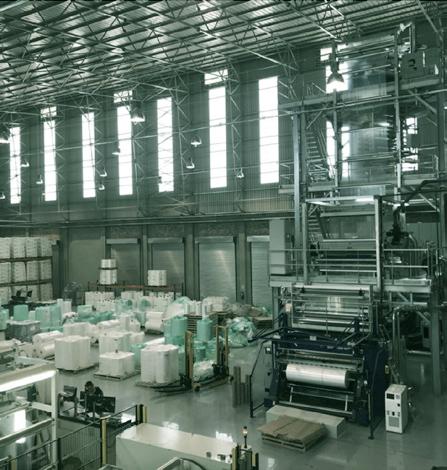
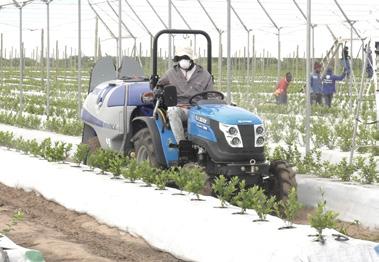
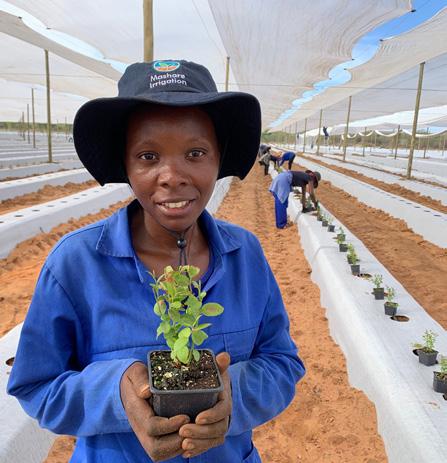
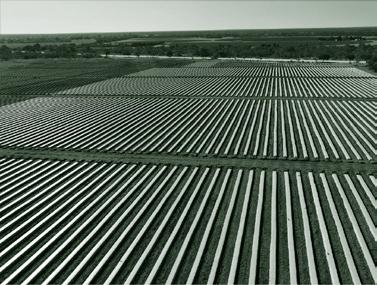
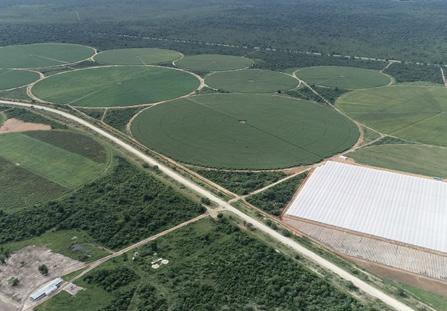

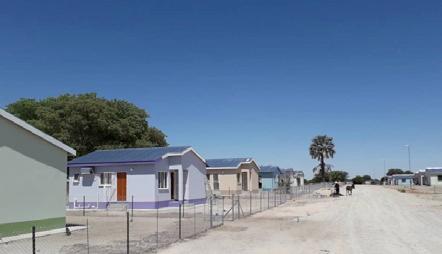
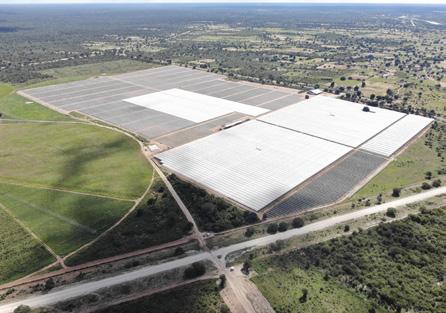
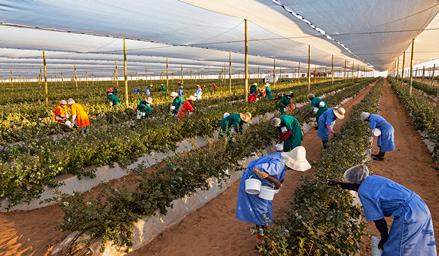

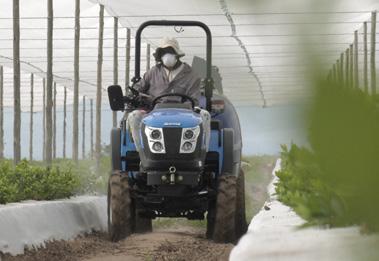
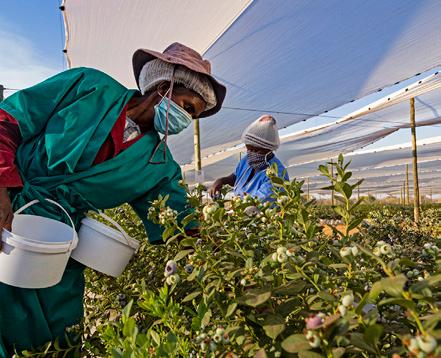
The Königstein Capital Group was established in 2009 as an independent unlisted investment manager that focuses on private equity and venture capital fund management in the Namibian market. The management team has extensive experience in various sectors of the economy gained over the last 40 years.
Königstein offers the following features that will unlock value for investors, entrepreneurs and developers:
• Extensive experience in and knowledge of the Namibian business environment
• A successful track record
• Superior proven financial deal-making abilities
• A network of key players in various industries to ensure deal flow
• Good corporate governance structures
• Strict risk management
• The ability to actively assist portfolio investments when required.
Through its current funds under management, Königstein Capital has already invested more than N$850 million in projects and investments with an economical value close to N$2 billion. Königstein has the necessary fund structures in place to offer investment alternatives to pension funds, institutional funds, and other investors.
Königstein Capital manages three funds that invest in property and infrastructure: The Königstein Capital Property Investment Fund (KCPIF) and Königstein Affordable Housing Fund (KAHF).
These funds invest in property and infrastructure projects:
• residential property (focused on lower-cost/affordable housing)
• infrastructure development
The funds have invested in a number of very successful propertydevelopment projects which have delivered more than 3 000 individual property units to the market. There are various new property-development transactions in the pipeline.
Spitz Capital (Pty) Ltd is the latest established fund. It is a Regulation 13 compliant unlisted investment vehicle, with the Government Institutions
Pension Fund as principal investor. Investment sector focus:
• Agribusiness and agriculture
• Health care
• Manufacturing, industry and services
• General business
• Media
• Financial services
Spitz Capital portfolio companies:
• Mashare Irrigation – an intensive cropping company producing grains and vegetables for the Namibian market
+264 61 303 227 info@konigsteincapital.com www.konigsteincapital.com
• Mashare Berries – Namibia’s first producer and exporter of blueberries
• Namibia Plastics – a plastic extrusion company that produces specialist products for amongst others the food & beverage and construction industry.
• Kavango Berries – producer and exporter of blueberries
• Kudu Biomass Group – producer and exporter of biomass products
Our investment objective is to provide investors superior and sustainable returns while at the same time having the maximum social impact. A perfect example of this strategy is our investment Mashare Berries. Through our fund Spitz Capital’s investment into Mashare Irrigation Group, we were able to establish Namibia’s first commercial Blueberry farm. Mashare Berries grows Blueberries for local consumption and export markets –creating jobs and adding to Namibia’s foreign earnings. This investment perfectly represents our growth strategy – scalable businesses with high social impact.
We follow a proper investment process that includes due diligence, negotiations, deal structuring and final recommendation by an investment committee that includes independent, non-executive trustees or directors.
Investments in the underlying portfolio companies are structured in such a way as to maximise return and to contain risk. We may use any of the following mechanisms to invest:
• subscription in ordinary shares, preference shares and/or debentures
• advancing of loans
• a combination of the above.
The individuals involved are Albie Basson, Arno Louw, Albert Basson, Etii Itope, Vidette Rickerts and Philip Ellis who have extensive business, investment-management, deal-structuring and corporate-finance experience.
A Namibia-focused development fund, with an initial focus on the food and agribusiness sector. Its aim is to invest into, as well as develop new industries, by leveraging Namibia’s abundant resources and world-class infrastructure.
The fund will focus on:
• Generating long term sustainable returns;
• Earn hard currencies; and
• Job creation.
We are excited about Namibia’s potential and eager to partner with likeminded companies and entrepreneurs.


The solutions you need for achieving your long-term business vision and goals have to be different. They need to stand out. They need to outperform the competition. Most importantly, they need to create impact. Solutions like these cannot come from simple product and service offerings. They come through partnerships. They come from a fully integrated team approach, and being personally invested in every account and client you manage.
This is the cornerstone which Nedbank CIB is built on. An innovative, highly integrated and personally invested banking approach, focused on bringing the goals and ambitions of our clients to life. This is the only way we are able to make a real difference – through building partnerships with our clients. Because if we aren not personally invested in your success, we are just another bank.
We strive to create solutions that impact the lives and goals of our clients; whether they are transactional solutions, corporate and investment banking solutions, lending products, or advisory services to corporate organisations. Each solution is based on a partnership approach, and because of this, each of our advisors is personally invested in your long-term success.
Supported by industry and product experts, the Nedbank Corporate and Investment Banking team is renowned for their ability to provide impactful corporate financing and investment solutions.






Contact the CIB office on: cib@nedbank.com.na (061) 295 2863/55
Nedbank Campus Freedom Plaza, c/o Fidel Castro & Rev Michael Scott Street, Windhoek
 Executive: Corporate and Investment Banking
Tjivingurura Mbuende
Head: Corporate Property Finance
Christo Kruger
Head: Corporate and Investment Banking
Dr Edward Turner
Relationship Manager: Corporate and Investment Banking
Cica de Wet
Executive: Corporate and Investment Banking
Tjivingurura Mbuende
Head: Corporate Property Finance
Christo Kruger
Head: Corporate and Investment Banking
Dr Edward Turner
Relationship Manager: Corporate and Investment Banking
Cica de Wet










People want to be remembered for what they have contributed to the world. Sometimes that contribution can be so special that it unalterably changes the universe. Each one of us will leave a lasting footprint which will be remembered by those whose lives we have touched. At Nedbank Private Wealth we help you create, grow and preserve your legacy.
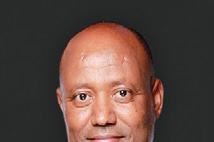




Nedbank Private Wealth understands what matters to you most. Whether it’s transacting internationally, purchasing property in the UK or trading in stock, Nedbank Private Wealth offers advice and solutions to meet your unique banking needs. We aim to use our financial expertise to help you deliver the value and care you and your family deserve.
Nedbank Private Wealth is the epitome of a highly personalised financial experience. We offer the full range of private wealth benefits, including airport lounge access, international and local forex services, advisory services, long-term financial planning, offshore and local investment opportunities as well as philanthropy events. Nedbank Private Wealth is the pinnacle of Namibian banking services.

We provide a wide range of banking services which help solve your financial needs, from personal and family banking to business finance, enabling you to focus on leaving behind a legacy that outlives you.


We all leave a legacy behind; whether we make the choice or not.
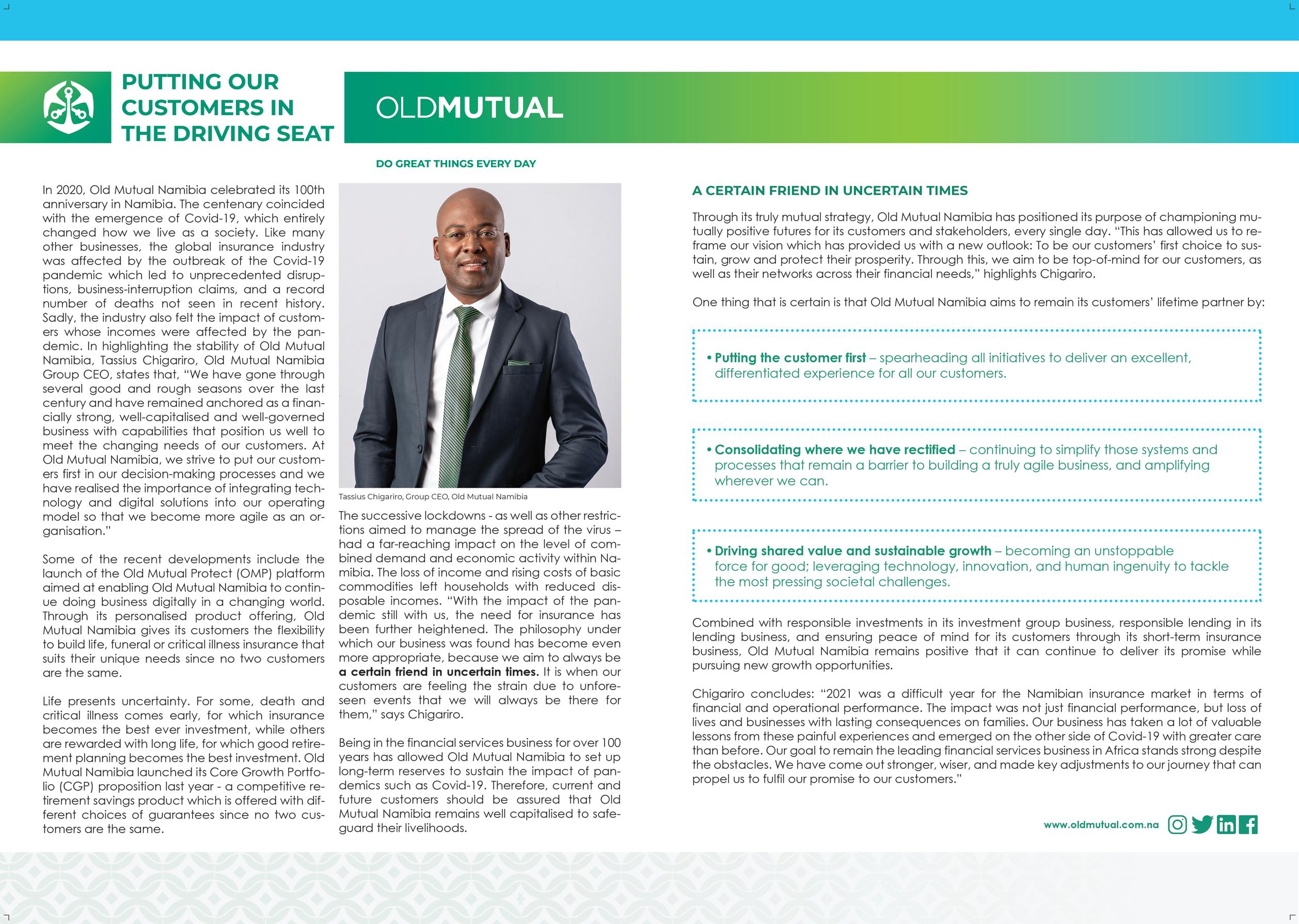
RMB partners with FNB Namibia to create a N$353 million green bond making it the first for FirstRand Namibia Group aimed at supporting sustainability projects in Namibia.
RMB in Namibia and RMB’s SA debt capital markets (DCM) and sustainable finance teams successfully arranged FNB Namibia’s first green bond issuance in the local DCM. This marks the second issuance of green bonds in Namibia to date, with FNB Namibia raising N$353 million across three- and five-year notes.
The proceeds of the green bonds will be allocated to eligible green loans applied towards Namibian green buildings and renewable energy generation projects. Sustainability is key to FNB Namibia’s vision of a globally competitive Namibia, and these green bonds mark a major milestone for the country and the bank. Through this, FNB Namibia can ensure appropriate financial resource allocation to support the greening of the Namibian economy, as well as drive stronger issuance volumes while enabling the growth of the local green bond market.
FNB Namibia’s inaugural green bond auction achieved a diverse orderbook, supported by over 13 local investors. The auction was well received, garnering over N$2 billion in bids, resulting in the auction being 5.82 times subscribed.
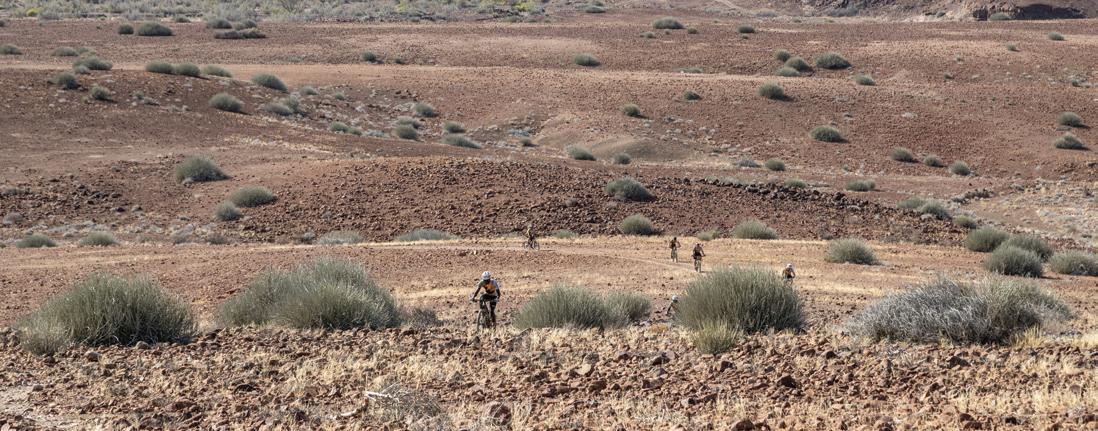
The green bonds, listed on the Namibia Stock Exchange, have been issued off FirstRand Limited’s sustainability bond framework which has been established at a group level to support the issuance of thematic debt instruments by the group (including its subsidiaries, like FNB Namibia). The framework was independently assessed and is aligned to the guiding principles and reporting requirements of the United Nations Sustainable Development Goals, the International Capital Markets Association Green Bond Principles, Social Bond Principles and Sustainability Bond Guidelines of 2021. RMB’s Namibia and South Africa DCM team, together with the RMB Sustainable Finance and ESG Advisory team, worked closely with local investors to ensure that they were comfortable with the principles and resultant issuance.
“This inaugural green bond issuance shows that we are at the forefront and committed to unlocking sustainable finance opportunities that benefit our clients, communities and environment at large. Further, through the adoption of the group’s sustainability bond framework, our approach supports transparent, comparable disclosures in the context of environmental, social and corporate governance issues,” says Selma Kapeng, FirstRand Namibia Group Treasurer.
Globally the market for green bonds has grown exponentially, over 100% year on year (as at Dec 2021). The Africa market contributes only 0.03% to this global market (as at Dec 2021)*. This demonstrates that Namibia, and the continent, provides untapped opportunities for sustainable funding instruments to support the growth of green economies.
“One of the key roles of investment banks is to channel capital to opportunities. The success of the N$353 million green bond issuance for FNB Namibia, as postulated by the more than five times oversubscription, is evidence that there is substantial amounts of capital available to support sustainable investments and green initiatives. Given our proven DCM capabilities, coupled with market-leading sustainable finance expertise, RMB is well placed to deliver credible and well-structured issuances to clients both locally and regionally.” – Leonard Hamunyela from RMB in Namibia.
*Bloomberg Market Data: For more information, please contact Kawela M’ule, Marketing Officer/Specialist for RMB at FNB Namibia
RMB (+264 61) 299 2115 kawela.mule@fnbnamibia.com.na
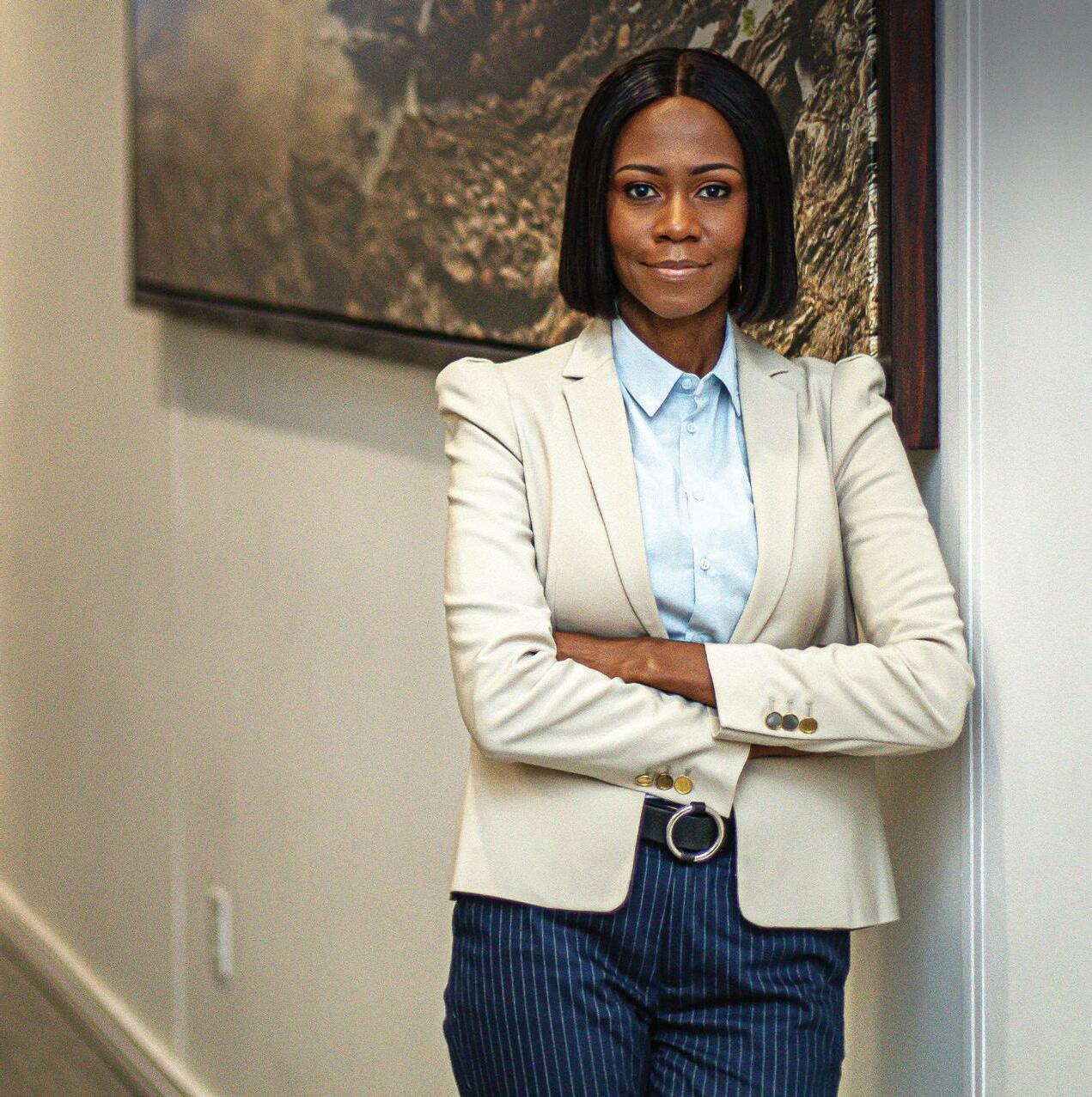
igital banking is the future”, they used to say. That future is here, and digital banking is an integral part of the present, transforming lives and changing the way people do things rapidly.
Standard Bank has taken advantage of the opportunities offered by new technologies, to provide its customers with cutting-edge solutions to improve their banking experiences and offer products that seamlessly layer into their lives.
Standard Bank is committed to understanding a customer’s needs, and tailoring products to ensure that those solutions are not just satisfactory, but they are delightful – going beyond what is expected. Two of Standard Bank’s flagship digital solutions, that are tailored to the customer today, are its PayPulse, a cashless payment option, and Blue Fuel, also a cashless fuel management system.
PayPulse exists in an App format which can be downloaded from the Google and Apple app stores, and USSD via the *140*6626# number, making it accessible on all cellphone devices. It is fast, secure, and easy to use, and users can link up to three different cards from any bank in Namibia. This means that it caters for everybody and not just Standard Bank clients.
What is also special about it is that Standard Bank’s Blue Voucher capability has been incorporated into PayPulse to enable customers to pay via a QR code through a scan and pay method. This feature acts like a wallet on your phone, and is especially user friendly for informal vendors, who can create their own QR code to which people can pay for goods and services instantly. Once the money is in this “wallet”, its safe and secure and they can then make use of this money for different transactions of their own.
In an era where customers are in need of more convenient ways to pay their bills, without queuing up in long lines, customers can perform transactions from the comfort of their mobile devices. And if they are out shopping or enjoying a meal with friends and family, they can pay for it using PayPulse.
PayPulse enables instant cash out of money at the tills of prominent grocery stores, and apart from cashing out and sending Blue Vouchers, it also allows customers to send money to any mobile number in Namibia, even if they don’t have a PayPulse account. Customers can top up on
electricity and airtime and pay for bills such municipal water & electricity and DStv/GOtv accounts.
Our second featured digital technology is our flagship fuel management system, Blue Fuel. Namibian businesses are facing significant pressures to maintain core services with significantly reduced budgets. One way of achieving this is through efficiency savings on the purchase and use of all services, including vehicles, through standardisation and the use of technology.
To address this, Standard Bank offers the Blue Fuel Technology, aimed at simplifying fleet managing with low-cost solutions designed to eliminate the hassle of managing, monitoring and controlling the refuelling of your fleet.
Every fleet manager knows that fuel costs can overshadow other operating expenses. Standard Bank's Blue Fuel offers the newest innovation in fleet management to help you better manage your fleet of vehicles, whether you have a huge company or just three cars.
The technology ensures that only authorised vehicles are able to fill up, without the need to purchase and install expensive vehicle hardware. In addition, drivers can authorise transactions using fleet cards, driver PIN’s or even their mobile phones.
With Blue Fuel all transactions are securely authorised in real-time and checked against multiple, configurable fuel rules using our unprecedented technology. Successful transactions and unsuccessful attempts are instantly available to view on a personalised web portal using any internet-connected device.
Individuals, small businesses and companies with large fleets are all eligible for Blue Fuel, with a hassle-free registration process.
Blue Fuel allows for real-time authorisation at the time of the transaction, instant access to reports, increased security against fraudulent transactions and serves as a management tool to effectively manage financial, technical and operations costs.
Both the PayPulse banking application and the Blue Fuel technology are essentially about having a fast, secure, and easy way for customers to make payments without the need to handle cash.
 Magreth Mengo Standard Bank Head of Marketing and Communications magreth.mengo@standardbank.com.na
Namibia’s fishing industry plays an important role in the country’s economy – providing employment, as a foreign exchange earner and contributing to government revenue. The Bank of Namibia (BoN) has projected growth of 2.6% in 2022 – down from 3.2% in 2021 and a contraction of 9.5% in 2020.
The mandate of the Ministry of Fisheries and Marine Resources (MFMR) is to manage the living aquatic resources sustainably and to promote the aquaculture sector. Total allowable catches (TACs) for eight species are determined annually by the MFMR based on scientific evidence and on the advice of the Marine Resources Advisory Council. Commercial harvesting rights for commercial purposes are granted to rights holders on the basis of various criteria and quotas are allocated to the rights holders.
Fishing companies have made major investments in onshore production facilities at Walvis Bay and Lüderitz over the past decade to increase employment opportunities in the industry, create value addition before products are exported and encourage product diversification.
There has been no quota for pilchards since 2018 pending the findings of research to determine the health of the pilchard stocks. The moratorium on orange roughy, a high-value deep sea fish, remains in place.
The commercial marine fisheries are dominated by hake and horse mackerel, which account for over 90% of the total catches. The rich fishing waters of the Benguela marine ecosystem also support some 20 high value and other commercial species.
Hake is the most important fisheries resource in terms of value, export earnings and job creation. About 90% of this mid-water and demersal species is caught by trawlers, while 10% is caught by longline. Frozen or wet hake is landed at Walvis Bay and Lüderitz.
Products include chilled fresh hake airlifted to markets in Europe and a variety of locally processed products such as prime cuts, high value loins, fillets and baby hake. Spain, the main export destination, accounts for close to 50% of total exports. Other European countries and South Africa are also major destinations, while a variety of coated and crumbed products are sold in Namibia.
The management and sustainability of the hake industry was assessed and certified by the Marine Stewardship Council in November 2020. The certificate expires in November 2025.
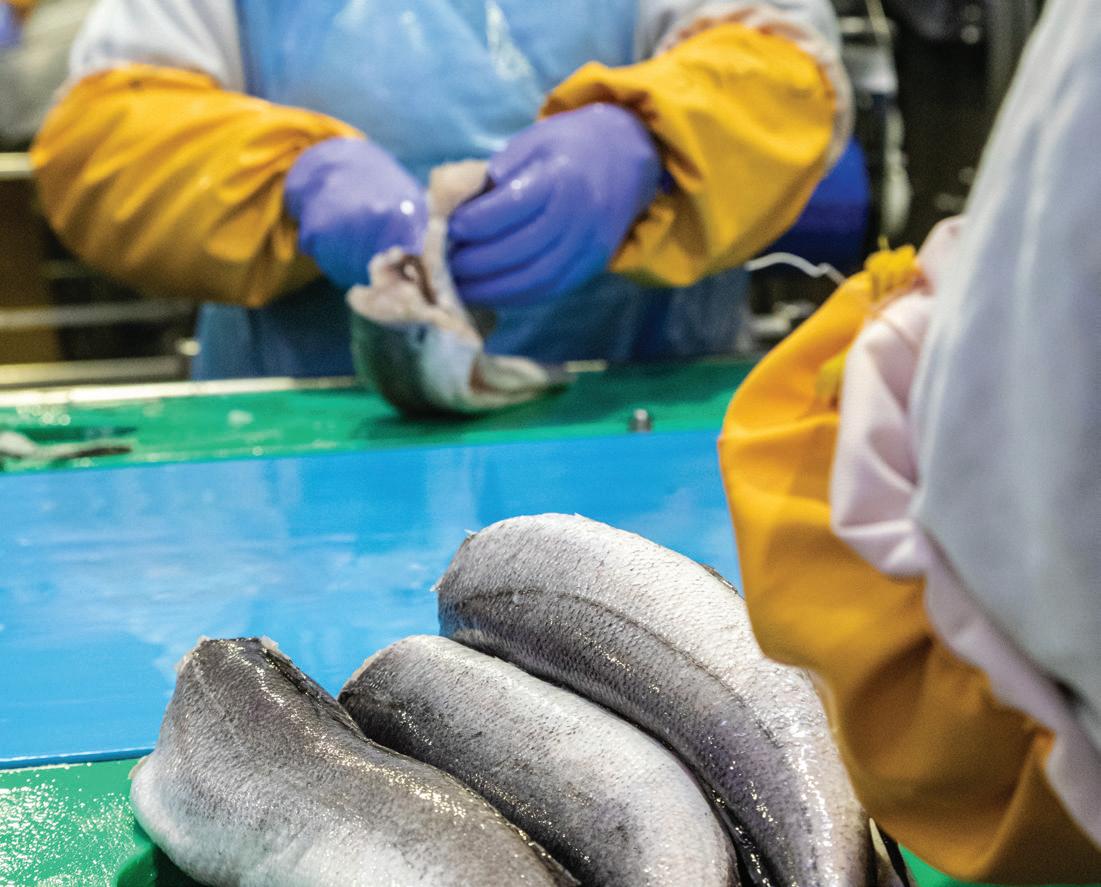
Horse mackerel, the most important species by volume and the secondmost valuable fisheries export earner, accounts for about two-thirds of total annual marine catches. It is an affordable high-protein fish which is
also rich in Omega 3. Zambia, Mozambique and the Democratic Republic of Congo are the main destinations for whole frozen horse mackerel.
Etosha Fishing introduced Namibia’s first canned horse mackerel range, EFUTA Maasbanker in 2013. The range includes horse mackerel in tomato sauce, chilli sauce and brine.
Rock lobster is caught in the shallow onshore waters of the continental shelf at the southern coastal town of Lüderitz. Japan and the People’s Republic of China are the main destinations of live and whole cooked and raw rock lobster.
The deep-sea crab fishery, which operates from Walvis Bay, is small in terms of the annual catches landed, but crab is a high-value product. Catches are processed on board or at the crab processing plant at the harbour town. Depending on the size of the crabs, products include whole round crabs, fresh or frozen sections, claw products, legs with or without shells and crab flakes and meat. Japan, the People’s Republic of China, South Korea and Spain are the most important export markets.
Monkfish, a high-value species, is caught as a target species or as a bycatch of the hake fisheries. Fillets and tails are exported to Spain, Italy, the United Kingdom and France.
Quotas for tuna and tuna-like species, caught in the southeast Atlantic, are determined by the International Commission for the Conservation of Atlantic Tunas (ICCAT). Albacore, the main target species, is exported frozen to Japan where it is used for sashimi. Other target species include big-eye tuna and swordfish, while blue shark and shortfin mako are caught as by-catches.
Sole and kingklip, two high-value species, are caught as bycatches of the trawl fisheries. Other important by-catches such as angelfish, ribbon fish, John Dory, jacopever and snoek are frozen at sea and processed on-land for export and local consumption.
Benguela Current Commission
Private Bag 5031, Swakopmund +264 64 40 6901 thandiwe@benguelaacc.org www.benguelacc.org
Directorate of Inland Fisheries
And Aquaculture Namibia
Private Bag 13355, Windhoek +264 61 205 3021 Rudi.Cloete@mfmr.gov.na www.mfmr.gov.na
Fishery Observer Agency
P O Box 2903, Walvis Bay +264 64 219 500 info@foa.com.na www.foa.com.na
NAMFI - Namibia Maritime & Fisheries Institute P O Box 3228, Walvis Bay +264 64 270 900 www.namfi.net
The commercial line fishing sub-sector operates mainly along the central coast from Walvis Bay, Swakopmund and Henties Bay. Snoek, silver cob (also known as kabeljou), West Coast steenbras are the main species caught from skiboats and larger vessels.
Namibia’s northern perennial rivers, the Okavango, Kwando, Chobe and Zambezi, have provided a source of protein for the people living along these rivers for centuries. But the increasing human population and overexploitation of the rivers’ fishing resources have resulted in a decrease in the fish populations. The MFMR has, however, set aside several fisheries reserves in the Zambezi River, while there are also regulations to control fishing in the Okavango River.
Eight inland freshwater aquaculture projects established, amongst others to improve food security, resort under the MFMR. The projects are located in West Kavango, East Kavango, Omusati, Oshana, Hardap, Karas and Omaheke regions. Annual production stood at 1,700 tonnes in 2019 which is well below the projected capacity of 5,000 tonnes a year.
Washed by the nutrient-rich and pollution free water of the Benguela system, the sheltered lagoons at Walvis Bay and Lüderitz enjoy ideal conditions for the cultivation of various shellfish species. Mariculture (marine aquaculture) is a relatively small industry operating from Lüderitz in the south of the country and the central coastal towns of Walvis Bay and Swakopmund.
The industry is dominated by the cultivation of mainly Pacific oysters in the lagoons at Lüderitz and Walvis Bay. Namibia’s highly acclaimed oysters are sold locally and exported to South Africa and Asia. Abalone from Namibia’s only abalone farm at Lüderitz is exported to Hong Kong, the People’s Republic of China and Japan. At full capacity, the farm will produce 300 metric tonnes a year. Mussels are cultivated at the Walvis Bay lagoon, while scallops and seaweed are among the emerging mariculture sectors. A multi-million project by Kelp Blue Namibia to cultivate and harvest giant kelp in waters between 3 km and 10 km off the Lüderitz coast was inaugurated in May 2022. Alternative agri-food, bio-stimulants, textile products and dye are some of the products that can be derived from kelp.
•
•
•
•
•
Hake is the most important fisheries resource in terms of value, export earnings and job creation.
Each year the government of Namibia, through the Ministry of Fisheries and Marine Resources, issues quotas to various parties which are allocated a portion of Namibia’s total allowable catch (TAC). The Namibia Fish Consumption Promotion Trust receives a quota of 15,000 metric tonnes of horse mackerel and 3,000 metric tonnes of hake.
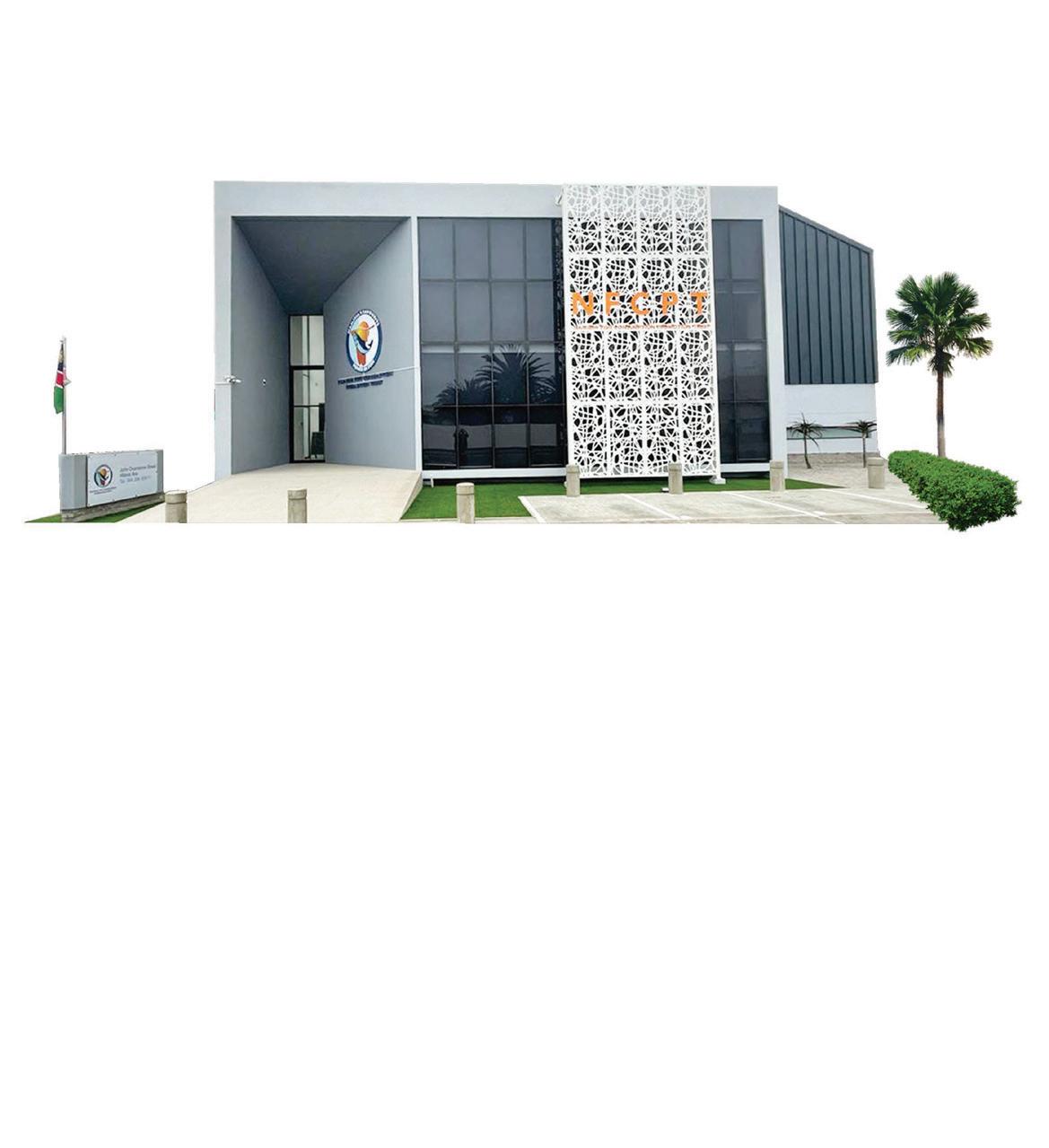
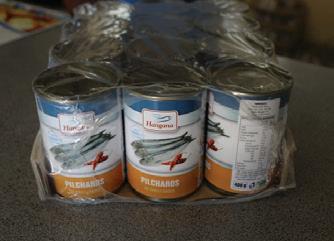
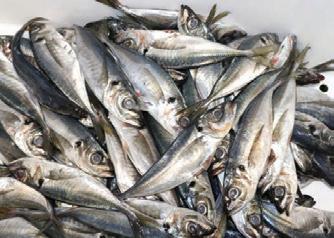
With eighteen fish shops established in all fourteen regions, the Namibia Fish Consumption Promotion Trust ensures that the nation enjoys access to quality affordable fish by distributing a variety of tonnes of marine and freshwater fish products countrywide.
Since Namibia is a meat producer and meat-eating nation that is vast and sparsely populated, the consumption of fish is not commonplace. It is rather more familiar to and accepted by inhabitants living in coastal towns and along perennial rivers.
To address this gap, the Namibia Fish Consumption Promotion Trust through its endeavours has made significant strides in promoting the consumption of fish by educating the public about the health benefits of eating fish as well as sharing innovative and practical ways it can be prepared and cooked. Integral to its educational efforts, the Namibia Fish Consumption Promotion Trust hosts an annual National Fish Consumption Day (NFCD) to promote the consumption of fish. NFCD is a corporate social investment (CSI) initiative established in 2012 which is rotated among all regions in the country. This initiative is a collaboration between the Namibia Fish Consumption Promotion Trust, the Ministry of Fisheries and Marine Resources, and the Fishing Industry is largely aimed at celebrating Namibian fisheries. The initiative further advances
the educational component of imparting culinary skills and the socio-economic benefits of consuming fish through drama and cooking demonstrations. Collectively, this initiative has raised N$5.1 million which has been invested in assisting our communities in hosting regions, mainly in addressing educational needs.
Furthermore to the NFCD initiative, the Namibia Fish Consumption Promotion Trust monthly conducts educational fish sale promotions in remote areas where fish is less known with efforts to increase the acceptance and practice of eating fish.
As informed by our mandate, government is keen to see Namibian people eating their fish. Therefore, at the Namibia Fish Consumption Promotion Trust, we are determined to be central in Namibia’s efforts to increase the per capita fish consumption in Namibia. We do this to address nutrition, provide food security and alleviate extreme poverty in our communities by creating opportunities that enable them to generate income from fish trading.
To date, the Namibia Fish Consumption Promotion Trust and critical players in the Fishing Industry have successfully increased the per capita fish consumption rate from 4 kg per person at independence to 16.6 kg per person. Our target, as informed by government is to attain a 20.4 kg per capita fish consumption per person. Therefore, we expect this figure to increase.
“With a sizable, dedicated staff, promoting local fish consumption and ensuring that the promotion of fish consumption coincides with imparting culinary skills, we travel no less than 11,361 kilometres monthly across the country to deliver quality affordable fish to the nation at the lowest prices.”
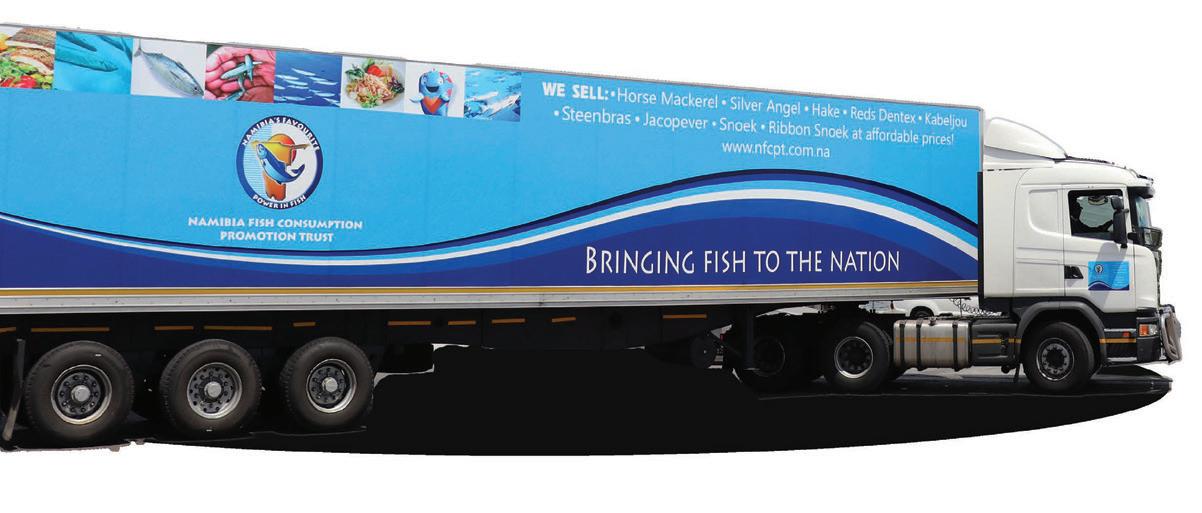


 Mr Victor Pea (CEO - Namibia Fish Consumption Promotion Trust)
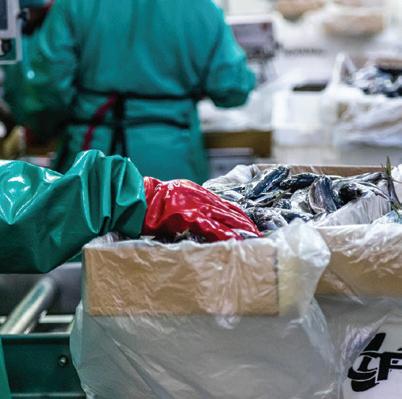
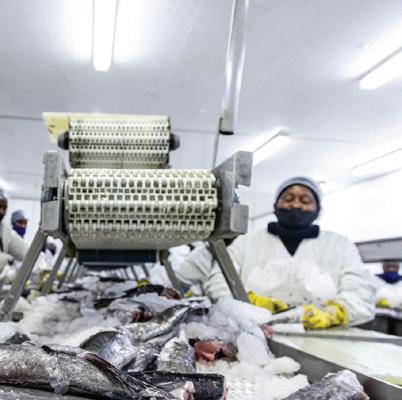

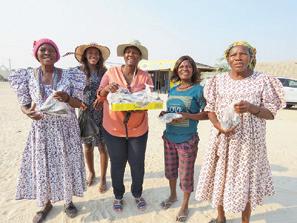

Erongo Marine Enterprises is proud to say that we are more than just a fishing company. United in purpose to drive inclusive development and growth, we empower all our stakeholders across the entire value chain.
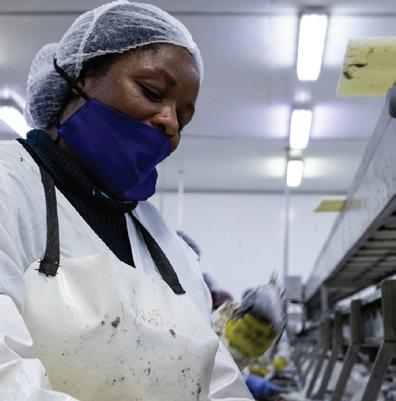
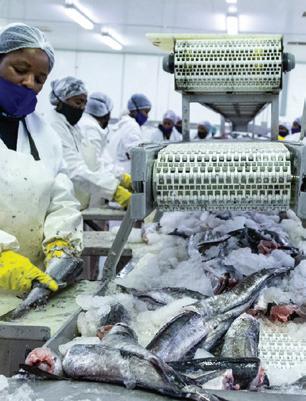
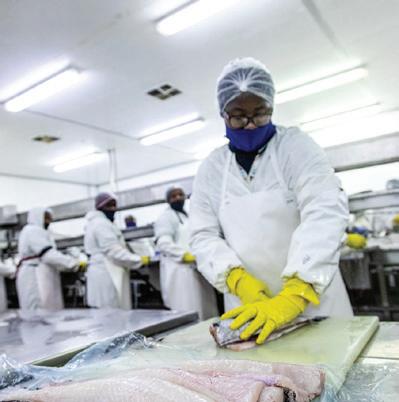
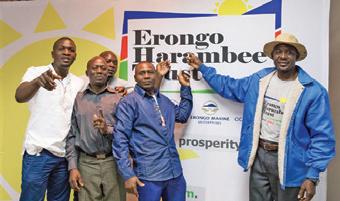
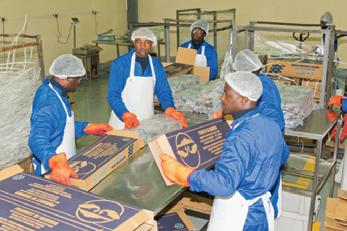
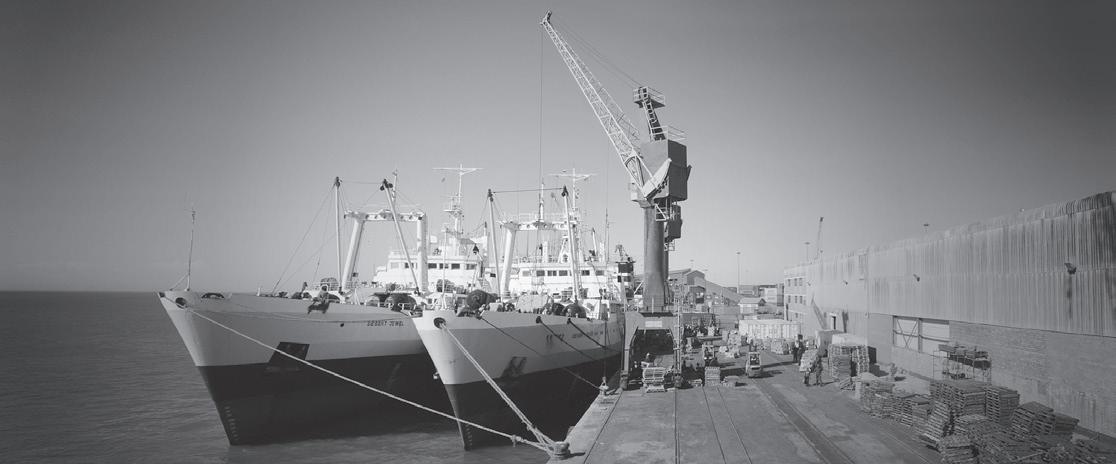
We equip our stakeholders to grow with the company and share the value that we create through sustained job creation, skills development, and ongoing supplier and client development.
As a good corporate citizen, we continuously transform lives by converting our fishing rights into broad-based social and economic benefits in a sustainable and inclusive manner.
Simply put… we care



EFUTA is canned under the highest quality standards ensuring goodness from the sea. High in Omega-3 fatty acids and protein, our canned horse mackerel and pilchard products provide a nutritious meal at an affordable price.
Etosha Fishing is a leading player in the Namibian fishing industry and considered to be one of the foremost round-can production facilities in the world. The company subscribes to the vision “excellence in food processing” and operates under HACCP compliance and EU accreditation.
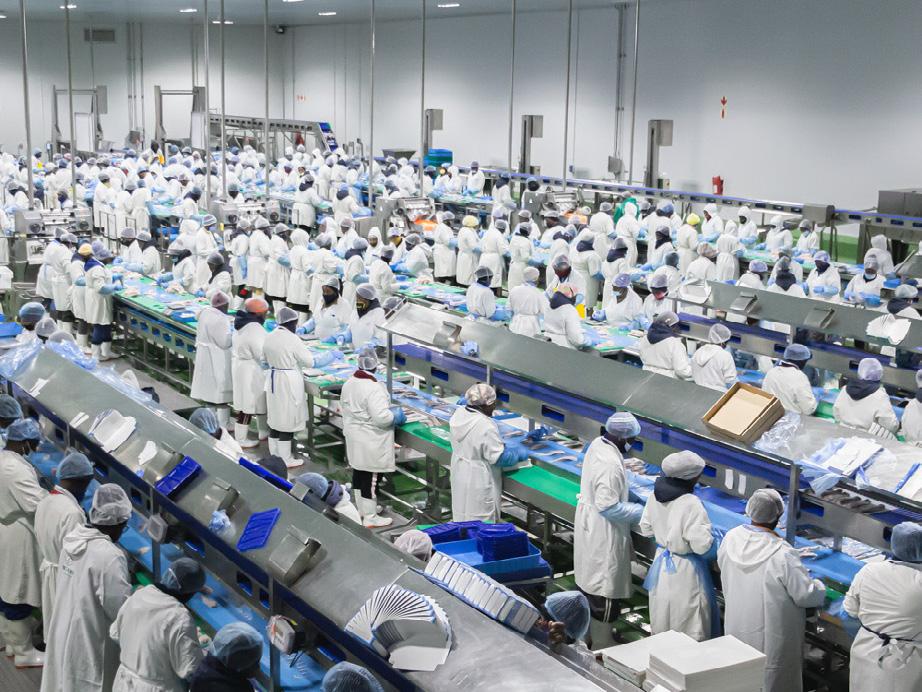
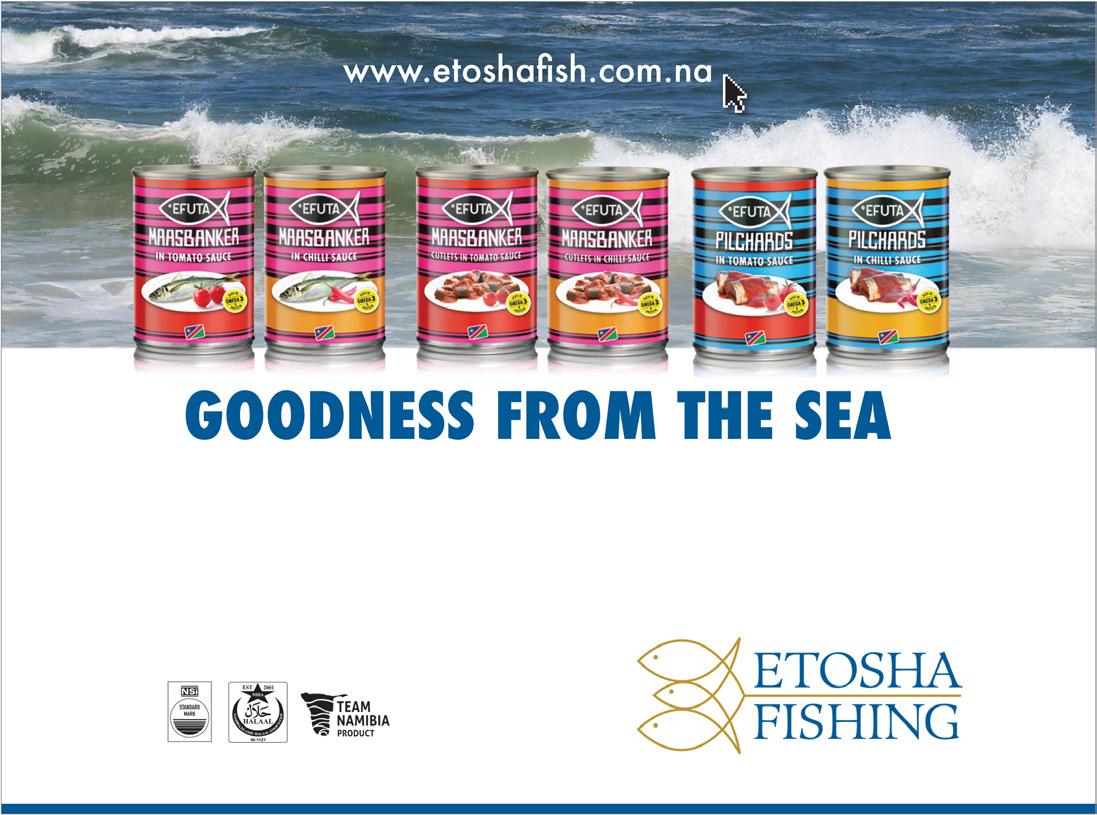
All our canned products comply with National Regulator for Compulsory Specifications (NRCS) and Namibian Standards Institution (NSI) regulations and standards.
Tel: +264-64-215 600 | info@etoshafish.com.na
indust
Health care in Namibia is provided by the public and the private sectors which are regulated by the Ministry of Health and Social Services (MoHSS). It is the ministry’s mission to provide integrated, affordable, accessible, equitable, quality health and social welfare services that are responsive to the needs of the population. The ministry is also responsible for the regulation of health care services and health care professions.
Public health care is fundamental to the ministry’s strategy to delivery accessible, affordable and targeted public health services and the public health sector has been one of the largest recipients of funds from the annual budget since independence. The ministry received an appropriation of N$8.35 billion in the 2022/23 budget, or 11.8% of total expenditure.
There are more than 431 public health facilities country-wide, including 27 hospitals. Windhoek Central Hospital is the national referral hospital, while Katutura hospital (also in the capital), Rundu in the Kavango West Region and Onandjokwe and Oshakati in northcentral Namibia are intermediate hospitals. There are also 37 health centres, while people, especially in remote rural areas can access health services at over 280 clinics and mobile clinics. Ambulance services are provided for patients in need of emergency medical care.
HIV/Aids, tuberculosis, respiratory diseases, strokes and cardiac conditions are among the most serious health conditions. In a positive

development, Health Minister Dr Kalumbi Shangula told the National Assembly during the debate on the ministry’s 2022/23 budget vote, Namibia has made significant progress towards achieving the 9595-95 target which is currently at 94-97-93. The 95s refer to the percentage of people who (1) are familiar with their HIV status, and of those who know it, (2) are receiving treatment , and of those receiving treatment , (3) have a depressed viral load. The target date is 2030.
Namibia does not have a national health insurance fund and patients who have the means pay nominal fees at public health facilities, while selected categories of patients are treated free of charge. Private health insurance is provided by private medical aid societies and the Public Service Employees Medical Aid Scheme (PSEMAS) for government employees and their families. The Namibia Financial Institutions Supervisory Authority (NAMFISA) is tasked with, amongst others, the registration of medical aid fund rules and monitoring the financial soundness of funds.
Namibia’s large size, combined with the fact that it has one of the lowest population densities in the world, however, poses a serious challenge to provide universal access to services. The expansion and maintenance of health infrastructure has, however, been severely impacted by the government’s fiscal consolidation. The ministry’s capital budget decreased from N$485.4 million in 2015/16 to N$187.01 million in 2019/20. The appropriation for the MoHSS is projected to reach N$1.026 billion during the Medium-Term Expenditure Framework for 2022/23 to 2024/25.
Namibia’s Constitution requires the state to ensure “… that every citizen has a right to fair and reasonable access to public facilities and services in accordance with the law.”
The total number of Covid-19 doses administered in Namibia by midMay 2022 stood close to 835,000, while 410,500 people were fully vaccinated. This represents only 16.6% of the target population and the government and the health ministry are encouraging Namibians to be vaccinated.
The health ministry has continued to strengthen its capacity to deal with the Covid-19 pandemic and spent a total of N$540 million in the 2021/22 financial year in this regard. Expenditure includes the coordination of the vaccination programme, capacity building of laboratories, strengthening of human resources, the provision of medical oxygen and the upgrading of mortuaries.
A vibrant private health sector caters for higher income groups and those with medical insurance and private health services are provided by over 200 facilities countrywide.
In addition to several private hospitals in Windhoek and one in Rehoboth, there are also private hospitals in Swakopmund and Walvis Bay at the coast, Otjiwarongo and Tsumeb in the north, Ongwediva and Ondangwa in north-central Namibia and Katima Mulilo in the Zambezi Region. They are equipped with state-of-the art equipment and provide a wide spectrum of medical services including general and specialised surgery comparable to international standards.
Private medical treatment is also available at health centres and clinics throughout the country, while registered private medical practitioners provide a comprehensive range of services. Pathology diagnostic testing is done by Pathcare Namibia and the Namibia Institute of Pathology (NIP), a statutory body. The Blood Transfusion Service of Namibia (NamBTS), an autonomous body, is responsible for the collection, testing and supply of safe blood products in Namibia. Private ambulance, emergency and medical evacuation, including air evacuation, services are available in Windhoek and major towns.
Catholic AIDS Action
P O Box 159, Windhoek +264 61 276 350 info@caaa.org.na www.caa.org.na
Drug Action Group
P O Box 20490, Windhoek +264 61 226 706 www.localdrugaction.com
Epilepsy Namibia
P O Box 11822, Klein Windhoek +264 81 322 6834 nameb@epilepsynamibia.org www.epilepsynamibia.org
Health Industry Forum Namibia +264 61 375 090 +264 81 124 6401
*For medical associations, contact HIFN
The health sector is governed by a number of statutory bodies to ensure professional heath care. Medical practitioners, dentists and people employed in certain professions allied to the medical profession are regulated by councils, whose functions include, amongst others, the registration of practitioners. The Namibia Medicines Regulatory Council (NMRC) is responsible for the development and maintenance of internationally acceptable standards of medicines control.
Training for health professionals are provided at the University of Namibia’s schools of medicine, nursing, pharmacy and public health. The Namibia University of Science and Technology’s Faculty of Health and Applied Sciences offer a variety of courses.
The Health Professions Councils of Namibia is responsible for controlling and exercising authority in respect of “… matters affecting the education and training of healthcare professionals and the way they practice their respective professions.” It consists of five councils: the Medical and Dental Council, Nursing Council, Pharmacy Council, Social Work and Psychology Council and the Allied Health Professions Council.
• Close to 12% of Namibia’s annual budget is appropriated to the Ministry of Health and Social Services
• 430 public health facilities countrywide
• 27 public hospitals countrywide
• 37 public health centres countrywide
• Private hospitals, health centres and clinics in all major towns
ICRC - International Committee of the Red Cross
P O Box 3970 +263 470 2440 www.icrc.org
MAN - Medical Association of Namibia
P O Box 3369, Windhoek +264 61 22 4455 www.man.com.na
*For medical associations, contact MAN
NAMAF - Namibia Association of Medical Aid Funds
P O Box 11974,Windhoek +264 61 25 7211 maggie@namaf.org.na www.namaf.org.na
Namibia Network of Aids Services Organisations
P O Box 23281, Windhoek +264 61 261 122 nanaso@nanaso.com
Namibia Institute of Pathology (NIP)
P O Box 277, Windhoek + 264 61 295 4000 info@nip.com.na www.nip.com.na
Namibia Red Cross Society
P O Box 346, Windhoek +264 61 413 7501 caneharakuta@redcross.org.na www.redcross.org.na
WHO - World Health Organisation
P O Box 3444, Windhoek +264 61 25 5121 afwcona@who.int www.afro.who.int
Namibian Association of Private HealthFacilities (NAPH) +264 61 375090 naphboard@gmail.com www.naph-namibia.com
www.namibiatradedirectory.com
On the 12th of November 2021, Renaissance Medical Aid launched our new product updates for 2022. We spent much of 2021 researching changing needs, conducting surveys with our clients and collecting feedback through our social pages and call centres. The feedback gave us some great insights, and we made a few changes based on the results. Here’s what’s new.

The Renaissance Medical Aid Benefit Builder is a long-standing and unique feature of RMA’s plans. It allows members to extend their medical cover with specific benefits, such as HIV treatment and counselling, extended optical benefits, or mental health care.
NEW! In our 2022 product updates, families on Prestige, Status, Caliber and Esteem Care have a new inclusive base benefit builder of N$450. This will automatically cover co-payments and benefit shortfalls within your available benefit.
IUCD devices and implants. Women are often the drivers of family planning, and women’s health needs are top of mind at RMA. For this reason, we have included specific benefits for birth control methods outside of the annual day-to-day limits.
Multivitamins and minerals. The global pandemic has made immune support more important than ever before, and awareness of the benefits of multivitamins and minerals is on the rise. At RMA, we believe prevention is better than cure, which is why we cover vitamin and mineral supplements.
COVID-19 rewards for vaccinated members. COVID-19 claimed the lives of 54 RMA members in 2021_ a fact which we greatly regret and our condolences go out to the families of these members. The pandemic has also been a major cause of eating into RMA’s fund reserves, which we have worked so hard to build up. For this reason, we are offering additional rewards to RMA members who help to ease the burden by getting vaccinated.
Male contraceptives. At RMA we are very aware that contraception does not come cheap, and men are as invested in family planning and health care as women. Therefore we are introducing cover for male contraceptives.
Diabetic and cardiac cover. Rather than covering these two most common health problems which our members face as chronic conditions, we have moved them directly into the extended benefits category. This allows our members to enjoy huge benefits, without the risk of benefits depleting before the end of the year.
Children stay children for longer. Our children are growing up in a more difficult time. At RMA we acknowledge this by allowing children to remain on their parents’ medical aid cover as a child dependant up to the age of 25 years, if they are not yet financially independent. This allows our younger members a little more time to find their feet before they need to join as a main member.
Supporting social distancing. Doing simple checkups via the phone has become much more common during the COVID-19 pandemic, and these costs have historically not been covered by medical aids. But, as of 2022 GP and psychology telecommunications are covered by RMA under the professional benefit.
COVID-19 treatment, prevention and care has resulted in one of the biggest fund payout years RMA has ever had, resulting in a slight drop in our communal fund reserves. This has meant that we have had to increase our existing product premiums. With tough times in mind, we have kept this increase as low as possible, while adding more ways for you, our members, to earn rewards, claim extra benefits, and supplement costs.
Renaissance Health Medical Aid Fund is an established and trusted medical aid fund in Namibia. Whether you need a comprehensive product option of day- to-day benefits and in-hospital treatment, or whether you just want to be sure that you will be cared for in a private hospital if needed, RMA offers a wide range of medical aid benefit options to suit any healthcare requirements or budget.
RMA is a fund that focuses on member-centricity, because our members are our top priority, and we value excellent standards in customer service and medical aid products. That is why, during the global COVID-19 pandemic, RMA has gone above and beyond to support its members, offering unique benefits to cover for tests, treatment, and vaccines.
RMA strives to be an accessible, obtainable and approachable medical aid, and the first choice for every Namibian when it comes to health care. Plus, RMA offers unique features to its product offering, such as the Benefit Wallet and the Benefit Builder, to enhance your benefits and ensure that you get the most out of your medical aid. Our products and services are entirely tailored towards giving our members the best in medical care and services, because RMA truly operates under the ethos of “Your Health Comes First”.
Emed Rescue 24 is a proudly Namibian Emergency Management Services (EMS) company that offers emergency medical evacuation, on-site mining support, event medical services, as well as customised first-aid and general safety training. The company has been in operation since 2004, and is the largest Namibian evacuation company in the private sector.
Emed’s trained medical crew, as well as its diversified fleet and team of highly qualified medical professionals, has ensured its expertise to access any terrain in Namibia. Emed Rescue 24 is a services provider to medical institutions and medical aid schemes, and enabled that clients get the best service available for their choice. Emed operates within the prescribed benchmark tariffs, because we believe in fairness and value.
To be the leading EMS provider of people-centric assistance through innovation, networking and technology that is safe, timely and efficient.
As the largest EMS provider, we are saving lives by collaborating with local and international communities, clients and stakeholders.
What Emed’s people do: I-RESQ
The central region of Namibia is serviced by the Windhoek response centre. The northern region is serviced by the Tsumeb response centre, while the Walvis Bay and Swakopmund response centres provide paramedical services to the coastal region. With a staff compliment of more than 100 qualified practitioners, Emed is able to assist throughout Namibia.
24/7 Emergency Call Centre
Emed’s infrastructure consists of a call centre that operates 24 hours a day, seven days a week. The call centre’s toll-free 924 number gives clients access to round-the-clock emergency medical assistance, with medically trained personnel on the line. Medical intervention by the response centre ensures fast, quality emergency response to patients, with quick stabilisation and transfers to the nearest hospital in case of an emergency.
Emed Rescue 24 operates both road and air ambulances across Namibia, each equipped with medically advanced support systems. These response vehicles cater for world-class pre-hospital treatment for patients. All aircrafts managed by Emed are dual pilot operated, pressurised and fully equipped to handle any medical situation. Trained medical professionals are always on board to ensure the best care is rendered to the patient being transported.
We specialise in mining operations by offering qualified remote site medics, on-site medical clinics, emergency evacuation, world-class first aid training and disaster management / incident command systems to further adhere to regulations of safety and health set by the Ministry of Mines and Energy. Compliance is certified by an internal audit programme offered by Emed Rescue 24.
Mining project locations are becoming increasingly remote and challenging in terms of geography, environmental conditions, remoteness, regulatory landscapes and a number of other factors. With the focus on mobility, we can provide preventative and emergency medical services to your employees anywhere on the job site. From fully stocked mobile treatment centres to medics trained for your specific worksite conditions, we are ready to deploy where and when you need us.
We understand the harsh conditions through experienced staff have demonstrated success in providing excellent patient care in extreme work employees are receiving the best medical care,
We offer comprehensive services for all phases of Continuity
We provide seamless care through detailed medical emergency response planning, medical audits and level of care, we take action through our vetted network of ground transportation, air ambulances is needed, our team integrates with corporate medical assistance providers through detailed strategic planning, eliminating the risk of transferring
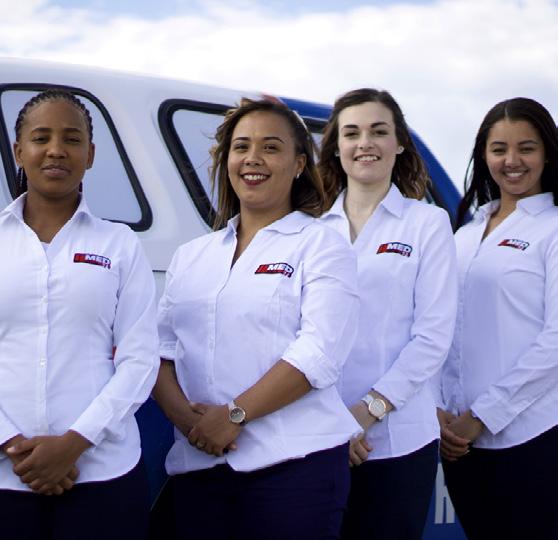
Emed Rescue 24 offers event medical services and event medics ensures that each event has professional Emed’s event compliance programme also ensures that clients and members of the general public event medical services are personalised to suit the any event, Emed will consult on the necessary safety precautions and procedures with the client, and
Emed’s training centre offers a variety of courses and namely the Resuscitation Council of South-Africa, the Ministry of Health and Social Services and the Ministry of Labour, Industrial Relations and Employment At Emed we believe that everybody should have and medical emergencies can happen anywhere risk management and providing the emergency market with the distribution of knowledge to save
In a medical emergency, your life depends on fast, professional emergency medical evacuation or So why not choose life? CONTACT US www.emedrescue.com
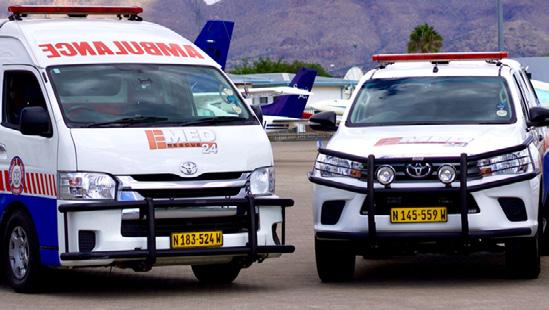
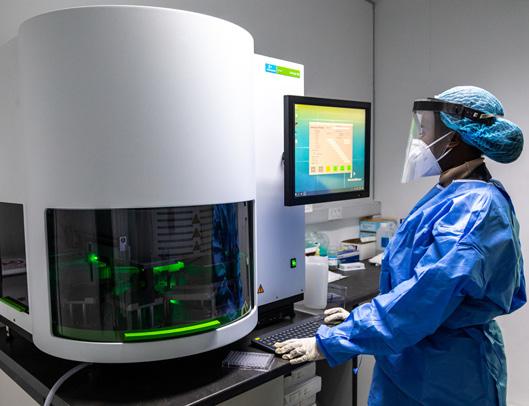
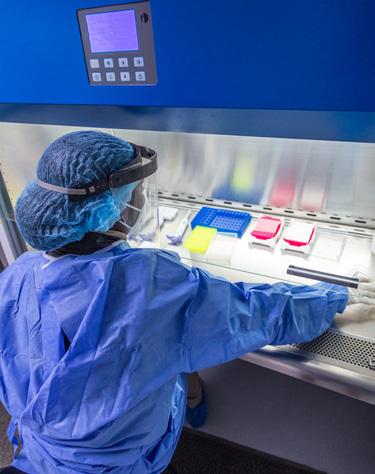
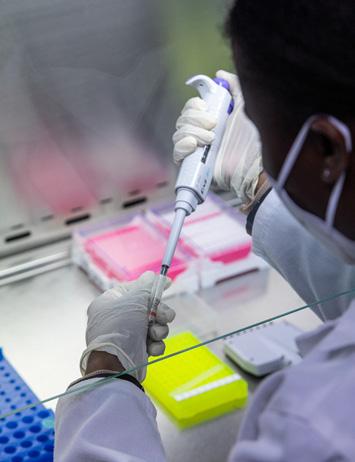
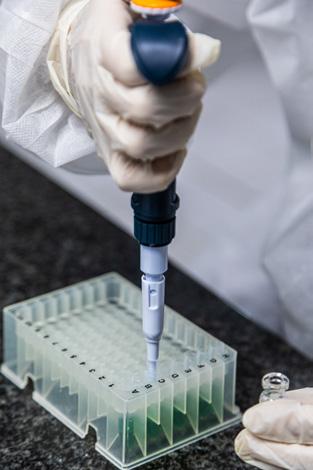

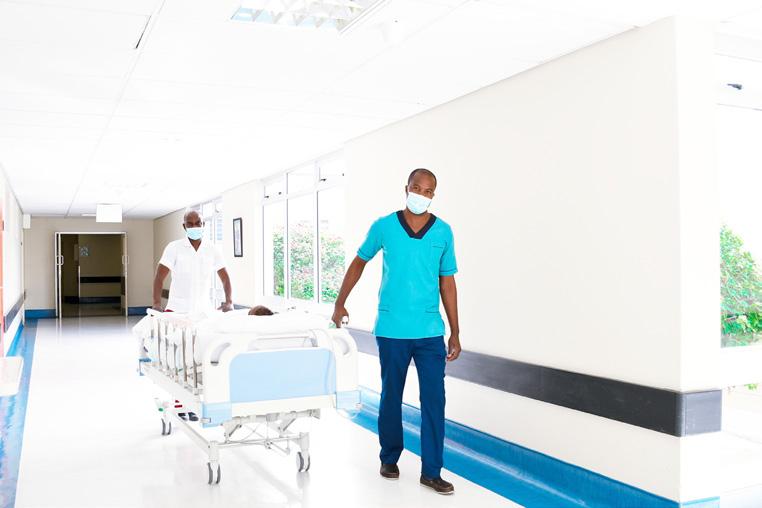


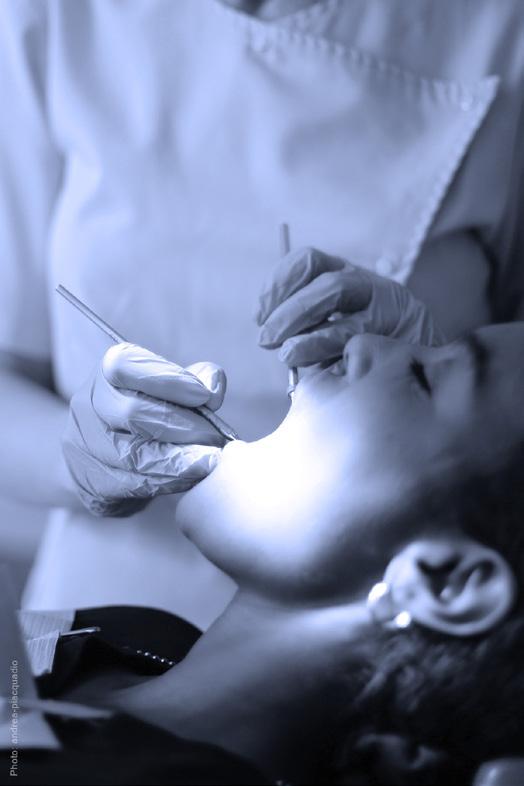
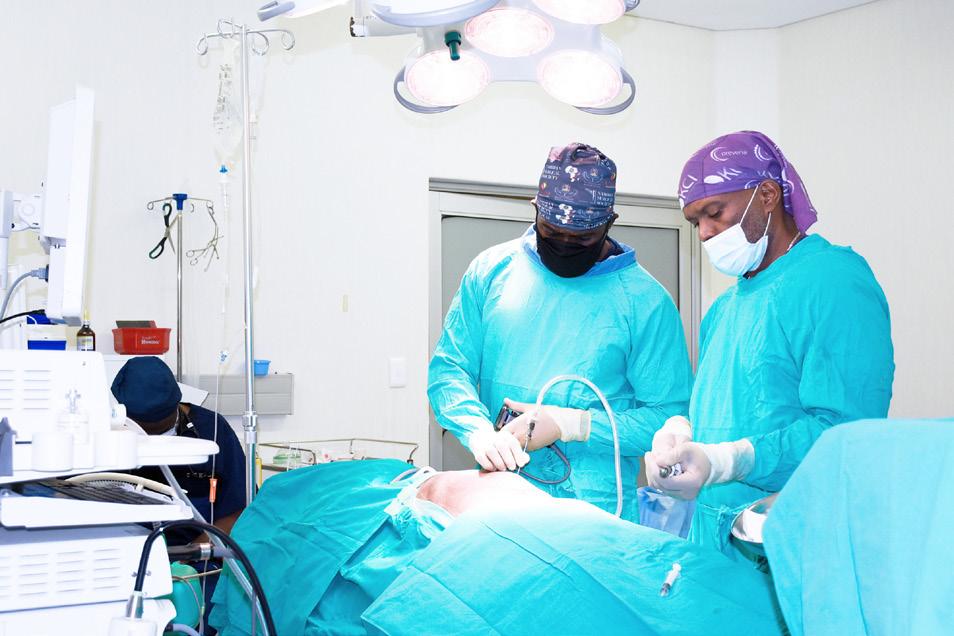


Windhoek Eye Centre is a one stop consultation, special investigations and day surgery theatre complex situated in Windhoek, the capital and heart of our beautiful country, Namibia.

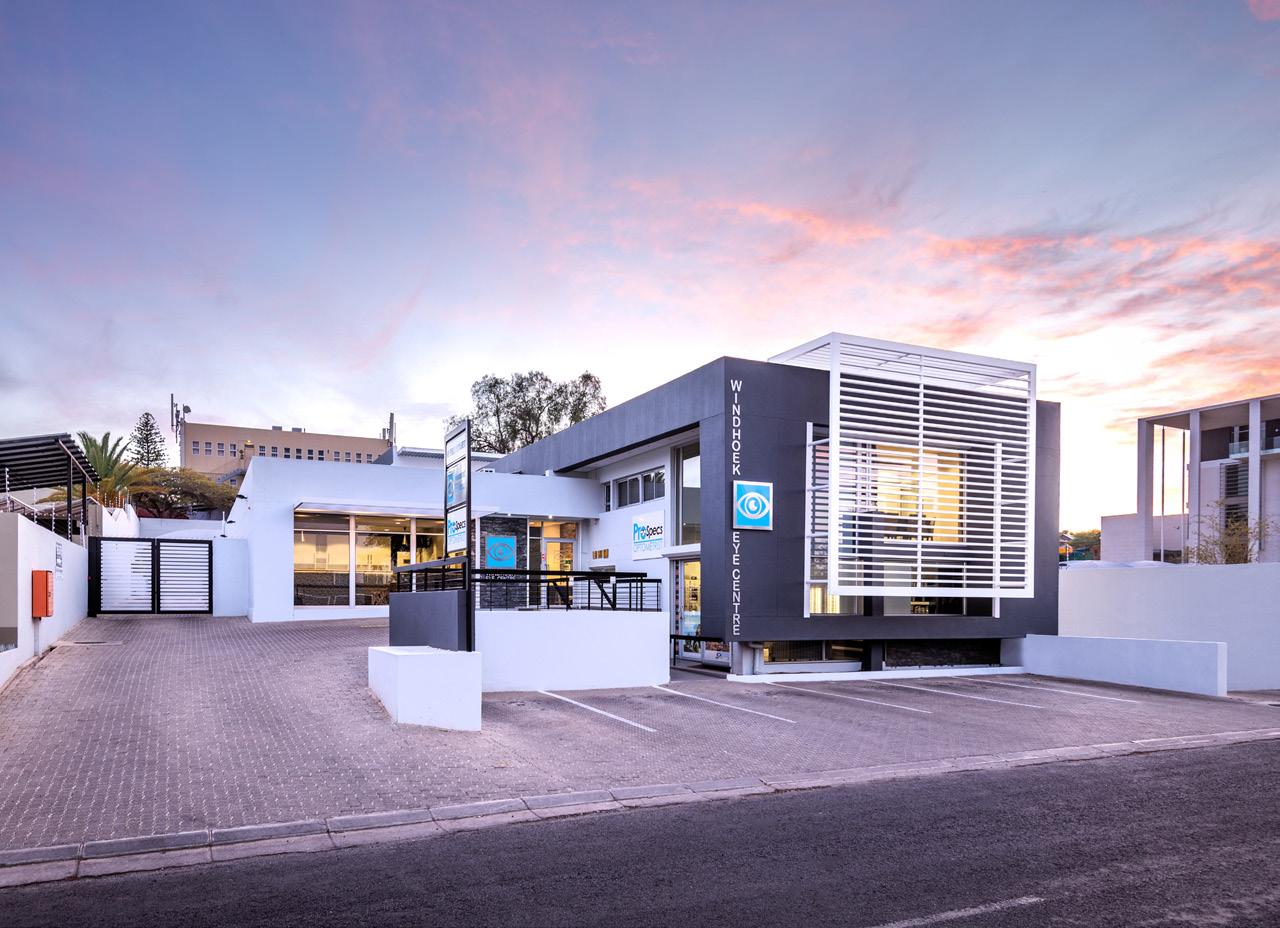
Our personal approach, combined with some of the best surgeons and dedicated staff have set a new standard for eye care in Namibia. We provide a full range of eye care services including Cataract, Retinal, Glaucoma and Oculoplastic surgery.
We pride ourselves in our state-of-the-art facility with the best and latest technology available in Ophthalmology in an inviting and friendly atmosphere.
Our commitment to our patients is to provide them with the best possible eye care in a professional modern environment.
For more information, contact us at: 46 Feld Street, Ausspannplatz, Windhoek PO Box 6807, Ausspannplatz, Windhoek Tel: +264 61 226736 / +264 61 223 431 www.windhoekeyecentre.com.na
Medical Rescue Africa (MRA) is Namibia’s leading fixed wing Aeromedical Evacuation company specialising in the evacuation of critically ill and injured patients across Africa, 24 hours a day, 7 days a week.
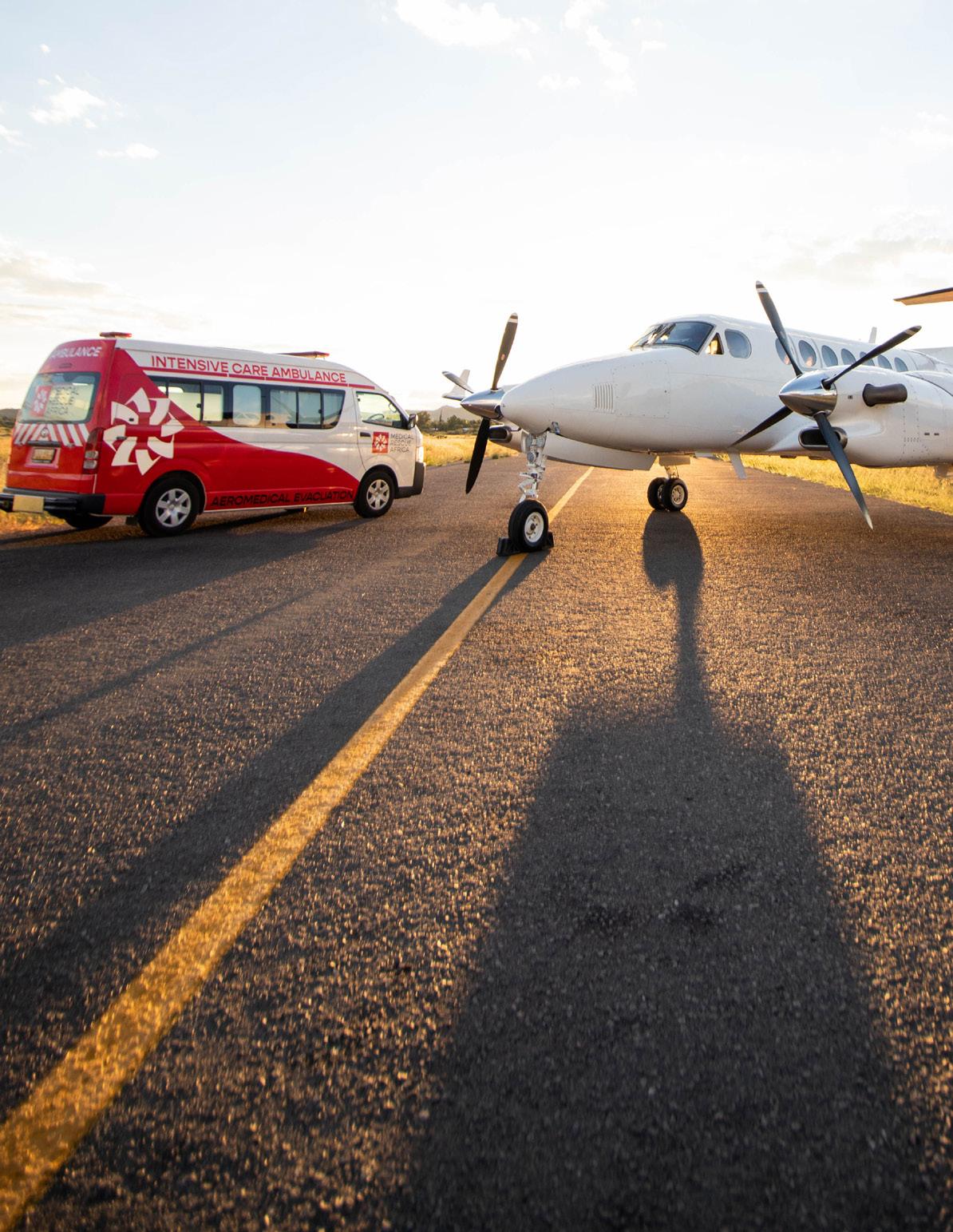
MRA, through Westair Aviation, has a dedicated fleet of Air Ambulance aircraft on standby which have the ability to land on unimproved airstrips as well as to operate at night and in bad weather conditions. Air crews undergo regular refresher training, and all operations comply with the highest safety and quality standards.
MRA has its own 24-hour Call Centre with trained and dedicated operators utilising state of the art equipment and aviation information technology. The Call Centre liaises with local and international Medical Aid, insurance and medical assistance companies to help facilitate and coordinate medical evacuations, and medical repatriation services.
To ensure the best possible pre-hospital treatment to patients, MRA offers a 24-hour Road Ambulance at Eros Airport for transporting patients from the Airport to the treating Hospital. The MRA Ambulance is equipped to an ICU patient care level. MRA has a standard service-level agreement with all accredited ALS Ambulance Services across Namibia for effective Road Ambulance evacuation services should the requirement be to not activate the fixed wing Air Ambulance.
MRA is led by a management team with extensive experience in medical response, evacuation and support operations.
Tel: 912 within Namibia or +264 83 339 0033 Internationally | Mail: MRA.CallCentre@westair.com.na Web: www.medicalrescueafrica.com
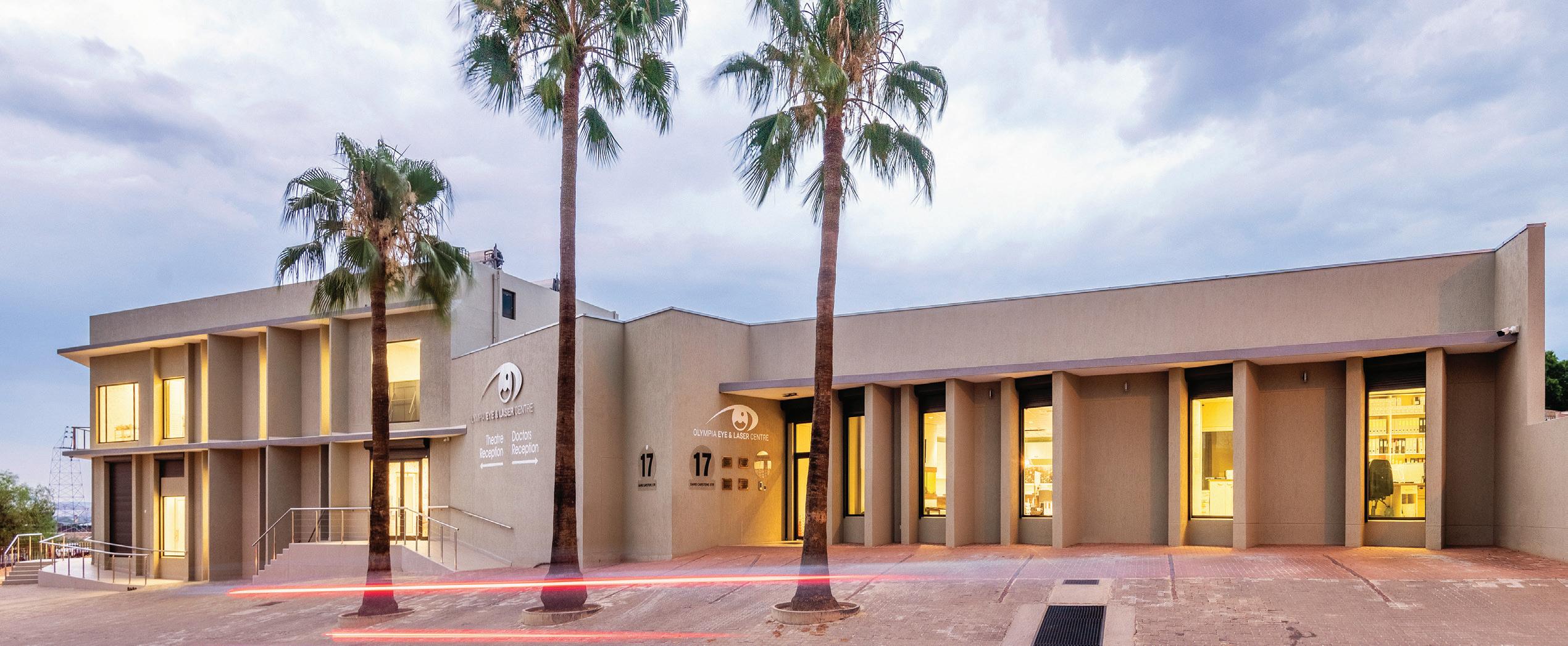



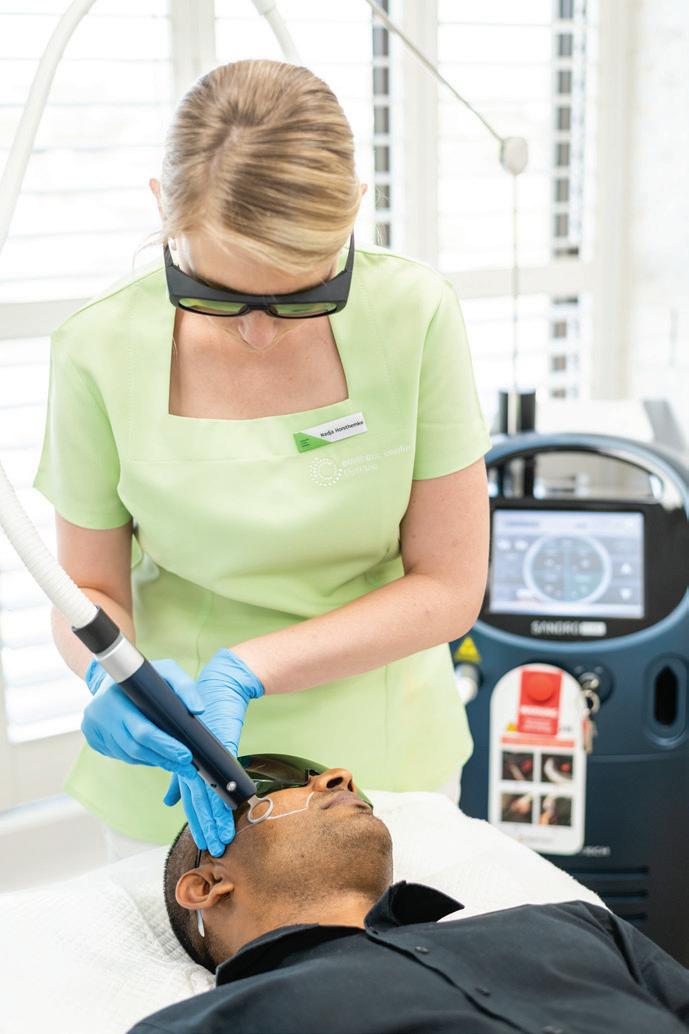



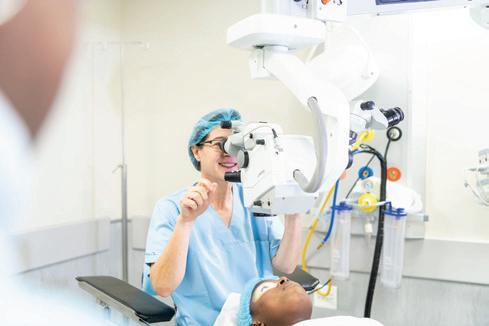


Considerable
decade
enabled
and expansion of Namibia’s telecommunication infrastructure over the
Technology to develop at a rapid pace throughout the country.
The Ministry of Information and Communication Technology (MICT) is the policymaker of the ICT sector, while telecommunication services and networks, broadcasting services, postal services and the allocation of radio spectrum in Namibia are regulated and supervised by the Communications Regulatory Authority of Namibia (CRAN)
The National Broadband Policy and Implementation Action Plan developed by the MICT with the technical assistance and financial support of the International Telecommunication Union (ITU) aims to provide a minimum of 2 Megabits per second download speed to 80% of the Namibian population by 2024. The policy is aligned to complement Vision 2030 for the Republic of Namibia, which stipulates that that ICT must be the most important sector in the economic development of the country by 2030, as well as several other plans and policies.
The Equiano subsea fibre optic internet cable was landed at Swakopmund in June 2022. The cable was brought ashore at the Platz am Meer Waterfront and connected to the cable station built by Paratus, the landing party for the Namibian branch of Equiano.
The Namibian branching unit of the project is a public-private partnership between Paratus Namibia and Telecom Namibia. Namibia’s investment in the project is about N$260 million.
The cable which connects South Africa to Portugal provides 20 times more network capacity than the West Africa Cable System (WACS). Equiano will also serve as a backup in the event of damage or maintenance to the WACS cable.
The first phase of the project, which was announced by Google in 2019, is expected to be completed in 2022.
Mobile telephone services are provided by four operators: Mobile Telecommunications Limited (MTC), Mobile Telecommunications Network (MTN) Namibia, Telecom Namibia (TN) and Paratus Telecommunications.
Following a decision by the government to sell up to 49% of its 100% stake in MTC, the company began trading on the Namibian Stock Exchange (NSX) on 11 November 2021. The initial public offering (IPO) of 367.5 million ordinary shares at N$8.50 per share was undersubscribed

by 19% as only 299 million were taken up. Institutional investors applied for shares valued at N$2.4 billion, while retail took up N$137 million in shares. The lack of interest by retail has been attributed, amongst others, to the current economic conditions.
The Finance Ministry said earlier the disvestment would be used to partly fund the budget deficit and to pay for debt close to maturity. The remaining 50% would be ring-fenced for, “… productive activities and utilised in a manner that reaps long-term benefits for the country.”
MTC recorded an increase in revenue from N$1.3 billion to N$1.4 billion for the half-year ending 31 March 2022, but profits decreased marginally from N$397 million to N$395 million. The number of subscribers stood at 2.3 million prepaid and 159,000 contract subscribers at the end of March 2022.
Revenue from pre-paid customers increased from N$852 million in March 2021 to NS910 million in March 2022. Revenue from contract customers decreased from N$391 million to N$368 million.
The company aims to achieve 100% population coverage with its N$1 billion 081Every1 network expansion programme. The project, which was launched in July 2017, includes the building of 524 base stations in rural and urban areas. G2 networks in rural areas are upgraded to G3, while G3 networks in urban areas are upgraded to G4 networks.
Regulations to operationalise part 6 of chapter 5 of the Communications Act No. 8 of 2009 were published in the Government Gazette in May 2022. Mobile phone subscribers will be required to register their SIM cards before being able to access network services. Telecommunication service providers will, amongst others, be required to store information related to the telecommunications of clients for five years. This includes the telephone numbers and other customer identification details, such as date, time and duration of the telecommunications, as well as the recording of internet protocol addresses.
Several private companies provide internet services, network solutions and telecommunication infrastructure, among them MTN Namibia, Paratus Namibia and Africa Online.
Paratus Namibia, a subsidiary of the Paratus group, a pan-African telecommunications operator, signed a national roaming agreement with MTN Namibia in November 2021
TN Mobile, a subsidiary of Telecom Namibia, is the second largest mobile operator. With about 285,000 subscribers, the company has only about 8% market share.
Telecom Namibia, the only company offering fixed-line telephone services, is 100% owned by the government through Namibia Post and Telecom Holdings Ltd (NPTH). Fixed-line subscriptions continued to decline as more clients are changing to mobile services and stood at just below 92,000 in the fourth quarter of 2021.
Paratus Namibia, a subsidiary of the Paratus group, a pan-African telecommunications operator, signed a national roaming agreement with MTN Namibia in November 2021. The agreement will enable Paratus to speed up the roll-out of LTE, a 4G wireless broadband standard. Customers will benefit from better and increased national coverage as a result of the integration of the two networks.
In another major development, Paratus Namibia announced in March 2022 that it would launch its carrier-neutral data centre facility in Windhoek, in August 2022. The facility, named the Armada Data Centre, will be the first carrierneutral and the largest data centre in Namibia. The N$123 million centre is situated at Brakwater, just north of Windhoek.
The number of broadcasting licences approved by the Communications Regulatory Authority of Namibia (CRAN) stood at 38 at the end of 2021. In addition to one signal broadcaster (Satelio Television Namibia) and one public broadcaster (NBC) there are also 21 commercial broadcasters and 15 community broadcasters.



Since the launch of Green Enterprise Solutions in 2010, the company has grown from a simple Infrastructure department to a start-to-finish ICT provider of technological solutions to various industries in Namibia, with a footprint in multiple regions across the country. Our vision is: To be the leading provider of innovative bespoke ICT solutions throughout Africa.
Our experience in the ICT industry has facilitated the formation of relationships and allowed us to partner with some of the best businesses and brands in the industry. These partnerships enable us to offer our clients the best service and the most suitable solutions for their needs.
Green is a certified:
• Microsoft Gold Partner
• Lenovo ISG Platinum Partner
• IBM Silver Partner
• Kaspersky Gold Partner
• Veeam Gold Partner
• VMware Advanced Partner

• Fortinet Select Integrator
• Authorized Service Centre for Lenovo, IBM, and ASUS in Namibia.
• Our Values are Innovation, Teamwork, Creativity, Good corporate citizen
Green’s comprehensive ICT solutions are ideal for almost any business need. Software, infrastructure, cyber and network security, Cloud, to professional solutions and products – we have the solutions for your needs.
• We design infrastructure solutions suited to the individual needs of each client and offer services ranging from server and storage solutions to backup and restore to high availability.
• Our comprehensive solutions can work as an effective security mechanism to make sure that your data is safe and secure.
• Our software solutions focus on a range of different areas, covering productivity, ERP solutions, mobile apps, and tailor-made software.
• Within the major services offered, Green also offers cloud- and pro fessional solutions

• The project management methodology that we employ is PRINCE2, which stands for Projects In Controlled Environments, and is a process-driven method for effectively managing a project. It is based on principles, themes, and processes.
• Consulting services – Corporate governance deals with the ways cor porations are directed and controlled. Information technology govenance is a subset of corporate governance which is focused on info mation technology (IT) systems, their performance and risk management.
• Green uses the COBIT Governance framework to align our clients’ business objectives with their IT infrastructure and ultimately achieve their goals. This is executed through: - Planning and organization - Delivery and support - Acquisition and implementation - Monitoring an evaluation
Green is committed to building future leaders in Information and Communication Technology (ICT). Our WIL Programme offers a wide range of opportunities for students to gain practical insights in the technical and administrative field of ICT.
Our long-term objective is to sustain a Namibian business which makes a positive contribution to all our stakeholders. We accomplish this through our own CSR activities and programmes. Green also offers support to local, regional, and national development projects.

Unit 1 Garthanri Park, c/o Thorpe & Voigts Street, Southern Industrical, Windhoek Windhoek: +264 61 416 300
9 Madison Park, Einstein Street, New Industrial Area, Swakopmund Swakopmund: +261 64 406 330


















•
•
•
•
•
•
•
•
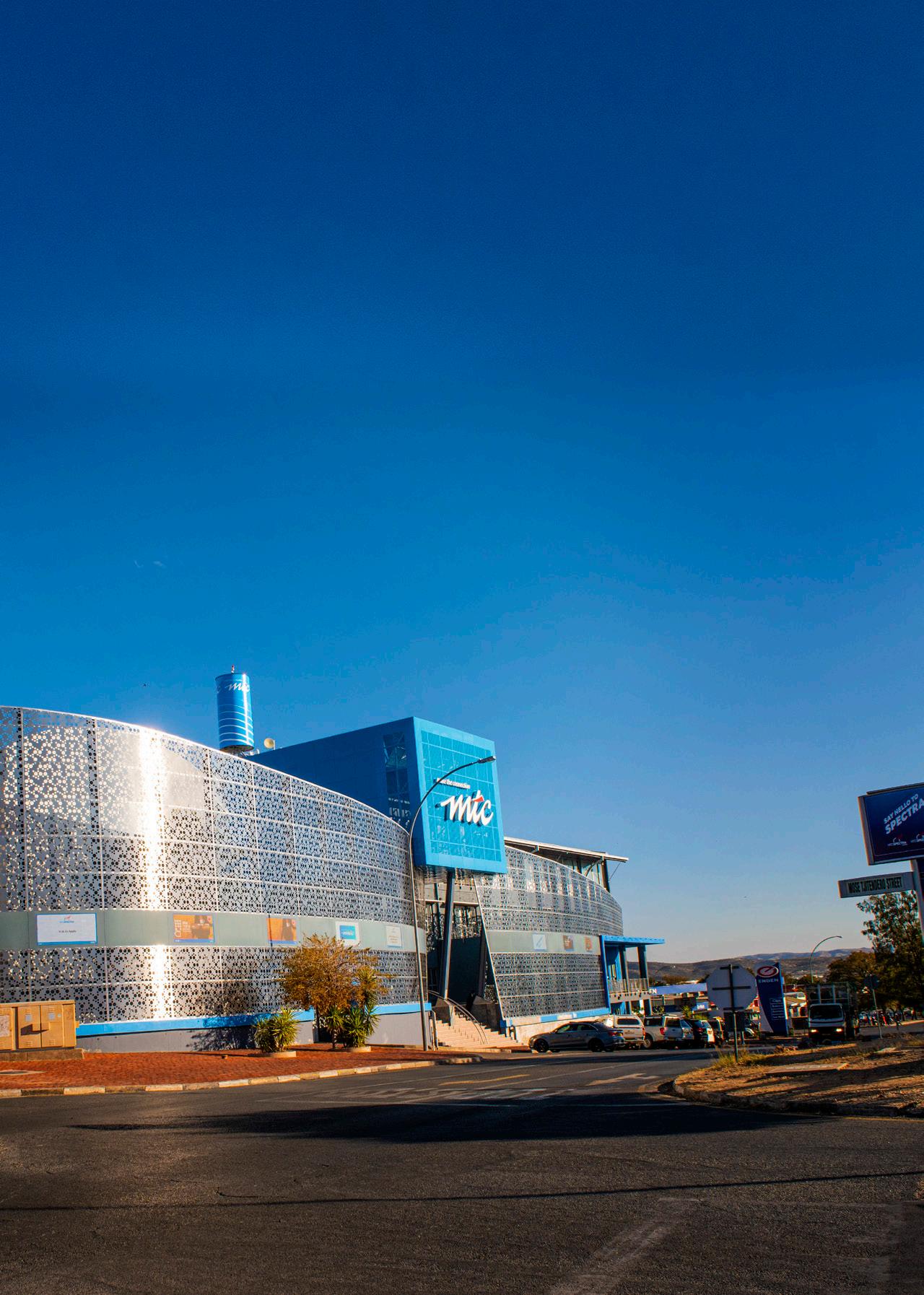
POWERCOM (Pty) Ltd was established in 2007 and later acquired by Telecom Namibia in 2013 and is a 100% subsidiary of Telecom Namibia. Its mandate is defined by the licence issued in accordance with Communications Act (No.8 of 2009) by CRAN, a Class Network Facilities Service Licence which empowers PowerCom to serve as an ICT infrastructure and equipment provider. Since 2013, the company has predominantly focused on building towers to enable service providers and operators to lease space on the towers and provide network coverage and services to their respective clients.

PowerCom’s value proposition lies in the company’s commitment to diversify infrastructure solutions in response to the key and vertical market demands. This will ultimately ensure that it will fulfil its goal to become a hub of connectivity within Namibia and maintain its relevance in an ever-changing marketplace. PowerCom’s infrastructure enables service providers and operators to connect their communications services through a range of infrastructure services offered by the company to the following industries, but not limited to:
• telecom operators (fixed and mobile)
• broadcasters (television & radio)
• internet service providers ecurity (security companies & neighbourhood watches)olice force & national security
• transport sector (road, rail, air & marine)
• farmers
• municipalities
Services offered by PowerCom include:
• tower space leasing
• managed services for rooftops
• 3rd party co-location (water towers)
At PowerCom we want to ensure that the towers we build are in locations with no network coverage. Let us help you get connected.
At PowerCom we want to ensure that the towers we build are in locations with no network coverage. Let us help you get connected.
At PowerCom we want to ensure that the towers we build are in locations with no network coverage. Let us help you get connected.
Send us your locations that do not have network coverage to: info@powercom.na
Do you know that you can lease part of your land for tower construction in areas with no network coverage?
Do you know that you can lease part of your land for tower construction in areas with no network coverage?
If you own land in areas with no network coverage, please contact us.
Do you know that you can lease part of your land for tower construction in areas with no network coverage?
If you own land in areas with no network coverage, please contact us.
If you own land in areas with no network coverage, please contact us.
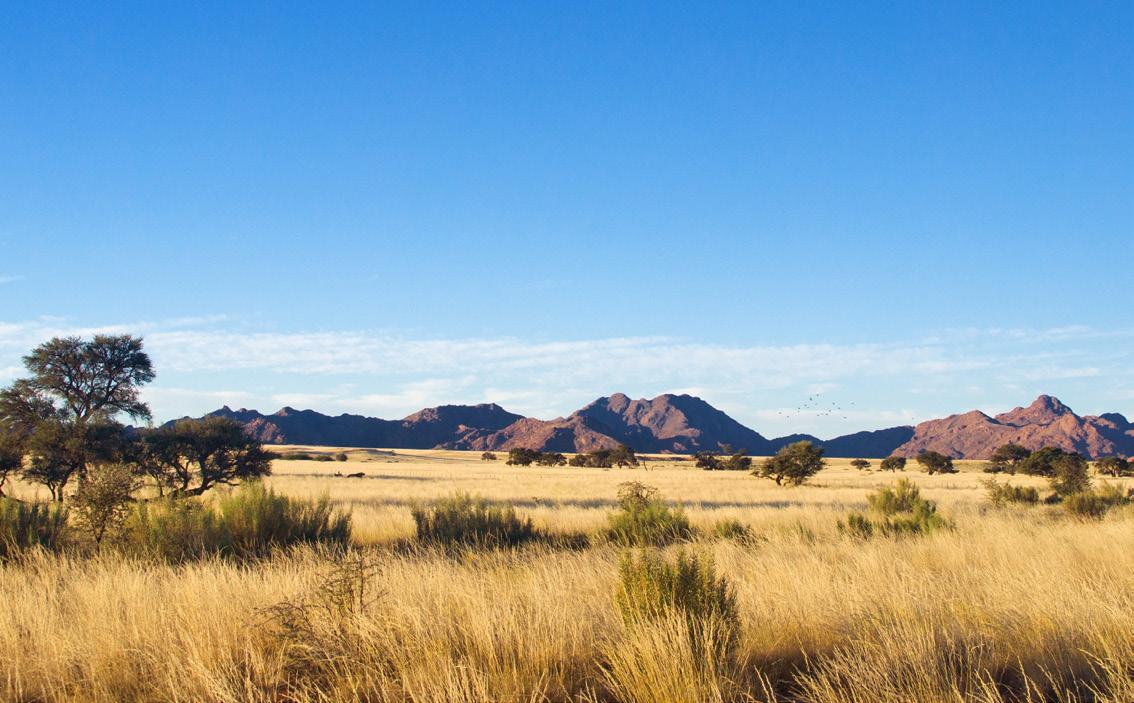
Contact Details: Email: info@powercom.na Website: www.powercom.na
Contact Details: Email: info@powercom.na Website: www.powercom.na
Contact Details: Email: info@powercom.na Website: www.powercom.na


Telecom Namibia aims to gain leadership as a TechCo and has made great strides towards remaining resilient in the future hyper-connected world by transforming our technology model and excelling in improved customer and employee experiences. It is our intention to make voice and broadband data services affordable and accessible across Namibia and drive a vision of a digitally connected future that leaves no Namibian behind.
As a forward-thinking company, we want to make sure we are ready to meet the demands of the future. Telecom Namibia aims to focus on the intensified roll-out of 4G, FTTx, and in the foreseeable future, 5G. We understand that faster and quality fibre deployment will deliver better network quality and investing and prioritising agile networks will provide reliable and faster connectivity for all Namibians.
As an investor in some of the world’s vast subsea cable systems such as SAT3, Seacom and WACS, the recently landed Google Equiano subsea internet cable and the building of the cable landing station, Telecom Namibia plans to secure Namibia’s digital transformation. With the Equiano subsea cable, communication diversity should be expected due to its increased capacity. This will be having a direct impact on connectivity, with faster internet speeds, more flexibility and an improved user experience for consumers in Namibia and beyond. With this extensive global connectivity, Telecom Namibia is poised as a regional internet hub and digital gateway to the SADC region and beyond.
Telecom Namibia’s international connections provide direct connections from Namibia to more than 200 destinations around the world. Telecom owns and operates a fibre network covering over 13,000 km across the country, which is equipped with a total of 850 Gbps DWDM- and IP-based services capacity. Telecom Namibia has deployed over 500 Ethernet and IP/ MPLS Points of Presence, thus allowing IP and Carrier Ethernet connectivity across most parts of the country. To date, Telecom Namibia has achieved a network roll out of over 300 mobile services base stations throughout the country, with several sites equipped with 3G, 4G and 4.5G technology for mobile broadband. Telecom Namibia’s network modernisation plans will address a number of legacy systems across all network layers and domains and will serve as a key foundation to support its Business Digitalisation initiative which in turn is aimed to support digital transformation of the various industries and market segments served by Telecom Namibia.
Telecom Namibia remains laser-focused on customer centricity, digitalisation, and creating synergies across our businesses. We continue with the #NewWay vision and as such Telecom is in the process of upgrading its systems to ensure enhanced service delivery to our customers in the domestic and international markets. Under #NewWay, Telecom Namibia also plans to modernise its mobile network and thus improve the user experience. In our quest to increase the average broadband speeds, Telecom Namibia continues to upgrade mobile sites from 2G and 3G to 4G and 4.5G to provide faster internet access speeds at every place that we cover. Through the Satlink offering, we provide services to rural and remote areas, thus further reducing the digital divide and ensuring connectivity for unconnected communities.
With a transmission network that is 100% digital, the company provides a comprehensive portfolio of communication services and solutions in broadband, data, and voice-over fixed wire-based connectivity (copper and fibre), fixed wireless and mobile platforms.
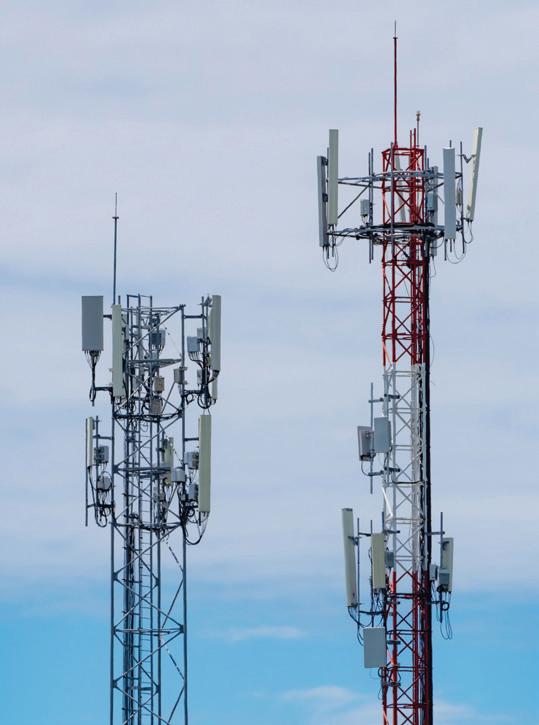
Telecom Namibia has adopted a strategy to provide integrated communication solutions and have products and solutions tailored for wholesale, corporates, government, large enterprises, medium enterprises, small enterprises, small office home office and residentials.
Complementing the deployment of additional mobile broadband access technologies, new IP/Ethernet backhauling network stations were deployed across the country. This IP/Ethernet backhaul infrastructure consolidates the existing backhaul for Metro Ethernet and other access technologies onto one platform which is in line with Telecom Namibia’s strategy to provide fixed mobile converged products and services.
The manufacturing sector plays an important role in Namibia’s long-term development goal to be a prosperous and industrialised country. It is one of the largest employers in the productive sector after agriculture and accounts for about 9.5% of Namibia’s gross domestic product (GDP).
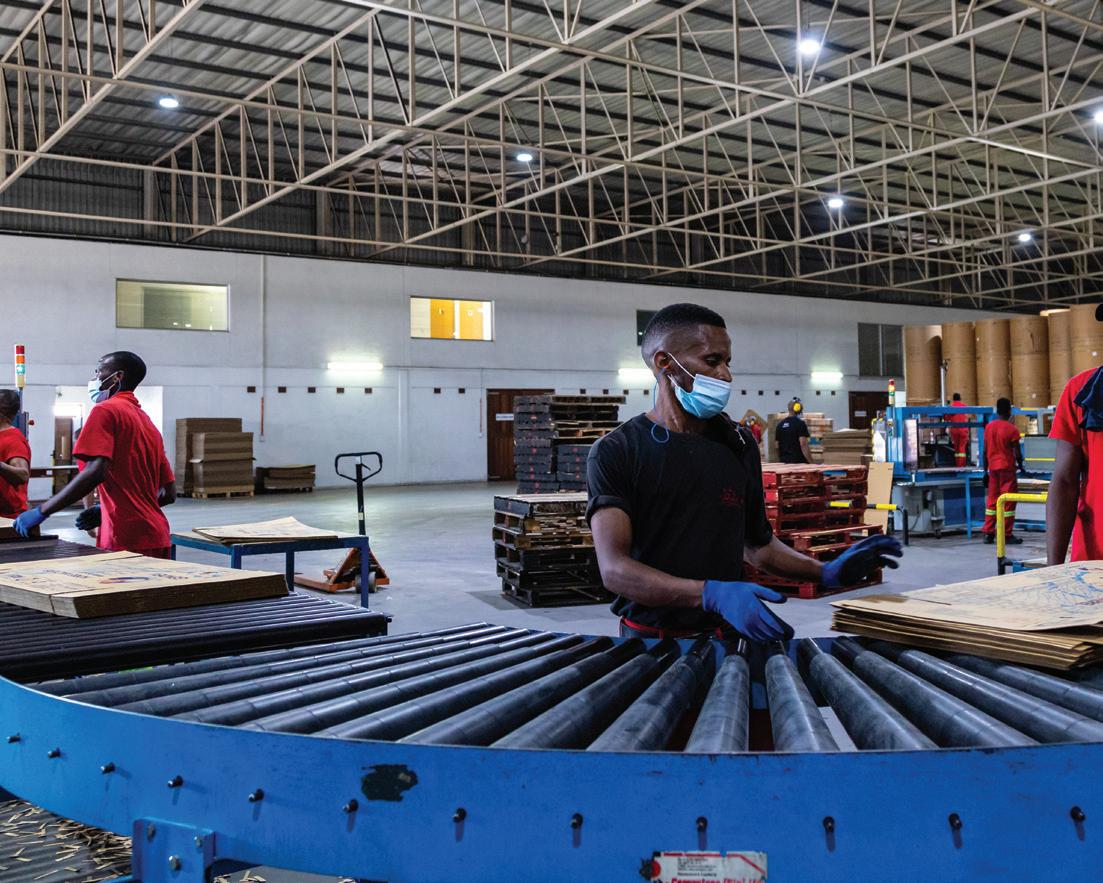
The Bank of Namibia (BoN) expects growth for the manufacturing sector to improve during 2022, following a marginal recovery in 2021. According to the bank’s February 2022 Economic Outlook, the industry is projected to grow by 2.4% in 2022, after recording only 0.5% growth in 2021 and negative growth of 18.3% in 2020. The projected growth for 2023 is 2.8%.
The industry has become more diverse in the past few years in subsectors such as textiles and wearing apparel, packaging and plastics, cosmetics, cleaning materials and pharmaceutical products. Highpriority investment areas include fish and fish products, livestock, meat and meat products, horticulture, mineral beneficiation, charcoal products and cosmetics, as well as automotive parts.
Although the domestic market is small, Namibia’s access to markets in the Southern African Development Community (SADC) with a population of over 330 million people creates opportunities for the export of locally manufactured products. The country’s strategic location on the
coast of southwestern Africa is complemented by a well-developed transport infrastructure and four transport corridors linking Namibia to neighbouring countries.
One of the major challenges facing the industry is that there are no manufacturing incentives following the scrapping of benefits granted to manufacturers after an amendment to the Income Tax Act in June 2020. Scrapped benefits included a reduced tax rate of 18%, a 10-year capital allowance claim for buildings instead of 20 years and a 125% tax deduction for expenses such as salaries and the training costs of employees.
The Special Economic Zone regime is in the process of being finalised following public consultations held by the Ministry of Trade and Industrialisation and the Namibia Investment Promotion Development Board (NIPDB). The regime will replace the Economic Processing Zone (EPZ) which has been phased out to avoid blacklisting by the European Union (EU) as a tax haven. In addition, the EPZ failed to attract new investments and create jobs, resulting in huge losses in revenue to the government. The regime will come into force once the Special Economic
Zone Bill has been finalised, passed by both houses of Parliament and published in the Government Gazette.
The Automotive Production and Development Programme (APDP) Policy for Namibia was published in the Government Gazette in September 2021. The policy complies with the Common External Tariff (CET) of the Southern African Customs Union and takes into account several other regional and continental trade agreements. The policy will enable the Peugeot-Opel plant at Walvis Bay to reclaim 18% tax on the export of the locally manufactured vehicles to South Africa. The N$150 million plant, which was opened in December 2018, was projected to assemble 5,000 Peugeot and Opel cars by 2020, but by mid-2022 only 150 vehicles had been assembled as a result of export issues.
Plastic Packaging won the 2021 Southern African Regional Exporters Award organised by the USAID Southern Africa Trade and Investment Hub. The company also won the Namibia Manufacturers Association Award for Corporate Manufacturer of the Year.
The BoN projects that the construction sector will contract for the seventh consecutive year. In its February 2022 Economic Outlook, the bank projected a contraction of 2% for 2022 before the industry is expected to expand by 2.5% in 2023.
The construction council will require contractors to register and they will be categorised in accordance with predetermined criteria to ensure that only active contractors are registered. It would also ensure that the capacity of contractors is aligned with the size of projects.
The government has set a target of building 20,000 houses countrywide between 2020 and 2025 to address the backlog in affordable housing in the country. The provision of housing has been identified as a priority sector under the Economic Advancement pillar of the Harambee Prosperity Plan II (HPPII). The target of 20,000 houses will be achieved through public and private stakeholders, including the National Housing Enterprise (NHE), Government Institutions Pension Fund (GIPF), the Shack Dwellers Federation of Namibia, Ongos Valley, regional councils and local authorities.
The manufacturing sector plays an important role in Namibia’s long-term development goal to be a prosperous and industrialised country.
An affordable housing initiative for ultralow income earners for residents of six informal settlements in Windhoek was launched as a pilot project in the capital in July 2020. The target of the initiative, which aims to provide housing to the poor by keeping the cost of labour and material at a minimum, is to build 1,200 houses over a two-phase period and will be rolled out to other local authorities and regions. By mid2022, the City of Windhoek has handed over 450 houses to new home owners.
The industry has been adversely affected by a decrease in the government’s capital projects over the past few years. Finance Minister Iipumbu Shiimi pointed out in his 2022/23 budget speech that the government would not be undertaking any new projects during the financial year as a result of “significant revenue constraints”.
The industry has been lobbying for a construction regulatory council since 2006. Despite a commitment by the government to finalise a bill by 31 March 2020 to regulate the construction industry, the industry still operates without a regulatory council. Over the years, this has resulted in numerous incomplete building projects, sub-standard work and tenders being awarded to foreign competitors and briefcase companies without the necessary experience, qualifications or financial resources.
The Namibian Manufacturers Association (NMA) is an association not for gain which represents Namibian manufacturers by facilitating a sustainable, competitive and prosperous manufacturing industry for all stakeholders.
Construction at Ongos Valley, the single largest building project in Namibia, is continuing. The mixed-use development, which got underway in August 2019, will be built over a 20 year period at an estimated cost of N$25 billion. It will consist of 28,000 houses, schools, malls and businesses.
Nedbank Namibia’s new N$495 million environmentally friendly head office building in Windhoek’s central business district was inaugurated at the end of March 2022. The ten-storey building, which received a fivestar rating from the Green Building Council of South Africa, uses close to 46% less energy than a conventional similar-sized building serving the same functions as a result of energy-efficient air conditioning, 100% light-emitting diode (LED) lighting and lighting control. Water usage from the municipal supply has been reduced by 45% through the reuse of grey water and water-saving sanitary fittings.
This is our most precious resource. We develop and maintain a highly skilled professional workforce, capable of providing organisational leadership and establishing, maintaining and improving world-class business and quality processes.
Quality Member of the 47% UP TO STRONGER 47% MANUFACTURER
Our entire approach to the manufacturing processes are environmentally driven, hence the sourcing of raw materials produced from eco-managed pulp plants.
By employing the latest technologies, we can exceed international standards and still remain competitively priced.
Guan’s Packaging is ISO 9001:2015 certied and we are committed to continually improve the effectiveness of the Quality Management System.
We are the only corrugated manufacturer in Namibia in possession of a Box Compression Test Machine, which enables us to test the stacking strength of a carton.
Our board strength exceeds the international required strength with up to 47% and still sells at a highly competitive price structure.
We are the rst corrugated manufacturer in Namibia to introduce a product which improves water resistance and dampproong without impairing recyclability. We are also the rst corrugated manufacturer which can produce E Flute in Namibia.




We provide cost-effective solutions that save Namibians money. With our shorter manufacturing lead times, it enables our customers to be more efcient and more competitive in an ever-growing market.
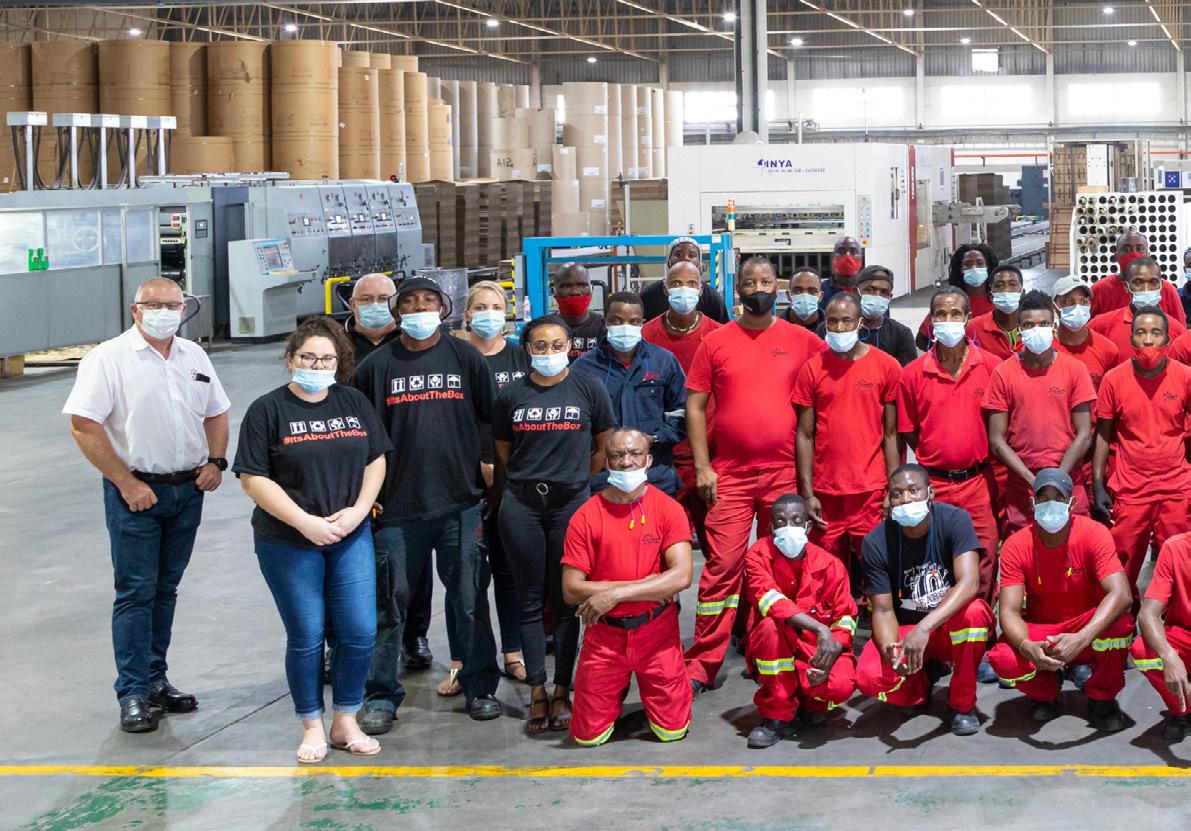
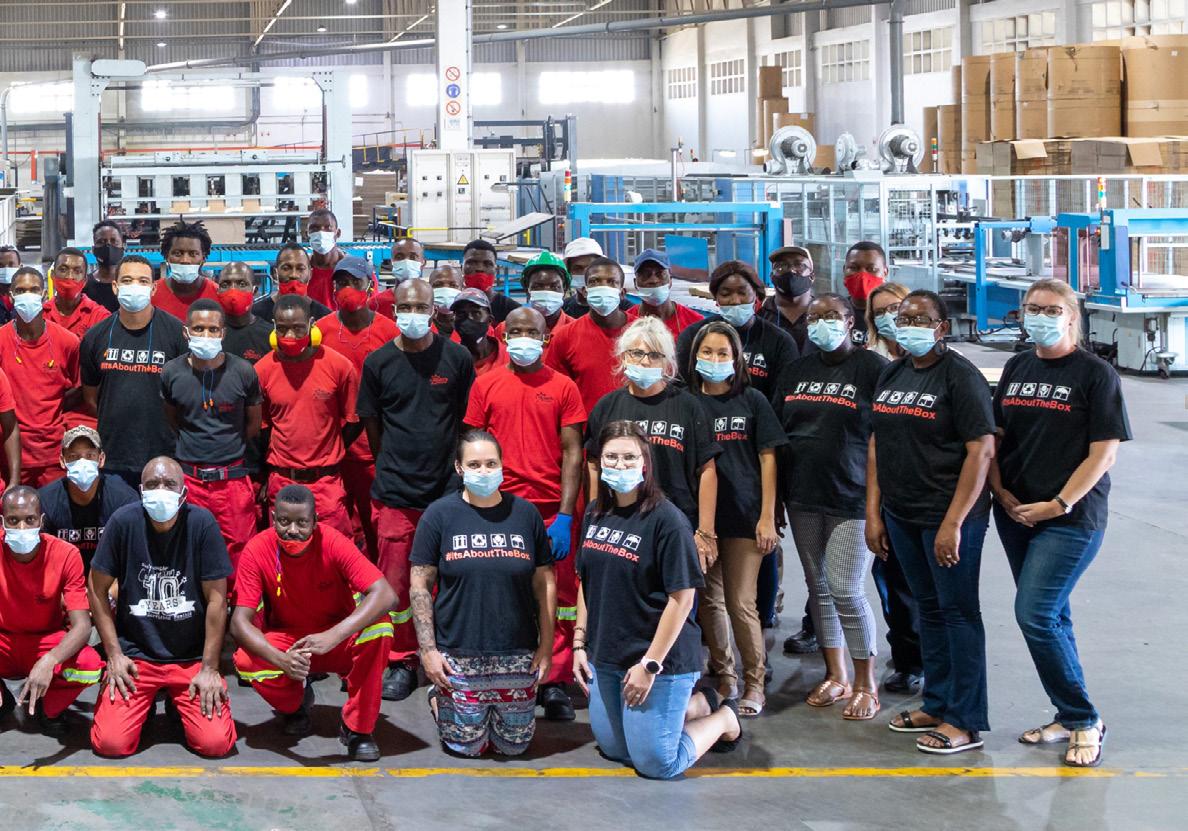


For over 69 years NEO Paints has created a Namibian legacy of developing personalised paint solutions, suitable for our harsh Namibian environment. Our uniquely developed products blend quality and innovation to bring beauty and colour to our Namibian people. Neo Paints is the market leader in the Namibian paint industry and specialises in the manufacturing of paint and other paint related products, and the distribution of paint accessories to our local markets.
NEO PAINTS WINDHOEK
12 Bell Street, Southern Industrial, Windhoek Tel: 061 384 700
NEO PAINTS WALVIS BAY Hanna Mupatani street, Walvis Bay Tel: 064 204 026

The mining industry accounted for 9.1% of Namibia’s Gross Domestic Product (GDP) in 2021 and is expected to drive the country’s economic growth following several positive developments at the end of 2021 and early 2022.
In its February 2022 Economic Outlook, the Bank of Namibia (BoN) says that the mining industry is projected to grow by 15.5% in 2022 and 12.0% in 2023. Positive developments include higher output of gold, marine diamond mining and copper, oil and gas exploration and exploration for and the development of new mines to extract battery minerals.
The diamond mining sector is projected to expand by 26.2% and 16.5% in 2022 and 2023, respectively as Debmarine’s new diamond recovery vessel, MV Benguela Gem, commences production during the second quarter of 2022. The N$7 billion vessel is expected to add 500,000 carats annually to the company’s production. Debmarine’s production of 1,136,000 carats in 2021 is a slight increase on the 1,125,000 carats produced in 2020.
Namdeb announced in November 2021 that the current life of mine of its landbased operations would be extended by 20 years from 2022 to 2042 in line with its long-term business plan. During the first five years, the government has agreed to reduce royalties from 10% to 5%. The long-term business plan will require a capital investment of N$1.8 billion by Namdeb. Production increased marginally by 2% to 330,000 carats in 2021.
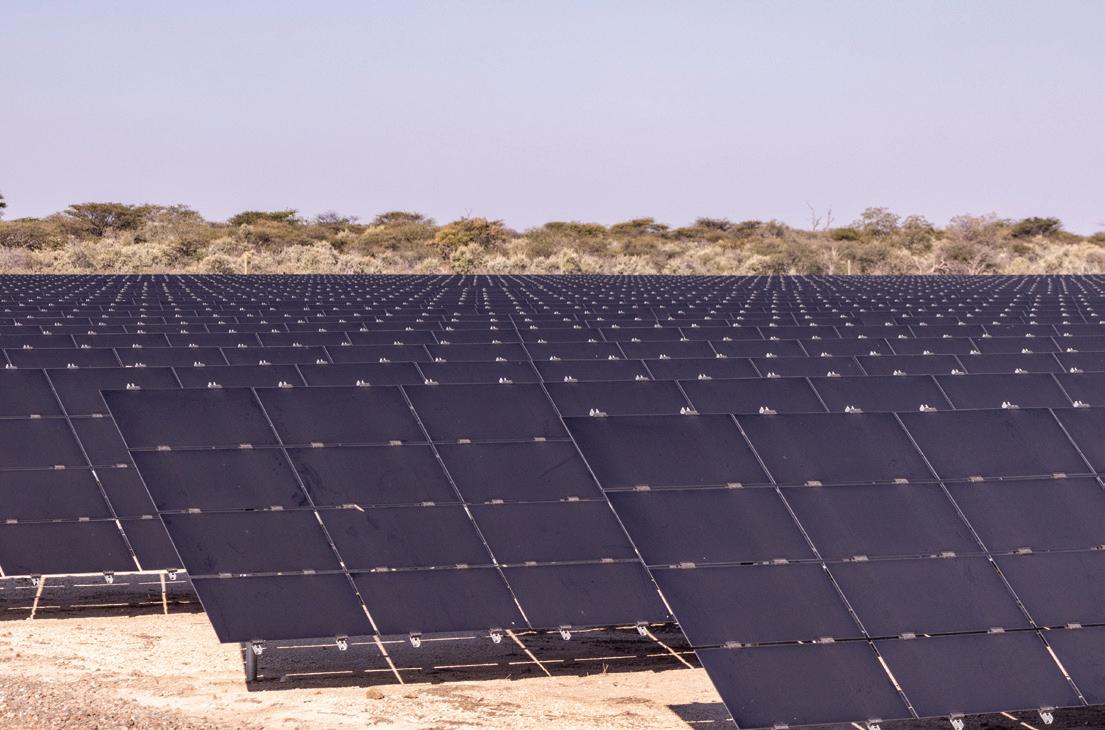
Namibia’s two gold mines, Navachab and B2Gold’s Otjikoto mine are expected to increase their output during 2022. Namibia is set to become a major gold producing country in the years to come, following the discovery of the Twin Hills deposit in the Karibib district by Canadian company Osino Resources. The mine is expected to produce between 100,000 and 200,000 ounces a year at full production during its ten to 15 year lifespan.
The BoN projected that the uranium sub-sector would grow by 3.9% in 2022 and 6.6% in 2023. The projection was made before Russia ‘s invasion of Ukraine which saw uranium spot prices reaching a six year high of over US$58.00 per pound in March 2022. Long-term prices climbed to US$36 in April 2022 – its highest level since July 2020. The price increase was caused by, amongst others, anticipated supply disruptions, as well as the growing demand for nuclear energy globally.
Orano’s Trekkopje and Paladin’s Langer Heinrich mines remain under care and maintenance, but could restart operations if the spot price for uranium oxide moves above US$55 per pound. Swakop Uranium and the Rössing mine, which are both majority owned by Chinese state-owned companies, however, continued production despite the low prices.
The metal ores sub-sector is projected to grow by 0.8% in 2022 and 3.6% in 2023. Namibia’s first iron ore mine, Lodestone Namibia’s Dordabis Iron Ore Project, exported 52,000 tonnes of raw iron from Walvis Bay in July 2021.
Trignon Metals restarted open pit mining at Kombat at the end of 2021 – 14 years after the mine’s closure as a result of flooding and low copper prices. The mine produced its first copper concentrate in December 2021 and announced its first shipment in February 2022. The mine will produce 30,000 tonnes copper concentrate a month at full production.
In another development, Gratomic announced plans to commence production at its Aukam Graphite Project in southern Namibia in 2022. The mine is expected to produce 20,000 tonnes of high purity graphite at full production annually.
In late February 2022, after nearly five decades off offshore drilling for gas and oil by various companies, TotalEneries announced a major light oil and associated gas discovery in its exploration block, approximately 290 km offshore of Oranjemund. This was followed by an announcement in April 2022 by QatarEnergy and the National Petroleum Corporation of Namibia that light oil had been discovered at two reservoirs in the offshore Orange Basin, about 270 km from Oranjemund.
Although the discoveries have been described as possible major game changers for the Namibian economy, analysts have cautioned that further testing and exploration will be required to determine the size and recoverable potential.
The onshore search for oil took on another dimension when the Canadian oil company ReconAfrica, a junior oil and gas company, began drilling its first well in January 2021. The company drilled its second well in May 2022 and announced in April 2022 that it had discovered a working petroleum system at its first drill site in the Kavango Basin.
Namibia improved its ranking on the 2021 Policy Perception Index (PPI) of the Fraser Institute Survey of Mining Companies from 47th in 2020 to 29th in 2021. The country also improved its ranking on the PPI as the most favourable jurisdiction in Africa from the 5th to the 2nd position in Africa.
The Chamber of Mines of Namibia, however, cautioned that the improvement of Namibia’s score from 74.30 points in 2020 to 75.20 in 2021 points is marginal and much lower compared to 2018 (80.7 points) and 2019 (87.22).
Namibia is set to become a leading global producer of green hydrogen and ammonia, following the announcement that Hyphen Hydrogen Energy has been selected as the preferred bidder for green hydrogen production facilities in Namibia.
The N$9.4 billion project in the Tsau IIKhaeb National Park in the IIKaras Region is planned to become operational in 2026. It is projected to produce 300,000 tonnes of green hydrogen and ammonia at full production. The project is expected to create 15,000 direct jobs during the construction phase and 3,000 direct jobs over its 40-year operational period.
Namibia’s first green hydrogen production plant was launched in February 2022. The plant, a demonstration hub for hydrogen applications, is being developed by Cleanergy Namibia, a joint venture by the Ohlthaver & List Group and CMB.TECH, a Belgian company. Construction of the N$271 million plant will start during 2022 and is scheduled for completion in 2023. The company aims to produce green hydrogen from solar power and distribute the clean fuel to heavy-duty applications like trucks, locomotives, mining equipment and ships. A larger scale production plant will be built in the second phase if the results of the demonstration plant are satisfactory,
NamPower ‘s six renewable energy projects are in various stages of development and are expected to generate an additional 170MW of electricity, while a 58MW grid-connected battery energy storage system will provide grid stability services. The total estimated cost of the projects is around N$5.5 billion. Four of the projects will be owned and operated, while two will be operated by independent power producers:
• 20MW Omburu Photovoltaic Project, 12 km southeast of Omaruru.
• 40MW Otjikoto Biomass Power Station, 15 km west of Tsumeb.
• 50MW Omburu Battery Energy Storage System, 12 km southeast of Omaruru,
• 40MW Rosh Pinah Wind Power Plant, 33 km north of Rosh Pinah.
• 50MW Wind Independent Power Producer Power Project, 20 km south of Lüderitz.
• 20MW Khan Solar Photovoltaic Independent Power Producer Project, 45 km west of Usakos.
The Chamber of Mines of Namibia
P O Box 2895, Windhoek +264 61 237 925 info@chamberofmines.org.na www.chamberofmines.org.na *Contact CoMN for a list of mining companies in Namibia
CREE - Centre For Renewable Energy & Energy Efficiency Private Bag 13388, Windhoek +264 61 207 2154 nei@nust.na www.nei.nust.na
Diamond Board Of Namibia
Private Bag 13927, Windhoek +264 61 284 8249 www.diamondsnamibia.com martha.haindongo@mme.gov.na
ECB - Electricity Control Board P O Box 2923, Windhoek +264 61 374 300 info@ecb.org.na www.ecb.org.na
Minerals Development Fund Of Namibia
Private Bag 13297, Windhoek +264 61 284 8263/ 380 www.mme.gov.na
Namibia Uranium Association P O Box 2747, Swakopmund +264 64 402 393 info@namibianuranium.org www.namibianuranium.org
NDTC - Namibia Diamond Trading Company PO Box 23316, Windhoek +264 61 204 3222 www.ndtc.com.na
Namibia Meteorological Services Private Bag 13224, Windhoek +264 61 287 7001 namibiaweather@gmail.com www.meteona.com
RERA - Regional Electricity Regulators Association of Southern Africa P O Box 2302,Windhoek +264 61 221 720 secretariat@rerasadc.com
Women in Mining Association Namibia
P O Box 2895, Windhoek +264 81 237 8514
•
•
•
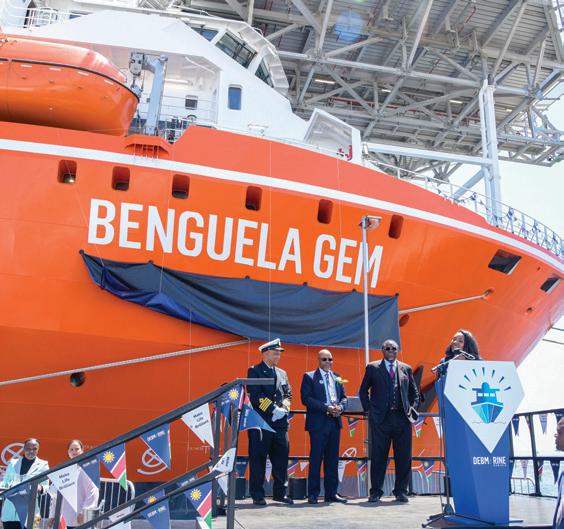
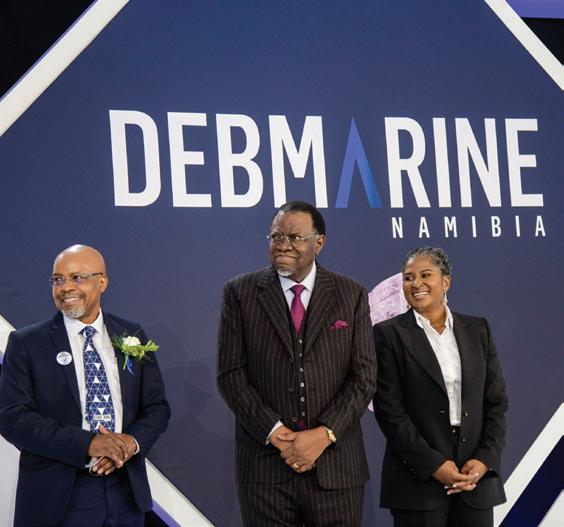
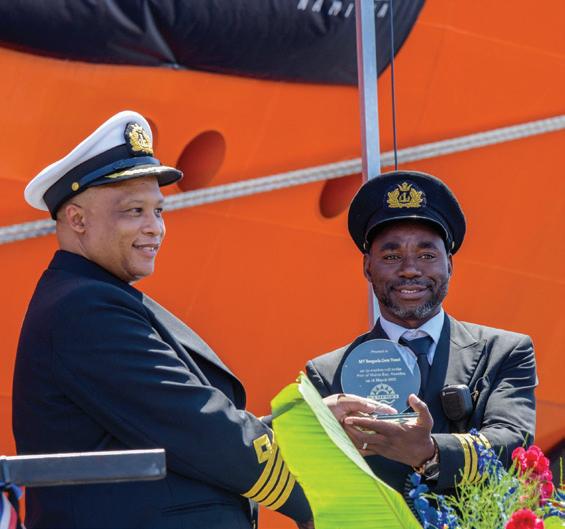
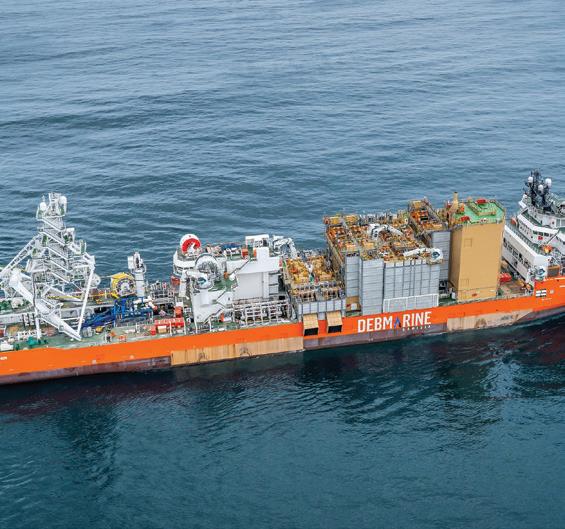
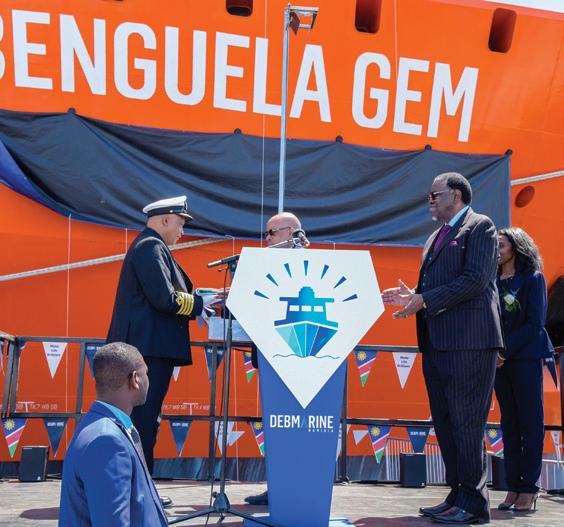
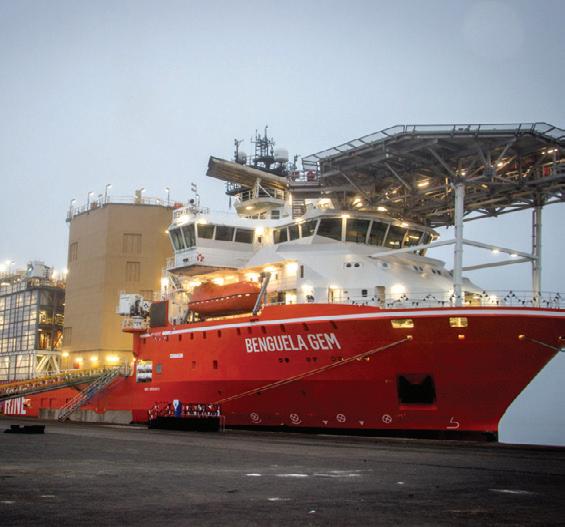
The MV Benguela Gem has arrived home in the Atlantic 1 recovery area, anchoring its place as a unique addition to the Debmarine Namibia fleet. The additional Gem was inaugurated in the port town of Walvis Bay earlier this year.
The MV Benguela Gem is an example of brilliance realised on the journey to become pioneers of a new diamond world. The MV Benguela Gem’s many attributes include being:
• The most advanced diamond recovery vessel in the world, with unrivalled efficiency, reliability and accuracy.
• The most environmentally friendly vessel of its kind.
• On track to create 161 highly skilled jobs for Namibia.
• Forecast to add an additional 500,000 carats of high-value diamonds to annual production.
The project took more than five years of intensive planning and construction by teams from Debmarine Namibia and De Beers Marine South Africa, with parts sourced from as far as the Netherlands, Norway and Poland. The initial construction was done in Romania.
The new recovery vessel is an addition to the Debmarine Namibia recovery fleet along with the MV Mafuta, the MV Grand Banks, the MV Debmar Pacific, the MV Debmar Atlantic and the MV !Gariep. The MV SS Nujoma is the world’s most advanced diamond exploration and sampling vessel, enabling greater success for the pioneering marine recovery company.
Our collective investment in the vessel will continue to support a long-term, sustainable future for Namibia’s diamonds. Since its launch, our new vessel has started operations to improve output, efficiency and sustainability, and to push the company’s 70% contribution to the total Namibian diamond production up even further.
“We have invested in the research and development of the latest industry technology for the Benguela Gem to enable us to produce diamonds safely, efficiently and more sustainably for the benefit of all Namibians,” says Debmarine Namibia CEO Otto Shikongo. Debmarine Namibia’s contribution to the national fiscus is unrivalled due to the revenue generated annually.
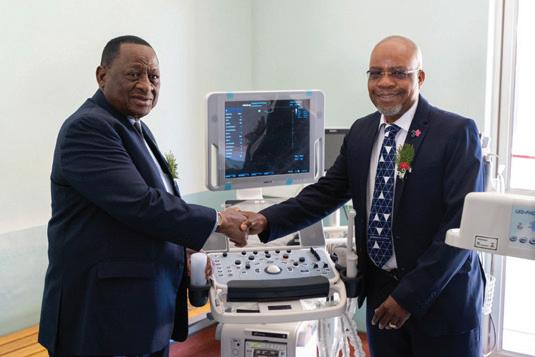
Further to our national commitment as a revenue contributor, we at Debmarine Namibia live by our purpose, ‘Make Life Brilliant’, which is fuelled by our ambition to be the beacon of mining excellence. Our approach is simple: to recover diamonds safely and sustainably whilst building a positive legacy, which is not limited to merely paying our loyalties and taxes.
Debmarine Namibia has officially been recognised for this role with an appreciation award by the Namibia Revenue Agency (NamRA) for the tax returns making the company the Highest Contributor to VAT, Highest Contributor to Corporate Income Tax and Overall Top Revenue Contributor in the 2021 season.
In 2021, Debmarine Namibia contributed N$1.6 billion to the Namibian fiscus in royalties, income tax and dividends. This contribution is estimated to increase to around N$4.7 billion in 2022. The increase is mainly due to the introduction of our new state-of-the-art diamond recovery vessel, MV Benguela Gem.
Partnering with Thriving Communities is one of our Building Forever social investment pillars. Through this pillar, we seek ways in which we can partner with our communities to generate real and lasting benefits for our country in the areas of health and wellbeing, skills and education as well as livelihoods by addressing socio-economic needs. Our social responsibility agenda, facilitated through our social investment fund, focuses on broad-based community needs identified and received throughout the country.
Debmarine Namibia remains committed to building a long-lasting and positive diamond legacy.
Debmarine Namibia handed over the following medical equipment to Karasburg District Hospital: ultrasound machine, phototherapy monitor for premature babies, vital sign monitors and theatre lights as well as curtains and general renovation work in the maternity ward. The medical equipment sponsorship worth over N$1 million was received by the Minister of Health and Social Services, Dr Kalumbi Shangula. Debmarine

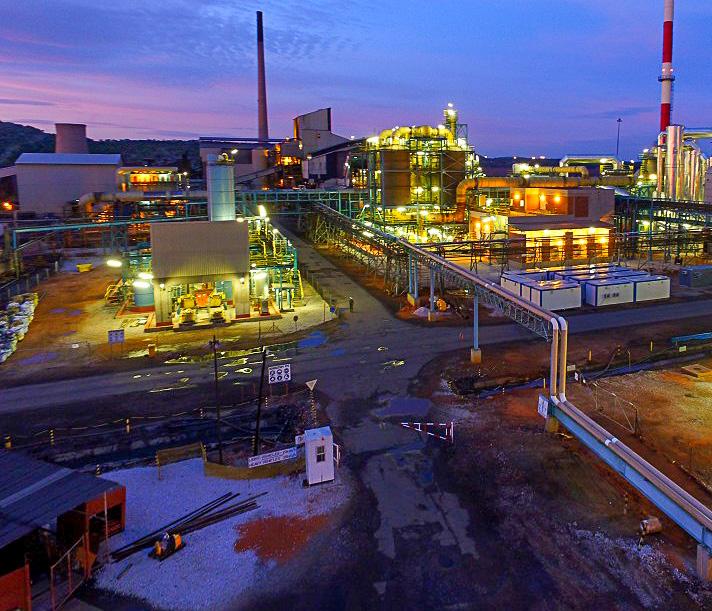
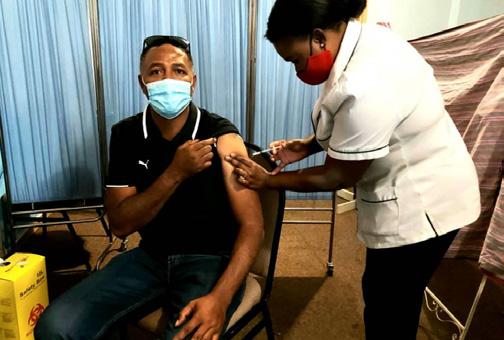
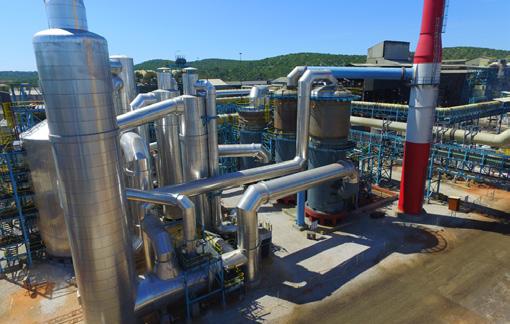
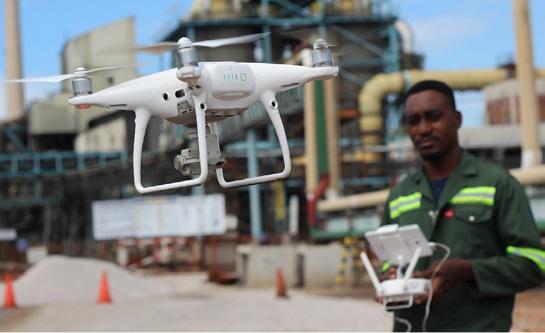
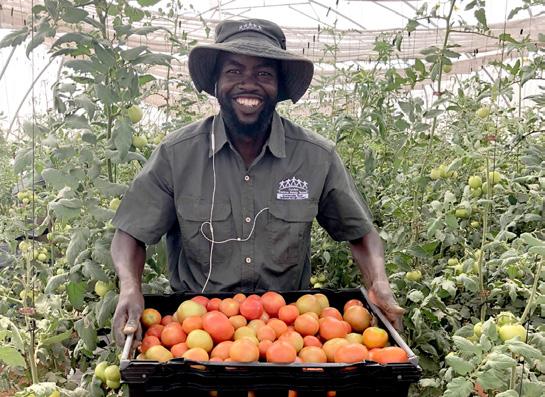
Namdeb’s rich history goes as far back as 1920 when diamond-mining companies along the Orange River were amalgamated to form Consolidated Diamond Mines (CDM). In 1994 CDM entered into a new partnership with the Namibian Government and Namdeb was formed.
Namdeb Diamond Corporation is a wholly owned subsidiary of Namdeb Holdings (Pty) Ltd, which is a 50:50 joint venture between the Government of the Republic of Namibia and De Beers. Namdeb Holdings has long-term mining concessions in the southwest of Namibia both on land and offshore, adjacent to the Orange River and offshore in the shallow waters.
Diamond exploration and mining takes place along the south-west coast and inland areas of Namibia’s ||Karas Region. The main land-based operations are found in the town of Oranjemund and satellite mines along the Orange River.
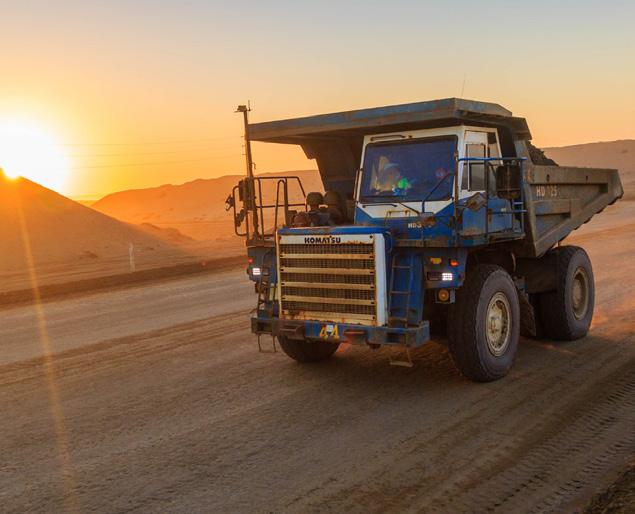

Namdeb has a workforce of approximately 1500 employees. There remains a focused commitment to increase the number of female employees within jobs and roles that have been traditionally male dominated. Namdeb also makes use of contractor companies which employ approximately 963 employees.
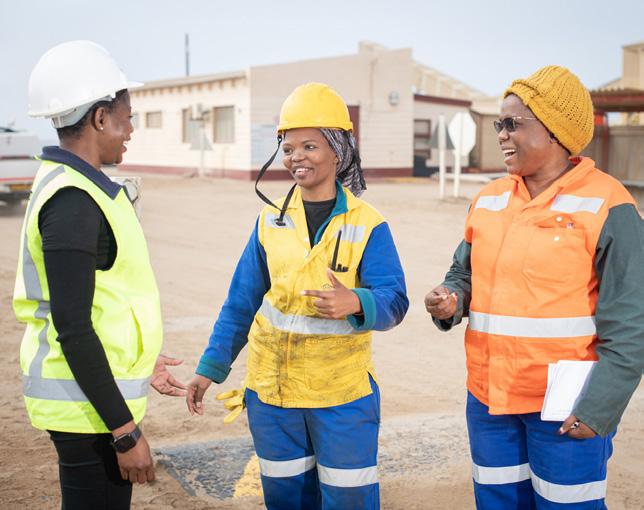
Safety is the first value and the number one priority for Namdeb. A zero-harm approach forms the foundation of all aspects of operations and this care is extended to all stakeholders and the environment in which Namdeb operates. Namdeb is proud to have continuously retained its Occupational Health and Safety Audit Standard (OHSAS 45001:2018).
Namdeb’s first priority is to ensure a safe and healthy work environment for employees. This is achieved through a holistic wellness programme which focuses on the prevention and care of diseases. In addition to this, a variety of services are offered to enhance continuous health monitoring. Namdeb prides itself on being the first organisation in Namibia to provide antiretroviral (ARV) medicine to employees, their spouses, life partners and dependents. Namdeb also secured a fully fledged COVID-19 facility in 2020 which not only serves its employees but also the town of Oranjemund and the ||Kharas Region at large.
Namdeb operations are located within the Tsau //Khaeb (Sperrgebiet) National Park, adjacent to the international Orange River and Namibian Islands’ Marine Protected Area. This unique location, as well as the potential for tourism in the area, creates a strong focus for the integration of biodiversity stewardship into the mine’s life
cycle from exploration, projects, operations and closure. For several years the company has supported various research and conservation efforts in both land and marine environs through the establishment of partnerships with key research and academic institutions. The company prides itself with a rehabilitation plan that is aligned with the park’s Land Use Plan. This plan makes provision for rehabilitation of areas for mining-based, nature-based and conservation areas in ensuring that an area is restored back to the way it was before mining activities took place.
Namdeb has a proud history of being an industry leader in the adoption of innovation across its value chain. Several types of innovative mining techniques have been employed to extract diamonds from alluvial deposits of ore bodies. Over the years, specialised equipment such as vacuum extractors, dredgers, accretion conveyors and drill platforms have been used to sample, extract the resource and create more accretion respectively.
Namdeb continues to find innovative opportunities to complement the existing mining methods to significantly improve performance and investigate initiatives that could make a meaningful contribution to the profitability of the operation.
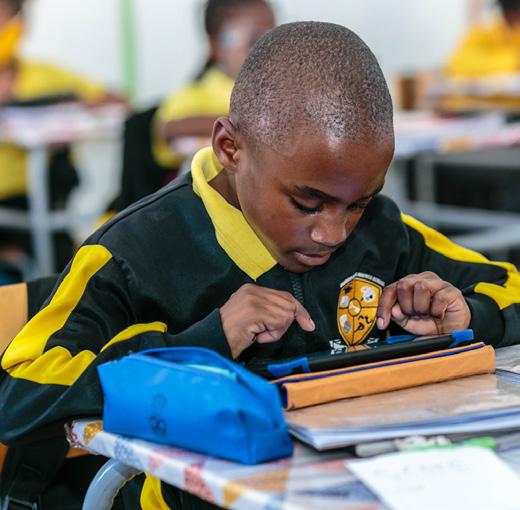
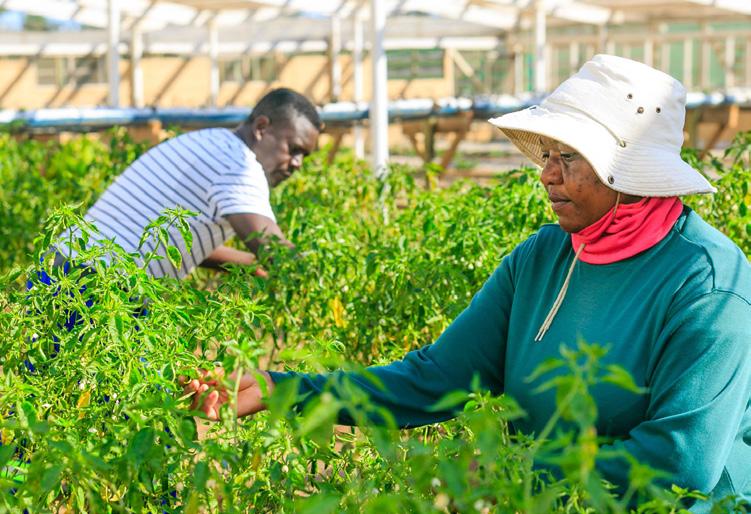
Namdeb mines diamonds profitably, sustainably and responsibly for the benefit of shareholders and other stakeholders whilst making a lasting contribution to Namibia. Diamond mining has played a significant role in building the social and physical infrastructure of an independent Namibia. As part of leveraging diamond equity, Namdeb will continue to investigate new opportunities which seek innovative ways of creating value.
On 14 October 2021 Namdeb announced the approval of its new Long-Term Business Plan. This new business plan saw the extension of the current Life of Mine Plan from 2022 until 2042, which supports the company’s vision of mining profitably, responsibly and sustainably untill 2050 and beyond. This also means that Namdeb can continue to plough back into the Namibian nation through job creation and CSI/CSR activities as well as continue to contribute to the country’s GDP.
+264 61 204 3333
Shangelao.ndadi@namdeb.com www.namdeb.com
Shangelao Ndadi Brand ManagerElectricity is the engine that drives all sectors of an economy and NamPower is repositioning itself constantly to remain relevant in the evolving Electricity Supply Industry (ESI).
NamPower is committed to supporting the government in achieving its goals as set out in the National Integrated Resource Plan (NIRP), the Harambee Prosperity Plan II and the commitments made at COP26.
Despite the challenges in its operating environment, NamPower has developed and implemented various strategies to improve business resilience and to ensure the security of electricity supply to the nation.
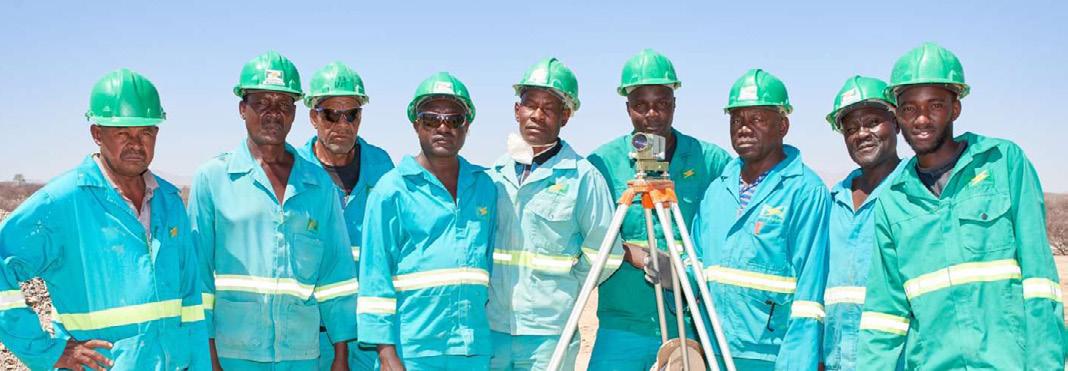
As part of its strategy, in addition to ensuring security of supply, NamPower is geared towards a predictable tariff path aimed at supporting economic growth and
“To be the leading electricity solutions provider of choice in SADC.”
maintaining the company’s financial sustainability, through the implementation of its planned generation and transmission projects.
NamPower’s current Integrated Strategic Business Plan (ISBP) 2020 – 2025, through which the company aims to reposition itself and adapt to prevailing market forces, aims to enhance the company’s mission: “To provide innovative electricity solutions, in an evolving market, which satisfy the needs of our customers, fulfil the aspirations of our staff and the expectations of our stakeholders in a competitive, sustainable and environmentally friendly manner.”
NamPower is committed to guaranteeing a reliable and sustainable electricity supply which propels life forward.

“To provide innovative electricity solutions, in an evolving market, which satisfy the needs of our customers, fulfil the aspirations of our staff and the expectations of our stakeholders in a competitive, sustainable and environmentally friendly manner.”
“To generate, transmit, supply and trade electricity, including the importing and exporting of electricity.”
NamPower’s core business is to generate, transmit, distribute and trade electricity, the latter of which takes place within the Southern African Power Pool (SAPP), the largest multilateral energy platform on the African continent. NamPower has a direct impact on ensuring security of supply for the Namibian nation by providing bulk electricity supply to the Regional Electricity Distributors (REDs), mines, the Namibia Water Corporation (NamWater), farms and local authorities (where REDs are not operational) throughout the country.
LOCATION OF PROJECT: 12 KM SOUTH-EAST OF OMARURU
The project involves the development of a 20MW Solar PV Project close to the town of Omaruru. Given the fact that Namibia is blessed with some of the best solar irradiation in the world, the estimated capacity factor of this project is approximately 36%. The project will be able to meet the average energy demand of approximately 16,000 households with clean renewable energy.
TOTAL PROJECT ESTIMATE: N$380 MILLION
Implementation period: The project has been completed and the Omburu 20MW PV Power Station was officially inaugurated on 24 June 2022.
50MW
LOCATION OF PROJECT: APPROXIMATELY 20 KM SOUTH OF LÜDERITZ
NamPower will procure an Independent Power Producer (IPP) to develop the 50MW Wind Power Project through an open, transparent and competitive bidding process.
The key benefits of the project are:
Reduce the overall NamPower tariff to the customer by introducing an affordable “new build” renewable energy to the Namibian grid; Support the renewable commitments prescribed in the Renewable Energy Policy and National Energy Policy; Provide renewable energy outside of the typical Solar PV dispatch profile, especially in the evening peaks (the wind resource profile supports evening peaks); Pool in private sector investment in the Electricity Supply Industry.
TOTAL PROJECT ESTIMATE: N$1.32 BILLION
Implementation period: Target commercial operation date for the power plant is scheduled for 2024.
LOCATION OF PROJECT: 15 KM WEST OF TSUMEB
The project entails the development of a 40MW Biomass Power Station utilising encroacher bush as the fuel source. Bush encroachment in Namibia currently affects 26 million hectares of potential agricultural land for livestock and food production.
As a potential project of national importance, the power station will not only assist NamPower to strengthen its domestic local generation mix with a fully dispatchable energy source (which could provide baseload energy), but also benefit the greater economy with its significant macroand microeconomic benefits from the value addition of harvesting encroacher bush as a fuel source.
TOTAL PROJECT ESTIMATE: N$2.0 BILLION
Implementation period: Project completion date for the power station is planned for 2025.
LOCATION OF PROJECT: OMBURU SUBSTATION, 12 KM SOUTH-EAST OF OMARURU
The project entails a stand-alone grid connected 58MW (minimum 60MWh) Battery Energy Storage System implemented at the Omburu Substation. This project will be grant funded (€20 million) by the KfW Development Bank.
The project will provide various grid stability services and will enable the grid to take up additional intermittent renewable energy generation, whilst ensuring security of supply.
TOTAL PROJECT ESTIMATE: €20 MILLION
Implementation period: Project completion for the power plant is planned for 2024.
LOCATION OF PROJECT: APPROXIMATELY 33 KM
NORTH OF ROSH PINAH
The project entails a 40MW wind power project in one of the best wind resource areas in the world with an estimated capacity factor of more than 30%.
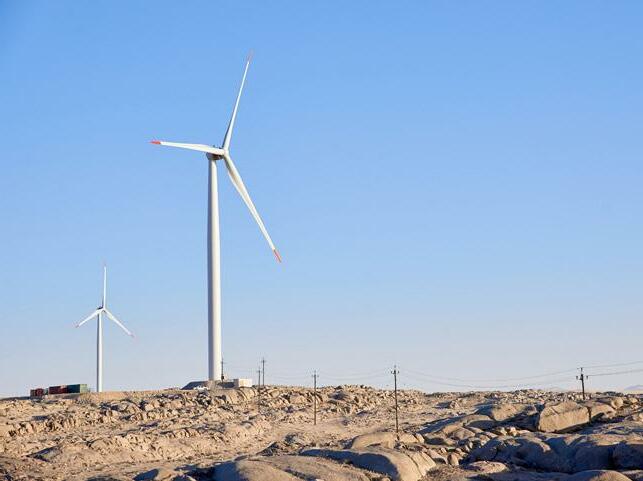
TOTAL PROJECT ESTIMATE: N$1.2 BILLION
Implementation period: Project implementation for the power plant is planned for 2024.
LOCATION OF PROJECT: 45 KM SOUTH-WEST OF USAKOS
NamPower has awarded the bid for the development of a 20MW Solar PV Power Plant to ANIREP Aussenkjer Solar One Namibia in July 2020 following an open, transparent and competitive bidding process. The power purchase agreement which facilitates the development of the power plant and sale and purchase of electricity from the power plant was signed in December 2020.
The key benefits of the project are:
Reduce the overall NamPower tariff to the customer by introducing an affordable “new build” renewable energy to the Namibian grid; Support the renewable commitments prescribed in the Renewable Energy Policy and National Energy Policy; Pool in private sector investment in the Electricity Supply Industry.
Implementation period: Target commercial operation date for the power plant is scheduled for 2022.
LOCATION OF PROJECT: WALVIS BAY
The project entails a 50MW power plant utilising Internal Combustion Reciprocating Engine (ICRE) technology which can either run on natural gas or liquid fuel (LFO/HFO). The power station will be owned and operated by NamPower, and the purpose of the power station will be to ensure that dispatchable power is available to cater for emergency power to the Namibian grid during times of shortage within the Southern African Power Pool (SAPP) and to help minimise or avoid load shedding.
TOTAL PROJECT ESTIMATE IN N$ AND US$ VALUES: N$1.259 BILLION / US$74 MILLION (N$ / US$ = 17).
Implementation period: Project completion for the power plant is planned for end 2023.
NamPower has in place a Transmission Master Plan that provides for large transmission backbone developments across the country. The Transmission Master Plan is updated on an annual basis to ensure that the company maintains pace with the evolving electricity needs of the country. The plan involves the construction of new transmission lines, new substations and the upgrading of existing transmission infrastructure. New infrastructure is required due to existing internal supply limitations, to provide for future load growth, the integration of upcoming generation plants, and possible wheeling of electric power through the transmission grid to the Southern African Power Pool (SAPP) region.
Below are some major Transmission Master Plan projects, which are either under construction, bidding process or in planning phases:
• 400 kV Auas–Gerus Transmission Line Project;
• 400 kV Auas–Kokerboom Transmission Line Project;
• 330 (400) kV Kunene and Omatando Substations Project;
• 400 kV Obib–Oranjemond Transmission Line Project;
• 220 kV Otjikoto–Masivi Transmission Line;
• 132/66/33 kV Sekelduin Substation Project;
• 220/132 kV Masivi New Substation Project;
• 132/66/33 kV Shiyambi New Substation Project;
The Auas–Gerus 400 kV transmission line project forms part of the Transmission Master Plan 400 kV development which is currently under implementation to ensure security of power supply for Namibia. The Auas–Gerus 400 kV line project will support the Auas-Van Eck-Omburu 220 kV network (providing for contingencies, benefit of improved losses and improved network stability) and strengthen the network to Gerus Substation. This will enable NamPower to accommodate increased electricity transfer and wheeling via the GerusZambezi High Voltage Direct Current (HVDC) link.
This project comprises of a 290 km transmission line from Auas Substation near Windhoek to Gerus Substation near Otjiwarongo and associated works required at both substations to integrate the line into NamPower’s existing network. The project commenced in May 2021 and the new line is planned to be commissioned in June 2023. It requires a capital investment of about N$868,302,000.
The Auas–Kokerboom 400 kV transmission line and associated feeder bay project forms part of the Transmission Master Plan 400 kV development. The project comprises a 500 km transmission line from Auas Substation near Windhoek to Kokerboom Substation near Keetmanshoop and associated works required at both substations to integrate
Namibia Power Corporation (Pty) Ltd
P.O. Box 2864, Windhoek, 15 Luther Street
Fax: +264 61 232 805 Tel: +264 61 205 4111
Email: register@nampower.com.na Website: www.nampower.com.na
NamPower
the line into the NamPower network. The estimated contract value for the 400 kV line construction is N$1,657,840,000.
(400)
The 400 kV line from the Kunene Substation site to the 400 kV Omatando Substation site has been completed. For this line to commercially operate, the two substations should be built at each end of the line, one at Kunene near Ruacana and another one at Omatando near Ongwediva. The platforms for these substations were completed. The two substations (Kunene and Omatando 400 kV extension) are still to be developed. The contract to construct the substations has been awarded. This development will cost N$741,240,000 and is planned to be commissioned in August 2023.
A 400 kV transmission line will be constructed from Oranjemond Substation in South Africa to Obib Substation near Rosh Pinah. This project will improve the reliability of the existing transmission interconnection between Namibia and South Africa, allow for increased power trading with South Africa’s Eskom, and improve the utilisation of the NamPower network for trading or wheeling of power between Southern African Power Pool (SAPP) member utilities. This project is expected to be completed by the end of 2024 at a cost of about N$1,200,000,000.
The Sekelduin Substation project is a new 132/66/33 kV indoor substation in the vicinity of Swakopmund. The substation will become the main transmission supply to the Swakopmund and Tamarisk substations, NamWater’s water supply scheme to Husab Uranium Mine and the Erongo RED 33 kV network. The Sekelduin Substation will be supplied with two 132 kV overhead lines from the Kuiseb Substation.
The construction of the substation will allow for all high voltage equipment to be housed indoors in a purpose-suited building to protect it against the highly corrosive coastal and desert environment. The high voltage equipment that will be installed are compact gas-insulated mixed technology switchgear (MTS) for the 132 kV and 66 kV switching systems, as well as gas-insulated metal-enclosed switchgear (MES) for the 33 kV switching system. This development will cost N$320,000,000 and is planned to be commissioned in February 2024.
PROJECT NAME: 220/132 KV MASIVI AND 132/66/33 KV SHIYAMBI
Electricity demand in the Kavango area has surpassed the capability of the existing transmission infrastructure, hence these two projects to address the situation. The new 132 kV line between Masivi and Shiyambi substations, as well as parts of the 132/33 kV Shiyambi Substation, have been completed. Work on the substations commenced in May 2021 and completion is planned at the end of 2024.

 Leon P Hanekom Executive Manager Technical Services
 Nelson T Sheya Chief Executive Officer
Sheehama Executive Manager Finance and Corporate Services
Nelson T Sheya Chief Executive Officer
Sheehama Executive Manager Finance and Corporate Services

 Bennodictus
Oshakati Premier Electric (Pty) Ltd (OPE) is an industry-leading distribution and supply company operating within the borders of Oshakati, Namibia. The mandate of OPE is to conduct the business of distribution and supply of electricity, electrical engineering services and other related activities throughout Oshakati. In support, the company tends to operations and ensures maintenance, upgrading and expansion of the electrical system towards a sustainable dependable power supply. In addition, OPE instals, maintains and operates the street lighting and traffic lighting installations in town to ensure improved safety and security.
Our mission, through effective and efficient service, is to provide our community with affordable and reliable electricity, with the purpose to exceed our stakeholders’ expectations, care for our employees, ensure innovation, diversify our growth and expand our markets, thereby becoming the preferred electrical services provider in all the areas where we operate.
Currently, OPE has approximately 10 900 active electricity customers in its area of operation with an annual turnover of approximately N$175 million. Due to a progressive town-development drive by the Oshakati Local Authority, OPE is expecting the addition of up to 5 000 additional residential customers over the medium term of five to eight years. Further interest indicated by potential commercial and industrial customers also promises a vibrant and exciting future prospect for the town.
Due to a changing electricity supply environment, OPE is committed to realising alternative generation solutions based on renewable energy technologies and is already in advanced stages of implementing a 5 MWac Solar PV generation installation.
Oshakati Premier Electric operates in accordance with an Electrical Master Plan that was formulated in 2001, updated in 2013 and 2018. A Maintenance Master Plan was also concluded in 2013 to guide the electrical maintenance plan for the town of Oshakati to ensure optimal network availability. During 2018 a Rural Electrification Masterplan was also introduced to expand service delivery to rural areas within the Oshakati Township borders.
• During 2003, the existing 10 MVA transformer in the NamPower substation was upgraded to a 20 MVA unit to cater for the load growth identified by the 2001 Master Plan.
• Solid growth in return on investments paid to the shareholder: N$9 million paid to Oshakati Town Council in 2020.
• Reduction of power failures is essential and has prompted the implementation of a comprehensive Maintenance Plan.
• Self-funding of infrastructure investment as per the OPE 2013 and 2018 Electrical Master Plans is conducted.
• Provision has been made for 24-hour prepaid vending stations since 2003.
• Provision of fully funded bursaries is made to needy students at local universities.
• Investment in human resource capacities: training of our core business employees in obtaining wiremen licensing, switching authorisation and various other ISO 45000 Safety System training interventions are in place to ensure safety and sustainability of the business.
• Investment in an 11kV power factor correction facility to lower electricity purchase costs from NamPower has been made.
• Connection of customers in previously non-reticulated areas has been effected: OPE has managed to distribute power to approximately 5 000 erven over the past 20 years in areas such as Evululuko, Okandjengedi (south and north), Oneshila, Uupindi (south and north), Oshoopala, Onawa and all planned location areas.
• OPE and Oshakati Town Council has formulated an electricity service connection project for residents in formalised planned informal areas. Qualifying residents who are not yet connected to the electrical supply were given the opportunity to apply for a free electricity service connection.
• Installation and maintenance of streetlights in Oshakati at no cost to the Oshakati Town Council have been implemented, translating into about N$2,5 million per year in operational expense to help improve general safety and security.
• OPE further erected 54 25m-high masts in Oshakati in the areas of Uupindi, Evululuko, Okandjengedi, Oneshila, Oshoopala, along Mandume Ndemufayo/Okahao Road and at Onawa.
• Installation of 14 traffic lights has taken place at intersections to assist in traffic-flow control and improve general traffic safety.
• OPE installed seven quality-of-supply meters in Oshakati to monitor the quality of electrical supply in town and to ensure that problem areas are addressed proactively.
• Electricity losses have been lowered in the past 16 years from an initial level of 12% to a current industry leading level of 6%, at which it has been consistent over the past six years.
• OPE is currently busy with electrification in the Evululuko Ext 13 area with approximately 262 erven and Okandjengedi South with 123 erven. Further electrification of areas such Evululuko Ext 14 area with 243 erven are due to follow in the 2021/2022 financial year.
• As part of its Rural Electrification Master Plan, OPE has completed the electrification of the Oshandumbala area and thereby providing access to supply for 93 village homesteads. Similar access initiatives for homesteads in Othingo Village, Onendongo, Emono and Reception are also planned for the following years.
With its wide open spaces, diversity of scenery, excellent roads and tourism infrastructure Namibia remains one of the top tourist destinations in Africa. The industry is showing encouraging signs of a recovery after the devastating effect of the Covid-19 pandemic on the industry – although it is likely to take a few years before returning to pre-Covid-19 levels.
The Bank of Namibia (BoN) has estimated that the tourism industry lost about N$3.2 billion in foreign currency earnings in 2020 following an 89% decrease in the number of tourists who arrived in Namibia in 2019. Several thousand people in the travel, tourism and catering sector lost their jobs as a result of the impact of Covid-19.
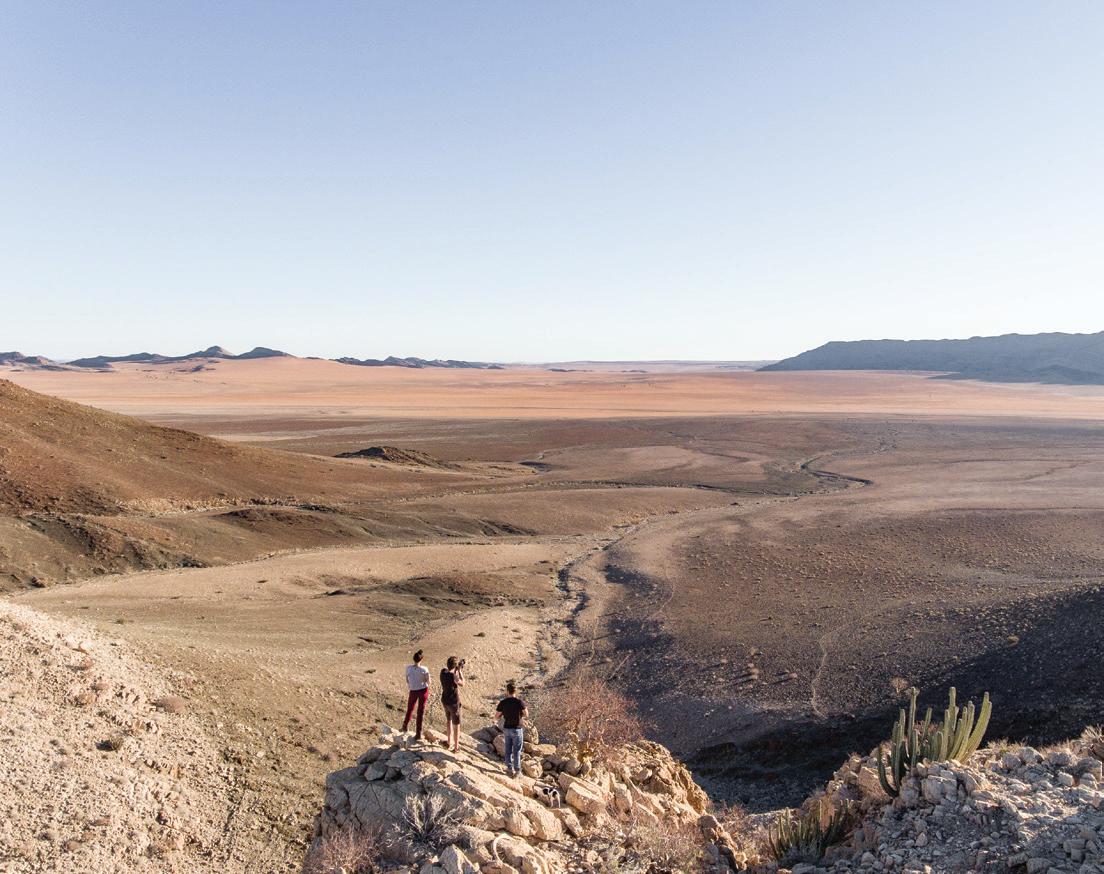
The introduction of Covid-19 protocols, which allow entry into Namibia to fully vaccinated visitors without the requirement of a negative PCR test, the resumption of flights by international carriers and the expansion of the number of flights, are expected to be a major boost for the tourism sector in 2022. The sector, however, remains vulnerable to the emergence of new Covid-19 variants and a resurgence of the virus in source markets. Concern has also been expressed about the possible impact that Namibia’s low vaccination rate could have on international tourism as only 16.6% of the target population had been fully vaccinated by mid-May 2022.
The Ministry of Environment, Forestry and Tourism (MEFT) is in the process of finalising a Tourism Sector Recovery Plan for 2022 to 2024 to revive the country’s tourism sector. It has 14 programmes and five strategic interventions: policy matters and Covid-19 tourism regulations and measures; aggressive online marketing and promotion campaigns; attracting new geo- and special segments of the global tourism travel market; increased tourism market intelligence through statistics, data collection and analysis; and improved accessibility and connectivity.
The estimated budget for the plan is N$520.5 million. According to the draft plan, the government through its offices, ministries and agencies, supported by development partners, “ must make budgetary and financial provisions to fund or co-fund targeted and relevant programs and activities.”
The hospitality industry reached its highest occupancy level in April 2022 – two years since the Covid-19 pandemic brought the local tourism industry to a near-standstill. The national occupancy rate reached 36.5% in April 2022, compared to 28.6% the previous month. The highest occupancy was recorded in the central and coastal areas, followed by the south and the north. Statistics released by the Hospitality Association of Namibia (HAN) show that the national occupancy rate for the first four months of 2022 stood at 26.5%, compared to 21.9% during the same period in 2021.
Germany, Switzerland and Austria accounted for just over 30% of foreign tourist arrivals in April 2022, followed by South Africa (8.5%), France (5.7%) and the United Kingdom and Ireland (2.2%). Namibian visitors to accommodation establishments decreased from 43.7% in March 2022 to 37.7% in April 2022 –a development that has been welcomed as foreign visitors spend more money at accommodation establishments than local or regional visitors.
The tourism industry is, however, faced with a shortage of vehicles to meet the increased demand from the self-drive market after rental companies reduced their pre-Covid fleet from about 8,500 vehicles to about 2,000. The shortage has been exacerbated by the flooding of the Toyota plant in Durban, South Africa, following heavy rains in April 2022. Production at the plant was suspended on 11 April 2022 for a minimum of 12 weeks.
management plans for the Skeleton Coast Park, Dorob National Park (including the Cape Cross Seal Reserve) and the Namib-Naukluft Park in December 2021. The plans set out the vision, objectives and guidelines for the development of the parks for the next ten years and also include provision for tourism development and management. New tourism concessions identified in the parks are expected to be awarded during the course of 2022. The NamParks5 phase of the Namibia National Parks Programme also includes the Tsau IIKhaeb National Park. The programme, which is executed by the METF, is co-financed by the German government through its ministry for economic cooperation and development through the KfW Development Bank.
With its wide open spaces, diversity of scenery, excellent roads and tourism infrastructure Namibia remains one of the top tourist destinations in Africa.
Namibia’s coastal parks form part of one of the longest stretches of protected coastlines in the world, extending from the Orange River to the Iona National Park in southwestern Angola. The MEFT launched its
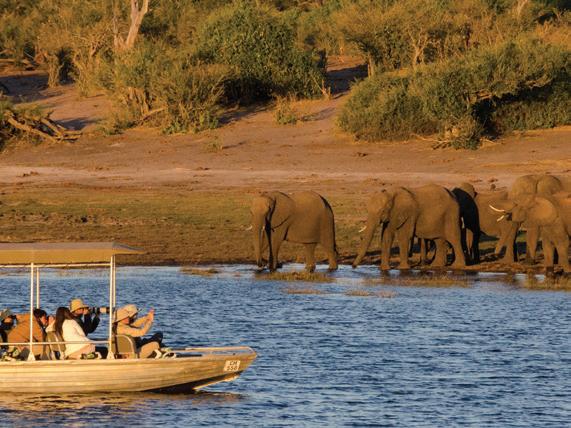
The MEFT has awarded five new concessions in the Tsau IIKhaeb National Park, including concessions in some areas that have previously been closed to the public. The concessions include tours through Kolmanskop ghost mining town and guided day tours and overnight 4x4 safaris to attractions such as Elizabeth Bay, Pomona and the Bogenfels along the coast south of Lüderitz. The Northern Sand and Sea concession extends from Lüderitz northwards and eastwards to the border with the Namib-Naukluft Park. Activities permitted include guided 4x4 and quad bike drives, overnight camping and guided sandboarding. In the Orange River concession, an area previously closed to the public, visitors will be able to join guided 4x4 trips and guided sandboarding activities in the dunes. Another area of the park that was previously closed to tourist is the Roter Kamm, a wellpreserved meteorite impact crater which was formed around 3.7 million years ago when a meteorite struck the area. The crater is about 2.5 km in diameter, while the walls are 300 m high. Activities include guided 4x4 trips and overnight trails and overnight camping at the viewpoint east of the crater.
• Namibia’s 20 state-owned conservation areas cover nearly 17% of the country’s land surface.
• The 86 registered communal conservancies countrywide cover 20% of the country’s land surface.
• Nearly 46% of the country’s land surface enjoys conservation protection.
• Scenery ranges from the Namib, the oldest desert in the world, to the verdant woodlands of the Kavango and Zambezi regions.
• Twyfelfontein and the Namib Sand Sea are UNESCO World Heritage Sites.
AAN - Accommodation Association of Namibia
P O Box 90270, Windhoek +264 61 228 809 info@namibweb.com
Bed & Breakfast Association of Namibia
P O Box 6000, Windhoek +264 62 58 1650 info@bedandbreakfastnamibia.com www.bedandbreakfastnamibia.com
CARAN - Car Rental Association of Namibia
P O Box 80368, Windhoek +264 61 249 239 info@caran.com.na www.caran.com.na
EIF - Environmental Investment Fund Namibia
P O Box 28157, Auas Valley +264 61 431 7700 info@eifnamibia.com www.eif.org.na
FENATA - Federation of Namibian Tourism Associations
P O Box 86495, Windhoek +264 61 230 337 welcome@fenata.org www.namibiatourism.info
HAN - Hospitality Association of Namibia
P O Box 86078, Windhoek +264 61 222 904 info@HANnamibia.com www.hannamibia.com
NACOBTA - Namibia Community Based Tourism
P O Box 86099, Windhoek +264 61 22 1918 office@nacobta.com.na
NCE - Namibian Chamber of Environment
P O Box 40723, Windhoek +264 61 240 140 +264 81 162 5807 info@n-c-e.org www.n-c-e.org
NAPHA - Namibia Professional Hunting Association
P O Box 11291, Windhoek +264 61 234 455 info@napha.com.na www.napha-namibia.com
www.namibiatradedirectory.com
NTB - Namibia Tourism Board
Namibia : Private Bag 13244 +264 61 290 6000 info@namibiatourism.com.na www.namibiatourism.com.na
NTB global representatives and agents
Frankfurt Schiller Strasse 42-44,D-60313 Frankfurt am Main,Germany +49 69 133 7360
London c/o Hills Balfour Synergy Colechurch House,1 London Bridge Walk London,SE1 2SX +44 20 7367 0962
Beijing c/o DPS Consulting Co. Ltd Room 416, ShengBao Building No. 2 Tuanjiehu Beilu, Chaoyang 1000026 +86 10 844 66463
Shanghai c/o Oriental Gateway Consultancy 3/F, #2150, Jinxuxiu Road 200127 +86 21 5059 6888
Namibia Wildlife Resorts Private Bag 13378, Windhoek +264 61 285 7111 www.nwr.com.na
Windhoek Reservations Office +264 61 285 7200 reservations@nwr.com.na
MICE (Meetings Incentive Conferences and Events) & Tour Planning +264 61 285 7108/67/69/88 mice@nwr.com.na
TASA - The Tour And Safari Association
P O Box 11534, Windhoek +264 61 238 423 info@tasa.na www.tasa.na
In 1991, several families invested in the future by turning four unproductive cattle ranches in Northern Namibia into a prolific 30,000-hectare private game reserve that is now a haven to large concentrations of wildlife.
Where lions were once shot on sight, Ongava is now home to several prides that are the hunters, not the hunted. Rhino populations are not only protected, they are understood, with a major genetics study revealing paternity and guiding decisions that encourage the prosperity of the species.
Sharing a common boundary with the Etosha National Park, Ongava is considered one of the finest private game reserves in the region, enjoying global recognition for exceptional conservation, ground breaking research and exciting safari adventures.
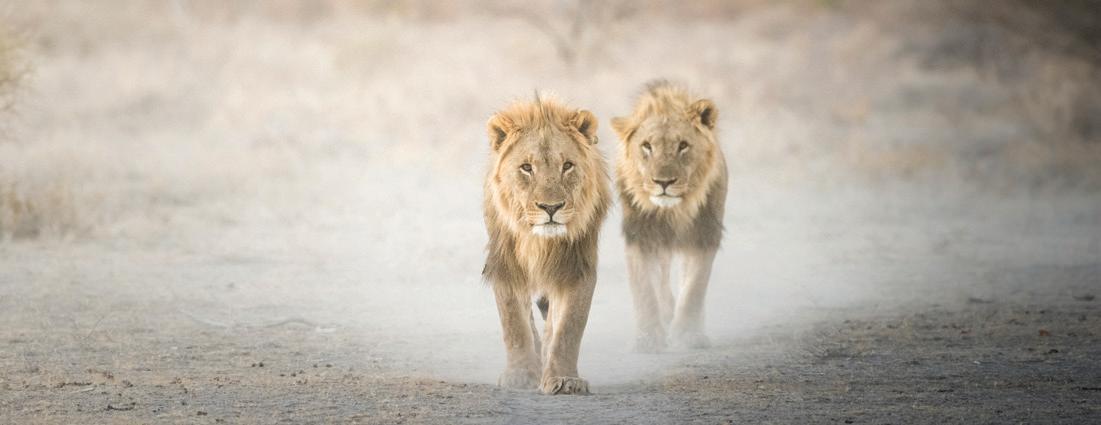
Experience Ongava - eco-tourism for the next generation.
Designed for privacy, luxury and intimacy with the land, Little Ongava is set on a high hill with pristine views across the plains. A boardwalk meanders over rocks and trees, connecting the beautiful main area with one of only three secluded en-suite thatched suites. Each suite is like a home, featuring a large sala with a cosy fireplace, comfortable seating, a private deck, infinity pool and sun loungers. The overall impression is one of pure natural indulgence indoors, surrounded by untamed nature outdoors. The lounge and dining areas have wonderful views of a popular waterhole, the open deck allowing for relaxed, stylish dining under the African sky. Guests at Little Ongava share a dedicated guide and vehicle, ensuring the best possible nature experience including bird watching, game drives, guided nature walks, white rhino approaching, excursions into the Etosha National Park and use of the photographic hide. The newly opened Ongava Research Centre's Visitors Centre boasts dozens of in-depth displays where guests can interface with science and research on a personal level.
Central to the design of the new Anderssons at Ongava is the connection to the wild, and it is most keenly felt at the waterhole and nearby
underground viewing hide. Here guests have a water level view of the prolific wild and birdlife on Ongava Game Reserve in a setting that inspires intimacy without intrusion. The social area, where guests gather for meals and to meet fellow wildlife enthusiasts, guides and naturalists, encompasses an undercover and open-air dining area, a spacious lounge and bar, a sunken observation terrace, an open fireplace, as well as a dedicated photographic nook for reviewing and editing images. Additional features include the curio shop, library, complimentary Wi-Fi, and connectivity to the research data gathered over years of cuttingedge scientific endeavours on Ongava. The Ongava Research Centre's Visitors Centre is a short walk away and guests can meander through the self-guided exhibition area at their own pace.
Ongava Lodge is perched on a ridge with seemingly endless views across the plains. Ongava Lodge’s fourteen air-conditioned brick, rock and thatch chalets, each with en-suite facilities, offer a relaxing retreat in the African bush. Gather at the main thatched dining area and enjoy a drink at the bar while watching wildlife interact at the floodlit waterhole. Your lodge experience includes a refreshing swimming pool, curio shop, Wi-Fi and a dedicated guide and shared game drive vehicle to participate in bird watching, game drives, guided nature walks, white rhino approaching or make use of the photographic hide. Guests now have the opportunity to explore the newly opened Ongava Research Centre's Visitors Centre.
Immersed in the African mopane bush, Ongava Tented Camp is a natural extension of this wild, wonderful landscape tucked in a hidden valley at the foot of a dolomite hill. Eight large, comfortable tents all have en-suite facilities, with double basins, indoor and open-air showers and private verandas. The dining area, bar and deck have an unobstructed view of the active waterhole. Your lodge experience includes nights at the campfire, stunning waterhole views, curio shop, swimming pool, a dedicated guide and shared game drive vehicle. The available activities include bird watching, game drives, guided nature walks, white rhino approaching, excursions into the Etosha National Park and the opportunity to meander through the self-guided exhibition area of the Ongava Research Centre's Visitors Centre.

With the desired outcome of having a diversified and competitive tourism sector with an increased number of tourists from 1.4 million in 2015 to 1.8 million by the year 2022, Namibia’s National Development Plan 5 (NDP 5) identifies the Tourism Industry as an important industry contributing to the country’s economic growth. Thus, NWR, as the biggest state-owned tourism industry company, has a significant role to play concerning those mentioned above national desired goal.
Namibia Wildlife Resorts (NWR) is a legal entity established through an Act of Parliament, the Namibia Wildlife Resorts Company Act (Act 3 of 1998). NWR’s mandate is to provide tourism and hospitality management services in protected areas and national parks of Namibia. With effect from 16 December 2019, NWR has been classified as a commercial State-Owned Enterprise as per the Public Enterprises Governance Act, 2019 (Act No. 1 of 2019).
The administration of the day ran Pre-independence, resorts in protected areas through the Department of Nature Conservation. Post-independence, resorts fell under the Ministry of Environment and Tourism under the Directorate of Tourism. Since the creation of NWR as a public enterprise in 1998, the structure of the company has drastically evolved. Notable progress
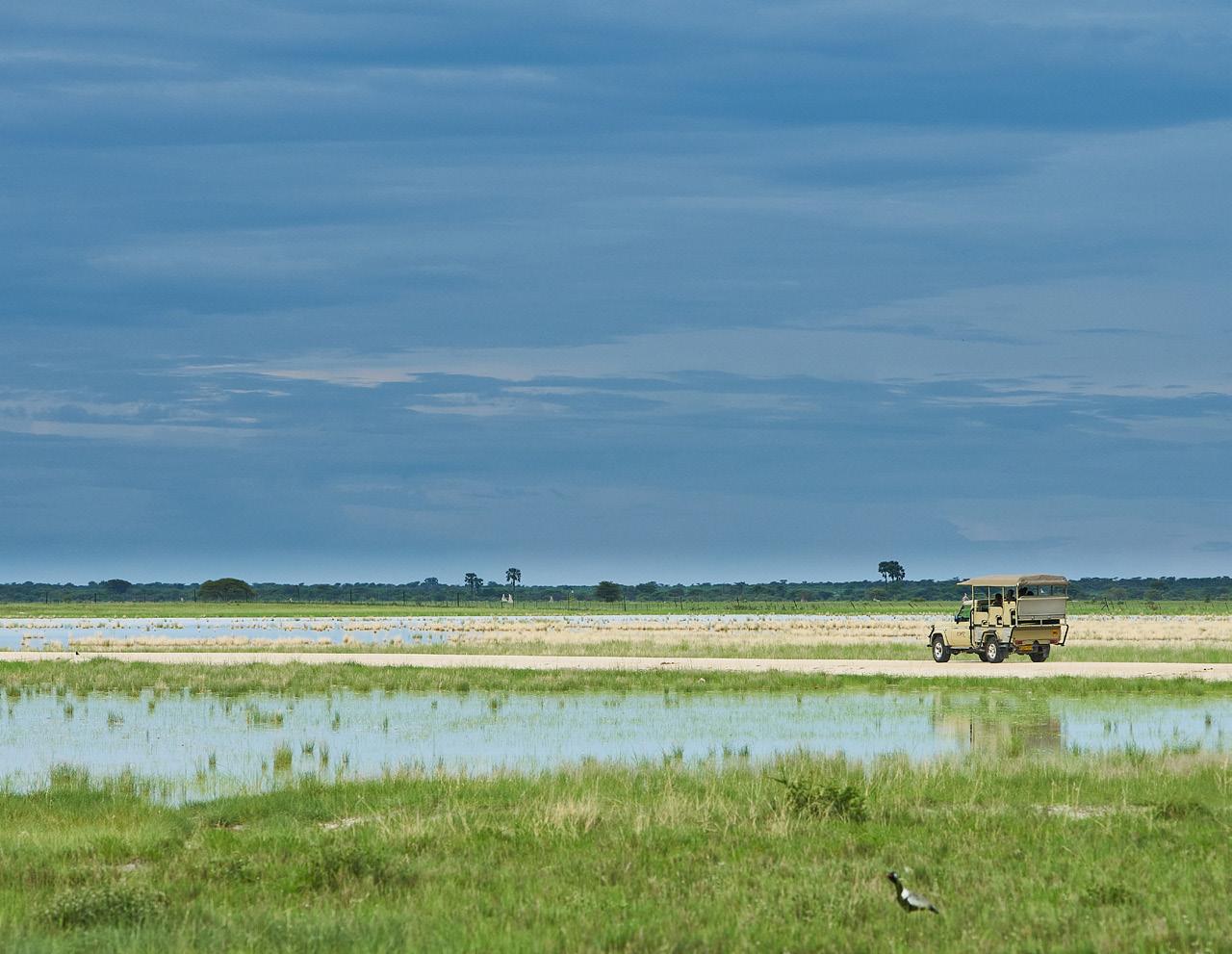
has been recorded on statutory compliance aspects as well as financial consolidation and sustainability.

The company now operates 26 facilities (resorts and camps) spread throughout all corners of the country. The focus has shifted from reliance on European tourists to a more global market, following the lead taken by the Namibia Tourism Board in developing new markets and the domestic tourism leg.
Previously unknown markets, including Asia and the United States, are being unlocked, and these travellers are coming to Namibia and the NWR facilities. Conferencing has also been emphasised which resulted in Gross Barmen, Hardap and Popa Falls being revamped to cater to modern conferencing needs. NWR offers any person the opportunity and chance to explore and relax at any of our facilities - whether you want to take photographs, catch a fish, explore the country’s cultures, see its wildlife, or sit back and enjoy its landscapes – NWR are at your service.
Going forward, the company intends to focus on being responsive to customer needs, continuous improvement in its processes, systems and procedures as well adherence to standard operating procedures in line with the tourism and hospitality norms and standards.
Are you seeking an unforgettable journey around the country? Escape the stress of daily life and unwind. Enjoy a break in some of Namibia’s unique lodges and experience the charming elements of Namibia.
Classic PortfolioHobatere Lodge is situated close to the Galton Gate, on the western side of Etosha National Park. The lodge is located in a concession area of 8808 ha offering a wide range of wildlife including lions, elephants and plains game found in the bordering Etosha. This destination is definitely a wildlife photographers dream! You can enjoy a game drive or relax at the main area where you will be able to spot the lions and elephants enjoying the waterhole from your breakfast table. Don’t miss the night drive, for which the lodge is renowned, introducing you to many of the shy nocturnal animals such as bat-eared foxes and honey badgers. Book a Boma Dinner which allows you to sit back, relax and enjoy an African dinner in the bush, under the Namibian sky. Or try the unique experience of the newly added treehouse, offering total isolation to become one with the wildlife drinking from the nearby waterhole. The treehouse is for intrepid adventurers and promises to be unforgettable. Hobatere Lodge lies within the ≠Khoadi-// Hôas //Hoas Conservancy.
Its sister lodge, Grootberg Lodge, is also in the ≠Khoadi-//Hôas //Hoas Conservancy. Grootberg Lodge has become a landmark in the Namibian tourism industry as the first lodge in the country that is wholly owned by a conservancy. The determined efforts by both the community and key stakeholders involved in the conservation of the area have resulted in a significant increase in wildlife numbers in the area, including endangered species such as black rhinos, desert-adapted lions, and elephants. Join our expert guides on an elephant or rhino tracking activity or visit an authentic homestead of the Damara people and experience the modern life of the #Khoadi-//Hôas //Hoas community.
For a more rustic outdoor experience visit the Hoada Campsite, the lodge 25 kilometers east of Grootberg Lodge. Nestled amongst large boulders, pitch your tent in one of the spacious campsites or book one of our furnished tents. Take a dip in the pool built between the rocks or join a Damara Culture walk.
Head south and visit one of the natural wonders of Namibia, the Fish River Canyon. Stay at the only establishment located on the edge of the Canyon, Fish River Lodge. The lodge offers adventurous and professionally guided hiking trails down into the heart of the canyon and also guided drives down to the natural rock pools. Escorted cycling trails on the rim of the canyon and the plateau are also on offer.
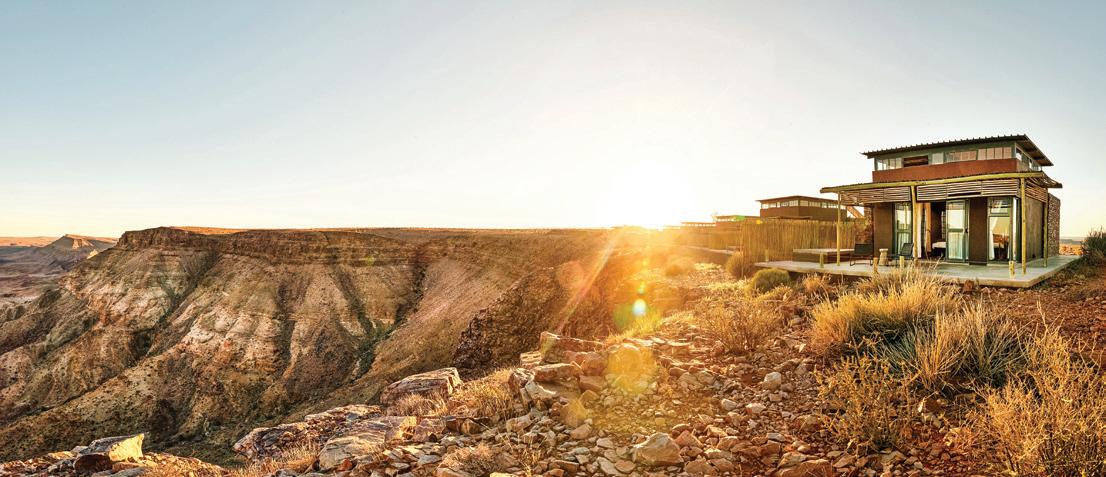
Experience the new campsites, Edge and Eternity, built in a style that reminds you of ancient ruins. They will definitely appeal to hiking enthusiasts who can enjoy a two- or three-night fully inclusive package.
Erongo Wild. Perched amid the rugged granite kopjes near Namibia’s iconic Erongo Mountains, the lodge is a founder member of the 2,000 square kilometre Erongo Mountain Nature Conservancy, which brings together 30 private landowners in an effort to conserve this diverse area. The reserve is renowned for its incredible bird life, along with rare, endemic flora and fauna and ancient Bushman rock paintings. Erongo Wild is the gateway to a host of terrific hiking trails – the ideal introduction to this amazing southern African country.

Shipwreck Lodge , the sole lodge located on the infamous Namibian Skeleton Coast provides a haven for those seeking tranquility and the comfort of indulging in nature. Nestled between the Atlantic Ocean and the dunes of the Namib Desert, guests can experience this iconic luxury setting and explore the raw and untouched nature of the Skeleton Coast National Park. You can look forward to appreciating the harsh beauty of the desert and solitary landscapes with plenty of geological history and desert-adapted animals. For the more adventurous at heart, guided trips lead you to the roaring dunes, clay castles, a seal colony as well as exploring the dunes on a quad bike.
Come and discover our lodges firsthand and unfold the mysteries of Namibia. Make your trip memorable with Journeys Namibia. Please enquire about our SADC rates.
+264 61 228 104 info@journeysnamibia.com reservations@journeysnamibia.com www.journeysnamibia.com
The Namibian government continues to give top priority to the provision of funding for the development of the country’s road infrastructure to achieve the objective of a safe and reliable, affordable transport infrastructure and a world-class logistics hub connecting the Southern African Development Community to international markets.
The Bank of Namibia (BoN) has projected growth of 4.6% for the transport sector in 2022 and 5.4% in 2023. The storage sub-sector is expected to grow by 4.3% and 4.8% in 2022 and 2023 respectively.
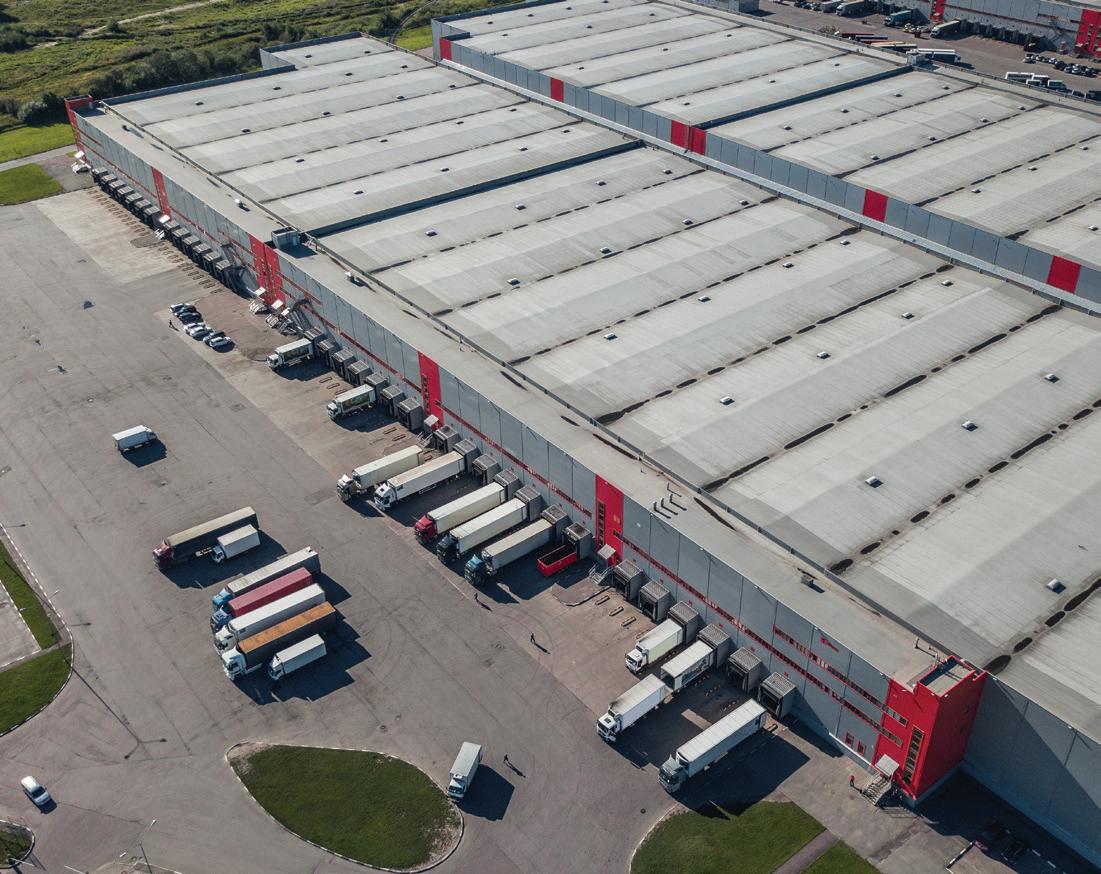
The appropriation in the development budget of the Ministry of Works and Transport (MWT) for the upgrading of rail, airport and road infrastructure amounts to close to 46% of the total capital budget for the 2022/23 financial year.
Namibia’s national road network has grown from just over 42,000 km in 2020 to 48,500 km in 2021. The bitumen (tar) standard network, which represents 17% of the total network, has increased from 5,500 km to 8,400 km over the same period.
An amount of N$1.1 billion was appropriated for the roads infrastructure programme of the MWT in the 2022/23 development budget. The Namibia Roads Authority has upgraded several major roads that form part of the regional transportation corridors during the past decade. Upgrades include the Windhoek to Okahandja, Walvis Bay to Swakopmund and Windhoek to the Hosea Kutako International Airport roads. Work on the third and final phase of the dual carriage road between Windhoek and the Hosea Kutako Airport
commenced in May 2022 and is expected to be completed in 2024. The 21 km section from the Dordabis interchange to the airport will be financed through a grant of over N$1 billion by the Chinese government. The authority is also in the process constructing, upgrading and rehabilitating several other major roads countrywide on an ongoing basis.
The upgrading of Namibia’s 2,687 km rail infrastructure to comply with the minimum Southern African Development Community (SADC) standards of 18.5 tonnes/axle load is continuing.
The national railway state-owned enterprise, TransNamib, obtained a N$2.6 billion loan from the African Development Bank and the Development Bank of Namibia in April 2022. It will be used to purchase ten new locomotives, the remanufacturing of 33 locomotives that are out of service, the modernisation of the TransNamib workshop, and the upgrading of signalling equipment. TransNamib plans to increase its freight volumes to three million tonnes a year over the next few years.
Namibia’s railway network is currently connected only to South Africa at Ariamsvlei. Two projects that are under consideration is the 1,500-km railway
line between Namibia and Botswana and the 772 km-long Trans Zambezi railway line between Grootfontein and Katima Mulilo in the Zambezi Region. The project is projected to cost over N$43 billion.
The number of vessels that called at Walvis Bay and Lüderitz between 1 April 2020 and 31 March 2021 declined by 25% to 1,303 vessels compared to the corresponding previous year due to Covid-19 restriction on movement. Overall cargo volumes at Namiba’s two ports, Walvis Bay along the central Namibian coast and Lüderitz in the south, increased from 5.6 million tonnes in 2019/20 to 6.2 million tonnes in 2020/21 – an 11% increase, despite the effects of the Covid-19 pandemic. The increase has been attributed to the continuous flow of cargo to and from the interior of the country and a substantial increase in transhipments. Cross-border volumes, which represent close to 24% of the total cargo volumes, increased by 39% in 2020/21 compared to 2019/20.
Namport has announced its intention to lease its container terminal at Walvis Bay to an independent operator for 25 years. Namport plans to enter into a specialised agreement where the operator handles the containers instead of an upfront payment to Namport. The operator will only handle containers and not any non-containerised cargo. The N$2.4 billion container terminal was inaugurated in 2019.
The decision to lease the container terminal was taken in view of the shift of shipping lines to the use of larger vessels to contain costs. This has resulted in a significant decrease in the volumes handled by the terminal in 2021/22.
FlyWestair, Namibia’s first privately-owned scheduled passenger airline, announced its rebranding to FlyNamibia in November 2021. The airline offers regular domestic return flights between Windhoek and Ondangwa, Rundu, Katima Mulilo and Oranjemund, while the FlyNamibia Safari operates daily flights between Windhoek and Sossusvlei, Swakopmund and the Etosha National Park. FlyNamibia also offers regular return flights between Windhoek’s Hosea Kutako International Airport and Cape Town International Airport.
Automobile Association of Namibia
P O Box 61, Windhoek +264 61 244 201 info@aa-namibia.com www.aa-namibia.com
NLA - Namibia Logistics Association
P O Box 90546, Windhoek +264 81 724 3169 info@nla.org.na www.nla.org.na
The Namibia Airports Company’s congestion alleviation project at the Hosea Kutako International Airport was completed at the end of September 2021.The expansions included increasing the number of check-in counters in the expanded check-in hall to 18, a new baggage handling system. And two new baggage reclaim carousels in the arrivals hall. The N$250 million project will accommodate the increased passenger arrivals and departures until 2030.
Following the global disruption of international travel caused by the Covid-19 pandemic, international airlines have resumed their flights and extended operations to Namibia’s Hosea Kutako International Airport. Namibia is currently served by Qatar Airways (Windhoek to Doha), Eurowings Discover (Windhoek to Frankfurt), Ethiopian Airlines (Windhoek to Addis Ababa) and TAAG Angolan Airlines (Windhoek and Luanda). Eurowings Discover also offers flights between Windhoek and Victoria Falls in Zimbabwe during the peak travel season.
SA Airlink is currently (June 2022) the only airline operating scheduled flights between Windhoek and Oliver Tambo International Airport (Johannesburg). South African Airways and Comair British Airways ceased operations between Namibia and South Africa after they were placed under business rescue, while the country’s national airline, Air Namibia, went into final liquidation in March 2021.
Namibia has positioned itself as a logistics hub for the Southern African Development Community (SADC) and is linked by a network of road and rail links to SADC countries by four corridors: the Trans-Kalahari Corridor (Walvis Bay to Windhoek and through Botswana to South Africa, the Trans Cunene Corridor (Walvis Bay through Windhoek to southern Angola), the Walvis BayNdola-Lubumbashi Development Corridor linking Namibia to Zimbabwe, Zambia and the Democratic Republic of Congo and the Trans Oranje Corridor linking Walvis Bay, Windhoek and Lüderitz to South Africa.
The Walvis Bay Corridor Group, a public private partnership (PPP) founded in 2000, serves as a service and facilitation centre to promote exports through the port of Walvis Bay to the SADC region.
Trans Kalahari Corridor Secretariat
P O Box 23017, Windhoek +264 61 250 071 admin@tkcmc.com www.tkcmc.com
Walvis Bay Export Processing Zone Management Company
P O Box 3304, Walvis Bay +264 64 201 3206 wbepzmc@iway.na www.wbepzmc.iway.na
Roads Authority
Private Bag 12030, Windhoek +264 61 284 7000 pr@ra.org.na www.ra.org.na
Road Fund Administration
Private Bag 13372, Ausspannplatz, Windhoek Toll-Free: 0800433300 +264 61 433 3000 www.rfanam.com.na
Despite the inevitable delays caused by Covid-19, several major road construction projects are progressing well.

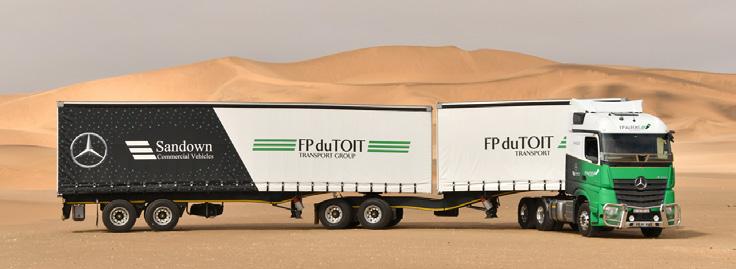
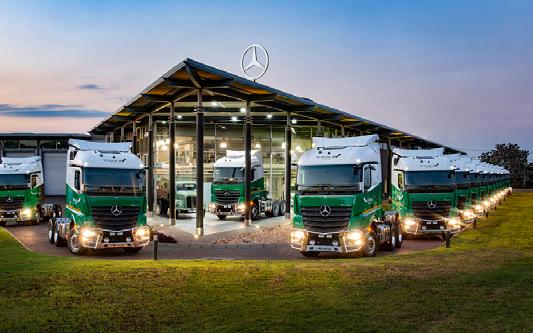
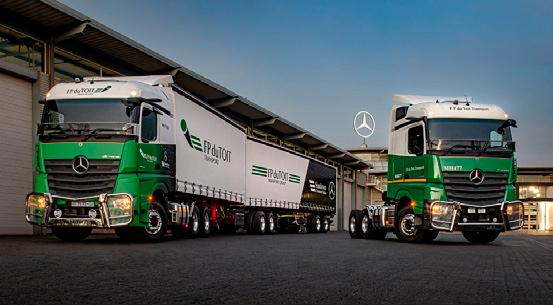
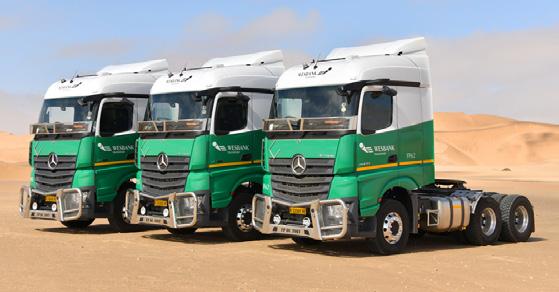
Manica Group Namibia has been at the forefront of creating innovative and integrated logistics and marine service solutions for companies doing business to and from Africa since 1924.
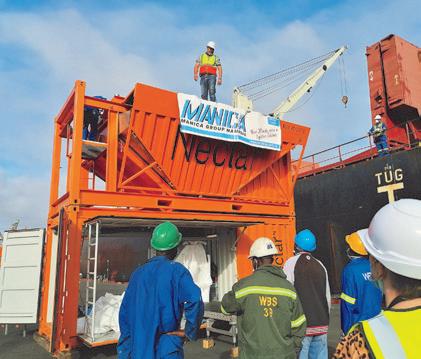
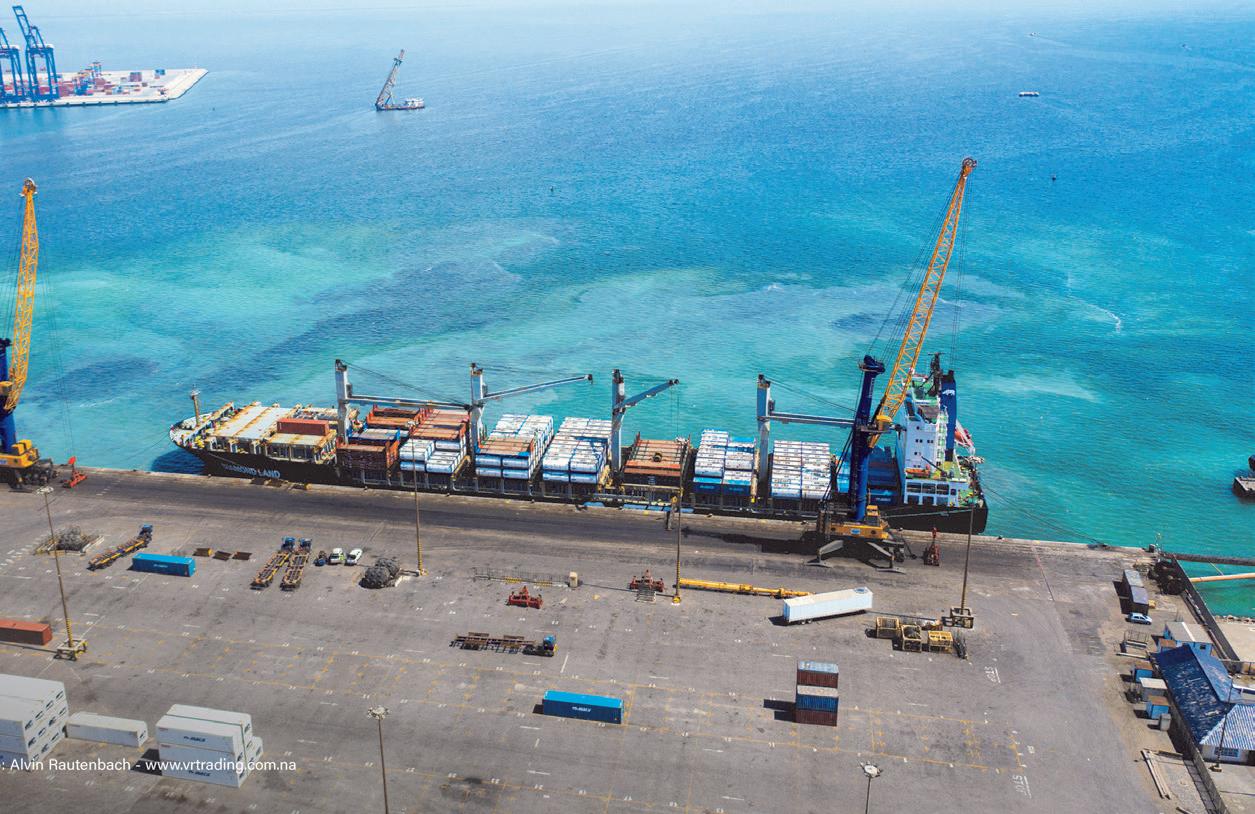
The group comprises a diverse portfolio of subsidiaries providing a variety of expert customs clearing, warehousing, cargo handling, stevedoring, ships’ agency, transport, bunkering and related logistics services. Manica bundles these into bespoke one-stop-shop solutions for any logistics requirement. This agile and flexible logistics approach helps to ensure cost- and time-effective services.
Manica embraces diversity, innovative thinking and continuous improvement. Capacity building, skills training and ensuring the highest level of safety and quality management is critical to the group’s operations. With Manica at the helm of your off- and onshore logistics management and support requirements, you can sit back with the assurance that we will deliver any cargo to any destination.
Cross border, mining, project freight solutions
Shipping, imports and exports
Stevedoring, materials handling and warehousing
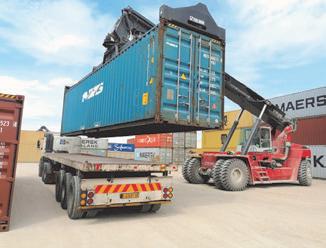
Industrial and marine ExxonMobil oil products
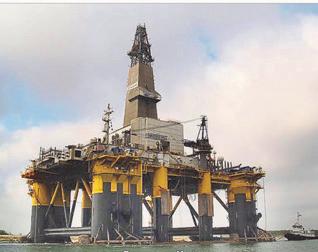
Airport ground handling, passenger and ramp services
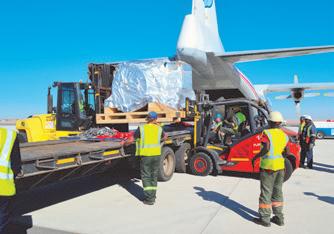
Complete oil and gas logistics support
Ships’ agency, bunkering, launch Services
Crew transfers, airport shuttle, visa applications, accommodation and travel arrangements
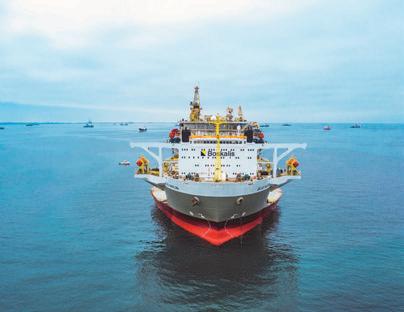
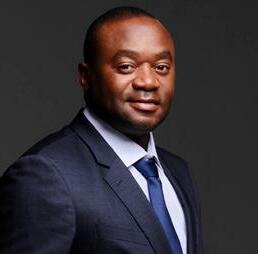



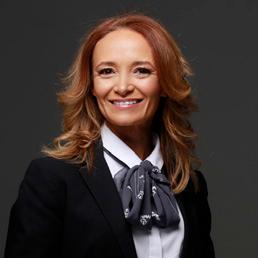

The MVA Fund is mandated to design, promote and implement crash and injury prevention measures, provide assistance and benefits to all people injured and the dependents of those killed in road crashes, in accordance with the MVA Fund Act No.10 of 2007.
Our Vision
Supporting your journey to independence.
Our Mission
Enhance customer experience through tailored services and empower them to return to meaningful life.
PASSION
We are compassionate and understanding with fellow team members and most importantly our customers.
We strive for quality and superiority in our work and the manner in which we deliver to our customers.
We are committed to the same goal; trusting and supporting each other.
We uphold the highest ethical standards and act with honesty, respect, trust and fairness in our interactions with our customers and stakeholders.
Individuals involved in a road crash are eligible for an undertaking of up to N$1.5 million, which provides for medical treatment, injury management, rehabilitation and life enhancement.
The Fund provides an injury grant to the value of up to N$100,000. This is a cash grant that serves as compensation for individuals injured in a road crash.
The Fund provides a funeral benefit to the value of N$7,000 for individuals who died as a result of a road crash in Namibia.
Loss of income may be claimed by a survivor of a road crash and is limited to N$100,000. Certain limitations and exclusions apply.
Loss of support may be claimed by a dependant of an individual deceased in a road crash. Loss of support is limited to N$100,000, with certain limitations and exclusions. Contact:
The Ports of Walvis Bay and Lüderitz lie on the West Coast of Africa. The Namibian Ports Authority (Namport) was established by the Namibian Ports Authority Act, No. 2 of 1994. It is recognised as a public enterprise in terms of the Public Enterprises Governance Act, No. 1 of 2019. Namport’s mandate is to exercise control and manage Namibia’s ports, lighthouses and other navigational aids in Namibia and its territorial waters.

The Port of Walvis Bay handles container imports, exports and transshipments, as well as bulk and break-bulk of various commodities. A wide range of industries such as petroleum, salt (bulk and bagged), mining and fishing are served at Walvis Bay.
The Port of Lüderitz serves the mines in the southern regions of Namibia and northwestern South Africa with imports and exports of mining commodities. It also serves as an important base for the local fishing industry.
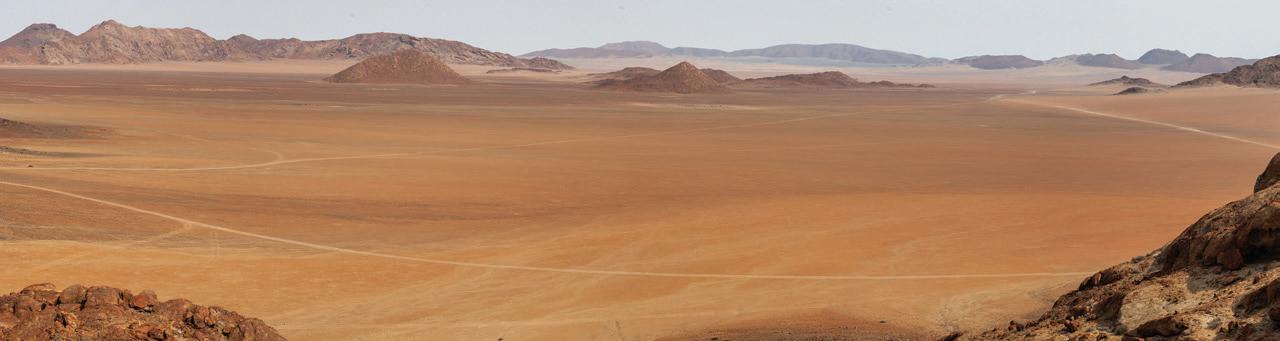
Strategically located along the Namibian coastline, Walvis Bay provides direct access to principal shipping routes, making it a natural gateway for international trade. Its world-class infrastructure and equipment ensure reliable and safe cargo handling.
The bay’s temperate weather conditions favour timely operations, allowing Namibia’s largest commercial port (Port of Walvis Bay) to receive between 2,000 and 2,500 vessel calls each year and a handling capacity of 10 million tonnes of cargo.

Namport focuses on being the best performing seaports in Africa. Therefore, Namport continues to invest in port infrastructure to ensure Namibia is not only compliant with the International Ship and Port Facility Security (ISPS) code, but is also geared towards opportunities for future growth.
In 2019, a new container terminal worth N$4.2 billion was brought into operation. It provides infrastructure and deployment of ship-to-shore gantry cranes for the first time in Namibian port history, firmly establishing a competitive position in relation to other ports for the critical hinterland markets. This raises the handling capacity to 750,000 TEUs, which is double the previous 350,000 TEUs.
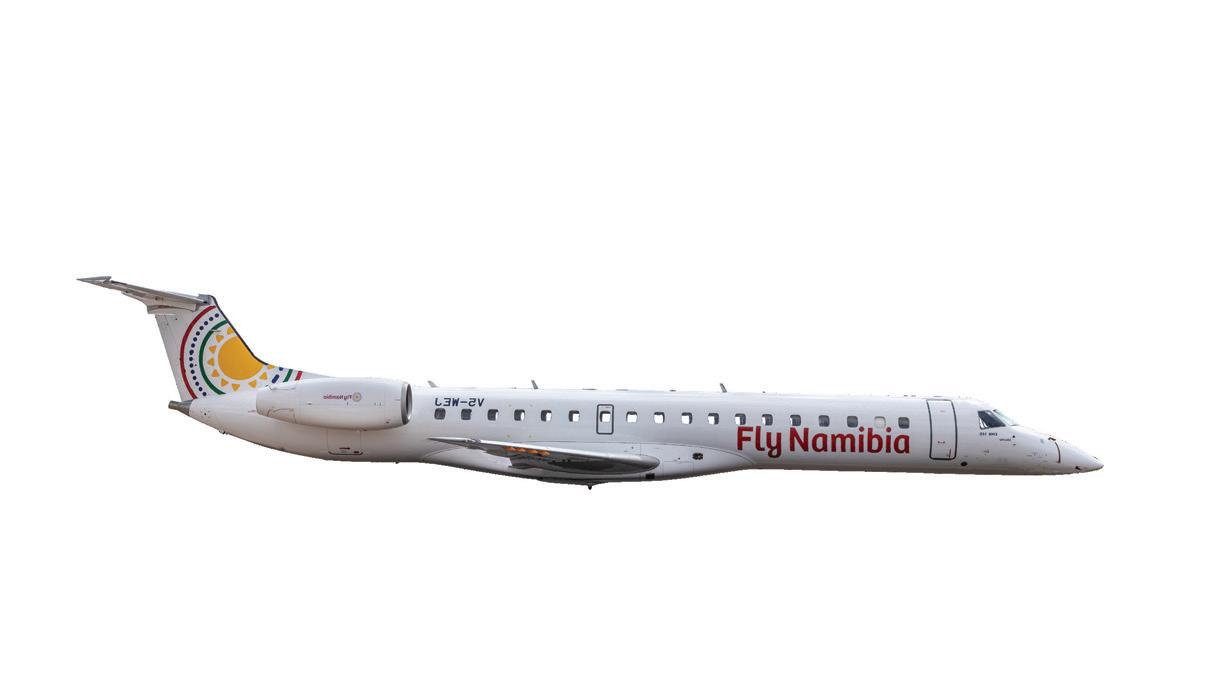
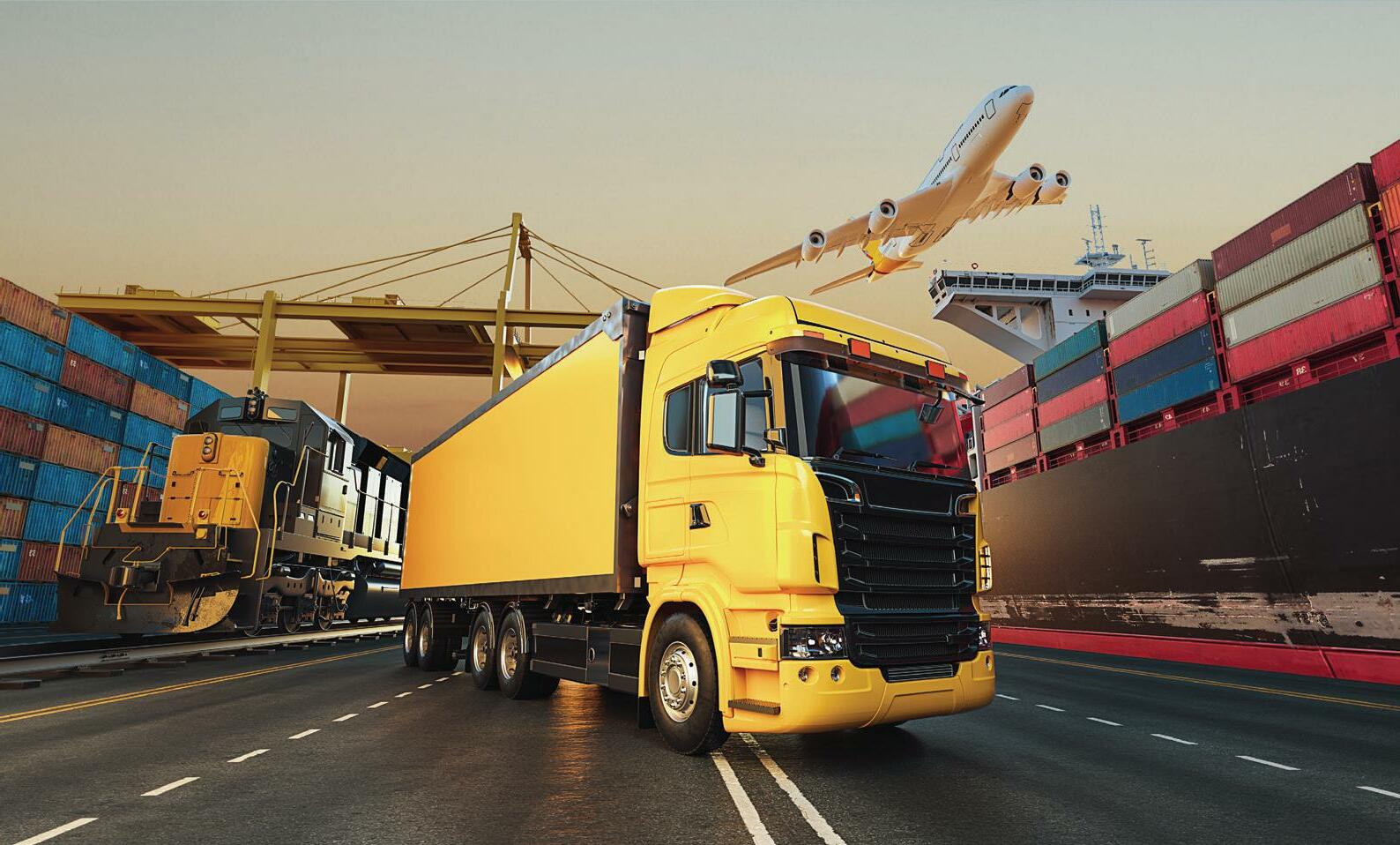
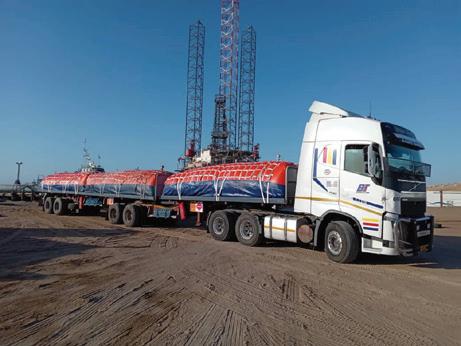

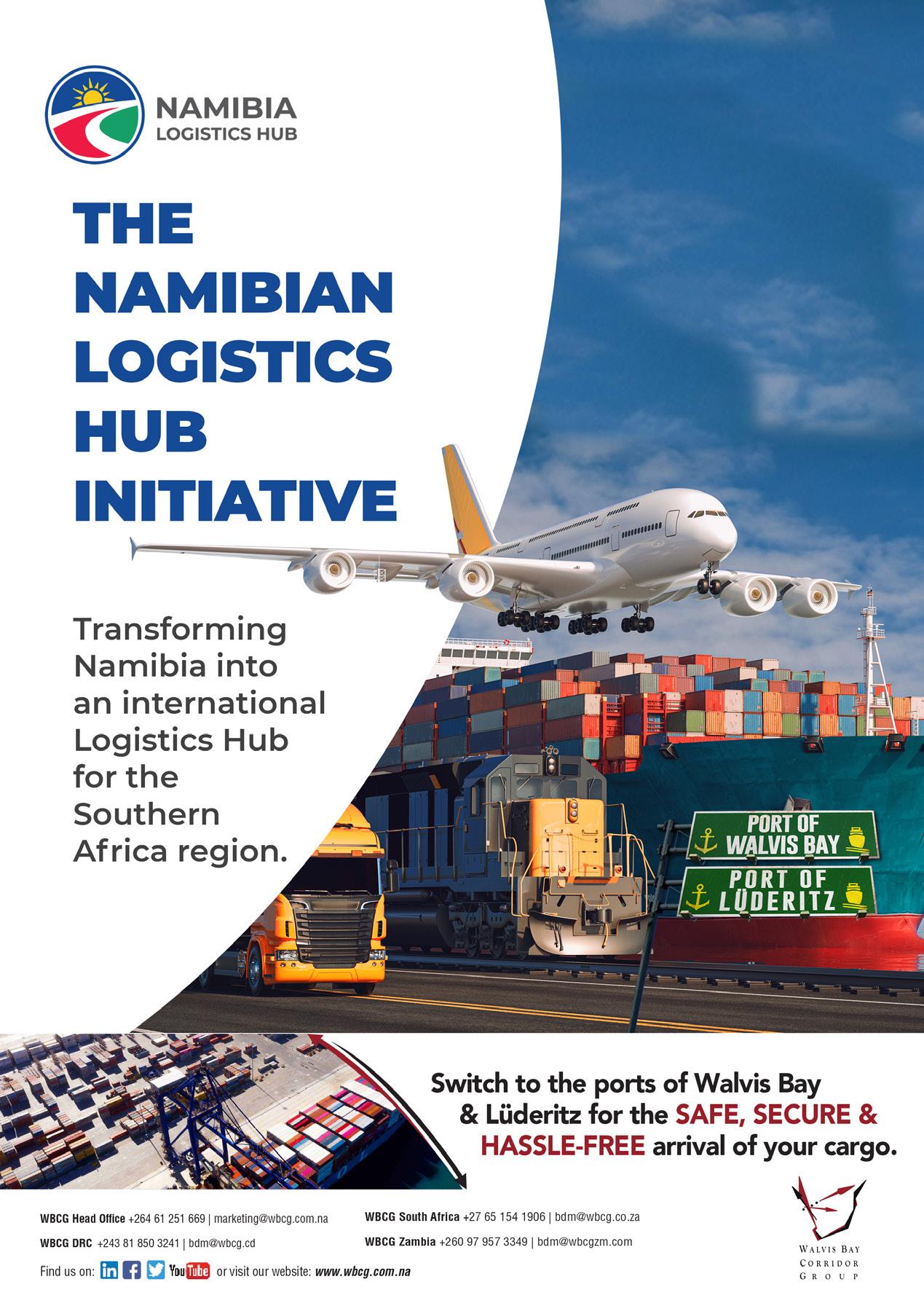
The Walvis Bay Corridor Group (WBCG), a Public Private Partnership (PPP), was established in the year 2000 as a service and facilitation centre to promote the benefits of using the Walvis Bay corridors via the port of Walvis Bay to and from Southern Africa.
We continuously identify opportunities, plan, coordinate, market, advocate for infrastructure development and facilitate trade. Through our unique institutional arrangement as a PPP, the WBCG is a perfect example of how Government and the private sector work together to integrate business potential and utilise transport and trade opportunities. This collaboration is incredibly important for economic development within the region and for the growth of the private sector.
Ministry of Works and Transport; Ministry of Trade and Industrialisation; Ministry of Home Affairs and Immigration; Ministry of Health and Social Services; Namibia Revenue Agency; Namibia Investment Promotion and Development Board; Namibian Ports Authority; Roads Authority; TransNamib; Walvis Bay Port Users’ Association; Container Liners Operators Forum; Namibia Logistics Association; Namibia Chamber of Commerce and Industry; Namibia Transporters Association; the Municipality of Walvis Bay; Road Fund Administration; and the Namibian Transport Association.
The Trans-Kalahari Corridor links the port of Walvis Bay to Botswana’s capital Gaborone, the heartland of South Africa’s industrial capital, Gauteng, and Zimbabwe. It is perfectly positioned to service the two-way trade between South Africa, Botswana, Zimbabwe, Europe, the Americas and the Far East.
The Walvis Bay-Ndola-Lubumbashi Development Corridor (WBNLDC) links the Port of Walvis Bay with Zambia, the southern Democratic Republic of Congo (DRC) and Zimbabwe. This corridor also connects via Zambia into Malawi and Tanzania. The corridor
stretches over 2,500 km and is supported by a railway line between Walvis Bay and Grootfontein, where transhipment facilities are available. The railway line resumes in Livingstone, Zambia.
The Trans-Cunene Corridor links Walvis Bay’s port to southern Angola via Tsumeb and Ondangwa to Oshikango in Namibia and the Santa Clara border post in Angola. The corridor is supported by a railway line that has been completed up to the Angolan border.
The Trans-Oranje Corridor is a network of rail and road linking the port of Lüderitz to the Northern Cape province in South Africa.
The Walvis Bay corridors are perfectly positioned to service the two-way trade between the SADC region and Europe, North and South America as well as emerging markets in the East. Costs and time savings are achieved along the Walvis Bay Corridors which offers the most efficient, safest and shortest regional route on the west coast.
The footprint of the WBCG extends to four offices beyond the borders of Namibia. These are in: Lusaka, Zambia since 2005; Johannesburg, South Africa since 2008; Lubumbashi, DRC since 2012 and São Paulo, Brazil since 2012.
Namibia has a clear vision to become a regional leader in logistics. Our National Development Plans have identified logistics as one of the economic priorities, an area in which Namibia has a clear competitive advantage. Against this background, Namibia has embarked on a transformation process to establish itself as the Logistics Hub for Southern Africa.
The Namibian Logistics Hub concept entails an intervention process that strives to put in place sustainable institutional arrangements and mechanisms that would ensure the transformation of the port of Walvis Bay and the Walvis Bay corridors into economic
corridors for the socio-economic growth and development of the country. To achieve this objective, the Logistics Hub Project was established under the umbrella of the WBCG.
The role of the Ministry of Works and Transport and WBCG (as the PPP entity) will ensure that the future Logistics Hub development process takes place under the auspices and with the direct involvement of the National Planning Commission.
Regional support for the harmonisation of standards, allowing for the smooth flow of trade between borders, is ensured through the establishment of regional committees and partnerships with regional bodies. The Trans-Kalahari Corridor Secretariat is made up of Government and privatesector representatives from Namibia, Botswana and South Africa. The Walvis BayNdola-Lubumbashi Corridor Management Committee, which is a partnership between Namibia, Zambia and the DRC, was established to address problems which could impede the smooth movement of goods across the borders along the WBNLDC.
The port of Walvis Bay is strategically located on the west coast of Africa, serving as a strategic link to Southern Africa’s more than 350 million consumers. With Walvis Bay now firmly established as one of the preferred gateways into Southern Africa, the WBCG continuously seeks to maximise the potential of the corridors to boost the social and economic benefits for Namibia and for the Southern Africa region as a whole.
The port of Lüderitz, located 254 nautical miles south of the port of Walvis Bay along Namibia’s coastline, caters to the southern part of the country, and provides access to markets in the Northern Cape province of South Africa. The port of Lüderitz offers excellent logistical services to the mines in the southern regions of Namibia and the north-western parts of South Africa with imports and exports of mining commodities, such as manganese. It is also an important base for the local fishing industry.
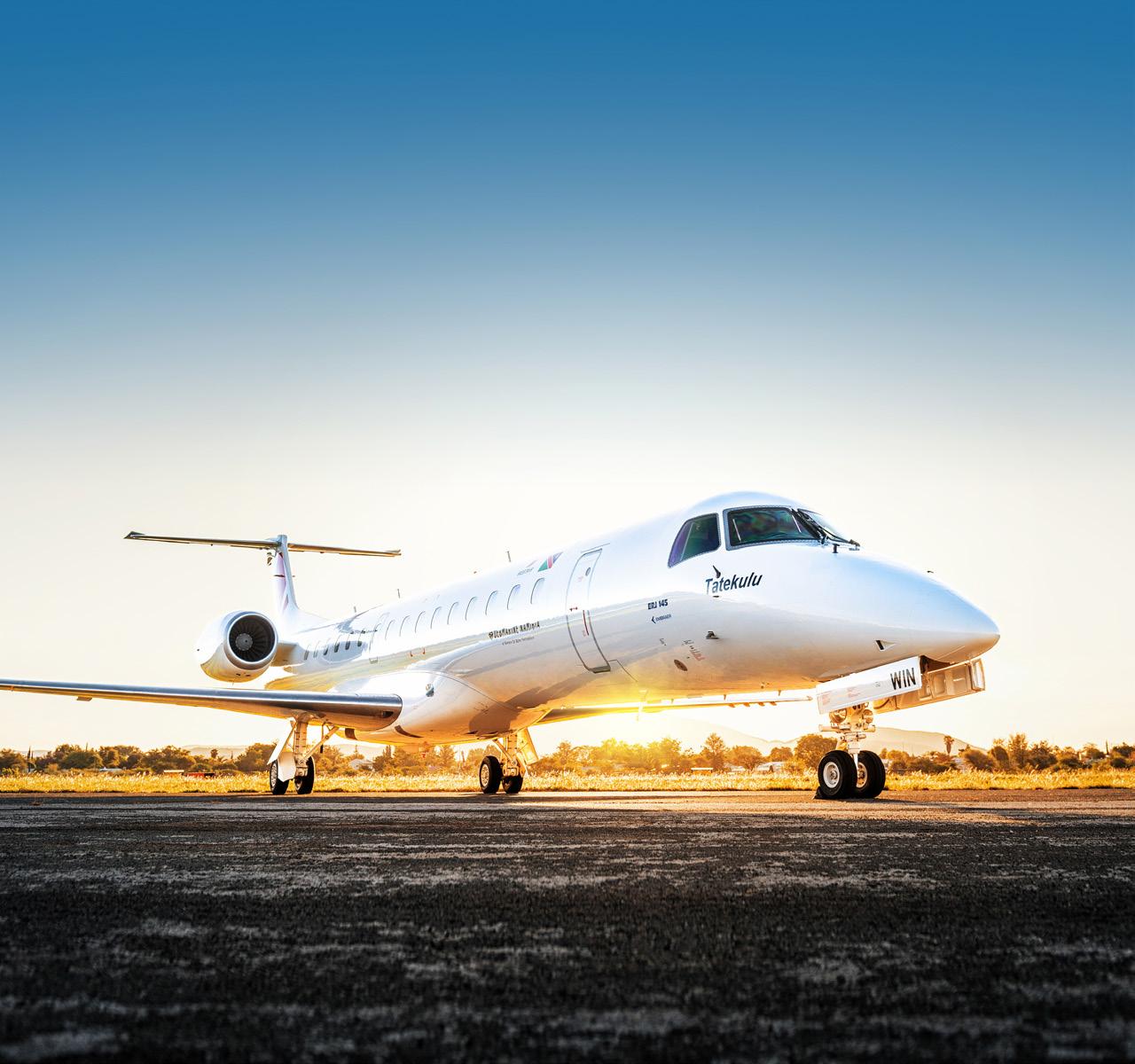
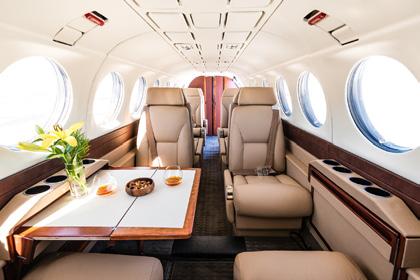

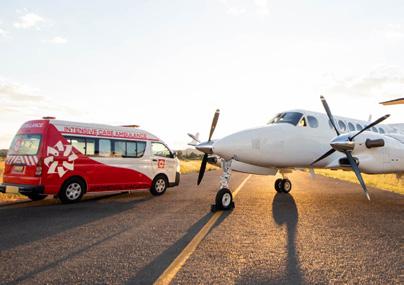
Westair Aviation is a fully integrated aviation service provider, based at Eros Airport, Windhoek. Starting out as only an aircraft maintenance facility 55 years ago, in 1967, Westair has grown to become the most diverse and experienced aviation company in Namibia. Currently the Westair fleet consists of more than 40 aircrafts, ranging from Cessna 182’s to 50 seat Embraer ERJ 145’s.
Westair’s aviation infrastructure on offer is suitable for any mission, freight in Africa, VIP charters across Africa, crew rotations for the mining sector or scheduled airline operations for the general Namibian public.
Our Workforce is highly qualified with world class flying experience and the company has experience operating across the African continent, Europe and North America.
Westair offers a diverse range of customized aviation services that includes:
• Aircraft leasing
• Cargo flights
• Scheduled passenger flights
• Scheduled freight operations
• Charter flights
• Geophysical survey flying
• 24 hours Emergency medical evacuation
• Flight & cabin crew training
• Offshore
FlyNamibia is an independent airline that prides itself in connecting people through local and regional flights whether for business or travel purposes. Granted designated carrier status by the Namibian Transport Commission and operating as FlyWestair‚ the airline had its first official scheduled passenger flight on Monday 24 June 2019. Boldly changing the name to
better reflect its role as trusted Namibian carrier‚ the airline has been operating as FlyNamibia since November 2021.
Having started out as an aircraft maintenance facility more than 50 years ago in 1967‚ FlyNamibia’s mother company‚ Westair Aviation‚ has grown to become the most experienced aviation company in Namibia. This experience along with dedicated staff provides the backbone to offer quality service and prioritise safety and keep flights on time.
Signa Aviation Services is a proudly Namibian Company that specializes in Aviation training and quality services. We are also the Namibian agent for Sling.
Signa Aviation is the leading Aviation Training provider in Windhoek Namibia. Signa Aviation provides flight training, aviation consultancy services and professional pilot services.
Medical Rescue Africa (MRA) is Namibia’s leading Aeromedical Evacuation company specialising in the evacuation of critically ill and injured patients across Africa, 24 hours a day, 7 days a week. MRA is based at Eros Airport in Windhoek, Namibia and focuses on the provision of innovative emergency medical evacuation solutions to various customers across Africa as well as Aeromedical Services through a network of skilled paramedics, nurses and emergency doctors.
MRA has a wide range of Air Ambulance aircraft that can offer evacuation options for all conditions in Namibia and Africa. All aircraft are equipped with an approved ‘LifePort’ system and are manned by the experienced and welltrained crews of Westair Aviation. All flight operations are conducted in accordance with strict quality and safety standards and comply with the Basic Aviation Risk Standard (BARS),
Oil and Gas Producer Standards (IOGP) and United Nations Aviation Standards (UNAVS).
Westair has acquired extensive experience in Africa over the past 20 years. In support of various mining, cargo and humanitarian activities, across the continent and other countries.
Westair offers competitive aircraft leasing options be it on a ACMI (Aircraft, Crew, Maintenance, Insurance) or AMI ( Aircraft Maintenance Insurance) basis.
Westair Aviation is one of the most experienced airborne geophysical survey operators in Africa.
Having completed successful surveys in more than 14 African countries, ranging from South Africa to Lybia and Algeria. Our diverse fleet offers clients a wide range of options capable to conduct any survey in the most efficient, applicable, and cost-effective manner.
Westair is one of Namibia’s leading and most advanced aircraft maintenance, repair, and overhaul (MRO) companies, dedicated exclusively to providing the full range of support services to regional aircraft operators as well as General Aviation in Africa.
Westair specialize in the maintenance, sale, overhaul of aircraft, in logistics and support aircraft part.
Westair has been awarded BARS (Basic Aviation Risk Standard) Gold status for three consecutive years, by the Flight Safety Foundation. Westair is the only Namibian aviation Company to hold such safety and quality recognition.
Eros Airport, Aviation Road, Windhoek, Namibia +264 83 WESTAIR (937 8247) reservations@westair.com.na www.westair.com.na
“Micro, small and medium enterprises (MSMEs) play a key role in job creation and income generation, and thus contribute to improving the living conditions of many Namibian people. Thriving and growing MSMEs are therefore a key factor in achieving national development goals.” – National Policy on Micro, Small and Medium Enterprises in Namibia 2016-2021.
The Census of Business Establishments (2019/2021), conducted by the Namibia Statistics Agency (NSA), has highlighted the important role of micro, small and medium enterprises (MSMEs) in the Namibian economy. A total of 61,157 MSMEs were recorded, while only 345 establishments were classified as large. The 55,804 micro establishments accounted for just over 91% of the total number of MSMEs, while 3,918 small and 1,435 medium businesses were recorded.

MSMEs are defined in the National Policy on Micro, Small and Medium Enterprises in Namibia as follows:
Micro enterprises: 1 to 10 full-time employees and/or an annual turnover of up to N$300,000.
Small enterprises: 11 to 30 full-time employees and/or an annual turnover of between N$300,001 to N$3,000,000.
Medium enterprises: 31 to 100 full-time employees and/or an annual turnover of N$3,000,001 to N$10,000,000.
The Namibia Investment Promotion and Development Board (NIPDB) is mandated to implement the National MSME Policy of 2016 and has established the MSME Development, Innovation, and Acceleration Department with the aim to:
• Nationally coordinate and create an enabling environment for the MSME sector,
• Develop an optimised, accessible ecosystem, and
• Bring about positive change through targeted support for MSMEs.
The NIPDB launched the first of a series of information sessions on its Know2Grow (K2G) initiative in February 2022 and has set itself a target of empowering at least 3,000 MSMEs countrywide by the end of 2022. The aim of the information sessions, which will be held in all 14 regions,
is to raise awareness of the services, facilities and growth opportunities for MSMEs with a focus on financing and market access. The sessions also provide an opportunity for MSMEs to network and engage with banks, various government ministries and agencies. The sessions are targeted at registered MSMEs operating in the textile manufacturing, agriculture, horticulture and food processing, electronics and information communication technology, green hydrogen, logistics and pharmaceutical sectors.
Danny Meyer, founder and director of SMEs Competitiveness Consultancy (Pty) Ltd, better known as SMEs Compete, says while Foreign Direct Investment (FDI) is very important it should perhaps not be the immediate focus as it is also very important for the country to stimulate the domestic economy.
He says valuable lessons have been learnt during the Covid-19 pandemic and that the future of the MSMEs landscape is looking a lot brighter. “There is an acknowledgement by the government, corporate firms, financial institutions and insurers that the country’s future lies with MSMEs,” says Meyer.
He believes there is a need to reconsider the necessity of regulations, controls and measures that inhibit start-up businesses from growing and expanding, without compromising health, food preparation, safety and other standards. “We have a large informal sector because it is so difficult for entrepreneurs to remain in business because of compliance issues. This caused many businesses that were in the formal sector to move back into the informal sector,” says Meyer.
With regard to the corporate sector’s role in supporting MSMEs, Meyer is of the opinion that large corporations, especially those with foreign shareholding, can do more to procure local goods and services from MSMEs. Although banks have realised the importance of MSMEs, Meyer feels they need to be more creative in terms of product offerings and charges, while short-term insurers have been ignoring small enterprises as there is little, if any, microinsurance products available.
Although Meyer believes that medium enterprises will drive Namibia’s industrial growth, he is quick to point out that most of the iconic Namibia business people started in the informal sector. “If we can identify champions in the informal sector and help them they would be positioned to become creators of wealth in Namibia.”
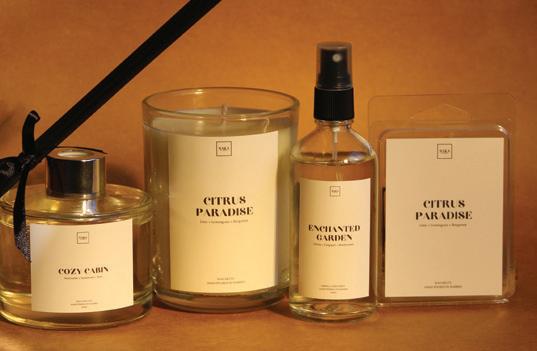
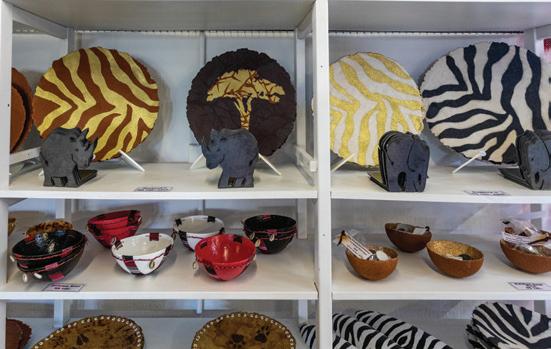
SMEs Compete co-founder and chief executive officer, Claudine Mouton, says entrepreneurs are required to comply with numerous regulations, but there is no one-stop shop where they can obtain information and advice on requirements such as registration, compliance and a host of regulations

“The availability of trained and dedicated staff is another challenge faced by MSMEs as they cannot afford to pay their employees the same rates as people employed in the corporate sector,” says Mouton, adding that access to affordable workspace is yet another challenge faced by small businesses.
According to Mouton, female entrepreneurs are viewed and treated differently from male entrepreneurs when dealing with banks, suppliers and customers simply because they are women. Another constraint women entrepreneurs face is that they find it difficult to expand their businesses beyond the town they live in because of family responsibilities. It is, therefore, difficult for women entrepreneurs in the informal sector to grow their business from a lifestyle business to small business enterprises unless they can find someone reliable to manage it.
SMEs Compete, a social entrepreneurship entity, was established in March 2006 to help small and medium enterprises to grow their businesses and create jobs. Its objective is to improve entrepreneurial, business management, information technology and other skills through a variety of business growth activities, business skills development and events.
Despite the inevitable delays caused by Covid-19, several major road construction projects are progressing well.
Facilitating trust relationships to attract and retain sustainable investment for a private sector-led and inclusive economic growth is at the core of what we do at the Namibia Investment Promotion and Development Board (NIPDB). We unlock economic opportunities and endeavor to enable a better quality of life for all Namibians. In order to achieve its purpose, the NIPDB developed six strategic objectives, which are informed by its mandate and guide the Board’s activities.
In line with this strategy, the NIPDB established the Department of Micro, Small and Medium Enterprises (MSME) Development, Innovation and Acceleration – tasked with the responsibility of providing targeted support for the development and scalability of Micro, Small and Medium Enterprises (MSMEs) in four (4) focal areas – Access to Finance, Access to Markets, Capacity Building and Ideation. The Department is mandated to develop institutional mechanisms and assume the lead coordinating role across all levers for MSME development nationally.
The Department of MSME Development, Innovation and Acceleration is divided into three divisions:
The Business Advisory Services (BAS) Division offers advisory and support services to MSMEs. Amongst others, BAS coordinates specialised and targeted enterprise training courses, seminars and interventions, which encompass all facets of business support including, but not limited to, the monitoring and evaluation of particular business.
The Ecosystems Optimisation (EO) Division undertakes the task of digitising the centralised repository of information about and that is valuable to MSMEs. EO drives collaboration with similar institutions and Business Support Organisations (BSO) to ensure that their frameworks are achieved. Additionally, the Division works at eliminating information asymmetry, which continues to stifle MSME growth. Leveraging digital platforms to disseminate information remains a cornerstone in achieving EO’s objectives.
The Capacity Building and Market Access (CMBA) Divisiont is responsible for developing and strengthening the skills of MSMEs through coordinating and facilitating coaching, training and knowledge-sharing initiatives that satisfy the gaps in MSME facilities. Moreover, CMBA is set out to accelerate growth and see MSMEs from Micro through to fully scaled enterprises.
The largest drivers of activity in any successful economy worldwide are Micro, Small and Medium Enterprises (MSMEs). MSMEs play a critical role in meeting consumer needs, growing the productive workforce and narrowing socio-economic inequality gap. In Namibia, MSMEs seek to benefit from continued and improved collaboration between and smart partnerships with industry players. Hence, since its inception, the Department has undertaken and launched three (3) major initiatives –Know2Grow, MSME App and the Namibian Retail Store Concept.
Know2Grow (K2G)
Know2Grow (K2G) is NIPDB’s patented MSME development and support brand, within which several capacity building and market access initiatives are established to address the critical needs of the target stakeholders – MSMEs. Currently, there are four (4) sub-initiatives launched under K2G – K2G Regional Knowledge Dissemination Seminars, K2G NextGen Entrepreneurs, K2G High Potential Pool and K2G TechNovation Social.
The MSME App is the product of a partnership with Mobile Telecommunication Company (MTC). The App was developed to make information regarding opportunities for MSMEs easily accessible at no cost. Mobile communication devices are instrumental in the way information is disseminated and an appreciation for the medium can be leveraged to support economic progress. The data generated by the use of the App will be responsibly used to better inform decisions that impact the sector.
The Namibian Retail Store Concept seeks to explore ways to enable a lucrative market space that is accessible to all Namibian MSMEs whose products and services meet the required national and international industry standards. This concept would be implemented through the establishment of a Market Access Strategy that would support the founding of a Namibian Retail Store – By Namibian, For Namibians.
Since its involvement with the Department, Jossob Investment Cc – [what kind business is this] – grew from transporting one (1) load of [what] supplies per [time period] to delivering eight (8) loads to Cape Town every month. It now also caters to one of the biggest wholesale suppliers in Pretoria. Its first wholesale retail outlet recently opened in Cape Town.
In conclusion, while the Department does not provide funding, it will continue to coordinate national MSME funding opportunities and seek to enter into Service Level Agreements (SLAs) with funding partners as a pledge to support MSMEs.
For more information please contact: MSME Development, Innovation & Acceleration +264 83 333 8610 suzandi.schiefer@nipdb.com
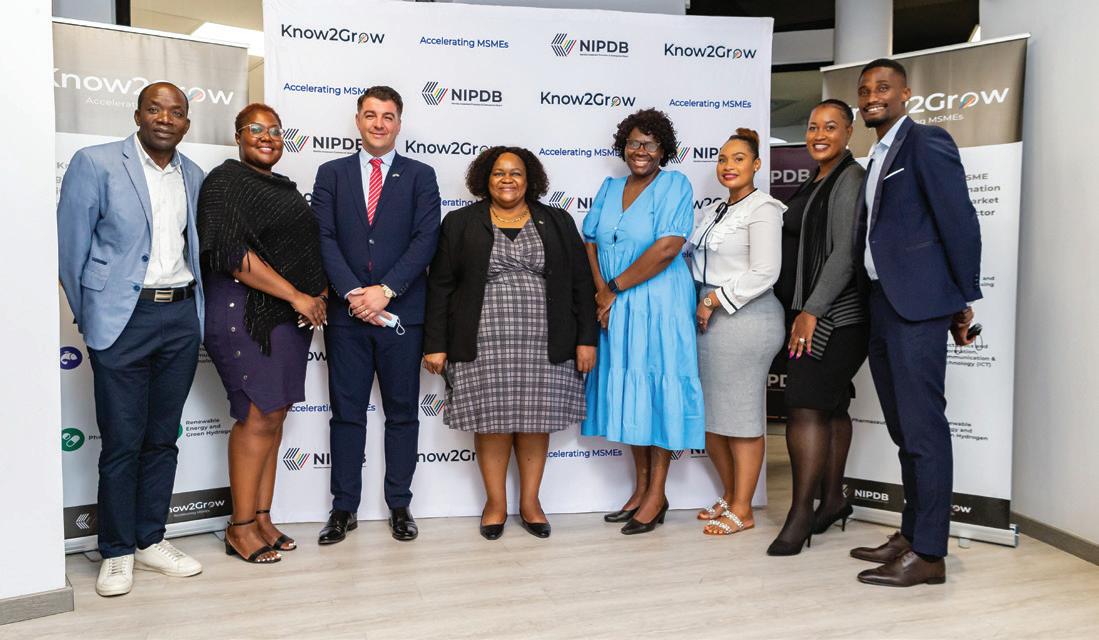
Site 2 Tennis Court Parking Lot, Strand Street, Swakopmund +264 81 430 4371 info@ecoglidingtours.com.na www.ecoglidingtours.com.na

Windhoek, Namibia +264 81 140 2666 +264 81 811 2812 lisa@hitohr.com www.hitohr.com
SkoJ NAMIBIA
Windhoek, Namibia +264 81 1244847 mariannel@scsi.com.na
Social media: @skoj.ii
+264 61 244 693 reception@timeware.com.na www.timeware.com.na
Windhoek, Namibia +264 81 466 6776 ashikotoristo@gmail.com
Windhoek, Namibia +264 81 124 4847 orders@emssence.com www.emssence.com/about-us/
Windhoek. Namibia +264 81 230 4847 info@susannel.com www.susannel.com
Bokamoso Entrepreneurial Centre, Unit B9, Hans Dietrich Genscher Street, Windhoek Namibia +264 81 269 9134 emalwa@gmail.com
10 Sipres Street, Windhoek +264 81 280 4247 parted.hair@gmail.com
10 Chalcedoon, Erospark, Windhoek +264 81 287 5800 small.danie@gmail.com
3 Crohn Street, Windhoek +264 81 809 1075 iinfo@besomedia.studio www.besomedia.online
Unit 20 Elysium Fields, 40 Berg Street, Klein Windhoek +264 81 756 3275 / +264 61 230 759 md@rqs.com.na www.rqs.com.na
www.namibiatradedirectory.com

COTA - College of the Arts
P O Box 2963, Windhoek +264 61 277 341 claasenj@cota.na
Franco Namibia Cultural Centre
P O Box 11622, Windhoek +264 61 387 330 secgen@fncc.org.na www.fncc.org.na
NACN - National Arts Council of Namibia
P O Box 149, Windhoek +264 61 293 3311 artscouncilnamibia@gamil.com
NAGN - National Art Gallery of Namibia
P O Box 994, Windhoek +264 81 145 0641 pro2@nagn.org.na www.nagn.org.na
NTN - National Theatre Of Namibia
P O Box 3794, Windhoek +264 61 374 400 info@ntn.org.na www.ntn.org.na
VAN - Visual Artists Namibia
P O Box 149, Widnhoek +264 61 293 3363 www.artscouncilnam.org
The Potters’ Association of Namibia
P O Box 2589, Windhoek +264 81 861 8869 pottersnamibia@gmail.com www.pan.iway.na
Refer to website for additional listings www.namibiatradedirectory.com
Directorate of Youth Development
Private Bag 13391, Windhoek +264 61 270 6528 ED.Secretary@msyns.gov.na www.msyns.gov.na
Katutura Youth Enterprise Centre
P O Box 5167, Ausspannplatz +264 81 129 1109 reception.whk@kayec.org.na
Lifeline Childline Namibia
P O Box 5477, Windhoek +264 61 226 889 reception@lifeline.org www.liflinechildline.org.na
Michelle McLean Children Trust
P O Box 97428, Windhoek +264 61 240 807 info@mmct.org.na www.mmct.org.na
Namibia Planned Parenthood Association (member of international planned parenthood federation)
P O Box 10936, Windhoek Tel: +264 81 230 4769 info@nappa.com.na www.nappa.com.na
National Youth Council
P O Box 60956, Windhoek +264 61 248 200 info@nyc.org.na www.nyc.org.na
National Youth Service
PO Box 32269, Pioneerspark +264 61 415 500 info@nys.com.na www.nys.com.na
SOS Children’s Village
Association of Namibia
P O Box 23134, Windhoek +264 61 222 457 letta.muleka@sos-naminia.org www.sosnamibia.org.na
Youth Credit Scheme
P O Box 13391, Windhoek Tel: +264 225 327 namibiaycs@gmail.com
Africat Foundation
P O Box 1889, Otjiwarongo +264 67 304 566 info@africat.org www.africat.org
Cheetah Conservation Fund
P O Box 1755, Otjiwarongo +264 67 306 225 visit@ccfnamibia.org www.cheetah.org
Coastal Environmental Trust Of Namibia
P O Box 786, Walvis Bay +264 64 205 057 www.eia.met.gov.na
Desert Research Foundation of Namibia
P O Box 20232, Windhoek West +264 61 377 500 drfn@drfn.org.na www.drfn.org.na
Directorate of Parks and Wildlife Management
Private Bag 13306, Windhoek +264 61 282 4211 www.met.gov.na
Enviro Fill Namibia (Pty) Ltd
P O Box 86580, Windhoek +264 61 24 871
International dialling code: +264 All telephone and fax numbers without codes are for WINDHOEK, Code 061
EIF - Environmental Investments Fund Namibia
P O Box 28157, Windhoek +264 61 240 339 nvanwyk@eif.org.na www.eif.org.na
Game Trust Product Fund
P O Box 28157, Windhoek +264 61 431 7700 info@gptf.org.na www.gptf.org.na
Gobabeb Training Research Centre
P O Box 953, Walvis Bay +264 64 694 198 gobabeb@gobabeb.org www.gobabeb.org
Habitat Centre For Research Development
P O Box 63036, Wanaheda +264 61 268 200
Harnas Wildlife Foundation
P O Box 90393, Gobabis +264 62 568 828/38 bookings@harnas.org www.harnas.org
Integrated Rural Development and Nature Conservation
P O Box 24050, Windhoek +264 61 228 506/9 info@irdnc.org.na www.irdnc.org.na
Ministry of Environment and Tourism: Directorate of Environmental Affairs
Private Bag 13306, Windhoek +264 61 254 2840 www.met.gov.na
Namibia Animal Rehabilitation Research and Education Centre
P O Box 11232, Windhoek +264 61 264 409 liz@narrec.net www.electric.com.na
Namibian Environment and Wildlife Society
P O Box 3508, Windhoek +264 61 306 450 www.news-namibia.org
NCE - Namibian Chamber of Environment
P O Box 40723, Windhoek T+264 61 240 140 info@n-c-e.org www.n-c-e.org
Namibian Environmental Education Network
P O Box 90825, Windhoek +264 61 284 2701 info@neen.org.na www.neen.org.na
NADEET - Namib Desert Environmental EducationTrust
P O Box 8702, Swakopmund +264 81 367 5310 admin@nadeet.org www.nadeet.org
Namutoni Environmental Education Centre Private Bag 201, Tsumeb +264 67 229 200
Nyae Nyae Development Foundation of Namibia
P O Box 9026, Eros +264 61 236 327 nndfn@iafrica.com.na www.nndfn.org
Poison Working Group of Endangered Wildlife Trust
P O Box 11232, Windhoek +264 61 264 409/ 264 256 liz@narrec.net
Save The Rhino Trust
P O Box 2159, Swakopmund +264 64 403 829 srt@rhinotrust.org www.savetherhinotrust.org
Wild Dog Project (Namibia Nature Foundation)
P O Box 245, Windhoek +264 61 248 345 info@nnf.org.na www.nnf.org.na
ACEN - Association of Consulting Engineers of Namibia
P O Box 25837, Windhoek +264 81 358 6057 acen@acen.org.na www.acen.org.na
CIF - Construction Industries Federation of Namibia
P O Box 1479, Windhoek +264 61 417 302 secretariat@cifnamibia.com
Namibia Institute of Architects
P O Box 1478, Windhoek +264 61 23 1559 info@nia.org.na www.nia.org.na
INQS - Institute of Namibia Quantity Surveyors
P O Box 9507, Windhoek +264 61 22 8970 info@inqs.org.na www.inqs.org.na
Henties Bay Waterfront Company Henties Bay Municipality
P O Box 61, Henties Bay + 264 64 502 000 frieda.neshuku@hbaymun.com.na
Lüderitz Waterfront Company (Pty) Limited
P O Box 78, Lüderitz +264 63 202 702 soraya@lüderitzwaterfront.com. na
NDC - Namibia Development Corporation
Private Bag 13252, Windhoek + 264 61 206 2294 www.oag.gov.na
Namibia Development Trust
P O Box 8226, Bachbrecht +264 61 238 002 info@ndt.org.na
Namibia Rural Development Project
P O Box 24886, Windhoek +264 61 237 279 nrdp@iafrica.com.na
ODC - Offshore Development Company (Pty) Ltd
Private Bag 13397, Windhoek +264 61 283 7360 odc@gov.com.na
Zambezi Waterfront (Pty) Ltd
P O Box 2171, Ngwze Katima Mulilo + 264 66 252 366 zwtp@iafricaonline.com.na
NDC - National Disability Council
P O Box 26047, Windhoek +264 61 225 913 Tjiuezatjombumbi@gmail.com
Namibia National Association Of The Deaf
P O Box 21040, Windhoek +264 61 244 811 nnad@iway.na
IOM - International Organisation for Migration
Private Bag 13301, Windhoek +264 61 231 639 lshitaleni@iom.int www.iom.int
NEF - Namibian Employers Federation
P O Box 21250, Windhoek +264 61 244 089 enquiries@nef.com.na www.nef.com.na
Namibia Institute for Democracy
P O Box 11956, Klein Windhoek +264 61 292 4850 naitahoshoono@gmail.com www.nid.org.na
National Society for Human Rights
P O Box 23592, Windhoek +264 61 236 183 nshr@iafrica.com.na
Multimedia Campaign on Violence (Min of Industralisation and Trade)
Private Bag 13347, Windhoek +264 61 222 246 nic@mti.gov.na www.mti.gov.na
NAWA - Namibia Women Association
P O Box 3370, Maroela Katutura +264 61 262 461
PAWO - Pan African Women’s Organisation
P O Box 215, Windhoek +264 61 229 640
Women’s Action for Development
P O Box 370, Windhoek +264 61 321 7667 info@wad.org.na www.wad.org.na
Young Women’s Christian Association Of Namibia
P O Box 21455, Windhoek +264 61 263 484 info.ywcanamibia@gmail.com www.ywca.wordpress.com
International dialling code: +264 All telephone and fax numbers without codes are for WINDHOEK, Code 061
www.namibiatradedirectory.com
SADC - Tribunal Southern African Development Community
P O Box 40624, Windhoek +264 61 38 3600 registry@sadc.int www.sadc.int
Working Group of Indigenous Monitors in Namibia
P O Box 80733, Windhoek +264 61 236 183
UNDP - United Nations Development Programme
Private Bag 13329, Windhoek +264 81 213 1654 www.undp.org
UNPF - United Nations Population Fund
Private Bag 13329, Windhoek +264 61 204 6336 namibia.nfpa.org
UNIC - United Nations Information Centre
Private Bag 13329, Windhoek +264 61 233 035 unic.windhoek@unic.org
UNICEF - United Nations Children’s Fund
P O Box 1706, Windhoek +264 61 204 6111 nmbregistry@unicef.org www.unicef.org
Legal Aid
Private Bag 13370, Windhoek +264 61 420 200 info.legalaid@moj.gov.na www.moj.gov.na
Legal Assistance Centre
P O Box 604, Windhoek +264 61 223 356 info@lac.org.na www.lac.org.na
Law Society Of Namibia
P O Box 714, Windhoek +264 61 230 263 legalofficer@lawsocietnamibia. org www.lawsocietynamibia.org
Office of the Attorney General
Private Bag 13302, Windhoek +264 61 281 2451 info.civillitigation@ag.gov.na www.moj.gov.na
Office of the Ombudsman Private Bag 13211 +264 61 20 7311
Office of the Prosecutor General
Private Bag 13191, Windhoek +264 61 374 200
Namibia
P O Box 1323, Windhoek +264 61 231 151 socadv@mweb.com.na www.namibianbar.org
Namibia Housing Action Group Shack
P O Box 21010, Windhoek West +264 61 239 398
NHE - National Housing Enterprise
P O Box 20192, Windhoek +264 61 292 7298 info@nhe.com.na www.nhe.com.na
Namibia Water Corporation (Namwater)
Private Bag 13389, Windhoek +264 61 710 000 info@namwater.com.na www.namwater.com.na
Directorate of Scientific Services
P O Box 13306 +264 61 284 2529 fdemas@mweb.com.na www.met.gov.na
Institute of Public Policy Research
P O Box 6566, Windhoek +264 61 240 514 info@ippr.org.na www.ippr.org.na
Labour Resource and Research Institute
P O Box 62423, Windhoek +264 61 212 044 info@larri-namibia.org www.larri-namibia.org
National Commission Of Research & Technology
Private Bag 13253, Windhoek +264 61 431 7005 info@ncrst.na www.ncrst.na
NSS - Namibia Scientific Society
P O Box 67, Windhoek +264 61 225 372 info@namscience.com www.namscience.com.na
Namibia Estate Agents Board
P O Box 90091, Klein Windhoek +264 61 249 885 Supervisor@neab.co.na www.neab.co.na
Social Sciences Division
Multi-Disciplinary Research Centre
Private Bag 13301, Windhoek +264 61 206 3052 antesa@unam.na www.unam.edu.na
National Sports Commission Namibia
P O Box 86573, Windhoek +264 61 246 105 icolours@nmaibiasports.org
TRANSFORMATION, DEVELOPMENT, EMPOWERMENT
Centre for Research, Information and Action in Africa
P O Box 23778, Windhoek +264 61 220 117
Centre for Resources and Transformation
P O Box 2497, Windhoek +264 61 221 179 guina@iway.na
Cohena
P O Box 50295, Windhoek +264 61 237 908
Development Aid from People To People
P O Box 135, Outapi +264 65 251 179 dappzts@dapp.namibia.org www.dapp-namibia.org
GIZ
P O Box 8016, Windhoek Tel: +264 61 222 447 albertina.haufiku@giz.de www.giz.de
IPBF - Indigenous People's Business Forums
P O Box 22402, Windhoek +264 61 400 862 info@ipbf.com.na
Konrad Adenauer-Stiftung
P O Box 1145, Windhoek +264 61 232 156 zentrale@kas.de www.kas.de
Lions Club Windhoek
P O Box 1145, Windhoek +264 61 307 491
Namibia Association of Norway
P O Box 24140, Windhoek +264 61 220 082 namnorwa@mweb.com.na
Namibia Nationhood Programme Co-ordinating Committee (Spice and Scale World)
P O Box 1657, Windhoek +264 61 263 021
NHC - National Heritage Council
Private Bag 12043, Windhoek +264 61 244 375 info@nhc-nam.org www.nhc-nam.org
Rural People’s Institute for Social Empowerment
P O Box 50155, Windhoek +264 61 236 029
ALAN - Association for Local Authorities Namibia
P O Box 2721, Windhoek +264 61 24 0915 alan@iway.na www.alan.org.na
ARC - Association of Regional Councils in Namibia
P O Box 3379, Windhoek +264 61 22 9537 arc@iway.com
NALAO - Namibian Association of Local Authority Officers
P O Box 2721, Windhoek +264 61 240 914 www.nalao.org.na
Windhoek Fire Station +264 61 211 111
Maxuilili Fire Station +264 61 212 265
Diaz Street Fire Station
Tel: +264 61 250 084 / +264 61 250 446
State Hospital +264 61 203 3111
Namibian Police +264 61 10 111
City Police
+264 61 290 2239 / +264 61 290 2018 (All hours) Toll Free Number: +264 61 302 302
Electricity Failures
+264 61 290 2452/3/4 (All hours) / +264 61 222 658 (After hours)
Water and Sewage +264 61 290 2402
Receiver of Revenue +264 61 209 9111
Civic Affairs +264 61 292 9111
City of Traffic Management Services
+264 61 290 2722 / +264 61 258 473
Customer service officer
Tel: +264 61 290 2690 / +264 61 290 2568
Town House
+264 61 290 2105 / +264 61 290 2224
Soweto Office +264 61 290 2766
Wanaheda Office +264 61 290 2723
Okuryangava Office +264 61 290 3145/6
Khomasdal Office +264 61 290 2536/7/8
Debt Management Division
Credit Control
Tel: +264 61 290 2069
Chief Health Services
Tel: +264 61 290 2496
Building Control +264 61 290 2386
Enquiries Katutura +264 61 290 2772
Chief Building Inspector +264 61 290 2386
Bus Services
Tel: +264 61 290 2505 / +264 61 290 2528
Analyst: Research & Information Technology +264 61 290 2024
Analyst - Investment Promotion, Business Development and Liaison +264 61 290 2577 invest@windhoekcc.org.na
Manager: Community Development +264 61 290 3152
Project Coordinator: Youth Development and Training +264 61 290 3152
Project Coordinator: Social Welfare +264 61 290 3510
Project Coordinator: Settlement Development +264 61 290 3153
Project Coordinator: Public Participation +264 61 290 2795
Arandis Municipality Mayor: Cllr. Erastus Kandenge Private Bag 7002, Arandis +264 64 512 415 communications@atc.com.na www.arandistown.com
Aranos Village Mayor: Cllr. Marline Claasen P O Box 157, Aranos +264 63 272 051/55 info@aranostc.or www.aranostc.org
Aroab Village Council Chairperson: Mrs Elsa Laubsher P O Box 51, Aroab +264 63 28 0513 aroabvc@iway.na elsa.laubsher55@gmail.com
Berseba Village Council Chairperson: Ms. Felicia Mutenga Private Bag 2043, Keetmanshoop +264 63 25 7033 councilberseba@gmail.com
Bethanie Village Council Chairperson: Mr. Blokstaan P O Box 74, Bethanie +264 63 28 3006 bethanievc@iway.na
Eenhana Municipality Mayor: Cllr. Mori-onn Kuvandje Private Bag 88007, Eenhana +264 65 29 0600 mueshi@eenhanatc.com.na
Gibeon Village Council Chairperson:
Cllr. Paul Isaak Private Bag 1001, Gibeon +264 63 25 1014 Silasmonica97@gmail.com
International dialling code: +264 All telephone and fax numbers without codes are for WINDHOEK, Code 061
www.namibiatradedirectory.com
Gobabis Municipality Mayor: Mrs. Elzele Thelon P O Box 33, Gobabis +264 62 57 7300 info@gobabis.org www.gobabis.org
Gochas Village Council Chairperson: Ms. Theresia Cloete P O Box 103, Gochas +264 63 25 0019 gochasvc@gmail.com
Grootfontein Municipality Mayor: Cllr. A Haimene P O Box 23, Grootfontein +264 67 24 3101
Helao Nafidi Municipality Mayor: Cllr. Darius Shaalukeni Private Bag 503, Helao Nafidi +264 65 26 0000 martha@helaonafidi.org
Henties Bay Municipality Mayor: Mr. His Worship L.J Vermaak P O Box 61, Henties Bay +264 64 50 2000 Mayor@hbaymun.com.na
Kalkrand Village Council Chairperson: Mr. Simeon Martin P O Box 5, Kalkrand +264 63 264 005 Acckalkvc@iway.na
Kamanjab Village Council Chairperson: Ms. Elsie /Goagoses P O Box 81, Kamanjab +264 67 33 0051
Karasburg Municipality Mayor: VACANT P O Box 33, Karasburg +264 63 27 0032 karasburgm@iway.na
Karibib Municipality Mayor: Cllr: Davey Van Wyk P O Box 19, Karibib +264 64 55 0016 pa2ceo@karibibtown.org
Katima Mulilo Municipality
Mayor:
Hon. Lista Shamalaza Private Bag 5009, Katima Mulilo +264 66 26 1500 ishamalaza@kmtc.org.na www.kmtc.org.na
Keetmanshoop Municipality
Mayor: Cllr. Ms Marie Smit Private Bag 2125, Keetmanshoop +264 63 22 1211 cms@keetmansmunicipality.org.na www.keetmansmunicipality.org.na
Khorixas Muncipality
Mayor:
Cllr. Ms Lina Gaeses
Private Bag 2005, Khorixas +264 67 331 057 pa2ktc@gmail.com
Köes Village Council
Chairperson: Mr. Willie Humphries P O Box 68, Köes +264 63 25 2747 koesvc@iway.na
Leonardville Village Council
Chairperson: Mr. Rudolf Shomonguula P O Box 56, Leonardville +264 62 56 9115 leonard@iway.na
Lüderitz Municipality
Mayor: Cllr. Anna Marie Hatzenberg P O Box 19, Lüderitz +264 63 207 600 annemariehatzenberg@gmail. com www.luderitz.com
Maltahöhe Village Council
Chairperson
Hon. Anna Swartbooi P O Box 98 Maltahöhe +264 63 29 3048
Mariental Municipality Mayor: Cllr. Mr Adam Kuhlman P O Box 110, Mariental +264 63 24 5600 bfortuin@marmun.org.na
Nkurenkuru Municipality Mayor: Cllr. Mr Josef Mutei P O Box 6004, Nkurenkuru +264 66 25 8089 nkutown@iway.na
Okahandja Municipality Mayor: Cllr. Natasha Brinkman P O Box 15, Okahandja +264 62 50 5100 mayor@okh.org.na www.okahandja.org.na
Okahao Town Council Mayor: Cllr. Hon Cornelia Iiyambula P O Box 699, Okahao +264 65 25 2204 s.n.iiuela@okahaotc.com.na www.okahao.com.na
Okakarara Municipality
Mayor: Cllr. Olga Tjiurute P O Box 2104, Windhoek +264 67 31 7084 okakararatc@gmail.com
Omaruru Municipality Mayor: Cllr. Roger Nautoro P O Box 14, Omaruru +264 64 57 0028 Rogernautoro1@gmail.com
Otjiwarango Municipality Mayor: Cllr. Bennes Haimbodi Private Bag 2209, Otjiwarongo +264 67 30 2231 enquiries@otjimun.org.na
Rundu Municipality Mayor:
Cllr. Gabriel Kanyanga Private Bag 2128, Rundu +264 66 266 400 Kanyanga@rundutown.org www.runducity.iway.na
Swakopmund Municipality
Mayor: Cllr. Louisa N. Kativa PO Box 53, Swakopmund +264 410 4111 lkativa@swkmun.com.na www.swkmun.com.na
Usakos Municipality
Mayor: Cllr. Gustav G. !Hoaeb P O Box 67, Usakos +264 64 53 0023 usakos@iway.na
Walvis Bay Municipality
Mayor:
Cllr. Travino Forbes Private Bag 5017, Walvis Bay +264 64 201 3111 pr@walvisbaycc.org.na www.walvisbaycc.org.na
Embassy of the People’s Democratic Republic of Algeria Ambassador: H.E. Mr. Seddik Saoudi P O Box 3079, Windhoek +264 61 22 1507 info@embassyofalgeria-namibia. org www.embassyofalgeria-namibia. org
Embassy of the Republic of Angola Ambassador: H.E. Ms. Jovelina A.A. Imperial e Costa
Private Bag 1220 Ausspannplatz , Windhoek +264 61 22 7535 embaixada.namibia@mirex.gov. ao
High Commission of the Republic of Botswana High Commissioner: H.E. Dr. Batlang Comma Serema P O Box 20359, Windhoek +264 61 22 1941/2/7 botnam@gov.bw
Embassy of the Federative Republic of Brazil Ambassador: Vacant P O Box 24166, Windhoek +264 61 23 7368/9 brasemb.windhoek@itamaraty. gov.br
Embassy of the People’s Republic of China Ambassador: Vacant P O Box 21350 +264 61 40 2598 chinaemb_emb@mfa.gov.cn www.chineseembassy.org
Embassy of the Democratic Republic of Congo Ambassador:
H.E. Mr. Anastas Kaboba Kasongo Wa-Kimba P O Box 9064, Windhoek +264 61 25 6287 missiondrcwindhoekdeux@gmail.com
Embassy of the Republic of Congo Ambassador:
H.E. Mrs. Lauria Ngayino P O Box 22970, Windhoek +264 61 25 7517 embcongo@iway.na
Embassy of the Republic of Cuba Ambassador:
H.E. Mr. Sidenio Acosta Aday P O Box 23866, Windhoek +264 61 22 7072 embajada@cubanembassy.net cubanembassy.net www.missiones.minrex.gob.cu/ namibia
Embassy of the Arab Republic of Egypt Ambassador:
H.E. Mr. Wael Mohamed Lofty Batea
P O Box 11853, Klein Windhoek +264 61 22 1501 embassy.windhoek@mfa.gov.eg
Delegation of the European Union Ambassador:
H.E. Ms. Sinikka Antila
P O Box 24443, Windhoek +264 61 20 26000/20 26202 delegation-namibia@eeas. europa.eu www.delnam.ec.europa.eu
Embassy of Finland Ambassador:
H.E. Mrs. Leena Orvokki Viljanen P O Box 3649 +264 61 22 1355 sanomat.win@formin.fi www.finland.org.na
Embassy of the French Republic Ambassador:
H.E. Mr. Sebastien Minot P O Box 20484, Windhoek +264 61 27 6700
cad.windhoek-amba@diplomatie. gouv.fr www.ambafrance-na.org
Embassy of the Federal Republic of Germany Ambassador:
H.E. Mr. Herbert L. Beck P O Box 231, Windhoek +264 61 27 3100 german@iway.na www.windhuk.diplo.de
High Commission of the Republic of Ghana High Commissioner:
H.E. Mr. Yakubu Alhassan
P O Box 24165, Windhoek +264 61 22 1341/2 ghmissio@mweb.com.na www.ghanahighcommission. com.na
High Commission of India High Commissioner:
H.E. Mr. Prashant Agrawal P O Box 1209, Windhoek +264 61 22 6037 hc.windhoek@mea.gov.in www.hciwindhoek.gov.in
Embassy of Republic of Indonesia Ambassador:
H.E. Mr. Wisnu Edi Pratignyo P O Box 20691, Windhoek +264 61 285 1000 kbri@iafrica.com.na www.kemlu.go.id/windhoek
Embassy of Republic of Islamic Republic of Iran Ambassador:
H.E. Mr. Seyed Ali Sharifi Sadati P O Box 2302, Windhoek +264 61 24 9700 iranemb.wdh@mfa.ir
Embassy of Japan Ambassador: Vacant P O Box 23025, Windhoek +264 61 42 6700 info@wh.mofa.go.jp
High Commission of the Republic of Kenya High Commissioner: Vacant P O Box 2889, Windhoek +264 61 22 6836 kenyanet@mweb.com.na
Embassy of Libya Acting Ambassador: Vacant P O Box 124, Windhoek +264 61 23 4454 libya.emb_na@foreign.gov.ly
High Commissioner of Malaysia High Commissioner: H.E. Mr. Hishamuddin Ibrahim P O Box 312, Windhoek +264 61 25 9342 protocol.kln@afol.com.na www.kln.gov.my
High Commission of the Federal Republic of Nigeria Ambassador:
H.E. Ms. Lilian Ijeukwa Onoh P O Box 23547, Windhoek +264 61 23 2103/4/5 nigeria.windhoek@foreignaffairs. gov.ng www.nhcwindhoek.org
Embassy of the Russian Federation Ambassador:
H.E. Mr. Valeriy Utkin P O Box 3826, Windhoek +264 61 22 8671 rusembnam@mid.ru
High Commission of the Republic of South Africa
High Commissioner:
H.E. Mr. William MP Whitehead P O Box 23100, Windhoek +264 61 20 57111 windhoek@mne.pt www.dirco.gov.za/windhoek
Embassy of the Kingdom of Spain Ambassador:
H.E. Ms. Antonia Javier Romera Pinto P O Box 21811, Windhoek +264 61 22 3066 emb.windhoek@maec.es www.maec.es
Embassy of the Republic of Turkey Ambassador:
H.E. Ms. Berin Makbule Tulun P O Box 90998, Windhoek +264 61 24 6158 embassy.windhoek@mfa.gov.tr www.evisa.gov.tr
British High Commission High Commissioner:
H.E. Ms. Kate Airey P O Box 22202, Windhoek +264 61 27 4800 general.windhoek@fco.gov.uk www.gov.uk
Embassy of the United States of America
Ambassador: H.E. Ms. Johnson Lisa Private Bag 12029, Ausspannplatz Tel: +264 61 29 58500 embassywindhoek@state.gov www.na.usaembassy.gov
Embassy of the Bolivarian Republic of Venezuela Ambassador:
H.E. Mr. Omar Berroteran Paredes
P O Box 13353, Windhoek +264 61 22 7905 embavenenam@gmail.com
High Commission of the Republic of Zambia:
H.E. Ms. Stella Libongani P O Box 22882, Windhoek +264 61 23 7610/1 zahico@iway.na
Embassy of the Republic of Zimbabwe Ambassador: H.E. Ms. Rofina N. Chikava P O Box 23056, Windhoek +264 61 22 8134 Zimwindh80@gmail.com
NAMIBIAN MISSIONS ABROAD
ALGERIA Ambassador: H.E. Dr Panduleni Kaino Shingenge +213 (0) 21 796627 algeris@mirco.gov.na
ANGOLA Ambassador: H.E. Mr Patrick Nandago P O Box 953, Windhoek + 244 222 321 241 luanda@mirco.gov.na
AUSTRIA Ambassador: H.E. Mrs. Nada Kruger +431 402 9371/2/3 vienna@mirco.gov.na
BELGIUM & EU Ambassador: H.E. Dr. Mekondjo Kaapanda Girrus +32 771 1410 nam.emb@brutele.be
BOTSWANA
High Commissioner: H.E. Mr. Asser Kapere P O Box 987, Gaborone +267 39 02181 namibhc@botsnet.bw
BRAZIL Ambassador: H.E. Mr. Mbapeua Muvangua +55 61 3248 6274/761 info@embassyofnamibia.org.br
CHINA Ambassador: H.E. Dr. Elia George Kaiyamo +8610 653 22211 namemb@eastnet.com.com
CONGO (Republic) Ambassador: H.E. Mr. Sipapela Cletius Sipapela P O Box 2895, Windhoek +264 06 466 668 namibiaembassycongo@gmail.com
CONGO (DRC)
Ambassador: H.E. Mr Simeon Uulenga P O Box 8943, Kinshasa +243 81 5559840 nameembassy_drc@yahoo.com
CUBA Ambassador: H.E. Mr. Samuel H. /Gôagoseb. +53 7 204 1430/28 namembassycuba@hotmail.com
EGYPT Ambassador: H.E. Mr. Vilio H. Hifindaka +202 235 89649 cairo@mirco.gov.na
ETHIOPIA & AU Ambassador: H.E. Mrs. Emilia Mkusa +2511 1 6611966 nam.emb@telecom.net.e
FINLAND
Ambassador: H.E. Mr. Charles B. Josob +358 01 8509700 info@namembassy.fi
FRANCE Ambassador: H.E. Mr. Albertus !Aochamub +33 1 44 17 3265 info@embassyofnamibia.fr www.embassyofnamibia.fr
GERMANY Ambassador: H.E. Mr. Martin Andjaba +49 30 254 0950 info@namibia-botschaft.de www.namibia-botschaft.de
www.namibiatradedirectory.com
GHANA
High Commissioner: H.E. Mrs. Selma Ashipala-Musavyi P O Box 3369, Windhoek +233302799764 accra@mirco.gov.na
INDIA
High Commissioner: H.E. Mr. Gabriel P. Sinimbo +91-11 26140389/0890/4772 nam@nhcdelhi.com
JAPAN Ambassador: H.E. Mr. Morven M. Luswenyo +81 3 6426 5460 embassy@namibiatokyo.or.jp www.namibiatokyo.or.jp
MALAYSIA
High Commissioner: H.E. Mr. Herman P. Diamonds +60 3 216 46520 namhckl@streamyx.com
NIGERIA
High Commissioner: H.E. Mr. Humprey Geiseb +234 97809441 abuja@mirco.gov.na www.namibiahc.com.ng
RUSSIAN FEDERATION
Ambassador: H.E. Mr. Clemens H. Kashuupulwa +7 499 230 3275 moscow@mirco.gov.na namibian-embassy.ru
SENEGAL
High Commissioner: H.E. Mr. Elvis T. Shiweda +221 33 859 2321 dakar@mirco.gov.na
SOUTH AFRICA
High Commissioner: H.E. Mr Veiccoh K. Nghiwete P O Box 29086, Pretoria +27 12 4819 100 secretary@namibia.org.za
SWEDEN
Ambassador: H.E. Mr. George M. Liswaniso P O Box 19151 SE 10432 Stockholm Sweden +46 8 442 9800 info@embassyofnamibia.se www.embassyofnamibia.se
SWITZERLAND
Ambassador: H.E. Mrs. Julia Imene-Chanduru +41 22 7330220 info@missionofnamibia.ch
TANZANIA
High Commissioner: H.E. Mr. Lebbeus T. Tobias P O Box 80211 Dar Es Salaam +255 22 2601903 namhcdar@gmail.com
UNITED KINGDOM
High Commissioner: H.E. Ms Linda Scott +44 207 636 6244 info@namibiahc.org.uk www.namibiahc.org.uk
UNITED NATIONS
Ambassador: H.E. Mr Neville Gertze +1 212 685 2003 namibia@un.int
UNITED STATES OF AMERICA
Ambassador: H.E. Mrs. Margaret N. MensahWilliams +1 202 986 0540 info@namibianembassyusa.org www.namibianembassyusa.org
ZAMBIA
High Commissioner: H.E. Mr. Haindong R. Siyave P O Box 30577, Lusaka +260 211 260 407/8 info@namibiahczambia.org www.namibiahczambia.org
ZIMBABWE
Ambassador: H.E. Mr. Nicklaas R. Kandji P O Box 7166, Harare +263 885 841/882 709 secretary@namibianembassy.co.zw www.chamberofmines.org.na
Honorary Consulate of Angola
Honorary Consul:
Mr. Andre Vetuna Private Bag 5541, Windhoek Tel: +264 65 221 799 Email: consuladogeral.rundu@ mirex.gov.ao
Honorary Consulate of Australia
Honorary Consul: Mr. Edward Humphrey P O Box 86491, Windhoek Tel: +264 61 30 0194 austrialian.consulate.namibia@gmail.com www.southafrica.embassy.gov.au
Honorary Consulate of Austria
Honorary Consul: Mr. Reinhard Laggner P O Box 40199, Windhoek +264 81 145 0095 hgk.windhoek@gmail.com www.bmeia.gv.at/en/embassy/ pretoria
Honorary Consulate of the People’s Republic of Bangladesh
Honorary Consul: Mr. Bulbul Mollah P O Box 268, Windhoek +264 61 400 998 molla.bulbul@yahoo.com
Honorary Consulate of the Kingdom of Belgium
Honorary Consul: Mr. Hans-Bruno Gerdes P O Box 43, Windhoek +264 61 383 300 fidel.iipumbu@gmail.com
Honorary Consulate of the Republic of Bulgaria
Honorary Consul:
Mr. Mihail Mihaylov P O Box 24449, Windhoek Tel: +264 61 24 6333 mmihaylov@gmail.com
Consulate of Canada Honorary Consul: Mr. François Uys P O Box 128, Windhoek +264 61 25 1254 canada@mweb.com.na
Honorary Consulate of the Democratic Republic of Congo
Honorary Consul: Mr. Haddis Tilahun P O Box 40194, Windhoek +264 61 27 7820 haddis@united.com.na
Honorary Consulate of the Republic of Cyprus
Honorary Consul:
Mr. Savvas I. Savva
P O Box 24, Walvis Bay +264 64 20 4501 sisavva@venus.com.na kypros@venus.com.na
Honorary Consulate of Denmark
Honorary Consul: Dr. Klaus Endresen Private Bag 13303, Windhoek +264 61 230526 klaus@appiah-endresen.com
Honorary Consulate of the French Republic
Honorary Consul:
Mr. Milutin Djoulizibaritch P O Box 529, Walvis Bay +264 64 22 0374 www.hannamibia.com
Honorary Consulate of the Republic of Greece
Honorary Consul:
Mr. Savvas I. Savva P O Box 24, Walvis Bay +264 64 20 4501 sisavva@venus.com.na
Honorary Consulate of the Republic of Hungary
Honorary Consul: Mr. György Trepper P O Box 20392, Windhoek +264 61 22 0450 trepper@iway.na
Honorary Consulate of Iceland
Honorary Consul: Ms. Bonita de Silva P O Box 24, Walvis Bay +264 61 222332 bdesilva@me.com
Honorary Consulate General Italy
Honorary Consul:
Mr. Alessandro Micheletti P O Box 6179, Windhoek +264 81 147 1250 italynamibia@gmail.com
Honorary Consulate of Jamaica
Honorary Consul: Prof Earle Spencer Taylor P O Box 25315, Windhoek +264 61 238 288 jhcon.nam@afol.com.na
Honorary Consulate of the Netherlands
Honorary Consul: Mr. Servaas van den Bosch P O Box 564, Windhoek +264 61 23 3733 honconsulnl@namibianederland.net www.namibianederland.net
Honorary Consulate of New Zealand
Honorary Consul: Mr. Bradley D. Basson P O Box 50088, Windhoek +264 61 38 6600 bdblaw@iway.na
Honorary Consulate of Norway
Honorary Consul: Mr. Klaus Endresen Private Bag 13303 P O Box 86099, Windhoek +264 61 25 8278 klaus@appiah-endresen.com
Honorary Consulate of the Islamic Republic of Pakistan
Honorary Consul: Mr. Akapandi Johannes Endjala P O Box 32128, Windhoek +264 61 37 5700/12 akapandi@jandpgroup.biz
Honorary Consulate of Portugal
Honorary Consul: Mr. Alfredo Lourenco Pimenta +26461 296 800 court@safarihotelsnamibia
Honorary Consulate of Serbia
Honorary Conusl: Amb. Marten Nen'ete Ka,ewasha P O Box 60157, Windhoek +264 61 244511 nenkete5@gmail.com
Honorary Consulate of the Democratic Socialist Republic of Sri Lanka
Honorary Consul: Mr Sackey Aipinge P O Box 98456, Windhoek +264 61 24 4064 consulslnam@gmail.com. www.consulsrilankanamibia.webs.com
Honorary Consulate of the Kingdom of Spain Honorary Consul: Mr. Miguel Angel Tordesillas Herranz
P O Box 603, Lüderitz +264 63 20 2891 tjozo.nasria@iway.na www.nasria.com.na
Honorary Consulate of the Kingdom of Sweden
Honorary Consul: Dr. Klaus Endresen Private Bag 13303, Windhoek +264 61 25 8278 klaus@appiah-endresen.com
Honorary Consulate General of Switzerland
Consul-General:
Mr. Urs Gamma P O Box 9245, Windhoek 264 61 22 3853 windhoek@honrep.ch
Honorary Consulate of the Kingdom of Thailand Consul General: Dr. Gabriel T. Uahengo P O Box 4762, Ondangwa +264 61 23 3737 gabes@zenith.com.na
Honorary Consulate of Republic of Turkey
Honorary Consul:
Mr. Burhan Seber P O Box 349, Walvis Bay +264 81 1490049 windhoek@honrep.ch
International dialling code: +264 All telephone and fax numbers without codes are for WINDHOEK, Code 061
www.namibiatradedirectory.com
99fm 38
Accessory Fitment Centre 160, 161
Advertising & Media 34-36 Advocacy 51
Aesthetic Center Olympia 110 Agility 81
Agribank 181
Agricultural Products 46 Agriculture 3, 8, 15, 16, 40-41
Agrimark 46 Agronomic 47
Agronomic Industry Regulation 47
Aircraft Leasing 164, 165
Aircraft Maintenance 164, 165 Alexander Forbes 72
ALI (African Leadership Institute) 62 Allan Gray Namibia 70-71 Alternative Building Materials 31 Alumni 60
Animal Feeds 44 Antigen 106
App Development 80, 81, 117 Audit 78
Autohaus Truck & Bus 181 Auto Parts 160, 161 Aviation Training 164, 165
Band and Consumer Insights 39, 52 Bank of Namibia 9, 28, 29, 66-67
Beso Media 170
Bidvest 153
BIPA (Business and Intellectual Property Authority) 48
Birgit Hoffmann 30
Bladder Tech 158, 159
Bloomberg Market Data 91
BMW 160, 161 Mini 160, 161
Board 28
Body Treatments 110
Bond Registration 57
Boxes 126, 127
Budget 17
Business and Public Services 48-49 Business Registration 48, 57
Cafe Coffee 110
Capital 17
Capricorn Foundation 181
Capricorn Group 74-75, 181 Cargo 156,162,163
Cashless Convenience 92, 93 Cellular Towers 120, 121 Charters 164, 165 Chemicals 29
Chicken 45 China 16
Civil Litigation 57 Climate 9 Coaching 30, 51
Commercial Litigation 57 Commodities 10, 15, 16, 18
Conservation 37 Construction 15, 31 Conveyancers 53, 56
Copper 16 Corporate Investment Banking (CIB) 86, 181
Corporate Social Investment 36, 137
Corridors 162,163 Covid-19 1, 16, 28, 29 Crafts 32
CRAN 114-115, 182 Crash & Injury Prevention 155 Credit 17 Crops 15
Cruise/Passenger Services 156 Customer-oriented 88, 89
De Beers 136 Debmarine 16, 18, 132-133, 183 Debt 18 Defense 15
DEKRA 153
Deloitte Inside cover Development 12, 54 Development Bank of Namibia 14, 68-69, 183
Diamond Mining 133, 136, 137 Digital Transformation 3, 11, 29, 81, 92, 93
Diversification 10, 29 Domestic Investment 3, 12, 15 Dr Weder, Kauta & Hoveka 53 Dundee Precious Metals Tsumeb 135
Eco-gliding Tours Swakop 170
Economic Growth 8, 12 29 Economic Recovery 3, 15, 29, 30, 69
Economy / Economic 1, 8, 12, 15, 17, 18, 28, 30, 31, 32, 69
Ecosystem 12 Edible Oils 158, 159 Education 36, 58-59 Eduvision 181
Efuta 99
Electrification 138, 139, 140, 141, 142,143
Electronics 29 Emed Rescue 24, 104-105 Emergency Services 164, 165 EMONEKO 110
Employee Wellness 30 Empowerment 30, 32 Emssence 170 Entrepreneurial 32 Equity 77
Erongo Marine Enterprises 98 Etosha Fishing 99
European Central Bank 17 Exports 3, 8, 29 Express Mark 46 EY 78-79
Eye Health Care 110, 108, 111
Farm de Rust 54
FB du Toit Transport 152 Federal Reserve 17 Feedmaster 44, 183 Finance 64-65
First Capital Building Cost Index 31 FirstRand Namibia 184
Fiscal 15, 17, 31
Fishing 8, 15, 94-95
FlyNambia 37, 157, 164, 165, 181
FNB 31, 80 – 81, 182
Food Testing 106
Foreign Investment 3, 12, 28 Forestry 15 Forex 80
Francois Erasmus Partners 56
Frans Indongo Trust 184 Frans Uusiku 31 Fuel 3, 158, 159
GDP 1, 15, 17
Gendev Fishing Group 98
Geophysical Survey 164, 165
Global Macro 16
Gold 15, 16
Goldwagen 160, 161
Government Institutions Pension Fund (GIPF) 82-83
Government of Namibia 20-27
Green Bond 90, 91
Green Energy/Hydrogen 3, 8, 29 Green Enterprise Solutions 116117
Guans Packaging 126-127
Hangana Seafood 99
Haval 160, 161
Health Care 15, 100-101
Health Care Facility 107, 108, 110, 111
Hino 160, 161
Hito HR and Training Consultants 170
Honda 160, 161 Horticulture 46 Hospitality 15 Human Resources 51 Huntinamibia 37
Inflation 3, 16, 18, 31
Information, Communication Technology 3, 8, 15, 29, 112-113
Infrastructure 9 Innovation 81 Insurance 15
Intellectual Property Protection 48 Interest Rates 17
Internet Solutions 119, 122, 123 Investment 3, 8, 28, 77, 88, 89, 91
Jet.X Couriers 152
Johannesburg Stock Exchange 182 Journeys Namibia 149
Kaap Agri 46, 182
KAHF 84-85
Kalahari Holdings Pty Ltd 54
Key Investor Service Agencies 14 KGB 84-85
Königstein Capital 84-85
Königstein Capital Property Investment Fund 84-85
L Law 9
Lead 15
Learn on One 36, 38
Legal Services 53, 56
Lexus 160, 161
Livestock 15, 18
Local Investment 28
Logistical Hub 9, 162, 163
Lüderitz 162, 163
Lüderitz Bay Shipping & Forwarding 153
M & G Investments 76-77, 181
M + Z Group 181
Machinery 29
Manica Group Namibia 153, 184
Manufacturing 3, 15, 29, 124-125
Marble 15
Marine Services 156
Market Access 9
Market Research 52
Mashare Berries 84-85
Mashare Irrigation 84-85
Meat 43
Meat Board of Namibia 42-43
Meat Standards & Regulations 43
Medical Rescue Africa (MRA) 109
Medipark Ongwediva 107
Metals 29
Mining & Energy 3, 8, 11, 15, 29, 130-131
Ministries 20-27
Ministry of Finance and Public Enterprises 17
Ministry of Industrialisation and Trade 27
Mobile Lubrication Specialist 153 Molace 153
Monetary Policy 16, 17 Monjasa 153
MRA 164, 165
MSMEs 3, 12, 28, 166-167
MTC 119, 183
Multichoice Namibia 118, 183, 184
MVA Fund (Motor Vehicle Accident Fund of Namibia) 154-155, 181
Nam Aloe 170
Nam-mic Holdings 73
Namcor 134, 184
Namdeb 136-137
NAMFISA 183
Namib Contract Haulage 55
Namib Laboratories 106
Namib Mills 129, 181
Namib Poultry 45 Namibia 9, 28, 31, 32, 43
Namibia Agronomic Board 181
Namibia Chamber of Commerce and Industry 14
Namibia Employers Federation 51
Namibia Fish Consumption Promotion Trust 96-97
Namibia Holiday & Travel 37
Namibia Investment Promotion and Development Board 9, 12, 28, 168-169, 182
Namibia Oncology Centre 84-85
Namibia Plastics 84-85
Namibia Protection Services 55
Namibia Statistics Agency (NSA) 15
Namibia Stock Exchange (NSX) 69, 91
Namibia Tourism Board 146
Namibia Trade Forum 14
Namibia Trade Network 37, 39, 182
Namibia Wildlife Resorts (NWR) 148
Namibian Agronomic Board 47
Namibian Ports Authority (Namport) 156, 184
Nampower Corporation 138-141 Namprint 55
Nangula Nelulu Uaandja 28 Natural Resources 9, 29
Nedbank Namibia 86-87, 181, 182
Neo Paints 128 Nissan 160, 161 Notaries 53, 56 NUST 60
O&L Group 99
Ocean Liner Services 153
Ocular Pathology 111
Offshore Investment 77 Oil 18
Okavango Berries 84-85
Old Mutual 88, 89
Olympia Eye & Laser Centre 110111
Olympia Optics 110
Omake Moments 181-184
One Africa Television 38 Ongava Game Reserve 147
Orca Marine Services 153 Oshakati Premier Electric 142-143
Parted 170
Passenger Airline 164, 165 Paypulse 92, 93
PCR Testing 106
Penduka Social Enterprise 32
Photography 51 Policy Environment 9
Power Maintenance 138, 139, 140, 141, 142, 143
Power Supply 138, 139, 140, 141, 42, 143
Powercom Pty Ltd 120-121 Private Sector 69 Private Wealth 87 Pro Parcel Distribution 152 Promote 3, 28 Prosperity Health 103 Public Administration 15 Public Private Sector 3 Pupkewitz 46, 160, 161 Pupkewitz Motors 160-161
R-booster Testing 106
Rankings 9 Rate 9
Real Estate 15 Recession 1, 16 Regulatory 3 Renewable Energy 10, 138, 139, 140, 141
Rennies Consolidated 153
Rennies Transport & Materials Handling 153 Repo 17 Research 31 Research@Tribefire 52 Resilience 1, 28 Retirement Fund Solutions 184 Revenue 16 Reviving and Economy 1, 3 RMA 102-103 RMB 90-91, 183 Roads 8
Rossouw Röver and Associates Quantity Surveyors Inc. 170 Russia Ukraine 3, 16, 18
Salt 15
SatLink 122, 123 Signa 164, 165 Skin Care 110 Skoji 170 SMEs 29, 69 Spitz Capital 84-85 Stability 9 Standard Bank Namibia 92-93, 184 Stories 37 Strategy 79 Susan Nel 151, 70 Sustainability 32, 91
Talamo Foods 170
Tax 15, 29
Telecom Namibia 122-123
Tertiary Education 15, 60, 61, 62
The Good Deal Namibia 39
The Logistics Company Namibia 158-159
The Tribe 39
This is Namibia 37, 39
Timeware Biometric Solutions 170 Tin 16
Today on One 39
Tourism 3, 8, 11,15, 18, 29, 144146
Toyota 160, 161 Trade 1, 8, 16
Trade Agreements 8 Training 51
Transformational Leadership 51, 62 TransNamib 184
Transport & Logistics 3, 11, 29,150-151,153
Transport 158, 159
Travel News Namibia 37, 38
Tribefire Studios 38-39, 52 Trusts 57
UNAM 61, 183
Unemployment 32 Unlisted Investment 85
Uranium 15, 16
Venture Media 37
Vessel Repair 156 Vital Contacts 171-178 Volkswagen 160, 161
Walvis Bay 162, 163
Walvis Bay Airport Services 153 Walvis Bay Corridor Group 14, 162-163
Warehouse Facilities 156
Water & Electricity 15, 18 WBS 153
Wesbank Transport 152 Westair Aviation 164-165, 181
Windhoek Eye Centre 108 Women 32
Worker Freight Services 153 Workforce 9, 31
Zero South Land Surveying 170 Zinc 16
CAPRICORN GROUP LIMITED’S DRIVING 'POSITIVE CHANGE' THROUGH ITS FOUNDATION
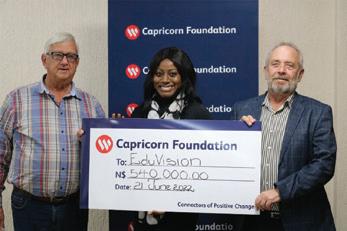
The Namibian Agronomic Board (NAB) and the Agricultural Bank of Namibia signed a Memorandum of Understanding to collaborate with interventions aimed at developing the agronomic and horticultural industry in Namibia.
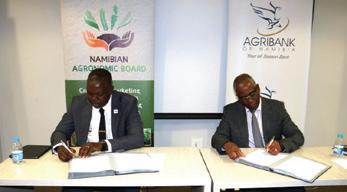
“As a Connector of Positive Change, the Capricorn Foundation is proud to have enabled Response Action Based Organisation to carry out its mandate and support the curb of violence in our communities,” said Marlize Horn, Executive Officer of the Capricorn Foundation.
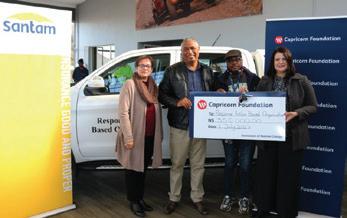
EduVision has been on the quest to change the narrative to make online learning more accessible since 2018. The Capricorn Foundation has announced its continued support to EduVision with a further contribution of N$540 000 to ensure that EduVision can continue with its online learning service and that more learners from remote schools can benefit from their service.
The first locally trained Physiotherapists was celebrated. MVA Fund invested N$4,5 million as seed funding to establish Physiotherapy and Occupational Therapy studies at UNAM. Since its inception in 2018, the Fund further supported 15 students with bursaries.
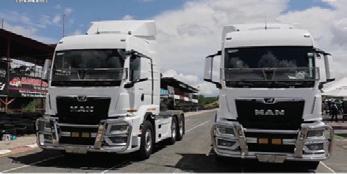
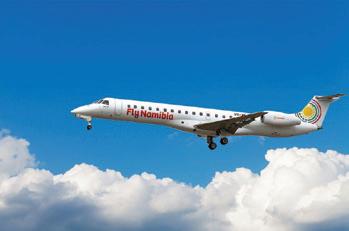
It is not by chance that the Authority has reached a 10-year milestone with a lot to celebrate. CRAN opened its doors with only 5 employees in 2011 and now has a workforce of 63 employees and boasts a mere 2% staff turnover.
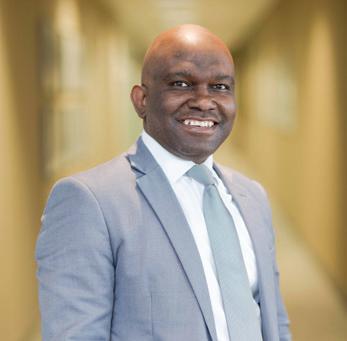
A Joint Trade Committee meeting was held between Namibia and Angola. "The focus of the meeting was to review the terms of reference, exchange and analyse the list of products of export interest between the two parties".
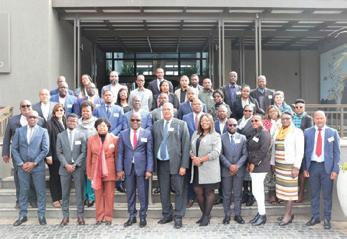
NTN Referenced in the Johannesburg Stock Exchange results report was referenced. This was truly a proud moment for us.
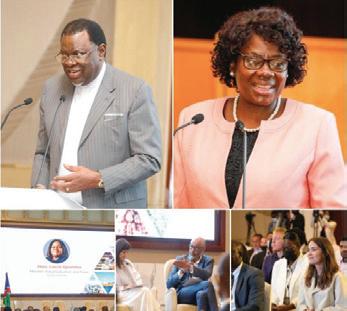
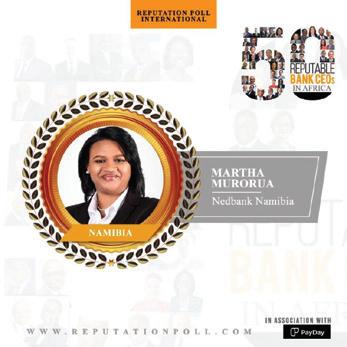

5 April 2022: Global Finance announced its 29th annual awards for the World’s Best Banks, with FNB Namibia announced as the overall Best Bank in Namibia for the third consecutive year.
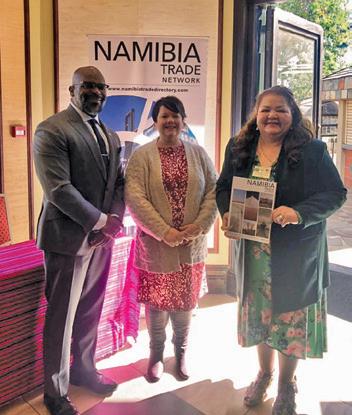
The mission aimed to promote trade and investment in the following sectors: Education; Mining and Mineral Beneficiation; Logistics and Container Terminal; Agriculture and Agro-processing; Low-cost Housing; Tourism and Hospitality; Water and Power Generation; Creative industry and Culture; Pharmaceutical and Medical supplies, including Herbal Medicine; Marine Resources; Natural Cosmetics, etc.
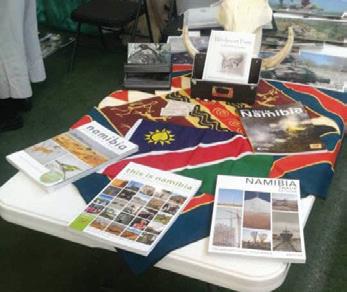
The Government of the Republic of Namibia hosted the #Namibia #Investment Summit, under the patronage of His Excellency Dr. Hage G. Geingob, President of the Republic of Namibia on the margins of Expo 2020 Dubai. Namibia provided insight on key areas of growth and investment opportunities across the following sectors: Renewable Energy, Agribusiness, Tourism, Infrastructure and Mining.
Agrimark is part of Kaap Agri Namibia. "Kaap Agri is an agricultural services group that distributes goods and services mainly to the agricultural sector, but also to the general public."


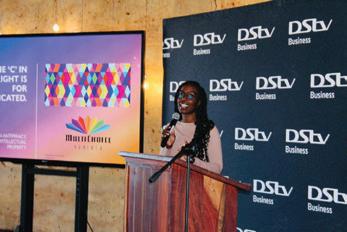

“MultiChoice,
The AMV3 is the seventh diamond mining vessel of Debmarine Namibia. Debmarine Namibia is Namibia’s leading marine diamond mining company. It is also recognised as a world leader in marine diamond exploration and mining technology.
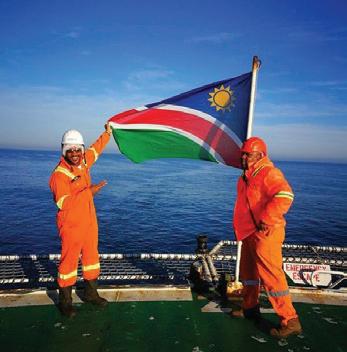
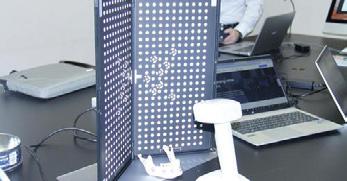
Matomola explains that the two pieces of legislation consolidate and harmonise the laws that would regulate non-banking financial institutions, financial intermediaries as well as financial markets in Namibia.

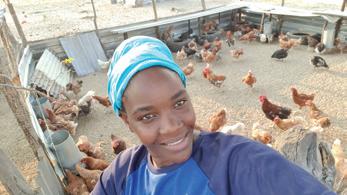
The University of Namibia's anatomical unit introduced 3D printing. Innovation is key to the development of the education sector.
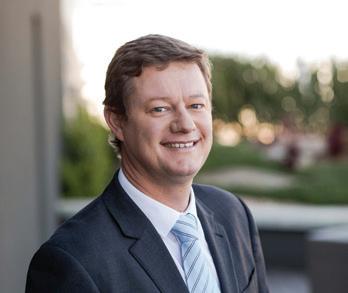
The proceeds of the green bonds will be allocated to eligible green loans applied towards Namibian green buildings and
The Development Bank of Namibia has announced a facility to finance climate change adaptation, bolstering its long track record of finance with beneficial environmental and social initiatives.
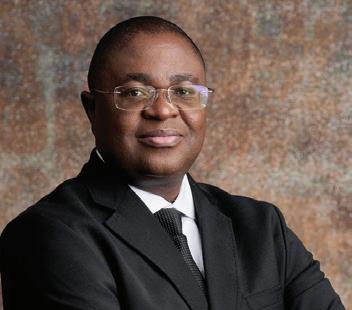
Global Finance magazine
February 2022:
RMB Namibia as the Best Treasury and Cash Management Bank and RMB as the Best Bank for Payments and Collections in Africa. Philip Chapman, RMB Namibia CEO said: “the Best Treasury and Cash Management Bank Award reflects the unique and distinguished rank which RMB Namibia enjoys in this area of our market, as well the customer trust in our services and the

A joint statement by NAMFISA and the Bank of Namibia announced that insurers and banks can now accommodate multiple sessions on a single life insurance policy.
FirstRand Namibia has launched the FirstJob Internship Programme in line with the leading financial services group’s purpose and broader Namibian talent development drive, and especially towards starting to address the cries of the many Namibian graduates without work and professional mentorship.
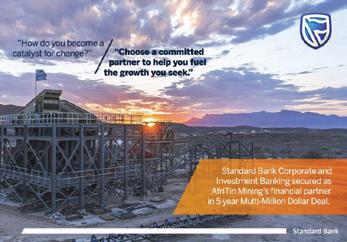
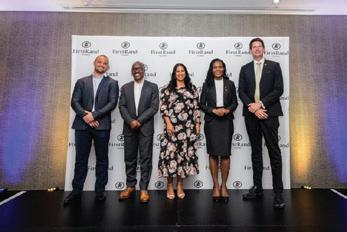
On
The Manica Group Namibia has been investing in Namibia's education system since 2005 in the form of an apprenticeship scheme called CATS (Commercial Advancement Training Scheme).
A group of Manica employees recently completed their mentorship program to ensure they are equipped in taking on the role of guiding apprentices.
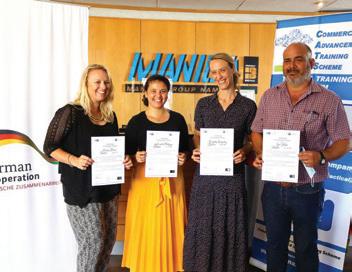
TransNamib and the National Petroleum Corporation of Namibia (NAMCOR), on Monday, the 6th of September, signed a Rail Transport agreement in order for TransNamib to move more petroleum products by rail.
“The signing of the rail transport agreement between the two entities is a milestone for TransNamib – it is the first time for TransNamib to sign a rail transport agreement with a fuel company since the establishment of the company," said the CEO of TransNamib
Johny Smith
Covid-19 Pandemic.

Standard Bank Corporate & Investment Banking have been secured as AfriTin Mining's preferred financing partner for 5 years. AfriTin holds a portfolio of production, development and exploration assets in Africa. Its vision is to leverage profitable pilot plant operations in tin.
Namibian Ports Authority (Namport) signs a Memorandum of Understanding with the Port of Rotterdam (PoR), readying itself to become the Green Hydrogen Export Hub for Europe and the rest of the World.
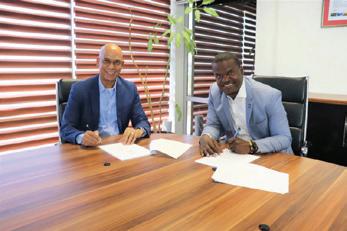
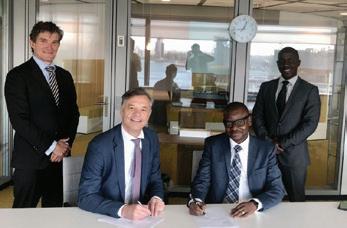
Our lives have changed so much over the last 2 years which meant service and product offerings had to keep up. It is positive to see this with a product such as DStv where its App and #Showmax offer customers the luxury of taking entertainment on holiday.
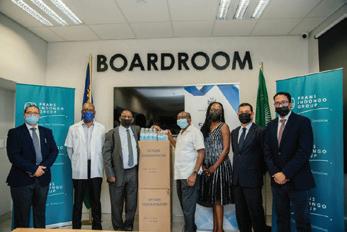
TRUST SUPPORTS GOVERNMENT’S FIGHT AGAINST COVID-19 WITH A N$1 MILLION DONATION TO THEOctober 13th, the Frans Indongo Group (FIG), through the Frans Indongo Trust, officially handed over a donation of One Million Namibian dollars to the Ministry of Health and Social Services Namibia as part of the Group's contribution to the ongoing national response against the
That’s our mantra at Venture Media. Sharing stories, information and inspiration to an audience that understand and value why certain things matter.
Why conservation, tourism, people & communities, businesses and ethics matter.
How these elements interrelate and how we can bring about change, contribute to the world and support each other. Whether for an entire nation, an industry, a community, or even just an individual. We find, explore, discover, teach, showcase and share stories that matter.
As part of our on-going efforts to share these stories far and wide, we are looking for partners that want to accompany us on this journey. We would thus like to propose a “Stories that Matter” series catered to your product and audience, whereby we will create a series of monthly Content Baskets. Each month we will cover one story (as predetermined between ourselves and your team) and capture, create and distribute it in the following formats and across all our (and your) available channels.