DIFFERENT TYPES OF BRIBERY ACROSS BUSINESS SECTORS
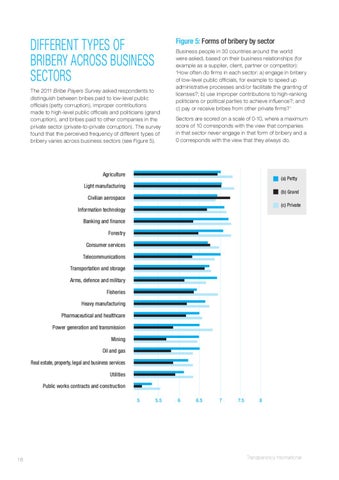
Figure 5: Forms of bribery by sector
The 2011 Bribe Payers Survey asked respondents to distinguish between bribes paid to low-level public officials (petty corruption), improper contributions made to high-level public officials and politicians (grand corruption), and bribes paid to other companies in the private sector (private-to-private corruption). The survey found that the perceived frequency of different types of bribery varies across business sectors (see Figure 5).
Business people in 30 countries around the world were asked, based on their business relationships (for example as a supplier, client, partner or competitor): ‘How often do firms in each sector: a) engage in bribery of low-level public officials, for example to speed up administrative processes and/or facilitate the granting of licenses?; b) use improper contributions to high-ranking politicians or political parties to achieve influence?; and c) pay or receive bribes from other private firms?’ Sectors are scored on a scale of 0-10, where a maximum score of 10 corresponds with the view that companies in that sector never engage in that form of bribery and a 0 corresponds with the view that they always do.
Agriculture
(a) Petty
Light manufacturing
(b) Grand
Civilian aerospace
(c) Private
Information technology Banking and finance Forestry Consumer services Telecommunications Transportation and storage Arms, defence and military Fisheries Heavy manufacturing Pharmaceutical and healthcare Power generation and transmission Mining Oil and gas Real estate, property, legal and business services Utilities Public works contracts and construction 5
18
5.5
6
6.5
7
7.5
8
Transparency International