

(read all about ACC Beyond in English on pages 6 & 27!)
The Armenian Community Centre of Toronto invites you all to attend the Groundbreaking Ceremony




(read all about ACC Beyond in English on pages 6 & 27!)
The Armenian Community Centre of Toronto invites you all to attend the Groundbreaking Ceremony
TORONTOHYE—On Wednesday, March 5, AGBU Toronto marked International Women’s Day with a dynamic panel discussion on women’s brilliance and resilience, bringing together accomplished Armenian women from diverse fields. The event, held at AGBU’s Toronto office, featured an engaging conversation led by moderator Kealy Wharram, a top-performing real estate broker. The discussion centered on the experiences and achievements of three Armenian women excelling in competitive industries: Dr. Talar Hopyan, Dr. Adrina Bardekjian, and Isabelle Davidian.
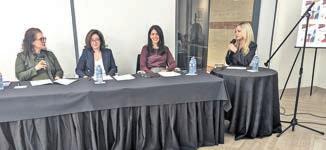
Dr. Talar Hopyan, a neuropsychologist and global head of clinical surveillance and training at Syneos Health, shared insights from her extensive career in scientific research and medical strategy. With a doctorate in Psychology, Biology, and Behavior from the University of Toronto, Dr. Hopyan’s expertise spans neurocognitive assessments and pharmacodynamic measures in early-phase clinical trials.
Dr. Adrina Bardekjian, an urban forestry researcher and director of research and engagement at Tree Canada, highlighted her work in environmental conservation and gender equity in arboriculture. An adjunct professor at the University of Toronto’s Institute of Forestry & Conservation, Dr. Bardekjian has dedicated two decades to urban forestry and has produced publications and short films aimed at making environmental research accessible to wider audiences.
Isabelle Davidian, vice president of strategic accounts at Ideon Media, brought her experience from the digital media and advertising industry. Davidian has held leadership roles in sales and marketing at companies like Cue Digital and Postmedia Network, playing a pivotal role in shaping digital advertising strategies.
Wharram skillfully guided the conversation, allowing each
panelist to share personal and professional experiences, challenges faced, and lessons learned. The event was lauded for its depth and impact, leaving attendees inspired by the panelists’ journeys and accomplishments.
In addition to the discussion, AGBU Toronto celebrated International Women’s Day with an art exhibition featuring the works of Dikie (Tundayan) Benglian, a Toronto-based watercolor artist. Benglian, who began painting in 2018 after retiring, showcased a collection of nature-inspired pieces that captured the audience’s attention. Her artwork, influenced by her deep appreciation for nature’s beauty—sunsets, sunrises, and light filtering through clouds and trees—added an artistic dimension to the celebration.
“I am inspired by nature's miracles, as well as scenes that evoke emotion,” Benglian shared. “I am always trying to see things with fresh eyes and to improve my skills.”
The panel discussion and art exhibition exemplified AGBU Toronto’s commitment to celebrating women’s achievements and fostering meaningful conversations about leadership and resilience. Attendees left the event feeling empowered, reflecting on the inspiring stories of the panelists and the artistic expression of Benglian’s work. ֎

editor@torontohye.ca
Publisher Torontohye Communications Inc. info@torontohye.ca
Editor Rupen Janbazian editor@torontohye.ca
Graphic designer/Layout editor Ara Ter Haroutunian ara@torontohye.ca
Associate editor/Staff writer Diroug Markarian Garabedian diroug@torontohye.ca
Associate editor/Armenia correspondent Salpy Saghdejian salpy@torontohye.ca
Administrator Missak Kawlakian missak@torontohye.ca
Advisor Harout Manougian harout@torontohye.ca
Advertisements ads@torontohye.ca Branding Proper Company proper.am
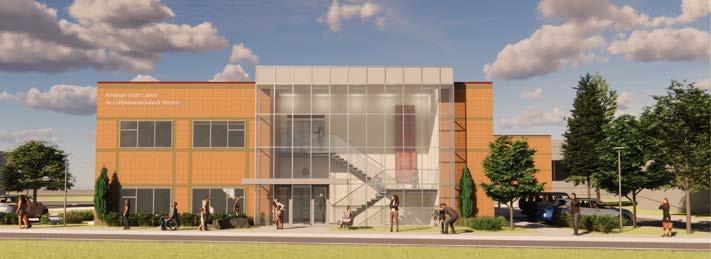
TORONTO–The Armenian Community Centre of Toronto (ACC) has announced a significant expansion of its facilities to enhance services and create a more inclusive space for future generations. As part of the ACC Beyond campaign, this project will reinforce the Centre’s role as a hub for Armenian culture, education, and community engagement.
Founded in 1967, the ACC has been a cornerstone of the ArmenianCanadian community for over five decades, providing educational, cultural, athletic, and social programs. In 1979, the Centre relocated to its current location at 45 Hallcrown Place, marking a significant milestone in its growth. That same year, the ARS Armenian Private School (nursery through grade 12) opened its doors, further strengthening the community’s educational foundation. The need for more space led to the constructing of a new building at 50 Hallcrown Place, which opened in 2004 and became home to the Armenian Youth Centre (AYC), a youth engagement and activities hub. In 2010, major renovations at 45 Hallcrown Place introduced new office spaces, an upgraded lobby, and The Hallcrown Banquet Hall.
The expansion project will now add a two-story facility with a basement totaling 16,000 square feet. It will feature eight modern training rooms, a robotics lab, a multipurpose arts studio, an expanded cafeteria and kitchen, a student lounge, and a welcoming lobby. Designed to be fully accessible, the new space will ensure a barrier-free environment for all visitors. Future provisions for additional training rooms are also included in the plan.
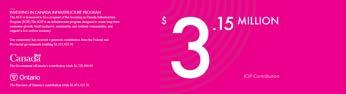
The ACC has secured funding from the Investing in Canada Infrastructure Program (ICIP), which supports economic growth and resilient communities. The Centre has received a combined contribution of $3,153,923.30 from the federal and provincial governments, with the Government of Canada providing $1,720,400.00 and the Province of Ontario contributing $1,433,523.30. In addition to government funding, the ACC Beyond campaign offers sponsorship opportunities, including naming rights for rooms in the new expansion. Donations over $500 will be acknowledged on the Donor Recognition Wall, while alumni contributions exceeding $100 will be honored in the Student Lounge.
“We are thrilled to upgrade our space to serve you better and create an even more welcoming environment for future generations,” the ACC states in a release. The Centre encourages individuals and businesses to contribute to this historic project by making a one-time donation or pledging support over three years. These contributions will help establish an enhanced environment where Armenian traditions and contemporary Canadian life seamlessly blend.
For over 50 years, the ACC has been a focal point for Armenian culture and identity in Canada, offering educational initiatives through the ARS Armenian Private School, cultural programming through Hamazkayin’s Klatsor chapter, and athletic and scouting opportunities through
Homenetmen Toronto. The Centre also houses vital organizations such as the AYF Canada Simon Zavarian chapter, the Armenian National Committee of Toronto (ANCT), and the ARS Toronto Roubina chapter, all of which contribute to community empowerment.
Community members can support the ACC Beyond campaign by making a donation. Details can be found in the comments. Every contribution brings the Centre closer to its goal of building a stronger, more dynamic Armenian community in Toronto. ֎

















MEDICAL CENTRE & PHARMACY
Dr. Rupert Abdalian Gastroenteology
Dr. Mari Marinosyan Family Physician
Dr. Omayma Fouda Family Physician
Dr. I. Manhas Family Physician
Dr. Virgil Huang Pediatrician
Dr. M. Seifollahi
Family Physician
Dr. M. Teitelbaum Family Physician
Physioworx Physiotherapy


By Sophia Alexanian
A few months ago, I interviewed Dr. Victoria Rowe about her dissertation on Armenian women’s writing in the late 19th and early 20th centuries. Our conversation, featured in the February 2025 issue of Torontohye, left me deeply impressed by her research—and curious. Was there any recent analysis of modern Armenian women’s writing?
Google Scholar didn’t offer many answers, so I decided to take matters into my own hands and analyze Armenian women’s writing myself.
Scope of analysis
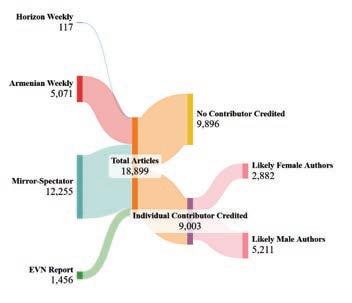
To keep my research focused and manageable, I narrowed the scope of my analysis to my immediate counterparts: Armenian women who write in English for Armenian news publications. I also limited my dataset to articles that were easily accessible online and published in recent years. To gather this data, I fully scraped three websites—EVN Report, the Armenian Weekly, and the Armenian MirrorSpectator—and partially scraped Horizon Weekly. The following graphic illustrates the number of articles collected from each source, the proportion of pieces credited to individual contributors, and the likely gender of those contributors.
Limitations of data collected
For each article scraped, I recorded key details: the published date, URL, author’s name, and also keywords. The keywords were generated using a simple form of natural language processing (NLP)—a method that enables computers to process and interpret human language.
Since I was working with a fairly large dataset without specialized hardware, my analysis remained surface-level. Instead of diving into the nuances of tone or perspective, I focused solely on identifying common keywords in each article. For example, I could track how often “EU” appeared as a major keyword, but not whether Armenian women writers were praising or critiquing the EU’s relationship with Armenia.
Limitations of gendering the dataset
Once I had standardized data and extracted the authors' first names, I needed to determine the likely gender of each writer to focus specifically on Armenian women’s contributions.
This process came with some inherent challenges. First, I assumed a binary gender classification (‘male’ or ‘female’), which meant I wasn’t accounting for possible non-binary contributors. Second, I assumed an author’s gender aligned with the most commonly associated gender of their first name—a method that doesn’t account for gender-neutral names (including gender-neutral names like ‘Sam’ and using first initials like ‘C. S. Lewis’). Finally, my analysis only included articles where a named individual was credited as the author. This means that pieces written by women as part of editorial teams, collective statements, or anonymous contributions were not included in this analysis.
I hoped that my dataset was large enough that occasional anomalies would not significantly skew the results.
When it came to gendering the dataset, I couldn’t rely on standard services for large-scale name classification. One reason was cost—many of these services charge fees that add up quickly. But more importantly, most of them struggle with gendering Armenian names. This is likely due to the skewed dataset they use— one popular service has only 2,560 Armenian names in its dataset, compared to hundreds of thousands for anglophone countries (Canada: 26,187, United Kingdom: 105,368, United States: 169,208). Any AI-powered service needs to be trained on lots of data to be accurate, and a biased sampling of data can lead to inaccuracies.
I found that OpenAI’s GPT chat models were able to accurately gender both anglophone names and Armenian names, so that’s what I settled on using.
Gendering thousands of author names ended up costing less than a cup of Tim Hortons coffee.
Biases and limitations when categorizing keywords
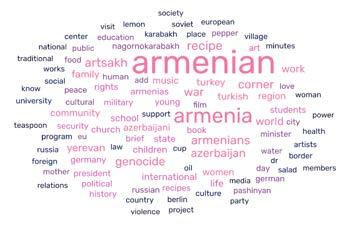
To get a quick visual overview of the major keywords and themes in Armenian women’s writing, I put together a word cloud (pictured below). However, I was not satisfied with just seeing which words appeared most often—I wanted a deeper understanding of how different topics compared in prominence.
To do this, I categorized the most frequently occurring keywords into broader themes. This allowed me to analyze what Armenian women were writing about when they covered geographical locations, socio-political issues, and cultural matters. Sorting the keywords into categories helped reveal patterns, but it also introduced a level of subjectivity, as I had to decide which words fit where.
The method I used for categorizing keywords was inevitably shaped by my own biases. I created a list of categories based on patterns I noticed in the most frequently used keywords (countries, cities, blockade and conflict, political terms, economic terms, etc). I chose ‘seed’ words for each category and set a similarity threshold to determine which terms would be grouped together.
While I did iterate and experiment with different choices for categories, seed words, and similarity thresholds until I was satisfied with the accuracy of the result, since there was no set standard I followed, there is inevitably room for improvement. →
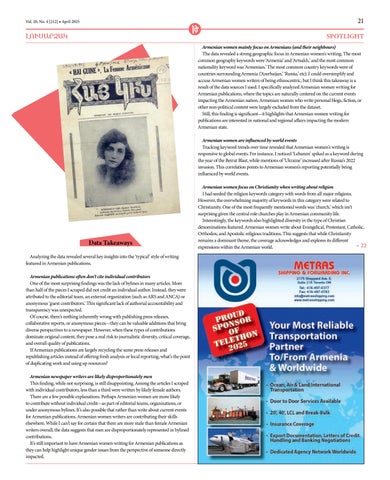
Analyzing the data revealed several key insights into the ‘typical’ style of writing featured in Armenian publications.
Armenian publications often don’t cite individual contributors
One of the most surprising findings was the lack of bylines in many articles. More than half of the pieces I scraped did not credit an individual author. Instead, they were attributed to the editorial team, an external organization (such as ARS and ANCA) or anonymous ‘guest contributors.’ This significant lack of authorial accountability and transparency was unexpected.
Of course, there’s nothing inherently wrong with publishing press releases, collaborative reports, or anonymous pieces—they can be valuable additions that bring diverse perspectives to a newspaper. However, when these types of contributions dominate original content, they pose a real risk to journalistic diversity, critical coverage, and overall quality of publications.
If Armenian publications are largely recycling the same press releases and republishing articles instead of offering fresh analysis or local reporting, what’s the point of duplicating work and using up resources?
Armenian newspaper writers are likely disproportionately men
This finding, while not surprising, is still disappointing. Among the articles I scraped with individual contributors, less than a third were written by likely female authors. There are a few possible explanations. Perhaps Armenian women are more likely to contribute without individual credit—as part of editorial teams, organizations, or under anonymous bylines. It’s also possible that rather than write about current events for Armenian publications, Armenian women writers are contributing their skills elsewhere. While I can’t say for certain that there are more male than female Armenian writers overall, the data suggests that men are disproportionately represented in bylined contributions.
It’s still important to have Armenian women writing for Armenian publications as they can help highlight unique gender issues from the perspective of someone directly impacted.
Armenian women mainly focus on Armenians (and their neighbours)
The data revealed a strong geographic focus in Armenian women’s writing. The most common geography keywords were ‘Armenia’ and ‘Artsakh,’ and the most common nationality keyword was ‘Armenian.’ The most common country keywords were of countries surrounding Armenia (‘Azerbaijan,’ ‘Russia,’ etc). I could oversimplify and accuse Armenian women writers of being ethnocentric, but I think this takeaway is a result of the data sources I used. I specifically analyzed Armenian women writing for Armenian publications, where the topics are naturally centered on the current events impacting the Armenian nation. Armenian women who write personal blogs, fiction, or other non-political content were largely excluded from the dataset.
Still, this finding is significant—it highlights that Armenian women writing for publications are interested in national and regional affairs impacting the modern Armenian state.
Armenian women are influenced by world events
Tracking keyword trends over time revealed that Armenian women’s writing is responsive to global events. For instance, I noticed ‘Lebanon’ spiked as a keyword during the year of the Beirut Blast, while mentions of ‘Ukraine’ increased after Russia’s 2022 invasion. This correlation points to Armenian women’s reporting potentially being influenced by world events.
Armenian women focus on Christianity when writing about religion
I had seeded the religion keywords category with words from all major religions. However, the overwhelming majority of keywords in this category were related to Christianity. One of the most frequently mentioned words was ‘church,’ which isn’t surprising given the central role churches play in Armenian community life.
Interestingly, the keywords also highlighted diversity in the type of Christian denominations featured. Armenian women write about Evangelical, Protestant, Catholic, Orthodox, and Apostolic religious traditions. This suggests that while Christianity remains a dominant theme, the coverage acknowledges and explores its different expressions within the Armenian world. → 22

There are several ways to expand on this research and develop a more comprehensive analysis of Armenian writing.
Larger dataset (i.e., scraping more websites)
Expanding the dataset would allow for stronger conclusions about broader trends in Armenian women’s writing. This would involve scraping more websites (which would require creating unique web scrapers for each one). Fortunately, my existing data processing pipelines are scalable to be able to integrate new data from websites.
Analyzing Armenian women’s writing in Armenian, Russian, French, and other languages
Since my study was focused on English-language Armenian writing, it naturally excluded a large community of Armenian women who write in Armenian, Russian, French, and other languages. Expanding our analysis to the global community of Armenian women writers would be a natural next step.
To do this, we would need to scrape the websites of non-English publications. We would also need NLP methods capable of extracting and categorizing keywords in nonLatin languages like Armenian and Russian.
Deeper analysis of article content
I lacked the skill to do a deep dive into the tone and perspective taken on topics. I would love to collaborate with someone more skilled in advanced NLP techniques to write scripts capable of detecting sentiment, tone, and perspective within the articles.
For example, while my analysis showed that ‘church’ is a common topic, it couldn’t determine whether Armenian women were writing positively about community experiences, critiquing certain traditions, or engaging with religious themes in other ways. Automating this type of deeper analysis would help reveal broader patterns in how key topics are approached.
What can we do with what we know so far?
While my analysis is just a starting point, we do have some key takeaways that allow us to take action to improve the quality and diversity of writing in Armenian publications.
1. Increase authorial accountability
Publications should make a greater effort to credit individual authors in bylines. This would help build trust with readership, give credit to the writers who work hard to produce original content, and allow us to more easily gauge the level of diversity in newspaper contributors. Readers can also play a role—if they notice their favorite publication regularly omitting author names, they should reach out to the editorial team and express their concerns.
2. Encourage more Armenian women to write
To ensure that Armenian women’s voices are represented, financial and social support is crucial. Having grants and honorariums available to writers would remove some of the barriers to devoting time to writing. As well, specifically soliciting women’s perspectives on issues, prioritizing gender parity on editorial teams, and having mentorship and guidance available would encourage women to contribute to their local Armenian papers.
3. Invest in the study of the modern
We should direct more resources towards analyzing modern Armenian cultural products. A lot of Armenian studies research seems to focus on medieval manuscripts and the 1915 Genocide; however, cultural studies could benefit from analyzing recent trends. The last 30 years of Armenian history have been packed with important milestones and events, each of which has inspired news coverage and cultural output. It is worthwhile to critically examine the cultural landscape these outputs have created and decide if the status quo best serves the Armenian community.
Armenian women’s writing is an essential cultural product of modern Armenian society. The trends in media coverage reveal both strengths and risks, and it’s up to the broader Armenian community to continue researching these patterns and implementing meaningful changes. The creation of quality cultural publications— where women’s voices are equitably represented—is a shared responsibility of the collective community. ֎
ACC Beyond... ← 1
50 Hallcrown Place-ի
•
•
•
•
•
•
•
•
•
•
(cinnamon)
1. (գոյ.) ելեկտրոնիկ
2.
5.
7. (գոյ.)
8.
10. (գոյ.)
12. (գոյ.)
14. (գոյ.)
Ruben thinks of a three-digit positive number in which the middle digit is zero. He says that the sum of the first and last digits is 11. When the digits of the number are reversed, the new number is 495 greater than the original. Can you figure out the number Ruben was thinking of?
ազնիւ
9. (գոյ.) արտ, գետին, ցամաք,
Sevana has twice as much money as Sally, and Sally has three times as much as Anabel. Altogether, the three of them have $1,500,000. How much money does Sally have?
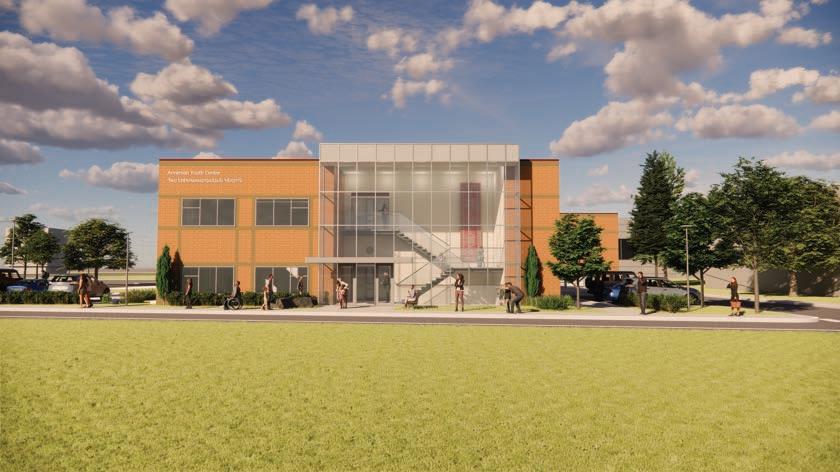
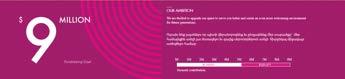
For over 50 years, the Armenian Community Centre of Toronto has been the heart of our community — a place where culture thrives, friendships grow, and traditions are passed down. Now, it’s time to take the next step.
We are proud to introduce the ACC Beyond Fundraising Campaign, a transformative project for our home at 50 Hallcrown Place.
We are thrilled to upgrade our space to serve you better and create an even more welcoming environment for future generations.
More details can be found by visiting www.accbeyond.com
This journey starts today, and we need you to be part of it. Will you help us take ACC Beyond?
քայլին: Հպարտութեամբ կը յայտարարենք ACC Beyond հանգանակային արշաւի մեկնարկը, որմէ գոյացած գումարը պիտի տրամադրուի 50 Hallcrown Placeի մեր տունը փոխակերպող
նախագիծին:
Պիտի վերահարթենք մեր տարածքը՝ աւելի լաւ
ծառայելու համար ձեզի եւ աւելի հիւրընկալ միջավայր ստեղծելու համար ապագայ
սերունդներուն:
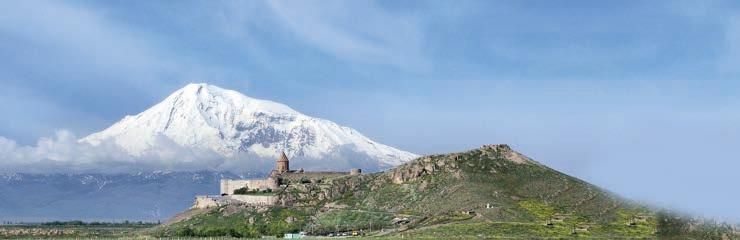
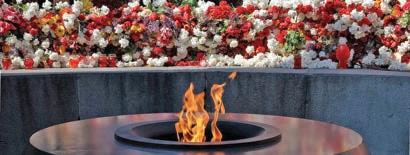
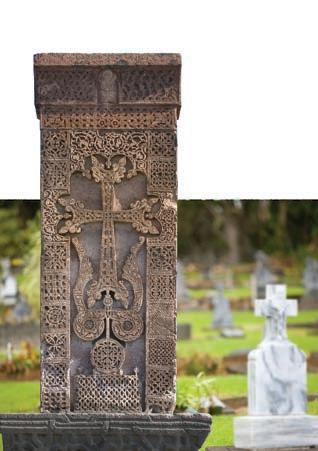
In Tribute to Armenia, as symbolized by Holy Mt. Ararat, and to the Armenian people who were the first to embrace and adopt Christianity as a State religion in 301, and the first nation to be crucified in 19151923 falling victim to the first genocide of the 20th century. For the glory of a reborn free Armenia world-wide, whose generations of sons and daughters continue to believe in justice world-wide.

Group of Cemeteries For Your Personalized Appointment
Contact: Rosa Crognale
Michelle Richards Tel: 416-899-1174
Tel: 416-990-6516
Email: mrichards@arbormemorial.com
Email: rcrogn@mountpleasantgroup.com
Maria Larin Tel: 647-909-1881
Email: mlarin@arbormemorial.com
Sheppard Avenue East Scarborough, Ontario MIS 1T3
Contact: Tracy Burton
Tel: 416-293-5211
Email: directors@ogdenfh.com
Goodmark Place, Suite 1a Toronto ON M9W 6S2
Contact: Fabian Di Maria
Tel: 416-566-6486
