
KLEIN Numolux Group CEO SA’S TOURISM RANKING Are we #1? THE NEW ENERGY PLAN What it means for you WOMEN IN BLUE Going beyond the call of duty STRIVING FOR EXELLENCE

HILTON

SEPTEMBER | 2022

Visit www.bcx.co.za for more. Technology is a key driver to create a mobility ecosystem that is more effective and collaborative. Promoting interoperability ensures a better service for people and goods. With BCX, you can modernise outdated transport networks. Enable transportation of the future

Reimagine transport

#RenewingSociety Our most important customer, is yours.

September is all about heritage, democracy and the environment

Sharing the profits of traditional knowledge
The hiddens gems to visit in South Africa
A new path to increase energy capacity
Prof Pamela Naidoo: Keeping hearts healthy
Fostering social cohesion and building the nation
SA is Africa’s largest travel and tourism economy
36 | Public Service Month
32 | Trailblazer
48 | Tourism Month
62 | Regional Focus
60 | In Other News
26 | Royalties, Rooibos and the Khoisan
52 | South Africa’s tourism ranking
Plastic recycling: Cleaning up is on the up
4 | Public Sector Leaders | September 2022 Contents SEPTEMBER 2022 | ISSUE 19
The five wealthiest women in the country
Deputy Minister of Public Service and Administration: Dr Chana Pilane-Majake

President Ramaphosa addresses the nation on economic recovery
68 | Legal Matters
22 | Heritage Month Feature
56 | Top tourist destinations
66 | Financial Fitness
Changes transforming South Africa’s public service
58 | International Translation Day
24 | South African Heritage Resource Agency (SAHRA)
12 | Cover Story
70 | Upcoming Events
Women in blue: The public servants creating safer communities
Government Employee Pension Fund: Securing a new economic future
Probation: The responsibilities of companies and employees
64 | New Energy Plan
72 | Richest women in South Africa
Interview with Numolux CEO, Hilton Klein
Features
Editorial 5612
Bridging language barriers to create an inclusive judiciary
10 | Addressing The Nation
34 | Women in Leadership
Western Cape: Unlocking future growth
Protecting South heritage to promote cultural tourism
38 | Focus on SAPS
The importance of the tourism sector
Public Sector Leaders | September 2022 | 5enquiries@gems.gov.za0860www.gems.gov.za004367 33165 today! Join a medical Scheme that understands the needs of the South African Family and enjoy rich benefits on Tanzanite One and Emerald Value Option (EVO).


6 | Public Sector Leaders | September 2022 PUBLIC SECTOR LEADERS The Digimag For Leaders In The South African Public Sector Advertising DistributionSales,andSubscriptions Top Media & Communications (Pty) Ltd Tel: 086 000 Info@topco.co.za9590| www.topco.co.za CEO Ralf Fletcher TOPCO ProductionSTUDIODirector Van Fletcher van.fletcher@topco.co.za Group Editor Fiona Wakelin fiona.wakelin@topco.co.za Assistant Editors Koketso sinazo.mkoko@topco.co.zaSinazokoketso.mamabolo@topco.co.zaMamaboloMkoko Contributors Jessie Taylor Silke Rathbone Graphic Designer Nicola nicola.peacock@topco.co.zaPeacock Traffic Manager Daniel artwork@topco.co.zaBouwer SALES National Project Manager Emlyn Dunn Tel: 072 126 emlyn.dunn@topco.co.za3962 Brand Coordinators Sidney sidney.phiri@topco.co.zaPhiri Mandla mandla.mangena@topco.co.zaMangena Printers LAWPrint Images iStock / GCIS | Flickr Cover Image: Timothy Barlin Head Office Top Media & Communications (Pty) Ltd T/A Topco Media Elkay House, 186 Loop St Cape Town Tel: +27 86 000 9590 Fax: +27 21 423 7576 Email: Website:info@topco.co.zawww.topco.co.za DISCLAIMER All rights reserved. No part of this publication may be reproduced, stored in a retrieval system or transmitted, in any form or by any means, electronic, mechanical, photocopying, recording or otherwise, without the prior written consent of Top Media & Communications (Pty) Ltd T/A Topco Media. Reg. No. 2011/105655/07. While every care has been taken when compiling this publication, the publishers, editor and contributors accept no responsibility for any consequences arising from any errors or emissions. CREDITS 4858 64


PAYINRANDS Book with www.woodford.co.za. Pick-Up in over 1000 Destinations Worldwide. Abroad?TravellingBookwithWoodfordCarHireandPick-UpinLondon. South Africa’s largest independent car hire company.


Whether you are in the public sector, the private sector, supply chain or an interested individual, PSL has something for you.
edition of PSL focuses on Heritage Month as well as Public Service Month, and on the front cover we feature the CEO of Numolux Group, Hilton Klein.
ThisSantos.September
We hope you enjoy the read!
EDITOR’S LETTER BY FIONA WAKELIN

FIONA WAKELIN | GROUP EDITOR


In his letter to the country written on 5 September - From the Desk of the Presidency – His Excellency, President Ramaphosa, focused on job creation and the green shoots of optimism that are starting to surface in our country’s economy:
Inside, our Trailblazer is Prof Pamela Naidoo, CEO of the Heart and Stroke Foundation and our Women in Leadership features Deputy Public Services Minister Dr Chana Pilane-Majake. We celebrate Public Service Month by zooming in on the amazing work being done by women in SAPS - and take an in depth look at our tourism sector. South Africa has an incredibly rich cultural and natural heritage which we foreground in a number of articles celebrating Heritage Month. Our Regional Focus in September is the Western Cape and in this article we bring you up to date on the exciting developments in this province. The National Energy Plan feature addresses one of the issues uppermost in our collective minds as we head into another round of load-shedding.
Welcome to the September edition of Public Sector Leaders (PSL)
As part of his busy schedule, His Excellency recently attended the Cabinet Lekgotla held at the Sefako Makgatho Presidential Guest House in Pretoria and the annual South African Police Service (SAPS) Commemoration Day 2022 which took place at the SAPS Memorial Site, Union Buildings, Pretoria. President Ramaphosa also addressed the National Conference on Local Governance convened by the SA Human Rights Commission and travelled to Luanda, Angola, to pay respects to the late former Angolan President, José Eduardo dos
“Statistics South Africa recorded a decline in the unemployment rate for the second quarter of 2021. Significantly, their measurement shows that the actual number of people employed rose from 14.5 million people in the fourth quarter of 2021 to 15.5 million in the second quarter of 2022. This is an encouraging increase of much-needed jobs over the first half of this year. These jobs were mainly created in sectors such as community and social services, trade, finance and, notably, construction. Of course, much more needs to be done if we are to make a significant dent in our country’s high unemployment rate. At the same time, these figures indicate that the priority areas of the Economic Reconstruction and Recovery Plan – such as mass public employment, economic reform and infrastructure development – are having an impact on job creation,” - President Ramaphosa.
Letter from the Editor
topco mediaBrought to you by Join the platformworld’sforwomen who lead. topbusinesswomen.co.za OCT12-132022 topbusinesswomen.co.za REGISTER NOW

10 | Public Sector Leaders | September 2022 ADDRESSING THE NATION
BY FIONA WAKELIN
“These jobs were mainly created in sectors such as community and social services, trade, finance and, notably, construction.
On RecoveryRoadTheTo
“Of course, much more needs to be done if we are to make a significant dent in our country’s high unemployment rate.
His Excellency begins this first letter of the month from the desk of the Presidency by acknowledging that over the last few years, South Africans have had to contend with slow growth and rising unemployment – which had been worsened by the pandemic, an attempted insurrection unrest in July last year, and, earlier this year, severe floods in parts of KwaZulu-Natal, Eastern Cape and North West. All of which was compounded by the energy crisis. There are, however, signs of green shoots and indications that our economy is showing encouraging signs of recovery, with the latest employment figures indicating there are grounds for cautious “Statisticsoptimism.SouthAfrica recorded a decline in the unemployment rate for the second quarter of 2021. Significantly, their measurement shows that the actual number of people employed rose from 14.5 million people in the fourth quarter of 2021 to 15.5 million in the second quarter of 2022. This is an encouraging increase of muchneeded jobs over the first half of this year.
Ramaphosa’s letter to the nation on 5 September focused on job creation – and the optimistic signs of economic recovery in the country.
President

Good news in this sector came from the Construction Industry Development Board which recently noted that
“The growth in employment, together with other promising signs of recovery, should encourage us to push ahead with the reforms and implement our Economic Reconstruction and Recovery Plan to unlock investment and growth. It should encourage all social partners to work more closely and with greater urgency and purpose to achieve faster growth and create more jobs,” – His Excellency Ramaphosa. n


President Ramaphosa reflects on infrastructure development and investment being among the key priorities of the nation’s recovery plan – which makes the growth in jobs in the construction area particularly encouraging. The government’s commitment to growth in this sector was reflected in the February budget which outlined a 30% increase in spending on public infrastructure over the next three years to R812billion - compared to R627-billion over the past three years.
“While our economy takes time to recover and our reform programme is implemented, we will continue to pursue a range of complementary interventions to support job creation. Alongside the measures that supports [sic] private sector growth, we will expand public employment and ensure social protection for the most vulnerable.
In order to facilitate this, H.E. notes that, at the end of August, the government published a proposed amendment to remove the licensing threshold for electricity generation facilities
there has been an increase in infrastructure projects driven by state-owned enterprises like Transnet and Eskom and through the Department of Public Works and encouragingAfterInfrastructure.focusingonthesignsin the infrastructure sector, His Excellency then zooms out to look at the economy as a whole and shares with us that in June this year it returned to pre-pandemic growth levels - owing to a positive GDP outcome in the first quarter of the year; however, he also acknowledges that the the objective is to move significantly off this low base, which is why we are continuing with our focus on structural reforms that drive growth.
“At the same time, these figures indicate that the priority areas of the Economic Reconstruction and Recovery Plan – such as mass public employment, economic reform and infrastructure development – are having an impact on job creation,” - H.E. Ramaphosa.
- with the aim of encouraging investment in larger, utility scale projects to rapidly add new generation capacity to the grid. Since the licensing threshold was raised to 100 megawatts (MW) in June 2021, more than 500 MW of private renewable power generation projects have been registered, with a pipeline of over 6 000 MW of projects at various stages of development.
Public Sector Leaders | September 2022 | 11
Klein was born in the early 1970s in Bishop Lavis, Western Cape – and will always be “proudly Cape Flats”.
BY FIONA WAKELIN
In 1994 Hilton was tasked by the ANC to assist with the formulation of the Truth and Reconciliation Commission and its administration. He was then integrated into the SANDF and became the first black Chaplain in the history of the Cape Field Artillery and headed up the Chaplaincy at the Defence Headquarters in Pretoria. Hilton was then promoted to become the Chief of the South African Military Health Chaplains, with the rank of a full Colonel, majoring in Military Ethics and Counselling.
Since his early years as Chairperson of his school’s SRC he has been actively involved in the struggle against oppression. Inspired by the religious leadership of Archbishop Desmond Tutu and Reverend Allan Boesak, soon after school, Hilton enrolled at the Calvyn Protestant Theological Seminary to become a priest, and then furthered his studies in Liberation Theology and Ethics at the University of the Western Cape. He lived out his calling as a community priest in
the Calvin Protestant Church in a township called Eerste River on the Cape Flats.
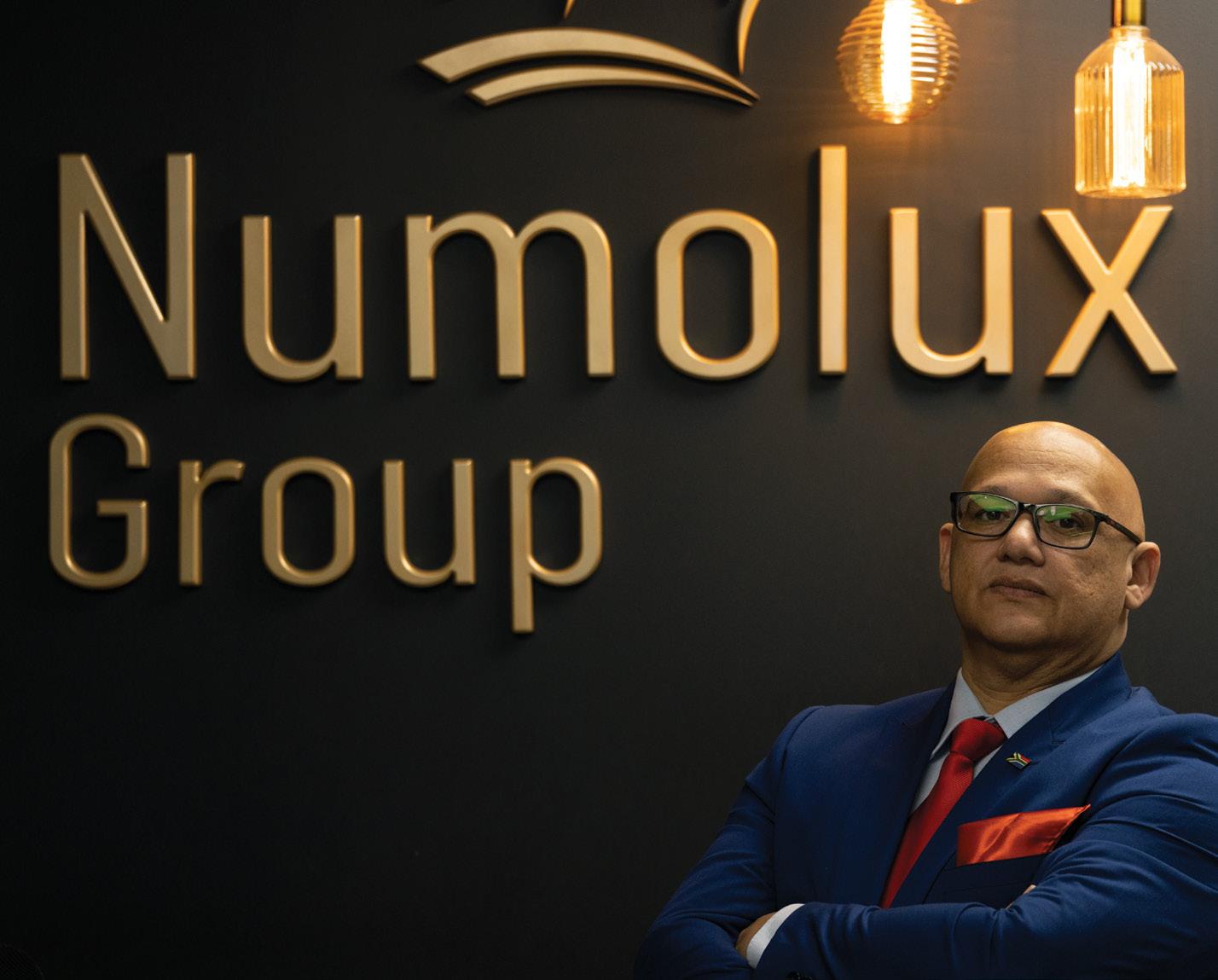
Delivering the highest level of innovative solutions, advanced research, service and care Numolux Group CEO, Col (Ret) Hilton Klein
Hilton
Hilton also holds the SAMHS Surgeon General’s Mohale award, the highest and most prestigious awards an officer can achieve in the Military Health Services. He then served as Head of the Office of the Deputy Minister of Defence until he resigned in 2017 and entered the

He took part in many military operations inside and outside the borders of South Africa, and though he received various medals and decorations during his military career - he is proudest of the Nelson Mandela Military Medal for exceptional services renderedto the late, former President, Hon. Nelson Mandela.
12 | Public Sector Leaders | September 2022 COVER STORY
AS A PROVIDER OF ADVANCED AND SUSTAINABLE SOLUTIONS, WHAT SERVICES DOES NUMOLUX PROVIDE – AND WHICH SECTORS DO YOU COVER?
Tenacity, in these tumultuous times is also vital to great leadership. Not everything is going to go right all the time. If COVID-19 and lockdowns showed us anything – it was how
As a proudly black, private South African company –we want to work easegovernmentalongsidetotheburdenofpovertyandunemploymentinourcountry
HOW IMPORTANT IS HAVING THE RIGHT PEOPLE AROUND YOU TO YOUR BUSINESS?
Public Sector Leaders spoke to Hilton about milestones, leadership, vision and some exciting plans for the future:
I would like to think that it is firm, but fair – but also a style which gives people the chance to grow and develop. I encourage creativity. I want people to think innovatively and I try new things. I don’t reward failure but I am aware that it does happen, and as CEO I expect the people around me to learn from it, grow from it – and build on it.
In my experience, having the right people around you is key to a successful business. I can proudly and honestly state that the success of Numolux is not based on my leadership skills – but on the collaborative efforts of my amazing
By the grace of God, there have been many. We started out in 2017, with the intent to focus on solutions to South Africa’s challenges. We are but a baby, amongst giants.
private sector as CEO of Numolux Group, a proudly South African, Level 1 B-BBEE military veterans-owned company with a global footprint and a diverse operational portfolio, consisting of various business units which provide advanced and sustainable business solutions to both the public and private sector across the world.
quickly things can fall apart. But a great leader has to have the tenacity to pick up the pieces and push through.
We have a footprint in the health, agriculture, energy and security space.
WHAT HAVE BEEN SOME OF YOUR MAJOR MILESTONES AS THE CEO OF NUMOLUX OVER THE LAST 5 YEARS?
Public Sector Leaders | September 2022 | 13
We have made the concerted effort to head-hunt the best people within their various industries for our team. More importantly, we have put plans in place which ensures that knowledge within a certain sector is shared from the top down. When we work in silos, only a few within an organisation are empowered. We don’t want that to be the case at Numolux. It is our wish that every employee becomes empowered and uplifted through knowledge and skills – and grows with us.
A great leader should also believe in what their company is doing.
WHAT ATTRIBUTES DO YOU BELIEVE A GREAT LEADER SHOULD POSSESS?
WHAT IS YOUR LEADERSHIP STYLE?
We have successfully partnered with Sinovac Biotech (China) to become their in-house country representative for all their products. This has led to us running clinical trials across South Africa for the Sinovac COVID-19 vaccine, CoronaVac – and subsequently receiving full registration from SAHPRA for it. We have also successfully vaccinated the first 6 month old baby in the world with this inactivated vaccine. This is a world first, and my team and I are immensely proud to have been a part of this.
Exco, my management team, and all our employees who have been handpicked for their work ethic, their values and their loyalty – so that we may reach our business goals and make a sustainable difference in the lives of global citizens.
Humility, gratitude and the knowledge that everything that you have can be lost within the blink of an eye. Once you recognise that, then it keeps you constantly grounded. I also think a great leader should lead by example. It serves no purpose to want to hold employees to values like integrity, honesty and transparency when you don’t display them yourself.
A great leader should also believe in what their company is doing. At Numolux, we want to deliver the highest level of innovative solutions, advanced research, service and care to those who need it most on the African continent , and the globe. And I sincerely believe that we can - and are - doing this. Above all, I believe that a great leader should have vision, with which they can (with conviction) motivate, inspire and empower those around them to reach the goals set out by the organisation.
Now this is where you will really get me talking!
We should not only be paying tribute to these struggle heroes at their funerals, when they are no longer here - but as Numolux we believe that we should honour their legacy whilst they are still here, still able to tell their stories, and make us remember whose shoulders we stand on. Numolux is a company grounded in gratitude - grateful to the Almighty for His blessings - and grateful to these men and women, whose selfless sacrifices made it possible for us to be in the position we are today. We do not take it lightly - that we are here todaybecause of them.
As for our military veterans, they are not merely a part of our history, they made history. They left their families, their partners, their small children and sacrificed it all, for a revolution which led to a democracy. We had virtually no control when our history was sanitised to suit an oppressive Apartheid regime - but we will have to hang our heads in shame if we let this vitally important part of our history be forgotten.
We think these are remarkable, historical stories that we think the world should know about. We need the veterans to tell their stories before it is too late. No one is getting younger, and sadly many have already passed on. n
two of the projects closest to my heart, is our Numolux Junior Board and our collaboration with the Peoples Liberation Army of
China, to tell the stories of our liberation fighters who trained in China during the Apartheid era. For our Junior Board, we have taken a group of secondary school students and embarked on a programme of mentorship to develop them in all aspects of the corporate world. We also want to create platforms where they can be innovative, creative and fearless. I strongly believe that we need to stop talking about creating a better future for our youth - and start equipping them with the tools with which they can thrive and shine within our future.
As a proudly black, private South African company – we want to work alongside government to ease the burden of poverty and unemployment in our country and assist in creating access to better healthcare – and provide food, energy and job security to the most vulnerable within our societies. We are grateful to our current strategic partners, and will continue to collaborate and join hands with organisations who share our ethos and vision of creating sustainable
WHAT IS NUMOLUX’S VISION FOR PARTNERING WITH THE PRIVATE AND PUBLIC SECTOR IN PROJECT PLANS AND ROLL OUT.
14 | Public Sector Leaders | September 2022
WHAT EXCITING PLANS DO YOU HAVE FOR THE COMING YEAR?
However,plan.
I am also a very purpose-driven leader. I don’t want to be the leader of a company that tells the world what we do, boast about how we do it and how successful we are –and then expect others to support us, our business models and our products. I want to be the leader of a company that through the values and beliefs of our employees, partners and stakeholders has purpose in all that we do.
This will tie in with our plan to start AfriVac, a manufacturing plant which will see medicines and vaccines for the people of Africa, being manufactured in South Africa, by her people. We are set to grow our footprint within the meat, dairy and cannabis agricultural space –and will also be making strides in assisting South Africa with its energy
We are in the process of embarking on clinical trials for an array of medications and will be setting up more clinical trial sites across the country, and Africa.
solutions to the problems which plague our citizens most.
• Hospital DevelopmentInfrastructure
• Energy
• Education
The Numolux Group sustainably impacting health, food, education and energy security
The overall state of healthcare in South Africa could certainly improve within its public sector, however, the country is actively trying to overcome decades of

The
The Numolux Group is proud to be a private, black-owned company within the BRICS group of countries. Our highly skilled team has a shared purpose of reaching new heights by always striving for excellence, and uplifting and empowering not only ourselves but those around us.
segregation and current practices of de facto discrimination in order to provide high-quality services for all citizens. Since the beginning of the global pandemic, South Africa has experienced various waves of COVID-19 infections, placing significant pressure on the country’s health system in terms of budget and service delivery.
• Regulatory Framework
Numolux Group is a proudly South African, Level 1 B-BBEE military veteransowned company. We have highly successful global partnerships, which have given rise to pioneering medical procedures and set us on course to have sustainable impact on health, food, education and energy security in our country - on the African continent and around the world.
We reiterate our commitment to work alongside the government to find sustainable solutions to the issues facing our people. As the entire world deals with the ravages of COVID-19, the health space in South Africa is top on our list of sectors that we will work tirelessly to make a difference in.
-
The Numolux Group identifies needs across industries, and creates platforms and offerings for business development and growth in the following sectors:
NUMOLUX HEALTH
Currently, the largest portfolio of the Numolux Group is Numolux Health. We are involved in various sectors of health –and we are immensely proud of the phenomenal,
We have a diverse operational portfolio consisting of various business units which provide advanced, profitable and sustainable solutions to public and private sectors across the world.
Public Sector Leaders | September 2022 | 15 ADVERTORIAL NUMOLUX GROUP
• Medicines and medical equipment
• Agriculture
working alongside the government to alleviate the burden of poverty and unemployment - and create a positive, sustainable impact on the lives of our brothers and sisters of African soil. We aim to do this whilst never forgetting the struggles and sacrifices of those who made it possible for us to have the success we have today.
• Clinical research and medical trials
As a company, we are blessed to be thriving in a time when many have faced turmoil. We acknowledge our responsibility to citizens of the world, Africa and most importantly South Africa – to always do better, be better and give back. The Numolux Group is committed to
• Import and Export Services
As was the case with CoronaVac, this subsidiary of the Numolux Group will be key in submissions and regular reporting to Ethics Committees & SAHPRA - and will facilitate the registration of medicines, medical devices, vaccines and complementary medicines with relevant bodies.
In September 2021, Sinovac and Numolux launched their first COVID paediatric clinical trials at Pretoria's Sefako Makgatho Health Science University. The launch was well received in the media and was supported by the South African Medical Research Council.

The Numolux Clinical Research Division works towards developing clinical trial capacity in order to meet the growing demands of the clinical trial market.
so on many more in the future. We will soon also be partnering with other companies from the BRICS region, and on the African continent.
The Numolux Group is wellpositioned to grow its work with existing local and international partners, develop new collaborations and continue medical research for various products, at our network of trial sites across the country. The Numolux Group and Sinovac are working together on current trials within
CLINICAL RESEARCH
NUMOLUX- CURANTO PHARMA
In early July 2021, the SA Health Products Regulatory Authority (SAHPRA) announced that it had authorised emergency use of CoronaVac. This is an inactivated COVID-19 vaccine manufactured by Sinovac Biotech (China). The Numolux Group is their South African in-country vaccineCoronaVacpartner.isaninactivatedagainstCOVID-19,based on
Clinical trials are essential to evaluate the safety, efficacy, and outcomes of health interventions such as vaccines and other medical treatments, and contribute to improving health outcomes.
We firmly believe that every person has the right to choose which vaccine they are administered, and we are hopeful that CoronaVac will soon be made available to those in South Africans who wish to use it.
South Africa is in the midst of a power crisis. Eskom's ageing infrastructure, reduced reliability and the significant gap in power generation capacity and demand has left the country susceptible to rolling blackouts. These factors
of health security for the people of South Africa, Africa and the world.
CORONAVAC
triumphs came about as part of our paediatric clinical trials. The Numolux Group and Sinovac, successfully vaccinated the first 6 month old baby in the world with the inactivated CoronaVac COVID-19 vaccine, at one of our South African clinical trial sites. We are pleased to report that nearly one year after vaccination – no serious adverse effects (SAE) have been observed in the baby.
Numolux-Curanto Pharma was formally established in 2021 with the purpose of focusing on regulatory, GMP and legislative compliance requirements for the Numolux Group. With practical experience, first-hand knowledge, and a clear understanding of regulatory requirements in South Africa and other African countries. Numolux–Curanto Pharma has been approved by SAHPRA as an Applicant and Holder of the Certificate of Registration (Marketing Authorization Holder), by National Department of Health and by SAPC.
the technology of vaccines which have been successfully used in immunisation programmes, in South Africa and across the globe, for decades. These types of vaccines are often a preferred product class for special populations and public members. CoronaVac has been administered to over 2.8 billion people worldwide. Receiving full registration for this vaccine in South Africa is no small feat, and is the culmination of commitment and hard work by the Numolux Group, Sinovac and all involved. It is an achievement that we are immensely proud of. Undoubtedly, one of our greatest
NUMOLUX ENERGY
16 | Public Sector Leaders | September 2022
across Africa. We envision being a preferred renewable energy partner which provides innovative technology and solutions in the generation and distribution of renewable energy.
Through our work in the meat, cannabis and dairy production space - we will be creating skilled and unskilled jobs in a sector which has declined in growth in the second quarter of 2022.
The South African government estimates that approximately 11 million people in South Africa are food insecure, and that children are mostly affected by this. More than 20% of children in South Africa suffer from stunting because of poor 70%nutrition.ofall
Our goal is to become leaders in the field of “emergency care packs” - helping people at a time when they are most vulnerable in their lives. Through our partnerships –local and abroad – we aim to make available packs containing basic necessities to women in shelters, children in places of safety, newborn babies and victims of assault.
Tel: 012 941 9977
NUMOLUX AGRICULTURE
NUMOLUX CSI
poor people in South Africa live in rural communities and it is they who suffer the most. To help alleviate the burden of
As part of the South African government strategy to mitigate a power crisis, a national energy strategy has been adopted to allow for private companies to generate and distribute energy into the national grid.
Email: info@numolux.com Website: www.numolux.com

South Africa’s power problems, dire as they are, aren’t purely domestic. Around 86% of the entire continent’s coal-fired generation capacity can be found in South Africa. We export electricity to Botswana and Namibia and are part of the Southern African Power Pool, which provides electricity to countries in southern Africa.
Numolux Energy is committed to building and managing energy solar systems which will be used to generate and distribute renewable solar energy to households, commercial clients and municipalities across South Africa. This will include the procurement, assembling and distribution of solar components to solar installers
Public Sector Leaders | September 2022 | 17
have contributed to an increased frequency of loadshedding (planned blackouts) needed to reduce the burden on its power generation facilities.
food insecurity, we have set up the Numolux Agriculture arm of the Numolux Group.
Address:CONTACT Podium @ Menlyn,
&
We realise that the scope is vast - and that the challenge may seem insurmountable, but we are committed to making a difference in the lives of those around us who need it most. n Level 2, Cnr Lois Atterbury Menlyn, Tshwane
Road,
The long-term objective of Numolux Energy focuses on building solar farms across different provinces in South Africa with a minimum capacity of 100 MW. These solar farms will be built with the intention of connecting them to the South African national grid. This objective is aligned to the South African energy mix program, which seeks to transform the South African energy generation strategy from fossil dominated to clean energy.
The Numolux Corporate Social Investment (CSI) department sees to it that the company remains socially and ethically responsible and relevant - by contributing to the social, environmental and economic well-being and upliftment of our staff, our partners and the communities wherein the Numolux Group has an established footprint.

Find Address:us:Sender Technology Park, Octave Street, Honeydew Postal: SENTECH, Private Bag X06, Honeydew, 2040 WhatsApp: 060 062 5458 Call Centre: 0860 736 832 Email: support@sentech.co.za Digital ServicesInfrastructureforAfricaby Africa SENTECH offers an array of digital infrastructure services, that enable connectivity and content delivery. As an enabler of connectivity and content delivery, these offerings include: Video and Audio Content Provision of digital platforms for the delivery media services in South Africa and Africa through DTH, DTT, SENTECH Apps, AI enabled Set-Top-Boxes and 5G broadcasting. Towers With the wealth of strategically positioned Towers, Sentech provides broadcast coverage to more 100% of the population. Facility leasing and co-location on its masts will provide managed infrastructure of both passive and active infrastructure solutions with value added services for its customers. Broadband Sentech connects households, healthcare centres, education facilities and communities in South Africa through Satellite (VSAT), Fixed Wireless, 5G, and Cloud services. Data Centre Infrastructure Provider Sentech offers cloud and data hosting services, which will provide compute power, storage and disaster recovery capabilities. Satellite Operations Sentech is developing a geo-spatial satellite which will enable broadband communication services in sub-Saharan@Sentech@SentechLtd@SentechAfrica.Ltd.SOCLimited


Pfizer Laboratories (Pty) Ltd. Reg. No. 1954/000781/07. 85 Bute Lane Sandton, 2196, South Africa. Tel. No: 0860PFIZER(734937) PP-UNP-ZAF-0036
A home to millions of culturally diverse people, South Africa is known as the rainbow nation because of the myriad of people with different cultures and religions. The country has 11 officials languages which include:
During Heritage Month, people who speak these languages take pride in their languages and dress up in their different traditional attires to celebrate their cultural heritage. They are all united South Africans who proudly form part of South Africa’s cultural heritage. The well-known activist, Mahatma Gandhi, summed it up perfectly when he said: “A nation's culture resides in the hearts and in the soul of its people.”
Fostering greater social cohesion and building the nation
CULTURAL HERITAGE
HERITAGE MONTH
LIVING HERITAGE AND INDIGENOUS PEOPLES
hen it comes to heritage, South Africa is one rich country. The country recognises September as Heritage Month with the 24th of September marking Heritage Day, where the cultural wealth of the nation is celebrated.

In its preamble, the Convention for the Safeguarding of the
The South African government says that “living heritage is the foundation of all communities and an essential source of identity and “Aspectscontinuity.”ofliving heritage include: cultural tradition, oral history, performance, ritual, popular memory, skills and techniques, indigenous knowledge system and the holistic approach to nature, society and social Inrelationships.”SouthAfrica the term “intangible cultural heritage” is used interchangeably with the term “living heritage”.
“A nation's culture resides in the hearts and in the soul of its people.”
The day is celebrated by remembering the cultural heritage of the people that make up the population of South Africa. Various events are staged throughout the country to commemorate this day.
For this year’s Heritage Month, the government is urging members of the public to use this time to foster greater social cohesion, nation-building and a shared national identity.
The rich and textured knowledge that indigenous people pass from generation to generation from cultural practices to expressions, representations and knowledge, is of utmost importance to our societies. According to UNESCO, “the practice and transmission of this heritage contributes to the ongoing vitality, strength and wellbeing of communities.”
BY SINAZO MKOKO
“The celebration of Heritage Month has created a conducive environment for all people to embrace and celebrate what was inherited or bequeathed to us by our forebears. We call on all South Africans to support the culture of reading and incorporate it into their daily lifestyles. It is important to encourage your children to visit a library and start reading at an early age so that they grow up with the passion for reading as this develops a broader vocabulary and increased general knowledge.”
W
isiZulu, isiXhosa, Setswana, Sesotho sa Leboa (also known as Northern Sotho), Sesotho, siSwati, Tshivenda, Xitsonga, isiNdebele, Afrikaans and English.
22 | Public Sector Leaders | September 2022
Here Public Sector Leaders looks into several aspects of our country’s heritage.
PERFORMING ARTS
• Safeguard the intangible cultural heritage;
• Provide for assistance.cooperationinternationaland
THE “INTANGIBLE CULTURAL HERITAGE” IS MANIFESTED INTER ALIA IN THE FOLLOWING DOMAINS:
“Cultural media, institutions and industries can also play a crucial

South Africans have innate artistic skills from dancing to singing, poetry and story-telling, performing arts has always been a huge part of our heritage. When words fail, the performances start and the rhythm and ullulations tell stories and express the pride South Africans have in their roots.


• Knowledge and practices concerning nature and the universe;
• Ensure respect for the intangible cultural heritage of communities,thegroups and individuals concerned;
• Performing arts; social practices, rituals and festive events;
• Traditional craftsmanship.
role in ensuring the viability of traditional forms of performing arts by developing audiences and raising awareness amongst the general public. Audiences can be informed about the various aspects of a form of expression, allowing it to gain a new and broader popularity, while also promoting connoisseurship which, in turn, encourages interest in local variations of an art form and may result in active participation in the performance itself,” says UNESCO. n
Public Sector Leaders | September 2022 | 23
Intangible Cultural Heritage says that “‘communities, in particular indigenous communities, groups and, in some cases, individuals, play an important role in the production, maintenancesafeguarding,andrecreation of the intangible cultural heritage.”
THE PURPOSE OF THE CONVENTION FOR THE SAFEGUARDING OF THE INTANGIBLE CULTURAL HERITAGE IS TO:
• Raise awareness at the local, national and international levels of the importance of the intangible cultural heritage, and of ensuring mutual thereof;appreciation
Sources: SA Gov | SA History UNESCO
However, UNESCO warns that many forms of performing arts are under threat today. “As cultural practices become standardised, many traditional practices are abandoned. Even in cases where they become more popular, only certain expressions may benefit while others suffer.
• Oral traditions and expressions, including language as a vehicle of the intangible cultural heritage;
Protecting South African heritage to promote cultural tourism

If named a Grade 1 heritage resource, a declaration is issued. This is the formal recognition of the heritage resource’s significance and will lead to the establishment of a conservation management plan.
declaration of National Heritage Sites. The grading and declaration of heritage sites provide a way to assess significant sites and establish conservation management plans for them. Among the sites that can be considered for grading are sites, objects, shipwrecks and graves. Both processes require a lengthy research process to establish the resource’s significance, management, and sustainability.
Protecting these significant sites in South Africa falls to the South African Heritage Resource Agency (SAHRA). SAHRA is the national body that is mandated to identify and manage South Africa’s heritage resources and to protect them for future generations. This means it is the agency that is for the protection of South Africa’s cultural heritage.
SAHRA
Cultural
The body works to develop the skills and capacities of communities, to help them identify and protect heritage resources. Heritage resources include any place or object of cultural significance, either publicly or privately owned. However, this heritage is largely
At the heart of SAHRA’s operations is a steadfast focus on the organisation’s mandate: the identification, conservation, promotion and preservation of our Oneheritage.oftheways
IDENTIFYING AND PROTECTING HERITAGE RESOURCES
During the grading process, SAHRA assesses the heritage significance of the resource and determines the relevant authority that will oversee the site. There are three grades, with Grade 1 assigned to sites with national significance that will be administered by SAHRA.
24 | Public Sector Leaders | September 2022
tourism, which brings travellers to spend time at notable heritage sites, has significant potential to increase economic activity. But to tap into this lucrative market, destinations need to preserve heritage sites.
SAHRA works to encourage South Africans to conserve what they consider to be valuable heritage resources, as the country has a rich cultural heritage. The organisation works with local communities to identify heritage resources and record the oral and living histories of these resources. The organisation also works to educate the public and increase public involvement in the preservation of heritage resources.
BY JESSIE TAYLOR
SAHRA does this is through the grading and
unprotected and undiscovered, with many communities living in heritage areas unaware of the intrinsic value of those sites or how to manage and protect them.
Once the heritage object has been declared, no person may destroy, damage or alter it without a permit from SAHRA.
the coming years. The sector is so lucrative that US cultural heritage travellers have an economic impact of more than $120-billion alone. In addition, the interest in heritage sites ensures that these sites receive protection and that local communities become aware of their significance. This in turn fosters a sense of national pride, increasing cohesion among the population, fostering a sense of identity and creating cross-cultural Culturalunderstanding.tourism has also contributed to the revitalisation and preservation of the art and cultural heritage of some cultures, which helps to keep traditions alive that may otherwise die out. n
National Heritage Sites need protection to safeguard them from damage or alteration and prevent development that could endanger them. The protection also offers a way to regulate public use of the Southsite.Africa
Island, iSimangaliso Wetland Park, Cradle of Humankind, UkhahlambaDrakensberg Park, Mapungubwe Heritage Site, Cape Floral Kingdom, Richtersveld Cultural and Botanical Landscape and Vredefort Dome. Heritage sites are essential for a thriving cultural tourism market. This type of tourism sees people travelling to experience the places, artefacts, and activities of a people and place’s history. Research has shown that this type of tourist stays longer and spends more at their destination – which has the added benefit of increasing business opportunities, creating jobs and bolstering the local economy.
HERITAGE PLAYS A ROLE IN DRAWING IN TOURISM
Sources: Danubius Journals | Tourism Teacher | Iberdrola ResearchGate | SAHRA
Public Sector Leaders | September 2022 | 25
Over the last few decades, cultural tourism has seen significant growth, especially with its declaration of World Heritage Sites. Today, it is estimated that around a third of all tourism is cultural tourism and is expected to grow by around 15% in
has several heritage sites declared by SAHRA, including Castle of Good Hope, Bushmanskloof Rock Painting Landscape, The Daljosafat Cultural Landscape, SS Mendi Memorial, The South African Astronomical Observatory, Liliesleaf Farm and the West Coast Fossil Park. These are in addition to South Africa’s eight World Heritage Sites: Robben


theRooibosRoyalties,andKhoisan
Sharing the profits of traditional knowledge
A2019
agreement has seen more than R12-million paid to South Africa’s indigenous communities in return for the commercial success gained from their traditional knowledge.
The funds will be transferred into two community trust accounts established by the South African San Council and the National Khoisan Council.
The rooibos tea industry paid the funding as part of the Rooibos Traditional Knowledge Benefit-Sharing Agreement signed in November 2019, which ensures that the San and Khoi-Khoi people benefit from the commercialisation of their indigenous medicinal knowledge. The funds go towards programmes to protect their cultural heritage, advance education and development and improve livelihoods.

26 | Public Sector Leaders | September 2022
The Andries Steenkamp Benefit-Sharing Trust will share the benefits with the San communities to assist with their endeavours to protect their traditional knowledge and related biodiversity. The Khoi-Khoi Biodiversity Trust is developing a comprehensive plan to distribute the funds in a way that will secure equity and fairness to Rooibosall.
Today, the rooibos industry is worth more than $20-million, and nearly 16 000 tons of rooibos are harvested annually for export to more than 30 countries. The plant is used to make beverages and beauty products.
BY JESSIE TAYLOR
TRADITIONAL KNOWLEDGE
is indigenous to South Africa’s Cape region, which has been home to the Khoisan people for millennia. These communities have long known the restorative and healing properties of this plant, but this knowledge was misappropriated by commercial farmers for commercial gain more than 150 years ago. In the Cederberg region, the only place Rooibos grows naturally, the Khoisan people have used it as a tea and herbal remedy for more than 300 years.
KEEPING CULTURAL HERITAGE ALIVE
The pilot phase has also allowed the government to gather accurate data on the dynamics of
The agreement followed a nine-year negotiation process spearheaded by the Department of Forestry, Fisheries and Environment, which resulted in an agreement widely regarded as one of SA’s success stories in implementing the National Environmental Management Biodiversity Act (Nemba).
Sources: Business Insider | BBC Quartz | GoLegal | AgriOrbit SA Rooibos Council
Martin Bergh, Chairperson of the SA Rooibos Council, says the agreement is a first-of-its-kind in the world. “Other agreements involved specific companies and traditional knowledge holders, whereas this agreement encompasses the entire industry, ensuring all volumes of Rooibos sold are levied through one process,” he says.
This means that the word ‘Rooibos’ or ‘Red Bush’ can only be used for Rooibos tea imported from the winter rainfall areas of the Western and Northern Cape, much like “Champagne” can only be used for sparkling wines from the Champagne region in
Public Sector Leaders | September 2022 | 27
The Minister of Forestry and Fisheries and Environmental Affairs, Barbara Creecy, said because rooibos has a long history of commercialisation in South Africa, it was deemed important for the rooibos industry to comply with Nemba and the associated regulations.
“The industry is delighted that the first funds have now been paid to the representatives of the Khoi and San people and remain committed to the terms of the Access and Benefit-sharing Ministeragreement.”Creecy said that fair and equitable benefitsharing interventions to work, the commitment of all people involved in the sector in South Africa and abroad is needed.
ROOIBOS: SOUTH AFRICA’S CHAMPAGNE
The industry-wide agreement includes the one-year pilot through which the San and the Khoi people will receive 1.5% of the farmgate price from the 10 rooibos industry processors. This payment is done in the form of an annual levy.
Rooibos enjoys Geographical Indicator (GI) status, which links a product to a specific geographical area, which indicates the origin of where the product is produced, processed or prepared.

the rooibos industry. This includes information on opportunities for transformation, the composition of the farmers and other roleplayers across the value chain, as well as market and trade information related to the sale of rooibos locally and internationally.
TheFrance.status was granted in 2014 by the European Union, and this gave the Rooibos tea manufacturers of South Africa full ownership of the Rooibos name.
“We recognise that innovative solutions are required to address the fair and equitable sharing of benefits derived from the utilisation of genetic resources and the traditional knowledge associated with its use. Amongst these is partnerships between industry and communities to ensure that our national and international biodiversity commitments are met,” she said.
WORKING TOWARDS EQUITABLE SOLUTIONS
“With a suitably negotiated and concluded benefit-sharing agreement in place, the issuing of the associated bioprospecting and biotrade permits is more efficient. Without it there would be no contribution to the socioeconomic growth of the two communities.” n
When ITHUBA was awarded the third National Lottery Operation licence, Paytronix played a crucial role in the deployment of the ICT infrastructure. The implementation and setting up for operation was completed in a record time of 5 months. This remains a remarkable achievement globally, and positions Paytronix as an international player using best practices and exceptional standards.
28 | Public Sector Leaders | September 2022
Paytronix Systems is a 100% Black-owned company established in 2002, with a Level 1 BBBEE rating. Since 2002, Paytronix has established itself as a strategic ICT solutions provider in offering specialised ICT Services. The founders’ rich industry knowledge and experience secured confidence from clients who entrusted Paytronix with important tasks, right from the beginning.

Enabling Business Success Through Innovative Technology

Currently, Paytronix is the ICT solutions provider for the South African National Lottery Operator, ITHUBA. The Lottery business is highly regulated and technically complex. The Operator must comply with stringent requirements by its Regulator, the National Lotteries Commission (NLC); and the Department of Trade Industry and Competition (DTIC).
ITHUBA is also a member of the World Lottery Association (WLA), which means that it subscribes to world-class Lottery standards and must comply with the WLA values. The multifaceted nature of the Lottery business makes ITHUBA a unique client that requires specialised solutions, out-of-the-box thinking and diversified services structured within an environment that deploys ICT expertise and capabilities to operate a successful Lottery organisation. Paytronix has proven to be a reliable service provider to ITHUBA since the beginning of its mandate.
In 2002, Paytronix was appointed as an ICT service provider for Empilweni Pay-out Services. The company’s mandate was to develop, implement and manage a turn-key social grant distribution solution for South African citizens on behalf of Empilweni, this is the solution that was in place before government awarded the grant payment services to SASSA. Empilweni used its ICT infrastructure to distribute more than R3 billion in cash annually to 450 000 beneficiaries monthly, in the Mpumalanga Province. The key milestone was the design and the manufacturing of mobile pay stations. The reliability and high-performance of the system enabled Empilweni to successfully deliver against its contract with government for 12 years.
Paytronix has the expertise, technical resources and capacity to manage and support the E-commerce platform in-house as well as capabilities to go beyond. With a tremendous amount of domain knowledge and IP in the E-commerce services, retail and logistics arenas, Paytronix offers a range of outsourced services that deliver true and measurable value to our clients.
The Deployment of national MPLS network reaching the most locations.rural
Paytronix manages and supports ITHUBA’s Nerve Centre and E-Commerce infrastructure. We designed the first-ever South African National Lottery Mobile App, and managed the online and mobile E-commerce platform for ITHUBA to dispense National Lottery games.
Implementation of corporate business systems i.e. financial, CRM and BI. rollout.Centre
acrossofImplementation9000terminalsthecountry.
The project milestones included:
The Design implementationandoftwohigh-tierdatacentres.
Paytronix manages contracts with third-party service providers such as Vodacom, Transaction Junction and VPS on behalf of the Operator, as well as the integration and Service Level Agreements (SLAs) with ITHUBA’s channel partners which include:
These are all providers that sell National Lottery tickets – retailers sell physical tickets while banking sell tickets via their digital platforms, while Blue Label sell tickets via USSD. This has enabled ITHUBA to create an accessible and convenient National Lottery.
LotteryofImplementationaworld-classsolution. Call
Within the first 3 years of ITHUBA’s tenure into the Lottery license, Paytronix Systems managed the data operations of more than 1.636 billion transactions on the Operator’s behalf, with a transaction value of more than R19.5 billion rand.

» Nedbank. » First National Bank. » Standard Bank. » Shoprite Checkers. » Pick n’ Pay. » Mass Mart. » Blue Label.
Our aim is to enable our customers to fulfil their mandates seamlessly, using innovative technology to play an integral role in the flourishing of their businesses.
In just 26 years, there has been a 52% increase in tobacco use in sub-Saharan Africa. And rapid urbanisation in South Africa has seen a change in food consumption patterns, with people are consuming more calories, sugary beverages, and processed food.
“Outdoorseriously”.smoking should be considered to be environmental pollution. We want to improve education – even people with a very healthy lifestyle are doing themselves a huge disservice by smoking,” she said.
Sources: World Heart | Heart Foundation | World Health Organization
Prof Pamela Naidoo Keeping hearts healthy
30 | Public Sector Leaders | September 2022
This lobbying has already seen great success, with South Africa no longer allowing smoking indoors.
This is critical work as every day 225 South Africans die from heart disease and stroke. Cardiovascular and cerebrovascular disease claims more lives than all cancers combined.
These lifestyle choices are increasing the risk of cardiovascular disease, which places additional pressure on an already heavily burdened healthcare system and impacts the livelihood of many South African households. n
TIME TO TAKE ACTION AGAINST DISEASE
TRAILBLAZER
At the helm of the Heart and Stroke Foundation, an organisation that works to halt the rise of premature deaths through cardiovascular and cerebrovascular disease and to promote the adoption of a healthy lifestyle, is Professor Pamela Naidoo.

Globally, non-communicable diseases (the collective term for cardiovascular and cerebrovascular disease, diabetes, cancer, chronic respiratory disease and mental disorders) are the leading cause of death. They result in more than 60% of the world’s deaths, and 80% of those take place in developing countries like South Africa. The effects of noncommunicable diseases is especially noticeable on the continent, where it is predicted they will overtake all other causes of death in Africa by 2030.
The time to act against noncommunicable diseases is now, Prof Naidoo insists, especially with changing lifestyles on the continent.
Cardiovascularcerebrovascularanddisease is the leading cause of death and disability in South Africa, after HIV and AIDS. This type of disease is behind one in every six deaths – but one woman is heading up the fight to change this.
BY JESSIE TAYLOR
Prof Naidoo’s career has been guided by a desire to deal with the factors contributing to the diseases affecting so many in our society. This saw her moving away from working with patients on a one-to-one basis to specialising in public health. The move allowed her to deal with the wider issues affecting her patients and have a bigger impact on society and population health. She has focused on non-communicable diseases for more than 15 years, working as CEO of the Heart and Stroke Foundation and as President of the African Heart Network
Prof Naidoo is a public health specialist with 29 years’ experience in the health sector across non-communicable and communicable diseases. She is a Registered Clinical Psychologist who holds a Master’s in Public Health, as well as a Doctorate in Philosophy (Behavioural Medicine).
She previously held the role of Research Director of the Psycho-social WellBeing and Behavioural Interventions programme at the South African Human Sciences Research Council, but she also holds an Extraordinary Professorship in the Faculty of Community and Health Sciences at the University of the Western Cape. Prof Naidoo is an Associate Professor Extraordinaire in the Faculty of Medicine and Health Sciences at Stellenbosch University and is also a National Research Foundation-rated researcher. She devotes most of her time to her role at the Heart and Stroke Foundation. The Heart and Stroke Foundation aims to promote cardiovascular and cerebrovascular
health through advocacy, influencing policy, and providing information, tools, and support which will empower people to adopt healthy lifestyles and seek appropriate care early in the manifestation of the disease.
A GROWING HEALTH CONCERN
Cardiovascular diseases are the leading cause of death globally, taking an estimated 17.9 million lives each year. This group of disorders affect the heart and blood vessels and includes coronary heart disease, cerebrovascular disease, rheumatic heart disease and other conditions. Around 80% of cardiovascular disease deaths are caused by heart attacks and strokes.
But Prof Naidoo hopes it will be expanded to include legislation to curb outdoor smoking. She believes this is the first step to “not endangering the public, and taking environmental smoking
“I am a passionate advocate of reducing the morbidity and mortality rates due to heart disease and stroke. One of the things I am pushing for is zero tolerance of tobacco smoking, and I’m working with the South African government and other relevant stakeholders to achieve this, given that tobacco smoking is one of the strongest risk factors for cardiovascular disease,” she said.
Embracing technology and expanding organically
“As a company we also believe in establishing a sustainable legacy for the communities in which we operate, and the industry as a whole. To support this philosophy, 5% of our equity has been ring-fenced equally for the benefit of employees and communities through employee and community trusts.”
n
Meet Vusimuzi Group Founder and CEO, Prince Vusi Mdaki CONTACT Tel: +27(0)17 110 0061 Fax: +27(0)17 004 0288 Email: Info@vusimuzigroup.co.zaADVERTORIAL VUSIMUZI GROUP
Public Sector Leaders | September 2022 | 31
This businesshaseverythingstickytendencytomy(mother)TheShefigurehadworkhadwhatworkerwho“Myrequiredthehisinspirationentrepreneurtenacityapproachservant-leadershipandtheinspirationalrequiredfromanisgroundedinthehereceivedfrommother,whotaughthimcourageandperseveranceofaleader.motherwasahardworkerworkedasadomesticallherlifeand,nomatterhardshipswefaced,shefaiththateverythingwouldout-anditdid.Evenifshenothingtogive,shewouldoutawaytocaterforus.woulddothisrepeatedly.examplesmyrolemodelgavemeresultedinabilitytogothroughwallsreachmygoalsandatoputmyselfinsituationsknowingthatwouldworkout.Thisshownmanytimesinmyaccomplishments.”
Today, he runs a company adding value across an array of industries, through their investments. Vusimuzi Group has invested in sectors such as financial services, mining, telecommunications and health, among others. They play an active role in the companies they invest in, but also gear their operations towards sustainable practices.

Prince
The name of the company is derived from the Founder’s middle name, “Vusimuzi”, which can be translated to “I will raise up this house” (ngizowuvusa lomuzi). Vusimuzi Group has its roots in Mpumalanga, the province of Prince's birth. He was born in Nhlazatshe, near the town of GrowingBadplaas.up,Prince wanted to be an electrical engineer but was unable to complete his secondary education after taking responsibility for the household. “The journey was not easy, as

Vusi Mdaki is the young Founder and CEO of Vusimuzi Group, a 100% black-owned and 48% women-owned micro-industrial company which provides multiple services, including electrical, civil, mechanical and industrial engineering, as well as operations management.
“It just so happened that my father worked at a mine from the ‘80s until the early 2000s and while growing up in a mining town I would see construction vehicles and make my own toy models and what I thought was just play turned out to be a dream. You can say I found my calling rather early in life.”
life is not the same for all of us. Some people want to be in their comfort zones whereas some of us want to do something daring.” Vusi chose the engineering field because he believed it would afford him the opportunity to solve multiple problems.
Deputy Minister Pilane-Majake, was born in Pretoria. Her father Mogale Pilane was a staunch member of the SACP and her mother, a nurse and community worker, Magdalene Pilane was part of 20 000 women who marched to the Union Building in August 1956. In her youth, Minister Pilane-Majake started working with structures that supported the struggle for liberation and liaising with internal and exiled leadership of the ANC
IN LEADERSHIP
the public service, to promote the principles of Batho Pele (“People First”). Deputy Minister PilaneMajake also serves as the Whip of Ethics Committee of Parliament.
32 | Public Sector Leaders | September 2022
WOMEN
CHAMPION FOR A ‘PEOPLE FIRST’ PUBLIC SERVICE
BY JESSIE TAYLOR
Deputy Minister Public Service & Administration Dr Chana Pilane-Majake
Ensuring accountability in our public service
Africa has embarked on a process to audit the lifestyles of government officials to crack down on corruption within the public service. The move, which has come into effect as of April, is just one of the steps being taken to professionalise the public service. Lifestyle audits are a way to assess the unexplained wealth of public servants, which could indicate they have been complicit in corruption or conflicts of interest. The audits are not intended to be a punitive measure but are rather a tool to promote ethics among public service employees.
She has been a member of parliament since 2014 but has also held important roles outside of the political arena. Deputy Minister Pilane-Majake was previously


Hon. Pilane-Majake holds a Doctorate in Literature and Philosophy from the University of South Africa, a Master’s degree in Social Sciences from the University of KwaZulu-Natal), Honours and Bachelor’s degrees from the University of Limpopo and a Diploma in Development Studies from Stanford University in California, USA.
In her current role as Deputy Minister for the Public Service and Administration, Hon. Pilane-Majake works towards the improvement of
South
Among those championing ethical public administration is Deputy Minister Chana Pilane-Majake, deputy minister of public service and administration. She states that senior public servants will be screened at least once a year, to establish if government officials are living lavishly, well beyond their means. This will allow her department to proactively identify possible corruption.
PROGRAMMES TO PROFESSIONALISE
They are one of several programmes to eradicate the scourge of corruption in the public service, guided by the government’s National Anti-Corruption Strategy. The strategy has been developed on the intrinsic values of integrity, transparency and accountability, respect for the rule of law, and zero tolerance for corruption.
ThePilane-Majake.lifestyleaudits
The lifestyle audits aim to help professionalise, modernise and optimise the public service. They aim to probe unexplained wealth and detect conflicts of interests that have an impact on productivity and service delivery. They are a tool to the ethics which should lie at the heart of the public service. The audits are to be carried
were made compulsory for all national and provincial departments under former Public Service Minister Ayanda Dlodlo.
out by heads of departments, supported by ethics officers and are compulsory for all national and provincial departments.
appointed as Chief Executive Officer for the Commission on Gender Equality, a role she held for eight years before joining VIP Consulting Engineers as Executive Director for Human Resources. Before joining the Commission on Gender Equality, she worked for the EU Foundation for Human Rights in South Africa, a bilateral programme between South Africa and the European Union assisting in promoting the culture of human rights in South Africa.

Should corruption or criminal conduct be found during this investigation, it will be reported to the police for further investigation. The third process will be carried out in the event of complex cases, involving concealed assets, external auditors may be called in to carry out a thorough lifestyle audit. n
support to all the ethics officers at the departmental level and monitor and assess the effectiveness of the entire process, said Deputy Minister
Public Sector Leaders | September 2022 | 33
THE PUBLIC SERVICE
The process is divided into three phases. In the first phase, departments will carry out lifestyle reviews through ethics officers. This will involve the entail verification of financial disclosures. Should a conflict of interest or unexplained wealth occur during this stage, the second phase will commence. This will see lifestyle investigations conducted by departmental investigators.
Sources: Bertha Gxowa | BusinessTech | BusinessLIVE Corruption Watch | SA Gov People’s Assembly
She also has extensive lecturing experience, having taught at the University of the North and the University of Natal. She has also helped to establish a number of schools for children with disabilities.
Deputy Minister Pilane-Majake has supported the lifestyle audits, explaining that they will be focused on senior management every year, and non-senior management every second year, in a continuous process of accountability. The audits will be managed by the ethics, integrity and disciplinary technical task unit, which will offer
Anew
The future of administrationpublic
PUBLIC SERVICE MONTH
South Africa has pockets of excellence in public service, but a number of areas remain dysfunctional and struggle to advance the aspirations of the Constitution. This was highlighted in reports by the Zondo Commission, which found that in some cases senior government leaders do not have the necessary expertise and that the public administration still has some work to do to become effective and professional. To address these challenges, the
The government has introduced several key measures as a part of a new project to professionalise public services in South Africa and to take a stance against questionable appointments of government officials.
34 | Public Sector Leaders | September 2022
LEGISLATING FOR A TRANSPARENT PUBLIC SERVICE
municipal law has been signed by President Cyril Ramaphosa, taking South Africa a step closer to professionalising the public service.
government is implementing a series of measures to reform the public service and professionalise public administration.
The legislation includes the political office of chairperson, deputy chairperson, secretary, deputy secretary or treasurer of a political party nationally or in any province, region or other areas in which a political party operates. The previous legislation in South Africa BY JESSIE TAYLOR
This month, President Ramaphosa signed the Local Government: Municipal Systems Amendment Bill into law. This legislation prohibits South African municipal workers and senior managers from holding

political office. It also empowers MECs to take the necessary steps to validify appointments and enforce compliance.
Changes transforming South Africa’s public service

Cooperative Governance and Traditional Affairs Minister Nkosazana Dlamini-Zuma recently established uniform norms and standards and introduced minimum qualification and competency criteria for public servants.
only prevented municipal managers and those who reported directly to them from holding political office.
“Such support includes enrolling the youth, local community members and officials in the recognition of prior learning programme, apprenticeship programme, and young graduates programme
has seen public servants trained on a range of subjects, including ethical conduct, economic governance and planning.
“As we have recognised before, many of these challenges arise from poor management of the politicaladministrative interface. There is weak oversight, poor accountability and inadequate consequence management systems. There is a shortage of skilled leadership and management, and widespread fraud and corruption,” said President Ramaphosa.
Sources: BusinessTech | Daily Maverick | News24 Politicsweb | SA News
The government is expected to soon finalise a national framework on the professionalisation of the public sector.
among other professional development programmes,” said Minister “However,Dlamini-Zuma.thissupportis far from being adequate because we are limited by resources at the disposal of MISA. Nonetheless, the participants are enabled to professionally register.”
Another aspect of the reforms to the public sector is the District Development Model, which is a whole of government approach to planning, budgeting and implementation with the aim of eliminating waste and duplication of Theresources.DistrictDevelopment Model
In addition to these measures, Minister Dlamini-Zuma said a review is under way to build capacity for local government. This will see municipalities developing and implementing a capacity development plan, aligned to the Integrated Development Plan. n
BUILDING A CULTURE OF BATHO PELE

Public Sector Leaders | September 2022 | 35
will mobilise other departments to come to the assistance of local government in providing an integrated, district-based service delivery approach aimed at fasttracking service delivery.
The regulations introduced by Minister Dlamini-Zuma also seek to delineate roles and responsibilities for councillors and officials and prohibit councillors from taking part in recruitment and selection processes.
The latest legislation is just one of several steps being taken by the government to professionalise the public service, including the Local Government Municipal Structures Amendment Act which came into effect on 1 November 2021. This legislation introduced a specialised code of conduct and minimum requirement for councillors.
The criteria require senior management to have tertiary qualifications, a minimum of five years of management experience and essential leadership competencies, in an effort to improve public service.
“This framework proposes a stronger emphasis on merit-based recruitment and appointments, integrity testing for all recruits to the public service, and curriculum development for ongoing learning of public servants,” said President Cyril Ramaphosa.
At the recent ANC policy conference, President Cyril Ramaphosa said the government, led by the party, has been rebuilding the public service and the culture of Batho Pele (meaning “people first”), in government departments, municipalities, state-owned enterprises and other organs of Thisstate.move
There are several other interventions planned by the government, among which is the Municipal Infrastructure Support Agency’s work to deploy professionals – such as registered engineers, planners, energy and water specialists, and transport specialists - to specific municipalities. They would provide on-the-job training and support to municipal staff.

BY JESSIE TAYLOR
Today, women police members form an integral part of the SAPS, bringing strength, innovation and unwavering resilience, often going beyond the call of duty in serving their communities.

36 | Public Sector Leaders | September 2022 FOCUS ON SAPS
The public servants creating safer communities
Women in blue
Among
the ranks of the South African Police Service (SAPS) are a number of women striving to serve their communities, creating a safer South Africa for all. Despite the police force being established in 1913, women were enlisted as 'full members of the force' for the first time on 1 January 1972. At the time when two women were appointed as commanders of the newly established 'women police force'. But it still took almost a decade before women were allowed to work on patrol, undercover and do investigative work.
Eighteen years later, she still serves in the Explosives Section, as one of only two female members rendering explosives control in Gauteng. In 2019 Hawkins was promoted to the rank of Colonel and appointed as commander of the Explosives Section in Gauteng.


police service 33 years ago as a student constable, and today is a highly decorated member who has served in a number of roles, including as an investigator, station commander and the Provincial Head responsible for Visible Policing in the Free State. She also served as the Deputy Provincial Commissioner responsible for Crime Detection in Gauteng. Lieutenant General Mosikili has represented the country in New York, Singapore, Netherlands and America on crime-fighting efforts and also serves as a board member of Crime Stoppers International (CSI), a global non-profit organization committed to supporting law enforcement efforts by mobilising citizens to anonymously share information about crime.
COLONEL FIONA HAWKINS
“You need to have a strong mindset, ‘nerves of steel’ and a craving for adrenaline to pursue this career path,” Colonel Hawkins says.
Public Sector Leaders | September 2022 | 37
Here are four women in blue considered game changers in their respective fields:
Colonel Fiona Hawkins is the epitome of the age-old saying ‘dynamite comes in small packages’. The just over 1.5m tall police member serves as a Bomb Disposal specialist. She joined the police service 20 years ago as a student constable, going on to complete her Tactical Policing training after her basic police training in 2002.
She(NATJOINTS)joinedthe
Appointed in July, Lieutenant General Tebello Mosikili is the country’s first female Deputy National Commissioner responsible for Policing. She is responsible for overseeing all Visible Policing and Operational environments, as well as Protection Security Services (PSS). She also takes over the role as Co-Chairperson of the National Joint Operational and Intelligence Structure
“I always wanted to become a policewoman and be part of the action in the fight against crime in our country. My height was a challenge and I kept on applying until I was finally accepted in 2002,” says Colonel Hawkins. She vividly recalls the day she was recruited to join the Explosive Section in 2004, while still based at SAPS Stilfontein in the North West province. She went on to complete the Basic Bomb Technician course that same year and made history when she became the first woman of colour within the SAPS to be a qualified Bomb Technician.
LIEUTENANT GENERAL TEBELLO MOSIKILI
38 | Public Sector Leaders | September 2022
This 29-year-old police member serves as a motor mechanic at the Maitland Garage in Cape Town – a career that was inspired by watching her father servicing his own vehicle and being sent on errands to buy motor spares.

For Constable Sifingo, joining the service has not only allowed her to gain new experience, but also to form part of a family.
CONSTABLE SIKELELWA SIFINGO
Sources: SA History
| SAPS
WARRANT OFFICER ANEL ESTERHUIZEN
She studied motor mechanics at False Bay College, after which she completed a four-year apprenticeship at the Barloworld Academy. But she wanted to work on other vehicle brands, and this led her to apply for a position in the SAPS, which houses an extensive fleet of different vehicles. Her work may be behind the scenes, but Constable Sifingo’s service is essentialwithout a reliable vehicle fleet, the crime-fighting efforts of the SAPS cannot reach the communities in which they are needed.

Warrant Officer Anel Esterhuizen works in the Public Order Police (POP) environment. Described as an “all-rounder”, she has 31 years of uninterrupted service and is a public order police training instructor as well as a qualified medic.
“From the commanders to my colleagues, I am treated with so much respect. It is heart-warming,” she says. n
Warrant Officer Esterhuizen has a code 10 license, and drives large police vehicles such as the previously used Casspir and today’s Nyala, an armoured vehicle used by police during raids and public protests. These armoured vehicles are very strong and powerful and are resilient to being shot at, stones and petrol bombs. She also drives and operates the water cannon, which is a truck that shoots a high-velocity stream of water and is used in crowd control management to disperse large crowds.
Having been raised by her father after her mother passed away when she was three, Warrant Officer Esterhuizen has never been intimidated by a male-dominated environment. From an early age, she learned to be at the forefront, and no task is ever daunting for her.
BUSINESSFORSECURITYCYBERADVANCEDYOUR For more than 30 years, ESET® has been developing industry-leading IT security software and services. Over 400,000 businesses and 110m users worldwide rely on us to deliver reliable, comprehensive protection. SECURE YOUR BUSINESS DATA, WITH ESET

Franco Cotumaccio, Director and Co-Founder of Shadow Careers added: “Sigma Connected South Africa shares our vision for creating meaningful career opportunities for excluded youth. We are excited about Sigma Connected opening their call centre operations right next to our new career creation centre in Mitchells Plain.”
The event was hosted by Sigma Connected’s Managing Director, David Neale, and attended by over 50 guests, plus the first 90 employees who have joined the business in Mitchells Plain.
40 | Public Sector Leaders | September 2022 EDITIORIAL SIGMA CONNECTED
With plans to create 1 000 new roles in Mitchells Plain and nationally by 2025, many through Impact Sourcing, the contact centre was unveiled by the Head of the Project Management Office, in the Private Office of the President, Rudi Dicks, who is working closely with the President Cyril Ramaphosa on the unemployment programme.
Ambassador Sadick Jaffer, Chief Director for Investment Promotion and Facilitation at the Department of Trade, Industry and Competition,
Through its impact sourcing partner, Shadow Careers, which is also based in Mitchells Plain’s Watergate Centre, the company has hired over 60% of its employees from excluded backgrounds.
For more information on the Sigma Connected Group and its services readers can visitCareersForwww.sigmaconnected.com/zavisitmoreinformationonShadowanditsservicesreaderscanwww.shadowcareers.co
state-of-the-art contact centre has been officially opened in the Cape Town community of Mitchells Plain by one of the country’s leading Global Business Services (GBS) companies.
Following an announcement earlier this year, Sigma Connected South Africa, which offers ‘white label’ customer contact centre services across a variety of sectors, has now opened its Watergate Centre facility in the Cape Flats, becoming the first GBS operation to provide contact centre services from Mitchells Plain.

“Our shared vision creates a new model for the future sustainability of the GBS sector, which could be replicated across the country to encourage others to invest in similar “Shadow'scommunities.”aspirationis national and we are looking for partners to help us achieve this goal, thereby substantially increasing job “Ancreation.”essential part of creating these outcomes is partnering with purpose.”
next three years we are planning to hire more than 1 000 people across South Africa and we hope to replicate this model to make a real difference in similar communities across the country.”
Sigma Connected and Shadow Careers open Mitchells Plain contact centre and training facility to tackle youth unemployment
Anew
assisted Mr Dicks and other delegates in cutting the ribbon to open the new contact centre.
n
• Shadow Careers with their GBS partners plan to create another 1500 permanent careers in the next 3 years through its career creation centre in Mitchells Plain
• More than 90% of Shadow Careers students have successfully been placed into permanent jobs with 197 permanent careers created
• Founded in 2011, Sigma employs over 4 000 people
"So far we have received over 800 applications for jobs, with 300 being received within the first few hours of advertising the roles. I am pleased to say all of these came from local people living in Mitchells Plain,” said Mr "OverNeale.the
Interview with Sigma Connected
“We are Sigma Connected, we are different” Managing Director,

impact with the people that we employ. As a business that is South African-owned we recognise our success helps address the challenge of youth unemployment - we are not only providing jobs, but careers. Last year we provided an additional 1 300 jobs, with over 60% being delivered through impact sourcing and over 70% of our leadership positions came from internal promotions.
Finally, I think the recognition at this years Cape BPO awards was an amazing thank you to all those in the team that have worked tirelessly to make Sigma Connected a great place to work, along with many individual awards, recognition for Top Impact Sourcing initiative, Top Community Spirit initiative and Top Emerging BPO were great accolades, along with the recent Top Empowerment Award from Topco Media, of course!
The ones that really stand out are the ones which have the greatest
CONNECTED
Sigma Connected offers bespoke service offerings to each individual partner’s needs, rather than an off-the-shelf solution. Not only are we fortunate to have the scale to meet our partners' challenges with international best practice, but we also have a supportive parent company Digicall.
David Neale
PLEASE UNPACK: “WE ARE SIGMA CONNECTED, WE ARE DIFFERENT”. We want to be a force for good, whilst also being successful. We’re not content with the status quo of the market and believe there is a better way of doing things, wanting to forge a new segment within the sector that we can own.
Address: Woodstock Quarter, Upper Ground 187 Sir Lowry Rd, Woodstock Cape Town, 7925 Tel: +27 (0) 21 203 0904 enquires@sigmaconnected.com
Web: www.sigmaconnected.comINTERVIEW SIGMA CONNECTED
Email:
Sigma
WHAT HAVE BEEN YOUR MOST MEMORABLE ACHIEVEMENTS AS MANAGING DIRECTOR?
We became the first BPO in history to take the work to our people, rather than people to work, opening our state-of-the-art contact centre in a township in Cape Town, Mitchells Plain. Taking the jobs to where people live has had a significant impact on their livelihoods by spending less time travelling and more time with their families. Cutting down on transport costs and being able to invest in their local community. I hope as the first, we can give confidence to the sector and others will now follow and bring further investment to the area. Having the opportunity to meet President Cyril Ramaphosa to discuss this on Youth Day this year is a memory I certainly won’t forget!
Connected, is a Business Process Outsource partner (BPO) that offers tailored outsourced solutions to its partners, focusing on delivering the best customer experience for your customers. They offer services in areas such as customer acquisition, customer experience management, quality assurance, retention management and collections to name a few. Managing Director, David Neale shares his most memorable achievements and explains what sets Sigma Connected apart.
We are a people business focused on people; determined to enhance the lives of our employees and their communities, whilst supporting and empathising with those we speak with on our partners behalf. We believe there is a different way to do Thisthings.isfundamental to our vision and culture and drives success. n
Public Sector Leaders | September 2022 | 41
one-stop shop service aimed at unlocking investment and expansion opportunities for local and global businesses, whilst facilitating the ease of doing business.
In line with the GGT2030 plan, the GGDA strategically augments government in rolling out strategic economic infrastructure projects to turn Gauteng into a single, multi-tier, mega Special Economic Zone. The rapid roll out of feasible Special Economic Zones will create jobs and much needed competitive manufacturing capacity in
The GGDA’s partnership with the World Bank yielded constructive results where twenty-seven companies from the five corridors were supported through various interventions and facilitation that seek to free obstacles that they faced in investment and trade in order to do business in Gauteng. Through the Trade
WHAT ARE SOME OF THE NOTEWORTHY PARTNERSHIPS THE AGENCY HAS DEVELOPED WITH THE PRIVATE SECTOR?
PLEASE UNPACK THE RELATIONSHIPS THE GGDA HAS WITH GOVERNMENT DEPARTMENTS AND HOW THIS BENEFITS THE ROLE OUT OF YOUR MANDATE?
42 | Public Sector Leaders | September 2022 INTERVIEW
Dr
Chairperson of the GGDA, Dr Sibongile Vilakazi, leading the team to turn around the fortunes of the Gauteng Province

As the implementing arm of the Gauteng Department of Economic Development (GDED), the GGDA provides a seamless
She currently serves as an independent non-Executive Director of the South African Music Rights Association (SAMRO) Board, where she is the chairperson of the Social, Ethics and Governance committee. She also serves on the Board of Kalagadi Manganese mining company as an independent non-Executive Director and a member of Entsika Foundation Board.
PLEASE DESCRIBE THE SERVICES OFFERED BY THE GAUTENG GROWTH AND DEVELOPMENT AGENCY.
the Gauteng City Region. Government remains an integral partner and shareholder in the GGDA. This strategic relationship ensures the facilitation of trade and investment, as well as effective implementation of long-term projects in line with the GGT2030 vision.
Vilakazi is a Research Psychologist with a PhD in Organisational Development and Diversity Management. She completed her PhD at Wits Business School (WBS) in 2015, and in 2017 joined the Business School as a faculty member – teaching Business Strategy on the PDBA and MBA programmes, as well as supervising MBA and PhD research students. She has rich corporate experience in customer strategy design and implementation, having headed Customer Experience for the Alexander Forbes Group, served as an Account Director at Kantar, and worked for Nedbank Group Insights and Nedbank Retail Segment. She is the founder of Ntsikelelo Business Solutions, a consulting business, in which she consults for small, medium, and corporate organisations on business transformation strategy, customer experience strategy, strategy implementation, and monitoring.
BY FIONA WAKELIN

• Infrastructure development is on an upward trajectory
Tel: 011 085 2325 / 011 085 2321
YOU HAVE A MULTI- FACETED CAREER –WHAT EXCITES YOU ABOUT YOUR ROLE AT GGDA?
WHAT WAS THE THING YOU LOOKED FORWARD TO MOST AT THE END OF LOCKDOWN?
PLEASE SEND AN INSPIRATIONAL MESSAGE TO OUR READERSHIP
• A greater appetite for SMME investment opportunities
and Investment unit, investment projects were successful facilitated in a total value of R19.5-billion this past financial year alone.
The past 2/3 years have been nothing short of a socio-economic whirlwind for the world. The socio-economic impacts of the Coronavirus pandemic have compelled us to radically shift thinking, behaviour and outlook on how we work and relate as societies. Inevitably this disruption has severely impacted our economies causing major regression in fighting unemployment, poverty and class inequalities. The albatross of inequality in South Africa is more
WHAT TRENDS IN TERMS OF GROWTH AND DEVELOPMENT HAVE YOU NOTICED OVER THE LAST 5 YEARS?
WHO ARE YOUR FAVOURITE AUTHORS – AND WHAT ARE YOU READING AT THE MOMENT?
Do You! Stop wasting time trying to fit in. Take responsibility for your happiness and account to yourself by being the best version of yourself. n
Address: 124 Main Street, Marshalltown, Johannesburg.
The role of the GGDA in turning around the fortunes of the Gauteng Province, is now more vital than ever. The African continent at large has become more critical in the prevailing socio -economic environment. Year 2022 marks a resurgence in the GGDA’s renewed strategic commitment and revival of the organisation towards being Africa’s agile investment promotion agency. We need to curb perceptive pessimism about Africa and play a role in beaming investment opportunities.
WHAT ARE SOME OF THE HURDLES THE AGENCY FACES – AND HOW ARE THEY OVERCOME?
HOW HAS COVID-19 IMPACTED ON THE GGDA BUSINESS PLAN?
The GGDA has positioned itself as a thought leader, spearheading the economic development efforts for the province, targeting local and international investors. The GGDA drives its programmes in line with the approved economic and industrial policies of the Gauteng Provincial Government.


Sleeping to recharge. We get so busy that sleep has become a luxury, yet it is essential to our productivity.
This goes without question. The GGDA sees this as an opportunity to engage continentally on finding strategies for less inhibited regional trade on the continent which would be facilitated by the African Continental Free Trade Area. This would be beneficial to women for a myriad of reasons, including lowering the gender wage gap. This, coupled with growth in the manufacturing sector, would lead to more opportunities for women to participate formally in the African economy.
I don’t have favourite authors, but I prefer biographies. I learn from how people have lived their lives, especially those who’ve achieved great things in their lives. I’m currently reading “Black Poverty” by Nhlanhla Buthelezi in preparation to provide my reflections at the book launch. I’ve been asked to be one of the panellists to review the book.
accountable to others. Therefore, people must decide if they want to be part of the team. Once they’ve decided, they must deliver what they are contracted to deliver and be accountable.
Publishing my book. Well, I have to first finish it, but definitely publishing in the next year.
Email: info@ggda.co.za Website: ggda.co.za
HOW WOULD YOU DESCRIBE YOUR LEADERSHIP STYLE?
DO YOU HAVE ANY EXCITING PLANS FOR THE COMING YEAR?
Going out and being with people. COVID-19 confirmed to us that we are because of others. Human connection is essential to our survival as humans.
The impact that the role could have if we get what needs to be done right. The GGDA role is my most important role right now. I lead a very competent Board. We have been trusted to turn the fortunes of the province around. It is daunting especially considering the high unemployment rate and potential hopelessness amongst the people of the province, but it is also most exciting because we are the right people for the job. We care for what needs to be done, we are skilled to do it and we are committed to doing it with the speed, integrity and urgency required.
IS GAUTENG GEARED UP TO PARTICIPATE IN, AND BENEFIT FROM, THE AFRICAN CONTINENTAL FREE TRADE AREA?
• ICT and Technological ways of working
IF YOU HAD AN EXTRA HOUR IN THE DAY, HOW WOULD YOU CHOOSE TO SPEND IT?
Public Sector Leaders | September 2022 | 43
vivid and demands salient solutions to mitigate an economic meltdown. However, we must equally acknowledge that historically, each crisis has served as a catalyst towards a radical shift towards a more progressive direction or a way to bring global leaders together, finding innovative ways to reignite our economies.
WHAT DO YOU SEE AS SOME OF THE MAJOR ACHIEVEMENTS OF THE GGDA?
CONTACT DETAILS:
Respectful, caring and inclusive. It's important to me that the people I lead feel heard, valued and trusted to step up and deliver what they are best at while supporting the team to be great as a collective. My motto is that we are all accountable to ourselves before we are
The GGDA has trained over 20 000 citizens so that they may participate in critical strategically identified sectors, such as the creative sector, the automotive industry, jewellery beneficiation, advanced manufacturing sector, and its subsectors. However, it must be noted that the GGDA has, over the past two years, navigated its ambitions in an interconnected, but fragile, global economy. The past year saw GGDA pursuing its mandate in an unprecedented environment characterised by decreased investment in both the public and private sectors. The pandemic-era economy was characterised by low growth, high unemployment, and persistent limited economic inclusion. Due to higher international exposure of Gauteng’s key sectors, the GCR suffered a disproportionate share of the impact of this crisis. Consequently, the shock of the pandemic has hindered the growth path toward youth concentrated, high labour-absorbing industries.
1. Rapid economic infrastructure deployment to boost industrialisation and enable economic growth in strategically identified sectors;
Our Subsidiaries are:
5. Revamped and enhanced integration into the African continent.
44 | Public Sector Leaders | September 2022 Contact the Gauteng Growth and Development Agency on | +27 010 085 2400 | A: 124 Main Street, Marshalltown, Johannesburg, Gauteng, Republic of South Africa. | www.ggda.co.za | @TheGGDA | info@ggda.co.za GAUTENG GROWTH AND DEVELOPMENT AGENCY (GGDA)
4. Increased support, facilitation, stakeholder engagement and partnerships in strategic sectors, and
• The Constitution Hill.
The Gauteng Growth and Development Agency (GGDA) is committed to creating an inclusive and transformed Gauteng economy that attracts foreign and domestic direct investment, develops sustainable enterprises and strategic economic infrastructure, and enables the growth of exports to the continent and beyond. As the implementing arm of the Gauteng Department of Economic Development (GDED), the GGDA provides a seamless one-stop-shop service aimed at unlocking investment and expansion opportunities for local and global businesses, whilst facilitating the ease of doing business.
• The innovation hub.
3. Increased job creation, skills development and enterprise development in identified sectors;
As the GGDA we open possibilities, we make it easy to do business locally and globally, we grow business and more importantly we support business. The organisation remains more determined then ever to reignite the Gauteng economy, linking global investment to the domestic economy towards another decade of growth and development.
• The Automative Industry Development Centre.

• The Gauteng Industrial Development Zone.

The year 2022 marks a decade since the Gauteng Economic Development Agency (GEDA) and Blue IQ Holdings merged to form the Gauteng Growth and Development Agency (GGDA). Over the past decade, it is with pride that the GGDA reflects on its active role in successfully facilitating over 120 foreign companies to invest over R24 billion in Gauteng, in the process directly creating over 30 000 jobs.


2. Support inclusion of SMEs to broaden economic participation;
The GGDA has however remained resolute in its commitment, guided by the following principles:


Among the several advisory boards that she serves on, Chikwamba was recently appointed to the African Union Panel on Emerging Technologies, where she advises its Member States on harnessing emerging technologies for economic development.
The science and technology industry has always been considered predominantly male; however, the Council for Scientific and Industrial Research’s (CSIR) women are reshaping this narrative by using their scientific expertise to develop and drive research and development strategies that support the development of a capable state, enable local industry to stay ahead of the curve and, ultimately, contribute towards honing a knowledge economy that enables socioeconomic growth.
As a result, she continues to be an industry expert on how research and innovation can be used to drive the modernisation of mines in South NtsoelengoeAfrica.has held various positions in the mining industry, which has given her experience in the processing of minerals. She has delivered capital projects in the mining industry, the development of bespoke technology research, appropriate innovations that helped accelerate modernisation across the mining value chain. This includes the marketing of commodities. She also previously served as a member of the innovation steering committee at the Minerals Council of South Africa and is currently a Council Member of the South African Institute of Mining and Metallurgy. As a leading scientific and technology research organisation, the CSIR prides itself in attracting top women in research and development who have the technical know-how to shape and shift South Africa’s local industry.
46 | Public Sector Leaders | September 2022
ADVERTORIAL CSIR
The CSIR’s Dr Rachel Chikwamba was listed by Apolitical as one of the most influential people navigating disruption. As the Group Executive for the Advanced Chemistry and Life Sciences division, Dr Chikwamba believes that collaborative initiatives with local and international partners in academia, and the public and private sectors are imperatives that contribute towards the development of relevant industryfacing strategies.
CSIR GROUP EXECUTIVE: ADVANCED CHEMISTRY AND LIFE SCIENCES
Her keen interest in innovation has seen her steer the ships of many cross-functional multidisciplinary teams to achieve the CSIR’s strategic initiatives. She has also led and participated in several global research consortia and has been the principal investigator in many locally and internationally funded research initiatives. A geneticist by training, Chikwamba has a keen interest in broadening access to highly effective vaccines and therapeutics to populations in low and middle-income countries, particularly in Africa, where access is limited predominantly by supply and cost. She has approached this by focusing on translational research to develop potentially cost-effective production methods for biologics on the African continent, working towards upgrading these facilities to support the local production of value pharmaceuticals.
Known for being a leader in the field of mine modernisation, the CSIR’s Sibongile Ntsoelengoe is pioneering the CSIR’s value offering in Future Production: Mining. Her extensive technical expertise in iron ore and base metal commodities


EXECUTIVE MANAGER FOR FUTURE PRODUCTION: MINING
which spans over fifteen years, has seen her tap into her experience to spearhead a digital technology strategy and innovation roadmap, which revolutionised the local mining industry.
competitiveness and economic performance through innovation.
Dr Chikwamba spearheaded the implementation of the CSIR Strategy towards improved sectoral
CSIR Women at the helm of industry shapeshifters
(AWS), to study environmental change, especially agricultural and biological invasive dynamics.” She says, “I am currently working on developing a smart agriculture web application to provide an Internet of Things solution for agriculture. We use machine learning, artificial intelligence and big data to provide insights into how farms are performing and what they can do to improve their yield. I am also involved in a New Earth Observation Frontiers project where I am using radiative transfer models to simulate a dataset of synthetic data that will facilitate the task of inverting measured hyperspectral data to predict terrestrial ecosystems properties. The project is sponsored by the National Research Foundation.”
Her work at the CSIR focuses on a Department of Science and Innovation project benefiting farmers. It includes producing a model to quantify crop water use, as well as soil moisture. The project is currently in its third year. “Farmers want to know the amount of water in their soil; for example, they cannot apply fertiliser if there is a moisture deficit in the soil. We also focus on medium-scale farmers, and the system we are developing is meant to be more affordable for these farmers. I am working on the water algorithm, using machine learning and artificial intelligence. Right now, I’m trying to evaluate the random forest model to see how it performs in retrieving soil moisture from synthetic aperture radar data.”
Tel: 012 841 2911 Email: enquires@csir.co.za Website: www.csir.co.za


Leveraging the earthly secrets revealed from space
Masemola uses the “geospatial big data, machine learning and cloud computing, such as Google Earth Engine and Amazon Web Services
Steenkamp’s expertise is in Earth observation where Earth-orbiting satellites are used to obtain information about our planet. The geospatial content they provide is essential for the analyses of spatial features that can be observed from space. She says, “It is an amazing field to be in, working with cuttingedge technology and developing applications for fields varying from climate change to urban planning.”
Majozi says, “My area of expertise is in geoinformation science, Earth observation applications and water resources.” She looks at, for example, vegetation water use or the moisture in soil in natural and agricultural environments. “I use innovative satellite airborne and drone remote-sensing technologies, together with in situ Earth observation for quantifying and monitoring water resources and hydrological cycle components.”
She works on the Advanced Fire Information Service (AFIS), started in 2004. Steenkamp explains, “AFIS provides risk assessment, detection and mapping of wildfires by using different instruments onboard satellite platforms. The information is used to reduce the time lag between fire ignition and response from emergency agencies, as well as to assess post-fire impacts on communities, infrastructure
Majozi and Masemola both emphasise that their skills are complementary and contribute to well thought-through and relevant tools for decision-makers, and, says Masemola, “the development of software that addresses the unique challenges faced by emerging farmers in South Africa.” n

Public Sector Leaders | September 2022 | 47
and property. We provide this information to government departments, municipalities, utility companies, fire protection associations and many other users to mitigate and manage the devastating impact of wildfires.”
CONTACT DETAILS:
Hearing about the work of Karen Steenkamp, Dr Nobuhle Majozi and Dr Cecilia Masemola - and how they, by relying on data gleaned from way up there, are able to help farmers and other decision-makers way down here - makes one wonder if Big Brother knows that the sisters are stealing the show...
This is the sentiment behind a new travel campaign, launched by the Industrial Development Corporation (IDC), in partnership with SA Tourism and the Tourism Business Council of South Africa.
The campaign looks to gain back some of the losses the tourism industry experienced during COVID-19. The industry lost an estimated R54-billion in income over 2020 and 2021, facing around a 75% revenue reduction at the height of the pandemic. More than 430 000 jobs were affected by the shrinking revenue.
48 | Public Sector Leaders | September 2022 TOURISM MONTH
DOMESTIC TRAVEL: TAPPING INTO ECONOMIC REVITALISATION THROUGH LOCAL TOURISM
The domestic tourism spend in 2019 was R44-billion, which increased to R68-billion in 2020. In the first quarter of this year, domestic tourism spend sat at ItR19-billion.isthismarket that the latest locally-focused tourism campaign hopes to tap into.
The importance of the tourism sector Growing transformingand the country’s economy
GAINING BACK THE LOSSES CAUSED BY THE PANDEMIC
Before the pandemic, travellers to South Africa brought around R82-billion into the country in direct foreign spending and accounted for just over 9% of the country’s gross domestic product (GDP). The sector was considered the country’s second most
BY JESSIE TAYLOR
South Africans have the power to transform their own tourism industry, increasing job creation and stimulating economic recovery.
Domestic travel has long been a significant source of economic activity. In the first quarter of 2022, there were six million domestic tourism trips, placing the market well on the way to reaching the 28 million trips taken in 2019 before the pandemic. Domestic travel trips dropped to 19 million trips in 2020 and 15 million in 2021.

important export sector before the pandemic’s international travel restrictions reduced tourism activity to a Whiletrickle.these
“Soon after Covid hit our shores, the IDC unveiled a funding package through which it ring-fenced R250m from the Covid Relief fund in support of IDC investee companies in the sector. As the economy opens up, we anticipate an increase in local travel across South Africa. Our investment in this initiative demonstrates our confidence in the tourism sector as a key contributor to South Africa’s economy [sic],” he added. n
As part of the campaign, travellers have an opportunity to secure holiday and leisure travel at a significantly discounted rate.
Sources: Bizcommunity | Engineering News | IDC | SouthAfrica.net | BusinessLIVE | TBCSA | SA Gov
The survey revealed that less than 10% were planning to holiday overseas, whereas a quarter was planning a domestic holiday.
Thesays.campaign
Mr Nchocho added that the IDC’s travel campaign is primarily intended to encourage South Africans to explore their own ‘backyard’ and help stimulate activity and revival of the tourism sector.
Public Sector Leaders | September 2022 | 49
VALUE-DRIVEN TRAVEL DESTINATIONS

The sector is seen as a key driver of the economic recovery in the country, and a Tourism Sector Recovery Plan has been developed to encourage economic activity. The plan is built on three pillars: protecting and rejuvenating supply, reigniting demand, strengthening and enabling the capability for long-term sustainability.
“We are delighted to present South Africans with an opportunity to explore the many tourism products that our country has to offer, and this is more important especially as we emerge from economic
restrictions have since fallen away and international travel is slowly recovering, the industry believes that unlocking domestic travel could fast track the sector’s recovery.
comes at a time when South African travellers, facing increasing economic pressures, have cut down on international travel. The largest survey of travel intentions, by consultancy group Travel Lifestyle Network, found that more South Africans are opting to take local holidays. The South Africans polled indicated that value for money was important in their choice of destination, with 43% indicating that this would have the most impact on their selection. The survey found that South Africans expressed more desire to travel than the global average, but those who took trips were below the global average.

lockdowns and travel bans imposed at the height of the pandemic from May 2020 up to August last year. We are hopeful that this campaign will also help the sector recover some of the jobs lost during lockdowns,” he
The tourism sector has been earmarked as an essential industry to encourage economic recovery and is one of the critical intervention areas that have been identified in the Economic Reconstruction and Recovery Plan.
IDC CEO TP Nchocho says: “Prior to the on-set of the COVID-19 pandemic, the numbers confirm the importance of the sector in relation to GDP contribution. The subsequent economic lockdowns significantly disrupted the growth momentum in the sector.”
Mr Nchocho adds that the Corporation is commited to supporting the domestic industry through various initiatives and structured interventions.
Isaac Chauke, congratulated the artisans and appreciated the effort by the College management in making sure that they produce and recognise the trade-and-tested artisans.
The ceremony took place on the front steps of the new building, with college management, council, staff, stakeholders and officials from the Department of Higher Education and Training attending the event.
50 | Public Sector Leaders | September 2022
“I don’t want you to suffer after this by not getting a job. I want you to create your own jobs by opening your own businesses with these tools,” he elaborated.
MOPANI TVET COLLEGE GIVES SPECIAL RECOGNITION TO ITS ARTISANS
Exciting new developments for Mopani TVET College
Principal, Dr Levy Baloyi handed over toolboxes to the artisans, giving them a head start to their journey after completing their trades.
get to work. To get South Africa working, this is the image we want to Thesee".College
ADVERTORIAL MOPANI TVET COLLEGE
During the Artisan Recognition Ceremony, Hon. Zungu said, "When I arrived, I was impressed to see the artisans wearing overalls and not graduation gowns. It showed that they are ready to work. We are hands-on people; we want to get to work. There's nowhere, except for lawyers, where they will wear academic gowns when they
COLLEGE OFFICIALLY UNVEILED THE PHALABORWA CAMPUS NEW ADMINISTRATION BUILDING The new Administration Building on Mopani TVET College’s Phalaborwa Campus was officially opened on 5 August 2022.
Dr Baloyi pleaded with the private and government entities to create opportunities for all students coming from the TVET sector. Speaking on behalf of the students, SRC President, Mr
Mopani TVET College
Mopani TVET College held its Artisan Recognition Ceremony on Friday, 5 August 2022 at Sir Val Duncan Campus to recognise students who recently completed their trades.

I don’t want you to suffer after this by not getting a job. I want you to create your own jobs by opening your own businesses with these tools
The event was attended by the Department of Higher Education, Science and Innovation Deputy Director-General (DDG) for TVET Branch, Mr Sam Zungu, on behalf of Minister Blade Nzimande. Hon. Zungu delivered a keynote address to honour the 138 artisans who were recognised by the Department for successfully completing their various trades.
“Many learners never get an opportunity like this and as such they tend to be misinformed when they enrol at colleges” concluded Leso. The College’s Assistant Director for Marketing and Communication, Ms Given Sebashe, thanked the Department of Basic Education - in particular Circuit Managers, Principals and the Life Orientation Educators - for allowing the learners to attend this Open Day event.
on-the-spot assistance and advice, personal interaction with academics, current students or other prospective students.
ADDRESS: Cnr Combretum & Haarlem Streets, Private Bag, X01024, Phalaborwa, 1390
The success of the Open Day was due to the extensive school visits, follow-ups and career exhibitions by the school recruitment team throughout the year.
MOPANI TVET COLLEGE OPENS ITS DOORS FOR HIGH SCHOOL LEARNERS
In his remarks, Dr Levy Baloyi congratulated the Campus Manager and her team for a job well done. He thanked the staff for making the campus a vibrant environment and commended the campus for being a beautiful learning space.
The Department of Higher Education, Science and Innovation DDG for TVET Branch, Mr Zungu, said, “the opening of the new building was a joyful moment and that the new offices will make a huge difference in the campus’ service delivery”.

Mopani TVET College was abuzz with prospective students from several high schools across the Limpopo Province that converged at Sir Val Duncan’s campus on Friday, 5 August 2022 for the College’s annual open day.

The college hosted more than 2 000 Grade 9-12 learners together with their Life Orientation educators. Themed “Try a Skill”, the Open Day presented an ideal platform for learners to explore TVET study opportunities with
SETA’s, employers and universities also formed part of the event to impart information of their different services.
“We are excited to open our gates to the youth to come and explore college life. It is times like this where one starts to understand that the education and training offered at TVET Colleges is designed to develop practical and other skills needed for a wide variety of jobs” said Dr Baloyi.
Public Sector Leaders | September 2022 | 51
Dr Levy Baloyi highlighted the importance of the event and encouraged learners to learn more about the programmes offered in order to make better informed career choices. He further advised learners to choose TVET colleges as an option to further their studies and help bridge skills gaps such as that of artisans in the country.
EMAIL:mopanicollege.edu.zaadministration@ TEL: 015 781 5721

An educator from Bjatladi Secondary School, Mr ME Leso thanked the college for giving learners and out of school youth an opportunity to visit the institution and to be taken through different programmes offered.
The college showcased practical elements of its programmes such as Electrical Engineering, Carpentry, Welding, Diesel Mechanic, Hospitality etc. Learners were spoilt for choice with such a vast programme offering.

Minister Sisulu said the country’s tourism sector was supported by its citizens during the difficult and dark times of the COVID-19 pandemic and the restrictions that came with it. “Domestic tourism has been leading the sector’s recovery and continues to be the cornerstone of our industry. This is as a result of the concerted effort by the tourism sector to place a bigger focus on domestic tourism and the Revenge Tourism I talked about on Thursday when we released the international and domestic tourism statistics for the first six months of 2022,” she Ministersaid.Sisulu
INTERNATIONAL
performance since 2019, with 17 out of the 21 regional countries covered by the index increasing their TTDI scores”.
added: “This recovery is evident in the domestic tourism
WORLD RANKING
The report showed that while Mauritius (62nd) ranks highest in the region, South Africa is the largest travel and tourism economy in Africa.

also seeing a significant increase in domestic spend. Local demand for travel has surged following the easing of COVID-19 travel restrictions and removal of travel bans. Many of our small tourism businesses that struggled during the travel restrictions benefitted from the spend we are seeing now.”
DOMESTIC TOURISM
The
Post-pandemic, the world is even more eager to travel and South Africa is among the countries that are benefiting from this. The Tourism Department stated that the country has seen an increase in local, regional and international travel. Minister Sisulu said as this demand increases, American and European airline carriers are also
52 | Public Sector Leaders | September 2022 TOURISM RANKING
BY SINAZO MKOKO
SA is Africa’s largest travel and tourism economy
Tourism sector making great strides to recovery
recovery of South Africa’s tourism sector has gained incredible momentum, and this can be seen in South Africa’s tourism performance in the first half of This2022.isaccording to the National Department of Tourism. Speaking at the launch of Tourism Month, at !Khwa ttu, in the Western Cape on 4 September, Minister of Tourism, Lindiwe Sisulu, said the country’s international and domestic numbers are increasing gradually, “signalling that the sector is well on its way to recovery.” She said it is predicted by the World Tourism Organisation (UNWTO) that, in 2024, the tourism sector will return to 2019 levels of activity.
performance figures for the first half of 2022, with holiday trips increasing tremendously. Domestic travel figures have exceeded 2019 which is really fantastic and, in the first half of the year, South Africa recorded over a 100% increase in domestic trips compared to the same period in
Currently, South Africa is sitting at 68th in the world tourism rankings - second place in the African continent after Mauritius. According to the Travel & Tourism Development Index (TTDI) 2021 released in May 2022, the “SubSaharan Africa (Africa) has had the greatest improvement in TTDI
“We2021.are
FORGING AHEAD
There’s no sector without challenges and the country’s Tourism Department is not papering over the cracks on this. Minister Sisulu said while the country’s experienced aviation industry is doing well and they are pleased that South
beneficial business deals will be borne out of Africa’s Travel Indaba,” she said.

“In the first half of the year, South Africa recorded year-to-date international arrivals of 2.3 million. This is an increase of 147% when compared to the same period in 2021. Africa land markets are still the key driver of arrivals into South Africa, having contributed close to 1.7 million tourist arrivals between January and June 2022. During the same period, January and May 2022, tourist arrivals from the European market increased by 563%, to over 356 000, when compared to the same period in 2021,” she said.
She added that through SA Tourism, they have since signed a Memorandum of Understanding (MOU) with Emirates to grow the tourism market in South Africa. “We expect this will promote tourism and inbound traffic to South Africa from key markets across the Emirates
“Wenetwork.arealso working on a Memorandum of Understanding with Qatar which will be hosting the World Cup this year as we have been chosen as a hub for the World Cup. The Middle East is a critical market for South Africa so these collaborations will provide ease of access to and from South Africa for travellers from this region and will boost our trade efforts.” n
they are doing all they can to deal with the challenges. “We are concerned that this may hamper the rejuvenation of our tourism sector and a few weeks ago we met with the Airlines Association of Southern Africa (AASA) to understand the potential risks and how we could assist.”
Minister Sisulu shared that during the working visit to Expo 2020 Dubai, in December last year, the government held bilateral engagements with potential investors and members of the traders who sell South Africa to the world. “We held a very successful Travel Indaba in May and we are confident that a lot of mutually
THE CHALLENGES
African Airways (SAA) is back in the skies, the aviation industry is “battling headwinds caused by risks including economic downturn, labour shortages and rising cost of jet Shefuel.”said
Sources: Travel & Tourism Development Index | StatsSA | Department of Tourism
increasing the frequency of flights to Johannesburg and Cape Town.
Public Sector Leaders | September 2022 | 53
KUBU Science and Technology Institute (KSTI) is a newly born organisation entering the Higher Education and Training sector with the primary aim of making a contribution to fighting inequality, poverty, and unemployment in South Africa.


KUBU Science and Technology Institute excellence and innovation
CONTACT DETAILS:
54 | Public Sector Leaders | September 2022
ADVERTORIAL KSTI
Postal Address: PostNet Suite 383, Private Bag X0001, Ifafi, 0260 WhatsApp/Call: 062 121 9470
Email: info@ksti.co.zaadmin@ksti.co.za
We are united in
Website: www.ksti.co.za


OCT12-132022 topbusinesswomen.co.za Book your spot now to continue the brave conversations this year. RISE#ABOVETHENOISE

“We are united in excellence and innovation” is not just a slogan for KSTI but the power of its values which are excellence, integrity, entrepreneurship, innovation, and sustainability. These values are not just formulated for guiding the organisation but entrenched and reflected in the character of the CEO. The latter is an African woman, Professor Eunice Seekoe, who comes from a humble background, defeated the odds and became an accomplished scholar and executive leader in Higher Education. Professor Seekoe holds a
KSTI is confident in achieving its vision for leaders to empower students by developing lifelong entrepreneurial learning in society. This vision is realised by maintaining excellence in all endeavours of the institution and creating sustainable employment through groundbreaking teaching, research and innovation, as well as using science and new technologies coming with the fourth industrial revolution.
Doctorate, MBA, and MSoc Sc in Nursing Education. She is qualified in executive leadership courses from Harvard T.H. Chan School of Public Health. She has a proven record as a turnaround strategist and the development of executive leaders in Higher Education and the Public Health Service. n
Public Sector Leaders | September 2022 | 55

Namaqualand is known as "the only site in the whole world where a vast dry area annually transforms into a lush orange flowerbed, but only for a few short weeks."

They state: “As much as the Namakwa daisies herald the arrival of spring, the end of the flower season is introduced by the “arrival” of Namakwaland’s famous purple vygies. And while the vygies are showing off their vibrant colours, the Namakwa daisies are sowing their seeds in preparation for the next flower season.”
Every province has something to offer
56 | Public Sector Leaders | September 2022 TOP TOURIST DESTINATIONS IN SA
sprung in:
daisies appear, the first sign that Namakwaland is unfolding its spectacular carpet of colour.”
BY SINAZO MKOKO
sight for sore eyes. SANParks states: “Namaqualand is renowned for its annual mass display of wild flowers in spring and a rich diversity of succulent plants, with an estimated 3 500 species, more than a 1 000 endemic to the area.”
South Africa: The explorer's paradise
Despite challenges faced by the tourism sector, South Africa remains “geopolitically distinctive and possesses natural and cultural diversity that supports a globally compelling tourism proposition.” According to the National Tourism Department, the country’s tourism base is significant and is one of the world’s most popular long-haul destinations. Here, we look at some of the best tourist destinations the country has to Springoffer.has

NAMAQUALAND, NORTHERN CAPE
Located in the Northern Cape province, Namaqualand’s natural ability to transform from a dry desert to a beautiful floral carpet leaves many visitors blown-away. Each year, between August and September, hundreds of tourists flock into the Namakwa region to see wildflowers bloom making it a
The weather is monitored closely and the natural landscape is watched for the “first signs of spring and report on the progress of the flower season as soon as the first Namakwa
Kruger is one of the premier gamewatching destinations in the world. Approximately 147 mammal species occur in the park. It is possible to see all the classical African big game, including elephants, black and white rhino, hippopotamus, giraffe, zebra, buffalo, warthog and many antelope species. Large carnivores include lion, leopard, cheetah, wild dog and spotted hyena. There are also many smaller mammals equally enticing species.
Known as “the dragon mountain” this is a mountain that stretches over 200 kilometres and forms a natural border between KwaZulu-
When it comes to vegetation, the Park is known for its vast botanic diversity. “Simplistically the Kruger National Park can be divided into 16 macro ecozones. The northern half of the park, north of the Olifants River is predominantly mopane veld, while south of the Olifants the ecozones are thorn veld. There are 336 tree species in the park.”
Natal and Lesotho. The mountain is the second largest in Africa and the highest mountain range in southern Africa. Within the Drakensberg of KwaZulu-Natal lies the 243 000 hectare mountain region that is also a World Heritage Site, known as Ukhahlamba-Drakensberg Park. This region has some of the most significant scenery in this country with over 600 examples of San rock paintings in caves around the park, according to SA Venues.
Siyabona Africa says: “The scenic uKhahlamba Drakensberg Park is a rich wildlife sanctuary. A diverse range of habitats protects high levels of rare and endangered animals and plants. A significant concentration of San rock art can be seen in hundreds of caves and rock-shelters at this Drakensberg nature reserve in KwaZulu-Natal - the largest group of Bushmen paintings south of the Sahara.” n
Sources: Experience Northern Cape NorthernSANParksCape Gov Drakensberg Info Siyabona Africa Google South Africa
Public Sector Leaders | September 2022 | 57
while seeing the Big Five remains something of a quest for millions of visitors, they encourage visitors to be open-minded when visiting the park as there are plenty of other fascinating animals and birds in the African bush. SANParks states: “
From its breathtaking and picturesque landscapes, and spectacular African wildlife, the Kruger National Park is South Africa’s largest and most loved park and is a premier destination for viewing the Big 5. According to the South African National Parks (SANParks),
“From just two breeding pairs in 1982, the penguin colony has grown to about 2 200 in recent years. This is partly due to the reduction in commercial pelagic trawling in False Bay, which has increased the supply of pilchards and anchovies, an integral part of the penguins’ diet,” they said. The beach was recently named the 9th best beach in the world by a global travel site, Big 7 Travel.

KRUGER NATIONAL PARK, LIMPOPO AND MPUMALANGA
THE DRAKENSBERG, KWA-ZULU NATAL

BOULDERS BEACH, WESTERN CAPE
Nestled in the Cape Peninsula, near Simon’s Town, Boulders Beach is one of the most loved and beautiful beaches in South Africa. In May this year, while celebrating 15 years of the Google Street View feature, Google shared that Boulders beach topped the list as the most searched beach in South Africa over the past year. According to SANParks, Boulders has become world famous for “its thriving colony of African Penguins and magnificent wind sheltered, safe beaches.”
The OCSLA provides legal advice, representation and legislative drafting services to all state departments, municipalities, and parastatals and supports the government to achieve its objectives of transforming South African Insociety.May2010, the Translation Unit became a formalised unit within the OCSLA and started to translate legislation into all the eleven official languages of South Africa. These eleven official languages are Sepedi, Sesotho, Setswana, isiZulu, isiXhosa, isiSwati, isiNdebele, tshiVenda, xiTsonga, English and Afrikaans. The Unit is overseen by Senior Legislative Language Practitioner.
Bridging language barriers to create an inclusive judiciary
Africa’s diverse cultural and linguistic heritage has left it with a legacy of diversity, which is most noticeable in the country’s 11 official languages. These languages allow millions of South Africans to access government services in their mother However,tongue.toensure that each language is adequately represented in the country’s judicial system, legislation and other official documents need to be translated into all official languages. This is the work of a specialist team within the Department of Justice and Correctional Services.
CREATING INCLUSIVE LEGISLATION
The Office of the Chief State Law Adviser (OCSLA) established the Translation Unit in Cape Town in 2008 with three Legislative Language
INTERNATIONAL TRANSLATION DAY

BY JESSIE TAYLOR
Practitioners. At the time, they were appointed to translate legislation into Siswati, IsiZulu, IsiXhosa.
South
58 | Public Sector Leaders | September 2022
The Translation Unit currently only provides services to national departments, and due to limited capacity, it will need to be further capacitated to expand services to provincial or local spheres of government. These spheres do, however, have their own Language Practitioner units.
As part of promoting the use of all the official languages, the Unit has ensured the OCSLA office environment has signage in all official languages and observes days of significance relevant to its work. This includes International Translation Day, celebrated annually on 30 September.
The Legislative Language Practitioners will also give lessons on the history, culture and languages of indigenous languages.
TRANSLATIONINTERNATIONALDAY

BUILDING
South Africa’s legal profession adopted English as the language of record after democracy. However, with less than 10% of the country’s population speaking English as their mother tongue, developing legislation into other languages creates an inclusive judiciary for all South Africans.

Justice Maya said there is a need to develop African languages for use in courtrooms, and that they would be included in law degree curriculums. This would enable more judges and court officials to work in African languages and would also create more job opportunities for forensic linguistics and legal translation experts.
Minister Lamola said those with hearing disabilities are often marginalised and excluded in social circles, at work, in schools, at places of worship and at many leisure, cultural and sports events. By making SASL an official language, those with hearing difficulties would have access to government services and resources, allowing them to access their full human rights. Increasing the number of languages used in legislation and the judiciary offers an opportunity to further the agenda of transformation. It ensures that no one language is seen as superior and allows for all official languages to become a tool for social justice. n
Multilingualism in the judiciary was recently highlighted by South Africa’s new Deputy Chief Justice, Justice Mandisa Maya, when she was commended for writing judgments bilingually (in isiXhosa and English) during an interview for the position of Chief Justice in February this year.
MULTILINGUALA
Sources: BusinessTech Conversation | IOL | DOJ United Nations
Public Sector Leaders | September 2022 | 59
JUDICIARY
In addition to promoting the status of all of South Africa’s official languages, the judiciary may soon be embracing a 12th official language. Justice Minister Ronald Lamola recently announced he has gazetted a constitutional amendment for public comment, which will make South African Sign Language (SASL) an official language. This change would allow for the legal recognition of SASL.

The
International Translation Day pays tribute to the work of language professionals in bringing nations together, facilitating preservingeducation”.butandensuringrolethat“isAccordingSeptemberdiedGospeltranslatedthetheofmostlyNorth-easternofconsideredfeastThetheSeptember,commemoration,andstrengtheningtocooperation,understandingdialogue,andandcontributingthedevelopmentandofworldpeacesecurity.Theannualheldon30wasadoptedbyUNin2017.datecelebratestheofSt.Jeromewhoisthepatronsainttranslators.ThepriestfromItalyisknownfortranslatingmosttheBibleintoLatinfromGreekmanuscriptsofNewTestament.HealsopartsoftheHebrewintoGreek.JeromenearBethlehemon30420.totheUN,theregrowingawarenesslanguagesplayavitalindevelopment,inculturaldiversityinterculturaldialogue,alsoinattainingqualityItisessentialforculturalheritage.
Throughout the world, public and private sector organisations are joining communities and NGOs in initiatives and changes which are addressing the impact of plastic waste. South Africa is a global leader in plastics recycling and has developed models that are being used as benchmarks across the African continent. Here we take a look at developments in research and the growth in recycling efforts.
The laboratory is “capable of establishing the conditions and timeframes for the biodegradation of materials.” The CSIR is already developing a solution to the problem of single-use plastics, through products that are made in part from biomass resources such as cellulose and starch. These resources are biodegradable in both domestic and industrial conditions.
IN OTHER NEWS
RESEARCH FOR A CLEANER FUTURE
BY KOKETSO MAMABOLO
A few months ago, the Japanese government donated equipment and an automated testing facility worth R5-million, through the United Nations Industrial Development Organisation (UNIDO), to the Council for Scientific Research (CSIR). The CSIR now operates the continent's only facility capable of testing and verifying “imported or locally produced products that are being promoted as biodegradable,” reads a statement from Plastics SA.
Speaking at the handover of the testing facility, the Minister of Forestry and Fisheries and Environmental Affairs, Hon. Barabara Creecy, gave context to the importance of the initiative. “Inadequate waste management poses a significant threat to our environment, causing pollution to soil and ground water and undermining ecosystem functions and services. Marine plastic waste is a global problem that threatens biodiversity and wildlife. The services that will be offered through this facility will broaden transparency and ensure that product claims can be tested in accordance with environmental labelling standards.”
Plastic recycling in South Africa

Cleaning up is on the up
The handover was also attended by a key stakeholder in the plastic recycling industry, the waste pickers, represented by two associations. The African Reclaimers Organisation and South African Waste Pickers Organisation each received waste collection trucks to further their capacity to collect recyclable waste.
with a range of stakeholders such as the public and private sectors, as well as educators, to raise awareness and improve the management of waste in communities.
SA PLASTIC PACT
• Europe has a 31% impact recycling rate from plastic
• Recycle content of 30% across all plastic packaging n
“Plastics give us reliable performance at an affordable price,” continued Hanekom.
Plastics reprocessors are represented by the South African Plastics Recycling Organisation. Members
“procure sorted, baled endof-life plastics and reprocess it into raw material.”
WORLD CLEAN-UP DAY
• Reduce “problematic or unnecessary plastic packaging”
• South Africa has a 46% impact recycling rate from plastic
• 1 ton of plastic recycled saves 5.7m³ landfill space
Sources: Plastics SA | SAPRO | Cape Business News | Engineering News | Recycling International | World Clean-Up Day
The plastics industry has come together in an effort to create a circular economy. The industries wants to achieve four targets by 2025:
• 52 100 opportunitiesincome
• Efficiently recycle 70% of plastic packaging
A study conducted by the CSIR, in 2020, found that when shopping bags made locally are reused they have the least environmental impact, compared to carrier bags, which are made from alternative or biodegradable materials.
SAPRO
• Make 100% of plastic packaging reusable
Clean-Up & Recycle SA Week is being held from 12th to the 17th of September, driven by Plastics SA. River Clean-Up Day will be on the 14th of September. National Recycling Day is on September 16. The week ends on World Clean-Up Day/ International Coastal CleanUp Day on the 17th. World Clean-Up Day has seen 56.6 million volunteers get involved since 2018.
Public Sector Leaders | September 2022 | 61
PLASTICS SA
In July this year, Plastics SA joined the global movement calling for a complementary approach, in a strategy that is based on science, to reduce the amount of environmental waste.

“We don’t endorse the call for the people to go plastic free, but we support the appeal for a plastic-free environment,” said Plastics SA Executive Director, Anton Hanekom.
“More of the plastic used in these sectors are either recyclable, or are being manufactured with a percentage of recycled plastic contents as products designers and developers are grasping the benefits and savings afforded to them by supporting the circular economy.”
• 461 500 tons of plastic waste collected for recycling in SA
“Some of society’s biggest challenges are being addressed with the help of plastics,” said Hanekom, “including improving medical outcomes, access to fresh and healthy foods, hygiene and sanitation, modern communication, transportation systems, infrastructure and Plasticsemployment.”SAworks
“There are many applications of plastics in the healthcare environment, automotive industry, technology, building and construction and mining.”
• 1 739 500 tons of plastic produced in SA
progress that is already being made on the job creation front. Two investors have expanded their interest and created 400 jobs. Even more exciting are the 2 000 jobs created in the Saldanha Bay Industrial Development Zone.
“Because … we face a crisis too big to ignore, and one that requires our immediate intervention. This is what I have often called ‘pandemic number two’, a pandemic of joblessness and hunger.”
BY KOKETSO MAMABOLO
• Invest in infrastructure that can help business grow and employ more people
COVID LESSONS FOR JOB CREATION
REGIONAL FOCUS
Western Cape: Unlocking future growth Jobs and hospitals on the Provincial Government’s agenda
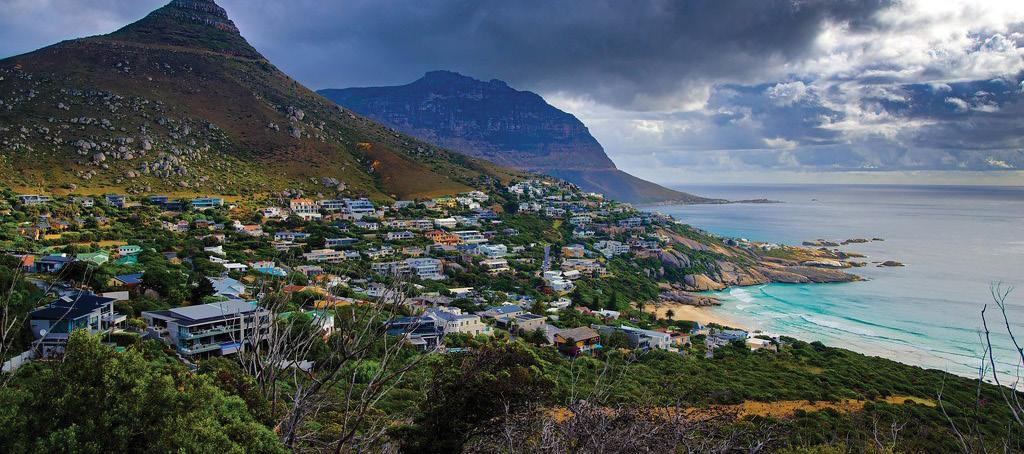
“I think the time for diagnosis is over. It’s now time to do something about it,” declared the Western Cape's Premier, Alan Winde, during his latest State of the Province Address (SOPA) in February. The Premier presented his administration's clear roadmap for recovery and growth, emphasising the importance of job creation and the well-being of the province’s residents.
The approval and gazetting of the Atlantis Special Economic Zone (SEZ) as a Schedule 3D public enterprise is an example of the
• Facilitating private sector investment which can create jobs in the province
With the COVID-19 pandemic winding down, the province’s focus has shifted. “This new stage provides us with a window of opportunity to make the bold changes that are now needed, so that we push back against going back to normal and so that we push forward, to do even better,” said the Premier in his address in the town of Velddrif, which marked the official opening of the Western Cape Provincial Parliament (WCPP).
is taking lessons from the response to the COVID-19 pandemic and applying the coordinated response approach to unemployment. The provincial government has identified two “clear pathways”.
The Premier has chosen to be proactive when it comes to the challenges residents are facing, determined instead to exercise the full capabilities of the public and private sectors. At SOPA, he reiterated what he had said in October of 2021 about his priorities for recovery: “...our single biggest priority in the year ahead must be to create an environment where the private sector creates jobs and lots of Thethem.”province
62 | Public Sector Leaders | September 2022
Housing opportunities have also driven job creation with the Premier noting that “Since the start of this

“According to the Global Startup Ecosystem Report 2021, Cape Town is listed as the number one performer in Africa for technology ecosystems and is home to almost two-thirds of all start-ups in South Africa. We are truly Africa’s Tech Capital.”

FOCUSING ON THE WELL-BEING OF RESIDENTS
To achieve the same effect that was seen in the pandemic response, an interdepartmental cabinet has been formed which includes the newly created Infrastructure and Mobility departments. Also included in this group are Provincial Treasury and the departments of Economic Development, Tourism and Agriculture.
• The agricultural sector has steadily grown over the last five years, creating more jobs
“I will also include private sector representatives so that we lead with interventions that will unlock growth and help business [sic] employ more people,” said the Premier.
• Cape Town is Africa’s Business Process Outsourcing capital
• The VECTOR programme, which monitored 20 000 diabetics, won an award
Government has five “mega health” projects set in motion for the medium-to-long •term:Belhar Regional Hospital
• Helderberg Regional Hospital
Public Sector Leaders | September 2022 | 63
government’s term of office, we have provided over 32 000 housing opportunities, helping create over 2 700 job opportunities in the Western Cape”.
• The Western Cape is hive of tech-related activity -
The COVID-19 pandemic saw major wins for the province:
• The largest field hospital in Africa was built at the Cape Town International Convention Centre
• 2.2 million medicine parcels were delivered to people’s homes
“The most important lesson from our COVID-19 experience is that we are capable of breaking down silos, and working quicker and more in Thesync.”Provincial
• Klipfontein Regional Hospital
• Tygerberg Central Hospital
He also highlighted the potential for further growth, going through the Western Cape’s progress and stable footing:
• Swartland District Hospital
“Preparation is commencing for the Belhar and Klipfontein Regional hospitals, and detailed planning to enable a Public-Private Partnership for the Tygerberg Central Hospital development has also begun, working in collaboration with the World Bank.” n
recognised as Africa’s “green tech hub”, with potential for even more growth
Sources: Western Cape Gov
“The shortage of electricity is a huge constraint on economic

The plan includes a renewed push to improve power plant reliability. President Ramaphosa said that over the next year, Eskom will
the energy sector is generation capacity. Only around 60% of the capacity is available at any given time due to maintenance and unplanned outages. This, along with other factors, has led to an electricity shortage of up to 6 000 MW.
The interventions are aimed at improving the performance of Eskom’s existing fleet of power stations, accelerating the procurement of new generation capacity, increasing private investment in generation capacity, enabling businesses and households to invest in rooftop solar, and fundamentally transforming the electricity sector and positioning it for sustainability in the Amongfuture.thechallenges facing
The plan was announced amid what President Ramaphosa termed an “energy crisis”, with the country experiencing severe load “Aftershedding.morethan a decade without a reliable electricity supply, South Africans are justifiably frustrated and angry. They are fed up. We have therefore developed a set of actions to respond to the crisis,” said President Ramaphosa.
The government has started to allow parties other than Eskom to generate electricity and has raised the licensing threshold for new embedded generation projects from 1 MW to 100 MW. This removed the licensing requirement for generation projects up to 100 MW that are connected to the national grid, and this will allow these independent generators to sell electricity to one or more customers.
growth and job creation. It deters investment and reduces our economy’s competitiveness,” said President Ramaphosa.
The News Energy Plan aims to encourage the development of renewable energy sources and encourage private investment in the sector.
Among the changes proposed by the New Energy Plan are:
64 | Public Sector Leaders | September 2022
NEW ENERGY PLAN
• BOLSTERING ESKOM’S CAPACITY
W
“The crisis that we are facing requires that we should take bold, courageous and decisive action to close the electricity gap.
This is a call for all South Africans to be part of the solution; to contribute in whatever way they can to ending energy scarcity in South Africa.”
BY JESSIE TAYLOR
ide-ranging and urgent power reforms announced by President Cyril Ramaphosa have the potential to transform the electricity sector.
A new path to increase energy capacity
• PROMOTING PRIVATE ELECTRICITY GENERATION
Public Sector Leaders | September 2022 | 65
There is significant potential for households and businesses to install rooftop solar and connect this power to the grid, said President Ramaphosa. To incentivise greater uptake of rooftop solar, Eskom will develop a feed-in tariff that will allow those with solar panels in their homes or businesses to sell surplus power to Eskom.

• PURCHASING OF ELECTRICITY
As part of addressing the shortage of electricity, Eskom will now also purchase additional energy from existing private generators such as mines, paper mills, and shopping centres, among others. In addition, Eskom will now import power from our neighbouring countries in Southern Africa, such as Botswana and Zambia, have more electricity capacity than they require
“OurRamaphosa.ultimate objective is to achieve long-term energy security so that we never have to experience an electricity shortage again. We aim to do this by stabilising Eskom and improving plant performance, establishing a competitive electricity market, opening the way for private investment in new generation capacity and increasing our investment in renewables.” n
• “We are cutting red tape that has made it difficult for Eskom to buy maintenance spares and equipment within the required period to effect repairs,” he added.
Sources: BusinessLIVEBusinessTech|Engineering News IOL
• A FOCUS ON RENEWABLE ENERGY
The power utility will also focus on recruiting skilled personnel, including former senior Eskom plant managers and engineers from the private sector, to address the shortage of skilled personnel and engineers.
One of the first steps taken to address the electricity shortfall was to revive
• REDUCING REQUIREMENTSLICENSING
“These interventions will allow us to do what is necessary to accelerate new generation capacity while protecting the rights of all South Africans and upholding the rule of law. We do not need a state of emergency or national disaster to implement common-sense regulations that should help in resolving our energy crisis,” said President
• Eskom will also be constructing its first solar and battery storage projects at Komati, Majuba, Lethabo and several other power stations. These will result in over 500MW being added to the system.
the renewable energy procurement programme in 2018. Since then, over 2000MW of solar and wind power has been connected to the grid through Bid Window 4 of the programme. A further 2 600MW of capacity has been procured through Bid Window 5, which will begin to add capacity from early 2024. In addition, the amount of new generation capacity procured through Bid Window 6 for wind and solar power will be doubled from 2 600MW to 5 200MW.

• INCREASED INVESTMENT IN SOLAR
The government will be removing the licensing threshold for embedded generation. This will enable private investment in electricity generation to rise to higher levels. While these generators will not require licences, all new generation projects will still have to register with the regulator and comply with the technical requirements.
increase the budget allocated for critical maintenance to increase the reliability of its generation capacity.
The GEPF holds sway over South Africa’s long-term growth due to the size of the Fund and the investment potential that comes with that.
FINANCIAL FITNESS
The defined benefit fund was established in 1996. It is currently the largest pension fund in South Africa and one of the largest pension funds in Africa. The Fund has more than R1.8 trillion in assets under management and is the single largest investor in the Johannesburg Stock Exchangelisted (JSE) companies.
CHANGING SOCIETY THROUGH INVESTMENT
TODAY
Pension savings are essential to caring for the older population and reducing poverty levels in the country. But ensuring that public service employees have an income after retirement is just one of the key roles the Government Employees Pension Fund (GEPF) plays in the South African economy.
Aside from offering members an extensive range of benefits, the Fund is a significant investor and can drive economic and societal transformation.
The Government Employees Pension Fund (GEPF) is Africa’s largest
BY JESSIESTARTTAYLORINVESTING
The Fund is large by international comparison, with a significant membership, and manages funds equivalent to around a quarter of
66 | Public Sector Leaders | September 2022
A LEGACY OF ASSET MANAGEMENT
pension fund, with more than 1.2 million active members. The Fund has around 450 000 pensioners and beneficiaries. The GEPF is mandated to manage and administer pensions and other benefits for government employees in South Africa under the Government Employees Pension Law (1996).
Government Employees Pension Fund Securing a new economic future
The Fund works to give members, pensioners and beneficiaries peace of mind about their financial security after retirement. It does this by ensuring that all funds in its safekeeping are responsibly invested and accounted for and that the benefits due are paid efficiently, accurately and timeously.

The GEPF offers security to civil servants after they retire by providing them with an income and various benefits, but it has also played an important role in investing in the economy.
If you joined the GEPF before 1998, you might also be entitled to certain tax benefits.
Along with growing the economy through investment, the GEPF holds the power to turn the tide against poverty, especially among the elderly. Research has shown there is a poor retirement savings culture among South Africans, with fewer than a third of adults having any form of pension account.
Along with retirement benefits, the Fund pays death benefits when a
Those who do have savings do not necessarily have enough to support themselves once they stop working: Institute of Retirement Funds Africa has found that two-thirds of members have less than R50 000 in their pension funds. The low level of pension savings results can be a burden for younger generations, with many young professionals
• A channel of communication for complaints: The Fund recently launched the Government Employees Pension Ombud (GEPO), an independent internal structure of the GEPF dealing with administrative complaints against the GEPF from its members, pensioners and beneficiaries. The purpose of the GEPO is to facilitate, investigate, determine and resolve complaints lodged by members, pensioners and beneficiaries of the GEPF in a fair, impartial and timely manner. Advocate Makhado Ramabulana has filled the position of Ombud since July 2021.
If you joined the GEPF before 1998, you might also be entitled to certain tax Thebenefits.Fundoffers
member dies while in service, or within five years of becoming a pensioner, as well as offering funeral benefits to help pay the funeral costs when a member or pensioner passes away.
This type of investment can have a very considerable impact on economic and social transformation in the country.
forced to put large portions of their income aside to support their family, in turn trapping them in the cycle of poverty.
While the Fund has value to society, there are some specific advantages from which members stand to benefit. Not only do they have access to retirement and early retirement benefits in line with their years of service, but they are also covered for retirement due to medical reasons.

Sources: National Treasury | BusinessTech | Daily Maverick | GEPF | News24
• Increases in line with inflation: Earlier this year, the GEPF announced an annual pension increase of 5.5% is to be provided to its pensioners. The increase is based on the inflation rate, in line with the Fund’s policy and past practice. The increase, which is above that provided for in GEP Law and Rules, is granted at the discretion of the Board of Trustees of the GEPF, taking the Fund’s investment performance into account.
CREATING BENEFITS THAT COUNT
two additional forms of security for members:
the country’s GPD. This creates vast investment potential, especially with the Fund moving away from investing in government bonds to a well-diversified portfolio.
Public Sector Leaders | September 2022 | 67
WHY IS PROBATION NECESSARY?
Both employers and employees find probation periods valuable, because employers can evaluate whether a candidate is a good cultural fit and
Probation
68 | Public Sector Leaders | September 2022
WHAT DO EMPLOYEES OFTEN FORGET DURING THEIR PROBATION PERIOD?
Is it fair, is it necessary, and is it legal?
• Deadlines/give enough time for the employee to improve his/her performance;
• Performance review meetings/ check-ins with the employee, to make sure that the employee knows what is expected from him/her;
A probationary period is meant to review an employee's job performance over a reasonable, mutually agreed-upon amount of time for the employer to evaluate whether the employee is suited for the position/reached the expected standard they have been assigned, prior to confirming a permanent appointment.
In South Africa, the standard probationary period is three months, with the most significant criterion being that it be "fair" and dependant on the type of position/complexity of the role you hold.
The simple answer is yes, it is legal, and unless you are not competent as you should be to hold the position you have been appointed in, you too would consider it fair and even necessary.
• Inform the employee what will happen (next steps) if the company is not happy with his/her performance.
has reached the expected standard of performance. At the same time, employees can evaluate whether they like the culture of the company and whether they are able to fulfil the position they have been appointed in.
WHO BENEFITS FROM A PROBATION PERIOD?
Employees often forget that a company can decide not to appoint you on a permanent basis even if you have been performing but are not deemed to be a good fit for the company.

periods - there will always be hard-pressed questions around this topic!
• Identify what areas (if any) there are that need improvement;
WHAT RECORDS SHOULD BE KEPT DURING THE PROBATIONARY PERIOD?
In practice, the employer must make sure that managers or supervisors know about these rules and that they keep detailed written minutes and records of:
Labour Excel specialises in offering a variety of Labour Law and HR Solutions. Silke Rathbone, one of the Principal Partners, has crafted and honed her skillset and assists corporates and individuals along the Labour journey to ensure they understand what is required of them at all levels. n
The Responsibilities of Companies and Employees

Our children are our heritage
T: +27 (11) 548 3900 | E: infosa@forafrika.org | W: ForAfrika.org/za/ | REG: 0 52-455-NPO

Public Sector Leaders | September 2022 | 69
As Africans we are determined to see our continent thrive. Our children are our heritage and we believe that educating and nourishing them are key to unlocking Africa’s full potential. ForAfrika plays an active role in this, feeding approximately 1.4-million children on the continent daily. In South Africa we work with crèches in informal settlements across all nine provinces to nourish and enhance the education of over 100,000 children and empower their communities with the agricultural skills they need to grow their own food and even generate an income selling surplus produce.

As Africa’s largest indigenous non-governmental organisation, we are at the forefront of the change that we desire to see.
Join us to see an Africa that thrives.
BY KOKETSO MAMABOLO
It was in 2007 when the United Nations General Assembly declared the 15th of September as the International Day of Democracy. Each year this key pillar of modern society is celebrated by parliaments around the world. Members of the Inter-Parliamentary Union are among many who take time to reflect on the importance of upholding democracy and ensuring all humans reap its benefits. “The International Day of Democracy provides an opportunity to review the state of democracy in the world,” says the United Nations. Almost thirty years into democracy, it’s as good a time as ever for South Africans to reflect on the state of our own democracy.
1615
International Day for the Preservation of the Ozone Layer

International Day of Democracy
September is all about heritage, democracy
Each year the United Nations urges the world to stop all hostilities as we observe International Day of Peace. The inaugural celebration was held on the commencement of the General Assembly’s opening day in 1982. “The UN General Assembly has declared this as a day devoted to strengthening the ideals of peace, through observing 24 hours of non-violence and cease-fire,” says the UN. “But achieving true peace entails much more than laying down arms. It requires the building of societies where all members feel that they can flourish. It involves creating a world in which people are treated equally, regardless of their race.”
International Day of Peace

70 | Public Sector Leaders | September 2022 UPCOMING EVENTS

With ongoing conversations around the impact humans have on the environment growing more and more urgent, and the discourse shifting with each passing year, it’s easy to forget that the ozone layer sits at the very heart of damage humans have done. This makes the International Day for the Preservation of the Ozone Layer even more important. The 16th of September is the day when the Montreal Protocol on Substances that Deplete the Ozone Layer was signed in 1987. More than three decades later, the objective remains the same: Reduce the production and consumption of substances which can expose us to the harmful ultraviolet light emitted by the sun.
21
TranslationInternationalDay
24
EnvironmentalWorldHealthDay

democracy and the environment
In the first millennium, St. Jerome performed a task which would go on to have an indelible mark on humanity. The priest is considered the patron saint of translators, recognised as the first person to translate the Bible from Hebrew into Latin. “The day presents an opportunity for paying tribute to the work of translators, terminologists, interpreters and language practitioners in general who endeavour to make the world a slightly smaller place by breaking down language barriers and allowing great literature to be enjoyed far more widely,” says the South African government.
The IFEH notes how environmental health can further the realisation of seven SDGs, almost 20 targets and at least 30 indicators. “It is necessary to accept that there is an integral connection between the environment, health and the economy. It is therefore important to invest in healthy and green recovery, close to all communities…”
| SA Gov IFEH
The theme for this year is “Strengthening Environmental Health Systems for the implementation of the Sustainable Development Goals”. On this day the world reflects on the external factors which have an impact on the health of humans.
A public holiday in South Africa, Heritage Day is the embodiment of what the late Archbishop Desmond captured in his phrase “The Rainbow Nation”. Much like New York or London, South Africa’s metropolises are examples of how languages and cultures can collide to create a society which represents the width and breadth of humanity. Heritage Day celebrates the “cultural wealth of our nation”, recognising the traditions, history, languages, knowledge and practices of all who live in the rainbow nation. “Living heritage plays an important role in promoting cultural diversity, social cohesion, reconciliation, peace and economic development,” says the South African government.

In a country with a collage of languages, the legacy of St. Jerome is one that deserves to be honoured.

30
Sources Inter-Parliamentary Union Nations
| United
Heritage Day
Public Sector Leaders | September 2022 | 71 26
:
Spearheaded by the International Federation of Environmental Health (IFEH), this day “is targeted towards preventing disease and creating health-supportive environments.”
RICHEST WOMEN BY FIONA WAKELIN & SINAZO MKOKO Meet South Africa’s top 5 wealthiest women Top to bottom: Wendy Appelbaum; Wendy Ackerman; Irene Charnley; Bridget Radebe; Sharon Wapnick


Looking
supermarkets and 14 hypermarkets. The company extends its food and retail services across South Africa, southern Africa and even Australia, and has employed an estimated 49 000 people over the years. Wendy received an Inyathelo Award for her family’s philanthropic efforts in 2007.
BRIDGET RADEBE Bridget Radebe is the former
IRENE CHARNLEY Irene Charnley is the the Founder, former CEO and former Deputy Chairperson of Smile Telecoms, a Pan-African telecommunications group established in 2007, with broadband operations in Nigeria, Tanzania, Uganda and a presence in the Democratic Republic of Congo (“DRC”). She is a successful businesswoman and is the President of the International Women’s Forum South Africa (IWFSA), a global organisation of over 7 500 preeminent women of significant and diverse achievement across 36 nations and 6 continents. Among other things, she has served on the Board of the Public Investment SittingCorporation.onthe fourth place is:
SHARON WAPNICK

president of South African Mining Development Association and a mogul in the mining industry. She’s the older sister of one the richest men in South Africa, Patrice Motsepe. With a networth of over R1billion, the iconic business woman has paved a way for many African women who aspire to be in the male-dominated industry and be among the top richest women in South ClosingAfrica.thetop five is:
With a networth of over R400million, Sharon Wapnick was the Founding Member of Tugendhaft Wapnick Banchetti & Partners - a leading South African boutique corporate and commercial law firm, centrally situated in the economic hub of Sandton's CBD. She is the daughter of the Founder of Octodec Investments, Alec Wapnick. In 2011, Sharon was elected as the Chairman of Octodec. She completed her BA degree and LLB (cum laude) via the University of the Witwatersrand, and fulfilled her articles of clerkship with Moss Morris, which is where she was promoted as the Deputy Chairperson of Moss Morris in 2003. n
at the list of the richest women in Africa, what is striking is that acquiring billionaire status does not happen overnight. Everyone featured here has spent a lifetime investing in, and growing, their entrepreneurial empires. Silver hair and gold in the bank!
followed by:
In the third place is:
Topping the list of wealthy powerhouses in South Africa is:
Wendy Appelbaum is the daughter of Liberty Group founder Donald Gordon and the owner and Chair of De Morgenzon Wine Estate. Previously, Wendy also served as the Deputy-Chairperson of the Women's Investment Portfolio Limited (Wiphold Limited), which is a renowned women’s investment holding company that is listed on the JSE. Overall, Wendy is also a Director of Sphere Holdings (Pty) Ltd, which is a black empowerment company addressing financial services in mining sectors. In 2015, she was awarded both the Forbes Woman Businesswoman of the Year, and the Forbes Africa Woman of the She’sYear.
WENDY APPELBAUM
WENDY ACKERMAN Wendy Ackerman is one of the founders and an Executive Director of Pick ‘n Pay Stores. Along with her husband Raymond Ackerman, Wendy has been a tremendous force in building up one of South Africa’s leading FMCG retailers, which, to date, consists of over 450 stores, with the inclusion of 121

We care for our natural resources. Not just for nature’s sake, we do it for you. The choices we make about the way we produce and consume energy can transform our economy and improve our quality of life. Visit wwf.org.za to see how every action, big or small, makes a difference.

