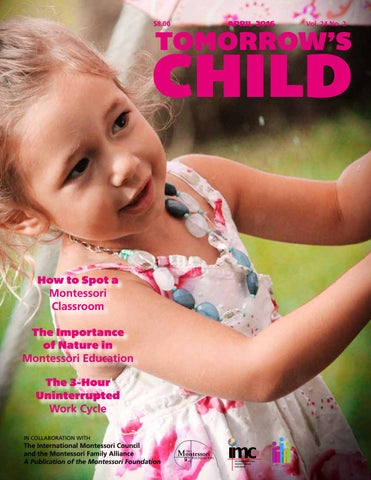
$8.00
APRIL 2016
Vol. 24 No. 2
How to Spot a Montessori Classroom The Importance of Nature in Montessori Education The 3-Hour Uninterrupted Work Cycle IN COLLABORATION WITH
The International Montessori Council and the Montessori Family Alliance A Publication of the Montessori Foundation
TOMORROW'S CHILD © § APRIL 2016 § WWW.MONTESSORI.ORG
1
Ever wish for something to hand out at community events or open houses that easily explained or visually showed some aspect of Montessori that didn’t overwhelm the reader? Who better than the people who wrote the book, The Montessori Way, to introduce such a product!
Our 3 best t) sellers (righ e in l b a l i a v a o als Spanish!
NINE Montessori titles now available. Use the form below to order & stock up now.
Each pamphlet bundle contains 50 of the same title and is incredibly affordable at $15 USD per bundle plus postage. The items are in stock and ready to ship. They may be purchased the following ways: 1. Through our online publication center located at the Foundation’s website: www.montessori.org (go right into the ‘bookstore’ tab) 2. By calling Margot at 800 632 4121 (IMC school members receive a discount on this item and will need to call with credit card. Should your IMC school membership need to be renewed, we will do that at the same time.) 3. Use this order form and either mail or fax your order. Make checks payable to: The Montessori Foundation and mail to: 19600 E State Road 64, Bradenton, FL 34212 USA. Or Fax us at 941 359 8166. To obtain shipping-cost information for orders outside US email: margot@montessori.org. Expedited courier service, such as FEDEX/UPS is substantially more expensive (price is determined by weight and location by the courier). We will estimate this for you if USPS can not deliver to your area, before charging out). Fed Ex and UPS cannot deliver to a PO BOX. 1. What is Montessori? ❑ English ❑ Spanish
_____#of bundles @$15
Total due $_______
2. Why Would You Start Your Three-year-old in School? ❑ English ❑ Spanish
_____#of bundles#of @$15 Total due $_______ bundles@$15 Total due $
3. Montessori Nurtures Curiosity, Creativity & Imagination
bundles@$15 Total due $ _____#of bundles#of @$15 Total due $_______
4. What can Montessori Offer Our Infants & Toddlers?
_____#of bundles @$15
Total due $_______
5. Creating a Culture of Partnership, Kindness, Respect & Peace
_____#of bundles @$15
Total due $_______
6. The Importance of Montessori for Kindergarten ❑ English ❑ Spanish
_____#of bundles @$15
Total due $______
7. Joyful Scholars: Montessori for the Elementary Years
_____#of bundles @$15
Total due $______
8. Research & Montessori
_____#of bundles @$15
Total due $______
9. Montessori in the Home
_____#of bundles @$15
Total due $______
Shipping Method: ❑ USPS FLAT RATE PRIORITY ❑ COURIER (FedEx/UPS)
$ TOTAL DUE $
Shipping Amount Shipping Amount $______
❑ 1 - 3 bundles $6.95 over 24 call. $7.45 ❑ 4 - 12 bundles $12.95 $13.45 ❑ 13-24 bundles $15.95 Call for pricing
TOTAL DUE $______
IMC membership number ___________ for discounted pricing of $12.50 per bundle. To obtain shipping-cost information for orders outside US, call 941-309-3961 or email: margot@montessori.org. Credit card#____________________________________ Name on Card____________________________________Exp. date_________ EMAIL address for receipt_________________________(please print clearly) Phone number in case we have a question(_____) ____________ Mailing address and name of contact person___________________________________________________________________________ SAMPLES ARE $1.00 EACH PLUS $1.44 S&H (US) ($2.44 CANADA) (S&H APPLIES FOR UP TO NINE BROCHURES). CIRCLE: 1 2 3 4 5 6 7 8 9
2
TOMORROW'S CHILD © § APRIL 2016 § WWW.MONTESSORI.ORG
Tomorrow’s Child (ISSN 10716246), published four times a year, is the official magazine of The Montessori Foundation, a non-profit organization. The opinions expressed in Tomorrow’s Child editorials, columns, and features are those of the authors and do not necessarily represent the position of the magazine or The Montessori Foundation. Acceptance of advertising does not represent the Foundation’s endorsement of any product or service. It is policy of The Montessori Foundation, a non-profit organization, to encourage support for the organization by discounting the sale of bulk order shipments of Tomorrow’s Child in order that schools may make the magazine available to their families. The Montessori Foundation does NOT grant permission to reprint material from Tomorrow’s Child in any other form (e.g., book, newsletter, journals). Copies of this issue or back issues are available for purchase through our online bookstore: www.montessori.org. For Standing Bulk Orders, call 800-655-5843 (toll free), use the order form on page 39, or place your order at www. montessori.org. The Montessori Foundation does not provide refunds for cancelled standing bulk orders. Send all correspondence to: The Montessori Foundation 19600 E State Road 64 . Bradenton, FL 34212-8921 Phone: 941-729-9565/1-800-655-5843 Fax:941-745-3111 WWW.MONTESSORI.ORG EDITOR Joyce St. Giermaine PRESIDENT Tim Seldin PROGRAM DIRECTOR Lorna McGrath EVENTS & MEMBERSHIP Margot Garfield-Anderson ADVERTISING Chelsea Howe BOOKKEEPER Don Dinsmore FULFILLMENT Michael Anderson GRAPHIC DESIGN Katrina Costedio PRINTED BY InterPrint Note: InterPrint is now FSC,SFI and PEFC Chain-of-Custody Tri-Certified. Chain-of-custody certification offers paper that has been harvested from responsibly managed forests, then verifiably traced through all stages of print production. Conferences & Workshops IMC Margot Garfield-Anderson: Phone: 941-309-3961/Toll Free: 800-632-4121 Fax: 941-359-8166 email: margot@montessori.org Past Issues, Books & CD Orders For immediate service, use our secure online bookstore at www.montessori.org. For questions regarding an order, email: margot@ montessori.org or Phone 941-309-3961/Toll Free: 800-632-4121 Subscriptions & Bookkeeping Don Dinsmore Phone: 941-729-9565/1-800-655-5843 Fax: 941-745-3111 dondinsmore@montessori.org Classified & Display Advertising Chelsea Blanco Phone: 941-729-9565/Fax: 941-745-3111 tcmag@montessori.org Parenting Center Lorna McGrath Phone: 941-922-4949/1-800-655-5843 Fax: 941-745-3111 lornamcgrath@montessori.org
6
The Solution to Improving Focus in the Montessori Classroom by Rachel Buechler
8
Weaving Nature Study into the Montessori Classroom by Kelly Johnson
10
Nature Journaling with Upper and Lower Elementary Children by Kelly Johnson
12
Pack a Nature Journal Field Bag by Kelly Johnson
14
Little Children + Herb Gardens = Big Nature Connections by The Montessori Foundation Staff
17
How Do You Know When You’re in a Montessori School? by K.T. Korngold
21 22 24
Brief Summary of Urie Bronfenbrenner’s Theory on Child Development and the Impact of Parent Involvement by Kyla Landon A Year of Wonder: The Neuroscience of Empathy by Sam Chaltain A Montessori Morning: The Three-Hour Uninterrupted Work Cycle by Punum Bhatia, PhD
28
Grandparent’s Corner: A Warm Heart in the Cold Northeast by Margot Garfield Anderson
30
Grandparent’s Corner Plus: Point / Counterpoint by Joyce St. Giermaine
26 CLASSIFIEDS 32 BOOK REVIEWS 34 DEAR CATHIE Montessori for Kindergarten 36 MONTESSORI 101 The Montessori Bubble
TOMORROW'S CHILD © § APRIL 2016 § WWW.MONTESSORI.ORG
37 MONTESSORI AT HOME Helping Young Children Prepare Their Own Snacks 39 TC ORDER FORM Cover photo Evie Knott at Hunsader’s Rockin’ Ranch, Florida photo by Joyce St. Giermaine
3
A Heutink Brand
Same trusted company
new name
For over 85 years Nienhuis Montessori, the world-leading Montessori brand, has been available to you through our company Nienhuis Montessori USA. We are proud to announce that as of April 1, 2015 our official name changed to that of our mother company - Heutink USA. With the same team, the same drive, selling the same familiar high-quality Nienhuis Montessori products, we also introduce 3 additional brands to the US market - Educo, Jegro, and Arts & Crafts. A wide range of global brands.
USA 150 S Whisman Road, Mountain View, CA 94041, USA T 1.800.942.8697 or 1.650.964.2735 | F 1.964.8162 | info@heutink-usa.com | www.heutink-usa.com
7.5x9.5 inch.indd 1
4
09-06-15 13:44
TOMORROW'S CHILD © § APRIL 2016 § WWW.MONTESSORI.ORG
APRIL 2016
LETTER PRESIDENT: FROM THE
DEAR MONTESSORI FRIENDS:
It’s hard to believe that the school year in the northern hemisphere will soon come to an end for most of us, and this is the last print issue of Tomorrow’s Child for the 2015-2016 academic calendar year. During the months ahead, until the new school year begins, there will be two more issues of Tomorrow’s Child that will be published digitally and sent to all members of the Montessori Family Alliance. In case you missed the news, the Montessori Family Alliance is a new international network of Montessori parents, teachers, and friends of Montessori. We focus on issues of children, Montessori education, and Montessori family life from infants and toddlers through teens. The Montessori Family Alliance reaches out to parents and teachers with articles that explore the principles of Montessori education and stories about individual Montessori school programs, reflections of present and former Montessori students, and articles about Montessori research. Benefits include: a digital and printed subscription to Tomorrow’s Child; two extra digital issues during our normal hiatus (May–August); weekly online Montessori Family Life Parenting Webcasts; Montessori Family Life Parenting Discussion Forums; videos about the Montessori experience; talks by noted Montessori educators; access to the digital edition of our popular Montessori 101: A Guided Tour of the Early Childhood and Elementary Classroom; and archives of past articles from Tomorrow’s Child. The Alliance continues to grow with members across the United States, Canada and in countries around the world. We will continue to run our weekly webinars for parents year-round except for a vacation break during the northern summer, and many projects under development include new courses and videos for parents that will roll out next fall. We want to thank you for your support and encourage you to help us promote Tomorrow’s Child and to share news of the Montessori Family Alliance with your families and friends.
Tim Seldin President, The Montessori Foundation Chair, International Montessori Council
TOMORROW'S CHILD © § APRIL 2016 § WWW.MONTESSORI.ORG
5
The Solution to
IMPROVING FOCUS
in the Montessori Classroom by Rachel Buechler
What if I told you I have the solution to helping children focus in the classroom? What if the solution is so easy that it requires little or no effort? I believe I do have the answer and it lies in children spending time outside.
W
hen I first became a teacher, I focused on preparing a beautiful environment inside the classroom. I spent hours designing and creating works and then observing the children’s reactions and interactions with the materials. Outside time was the time of day that children freely ran around and played with each other; it was also the mental break for teachers that they needed. I did not observe it as one of the most necessary times of the day. Recently some alarming statistics have changed my thinking. According to the Huffington Post, children are experiencing an average of 15 minutes of outside time a day, while they receive 7 hours and 40 minutes of screen time a week. The Huffington Post also states that it was recently mandated that prisoners should receive 2 hours of outside time each day, which is considerably more than our children are being entitled to. You may be thinking, but our Montessori schools are different; sadly, this is not true. Recently, I heard a public school Montessori teacher saying that she was forced to shorten her outside time to 20 minutes because of the curriculum demands of the state. Even our beautiful Montessori schools are not safe. Now you may be wondering, is the outside time
6
really more important than the wonderful work happening in the classroom? Is it really that harmful for the time to be reduced? Firstly, we are seeing that focus and concentration levels among our young students are becoming more significant issues, and the words ADHD and ADD are becoming more frequently used. Are we becoming more aware of disorders, or are we not utilizing the very experience that can help with children’s focus. Mack R. Hicks Ph.D. says that our children are experiencing 7 hours and 40 minutes of screen time a week, compared with just 3 hours in 1995 according to the BBC. According to the Centers for Disease Control and Prevention, cases of ADHD have risen from 7.8 percent in 2003 to 11 percent in 2011. Could replacing outdoor time with screen time be a factor in these statistics? I believe so. Outdoor time can improve children’s focus and provides them with a positive outlet for their large gross motor energy movements. Outdoor time also allows children to learn about the outside world, lowers stress, increases vitamin D, boosts positive moods, teaches children responsibility and patience, encourages natural curiosity, provides social experiences, and teaches cause and effect.
TOMORROW'S CHILD © § APRIL 2016 § WWW.MONTESSORI.ORG
Not only does it help with these skills, but the benefits of outdoor time can enhance all areas of the curriculum. Practical life is prevalent in the outdoor environment, from caring for a garden to raking sand. Through gardening, children learn to take responsibility for the plants and see growth when they maintain that care of the garden environment. They can explore, investigate, and research plant growth, rainfall, and creatures from birds to creepy crawlies that visit the outdoors, thus fostering their knowledge of the sciences and their own curiosities. Language can be explored through journaling, poem writing and identification of the insects, bugs, or plants that can be found in the outside environment. An herb garden can be created by the children and used to enhance their sense of smell and touch through exploration. To enhance hearing skills, a sound chart can be used. For younger children, it could be pictures of different sounds you may hear outside, or for older students, a written list provides students with the opportunity to sit and check off the list
the sounds they hear. This activity encourages use of the senses but also focuses on listening for specific sounds to enhance the skills needed to hear different phonetic sounds. Children can manipulate tools in the sandbox and build their fine-motor skills, by handling tiny seeds, placing them with precision. Art activities can be introduced to the outside space, such as leaf rubbing and water painting. More organized activities that encourage beautification of the outdoors, such as windmill making, building wind chimes, or making bird feeders can be done to help foster creativity, fine motor-skills and focus. Going back to the genius of Maria Montessori, she believed that the outside environment is where the children can come to be calm. She said, “When children come into contact with nature, they reveal their strength.” The environment can encourage this by learning how to care for plants, especially being gentle with more delicate plants and the consequences of what happens if they are not well cared for.
TOMORROW'S CHILD © § APRIL 2016 § WWW.MONTESSORI.ORG
I hope that taking time to read this has encouraged you to fight for your outdoor time and to prioritize it in your children’s day. I anticipate that you have had the opportunity to be inspired by the ideas listed to maximize the use of that time to benefit the children. I have confidence the next time your classroom (or your home) is “having one of those days,” you will bring the children to your second prepared environment: the outdoors. Good Luck. About Rachel Buechler Rachel is the Assistant Director at Charlotte Montessori School in Charlotte, NC. She is originally from Burnley, England and has lived in NC since 2010. She started out as an Infant/ Toddler teacher and holds a Montessori certification in Infant/Toddler. If you have further questions you can send them to rbuechler@charlottemontessori.com.
7
for nature; and the necessity of primary experience as the key to nature connection. When I first discovered these themes, I could only think how inherent they are in both Montessori philosophy and method.
Weaving Nature Study into the Montessori Elementary Classroom
F
or every first-year Montessori teacher, there is a learning curve. For me, in that first class 15 years ago, I learned that equally important as teaching reading and math is keeping alive the children’s senses of wonder and connection with their natural world. Of course, in theory, as Montessorians we know this, but in the thick of everyday classroom routines, it isn’t always so easy to keep nature connection at the top of the to-do list. Starting with a very small schoolyard garden bed, I made it my mission to open those children, their families, and the ones that followed, to the wonders of a seed, the fun of harvesting and cooking greens, and the delicious taste of a tomato eaten fresh off the plant as an integrated part of daily life woven across the lower elementary curricula. Why? Because I felt that this was the way I could contribute to Montessori’s vision of education as a tool for peace. Environmental protection comes from a culture that is connected to the environment. We don’t protect what we don’t love, so I was going to make sure my students loved nature (and learning of course!)
I have always had a strong connection to gardening and nature, but as I look back, I understand on a deeper level the importance of the connections to nature, wonder, beauty, and food that were built in my childhood. There was never any fuss over eating vegetables in my house because they were homegrown and delicious! I had a connection with my food and the people who grew it as well as a connection with the wilder aspects of nature that surrounded me. Although I lived in the suburbs, I was regularly able to dig holes, play with sticks, and go camping in nearby wooded areas. These childhood nature experiences were the foundation for my adult desire to create school, backyard, and community children’s gardens and to help adults create experiences that build foundational nature connections with the children in their lives. Nature-Study and School Gardens: Yesterday and Today
When I discovered the historic Nature-Study movement, I discovered the educational philosophy that had been influencing
by Kelly Johnson
my teaching style and work connecting children and nature for years. This prominent movement1 sustained mainstream popularity from the late 1800s through the early 1920s and promoted a conservation ethic in children through education and primary experience in and with nature. In America, this movement paralleled Maria Montessori’s work in both time and necessity. The Nature-Study movement gained huge popularity across American culture and encompassed various themes: the sentiment of nature versus the science of nature; an integration of gardens in schools; the popularizing of the belief that children specifically (and humans in general) have a natural inherent connection with nature2; the promotion of conservation awareness; and the concept of nature’s intertwined relationship with aesthetics and art. Nature-Study also incorporated the following sub-themes: elementary education reform as the primary outlet for changing society’s view on conservation; technology and industry contrasted with sympathy
Similar to Montessorians, advocates of the Nature-Study pedagogy believed that primary nature experience was critical and that it provided children with the resources to help them critically assess popular culture and materialism (Armitage 21). Elementary science first began to take root within the Nature-Study movement, and the majority of its proponents promoted nature-study as a way to make science and natural history hands-on (Kohlstedt 117). The major difference between modern science education and Nature-Study is that the latter, like the Montessori cultural curricula and the elementary cosmic curriculum, employed a creative, child-centered approach focused on incorporating nature across the entire academic curricula and child’s life (like a web) through the use of observation and the arts, rather than the view of natural history being a separate discipline. Unlike traditional modern science education, the desired outcome of Nature-Study was “to teach it for loving” rather than controlling, nature (Comstock); this struck me as a valuable parallel to the way Montessori teachers educate for peace and the human potential for good. During the rapid industrialization of the early 20th Century, so similar in cultural change to today’s rapid computerization, the foremost advocates and educators of Nature-Study promoted the movement as the ultimate qualitative, cross- curricular
1 The Nature-Study movement was very popular in America from the late 1800s through World War I, but had generally waned from popular culture by the Depression Era. Nature-Study was influenced by the likes of Thoreau, Whitman, and Agassiz and was essentially the first major environmental and conservation movement in the United States as it responded to changes and popular concern stemming from the Industrial Revolution and supported Progressive Era politics. Theodore Roosevelt was an avid supporter of this movement as was Ralph Waldo Emerson, Booker T. Washington, and many other influential progressive naturalists, artists, and educators of the early 1900s including Anna Botsford Comstock and John Dewey. 2 Now often referred to as biophilia “the innate tendency to focus on life and lifelike process.” (Wilson 1)
8
TOMORROW'S CHILD © § APRIL 2016 § WWW.MONTESSORI.ORG
method for inspiring connection to the natural world during youth, with an outcome that anticipated adults who would care for their natural world. Similar in intention to Montessori’s goal of educating for peace, the NatureStudy advocates educated children on the power of nature for promoting peace. Nature-Study was something that spanned indoor, outdoor, and home learning environments. It was a popular area of study as well as pastime, which I believe, as in Montessori philosophy, is one of the strengths. When the child sees that their teachers and family members both value a practice (whether Montessori or NatureStudy), it becomes an integral part of the child’s ethical system. From a more academic standpoint, Nature-Study documentation provides consistent data indicating modern research outcome that “adults who had significant and positive exposure to nature as children...were more likely to be environmentally sensitive, concerned, and active” (Blair). It is very intriguing how the rhetoric of today’s environmental and “green” education movements mirror that of a century before. As Montessori teachers and parents, we need not struggle to integrate outdoor learning across curricula and children’s lives. The Nature-Study advocates solved curriculum integration, and Maria Montessori corroborated the importance of slowing down to the child’s
pace. She observed that children want to “bring their activity into immediate connection with the products of Nature,” and when she speaks on “the garden as being what responds to the needs of the child’s spirit,” I feel as if I can’t help create children and school gardens fast enough (Montessori, 2006). These are only a sprout of the many green “thumbs-up” Montessori gives her teachers for incorporating outdoor environments and nature into the life of the child (and adolescent) as much as possible! The combination of historic and modern research across fields of progressive education supports that the time for 21st century Nature-Study has returned and the Montessori classroom, and home environments are natural leaders! Whether you have a flowerpot in a sunny window, a full-scale school farm, or access to a bed in a community garden, integrating nature and gardening across Montessori curricula and daily life of the child is the perfect way to fulfill developmental needs for connection with the natural world in a holistic meaningful way, with the added potential for a future culture connected to (and in love with) the natural world of which it is inherently part. Let’s get planting!
On the next page, Kelly teaches us about nature journalling with our Lower and Upper Elementary children and how to make their very own nature journals.
TOMORROW'S CHILD © § APRIL 2016 § WWW.MONTESSORI.ORG
9
om d a p te d f r (L e s s o n a W in g s, t he bo ok e r) n d Wo n d Wo r m s, a
The nature journal is a timetested way to document and assimilate nature experience and discovery and was a very popular pastime during the Nature-Study movement. Nature has been an inspiration to humans throughout history, and nature journaling has been practiced by some of humankind’s greatest thinkers, artists, naturalists, and scientists, including Dr. Montessori herself! The nature journal is a place to document observations, information, and then assimilate discoveries in a creative, yet scientific, way and is where many generate inspiration for their life work. Through journaling, patterns and observations discovered in nature that may have otherwise gone unnoticed or overlooked can be tracked. This type of pattern work enhances students’ ecological intelligence and connections to the natural world, while cultivating the skill of focused observation. The nature journal is also a wonderful anecdotal record-keeping tool. Teachers can track observation, drawing, and writing skills, as well as pattern thinking, once the children
10
Thank you to Kelly Johnson for sharing this information with us, some of which we have published previously. With warmer weather in the US these are just perfect projects.
and presented at sharing/showand-tell time, to other classes, at a parent event, or in a common area as a display. I once had a student who, for our monthly sharing time, would create the most wonderful posters, telling the stories of her nature discoveries and outings from trips to pick apples to small backyard nature discoveries and at home research work. Her mother did a wonderful job of encouraging, facilitating, and interconnecting the school-based Nature-Study work with familylife experiences and then creating engaged outlets for her child’s assimilation of nature experience. This is how really deep, memorable connections are made, the ones that create adults who love their natural world enough to work to protect it.
Through journaling, patterns and observations discovered in nature that may have otherwise gone unnoticed or overlooked can be tracked. become more adept at documenting their discoveries. It is a natural cross-curricular learning tool that seamlessly integrates across all Montessori curricula. In addition to regular daily or weekly time to journal in the outdoor environment: nature journals are a great way to focus high energy levels generated from outdoor excitement; always bring the nature journals on outings to natural areas or to museums, because these locations provide inspiration and often exhibit the patterns witnessed in the school outdoor environment. Try taking the journals to urban plazas to have children discover and document the unexpected nature found there. Upon returning home or to school, have students share a favorite sketch or thought from their journal regarding the day’s activity. Sharing is a great way to
recap, assimilate the experience, and assess the child’s learning. Then, embark on developmentally appropriate cultural research projects that identify and elaborate on what has been discovered in these locations and compare them to what is known about the schoolyard environment. This makes the journal a springboard for biological and historical research that integrates directly into the botany, biology, and geography curricula threads, while inherently tying across reading, writing, handwriting, and even math if measurements were taken of discoveries. Any unidentified natural object discovered on an outing, or in the schoolyard, can be carefully drawn in the journal and be brought back to the indoor classroom for further research that often ends up involving the entire class in a new discovery. The findings can then be prepared
For those schools required to incorporate technology initiatives, nature journals can prove to be beneficial tools that bring a softer side to technology in the Montessori environment. Try this: create a nature walk through a nearby park, wooded area, or the schoolyard’s perimeter, using digital cameras to take photographs of flora, fauna, and their habitats. Back in the classroom, have the students research the anatomy, needs, desired habitats, habits, and historical cultural significance of their discoveries. Then, write accounts documenting the important facts and create poems or drawings expressing the natural items and the experience. Use this documentation to create a local field-guide-style pamphlet, using a design program or a blog in a photo-essay format that features their natural history research, photography, and creative interpretations of local flora and
TOMORROW'S CHILD © § APRIL 2016 § WWW.MONTESSORI.ORG
fauna. Update the blog monthly or seasonally and visit the areas being documented regularly over the course of the year and let the children’s discoveries inspire their learning throughout the year. Make Classroom Nature Journals
Of course, a nature journal can be made from any notebook or sketchbook, but there is something extra special about having children make their own. I’ve observed that creating nature journals encourages more personal accountability for the journal when it is taken out of the classroom and distinguishes it from any other notebook in the cubby. Journals can be made from materials found in the average classroom and could even be incorporated into a recycling lesson if you use recycled paper. The adult preparation time is about one hour for twenty-five journals. If the students are younger than third grade, they will need a little adult help to assemble the books, so this project may be best done with a volunteer. Remember to make a journal for yourself, any associate teachers, or parent volunteers, so that everyone can journal together, modeling the significance of the work to the children. Let the children know that the journals are a place to record in words and pictures the things they see and discover in
nature. They are also a place to record their questions and feelings about nature. Try to use the nature journal frequently. The more the children (and the adults) journal, the better they will get at observation, documentation, and detecting patterns in nature. Once you feel that the children have reached a minimal level of proficiency, you may want to introduce the use of viewfinders, rulers, magnifying lenses, field bags, bug boxes, and technological devices into the journaling process. Depending on age level, use discretion when introducing new field materials (especially if using technological devices) so handling the extra materials does not distract the actual journaling process. MATERIALS PER BOOK
¡ 8.5x11 inch sheets of paper (ideally 100% postconsumer recycled). The number of sheets will depend on how many pages are desired in the journal. More pages can be easily added later if needed. ¡ 1 piece of construction paper or other decorative cover paper, 9x12 inches, also easily found recycled ¡ 1 regular rubber band ¡ 1 thin stick or bamboo skewer, 8.5 inches long ¡ A single hole punch ¡ Colored pencils or markers to decorate the covers
WORKS CITED Armitage, Kevin C. The Nature Study Movement: The Forgotten Popularizer of America’s Conservation Ethic. Lawrence: UP Kansas, 2009. Print. Blair, Dorothy. “The Child in the Garden: An Evaluative Review of the Benefits of School Gardening.” The Journal of Environmental Education 40.2 (2009): 15-38. Print. Kohlstedt, Sally Gregory. Teaching Children Science: Hands-on Nature Study in North America, 1890-1930. Chicago: U Chicago P, 2010. Print. Montessori, Maria. The Discovery of the Child. Madras: Kalakshetra, 2006. Print. Wilson, Edward O. Biophilia: The Human Bond with Other Species. Cambridge: Harvard UP, 1984. Print.
thread it up through one hole so a little loop pokes through.
PREPARATION
¡ Fold the 8.5x11 inch sheets of paper in half horizontally to create 8.5x5.5 inch folded sheets. Depending on the number of pages, the sheets may need to be folded in smaller groups and then compiled into one “book block” or stack of folded pages. ¡ Measure 1.5 inches from the top and bottom of the “book block” and punch a hole at each mark. Depending on the thickness of the “book block,” the hole punching may also need to be done in smaller groups of pages and then the pages recompiled. ¡ Fold the cover paper in half horizontally. ¡ Measure 1.75 inches from the top and bottom of the cover paper and punch a hole at each mark. ASSEMBLY 1.
Give each child a “book block,” cover paper, rubber band, and stick.
2.
Insert the “book block” making sure all holes line up. Have the children check if they can see through the hole, if so, then they know the holes are lined up.
3.
Pinch the rubber band in half and from the bottom,
4.
Insert one end of the stick or skewer through the loop securing it from falling back through the hole. The stick will be on the top side of the journal.
5.
Flip the journal over and holding the rubber band tightly, stretch it to the other hole. Pinch and insert the rubber band through the hole. Thread it up through the hole so a little loop pokes through on the topside.
6.
Tightly holding the loop through the hole, flip the journal back over to the topside and slide the free end of the stick or skewer through the bottom loop securing it from falling back through the hole.
7.
Have children write their names on and decorate the covers.
8.
To add more pages, disassemble the book and add a second “book block” stacked underneath the first. Do not place the new book block inside or around the first; this will rearrange the journal’s chronological order. Reassemble the rubber band and stick or skewer.
ABOUT KELLY JOHNSON Kelly Johnson (BFA, MA, AMS 6-9) is an artist, author, Montessorian, and children’s garden guide in Neptune Beach, Florida. Through her book Wings, Worms, and Wonder: A Guide for Creatively Integrating Gardening and Outdoor Learning Into Children’s Lives, blog, articles, student and teacher workshops, garden consultations, eCourses, and handmade garden accessories, Kelly inspires children and adults to creatively connect with their natural world through gardening and the arts. Contact Kelly at wingswormsandwonder@gmail.com and follow her blog at wingswormsandwonder.com for more Montessori and Nature-Study inspired children’s gardening and nature journaling fun.
TOMORROW'S CHILD © § APRIL 2016 § WWW.MONTESSORI.ORG
11
Pack a Nature Journal Field Bag! Be Ready to Journal at the First Sight of a Rainbow!
by Kelly Johnson
T
A Note from Kelly I’m Kelly Johnson. I’m an artist, surfer, musician, gardener, and seasoned Montessori teacher in Neptune Beach, Florida. And, of course, author of Wings, Worms and Wonder. I want to see pics of your nature art journaling field bags! Share them on Instagram #wingswormsandwonder Find the simple pattern for making the (green) field bag from Wings, Worms, and Wonder on my etsy page. Not feeling crafty? I’ll make a field bag for you. A stocked field bag for each member of the family would make an awesome gift that would be enjoyed all year! Want some guidance into the world of nature journaling? Check out the Wings, Worms, and Wonder online nature journaling school! http://wingsworms-and-wonder-classroom. teachable.com/
he Boy Scouts definitely knew a thing or two about nature adventuring when they set their motto: “Always be prepared.” Creative nature adventures big and small outside the classroom door and in your own backyard are even better when you are ready for anything! A little preplanning on the front end will keep you “always prepared” for any journaling journey from exploring the schoolyard garden to hiking up a mountain! One way to always be ready for nature fun is to have a field bag packed and ready to go at a moments notice. Field bags are an easy-to-carry small bag packed with the things you like to use to document creative discoveries made while exploring your natural world. The field bag can be backpack or tote style, but it should allow the owner to have their hands free, not restrict your movement, and it shouldn’t be too big because you don’t want to carry a class set! Whether nature journaling is a class or family past time, it’s important that each member have their own field bag, so choose smaller bags to designate and keep packed as the field bags. I recommend the bag average 8”×10” size. Otherwise it gets bulky and, ideally, it should have a shoulder strap. You could make your own like the one I give a pattern for in my book Wings, Worms, and Wonder,
12
you could buy one, or, if you have a small tote or backpack, you could use that. First, be sure that your nature journal fits in the field bag. This will probably be the largest item included. Then, choose a few drawing pens and pencils and place them in a pouch to keep in the bag. These will be used to draw and document discoveries and to write poems or thoughts about the nature being experienced. You can pack a small travel set of paints, but that may be a medium you choose to explore when the journaling session is more planned, as you will have to accommodate for water and what not. This packed field bag is more for on-
the-go type journaling adventures. Pack duplicates of your favorite drawing supplies. I like a small pack of colored pencils, a regular pencil (and of course a pencil sharpener that contains it’s shavings so we don’t litter in nature), my favorite drawing pens in nature inspired colors (Le Pen™ is my personal fave), and I also like to keep a large crayon or two without the paper for making rubbings should the inspiration strike for creating textured backgrounds. Next, include a small ruler, tape measure, or both. This is great for documenting leaves or other discoveries that may want to be researched later. It is also good for incorporating math into the excursion.
TOMORROW'S CHILD © § APRIL 2016 § WWW.MONTESSORI.ORG
Keep a magnifying glass in the field bag. I recommend a decent quality glass. These will run you about $3-$5 at the hardware store or online; in nature catalogues, they may be a little more pricey. Magnifying glasses are fun and awesome for seeing the world from a different point of view. Students can pretend they are an insect to spark inspiration! Magnifying glasses also are great for observing details on insects, flowers, and anything else discovered to journal about. It is fun to draw and collage macro style details out of context. I like to include a small viewfinder for looking at the world in a flattened way. These could be a square window cut from cardboard, or I like to use old slide housings. They give the feeling of looking through a little window at the world. They also help you focus in on a scene or specific area by defining the viewing area and are really great for setting up compositions for drawing landscapes. For some reason, they seem to flatten the scene like a photograph would and makes it easier to draw. FL Montessori halfpg cmyk.qxp__Layout 1
The adult may also want to have a collection case or two in their bag. These could be little containers or simple plastic zip-lock bags for collecting leaves and seeds. When the group returns, you may want to add some seeds or leaves into your journal spread with glue. Keeping them in a case or baggie will protect them a bit and also keep them from getting lost in the depths of the field bag. In addition to the art-supply items, carry a field guide specific to the area or the area being explored. It is fun to make identifications on the spot and sometimes to add them to the journals when it seems beautiful. Naming is an important part of making connections with our natural world. We seem to care more deeply for plants and animals of which we know the names.
I also recommend considering carrying a few things like insect repellent, sunscreen, a small first-aid kit, bee-sting salve, tissues, and perhaps specific safety items like a snake-bite kit and a cell phone. Not to scare, but we are fol8/12/15 11:58 AM Page 1 lowing the motto “always prepared,” right?
If you are new to nature, journaling, or are nervous to unplug too much and want to bridge the nature/technology divide, you could bring a digital camera, a GPS, or use identification apps (like for bird songs for example). Remember, though, the technology is a secondary means to nature connection, not the end itself. Use it as a bridge and then try your best to move away from it as quickly as possible and into connecting with your natural surroundings in a primary way. This is a great way for engaging adolescents into the natural world. Once your field bags are packed and ready, keep them handy to go at sight of first rainbow or when inspiration sparks! Smooth systems make nature journaling more enjoyable for beginners and experts alike, so set up a system that works for you, your classroom, and your family; then, get outside in every season with the nature journals as your guide. A world of beauty is out there waiting! ¢
Flyleaf Publishing’s Books to Remember™ Series
Written by a Montessori teacher, endorsed by national reading experts. This beautifully illustrated series contains one book for each Sandpaper Letter sound. Carefully written texts allow students to apply the skills they have learned to authentic, meaningful literature. Supplementary Learning Cards and Teacher’s Guides enhance Montessori Language lessons and align to the Common Core State Standards. TOMORROW'S CHILD © § APRIL 2016 § WWW.MONTESSORI.ORG
Preview materials on our website:
www.FlyleafPublishing.com
Orders & Brochures:
Orders by Fax:
800-449-7006 603-669-7945 13
den to create meaningful nature connection experiences with children! A few flower pots of select herbs will work perfectly. Children enter the garden without expectation, so a few pots seem like a lot to them. If you have an herb garden and young children in your life, consider designating a section to herbs that children especially enjoy. This will protect any rare varieties you may be growing, herbs inappropriate for children to eat, or plants you don’t want ravaged by little hands as they develop their picking coordination!
Little Children + Herb Garden Activities = Big Nature Connections Experiential learning is amazing at any age, but watching young children sensorially explore the herb garden is like tapping into pure wonder.
E
xperiential learning is amazing at any age, but watching young children sensorially explore the herb garden is like tapping into pure wonder. Children approach the herbs with curiosity, the way only a beginner can. It is a gift to share these first experiences, especially when tasting is involved, since oral exploration is inherent in the young child’s development. Often, as adults, we must keep things out of children’s mouths, so it is a special treat to create a natural environment where tasting is celebrated! Providing time and space for children to stroll at their own pace in the garden is important in their increasingly hectic and scheduled lives. When we provide young children with nature experiences that engage their senses, we help develop their Naturalist Intelligence (the 8th of Howard Gardener’s multiple intelligences) and encourage a “green thumb” self-perspective.
14
Current research by author Richard Louv and the Children and Nature Network points to early childhood nature connections as being vital for building a future of happy, healthy, humans who are connected and committed to preserving their natural world. Balancing guided garden journeys and plant naming with independent sensorial explorations (or wondering and wandering, as I like to call it) are equally important for helping children connect to their natural world. As an adult, it is easy to slip into the role of “teacher” in the garden rather than following the child’s curiosity, at the child’s pace, and acting as a guide. A guide is an observer, keeping the child safe and answering any questions that arise, while allowing the child to learn in her own way. When we allow ourselves this opportunity to guide, we tap into the children’s wonder and see the garden with new eyes, thereby connecting with both nature and the child holistically.
Creating garden activity stations, where a wondering and wandering child can engage in herb exploration are simple to actualize and help bring childlike wonder to the garden. Very young children will need an adult’s one-onone attention, but most four- to six-year- olds (and beyond) can recreate projects independently if a completed sample is modeled at the activity station. When engaging with the prepared garden activities, the children are purposeful in their interactions with the plants and take the “work” seriously, often repeating the activity multiple times until they reach a self-decided mastery. Creatively engaged young children connect with the garden on deep sensory and cognitive levels as they improve their spacial awareness and motor skills. It can be easy to overlook the developmental benefits for the all the fun that herbgarden exploration brings! Urban and container gardeners rejoice, you don’t need a full gar-
In a children’s herb garden, in ground or container, start growing mints, stevia, basil, bee balm, lavender, fennel, parsley, lemon verbena, shiso, nasturtium, aloe, fenugreek, chamomile, echinacea, and mullein. From leaf to seed pod, these herbs are a feast for the young child’s senses. If you have plenty of room, consider lemongrass, rosemary, salvias, and the herbaceous papaya tree, which is easy to grow from seed as an annual plant if you live in cooler climates. The classic culinary herbs of basil, oregano, thyme, chives, and parsley, as well as tea herbs like mint and chamomile, are also great to grow in containers near the kitchen door. While cooking, invite the children to independently pick the herbs needed in the dinner or to make the tea. This piques children’s interest in cooking and teaches healthy eating habits and positive food relationships. Children love to eat what they grow, pick, and prepare themselves. Cooking with children, while not always efficient, is always gratifying because they are so enthusiastic to eat their home grown creations. Revealing the sensorial wonders of nature is a special gift that we as gardeners can give children. While in the adult’s product-
TOMORROW'S CHILD © § APRIL 2016 § WWW.MONTESSORI.ORG
oriented mind, the goal of these activities may be to: teach basic gardening methods; build confidence; create connections with the local natural environment; strengthen the Naturalist Intelligence; hone fine-motor skills; and lay a foundation for a lifelong love of the plant world. The young child is interested in the process of the activity or experience—the way a mint leaf tears, how a flower floats in water, or that aloe feels sticky. When we provide the garden and the experience, the child rewards us with a reminder to slow down and enjoy nature’s wonders through all five senses. Herbal Water Infusions
Technically, this isn’t a true infusion, but it suits the young child’s attention span perfectly and is a refreshing treat. This activity engages touch when the child picks and handles the leaves, smell when they pick and tear herbs, sight when the child chooses which herbs or flowers to pick and sees the beauty of the glass with the infused botanicals, and taste when the child tastes the actual herbs and drinks the infused water. This activity also builds fine-motor skills, as well as meets the young child’s developmental need to fill up (and then often dump out). It also helps develop the cognitive realization that one container can hold another object. Simple for us, but big work for a young child. You will need: clear containers, such as: plastic punch cups or small mason jars; potable water to fill the containers; a tray; herbs and edible flowers to pick; and a straw to stir. (A papaya petiole makes a great “nature” straw stir stick.)
When we provide the garden and the experience, the child rewards us with a reminder to slow down and enjoy nature’s wonders through all five senses. a tray set with enough cups and straws for each child. Fill the cups half way with water. Place a straw in each cup. Show the child how to harvest and then place the herb leaves and flowers into the cup of water. They will take to this picking and placing job quickly and love to pick, place, and then stir it all up with the straw. Give them space to independently explore and quiet to concentrate. As sweet as this activity is to observe, try to refrain from taking pictures as this will also break the child’s concentration. Sit back, relax, and enjoy watching their wonder at work! After adding all the herbs and flowers they like, encourage the child to taste their infusion, although they will most likely do this on their own without your suggestion! Bath Time Tea bags
Preparation: Create an area in the garden near where they can pick herbs and edible flowers on a low bench, mat, or blanket for the child to discover and work. Have
This is a fun activity, because bath time is integral to children’s daily routine. It encourages the children to engage their senses of smell to choose the herbs they
would like in their baths. It helps develop their sequencing skills: Now we pick the herbs and later we will use them in our bath. It also begins to show children, at a basic level, how the herb garden integrates into everyday life. Even commercial children’s washes infuse lavender scents these days, so why not make your own! You will need: Ready-made, large fillable tea bags or light cotton muslin fabric to sew your own, yarn or ribbon, and herbs. If sewing your own, I recommend making simple 6” x 3” pouches. Decide if you want to pick the herbs ahead of time and have them in baskets or have the children pick their own. The ability to pick ahead makes this activity work well for indoor workshops. Give each child a pouch and have them stuff it about 3⁄4 full of any herbs they like. Tie off the top with a piece of yarn or ribbon or, if using a drawstring readymade bag, just cinch it up. Adding a couple drops of chamomile or lavender essential oil before cinching gives the bath
TOMORROW'S CHILD © § APRIL 2016 § WWW.MONTESSORI.ORG
tea bag an extra olfactory boost. After the bags are filled, store them in the fridge until bath time to keep the fresh. At bath time, place the tea bag under the faucet to steep while the tub fills. It can be left in the bath with the child as well. Initiating a conversation about the herbs, the picking process, and smelling the pouch makes for an interesting bath-time chat. After bath time, discard the herbs from the pouch, hang the pouch to dry, and refill another day. Nature’s Chewing Gum
This is a simple and quick sensorial exploration that illustrates how items in our everyday lives are inspired by nature. You will need: a mint plant and a stevia plant. Have the child pick 1 mint leaf and 1 stevia leaf. Invite them to eat the leaves at the same time. Voila, nature’s gum! It tastes like mint gum without the sticky mess! ¢
15
16
TOMORROW'S CHILD © § APRIL 2016 § WWW.MONTESSORI.ORG
How Do You Know When You Have Entered A Montessor0i School? have visited many schools over my years as a parent, educator, and CEO of CME|NY. There are a few key clues that I look for to help me gauge how the school is doing on the Montessori spectrum. I’m happy to see Community Playthings™ furniture, the clean lines and clear maple wood create a natural inviting background for all the beautiful materials; I love to see the demure Pink Tower standing at attention, the vibrant span of Color Tablets spread against a white mat, the silvery glow of the Sensorial Bells lined up along a window sill; I delight when I see a collection of genuine fossils, the long extended length of a colorful Timeline of Life stretched across the floor, the gorgeous green of Botany Charts. I hope to notice a cozy place for community meetings and gatherings, where children or teens can comfortably sit, sprawl, or loll. But even without all that, I look for other indications to inform me whether or not this environment is working effectively as a Montessori community. I start my assessment in the hall. With their primary function being conductors of transitions, hallways are places that either bustle with comings and goings or sit fallow in silent emptiness. With their wide stretches of long walls hallways create opportunities that do not exist in other parts of the school buildings, and often there is a strong desire to fill them with artwork, inspiration, color. Just as a Montessori classroom environment reflects a simple, clean organization, I hope the halls are restrained in their design. Certainly, there is a need for children’s chairs or benches, strategically placed where students may need to wait. Adult-size seating makes a natural place for visitors to remove their shoes before entering a classroom. I want to see children’s own artwork, hung at child’s eye level; I’m pleased when I see plants growing, a collection of shells, stones, branches in a vase, nests, etc., all bringing the inspiration and peace of the natural world within the internal borders of the school. When there is a display of artwork, created by the community to reflect the vision and mission of the school itself (a wall mural, quilt, collage), something unique and handmade, I know I am seeing an attestation to the love of the community for the school they call their own. If you sense placards are talking to you from the walls, that is a signal that their messages may not be getting to the children. It does reveal who makes the rules in the school and who has to follow them. Maria Montessori called her first school Case dei Bambini. It was a “children’s house,” a name
that reflected her vision of a habitat specifically for children to learn and thrive, one that was dedicated to them and also of them. The children themselves were central to the community. Their contributions mattered to the whole, no matter how small or young, they helped maintain and sustain it. How do we set up environments that send that message to the children and families who walk our halls everyday? Here are more questions to consider as you make your way through the school.
by K.T. Korngold
Take a look at the artwork. Is it all clumped according to categories or prescribed projects with the similar pieces repeated one after another with only slight variations? Or is it displayed like it might be in a gallery with a diversity of artists, ages, and medium all represented, including young and old, a range of proficient and developing artists? Who is the artwork for? Is it hung to catch a child’s eye or at taller levels to impress the adult? Does it celebrate process or only final product? How about ground rules? Are there inspiring regulations, clever sayings outlining good behavior, catchy wisdoms proclaiming how to be your best? Or are ground rules written by children themselves and formed by the community each year? One of my favorites comes from a community meeting: “Sometimes when you get bumped, I didn’t do it on purpose.” How are the children greeted in the morning? One of our faculty members from California told me that she was able to transform the culture of her charter school by the simple act of instituting a daily greeting with each and every student at the entrance to the school. One fellow came in earlier than all the rest. Once she realized he arrived so early, she made sure to be present by that time in order to meet him. As she did with all the students, she crouched down to his level, looked him in the eye, shook his hand, and welcomed him by name. He liked the quiet of the school in the early morning. Sometimes he helped the teachers set up; sometimes he ate the oatmeal breakfast; sometimes he rested in the sofa in her office. She knew it was important to be at the door each day. After she made it her mission to do so, she measured her accomplishments by the mornings she met that singular goal. She didn’t know until he had graduated that he had been homeless. Does it matter when some children arrive early or late? What are the consequences for them? Are they marked
TOMORROW'S CHILD © § APRIL 2016 § WWW.MONTESSORI.ORG
17
tardy and lose points against their overall strengths as a student? Do they wander into the classroom not knowing where to go or what to do? The time of arrival is seldom in the child’s control. Yet, when we punish or call out a child for being tardy, we may set in motion a series of unintended consequences or anxiety that may result in more unwelcome behavior. If the children are being greeted at the entrance by the head
serve, it is very likely that I will see learning in that environment. I see learning when different types of activities are occurring at the same time, as I did at a recent visit to the New York Montessori Charter School, when I looked in on an early childhood classroom. I saw children engaged in small groups while others worked individually. Students had materials on mats on
One of our faculty members from California told me that she was able to transform the culture of her charter school by the simple act of instituting a daily greeting with each and every student at the entrance to the school. and then met at the door of their classroom by a teacher or teacher’s assistant, the students feel welcome, accepted, known. When we welcome our children without reference to their clothing, appearance, or mood, it sends a very important message of acceptance, “Hello Freeha, I’m glad to see you today. Good Morning.” A warm, unconditional reception is a gift of acceptance we can offer our children each and every day spent with us. What if a child comes so late each day that she misses morning meeting? Is the school flexible enough to postpone group time until she arrives? What if the teacher is eager to start individual lessons and can’t cut into that important work time by waiting at the door for each student to arrive. One of our faculty members added “greeter” to the children’s jobs, so they take on that important responsibility and become engaged in the life lessons of grace and courtesy by shaking a friend’s hand, giving a welcoming hug, helping a latecomer walk into the space with a sincere feeling of acceptance. We all know well enough that Montessori environments don’t teach from the walls. We don’t use posters or themes to announce our plans or set forth the outcomes of the semester. But where do you look, then, to see learning happening? If I can’t see the teacher, and I can’t locate the teacher’s desk, I know if I get down to child’s level and ob-
18
the floor, while others sat at tables. One student was walking around, in search of a new activity to select; another moved slowly, back and forth across the room, as she carried the red rods, one at a time, to her mat. I saw one young boy wandering—watching, observing, finding his place, learning from what he saw and heard. A Common Core Observer might give this classroom very low marks because the students were not doing the same thing at the same time, the teacher was not giving direct lessons, and some children were “wandering” around. But I am satisfied knowing there is great value here, not only in this period of observation but also for the long term, as these children move toward their own futures. Dr. Montessori said: “Under the urge of nature and according to the laws of development, though not understood by the adult, the child is obliged to be serious about two fundamental things… the first is the love of activity…The second fundamental thing is independence.” (What You Should Know About Your Child) I see learning when I am privileged to catch work left out with a child’s name marking that it is still in use. Common Core dictates that we teach persistence. Is this even a quality we can teach, or is it rather a quality we encourage? I think of persistence as the will to return to solve a problem, even when the answer is not yet forthcoming or is out of reach. Webster’s dictionary defines persistence as “1) the quality that allows
someone to continue doing something or trying to do something even though it is difficult or opposed by other people; 2) the state of occurring or existing beyond the usual, expected, or normal time.” Consider for a moment your image of someone pondering a difficult problem. Is that person sitting still, silently, at a desk? Or is he stroking his beard, pacing the hallway, walking the length of the room? Is she talking to herself, scribbling notes on a pad, going for long walks in nature? Benjamin Franklin was not at his desk when he experienced electricity in the lightening storm. Madame Curie was not sitting still when she discovered radium; Nicholaus Copernicus was not in school when he realized that the earth revolves around the sun. In the Secret of Childhood, Montessori said, “Movement, or physical activity, is thus an essential factor in intellectual growth, which depends upon the impressions received from outside. Through movement we come in contact with external reality, and it is through these contacts that we eventually acquire even abstract ideas.” Solving problems takes time. The work may not be finished in a single work session between the announcements of period bells; it may not be completed in a day or even in a week. Persistence is the act of returning to something difficult, even after time has passed. And sometimes our brain needs to take a break; our bodies ache to move in order for us to break through and solve the problem. When you see movement in a Montessori environment, you will see it is something that is accepted, not something that is squashed. As Maria Montessori said, “The task of the educator lies in seeing that the child does not confound good with immobility and evil with activity.” (The Montessori Method) Is there work on the shelves that is open and available for the children to discover, select, and self-correct? Or is all work handed to them on worksheets that require an adult to check? Is work graded solely by the adults? Or are there other forms of assessments: peer assessment, peer feedback, self-assessment, work groups? Do children participate in their own conferences? Do students make
TOMORROW'S CHILD © § APRIL 2016 § WWW.MONTESSORI.ORG
decisions about their learning, their goals for the day, week, and year? If children want to work, are they permitted to come back into the classroom later, during lunch, or recess to finish a project or read, or be away from the group? Are adults available and willing to be there for them outside of their mandated work schedule? If a child doesn’t want to participate in a group meeting, is there a safe space for that student to be without feeling chided, embarrassed, ridiculed —a vantage point where the child can observe and absorb without disturbing the others. Not all children can tolerate group time (or sustain as much group time) as others. Are there wiggle chairs for children who don’t yet have the muscle tone to sit still or sit for long? Are there Brain Gym™ tools to help children warm up their brains to get ready to learn? Is there heavy activity for children who need sensory input? Are there havens for children who get overloaded or overwhelmed? Are there opportunities for children to move with selfselected activity: yoga cards; movement cards; movement activities; a dedicated movement shelf? Are the students considered responsible enough to go out into the hallway by themselves? I know plenty of licensors who don’t allow children to be anywhere, unmonitored. This is a shame, of course, and another battle we have to fight with state regulators to demonstrate that children can be safe with freedom within limits in the hallways and grounds of their own schools. Are the children permitted to start work without assistance or a presentation? If you came into a class and the teacher was not present, would the students be idle or working, engaged, self-motivated? When I visited a class at PS 31, the children were all playing drums: pounding out to each other in a call and response pattern. It wasn’t until five minutes had passed that I realized the teacher had stepped out into the hallway—she was waiting for me, and I had slipped in before her. Just as Maria Montessori’s children did that wondrous morning in
the Casa dei Bambini, these children had started their work without her. As Dr. Montessori stated, “The greatest sign of success for a teacher is to be able to say the children are now working as if I did not exist.” (The Montessori Method) How are the children called to attention? Does the teacher make a sound? Count backwards from 10?
What is being missed? I look to the environment first to make a change— not to the child. I look to the ways we interact with our children to help them develop inner control. In a Montessori classroom, you might hear a soft chime rung by a teacher to signify a call to attention; you might see all the children stand, one at a time, with their hands on
Is the natural desire for socialization being ignored? What is being missed? I look to the environment first to make a change—not to the child. I look to the ways we interact with our children to help them develop inner control. Flicker the lights? Clap her hands? Threaten to take something away if behavior doesn’t cease? In some states, it is illegal to threaten children to withhold food, water, snack, to withhold recess—and yet, schools do this all the time as a way to manage behavior. There are many other methods to announce transitions, change behaviors, and/or modify the tone in a room. Our lab school, the Montessori Children’s Center, serves children as young as three months old. Sometimes we hear crying from our infant room or from the hallway. There is a baby expressing herself, asking for something, vocalizing an unmet need. Our guides listen, attend, respond. After a few days of caring for each child, they can recognize the different sounds each child makes to signify her need: hunger, sleepy, wet, wanting to be comforted, asking to be held. When I hear an adult yelling in a school environment, I ask the question: What is the unmet need that is causing this loud piecing sound? If a teacher or administrator is yelling at students that sends a message that someone’s needs are unmet. What has happened that the environment has unraveled so much that an adult needs to raise her voice at the children? Are the developmental needs of the children going unrecognized? Is the urge for movement being suffocated? Is the natural desire for socialization being ignored?
TOMORROW'S CHILD © § APRIL 2016 § WWW.MONTESSORI.ORG
their hearts as they ready for the end of a work period. You might catch the soft swish of a rain stick turned upside down to announce a visitor at the door. At the Montessori School located in Wilton, Connecticut, I observed the gathering of the entire community for the monthly meeting. As the students and teachers streamed into the central hallway, the children spontaneously began to sing “Roots and Wings.” As each person entered the community space, another voice joined the mix, until all children and staff were singing together. At Yonkers Montessori Academy, I observed when the noise level increased a student went over to a shelf and began to play a very quiet music box. The class responded by lowering their voices. It was the students who were self-monitoring the comfort level of the sound in that classroom community. We should not be yelling at our children in school for any reason. While it doesn’t leave bruises, it is a form of violence that can have a lasting impression. Many children are sensitive to sounds; most people do not like to be yelled at by anyone. Unfortunately for all of us, yelling is not illegal in schools. In fact, some might consider yelling a safe alternative to a more aggressive form of punishment, which continues to be an available option,
19
At the CME|NY Administrator course, we enroll talented and highly experienced administrators who come from all over the country to attend our adult training facility to learn about becoming Montessori administrators. Some come for a three-day workshop, others attend a six-day week; many choose to complete the course for an AMS credential. Most of our participants have more degrees, certificates, and hours of professional development than I could even hope to achieve or accumulate. These are exemplary leaders in their work and strongly dedicated to the children and teachers at their schools. But they lack one thing: they don’t have a deep understanding of how to run a Montessori school because they have never studied Montessori as an Administrator: what it looks like; what it means; how to translate the rhetoric into real action; real direction; real orchestration. Our course offers these experienced administrators the opportunity to not only learn about Montessori practice but also how to bring the methods into the daily lives of the children, staff, and rituals of their school. They learn this by attending dynamic classes specifically designed for them, observing a variety of successful Montessori settings, with practical experience, and intensive interactions with other peers. They learn as our children learn, working peers, bantering with a mentor, conferring with other successful school leaders in a guided, practical, dynamic experience. Each class begins with an opportunity to bring the cohort to attention without traditional methods, led in rotation by each participant, as we do in our other teacher education courses. Each week finishes with a community meeting, a formal ritual of gratitude, and assessment, also led by the participants. Imagine if you come to our course with only a few tricks up your sleeve, you leave with many new tools in your Montessori Methods toolbox. Last summer, I was able to bring an entire audience to silence and attention at our Pathways to a Peaceful School Conference without touching the microphone, speaking, or creating a single sound. How do you know if you are in a Montessori school? Look for that teacher—where is she?
20
Can’t you find her? If you can’t identify the teacher right away, look toward the rug. Maybe she is silently sitting beside a child who is working; maybe she is taking observation notes from a stadium floor chair. We consider our teachers to be facilitators or guides; they are not at the center, but rather moving on the periphery, watching, observing, setting up and maintaining the environment. It not their job to imbue knowledge in the children but rather to support them individually on their journey toward development and learning, as each moves individually throughout the classroom, stretching, and developing the inner force that governs and guides them. And we see the job of the Administrator to support that teachers in the development of this important work. Once you know what to look for, you can see that Montessori environments designed to assist in that natural growth require a culture that accepts these key elements in order for the children, staff, and administrator to succeed. When all those who contribute to making that culture work together, the school
thrives and you know you are in a Montessori school community. K.T. Korngold, MFA (Infant and Toddler, Administrator) is CEO of the Center for Montessori Education|NY, the first TEP to offer a Course for an Infant and Toddler AMS Credential and the first TEP to offer a course for an Administrator AMS credential. Our Infant and Toddler course runs on a year-round schedule, our Early Childhood course is a summer intensive held at the college of New Rochelle, where CME|NY also shares in a partnership program leading to a Master of Montessori in Early Childhood and State Teaching certificate. Our annual Pathways to a Peaceful School Conference is held in July. CME|NY also provides monthly professional development opportunities for new and experienced teachers and administrators. K.T. has been a frequent contributor to Tomorrow’s Child and Montessori Life. She has been involved in the Montessori Children’s Center in White Plains, New York, the Whitby School Infant Room, and the Montessori Middle School in Norwalk, Connecticut.
Online Montessori Record Keeping Software Classroom Management | School Administration | Parent Communication *Includes Comprehensive Scope & Sequence with Common Core Alignment! Montessori Compass is the user-friendly online record keeping system you have been searching for! Record daily classroom activity & observations in mere seconds from ANY web-enabled device! No cumbersome steps, no needlessly long learning curve. MC is a great solution for busy Montessori Educators who are seeking a record keeping solution that just works. All record keeping data is saved and tagged to student profiles in real-time. Progress reports can be generated instantly and parent communication has never been easier. MC includes a comprehensive Montessori Scope & Sequence (Infant - Age 12) with CCSS alignment. In addition, parentfriendly descriptions & photos of Montessori materials are available to help educate the parent alongside the child.
Classroom Management Features: Record Keeping Classroom Observations Attendance Lesson Plans Customized Trackers & Much More!
iPad
legal for principals and school heads in many places. There are 19 states in this country where corporal punishment is permitted in schools. How deeply Montessori philosophy and practice has penetrated the culture of the school can be seen in the tools administrators and teachers use to manage behavior and inspire or control children.
School Management Features: Student Profiles Messaging School Calendar Real-Time Student Metrics Standards Alignment & Much More!
Parent Communication Features: Online Parent Portal Classroom Photos Daily/Weekly Activity Reports Comprehensive Progress Reports School Directory & Much More!
888-619-2229 | www.MontessoriCompass.com www.facebook.com/MontessoriCompass.com | www.twitter.com/MontCompass
TOMORROW'S CHILD © § APRIL 2016 § WWW.MONTESSORI.ORG
A Brief Summary of
URIE Bronfenbrenner’s THEORY ON CHILD DEVELOPMENT & THE IMPACT OF PARENT INVOLVEMENT by Kyla Landon BA, RECE
A
s many of us have already figured out, children do not exist in their own tiny bubble unaffected by family, peers, teachers and community culture. In fact it is quite the opposite. We understand that our children and students are greatly impacted by the world around them. The well-known human development psychologist Urie Bronfenbrenner outlined the impact of parent involvement at schools and the other surrounding influences on a child’s development in his Ecological Systems Theory of Development. Like fish in the ocean, people exist as part of an ecosystem, with each person having their own immediate social “microsystem.” Parents, teachers and caregivers are all a part of this “microsystem,” and positive interactions between these parts will create balance for an individual’s growth and learning.
Urie Bronfenbrenner (April 29, 1917– September 25, 2005) was a Russian-born American developmental psychologist who is most known for his ecological systems theory of child development.
These vital interactions are all part of an individual’s “mesosystem.” For example, when parents and teachers communicate directly and work towards shared goals, such as encouraging a child’s interest in reading, practicing an instrument for the school concert, or raising a grade from C to B, children can rely on their support system and feel more confident in creating and pursuing goals. On the other hand, when the music teacher tells her student to practice at least one hour a day, but mom and dad make a no-music rule at home, conflicting influences hinder the child’s “mesosystem” and cause dysfunction to his/her overall development.
TOMORROW'S CHILD © § APRIL 2016 § WWW.MONTESSORI.ORG
So what can parents and schools do to optimize the impact of parent involvement on a child’s ecosystem? ¡
Create a functional system to stay updated on daily happenings at home/school.
¡
Communicate needs and priorities directly to other important adults (i.e., parents can inform teachers of important family events that might impact school performance/attendance).
¡
Share student schedules (including class trips, school events, and major assignments) and make them accessible to all parties so everyone can stay in the loop.
¡
Get to know each other! Ask questions and share feedback on children’s individual likes/dislikes, home culture, strengths, and needs.
It’s easy to get caught up in our own daily happenings and forget how much our bubble really does overlap with many other loops in a child/ student’s life. Thinking about Bronfenbrenner’s ecological theory can help us remember that we are part of a community and don’t have to do it all on our own! Teachers, parents and youth organizations are all impacting children’s development on a daily basis. Why not work together as much as possible to help them succeed? ¢ Kyla Landon holds a bachelor’s degree in early childhood studies and is a registered early childhood educator in Toronto, Ontario, Canada. Original article appeared at https://hubbli.com/ impact-of-parent-involvement and was reprinted with permission.
21
revolutions in France and the Americas, and running right up to and through the age of social media and the selfie stick, we humans have begun increasingly to look inward—and to find an equally endless source of awe and wonder as we do. At the same time, a wave of new discoveries in fields ranging from neuroscience to psychology have taught us that our need to wonder is more than just a desire to daydream; it is the way we deepen our empathic capacity to connect with our fellow creatures. “What do we human beings do all day long?” asks neuroscientist Marco Iacoboni. “We read the world, especially the people we encounter.” And according to Iacoboni and his colleagues, we do so by relying on “mirror neurons”—a special subset of the more than 100 billion neurons that are busily and ever at work in the most complex structure in the known universe: the human brain.
A Year of Wonder: The Neuroscience of Empathy
by Sam Chaltain
By announcing last month that I wanted 2016 to be a year of wonder, I put friendly pressure on myself to pursue all the big questions that occurred to me. We’ll see how well I’m able to sustain the energy over the course of the rest of the year, but my first riddle was this: If empathy is what makes us distinctly human, what do we know about the neuroscience of empathy itself?
I
f a person wishes to wonder deeply about the world, which ingredient is more important—the person, or the world?
our history as a species—our ancestors were most likely to find comfort, and a sense of identity, through their ability to fit usefully and invisibly into a larger community.
Until recently, our answer was clearly the latter. For the great majority of our time on this planet, human beings have viewed the world almost entirely through the prism of “we,” not “me.” As foragers, we lived in unquestioning obedience to the unknowable marvels of the natural world. And in the earliest civilizations, we lived to serve the needs of our Gods in Heaven—and then, later on, their handchosen emissaries on Earth. In these long chapters of the human story— which together make up more than 93% of
22
To stand out from the crowd was undesirable, since, in reality, doing so could mean ostracism or death. To walk in someone else’s shoes was unnecessary, since, in effect, everyone wore the same shoes. And to wonder about the world was to focus one’s gaze outward, or upward. Over time, however, the human gaze has shifted. Beginning with the rise of the great religions, continuing through the citizen
They’re called mirror neurons to describe the ways that observing the behavior of someone else—from eating a peanut, to yawning, to experiencing sudden pain—can trigger the same brain activity in the observer as in the observed. “Our brains are capable of mirroring the deepest aspects of the minds of others at the fine-grained level of a single brain cell,” Iacoboni explains. “This is utterly remarkable. Equally remarkable is the effortlessness of this simulation. We do not have to draw complex inferences or run complicated algorithms. “When we look at others, we find both them and ourselves.” Similarly, a growing chorus of researchers has begun to suggest empathy is a foundational building block in our process of developing social cognition. “The brain is a social organ, made to be in relationship,” explains psychiatrist Daniel Siegel. “What happens between brains has a great deal to do with what happens within each individual brain … [And] the physical architecture of the brain changes according to where we direct our attention and what we practice doing.” And yet, as far as words go, empathy is a new one—it didn’t even appear until the early 20th century. It comes from the English translation of the German word einfühlung, which was used to describe the relationship between a
TOMORROW'S CHILD © § APRIL 2016 § WWW.MONTESSORI.ORG
“It is awe that inspires all human imagination. Without awe, we would be without wonder and without wonder we would have no way to exercise imagination and would therefore be unable to imagine another’s life ‘as if’ it were our own.” work of art and its subject; it was later expanded to include interactions between people.
paradoxical desire to seek “universal intimacy” with the world.
Those interactions, according to social theorist Jeremy Rifkin, are what give rise to a deeper human capacity for making sense of the world. “Empathic consciousness starts with awe,” he contends. “When we empathize with another, we are bearing witness to the strange incredible life force that is in us and that connects us to all other living beings.
“We are learning,” Rifkin writes, “against all of the prevailing wisdom, that human nature is not to seek autonomy—to become an island to oneself—but, rather, to seek companionship, affection, and intimacy. We have
“It is awe that inspires all human imagination. Without awe, we would be without wonder and without wonder we would have no way to exercise imagination and would therefore be unable to imagine another’s life ‘as if ’ it were our own.”
Sam Chaltain (@samchaltain) is a partner at WONDER, a global design studio that helps schools and communities reimagine the future of learning at the intersection of space, culture, and story. His work focuses on how individuals and organizations can find and tell stories that capture the emotional center of an idea; build and sustain an audience of supporters over time (as opposed to merely generating awareness); and leverage both traditional and new media in order to expand an ideological base of support. This article also appeared on Sam’s blog and was reprinted with permission; visit his blog at samchaitlain.com. By the way, Sam will be a keynote speaker at the Montessori Foundation’s 2016 International Conference in November. Watch for more information or contact Margot Garfield-Anderson at margot@montessori.org.
In other words, we have slowly flipped the paradigm of human understanding: strictly speaking, it is not the world that makes us wonder; it is our wondering that makes the world. Or, even more specifically, as the Chilean biologist-philosophers Francesco Varela and Humberto Muturana point out, “the world everyone sees is not the world but a world, which we bring forth with others.” This epiphany is changing more than just our understanding of the brain. In recent years, scientists in fields ranging from biology to ecology have revised the very metaphors they use to describe their work— from hierarchies to networks—and begun to realize, as physicist Fritjof Capra says, “that partnership—the tendency to associate, establish links, and maintain symbiotic relationships—is one of the hallmarks of life.” The downside of all this navel-gazing? A heightened risk of narcissism, consumerism, and reality television.
been sending out radio communications to the far reaches of the cosmos in the hope of finding some form of intelligent and caring life, only to discover that what we were desperately seeking already exists among us here on Earth.” ¢
We are seeking IMC Partners! www.wowfactorle.com
Add excitement, pizzazz, and revenues to your fundraisers. It’s no risk to you, easy, and just two simple steps. 1) See our range of exotic travel packages at www.wowfactorle.com. 2) Enter the product/s you wish to sell at www.wowfactoradmin.com Entice your Board Members, Parents and Alumni, with a travel experience of a lifetime, and at the same time raise funds for your Montessori School!
The upside? A steadily increasing empathic capacity, anchored in our development of a shared sense of vulnerability, and a TOMORROW'S CHILD © § APRIL 2016 § WWW.MONTESSORI.ORG
23
A Montessori Morning: The Three-Hour Uninterrupted Work Cycle by Punum Bhatia, PhD “The first essential for the child’s development is concentration. It lays the whole basis for his character and social behavior” —Maria Montessori
Dr. Maria Montessori believed that children have an inner directive for their optimum selfconstruction and that concentration was the key to their natural development. This was perhaps one of her major contributions to the world: that if protected and nurtured, the child’s Inner Guide will lead to the development of the child’s full potential. She asked those working in her schools for close observations of the children’s behavior and it was Signorina Maccheroni in Rome who first provided specific information concerning the way in which the children were working: “The child keeps still for a while, and then chooses some task he finds easy, such as arranging the colors in gradation; he continues working at this for a time, but not for very long; he passes on to some more complicated task, such as that of composing words with the moveable letters, and perseveres with this for a long time (about half an hour). At this stage he ceases working, walks about the room, and appears calm; to a superficial observer he would seem to show signs of fatigue. But after a few minutes he undertakes some much more difficult work, and becomes so deep-
24
ly absorbed in this that he shows us that he has reached the acme of his activity…When this work is finished, his activity comes to an end in all serenity; he contemplates his handiwork for a long time, then approaches the teacher, and begins to confide in her…The appearance of the child is that of a person who is rested, satisfied, and uplifted.” Many years of observation convinced Montessori that the work of the child and the formation of the personality occur during periods of intense concentration, which she called “polarization of attention.” She observed that children deeply engaged and fully concentrating on a task at hand were transformed and “showed extraordinary spiritual qualities, recalling the phenomena of a higher consciousness.” After completing a cycle of activity, children seemed refreshed, calm and satisfied. This is similar to what Csikszentmihalyi termed “flow” and can be understood as an ability to focus on an interesting activity, which leads not only to quality performance but, most of all, to maximum effort and intensity of concentration. Dr. Montessori envisioned a prepared environment where chil-
dren could develop unhindered, allowing them to reach their maximum potential. In the process, the true nature of the child emerges, giving the world a glimpse of the potential of all of humanity. The core of the Montessori prepared environment, and the key for concentration and optimal experience, is the three-hour uninterrupted work cycle. Montessori believed that “children need sufficient time to delve into work, to concentrate and to develop their inner guides.” She considered that this required amount of time allows for a child to progress into the most in-depth concentration and intellectual exploration, resulting in the most significant growth. She noted: “Each time a polarization of attention took place, the child began to be completely transformed, to become calmer, more intelligent, and more expansive.” Montessori came to understand that children, when uninterrupted and left in freedom to choose work, displayed a distinct work cycle that was so predictable it could even be graphed. This cycle, with two peaks and one valley, lasted approximately, three hours. At Montessori Casa International, children have three hours of open, uninterrupted time to choose in-
dependent work, become deeply engaged, and repeat to their own satisfaction. There are no bells here or morning recess. The day is not cut up into time segments (music, art, snack, etc.) the way it is in a traditional school. The children and the teachers work in unison during the morning: sometimes individually and at other times in groups. Sometimes, they receive lessons, and at other times, they give them. When they need a break, they have a snack that they have prepared earlier in the morning. The three hours gives the children plenty of time to move in and out of extended periods of concentration at their own pace. They follow their own inclinations and engage in activities that expand their cognitive, social and motor skills. A work cycle of three hours allows the child adequate time to become involved in his/her work, to observe, and then become significantly engaged in an activity. Montessori wrote: “There is a vital urge to completeness of action, and if the cycle of this urge is broken, it shows in deviations from normality and lack of purpose.” This is part of what makes Montessori unique and, as much as possible, this work cycle should be respected. An interruption, no matter how beneficial an adult may consider it to be, disturbs the growing development of the
TOMORROW'S CHILD © § APRIL 2016 § WWW.MONTESSORI.ORG
child’s concentration and focus. In fact, if children are aware that they may be interrupted during the course of the morning, they will choose not to work at all. I often explain this to my teacher trainees with a personal question: If you knew you had only 15 minutes to work on your essay, would you even start? The answer inevitably is a no. How can you even begin to concentrate knowing that you do not have an uninterrupted period of time to work? It is no different with the child. A pure, authentic Montessori school will not allow any interruptions during the work cycle. Our Chinese teacher does not come into the classroom midmorning and give all the children a 30-minute lesson. She is with the children for the full day, speaking to them in Mandarin, giving them the Montessori presentations in Mandarin and taking care of them, just as the English speaking teacher does. We have no art instructor pulling out a group of children and disturbing the whole class whilst doing so. We have a very rich art appreciation program that is one of the curriculum areas of the classroom, and the children can choose to work with those materials just as much and often as they work in Sensorial or Literacy. We believe that if the work cycle is interrupted, the child will never reach that deep concentra-
tion Montessori speaks about, and that if the work cycle is shorter than three hours the child’s full development of concentration and focus may never occur. The adults in Montessori settings facilitate children’s learning by preparing a favorable environment that meet the needs of the children and challenges them as well. They use observation as a vital tool for understanding and nurturing the individual potential within each child by offering plenty of opportunities for spontaneous engagement in activities. Expectations for behavior to ensure the well-being and safety of everyone are laid down by the teacher at the beginning of the school year and gentle reminders given whenever needed. Many children enter the classroom and, for the first few minutes, choose to socialize with each other. The classroom is busy and noisy, as greetings are exchanged and stories shared. This is usually followed by a period when children choose relatively simple tasks and stay with them for a short period of time. These are familiar tasks that they have done several times before. They may repeat these tasks over and over again and, in doing so, gain a sense of competence and empowerment. This prepares them for the more chal-
lenging tasks that lie ahead. Once they are ready, they will choose a slightly more difficult task and stay with it for a longer period. This may be followed by a period of what Montessori described as ‘false fatigue,’ when they are often seen wandering around the classroom, almost looking for inspiration. An observer in the classroom will find the children restless and will think the morning work period has come to an end. The trained teacher, however, recognizes false fatigue and does not interrupt, knowing fully well that if she were to step in at this point, when it seems that the child needs guidance to choose an activity, the great work will never happen. Left to themselves, the children will choose their most difficult work of the morning and stay with it for the longest time. It is during this period that the deepest concentration and the greatest strides in the development of skills and acquisition of knowledge are seen. Some children will work with other children; others may work diligently on their own; and some might accept an offer for a more challenging presentation by the teacher. After the completion of this work, the child is never seen as exhausted or tired. On the other hand, s/he seems refreshed with a desire to do even more work. Montessori writes: “In the first period of the morning, up to about 10 am, the occupation chosen is generally an easy and familiar task. At 10:00, there is a general commotion; the children are restless, they neither work nor go in quest of materials. The onlooker gets an impression of a tired class about to become disorderly. After a few minutes, the most perfect order reigns once more; the children are promptly
absorbed in work again; they have chosen new and more difficult occupations. When this work ceases, the children are gentle, calm and happy.” When the time available is less than three hours, the child is unable to accomplish this feeling of satisfaction. Hence, it is crucial that all Montessori schools respect the three-hour uninterrupted work cycle knowing that it is the foundation for the child to achieve lengthened periods of concentration, discipline and normalization. Montessori writes: “Only normalized children, aided by their environment, show in their subsequent development those wonderful powers that we describe: spontaneous discipline; continuous and happy work; social sentiments of help and sympathy for others.” ¢ REFERENCES: Csikszentmihalyi, M. (1997). Finding flow: The psychology of engagement with everyday life. New York: Basic Books Lillard, A. S. (2005). Montessori: The science behind the genius. New York: Oxford University Press. Montessori, M. (1914/1965). Dr. Montessori’s own handbook. New York: Schocken. Montessori, M. (1917/1965). Spontaneous activity in education: The advanced Montessori method. New York: Schocken. Montessori, M. (1948/1967). To educate the human potential. Madras. India: Kalakshetra. Montessori, M. (1948/1976). From childhood to adolescence. New York: Schocken. Montessori, M. (1988). The absorbent mind. Oxford: Clio.
ABOUT PUNUM BHATIA, PhD Inspired by Dr. Maria Montessori’s philosophy, Punum Bhatia, PhD has dedicated her life to Montessori education as a parent, teacher, and teacher educator for nearly thirty years. She completed her Bachelor’s degree in English Literature; earned Masters’ degrees in English Literature and Education from the University of Calcutta; and completed a certificate diploma in Montessori Pedagogy. She earned her Doctor of Philosophy from the University of Colorado Denver in 2012 for her work on the Self-Efficacy of Montessori teachers. In her efforts to understand children and the environments necessary for them to grow and flourish, Punum focuses on Maria Montessori’s original philosophy and techniques. After teaching the Montessori Method to cohorts all around the world, she is now the proud owner of her very own bilingual preschool. (www.mcidenver.edu).
TOMORROW'S CHILD © § APRIL 2016 § WWW.MONTESSORI.ORG
25
CLASSIFIEDS HEAD OF SCHOOL DIRECTOR OF EDUCATION WILLIAMSBURG MONTESSORI SCHOOL, VA The ideal candidate will be a Montessori-trained (AMS or AMI) educational leader, dedicated to fostering a positive and collaborative school community with a passionate commitment to the authentic Montessori philosophy and methods. This leader will be an excellent communicator with strong facilitation skills and an experienced decisionmaker, and will partner with the Head of School and the Board of Directors to implement the strategic plan and longterm vision for the school. The Director of Education is responsible for implementing authentic Montessori educational philosophy and ideals through out the curriculum and faculty teaching methods, while ensuring that the school’s mission, vision, and goals are effectively implemented. The Director of Education leads the faculty, coaching them in the best practices and the latest tools for enhancing the educational experience of the child. The Director of Education also works collaboratively with the Head of School, Board of Directors, staff, students, families, alumni and greater community to improve all programs offered by WMS. A more detailed description of principal responsibilities can be found on our website at http://www.williamsburgmontessori.org/about-wms/ wms-employment-opportunities/. MIDDLE SCHOOL TEACHER— SAN FRANCISCO, CA Casa di Mir Montessori School provides authentic Montessori education to students Pre-K to grade 8. We have a dynamic Middle School program with established community partnerships, including farm and travel components. The Middle School program takes full advantage of the rich array of cultural offerings in the San Francisco Bay Area. A well-designed adolescent program with many opportunities for growth, the Casa di Mir
26
Middle School seeks a committed and multi-talented teacher with a Humanities focus to begin summer 2016. PRINCIPAL—VICTORVILLE, CA Mountain View Montessori located in Victorville, California is a public Montessori TK-6 Charter school. MVMCS is currently accepting applications for the position of Principal. Application materials and position requirements may be found at https:// www.edjoin.org/Home/JobPosting/768893. UPPER ELEMENTARY TEACHER— PALM HARBOR, FL Palm Harbor Montessori Academy is an accredited independent, co-educational school in beautiful Palm Harbor, Florida serving children from the ages of 1 to 14 years. We are seeking a 9-12 accredited teacher with a passion for Montessori philosophy and has a willingness to be part of a continually growing, dynamic team of teachers and administrators. Candidate must hold a Bachelor’s Degree or greater and a 9-12 Montessori Credential. Must be a motivated, team player with excellent classroom, timemanagement and organizational skills. If interested, please send resume to cmercier@floridamontessori.com.
and students enjoy working inside and outdoors. NewGate is truly independent, free of most of the pressure felt by many Montessori schools to compromise the integrity of their programs. Our school community is active and supportive, we have a national board of Montessori leaders, and the school plays host to visiting Montessori educators from around the world. Learn more at www.newgate.edu. Contact Tim Seldin, Head of School at timseldin@montessori.org and Associate Head of School, Robin Howe at robinhowe@montessori.org. PRIMARY TEACHERS— OCALA, FLORIDA, FL Queen of Peace Children’s House is currently seeking Primary Montessori Certified Teachers with a Bachelor’s Degree for our expanding program. Please email your resume to qopmontessori@aol.com FOR SALE: BAY MONTESSORI SCHOOL AGE 2 THROUGH 6TH GRADE Southern Maryland, Saint Mary’s County. Near the Patuxent River Naval Air Base. Approx. 80 students/12,000 sf building on 13+ acres/in ground swimming pool. www.Baymontessori.com.
RARE FACULTY OPENING FOR A LOWER ELEMENTARY GUIDE AT NEWGATE SCHOOL, SARASOTA, FL The New Gate School, the Lab School of the Montessori Foundation, has a rare opening for a Lower Elementary Guide. New Gate is a center of Montessori leadership, Montessori teacher development, and research. We are a truly international Montessori school for 125 wonderful children from age 18 months through the 12th grade in Sarasota, Florida, one of the most livable and beautiful cities in America.
• • • •
The school is set on 5 acres of mature trees and fields. Each class has its own garden and wide porches,
We are a strong community of parents, children and staff with a history
NEW MONTESSORI PROGRAM— SEATTLE, WA A new Montessori program in Seattle, Washington will be opening Fall of 2016. We are looking for talented and experienced Montessori teachers for a wide number of roles. Positions we will interview for include: Director Assistant Director Curriculum Director Lead teachers for primary, toddler and infant classes
of excellence and expectations of acceptance and respect for each other. These positions require excellent writing and speaking skills, ability to work as a team, commitment to Montessori education at every level! Professional qualifications include:
• • • • •
BA or MA in Early Childhood Education or related field MACTE recognized Montessori certification 3-5 years teaching experience at ECE level Proven ability to work with a diverse community Outstanding references
Personal qualities that support success in our organization:
• • • • • •
Passion for learning at all ages Able to be a team member and leader Articulate speaker and writer Demonstrates reflective listening and respect to others Sense of humor and sees the best in others Organized and computer proficient
Full time/Part time /Generous Benefits/Compensation: Reflective of education, experience and position. For more information please send cover letter and resume to Haggard@ uw.edu. MONTESSORI TEACHERS IN THAILAND Pitisuksa School, (Montessori English Program) is the first Montessori school in Chiang Rai, Thailand, located on a large campus in a peaceful town in north Thailand. We provide a high quality education for children aged 2 to 12. We teach mainly in English but Thai courtesy and culture are important parts of the school culture. We are seeking a dynamic, teamoriented certified Montessori teachers for Toddler, Kindergarten, and upper
TOMORROW'S CHILD © § APRIL 2016 § WWW.MONTESSORI.ORG
CLASSIFIEDS elementary classes starting in May 2016. Teaching in English. Each classroom has a full-time Thai co- teacher. Please send resume and contact Mrs. Piyanoot Chatchawarat, school Director at pitisuksaschool@gmail.com. RENAISSANCE MONTESSORI, A BILINGUAL PRESCHOOL LOCATED IN CARY, NC, IS LOOKING FOR AN EARLY CHILDHOOD MONTESSORI GUIDE This English speaking teacher would serve as the lead of one of our 3-6 year old classrooms, and would work with a spanish-speaking aide. Eligible candidates must possess a bachelor’s degree and a primary teacher certificate from an AMI, AMS, IMC or MACTE accredited teacher training program. Interested candidates should email their resumes and salary requirements to mseldin@renaissancescholars.com.
UPPER ELEMENTARY TEACHER— PASS-A-GRILLE BEACH, FL Montessori by the Sea is seeking an Upper Elementary Teacher for our expanding program. Position available August 2016. We are looking for an experienced, enthusiastic upper elementary teacher with great communication skills. A nurturing individual with a Montessori certificate and Bachelor’s Degree. MBTS is located on Pass-a-Grille Beach, FL, directly across from the Gulf of Mexico. Great opportunities for an outdoor classroom! Applications to nicole@montessori-by-sea. org (Nicole Wilson). MONTESSORI TRAINED EDUCATORS—NARRAGANSETT, RI Quest Montessori School, a toddlerthrough 8th grade school located in Narragansett, RI seeks experiencedMontessori trained educators for mul-
tiple levels. All positions to start July 1, 2016. Please email a cover letter and resume to Michael Barclay, Head ofSchool, at mbarclay@questschool. org. To learn more about Quest, visit our website at www.questschool.org. Quest MontessoriSchool is an equal opportunity employer.
Facebook: www.facebook.com/ MontessoriKatowice
PRIMARY 3-6 AND ELEMENTARY 6-9 GUIDES FOR MONTESSORI SCHOOL IN KATOWICE, NEAR KRAKOW English Montessori School in Katowice, South Poland is looking for a Montessori qualified native English speaker primary guide (3-6) for the school year 2016-2017 as well as a qualified elementary guide (6-9).
TODDLER MONTESSORI TEACHER —SALT LAKE CITY, UT Montessori Community School of Salt Lake City is seeking a full-time, certified Toddler Montessori Teacher to join our Toddler Team, beginning June 13th or August 15th, 2016.
The teaching programme is delivered totally in English for international children with the option of a bilingual English-Polish programme for Polish children.
To place a classified ad, send your ad to tcmag@montessori.org. $2 per word / $50 minimum.
Benefits include a good local salary and a travel allowance. Interested applicants should apply to Bronwen Allen: recruitment@ englishmontessori.com
Please see additional information on www.mcsslc.com. ¢
It takes a village to raise a child.
Inspired by the uniqueness of the winding Robinia wood, the ORGANIC ROBINIA VILLAGE is an inclusive play space that introduces nature into children’s lives.
The Organic Robinia Village TOMORROW'S CHILD © § APRIL 2016 § WWW.MONTESSORI.ORG
1.800.426.9788 www.kompan.com 27
Grandparent's Corner
A Warm Heart in the Cold Northeast by Margot Garfield-Anderson
I
moved to southwest Florida 18 years ago to escape the cold, harsh winters of upstate New York. However, my children did not follow and, subsequently, three of my four granddaughters were born, yup, in the dead of the northeast winter season. Thank goodness I keep winter coats and boots amongst my flamingopatterned Capris! In late January I ventured up to New Jersey to spend time with three-year-old Aubrey and fivemonth-old Harper, my fourth granddaughter. Our visit was going so well, with Aubrey delighting in showing me the “art center” in the playroom that we had given her as a holiday gift this year. We invested in a high-quality wooden easel, rolls and pads of painting paper, nice brushes and paints, and a good smock, because giving children the best quality supplies and then guiding them as to how to care for them is worth the upfront expense. Since your grandchild is attending a Montessori program or being home-schooled the Montessori way, don’t be surprised if they, too, are very particular about the care of their “tools.” After she donned her smock and set up her paints and paper (while meticulously keeping her yellow brush in the yellow paint, red in the red, and so forth and explained in great detail what all of her brush strokes represented), she painted with an intense look of total absorption and concentration. I sat in (almost) total silence, because I’ve learned how to be an observer in the room from all my Montessori years. Not interfering and not judging the process or the decisions she was making let her have total
28
Getting down on the floor with your grandchildren and interacting on their level is rewarding and makes them feel as if you are truly invested in what they are doing. creative control over her painting. When she was finished, she invited me to come and see; and everything she had told me I recognized and saw. When she was finished, she aided in carefully cleaning the brushes, putting away the smock, and closing the lids on the paints so that they were ready for the next time she wanted to use them. While it’s easier, faster, and cleaner to do this for children, try to hold yourself back from doing so. The child will normally take the lead and know that this is how to care for their environment at home. In other words, we are always striving to send a consistent message at home that reinforces what children are learning at school.
snow from a blizzard, and their house was blanketed with 33 inches of snow. It delayed my departure by four extra days, as the snowplow company and airports just couldn’t keep up with the demands of snow removal. It gave me a wonderful opportunity to observe her working with her MagnatilesTM (a terrific gift for a special occasion), while helping children with all kinds of skills and problem solving, as well as letting their imaginations soar.
During the course of the visit New Jersey got hammered with
Getting down on the floor with your grandchildren and
We listened and danced to lots of Frank Leto music, and I taught her the Cocoanut Soap song that she just loves and, of course, we had lots of tea parties for her dolls and infant sister.
interacting on their level is rewarding and makes them feel as if you are truly invested in what they are doing. Yes, sometimes I feel kind of sore from getting down on the floor to play, but the payoff is so worth it because she’s now had this extended oneon-one visit with me that just helps build on the next visit we have. And, it was a lot of fun. Watching her interact with her sister is truly delightful. It might be things will change once Harper becomes mobile and crashes through her building creations but for the moment she loves to read to her and kiss her head or hand or cover her with a blanket when she’s fallen asleep while watching us play. Many first-born children react negatively when a new sibling
TOMORROW'S CHILD © § APRIL 2016 § WWW.MONTESSORI.ORG
comes home to live. Their world is a bit upended with having to share space, time, love, alone time with special adults or even friends. Children of 2 or 3 years of age are not often articulate enough to verbalize the frustration or annoyance they are experiencing. As the grandparent, we have the opportunity to create special times that aid the older child in seeing the advantages of being older. I tried to do this whenever Harper was napping but most of the time Aubrey happily included her in whatever we were doing.
hanging objects became more and more purposeful as the week went on. Eventually, she was able to continuously swat and connect. The joy and feeling of achievement that registered on her face was very apparent. When I said silly words repeatedly, she made her first full-on belly laughs. I was filming for an upcoming Tomorrow’s Child digital issue and happened to catch it. There’s nothing as uplifting as the sound of a baby belly laughing, I assure you! Honestly, I don’t know who was laughing harder once she got going.
palm while it covered her eyes. Raegan didn’t seem to need to self-sooth and is, at three, insanely independent, and Harper, she does this “um, um, um” sound, almost like a purring. It will be interesting to observe if she continues that sound, trades it for another or, like her cousin, doesn’t seem to need it any longer once she’s older.
Harper is to be my last grandchild; so I’ve been informed! Every second with her is that more precious because it’s one of my most favorite stages of development. It is a fantastic and interesting age to observe. Every day we did a few sessions of tummy time. This not only helps an infant in developing strong neck muscles but, helps them begin the process of discovery which eventually leads to rolling over.
Putting her down for the night became a special time as well, and I’m grateful to my daughter and son-in-law handing over that part of the evening to me. We’d sit in her room, in the gliding rocking chair snuggled up in her little PJs while she had her final bottle of the night. I played soft music in the background, just listening to the little sounds she made as she drank and began to relax.
And, so the night for her would end when her chubby little fingers reached out to my hand, grabbing hold and began a finger dance we perfected. It quickly became part of our routine. The trust and the love that went back and forth between us was palpable. Then, those same chubby fingers reached up, grabbed hold of a hunk of my hair and gently pulled on it, similarly to the way she did to herself. The final part of this routine? A vise-grip hold on the tender flesh under my chin, and then she was asleep. I have some fingerprints to show for it, but I would not have traded a single second of the contact for the world.
She’s now comfortable being on her back looking up at the items on her play mat and sling-back chair. Her jerky hand movements to establish contact on the
Each of my granddaughters have had very different self-soothing routines. My oldest, Blakely, was a hair twirler and at six, she still does that. Aubrey sucked her
I say to all the grandparents of Montessori children out there, get down on the floor, interact, share family history, create new memories together, listen to
TOMORROW'S CHILD © § APRIL 2016 § WWW.MONTESSORI.ORG
them when they talk, help them see the world for the wonderful place it can be if we open our eyes, hearts and minds to all different experiences and people. Montessori is a tremendous gift to our children of the world; help foster that in your home, and enjoy the ride because it’s over way too fast! ¢ Margot GarfieldAnderson has been with the Montessori Foundation for 16 years working in many capacities within the organization. Her role as grandmother to 4 adorable granddaughters, using the Montessori way of life with them has been the greatest joy of her life.
Mobile - Montessori We’re On Your Site Accepting Proposals for Training At Your School Now For: Early Childhood Courses Elementary Level Courses
Southwestern Montessori Training Center, Incorporated A Non-Profit Educational Organization Est. 1974 Post Office Box 310947, N.T. Station, Denton, TX 76203 Phone/Fax: 940-566-1640 swest4smtc@aol.com MACTE Accredited
29
Grandparent's Corner +
Point / Counterpoint by Joyce St. Giermaine
M
argot Garfield-Anderson and I have worked together for so long that we are more family than coworkers, sharing good times and not-so-good challenges along the way.
pajamas; what plate serves their food; the air that they breathe. Add to that mixture of high-octane energy, two quick minds, a freakishly young understanding of sarcasm, and an unending quest for misadventures, and
Another thing we have in common is grandchildren, albeit Margot has four granddaughters and I have two grandsons. All of our grandchildren are in the infant to five-year-old range. Reading Margot’s grandparenting articles are so completely different from my experiences that I sometimes feel compelled to offer the other side of grandparenting boys (ages three and four).
Reading Margot’s grandparenting articles are so completely different from my experiences that I sometimes feel compelled to offer the other side of grandparenting boys.
Margot and I both live in Florida, and our grandchildren live “up north,” so we both miss spending day-to-day time with the kids. Invariably, we also both return home sick from germy little hands no matter how many pre-visit vitamins we consume. That’s where the similarities end. Margot goes north with learning activities planned, shopping list at the ready, prepared for princess-themed movie nights, tea parties, and events designed to be remembered as important quality time with grammie. My grandparenting experiences are memorable, sometimes physically painful, and always mentally challenging. I often joke that I should receive “combat pay” when asked to babysit, because, in my efforts to keep them alive throughout the “play” that often becomes a series of improvised mixed martial arts events, somebody often gets hurt (usually myself included). Separated by just 15 months (and the younger one being as big as his older brother) makes for intense competition with each other for EVERYTHING: which car seat they choose; who gets the Spiderman
30
you may understand why a successful visit with my grandchildren is more based on mitigation of damages and the goal of survival than on learning or making memories. Both boys have been in Montessori since they were infants. No, Montessori has not failed (imagine what they would be like without Montessori!), and, yes, there are discipline and rules at school and at home. They are who and what they are. If you have children who share an excess of enthusiasm, you’ll understand and may appreciate this small chapter from a book I am going to review in the book review section. It comes from Geek Parenting: What Joffrey, Jor-El, Maleficent, and the McFlys Teach Us about Raising a Family, by Stephen H. Segal and Valya Dudycz Lupescu. If you are the parent or grandparent of a child who walks on the wild side, always or occasionally, you absolutely must read this little book to help put what you are experiencing into perspective. With the authors’ permission, I include this little chapter from Geek Parenting based on the comic strip Calvin and Hobbes and I include it because it reminds me of my grandchildren and may strike a resonant chord with some of our readers. ¢
EXCERPT FROM: Geek Parenting: What Joffrey, Jor-El, Maleficent and the McFlys Teach Us About Raising a Family by Stephen M. Segal and Valya Dudycz Lupescu
CALVIN AND HIS PARENTS TEACH US: “Just Because They Build Snowman Murder-Investigation Scenes Doesn’t Mean There’s Something Wrong with Them” Freshly fallen snow has pristine, untouched potential, like a blank canvas. Our kids look at all that white and cannot wait to charge outside to manifest some imagined landscape: a magic castle with unicorn sentries, a rebel base on Hoth, or–if our kid is the star of Calvin and Hobbes–a frozen apocalypse peopled with snowman horrormovie scenes. Like most children, Bill Watterson’s comic-strip protagonist Calvin creates pretend personas to act out his fantasies and work out his frustrations: Stupendous Man! Spaceman Spiff! Tracer Bullet! Calvin’s parents generally take his action in stride and with good humor. But what would happen to Calvin if he were a real boy today, dreaming of Deranged Mutant Killer Monster Snow Goons in an era when school systems are perhaps more gun-shy than ever about odd nonconformists? Our lives, and teachers’ lives, would certainly be easier if kids didn’t challenge authority. But do we really want neat rows of children following orders, reciting answers and never asking any distracting questions? It sounds pretty great, but seems just a few short steps away from Nineteen Eighty-Four or Brave New World. Maybe young readers are hungry for dystopian tales that depict the horror of extreme conformity because sometimes they feel we’re steering them in that very direction. Our world needs more creative thinkers and visionaries, not fewer. Which is why Calvin’s parents are such good role models, offering common sense and calm guidance that reigns in Calvin’s imagination when necessary, without quashing it. Because it’s the children with adventurous spirits who will go off into the unknown to answer the call of Calvin’s last line in the final strip of the series: “Let’s go exploring!”
TOMORROW'S CHILD © § APRIL 2016 § WWW.MONTESSORI.ORG
INFANT/TODDLER
EARLY CHILDHOOD
ELEMENTARY
Become a Montessori Teacher
The LAB SCHOOL of THE MONTESSORI FOUNDATION 18 MONTHS TO 12TH GRADE
... without missing work
ACCESSIBLE FLEXIBLE AFFORDABLE VALUABLE For more information or to schedule a tour...
The convenience of distance education Start any time on your own schedule Montessori Diploma Programs and Curriculum Advance your Montessori Teaching Career Toll-free: 1.877.531.6665 info@montessoritraining.net www.montessoritraining.net
(941) 922-4949 5237 Ashton Road, Sarasota, FL 34232 www.newgate.edu
Integrated Services +
ADMISSIONS & ENROLLMENT BILLING & TUITION MANAGEMENT FINANCIAL AID ASSESSMENT
= One Interface, Happy Families & Happy Schools Contact us for Montessori School References See what we can do for you at tads.com/montessori 1.800.477.TADS | www.tads.com | info@tads.com
TOMORROW'S CHILD © § APRIL 2016 § WWW.MONTESSORI.ORG
31
BOOK REVIEWS
The Most Magnificent Thing written and illustrated by Ashley Spires What a funny, wonderful story about a girl and her dog. The girl has an idea of something that she wants to create. She has a helper (her dog), she gathers things, she puts things together, but each time it’s just not right. The girl doesn’t give up, though. She tries many different iterations of the “thing.” And still, not right. She gets very upset – mad even! Finally, she just wants to quit. Her assistant suggests that they take a walk. As they do, they come across all the things that didn’t work. They noticed that certain parts of those things could be put together to make what she had imagined. She worked and worked. Finally completed, it was just right. It was THE MOST MAGNIFICENT THING! Wait until you and your child see what it is. Elementary-age children and even slightly younger children will love this story of imagination, creativity, and determination.
By Lorna McGrath
elementary classes working on Number Rolls or the Thousand Chain, you know what I mean. This is a story about a boy who loved to count and decided to count to four million, nine hundred sixty-two, five hundred seventy-one, and he decided to do it in one day. As you go through the day with Zachary Zane, I’m sure you and your child will enjoy the adventure of finding many different things to count. You will be on the edge of your seats as he gets closer and closer to his goal and to the end of the day. Will Zachary Zane make it? You’ll have to read the book to find out.
The Nonsense Show written by Eric Carle
Eric Carle, an all time favorite writer of children’s books now has a new one that will get your children chuckling and thinking at the same time. It’s interesting because your children have to have some experience with the world and a bit of a sense of humor in order to get some of the subtleties (or not so subtle). 4,962,571 An example: a magician (a rabbit) is pulling a boy out of the hat. It written by Trevor Eissler will be fun to let your child figure illustrated by Ruth Chung things out and to answer the Children love to count; the bigger question, “What’s wrong with the better. If you have ever seen this picture?” There are lots of children in primary and lower opposites and switched-around
32
things in the Nonsense Show, and it’s written in rhyme! The illustrations are done in classic Eric Carle style: beautiful colors and the cut-out look. Lovely, silly, a little strange book. Enjoy!
Beyond Measure: Rescuing an Overscheduled, Overtested, Underestimated Generation written by Vicki Abeles, Director of Race to Nowhere, with Grace Rubenstein If you saw the documentary Race to Nowhere, this book is a compelling reminder that the work is not yet done to change the conventional system of education in the United States to one that will support our children’s happiness, health, love of learning, and the ability to thrive as adults. If you did not have the opportunity to see Race to Nowhere, see if you can view it and look forward to Vicki’s second film, Beyond Measure.
are reading this review have your children in Montessori schools or are teaching in one and are giving children a different educational experience than the conventional one. However, I know that Montessori high schools are few and far between, and as much as we don’t want to admit it, some Montessori schools feel pressured to prepare their students for the conventional system. So again, we are faced with either conventional high school for our children when they finish Montessori school or a modified Montessori program that still tests, uses grades, and gives busy work to do at home. So, we still have work to do in our own schools not to mention in our communities, where the vast majority of children go to conventional schools. Much of the beginning of Beyond Measure focuses on the damaging effects of conventional education on our children. Then the author goes on to offer inspiring examples of how changes are happening in homes and schools across the country, as well as practical solutions that you can implement in your homes, schools, and communities.
Definitely read this book as a prequel. We need to keep pushing forward for the sake of all children, not just our own, as cultures take a long time to change and the conventional model of educaThis a book that every parent, tion is just not working. teacher, administrator, and I feel a little like I’m preaching politician needs to read and take to the choir as most of you that action on. We cannot wait any
TOMORROW'S CHILD © § APRIL 2016 § WWW.MONTESSORI.ORG
BOOK REVIEWS educational resources to review. Usually, I pass them along to somebody who is a real, certified, honest-to-goodness Montessorian. But sometimes, a little gem comes across my desk that I am more than qualified to review and enjoy, because I’m a parent, grandparent, and I was a bit of a quirky kid and geeky adult.
longer. Vicki Abeles puts it well. “We must collectively decide…to meet children where they are…” And we must see the “…new vision for great schools as hubs of deep personal learning… and frame them as centers for fostering lifelong wellness.” Go out and get a copy to read. Then once you’ve read it, go out and get as many copies as you can to distribute to friends, relatives, educators and politicians, because there is strength in numbers!
Geek Parenting: What Joffrey, Jor-El, Malficent, and the McFlys Teach Us about Raising a Family
Quirk Books (how perfect is that … Quirk!) begins its promo with: Meltdowns at the grocery store. Sibling rivalry. Teenage angst. In these familiar moments of parental crisis, do you ever stop to think, What would Captain Picard do?
Building a fort, treehouse, or hideway is part of childhood’s imaginary world, where anything might be possible. Forts are universal play places; you can make them almost anywhere, out of almost anything. In Fantasic Forts, children learn how to make the most of outdoors (and indoors) to create one-of-a-kind forts. Published by Quarto Publishing Group, this book is filled with pictures to inspire the child in your life and the inner-child in all of us. ¢
the
WORLD
the
WORLD
the
WORLD
Melvill
history v. history v.4 history v.3
Buy this book! Check out the website at http://www.quirkbooks.com/book/geek-parenting.
written by Jo Schofield & Fiona Danks reviewed by Joyce St. Giermaine
PROUST
In Geek Parenting, the authors have compiled 75 mini-essays about raising children from the best examples in geek culture: Vader and Luke; Spock and Sarek; Peter Parker and Aunt May; even Pinocchio and Gepetto. It is the perfect companion for those wishing to pass on their geekdom with the unique wisdom parents need to make sure the force is strong with their little ones all the way
Fanastic Forts
Melville
As Editor of Tomorrow’s Child, I often get unsolicited books and
Another benefit of this book is my new-found knowledge of geek culture. I have now added many books and movies to my “mustread,” “must-watch” list.
You will laugh and possibly cry about some simple truths viewed with different eyes. It might also give you a few thoughts on our culture’s ongoing super fascination with movies based on superheroes I’ve never even heard of, which also explains why my grandson Jackson (who, this week, is going by the name “Stanley”) is obsessed with his collection of masks, capes, lasers, and shields and even puts a different spin on his very respectful (but interesting) encounter with a Muslim woman dressed in full Niqab (a black veil that covers her entire body except her eyes): “I like your costume, Batman.” For Jackson, that was probably the most sincere compliment he has ever bestowed upon anyone. Fortunately, the woman laughed, but it bears repeating, “It takes brave parents to raise Montessori children.” According to Geek Parenting it might also take a starship, a time machine, or a tribe of elves.
MOBY DICK
written by Stephen H. Segal and Valya Dudycz Lupescu reviewed by Joyce St. Giermaine
I simply love Geek Parenting, and I think you will, too. The stories/ lessons are no more than 2 pages long. I don’t know if either of these authors has a “Montessori” background, but they sure echo what we hope to encourage in our classrooms and homes.
through the angst of adolescence. With permission from the authors, I included a lesson inspired from Calvin & Hobbes, which can be found on page 30 in the grandparenting section of this issue. It’s called “Just Because They Build Snowman-Murder Investigation Scenes Doesn’t Mean There’s Something Wrong with Them” because it resonates with my grandparenting challenges with two young boys.
Calling all teachers, parents, children! We would love to publish your reviews of your favorite books. Please send them to lornamcgrath@montessori.org along with a high resolution photo of the book cover (if possible). Thank you! TOMORROW'S CHILD © § APRIL 2016 § WWW.MONTESSORI.ORG
33
DEAR CATHIE
MONTESSORI FOR THE KINDERGARTEN YEAR
DEAR CATHIE, How important is it to keep my child in the Montessori class through the kindergarten year? After all, she will have to transition to her neighborhood school at some point. Isn’t it best that she do it when all of the children are entering the local elementary school? If we don’t transition at kindergarten, how will it be any different at first grade? —A PRAGMATIC DAD
Dear Dad,
I
base of each child in the class and, by the time this has occurred, many weeks will have passed, and your child will have lost that learning opportunity and have begun to form an opinion of school.
language or math skills, much of your child’s day will be spent learning with the class as a group mastering those basic skills. Children have little chance to follow their passions and learn about the things that interest them.
There will definitely be a transition. Traditional schools function much differently than Montessori schools, and that is important to discuss with your child as she prepares for the change.
think you are raising an issue that many parents consider. The short answer is that the best time to transition to traditional school is after the kindergarten year. It is best to complete the Contrast this with the beginning There is no doubt in my mind three-year cycle in the Montessori of kindergarten in a Montessori In the Montessori kindergarten, that the third year in a primary 3-6 program. school. When your child enters children progress at their own Montessori class is well worth the The public or non-Montessori kindergarten teacher meets each child as an unknown entity. She has to begin from scratch learning about what your child knows, how your child behaves, how your child learns, and what your child finds interesting and motivating. Not only does the teacher need to learn about your child but every other child in the class as well. The teacher does this at the same time as establishing the school and classroom routines, as well as keeping all the children busy by giving them ‘activities’ and ‘work’ that keeps the entire class busy regardless of their knowledge and skill level. These activities are probably not interesting, fun, or challenging to children who already read and have mastery of the basics of academics. These are probably even less enticing for a child who has been academically challenged in a Montessori environment. It takes a teacher a significant amount of time to figure out the learning style and knowledge
34
There is no doubt in my mind that the third year in a primary Montessori class is well worth the time and money! kindergarten in the Montessori school, her guide knows her well. Your child’s guide knows what has occurred in the class in previous years, what is challenging and what is enjoyable. From the first day of the kindergarten year, your child’s learning progresses according to her own pace in all aspects of the curriculum. She is viewed as a leader by all members of the community and enters the classroom with joy and confidence. She chooses work that she enjoys. The local traditional kindergarten also teaches to the average child in the class. The teacher is responsible to make sure that each child masters the learning objectives of the local school district and often the Common Core curriculum. While there may be some grouping made for children who are advanced in
pace in all aspects of the curriculum. Once a child has mastered the basic skills of the kindergarten level, she seamlessly moves past that level and is introduced to more challenging work in that area. If children show interest in a particular subject or area, they are introduced to work in that area on their instructional level. Thus, each child is constantly challenged based on their individual level of functioning. By first grade in local elementary schools, children have been grouped academically, and all children are familiar with the basics of the school routine and the expectations of school. Now your child can slide into the class, be placed into an instructional group that is appropriate for her functioning and lose much less time academically.
time and money! Parents often tell me that it is the most worthwhile year their child has spent, and children look back on it with the most joy and fondness! It lets your child have the chance to be a leader in the classroom and contribute to the classroom from which she received so much when she was three and four years old. ¢ Cathie Perolman is an experienced Montessori guide at the 3-6 level. She is a Montessori teacher educator and publisher of educational materials. She can be contacted through Tomorrow’s Child at: tcmag@montessori.org.
TOMORROW'S CHILD © § APRIL 2016 § WWW.MONTESSORI.ORG
MONTESSORI 101
The Montessori Bubble by Pilar Bewley
A
t what point do you burst the Montessori bubble?” a friend recently asked. She has two young children in Montessori, but is considering enrolling them in a traditional private school after they finish primary. My first thought (as a Montessori child, parent, and teacher) was, “Why would you want to burst it? Why leave Montessori if you don’t have to?” But my friend is not alone in her concern: many parents feel that Montessori shelters children from tests, grades, and competition. Based on their own background, they believe that only a
conventional approach to education can provide the tough experiences that will prepare children to be successful when faced with the hardships of real life. Finding myself at a loss for a coherent answer, I posed the question to Dr. Steve Hughes during his recent visit to our city. He looked at me from behind his glasses for a moment, and then asked: “Which is the real bubble?” His question was all the answer I needed. Because the truth is, success in life is not built on a foundation of standardized tests, but on the freedom to make difficult choices
and experience their consequences. Success in life is not built on grades and percentages, but on selfawareness and self-improvement. Success in life is not built on artificial competition among sameaged peers, but on genuine collaboration between generations. Success in life is not built on cheating the system, but on having the wisdom and courage to transform it. In Dr. Maria Montessori’s words: “If education is always to be conceived along the same antiquated lines of a mere transmission of knowledge, there is little to be hoped from it in the bettering of man’s
TOMORROW'S CHILD © § APRIL 2016 § WWW.MONTESSORI.ORG
future. For what is the use of transmitting knowledge if the individual’s total development lags behind? … The child is endowed with unknown powers, which can guide us to a radiant future. If what we really want is a new world, then education must take as its aim the development of these hidden possibilities.” Pilar Bewley holds the AMI Primary and Elementary diplomas and has worked with both age groups. She is currently a consultant and writer and is raising her four-year old son and nine-month old daughter using the Montessori approach. Follow her adventures in Montessori parenting at www.thefullmontessori.com.
35
Montessori at Home 101 Montessori
Helping Young Children Prepare Their Own Snacks by Tim Seldin
that parents can help is by setting Today, let’s look aside space on the lowest shelf in the family’s refrigerator to hold at one aspect of healthy snack foods and drinks Montessori in your that your young child can prepare. home: helping • Many families use small Tupperware™ containers to your children hold peanut butter, jams, prepare their own lunch-meats, and spreads. snacks and drinks • Prepared snacks, such as yogurt, can often be purchase in when they are small individual servings and • hungry and thirsty. stored right on the shelf.
O
ur children are an integral part of our families, and when they are young, they want to be near us most of the time. When we work in the kitchen, they often want to help. When we sit down to dinner, they want to join us. They want to feel grown up. They want to feel a part of whatever is going on. They want to be independent. According to their age, young children can be very helpful around the house. They can clean up their rooms, help to chop vegetables, sweep up messes, dust, and generally help us in the kitchen as we cook and bake. They can learn how to set the table, carry food to and from the kitchen table, arrange flowers and table decorations. They can also learn table manners, how to greet guests at the door, how to sit nicely at the table, and how to act as nice hosts and hostesses to young friends, guests, and relatives who come to visit.
Set of child-sized flatware (4 forks, knives, spoons) $12.99
• Small child-sized plates,
bowls, glasses, forks, knives and spoons can be found in a number of stores.
• Since all of our children are
now grown, we went out to search for the sorts of things that you might use at home if you have children between ages three and five. With care, even two-year-olds can use many of the things we found.
During a separate stop at WilliamsSonoma™, a pricier kitchen supply store, we found a cute little covered individual butter dish, which would be perfect to hold a soft spread, such as peanut butter. $6.00. Here are a few more suggestions:
• Make room in your kitchen
• Use a bottom drawer to hold forks, knives, and spoons.
• Use a low shelf to hold
your child’s plates, cups, and napkins.
• Small solid wood benches
are useful when placed next to the front door for removing shoes, and in the bathroom and kitchen for reaching sinks. ¢
for a child-sized work table for young cooks.
From Bed, Bath, & Beyond™, a chain of stores found in most towns in America, we purchased:
• Small citrus juicer (just the right size for small hands and small oranges $2.99
• Small sugar holder with spoon (for jam) $1.99
• Small pitcher $3.99 • Small child-sized plain white plates $2.99
Today, let’s look at one aspect of Montessori in your home: helping your children prepare their own snacks and drinks when they are hungry and thirsty. Children should be able to be as independent as possible. One way
36
• Slightly oversized shot
glasses, perfect for small hands $.99
• Small child-sized plain white ceramic bowl
$5.99
TOMORROW'S CHILD © § APRIL 2016 § WWW.MONTESSORI.ORG
An all-in-one parent communication and school management platform that saves time and money.
Finally, you can stop spending hours managing systems and ever-growing piles of paper!
Reduce your workload by centralizing all communication into one user-friendly system. Give parents the ability to RSVP, fill out forms, sign-up for events, etc. easily and conveniently. Use the Hubbli database for complex searches, community and classroom directories, and admissions/enrollment/ program development.
Learn more at http://hubbli.com or call 1-888-415-4450 TOMORROW'S CHILD © § APRIL 2016 § WWW.MONTESSORI.ORG
37
Tomorrow’s Child Magazine and Montessori Family Alliance The Montessori Foundation strives to provide schools and parent organizations with up-to-date, meaningful information and resources. Tomorrow’s Child has been around for more than 24 years and is still going strong! And now, it comes with all the benefits of the Montessori Family Alliance, hosted by Lorna McGrath, The Montessori Foundation’s Parent Educational Director. The cost has not changed, even with all the added benefits we’ve added! At the same time we are conserving natural resources and trees by using digital technology to offer a members-only website with weekly webcasts, courses for parents, articles, a resource library, and more.
Still not sold? Want to see a sample before ordering? Go to www.montessori. org. You’ll be able to read (through the wonders of digital technology) the first 10 pages of the most current issue of Tomorrow’s Child magazine. You will then be pointed to the SIGN UP information to get you started. (PLEASE NOTE, Schools wanting Standing Bulk orders will need to use our secure Bookstore to order for the coming year. Cut and paste this link into your browser: http://www.store. montessori.org/1-Tomorrows-ChildMFA-Bulk-orders-USA-TCMFA-BULK-USA. htm or under the Resources tab on the homepage pull down the menu and go to the Bookstore.)
Standing Bulk Orders for the 2015/16 School Year
Individual Orders (print)
Tomorrow’s Child magazine is the best way for schools to help parents stay connected on key issues in Montessori. Articles and courses on parenting, research, how Montessori is done internationally, schools showcasing their uniqueness, Montessori in the home, graduate acheivements and valuable calendars of events make this package one of the most significant Montessori resources worldwide. Administrators who put the cost into their tuition understand that the benefits far exceed the minimal cost. When parents are informed and embrace the time tested & proven results that a Montessori education can bring to their families they will thank you! Standing bulk orders receive greatly discounted subscriptions to Tomorrow’s Child and membership for your school’s families in the Montessori Family Alliance. In the US a standing bulk order is only $16 per family per year (50 minimum). That’s just $800 annually! (Schools with fewer than 50 families can call 800-655-5843 to get approval for a smaller quantity, but no fewer than 20 at this price.)
38
You may purchase the print version of Tomorrow’s Child/membership to the Montessori Family Alliance by using this form or by visiting our online bookstore at www.montessori.org. Those with current print subscriptions will continue to receive the publication mailed to their address on file. (Have you moved? Remember to notify us.)
Individual Orders (digital) When you subscribe/become a member to the digital version you will be emailed a username, password, and a link to the Montessori Family Alliance site that will allow you to view Tomorrow’s Child digitally and access the Montessori Family Alliance. Digital subscriptions are $20USD, annually. Remember, the digital version is not for our current standing bulk order subscribers, but for those who wish to have an indvidual subscription sent electronically. Each time we publish an issue simply login to see what’s new. Navigate the digital issue with the arrows, just like flipping the pages in a print magazine.
Members-Only Website: For a taste of what membership in the Montessori Family Alliance has to offer, visit: montessorifamilyalliance.org. We’ve got Montessori experts, parents, and some fantastic bloggers on board. It will be interactive and exciting. New content will be added daily, and we are busy loading over 20 years of resources into our library. Check it out! WIth membership, everything we’ve accumulated for decades is available to you and your families. A great deal for Montessorians—a lot of work for us, but we think you’ll be amazed!
Make checks payable to: The Montessori Foundation Mail to: The Montessori Foundation 19600 E State Road 64, Bradenton, FL 34212 Fax: (941) 745-3111 If your schools needs an invoice for bulk orders only, please contact dondinsmore@montessori.org
TOMORROW'S CHILD © § APRIL 2016 § WWW.MONTESSORI.ORG
ORDER FORM
Tomorrow’s Child AND Montessori Family Alliance Standing Bulk Orders (SBO) for the 2016/17 school year. r For USA orders subscriptions/membership x $16 USD (This price goes into effect after the Early Bird Special closes out on May 31, 2016.) TOTAL DUE Final Discount Pricing of the Year... $14.75 per subscription/membership April 16-May 31, 2016, US orders only. Then the price goes to $16 USD and is still a great bargain.
TOMORROW’S CHILD Four issues per year September, November, January & April
Individual Subscriptions (Print + Digital Subscription) r I would like an individual subscription/membership starting with the most current issue. For USA orders subscriptions x $30 USD per year. For orders outside the USA subscriptions x $45 USD annually. TOTAL DUE Individual Subscriptions (Digital-Only Subscription) r Yes, please, send me the digital version of Tomorrow’s Child magazine and access to the MFA website. I understand that I need to provide an email address that will accept the notice of how to log in and obtain the magazine. For anywhere, worldwide a single digital-only subscription is $20 USD annually. TOTAL DUE Special Expanded 101 Issue ... On Sale Now! Our special double issue combines our two most popular publications: Montessori 101: What Every Montessori Parent Should Know and A Guided Tour of the Montessori Classroom. 72 pages with 200+ pictures.
MONTESSORI FAMILY ALLIANCE 365 days per year, 24 hours per day
# Copies USA & International # Copies
1-34 Copies $15 Now $7 (plus s/h)
x General Price $
35+ Copies $10 Now $5 (plus s/h) = TOTAL DUE
For your convenience, we continue to accept payment by credit card: VISA, MASTERCARD, AMEX and DISCOVER Exp Date:
Credit Card Number: Email Address (please print): Name on Card:
Shipping address: (for bulk orders couriers such as FEDEX or UPS cannot deliver to a PO BOX):
Contact Person’s Name:
School Name:
Mailing Address if different: Please remember: Tomorrow’s Child is a copyrightprotected publication. Duplication of the magazine in any form without permission is prohibited by law and prevented by your integrity.
City:
State:
Zip Code:
Daytime phone number:
(in case we cannot reach you by email).
We never sell your information. If we have a question regarding your credit card or order we will call.
TOMORROW'S CHILD © § APRIL 2016 § WWW.MONTESSORI.ORG
39
The Montessori Foundation 19600 E SR 64 • Bradenton, FL 34212
SILVER SPONSOR
SILVER SPONSOR
Non-Profit Org U.S. Postage PAID St. Petersburg, FL PERMIT # 597
GOLD SPONSOR
SILVER SPONSOR
BRONZE SPONSOR
Hubbli
Join as we traverse the globe for the 2nd Annual Hong Kong Conference, October 7 and 8, 2016.
20th Annual International Conference in Sarasota, Florida, USA, November 3-6, 2016.
A bigger event is planned for this year because the response to our first conference was so well-received.
3 AMAZING Keynote speakers and over 80 workshops
Mark your calendars and start saving your frequent flyer points to join us at the International Montessori School campus for this incredible opportunity. For more information on this event keep checking www.montessori.org or email: Margot@montessori.org. Registration opens July 1st. Seating is limited. CONFERENCE PARTNERS:
over the course of this transformational weekend. Frank Leto is a world famous Latin Musician and Montessori music maker. Frank was this year’s recipient of the Ursulua Thrush AMS Peace Grant. Sam Chaltain is a partner at WONDER, a global design studio. His work focuses on how individuals and organizations can find and tell stories; build and sustain an audience of supporters; and leverage both traditional and new media to expand an ideological base of support. Paul Epstein is one of Montessori’s most entertaining Keynote speakers. Paul works in Montessori education as an administrator, teacher, researcher, consultant and author whose goal is to help bring about transformative learning. Registration opens mid July. Keeping checking montessori.org for more information or email Margot@montessori.org.