CULTURE
DYNAMISM,
DUALITY AND CULTURAL RICHNESS Mexican Consulate in Oxnard hosts two commemorative art exhibitions.
T
BY KATHRYN STELMACH ARTUSO
he eagle wrestling with the snake is one of Mexico’s best known symbols. Yet in the hands of the artist Rafael Perea de la Cabada, the emblem takes on new significance and a deeper resonance. If you enter the Mexican Consulate in Oxnard to see such artwork, your eyes will immediately be drawn to the giant tapestry on the left wall, depicting the serpent and eagle intertwined in writhing, perpetual motion. The inextricability of the two animals is reflected in the title of the work, “Aguipiente y Serguila,” a play on words that mimics their endless, interpenetrating twist. “Where, exactly, is the eagle?” you ask, backing up for a better perspective. Perea de la Cabada chuckles. “An artist’s job is to raise questions, not provide easy answers.” Such oppositional dynamism structures the two art exhibitions currently on display at the Consulate of Mexico in Oxnard,
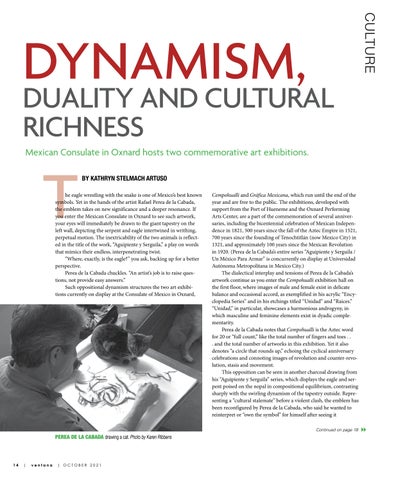
PEREA DE LA CABADA drawing a cat. Photo by Karen Ribbens
14
|
ventana
| OCTOBER 2021
Cempohualli and Gráfica Mexicana, which run until the end of the year and are free to the public. The exhibitions, developed with support from the Port of Hueneme and the Oxnard Performing Arts Center, are a part of the commemoration of several anniversaries, including the bicentennial celebration of Mexican Independence in 1821, 500 years since the fall of the Aztec Empire in 1521, 700 years since the founding of Tenochtitlán (now Mexico City) in 1321, and approximately 100 years since the Mexican Revolution in 1920. (Perea de la Cabada’s entire series “Aguipiente y Serguila / Un México Para Armar” is concurrently on display at Universidad Autónoma Metropolitana in Mexico City.) The dialectical interplay and tensions of Perea de la Cabada’s artwork continue as you enter the Cempohualli exhibition hall on the first floor, where images of male and female exist in delicate balance and occasional accord, as exemplified in his acrylic “Encyclopedia Series” and in his etchings titled “Unidad” and “Raices.” “Unidad,” in particular, showcases a harmonious androgyny, in which masculine and feminine elements exist in dyadic complementarity. Perea de la Cabada notes that Cempohualli is the Aztec word for 20 or “full count,” like the total number of fingers and toes . . . and the total number of artworks in this exhibition. Yet it also denotes “a circle that rounds up,” echoing the cyclical anniversary celebrations and connoting images of revolution and counter-revolution, stasis and movement. This opposition can be seen in another charcoal drawing from his “Aguipiente y Serguila” series, which displays the eagle and serpent poised on the nopal in compositional equilibrium, contrasting sharply with the swirling dynamism of the tapestry outside. Representing a “cultural stalemate” before a violent clash, the emblem has been reconfigured by Perea de la Cabada, who said he wanted to reinterpret or “own the symbol” for himself after seeing it Continued on page 18
8