Empowering
ANNUAL AP MEETINGS SPHS WINTER FORMAL ASB BLOOD DRIVE
AP course informational meetings will be held from Wednesday, Feb. 1 to Friday, Feb. 10.
South Pasadena High School will hold their annual Winter Formal at Union Station on Saturday, Feb. 4.
ASB coordinates a campus wide blood drive set to be held in the Practice Gym on Monday, Feb. 6.
BERBERIAN HONORS LIVES LOST
Photography teacher Rouzanna Berberian was one of several artists featured in Glendale’s artistic commemoration of the 2020 Artsakh War – entitled Shelter – was visible until Sunday, Jan. 29. Working alongside the Armenian artist group “She Loves Collective,” Berberian’s installation was installed in early December. Featuring handtied ribbons with embroidered names of the fallen soldiers, the art installation mourns the loss of Armenian troops in the war.
The group focuses on social justice movements and expressing themselves as artists over issues throughout the world; they use mediums from the visual arts to performances to engage local communities. The installation was planned by the collective, which Berberian has been a part of for eight years.
The Artsakh War, which occurred in 2020, revealed the tensions between Armenia and Azerbaijan. For Armenian forces, the 44 day battle led to the loss of just under 4,000 Armenian soldiers over issues such as social injustice and border conflicts.
Glendale has the largest Armenian population outside of Armenia itself. The city contacted the She Loves Collective to create a memorial and place of closure and reflection from the war after complaints from Glendale’s Armenian community over a lack of mourning location.
“Each ribbon represents one name. We cut the ribbons by size alongside volunteers over 21 days where we hand stamped every fallen soldiers’ name,” Berberian said. “The

EAST ASIAN BEAUTY
Tiger analyzes the nuances and malice behind beauty standards present in Eastern Asian regions for women and how they translate into the everyday lives of Asian women in America.

exhibition is called Shelter because we helped create a shelter for the soldiers under a government that failed to protect them.”
The four room installation includes the ribbon artwork, a black and white video with a spoken-word poem, a photography room with sentimental photos from Armenia, and cleansing elements such as salt and lava rocks.
AP Photography student Basil How participated alongside the She Loves Collective to add to the installation. On Saturday, Jan. 14, How led an origami workshop for participants to aid visitors in creating flowers for the art piece after the curator of the exhibition reached out for How’s assistance and artistic vision.
“As the hours went by I got used to instructing how to fold the tulips. It was an engaging experience as I got to teach a lot of people, including some of my friends and staff from SPHS,” How said. “The origami tulip represents growth and rebirth which correlated with the installation.”
The silver tulips created during How’s workshop were interwoven into the existing installation. The tulips were tied to the end of the ribbons and were one of several workshops occurring throughout the weekends that the installation was active.
The installation has sought to inform the Glendale community on the border crisis occurring in Armenia. Berberian’s exhibition closed with a candlelight vigil on Sunday, Jan. 29, where Berberian and other Armenian artists reacted to the border blockades with performance art while mourning the lives lost. The collective will continue to explore their artistic endeavors through future projects.
Tiger reviews the discrimination and bias embedded within the LGBTQ+ community and how these implicit stereotypes are televised through award winning show Rupaul’s Drag Race.

The SPHS Track team continues to prepare for the start of their upcoming season with newcomers and returners on the team. Their first meet takes place at Covina High School on Saturday, Feb. 18.

Page 6
TRACK PREVIEW Page 11 Page 15
BIAS IN DRAG RACE
STORY JAYDEN TRAN
PHOTO SHIN-HYE (RACHEL) CHOI
VOLUME 109 ISSUE 4 JANUARY 31, 2023
SOUTH PASADENA HIGH SCHOOL 1401 FREMONT AVE, SOUTH PASADENA, CA 91030
IN THE NEWS
TIGERNEWSPAPER.COM
students to think critically and creatively since 1913
SPHS Speech and Debate competes in San Gabriel
STORY MORGAN SUN
PHOTO EMIKO (EMI) ESSMILLER
The South Pasadena High School Speech and Debate
Varsity team competed in their annual Spring Varsity competition in San Gabriel High School on Saturday, Jan. 22. 12 participants from SPHS competed individually in Congressional Debate. Each member prepared six speeches on separate bills or resolutions and debated one during their rounds, then changed to a different topic the next round.
11 of the 12 varsity members did not make it to the final round, in which finalists debated a bill to require DNA evidence for death penalty sentencing. Freshman varsity competitor Eric Shiroishi rose up in the ranks as the only varsity debater to reach the last round.

“The tournament was very long, tiring, and nerve wracking. But I enjoyed debating and giving my speeches,” Shiroishi said. “The best part is asking questions and trying to stump the people on the other side of the argument.”
The end of the tournament saw the SPHS debate team scarcely called up during the awards ceremony. The only honor for the Tigers came from novice competitor Lucia Atencio for winning an MVP reward.
But the team is not to be subdued. They are continuing to work on improving their confidence in speech delivery, and fine-tune their arguments. Counter-arguments seem to be a big focus for the next competition, which is the State Qualifiers on March 4 at Schurr High School.

“I think the tournament was a good experience for our team because it gave a lot of our novice competitors valuable experience that they can build on for State
Qualifiers next month,” English teacher and Speech and Debate advisor Chris Herrin said. “I always get a thrill when the students exit a round and can’t wait to talk about how it went or some bizarre thing that a student from another school said.”
The Speech and Debate team might have lost this competition, but the members gained knowledge of the dynamics and operation of a debate tournament. Some novice members chose to compete at the varsity level in this debate, and are hoping to return next year to lead their
events for future novice competitors. Each topic that is debated stems from a real life issue in the government, and can give practice into critical thinking for future citizens that will have to learn about these topics.
“One of my favorite aspects of advising Speech and Debate is seeing young people passionately debate real-world topics,” Herrin said. “I think this is something that they rarely get to do in their other classes and I think giving students the space to think and talk about things that have a daily impact on their lives is really beneficial to them.”
SPHS junior Quincy Sakai plans cultural mural for Gold Award
her friends in 7th grade, and carried this passion for origami making into her gold award project. Working in collaboration with the South Pas library, Sakai started an Origami Club for kids which she leads once a week. At the club, Sakai leads a different folding projects and reads some of a culture story. In a recent meeting in november prior to holiday break, club members learned to fold jumping frogs.
“Frog pronounced “kaeru” in Japanese is pronounced the same way as the word for return, so it was sort of like wishing the kids off for a good break and safe return for when we had meetings again in January.” Sakai explained. The club also spreads the word about the mural she will be painting, and the opportunity for the community to contribute to the mural by painting cranes.
“[The club] is to help children to find a way to discover more cultures and also just to have fun.” Sakai said.
STORY ROSE VANDEVELDE
PHOTO SAMANTHA SHIROISHI
A Junior at SPHS, Quincy Sakai encourages the community to connect with their own heritage through a community mural in her gold service award project. Sakai first joined the Girls Scouts program in first grade with her friends, and has contributed to the community through girls scouts service projects and volunteer opportunities ever since.
“It just a way to meet new friends at first - as we got older it started getting into more community based stuff, and I just decided to stick with it because I really liked the group I was with.” Sakai said.
Peacock removal in South Pasadena
The South Pasadena City Council has begun the process of relocating the city’s peacocks after years of residents complaining about the problem. Citizens have been voicing their concerns about numerous disturbances such as vandalism of vehicles, defecation on lawns, torn up gardens, and screeching from the birds.
Resident Shlomo Nitzani has taken matters into his own hands by starting a petition nine months ago to relocate the peacocks to other cities. The petition called on the City Council to relocate the birds to other cities in California.
A gold award project requires over 80 hours of time spent researching or executing the scout’s project in addition to the reflections that the scout must write about their project following completion. A girl scout can begin their gold award project starting freshman year of high school and ending senior year.
“It was a difficult decision at first because I wasn’t really sure what I wanted to do, a lot of the projects I was hearing about at the time were more science related… and one of the really popular methods for the take action portion was building a website and I wanted to stay away from that.” Sakai said
Sakai began learning origami as a hobby with two of
He collected a little over 200 signatures. Nitzani has had a lot of problems with the peafowls, the generic name for peacocks and peahens, for over seven years. He also wanted to reassure other citizens that he and his supporters are not killing the peafowls.
Nitzani said, “Eradicating is killing them. We are not killing peacocks, we are relocating them.”
South Pasadena adopted a new Peafowl Management Plan on Oct. 5, 2022. This plan outlined an annual census and review of the peafowl population, a no-feeding ordinance, with a potential fine ranging from $100 to $1000 alongside possible imprisonment for up to six months, and the removal of the birds from the city.
The peacocks are mainly disturbing the residential area near Monterey Hills Elementary School, where many
The “Take Action” portion of Sakai’s gold award project will be a community mural which she will paint the base of. The mural will include painted paper cranes that any volunteers can help to create.
“There’s this story - this really old Japanese myth that if you fold a thousand cranes, you get granted one wish… So I kinda want to take that idea into the mural and kind’ve extend it a little bit with the origami club.” Sakai said. The design of the mural includes flowers, and a muted background that features patterns peeks out from behind petals or edging out of the side. Leaves surround the delicately drawn flowers, and paper cranes float across the frame.
“Ultimately, I’d like people to feel more encourage to
residents are taking their issues up with the South Pasadena City Council. The council agrees with citizens that there is a problem with the peafowls but residents have expressed their exasperation with the slow process. A month after Nitzani’s petition, the council hosted an open forum, with backers of removal and those who opposed in attendance.
Many other residents are worried at how the population of peafowls is growing “exponentially”. A 2021 census previously determined the peafowls were at a population of 36. A current census, from Dec. of 2022 counted 106 peafowls. There are no natural predators to take care of the peafowls, though coyotes have been known to attack peafowls on occasion.
Residents hope that, this time, city council will relocate the peafowls once and for all.
STORY CLEMENTINE EVANS
Students from South Pasadena High School’s Varisty Speech and Debate team competed in local competition at San Gabriel High School.
TIGER JANUARY 31, 2023
PAGE DESIGN ALLISON LEE NEWS 2
Town Square opens Rice and Nori
Rice and Nori recently soft opened in the South Pasadena Town Square, furthering the businesses present in the plaza. The second location of the restaurant features a variety of Japanese onigiri and hand rolls.
STORY ETHAN KWAK PHOTOS MICHELLE SHADMON
Founded by Los Angeles based chefs Mika Nikata Shenefeld and Regina Chen, Japanese restaurant Rice and Nori has garnered hundreds of positive reviews since its Little Tokyo opening in 2019.
This January, a second establishment opened in South Pasadena at 910 Fair Oaks Avenue between Starbucks and Chipotle.

“I love how South Pasadena continues to enrich our community by bringing new cultures of food for us to enjoy,” freshman Scarlett Kirschenbaum said.
The opening has been highly anticipated by residents, notably due to an absence in the diversity of food options and the popularity of the Little Tokyo location. The appeal is mostly centered on the convenient nature of fast food made with organic ingredients.
“We loved the downtown location so we were excited to have one open up in our neighborhood,” a South Pasadena resident said. “It’s great to have another quick food option that isn’t your standard fast food fare.”
Within a few days of their unadvertised soft opening in late December, Shenefeld felt overwhelmed but also “blessed” by the large crowds waiting in line.
“I’ve opened 30 restaurants with soft openings, and usually they are very subtle. We were delayed by more than a year, so when we were ready, we opened the second location,” Shenefeld said. “We didn’t even announce [the soft opening] but we were hit really hard. Everyone was waiting for us, so we were like, ‘Wow.’ It was way more than we expected.”


Among the menu items, Shenefeld says spam and egg musubis have been the quickest to go. Many other variations of onigiri are a popular option in a variety of combinations like bacon and avocado. Shenefeld discussed the vision behind the first Rice and Nori and what inspired the original menu.
“At first we wanted more handrolls because I used to be a sushi chef and hand rolls are fast and easy to make,”
Shenefeld said. “Then we thought we may as well do rice balls too because we had the rice and nori anyhow. We only had five variations, but then they got really popular so now we have 18 to 20 different types.”
The founder and chef also plans to add more cooked items such as chicken karaage, which is Japanese fried chicken.
Another possibility is licensing Rice and Nori’s own liquor to expand menu options at night. Like their Little Tokyo location, Shenefeld plans to offer delivery as soon as possible.
“We’re really blessed. We already get a high school crowd after three, so it’s like, ‘Oh, high school kids are coming.’
I think [South Pasadena] needed more Japanese fast food that’s not just tempura. It’s comfort food,” Shenefeld said. The menu features a variety of Japanese foods for consumers to purchase. There is a range of dishes on the menu from traditional flavors to fusion-inspired fillings. “Rice and Nori has allowed me to explore different kinds of cuisine that I normally cannot experience without the South Pasadena’s Farmers Market,” an anonymous SPHS student said. “I commend the efforts from the owners in making the space appreciative to Japanese culture.”
So far, Shenefeld has been amazed at the public response. Once all staff positions are filled, Rice and Nori looks forward to unveiling its grand opening.
TIGER JANUARY 31, 2023
PAGE DESIGN ALLISON LEE
3 NEWS
Celebrating Lunar New Year
Beginning Saturday, Jan 15 and ending Sunday Feb. 5, Lunar New Year is celebrated in various countries across Asia in alignment with the lunar calendar. 2023 marks the year of the rabbit and begins with the first new moon and ends on the first full moon. For Asian and Asian Americans the new year is a time for reconnecting with family and welcoming in the new year positively.
STORY CLEMENTINE EVANS, KAHLEN MIAO, & LINDA YUN ILLUSTRATIONS & PAGE DESIGN ALLISON LEE & ELLIE NAKAMURA
Chinese Zodiac mythology
In Chinese mythology there are 12 animals in the Zodiac, chosen for the zodiac through a race. Animals in the Chinese zodiac are assigned to different years of birth, recurring every 60 years, and have different traits and beliefs associated with each.
The animals of the zodiac are concurrent with another system known as the “Twelve Earthly Branches” or the “Ten Heavenly Stems” based on five classical elements: metal/gold, wood, water, fire, and earth. These elements are also assigned to be yin or yang and thus creates a ten year cycle.
Many variations of the “Great Race” myth exist, however, the main premise of the story remains the same. The Jade Emperor organized a race to find a way to divide time properly. The rat is the first to finish the race, tricking the ox into helping him cross a river who then finishes second. The tiger, rabbit, dragon, and snake then finished respectively. The sheep, monkey, and rooster work together to cross the stream and finish in that order. Lastly the dog and the pig cross the river.

The Chinese zodiac famously does not have a cat in its cycle, however in the place of the year of the rabbit, Vietnam celebrates the year of the cat while it is the year of the mousedeer in the Malaysian zodiac.
Being the fourth of twelve zodiacs, the rabbit is associated with the traits of being kind, gentle, and skillful. These traits are generally the same across the different elemental aspects of the rabbit. 2023 is elementally the year of the water rabbit.

Monterey Park tragedy
The community of Monterey Park was struck by a mass shooting on Saturday, Jan. 11, taking the lives of 11 people and injuring nine others. This massacre was the country’s fifth mass killing of 2023. The shooter, identified as 72-year-old Huu Can Tran, died from a self-inflicted gunshot wound after being chased down by law enforcement on Sunday, Jan. 22, Lunar New Year day in Alhambra, California.
The shooting took place at a dance studio at Star Ballroom Dance Studio, in Monterey Park on Saturday, Jan. 21 around 10:20 p.m. Multiple students of South Pasadena High School and the greater South Pasadena community have been affected by the shooting. Monterey Park and the Star Ballroom Dance Studio hold a close connection to Asian members of the community.
“I used to take Latin dance classes there [almost] every weekend for almost three to four years. At that time, I was preparing for a competition for gold, but that got cut short because of the pandemic,”
Senior Rachel Liao said.“...[After the pandemic], I just did not feel like I wanted to get back there. On Lunar New Year, I saw it on the news. The headline only said “A Monterey Park Lunar New Year tragedy”.
When Liao heard of the shooting on the news, she was devastated. Like many others who had connections to the local studio, she did not know how to react.
“At first I did [not] want to believe that it was the ballroom I was at,” Liao said. “I was really hurt by it…I just started bawling my eyes out. One of the victims was the owner [of the dance studio] and I knew him really well. I remember dancing with him for a little while. He was like a grandpa to me.”
Senior George Hong-Sheng was also a member of the Star Ballroom Dance Studio and was devastated to hear the news of the shooting.
“It really hit [hard] knowing where it happened, because it had been somewhere I was exceedingly familiar with, the floors and mirrors, the entrance and the restaurants next to it,” Hong-Sheng said. “...being connected to the place somehow made it feel all the more surreal… before I knew the location I felt sympathetic, but it kind of [aligned with] other shootings that happened previously, but hearing that it was somewhere I [would go] to regularly [made me feel] pretty uneasy.”
Lunar New Year celebrations have been mixed with memorials for the recent shootings in Monterey Park and at Half Moon Bay.
TIGER JANUARY 31, 2023
4 NEWS
THE TIGER ESTABLISHED
1913
CSPA SILVER CROWN 2021
CSPA GOLD MEDALIST 2019
CSPA SILVER CROWN 2018
CSPA GOLD MEDALIST 2017
CSPA CROWN AWARD 2016
CSPA GOLD MEDALIST 2015
CSPA GOLD MEDALIST 2014
CSPA GOLD MEDALIST 2013
CSPA GOLD MEDALIST 2011
EDITOR-IN-CHIEF ANIKA EBBERT
MANAGING EDITORS
HANNA BAE, Print
ELSIE WATERS, Online
NEWS
KAHLEN MIAO, Editor
OPINION
HANNA BAE, Editor
FEATURE
ELSIE WATERS, Editor
SPORTS BENJAMIN REGAN, Editor
DESIGN ALLISON LEE, Editor
PHOTOGRAPHY
MICHELLE SHADMON, Editor
COPY
KAHLEN MIAO, Editor
RALUCA TUDUSCIUSC, Editor
STAFF WRITERS
ADA BORREDON
CLEMENTINE EVANS ETHAN KWAK ISU PARK
MORGAN SUN
JAYDEN TRAN
ROSE VANDEVELDE LINDA YUN
PHOTOGRAPHERS
SHIN-HYE (RACHEL) CHOI
EMIKO (EMI) ESSMILLER SAMANTHA SHIROISHI
ILLUSTRATORS ISOLE KIM
ETHAN LYONS
ELLA MIZOTA-WANG
GRAPHIC DESIGNER
ELLIE NAKAMURA
BUSINESS AND ADS MANAGER REV BRICK
FACULTY ADVISOR
KAREN HAMES
VOL. 109 NO. 4 DISTRIBUTED ON JANUARY 31, 2023.
DISTRIBUTION: 1477 STUDENTS; 70 COMMUNITY. 1200
COPIES PRINTED. DISTRIBUTED BY TIGER STAFF FREE OF CHARGE.
TIGER IS PRODUCED BY THE CAREER TECHNICAL
EDUCATION JOURNALISM CLASS AT SOUTH PASADENA HIGH SCHOOL, 1401 FREMONT AVE, SOUTH PASADENA, CA 91030. LAYOUT AND PHOTO IMAGING ARE COMPLETED ON-SITE.
SIGNED ARTICLES APPEARING IN TIGER REPRESENT
THE WRITER’S OPINIONS AND DO NOT NECESSARILY REFLECT THE VIEWS OF THE STAFF, STUDENT BODY, FACULTY OR ADMINISTRATION OF SPHS. ORIGINAL STORIES WILL CARRY BYLINES, ALTHOUGH STORIES REWRITTEN BY ANYONE OTHER THAN THE ORIGINAL WRITER WILL NOT RECEIVE ONE. CONTRIBUTING WRITERS WILL ALSO RECEIVE ONE.
CONTACT THE PUBLICATIONS OFFICE AT (626) 4415820 EXT. 2615 BETWEEN 8:00 A.M. AND 4:00 P.M. FOR ADVERTISING RATES AND SUBSCRIPTIONS. TIGER WELCOMES ARTICLES, LETTERS OR REBUTTALS FOR PUBLICATION IN THE PRINT AND ONLINE EDITIONS. ALL LETTERS MUST BE SIGNED AND VERIFIABLE, BUT NAMES WILL BE WITHHELD UPON REQUEST.
TIGER’S MISSION IS TO PROVIDE A RELIABLE NEWS OUTLET FOR SPHS AND THE LOCAL COMMUNITY. THROUGH A VARIETY OF COVERAGE, TIGER EMPOWERS/ENABLES STUDENTS TO THINK CRITICALLY AND CREATIVELY, COMMUNICATE EFFECTIVELY, SOLVE PROBLEMS, SET AND REACH GOALS, AND WORK COOPERATIVELY AND INDEPENDENTLY AS RESPONSIBLE CITIZENS. TIGER IS A FORUM FOR STUDENT FREE SPEECH, IN ACCORDANCE WITH CALIFORNIA ED CODE 48907.
ALL REMAINING CURRENT TIGER NEWSPAPER POLICIES ARE ONLINE AT TIGERNEWSPAPER.COM INCLUDING: CONFLICT OF INTEREST, LETTERS TO THE EDITOR, CORRECTIONS, AND SOCIAL MEDIA.
STAFF EDITORIAL
OPINION
LOTE courses builds barriers
Language courses at SPHS fail to provide sufficient communication skills.
The South Pasadena High School languages department needs to transition from past standards of reading and writing comprehension to a communication based curriculum. In order to be prepared for language use beyond school, students must possess an array of knowledge that they can use to adapt to any scenario.
Students often take a languagse for three or more years of high school, and must complete at least two years of the same language to graduate. According to “ACTFL-Language Connects;”; learning a language is not only beneficial in the workplace, the process also improves cognitive function and focus. In addition, language learning strengthens the brain against dementia and degenerative neurological conditions.

Curriculum for language learning has been evolving ever since the traditional grammar-translation method that emerged in the early 1900s. This learning style is composed of vocabulary memorization and rule explanations. Learners generally struggled with communicating creatively and effectively.
Elements of the SPHS curriculum are reminiscent of this method and are usually guided through textbook and worksheets. While it moves away from the grammartranslation method, it is still not completely aligned with an end goal of communication. The large emphasis on reading and writing hurts students who do not learn best from literary techniques, but instead connect most with an auditory, visual, or kinetic style. The interactive benefits of non-traditional learning styles enable more types of learners to engage with material.
Communicative Language Teaching (CLT) is not a curriculum, but rather a general direction of teaching that has an end goal of student communicative proficiency. According to Pearsonhighered, CLT courses are generally taught almost exclusively in the target language, use non-academic resources
from the target culture (magazines, novel, etc.), involve student interaction among students, and are fluid in adapting to each student on an individual basis.
A study conducted by the Canadian Science Center involved an experimental CLT group learning English —, taught throughusing interviews, role-playing, and problem solving. The CLT group did significantly better than another group learning English taught using traditional methods.
The SPHS curriculum echoes both the grammar-translation method, CLT curriculum, and others, but remains mostly comprehension based. The very metric used to measure student growth, language finals, are often a dreaded slog through mind-numbing amounts of questions that induce stress and unnecessary mental fatigue. Rather than testing a student’s ability to think critically or use their language foundation in creative ways, they encourage memorization of vocabulary lists and grammar rules. These designs are a flawed evaluation of fluency as they do not measure the student’s ability to interact with another individual.
The fact remains that some skills cannot be taught through the confines of worksheet and textbook activities, such as pronunciation, an often rushed skill that students are expected to master but is not explicitly focused on as a main element of a course.
While in higher courses students and teachers do communicate mainly in the target language and integrate greater amounts of projects and speaking assignments, learning is built on traditionally structured foundations of memorization developed in 1/2 and some 3/4 classes. APs are generally the class that is the most speaking based, but without the attendance of many of the student body, the skills learned through real life scenarios in this program do little to remedy the deficit left in speaking ability.
Boos & Bravos
Tiger’s cheers and jeers for the month of January
BOO to people who use laughing emojis instead of crying ones and skulls. What are you? Mentally stable?
BOO to Jake Sully. Why are you, a 10 foot blue alien, kind of hot.
BOO to Beyonce's exclusive Dubai concert. Celebs already have it all, why are you inviting Kendall Jenner?
BOO to Discord. Yes, I'm talking to you, Jayden.
BOO to people who come back from COVID without a mask. Who do you think you are anyways?
BRAVO to Google Translate. You will always be the Spanish Dictionary in my heart.
BRAVO to Congress for being Swifties. Ticketmaster really needs to calm down.
BRAVO to to everyone who filmed the Beyonce concert. Taking down capitalism, one concert at a time.
BRAVO to Cars. Life is a highway.
BRAVO to my phone at 1%. It has more will to live than me, fr.
TIGER JANUARY 31, 2023
BRAVOS BOOS
PAGE DESIGN ALLISON LEE 5
Museums need to return stolen antiquities
Artifacts that have been stolen have detrimental effects on the cultures and countries that have been robbed of their own heritage. The Benin Bronzes were stolen in 1897 from the palace of the king, the oba, of the Kingdom of Benin during a raid by the British military. These sculptures were the kingdom’s version of diaries and their written history meant to be preserved for thousands of generations. After slaughtering thousands, the British ransacked objects from the palace of the oba, lined them up neatly, photographed them, and a British officer, Captain Herbert Sutherland Walker, labeled these photographs, “loot” and “more loot” in his diary.
STORY CLEMENTINE EVANS
ILLUSTRATION ISOLE KIM
Antiquities from around the globe have been stolen and displayed in other countries’ museums, where they do not belong. Today, many museums such as the British Museum, the Field Museum in Chicago, the Metropolitan Museum of Art, possess a countless number of artifacts stolen from their countries of origin during colonial rule, many of which were looted during wars. These museums and institutions have evaded questions regarding whether or not they should repatriate these artifacts to their home countries, while continuing to hide behind excuses for hoarding them.
The main ‘concern’ and argument from museums retaining ownership over artifacts like the Koh-i-Noor diamond of India and the Benin Bronzes of modern-day Nigeria, are that these countries cannot properly take care of their own cultural antiquities. Countries that have stolen artifacts from those who should have rightful
ownership over them have actually damaged the objects themselves. A report from the British Museum states that there was water leakage in the Greek section of the museum and, after the staff attempted cleaning the marbles with “wire brushes”, they had caused irreparable damage to the priceless sculptures. Museums’ carelessness have led to the damage of artifacts that should have never belonged to them.
Countries like Egypt, India, and Greece have had objects stolen from them and have been calling for their return for decades. Dorothy King, author of The Elgin Marbles, argued that Britain cannot even “think about returning the Elgin Marbles to Athens until the Greeks start caring for what they already have”. King then continued her patronization of Greece by saying, “If you know a mother was abusing her child, you would [not] let her adopt another.” This sentiment by King is just incorrect. This metaphor falsely assumes that the “mother” is simply requesting to adopt another “child” when, in actuality, she is demanding the return of her kidnapped one.
Museums claim to keep these artifacts to further the connections between visitors and other countries and cultures. However, one of the museums that continuously reassures people they are trying to do this, the British Museum, is built on foundations with ties to slavery. Sir Hans Sloane founded the British Museum in 1753. He was married to an heiress of many sugar plantations in Jamaica.
Slonae purchased a great deal of objects for his personal collection that he then donated to the British Museum upon its inauguration. He also bought many more artifacts for the museum with that same money. His collection also consisted of body parts, such as skulls and skin, of slaves that he had previously owned. Those were also part of the original collection at the British Museum. If this museum insists on their story of ‘connecting people and cultures’ then they are connecting people through collections of artifacts that were either stolen or bought with money earned through slavery.
To this day, museums and institutions have robbed countries of their heritage and culture. Museums that claim they want to use their collections to bond the world together have done the complete opposite. They have torn countries apart by stealing their history and treasured artifacts.
The deceiving lure of East Asian beauty standards
STORY LINDA YUN ILLUSTRATION

ELLA MIZOTA-WANG
Growing up Asian is akin to a frozen lake in the wake of spring. It’s only a matter of time before the first crack turns up. For many Asian Americans, the divide begins where the conversation ends. The junction between Asian and Western beauty forms around where it is mutually beneficial. But for most, it means navigating another pipeline of self-esteem issues.


The interplay between western influences and East Asian beauty standards is often tangled in the messy adolescent search for identity, where the self can never match up. While we are quick to judge ourselves in the mirror, we are not so quick to see beauty as two-sided, and even slower to realize that this struggle for beauty is too often a universal struggle to be less deficient.
As the oldest child, I’m expected to carry the torch, not crumble under it. My parents’ lives resemble an immigrant sob story – notable events including surviving a famine, getting out of poverty, moving to the states, and not worrying about looking FOB. I share with them just one of these accomplishments. For them, aesthetics and the visual appeal were all but replaced with the need for practicality.
HOT CAKES & HOT TAKES
MICHAEL MAYEMURA
Rising from the ashes of tragedy
I struggled to write this column. I stared at the screen for five hours, knowing exactly what I wanted to write, but failing to put those thoughts into words. So, this may be a cop-out of an intro, but it is an intro no-less. Oftentimes, when I struggle to express how I feel, I turn to music. It’s this omnipotent creature that somehow encapsulates everything all at once. So, trailing the Monterey Park mass shooting, I bank on music to unpack my emotions.
Beauty standards are undoubtedly one of the most confusing parts about growing up. For many Asian Americans, that confusion often translated into a lack of identity of what being “attractive” means. We are tethered by blood to spiteful aunties, and also by great expectations to not deviate from mainstream tastes. Tip the scale over one way and you devolve into a stereotype – long straight hair, glasses, and no sex appeal. Tip it the other way and you become a “wannabe white Asian” – an arrogant snob who thinks they are above their own culture. The balance between what is essentially nerd versus self-hatred is not only delicate, but exhausting to keep up with.
Like many first generation Asian American women, my mom has a sizable collection of expensive SPFs sunscreens and colorful parasols. I used to wonder why she seemed to hold her complexion in such high regard, until recently, when I realized that to seem white is to be one step closer to the social statuses reserved for white people.
Beauty is a myriad of subjectives, but East Asian beauty seems to always have a standard. To drift from the standard is often to fall short of the ideal. The Asian American experience is not complete without the merging of different cultures, and that acceptance stems from welcoming both the peaks and valleys.
Growing up in Monterey Park, I was enamored by this mini Chinatown foregoing the tacky architecture, infusing itself instead with this unique latin flare. But tuning into the news and international headlines, I realized that this was not the same Monterey Park that caught their attention. Rather, it was this helpless, quiet town struck with an unforeseen tragedy narrative that truly irked me. And amidst the chaotic broadcasts and echoed newslines was this dreamy-pop beat: Lorde’s “Team.”
I realized that I did not want the beauty and the culture of my hometown to be outshined by this singular tragedy. As insensitive as it sounds, I refused to become another city competing for a love I knew we’d never receive – to be yet another location added to the archives of mass shootings, only to be remembered when the next one unfolds.
I realized that we were the ones who had to live with the aftermath. After all the cameras and politicians vanish, we’d be the ones to pick up the pieces. We were the ones left in the ruins of this palace stuck within my dreams; this shattered sanctuary from a ceaselessly unfamiliar world and a growingly violent America.
I realized that I hated the idea that we had to be strong; that we were resilient; that we were better than this. Afterall, we are not bulletproof – we cannot withstand blow after blow. It is this arrogant strength that led us into this situation and would not shield us from another. It is this notion of resilience that conceals the need to grieve and the need for change. We are tired of getting told to throw our hands up in the air — of apathetic responses to this unnatural disease.
We stand here with shards beneath our feet, realizing that this was not our fault. We realize that we are not immune.
But that does not alter who we are. I reiterate my aversion to our victimhood: Monterey Park deserves so much more than meager pity. We are a glistening gem nestled in the suburbs of East Los Angeles. We are home to a unique Asian-Hispanic fusion – a town of daytime dim sum and nightly taco runs. We are the city built upon the amalgamation of seemingly unrelated groups packed into this small, yet vibrant community. We have always have and will be on each other’s team.
TIGER JANUARY 31, 2023
Even though museums have stolen antiques for centuries from their protectorate, they are depriving these countries of the ability to maintain their own cultural identity.
PAGE DESIGN ALLISON LEE 6 OPINION
PRO/CON : AI in education
AI has grown increasingly omnipresent in today’s society, encompassing entire industries and providing the backbone to post-Covid education. Tiger analyzes the drawbacks and benefits that AI provides to students.
Pro: Technology advancement in education is the future
STORY ISU PARK ILLUSTRATION ELLIE NAKAMURA
Artificial Intelligence has become increasingly prevalent over the past decade, with an exponential advancement pattern. These systems have made human life considerably easier, and alongside occupying the healthcare, finance, and transportation worlds, AI has taken on education.
With AI programs appearing in every level of school, its advantages have reaped the development of personalized learning experiences and accessible education (i.e., in combating overcrowded classrooms and empowering easy access for disabled people). It has also become a way for educators to better understand how students learn, providing them with a basis for recognizing trends to make more informed decisions about instruction.
What controversy that has landed on these technologies may surround a matter of cost, unemployment, and an easier way of infringing on academic integrity.
Adamantly, there is a large amount of debate on either side, but really, an AI future is an inevitable fate, so any act of arguing against it is ultimately meaningless.
Digitalization has impacted every aspect of human life – to the point that its aftermath is irreversible. For instance, it is the only plausible future for the staffing industry; the growing economy and the effect of social distancing culture put digitized methods at the forefront of employment, for its practicality is far greater than its alternative.
As AI systems become more advanced and autonomous, the ethical considerations will become more complex. Bias, transparency, and accountability are all facets of artificial intelligence, implemented by its creators.
Inserting these definitive parts of humanity into AI is a way of making AI more “human.” This increases the potential of technological singularity, where the effects of technological growth on civilization will expand past the point of reversal, and humans will no longer be able to predict machines.

Regarding the way most humans are already fairly dependent on AI, this is likely to happen soon.
Moreover, humankind is yet to encounter a limit to technological intelligence, but the limits of human intelligence are clearly understood.
Human intelligence is fixed, so any foreseen future involves a merge between our own cognitive capabilities with the boundless capabilities of AI. Thus, AI is likely to surpass humans. Because it is evidently smarter than us, we must embrace it as a part of evolution.
Perhaps this is dangerous to humanity. It is quite literally allowing humans to rely less and less on brain power, which is a direct blow to education. But to think there will be a delay on technological development for the sake of the common good is absurd; take nuclear energy.
While nuclear energy is inherently destructive, it ultimately benefits the world of STEM and advances technologies that help the greater cause of humanity. Thus is the same for AI advancement as well.
The creation of nuclear bombs took the lives of many people, and its advancement for the purposes of war machinery was controversial. However, it eventually paved the way for nuclear energy to be provided for the people, lending another way for cleaner energy.
AI has the potential to have positive impacts the way nuclear energy has had.
What people do not consider is that “artificial intelligence” is not just the physical product of technology – like computers or phones – but that it also accounts for the repercussions of all technology information; further advancement and involvement of AI in all mediums is an unavoidable fate for the permanent impact of digitization.
AI already exists, and any further work is to reach an era of hyper advancement – in every facet of life, including our schools.
Con: AI advancements will ruin educational standards
STORY JAYDEN TRAN ILLUSTRATION ELLIE NAKAMURA

The beliefs behind modernization and futurist ideology have long driven the world to consider developing and integrating technology into undiscovered fields. The Bureau of Labor anticipates that the computer science industry will grow 15 percent in the next 20 years, an extremely high growth rate attributed to the growing reliance on technology. With more dependency on automation, the interest in compsci emerging as an undergraduate major further adds to the workforce of the computer science world.
Questions regarding artificial intelligence and the many ways that AI can shape societies and job fields have developed with a growing passion for computer science. From questions on independence and whether we will turn into the humans from Wall-E to the impacts on the economy, the controversies over AI have long condemned the world of education. Despite these questions, it is imperative that modernization chooses to separate AI from the educational world; students should strive to learn without being stunted by advancements that promote an “easy way out” of learning to articulate thoughts and comprehend the world around us that is presented by basic humanities curriculum.
ChatGPT, a natural language AI focused on answering prompts with a natural computer-generated response, is free to use and has been uploaded to the internet since November. The sudden release of the AI less than two months ago shocked the educational world in ways that society could not have predicted.
OpenAI, the developing company of ChatGPT, claims in their mission statement that they seek to “ensure that artificial intelligence benefits all of humanity.” The development of their AI contradicts their vows.
ChatGPT has been an immense victory for the world of STEM. For scientists, the evolution of this AI marks progress in the growth of technology. For students interested in computer science, the realistic responses behind text-based prompts quickly manifest what hours of research online could attain.
“I was working on a coding project responding to a prompt
and got stuck,” an anonymous senior said. “Eventually, I turned to using ChatGPT and I was able to overcome the challenges I was facing.”
However, AI like ChatGPT ultimately tramples on a majority of the humanities and social industries. For teachers, specifically those in courses that require essays, the release of this AI has been detrimental to the lessons they curate.
“This is disruptive in terms of how we are supposed to judge authenticity. It’s going to be tricky trying to navigate this new development,” SPHS English teacher Katherine Jaroch said.
“I sent the department an email with both perspectives of this debate and we discussed the possibility of going back to pen and paper or tools for surveillance in terms of writing.”
Living in a country driven by markets and economy, the shift to STEM and AI from humanities is representative of our public values. The growth of AI into education will teach children how things work; students will never learn why things work without humanities and the values of the liberal arts. ChatGPT oversteps the boundaries of STEM’s involvement in humanities curriculum. By furthering the development of this AI technology into the educational world, humanities will not be able to teach children the nuances surrounding the world we live in.
Society and computer scientists should not continue to further artificial intelligence that can be exploited in the educational world; ChatGPT is an example of how the progression of AI has impacted the lives of students. The growth and development of students may be stunted in order for them to get an easier A in a course as they utilize the AI to write their assignments. ChatGPT allows students to ignore the lessons of comprehension and understanding that guide English-focused curriculum.
The AI from Turnitin.com, focused on checking for plagiarism in educational writing, was already a pain for teachers and students alike. By using ChatGPT and developing more AI to either act like or counter it, the lives of both parties will just become a more convoluted system of checks and balances to see if someone’s work is plagiarized. Submitting to multiple websites is an aggravating process, and ChatGPT complicates it further.
TIGER JANUARY 31, 2023
PAGE DESIGN ALLISON LEE 7 OPINION
Fighting the drought in art

Different perspectives of funding divide SPHS
The structure of receiving funding at the high school is a convoluted system of questions and concerns. Multiple sources of support, confusion over who to ask, and a shift in administration are all factors involved in the structure of funding for courses; the perspectives on the financing of classes seem to differ between staff and students.

The issue of funding is one that is difficult to comprehend with a multifaceted perspective. Looking at the issue of funding from different lenses provides an insight into how different members of the community view the funding for classes at the high school campus.
When identifying the issues of funding on campus, a number of teachers on campus have reported that their courses feel adequately funded in a majority of aspects.
For courses involved in the sciences, laboratory tables and equipment line the perimeter of classrooms. In the arts classrooms, however, there is a lack of funding in terms of location for both staff and students.
“We don’t have an official photography lab for the class, so I have no storage space to store materials,” photography teacher Rouzanna Berberian said. “Wish Night and SPEF mainly contribute to the photography department by providing us with more contemporary and higher quality materials to help students explore varieties of art while the district funds the necessary supplies.”
The main consensus between a majority of teachers seems to be that all the courses and activities are adequately funded. When making comparisons between different fields of education, teachers, especially in the arts, feel as though their courses are supported by the district.
“From my perspective, [SPEF has] been very generous in providing the materials I need for each course I teach,” visual arts teacher Aimee Levie-Hultman said. “Coming from a smaller district without as much money as larger school districts, the value we place on the arts allows me to receive the necessary funding for all my classes.”
Despite the views from teachers that their courses are funded and supported by SPEF, some students on campus seem to believe that a majority of courses – especially those in the arts – are left underfunded.
“There’s very little publicization for arts based events in comparison to activities like sports games where there are themes and rewards for attendance,” senior Kate Campbell-Kelly said. “The arts feel forgotten at SPHS without events or exhibitions to garner attention to the physical arts programs like painting and drawing. It seems like there is very little recognition for artists on campus compared to individuals like athletes or scholars.”
The arts on campus are typically student-led or more heavily student involved. From stage directors for plays and musicals to individualized art portfolios, students are put into positions where they must understand how funding works for their shows or their competition submissions. For programs in place on campus that involve student leaders, fundraising and grants have become an established norm to receive money.
“We’re lucky to have the opportunities to apply for grants from organizations such as the PTSA,” senior dance captain Stephanie Law said. “However, most of our funding comes from student donations made to our after school dance classes. Dancers and parents actively volunteer for Bingo, which is a large contributor to the program.”
Two separate perspectives reveal the many discrepancies in the concept of funding on campus. On one hand, teachers have built a certain experience and expectation in their time teaching that allows them to understand what may need funding. On the other hand, students feel stifled from exploring their passions as a result of lacking support and resources. These conflicting outlooks on funding divide our campus.
“Sports teams and STEM classes receive more funding than dance, theater, and other arts programs,” an anonymous performing arts student said. “The sports teams on campus are great, but I feel that some of the funding they receive could be distributed amongst our VAPA department.”
Without properly addressing all the issues of funding on campus, all parties involved who are impacted by fiscality will continue to see the problem at different levels. Solving this issue requires every individual, from the district to students, to truly understand the value of dividing the allocated budget for SPHS to equally promote and support all of the programs that the campus offers.
TIGER JANUARY 31, 2023
8
Discrepancies in funding among art programs

SPUSD prides itself on its excelling arts programs –including music, paint/draw, and photography courses – allocating adequate funding for these programs and their betterment. SPUSD projected to spend over $2.2 million dollars on “Arts, Music, and Instructional Materials” in their First Interim for the 2022-2023 fiscal year. However, there is no “set budget” for each program, and thus, the seemingly millions of dollars allocated is not reflective of the true needs and materials for these programs.
The arts department should not be required to rely on private fundraising, straining teachers and staff, to collect sufficient money. There should be proper discussion on a needs-based basis with these programs, ensuring that the money is set aside for creative development and used in ways that encourage student success.
Despite being a STEM-driven high school, it is evident that SPHS seems to be reasonably invested in fostering creativity and self-expression at school with options for arts teachers to request specific materials.
“I think the budget for this school is higher than any other school I have spoken to,” visual art teacher Aimee LeveeHultman said. “I give the district a list of what I want to purchase and they either approve or deny it, which means there is no set budget. From my perspective, they have been very generous in providing what I need material wise for the different classes I’m teaching.”
However, there are discrepancies among the art teachers. Although teachers are able to apply for grants and rely on Wish Night, a unique practice that allows community members to donate and support SPUSD programs, the baseline foundation that is provided on paper is meager in comparison to the sheer costs of the materials necessary.
In other words, the lack of a specific budget for programs often poses a number of issues and inconsistencies among programs. For one, staff members are not adequately paid. The Tiger Band at SPHS consists of two marching, two percussion, two front ensemble coaches, and colorguard coaches during the annual marching season in the fall. The band also works with additional sectional coaches for the drumline and winterguard in the spring. But, the fall coaches and additional spring coaches are not paid for by the district.
“The district pays for two of my coaches for the spring semester for drumline. In the fall… the district does not pay for any of [them.] We fundraise and pay for all of that,” band director Howard Crawford said. “A lot of my job is fundraising and trying to do performances to get money for the program, and that is a lot, it is a hassle [and] it is a burden. That is why jazz bands are out so much because we charge people when the jazz band goes out and performs.”
Beyond this, the money that is granted for programs is not nearly sufficient for the materials and resources necessary for engagement. While teachers are able to apply for grants and depend on Wish Night for larger requests and materials, the money that is allocated is otherwise insufficient.
The band program is provided $500 to purchase or license sheet music, but this sum is not nearly enough to cover the cost. The cost of music comes to nearly ten times as much each year.
“It takes more than $500 to put on a concert. If we want to do something major you only can rent it and it is a couple hundred dollars just to rent it. We can only rent it for the performance,” Crawford said. “[For] marching band music, you only rent it for one season, and it is always $34000 for the music.”
When comparing the funding between performance arts and visual arts, the system in place reveals the discrepancies for specific materials. While the district is able to allocate necessary funding with opportunities to apply for grants and seek donations, this structure does not maintain stability when looking at more materialbased resources.
In the visual arts, teachers can work with providing necessary materials and finding substitutes; in the performance arts, teachers are not able to afford materials such as sheet music.
There is a lack of communication and understanding for the resources and materials necessary to promote the art and passions of students on campus. While some teachers claim that their courses are adequately funded for students, the reality is that there is a lack of attention for the arts at SPHS compared to other programs.

art funding PAGE DESIGN ALLISON LEE ILLUSTRATIONS ISOLE KIM & ALLISON LEE STORY JAYDEN TRAN & HANNA BAE TIGER JANUARY 31, 2023
9
Katsu Sando: serving novelty Japanese cuisine in Los Angeles
Inspired by the Japanese convenience store, Katsu Sando operates in a small space in Chinatown to create big flavors through its iconic katsu, milk bread, and curry.
STORY LINDA YUN
PHOTO SAMANTHA SHIROISHI
Big things come in small packages and sandwich shops are no exception. Woven in a string of street vendors at the heart of Chinatown, an unassuming Japanese sandwich shop that has quietly earned its place in top Yelp rankings, and in the hearts of locals too. Committed to recreating the ambiance of the Japanese convenience store, Katsu Sando has reinvented the dine-in experience, offering the much-loved marriage between western and Japanese cuisine, save for the exorbitant price tag.
The convenient location costs Katsu Sando the room for dine-in, but the owners made the best use of the limited space. A long wooden countertop faces the window, which doubles up as a prime spot for people-watching, and stands adjacent to a grab-and-go station contains a medley of pre-made goods.
Having arrived in the early evening, only the spam + egg and tuna + mayo onigiris remained, wrapped in packaging that included instructions - a quaint touch that made it all the more welcoming. Seasonal fruit sandos and egg salad sandos lined the opposite end. The bottom shelf was brimming with a variety of Japanese beverages and, most notably, a colorful selection of Calpico.

Besides the grab-and-go selection, Katsu Sando’s bread and butter is its katsu sandwich and curry rice. Thin, wooden letters line the walls, piecing together the menu like a puzzle. Besides classic pork and chicken, Katsu Sando also offers novel cutlet options like menchi, shrimp, and snow crab. The menu also offered a number of plates and sides, with staples including the Katsu Curry Rice and Curry Chizu Fries.
Katsu Sando whisks together their signature Japanese milk bread on the daily. The bread is consistently soft
and fluffy, but never without bite. The seasonal fruit sando was pillowy with a hint of creaminess, loaded with whipped cream and a seasonal selection of fruits. At the time of my visit, the fruits included strawberries and kiwis. Each bite had the perfect amount of toast, cream and fruit - the subtle sweetness of the cream counteracting the succulent tanginess of the fruit.
The quintessential chicken katsu was breaded in panko and fried to golden-brown perfection. With a light and satisfying crunch, the flaky crust gives way to the tender chicken, which glistened of juice throughout. The cutlet was dressed in a generous amount of tonkatsu sauce, and rested in a nest of miso mustard ginger slaw. The sandwich came in two halves, each enough to fill up one person. Regardless, many enjoyed their shares with intensity and commitment, and couldn’t help but wonder what the innocent passerby thought when they gazed through the window.
The katsu curry rice came in a to-go box packed full of peary, translucent hikari rice and a generous amount of chicken katsu. The curry came in a separate container on the side, with which can be adjusted to suit one’s preferences; some dabbled the curry over the rice conservatively, others drenched the rice with it. The flaky katsu softened under the weight of the curry to complement the sticky rice, creating a symphony of flavors and textures. The plate came with two sides - a small portion of potato salad and succulent takuan (pickled yellow daikon) that yields a much-needed crunch.
Since its opening in 2020, Katsu Sando has quietly been LA’s best kept secret. From handmade snacks to-go, sandwiches with innovative fillings, and convenient curry platters, the humble eatery is novelty done right. With a versatile menu and a convenient location, the lowkey canteen combines The Beatles jam and friendly staff to provide a perfect refuge from a day away at DTLA.
Charlotte’s Web CHARLOTTE DEKLE
Don’t worry, Donna

Not that any reader of this column was wondering, but my favorite television show is Aaron Sorkin’s “The West Wing.” To be more specific, the first four seasons of Aaron Sorkin’s “The West Wing.” In fact, I have converted multiple people to watch and enjoy the show. On one occasion, a friend pointed out something that gave me pause, “Josh is kind of a jerk, right?”
Now being a Deputy Chief of Staff Josh Lyman apologist, I had to inquire further. They responded, “Well, he is constantly mansplaining to his secretary.” Then I responded, “Actually, all of the men do that.” After my off-hand and all-too-revealing response, I learned that I had never really noticed the flippancy in which the show treated its female characters. Given that 100% of the series’ inaugural season was written by Aaron Sorkin, he is solely to blame.
Fans of “The West Wing Weekly” podcast know the term for Sorkin’s special form of mansplaining, Telladonna, defined as “the often-used device when a character explains a policy or procedural issue in the episode to another character. Most frequently – but not exclusively – employed with Josh Lyman explaining (or mansplaining, or Lymansplaining) an issue to Donnatella Moss” pervades every episode. The only female character not constantly ‘lymansplained’ to is Press Secretary CJ Cregg. This is only because the show had former Clinton Press Secretary Dee Dee Myers on board as a consultant. But Cregg still faces her fair share of sexism, especially when she enlists Sam to explain the Census to her in agonizing detail. One would think that as the White House Press Secretary, she would know about the census. That episode was written by Sorkin with no consulting from Myers, go figure.
Obviously, this is what happens when men write women. Unfortunately, men exist outside of Aaron Sorkin television.
I am not on staff at the White House in any capacity, but I have been on the receiving end of many a mansplain diatribe. I know even using the word ‘mansplain’ will elicit laughs and people calling me ‘woke.’ In fact, being belittled and demeaned is so commonplace in many teenage girls lives that it does not even seem demeaning anymore.
I could not count how many times a male peer had, unprompted, explained a topic to me. I could not count how many times I have been interrupted and invalidated by a male classmate while expressing an opinion. I could not count how many times I have been called ‘sensitive’ or told to ‘calm down’ whenever I express an opinion I am passionate about.
Of course, I speak from a place of privilege. Many women of color and trans women experience much worse than those comments. But it is still unsettling how normalized this behavior has become. Now I doubt that most of my male peers have seen “The West Wing,” but they probably have seen Andrew Tate, who also does not respect women.
“The West Wing” is a great television show. Despite all of its sexist undertones, it still gave the world competent and strong-willed female characters that I cherish. It is just so infuriating that the brazen disregard for women’s intelligences still exists in the same form it did 20 years ago, now Donna can tell that to Josh and Sam.

TIGER JANUARY 31, 2023
PAGE DESIGN ALLISON LEE 10
FEATURE
Swimming Upstream highlights student screenwriting
SPHS junior Charlotte Dekle continues to coordinate her original play.
STORY CLEMENTINE EVANS
PHOTO SHIN-HYE (RACHEL) CHOI
J unior Charlotte Dekle has cast, produced, and written her own play entitled Swimming Upstream. With a combination of her love for writing and films, she has put them together into her very own, personal romantic comedy to share with others. Dekle’s production is a determined piece of writing that has endured many challenges in the process of creation. It will be performed in the Little Theater at South Pasadena High School on Friday, Feb. 10 and Saturday, Feb. 11 at 7pm. Tickets will be $5 and sold at the door. Ticket profits will go to the SPHS Drama program.
The plot of Swimming Upstream is a genuine love triangle. The main protagonist of the play, Mallory, is extremely desperate in search of “the One,” and wants to get into that relationship as soon as possible. On her quest to find her true love, she ends up dating two people at once and chaos emerges. As there are not enough rom-coms that include things Dekle likes, she wrote one for herself.
Dekle said,“If you are looking for [some] dirty-ness, if you [are] looking for sordidness in my play, you can find it. There is a lot of innuendos and puns, sexual puns because I…love puns and I love word play and I…thought it would be funny [to put some in there]…If you [are] not looking for anything too dirty then I think you [will] be fine, although there are some sexy puns in there, too.”
She was inspired to write her play after taking a screenwriting course at the University of Indiana in the summer of her freshman year.
“I finally got to hone my skills in [the] course and by the end, you were supposed to write your own film script that you could potentially [write] on your own [later on],” Dekle said. “And [the script] was only supposed to be five pages long but mine was 15 pages long [and] I just had this perfect idea and so I just wrote [my] story.”
She wrote her play in a very short amount of time. Dekle wrote the first 15 pages in one night and continued adding on to the script for the next three years. Now, her play is about 56 pages long.
Dekle drew inspiration from television and movie
writers like Nora Ephron and Aaron Sorkin. Ephron has written some of Dekle’s favorite films, such as When Harry Met Sally. Sorkin’s dialogue in his scripts has influenced her in her current production. Her play has romance and comedy that Ephron includes in her scripts with the “wordy dialogue” Sorkin has in his. Dekle wanted her play to appeal to both teenagers and adults so she added in risqué dialogue she thought would attract different demographics of audience members.
Dekle reached out to SPHS Drama teacher, Nick Hoffa, to ask for help producing and writing her play. Hoffa and Dekle had several lengthy discussions about the script and how the play would actually be performed at the school.
Hoffa said, “We do a lot of writing short pieces in all three Drama classes, but no one has really come to me and said, ‘I have an actual play that I want to do.’… Charlotte has always been a super…dedicated Drama student so if she has something that she wrote I bet that it is great. It is the kind of thing that I want to be doing every year, having student-written plays to put on.”
Auditioning a cast for Swimming Upstream was a difficult process. In the beginning of 2022, auditions for the play were held and lots of students auditioned and were then cast. Dekle only had her Instagram profile, the SPHS Drama Instagram profile, and announcements from Hoffa to his classes which all advertised auditions. She discussed her play with Hoffa and the number of roles that she would need to fill with student actors. After casting the play, lots of students could not fit the play into their schedules and had to drop out of the production or withdrew their names from consideration. With lots of cast turnovers, Dekle had to convince her friends, fellow classmates, and other students she knew were good actors to join the cast.
Swimming Upstream will be performed in the Little Theater at South Pasadena High School on Friday, Feb. 10 and Saturday, Feb. 11 at 7pm. Tickets will be $5 and sold at the door. Ticket profits will go to the SPHS Drama program.

Drag Race televises discrimination in the LGBTQ+ community
STORY JAYDEN TRAN
ILLUSTRATION
ELLA MIZOTA-WANG
Rupaul’s Drag Race has cemented itself in the attention of mass media, popularizing the art of drag. The show has become a significant piece of representation in television for the LGBTQ+ community, having garnered Critic Choice Awards and Emmys for anything from reality TV to best host. The reality show highlights drag contestants in both challenges and on the runway.
The unfortunate truth behind Drag Race comes with how the directors and production team chooses to present specific artists. While its popularity has laid the groundwork for representation and further development of new shows across the world, it televises transphobic, fatphobic, and racist ideologies spread between the LGBTQ+ population. Drag Race, despite being hailed as positive representation for the LGBTQ+ community, perpetuates issues so frequently aligned with reality
television shows. The show places a bias on pre-existing stereotypes within the community, tending to favor the “norm;” cis-gendered, white, skinny contestants.
This norm is revealed through the bias to queens such as finalist Gigi Goode, who was claimed by fans to be robbed on her run through season 12 after losing to Black queen Jaida Essence Hall. This is furthered with season 10 winner Aquaria, who won against self-proclaimed and coveted “big queen” Eureka O’Hara, revealing how contestants of color, size, and gender that do not match the stereotype of the typical queer person are shunned by the audience and production team.
In some years, the show sometimes looks past the identity of queens and recognizes an individual’s true talent through crowning winners that are not the norm of the LGBTQ+ community. For example, almost all queens crowned during 2019-2021 were Black, many of whom made it through the competition with ease. However,
the question lies in the timing of these crownings; these victories align directly with social movements such as Black Lives Matter and the rising intolerance for social injustice.
The villainization of specific queens, especially those who are people of color, counteract the steps made to promote colored queens in later seasons. In earlier seasons of Drag Race, Black queens such as Tyra Sanchez or Phi Phi O’Hara were edited to portray the typical villain archetype, pitting performers of color against the white artists of the show. This theme follows through to the more modern seasons in fights between performers such as Derrick Berry versus Bob TDQ or The Vixen versus Aquaria, where the audience is shown microaggressions from the white queens while the Black queens are villainized for being understandably angry and upset.
As a show, Drag Race has done a commendable amount of work in showing the entertainment and extravaganza that can come with a subgenre of the LGBTQ+ community and ballroom culture. Famous drag artists hailing from the show – from Shea Coulee to Shangela – have worked in social justice advocacy and fought against government officials who claim drag grooms children. But in terms of representation, the values that Drag Race establishes in utilizing discrimination that is present in the community to promote drama counteract the very idea that the show is a platform for artistic expression.
In addition to these embedded biases, the hostility of the show’s environment creates a vulnerable setting that producers oftentimes capitalize on. Multiple contestants have spoken out and stated that directors have forced them to share inappropriate and traumatizing stories for a few crying clips in one episode. Queens such as Roxxy Andrews and Blair St. Clair have shared their discomfort in their pressure to share their trauma regarding issues like abandonment, body dysmorphia, and sexual assault. These are not isolated incidents as the years have revealed and these times of vulnerability \are an extension of the emotions that the performers undergo throughout the competition. During filming, contestants are under strict isolation, unable to contact anyone outside of their competition. In such a concentrated environment, hostility and heightened emotions foster vulnerability within contestants.
Above all, the genre of reality television shows are meant to be dramatic, entertaining, and engaging. The

TIGER JANUARY 31, 2023
PAGE DESIGN ALLISON LEE
11 FEATURE
Russel’s Glitch Feminism analyzes identity
The first explorations between identity politics and digitalization date back to as early as the 90’s, an era marked by the new rise of digital culture. Pioneers of “cyberfeminism” examined gender and gender constructs in online networks, but today, as this digital culture grows more complex, what characterizes an “identity” has gained infinite meanings. Legacy Russel, writer and advocate of revolution cybertheory, explores a new possible medium in her manifesto, Glitch Feminism. However, it seems that its theory only upholds the rhetoric of radicalism, and not the politics.
Divided into twelve brief chapters, Russel’s central argument is to embrace the “glitch”, which she defines as “a vehicle of refusal and a strategy of nonperformance, aim[ing] to make abstract again that which has been forced into an uncomfortable and ill defined material”. Essentially, existing within manufactured constructs of gender, race, and sexuality has forced people out of abstraction, and into something more black and white.
Russel explains that to abide by a binary is to assume that humans are fixed, while really, conditionality is a part of humanity. As discussed in her chapter “Glitch is Cosmic,”

the body is constantly becoming, and exploring its limits may call for a cyber alternative.
This is admittedly an interesting take; cyberspace certainly does have the potential to revolutionize identity politics because online, an identity is not attached to a physical being, so there is no need for a body to exist as a cultural architecture. However, it seems that Glitch Feminism may have failed to consider how difficult this liberation would be to achieve, especially in the face of aggressive institutionalism and surveillance capitalism. Identities may be infinite, as Russel claims, but this could translate to the infinite amount of tracking that larger tech companies profit off of. If Russel’s theory can safely exist under capitalism, it is just another neoliberal idea of “friendly”, ineffective activism.
What Glitch Feminism succeeds more substantially at is how it is not at all specific to gender and sexuality. Russel argues that every tradition created for the purposes of segregating and increasing power is a notion that glitch feminists disrupt.


“Glitching” on the traditional binary is usually an inherent act that comes with the mere presence of nonwhiteness, queerness, and any facet of an identity that
is historically provocative. This is where the irony of “glitch” comes in; creating space through destruction.
Still, advocating for “Glitch” is highly conceptual. In fact, most complicated philosophies do not play out so perfectly in practice, and to spend the time talking about them may distract from more pressing issues. And yes, digital and non-digital worlds are expanding into each other, but the difference between what is cyber and what is not is too vast for glitch feminism to actually be applicable.
Though Glitch Feminism is highly unlikely, Russel’s argument still teaches a valuable lesson on identity exploration. In meta verses, entities embrace all components of a self; one can recognize that masculinity and femininity, per se, are not polar points, but rather, pieces of a continuous narrative. In her own words, “We will rearrange and repurpose by any means necessary, rendering what rises from this rebirth unrecognizable from the violence of its original. Be the glitch. Let the whole goddamn thing short-circuit.” However meaningless these words are in practice, they deserve to be tested out, and if not for an identity revolution, just for ourselves.
Tiger ’s best photos from the Fall semester


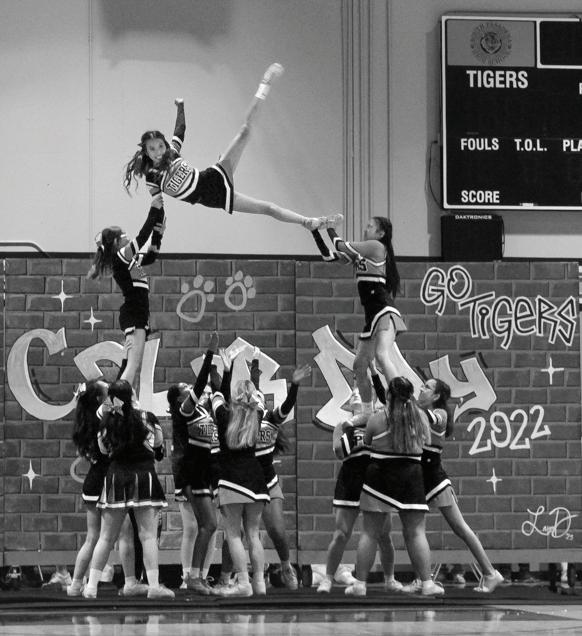
 STORY ISU PARK ILLUSTRATION ELLA MIZOTA-WANG
TIGER JANUARY 31, 2023
PAGE DESIGN ALLISON LEE
Legacy Russel highlights the nuances of identity politics and activism within online spaces in her manifesto “Glitch Feminism.”
12 FEATURE
PHOTOS SHIN-HYE (RACHEL) CHOI , EMIKO (EMI) ESSMILLER & SAMATHA SHIROISHI
TAAGLAA: Grand Central Market Bazaar
TIGER’S AWESOME ADVENTURES IN THE GREATER LOS ANGELES AREA
STORY CLEMENTINE EVANS
PHOTOS EMIKO (EMI) ESSMILLER
Below the beloved Los Angeles Grand Central Market is a hidden bazaar, offering a diverse array of interesting finds. The flea-market showcases vendors and their creative designs from 11 a.m until 9 p.m from Friday through Sunday.


After the two train rides and a walk from the Civic Center train station, me, Emi, her friend Elise, and my COPA rival Isabelle arrived at the market. The plethora of neon signs that pointed out the varying bars in the market was dizzying. The chaos in the market above was too overwhelming, enhancing the tranquility and comfort downstairs in the bazaar. The four of us then headed down to where the banners pointed us.
The Grand Central Market Bazaar opened in 2020 during the height of the pandemic to give opportunities to local vendors who had otherwise lost venues to sell their products. The former director of the Grand Central Market had the idea to open a forum downstairs to support small businesses in such a time.
As we walked down the steps, the sweet scents of homemade of candless beckoned me in. We wandered from stall to stall downstairs and gazed at each vendor and their products from vegan leather products to homemade
sweater vests. Varying tables stacked with handcrafted jewelry emphasized the creativity of the environment.

Instead of taking notes, I wanted more than anything to venture to all 12 of the tables and buy everything they had. After I calmed myself down and realized that that was not the best idea, I pulled out my notebook and started furiously scribbling down small details.
Minimalistic jewelry and aesthetic glass mugs lined the tables while I walked by. I strolled through the stalls and I was transcended into an underground escape. I knew I could walk around and discover something I had never seen or heard of before.


My first purchase was at Rita’s Jewelry Designs, a business that handmakes jewelry and trinkets, where I bought two vinyl stickers, one with Eyore and one with Piglet, both from one of my favorite Disney classics, The Adventures of Winnie the Pooh.
After looking through the stickers and purchasing them both. Isabelle and I walked around the small basementlike area underneath the busy, upstairs world of foods. The two of us admired the handwork of the vendors and the detail in their product.
I then made a beeline for these incredibly pungent candles at Neth Sarmiento. Candles were crafted into
incredible shapes that reflected their scent. A blueberry cobbler smelling one had the designs of small blueberries and light blue frosting carved into the candle in threedimensional design.
Vendors that had smaller stalls that seemed hidden also had the most obscure items. The Style House of Chic had only a single table and three small racks of clothes. The tiny and luxurious stall had clothes that I had always dreamed of finding.

As the owner told me their backstory and where they get their inspiration from, I fawned over the intricate designs of one of their baguette bags. The scrunched up strap along with the rest of the almost ironing-worthy fabric really did make me hungry, not that I would ever eat a bag, but definitely a baguette if I could find one. I kept thinking about what other foods could go well on a handbag. After snapping out of my food and accessory trance, we decided to head upstairs to the food market.
After realizing I should probably get out of the middle of the narrow walkways inbetween restaurants, I finally ordered Mac n’ Cheese with crispy chicken from Knead Noodles. Emi and Elise split off from me and Isabelle and ordered at Bento-Ya. We all dove into our meals and exhaled with satisfaction over the day we had enjoyed. After being back at school for two weeks, another break was just what we needed.
TIGER JANUARY 31, 2023 PAGE DESIGN ALLISON LEE
13 FEATURE
IN
THE MIDST OF CROWDED
DOWNTOWN
LOS ANGELES, the Grand Central Market Bazaar highlights vendors from around California.
Girls Basketball: A Unique Leadership Dynamic
STORY JAYDEN TRAN
PHOTO EMIKO (EMI) ESSMILLER
The SPHS Girls Basketball team is recognized on campus for dominating opponents on the court. Just last year, the team reached the Division II CIF quarterfinals before losing to the Brentwood Eagles. A large factor in the success of the team lies on the leadership from the captains. Unlike most sports teams on campus who have one or two captains, the Girls Basketball team at SPHS has a three-captain leadership system.
The team’s captains for the 2022-2023 season are seniors Lotis Shoun and Peyton Washington-Gauzer and junior Dylan Tse. The three were selected this year by their coach for having the most experience and playing on varsity the longest. The coach of the team has implemented this system for the last few years on campus.
“Dylan is the bridge between our coach and the team, letting us know the timing and dates for both our practices and games,” senior captain Shoun said. “Peyton is our cheerleader and keeps the energy high while I act as a support system for everyone on the team.”
Having three captains creates a unique dynamic for players on the team. Unlike teams that have one captain, having multiple captains makes the positions less coveted and more accessible for players. The team is able to work together without challenges and the typical competition that comes with being named a captain.
“I like the three captain system that we have in place,” senior captain Peyton Washington said. “Someone is always there to help and there are multiple confirmations and assurances. It’s nice to have several people to rely on and I appreciated it when I was a sophomore and junior so leading the team now is even more enjoyable.
Delegating the captain’s typical job of supporting and communicating between all three captains allows the trio to work alongside one another to benefit the team.
“After being scolded by our coach one time, the three of us came together to brainstorm the perfect things to say to our team as encouragement,” junior captain Dylan
Tse said. “Moving forward, we would like to keep up our chemistry that allows us to work well together.”
For players who look up to the captains, having three captains allows athletes to perform in a more supportive culture. There is a steadier leadership committee as a result of having a trio of captains as opposed to one or two individuals having all the power. This system provides a more stable and environment for players on the team.
“I think the leadership this year is very natural. It was kind of unspoken who would be taking charge this year,” junior Olivia Alfonso said. “All of them are both skilled
and experienced, and they bring so much in terms of energy and positive examples for the rest of us all to follow. Having three captains makes it easier because everyone on our team has one person on the captain team that they can go to.”
The trio of leaders has paid off for the SPHS Girls Basketball team having won all eight of their league games and currently standing in first place in the league.
The SPHS Girls Basketball team continue to shine in their season, and will be playing the San Marino Titans on Thursday, Feb. 2.
Badminton looks to rebuild after loss of key seniors
Varsity and JV. Badminton is one of the few sports where both levels practice together.
Some players returned from last year, but the senior core that propelled the team in previous years graduated in 2022, leaving a smaller experienced group for the ensuing season. With a relatively small team however, badminton looks to strengthen that core through practices that improve skill and bring the team closer together.
“It’s just practicing every day; and just playing on the weekends…and we meet really often with teammates.” sophomore Peter Xie said.
These weekend practices are crucial for many of the connections formed in the team.
“A core idea that we believe as a team is that our results depend on the effort we put in. Understanding this has really helped motivate our team to push ourselves,” junior captain Macias said.
A Division I title will not be easy in a rebuilding year, but a place in SPHS’s wall of CIF victory is still achievable according to captain Macias and co-captains Ng and Fong. In order to succeed in CIF, bringing a whole crew of freshmen and underclassmen up to speed is crucial. In addition to tryouts in the winter and summer, badminton sharpened their skills over winter break with trips to open gyms. Even though practice and dedication are highly valued in the sport, creating a safe learning environment for new players is a must for the team.
STORY ROSE VANDEVELDE PHOTO MICHELLE SHADMON
As SPHS’s only Division I sports team begins to prepare for their upcoming spring season, badminton looks forward to a rebuilding year. This year, the handful of seniors and upperclassmen will try to bring prior knowledge to a young team.
SPHS’s badminton community goes past the official roster of the team, to badminton club. While the captains of the team are also in charge of the club, SPHS’s badminton club is mainly a way to provide an opportunity for those who enjoy playing the sport.
The impact of COVID-19 and a virtual year was detrimental to the badminton program, and the team was forced to rely mainly on its returning seniors in the 202122 season. With the loss of these graduated seniors, less experienced players make up much of the roster.
Aside from the team’s captain junior Elijah Macias and co-captains senior Priscilla Ng and sophomore Anson Fong, some of the small group of more experienced players are poised to shine this season. Juniors Jadon Tse and Abby Chen looked strong in previous years and will help propel the team to victory.


The South Pasadena badminton team ended their previous season with a disappointing loss in the first round of CIF. However, when taking into consideration the fact that the team is in a league considered the most difficult in the country, their performance is commendable.
The highly decorated Arcadia badminton team will be the biggest threat in the league as they shoot for their third consecutive CIF title. Not only have they won the previous two, they are ranked among the top teams in the nation.
This year, the team will have to suffice with a smaller roster than usual, with about 25 players in total between
“The type of environment I want to create for this year’s team is [a] warm and welcoming community. During my freshman year, the seniors on the team were very helpful to me, this helped me improve a lot. [Being] captain, I look to replicate that same sense of community into this year’s team,” Macias said.
Practices will include many different types of skill improvement drills, led by Macias, as well as badminton head coach Edwin Luong.
“As a team we really plan to focus on shuttle drills so our players are able to adapt their shots in different situations. I think that will really help our team improve and win more games,” Macias said.
With three levels of competition in the area (D1, D2, and open), badminton will enter division I or open during the season. The team will get their chance to show their hard work and dedication to practicing in March, when they will compete in the first league matchup.
TIGER JANUARY 31, 2023
PAGE DESIGN ALLISON LEE
BADMINTON PREPARES FOR THE SEASON with captains Priscilla Ng, Anson Fong and Elijah Macias.
14 SPORTS
The SPHS Girls Basketball team is led by a diverse trio of captains.
Giving credit where credit is due
Lesser
known
sports like
winter guard should be allowed to gain credit for the work they put in.
with competitions and practices, marching band and color guard perform at every home football game with their show during halftime.
During the spring, SPHS’ color guard takes on a new name as winter guard — even when the activity stays the same. Winter guard is only the indoor version of the sport, with competitions solely dedicated to the guards’ show without the band. However, guard is not viable for the Visual and Performing Arts (VPA) credit, and only winter guard is excluded from PE credits.
Every year is a struggle to gain more members for guard, as publicity is sparse. Most news publications only cover mainstream sports in their reporting, leading to less participation in the foreign extracurriculars. Even to those who know of the sport, incentive is limited when credit is not given where it is due.
Winter sports are nearing their end, and spring sports are just beginning. With popular sports such as baseball and track and field right around the corner, it is easy to overlook the little known athletics, particularly a group that is part of the SPHS band — Winter Guard. Neither team gets any credit for their work, whether academic or public interest, even when members put in countless hours during the season to put together a show.
UPCOMING GAMES
Winter guard, also known as color guard, performs with the marching band during fall season, and then switches to their own performances during the spring. They use flags, rifles, sabers, and other assortments of props to tell a story through their movements and dance.

Over the summer, the marching band and color guard spend a two-week period at an all-day camp to prepare for the upcoming season. Once school starts, the band starts its practices to prepare a five to ten minute show. Every week has two or three practices, three hours each. Once the season begins, competitions begin stacking up seemingly every weekend. Along
When winter guard is not given any sort of academic incentive, it becomes a time drain even to those who enjoy it. There are hordes of classes and electives to choose from at SPHS, and the graduation requirements for students may not allow time for a hopeful member to participate in the sport. With an abundance of other classes that meet academic requirements, new members are hard-pressed to find the time or motivation to join. Without new members to fuel the growth of a team, no group can last — especially one with an already modest audience.
Winter guard is a sport that is unknown to many, and some may argue against its legitimacy as a sport. However, sports can come in many forms, not just the soccer-kicking, basketball-throwing, and cross country running that is widely practiced. Let’s appreciate the lesser known athletics, who don’t get the recognition they deserve for their hard work and achievements. Giving winter guard the acknowledgement it deserves, not only with academic incentive, but also with funding towards its program, will keep the art alive and well.
THURSDAY, FEB. 2ND @ 4:00 PM, GIRLS WATER POLO VS. BLAIR AT BLAIR
THURSDAY, FEB. 2ND @ 4:00 PM, GIRLS SOCCER VS. SAN MARINO AT SAN MARINO
FRIDAY, FEB. 3RD @ 6:00 PM, BOYS BASKETBALL VS. ANIMO JACKIE ROBINSON AT HOME
SPHS Track and Field team perpares for upcoming season
STORY ETHAN KWAK ILLUSTRATION SAMANTHA SHIROISHI
Last season, 18 athletes on the SPHS Girls’ Track and Field qualified for CIF. The team, composed mostly of underclassmen, finished fifth among 117 other schools in CIF Division V, and second in CIF Division III.

Coach CB Richards is optimistic for the upcoming season. Sophomores Abigail Errington, Kezia Gavlak, Perri Koo, Chloe Koo, Jackie Sides, and Amelie Geoffron all excelled in multiple categories as freshmen. Errington broke 33-year Rio Hondo League league final records for the 3200m along with junior Mia Holden setting records in the triple jump.
“The sophomores still have a lot of untapped potential that we will see come to fruition this season. Their natural talent combined with the hard work … will be a key factor in the team’s overall success this season,” Richards said.
Richards also expects great progress from returning athletes junior Helena Foord, junior Lillian Sherman, senior Rachel Noonan, sophomore Avery Taylor, junior Zoya Brown, and senior Luna Encinas.

“I am confident that this team is ready to take on the challenges of the upcoming season. We show a great deal of potential, and I am excited to see how that translates to meets,” Richards said. “The dedication and hard work that has been put in during the off-season is evident … and I know that it will pay off when we hit the track.”
In addition to the current roster, freshmen Anna Kowal, Amada Cortes, and Naya Holden will join the team this season.
“[There is] a lot of new talent coming in, but I have noticed these new freshmen showing varsity scoring potential in 2023,” Richards said.
Among the many events on the road to CIF, sophomore distance runners Errington, C. Koo, Sofia Humphrey, and Geoffron train in anticipation for the Arcadia invite. Hosted by Arcadia High School, the track and field meet is known as the most competitive in the country, drawing runners nationwide.

“This season, I’m looking forward to the Arcadia invite and competitive meets,” Errington said. “During cross country
season it was definitely a boost to our confidence because we broke a lot of records. We want the opportunity to race against the fastest girls in the country.”
Last season, the team broke many personal, school, and even league records. With a strong lineup of relay teams, SPHS track broke records for the 4x1600 and 4x800.
“Honestly [I am] just [looking forward to] having a fun time with my team, possibly breaking some records and possibly winning the 4x16 and 4x8,” C. Koo said.
This year’s roster with ambitious, enthusiastic studentathletes is the ideal combination for a successful season.
“Each year, I am excited to see what the future holds as far as what the season brings us. For this team as we continue to build on this success and strive for even greater accomplishments I believe we will reach for high goals… I am excited to help the team on that path… This is what team sports are all about to us at SPHS Tiger Track,” Richards said. The first track meet will be held at Covina High School on Feb. 18, 2023.
TIGER JANUARY 31, 2023
STORY MORGAN SUN
PHOTO SHIN-HYE (RACHEL) CHOI
PAGE DESIGN ALLISON LEE
15 SPORTS
WARMING UP ON THE TRACK, members of the South Pasadena High School Track and Field team practice together, preparing for a successful upcoming season.
The history of Jews in baseball
STORY BENJAMIN REGAN ILLUSTRATION ISOLE KIM

Irecently attended a talk hosted by The Jewish Federation of the San Gabriel Valley at Temple Beth Israel about Jewish players in professional baseball. Josh Rawitch, the President of the National Baseball Hall of Fame and Museum, and Peter Drier, Professor at Occidental College, author, and baseball guru spoke about the history of Jews in baseball and the impact they have had. As a Jewish baseball player myself, I was interested to hear about Judaism and its role in the lives of athletes.
Stories about Jews in baseball always have and likely always will center around pitcher Sandy Koufax. The southpaw won three Cy Young Awards and four World Series Championships in his tenure with the Dodgers, earning his spot in the Baseball Hall of Fame. On October 6, 1965, his religion and his career conflicted. The day was Yom Kippur, the holiest day on the Jewish calendar. It also happened to be game one of the World Series against the Minnesota Twins, a game that Sandy Koufax was lined up to start. Koufax opted to attend synagogue in Minneapolis on Yom Kippur. A week later, Koufax triumphed over the Twins in game seven to win the championship. By not playing on Yom Kippur, Koufax showed his devotion to Judaism and inspired a generation of American Jews.
Before Sandy Koufax, there was Hank Greenberg –the second Jewish name synonymous with baseball. Greenberg’s Hall of Fame career was spent with the Detroit Tigers, over which time he won two most valuable player awards and two championships. Greenberg’s unrivaled career earned him the nickname “the Jewish Babe Ruth.”
“Jewish players throughout history have been on the forefront of social justice. Hank Greenberg, because he was met with so much anti-semitism when he was playing…was one of the few white players that was very supportive of Jackie Robinson when he came up,” Drier said.
Greenberg was put into a similar position to Koufax on September 13th, 1934, with a pennant on the line and a city on his back. Greenberg, like millions of other Jews in America, chose to observe Yom Kippur and attend temple. Once again, a Jewish ballplayer led the way.
In 2017, the World Baseball Classic brought about an international highpoint for Jews in baseball. The World Baseball Classic, a worldwide baseball tournament that features 20 countries competing, has been primarily dominated by powerhouses such as the Dominican Republic and the United States. In 2017, however, the spotlight shone on Team Israel.
Israel is known for many things; baseball is not one of them. The national team hadn’t qualified for any of the previous tournaments, but Israel earned its spot in the 2017 tournament alongside the world’s best teams. With little to no expectations and underwhelming coverage, Team Israel proved to be the story of the tournament. The group was led by Brad Asmus, a longtime player and manager in MLB who pulled all the right strings for the Isralies. The team itself didn’t have many big names -aside from four-time All-Star Ian Kinsler, Team Israel was a combination of castaways and has-beens. The team also didn’t have a single Israeli-born player, all were American Jews. Yet the team was united by their religion and played for each other and for Judaism.
Team Israel got off to a blazing start to open the tournament, knocking off a stacked Netherlands roster to advance. The Israelies kept winning, beating Cub\a decisively. The magic would eventually run out for Team Israel, falling to Japan in a hard-fought contest. Nonetheless, no one could have predicted Team Israel’s successes.
“There was a feeling that they were doing something special…they felt a special pride in being Jewish that maybe they didn’t have before,” Rawitch said, speaking of the 2017 run.
A few years later, in 2021, the Braves faced the Astros in the World Series. And once again, the baseball gods intertwined Judaism in a significant baseball event. Max Fried, a young Jewish pitcher, was on the mound for the Atlanta Braves in game 2. He delivered a pitch to Alex Bregman, the star Jewish third baseman. He hit a fly ball to Joc Pederson, the Braves Jewish left fielder. The trio of Jews was complete.
Baseball, as America’s pastime, has not always been a microcosm of the country’s great melting pot. But baseball has evolved, and today’s game features a diverse group of athletes from many ethnicities. More people than ever are calling baseball their sport, and this will only increase with the league’s goals of global inclusion. Judaism is one of these important pieces that make up the game of baseball.
SPHS Girls Soccer defeats Temple City in a tight match
The Tigers came back reenergized after halftime, and intercepted the ball seconds after the Rams took the kickoff. Reasserting their position, the Tigers took over the offensive field once again. Kowal and Pollard partnered to open opportunities to score, but while the Tigers were unceasingly attacking the goal, the Rams’ goalkeeper managed to block multiple shots, keeping them at bay.
With that, the Tigers got the ball back into their possession and ran towards the opposite goal. The Tigers brought their all as Pollard, with an assist from junior Kaoruko Endo, took a shot at the goal and the ball brushed past the goalie’s fingers to hit the net, scoring the very first goal of the game and giving South Pas a 1-0 lead.
STORY LINDA YUN ILLUSTRATION SAMANTHA SHIROISHI
The girls soccer team narrowly won against the Temple City Rams in an away game on Friday, Jan. 27, triumphant by a score of 1-0. The Tigers managed to scrape by the Rams and improve their record to 11-2-1 overall and 6-2 in the Rio Hondo League.

The Tigers controlled the ball from the kickoff with junior Iris Pollard kicking it back to senior Sabrina Bluml until the Tigers lost the ball quickly to the opposing side. The two teams began a back-and-forth with each side gaining control of the ball for a short stint before the other team took control and ran the play back to the opposition.
The play seemed to center around the midline during the first half of the game, until freshman Anna Kowal intercepted the ball and passed to Pollard. Pollard took a shot at the goal and missed, but the play had moved towards the offensive goal box. From then on, the Tigers’ increased aggression kept the Rams on their toes with driving pushes towards the goal.
The Rams were breaking through the Tigers’ defense to try and get an offensive push, but senior Ava Fineza was quick to herd the Rams back towards their goal box as she protected the back lines. However, even with the Tigers pushing towards the goal more fervently than ever, the whistle rang out for halftime with zero goals in the game, the two teams at a standstill.
After a quick celebration, the Tigers focused on pressing towards the opposing goal once again. However, after freshman Rose Vandevelde and Pollard joined forces to attack the goal, the Rams gained possession and began traveling back towards the defending field. The opposing team attempted to shoot, but sophomore goalkeeper Ava Hartstein dove for the ball, successfully deflecting the shot. Once again, Harstein securely snatched the ball out of the air on the Rams’ second attack.
A couple minutes sped by with the teams fighting for power over the ball, and sophomore Saidbh Byrne, Vandevelde, and Bluml did well to keep the ball out of the Rams’ hands. With only a few minutes left in the game, the Tigers were stalling for time by keeping the ball along the edge and continuously going out-ofbounds. The match ended with a 1-0 win for the Tigers after a hard-fought game.
TIGER JANUARY 31, 2023
BUT WAIT! INSTAGRAM @tigernewspaper TWITTER @SPHStiger FACEBOOK tiger.newspaper There’s more... CHECK OUT MORE COVERAGE ON ONLINE tigernewspaper.com YOUTUBE @SPHSTigerNewspaper
SPORTS PAGE DESIGN ALLISON LEE
16
