Understanding the origins of
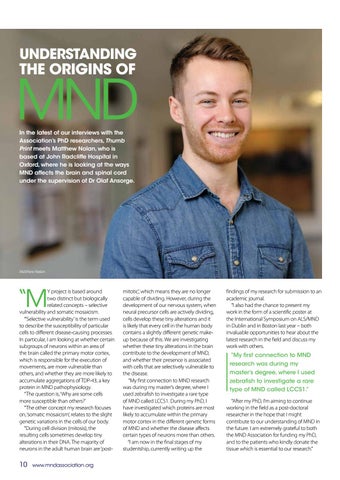
MND In the latest of our interviews with the Association’s PhD researchers, Thumb Print meets Matthew Nolan, who is based at John Radcliffe Hospital in Oxford, where he is looking at the ways MND affects the brain and spinal cord under the supervision of Dr Olaf Ansorge.
Matthew Nolan
“M
Y project is based around two distinct but biologically related concepts – selective vulnerability and somatic mosaicism. “‘Selective vulnerability’ is the term used to describe the susceptibility of particular cells to different disease-causing processes. In particular, I am looking at whether certain subgroups of neurons within an area of the brain called the primary motor cortex, which is responsible for the execution of movements, are more vulnerable than others, and whether they are more likely to accumulate aggregations of TDP-43, a key protein in MND pathophysiology. “The question is, ‘Why are some cells more susceptible than others?’ “The other concept my research focuses on, ‘somatic mosaicism’, relates to the slight genetic variations in the cells of our body. “During cell division (mitosis), the resulting cells sometimes develop tiny alterations in their DNA. The majority of neurons in the adult human brain are ‘post-
10
www.mndassociation.org
mitotic’, which means they are no longer capable of dividing. However, during the development of our nervous system, when neural precursor cells are actively dividing, cells develop these tiny alterations and it is likely that every cell in the human body contains a slightly different genetic makeup because of this. We are investigating whether these tiny alterations in the brain contribute to the development of MND, and whether their presence is associated with cells that are selectively vulnerable to the disease. “My first connection to MND research was during my master’s degree, where I used zebrafish to investigate a rare type of MND called LCCS1. During my PhD, I have investigated which proteins are most likely to accumulate within the primary motor cortex in the different genetic forms of MND and whether the disease affects certain types of neurons more than others. “I am now in the final stages of my studentship, currently writing up the
findings of my research for submission to an academic journal. “I also had the chance to present my work in the form of a scientific poster at the International Symposium on ALS/MND in Dublin and in Boston last year – both invaluable opportunities to hear about the latest research in the field and discuss my work with others.
“My first connection to MND research was during my master’s degree, where I used zebrafish to investigate a rare type of MND called LCCS1.” “After my PhD, I’m aiming to continue working in the field as a post-doctoral researcher in the hope that I might contribute to our understanding of MND in the future. I am extremely grateful to both the MND Association for funding my PhD, and to the patients who kindly donate the tissue which is essential to our research.”