Mind & Body | Dental Care Basics
STRAIGHT TALK about Dental Care with Braces by Tori Hebert
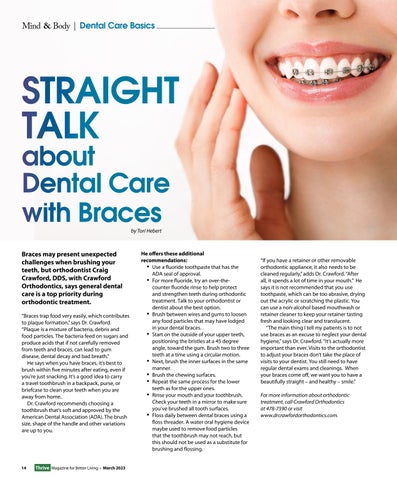
Braces may present unexpected challenges when brushing your teeth, but orthodontist Craig Crawford, DDS, with Crawford Orthodontics, says general dental care is a top priority during orthodontic treatment. “Braces trap food very easily, which contributes to plaque formation,” says Dr. Crawford. “Plaque is a mixture of bacteria, debris and food particles. The bacteria feed on sugars and produce acids that if not carefully removed from teeth and braces, can lead to gum disease, dental decay and bad breath.” He says when you have braces, it’s best to brush within five minutes after eating, even if you’re just snacking. It’s a good idea to carry a travel toothbrush in a backpack, purse, or briefcase to clean your teeth when you are away from home. Dr. Crawford recommends choosing a toothbrush that’s soft and approved by the American Dental Association (ADA). The brush size, shape of the handle and other variations are up to you.
14
Thrive Magazine for Better Living • March 2023
He offers these additional recommendations: • Use a fluoride toothpaste that has the ADA seal of approval. • For more fluoride, try an over-thecounter fluoride rinse to help protect and strengthen teeth during orthodontic treatment. Talk to your orthodontist or dentist about the best option. • Brush between wires and gums to loosen any food particles that may have lodged in your dental braces. • Start on the outside of your upper teeth, positioning the bristles at a 45 degree angle, toward the gum. Brush two to three teeth at a time using a circular motion. • Next, brush the inner surfaces in the same manner. • Brush the chewing surfaces. • Repeat the same process for the lower teeth as for the upper ones. • Rinse your mouth and your toothbrush. Check your teeth in a mirror to make sure you’ve brushed all tooth surfaces. • Floss daily between dental braces using a floss threader. A water oral hygiene device maybe used to remove food particles that the toothbrush may not reach, but this should not be used as a substitute for brushing and flossing.
“If you have a retainer or other removable orthodontic appliance, it also needs to be cleaned regularly,” adds Dr. Crawford. “After all, it spends a lot of time in your mouth.” He says it is not recommended that you use toothpaste, which can be too abrasive, drying out the acrylic or scratching the plastic. You can use a non-alcohol based mouthwash or retainer cleaner to keep your retainer tasting fresh and looking clear and translucent. “The main thing I tell my patients is to not use braces as an excuse to neglect your dental hygiene,” says Dr. Crawford. “It’s actually more important than ever. Visits to the orthodontist to adjust your braces don’t take the place of visits to your dentist. You still need to have regular dental exams and cleanings. When your braces come off, we want you to have a beautifully straight – and healthy – smile.” For more information about orthodontic treatment, call Crawford Orthodontics at 478-7590 or visit www.drcrawfordorthodontics.com.