VOL 1 NO.31 • SEPTEMBER 12 – SEPTEMBER 18, 2021
FASHION
Blurred Lines Getting A Step Closer To Fashion Equality BY KEHINDÉ FAGBULE
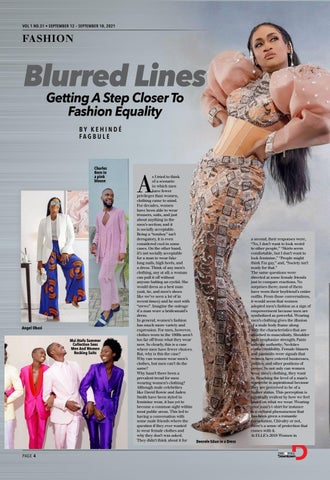
Charles Born in a pink blouse
Angel Obasi Mai Atafo Summer Collection Sees Men And Women Rocking Suits
PAGE 4
A
s I tried to think of a scenario in which men have fewer privileges than women, clothing came to mind. For decades, women have been able to wear trousers, suits, and just about anything in the men’s section; and it is socially acceptable. Being a “tomboy” isn’t derogatory, it is even considered cool in some cases. On the other hand, it’s not socially acceptable for a man to wear fake long nails, high heels, and a dress. Think of any men’s clothing, any at all; a woman can pull it off without anyone batting an eyelid. She would dress as a best man (suit, tie, and men’s shoes like we’ve seen a lot of in recent times) and be met with “awws”. Imagine the outrage if a man wore a bridesmaid’s dress. In general, women’s fashion has much more variety and expression. For men, however, clothes worn in the 1800s aren’t too far off from what they wear now. So clearly, this is a case where men have fewer choices. But, why is this the case? Why can women wear men’s clothes, but men can’t do the same? Why hasn’t there been a prevalent trend for men wearing women’s clothing? Although male celebrities like David Bowie and Jaden Smith have been styled in feminine wear, it has yet to become a common sight within most public areas. This led to having a conversation with some male friends where the question if they ever wanted to wear female clothes and why they don’t was asked. They didn’t think about it for Denrele Edun in a Dress
a second, their responses were, “No, I don’t want to look weird to other people,” “Skirts seem comfortable, but I don’t want to look feminine,” “People might think I’m gay,” and, “Society isn’t ready for that.” The same questions were directed at some female friends just to compare reactions. No surprises there; most of them have worn their boyfriend’s entire outfits. From those conversations, it would seem that women adopted men’s fashion as a sign of empowerment because men are symbolized as powerful. Wearing men’s clothing gives the illusion of a male body frame along with the characteristics that are attached to masculinity. Shoulder pads emphasize strength; Pants indicate authority; Neckties evoke credibility. Female blazers and pantsuits were signals that women have entered businesses, politics, and other positions of power. So not only can women wear men’s clothing, they want to. Reaching the level of a man’s wardrobe is aspirational because they are perceived to be of a higher status. This perception is physically evident by how we feel based on what we wear. Wearing your man’s t-shirt for instance is a cultural phenomenon that has been given a romantic connotation. Chivalry or not, there’s a sense of protection that comes with it. At ELLE’s 2018 Women in