VOL 1 NO.4 • MARCH 07 – MARCH 13, 2021
IWD SPECIAL
IN CONVERSATION WITH ACTRESS
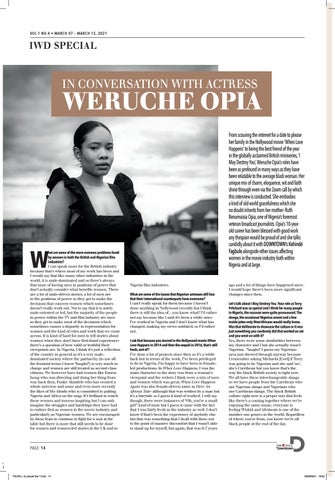
WERUCHE OPIA From scouring the internet for a date to please her family in the Nollywood movie ‘When Love Happens’ to being the best friend of the year in the globally acclaimed British miniseries, ‘I May Destroy You’, Weruche Opia’s roles have been as profound in many ways as they have been relatable to the average black woman. Her unique mix of charm, eloquence, wit and faith shine through even via the Zoom call by which this interview is conducted. She embodies a kind of old world gracefulness which she no doubt inherits from her mother- Ruth Benamaisia Opia, one of Nigeria’s foremost veteran broadcast journalists. Opia’s 10-yearold career has been blessed with good work any thespian would be proud of and she talks candidly about it with DOWNTOWN’s Kehindé Fagbule alongside other issues affecting women in the movie industry both within Nigeria and at large.
W
hat are some of the more common problems faced by women in both the British and Nigerian film industries? I can speak more for the British industry because that’s where most of my work has been and I would say that like many other industries in the world, it is male-dominated and so there’s always that issue of having men in positions of power that don’t actually consider what benefits women. There are a lot of male-driven stories, a lot of men are in the positions of power so they get to make the decisions that concern women which sometimes doesn’t really work out. Not to say that it is solely male-oriented or led, but the majority of the people in power within the TV and film industry are men so they get to make most of the decisions which sometimes causes a disparity in representation for women and the kind of roles and work that we come across. It is kind of hard for men to tell stories about women when they don’t have first-hand experiencethere’s a question of how valid or truthful their viewpoints are. In Nigeria, I think it’s just a reflection of the country in general as it’s a very maledominated society where the patriarchy (to use all the feminist terms I know *laughs*) is very much in charge and women are still treated as second class citizens. We however have had women like Emem Isong who was directing and doing her thing from way back then, Funke Akindele who has created a whole universe and some and even more recently the likes of Mo Abudu who is committed to putting Nigeria and Africa on the map. It’s brilliant to watch these women and moreso inspiring but I can only imagine the struggles and hardships they have had to endure first as women in the movie industry and particularly as Nigerian women. We are encouraged by these feats to continue to fight for a seat at the table but there is more that still needs to be done for women and women-led stories in the UK and in
Nigeria film industries. What are some of the issues that Nigerian actresses still face that their international counterparts have overcome? I can’t really speak for them because I haven’t done anything in Nollywood recently but I think there is still the idea of…you know what? I’d rather not say because like I said it’s been a while since I’ve worked in Nigeria and I don’t know what has changed, making my views outdated, so I’d rather not. I ask that because you starred in the Nollywood movie When Love Happens in 2014 and then the sequel in 2016, that’s still fresh, sort of? I’ve done a lot of projects since then so it’s a while back but in terms of the work, I’ve been privileged to do in Nigeria, I’m happy to have been in femaleled productions. In When Love Happens, I was the main character so the story was from a woman’s viewpoint and the writers I think were a mix of men and women which was great. When Love Happens Again was also female-driven same as Dere: An African Tale- although that was written by a man but it’s a fairytale so I guess it kind of worked. I will say though, there were instances of “Oh, you’re a small girl” kind of issue but I guess it came with the fact that I was fairly fresh in the industry as well. I don’t know if that’s been the experience of anybody else but that was something that I dealt with then- not to the point of massive discomfort that I wasn’t able to stand up for myself, but again, that was 6-7 years
ago and a lot of things have happened since. I would hope there’s been more significant changes since then. Let’s talk about I May Destroy You. Your role as Terry Pritchard was so special and I think for many people in Nigeria, the nuances were quite pronounced. The slangs, the occasional Nigerian accent and a few inside jokes only West Africans would really know. Was that deliberate to showcase the culture or it was just something you randomly did that worked on set and you went on with it? Yes, there were some similarities between my character and I but she actually wasn’t Nigerian. *laughs* I guess my Nigerianness just showed through anyway because I remember asking Michaela [Coel] if Terry was going to be Nigerian and she said ‘no’, she’s Carribean but you know that’s the way the black British society is right now. We all have these interchangeable slangs so we have people from the Carribean who use Nigerian slangs and Nigerians who use Carribean slangs. The black British culture right now is a proper mix that feels like there’s a coming together where we’re enjoying the same music, everyone is feeling Wizkid and Afrobeats is one of the number one genres in the world. Regardless of where you’re from, you know we’re all black people at the end of the day.
PAGE 14
m ela ed nd THEWILL dt_restyle Mar 7.indd 14
05/03/2021 18:52