THE WEBB SCHOOL
WEBB MAGAZINE
Dedicated to the Class of 2020
Head of School Interviews Webb 150 Celebration and Reunion Weekend Update
Spring - Summer 2020
The Webb School Magazine
Inside: COVID-19 Reactions, Reflections
1
THE WEBB SCHOOL
WEBB MAGAZINE
Raymond S. Broadhead Head of School
PAGES 4-8
Celebrating the Class of 2020
PAGES 10-11 Broadhead era positions school for next 150 years
PAGES 12-15
Webb faces COVID-19 with health and safety in mind
WEBB COMMUNICATIONS EDITOR: Rita Mitchell Director of Communications DESIGN & LAYOUT: Gayle K. McClanahan Graphic Designer CONTRIBUTORS: Alyce Allen Director of Advancement Services Dorothy Elkins Alumni Research Assistant Jonathon Hawkins Director of Alumni Relations and Annual Giving
PAGES 16-17
Cheeseman inspired by Webb's mission as he becomes head of school
PAGE 18
The Celebration is on!
PAGE 19
Class of 1969 Minority Scholarship
Michelle Thomas Director of Parent Giving and Donor Relations Matt Wilson Director of Alumni and Development The Webb School Magazine is published biannually in the summer and winter by The Webb School, 319 Webb Road East, Bell Buckle, Tenn. The Webb School is a nonprofit 501(c)(3) organization: 62-0401875. The Webb School complies with all applicable anti-discrimination laws and does not discriminate on the basis of gender, race, color, religion, ethnic or national origin in the administration of its educational policies and programs, admissions p r o c e s s e s , s c h o l a r s h i p and financial aid programs, employment practices, athletic and other school administrative programs.
Spring-Summer 2020
PAGES 22-24
2
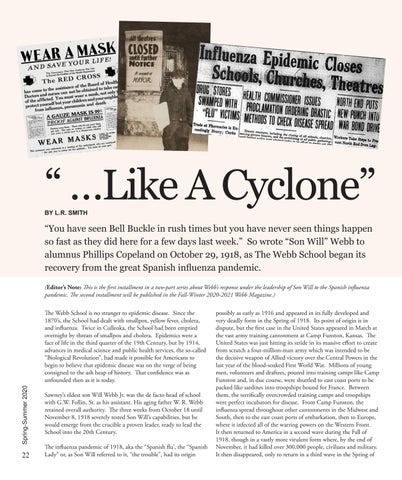
Like a Cyclone Webb during the 1918 influenza pandemic
PAGES 37-39
Alumni Award Recipients
PAGE 39
Memoriams
319 Webb Road East Bell Buckle, Tenn. 37020 1-931-389-9322
On the cover, left to right from upper left corner: Anna Allison, Arianna Boyle, Bailey Chance, Amy Chen, Kyle ClonceBryan, Sydney Cohen, Charlee Davis, Jael Davis, Shemar Fray, Hanna Gao, Alex Garrett, Dacey Goodwin, Louisa Greenberg, Olivia Greer, Dalton Gregory, Ella Harris, Amos Howard Jr., Isabella Insell, Keon Johnson, Noah Jolley, Michael Jones, Zach Jones, Firuz Khamidov, Kojo Kufuor, Max Kwarteng, Wesley Ledbetter, Young Seo Lee, Abbi Lowry, Adam McAbee, Mackenzie McKillip, Mary Okon, Vraj Patel, Hongrui Peng, JJ Platt, Azaria Porter, Kat Pugh, Sara Smith, Adelia Stanley, Carol Su, Nathan Thompson, Andrew Turner, Chloe Tyner, Donovan Vincent, Gianna Wagnon, Lily Walker, Tiger Wang, Steven Wu, Rogen Xu, Alan Yang, Justin Zhu
A NOTE FROM THE HEAD OF SCHOOL
Resilience - Stronger Together - Family Uncertain Times By Ray Broadhead
These are the words that have defined the last few months of the school year. In the future, the story of Webb’s 150th year may more likely be defined by what did not happen, rather than what did. While we cannot change history, we can influence the narrative by leaving behind enough evidence of the many wonderful efforts by the Webb community to endure, to teach, and to handle misfortune. Throughout history, leadership and character are defined in times of uncertainty. Three of our most memorable presidents, Washington, Lincoln and Roosevelt, served in times of great unrest, and each one in his own way answered the call. I am proud of all members of the Webb community for all their efforts to meet the challenges of each day with thoughtfulness, decisiveness, and the willingness to serve. Teachers needed to quickly adjust to distance learning, which is no easy task. For most, time on task was even greater than during classroom learning. Teachers spent hours looking for papers, trying to keep track of missing assignments, and learning new skills and platforms for assignments. Some teachers created videos to share with the students. Yes, we all learned how to Zoom, and we had some special moments, but the reason we are all at Webb is because we thrive on the daily faceto-face interaction with students. I salute the faculty for all their efforts.
From the very beginning of the pandemic, our faculty and staff have worked hard to make timely and informed decisions with regards to what is the next best course of action. We continue to do so, as we make plans to honor the class of 2020 at an in-person and virtual graduation on July 11. Special thanks to Larry Foulk, dean of students, for his dedicated leadership of the COVID-19 Task Group. The group's work was essential as we made the difficult decision on March 17 to move to distance learning for the rest of the year. The Board of Trustees has also been very active during these times. Our virtual board meeting on April 17 had the best attendance in recent years. Their concern and love for the school is remarkable, and the gift of their time and talent supports the school in so many ways. As I close out my 10 years at Webb, I am grateful for the opportunity that I have had to serve and learn here. I often remark that I have become a better person in my time here. Honesty, integrity, grit and service are some of the contextual hallmarks of character at Webb. I feel in my heart that I have been shaped by these virtues. The voice of Sawney still echoes in soft whispers throughout the campus. We are all inspired by that voice, and that of the many great faculty, past, present and future, who will inspire students to do the right thing. On the Davis-Woosley building on campus, there is a great Sawney quote: “A man’s reputation is only what men think him to be; his character what God knows him to be.” Every day that whisper has inspired me.
Please visit pages 4-8 as we celebrate the Class of 2020.
The Webb School Magazine
Students also had to adjust to distance learning. For some, the necessary organizational skills without continuous structure was daunting. The pain of loss of not being part of the Webb community affected some more than they would have thought -- missing their friends, missing their teachers, and missing the community that cares for them. It often takes loss to recognize value and importance. The students have done very well in the face of this enormous change. Of course, we must also thank the
many parents who, in some cases, were working from home and also assisting their students.
3
Celebrating the The Webb School
Graduation Graduation
Spring-Summer 2020
invites will you hostto
4
Please join us in the Class of 2020 Forcelebrating the Class of 2020 July 11,A.M. 2020, 9:00 A.M. Saturday,Saturday, July 11, 2020, 9:00 • Barton Athletic Center Barton Athletic Center For the Middle School Friday, July 10, 2020, 6:00 P.M. • Barton Athletic Center
Dalton Gregory, Albany, Ky. I guess one of the lessons is how important it is having the community there and all those people around you, seeing them so often and talking to so many people every day. You just kind of realize how important that community really is.
These 50 outstanding ladies and gentlemen have been accepted into 138 different colleges and universities, including: Alabama, American, Arkansas, Auburn, Babson, Baylor, Belmont, Berkeley, Boston, Brandeis, Bryn Mawr, Butler, UC-Davis, UCLA, Carson-Newman, Clemson, Colby, Columbia, Connecticut, DePaul, ETSU, Emory, Flagler, Furman, Georgia, George Washington, Georgia Tech, Jacksonville State, Kenyon, La Salle, Lake Forest, Lipscomb, LSU, Loyola, UMass, McKendree, Miami, Montana State, MTSU, Northeastern, NYU, Ohio State, Oglethorpe, Pace, Penn State, Purdue, Samford, SCAD, Tennessee, UT-Chattanooga, UT-Martin, Tennessee Tech, Tulane, Ole Miss, Pittsburgh, Rhodes, Rollins, Rutgers, University of Southern California, Vassar, Washington, Xavier and Yale. The Webb School Magazine
5
Spring-Summer 2020
Alex Garrett, Cookeville, Tenn. I’ve learned that it takes more than distance and quarantine to break a friendship; the relationships I made at Webb will last forever.
6
Ella Harris, Murfreesboro, Tenn. I think I'm looking forward to college. I almost just want to skip the summer and go on to college. I'm going to an art school, so I know the curriculum is going to be really focused on what I love to do.
Keon Johnson, Shelbyville, Tenn. I will remember most the lifelong friendships that I have made throughout my high school experience.
Adelia Stanley, McMinnville, Tenn. I'll remember being mindful of the inbetween moments, getting to school and seeing my friends every day and talking with my friends. As it came to an end, I was grateful that I had taken the time to do that--to be present in and capture the moments.
Hannah Little Lead Advisor Chadd Bridwell Elyse Jensen Effie O'Neil Jonathan Chicken Jason Simpson Kelly Northrup Mallory Garcia Michael Quinn Pamela Seals Ruth Cordell Scott Persichetti Shelby Lamb Susan Mullen
The Webb School Magazine
Louisa Greenberg, Murfreesboro, Tenn. I spent a lot of time with friends and made a lot of memories with them. I'll remember Senior Blazer Day, because that's one of the big events for seniors. I was looking forward to the other things to close out the year. But I was still happy with the way my senior year went.
Thank you Senior Advisors
7
Hannah Little, lead senior advisor, spearheaded a Webb tradition by working with seniors at a distance on the Class of 2020 Senior Board. Seniors were mailed a board square to design. Once each senior designs his or her piece and returns it to Webb, the class Senior Board will be created and hung with those of other classes in the Alumni Center.
Charlee Davis, Shelbyville, Tenn. I have learned to not take any Webb memories and experiences for granted because, as tough as the school might be sometimes, there are a lot of great people there and a lot of good opportunities that we could miss out on if we don't fully experience them and appreciate what the school has to offer.
Vraj Patel, Murfreesboro, Tenn. Be appreciative, including the education that you received as well your family and friends. Value education, because it's really important in your life. And, in general, be appreciative of everything you have. ANCIENT GUARD SINCE 6TH GRADE Anna Allison Charlee Davis Isabella Insell Anna Catherine Pugh Donovan Vincent ANCIENT GUARD SINCE 7TH GRADE Bailey Chance Olivia Greer Wesley Ledbetter Young Seo Lee Lily Walker OLD GUARD SINCE 9TH GRADE
Spring-Summer 2020
Kyle Clonce-Bryan Louisa Greenberg Ella Harris Noah Jolley Adelia Stanley Chloe Tyner Tiger Wang Justin Zhu Haojing Chen Sydney Cohen Jael Davis Shemar Fray
8
Dacey Goodwin Dalton Gregory Keon Johnson Michael Jones Zachary Jones Abigail Lowry Mackenzie McKillip Vraj Patel Sara Smith Nathan Thompson Alan Yang
Bailey Chance, Manchester, Tenn. I know I'll definitely make new friends at college and get to experience the whole college lifestyle. I think I'll definitely enjoy pursuing passions I really care about especially what I plan on getting a degree in -- accounting and business management.
Financial aid key for Webb Fund chairs By Davis Turner '79 and Melora Wilkins Turner '80 Over the past few months, in conjunction with the Alumni and Development Office, we have had the good fortune of being able to communicate virtually with alumni, parents, and friends of the school. We have been asking how they are doing, and updating them on how the school is responding to the COVID-19 pandemic. Many, like us were truly looking forward to coming to campus in April for a special joint Webb 150 Celebration and Reunion Weekend, and we are pleased that these events have been rescheduled for Oct. 8-11. (See page 18 for more details.)
This past year, as alumni board members, we were delighted to accept the roles of Webb Fund Chairs. We have seen the school grow, and how much others have
Alex Garrett '20 is a terrific young man from Cookeville, Tenn. He made the most of his time at Webb this year by exploring his love of history and by being a critical part of the football and varsity basketball teams. He is well liked by faculty and students alike. We had the chance to meet Alex when he and his teammates came to visit the Alumni Board as part of its winter meeting in February. Many have asked how they can help ensure that Webb is able to remain strong during this time. Webb is determined to keep all students who may be experiencing financial hardship. For those who are in a position to help at this time, please consider designating your gift to Webb in support of financial aid. Your support can truly make a difference.
It was a great honor for me to be the first recipient of the Rusty Turner scholarship. Without this, I wouldn’t have been able to attend Webb and get all the experiences that I had my senior year. -Alex '20 You may give online by visiting www.thewebbschool.com and clicking "Make a Gift" or by calling the Alumni & Development Office at 931-389-5724.
The Webb School Magazine
A number of stories have reminded us why we truly enjoy being a part of the Webb community. We want to help connect people with Webb. Whether that is because of nostalgia, because of what is happening today, or because education is the hope for the future, we encourage everyone to be as involved as they would like to be with the community.
given back to the school. We felt very fortunate to be in a position with family and friends to name a scholarship in memory of Rusty '82 [Davis' brother] last year. The first recipient of the scholarship was named this year. We hoped that it would be given to a student who could "have the full Webb experience--live on campus, receive an outstanding college preparatory education, and learn the commitment to honor, integrity, and character that Webb instills."
9
Broadhead era positions school towards next 150 years Residential and science facilities, faculty compensation and the Advanced Placement Program were four main areas of emphasis when Ray Broadhead joined Webb 10 years ago as head of school. As he reflects on the last decade, he counts those areas as keys to helping position the school for its 150th anniversary for the future. He completed his tenure at Webb in June. “Impactful advances are never accomplished by one person. One person may have the vision, but it takes many people to complete the project,” he said. “None of these advancements are my own; there were many people who helped by taking on key roles.” Broadhead said that when he arrived at Webb he saw some areas that he thought needed immediate improvement. One of those was residential facilities for faculty and staff. “The four existing dormitories on campus did not have houses that were really suitable for a family. The result of this was that dorms did not have an opportunity to shape an identity through their adult leadership,” he said. “One of the first solutions was to add the Margaret G. Turner House to Cooper-Farris dorm. This well-designed addition had space for a family and an area where the residential faculty member could interact with the students in the dorm while maintaining family life.”
Spring-Summer 2020
The next step, he said, was Phase I of the Residential Village Project. The project, constructed in close proximity to existing dorms, included two dormitories, Wendel Haynes Hall and Meadows Hall each with faculty/staff housing, and the Dorothy Powell Elkins Student Center.
10
“These facilities were necessary to expand our boarding population and to offer very attractive housing on campus for students and faculty,” he said. “As a biology teacher, I saw that the present science labs were crowded, and we needed more space to
Webb Winter Magazine Cover 2009-2010
accommodate increasing science enrollment. With the construction of McClurg Hall, we were able to create three science labs and two math classrooms that are state of the art, with plenty of room for lab work.” Broadhead added, “One of our biggest and most enjoyable challenges was to find a brown chalkboard for Mrs. (Sandy) Truitt. They no longer exist, so we had to cut out the chalkboard from her Big Room classroom and install it in her new McClurg Hall classroom. She was thrilled!" Another area that drew Broadhead’s attention was faculty compensation. “It is always challenging to keep faculty compensated at a level that is commensurate with their efforts to support students in many ways," he explained. "In addition to raising the scale for all faculty in a three-year period that just ended this year, I introduced stipends for 'extras' that are part of some faculty members’ schedules such as coaching, living in a dormitory and maintaining a Commercial Driver’s License to transport students for athletics and school trips." Finally, he wanted to improve the scope of the AP Program. “When I arrived at Webb, there were only about 12 AP offerings, and some were not offered every year. One of the key missing classes was biology. I thought we needed some external verifications that our classes met proper standards. AP is an example of such verification. Departments met, and many took on new AP classes. Presently the school has more than 20 AP classes.” Webb's current head acknowledged that none of this could have happened without the support of the successful Moving Our Tradition Forward Campaign. The Alumni and Development Office was led by Claudia Hazelwood, who engineered the strategy and created a strong A&D team, including her successor, Matt Wilson. Broadhead led the initial planning for the celebration of Webb’s
150th Anniversary year. “The planning for Webb 150 began three years ago. The addition of Jonathon Hawkins, director of alumni relations and annual giving, to our staff added solid leadership as we moved forward. There were so many hours spent planning this year, and we were ready,” he explained. “There were some wonderful events that began last summer with the school hosting the Webb Family Reunion. From August 2019 through March 2020, there were Alumni and Friends Socials in a number of cities, a Coast-to-Coast Toast on Nov. 11 to celebrate Sawney’s birthday, four Webb 150/ Follin Speakers Series events, a very spirited reception in Nashville in January, an elegant reception in Birmingham in February and one in Memphis in March. The COVID-19 pandemic led to the campus closing in mid-March, a shift to distance learning and then the postponement of the Webb 150 Celebration and Reunion Weekend and other year-end events.
BEST SCHOOL SPIRIT Basketball games during the last four years – amazing! BEST SENIOR PRANK Two roosters (gamecocks) in a cage outside my office BEST SCHOOL GATHERINGS Alumni weekend the last two years LOUDEST CHAPEL When we announced a holiday for a teacher workday BEST CHAPEL STORIES L. R. Smith and his sermons about morality involving turkey hunting BEST FLOWER PLANTING When 15 students helped my wife Leone and I plant 1,500 daffodil bulbs to commemorate Webb 150 BEST ALUMNI DINNER AT OUR HOUSE Bert Duling ’64 convinced 18 of his 22 classmates to return for their 50th reunion at our house in 2014. We hosted about 35 people, and they were seated everywhere!
McClurg Hall Groundbreaking
Broadhead said that as the world changes rapidly, the form of education will also likely change. “Some of these new modes of education will truly advance scholarship, while others will be fads that disappear. Webb’s legacy is in its commitment to honor and character. While the world changes, these fundamental tenets are immutable. Small class sizes, personal relationships, and a faculty that truly cares about its students helps build the character of the students. It has been that way for 150 years, and I believe it is also the roadmap to the future. I hope that the school will continue to attract the strongest students possible, maintain a diverse student body, and, one day, have a waiting list!” Webb Board of Trustees Chair Vance Berry added, “I would like to thank Ray for his leadership during the past 10 years. Webb has grown academically and athletically, and has enhanced its residential campus. We have two new dormitories (Wendel Haynes Hall and Meadows Hall) and a new Student Center (Elkins Center) that have made a significant difference to our faculty and students alike. We also have new STEM programming that offers our students a state-of-the-art learning experience in science and math (McClurg Hall).” Berry added, “Ray has shown himself to be a "tireless worker", especially during the school's 150th year in 2019-2020. I would like to thank Ray and Leone for the commitment they have made to the school.”
The Webb School Magazine
“I really do not believe that I have had enough time to truly reflect on this. Of course, I am disappointed that our large celebration did not take place in April. However, I am more focused on what our seniors have lost this spring: prom, senior chapel, senior survival, graduation with all in attendance, and just being together for the final weeks. I can only imagine how they must feel.” He added, “I took on teaching a class during spring semester. The first quarter was wonderful, and then COVID-19 changed us to become distance learners.
As he closes his tenure at Webb, Broadhead counts many events and experiences among favorite memories of Webb. Here are his superlatives:
I had a steep learning curve to conquer, and we just found our stride as we approached the end of the academic year.”
11
Webb faces COVID-19 with health and safety in mind (Editor's Note: The Webb School acknowledges all health-care and service providers, agencies and businesses that continue to find new ways to provide and serve, manufacturers that retooled to make needed equipment, and individuals who are still doing whatever they can to aid those affected by COVID-19 in any way. The school also recognizes that people from all of Webb's constituencies have played vital roles.) During the spring semester, the Webb community joined people around the world for months consuming the most recent information about the COVID-19 pandemic and, since January, have followed news about the cases reported in the United States. A 24-hour news cycle, social media, national, state and local governmental websites and medical briefings have provided a continuous feed of information about every aspect of the virus.
Spring-Summer 2020
From the beginning, there were in-depth reports about health and safety. Symptoms and transmissions were continually explained, cautions repeated, tests administered, cases confirmed and contacts quarantined. Recoveries and deaths were tracked and reported. All the while, paramount was the urgency to produce medical equipment, improve treatment and develop a vaccine.
12
News reports also included the ways the pandemic has taken its toll on health-care professionals and medical facilities, families directly affected by COVID-19 diagnoses and deaths and educational institutions that made the shift to distance learning. There was also news of shutdowns in service, commercial, manufacturing, entertainment and sports sectors causing layoffs and job losses. As employees were sent home, some had the option to telework, and online video meetings and conferences became the norm.
Many churches moved to online services for months. Normally, a very mobile society, people were advised to stay at home and to social distance when they did venture out for necessities. Amid all the tragic and disconcerting news, numerous stories and social media postings held up an overwhelming number of acts of kindness and people expressing gratitude for the help they received. Following is Head of School Ray Broadhead's timeline noting the rapid pace at which the school's COVID-19 Task Group and leadership made initial decisions, continued to carry out Webb's mission and remained nimble and resilient.
March 6 COVID-19 Task Group formed to manage Webb's response March 11 Decision made to prepare for a period of distance learning after spring break March 12 All international spring break trips cancelled March 13 Students asked to leave a week early for spring break - many international students remained on campus March 16,17,18 Faculty trained for distance learning March 17 Decision made to close the campus, utilize distance learning for the rest of the school year, assist boarding students to return home, cancel spring athletics seasons and postpone or cancel end-of-year events March 24 Last international students left campus March 30-May 21 Distance Learning spanned nearly two months
Faculty, students, parents key to making distance learning work As the COVID-19 Task Group and other Webb leadership continued to closely follow the pandemic spreading throughout the country and be nimble and flexible in the school's response, distance learning became the focus.
“We needed to remember students were overwhelmed with the situation itself. The key was to keep it simple for students and create consistency,” Little explained. "The sequence of events seems blurred looking back. The national
The main challenges from a family's viewpoint, according to Taucare, were siblings sharing computers at home to complete schoolwork, technology connectivity issues at home and parents who were also working from home. "Those issues were pretty individual for each family." She added, "Some students also needed the structure of school, and sometimes, a question that would have been a 20-second exchange in the classroom would take an hour to discuss by email." Early on, Taucare said she and others requested feedback from the families and made adjustments to the online delivery. "The faculty
The Webb School Magazine
"When we decided that Webb would transition to distance learning for several weeks and then the remainder of the school year, the ball was rolling. It was not just a matter of taking a class and putting it online. It was a different way of thinking," said Nicole Taucare, dean of academic affairs. Led by Raymond Pryor, director of technology, Hannah Little, library director who also assisted with technology, and Taucare, the extra week of spring break allowed teachers time to train and plan, by departments and individually.
and international news each day became dire, and we as a collective at first didn’t think it would affect us in Bell Buckle," said Pryor. "A number of faculty and staff quickly created a framework for distance learning. We decided to use a combination of online options with RenWeb/FACTS, Google Classroom, and Zoom being the main tools.” He added that the next several weeks there was troubleshooting, but it smoothed out.
13
members were amazing. They were very creative in how they executed their lessons. It wasn't perfect, but we adjusted, and overall, I think we did pretty well with it. Communication with parents was key in making it successful."
it simple, establish a digital home base, prioritize key assignments, and maintain individual communication with students and advisees. Students should be regularly updated on their progress, and as teachers, it is important for us to remain positive."
Tabetha Sullens '94, middle school head, added, "For many faculty members, just getting familiar with all of the technology offerings available was a hurdle. We all had to try something new and 'take a hand in the game.' Many parents had to carve out time in their own work schedules to support their child’s(ren’s) needs. We decreased the workload as a way to communicate that, while strong academics are a Webb hallmark, family and health were more important at the time."
"I think Webb has done an awesome job adapting to a tough situation. We are not perfect, but our faculty and staff are caring and want to provide the best for our students and their families," said Scott Dorsett, director of athletics, who teaches a personal finance class.
She added, "COVID-19 led teachers and students alike to reimagine how we construct learning. I saw students bring newfound ingenuity to their work. They used “found objects” to curate science projects, constructed video responses to literature questions, and crafted mathematics slideshows, for example. As always, Webb faculty and students rise to any challenge.” Reflecting on her own distance-learning experience, Daiva Berzinskas, director of international programs and English Language Learner teacher, said, "Under the circumstances, I think distance learning went well. Things I have learned are to keep
Amy Sheehan, 6th and 7th grade science teacher, shared several practices that worked well for her, including organizing the assignments for the week in an easyto-read manner; posting assignments Sunday evenings -- usually with a video/ slide presentation of her teaching a lesson -- a worksheet, and then a project-like assignment. Due dates were scattered through the week with the lab due on Friday. “The projects I assigned had a variety of ways in which students could present the material -- more than I tend to do in the classroom,” Sheehan said. “I really liked that. The inventions (assignment), for instance, had great videos, slide presentations, and some students chose to do a Zoom presentation with me.” “I thought the faculty and administration at Webb dealt with families with a lot of
Spring-Summer 2020
Continued on Page 26
14
Webb staff members reflect on their work during COVID-19 LARRY FOULK, Dean of Students and Chair of the COVID-19 Task Group "The Dean of Students Office exists at the intersection of all things related to school life. Things changed in a rather dramatic way for everyone before the end of the first week in March. As a truly global school community, it was apparent that the administration needed some guidance with respect to responding to this unprecedented health crisis. On March 6, Mr. Broadhead created the school's COVID-19 Task Group. Communication was especially critical. Our task group worked closely to direct constituents' attention to pertinent information about everything from health agencies guidelines, government authorities’ orders, and school-related updates."
JULIE HARRIS '95, Director of Enrollment Management “Notifications for our new accepts for the 2020-2021 school year were mailed just as the pandemic was hitting our community. These families have expressed how important a Webb education is to their child, and they remain hopeful they will still be able to attend Webb. As things are beginning to improve and as our state opens up, we feel more encouraged each day. The most difficult challenge was not being able to give campus tours. On-campus visits are crucial to our success in enrolling new families. You really have to see Webb in person and meet all of its wonderful people to truly understand the value of a Webb education.”
JUDY DONAHUE, Business Assistant, A.R., Investments and Banking RISA BROWN, Health Center Nurse "The Webb School Health Center has been keeping up with the latest information, as it relates to schools, regarding COVID-19 from the CDC and local and state governments since the virus outbreak. This has been a challenging time for everyone, but our Webb community has done a great job of working together."
JON BLOOM Director of Residential Life
CHADD BRIDWELL, Director of College Counseling “College Counseling was able to maintain constant contact with seniors using technology. We scheduled virtual meetings with most juniors and seniors to ensure we felt connected and updated. Webb’s College Counseling team will remain abreast of changes in college admission practices, timelines and requirements. Many colleges are already rethinking the traditional face-to-face Webb visit and may prefer virtual information sessions.” Continued on Page 25
For more about The Webb School, visit
www.thewebbschool.com
The Webb School Magazine
“Things moved so fast in the first 11 days from the first Task Group meeting on March 6 to March 17 when campus was closed. Every day, members of the Task Group and others were following various media reports about COVID-19.” Bloom related that when the call was made to begin spring break a week early and start distance learning March 30 for a period of time, a number of international students remained on campus along with residential staff members. "Then when campus was closed for the remainder of the year, the focus shifted to assisting these students in their return home. Many had to do some type of quarantine when they reached their home country. The last student left campus on March 24."
“Since each member of the business staff has a separate office, we were able to maintain distancing and continue to carry out our responsibilities. Staff members were still able to communicate with Cindy Cox, assistant manager of operations, and each other with phone calls, texts and emails. Everything else was business as usual with no real change in daily operations. Campus was closed, so we did not have many visitors to the Administration Building."
15
Cheeseman inspired by Webb’s mission as he becomes head of school Ken Cheeseman officially begins his responsibilities as Webb's Head of School on July 1, but in reality, he has often thought of Webb throughout his career. At various stages, he has been aware of Webb's storied history, its success and its reputation for education excellence. "Even during my last year as an undergraduate at University of Virginia when I was looking for my first job in education, I was intrigued by the success of The Webb School. During several of my interviews at other schools, I heard people talk about Sawney Webb. So, for more than 30 years, I have connected the name Webb with excellence in independent education. Serving as the President of the Board for the Tennessee Association of Independent Schools, I was often reminded of the high quality of education that defined Webb."
Spring-Summer 2020
Webb's reputation, leading a day/boarding school -- a combination that he found "very appealing" early in his career -- and returning to Tennessee, attracted him to Webb during the 2019 head of school search. He was named as the next head in December and
L-R, Cathy, Cathy’s mother Billie, Abby Faith, Allison, Claire, Carter, and 16 Ken
brings extensive experience and expertise with education in independent day and boarding schools, strategic planning, policy setting, admissions and fundraising. He succeeds Ray Broadhead, who served in the position for the last decade. "I firmly believe that Webb can be the best small boarding/day school in the Southeast and perhaps the country in instilling a love for and excellence in the three A’s: academics, arts, and athletics. This kind of complete student experience in the beautiful setting of The Webb School can be unparalleled," Cheeseman offered. "Since my earliest days in education, I have seen the combination of clear, high standards aspired to within the deep, healthy relationships between teachers/coaches and students produce the best, most transformative learning." The new head had his first meeting with all the faculty and staff in February and holds to the statements he made that day. "At the 30,000-feet level, I want us, together with the board, to place our Webb feet firmly on the foundation of our mission and Webb’s Six Enduring Understandings (www.thewebbschool.com/theschool). The image I have is of six pillars, each representing one of
these enduring values, holding up a rock-solid entablature. We, as the faculty and staff, must stand firmly on this foundation as we look into the future to understand what our students will need to thrive and lead in 2040, 2050, and beyond. Our individual and collective understanding of these needs will inform our analysis of our processes, pedagogies, communications, and partnerships with parents." He also has been impressed by Webb's alumni. "One of the elements of Webb that I appreciate is the deep love and affection that the alumni base has for Webb. Clearly the experiences that so many of our students have had at Webb have been transformative in their lives. This inspires me with a strong sense of purpose to continue those kinds of experiences for our students. I am excited to get to know the Webb community, not only in Middle Tennessee, but the alumni and past parents around the globe. I am particularly interested to hear the alumni stories of how Webb shaped its graduates to be who they are today." On a personal level, Cheeseman added, "My hope and prayer is that we, particularly Cathy and I, can come to really know this community and use our experiences and gifts and talents to bless the Webb community. I have already been so blessed by the board, leadership team, faculty, and the parents and students. I see the Webb community as a place where my Abby Faith, a rising 8th grader, can flourish, becoming her very best self, and I am very excited about this match for her." In his leisure time, Webb's new leader enjoys running, walking and hiking. "You will often find me running with Cathy, my wife, or
trying unsuccessfully to keep up with one of our four children on a run. I love to travel and experience new places and cultures. You will notice as you glance at my bookshelves that I love to read -- a couple of hours with a good book is always time well spent. Playing board games or watching a movie with family is a favorite as well." Prior to Webb, he served as Head of School of Fort Worth Christian School in Fort Worth, Texas. He has also held positions of Head of School and Academic Dean, respectively, at St. Paul Christian Academy and Brentwood Academy, both in Nashville, Tenn., and served in various leadership roles at TMI Episcopal in San Antonio, Texas, McCallie School in Chattanooga, Tenn., and Woodberry Forest School in Orange, Va. He is a graduate of University of Virginia with a Bachelor of Arts in English and Economics and received a Master of Education in Curriculum Leadership from Lipscomb University. He and Cathy have four children, Allison 24, Claire 22, Carter 19 and Abby Faith 13. “I continue to be impressed by Ken’s commitment to what is possible to achieve with The Webb School team. He has a deep sense of appreciation for the mission, values, and history of the school,” said Vance Berry, Webb Board of Trustees chair. "Ken added that it would be a 'distinct honor to partner with The Webb School Board of Trustees and lead and serve the faculty and staff to powerfully live out this mission' on behalf of the alumni and current and future students. The board looks forward to a great partnership. Our school is in a strong position, and we look forward to building on a firm foundation. In the coming months, we will continue to introduce him and his family to the Webb community. We hope you will join us as we give them a warm welcome."
More about the Cheeseman Family has been named Tennessee Girls’ Coach of the Year in Division II multiple times in both track and cross country over the last 20 years. Four times she was chosen by USA Track and Field Girls’ Coach of the Year in all divisions, public or private, in Tennessee. During the past decade, Cathy has been exceedingly blessed to coach all four of the Cheeseman children. Their oldest, who teaches 8th-grade English in North Carolina, ran for Cathy at Brentwood Academy and then was captain of the cross country and track teams at Davidson College just outside of Charlotte. Claire, their second daughter, also ran for Cathy at Brentwood Academy and is currently the captain of the Belmont University Women’s cross country and track teams. Their only son, Carter, ran for Cathy at Fort Worth Christian School and just completed his first year at the University of Notre Dame, where he is a member of the cross country and track teams. Their youngest, Abby Faith, also ran for Cathy at FWC and will be an 8th grader at Webb in the fall, and Cathy is excited to coach her and all the Webb Feet in cross country and track.
The Webb School Magazine
Cathy Cheeseman began her career as a teacher and coach in 1989 after graduating from the University of Tennessee at Chattanooga where she earned her Bachelor of Science in Science Education and earned All-Southern Conference in track. She taught middle-school life and physical science and physical education while coaching cross country and track at the Girls’ Preparatory School in Chattanooga. She then served as the Assistant Director of Admissions at the Woodberry Forest School in Virginia while coaching cross country and track as well. Before starting their family, Cathy taught health and wellness and coached at TMI Episcopal in San Antonio, Texas. After their first child, Allison, was born in 1995, Cathy focused on family and coaching. Over more than three decades, Cathy has developed an illustrious coaching career, recently coaching at the highest level of U.S. distance running with one of her athletes winning the 2019 U.S. indoor national championship in the 5000-meter run and qualifying for Team USA and running in the 2019 IAAF Cross Country World Championships in Aarhus, Denmark. Her teams have won numerous state titles and been ranked regionally in the U.S. She
17
Webb 150 Celebration and Reunion Weekend
Spring-Summer 2020
OCTOBER 8-11, 2020 www.thewebbschool.com/150
18
Webb 150 Online Store Celebrate with special edition merchandise
Class of 1969 has scholarship as legacy BY MARK MANN ’69
Fifty years ago, members of the class of 1969 were raising money for their class gift to the school, but they did not know what legacy they wanted to leave Webb. They ended up raising about $2,300, but they had no idea what to give to the school. They finally settled on creating a scholarship to help minority students attend Webb. Since 1975, dozens of minority students have come to Webb with the help of the Class of 1969 Minority Scholarship. Classes before 1969 had given gifts such as money for building projects, trees, benches, library, etc., but the class of 1969 was looking for a more significant gift. Its members wanted to leave Webb with a broader vision of how to educate students. In 1969, they knew that Webb did not accept minority students, but the class still wanted to help those students attend Webb to experience the same kind of enriched education that they had. As class president, I was to announce our gift at our graduation in early June. But a few days before graduation then Headmaster Henry Whiteside told me and class vice president Sam Lasseter that he would not accept our gift, as Webb did not accept students of color, nor could he (Whiteside) commit the Board of Trustees contrary to their present policy.
So, I kept the money in a personal savings account for several years and did donate $3,000 to Webb in 1975 when the school expanded its enrollment to include minority students.
In this celebration year marking Webb's 150th founding, it is worthwhile to recognize that the school has continued to grow and expand the educational opportunities of its students. Our class gift is just one example of those changes. As we all know Webb has continued to change in other ways as well since 1969. It has added female students, created international programs, added interscholastic sports, expanded academic classes, boosted day student enrollment and instituted summer programs for students. These changes and others demonstrate Webb's continued efforts to improve the total educational experience for its students. School officials show a willingness to find new ways to set a foundation for students so they can continue to develop their lives after high school. It is my hope that our class members, and other alumni for that matter, will support the Class of 1969 Minority Scholarship so it can reach at least $150,000 this year. It already has helped a number of minority students attend Webb, and it can help many more if other alumni decide to contribute. For more information about gifts that can be designated to the Class of 1969 Minority Scholarship, please contact Michelle Thomas, director of parent giving and donor relations, at mthomas@webbschool.com or 931-3895725. Webb has changed a great deal during its 150-year history and especially in the past 50 years. We know more changes will continue in the future. We all need to do our part to make sure those changes continue to be positive ones for the Webb students of the future.
• A man walks on the moon • Abbey Road is released • Richard Nixon took office • The Vietnam War tears the nation apart • Woodstock draws 400,000 to upstate NY • Dow Jones is at 800 • Webb School tuition is $2,500
The Webb School Magazine
Instead of coming up with an alternative gift or returning the money to donors, we decided to announce the intent of our gift at graduation and to say that we would keep the money and donate to Webb when it would accept minority students.
Since then, these students have been receiving financial help from the scholarship, which has grown to more than $85,000 today.
19
Webb parent Gary Coonan tackles project that brings bell in tower to life It was serendipity last fall when Gary and Ruth Coonan, (Anastasia ’25), were completing a remodel project of the Will Webb Building that houses the Admissions Office. Intrigued by the building’s design with a tower, Gary Coonan, an engineer, inquired if there was a bell in the tower. “Interestingly, no one really knew. So, I grabbed a ladder and crawled up there to take a look. And sureenough there was a bell, covered in decades of dust and debris. I felt like I had stepped back in time,” he said.
Spring-Summer 2020
“It seemed a shame for the bell not to ring again, and I thought it would be a really fun project,” Coonan remarked. “I’m an engineer, love restoring things, and knew it would be a great challenge especially since I knew nothing about bells.” He also decided that it would be a good addition to Webb’s 150 anniversary festivities.
20
Surveying the tower interior and the bell, it was clear to him that several systems had been used to ring the bell through the years. “There is a large wheel that was originally used to manually ring the bell via a rope that went through the tower floor into the foyer. There was no longer a rope, and the hole in the tower floor was covered. There was an old hammer, with a bolt
through the handle, mounted to strike the bell on the outside,” he explained. “There was also an old timer of some sort mounted on the wall in the admissions office. This was obviously installed some time later to allow the bell to ring on a schedule. It had not been functional for a long time.” Coonan said that the bell was originally designed to swing 180 degrees from side to side which allowed the full tone to be heard as far as possible. All the parts were long gone. The bell was faded and tarnished; however, it still had the bell company name and date of commission in raised letters. The Webb name and Latin motto inscription were painted on the bell, but barely visible.
Webb Library Director Hannah Little and Archivist Susan Howell researched and found two entries for the Webb School within the Meneely Bell Company Account Books (SC12681). In the Meneely Bell Company Cash Book G, there is an entry for May 20, 1927, for:
Webb School By Mr. W. R. Webb, Jr. Bell Buckle, Tennessee Check for $395
As he pursued the project, he found that the needed mechanism was simple. It includes a small ½ HP drive motor, roller chain (bicycle chain), sprocket and controller with an industrial computer. “The operation is deceptively simple too,” he explained. “The controller rocks the bell back/ forth via the motor and chain. The controller has a built-in calendar that begins the ring cycle at any preset time. Each ring cycle can run from 5-120 seconds, depending on how it is set. The controller is programmed via a large color touchscreen on the controller box or via a desktop app or phone app. The calendar can be changed at any time, and training takes about one minute.” What he found behind the scenes was far more complicated. Coonan readily admits that there were many challenges. “It was definitely more difficult than I expected. I
thought it would be easy and be completed in a few days. I learned that there are only a few companies out there that work on these kinds of bells. It’s a very small niche. I talked to most of the companies thinking I would be able to find what I needed, but their solutions were way too expensive ($10k-15k).” As an engineer, he thought — “no problem, I’ll just make what I need. That turned out to be a lot more difficult. My solution at first was new school, high tech, digital control, precision. But the bell was old school, analog, traditional. It couldn’t be controlled so precisely. Four hundred pounds of musical brass wants to do what it wants to do. An old-school solution would not deliver the stability/reliability and control. Another possible solution would have been to eliminate the bell altogether and go to a straight electronic carillon. A better and fitting solution was a blend of both, a little old and a little new. The school has an impressive history and tradition, too, but has to keep up and modernize to stay relevant -- can’t stay old and can’t be all-out modern. Why not a creative blend of both? There was a lot of muttering in between those two concepts though.” He was assisted by one of his employees who installed all the wiring, which Coonan noted was not an easy thing to do.
As it turned out, all the individual parts of the system were off-the-shelf items, easily available and at very low cost. If the industrial computer fails and has to be replaced, the program can easily be reloaded by an SD card. And true to his background, Coonan made sure that a complete list of the
“Anything with moving parts requires periodic maintenance, he added, “and in this particular case, it’s making sure the chain is greased and there is no obvious evidence of fatigue in the support frame of the bell. A yearly inspection would be appropriate. If any of the operating parameters are out of spec, an alert will be activated and an email sent out so it will be checked.” Coonan was intrigued that Library Director Hannah Little and Archivist Susan Howell were able to find out some “great details” on the bell, including the original purchase price of $395. “The other interesting thing I found out was how few of the alumni have ever heard the bell ring. I guess it has been silent for a very long time.” The bell was operated in silent mode for about two weeks to test the system and “shake out any bugs in the firmware and drive system.” Although campus was closed at the time as a result of COVID-19, the bell officially rang for the first time on March 30 at 8 a.m. to usher in distance learning. When campus reopens, the daily schedule includes the bell ringing at 8 a.m., the beginning of chapel and at the end of day. “I’m very excited about how it turned out. The bell sounds great, the controller works perfectly, the admissions staff is happy; so, I’m happy, too. “I worked on this project at night, and my daughter could see some of my frustration as I tried different things on the test setup on my desk. We talked a lot about frustration and not letting it stop you from achieving success. We used it as a life lesson, and it was good for her to see an adult struggle to figure something out. She learned that frustration and wanting to give up is not just a kid thing.” He added, “I also spent a lot of time at the admissions building and got to know the staff and learned a lot more about Webb. That was a nice byproduct of the project.”
The Webb School Magazine
As he describes it, “The ringing of a large bell requires a certain cadence for it to operate smoothly and broadcast the proper tone. The motor has to work in complete concert with it. It is analogous to pushing a child on a swing. If you push at just the right time, it doesn’t take much effort. If you try pushing at the wrong time, it’s likely to knock you over.” He added, “The bell assembly weighs more than 400 lbs.; it can easily overpower a small ½ HP motor if it tries to push at the wrong time. It was fun figuring out how to tell the computer exactly when to push.”
parts and model numbers were documented in the control box.
21
“ …Like A Cyclone” BY L.R. SMITH
“You have seen Bell Buckle in rush times but you have never seen things happen so fast as they did here for a few days last week.” So wrote “Son Will” Webb to alumnus Phillips Copeland on October 29, 1918, as The Webb School began its recovery from the great Spanish influenza pandemic. (Editor’s Note: This is the first installment in a two-part series about Webb’s response under the leadership of Son Will to the Spanish influenza pandemic. The second installment will be published in the Fall-Winter 2020-2021 Webb Magazine.)
Spring-Summer 2020
The Webb School is no stranger to epidemic disease. Since the 1870’s, the School had dealt with smallpox, yellow fever, cholera, and influenza. Twice in Culleoka, the School had been emptied overnight by threats of smallpox and cholera. Epidemics were a fact of life in the third quarter of the 19th Century, but by 1914, advances in medical science and public health services, the so-called “Biological Revolution”, had made it possible for Americans to begin to believe that epidemic disease was on the verge of being consigned to the ash heap of history. That confidence was as unfounded then as it is today.
22
Sawney’s eldest son Will Webb Jr. was the de facto head of school with G.W. Follin, Sr. as his assistant. His aging father W. R. Webb retained overall authority. The three weeks from October 18 until November 8, 1918 severely tested Son Will’s capabilities, but he would emerge from the crucible a proven leader, ready to lead the School into the 20th Century. The influenza pandemic of 1918, aka the “Spanish flu’, the “Spanish Lady” or, as Son Will referred to it, “the trouble”, had its origin
possibly as early as 1916 and appeared in its fully developed and very deadly form in the Spring of 1918. Its point of origin is in dispute, but the first case in the United States appeared in March at the vast army training cantonment at Camp Funston, Kansas. The United States was just hitting its stride in its massive effort to create from scratch a four-million-man army which was intended to be the decisive weapon of Allied victory over the Central Powers in the last year of the blood-soaked First World War. Millions of young men, volunteers and draftees, poured into training camps like Camp Funston and, in due course, were shuttled to east coast ports to be packed like sardines into troopships bound for France. Between them, the terrifically overcrowded training camps and troopships were perfect incubators for disease. From Camp Funston, the influenza spread throughout other cantonments in the Midwest and South, then to the east coast ports of embarkation, then to Europe, where it infected all of the warring powers on the Western Front. It then returned to America in a second wave during the Fall of 1918, though in a vastly more virulent form where, by the end of November, it had killed over 300,000 people, civilians and military. It then disappeared, only to return in a third wave in the Spring of
Pictured is Blanche Lewis Wardlow Webb
1919. By the end of 1919, nearly 500,000 Americans had died of it. October, 1918, was the deadliest month of the pandemic and the Spanish Lady was coming to visit Bell Buckle.
Four days later, “the trouble” came to town… Thursday night and all day Friday (October 17-18), it rained, hard and cold, in Bell Buckle. The heaviest downpours came early
The Webb School Magazine
In the Fall of 1918, Son Will was certainly not unaware of the spread of influenza across the country. In April, the first wave had brushed the school, afflicting nearly all of the boys in Mrs. Dillingham’s boarding house in Bell Buckle, bringing on the telltale headand body aches, nausea, fever, and a lingering deep cough, and requiring the employment of a nurse. By the first week of October, Tennessee was in the throes of the second wave, all schools and public places in the state being ordered closed and the flu raging in Nashville. By the second week of October, it was creeping closer to Bell Buckle with several cases appearing in Bedford County, brought from Nashville by locals working at Dupont’s Old Hickory gunpowder plant. Son Will elected to continue operations as usual, reasoning to worried parents that Bell Buckle’s relative isolation would protect the boys. Quarantine rules were instituted: the boys were forbidden to go to church or public gatherings, or to travel by rail or highway out of Bell Buckle. If parents insisted that their boy come home, he was forbidden to return until after any epidemic passed. Motion picture shows in the brand-new campus theater were suspended. Following the old belief that fresh air was beneficial, the boys studied outside as much as possible and the Big Room windows were kept open, even in the chill of October. The boys
were regularly lectured in Chapel over the signs of influenza and its prevention. Apparently, two teachers did not feel that the rules applied to them and travelled out of town, returning with symptoms. They were immediately separated from the boys. Son Will had great faith in the ability of the School’s doctor of 15 years, Dr. John Knox Freeman, who had carried it through the flu epidemic in 1902 without loss, to cope with any outbreak. Finally, he felt that the boarding house system, whereby the boys lived with families in town rather than in dormitories on campus, was a much more effective system of localizing and containing any outbreak. As of October 15, Son Will was fairly optimistic, writing to a parent: “…I would prefer to be overcautious than under-cautious…as the situation is growing better at the present time in our state we are now hoping that we can keep it out entirely… if any of our boys take it, we will give them the same care that we would give to members of our own family…I believe that your boy is far safer here than he would be anywhere under present conditions.”
23
Spring-Summer 2020
Friday morning, as the boys were walking from their boarding houses up the hill to campus. So many of them arrived at the Big Room soaked through and through that, after an attempt to start the day’s lessons, Son Will cancelled classes and sent the boys back to their houses to change into dry, warm clothes. Teenagers being who they are, some boys in Mrs. Sutton’s boarding house failed to follow instructions. Two of them were showing symptoms of influenza the next morning (Saturday was a school day) but they told no one and came to classes anyway, even though one of them was running a 105-degree temperature. By noon, he was in a state of collapse and every boy in the school had been exposed. Then “…the thing came like a cyclone.” The week of October 20-27 was utterly chaotic. On Sunday, there were five cases, forty by Tuesday, fifty by Thursday and, by Monday, October 28, the School’s case load had topped out at seventy-one. The School was not the only place visited by the Spanish Lady; she swept through Bell Buckle, producing at least the same number of cases as at Webb. Half of the faculty, as well as four out of five doctors in town, were laid low. Mercifully, Dr. Freeman was still on his feet. Son Will faced multiple immediate crises: he had to identify and quarantine the ill; provide adequate medical care for them; notify terrified parents and keep them in the information loop; and decide what to do with the remaining still-healthy students. He did a remarkably good job of juggling the balls.
24
The attempt to quarantine the boys showed up one deficiency of the boarding house system: the lack of central control. Son Will sent instructions that, in houses where there was flu, the still-healthy boys should be moved to as yet untouched houses. The response was spotty. Most boys obeyed; some did not, and at least two boys were summarily sent home: “We cannot be responsible for boys who will disobey in an emergency like this…” While most of the landladies rose to the crisis admirably, there were some failures: in one case, two boys, after being diagnosed with flu, were
left uncared for and alone for twentyfour hours by their landlady, who feared becoming infected. This was the exception: most landladies nursed their sick boarders as tenderly as they did their own children. The fundamental problem was one of too many patients with too few skilled caregivers to look after them, the landladies having little if any nursing experience. Son Will’s faith in Dr. Freeman was wellplaced. Though he was the only doctor left standing in Bell Buckle, with numerous patients of his own in the community, Dr. Freeman was a constant and tireless presence in the School, checking the ill boys at least once a day; twice a day with the more serious cases. He “…has never lost a boy during the fifteen years he has held this position and we are taking every precaution possible not to break that record…” However, given the sheer number of patients, he had to have support staff, and therein lay the problem: there was an almost complete lack of trained nurses in Bell Buckle. Those who were not down with the flu had been called away to service elsewhere. Try as he might, Son Will could find no nurses, not even among the student nurses at Saint Thomas in Nashville. Then, Fortune smiled… Mrs. Blanche Wardlaw Webb (no relation), a highly skilled trained nurse, happened to be in Bell Buckle recovering from her own bout with the flu. At first reluctant, she realized the School’s desperate situation and agreed to help on the condition that an entire house be rented and equipped as a hospital, so that the most serious cases could be more efficiently cared for under one roof. Within twelve hours, on Monday, October 21, the thing was accomplished and twenty-two boys were installed in what would become Webb School’s first infirmary, with Mrs. Webb in charge. (L.R. Smith is a longtime faculty member, teaching history and ethics and serving as chapel director. He also had a long tenure as Honor Council advisor.) (To be continued in the Fall-Winter 2020-2021 Webb Magazine)
Continued from page 15
ALLEN HUNT, Co-Director of Physical Plant
MARY LOU FOUST, Custodial Night Shift Supervisor
“As a result of COVID-19, our department maintained distancing as we worked. The fact that the campus was closed and the buildings were vacant, did assist us in being able to begin our summer renovation and damage-repair projects sooner. The pandemic, in some cases, delayed the work of contractors on campus and also the delivery of materials and supplies.”
“COVID-19 resulted in the campus being closed in mid-March, which allowed the custodial staff to begin earlier the deep cleaning that is scheduled each summer in all buildings. We are maintaining distance while working and sanitizing all the individual and common spaces along with furniture and equipment."
SCOTT DORSETT, Director of Athletics “We tried to be on the front edge of informing our constituents of all that is going on at Webb and let them know we care. I notified the Webb community in mid-March that spring seasons were cancelled by the Tennessee Secondary School Athletic Association (TSSAA). In addition to their distance learning responsibilities and after it was deemed safe, our department staff helped coordinate the retrieval by students of their belongings, and was involved in the detailed cleaning of facilities and preparations for their use by various summer camp participants.”
MICHELE DANIEL '85, School Counselor “Students, faculty, and parents may all have experienced a sense of loss and grief as there was no closure to this school year, and many milestones and traditions were either canceled or postponed. If someone already struggles with anxiety or depression, those symptoms may be further exacerbated.” However, Daniel noted that some students she spoke with said their stress level has actually decreased, and others welcomed some downtime and spending time with their families. What is most important, she noted, is recognizing any drastic changes in behavior or daily functioning of those closest to you and knowing there are still available mental health resources during this time.”
JONATHON HAWKINS, Director of Alumni Relations and Annual Giving (See page 18 for details about the Oct. 8-11, 2020 event!) “It was difficult deciding to postpone our Webb 150 Celebration and Reunion Weekend, as it had been in the planning stages for more than two years and so much hard work had gone into making it a weekend to remember. Now that is has been rescheduled, the entire Webb community is anticipating our celebration even more than ever! With the pandemic impacting all our lives, there seems to be a greater thankfulness about things that mean the most. For many alumni that includes their experiences at Webb. I'm looking forward to celebrating with everyone who loves Webb, and know it will be even better than what was originally planned."
MATT WILSON, Director of Alumni and Development “COVID-19 has been a challenge for us to see our alumni and friends, as we have had to postpone a number of events, face-to-face visits and travel,” explained Director of Alumni and Development Matt Wilson. “At the same time, during the past two months, we have had many wonderful conversations by phone, email, and Zoom -- checking in with people -- to update them on the school and hear how they are doing.” Wilson added that in planning for the return of Webb’s customary outreach activities, it has been very heartening to know Webb has rallied together to encourage each other as much as possible.
During Webb’s 150th anniversary year, gifts to the Webb Fund may be designated to “Webb 150” to help with our social and educational activities. In addition, Webb is committed to help all students who may be experiencing financial hardship due to the COVID-19 pandemic, and there is a way you can help with this ambitious goal. If you are in a position to do so, please consider investing in our students with a gift to the Webb Fund designated for financial aid. Visit www.thewebbschool.com and click on Make a Gift today or call the Office of Alumni and Development at 931-389-5724.
The Webb School Magazine
Support Students while Celebrating 150 Years of Webb!
25
Continued from page 14
compassion, when they were like all of us in uncertain territory,” said Mary Beth Hagan, mother of Abby ’23 and Caleb ’25. “I really appreciated that they still focused on the whole student with Zoom calls to check in on the kids. Abby and Caleb enjoyed the structure that was provided and the opportunity to have conversations with their teachers, but they also enjoyed the ability to sleep in and work on their own schedule.” Denise Ledbetter, Webb School Parents’ Association president and parent of Luke ’22, Drew ’23 and Sammy ’26, noted some takeaways from the experience. “We have learned that distance learning can be effective; however, some students excel with the face-to-face interaction. We recommend standardizing the technology and application methods and possibly requiring some live video classes. We are thankful that Webb continued with educating our children. We felt the flexibility and availability of most teachers was very beneficial." She added, "Adapting to technology to conduct meetings and elections was the main impact for WSPA." “I think Mollie Kate '21 had a good experience. She puts a lot of pressure on herself and wanted to maintain her grade-point average, it was so new to her,” said Mandy Hayes ’92, mother of Mollie Kate Creech. “Once she was able to establish her routine, she sailed right through it. She liked getting all her work for the week. She self-schedules – that’s a strength for her. Her time management worked very well.” Hayes said that her daughter got up at the same time every day, worked out and worked on her assignments. "Mr. Broadhead and the Administrative Council acted swiftly in deciding distance-learning would become a priority. I applaud Ms. Taucare and IT for making resources available to faculty in providing tools for online learning," said Director of College Counseling Chadd Bridwell. “The faculty was nimble and made these changes with little preparation and are true heroes in making e-classrooms successful."
Spring-Summer 2020
Director of Enrollment Management Julie Harris '95 added, "I believe now that we have experienced a pandemic like this, we will be better equipped with making decisions and plans for emergency situations. I think it’s important that we continue to study the best practices for distance learning and to provide proper training. I also think this is a good opportunity to incorporate more technology and remote learning into our curriculum. These skills are essential for our students and future generations of students, as remote learning and working becomes a more common practice in our society."
26
Spring Recap Nearly 230 attend Belles and Buckles Nearly 230 guests attended the 2020 Webb School Parents' Association Belles and Buckles Gala on Jan. 31, in support of The Webb School. The proceeds benefit faculty and staff with bonuses, provide teacher and classroom supplies and support campus improvement. The gala and auction, which took place at The View at Fountains in Murfreesboro, raised funds through ticket sales, sponsorships and auction item sales. It was attended by a sellout crowd of Webb parents, faculty and staff, trustees, alumni and friends of Webb from Middle Tennessee and beyond. The WSPA would like to thank our generous sponsors, donors and volunteers for their efforts to make this event memorable. We look forward to seeing you at the gala in 2021!
Zhu claims awards in 2020 Scholastic Art & Writing program
A letter to Zhu announcing his awards noted that "since 1923 the Scholastic Awards have recognized some of America’s most celebrated artists when they were teenagers including Andy Warhol, Tschabalala Self, Stephen King, Charles White, Joyce Carol Oates, and Kay Walkingstick."
Four students from The Webb School string orchestra program were accepted in the annual Mid-State Orchestra in Murfreesboro: Carrie Simmons (11th grade) bass, Michael Jones (12th grade) viola, Mia Smith (8th grade) violin and Ava Foulk (9th grade) viola (not pictured with other students and Susan Mullen). These orchestras provide talented students the opportunity to pursue and expand their studies outside of school under the batons of well-known conductors with scores of other hard-working and motivated musicians. Mid-State is sponsored by the Middle Tennessee School Band and Orchestra Association (MTSBOA). Students worked for months to audition in November and December in order to earn a spot in their respective orchestras. Ten hours of rehearsals and concerts took place at Blackman High School in Murfreesboro with musicians from hundreds of schools across Middle Tennessee Jan. 16-18. Ava Foulk was ill and could not participate. Selected as alternates for the event were Mary Bryant (11th grade) violin and Brianna Cumberbatch (8th grade) violin.
The Webb School Magazine
Senior Justin Zhu of Shenzhen, China, recently was recognized in the 2020 Scholastic Art & Writing Awards program. He received a Silver Key in Drawing and Illustration for his watercolor "Food Delivering", and an Honorable Mention for his large cardboard sculpture "101 Poda Pede - A Contribution to Nature."
Webb Orchestra Students Selected for Mid-State Orchestra
27
Mock Trial team wins district Webb's team won the 2020 State High School Mock Trial District II Competition on Feb. 29, with Tiger Wang of Bell Buckle named Best Attorney and Louisa Greenberg of Murfreesboro named Best Witness. Kathleen Camp, English teacher and attorney, is the team advisor. She was assisted by Jason Simpson, French teacher. This year's problem was a civil case involving a chicken sandwich battle. State competition in Nashville, set for March 20-21, was cancelled because of COVID-19.
Webb Hosts Annual College Fair Webb hosted the annual college fair with 36 colleges, universities and other institutions invited to participate on March 3 in the HaunRagland Gymnasium. Included were Austin Peay State University, Belmont University, Birmingham-Southern College, Centre College, Denison University, Hampden-Sydney University, Lake Forest College, Middle Tennessee State University, Mississippi State University, Motlow State Community College, Northeastern University, Oglethorpe University, Parachute Bridge, Piedmont College, Roanoke College, Savannah College of Art and Design, Sewanee-The University of the South, Southern Illinois University, The University of AlabamaHuntsville, The University of Mississippi, The University of Tennessee at Martin, Transylvania University, U.S. Army, U.S. Marine Corps, U.S. Navy, University of Louisville, University of Memphis, University of North Alabama, University of South Carolina, The University of Tennessee at Chattanooga, The University of Tennessee at Knoxville, Vanderbilt University, Welch College, Willamette University and Wofford College.
Spring-Summer 2020
Director of College Counseling Chadd Bridwell and Assistant Director Jamie Newberg organized and coordinated the event.
28
Students have Vanderbilt, MTSU campus visits with college counseling director During winter break, Chadd Bridwell, director of college counseling, took four students on a full campus visit experience to Vanderbilt University. Attending were Yaotian Zhang, Amy Chen, Vincent Kacer and Cedric Vu. He also took two students, Caleb Voorhes-Fontenot and Christopher Bain, to Middle Tennessee State University.
Bilbro wins 2020 Geography Bee Seventh grader Serik Bilbro of Murfreesboro recently won the annual middle school Geography Bee. The event was organized by Andrew McRady, history faculty member, and Larry Nichols, retired history faculty member, returned and volunteered as the reader. Lexi Sullens '18 also visited and served as a judge. Bilbro, Ben Kendall of Nolensville and Laurel Cox of Bell Buckle scored perfectly in seven rounds. In the eighth round, Bilbro placed first, Cox was second and Kendall, third. “The Geography Bee is a highlight of the year. I am consistently inspired to see and hear the students’ knowledge of our world. I am also honored Mr. Nichols was able to join us for this tradition,” said Tabetha Sullens '94, middle school head.
Wu, Liu among Math League high-scoring students Senior Steven Wu and junior Feynman Liu were listed among the high-scoring students in this year's Math League contest. Webb competes in a league that consists of schools from 22 states -- from Hawaii to South Carolina. For the 2019-2020 academic year, Webb was 14th overall on the list of highscoring schools in its league.
Dr. McCardell, distinguished historian, featured in Webb 150/Follin Speaker Series In honor of The Webb School’s 150th Anniversary, the Webb 150/Follin Speaker Series continued in the spring semester with Dr. John McCardell, 16th Vice Chancellor of Sewanee: The University of the South. McCardell is a distinguished historian and respected national leader in liberal arts education. His presentation entitled “Remembering the Civil War: Abraham Lincoln, Jefferson Davis, and Historical Memory” was presented Jan. 22 in the Follin Chapel. The speaker series is free and open to the public. McCardell, who is also president emeritus of Middlebury College, is a 1971 graduate of Washington and Lee University. He did his graduate work at The Johns Hopkins University and then at Harvard University, where he received his Ph.D. in history. His specialty is U.S. history with special emphasis on the 19th century, the Old South, and American historiography. He possesses a record of
achievement as a scholar and is the author of "The Idea of a Southern Nation" (1979), which received the Allan Nevins Prize, as well as many essays and book reviews. He has also written extensively on student life and the liberal arts college. He has served as chair of the Board of Directors of the National Association of Independent Colleges and Universities, as chair of the Division III Presidents’ Council of the NCAA, and on the boards of the Episcopal High School and Washington and Lee University. He currently serves on the board of the Tennessee Independent Colleges and Universities Association, the Porter-Gaud School in Charleston, S.C., and as a member of the Board of Managers of the South Carolina Historical Society. He will be stepping down as Sewanee’s vice chancellor in the summer of 2020 after 10 years of service.
Voorhes-Fontenot wins Webb Spelling Bee Seventh grader Abigail Voorhes-Fontenot of Shelbyville claimed first place in the annual spelling bee at The Webb School. Eighth grader Gray Hamilton of High Point, N.C., placed second, and sixth grader Alora Pearce of Tullahoma placed third. Daiva Berzinskas, International Program director, organized the spelling bee, and judges were Kevin Finn, English teacher, and Jacqueline Boyanton, English Department chair.
Joe Griggs, W.I.L.D. (Wilderness Instruction and Leadership Development) teacher and outdoor director, and Mike Quinn, art teacher, accompanied a group of students on a 4-day Winter Break backpacking trip to Barrier Island off the Georgia Coast in February.
Stanley and Wang named Merit Finalists "I'm excited to advance to the next stage of the National Merit selection process. I look forward to taking advantage of the scholarship opportunities this will bring," said Wang, when finalists were named. Stanley remarked, “I am honored and excited to have received finalist standing, and I would like to again thank my teachers and family for all their support and for providing opportunities like this for me to succeed.”
The Webb School Magazine
Seniors Adelia Stanley and Tiger Wang were named National Merit Scholarship Finalists in February. Stanley of McMinnville and Wang of Bell Buckle were among the top 1 percent of 2020 U.S. high school seniors to achieve semifinalist distinction in September 2019. Of the 16,000 students selected nationwide as semifinalists, 90 percent (roughly 15,000) were chosen to be finalists. Stanley and Wang were among finalists, who claimed 7,500 National Merit Scholarships worth approximately $31 million as announced in April.
29
Juniors Creech, Liu second-year McDonnell-Follin Scholars Mollie Kate Creech and Feynman Liu were selected as McDonnell-Follin Scholars for the 2019-2020 school year. The McDonnell-Follin Scholars Program supports the in-depth study of a particular academic area by a student for one semester, supported by a member of the faculty or administration. An endowment supports the program, in which the participants earn course credit. Liu chose statistical physics and quantum mechanics as the focus of his studies. Specifically, his goal was to obtain a basic understanding of these two by working through a text and an online course. In addition, through the use of computer programming, Liu created simulations that visually aid in the understanding of a couple specific aspects of these topics. He worked through significant portions of statistical physics, and also focused on understanding some of the complexities of the Schrödinger Equation, one of the foundations of quantum mechanics. He was assisted by Henry Brooks, physics teacher. Creech focused on American Sign Language and Socialization as her independent study. She practiced and developed communication skills within the American Sign Language framework. She assessed
socialization and inclusion among the deaf population and articulated her research within a research paper, while also demonstrating her ability to utilize online tools for academics. Further, she exercised the American Psychological Association (APA) conventions in her writing which prepared her for nursing study in college. Finally, Creech “gave back” to the middle school by sharing her study in seminar. She was assisted by Tabetha Sullens '94, middle school head. The program was created to honor Jim McDonnell '43. McDonnell explained that while he was at Webb in the 1940s, it was Webb Follin Sr. (class of 1908), who taught him so much and made an indelible mark on his career -the best educator he ever experienced. That bond made the difference, and McDonnell suggested creating a program to encourage academic collaboration among teachers and students today. McDonnell was elected to the board in 1957 and served as chair from 1967-1988, a tenure longer than any other chair to date. He was named trustee emeritus and a member of the Distinguished Alumni Society in 1993.
Pyrdum wins choreography award at National Dance Competition Abigail Pyrdum of Murfreesboro, a junior, won the Champion in Category award for choreography at the Platinum National Dance Competition in Chattanooga, Tenn. She participated in the competition with her dance team/studio, Barfield School of Dance in Murfreesboro.
Spring-Summer 2020
“This is a really big accomplishment for me because this piece was in competition with other dances that were choreographed by paid and professional choreographers,” Pyrdum explained.
30
Middle School students enjoyed a Valentine's Dance. PIctured from left are, Hughes Bradley '25, Thomas Whitaker '25 and Gabe Crisp '24
“I have always loved the idea of choreographing my own dance piece. I listen to music and create routines and moves in my head, but I never had the opportunity to actually create a full dance. I choreographed this dance for my junior project (part of Webb’s Emerging Voices public performance program). It gave me the opportunity to finally create a piece and have people perform the choreography.” She added, “My coaches thought that it would be a great opportunity to add this routine with our other dances during competition season.” Pyrdum began dancing at the age of two at Barfield School of Dance and at 10 joined the competition team. This is her 15th year dancing and seventh season competing with the studio’s team.
Macy Simons, Ryan Sublette, Ella Rose Brewer, Anastasia Coonan, and Abigail Voorhes-Fontenot
ebb Athletics J.J. Platt honored for 1,000 points! Director of Athletics Scott Dorsett, J.J. Platt, Varsity Boys' Head Coach Jeff Mitchell
Jordan Jenkins honored for 1,000 points! Jordan Jenkins, Varsity Boys' Head Coach Jeff Mitchell
Varsity Boys’ Basketball Team wins Middle Region, Div. II-A, District 3 Basketball Tournament Big nights by J.J. Platt and Jordan Jenkins paved the way for the varsity boys' basketball team to win the Middle Region, Div. II-A, District 3 Basketball Tournament over Christ Presbyterian Academy. The final score was 79-67, and Platt and Jenkins led all scorers with 28 points each in the championship game Feb. 15 at Columbia Academy.
Middle School boys’ basketball team runnerup in MTAC Tournament The middle school boys’ basketball team was runnerup in the Middle Tennessee Athletic Conference Basketball Tournament. The team lost, 53-38, to Lighthouse Christian School in the Feb. 8 game.
Golf Middle School Lacrosse Varsity Boys Varsity Girls Middle School Girls Soccer Varsity Boys Middle School Boys Tennis Varsity Boys Varsity Girls Middle School Boys Middle School Girls Platt, Brown were nominees for Tennessean Sports Awards Webb senior J.J. Platt was selected as a winter sport boys’ basketball nominee for the Tennessean Sports Awards, part of USA Today Sports. Sophomore Conner Brown was selected as a fall sport golf nominee. The awards, presented by Farm Bureau Health Plans of Tennessee, were shown live online June 18.
Coach Jeff Mitchell was named Middle Region, Div. II-A, District 3 Basketball Coach of the Year
The Webb School Magazine
Shemar Fray signs with Carson-Newman University
Webb versus Webb in state tournament quarterfinal game The varsity boys' basketball team traveled to Tipton-Rosemark Academy and defeated the Rebels, 75-69, in the first round of the Tennessee Secondary Schools Athletic Association Div. II-A State Tournament. The Feet traveled to Knoxville for the state quarterfinal game but lost to the Webb Knoxville Spartans on Feb. 29. The final score was 70-61.
The spring sports season was cancelled in March as a result of COVID-19. We miss not having photos of the teams below.
31
Webb welcomes Turnbow and Moore to strengthen football, soccer and summer programs
Spring-Summer 2020
The Webb School has hired two full-time coaches who will join the school this fall. Kyle Turnbow, a Shelbyville resident, has been hired as head football coach/director of summer programs, and Kevin Moore, a Murfreesboro resident, will be director of soccer/admissions coordinator.
32
the defensive coordinator at LaVergne High School in LaVergne, Tenn. After spending two years at LaVergne, he accepted a position as the schoolwide head of strength and conditioning at Middle Tennessee Christian School and also coached the offensive line. In 2019, he became the offensive line coach at Stewart's Creek High School, as the team set records for most wins in a season and set rushing records.
“We are blessed to have Kyle Turnbow join our team at Webb! His experience of successfully investing in the hearts and minds of boys to help them grow into men of integrity and honor is Turnbow and his wife Meagan have two children, strong,” said Ken Cheeseman, head of school-elect. Hannah, 7, and Hudson, 5. Meagan is the assistant “During my conversations with him, it was clear principal at Rocky Fork Middle School in Smyrna. that he loved the game of football, but loved how Coach Turnbow's brother Whit is the president of the the game can be used to develop character, the kind Tennessee Golf Foundation. of character that Webb has striven for and inspired for 150 years. I am confident that Coach Turnbow "After listening to the renewed vision for athletics Kyle Turnbow will elevate the level of our football performance that incoming head of school Ken Cheeseman and and do so in ways and by means that will continue athletics director Scott Dorsett have, it became very to strengthen the mission of Webb.” Cheeseman apparent to me this was a tremendous opportunity for added, “While the expertise and experience that my family and me,” said Turnbow. “The Webb School Coach Turnbow will bring to our athletic program has a tradition of excellence dating back to 1870, and will be a huge added value to our community, I I expect nothing but the same going forward for this am just as excited about the strategic thinking and football program. Webb provides an education that is work he will bring to our summer programs. He second to none, and now athletics will also follow that will work closely with me and the leadership team lead for the surrounding counties, nation and world." to develop a comprehensive summer program that is, in all of its facets tied to our strategic admissions “We are also excited to welcome Kevin Moore to plans. He will spend much of his time developing our team at Webb. I was particularly impressed with programs and recruiting families to bring hundreds Coach Moore’s desire to raise our soccer programs Kevin Moore of Middle Tennessee families to our campus throughout the to the same levels of excellence that our academics enjoy,” said summer, enjoying a multitude of intentional experiences and Cheeseman. “I am confident he will leverage the game of soccer highlighting the value of a Webb education.” to deepen the character of our young men and women at Webb in ways that reflect well our time-honored mission. Additionally, "Coach Turnbow will be coming on board to continue to build the I am encouraged by Coach Moore’s desire to make Webb a hub Webb football program and will be taking on a new role as director for competitive soccer throughout Bedford County and the of summer programming,” said Director of Athletics Scott Dorsett. Murfreesboro area, desiring to have many future Webb Feet on our “We are excited to have landed such a talent. He brings a wealth campus throughout the year.” of knowledge and ability to build relationships in the programs of our school. I look forward to working with him as we continue to Athletics Director Scott Dorsett agreed, "Having Coach Moore strengthen our vision of the future for Webb.” join the Webb community is exciting. He brings many talents to our school and will create an immediate impact. He will revamp Turnbow graduated from Shelbyville Central High School in 2001. our soccer programs by coaching the varsity girls’ and boys’ teams After graduation, he played collegiate football at Middle Tennessee and overseeing the middle school programs and mentor those State University under Coach Andy McCollum. He graduated with coaches. Coach Moore will work with the Admissions Office as an a degree in physical education in 2006, and then a master's degree admissions coordinator.” from Lipscomb University in Educational Leadership in 2013. Moore graduated from Middle Tennessee State University in 2016. His first coaching position was in 2006 at Shelbyville as the He played at Stones River Football Club and Siegel High School. offensive and defensive line coach, and in 2013, he was named He began his coaching career at Shelbyville Indoor Soccer as facility the defensive coordinator. In 2015, Coach Turnbow was named manager and now serves as a league coordinator. He and his fiancé
Sarah Soto founded Shelbyville Football Club (2018), a youth soccer organization, to improve, develop and display Bedford County talent. The club has grown twice in size since its founding and continues to grow. Moore also serves as the director of coaching, director of player development and head coach for the SFC U11 Boys and SFC U19 Boys Select teams. He has served as head coach for SFC ‘09 Boys (ranked 10th in the state) and as head coach for SFC U19 Boys Select. Coach Moore also began a personalized training program for young soccer athletes. “In two years, we’ve managed to provide multiple resources
STUDENT ATHLETES OF THE MONTH
November CAROLINE WHITAKER
December JORDAN JENKINS
January SANAI THOMAS
for our youth to play, develop their skills and improve at all ages and skill levels,” he said. “My goal is to create a hot-bed of soccer talent in this area so it can one day lead players to great success and hopefully win a couple of state championships at Webb.” He added, “Once I had a chance to head the soccer department at The Webb School, I knew I had to take the opportunity. Webb has a prestigious reputation in academics, and I want to create the same reputation for the soccer program. My goal is for our program to remain consistently competitive for years to come and hopefully be able to fill up our trophy cabinet in the process.”
SHEMAR FRAY Named to TN Football Coaches Association Div. II-A All-State Team J.J. PLATT 2020 All-Mid-State High School Boys’ Basketball First Team CONNER BROWN 2020 All-State Golf Team
Unable to name All-League Players after the season was cancelled as a result of COVID-19, Tennessee Scholastic Lacrosse Association invited each school to nominate three players for Most Outstanding Players of 2020. Hudson Tucker, midfield, was recognized in the Private School Division.
BASKETBALL AWARDS 2019-2020 Season All-District Team LAUREN VANN 2019-2020 Season All-District Team J.J. PLATT JORDAN JENKINS ALEX GARRETT Season MVP J.J. PLATT All-District Tournament Team J.J. PLATT JORDAN JENKINS District Tournament MVP J.J. PLATT All-Region Tournament Team JORDAN JENKINS
Skeet Feet claim awards in two 2020 Florida tournaments In February, Roman Tavares-Finson competed in the Gator Cup, a world-class sporting clays tournament in Okeechobee, Fla. He won first place in the A-class division and tied for seventh overall in the junior rankings.
The three international skeet shooters were accompanied by Head Coach Buck Smith. They competed with skeet shooters of all ages and from all over the world. The competition was on Saturday and Sunday with two practice days on Thursday and Friday. Saturday
The Webb shooters were surprised with a visit from Vance Berry, chairman of the Webb Board of Trustees. Among the competitors was Webb alumnus Antonio Valiente ’01, who has been and continues to be a supporter of the school’s skeet team.
The Webb School Magazine
Three other Skeet Feet traveled to the Jacksonville (Fla.) Open International Skeet Tournament. In the junior men, Miles Simons won the junior finals to claim gold, and Johnathon Savage was right behind him, earning the silver. In the junior women, Phoebe Smith went to the finals with a high-qualifying score but got knocked out of the finals.
the students shot three rounds of 25, and Sunday they shot two rounds of 25--with a total of 125 for all five rounds. By the end of the qualifying rounds, all three managed to either tie or beat their personal best score. Smith scored 104, Savage scored 105, and Simons scored 107.
33
Class Notes Life And Career Updates To Keep You Connected With Your Classmates
1930s
Poetry of Pulitzer Prize runnerup Andrew Glaze ’38 focus of website
Spring-Summer 2020
The poetry of the late Andrew Glaze ’38, poet, playwright and novelist, is being promoted on a website created by his daughter Elizabeth Glaze, who also shares commentary about each poem. A recent post is titled “Chocolate Pie” from the last book published while he was still living -- Overheard In A Drugstore. The poem is about Glaze’s time as a high school student at Webb, his Latin teacher Dr. Thomas Cutt, World War II, and the Civil War. Visit the website, “Andrew Glaze Poetry and the stories behind the poems,” by Elizabeth Glaze at https://andrewglazepoetry. com/.
34
Glaze, who died in 2016, became Poet Laureate of Alabama in 2013. He was born in Nashville and reared in Alabama. The Harvard graduate was the author of 10 books of poetry, from the 1966 Pulitzer Prize runnerup Damned Ugly Children to Andrew Glaze: Greatest Hits 1964-2004, published in 2005 to Overheard In A Drugstore in 2015. He also had to his credit two plays that were produced on Broadway. His work has been published in Atlantic Monthly/The Atlantic, The New Yorker, New York Quarterly, Poetry and Saturday Review, among many other magazines and in countless anthologies. Glaze was featured on audio and videotape recordings, in online publications, and his work is preserved in numerous college, university and historical archives.
1970s Judge Andrew Howorth ’74, Mississippi Third Judicial District circuit judge, will retire from the bench on June 30 after 18 years of service. He was featured in an article in The Oxford Eagle on Jan. 6, 2020. (Photo by Bruce Newman, Oxford Eagle)
Ward Cammack '75, Nashville, Tenn., writes: “After spending nine years in Sewanee, Tenn., we returned to Nashville to pursue our careers, be close to an airport, be with friends and see lots of people.”
1980s
Jeff Patterson ’82 provided two photos of a graduation ceremony in Nashville in May 2019. Pictured with him are Warren Patterson '55 and Elizabeth Huddleston '81. Also pictured are Mary Huddleston Earthman '80 and George Huddleston '76.
Comerica Bank named Irvin Ashford Jr. ’87 its new Chief Community Officer in January. Ashford is responsible for community reinvestment nationally and all associated activities, including development, lending, community investments, volunteerism and data analysis. Additionally, he leads Comerica's diversity business resource groups. Ashford previously served as Comerica's National Director of Financial Education and External Affairs and maintains these responsibilities in his new role. Ashford reports directly into the Office of the Chairman. Ashford has remained a pillar in the community, aiding various civic and community groups that include serving on the board of directors for the Texas Women's Empowerment Foundation (TWEF), Dallas Theater Center, Kym's Kids and Focus on Teens. He also serves on the Board of Trustees for The Webb School, in Bell Buckle, Tenn., where Ashford was one of the school's first African American graduates. Elizabeth Boggan ’88, Hixson, Tenn., married former Webb faculty member (1984-1988) Ed Fox on Jan. 3, 2020.
1990s
Jason Neel ’93 of Gulf Shores, Ala., took a new position at the Orange Beach Public Library as the reference librarian.
2000s
Katie Stoddard Funderburk '01 and husband Chip of Greenwood, S.C., welcomed newborn daughter, Mary Gwendylon, into their family on Feb. 8, 2020. Sara Dunham '03 and her husband Christopher welcomed twin sons, Luke and Emmett, to their family on Jan. 17, 2020. Abishek Singh '05 married Sarvani Madiraju on Dec. 14, 2019.
2010s
Chase Adcock ’10 graduated from Undergraduate Pilot Training at Columbus Air Force Base, Mississippi on Sept. 13, 2019. Retired Lt. Gen. Jeffrey Lofgren, former Deputy Chief of Staff for Capability Development, saluted Chase and presented him with the Order of the Daedalians AETC Commanders Trophy. The trophy is given by the Base commander to the student with the highest overall flying and academic average in T-6A Texan II and T-38C Talon. The Webb graduate also received awards as the Air Force Education Training Command (AETC) Distinguished Graduate – Top Graduate, Air Force Association Award – Given to the student with highest Dedication to the Mission, Integrity, and Patriotism, Academic Excellence Award – Highest academic Average, T-38 Flying Training Award – Highest average in all phases of flight, Military Training Award –Based on leadership, and Transition/Instrument/Formation – Highest average in each phase of flight. Adcock completed Introduction to Fighter Fundamentals (IFF), a twomonth course based around Airto-Air and Air-to-Ground Combat Training flying the AT-38C. He won the River Rat Award and was inducted into the Red River Valley River Rat Association. This association was created by Vietnam Veterans. He also won the Air-toGround Award – Highest scores at the Bombing Range.
The varsity boys' basketball team and coaches visited the Board of Trustees Retreat and the Alumni Board meeting in February in Murfreesboro, Tenn.
The Webb School Magazine
He is currently training to fly the A-10C at the 47th Fighter Squadron in Tucson, Ariz., and will be returning to the 163rd Fighter Squadron in Fort Wayne, Ind.
35
Paige Spivey '10 graduated with honors from Louisiana State University School of Veterinary Medicine in May 2020 and began a one-year Small Animal Medicine & Surgery Rotating Internship at BluePearl Animal Hospital in Franklin, Tenn., in June 2020. Emily Coffey Feldbruegge '11 and husband Adam, of Petersburg, Tenn., are the proud parents of a new daughter, Ezrah Kathleen born on March 20, 2020. Ryan Pryor '12 was recently voted Teacher of the Year by the student body at Crosstown High School, a project-based learning charter school in Memphis, Tenn. Eli Freeman '16 graduated from Millsaps College (Jackson, Miss.) in May, 2020 with a B.S. in Political Science and History. He played in every golf tournament with the Millsaps Majors, during his four years there. Eli will enter UT Law School in Knoxville August 2020.
Spring-Summer 2020
AC Tuma '16 graduated from the U.S. Air Force Academy. Her class graduated six weeks early, on April 18, due to COVID-19. Hers was the first class from the academy to ever graduate early. In addition to graduating with a B.S. degree in Systems Engineering, she was commissioned as a 2nd Lieutenant. She will report to Columbus Air Force Base in Columbus, Miss., on June 18 to begin her Pilot Training. Vice President Mike Pence was the commencement speaker at her graduation, and the class was honored with a flyover by the U.S. Air Force Thunderbirds. No guests were allowed at the graduation because of COVID-19.
36
Lexi Sullens ’18, a sophomore at Rhodes College, recently was granted an Urban Education Summer Fellowship. Originally planned for this summer, the fellowship will be completed in summer of 2021 as a result of the COVID-19 pandemic. The Rhodes College website has the following description of the fellowship. “This summer fellowship allows Rhodes students to critically examine issues in urban education, using the city of Memphis as a site to explore these issues both locally and nationally. The program aims to provide opportunities to integrate theory, research, and practice to consider the possibilities for schools and youth-facing organizations to work towards humanization and social justice. Fellows participate in an eight-week internship with a local organization focused on educational issues. Organizations past fellows have worked with include BRIDGES, Facing History and Ourselves, Shelby County Schools, Literacy MidSouth, LITE Memphis, and Whole Child Strategies. In addition, fellows participate in weekly seminars with Educational Studies faculty and have the opportunity to engage with a nationally recognized scholar of urban education as well as students in the Master of Arts in Urban Education program during a summer conference. Students are provided with a $3,000 stipend for their work, as well as housing on campus for the duration of the fellowship.”
A number of Webb alumni and friends attended the TSSAA State High School Basketball Tournament quarterfinal game in Knoxville versus Webb Knoxville on Feb. 29. Included were front row – Jake Thompson ’09, left; Sam Barnes Coleman ’13, second from left; Zach Norris ’14, right; second row – Alex Foutch ’16, Kayla Taylor ’19. Kristen Linton '00 and Webb Follin '73 of Nashville, Tenn., and Spenser Coop '08 of Miami, Fla., recently visited with Matt Wilson, director of alumni and development, and Jonathon Hawkins, director of alumni relations and annual giving, during a recent trip to the Bell Buckle Cafe in Bell Buckle, Tenn.
The Webb School's Office of College Counseling recently invited Webb alumni from the Classes of 2018 and 2019 to speak to seniors and upper school students about their college experiences. Pictured left to right are Jonathan Nam '19, Sana Alsalman '19, Madeline Boyanton '19, Will Ledbetter '18 and Alex Reavis '19. Former faculty Former faculty members Teddy and Karla Vogt Schaffer of Easthampton, Mass., welcomed new baby daughter, Linley Capri, on March 10, 2020.
Webb honors Ashford, Hardin, Alexander and Pine Four alumni of The Webb School were recently honored by the Board of Trustees and Alumni Board with Distinguished Alumni Society and John Hardin Service awards. Slated for announcement in April during the Webb 150 Celebration and Reunion Weekend, the awards will be presented at the campus event in October 2020. Irvin Ashford Jr. ’87 and Dr. Bill Hardin ’79 were selected as inductees of the 2020 Distinguished Alumni Society, and Charles Alexander ’68 and George Pine ’68 were named to receive the 2020 Hardin Service Award. The Distinguished Alumni Society recognizes and honors those alumni who demonstrate outstanding leadership beyond the Webb School community. Membership in the Distinguished Alumni Society is awarded by the Alumni Board and the Board of Trustees of The Webb School. Members of the Distinguished Alumni Society include Webb Alumni who, through personal commitment, work ethic, and service, have achieved significant success in their professional careers and have made outstanding contributions to their communities, demonstrating Sawney's vision of bringing honor to themselves and to The Webb School.
External Affairs.
Ashford serves as the chief community officer for Comerica Bank. In his role, he oversees community reinvestment nationally and all associated activities; including development, lending, community investments, volunteerism and data analysis. Additionally, Ashford leads Comerica's diversity business resource groups. Ashford previously served as Comerica's National Director of Financial Education and
Ashford remains a pillar in the community, aiding various civic and community groups that include serving on the board of directors for the Texas Women's Empowerment Foundation (TWEF), Dallas Theater Center, Kym's Kids and Focus on Teens. He also is a Board of Trustees member for the Webb School, where Ashford was one of the school's first African-American graduates. Ashford previously served on the school’s Alumni Board. In 2019, the University of Dallas inducted Ashford into the
In April 2020, Savoy Magazine recognized Ashford as one of its 2020 Most Influential Black Executives in Corporate America, branded as the definitive listing of African-American executives, influencers and achievers impacting corporate America. Ashford’s profile is featured in the spring issue of Savoy, the leading African American business and lifestyle magazine, and also available at SavoyNetwork.com, Amazon and newsstands worldwide. Dr. Hardin is past Founding Director of the Tibor and Sheila Hollo School of Real Estate and Director of the Jerome Bain Real Estate Institute and is presently Associate Dean for the Chapman Graduate School of Business at Florida International University (FIU) where he is a professor of real estate and finance and holds a Knight Ridder Endowed Eminent Scholar Chair. Dr. Hardin holds the Fellow of the Royal Institute of Chartered Surveyors (FRICS) designation. The FIU College of Business is among the 10 largest AACSB-International accredited business schools. The Chapman Graduate School of Business graduates more masters level students each year than any AACSB accredited public university in the United States. Prior to joining the faculty of Florida International University, Hardin held the Robert W. Warren Chair of Real Estate at Mississippi State University and was a faculty member at Morehouse College in Atlanta. He is a Homer Hoyt Institute Weimer School Fellow. Dr. Hardin was awarded the Ricardo Medal by the American Real Estate Society in April, 2018. The Award represents the society’s highest recognition of scholarship and recognizes important research in real estate over at least two decades. In 2018, Dr. Hardin was selected by the International Real Estate Society for its Achievement Award which is awarded based on achievement and leadership in the real estate discipline over an extended period of time in a global context. Dr. Hardin was ranked 2nd or 3rd globally in the Journal of Real Estate Literature’s REAL research rankings for the years 2015, 2016, 2017 and 2018. The rankings cover the prior five-year periods. FIU’s Hollo School of Real Estate has been ranked #1 in the United States and 2nd globally in these same rankings as an institution. Dr. Hardin’s research has been published in top tier journals such as Real Estate Economics, Journal of Real Estate Finance and Economic, Journal of Real Estate Research and many others including Financial Review and Journal of Financial Research. He has presented his research at major conferences including those of the American Real Estate Society, the Asian Real Estate Society, the American Real Estate and Urban Economics
The Webb School Magazine
He joined Comerica Bank in 2000 and has continued to strengthen relationships with the communities served by Comerica through various financial education and community development initiatives. In 2019, Ashford and his team established the Comerica Money $ense program to address the critical need of teaching sound financial principles to a wide range of audiences from prekindergarten students to senior citizens, as well as small businesses. The program has expanded to include Business, Education, Sports and Senior $ense. Coupled with the Comerica Money $ense program, the bank has developed the Financial Education Brigade, a collection of employee volunteers dedicated to improving the community through financial empowerment.
Satish & Yasmin Gupta College of Business Hall of Fame for his contributions to community and economic development initiatives in diverse and underserved communities. Ashford is a Woodrow Wilson International Studies and Public Policy Fellow, an American Marshall Fellow and British American Project Fellow. A graduate of Oberlin College in Oberlin, Ohio, Ashford earned dual master's degrees – public affairs from the University of Texas and business administration from the University of Dallas.
37
Association, the Southern Finance Association, the European Real Estate Society, the Eastern Finance Association and the Financial Management Association. Dr. Hardin is Co-Editor of Journal of Real Estate Research and is a member of the board of directors of the American Real Estate Society. He is past President, Program Chair and Director of Publications for the American Real Estate Society. He also serves on the editorial board of International Real Estate Review, Journal of Property Research and the Journal of Housing Research and the editorial review board of The Appraisal Journal. He is past Editor of the Journal of Real Estate Practice and Education. Dr. Hardin received his doctorate from Georgia State University. He also has a MSRE degree from Georgia State University and a MIBS/IMBA degree from the University of South Carolina. His undergraduate degree is from UNC-Chapel Hill. Prior to his career in academia, Dr. Hardin did small scale real estate development and had a 10-year career in banking focused on international trade and commercial real estate lending. Hardin's family bond with Webb is strong and began when his great-uncles, John Jenkins and Thomas Jenkins, attended the school in the 1920s and later served on the Board of Trustees. It continued with his father, William G. Hardin Jr. '52. His daughter Josephine graduated in 2015. He served on the Alumni Board from 19931997 and was a member of the Board of Trustees from 2013-2019. Additionally, he was Webb Fund Chair in 2013-2014 and 20142015 and is a member of the Burkhead Legacy Society, a group of Webb alumni and friends who have made provisions for Webb in their estate plans. The purpose of the John B. Hardin Service Award is to recognize and honor those alumni and members of the community who have consistently contributed an exceptional amount of time and talent to Webb and whose efforts benefit students, enhance campus life and reaffirm the commitment of the Webb community to the School.
Spring-Summer 2020
Alexander, a Webb Trustee Emeritus, is a freelance writer and editor. After receiving a B.A. degree in economics from Harvard, he taught algebra, biology and general science at Webb for a year, and taught biology at Montgomery Bell Academy in Nashville for three years before changing careers by getting an M.S. in journalism from Columbia in 1977.
38
For 23 years, Alexander was a reporter, writer and editor at Time magazine. During his tenure he became Business Editor, then Science Editor and finally International Editor. During his last 13 years at Time, he was best known for directing the magazine’s environmental reporting, including numerous major stories on climate change. In 1989, he edited a historic special report: instead of naming a Person of the Year, Time published “Planet of the Year: Endangered Earth.” In 2000, he edited Time’s first globally distributed special issue, which was devoted entirely to climate change and other environmental concerns. Over the
years, he edited articles by, among many others, Bill Clinton, Al Gore, Mikhail Gorbachev, Jane Goodall, Edward O. Wilson, Jon Krakauer, Richard Leakey, Felix Rohatyn, Paul Krugman, Salmon Rushdie, Jared Diamond and Leonardo DiCaprio. Among his awards for stories written or edited are the Page One Award for Excellence in Journalism from the Newspaper Guild of New York, the John Hancock Award for Excellence in Business and Financial Journalism, the National Conservation Achievement Award from the National Wildlife Federation and the Bassow Award from the Overseas Press Club for Best Reporting on Environmental Issues. After leaving Time in 2001, Alexander continued to freelance occasionally for the magazine and began doing some work for the corporate side of the company. He wrote Time Inc.’s first two Sustainability Reports. Since then he has written for such publications as The Nation, Conservation and E Magazine and for many years was a blogger for The Huffington Post. All the while, Alexander was no stranger on the Webb campus. Over the years, he gave several chapel talks and delivered the 2008 Commencement Address. He has often been a guest speaker in such classes as AP Government and Issues in Democracy. In 2018, he sponsored a field trip for a group of Webb students who wanted to attend the March For Our Lives, and he joined the students in our nation’s capital for a lesson in political activism. Alexander is a major financial contributor to the school: he sponsored the Alexander Cafe in the Elkins Student Center in memory of his parents and led the fundraising drives that paid for the Craig Ferrell Science Office and Wendel Haynes Hall. He orchestrated the Class of 1968’s donation to the McDonnell-Follin Scholars Program. For nine years he was a Webb Trustee, serving on the Governance Committee and chairing the Academic and Student Affairs Committee. He is particularly proud to have been on the Head of School Search Committees that recommended the hiring of Ray Broadhead and Ken Cheeseman. During his 37-year career in radio, Pine, a native of Lake Village, Ark., owned six radio stations, three in Greenville, Miss., two in Wilmington, N.C., and one in West Palm Beach, Fla. He also was one of the industry's leading executives. In 2003, he became President and Chief Operating Officer of Interep, the nation's largest independent advertising sales and marketing company specializing in radio, the Internet and complementary media, with offices in 16 cities. Interep was the parent company of ABC Radio Sales, Allied Radio Partners, Cumulus Radio Sales, among others, as well as Interep Interactive, the company's interactive representation and web publishing division specializing in the sales and marketing of online advertising, including streaming media. As President and C.O.O., a position he held until 2013, Pine oversaw all of Interep's radio representation firms. Prior to assuming that position, he was President of ABC Radio Sales, an Interep company, and was accountable for ABC's national sales and marketing company. Under Pine's leadership, ABC achieved a national compounded annual growth rate twice that of the industry. Previously, Pine managed Interep's Eastern Region,
including the New York, Boston and Philadelphia offices; the region, with billings in excess of $300 million annually, consistently outperformed the national market. Pine began his national radio sales career with McGavren Guild Radio in 1973 as an Account Executive in the New York office. After a series of promotions, in 1985 he became Executive Vice President of the New York region. In 1989, he was appointed a Regional Executive for Interep/New York and in 1993 became President of Interep East. His father George Pine Jr. was a 1945 Webb graduate, and Pine enrolled at Webb in 1964. He received a B.S. degree in Television
and Radio at Ithaca College and in 2000 was elected to the Ithaca College Board of Trustees. While a student at Ithaca, Pine was the youngest Webb Board of Trustees Student Trustee in 19711972. He began serving as a trustee in 1973 and was elected as chairman for two terms, 2011-2015. He served on the Governance, Development and Building and Grounds committees. He continues to serve as a trustee and an Executive Committee member. Pine has long supported Webb as a major financial contributor, was Webb Fund chair in 1995-96 and is a faithful Webb auction donor. He has been a campaign cabinet member and was named a Distinguished Alumnus in 2000. He is also a member of the school’s Burkhead Legacy Society.
In Memoriam The Webb School offers sincere sympathy to the families.
To view the announcements in their entirety, visit www.thewebbschool.com/alumni Webb Family, Former Faculty and Staff Margaret Webb Reagan of Savannah, Ga., 96, Sawney Webb's last surviving grandchild, died on March 14, 2020. Graveside service was in Knoxville, Tenn. at Highland Memorial Cemetery on March 21 for the family. Garwood “Gar” Maunula, 81, former director of studies and physics teacher, passed away peacefully on March 27, 2020, at his home in Shelbyville with his family by his side. There was no service in Tennessee. Burial was in Michigan.
1960s Thomas Macoy Francis '62, 76, entered into rest Dec. 7, 2019, at his residence. A Celebration of Life service was held on Dec. 11 in the chapel of Chance & Hydrick Funeral Directors.
1970s Catherine Bertrand '77, 61, Beaujeu, France, passed away on March 9, 2020. The religious ceremony was March 12, 2020, at the Saint-Joseph Church of Villié-Morgon, followed by burial at the VilliéMorgon Cemetery in Villié-Morgon.
Timothy Humphrey Graham, 66, of Sewanee, Tenn., former director of studies and college counseling, died on April 6, 2020, at his home. A private family service was held outdoors on April 10. A community service and reception will be held at a future date. Judith Harris Pulliam, Webb dietician in the late 1970s and 1980s, died May 11. She was the mother of Randle Doss '81.
2000s
Enoch Ensley Jarrell Sr. ’53, 85, of Bedford County, Tenn., died Dec. 22, 2019. The funeral service was Dec. 26, 2019, with a private burial at Jarrell Cemetery.
Jesse “Hayden” Tucker ’01, age 37, a resident of Brunswick, Ga., passed away suddenly on May 8, 2020. A private service was held at Christ Church, St. Simons Island, Ga., on May 15, 2020.
Services for Charles Conner Burns ’59, 78, of Natchez, Miss., who died April 3, 2019, at Merit Health Hospital in Natchez, were April 6, 2019, at Laird Funeral Home in Natchez.
The Webb School Magazine
James S. “Jim” Gilliland ’51, a resident of Memphis, Tenn., passed away on Feb. 24, 2020. Visitation was March 1, 2020, at the University Club of Memphis. A private burial for the family will follow at a later date.
Lloyd Kendall “Kenny” Moss III '01 age 37, of Temperance Hall, Tenn., passed away on May 20, 2020, at the Emergency Room of St. Thomas DeKalb Hospital. There was no public visitation at the funeral home. A private funeral service for the family was on May 25 at the chapel of LoveCantrell Funeral Home. Burial followed at the Cripps Cemetery in Lancaster, Tenn.
1950s
39
The Webb School BELL BUCKLE
Post Office Box 488 Bell Buckle, TN 37020 Address Service Requested
Spring-Summer 2020
Webb 150 Celebration and Reunion Weekend
40
OCTOBER 8-11, 2020
www.thewebbschool.com/150