
THE USD VISTA
USD receives largest gift in school history
Darlene Marcos Shiley pledges $75 million to STEM initiative
Last month, at USD’s annual Founders Gala celebrating the University’s 75th anniversary, USD Board of Trustees Chair Emerita Darlene Marcos Shiley announced a gift of $75 million towards USD’s STEM education. Not only is the donation the largest in University history, but the pledge also marks the largest donation given to any Catholic university in the United States.
Shiley has been a staunch supporter of the University for many years, serving on the Board of Trustees and donating funds with her late husband Donald P. Shiley. In the past, the pair offered support for the Shiley-Marcos School of Engineering (SMSE), resulting in the Donald P. Shiley Center for Science and Technology and the Shiley Theatre. However, the couple’s impact does not stop there, as the $75 million contribution intends to bolster STEM education by launching the Shiley STEM Initiative.
The new program will support STEM education at USD by launching new majors,

minors and certificates, as well as introducing greater collaboration between engineering and the natural sciences. The gift will also lead to the development of more
collaborative classrooms, Maker Spaces, machine shops and resources specific to biomedical engineering. The STEM Initiative page on the USD website added that the
gift will also support additional scholarships and fellowships for students interested in research. Greater research opportunities are also planned to be added, allowing students
Welcoming the winter season Students share their holiday traditions
With finals season quickly approaching, students are watching the countdown to intersession with a close eye. San Diego winter has officially hit, which means the time for watching holiday films and drinking hot chocolate has finally arrived. The upcoming break allows students to look forward to catching up with family and friends, enjoying their favorite hobbies and possibly celebrating the holiday season. With holidays such as Hanukkah, Kwanzaa and Christmas right around the corner, students are getting ready to celebrate or participate in winter traditions that come with the season. From baking sweets to watching holiday movies, USD students have a variety of activities that they plan to take part in during this upcoming winter break.
Many students are looking forward to visiting home and being around family during the holidays.
USD first-year Gabe Ambrose

shared his travel plans for visiting family over intersession.
“I’m from Malaysia,” Ambrose said. “My family’s there, and I’ve not been back for


to begin research the summer prior to their first year at USD.
USD sophomore Michelle Graeber is one of many mechanical engineering students living on campus. Graeber expressed her excitement and gratitude for the gift.
“I’m so grateful for Mrs. Shiley’s generous donation and excited about everything the Shiley STEM Initiative will bring to SMSE,” Graeber said. “I’ve had such great experiences with the professors here, and I love that this will help strengthen those connections through more research opportunities. I’m especially looking forward to the new Maker Spaces and labs — it’s going to be amazing to have more hands-on learning and increased resources for innovation with STEM clubs, classes and students alike.”
Another mechanical engineering student, USD sophomore Ignacy Wozniak shared similar sentiments as Graeber, noting his excitement for increased research on campus.
“I am about to do research abroad and I hope that the donation will help finance
Shiley, Page 2
Christmas for
EMMA PIRHALA NEWS EDITOR
HAILEY HOWELL FEATURE EDITOR
Shiley announced the historic gift at the annual Founders Gala celebrating the University’s 75th anniversary.
Photo courtesy of USDtv
The USD Christmas tree stands tall overlooking the Paseo de Colachis.
Emma Pirhala/The USD Vista
Shiley gifts $75 million to USD
The donation is the largest gifted to a Catholic university in the U.S.
From Shiley, Page 1 experiences like this for other students, who may not have the resources to conduct research out of the country,” Wozniak stated.
While Shileys’ generosity will primarily expand USD’s STEM programs, it will also benefit other programs at USD. Shiley’s generosity will also benefit the arts by continuing to support the Donald P. and Darlene M. Shiley Master of Fine Arts (MFA). The MFA program has risen to be considered one of the top in the nation, as designated by The Hollywood Reporter.
The gift will also continue the couple’s devotion to military-connected students by expanding the University’s ability to support such students.
In response to Shiley’s transformational gift, President James T. Harris III recognized her and her late husband for their longstanding commitment to the University.
“Darlene Shiley is one of the most generous and kind
individuals that anyone could ever meet,” Harris said. “She’s always looking out for humanity and the best interests of our society, and she particularly loves our students. We are a better institution because of Donald and Darlene Shiley and what they’ve decided to do for this institution and what they’ve done for this world. In our vision statement we talk about leading with love, and Donald and Darlene Shiley have always led with love.”
The Shileys have a long history of philanthropy in the San Diego region, donating to a multitude of causes and organizations. Yet, education remains a key priority to the philanthropic pair. Darlene Shiley explained her love for learning in a quote published on the USD website.

“Both Donald and myself came from poor backgrounds,” Shiley stated. “But we learned at a very early age that education was the way to move forward. You’re not going to go any place if you don’t get educated and prepare yourself for what the world has out there.”
Donald P. Shiley garnered his wealth from his invention with the Björk-Shiley prosthetic heart valve which was utilized in the 1970s. Shiley later
sold his company, Shiley Laboratories, to Pfizer which led to an influx of wealth. With his wealth, he was devoted to donating his entire estate to charitable organizations.
USD students await the impact of the recent contribution, and plans to
implement the generosity of Darlene Shiley are expected to commence soon as the new year starts. The launch of the Shiley STEM Initiative is expected to create transformational opportunities for students in the upcoming years, propelling USD into the limelight.
Skateboards remain banned on plazas
Students react to the ongoing campus regulations
EMMA PIRHALA NEWS EDITOR
Prior to Thanksgiving break, signage reminding students of the ongoing campus regulation banning scooters and skateboards from plazas appeared. The signs, seen near Maher Hall, state that “No skateboards or scooters [are] allowed on plazas.” Although the Department of Public Safety (DPS) confirmed that the regulation has been in place, the signs remained a surprise to students who were unaware of the rule.
USD sophomore Maliya Ninofranco shared that she learned about the rules from the posted signs, but explained that she is not annoyed by skateboarders.
“[Skateboarders] do not annoy me because I understand that people are just trying to get around campus,” Ninofranco said.
A statement from DPS to The USD Vista elaborated on the policy.
“Our policy on self-propelled skateboards, scooters, and rollerblades has not changed,” the statement read. “All selfpropelled devices are prohibited west of Degheri Hall and East of Copley Library, which is known as the center of campus, between the hours of 8 a.m. and 4 p.m.”
The Student Code of Rights and Responsibilities provides information regarding other policies surrounding the use of bicycles, electric bikes, scooters and rollerblades.
“Riding is never permitted on the steep grades adjacent to the Jenny Craig Pavilion and the steep grade leading to the west

gate entrance,” the code read.
DPS remained committed to the policy, further elaborating that those who violate the regulation will be penalized accordingly. However, the statement issued to The USD Vista did not clarify what the repercussions would be.
“Signs reminding students not to ride on the plaza were set up a few weeks ago as a reminder,” DPS stated. “Those who violate USD’s policy may be subject to disciplinary action.”
The policy remains intact in light of other legislation within the state and city. The state of
California, as well as the City of San Diego, recently passed laws which prohibit the use of electric bicycles and electric scooters on all sidewalks.
“Recent laws passed in California prohibit the riding of electric bicycles (E-bikes), and electric scooters on all sidewalks, CA Vehicle code sections 2120021235,” the DPS statement explained. “Additionally, laws pertaining to electric skateboards, electric single-wheel boards, and other Electronically Motorized Boards (EMBs) prohibit them from being used on sidewalks and
require them to operate on streets with speed limits of 35 mph or less.
CA Vehicle Code section 21294. The City of San Diego also has several Municipal Codes that prohibit the riding of various skateboards, scooters, and rollerblades in certain areas (SDMC 84.12).”
Although USD’s campus is considered private property, state laws still apply. However, skateboards and electric scooters remain a common sight on campus sidewalks with many students opting to utilize the mode of transportation to get across campus. Some USD students are
taking action against the ban, such as first-year Reed Lanham, who created signs as part of his sculpture class to protest the regulation. Lanham explained his reasoning behind the sculptures.
“The sculpture consists of three protest signs promoting the idea that skateboarding is not a crime,” Lanham shared.
Students, like Lanham, share similar sentiments regarding the continued ban. Lanham described why he supports overturning the ban.
“The skateboard ban feels like something the school did to control their liability rather than keep the campus safe,” Lanham detailed.
“Personally, as a skateboarder, I take a high responsibility in keeping people around me safe and understanding that I am the one who could cause an injury. Despite this, I still find that the school bans skateboarding in order to please the aesthetic of the school. Another reason I am against the skateboarding ban is due to a student’s ability to cross campus in a timely manner especially when coming from the Valley or Vistas. This truly becomes a problem when the tram service on campus is inadequate for most students. The [Valley Express tram] does not run past noon and it is hard to catch or have enough seats. This makes skating to class super helpful because skating to class saves me about 15 minutes to get from Valley to [Camino Hall].”
Despite the restrictions, many students continue to ride motorized and selfpropelled scooters, bikes and skateboards throughout campus.
Three signs made by USD first-year Reed Lanham protest the skateboard ban.
Lauren Ceballos/The USD Vista
Darlene and Donald Shiley pictured prior to his death in 2010.
Photo courtesy of USDtv
Trump nominates new Cabinet members
On November 5, former President Donald Trump was re-elected to the executive office and became the 47th presidentelect of the United States. The president-elect is tasked with appointing the positions of their senior advisors, and nominees must be confirmed by the Senate in a series of hearings. With the results of the election, Republicans took control of the Senate, which will likely impact the Senate confirmations for each nominee.
Trump has already announced the nominations of 15 members for different Cabinet positions. After meeting with President Joe Biden at the White House, Trump announced he would be nominating Senator Marco Rubio of Florida (R) to be the Secretary of State. A Republican from Miami, Rubio has served in the Senate since 2011 and ran for president in 2016. The senior senator has been a vocal supporter of Trump since he suspended his own 2016 presidential campaign. Tulsi Gabbard (R), former congresswoman from Hawaii, was nominated to be the director of national intelligence. Gabbard ran as a Democratic presidential candidate in 2020, but in 2024 became a staunch Trump supporter. Trump’s senior advisor on the campaign trail, Susie Wiles, has been promoted to White House chief of staff, and is the first woman who will hold the position.
Some appointees have made themselves well known in the media before, whether it be due to scandals or allyship with Trump, while others have been working behind the scenes with the president-elect. USD first-year Michael Ivory commented on how he feels about the Cabinet appointments.
“I’m not really big on following politics, but there’s no escaping hearing about these Cabinet positions in the news,” Ivory stated. “I feel like each pick has done something controversial or noteworthy that makes it a wild choice from Trump. I heard about the attorney general and was like ‘Okay, a congressman, that makes sense,’ and then, no, apparently people think he’s crazy. I don’t really know what to believe so I’m just gonna wait and see how they do when they’re actually in the Cabinet.”
Representative Matt Gaetz

of Florida was originally nominated to be the next Attorney General, but withdrew due to criticism for his extreme views andpast investigation for alleged sex trafficking. In late 2020, a Justice Department investigation placed Gaetz under public scrutiny, claiming that he was linked to a federal sex trafficking scandal involving minors. The investigation ended with no federal charges against him and Gaetz insisted that he was innocent. Following his withdrawal from nomination, Gaetz also announced that he would not be returning to his position in Congress.
Politicians are not the only ones gaining political acknowledgement from Trump.
Pete Hegseth, a political commentator on Fox News, was nominated to be the secretary of defense. Hegseth served in the United States Army and in the National Guard. He also received a Masters in Public Policy from Harvard University. In 2017, Hegseth was accused of sexually assaulting a female conservative group staffer, but no charges were filed. The accusations have once again resurfaced with the news of his possible appointment. Hegseth has also long been an ignitor of the debate as to whether or not women should be allowed to serve in the military. He has been vocal on his belief that women should not fight in combat.
“I’m straight up just saying we should not have women in combat roles. It hasn’t made us more effective. Hasn’t made us more lethal. Has made fighting more complicated,” Hegseth stated on a podcast with Shawn Ryan.
Elon Musk, who was a fierce ally of Trump’s on the campaign trail, was rewarded for his loyalty to the presidentelect. Musk was selected to run the newly-created Department of Government Efficiency (DOGE) alongside investor Vivek Ramaswamy, which is not an official government agency. Ramaswamy, a 2024 Republican presidential candidate, is the founder of pharmaceutical company Roivant Sciences. He declared his race for the presidency in early 2023, but dropped out after the 2024 Iowa caucuses and endorsed Trump. Trump spoke of his hopes for the new department in a post on the social media platform X.
“Together, these two wonderful Americans will pave the way for my Administration to dismantle Government Bureaucracy, slash excess regulations, cut wasteful expenditures, and restructure Federal AgenciesEssential to the ‘Save America’ Movement,” Trump stated.
Trump hopes that the agency will seek external advice and focus on reforming the federal bureaucracy to improve efficiency. This department is not
an official government agency, and raises questions as to whether or not Musk and Ramaswamy will actually be able to act efficiently.
Trump’s choices of having non-politicians run government agencies, particularly someone such as Elon Musk who is the richest man in the world, has garnered attention. USD sophomore Annie Jackson weighed in on what she thinks the dividing line between politics and celebrities should be.
“I’ve never agreed with famous people getting into politics,” Jackson commented.
“I think they should support candidates just like any other American does, but to actually give them government roles when they have no experience in politics is pretty crazy to me.”
Another outspoken Trump campaign supporter, Robert F. Kennedy Jr., was nominated to be the secretary of health and human services (HHS). RFK Jr. originally ran in the 2024 election as a Democrat before opting to run as an Independent candidate. Ultimately, he dropped the bid altogether, and endorsed Trump. Former Vice President Mike Pence spoke out against the nomination, saying that RFK Jr. would be the most pro-abortion Republican secretary in modern history. As Secretary of HHS, RFK Jr. would be responsible for responding to public health and medical emergencies. The former environmental lawyer
has long been questioned on his stance on vaccinations. This is widely due to his opposition to the COVID-19 vaccine as well as his involvement with anti-vaccine group, Children’s Health Defense. However, just recently, Kennedy insisted that he is not anti-vaccine and would not take vaccines off the market.
“If vaccines are working for somebody, I’m not going to take them away,” Kennedy stated in an interview with MSNBC. “People ought to have choice and ought to be informed by the best information, so I’m going to make sure that scientific safety studies and efficacies are out there and people can make individual assessments about whether that product is going to be good for them.”
Though some USD students are following the nomination of each position, others are choosing to focus on other things. USD sophomore Siena Pugay is tired of political commentary, and wants to redirect attention elsewhere.
“Don’t get me wrong, I totally think it’s important to pay attention to politics, I just find it exhausting sometimes,” Pugay stated. “Trump doesn’t care what I personally think about his nominations, so I decided to just not really pay attention to it. It’s just really not that big of a deal, at least to me.”
Trump’s nominees will continue to roll out as he works to transition back into office.
Trump and Musk have become close allies during the course of the campaign.
Photo courtesy of @benmbruce/Instagram

JACKIE MARQUEZ EDITOR-IN-CHIEF

Word Search

Crossword of the week: Winter wonderland edition


Red-nosed guide of Santa’s sleigh 6. Cozy accessory that keeps your neck warm
7. Bobbles traditionally hung on a Christmas tree
9. Jolly man in a red suit 10. You might drive around to look at these on
night.
Big socks hung above a fireplace
Word bank: Garland, Skating, Dreidel, Gifts, Christmas, Snow, Sugarplum, Coal, Winter, Sled, Tree, Scarf, Cookies, Santa, Kwanzaa, Fireplace, Reindeer, Hanukkah, Star, Candle, Ice, Ornament, Menorah, Yule
Jackie Marquez/The USD Vista Jackie Marquez/The USD Vista
ARTS & FEATURE
Pancakes with a purpose How Pancakes: Serving Up Hope is making an impact
HAILEY HOWELL FEATURE EDITOR
Many USD students have heard about the Pancakes: Serving Up Hope initiative, but they might not know much about how it’s run. Pancakes: SUH is a student-led initiative supported by the Changemaker Hub that allows USD students to get more involved in their local community. Every other Saturday, a group of USD students spends their morning at the griddle, serving people who live in the East Village neighborhood. It gives students an outlet to make pancakes and connections in the San Diego area by flipping pancakes for those who don’t have access to housing.
In 2014, USD alumni Will Tate founded Pancakes: Serving Up Hope with the ambition of making a difference in the local community. After a similar club at USD — Pancake Peeps — became a non-profit and split, Tate wanted to continue flipping pancakes and building relationships in the community. Tate reached out to the Changemaker Hub and connected with Director of Social Change and Student Engagement Dr. Juan Carlos Rivas with the proposal to continue serving pancakes. Rivas wanted the initiative to make a strong impact within the local community. He explained his thought process going into the idea before it officially became an initiative supported by the Changemaker Hub.
“I wanted to make sure that if we were going to take it on as an initiative, it was going to still be student-led and that we would provide a bit more depth to the experience of the people that are running and attending pancakes,” Rivas said. “So by that I mean that people will build better relationships with the community where they visit.
This story is really not about us providing food, but it’s about building relationships with people that are experiencing homelessness, period. [The goal is] to get to know each other as people and then the pancakes are just the medium that we use in order for productivity.”
Rivas explained that there were many aspects that the Changemaker Hub considers when taking on an initiative. He described some of the most important elements, including students being passionate about helping others and wanting to build meaningful relationships.
“A lot of people come to the Changemaker Hub hoping to find opportunities to get involved,” Rivas said. “Our bread and butter is not doing volunteer work. It’s one of the ways in which people are most familiar with making a difference or practicing change making. But it’s not the only thing we do, and it’s not the core of what we do. The core of what we do is really engaging with the students to train them on social change processes.”
Pancakes: SUH becoming an initiative, rather than a club, was significant due to the faculty guidance and financial management advice provided by the Changemaker Hub. The initiative operates through funding from the Changemaker Hub, as well as donations made in fundraisers such as Torero Tuesday.
“When we do our fundraising, Torero Tuesday, that’s the biggest fundraising day for Pancakes,” Rivas said.
“The way that Pancakes always operated was [that] they had supporters, like students that had done pancakes before. [The Changemaker Hub] just chips in a little bit of money. Now, Torero Tuesday becomes a big day where we send an email to anybody who’s been a part of Pancakes before, and the people that are participating now say,

‘Hey, everything you chip in helps us buy the materials.’”
The money from fundraising helps to cover the initiative’s costs, such as the pancake mix and a storage space that’s rented to hold the supplies and grill.
Pancakes: SUH used to meet once a week, but following the COVID-19 pandemic, the group goes to the East Village area every other Saturday from about 9 a.m. to 1 p.m. Due to the time commitment and graduation of student leaders, it was difficult for students to continue meeting weekly.
“We go every other week, just because it’s not feasible,” Rivas said. “If we had more student leaders to run it … We could alternate teams. We have not been able to see it grow in that way yet because people graduate.”
USD senior Elissa Mueller took on the role of being a student coordinator last spring after volunteering with Pancakes: SUH. As a student coordinator, her responsibilities include coordinating events, setting up and getting supplies, as well as helping volunteers get to the event. The reason she decided to get involved was because of the connections that she

formed within the community.
“I think definitely building relationships is the biggest reason that Pancakes exist,” Mueller said. “You know, we aren’t trying to solve homelessness or hungriness on the streets. It’s just not possible with the kind of bandwidth that we have as students. But building a real connection with the people that we’re serving is really what’s most important.”
One of the problems Mueller notices is a lack of support for this community, which is why this initiative is so significant.
“Through interacting with the unhoused community, unfortunately I see a general lack of compassion and empathy by the surrounding residents and business owners downtown,” Mueller said. “While much of the unhoused community is quite kept to themselves, it is sad to see how they are continuously pushed to smaller areas of downtown by new developments being made. Additionally, I think there needs to be more work done by others to humanize the unhoused population because I have learned that anyone can end up in that situation.”
Mueller explained that some of her favorite moments with the initiative have been talking with people and realizing the difference she is making in the community.
“Last event, we actually had someone come up to us, and they thanked us,” Mueller said. “They said they weren’t on the street anymore and that they remembered me. And he was like, ‘You’ve been doing this for a long time, right?’ I’m like ‘Yeah, you know, a couple years.’
And he was like ‘I remember you. And I’m not on the street anymore. I got custody of my kids again, working on getting an apartment.’ So that was one of the most powerful things I think anyone has ever said to me … I think that makes it all worth it.”
Muller also shared that any
students who come to help give back to the community are appreciated. Anyone is welcome to volunteer with Pancakes: SUH and that it’s a space for everyone to come together.
“We like to have new volunteers,” Mueller said. “It’s really nice to see a variety of people when we’re volunteering … You don’t have to be great at talking to people to go down there. If you really love talking to people then you can absolutely do that the whole event, but that doesn’t have to be a strength. We’re also making pancakes and preparing food and all of that too. So being a part of the process is also just as important as having simple conversations.”
The best way for students to get involved is by signing up for the Pancakes: Serving Up Hope newsletter. The newsletter includes a link where students can register to volunteer.
“When they send out the newsletter to people that want to go, honestly within hours it gets filled up because we can only take 20 people at a time,” Rivas said. “And people want to go. It’s that we haven’t been able to grow the way we want to, like be able to do it all the time. So part of what the hub is doing right now is we’re exploring other venues with other nonprofits … That’s how bayside community food distribution came about … Providing another venue for students to step in to do volunteer work.”
Though only a group of 20 students are able to volunteer with this initiative, it is making a significant difference. The initiative isn’t just focused on serving pancakes, but giving an outlet for students to meet people and form impactful relationships within the community. Students can learn more about Pancakes: Serving Up Hope by joining the newsletter via the link on the initiative’s Instagram page:@pancakes_suh.
Making pancakes helps students build relationships within the community. Photo courtesy of @pancakes_suh/Instagram
A life shaped by art
USD professor Robert Pincus reflects on a career defined by creativity
DANIELLE PISCITELLI CONTRIBUTOR
Through a long career journey, Robert Pincus has developed a philosophical framework that has influenced how he measures success.
“To me, success is writing what you really want to write about,” Pincus said. “And to me, success is — this will sound a little round — but success is also teaching in a classroom ... There’s nothing like having a nice discussion in a classroom.”
Pincus is currently an architecture and art history professor at the University of San Diego. A prolific writer and essayist, he served as an art critic and book editor at The San Diego Union-Tribune and as a critic at the LA Times. He is also a published author, writing the influential book, “On a Scale that Competes With the World: The Art of Edward and Nancy Reddin Kienholz” about the artists Edward and Nancy Reddin Kienholz.
Pincus was born in Fairfield, Connecticut, a lush, green town with a close-knit community and memorable food. His parents would often take him and his older sister down to Westchester, New York, to visit their cousins. He speaks of his early childhood on the East Coast with a fond smile. But when he was seven years old, his family packed up and moved cross-country to Los Angeles. This was a startling experience for him.
Upon arriving, he remembers asking his father why everything was so brown. After some initial discomfort, California began to grow on him. His home there was filled with plenty of books, as his parents were avid readers and passed their love onto him. His parents would pull books from
the shelves for him to read, his favorite being the sweet poems of “A Child’s Garden of Verses” by Robert Louis Stevenson. It was from this anthology that his love for poetry stemmed. His appreciation for literature continued to grow as he entered his rebellious teen years. In high school, he liked to think of himself as a non-conformist, sporting long hair and beaded jewelry. He spent most of his time with outsiders at his high school, forming a sort of intellectual group. That was when he began to read more classic poets and novels, really starting to understand literature on a deeper level. He had a surface-level interest in art, using his parents’ membership at the LA County Museum of Art (LACMA) to attend exhibitions here and there.
“What the heck is that,” Pincus remembered thinking to himself at a cubist exhibition.
However, there was one exhibition at the LACMA he remembers sparking an ember of interest. It was called “Art and Technology.” The display was a landmark exhibition showcasing the works of artists in collaboration with large technology firms to create cutting-edge technological art. Seeing art in such an innovative way caught his attention. He would not forget the “Art and Technology” exhibition in the years to come.
After graduating from high school, Pincus attended the University of California, Irvine. He started off studying as an English major, with some of his classes incorporating art into the curriculum. This was where he was exposed formally to art history. Pincus enjoyed the interdisciplinary aspect of those classes and decided to switch his major to comparative cultures. The program was forward thinking,


exploring societal cultures and broadening one’s view of cultures through the lenses of the humanities and social sciences. This was especially progressive in the ‘70s when Pincus was in college. He liked the progressive thinking the program encouraged, particularly since some of his interests lay in activism and civil rights. Unfortunately, the program was disbanded after Pincus graduated.
“I have a bachelor’s degree in something that doesn’t exist,” Pincus said.
Once exposed to art, he wanted to continue pursuing this path. He graduated college and went to the University of Southern California (USC) to receive his master’s in American studies. He wanted to compare American literature and art.
“I liked the idea of looking at certain periods of history and how writers and artists were sort of doing parallel things,” Pincus explained.
It was in one of his art history classes that his professor encouraged him to write for some art magazines as a side gig. He hesitated applying to the position, but ultimately took his professor’s advice. At the same time, he decided he wanted to pursue his PhD at the University of Southern California in art history and English. While in grad school, he worked as a teacher at USC to help pay for his degree. He also had a side gig writing art reviews for the Los Angeles Times once a week.
“It was kind of
insane,” Pincus said. Dr. Pincus neared the end of his postgraduate studies and had two career paths: continue to pursue teaching or write as a critic full-time. He was ready to take a teaching position when he received a call from The San Diego Union-Tribune. A friend at the paper had recommended him for the position of fulltime art critic. He went for the interview and took the job. He became a full-time art critic, finished his dissertation and turned it into a book, “On a Scale that Competes With the World: The Art of Edward and Nancy Reddin Kienholz.” Once in a while, he would return to teach a class.
“[Life as an art critic] was quite fun, quite interesting,” Pincus said.
He would write two to three stories a week on exhibitions, galleries or museums throughout San Diego for the Friday and Sunday papers. Most of the time, he covered stories in San Diego but would also travel to Los Angeles and New York for important events.
Working as a critic wasn’t always easy, especially as the media landscape began to change with the rise of the internet. In 2009, The UnionTribune was sold. Nearly half the staff was cut, including Pincus. That was when he returned to teaching fulltime. At the time of the staff cuts at The Union-Tribune, he was already teaching a class at the University of San Diego, which began to offer him more courses during the
year. Now, he teaches two courses: “Writing for Artists” and “History of Art Theory and Criticism,” as well as a lower-division art history course from time to time. When teaching non-major students, he has one hope.
“When they leave the class, I hope they remember two or three things that they think are memorable — two or three artists maybe, or some readings,” Pincus said.“I just hope it makes people feel more appreciative of art, enjoy it and feel less intimidated by it, because I don’t think art is really that intimidating. But I do know that a lot of people are intimidated by it.”
The most important thing for Pincus is creating a comfortable environment for his students. He believes that students learn better when they feel relaxed. In this environment, true success can be found.
“I don’t believe a punitive approach to teaching or scaring students or leaving them in the dark works well.” Pincus said. “I think you have to set an atmosphere making it comfortable for them, and treat them with respect and kindness, then that makes the best learning atmosphere.”
This is similar to Pincus’ approach to being successful as a critic. As long as he maintains the respect and integrity of his peers and students, Pincus believes he is successful. Over the course of career, Pincus has found what he wants to write about, and to him that is success.
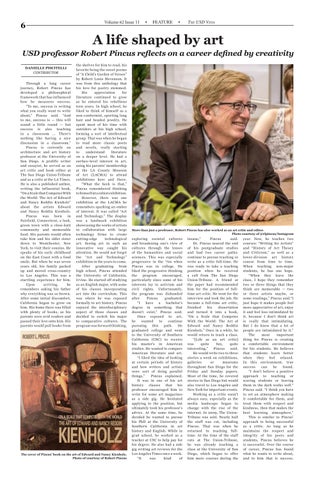
More than just a professor, Robert Pincus has also worked as an art critic and editor.
Photo courtesy of @rlpincus/Instagram
The cover of Pincus’ book on the art of Edward and Nancy Kienholz. Photo of courtesy of Robert Pincus
ARTS & FEATURE Finals to festivities Students share about their winter break plans
From Holiday, Page 1 two years now. I kind of told my mom that I wasn’t going to go back this year for the third year in a row. Then I kind of teamed up with my dad, and said, ‘Money comes and goes, but memories last forever.’ So I got my ticket like a week ago to go see my family and my mom has no idea, so I’m going to surprise her. So I’m looking forward to it and I arrive on Christmas Eve.”
Ambrose also shared how he usually experiences the holiday season outside the U.S.
“In Malaysia, the Christmas stuff starts really early,” Ambrose stated. “You don’t have Thanksgiving. So pretty much once you reach the [cold] months like September … Christmas preparation started really early. Your decorations are up, no snow or anything but really it’s just time with family and time with people you love. Usually, for me, Christmastime is less about
myself and more about being able to give because I think that’s where I find more joy.”
Many students agree that winter intersession can be a great time to catch up with family and spend time celebrating the holidays. USD junior Ava Carter shared some of her favorite Christmas traditions.
“One of my favorite holiday traditions is definitely, definitely, definitely decorating the tree,” Carter said. “I love doing that with my mom and my girlfriend and my brother and the rest of my family, so that’s definitely one of my favorites. And then on Christmas Eve, we’ve always watched ‘Polar Express.’ So that’s definitely a really fun one, and then [we open] a gift the night before.”
Carter also shared more about what hobbies she was looking forward to pursuing over break.
“I love to cook, [but] when you’re busy and stressed it’s
hard to cook big meals and then clean all of it up in one night,” Carter said. “So I’m excited to cook more. And I live off campus in an apartment and I play instruments, so I can’t really play my drum set in my apartment. That would be crazy. I have a drum set back home so I’m excited to do that and play guitar.”
While some students are celebrating one holiday, others are celebrating multiple. USD junior Isabelle Rands shared what her winter break typically looks like.
“I am both Jewish and Christian,” Rands said. “So for Christmas, one of our main traditions we do [is] deco drive, we call it. Which is where we go around and we drive and look at all the Christmas lights on Christmas Eve. That’s one of our main traditions. Hanukkah is one of the other holidays we always celebrate when we get home. This year it is on Christmas which is exciting, but will also
make it harder to celebrate both holidays. Normally we light the Menorah, open presents and make latkes. And then on Christmas Day, one thing we always do when opening presents is we go one at a time, which I think is really nice because we get to see what everyone got. Another tradition we always do is we always watch ‘Christmas Vacation.’
We already watched it.”
During this season, many students have annual traditions that they love to get involved in with their families.
USD sophomore Kristi Phillips shared what she is most excited for when she arrives home.
“I’m looking forward to Christmas Eve, which is when me and my 14 cousins all get together at my aunt’s house, and we do a massive charcuterie board making contest,” Phillips shared. “They’re huge. Last year we actually used a mirror and built like a whole mirror of

Free Student Checking & Savings
As a new Poppy Bank customer, we invite you to enjoy a free checking account with proof of school enrollment $0 Monthly Service Fee for up to 5 years while in school
Offer available for students 18-24 years old at account opening who are enrolled in college, vocational, technical, or trade school.
$50 minimum balance required No monthly service charge
charcuterie … And then I’m also just looking forward to spending time with my family, like we always watch Hallmark movies at night. Even though they’re usually really bad, we still watch them.”
Many students are feeling the stress of finals week, but that doesn’t stop them from looking forward to breaking away for the holidays.
“I definitely feel ready for a break because I felt ready for a break at Thanksgiving and coming back is always a tough push,” Phillips said. “But keeping break in the back of my mind is just helping me to get through finals and keep the stress levels down because I know it’s at the end.”
Even though this can be a busy time for students, the upcoming break from classes is helping many students push through their coursework. Toreros are welcoming the holiday season and looking forward to a variety of annual traditions.

AROUND THE WOR
USD STUDENTS SHARE THEIR FAVO
Studying abroad is more than just earning cre can lead to memories that last a lifetime Wit top universities for international study, stu countries, learn new languages and create m Study abroad programs align with the USD a 16th to December 20th and students retur comes to a close, Toreros reflect on wh

LIZZY BISHOP, JUNIOR
“Studying in Madrid has been an unforgettable experience. I’ve had the opportunity to travel and create countless memories One of my favorite memories was having dinner with my host family and roommates, laughing and [sharing] stories about our days. Another highlight was the school’s proximity to cute parks, where I would peoplewatch and enjoy the sunsets after class ”
FAITH GIDE
“I have absolutely loved being i new culture! I love that my u grown and developed, and I’m my sorority sisters. Traveling grounded and feel close to hom experiencing new things every can be anywhere with the rig favorites is traveling to see th weekends, like Cinque Terre or from the busy city of Rome and and simply
COURTNEY CAPTEZ, JUNIOR
“This past semester I studied abroad in Sydney, Australia Being able to travel around such a beautiful country with new friends has been a highlight for sure of my study abroad experience. Some of my favorite memories include exploring the many beaches of Sydney, my trip up the coast to Noosa, and my trip to Bali!”


Photo courtesy of Lizzy Bishop
Photo courtesy of Courtney Captez
Photo courtesy
RLD IN A SEMESTER
ORITE STUDY ABROAD MEMORIES
edits overseas; it is a formative experience that h USD consistently ranked among the nation’s udents have the chance to travel to different memories that define their college experience. academic calendar, with finals from December ning home shortly after. As the fall semester hat made their time abroad memorable
EON, JUNIOR
in Italy and getting immersed in a understanding of the world has so glad I get to do it with some of g with them has helped me stay me even when I’m so far away and second It reminds me that home ght people Another one of my he smaller towns in Italy on the Castle Gondolfo It’s a nice break d a good way to meet local Italians y slow down.”
GRACIE LAKOSE, JUNIOR

Photo courtesy of @kasiakubiczek_/Instagram

“I have absolutely loved studying abroad this semester in Rome! One of my favorite memories is recreating pictures of my mom when she traveled to Italy when she was my age. This has always been her dream for me, and I’m going to surprise her at Christmas Italy is the most beautiful country I have ever seen, and I feel so lucky to be able to share this e with her!”
ANJALI DALAL-WHELAN, JUNIOR
“I am studying abroad at the USD Madrid center in Spain! This has been such an amazing semester and a once in a life time experience! My favorite memories from being abroad are exploring Madrid and immersing myself in Spanish culture While traveling to different countries in Europe is so fun, I’ve really enjoyed taking advantage of Madrid I recently took a cooking class with my friends where I learned how to make paella and sangria. Living with a host family has also been an amazing experience which has taught me so much about Spanish culture and made [f l] lik I h second home her


Photo courtesy of Anjali Dalal-Whelan
courtesy of Faith Gideon
OPINION
Deadlines under the tree
Dealing
ZOE ROGERS OPINION EDITOR
The holidays are the perfect time to practice traditions, engage in holidayrelated activities and spend time with your family. For many students, however, the holidays are a difficult time to nurture family relationships because of their academics. Schoolwork such as projects, presentations, homework and exams pose a difficult obstacle for students over breaks and prevent them from spending quality time with their families during the holidays. That can create a source of guilt for college students.
It’s easy for students to feel conflicted during the holidays when facing this dilemma. The struggle of balancing quality time with family and the pressure of completing school work on
with the guilt of homework over the holidays
time is evident in the lives of college students, especially during Thanksgiving, or if they’re taking an online course over intersession. This difficult balance can lead to an overwhelming sense of stress in students’ minds.
For me, and many other students throughout a variety of grade levels and majors, it can be difficult to study for an exam or complete a homework assignment in a room full of people who aren’t also working. A distracting environment poses an obstacle to productivity. When I am attempting to get school work done, and it is nearly impossible for me to get any substantial work done in a room full of my energetic relatives. I would much rather have quality time with them at home and do homework when I’m at school, the place where I spend the majority of my time already.
On many occasions over

the holidays, I often find that I need to isolate myself from my family in order to get my work done. This necessary isolation

creates an overbearing sense of guilt, and I face the internal battle of getting good grades or spending quality time with my family. I realized that I’m confronting frustration because I’m missing out, and stressing because I have so much school work. On top of that, my family loves to let me know that I am missing out on memories while I’m cooped up in my room studying. My brother, who I tend to see once every few months, never fails to mention how I only get to see him for a limited amount of time, but I am choosing to use this time to study instead of hanging out with him. While my brother still understands the importance of my academics, he also finds it necessary to highlight that family time is important and that it doesn’t come often. I agree with him.
Homework guilt is not just specific to family and the holidays. It can often be found in the everyday lives of college students, whether it be on weekends when all your friends are going out and you have to stay behind working on assignments, or when your roommates are staying up late having a fun conversation but you’re trapped in your room completing an assignment. But this homework guilt is found on a more extreme level over the holidays. Because of the semester coming to an end and the pressure to succeed academically and finish with a positive GPA, it’s easy to value grades over quality time. However, while it can be difficult to balance academics over the holiday season and breaks, there is a way to avoid this challenge. Get your work done before family gatherings, so you
don’t have to worry about missing out on family time. Although this approach is doable, it can oftentimes feel impossible to get your work done before seeing your family, especially if your professors’ deadlines are not holiday-sensitive. Sometimes, you just have to learn how to allocate your time wisely, and balance your schoolwork and family. There are numerous ways to set yourself up for success over breaks so you’re not swamped with work, including breaking your assignments into different steps and writing out when you want to work on each part. Homework stress can be alleviated by planning ahead and organizing your work before break, as well as by assessing how much time you need to spend on your assignments so you can divide up your time evenly between school work and quality time. I experience homework guilt on a stronger level over the holidays compared to during the school year; it’s easy to feel trapped by academics, especially when professors don’t incorporate holiday friendly deadlines. While it’s normal to feel guilty for giving up quality time with your friends and family to catch up on school work, the pressure to simultaneously spend time with your family and complete your assignments during the holidays is damaging. Homework guilt during the holidays is almost impossible to avoid when facing the battle between homework and family. But, once you find a way to balance both sides, your holiday will be much more enjoyable.
It can be difficult to balance quality time with your family and schoolwork.
Photo courtesy of @usd_business/ Instagram
important to spend time with your loved ones over the holidays.
OPINION
Confessions of an over-consumer
Holiday sales shouldn’t overshadow the spirit of the season
JULIE FROMM ASST. OPINION EDITOR
During my much needed Thanksgiving break, I spent my time doing things I haven’t been able to do for months, thanks to my ever increasing workload. I read new books, watched holiday movies and slept in as late as I wanted.
The thing I was most looking forward to, though, were the holiday sales that have been advertised in my inbox for weeks. Reformation boasted 25% off select styles, Free People offered 40% off at checkout and Anthropologie went as far as 50% off on specific items. Having been a participant in the feeding frenzy that is Black Friday and Cyber Monday for years now, I made sure I knew what I wanted and from where before the sales went into effect.
After I’d scoured countless websites for low priced jeans, half-off jewelry and buy-oneget-two-free deals, I scrolled through my carts — but then hesitated to click “purchase.” It hit me that Thanksgiving, Christmas and Hanukkah, holidays dedicated to celebrating the people we love, are now overshadowed by the retail sales that precede and follow them.
As I thought about sitting at the dinner table the day before, expressing my gratitude for my health and my tightknit family, my shopping haze quickly faded away, and I realized I would never buy most of these things without the sales tag attached. What do I need another pair of low rise dark wash jeans for? The answer is nothing. I realized that I had yet again fallen victim to the
flashy advertising that retailers have mastered through years of consumer manipulation.
Rather than relishing in the joy of the holiday season and being grateful for what I already have, I was solely focused on buying more, more, more and at a knocked down price. Thanksgiving and Christmas, holidays dedicated to celebrating the people we love, are now overshadowed by the retail sales that precede and follow them.
Once the sales had passed and the dust settled, I was curious to know how much revenue Black Friday and Cyber Monday curated during their 24-hour life spans. With almost every retailer imaginable participating, I knew the total had to be high. According to data collected by Adobe Analytics, an analytics tool that helps businesses collect and analyze data based on customer interactions, U.S. online sales hit $10.8 billion on Black Friday, and consumers spent $13.3 billion online during Cyber Monday. These numbers baffled me, but maybe they shouldn’t have.
Capitalism urges us relentlessly to consume as much as possible. Social media platforms such as TikTok and Instagram learn what you like based on what you watch, then flood you with targeted ads intended to get you to spend as much money as possible.
Viewing just one video about the best sweaters for the winter months can send you into a purgatory of endless ads for sweater bundles from TikTok Shop. To add insult to injury, the life cycles for trends are becoming increasingly short.
As soon as you buy the off-

the-shoulder sweater that everyone is raving about, they’ve moved on to a different, even better sweatshirt that you absolutely cannot live without. Another thing that makes online shopping so irresistible is the instant gratification you get when you select expedited shipping for the perfect outfit for your Secret Santa party. Not only do the holiday sales offer us that familiar feeling of immediate pleasure, but we can also get what we want for up to 50% less. To me, this is evidence enough that we are entirely missing the point of the

holiday season. After wishing for peace on earth at the dinner table, we turn around and trample people in line at Target’s Black Friday sales the very next day. Instead of trying to prove our love or find our joy through purchases, we should be spending quality time with the people in our lives.
I stand before you, though, as an admitted over-consumer. It would be self righteous of me to lecture sales enthusiasts when I’ve accumulated my fair share of unnecessary purchases.
I have participated in all the sales. I’ve bought the same shirt in three different colors, a new tube of lipgloss while three others sit at the bottom of my purse and new pairs of earrings just because. It’s thrilling to buy something new, and marketers know exactly what to say and when to say it to feed into our deepest desires, especially during the holiday season. We’re at our most vulnerable, trying to find the perfect gifts for our loved ones that show them just how much we care, and people become more susceptible to spending more than is necessary. In fact, 53% of Americans admit to receiving at least one unwanted gift over the holidays, according to data collected by Finder. com, a website that compares different financial tools.
So not only are you spending more on gifts for friends and
family, but they might just end up in the trash, anyway. Even if gifts are returned, retailers end up throwing away about a quarter of returned items, leading to almost 6 billion pounds of new waste in landfills, according to an article by NPR. It’s difficult to ignore these numbers when I know that I can do something about it.
This year, in lieu of exchanging gifts with my siblings, we’ve decided to go out to dinner while we’re home for winter break. That way, we can avoid any chance of getting each other something that the other didn’t want. If you still feel drawn to buy something for the people you love, I’d recommend asking them for ideas of things they’d like in advance to ensure that you buy them something they’ll really appreciate — or at least ask for a gift receipt.
However, in the spirit of the holidays, spending quality time with friends and family can be a gift in itself. Opting to spend an evening ice skating or watching cheesy Hallmark movies can be a way to show your love without breaking the bank. As the holidays ramp up and the sales come and go, I plan to continue finding ways to consume less and appreciate the holiday season for what it is: a time to be thankful for the people I love most, not the things that I purchase.
It’s important to not let Black Friday sales take over the holiday spirit.
ARTS & CULTURE
The battle between new and nostalgic Cheesy and classic holiday movies are back for the season
depth, originality and emotional resonance that makes earlier holiday classics timeless.
With a chill filling the air, the holiday season has arrived and the yearly saga of holiday movies has begun to take over the homes of millions. Big-name brands such as Hallmark, an entertainment network that was originally a postcard company, and Netflix, a streaming service, have become known for their holiday movies. Both of these brands have garnered a reputation for producing “cheesy” holiday films.
In 2009, Hallmark began its holiday movie journey with the series “Countdown to Christmas.” Since then, it has become an annual event that uses a combination of new and old films broadcasted all throughout the day, every day, in the weeks leading up to Christmas. In a similar fashion, Netflix creates new holiday movies that fill subscribers’ feeds each year. This year, Netflix will be releasing five original movies, each entering the streaming service weekly until Christmas day.
“I’ve seen some good Netflix originals, but then again I’ve also started some that I can’t finish,” USD firstyear Bethany Tate said. “I feel like you can always tell when Netflix made the movie — there’s just something about it. You feel like, ‘this isn’t a masterpiece,’ but it’s still alright enough to watch.”
This massive influx of holiday movies has become a case of quantity over quality. With these films being produced at a rapid speed for consumers, some have noticed a lack of
“I feel like most new Christmas movies have the same plot,” Tate said. “Like it’s always about saving Christmas, and even all the titles are super weird too, but I still enjoy watching them because I like to cringe. I do a try-not-to-cringe challenge with these movies, since I watch them a lot with my sister. The acting especially is always awful in these movies, and I feel like that’s kind of almost charming because it’s so bad, but I can’t stop watching it. Like I said, all the plots are the same. There’s two love interests who find a way to each other even when they start off fighting.”
Though some find these new festive films suitable enough for their holiday enjoyment, others have a strong disdain for them.
One of Netflix’s most recently released Christmas movies is titled “Hot Frosty,” which was watched 16 million times in the first five days of release. “Hot Frosty” follows a magical snowman that comes to life and was popular on social media due to its cast, including actors such as Lacey Chabert, Dustin Milligan and Craig Robinson.
Some USD students expressed that they are drawn to these movies because of the actors which may play a role in the success of these cheesy holiday movies.
“Usually Netflix originals are terrible, but I do watch them when they have an actor or actress that I know,” USD first-year Heidi Robinson said.
“And I’m like, ‘Oh I like this person so I’m going to watch this.’ It may be cheesy but I


don’t know, maybe it adds to the holiday factor. But overall, they just aren’t that great. I never turn on the Hallmark channel, instead I use Netflix … I actually hate Hallmark. It’s treacherous.
I kinda die inside everytime I watch one little scene since these movies have unrealistic stuff. It’s fake, with a common theme of holiday spirit & love that just doesn’t feel real … They are terrible. I don’t want to watch awful movies. I want to watch good Christmas movies.”
While many of these new, cheesy Christmas movies are appearing on a variety of platforms, there is still a large love for the older Christmas movies from the ‘90s-2000s. Some students say that these older movies often have satisfying, comfortable endings that bring the film to a joyful conclusion. This feeling of security keeps viewers coming back to rewatch year after year, with movies such as “Home Alone” and “How the Grinch Stole Christmas” appearing on IMDB’s Top 100 Christmas Movies of all-time list.
“I definitely love older Christmas movies more,” Robinson said. “I like the old vibe, since they are more nostalgic. Even though you
weren’t even born at the time, you can feel like you’re a part of it. My favorite old Christmas movie is called ‘The Family Man,’ that’s a really good one. My Dad loves ‘A Christmas Story,’ that one is funny so we watch it all the time. I feel like a lot of newer Christmas movies are kind of the same. Or it’s just not as nostalgic. The acting for me, I can’t, I cringe every time. They just don’t hit the same because Hallmark acting is terrible since the whole plot is expected, and you’re just left bored.”
Christmas and other holiday movies are frequently used to bring friends and families together to share joyful moments while watching a heartwarming story. Oftentimes, viewing these movies becomes a household tradition for people each year, with the desire to get into the holiday spirit.
“If I’m sitting down with my family and we’re having like a Christmas movie night, then we’ll turn on Netflix or another platform that has a Christmas movie we wanna watch,” Tate said. “But if we’re doing stuff around the house and we just want something on, then we might go to one of the Hallmark channels. It’s always such a nice feeling watching them with my
friends and family, especially in the comfort of my home.”
For many, Christmas is a time of nostalgia and is often spent with family and friends.
From decorating the Christmas tree, drinking hot chocolate and opening advent calendars, the entire month of December acts like a pre-holiday in a way. Many people have that one particular Christmas movie they are fond of and look back on it with a swelling heart of joy.
“There’s too many [Christmas movies] to choose from, but maybe ‘The Polar Express,’” Robinson said. “Not because of how good it is, but because of the nostalgic factor. Because in elementary school you would watch it with your class and get popcorn and a cup of hot chocolate, and that would be all you would do for the day. I look forward to watching it every year because of that.”
The holiday season goes by fast, but with Christmas movies, both old and new, it’s a time of entertainment best spent with family and friends. While opinions differ, watching a heartfelt festive film is an activity many can agree on and enjoy. It has become a prominent way to celebrate the holidays.
CRISTIANA VLADESCU CONTRIBUTOR
The nostalgic elements of the original ‘Rudolph the Red-Nosed Reindeer’ claymation bring viewers back every year.
Photo Courtesy of @genesee_theatre/Instagram
The animated Christmas film, ‘The Polar Express,’ was released in 2004.
Photo Courtesy of @popbase/X
The Netflix original, ‘Hot Frosty,’ was released this year amongst many others. Photo Courtesy of @netflix/X
‘Wicked’ flies to the big screen
Students hold space for the latest Broadway adaptation
ALEXANDRA ALCALA
ASST. A&C EDITOR
This past month, the movie “Wicked” hit the cinemas and caught the media’s attention with press tours, beauty product collaborations and interviews. The newest film is based on the Broadway musical which precedes the plot of “The Wizard of Oz.” The musical shows the life of two witches, Glinda and Elphaba, and how they first met each other, years before Dorothy ever entered Oz.
Starring Ariana Grande and Cynthia Erivo, the film has amassed a high rating of 8.1/10 on IMDb and 89% on Rotten Tomatoes after a short week of being released. The release day was certainly popular as the film grossed over $112 million on that day alone. USD students have been taking some time off from studying to watch the movie.
“I had no expectations before watching the film because I had never seen the musical,” USD sophomore Nathalie Diazgranados said. “Before going to the movie theatre, I watched the interviews from the press tour and they gave me a little insight about what to expect plot-wise, but I had no expectations.”
Everything the film did to catch the viewers’ attention before the actual release day paid off. The cast participated in an international press tour, meeting with different TV and social media channels to share more about their experiences while filming “Wicked.”
“I was expecting an amazing vocal range from the actresses, which I found while watching the movie,” USD sophomore Xitlali PedrazaPayta said. “I thought the film was amazing. It was super cool to see the outcome of their hard work over the past months.”
While the storyline had a lot of people intrigued, USD students agreed that the musical aspect of the film really showed off the actress’s range. Grande is famously known for her long career in both acting and singing. Similarly, Erivo started her singing and acting career around the same years as Grande. Erivo has performed more in movies and Broadway shows than Grande, who largely releases albums.
“I had heard of the musical prior to watching the movie,” Diazgranados said. “I was told by many friends how great the stage production was, so I was excited to watch it for that reason. Overall, I really enjoyed watching the film. I think they did a great job of bringing the characters alive. I feel as though there was never a dull moment in the film. Although the movie was long, it truly did not feel like it. The music and the singing was beautiful, and I genuinely cannot believe that a lot of the actors sang live
during the filming of the movie.”
An aspect that stood out to many was the difficult live singing during scenes that simultaneously included stunts and choreography. Reflective of the actual Broadway performance of “Wicked,” many students have praised the intricate skills it took for the actresses to combine all of these elements.
“I enjoyed seeing Elphaba fly on her broom while being able to sing so beautifully,” Pedraza-Payta said. “The scene was very magical and just added more sentiment to the whole storyline itself.”
This celebrated moment is the “Defying Gravity” scene and is the moment where Erivo performs the song, one of the most popular tracks in the musical. The beloved song has been enhanced in the film production because of the developments made in modern technology that is reflected in today’s cinema. The adaptation to the screen has made the scene stick out to many students.
“A highlight of the movie for me was the ‘Defying Gravity’ sequence,” Diazgranados said. “The way it was shot, combined with the intense emotion of the moment, made it truly breathtaking. I think Cynthia Erivo did a wonderful job. This part of the film was filled with action and for me, personally, it was very emotional. It emphasizes the importance of staying true to your beliefs even when people in positions of power try to sway your actions. I think this scene serves as a message for many who watch the film.”
Musicals have been a part of the entertainment industry for quite some time. However they can cause some discourse among audiences as some people do not enjoy them as much as others.
Diazgranados explained how her family faced this dilemma over Thanksgiving break.
“I would say that I do enjoy musicals,” Diazgranados said. “I think that with time they have grown on me. I went to watch the movie with my mom who really is not a fan of musicals, but after watching, she fell in love with the movie and its message.”
For many people, musicals might not be their preferred form of entertainment. However, many USD students took advantage of their latest break to watch the newest take on “Wicked,” which has brought up many positive reactions. The topics touched upon in the storyline really stand out in the movie — the friendship and trust between Glinda and Elphaba, the prejudice they suffer, goodness versus wickedness as well as privilege and apathy. These different themes really shine and, most importantly, help the audience connect with the characters on the screen.


The film is the highest grossing Broadway adaptation in history, making $455 million worldwide so far.
Photo Courtesy of @broadwaysf/Instagram
Cynthia Erivo and Ariana Grande pictured behind the scenes of the new Hollywood hit, ‘Wicked.’
Photo Courtesy of
Kendrick Lamar releases a holiday gift
A review of the artist’s new surprise album, ‘GNX’
ELLIE SKJERSAA ARTS & CULTURE EDITOR
From creating chart-topping hits to partaking in ongoing celebrity feuds, Kendrick Lamar has been making headlines left and right. The last couple of weeks, headlines have been flooded with talk of his new surprise album “GNX,” which was released on November 22. This is Lamar’s sixth studio album, and it showcases 12 tracks that seamlessly blend together complex lyricism and catchy melodies.
Fans can only speculate why Lamar chose to release a surprise album. In May, he dropped the track “Not Like Us” which was a diss track of another rap artist, Drake. Afterwards, the song remained in the No. 1 Billboard position for 21 consecutive weeks. USD senior Ave Sandstrom noted that Lamar’s recent and ongoing success could be attributed to this decision.
“He’s definitely had a crazy year,” Sandstrom said. “I guess most of the time people will release singles before dropping. You know, maybe he was like, ‘I don’t need to do that. I’m gonna drop an album, and everybody’s gonna know about it, and everybody’s gonna listen to it. I don’t need to do anything to create hype, other than release the art that I make.’”
The album is largely inspired by his life in Los Angeles and more specifically, his roots in Compton. “GNX” embodies West Coast hiphop and R&B at its core. He addresses topics such as black suppression, rap culture and Lamar’s personal challenges in the music industry specifically. USD senior Jude Van Matre touched on how these manifested in the tracks.
“You have spots on the album where he’s definitely calling out the rap industry especially,” Van Matre said. “In his view, rap is no longer about dissecting or analyzing culture, black culture especially. In his view, rap has really just become about getting the highest numbers and chasing whatever’s trendy or whatever’s popular. It’s no longer about the music. It’s basically everything outside the music.”
Lamar’s intricate songwriting and storytelling abilities feature introspective revelations and poetic messages about the social, cultural and political world. Often, as seen in “GMX,” he uses criticism and art to expose norms that society does not question because we are so deeply intertwined in them. For some students, this is what sets him apart from other artists.
“I think [his music is] definitely more grounded in reality and addresses what
is urgent and what we need to change and reflect on as a society,” Sandstrom said. “This has to do with thinking deeply about ourselves, our values, the groups that we’re in and the people we associate ourselves with.”
Even after listening to the album many times, there may be new messages that one may not have noticed before. The element of interpretation that is enriched in poetry and lyricism allows the listener to draw individual takeaways that others might not have noticed. This is something that students enjoy when listening to Lamar’s music, especially “GNX.”
“At first, I interpreted [the song ‘Gloria’] as him talking about his fiance,” Van Matre said. “Now, I think that ‘Gloria’ is in reference to the art of music itself. He’s referring to music as a person, or as Gloria, and he’s kind of exploring his relationship with music and how it’s evolved over time. Sometimes he’s grown kind of cynical of the musical landscape as a whole, and whether what he’s doing with his music actually means anything, whether it actually impacts or brings change, what his place is in the music industry.”
Throughout the years, Lamar has won 17 Grammy Awards and is the only rap artist to win a Pulitzer Prize, which he was awarded for his album, “DAMN.”

However, this recent album has set a new tone that has not been seen in his previous five albums. Songs such as “Reincarnated” are leading fans to speculate whether this album marks his transition into a new era of music and has raised questions of what’s to come in the future as he embarks on this next journey.
“To me, when you compare this album to his other works, it’s him at his most accessible, but also at his most free,” Van Matre said. “Instead of worrying about getting across to people, it’s just like, ‘I’m gonna create whatever music I want to and just
kind of have fun with it a bit.’”
As the end of the year approaches and with a Super Bowl performance looming in the near future, Kendrick Lamar has a mysterious and exciting future ahead, not only for himself, but for his fans as well. His recent announcement of his “Grand National Tour” with SZA is also spurring excitement amongst those who hope to see the album live. What ultimately brings students back for more, time and time again, is the catchy beats in tandem with reflective and critical messages he wraps into his music.

The cover art for Kendrick Lamar’s new album, ‘GNX.’ Photo Courtesy of @kendricklamar/Instagram
Sandmeyer: ‘All I wanted to do was play’
USD soccer player Jack Sandmeyer’s journey
On Nov. 24, 2024 USD senior and defender Jack Sandmeyer became the hero of USD’s soccer season. In the 82nd minute of USD’s second round game in the NCAA tournament against Duke University, Sandmeyer headed in a corner kick from USD junior midfielder Josh Martinez for his second goal of the season. This goal gave the Toreros a 1-0 lead with only eight minutes left, which they held until the end of the game. This allowed them to advance to the third round of the NCAA for the third time in school history. Sandmeyer recounted his memory of the goal.
“The only thing I could remember was being swarmed by my teammates after,” Sandmeyer said. “It was honestly one of the best feelings I’ve ever had, and one that I’ll never forget.”
For Sandmeyer, it was a long-fought battle to get to this point. Sandmeyer, a former California Interscholastic Federation San Diego Section player of the season for St. Augustine High School, initially enrolled in University of California, Davis (UCD) in 2021. Sandmeyer redshirted his freshman season before deciding to leave UC Davis due to what he described in a San Diego Union-Tribune (UT)
interview as an opinion conflict with the coach. It was at that point that Sandmeyer decided to enroll in USD strictly as a student, where he decided to try out for the USD club soccer team — not the official USD team. He failed to make the team, and according to Sandmeyer, he thought that he was done with soccer forever.
“It was a bit frustrating because at this point in my life, all I wanted to do was just play the sport,” Sandmeyer stated. “I honestly felt like that was a sign to give up on soccer and stick to academics.”
In between leaving UCD and starting at USD, Sandmeyer decided to play soccer for the San Diego Internacional, a low-level league club. There, Sandmeyer received a stroke of luck. Internacional’s coach, Keither Miller, thought Sandmeyer had talent.
Miller decided to call USD coach Brian Quinn, asking Quinn to let Sandmeyer try out for the team. In an interview with the UT, Quinn claimed that he initially expressed skepticism about Miller’s request to give Sandmeyer a tryout.
“He said, ‘Oh, you have to take a look at Jack Sandmeyer,” Quinn said to the UT. “I was thinking, ‘Not another walk-on.’ I mean, you get [suggestions for] walk-ons all the time, and they never pan out.”

However, Sandmeyer proved him wrong, making the team this season and becoming a key part in one of the nations best defenses. Sandmeyer has started 19 of USD’s 20 games, only missing one game against the University of San Francisco due to being suspended for accumulating too many yellow cards in the season.

Sandmeyer has also played the third most minutes for USD.
With Sandmeyer as one of the backbones of the defense, USD has one of the NCAA’s best defenses, finishing the season as the fourth best defense by goals against average (.700).
This defensive prowess is part of what allowed USD to climb to third in the national ranking and helped them secure their third consecutive West Coast Conference championship, securing the Toreros a spot in the NCAA tournament. For his efforts, Sandmeyer was rewarded by receiving AllWCC Second Team honors.
Unfortunately for USD, a late loss in the season to Portland dropped them in the ranking and prevented them from getting a first round bye. This would provide Sandmeyer with an opportunity, however, as USD’s first round match in the NCAA tournament was against his old team, friends and coach in UC Davis. Sandmeyer spoke on the mindset he had entering the game against the Aggies.
“Even though my mindset at the time was that it was just another game, I knew that it would have a greater significance for me,” Sandmeyer stated. “Three of my old roommates were starters on the Davis team, and I knew it would be a chippy game from start to finish. Looking back on the season, I would definitely say it was a major highlight being able to knock them out of the tournament.”
Sandmeyer and the defense did their job, shutting the Aggies out to allow USD to
snag a 1-0 win after a goal of the year candidate from junior midfielder Cesar Bahena, taking advantage of a miscue from the Davis defender to shoot the ball into the upper left of the scrambling keeper from 40 yards out. The Toreros then went on the road to face Duke.
In addition to Sandmeyer’s heroic late goal, he was also crucial in shutting down the number one offense in the nation by goals scored average (3.00), becoming only the third team to shut out the Blue Devils.
The party would unfortunately end in the third round, as USD lost to Vermont 0-1 after conceding a penalty in the first 30 seconds of overtime. As a senior, Sandmeyer is hoping that this isn’t the end of his time on the USD soccer team.
“With one additional year to play, I’m definitely looking toward hopefully playing with the team for another season,” Sandmeyer stated. “I am currently in the process of applying to the law school here at USD, and with an acceptance I would be extremely happy to have one more year with the guys who have helped create such a memorable season for me and the entirety of the USD community.”
Whether or not Sandmeyer will be able to return next season, he will have left USD soccer fans with an incredible moment and legacy for the team. For someone who thought not too long ago he was completely done with the sport, it only makes the memories he’s made even more special.
Jack Sandmeyer pictured passing the ball during a home game against the University of Washington.
Photo courtesy of @jacksandmeyer/Instagram
Jack Sandmeyer, No. 26, takes the field this season.
Photo courtesy of @jacksandmeyer/Instagram
JoAnn Vallese’s impact in sports administration A look
NEOMI BEACH CONTRIBUTOR
Over the course of a decade, JoAnn Vallese has built a career defined by resilience, leadership and commitment to student development. As the Associate Director of Academic Services at the University of San Diego, formally the Assistant Director of Academics and Scholar Athlete Development, Vallese has combined her diverse experiences in counseling, consulting and sports leadership into a role that supports student-athletes. With a Master’s in Education in counseling (M.Ed), focusing on leadership and diversity studies, Vallese’s journey from clinical counseling to corporate consulting to academia tells a story of dedication to both personal growth and the betterment of others.
One of the most formative moments in Vallese’s early life came when she switched from her local Catholic school to The Baldwin School, a private all-girls school outside of Philadelphia, in the eighth grade. Feeling disconnected from everything she knew, she had a pivotal conversation with her headmistress, which convinced her to give the school one more chance.
This decision would change the trajectory of her high school years. It was during this time that Vallese
USD athletics’ academic services SPORTS
discovered the sport that would go on to define much of her identity — rowing. By her junior year, Vallese had become a coxswain, a role that allowed her to take the helm of a men’s varsity crew team.
“Rowing became a guiding force in my life,” Vallese said. “I have no idea who I would be if I had switched out [of Baldwin] and never found rowing.”
Baldwin, with its challenges and opportunities, helped Vallese unlock a key component of her future career: leadership through connection.
In addition to the pressures of attending a prestigious private school, Vallese’s childhood was also defined by a unique set of social dynamics. Growing up in Philadelphia, Vallese’s family owned two homes — one in the city and another in the beach town of Ocean City, New Jersey, where they spent their summers. The duality of these worlds introduced Vallese to different communities and social circles, but also left her feeling as though she never quite fit in.
Her years of shifting between two different social groups also gave her a deep appreciation for the individuality of human experiences — an understanding that would prove invaluable in her counseling work.
“You learn to value what each person brings to the table,” Vallese said.


These insights shaped her approach as a counselor and later as a leader at USD. Vallese graduated from the University of San Diego with a degree in English Literature and a minor in Communication Studies. Vallese then went on to earn her M.Ed in Counseling from the University of San Diego. Her early career took her into private practice, partial hospitals and nonprofits, where she specialized in working with children.
“I can relate to most people because of how I can empathize and connect with people at an emotional level,” Vallese said.
While Vallese enjoyed the counseling work, she missed being part of a team. Rowing taught her the importance of teamwork and shared goals, an element that was missing from the isolated nature of individual counseling. This realization ultimately led her back to her alma mater, where she now works with student-athletes, helping them balance their academic, athletic and personal commitments.
“My goal is to help my students be the best versions of themselves,” Vallese said.
She focuses on providing accountability, support and
encouragement for students who are often overwhelmed by the pressures of balancing sports and studies. Vallese speaks highly about the many thankyou notes she’s received over the years from students she’s helped guide through difficult times.
“Seeing the growth and successes of my students is one of the most rewarding parts of my job,” Vallese said.
Vallese is also a mother to four children — Alyssa, Ethan, Jadon and Talia — and spoke of how her role as a parent has always taken precedence. And she would make the same decision again, knowing that family comes first.
Vallese’s husband, George Vallese, has been a constant source of support throughout her journey. The two were married in 1997 and have built a strong partnership centered around faith, family and trust.
At the heart of Vallese’s personal philosophy is the belief that life is a constant work in progress. But through it all, she relies on her strong Christian faith to guide her.
“Standing on biblical truths and principles helps me get through setbacks,” Vallese said.
She also emphasized the
importance of leaning on trusted friends, many of whom have been in her life for decades. Vallese not only reflected on her professional accomplishments, but also on the relationships she has built.
For her, it’s the connections she has forged with family, friends and students that matter most. Vallese describes her values as rooted in authenticity and integrity, principles that have guided both her personal and professional life.
“It’s about the relationships that came, not the accolades… accolades stack up, but that feeling doesn’t last long,” Vallese said. “I want people to know I try my best to embody my faith and give to people.”
One of Vallese’s guiding principles is Micah 6:8.
“To act justly and to love mercy and walk humbly with God,” Vallese stated.
Vallese does not define her legacy by her titles or achievements, but by the countless lives she has touched along the way. Her commitment to love, growth and service has left a mark on the people around her — a testament to a life lived with purpose and empathy.
JoAnn Vallese works with student-athletes at USD. Photo courtesy of JoAnn Vallese
JoAnn Vallese pictured during her time as a coxswain with USD rowing.
Photo courtesy of JoAnn Vallese