A Newsletter from The Weinberg Memorial Library
A Newsletter from The Weinberg Memorial Library
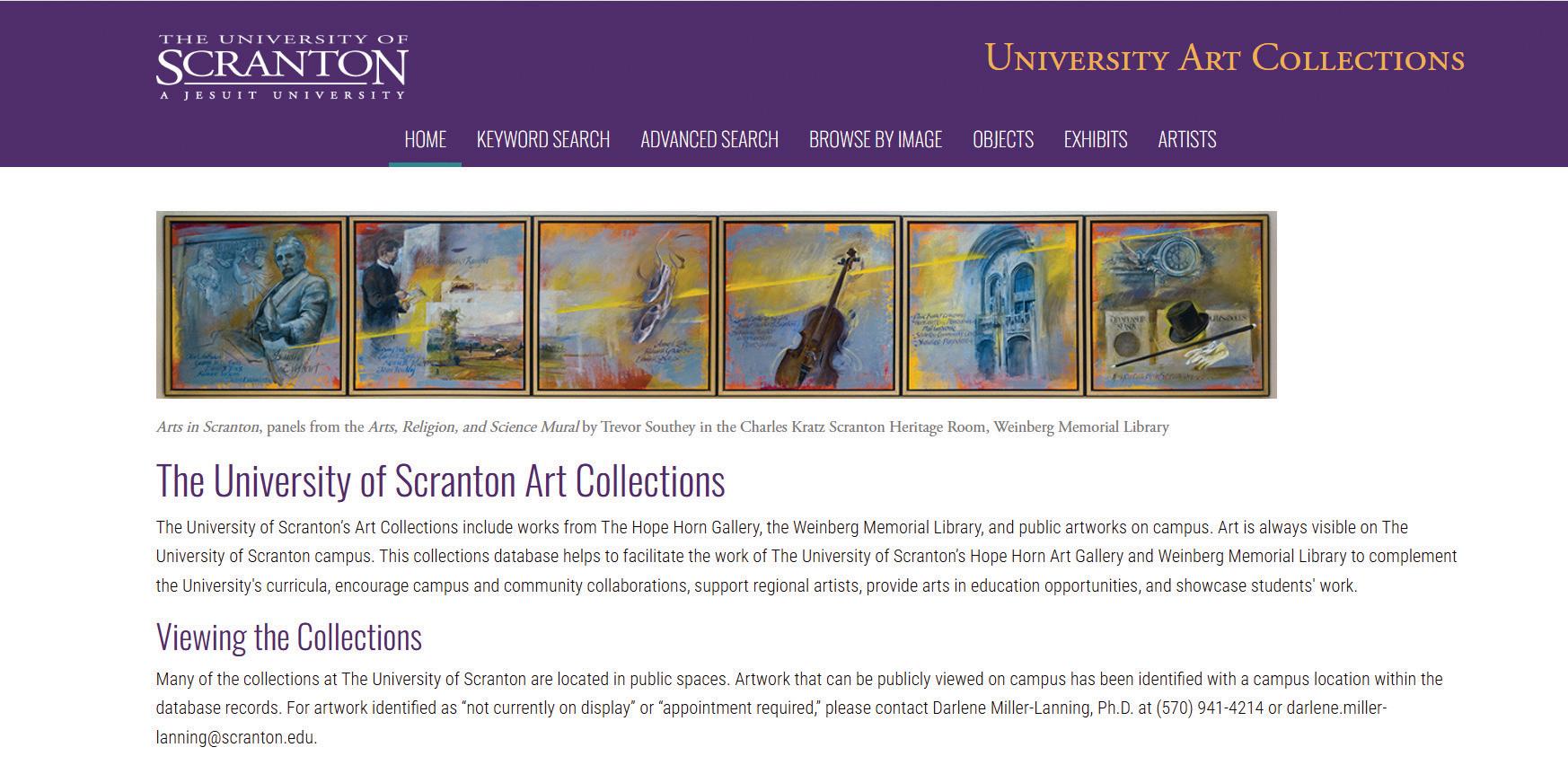
In spring 2025, the Weinberg Memorial Library and Hope Horn Gallery announced the launch of an online catalog for The University of Scranton Art Collections. The new catalog showcases works from the University’s collections and enables the public to learn more about the artists and artworks represented in the University’s holdings. The catalog includes records for artworks from the Hope Horn Gallery, the Weinberg Memorial Library, and public artworks on campus. The multi-year project was a partnership between the Weinberg Memorial Library and the Hope Horn Gallery, combining expertise in art history, curation, and collection management.
The University holds an impressive collection of artworks including paintings, sculptures, prints, photographs, and significant historical and cultural objects that create a campus-wide museum experience. Many of the works in the University’s collections are displayed in academic buildings, administrative offices, the Library, Hope Horn Gallery, and public areas. The collections enrich the
campus environment through their cultural and artistic expression, historical significance, and thematic connections to the University’s mission. Until now, there has not been a dedicated platform to explore the University’s holdings or learn about the works online. With the launch of a catalog for the University Art Collections, students, researchers, and visitors can now browse the collections online, learn about individual pieces, and better appreciate how art is woven into the fabric of campus life.
The project originated in spring 2023 with the primary objectives of documenting the collections and providing online access to the public. The Library and Gallery worked in collaboration to enable access to the artworks in a centralized online platform in order to enhance research opportunities with the collections. Students, faculty, and researchers in the arts, history, and cultural studies are now able to access information about artists and artworks in the collections and, in some cases, (continued on page 3)

Dear Friends,
As we begin the 2025–2026 academic year, I am filled with gratitude for the many ways the Weinberg Memorial Library continues to grow, innovate, and serve our campus and broader community. This issue of Information Update captures the vibrancy of that work—from exciting new digital initiatives to the quiet but profound impact of information literacy instruction, faculty recognition, and student excellence.
One of the highlights of the past year has been the launch of the University Art Collections online catalog—a significant partnership between the Library and the Hope Horn Gallery. This long-term project has brought to light hundreds of works across our campus, transforming the way we connect with and understand our institutional heritage through art. I encourage you to explore the catalog and discover the richness of the University’s visual and cultural landscape.
This fall also marks the opening of our exhibit, "From Manuscript to Print," which features some of the oldest and rarest materials in our collections. A recent gift—a 1470 incunabulum printed by Ulrich Zell—reminds us that the preservation and sharing of knowledge, whether through manuscript or digital record, is central to the mission of libraries.
Our Special Collections continue to expand, with the addition of the Paul Kanjorski Congressional Papers and the Lloyd M. Kelchner Penmanship Collection. These new acquisitions further deepen our holdings and open new doors for student and faculty research.
This newsletter also celebrates the achievements of our Library faculty. From their leadership in revising the Information Literacy Curriculum Learning Outcomes to their
recognition with Provost Enhancement Awards, our faculty demonstrate a tireless commitment to excellence, interdisciplinarity, and Jesuit values in their work.
We are especially proud to feature the winners of the 2025 Bonnie W. Oldham Library Research Prize. Their projects exemplify the power of inquiry, the impact of thoughtful research, and the supportive role of librarians in helping students reach new heights.
Alongside our new initiatives and ongoing commitments, we also take time to honor those who have shaped our Library with enduring service. This summer, we celebrated the retirement of Patricia Savitts after 27 years of dedicated service. Pat’s steady presence at the Library Services Desk (formerly the Circulation Desk)—and her warm rapport with students, faculty, and staff—will be dearly missed. We wish her joy and fulfillment in this new chapter of life. We also bid farewell to Kym Fetsko, whose creativity and dedication left a lasting impact on the Library, the Friends of the Library, and the Schemel Forum. Kym’s ability to bring people together and her tireless behindthe-scenes work enriched our community in countless ways, and we are deeply grateful for all she accomplished as we wish her the very best in her next endeavors.
Finally, I want to thank our entire Library team for the energy, collaboration, and care they bring to our work each day. Whether planning student celebrations, contributing to professional conferences, or simply helping someone find the right book or article, our staff make the Library not just a place of resources, but a true home for learning.
As always, I invite you to visit the Library, in person or online, and see what’s new. We are here for you.
— George Aulisio, Ph.D., DeanoftheWeinbergMemorialLibrary
We would like to thank the newest members of the Friends of the Weinberg Memorial Library for their contributions.
Jill Cadden
Kym Fetsko
Thomas Keen
Phil Manwarren
Robert MacKee
James & Patricia
Montenegro
John Russo
Patricia Savitts
connect that information to records in the University Archives. The online catalog invites exploration of the collections by the campus community and the broader public while also deepening an appreciation for the works and their contributions to the campus environment. In addition to enhanced research opportunities, the new catalog enables the Hope Horn Gallery and Library to more effectively document, track, and manage the art collections. Catalog records for artworks and artists streamline the organization and arrangement of collection information, making it easier to manage the collections over time.
However, the University’s extensive collections have been acquired over many years. Some of the works were purchased by University administrators and academic offices, while others were acquired by the Gallery or Library. And, in many cases, works were obtained through donation. The Hope Horn Gallery had documentation for many of the works inventoried, while some detective work was also required since many works were no longer in their original campus location or lacked documentation.
By the second year of the project, the Library had gathered enough information to create the
The project team in the Library included faculty and staff from three different departments – Cataloging, Digital Services, and Library Systems – who worked in close collaboration with Gallery Director Dr. Darlene Miller-Lanning. The first project phase focused on inventorying the collection to gather information about the artworks, including location and condition, and photographing them for documentation. Library faculty and staff worked building by building across campus during the inventory phase and recorded whatever information was obtainable about the artworks including artist, title, medium, and dimensions. Cataloging & Metadata Librarian Marleen Cloutier and Dr. Miller-Lanning also addressed many questions related to ownership, acquisition, and provenance. The project team kept track of any acquisition or provenance information that was available in records from the University Archives and Hope Horn Gallery.
online catalog, prepare individual records for artworks and artists, and develop the public website. The information obtained about the artworks during the initial inventory phase was entered into a collection management system and used to create the searchable online catalog.
To date, 18 campus buildings, totaling over 600 works, have been inventoried. Approximately 330 of the artworks have catalog records that are publicly available online. Library faculty and staff are continuing their research to prepare the remaining catalog records to be publicly viewable. Catalog records will be further enhanced as archival materials and documentation from the Gallery are processed and added. The Library project team will continue to review records for possible reference and links to holdings in the Library’s collections to further assist researchers and visitors in learning about the artworks.
in the catalogforthepublic
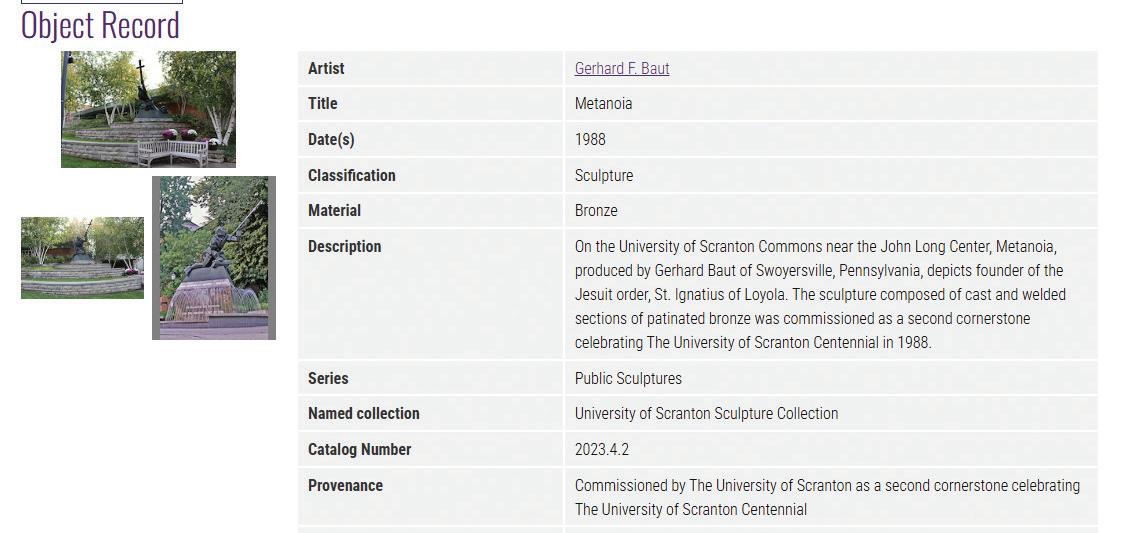
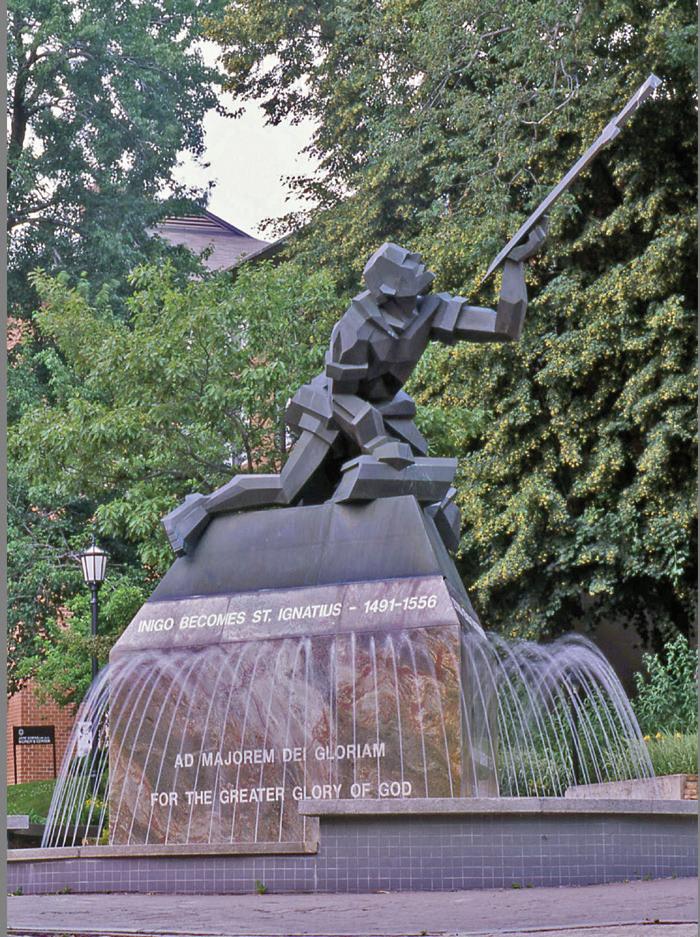
The University Art Collections catalog can be accessed from the Hope Horn Gallery’s website, the Weinberg Memorial Library’s homepage, and through a URL shortcut: scranton.edu/UniversityArt.
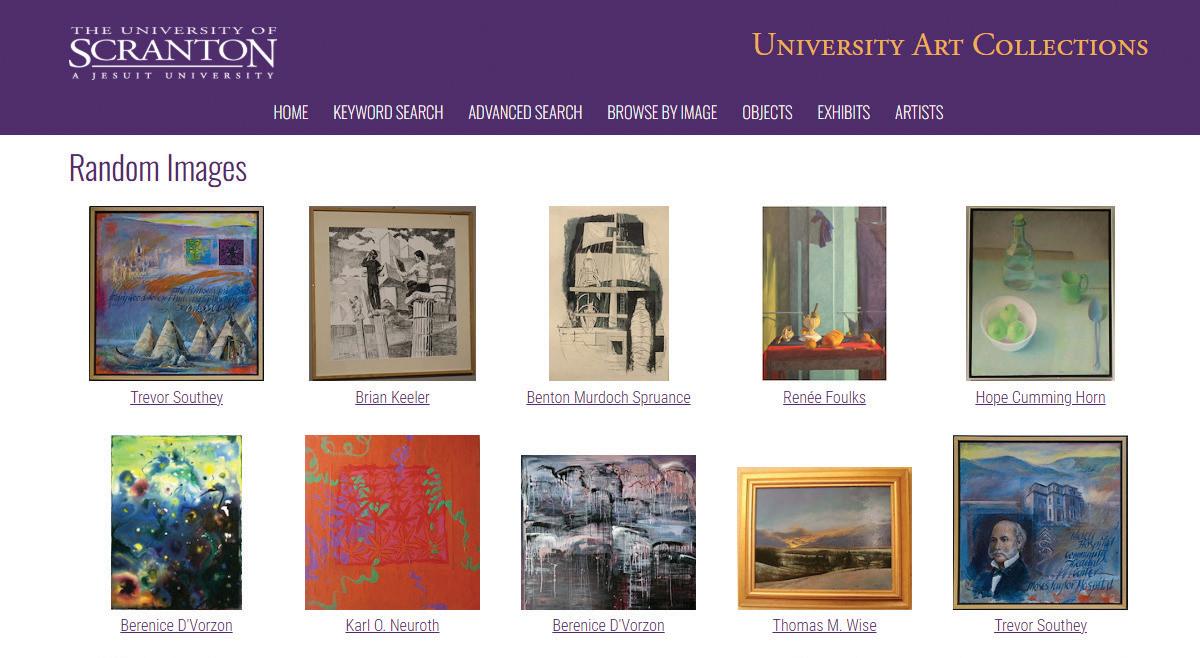
Visitors can explore the art collection under the Objects section, which can be searched by keyword. Object records provide information about individual artworks, images of the artworks, and links to related records and resources on artists and objects. There are also catalog records for artworks that are part of a series. These records, indicated by (Series) in the title, include each artwork of the series together in one record. A random rotating selection of images can be viewed under the Browse by Image section. Clicking on the images will provide additional information about the artwork as well as a link to the Object record. If you are not familiar with our campus collections, this feature provides a unique and engaging way to explore the variety of works available in the collection.
The Exhibits section documents current and previous exhibitions held at the Hope Horn Gallery. Exhibit records provide the dates and a description of the exhibition as well as links to some of the associated catalog records for objects that were displayed as part of the exhibition.
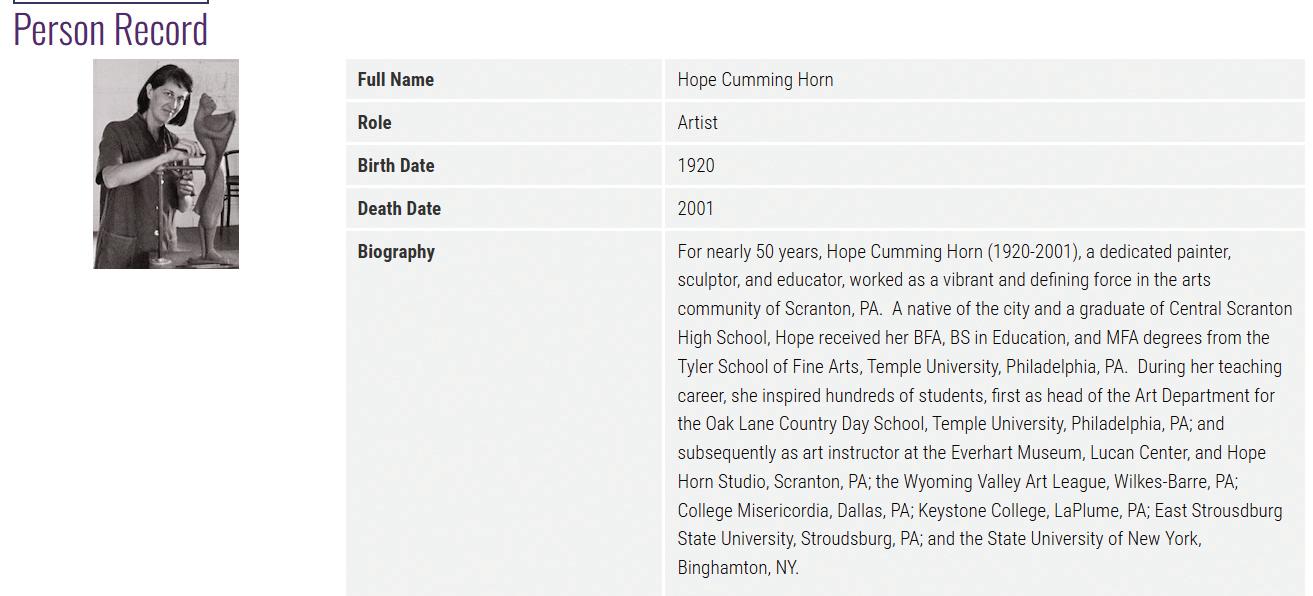
Discover featured artists under the Artists section. Records for artists provide biographical information and links to their associated object records, artist websites, and connections to resources in the University Archives.
While already extensive, the University Art Collections catalog is continually evolving. More artworks will be added over time, and existing records will be enhanced with additional details about artists and works as more information becomes available. Notably, the Library and
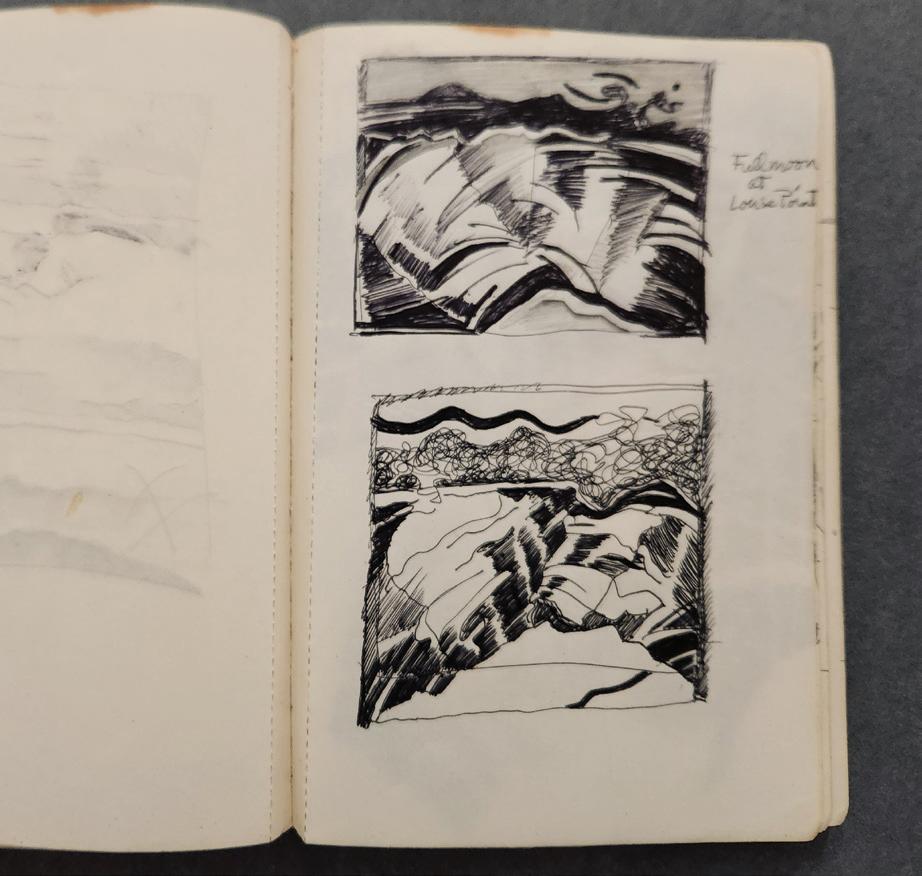
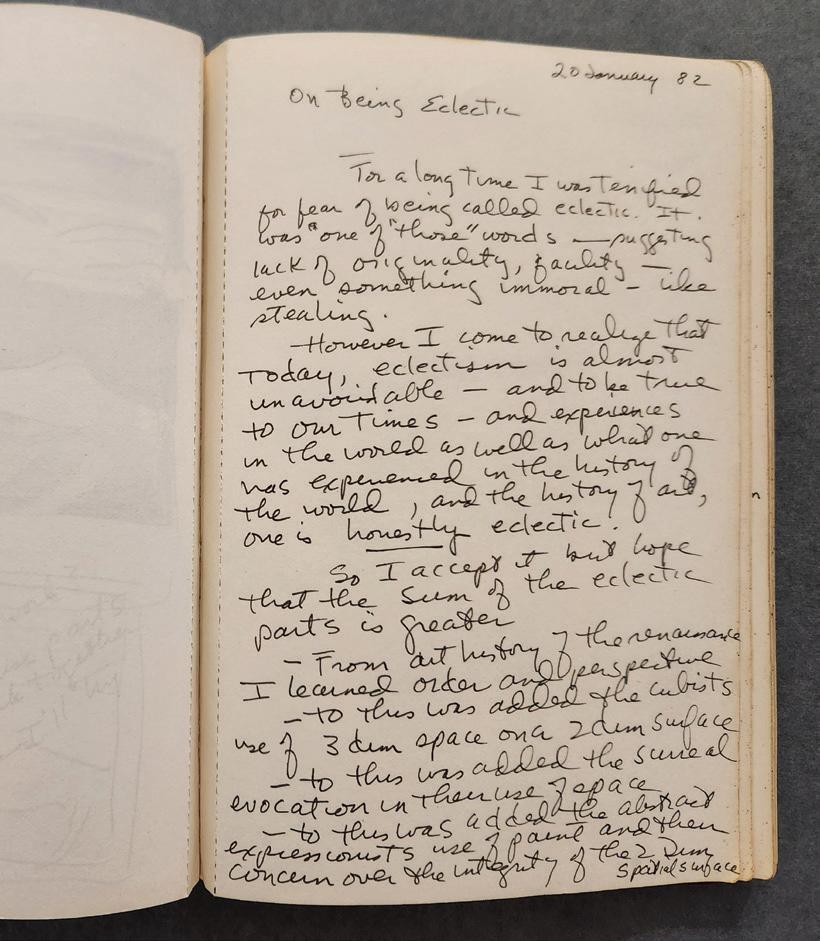
Gallery are currently working on cataloging some of Berenice D’Vorzon’s records to make these available in the online catalog. D’Vorzon bequeathed her artistic estate and artist’s records to the Hope Horn Gallery in 2015. A New York native, D’Vorzon was prominent in the mid-to-late 20th century and exhibited in galleries and museums throughout the United States. Her work was stylistically influenced by the Abstract Expressionist movement while her subject matter was inspired by travels to Europe, China, Israel, Bali, and the American Deep South. This academic year, the Library will digitize some of D’Vorzon’s personal sketchbooks which include preparatory sketches and notations about her artworks. Many of these works are on display on campus and searchable in the online catalog.
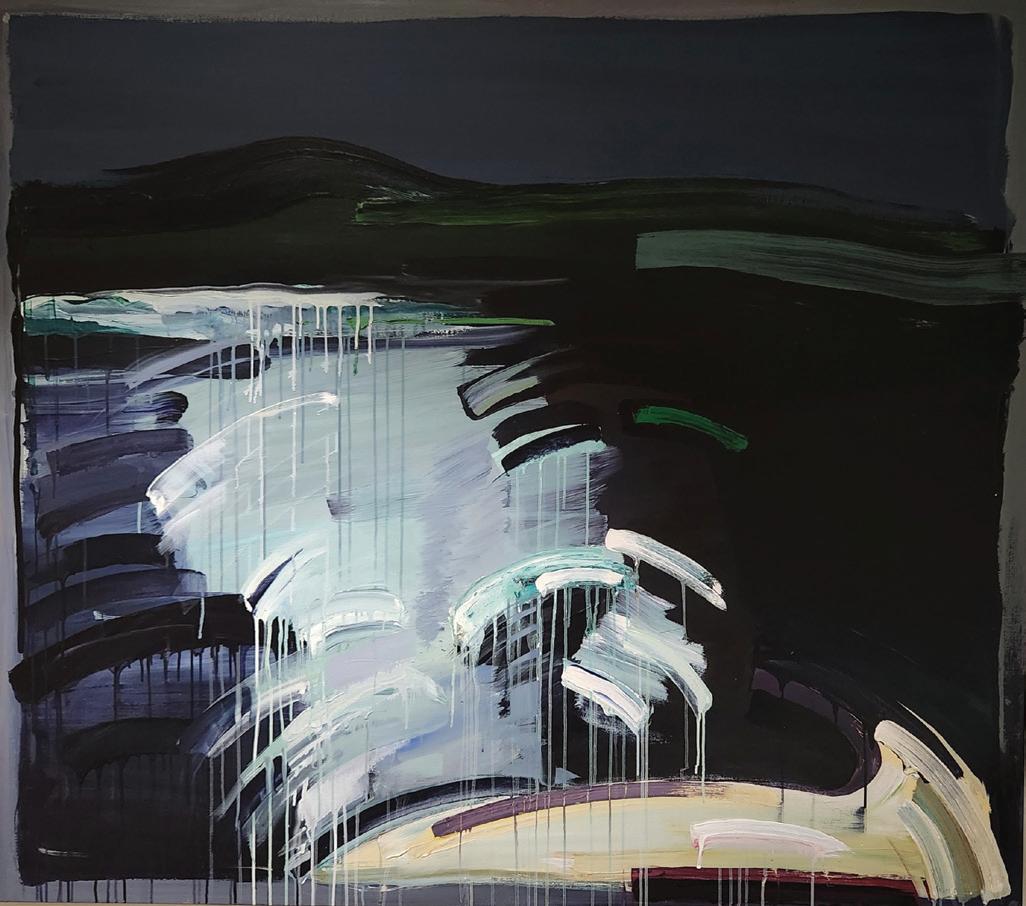
While some of the artworks in the catalog are not on permanent display or publicly accessible, many works from the University’s collections are located in public spaces on campus. Artwork that can be publicly viewed is identified
in catalog records with a campus location, and clicking on the campus location will provide a list of additional artworks in the same building or campus space. We invite everyone to explore the University Art Collections’ new online catalog and visit campus to discover the incredible works of art that make the University a living museum.
Associate Professor Colleen Farry, Digital Services Librarian
—Associate Professor Marleen Cloutier, Cataloging and Metadata Librarian
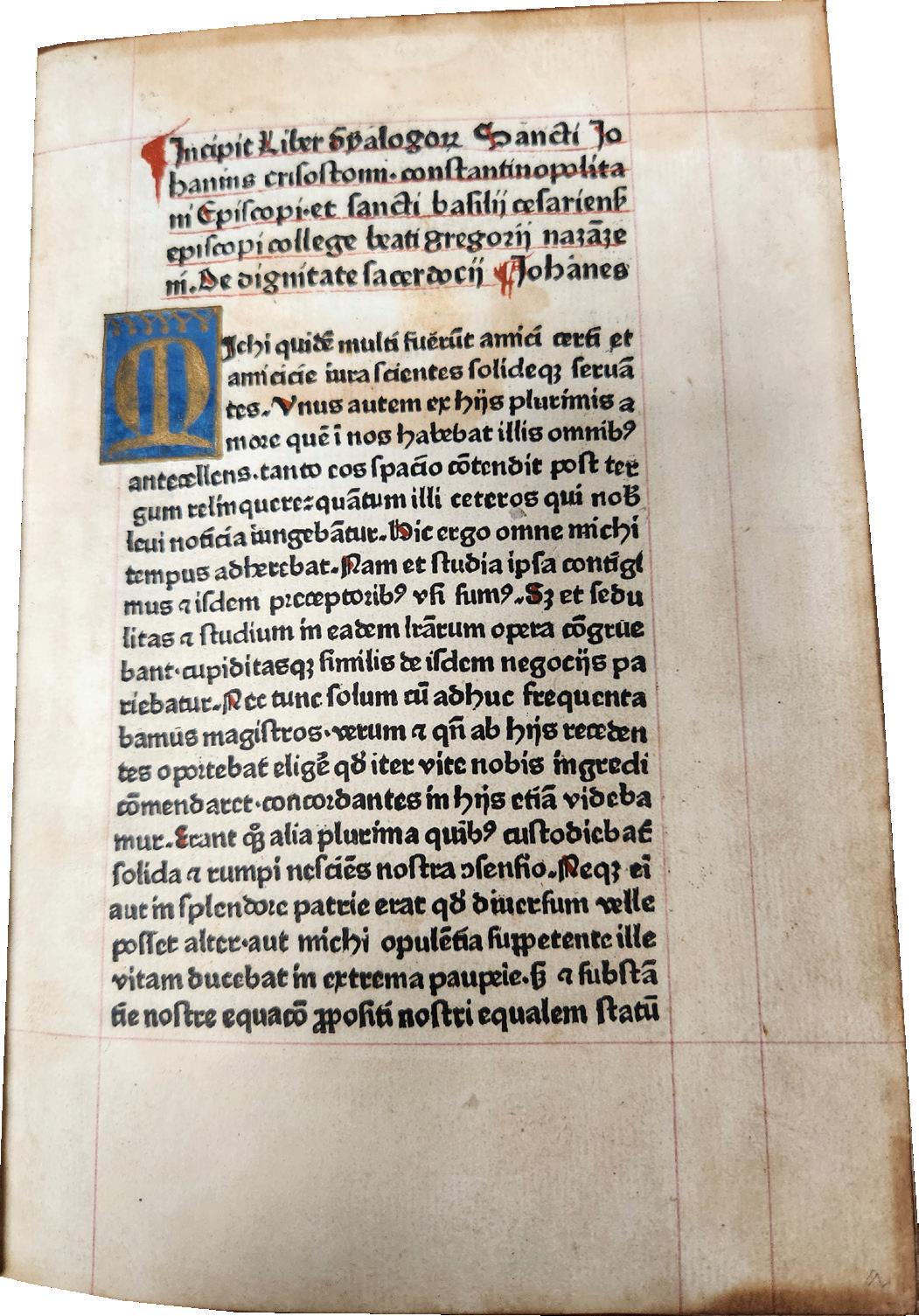
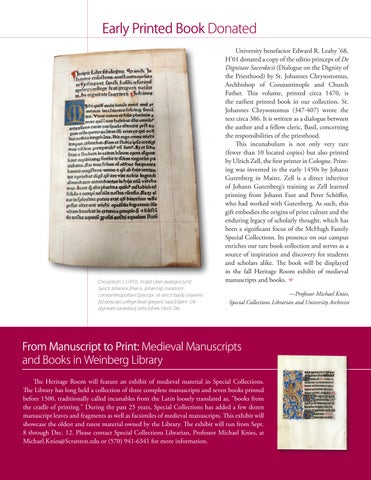
Chrysostom J. (1472). IncipitLiberdyalogor[um] SanctiJohanins[thatis,Johannis]crisostomi. constantinopolitaniEpiscopi.etsanctibasilijcesariens [is]episcopicollegebeatigregorijnaza[n]zeni.De dignitatesacerdocijJoha[n]nes.Ulrich Zel.
University benefactor Edward R. Leahy ’68, H’01 donated a copy of the editio princeps of De Dignitate Sacerdocii (Dialogue on the Dignity of the Priesthood) by St. Johannes Chrysostomus, Archbishop of Constantinople and Church Father. This volume, printed circa 1470, is the earliest printed book in our collection. St. Johannes Chrysostomus (347-407) wrote the text circa 386. It is written as a dialogue between the author and a fellow cleric, Basil, concerning the responsibilities of the priesthood.
This incunabulum is not only very rare (fewer than 10 located copies) but also printed by Ulrich Zell, the first printer in Cologne. Printing was invented in the early 1450s by Johann Gutenberg in Mainz. Zell is a direct inheritor of Johann Gutenberg’s training as Zell learned printing from Johann Fust and Peter Schöffer, who had worked with Gutenberg. As such, this gift embodies the origins of print culture and the enduring legacy of scholarly thought, which has been a significant focus of the McHugh Family Special Collections. Its presence on our campus enriches our rare book collection and serves as a source of inspiration and discovery for students and scholars alike. The book will be displayed in the fall Heritage Room exhibit of medieval manuscripts and books.
Professor Michael Knies, Special Collections Librarian and University Archivist
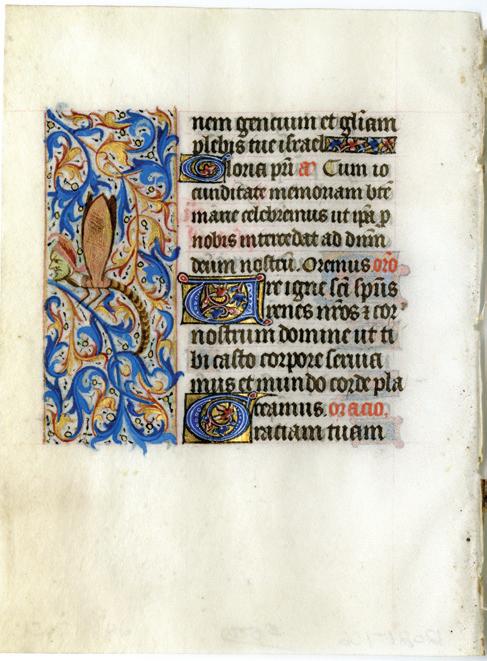
The Heritage Room will feature an exhibit of medieval material in Special Collections. The Library has long held a collection of three complete manuscripts and seven books printed before 1500, traditionally called incunables from the Latin loosely translated as, "books from the cradle of printing." During the past 25 years, Special Collections has added a few dozen manuscript leaves and fragments as well as facsimiles of medieval manuscripts. This exhibit will showcase the oldest and rarest material owned by the Library. The exhibit will run from Sept. 8 through Dec. 12. Please contact Special Collections Librarian, Professor Michael Knies, at Michael.Knies@Scranton.edu or (570) 941-6341 for more information.
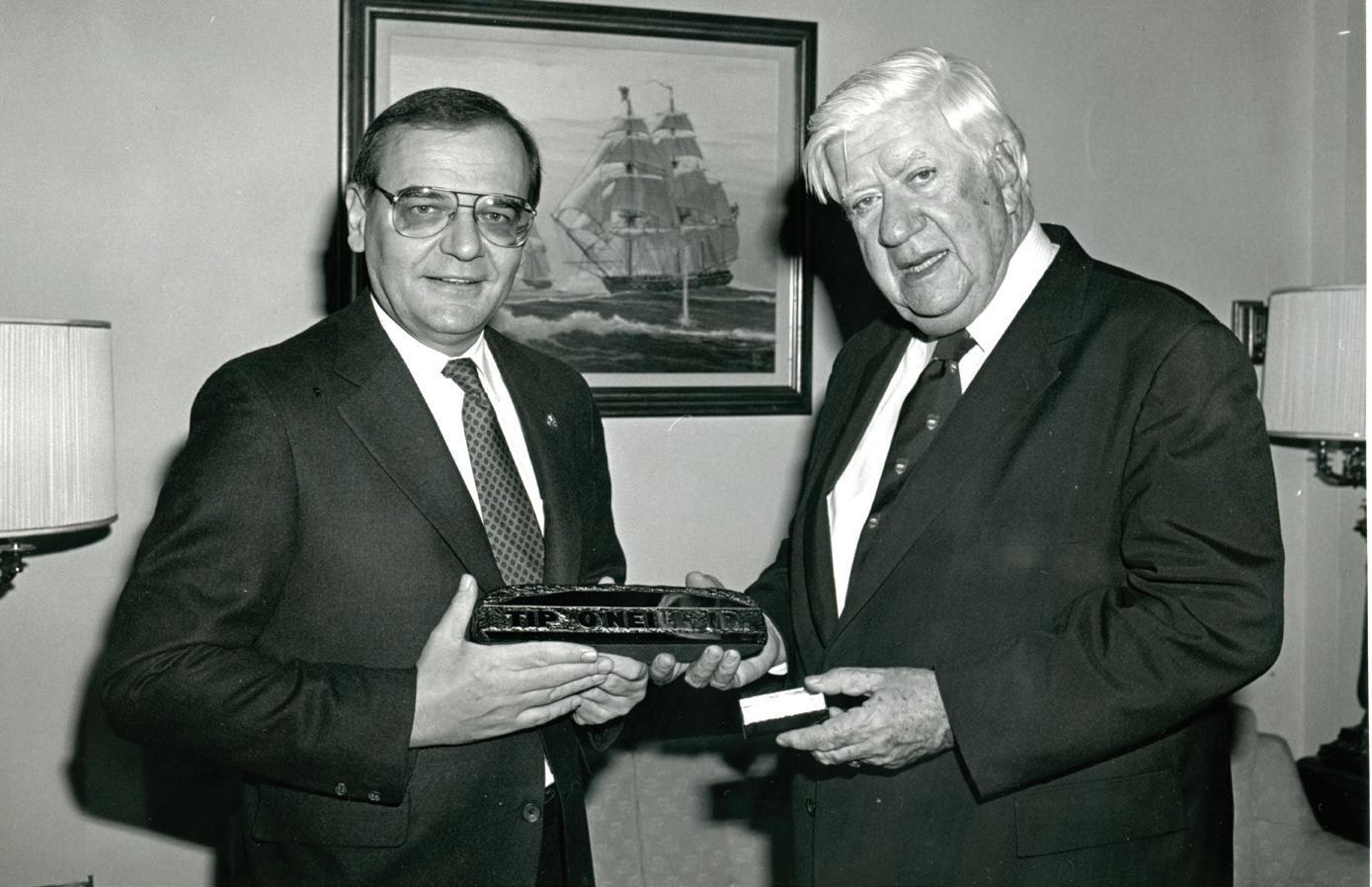
The Weinberg Memorial Library recently acquired the congressional papers of Paul Kanjorski. Kanjorski, who was born in 1937 in Nanticoke, Pennsylvania, served as U.S. representative for Pennsylvania’s 11th congressional district from 1985 until 2011 as a Democrat. His major committee assignments included the Committee on Financial Services and the Committee on Oversight and Government Reform. The collection includes approximately 180 boxes of material and is currently being processed. There will be an announcement when the Kanjorski Collection is open.
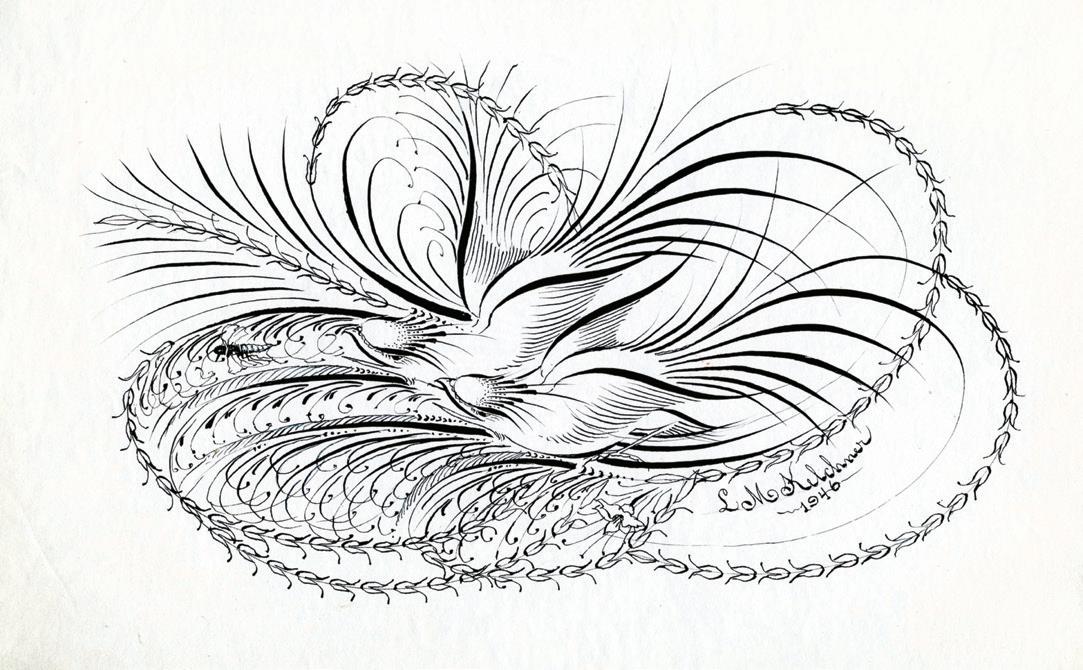
Weinberg Library’s American penmanship and pen art collections have increased due to the donation of the Lloyd M. Kelchner Penmanship Collection from his granddaughter, Marie Hurbut. Kelchner (1862-1948), born in Lightstreet, Pennsylvania, was an early associate of Charles Paxton Zaner, whose Zaner-Bloser Penmanship Collection forms the core of our handwriting collections. The Kelchner Collection features penmanship samples and many examples of artistic pen flourishing.
Professor Michael Knies, Special Collections Librarian and University Archivist
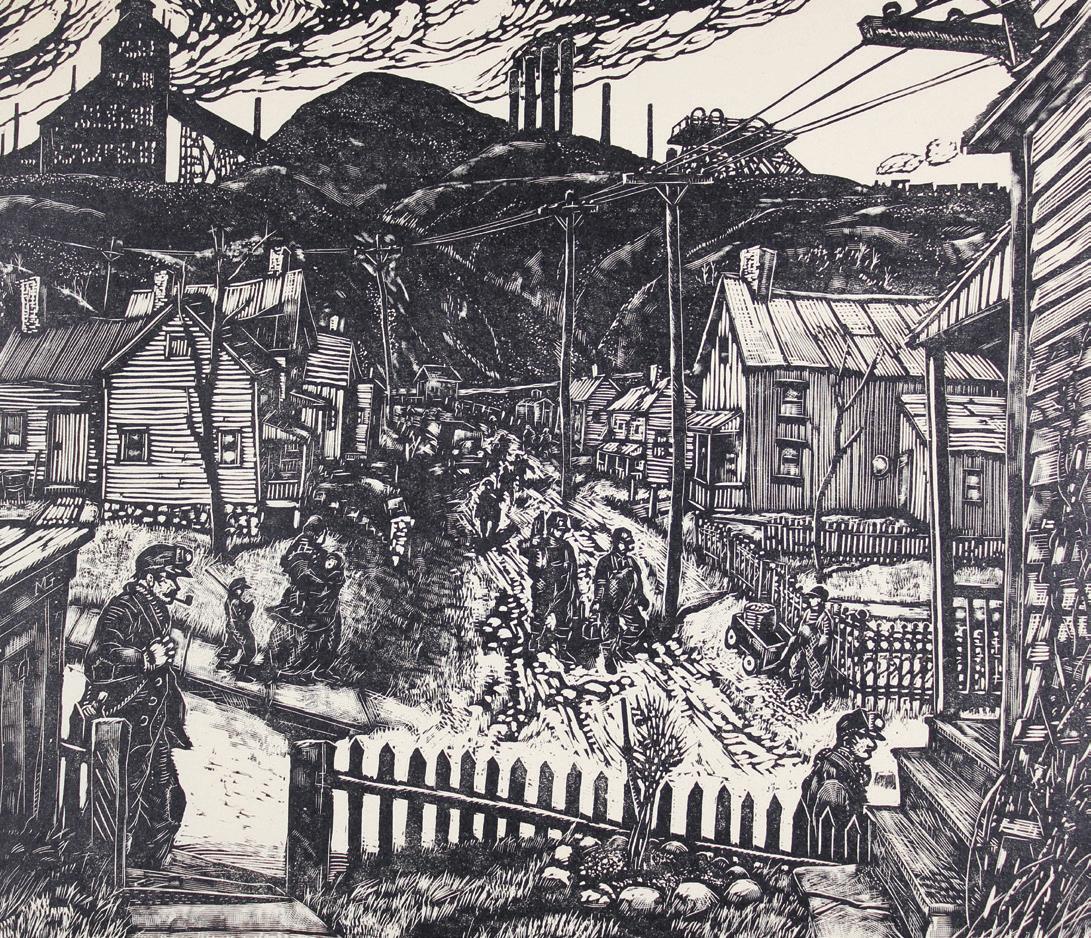
In 2025-2026, the Hope Horn Gallery presents The Anthracite Coal Industry of Northeastern Pennsylvania: Selected Paintings, Sculptures, and Works on Paper from Public and Private Collections: 1829-1959 and Selected Prints, Drawings, and a second exhibit, Watercolors from The Stanislaus Collection: 19331946. Organized by Richard Stanislaus G’98, past curator of the Pennsylvania Historical and Museum Commission Anthracite Heritage Museum, this two-part exhibition, lecture, and catalog series features the work of painters, illustrators, photographers, sculptors, and printmakers who, over the course of 130 years,
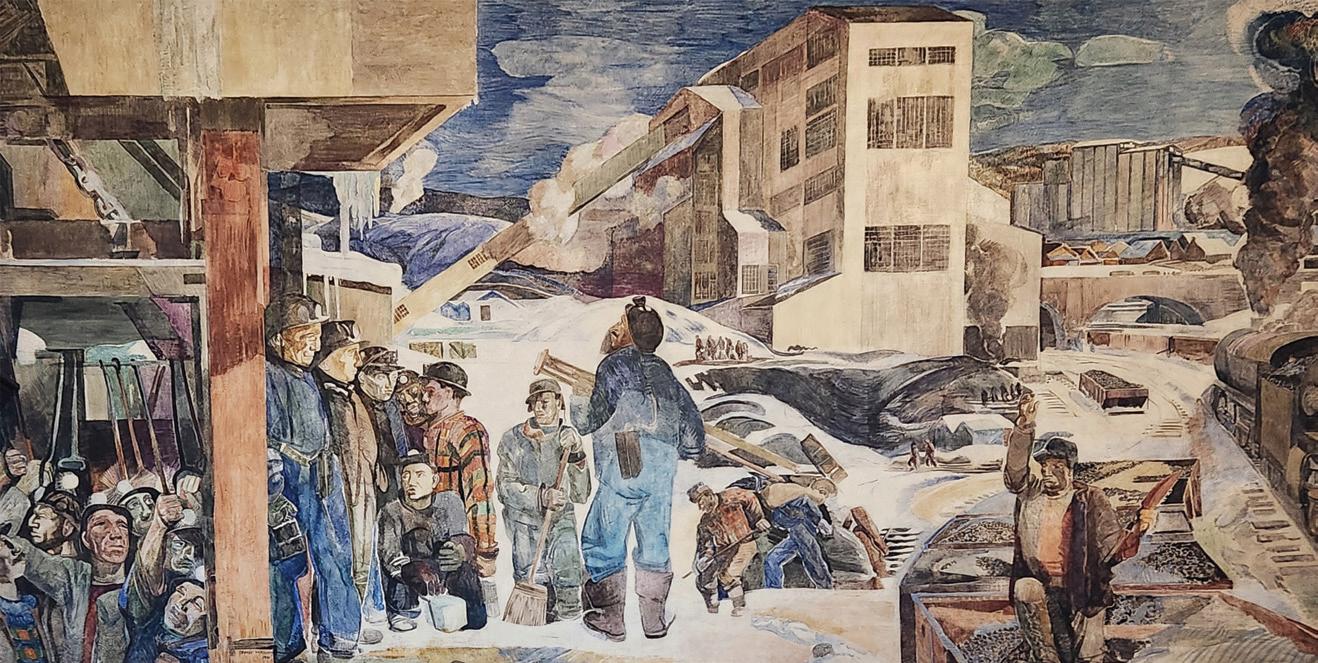
represented the anthracite industry as a subject that was scientific, mysterious, heroic, tragic, and picturesque.
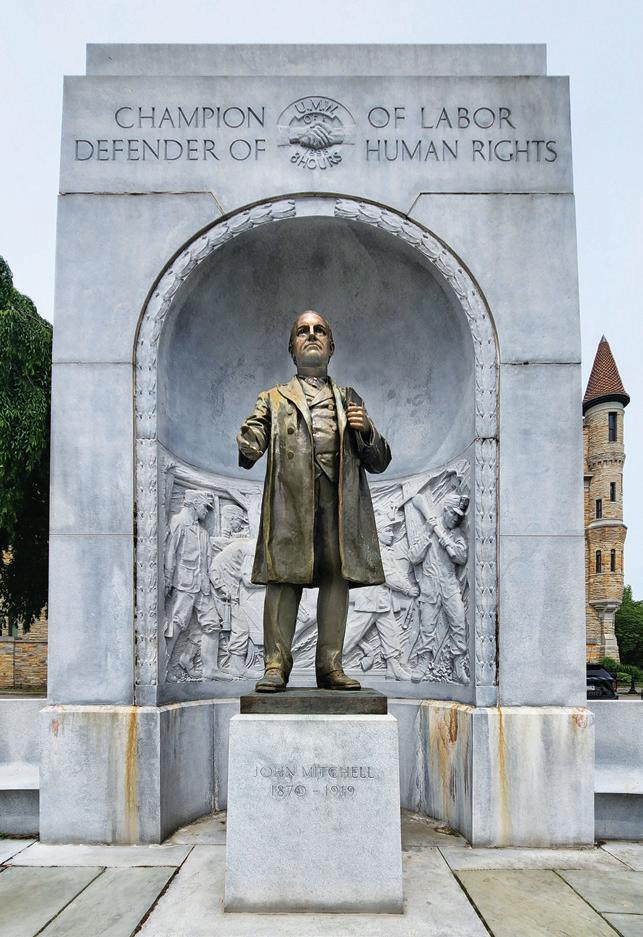
The first exhibition provides a broad overview of private and public art in both the gallery and community. Examples are: Coal Mines on the Susquehanna (c. 1870) by George Clough, a landscape painting depicting colliery structures; Avondale Colliery Disaster (1869) by Theodore Davis, a periodical illustration chronicling mining events; the John Mitchell Monument (1924) by Charles Keck and Peter Sheridan, a memorial sculpture honoring union labor; and Nature’s Storehouse (1941) by Walter Maril, a public mural celebrating anthracite culture.
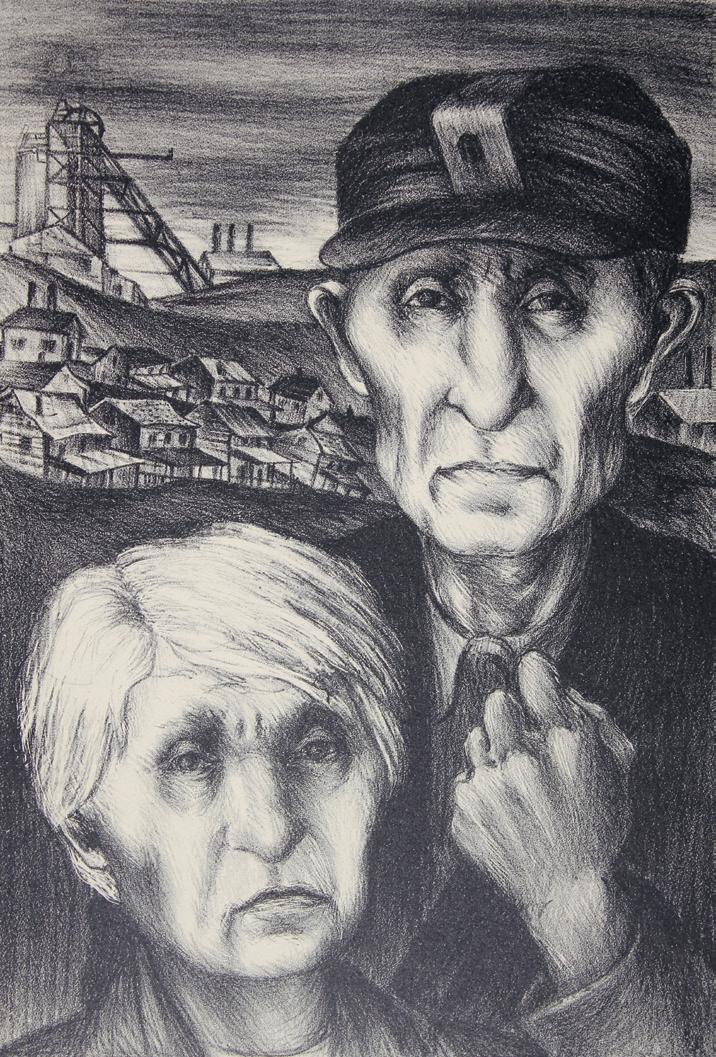
The second show examines a focused collection of works produced during the 1930s by artists associated with the Works Progress Administration. Pieces include: Miners Driving a Gangway (1935) by Nicholas Bervinchak, an etching completed by a former miner of Ukrainian heritage born in Schuylkill County; Black Country (1937-1938) by Michael Gallagher, a woodcut prepared by a Philadelphiabased WPA printmaker and Scranton native; Bootleg Mine (1937) by Chet LaMore, an ink wash drawing produced by a Wisconsin native who worked in New York and Michigan; and Miner and Wife (1937) by Riva Helfond, a lithograph designed by a WPA artist from New York City after visiting the anthracite regions of Shenandoah.
—Darlene Miller-Lanning, Ph.D., Hope Horn Gallery Director
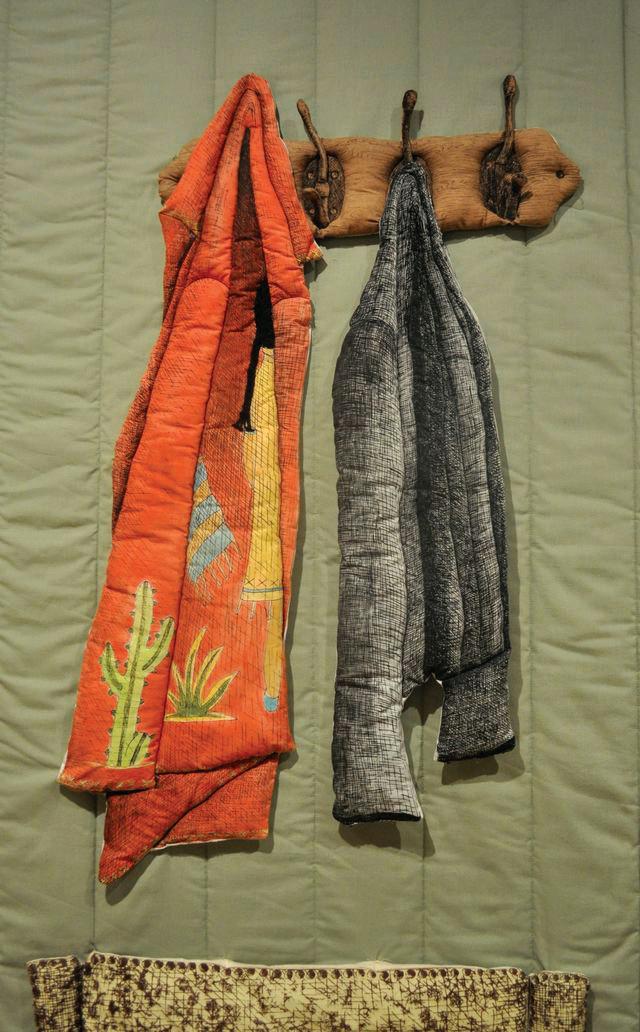
Kay Healey. Lost and Found: Jacket Detail
Quilted fabric installation. 2014.
September 2 through October 10, 2025
September 2 through October 10, 2025
In her life-sized drawn, painted, and screen-printed fabric installations, Kay Healy investigates themes of home, loss, and resilience through interviewbased initiatives. As an artist and educator, she has received fellowships from the Independence Foundation, Leeway Foundation, and NewCourtland Network for her projects grounded in the narratives of displaced persons and senior citizens. Based in Philadelphia, PA, she holds a BA from Oberlin College and MFA from the University of the Arts.
In her life-sized drawn, painted, and screen-printed fabric installations, Kay Healy investigates themes of home, loss, and resilience through interviewbased initiatives. As an artist and educator, she has received fellowships from the Independence Foundation, Leeway Foundation, and NewCourtland Network for her projects grounded in the narratives of displaced persons and senior citizens. Based in Philadelphia, PA, she holds a BA from Oberlin College and MFA from the University of the Arts.
SPECIAL EVENTS
SPECIAL EVENTS
FRIDAY, SEPTEMBER 5, 2025
FRIDAY, SEPTEMBER 5, 2025
Sampler: Fabric Installations and Personal Narratives
Sampler: Fabric Installations and Personal Narratives
Kay Healy, Exhibiting Artist
Kay Healy, Exhibiting Artist
Gallery Lecture at Pearn Auditorium, Brennan 228 • 5:00 to 6:00 p.m.
Gallery Lecture at Pearn Auditorium, Brennan 228 • 5:00 to 6:00 p.m.
Public Reception at Hope Horn Gallery, Hyland 405 • 6:00 to 8:00 p.m.
Public Reception at Hope Horn Gallery, Hyland 405 • 6:00 to 8:00 p.m.
October 20 through December 12, 2025
October 20 through December 12, 2025
The Anthracite Coal Industry of Northeastern Pennsylvania
Selected Paintings, Sculptures, and Works on Paper from Public and Private Collections: 1829-1959
The Anthracite Coal Industry of Northeastern Pennsylvania Selected Paintings, Sculptures, and Works on Paper from Public and Private Collections: 1829-1959
Organized by Richard Stanislaus, past curator of the Pennsylvania Historical and Museum Commission Anthracite Heritage Museum, this first exhibition in a two-part series features coal-themed art from the nineteenth and twentieth centuries, on loan from individuals and organizations including the Lackawanna Historical Society, Luzerne County Historical Society, Everhart Museum, Anthracite Heritage Museum, Pottsville Public Library, and Scranton Public Library. The project is supported in part by grants from The Gail and Francis Slattery Center for the Ignatian Humanities at the University of Scranton; the “armature” initiative of Northeast Educational Intermediate Unit 19; and the Lackawanna County Office of Arts and Culture.
Organized by Richard Stanislaus, past curator of the Pennsylvania Historical and Museum Commission Anthracite Heritage Museum, this first exhibition in a two-part series features coal-themed art from the nineteenth and twentieth centuries, on loan from individuals and organizations including the Lackawanna Historical Society, Luzerne County Historical Society, Everhart Museum, Anthracite Heritage Museum, Pottsville Public Library, and Scranton Public Library. The project is supported in part by grants from The Gail and Francis Slattery Center for the Ignatian Humanities at the University of Scranton; the “armature” initiative of Northeast Educational Intermediate Unit 19; and the Lackawanna County Office of Arts and Culture.
FRIDAY, OCTOBER 24, 2025
FRIDAY, OCTOBER 24, 2025
FRIDAY, NOVEMBER 7, 2025
FRIDAY, NOVEMBER 7, 2025
The Anthracite Coal Industry of Northeastern Pennsylvania
The Anthracite Coal Industry of Northeastern Pennsylvania
Richard Stanislaus Guest Curator Gallery Lecture at Pearn Auditorium, Brennan 228 • 5:00 to 6:00 p.m.
Richard Stanislaus, Guest Curator Gallery Lecture at Pearn Auditorium, Brennan 228 • 5:00 to 6:00 p.m.
Public Reception at Hope Horn Gallery, Hyland 405 6:00 to 8:00 p.m.
Public Reception at Hope Horn Gallery, Hyland 405 • 6:00 to 8:00 p.m.
New Deal Post Office Murals in the Anthracite Regions of Northeastern Pennsylvania
New Deal Post Office Murals in the Anthracite Regions of Northeastern Pennsylvania
David Lembeck, Independent Scholar Gallery Lecture at Pearn Auditorium, Brennan 228 • 5:00 to 6:00 p.m.
David Lembeck Independent Scholar Gallery Lecture at Pearn Auditorium, Brennan 228 • 5:00 to 6:00 p.m.
Public Reception at Hope Horn Gallery, Hyland 405 • 6:00 to 8:00 p.m.
Public Reception at Hope Horn Gallery, Hyland 405 • 6:00 to 8:00 p.m.
FEBRUARY 2 THROUGH MARCH 13, 2026
FEBRUARY 2 THROUGH MARCH 13, 2026
The Anthracite Coal Industry of Northeastern Pennsylvania Selected Prints, Drawings, and Watercolors from The Stanislaus Collection: 1933-1946
The Anthracite Coal Industry of Northeastern Pennsylvania Selected Prints, Drawings, and Watercolors from The Stanislaus Collection: 1933-1946
Organized by Richard Stanislaus, past curator of the Pennsylvania Historical and Museum Commission Anthracite Heritage Museum, this second exhibition in a two-part series features coal-themed art from the New Deal era, on loan from The Stanislaus Collection. The project is supported in part by grants from the “armature” initiative of the Northeast Educational Intermediate Unit 19 and the Lackawanna County Office of Arts and Culture.
Organized by Richard Stanislaus, past curator of the Pennsylvania Historical and Museum Commission Anthracite Heritage Museum, this second exhibition in a two-part series features coal-themed art from the New Deal era, on loan from The Stanislaus Collection. The project is supported in part by grants from the “armature” initiative of the Northeast Educational Intermediate Unit 19 and the Lackawanna County Office of Arts and Culture.
FRIDAY, FEBRUARY 6, 2026
FRIDAY, FEBRUARY 6, 2026
Depictions of the Anthracite Coal Industry in Prints of the 1930s
Depictions of the Anthracite Coal Industry in Prints of the 1930s
Richard Stanislaus, Guest Curator
Richard Stanislaus Guest Curator
Chester Kulesa, Past Director, Anthracite Heritage Museum
Chester Kulesa, Past Director, Anthracite Heritage Museum
Peter Hoffer, Printmaker/Professor Emeritus, Marywood University
Peter Hoffer, Printmaker/Professor Emeritus, Marywood University
Panel Discussion at Pearn Auditorium, Brennan 228 • 5:00 to 6:00 p.m.
Panel Discussion at Pearn Auditorium, Brennan 228 5:00 to 6:00 p.m.
Public Reception at Hope Horn Gallery, Hyland 405 • 6:00 to 8:00 p.m.
Public Reception at Hope Horn Gallery, Hyland 405 • 6:00 to 8:00 p.m.
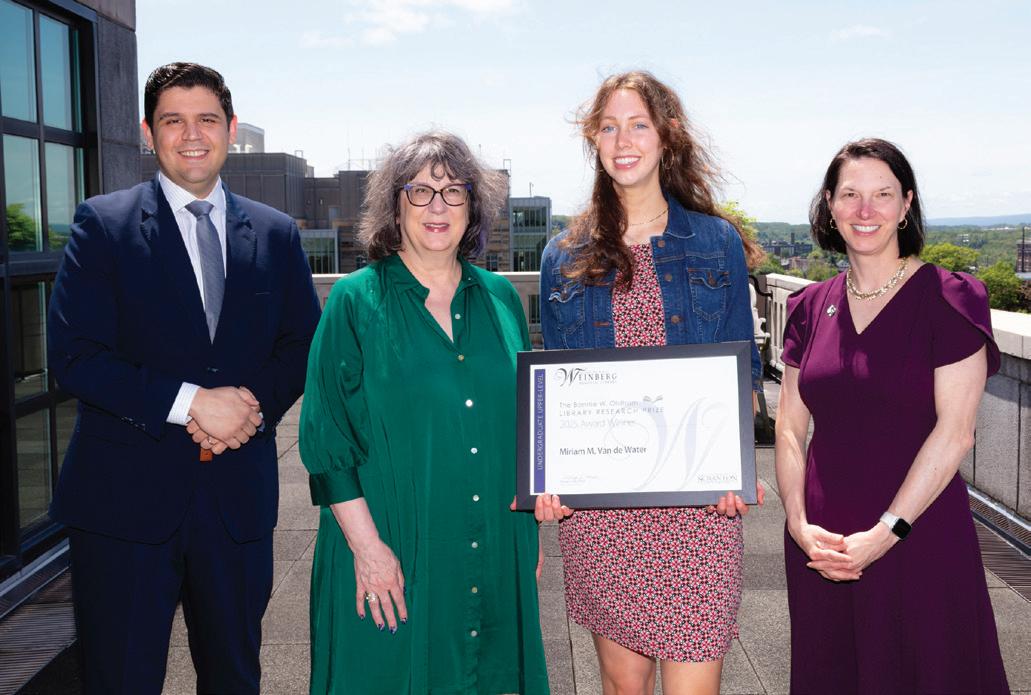
2025 Bonnie W. Oldham Library Research Prize Award and Honorable Mention recipients, from left to right: Erin Augusiewicz, Miriam M. Van de Water, Myira Vilchis Bruno, Kiera Mooney, Jessica Tsu, and Faith Montagnino. Not pictured: Nicolette George, Mary Kallberg, Julia LeMay, and Stephanie Patullo
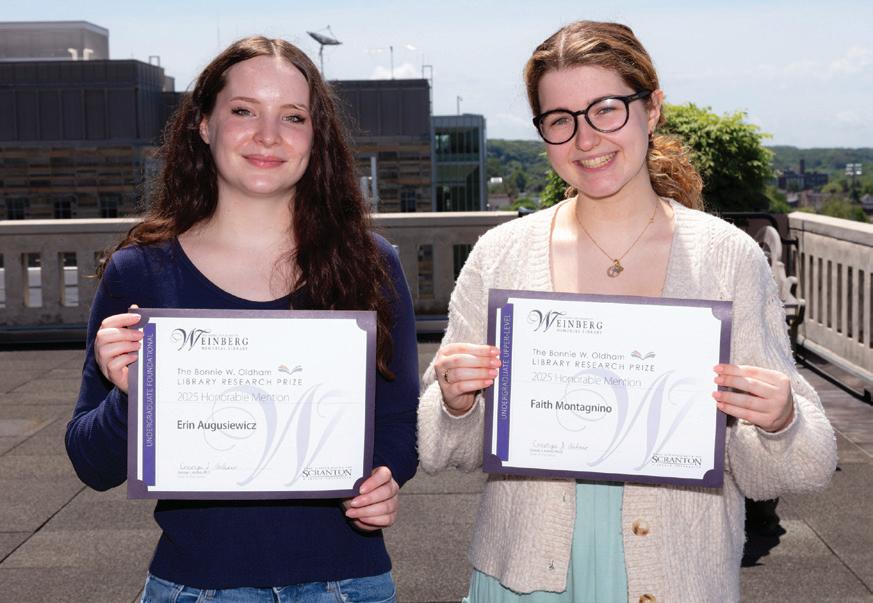
From left to right: 2025
Bonnie W. Oldham Library Research Prize Undergraduate Foundational Honorable Mention award recipient
Erin Augusiewicz, and Undergraduate Upperlevel Honorable Mention award recipient Faith Montagnino. Not pictured: Graduate Honorable Mention award recipients
Nicolette George, Mary Kallberg, Julia LeMay, and Stephanie Patullo
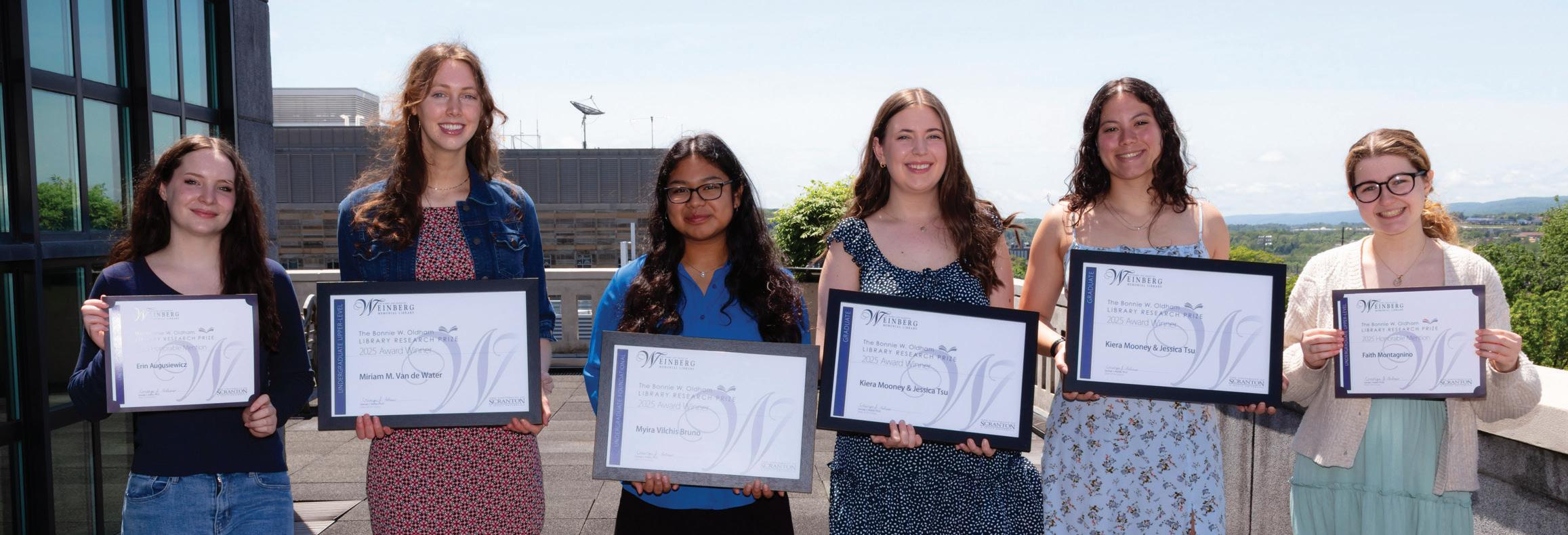
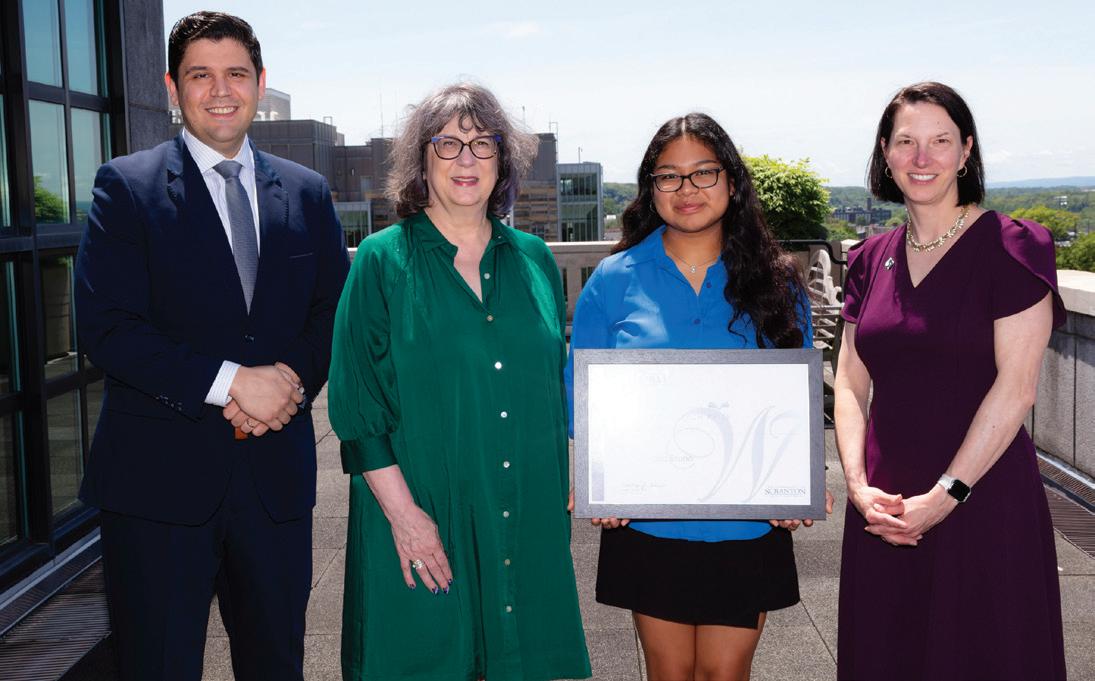
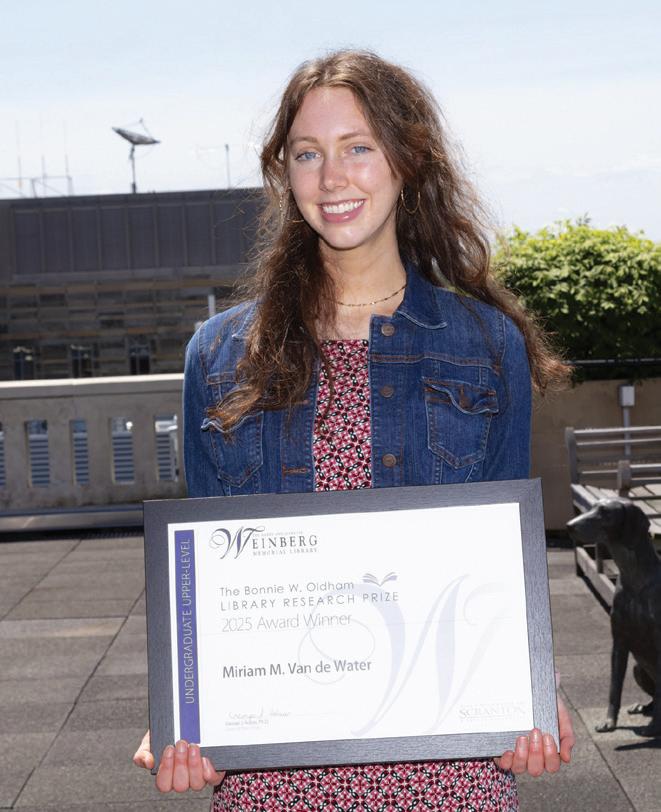
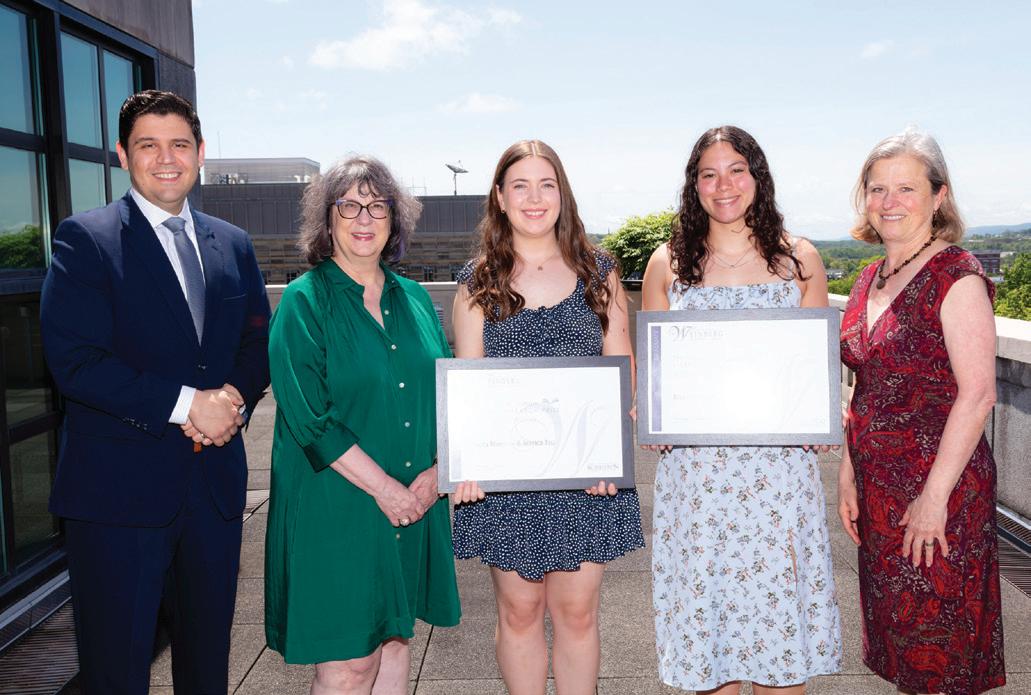
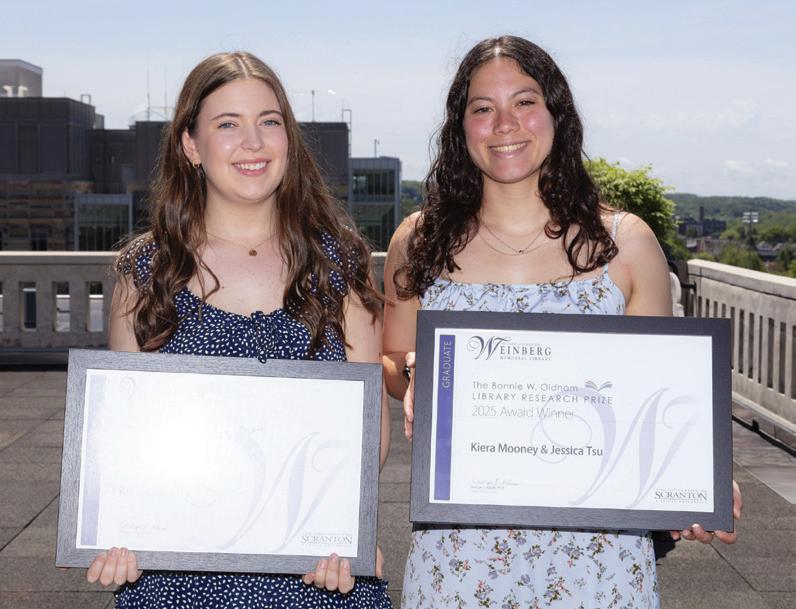
Prize winners of the 2025 Bonnie W. Oldham Library Research Prize were honored at an Awards Ceremony and Reception on Friday, May 16, 2025, in the Charles Kratz Scranton Heritage Room of the Weinberg Memorial Library. Dr. George Aulisio, Dean of the Library, awarded the Undergraduate Foundational category to Myira Vilchis Bruno, a first-year political science major with a legal studies concentration; the Undergraduate Upper-level category to Miriam M. Van de Water, a graduating senior mathematical sciences and neuroscience double major with a minor in philosophy and a concentration in biology; and the Graduate category to Kiera Mooney and Jessica Tsu, graduate students in the Master of Science in Occupational Therapy program.
Currently celebrating its 15th year, the Weinberg Memorial Library inaugurated
the Library Research Prize in 2011 to recognize excellence in research projects that show evidence of significant knowledge of the methods of research and the information gathering process, and use of library resources, tools, and services. In 2017, the prize was named for Professor Emerita Bonnie W. Oldham, who founded the prize at the University in 2011. The Bonnie W. Oldham Library Research Prize was fully endowed in 2019 and consists of a prize of $500 awarded to winning projects in each of the three categories: Undergraduate Foundational (100-level projects), Undergraduate Upper-level (200- to 400-level projects), and Graduate-level projects.
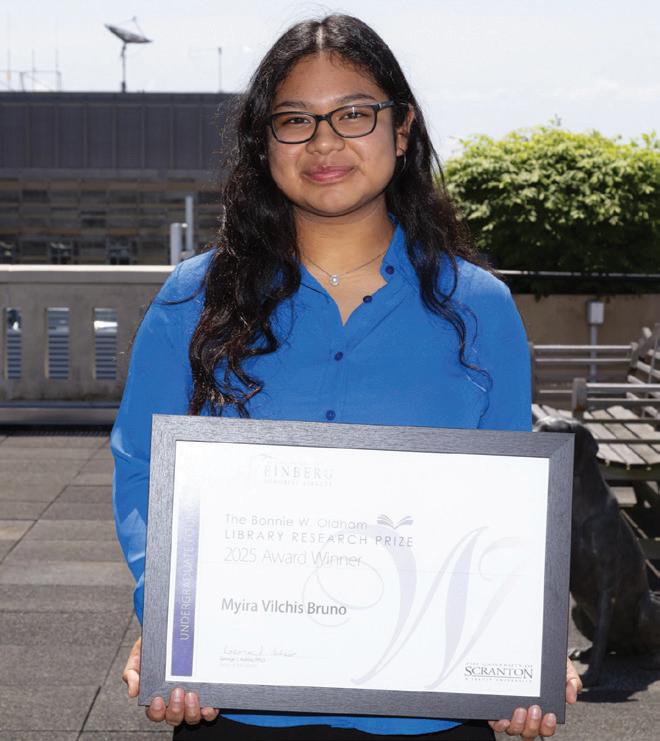
Vilchis Bruno submitted to the competition her paper titled “Directly American,” completed in Professor Dawn D’Aries Zera’s WRTG 107: Composition course. Tasked with researching an argumentative contemporary issue related to her major, Vilchis Bruno chose to research and write on how direct democracies are more beneficial than representative democracies. On her motivation for researching this topic, she notes in her description of research, “I am always finding new ways to expand my knowledge of our current democracy and how it alters the law.”
Vilchis Bruno began her research in an information literacy class taught by a faculty
librarian where she learned how to search for materials in a variety of formats that contained evidence she could use to support her argument. In the A-Z list of databases, she found the EBSCO database Academic Search Premier, which became one of her most utilized databases for finding useful and relevant sources. In her description of research, she mentions using the search filters in Academic Search Premier to narrow search results to peer-reviewed academic journal articles published between 2018 and 2025. She also notes the usefulness of the article-saving feature in the EBSCO platform, which allowed her to save articles to refer to later while continuing on with her research process. She describes how using different keywords related to her topic enabled her to extend her research beyond analyses of the United States to such countries as Germany, Britain, and Botswana.
In addition to accessing Library resources through databases such as Academic Search Premier and ProQuest Central, Vilchis Bruno shares that learning about the Library’s Publication Finder tool in her information literacy instruction session prompted her to use it to locate specific journals related to the field of political science, such as the Journal of Regional Science and the American Political Science Review, which helped her focus her research more directly on scholarly work related to her essay topic. This tool also enabled her to easily explore streaming media related to her topic that was accessible through the Library, which was a format requirement for one of her sources for this paper.
In reference to her research project, Vilchis Bruno states: “Before sufficiently navigating the library databases, I would spend more time finding sources than writing. This caused me to doubt my writing because I thought it was inaccurate. I grew unmotivated to write, and I no longer enjoyed it like I did before. However, I kept in mind the Ignatian value of Cura Personalis or ‘care
for the person.’ I was still passionate about making sure I had full support on my side of the argument.” She further notes, “Research on democracies across the globe was a special interest of mine because I hope to practice international law in the future. To advance my future, I had to focus on the present.”
The Honorable Mention award in the Undergraduate Foundational category was presented to first-year psychology major Erin Augusiewicz for the project, “Psychedelic Treatment?” completed in WRTG 106: College Writing II for Prof. D'Aries Zera.
Undergraduate Upper-level category winner Van de Water submitted to the competition her Honors thesis titled “Examining the Outcomes of Collective Decision Making Over Time,” completed in the course MATH 489H: Honors Project II, advised by Dr. Jason Graham. Van de Water explains in her description of research that her Honors research topic, which was “to explore how collective decision-making and sociality influence population fitness,” led her to “discover the importance of breaking large research questions into manageable
Dr.
and Senior Vice President of Academic Affairs; 2025 Bonnie W. Oldham Undergraduate Foundational Research Prize award recipient Myira Vilchis Bruno; and Dr. Carolyn McNamara Barry, Dean of the College of Arts and Sciences.
2025 Bonnie W. Oldham Library Research Prize Undergraduate Foundational award recipient Myira Vilchis Bruno
From
2025 Bonnie W. Oldham
Undergraduate Upperlevel Research Prize award recipient Miriam M. Van de Water; and Dr. Carolyn McNamara Barry, Dean of the College of Arts and Sciences.
2025 Bonnie W. Oldham
Library Research Prize
Undergraduate Upper-level award recipient Miriam M. Van de Water
pieces—whether determining which parameter to test, learning to build simulations, or choosing the best way to visualize complex results.”
Van de Water describes the Library as playing a central role in her research journey. She discusses using the Library’s resources, spaces, and services to structure and support her work. She says, “Being immersed in that space helped structure my thinking and reinforce the seriousness and excitement of the work I was doing.” She describes working on the Library’s second floor while preparing a literature review and using the Library’s computer labs to build simulations and write early drafts of her research paper. She also recounts a research consultation with a faculty librarian that revealed overlooked areas in her Honors project, stating: “Her input reminded me that research is ultimately about communication, and that excellence isn’t just technical—it’s also about clarity, accessibility, and collaboration.”
Van de Water’s research journey is also characterized by reflection and personal
transformation. She discusses living out the Ignatian principle of “Contemplation in Action,” which she describes as nurturing her character and clarifying her professional goals. She explains: “My work was rooted in long, quiet hours of focused thought, literature review, and coding— but it was always oriented toward application. I wasn’t just thinking for the sake of thinking; I was using those insights to build something, to contribute to a broader scientific conversation.”
Van de Water concludes her description of research by sharing the following reflection about her work on the project: “This project did more than fulfill a graduation requirement. It taught me how to break down big questions into manageable pieces, how to reach out for help, and how to sit with uncertainty until clarity emerged. It showed me that research is not only about discovery but also about formation—about becoming a person capable of asking better questions, communicating ideas thoughtfully, and navigating complexity with humility and care.” She further reports that her work on this project has helped develop her confidence as a researcher as she prepares to begin her Ph.D. in biomathematics at North Carolina State University in the fall.
The Honorable Mention award in the Undergraduate Upper-level category was presented to Faith Montagnino, a third-year English major with writing and philosophy minors in the SJLA and University Honors programs, for her project titled “Reading and Writing to Heal: Poetry Therapy as a Tool for Person-Centered Group Therapy,” completed in the course HONR 385H: Poetry as Therapy for Dr. Paul Datti. Graduate category winners Mooney and Tsu submitted to the competition their project titled “The Role of Gender Throughout the History of Occupational Therapy,” completed in the course OT 544: Leadership Principles, Ethics, and Pragmatics, taught by Dr. Marlene Morgan. This historiographical
research project explores the role of gender makeup on the occupational therapy workforce over the past century and incorporates evidence from primary sources from the 1910s to the present day.
Mooney and Tsu found this evidence by searching a multitude of library databases including SAGE Journals, PubMed, MEDLINE, EBSCO, JSTOR, and JAMA Network, as well as the Internet Archive and the Library’s microfilm collection. On the latter, they noted in their description of research, “Looking at the microfilm took an unexpected amount of patience, but it became an immersive experience for us to participate in that further expanded our education.” They also utilized the advanced research technique of citation chasing, which taught them that research “will not always be as simple as typing in one keyword and finding the perfect article.”
Initially looking for why there were more women than men in the field, the research process evolved for Mooney and Tsu as they found other gender inequities towards women, such as wage gaps, discrimination, and gender stereotypes. They discovered these other dimensions of their topic through the research process, which required that they reassess and change their approach to searching, which “steered [them] in an unexpected direction.” They found this process and discovery enlightening as they confronted the struggles of working women throughout time.
In true Jesuit fashion, Mooney and Tsu were pushed by this project to become better researchers and embodied Magis, or the “restless desire for excellence.” Realizing they were the first students to choose this topic for their research in this course, they knew they had their work cut out for them, but they were determined and they persevered. They describe this characteristic of their research process in the following way: “The hours that we spent scouring databases, citation chasing, using microfilm, and digging through archives exhibit our determination and perseverance in creating a detailed paper that accurately showed the whole story of this topic throughout history.”
The Honorable Mention award in the Graduate category was presented to Doctor of Physical Therapy students Nicolette George, Mary Kallberg, Julia LeMay, and Stephanie Patullo, for the project, “Physical Therapy versus Complementary and Alternative Medicine Effects on PostEpisiotomy Pain: A Systematic Review,” completed in PT 773: Scientific Inquiry III for PT for Dr. Lori Walton.
Winning projects and research description essays were added to the Library’s Bonnie W. Oldham Library Research Prize Collection in the digital collections over the summer. Information about the Bonnie W. Oldham Library Research Prize can be found on the website: http://www.scranton.edu/ libraryresearchprize. Questions about the Bonnie W. Oldham Library Research Prize can be directed to the Library Research Prize Planning Committee at libraryresearchprize@scranton.edu.
—Professor Donna Witek, Information Literacy Coordinator and Research & Instruction Librarian for the Humanities and Ignatian Pedagogy
From left to right: Dr. George Aulisio, Dean of the Weinberg Memorial Library; Dr. Tracy Stewart, Interim Provost and Senior Vice President of Academic Affairs; 2025 Bonnie W. Oldham Graduate Research Prize award co-recipients Kiera Mooney and Jessica Tsu; and Dr. Victoria Castellanos, Dean
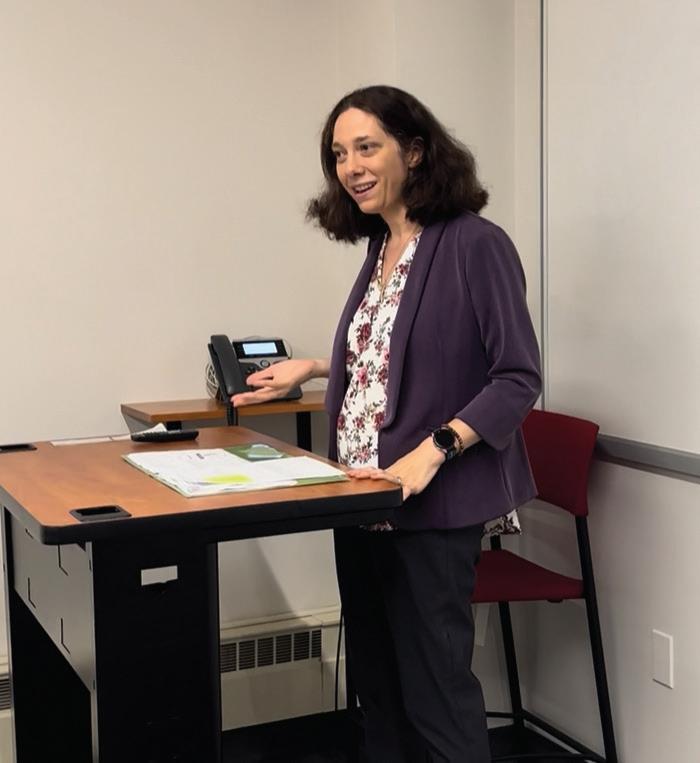
At the start of academic year 2025-2026, the Weinberg Memorial Library implemented six new Information Literacy (IL) Curriculum Learning Outcomes (CLOs). These learning outcomes represent the substance of what students learn through their engagement with the Library during their time at The University of Scranton.
The six new outcomes were the result of a review of the Library’s long-standing IL Program Learning Outcomes, which had been in place since 2014. The new IL CLOs were the result of a collaborative process that included the full Library faculty with input invited from Library administration. After a six-month review and revision process, the Library faculty voted to adopt the new IL CLOs in February 2025 and shared the revisions with the Library Advisory Committee, composed of faculty from all academic departments at the University, in April. The faculty librarians have begun tailoring their information literacy instruction to teach the new outcomes to students across all programs and levels at the University.
The Library faculty decided to review our IL Program Learning Outcomes for several reasons. They were ten years old, so elements felt stale and dated. Both the technology that powers our work and our wider professional understanding of information literacy have evolved since we last reviewed our learning
outcomes. And it was an opportunity to integrate critical and justice-focused approaches to information literacy grounded in the Jesuit educational mission of the University into our instruction. This grounding in the University’s mission is especially relevant in light of the recently approved Ignatian Core Curriculum slated to begin delivery in fall 2026.
After a period of preparation that included discussion of a set of shared readings focused on information literacy, the Library faculty charged a task force made up of the four Research & Instruction Librarians to review the learning outcomes. The task force brought ideas and initial drafts to the full Library faculty and administration in monthly department meetings for discussion and broader departmental input.
In tandem with the outcomes review and revision, the task force proposed that the Library offer a definition of information literacy as we teach it here at the University before presenting the new outcomes in our curriculum. Because information literacy is developed both in and beyond the classroom, the department also revised the scoping statement to be inclusive of the Library’s educational work beyond the traditional classroom setting.
Future plans include mapping the outcomes to the new University core curriculum and the ACRL Framework for Information Literacy for Higher Education, establishing new assessment processes, and creating professional development opportunities and new pedagogies in support of the outcomes. For updates about how the Library is teaching and assessing our new IL CLOs, visit our Information Literacy Curriculum and Assessment page at: www.scranton.edu/academics/wml/infolit/curriculum-assessment/ index.shtml.
—Professor Donna Witek, Information Literacy Coordinator and Research & Instruction Librarian for the Humanities and Ignatian Pedagogy
These are the Weinberg Memorial Library’s six new IL CLOs, along with our description of how we define information literacy at The University of Scranton:
Information literacy is defined by the Association of College and Research Libraries (ACRL) as “the set of integrated abilities encompassing the reflective discovery of information, the understanding of how information is produced and valued, and the use of information in creating new knowledge and participating ethically in communities of learning.”
Information literacy in the context of the University’s Jesuit educational mission is a tool by which researchers transform the world around them into a more just place through a process that includes attentiveness to their experience with information, reflective inquiry as to the meaning of those experiences, and making choices to act in response to what they’ve learned through their engagement with information.
The learning outcomes of the Weinberg Memorial Library’s Information Literacy Curriculum describe the knowledge, skills, and dispositions scholars and learners at the University will develop in support of this process.
Through engagement with the Library’s course-integrated instruction and research services, outreach programming, workshops, exhibits, and services, learners will:
1. Consider the forms and formats of published evidence in different disciplines andcontexts in order to use search systems to meet their research needs.
2. Reflect on their growing knowledge about their research inquiry in order todevelop a search strategy.
3. Use the source evaluation process to seek out diverse information and differing viewpoints in order to become better informed researchers and citizens.
4. Develop an understanding of the role of algorithms and artificial intelligence (AI) within information systems in order to critically evaluate their agency andresponsibility as researchers in complex information environments.
5. Analyze the information contexts and needs encountered within their research inorder to make use of a variety of related literacies (e.g., media, data, digital,privacy, algorithmic, etc.) in their research practices.
6. Examine their information behaviors and practices in light of issues of information access, power, and privilege, in order to develop a critical, justice-informed approach to information use.
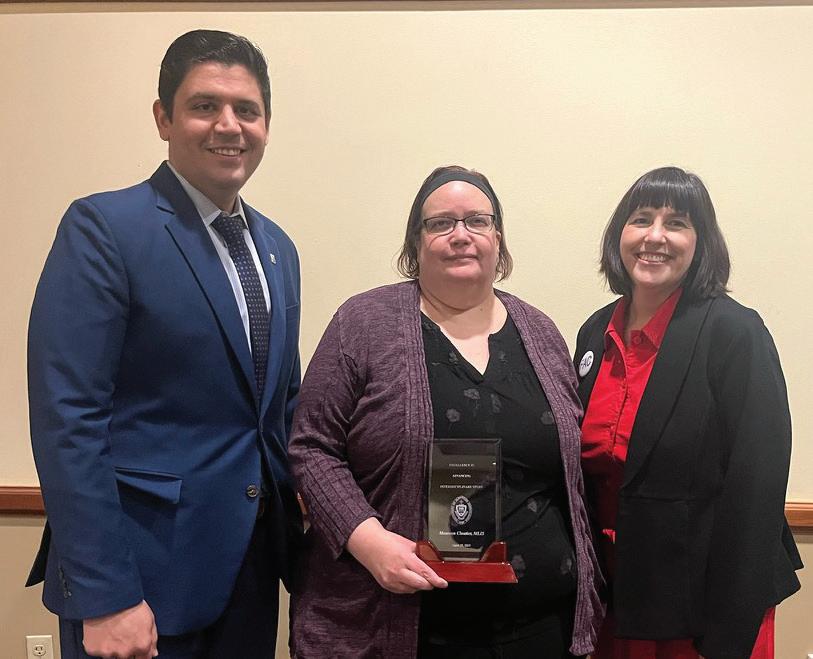
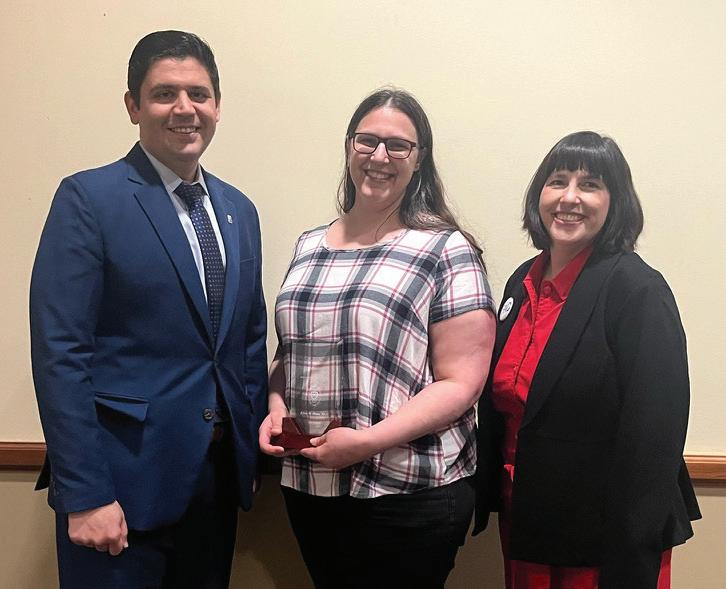
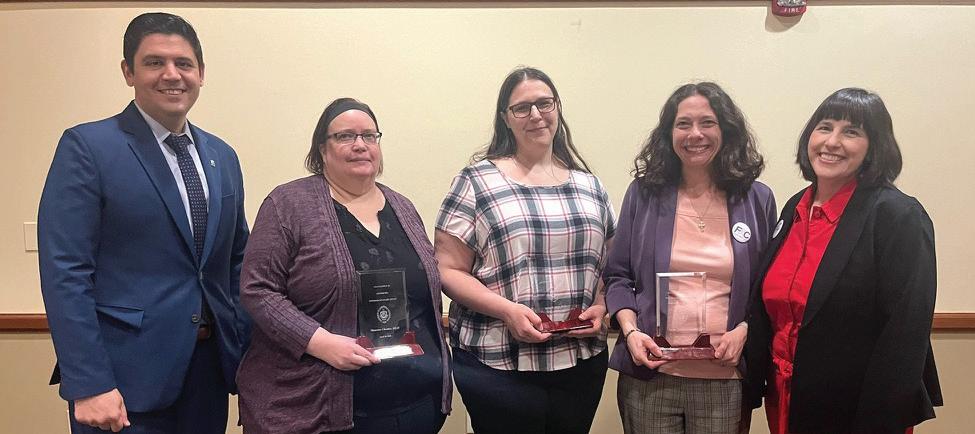
Professor Marleen Cloutier, Cataloging & Metadata Librarian (left photo, center), and Professor Sylvia Orner, Collections & Resource Management Librarian (right photo, center), were named co-recipients of the award for Interdisciplinary Study for their exceptional work implementing the new library management system, discovery layer, and catalog.
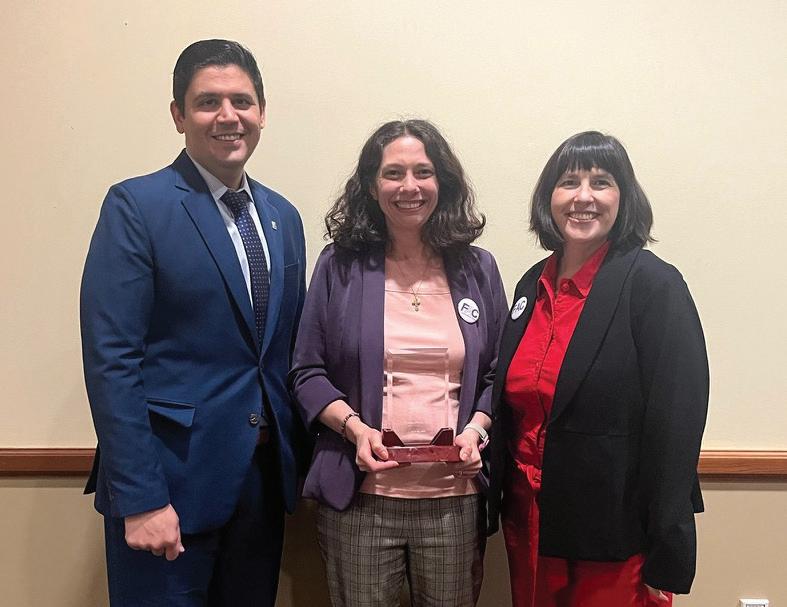
Professor Donna Witek, Research & Instruction Librarian for the Humanities & Ignatian Pedagogy (center), received the Magis Award for adapting classic principles of Jesuit pedagogy into the curriculum, for her outstanding work on the GE curriculum committee, and her work on the Library’s learning outcomes.
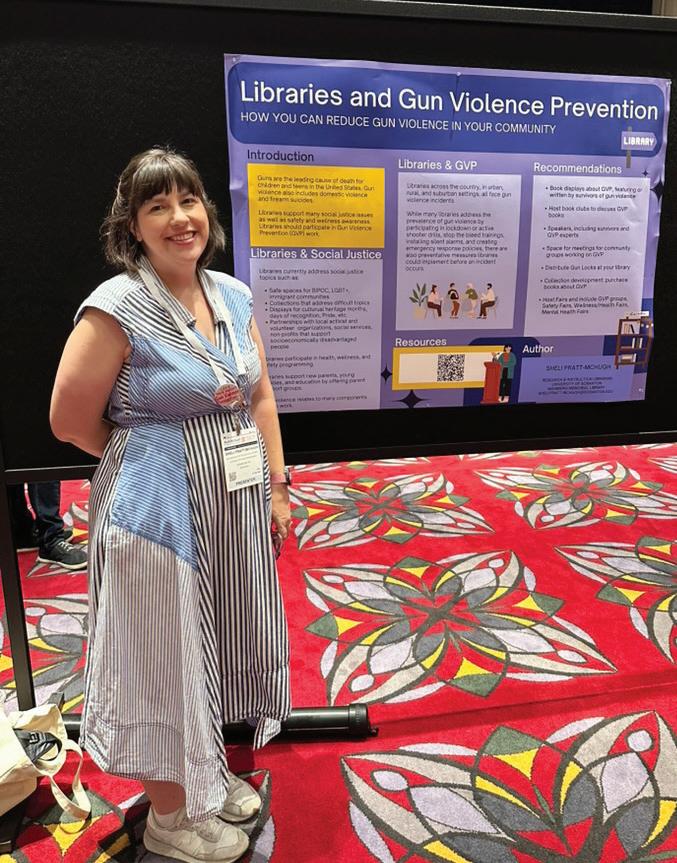
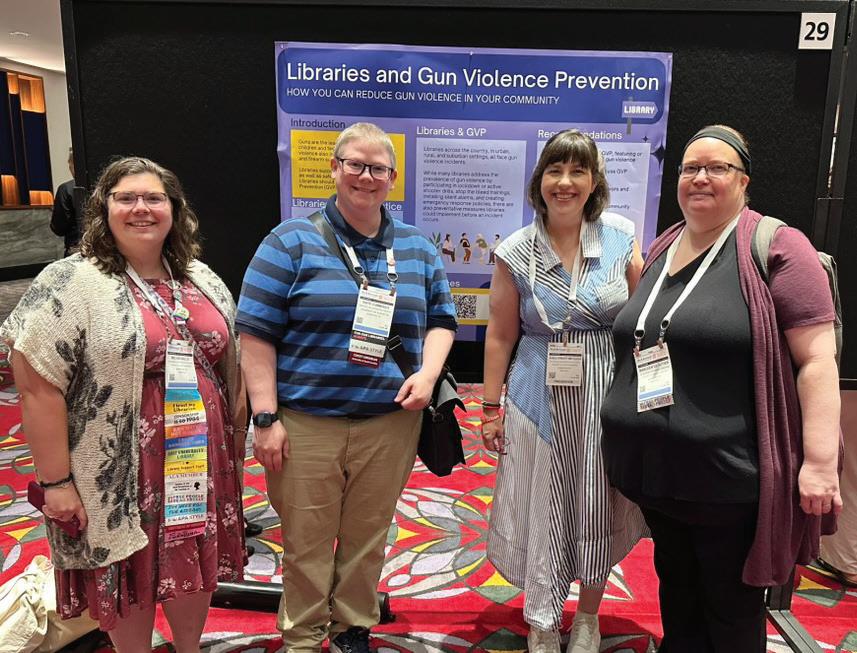
Sheli Pratt-McHugh presented a poster on her research titled, Libraries and Gun Violence Prevention:Howyoucanreducegunviolence inyourcommunity.
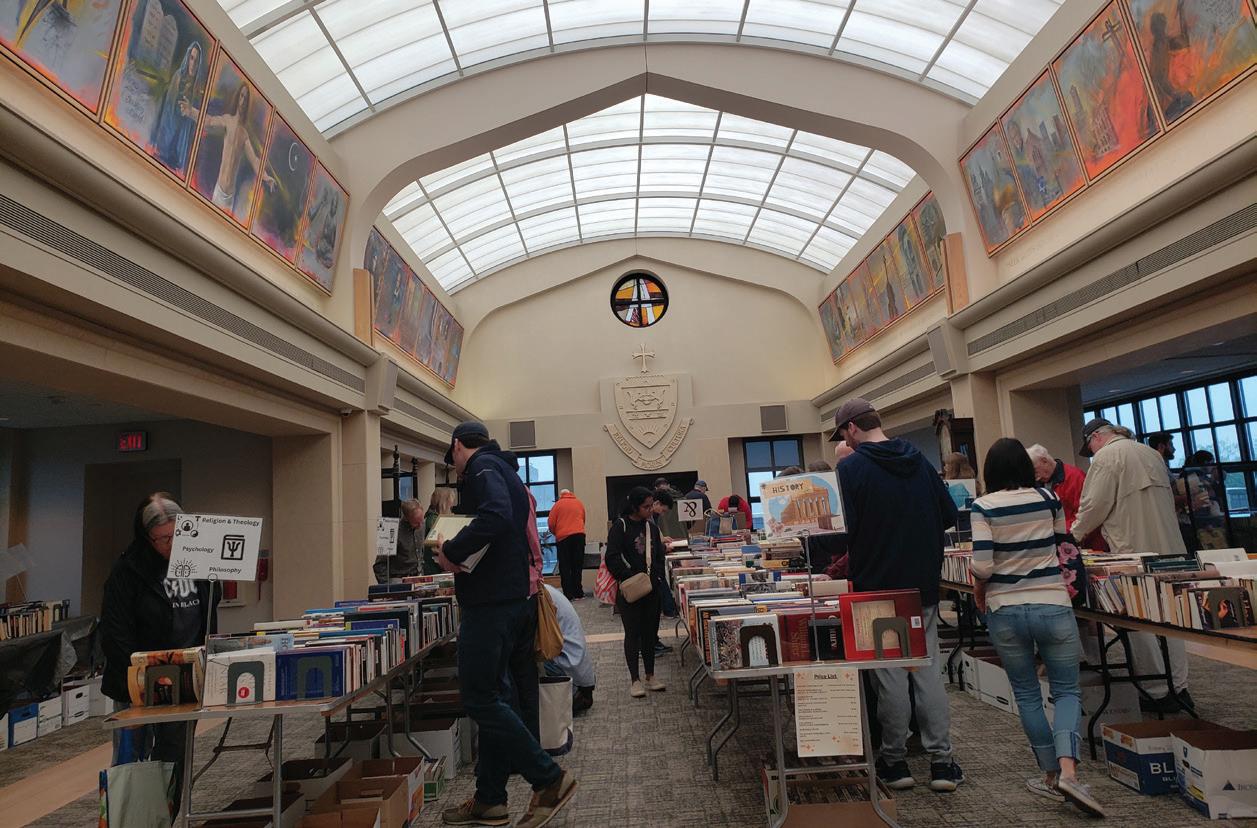
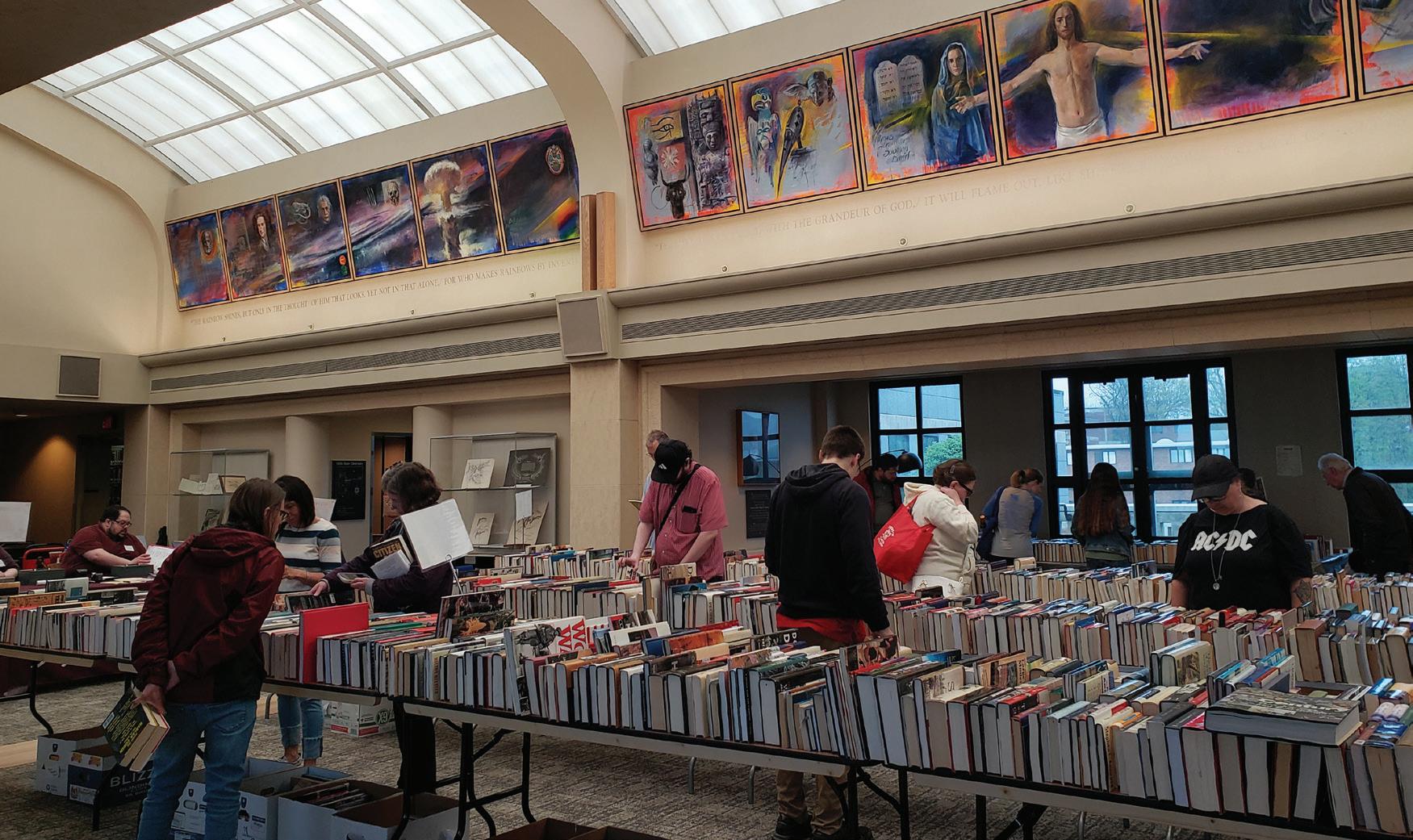
The University of Scranton’s Weinberg Memorial Library held its annual Book Sale during the final weekend of April. The Book Sale continues to be well attended and well received by the community. Volunteers for the sale this year included Weinberg Memorial Library faculty and staff, members of the Friends of the Weinberg Memorial Library, University of Scranton student volunteers, and community members. Thank you to all our volunteers and attendees for your ongoing support of the Weinberg Memorial Library’s book sales!
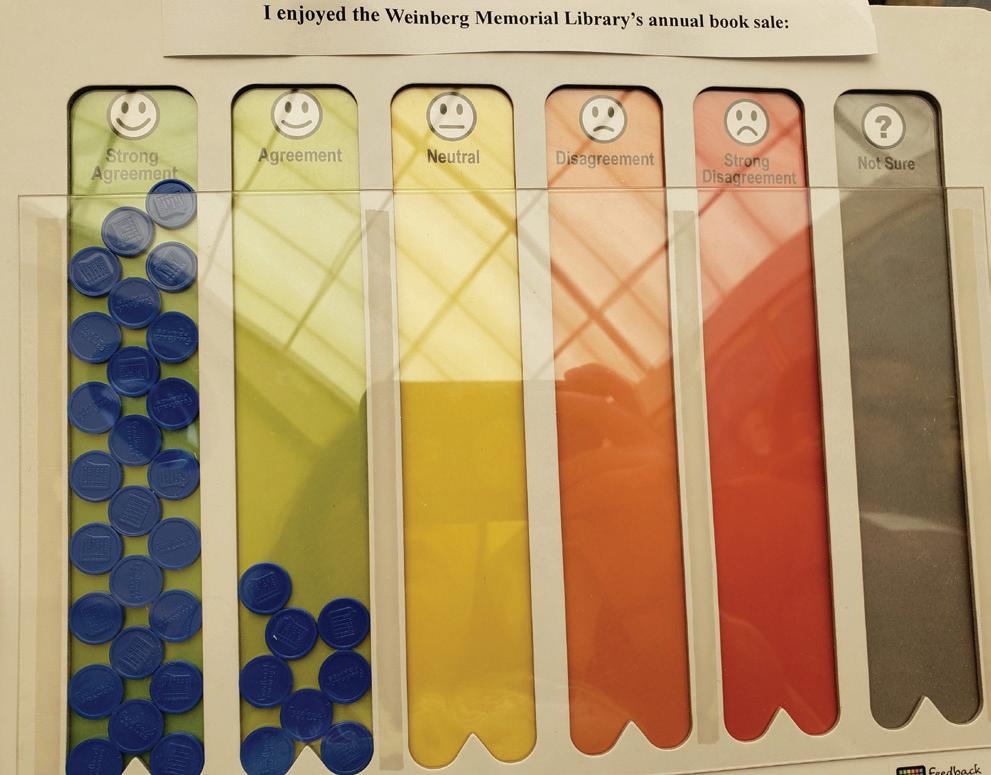
New this year was the use of a Feedback Frame, provided by the Pennsylvania Library Assocation, to receive feedback from attendees at the Book
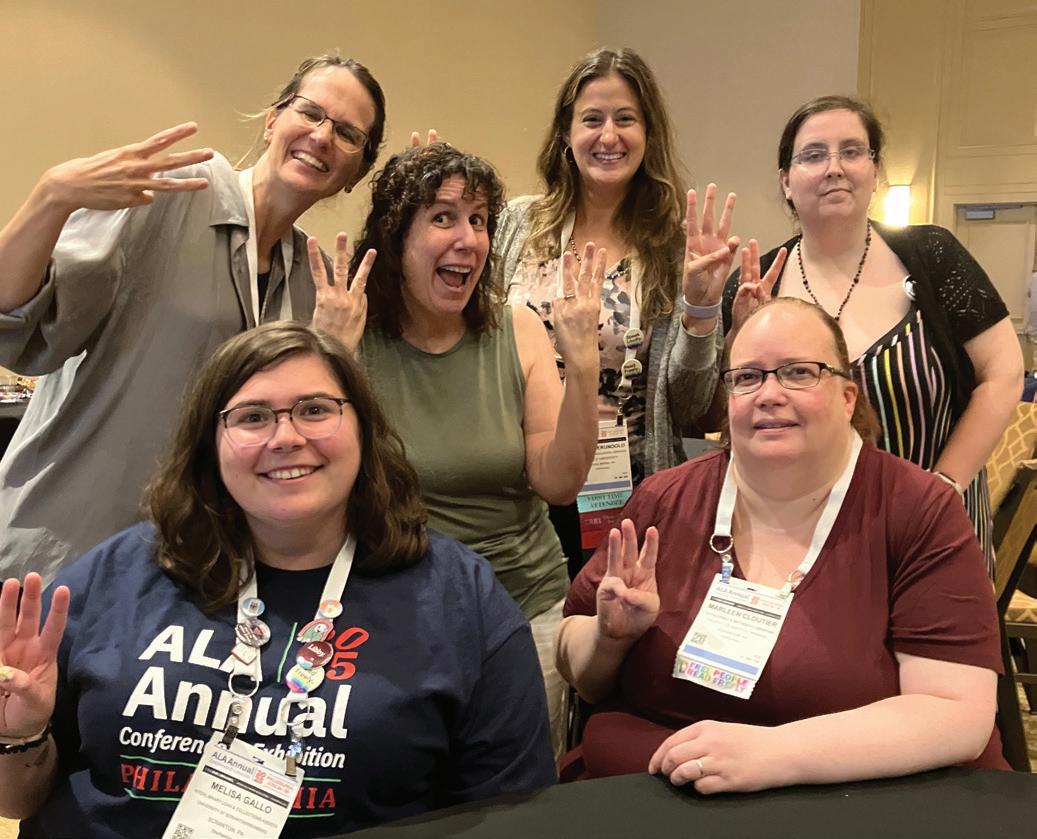
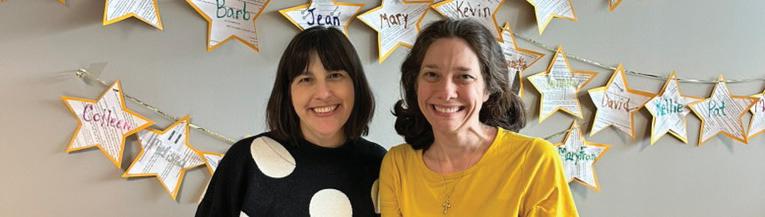
Employees from the Weinberg Memorial Library celebrate National Library Workers Day.
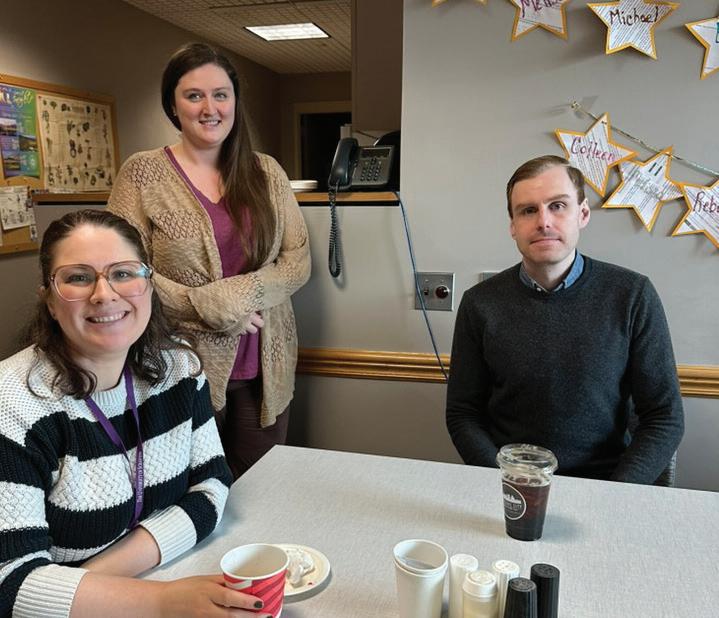
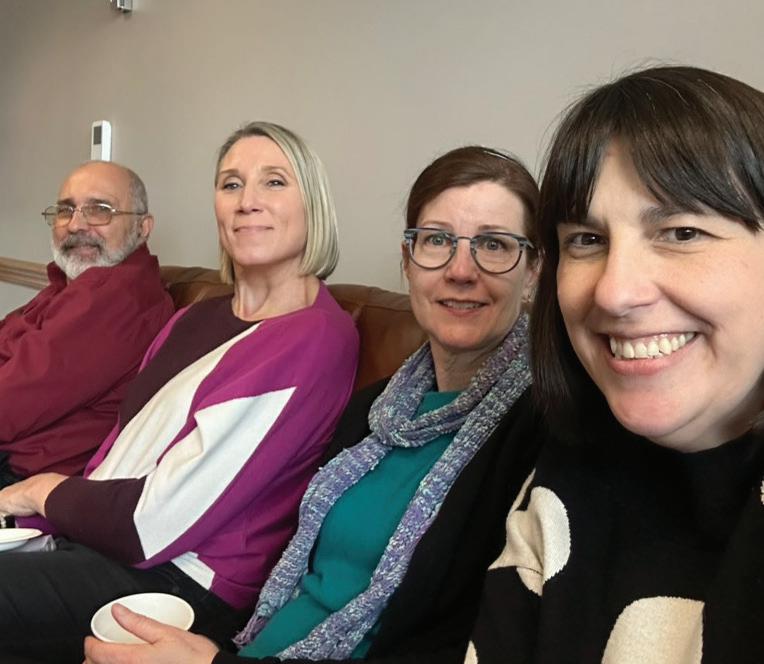
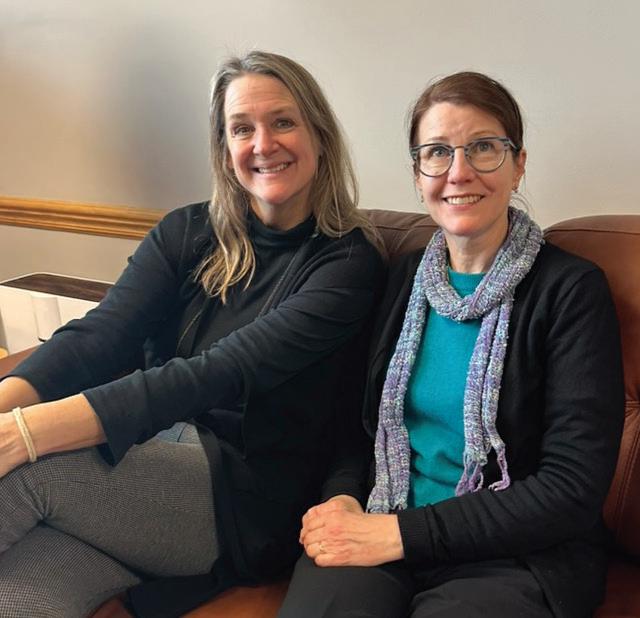
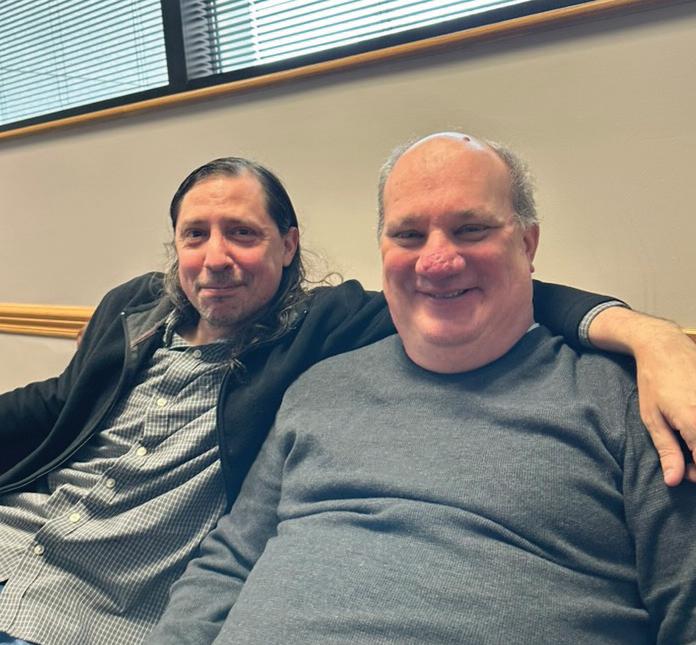

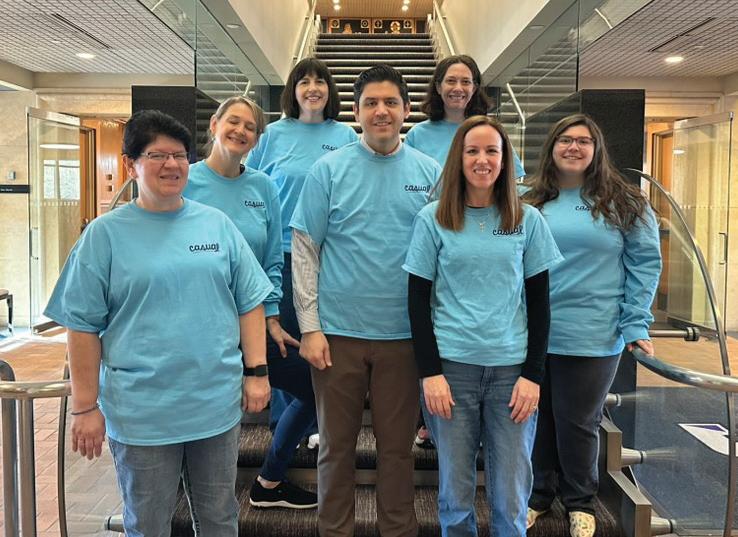
Library employees participated in Casual Day, supporting the Northeast Regional Cancer Institute’s annual event to help raise awareness about the importance of colorectal cancer screenings.
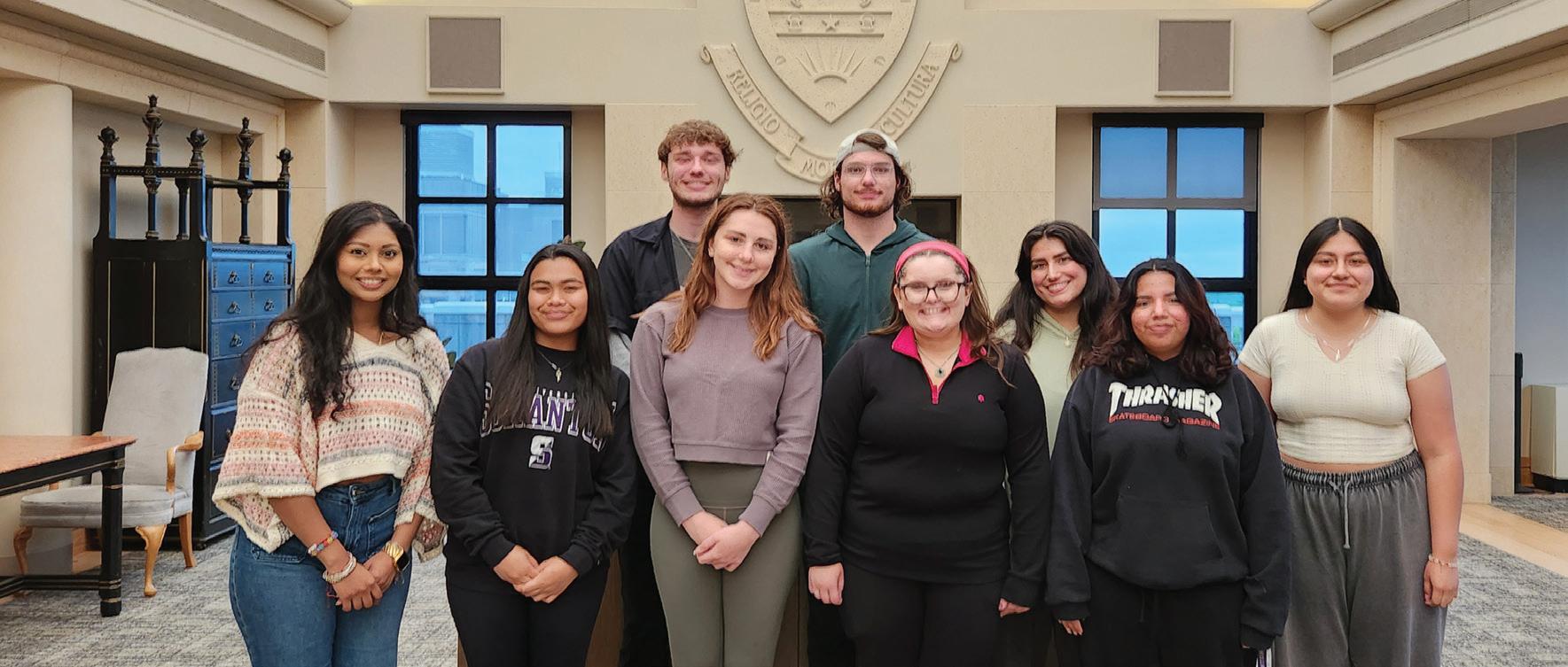
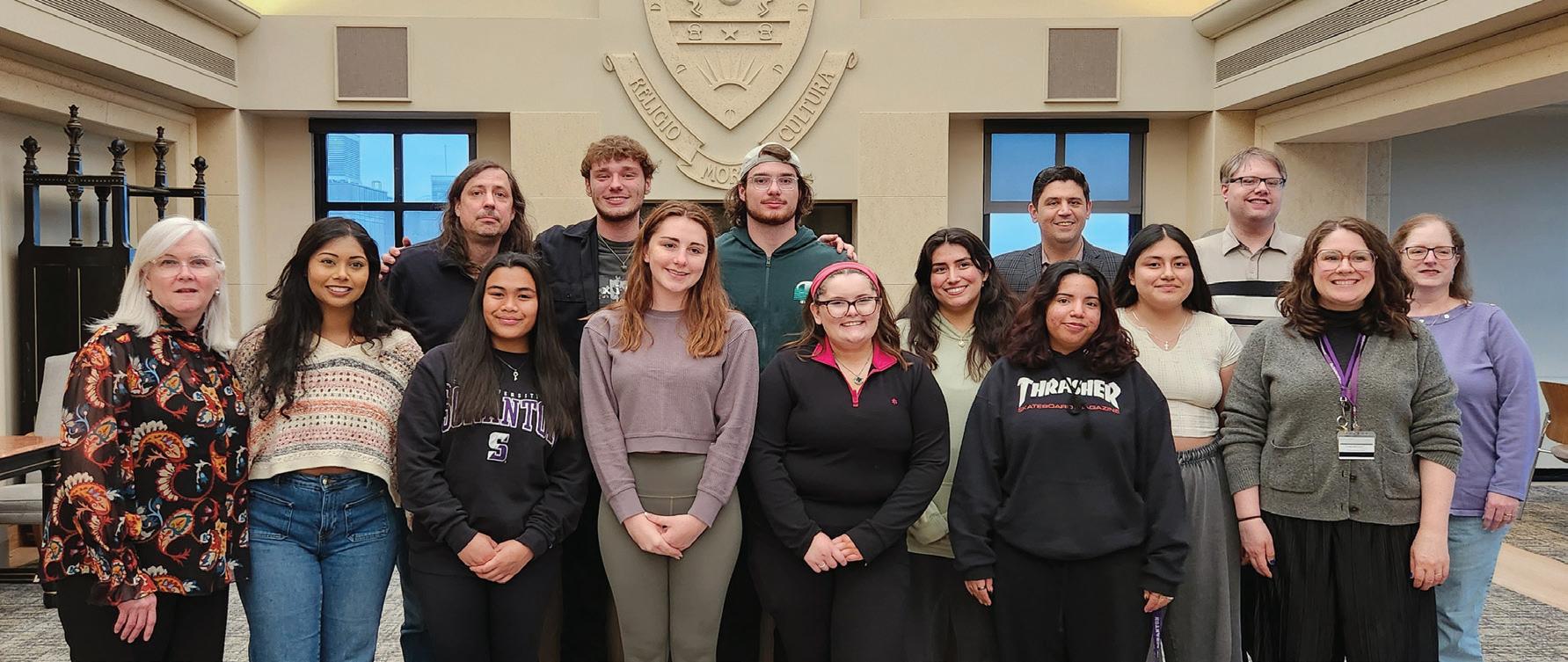
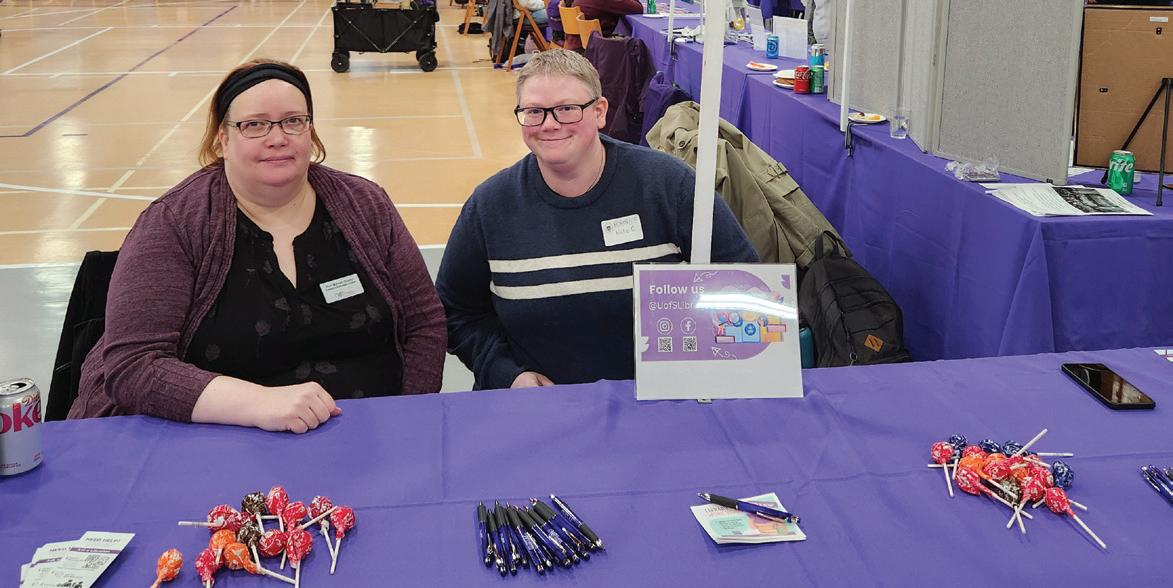
Professors Marleen Cloutier and Kate Cummings welcomed new students and their families at New Student Acceptance Day on April 5, 2025.
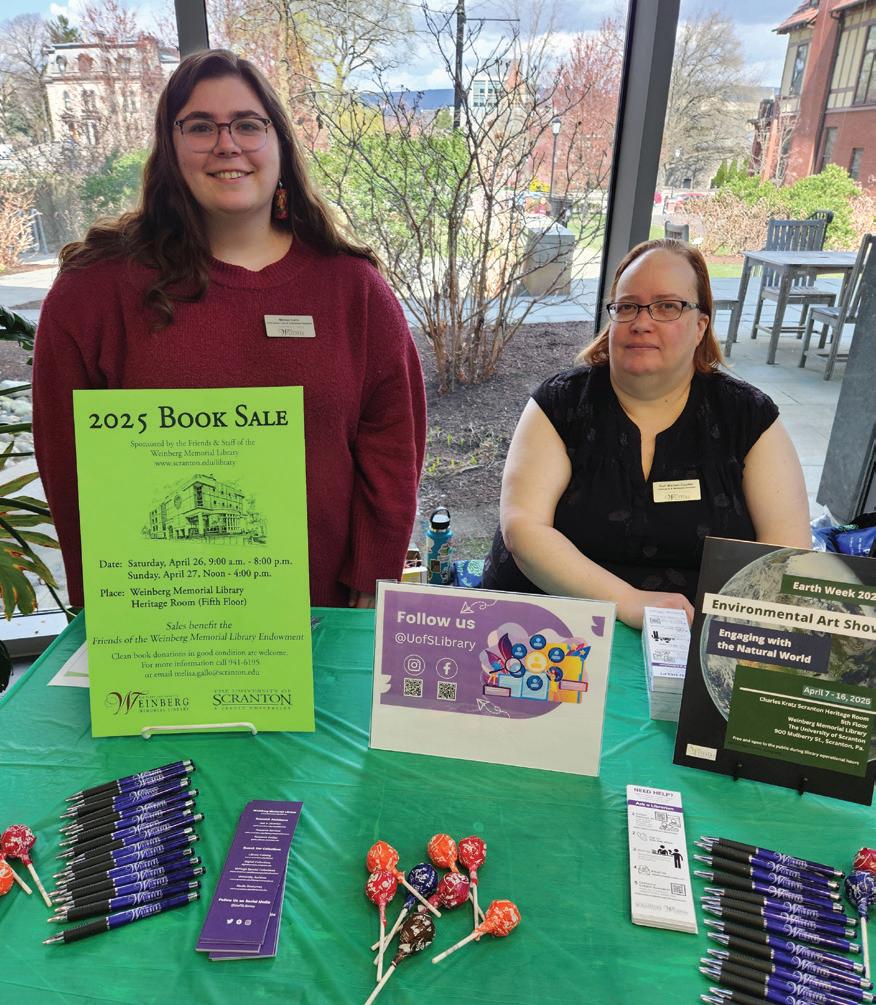
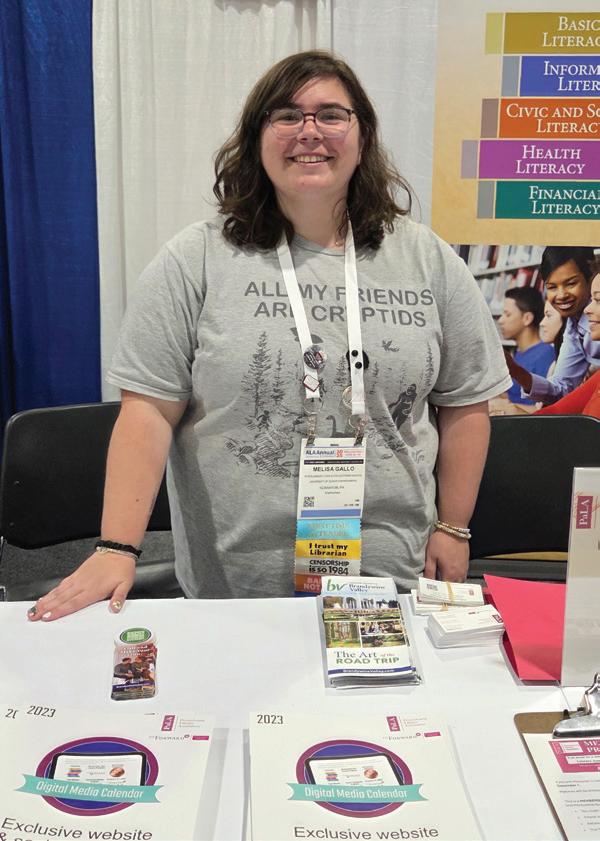
Melisa Gallo, Interlibrary Loan and Collections Assistant, and Professor Marleen Cloutier represented the Weinberg Memorial Library at the 2025 Earth Day Fair on Tuesday, April 15, in the Atrium of the Loyola Science Center.
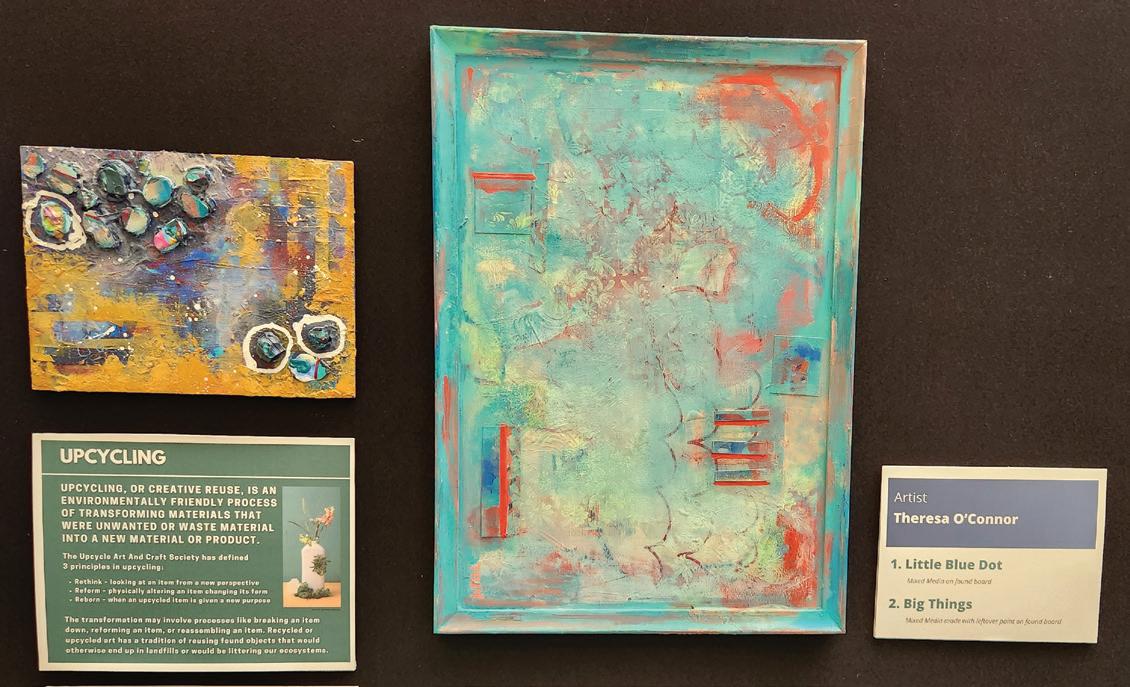
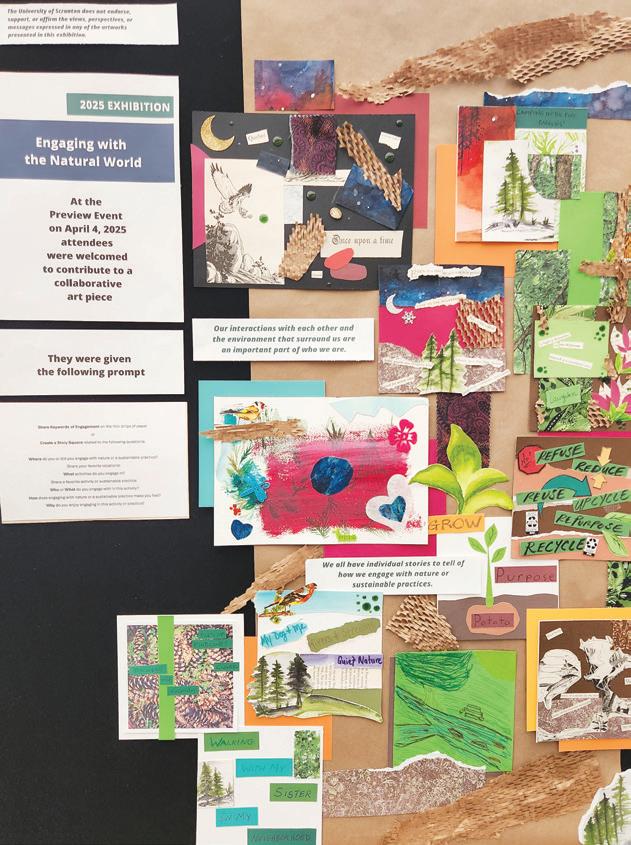
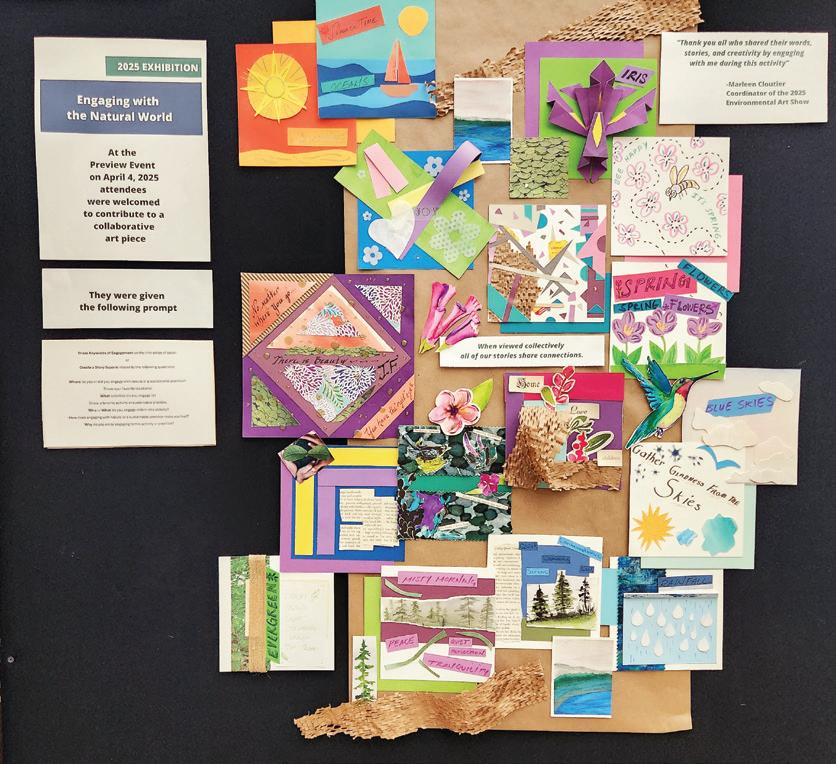
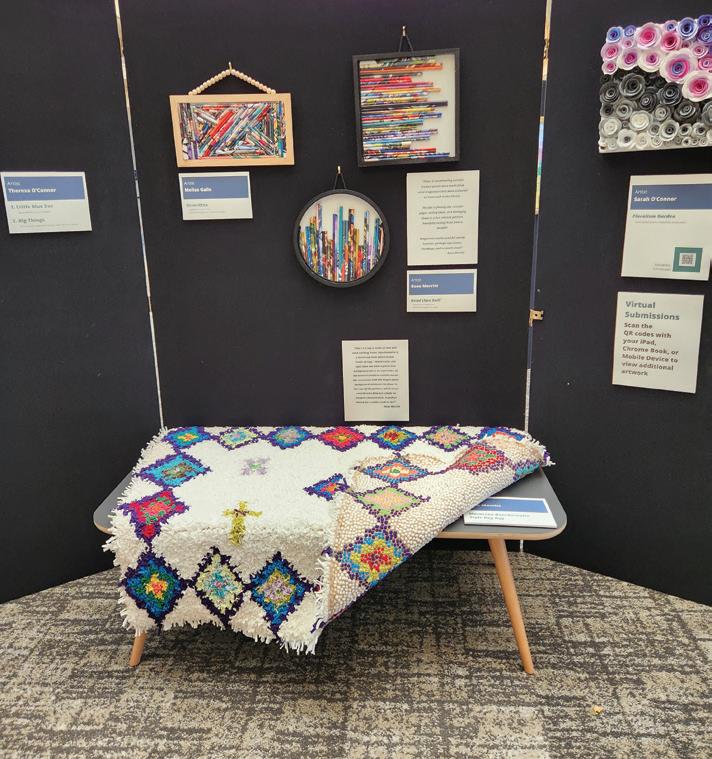
The Weinberg Memorial Library presented the Environmental Art Show, themed Engaging with the Natural World, from April 7-17, 2025. Artists shared their engagement with nature or a sustainable practice which included paintings, drawings, photography, and upcycled works of art and craft. Attendees at the First Friday opening event on April 5, 2025, participated in creating a public art piece sharing their words and stories.
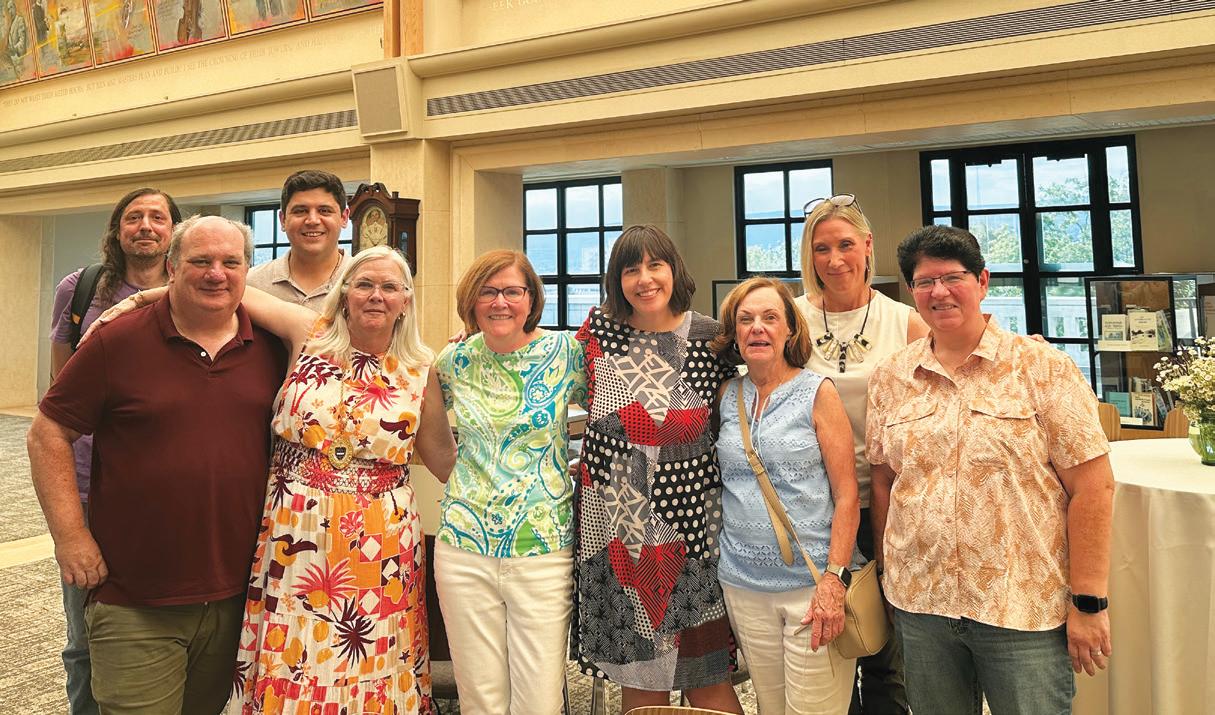
After 27 years of dedicated service, the Weinberg Memorial Library bids a fond farewell to Patricia “Pat” Savitts, Senior Circulation Services Clerk, who retired on July 25, 2025. Pat’s retirement marks the end of an era, and her absence will surely be felt throughout the Library and across campus.
Pat joined The University of Scranton in 1998 as Secretary to the Director of the Library. It didn’t take long for her work ethic and commitment to shine through. In 2004, she transitioned into the role of Circulation Clerk, where she continued to grow and thrive. By 2011, Pat was promoted to Coordinator of Circulation and Access Services—a position she held for more than 20 years with steadfast dedication. Throughout her tenure, she led her department through numerous changes: expanded hours, revised procedures, redefined responsibilities, and even a few name changes.
In 2024, Pat chose to step down from her leadership role, assuming the title of Senior
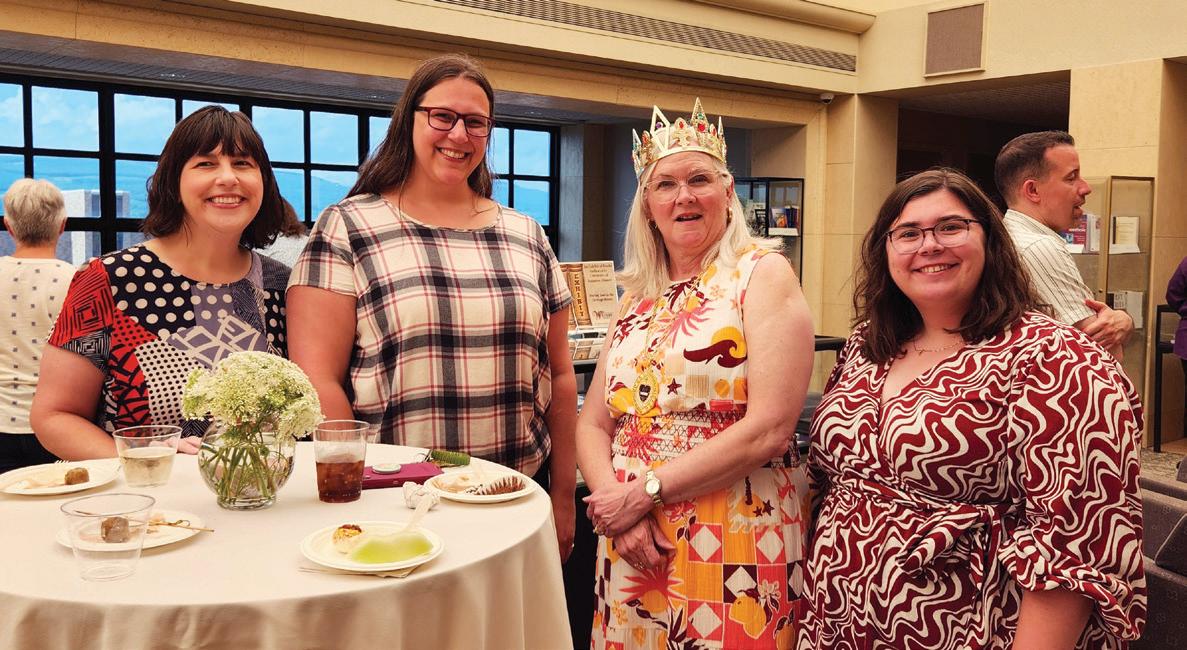
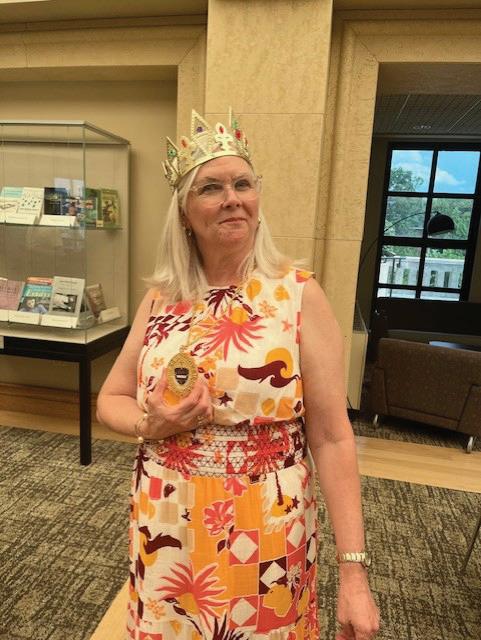
Circulation Clerk while continuing to be the same reliable and supportive presence at the front lines of Library service. From the Circulation Desk—now known as the Library Services Desk—Pat was a constant source of problem-solving expertise, patience, and professionalism. Her contributions have supported the daily operations of the Library and, more importantly, the success of countless students, faculty, and staff.
Pat’s impact extended well beyond her job description. She was a cherished colleague whose kindness, integrity, and willingness to help others created a culture of support and camaraderie. Whether you needed guidance, a quick answer, or just a listening ear, Pat was there.
To honor her legacy, the Library held a retirement celebration in her honor on July 25, 2025, in the Charles Kratz Scranton Heritage Room. Friends, family, and colleagues gathered to share memories, express their gratitude, and toast a career marked by dedication, service, and heart.
We thank Pat for all she has given to the Weinberg Memorial Library and The University of Scranton. We wish her a retirement filled with joy, relaxation, and the same warmth she brought to our community for nearly three decades.
Congratulations Pat, you will be deeply missed!
— George Aulisio, Ph.D., Dean of the Library
Grand Prize: The Schemel Forum (one annual couple’s membership)
Culinary Delights: Dave & Buster’s (two $50 power cards); Domino’s (three coupons for a large pizza with two toppings); Nibbles & Bits ($15 gift certificate with serving plate); Ruth’s Chris Steakhouse ($25 gift card – courtesy of Metz Culinary Management)
Entertainment: Actor’s Circle (pair of FLEX tickets); Everhart Museum (one family-level membership); Hardback Edition of The Hollow Crown (courtesy of Barnes & Noble Booksellers-Lehigh Valley); PNC Bank (four club seats to a Wilkes-Barre/Scranton Penguins hockey game – date TBD); Scranton Cultural Center (voucher for four tickets)
Tres Chic: Hand-knit Shawl (courtesy of Bonnie Strohl); Liztech Pins (bird, dragonfly, and two petals – courtesy of Charles Kratz and William Varady)
And More!: Cardinal Snow Globe (courtesy of Driftwood Antiques); Crystal Pitcher (courtesy of Driftwood Antiques); Hand-crafted Wreath (courtesy of Sheli Pratt-McHugh); Hilton Scranton & Conference Center (overnight stay for two, including breakfast at Trolley’s); Set of Four Spode Pastry Forks (courtesy of Driftwood Antiques)
Grand Prize: Greater Scranton YMCA (six-month family membership)
Culinary Delights: Abe’s ($25 gift certificate); Café Classico ($25 gift certificate); Cooper’s Seafood House ($100 gift card); Dave & Buster’s ($50 power card); Dino & Francesco’s ($25 gift card); Domino’s (two coupons for a large pizza with two toppings); Ruth’s Chris Steakhouse ($25 gift card – courtesy of Metz Culinary Management); TGI Fridays ($25 gift card – courtesy of Metz Culinary Management)
Entertainment: Friends of the WML (two tickets to the Distinguished Author Award event); Hardback Edition of The Truth About the Devlins (courtesy of Barnes & Noble Booksellers-Lehigh Valley); Lakeland Golf Club (gift certificate for two 9 hole rounds, including cart); Scranton Cultural Center (voucher for four tickets)
Tres Chic: Boscov’s (purse, scarf, and bracelet); Compact Mirror (courtesy of Charles Kratz & William Varady); Hand-knit Shawl (courtesy of Bonnie Strohl); Liztech Flower Pin (courtesy of Charles Kratz & William Varady)
And More!: Abstract Painting (courtesy of Kym Fetsko); Amazon ($25 gift card – courtesy of Charles Kratz & William Varady); Basalyga Hospitality ($25 gift card); Buttercream Candle (courtesy of Driftwood Antiques); Crystal Vase (courtesy of Driftwood Antiques); Guy’s Barber Shop ($25 gift certificate); Hand-crafted Wreath (courtesy of Sheli Pratt-McHugh); Lackawanna Heritage Valley (gift basket); Medicus Express Care (first aid kit); Scranton Running Co. (gift basket including $25 gift card); Settlers Hospitality (mid-week overnight stay at the Chestnut Inn, including breakfast); Swedish Sponge and Doilies (courtesy of Charles Kratz & William Varady); Wine Glasses (two) (courtesy of Driftwood Antiques)
is an annual fundraiser organized by the Friends of the Weinberg Memorial Library with proceeds supporting the Weinberg Memorial Library Endowment Fund. We hold four drawings per year and tickets can be purchased online or in person. Visit scranton.edu/library for more information.
• Melissa Crotti joined the professional staff as our new Library Services Department Coordinator on March 31, 2025.
• Kym Fetsko resigned as Assistant to the Dean of the Library and Schemel Forum Events Coordinator on April 11, 2025.
• Ian O’Hara, Research & Instruction Librarian for Health Sciences, was appointed as Research & Scholarly Services Coordinator on May 17, 2025.
• Patricia Savitts, Senior Library Services Clerk and former Library Services Coordinator, retired on Friday, July 25, 2025, after 27 years of service.
The Harry and Jeanette Weinberg Memorial Library
Scranton, Pennsylvania 18510- 4634
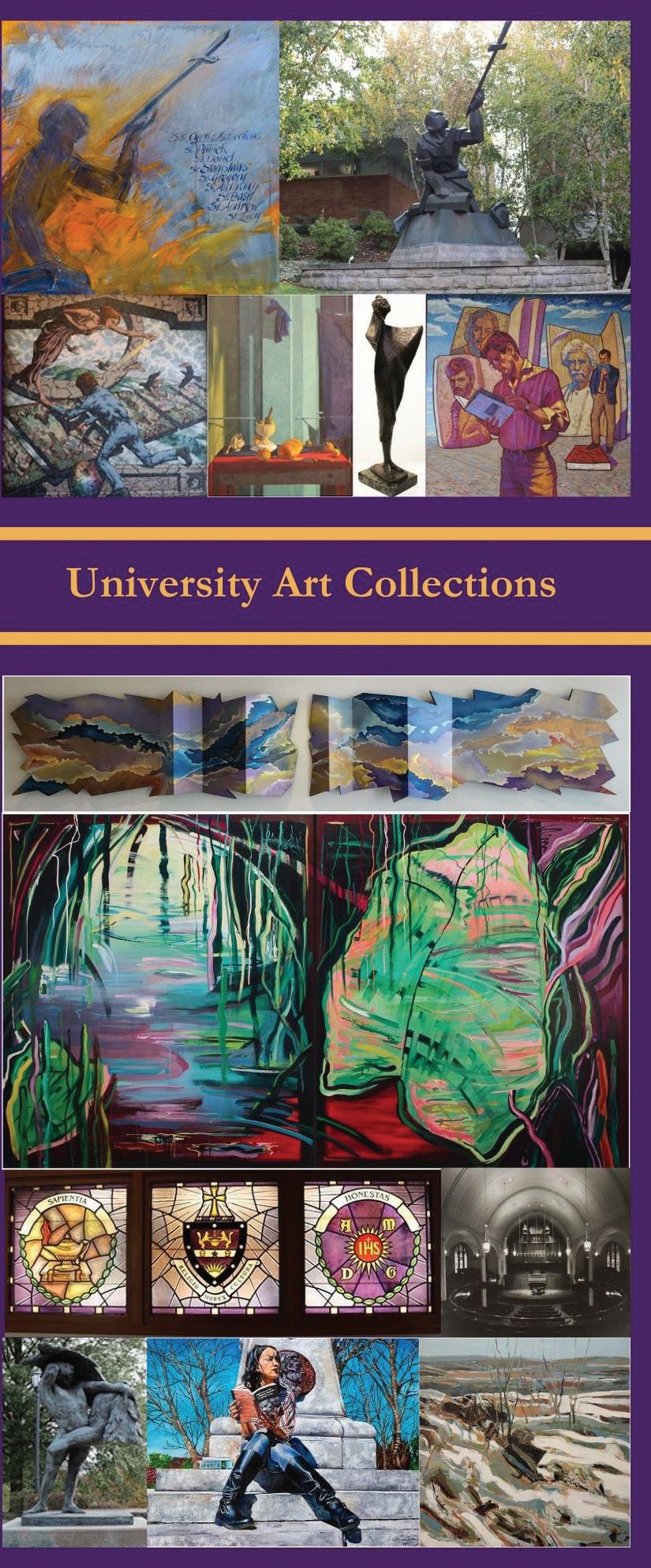
University Art Collections artwork featured on front cover:
Row 1: Religion in Scranton Panel 4, Trevor Southey; Metanoia, Gerhard Baut
Row 2: The Commissioned Artist, Louis N. Pontone; Twilight State of Perfect Clarity, Renée Foulks; Figure with Drape, Hope Cumming Horn; Global Literature, Brian Keeler
Row 3: “Untitled” Angled Diptych, Predrag Djordjevic
Row 4: Lilith Swamp Diptych, Berenice D’Vorzon
Row 5: Stained Glass Panels from Gunster Hall, Hank Fells; Houlihan McLean Center, University of Scranton, Wilson Tifft
Row 6: Jacob Wrestling with the Angel, Arlene Love; Frederick Douglass, Travis Prince; Lackawanna Valley, Earl W. Lehman
Newsletter from the Harry and Jeanette Weinberg Memorial Library Scranton, Pa 18510-4634
Co-Editors: Sheli Pratt-McHugh and Marleen Cloutier
Dean of the Library: George J. Aulisio, Ph.D.
Phone: 570-941-7816