ALSO: SFNET ECONOMIC IMPACT STUDY & ABL CREDIT QUALITY PREDICTS STRESS SEPT/OCT 2026 WWW.SFNET.COM
Working TSL COVER STORY
Capital in Action FROM TRANSFORMATIVE TRANSACTIONS TO INSIGHTS INTO INDUSTRIES SEEKING CAPITAL, SEE HOW SECURED FINANCE POWERS GROWTH AND RESILIENCE
TOUCHING BASE WORKING CAPITAL IN ACTION
Connecting Businesses, Lenders and Opportunity Secured finance has always been a relationship business—one built on expertise, creativity, trust and a shared commitment to helping companies move forward. At SFNet, we see every day how asset-based lending, factoring and other supply chain finance solutions can provide businesses with the working capital, flexibility and confidence needed to pursue opportunity, manage change and navigate challenging periods. In this issue of The Secured Lender, we highlight those connections through real-world deal stories from our members and a closer look at the growing network of associations that helps bring prospective borrowers and SFNet members together. Our “Anatomy of a Deal” case studies, beginning on page 4, offer an inside view of how secured finance professionals approach complex situations and develop solutions tailored to each borrower’s needs. These transactions are a reminder that behind every facility is a business with its own story: a company managing rapid growth, addressing a liquidity constraint, completing an acquisition, weathering a turnaround or simply seeking capital that better reflects the value of its assets. The featured deals in this issue illustrate the essential role SFNet members play in translating challenges into opportunity. They demonstrate the range of expertise across the secured finance community, from underwriting and collateral analysis to structuring, diligence and execution. They also reinforce a central truth about our industry: capital is most effective when paired with an understanding of a company’s operations, markets and ambitions. For business leaders, the world of financing can sometimes seem complicated or inaccessible. Many executives are familiar with traditional bank loans, but may not fully understand how asset-based lending and factoring can support working-capital needs, unlock value in accounts receivable and inventory, and provide flexibility as conditions change. This is where SFNet can play an integral role, providing education and fostering connections. Our Alliance Partner Program is designed to extend that mission beyond the secured finance community. Through the program, SFNet partners with trade associations whose members include businesses that may be prospective borrowers for our members. These partnerships create a
bridge between industries seeking practical capital solutions and the professionals with the knowledge and resources to provide them. This issue, which will be distributed to prospective borrowers, features our first Alliance Partner section, beginning on page 38, where readers will learn more about the organizations and their industries RICHARD D. GUMBRECHT working with SFNet SFNet Chief Executive Officer to expand awareness of secured finance. These partnerships reflect the power of association-toassociation collaboration: when trade groups share information and connect their members to knowledgeable financing professionals, businesses are better positioned to make informed decisions and respond to both challenges and opportunities. A tangible demonstration of the positive effects of our industry is the recently published SFNet 2026 Secured Finance Economic Impact Study. The study finds our industry is an often-overlooked segment of the credit markets that provides a significant source of capital. See details on page 28 (Spoiler alert: ABL and factoring contribute approximately $173 billion annually to the U.S. economy, adding a substantial 0.5% to GDP, and supporting an estimated 773,000 additional U.S. jobs.) Another exciting data-related item is on page 24, The Signal in the Survey: ABL Credit Quality as an Early Warning of Systemic Stress. New academic research conducted by Hao Ding, PhD, postdoctoral research fellow at the University of Oxford, finds that the numbers SFNet members report every quarter carry information about system-wide financial stress up to two years before it arrives. As you read the content of this issue, I encourage you to consider the broader impact of our industry. The work of secured finance professionals often takes place behind the scenes, but its results are felt throughout the economy. Our members provide the capital and counsel that help businesses keep moving, invest in their futures and realize their potential.
Rich Gumbrecht Chief Executive Officer Secured Finance Network
TABLE OF CONTENTS. SEPT/OCT. 2026 VOL. 82 ISSUE 5
COVER STORY DEAL SPOTLIGHT P4
SFNet Deal Spotlight This section highlights real-world transactions completed by SFNet members, demonstrating how secured finance delivers critical capital, fuels growth, and helps businesses navigate challenges. Through these deals, readers can see the tangible impact our industry has on companies, communities, and the broader economy. 4
FEATURE STORIES
The Signal in the Survey: ABL Credit Quality as an Early Warning of Systemic Stress New academic research finds that the numbers SFNet members report every quarter carry information about system-wide financial stress up to two years before it arrives, and that they add predictive power the traded market does not supply. The survey’s nonaccrual rate has just posted its highest reading since 2011. 24 BY HAO DING, PHD
2
THE SECURED LENDER SEPT/OCT. 2026
The $173 Billion Impact: How ABL and Factoring Help Power the U.S. Economy SFNet’s 2026 Economic Impact Study finds asset-based lending and factoring increase U.S. GDP by 0.5% and support nearly 800,000 American jobs. 28 BY THE SECURED LENDER
Interview with Betty Hernandez, Retiring President of SFNet Betty Hernandez, executive vice president/chief credit officer of SLR Business Credit, reflects on her year as SFNet president, including new programs and events launched during her tenure and opportunities in the year ahead. 32 BY MICHELE OCEJO
Del Monte Foods – Is the Juice Worth the Squeeze for Non-Pro Rata DIP Roll-Ups? As DIP financing and liability management transactions continue to reshape restructuring strategy, this article offers timely guidance for secured lenders navigating roll-ups, ratable sharing provisions, and participation rights. 34 BY JOHN VENTOLA, JONATHAN MARSHALL, MICHAEL COMERFORD, LUKE BARRETT, AND ALEXANDRA THOMAS
Articles FOOD INDUSTRY INSIGHTS
Frozen Food's Middle Market Is an Underserved Credit Opportunity Frozen food has moved from backup dinner option to everyday growth engine, reshaping how consumers shop and how manufacturers finance production. 38 BY MICHELE OCEJO PRECISION TOOL INDUSTRY INSIGHTS
Forging Ahead: How Flexible ABL Financing is Fueling Growth for U.S. Manufacturers For manufacturers, growth often depends on having capital that moves as quickly as the business does. 40 BY THE SECURED LENDER MACHINING & TOOL INDUSTRY INSIGHTS
Understanding the Financing Needs of America’s Machining and Tooling Industry Precision manufacturing may operate behind the scenes, but its financing needs are central to the strength of America’s industrial supply chain. 42 BY MICHELE OCEJO DISTILLERS INDUSTRY INSIGHTS
Understanding the Financing Needs of America’s Spirits Industry From family-owned craft distilleries producing a few hundred barrels annually to global spirits companies managing extensive brand portfolios. 44 BY THE SECURED LENDER
DISTILLERS INDUSTRY INSIGHTS
Turning Inventory Into Growth Capital: Secured Finance for Spirits Companies For distillers, importers and distributors, growth can create a cash-flow challenge long before it creates a profitability problem. 48 BY THE SECURED LENDER SFNET MEMBER PROFILE
Aurous: The Value-Added PO Lender Aurous Financial SVCS LLC draws on deep manufacturing and supply-chain experience to finance purchase orders and production costs on a transaction-by-transaction basis. 50 BY EILEEN WUBBE TSL PULSE
The Secured Lender’s Industry Pulse What’s the biggest gap you see between what students learn in school and what they need to know on day one in a secured nance role, and how can internships or campus programs help close that gap? 52 BY EILEEN WUBBE RESTRUCTURING INSIGHTS
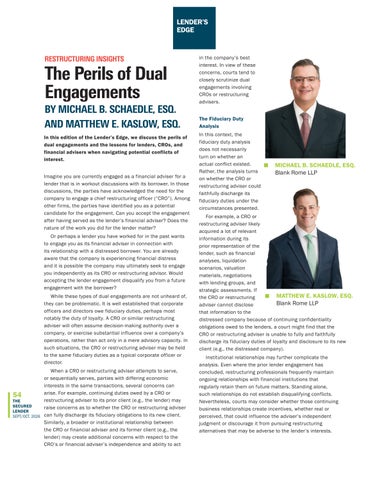
The Perils of Dual Engagements In this edition of the Lender’s Edge, the perils of dual engagements and the lessons for lenders, CROs, and financial advisers when navigating potential conflicts of interest are discussed 54 BY MICHAEL B. SCHAEDLE, ESQ. AND MATTHEW E. KASLOW, ESQ.
Departments TOUCHING BASE 1
The Secured Finance Network is the trade group for the asset-based lending arms of domestic and foreign commercial banks, small and large independent finance companies, floor plan financing organizations, factoring organizations and financing subsidiaries of major industrial corporations. The objectives of the Association are to provide, through discussion and publication, a forum for the consideration of inter- and intra-industry ideas and opportunities; to make available current information on legislation and court decisions relating to asset-based financial services; to improve legal and operational procedures employed by the industry; to furnish to the general public information on the function and significance of the industry in the credit structure of the country; to encourage the Association’s members, and their personnel, in the performance of their social and community responsibilities; and to promote, through education, the sound development of asset-based financial services. The opinions and views expressed by The Secured Lender’s contributing editors and authors are their own and do not necessarily express the magazine’s viewpoint or position. Reprinting of any material is prohibited without the express written permission of The Secured Lender. The Secured Lender 0888-255X, Copyright © 2026 by Secured Finance Network is published 6x per year (Jan/ Feb, March, June, July/Aug, Sept/Oct, November) by SFNet, 875 6th Ave, Ste 1802, NY, NY 10001. Business and Editorial Offices: 875 6th Ave., Ste 1802, NY, NY 10001, Accounting and Circulation Offices: 875 6th Ave, Ste 1802, NY, NY 10001 Call (212) 792-9390 to subscribe. Periodicals postage is paid at New York, NY, and additional mailing offices (if applicable). Secured Finance Network 875 6th Ave., Suite 1802, New York, NY 10001 (212) 792 -9390 Email: tsl@sfnet.com www.SFNet.com Periodicals postage paid at New York, NY, and at additional mailing offices. Postmaster, send address changes to The Secured Lender, c/o Secured Finance Network, 875 6th Ave., Suite 1802, New York, NY 10001 Editorial Staff Michele Ocejo Editor-in-Chief and SFNet Communications Director mocejo@sfnet.com Eileen Wubbe Senior Editor ewubbe@sfnet.com Aydan Savaser Art Director asavaser@sfnet.com Advertising Contact: James Kravitz Chief Business Development Officer T: 646-839-6080 jkravitz@sfnet.com
3
THE SECURED LENDER SEPT/OCT. 2026
DEAL SPOTLIGHT THE ANATOMY OF A DEAL
When Structure Meets Opportunity BY ANDREW COONEY
Some of the most compelling deals arise when a great business simply finds itself without the right capital partner. That was precisely the situation when Altriarch was introduced to a West Coast-based manufacturer with more than 50 years of operating history, industry-leading products, and a capital base in need of a restructure. With core offerings that include stud finders, wall scanners, metal detectors, and water leak detection systems, this company has become a household name in the home improvement and light construction space. Over the last 50 years, the products of this company have made it the market leader in its category, serving both professional contractors and the broader DIY consumer base. Those tools are stocked in the largest home improvement and e-commerce retailers in the country, and its intellectual property portfolio reflects decades of consistent innovation. The Company approached Altriarch during a situation where its current credit profile reflected something a traditional lending facility isn't always built to accommodate: a fundamentally sound business temporarily pressured by forces outside its control. The tariff environment over the past two years had meaningfully compressed margins and strained working capital, as the cost of goods sourced from international manufacturing partners increased faster than pricing could offset. As those headwinds worked through the financials, the Company found itself seeking a more flexible capital partner that was willing to look past a difficult trailing period and underwrite the business on the full strength of its collateral and competitive position. Rather than anchoring availability to recent earnings, Altriarch underwrote the business on the underlying collateral, which was investment-grade receivables from the country's largest home improvement retailers, as well as inventory that was validated through a field exam process. Additionally, the Company has a decades-old brand with durable shelf positioning. By engineering a borrowing base around the 4 quality of those assets, Altriarch was able to provide additional THE availability while maintaining the principal protection that SECURED LENDER defines responsible asset-based lending. The result was a SEPT/OCT. 2026 facility that gave the Company the liquidity runway it needed, anchored by a well-defined borrowing base.
A Capital Structure That Needed Catching Up Founded in the 1970s, the Company had navigated five decades of market cycles, technological shifts, and various consumer trends. It had built its competitive moat through product innovation, a deep retail partnership and distribution network, and a significant IP portfolio that continues to generate commercial opportunities. In recent years, the ANDREW COONEY Company experienced Altriarch operational obstacles as a result of a post-COVID environment and tariff uncertainty. Those challenges included supply chain diversification across multiple manufacturing geographies, shifting inventory profiles, and the pressure of sustained tariff uncertainty. These were not signs of a business in decline, but the natural friction of a company actively investing in its own resilience. By early 2026, the cost structure had normalized, and a pipeline of new product launches was actively coming to market, including next-generation detection devices and smart-home sensor products targeting the growing connected-home category. With those tailwinds building, the Company was positioned for meaningfully improved performance heading into the second half of the year. What it needed was a capital partner with the conviction to underwrite that trajectory. "Tariffs, among other unforeseen circumstances, created a real earnings headwind for this business, which we understood going in. We also knew the underlying collateral, which consists primarily of receivables from investment-grade retailers, didn't change because of those headwinds. However, the underlying collateral was only part of the conviction. Spending time with the management team during underwriting made it clear that the team consists of long-tenured operators who know the business inside-and-out. The management team has navigated real cycles and was candid about the challenges that occurred. The combination of a strong asset base and a strong management team is a big reason why we are comfortable with this loan," said Andrew Cooney, senior vice president, Investments, Altriarch. Built for Stability & Sized for Growth Altriarch structured and ultimately closed a $12.5M senior secured asset-based revolving credit facility, which includes a $5M accordion feature, for a max commitment of $17.5M. The facility is backed primarily by accounts receivable and was carefully engineered to provide additional working capital to the Company. At the same time, Altriarch maintains strong collateral coverage and principal protection
independent of any growth assumptions by the Company. The borrowing base structure and mechanics, which contain clearly defined eligibility criteria and ongoing collateral monitoring, provide a structure that works for both Altriarch and the Company over the long term. At close, the proceeds from the facility were used to refinance the Company’s existing debt obligations and provide additional liquidity that was used to fund new product launches and strategic growth initiatives. The $5M accordion feature was included due to the Company’s strong pipeline of new products that are set to materialize in the next 6-18 months. The Right Deal at the Right Time Altriarch's edge as a lender isn't always based on speed or size. Complex structuring and the ability to evaluate a business on its full merits rather than a trailing 12-month income statement are what separates Altriarch from traditional asset-based lenders. This transaction is a clear expression of that philosophy. The Company's financials had been pressured by a multiyear tariff environment that compressed margins and complicated working capital planning. However, the collateral was real, the retail relationships were durable, and the management team had navigated the business through harder cycles than this one. Altriarch's underwriting began and ended with those fundamentals rather than a few ratios that happened to be temporarily off trend. That distinction is the primary reason transactions like this one get done in a way that works for the borrower and the lender.
facility is designed to provide a capital structure that grows alongside the Company, which means this relationship is built for long-term success. That said, Altriarch’s work does not end when the loan closes, as the loan must be monitored closely to ensure the collateral remains intact throughout the life of the facility. About Altriarch Asset Management, LLC Altriarch is a private credit firm based in Charleston, South Carolina, specializing in asset-based credit solutions for fragmented markets underserved by traditional lenders. Managing nearly $450 million in assets, Altriarch delivers structured financing to alternative lenders and small businesses seeking flexible capital backed by tangible assets. Each facility is meticulously designed to match the precise cash flow needs of borrowers, making Altriarch a trusted partner to fuel business expansion.
Tariffs, among other unforeseen circumstances,created a real earnings headwind for this business, which we understood going in. We also knew the underlying collateral, which consists primarily of receivables from investment-grade retailers, didn’t change because of those headwinds.
Andrew Cooney is a senior vice president at Altriarch. He helps lead the Firm’s sourcing, underwriting, and deal execution functions, with responsibility for identifying and closing credit transactions from origination through close. Altriarch is a private credit firm that specializes in lender finance and assetbased lending. The Firm provides bespoke credit solutions across a broad range of borrowers and collateral types, with a focus on situations that require creativity and structuring expertise.
Looking Ahead After closing the new Altriarch facility, the Company is now entering the second half of 2026 with something it didn't have 12 months ago: a capital structure that values tangible assets that’s built to support the growth of the business rather than what’s happened over the last 12 months. The tariff headwinds and post-COVID challenges that defined the past two years are beginning to abate, the cost structure has been stabilized, and a new product pipeline is close to going to market and reaching retail shelves. The Company's retail partners remain fully engaged, and its category leadership position remains intact. This
5
THE SECURED LENDER SEPT/OCT. 2026
DEAL SPOTLIGHT THE ANATOMY OF A DEAL
Bridging the Gap from Predatory Debt to Legacy Banking BY KUNAL KOHLI
High-growth brands often face a dangerous financing gap: needing capital faster than traditional lenders are willing to provide it. This article examines how one consumer brand moved away from costly merchant cash advances and toward a structured asset-based lending solution that better supported growth, preserved equity, and created a path to bankability. For high-growth consumer brands, triple-digit scaling often creates a fundamental mismatch between top-line expansion and available liquidity. As revenue surges, the capital required to fund high-volume inventory production creates large working capital gaps. When legacy financial institutions decline these businesses due to rigid credit box constraints or a lack of multi-year profitability, founders often turn to merchant cash advances (MCAs) as the path of least resistance. For our client, Bearaby, a leader in the sustainable home wellness sector, reliance on high-frequency alternative debt posed a structural risk to its growth trajectory. Their product, hand-knitted weighted blankets, requires a specialized manufacturing process with high upfront costs and long transit times, further straining their cash position during peak seasons. The Mechanics of the MCA Trap While marketed as quick and easy liquidity, the factual structure of an MCA is often mathematically incompatible with a scaling consumer packaged goods brand that operates on long production cycles. MCAs historically weren't required to disclose an APR, though that's now changing in states like California and New York. But disclosure alone doesn't solve the problem: even when an MCA quotes an APR, the number itself can be structured in a way that hides the true cost.
6
THE SECURED LENDER SEPT/OCT. 2026
True Cost of Capital: When MCAs quote a monthly fee, for example, 1% per month with a 6-9 month payback, companies often think that their APR is 12% for the year. This is where the less-reputable MCAs succeed in tricking you into thinking that they are competitive; the actual cost of capital is significantly higher. What many brand owners miss is that MCAs charge you their monthly fee on the total amount that you borrow, regardless of the large weekly or monthly principal repayments you are required to make. Traditional asset-based lenders, whether a bank or non-bank, only charge interest on your remaining principal balance. For example, on a $1,000,000 line of credit at 10% APR, your first month’s interest is roughly $8,333 —
and as you pay the balance down, your interest payments shrink with it. An MCA works the opposite way: a 1% monthly fee on $1,000,000 over 9 months means you owe $1,090,000 total, paid back in fixed installments of about $121,000 every month — whether your sales are up, down, or flat. You don’t get credit for paying early, and you don’t get relief when business slows down.
KUNAL KOHLI Assembled Brands
Cash Flow Depletion: MCAs typically require daily, weekly, or monthly automated repayments to be made directly from merchant accounts or the brand’s bank account. For a rapidly scaling entity, this constant sweep removes the liquidity necessary for growth, payroll, and other necessary operating expenses. The Stacking Cycle: Because the effective cost of an MCA is significantly higher than traditional debt, companies often find it difficult to retire the initial borrowings. This unfortunately forces brands to stack multiple MCA facilities to cover existing obligations, creating a tremendous debtservice burden that can consume operational margins and stifle innovation. On top of that, when the brand seems like they have gained steady footing and look to refinance the existing MCA with a more cost-effective solution, they end up not having enough of a borrowing base to refinance and get stuck in a withering cycle. The “Unsecured Myth”: Despite marketing themselves as unsecured financing, MCAs are increasingly filing UCC liens against merchant assets, quietly securing themselves while maintaining the illusion of flexibility. Once a lien is in place, MCAs use it as leverage, renegotiating terms from a position of power or threatening legal action to extract repayment from brands that have little choice but to comply. The Solution: A Strategic Capital Backbone The objective for Bearaby was to serve as a bridge to bankability by aligning the brand’s financing with its actual operational cycle. We recognized that the business was not unlendable; it was simply mismatched with its current debt structure. We shifted the underwriting focus to prioritize collateral value and unit economics over historical profit-and-loss statements. Restructuring the Capital Foundation By implementing a senior secured revolving line of credit backed by
inventory and receivables, we provided a structured alternative to highfrequency debt: Normalization of Cash Flow: We replaced daily automated sweeps with a facility that mirrors the brand’s 90-day production and sales turns. This restored the operational breathing room necessary to focus on strategic growth rather than weekly debt service. Collateral-First Underwriting: While legacy banks often focus on earnings-based covenants, our diligence focused on the quality of the asset base and customer velocity. Unlike lenders who avoid non-landed goods entirely, we advanced against Bearaby’s in-transit inventory, supported by a formal NOLV appraisal with fully loaded costs, including freight and duties, incorporated into the valuation. This enabled us to unlock capital against a unique asset class, a critical move for brands with international supply chains and long oceanic transit times. Preserving Equity Value: A primary goal was to fund growth without depleting equity dollars. This non-dilutive assetbased structure allowed the founders to finance an eightfigure expansion without the significant equity surrender or loss of control typically required by venture capital or private equity firms.
expanded to support the resulting increase in accounts receivable. Today, Bearaby has successfully scaled to eight-figure revenue and secured significant national retail placements. The focus of the ongoing partnership remains on maintaining a stabilized capital foundation, ensuring the brand preserves its equity value while building the long-term track record required to eventually transition into the legacy banking ecosystem from a position of financial strength. Kunal Kohli is the managing director, head of revenue for Assembled Brands, a specialty asset-based lender offering flexible working capital to rapidly scaling consumer brands. He leads the firm's revenue strategy, business development, and marketing initiatives. Before Assembled Brands, Kunal built and led Customer Success & Partnerships at Ampla, a fintech lending platform for consumer brands, and previously co-founded and served as President of BOU, a popular food company known for its bouillon and gravy cubes. He holds a dual degree in Economics and Political Science from Syracuse University.
The ultimate objective of a structured asset-based facility is to provide high-growth enterprises with the operational runway required to achieve institutional readiness. By The Outcome: Establishing the Path to Bankability replacing volatile, high-frequency, expensive The ultimate objective of debt with a structured senior facility, we ena structured asset-based abled the brand to establish the clean finanfacility is to provide highgrowth enterprises with the cial track record, reporting discipline, and opoperational runway required erational scale necessary to align with future to achieve institutional traditional banking criteria. readiness. By replacing volatile, high-frequency, expensive debt with a structured senior facility, we enabled the brand to establish the clean financial track record, reporting discipline, and operational scale necessary to align with future traditional banking criteria. As the brand expanded from a direct-to-consumer trailblazer into major national retail partnerships, the ABL facility dynamically
7
THE SECURED LENDER SEPT/OCT. 2026
DEAL SPOTLIGHT THE ANATOMY OF A DEAL
Maximum Leverage, Minimal Equity in a Distribution Acquisition BY DARREN PALESTINE
This anatomy of a deal breaks down a highly leveraged acquisition financing that required creativity, speed and cooperation among all parties. From restructuring the capital stack mid-process to resolving a complicated seller note negotiation, the deal illustrates how flexibility, communication and disciplined structuring can keep a complex transaction moving toward a successful close. Some deals are straightforward. This was not one of them. In the spring of 2026, the sponsor approached Commercial Finance Partners about acquiring a Northeast-based fasteners and connectors distributor with a clear goal from the first conversation: maximum leverage, minimum cash out of pocket. The target was a strategic complement to the sponsor’s existing portfolio of fastener and connector manufacturers, and the transaction included both the operating business and the real estate it occupies. The purchase price ultimately landed at $19,500,000, negotiated down from a $20,000,000 letter of intent. Financing 94% of a lower-middle-market acquisition is not a conventional ask, and getting there required a capital stack that changed shape more than once between term sheet and funding. This is the anatomy of how it came together. The Original Structure
8
THE SECURED LENDER SEPT/OCT. 2026
The initial structure paired a $15,000,000 conventional senior term loan through a national non-bank lender’s conventional (non-SBA) program with an asset-based revolver from a second lender, secured by accounts receivable and inventory. The ABL was designed to do double duty: fund a portion of the acquisition at closing and then serve as the company’s ongoing working capital facility, with advance rates of 85% on eligible receivables and 50% on eligible inventory. A $1,500,000 subordinated seller note and a modest cash injection from the sponsor rounded out the sources. On paper, it worked. In practice, two facilities from two lenders closing simultaneously means two underwriting processes, two legal teams, and an intercreditor agreement — all racing the same deadline. The senior lender put a firm end-of-quarter close on the transaction, the buyer and seller
were both committed to that date, and the deadline became the organizing force of the entire deal. Twist One: The Clock As the closing date approached, it became clear the ABL facility simply was not going to be ready to fund on the same day as the senior loan. Nothing was wrong with the deal — the diligence workstreams DARREN PALESTINE were just running on Commercial Finance Partners different timelines, and the hard deadline left no room to wait. That meant the revolver could no longer be counted on as day-one acquisition capital, and roughly $3,000,000 of the sources had to come from somewhere else. Twist Two: Restructuring the Stack Mid-Flight Rather than let the timeline slip, we went back to the senior lender and restructured. The roughly $3,000,000 of acquisition funding originally slotted to come from the revolver moved into the senior facility, taking the conventional term debt from $15,000,000 to $18,000,000. The ABL was repositioned as a pure post-closing working capital line of approximately $3,000,000, funding a few weeks behind the acquisition on its own timeline. The result was a cleaner close and a better longterm structure: term debt sized to the transaction, and a revolver sized to the working capital cycle rather than stretched to cover both. The senior approval itself was negotiated hard. Over two rounds, the lender reduced the spread meaningfully from the original approval, cut the prepayment penalty to a three-year 5-3-1 step-down, and — while a $525,000 payment reserve stayed in the structure — agreed to language committing its investment committee to consider releasing the reserve after 18 consecutive on-time payments. On a leverage profile this aggressive, every one of those concessions mattered to the sponsor’s cash position. Twist Three: The Seller Note The $1,500,000 seller note nearly took the deal down a week before the deadline. Seller’s counsel proposed a structure with compounding interest, a balloon at the 15-month mark, and penny warrants — a 5% warrant in the buyer at a one-cent strike if the balloon wasn’t paid, and a second 5% warrant on any default during amortization. For a note representing less than 8% of the purchase price, on a deal where the seller was receiving roughly $18,000,000 in cash at closing — about 92% of the total consideration — the complexity was out of proportion to the risk.
The resolution came from keeping the economics simple and the credit support strong. The sponsor offered a personal guarantee on the note, ongoing personal liquidity reporting, an interest rate step-up at month 15, and a repayment schedule of 15 months interest-only followed by 24 months of straightline amortization — the note fully repaid within 39 months of closing. That package, backed by the senior lender’s own subordination requirements, got everyone to signature without warrants and without a balloon.
Darren Palestine is the managing partner of Commercial Finance Partners (CFP), a Boca Raton–based direct lender and debt advisory platform. CFP funds an AR factoring book on its own balance sheet and advises small-ticket through middle-market companies across the full capital stack — SBA 7(a) and 504, conventional term loans, ABL, bridge and mezzanine financing, and structured private credit.
The Close
Darren is an SFNet 40 Under 40 award recipient and an active member of SFNet, TMA, and EO (Entrepreneurs’ Organization).
With the seller note resolved days before quarter end, the transaction dry-closed into escrow to hit the deadline, with funding following in the first days of July. Even then, the deal delivered one final scare: closing costs produced a six-figure shortfall at the closing table that was worked out in the last 24 hours. The working capital facility followed on schedule, giving the company committed liquidity for the receivables and inventory cycle from day one of the sponsor’s ownership. The Takeaway The final capital stack: $18,000,000 in conventional senior term debt, a $3,000,000 asset-based revolver for ongoing working capital, a $1,500,000 fully subordinated seller note, and a sponsor cash injection of roughly $1,250,000 — about 6% of the purchase price. The sponsor achieved the leverage objective set in the first phone call, and the seller walked away with over 90% of the consideration in cash at closing.
On paper, it worked. In practice, two facilities from two lenders closing simultaneously means two underwriting processes, two legal teams, and an intercreditor agreement — all racing the same deadline. The senior lender put a firm end-of-quarter close on the transaction, the buyer and seller were both committed to that date, and the deadline became the organizing force of the entire deal.
The lesson for anyone advising on transactions like this: the structure you sign a term sheet on is rarely the structure you fund. What closed this deal wasn’t the original design — it was the willingness of two lenders to re-cut the stack mid-process, a seller note negotiation that traded complexity for credit support, and a hard deadline that forced every party to prioritize. Deals with this much leverage don’t survive on optimism. They survive on structure, communication, and lenders who pick up the phone.
9
THE SECURED LENDER SEPT/OCT. 2026
DEAL SPOTLIGHT THE ANATOMY OF A DEAL
How One Line Scaled Elevenfold with a Fast-Growing Beverage Brand BY BEN BRACHOT
In 2019, Waterloo Sparkling Water was just two years old, VC-backed, with strong regional distribution across many of the industry’s top retailers. The brand had already proven product-market fit and was showing every early sign of a company about to accelerate. As Waterloo looked for a partner to fund its next stage of growth, it had its pick of lenders: banks and established ABL players alike competed for the senior position. That competition alone spoke to the company’s creditworthiness, yet the structures on offer were built around financial covenants calibrated for mature, steadystate businesses; a poor fit for a brand deliberately investing ahead of its growth.
receivables and inventory, rather than a multiple of cash flow. From the outset, the line was built to grow alongside the brand, structured for a business Dwight knew was poised to scale rapidly. “Waterloo is what a well-structured consumer ABL looks like over a full growth cycle. When you underwrite the trajectory of a business, not just the snapshot in front of you, BEN BRACHOT the line can scale with the Dwight Funding brand from the early stages all the way through maturity. That’s the value of getting the structure right at the start,” said Ben Brachot, co-founder & managing director, Dwight Funding. Scaling the Facility Over roughly six years, the line grew elevenfold, scaling in lockstep with the business. These increases weren’t part of a routine annual conversation. As Waterloo expanded operations, Dwight moved swiftly to provide the working capital support required, with each increase tied to a specific driver:
In 2019, Waterloo Sparkling Water was just two years old, VC-backed, with strong regional distribution across many of the industry’s top retailers. The brand had already proven product-market fit and was showing every early sign of a company about to accelerate.
For Dwight Funding, this was familiar territory. Its product was built for exactly this kind 10 THE of borrower: a fast-growing brand that ties up cash to fund SECURED expansion long before it converts back. Dwight understood that LENDER SEPT/OCT. 2026 restrictive covenants could penalize the very spending driving the growth.
In September 2019, Dwight closed a seven-figure AR and inventory revolver with no financial covenants, sizing availability to the strength of the working capital assets themselves,
3x | National Grocery (2020): Following a private equity investment, Dwight reunderwrote the structure and grew the line to roughly 3x its original size, supporting Waterloo’s move into national grocery distribution, including Albertson’s/ Safeway and Kroger.
8x | Mass & Club (2024): With national scale established across mass and club, including Walmart and Sam’s Club, Dwight expanded the line to roughly 8x its original size and brought in a participating lender to support the increase. 11x | Continued Wholesale Expansion (2025): The line reached 11x its original size as the brand kept scaling, including full national launches at Costco and Aldi.
“What’s mattered most is that Dwight’s structure has scaled with us at every stage without needing to renegotiate the fundamentals. That consistency has been valuable as we’ve grown and has made Dwight a great partner,” said David Ingraham, CFO, Waterloo Sparkling Water. Technology Traditional asset-based loans are reporting-intensive by nature. For scaling consumer brands, many of which have intentionally lean finance teams, that level of friction shows up as headcount, not just hours. Dwight built Atlas to solve this across its portfolio. The platform integrates directly with a borrower’s ERP and accounting systems, accepts documents in their native formats, and automates processing rather than requiring a lean finance team to reformat and re-key. As Waterloo’s business grew in complexity, so did its reporting requirements. Atlas cut BBC turnaround by roughly 96%, compressing a time-intensive manual process into minutes and eliminating any need for additional headcount to manage their line. That trade is where a technologyenabled asset-based facility separates itself from conventional financing.
understands the category, moves quickly when it counts, and tackles industry-wide inefficiencies with innovative tools like Atlas. That is what the right partner looks like for a consumer brand built to scale. Ben Brachot is co-founder and managing director of Dwight Funding, an asset-based lender to growth-stage companies across DTC, CPG, and other high-growth sectors. By combining deep industry expertise with Atlas, its proprietary loan servicing and risk management platform, Dwight delivers an efficient and transparent ABL experience designed for the acute needs of today’s leading brands. Prior to Dwight, Ben was a Director at FGI Finance where he led hundreds of ABL transactions and grew his team’s presence throughout the US, UK and beyond. He graduated with a B.S. in Finance and Marketing from NYU Stern School of Business.
Conclusion The line grew elevenfold over six years, keeping pace with Waterloo’s position as the #1 fastest-growing independent sparkling water brand, with retail sales expanding at roughly five times the rate of the total sparkling water category (Source: Circana/IRI, MULO+, 2020-2025 retailer sales, excl. brands under $150MM). Across a private equity investment and several large-scale distribution wins, Dwight met each milestone without the introduction of onerous covenants.
Over six years into the relationship, it continues to grow. Long-term partnerships like these are built when a lender understands the category, moves quickly when it counts, and tackles industry-wide inefficiencies with innovative tools like Atlas. That is what the right partner looks like for a consumer brand built to scale.
Over six years into the relationship, it continues to grow. Long-term partnerships like these are built when a lender
11
THE SECURED LENDER SEPT/OCT. 2026
DEAL SPOTLIGHT THE ANATOMY OF A DEAL
Relationships, Industry Expertise, and Big-Picture Focus: How Hedaya Capital Helped a Woman-Owned Business Navigate a Crossroads BY ALFRED HEDAYA
A successful transaction is about more than a financial snapshot in time. While P&L statements and mitigating risk are important, success lies in building relationships, developing innovative solutions, and assessing a company and its future holistically. The Hedaya Capital Group exemplifies this approach with its interactions with entrepreneurs. Combine a determined, creative woman who has been designing shoes since she was 16, the Company she launched from her studio apartment, and 25 years of success. Add in a financial hiccup and a lender exiting the relationship. That could be a recipe for tragedy, unless you know The Hedaya Capital Group. From day one, the founder’s mission was to empower and inspire women through products designed to reflect their confidence, purpose, and strength. She built relationships with overseas factories, mentored designers, and cultivated distribution channels. The Company partners with a few select major retailers such as Target and Walmart, as well as through e-commerce sites, and is now one of the largest female-founded private label footwear development companies in the U.S. Her designers work closely with their clients’ merchandising departments to develop unique designs tailored to each client’s customer demographic. The business has delivered consistent year-over-year revenue growth and is projecting $70 million in sales for 2026.
12
But despite consistent growth, a combination of post-COVID THE disruption, rising payroll costs, tariffs, elevated operating SECURED expenses, and margin compression created a working capital LENDER SEPT/OCT. 2026 squeeze. Factoring had long been a foundational solution, but its existing factor sought to exit the relationship. Knowing of The Hedaya Capital Group’s expertise in the apparel industry, the factor reached out to Louis G. Barone, Hedaya Capital’s senior advisor.
The Hedaya team, including myself, Barone, and Michael Stanley, visited the Company’s headquarters to evaluate the opportunity first-hand. Rather than focusing solely on historical financial performance, our team spent time understanding the company’s operating model, customer relationships, sourcing strategy, and growth objectives.
ALFRED HEDAYA
We believed in the The Hedaya Capital Group Company's founder and management team, their turnaround plan, and the underlying business's fundamental strength and decided to step in and replace the existing lender. “The owner wanted a factor who understood the industry and could simplify the financing process so she could stay focused on growth,” Barone said. “By making a few process adjustments, we were able to deliver a seamless experience and a lower cost of capital in an $8 million factoring facility. The owner appreciated our fresh perspective, industry knowledge, and personal attention.” Structuring Around Direct Import Complexity One of the primary challenges involved the company’s “direct import” customer arrangements. Under these structures, certain large retailers took possession of inventory at overseas ports and remitted payment directly to the company rather than to the factor — a dynamic that can complicate collateral control for traditional factoring firms. Instead of viewing the issue as a deal-breaker, Hedaya worked with the company to structure a solution. We established a dedicated account in the company’s name and implemented a deposit account control agreement (DACA), allowing incoming payments to be swept directly into Hedaya Capital’s lock box account. The adjustment preserved the customer relationships while maintaining the controls necessary to support the facility. Testing the Turnaround In conducting early due diligence, Hedaya engaged a field examination firm to validate the financial data presented by management. Just prior to closing, the examiner revisited to update actual performance and confirmed that the Company’s projections were coming to fruition, further strengthening our confidence to close the transaction.
Addressing Customer Concentration Another key underwriting consideration was customer concentration. Two major retail accounts accounted for approximately 80 percent of the company's revenue — a level that many lenders would consider significant exposure risk. To mitigate the concentration, Hedaya negotiated a side collateral package with the founder. The structure helped mitigate risk while enabling the company to secure the liquidity needed to stabilize operations and continue executing its growth strategy. The Outcome Hedaya ultimately closed a flexible $8-million factoring facility designed to support working capital needs and position the business for renewed profitability. For Hedaya, the transaction reflected the importance of combining our industry expertise with flexible structuring and hands-on diligence.
last 20 years, he has earned a reputation for quickly underwriting traditional and non-traditional financing structures to support clients' growth needs across a wide range of industries. He understands how trade finance tools, including factoring, asset-based lending, letters of credit, and purchase order financing, can propel small businesses and middle market companies forward. He is passionate about the firm’s collaborative approach and commitment to fair dealings based on honesty and integrity. Prior to co-founding The Hedaya Capital Group, Alfred held senior leadership roles in merchandising and sales in the consumer products and apparel industries, giving him valuable insight into the financing needs of entrepreneurs and management teams.
“We appreciate the founder’s vision and work ethic,” Stanley added. “They have a strong business plan for 2026 and beyond, and we look forward to scaling the relationship alongside their growth.” The Company's turnaround began with cost-cutting over the past year and gained momentum after partnering with Hedaya Capital in December 2025. In its first full quarter under the new relationship, sales grew 15%, operating expenses fell 40% year-over-year, gross margins grew 30%, and the Company posted its second consecutive profitable quarter. Together, they are proving that with the right team, challenges can be overcome, a trusted design partner can carry on, and dreams can continue to grow.
Hedaya ultimately closed a flexible $8-million factoring facility designed to support working capital needs and position the business for renewed profitability. For Hedaya, the transaction reflected the importance of combining our industry expertise with flexible structuring and hands-on diligence.
Alfred Hedaya is a founding partner and principal of The Hedaya Capital Group, responsible for the firm’s overall leadership and strategic vision. Over the
13
THE SECURED LENDER SEPT/OCT. 2026
DEAL SPOTLIGHT THE ANATOMY OF A DEAL
How a $1.4 Million Refinancing Helped a Manufacturer Uncover Hidden Borrowing Capacity BY ERIC SCHWARTZ AND CAROLYN MCCLURE
This Anatomy of a Deal shows how a manufacturer turned equipment already supporting its operations into added borrowing capacity. For finance professionals, the transaction offers a practical look at how specialized collateral knowledge, an existing lender relationship and a timely refinancing can unlock liquidity and support future growth without disrupting the business. Deal Snapshot Borrower: Leading manufacturer of advanced beryllium- and copper-based alloys.
The trigger: As its equipment loan approached maturity, management recognized that the company’s financing no longer reflected the value of its expanded equipment portfolio. “The business had evolved. The financing needed to evolve with it.” The Opportunity The goal: Refinance the existing obligation, incorporate newly acquired machinery and increase borrowing capacity supported by those assets.
ERIC SCHWARTZ Loeb
The wrinkle: The company had financing alternatives and needed a lender who could move quickly. The winning lender would need to understand industrial assets, move efficiently and avoid unnecessary diligence.
Transaction: $1.4 million equipment refinancing. Challenge: The business had added machinery, but its financing structure had not kept pace. Solution: Refinance existing debt and incorporate newly acquired equipment into the collateral pool. Outcome: Increased borrowing availability from assets already supporting production. Bottom line: Growth had created financing opportunity. Why It Matters The big picture: Many manufacturers continuously invest in equipment while leaving financing structures largely unchanged.
14
THE SECURED LENDER SEPT/OCT. 2026
The takeaway: When lenders understand both the business and the equipment, refinancing can become a strategic liquidity event rather than a simple maturity extension.
Why Loeb Was Different Three advantages mattered:
CAROLYN MCCLURE Loeb
Existing lender relationship Familiarity with the equipment portfolio Existing appraisal information Result: Instead of rebuilding an understanding of the business from scratch, the process focused on evaluating how the collateral base had changed since the original financing closed. “Equipment expertise often reveals value that traditional credit analysis alone cannot fully capture.” The Structure Final transaction: $1.4 million equipment financing facility.
The Challenge What happened: A specialized alloys manufacturer continued investing in production equipment across multiple facilities while serving aerospace, defense, telecommunications, automotive and precision-manufacturing customers.
Proceeds were used to: Refinance the existing loan Add newly acquired machinery to the collateral base Increase borrowing availability Support future growth initiatives
The Outcome What changed: The manufacturer gained additional liquidity from equipment already installed and supporting production. What did not change: Operations continued uninterrupted, and expansion plans stayed on track. Lessons for Finance Professionals
About Loeb Since 1880, Loeb has helped manufacturers and financial institutions leverage industrial assets throughout the equipment lifecycle. The company provides financing, valuation, auction, acquisition and equipment-sale services.
Financing should evolve as the asset base evolves. Existing lender relationships can accelerate execution. Specialized equipment requires specialized collateral analysis. Refinancing can unearth liquidity, not just replace maturing debt. Eric Schwartz is president of Loeb, where he is leading the modernization of one of the nation's oldest and most respected industrial asset firms. He works with an exceptional team that helps businesses extract value from machinery and equipment through asset-based lending, auctions and appraisals. With more than 20 years of experience in finance, technology, and leadership, Schwartz is known for combining innovation with practical execution to drive growth for clients and the company alike.
Result: Instead of rebuilding an understanding of the business from scratch, the process focused on evaluating how the collateral base had changed since the original financing Carolyn McClure closed. “Equipment expertise often reveals is vice president of Business value that traditional credit analysis alone Development at Loeb, cannot fully capture.” where she helps structure equipment financing solutions for manufacturers and other asset-intensive businesses. McClure has nearly 30 years of experience providing lending solutions and working capital to small business owners and middle-market companies.
15
THE SECURED LENDER SEPT/OCT. 2026
DEAL SPOTLIGHT THE ANATOMY OF A DEAL
How the Proper Loan Structure Led to 4x EBITDA Growth in Eight Years BY MIKE MAY
Old National Bank helped a small company in a distressed state turnaround their business. The key: Listening to the company’s needs and building a tailored loan structure that matches the company’s industry requirements and its longterm growth plan. When a local, family-owned plastic injection mold company in Chicagoland came to Old National in 2018, their loan structure was misaligned with their business needs. Their EBITDA was at $4.6MM, while their annual fixed charge was at $4.7MM. As a result of this loan structure, the company lacked the cashflow to expand their customer base. In 2018, they reported that 50% of their business was from one client and 80% was from two clients. Even if they were to win a new client, they couldn’t afford to grow to fulfill the new orders. The situation was clearly unsustainable. The Value of Banking Expertise and Planning We talked through their needs, reviewed their finances and came up with a plan. Not just to get the company out of the hole it was in, but to build toward a future state of sustained success. We were looking 8-10 years ahead. Our initial loan package was an $8MM revolving line of credit and a $5MM term loan. We also brokered an $8MM mezzanine loan at 12%, a substantial rate reduction from the previous mezzanine note. The result was a reduction of annual fixed charges to $3.1MM. This stabilized their finances and began to get them back on track.
16
THE SECURED LENDER SEPT/OCT. 2026
The Cascading Effect of Quality, Tailored Financing One of the first things this new loan structure did was allow the company to purchase resin directly from a resin manufacturer. Previously, because the company was cash-strapped, the company could not afford to pay manufacturers within the industry term of 10-15 days; instead, they had to buy resin as needed from a broker at a substantial mark-up.
We estimate that this change alone saved the company about $2MM per year. Plus, since they could now purchase resin at quantities that allowed for growth, it gave them the opportunity to take on new clients. A Long-Term Client Commitment Part of our plan with this client was to provide equipment loans over the MIKE MAY course of several years, Old National Bank so that they could improve their manufacturing process while also reducing their labor and manufacturing costs. In 2020, we did a term loan to start the process, allowing them to purchase four new molding injection machines with full automation. Then from 2021 through 2024 we did three term facility loans with the SBA 504 program. In total, this set of SBA loans allowed the company to purchase an additional 18 new molding injection machines, as well as a large capacity grinder machine and new dual capacity molds. The end result: 70% of the company’s machines are now fully automated. They make a higher quality product that requires no manual trimming and the new machines run at a 90% capacity rate, versus 50% with the old machines. The grinder gave the company the ability to produce more of their own material for some of their products, versus having to purchase it from a third-party, while the dual cavity molds literally doubled production on the machines where they were implemented. The new automated equipment has also allowed the company to reduce staff substantially, leading to an annual payroll savings of approximately $2MM. We’re Seeing Lasting Results The company’s client list has stabilized; they are no longer over-concentrated in two clients. Because they’ve been able to reduce their production costs and purchase resin directly from suppliers, they can price their product very competitively, giving them access to major national companies. They’ve taken on several of these clients and are considering facility and location expansions. We’re currently planning an equipment loan for an extruder, which will further reduce their overall cost of production. The company’s revenue this year is projected to be over $100MM, a marked increase from the $46MM in revenue when we started the relationship. Similarly, their projected
EBITDA for this year is approximately $18MM, a four-fold increase from when we started working with the company. A Complete Banking Relationship Since the first set of loans, we’ve gone on to develop a full commercial banking relationship with the company. We’ve also become a trusted partner within the company for personal banking needs. For example, the owners are near retirement and currently thinking through transitioning their business to the next generation. We’ve introduced them to the wealth advisory 1834, a division of Old National Bank, to help them develop an effective transition strategy. Additionally, 1834 offers a complete set of wealth advisory services for individuals—several owners and executives have become clients and have access to a Private Banker with Old National, who can serve as their point of contact for personal financial needs. We’re also providing on-site financial education courses to the company’s employees. And we’ve had a mortgage lender visit to help an employee with a loan for a home.
Since its founding in 1834, Old National has focused on community banking by building long-term, highly valued partnerships with clients. As a Top 25 U.S. Bank (pro-forma results (5/6/2026)), our broad suite of Commercial Banking services combined with our Wealth Management solutions include the solutions business clients need to pursue success. Mike May is currently working with Old National Bank in the Specialty Lending Group located in Chicago, IL as a national line of business. A 40-year experienced structured finance professional working with asset based clients and private equity sponsors throughout the United States in both domestic and international currencies and locations.
The company’s client list has stabilized; they are no longer over-concentrated in two clients. Because they’ve been able to reduce their proExperience Leads to Success duction costs and purchase resin directly from When this company suppliers, they can price their product very came to us, they competitively, giving them access to major nawere drawing on the expertise of commercial tional companies. They’ve taken on several of bankers who have these clients and are considering facility and honed their skills location expansions. We’re currently planning through many years of experience. We know an equipment loan for an extruder, which will the market and have further reduce their overall cost of production. regularly worked with manufacturers on financing structures. Ultimately, that’s what led to the results we see today—and why, as bankers, we continue to do this. It feels great to see clients thrive.
17
THE SECURED LENDER SEPT/OCT. 2026
DEAL SPOTLIGHT THE ANATOMY OF A DEAL
Republic Business Credit Delivers Flexible $9 Million ABL Facility for Growing Hardware Supplier BY REPUBLIC BUSINESS CREDIT
When a longtime California hardware supplier needed more flexibility than its bank could provide, Republic Business Credit stepped in with a tailored $9 million ABL facility. The financing helped the company manage inventory demands, tariff pressure and retail growth, offering a timely example of how asset-based lending can support businesses through transition and expansion. A California-based hardware manufacturer and distributor recently found itself at a crossroads. Founded in the 1960s, the value-tiered supplier had built a strong reputation catering to both professional commercial contractors and residential do-it-yourself consumers. With a portfolio of company-owned brands and private-label programs the product line built around the demands of two distinct market segments, the company had developed a sizable inventory across its retail network. As the business scaled, the company's working capital needs became more complex. The company needed to maintain meaningful inventory levels, support extended payment terms for large national retailers, absorb the timing impact of imported products, seasonal purchasing and customer programs. At the same time, tariff volatility and broader economic uncertainty in 2025 and 2026 pressured gross margins and increased the need for a more flexible financing structure.
18
THE SECURED LENDER SEPT/OCT. 2026
At the end of 2025, the company’s bank decided not to renew its asset-based lending (ABL) facility as it no longer wanted to support the required flexibility or capacity needed to support its continued growth. The company, recognizing the need for a more dynamic financing partner, was referred to Republic Business Credit by the relationship manager and portfolio manager of its incumbent bank lender. The referral partner knew Republic’s experience financing consumer
product companies, inventory-intensive businesses, and transitional credit situations made it an ideal financing partner. Drawing on its deep expertise in transitional lending situations, Republic Business Credit structured a $9 million ABL facility that refinanced the existing working capital bank loan while delivering meaningfully expanded borrowing capacity. The facility was purpose-built to provide scalable, flexible financing aligned with the company's operational needs. The impact has been both immediate and strategic. With a stronger lending arrangement in place, the company is now positioned to stabilize vendor relationships, optimize inventory management, and pursue long-term growth across its retail network without being constrained by capital availability. Since funding, the company has met its 2026 projections and operating objectives. The facility has supported continued sales momentum, margin stabilization, maintained appropriate inventory levels and continues supporting their key national retailer customers while executing its long-term growth strategy. Celebrating its 15th anniversary, Republic Business Credit is a nationally recognized commercial finance company supporting the working capital requirements of companies nationwide, including private equity and entrepreneurial businesses. Republic provides assetbased lending, e-commerce, ledgered lines of credit, factoring and Fast AR Funding. Republic partners with its clients to provide up to $20 million in senior credit facilities to rapidly growing businesses, start-ups and companies experiencing recoverable distress. Republic is recognized by the Secured Finance Network as one of the largest finance companies in the United States of America. Republic is proud to be headquartered in New Orleans with additional offices in Chicago, Los Angeles, Houston and Atlanta. Republic is a wholly owned subsidiary of Renasant Bank.
SFNet Professional Development Your Partner in Building High-Performing Secured Finance Teams
• Structured Learning Paths • Customized Private Training • Leadership Development • Certification Opportunities
Designed for lenders, factors, attorneys, and service providers. Visit sfnet.com/education
DEAL SPOTLIGHT THE ANATOMY OF A DEAL
Overcoming TaxDriven Distress Through Structured Credit BY MARCUS EIDE
In the asset-based lending market, some of the most compelling transactions arise not from expansion or acquisition, but from stabilization. This situation highlights how a fundamentally sound operating business can find itself in a near-terminal liquidity position, not from deteriorating demand, but because of compounding tax liabilities and an inability to reach resolution with the taxing authority. The Challenge: A Growing Liability That Acted Like Debt The borrower, a long-established civil contractor in a specialized service industry, faced a critical inflection point following a period of operational disruption. During that time, the business fell behind on federal tax remittances, triggering a cascading effect of penalties, interest accrual, and a formal lien. While tax liabilities are often viewed as a static balance sheet item, in this case they functioned much more like a highcost, compounding debt obligation: The liability continued to increase annually due to penalties and interest, even as the business attempted partial remediation The tax lien prevented previous attempts to refinance and limited access to traditional credit channels The obligation was not structured or amortized, creating ongoing uncertainty around total exposure and timing of repayment
20
THE SECURED LENDER SEPT/OCT. 2026
Internally, analysis indicated that when this growing tax burden was properly treated as a recurring debt obligation, historical debt service capacity was materially weaker than it seemed initially. This dynamic left the business trapped, operationally viable, but financially constrained and exposed to the risk of enforcement action. Compounding the issue, efforts to negotiate relief or concessions with the taxing authority proved challenging. Without meaningful reduction in penalties or a structured repayment path, the liability continued to escalate, placing
increasing pressure on cash flow and threatening the long-term viability of the company. The Liquidity Squeeze At the same time, the business carried multiple equipment financings and real estate debt obligations, many of which were priced at higher rates or structured inefficiently relative to current performance. In aggregate:
MARCUS EIDE
The company was Ritchie Bros. Capital Solutions managing several creditor relationships simultaneously Certain facilities were in forbearance or under pressure The tax lien sat structurally senior in terms of urgency, despite not being cash-flow amortized Even as operating performance began to recover, with improving margins, steady revenue generation, and normalized job pipeline, the capital structure remained misaligned. The business generated sufficient earning power to support a right-sized facility, but not enough flexibility to address all obligations in parallel while continuing to absorb an escalating tax burden. This is the classic “good business, broken balance sheet” scenario, one where timing, structure, and external constraints converge to create distress disproportionate to underlying fundamentals. The Solution: Consolidation and Reset Through Structured Credit The transaction was designed as a comprehensive refinance and stabilization package, anchored by a $7.55MM senior secured facility. The use of proceeds reflects the strategic priorities: ~$3.9MM allocated to fully extinguish outstanding tax liabilities ~$1.7MM used to refinance incumbent equipment debt ~$1.8MM applied to refinance existing real estate obligations Remaining proceeds covering transaction costs and execution This was not a growth-oriented financing. It was a balance sheet reset, intended to eliminate fragmentation, remove uncertainty, and reestablish a sustainable capital structure.
Crucially, the solution required looking beyond a single collateral class. A prior attempt to refinance using equipment alone proved insufficient to bridge the full obligation stack. The inclusion of real estate, with $3-4MM of embedded equity, ultimately provided the incremental collateral support necessary to complete the transaction and fully address the tax liability. Why Structure Matters The loan was structured with several key features designed to balance risk and durability: First-lien position across both equipment and real estate assets Combined collateral pool with conservative loan-to-value metrics (mid-70% range) Amortization tailored by asset type (shorter for equipment, longer for real estate) 30-month term with a balloon maturity, allowing time for continued operational stabilization The collateral package itself was diversified and liquid, consisting primarily of construction and service equipment alongside owner-occupied industrial real estate. This provided both downside protection and flexibility in a workout scenario. From a lender perspective, recovery analysis demonstrated a consistent equity buffer throughout the life of the loan, even after factoring in depreciation, liquidation costs, and enforcement expenses.
Path Forward: Stability Over Expansion Post-closing, the company is positioned for stability rather than aggressive growth: A streamlined capital structure with a single senior lender Improved visibility into obligations and cash flow requirements Continued access to diverse base of projects and customers EBITDA generation in the ~$2MM range on a normalized basis, supporting ongoing debt service Importantly, the business did not rely on incremental working capital from the transaction to survive. Instead, it required structural clarity and liability resolution, both of which were achieved through the financing. Conclusion This transaction underscores a key theme in today’s private credit market: not all distress is operational. In many cases, it is structural, driven by mismatches between liabilities, lender expectations, and external constraints. Here, an unresolved tax obligation, combined with limited flexibility from the taxing authority, created a situation where a viable business faced the real possibility of failure. The inability to secure relief or concessions amplified the urgency, turning what might have been a manageable liability into a critical threat. Through a thoughtfully structured, asset-backed solution, we were able to:
The Turning Point: Eliminating the Tax Overhang
Eliminate the core source of financial pressure
The most critical outcome of the transaction was immediate removal of the tax lien and its associated uncertainties.
Consolidate and right-size the company’s capital stack
This accomplished several things simultaneously: Stopped the accrual of penalties and interest that had been compounding over time Eliminated the risk of enforcement actions that could have disrupted operations entirely Clarified the true debt service profile of the business going forward Allowed management to focus on operations rather than liability management Notably, the benefits of the refinancing were not immediately obvious when viewed solely through traditional metrics such as monthly payments or headline DSCR. In fact, the new facility did not materially reduce scheduled debt service. However, when incorporating the previously accruing tax liability into the analysis, the impact became clear. By converting an uncontrolled and growing obligation into a resolved liability, the borrower effectively improved its normalized debt service capacity and reduced risk within the business.
Provide a clear and achievable path forward Without this intervention, the trajectory likely would have been very different. With it, the business not only remains operational, but now has a defined runway to continue rebuilding on its own terms, and on a sustainable foundation. Marcus Eide is the program manager of Ritchie Bros. Capital Solutions.
21
THE SECURED LENDER SEPT/OCT. 2026
DEAL SPOTLIGHT THE ANATOMY OF A DEAL
From Turnaround to Growth:
Rosenthal Capital Group on how the right financing solution can make all the difference BY ANDREW O’DAY AND KENNETH FRASIER The alternative lending landscape has undergone a fundamental transformation in recent years, reshaping what it means to seek financing outside of traditional channels. As many banks have grown increasingly more selective in their lending criteria, non-bank lenders have moved decisively to capture the opportunity and fill the void, oftentimes offering faster decision-making, more adaptable and customized deal structures and a genuine willingness to lend to borrowers that more institutional lenders may have passed over. In today’s still shaky economic environment, many business owners are gravitating toward lenders that can offer solutions tailored to their specific circumstances rather than a more rigid, onesize-fits-all approach. Asset-based lending, in particular, has proven to be one of the most effective tools in the current economic climate, offering a lifeline to businesses navigating turnaround situations or working their way back after a challenging period. It is also equally well-suited for companies at the other end of the spectrum that may be growing quickly and looking to access additional liquidity without giving up equity or disrupting their day-to-day operations. With banks widely expected to maintain this more conservative stance in the near term, the appeal of non-bank asset-based lending is only growing stronger.
22
THE SECURED LENDER SEPT/OCT. 2026
“The shift we're witnessing right now is unmistakable. We are seeing many clients moving away from institutional bank financing, whether by choice or circumstance, and turning to alternative lenders who are well equipped to meet their needs,” said Paul Schuldiner, chief lending officer at Rosenthal Capital Group. “With such an unstable global market, those circumstances can take many forms, from struggling to manage the impact of tariffs to ending up in an unexpected turnaround situation.” Rosenthal Capital Group (RCG) recently partnered with a food & beverage company facing exactly that type of adversity and worked with the business to get them back on track. The client, a well-known frozen seafood wholesaler based in the Southeast, imports and distributes premium seafood to major food wholesalers and retail partners across the Eastern and Southeastern U.S. Three years ago, the company found itself in a turnaround situation, contending with margin compressions and an overly concentrated customer base. The client had initially pursued a bank asset-based loan over
RCG’s alternative solution, but after a more restrictive credit review with the bank during due diligence, the bank imposed several unexpected changes that would have materially reduced availability. The company’s turnaround consultant advised the client to explore alternatives and kept RCG close to the process. When the bank deal ultimately failed to close, the consultant brought RCG back into the fold. What followed was a fortunate case of being in the right place at the right time. RCG executives happened to be attending the same industry trade show as the client and were able to reconnect and restart discussions. After only three weeks, RCG structured and closed an $11 million assetbased lending facility backed by accounts receivable and inventory. Over time, and as the business stabilized and grew, the working capital solution scaled with it, increasing incrementally to today’s level of $12.5 million.
ANDREW O’DAY Rosenthal Capital Group
KENNETH FRASIER Rosenthal Capital Group
Less than three years into the partnership, the results speak for themselves. The client has recovered with improving margins and is operating on solid footing, even after navigating the tariff disruptions and trade challenges that rattled global markets in 2025. Even with the oppressive tariffs that disrupted global markets and the many trade challenges that followed, the company ended 2025 on solid footing. This particular scenario is an example of how non-bank asset-based facilities can deliver much-needed working capital, enhanced liquidity and a viable alternative to institutional debt. Economic uncertainty, tighter bank credit standards and persistent working capital pressure are pushing more businesses toward alternative asset-based solutions. If current trends hold, non-bank lending to asset-backed borrowers – whether growing or in distress – could become one of the fastestgrowing segments in alternative finance. Kenneth Frasier is senior vice president at Rosenthal Capital Group, based in Atlanta. Andrew O'Day is senior vice president at Rosenthal Capital Group, based in Chicago.
Print Advertising with The Secured Lender The industry’s most trusted resource for credible news TSL print The industry’s most trusted resource for credible news published for over 30 years, with over 6000 readers per issue, SFNet’s The Secured Lender has an audience that is engaged, refers to the magazine often and 47% of respondents to a recent survey have taken action as a result of reading advertisements in the publication.
The power of buzz is still alive in print 7 out of 10 B2B readers say they spend more time with industry related print publications than with mainstream business or consumer print magazines, according to the Association of Business Information & Media Companies.
Put your capital to work with SFNet today. Contact James Kravitz, Chief Business Development Officer at (917) 881-1247 or jkravitz@sfnet.com.
FEATURE STORY
The Signal in the Survey: ABL Credit Quality as an Early Warning of Systemic Stress BY HAO DING, PHD
24
THE SECURED LENDER SEPT/OCT. 2026
New academic research finds that the numbers SFNet members report every quarter carry information about system-wide financial stress up to two years before it arrives, and that they add predictive power the traded market does not supply. The survey’s nonaccrual rate has just posted its highest reading since 2011.
I
n the first quarter of 2025, non-accruals reported by SFNet members jumped from 0.54% of loans outstanding to 1.00%. They have stayed above one percent since, reaching 1.33% in the fourth quarter and 1.38% in the first quarter of 2026. That is the highest reading since early 2011, and roughly halfway back to the crisis-era peak of about 2.6%, reached in early 2010 (reconstructed from SFNet’s published quarter-on-quarter changes).
Now look at the market for comparison. Spreads on equipment and dealer-floor plan securitizations remain tight. New issuance is healthy. There has been no headline event. The two pictures are hard to reconcile, and the argument of this article, drawn from a working paper written with April Goulding of Bayes Business School,1 is that this is not a puzzle. It is what the historical record says usually happens: the survey moves first.
What the Survey is Saying Now Three features of the current data stand out. The level is back to where it last was in 2011. Non-accruals spent 2022 near 0.2% of loans outstanding, the most benign stretch in the published record. They have climbed almost continuously since, and the recent moves have not been gradual: the rate nearly doubled in a single quarter at the start of the year, jumped again at the end, from 1.05% to 1.33% in the fourth quarter, and the first quarter of 2026 has extended the run to 1.38% (Exhibit 1). The composite moved with it. The research uses a single index, ABL Credit Quality, built from five reported flows: the quarter-on-quarter change in non-accruals, the share of lenders reporting rising non-accruals, the change in line
utilization, commitment growth, and the diffusion of write-off increases. In the first quarter of 2025 that index reached one standard deviation above its long-run average, its highest since the pandemic quarter of 2020; it eased over the middle of the year, turned up again into the fourth quarter, and by the first HAO DING, PHD quarter of 2026 it was University of Oxford back near that level. Nearly half of responding lenders (46%) reported rising non-accruals in that quarter, up from 24% the quarter before. Utilization is firming again. Line utilization moved back to roughly 40% by mid-2025, having drifted down from 42% at the start of 2023 to 36% by the end of 2024, before easing to 37% in the fourth quarter; in the first quarter of 2026 it snapped back to 39% as borrowers drew more heavily on existing facilities. Borrowers drawing more on their lines while credit quality softens is a combination familiar to anyone who has managed a book through a turn. None of this says a crisis is imminent. Levels in this range remain manageable, and the industry has absorbed comparable readings before without systemic damage. What the research adds is a different question: not whether these levels are alarming in themselves, but what they have historically preceded. Why the Survey is Early The reason is the lending model, and it is worth stating plainly because it is often mistaken for something else.
An asset-based facility is monitored continuously. The lender holds cash dominion over the borrower’s accounts. The borrowing base is recalculated as receivables and inventory move, and it is tested against the borrower’s actual workingcapital position rather than a projection made at closing. Field 25 THE examinations and appraisals SECURED happen on a schedule, not on LENDER SEPT/OCT. 2026 an event. When a borrower’s Exhibit 1: Non-accruals are back to 2011 levels. SFNet survey non-accruals as a percentage of loans collateral quality starts to slip, outstanding. Published levels begin in 2014; earlier and gap quarters are drawn from SFNet historical the lender sees it in the borrowing records, reconstructed from the published quarter-on-quarter changes, or taken from the retro-reported chart base before it appears anywhere in the 4Q 2016 report. Shaded bands mark quarters of systemic stress. Source: SFNet Quarterly Asset-Based else, because the borrowing base Lending Survey; SFNet historical records. 1
Ding, H., and A. Goulding, “Asset-Based Lending as a Leading Indicator of Systemic Crises,” working paper, available at ssrn.com/abstract=6954858.
The paper has been presented at the Bank of Finland and European Systemic Risk Board joint conference and the International Risk Management Conference.
FEATURE STORY is the instrument through which the relationship is conducted. Securities markets have no equivalent vantage point. A bond investor sees the collateral only through periodic reports, and only after the fact. That is a structural feature of the instrument, not a failing of the investor. Those observations are what the survey collects: SFNet’s members supply the figures to their trade association, and the association publishes them. What the survey does is aggregate, quarter by quarter, a view of borrower condition that exists only because someone is monitoring the collateral continuously. The advantage is one of vantage point and of process, not of secrecy, and the whole point of publishing the survey is that the vantage point becomes available to everyone who reads it. What the Research Finds The paper takes 17 years of quarterly SFNet observations, combines them with a standard set of macro-financial controls, and asks whether the survey improves the prediction of system-wide financial stress out of sample, using only information that would have been available at the time of the forecast. It does. Adding a parsimonious block of ABL survey indicators to standard macro-financial controls raises 12-month-ahead prediction accuracy, measured by AUROC, from 0.67 to 0.73. On the standard scale, 0.5 is a coin flip and anything above 0.7 is considered genuinely useful; a six-point gain of this kind is meaningful against the benchmarks in the early-warning literature. The comparison with market data is the sharpest way to see what the survey contributes. Take the standard macro-financial model, which reaches 0.67 at the twelve-month horizon, and
give it one more input. Add the survey indicators and it rises to 0.73. Add instead a measure of secondary-market prices for commercial asset-backed securities, the equipment and dealer-floorplan bonds whose collateral is closest to ABL’s. Built from trades reported through FINRA’s TRACE system and evaluated on the same quarters and the same horizon, it does not move the model: 0.66. On this test the SFNet survey beats TRACE outright: the survey earns its place alongside standard indicators and the traded price does not. Run the two against each other and the picture is consistent but narrower. A survey-only model and a prices-only model finish level at 12 months, both 0.70, and the survey beats prices at two years, 0.86 against 0.85. That margin is slim but still worth stating plainly. The robust result is not that the survey wins a race against prices; it is that the survey carries information about borrower condition that prices do not contain at all. The result is strongest at long horizons. Asked whether system-wide stress will occur at any point in the next two years, the full model reaches 0.868. The survey’s advantage is not that it reacts faster to today’s news; it is that it sees conditions markets have not yet had reason to price. Exhibit 2 shows why. It plots the ABL Credit Quality composite against a systemic stress index built from market-wide indicators, with stress episodes shaded. The composite rises into the 2009 and 2011 episodes, into the pandemic quarter of 2020, and into the 2022 tightening. It is rising again now. The Supervisors are Seeing the Same Divergence An independent check comes from the regulators. The interagency Shared National Credit review, in which the Federal Reserve, the FDIC and the OCC examine every syndicated credit above $100 million shared by three or more supervised institutions, reported for 2025 that overall criticized levels were roughly flat at 8.6% of $6.9 trillion in commitments. Non-accrual commitments, however, rose 30.4% in a single year, from $65.1 billion to $84.9 billion.
26
THE SECURED LENDER SEPT/OCT. 2026
Exhibit 2: The composite rises into stress episodes. ABL Credit Quality composite (left) against the Systemic Stress Index (right), with stress episodes shaded. Source: SFNet Quarterly Asset-Based Lending Survey.
That is the same shape as the survey’s message: the headline measures look calm, the harder credit measures are accelerating. The OCC’s Fall 2025 Semiannual Risk Perspective likewise records that commercial and retail delinquencies, loss rates and classified levels “remain manageable,” which is true of levels and is precisely why the direction of travel matters more than the level right now.
By The Numbers completeness of that record.
1.38%: SFNet survey non-accruals, 2026Q1, the highest since early 2011 0.54% to 1.00%: the move in a single quarter, 2024Q4 to 2025Q1 0.67 to 0.73: accuracy of twelvemonth-ahead crisis prediction, before and after adding the ABL survey indicators 0.86 against 0.85: two-year-ahead prediction accuracy, the survey ahead of secondary-market prices 0.868: two-year-ahead prediction accuracy once the survey is added to standard indicators 68 quarters of survey data, 2009 to 2026 Over the 17 years the two series overlap, the ABL Credit Quality composite has tended to turn before the supervisory criticized rate rather than after it.
The Bottom Line The numbers SFNet members report each quarter are not a lagging administrative return. On 17 years of evidence they are a leading indicator of system-wide financial stress, and they carry information the traded market does not. That is a function of how asset-based lending works: continuous monitoring of collateral produces a view of borrower condition that no secondary-market investor can assemble from the outside. Those numbers are now at their highest since 2011, and they are rising while spreads stay quiet. The industry has the earliest view of this cycle that anyone has. It is worth acting like it. Hao Ding, PhD, is a postdoctoral research fellow at the University of Oxford. His research encompasses systemic risk, generative and agentic AI, and alternative data in finance. His recent work builds early-warning indicators of systemic crises from asset-based lending surveys, examines crash risk in retail-dominated markets, and measures retail investor attention to mutual funds using EDGAR server logs. He develops trading strategies across multiple asset classes using large language models to identify behavioral investment signals. He also studies the AI economy, focusing on how generative and agentic AI are reshaping scientific research.
What to Watch Watch the composite, not only the level. A non-accrual rate of one percent is not, by itself, a warning. A non-accrual rate that has doubled in a quarter, alongside firming utilization and a broadening share of lenders reporting increases, is a different signal. The research finds the predictive content sits in the combination and in the flows, not in any single level. Watch the gap between headline calm and credit measures. In both the supervisory data and the market data, the aggregate picture is currently more reassuring than the underlying credit measures. Historically, that gap has closed in one direction more often than the other. Keep responding to the survey. This is the practical point, and it is not a courtesy. The predictive content documented here exists because a large share of the industry reports consistently, quarter after quarter, including the roughly 40 percent of the market that is non-syndicated and therefore appears in no public filing anywhere. There is no other source for that segment. Every complete response makes the indicator sharper, and the case now being made to academics and policymakers, that secured lenders’ assessments deserve a place in how systemic risk is monitored, rests on the
27
THE SECURED LENDER SEPT/OCT. 2026
FEATURE STORY
The $173 Billion Impact: How ABL and Factoring Help Power the U.S. Economy BY THE SECURED LENDER
28
THE SECURED LENDER SEPT/OCT. 2026
SFNet’s 2026 Economic Impact Study finds asset-based lending and factoring increase U.S. GDP by 0.5% and support nearly 800,000 American jobs.
A
sset-based lending and factoring have long occupied a distinctive place in American finance. They provide liquidity when conventional credit may be unavailable, finance working capital as companies expand, and help businesses navigate periods of disruption or financial stress.
But what happens when those individual transactions are added together across the U.S. economy? According to the Secured Finance Network’s 2026 Secured Finance Economic Impact Study, the answer is substantial: ABL and factoring increase the size of the U.S. economy by approximately 0.5%, or $173 billion in annual real GDP, and contribute an additional 773,000 jobs. Those headline figures put a number on something secured finance professionals have understood for decades. ABL and factoring do more than finance individual companies. By expanding access to working capital, reducing financing costs and helping viable businesses remain open, they generate economic activity that extends well beyond the companies directly using them. SFNet estimates that approximately 15,000 U.S. borrowers use ABL, with facilities ranging from $100,000 to $5 billion, while another 85,000 businesses use factoring. Together, ABL and factoring provide access to as much as $659 billion in financing. The study shows how that capital ultimately translates into investment, consumer spending, employment and household income. Measuring an Economy Without ABL and Factoring The study measures the industry’s contribution by comparing two economic scenarios: a baseline in which companies have access to ABL and factoring and a hypothetical economy in which those financing options do not exist. The difference between the scenarios estimates the economic contribution generated through three principal channels: expanding access to financing, reducing financing costs and preventing business closures. That distinction is important because eliminating ABL and factoring would not simply cause every borrower to replace its facility with a conventional bank loan. ABL provides financing based on closely monitored assets such as accounts receivable and inventory, while factoring allows companies to turn invoices into immediate liquidity. Those structures make capital available to companies that may not qualify for conventional cash-flow financing—or may not be able to obtain enough conventional financing to meet their needs. Research cited in the study from the World Bank has found that enabling companies to use movable assets as collateral expands access to credit, particularly for smaller businesses. The Office of the Comptroller of the Currency has similarly observed that ABL can be the most economical financing option available to certain borrowers.
A $114 Billion Financing Gap The magnitude of that difference becomes clearer when looking at what would happen if ABL and factoring disappeared. Under SFNet’s baseline assumptions, the two financing structures provide up to $659 billion of available capital, with approximately $279 billion utilized. Without ABL and factoring, the model estimates approximately $165 billion would migrate to other sources, including cashflow lenders, high-cost alternative lenders and equity financing. Another $114 billion would simply disappear from the financing available to U.S. businesses. The financing that does remain would frequently be more expensive. The study estimates companies shifting to cash-flow lenders would face financing costs approximately 4.5 percentage points higher, while firms turning to certain high-cost alternatives could face substantially larger increases. Raising equity would also carry considerably greater economic costs than ABL or factoring. Those differences have consequences beyond interest expense. Working capital determines whether companies can purchase inventory, carry receivables, meet payroll, accept new customer orders and invest in expansion. For many growing businesses, the limiting factor is not demand but the capital required to support that demand. ABL and factoring turn assets already on the balance sheet— or invoices awaiting payment—into deployable liquidity. $173 Billion in Additional GDP Once those effects ripple through the economy, the impact becomes significant. As mentioned above, SFNet estimates that access to ABL and factoring increases annual U.S. real GDP by approximately $173 billion, equivalent to 0.5% of the economy. The impact comes from several directions. Businesses with greater access to financing can invest more, employ additional workers and purchase more goods and services. Those expenditures become revenues for other businesses, creating additional rounds of economic activity. The study estimates that ABL and factoring increase business investment by 2.6% and consumer spending by 0.3% compared with an economy without those financing products. Stronger domestic demand also increases imports, causing net exports to decline 4.1% in the model. Even after accounting for that effect, the net contribution to U.S. GDP remains 0.5%. For an industry accustomed to measuring commitments, outstandings, borrowing bases and advance rates, the $173 billion figure provides a different perspective on ABL and factoring. The products are not simply alternative sources of commercial credit. According to the study, their availability materially affects the productive capacity of the U.S. economy.
29
THE SECURED LENDER SEPT/OCT. 2026
FEATURE STORY Nearly 800,000 American Jobs The employment impact is equally significant. SFNet estimates that businesses using ABL and factoring employ between 5 million and 8 million workers. The study then isolates the incremental employment associated with having these financing options available. The result: approximately 773,000 additional U.S. jobs. That employment effect is sufficient to reduce the national unemployment rate by an estimated 0.4 percentage points. The benefits extend to household finances. The study estimates that access to ABL and factoring increases real disposable income by 0.5%, equivalent to approximately $940 per household, while increasing the personal savings rate by 0.2 percentage point.
solely by the growth it enables during favorable economic conditions. It also comes from preserving companies, supplier relationships, productive capacity and employment when borrowers encounter difficulties. The Industries Where Secured Finance Matters Most The economic benefits are particularly pronounced in industries with substantial working-capital requirements. Wholesale trade accounts for approximately one-quarter of ABL borrowing, according to the study, while electronics, automotive and transportation collectively comprise more than one-third of factoring volume. Construction also benefits indirectly from the additional investment supported by ABL and factoring.
The connection between a commercial financing facility and household income may not always be obvious, but the economic chain is relatively straightforward. Financing allows a company to purchase inventory or accept additional orders. That activity supports suppliers and may require additional employees. Those employees earn wages and spend money elsewhere. Repeated across tens of thousands of companies, individual financing decisions become meaningful macroeconomic activity.
Without ABL and factoring, the model estimates approximately $165 billion would migrate to other sources, including cash-flow lenders, high-cost alternative lenders and equity financing. Another $114 billion would simply disappear from the financing available to U.S. businesses.
Keeping Businesses—and Jobs—Alive
30
THE SECURED LENDER SEPT/OCT. 2026
ABL and factoring also perform an important defensive role. The products are often used by companies facing financial challenges precisely because collateral-based financing can remain available when conventional credit becomes more difficult to obtain. According to estimates from secured finance industry experts incorporated into the study, 27% of ABL clients could close without access to ABL, while 40% of factoring clients could close without factoring.
The study estimates that access to these financing structures increases economic output in the automotive sector by approximately 3.9%, construction by 1.5%, electronics by 1.4%, wholesale trade by 1.2%, and transportation and trucking by approximately 0.8%. These industries illustrate why workingcapital finance matters.
Manufacturers purchase materials before receiving payment for finished products. Distributors carry inventories and receivables. Transportation companies incur fuel, payroll and maintenance expenses before customers pay invoices. Growing businesses can therefore find themselves consuming cash precisely when sales are increasing. ABL and factoring bridge those timing gaps. A National Impact With Local Consequences The state-level results demonstrate how the $173 billion national impact reaches local economies.
This ability to provide liquidity through periods of stress is an important part of the industry’s economic impact.
In Texas, access to as much as $65 billion of ABL and factoring financing contributes an estimated $19 billion in economic output and 77,000 jobs, while increasing disposable income by approximately $1,430 per household.
The value of secured finance, therefore, cannot be measured
In New York, approximately $67 billion of available financing
About the study Asset-based lending (ABL) and factoring play important roles in providing firms with access to working capital and financing that may not otherwise be available. Using Inforum’s LIFT and STEMS models, this study traces how that financing creates benefits that ripple through business investment, production, employment, and the broader U.S. economy. The results illustrate that the economic importance of these financing mechanisms extends well beyond the firms that rely on them directly. The Inforum LIFT model is an industry-macro model of the overall US economy. Using survey-based data on the current use of ABL and factoring by major industry groups, we modeled how firms would need to turn to higher-cost lending mechanisms, or possibly lose access to finance altogether. The effect of these changes was translated into changes in equipment and structures investment by industry, which have further impacts on production, employment and GDP. The macroeconomic results indicated that ABL and factoring raise U.S. GDP by $173 billion and increase U.S. employment by 773 thousand jobs. The Inforum STEMS state-level model works together with the LIFT national-level model. It translates the national-level results into impacts by state. Additional survey-based data on the use of ABL and factoring by state was incorporated into the modeling of five key states: California, New York, Texas, Illinois and Georgia. State-level GDP impacts for this group of states ranged between 0.4% and 0.9%; gains for these state economies are similar in percentage terms to those for the overall U.S. economy. This analysis demonstrates the substantial investment and economic activity supported by ABL and factoring. — Douglas S. Meade, Ph.D, executive director of Inforum DOWNLOAD REPORT HERE
translates into an estimated $19 billion of additional economic output and 73,000 jobs, along with approximately $1,500 in additional disposable income per household. The pattern is similar elsewhere. Illinois gains an estimated $11 billion in economic output and 63,000 jobs from access to ABL and factoring, while Georgia sees an estimated $8 billion of additional output and 44,000 jobs. California’s estimated impact reaches $20 billion and 57,000 jobs. The state findings reinforce a central point of the report: secured finance’s impact does not remain within financial centers. It follows borrowers into factories, warehouses, distribution networks, construction projects and communities across the country.
Putting Businesses Behind the Numbers The report’s case studies demonstrate how those macroeconomic effects begin with individual financing decisions. California-based Patrick Ta Beauty, for example, needed capital to double its shelf space at Sephora and expand into additional stores but faced challenges obtaining financing because of revenue concentration and other credit considerations associated with an emerging brand. An ABL facility from SG Credit Partners supplied working capital to support that expansion. In Georgia, an electrical contractor preparing for several large projects—including a multimillion-dollar contract at HartsfieldJackson Atlanta International Airport—needed additional working capital as larger projects increased cash-flow demands. A $1 million factoring facility from nFusion Capital converted invoices into immediate liquidity and positioned the business to pursue additional growth. And in Illinois, Aequum Capital provided a rapidly growing appliance distributor with a $7.5 million ABL facility after its existing bank line could no longer support its working-capital and e-commerce expansion needs. Different industries and financing structures lead back to the same principle: capital availability can determine whether demand becomes actual economic growth. Secured Finance as Economic Infrastructure The 2026 Economic Impact Study ultimately asks a larger question than how much ABL and factoring activity occurs each year. It asks what would happen to the U.S. economy if those financing channels were not available. The answer is stark: less capital, higher financing costs, more business closures, lower investment, weaker consumer spending, lower household income and fewer jobs. Most notably, the study estimates that the U.S. economy would be approximately $173 billion smaller annually and have 773,000 fewer jobs without the economic activity supported by ABL and factoring. For the secured finance industry, those may be the most important numbers in the report. ABL and factoring increase the size of the U.S. economy by 0.5% and employment by nearly 800,000 jobs. That finding moves the discussion beyond loan volume and market share. It positions ABL and factoring as part of the financial infrastructure that allows American businesses to convert assets into capital, capital into investment, and investment into economic activity.
31
THE The transaction may begin with an invoice, a piece of inventory SECURED or a borrowing base. Its impact can ultimately reach much LENDER further. SEPT/OCT. 2026
To download the report visit: www.sfnet.com/home/industrydata-publications/industry-insights-trends/sfnet-economicimpact-report.
TSL INTERVIEW
Interview with Betty Hernandez, Retiring President of SFNet BY MICHELE OCEJO
32
THE SECURED LENDER SEPT/OCT. 2026
Betty Hernandez, executive vice presidentchief credit officer of SLR Business Credit, reflects on her year as SFNet president, including new programs and events launched during her tenure and opportunities in the year ahead.
T
ell us what you are most proud of from this past year?
There are many things that I’m proud of from this year of being SFNet’s president. As part of our strategy to strengthen our role as the nexus of secured lending, I have been interviewed by several media outlets, including PitchBook, FundFire, 9Fin, LSEG and Bloomberg. Since I work for SLR, a specialty finance platform, topics discussed included the current state of private credit and the overall secured lending market environment. Through these discussions, I, together with others from SFNet, have been able to showcase some of the important work our association is doing, including our Fraud Task Force and industry Data Surveys, both of which provide members with valuable real-time insights about the market and emerging risks. The Fraud Task Force, in particular, brought together industry leaders to study the evolving threat landscape, identify common fraud schemes and share best practices to help lenders strengthen controls and safeguard portfolios. The Task Force also hosted three webinars. I’m also proud of how SFNet continues to innovate and respond to changes in our industry. This year, our Technology & AI Committee launched SFNet’s first-ever AI and Technology Conference, Reimagined: AI & Automation in Secured Finance. The response exceeded all expectations. The event sold out within days, and demand was so strong that we added a virtual attendance option to accommodate additional participants. The conference demonstrated that our members are eager to embrace new technologies and better understand how AI can enhance operations, improve risk management and shape the future of secured finance. Another accomplishment is our continued investment in talent development. SFNet has long been committed to mentoring, and this year we introduced a new Reverse Mentoring Program that flips the traditional model by pairing younger professionals with senior executives. The goal is to create meaningful two-way learning opportunities around technology, innovation, workplace culture and generational perspectives. I believe programs like this help ensure our industry remains relevant, adaptive and attractive to the next generation of leaders. Finally, I am extremely proud of the growth and impact of our Women in Secured Finance community. This year’s Women in Secured Finance Conference achieved record attendance and delivered tremendous energy, engagement and networking opportunities for attendees. It is rewarding to see this group continue to grow and play such an important role in advancing leadership, professional development and inclusion across our industry. When I look back on the year, what stands out most is SFNet’s ability to bring people together, create meaningful opportunities for learning and connection, and provide leadership on the issues that matter most to our members. That’s something I am incredibly proud to have been a part of. What surprised you about being SFNet president? As part of my duties as SFNet president, I am chairing this year’s Hall of Fame nominations. I was surprised at the dedication and great lengths that some of our other committee members would go to
identify potential “pioneer” Hall of Fame candidates. I couldn’t believe the effort and research that went into this. One member traveled across several states to cull through dozens of boxes and past meeting minutes. This is just one example of how much our volunteers do. What opportunities do you see in the years ahead for both the industry and the association?
BETTY HERNANDEZ SLR Business Credit
During last year’s Annual Convention, I was approached by some individuals interested in forming an SFNet Chapter in Mexico. For the last few months, we have been in discussions to see how SFNet could benefit the secured lending community in Mexico. We are still formulating a strategy and have assembled a boots-on-the-ground group of service providers and lenders who are certain that our chapter model will benefit their community. I’m anxious to see how this will develop over the next year. I think our Chapter network is a “hidden gem.” It is the lifeblood of our community. This is where I started and see many opportunities for the chapter network to keep growing and thriving. I think there is great potential in our trade association Partner Alliance program. This was initially introduced by Jennifer Palmer, and we have continued to expand this program where SFNet members can connect with other trade association members to identify opportunities where we can assist in providing working capital to their members, such as the distillery industry, for example. (Editor's note: See content starting on page 38) I see great potential where all can benefit. I can tell you one thing that I’m not surprised by, and that is how hard the SFNet staff works. This is a well-oiled and experienced team of professionals, many of whom have been working together for a long time. They support me in any way that I ask of them. Whether it is to coordinate my media training, or social media posts promoting SFNet, or coaching me for on-stage appearances at the conference, they are there every step of the way. I’m very grateful for their support. I couldn’t have done it without them and, of course, Rich Gumbrecht. Any advice/tips for incoming president, Stewart Hayes? I’ve been in our industry for over 36 years. Stewart has been involved longer than I have been. There isn’t much advice I can offer him that he doesn’t already know. I learn from Stewart each time we meet. After all, he is a Hall of Famer! My only advice is to continue to rely on the staff. It is not easy working a full-time job and also being president of a dynamic association. The SFNet staff and team of volunteers are always willing to help. Michele Ocejo is SFNet director of communications and editor-in-chief of The Secured Lender.
33
THE SECURED LENDER SEPT/OCT. 2026
FEATURE STORY
Del Monte Foods – Is the Juice Worth the Squeeze for Non-Pro Rata DIP Roll-Ups? BY JOHN VENTOLA, JONATHAN MARSHALL, MICHAEL COMERFORD, LUKE BARRETT, AND ALEXANDRA THOMAS
34
THE SECURED LENDER SEPT/OCT. 2026
As DIP financing and liability management transactions continue to reshape restructuring strategy, this article offers timely guidance for secured lenders navigating roll-ups, ratable sharing provisions, and participation rights. Read on for a practical look at the Del Monte decision and what it may mean for future credit agreement drafting and bankruptcy disputes.
A
recent decision from the Bankruptcy Court for the District of New Jersey (Judge Kaplan) provides important guidance that merely negotiating and entering into roll-up DIP financing does not, without more, trigger prepetition ratable sharing provisions absent express contractual language to that effect. However, DIP lenders should exercise caution in light of Judge Kaplan’s observation that the eventual satisfaction of the obligations created by the DIP and roll-up loans may have to be shared to some extent. Secured lenders can utilize this decision in connection with considering whether to participate in a DIP financing that includes a roll-up provision. The decision leaves open the possibility that even where a prepetition lender declines to participate in a DIP financing with a roll-up provision, the lender may still be entitled to some portion of the proceeds to the extent such obligations are ultimately repaid in cash. However, Judge Kaplan’s ruling did not affirmatively require such pro rata sharing of DIP loan proceeds with non-participating lenders, nor have other recent bankruptcy court decisions imposed such a requirement. The result of any dispute regarding a prepetition credit agreement will be highly fact-specific and will ultimately turn on the precise language set forth in the loan document and underlying applicable law. This decision should be added to the ever-growing list of considerations to keep in mind when drafting prepetition credit agreements against the evolving backdrop of LME transactions.
JOHN VENTOLA Choate
JONATHAN MARSHALL Choate
MICHAEL COMERFORD Choate
LUKE BARRETT Choate
Analysis of Judge Kaplan’s Ruling On May 11, 2026, Bankruptcy Judge Michael B. Kaplan of the District of New Jersey issued an unpublished memorandum decision partially granting and partially denying a motion to dismiss an adversary proceeding. The adversary proceeding addressed whether roll-up debtor-in-possession (“DIP”) financing triggered pro rata sharing provisions in a prepetition credit agreement (“Loan Agreement”) in the Del Monte Foods Corporation II, Inc. chapter 11 cases. Minority secured lenders alleged that participating lenders breached the Loan Agreement’s “ratable sharing” provision when they negotiated a DIP facility. The new facility rolled up $247.5 million of prepetition debt into super-priority DIP obligations in exchange for extending $165 million in new money. The minority lenders, who declined to participate in the DIP financing, contended they were entitled to share ratably in any “payment or reduction” of debt received by participating lenders. Judge Kaplan dismissed the breach of contract claim with prejudice, holding that the roll-up did not constitute a “payment” or “reduction” under the Loan Agreement. Judge Kaplan grounded his analysis in New York contract law and the plain language of the Loan Agreement’s ratable sharing provision. The ratable sharing provision, set forth in Section 2.17 of the Loan Agreement, required lenders receiving disproportionate “payment or reduction of a proportion of the aggregate amount of principal, interest, fees and other amounts then due and owing” to purchase participations in
ALEXANDRA THOMAS Choate
other lenders’ claims so that all recoveries would be shared ratably. Section 2.17 also provided examples of how such “payment” or “reduction” could occur, including but not limited to “voluntary prepayment” or “adequate protection of a deposit treated as Cash Collateral under the Bankruptcy Code.” There were also three exclusions set forth in the ratable sharing provision, but a roll-up was
not included as an exception. The court held that neither the debtors’ new postpetition loan obligations nor the improved treatment of participating lenders’ prepetition loans through the roll-up constituted a “payment” or “reduction” of debt, as the transactions did not involve the discharge of any debt. Notably, Judge Kaplan
35
THE SECURED LENDER SEPT/OCT. 2026
FEATURE STORY distinguished Judge Goldblatt’s 2024 decision in the American Tire chapter 11 cases, in which Judge Goldblatt found that a proposed non-pro rata roll-up of prepetition term loan claims against American Tire into superpriority DIP loan claims likely violated the Debtor’s prepetition term loan credit agreement’s ratable sharing provision. Judge Kaplan took account of American Tire by highlighting that (1) Del Monte Foods, the minority lenders were given an opportunity to participate in the DIP Financing, whereas in the American Tire, the minority lenders were not permitted to participate; and (2) Judge Goldblatt did not decline to approve outright the proposed DIP loan facility and roll-up in American Tire—rather, he stated that any DIP approval order must preserve the rights of excluded term loan lenders to bring a suit against the participating term loan lenders for potential breach of the credit agreement as a result of the roll-up. Judge Kaplan also quoted a comment by Judge Goldblatt indicating that a “cashless conversion” roll-up may be fundamentally distinct from a “traditional” roll-up. Ultimately, Judge Kaplan concluded that the debtors and participating lenders engaged in a cashless exchange that secured additional financing through new postpetition obligations and improved treatment of prepetition claims without resulting in any payment, satisfaction, or reduction of amounts due under the Loan Agreement.
lenders’ claims for breach of the implied covenant of good faith and fair dealing, finding them duplicative of the breach of contract claims. The court further noted that: (i) all similarly situated creditors were offered the right to participate in the roll-up loans on equal terms and (ii) the court had expressly found in its DIP order that the agreement was negotiated in good faith and at arm’s length. Judge Kaplan stated that he would require further factual evidence demonstrating wrongful conduct on the part of the participating lenders before sustaining a claim based on a breach of the implied covenant of good faith and fair dealing. As a result, he dismissed this claim without prejudice, stating that he would reconsider it if the minority lenders took further discovery and managed to “articulate and substantiate the alleged scheme” in which the majority lenders purportedly participated. However, Judge Kaplan allowed the minority lenders’ declaratory judgment claim to proceed, holding that a substantial controversy exists regarding whether future payments on the roll-up loans must be shared ratably. The court found that resolution requires determining the economic value attributable to the roll-up feature and whether such value should be shared with non-participating lenders. As such, further discovery and “possible expert analysis” was necessary to determine the amounts, if any, subject to pro-rata sharing after the eventual satisfaction of the DIP and roll-up loans.
The court held that neither the debtors’ new postpetition loan obligations nor the improved treatment of participating lenders’ prepetition loans through the roll-up constituted a “payment” or “reduction” of debt, as the transactions did not involve the discharge of any debt.
The court rejected the minority lenders’ reliance on economic substance arguments, holding that other provisions of the Loan Agreement supported the conclusion that “payment” required a transfer of cash or cash equivalents. 36 Judge Kaplan emphasized that the Loan Agreement contained THE no express provision establishing that a roll-up would SECURED LENDER constitute “payment” or “reduction” of debt or give rise to SEPT/OCT. 2026 obligations under the sharing provision. The court further noted that had the parties intended to prohibit roll-up arrangements or treat them as payment of prepetition debt, they could have stated so expressly. Judge Kaplan then dismissed without prejudice the minority
Considerations The Del Monte decision has already been cited in ongoing bankruptcy litigation in other courts. On May 21, 2026, the Serta uptier participating lenders argued to the Bankruptcy Court for the Southern District of Texas (Judge Lopez) that Judge Kaplan’s decision supports their position that the pro rata sharing provision in the Serta credit agreement only applies to cash payments, rather than a cashless debt-for-debt exchange. However, the Serta excluded lenders have attempted to distinguish Del Monte on similar grounds as Judge
Kaplan distinguished American Tire: noting that the opportunity to participate in the DIP was not open to all similarly situated lenders in Serta (or American Tire), as it was in Del Monte. The excluded lenders also argued that the participating lenders understood the term “payment” to encompass debt-for-debt exchanges and specifically intended their existing debt to be discharged upon their entrance into the uptier transaction, unlike in Del Monte. The Del Monte decision underscores the critical importance of precise drafting in prepetition credit agreements. Secured lenders should carefully evaluate whether existing ratable sharing provisions clearly address non-cash transactions, including roll-ups, uptiers, and other liability management transactions. Absent explicit language treating debt exchanges or priority enhancements as “payments” or “reductions,” courts may be reluctant to extend traditional sharing provisions to reach these arrangements. At the same time, the court’s decision to allow the declaratory judgment claim to proceed highlights that risk does not end at the outset with approval of DIP financing. Although entry into a roll-up structure may not trigger immediate pro-rata sharing, lenders can face potential downstream litigation regarding the allocation of value upon repayment of DIP obligations. Secured lenders should therefore assess not only whether to participate in DIP financing, but also how the economics of any roll-up may later be characterized. This uncertainty reinforces the importance of assessing opportunities to participate in DIP financing, potential avenues to pursue if lenders choose not to participate or are not provided with an opportunity to participate, and the underlying terms in prepetition credit documents. Such efforts will help to mitigate the risk of post hoc redistribution of recoveries.
Michael Comerford, a partner at Choate, has more than 20 years of experience representing debtors, agents, creditor groups, hedge funds, and private equity firms in complex restructurings and special situations across industries including oil and gas, shipping, retail, healthcare, and real estate. He also advises independent directors and officers on restructuring strategies and counsels creditors throughout the capital structure in out-of-court workouts, bankruptcy cases, and middle market transactions. Luke Barrett is a principal at Choate who advises lenders, debtors, creditors, agents, trustees, and equity holders in complex distressed situations across a wide range of industries. He also has experience representing clients in chapter 11 cases through drafting and filing key pleadings, and in-court appearances. Alexandra Thomas, an associate at Choate, represents debtors, lenders, and creditors in chapter 11 cases across a variety of industries. She also has experience representing banks, non-bank lenders, and other financial institutions in a range of complex financial transactions.
John Ventola, department chair of choate’s finance & restructuring group, has more than 25 years of experience representing banks, private credit lenders, and distressed investors and helping guide them through a wide range of complex lending and corporate restructuring issues, including Chapter 11 cases and out-of-court workouts. John is a Fellow of the prestigious American College of Bankruptcy. Jonathan Marshall is a partner at Choate with over a decade of experience advising financial institutions and companies on a range of complex financial transactions, with a concentration on corporate restructurings and loan workouts. He specializes in advising first- and second-lien lenders, troubled companies, and other strategic parties in both in- and out-of-court restructurings. Jonathan also has substantial experience representing insurance providers throughout the bankruptcy process.
37
THE SECURED LENDER SEPT/OCT. 2026
ALLIANCE PARTNER SPOTLIGHT FOOD INDUSTRY INSIGHTS
Frozen Food's Middle Market Is an Underserved Credit Opportunity BY MICHELE OCEJO
Frozen food has moved from backup dinner option to everyday growth engine, reshaping how consumers shop and how manufacturers finance production. But behind the freezer aisle’s momentum is a middle-market financing challenge that secured lenders may be uniquely positioned to solve—if they understand the seasonal rhythms, inventory demands and receivables pressures driving the industry. Frozen food is one of the quieter growth stories in American retail. Category sales are up more than $27 billion since 2019. Nearly everyone you know bought frozen food at some point last year. Behind that growth sits a segment of manufacturers whose capital needs are structurally different from most middlemarket borrowers, and largely underserved by traditional cash-flow lending.
15 months. "Building that inventory requires the bulk of our working capital needs during the processing season, even though we won't be selling it for up to a year later, sometimes longer," says one frozen food manufacturing executive, who has worked on both the year-round prepared meal and IQF supplier sides of the industry. "The challenge is terms that are reasonable and align with how slow inventory turns. Our industry operates on thin margins." "Capital is generally tied up in inventory and other costs, so cash cycles can be long," says a frozen foods CEO, describing the rhythm of processing an entire season's supply and carrying some of it over into the next. That mismatch shows up in more than one seasonal window. A hamburger and hot dog bun crunch can show up every May through July, with a separate bump around frozen pizza in October and during the Super Bowl, and a smaller back-to-school lift as buying habits reset. Each window can call for its own mix of equipment, trailers or short-term bridge funding, on a schedule that doesn't map cleanly onto an annual credit facility.
Capital needs extend beyond inventory carry into equipment and automation, though the picture there is more mixed. Larger processors often fund routine food safety upgrades internally. Asset-based lending tends to matter more for mid-tier companies facing a bigger equipment outlay tied to a specific, dedicated need, rather than a speculative bet on a new product line.
The compressed time scales of frozen food 38 THE manufacturing create SECURED opportunities for assetLENDER SEPT/OCT. 2026 based lending solutions. Many frozen processors, particularly seasonal packers of fruits, vegetables and proteins, compress an entire year's production into a matter of weeks, then sell down that inventory over the following 12 to
Capital needs extend beyond inventory carry into equipment and automation, though the picture there is more mixed. Larger processors often fund routine food safety upgrades internally. Asset-based lending tends to matter more for mid-tier companies facing a bigger equipment outlay tied to a specific, dedicated need, rather than a speculative bet on a new product line. "Not every project gives the same ROI," one CEO says. Food safety and quality investments, he notes, are a musthave regardless of return, while other capital improvements can be weighed more conventionally against payback.
Lenders need to know the landscape and build trust with their prospective partners. For example, an assetbased facility built to fund capacity for a named customer with a known volume commitment carries a completely different risk
profile than a facility for another borrower that wants to expand into an unproven adjacent category in the hope that demand will follow. Once a company's capital needs cross into seven figures, board approvals and covenant structures typically pull the deal toward other financing avenues. The sweet spot for asset-based lending in this industry sits squarely in the middle market, which is also where access is thinnest. This is exactly where relationship-driven ABL lenders can build lasting value. Processors who've used ABL repeatedly with the same lender will experience a due diligence process that gets easier over time, as the lender gets to know the operation, sometimes literally touring the plant, and a 20-question intake shortens to 15. Factoring, a receivables-based cousin of ABL, opens up a complementary path for processors whose working capital gap sits less in inventory and more in accounts receivable. Many frozen food manufacturers sell into large grocery chains, club stores or foodservice distributors that pay on 30- to 90day terms, stretching the cash cycle further out past the months already tied up in seasonal inventory. By selling those invoices to a factor, a processor converts receivables into cash almost immediately rather than waiting out a big retailer’s payment schedule. That structure can be especially useful for smaller or newer processors that haven’t yet built the borrowing base or track record a traditional ABL revolver requires, since factors underwrite largely against the credit strength of the retailer or distributor paying the invoice rather than the manufacturer itself. For a company with a concentrated customer base, that shift in underwriting focus can open financing that wouldn’t otherwise be available, and factoring facilities can typically be put in place faster than a full asset-based lending relationship.
Not every frozen food capital need maps neatly onto ABL, and lenders should go in with that clearly in mind. National distribution buildouts, for instance, tend to get financed through other channels. And while pure seasonal-inventory carry looks like an obvious fit on paper, it isn’t always the first port of call for a potential deal. In an underexplored corner of the market, relationships and education are everything. For secured finance executives willing to learn the rhythms of this industry, frozen food’s middle market offers exactly what ABL and factoring do best: financing tied to the real, verifiable value of inventory and receivables, deployed on a timeline that matches how the business actually operates. Lenders who show up season after season, whether through an inventory-based revolver or a factoring facility, tend to keep their borrowers for the long haul. For further information on SFNet members and how they can assist your organization, visit our Alliance Partner page: www.sfnet.com/utility-navigation/aboutsfnet/alliance-partnerprogram
Factoring, a receivables-based cousin of ABL, opens up a complementary path for processors whose working capital gap sits less in inventory and more in accounts receivable. Many frozen food manufacturers sell into large grocery chains, club stores or foodservice distributors that pay on 30- to 90-day terms, stretching the cash cycle further out past the months already tied up in seasonal inventory.
Michele Ocejo is SFNet director of communications and editor-in-chief of The Secured Lender.
39
THE SECURED LENDER SEPT/OCT. 2026
ALLIANCE PARTNER SPOTLIGHT PRECISION TOOL INDUSTRY INSIGHTS
Forging Ahead: How Flexible ABL Financing is Fueling Growth for U.S. Manufacturers BY MICHELE OCEJO
For manufacturers, growth often depends on having capital that moves as quickly as the business does. This article shows how asset-based lending and factoring can help companies refinance debt, improve liquidity and invest in equipment, operations and expansion—without being limited by traditional credit structures. For companies weighing their next move, these real-world examples offer a practical starting point. Across America’s manufacturing sector, companies that build the parts, tools, and systems powering our economy depend on one essential input: liquidity. Working capital fuels production runs, supports payroll, and funds investments in new technology. Yet for many precision manufacturers, traditional credit options don’t always align with real-world operating cycles. Enter asset-based lending (ABL), a powerful, flexible financing model that unlocks the value of a company’s assets to provide immediate, scalable access to capital. Recent transactions from First Business Bank, Celtic Capital Corporation, and Great Rock Capital illustrate how modern ABL solutions are empowering manufacturers across the country to refinance, reinvest, and position themselves for the future.
A leader in high-pressure aluminum die casting and precision machining, required a creative financing structure to strengthen its balance sheet, refinance debt, and support upcoming capital expenditures. Each company was thriving in its field, but all needed a partner willing to look beyond traditional metrics, a lender that could structure credit around opportunity, not constraint. The Turning Point Each business found that partnership through asset-based lending, purpose-built facilities designed to align capital availability with tangible business strength. First Business Bank provided a $6.85-million financing package—including a revolving line of credit, CapEx equipment line, and real estate term loan—to refinance a Texas precision-machining manufacturer. The comprehensive structure not only improved liquidity but also gave the company flexibility to seize future growth opportunities. Celtic Capital Corporation partnered with another lender to deliver a combined $4-million equipment and working capital solution to a Midwest-based manufacturer of precision components. Celtic’s $2.5-million equipmentonly loan, paired with a $1.5-million participation in A/R and inventory lines, allowed the company to pay off its bank, consolidate its obligations, and continue operations seamlessly. Great Rock Capital structured a $23.8-million senior secured term loan facility, which included both a term loan and a delayed-draw term loan. Working in collaboration with the revolver lender, Great Rock’s solution refinanced existing debt, enhanced liquidity, and provided headroom for future capital expenditures. Together, these transactions show how the modern ABL model goes beyond financing, it delivers partnership, problemsolving, and the ability to adapt to complex corporate needs. The Results
The Challenge
40
THE SECURED LENDER SEPT/OCT. 2026
For middle-market manufacturers, maintaining liquidity during periods of growth, restructuring, or capital investment is often a balancing act. A long-established precision-machined metal parts manufacturer needed a new financing solution to refinance existing debt while maintaining the flexibility to invest in growth and equipment modernization. A decades-old manufacturer of precision components and assemblies faced a similar crossroads, looking for a way to pay off its bank while combining multiple asset-based solutions into one cohesive capital structure.
With their new financing in place, these companies gained not only stability but also strategic momentum: The precision manufacturer can now reinvest in machinery and workforce capacity, backed by a lender that understands the cyclical nature of industrial demand. The component manufacturer achieved a cleaner capital structure and improved liquidity, freeing up cash flow to focus on operations rather than debt management. The leader in high-pressure aluminum die casting and precision machining emerged from its refinancing with a more flexible balance sheet and stronger footing to pursue long-term innovation in the transportation and industrial sectors.
In each case, ABL delivered more than working capital, it delivered confidence, control, and clarity about the future. The Human Element “Our lender didn’t just write a check, they listened, understood our business, and structured a solution that fits how we actually operate,” shared one manufacturer’s CFO. “That flexibility is invaluable in this environment.”
For further information on SFNet members and how they can assist your organization, visit our Alliance Partner page: www.sfnet.com/utility-navigation/aboutsfnet/alliance-partner-program Michele Ocejo is SFNet director of communications and editor-in-chief of The Secured Lender.
From small precision shops to large industrial platforms, ABL financing is enabling leaders to focus on what they do best: building and innovating, with the peace of mind that their capital partner is as adaptive as they are. The Broader Lesson Across America’s industrial base, assetbased financing has evolved into a strategic tool for transformation. These deals represent the next generation of partnership between manufacturers and financial institutions, relationships built on trust, transparency, and shared vision. By turning hard assets into smart liquidity, ABL allows manufacturers to innovate, reinvest, and strengthen their foundations without waiting for permission from the traditional credit market.
“Our lender didn’t just write a check, they listened, understood our business, and structured a solution that fits how we actually operate,” shared one manufacturer’s CFO. “That flexibility is invaluable in this environment.” From small precision shops to large industrial platforms, ABL financing is enabling leaders to focus on what they do best: building and innovating, with the peace of mind that their capital partner is as adaptive as they are.
Factoring can also be an effective financing option for borrowers, particularly those that need faster access to cash tied up in unpaid invoices. By converting accounts receivable into immediate working capital, factoring can help companies manage payroll, purchase materials, fulfill new orders and bridge timing gaps between production and customer payment. For growing manufacturers, it can provide liquidity that scales with sales while easing pressure on cash flow. Factoring and ABL financing are not stopgap measures, they’re strategic enablers of growth.
41
THE SECURED LENDER SEPT/OCT. 2026
ALLIANCE PARTNER SPOTLIGHT MACHINING & TOOLING INDUSTRY INSIGHTS
Precision Under Pressure:
Understanding the Financing Needs of America’s Machining and Tooling Industry BY MICHELE OCEJO Precision manufacturing may operate behind the scenes, but its financing needs are central to the strength of America’s industrial supply chain. This article explores why machining and tooling companies require flexible capital, how lenders can support their growth, and why this essential sector deserves closer attention from the secured finance community. Behind nearly every manufactured product is a precision component, mold, die, or tool produced by a machining and tooling company. Whether supplying aerospace assemblies, medical devices, automotive systems, defense equipment, or consumer products, precision manufacturers play a critical role in keeping America's industrial economy moving. Yet while their products are often invisible to end users, the financial demands of running these businesses are anything but. Significant capital investment, skilled labor requirements, long production cycles, and evolving technology needs create unique financing challenges and opportunities for lenders serving the sector. According to the National Tooling & Machining Association (NTMA), the organization represents approximately 1,200 tooland-die and precision manufacturing companies with more than $8 billion in annual sales. NTMA's mission is to support a robust and sustainable U.S. manufacturing supply chain while advancing the interests of precision manufacturers through collaboration, education, workforce development, and advocacy.
42
THE SECURED LENDER SEPT/OCT. 2026
For asset-based lenders and factors, the sector presents a compelling opportunity. Precision manufacturers often possess significant hard assets, including machinery, equipment, inventory, and accounts receivable, while simultaneously facing working capital demands that traditional financing structures may not fully accommodate. Precision Manufacturing Remains Critical to the U.S. Economy Although machining and tooling companies often operate behind the scenes, their products are essential to countless industries. Precision manufacturers produce the molds, dies, fixtures, tooling,
and machined components that enable the production of everything from aircraft and medical devices to consumer products and defense systems. NTMA notes that its members play a critical role in strengthening America's manufacturing base and supporting a resilient domestic supply chain. The industry's importance has become increasingly visible as manufacturers across sectors seek to reduce supply chain disruptions, shorten lead times, and increase domestic sourcing capabilities. As reshoring initiatives gain momentum and advanced manufacturing technologies expand, precision manufacturers may find themselves in a favorable position to pursue growth opportunities. However, growth frequently requires capital long before revenue is realized. A Capital-Intensive Business Precision machining and tooling companies face substantial upfront costs. Modern CNC machining centers, multi-axis equipment, EDM machines, robotics, metrology systems, and automation technologies often require significant investment. In addition, manufacturers must continually invest in software, quality systems, facility improvements, and employee training to remain competitive. Unlike some industries where inventory can be rapidly converted into sales, machining projects often involve lengthy production schedules and customer-specific requirements. Materials, labor, and machine time may be committed weeks or months before an invoice is generated. As a result, cash flow can become strained even during periods of strong demand. It is not uncommon for a manufacturer to secure a major new contract only to discover that fulfilling the opportunity requires additional working capital to purchase raw materials, hire employees, add shifts, or acquire equipment. Workforce Development Continues to Shape Industry Growth One of the most significant challenges facing the machining and tooling sector is workforce availability. NTMA has identified workforce development as a strategic priority and actively works to engage, inspire, and prepare the next generation of manufacturing professionals. The association's educational initiatives, apprenticeship programs, leadership development efforts, and workforce outreach activities are designed to help manufacturers address the skilled labor gap that continues to affect the industry. For many companies, labor-related investments have become nearly as important as equipment expenditures. Recruiting, training, and retaining skilled machinists, programmers, quality specialists, and technicians require ongoing capital commitments that may not generate immediate financial returns. Financing solutions can help companies make these investments while preserving operating flexibility.
The Working Capital Challenge Many machining and tooling companies operate within supply chains dominated by larger OEMs and Tier 1 suppliers. While these relationships can provide stable revenue streams, they often come with extended payment terms, creating timing gaps between production expenses and customer collections. As noted in NTMA-focused financing guidance developed by SFNet, long lead times, customer-specific tooling programs, high material costs, and extended payment cycles can create working capital pressures even when order books remain strong. This environment creates natural opportunities for assetbased lending and receivables financing. Accounts receivable frequently represent a substantial balance-sheet asset. Factoring and receivables financing can convert invoices into immediate liquidity, reducing reliance on internal cash reserves and allowing manufacturers to reinvest in production more quickly. Similarly, asset-based lending facilities can provide revolving access to capital secured by receivables, inventory, machinery, equipment, and other assets. Because borrowing availability is tied to collateral values, these facilities often expand alongside business growth. Technology Investments Are Reshaping Capital Needs Manufacturers today face increasing pressure to adopt automation, digital manufacturing tools, and advanced production technologies. Many companies are investing in robotics, lights-out manufacturing capabilities, data analytics, additive manufacturing, and sophisticated qualitycontrol systems in order to improve efficiency and address labor constraints. While these investments can enhance productivity and competitiveness, they typically require meaningful upfront expenditures.
Why Precision Manufacturing Is a Natural Fit for Asset-Based Finance The machining and tooling industry possesses many characteristics that align well with specialty finance solutions: Valuable machinery and equipment Accounts receivable from established commercial customers Inventory and work-in-process assets Long production and billing cycles Recurring capital expenditure requirements Growth opportunities tied to reshoring and advanced manufacturing At the same time, manufacturers often face liquidity gaps created by timing mismatches between production costs and customer payments. Asset-based lenders and factors are uniquely positioned to bridge those gaps while supporting continued expansion. An Industry Built for Long-Term Growth For finance providers willing to understand the unique dynamics of precision manufacturing, the machining and tooling sector offers a combination of strong collateral, essential end markets, and ongoing demand for flexible capital solutions. Whether supporting a growing machine shop investing in its first automated production cell or an established manufacturer expanding into new markets, specialty finance can play an important role in helping precision manufacturers remain competitive in an increasingly complex industrial landscape.
For lenders, these technology investments may also enhance borrower competitiveness and support long-term value creation.
Equipment financing, term loans, and ABL structures can help companies fund modernization efforts without diverting excessive working capital from day-to-day operations. For lenders, these technology investments may also enhance borrower competitiveness and support long-term value creation.
SFNet Alliance Partner, the National Tooling & Machining Association (NTMA) ntma.org., contributed information to this article. For further information on SFNet members and how they can assist your organization, visit our Alliance Partner page: www.sfnet.com/utility-navigation/about-sfnet/ alliance-partner-program Michele Ocejo is SFNet director of communications and editor-in-chief of The Secured Lender.
43
THE SECURED LENDER SEPT/OCT. 2026
ALLIANCE PARTNER SPOTLIGHT DISTILLERS INDUSTRY INSIGHTS
Distilling Growth:
Understanding the Financing Needs of America’s Spirits Industry BY THE SECURED LENDER From family-owned craft distilleries producing a few hundred barrels annually to global spirits companies managing extensive brand portfolios, the distilled spirits industry is a capital-intensive business that presents unique financing opportunities for asset-based lenders and factors. While the needs of a startup bourbon producer differ from those of a multinational liquor company, both operate in a sector defined by significant upfront investment, long production cycles, complex regulations, and evolving consumer demand. According to the Distilled Spirits Council of the United States (DISCUS), which represents distillers of all sizes, the industry generates approximately $250 billion in annual economic activity and supports about 1.7 million jobs across production, distribution, sales, hospitality, tourism, and agriculture. The industry includes thousands of distilleries nationwide, ranging from large established producers to a rapidly expanded craft segment that has grown from roughly 75 distillers in 2006 to more than 2,000 today. For lenders serving middle-market companies, the spirits industry offers a combination of attractive collateral assets and specialized financing requirements that often align well with asset-based lending and factoring solutions. Distilled Spirits Have Maintained a Strong Growth Trend in the U.S. Market Since the Early 2000s
44
THE SECURED LENDER SEPT/OCT. 2026
According to Euromonitor, the U.S. distilled spirits industry is the second-largest spirits market in the world, generating $112 billion in retail sales in 2025. In 2022, spirits supplier revenues surpassed beer for the first time, and spirits have maintained that leadership position through 2025 by continuing to outperform both beer and wine. Since 2000, spirits have gained 13 percentage points of market share based on supplier revenues, reaching 42.4% in 2025. Over the same period, supplier revenues more than tripled to $36.4 billion. High-End and Super-Premium Brands Have Powered Industry Growth As DISCUS reported at its Annual Economic Briefing, premiumization has been a key driver of industry’s growth. While
total per capita alcohol consumption has remained stable or declined, consumers' shift toward high-end and super premium products has enabled supplier revenues to grow beyond what volume gains alone would have achieved. Excluding spirits-based RTDs, high-end and super-premium brands accounted for 64% of spirits supplier revenues in 2025, up from less than 40% in 2005. American whiskey producers have been among the biggest beneficiaries of this trend, with more than 80% of American whiskey supplier revenues in 2025 generated by high-end and super-premium brands. Spirits-Based RTDs Injected New Momentum into Industry Growth Despite a recent slowdown across several spirits categories in 2025, cocktails and spirits-based canned cocktails (ready-to-drink) have expanded dramatically over the past several years and now account for more than 10% of supplier revenues, compared with about 1% a decade ago. Sales of these products continue to grow at double-digit rates, while malt-based RTD sales have begun to decline in recent years. Cocktails/spirits-based RTDs account for only about 20% of total RTD volume, highlighting substantial opportunity for further market share gains. International Markets Offer Significant Growth Opportunities International markets also present significant opportunities for American distillers. U.S. spirits exports have quintupled since 2000, reaching $2.4 billion in 2025. Many craft distillers have successfully expanded into export markets, while others increasingly view international sales as a key source of longterm growth. In fact, distilled spirits were exported from 43 states in 2025. Exports through June 2026 are up 26 percent compared with the same period in 2025. A Business Built on Upfront Investment Distilling requires substantial capital long before revenue is realized. Producers must purchase raw materials, invest in stills and production equipment, build or lease facilities, acquire barrels and packaging materials, and maintain compliance with extensive federal and state regulations. For many products, particularly whiskey, rye, bourbon, and certain aged rums, revenue may be years away. The product must mature before it can be bottled and sold, creating a lengthy gap between production costs and cash generation. This challenge is especially significant for craft distillers. Industry feedback indicates that many emerging brands experience strong early demand, but lack sufficient cash flow to support rapid growth. Financing is often needed to fund inventory production, purchase packaging materials, expand operations, or support contract distilling arrangements that require significant upfront expenditures. Unlike many manufacturers, distillers cannot simply increase production and immediately generate sales. In many cases, inventory produced today will not be marketable until several
years later. As a result, access to working capital can be critical to sustaining growth.
The Working Capital Needs of Craft Distillers
Inventory: Both Opportunity and Challenge
The American Craft Spirits Association’s Craft Spirits Data Project, conducted with Park Street, underscores the pressure facing this segment. As the nation’s only trade association exclusively representing craft distillers, ACSA provides industryleading insight into the operational and financial realities facing producers. For lenders evaluating the sector, ACSA’s industry intelligence provides important context on regulatory requirements, emerging trends such as RTD growth and premiumization, and the operational challenges faced by more than 2,000 craft producers nationwide.
Inventory management is one of the industry's defining financial challenges. Many craft distillers identify cash flow management tied to inventory as one of their most pressing concerns. Aging spirits tie up capital for extended periods, while taxes, insurance, warehouse costs, and operational expenses continue to accrue. Distillers must strike a delicate balance between producing enough product to meet future demand and avoiding excessive inventory that strains liquidity. The scale of this opportunity is evident in the American whiskey category. By the end of 2025, inventories had reached a record 1.5 billion proof gallons, nearly 170% higher than a decade earlier. This growth reflects the industry's confidence in long-term demand and its commitment to producing premium, high-quality whiskey. As distillers continue to innovate with new and longer-aged expressions while expanding into export markets, securing and managing the financing needed to support maturing inventory is becoming increasingly important (for more information, see DISCUS category information here). For lenders, however, aging inventory can represent a unique collateral opportunity. Unlike many consumer products that depreciate over time, premium spirits often increase in value as they mature. Barrels of aging whiskey can become significant balance-sheet assets, particularly when supported by robust inventory controls, warehouse receipts, insurance coverage, and detailed tracking systems.
Feedback from craft distillers highlights several recurring financing needs.
Its 2025 report found that the number of active U.S. craft distillers stood at 2,282, while craft spirits sales declined for a second consecutive year in 2024, with volume falling 6.1% to 12.7 million 9-liter cases and value declining 3.3% to approximately $7.58 billion. Even so, producers continued to reinvest in their businesses, with total investment reaching $811 million in 2024. For lenders, these figures point to a market in which many operators still require capital to preserve liquidity, support local-market sales, fund equipment and facility needs, and manage the strain of slower growth.
The distilled spirits industry combines many characteristics that asset-based lenders find attractive: tangible inventory, specialized equipment, valuable intellectual property, accounts receivable, and, in many cases, significant real estate holdings.
Inventory-backed financing structures can help unlock working capital without forcing producers to interrupt their aging programs or sell maturing assets prematurely.
ACSA uses these insights to guide its advocacy, education, and workforce development initiatives, helping distillers navigate market pressures and strengthen long-term resilience.
Many operators seek working capital to establish a stronger operating foundation and create flexibility for future expansion. Financing may support larger tasting rooms, expanded production facilities, additional warehouse space, or investments aimed at increasing consumer engagement. Tourism represents an important revenue source for many craft distilleries, particularly those operating tasting rooms and visitor destinations. However, some operators report that distillery tourism has softened in certain markets, creating pressure on monthly rent obligations and operating expenses.
45
THE SECURED LENDER SEPT/OCT. 2026
ALLIANCE PARTNER SPOTLIGHT In these situations, revolving credit facilities and working capital solutions can provide liquidity during periods of uneven cash flow. The increasing competitiveness of the spirits marketplace is creating additional financing needs. Distillers report that successful brand building increasingly requires dedicated sales and marketing investments. While these expenditures can drive long-term growth, they often occur well before revenues are realized, creating another demand for flexible capital. Understanding the Regulatory Environment Lenders entering the spirits sector must understand that beverage alcohol operates differently than many manufacturing industries. A key consideration is the three-tier distribution system, which generally separates producers, distributors, and retailers. This structure affects how products move through the marketplace and how receivables are generated and collected. The industry is also subject to extensive federal, state, and local regulations governing production, labeling, distribution, taxation, and sales. Distillers are among the most heavily regulated manufacturers in the United States and face significant excise tax obligations. These regulatory requirements create administrative complexity, but they also generate substantial reporting and record-keeping that can enhance transparency for lenders evaluating borrowers and collateral. Receivables and Growth Financing As distilleries expand distribution, accounts receivable become an increasingly important asset. Whether selling through wholesalers, distributors, hospitality accounts, or retail channels, spirits producers often face payment cycles that can strain liquidity. Factoring and receivables financing can accelerate cash conversion and provide funds needed to support production growth. Growth-stage distillers frequently need capital not because sales are weak, but because demand is outpacing available resources. Financing may be required to increase production capacity, purchase additional barrels, build inventory for new market launches, or hire sales personnel to support geographic expansion.
46
THE SECURED LENDER SEPT/OCT. 2026
For larger producers, financing needs may extend to acquisitions, brand portfolio expansion, export growth initiatives, large-scale inventory management, and supply chain optimization. An Industry Facing Change The spirits industry continues to evolve as consumer preferences shift and competition increases. Recent industry data indicates that craft spirits producers have faced slowing growth, increased competition, and pressure on margins. Some
operators report declining sales and greater difficulty building market share in an increasingly crowded marketplace. As a result, financing needs across the sector are becoming more diverse. While some companies are seeking growth capital, others are exploring strategic alternatives such as mergers and acquisitions, business sales, asset divestitures, or operational restructuring. This dynamic environment creates opportunities for a range of specialty finance providers. In addition to traditional ABL facilities and factoring arrangements, lenders may encounter opportunities involving inventory monetization, equipment financing, bridge financing, restructuring support, and acquisition-related transactions. A Natural Fit for Asset-Based Lending The distilled spirits industry combines many characteristics that asset-based lenders find attractive: tangible inventory, specialized equipment, valuable intellectual property, accounts receivable, and, in many cases, significant real estate holdings. At the same time, long production cycles, aging requirements, regulatory complexities, and seasonal revenue patterns often create financing gaps that conventional commercial lending may not fully address. For lenders willing to understand the industry's nuances, the spirits sector offers a compelling combination of collateral-rich borrowers and ongoing demand for flexible capital solutions. Whether supporting an emerging craft distillery building its first aging inventory or a mature producer pursuing its next acquisition, asset-based finance can play a critical role in helping distillers navigate the long road from production to profitability. SFNet Alliance Partners, the Distilled Spirits Council of the United States (distilledspirits.org) and the American Craft Spirits Association (americancraftspirits.org) contributed to this article. For further information on SFNet members and how they can assist your organization, visit our Alliance Partner page:www.sfnet.com/utility-navigation/aboutsfnet/alliance-partner-program This article was written with the assistance of an AI tool.
ALLIANCE PARTNER SPOTLIGHT DISTILLERS INDUSTRY INSIGHTS
Turning Inventory Into Growth Capital: Secured Finance for Spirits Companies BY THE SECURED LENDER
For distillers, importers and distributors, growth can create a cash-flow challenge long before it creates a profitability problem. Asset-based lending (ABL) and factoring can unlock liquidity from assets already on the balance sheet, including aging barrels, bulk spirits, finished goods and receivables, to help businesses fund production, new-market expansion and strategic opportunities. A spirits company may have a successful brand, growing distributor demand and valuable inventory yet still be short of working capital. Cash goes out early for ingredients, distillation, barrels, packaging, freight and sales support, while cash from finished-product sales may arrive months—or, for aged spirits, years—later. Secured finance can align financing with that operating cycle. Rather than relying principally on trailing earnings or conventional financial covenants, ABL evaluates eligible collateral such as accounts receivable and inventory and, in appropriate structures, other assets. Factoring converts invoices into cash more quickly after product has been sold. Used independently or together, these solutions can provide liquidity when a spirits company needs it most. The Challenge: Valuable Assets, Delayed Cash Every segment of the spirits industry faces some version of this challenge. A craft whiskey producer may invest heavily in distillation and barrels, then wait four to six years before inventory becomes finished product and generates meaningful revenue. A tequila importer may need to place large overseas orders months before bottles arrive in the United States. A regional distributor may carry substantial inventory while waiting 60, 90 or more days for customers to pay. In each case, the balance sheet may contain meaningful value, but that value is not immediately available for payroll, supplier 48 purchases, marketing, new product launches or expansion. That is THE where an asset-based facility can make a difference. The question SECURED becomes not simply, “What did the company earn last quarter?” LENDER SEPT/OCT. 2026 but also, “What assets does the company own, how liquid are they and how can their value support borrowing capacity?” Aging Barrels Can Be a Financing Asset The value of ABL is especially clear in aged spirits. Unlike ordinary inventory, whiskey and other maturing spirits may become more
valuable over time. The product is developing into a higher-value asset as it ages, yet many conventional financing structures are not designed around that long production cycle. A well-structured secured facility can recognize the importance of aging inventory. Barrels and casks may represent a major share of a distiller’s enterprise value even though they will not produce finished-product revenue for several years. A lender can evaluate inventory composition, age, storage, insurance, marketability and appraisal value as part of a broader collateral analysis. The borrower benefit is straightforward: an ABL structure may allow a company to turn a portion of aging inventory value into working capital. That liquidity can support continued production, expansion into new states or distributor relationships, bottling and packaging, marketing, raw-material and barrel purchases, and branded, contract-distilled or private-label programs. Real-World Examples: What Secured Finance Can Do for a Spirits Business Publicly reported transactions show how these structures can work across the spirits industry—from emerging brands to large established producers. An emerging canned spirits brand received a $1-million senior secured facility supported by inventory, receivables and purchase orders. The financing helped fund supply-chain needs, marketing and logistics as the company scaled. For a growing brand, the lesson is that a facility can provide working capital before growth is fully reflected in cash flow. A Texas distiller received a $10-million asset-based revolving line of credit and term loan to support working capital and continued growth. The company produced its own spirits as well as white-label products and sold into dozens of states and international markets. This illustrates how ABL can support a producer as distribution, product lines and manufacturing activity expand. A California wine and spirits producer obtained $4.5 million of combined ABL, purchase-order financing and term loans. The $3.9 million A/R and inventory line made finished goods and bulk wine and spirits eligible for borrowing purposes. The transaction is particularly relevant for producers whose inventory is aging while they simultaneously need capital to support future sales. A premium wine and spirits producer secured an asset-based growth-capital facility to provide working capital for continued U.S. and international expansion. The transaction demonstrates that ABL can be a growth tool for established premium brands, not simply a financing option for companies under financial pressure. An alcoholic beverage producer and distributor secured a $78-million senior secured facility to refinance existing debt, provide additional liquidity and support future growth. The business produced distilled spirits and ready-to-drink cocktails through private-label, contract-manufacturing and brandedproduct channels. The example shows that secured finance can scale to the needs of a diversified, established spirits operation.
At the larger end of the market, a major distilled-spirits producer refinanced into a $300-million revolving credit facility, replacing a $ 150-million facility and increasing available capital by $150 million. The facility included an accordion option that could increase availability; in 2025, the revolving facility was subsequently increased to $500 million. The takeaway for larger producers is that secured revolving credit can provide significant flexibility for strategic growth and acquisitions. An SFNet case study of a whiskey-focused business illustrates another possibility: a financing structure can be designed around the distinctive economics of the whiskey industry, including inventory and the long period required for spirits to mature. The objective was to create a capital structure that could grow with a business whose assets and cash-conversion cycle do not resemble those of a conventional manufacturer. Together, these transactions show that the opportunity is not limited to one size or type of spirits company. Similar financing principles can apply to a craft distiller building inventory, a growthstage producer expanding distribution, an importer funding large orders, a contract manufacturer taking on new programs or an established producer seeking substantial liquidity for growth or refinancing. Financing Growth Across the Industry ABL is not only a solution for small or emerging distillers. It can also support established manufacturers, importers and distributors whose working-capital needs rise with scale. Adding SKUs, entering new markets, launching an RTD line or taking on a major retail program can require more inventory, packaging, production and exposure to distributor payment cycles than internally generated cash can support. For a manufacturer, borrowing availability may be based on eligible receivables, finished goods, raw materials and—in certain situations—aging or bulk inventory. For an importer or distributor, the borrowing base may be driven primarily by inventory and invoices due from creditworthy customers. The result can be a facility that grows as the eligible asset base grows. This model can be useful for geographic expansion or national distribution; new brands, line extensions or RTD launches; privatelabel and contract-manufacturing growth; acquisitions; refinancing; turnaround or operational-improvement initiatives; and seasonal inventory builds ahead of holidays or major retail programs. Where Factoring Fits Factoring addresses a different, but equally important, challenge: the delay between a sale and collection. Once product has shipped and an invoice has been issued, a spirits company may still wait weeks or months for a distributor, retailer, restaurant group or other customer to pay. Factoring can accelerate the cash-conversion cycle by allowing the company to sell eligible receivables to a factor and receive an advance against invoice value.
The company receives cash sooner while the factor collects payment from the customer. When the customer pays, the factor releases the remaining reserve, less its fee. For a rapidly growing importer or distributor, factoring can be useful when a major retail opportunity requires inventory purchases before prior shipments have been collected, or when customer payment terms are longer than supplier obligations. A typical growth cycle is: Purchase order → Inventory purchase → Product shipment → Invoice issued → Factoring advance → Cash available for the next order. Factoring may stand alone for businesses with strong receivables, but limited inventory borrowing capacity, or complement an inventory-based ABL facility. In a combined approach, one financing source supports product before it sells while another helps monetize the receivable after the sale. Matching the Facility to the Business No two spirits companies have identical financing needs. A craft distiller with a warehouse full of maturing whiskey has a different collateral profile from a wine and spirits importer selling to national retailers. An established producer with private-label operations and international distribution may need a larger, more flexible facility than a regional distributor managing seasonal inventory swings. The right lender will do more than apply a generic formula. It will understand the company’s route to market, aging cycle, customer concentration, inventory profile, supplier relationships and strategic objectives. That industry-aware underwriting matters in spirits, where collateral value, liquidity and timing can vary considerably by business model. A More Strategic View of Liquidity Secured finance is not simply a fallback option for businesses in distress. For many spirits companies, it can be a strategic capital tool—turning operational assets into usable liquidity and providing flexibility during growth or change. A distiller’s barrels, an importer’s warehouse inventory and a distributor’s receivables are the assets that drive the business. When financing is structured around those assets, companies may be better positioned to invest in production, pursue new opportunities and manage the gap between making a product and getting paid for it. For spirits executives, the key question is not whether there is value in the business. It is whether the company’s financing structure recognizes that value—and puts it to work.
49
For further information on SFNet members and how they can assist your organization, visit our Alliance Partner page: www.sfnet.com/utility-navigation/about-sfnet/ alliance-partner-program An AI tool was utilized in creating this article.
THE SECURED LENDER SEPT/OCT. 2026
SFNET MEMBER PROFILE
Aurous: The ValueAdded PO Lender
JEFF SIRCHIO Aurous Financial
BY EILEEN WUBBE
Aurous Financial SVCS LLC draws on deep manufacturing and supply-chain experience to finance purchase orders and production costs on a transaction-by-transaction basis. Working alongside a broad spectrum of banks, factors, and asset-based lenders, the firm can fund up to $20 million in costs tied to a single purchase order and is repaid as eligible receivables are created.
KENNY DESAI Aurous Financial
50
THE SECURED LENDER SEPT/OCT. 2026
JOSH SIRCHIO Aurous Financial
As banks and factors take a more measured approach to extending credit against inventory, transactionspecific financing has become an increasingly valuable tool, both for manufacturers navigating growth or a turnaround, and for the AR lenders looking to support them without absorbing the added risk of financing inventory directly. Aurous was built to sit in that gap. Over the course of a 35-year career in manufacturing and importing, Jeff Sirchio, co-founder and director of Loan Operations at Aurous, was special advisor to Tommy Hilfiger and managing director of Kappa North America. Frustration as a borrower pointed him toward the opportunity to rethink purchase order financing. "Immediately prior to starting Aurous, I was a partner in a company that went from zero sales to $18 million in net shipped sales in 11 months. We found out really quickly that we needed more money to manufacture. The factor we were working with was great, and gave us over-advances, but they got tired of me calling every week asking for another half million dollars, and so they put me in touch with a PO finance company. That borrowing experience revealed unexpected fees and a structure that ate up a significant portion of our profits. We felt underserved by the market."
Jeff first prototyped his transactional lending model with a blend of his own money and outside capital, soon partnering with seasoned entrepreneur Kenny Desai in 2018 to productize
and operationalize the offering as Aurous. "Having success in a variety of industries, when I saw the opportunity to start Aurous, I realized I could leverage my earliest experiences in manufacturing to solve a critical, unmet need in the industry. Our approach is specifically tailored to solve pain points that I'd experienced and knew still existed today. For borrowers, longterm contracts are onerous; minimum utilization requirements are not economically efficient." Jeff agrees, "We think it's important to put it on ourselves to earn our clients' business one transaction at a time." That empathy for the borrower's experience carries through into how Jeff describes what makes a deal work. "Profits start with getting a customer PO that you can fulfill at a respectable gross margin. By then revolving around the transaction instead of an ongoing line of credit, we're able to meaningfully reduce costs, saving clients money in the long term because we aren't dealing over a 90- or 120-day period. If a client needs money for exactly 17 days, that's what they'll pay for." Jeff explains, "If multiple stakeholders need to be paid in the supply chain, we assess a daily rate on any dollar we deploy, only once we deploy it. It's the fairest borrower experience we could design, and doing right by the client has been good business." Today, Aurous's team of 10 amplifies this expertise in order to further differentiate the business. The value-add of a manufacturing background in PO finance often results in realizable cost savings to the borrower and further ensures ontime product delivery. This pedigree also enables Aurous to get comfortable supporting clients in ways that its competitors might not; the firm is willing to support payments to multiple suppliers on a single order, and to finance POs related to replenishment inventories for a period of time following delivery to the borrower. The trajectory of the business has been strong, and Aurous is on track for another record year. Kenny maintains that the key to sustained growth is for Aurous to be just as partnercentric as it is customer-focused. "Being tight on process means understanding counterparty risk, and always adhering to our core principles. This enables us to be a good steward of the transaction and a loyal partner to the lender that is giving us a secured exit." Josh Sirchio, Jeff's son, who has been with the company since 2018 and now serves as its head of Revenue, drives managing the lender network and continuously working with new partners: "Relationships are the lifeblood of any good business. But this is particularly true for Aurous, where the client has no obligation to stay with us beyond a given transaction, and where AR lenders have no obligation to call on us the next time they need help. These relationships mean everything to us, and we proactively seek to manage our lender relationships by understanding and addressing their needs and concerns." Aurous's business model centers on working with AR lenders to help their borrowers fulfill profitable purchase orders, whether to sustain growth or to execute a turnaround plan. By design, Aurous requires the participation of an AR lender to provide it with a secured exit; the firm is not a competitor to a client's existing lenders, but instead performs as a risk mitigation
partner. Aurous takes a first-priority interest on the inventory that it funds while it is in transit, but immediately subordinates to the AR lender upon submission of the invoice, so as to supplement financing rather than replace it. All transactions are governed by an intercreditor agreement, and the team understands the importance of accommodating AR lender requirements, not the least of which tends to be speed. Per Jeff, "Once we have an acceptable intercreditor in place with a lender, the next referral can be closed within a week, assuming the borrower is cooperative in providing information related to the purchase order." AR lender portfolio accounts are generally the most viable new business opportunities for Aurous. As Josh explains, "Knowing a lender has conducted due diligence on a potential client will typically accelerate an opportunity to our underwriting process." Aurous finances POs that are accretive to the borrower's operations in terms of positively impacting profitability, which is a key driver for referrals. The firm's expertise and involvement often help an AR lender maintain its relationship with a borrower and possibly even improve its viability, without taking on the added risk of financing any inventories. Remarks Josh, "Lenders take comfort in knowing that, when Aurous is involved, there is less likelihood for unexpected dilution related to matters like late deliveries and quality issues." While Aurous is not a "lender of last resort," the firm will work with lenders, turnaround consultants and borrowers in "workouts," provided the existence of a sound turnaround plan. The company is growing rapidly. Aurous closed three deals in the last month and is actively hiring across sales, credit, operations and admin roles. "So, if you are reading this article and want a rewarding career, reach out to us!" Josh insists. As the team looks toward the future, channel partners are expected to be a key driver of growth, particularly relationships that connect Aurous with portfolio companies already positioned to need transaction-level financing as they scale. Per advisor Vikas Desai: "Aurous has a significant opportunity to unlock untapped supply chain partnerships across private equity and venture capital portfolios, particularly by leveraging our deep network in consumer packaged goods. I'm excited about the growth potential that these new channels can create alongside continued technological innovation in the business." For Kenny, what ultimately sets Aurous apart isn't just the structure of its financing, but the operating history behind it. "All PO funders have money," he says, "but few, if any, have so many years of operational experience of having actually been an importer and manufacturer of products across the globe." Eileen Wubbe is senior editor of The Secured Lender.
51
THE SECURED LENDER SEPT/OCT. 2026
TSL PULSE
The Secured Lender’s Industry Pulse BY EILEEN WUBBE
In this new column, we ask industry executives about a hot topic. In this issue, we are asking: What’s the biggest gap you see between what students learn in school and what they need to know on day one in a secured finance role, and how can internships or campus programs help close that gap?
Tammy Kemp, chief credit officer, Garrington Group of Companies In school, good students are rewarded for following the process and arriving at the “correct” result. Successful people in secured finance are curious collaborators who listen, analyze, and solve problems. In our world, a square peg can fit into a round hole. This is best learned by experience. Ideally, interns will have the opportunity to “be in the room” to experience difficult conversations, watch the decision process unfold, and ask questions along the way. The best results come from combining education and experience. The fundamentals — financial statements, business planning, and operations — are skills you need. But how you make sense of a problem, collaborate, uncover the big picture, and solve the challenge is honed by doing. So, in large part, school teaches you how to learn. By doing, watching, listening, and making mistakes, you gain insight and knowledge and learn how to apply it. Arriving at the office on day one ready to listen, to think about what you are hearing, and to ask questions as you work through all these inputs is an excellent start. Becca Ripley, VP of Marketing, SouthStar Capital
TAMMY KEMP Garrington Group of Companies
BECCA RIPLEY SouthStar Capital
The biggest gap is the difference between understanding finance in theory and understanding how a business actually operates. Students may learn how to analyze financial statements, but on day one in secured finance, they also need to understand the full story behind the numbers. How a company generates revenue, manages cash flow, invoices customers, handles working capital needs, and navigates periods of growth or financial pressure. My own path, from studying marketing and entrepreneurship while competing as a Division I athlete to becoming VP of Marketing at SouthStar Capital, has shown me how valuable practical experience and transferable skills can be. Communication, resilience, relationship-building, and the ability to ask thoughtful questions are just as important as technical knowledge in this industry.
52
THE SECURED LENDER SEPT/OCT. 2026
DANIEL TORTORIELLO SLR Business Credit
ELIZABETH VAN SCHILFGAARDE NautaDutilh New York P.C.
Internships and campus programs can help close this gap by giving students exposure to real transactions and operating companies. Reviewing deal packages, sitting in on underwriting and credit discussions, shadowing business development professionals, and learning how facilities are structured would provide valuable context. Mentorship across sales, credit, operations, and portfolio management can also help students understand the industry’s many
career paths and arrive on day one with greater confidence and a more complete understanding of secured finance. Daniel Tortoriello, EVP/COO, SLR Business Credit Having had the opportunity to make some presentations to some students recently, two things seem to stand out to me as the main issues for both the student and employer. These are: 1) what is the advantage of having an ABL credit facility? and 2) how does it work practically? These two points can sometimes be lost in a textbook - (I mean tablet). The theoretical understanding of the accounting procedures of a business, the legal meaning of an invoice/contract, and how a lender can secure their position on the collateral to allow the client to accelerate its cash flow are all critical. Having this foundation assists in every role within ABL, from field examiner to an account executive, to portfolio management and in new business development. I believe the best way to become more qualified in all these areas is through experience and applying the theorical to the actual. Once the student sees firsthand how a credit facility is managed and understands why it is such a hands-on process with the client, they see the effects of such a process in accelerating cash flow, helping support sales growth, clients being able to access money that a traditional credit facility may not allow. Thus, a mentor is critical in passing along real-life experiences to a new hire. Also, interns need just as much mentoring. Letting them know that no position or job is mundane because all of them are critical in finding a potential issue with collateral or a client. Each job serves a purpose and is linked to the next. ABL is truly a team sport. The assets that we lend against are so liquid and changing daily that one needs to truly understand how critical it is to understand the life blood (cash flow) of a business. Here at SLR, we truly believe this to be the case and stress it in our daily operations. I recently was making a presentation to a group of students, and we were discussing the points mentioned above. It seemed that they got it, but were not really interested or excited about it. So, I decided to give them a history lesson about ABL. The industry started many years ago when traders came to the USA with goods, had a receivable due from a local merchant, and they needed cash before they headed back to Europe. Those were the first asset-based loans in our country. So, I asked one student to be the owner of a company. I then asked three students to be customers. I then asked another to be a supplier and another to be the lender. Once they saw the connection between the owner and his customers not paying him for 30 or 60 days, his supplier asking for payment and allowing for a discount if the owner paid early, and the lender allowing for the owner to take advantage of the discount, buy more product and increase sales the lightbulb went off (or on actually). The students started to understand the practical nature of how people need to work together to make things better. And this is why I went into ABL. It was not by choice
at first, but because the field examiner job at the bank paid $500 dollars more per year- (true story). After being involved and believing the industry can really help people achieve their goals, I wanted to become a part of that. I, and those at SLR, believe we need to pass this along to others and no better place to start than with the next generation. Elizabeth van Schilfgaarde, partner, NautaDutilh New York P.C. Thinking that business development is for later, for when you are further in your career. You are never too junior to benefit from the understanding that at work every interaction is business development. Every interaction may have an impact on what future opportunities you may have. Of course you must be good at what you do. And school may have prepared you well for that. Without that it will be hard to make an impact. But what school does not teach you is how to build a network that will serve you in your career. Whether you are sending an email to a client or a counterpart, ideally your recipient appreciates getting the email. Ideally people associate hearing from you with positive vibes. That will go a long way to building your reputation. But it is not just your emails, or how you show up online. It is also how you show up in person. Ask yourself: are you there for people? Do they know they can count on you? Do they feel heard? And, also relevant, do you dress the part? How you show up matters. It shapes your network. And your network shapes your career. Editor's Note: SFNet's Guest Lecture Program, launched in 2019, aims to educate and inspire young, diverse talent in the $5 trillion secured finance industry by introducing students to asset-based lending (ABL), factoring, and other secured lending disciplines. For more information please contact Denise Castagna, SFNet's program manager-education and chapters at dcastagna@sfnet.com. Eileen Wubbe is senior editor of The Secured Lender.
53
THE SECURED LENDER SEPT/OCT. 2026
LENDER’S EDGE
RESTRUCTURING INSIGHTS
The Perils of Dual Engagements BY MICHAEL B. SCHAEDLE, ESQ. AND MATTHEW E. KASLOW, ESQ.
In this edition of the Lender’s Edge, we discuss the perils of dual engagements and the lessons for lenders, CROs, and financial advisers when navigating potential conflicts of interest. Imagine you are currently engaged as a financial adviser for a lender that is in workout discussions with its borrower. In those discussions, the parties have acknowledged the need for the company to engage a chief restructuring officer (“CRO”). Among other firms, the parties have identified you as a potential candidate for the engagement. Can you accept the engagement after having served as the lender’s financial adviser? Does the nature of the work you did for the lender matter? Or perhaps a lender you have worked for in the past wants to engage you as its financial adviser in connection with its relationship with a distressed borrower. You are already aware that the company is experiencing financial distress and it is possible the company may ultimately seek to engage you independently as its CRO or restructuring advisor. Would accepting the lender engagement disqualify you from a future engagement with the borrower? While these types of dual engagements are not unheard of, they can be problematic. It is well established that corporate officers and directors owe fiduciary duties, perhaps most notably the duty of loyalty. A CRO or similar restructuring adviser will often assume decision-making authority over a company, or exercise substantial influence over a company’s operations, rather than act only in a mere advisory capacity. In such situations, the CRO or restructuring adviser may be held to the same fiduciary duties as a typical corporate officer or director. When a CRO or restructuring adviser attempts to serve, or sequentially serves, parties with differing economic interests in the same transactions, several concerns can arise. For example, continuing duties owed by a CRO or 54 restructuring adviser to its prior client (e.g., the lender) may THE SECURED raise concerns as to whether the CRO or restructuring adviser LENDER SEPT/OCT. 2026 can fully discharge its fiduciary obligations to its new client. Similarly, a broader or institutional relationship between the CRO or financial adviser and its former client (e.g., the lender) may create additional concerns with respect to the CRO’s or financial adviser’s independence and ability to act
in the company’s best interest. In view of these concerns, courts tend to closely scrutinize dual engagements involving CROs or restructuring advisers. The Fiduciary Duty Analysis In this context, the fiduciary duty analysis does not necessarily turn on whether an actual conflict existed. Rather, the analysis turns on whether the CRO or restructuring adviser could faithfully discharge its fiduciary duties under the circumstances presented.
MICHAEL B. SCHAEDLE, ESQ. Blank Rome LLP
For example, a CRO or restructuring adviser likely acquired a lot of relevant information during its prior representation of the lender, such as financial analyses, liquidation scenarios, valuation materials, negotiations with lending groups, and strategic assessments. If MATTHEW E. KASLOW, ESQ. the CRO or restructuring Blank Rome LLP adviser cannot disclose that information to the distressed company because of continuing confidentiality obligations owed to the lenders, a court might find that the CRO or restructuring adviser is unable to fully and faithfully discharge its fiduciary duties of loyalty and disclosure to its new client (e.g., the distressed company). Institutional relationships may further complicate the analysis. Even where the prior lender engagement has concluded, restructuring professionals frequently maintain ongoing relationships with financial institutions that regularly retain them on future matters. Standing alone, such relationships do not establish disqualifying conflicts. Nevertheless, courts may consider whether those continuing business relationships create incentives, whether real or perceived, that could influence the adviser’s independent judgment or discourage it from pursuing restructuring alternatives that may be adverse to the lender’s interests.
Complex deals. Practical solutions. At Valley National Business Capital, we combine asset-based lending expertise, flexible structures, and relationship-driven service to help middle-market businesses navigate change and seize opportunity. SEE WHAT THE RIGHT CAPITAL PARTNER CAN DO.
Reach out to Valley to start the conversation Terry Keating Business Head 347.819.1747 tkeating@valley.com
Si Qin Business Development Officer - Midwest 464.204.0448 sqin@valley.com
Cliff Niebling Business Development Officer - Southeast 631.875.1633
Edward Gonzalez ABL Originations Associate 929.459.3889 edgonzalez@valley.com
Marianna Hannart Business Development Officer - Northeast 347.446.7685
©2026 Valley National Bank. Member FDIC. Equal Opportunity Lender. All Rights Reserved. VLY13642
Conflict Waivers In an effort to address these issues, restructuring advisers frequently rely upon conflict waiver provisions contained in their engagement letters. However, a valid waiver often requires more than a generalized acknowledgement that a prior engagement existed. Rather, restructuring professionals should fully disclose the nature of the prior engagement, the continuing obligations arising from that engagement, the practical consequences those obligations may have on the adviser’s ability to represent the borrower, and the reasonably foreseeable risks associated with the proposed representation. Further, not every conflict can be resolved through disclosure and informed consent. For example, if the terms of the prior engagement would require a CRO or restructuring adviser to withhold material information from its new client, or effectively prevent it from freely communicating with its new client, a court might view the conflict as one that cannot be cured through even the most comprehensive disclosure. Potential Consequences The consequences of failing to appropriately address these issues can be significant. Courts possess broad equitable authority to fashion remedies where fiduciary obligations have been breached. Depending upon the circumstances, those remedies may include the denial of compensation, disgorgement of fees, prejudgment interest, attorneys’ fees where authorized by statute or contract, and, in appropriate cases, punitive or exemplary relief. Perhaps more importantly, reputational consequences may significantly exceed the immediate financial impact. Restructuring professionals, as well as lenders, depend upon the confidence of market participants. Questions concerning independence or conflicts of interest can undermine that confidence long after a particular engagement has concluded. Practical Takeaways for Restructuring Firms Dual engagements involving lenders and distressed borrowers are neither prohibited nor inherently improper. However, they require careful consideration before the engagement begins, rather than after questions concerning independence or conflicts have already arisen. Just because a prior engagement with a party adverse to a new client has concluded does not mean the conflicts arising from that engagement are resolved or that a restructuring adviser’s relationship with the old client no longer creates 56 THE a potential conflict. Faced with such conflicts, boilerplate SECURED waiver provisions are insufficient. Fiduciaries must make LENDER SEPT/OCT. 2026 fulsome, forward-looking disclosures and ensure the client understands the nature, extent, and consequences of any conflict before any waiver can be effective. And, under certain circumstances, no amount of disclosure can cure a conflict. Identifying and navigating these considerations is vital not only
for a restructuring adviser to effectively serve its clients and fulfill potential fiduciary duties, but to avoid potentially harsh consequences down the road. We hope you enjoyed the column and are always interested in your feedback. If you have any questions or comments, please let us know at mike.schaedle@ blankrome.com or matt.kaslow@blankrome.com. And as always, whenever the structure matters and the stakes are real, the Lender’s Edge is with Blank Rome. A fellow in the American College of Bankruptcy and a senior partner in Blank Rome’s Financial Services, Restructuring and Bankruptcy practice group, Michael Schaedle concentrates his practice on bankruptcy, reorganizations and workouts, debt and equity restructuring, and commercial and public debt transactions, including lenders in distressed contexts; DIP lenders; secured creditors; equipment lessors; debt buyers/investors; collateral agents; indenture trustees; bank and other creditor groups and committees; creditors; credit bidders/asset purchasers / plan-ofreorganization proponents; and assignees/receivers and other fiduciaries. Matthew Kaslow concentrates his practice on corporate finance, restructuring, and bankruptcy matters, and related litigation. He represents lenders and purchasers in distressed contexts, secured creditors, bank and other creditors groups and committees, while representing plaintiffs and defendants in commercial litigation in state and federal court. He also represents borrowers, banks, and other institutional lenders in a wide range of financing transactions.
Knowledge Is Power THE INDUSTRY CHANGES FAST. THE TSL EXPRESS
SECURED FINANCE DEAL TABLE HELPS YOU KEEP PACE
The Secured Finance Deal Table offers: Comprehensive, interactive information that is fully sortable and downloadable Detailed ABL, factoring and other senior secured transaction data on over 3400 deals, updated daily Specifics including deal terms, structure, borrowers, industry, interest rates, contact information, and more Join the ranks of industry leaders who trust the TSL Express Secured Finance Deal Table to navigate the complexities of secured finance.
Harnessing the Winds of Change SFNet’s 82nd Annual Convention November 10 to 11, 2026 | Chicago, IL | #SFNet82Annual
Introducing our Keynote Speakers
Ryan Poles General Manager, Chicago Bears
Jon McNeill CEO, DVx Ventures
Diane Swonk Chief Economist, KPMG Economics
Register now at sfnet.com/82annual