THE QUARRY
THE QUARRY Literary and Visual Arts Magazine St. Olaf College 2015
The Quarry Staff Executive Editor
Bergen Nelson
Literary Editor
Madisen Egan
Managing Editor Art Editor Layout Editor
Abi Tupa Josh Torkelson Erika Terwilliger
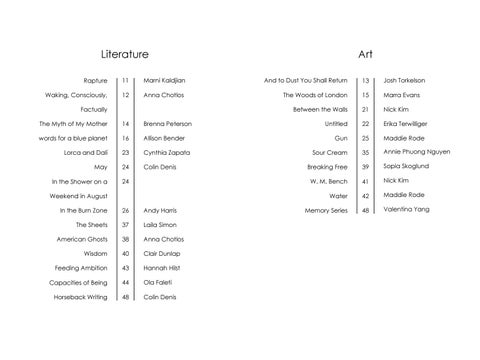
Literature
Art
Rapture
11
Marni Kaldjian
And to Dust You Shall Return
13
Josh Torkelson
Waking, Consciously,
12
Anna Chotlos
The Woods of London
15
Marra Evans
Between the Walls
21
Nick Kim
Untitled
22
Erika Terwilliger
Gun
25
Maddie Rode
Sour Cream
35
Annie Phuong Nguyen
Breaking Free
39
Sopia Skoglund
W. M. Bench
41
Nick Kim
Water
42
Maddie Rode
Memory Series
48
Valentina Yang
Factually The Myth of My Mother
14
Brenna Peterson
words for a blue planet
16
Allison Bender
Lorca and DalĂ
23
Cynthia Zapata
May
24
Colin Denis
In the Shower on a
24
Weekend in August In the Burn Zone
26
Andy Harris
The Sheets
37
Laila Simon
American Ghosts
38
Anna Chotlos
Wisdom
40
Clair Dunlap
Feeding Ambition
43
Hannah Hilst
Capacities of Being
44
Ola Faleti
Horseback Writing
48
Colin Denis
A Note from the Editors We editors of The Quarry are often asked whether there is any rhyme or reason to our selection process, or to our arrangement of the selections in the published issue. It is an understandable concern. This year we received over 120 unique works of poetry, prose, and visual art that we had to compress into an issue of 25 pieces. Additionally, it is a daunting editorial task to place objective judgments on subjective expression. However, we have a definite answer to explain how we accomplished this difficult selection process: the power of discussion. In the first round of this process, each editor becomes attached to different pieces, which often inspire a personal connection, making cooperation seem hopeless. But, when we start to discuss the pieces together, expressing our motivations and reasons for selecting certain pieces, we discover that each submission contains a myriad of meanings and a dynamic range of beauty far beyond what we had seen alone. It pains us to let pieces go. However, our persistent and passionate discussions worked to produce a series of selections whose form and content elicit essential conversations relevant to the campus community and beyond. With that said, it is the final stage of the selection process that proves the most difficult and the most rewarding, as we editors strive to place the unique, yet interconnected works of art in the perfect order. After innumerable nights of debate over which pieces worked best alongside one another, we were able to discern the order of the final draft. These nights were filled with the discovery of new interpretations and appreciations for the collection of artistic expression that now sits before you, waiting to be explored. This issue of The Quarry is composed from a diverse selection of themes: love and death, maturation and ineptitude, confusion and nostalgia, the power of words, and the definition of being. There is indeed a narrative, perhaps multiple, that are told through the order of these pieces. But, we editors are sworn to secrecy. Each encounter with a poem, story, or piece of art is a personal discussion between the artist, the artwork, and the reader. Ultimately, this discussion demands a wider conversation between readers of all different kinds so that they may discover the unique complexities of one another’s lives through their experiences with art. The narrative we create during our selection process is merely the beginning of these wider and more important conversations. Thank you to all who have submitted to The Quarry for providing us with the chance to discuss such a variety of creative expressions. It was our honor to take on the challenge of selecting pieces from such excellent contributions. And to our readers, thank you. You make our work worthwhile. It is our hope that you find a passion for at least one poem or piece of art in this issue, so that you may experience as much excitement and pleasure in discussing these brilliant works as we did in selecting them.
8
-The 2015 Quarry Editors
9
Rapture
Marni Kaldjian
Looking at my bookshelf porn, I wonder about the constitution of lust. Because painstakingly licked tips turning fingered pages prurient glistenings on moist faces rolling down emotion sing the body electric. Late-night tangled-sheet trysts flashlight grasped in sweaty palms For each ecstatic instant must an anguish pay. And ardent declamations Biting shoulders in anticipation, Climaxing, finally, in victorious hunts and proposals that recall Austen, Auden, Rimbaud, Feverous they say lady, I will touch you with my mind. This is rapture enough for me.
10
11
Waking, Consciously, Factually Anna Chotlos
Inhaling the bees, big bluestem grass my vibrating straw: she kissed my forehead goodbye and made me fall in like spilling secondhand grief the color of cloud shadows over the knife-edge where prairie meets highway. Waking, I never want to sleep again. Golden, unburdened air
Consciously. Cicadas, buried first, then resurrected to youthful flight: Night breaks open impermeable reflections. I watch Carpenter’s hands sift fallen leaves, construct diagrams, semi-lucid lines crumple inward, motley alphabets drawn from ancient dreams.
Cradles the winged grasshopper and I:
Factually.
I don’t remember if I run to
For the first time naked,
or away; only that I match the fierceness
and the opposite of alone.
the sun-drunk joy. my last gasp of certainty before the thunderous shaking, softer still then I ever was layers of days,
And to Dust You Shall Return
Josh Torkelson
Digital Image Composite
ripeness I cannot refuse.
12
13
The Myth of My Mother Brenna Peterson
Her head stands erect, her eyes clear and searching. Her long legs move quickly, and her long arms hold tightly. Delicate fingers tap out a tune, and a steady hum calms the air. Her auburn curls make friends with the wind and whimsically play. My mother doesn’t like this. She clicks her tongue. * * * My mother knows her children. She wades through their struggle in black wellies, and never falters, never stops. She sets up camp in the center of sorrow and refuses to leave, a bag of marshmallows in hand. She sings a quiet lullaby. Golden slumbers kiss your eyes. My mother is a celebrity among people ages 0 to 4. Her invisible antennae sense little ones with exceptional accuracy. Their voices, too large for their miniature frames, yell “CIN-dy! CIN-dy!,” and after a tiny-legged sprint they suction to her calves like four-legged octopi. In January my mother tries to pick up university students as they walk home from the grocer’s. They politely refuse, their answers obscured by wooly scarves. She doesn’t give up. Aren’t you freezing? she asks, and the car creeps along. Her daughter is mortified. She slider down in her seat. * * * My mother is charming. She sometimes goes to the theater alone and occasionally eats cake for breakfast. Her twist would turn Chubby Checker a deep jade, and her laughs often overflow and require back-up. My mother feels. She cries at movies and she cries at recitals. she cries for the hero and for the villain - she assigns no blame. When she’s proud she cries between muted laughs, her eyes gleaming. * * * I give the brassy doorknob a quarter turn, and peek inside her corner bedroom. Warm light escapes gleefully into the dark hallway, and I hold my breath, trying to be sneaky.
The Woods of London
Marra Evans 4 3/4 x 6 in. Print
The book sits against the mountain of her knees, and her eyes sweep through valleys of text. Her left hand lies in the canyon skimming her side, and her right hand rises and falls on the waters of her breath. She’s aware of my presence, but says nothing. She’s the mother of six, no stranger to company.
14
15
words, for a blue planet Allison Bender
Dear Mr. Politician, I’ve never actually written to a politician before. And I’m not sure how I should write that will make you listen to me. I’m writing to express my concern over the terrifying imminent threat of climate change to our country and our children’s future… elegies,
In 1910, 150 glaciers graced the rugged mountains in Glacier National Park. Now there are 25.
Masses of passenger pigeons once darkened the skies. Who even remebers they were here? Probably just the hills.
Ten million hectares of farmland are lost every year due to erosion. Around the world, 3.7 billion malnourished people are left to mourn the loss to the sound of their grumbling stomachs.
irrationalities,
What impact? There are so many birds.
Warming? It’s not real; last year’s winter was snowier and colder than ever.
Let’s just take a picture; it will last longer.
…I don’t know why you still haven’t taken action. There’s plenty you can do as a politician! Is it possible that you still think it’s not happening? In order to have a working government and economy, we need to value sustain the one earth we have. Think about the miracle of this Earth. Conditions just perfect for life… praise songs,
16
“For the beauty of the earth, For the glory of the skies, For the love which from our birth, Over and around us lies; Lord of all, to Thee we raise, This our hymn of grateful praise.”
“When through the woods and forest glades I wander And hear the birds sing sweetly in the trees, When I look down from lofty mountain grandeur, And hear the brook and feel the gentle breeze. Then sings my soul…”
…An overwhelming majority of scientists agree that climate change is occurring and that humans are contributing to it. You say that you like to hear from your constituents; so please, hear me out. The Intergovernmental Panel on Climate Change’s 2014 report came out November 1st. Thousands of scientists from 195 countries agree, with “high confidence,” that people are wreaking this devastation anthropocentric emissions are causing further warming and long-lasting changes across all components of the climate system. The likelihood of severe, pervasive, and irreversible impacts for all people and ecosystems is increasing continually… what the scientists say,
The decade from 2000 to 2010 was the warmest on record.
A warmer climate holds more water vapor in its grip. With this added fuel, snow and rain storms will become larger and more volatile.
The rise in sea level expected to occur will increase the risk of flooding for hundreds of millions of people around the world:
Miami, New York City, Houston, Victoria, Atlantic City, San Diego, San Francisco, Seattle, Bangkok, Alexandria, Tokyo, Amsterdam, Haiphong, Shanghai, Mumbai, Dhaka.
17
…Since when do thousands of scientists agree with “high confidence” on anything? We only have a few critical years to take action, and it is your responsibility as a public servant crucial that the government does everything in its power to reduce greenhouse gas emissions and to develop sustainability… (more) elegies,
150-200 species of plants, insects, birds, amphibians, and mammals; every twenty-four hours they slip away and maybe the count today is 200, but maybe it’s 150.
About one acre. That’s the amount of rainforest we are losing every second. One one-thousand, two one-thousand, three one-thousand.
things I’ve done,
Drove daily to school instead of walking the mile.
Turned the heat on high instead of putting on another sweater.
Filled a closet with clothes made in inexcusable conditions that I turned a blind eye to.
Forgotten to see beyond myself.
But I’m learning. I’ve realized that This is a moral responsibility, Mr. Politician, and I believe you should act…
thoughts that keep me up at night,
baby steps,
Seeping into groundwater, salty oceans have caused Kiribati, a Pacific Island, to purchase land in Fiji for growing crops. And if the waters keep rising, an escape.
When my future children are my age, there won’t be glaciers at Glacier National Park. Will we rename it No-Glacier National Park? How about Melted National Park?
Four hundred thousand marching through Times Square: The People’s Climate March. Small steps because the streets are packed. The words of scientists blending with religious leaders’. Grandmothers sing with laborers; students cheer with politicians whose arms are around the shoulders of Hollywood actors.
How do I speak in a way that unites and inspires?
President Obama and President Xi Jinping: leaders of the largest carbon dioxide producing nations, standing together proclaiming their climate agreement to the world.
Did anyone notice when the last passenger pigeon fell from the sky?
What’s missing in letters and lists? Love.
…I don’t have a reason to give up. I’m entering the struggle and I’m bringing you with me, Mr. Politician. And I know it’s going to be hard. It’s going to be the hardest thing we’ve ever done. That’s right. “We.” There is hope in “we”…
Reframe, rethink. Reframe, rethink.
battle cries,
…Today I sat down to write an apology letter to my future children. An apology for all of the things I’ve done and the things I should have done but didn’t. For abused land, for rising sea levels and flooded islands, for species that no longer exist outside National Geographic photographs, for paved over prairies and wars over water. But I’m writing to you instead. You see, writing my apology letter would just have been another one of my acts of passivity and surrender…
What do you shout when you are a part of the enemy?
things I cried while marching through Time’s Square,
¡Obama, escucha, estamos en la lucha!
What do we want? Climate Justice! When do we want it? Now!
We are unstoppable! A better world is possible!
…Are you listening to us? I don’t want to write that apology letter! I understand that there are many important issues that vie for your time. And I understand that you want to be reelected. However, the glaciers climate will not wait for bureaucratic
18
19
delay. We must address these issues now. We have all the reasons in the world… love stories,
Have you ever looked at that picture of the Earth from space? The one taken from Apollo 17? It was the last picture of the entire earth taken by a human. They call it “Blue Marble.” Up there in the eternal nothingness of space our Earth is fragile, The only one like it, Beautiful and deep blue, Silver glaciated mountains, emerald rainforests, golden rolling sand dunes, A haven.
While 400,000 flooded New York, others marched on the other end of the blue marble saying, “I love you, te amo, ich liebe dich, aku cinta kamu, wŏ ài nĭ.” In more than 162 countries, “I love you” to the earth, and “I love you” to each other.
…The truth that stares me in the eyes when I’m fading into sleep at night, or reading the paper, or staring at a blank word document, is that I may still have to write my apology letter. But maybe it won’t be as long. Love, Sincerely, Love,
A concerned student, A girl looking for change, A hopeful citizen, Allison Grace Bender
Between the Walls
Nick Kim Photo
20
21
Lorca and DalĂ Laila Simon
My father sat studying the pair as They walked into a church and laughed Rode bicycles over gleaming teal stones Their white pants billowed while small grease stains fell From the chain they wove with their wheels Oh they traveled
Untitled
Erika Terwilliger 14 x 5 x 5 in. Stonewear
with canvas and paper and blood The ocean called an infinite blue and they wept while Ink was torn and tears vanished in a hail of arms or sleep and I urged to live like them My same father sits surrounded by their books for years Taking their Spanish words and spinning trails Lines of vision and strong connections of the two who might be lovers Consuming pages and I am along for the ride
22
23
May
Cynthia Zapata this is my heart, a soft plum plucked from its branches picked in its ripeness for you to cut open and into my love is the sticky juice on your lips it tastes better soft that is why i waited so long watching the way my heart matured
Gun
from blush pink
Maddie Rode
to the royal purple that says I am ready.
In the Shower on a Weekend in August
24 x 36 in. Digital Painting
Colin Denis
Hiding behind walls of opulent sarcasm, pretending life can be measured by a number of orgasms, I’m bleeding from the port side. (Oh, that’s port wine.) Trigger dust settles and green things turn yellow but black remains black as it softens and swallows Lives like seasons in temperate zones.
24
25
In the Burn Zone Andy Harris
A prefatory note: It is hard for me to know how to start this essay. See, the stories I’m about to tell you took place during the summer of 2013 and the fall of 2014— two very different times in my life—but the story really begins around my nebulous pre-teen years and hasn’t ended yet. These sorts of stories are said to begin en medias res, in the middle of things, which is a word you only hear in collegiate English and Classics classes and at fancy parties with fancy drinks. I am beginning here because the space in between the beginning and the end of things is shaky, uncertain ground. But I am giving the whole thing away. Let me set the scene for the first part of the first story. It is August of 2013, and four other young men and I are in the middle of a 150 mile-long canoe trip. The action: cruising down the middle of Knife Lake. Our biggest problem of the day: it is getting dark, and we have not yet reached camp.
It’s all alien on the south side of Knife Lake. There are no trees, only their ghostly, ashen husks. There’s nothing green above waist height. Even the dirt looks unfamiliar, more grey than brown, like it’s from the moon. It’s as though a miniature apocalypse happened in this little patch of wilderness and nobody noticed. On the north shore, things are normal. That landscape, brimming with green, has been our home for the last six days. The north side is the normal zone. The south side, though, that’s what’s called the Burn Zone. The National Forest Service regularly burns the southern shore of Knife Lake to both deter natural wildfires and to renew the topsoil in the area. It’s all part of the ecological cycle, they say, for fire to replenish the land. I’m leading a canoe trip in the Boundary Waters, but I am sure not doing much of anything. Robby, my co-leader and best friend, and I are at the helm of the self-dubbed “Dream Team,” three young warriors, slayers of lakes and masters of portages, driving relentlessly, going further than any other trip before us. More than anything else, I’m only here to make sure nobody dies. But, for being relentless and warriors and all that, the Dream Team is tired today. I think it’s the Burn Zone effect. Something about the color of that blasted shore saps the strength from your arms and back. It seems endless, the greyness of it. It reminds us of how far we’ve come and how far we still need to go. As we paddle eastward, straight down the middle of the lake, I begin to feel the pressure of the sunlight move lower down my back. I take out the wrinkly map from its pack
26
and splay it across my knees as I paddle. “Shit, Robby,” I say up to the bow of the canoe, “the sun’s going down, and I don’t see any campsites in the normal zone on the map.”
“That island up there is perfect,” Robby replies.
I look up from the map. Even from far away, I can tell that the island Robby is talking about is not much more than a heap of dirt, dotted with the ashy reminders of one-time trees. It’s totally naked. “No way, Rob-dog. That island’s all burned. There won’t be anything to make a fire with.”
A note about making fires: If you have ever tried making a fire in the dark, with three kids complaining about how hungry they are, and, if you somehow get some kindling lit, and if you’ve looked around to find that there is nothing bigger than a couple of twigs and some bush clippings to burn, then you know just how unappealing camping in the Burn Zone sounds to me right now. It’s like trying to write a paper with your fingers taped together.
“We don’t have any gas left?” Robby asks.
“No. I told you last night, we used up the last of it. Abe must have packed us out with a half-can or something. We need to go further, there’s an unburned campsite four or five miles up Knife.”
“Four or five miles of burned-down hell,” I add.
“No, that island there is actually perfect,” Robby says, “there’s nothing to get in the way.” “Exactly,” I say, “there’s no shade. Murray will get sunburned and die.” “Yeah, but there’s nothing to get in the way of the meteor shower that’s going to happen tonight. I checked the weather before we left. It’s happening. That island’s perfect. Nothing to get in the way.”
And that changed everything.
27
* * * Everything was changed once again, in a very different place. This time I was inside. More than that, I was inside the inside, typing away at a computer in a study lounge. The walls were this kind of white that reminded me of a hospital or a dentists’ office. It even smelled sterile. And there I was, slogging away at an essay on T.S. Eliot’s Four Quartets. It was the perfect snapshot of my college career: too perfect, too normal to last long.
I learned of Abe’s death in that room.
A note about Abe: He was named Ryan Abrahamson, but everyone called him Abe. He was the dinosaur at the summer camp I worked at (every camp has one). The dude had something like 10 years of staff under his belt. Now, we weren’t especially close, but everyone thought he was part of the camp geology, somehow immortal, like he was born of the wind and the rain. He could paint a room happy. One time, when he was young, his baseball coach told him to shave his head and stop smoking weed. He quit the team right then and there. He loved hitchhiking and tie-dyes and whisky. He would’ve hated the room in which I learned that he died.
I got calls from everyone, all with the same news. “Abe is dead.” I could not believe what they said. “No, that can’t be right,” I told my brother after he called, as if we were talking about how to spell out a difficult word like “beautiful” or “attachment” or “vulnerability.” It only became true with repetition. “Abe is dead,” my friends told me. “We have lost our longtime staff member Ryan ‘Abe’ Abrahamson,” the camp statement told me. “To mourn our passed Abe,” the invitation to his memorial service told me. “Abe is dead, Abe is dead, Abe is dead” is all I heard from everybody that knew him. I was made vulnerable, completely exposed, in that small room, in front of the computer screen that blared my own writing back onto me. Later, I learned that Abe was a writer as well. They found a journal on his body, chronicling all his thoughts from his opinions on 90’s rap to the magic of meeting strangers on the road. One of his entries:
“To another good day. It is good to be alive.”
Even before I learned of Abe’s journal, back when I was in that white computer lab, I couldn’t take it. I couldn’t take the fact that he was gone, the fact that he could even be gone, the fact that he loved to live more than anything. I didn’t need his words to know, with absolute certainty, that Abe loved to live. And then, all at once, without so much as a goodbye or an explanation, he died. Abe’s death lit
28
me on fire and burned me. I was thrown down and on fire. I couldn’t get put the fire out. I couldn’t get up. * * * “Come on, David. Get it up.” David struggles to balance the canoe on his hips. His tanned hands are positioned correctly on the yoke, to make sure the canoe swings up in a perfect crescent, but the angle between his body and the canoe is weird. I don’t think he is squatting down far enough, so he doesn’t generate enough power with his legs. He compensates by trying to shove the canoe up onto his shoulders with his arms.
“Get it up, David. Be strong.”
Maybe those aren’t the best words to use, I say to myself, but I’m doing my best here. David is very slight, even for a 14 year-old swimmer. It is hard to be strong when you need to balance a 17-foot canoe sideways across your body. Still, his goal for the trip is to learn how to one-man lift an aluminum canoe, so that he can show the whole camp when he got back. We have been practicing in the water off the scorched island. David has been trying to get it up for the past hour, and the sun is almost set. The rest of the group, a sunburned Murray, DJ (a 300-pound 16 year-old, who can one-arm lift a canoe), and Robby, are all working on starting a cookfire. At least David and I aren’t scrounging for firewood like the rest of them. David rocks the canoe with his hips. One, two, three, then he goes for the lift. There’s just not enough there. The canoe drops first back to his legs and then to the water. He swears loudly, his fingers reach and pull at his black hair. I wade through the water to him. “I know it’s hard. It’s really, really hard, and it’ll take some practice. Let’s call it a day. Sometimes you just need to let it go.” I turn back and begin to head up the hill to the campsite. I hear DJ’s big, roaring guffaw of laughter. Murray probably said something crude about how the remnants of the trees look, standing straight up out of the ground, stiff and erect. I understand why middle-school teachers go crazy, I think. Teenage boys. But then I hear four things in clockwork succession: the sound of water moving, a grunt, and the hissing noise of shoulder pads being deflated by landing on shoulders. Then, finally, I hear,
“Are you kidding me? Did nobody see that?”
I turned back and there it is. David has lifted the canoe up unto his
29
shoulders. I don’t answer his question, but I start laughing. He starts laughing too, and, pretty soon, it seems like the whole island is covered in laughter. We are laughing at all of it: the fact that the trees look like adolescent profanity, the fact that he lifted the canoe. But, most of all, we laugh at the good grace of our fate, that we are here, all of us, in this ugly place doing beautiful things. We climb the hill to start the fire. Before the meteor shower, as we eat pasta around the ragged little cookfire we coaxed to life, we read a note written to us by a friend back at camp. It was scrawled on this thin scrap of paper. We have no idea who sent it, but I am still, to this day, thankful that they did. Our friend wrote seven words that crystallize all human understanding. They wrote:
“Remember: in all things, beauty is present.” * * * A related piece of wisdom, from Aldo Leopold:
“When one tugs at a single thing in nature, he finds it attached to the rest of the world.” * * * Abe’s death didn’t scorch only my heart. It cut wide across people around the world. I found myself grieving with people I had never met, people from Missoula and California and Colombia and France. But, most of all, I grieved with my brother, Tommy.
A note about my brother: Abe and my brother Tommy were brothers themselves, made that way through their time they shared in the wild. Abe had led my brother’s first few forays into the Boundary Waters, and my brother was one of his favorite campers. And once my brother started working at camp, they hugged and laughed and danced together as children do. When Abe and I went to the bars on our nights off, he would beg me to keep secret his cigarette habit from my brother—this is the way Abe expressed to me his love for Tommy.
Tommy called me first with the news of Abe’s death. He hung up in tears. He thought, correctly, I did not believe that Abe had actually died. Later, when I knew for certain that what happened did actually happen, he would not return my calls. My mother called me at some point, while I was still in that sterile computer lab. She had been able to get through to my brother.
30
“How are you,” she asked me, “How are you dealing with this?” “About as well as anybody. It’s Tommy you should be calling.”
“Yeah, he called me earlier today. I don’t know what to do, but I sent his copy of A Sand County Almanac to Williamsburg.” Heat rushed across me. I needed to cry, and I wouldn’t do it on the phone with my mom.
“Mom,” I said, “I’ll have to call you back.”
I hung up on her there and began to weep. I had never cried this hard, and it was not even for me. Abe had given Tommy A Sand County Almanac, Aldo Leopold’s best work of nature writing, after their trips together in the wild. Abe had said that someone special had given it to him, after an adventure in the wilderness. The book was Tommy’s last connection to Abe. It was such a small thing—just some paperback pages with a black-and-white cover of a flock of geese—but it was what was left. I called her back after some time. She had that you-just-hung-up-on-me tone of voice that moms everywhere, by some kind of unisersal law, have perfected to a tee. “As I was saying,” she said, “I sent the book to Virginia. He thinks that a plane ticket back home would be excessive. What do you think?” “He needs to be here,” I immediately replied, “He needs to be here because we need him here. He needs to come to the service on Sunday. I can’t be all alone by myself in this.” end.
There was a pause in the conversation. I heard muffled sounds on the other
“Okay. We will see what we can do to get Tommy here. But you might need to foot some of the bill.” “Thank you so much, mom. And thank you too, dad, I know you’re listening on speaker-phone” I “Hi, Andy, how are you doing,” asked my dad in his thick Milwaukee accent—the first thing he says to me whenever we speak. “Just fine, dad. I’m just worried about Tommy. It’ll be good to have him here.”
“Yes, it will be. It’ll be good to have you two back together. It is worth it.” *
*
*
31
“Do you guys think life is, you know, worth it?”
This is where the conversation eventually winds up, after the pasta has been eaten and we start to watch the stars. Every night, we do a strange thing called “Devotions,” or “Devos” for short. The point is to unwind and reflect about any number of things. Turns out, tonight’s topic is pretty much the biggest thing any of us can talk about.
A note about Devos: These are the kinds of talks that have saved lives. These are the talks you have when it gets dark out, and then you speak out in the darkness, and people will actually listen. These are the kinds of talks that remind you that you are not alone, even when you can’t see the faces of the people you are talking to.
There is a long pause in the conversation. Holy hell, I say to myself, what a question. Is life worth it? Can it possibly be anything other than worth it? Who could live with a worthless life? The fire is almost dead. It did well to heat our pot of lakewater so that we could cook, but now all that remains are orange embers. It is a moonless night, so we can’t see one another, but we hear our collective breathing while we sit and think. The stars are everywhere across the sky. We can see the dust of the Milky Way, the Big Dipper and, from there, the North Star. This is the canvas on which the meteor shower will paint.
Slowly, after the long, long silence, the answers starting coming:
“I think my family makes my life worth it. And my dog. I love my dog.”
“I think it’s worth it because it can’t not be worth it.”
“It is always better to keep going, no matter what. Just keep going.”
“Nature makes my life worthwhile.”
“I just love everything too much.”
Then, the stars fall in. It begins haphazardly, all at once. A flurry of light streaks across the sky, the tails of meteors all crisscrossing and overlapping, making a blanket out of the night. And it keeps going, for what seems like forever, with long, bursting meteors creating the main fibers of this sky-quilt— the short, erratic ones stitching them all together and making it all coherent and sensible and one.
32
Soon all the sky is in motion, and the steady backdrop of the North Star and the dust of the Milky Way become obscured in the cresting movements of the shooting stars, and we can only see the meteor shower. It is the sky. And then, less than a minute later, no more, It is over. I was awash in the feeling of vulnerability. Here am I, a small, insignificant mote of dust on the precipice of an unknown realm of falling stars, galaxies and universes, and the endless motion of everything. But I am also so happy, so very happy, that we made the bone-headed decision to camp in the Burn Zone on Knife Lake. “The tree cover would’ve ruined it,” I told Robby as we slipped into our tent for the night. way.”
“Yeah. It was perfect,” Robby said back, “There was nothing to get in the
“You going to carry those bruises to remind you, wherever you go.”
He finally echoed, “Yeah, it really was.”
* * * “That was perfect,” I said to my brother as we drove back from Abe’s memorial service. He seemed to weigh that statement as we flew past bare cornfields. We could see for miles across the desolate countryside, everything silent except for John Prine crooning from the speakers:
And maybe it really was perfect. There was laughter and tears, songs and poems. Everyone wore white, as per Abe’s requests in his journal. There must have been 300 people there, at least, young and old people, people who flew from other continents to come to the service. And we all cried together and hugged and laughed and did all of these at the same time, all of us. We were all in the burn zone of the heart, the soul-smashing sadness that happens all across the earth all the time, a crisscrossing weaving of sorrow that ties us all together. We were on fire with grief, which is another word for love. Everyone came to feel that painful love, to feel vulnerable for having known someone so full of life. We were there for the pain because pain is beautiful, perfect, in its own way. Or maybe we were there for the cookies, store-bought, but still really highquality. I bet the cookies were in Abe’s journal too, along with the dress code. He wrote down exactly how he wanted it. He put it to words. Abe, of course, was the real reason; but free cookies can never be passed up on. They gently warm you up, like how a fire warms you up on a cold, moonless night. They remind you that there is good in the world. When my life is memorialized in a service, there will be cookies for everyone. But not too many. *
*
*
33
After a little in-tent chatter with Robby, I crawl into my sleeping bag. The weight of the day is heavy on my back. I’d carry that weight any day. I do carry it every day. When I close my eyes to fall asleep, I can once again see the meteor shower. I can see it, just as it was, anytime I like. I think, on some level, I am still in the Burn Zone watching the stars fall in. Even now they are falling, always falling, even up to these last words. But, of course, these aren’t the last words. There will always be more words—words make you fall, words that burn you and words that leave you totally changed. * * * So, as a closing note, if there is anything to take away from this, let it be: It is good to be alive. In all things there is beauty. When you tug at one thing in nature, you find it attached to the rest of the world. You will carry your bruises to remind you, wherever you go.
And, as my own addition:
In the end, all my stars and my tragedies and my words are for you. Because it’s not so much the fact that I’ve seen meteor showers and have had a friend die that I realize that in the moments we are most vulnerable we are most alive. Rather, I think I know what I know because I write about it now, in this moment and for always after, for you.
Sour Cream
Annie Phuong Nguyen Stcnewear
34
35
The Sheets Laila Simon
A small girl clutches the short stack of warm copied paper to her chest The heat feels to her like her clothes on the radiator after a bath She says she loves to pile in sheets out of the dryer The roof of the main building is finally rid of the snow sheet It fell off in one go and wrinkled on the way down Collapsing onto all the sitting benches where no one’s been A feather dyne spread on the floor is the greatest luxury Without a sheet cover it reflects all the yellow light that is off sometimes It gets washed occasionally and gleams
36
37
American Ghosts Anna Chotlos Exhale.
Wait.
The wishing intensifies.
Dead crow Tuesdays
The iron beating my chest,
With feet like prehistoric reptiles
wanting to move to the other place
Brittle and clenched
where I left my innards dripping
Red paint bruises on both sides,
viscous liquid
Labyrinthine growths
and the water’s sky-colored.
Dissect my belly.
Gasp.
Rise.
Guilt lives in drawers
White wind turbines
Addressed neatly across
guard the way back
unsent envelopes
stark harbingers, but gentle
‘I love yous’ sealed in my ribcage
fields surround the bodies
for not finding the stamps
and yellow arch-backed wails
while you still stayed alive.
slowly die across
Choke.
Breaking Free Sophia Skoglund
18 x 10 in. (each) Ink and Graphite on Paper
a sky colored sky.
Treading water but instead of lungs I have a recollection of your voice. It’s late, the swamp’s dark And I’ve settled into not asking how you died. Neck-deep. Wilted yellow roses.
38
39
Wisdom Clair Dunlap
my deciduous teeth, unsplit walnuts that cracked easy as a knuckle; moth soft, helicoptering maple fruits; bright as witch hazel; pushed out by the tender seeds of cuspids and molars – slow growers without season. and me, planting their babies under my pillow, watching.
W. M. Bench
Nick Kim
17 x 66 x 20 in. Metal, Wood
40
41
Feeding Ambition Hannah Hilst
I live a fantasy hanging like a loose garment [wishful fabric barely covering enough skin] rope of hope tied around the waist a waist of starvation from wait wait for purpose, direction, goal gaunt shoulders frame empty spaces [more space than bone between these ribs] each indentation a squandered day.
Water
Maddie Rode
26 x 17 in. Digital Painting
42
43
Capacities of Being Ola Faleti
What’s in a body is touch receptors and 65% water. What’s in a body are deities. What’sin a body are reflexes and layers of sensitive skin and heart. In 1997 a third-wave ska band named Sublime had a hit song about heartbreak. The track was #6 on the band’s eponymous album, and peaked at #3 on the US Billboard Hot Modern Rock listing. This song was titled “Santeria.” Imagine white teenagers and twenty somethings in someone’s damp basement, passing around a bowl and listening to Sublime on their speakers, then pondering, “what the fuck is Santeria?” Inquiring minds of the 21st century have Google. If you wanted to understand Santeria back then, you found a library. Here’s something fun for you on a rainy Saturday: grab a geometric compass (or tape two pencils together) and do the two-point discrimination test on your arm. Bodies are poetic because on various parts of the skin’s surface, there are corresponding pain receptors. If you touch two squares of flesh inches away from each other it feels like one touch. Some of us perceive our pain receptors at an early age – one such woman was Lydia Kamaka’eha Kaola Mali’i Lil’iuokalani. The first time she found her pain receptors was at age four after the smarting smack of a slender wood stick from a teacher at the Royal School in Honolulu in 1842. Lydia would grow fond of knowing when her stimuli was being damaged. This would become useful when she became Hawaii’s only female ruler. She was simply Queen Lil’iuokalani once she was throned.
Imagine the feeble-tongued American “settlers” who called her Queen Lil.
Chambers Dictionary of the Unexplained defines Santeria as “A Caribbean religion combining African beliefs and Roman Catholicism.” How succinct, how neat, how godly. (You know that cleanliness is close to Godliness). There are also people who say the bigger the hair, the closer to God. I would be wary of certain Christian aphorisms). Queen Lil enjoyed Christian aphorisms and quotes. Her lifelong favorite became “My God, my God why hast thou forsaken me?” This was when she looked down and her Queendom was gone. In the Yoruba language there isn’t an equivalent word to “forsake.” That is, the Chamber’s Dictionary is vague; Santeria combines Yoruba beliefs, as there is no such thing as a universal African belief. Imagine monocled white men nodding to
44
themselves, “yes, animism, how quintessentially… African.” The Yoruba Pantheon will not abandon you. In Santeria there is one Supreme Being, Oludomare, and his emissaries. These emissaries are called orishas. They are a soft bridge to the absolute. What’s in a body is blood and bowels. Both were in abundance on ships rocking and rolling with mournful West African cargo. Religion, just like the enslaved, was an import. Europeans would test how long it took African blood to break, disintegrate, soak the soil and fertilize. Many blood trees grew during Slavery. Palm trees grew in Hawaii, and still continued to grow even after the 1776 arrival of Captain James Cook. In 1810, King Kamehameha was the first official king of Hawaii. Queen Lil was the eighth ruler and first Queen. When she was young she was lithe and learned in a Christian school system, where she mastered music composition and imperialist jargon. Yoruba religion became the most comfortable on a different island: Cuba. This is where it would become known as Santeria. Un-fun fact: If you break down Santeria, it means “worshipper of Saints.” The word Santeria came from the disdainful Spanish, who thought of orishas as pagan saints. “Santeria” was used to scold the slaves who didn’t take to Catholic brutality well enough. Many call “Santeria” Regla de Ochas instead: Rule of Orishas.
What’s in a body is reverence.
If you practice Yoruba you are a receptacle of veneration. On your birthday you give gifts to your own personal orisha. Your fingers assemble an intricate throne with tokens of appreciation – perhaps pens and books if she’s the learned orisha, Obba, or a beautiful knife set if he’s Shango, the kingly orisha. If you practice Yoruba, you know that these deities are not so omniscient that they don’t need to be appeased or reminded that they are beloved. That is why orishas can protect us – they shield us from what they know is hurtful to the human heart and psyche. If Queen Lil practiced Santeria, her favorite orisha would have been Yemaya. Yemaya is the mother of the Yoruba Pantheon. She is cool, peaceful and everything exquisite about femininity. She represents the fish, the stars, cerulean oceans and moons. Her symbolic icons are sweet – brown sugar, molasses.
You hide in Yemaya’s skirts to escape unruly wrath.
Had Queen Lil asked, Yemaya would have summoned waves to sweep away the white imposters whose parents had moved to the Hawaiian Islands all for the
45
shame-sake of giving brown people a white God.
But had Queen Lil asked? No.
She married John Owen Dominis. He was from the soft piles of snow, picturesque mountains, and stolen Mohawk tribe-land known as Schenectady, New York. Their marriage was often unhappy – she couldn’t bear children and his loins were wandering. Such is a life of tolerance.
What’s in a body is rivers, oceans, succulent pigs, candles, Spam, hemoglobin, bad juju, national anthems, blue blood, thick walls, dissected brains, strange reflexes, tongues, teeth, anger, acceptance, watermelons, animal sacrifices and active endocrine systems. What’s in a body is belief.
What’s in a body is tolerance for many things, including pain.
Here’s something to try on a Friday night-in: check your threshold. 1. Fill a vat with ice water. 2. Stick your hands into the vat 3. See how long you can take it. For most people a minute is the maximum. “A minute is all it takes to support a child on eighty cents a day.” Cue weathered white man holding a dark child. Cue camera zoom into the dark child’s empty eyes. Cue a 1-800-WHY-THEM. These days Nigeria is roughly 50% Muslim and 40% Christian. Less than 10% of the population practice indigenous beliefs, such as the Yoruba religion. The lasting question was, how do you bring down a proud people and their ruler? With chutes, ladders and a coup d’état. How do you justify this? Victimblaming of course. Queen Lil’iuokalani tried to make her islands neat, orderly, and godly with a new constitution, one that would restore voting power to native Islanders after decades of too many American investors adapting the politics to their own liking. They saw Hawaii as a cluster of profit instead of islands inhabited by people with centuries of lush traditions. The Americans ballyhooed at this new constitution proposal, naturally. They fumed, then they went to their lawyers, then they started their own separate republic recognized by the US government. Before you could hum “Aloha Oe,” the Queen had abdicated her throne. Hawaiians no longer ruled Hawaii, which officially became a US state in 1959. You could now add Hawaiians to the list of peoples sodomized by America’s imperialist member.
Another word for Santeria is Regla Lukumi – Way of Lukumi.
Lukumi is the people and culture resulting from the fuse of Catholicism and Yoruba practices. This comes from “olukumi” – “we are friends” in Yoruba. But you can’t befriend a shadow. You can’t befriend evil spirits and you can’t befriend your colonizer. “Oyinbo” in Yoruba. “Haole” in Hawaiian.
46
47
Horseback Writing Colin Denis
All I do is drive cattle but People think I shoot robbers in saloons. They think I just ride space shuttles but Actually I conquered the moon.
Memory Series Valentina Yang
22 1/2 x 30 in. Mixed Media
48
49
The Quarry is an annual publication by the students of St. Olaf College All correspondence should be addressed to: Executive Editor, The Quarry St. Olaf College 1500 St. Olaf Avenue Northfield, MN 55057 All works of the authors in this issue are protected by a creative commons lisence. © 2015 The Quarry Printed by Engage, Northfield MN
Cover artwork: “Såmsø” by Nick Kim These works selected independently of the editor contributor: Untitled, Erika Terwilliger And to Dust You Shall Return, Josh Torkelson
50
51