THURSDAY, APRIL 27, 2023
Public urination arrests at fests drop after COVID-19...PG 4
Luke Olson is Ohio’s most reliable pitcher...PG 11
Was ‘Midnights’ actually a break up album?...PG 15
The rising risk of wildfires in Southeast Ohio


THURSDAY, APRIL 27, 2023
Public urination arrests at fests drop after COVID-19...PG 4
Luke Olson is Ohio’s most reliable pitcher...PG 11
Was ‘Midnights’ actually a break up album?...PG 15
The rising risk of wildfires in Southeast Ohio
Goodbyes are weird. Sometimes they’re bittersweet, and other times they’re just sweet. In some cases, like this one, they’re not very conclusive. Honestly, I think those are the hardest because they don’t mark a definitive end to anything. They’re more like a measly “so long” rather than a “goodbye.”
I’m not graduating, and I’m certainly not leaving The Post . However, although it feels kind of awkward, I still have a goodbye to make. The time has finally come for me to hang up the ol’ editor-in-chief hat and walk into the sunset. And it’s a beautiful sunset at that.
When I became editor-in-chief roughly a year ago, I had no idea how transformative the job would be, both in my personal and professional life. Abby Miller, the previous editor, set a fantastic foundation for me to build upon, and her enthusiasm about the job made me so excited to start. She told me about the triumphs and tribulations of the editorship but assured me I could handle whatever came my way. I still
look up to her for her wisdom and support.
A year later, I’ve realized she was right. Like life, the job has incredible ups and significant downs. All in all, it’s been the best experience of my life.
I’m so incredibly thankful for the people this job has brought me closer to. I got to work with some of the most talented students I know, most of whom I handpicked, and build a paper each week that I was proud to put my name on. To all of the people on my editorial and creative teams, even though there are too many of you to name, you are all rockstars and I appreciate you from the bottom of my heart. And to my executive editors — Kayla Bennett, Jack Hiltner, Anastasia Carter and Alesha Davis — you all have done a great job keeping me sane and making my job fun; thank you so much.
I’m confident that the work The Post has done this year is some of the best in its 111year history. My departure won’t change that trend one bit. Katie Millard, who is taking over for me in a couple of weeks, is
going to thrive in the position. I’m already impressed with her work, and I can’t wait to see what she and her staff accomplish.
So, this will be my last ever “From the Editor’s Desk.” I’d like to give one last big thank-you to everyone who has supported me, including my parents, friends, professors, Post alumni and mentors. And to The Post ’s readers, thank you so much for reading and for supporting our mission all year long.
Long live The Post
Ryan Maxin is a junior at Ohio University and editor-in-chief of The Post. Want to talk to Ryan? Send him an email at rm554219@ ohio.edu or tweet him at @ryanmaxin.
HEADSHOT BY HANNAH CAMPBELL
Editor-in-Chief | Ryan Maxin
Managing Editor | Kayla Bennett
Digital Director | Anastasia Carter
Equity Director | Alesha Davis
EDITORIAL
News Editors | Molly Wilson, Addie Hedges


Asst. News Editor | Maya Morita

Culture Editor | Katie Millard
Asst. Culture Editor | Alyssa Cruz
Sports Editor | Will Cunningham
Asst. Sports Editor | Ashley Beach
Opinion Editor | Tate Raub
Asst. Opinion Editor | Meg Diehl
The Beat Editor | Emma Dollenmayer
Asst. The Beat Editor | Grace Brezine
Projects Editor | Hannah Campbell
Investigative Editor | Alex Imwalle
Copy Chief | Aya Cathey
Slot Editors | Bekah Bostick, Katie Trott, Arielle Lyons, Lydia Colvin
ART
Art Director | Trevor Brighton

Asst. Art Director | Lauren Adams
Director of Photography | Jesse Jarrold-Grapes
Photo Editor | Carrie Legg
DIGITAL
Audience Engagement Editor | Emma Erion
Asst. Audience Engagement Editor | Molly Burchard
Director of Multimedia | Cole Patterson

Asst. Director of Multimedia | Donovan Hunt
BUSINESS
Media Sales | Grace Vannan, Gia Sammons
Director of Student Media | Andrea Lewis
Volume 113, Issue 29
ONLINE
thepostathens.com
thepostathens TWITTER
@ThePost INSTAGRAM
@thepostathens
Monday – Friday
Closed Saturday and Sunday Baker University Center, Room 325
1 Park Place Athens, OH 45701 (740) 593-4010
Have you ever find something in The Post thought-provoking, questionable or even infuriating? Let us know! We are always interested in hearing about the way our readers respond to our content.
Letters should be fewer than 500 words. All letters must be signed by at least one individual; anonymous letters will not be accepted. The Post does not accept letters soliciting donations or news releases. Please include your year and major if you are a student. The Post reserves the right to reject submissions or edit submissions for clarity, vulgarity and Associated Press style.
The Post is an editorially independent media outlet run by Ohio University students. We distribute the paper free of charge in Athens, Ohio, when classes are in session. Editorial page material represents the opinions of the editors, columnists and letter writers. Opinions expressed are independent of Ohio University and our printer.
IN PERSON
Baker Center, Room 325
BY EMAIL letters@thepostathens.comONLINE
thepostathens.com/letters
The Post will not print advertising that violates local, state or federal laws. The Post will not run advertisements that violate the Fair Housing Act, or the Equal Employment Opportunity Commission policies. The Post reserves the right to reject advertising deemed to adversely affect the integrity and credibility of the publication or be in conflict with the educational mission of the university or community it serves. The Post retains the right, at its discretion, to approve or reject an advertisement that negatively affects the relationship with our readers or that promotes content, services, or activities that violate our advertising policy.
If an error occurs, and an advertisement is published not as ordered, please notify The Post by the end of the business day following publication, a corrected advertisement will run without charge in the next print edition. Cancellation requests for advertising must be received and acknowledged by staff no later than 2:00 pm on Wednesday for the Thursday print edition. Refunds will not be given for ads that have been printed. These advertising policy rules can be changed at any time without prior notification.
Ohio University has spent time hiring and filling positions across the university, including deans’ positions from the College of Business to Health Sciences and Professions. It is also currently undergoing the hiring process for deans within the Russ College of Engineering and Technology and the College of Arts and Sciences.

Both open deans’ positions are being hired through open forums. Provost Elizabeth Sayrs hopes to announce who will be in those positions before the end of the semester, Daniel Pittman, a university spokesperson, said.
“Salary details for either role will not be available to share until after the successful candidates have been identified and their contracts are formally completed,” Pittman wrote in an email.
John McCarthy, dean of the College of Health Sciences and Professions, recently went through the dean interview process and was hired as dean in December 2022. He is currently making $245,000 annually in the position.
“I certainly never thought I would be a dean,“ McCarthy said. "Most of my training was really to be a pretty intense researcher and teacher. When there were opportunities to take over, I decided to try them out and found that there were parts of the job I enjoyed and found interesting, too.”
McCarthy has been at OU since 2004 and has held several positions within the Health and Sciences Department including assistant professor, director of the Division for Communication Sciences and Disorders and associate dean for research.
“It's nice to have gone through a process where there was a search and where … the individuals in the college had different choices, and could consider my candidacy,” McCarthy said.
In March, OU named Russell Morrow its first assistant dean of Diversity, Equity and Inclusion in Business. In this position, Morrow looks at how the College of Business accomplishes goals that contribute to DEI, and he makes around $80,000 annually.

Morrow received his undergraduate degree in media arts and video production as well as his master’s degree in college student personnel from OU.
Since graduating, Morrow has worked at other univer-
sities, including The Ohio State University, where he was a professor teaching about social justice leadership and got his doctorate in education administration.
Morrow also worked at Denison University in its Department Center for Belonging and Inclusion but said it had been a great experience to return to OU.
“It's great to get to see a different side of the institution that I fell in love with, found a home and spent six years at, so I really enjoy kind of coming full circle and seeing familiar faces,” Morrow said.
While in this position, Morrow said he hopes to make students who come from underrepresented backgrounds in the College of Business have their experiences validated.
“I want students who come from marginalized and underrepresented backgrounds in the College of Business to say they felt like they found a home,” Morrow said.
McCarthy said he would like for students to see him as a resource and someone who is in a position to help students across the university.
“Not everybody understands what a dean is,” McCarthy said. “There's never a view of a dean that's fairly positive, and … I would like to think I'm somebody who's a resource for individuals in the college.”
@PAIGEMAFISHER
PF585820@OHIO.EDU
After a long day of partying at a fest, some students may find themselves drunk, lost and without many open bathrooms. A common question starts to trickle into their minds: Can I rock a piss right here without getting caught by the cops?
Many people have learned the answer is no the hard way.
Ohio University Police, or OUPD, and Athens City Police, or APD, arrested seven people for public urination during Mill Fest in 2019, according to arrest records from both departments requested by The Post. The total number of public urination arrests that year was 12.
However, this year, the two departments have only made one arrest on a fest day since the parties returned after a two-year hiatus due to COVID-19.
Fest season is a tradition where OU students living on a particular street or section of off-campus housing collectively throw parties on a Friday or Saturday during the Spring Semester.

Milliron Apartments, Mill Street, Congress Street, High Street, Palmer Place Apartments and Palmer Street are participating as of 2023. With parties on Saturday beginning between the early hours of 7 a.m. to 9 a.m., students will be drinking, and with that, many bladders fill early in the day.
Fest season is infamously the rowdiest time of the year in Athens. Police cars, officers on foot and groups of police horses from APD and OUPD, who are sworn in as APD officers for the season, roam the streets to ensure everything is in order. Public urination must be seen by an officer for them to make an arrest.
The total number of arrests in 2018, 2019, 2022, 2023 is 22. In 2018, there were nine, 12 in 2019, zero in 2022 and one in 2023, which happened on April 15. Of all of those, only two were listed as female and the remaining 20 were listed as male by the arresting officer.
"Back in the late '90s, early 2000s when we had fests our numbers were nowhere near this low," Ralph Harvey Jr., captain of police at APD, said. "We were arresting a lot more people, we were having a lot more problems and it was all at night."
Tim Ryan, staff lieutenant at OUPD, said he remembers putting on riot gear to clear thousands of people off the streets during fests when he started working for the department nearly 18 years ago. Nowadays, Ryan said the environment at fests has changed and is much safer partly due to Ath-
ens' nuisance party law, which was adopted in 2004 and gives the police the ability to shut down a party it deems as a nuisance.
The conditions for a gathering to be considered a party include destruction of property, underage drinking, illegal open container, unlawful deposit of litter, public urination or defecation and many more, according to the Ohio Revised Code.
Garrison Dunn, a senior studying marketing, said he was at a party during Congress Fest that was shut down because someone publicly urinated in front of the house. He said it was disrespectful and wasn't upset that the cops shut the party down.
APD made its only public urination arrest in the last two fest seasons at this year's Congress Fest. It was not confirmed whether it was the one related to Dunn's party being shut down, but a Congo Fest arrest is an outlier in the last six years.
Of the 22 arrests made during that period, 12 were during a Mill Fest, five occurred during a Palmer Fest, three were during a High and Congress Fest and Palmer Place only reported one arrest.
"Theoretically they could bust every college party no matter what (for underage drinking)," Dunn said. "That's just how it is and I think you just got to draw a line when people are just being idiots. If some dude was … peeing on my lawn, peeing on the street I wouldn't really want that."
Harvey also said the nuisance party law has been influential in calming fests down, but the change really started in 2012 when an arsonist started a fire in the basement of a house party during Palmer Fest.
"After that, there was a distinct change in how both the police department, the city, the university, and even the student population dealt with big events and fests," Harvey said.
The main strategy they found was to shut down the nuisance parties early in the day because a lot of the problems would happen during the night. Now, Harvey said APD has started educating and working with students.
In the fall, officers who shut down parties would explain exactly what violations a party was under. For several years, APD sent infor-
mational fliers out before big events like fest weekends. Harvey said he believes that has made a big impact and now sees a change in the way students behave during fest weekends.
Harvey said he's also started seeing students either call APD or go up to foot patrols and ask them to break up their parties, which is something he said he had never seen until recently.
"You want us to shut your house down? We'll help you out, we like it when you're compliant," Harvey said.
A big change Ryan said he has seen is more parties using porta potties. He said he thinks it's great and has "really changed the game."
"I personally do expect (less crime during fests) to continue," Ryan said. "I have had some great experiences with fest-goers over the last couple of years and that has been more positive than years ago. I think it's a different time. I think it's a better, safer time."
We want to extend a note of appreciation to the all of the alumni, mentors, students and families who shared their stories and shared our social posts on #OHIOGivingDay in support of The Post Fund
90+donors
$17k
nearly
in contributions & Matching gifts
a junior studying nursing, says that this will allow the program to go smoother for new students.
"A lot of times students will see different things and they just don't really want to do it," Portem said. "I think they should just be very open minded and try to expect the best because I think that's really what we're trying to do and really trying to get them ready for their fall semester."
Portem also says that orientation leaders naturally are very energetic, giving this advice to students who may be initially intimidated by the program. He also said that meeting new people can feel overwhelming, but making friends is worth it in the end.
Now that BSO staff have been waiting since January to welcome new students, Prior and Rockwell are excited to get to know the incoming students this summer, wanting to support freshmen from different backgrounds.
"If I'm a first generation college student, there's something for me there," Prior said. "If I am a legacy student and my family has come to Ohio before, how do I engage differently? There's a couple of different populations that we try to support, and a lot of our program is designed around that."

Looking back on her BSO experience, which led her to become an orientation leader, Rockwell hopes to continue making memories with students this summer. So far, one of her favorite memories has been connecting with students in her major.
"Some of my favorite memories are getting to meet new students," Rockwell said. "When working my first year on the team, I worked with the College of Health Sciences and Profession which is my major specific college, and I got to meet so many of my students that I later on have had class with and became friends with. Getting to see them grow is one memory that I really enjoy."

At the start of every summer, Ohio University prepares for a new freshman class after saying goodbye to its seniors, eager to meet fresh faces before school starts back up again in August. As part of this preparation period, the university welcomes incoming students through Bobcat Student Orientation, or BSO.


BSO is a day-and-a-half-long program for incoming students to learn more about the university, their major and class offerings. Additionally, BSO staff integrate activities for freshmen to learn more about one another, establishing new friendships before the first day of the semester.
Vincent Prior, the director of undergraduate orientation programs, said that BSO is updating its program based on last year's successful turnout, wanting the experience to be even better for students than before.
Part of last year's success was due to the escape room activity BSO added to its itinerary, now planning to bring it back this year, as well as more social programming.
"One of the things we added last summer was we did some more intentional late night programming, some social programming for students," Prior said. "Some of my favorite memories from last summer were in those same spaces, but with our staff. While they're interacting with students, or students are interacting with each other, us being able to also interact with the team."
Outside of activities, Prior also says incoming students can expect breakout sessions, allowing them to choose what topics they would like to learn more about on campus.
"It's an opportunity for students and their guests to choose what content they hear at orientation, and that's where we're able to hone in on your personal experience," Prior said. "It's not just a one size fits all, everyone


gets all the content. It's here's a time in the day where you get to strategically pick what you hear based on the things that you're interested in or what needs you have."
Students are required to stay overnight in the dormitories on campus, getting a taste of campus life during the summer while interacting with others from all over the U.S.
Ceci Rockwell, the orientation coordinator for student programs, says that new students should also prepare to meet many new people, emphasizing the importance of making connections early on in their college careers.
"One thing that they should expect is that you're going to meet tons of new people," Rockwell said. "They're going to get to get to know their advisors and really have a conversation about what it means to be a Bobcat."

Past orientation leaders also gave insight into how students can prepare for the program, encouraging them to stay open-minded and positive throughout. Jacob Portem,
Portem says his favorite memories include ones beyond BSO, enjoying seeing his students thrive within their first year of college.
"I think probably my favorite memory really wasn't during the summer," Portem said. "It was actually seeing all the students that I helped advise that I worked with over the summer later in the fall of their first semester and seeing them talk to me, which I think was really great."
Overall, Bobcat Student Orientation provides many opportunities for freshman year to adjust before jumping headfirst into a new school setting. Prior says that these opportunities are what students will take away the most from the experience.
"I think it's the opportunity to connect, opportunity to learn resources, getting your first semester schedule and then being able to identify what you need as a student and getting that out of the program," Prior said.
@GRACE_KOE
The Asian American/Pacific Islander Student Union, or AAPISU, at Ohio University, hosted AAPI Week from April 16 to April 20 to celebrate and appreciate cultures and heritages.
Although Asian American and Pacific Islander Heritage Month is in May, the AAPISU hosted a week of events a few weeks prior because OU’s finals week occurs during the first week of May.
The Federal Asian Pacific American Council, or FAPAC, declared the theme of AAPI Heritage Month as “Advancing Leaders Through Opportunity.” FAPAC was founded in 1985 as a nonprofit, nonpartisan organization representing Asian Pacific American employees working in the Federal and District of Columbia governments.
According to FAPAC’s press release announcing the month’s theme, “Advancing Leaders Through Opportunity,” is a continuation of a series created by the organization in 2021. The theme’s purpose is to recognize FAPAC’s achievements in “advancing leaders in the Federal and DC government.”
In 1978, Asian/Pacific American Heritage Week was formed in Congress, according to the Asian Pacific American Heritage Month government website. In 1992, Congress passed a law expanding the week to a month.
Alexis Ky, a senior studying nursing and a general body member of AAPISU, said AAPI Week overlapped with another important day.
“It’s a nice time to get together and celebrate and appreciate more of the community that we have here,” Ky said. “This year, the AAPISU Week ended up falling around Cambodian New Year (and) Laos New Year, but I’m Cambodian and Chinese.”
AAPISU, Ky said, is an identity-based organization committed to recognizing the accomplishments and advancements made by people within the AAPI community and not only negative news.
“We strive to create a community who are underrepresented,” Ky said. “What we do is we try to highlight and shine light on achievements in the AAPI community that are overlooked, not just (negative) things you see on news outlets or any type of media. We also want to also showcase the good things and the great accomplishments that people in our community have done.”
Gabbie Buhay, a junior studying psychology and the director of programming at AAPISU, said the organization was founded in 2021, and this year was the second-ever AAPI Week at OU. The first AAPI Week event
was scheduled to be a cherry blossom walk and picnic, but Buhay said the event was canceled due to rain. This was the second time the cherry blossom walk and picnic was canceled in the past two years.
“I always like to think that even though it’s two years only in the making … (the) cherry blossom picnic or walk has always been cursed,” Buhay said. “Last year it rained a ton, this year it rained too so it kind of didn’t happen. We still had an OK time. We ended up going to Boyd, having some breakfast.”
As the director of programming, Buhay said she noticed people were more likely to come to events if there was food, especially free food, which is part of why AAPISU collaborated with OU Culinary Services.
“We’re very grateful that (Jefferson Market) Kitchen was very gracious enough to collaborate with us,” said Buhay. “They wanted to showcase Asian cuisine more and more on campus.”
Tuesday, April 18, Gideon General – a well-known food content creator – came to OU to teach students how to cook beef and broccoli at Jefferson Market Kitchen. Buhay said the AAPISU discovered General lived in Dayton and has Filipino heritage.
Amy Szmik, a senior studying journalism and general body member at AAPISU, said she attended a luau at the District on West Green on Wednesday, April 19. Szmik said there were smoothies and people discussing Pacific Islander cultures. Szmik plans to cel-

ebrate Asian American and Pacific Islander Heritage Month throughout May and with her family at a festival in Cleveland.
AAPI Week showcased a variety of cultures and heritages from Asia and the Pacific Islands while bringing together people from those communities or people who wanted to learn and appreciate.
“It’s just great to have celebration of our culture and our heritage and everything,” Szmik said. “Even if our community isn’t super big here it’s just really nice to have people around you celebrating it too.” @MCKENNACHRISTY1
Deep within the heart of the Wayne National Forest are the charred remains of wildlife, flowers and the life that once inhabited a portion of the forest before nature's fiery wrath.
Like burnt popcorn and volcanic ash, the remains of once vibrant oak trees and nutrient-rich soil lay buried underneath fire retardant as firefighters battled one of the largest fires in Southeast Ohio's history.

Wildfires have ravaged the country for
hundreds of years; many have been deadly, costly and destructive.
Climate change contributes to unprecedented fires in places like California, which had its largest wildfire ever recorded in 2020 and has fueled fires that have burned in Southeast Ohio.
According to a report from the U.S. Global Change Research Program, changes in climate lead to longer active fire seasons as weather patterns create warmer and drier conditions. Although not the only factor, climate change has played a significant role.
Climate-charged fuel
For regions that are usually temperate and have predictable rainy seasons — like Southeast Ohio — climate change could also lengthen fire seasons in the area.
Dr. Nancy Manring, associate professor of political science and director of the environmental science and sustainability program at Ohio University, said she believes climate change is a powerful force that could lengthen the fire season in the region.
"My understanding of climate instability is that if major global weather systems shifted, then it's at least conceivable that the huge amounts of rain that we seem to be getting, that might go away, it might go somewhere else," Manring said. "It's possible that we could be in an extended drought and then given all these forests around us wildfire would be something to worry about."
Alongside climate change, weather patterns can also greatly impact how wildfires burn, where they move and their duration.
Maddy Zarembka, a senior studying meteorology and the lead forecaster at the Scalia Laboratory, said wind shifts are a big factor when battling wildfires.
"When you have that big of a wind shift, it can cause a fire to move in a different direction," she said. "So you have to make people aware — maybe the firefighters that are out fighting this fire — when that wind shift is going to happen because that can make a big impact on where the fire goes."
When wildfires burn, they release copious amounts of carbon dioxide into the atmosphere, which warms the planet and contributes to climate change. At the same time, climate change is a factor that has resulted in the birth of more wildfires, creating a perpetual, disastrous cycle.
According to the U.S. Forest Service, in Ohio, wildfires can occur at any point of the year, but many of those wildfires frequently happen during the spring and autumn fire seasons.
In Southeast Ohio, an average of about 400 wildfires occur every year, many of which are started by humans. Locally, those fires stem from campfires, debris burning and illegally started fires. Typically, wildfires in the area are small and burn less than 10 acres, and larger fires are rare.
Kyle Brooks, Wayne National Forest public affairs specialist, said that the majority of wildfires that occur in Southeast Ohio are small in size, but because of climate change,
larger fires could become normal.
"Large wildfires are exceedingly rare in Southeast Ohio, with less than 1% of wildfires reaching even 100 acres in size," Brooks wrote in an email. "But while large wildfires might be rare, they do occur. Due to climate change, this pattern of wildfires is likely to change. This means we could see more — and larger — wildfires in the coming years and decades."
To help combat the increasing risk of wildfires, the Wayne National Forest Headquarters will conduct a series of several controlled burns throughout the year. Those controlled burns are named prescribed burns. They also offer opportunities for anyone interested to come along, assist and learn about the process.
One OU student, Colby Bryan, a junior studying meteorology, recently went on a prescribed burning trip along the Baileys Trail System with fire specialists from the Wayne National Forest Headquarters.
He said the trip was a unique experience and recalled how surreal the sky appeared after the burns started — an experience he'd never had before.
"It was a fun experience, going out and seeing that (the sky), it's like it was a surreal feeling," Bryan said. "When I was in the deep areas, where there's a lot of smoke and you look up in the sky, the sun had this really orange glow to it."
Prescribed burns are controlled fires that fire specialists light to restore the health of many forest ecosystems. Often executed with extreme caution and careful oversight, those fires reduce hazardous fire-starting fuels in forests, which lowers the chance of larger wildfires erupting in densely populated areas. They can also minimize the spread of plant diseases and harmful pests, remove unwanted invasive species and return proper nutrients to the soil.
When performing prescribed burns, it's important to be properly prepared and to have the right equipment. However, fire equipment can be expensive.
In March, the Ohio Department of Commerce announced a list of recipients of a fire equipment grant. The grant included 154 fire departments across 70 counties and totaled $1.3 million.
Athens County received over $20,000 in grant funding with the Athens Fire Department, Jacksonville Volunteer Fire Department and the Waterloo Township Fire Department each as recipients.
Ryan Sundberg, Wayne National Forest fire management officer, wrote in an email that the Wayne National Forest received funds that were allocated to purchasing more fire equipment and training.
"This past year, the Wayne National Forest was allocated $57,000 in preparedness funding, which covered purchases for fire equipment and fire response training," Sundberg wrote in an email. "$120,000 was allocated for prescribed fire implementation
and planning."
Aside from funding allocations, Sundberg also said that typical fire response depends on a variety of factors and coordination between local fire departments in the area.
"The national forest coordinates with the Ohio Division of Forestry and local fire departments to assess and acquire resources," Sundberg wrote in an email. "The typical response time on average from when the national forest duty officer is alerted to a wildfire and when fire crews are dispatched is less than two minutes, which varies due to staffing issues and availability of firefighters to respond."
However, despite the efforts of controlled burns by fire specialists and forest managers, and an increase of funding for fire departments across the state, large wildfires still have the potential to ignite either from human disruption or severe weather conditions; especially with state and federally protected forest lands that are dangerously close to home.
Kimble Complex Fire
In November 2022, The Kimble Complex Fire ignited in Pedro, Ohio, a mere 72 miles away from Athens, 20 miles from Huntington, West Virginia and relatively close to other municipalities like Ironton.
The fire began as a group of many small wildfires. As one larger fire, it contributed to the burning of 1,300 acres of land in the Ironton Ranger District of the Wayne National Forest near Ohio State Route 93. The fire eventually grew in size due to warm, dry and windy conditions.
Jasmine Facun, Wayne National Forest's acting public affairs officer, wrote in an email the Kimble Complex Fire currently remains under investigation and there is no official timeframe for when the investigation will be complete.
Although caused by natural factors, manmade influences and disturbances have contributed to the spread of large, destructive wildfires.
In a news release from the United States Department of Justice, James Bartels, a former 9-1-1 dispatcher for Gallia County, was arrested in connection with the burning of 24 other fires in the Wayne National Forest.
Brooks said many fires in Southeast Ohio have ignited from human interference and occur during Ohio's spring or fall fire season.
"Almost all wildfires in southeast Ohio are started by people," Brooks wrote in an email. "Most occur during Ohio's spring or fall fire seasons, when the weather conditions are particularly dry, windy, and warm."
Brooks also said that fires are fueled by dry weather conditions that dry out different types of fuel, which can ignite with ease.
"These weather conditions dry out the fuel — all the leaves, branches, and herbaceous plants — found in forested areas," Brooks wrote in an email. "At that point, all it takes is one ignition source for a wildfire to start and easily spread. The most common ignition sources for wildfires in southeast
Ohio are backyard debris fires, campfires that escape control and arson."
Practicing Fire Safety and Prevention
Ohio has an annual fire season that typically runs from March to May and from October to November when humidity levels are low and forests are especially dry.

According to Ohio Revised Code 1503.18, during the active fire season, outdoor open burning is prohibited in unincorporated areas between 6 a.m. and 6 p.m. The ban includes burning trash, debris and yard waste, even in a fire barrel.
The Wayne National Forest has several systems in place to assess weather patterns that could stimulate the growth of new fires, like dispatching firefighters and monitoring active fires. Officials work in tandem with several other offices, such as several National Weather Service offices in the region and the Mid-Atlantic Coordination Center.
The Mid-Atlantic Coordination Center provides communication about wildfires and other related incidents in the Mid-Atlantic region of the U.S. The organization coordinates the responses to wildfires in national forest areas and supports prescribed burning programs.
There is also the National Fire Danger Rating System (NFDRS), which is a system that allows fire safety officials to evaluate a region's fire danger. In forecasting, officials look at weather patterns, topography and fuels.
The NFDRS system evaluates fire risk in several levels that range from low to extreme. A low level means that fires that start are the easiest to control and forest fuels are not ignited easily. However, at an extreme level, fires start with ease and spread rapidly and are extremely difficult to contain.
Sundberg explained the protocol and the
Wayne National Forest systems in place for responding to active fire alerts, including a new program designed to improve fire detection.
"During the fire season, we send crews on patrol looking for fires," Sundberg wrote in an email." We also follow up on overhead air traffic reports on smoke spotted while flying over the Wayne National Forest. The newest tool we have utilized is the national FireGuard program. This program utilizes military satellites' capabilities to detect wildfires, and sends notifications of a wildfire in the area thus creating a response."
Besides the systems put in place by trained firefighters and operations managers at The Wayne National Forest for people unaware of how to protect themselves from wildfires, there are several ways to stay safe.
The Red Cross offers a wildfire preparedness guide with several tips on staying safe before, during and after a wildfire, including creating an emergency evacuation plan, proper cleanup efforts and how to stay healthy after environmental contamination.
Brooks recommends that people stay upto-date with their local fire laws, follow burn bans and continue to be careful around fire.
"The first and foremost way to protect yourself from wildfires is to make sure they don't happen in the first place," Brooks wrote in an email. "Know your state and local fire laws, follow the statewide 6 a.m. to 6 p.m. burn bans during the spring and fall fire seasons, always be careful with fire, never leave fires unattended, and always put fires completely out until they are cool to the touch."
@TRERSPENCER1
TS582119@OHIO.EDU


For the first 13 innings of its Wednesday afternoon doubleheader, Ohio looked nothing like a team fighting for home-field advantage in the Mid-American Conference Tournament. In fact, Toledo, its opponent, looked far hungrier and complete as it headed toward a doubleheader sweep as well as a deflating defeat for Ohio.

Then, everything turned upside down.
With Ohio down 9-6 going into the bottom of the 7th inning, Alexis Dawe led off the inning with an infield single and would later score on an RBI double off the bat of Annalia Paoli. Over the two games, Paoli only got out twice in her seven at bats and added a pair of home runs in the process.
Nonetheless, the Bobcats would need more than one run to tie the game. The hero from Tuesday’s triumph, Shelby Westler, walked to the plate with the chance to tie the game as two runners stood in scoring position. Westler’s sacrifice fly brought the Bobcats within one run but also gave them one final chance to knot the game at nine runs apiece.
On a 1-1 count, CiCi Keidel collected her biggest hit of the season as she drove in Paoli to tie the game. The Ohio faithful in attendance erupted as it was finally able to rejoice after tense moments all day.
The 8th inning was less exciting as both teams were unable to take the lead, but the 9th inning would prove to be the chance for Ohio to flex its muscles and push its way past Toledo.
Paoli led off the inning against Toledo right-hander Sophia Knight with a walk. After an infield single from Sydney Grein, the stage was again set for Westler to end the game. This time, she came through in the biggest way possible. Her walkoff hit to the right-center field gap gave Ohio a much-needed win.
However, the win does not completely cover up some of the miscues that allowed Toledo to take command of the game. Yes, the victory does mask them, but Ohio knows it will have to tighten things up moving forward if it wants a chance at hosting the MAC Tournament.
“I did think we started the game out a bit slow, a bit sloppy,” Ohio coach Jenna Hall said. “Then (we) started to get back into it.
Like I said, being present enough in those moments to step up when (we) need it is huge. The confidence continued to rise and I think that is what we were lacking. There was a little hesitation early… We were a little on our heels (in Game 2), more protective rather than aggressive.”

Hall’s comments justify the notion that a combined nine errors across the doubleheader is likely not going to cut it in the postseason. Although Ohio did come out on top, Hall does not necessarily believe that was due to the defense, but more likely due to timely hitting and situational awareness.

The situational awareness that won the game, though, is something that can be taken into the postseason. Ohio struggled mightily against Toledo’s Sophia Knight in the first game of the day after scoring three runs in the first inning. When Toledo brought Knight into the second game of the afternoon, any offensive progress being made was squashed.
However, Ohio was able to mount the rally in the 7th inning as well as the game-winning push in the 9th inning against Knight. One thing that was apparent was the change of approach for the Ohio hitters when facing

Knight for the second time in the afternoon.
“I think that we were aggressively patient and waiting for the pitch we wanted was key,” Hall said. “I think she took us out of our comfort zones earlier in the day and then made sure that we stayed behind the ball. I think we were getting underneath it and then coming off the ball at times. We talked about getting through pitches and staying on top of them and I think that was a part of a lot of the execution late in the game.”
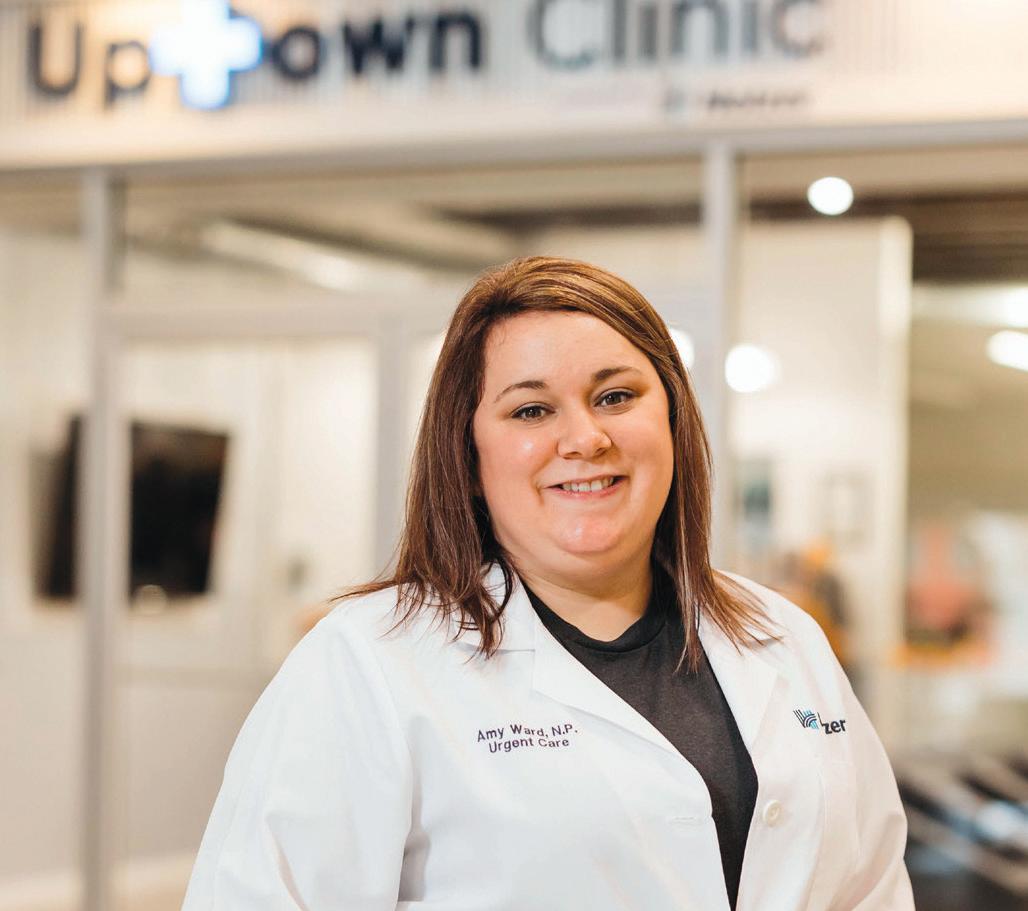
One of the players that seemed to excel against Knight was Paoli. Her first home run of the day was against Knight as well as her RBI double and rally-igniting walk.
“I was just looking for a hard pitch,” Paoli said. “I was laying off all the changeups because I have been swinging at them a little more than I should. I was really just looking for something hard on the inner half.”
Regardless of how it got the job done, Ohio was able to pick up the win to split the doubleheader and win the series, which could be a key moment in the race for the MAC’s top spot.
Luke Olson is Ohio’s Friday guy. The junior from Granville, Illinois, has proven himself to be a reliable arm this season and leads Ohio in wins with three. He’s also the only pitcher on Ohio’s roster to meet the inningsper-game requirement for ERA.
Olson transferred to Ohio from Danville Area Community College for the 2023 season. He hasn’t been in Athens long, but he’s already made a name for himself in the Mid-American Conference. On April 7, Olson threw a complete-game shutout against Toledo. He struck out seven batters and allowed a mere two hits.


The Post sat down with Olson to chat about life in Athens and more:
TP: So, if you could take three things with you on a deserted island, what would they be?
Olson: That’s a good question. Golf clubs — got to have those, a surfboard and my baseball glove.
TP: OK, are you a big golfer and surfer?
Olson: I’ve never surfed, I just think it would be cool if that was on the island. I’d have something to do, but I do like to play golf when I can.
TP: Do you have any favorite golfers?
Olson: I watched Tiger (Woods) growing
here?
Olson: I think so. I think being on campus is a lot different for me. There’s 250 kids in my high school, so I knew every single person. I’ll go to class and I won’t know somebody, I think it’s awesome. I can just blend in and be Luke, not everyone knows every single thing about me. It’s different.
TP: Do you have any favorite spots in Athens that you’ve discovered?
Olson: I spend so much time in The Convo and the field, I don’t really have a ton of free time, but I like it. I guess the locker room. I spend a lot of time there (laughs).
TP: What are three things people could find in your locker besides gloves and baseball kinds of things?
Olson: I have headphones in there. I have these Nike Burrow slippers that I wear all the time that I probably shouldn’t be wearing around, but I wear them all over. I always have my JUCO clothes in there, I pretty much wear that, but that’s it.
TP: You mentioned headphones, are you a big music listener?
er stuff like Gunna and YoungBoy. I also listen to like Morgan Wallen and stuff like that.
TP: Are you a new country or an old country fan?
Olson: I would say newer, but I’ll listen to the 2000s and 2010s. I like Darius Rucker a lot, but I tend to go toward the Wallen or Luke Combs newer stuff. Hardy’s good too.
TP: I could just see you on your deserted island with your surfboard listening to some Darius Rucker
Olson: (Laughs) I should bring a beatbox, that’s what I should do. Or bring my AirPods, that’d be fine.
TP: Yeah! My last question for you is what is something you wish people knew about you? Do you have any hidden talents or anything?
Olson: Me and Dillon Masters spend a lot of time slinging the football around. We may be able to make a run if there are walk-on tryouts. Don’t count us out. We have a lot of fun with the football. I’d say that’s a hidden talent.
up. He’s like my favorite.
TP: Yeah, so you talked about your glove. Why did you start playing baseball?
Olson: My dad used to coach when I was younger. He coached junior high and high school. After school when I was younger, I would go to practices and I’d hang out there. I always wanted to be like the guys that he coached. It was always cool for me to be in the dugout during games and practices. I fell in love with being at the ballpark and I’ve never wanted to not be there.
TP: That’s cool. You’re from a small town, right? Did you have like sandlot teams? Are there any professional teams you like?
Olson: I’m a (Chicago) Cubs fan. Me and my friends used to play in a little lot that was empty all the time which was cool. We just played wiffle ball. Being from a small area, there’s not a ton to do, so you’ve got to just make do with what you have. We had an empty lot, a wiffle ball and a bat, so we’d play whenever we could.
TP: I get it. My hometown is itty bitty. I’m a big drive-around-for-fun person.
Olson: Mine had like 1,300 people so we’d literally drive to Walmart for fun. People don’t get it if they’re not from a small town. That is fun.
TP: Athens is kind of a small town, do you feel like you’ve grown used to the energy
Olson: Yeah. I listen to a lot of country because that’s what everybody listens to when I’m back home, but I also listen to new-
 ROBERT KEEGAN III FOR THE POST
Ohio picked up its first midweek win of the season against Shawnee State Tuesday night. Mitchel Hemmen picked up his first win of the year in relief for the Bobcats with a final score of 7-2.
Braxton Kelly got the start for the Bobcats, an unusual role for the righty who is typically the team’s go-to closing pitcher.
Kelly only pitched one inning where he could keep the Shawnee State batters quiet through the first, which gave the offense time to take the lead.
The Bobcat offense got off to a hot start in the first with two runs by means of a Cole Williams’ single that scored both Mason Minzey and A.J. Rausch.
After Kelly exited, Hemmen took the mound. Hemmen followed with four innings of well-pitched baseball where the righty’s only tough spot was a two-run home run that was surrendered in the second to designated hitter Noah Rezner.


From then on, the Bobcat pitching did not surrender a run.

“I thought (Hemmen) settled in and did fine. Tyler Peck was really sharp tonight,
which was good to see and then Hudson (Boncal) there at the end was sharp too,” Ohio coach Craig Moore said. “It’s good to see those guys but we’d like to have a couple more guys step up down there in the bullpen.”
The Ohio offense came alive in the fifth. Rausch started off the inning with a single to right and proceeded to steal both second and third before advancing home on a wild pitch that gave the Bobcats a one-run lead.
Shawnee State pitchers Garrett Goodwin and Dylan Bernard each walked one batter before Colin Kasperbauer came up to the plate to deliver a two-run double down the first base line that extended the lead for Ohio to three.
Williams tallied his third RBI of the game during the fifth with a double off of the centerfield wall that was feet away from a threerun home run.
“Certain situations call for different things that I may have to do up there but I’m comfortable hitting up (in the four hole),” Williams said. “I just like hitting with guys on base.”
Ohio had no trouble running the bases during Tuesday’s game. The offense generated runs with a combined total of nine stolen
bases, including three from Rausch.

Peck and Boncal finished the game with four innings of shutout baseball that propelled the team to a 7-2 victory.
Ohio will now prepare for a road trip to Kent State, which is currently part of a fourway tie with Ohio, Ball State and Central Michigan for first place in the Mid-American Conference.
“Everybody’s always checking the standings and talking about it and everything which is always really good to see,” Hemmen said. “It’s gonna be a really exciting next couple of weeks and we’re all pumped for it.”

For ages, humans have obsessed over progress because progress is believed to be the solution to our issues.
There is constant discussion about developing and implementing solutions to what we perceive as problems. One could argue that everything we do — from school to employment, to clubs, to the art and music we create — revolves around bettering the world for others in some way. Everything we do has been justified to benefit humanity.
We have a drive for advancement. We have the drive to improve our homes, what cars we drive, the words we put down on a page, the Instagram posts we put out into the world, and more. Whether this is something produced socially — namely, the judgment of others pushing us to seek improvement — or if it’s innate that’s a discussion for another column.
However, this discussion of endless human advancement is apt for one current topic: the development of artificial intelligence.
We here at Ohio University have all heard of Chat GPT, or seen the discourse surrounding AI-generated art or music, or seen the reports of fake stories designed to imitate veritable news organizations. Or the ‘copilot’ that is now in some browsers. The list goes on.
In the few short months after its debut, public-use AI has become extremely visible in discussions regarding technology. And these discussions have been mostly negative.
People often wonder what jobs AI could and will replace. Whether AI is going to steal from artists’ hard work or contribute to misinformation. Again, the list of anxieties goes on.
So, to return to my original thoughts, technological advancement’s primary purpose is to benefit society. Otherwise, it’s not justified.
And, with the artificial intelligence that has been handed down to the public, I just can’t see the benefits.
To provide just one example, Snapchat, a social media app, just released a version of its AI. Users can chat and share photos with it all the same as real friends. It cannot be removed unless you pay a fee. Snapchat is an app for communication, and they have developed something for our isolated generation to communicate with. Personally, I think it tells us quite a bit about a developer’s intentions when they create something that seemingly preys on the already exorbitant loneliness of Generation Z.
AI was not created with human and social benefits in mind. It was created to keep up with the latest fads and to make Snapchat more competitive with other social media.
There is no denying that technology is useful. There is no denying that technology is necessary. It’s why, in the 21st century, STEM is praised and encouraged to young students as a career. We see science as the future. But not all technology is useful and necessary, and I believe this applies to artificial intelligence for public use. The only arguments for AI have been to justify its existence–which is never encouraging.
Human advancement is pursued relentlessly, but it is not
always a good thing. It has the capacity to harm, just as it has the capacity to hurt. Novelty is not a reason to praise something we have created.
It’s too early to say what kind of threat AI is going to be to us if it is any sort of threat at all. As an example, the 2020 election and the COVID-19 pandemic was rife with conspiracy theories and misinformation. I can only imagine what we will have to deal with in the 2024 election season when anyone can create convincing soundbites or newsreels.
I approach AI’s development with skepticism because, as a historian, I have studied the pitfalls of human technology and advancement. To put forth a (perhaps overused) comparison, when Dr. J. Robert Oppenheimer, head of the Manhattan Project, spoke on the atomic bomb years after its creation, he famously said: “We knew the world would not be the same.”
The developers who have created AI will not be the ones to suffer the consequences. They will get contracts, publicity and infamy. But it will be our jobs, our relationships, and our education that will be impacted the most. It will be society, us, that has to adjust to AI’s creation.
Regardless of whether it will harm or hurt, Artificial Intelligence has been handed to the public. It is a pandora’s box that we do not know the consequences of. Only time will tell.
Colleen McLafferty is a junior studying history at Ohio University. Please note that the views and opinions of the columnists do not reflect those of The Post. What are your thoughts? Tell Colleen by tweeting her at @colleenbealem.
Have you ever girlbossed a bit too close to the sun? Just as the “b-word” was reappropriated by those it sought to harm, “girlboss” is being reappropriated by the girlbosses. There are plenty of think pieces floating in the ether that preach “girlboss” is merely a term used to isolate women in the corporate world, promote white feminism and so on.
The term was originally popularized by notorious Nasty Gal founder Sophia Amoruso. For Amoruso, a girlboss was one who was in charge of their own life, not necessarily other people.
As written in a farewell letter on Girlboss.com, Amoruso clarified that “the intent wasn’t to be about being female bosses, it was like, ‘be the boss of your own life.’ I wrote (‘#Girlboss’) for women because that’s who shopped from me and I’m a woman.”
Over time, the word has evolved to have severe, negative connotations, and some view the moniker as an insult symbolizing hypocrisy, toxicity and false solidarity.
However, a research article published on behalf of the Association for Psychological Science proposes that “self-labeling with a derogatory group label may ironically weaken its stigmatizing force and even revalue it, transforming the very words designed to demean into expressions of self-respect.” Such reappropriation attempts to devalue an insulting
label’s stigma and allow the self-labeler a feeling of power that can expand beyond themself.
I will say, I do think there is a distinct difference between “girlboss” and “girl boss.” Girlboss is hot, girlboss is a game and girlboss is fun. It is effectively one word and it is snappy. On the other hand, “girl boss” is a combination of words using “girl” as an adjective before the noun “boss,” and that is unnecessary.
A very amusing and tone-deaf (sorry) Refinery29 story declares the “girl-” prefix in girlboss is infantilizing because “if we weren’t so scared of women’s power we wouldn’t need to do this, to make it more palatable by rolling it in glitter and pinkwashing it.”
I’m sorry, but as an adult girl, I enjoy both glitter and the color pink. Please feel free to roll everything in glitter for my benefit.
Also, girlboss has evolved into a gender-neutral term. Don’t ask me to explain this — it is in the aura of the word. Non-binary people can be girlbosses if they want to. In a way, girlbosses are simply more powerful than a regular “boss.”
To be a girlboss is to always have the Michelle Obama-led “Hey Queen” motivational video on standby. You take mental health breaks when needed. You care about others.
I will admit when I first started using the word girlboss, it was reluctantly and ironically. My friends used the word so I thought, “Hey, why not. It’s silly!” But, I committed to the bit so strongly that it became a sincere part of my vocabulary. In
the end, the word has almost become an inside joke amongst exhausted Zillennials and Gen Zers.
As a Black woman, it would be remiss of me to bypass the valid criticisms of “girlboss culture.” The Girl Boss golden era, from 2014 to 2019, according to Glamour, was not equal and mainly uplifted white women. Some who are weary of the reclamation of girlboss note the movement’s need for genuine diversity and inclusion.
To that, I say, I wholeheartedly agree! At this moment, I am exclusively discussing the word, not the culture or movement.
No, I will not purchase a Cricut machine to emblazon “#GIRLBOSS” across all of my physical belongings. But I will shout out my cool friends for following their dreams on their own terms and achieving what they put their minds to. Like, they are girlbosses. What else am I supposed to call them?
Sure, I could say, “Hey, you are smart, talented, charismatic, and will succeed in life.” However, “You are such a girlboss” conveys the same message. Why waste time saying a lot of words when few words do the trick, you know?
Besides, I can use the time I save saying fewer words to girlboss.
Dori Gray is a senior journalism major at Ohio University. Please note that the ideas expressed in this column do not reflect those of The Post. Want to chat with Dori? Tweet her @ dorigraywrites.
OLIVIA ROHLING FOR THE POST
The weather is finally warm, classes are wrapping up and summer is just about here. Like every season, new trends are starting to emerge. Here’s a list of up-and-coming trends you might see this summer:

This trend gained traction through TikTok influencer Darcy McQueeny and can be seen in her “GRWM for class” TikToks. McQueeny almost always wears a slickedback ponytail to class and sometimes to go out with her friends. This hairstyle has been more prevalent in the bar scene and is an upand-coming trend that will surely flourish this summer. The hot weather almost leaves those with long hair with no choice but to
put it up in one way or another, so this sleek style is a great option.
Summer often offers a boost in happiness for a lot of people. Another thing that can elevate one’s mood is bright colors; there’s no better time to wear those colors than summertime. It wouldn’t be surprising to see clothes the colors of neon pink and green be really popular this summer. Neon-colored nail polish, accessories and clothes will be on the rise this summer.
Another up-and-coming hairstyle that will flourish this summer is bubble braids. No matter how unskilled you are at doing hair, most people can do a bubble braid. It’s quick, easy and chic. If you want to spice it
up, braid a section of a ‘bubble’ with a fishtail or regular braid. For those with longer hair, this hairstyle is great for keeping our hair off our necks during the hot summer months.
You’ve likely seen them all around campus: workout sets. They’re versatile, easy and not to mention absolutely adorable. Amazon sells a wide variety of these sets, and if you’re willing to spend a little more money on them, Aerie would be a great place to stop too!
Jorts are back and better than ever. Jean shorts, or “jorts,” will surely be a hot trend this summer, but not just any jean shorts. A big trend you’ll probably see this summer is jorts that go almost down to above the knee – we aren’t talking about cut-offs here. Den-
im shorts that are a bit longer will definitely be a hot item this summer.
Another clothing item, biker shorts, will surely be an ‘oh so stylish’ item this summer. If you’re looking for inspiration on how to style them and what to pair them with, look no further than Princess Diana. The princess wore biker shorts and a light pullover in many of the photos paparazzi took of her, so if you’re going to get biker short inspo from anyone, let it be her.
A mindless scroll on TikTok might lead you toward a new side of the social media app: the famed "WaterTok," stimulating over 170 million views across the app. But it's not just plain, old water; it's a 40-ounce Stanley cup full of ice, powder flavor packets and copious pumps of syrup to create the ultimate water-drinking experience.
Consistently made by American TikTok users, the trend inspired others to increase their water intake, especially those trying to lose weight. Users share how to increase hydration, capturing their water recipes daily. Recipes contain powders and syrups that have little to no calories or sugar and are instead packed with artificial sweeteners.
While it isn't a new phenomenon, the presence of social media has allowed "WaterTok" to become the next "TikTok made me buy it," with tons of users now buying the Stanley cups and all of the flavorings to make their own unique recipes.
But many have to contest if it is actually water. The other side of "WaterTok" argues that these flavored combinations are basically juice or Kool-Aid. Some also stipulate
that this trend adds to toxic diet culture, as it encourages the heavy consumption of artificial sweeteners and aspartame.
"WOTD," otherwise known as the "Water of the Day, "is one of the most popular sharing methods of "WaterTok." The "Hydration Station" or the "Water Bar" is the equivalent to an at-home coffee station, except there is an abundant stock of syrup bottles on a spinning organizer and flavor packets separated in their own packed caddy.
The most popular flavors of powders range from pop-adjacent flavors like orange Crush or Hawaiian Punch to packets mimicking liquified candy like Starbursts, Nerds, Jolly Ranchers, Skittles, etc. The syrups range in size from smaller handheld bottles to larger pump syrups in bulk. The possibilities are endless with syrups like salted caramel, dragon acai fruit, cotton candy, and coconut.
A powder packet of the green apple Jolly Rancher with two pumps of salted caramel syrup creates a drink resembling a caramel apple. One user shared her birthday cake water recipe, which consists of four pumps of cotton candy-flavored syrup and three pumps of vanilla-almond flavored syrup. This particular video has accumulated over
two million views, though the comment section is filled with remarks like "Why don't people just drink water," and "At what point are y'all just making juice?"
Several users have already begun posting videos to mock the flavored water users, giving their satirical renditions of the water recipes.
One clip even brings in a sound clip from the iconic mockumentary show "Parks and Recreation" as a tie-in to the bizarreness of "WaterTok."
The drama between the two sides has grown as the trend becomes increasingly popular. The flavored water makers make jokes right back, poking fun at what the other side wants them to say or think about their drinks.
A Harvard nutritional physicist, Dr. Uma Naidoo, has spoken out about this particular trend, stating that the marketed zero-calorie or zero-sugar products of syrups and powders are not the same as if you were to drink a normal cup of water. All artificial sweeteners are potentially harmful to the body but can be used in moderation. For some users, they have apparently contributed to their weight loss.
"Two pumps of the coconut syrup, ma-
ma's trying to have a pina colada," says Tonya Spanglo, also known as "takingmylifebackat42" on TikTok. Her videos get some of the heaviest traction on this side of the app, especially as she shares how she has lost over 200 pounds with the help of her water recipes. She even has a partnership with Skinny Mixes, a company that creates several sugar-free syrups that she promotes in her videos.
She particularly has spoken out about her strong feelings against all the hate she has received on her daily videos. Spanglo and many other "WaterTok" lovers seem determined to stay on the flavored water train, despite the fact that it may or may not actually be water.
Who knows how long this side of TikTok will remain relevant, especially because of the heavy load of backlash and drama between both sides. But the fad is definitely entertaining and creative nonetheless, even though it's entirely easy to drown in this new TikTok sensation. @LOGANHUMPHREY
Sadly, one of pop culture's most beloved couples, Taylor Swift and Joe Alwyn, recently split after six years together, the news breaking just weeks into the singer's "Eras Tour." Yet, there's been speculation that the two have been broken up for a while now, with fans using Swift's most recent album, "Midnights" as evidence.
If you truly pick apart each song from this record, there are subtle hints that their relationship is no longer intact. With this in mind, here are all of the signs that "Midnights" by Taylor Swift was, in fact, a breakup album:
Swift recently said she felt the most connected to "Midnights"
During her recent tour stop in Tampa, Florida, the singer told the audience that she currently "feels really connected" to "Midnights" because "it's the most accurate picture" of her life. This speech was later uploaded to TikTok, causing fans to theo-
rize that she may be referring to her breakup with Alwyn. Later on, another fan also tweeted that Swift's lyrics sound like she's been grieving the fearful end of her relationship, evident in the color scheme also used for it.
The lyrics on "Midnights"
While many songs on "Midnights" are obvious homages to Alwyn, such as "Sweet Nothing" and "Mastermind," there are also quite a few that see Swift's exasperation and sadness come to the forefront. For example, "Bejeweled" is a song where the singer is annoyed with the comfort of her relationship and wants some more excitement.
She sings, "Baby love, I think I've been a little too kind / Didn't notice you walking all over my peace of mind / In the shoes I gave you as a present / Puttin' someone first only works when you're in their top five / And by the way, I'm going out tonight," which is a definite sign of being tied down for too long.
Additionally, People reported that Swift and Alwyn broke up because of Swift's return to the spotlight after the COVID-19 pandem-
ic, where the two fell in love "in a safe bubble while she was retreating from the world" and in an "insulated way," causing the actor to struggle with her level of fame again.
This fact is heavily discussed in "Bejeweled," as Swift admits to not wanting to dull her sparkle or slow down career-wise for her partner, and says, "I made you my world / Have you heard? / I can reclaim the land / And I miss you / But I miss sparkling."
Another song where Swift is doubtful of being in a serious relationship is "Midnight Rain." In one of the lines, "He wanted it comfortable / I wanted that pain / He wanted a bride / I was making my own name / Chasing that fame / He stayed the same," the singer possibly referencing Alwyn's comfortability with staying out of the spotlight, something she couldn't find common ground on him with.
This annoyance is also referenced in "Lavender Haze," where Swift sings, "All they keep asking me / Is if I'm gonna be your bride / The only kind of girl they see / Is a one-night or a wife," sick of people seeing her as Alwyn's girlfriend and not for her ac-
complishments.
Lastly, Swift's most underscored track, "Labyrinth," sees her grieving the end of her time with Alwyn, saying, "I'll be getting over you my whole life" and "Break up, break free, break through, break down."
As fans worried that Swift would be upset throughout her extensive US tour this summer, she made a subtle yet sweet gesture to one fan recently. During her song "Delicate," which all Swifties know is a direct reference to Alwyn, the fan held up a sign asking, "You OK?" and the singer replied with a thumbsup and a smile.
With this remark, it's safe to say that Swift is moving on from heartbreak with the help of her fanbase and staying busy on tour.
All of the signs that ‘Midnights’ by Taylor Swift was, in fact, a breakup album