TheParliamentarian



2009
18-24 October7th CPA Canadian Parliamentary Seminar, Ottawa, Canada
26-29 OctoberWilton Park Conference on Governance and Accountability, West Sussex, United Kingdom
2-6 November18th CPA Australian and Pacific Regional Seminar, Wellington, New Zealand
11 NovemberDepartmental Committees Workshop for Trinidad and Tobago
20-26 NovemberPacific Parliamentary Assembly on Population and Development/Forum Presiding Officers and Clerks Conference incorporating CPA-FPOC Pacific•Benchmarks Discussion, Cook Islands
25-30 NovemberCHOGM, Port-of-Spain, Trinidad and Tobago
The publication of a Calendar of CPA events is a service intended to foster the exchange of views between Branches and the encouragement of new ideas. Further information may be obtained from the Branches concerned or the Secretariat. Branch Secretaries are requested to send updates of this material to the Information Officer (pirc@cpahq.org) to ensure the Calendar is full and accurate.

In the next issue of the In the next issue of the
Parliamentarian... Parliamentarian... A conference special on the A conference special on the 55TH COMMONWEALTH
55TH COMMONWEALTH
PARLIAMENTARY PARLIAMENTARY
CONFERENCE in Arusha, CONFERENCE in Arusha, Tanzania Tanzania
The Commonweatlh and the CPA: The Commonweatlh and the CPA: Meeting Future Global Challenges Meeting Future Global Challenges
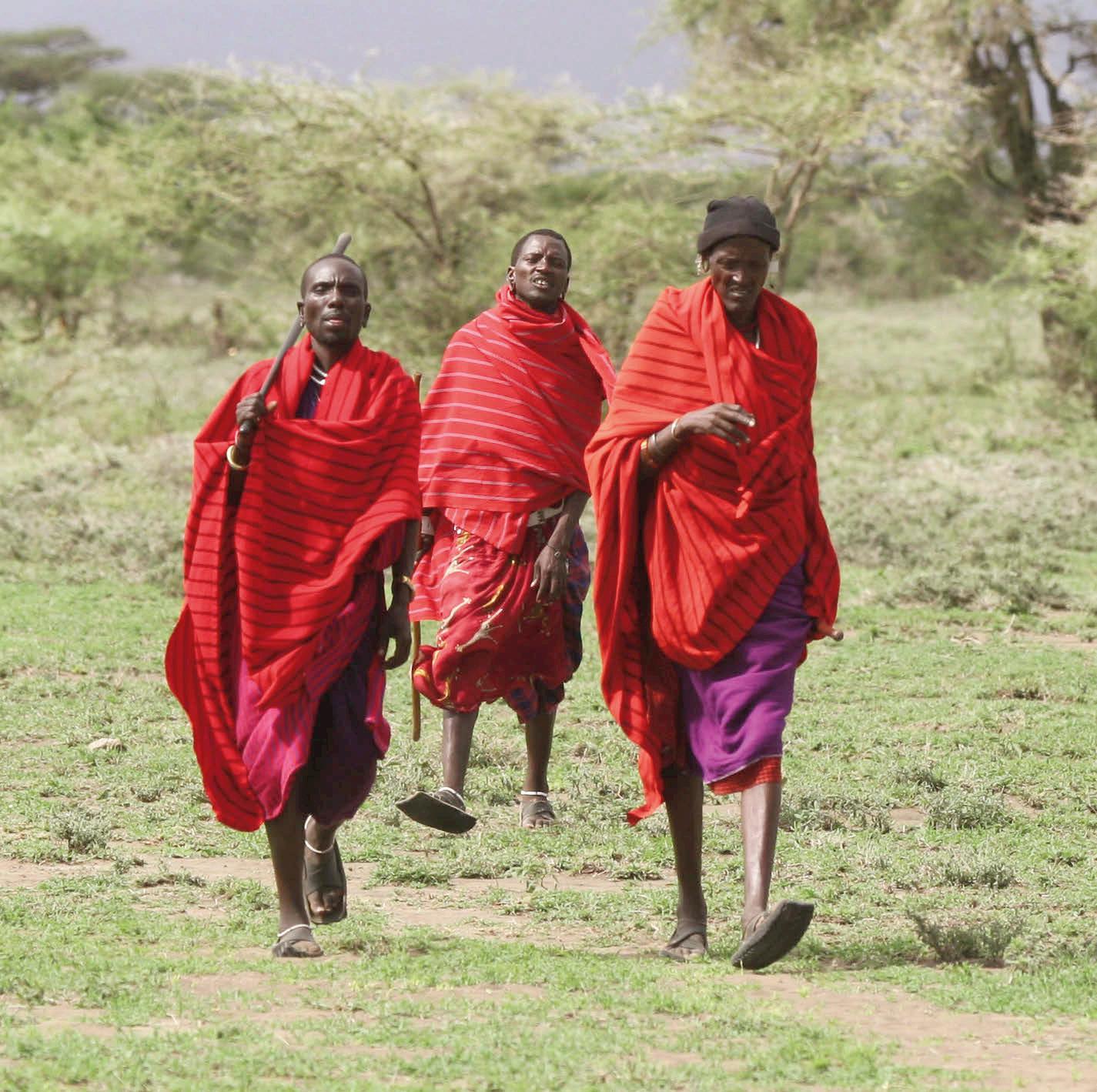
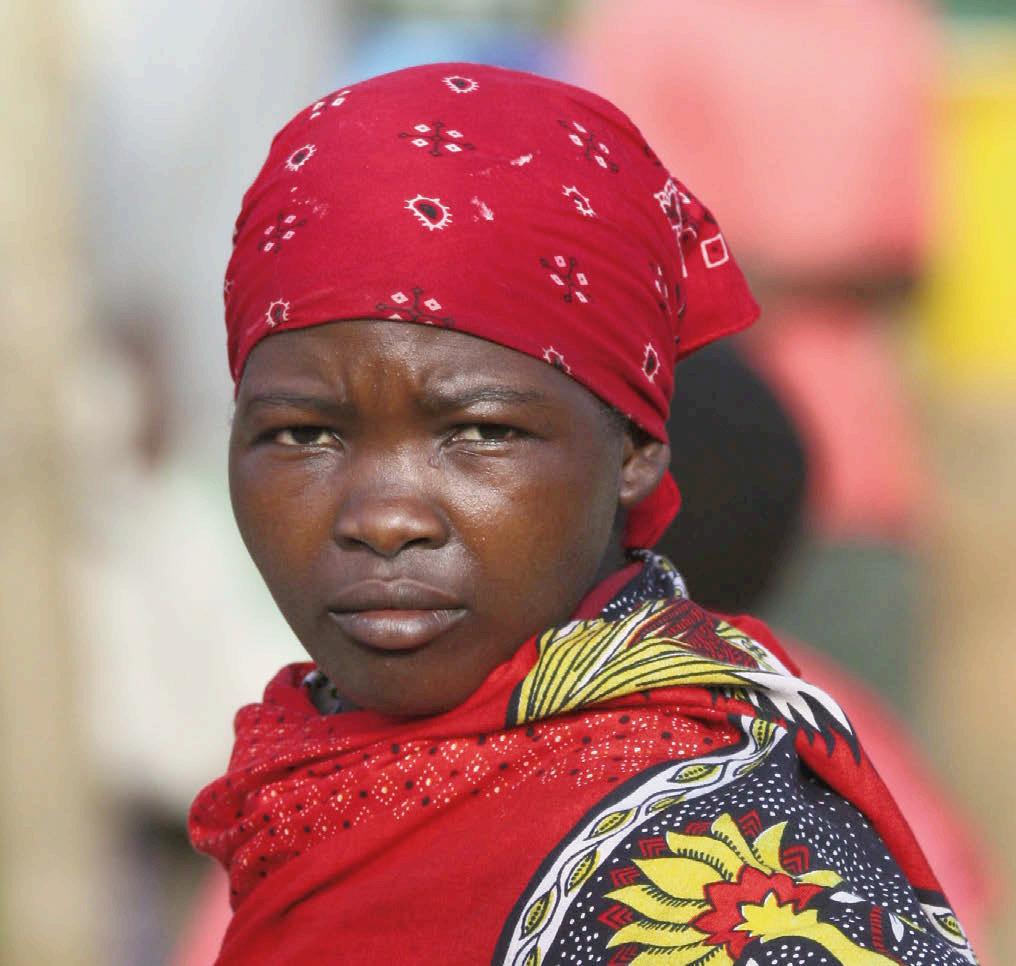


Journal of the Parliaments of the Commonwealth Vol. XC
2009: Issue Three
ISSN 0031-2282
Issued by the Secretariat of the Commonwealth Parliamentary Association, Suite 700, Westminster House, 7 Millbank, London SWIP 3JA, United Kingdom
Tel: (+44-20) 7799-1460
Fax: (+44-20) 7222-6073
Email: hq.sec@cpahq.org www.cpahq.org
Publisher: Dr William F. Shija Secretary-General
Editor: Andrew Imlach Director of Communications and Research
Assistant Editor: Lisa Leaño
Front cover
An elderly woman knitting a sweater out of used wool, Papua New Guinea.
Image: Shutterstock®
Printed in England by Warners Midlands, PLC, The Maltings, Manor Lane, Bourne, Lincs PE10 9PH
Inside Issues
Affirmative action across the parliamentary spectrum Page 212
View from the Chair Facing up to critical issues through Commonwealth consultation. Page 214
View from the CWP Discussing democracy in South Asia. Page 216
View from the Secretary-General Democracy and equity under the financial crisis. Page 218
Rhetoric to Reality: Trying to break the gender barrier in Papua New Guinea
Hon. Carol Kidu Page 222
Changing policy responses to future credit growth
Mr Charles Bean. Page 226
An Australian Model for Human Rights?
Mr Brian Tee, MP.. Page 230
Financial accountability: enhancing the functions of the Public Accounts Commitees in Trinidad and Tobago
Sen. the Hon. Danny Montano. Page 232
Curbing excessesfinancial and deficiencies in Samoa
Hon. Tuiloma Lameko, MP. Page 236
Accounting for public spending in Vanuatu Hon. Ture Kailo, MP Page 238
The effect of the A.C.T. Greens/ALP Parliamenary Agreement
Mr Shane Rattenbury. Page 240
Not a foolish exercise: Assess your own Parliament as an effective democratic Legislature Hon. Taomati Iuta, MP. Page 246
Norfolk Island raises the bar for democracy
Hon. Lisle Snell, MLA, and Hon. Andre Nobbs, MLA. Page 248
An integrated approach to parliamentary assessment
Ms Melissa Bhatnagar, Ms Jill Shirey and Ms As Page 252
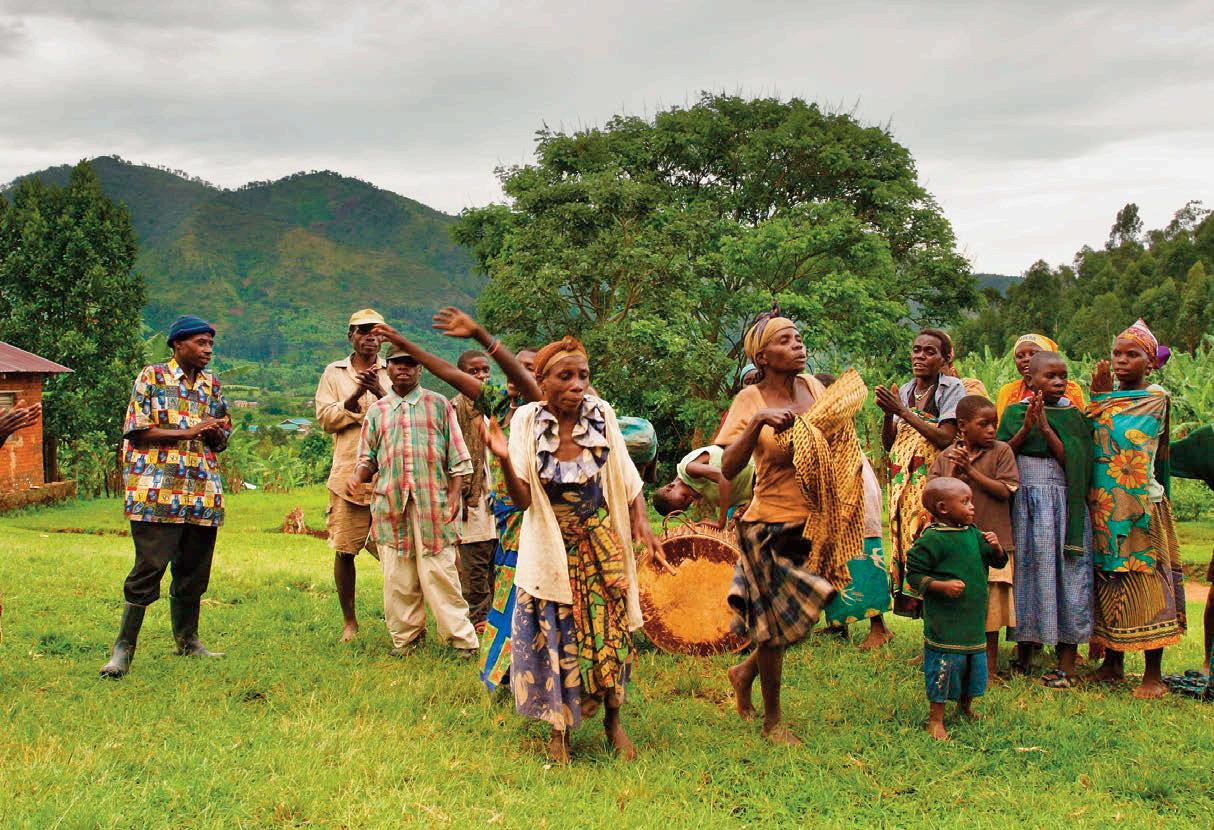
Making the connection
Mr Ian Harris. Page 256
Computer-based support in the parliamentary system
Mr Attaullah Khan. Page 260
Improving Members’ conduct
Hon. Jim Fouras. Page 264
Tracing the history of the Punjab Provincial Assembly
Miss Abeeda Haroon and Mr Khalid Mahmood.
Page 266
Parliamentary Practice in British Columbia – Fourth Edition
Mr Claude Richmond. Page 284
CPA Organization
Page 285
Parliamentary news: Papua New Guinea, Sri Lanka, Canada, Australia, United Kingdom, India, Trinidad and Tobago and New Zealand. Page 271
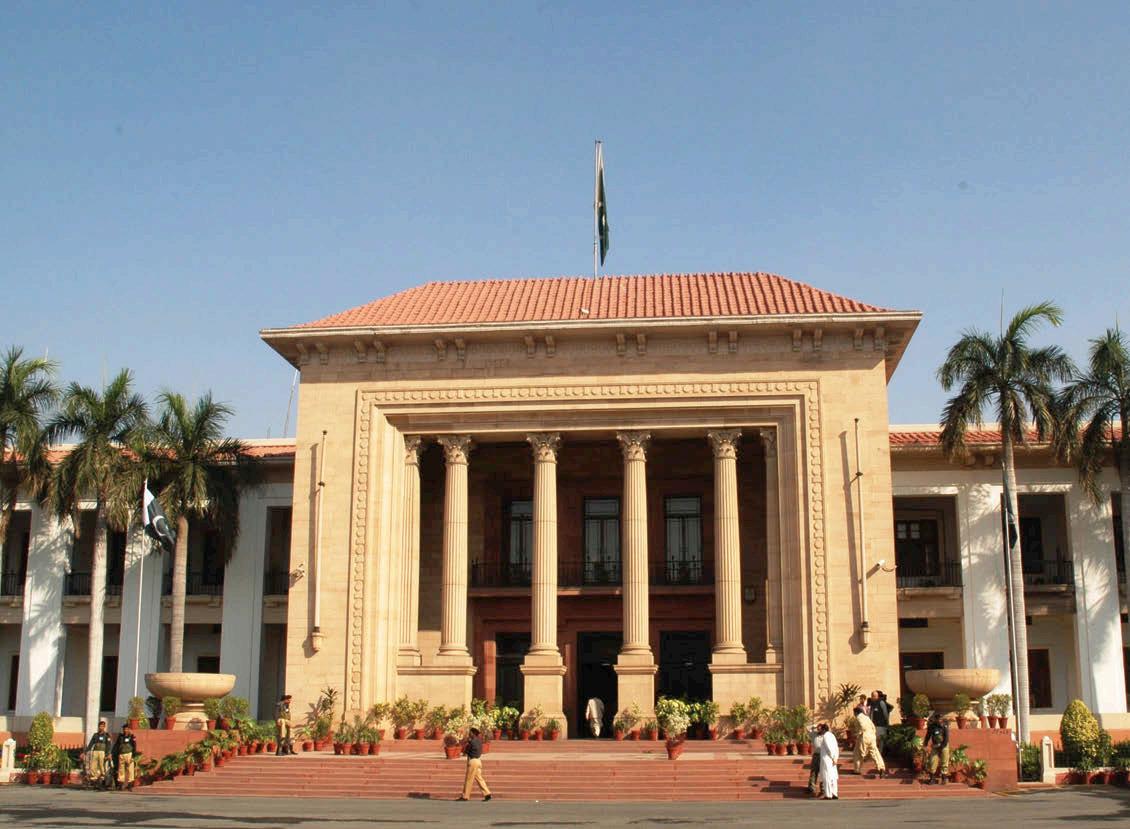
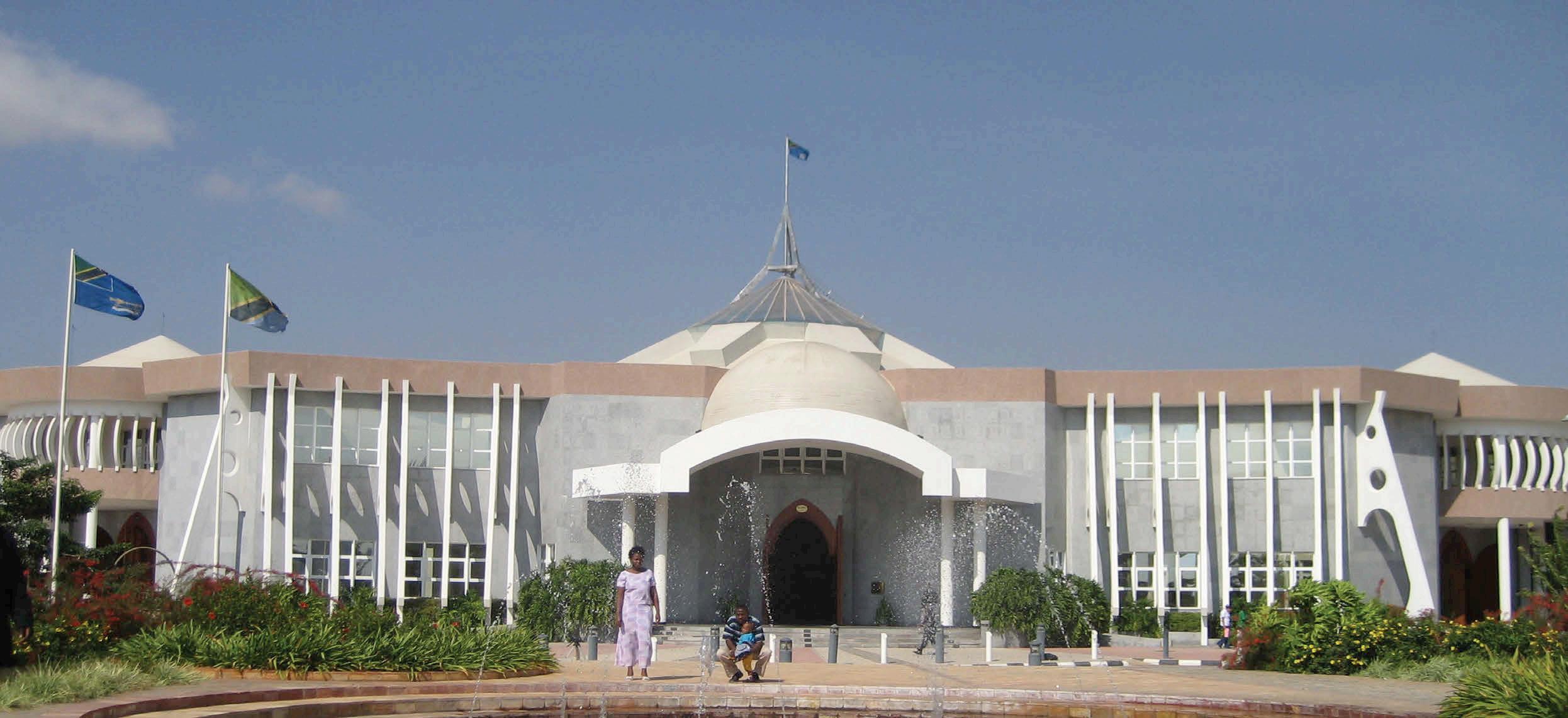
Profile on Tanzania: Supplement included as an insert with this issue.
Annual subscription (four issues)
UK: £34 post free.
Worldwide:£36 surface post £42 airmail
Price per issue
UK: £11
Worldwide:£12 surface post £13 airmail
Opinions and comments expressed in articles and reviews published in The Parliamentarian are those of the individual contributors and should not be attributed to the Secretariat of the Association.

Editor’s note
Hon. Dame Carol Kidu, MP, openly admits that she never used to advocate affirmative action to bring more women into Parliament. Three Parliaments in Papua New Guinea changed her view: one to which she and one other woman were elected followed by two successive Parliaments in which she was the only woman among 109 MPs.
Earlier this year, the government of Papua New Guinea, of which she is a Minister, was unable to nominate women to Parliament because it lacked the necessary two-thirds parliamentary majority to pass the motion. In her leading article in this issue, Dame Carol indicates the government will try again as she argues that Papua New Guinea must make special provisions to install more women in parliamentary seats because nothing else has worked to reverse the gender imbalance. The Minister writes here about the special measures being proposed to make the Papua New Guinea Parliament more representative of the South Pacific nation’s population – and give it some hope of at least coming close to the Commonwealth target of 30 per cent of parliamentary seats occupied by women by 2015. Affirmative action on the
gender question gives way in our second article to affirmative action to respond to the global financial crisis. Mr Charles Bean, a Deputy Governor of the Bank of England, readily acknowledges that some people accuse him of playing a small part in the current crisis. Who better, therefore, to turn to for ideas on how to resolve the current crisis and stop it happening again? We publish here some of his ideas as they relate to policy measures which fall within, or close to, the remit of Parliamentarians. Responses to the financial crisis will need to work now and, unfortunately, later: Mr Bean has warned economists – and the rest of us – that financial crises are an inevitable part of a free-market economy.
Australia does not have a reputation as a country in which human rights might be in jeopardy, but consultation has begun there on the development of a national human rights charter. The Australian Capital Territory and the state of Victoria already have human rights charters for their own jurisdictions. Mr Brian Tee, MLC, a Member of Victoria’s upper House, writes here on how his state’s charter, which is part of state law, has had a positive practical impact on many sectors in the
state. He also notes that there were – and still are – fears that such an all-encompassing charter would have many unintended negative consequences. The fears have so far not become reality.
Small Commonwealth Parliaments often argue that they need different procedures and processes because their Members are more intimately familiar with their communities and governance than are Members in large jurisdictions. One area of parliamentary government where this is not the case is their review of public spending. The role of the Public Accounts Committee (PAC), an area in which the Commonwealth Parliamentary Association (CPA) has been focusing much attention, is equally vital in small and large Parliaments.
In this issue, we present three examples of the role of PACs in small Parliaments. Sen. the Hon. Danny Montano, President of the Senate of Trinidad and Tobago, writes first on efforts to strengthen his Caribbean Parliament’s PAC, with assistance from a CPA seminar. Hon. Tuiloma Lameko, MP, who chairs the Samoan equivalent of the PAC, reports on how it is working to strengthen the governance of his Pacific island nation. To the west of Samoa, the
Parliament of Vanuatu always places a high priority on the work of its PAC, writes Government Whip Hon. Ture Kailo, MP. As evidence of this, he reports that the MP who currently chairs the committee is a former Leader of the Opposition. Mr Tuiloma and Mr Kailo participated in this year’s Summer Residency Programme for Public Accounts Committees organized by La Trobe University’s Public Sector Governance and Accountability Research Centre with the CPA and other partners. The programme continues to assist PACs to improve their effectiveness.
The Australian Capital Territory (A.C.T.) Legislative Assembly has used other CPA programmes to improve its effectiveness. It was the Commonwealth’s first Assembly to assess itself by using the CPA Benchmarks for Democratic Legislatures. Now, the Assembly is using the CPA-inspired Commonwealth (Latimer House) Principles on the Three Branches of Government as part of a new Parliamentary Agreement enabling the Labor Party to form a minority government with support from the Green Party. Mr Shane Rattenbury, MLA, the Assembly’s Speaker, writes in this issue on the parliamentary reforms
that are an essential part of the agreement, reforms that also included other measures advocated by various CPA groups.
Returning to the CPA Benchmarks, this issue looks at the application of the Benchmarks by two Houses, including one whose Speaker initially dismissed the idea as an insulting and foolish exercise. Kiribati Speaker Hon. Taomati Iuta, MP, describes here how he changed his initial negative view of the Benchmarks, leading to the launch of a self-assessment involving all Members of the Parliament of Kiribati. The Kiribati experience will not only help the Parliament to identify practices it might wish to improve, it will also feed into a major project by the CPA and other partners to agree a set of Pacific Benchmarks tailored to the needs and traditions of its small island states. Benchmarks self-assessments are either under way or about to begin in Tuvalu, Niue, Vanuatu, Tonga and Nauru. The Parliament of Canada has conducted its self-assessment (as we hope to report here in a future issue), and the Parliaments of Australia and New Zealand are planning a joint assessment conducted in a novel way.
The second Benchmarks application is by Norfolk Island’s
Legislative Assembly, but it is at this stage not in the form of a selfassessment. Speaker Hon. Lisle Snell, MLA, and Chief Minister Hon. Andre Nobbs, MLA, have contributed a joint article to this issue on the use of the CPA Benchmarks to support their small House’s attempts to resist changes to the island’s governance that they fear will be imposed on them by the Australian government. The use of a self-assessment device as a selfdefence mechanism is an innovative development.
The CPA Benchmarks is one of several standards developed by various organizations to assess parliamentary performance. A group of Masters students at the London School of Economics have compared the Benchmarks and four of the others in a project for the World Bank Institute, one of the partners in the CPA Benchmarks. The students report here on their conclusions and on the assessment tool they developed in an attempt to distil one standard out of the five.
One activity that many Parliaments are striving to improve is their outreach work. As Parliaments recognize that they must compete for public attention, and that promoting public interest in what Parliament is doing
strengthens a nation’s democratic commitment, many institutions are seeking new ways to communicate with the public both through the media and directly. Mr Ian Harris, whose tenure as Clerk of the Australian House of Representatives comes to an end later this year, catalogues the many tools his House uses to great effect to keep Parliament in the forefront of politics.
Inevitably today, some of those tools are electronic; but high-tech communications are not confined to Parliaments in highly developed societies. Mr Attaullah Khan, the officer responsible for the information and communications technology in Pakistan’s North West Frontier provincial Legislature, writes in this issue on the computer facilities and services provided to Members so they can reach the people in a province in which MLAs must compete with groups bent on destabilizing democratic institutions.
Observers often argue that raucous and impolite behaviour by Members in the Chamber also destabilizes democracy. A former Speaker of the Queensland Parliament, Hon. Jim Fouras, agrees as he writes in this issue about maintaining in a House a level of decorum which respects
the institution, and encourages others to do the same.
This journal has for many years focused attention on the Parliaments and Legislatures hosting Commonwealth Parliamentary Conferences and Executive Committee meetings. Pakistan’s Punjab Branch has suggested that similar features could be published on the histories and development of other Assemblies. We therefore begin what is to be a regular feature with the history and development of the Punjab provincial Legislature.
Finally, a former Speaker of the British Columbia Legislative Assembly, Mr Claude Richmond, the latest edition of Parliamentary Practice in British Columbia by the Clerk of the B.C. Legislative Assembly, Mr E. George MacMinn, QC. Not only is this book a valuable addition to the literature on Commonwealth practice and procedure, it also serves a model to other Parliaments and Legislatures of a publication each could produce and as a reminder that records of the parliamentary process need not be confined to the practices of a few big Parliaments.
This issue will be published in time for the 55th Commonwealth Parliamentary Conference to be held this year in Arusha, Tanzania. Therefore, I must begin by offering sincere thanks to the CPA Tanzanian Branch for hosting the event. Members will recall that last year the 54th CPA Conference was held in Kuala Lumpur and I know just how much planning and work has to go into the preparation. Therefore, I am sure that I speak for all delegates when I say how truly grateful we are to Tanzania for its hospitality. The conference, which begins on 29 September and ends on 5 October, will be formally opened by President H.E. Jakaya Mrisho Kikwete. I am sure delegates will wish me to thank the President for gracing the occasion with his presence and for hosting the opening dinner.
severe stress on emerging democracies and as such this is a crucial issue for the CPA.
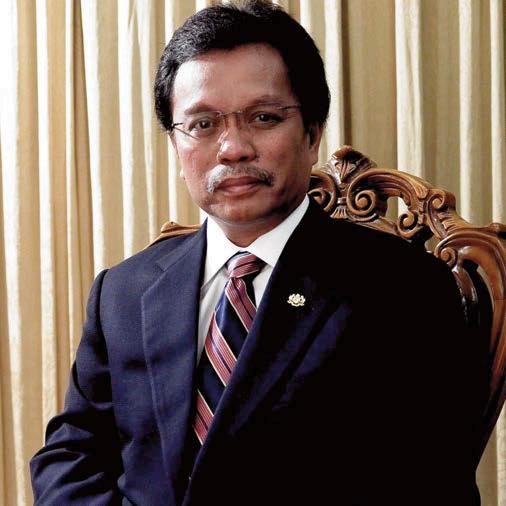
The conference theme this year is: “The Commonwealth and the CPA – Meeting Global Challenges”. We have a very busy schedule and, in addition to the formal business meetings of the Association, I want to draw attention to the eight workshops planned for 4 October. Perhaps even the word “challenge” is an understatement for the topics include a wide range of very serious issues that Parliamentarians are facing now and will undoubtedly have to address in the future. Probably uppermost in peoples’ minds is the global financial crisis and how this affects individual governments’ ability to meet the economic, social and educational aspirations of the people.
Apdal, MP
Chairperson of the CPA
Executive Committee and Minister of Unity, Culture, Arts and Heritage, Malaysia
The global financial meltdown has placed heavy pressure on Parliaments too, as Members have had to grapple with often unpalatable decisions. There is no doubt that as a result of failures in the world financial system there are now more people suffering from poverty than a year ago and some economies are tottering under the strain. Surely as we reach the end of this first decade of the 21st century it is not beyond the wit of mankind to develop a better and more secure world financial system and one where we avoid these seemingly repetitive crises. I believe that we must promote an approach to world financial management based on sound ethical principles, an approach that is sufficiently well regulated to put a stop to outrageous greed-driven risk-taking. Not only is this a matter of deep concern for economic stability, but crises such as these also place
I would like to see the Commonwealth, particularly the developed nation members, use all our collective powers to influence the policies of world financial decisionmakers. It is not tolerable to have a system that effectively penalizes the impoverished, stunts economic growth of the many by the few and causes untold hardship every time there is a new crisis.
Parliamentary collaboration on climate change
In a way, the global financial crisis is closely linked to another conference workshop theme: the issue of climate change. The Secretary-General of the United Nations is, as I write, visiting the Arctic to draw the world’s attention to the seriousness of the situation. Climate change, even on the most modest forecast, is a phenomenon previously unknown to mankind.
It is a highly complex issue that belies even modern methods of accurate modeling as the variables are limitless. Climate change is unique in another respect for it is an issue that requires both national and international collaboration and creativity. Quite what the impact, both beneficial and negative, will be cannot yet be forecast with a universally acceptable degree of accuracy. However, there is agreement that more science-based information is needed in order to provide realistic advice to businesses and policy- and decision-makers. Mr Charles O. Holliday, Jr., the Chairman of the Board and Chief Executive officer of DuPont, said:
“The health and security of our economy, energy supply and climate are inextricably tied. We believe that climate change legislation, if done right, can help put us on a path toward addressing the long-term challenges of energy security and climate change, while creating new market spaces for products and technologies that enable sustainable growth.”
The rise in sea levels since 1993 has been of the order of 3.3 millimetres (+/- 0.4 millimetres) a year. In 2001 the Intergovernmental Panel on Climate Change (IPCC) projected a best-estimate rise of 2 millimetres a year. Global mean surface temperature increases since 1990
are of the order of 0.330C, which is in the upper range predicted by the IPCC. Both the change in sea levels and the increase in global surface temperatures will have an impact as yet to be accurately determined.
That there will be an impact is without doubt and I know that it is an issue that CPA Members will have to address with increasing urgency. I am particularly concerned for the wellbeing of those member states that are likely to be most affected by rises in sea levels. However, I am confident that the Climate Change Workshop will enlighten those who attend and produce some practical advice for Members.
Like most Members, I abhor violence and most especially that inflicted on the weak and vulnerable. Therefore, I was pleased to see that one of the conference workshops is going to address the issue of violence against women, especially domestic violence. I am confident that the workshop will not only fully explore the problem but also present practical ideas for policy development that will reduce and eventually put an end to this unacceptable scourge.
During my election address last year, Members will recall that I said that I am particularly committed to engaging young people in the democratic political process. Therefore I am looking forward to hearing of the deliberations during Workshop H – “The Commonwealth and Youth – How to engage Future Generations in Representative Democracy”.
Perhaps this is also a good point to mention the “Little Acorns Project”. This CPA project will be located at the Arusha Secondary School in Tanzania and aims to mark the occasion of our 2009 conference by:
1.Providing up to 10 internet-ready laptop computers in a classroom of the Arusha Secondary School;
2.Enabling the school to have access to the internet through a local server;
3.Providing a range of supporting software that is compatible with the Tanzanian Information Communication Technology context;
4.Enabling the CPA to provide appropriate software and information about parliamentary democracy via the net to participating schools across the world, and
5.Encouraging internet links between schools and pupils of CPA Member states.
The project will be launched during the conference and non-attending Members who are interested in the project or would like their local schools to become involved will find further information in future issues of this journal. The Little Acorns Project has been generously sponsored by PETRONAS Malaysia, to whom I am most grateful.
I would like to thank Hon. Prof. Jumanne A. Maghembe, MP, Tanzanian Minister for Education and Vocational Training, his staff and the Headmaster of Arusha Secondary School for facilitating the project. The project could not have come to fruition without the encouragement and support of our Secretary General and his staff.
The year 2009 marks the 60th anniversary of the Commonwealth. In April 1949, Heads of Government from Australia, Britain, Ceylon, India, New Zealand, Pakistan, South Africa and the Canadian Secretary of State for External Affairs met in London and deliberated over six days. The outcome was the Declaration of London. Since then our Commonwealth has grown to become a unique association of independent states consulting and co-operating in the common interests of their peoples and in the promotion of international understanding and parliamentary democracy. I shall ask the Executive Committee of the Commonwealth Parliamentary Association to formally mark the occasion by sending appropriate greetings to the Secretary-General of the Commonwealth, H.E. Kamalesh Sharma, and of course to our Patron Her Majesty Queen Elizabeth II who has carried out with such dignity and devotion her role as Head of the Commonwealth for almost the entire 60 years of its existence.
Finally, in this pre-conference issue, I want once again to thank the Tanzanian CPA Branch not only for the hard work they have put in but also for the warmth of their hospitality. I am sure that even though we have a very full agenda there will be opportunities for old friends to meet, new friendships to be formed and that the Commonwealth family of Parliamentarians will be re-energized and further strengthened to meet the challenges we all face.
The word democracy is derived from two Greek words (demos = the people; kratein = to rule) which literally mean "rule by the people."
Democracy may, therefore, be described as a political system in which the people are entitled (through some form of constitutional arrangement) to make the basic determining decisions on important matters of public policy. Democracy empowers people with the capabilities and the choices to drive change that will help to improve their lives and natural environment for the protection and effective realization of human rights. The values of freedom, respect for human rights, and the principle of holding periodic and genuine elections by universal suffrage are essential to a democracy.
15 September is being celebrated as an International Day of Democracy but 70 countries are still being run under autocratic rule. India, Sri Lanka, Pakistan, and Bangladesh each have long histories of multiparty electoral democracy; however, a few families have dominated political life in all of them, such as the Gandhi family in India, Chandrika Kumaratunga in Sri Lanka, Khaleda Zia & Haseena Wajid in Bangladesh, and the Bhuttos & Shariffs in Pakistan.
who enter politics lack the basic political support and economic resources to run successful campaigns or effectively serve their constituents if elected.
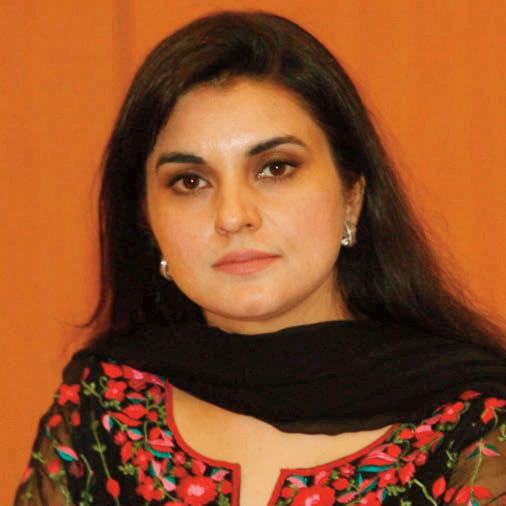
Ms Kashmala Tariq, MNA Chairperson of the Commonwealth Women Parliamentarians
Political parties in the region often come to be seen as reflecting the will of one powerful personality whose successors view the party as their personal property and carry forward the legacies. Even the countries boasting of a democratic system are essentially dictatorial state in the garb of democracy. Countries many use democracy as guise for autocracy.
Prospects for democracy are grim in Pakistan because of the entrenchment of the pervasive military influence, a weak civil society, lack of democratic cultural norms and lack of democracy within the political parties. Elected governments in both Pakistan and Bangladesh have frequently been usurped by military coups. Widespread political corruption and increased instability often lend legitimacy to military rule as a better alternative in these nations. In most South Asian countries, women occupy only a small number of seats in their respective national and local Legislatures. Many women
Democracy has long been a "buzzword" in Pakistan. It is also a "Eureka" word for most politicians who want the people of Pakistan to believe that electoral politics is a panacea for most of their problems. Although the Pakistani political system has long been alternating between various forms of electoral politics and dictatorship, nothing seems to have alleviated Pakistan’s chronic difficulties. Pakistan has been under military governance almost 30 years for the majority of its 62 years of existence. All five of the nation’s elected governments have been removed by the army, on each occasion with the stated or implicit support of the president. On two of these occasions (1993 and 1996) another civilian government was installed in its place, and in the remaining three (Ayub Khan, 1958; Zia ul-Haq, 1977; Pervez Musharraf, 1999), military leaders seized power for themselves outright. Further, of the three elected prime ministers (Nawaz Sharif and Benazir Bhutto both served twice), one was executed (Z.A. Bhutto), and the other two were exiled under threat of imprisonment if they ever returned (Benazir Bhutto and Nawaz Sharif).
The failure of democracy in Pakistan is due to four reasons:
1.Weak legislators
Insufficient assertiveness by legislators - The elected representatives were by and large not aware of their rights and responsibilities and no effective system was evolved to make these representatives aware of their responsibilities.
2.Lack of new leadership
Cultivation of democratic elites disrupted by military governance - During the periods of military rule, the political process which on its own momentum develops new leadership in the country came to a halt. Whenever democracy was
restored, the process did not continue long enough to allow new leadership to emerge.
3.Alienation of educated middle classes
Alienation and disengagement of alleviation of educated middle classes from politics - The educated classes mostly from the middle class remained largely unconcerned about the political process. They were either ignored or got disillusioned because they saw no prospects for them in the process. The political activity remained largely confined to the moneyed class or the street toughs. The educated middle class, professionals, scholars, minorities and women need to be encouraged to join the political process more actively.
4.Lack of accountability
Lack of active citizenry exercising accountability - There had been no initiative taken by the citizens to monitor the performance of the elected representatives and elected bodies and to hold them accountable to their voters on the basis of their track.
Lack of good governance and rule of law; a historically weak understanding of the significance of continuing democratic process on the part of the armed forces, lack of internal democracy in political parties; ineffective Parliament and role of big money in politics are five major
potential threats that can hamper the growth and stability of democracy in Pakistan. Political parties, government and the media need to focus on these challenges in order to strengthen democracy in Pakistan.
Political parties, whether in power or not, need to strengthen the practice of internal democracy as a vital deterrent to non-democratic intervention. Autocratic culture in most political parties not only hampers the growth of political parties as the strongest pillars of representative democracy, it is a deterrent for the youth of the country to participate in politics to their full potential. Authoritarian and oligarchic tendencies in leadership of various political parties do not serve the cause of strengthening democracy in Pakistan.
The role of big money in politics is the biggest deterrence against the inclusion and participation of middle class and average citizens of the country in the political process of Pakistan. Big spending during election invariably leads to corruption among the top echelons of political leadership. An urgent reform and an effective implementation of existing laws of the land to curb the role of money in politics are essential to make democracy broad-based and inclusive.
For an effective and functional democracy, Parliament’s supremacy has to be established by its own actions and contributions. While the legislative performance of the National Assembly during the past year leaves much to be desired, Parliament must focus on legislating on Electoral Reforms including State-funding of Political Parties; Repeal of undemocratic features arbitrarily imposed on the Constitution; Open the Parliamentary Debates and Committees; to media in public.
There are serious issues that continue to face politicians and civic leaders as to what methods are suitable to implement sound democratic practices with economic and social equity at national and international levels.
The world economic activities are normally driven by the use of human and material resources. In both developed and developing countries, economic and social developments are driven by the utilization of land, energy, technology, and finance. Likewise, the products of economic activities are shared among the members of society.
The participation and sharing in the production and consumption of goods and services depend on the political history and structure of individual societies; thus some political groups and societies being termed as capitalist, socialist, communist, centre-left, centre-
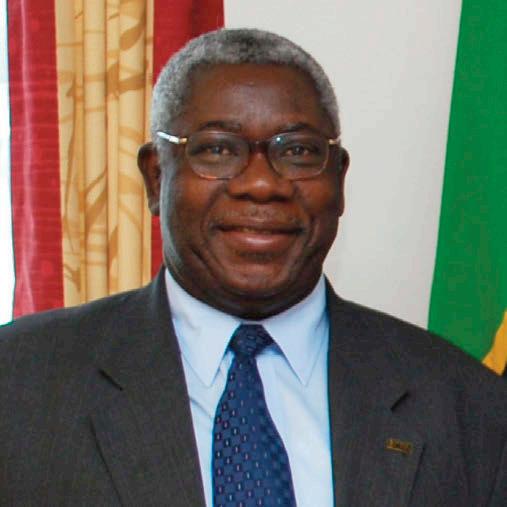
Dr William F. Shija Secretary-General of the Commonwealth Parliamentary Association
right, far-left, far-right, western, eastern, etc. It is the political history and structure of individual societies which largely continue to influence the manner in which global economic resources are shared.
Historically, some societies in the world have ruthlessly utilized resources – human, physical and financial – to accumulate wealth. In some instances, capitalism was built on the backs of a wave of mercantilism and human exploitation. There were cases where huge tracts of land and human labour were forcefully seized and exploited to produce and accumulate wealth in the name of capitalism. As a result, the present world economic structure is a product of technological advances but with huge imbalances of the distribution of wealth. Some social scientists have attributed the current financial crisis, violence and civil wars, abject poverty, and other related problems to the
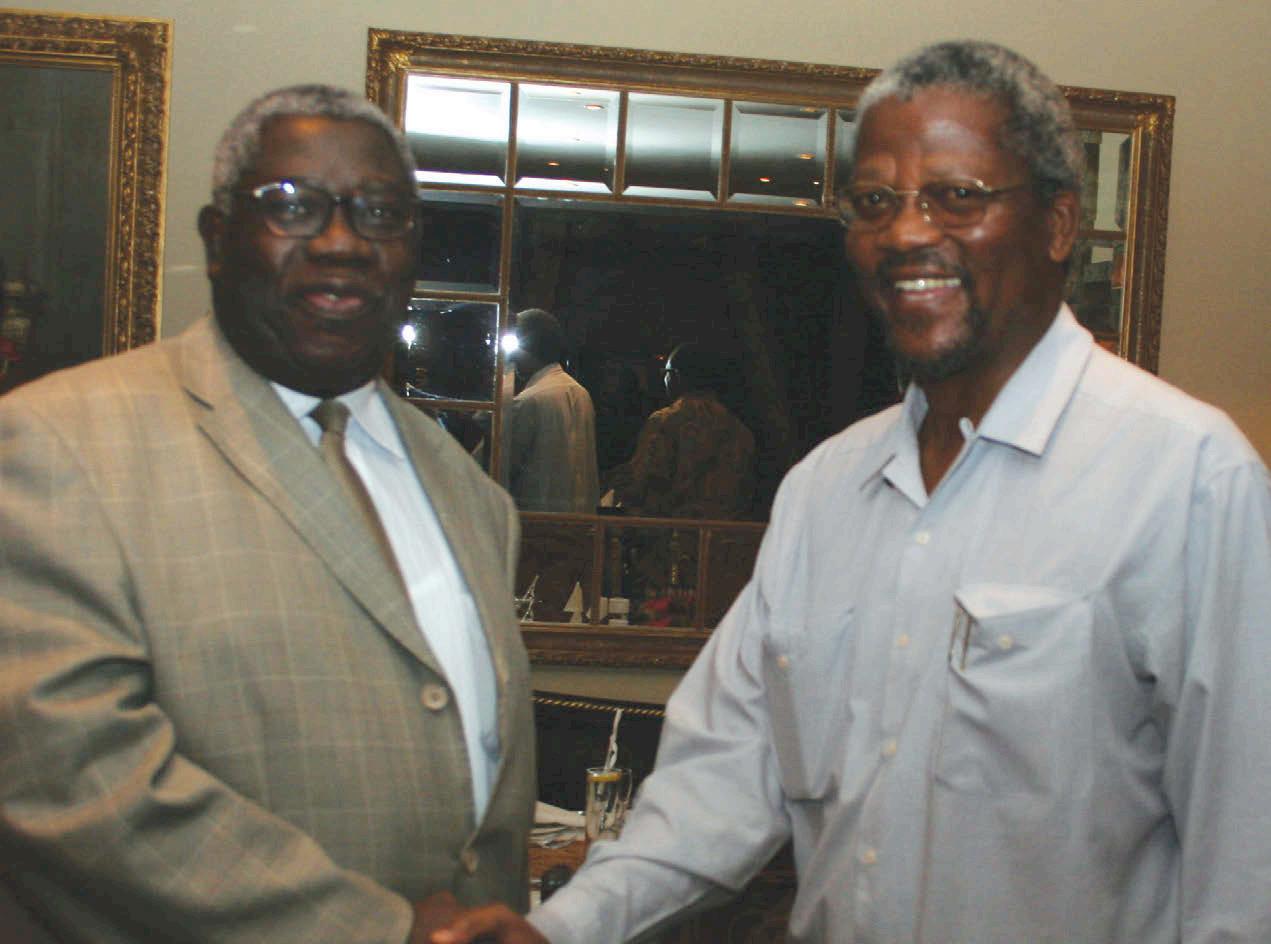
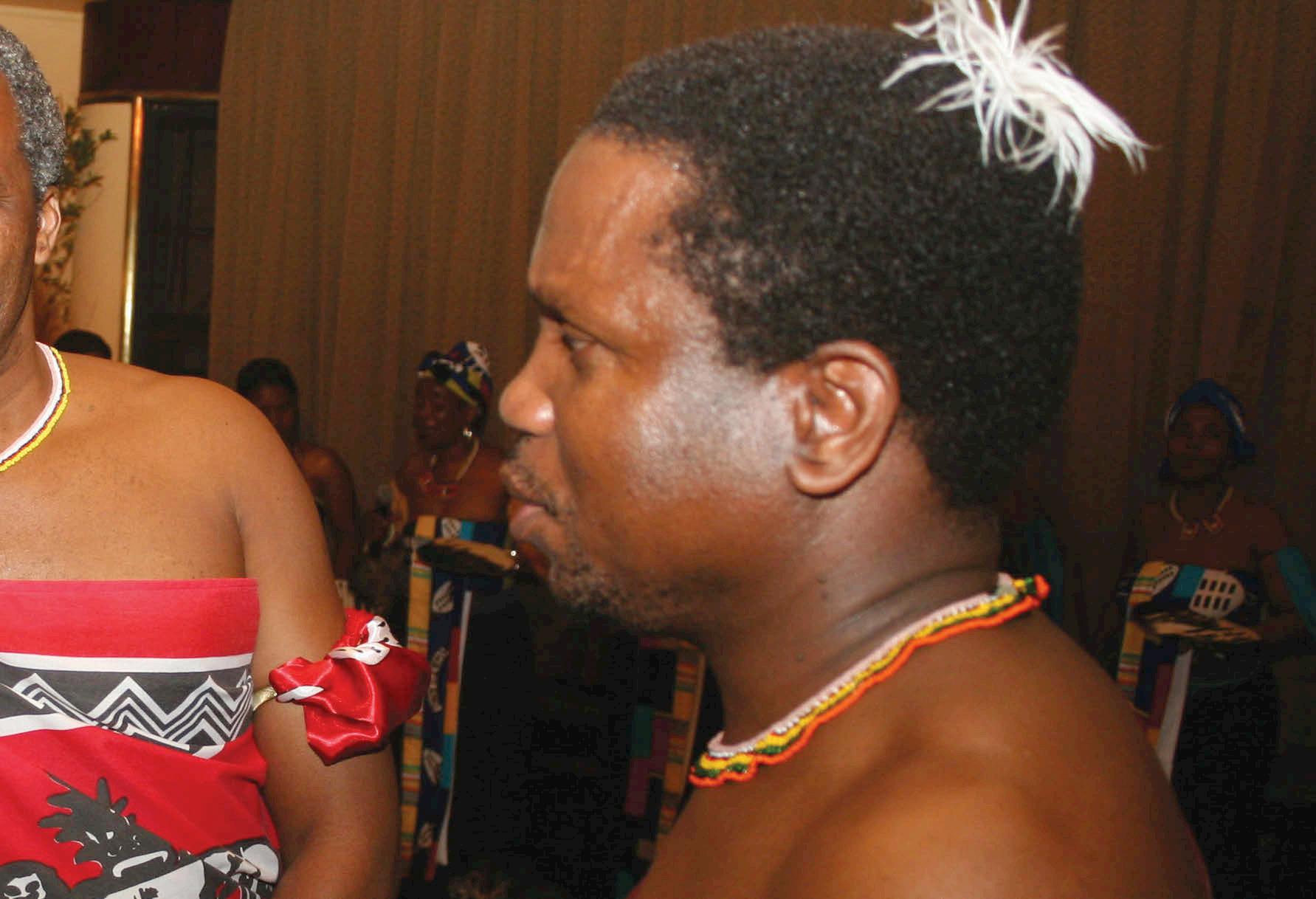
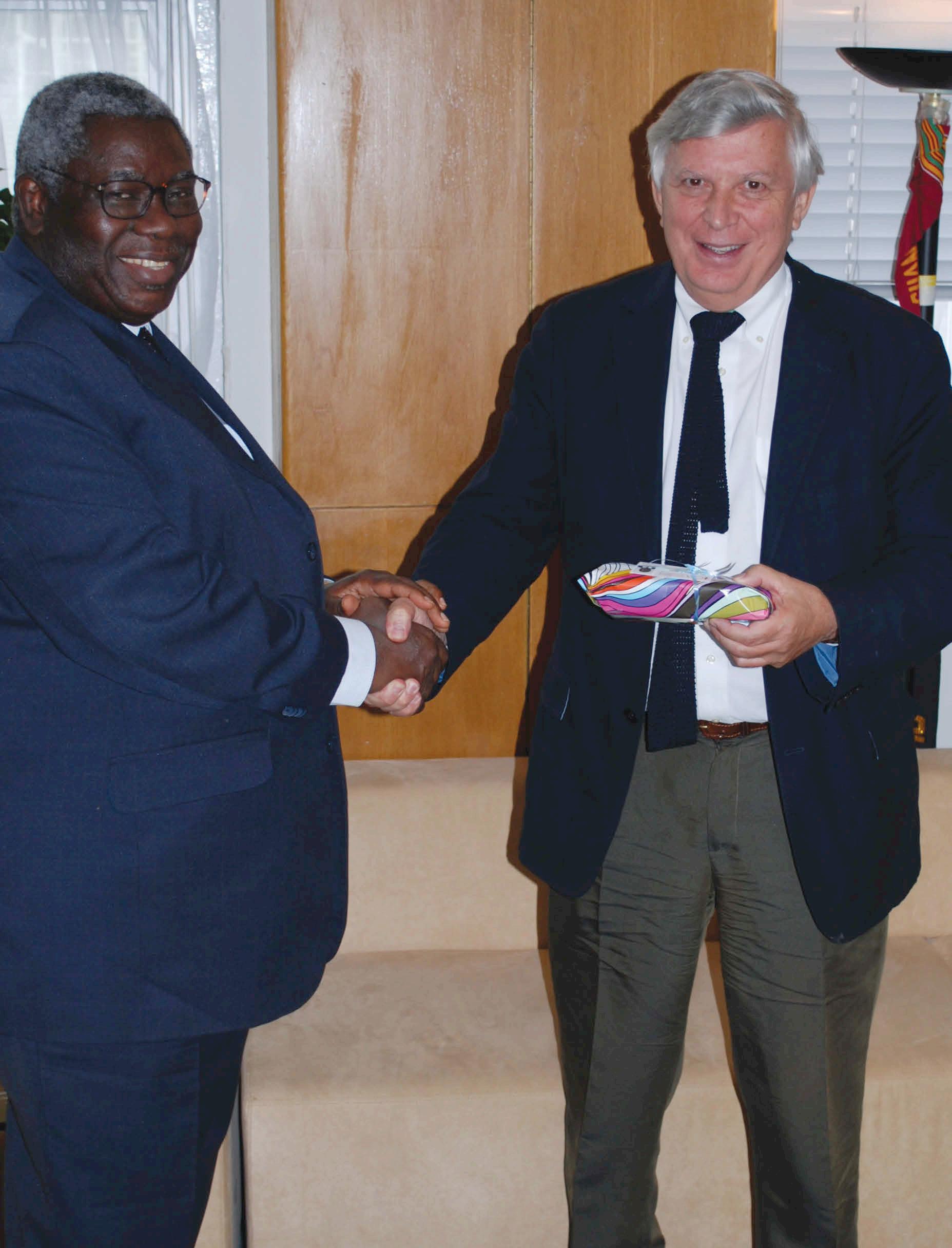
The Secretary-General with a CPA Executive Member from the Swaziland Branch.
failure of the global economic system to address them.
For example, first, within many developing countries, some citizens do not as yet have clear access to, and rights for, resources and services such as education, health, land, water, and other basic amenities. But there are numerous economic activities that take place in such individual countries to generate income. Land ownership and utilization, oil drilling, mineral exploitation, income from wildlife and tourism sales, as well as other extractive economic activities, are being carried out. The challenge is that commensurate trickle-down wealth distribution and sharing are missing among national populations.
In some societies, corruption and mismanagement of public funds are so widespread that democracy becomes a mockery. In such cases, the incomes are not adequately directed at generating the spirit of work ethics, skills acquisition, self-employment and business partnership. Women, who bear the brunt of serving families, particularly raising children, are also often marginalized. In other words, the income distribution systems in many developing countries appear to be creating a breed of extremely wealthy individuals, at the expense of a mass of very poor people. This pure capitalistic practice also appears to be creating social arrest; sometimes violence. The poverty-alleviation policy strategies are yet to be made effective to enable the incomes from national resources to be fairly distributed to society to raise the standards of education, health, and basic life skills. In several countries, the IMF/World Bank prescriptions have not worked effectively either.
It can be argued that a society’s fair distribution of wealth is key to both democratic and equitable principles. Old and contemporary historical events indicate that good democracy will flourish where and when the majority of the people are fairly treated and compensated. Experience has also shown that insensitive political leadership would usually be replaced if it failed to respond to the basic needs and welfare of the people. It would not matter whether a structure was termed capitalist or socialist; it would
be what the system offered to satisfy the majority of the people. In my opinion, leaders in developing countries of Africa, Asia, or anywhere else in the world, have to develop policies to implement fair wealth distribution if they want to keep populations truly democratically governed.
At international level, the political world has continued to be divided by expressions of developed (industrialized) and developing (nonindustrialized) societies. There are sometimes definitions of East versus West, or North versus South, First World, the Third World, globalization and other sub-definitions such as Sub-Saharan Africa, that describe the level of material development of selected societies. The global economic and financial regime is defined against the structure of the post-war Bretton Woods Institutions (World Bank and IMF). It is these institutions which were used to rehabilitate the economies of a devastated post-war Europe. The U.S. Marshal plan seems similar to the present-day Financial Stimulus Packages in the United States and Europe.
In recent times, what economists and financial experts have told the world is that the financial crisis was caused by irresponsible, if not simply greedy, individuals in selected financial institutions of the Western world. The effects have been devastating on developing countries, many of which have had just a few decades of democratic and capitalist development schemes. Some of the social effects of the financial crisis in developing countries include lack of investment, stalled infrastructural development, unemployment, increased debt, social disorder, etc. These effects, compounded by the effects of climate change and the HIV/AIDS scourge, are causing untold miseries in developing countries, particularly in Africa, where self determination culminated only recently with South Africa’s enfranchisement in 1994.
Further, it appears that capitalism per excellence has not yet helped developing economies through trade. The World Trade system continues to be lopsided and unfair to developing countries to the extent that the financial crisis has further buried their hopes. To borrow from Mr Cameron
Duodu’s comment on President Barack Obama’s visit to Ghana recently regarding Africa’s trade predicament:
“In the face of the controlled markets (in the G8 nations), African countries face three problems. First, African manufacturing and processing seldom adds much value to the raw product. Coffee is the second most traded commodity in the world after petroleum. Of the £35 billion the global coffee market represents, only £3.8 billion accounts for the value of the raw coffee beans traded annually. Second, the industrialised countries’ tariff and non-tariff barriers escalate with each additional stage of processing for most primary commodities..... What Africa needs is an overturning of an economic system that gives a Kenyan coffee grower 0.2
per cent of the proceeds from coffee, while Western coffee traders pocket the rest” (New African, August/September: pp 16-17).
The above-quoted statement illustrates that the world trading system, now stuck with the Doha Round of Negotiations, is unfair and unfavourable to developing countries, the result of which is increased poverty to several societies and, conversely, increased richness to other societies. It is this economic imbalance and inequity which calls for a new World Economic Model, something that is not simply a choice between Capitalism, Socialism, or other.
It is my opinion that the financial crisis has presented two major lessons for Commonwealth Parliamentarians. First, the quest for a fair and
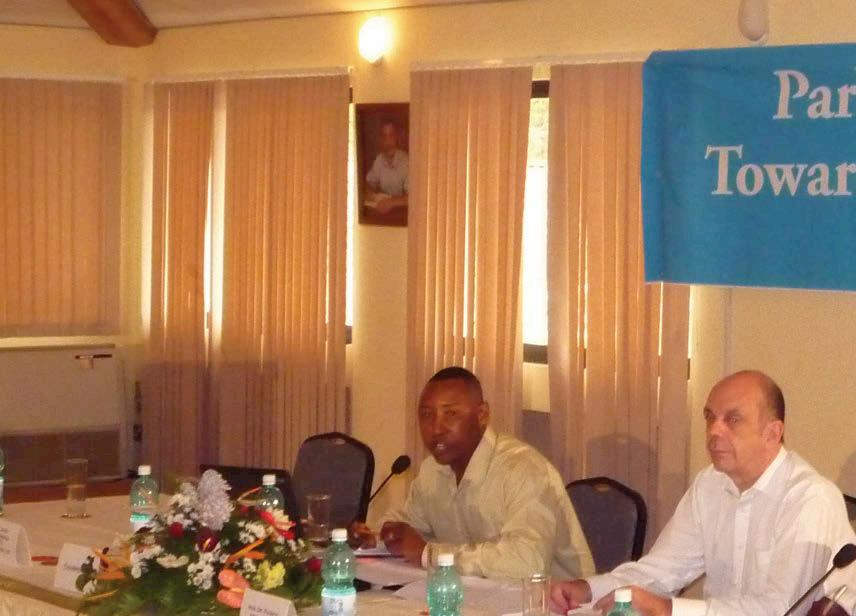
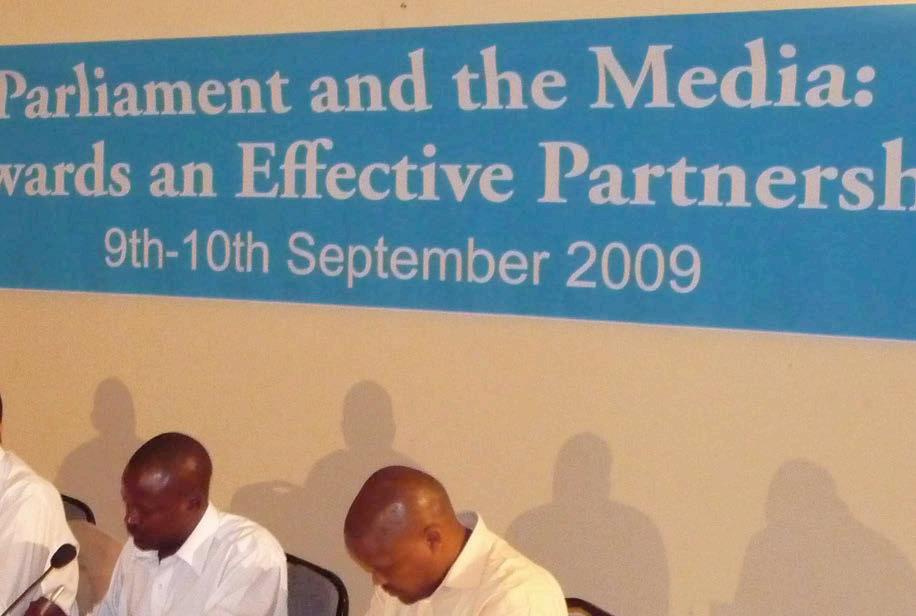
A session taking place at the recent CPA Parliament and the
balanced global economic system must be pursued. Commonwealth countries should vigorously argue for a fair global trading system as the backbone for a fair world economic system. In a world where farmers in developed countries are subsidized in order to compete with their colleagues in developing countries who run unsubsidized agriculture, using overpriced
agricultural implements, equitable economic relationships cannot be established and sustained. Second, I can vouch for the majority of the people of the world, in both developed and developing countries, that there is high demand for a system which has an equitable distribution of wealth.
The blatant accumulation of wealth does not only destabilize society; it
kills democracy. The Commonwealth should have the courage to position itself as an example of those who want an economic model which democratic and equity form the basis of the world order.
It is my view that the 21st Century presents the world community with excellent opportunity to search for a
better economic structure which serves people based on equity. If democracy defines the political equality of participation and choice, then the effort to create an economic system based on equity should be made the backbone of a new world economic theory. In this way, true democracy will also be sustained.

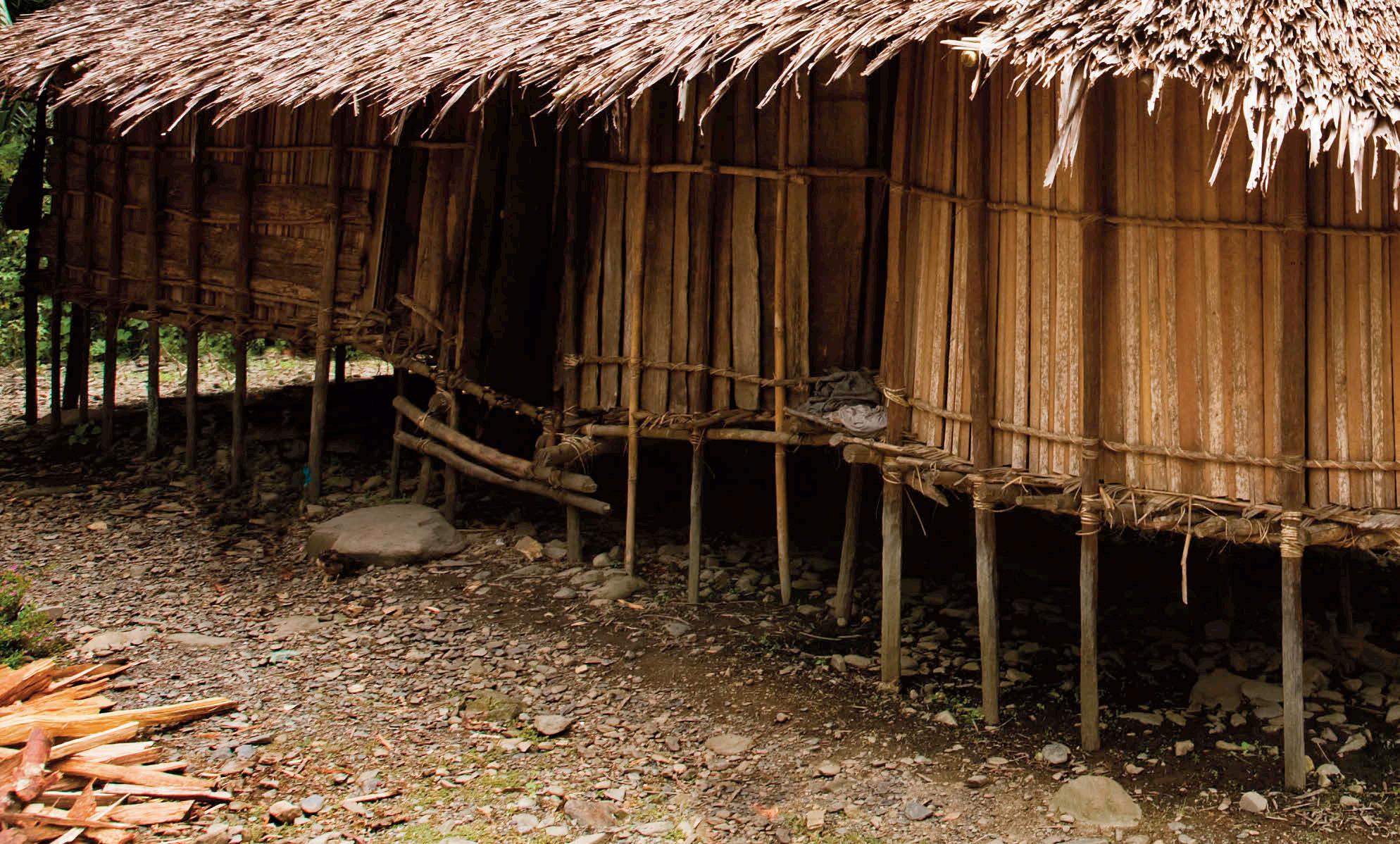
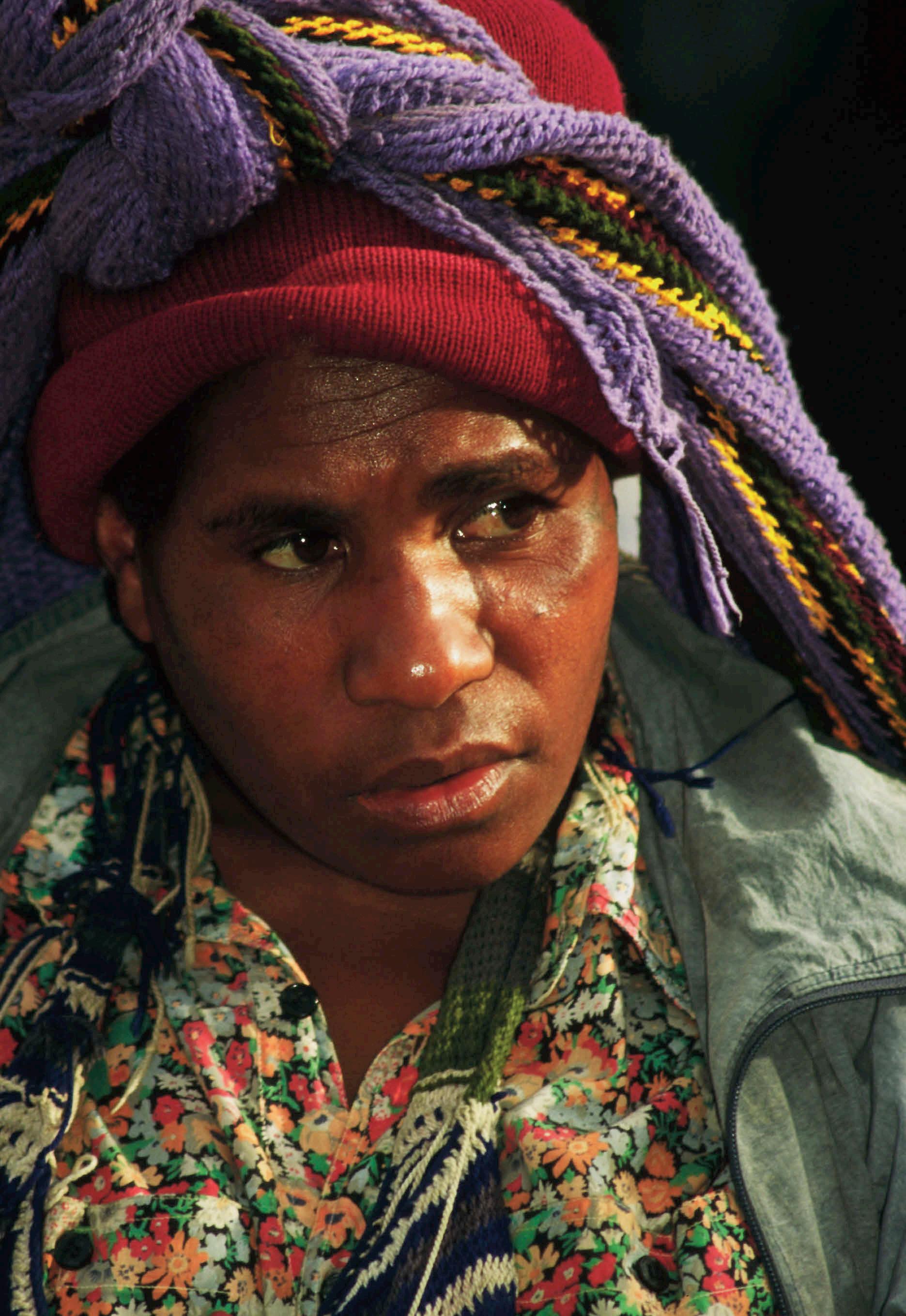
Affirmative action is the only way women will be able to take their rightful places in the Parliament of Papua New Guinea in the foreseeable future, argues its only female MP as the campaign continues to bring more Pacific Island women into politics.
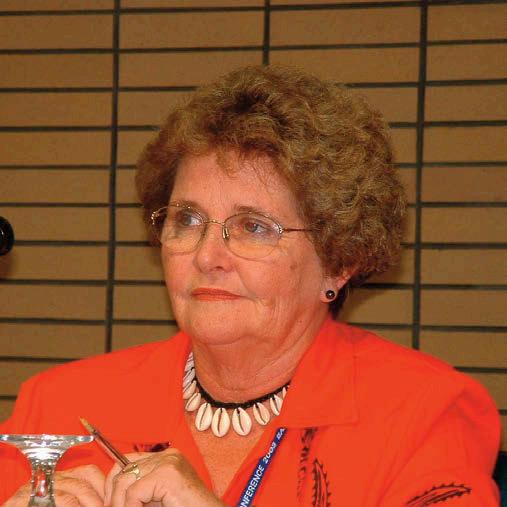
Hon. Dame Carol Kidu, DBE, MP, in Port Moresby
Dame Carol is a Member of the Papua New Guinea Parliament for the Melanesian Alliance. She was re-appointed as Minister for Community Development in the coalition government formed in 2007. A teacher and text book author, she was first elected to Parliament in 1997. She is the only woman in the House.
In March 2009, a motion by Prime Minister Sir Michael Somare to introduce Special Measures for Women’s Parliamentary Representation was defeated in the Parliament of Papua New Guinea (P.N.G.). It would have added three nominated women to a Parliament of 109 Members in which I am the only woman. Before I was privileged to become a Member of that Parliament, I did not really believe in special measures or affirmative action.
However, after more that 12 years experience in P.N.G. politics, I am convinced beyond any doubt that special measures are the way forward for Papua New Guinea at present and perhaps for the foreseeable future.
P.N.G. can either continue to be one of the countries at the bottom of the list of women’s Parliamentary representation globally, or it can choose to take temporary measures to ensure that
women are allowed their constitutional right to participate in the parliamentary processes of their country.
At the bottom of the global gender list
In P.N.G., cultural norms, educational levels, economic development and Parliamentary and legal systems have made women’s full and active political participation virtually impossible.
Despite the great progress made by women in this country, we still have a long way to go before making our presence felt in Parliament and at all decisionmaking levels.
Fifteen years after signing and ratifying the Convention on the Elimination of All Forms of Discrimination Against Women (CEDAW), we have submitted our Report to the UN Committee on CEDAW and have been scheduled to appear next year before that committee, the highest international body on women’s rights. CEDAW stipulates very clearly in Article 4 that States Parties should adopt “temporary special measures aimed at accelerating de facto equality between men and women which shall be discontinued when the objectives of equality of opportunity and treatment have been achieved”. Without special measures in place to fast-track the
Parliamentary representation of women, Papua New Guinea will have to offer an explanation to this United Nations body why we have failed to do so.
Nor do we want to go to the Meeting of Commonwealth Ministers for Women in Barbados next year and not be able to show we have progressed on our
Commonwealth commitment of achieving the Commonwealth target of 30 per cent women’s representation in decision-making positions by 2015.
P.N.G. has committed itself to the Millennium Development Goals which include the advancement of women.
However, the Pacific has been the worst region globally in making progress for women in politics. I hope Papua New Guinea will be the first independent Pacific Islands country to take up the directive from the Eminent Person’s Group (EPG) review of the Pacific Islands Forum which affirmed that Pacific Islands’ leaders should respond to the need “to increase the current low level of participation by women at all levels in decision-making processes and structures”.
This review and the subsequent establishment of a Pacific Plan were endorsed by Pacific Islands’ Leaders in their 2004 Auckland Declaration and repeated in the 38th Pacific Island Forum
Communiqué which, among other things, agreed to “explore ways to enhance participation, particularly by women, in decision-making processes and institutions and, in particular, parliamentary processes.”
No democratic break-through yet for Pacific Island women Special measures such as the nominated seats, followed by reserved seats for women, are necessary because P.N.G. women continue to face systemic and structural gender discrimination and obstacles, such as less access to resources, less access to political experience and opportunities and less support from political networks or voters to establish the support bases needed for success in politics. There are no formal barriers to women’s participation in either the national Parliament or provincial Assemblies. We thought one of the key structural obstacles to women’s equal participation was
Twenty-two seats reserved for women should be added to the Parliament of Papua New Guinea, the country’s National Leaders Summit reportedly agreed in mid-August.
The panel of 20 provincial Governors agreed one additional parliamentary seat should be created in each province for women to contest. Currently, the 109-Member Parliament has one woman MP. The creation of two new provinces will bring the total
number of provinces, and therefore potentially of reserved seats for women, to 22. Sir Barry Holloway, who chairs a government task force to improve governance and administration, said Parliament would have to amend existing legislation to create the seats. If the amendments are approved, the seats could be added to Parliament from the 2012 elections. This would increase the number of MPs to 131. aw/cedaw.htm]
of the constitution calls for “equal participation by women citizens in all political, economic, social and religious activities” and one subsection allows for “the making of laws for the special benefit, welfare, protection or advancement of females”.
the electoral system. But even the change from first-past the post to Limited Preferential Voting (LPV) in 2007 did not live up to its expectation that it would benefit women and I remain as the only woman – 0.9 per cent of our Parliament.
The fact that half our population is so inadequately represented in Parliament raises serious questions about the legitimacy of our democracy. This very visible injustice can be changed immediately under our constitution by using sections to introduce special measures such as nominated Members while we do the necessary consultation and drafting to introduce legislation for reserved seats by an elective process in 2012.
Women have become active in many public and private sectors occupations and in many spheres of P.N.G. public life in a variety of roles; but they still remain outside the realm of political decisionmaking.
When Parliaments have a critical mass of women, the social indicators of the nation improve: education for girls and women; our
shameful maternal mortality rate; the increasing feminization of the HIV epidemic; the importance of women’s contribution to the formal and informal economy and their limited access to wealth. If women remain outside Parliament,
“The fact that half our population is so inadequately represented in Parliament raises serious questions about the legitimacy of our democracy.”
development for the whole country remains one sided, slow and ineffective.
Various legal opinions exist on the implementation of the constitutional provision for nominated seats. But the preamble
Our Organic Law on Provincial Governments and Local-Level Governments already provides for the nomination of women representatives at the provincial and local levels. It specifically allows for one women’s representative to be nominated in each of the 20 provincial Assemblies and for two women to be appointed in the rural local governments and one in urban local governments as well. Women are now winning elections at the local level. This is a precedent for nominating women to Parliament as a special temporary measure while we are moving forward with reserved seats for the elections of 2012.
The Prime Minister’s unsuccessful motion in March was the latest step in over 20 years of work, starting with the National Council of Women and Women in Politics in the 1980s. Two decades of lobbying by women resulted in motions being brought to the Floor of the House in the 1990s and in 2002. These motions naming a woman for nomination to Parliament were private Member’s motions and were not voted on.
In 2004, I made my first attempt for National Executive Council (NEC/Cabinet) support to bring a motion on special temporary measures to the Floor but it rejected my attempt. In retrospect I believe that was a wise decision: with the change to Limited Preferential Voting, I was confident some women would join me on the Floor after the 2007 election. However, that did not eventuate. Efforts were then reactivated to ensure the participation of women in politics. In 2008, a diagnostic analysis of the 2007 results was conducted involving most of the
women candidates from the election. From the political level, I had begun a review of my 2004 attempt for NEC endorsement to use sections 101 and 102 of the constitution, which provide for nominated MPs, as a temporary measure and I presented that to the women at the diagnostic

workshop with varied reactions.
It took three NEC decisions to fine-
The constitution is silent on the process to select nominees for appointment by Parliament, so the NEC eventually agreed a process,

tune the process because some of my ministerial colleagues – and opposition Members – were concerned that nominated women might destabilize political numbers.
to have been used with the March motion, that was transparent, fair and legal so the best qualified women nominees could be presented to Parliament. It included an independent screening panel appointed by major organizations: National Council of Women (Chair of the panel); P.N.G. Council of Churches; Evangelical Alliance; Public Employees Association; Public Services Commission; Employers Federation, and the National Academic Staff Association of the University of Papua New Guinea. The women who formed the screening panel were highly qualified women of integrity who each signed a code of conduct before starting their work. Any female P.N.G. citizen was able to submit her application. The applicants were screened according to terms of reference based on the work that they would do as Members of Parliament. This merit based, non-politicized process narrowed the 79 applicants down to 12 for interview, from which six names were to be considered by the Prime Minister and the Leader of the Opposition in consultation.
The process was not designed to find politicians per se but to identify a group of women well qualified in their understanding of gender issues who could contribute positively to this Parliament for the three remaining years of its term.
The Leader of the Opposition decided not to be involved, so the Prime Minister chose three names from the shortlist of six. The Parliament would then have been asked to approve their appointment. An absolute twothirds majority of the 109 Members would have needed to vote “yes” before the women could have been appointed to the three nominated seats.
We need women in Parliament.
Research around the world shows that women in Parliament bring a specific focus and emphasis to different, but equally important, public matters such as: development for all, the alleviation of poverty, accessible delivery of services, gender-based violence, children’s rights, equality in the public service and economic development that benefits both women and men – surely the foundation of real development for the nation. The motion for nominated seats is planned to be reintroduced.
The nominated women would have all powers of an elected MP except the power to be involved in a vote of no-confidence and the power to block budget. They would be independent Members of Parliament and would most likely sit in the middle Benches. But they could be appointed to any position at the discretion of the Prime Minister and the Leader of the Opposition.
They would contribute to Parliament as legislators, policymakers and as a voice for women and women’s issues. They would perform as Parliamentarians and would bring private Members’ legislation to the Floor as well as add different perspectives to debates.
This appointment by Special Measure would be temporary until 2012 when legislation for reserved seats for women will be in place. Work on this is already well advanced and the opposition has already committed to supporting the reserved seats legislation.
Such important legislation requires time for regional, political party and stakeholder consultation before the drafting of the preferred option can begin. Work on this task has been happening at the same time as the work on nominated seats.
Our challenge remains to find a way to change the beautiful rhetoric of our constitution into reality for the women of Papua New Guinea.
The Deputy Governor of the Bank of England calls on financial and economic policymakers at all levels to consider the benefits of developing additional instruments to respond to rapid credit growth and rising asset prices by directly targeting the incentives to extend excessive credit. This is necessary because, he says elsewhere, crises such as the current global financial crisis should be viewed not as unusual situations but as a central feature of free-market economies.
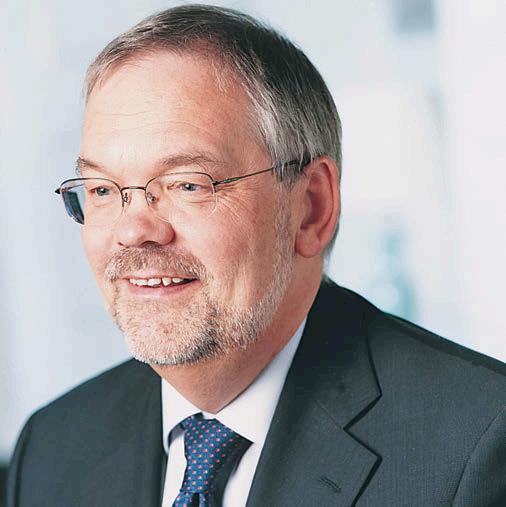
Mr Charles Bean in London.
Mr Bean is the Bank of England’s Deputy Governor for Monetary Policy and a member of its Monetary Policy Committee. The article contains excerpts from his Schumpeter Lecture on “The Great Moderation, the Great Panic and the Great Contraction”. He acknowledges the assistance of Mr Adrian Penalver in preparing this paper. The views expressed are those of the author and do not necessarily reflect those of either the Bank of England or the Monetary Policy Committee.
The past 24 months have been tumultuous for the global economy, for economic policy-makers and, indeed, for the discipline of economics. Following a long period of unusually good economic performance, characterized by relatively steady growth and low and stable inflation in the advanced economies and rapid growth and development in key emerging market economies, we have seen the eruption of a systemic financial crisis of quite unusual intensity and international reach. The nearest precedent is probably the widespread closing of international capital markets on the eve of the First World War. Associated with that, we have seen the sharpest internationally synchronized slowdown in growth in the postwar period, together with an unprecedented contraction in world trade.
Responses to the current crisis
The severity of the financial crisis and the sharpness of the
contraction in activity have prompted an aggressive response by policy-makers [including]…measures taken to support the banking system directly….
The first action has been to offer extensive liquidity support, particularly after the intensification of the crisis in the wake of the collapse of Lehman’s [Brothers Bank]. Following Bagehot, the classic guide for central banks in the face of a financial crisis is to lend freely against good collateral at a penalty rate. Although the
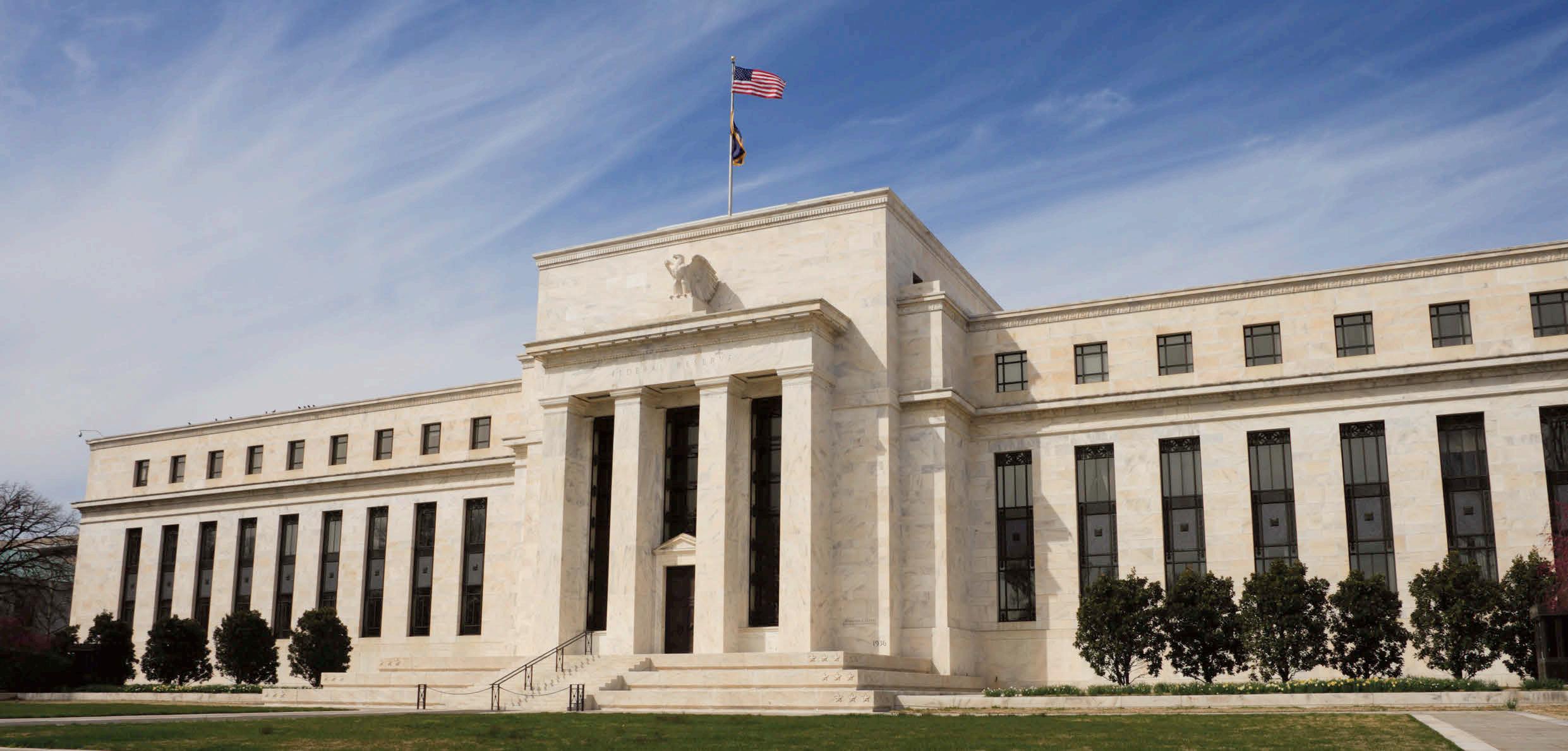
details of the operations differ, the central banks in each of the main jurisdictions have followed that guide, widening both the range of the collateral that they are prepared to lend against and extending the tenor of the loans. In the United States, because of the critical importance of non-bank financial intermediaries to the U.S. economy, the Federal Reserve has also extended the range of counterparties that it is prepared to deal with. As a result, the balance sheets of central banks have mushroomed.
All of the key central banks have also cut their policy rates aggressively, so that both policy rates and short-term market rates are close to their effective floor of zero. Before the crisis erupted, and with policy rates averaging somewhere in the four-to-five-percent range, most central bankers would have thought they had plenty of room for manoeuvre to offset adverse demand shocks by cutting policy rates. But the transmission mechanism of
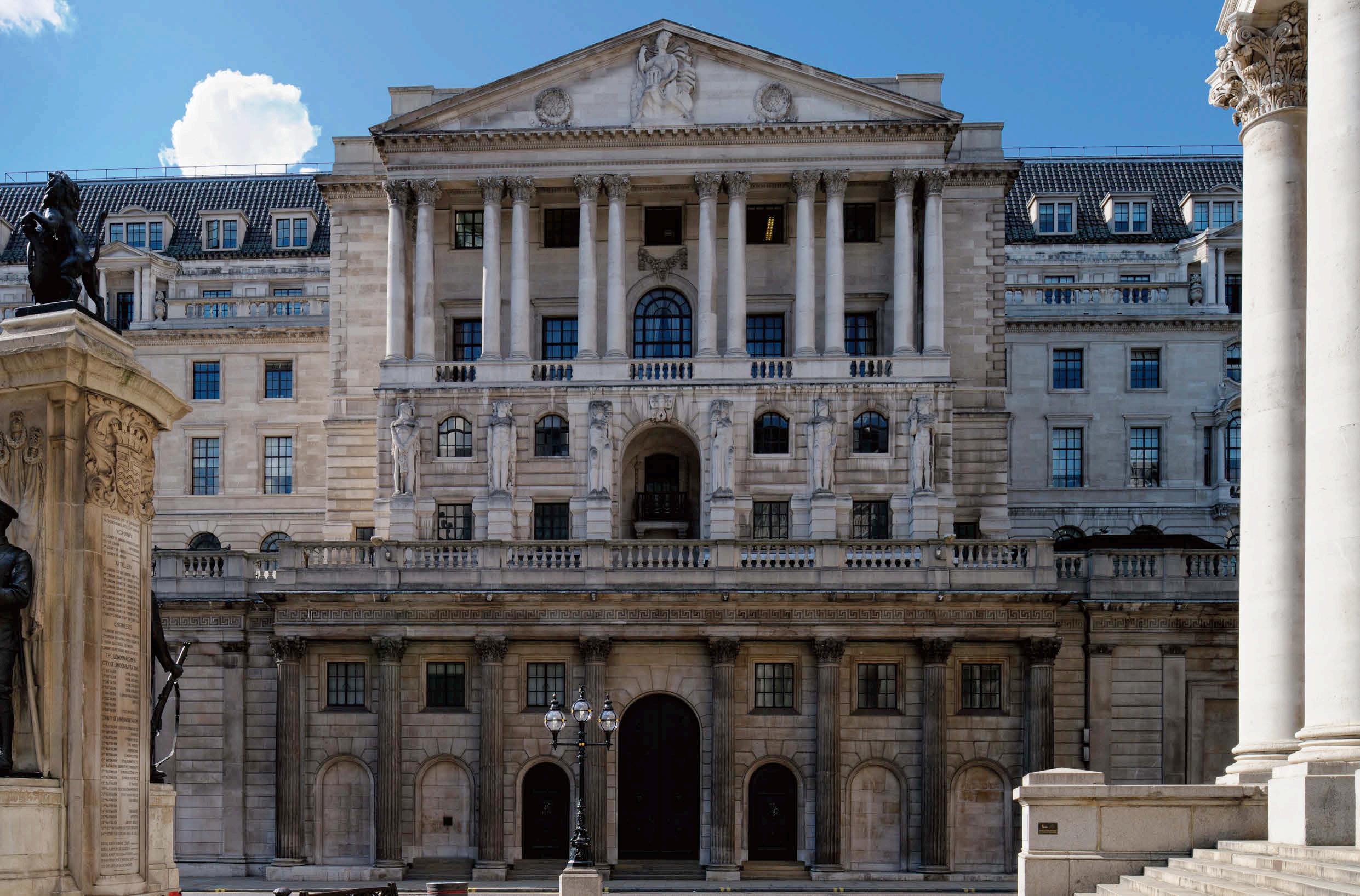
monetary policy is weakened when the financial system is trying to deleverage. Hence central banks have found themselves needing to
inject even more stimulus, taking them into unknown territory.
There are two primary options confronting a central bank that has reached the zero interest rate lower bound, both of which seek to influence a wider range of asset prices. The first is to provide a commitment to keep the policy rate low for a significant period into the future. This approach had already been followed by the U.S. Federal Reserve earlier in the decade, when it set interest rates much lower than suggested. At the present juncture, the Federal Reserve, the Bank of Canada and the Riksbank have all made explicit statements that imply policy rates will remain low.
The idea behind providing such commitments is that they both pull down market interest rates further out along the yield curve and raise
expected future inflation. Indeed, in the canonical New Keynesian/New Classical DSGE model, this is the only way of stimulating the economy at the zero interest rate lower bound, as the impact of monetary policy is completely summarized by the current and future path of the policy rate. A variation on this theme, in essence adopted by the European Central Bank, is to provide unlimited financing to the banking system at the policy rate at longer maturities than usual.
The other option involves the outright purchases of assets, rather than the normal repurchase agreements (i.e. collateralized lending) undertaken by central banks. This may involve the
purchase of either government debt or a range of corporate assets. And they may be financed by the issuance of extra central bank reserves, raising the monetary base. Or they may be financed by the sale of other assets in which case there will be no effect on the monetary base.
The Federal Reserve and the Bank of England have bought both government and private assets, though with different emphases, in part reflecting the different financial market structures. In particular, the Federal Reserve has bought significant quantities of a variety of corporate assets,

whereas the Bank’s purchases have been more heavily concentrated on purchases of government debt.
The aim of purchases of corporate assets is to enhance market liquidity by having the central bank stand ready to act as a backstop buyer. In so doing, it should bring down spreads over government bond yields by
reducing liquidity premia, encourage issuance and generally improve the functioning of capital markets. Importantly, the central bank may not need to make a large volume of purchases to make a difference. The mere fact of credibly standing ready to buy may be enough to have the desired impact. However, the central bank will be taking private credit risk
more general impact by pushing down bond yields. That, in turn, can be expected to push up a whole range of asset prices as the sellers subsequently re-balance their portfolios. Rather than being considered unconventional, purchases of government debt financed by the issuance of extra central bank money is really just a return to the classic monetary policy operation of the textbook: an open market operation. The only things that distinguish the present operations from a traditional open market operation are the circumstances under which they are taking place and their scale.
.Under normal circumstances, when the asset purchases are financed by the issuance of additional central bank money, one would also expect the increase in commercial bank reserves to lead to increased lending. However, when banks are trying to deleverage, such additional reserves are more likely to be hoarded. That appears to be what happened during the Japanese experiment with quantitative easing in the early part of this decade and a similar response is to be expected from banks at the current juncture.
onto its balance sheet, potentially exposing itself – and indirectly the taxpayer – to the risk of credit losses. So ultimately, this may be better thought of as a fiscal action.
Purchases of government debt are instead intended to have a
The initial responses in the United Kingdom to these measures have been moderately encouraging. Government bond yields fell significantly on the commencement of the programme of asset purchases, and yields appear to be some 50 to 75 basis points lower than they would otherwise be. And there are also signs of beneficial effects on conditions in the relevant corporate credit markets.…But it is very early to draw conclusions on the efficacy of these measures, as the transmission lags through to nominal spending are likely to be quite long. Moreover, even in some years time, it will still be difficult to draw firm conclusions, as the counterfactual is bound to be uncertain. But it will certainly provide fertile ground for future PhD theses.
Let me turn now to the lessons from the crisis regarding the conduct of monetary policy in the future. In the run-up to the crisis, there was a lively debate regarding the right way to respond to rapid credit growth and rising asset prices. On the one hand, economists at the Bank for International Settlements and others advocated “leaning against the wind” by raising interest rates above that apparently warranted by inflation and activity. On the other hand, the Federal Reserve espoused a policy of “benign neglect” coupled with aggressive relaxation in the event that asset prices fell sharply on the grounds that identifying an asset price bubble in its early stages was difficult and trying to deflate an established one was dangerous.
The events of the past couple of years have clearly tipped the balance in favour of taking preemptive action. And in a secondbest world, where monetary policy is the only instrument available to cool a credit/asset-price boom, then that may well make sense.
Indeed, an inflation-targeting central bank ought to be willing to undershoot its target in the medium term, if it thereby improves its chance of meeting the target further out through the avoidance of a disruptive bust. But monetary policy is a blunt weapon for this purpose, and raising interest rates enough to cool a credit/assetprice boom that is in full swing is likely to involve substantial collateral damage to real activity.
Instead, with an additional objective in the shape of credit growth/asset prices, one really needs another instrument that has a stronger and more direct impact on credit growth and asset price inflation than monetary policy. That is what so-called “macro-prudential regulation” is supposed to achieve.
Most discussion in policy circles has so far revolved around introducing pro-cyclical capital requirements, or its close cousin –dynamic provisioning. Thus banks would be required to build up extra capital/reserves during a credit/asset-price boom that can then be run down in the event of a bust. This should reduce the incentive for banks to leverage up
in a boom, as well as making the financial system more robust in a bust. However, other instruments could also be deployed to this end. For instance, credit/asset-price booms seem to be characterized by an excessive shift into riskier forms of lending. In that case, an instrument more directly targeted at the microeconomic distortion would be to increase the riskweights that are attached to such lending when computing banks' required capital. And, as we have seen in the present crisis, a lot of the action has taken place outside banks' balance sheets. In that case, varying margin requirements might be a more appropriate instrument for dealing with vulnerabilities building up in the capital markets more generally. The best approach is likely to involve a portfolio of instruments.
Once the instruments have been identified, a host of other questions then need to be addressed. Precisely which variables should the instruments vary with and how are the variations supposed to be
calibrated? And once that has been answered, policy-makers need to understand both the macroeconomic impact of the instruments and how their operation interacts with monetary and fiscal policies.
Everything I have said so far about macro-prudential regulation has been couched in terms of moderating the impact of the credit cycle over time. But the earlier discussion of network effects highlighted the potential role played by large and highly interconnected financial intermediaries, graphically illustrated in the aftermath of the collapse of Lehman's.
That points to another role for macro-prudential regulation, namely to increase the robustness of the financial system by requiring systemically important intermediaries to carry heavier capital requirements. So the cross-section dimension adds another set of instrument design issues.
The Chair of the Human Rights Leadership Forum outlines how Victoria’s Charter on Human Rights and Responsibilities has proven to be a successful model for the State, providing a fitting example for other Parliaments to follow suit.
Mr Brian Tee, MLC,
Before entering the Parliament of Victoria, Mr Tee worked as a solicitor, industrial officer and senior advisor to the Attorney General. He was elected to the Legislative Council in 2006 and is Parliamentary Secretary for Justice, and serves on a number of committees including as the Chair of the Human Rights Leadership Forum and Aboriginal Justice Forum.
In Australia we are proud of an ethos which promotes mateship and a fair go for all. We relish in our diversity and wear our tolerance of those with different backgrounds with pride.
Yet very few of the rights that underpin our core values have any legal protections. Basic freedoms such as the right to religious freedom, the right to free speech and rights to lawful assembly are often not protected in legislation or are protected in a haphazard ineffective way.
In Australian politics many espouse high ideals around the protection and promotion of human rights. However it is rare for Australian Governments to actually legislate to protect those human rights.
Perhaps the concern is that at its heart such legislation is about government agreeing to constrain its powers by recognzing and protecting the rights of citizens.
Three years ago, Victoria became the first Australian state to break the mould by introducing a charter of human rights and responsibilities. The charter enshrined in one, place the rights and responsibilities we take for granted but which have no legal protection. Our charter enshrined civil and political rights contained in
the 1948 United Nations Declaration of Human Rights. It was passed into state law three years after the Australian Capital Territory enacted its Human Rights Act as territorial law.
When the charter was introduced it was criticized as being a ”lawyers picnic” that would increase litigation, transfer power to an unelected judiciary and provide a legal shield that protects scoundrels, rogues and criminals from justice.
Two years later the scaremongering, which continues in some quarters, has proved to be without foundation.
Instead the charter has strengthened our democracy and improved organizational culture; reinvigorating existing principles of practice; causing better and fairer laws to be developed and laying bare the decision-making process for all to see.
The charter acts as a restraint on the power of the executive by bringing human rights to the fore of the decision making process. Government departments and agencies, local governments, police, prisons, mental institutions all have to act in a manner which is consistent with the human rights of a citizen.
Parliament is required to
consider and report on the human rights implications of legislation that it is considering; courts have to interpret legislation in a way that is compatible with the human rights charter. Where legislation cannot be interpreted in a way consistent with human rights the legislation is referred to the Victorian Parliament. The democratically elected Parliament then decides whether to keep or amend the offending legislation.
To date only 55 court cases have raised charter issues. Of those cases the Attorney General has intervened in 16 cases where significant human rights questions where raised. In six of the cases where the attorney intervened, the charter arguments were withdrawn or abandoned after submissions were filed. While four proceedings are currently on foot thus far no legislation has been held by the courts to be incompatible with the human rights charter.
In truth, the charter has thrown up but a handful of significant cases. Instead of floodgates we have seen barely a trickle of litigation, and this outcome was deliberately sought by the framers of the charter who ensured that compensation could not be awarded for any breach. Instead our charter is about enhancing the
power of the democratically elected Parliament, and it is about provoking dialogue and debate and not able lining the pockets of the legal fraternity.
We have seen the charter make a real impact on people’s lives for the better.
Here are just a few examples of the positive and practical ways in which the Human Rights Charter has enhanced the lives of Victorians, particularly the vulnerable.
1.When a local disability provider incorporated a human rights checklist into its assessment of client’s needs it found a number of people had had their right to vote restricted.
This omission was remedied.
2.A women with an acquired brain injury received treatment for painful contractures of her left hand– a condition which may have required amputation if left too long. She received treatment after previously not been considered a priority due to her age.
3.A group of young people with acquired brain injuries were given a reprieve from being placed in aged care facilities that were not appropriate to their needs.
To ensure enforcement and compliance with the charter there is an independent body which
reviews and publicly reports on the progress that has been made on implementation.
This is done through annual reports made by the independent Human Rights Commission. The second annual report released in March 2009 focused on the rights of children and young people.
The report concluded that while cultural change does not happen overnight it is clear that progress is being made. Departments such as Human Services and the Department of Justice have implemented initiatives to promote a human rights culture within the organization and service delivery.
The report reveals a subtle and yet important transformation in attitudes and processes. Under the charter people are seen as citizens rather than clients, increasingly we do things with people rather than for people. When developing or implementing legislation, policies and services we increasingly engage the community through participation rather than consultation.
Inevitably there is more to be done. The Human Rights and Equal Opportunity report highlights local government as an area of focus in the immediate future. The Human Rights Commission has highlighted the need for a coordinated strategy for local councils across the state to incorporate the charter into local law making, policy development and service delivery.
The National Australian government has recently announced that it will consider the development of a national charter of human rights. It has commenced national consultation on the implementation of a human rights framework at a federal level. The Victorian Government is engaged in this consultation, with the Victorian Charter providing an example of how a human rights framework might be implemented nationwide.
In Victoria we have achieved a great deal since the charter was fully implemented. We have made progress toward building a culture where human rights are part of the fabric of our society, where the equality, dignity, freedom and respect of every Victorian is recognized, respected and protected.
These are not just high ideals, the Victorian Charter is a practical tool, bringing together legal protections for everyday people to redress disadvantage and uphold their human rights.

This article is based on a Public Accounts Committees Workshop hosted by the Trinidad and Tobago Branch of the CPA in collaboration with the CPA Secretariat on 3 and 4 December 2008.
Sen. the Hon. Danny Montano, in Port-of-Spain.
Mr. Montano is the President of the Senate of the Ninth Parliament of the Republic of Trinidad and Tobago. A Chartered Accountant, Sen. Montano first entered Parliament as a Senator in the 5th Parliament (1995-2000) and has served on the Opposition as well as the Government Benches. He was elected as President of the Senate in December 2007.
The Public Accounts Committee (PAC) – a parliamentary committee with deep historical roots – is one of the main links in the chain of public accountability, the others being Parliament itself, the Treasury and the Office of the Auditor General. In the Commonwealth, the genesis of the Public Accounts Committee can be found in the appointment of such a Committee in the United Kingdom in 1861.
Provision for the existence of a PAC may be explicitly laid down in law as is the case in Trinidad and Tobago. More often, however, it is the Standing Orders of Parliament which provide for its operations, function and conduct. The financial regulations, the exchequer, Audit Act and the State Enterprises Monitoring Manual are often used as guidance and reference.
The first PAC of Trinidad and
Tobago was appointed in 1960 by the then Speaker of the Legislature following the adoption of a motion by the House of Representatives.
The present constitution of Trinidad and Tobago makes provision for two Committees:
•The Public Accounts Committee (Section 119(4));
and
•The Public Accounts (Enterprises) Committee (Section 119(5)).
It is before such committees that those accountable must explain their stewardship and give explanations for their actions on issues raised in the Auditor General’s Report.
Mandate and constitution of PACs
In accordance with Section 119(4) of the constitution, the mandate of the PAC is to consider and report to the House of Representatives on:
(a)The appropriation accounts of moneys expended out of sums granted by Parliament to meet the public expenditure of Trinidad and Tobago;
(b)Such other accounts as may be referred to the Committee by the House of Representatives or as are authorised or required to be considered by the committee under any other enactment; and
(c)The report of the Auditor General on any such accounts.”
In addition to the PAC, Section 119(8) of the said constitution charges the Public Accounts (Enterprises) Committee with the responsibility of considering and reporting to the House of Representatives on—
(a)The audited accounts, balance sheets and other financial statements of all enterprises that are owned or controlled by or on behalf of the State; and (b)The Auditor General’s report on any such accounts, balance sheets and other financial statements.”
In accordance with Section 119 of the constitution, the committees shall consist of not less than six or more than ten members. Usually, the maximum number of members is appointed to these committees comprising of members of both the
Senate and the House of Representatives and reflect the balance of the parties in the Houses. The Chairpersons of both committees are members of the opposition, as specified in the constitution (Sections 119(2) and (6)).
Although the PAC is comprised of members of different political parties, it is important that political affiliations be subjugated at committee meetings. To be effective, the PAC must maintain an objective, non-partisan and “what is best for my country” approach to its work. It should also conduct its affairs in accordance with current practices applicable to the PAC’s.
The PAC as an instrument vital to accountability, brings together the accounting cfficer, the Treasury – Ministry of Finance, the Auditor General and Parliament in an exercise geared to ascertain
that public revenue due, has been raised and collected, that public money has been spent in accordance with the dictates of Parliament and the relevant legislation and financial directives to the service of Trinidad and Tobago.
The bulk of the work of the PAC is derived from the Auditor General. At the end of each session, a revised list of entities is prepared after consultation with the Auditor General’s division and officials of the Ministry of Finance in the case of State Enterprises. A proposed agenda is then arranged.
Reports are referred to the committee by the House of Representatives after they are laid in the House. The final decision on the selection of entities to be examined is that of the committee and is dependent upon the nature of the audit queries or infractions outlined in the Auditor General’s reports or management letters.
It therefore means that the committee is only concerned with reports referred to them by the House of Representatives. They do not concern themselves with the merits of policy.
Standing Order 80(9) of the House of Representatives provides for meetings to be held ‘in camera’ with only representatives of the Auditor General, treasury and parliamentary staff allowed to attend. However, meetings can be open to the public “subject to any order of the House or resolution of the Committee’.
The committees have the power to take evidence and report back to Parliament. Witnesses are compelled to testify. However, if accounting officers refuse to testify or produce evidence before the committees, the committees may report the matter to Parliament for action to be taken.
Although the committee has no power to enforce its recommendations, it relies on the persuasive power of reporting and
the co-operation of governments to achieve any resultant action.
Subsequent to the examination of entities, the committees are required to report to Parliament its findings and recommendations at the end of every session, in accordance with Standing Orders 75(1) of the Senate and 82(1) of the House of Representatives. Debate sometimes takes place on the report. The choice for or against debate on a report of the committees originates from the committees.
Public Accounts Committees experience the following
•Insufficient number of backbenchers to serve on the committees;
•Use of Ministers on the PACs;
•A high incidence of aborted meetings due to a lack of quorum;
•A large number of entities and as a consequence the numerous reports to be examined by the committees, resulting in backlogs;
•The number of parliamentary committees competing for the limited space available to them within the Parliament building;
•Failure on the part of entities to
submit their accounts to the Auditor General on a timely basis, thereby resulting in these reports being laid in Parliament years after the end of the financial year being reported on; and
•A lack of power by the authorities to deal with delinquent accounting officers who fail to submit their financial reports on time or never.
The Trinidad and Tobago Branch of the CPA in collaboration with the CPA Secretariat held a two-day PAC workshop in Trinidad and

Tobago on 3 and 4 December 2008. It was held in response to questions from Members of the Public Accounts and Public Accounts (Enterprises) Committees regarding how the committees function. The workshop specifically sought to:
•Devise ways to alleviate the challenges mentioned above; and
•Enhance the work of the committees by exposing Members of Parliament to information, practice and procedure that would ultimately improve the way the committees function and carry
The following recommendations were proposed by the participants of the workshop to improve or enhance the operational capabilities of the PACs:
1. It should be the practice of the committees to have an initial meeting for the purpose of arriving at a statement of the PAC/PA(E)C powers at the beginning of each parliamentary term.
2. A sub-committee on agenda and procedure comprising at least two Members, one of whom should be the Chairperson, should be appointed. The Clerk and a representative of the Auditor General’s department should attend.
3. There should be improved follow-up of recommendations emanating from the Committees:
(i) Ministers should be required to respond to recommendations listed in the report within a stipulated time frame;
(ii) The Auditor General should be mandated to prepare a followup report or reports as the case may require, on the state of the ministry’s/agency’s implementation of the recommendations.
4. The committees could comprise smaller number of Members;
5. Quorums should be practical so as to ensure that the committees function;
6. Meetings should be held in public;
out their mandate.
The following issues were discussed at the workshop:
•Parliament and financial scrutiny
•Challenges for Public Accounts Committees
•Enhancing PAC performance
•The relationship between the executive and PACs
•The relationship between the office of the Auditor General and PACs.
7. The question as to live broadcast is a matter for the individual committee. There should however be rules and regulations for the protection of witnesses in relation to live broadcast;
8. The Auditor General to use nontechnical language in reports where possible;
9. There should be a greater attempt for Auditor General reports to be more current;
10. Output budgeting should be fully implemented by the Ministry of Finance – this will advance the efforts now being made by the
Auditor General to introduce valuefor-money auditing;
11. The internal audit function within ministries should be strengthened as a matter of priority;
12. When politics creep into the discussions of the committees, it is the role of the Chair to ensure that political point scoring does not take up a great deal of the committees’ time and does not sour relations between Members.
Participants also agreed that enhanced PACs’ performance requires focusing on PAC leadership and its role as contributing to government accountability, on building sustainable capacity and on results-based effectiveness.
We believe that the adoption of the above recommendations would improve the work of the PACs making it a more effective and efficient entity and, by extension, ensuring that government is held accountable for the administration and expenditure of public moneys.
The major characteristics of good governance are the accountability and transparency in government operations and expenditure. Government must account to Parliament, on whose will they depend for their very existence. However, although Parliament is sovereign, it does not exercise executive authority – that is the responsibility of Ministers, individually and collectively.
Parliament’s role is to hold Ministers to account for the activities carried out under their authority or those authorities vested directly in departmental officials. In turn, Ministers need to assure themselves that structures and processes are in place to give them the appropriate degree of control, which includes ensuring that officials are managing their department well enough to support ministerial accountability.
Samoa’s financial oversight committee is effective as the public spending watchdog despite limitations.
Mr Tuiloma has been the Chairperson of the Legislative Assembly of Samoa’s Finance and Expenditure Committee since 2006 and is an Associate Minister in the Prime Minister’s Office. He is a Member of the Human Rights Protection Party. This article is based on his presentation to the 2009 Summer Residency for Public Accounts Committees held by Australia’s La Trobe University with support from the CPA, the World Bank Institute and the Centre for Democratic Institutions.
Accountability is fundamental to good governance and is now one of the most common themes in any modern democracy. Public accountability simply means responsibility to account for action taken and resources used.
In Samoa, government ministries and public bodies are required by law to report to Parliament and in accordance with Standing Orders, those reports are referred to parliamentary select committees for consideration and report to the Assembly within three months from date of referral. Committee reports are considered in Parliament and the debates are broadcast live throughout Samoa.
The latest amendments to Standing Orders were approved by the Legislative Assembly on 5 May 2008. These amendments provided for the reduction of select committees from 13 since 2006 to 10. The Education, Communication and Information Technology Committee and the Health and Social Services Committee are currently chaired by nongovernment Members
The new Finance and Public Expenditure Committee
The Finance and Expenditure Committee, formerly known as the Public Accounts Committee, has its main objective for the overall review of financial management in all Government Ministries and Public Bodies. I was elected as
Chairperson of the Finance and Expenditure Committee since 2001, the position which I’m currently holding for two consecutive general elections (2001 and 2006). Standing Orders 169 of the Parliament of Samoa states:
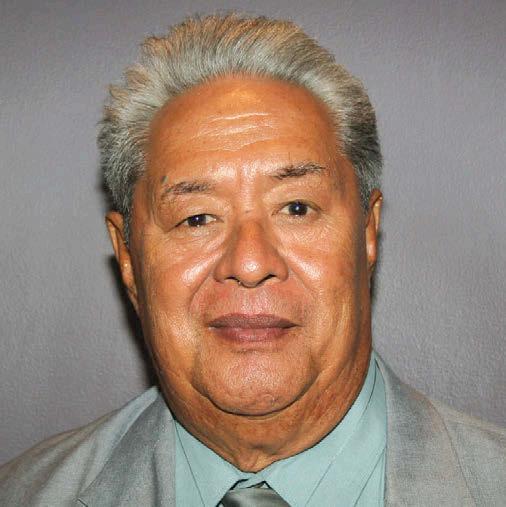
“There shall be a Committee to be known as the Finance and Expenditure Committee to consist of eight Members who shall be appointed upon motion as soon as may be after the commencement of each Parliament.”
The Finance and Expenditure Committee carries out an important oversight role in relation to the raising and spending of public money. Pursuant to Standing Orders 170, it shall be the duties of the Finance and Expenditure Committee to:
(a)Consider any Bill, Petition or other matter referred by the Assembly pursuant to these Standing Orders; and any Estimates or review of Ministerial and Departmental performance;
(b)To examine the policy, administration and expenditure of Ministries and Government Bodies related to government finance, insurance, superannuation, national provident fund, taxation, auditing of public accounts and Ministries and Public Bodies;
(c)To have responsibility for the overall review of financial management in all Government Ministries and Public Bodies;
The Public Finance Management Act 2001 specifies principles of responsible fiscal management and sets out reporting requirements on the Minister of Finance and the Ministry of Finance. The reporting requirements on the Minister include the Budget Address and the statement of the projection of estimated revenues and expenditures for the budget year and the Fiscal Strategy Statement to be submitted as part of the budget address.
The Budget Address laid by the Minister of Finance for the Financial Year 2008/2009 emphasized governments economic vision to improve quality of life for all Samoan citizens premised on the goal of sustainable economic development and social progress that promotes employment opportunities and improved education and health sectors. (See figure 1). This year’s budget was set against one of the most challenging times in the world economy and indeed for our economy. We have experienced the impact of the combined increase in fuel and food prices on inflation. The annual headline inflation rate rose to 6.0 per cent in March 2008
The Finance and Expenditure Committee as part of its core responsibility is to examine the public accounts and such other accounts laid before the Legislative Assembly. The Committee therefore focuses its inquiries into two main objective:
1.Whether or not the public moneys that Parliament approved in the Main and Supplementary Estimates were spent in accordance with
the conditions they were approved for, and 2.Whether or not the Public accounts were drawn up in accordance with the provisions of Part XIV of the Public Finance Management Act 2001.
The Minister of Finance submitted for tabling in Parliament during last month session the public accounts of the government of Samoa for the financial year ended 30 June 2006 and year ended 30 June 2007. The public accounts are based on the results for the financial years ended 30 June 2006 and 2007 and the balances as at those dates as reflected in the accounting records maintained by the Ministry of Finance.
It is obvious that the submission of public accounts to Parliament does not comply with the reporting requirements of Part XIV of the Public Finance Management Act 2001. Part XIV provides that public accounts shall be tabled before the Legislative Assembly no later than six months from the end of the financial year to which they relate. However, the Financial Secretary clarified that deficiencies in internal controls, accounting procedures and records in a few ministries resulted in the delay of certification
and transmission of statements of public accounts to Parliament. The Controller and Chief Auditor’s Report for the period ending 30 June 2007 also highlighted such deficiencies during the auditing process of those accounts. This has been the case during scrutiny of previous public accounts. From my point of view as Chairman of the Finance and Expenditure Committee, such processes may require considerable resources and time to achieve unless ministries and public bodies comply with standard financial systems and accounting procedures already set in place by the Ministry of Finance and Audit Office to ensure proper internal control.
The Controller and Chief Auditor and the Ombudsman are Officers of Parliament. They are independent and neutral. As stipulated under Article 99(1) and (2) of the Constitution of the Independent State of Samoa, the Controller and Chief Auditor shall audit all public accounts and funds of all departments and offices of the executive and report at least once annually to the Legislative Assembly. During Parliament’s first sitting in January 2009, the
Controller and Chief Auditor’s Report for the period ending 1 January to 30 June 2007 was considered and approved by the Assembly.
The Controller and Chief Auditor conducted special investigations on the performances of government ministries and public bodies. The Controller and Chief Auditor highlighted in his report ministries and public bodies which did not comply with proper financial systems and accounting procedures already set in place in accordance with provisions of the Public Bodies (Performance and Accountability) Act 2001.
The Audit Office findings and recommendations were submitted to respective ministries and public bodies’ boards of directors for their consideration and decision. Investigation procedures were carried out as usual and later discovered that substantial receipts were unaccounted for and public funds were confirmed misappropriated.
As a result, proper action was applied and officials involved were terminated. The Controller and Chief Auditor’s report for the period ending 30 June 2007 also summarized particulars of irregularities in respect of cash and government assets where most of the officials involved with those cases faced legal actions.
To conclude, Parliament plays a vital role with the responsibility of holding executive government to account between elections, and it is to the Parliament that the public looks when people believe that the government of the day behaves excessively. The use of parliamentary Select Committees has developed as a major mechanism by which Parliament can hold executive government accountable and ensuring that the executive government operates in the best interest of its citizens.

The Pacific nation of Vanuatu places a priority on a proper system for parliamentary oversight of government spending, says the Government Whip.
Mr Kailo has been a Member of the Parliament of Vanuatu for the governing Vanua'aku Pati since 2008. The former Director of the Department of Youth and Sports, Mr Kailo is the Government Whip. This article is based on his presentation to the 2009 Summer Residency for Public Accounts Committees held by Australia’s La Trobe University with support from the CPA, the World Bank Institute and the Centre for Democratic Institutions.
The government of the Republic of Vanuatu, in its comprehensive reform programme objectives, has included the development of standing committees’ roles and procedures. It has emphasized in particular the strengthening of the role of the Public Accounts Committee.
The Public Accounts Committee (PAC) is established in accordance with Standing Order 49 (1) at the commencement of a Legislature by resolution of Parliament, upon the First Deputy Speaker giving notice of a motion under Standing Order 35 to establish such a committee.
Membership and an unusual problem
As the PAC is part of the standing committee system, its membership consists under Standing Orders of not more than seven Members
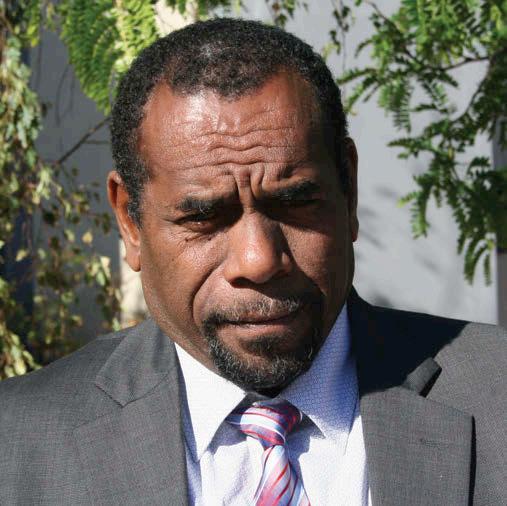
representing proportionally the political parties present in Parliament. The membership is confirmed to Parliament by the First Deputy Speaker tabling a report, pursuant to the Standing Order 20. The report contains the name of the Chairperson and those of the Members of the committee.
A change in the membership of the Public Accounts Committee is also confirmed to
Parliament by the First Deputy Speaker tabling another report containing the change in Membership, pursuant to the same provisions of Standing Order 20.
If a government Member decides to sit with the opposition or is appointed as a Minister, or if an opposition Member decides to sit with the government or is appointed as a Minister, that Member will be replaced by the government or the opposition, as the case may be, and the First Deputy Speaker shall confirm the change in membership by tabling a report pursuant to Standing Order 20 of Parliament.
As governments change regularly in Vanuatu, this rule appears to be a stumbling block for the PAC as it prevents it from functioning efficiently because the government or the opposition, as the case may be,
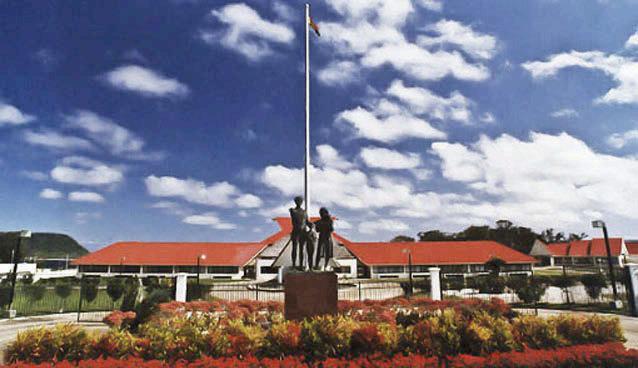
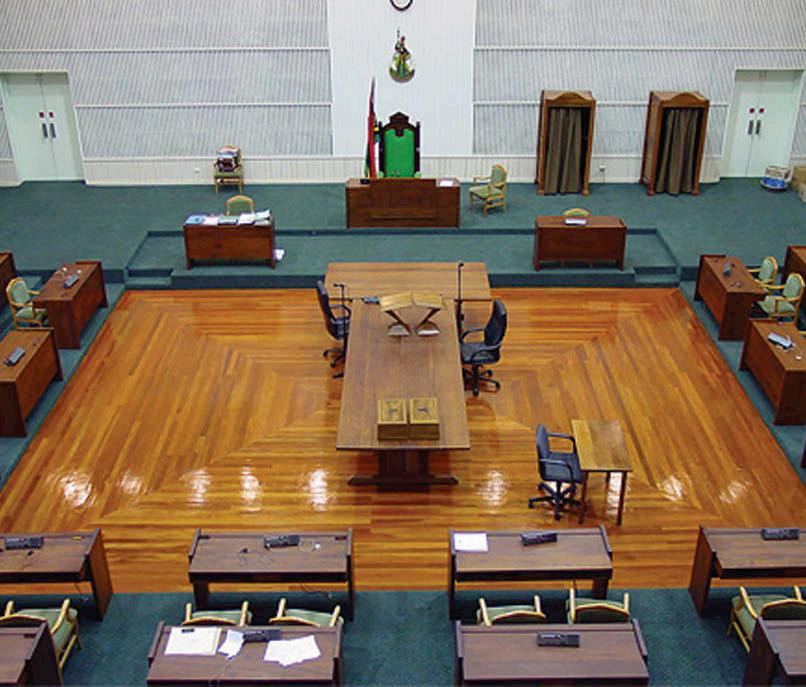

takes time to replace Members who cross the Floor or are appointed to a ministerial position.
The Chairperson of the PAC is the only Committee Chairperson who is nominated from among the opposition Members. The Chairperson of the PAC is Hon. Moana Carcasses Kalosil, MP, from the Green Confederation as proposed by the Leader of the Opposition. Mr Kalosil is a former Leader of the Opposition.
The PAC is administered by the Committees Secretariat which is managed by the Assistant Clerk for the Committees System.
The functions of the PAC are:
• To report on the economic, financial and budget policy statement;
•To consider fiscal strategy submissions made under
provisions of the Public Finance and Economic Management Act;
•To examine the accounts of the receipts and expenditures of the government of the Republic of Vanuatu including financial reports transmitted to the Auditor General;
•To examine all reports of the Auditor General;
•To examine financial affairs of government statutory bodies;
•To report to Parliament any item or matters in the government accounts, statements, reports or any circumstances connected with them, to which the committee is of the opinion that the attention of Parliament should be directed, and
•To enquire into any question in connection with public accounts which is referred to it by Parliament, and to report to Parliament upon that question.
The committee, through its Chairman, has the power to:
•Request any person to attend and give evidence before it;
•Request that papers and records that are relevant to its proceedings be produced;
•Direct that any person be summoned to attend and be examined and give evidence, and
•Direct that any person be summoned to produce papers and records in that person’s position, custody or control that are relevant to the Committee’s proceedings.
Resources for the PAC
Vanuatu’s PAC always works in close collab oration with the government’s Auditor General as provided under the Expenditure Review and Audit (Amendment) Act of 2000. He or she also advises the committee, assists the committee during some of
Top: The Parliament
Bottom: The Chamber inside Parliament.
its proceedings and hearings and runs awareness programmes on public accounts and financial matters, from time to time, on the request of the Chairman of the Public Accounts Committee.
The work programme for the Public Accounts Committee is established in each Parliament once its Members are appointed.
In terms of financial resources, the Public Accounts Committee has an estimated budget of Vatu5 million allocated each year.
The Public Accounts Committee continues to exist until the dissolution of Parliament.
The Speaker of the Legislative Assembly for the Australian Capital Territory discusses the Parliamentary Agreement that was signed by the Leaders of the A.C.T./Greens and its effects on the operation of the Assembly.
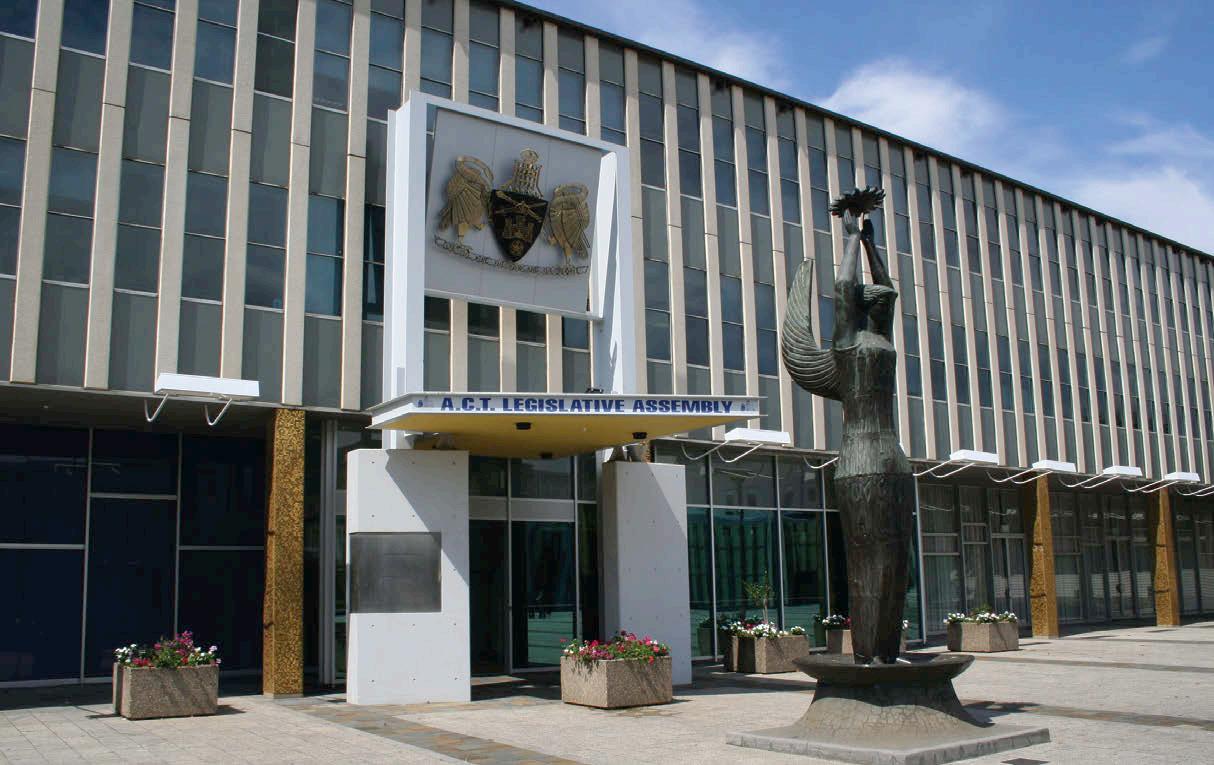
Mr Shane Rattenbury in Canberra.
Mr Rattenbury is Speaker of the Legislative Assembly for the Australian Capital Territory. A graduate in economics and law who is a former International Political Director of Greenpeace, Mr Rattenbury was elected as a Member of the Green Party.
Introduction
This paper discusses the Parliamentary Agreement that was signed by the leader of the Australian Labor Party and the leader of the A.C.T. Greens on 31 October 2008 following the 2008 general election and the effect of that agreement on the operation of the Legislative Assembly for the Australian Capital Territory. It canvasses some of the parliamentary reforms that have been effected already, as well as identifying those reforms that have still to be implemented.
Background
The sixth term of the Legislative Assembly (2004-2008) was characterised by the first majority government for the A.C.T.. In all previous Assemblies from 1989 with one brief exception the governing party was reliant on the opposition or the cross-benches to pass legislation. Holding nine seats out of a possible 17, the Stanhope Labor Government was able to pass bills without the support of
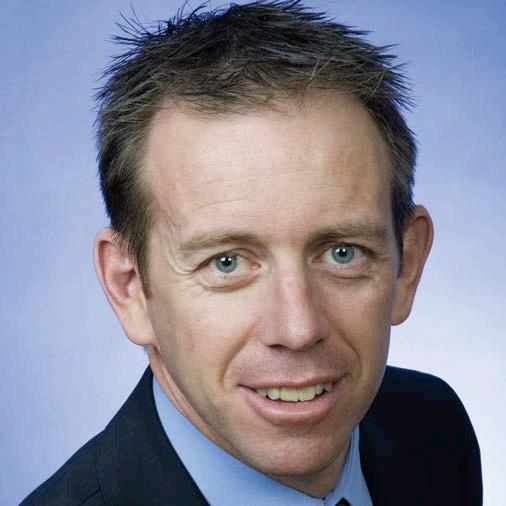
the cross-bench or opposition.
At the 18 October 2008 election for the Seventh Assembly, the Australian Labor Party took seven seats, the Liberal Party six, and the Greens four. No party had sufficient numbers to form government alone. This created a scenario whereby the cross-bench was able to determine which of the major parties would form government. After two weeks of negotiations, the Greens voted for Jon Stanhope to remain Chief Minister, thus allowing Labor to form a minority government.
Pursuant to the Green’s support of the Labor Government, the parties created the Parliamentary Agreement for the Seventh Legislative Assembly for the A.C.T. (Attachment A). Parliamentary agreements have been made in other jurisdictions, most recently between the Liberal and National parties following the 2008 Western Australia state election.
The Parliamentary Agreement sets out the commitment of the parties to stable government, fiscal responsibility and parliamentary reform. The Agreement contains provisions designed to ensure an accountable and transparent government, public service and parliament that are responsive to the community. Appendix 1 of the Agreement deals with the agenda for parliamentary reform, the focus of this paper. Appendix 2 includes a range of policy initiatives to be delivered during the term.
Less than a year into the Seventh Assembly, many reforms contained in the Agreement have been implemented, or are the
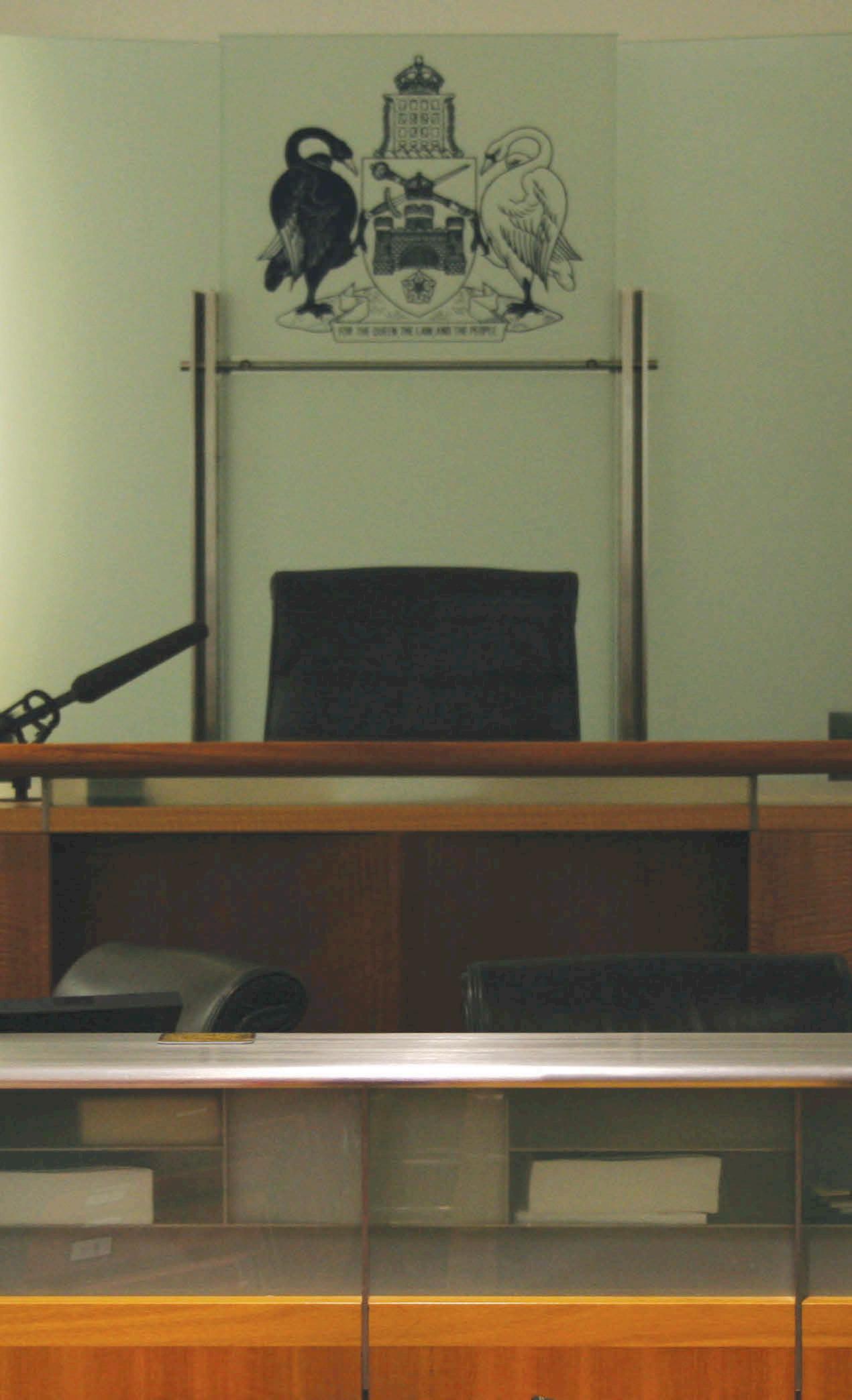
subject of inquiry and ongoing activity.
Detailed below are some of the major initiatives that have been implemented.
Endorsement of the CPA Latimer House Principles
Clause 1.1 of the agreement states that the parties commit to endorse the Commonwealth (Latimer House) Principles on the Three Branches of Government. The Latimer House Principles describe best practice for the relationship between Parliament, the executive and the judiciary. The Principles promote good governance, the rule of law and human rights.
Pursuant to Clause 1.1, on 11 December 2008, the Assembly endorsed a continuing resolution to adopt the Latimer House Principles. Also on 11 December 2008, the Assembly resolved:
“That the Standing Committee on Administration and Procedure: (1)inquire into appropriate mechanisms to coordinate and evaluate the implementation of the Latimer House Principles in the governance of the A.C.T; and (2)report to the Assembly by the last sitting week in June 2009. The Committee has since resolved to report by the final sitting week in August 2009.”
To date, the Committee has received 10 submissions from a varied range of stakeholders, including the A.C.T. Law Society, parliaments in other jurisdictions and scrutiny bodies such as the Human Rights Commission, Ombudsman and Auditor-General.
Standing committee inquiry
Clause 2.12 of the agreement requires the Standing Committee on Administration and Procedure to establish an inquiry within six months into the merit of appointing a Parliamentary Budget Officer.
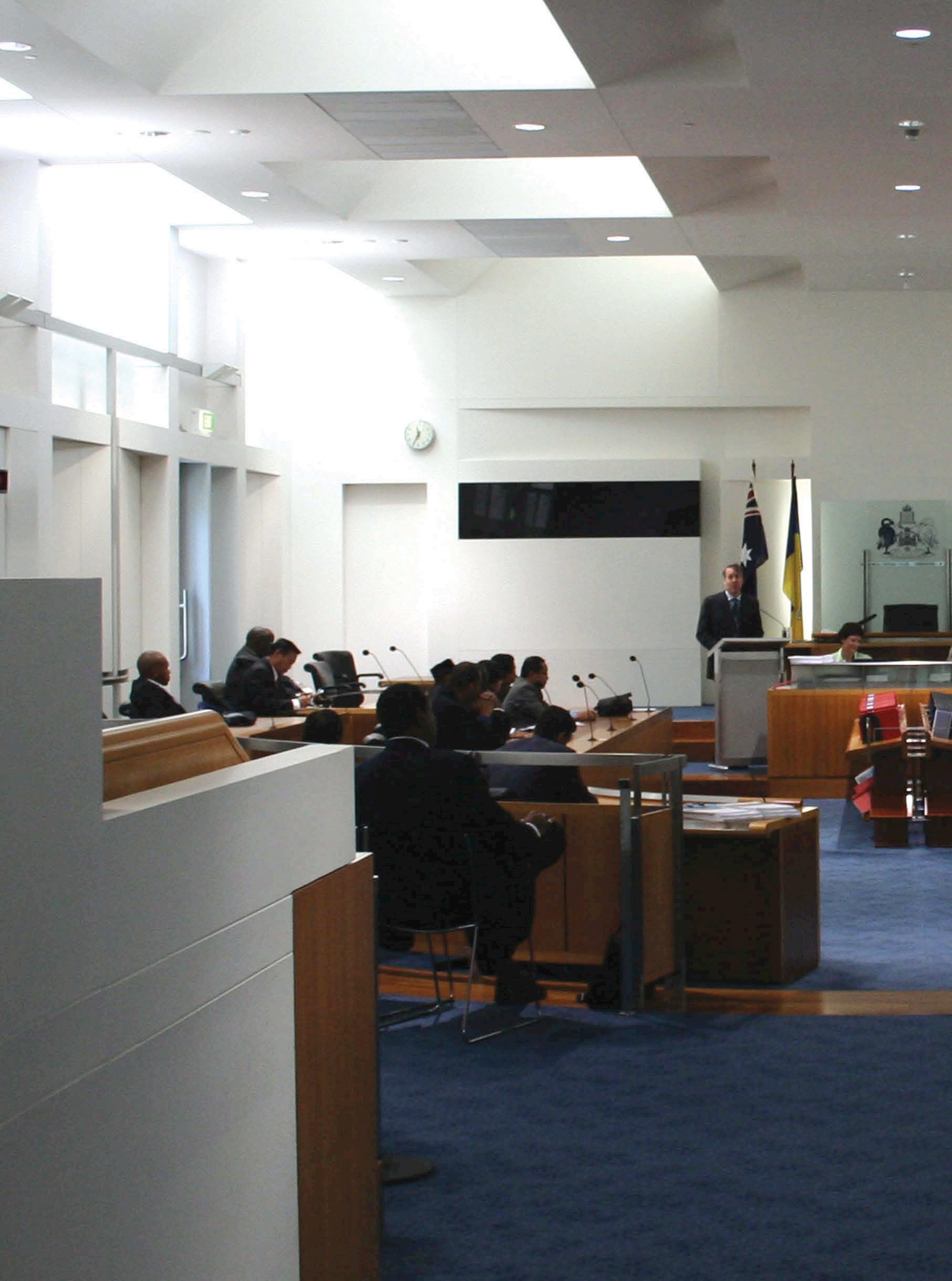
On 12 December 2008, the Assembly resolved that the Committee undertake such an inquiry, and report to the Assembly by the last sitting day in August 2009. To date, the Committee has received six submissions from a variety of
stakeholders.
A number of countries have a budget research organization attached to their Legislature to conduct independent analysis of national budgets. The functions of such organizations may extend to providing independent analysis of
the government’s fiscal plan, review of government estimates and preparation of cost estimates for legislative proposals. Examples include the Canadian Parliamentary Budget Officer, the United States Congressional Budget Office and the Scrutiny
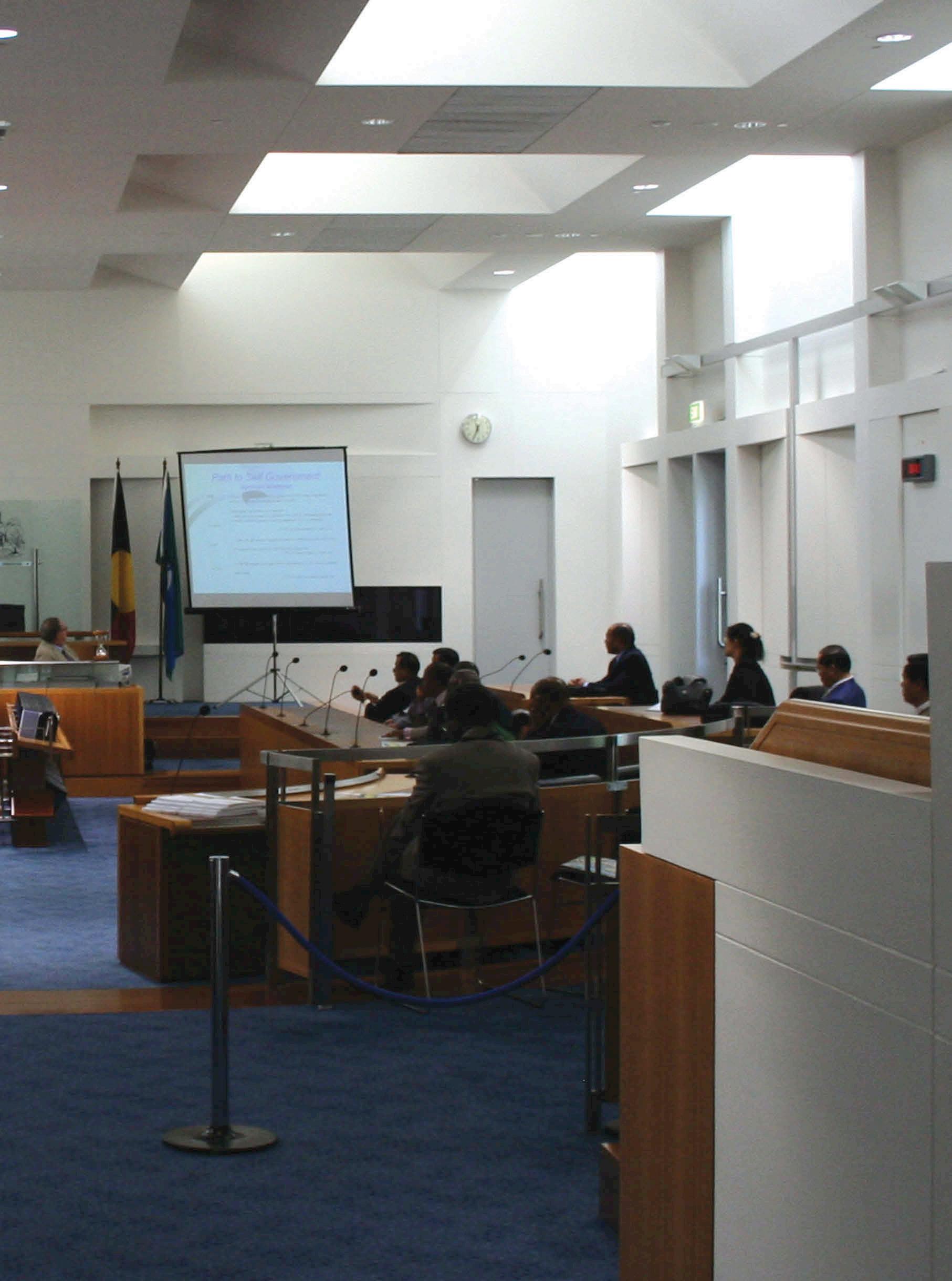
Unit within the Committee Office of the United Kingdom’s House of Commons. Closer to home, there have been recent calls from the Federal Opposition Leader Hon. Malcolm Turnbull for a new independent body to provide impartial economic forecasts for
the Commonwealth Parliament. The independent body would be modelled on the U.S.
Congressional Budget Office.
In the A.C.T., the Select Committee on Estimates 20092010 temporarily engaged a consultant to provide
independent economic and financial analysis of the A.C.T. Budget and to assist with the
technical aspects of the Budget Papers. The consultant, Mr Tony Harris, former Auditor-General of New South Wales, provided the committee with a review of the Budget and commentary on stakeholder evidence at public hearings.
Chairs of committees’ on estimates Clause 2.10 of the agreement requires that a non-government Member chair the Standing Committee on Public Accounts and the Select Committee on Estimates. Member for Molonglo and Greens MLA Ms Caroline Le Couteur was elected chair of the Standing Committee on Public Accounts, and Liberal Member for Brindabella and Leader of the Opposition Mr Zed Seselja MLA was elected chair of the Select Committee on Estimates 2009-2010. The Agreement also provides for other Green MLAs to chair other committees.
The Assembly has gone beyond the initial target of nongovernment chairs for these committees, and has elected nongovernment chairs to all but one of the Assembly standing committees:
-Standing Committee on Administration and Procedure (Mr Shane Rattenbury MLA, Greens)
-Standing Committee on Climate Change, Environment and Water (Ms Meredith Hunter MLA, Greens)
-Standing Committee on Education, Training and Youth Affairs (Ms Amanda Bresnan MLA, Greens)
-Standing Committee on Health, Community and Social Services (Mr Steve Doszpot MLA, Liberals)
-Standing Committee on Justice and Community Safety (Ms Vicki Dunne MLA, Liberals)
New standing order to ensure that bills are not to be debated in
the same sitting period as they are introduced
Clause 3.6 of the agreement requires a new standing order to be introduced, requiring that no bill be presented and debated in the same sitting period unless the Assembly agrees there are exigent circumstances. A temporary order to this effect was implemented on 9 December 2008. Temporary order 172 states that the question “that this bill be agreed to in principle” shall not be determined by the Assembly during the sitting period at which the bill is first introduced, except in the case of a bill declared to be an urgent bill”.
The value of temporary order 172 was highlighted recently during debate of the Exhibition Park Corporation (Repeal) Bill 2009 when I commented:
“I think this bill has demonstrated very well the value of that approach because it has given us time to consider this bill and, at least in the case of the Greens, to go out and talk to some of the stakeholders involved in this issue, ask them their views, consider the government's plan, potentially enter into a discussion with the government about the content of the bill and then come to the floor of the Assembly today and actually have a substantive debate... It has been very valuable and I think underlines the value of that amendment to that standing order. I commend that standing order to the Assembly in its new form and trust that it will become a permanent, not just temporary, standing order of this place.”
Appointment of an independent legal arbiter
Clause 3.5 provides for a new standing order to resolve disputes for orders for papers through the provision of an independent arbiter to determine if a claim of executive
privilege is legitimate, such as that provided for in the New South Wales Legislative Council. Similar mechanisms have been employed in Victoria.
Temporary order 213A was adopted on 12 February 2009 to allow a Member to dispute a claim of executive privilege, and authorise the Clerk to release the disputed documents to an independent legal arbiter for evaluation and report within seven calendar days as to the validity of the claim. The independent legal arbiter is to be appointed by the Speaker and must be a retired Supreme Court, Federal Court or High Court Judge. A report from the independent legal arbiter is to be lodged with the Clerk and made available only to Members of the Assembly, and not published or copied without an order of the Assembly.
Temporary order 213A was invoked for the first time early in 2009, when the Leader of the Opposition disputed a claim of executive privilege over the 2006 Functional Review in relation to the A.C.T. Budget. Sir Laurence Street, a former Chief Justice of the Supreme Court of New South Wales and independent legal arbiter for the NSW Legislative Council, was appointed to arbitrate the matter. His report, Disputed Claim of Privilege—Review of A.C.T Public Sector and Services Report of Independent Legal Arbiter was tabled in the Assembly on 7 May 2009. Sir Laurence upheld the Government’s claim of privilege in relation to the Functional Review documents.
Although I have accepted the arbiter’s finding, I made some remarks in the Assembly about the decision and suggested that the process requires some further refinement. In my opinion the Assembly should review the arbitration process to make sure both sides of the argument are
put forward to the arbiter in the future.
Clause 3.12 provides for a new standing order to require answers during question time to be “directly” relevant to the question. In response, standing order 118(a) has been temporarily amended to require that an answer to a question without notice must be directly relevant to the subject matter of the question (previously, an answer had to be “confined” to the subject matter in question). Standing order 118 has been further amended to require that “a Member who believes a response given to a question
“New standing order to ensure that bills are not to be debated in the same sitting period as they are introduced.”
was in the form of a ministerial statement, may seek the leave of the Speaker to respond to the statement at the conclusion of Question Time for a period not exceeding five minutes”. This amendment is consistent with clause 3.13 of the Agreement. The intention of these amendments was to force Ministers to answer questions directly, rather than permitting political grandstanding on tangential matters. As one of my colleagues stated when the new standing order was being debated:
Question time has sometimes become almost farcical, with ministers being permitted to push a line on a particular issue rather than
answer the question. Assembly Hansard has examples of answers to questions that make only a meagre attempt to answer the topic of the question. It is intended that, by amending standing order 118 and requiring that the answer be directly relevant to the question asked, this will no longer be the case and, in formulating questions, members will be able to simply state a question and have it answered without having to wonder about what sort of tangent the minister might take in response to it.
Standing order 69 has been amended to allow an equal amount of speaking time for the government, opposition and crossbench members. The old rule tended to allow the government and opposition to speak for longer during debates for agreement to a bill in principle and in debates otherwise not provided for in the standing order.
Until recently, the Assembly and Government Library was under the administration of the Department of Territory and Municipal Services (TAMS- an executive agency – a situation not observed in any other Australian jurisdiction, with the possible exception of the Northern Territory), despite being located within the Assembly precinct, and providing services predominantly to Members and their staff.
On 1 July 2009, responsibility for the library was transferred to the Legislative Assembly Secretariat. The decision brings the Assembly into line with other parliamentary jurisdictions, providing the Assembly with direct control of its own library. An important element of the decision was that the library would continue to provide services to A.C.T. Government agencies.
Provisions of the Agreement yet to be implemented include:
Clause 2.1
Assembly committees to perform a dual role, being scrutiny of Executive decision making, and collaboration with the Executive in informing decision making on legislative reform, policy setting and service delivery
For further information about the proposed collaborative approach, refer clauses 2.2 – 2.7. (I should point out that the Clerk has provided advice to a Member which was subsequently copied to all committee chairs that raised concerns about the practicality of such an arrangement. The Clerk noted that it may appear that the Committees and the Chairs may be seen to be performing executive work, and it may blur the lines between the executive and the Legislature).
Clause 2.11
Senior public servants to be seconded to the Assembly to assist with committee work when requested by the committee (see 4.2 also).
Clause 3.3
Exposure drafts of all major pieces of reform legislation to be released prior to their presentation in the Assembly.
Clause 3.7
Amendments to the Human Rights Act 2004 requiring all private Members’ bills to be assessed for compliance with the Act (currently only government bills are assessed for compliance).
Clauses 3.9 -11
oFinal Impact Analyses of bills, reports on consultation to be tabled
o Climate Change Impact Analysis to be completed and made available; and
o The introduction of Triple Bottom Line annual reporting.
Clause 5.5
Passage of legislation which will require all political donations to be disclosed within one month of receipt and in an election period, on a weekly basis.
Freedom of Information
Freedom of information laws are under review in many Australian jurisdictions, including Queensland and the Commonwealth. In the context of this reform and the Parliamentary Agreement’s focus on improved accountability and transparency of government, a review of the A.C.T.’s freedom of information laws is timely.
Early this year the Assembly passed the Freedom of Information Bill 2008, preventing the use of conclusive certificates except in relation to national security considerations.
This reform was consistent with clause 5.4 of the Agreement. Although this is a good start to the reform process, there is still substantial scope for revision. The Standing Committee on Justice and Community Safety’s inquiry into the Freedom of Information Act 1989 is a welcome start to a more extensive review process.
The Agreement proposes that this process should extend to the appointment of an independent Information Commissioner (clause 5.3), in addition to completion of an inquiry into reform of the Public Interest Disclosure Act 1994 (clause 5.3).
New temporary order 254A allows for with a request for explanation concerning a government response to a committee report. If, after three months of the presentation of a committee report there has not been a government response, the chair of the committee may ask the relevant
minister for an explanation as to why a response has not been forthcoming in that time. This new temporary order is based on standing order 118A, which sets similar standards in relation to answers to questions on notice. This is yet another measure to improve accountability of the Government to the Assembly and to the people of Canberra.
Clause 3.4 requires a new standing order that all government amendments to bills will not be able to be debated unless a scrutiny report from the Scrutiny of Bills Committee has been provided unless the Assembly agrees the
“...good progress has been made in a short period of time on strengthening democracy and asserting the primacy of the Legislature.”
amendment is of an urgent, minor or merely technical nature. A temporary order to this effect was adopted in February 2009 (see standing order 182A).
It should be noted that most of these changes were adopted by the Assembly as temporary standing orders (in other jurisdictions referred to as sessional orders), which means they lapse at the end of the 7th Assembly in October 2012. It is often the case that, where significant changes occur to a
legislature’s practice and procedure, it is prudent to trial such changes in order to see if they achieve the desired effect in the operation of the legislature. It is hoped that the temporary orders will, if considered a success, will be permanently adopted as standing orders.
As can be seen from the above, good progress has been made in a short period of time on strengthening democracy and asserting the primacy of the Legislature. I believe that this has reasserted the authority of the Legislature in terms of its legislative, accountability and representational responsibilities. It is hoped that these reforms will reinforce the need for the executive to continually account to the legislature on its exercise of power and the decisions it has taken.
When the Agreement was first signed it was reported in The Age that in a breakthrough that could have repercussions throughout Australia, a Labor government in the A.C.T. has pledged to scrap ministers’ power to block freedom of information requests, end the abuse of question time and require parties to report weekly on donations during election campaigns.
In the same article it was stated that the former Democrats senator Andrew Murray, a long-time crusader for parliamentary reform, hailed the agreement as “a wonderful advance” and predicted that its impact would spread far beyond the A.C.T. “It is a fact that advances in one state inevitably spread to the others, and ultimately to the Commonwealth itself” he said.
I will watch with interest to see if Mr Murray’s comments prove to be true, and I would welcome delegate’s comments on what reforms their Parliaments have undertaken in recent times.

Parliaments throughout the Commonwealth and throughout the world should be institutions where the human rights of the individual are recognized and where the principles of democracy are closely conducted and the rule of law is the order of every day. The Speaker of the Parliament in Kiribati says all Presiding Officers must carefully consider whether its Parliaments live up to its expectation.
Mr Iuta was elected as Speaker of the Parliament of Kiribati in 2007, the second time he has occupied that post. He was a Minister from 1979 to 1994, including serving as Vice-President of Kiribati from 1991 to 1994. He was a Member of Parliament from 1994 to 2002.
An insult to a Parliament?
In my situation when I was asked to assess my Parliament – whether or not it was up to the CPA Benchmarks – my immediate reaction was one of anger. I was angry because the word “benchmark” to me means a “measure of excellence”. I was angry and felt insulted because I felt that being asked to undergo the benchmarking exercise was an indirect way to tell me that my Parliament is not up to the accepted standard as far as Parliaments go.
Rightly or wrongly, I have always considered that my Parliament is one Parliament that had conducted its affairs in accordance with the most democratically accepted principles and I therefore was not prepared to lower myself as to agree to compare how I had performed against the standard of another Parliament that some
foolish person had selected to be a shining example. My mind went into function trying to extract what other Parliaments had done wrong and ended up with the conviction that my Parliament is better than all the others. I decided there and then, that there was no point in undertaking an exercise on Benchmarking and I was prepared to forget about it. Other fools can do it for their Parliament but not me because my Parliament is the best as far as democratic principles are applied.
Then there was this suggestion from the Secretary-General of the Commonwealth Parliamentary Association Secretariat that a workshop on Benchmarking would be conducted at the end of the workshop on “First Among Equals”, a professional development course
for Speakers organized by the Centre for Democratic Institutions (CDI), which was to be held at the Queensland Parliament in Brisbane.
Mr Andrew Imlach of the Commonwealth Parliamentary Association Secretariat in London and Mr Alifereti Bulivou of the Pacific office of the Pacific Parliamentarians Association on Population and Development and Forum Presiding Officers Conference (PPAPD/FPOC) office in Suva came over to conduct the Benchmarking workshop at the end of a CDI workshop in Brisbane in late June. They were ably assisted in conducting the Benchmarking workshop by resource personnel from the “First Among Equals” workshop.
First it was explained in great detail how the Benchmark idea was decided: the exercise is not in any way trying to set any
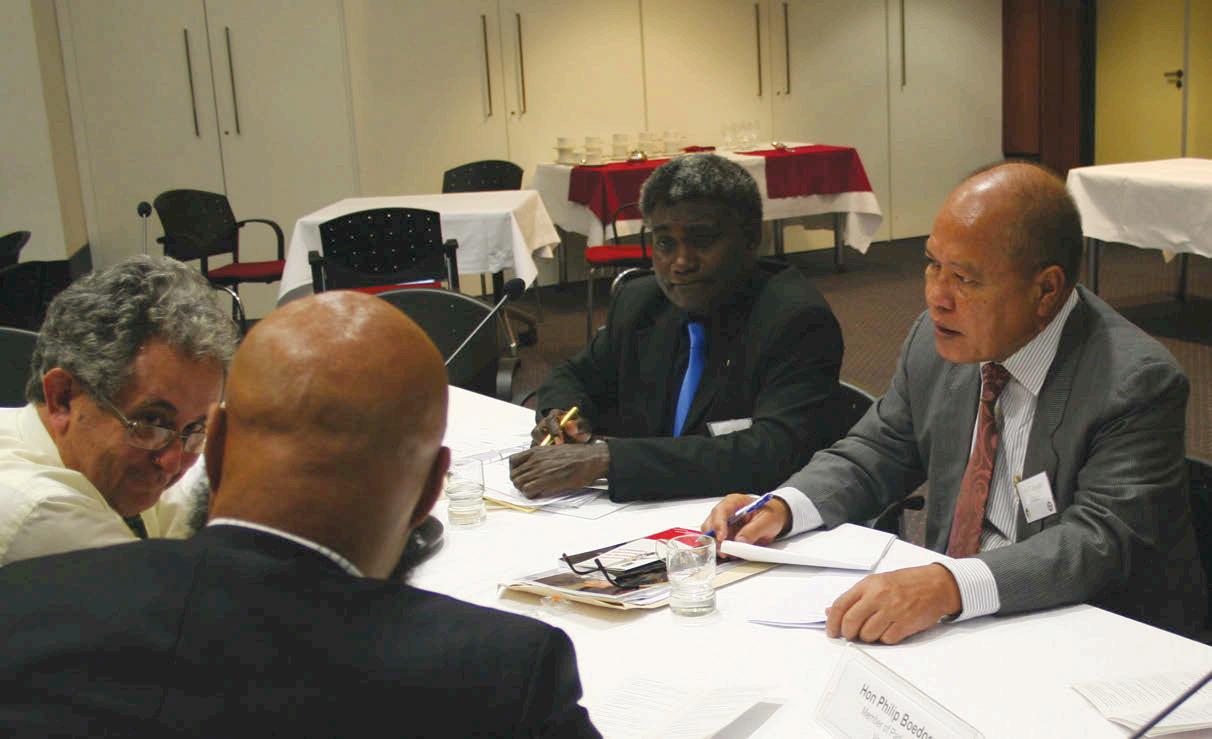
Parliament as a Benchmark and to ask others to compare their Parliament to that Parliament. Rather it is an exercise to ask pertinent questions which have been thoughtfully compiled to be conducive of the good operation of a democratically sound institution. There are two main reasons behind the formulation of the Benchmarks. First, to undertake the Benchmarking exercise is the same as registering your keen interest in adhering to democratic principles in the working of your Parliament. In doing so you are making your Parliament known to world bodies and aid donors who may have an interest to assist in the development of democratic Parliaments and in strengthening the capacity of Parliaments so that they play their role fully as the representatives of the wishes of the people and in scrutinizing the performance of the executive.
The second important feature of Benchmarking is in its selfassessing role. You are not comparing your Parliament to another Parliament but rather you are undertaking an exercise to “self-assess” your Parliament. In everyday life it is quite a healthy activity to assess yourself. It is most gratifying to see how you perform against targets or benchmarks that you have set yourself as standards that you wish to achieve in order to elevate your performance to that level. You are not trying to compare yourself to anyone else. You set
make comments on the answers from the three groups.
your own standard that you think will elevate your level and set yourself to get those standards. There is nothing more satisfying than to feel that you have achieved an acceptably high performance mark.
At the end of explanations from the resource persons on benchmarking, the workshop participants were divided into three smaller groups and were asked to respond to their selected areas of benchmarking. The resource personnel were also divided into three groups and were allocated to assist the participant groups in responding to the Benchmarks each group had been asked to answer.
Each group came up with answers that they felt their Parliaments had practised. Where there were questions that the group differed on, then a general discussion among the members of the group ensued to find a common answer which all members agreed to. In the end, all groups presented their answers through one of them whom they had elected to be spokesperson. All participants are allowed to
The exercise helped all members of the workshop to fully understand what the Benchmarking is trying to get at. In the end, we who were lucky to have the opportunity to participate came out convinced that it is an exercise worth doing. We all agreed that all Pacific Parliaments that are members of the Commonwealth Parliamentary Association should try and complete the Benchmarking exercise before the end of 2009. In fact, we set a date that we would expect all Pacific Parliaments to have completed the exercise by. It is our expectation that when we come to the next PPAPD-FPOC meeting to be held in Rarotonga, Cook Islands, in the second half of November this year we should have all undertaken the exercise and have also completed it.
Kiribati moves ahead
In the case of Kiribati I am happy to say that we are the first from the small Pacific islands Parliaments to have done this exercise. This was possible through the assistance of Mr Bulivou.
Mr Bulivou was in Brisbane in May helping with the workshop in Benchmarking that I talked about above. Before coming to Brisbane he contacted our Parliament suggesting that he would want to take the opportunity of his visit to Kiribati for the CPA Pacific Region Presiding Officers and Clerks Conference to undertake Benchmarking for our Parliament. Before I left for Brisbane I told the Clerk to inform Mr Bulivou that his idea of doing the Benchmarking on his coming to the CPA Presiding Officers and Clerks Conference would not be welcome as we in Kiribati would be busy with the Conference.
After the completion of the exercise on Benchmarking in Brisbane I completely changed my former attitude and was convinced that it is a worthwhile thing to do for
the good of my Parliament. I therefore agreed that Mr Bulivou should undertake this exercise with my Parliament the day after he arrived in Kiribati which was 3 July 2009. This was the last working day before the start of the Presiding Officers and Clerks conference on Monday the following week.
There was not really enough time to get as many people to come to attend our Benchmarking exercise. I decided that I would not only invite Parliamentarians to do this but it would be good and useful if some from the public service also had a go at the exercise. So in the morning of 3 July, Mr Bulivou and I met with all senior staff of the Parliament. The parliamentary staff agreed that Benchmarking should be done. In the afternoon of the same day we again met but this time we were joined by a few of the Parliamentarians who were present on the capital, Tarawa, and this also included the attendance of the Secretary to the Cabinet and the Attorney General.
We covered all the questions of the Benchmark that Friday afternoon; but we all agreed to come back again on Monday morning the following week to answer some other questions with Mr Bulivou.
Though we who were present had answered the Benchmark questions, we realized that our views may not be representative of the views of the remaining Parliamentarians; so we agreed that Mr Bulivou would take notes of our answers to the questions and that when all the remaining Parliamentarians arrive for the next parliamentary meeting we will distribute these answers to them.
Only after they have provided their comments to those answers will we then take it that the Benchmarking has been thoroughly completed.
Two Members of Norfolk Island’s Legislative Assembly celebrate the Island’s 30th anniversary of internal self-government, which they hope will show the Australian government ways in which it too can apply similar measures in its own jurisdiction.
Hon. Lisle Snell, MLA and Hon. Andre Nobbs, MLA.
Mr Snell is the Speaker of the Legislative Assembly in Norfolk Island while Mr Nobbs is its Chief Minister.
“Norfolk Island aspires to achieve the highest possible standards in democracy, openness and good practice in government… and can be a pilot programme which will show the way in which the Australian Government can apply similar measures within its own jurisdiction”.
(Chief Minister Hon. Andre Nobbs, news release to the Norfolk Island community, 29 May 2009)
On 19 August 2009 Norfolk Island celebrated its 30th year of internal self-government with a commemorative sitting of its Legislative Assembly. Her Excellency the GovernorGeneral of Australia, Ms Quentin Bryce, AC, accepted our invitation to be present as our guest.
Norfolk Island’s path to full internal self-government over the last 30 years demonstrates the capability of the elected representatives of the Island’s community to govern this tiny Island, which has a permanent
population of less than 2,000 people.
Progress over that period has shown that local people, who are necessarily closer to the challenges of living in a small, remote community, are more likely to be able to respond to those challenges effectively than are decision-makers from far away. This perception underpinned the grant of self-government in 1979, at which time it was stated by the responsible Australian Minister that Norfolk Island would not be required to be regulated “by the same laws as regulate other parts of Australia”.
Our community has seized the opportunity given in 1979 to cater to the Island’s unique circumstances with zest. We embrace modern principles of democratic government, effectively deliver programmes, services and entitlements to the community, and have substantially upgraded public infrastructure and given real attention to environmental concerns.
However a recurring theme in Norfolk Island’s governance over recent years has been the repeated suggestion – sometimes more akin to a demand – that the Island should conform to the norms of metropolitan Australia, irrespective of whether that would be appropriate to the Island’s circumstances.
A recent example of this is the announcement on 29 May 2009 by the (then) Australian Minister for Home Affairs, Hon. Bob Debus, MP, of “important reforms for Norfolk Island”. These include the expressed intention “to reform the voting system for the Norfolk Island
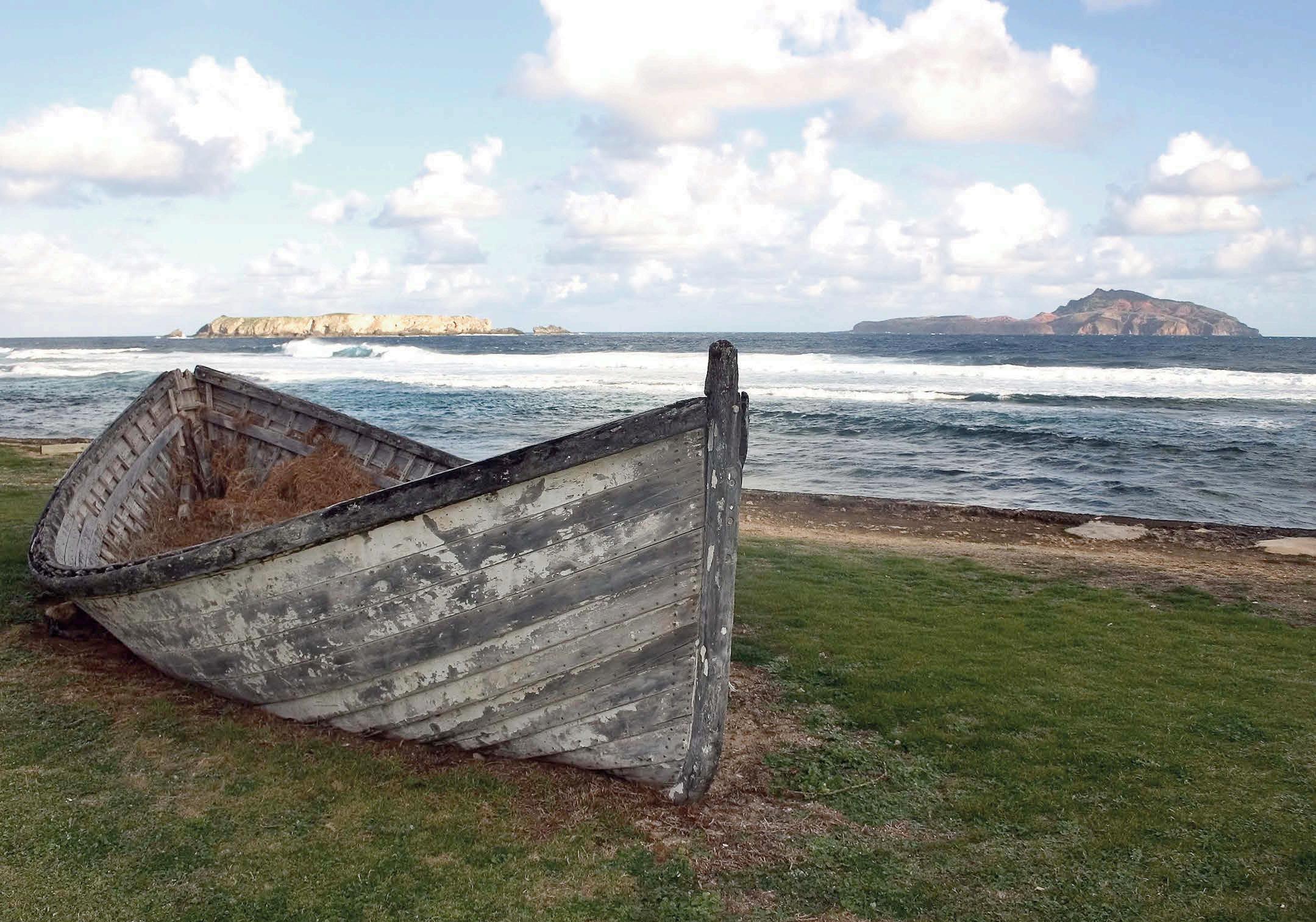
Assembly and provide more certainty about when elections are held”.
Mr Debus went on to say: “These reforms will be introduced in a manner which ensures that the law of Norfolk Island reflects its status as part of Australia”.
Both the intended changes themselves, and the rationale given for them, exemplify the tension between the original justification for self-government and the continuing – latterly, increasing – pressure for the Island’s governance to be conducted according to Australian notions of how affairs ought to be conducted.
Sometimes this pressure is less than helpful. The Australian
Parliament, against the wishes of the Norfolk Island Legislature, made changes in 2004 to the Island’s electoral system. These changes had the effect of preventing those Island residents who were not Australian citizens from enrolling to vote in Legislative Assembly elections, and making them ineligible to be members of the Assembly. The Australian Human Rights Commission said of this change:
Having created a right to vote without reference to nationality in recognition of the special circumstances of the residents of Norfolk Island, it would arguably breach article 26 [of the International Covenant on Civil and Political Rights] to disenfranchise certain beneficiaries of that right
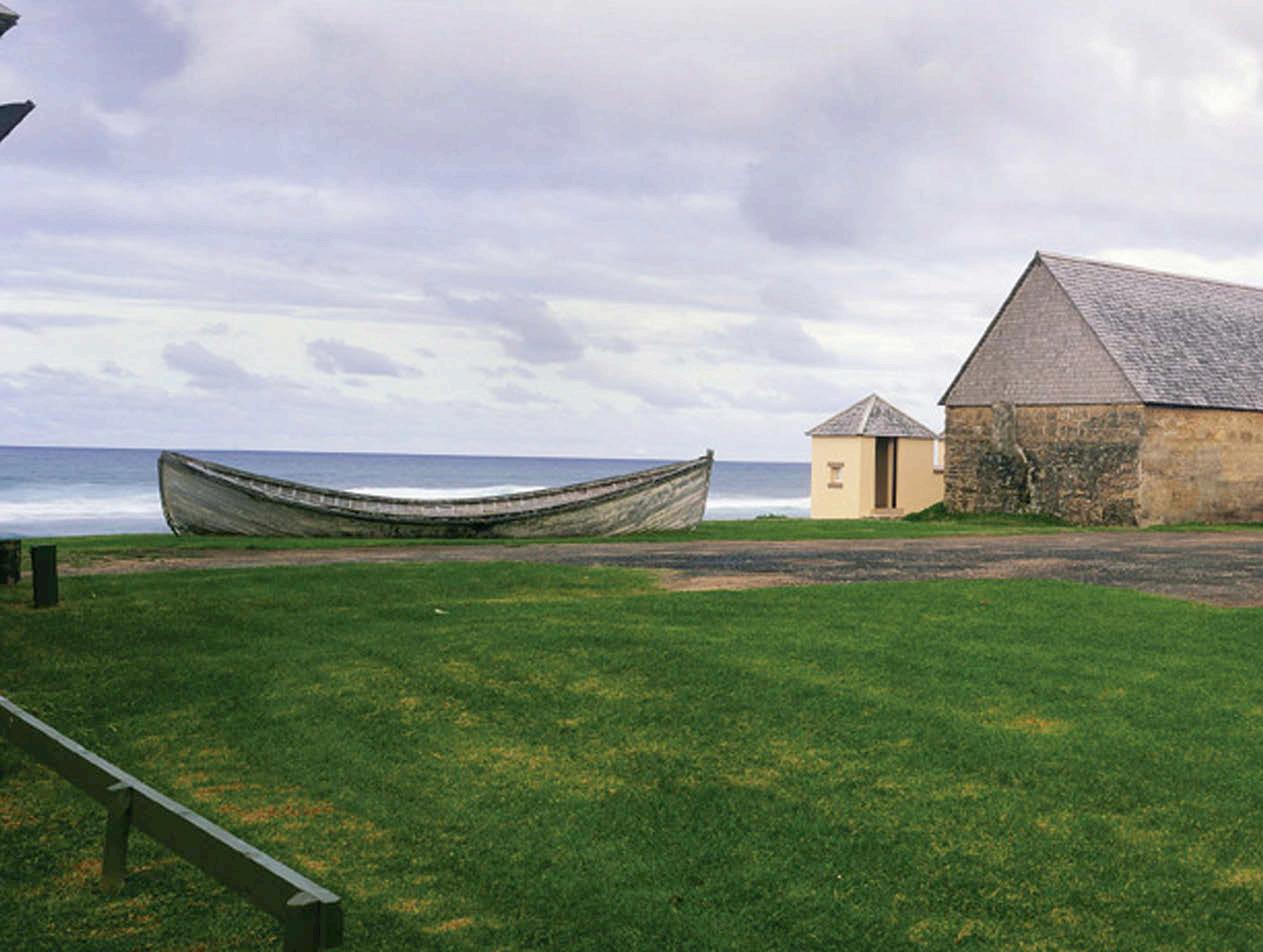
now solely on the basis that they are not Australian citizens.
At other times, metropolitan pressure can give rise to the opportunity to aspire to universal benchmarks for democratic Legislatures, unconfined by parochial perspectives whether those of Australia or of Norfolk Island.
Take the case of voting rights. In Australia, citizenship is a requirement for engagement in the electoral process. In other countries (for example the United Kingdom) wider criteria apply, and the franchise is not restricted solely to citizens. The CPA Benchmarks
for Democratic Legislatures (Benchmark 1.1.1) calls for “direct universal and equal suffrage in a free and secret ballot”. The expression “universal” suggests that the British approach is a better fit for that Benchmark than is the Australian.
We in Norfolk Island aspire to the “universal” model of electoral rights, but unfortunately it is not a choice which is open to the Island’s Legislature to adopt. Rather, the Australian model has been externally imposed.
On other issues, though, we have the freedom to take the initiative and lead the way.
An example is the introduction of effective anti-corruption measures. For some time the Norfolk Island government has been negotiating with the New South Wales government to enable New South Wales’ highly effective Independent Commission against Corruption to have a role in Norfolk Island. There is no such body operating at the Australian Federal level, and this is an issue on which Norfolk Island’s non-adherence to Federal norms can lead the way.
The question of fixed-term Parliaments is another area where Norfolk Island could adopt a
different course than that adopted by the Commonwealth of Australia. At the Australian federal level, a fixed-term for Parliaments would require amendment of the constitution. This is in practice unlikely to occur. Mr Debus’ comment that the intended changes to the Island’s voting system would “provide more certainty about when elections are held” has been widely interpreted as pointing to fixed terms for the Norfolk Island Legislative Assembly, as already occurs in some Australian jurisdictions including the Australian Capital Territory and New South Wales.
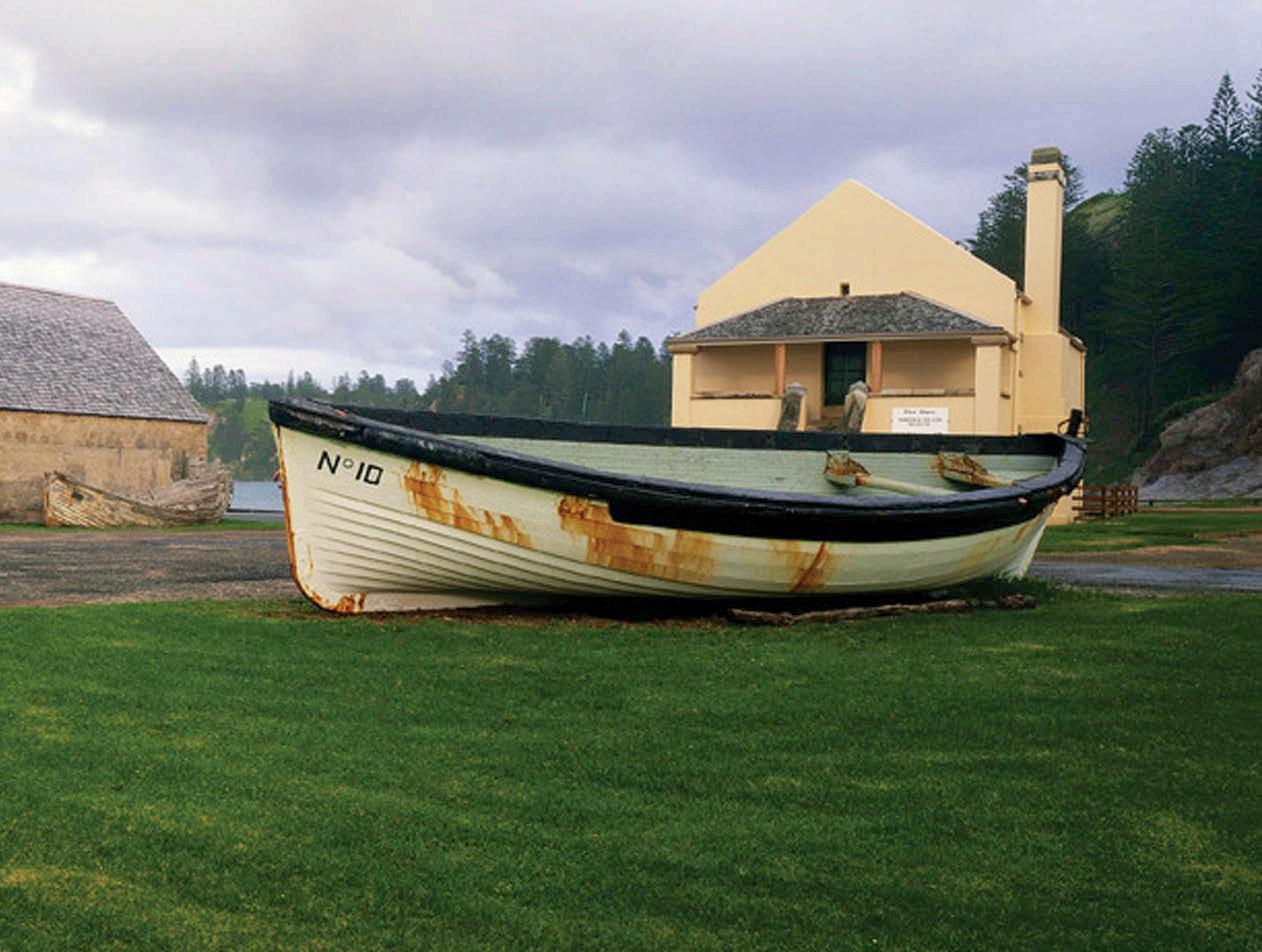
The merits and demerits of fixed terms are open to debate and we are by no means convinced that a move to fixed terms would be useful in the Norfolk Island context. The point to be made, though, is that if a good case were made out for such a change it would be possible to implement it in this jurisdiction, but not possible federally.
A final example to illustrate the general point that uniformity can be regressive is the registration and disclosure of the pecuniary and commercial interests of Members of the Legislature, and the related issue of a code of
conduct for Members.
These are recognized by the CPA Benchmarks (10.1.2 and 10.1.3) as necessary for best practice democratic Legislatures.
Norfolk Island has had a statutory pecuniary interests and disclosure regime, and a statutory code of conduct for Members since 2004. The sanctions available under the legislation include suspension from the Assembly for up to six months, removal from executive office and/or a substantial fine.
The federal regime, by contrast, covers only registrable interests and does not include a
code of conduct. And the provisions relating to Members’ interests are non-statutory. They arise simply from resolutions of the House of Representatives and Senate (see for example House Resolution 13 February 2008).
On this issue, we think nonconformity with the federal norm better fits the spirit and substance of the CPA’s best-practice Benchmarks.
These are of course examples only. In many other areas it can be shown that conformity with metropolitan norms would lead to
counterproductive or regressive outcomes. In other areas, the reverse is true. We believe that at bottom what matters is the appropriateness of a measure, decision or process for the particular jurisdiction whose Legislature adopts it, rather than the pursuit of uniformity as a normative exercise in itself, or in order to make a political point about the virtues of conformity.
A team at the London School of Economics analysed existing parliamentary assessment tools and examined opportunities to craft a single, holistic tool. Their findings are reported in this article.
Ms Melissa Bhatnagar, Ms Tanja Kuechen, Ms Jill Shirey, and
Aslihan
Tuncer
Ms
The authors are students in Public Administration at the London School of Economics. This study was done as a Capstone Project commissioned by the World Bank Institute.
Parliaments face multiple challenges to strengthening their democratic functioning. Ideally, one of these difficulties should not be confusion about assessment tools or other measures used to gauge parliamentary performance and sustainability. A given Parliament should have a clear idea of recognized international standards and should be able to identify ways it would like to improve based on these guidelines. However, the existence of multiple assessment tools and lack of uniform, agreedupon international standards means that such confusion is often pervasive. What’s a wellintentioned parliament to do?
At the request of the World Bank Institute and as part of our Master of Public Administration (MPA) Programme at the London School of Economics, our team undertook an analysis of existing parliamentary assessment tools and examined opportunities to
craft a single, holistic tool. We wanted to understand ways in which existing tools are similar as well as different from each other. Do they emphasize different aspects of parliamentary functioning? To this end, we examined five parliamentary assessment tools in our study, which are the following: the National Democratic Institute Standards (NDI Standards), the Commonwealth Parliamentary Association/World Bank Institute/United Nations Development Programme Benchmarks (CPA/WBI/UNDP Benchmarks), the InterParliamentary Union SelfAssessment Toolkit for Parliamentarians (IPU Toolkit), the Parliamentary Centre – Budget Process (PC-Budget) Report Card, and the Parliamentary Centre –Parliamentary Audit (PC-Audit) Report Card.
These assessment tools vary a great deal in terms of length and format. The longest assessment
tool (NDI Standards) has 89 indicators, whereas the shortest assessment tool (IPU Toolkit) has only 48 questions. Some assessment tools, which were created by the various organizations indicated in their titles, are formulated as questions while others are designed as standards, or benchmark indicators. In order to better understand if different assessment tools produce divergent results within the same country, we applied each tool to four sample countries, namely Germany, Turkey, Peru, and Uganda. As many assessment tools are still in the early stages of testing within countries, this part of our study was particularly critical. If a parliament appears to be stronger when one assessment tool is applied versus another, it is even more imperative to create a holistic, standardized assessment tool to avoid controversy and confusion during the challenging process of parliamentary strengthening.

Before describing our proposed holistic tool, which emerged from the overlapping areas across the assessment tools, it is important to note that the tools display significant differences. Many of these differences may be due to the fact that each tool has been constructed by a different organization in a way that reflects its own unique approach to parliamentary assessment. In order to closely examine possible differences between tools, our team analyzed the tools both at the question-by-question and topical
levels. In addition, we evaluated all tools according to their utilization of good question design principles. Finally, we applied all tools to the sample countries to ascertain whether they produced differential results.
First, when we analyzed the assessment tools at the questionby-question level, we found that there is a relatively low amount of overlap between all five of the tools. For example, only five indicators from the 88-indicator CPA/WBI/UNDP Benchmarks can be matched with indicators from all other tools. Five additional indicators from this tool can be matched with three (out of four)
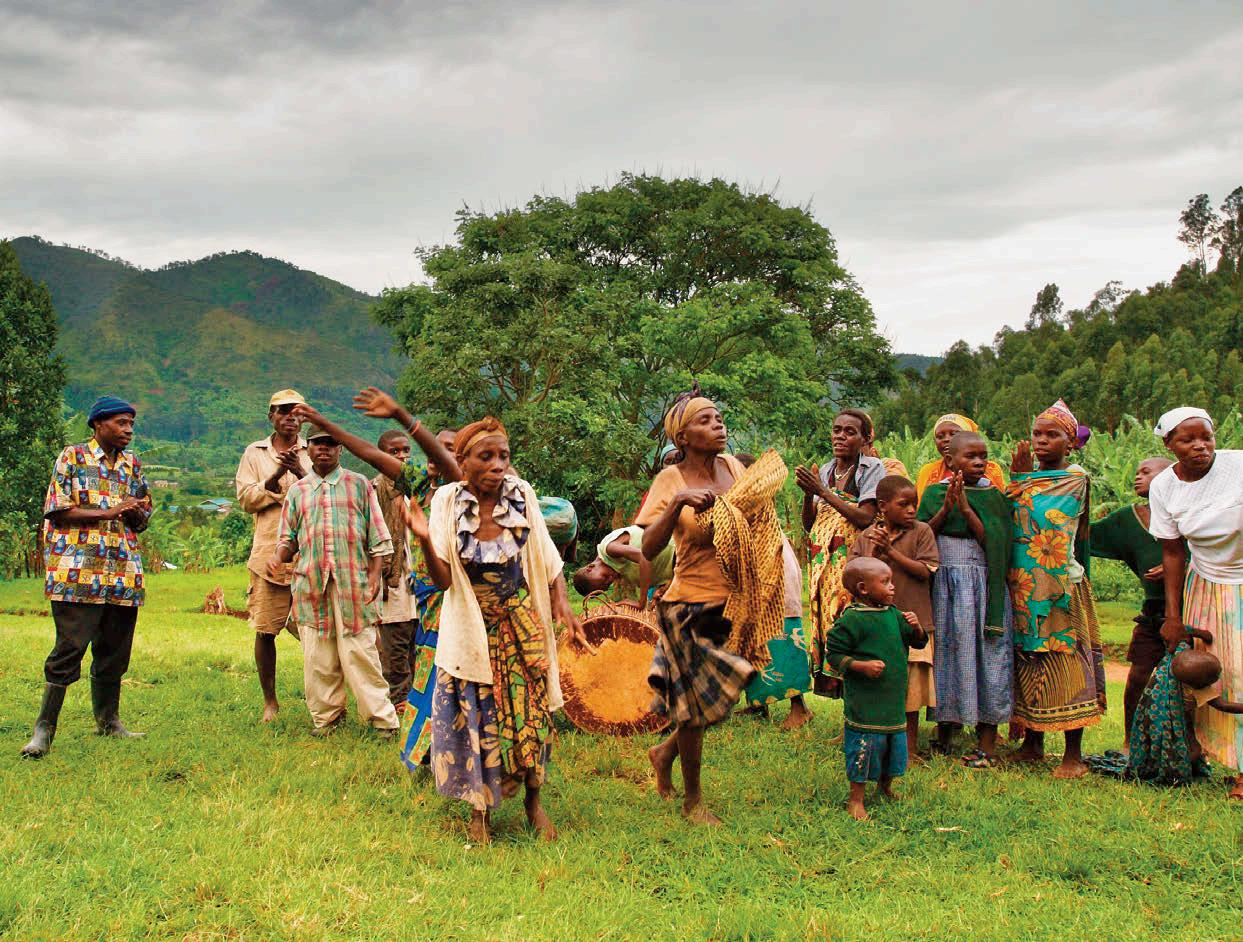
other tools. The Parliamentary Centre Report Cards (PC-Budget and PC-Audit) have the greatest degree of overlap with the other tools. This may be because the PC Report Cards focus only on the Oversight function of parliaments, which is an area addressed by all other tools as well. In contrast, topical areas addressed by other tools are not found in all others.
In order to look more closely at possible overlap between topics covered by the tools studied, we generated sub-categories. These sub-categories, which include Law-making, Representation, Resources, Public Engagement, Oversight, and Resources, enable
The four countries included in the sample:
Top left: Detailed ceiling of the Reichstag, the German Parliament, in Berlin; Top right: Batwa pigmy dancers in Uganda; Bottom left: Peruvians participating in the festival of the Plaza de Armas; Bottom right: A view of Istanbul, Turkey.
comparison of components and activities of democratic parliaments that each tool attempts to assess. When examined at this level, several patterns and observations emerge. First, the
CPA/WBI/UNDP Benchmarks and NDI Standards are quite similar to each other when compared to other tools. This is also the case for the PC Report Cards. This is likely to be a function of how these tools were constructed; the CPA/WBI/UNDP Benchmarks were developed in concert with the NDI Standards, and both of the PC Report Cards were devised by the same organization and differ by only a few questions. Secondly, the CPA/WBI/UNDP Benchmarks and NDI Standards are the only tools to have indicators on all six sub-categories. The IPU Toolkit’s questions address four subcategories, namely Law-making, Representation, Public Engagement, and Oversight. Questions from the PC Report Cards only address Oversight. Third, these differences in composition/content across tools are expected given the differences between their creator organizations’ priorities and approaches to parliamentary assessment. The CPA/WBI/UNDP Benchmarks and NDI Standards are standardsbased assessment tools that concentrate on multiple dimensions of democratic legislatures. The IPU Toolkit is mainly informed by core democratic values which emphasize transparency, accessibility, and representation of legislatures. The PC Report Cards, on the other hand, focus solely on the budgetary process.
When we compare the tools not just on a question-by-question or topical content basis, but also in terms of their adherence to good question design principles, it is harder to find clear patterns among the tools. While we acknowledge that the tools were not necessarily designed with such principles in mind, it may be important in ensuring assessment is user-friendly and results can be clearly understood. Our evaluation suggests that although the
CPA/WBI/UNDP Benchmarks and NDI Standards tend to have the highest degree of presence of good question design principles, there is still large variation between each principle (objectivity, precise wording, non-compound structure, non-leading phrasing). While it is laudable that some tools score particularly highly in some areas, these tend to be non-substitutable. For example, if an indicator of a given tool is objective but imprecise, it may still produce confusing or conflicting answers.
When the tools are applied to sample countries, we find that there are differences across the three sets of tools (the IPU Toolkit as one set, the CPA/WBI/UNDP Benchmarks and NDI Standards as a second, and the PC Report Cards as the third), but large similarities within these sets. Again, we believe this is mostly due to differences of organizations with regards to goals, values, membership base and approach to parliamentary assessment.
An integrated approach
Despite areas of difference, our examination of these assessment tools revealed that there is indeed agreement among them. Although limited, we found overlap between tools both in terms of broad topics covered as well as at the questionby-question level. Using these areas of agreement, we crafted a holistic assessment tool. This tool should not be viewed as the panacea for disagreements among the existing tools. Rather, it merely reflects the overlapping areas of agreement between the main existing tools, thus providing a basis from which organizations must decide which further topics they can agree to include.
Our holistic assessment tool is comprised of 27 questions designed to allow Parliaments to conduct self-assessments. Our decision to use questions rather than benchmark indicators adheres with the design of the IPU Toolkit and both PC Report Cards
(as well as a new NDI Standardsbased questionnaire that was created at the same time as our study). When we conducted interviews with the organizations that created these assessment tools, they noted that they want their tools to be used by Parliamentarians themselves, as well as by civil society groups and others within a given country. Thus we have designed this holistic assessment tool according to the same orientation and values. As a
“Although limited, we found overlap between tools both in terms of broad topics covered as well as at the questionby-question level.”
degrees of membership in a set. This is defined as follows: 0 = no performance (fully out of the set), 0.25 = low performance (more out of the set than in), 0.5 = neutral performance (neither in nor out of the set), 0.75 = high performance (more in the set than not), and 1 = full performance (complete membership in the set).
self-assessment tool, rather than as an external judgment, our holistic tool tries to meet the dual goals of generating discussion as well as providing a baseline assessment for Parliaments who wish to measure their progress over time. In order to accomplish this goal, we considered principles of good question design and have tried to make our questions as objective, precisely worded, noncompound, and non-leading wherever possible.
In addition to this attention to formation of questions, we have also provided a scoring rubric for responses. Here we face another challenge. Some questions may be more easily answered with a “yes” or “no” response, but others require more qualitative responses. To address both, we suggest a scoring method that recognizes
To assess whether our holistic tool does a good job of capturing the agreement between the existing assessment tools, we applied it to four sample countries (Germany, Peru, Turkey, and Uganda) using the same data as for the original application of assessment tools to these countries. As expected, results in all countries produce a result between the high and low scores of these other assessments. This application of the holistic tool to sample countries does not necessarily prove it is a superior tool as compared to the existing assessment tools. However, by producing a range of performance and concentration of scores similar to common trends of existing tools, it does adequately capture their overlapping areas of agreement.
Throughout our examination, we aimed to preserve our independence and neutrality and avoided subjective judgment as much as possible. This is also inherent in our proposed holistic assessment tool; rather than presenting an ideal assessment tool, it is a balanced approach to parliamentary assessment, drawing together elements from all other tools. The findings from the application of this holistic tool to the sample countries enhance this point. However, if harmonization is their end goal, organizations will be required to take subjective stances on what constitutes efficient composition, better design, and an effective approach based on their goals and objectives.
To be relevant, Parliament needs to connect with the community, says the Clerk of
Australia’s House
Mr Ian Harris
Mr Harris has been the Clerk of the House of Representatives of the Parliament of Australia since 1997. He has served in the House of Representatives for 37 years.
Relevance is a word I often hear as Clerk of the House of Representatives. Our standing orders require that ministers responding to questions without notice must keep their answers “relevant to the question”. During Question Time, opposition members are quick to raise relevance as a point of order when a minister appears to stray from the topic at hand.
However relevance is not just a matter of parliamentary procedure. It is the essential ingredient for a properly functioning parliamentary democracy.
One of my biggest concerns for the Australian Parliament is that it stays relevant to the people it serves. That means connecting with the community in a meaningful way – something that has been a priority for me in my role as Clerk of the House over the past decade.
In that time, and with the full support of successive Speakers, Australia’s House of Representatives has developed a
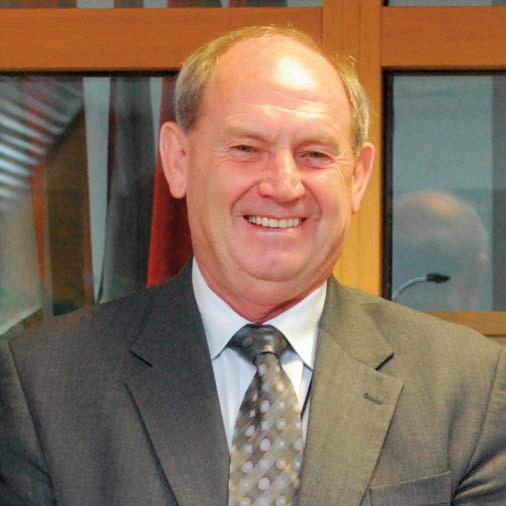
comprehensive community outreach programme to improve understanding of Parliament and its work in the community and to encourage public participation in that work.
When assuming the job of Clerk a decade ago, I was concerned that the work of parliamentary committees received only limited media coverage. I was disappointed that the cooperative work of Parliament was often overlooked in reporting.
Backbenchers raised with me their frustration at receiving little
acknowledgment for their contributions to parliamentary debates.
Things had to change if we were to retain our title as the People’s House, and change they did. We took a new approach to dealing with the media and we developed our own ways to communicate better with the community.
Our first significant step was to establish a media and community relations office as the epicentre for our new community outreach programme. The small but focused office has as its key objective the promotion of the House of Representatives and its work to the community, particularly the work undertaken by House committees.
The media have been an important target for the work of our Liaison and Projects Office. The employment of specialist media advisers has enabled us to develop a centralized system for informing the media about committee investigations, hearings and reports.
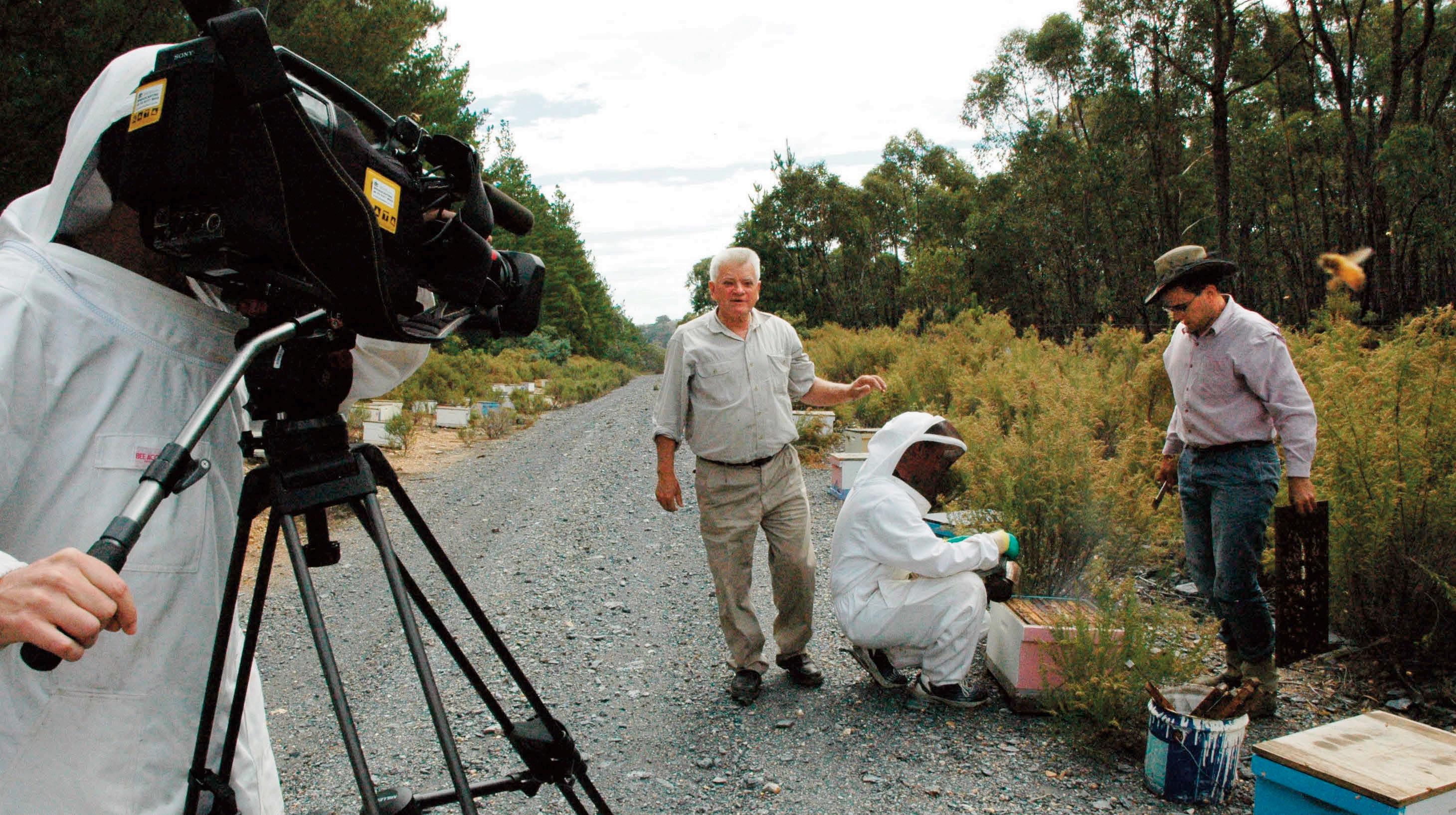
Previously individual committee secretariats handled their own media, with varying degrees of success. A centralised media advisory service has enabled a more consistent and professional approach that is appreciated by the media and committee secretariats alike.
The media unit has developed an email alert service that regularly informs media across Australia about the progress of committee investigations. More than 900 media outlets have signed up for this free service because they see great benefit in accessing immediate information about committees from a reliable and consistent source, rather than having to hunt for information from each individual committee. Community organizations, government agencies and representatives of other organisations that deal with parliament are also able to access this service, and more
than 2,000 do.
Complementing the alert service, our media advisers make personal contact with newspaper, television and radio journalists to advise them of upcoming committee activities, particularly the release of committee reports. This personal contact helps to ensure that the message of parliamentary committees does not get lost in the daily avalanche of media releases that media outlets get from a variety sources.
Another important feature of our community outreach programme is our commitment to provide information direct to the public through a variety of our own products and services. We take the view that it is not sufficient for parliament just to rely on the media to get its message out.
Our approach is to package parliamentary information in an interesting and entertaining way. In an age when the community has
access to information from so many different sources, we must ensure that parliamentary information is provided in line with contemporary trends.
Taking this into account, we publish a current affairs magazine, produce a television programme and run a news website on the work of the House of Representatives.
Our quarterly About the House magazine, provided free to the public, has been one of the great success stories of our outreach programme. Its popularity grows weekly, having already gained a readership of around 80,000 people across Australia. A recent community survey of the magazine gave it an approval rating of 98 per cent for range of topics, 97 per cent for content of articles, 97 per cent for readability, and 97 per cent for layout and design.
The magazine’s success, in my view, can be attributed to a range of factors. The magazine
covers a diversity of issues, many that do not otherwise get detailed media attention. Recent editions of the magazine have covered financial literacy, franchising, the needs of carers in the community, the impact of climate change on farmers, retailing in remote communities, technology to harness wave energy, and the growing problem of obesity.
The magazine articles are written by seasoned journalists who are able to cover the work of Parliament in a creative and nonpartisan way. It also has a contemporary design, so that readers are engaged with the magazine’s content and look.
As most of the material is sourced from committee submissions, hearings and reports, as well as parliamentary debates, the magazine demonstrates that parliamentary information packaged in an interesting way can have popular appeal.
One reader’s feedback perhaps best sums up why the magazine has become such a flagship for us in promoting parliament. After reading his copy of the magazine, the reader wrote to the editor stating that he was surprised to find out how many interesting issues Parliament was considering.
www.aph.gov.au/ath and in the past year has attracted more than 40,000 visitor sessions. With this sort of response, we intend further developing the online version of the magazine.
committees in locations across the country.

Some of the magazine articles have even prompted broader media coverage of an issue. When the magazine ran a cover story on the honeybee industry and threats posed to it, national media picked up on the story and reported extensively on the issue, which had originated in a submission to a committee inquiry.
An online version of the magazine is available from the About the House website at
The About the House website also carries regular news updates on the work of committees. While each parliamentary committee has its own web page, one of the limitations with that approach is that people looking for information about a specific committee inquiry or report won’t always know which committee is conducting the inquiry. A consolidated House of Representatives news page, with links to individual committee web pages, allows for easy access to the latest information from parliament.
Recently, we have introduced video news items to the About the House website. These three to five minute video features, produced inhouse, highlight the work of the House and its committees through interviews with committee members and witnesses at hearings. The video news items also cover site inspections by
These video segments provide an effective means to show the community how Parliament’s work extends beyond the national capital and how, through the work of committees, Parliament can reach out to people have had more than 50,000 visitor sessions for these videos.
To this end I have been interested in the prospect of enlivening parliamentary debates through the use of audio visual material, as an additional means for engaging the next generation. The spoken word does not need to be the only way in which Parliament conducts its business. This is something for future consideration.
The individual segments are also packaged together as the About the House television programme, broadcast on the Sky News channel and on the new Australian Public Affairs Channel (A-PAC). I have been pleased to see our in-house productions picked up by the mainstream media, again demonstrating that parliamentary information packaged in the right way can have popular appeal.
In seeking to better connect with the community, we have recognized the need to not only embrace new technology but also generational change. Parliament must be relevant to young people if it is to retain its relevance into the future.
One specific way we have sought to connect with younger people is through our university lecture programme, called House Calls. The Speaker and I regularly deliver lectures to students at universities across Australia as a way of informing them about the realities of working in
Those lectures have been conducted mainly for law, business and politics students and always involve a very engaging question and answer session at the end. At our most recent lecture, there were so many questions that I invited any student who hadn’t had the opportunity to ask a question to email that question to me. The next day I received more than 20 probing emails.
We are also using technology to enliven our parliamentary history and the visitor experience to Parliament House.
For our centenary we produced a cd-rom encyclopaedia and four episode documentary, together with a study guide, on the first 100 years of the House of Representatives. Titled A House for the Nation, the history pack is being marketed to
schools, universities and anyone interested in the history of the Australian parliament. The website for the project is: www.houseforthenation.gov.au.
Recently we have also developed a touch screen kiosk titled “Meet your MP” that will allow visitors to Parliament House to access a range of information about their member of parliament, including electorate and biographical details, a video message, photos supplied by the MP, and the MP’s answers to a questionnaire about who they are and why they entered Parliament.
All of these products and projects are about making that important community connection between parliament and the people it serves. They
“Parliament must be relevant to young people if it is to retain its relevance into the future.”
represent a staffing and financial commitment to community outreach which must be managed within the context of the overall parliamentary budget.
The work described above is conducted through an office with four full-time staff and one part-time staff member, supported by a range of other people who contribute their skills and experience as required, including on a freelance basis.
For developing Parliaments, some of these initiatives at first glance may seem out of reach. However the concepts can be adjusted to meet budgetary and staffing limitations.
At a time of budgetary constraint, it’s legitimate to ask can
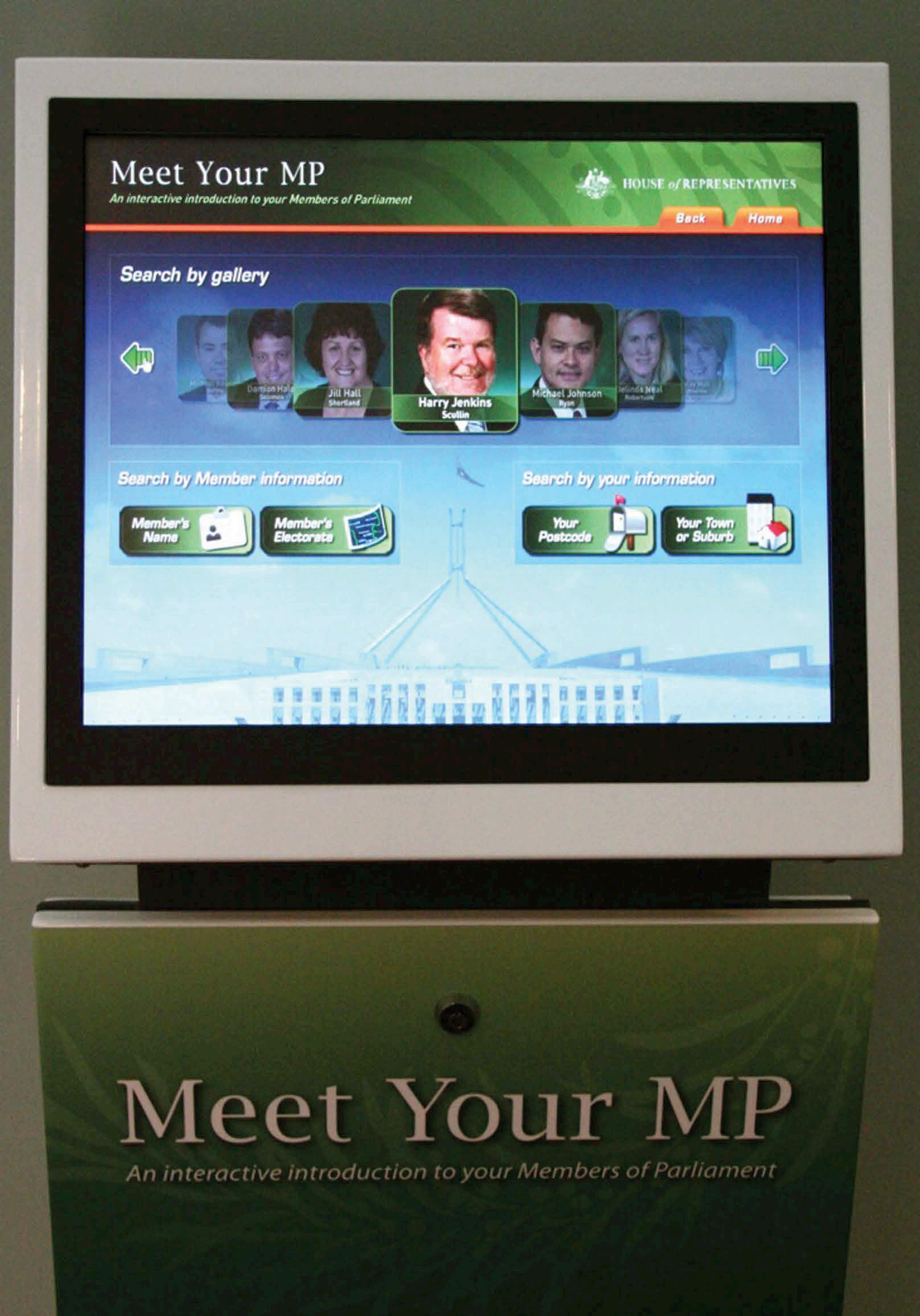
we afford to do community outreach. My response is: Can we afford not to?
For more information on the House of Representatives community outreach program in the Australian Parliament, visit www.aph.gov.au/ath or email liaison.reps@aph.gov.au or phone the Liaison and Projects Office on +61 2 6277 2122 (Director: Andres Lomp).
Parliamentary outreach initiatives: Left: The front and back covers of About the House; Above: The interactive screen
The Provincial Assembly of the North West Frontier Province in Pakistan applies computer technology to enhance its parliamentary functions.

Mr Attaullah Khan in Peshawar.
Mr Khan is the Director of Information Technology and the CPA focal person at the Provincial Assembly of North West Frontier Province in Peshawar, Pakistan.
Computers are now as commonplace in the workplace as they are in our homes. Parliaments have also embraced the use of computers to carry out its parliamentary duties.
In 1803 the House of Commons passed a resolution giving the press the right to enter the public gallery. That same year Mr William Cobbett, publisher of Cobbett's Weekly Political Register, added to his newspaper a supplement/entitled “Parliamentary debates”, which was a reprint of journalists’ reports of speeches extracted from other newspapers. In 1812 that publication was taken over by Cobbett's assistant, T. C. Hansard, who in 1829, changed the title of the reports to Hansard's Parliamentary Debates.
In 1909, the House of Commons took control of the reporting and printing of parliamentary debates that marked the need for automation, record keeping and retrieving systems. It is since then, that Parliaments throughout the world have started the utilization of computing technology from the simple use of saving textual information
processing to the maintenance of state of the art database development.
In Peshawar, the Provincial Assembly of the North West Frontier Province (NWFP) too was keen in utilizing computer technology for parliamentary purposes, and fortunately for us, the Asia Foundation along with USAID launched a Parliamentary Development Project (PDP) for the two Parliaments and all of the Provincial Assemblies.
network
A state-of-the-art network was laid down duly supported by professional hardware and software that enabled us to have a computerized library, secretarial record keeping, computerized debates, an automated recording and a transcription of Hansard with a link among the IT, editing and
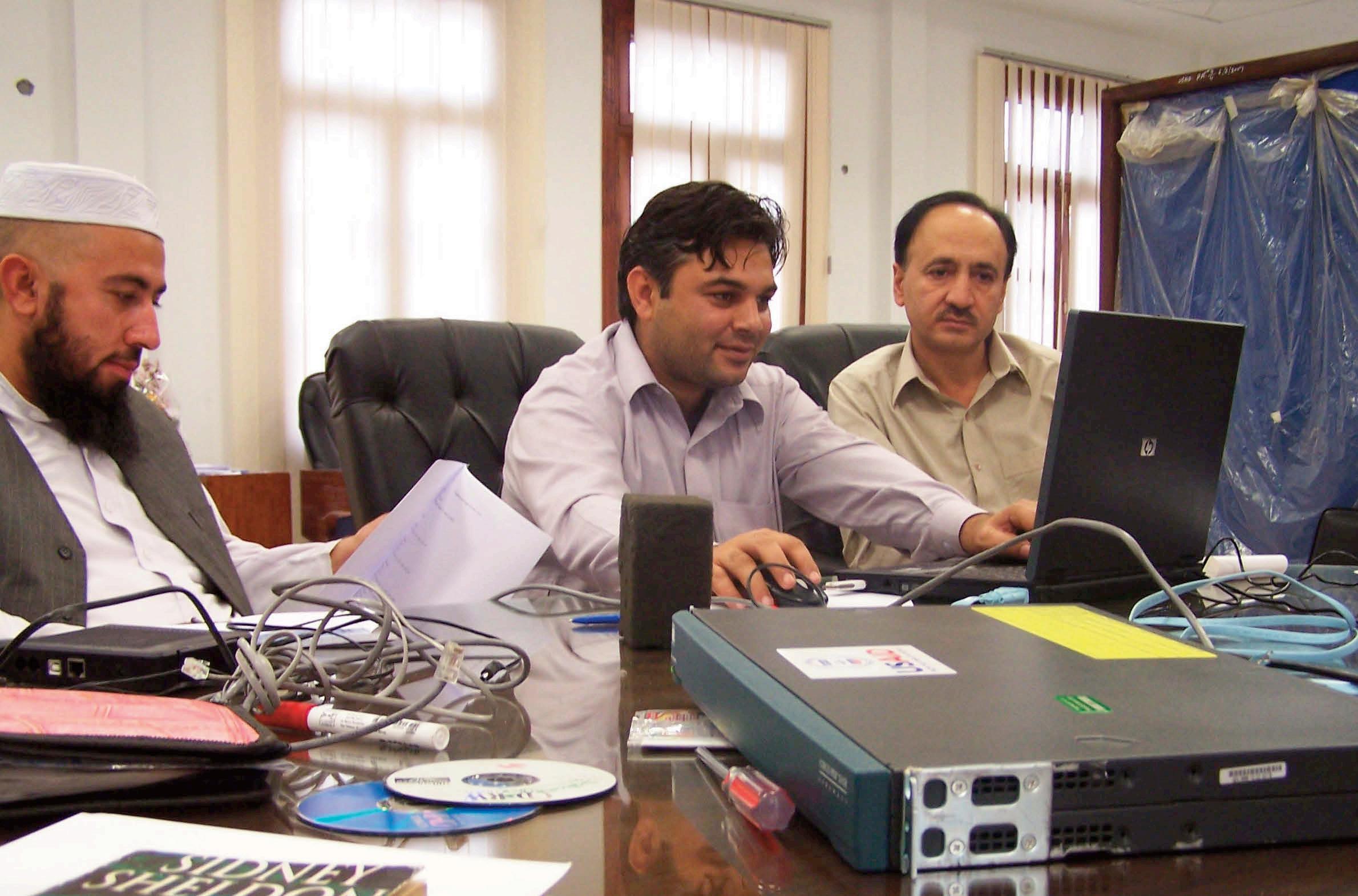
reporting sections through a cycle from transcription to editing and a final printing of edited debates.
The IT Section of NWFP Assembly placed a screen over the table of Mr Speaker in the house projecting the rules of the Assembly, the Mays parliamentary practices, the constitution of Pakistan and extracts from the Lok Sabha. All possible support was provided to Mr Speaker during the assembly sessions. This practice went on till 1999 when the assemblies were dissolved and the whole building was later demolished, demolishing the computer network and all installations in the wake of rebuilding and restructuring. A concerted effort was made to reestablish the IT activities in the new building in order to facilite the Secretariat as well as provide
ample support to the MPAs and their constituencies.
Since March 2008, The IT section was moved back to the newly constructed building where the infrastructure was in place but great effort was needed to see the automation support taking place. The network was distributed in four groups: the Public Accounts Committee, general legislation, debates and administration.
With the help of USAID – under the PLSP Project – a new website, www.panwfp.gov.pk, has been developed with room to improve in the future. Currently, it provides almost all necessary information about the assembly secretariat, business of the assembly, complete Members’ information,
CPA activities, necessary uploads like the constitution of Pakistan, the rules of business of the NWFP assembly, a book on the overall business of the previous assembly from the year 2002 to 2007 etc. It also covers government, opposition formats, party affiliation, ministries and every thing related to the MPA. Construction and improvement is underway. The website also helps the constituents and researchers who work on the parliamentary system and set-up in Pakistan.
Online support to Mr Speaker
This year, the IT Section successfully installed and provided real time support on rules and Constitution of Pakistan to Mr Speaker. All necessary information on Members standing in their seats, name and party affiliation of Members are displayed the moment they press the “mic”
button, the Speaker chooses to name a Member to whom he wants to give the floor, is the given the right to speak and the debate is then recorded thereafter.
Other facilitation includes the electronic voting system, completion of quorum, a comprehensive accumulative account of the total proceedings of the day and other such activities.
The IT section also integrated the CCTV system with the security cover to enable archiving and to maintain a watch available to the security unit of the Assembly secretariat. An extension of the CCTV is underway to enable other designated offices to monitor
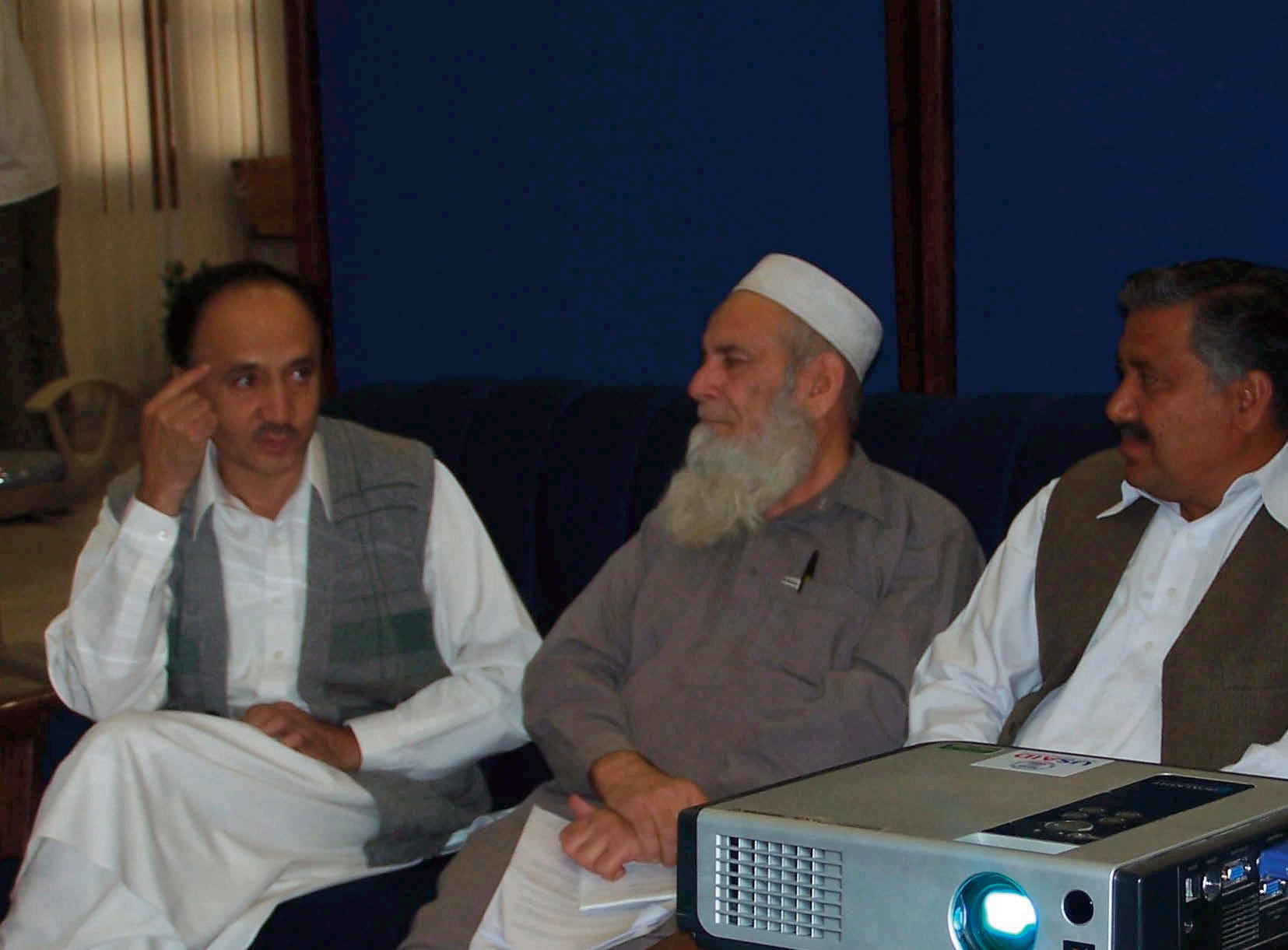
activities. An electronic billboard type system is to be displayed soon which will carry a schedule for at least one week showing the dates and other information about committee meetings, committee room number etc, other information and messages may also be displayed at the board just like they display flights at the airport.
From the budget session this year, the IT section took another step by showing live coverage of the assembly session over the website, making us the second assembly after Punjab to screen live coverage. Apart from the live
coverage, the archives are to be placed and made available for users who might have to do research or for other purposes.
Current legislative software development and databases
The following are the major areas (some already completed and in use) where legislation has been the subject of computerization and where a lot of efforts are being made with the able support of the Government of Pakistan IT department. The outline of the project is:
Project overview
The project “Automation of NWF P Assembly” is to fulfill the workflow and information needs
of the users i.e. Members and employees of the NWF P Assembly.
The automation is part of a larger initiative of the IT section to provide greater access to government information and services, improve and open a window to the internal efficiency of Legislature and operations, enhance public participation in the working of the government and make government more accountable to the citizens.
Project objectives:
Specifically, the NWFP Assembly automation project has three key objectives:
• In a timely manner, provide the citizens with public access information on all proceedings of the NWFP Assembly;
•Provide Members of the NWFP assembly access to information on the working of the house from their work as well as from their home;
•Facilitate the functioning of the NWFP assembly in a way that can increase their productivity and efficiency in managing the legislative process.
The modules covered in this project are divided into two main areas, namely the core legislative process and supporting application.
Core legislative process
The legislative process forms the core workflow of the NWFP assembly secretariat. This process encompasses a variety of subprocesses which are firmly integrated. These include:
Bill management system
A key legislative activity is introducing Bills and constitutional amendments. The Bill Management Processes tracks the entire lifecycle of all categories of Bills that are moved in the house.
Resolution management system
Resolutions encompass the decisions taken by the house. All steps involved in managing resolutions are covered under this set of processes.
Motion management
Motions of various categories are the mechanism for conducting business in the house. These motions are and will be tracked and managed using these sets of processes.
Committee management system
The committee system is an integral part of the legislative process, through which detailed and expert opinion is incorporated into the legislative activity. Management of committees along with their activities is managed by these processes.
Public Accounts Committee management system
The Public Accounts Committee (PAC) system is an essential part of the legislative process, through which detailed and expert check & balance to different departments’ accounts
are put in place. Auditor General reports’ represents the financial mishandlings and all responsible persons from departments answerable to committees. The system controls all the processes from committee formation to the final report from PAC.
House debates management system
All debates of the house are recorded verbatim during the session. An edited version of the debate is published soon after a session’s closure. An entire branch is dedicated to managing the recording of these debates.
Question management system
A formal mechanism of questions and answers is provided for in the rules of business and procedures of the assembly. These are targeted to be captured, tracked and indexed.
• Misc. legislation management
• Misc. legislation consists of different legislative processes
•Assembly management
•Oath management/Member oath
•Session management
•Order of the day
•Speaker script
•CM ascertainment
•Speaker/Deputy Speaker election
•Member attendance management
•Committees management
•PAC management
•Member/arrest release process
Supportive Applications
These applications are to help support the legislative process by facilitating the legislators.
Document retrieval and management
Document management is an all
pervasive aspect of the application. All key documents will be managed via this application.
There is no workflow involved to maintain documents in its stand alone module.
Notice branch
Notice branch deals with the attendance, issuance of the diary number and management of the seating plan.
IPR branch (Member biography)
IPR branch maintains biography data of all Members and is responsible for arranging parliamentary visits to other countries and handling incoming visits. The module depends on the oath management process of the misc. legislation process. All other modules are dependent on IPR. There is no further workflow involved to maintain Members’ information.
Establishment Branch
The establishment branch maintains biography data of all employees, their work histories in different departments and also maintains their leave statuses.
Application enhancements:
Member`s login
Through this module of the application, Members of Parliament can submit their business and view statuses or progress of their business through an intranet from anywhere in world; they can also check their accounts information and house proceedings et cetera..
Transport Branch
The transport branch maintains information regarding all vehicles and scheduling their use. It also keeps record of vehicle disposals, repairing, fuel consumption, all related book keeping as the rules of the Provincial Government.
Web portal enhancement
The NWFP Assembly website will play a central role as the information hub. It will be the platform to disseminate information to the public and thereby bring transparency to the functioning of the House. Additionally it will be the portal for legislators in helping them perform their functions more effectively by letting them interact with the system remotely.
Training for all MPAs on the new software management system for motions and questions will be conducted in the current budget year. After successful training, each MPA will be provided with a proficiency certificate from Mr Speaker as well as a laptop so that they have access to their assembly database and website.
Future oriented targets
As our next target, we hope that a software is procured for linking all the attached departments of the Provincial Government so that all related business like questions, motions and other related business can be sent to them online and replies can be received from them in 14 allocated days at least for the questions. Moreover, all related reports and actions taken are to be made available for audit trail.
Software is being proposed for the Public Accounts Committee to include the provincial finance department, the office of the Accountant General, the concerned department and the assembly secretariat for all scheduled meetings and their feedbackcycle.
A global possibility
It is my humble suggestion, that an IT group should be formed among the CPA nations, initially region wise, then developing a large network to share information and make a CPA global village available to all Commonwealth nations.
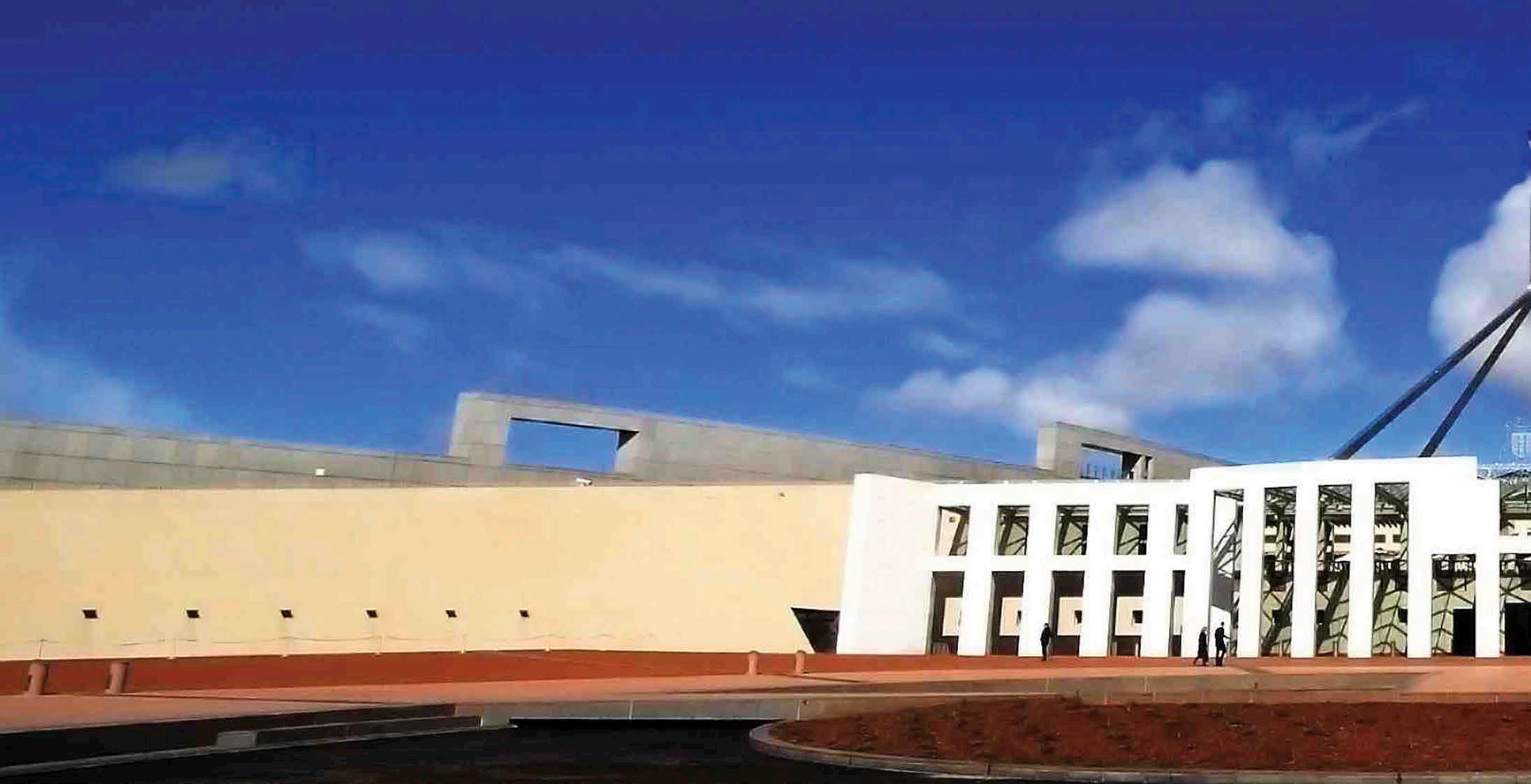
A former Member of the Australian state Parliament in Queensland examines the recommendations for how Members can improve their conduct and renew accountability and better public perception at the same time.
Mr Fouras was an Australian Labor Party Member of the Queensland state Parliament in Australia from 1977 to 1986 and from 1986 to 2006. He served as its Speaker from 1989 to 1996 and Deputy Speaker from 1999 to 2006. He was a research chemist and marketing economist before entering politics. This article is a version of an article by Mr Fouras published recently by the Brisbane CourierMail.
In his maiden speech in the Queensland Parliament, Mr Mark Ryan, MP, an Australian Labor Party Member, called on politicians to improve their performance and to be more engaged with the electorate. This young MP is seeking to reverse a trend and the threat it poses to the legitimacy of Parliament.
A three-year research project by the Parliament Studies Unit at Monash University in the Australian state of Victoria shows that despite low respect for Parliamentarians there is a strong public commitment to the Parliament itself. However, people do not value the behaviour of their MPs.
While the “ battlefield” created by parliamentary proceedings is seen by some as an inevitable part of Parliament’s important role as a forum for policy debate, the majority see the “battlefield” atmosphere as a distraction from the real issues and
Parliamentarians’ behaviour as “tiresome”.
Mr Scott Emerson, MP, a new Liberal National Party Member
of the Parliament, used his maiden speech to express concern that governments favour secrecy rather than embracing scrutiny. Parliamentary rules are being manipulated to thwart rather than facilitate open discussion. These comments are in agreement with a 2006 study entitled “Why Accountability
Must Be Renewed” which was conducted by 10 academics and former politicians.
The above paper argues that laws which attempt to make Australian governments accountable are urgently needed because politicians in power are so practiced at frustrating the democratic process. The report notes that “an ever growing desire to maintain political advantage had eroded the way democracy operates”.
The paper is particularly critical of the way governments frustrate the operation of freedom of information laws. A key recommendation in the paper proposes narrowing the grounds for exemption so that the only documents withheld as cabinet documents are those “whose release may undermine the unanimity of cabinet or which may jeopardize fundamental matters of public interest such as the administration of justice and national security”.
Two other significant proposals were the requirement for Ministers
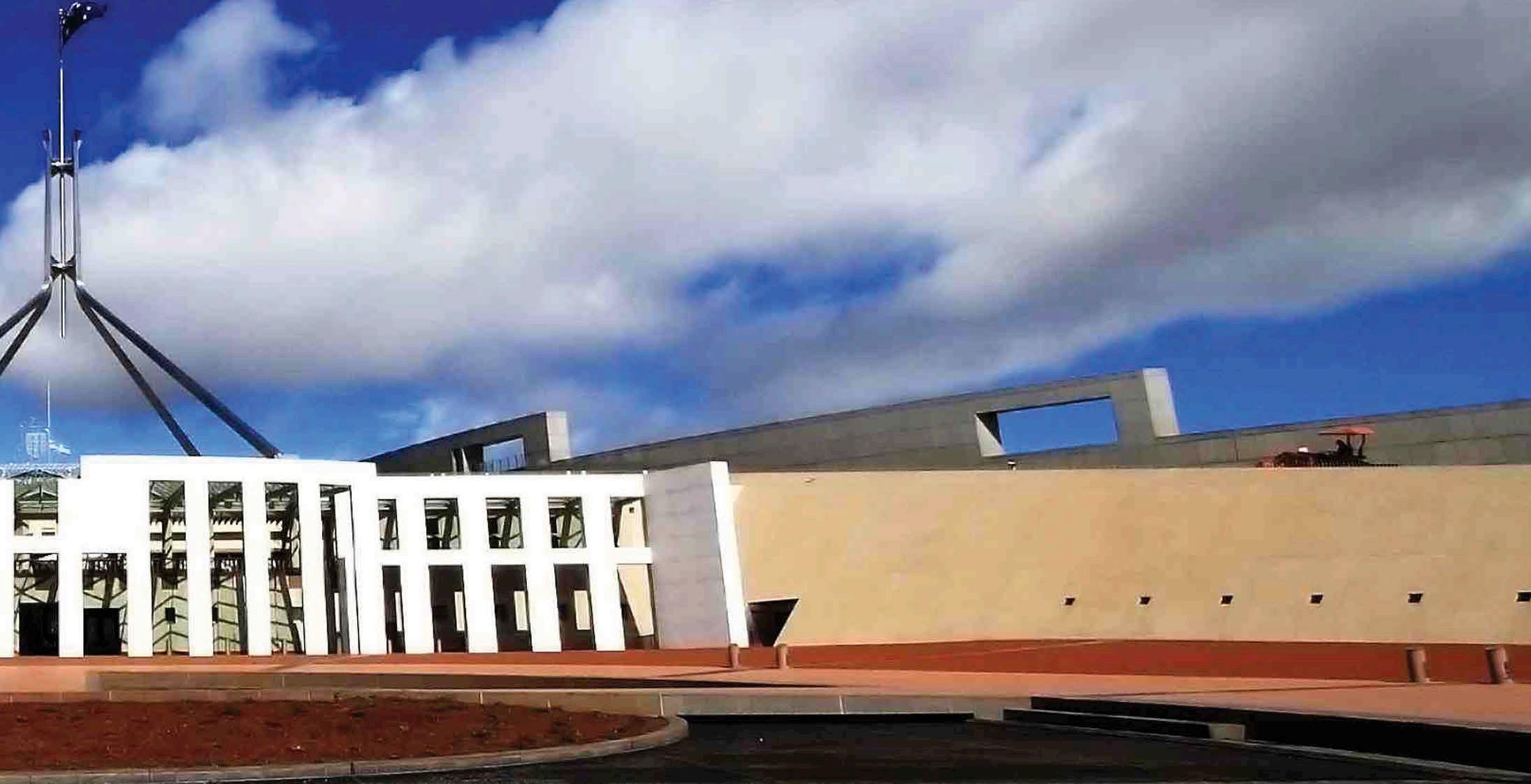
to be answerable to Parliament for every action of public servants, personal staff and other personnel acting under their prerogative and as well as the appointment of a Parliamentary Standards Commissioner with powers to investigate breaches of accountability.
The outcomes of debates on Bills before the House are not determined by the strength of the arguments of the Members but by predetermined decisions taken prior to the debate commencing. All too frequently, the major purpose for lengthy debates is to fill in time as well as for the Members to be seen to be actively participating.
Issues that are of significant public interest demand a wider and more informed debate. The government should facilitate free ranging “take note” debates on such subjects. Legislative review committees – as currently happens in New Zealand – will then take the legislation to public meetings for
community consultations. The use of internet fora would further enhance the consultation process.
The public perception is that Parliaments are out of touch with the common people and do not engage in significant debate on
“The public perception is that Parliaments are out of touch with the common people and do not engage in significant debate on matters of major concern.”
matters of major concern. Whilst a winner takes all attitude prevails, open government cannot function.
Surveys show that Question Time in Parliament is creating a
negative impression of Parliament and politicians. Changes to Question Time are needed so that it would serve its true purpose as an accountability check. However, the “battlefield” atmosphere has made Question Time more about testing the performance of Ministers and shadow Ministers than accountability.
The Standing Orders are clear about the need for answers to be relevant. However, on too many occasions, Ministers evade the questions. This often leads to heated interjections with consequential reprimands to opposition Members and to their “sin-binning”, an Australian practice of sending unruly Members out of the House for an hour.
Supplementary questions should be introduced.
The “Dorothy Dixers” asked by government Backbenchers to enable Ministers to promote their politics regularly become part of the agenda to attack the opposition. By asking hostile questions, the opposition is not blameless in what has become the
debacle of Question Time. One classic example of evasion is that on six occasions in the Australian House of Representatives, then Prime Minister Hon. John Howard was asked when he decided to commit Australian troops to Iraq. This decision cost the Australian tax payers in excess of $1 billion. The question was never answered.
The concept of democracy was founded on the right of everyone to take part in public affairs; in the legislative process and to oversee the governance of their country. The democratic process should deliver open and transparent government and provide public accountability for all who administer public authority, whether elected or not.
The word “conversation” comes from Latin for “getting together” and “turning around”. My hope in writing this article is to stimulate an ongoing conversation between the people and their politicians.
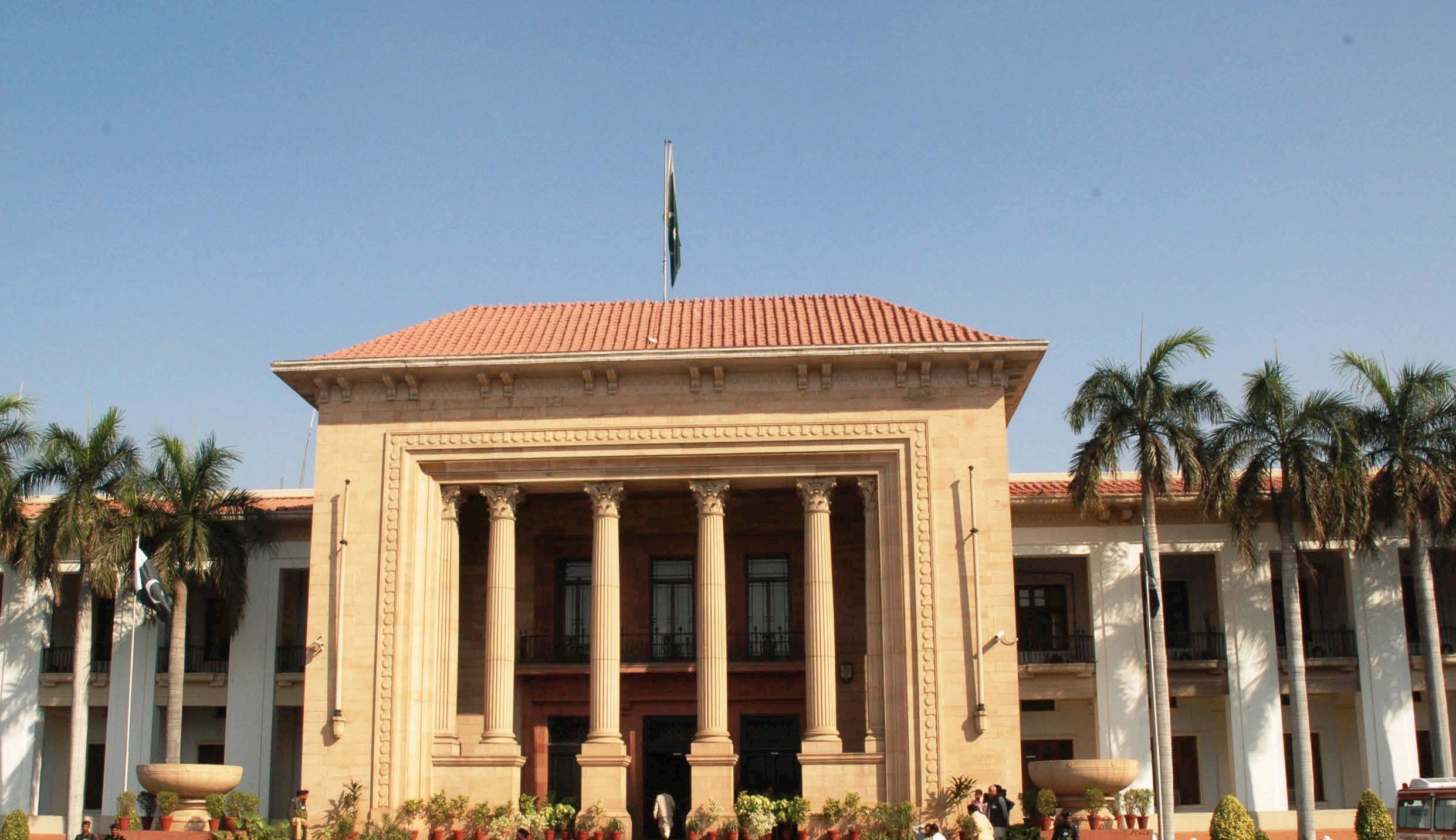
Two experts in parliamentary research in Pakistan outline the history of the Punjab Provincial Assembly.
Miss Abeeda Haroon and Mr Khalid Mahmood, in Punjab .
Miss Haroon is a Research Officer with 10 years experience in parliamentary research, while Mr Mahmood is an officer of the Secretariat, having served 27 years in the largest provincial Legislature of Pakistan.
Pakistan emerged as an independent state after the end of British rule in India in 1947 and comprises four provinces: Punjab, Sindh, North West Frontier and Balochistan, besides the Federally Administered Tribal Areas (FATA). Islamabad is the federal capital of Pakistan.
Pakistan is a federal republic with the parliamentary form of government. At the federal level, there is a bicameral Legislature and at the provincial level, each of the four provinces has a directly elected unicameral Provincial Assembly.
The province of Punjab is the largest of the four provinces and was once a part of Indian Punjab before independence in 1947. For this reason, the history of the Provincial Assembly of the Punjab is divided in two periods, i.e. the pre-independence and the post independence period. Like other parliamentary institutions in the country, it has evolved through a
long process of constitutional development.
The genesis of the Legislature in the sub-continent can be traced back to the 19th century. From 1833 to 1861, the Governor General in council was the sole administrative as well as the legislative authority in British India, who ran the administration and was assisted by the executive and legislative councils. Beneath the Governor General were the Governors of Provinces of India.
The War of Independence waged in 1857 against the British rulers of India made them realize the necessity of establishing closer contacts with the local public and its opinion. This resulted in the enactment of the Indian Councils Act, 1861. This Act provided for the establishment of a council of the Lieutenant Governor at the state level to transact legislative business as the legislative council.
The 1861 Act thus laid the foundation for the future Legislature as an independent entity separate from the executive council.
The first council in the Punjab, however, was yet to be constituted when the Indian Councils Act, 1892 was enacted. This act enlarged the functions of the council in two respects, firstly, the council could discuss the annual financial statements and second, it could ask questions subject to certain limitation. Members were to hold office for two years.
The first Legislative Council in the province of the Punjab under the Indian Councils Act, 1861 – as modified by the Indian Councils Act, 1892 – was constituted in 1897. This council comprised both official and non-official Members. The meetings of the council were presided over by the Lieutenant Governor himself.
The element of elections in the Legislative Council was introduced
for the first time by the Indian Councils Act, 1909, also known as the Minto-Morley Reforms. The 1909 Act gave the Indians a limited role in the legislative councils, and dispensed official majorities in the Provincial Legislative Councils giving them power to move resolutions upon matters of general public interest, the Budget and to ask supplementary questions. This Act enhanced constitutional development.
Six years later, the Government of India Act, 1915 was enacted with a rationale to consolidate the provisions of all the preceding acts. This Act also provided for the constitution of the Punjab Legislative Council instead of the Councils of Lieutenant Governor. During the period from 1897 to 1920, four Councils of Lieutenant Governor were constituted, in 1897, 1910, 1913 and 1916.
The Montague-Chelmsford Reforms were introduced by the British Government to set up selfgoverning institutions in India. The reforms were outlined in the Montague-Chelmsford Report prepared in 1918 and formed the basis of the Government of India Act, 1919.
The 1919 Act was essentially transitional in character. The franchise was extended, and increased authority was given to the central and the provincial legislative councils. The most important feature of the 1919 Act was the introduction of a new system of dyarchy or double government in the provinces. The Act created 11 self-governing provinces. The Governor could not be a member of the Legislative Council, he could, however, address the members in the Legislative Council. Four Legislative Councils under this Act were constituted in Punjab; in 1921, 1924, 1927 and 1930.
Under Section 84 of the 1919 Act, a statutory commission was to be appointed at the end of ten years, to determine the next stage
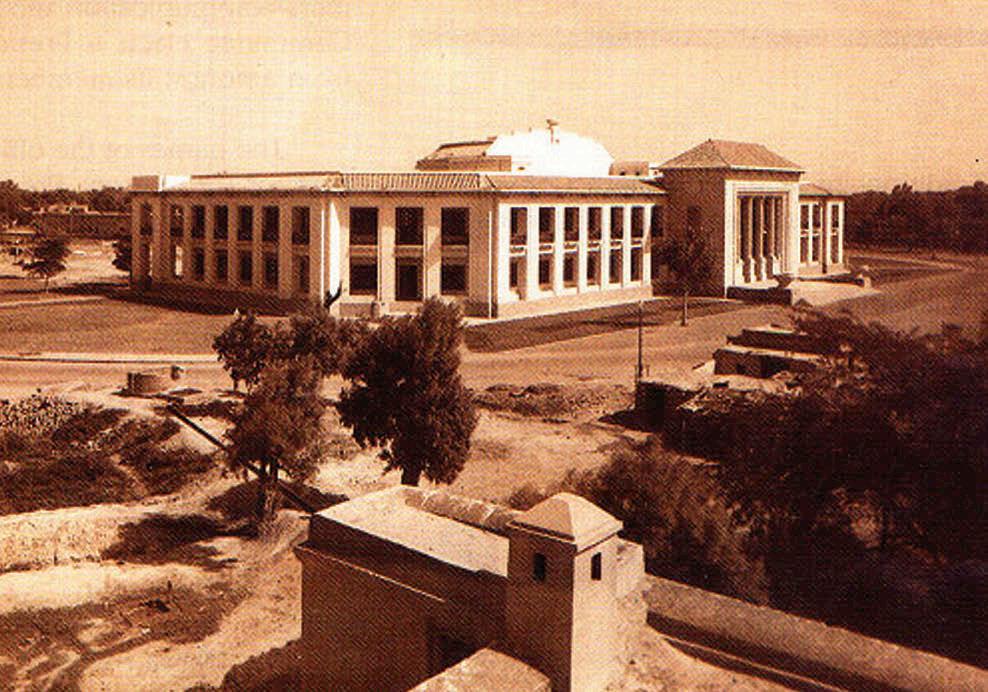
in the realization of self-rule in India. Accordingly, the British government appointed a Commission under Sir John Simon in November 1927. The Commission, which had no Indian members, was given the task to investigate India's constitutional problems and make recommendations to the government on the future constitution of India. The Commission recommended further constitutional changes, which were embodied in the Government of India Act, 1935. This Act granted Indian provinces autonomy and the dyarchical system was discontinued.
The 1935 Act provided for a Federation and the constituent units as the Governor's Provinces. This Act, for the first time, provided for the constitution of an Assembly in place of a Council. Almost all the members of Assembly were to be elected, with the exception of some special and otherwise unrepresented groups. The term of the Assembly was fixed as five years. The 1935 Act also made a division of powers between the
Centre and the Provinces. Two Legislative Assemblies were also constituted under this Act, in 1937 and 1946.
The end of an era
In 1947, the British rule in India came to an end and the subcontinent was divided into two sovereign and independent states of Pakistan and India under the Indian Independence Act, 1947. Pending promulgation of a constitution, the Government of India Act, 1935, with necessary alterations and modifications through the Pakistan (Provisional Constitution) Order, 1947, was adopted as the provisional constitution.
With the creation of Pakistan, the province of Punjab was also divided into two provinces, i.e. Western Punjab (in Pakistan) and Eastern Punjab (in India) resulting in the division of the Punjab Legislative Assembly, constituted in 1946, into East Punjab and West Punjab Legislative Assemblies. This carried forward West Punjab Legislative Assembly was declared to be the first Provincial Assembly
Opposite page: View of House in 2009;
Above: The Assembly building in 1937.
after independence under the Pakistan (Provincial Legislatures) Order, 1947, and was dissolved in 1949.
In 1950, the Province of West Punjab was renamed as Province of Punjab and the second Assembly was constituted in 1951 which ceased to exist when under the Establishment of West Pakistan Act, 1955, the provincial units and other states were incorporated into a single Province namely Province of West Pakistan.
Awaiting enactment of the first constitution by the Constituent Assembly, the 1955 Act contained provision for constitution of an interim Provincial Assembly of West Pakistan which was elected in 1956 in accordance with the provisions of the said Act, however, before it could hold its first sitting, the first Constitution of Pakistan was enacted and the interim Assembly was declared to be the
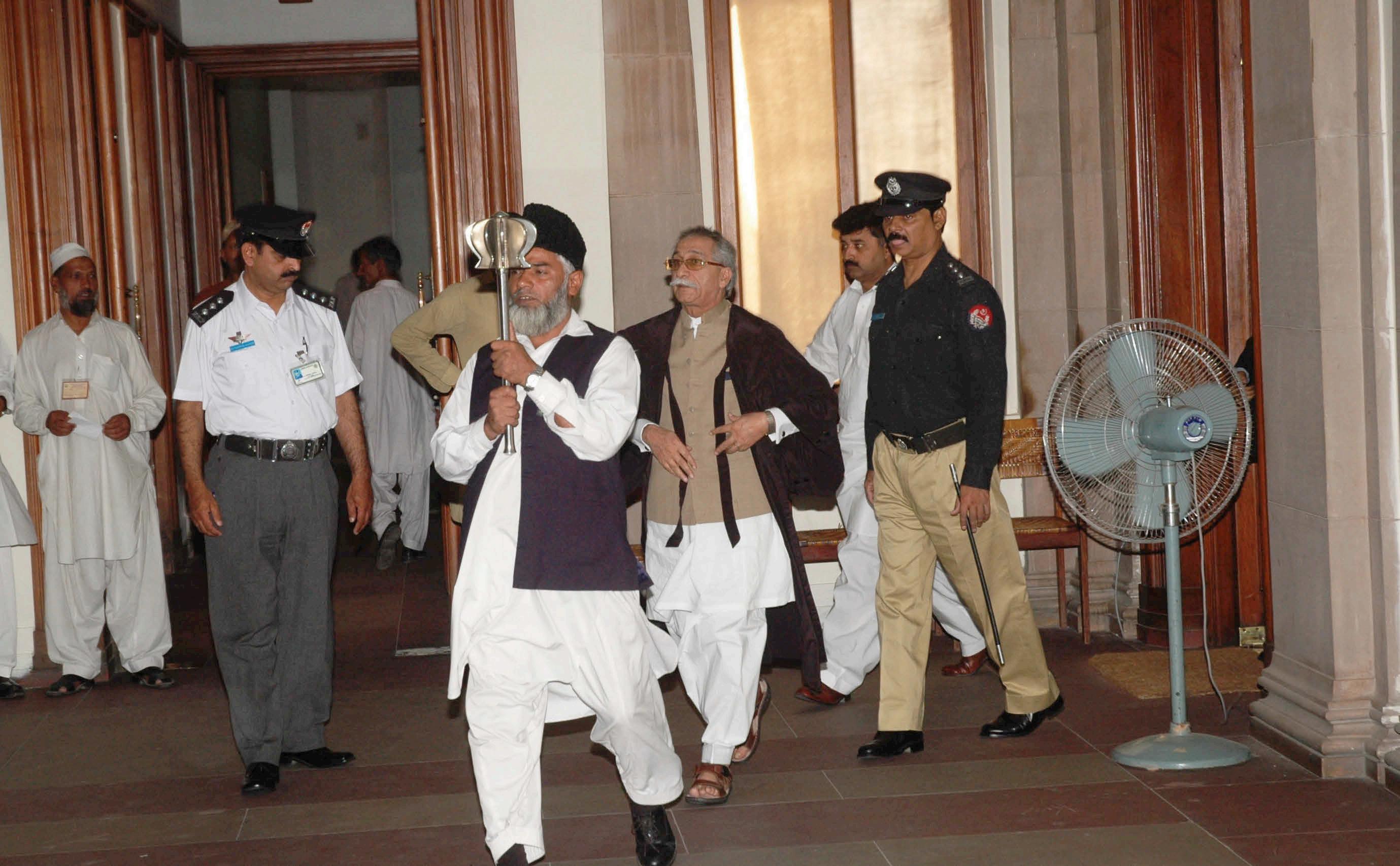
first Provincial Assembly of West Pakistan in accordance with the provisions of the 1956 Constitution. On 7 October 1958, Martial Law was imposed in the country, the Assemblies were dissolved and the 1956 constitution was abrogated. No elections under the 1956 Constitution, therefore, could be held.
The second constitution
The second constitution of Pakistan was promulgated on 1 March 1962 and the Martial Law was lifted. The 1962 Constitution provided for a unicameral Legislature. The principle of Basic Democracy was introduced for the first time in the country and the system of indirect elections was presented. The next two Provincial Assemblies of West Pakistan were constituted in 1962 and 1965 under the 1962 Constitution. On
25 March 1969, Martial Law was again imposed in the country, the 1962 constitution abrogated and the Assemblies dissolved.
In July 1970, the Province of West Pakistan was abolished and the status of provinces was restored under the West Pakistan (Dissolution) Order, 1970 (PO I of 1970). A Legal Framework Order, 1970 was issued which provided for setting up of a National Assembly and Provincial Assemblies of East Pakistan, Punjab, Sind, NWFP and Balochistan. The elections to the National Assembly and Provincial Assemblies were held on 7 and 17 December 1970 respectively. However, due to the political crisis, the elected assemblies could not become functional till 1972 when the Martial Law was lifted and an Interim Constitution came into force on 21 April 1972.
The National Assembly formed
a Constitution Committee in April 1972 to prepare the first draft for framing a Constitution. The report of the Committee was presented on 31 December1972 along with a draft constitution. It was unanimously passed by the National Assembly in its session held on 10 April 1973, authenticated by the President on 12 April 1973, and came into force on 14 August 1973.
Under the Constitution of 1973, as amended from time to time, all the four provinces of Pakistan enjoy considerable autonomy. Each province has a Governor, a Council of Ministers headed by a Chief Minister appointed by the Governor, and a Provincial Assembly elected by the universal adult suffrage. The Provincial Assemblies also have reserved seats for women and minorities.
The Provincial Assembly of the Punjab, constituted as a result of
general elections held in December 1970 under the Legal Framework Order, 1970, was declared to be the first assembly in accordance with the provisions of the 1973 constitution. The term of the assembly was fixed as five years; however, it was dissolved few months before completion of its tenure.
The second assembly under the 1973 constitution was constituted in April 1977; however, it was also dissolved after only two months and 27 days, as a result of promulgation of Martial Law on 5 July 1977. The 1973 constitution was kept in abeyance for a period of about eight years and, after having been substantially
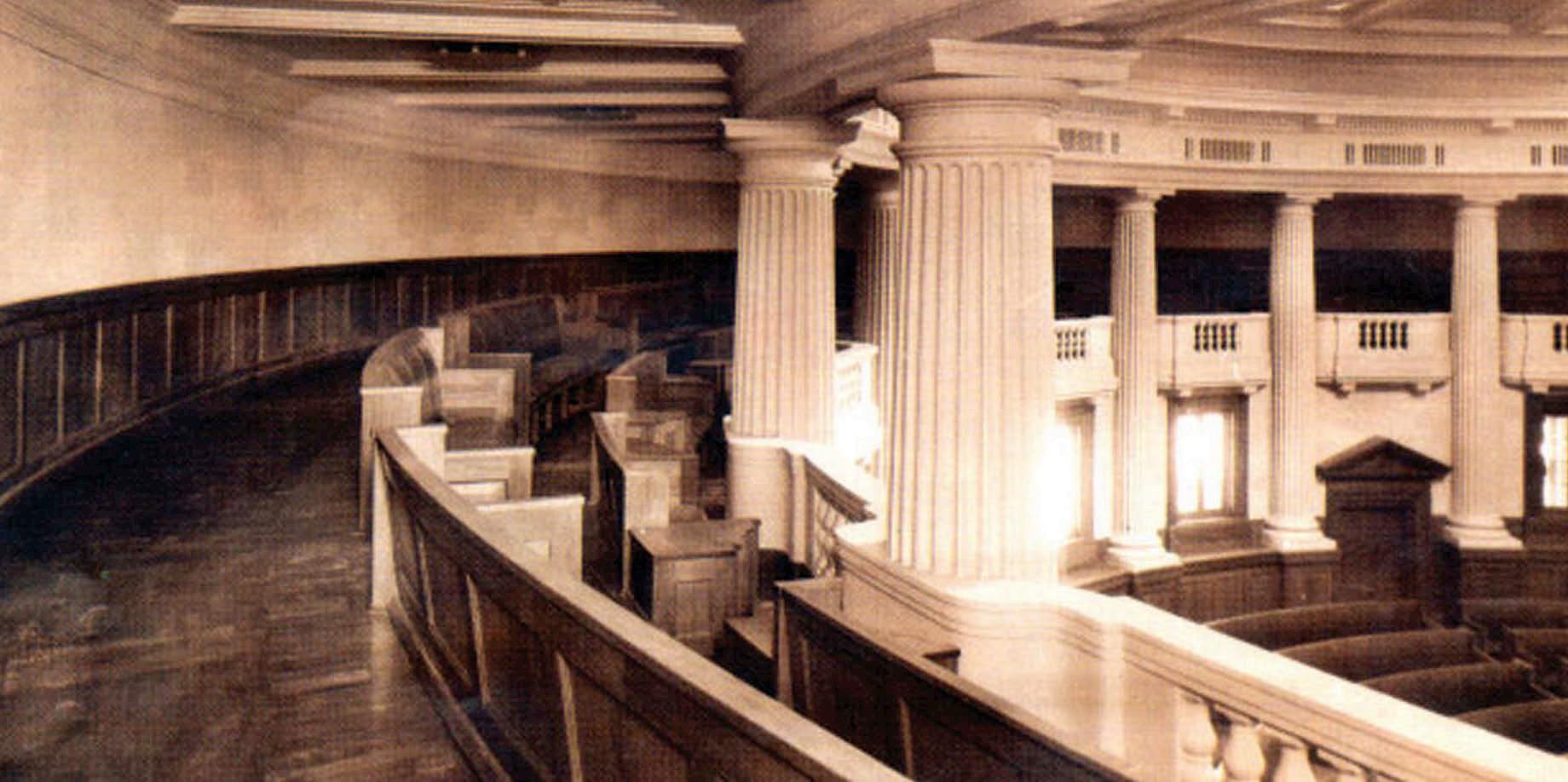
amended, it was partially reactivated on 10 March 1985. With the lifting of Martial Law on 30 December 1985, the constitution was wholly restored. The successive Punjab Assemblies were constituted in 1985, 1988, 1990, 1993 and 1997. All these assemblies were dissolved before completion of their constitutional tenure of five years.
After yet another military intervention on 12 October 1999, the Parliament and Provincial Assemblies were suspended and later dissolved. Following a constitutional gap of three years, the Assemblies were constituted as a result of general elections held in October 2002.
The Assemblies were near the completion of their constitutional tenure of five years, when the Chief of Army Staff/President declared emergency in the country on 3 November 2007, following increasing acts of terrorism and judicial activism. A Provisional Constitution Order was issued suspending the constitution. The National Assembly stood dissolved on 15 November 2007 after
completing its constitutional life and the Provincial Assemblies were dissolved on 18 November 2007, a few days before completion of its’ tenure. General elections were held on 8 January 2008. The state of emergency was lifted on 15 December 2007 and the constitution was restored with certain amendments. Following the assassination of the former Prime Minister, Ms Benazir Bhutto on 27 December 2007, general elections were postponed till 18 February 2008.
The present Punjab Assembly is the 15th assembly after independence in 1947 and has been constituted as a result of February 2008 general elections. It has a total membership of 371 out of which 297 are general seats to be elected on the basis of direct vote. In addition to the general seats, there are 66 seats reserved for women and eight seats reserved for the non-Muslim minorities elected through proportional representation system of the political party’s lists of
candidates on the basis of total number of general seats secured by each political party in the assembly.
In democratic societies, political parties play a significant role in articulating citizens' aspirations. There are over 90 political parties cherishing democratic, religious and nationalist ethos but only less than a dozen are mainstream political parties in the country.
There are however, two major political parties in Punjab: the Pakistan Peoples Party Parliamentarians and the Pakistan Muslim League, which is divided into two factions,, the Pakistan Muslim League (Nawaz) and the Pakistan Muslim League.
Since 1985, seven Assemblies have been constituted in the Punjab. However, in 1985 elections were held on a non-party basis, hence the Assembly was non-partisan. Since 1988, the Pakistan Muslim League has been the most popular party in the province and has been forming the government in Punjab by itself or with coalition partners as is the current situation.
At present an alliance of four political parties is running a coalition government in the Punjab and the Pakistan Muslim League (Nawaz), the largest party with 171 seats in the Assembly, is leading the coalition. Mian Muhammad Shahbaz Sharif, the Leader of the largest party, is functioning as the Chief Minister. The other major allied party is Pakistan Peoples Party Parliamentarians with 107 seats.
The Chief Minister is assisted by a cabinet of Ministers, special assistants, advisors and parliamentary secretaries. Another faction of the Pakistan Muslim League, with 83 seats, is currently sitting in the opposition with Ch Zahir-ud-Din functioning as Leader of the Opposition. Mr Rana Muhammad Iqbal Khan and Mr Rana Mashhood Ahmad Khan are currently serving as Speaker and Deputy Speaker, respectively, of the Provincial Assembly of the Punjab.
NEW ZEALAND: Land Transport (Amendment) Bill Page 273
INDIA: The Information Technology (Amendment) Bill 2008 Page 276
AUSTRALIA: Health Australia Workforce Act 2009 Page 281
SRI LANKA: Department of Coast Guard Bill Page 282
QUEBEC: Environment Quality (Amendment) Act Page 283
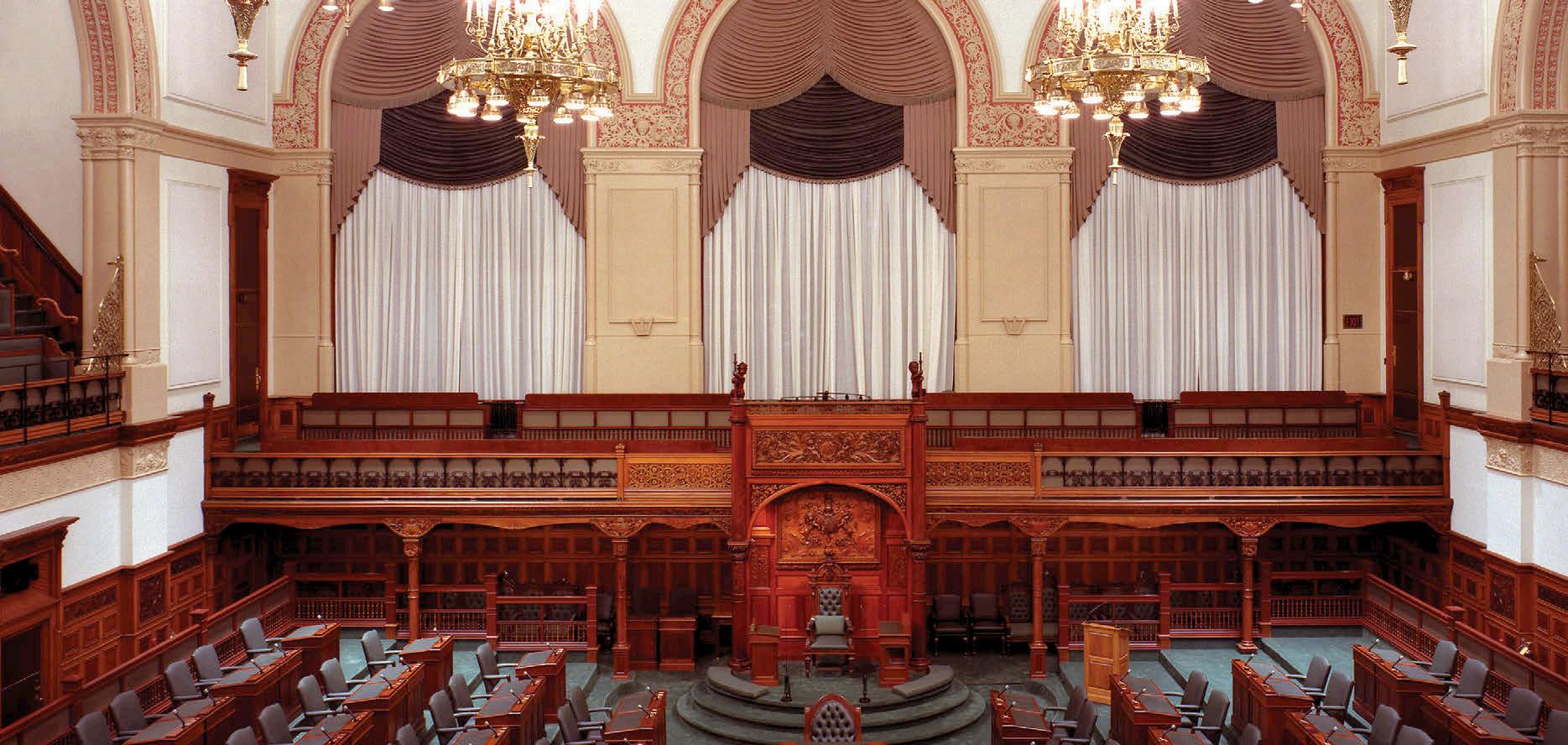
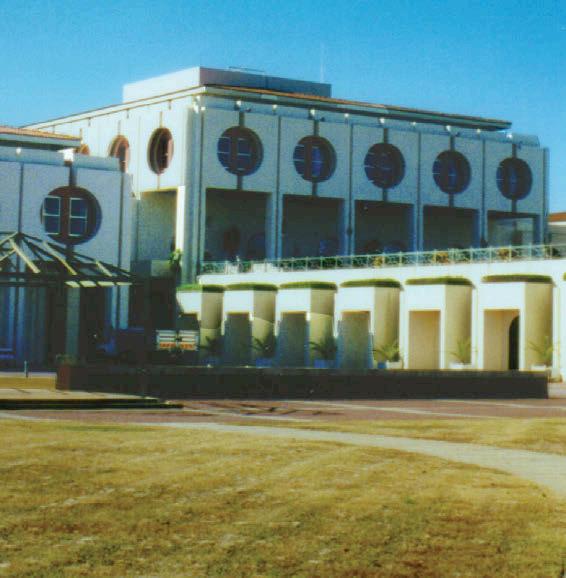
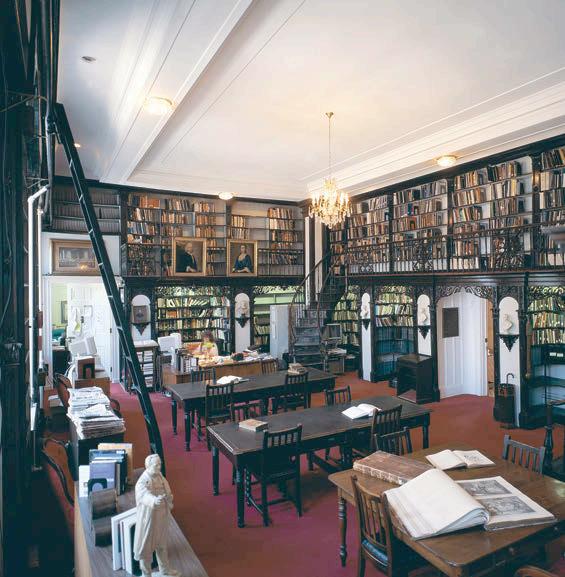
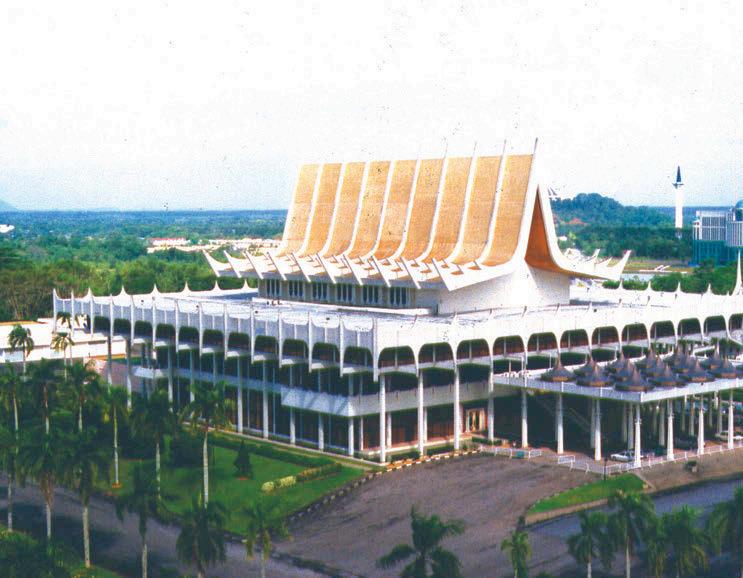
DEBATING THE NEW ZEALAND BUDGET Page 272
ASEAN-AUSTRALIANEW ZEALAND FREE TRADE AREA LEGISLATION Page 274
“UTEGATE” AFFAIR –ACCOUNTABILITY PROBE BACKFIRES ON OPPOSITION Page 280
Hon. Bill English, Minister of Finance, presented Budget 2009 on 28 May. This was followed by a debate over five sitting days, and urgency was taken over two days to pass a related Taxation Tax (Budget Measures) Bill.
Hon. Phil Goff, Leader of the Opposition, moved an amendment expressing no confidence in the government, and called the Budget “dishonest”. He claimed that “it says one thing and it does just the opposite. In a nutshell, this is a Budget that is full of rhetoric but empty of substance and empty of any vision. The tax cuts personally guaranteed by [Prime Minister] Rt Hon. John Key dishonestly to
win an election are gone, but this Budget cannot even be honest in the words that it uses. It says “defers”. Mr English told the lock-up that the tax cuts were gone; they were gone for ever. But the biggest
dishonesty is to talk about entitlements for superannuation being guaranteed at the very time that the Budget guts the funding of superannuation, not for the two years that people might have been expecting but for more than a decade. That means that the government will not face up to its responsibility for the future. Then the Budget dishonestly talks about productivity. One of the keys to productivity is research and development. What does this Budget do? It reduces Labour’s funding for productivity, through research and development, by 75 per cent. It is a Budget that is designed to help those unfortunate to lose their jobs— that is the biggest lie. What do we find this Budget actually does in practice? It takes $5 million out of the employment assistance designed to assist people who have lost their jobs to move on to another job. It should have been a Budget for jobs; it is not”.
In reply, the Prime Minister, said that “what we learnt from the Labour Party is that it wants to spend more money. It is a credit card opposition; Mr Goff does not want to defer tax cuts, and he does not want to chop any expense; he just wants to spend more money. Out there in New Zealand, after listening to Phil Goff, people are saying he is “Whack-it-on-the BillPhil””. However, “whether or not Mr Goff wants to accept the
fact, the National government has inherited the worst economic conditions since 1930. Our trading partners’ income is collapsing, unemployment is soaring around the world, our economy will earn $50 billion less in the next three years. The tax we are able to get will be a whole lot less, and the government

needs to do something about it. Labour may be a credit card opposition, it may want to try to spend our way out of it, and it may believe that “Visa-nomics” is the way to do it, but unfortunately it will not cut it. Phil Goff said that no jobs were created. What about the 600 police we are adding? What about the 800 professionals in the health system? What about the hundreds and hundreds of people we are hiring around the economy on the back of this Budget?”
Dr Russel Norman (CoLeader, Green) asked “how does this government’s first
Budget measure up? Is it a Budget to protect those who are hardest hit, or a Budget to protect the balance sheets of the wealthy? Can this government budget for the future?”. Dr Norman added that “there is at least one point of light for which the government deserves credit and congratulations. In last year’s Budget the Green
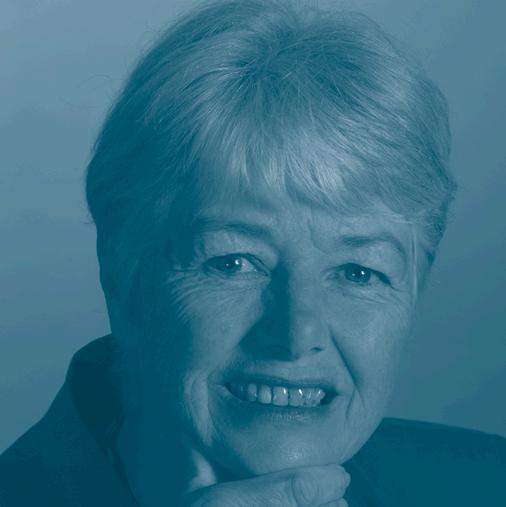
Party negotiated enough money to insulate all state homes. A little later, we negotiated a billion-dollar fund to help get private homes insulated via the emissions trading scheme. Although the government has put that scheme on hold, it has worked with my colleague Ms Jeanette Fitzsimons on a fund to make private homes warm, healthy, and safer for the climate. Beyond this bright spot, things get a little grim. The Green Party believes that a strong Public Service is essential for providing a fair deal for all New Zealanders. All Kiwis are entitled to a good education, high-quality healthcare, and employment opportunities. The Budget does not provide enough of this. Already we have seen an estimated 1,400 jobs lost, and an effective wage freeze in the public sector. This is not a cap; it is a sinking lid. Nine million dollars have been set
aside for the reform of the Resource Management Act. The purpose of this reform, as the Minister of Finance told us, is to enable business to make more money. This government cares so little about our national heritage that even the environment has been pilfered to benefit developers”.
The vote on the no confidence amendment was lost by 51 votes to 68.
As part of the National Party’s confidence and supply arrangement with the ACT Party for the formation of a new government in November 2008, National agreed to a review, by a specially formulated select committee, of New Zealand’s response to and policy on climate change. The Emissions Trading Scheme Review Committee was set up a month later. The Climate Change Response (Emissions Trading Forestry Sector) Amendment Bill was the first Bill referred to that committee.
The Bill had as its aim the delaying of provisions affecting the forestry sector— dates for reporting deforestation and exempting small block owners, and the government’s allocation plan for pre-1990 forest owners that had been due to come into force under existing law on 30 June 2009.
In the second reading debate on the Bill, the Minister for Climate Change Issues, Hon. Dr Nick Smith, said “we are the first country in the world to attempt to bring forestry into an emissions trading scheme, and it needs to be done in a considered and careful way”.
The Labour Party protested at further delay in the scheme. According to Labour’s climate change
spokesperson, Mr Charles Chauvel, speaking in the first reading debate: “The forestry sector has probably suffered
Land Transport Amendment Bill (No. 4)
On 24 June 2009 Hon. Steven Joyce (Minister of Transport) moved the third reading of the Land Transport Amendment Bill (No. 4), and explained that it dealt “with three quite separate, but in their way important, land transport matters. They concern new powers to deal with the problem off drug-impaired drivers on our roads; a comprehensive rewrite of vehicle registration and licensing laws…and the continuation in force of certain powers of local authorities” in regard to the enforcement and making of traffic by-laws. “People who drive while their judgment and reactions are impaired by drugs—and by that I mean both controlled drugs and prescription medicines—are a danger to themselves and others. This Bill aims to reduce this risk by creating an offence of driving while impaired and with evidence in the bloodstream of a controlled drug or a prescription medicine, and by empowering police to determine whether a driver is impaired by means of a compulsory impairment test. If this test shows that the driver is impaired, it will be followed by a blood test to determine whether drugs are present.”
Mr Joyce added that “based on the evidence I have seen in the past 24 hours, I believe
that…Valium and related drugs, known collectively as benzodiazepines…should be considered for inclusion in this legislation. If [my officials’] advice supports the inclusion of benzodiazepines, I will write to all political parties and ask for their support for a special amendment to that effect before the legislation comes into force [on] 1 December”.
Hon. Trevor Mallard (Labour) stressed the “multipartisan basis” on which the Bill was dealt with in the select committee, saying that “a comment was made coming out of the committee that it was pretty hard to tell who was from what party as we were working through the particular issues, which I think was healthy”.
Ms Jeanette Fitzsimons (Green) expressed “some unease, as the Bill does not do quite what it was intended to do and it does not meet all of our objectives. This Bill excludes a major class of drug, benzodiazepines…commonly known as sedatives...they have been implicated in a number of road accidents and deaths”. In addition “our laws should be evidence-based and scientifically sound. The subjective view of a police officer is not a robust test, nor is the simple presence of a drug with no scientifically based assessment of the level of impairment that that drug can cause”.
more than any other from delay and doubt in the emissions trading and climate policy area”. As a compromise he put forward an amendment during the select committee’s brief consideration of the legislation to tie the Bill’s reporting provisions to the specific date of 1 July 2010
rather than to have them brought in by Order in Council. National supported the amendment, in return for the cooperation of other parties in fast-tracking the Bill through the House to prevent stakeholders from being in breach of the law.
Debate on this supposedly minor, technical Bill afforded an opportunity for all parties to Land Transport Amendment Bill (No. 4)weigh up the merits of climate change legislation in general. In the second reading debate Hon. Tariana Turia of the Māori Party was concerned that Māori landowners should be “no worse off” than the owners of privately owned non-Māori land in relation to carbon credit compliance and trading, while Mr Stuart Nash, a new Labour Member, claimed that “planting trees, and farming them for carbon credits…is to New Zealand’s competitive advantage”. Many speakers reiterated National Member
Ms Nicky Wagner’s commitment to “New Zealand’s “clean, green” brand”, and Ms Fitzsimons of the Green Party urged “let us not fall over backwards to delay even longer doing something about climate change.”
Consideration of report of privileges committee on freedom of speech of MPs
On 2 June the House noted a Privileges Committee report on what the committee chairperson (Mr Chauvel, Labour) described as “the interplay between court orders…and the privilege of freedom of speech of Members”, and on “the protections that exist for the reporting and broadcasting of what is said in Parliament and in parliamentary proceedings”.
Mr Chauvel explained that on the sub judice rule the committee thought that “if a Member believes that the public interest requires [a Member] to breach a suppression order or otherwise refer to a matter in front of a court then there should remain facility for this…subject to the discretion of the Speaker to first consider and take advice on whether the statement that is sought to be made is truly in the public interest”.
Mr Chauvel also pointed out that the committee was “surprised to learn…gaps in legal protection may well mean that publishers and broadcasters could face civil or criminal liability for publishing or broadcasting [parliamentary proceedings] in breach of a court order, even if inadvertently”. Hon. Simon Power (Minister of Justice) said the committee therefore recommended that
the government “introduce legislation…to provide that the live broadcast of Parliament’s proceedings, including select committee hearings, is protected by absolute privilege”, and that “delayed broadcasts or rebroadcasts…made by order or under the authority of the House…are protected by absolute privilege”…that “a fair and accurate report of proceedings in the House…or summary using extracts of proceedings in the House, by any person is protected by qualified privilege””, and that “the broadcast and other publication of extracts of Parliament’s proceedings…not made by order or under the authority of the House…are protected by qualified privilege, in a manner consistent with the…Defamation Act 1992”.
Dr Kennedy Graham (Green) considered the “recommendations…carry us forward in securing the constitutional relationship between the legislature and
the judiciary…and in refining the relative protections accorded to the House and others in society”.
Mr David Garrett (ACT) sought amendment of the “unsatisfactory…law with regard to effective repetition”, arguing that “most
commentators and many, if not most, lawyers believe that Buchanan v Jennings was bad law. It cannot be either sensible or right for a Member…who says in the hallway “I do not resile from what I said in the House” to then become liable for what he or she said in the Chamber. The committee, in my view quite rightly, expressed its disappointment that the change recommended in 2005 had not been actioned and said that it expected action to be taken on that point as soon as possible”.
Mr Te Ururoa Flavell (Māori Party) referred to “the “Black Friday” police raids on the Tūhoe nation”, saying that “in this matter of extreme public interest, our questions in the House were frequently shut down”, and added that “we need to know, if a case is held over, what mechanisms are in place to guarantee the issues can benefit from exposure to the light of parliamentary scrutiny”.
Mr Power indicated “the government… [will] respond formally in due course” to the committee’s report.
Zealand free trade area legislation
The ASEAN-Australia-New Zealand Free Trade Area Bill was divided into the Tariff (AANZFTA) Amendment Bill and the Customs and Excise (AANZFTA) Amendment Bill, whose third readings were moved on 2 July 2009.
Speaking in the debate on the third readings, Hon. Chris Finlayson, Acting Minister of Trade, said “this legislation amends New Zealand’s domestic legislation so that New Zealand can be ready to enter into force the ASEAN-
Australia-New Zealand Free Trade Area agreement”. He also explained that the legislation “amends the Tariff Act 1988 in order to implement preferential tariff
rates on imported goods from free-trade agreement parties and enable transitional safeguard measures to be applied in appropriate circumstances on such exports. [It] also amends the Customs and Excise Act 1996 by creating a system for issuing certificates of origin for
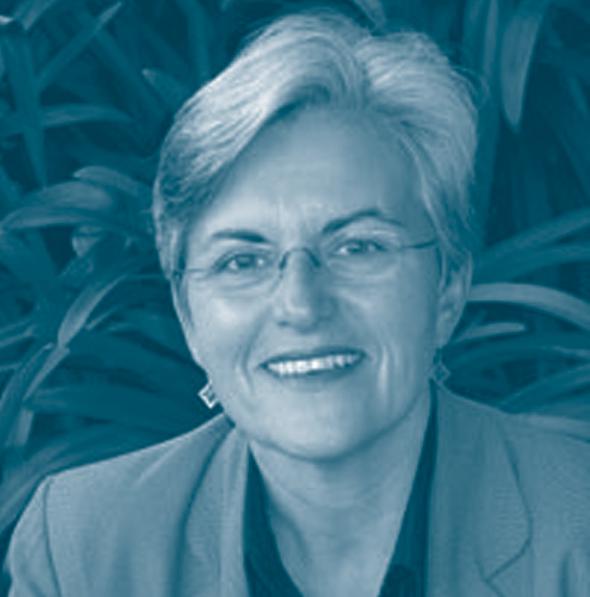
growing market”.
Ms Maryan Street (Labour) reiterated the opportunities that the ASEAN free-trade agreement confers on, and provides for, the New Zealand economy. She noted that the agreement, which involves a 12-country agreement and markets of some 566 million people, had been a long time in the making. “It allows our export producers in New Zealand access, on favourable terms, to markets of enormous size. Even when the global economy is faring badly, there is still room in these ASEAN markets for growth in New Zealand’s exports.” She said the agreement covered goods, services and investment. “As far as goods are concerned, clearly, New Zealand will benefit from the elimination of tariffs—within 12 years— on 99 per cent of New Zealand’s current exports to the four largest markets in the ASEAN grouping. Those markets are Indonesia, Malaysia, the Philippines, and Vietnam.”
Dr Graham (Green) said that National and Labour should be regarded in the debate and on the issue “as a conjoint political establishment best regarded as “NatLab”. Their views can be seen in contradistinction to those of the Green Party”.
Job cuts in the ministry of social development
Leading off an urgent debate on 1 July, Hon. Annette King (Deputy Leader, Labour) said that “yesterday the chief executive officer of the Ministry of Social Development announced cuts of up to 200 jobs as part of restructuring demanded by

the government and [Hon. Paula Bennett, Minister for Social Development and Employment]. Those cuts will affect children and families, and they come at a time when unemployment is rising rapidly. Young people had a chance a few weeks ago under a programme called Enterprising Communities, but it was dumped by Miss Bennett. I can tell Miss Bennett that 3,000 jobs would have come out of that programme if there had been continued investment in it.”
in New Zealand.”
According to Mr John Boscawen (ACT), “Labour Members are very happy to suggest that the solution to problems is to spend more money. The more money we spend the better, and the more likely the problem will go away. We have had a massive increase in health spending…what do we see? We see a drop in productivity. It is not a question of spending more money; it is a question of how we spend it”.
In the view of Ms Ruth Dyson (Labour) “there is no bigger need than the need of kids who are hurt in their own homes. It beggars belief that that is the very area Ms Bennett has signed off for a cut. We have heard a lot about the recession, the worst recession in 30 years—that we are going through tough times, that we

goods exported from New Zealand to ASEAN markets”.
Mr Finlayson noted that “the New Zealand - ASEAN two-way trade was worth more than $12 billion last year, which is 85 per cent greater than New Zealand’s trade with China for the same period. ASEAN is our fastest-
Mr Keith Locke (Green) explained that the Green Party was “not at all against trade or trade agreements; we are against agreements that reduce tariffs to nothing, across the board, in an ideological way rather than in a practical way. We are against agreements that open up New Zealand to foreign investment in an across-the-board way”.
Ms Bennett said it was “vitally important that the House debate child abuse and neglect…New Zealand has the third-highest rate of child abuse and neglect in the OECD. That is a horrific statistic in any terms. I can guarantee the public of New Zealand that due to changes that have taken place in the last few months, more frontline social workers will be working with…our children
have to tighten our belts, and that we have to make tough decisions. Well, we do. We do have to make tough decisions, and that is all about priorities. Now is the worst time to be cutting jobs. There could not be a worse time for the government to be cutting back on Public Service jobs and adding to the list of unemployed people”.
The Information Technology (Amendment) Bill, 2008
The Information Technology Act was enacted in the year 2000 to give a fillip to the growth of electronic-based transactions and to provide legal recognition for e-commerce and etransactions among other things.
With proliferation of information technology enabled services such e-governance, ecommerce and e-transactions, protection of personal data and information and implementation of security practices and procedures relating to these applications of electronic communications have assumed greater importance and hence it was felt that they required harmonization with the provisions of the Information Technology Act.
In light of the rapid increase in the use of computer and internet usage to publish sexually explicit materials, breach confidentiality etc, penal provisions have been included in the Information Technology Act, the Indian Penal Code, the Indian Evidence Act and the Code of Criminal Procedure to prevent such crimes.
The United Nations Commission on International Trade Law (UNCITRAL) adopted the Model Law on Electronic Signatures in 2001. In view of
the General Assembly of the United Nations’ recommendation that all States accord favourable consideration to the said Model Law on Electronic Signatures, alternate technology of electronic signatures was installed to ensure it worked correctly with the said Model Law.
To achieve these objectives the Government brought forward the Information Technology (Amendment) Bill, 2008. Salient features of the amending Bill include:
• The words “digital signature” have been substituted by the words “electronic signature”, so as to make it technology neutral.
•A new Section 6A empowers the Central and the State Government to authorize the service providers to provide efficient services to the public for an appropriate charge.
•A new Section 72 A makes the disclosure information in breach of a lawful contract punishable.
The Bill was passed by the Lok Sabha and the Rajya Sabha on 22 and 23 December 2008. The Bill was assented by the President on 5 February 2009.
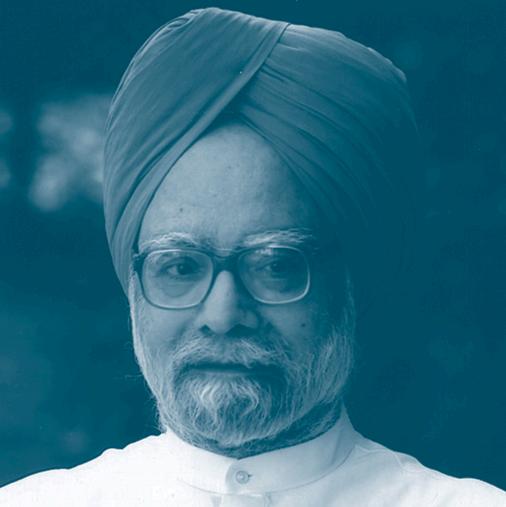
Dr Manmohan Singh
The 15th Lok Sabha was constituted on 18 May 2009 following the notification to this effect issued by the Election Commission of India after the successful conclusion of the general elections. The term of the 14th Lok Sabha was to expire in the normal course on 1 June 2009 and in terms of the constitutional provisions, a new Lok Sabha was required to be constituted before 2 June. General Elections to constitute the 15th Lok Sabha were held in five phases on 16, 23 and 30 April and 7 and 13 May 2009. The General Elections to the Lok Sabha for 499 out of 543 Parliamentary constituencies in all the States, NCT of Delhi and Union Territory of Puducherry, except Arunachal Pradesh, Assam, Jammu & Kashmir, Jharkhand, Manipur and Nagaland, were held on the basis of the newly delimited constituencies. The extents of Parliamentary and Assembly constituencies in all States, except Arunachal Pradesh,
Assam, Jammu & Kashmir, Jharkhand, Manipur and Nagaland, had been redetermined by the Delimitation Commission set up under the Delimitation Act, 2002.
The total electorate in the country was approximately 714 million compared to 671 million in 2004. This marks an increase of 43 million in the number of the electorate. For the first time the entire country, except the three States of Assam, Nagaland and Jammu & Kashmir, used the Photo Electoral Rolls. Out of 543 parliamentary constituencies, a photo electoral roll was used in 522 parliamentary constituencies to prevent impersonation and facilitate easy identification. There were 8,034,944 polling stations in the country, as compared to 6,087,402 polling stations during the 2004 Lok Sabha elections. Electronic Voting Machines were used in all the polling stations of the country as was done during the last Lok Sabha election in 2004.
Results for all the 543 elective seats were declared on 16 May 2009. The Indian National Congress (INC) party emerged as the single largest majority party with 206 seats followed by the Bharatiya Janata Party (BJP) with 116 seats. The United Progressive Alliance (UPA) led by the Congress party was close to the figure required to form the government.
The President of India nominates two members from the Anglo-Indian community to the 545-member House.
The Prime Minister, Dr Manmohan Singh tendered his resignation and that of his colleagues in the Council of Ministers on 18 May 2009. The President of India, Smt. Pratibha Devisingh Patil, on the recommendation of the Cabinet, dissolved the 14th Lok Sabha the same day. The Election Commission formally notified the constitution of the 15th Lok Sabha on 18 May 2009 and the Chief Election Commissioner, Shri Navin B. Chawla submitted to the President a copy of the notification containing the names of the Members elected to the House of the People following the General Elections
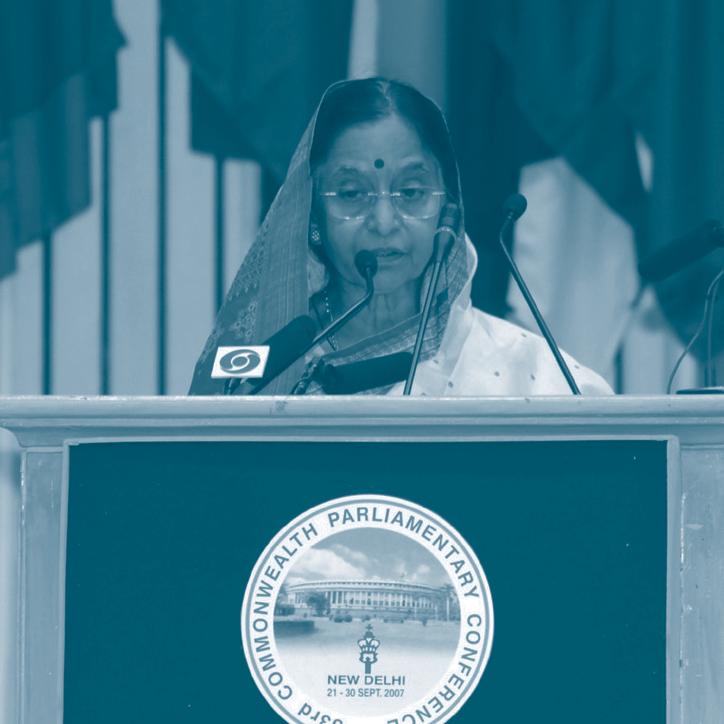
to the 15th Lok Sabha.
There are representatives from 37 political parties in the new House as compared to 38 in the previous Lok Sabha, besides some independent Members. There are 58 women Members in the House, the highest so far in any Lok Sabha. The Lok Sabha has 291 Members elected for the first time, which means a majority of the Members of the present Lok Sabha are new.
Government formed The process of forming a new
government at the centre began with the declaration of election results on 18 May. On 20 May, Dr Singh who was elected leader of the Congress Parliamentary Party the previous day, called on the President and staked claim to form the government. He also handed over to the President letters of support extended to him by various political parties and others. The President, being satisfied on the basis of the various letters of support received that the Congress-led UPA alliance, which was also the largest pre-election alliance, was in a position to command majority support of the newly constituted 15th Lok Sabha and to form a stable government, appointed Dr Singh as the Prime Minister for a second consecutive term and requested him to indicate the members of the new Council of Ministers. On 22 May, the President administered oaths of office and secrecy to 19 Cabinet Ministers at a ceremony held in the Rashtrapati Bhavan. On 28 May, 14 more Cabinet Ministers, seven Ministers of State (Independent Charge) and 38 Ministers of State were administered oaths of office and secrecy. Besides the Prime Minister, there are 33 Cabinet Ministers, seven Ministers of State (Independent Charge) and 38 Ministers of State in the Union Council of Ministers.
Fifteenth Lok Sabha meets
The First Session of the 15th Lok Sabha commenced on 1 June 2009. Members stood in silence for a short while to mark the solemn occasion of the first sitting of the new House. The Secretary-General of the Lok Sabha, Shri P.D.T. Achary laid on the table a list containing the names of Members elected to the 15th Lok Sabha
Before the commencement of the Session, the President appointed Shri Manikrao Hodlya Gavit, the senior most Member of the House, as the Speaker Pro-tem for performing the duties of the Speaker from the commencement of the first sitting of the House till the election of the Speaker. Shri Gavit was administered the oath of office and secrecy by the President on 1 June. The President also nominated S/Shri Basudeb Acharia, Arjun Charan Sethi, Biren Singh Engti and Smt. Sumitra Mahajan, MPs on the Panel of
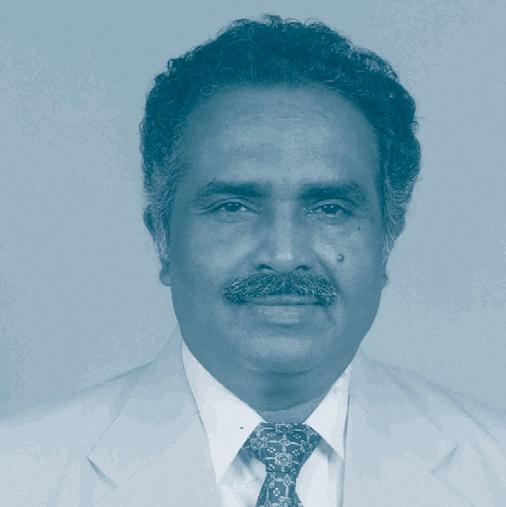
Chairmen to assist the Speaker Pro tem. The office of the Speaker falls vacant immediately before the commencement of the first meeting of a newly constituted House.
The first two sittings of the House on 1 and 2 June were mainly devoted to the Members making and subscribing the oath or affirmation. This being the first Session of the new Lok Sabha, the President addressed the Members of both the Houses of Parliament assembled together in the Central Hall of Parliament House on 4 June. In her address, she said that the government would initiate steps within the next 100 days for early passage of the Women's Reservation Bill in
Parliament providing for onethird reservation to women in state Legislatures and in Parliament; bring constitutional amendment to provide 50 per cent reservation for women in rural and urban local bodies (presently one-third reservation); make concerted effort to increase representation of women in central government jobs; and create a national mission on empowerment of women for implementation of womencentric programmes in a mission mode to achieve better coordination. Stating that the priority of the government would be to consolidate the ongoing flagship programmes of inclusion, the President listed ten broad areas of priority for the government for the next five years:
• Internal security and preservation of communal harmony;
• Stepping up of economic growth in agriculture, manufacturing And services;
•Consolidation of the existing flagship programmes for employment, education, health, rural infrastructure, urban renewal and introduction of new flagship programmes for food security and skill development;
•Concerted action for the welfare of women, youth, children, other backward classes, scheduled castes, scheduled tribes, minorities and the elderly along with strengthened social protection;
•Governance reform;
•Creation and modernization of infrastructure and capacity addition in key sectors;
•Prudent fiscal management;
•Energy security and
environment protection;
•Constructive and creative engagement with the world and
•Promotion of a culture of enterprise and innovation.
The Motion of Thanks on the President’s Address was moved by Dr (Smt.) Girija Vyas on 5 June and was seconded by Shri P.C. Chacko, both from the Congress. The discussion on the Motion continued on 8 and 9 June and 76 Members belonging to different political parties took part. Dr Manmohan Singh in his reply to the debate enumerated various measures taken by the government to address specific problems and promised to further strengthen the flagship programmes for employment, education, rural and agricultural development and health, and to improve the delivery of public services through greater transparency and accountability. The Motion was adopted on 9 June, with the Rajya Sabha also adopting the motion on the same day.
Speaker elected
Smt. Meira Kumar, MP, was unanimously chosen as the Speaker of the 15th Lok Sabha on 3 June 2009. There were 11 motions proposing her name for the office of Speaker. One of the motions was moved by the Chairperson of the Congress Parliamentary Party and also of the UPA, Smt. Sonia Gandhi, and seconded by the Leader of the House and Finance Minister, Shri Pranab Mukherjee. The Prime Minister, Shri Mukherjee, and the Leader of the Opposition in the Lok Sabha, Shri L.K. Advani conducted Smt. Kumar to the Chair. Smt. Kumar had resigned from the Council of Ministers to file her nomination for the office of the Speaker. She is the first woman Member of the
House to be elected as the Speaker of Lok Sabha.
Dr Singh commented it was the first time a female Member of the House had been elected as Speaker and that too a woman belonging to the dalit community. Her election is a tribute to the women of the country for the great services and great contribution they make to the nation. Assuring the Speaker of his Government’s full cooperation in discharging her onerous duties, the He added that the knowledge, wisdom and experience gained as a former diplomat, as a Parliamentarian with 25 years or more standing and as a former Minister in the Government of India would stand her in good stead in dealing with issues that come before the House. Shri Mukherjee said the experience in government and in Parliament would help in rendering the responsibilities
bestowed on her. He said the government would try to create a new precedence not of obstructions but debates and discussions in the 15th Lok Sabha. Congratulating Smt. Kumar, Shri Advani hoped that the 15th Lok Sabha would function in an efficient manner under her guidance and that the Speaker would be able to discharge her responsibility.
Shri Mulayam Singh Yadav (SP) was happy that a woman Member was elected as the Speaker and hoped that the views expressed by the opposition parties would be given more weight. Shri Arjun Charan Sethi, leader of BJD Parliamentary Party said history would always remember Smt. Kumar as the first woman Speaker of Lok Sabha and her election to the exalted office would facilitate the inclusive voice of the nation and of the House, particularly those belonging to the vulnerable and marginalized stratum of the society. Shri T.R. Baalu (DMK) felt that the election of a woman as the Speaker would send an encouraging message to the dalits of India and especially the women, while Shri Chandrakant Khaire (SS) said that her election would definitely help to increase the number of women in Parliament. Leaders of other political parties and groups also congratulated Smt. Kumar on her election as the Speaker of the Lok Sabha.
Thanking the Members for electing her as Speaker, Smt. Kumar said the House had made history by electing a woman to the office of the Speaker for the first time in its 57 year life and thus, set a shining standard. She said “I feel proud and humbled by the unflinching faith you have reposed in me. On being elected Speaker, it is my first and foremost duty to serve the House according to the Indian Constitution, rules and conventions rising above various political ideologies and affiliations. In fact, this is a service to the nation, because this House is a microcosm of India”. The Speaker said that the dexterity of the Members lies in the fact how capable they
are in keeping the Executive always alert without hampering the functioning of Parliament or the Executive.
She observed that the interruptions in the proceedings of Parliament do not allow achievements and omissions and commissions of the government to be reviewed and the principle of the democracy demands that this should not happen. Pledging not to leave any stone unturned to uphold the dignity of the House and the honour of its embers, Smt. Kumar said, “The House of people is the reflection of the aspirations of the people of the country. We must understand properly what our electorates expect of us. They want that we should present their concerns and apprehensions effectively in the House and frame laws as need arises. Therefore, we must discuss and debate and even express our dissent if necessary, but that too with decency and without disrupting the proceedings of the House. There may be some sections of persons in the House who hold that stalling the proceedings of the House is the only way to express their dissent in an effective manner. No countryman would ever like
the proceedings of the Parliament to be stalled for raising issues concerning him in the House. In fact, many devices are available to Honourable Members to raise problems of the people and their concerns in the House. If we use these devices effectively, we can transform the House into a useful forum for deliberations”.
Deputy Speaker elected The senior BJP leader, Shri
Shri Kariya Munda
At the presidential procession: Smt. Kumar (centre) leads the Prime Minister and President.
Kariya Munda, MP, was unanimously elected as the Deputy Speaker of the 15th Lok Sabha on 8 June 2009. The Deputy Speaker was conducted to his seat by the Prime Minister, the Leader of the House and the Leader of the Opposition.
Shri Munda was first elected to the 6th Lok Sabha in 1977 and has been elected to the 15th Lok Sabha for a seventh term. A former Union Minister, Shri Munda was a member of several parliamentary committees. He was also a member of the Bihar Legislative Assembly and the Jharkhand Legislative Assembly.
There were seven sittings in all during the first session of the 15th Lok Sabha. The House was adjourned sine die on 9 June with the playing of the national song and it was prorogued by the President of India on 12 June 2009.
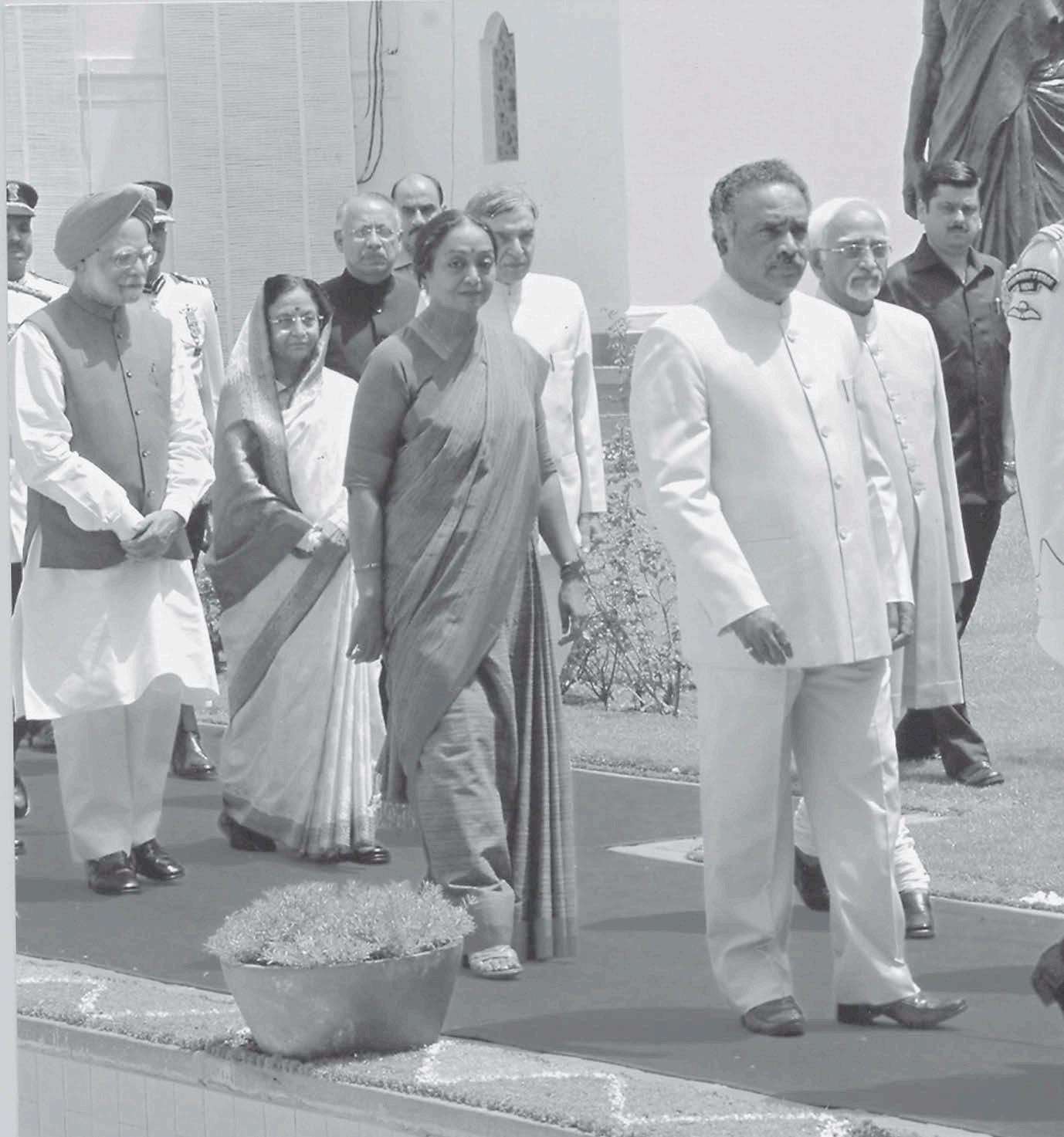
The Code of Criminal Procedure (Amendment) Bill, 2006
The Code of Criminal Procedure, 1973 is the procedural statute for administration of Criminal laws in India. For some time now a need had been felt to amend the Code of Criminal Procedure, 1973 to ensure fair and speedy justice and to tone up the criminal justice system. The Law Commission of India had undertaken a comprehensive review of the Code of Criminal Procedure in its 154the report and its recommendations had been found to be very appropriate particularly those relating to provisions concerning arrest, custody and remand, procedure for summons and warrant- cases, compounding of offences amongst others. It has also been found necessary to revise the law to maintain a balance between the liberty of the citizens and the society’s interest in maintenance of peace as well as law and order.
A need had also been felt to include measures for preventing the growing tendency of witnesses being induced or threatened to turn hostile by the accused parties who are influential, rich and powerful. It was therefore felt that they need to be given certain rights and compensation so that there is no distortion of the criminal justice system.
To achieve these objectives the Government brought forward the Code of Criminal Procedure (Amendment) Bill, 2006. The amending Bill was eventually enacted in 2008.
Salient features of the bill amended:
Change in definition: The Amending Act inserted following
new sub-clause (wa) in the definition clause of Section 2 of the Principal Act. (wa) “ Victim” means a person who has suffered any loss or injury caused by reason of the act or omission for which the accused person has been charged and the expression “victim” includes his or her guardian or legal heir;
The Amending Act also amended section 26 (of the Principal Act) relating to courts by which offences are subject to trial. A proviso had been inserted in clause (a) of the said section so as to provide that any offence under section 376 and sections 376A to 376D of the Indian Penal Code, 1860 shall be tried as far as practicable by a court presided over by a woman.
A proviso has also been added to Section 46 of Principal Act relating to how arrest is to be made. As per this proviso when a woman is to be arrested, unless the circumstances otherwise require or unless the police officer is a female, the officer shall not touch the person of the woman to arrest her.
Further amendments include:
•Provision has been made for medical treatment of an accused person of unsound mind pending the trial.
•Punishment for perjury has been increased to imprisonment for a term which shall not be less than three months extendable up to two years with liability for five.
The Bill was passed by the Rajya Sabha and the Lok Sabha on 18 and 23 December 2008 respectively. The Bill was assented by the President on 7 January 2009.
The opposition led by Hon. Malcolm Turnbull, MP, has waged a major attack on the probity and accountability of the government. The opposition alleged that the Prime Minister, Hon. Kevin Rudd, MP, and the Treasurer, Hon. Wayne Swann, MP used their influence to benefit a car dealer who previously supported the Prime Minister with the provision of a ute. The drama has been
Turnbull, based on this evidence, called for the resignation of the Prime Minister and Treasurer if they could not justify their actions.
referred to as Utegate or the OzCar scandal.
In July 2007 Mr Rudd declared on the register of pecuniary interests that an Ipswich car dealer, Mr Ron Grant lent him a $5000 ute which Mr Rudd used as a mobile electorate office. In October 2008 key car dealer financiers pulled out of the Australian market because of the global credit squeeze. In December 2008 the government announced a $2 billion OzCar fund to support local car dealers. In February
2009 there was an email allegedly sent from Mr Andrew Charlton, an adviser in the Prime Minister’s office, to Mr Godwin Grech, a Treasury official, asking if OzCar could help Mr Grant.
Throughout June the opposition used question time to probe the Prime Minister and Treasurer about their links to Mr Grant and whether or not they had made representations on his behalf. They both strenuously denied the allegation that they had inappropriately sought special consideration of Mr Grant under the OzCar scheme.
On 19 June a Senate committee took evidence from Treasury officials including Mr Godwin Grech. In response to questioning from Senator Eric Abetz, Mr Grech answered that he thought the Prime Minister’s office may have sent him an email asking him to help Mr Grant. Mr Grech previously, in a private meeting, showed Mr Turnbull the alleged email from the Prime Minister’s office. Mr
The Prime Minister rejected the allegations and called for the Auditor-General to undertake an inquiry into the affair. On 22 June the Federal Police raided Mr Grech’s home, interviewed him and revealed that the email was a fake. Mr Grech later admitted that he created the faked email. Mr Grech acknowledged that his actions were an error of judgement but he acted this way because he thought the issue of Mr Grant could be used to frustrate the passage of the OzCar finance bill in the Senate.
On 4 August the AuditorGeneral released his report into representations to the department of the Treasury in
relation to Motor Dealer Financing Assistance. The Auditor-General found that the Prime Minister and Treasurer
had no case to answer. The Auditor-General stated that “Treasury was aware that the dealer [Mr Grant] was acquainted with the Prime Minister, but there is no evidence that the Prime Minister was aware of the representation, or that the Treasurer or his Office applied any pressure on Treasury to give this dealer more or better assistance than others”.
In relation to Mr Grech, the Auditor-General commented that the implementation phase of the policy raised serious questions about whether he breached the Australian Public Service Code of Conduct. The Auditor-General commented that “this was particularly in relation to the disclosure of confidential information to parties outside executive government that had no entitlement to this information, and the nature of some of the email communications and other interactions with third parties”. In addition, the Auditor-General noted that the “preferential treatment given to one representation was motivated by, amongst other things, the personal circumstances of the dealer principal and Mr Grech’s understanding that the dealer principal was a supporter of, and donor to, the Liberal Party of Australia with other records made by Mr Grech stated that he was “Lib”.
Mr Turnbull is reported to have said that he was misled by Mr Grech and regretted
ever meeting him.
Prior to the release of the Auditor-General’s report, the
Senate Standing Committee on Privileges commenced an inquiry on 24 June into
Amendment (Enhanced border controls and other measures)
The Act amends the Customs Act 1901 to ensure that the Australian Customs and Border Protection Service can continue to perform effectively its law enforcement and regulatory role and functions. In particular the legislation clarifies the current powers to patrol areas and moor Customs’ vessels; provided that the present power to board ships without nationality can be exercised in any area outside of the territorial sea of another country; and clarify that the present power to use reasonable force as a means to enable the boarding of a pursued ship encompasses the use of devices designed to stop or impede a ship.
In addition, the legislation will strengthen Customs’ ability to request an aircraft to land to include circumstances where it is suspected that the aircraft is carrying goods that are related to a terrorist act or are likely to prejudice Australia’s defence or security.
The then Minister for Home Affairs, Hon. Bob Debus, MP, concluded that the legislation “allows Customs to perform its roles more efficiently and effectively to protect the community at the same time as it continues to give every support to legitimate trade and travel”.
The Shadow Minister for Justice and Customs, Hon. Susan Ley, MP, indicated that the opposition would support the legislation but commented that whilst the government has revamped the role of Customs, “it is a shame that the Rudd Labor government cannot couple this with the funding that Customs so badly needs”. Ms Ley stated that “the Rudd Labor government’s $51.5 million in budget cuts to the Australian Customs and Border Protection Service, in real terms, has significantly hampered the ability of Customs to respond to the multitude of security threats that land on Australia’s borders”. Ms Ley concluded that “it is obvious that border protection is not a priority, and Mr Rudd and Labor could well be setting Australia up for a border security disaster”.
The Act establishes Health Workforce Australia as an independent statutory body to implement Council of Australian Governments health workforce initiatives agreed to in November 2008 including funding, planning and coordinating clinical training, supporting clinical training supervision and health workforce research and planning, funding simulation training, and providing advice to Health Ministers.
The Minister for Health and Ageing, Hon. Nicola Roxon, MP, commented that “there can be no doubting that Australians enjoy one of the best health systems in the world” and one of the reasons for this is “the quality of our health workforce”. Mr Roxon noted that Australia is currently dealing with the legacy of a historic underinvestment in our health workforce. She stated that the end result of this neglect by the previous government is there are now “chronic shortages in general practice, various medical specialities, dentistry, nursing and certain allied
“whether any adverse action was taken against Mr Grech in consequence of his
health professions”.
Ms Roxon commented that “workforce shortages and inflexibilities and inefficiencies in training and service delivery can contribute to poor health outcomes, particularly in certain regions, such as our rural and remote areas, and for certain population groups, particularly Indigenous Australians”.
The ageing of the population was another challenge that was placing increasing pressure on the health system. Ms Roxon stated “the ageing of the population will have significant implications for the health workforce in terms of demand, with the over 55s being the heaviest consumers of medical services, and supply, with increasing numbers of health professionals expected to retire in the near future”.
Ms Roxon advised that the $1.6 billion health workforce package comprising $1.1 billion of Commonwealth funding and $539.2 million from states and territories “is the single largest investment in the health’s workforce ever made by Australian governments”.
Ms Roxon concluded that “this investment will improve health workforce capacity, efficiency and productivity by improving clinical training arrangements, increasing postgraduate training places for medical graduates, improving health workforce planning across Australia and enhancing training infrastructure, particularly in regional and rural areas”.
The Shadow Minister for Health and Ageing, Hon. Peter Dutton, MP, rejected claims that the previous government was to blame for some of the problems in the health sector. Mr Dutton stated that “the simple fact is that the former coalition government began dramatically ramping up the number of education places for health professionals almost a decade ago—indeed, from 2000. We provided for significant growth in the number of medical graduates, nurses, dentists, pharmacists and psychologists emerging from our universities”. In contrast, Mr Dutton noted that the “Rudd government’s budget, which will drive this nation into deficit and debt for decades to come, contained more than a score of small under-the-radar funding cutbacks in health that may hinder the development of the health workforce over the coming years”.
Mr Dutton noted that “one such cut pulled $30 million from a programme supporting postgraduate research into public health, which drew criticism from the Public Health Association”. Mr Dutton raised a series of questions about the legislation that needed to be answered. First, would the proposals result in additional layers of administration and bureaucracy? And second, would the new authority “try to usurp some of the responsibility of the colleges and some of the other organisations that seek to provide professional development to the professions around this country?” Mr Dutton concluded that “we want to support people who are delivering health services at the front-line, as opposed to Labor, who want to support the spinmeisters in the back rooms”.
evidence before the Economics Legislation Committee on 19 June 2009, and, if so, whether any contempt of the Senate was committed in that regard”. Another proposed reference to the Privileges Committee on 25 June asked the committee to consider whether any false or misleading evidence was given to the Economics Committee and whether any false documents were used as a basis for questioning in the hearing. The proposed reference was rejected by equally divided votes, with Senator Steve Fielding voting with the opposition. The Senate Procedural Information Bulletin commented that “this matter may be revisited as further information about the affair emerges from inquiries by
the Australian Federal Police and the Auditor-General”.

Senator Abetz referred to the disputed email during the Senate committee hearing on 19 June. It has now been confirmed that Mr Grech met with Mr Turnbull and Senator Abetz before Mr Grech appeared before the Senate Economics committee. It has
also been revealed that Mr Grech prepared a series of questions for Senator Abetz to ask him at the hearing.
On 11 August 2009 the Leader of the Government in the Senate, Sen. the Hon. Chris Evans, moved that a range of matters be referred to the Privileges Committee. The motion stated that the Privileges Committee examine in “relation to the hearing of the Economics Legislation Committee on 19 June 2009 on the OzCar program”:
(a) Whether there was any false or misleading evidence given, particularly by reference to a document that was later admitted to be false; and
(b) Whether there was any improper interference with the hearing, particularly by any collusive
The Department of Coast Guard Bill was presented to Parliament by Hon. Ratnasiri Wickramanayake (Prime Minister of Internel Administration and Deputy Minister of Defence) on 24 June 2009. The second reading of the bill was debated and passed with amendments on 9 July and was assented by the Hon. Speaker on 6 August.
Mr Wickramanayake told Parliament that the Coast Guard Unit attached to the Fisheries and Aquatic Resources Ministry has been taken under the control of the Defense, Public Security, Law and Order Ministry. The Coast Guard Department will provide a multi mission coast guard service to ensure the security of the coastal areas, the maritime zones, the territorial waters of Sri Lanka and the high seas.
Presenting the Department with the Coast Guard Bill, the Premier said more legal powers would be vested within the department through this Bill to prevent illegal fishing in the coastal areas of Sri Lanka and the protection of fishermen and also rendering assistance at sea.
prearrangement of the questions to be asked and the answers to be given for an undisclosed purpose, and, if so, whether any contempt was committed in that regard.
In addition, Senator Fielding proposed an alternative motion that referred to the incidents that occurred on 19 June 2009 and also whether there was manipulation of evidence given to the Senate Economics Committee on 22 October 2008 concerning Labor Senator Stephen Conroy.
The motions were debated on 12 August. Senate Fielding’s motion was not supported but Senator Evans’ motion was agreed to with the Senate dividing 34 ayes against 32 noes. For this vote, Senator Fielding supported Senator Evans’ motion.
It will also assist Customs and other relevant authorities in conducting anti-smuggling and anti-immigration operations.
The department will be vested with powers to co-operate with the law enforcement agencies and the armed forces by taking necessary measures for the suppression of destructive terrorist activities occurring in the maritime zones and the territorial waters of Sri Lanka.
Preventing trans-boundary movement of narcotics by sea and ensuring the safety of life and property at sea would be other objectives of the department. Search and rescue operations for those caught up in events of natural disasters and salvage operations in relation to vessels and other goods and other accidents at sea will also be streamlined, the Prime Minister added.
Hon. Bimal Ratnayake MP (JVP) contributing to the second reading stated that though they have some adverse observation on the bill, their party on principal agreed to establish the Department of the Coast Guard.
The Department of the Coast Guard Bill was passed without a division on 9 July 2009 with amendments.
The purpose of the Act – passed on 18 June 2009 – was to reduce greenhouse gas emissions, which affect the quality of the atmosphere and contribute to global warming and climate change.
Under the Act, the Minister requires that emitters report their emissions and the information is to be kept in a public register for the purposes of a greenhouse gas emissions inventory. The Act also requires the Minister to submit a climate change action plan to the government and to publish annually a greenhouse gas emissions inventory and a report on the measures implemented to reduce those emissions.
The Act provides that the Government is to set greenhouse gas reduction targets using 1990 as the baseline. It also contains provisions allowing the government to put in place all the mechanisms required to implement a cap-and-trade system. Sums collected under the new provisions are to be used to finance various climate change measures.
The Act was passed on 11 June 2009, and confirms the legal status of both surface water and groundwater as a collective resource that is part of the common heritage of the Québec nation. The Act recognizes the right of every person to have access to safe water and sets out certain principles, including the duty to prevent damage to water resources and to repair any such damage. It creates a civil action that will allow the Attorney General to require the reparation of any ecological damage to water resources.
The Act defines water governance rules that are based on concerted, integrated management within the hydrologic units designated by the Minister of Sustainable Development, Environment and Parks, including the St. Lawrence River Basin, and take into account the principles of sustainable development.
The Act also establishes a new water withdrawal authorization system that increases water resource protection. The new scheme recognizes the need to satisfy the needs of the population first but also to reconcile ecosystem needs and the needs of economic activities.
The Act incorporates into the Environment Quality Act the prohibition provided in the Water Preservation Act against transferring water out of Québec. Moreover, it makes the lifting of that prohibition by the Government – for any reason in the public interest – subject to public consultation.
The Act to amend the Code of Civil Procedure to prevent improper use of the courts and promote freedom of expression and citizen participation in public debate (Bill 9), passed on 3 June 2009, amends the Code of Civil Procedure to promote freedom of expression and prevent improper use of the courts, in particular if it thwarts the right of citizens to participate in public debate.
The Act allows the courts to promptly dismiss a proceeding that is improper and authorizes the reversal of the burden of proof if improper use of procedure is summarily established.
Finally, it allows the courts to order the payment of a provision for costs, and to condemn a party to pay the fees and extrajudicial costs of the other party.
The Act, passed on 18 June 2009, establishes special rules for the recovery of tobacco-related health care costs attributable to a wrong committed by manufacturers, including a failure in their obligation to inform the public about the risks and dangers posed by tobacco products.
The Act allows the Government to bring an action on a collective basis to recover the costs incurred for all health care recipients stemming from exposure to tobacco products of one or more types, or on an individual basis to recover the part of the costs incurred for certain particular recipients of similar health care.
The purpose of the Act, passed on 18 June 2009, is to regulate clinical and research activities related to assisted procreation in order to ensure high-quality, safe and ethical practices. The Act is also designed to encourage the ongoing improvement of services in that area.
The Act provides that any assisted procreation activity, allowing for exceptions, must be carried out in a centre for assisted procreation for which a licence has been issued by the Minister of Health and Social Services and which is under the direction of a physician.
Mr Claude Richmond in Victoria.
Mr. Richmond is a former Speaker of the Legislative Assembly of British Columbia in Canada.
The year I was first elected as a Member of the British Columbia Legislative Assembly, 1981, coincided with the publication of the first edition of Parliamentary Practice in British Columbia. The author Mr E. George MacMinn, QC, now Clerk of the B.C. House, updated his annotated guide to the B.C. Assembly’s standing orders in 1987 — and I still have that wellworn copy — and again in 1997. The fourth edition was published in 2008 and reaffirms our Clerk’s international reputation as an expert in the workings of parliamentary democracy.
The purpose of the fourth edition is to provide a practical update to the procedural rules of the Legislative Assembly of British Columbia. The author recognizes the critical fact that any parliamentary authority which is not current, is destined to be of limited use. Many standing orders have been amended in British Columbia since the publication of the third edition in 1997. In addition, a number of sessional orders have been incorporated into the common practices of the House, such as those affecting the supply process and sitting hours.
Speakers and Clerks of the B.C. Legislative Assembly. The fourth edition is also an excellent resource for legislators and table officers in other jurisdictions who wish to gain insights into parliamentary practice of a medium-sized, elected chamber — whether operating at the provincial or national level.
On a personal note, I have found the book to be an invaluable
presence of the book alone was reassuring. Knowing that a thorough commentary existed, clarifying how the B.C. House has interpreted its own procedural rules over the years, acted as a safety valve to relieve the pressure facing a new occupant of the chair.
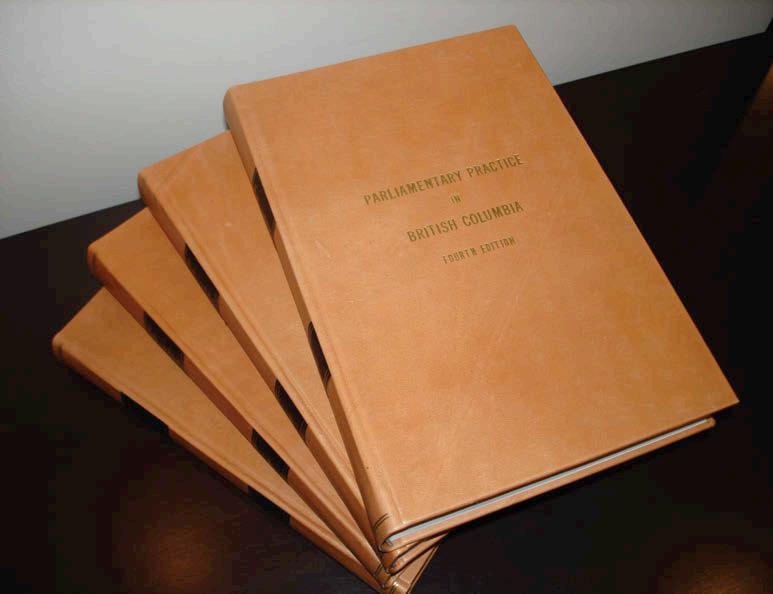
reference throughout my political career. As Government House Leader, from 1988 to 1991, I consulted the second edition on a regular basis for guidance on how to manage House business as effectively as possible.
I also recall many occasions when the book’s contents smoothly guided the daily proceedings of the House or informed the basis of my rulings as Speaker. For example, after only a few weeks in the chair, I found the test of urgency useful in deciding to rule that a transit strike did not qualify as a matter of urgent public importance under standing order 35. The book’s commentary on matters of privilege was also most helpful in formulating my rulings in this contentious area.
Having an up-to-date annotated guide to each of the 120 standing orders of the B.C. House, with a better index, will certainly be appreciated by Members,
During my tenure as Speaker from 2001 to 2005, I really came to appreciate how fortunate we are in British Columbia to have such a useful resource near at hand. As far as I know, none of the other nine provincial Legislatures in Canada have an equivalent procedural guide.
As a new Speaker, the physical
The fourth edition of Parliamentary Practice in British Columbia was published shortly before my retirement in May 2009, and I will treasure my personal copy as a memento of my cordial relationship with the author who is the longest-serving table officer in a Commonwealth parliament. I have no reservation in recommending this practical question-and-answer guide to practitioners and students of parliamentary practice as it contains solid observations and thoughtful advice.
PATRON:
H.M. Queen Elizabeth II (Head of the Commonwealth)
VICE-PATRON:
Colonel Jakaya Mrisho Kikwete (President, Tanzania)
Commonwealth Parliamentary
and Secretariat, Commonwealth Women Parliamentarians Steering Committee and Branches of Association
CPA Executive Committee
President:
Hon. Samuel John Sitta, MP (Speaker of the National Assembly, Tanzania)
Vice-President: Hon. Kenneth Marende, MP (Speaker of the National Assembly, Kenya)
Chairperson of the Executive Committee:
Hon. Mohd Shafie Apdal, MP (Minister of Rural and Regional Development, Malaysia)
Vice-Chairperson of the Executive Committee: Hon. Keith Flax, MHA (See Caribbean, Americas and Atlantic Region)
Treasurer: Hon. Hashim Abdul Halim, MLA (Speaker of the Legislative Assembly, West Begal, India
Hon. Abel Stronge, MP (Speaker of Parliament, Sierra Leone)
Hon. Elizabeth Yamie Frances Renner (Speaker of the National Assembly, The Gambia)
Hon. Mninwa Johannes Mahlangu, MP (Chairperson of the National Council of Provinces, South Africa)
Hon. Antonio Hama Thay, MP (Mozambique)
Hon. Marwick Khumalo, MP (Swaziland)
Hon. Job Yustino Ndugai, MP (Tanzania)
Hon. Ahmed Thasmeen Ali, MP (Deputy Speaker of the People’s Majlis, Maldives)
Hon. W.J.M. Lokubandara, MP (Speaker of Parliament, Sri Lanka)
Hon. Kiramatullah Khan, MP (Speaker of the Provincial Assembly, Northwest Frontier Province)
Sen. the Hon. Alan Ferguson (Deputy President of the Senate, Australia)
Hon. John Pandazopoulos, MP (Victoria)
Hon. Michael Polley, MHA (Speaker of the House of Assembly, Tasmania) (Acting)
BRITISH ISLANDS AND MEDITERRANEAN
Mr Nigel Evans, MP (United Kingdom) Mr Alun Cairns, AM (Wales)
Hon. Ernest M. Britto, MP (Minister for the Environment and Tourism, Gibraltar)
Mr Russ Hiebert, MP (Parliamentary Secretary to the Ministers of Intergovernmental Affairs and Western Economic Diversification, Canada)
Hon. Kathleen Casey, MLA (Speaker of the Legislative Assembly, Prince Edward Island)
Hon. George Hickes, MLA (Speaker of the Legislative Assembly, Manitoba)
CARIBBEAN, AMERICAS AND ATLANTIC
Hon. D. Giselle Isaac-Arrindell, MP (Speaker of the House of Representatives, Antigua and Barbuda)
Hon. Keith Flax, MHA (Deputy Speaker of the House of Assembly, British Virgin Islands)
Hon. Hari. N. Ramkarran, SCC, MP (Speaker of the National Assembly, Guyana)
INDIA
Hon. Somnath Chatterjee, MP (Speaker of the Lok Sabha, India)
Hon. Uday Narain Choudhary, MLA (Speaker of the Legislative Assembly, Bihar)
Hon. Tanka Bahadur Rai, MLA (Speaker of the Legislative Assembly, Assam)
PACIFIC
Ms Moana Mackey, MP (New Zealand)
Hon. Snyder Rini, MP (Minister for Finance and Treasury, Solomon Islands)
Hon. Dr Tetau Taitai, MP (Acting) Kiribati
SOUTH-EAST ASIA
Hon. Dato Zulhasnan Rafique, MP (Minister of Federal Territories, Malaysia)
Hon. Datuk Frankie Chong Yu
Chee, MLA (Deputy Speaker of the Legislative Assembly, Sabah)
Dr Mohamad Maliki Osman, MP (Singapore)
Ms Kashmala Tariq, MNA (Chairperson)
Dr Thomas Kashililah (Parliament of Tanzania)
ASIA
Mr Raja Muhammad Amin (Parliament of Pakistan)
Mr Andres Lomp (Parliament of the Commonwealth of Australia)
Mr Andrew Tuggey (Parliament of the United Kingdom)
Mr Paul Belisle (Parliament of Canada)
CARIBBEAN, AMERICAS & ATLANTIC
Ms Jacqui Sampson (Parliament of Trinidad and Tobago)
Shri P D.T. Achary (Parliament of India)
Mr Rafael Gonzalez-Montero (Parliament of New Zealand) SOUTH=EAST ASIA
Mrs Roosme Hamzah (Parliament of Malaysia)
PRESIDENT
TBA (Tanzania)
CHAIRPERSON
Ms Kashmala Tariq, MNA (Pakistan)
DEPUTY CHAIRPERSON and Australia
Ms Angela D’Amore, MP (New South Wales)
Hon. Moggie Mbaakanyi, MP (Botswana)
ASIA
Hon. Ferial Ashraff, MP (Sri Lanka)
BRITISH ISLANDS AND MEDITERRANEAN
Ms Kate Hoey, MP (United Kingdom)
Ms Maria Minna, MP (Canada)
CARIBBEAN, AMERICAS AND ATLANTIC
Hon. Marjorie Morton, MHA (President of the Nevis Island Assembly, St Kitts and Nevis)
Commonwealth Parliamentary Association Secretariat
Suite 700, Westminster House, 7 Millbank, London SW1P 3JA, United Kingdom
Tel: (+44-20) 7799-1460
Fax: (+44-20) 7222-6073
Email: hq.sec@cpahq.org
Secretary-General:
Dr William F. Shija
Director of Communications and Research:
Mr Andrew Imlach
Director of Administration and Finance:
Mr David Broom
Hon. Km. Selja, MP (Minister of State of the Ministry of Housing and Urban Poverty Alleviation, India)
PACIFIC
Hon. Va’aiga Tukuitoga, MP (Niue)
SOUTH-EAST ASIA
Ms Irene Ng, MP (Singapore)
ALDERNEY (www.alderney.gov.gg)
President:
Sir Norman Browse (President of the States)
Secretary and Offices: Mrs Sarah Kelly (Clerk of the States)
The Court of Alderney, Queen Elizabeth II Street, Alderney GY9 3TB
Tel: (+44) 1481-822-817
Fax: (+44) 1481-823-709
Email: alderneycourt@cwgsy.net
ANGUILLA (www.anguilla.gov.ai)
President:
Hon. David Anthony Carty, MLA (Speaker of the House of Assembly)
Vice-President: Ms Keesha C. Webster, MLA (Deputy Speaker of the House of Assembly)
Secretary and Offices: Mrs Adella Richardson (Clerk to the House of Assembly)
The Valley, Anguilla
Tel: (+1-264) 497-5081; 497-3748
Fax: (+1-264) 498-2210
Email: carmen.richardson@gov.ait
ANTIGUA AND BARBUDA (www.ab.gov.ag) (President)
Sen. the Hon. Hazelyn MasonFrancis, MBE (President of the Senate)
Secretary and Offices: Mrs Thelma Thompson (Clerk to Parliament)
Antigua and Barbuda Department of Legislature, Queen Elizabeth Highway, St Johns, Antigua and Barbuda
Tel: (+1-268) 463-4822
Fax: (+1-268) 462-6724
Email: parlment@candw.ag theltho@yahoo.com
AUSTRALIA (www.aph.gov.au)
Joint Presidents:
Sen. the Hon. John Hogg
(President of the Senate)
Hon. Harry Jenkins, MP (Speaker of the House of Representatives)
Vice-Presidents:
Hon. Kevin Rudd, MP (Prime Minister)
Hon. Malcolm Turnbull, MP (Leader of the Opposition)
Secretary and Offices: Mr Ian Harris, AO (Clerk of the House)
c/o Parliamentary Relations Office
Parliament House, Canberra, A.C.T.
2600
Tel: (+61-2) 6277 4340
Fax: (+61-2) 6277 2000
Email: PRO@aph.gov.au
STATE AND TERRITORIAL PARLIAMENTS OF AUSTRALIA
AUSTRALIAN CAPITAL TERRITORY
(www.parliament.act.gov.au)
President:
Mr Wayne Berry, MLA (Speaker of the Legislative Assembly)
Vice-Presidents:
Mr Jon Stanhope, MLA (Chief Minister)
Mr Bill Stefaniak, MLA (Leader of the Opposition)
Secretary and Offices:
Mr Tom Duncan (Clerk of the Legislative Assembly)
A.C.T. Legislative Assembly, Civic Square, London Circuit, Canberra
A.C.T. 2600, Australia. Tel: (+612) 6205-0191
Fax: (+612) 6205-3109
Email: tom.duncan@parliament.act.gov.au
NEW SOUTH WALES (Australia) (www.parliament.nsw.gov.au)
Joint Presidents:
Hon. Peter Primrose, MLC (President of the Legislative Council)
Hon. Richard Torbay, MP (President of the Legislative Assembly) Vice-Presidents:
Hon: Nathan Rees, MP (President of the Legislative Council)
Mr Barry O’Farrell, MP (Leader of the Opposition)
Secretary and Offices: Mr Russell D. Grove, PSM (Clerk of the Legislative Assembly)
Parliament House, Sydney, 2000, New South Wales, Australia
Tel: (61-2) 9230 2222
Fax: (61-2) 9230 2333/2812
Email:
russell.grove@parliament.nsw.gov.au
NORFOLK ISLAND (Australia) (www.norfolk.gov.nf)
President:
Hon. Lisle Denis Snell, MLA (Speaker)
Vice-President:
Mr Timothy John Sheridan, MLA (Deputy Speaker)
Secretary and Offices:
Ms Robin Eleanor Adams, JP (Clerk to the Legislative Assembly)
Old Military Barracks, Kingston, Norfolk Island 2899, via Australia, South Pacific
Tel: (+672-3) 22003
Fax: (+672-3) 22624
Email: clerk@assembly.gov.nf
NORTHERN TERRITORY (Australia) (www.nt.gov.au/lant)
Vice-Presidents:
Hon. Paul Henderson, MLA (Chief Minister)
Hon. Terry Mills, MLA (Leader of the Opposition)
Secretary and Offices: Mr Ian McNeill
(Clerk of the Legislative Assembly)
G.P.O. Box 3721, Darwin NT 0801, Australia
Tel: (+61-8) 8946-1450
Fax: (+61-8) 8941-2567
Email: ian.mcneill@nt.gov.au
QUEENSLAND (Australia) (www.parliament.qld.gov.au)
President:
Hon. Mike Reynolds, MP (Speaker of the Legislative Assembly)
Vice-Presidents:
Hon. Anna Bligh, MP (Premier)
Mr Lawrence Springborg MP (Leader of the Opposition)
Secretary and Offices: Mr Neil Laurie (Clerk of the Parliament)
Ms Leanne Clare (Assistant Honorary Secretary)
Parliament House, Brisbane 4000, Queensland, Australia
Tel: (+61-7) 340 67185
Fax: (+61-7) 322 17475
Email: neil.laurie@parliament.qld.gov.au
SOUTH AUSTRALIA (Australia) (www.parliament.sa.gov.au)
Joint Presidents:
Hon. Jack Snelling, MP (Speaker of the Legislative Assembly)
Hon. Bob Sneath, MLC (President of the Legislative Council)
Vice-Presidents:
Hon. Mike Rann, MP (Premier)
Hon. Martin Hamilton-Smith, MP
(Leader of the Opposition)
Secretary and Offices: Mrs Jan Davis, AM (Clerk of the Legislative Council) Parliament House, Adelaide 5000, Australia.
Tel.: (+61-8) 8237-9301
Fax: (+61-8) 8211 7658
Email: jan.davis@parliament.sa.gov.au
TASMANIA (Australia) (www.parliament.tas.gov.au)
President:
Hon. Lin Thorp MLC
Senior Vice-President:
Hon. Sue Napier, MHA (Minister for Infrastructure)
Junior Vice-President:
Hon. Greg Hall, MLC
Secretary and Offices:
Mr Peter Bennison (Deputy Clerk of the House of Assembly)
Parliament House, Hobart, Tasmania 7000, Australia.
Tel: (+61-3) 6233 2211
Fax: (+61-3) 6233 6266
Email: peter.bennison@parliament.tas.gov.au
VICTORIA (Australia) (www.parliament.wa.gov.au)
Joint Presidents:
Hon. Grant Woodhams, MLA (President of the Legislative Council)
Hon. Jenny M. Lindell, MP (Speaker of the Legislative Assembly)
Vice-Presidents:
Hon. John Brumby, MP (Premier)
Mr Ted Baillieu, MP (Leader of the Opposition in the Legislative Assembly)
Mr John Lenders, MLC (Leader of the Government in the Legislative Council)
Joint Secretaries and Offices:
Mr Ray W. Purdey (Clerk of the Parliaments and Clerk of the Legislative Assembly)
Mr Wayne R. Tunnecliffe (Clerk of the Legislative Council) Parliament House, Melbourne,Victoria 3002, Australia. Tel: (+61-3) 9651 8911, 9651 8550
Fax: (+61-3) 9650 4279
Email: cpabranch@parliament.vic.gov.au
WESTERN AUSTRALIA (www.parliament.wa.gov.au)
Joint Presidents:
Hon. Barry House, MLC (President of the Legislative Council)
Hon. Grant Woodhams, MLA (Speaker of the Legislative Assembly)
Vice-Presidents:
Hon. Colin Barnett, MLA (Premier)
Hon. Eric Ripper, MLA
(Leader of the Opposition)
Hon. Sue Ellery, MLC (Leader of the Opposition in the Legislative Council)
Mr Peter McHugh
(Clerk of the Legislative Assembly) Parliament House, Harvest Terrace, Perth 6000, Western Australia, Australia
Tel.: (+61-8) 9222-7215
Fax: (+61-8) 9222-7818
Email: cpawa@parliament.wa.gov.au
THE BAHAMAS
(www.bahamas.gov.bs)
Joint Presidents:
Sen. the Hon. Lynn Holowesko (President of the Senate)
Hon. Alvin Smith, MP (Speaker of the House of Assembly)
Vice-Presidents:
Rt Hon. Hubert Alexander Ingraham, MP (Prime Minister)
Hon. Perry G Christie, MP (Leader of the Opposition)
Secretary and Offices: Mr MauriceTynes (Clerk to the Legislature) House of Assembly, P.O. Box N3003, Nassau, The Bahamas.
Tel: (+1-242-32) 22041
Fax: (+1-242-32) 21118
Email: houseofassembly@bahamas.gov.bs
BANGLADESH
(www.parliamentofbangladesh.org)
President:
Hon. Abdul Hamid (Speaker of Parliament)
Vice-President:
Hon. Shawkat Ali, MP (Deputy Speaker of Parliament)
Secretary and Offices: Mr Ashfaq Hamid (Branch Secretary)
Bangladesh Parliament, Parliament House, Sher-e-Bangla, Nagar, Dhaka 1207, Bangladesh.
Tel: (+880-2) 811-1600, 811-14
Fax: (+880-2) 811-2267, 912-22
Email: sangshod@citechco.net
BARBADOS
(www.barbadosparliament.com)
Joint Presidents:
Sen. the Hon. Branford Taitt (President of the Senate)
Hon. Michael Carrington, MP (Speaker of the House of Assembly)
Vice-Presidents:
Hon. David J.H. Thompson, MP (Prime Minister)
Hon. Mia Mottley, MP (Leader of the Opposition)
Joint Secretaries and Offices:
Mr Pedro E. Eastmond (Acting Clerk of Parliament)
Mr Nigel R. Jones (Deputy Clerk of Parliament)
Parliament Buildings, Bridgetown, Barbados.
Tel: (+1-246) 4263717, 4263712
Fax: (+1-246) 4364143
Email: parliamentbarbados@caribsurf. com
BELIZE (www.governmentofbelize.gov.bz)
Joint Presidents:
Hon. Andrea Gill (President of the Senate)
Hon. Emil Arguelles, MHR (Speaker of the House of Representatives)
Vice-President:
Hon. John Briceño (Leader of the Opposition)
Secretary and Offices: Mr Herbert C. Panton (Clerk of the National Assembly) PO Box 139, Belmopan, Cayo District, Belize, Central America. Tel.: (+501-8) 222141, 222142, 222144
Fax: (+501-8) 223889
Email: clerkna@bna.gov.bz
BERMUDA (www.gov.bm)
Joint Presidents:
Sen. Mrs Carol A.M. Bassett, JP (President of the Senate)
Hon. Stanley Lowe, OBE, JP, MP (Speaker of the House of Assembly)
Vice-Presidents:
Hon. Ewart Brown, JP, MP (Premier)
Mr H. Kim E. Swan, JP, MP (Leader of the Opposition)
Secretary and Offices: Ms Shernette Wolffe (Clerk to the Legislature)
Sessions House, 21 Parliament Street, Hamilton HM12, Bermuda. Tel.: (+1-441-2) 927408
Fax: (+1-441-2) 922006
Email: smwolffe@gov.bm
BOTSWANA (www.gov.bw)
President: Hon. Patrick Balopi, MP (Speaker of the National Assembly)
Vice-Presidents:
H.E. Dr Festus G. Mogae, MP (President of the Republic)
Hon. Otsweletse Moupo, MP (Leader of the Opposition)
Secretary and Offices: Mr Ernest Sipho Mpofu (Clerk of the National Assembly) P.O. Box 240,Gaborone, Botswana Tel.: (+267) 361-6800
Fax: (+267) 391-3103, 391-4376 Email: parliament@gov.bw
BRITISH VIRGIN ISLANDS (www.dpu.gov.vg)
President: Hon. Roy Harrigan, MHA (Speaker of the House of Assembly)
Vice-Presidents:
Hon. Ralph T. O'Neal, OBE, MHA (Branch Vice-President)
Dr the Hon. D. Orlando Smith OBE, MHA (Leader of the Opposition)
Secretary and Offices: Ms Phyllis Evans (Clerk of the House of Assembly)
Office of the Clerk, Richard G. Stoutt Building, Road Town, Tortola, British Virgin Islands
Tel.: (+1-284) 494-4757/8
Fax: (+1-284) 494-4544
E-mail: almccall@gov.vg
CAMEROON (www.assemblee-nationale.cm)
President:
Hon. Djibril Cavaye Yeguie, MP (Speaker of the National Assembly)
Vice-president:
Hon. Joseph Mbah-Ndam, MP (Leader of the Opposition)
Secretary and Offices: Mr Aatsa Atogho (Branch Secretary)
National Assembly, Yaounde, Cameroon.
Tel: (+237) 7771-0077, 77777247
Fax: (+237) 2222-3869, 22220979
Email: ancm@cm.refer.org
PARLIAMENT OF CANADA (www.parl.gc.ca)
Joint Presidents:
Sen. the Hon. Noel Kinsella (Speaker of the Senate)
Hon. Peter Milliken, MP (Speaker of the House of Commons)
Vice-Presidents:
Rt Hon. Stephen Harper, PC, MP (Prime Minister)
Mr Michael Ignatieff, MP (Leader of the Official Opposition) Chair:
Mr Russ Hiebert, MP
Executive Secretary and Offices: Ms Stephanie Bond
5th Floor, 131 Queen Street, Houses of Parliament, Ottawa, Ontario, Canada K1A 0A6
Tel.: (+1-613) 993-0330
Fax: (+1-613) 995-0212
Email: cpa@parl.gc.ca
PROVINCIAL AND TERRITORIAL PARLIAMENTS OF CANADA
ALBERTA (Canada) (www.assembly.ab.ca)
President: Hon. Ken Kowalski, MLA (Speaker of the Legislative Assembly)
Vice-Presidents:
Hon. Ed Stelmach (Premier)
Dr. David Swann (Leader of the Official Opposition)
Secretary and Offices: Dr W.J. David McNeil (Clerk of the Legislative Assembly) 801 Legislature Annex, 9718-107 Street, Edmonton, Alberta, Canada T5K 1E4.
Tel: (+1-780) 427-2478
Fax: (+1-780) 427-5688 (Clerk’s Office) or (+1-780) 422-9553 (Speaker’s Office)
Email: david.mcneil@assembly.ab.ca
BRITISH COLUMBIA (Canada) (www.leg.bc.ca)
President:
Hon. Bill Barisoff, MLA (Speaker of the Legislative Assembly)
Vice-Presidents:
Hon. Gordon Campbell, MLA (Premier)
Ms Carole James, MLA (Leader of the Opposition)
Honorary Secretary and Offices:
Mr E. George MacMinn, QC (Clerk of the Legislative Assembly) Room 221, Parliament Buildings,Victoria, British Columbia, Canada V8V lX4.
Tel: (+ 1-250) 387 3785
Fax: (+1-250) 387 0942
Email: clerkhouse@leg.bc.ca
MANITOBA (Canada) (www.gov.mb.ca/legislature)
President:
Hon. George Hickes, MLA (Speaker of the Legislative Assembly)
Vice-Presidents:
Hon. Gary Doer, MLA (Premier)
Mr Hugh McFadyen, MLA (Leader of the Opposition)
Secretary and Offices:
Ms Patricia Chaychuk (Clerk of the Legislative Assembly) 237 Legislative Building, 450 Broadway, Winnipeg, Manitoba, Canada R3C 0V8.
Tel: (+1 204) 945 3636
Fax: (+1 204) 948 2507
Email: patricia.chaychuk@leg.gov.mb.ca
NEW BRUNSWICK (Canada) (www.gov.nb.ca/legis/)
President:
Hon. Roy Boudreau, MLA (Speaker of the Legislative Assembly)
Vice-President:
Hon. Shawn Graham, MLA (Premier)
Secretary and Offices: Mrs Loredana Catalli Sonier (Clerk of the Legislative Assembly) Parliament Buildings, P.O. Box 6000, Fredericton, New Brunswick, Canada E3B 5H1.
Tel: (+1-506) 453 2506
Fax: (+1-506) 453 7154
Email: l.catalli.sonier@gnb.ca
NEWFOUNDLAND AND LABRADOR (Canada) (www.gov.nl.ca)
President:
Hon. Roger Fitzgerald, MHA (Speaker of the House of Assembly)
Vice-Presidents: Hon. Danny Willams, QC, MHA (Premier)
Ms Yvonne Jones, MHA (Leader of the Opposition)
Secretary and Offices: Mr William MacKenzie (Clerk of the House of Assembly) House of Assembly, Confederation Building, P.O. Box 8700, St John's, Newfoundland and Labrador, Canada A1B 4J6.
Tel.: (+1-709) 729-3405 / 7292579
Fax: (+1-709) 729-4820
Email: williammackenzie@gov.nl.ca
TERRITORIES (Canada)
(www.assembly.gov.nt.ca)
President: Hon. Paul Delorey, MLA (Speaker of the Legislative Assembly)
Secretary and Offices:
Mr Tim Mercer (Clerk of the Legislative Assembly) Legislative Assembly of the NWT, P.O. Box 1320,Yellowknife, Northwest Territories, Canada X1A 2L9.
Tel: (+1-867) 669 2299
Fax: (+1-867) 873 0432
Email: tim_mercer@gov.nt.ca
NOVA SCOTIA (Canada) (www.gov.ns.ca)
President:
Hon. Charlie Parker, MLA (Speaker of the House of Assembly)
Vice-President:
Hon. Darrell Dexter, MLA (Premier)
Secretary and Offices: Mr Roderick K. MacArthur (Clerk of the House of Assembly) P.O. Box 1617, Province House, Halifax, Nova Scotia, Canada B3J 2Y3.
Tel: (+1-902) 424 5978
Fax: (+1-902) 424 0632
Email: macartrk@gov.ns.ca
NUNAVUT (Canada) (www.assembly.nu.ca)
President: Hon. James Arreak, MLA (Speaker of the Legislative Assembly)
Secretary and Offices: Mr John Quirke (Clerk of the Assembly) PO Box 1200, Iqaluit, Nunavut, X0A 0H0, Canada.
Tel.: (+1-867) 975-5100
Fax: (+1-867) 975-5191
Email: jquirke@assembly.nu.ca
ONTARIO (Canada) (www.ontla.on.ca)
President: Hon. Steve Peters, MPP (Speaker of the Legislative Assembly)
Vice-President: Hon. Dalton McGuinty, MPP (Premier)
Secretary and Offices: Mrs Deborah Deller (Clerk of the Legislative Assembly) Room 104, Main Legislative
Building, Queen’s Park, Toronto, Ontario, Canada M7A 1A2.
Tel.: (+1-416) 325-7341
Fax: (+1-416) 325-7344
Email: clerks_office@ontla.ola.org
PRINCE EDWARD ISLAND (Canada) (www.assembly.pe.ca)
President:
Hon. Kathleen Casey, MLA (Speaker of the Legislative Assembly)
Vice-Presidents:
Hon. Robert Ghiz, MLA (Premier)
Hon. Olive Crane, MLA (Leader of the Opposition)
Secretary and Offices:
Mr Charles H. MacKay (Clerk of the Legislative Assembly)
P.O. Box 2000, Charlottetown, Prince Edward Island, Canada C1A 7N8.
Tel: (+1-902) 368 5970
Fax: (+1-902) 368 5175
Email: chmackay@gov.pe.ca
QUEBEC (Canada) (www.assnat.qc.ca)
Joint Presidents:
Mr. Yvon Vallières, MNA (President of the National Assembly)
Ms Fatima Houda-Pepin, MNA (Vice-President of the National Assembly)
Secretary and Offices: Mr Richard Daignault Assemblée nationale du Québec, Direction des relations interparlementaires et internationales, Edifice JeanAntoine-Panet, 1020 rue des Parlementaires, 6e étage, Bureau 6.65, Québec G1A 1A3, Canada Tel: (+1-418) 643 7391 Fax: (+1-418) 643 1865
Email: rdaignault@assnat.qc.ca
SASKATCHEWAN (Canada) (www.legassembly.sk.ca)
President:
Hon. Don Toth, MLA (Speaker of the Legislative Assembly) Vice-President:
Mr Greg Brkich, MLA (Deputy Speaker)
Secretary and Offices: Mr Gregory Putz
(Clerk of the Legislative Assembly) 239 Legislative Building, Regina, Saskatchewan, Canada S4S OB3. Tel: (+1-306) 787-2335
Fax: (+1-306) 787 0408
Email: cpa@legassembly.sk.ca
YUKON (Canada) (www.legassembly.gov.yk.ca)
Joint Presidents:
Hon. Ted Staffen, MLA (Speaker of the Legislative Assembly)
Vice-Presidents:
Hon. Dennis Fentie, MLA (Premier)
Vice-President:
Hon. Arthur Mitchell, MLA (Leader of the Official Opposition)
Secretary and Offices:
Dr Floyd McCormick (Clerk of the Legislative Assembly) Yukon Legislative Assembly, Box 2703, Whitehorse, Yukon, Canada Y1A 2C6.
Tel: (+1-867) 667 5498
Fax: (+1-867) 393 6280
Email: clerk@gov.yk.ca
CAYMAN ISLANDS (www.gov.ky)
Joint Presidents:
Hon. Mary Lawrence, JP (Speaker of the Legislative Assembly)
Hon. W. McKeeva Bush, OBE, JP, MLA (Leader of the Government)
Vice-President:
Ms Zena Merren-Chin (Leader of the Opposition)
Secretary and Offices: Ms Wendy Lauer (Clerk of the Legislative Assembly)
P.O. Box 890 GT, Grand Cayman, Cayman Islands.
Tel: (+1-345) 949-4236/8
Fax: (+1-345) 949-9514
Email: wendy.lauer@gov.ky
COOK ISLANDS
(www.cook-islands.gov.ck)
President:
Hon. Norman George, MP (Speaker of Parliament)
Vice-President:
Hon. Jim Marurai, MP (Prime Minister)
Secretary and Offices: Mr Nga Valoa (Clerk of Parliament)
Office of the Legislative Service, Parliament of the Cook Islands, P.O. Box 13, Rarotonga, Cook Islands.
Tel: (+682) 26500, 26507
Fax: (+682) 21260
Email: nvaloa@oyster.net.ck nvaloa@parliament.gov.ck
CYPRUS
(www.parliament.cy)
President:
H.E. Mr Marios Karoyian, MP (President of the House of Representatives)
Vice-Presidents:
Mr Aristophanis Georgiou, MP
Mr Christos Pourgourides, MP
Mr Sofocles Fittis, MP
Dr Eleni Theocharous, MP
Secretary and Offices: Mr Socrates Socratous (Secretary-General of the House of Representatives)
House of Representatives, Homer Ave., 1402 Nicosia, Cyprus.
Tel.: (+357-22) 407-304, 407-310
Fax: (+357-22) 668-611
Email: international-relations@ parliament.cy
DOMINICA
(www.dominica.gov.dm)
President:
Hon. Alix Boyd Knights, MHA (Speaker of the House of Assembly)
Vice-President: Hon. Roosevelt Skerrit, MHA (Prime Minister)
Hon. Ron Green (Leader of the Opposition)
Secretary and Offices: Mrs Deirdre Jules (Acting Clerk of the House of Assembly)
House of Assembly, Victoria Street, Roseau, Dominica, West Indies. Tel: (+1-767-44) 82401 Ext. 3102, 3291
Fax: (+1-767-44) 98353
Email: houseofassembly@cwdom.dm
FALKLAND ISLANDS (www.falklands.gov.fk/legco)
President: Hon. Lewis Clifton, MLC (Speaker of the Legislative Council)
Secretary and Offices: Ms Claudette Anderson-Prior, MBE (Clerk of Councils)
Gilbert House, Stanley, Falkland Islands.
Tel: (+500) 27451
Fax: (+500) 27456
Email: canderson@sec.gov.fk
FIJI ISLANDS
Branch in abeyance
GAMBIA (www.gambia.gm)
President: Hon. Elizabeth Yamie Frances Renner (Speaker of the House of Representatives)
Secretary and Offices: Mr Momodou Sise (Acting Clerk of the House of Representatives)
Legislative Department, Parliament Buildings, Independence Drive, Banjul, The Gambia.
Tel.: (+220) 422-7241, 422-6643, 422-2352
Fax: (+220) 422-5123
Email: assembly.clerk@yahoo.co.uk
GHANA (www.parliament.gh)
President:
Rt Hon. Ebenezer Begyina Sekyi Hughes, MP (Speaker of Parliament)
Secretary and Offices: Mr Emmanuel Anyimadu (Branch Secretary)
Parliament House, Victoriaborg,
Accra, Ghana.
Tel.: (+233) 21-664-042, 21-665957
Fax: (+233) 21-662-084
Email: clerk@parliament.gh
GIBRALTAR (www.gibraltar.gov.gi)
President:
Hon. Haresh K. Budhrani, QC, MP (Speaker of Parliament)
Vice-President:
Hon. Peter Caruana, QC, MP (Chief Minister)
Secretary and Offices: Mr Melvyn L. Farrell, RD (Clerk to Parliament)
Parliament, 156 Main St, Gibraltar. Tel.: (+350) 200-78420, 20074186
Fax: (+350) 200-42849
Email: parliament@gibtelecom.net
GRENADA (www.gov.gd)
Joint Presidents:
Sen. the Hon. Joan Purcell (President of the Senate)
Hon. George McGuire, MP (Speaker of the House of Representatives)
Vice-Presidents:
Dr the Hon. Keith Mitchell, MP (Leader of the Opposition)
Hon. Tillman Thomas, MP (Prime Minister)
Secretary and Offices: Mr Adrian C. A. Hayes (Clerk of Parliament)
Houses of Parliament, P.O. Box 315, Church Street, St George's, Grenada, West Indies.
Tel.: (+1-473) 440-2090, 4403456
Fax: (+l-473) 440-4138
Email: adrian.hayes@gov.gd
GUERNSEY (www.gov.gg)
President:
Mr Geoffrey R. Rowland (Bailiff of Guernsey and President of the States)
Vice-Presidents:
Mr Richard J.Collas (Deputy Bailiff of Guernsey and Deputy President of the States)
Dep. Michael Torode (Chief Minister)
Secretary and Offices: Mr Kenneth H. Tough (H.M. Greffier)
Greffe, Royal Court House, Guernsey, Channel Islands, GYI 2PB.
Tel: (+44-1481) 725277
Fax: (+44-1481) 715097
Email: hm.greffier@gov.gg
GUYANA
(www.parliament.gov.gy)
President:
Hon. Hari N. Ramkarran, MP (Speaker of the National Assembly)
Vice-Presidents:
Hon. Samuel A. A. Hinds, MP (Prime Minister)
Hon. Robert Corbin, MP (Acting Leader of the Opposition)
Secretary and Offices:
Mr Sherlock Isaacs (Clerk of the National Assembly)
Parliament of Guyana, Parliament Office, Public Buildings, Brickdam, Georgetown, Guyana.
Tel: (+592) 226-1465, 226-8456
Fax: (+592) 225 1357
(Parliament Office)
Email: parlib@guyana.net.gy
INDIA
(www.parliamentofindia.nic.in)
President:
Hon. Somnath Chatterjee, MP (Speaker of the Lok Sabha)
Vice-Presidents:
Hon. K. Rahman Khan, MP (Deputy Chairman of the Rajya Sabha)
Shri Charnjit Singh Atwal, MP (Deputy Speaker of the Lok Sabha)
Secretary and Offices:
Shri P.D.T Achary
(Secretary-General of the Lok Sabha)
Room 18, Parliament House, New Delhi 110 001, India.
Tel.: (+91-11) 2301-7465, 23034255, 2303-4567
Room 103, Parliament House Annexe, New Delhi 110 001, India. Tel.: (+91-11) 2301-6987, 23034141
Fax: (+91-11) 2301-7465, 23015518
Email: cpaindia@sansad.nic.in
STATE LEGISLATURES OF INDIA
ANDHRA PRADESH (India) (www.nic.in/aplegis)
Joint Presidents: Hon. Kethireddy Suresh Reddy, MLA (Speaker of the Legislative Assembly)
Hon. Dr A Chakrapani, MLC (Chairman of the Legislative Council)
Vice-President: Hon. Rajasekhara Reddy, MLA (Chief Minister)
Secretary and Offices: Sri K. Tuljanand Singh (Secretary to the Legislature) Andhra Pradesh Legislative Assembly, Public Gardens, Hyderabad 500 004, Andhra Pradesh, India.
Tel: (+91-40) 2323-2072
Fax: (+91-40) 2321-0408
Email: seclegis@ap.nic.in
ARUNACHAL PRADESH (India) (www.arunachalpradesh.nic.in)
President: Hon. Setong Sena, MLA (Speaker of the Legislative Assembly)
Secretary and Offices: Shri C.P. Mansai (Secretary of the Legislative Assembly)
Naharlagun-791110, Arunachal Pradesh, India. Tel: (+91-360) 244-346 Fax: (+91-360) 244-305
ASSAM (India) (www.assamassembly.nic.in)
President: Hon. Tanka Bahadur Rai, MLA (Speaker of the Legislative Assembly)
Vice-President:
Hon. Tarun Gogoi, MLA (Chief Minister and Leader of the House)
Secretary and Offices: Shri Gauranga Prasad Das (Secretary of the Legislative Assembly)
Dispur, Guwahati, 781006, Assam, India.
Tel.: (+91-361) 261-1113, 2261766
Fax: (+91-361) 226-2225
Email: assamlegislative@sify.com
BIHAR (India) (www.bihar.nic.in)
President: Hon. Uday Narayan Choudhary, MLA (Speaker of the Legislative Assembly)
Vice-Presidents: Prof. Arun Kumar, MLC (Chairman of the Legislative Council)
Hon. Nitish Kumar, MLC (Chief Minister)
Secretary and Offices: Shri Surendra Prasad Sharma (Secretary of the Legislative Assembly)
Bihar Legislative Assembly Secretariat, Patna 800015, Bihar, India.
Tel.: (+91-612) 222-3840
Fax: (+91-612) 223-2212
CHHATTISGARH (India) (www.cgvidhansabha.gov.in)
President:
Hon. Shri Dharam Lal Kaushik (Speaker)
Secretary and Offices: Shri Devendra Verma (Clerk to Parliament)
Chhattisgarh Legislative Assembly, Baloda Bazar Road, Raipur 492 005, India
Tel.: (+91-771) 228-3615, 2283616
Fax: (+91-771) 228-3615, 228-
3788
Email: secycgvs@rediffmail.com
DELHI (India) (www.delhigovt.nic.in)
President:
Hon. Ch. Prem Singh MLA (Speaker of the Legislative Assembly)
Vice-President:
Smt. Kiran Choudhary (Deputy Speaker of the Legislative Assembly)
Secretary and Offices: Shri Siddarath Rao (Secretary of the Legislative Assembly)
Delhi Legislative Assembly, Old Secretariat, Delhi-110054, India.
Tel.: (+91-11) 2389-0007, 23890109
Fax: (+91-11) 2389-0128
GOA (India) (www.goagovt.nic.in)
President: Hon. Pratapsingh Rane, MLA (Speaker of the Legislative Assembly)
Vice-President:
Shri Mauvin Godinho, MLA (Deputy Speaker of the Legislative Assembly)
Secretary and Offices: Shri T.N. Dhruva Kumar (Secretary of the Legislative Assembly)
Goa Legislative Assembly Secretariat, Porvorim, Goa 403521, India.
Tel.: (+91-832) 241-0915, 2410917
Fax: (+91-832) 241-1054, 2411024, 241-1066
Email: goaassembly@dataone.in
GUJARAT (India) (www.gujaratindia.com)
President:
Hon. Ashok Bhatt, MLA (Speaker of the Legislative Assembly)
Vice-President:
Hon. Narendra D. Modi, MLA (Chief Minister)
Hon. Shaktisinhji H. Gohil, MLA (Leader of the Opposition)
Secretary and Offices:
Shri D.M. Patel (Secretary of the Legislature Secretariat)
Legislature Secretariat, Vitthalbhai Patel Bhavan, Gandhinagar 382 010, Gujarat, India.
Tel.: (+91-79) 2322-0998; 23253076
Fax: (+91-79) 2322-0902
Email: assembly@gujarat.gov.in
HARYANA (India) (http://haryana.gov.in)
President:
Hon. Dr Raghuvir Singh Kadian, MLA
(Speaker of the Legislative Assembly)
Secretary and Offices: Shri Sumit Kumar (Secretary of the Legislative Assembly)
Haryana Legislative Assembly Secretariat, Sector 1, Haryana 16 0001, Chandigarh, India. Tel.: (+91-172) 2740-785, 2740030
Fax: (+91-172) 2740-430, 2747075
HIMACHAL PRADESH (India) (www.hpvidhansabha.nic.in)
President:
Hon. Gangu Ram Mussafir, MLA (Speaker of the Legislative Assembly)
Vice-Presidents:
Hon. Virbhadra Singh, MLA (Chief Minister)
Hon. Prem Kumar Dhumal, MLA (Leader of the Opposition)
Secretary and Offices: Shri Goverdhan Singh (Secretary of the Legislature)
Himachal Pradesh Vidhan Sabha Secretariat, Council Chamber, Shimla 171004, Himachal Pradesh, India.
Tel.: (+91-177) 280-3086, 2658164, 265-6424
Fax: (+91-177) 281-1151, 2652949
Email: visabha@hp.nic.in
JAMMU AND KASHMIR (India) (www.jammuandkashmirstate legislature.org)
President:
Hon. Tara Chand, MLA (Speaker of the Legislative Assembly)
Vice-President:
Hon. Abdul Rashid Dar, MLC (Chairman of the Legislative Council)
Secretary and Offices: Mr M. Iqbal Ganai (Secretary of the Legislative Assembly)
Legislative Assembly Secretariat, Srinagar, Jammu and Kashmir State, India. Tel.: (+91-194) 247-9969 (Srinagar); (+91-191) 254-2031 (Jammu)
Fax: (+91-194) 247-7738 / 2479666 (Srinagar); (+91-191) 2570344 (Jammu)
Email: a.r.salmani@rediffmail.com/ ardar@rediffmail.com
JHARKHAND (India)
President:
Hon. Inder Singh Namdhari (Speaker of the Legislative Assembly)
Vice-Presidents: Hon. Arjun Munda, MLA (Chief Minister)
Hon. Stephen Marandi, MLA (Leader of the Opposition)
Secretary and Offices: Sri Amar Nath Jha (Secretary-in-charge, Legislative Assembly)
Jharkhand Legislative Assembly, Dhurwa, Ranchi, Jharkhand, India. Tel.: (+91-651) 244-0200 Fax: (+91-651) 244-0025
KARNATAKA (India)
(www.kar.nic.in/kla)
Joint Presidents: Hon. Jagadish Shettar, MLA (Speaker of the Legislative Assembly)
Hon. Veeranna Mattikatti, MLC
(Chairman of the Legislative Council)
Vice-Presidents:
Hon. B.S Yediyurappa, MLA (Leader of the House, Legislative Assembly)
Hon. Dr V.S Acharya, MLC (Leader of the House, Legislative Council
Hon. Mallikarjun M. Kharge, MLA (Leader of the Opposition, Legislative Assembly)
Hon. V.S Ugrappa, MLC (Leader of the Opposition, Legislative Council
Secretary and Offices: Shri S.B Patil
(Principal Secretary of the Legislative Assembly)
Karnataka Legislative Assembly Secretariat, PB No 5074, Room 228, 2nd Floor,Vidhana Soudha, Bangalore 560 332, Karnataka, India.
Tel.: (+91-80) 2225-0702, 22033471
Fax: (+91-80) 2225-8301, 22258171
Email: speaker-kla-kar@nic.in
KERALA (India) (www.niyamasabha.org)
President:
Hon. K. Radhakrishnan, MLA (Speaker of the Legislative Assembly)
Vice-Presidents:
Hon. V.S. Achuthanandan, MLA (Chief Minister)
Hon. Oommen Chandy, MLA (Leader of the Opposition)
Secretary and Offices: Shri P.D. Rajan (Secretary of the Legislative Assembly)
Kerala Legislative Assembly, Thiruvananthapuram, Kerala 695 033, India.
Tel.: (+91-471) 2512-002, 2513006, 2305-834; Speaker 2513007, 2308-890, 2305-830
Fax: (+91-471) 2305-891; Speaker 2512-131
Email:
secretary@niyamasabha.org
MADHYA PRADESH (India) (www.mp.nic.in)
President:
Hon. Ishwaras Rohani, MLA (Speaker of the Legislative Assembly)
Vice-President:
Hon. Shivraj Singh Chouhan, MLA (Chief Minister)
Secretary and offices: Dr A.K. Payasi
(Principal Secretary of the Legislative Assembly)
Madhya Pradesh Legislative Assembly, Bhopal 462 004, Madhya Pradesh, India.
Tel.: (+91-755) 244-0206
Fax: (+91-755) 244-0238
Email: vidhansabha@mp.nic.in
MAHARASHTRA (India) (www.maharashtra.gov.in)
Joint Presidents:
Hon. Shivajirao Deshmukh, MLC (Chairman of the Legislative Council)
Hon. Babasaheb Kupekar, MLA (Speaker of the Legislative Assembly)
Vice-Presidents:
Hon. Ashok Chavan, MLA (Chief Minister)
Hon. Ramdas Kadam (Leader of the Opposition, Legislative Assembly)
Hon. Pandurang Fundkar, MLC (Leader of the Opposition, Legislative Council)
Hon. Dattaji Nalawade, MLA
Hon. Harshvardhan Patil,MLA (Minister of Parliamentary Affairs)
Secretary and Offices: Shri A.N. Kalse
(Principal Secretary of the Legislative Assembly and Legislative Council)
Room 802, 8th Floor, Maharashtra Legislature Secretariat, Vidhan Bhavan, Mumbai 400 032, Maharashtra, India.
Tel.: (+91-22) 2282-0820, 22027399
Fax: (+91-22) 2202-4524, 22820820
Email: mls_mumbai@rediffmail.com
MANIPUR (India) (www.manipurassembly.gov.in)
President:
Hon. Dr Sapam Budhichandra Singh, MLA (Speaker of the Legislative Assembly)
Vice-Presidents:
Hon. Okram Ibobi Singh, MLA (Chief Minister and Leader of the House)
Treasurer:
Secretary and Offices:
Shri Th. Megha Raj Singh
Manipur Branch Secretariat, Imphal 79500I, Manipur, India.
Tel.: (+91-385) 245-0239
Fax: (+91-385) 245-1193, 2450253
Email: man-assembly@man.nic.in
MEGHALAYA (India) (www.meghalaya.nic.in)
President: Mr Charles Pyngrope, MLA (Speaker of the Legislative Assembly)
Vice-President: Shri Sanbor Shullai (Deputy Speaker of the Legislative Assembly)
Secretary and Offices: Smt. W.M. Rymbai (Secretary of the Legislative Assembly)
Meghalaya Legislative Assembly, Mahatma Gandhi Road, Shillong 793001, Meghalaya, India.
Tel.: (+91-364) 222-3878, 2224267
Fax: (+91-364) 221-0157
MIZORAM (India) (www.mizoram.nic.in)
President:
Hon. Lalchamliana, MLA (Speaker of the Legislative Assembly)
Vice-Presidents: Hon. Zoramthanga, MLA
(Leader of the House)
Hon. Lal Thanhawla, MLA (Leader of the Opposition)
Secretary and Offices: Mr Ngurthanzuala (Secretary)
Mizoram Legislative Assembly Secretariat, P.O. Aizawl, Mizoram, India.
Tel.: (+91-389) 232-2250, 2325733, 232-3608
Fax: (+91-389) 232-3207
Email: secymzmla@alpha.nic.in
NAGALAND (India) (www.nagaland.nic.in)
President:
Hon. Kiyanilie Peseyie, MLA (Speaker of the House of Representatives)
Vice-Presidents: Hon. Neiphiu Rio, MLA (Chief Minister)
Hon. Imkong, MLA (Leader of the Opposition)
Secretary and Offices: Mr A. E. Lotha (Secretary of the Legislative Assembly)
Nagaland Legislative Assembly Secretariat, Kohima 799001, Nagaland, India.
Tel.: (+91-370) 227 507, 2291029
Fax: (+91-370) 227 1509
Email: assembly@yahoo.com
ORISSA (India)
President:
Hon. Maheswar Mohanty, MLA (Speaker of the Legislative Assembly)
Vice-President: Hon. Prahlad Dora, MLA (Deputy Speaker of the Legislative Assembly)
Secretary and Offices: Shri Balakrishna Sahoo (Secretary of the Legislative Assembly) Legislative Assembly, Bhubaneswar, 751001 Orissa, India.
Tel.: (+91-674) 253-6872, 2536852
Fax: (+91-674) 240-6144, 241-
8678
Email: ola@ori.nic.in
PUDUCHERRY
(PONDICHERRY) (India) (www.pon.nic.in)
President: Hon. R. Radhakrishnan, MLA (Speaker of the Legislative Assembly)
Vice-President: Shri V. Vaithilingam (Chief Minister)
Secretary and Offices: Shri M. Sivaprakasam (Secretary to the Legislative Assembly)
Legislative Assembly Secretariat, Puducherry – 605 001, India. Tel: (+91-413) 334-462, 335-525 Fax: (+91-413) 335-525, 332-397 Email: secretary@satyam.net.in
PUNJAB (India) (www.punjabgovt.nic.in/governme nt/govt741.htm)
President: Hon. Sardar Nirmal Singh Kahlon, MLA (Speaker of the Legislative Assembly)
Vice-Presidents: Hon. Rajinder Kaur Bhattal, MLA
Hon. Sardar Parkash Singh Badal, MLA
Secretary and Offices: Sh. Madan Mohan (Secretary to the Legislature) Punjab Vidhan Sabha Secretariat, Vidhan Bhawan, Chandigarh, India. Tel.: (+91-172) 274-0786
Fax: (+91-172) 274-0472
RAJASTHAN (India) (www.rajassembly.nic.in)
President:
Mr Deependra Singh Shekhawat (Speaker of the Legislative Assembly)
Vice-Presidents:
Hon. Mr. Ashok Gehlot, MLA (Chief Minister)
Mrs Vasundhara Raje, MLA
(Leader of the Opposition)
Secretary and Offices: Shri H.R Kuri
(Secretary of the Legislative Assembly)
Vidhan Sabha Bhawan, Jyoti Nagar, Jaipur 302 005, Rajasthan, India.
Tel.: (+91-141) 274-4326; Speaker's Office 274-4321 Fax: (+91-141) 274-4333/4
Email: rajassembly@nic.in
SIKKIM (India) (www.sikkim.gov.in)
President:
Hon. D.N. Takarpa, MLA (Speaker of the Legislative Assembly)
Vice-Presidents:
Hon. Mingma Tshering Sherpa, MLA (Deputy Speaker)
Hon. Pawan Kumar Chamling, MLA (Chief Minister)
Secretary and Offices: Shri Dorjee Rinchen (Secretary of the Legislative Assembly)
Sikkim Legislative Assembly Secretariat, Nam Nang, Gangtok 737101, Sikkim, India. Tel.: (+91-3592) 203-654
Fax: (+91-3592) 202-181
Email: secretaryslas@gmail.com
TAMIL NADU (India) (www.tn.gov.in)
President:
Hon. R. Avudaiappan, MLA (Speaker of the Legislative Assembly)
Vice-Presidents:
Hon. M. Karunanidhi, MLA (Chief Minister)
Hon. Prof. K. Anbazhagan, MLA (Leader of the House)
Hon. Selvi J. Jayalalithaa, MLA (Leader of the Opposition)
Secretary and Offices: Thiru M. Selvaraj (Secretary of the Legislative Assembly)
Legislative Assembly Secretariat, Chennai 600 009, Tamil Nadu, India. Tel.: (+91-44) 2567-2611, 2567-
0271 (x105)
Fax: (+91-44) 2567-8956
Email: tnasmbly@tn.nic.in
TRIPURA (India) (http://tripura.nic.in)
President:
Hon. Ramendra Chandra
Debnath, MLA
(Speaker of the Legislative Assembly)
Vice-President:
Shri Subal Rudra, MLA (Deputy Speaker)
Secretary and Offices: Shri D.K. Daschaudhuri (Secretary to the Legislative Assembly)
Tripura Legislative Assembly, Agartala, Tripura, 799 001 India. Tel.: (+91-381) 222-4067, 2224968
Fax: (+91-381) 222-4095
UTTARAKHAND (formerly UTTARANCHAL) (India) (www.uttaranchal.assembly.org)
President:
Hon. Harbans Kapoor, MLA (Speaker of the Legislative Assembly)
Vice-Presidents:
Hon. Maj-Gen (Rtd) Bhuvan Chandra Khanduri, MLA (Leader of the House)
Hon. Dr Harak Singh Rawat, MLA (Leader of the Opposition)
Secretary and Offices: Shri Mahesh Chanddra (Secretary to the Legislative Assembly) Vidhan Sabha Bhawan, Dehradun, Uttaranchal, India. Tel.: (+91-135) 266-6444
Fax: (+91-135) 266-6788, 2666680
UTTAR PRADESH (India) (www.uplegassembly.nic.in)
Joint Presidents:
Hon. Shri Sukhadeo Rajbhar, MLA (Leader of the Opposition, Legislative Assembly)
Hon. Shri Sukhram Singh
Yadav, MLC (Chairman of the Legislative Council)
Joint Vice Presidents: Hon. Shri Mulayam Singh Yadav, MLA (Leader of the Opposition, Legislative Assembly)
Hon. Shri Ahmed Hasan, MLC (Leader of the Opposition, Legislative Council)
Secretaries and Offices: Dr N.K. Sinha (Special Secretary)
Legislative Assembly, Uttar Pradesh, Vidhan Bhawan, Lucknow 226 001, India.
Tel.: (+91-522) 223-8098, 2238168
Fax: (+91-522) 223-8208, 2238174
Email: upvs@up.nic.in
WEST BENGAL (India) (www.kolkata.wb.nic.in/bidhansabha)
President:
Hon. Hashim Abdul Halim, MLA (Speaker of the Legislative Assembly)
Vice-President:
Shri Bhakti Pada Ghosh, MLA (Deputy Speaker of the Legislative Assembly)
Secretary and Offices: Shri Jadablal Chakraborty (Principal Secretary of the Legislative Assembly) Assembly House, Kolkata-700 001, West Bengal, India.
Tel: (+91-33) 2248-6221, 22480896/6098
Fax: (+91-33) 2248-4248, 22130402
Email: root@bidhan.wn.nic.in
ISLE OF MAN (www.tynwald.org.im)
Joint Presidents: Hon. Noel Quayle Cringle, MLC (President of Tynwald and President of the Legislative Council)
Hon. Stephen Rodan, MHK (Speaker of the House of Keys) Vice-President:
Hon. Tony Brown, MHK (Chief Minister)
Chairman of the Executive Committee:
Mrs Clare Christian, MLC
Secretary and Offices: Mr Roger Philips (Clerk of Tynwald)
Legislative Buildings, Douglas, IM1 3PW, Isle of Man.
Tel: (+44-1624) 685500
Fax: (+44-1624) 685504
Email: enquiries@tynwald.org.im
JAMAICA (www.jis.gov.jm)
Joint Presidents:
Dr the Hon. Sen. Oswald Harding, OJ, CD, QC (President of the Senate) Hon. Delroy Chuck, MP (Speaker of the House of Representatives) Vice-President:
Hon. Bruce Golding (Prime Minister) Secretary and Offices: Ms Heather Cooke (Clerk to the Houses of Parliament) Houses of Parliament, Gordon House, 81 Duke Street, P.O. Box 636, Kingston, Jamaica. Tel: (+1-876) 922-0200/7 Fax: (+1-876) 967-1708, 967-0064
Email:
heather.cooke@japarliament.gov.j m/clerk@japarliament.gov.jm
JERSEY (www.statesassembly.gov.je)
President:
Mr Michael C. St. J. Birt (Bailiff of Jersey and President of the States)
Chairman of Executive Committee
Connétable Len Norman Secretary and Offices: Mr Michael N. de la Haye (Greffier of the States) States Greffe, Morier House, Halkett Place, St Helier, Jersey, Channel Islands, JE1 1DD. Tel: (+44-1534) 441013
Fax: (+44-1534) 441098
Email: m.delahaye@gov.je
KENYA (www.parliament.go.ke)
President:
Hon. Kenneth Marende, MP (Speaker of the National Assembly)
Hon. Farah Maalim, MP (Deputy Speaker of the National Assembly)
Secretary and Offices: Mr Patrick G Gichohi (Clerk of the National Assembly) P.O. Box 41842-00100, Nairobi, Kenya.
Tel.: (+254-20) 2284-8000/2221291
Fax: (+254-20) 243-694/315-950
Email: cna@parliament.co.ke
KIRIBATI (www.tskl.net.ki/parliament/index. html)
President:
Hon. Taomati Iuta, MP (Speaker of Parliament)
Vice-President:
H.E. Hon. Anote Tong, MP (President of the Republic)
Secretary and Offices: Eni Tekanene (Acting Clerk of Parliament) House of Assembly, P.O. Box 52, Bairiki, Tarawa, Kiribati. Tel: (+686) 21880 / 22080
Fax: (+686) 21278
Email: eni@parliament.gov.ki
LESOTHO (www.lesotho.gov.ls)
Joint Presidents:
Hon. J.S. Lejaha (President of the Senate)
Hon. Ntlhoi A. Motsamai, MP (Speaker of the National Assembly)
Vice-Presidents:
Prof. the Hon. P.B. Mosisili, MP (Prime Minister)
Sen. the Hon. R.M. Masemene
Secretary and Offices: Miss Lebohang Ramohlanka (Clerk to the National Assembly) Linare Road, Parliament Buildings, P.O. Box 190, Maseru100, Lesotho. Tel.: (+266) 22-323-035, 22-317-
056
Fax: (+266) 2231-7056
Email: parliam@ilesotho.com/ senate@ilesotho.com
MALAWI (www.malawi.gov.mw)
Chairman:
Hon. Louis Joseph Chimango, MP (Speaker of the National Assembly)
Secretary and Offices: Mrs Matilda Marcia Katopola (Clerk of the Parliament)
National Assembly, Parliament
Offices, Chief M'Mbelwa House, Private Bag B362, Capital City, Lilongwe 3, Malawi.
Tel.: (+265-1) 773-008, 773-090, 773-882
Fax: (+265-1) 774-196, 771-340
Email: parliament@malawi.net/
MALAYSIA
(www.parlimen.gov.my/ www.cpamalaysia.org)
Joint Presidents:
Hon. Tan Sri Dato' Abdul Hamid Pawanteh (President of the Senate)
Hon. Tan Sri Pandikar Amin Haji Mulia
(Speaker of the House of Representatives)
Vice-President:
Rt Hon. Najib Tun Abdul Razak, MP (Prime Minister)
Secretary and Offices: Mrs Roosme Hamzah (Clerk of the House of Representatives)
Parliament House, 50680 Kuala Lumpur, Malaysia
Tel: (+603) 2072-1955, 20797391, 2079-3161
Fax: (+603) 2070-0986, 20317361
Email: cpamalay@parlimen.gov.my
STATE PARLIAMENTS OF MALAYSIA
JOHORE (Malaysia) (www.johoredt.gov.my)
President:
Hon. Dato’ Haji Zainal Abidin bin Mohamed Zin, MLA (Speaker of the Legislative Assembly)
Vice-President: Hon. Dato’ Haji Abdul Ghani bin Othman, MLA (Chief Minister)
Secretary and Offices: Tuan Haji Mohamad bin Haji Karim (Clerk of the Legislative Assembly)
State Secretariat, Dewan Undangan Negeri Johore Bangunan Johore, Bukit Timbalan, Johore Bahru, Malaysia. Tel: (+60-7) 223-9780
Fax: (+60-7) 224-6359
KEDAH DARULAMAN (Malaysia) (www.kedah.gov.my)
President:
Hon. Dato' Haji Badruddin bin Amiruddin, MLA (Speaker of the Legislative Assembly)
Vice-President:
Rt Hon. Dato' Seri Haji Syed Razak bin Haji Syed Zain Barakbah, MLA (Chief Minister)
Secretary and Offices: Encik Kharudin bin Zain (Clerk of the Legislative Assembly) Aras 1 Blok A, Wisma Darul Aman, Jalan Tunku Bendahara, 05503 Alor Setar, Kedah, Malaysia. Tel: (+60-4) 730-1957
Fax: (+60-4) 733-3494
Email: kharuddin@mmk.kedah.gov.my
KELANTAN (Malaysia) (www.kelantan.gov.my)
President:
Hon. Hj Mohd Nassuruddin
B Hj Daud
(Speaker of the Legislative Assembly)
Vice-President:
Rt Hon. Dato’ Hj Nik Abdul Aziz
B Nik Mat
(Chief Minister)
Secretary and Offices:
Mr Muhammed Imran B. Mansoor
(Clerk of the Legislative Assembly)
Pejabat Setiausaha Kerajaan Kelantan, Blok 1, Kota Darulnaim, 15503 Kota Bharu, Kelantan, Malaysia.
Tel: (+60-9) 748-4123
Fax: (+60-9) 743-6649
Email: sudn@kelantan.gov.my
MELAKA (MALACCA) (Malaysia) (www.melaka.gov.my)
President:
Hon. Datuk Othman Bin Muhamad, MLA (Speaker of the State Assembly)
Vice-President:
Rt Hon. Datuk Haji Mohd. Ali bin Mohd. Rustam, MLA (Chief Minister)
Secretary and Offices: Mrs Mariam Binti Ilias (Clerk of the State Assembly) Jabatan Ketua Menteri Melaka, Blok Laksamana, Aras 2, Seri Negeri, 75450 Ayer Keroh, Melaka
Tel: (+60-6) 230-7452
Fax: (+60-6) 231-1304
Email: mohdzin@melaka.gov.my
NEGERI SEMBILAN (Malaysia) (www.nsic.gov.my)
President:
Hon. Dato' Haji Lilah bin Haji Yassin, MLA (Speaker of the Legislative Assembly)
Vice-President:
Rt Hon. Dato' Haji Mohamad bin Hj. Hassan MLA (Chief Minister)
Secretary and Offices: Mr Yaakop bin Rantau
Unit Dewan & Protokol, Tingkat 5, Blok B, Wisma Negeri, Jalan Dato' Abdul Malek, 70503 Seremban, Negeri Sembilan, Malaysia.
Tel: (+60-6) 765-9924, 762-3721
Fax: (+60-6) 764-7473
Email: kpsupro@sukns.gov.my PAHANG (Malaysia) (www.pahang.gov.my)
President:
Hon. Dato’ Haji Wan Mohd. Razali bin Wan Mahussin, MLA (Speaker of the Legislative Assembly)
Vice-President:
Rt Hon. Dato’ Sri Haji Adnan bin Haji Yaakob, MLA (Chief Minister)
Secretary and Offices:
Mr Nasruddin Md. Salim (Clerk of the Legislative Assembly) Pejabat Setiausaha Kerajaan Pahang, Wisma Sri Pahang, 25503 Kuantan, Pahang, Malaysia.
Tel: (+60-9) 552-1600
Fax: (+60-9) 516-3495
PENANG (Malaysia) (www.penang.gov.my)
President:
Hon. Dato’ Haji Yahaya bin Abdul Hamid, MLA (Speaker of the Legislative Assembly)
Vice-President:
Hon. Tan Sri Dr Koh Tsu Koon, MLA
(Chief Minister)
Secretary and Offices:
Mr Kasim bin Md. Isa (Clerk of the Legislative Assembly) Pejabat Setiausaha Kerajaan, Tingkat 25, Menara Komtar, 10503 Pulau Pinang, Malaysia.
Tel.: (+60-4) 650-5155 / 2611836
Fax: (+60-4) 261-3159
Email: syshaari@penang.gov.my
PERAK (Malaysia) (www.perak.gov.my)
President:
Rt Hon. Dato' Seri Di Raja Mohamad Tajol Rosli bin Mohd. Ghazali, MLA (Chief Minister)
Vice-President:
Hon. Dato' Haji Mat Isa bin Ismail, MLA
(Speaker of the Legislative Assembly)
Secretary and Offices: Mr Hasim bin Hasan
(Clerk of the Legislative Assembly) 2nd Floor, Pejabat Setiausaha
Kerajaan, Peti Surat 1004, Jalan Panglima Bukit Gantang Wahab, 03000 Ipoh, Perak, Malaysia.
Tel.: (+60-5) 522-5212/4
Fax: (+60-5) 241-0451
Email: hasim@perak.gov.my
PERLIS (Malaysia) (www.perlis.gov.my)
President:
Hon. Abdul Azib bin Haji Saad, MLA
(Speaker of the Legislative Assembly)
Vice-President:
Rt Hon. Dato’ Seri Shahidan bin Kassim, MLA (Chief Minister)
Secretary and Offices:
Mr Ahmad bin Zakaria (Clerk of the Legislative Assembly)
Pejabat Setiausaha Kerajaan, Ibu
Pejabat Kerajaan Negeri, 01990
Kangar, Perlis, Malaysia
Tel: (+60-4) 976-5481
Fax: (+60-4) 976- 3555
SABAH (Malaysia) (www.sabah.gov.my)
President:
Hon. Datuk Hj. Juhar Hj. Mahiruddin, MLA (Speaker of the Legislative Assembly)
Vice-President:
Rt Hon. Datuk Hj. Musa Hj. Aman, MLA (Chief Minister)
Secretary and Offices: Mr Bernard J. Dalinting (Clerk of the Legislative Assembly)
P.O. Box 11247, 88813 Kota Kinabalu, Sabah, Malaysia.
Tel: (+60-88) 427-533
Fax: (+60-88) 427-333
Email: bernard.dalinting@sabah.gov.my
SARAWAK (Malaysia) (www.sarawak.gov.my)
President:
Hon. Dato Sri Mohd Asfia Awang Nassar, MLA (Speaker of the Legislative Assembly)
Vice President:
Rt Hon. Datuk Patinggi Tan Sri Dr Haji Abdul Taib Mahmud, MLA (Chief Minister)
Secretary and Offices: Mr Abang Othman Abang Fata (Clerk of the Legislative Assembly) Dewan Undangan Negeri, Sarawak, Petra Jaya, 93502 Kuching, Sarawak, Malaysia.
Tel: (+60-82) 440-796, 440-628, 441-955
Fax: (+60-82) 440-790, 440-628
Email: abangof@sarawaknet.gov.my
SELANGOR (Malaysia) (www.selangor.gov.my)
President:
Hon. Tan Sri Dato’ Seri Haji Onn bin Haji Ismail, MLA (Speaker of the Legislative Assembly)
Vice-President:
Rt Hon. Dato’ Seri Dr Mohamad Khir bin Toyo, MLA (Chief Minister)
Secretary and Offices: Mr. Shamsul Azri bin Abu Bakar (Clerk of the Legislative Assembly/ Protocol)
State Legislative Assembly of Selangor, Tingkat 1, Bangunan Annex Dewan Undangan Negeri Selangor, 40680 Shah Alam, Selangor Darul Ehsan, Malaysia. Tel: (+60-3) 5544-7613
Fax: (+60-3) 5510-4055
Email: faizah@selangor.gov.my
TERENGGANU (Malaysia) (www.terengganu.gov.my)
President:
Hon. Dato' Haji Che Mat bin Jusoh, MLA (Speaker of the Legislative Assembly)
Vice-President:
Hon. Dato' Idris bin Jusoh, MLA (Chief Minister)
Secretary and Offices: Mr A Rahim Bin Jusoh (Branch Secretary)
Pejabat Dewan Undangan Negeri Terengganu, Tingkat U2, Blok
Podium, Wisma Darul Iman, 20503 Kuala Terengganu, Terengganu, Malaysia.
Tel.: (+60-9) 623-1957
Fax: (+60-9) 623-6957
Email: sudewan@terengganu.gov.my
MALDIVES
(www.majlis.gov.mv/pm/english)
President: Hon. Abdulla Shahid, MP (Speaker of the People's Majlis)
Vice-President:
Hon. Ahmed Nazim, MP (Deputy Speaker of the People's Majlis)
Secretary and Offices: Mr Ahmed Mohamed (Secretary-General)
People's Majlis Secretariat, Medhuziyaaraiy Magu, Male, 20080, Republic of Maldives
Phone: (+960) 331-3214, 3313216
Fax: (+960) 334-1856, 332-4104
Email: cpa@majlis.gov.mv
MALTA (www.parliament.gov.mt)
President: Hon. Dr Louis Galea, MP (Speaker of the House)
Vice-President: Hon. Carmelo Abela, MP (Deputy Speaker of the House)
Secretary and Offices: Ms Pauline Abela (Clerk of the House)
House of Representatives, The Palace, Valletta CMR 02, Malta. Tel.: (+356) 2559-6300
Fax: (+356) 2559-6400
Email: parliament@gov.mt
MAURITIUS (www.gov.mu)
President: Hon. Rajkeswar Purryag, MP (Speaker of the National Assembly)
Secretary and Offices: Mr Ram Ranjit Dowlutta (Clerk of the National Assembly) National Assembly, Port Louis, Mauritius.
Tel: (+230) 208-0691, 201-1414
Fax: (+230) 212-8364
Email: themace@intnet.mu
MONTSERRAT (www.gov.ms)
President:
Hon. Joseph H. Meade, MLC (Speaker of the Legislative Council)
Vice-President: Hon. Reuben Meade, MLC (Chief Minister)
Secretary and Offices: Miss Judith Jeffers (Acting Clerk of Councils) Government Headquarters, Brades, Montserrat.
Tel: (+1-664) 491-2195
Fax: (+1-664) 491-6885
Email: legis@gov.ms
MOZAMBIQUE (www.govnet.gov.mz)
President: Dr Eduardo Jaquim Mulembwe, MP
(Speaker of the House)
Secretary and Offices: Ms Elsa Maria Nhancale Botao (Branch Secretary)
Assembleia da Republica, 24 de Julho Avenue. nr. 3773, Caixa Postal 1515, Maputo, Mozambique
Tel: (+ 258) 21-40-08-26/29; 2122-51-00
Fax: (+ 258) 21-40-07-11/21-2251-79
E-Mail: chinhabotao@gmail.com
NAMIBIA (www.parliament.gov.na)
Joint Presidents:
Hon. Dr Theo-Ben Gurirab (Speaker of the National Assembly)
Hon. Asser Kapere (Speaker of the National Council)
Joint Vice-Presidents: Hon. Doreen Sioka, MP (Deputy Speaker of the National Assembly)
Hon. Margaret Mensah-Williams (Deputy Chairperson of the National Council)
Secretary and Offices: Mr Jakes Jacobs (Secretary of the National Assembly)
National Assembly, Private Bag 13323, Windhoek, Namibia.
Tel: (+264-61) 288-9111
Fax: (+264-61) 247-772
Mrs Panduleni Shimutwikeni
(Secretary to the National Council)
National Council, Private Bag 13371, Windhoek, Namibia
Tel.: (+264-61) 237-561, 2028000
Fax: (+264-61) 226-121
Email: parliament@parliament.gov.na
NAURU (www.naurugov.nr)
President:
Hon. Riddell Akua, MP (Speaker of Parliament)
Secretary and Offices: Mr Frederick Cain (Clerk of Parliament)
Parliament House, Nauru Island, Central Pacific.
Tel.: (+674) 444-3145
Fax: (+674) 444-3187
Email: farcain@cenpac.net.nr
NEW ZEALAND (www.parliament.govt.nz)
President:
Hon. Lockwood Smith, MP (Speaker of the House of Representatives)
Vice-Presidents:
Rt Hon. John Key, MP (Prime Minister)
Hon. Phil Goff, MP (Leader of the Opposition)
Secretary, Treasurer and Offices:
Ms Mary Harris (Clerk of the House of Representatives)
Parliament House, Wellington 6001, New Zealand
Tel: (+64-4) 471-9999
Fax: (+64-4) 439-6422
Email: cpa@parliament.govt.nz
NIGERIA
(www.nassnig.org/ www.nigeria.gov.ng)
President: Hon. Oladimeji Bankole, MHR (Speaker of the House of Representatives)
Vice-President:
Hon. Austin Opara, MHR (Deputy Speaker of the House of Representatives)
Secretary and Offices: Mr Alhaji Nasiru Ibrahim Arab (Clerk to the National Assembly) National Assembly, Three Arms Zone, PMB 141, Central Area, Abuja, Nigeria
Tel: (+234) 9-234-2269; 9-2340630
Fax: (+234) 9-234-2157; 9-2342159
Email: rabi1982003@yahoo.com
STATE LEGISLATURES OF NIGERIA
ABIA (Nigeria) (www.abiastate-ng.com)
President:
Hon. Sir Stanley Ohajuryka, MLA
(Speaker of the State House of Assembly) Offices: Abia State House of Assembly, P.M.B. 7242, Umuahia, Abia, Nigeria
ADAMAWA (Nigeria)
President:
Hon. Abubakar Abdullahi, MLA (Speaker of the House of Assembly)
Offices:
Adamawa State House of Assembly, Army Barracks Road, Yola, Adamawa Nigeria
AKWA-IBOM (Nigeria) (www.akwaibomstategov.com)
President:
Hon. Bassey Essien, MLA (Speaker of the House)
Vice-President:
Hon. Aniefiok Thomson, MLA (Deputy Speaker of the House) Secretary and Offices: Dr Okon A. Ekanem (Office of the Clerk of the House) Akwa-Ibom State House of
Assembly, Wellington Bassey Way End, PB 636, Uyo, Akwa-Ibom State, Nigeria
Tel.: (+234-85) 200-040/85202-259
ANAMBRA (Nigeria) (www.anambrastateng.org)
President:
Hon. Anayo Nnebe, MLA (Speaker of the House)
Secretary and Offices: Mr Walter N. Adogu (Clerk of the House)
Anambra State House of Assembly, Legislative Buildings, P.M.B. 5053, Awka, Anambra State, Nigeria.
Tel.: (+234 48) 551-379, 551-377
Email: houseofassembly_ana@yahoo.com
BAUCHI (Nigeria) Branch suspended
BAYELSA (Nigeria) (www.bayelsa.gov.ng)
President: Hon. Boyehayefa Debekeme, MLA
(Speaker of the House) Vice-President:
Secretary and Offices: Mr P.K. George, Esq. (Clerk of the House) Bayelsa State House of Assembly, Amarata, Yenagoa, PMB 37, Bayelsa State, Nigeria Tel.: (+234-84) 490-374/490375/490-382 /490-230
Email: byha_yen@yahoo.com
BENUE (Nigeria) (www.benuestate.gov.ng)
President:
Hon. Tseer Tsumba William Edo, MLA
Secretary and Offices: Mr Emmanuel Ukaba (Clerk of the House)
Benue State House of Assembly, Legislative Buildings, PMB 102356, Makurdi, Benue State, Nigeria Tel.: (+234-44) 531-610
BORNO (Nigeria) (www.bornonigeria.com)
President:
Hon. Goni Ali Modu, MLA (Speaker of the House)
Vice-President: Hon. Bello Ayuba, MLA (Deputy Speaker of the House)
Secretary and Offices: Alh. Musa A. Gwoma (Clerk of the House)
Aji Yusuf Ngamdu (Deputy Clerk of the House)
Borno State House of Assembly, P.M.B. 1180, Maiduguri, Borno State, Nigeria.
Tel.: (+234) 802-8411328
Fax: (+234) 805-7243812
Email: mgwoma@yahoo.com/ bornoparliament@yahoo.com
CROSS RIVER (Nigeria) (www.crossriverstate.gov.ng)
President:
Rt Hon. Francis Busam Adah, MLA (Speaker of the House)
Rt Hon. (Chief) Dominic Aqua Edem, MLA (Branch Vice President)
Secretary and Offices: Ntufam (Elder) John A. Okon (Clerk of the House)
Cross River House of Assembly, House of Assembly Buildings, P.M.B. 1372, Calabar, Cross River, Nigeria
Tel.: (+234) 87-220-010/87-233706
Fax: (+234) 87-233-706
DELTA (Nigeria) Branch suspended
EBONYI (Nigeria)
President:
Rt Hon. Omo Christopher Isu, MLA (Speaker)
Secretary and Offices: Hon. Chief G.O. Ogbaga (Clerk of the House)
Ebonyi State House of Assembly, Nkaliki Road, Abakaliki, Ebonyi State, Nigeria
EDO (Nigeria) (www.edostate.gov.ng)
President:
Hon. Matthew E. Egbadon, MLA (Speaker of the House of Assembly)
Vice-President:
Hon. Matthew Iduoriyekemwen, MLA
(Majority Leader)
Secretary and Offices: Mr Edward E. Agho (Clerk of the House)
Edo State House of Assembly, P.M.B. 1726, King's Square, Benin City, Edo State, Nigeria
Tel.: (+234) 52-259-410/52251-724/253-404/450-148
Fax: (+234) 52-251-724
Email: egbadon@benin.nipost.com.ng
EKITI (Nigeria) (http://ekitinigeria.net)
President:
Rt. Hon. Bamisile Richard Oluwafemi, MLA (Speaker of the House) Vice-President:
Hon. Taiwo Olatunbosun, MLA (Deputy Speaker)
Secretary and Offices: Pastor Fasiku Ademiloye (Clerk of the House)
Ekiti State House of Assembly, P.M.B. 5843, Ado-Ekiti, Ekiti State, Nigeria
Tel: (+234) 30-251-149/30240-235
Fax: (+234) 30-251149
Email: ekitihouseofassembly@yahoo.uk
ENUGU (Nigeria)
President: Hon. Abel Chukwu, MLA (Speaker of the House)
Vice-President:
Hon. Charles Ogbo Asogwa, MLA
(Deputy Speaker of the House)
Secretary and Offices: Mr Herbert Emeka Udeh, MLA (Clerk of the House)
Enugu State House of Assembly,
Legislative Building, Independence Layout, P.M.B. 1686, Enugu State, Nigeria
Tel: (+234-42) 451-761/451768/451-864/500-139
GOMBE (Nigeria) (http://gombestatenigeria.com)
President:
Hon. Kanu Peto Dukku, MLA (Speaker of the House)
Vice-President: Hon. Shuaibu Umar Galadima, MLA
(Deputy Speaker of the House)
Secretary and Offices: Mr Alhaji Adamu S. Musa (Clerk of the House)
Gombe State House of Assembly, Administrative Secretariat, P.M.B. 075, Gombe State, Nigeria
Tel: (+234) 72-220-047
IMO (Nigeria) (www.imostate.gov.ng)
Secretary and Offices: Dr Emmanuel Ngozi Ibekwe, MLA (Clerk of the House)
Imo House of Assembly, Private Mail Bag 1559, Imo State, Nigeria
JIGAWA (Nigeria) Branch suspended
KADUNA (Nigeria) (www.kadunastate.gov.ng)
President:
Hon. Abbas S. Pada, MLA (Speaker of the House)
Vice-President: Hon. Emmanuel Audu Maisango, MLA (Deputy Speaker of the House)
Secretary and Offices: Barr Umma Aliyu Hikima (Clerk to the Legislature) Offices of the Legislative Complex, Kaduna State House of Assembly, Lugard Hall, P.M.B. 2125, Kaduna State, Nigeria.
Tel.: (+234-62) 247-580 Fax: (+234-62) 243-580
KANO (Nigeria) (www.kanostate.net)
President:
Rt Hon. Abdul Azeez Garba Gafasa, MLA (Speaker of the House)
Secretary and Offices: Mr Mahmoud S. Bello (Clerk of the House)
State House of Assembly, PMB 3104, Kano, Kano State, Nigeria Tel.: (+234-64)665-894
KATSINA (Nigeria) (www.katsinastate-lgac.com)
President:
Rt Hon. Yau Umar Gofo-Gofo, MLA (Speaker of the House)
Vice-President:
Hon. Bilyanu Moh. Rimi, MLA (Deputy Speaker of the House)
Secretary and Offices: Mr Ahmed Moh. Katsina (Clerk of the House)
Katsina State House of Assembly, P.M.B 2148, Katsina, Katsina State, Nigeria
Tel.: (+234) 65-432-989 (President) /65-432-997 (Secretary) /65-432-992 / 65432-998 Fax: (+234) 65-432-992
KEBBI (Nigeria) Branch suspended
KOGI (Nigeria) Branch suspended
KWARA (Nigeria) (www.kwarastate.gov.ng)
President: Hon. Babatunde Mohammed, MLA (Speaker of the House) Vice-President: Hon. Babatunde Mohammed, MLA (Deputy-Speaker of the House)
Secretary and Offices: Mr Mahie Abdulkadir (Clerk of the House)
Kwara State House of Assembly, Legislative Buildings, Ilorin, Kwara State, Nigeria
Tel.: (+234-31) 220-001/220994
LAGOS (Nigeria) (www.lagosstate.gov.ng)
President:
Hon. Jokotola Pelumi, MLA (Speaker of the House)
Secretary and Offices: Mr R.O Jaiyesimi (Clerk of the House)
Lagos State House of Assembly, Assembly Complex, Alausa Ikeja, Lagos, Nigeria
Tel.: (+234-1) 496-1686/4978937/493-4753/775-4143
Fax: (234+1) 496-1686
Email: lagoshousespeaker@yahoo.com
NASARAWA (Nigeria) (www.nasarawastate.org)
Secretary and Offices: Mr Moses Ondaki (Clerk of the House)
Shendam Road, Lafia, Nasarawa State, Nigeria
Tel.: (+234-47) 221-435
Fax: (234-47) 221-563
Email: onawom@yahoo.com
NIGER (Nigeria) Branch suspended
OGUN (Nigeria) (www.ogunstate.gov.ng)
President:
Rt Hon. Titi Oseni, MLA (Speaker of the House)
Vice-President: Hon. Olu, MLA (Deputy Speaker of the House)
Secretary and Offices: Alhaji K.A. Lawal (Clerk of the House)
Ogun House of Assembly, P.M.B 2054, Abeokuta, Ogun State, Nigeria.
Tel.: (+234-39) 241-774/243989
ONDO (Nigeria)
Branch suspended
OSUN (Nigeria) (www.osunstate.gov.ng)
President:
Rt Hon. Raifu Adejare Bello, MLA
(Speaker of the House of Assembly)
Vice-President
Hon. Yekeen Taiwo Sunmonu, MLA
(Deputy Speaker)
Secretary and Offices: Mr Segun Akinwusi (Clerk of the House)
Mr Tunde Kolawole (Secretary)
Osun State House of Assembly, Gbongan Road, Abere, P.M.B. 4432, Osogbo, Osun State, Nigeria
Tel.: (+234-35) 243-033/360608/08037-186-539
Email: speaker@house.osunstate.org
OYO (Nigeria) (www.oyostate.gov.ng)
President:
Hon. Moroof Olawale Atilola, MLA
(Speaker of the House)
Secretary and Offices: Mr Okesipe Okesola (Clerk of the House)
Parliament Buildings, P.M.B. 5018, Ibadan, Oyo State, Nigeria
Tel.: (+234-02) 810-5676/8104941
PLATEAU (Nigeria)
(www.plateaustategov.org)
President:
Rt Hon. Simon B. Lalong, MLA (Speaker of the House)
Vice-President:
Hon. Usman Zumunta Musa, MLA
(Deputy Speaker of the House)
Secretary and Offices: Mr Cornelius D. Shiolbial (Clerk of the House)
Plateau State House of Assembly complex, 21 Old Bukuru Rd, PMB 2142, Jos, Plateau State, Nigeria. Tel.: (+234-73) 460-153/464080/463-246/465-888
Fax: (+234-73) 460-153, 464081
Email: plateauhouseofassembly@yahoo.com
RIVERS STATE (Nigeria) (www.riversstatenigeria.net)
President:
Rt Hon. Chibuike Rotimi Amaechi, MLA (Speaker of the House of Assembly)
Secretary and Offices: Mr A.E. Nwala (Clerk of the House)
Rivers State House of Assembly, Assembly Complex, P.M.B. 6166, Port Harcourt, Rivers State, Nigeria
Tel: (+234) 84 234-632 (Speaker)/84-330-338
Fax: (+234) 84 234-630
SOKOTO (Nigeria) (www.sokotostate.gov.ng)
Joint Presidents: Hon. Abdullahi Balarabe Salame, MLA (Speaker of the House of Assembly) Hon. Bello Muhammad Dange, MLA (Deputy Speaker of the House of Assembly)
Secretary and Offices: Hon. Mohammad Mainasara Ahmad (Clerk to the House)
Sokoto State House of Assembly, Kaduna Rd, PMB 02202, Sokoto, Nigeria
Tel.: (+234) 60-230-156, 236192
E-mail: harandemahe@yahoo.com
TARABA (Nigeria)
Secretary and Offices: Mal. Saidu Ajiya Karim Taraba State House of Assembly, Legislative Buildings, P.M.B 1069, Jalingo, Taraba State, Nigeria
Tel.: (+234) 35-243-033/35240-657/79-22571/79-23302
YOBE (Nigeria)
Secretary and Offices: Mr Alh Mohammed Nur Alkali
(Clerk of the House) Yobe State House of Assembly, Maiduguri Road, Damaturu, Yobe State, Nigeria
Tel.: (+234-76) 522-995/522-862
ZAMFARA (Nigeria) Branch suspended
NlUE (www.gov.nu)
President: Hon. Atapana Siakimotu, MP (President of the Legislative Assembly)
Vice-President: Hon. Krypton Okesene, MP
Secretary and Offices: Mrs Moka Tano-Puleosi (Clerk of the Legislative Assembly)
Ms Tina Tavita (Assistant Clerk of the Legislative Assembly) Assembly Chambers, Fale Fono, P.O. Box 40, Alofi, Niue, South Pacific.
Tel.: (+683) 4200 Ext 87
Fax: (+683) 4344
Email: legislative.premier@mail.gov.nu
PAKISTAN
(www.na.gov.pk/www.senate.gov.pk )
Joint Presidents:
Hon. Fahmida Mirza, MNA (Speaker of the National Assembly) Hon. Farooq Hamid Naek (Chairman of the Senate)
Secretary: Mr Karamat Hussain Niazi (Secretary of the National Assembly)
Mr Raja Muhammad Amin (Secretary of the Senate)
Parliament House, Constitution Avenue, Islamabad 44000, Pakistan
Tel.: (+92-51) 920-3734/9221082
Fax: (+92-51) 920-5205/9203359
Email: iprsenate@yahoo.com
PROVINCIAL LEGISLATURES OF PAKISTAN
BALOCHISTAN (Pakistan) (www.balochistan.gov.pk)
Secretary and Offices: Mr Muhammad Khan Mengal (Secretary of the Provincial Assembly)
Provincial Assembly of Balochistan, Quetta, Pakistan
Tel.: (+92-81) 920-1950
Fax: (+92-81) 920-2575
NORTHWEST FRONTIER (Pakistan) (http://nwfp.gov.pk)
President:
Hon. Kiramatullah Khan, MLA (Speaker)
Secretary and Offices: Mr Mohammad Saleem Khan (Acting Branch Secretary)
Northwest Frontier Provincial Assembly, Peshawar, Pakistan
Tel.: (+92-91) 921-0161
Fax: (+92-91) 921-0241
PUNJAB (Pakistan) (www.pap.gov.pk)
President:
Hon. Rana Muhammad Iqbal Khan, MPA (Speaker)
Secretary and Offices: Mr Maqsood Ahmad Malik (Secretary)
Provincial Assembly of Punjab, Lahore, Pakistan
Tel.: (+92-42) 920-0317/8
Fax: (+92-42) 920-0330
Email: info@pap.gov.pk
SINDH (Pakistan) (www.sindh.gov.pk)
President: Hon. Nisar Ahmed Khuhro (Speaker of the Provincial Assembly)
Secretary and Offices: Mr Hadi Bux Buriro (Secretary of the Provincial Assembly) Provincial Assembly of Sindh, Karachi 74400, Pakistan
Tel.: (+92-21) 921-2021/921-
2024
Fax: (+92-21) 921-2033
Email: info@pas.gov.pk
PAPUA NEW GUINEA (www.parliament.gov.pg)
President: Hon. Jeffrey Nape, MP (Speaker of the National Parliament)
Deputy President: Rt Hon. Sir Thomas Koraea, MP (Deputy Speaker of the National Parliament)
Secretary and Offices: Mr Don Pandan (Clerk of the National Parliament) Parliament House, Waigani, National Capital District, Papua New Guinea. Tel.: (+675) 327-7400
Fax: (+675) 327-7481
Email: parlib@datec.net.pg
BOUGAINVILLE (Papua New Guinea) Branch suspended
ST CHRISTOPHER & NEVIS (www.gov.kn)
President: Hon. Marcella Liburd, MP (Speaker of the National Assembly)
Secretary and Offices: Mr José Lloyd (Clerk of the National Assembly) Government Headquarters, P.O. Box 164, Basseterre, St Kitts. Tel.: (+1-869) 465-2521, 4671335
Fax: (+1-869) 469-5629
NEVIS
President: Hon. Marjorie Morton (President of the Assembly)
Vice-Presidents:
Hon. Joseph W. Parry (Premier)
Hon. Vance Amory (Leader of the Opposition)
Secretary and Offices: Mr Dwight Morton (Clerk of the Nevis Island
Assembly) Administration Building, Charlestown, Nevis Island, West Indies.
Tel.: (+1869) 469-5521
Fax: (+1869) 469-1806
Email: dwimo@hotmail.com
ST HELENA
(www.sainthelena.gov.sh)
President:
Mrs M A Cathy Hopkins, MBE (Speaker of the Legislative Council)
Secretary and Offices: Ms Gillian Francis (Clerk of the Councils/Secretary)
The Castle, Jamestown, STH 1ZZ, St Helena.
Tel.: (+290) 2470
Fax: (+290) 2598
Email: gillianf@sainthelena.gov.sh
SAINT LUCIA
(www.stlucia.gov.lc/agencies/ legislature)
President:
Senator Dr the Hon. Rosemary Husband-Mathurin (Speaker of the House of Assembly)
Vice-Presidents:
Hon. Stephenson King, MP (Prime Minister)
Dr Kenny Davis Anthony, MP (Leader of the Opposition)
Secretary and Offices: Mr Kurt Thomas (Clerk of Parliament)
Old Government Buildings, Laborie Street, Castries, Saint Lucia WI.
Tel: (+1-758) 453-6650/4683919/452-3856
Fax: (+1-758) 452-5451
Email: parliamentslu@yahoo.co.uk
ST VINCENT & THE GRENADINES (www.gov.vc)
President:
Hon. Hendrick Alexander, MP (Speaker of the House of Assembly)
Vice-Presidents:
Dr the Hon. Ralph Gonsalves, MP (Prime Minister)
Hon. Arnhim Eustace, MP (Leader of the Opposition)
Secretary and Offices: Ms Nicole Herbert (Clerk of the House of Assembly) House of Assembly, Court House, Kingstown, St Vincent. Tel.: (+1-784) 457-1872
Fax: (+1-784) 457-1825
Email: svgparliament@vincysurf.com
SAMOA (www.parliament.gov.ws/general.cfm)
President: Hon. Tolofuaivalelei Falemoe Leiataua, MP (Speaker of the Legislative Assembly) Mr Fepuleai A Ropati (Clerk of the Legislative Assembly) P.O. Box 1866, Apia, Samoa. Tel: (+685) 21 816 Fax: (+685) 21 817
Email: legislative@ipasifika.net
THE SEYCHELLES (www.egov.sc)
Joint Presidents: Dr Patrick Herminie, MP (Speaker of the National Assembly)
Vice-President: Hon. Rev. Wavel Ramkalawan, MP (Leader of the Opposition)
Hon. Marie-Louise Potter, MP (Leader of Government Business) Secretary and Offices: Ms Veronique Bresson (Branch Secretary/Clerk to the National Assembly)
National Assembly of Seychelles, P.O Box 734, Victoria, Mahé Tel: (+248) 321-333/321-603
Fax: (+248) 321-1401
Email: lgb5@seychelles.net
SIERRA LEONE (http://parliamentsl.org)
President:
Hon. Abel Stronge (Speaker of Parliament) Secretary and Offices: Mr Ahmed Abu Kemokay (Clerk of Parliament) Parliament Building, OAU Drive,
Tower Hill, Freetown, Sierra Leone
Tel.: (+232-22) 223-140
Fax: (+232-22) 222-483
(www.parliament.gov.sg)
President:
Hon. Abdullah Tarmugi, MP (Speaker of Parliament)
Vice-President:
Hon. Lee Hsien Loong, MP (Prime Minister)
Secretary and Offices: Mr Siow Peng Han (Principal Assistant Clerk) Parliament House, 1 Parliament Place, Singapore 178880
Tel.: (+65-6) 332-6668
Fax: (+65-6) 332-5526
Email: parl@parl.gov.sg
SOLOMON ISLANDS
(www.parliament.gov.sb)
President:
Hon. Derek Sikua, PM (Prime Minister)
Vice-President:
Mr Manasseh Sogavare (Leader of the Opposition)
Secretary and Offices: Mrs Taeasi Sanga (Clerk to the National Parliament) Office of the National Parliament, P.O. Box G19, Honiara, Guadalcanal, Solomon Islands.
Tel.: (+677) 22732
Fax: (+677) 24272
(www.parliament.gov.za/)
Joint Presidents:
Hon. Max Vuyisile Sisulu, MP (Speaker of the National Assembly)
Hon. Mninwa Johannes Mahlangu, MP (Chairperson, National Council of Provinces)
Secretary and Offices: Mr Zingile Dingani (Branch Secretary) Parliament, P.O. Box 15, Cape Town 8000, South Africa. Tel:(+27-21) 403 2911
Fax: (+27-21) 403 2604
Email: zdingani@parliament.gov.za
EASTERN CAPE (South Africa) (www.ecprov.gov.za)
President:
Hon. Noxolo Kiviet, MP (Speaker of the Legislature) Chairperson and Branch Representative: Hon. Phumulo Godfrey
Masualle, MP (Leader of the House)
Secretary and Offices: Mr Mzukisi Harold Mpahlwa (Secretary to the Legislature) Legislature of the Province of Eastern Cape, Private Bag X005I, Bisho 5605, South Africa. Tel.: (+27-40) 609-2013/6351374/609-2555
Fax: (+27-40) 636-4922
Email: debeerc@ecboadml.ecape.gov.za
FREE STATE (South Africa) (www.fs.gov.za)
President:
Hon. M.A. Dukwana, MPL (Speaker of the Legislature) Chairperson: Hon. S. T. Malebo, MEC, MPL (Minister of Public Works) Branch Representative: Hon. Mike Alolo, MPL (Deputy Speaker)
Secretary and Offices: Ms Elzabe Rockman (Secretary to the Legislature) Free State ProvincialLegislature, Private Bag X20561, Bloemfontein 9300, South Africa.
Tel.: (+27 51) 407-1239/407-1111
Fax: (+27 51) 407-1137
GAUTENG (South Africa) (www.gautengleg.gov.za)
President: Hon. Richard Mzameni Mdakane, MPL (Speaker)
Secretary and Offices: Mr Peter Skosana
(Secretary of the Legislature) Gauteng Provincial Legislature, Private Bag X52, Johannesburg 2000, South Africa.
Tel.: (+27-11) 498-5968/9
Fax: (+27-11) 498-5720
KWAZULU-NATAL
(South Africa) (www.kznparliament.za)
President:
Hon. Willies Mchunu, MPL (Speaker of the House)
Vice-President: Hon. Sbu Ndebele, MPL (Premier)
Secretary and Offices: Ms Nerusha Naidoo (Secretary of the House) KwaZulu-NataI Provincial Legislature, Private Bag x9112, Pietermaritzburg 3200, South Africa.
Tel.: (+27 33) 355-7600/3557509/8
Fax: (+27 33) 355-7699/3557544
Email: naidoon@kznlegislature.gov.za
LIMPOPO (South Africa) (www.limpopo.gov.za)
President:
Dr the Hon. Tshenuwani Simon Farisani, MPL (Speaker of the Provincial Legislature)
Vice-President: Hon. Manana Catherine Mabuza, MPL (Deputy Speaker of the Provincial Legislature)
Secretary and Offices: Adv. Mr E.N. Lambani (SecretarytotheProvincialLegislature) Provincial Legislature of Limpopo, Lebowakgomo Government Complex, Private Bag X9309, Polokwane 0700, South Africa. Tel: (+27-15) 633-5071/633-8008
Fax: (+27-15) 633-8185
Email: npglegs@mweb.co.za
MPUMALANGA (South Africa) (www.mpuleg.gov.za)
President:
Hon. Yvonne N. Phosa, MPL (Speaker)
Vice-President:
Hon. B.J. Nobunga, MPL (Deputy Speaker)
Secretary and Offices: Mr Rolson Mathabathe Moropa (Secretary to the Legislature)
Mpumalanga Legislature, Private Bag XII289, Nelspruit 1200, South Africa.
Tel.: (+27-13) 766-1166/8/9
Fax: (+27-13) 766-1459
NORTH-WEST (South Africa) (www.nwpl.gov.za)
Chairman:
Hon. Raymond Motsepe, MPL
President:
Hon. Thandi Modise MPL (Speaker of the House)
Vice-President: Hon. B.E.E. Molewa, MPL (Premier)
Secretary and Offices: Dr Baba Schalk (Secretary for the North-West Legislature) 2nd Floor, Legislature Building, Private Bag X2018, Mmabatho 2735, South Africa
Tel: (+27-183) 874-233/4 Fax: (+27-183) 873-908
Email: nathi@nwpl.org.za
NORTHERN CAPE (South Africa) (www.northern-cape.gov.za/ legislature/index.html)
President:
Hon. Calvin A.T. Smith, MPL (Speaker)
1st Vice-President: Hon. E.M. Dipico, MPL (Premier)
Secretary and Offices: Mr M.Z. Mawasha (Acting Secretary to the Provincial Legislature)
Northern Cape Provincial Legislature, Private Bag X5066, Nobengula Extension, Kimberley 8301, South Africa.
Tel.: (+27-53) 830-9007/8, 8398069
Fax: (+27-53) 839-8094
Email: mmashope@leg.ncape.gov.za
WESTERN CAPE (South Africa) (www.wcpp.gov.za)
President:
Hon. S.E. Byneveldt, MPP (Speaker of the Legislature) Vice-President:
Hon. Y. Gabru, MPP (Deputy Speaker of Legislature)
Secretary and Offices: Mr Peter Williams (Secretary to the Provincial Parliament)
Legislature Building, P.O. Box 648, Cape Town 8000, South Africa.
Tel: (+27-21) 487-1621 (President: 487-1603; VicePresident: 487-1612)
Fax: (+27-21) 487-1618 (President: 487-1604; VicePresident: 487-1613)
Email: petwilliam@wcpp.gov.za
SRI LANKA (www.parliament.lk)
President: Hon. W.J.M. Lokubandara, MP (Speaker of the Parliament) Vice-Presidents: Hon. Ratnasiri Wickramanayaka, MP (Prime Minister)
Hon. Ranil Wickremasinghe, MP (Leader of the Opposition)
Secretary and Offices: Mr Dhammika Kitulgoda (Acting Secretary-General of Parliament)
CPA Office, 4th Floor, Parliament of Sri Lanka, Sri Jayewardenepura Kotte, Sri Lanka.
Tel.: (+94-11) 277-7223 (Speaker), (+94-11) 277-7288 (Secretary-General of Parliament), (+94-11) 277-7277/8 (Office)
Fax: (+94-11) 277-7275/7227
Email: cpa@parliament.lk
Joints Presidents:
Sen. Gelane Zwane (President of the Senate)
Prince Guduza Dlamini, MP (Presiding Officer) Vice-Presidents:
Sen. Chief Gelane Zwane
(Deputy President of the Senate)
Hon. Trusty Gina, MP (Deputy Speaker of the House of Assembly)
Secretary and Offices: Ms Sanele M. Nxumalo (Clerk to Parliament)
Houses of Parliament, P.O. Box 37, Lobamba #107, Swaziland.
Tel.: (+268) 416-2407/11, 4163440
Fax: (+268) 416-1603
Email: clerk@parliament.gov.sz/ adminparl@swazi.net
TANZANIA
(www.parliament.go.tz)
President:
Hon. Samuel John Sitta, MP (Speaker of the National Assembly)
Vice-President:
Hon. Mizengo Kayanza Peter Pinda, MP (Prime Minister)
Mr Hamad Rashid Mohammed, MP
(Leader of the opposition)
Secretary and Offices: Dr Thomas Kashililah (Clerk)
The National Assembly, Box 9133, Dar es Salaam, Tanzania
Tel.: (Dar es Salaam): (+255-22) 211-8591/2
Fax: (Dar es Salaam): (+255-22) 211-2538
The National Assembly, P.O. Box 941, Dodoma, Tanzania. Tel.: (Dodoma): (+255-26) 2322696/232-4604
Fax: (Dodoma): (+255-26) 2324218
Email: dmgalami@parliament.go.tz
ZANZIBAR (Tanzania)
President:
Hon. Pandu Ameir Kificho, MHR (Speaker of the House of Representatives)
Vice-President:
Hon. Shamsi Vuai Nahodha, MHR (Chief Minister)
Secretary and Offices:
Mr Ibrahim Mzee Ibrahim (Clerk of the House of
Representatives)
House of Representatives, P.O. Box 902, Zanzibar, Tanzania. Tel: (+255-24) 223 0234/5 Fax: (+255-24) 223 0215
Email: zahore@zanlink.com
TONGA (www.parliament.gov.to)
President:
Hon. Tu’ilakepa, MP (Speaker of the Legislative Assembly)
Secretary and Offices: Dr Viliami Uasike Latu (Clerk of the House)
Tonga Legislative Assembly, P.O. Box 901, Nuku’alofa, Tonga.
Tel: (+676) 23565/24455
Fax: (+676) 24626
Email:
sione_tekiteki@parliament.gov.to
TRINIDAD & TOBAGO (www.ttparliament.org)
Joint Presidents:
Sen. the Hon. Danny Montano (President of the Senate)
Hon. Barendra Sinanan, MP (Speaker of the House of Representatives)
Vice-Presidents:
Hon. Patrick Manning, MP (Prime Minister)
Hon. Basdeo Panday, MP (Leader of the Opposition)
Joint secretaries and Offices: Ms Jacqui Sampson (Clerk of the House of Representatives, Honorary CPA Branch Secretary)
Mr Neil Jaggassar (Clerk of the Senate)
Parliament, Red House, P.O. Box 878, Port-of-Spain, Trinidad and Tobago.
Tel: (+1 868) 6232565, 6238366
Fax: (+1 868) 6254672
Email: jsampson@ttparliament.org
TURKS & CAICOS ISLANDS
President:
Hon. Clayton S. Greene, MLA (Speaker of the House of Assembly)
Vice-Presidents: Hon. Galmore Williams, MLC
(Chief Minister)
Hon. Floyd E. Seymour, MHA (Leader of the Opposition)
Secretary and Offices: Mrs Ruth Blackman (Clerk to Legislative Council)
Legislative Council, Front Street, Grand Turk, Turks and Caicos Islands, West Indies.
Tel: (+1-649) 946-2436
Fax: (+1-649) 946-2437
Email: tcilegsco@tciway.tc
TUVALU
President: Sir Kamuta Latasi (Speaker of the Parliament)
Vice-President:
Rt Hon. Apisai Ielemia, MP (Prime Minister)
Secretary and Offices: Ms Lily Faavae (Acting Clerk of the Parliament) Office of the Speaker, Private Mail Bag, Funafuti, Tuvalu.
Tel.: (+688) 20250
Fax: (+688) 20253, 20843
Email: parliament@tuvalu.tv
UGANDA (www.parliament.go.ug)
President: Hon. Edward Ssekandi, MP (Speaker of Parliament)
Treasurer: Hon. Rosemary Nansubuga Seninde, MP
Secretary and Offices: Mr A.M.Tandekwire (Clerk to Parliament) Parliament House, P.O. Box 7178, Kampala, Uganda.
Tel: (+256-414) 256-190/234340/6/235-023/347-438/40
Fax: (+256-414) 231-296/346826/250-459
Email: clerk@parliament.go.ug
UNITED KINGDOM (www.parliament.uk)
Joint Presidents:
Rt Hon. Baroness Hayman (Lord Speaker)
Rt Hon. Michael Martin, MP (Speaker of the House of Commons)
Chairman: Rt Hon. Gordon Brown, MP
(Prime Minister)
Vice-President:
Rt Hon. David Cameron, MP (Leader of the Opposition)
Joint Honorary Treasurer: Sir Nicholas Winterton, MP
Secretary and Offices: Mr Andrew Tuggey
Westminster Hall, Houses of Parliament, London SW1A 0AA, United Kingdom.
Tel: (+44-20) 7219 5373
Fax: (+44-20) 7233 1202
Email: cpa@parliament.uk
NORTHERN IRELAND (United Kingdom) (www.niassembly.gov.uk)
President:
Hon. William Hay, MLA (Speaker of the Assembly)
Vice-Presidents:
Rt Hon. Peter Robinson, MP, MLA (First Minister)
Secretary and Offices: MrTrevor Reaney (Branch Secretary)
Room 23, Parliament Buildings, Belfast BT4 3XX
Tel.: (+44-28) 9052-1130
Fax: (+44-28) 9052-1959
Email: Peter.Gregg@niassembly.gov.uk /
speaker@niassembly.gov.uk
SCOTLAND (United Kingdom) (www.scottish.parliament.uk)
President:
Mr Alex Ferguson, MSP (Presiding Officer)
Vice-Presidents:
Rt Hon. Alex Salmond, MP, MSP (First Minister)
Mr Ian Gray, MSP (Leader of the party not represented in the Scottish Executive with the greatest number of Members in the Parliament)
Secretary and Offices: Mrs Margaret Neal
The Scottish Parliament, Edinburgh EH99 1SP, United Kingdom
Tel: (+44 131) 348 5318
Fax: (+44 131) 348 6925
Email: margaret.neal@scottish. parliament.uk
WALES (United Kingdom) (www.assemblywales.org)
President:
Rt Hon. Lord Dafydd ElisThomas, PC, AM (Presiding Officer)
Vice-President: Hon. Rosemary Butler, AM
(Deputy Presiding Officer)
Secretary and Offices: Ms Claire Clancy (Chief Executive and Clerk of the National Assembly for Wales) National Assembly for Wales, Cardiff Bay, Cardiff CF99 1NA, United Kingdom. Tel.: (+44-29) 2089 8705 Fax: (+44-29) 2089-8686
Email: claire.clancy@wales.gsi.gov.uk
VANUATU
Branch suspended
ZAMBIA (www.parliament.gov.zm)
President: Hon. Amusaa K. Mwanamwambwa, MP (Speaker of the National Assembly)
VicePresidents: Hon. Michael Mabenga, MP Hon. Request Muntanga, MP Secretary and Offices: Mrs Doris Katai Mwinga (Clerk of the National Assembly) Parliament Buildings, P.O. Box 31299, Lusaka 10101, Zambia. Tel.: (+260-1) 292-425/36 Fax: (+260-1) 292-252
Email: clerk@parliament.gov.zm
Details of CPA Branches contained in these pages are correct as of going to press. For latest details, please consult our website at www.cpahq.org
If Branch details are incorrect, please notify pirc@cpahq.org
CPA silver-plated cardholder s
Silver-plated photoframe, clock and pen in holder
CPA souvenirs are available for sale to Members and officials of Commonwealth Parliaments and Legislatures by contacting the CPA Secretariat by email at: hq.sec@cpahq.org or by air mail at: Suite 700, 7 Millbank, London SW1P 3JA, United Kingdom
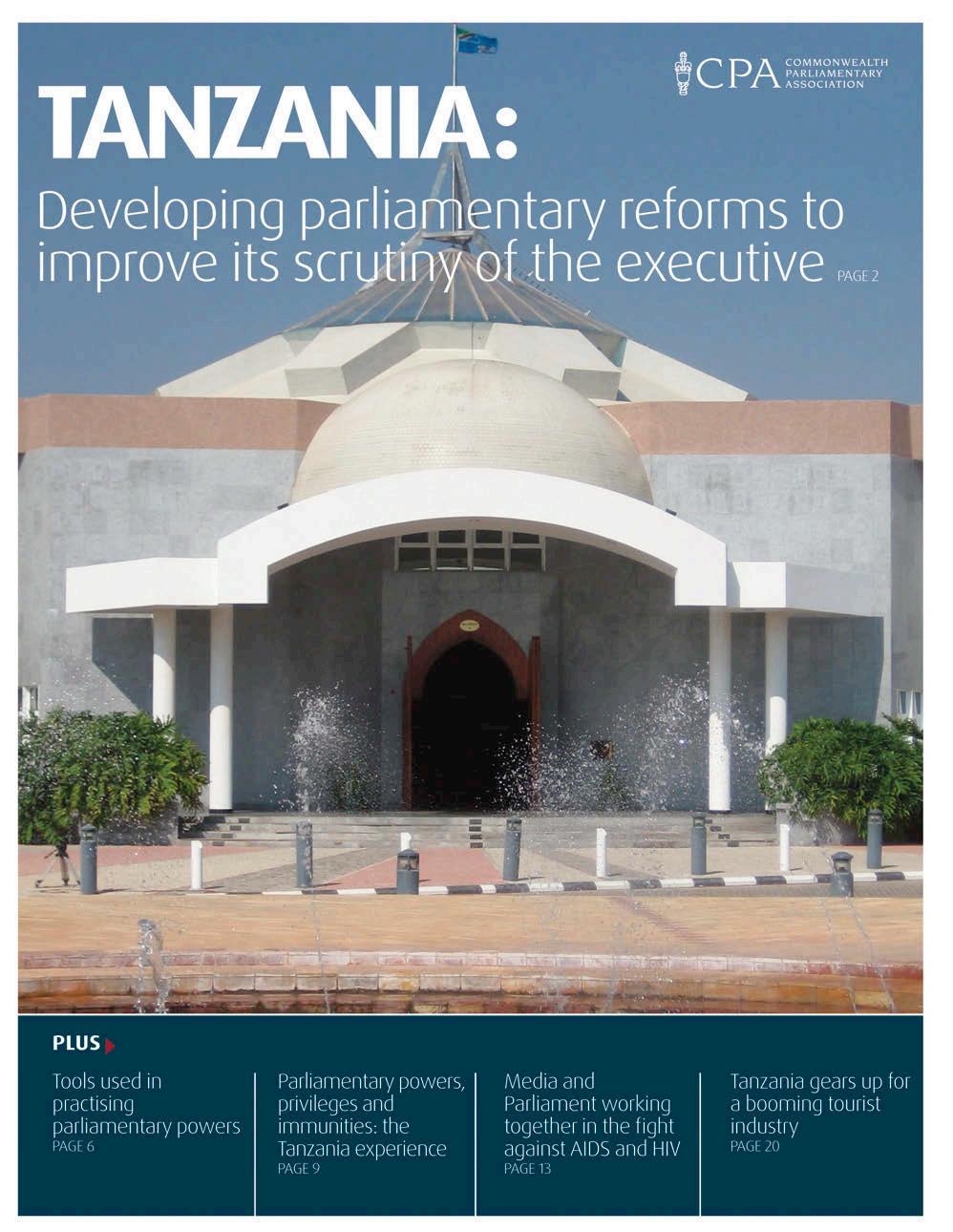
To subscribe for a copy of The Parliamentarian, please email pirc@cpahq.org. Members of Parliament should contact their Branch Secretary.