GHANA
Looking ahead to the 66th Commonwealth Parliamentary Conference in Accra, Ghana

THE COMMONWEALTH CHARTER 10 YEARS ON: VALUES AND PRINCIPLES FOR PARLIAMENTS TO UPHOLD
Celebrating 30 years of Parliamentary Democracy in Ghana
6
Gender Mainstreaming in the Parliament of Ghana
14
An Inclusive, Transparent and Responsive Parliament PAGE 20
Engaging Young Citizens in Parliamentary Democracy PAGE 35
PLUS
PAGE
PAGE
66th COMMONWEALTH PARLIAMENTARY CONFERENCE ACCRA, GHANA
30 September to 6 October 2023 (inclusive of arrival and departure dates)
CONFERENCE THEME: ‘THE COMMONWEALTH CHARTER 10 YEARS ON: VALUES AND PRINCIPLES FOR PARLIAMENTS TO UPHOLD’.
Ū One of the largest annual gatherings of Commonwealth Parliamentarians. Hosted by the Parliament of Ghana and CPA Ghana Branch.
Ū Over 500 Parliamentarians, parliamentary staff and decision makers from across the Commonwealth for this unique conference and networking opportunity.
Ū CPA’s global membership addressing the critical issues facing today’s modern Parliaments and Legislatures.
Ū Benefit from professional development, supportive learning and the sharing of best practice with colleagues from Commonwealth Parliaments together with the participation of leading international organisations.
During the 66th Commonwealth Parliamentary Conference, there will also be a number of additional conferences and meetings including: 39 th CPA Small Branches Conference; meetings of the Commonwealth Women Parliamentarians (CWP) and the Commonwealth Parliamentarians with Disabilities (CPwD) networks; 66th CPA General Assembly ; meetings of the CPA Executive Committee and; the 57th Society-of-Clerks-at-the-Table (SoCATT) meeting. At the 66th CPC, eight learning and development workshops will be held during the main Conference and four workshops during the CPA Small Branches Conference.
Visit the 66th CPC Hub for more information - www.cpahq.org/66-cpc
Commonwealth Parliamentary Association (CPA) | Email: hq.sec@cpahq.org | Tel: +44 (0)20 7799 1460 www.cpahq.org | Twitter @CPA_Secretariat | Facebook.com/CPAHQ | Instagram @cpa_secretariat | LinkedIn | Flickr
The Parliamentarian: Ghana Profile 2023: ISSUE THREE CPC SUPPLEMENT
GHANA: Host of the 66th Commonwealth Parliamentary Conference
Welcome Message: CPA President
Rt Hon. Alban Sumana Kingsford Bagbin, Speaker of the Parliament of Ghana
Page 2
The Development of Ghana’s Parliament and its Electoral System since Independence
Rt Hon. Alban Sumana Kingsford Bagbin, Speaker of the Parliament of Ghana
Page 3
Celebrating 30 Years of Parliamentary Democracy in Ghana
Hon. Samuel Atta Akyea, MP
Page 6
From Rubber Stamp to Transformative Parliament
Abraham Ibn Zackaria
Page 8
Ghana Parliament set to adopt Revised Standing Orders
Prosper Hoetu
Page 12
Gender Mainstreaming in the Parliament of Ghana
Hon. Mrs Gifty Ohene-Konadu
Page 14
Ghana's Legislative Process: A comparative overview of the law-making process in the Commonwealth
Dr Ernest Darfour
Page 17
Towards an Inclusive, Transparent and Responsive Parliament: Ghana's Citizens' Bureau
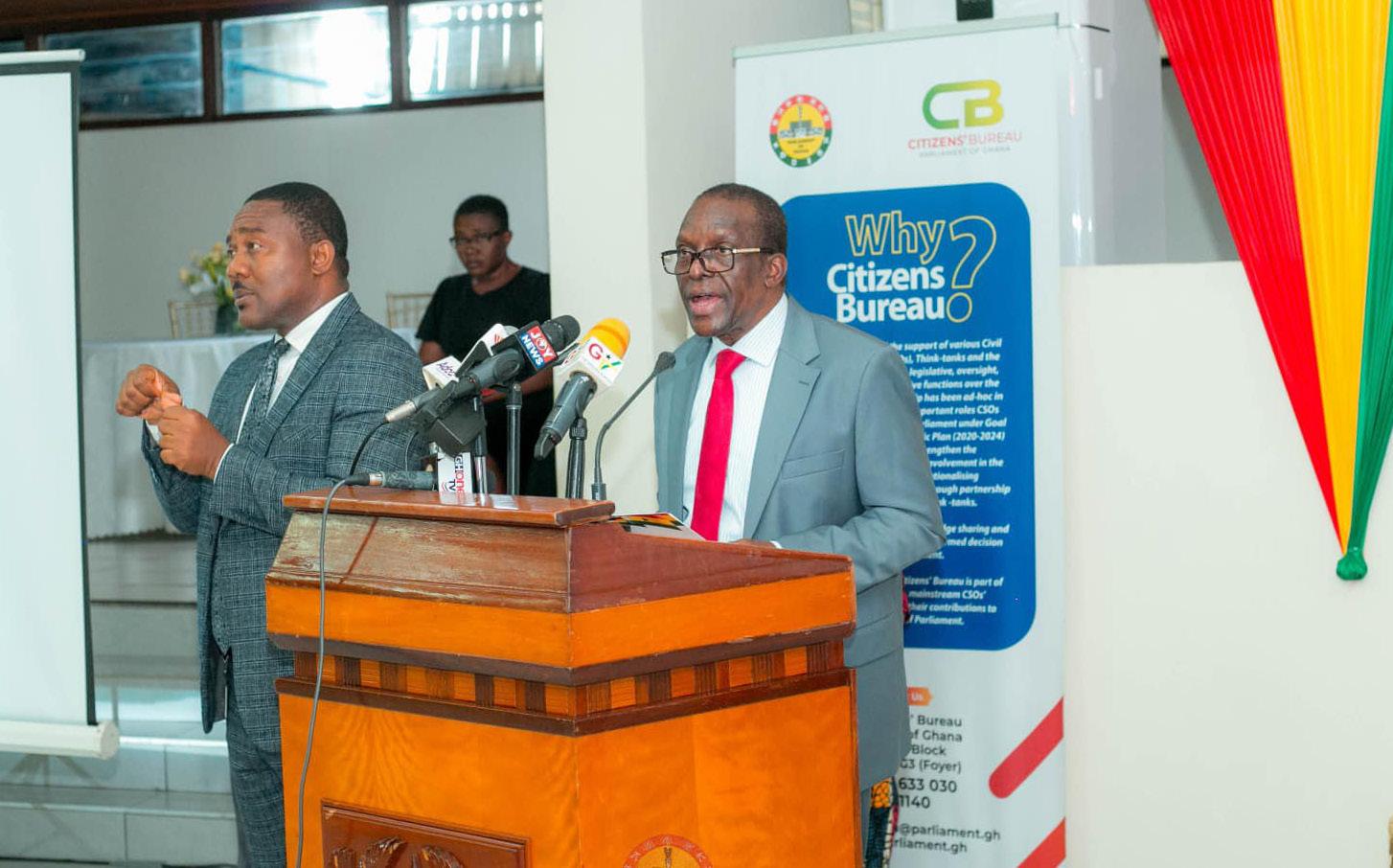
Hon Emmanuel Kwasi Bedzrah, MP and Prosper Hoetu
Page 20
Thirty and Counting: Deepening Representation in the Parliament of Ghana through Information, Communication and Language
Harold Wilson Hubert
Page 22
Rolling back desertification and repairing degraded lands in Africa
Pius Acolatse
Page 24
In the belly of Ghana’s politics: Savouring the role of women over the years
Ms Judy Aikins
Page 28
Private Members' Bills: Key to Parliamentary Effectiveness
Mr Benjamin Tachie Antiedu and Goodnuff Appiah Larbi
Page 31
Empowering Ghanaian Citizens: Transforming Parliament through Digital Channels for Transparency and Engagement
Mr Ernest Taanu Berrick
Page 32
Engaging Young Citizens in Parliamentary Democracy
Harold Wilson Hubert and Ms Akosua Opoku
Page 35
Ghana: Key Facts
Page 38
Ghana and the Commonwealth Parliamentary Association
Page 40
The Parliamentarian | 2023: Issue Three | 66th Commonwealth Parliamentary Conference | 1
CONTENTS
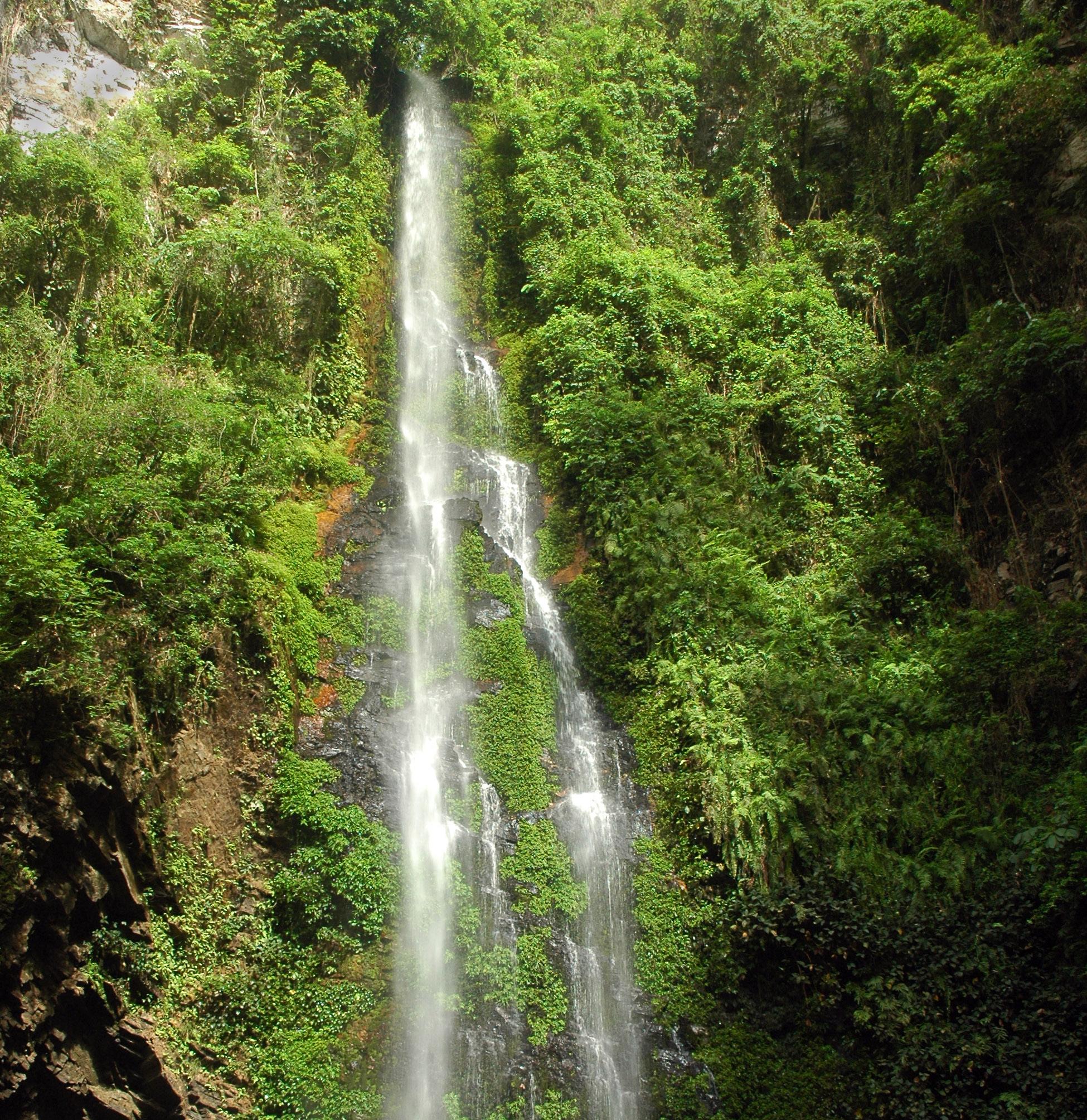
Front cover image: Tagbo Falls in eastern Ghana ( Shutterstock image).
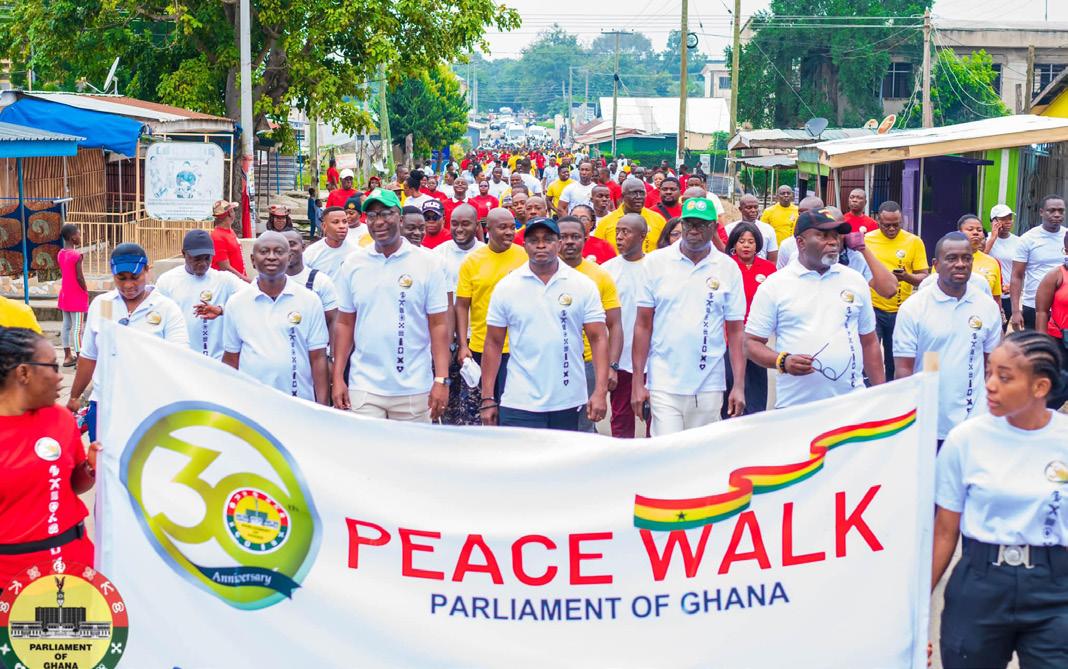
Below: MPs and parliamentary staff join citizens for the Parliament of Ghana's Peace Walk to mark 30 years of parliamentary democracy.
Image: Parliament of Ghana.
Image: Parliament of Ghana.
Above: The Speaker of the Parliament of Ghana launches the Citizens' Bureau which aims to increase public enegagement with Parliament and MPs. Read more on page 20.
WELCOME MESSAGE: CPA PRESIDENT AND SPEAKER OF THE PARLIAMENT OF GHANA
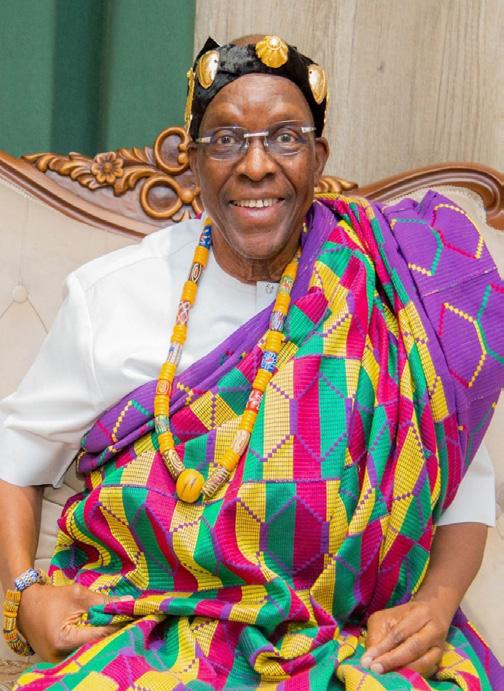
‘AKWAABA’
Ghana is excited to be hosting the 66th edition of the Commonwealth Parliamentary Conference (CPC) on the theme of ‘The Commonwealth Charter 10 Years On: Values and Principles for Parliaments to Uphold’. The annual CPCs are famed for the themes they discuss, the insights they shed on emerging issues of interest to Parliaments globally and the opportunities for networking that they offer participants.
I am persuaded that the Accra Conference will provide steer and direction for the Commonwealth Charter, which was adopted 10 years ago. It will firm up the CPA as an Association committed to enhancing knowledge and understanding of democratic governance within the Commonwealth, promoting youth engagement and gender equality in the pursuit of democracy in its exalted shape and form.
As Members of the CPA, we continue to be bound by the guiding principles of the Commonwealth. These, as we all know, include the rule of law, concern for the vulnerable, consensus building, mutual respect, inclusiveness, transparency and accountability. In our diversity as an Association lies our strength; and our commitment to democracy, development, peace, a shared value system and a common purpose in the Commonwealth is our forte.
Ghana looks forward with great expectation to this 66th edition of the CPC as it coincides with the celebration of three decades of uninterrupted parliamentary democracy under Ghana’s Fourth Republic. The previous three Republics were truncated by military coups d’état. Parliament as an institution and parliamentary democracy suffered the most under these military adventures. The Fourth Republic is the longest run of Parliament and, thus, worth celebrating. Accordingly, a number of activities have been planned to mark this historical epoch.
The honour and privilege of having a supplement on Ghana’s Parliament in The Parliamentarian – the most soughtafter publication of the CPA – at this time in Ghana’s democratic journey is most opportune. You will, in this supplement, be carried along ‘Thirty Years of Parliamentary Democracy in Ghana: The Journey Thus Far’, which is the theme for the celebration. I urge readers to follow how the celebration has progressed so far and the key developments that have shaped our democratic experience during this period.
At the end of it, the clarion call of the celebration is that never again should Ghana use the route of coup d’état for political transition. Generally speaking, this route did not benefit the country, and is still of no value to Ghana. I make this statement conscious of the democratic reversals we are witnessing in parts of Africa. Add the general erosion of trust and confidence in political leadership among many voters the world over, as attested to by various surveys, and you will need no reminders that we have no choice as Parliaments but to involve the citizens a lot more in what we do. I am glad to say that citizen engagement is at the centre of Ghana’s celebration
of 30 years of parliamentary democracy.
I always cringe when I recollect the story of a voter who went to Parliament to look for the Prime Minister. It is a story reflective of the extent to which the voter appears tired of his or her elected representative or the politician; one which should nudge all Parliaments in the Commonwealth and beyond to endeavour to improve upon citizen engagement and to remain true to our representational role.
The voter went to Parliament and the following ensued:
• Voter: I need to speak to Prime Minister X immediately
• The guard on duty: I am sorry; Mr X is no longer the Prime Minister of this country.
• (The voter leaves and returns the next day to repeat the same request.)
• Voter: Please, I need to speak to Prime Minister X
• The guard on duty: As I told you yesterday, Mr X is no longer the Prime Minister of this country
• (The voter leaves, but he is back again on the third day.)
• Voter: I need to speak to Prime Minister X
• The guard on duty (frustrated): Sir, why do you keep coming back? This is the third time I am telling you Mr X is no longer the Prime Minister of this country
• Voter: I know; I just cannot get tired of hearing you say that!
As we reflect on this story, I have no doubt that you will enjoy reading this supplement, and find value in the current trajectory of Ghana’s Parliament as we learn from one another’s experiences. Together, we must inspire confidence and trust, and offer hope and optimism to voters in the Commonwealth. This is non-negotiable if our wish is the continuous growth and development of parliamentary democracy in the Commonwealth, and, by extension, the growth and development of our countries and territories.
One this note, I welcome you all to Ghana and to the conference, and I hope that you will enjoy the traditional Ghanaian hospitality.
Akwaaba! Ye waabo yaane!
Rt Hon. Alban Sumana Kingsford Bagbin CPA President and Speaker of the Parliament of Ghana
2 | The Parliamentarian | 2023: Issue Three | 66th Commonwealth Parliamentary Conference
10 YEARS ON: VALUES AND PRINCIPLES FOR PARLIAMENTS TO UPHOLD
THE DEVELOPMENT OF GHANA’S PARLIAMENT AND ITS ELECTORAL SYSTEM SINCE INDEPENDENCE
Introduction
The struggle for independence in the then Gold Coast started with an agitation by the intelligentsia for the inclusion of Africans in the Legislative Council. At the heart of the colonial administration in the Gold Coast was the establishment of the Legislative Council, which consisted of only Europeans nominated by the Crown. There was no democratic electoral system in place then. The continued agitation of Africans for representation in the Legislative Council culminated in the gradual inclusion of Africans as unofficial Members. With time, Africans elected through universal suffrage dominated the Legislative Council.
During the early post-independence era, the country experienced several constitutional and democratic changes that impinged on the level of political participation and development of the country. However, with the restoration of civilian rule in 1993, the country, for the first time in its history, experienced sustained democratic stability for three decades and counting. This marked a departure from what pertained during the years of military coups and political instability, when, at the very best, the Parliament could only sit for two-and-a-half years before a coup put an abrupt end to its existence.
Alongside this democratic growth is the transformation of Parliament in terms of its composition and achievements. This article attempts to bring to the fore the changing character of the Legislature on its journey from the pre-independence era, through the post-independence era to the Fourth Republic.
Overview of the History of the Ghanaian Legislature
Pre-Independence Era
The history of the Ghanaian Legislature can be traced to 1850 when the first Legislative Council was established for the Gold Coast, which was a distinct dependency of the British Crown. The Council’s mandate was to advise the colonial Governor in enacting legislation. The Legislative Council consisted of the Governor and at least two other persons designated by Royal instructions. The Council was required to make “all laws, institutions, and ordinances as may, from time to time, be necessary for the peace, order and good government of our subjects and others within the said present or future forts and settlements in the Gold Coast”. This Council prevented the direct involvement of the indigenous people in the legislative process.
From 1866 to 1874, there was a break in the growth of the Legislative Council as the Gold Coast was reintegrated into the West African Settlements. However, in 1874, the Gold Coast was again given a separate government, and the Legislature experienced a
steady growth, but with limited powers. In 1888, John B. Mensah (1834-1892), the first African unofficial Member, was nominated to the Legislative Council. He was replaced by his first son, John Mensah Sarbah, in 1901.
Under the Clifford Constitution of 1916, the Legislative Council of the Gold Coast was enlarged as a representation chamber and consisted of 21 Members, including the Governor of the colony. There were 11 official Members and nine unofficial Members nominated by the Governor, making up a membership of 21.
Of the nine unofficial Members, three were Europeans, who represented the commercial, mining and banking sectors; six were Africans, made up of three paramount chiefs, who represented the chiefs; and the remaining three represented the educated members of society.1 The unofficial Members were later increased to 14, out of the 21 membership, and consisted of nine Africans, representing the traditional chiefs and the three cities of Accra, Cape Coast and Sekondi. There were still fewer Africans on the Legislative Council, and the elective principle was not applied in the selection of representatives onto the Legislative Council.
Under the Sir Frederick Gordon Guggisberg Constitution of 1925, the first Legislative Council elections took place. The Council comprised 30 Members, consisting of 16 official and 14 unofficial Members.2 Of the 14 unofficial Members, five were Europeans: three were appointed by the Governor to represent banking, mercantile and shipping interests, and the other two were elected by the Chamber of Commerce and Chamber of Mines. The remaining nine unofficial Members were Africans, six of whom were elected by the Provincial Councils and three Members represented the three municipalities of Accra, Cape Coast and Sekondi.
In 1927, the Constitution was amended to allow for the three municipal representatives to be directly elected.3 However, the franchise was severely limited, and the system continued to be dominated by British interests, as it limited the level of African representation in the Legislature. Also, the Constitution had limited coverage as its jurisdiction only covered areas around the coast.
On 29 March 1946, there was a significant change in the political situation of the Gold Coast. A new Constitution, the Alan Burns Constitution, was promulgated by an Order in Council, which enabled the colony to be the first in Africa to have a majority of Black members in its Legislature.4 Out of the Legislative Council’s 32 Members, 21 were black Africans, including 18 elected Members. This Constitution allowed for an unofficial Member of the Legislative Council to become its President while the Governor ceased to be
The Parliamentarian | 2023: Issue Three | 66th Commonwealth Parliamentary Conference | 3
CHARTER
THE COMMONWEALTH
Article by Rt Hon. Alban S. K. Bagbin, Speaker of the Parliament of Ghana.
the ex-officio President of the body. The first meeting of the Legislative Council was held on 23 July 1946.5
The 1951 Constitution, which was largely informed by the Burns Constitution of 1946 and the Coussey Committee’s recommendations, altered the structure of the colonial government. For example, the Constitution increased the number of African representatives in the Legislature to 75 Members, elected on universal suffrage. The Constitution also saw the election of the first Speaker – Sir Emmanuel Charles Quist – to the Legislative Assembly. There were three nominated ex-officio Members and six special Members representing commercial and mining interests. From 1951 until independence, Ghana developed the Westminsterstyle political system that operated on the principle of parliamentary sovereignty.
In spite of the progress made in the representation of Africans in the Legislative Council, complete representation was not achieved until 1954 when the Constitution called for the election of a 104-Member Assembly, and all were elected along political party lines. Thus, the 1954 Constitution paved the way for self-government of dominion status in 1957 and laid the foundation for Ghana’s independence. The Legislative Assembly was renamed the National Assembly.
Clearly, the struggle for self-government started with the struggle for inclusion of Africans in the Legislative Councils. The composition of the councils under colonial rule progressed from a Legislative Council dominated by only Europeans, through the inclusion of few unofficial Members, to a situation where unofficial African Members became the majority.
The First Republican Parliament
Ghana became a Republic under the First Republican Constitution on 1 July 1960. Under this Constitution, the National Assembly, formed under the independence Constitution of 1957, became the first National Assembly of the First Republic with a five-year term.
In February 1964, the Republican Constitution was amended, making the Convention People’s Party (CPP) the national party, and the First National Assembly was, therefore, dissolved in 1965. In the ensuing elections, the 198 Members, fielded solely by the CPP, were returned unopposed.
On 24 February 1966, parliamentary democracy was disrupted when the First Republican Government was overthrown through a coup d’état. Parliament was disbanded, thus bringing to an end the hard-earned institution of democratic governance that Africans had fought for over the years.
The Second Republican Parliament
In 1969, when the National Liberation Council (NLC), the military group that overthrew the First Republican Government, handed over power to a constitutionally-elected government, parliamentary democracy was restored once again in Ghana. In terms of composition, the National Assembly had 140 Members elected on the basis of universal suffrage. The CPP, having been proscribed, did not participate in the elections. Accordingly, the governing
party, the Progress Party, had 105 seats. The main opposition party, the National Alliance of Liberals, had 29 seats, and the remaining seats were shared among four other parties and one independent Member. There were only two women Members of Parliament.
The Second Republic was short-lived as it was again overthrown by a coup d’état on 13 January 1972 after being in office for only 27 months. This threw Parliament once again into abeyance until 24 September 1979 when parliamentary democracy was restored.
The Third Republican Parliament
The Third Republic came into being on 24 September 1979 when Parliament was re-established. Under the Third Republic, Ghana shifted from the Westminster system of government, and Parliament was no longer led by the Prime Minister as head of the Executive arm of government: the President, Vice-President and Ministers of State ceased to be Members of the Legislature. The Parliament consisted of 140 Members, including five women, and had a statutory life of five years. During the Third Republic, Parliament was undeniably stronger than its predecessors, aided by the slim majority held by the governing People’s National Party (PNP). This Parliament was the first in the history of the country to reject the government’s proposed budget in 1981. A military coup on 31 December 1981, led by Flight Lieutenant J. J. Rawlings, once again, put an abrupt end to civilian rule in Ghana as Parliament was disbanded by a decree.
The Fourth Republican Parliament
Ghana returned to constitutional rule on 7 January 1993 under the 1992 Constitution, which was approved by the people of Ghana through a referendum in April 1992. The Constitution provided for a four-year electoral cycle. The 1992 Constitution of Ghana, under
4 | The Parliamentarian | 2023: Issue Three | 66th Commonwealth Parliamentary Conference
THE COMMONWEALTH CHARTER 10 YEARS ON: VALUES AND PRINCIPLES FOR PARLIAMENTS TO UPHOLD
THE COMMONWEALTH CHARTER
10 YEARS ON: VALUES AND PRINCIPLES FOR PARLIAMENTS TO UPHOLD
Article 93(1), provides for a single-chamber Parliament with not less than 140 elected Members. The Parliament of Ghana is a unicameral Legislature. Ghana’s democracy under the Fourth Republic is a hybrid of the Westminster parliamentary model and the American presidential model, evidenced in Article 78(1) of the 1992 Constitution, which requires the President to appoint not less than half of the Ministers of State from within Parliament.
A plural electoral system in single-member constituencies has been adopted in Ghana in the Fourth Republic. Under this system, Ghana has, for the first time in its political history, held eight competitive multiparty elections under the same republic, having had three turnovers of power in the Third, Fifth and Seventh Parliaments, with the current Eighth Parliament being a hung one.
The first three Parliaments of the Fourth Republic had 200 Members from 200 single-member constituencies. By the Representation of the People (Parliamentary Constituencies) Instrument, 2004 (C. I. 46), the membership was increased to 230 for the Fourth and Fifth Parliaments. Subsequently, the number of Members of Parliament was further increased to 275 in the Sixth Parliament and has remained so to date.
The Ghanaian Parliament under the Fourth Republic has been described by scholars and commentators as being relatively weak (Barkan, et al. 2004). However, the Eighth Parliament of Ghana has proven to be relatively stronger than the previous Parliaments because of its composition. Each of the two parties represented has 137 seats, with one independent Member, thus making it a hung Parliament. Also, for the first time in the history of Ghana, the Speaker of Parliament is not a member of the party in government. This peculiar trait of the Eighth Parliament and its visibility, coupled with some major decisions of the House, such as rejecting the 2022 Budget, which was subsequently approved, and many decisions taken by secret ballot, make the Eighth Parliament stronger and transformative.
Conclusion
In conclusion, this article identifies three separate periods of legislative development in Ghana. The first period is the colonial era, which marked the foundation of the national Legislature in Ghana, characterised by Executive dominance and limited franchise in the nomination of Members of the Legislature. The second period, the early post-independence era, experienced different systems of governance, including a one-party system, presidential, parliamentary and military rules, and the suspension of the Legislature during the various military regimes.
The advent of multiparty electoral politics in 1992 ushered in the third era of legislative development in Ghana. The development of an open and transparent electoral system as the route to the Legislature, increased visibility, and a high social and political standing of the Legislature characterised the third era. These developments have placed so much responsibility on the Parliament of Ghana and its Members of Parliament.
References:
1 Political History of Ghana, Kimble, (1963), p.433
2 F M Bourret (1952) The Gold Coast: A Survey of the Gold Coast and British Togoland Stanford University Press, p49
3 John Parker (2000) Making the Town: Ga State and Society in Early Colonial Accra, p225
4 British Gold Coast/Togoland (1946-1957) Archived 2014-08-28 at the Wayback Machine
University of Central Arkansas
5 "The King's Message To Gold Coast", The Times, 24 July 1946, p3, issue 50511
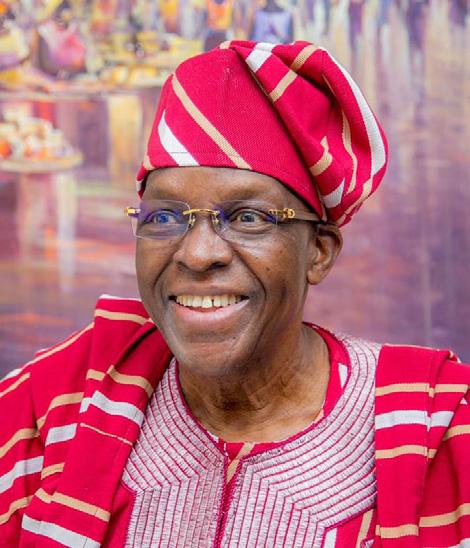
PROFILE OF THE CPA PRESIDENT, RT HON. ALBAN SUMANA KINGSFORD BAGBIN, SPEAKER OF THE PARLIAMENT OF GHANA
Rt Hon. Alban Sumana
Kingsford Bagbin is the Speaker of the Eighth Parliament of the Fourth Republic Ghana and has held the role since 7 January 2021. He became the first person to be elected as Speaker from a political party that is neither in government nor controls the majority of seats in Parliament.
He was previously the Second Deputy Speaker of Parliament (2017-2021). He was elected as the Member of Parliament for Nadowli North Constituency (1993-2005) and subsequently for Nadowli West Constituency (2005-2021). He became the Opposition Leader in January 2001, a position he held for eight years until he became the Majority Leader/Leader of Government Business/Leader of the House in 2009. He also held the position of Minister for Health (2012-2013) and Minister for Water Resources, Works and Housing (2010-2012). Between 2012 and 2017, he was a founding member of the group of Ministerial Leaders in Health, an initiative of the World Health Organization and the Harvard University in Switzerland. He was also a member of a three-member taskforce, usually referred to by Ghanaians as “the three wise men”, who were responsible for the President’s Priority Projects from 2013 to 2017.
Prior to his election, he worked as a lawyer having been called to the Bar as barrister of the Supreme Court of Ghana in 1982 and he was engaged in private legal practice between 1983 and 1993. He also taught English in Libya and was the acting Secretary to the Statistical Service Board at the Bureau of Statistics and Statistical Service.
During his education, he entered the University of Ghana in 1977, where he obtained a Bachelor of Arts degree in Law and English in 1980. He proceeded to the Ghana School of Law in Accra and also earned a Postgraduate Certificate on Privatisation of Public Utilities at the Eastern and Southern African Management Institute (ESAMI), Arusha, in 1999. He holds an Executive Master’s degree in Governance and Leadership from the Ghana Institute of Management and Public Administration (GIMPA).
As the Speaker and a Member of Parliament, he has served many inter-parliamentary and international organisations. He became the CPA President on behalf of the CPA Ghana Branch ahead of the 66th Commonwealth Parliamentary Conference, held in 2023 in Accra, Ghana. He was previously the CPA Vice-President (2021-2022) and he was also a Member of the CPA International Executive Committee as a representative for the CPA Africa Region (2012-2015).
The Parliamentarian | 2023: Issue Three | 66th Commonwealth Parliamentary Conference | 5
CELEBRATING 30 YEARS OF PARLIAMENTARY DEMOCRACY IN GHANA
The Chair of the Planning Committee for the 30th anniversary of parliamentary democracy under the Fourth Republic of Ghana outlines some of the plans to mark the occasion.
The Fourth Republican Parliament of Ghana is 30 years old. Following four military interventions in the governance of the country, the 1992 Constitution was promulgated on 28 April 1992, and this led to the birth of the Fourth Republic and its First Parliament on 7 January 1993. The period 7 January 1993 to 7 January 2023 is the longest era of uninterrupted democratic governance that Ghana has enjoyed. It is, therefore, important that the Parliament of Ghana commemorates this feat and uses the occasion to take stock of the impact and prospects of parliamentary democracy, while calling on the citizenry to support the activities of Parliament, which is pivotal in every democracy.
To kick off the two-pronged celebration of the birth of the Fourth Republic and the rebirth of Parliament, the Speaker of the Eighth Parliament of the Fourth Republic, Rt Hon. Alban Sumana Kingsford Bagbin, launched the anniversary on 22 February 2023 in the Chamber of Parliament. The year-long celebration is being held on the theme of ‘Thirty Years of Parliamentary Democracy under the Fourth Republic: The Journey Thus Far’.
In his address, the Speaker recounted the journey of parliamentary democracy thus far, extolling previous Speakers of Parliament for the roles they played in laying a solid foundation and consolidating the gains made. He indicated that having been elected as the representative of the people of the Nadowli North Constituency (now Nadowli/Kaleo Constituency) for the First Parliament under the Fourth Republic in 1992 and having represented the people for 28 years, the celebration also marks 30 years of his life in Parliament.
Present at the launch were Ghana’s first female Chief of Staff in the Office of the President and former MP, Mrs Akosua Frema Osei Opare; members of the Council of State; members of the diplomatic corps; religious and traditional leaders; and representatives of civil society organisations. Also present were former Speakers of
Parliament, Rt Hon. Edward Doe Adjaho and Rt Hon. Mike Aaron Oquaye; and a former Clerk to Parliament, Mr Samuel N. Darkwa.
In a message delivered on his behalf by Mrs Akosua Frema Osei Opare, the President of the Republic of Ghana, Nana Addo Dankwa Akufo-Addo, cautioned Ghanaians not to underestimate the importance of Parliament or undermine its work. He added that “we cannot emphasise enough the role of Parliament in exercising the checks and balances needed on the Executive”. The President reiterated his Government’s “commitment to duty to our children, grandchildren and generations to come to do everything to strengthen Parliament and deepen our democracy and the integrity of our electoral process”. He assured of his commitment to the peace, progress and prosperity of the country.
In his remarks, the Majority Leader and Minister for Parliamentary Affairs, Hon. Osei Kyei-Mensah-Bonsu, MP, observed that Ghanaians would be playing ostrich if “we claim that the justifications, real or imaginary, for which military juntas intervened in the governance of this country have been totally eradicated”.
He argued that the aspirations of Ghanaians as enshrined in the 1992 Constitution have not been achieved in their entirety, and called for constitutional amendments to put a cap on the number of Ministerial appointments. The Parliament, he said, must also be financially independent to enable it to do its work without any impediments whatsoever.
With some countries in West Africa saddled with military interventions and political unrest in recent times, the Majority Leader was quick to caution that Ghana should not think that having 30 years of uninterrupted democratic rule makes the country immune to military adventurism, and added that Ghanaians should “not falter in their faith in the current democratic system, but work towards its sustenance”
Hon. Samuel Atta Akyea, MP is a Member of the Ghana Parliament for the Abuakwa South Constituency. He was elected in 2008 to replace Nana Akufo-Addo, who is now the President of Ghana. He is the Chair of the Planning Committee for the 30th anniversary of parliamentary democracy under the Fourth Republic of Ghana. He is also Chair of the Parliamentary Select Committee on Mines and Energy and a member of the Committee on Subsidiary Legislation and the Special Budget Committee. He is a legal practitioner who graduated from the University of Ghana in 1989 with a Bachelor of Arts degree, majoring in Law and Philosophy. He was called to the bar in 1993. He was appointed Minister for Works and Housing between 2017 and 2021.
6 | The Parliamentarian | 2023: Issue Three | 66th Commonwealth Parliamentary Conference
THE COMMONWEALTH CHARTER
FOR
10 YEARS ON: VALUES AND PRINCIPLES
PARLIAMENTS TO UPHOLD
The Minority Leader, Hon. Dr Cassiel Ato Baah Forson, on his part, drew attention to what is purported to have been the causes of the death of the first three republics in the country – the abuse of power and corruption, as well as the failure to adhere to democratic principles. He added that it is the duty of a vibrant Opposition to question the actions and omissions of the Government.
The Clerk to Parliament, Mr Cyril Kwabena Oteng Nsiah, lauded the commitment of the Speaker and the Leaders of the House to the celebration of this milestone, particularly at a time when “we need to uphold and preserve the tenets of our democratic governance and safeguard the resources our homeland is endowed with for the benefit of the citizenry and posterity.”
Delivering a goodwill message on behalf of civil society organisations in Ghana, Mr Paul Aborampah Mensah, Programmes Manager at CDD-Ghana, said that civil society has over the years helped to inform the Ghanaian public about the work of Parliament and supported the institution and MPs to “build capacity relevant to their multiple mandates and functions of law making, oversight and representation”.
Ghana has completed 10 Afrobarometer surveys, which is a periodic assessment of the performance of a Parliament and its Members. Mr Mensah, however, noted that even though the reports of the survey are usually not “welcomed by MPs and Parliament, CSOs and Parliament have come to agree that occasional respectful disagreements are an inevitable part of their
CELEBRATION IN THE NORTHERN ZONE
As at the time of writing, activities for the celebration in the first zone (Northern Zone) have been held. The celebrations were heralded by courtesy calls on key traditional leaders by the Speaker. The purpose was to formally inform them of the celebrations and invite them to participate in the activities.
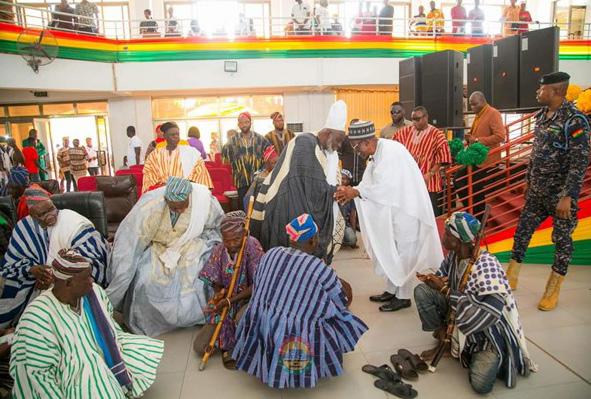
In the Upper West Region, a mock Parliament and debate were held in Wa, the regional capital. A total of five tertiary institutions participated. In the Northern Region, a public forum on 30 years of parliamentary democracy was held in Tamale, the regional capital, where the Speaker delivered the keynote address. The celebration culminated with a peace walk and fun games in Bolgatanga, the capital of the Upper East Region.
YEARS ON: VALUES AND PRINCIPLES FOR PARLIAMENTS TO UPHOLD
engagements”. This, he said, is healthy for the progressive evolution of the country’s democracy.
Year-long Celebration
Meanwhile, a Planning Committee, chaired by the Member for the Abuakwa South Constituency, Hon. Samuel Atta Akyea, has been set up to organise various activities across the country to commemorate the occasion. The Committee has zoned the country into four, with each zone having planned programmes to suit the peculiarities of the area.
Zonal activities such as public forums, mock Parliaments, football matches and health walks have been scheduled to take place. At the national level, there will be a public forum, fun games, lectures and an awards ceremony to recognise deserving individuals who have made significant contributions to the country’s democracy. The contribution of women since the inception of the Fourth Republic will also be highlighted. A prayer and thanksgiving service will also be held.
The Speaker of the Parliament of Ghana highlighted some legacy projects to be undertaken to commemorate the celebrations. These include the building of a Democracy House, which is meant to constantly remind people of the value of democracy and inculcate in Ghanaians the culture of democracy; the construction of a bust to depict African democracy; and the reconstruction of the ceremonial gates of Parliament to make them fit for purpose.
The Parliamentarian | 2023: Issue Three | 66th Commonwealth Parliamentary Conference | 7
THE COMMONWEALTH CHARTER
10
“ With some countries in West Africa saddled with military interventions and political unrest in recent times, the Majority Leader was quick to caution that Ghana should not think that having 30 years of uninterrupted democratic rule makes the country immune to military adventurism, and added that Ghanaians should 'not falter in their faith in the current democratic system, but work towards its sustenance'.”
Above: The Speaker of the Parliament of Ghana, Rt Hon. Alban Bagbin exchanging greetings with traditional leaders in the Northern Zone before the commencement of the public forum on 30 years of parliamentary democracy in Tamale.
Image: Parliament of Ghana.
FROM RUBBER STAMP TO TRANSFORMATIVE PARLIAMENT
An Agenda for Increased Evidence Use in the Parliament of Ghana.
Introduction
Information is critical for the effective performance of the functions of any Legislature. The ability of Members of Parliament to perform their roles along the policy and legislative cycle is shaped by their access to authoritative and reliable information (Barkan, 2009). Therefore, the lifeblood of Parliaments is information (Cunninghame, 2009), particularly at a time when there is an increasing call on policymakers, including Legislators, to make evidence a cornerstone in their decision-making processes. The importance of information to Parliament has been given credence by Miko and Robinson (1994), who, drawing on the work of Nelson Polsby (Greenstein and Polsby, 1975), developed a typology of Parliaments that links their information needs to their policymaking roles. They categorised Parliaments into four types on the basis of need, access and use of information as: the ‘rubber stamp Legislature, the emerging Legislature, the informed Legislature, and the transformative Legislature’.
In their view, rubber stamp Legislatures are those that have very little need for information other than the time and place to vote. Emerging Legislatures are characterised by the existence of a parliamentary library with some minimal reference materials, a research service and permanent staff, but very minimal demand for and use of information by MPs and Committees. The informed Legislatures have higher information needs, and thus have parliamentary library and research services which provide reference services, produce reports, and offer a clipping service that is distributed to all Members. The transformative Legislatures have substantial, generous allotment of personal staff, strong and well-staffed Committees, and large research groups capable of developing policy options. MPs and Committees in transformative legislation are ‘hungry’ for information in all aspects of their work (TINAPS, 2017).
In the context of the foregoing, into which category can we place the Parliament of Ghana as far as information usage is concerned? The ensuing sections discuss the concept of evidence-informed policymaking, the current system of evidence use in legislation, and the structures put in place to provide information in the Parliament of Ghana.
Concept of Evidence and Evidence-informed Policymaking
Evidence can broadly be defined as an argument backed by information, but usually has connotations of science-based knowledge, underpinned by research and a recognised, rigorous methodology.1 Information produced by integrated monitoring and evaluation systems, academic or legislative research, historical experience and good practice, among others, are examples of evidence.
Evidence-informed policymaking is an approach to making policy decisions that aims at ensuring that such decisions are well informed by the best available evidence. Thus, policymaking can be said to be evidence-informed when the process has considered a broad range of research evidence, evidence from citizens and other stakeholders, and evidence from practice and policy implementation, and has also considered other factors such as political realities and current public debates (Newman, Fisher and Shaxson, 2012).
This understanding of evidence-informed policymaking has moved the discussions on evidence away from a narrow focus on research and methodological rigour to a more inclusive understanding of evidence that recognises diverse forms of knowledge and information such as citizen knowledge, practical experience and administrative data (Jones, et al., 2012).
The Current Practice of Evidence Use in the Ghanaian Legislature
Recognising the role of information as evidence in the effective performance of the functions of the Legislature, the Parliament
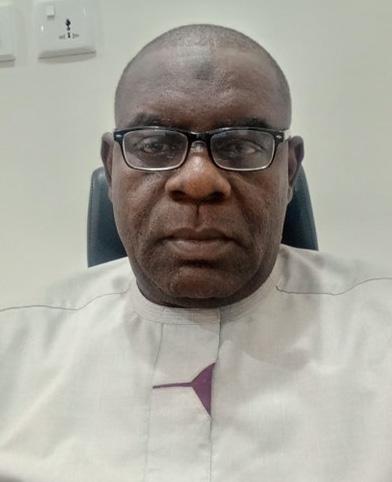
Abraham Ibn Zackaria, PhD has 17 years of experience in providing research services to the Parliament of Ghana, particularly the Speaker, Committees, Parliamentary Leadership and individual Members of Parliament. He is currently a Senior Research Officer and also doubles as the Head of the Research Team in the Office of the Speaker. He was previously the Head of the Science and Environment Desk in Parliament. He has research experience in the Institute of Statistical, Social and Economic Research (ISSER) at the University of Ghana, where he coordinated the Land Policy Research Project (LPRP). His research interests are evidence-informed policymaking in the Legislature, public policy, and land and environmental issues.
8 | The Parliamentarian | 2023: Issue Three | 66th Commonwealth Parliamentary Conference
THE COMMONWEALTH CHARTER 10 YEARS ON: VALUES AND PRINCIPLES FOR PARLIAMENTS TO UPHOLD
of Ghana has over the years been using information obtained from diverse sources in passing laws, approving loans and other agreements, approving the budgets, et cetera
The Use of Evidence when Passing Laws to Aid the Implementation of Policies
In passing Bills into laws, the Parliament of Ghana uses evidence from two main sources: fiscal impact analysis that accompanies a Bill laid before the House, and citizens/experts’ inputs into a Bill through memoranda submitted by the public.
Fiscal Impact Analysis
In accordance with Section 100 of the Public Financial Management Act, 2016 (Act 921)2, Bills that are to be laid in the House must be accompanied by a fiscal impact analysis. The information contained in the fiscal impact analysis is an important evidence that partly informs the decision of the Committee on the Bill. This impact analysis, as stated in Regulation 12 of the Public Financial
THE COMMONWEALTH CHARTER
10 YEARS ON: VALUES AND PRINCIPLES FOR PARLIAMENTS TO UPHOLD
Management Regulation, should show data on expected revenues to be realised from all identified funding sources in the implementation of the legislation or proposal, and data on all expected expenditure to be incurred under the legislation or proposal, including wages, salaries, allowances and pensions. In situations where the legislation envisages the creation of a new office, a proposed organogram and estimated staff requirements determined in consultation with the Public Services Commission, the Fair Wages and Salaries Commission, and the Ministry of Finance should also be attached.
Public/Experts’ Inputs into a Bill
Besides the fiscal impact analysis, when the House refers a Bill to the appropriate Select Committee for deliberations, the secretariat of the Committee advertises the Bill and invites memoranda from the public, including interest groups, experts and other stakeholders to make inputs into the Bill. The memoranda received from the public in respect of the Bill constitutes citizens and experts’ evidence used by the Committee in arriving at its decisions.
Evidence Used during Approval of Loans and other Agreements
Another important role of the Ghanaian Legislature is to consider and approve the terms and conditions of all loan agreements in accordance with article 181 of the 1992 Constitution and section 56(1) of the PFM Act. To perform this critical function effectively, the practice in the Parliament of Ghana has been that such agreements are accompanied by “value-for-money audit” of the agreement, the Finance Ministry’s approval, and advice from the Attorney-General’s Department, in accordance with the provisions of the ‘Procedures Manual for National Borrowing’ which was published by the Ministry of Finance (2021).
Besides these, the Research Department of Parliament undertakes independent in-house analyses of the loan agreements to support the Finance Committee. These accompanying analyses
The Parliamentarian | 2023: Issue Three | 66th Commonwealth Parliamentary Conference | 9
“
Evidence-informed policymaking is an approach to making policy decisions that aims at ensuring that such decisions are well informed by the best available evidence. Thus, policymaking can be said to be evidence-informed when the process has considered a broad range of research evidence, evidence from citizens and other stakeholders. ”
10 YEARS ON: VALUES AND PRINCIPLES FOR PARLIAMENTS TO UPHOLD
serve as a proof that the agreements are financially, legally and professionally prudent in the context of the objectives of the agreements.
Evidence Use in Approval of Budgets
The Parliament of Ghana has the responsibility of considering the Annual Budget Statement and Economic Policy of the Government, and passing the Appropriation Bill to enable the Government to implement its policies. To perform this role effectively and diligently, the Parliament requires information in the form of data, research, expert opinion and the views of civil society to serve as evidence to inform the decision of the House. Two key strands of information often used by the Parliament of Ghana in this regard are expert opinion obtained during post-budget workshops for MPs and sector estimates analysed by the Research Department.
Budget Analysis from Think-tanks at Post-Budget Workshops
When the Budget and Economic Policy of government is presented on the floor of the House, a forum dubbed Post-Budget Workshop is held for Members of Parliament, procedural Clerks and research staff of the Parliament of Ghana. While the object of the workshop is to equip MPs adequately to effectively scrutinise the budget statement, the forum also provides a platform for think-tanks, civil society organisations (CSOs), academia and other experts to present analysis of sections of the national budget from their professional perspectives. These analyses constitute experts’ evidence used by Members when debating the budget in plenary.
Sector Budget Briefs
At the budget approval stage, particularly when the sector allocations are referred to the respective Parliamentary Committees in the form of estimates or a Programme-Based Budget (PBB), the Research Department undertakes analyses of the sector budgets for the Committees. These analyses are presented to the respective Committees in the form of budget briefs. The briefs contain critical analyses of both the financial and policy performances of the various Ministries in the previous budget year, and a scrutiny of the budget projections in terms of allocations and targets set for the ensuing year. Such information influences the Committees’ decisions on the budget.
The Information Support System of the Parliament of Ghana
The Parliament of Ghana has over the years established four key information support structures as evidence brokers to support the work of the House with information. These include the:
1. Research Department which provides information support to Committees, the Speaker’s Office, Parliamentary Leadership and individual Members of Parliament on request, as well as undertaking proactive research services for the House and Committees.
2. Library Department which is in charge of planning, organising and supervising a variety of activities, as well as developing and maintaining a collection of reference library materials, including government publications on Parliamentary Service matters.
3. Inter-departmental Research and Information Group (IDRIG) which is a collaborative platform of all information-providing units and departments of the Parliamentary Service to ensure
synergy in the provision of information and to promote the visibility of the departments and their products. The group usually organises research and information weeks to showcase research and evidence products.
4. Assignment of Personal Research Assistants with master’s degrees by the Parliamentary Service Board to Members of Parliament. The role of the Research Assistants is to provide quick responses to the information needs of the Members and to liaise with the relevant information departments to provide information to the Members when necessary.
However, it has been observed that the Research and Library Departments have over the years been challenged in many ways in providing the required support services to the House and its Members. Capacity challenges in terms of limited expertise and inadequate numbers of staff, poor visibility of their services, low quality of products, and limited demand for their products are noticed. Consequently, the consideration of legislation and policies in the Parliament of Ghana is characterised by low demand for information and research products. This places it in the category of emerging Parliaments, according to the categorisation developed by Miko and Robinson (1994).
Additional Information Support Structures
As part of the agenda of the Parliament of Ghana to increase evidence use in the performance of its functions, priority is given to evidence production in its Corporate Strategic Plan (20202024). One of the objectives of the Plan, which is currently being implemented, is to “restructure the Committee System, and institutionalize mechanisms for evidence-informed decisionmaking”. To achieve this objective, Parliament has restructured its information support system by creating new information departments, including specialised units, to provide various types of information in the form of evidence to support the work of Parliament. Specifically, the Parliamentary Service Board (PSB) has approved the establishment of a Data Management Centre, Parliamentary Office of Science and Technology, and Office of Budget and Fiscal Analysis.
Data Management Centre
The Data Management Centre, among other things, is expected to liaise with the relevant data institutions in Ghana, including the Ghana Statistical Service (GSS) and the National Development Planning Commission (NDPC), think-tanks and relevant academic institutions and centres, to mobilise data and update the same periodically to support Parliament in the discharge of its oversight functions. Overall, the centre is to ensure that internal data generated by Parliament are organised in accordance with an acceptable standard format to facilitate its use and reuse by both MPs and external stakeholders. The centre will also serve as a focal point for MPs and Committees to access external data.
Parliamentary Office of Science and Technology (POST)
The Parliamentary Office of Science and Technology (POST), which is akin to POST in the UK House of Commons, will be the in-house source of independent, balanced and accessible analysis of public policy issues related to science and technology for the Parliament
10 | The Parliamentarian | 2023: Issue Three | 66th Commonwealth Parliamentary Conference THE COMMONWEALTH
CHARTER
THE COMMONWEALTH CHARTER
10 YEARS ON: VALUES AND PRINCIPLES FOR PARLIAMENTS TO UPHOLD
of Ghana. The core objective of POST is to work in constant contact with experts from academia, industry, government, the third sector and beyond. Experts from these institutions are expected to collaborate with POST to scan the horizon, identify literature, contextualise research evidence, and peer review the work of POST before the evidence is made available to the House.
The establishment of POST in the Parliament of Ghana reflects a widespread need among Members of the Ghanaian Legislature to find new ways of allowing informed debate and decisions on the complex challenges society needs to address in the science and technology sector.
Office of Budget and Fiscal Analysis
The object of the Office of Budget and Fiscal Analysis is to assist Parliament to undertake oversight in respect of the impact of fiscal policy measures on the economy. In terms of functions, the office is expected to submit reports to the Budget Committee on economic forecasts, budget projections and options for reducing the budget deficit; undertake analyses of budgets and other international financial agreements; as well as consider matters that relate to national development and the economy. Overall, the office is to serve as a hub for the generation of analytical evidence in the areas of finance, tax and economy.
Office of Policy Analysis
The Office of Policy Analysis is tasked to identify current or anticipated problems, create solutions, and influence political and social decisions of the House. The office will focus on collecting information, analysing potential policies, making recommendations, evaluating the outcomes of existing policies, and sharing information with Parliament, Committees and Members of Parliament. It is also expected to undertake studies on the impact that current and proposed laws may have on individuals and social groups; study political trends, ideas and governmental policies; and develop written reports that explain various research undertaken in particular areas.
Conclusion
The culture of evidence use in decision making by the Parliament of Ghana has become institutionalised and consolidated. This is evident by the priority given to evidence production in the strategic plan, the establishment of additional structures to increase the provision of evidence, and the assignment of Personal Research Assistants to Members of Parliament. It may, therefore, be concluded that if these new structures function optimally, the Parliament of Ghana would become a transformative Legislature in the not-toodistant future.
References:
1 Geddes, M. (2021). The webs of belief around ‘evidence ‘in Legislatures: the case of select committees in the UK House of Commons. Public Administration, 99(1), 40-54.
2 Section 100 (1) of the Act, among other things states that: “Any legislation to be laid before or proposal submitted for the approval of Parliament shall be accompanied by a fiscal impact analysis stating the estimated effect on revenues and expenditures for the financial year in which the legislation or proposal is expected to come into effect”.
PROFILE OF HON. OSEI KYEI-MENSAH BONSU, MP, MAJORITY LEADER IN THE PARLIAMENT OF GHANA
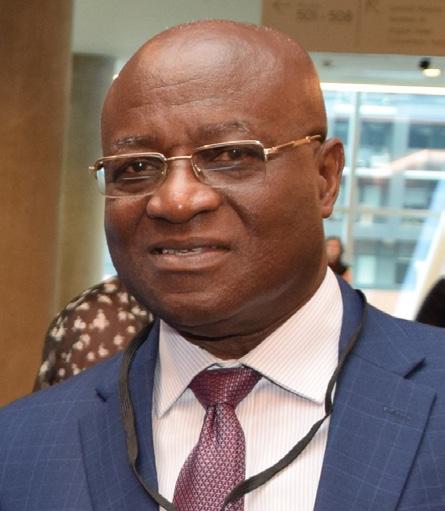
Hon. Osei Kyei-Mensah Bonsu, MP is the current Majority Leader in the Parliament of Ghana. He is serving his seventh term as the Member of Parliament for Suame, having won seven successive parliamentary elections since 1996. He is also the Minister for Parliamentary Affairs; the Leader of Government Business; and the Leader of the House. During the Eighth Parliament of Ghana, he also assumed temporary responsibility of the Ministry of Finance. He has held several roles since becoming a Member of Parliament, including Secretary to the Majority Caucus, Deputy Majority Whip, Majority Chief Whip, Deputy Majority Leader, Minister of State (Parliamentary Affairs), Minority Leader, Majority Leader, and Minister for Parliamentary Affairs and Leader of Government Business.
In Parliament, he has served as Member and Chairperson of several Parliamentary Committees including the Business Committee; the Appointments Committee; the Special Budget Committee; the Selection Committee; Works and Housing Committee; Youth and Sports Committee; Lands and Forestry Committee; Subsidiary Legislation Committee; and Standing Orders Committee.
He has represented the Parliament of Ghana several times including delegations to ECOWAS; the Inter-Parliamentary Union; National Council of State Legislators; the African Parliamentary Network Against Corruption (Ghana Chapter and Africa Region); and as the Vice President of the Global Organisation of Parliamentarians Against Corruption. In 2021, he was elected the Vice Chairperson of the Commonwealth Parliamentary Association and he is also a CPA International Executive Committee Member for the CPA Africa Region.
Prior to his election, he worked as a National Service Person at Kumasi Girls’ Secondary School where he stayed on to become a substantive teacher. He then moved to southern Africa, where he was the Project Manager of DATAME Consult, which operated in Zimbabwe and Zambia. From then on, he became self-employed, trading in vehicle spare parts in the famous Suame Magazine, until he entered political office.
He graduated from the Kwame Nkrumah University of Science and Technology with a Bachelor of Science degree in Urban Planning. He joined the Student Movement for African Unity (SMAU) and rose to become the Vice President of the Movement. At KNUST, he became the President and, at the same time, joined the Pan-African Youth Movement (PANYMO). He was twice the President of the Junior Common Room of the University Hall (Katanga) and the President of the Students’ Representative Council while he was in the university.
The Parliamentarian | 2023: Issue Three | 66th Commonwealth Parliamentary Conference | 11
AFTER TWO DECADES OF REVIEW … GHANA PARLIAMENT SET TO ADOPT REVISED STANDING ORDERS
Introduction
The much-anticipated revised Standing Orders of the Parliament of Ghana has finally been laid before the House for consideration. The Report of the Standing Orders Committee on the revision process was laid on 12 July 2023, and the House has since voted to adopt the report.
The revision of the Standing Orders, which was first adopted in 1993 by the First Parliament of the Fourth Republic of Ghana under Speaker Justice Daniel F. Annan, began in 2003 under the leadership of Rt Hon. Peter Ala Adjetey, Speaker of the Third Parliament. Over these 20 years, the revision has benefited from the contributions of Members of Parliament as well as the directions of Mr Ebenezer Begyina Sekyi-Hughes; Justice Mrs Joyce Adeline Bamford-Addo; Mr Edward K. Doe Adjaho; Prof Aaron Michael Oquaye; and Mr Alban Sumana Kingsford Bagbin, Speakers of the various Parliaments under the Fourth Republic.
The current Speaker, Rt Hon Alban S. K. Bagbin, deserves commendation for navigating the numerous contours of the topography of a hung Parliament and succeeding in having the Committee’s report on the revised Standing Orders laid and debated by the House.
Even though the delay in the adoption of the Standing Orders may be partly attributed to gridlocks and sharp disagreements, leading to a breakdown in consensus-building on some contentious issues, this may equally be considered a blessing in disguise. This is because the revision process has benefited from the rich experiences gained by Parliament as an institution over the past 30 years. The COVID-19 pandemic, though impacted negatively on parliamentary business, offered some lessons as well.
The outcome of the 2020 elections, which ushered in the Eighth Parliament, is a watershed moment for parliamentary democracy in Ghana. For the first time, citizens voted for a hung Parliament, which produced 137 elected Members from the National Democratic Congress (NDC) and same number for the New Patriotic Party (NPP), with an independent Member who was
originally an NPP Member of Parliament. That was not all. The next big surprise was the unprecedented election of a Speaker from a party that did not win the presidential elections, the NDC. The early days of the Eighth Parliament were characterised by controversy. There were many issues that the Standing Orders did not clearly address. Given that the two leading parties had equal numbers, there were disagreements such as: which group constituted the majority and would lead the House; how Committees would be constituted; whether there should be equal numbers; and who will chair the Committees and who will be the ranking Member. These were obviously interesting unchartered paths and grey areas that required exceptional leadership skills and consensus-building to navigate. What appeared to have calmed the situation was the decision by the only independent MP to do business with the NPP, thus making that side the majority.
Then came a rude awakening of a future possibility of a government having a minority in Parliament. In the event that this happens in future, how will the Standing Orders respond? The challenges presented by developments in the Eighth Parliament had significant impact on the work of the Standing Orders Committee that revised the Standing Orders to produce one that will stand the test of time.
This article explores the importance of the Standing Orders in parliamentary practice and some of the significant changes in the new Standing Orders for the Parliament of Ghana.
The Importance of the Standing Orders of Parliament
Article 110(1) of the 1992 Constitution of Ghana allows Parliament to determine how it conducts its business, subject only to the provisions of this Constitution.
This power of Parliament to make its own rules to govern the conduct of its business allows for flexibility and adaptability. As an institution, Parliament must be able to respond to changing circumstances in an ever-evolving political, social and economic environment. This flexibility allows for efficient decision-making and
Prosper Hoetu is a lawyer and governance expert who has consulted for both local and international organisations. He has contributed to both policy and legislative reforms in the areas of media regulation, local governance and decentralisation, small arms control, constitutional reforms, child protection and youth development. Prosper is a proud recipient of the 2015 Commonwealth Youth Worker Award and was also listed among the 50 Most Influential Young Ghanaians in the same year. Prosper is currently a Senior Research Officer to the Speaker and also heads the Citizens’ Bureau in the Parliament of Ghana – an office that coordinates civil society engagements with Parliament to achieve a more open, inclusive and responsive Parliament.
12 | The Parliamentarian | 2023: Issue Three | 66th Commonwealth Parliamentary Conference
THE COMMONWEALTH CHARTER 10 YEARS ON: VALUES AND PRINCIPLES FOR PARLIAMENTS
UPHOLD
TO
ensures that Parliament remains relevant and effective in a rapidly changing world. Through this authority, Parliament establishes rules that protect the rights and privileges of its Members, ensure fair and transparent proceedings, and maintain the integrity of the legislative process. This independence is crucial for Parliament to fulfil its role as a check on the other arms of government and to represent the best interests of the people.
Standing Orders are important for several reasons. They provide a framework within which order, discipline and decorum are maintained during proceedings. Rules of acceptable conduct for Members as well as modes of sanctioning offending Members are provided for in the Standing Orders. Areas such as the order of business, the rules of debate and voting are also covered to ensure that Parliament functions efficiently and effectively to achieve its mandate. They also promote equal access and opportunities for all Members of Parliament with regard to their participation in debates, asking questions, making statements, and generally presenting their views on matters before the House. These rules also protect minority and backbenchers’ rights, and prevent any unfair treatment or discrimination.
The provisions of the Standing Orders also enhance the democratic process by promoting transparency and accountability. Specifically, they spell out the procedures for introducing, debating and voting on Bills. These rules ensure that legislation is thoroughly debated and scrutinised before being passed, thereby enhancing the democratic process.
Significant Changes in the Revised Standing Orders
The new Standing Orders of Parliament come with significant progressive modifications that will advance good governance, transparency and public accountability. There are three categories of Committees in Parliament: Standing, Select and Ad hoc Committees. Among the new Standing Committees are: Committee on Petitions; Committee on Economic Development; Committee on Ethics and Standards; Committee on Ways and Means; Committee on Private Member’s Bills and Private Member’s Motions; Committee on Human Rights; Budget Committee; and Committee on Backbenchers’ Business. New Select Committees have also been proposed. They include the Committee on Independent Constitutional Bodies, the Committee on Parliamentary Affairs as well as the Committee on Public Administration and State Interests.
The Standing Orders also make elaborate provisions on the procedure for Private Member’s Bills, which is a new feature of Ghana’s Parliament that allows Members of Parliament to sponsor Bills in spite of the interpretation given to the limitations imposed by article 108 of the Constitution. Also worthy of mention is the new provision in the Standing Orders that allows Committees of Parliament to now sit in public, as opposed to the existing arrangement where Committees sit in camera. This will allow for much transparency as the general public can follow proceedings of Committees.
The new provisions in the Standing Orders have been hailed by governance experts and civil society actors as very progressive for many reasons. The proposal for a Committee on Petitions in the new Standing Orders suggests that Parliament intends to pay particular attention to the grievances of citizens. Parliament receives several petitions from citizens and interest groups. It is expected that this Committee will assist in addressing such concerns expeditiously. Petitions may be addressed to the Speaker or presented to the House by a Member of Parliament on their own behalf or on behalf of members of the public with prior notification to the Speaker. Such petitions may be referred to the Committee on Petitions by the Speaker for the appropriate action. The Committee on Independent Constitutional Bodies will not only promote greater accountability but will also serve as an avenue through which Parliament can support such institutions to address peculiar challenges that hinder the execution of their constitutional functions.
With the House having adopted the report of the Committee, the House will subsequently convene a Committee of the Whole to afford Members of Parliament with the opportunity to proffer amendments to the draft orders. Subsequent to that, the House will meet again in plenary to take a decision on the revised Standing Orders.
Conclusion
To conclude, the Standing Orders of Parliament is essential for maintaining order, protecting Members’ rights, promoting transparency, facilitating effective legislation, and preserving parliamentary traditions. It ensures that Parliament functions as a democratic institution and serves the best interests of the people.
The revised Standing Orders makes significant provisions that will facilitate the efficiency and effectiveness of parliamentary business while expanding the boundaries of good governance through transparency, citizens’ participation in the work of Parliament, and, for that matter, public accountability.
The Parliamentarian | 2023: Issue Three | 66th Commonwealth Parliamentary Conference | 13
THE COMMONWEALTH CHARTER 10 YEARS ON: VALUES AND PRINCIPLES FOR PARLIAMENTS TO UPHOLD
Image: Parliament of Ghana.
GENDER MAINSTREAMING IN THE PARLIAMENT OF GHANA
Towards a Definition
Gender mainstreaming is an approach to policymaking that takes into consideration both women and men. The idea was first introduced at the 1985 World Conference on Women in Nairobi. It was internationally established as a strategy during the United Nations Fourth World Conference on Women in Beijing in 1995 and adopted as a tool to promote gender equality at all levels.
The United Nations defines gender mainstreaming as: ‘The process of assessing the implications for women and men of any planned action, including legislation, policies, or programmes, in all areas and at all levels. It is a strategy for making women’s as well as men’s concerns and experiences an integral dimension of the design, implementation, monitoring and evaluation of policies and programmes in all political, economic, and societal spheres so that women and men benefit equally, and inequality is not perpetuated. The ultimate goal is to achieve gender equality.’
Similarly, the Inter-Parliamentary Union (IPU) also defines gender mainstreaming as “a process of ensuring that Parliaments incorporate the needs and interest of both men and women in its structures, operation, methods and its work as a nation’s peak legislative institution”.
Questioning Assumptions about Gender Mainstreaming
At its core, gender mainstreaming in the context of policy is a process of questioning assumptions. What assumptions have been made about the beneficiaries of a process or policy is of paramount concern. In this regard, three main assumptions are questioned, namely: assumptions about actors, assumptions about benefits, and assumptions about outcomes. Assumptions about actors seek to resolve the issue of who that process or policy seeks to target. Assumptions about benefits speak to whether all groups will benefit and be affected equitably. Assumptions about outcomes also seek to find out whether it promotes fairness.
The Importance of Gender Mainstreaming
Gender mainstreaming involves integrating gender equality perspectives at all stages and levels of policies, programmes and projects. Women and men have different needs and differ in respect of their access to and control over societal resources, power and human rights, including the justice system. The aim of gender mainstreaming is to consider these differences when designing, implementing, monitoring and evaluating government policies and programmes in all political, economic and social spheres. Thus, gender mainstreaming is recognised as an effective strategy for ensuring equitable distribution of government resources in all dimensions of gender.
It is also an effective tool for measuring commitments made at regional and international levels to promote gender equality. For instance, the UN Convention on the Elimination of All Forms of Discrimination Against Women (CEDAW) requires member countries to eliminate all forms of discrimination against women and girls and also ensure that they have equal rights.
Building a Gender-Sensitive Parliament
According to the IPU (2017), a gender-sensitive Parliament “responds to the needs and interest of men and women in its structure, operation, methods and work”. In line with this, the IPU recommends the implementation of the following actions to promote gender mainstreaming:
• Increase the number of women in Parliament and achieve equal participation;
• Strengthen gender equality legislation and policy;
• Mainstream gender equality throughout all parliamentary work;
• Institute or improve gender-sensitive infrastructure and parliamentary culture;
• Ensure that responsibility for gender equality is shared by all Parliamentarians, both men and women;
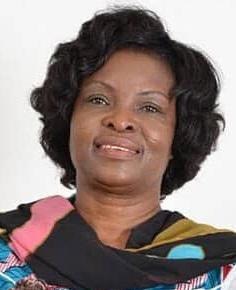
Hon. Mrs Gifty Ohene-Konadu is a civil servant and Ghanaian politician. She was the Member of Parliament representing Asante-Akim South constituency of the Ashanti Region of Ghana for two terms from 2005 to 2013. During her time in Parliament, she was appointed as a member of the Parliamentary Service Board and the Deputy Minister for Trade and Industry. She was also the Vice-Chairperson of the Women’s Caucus in Parliament. She was the National Coordinator of the ‘One District One Factory’ initiative from 2017 to 2020, and she is currently the Coordinator for Monitoring and Evaluation at the Office of the President. She holds master’s degrees in Development Studies; and Gender, Peace and Security.
14 | The Parliamentarian | 2023: Issue Three | 66th Commonwealth Parliamentary Conference
THE COMMONWEALTH CHARTER
FOR
10 YEARS ON: VALUES AND PRINCIPLES
PARLIAMENTS TO UPHOLD
• Encourage political parties to be champions of gender equality; and
• Enhance the gender sensitivity of and gender equality among parliamentary staff.
The Commonwealth Women Parliamentarians (CWP) network of the Commonwealth Parliamentary Association (CPA) is an active advocate for women's representation in Parliament, seeking to ensure Parliaments are gender-sensitive institutions. In this regard, the CWP network has produced two complementary publications to help Parliaments through the gender-sensitisation process:
• CWP Gender Sensitising Parliaments Guidelines: Standards and a Checklist for Parliamentary Change
• CWP Gender-Sensitising Parliaments: A SevenStep Field Guide
In the context of building a gender-sensitive parliament in Ghana, this article suggests that Parliament will have to, inter alia:
• Institute gender-sensitive training programmes for all MPs;
• Work in partnership with national women’s machinery, civil society, NGOs, the private sector and the media to ensure followup of parliamentary action, review and oversight;
• Hold public hearings and consult policy communities to determine the effects of policies, programmes and legislation on women and men, girls and boys;
• Hold governments, particularly Ministers, to account for their actions;
• Institutionalise gender-budgeting by raising gender issues during budget debates;
• Debate the content of Bills and ensure gender considerations are taken into account;
• Ensure the implementation of CEDAW obligations, especially in relation to State-party reporting;
• Ensure less aggressive parliamentary language and behaviour;
• Promote more family-friendly sitting hours;
• Introduce childcare facilities and parental leave for MPs;
• Change structures by rotating positions of parliamentary authority between men and women, such as Committee chairs, joint Committee chairs, Whips, et cetera;
• Provide for gender-neutral language; and
• Institute a network of gender focal points.
The Performance of Ghana’s Parliament
The performance of Ghana’s Parliament in the context of gender mainstreaming can be seen in terms of the level of women’s representation, their position in leadership positions, and the institutional set-ups to support gender mainstreaming in Parliament. In terms of leadership, several women in Ghana have held leadership positions in Parliament, including the position of Speaker. The Speaker of the Sixth Parliament was Justice Mrs Joyce Adeline Bamford-Addo. The other positions that have been occupied by women in Parliament include the following:
THE COMMONWEALTH CHARTER
10 YEARS ON: VALUES AND PRINCIPLES FOR PARLIAMENTS TO UPHOLD
• Majority Leadership
• Minority Leadership
• Chairpersons and Vice-Chairpersons on key Committees of Parliament
• Ranking Members on Committees
• Membership of key Parliamentary Committees
Overall, women’s role in Parliament as reflected in the above positions represents significant progress towards achieving gender mainstreaming in the institution, albeit at a slow pace.
In terms of women’s representation, Table 1 shows a steady increase in the number of women Members of Parliament vis-àvis the total numbers of Members of Parliament over the life of the Fourth Republican Parliament.
These trends notwithstanding, there exists a Gender and Children’s Committee in Parliament dedicated to the promotion of gender mainstreaming.
Challenges to Gender Mainstreaming in Parliament
In spite of the mentioned developments and efforts, Ghana’s Parliament faces some challenges in its journey to achieving gender equality. These include:
• The absence of a network of gender focal points across the Committees in Parliament;
• Lack of gender awareness and sensitivity training for Members of Parliament (MPs). Even though Parliament conducts training for all new Members at the beginning of each parliamentary Session, there is no gender training for new or old MPs;
• The lack of a collective effort by women in Parliament to promote gender-sensitive practices;
• The insignificant proportion of women MPs to their male counterparts. Numbers may not be the key ingredient in gender mainstreaming. However, the higher the proportion of women in the Legislature, the better their chances of taking advantage of opportunities that they may be availed with.
The Parliamentarian | 2023: Issue Three | 66th Commonwealth Parliamentary Conference | 15
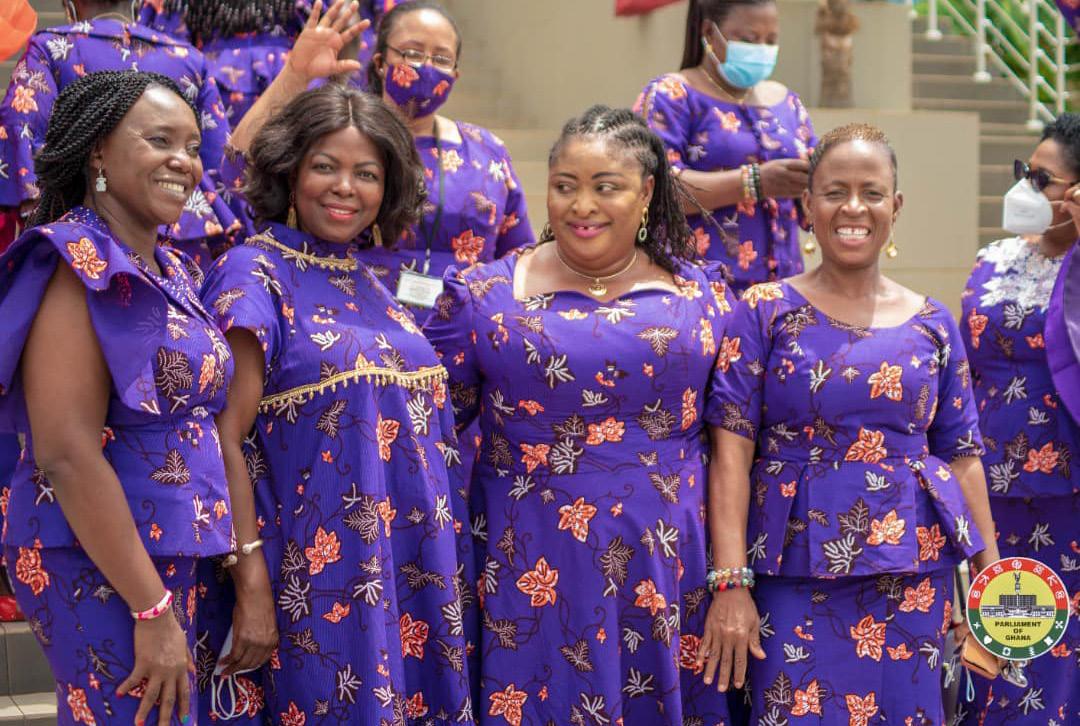
Above: Some Members of the Women's Parliamentary Caucus at the Parliament of Ghana celebrate International Women's Day.
Image: Parliament of Ghana.
THE COMMONWEALTH CHARTER
10 YEARS ON: VALUES AND PRINCIPLES FOR PARLIAMENTS TO UPHOLD
Enhance gender awareness and sensitivity training for MPs
It is highly recommended that continuous training could be used to highlight the gender dynamics of specific parliamentary practices such as responding to questions without notice or chairing Committees. This could be made part of the induction and orientation programmes usually organised for new Members or as part of an ongoing professional development course for all MPs.
Treat gender as a crosscutting issue in parliamentary affairs
It is also recommended that gender be treated as a crosscutting issue and addressed in the work of all Parliamentary Committees.
Promote positive discrimination in the election of MPs
To create the opportunity for raising gender-sensitive voices in the Legislature, the policy of positive discrimination should be seriously considered by Ghana. This is a system where the seats in some constituencies are reserved for specific or marginalised groups only to contest, and it is the most important method for affirmative action in the contemporary democratic setting.
As shown in Table 1, in the 30-year history of the Fourth Republican Parliament, the highest proportion that women Members have attained is 14.5% in the current 275-Member House. Given such a situation, gender-sensitive voices could be drowned by those of their vociferous male counterparts no matter how much capacity is built or the level of opportunities available for women to be mainstreamed in the House.
Recommendations
The following recommendations are suggested to improve gender mainstreaming in Parliament:
Another way this method is implemented is by ensuring that a minimum percentage of electoral candidates is apportioned for women. This may translate into an increase in the number of female voices on the floor of the House. As stated earlier, mainstreaming gender in legislative affairs may not be about numbers, but having more voices that advocate the gender agenda, which may help the cause.
The question that arises is whether Ghana needs to embark on such positive discrimination. Do groups such as the physicallychallenged, women and unionised labour need to be necessarily represented in Parliament? This would call for some national debate, some cursory analysis and constitutional amendments.
16 | The Parliamentarian | 2023: Issue Three | 66th Commonwealth Parliamentary Conference
Name of Parliament Year (From - To) No. of Women MPs Total No. of MPs Percentage of Women MPs First Parliament 1993 - 1997 16 200 8.0% Second Parliament 1997 - 2001 19 200 9.5% Third Parliament 2001 - 2005 18 200 9.0% Fourth Parliament 2005 - 2009 25 230 10.9% Fifth Parliament 2009 - 2013 19 230 8.3% Sixth Parliament 2013 - 2017 30 275 10.9% Seventh Parliament 2017 - 2021 38 275 13.8% Eighth Parliament 2021 - present 40 275 14.5%
TABLE 1: Trends in Female Representation in the Ghana Parliament, 1993-2021.
GHANA’S LEGISLATIVE PROCESS: A COMPARATIVE OVERVIEW OF THE LAW-MAKING PROCESS IN THE COMMONWEALTH
Introduction
The power to enact laws for the proper governance of the state is granted to all Legislatures. Article 93(2) of the 1992 Constitution of the Republic of Ghana vests the legislative power in Parliament. This power is exercised in accordance with Article 106 of the Constitution. The legislative process is very elaborate, consisting of several procedural stages involving different institutions and actors.
In the Commonwealth, the process is nuanced by a country’s political system and constitutional architecture. The differences in the legislative process reflect whether a country is unitary or federal, whether the Legislature is unicameral or bicameral, or whether the system of government is presidential, parliamentary or hybrid.
Using Ghana’s legislative process as a case study, this article provides a comparative overview of the law-making process in the Commonwealth.
Sources of Legislation
In Ghana and the Commonwealth in general, legislative initiatives are driven by inspirations from the national constitution, party manifestoes, campaign promises of winning parties, gaps in existing legislation, international obligations and agreements to which the government and the state are parties and other societal activities that need to be regulated.
The legislative process in Ghana comprises the First Reading, Committee Stage, Second Reading, Consideration Stage, Third Reading and Executive Assent. The various stages and the influence of Commonwealth Legislatures on the legislative process are discussed in seriatim
First Reading and Committee Stage
The introduction of a Bill by the Speaker and the reading aloud of its long title constitute the First Reading. The Bill is subsequently
referred to a Committee for consideration and report, in accordance with Order 125 of the Standing Orders of the House. In Ghana, except for Urgent Bills (Order 119) and Bills regarding settlement of financial matters (Order 122), all Bills begin their trajectory with a publication of their contents in The Gazette for 14 days.
Unlike the Public Bills Committees, which are constituted to consider Bills in the case of the UK House of Commons for example and in other Commonwealth countries, in Ghana, Select Committees, in addition to their oversight functions, are responsible for scrutinising Bills.
At the Committee stage, the Bill is scrutinised by Members, who invite inputs from experts and the general public to inform their deliberations. The sponsoring Ministry is given the opportunity to justify the provisions contained in the Bill. Organisations and individuals can also petition the Committee on any aspect of the Bill. If the Bill is of considerable public interest, the Committee would sometimes undertake a tour of the country to receive public inputs into the Bill.
During the consideration of the first Value Added Tax Bill in 1994 and the Representation of the People's Amendment Bill in 2007, for instance, the Finance Committee and the Committee on Constitutional, Legal and Parliamentary Affairs went around the entire country to collect public inputs into the Bills.
After the stakeholder meetings and receipt of public inputs, the Committee discusses the Bill thoroughly, taking into consideration all the concerns received. The Committee also undertakes a clauseby-clause consideration of the Bill.
To ensure that Committees do not unduly delay Bills referred to them, they are required by the rules to report on Bills within three months (Order 106(4)). This requirement is to ensure that the Legislature does not kill Executive initiative with the effluxion of time.
Despite this rule, important pieces of legislation such as the Right to Information Bill and the Mental Health Bill spent four to eight
Dr Ernest Darfour is a Senior Assistant Clerk with over 17 years of experience working with the Parliamentary Service of Ghana. He holds a PhD in Legislative Studies from the Center for Legislative Studies at the University of Hull in the United Kingdom. Dr Darfour is the author of The Legislative System of Ghana, a book focusing on how the Parliament of Ghana works. His recent publication is titled From a Rubber Stamp to Influencing Policy: A Critical View of Committees in the Parliament of Ghana, published by Routledge in their Library of Legislative Studies series on Parliamentary Committees in the Policy Process, edited by S. T. Siefken and H. Rommetvedt.

The Parliamentarian | 2023: Issue Three | 66th Commonwealth Parliamentary Conference | 17 THE COMMONWEALTH CHARTER 10 YEARS ON: VALUES AND PRINCIPLES FOR PARLIAMENTS TO UPHOLD
years in the legislative mill before they were passed. As the rules provide, all uncompleted business pending before the House or its Committees lapse at the end of each Session. As a result, Bills which could not complete the legislative process at the end of a Session are expected to be reintroduced at the beginning of the next Session, albeit at a cost. To forestall incurring huge costs to reintroduce Bills at the beginning of a new Session, the House has developed a convention to allow all outstanding Bills at the end of the Session to roll over into the next Session without expiring. As a result, Bills can now stay in Committees for more than a year and, indeed, throughout the entire parliamentary term. So now, Bills, when presented and read the first time until they are withdrawn or passed, stay the entire parliamentary term.
Second Reading Stage
The Second Reading stage in Ghana is similar to what pertains in the UK Parliament and other Commonwealth countries, where the debate focuses on the principles of the Bill. In Ghana, the sponsor of the Bill, at this stage, moves the Motion for the Second Reading by delivering a statement explaining the Bill’s implications and arguing for its passage. The sponsor's statement usually affirms the memorandum accompanying the Bill. The Chairperson of the Committee in charge of the Bill in Parliament rises to present the Committee’s report and moves for the adoption of the recommendations of the Committee. The ranking Member may also make a statement to either support the Committee’s report or present an alternative position. Other Members may be allowed to speak as well.
At the end of the debate, the House votes to accept or reject the Committee’s report. When the report is accepted, the procedural Clerk reads aloud the long title of the Bill, signifying that the Bill can now move to the next stage.
Consideration Stage/Committee Stage/Report Stage
The consideration stage in Ghana combines both the Committee stage and the Reporting stage in other jurisdictions of the Commonwealth. At the Committee stage in the UK, the Bill is referred to a Public Bill Committee for detailed consideration, where amendments are debated before a clause is approved on a “stand part” Motion. In Kenya, a Committee of the Whole House is constituted and chaired by a Deputy Speaker to consider the Bill in detail, clause-by-clause, including the title, preamble and schedules. At the Reporting stage, further amendments are introduced, and the
process does not entertain a repeat of the amendment that failed at the Committee stage.
At the consideration stage in Ghana, the House takes the Bill through a clause-by-clause amendment. Each amendment is pronounced and voted on to stand part of the Bill, as many amendments can be tabled during the process. The House is constrained by the decision taken during the Second Reading, as it pertains in most Commonwealth jurisdictions, and cannot reject the Bill's principle nor consider an amendment that goes against it. It is also precluded from considering any modification that does not fall within the scope of the Bill’s long title.
The Committee’s and any other amendments introduced by Members are debated and voted on clause-by-clause during this stage of the process. This stage is critical as that is where the Legislature can influence the policymaking process in a substantial manner. As a result, there is much bargaining and trade-off between Government Ministers, the Chairperson of the Committee, the Minority group, Leaders of the House and individual Members who have tabled amendments to the Bill. The success rate of the proposed amendment depends on the nature of the amendment, whether it is of substance or of a trivial nature.
The House, by convention, has introduced a new procedure called ‘winnowing’, by which a team is assembled to streamline, synchronise and reduce the number of amendments proposed to a Bill where the amendments proposed are deemed to be overly many. This arrangement is similar to the ‘winnowing’ process in the UK Parliament, which is handled by the Public Bills Committee. While the ‘winnowing’ team in Ghana is ad hoc with loose membership, composed when a particular Bill receives many amendments, the Public Bills Committee in the UK Parliament is permanently established with a changing composition when a new Bill is referred. The Parliament of Ghana in its forthcoming revised Standing Orders has made provision for the establishment of a permanent Committee to handle ‘winnowing’ and related matters.
The Clerk to the Committee that considers the Bill, serves as the Clerk to the ‘winnowing’ team at any time. It may also include other Members who are interested in the Bill and those with expertise in the area of the Bill. The ‘winnowing’ team acts as a clearing house for all the amendments relating to the Bill.
There may be a second consideration stage, where an MP has a last opportunity to make further amendments before the Bill is ready for the Third Reading.
Third Reading and Presidential Assent
The Third Reading is the final stage of the process of passing the Bill in the House. In the UK Parliament, the Bill is debated and voted on finally in the House of Commons before it is transmitted to the House of Lords, while in Ghana it is a mere formality to read the long title at the Third Reading to signify the passage of the Bill.
All adopted amendments are incorporated into the Bill, and the final draft is then forwarded to the President of Ghana for assent. Should the President refuse to assent to the Bill, the Bill must be returned to Parliament, and if two-thirds majority of Members continues to support the Bill, the President is compelled to assent to the Bill within 30 days of the passing of the resolution.
“
THE
CHARTER
18 | The Parliamentarian | 2023: Issue Three | 66th Commonwealth Parliamentary Conference
At the end of the debate, the House votes to accept or reject the Committee’s report. When the report is accepted, the procedural Clerk reads aloud the long title of the Bill, signifying that the Bill can now move to the next stage. ”
COMMONWEALTH
10 YEARS ON: VALUES AND PRINCIPLES FOR PARLIAMENTS TO UPHOLD
Influence of Commonwealth Legislatures on Legislation
Opinions vary regarding the influence of Commonwealth Legislatures in legislation. Since the establishment of the Fourth Republican Parliament, the Legislature in Ghana has passed over 1,000 laws, mainly emanating from the Executive. A critical analysis of the outcome of the legislative process in Ghana shows that the Legislature has evolved as a policy-influencing institution in three main ways: its ability to reject Bills, to introduce amendments, and to create an avenue for public participation in the policymaking process.
The power to reject outright a legislative proposal at the Second Reading stage or cause the government to withdraw policy proposals for reconsideration before they are reintroduced shows the extent to which the Legislature can influence policy proposals. While Parliament's power to reject Bills has rarely been used, in 2013, the Legislature for the first time rejected an Executive proposal: the National Fiscal Stabilisation Levy (Amendment) Bill, 2013, based on the recommendation of the Finance Committee (Parliamentary Debates, 12 December 2013). In its recommendation, the Committee stated, “The Committee has thoroughly examined the Bill and considers the passage of the Bill to be premature and accordingly recommends to the House to adopt its report and not to approve the National Fiscal Stabilisation Levy (Amendment) Bill, 2013” 1
This shows that if partisan considerations are eliminated, the Legislature as an institution could be a countervailing force to the Executive in the governance process. To avoid an imminent defeat or a substantial amendment to a Government Bill, which may not
THE COMMONWEALTH CHARTER 10 YEARS ON: VALUES AND PRINCIPLES FOR PARLIAMENTS TO UPHOLD
augur well for the image of the administration, particularly when both the Majority and the Minority sides of the House are thinking alike, the Government has been advised to withdraw the affected Bill on many occasions after its initial introduction and referral to the relevant Committee of Parliament.2 The act of ‘Executive withdrawal’ is a further show of the strength and influence of the Ghanaian Legislature.
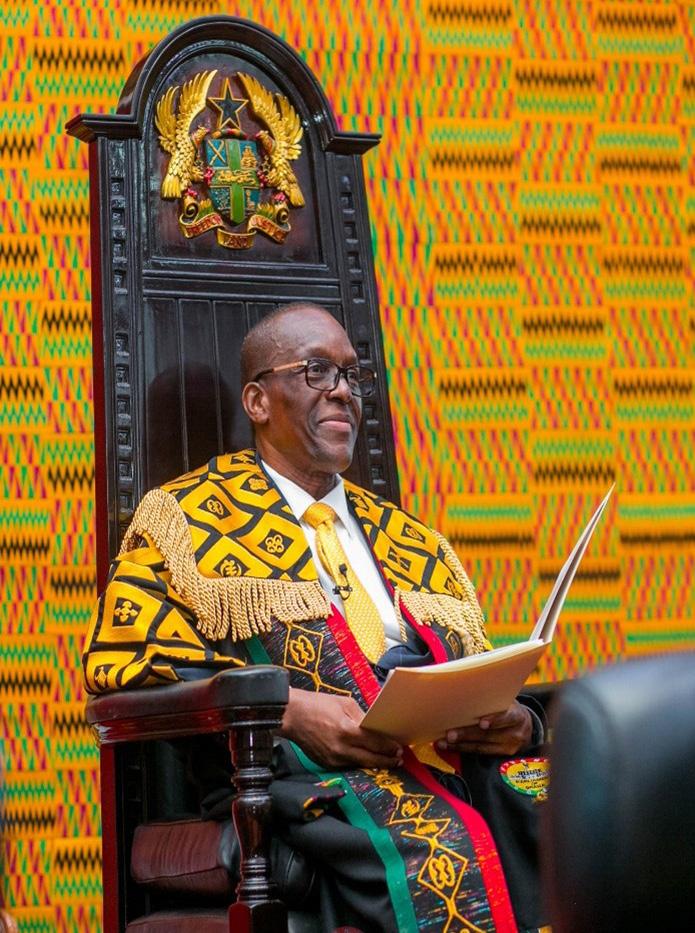
Bills passed by the Legislature go through a rigorous process of amendment at both the Committee and consideration stages in Parliament. The ability of the Legislature to carry out legislative amendments or to amend legislative proposals in line with the guidelines regulating the consideration stage of the legislative process indicates how independent the Legislature is regarding the processes of legislation.
The legislative process has ensured that the public is engaged and involved in the process as opportunities are given for public inputs at both the Committee and consideration stages. However, since the public engagement process is at the discretion of Committees or the forum considering the legislation, it does not offer an automatic chance for the public to be involved. In some instances, the public is not consulted, or their input is neglected in the legislative process.
To ensure that public interest is safeguarded, it is recommended that a formal procedural stage be incorporated into the legislative process, called public engagement or consultation, after the Bill is presented for the First Reading.
Conclusion
Generally, the legislative process across the Commonwealth comprises three stages (or readings), namely, First, Second and Third, in addition to a consideration stage, a Committee stage, Reporting stage, and Executive assent. In Ghana, no Bill shall be passed by Parliament unless it has been read three times and passed through the consideration stage. The consideration stage in Ghana combines processes at the level of the Committee and Reporting stages as pertaining to other Commonwealth jurisdictions.
The article has also highlighted the influence of Commonwealth Legislatures in the law-making process. If partisan considerations are set aside, Commonwealth Legislatures, through the legislative process, can support the State in enacting sound legislation for the governance of their countries.
References:
1 Finance Committee, Report on the National Fiscal Stabilisation Levy (Amendment) Bill, 2013; See Parliament of Ghana, Parliamentary Debates, 12 December 2013.
2 In the First Parliament, the Customs, Excise and Preventive Service (Management) Duties, Rates and Other taxes (Amendment) Bill laid and referred to the Committee on Finance on 9 December 1994 was withdrawn; In the Second Parliament, the Vice President (Succession) Bill, The Banking Bill and the Bank of Ghana Bill were all introduced but was later withdrawn; The Third Parliament saw the withdrawal of the Juvenile Justice Bill and the Development and Classification of Film Bill; In the Fourth Parliament, the Mineral and Mining Bill, the Anti-Money Laundering Bill, the Bui Authority Bill, the Data Capture (Registration) Protection of Personal Information and Privacy Bill, the Financial Administration (Amendment) Bill and the Road Traffic (Amendment) Bill were all laid and withdrawn and re-laid at various stages; In the Fifth Parliament, the 2009 Supplementary Appropriation Bill, the Medical Training and Research Bill, the Data Protection Bill and the Fees and Charges (Miscellaneous Provisions) Bill were laid, withdrawn and re-laid at various stages.
Above: The Speaker of the Parliament of Ghana.
The Parliamentarian | 2023: Issue Three | 66th Commonwealth Parliamentary Conference | 19
Image: Parliament of Ghana.
TOWARDS AN INCLUSIVE, TRANSPARENT AND RESPONSIVE PARLIAMENT
Introduction
Democracy, globally, is under severe distress. The 2022 Global State of Democracy report, issued by the International Institute for Democracy and Electoral Assistance, reveals a decline in and stagnation of democracy around the world. Even though democratic institutions exist in many countries, some have failed to respond to the needs of citizens leading to political and socio-economic crises. This article discusses the importance of the participation of civil society organisations (CSOs) in decision making, the establishment of a Citizens’ Bureau in the Parliament of Ghana and how the bureau will promote a more inclusive, democratic and responsive legislative process in Ghana.
Over the past decade, there has been growing activism by citizens in Africa as a result of dissatisfaction with their governments and poor socio-economic conditions. Governments in Tunisia, Libya and Algeria were ousted by sustained protests by their citizens. The African continent has witnessed several other upheavals in countries such as Nigeria, Egypt and Morocco. Some of these upheavals resulted in major reforms in those countries. These developments, coupled with the recent demonstrations of popular support for coups d’état by citizens in countries such as Burkina Faso, Chad, Guinea, Mali, Niger and Sudan, are worrying signs of democratic backsliding.
The Afrobarometer Survey report (round 9), published by the Ghana Centre for Democratic Development in July 2022, shows that while the demand side of democracy in Ghana remains very high, the supply side is problematic. The survey revealed that eight out of ten citizens were of the view that democracy is their preferred form of governance. However, their trust ratings of democratic institutions relative to the performance of their mandate was very low. For instance, the question as to whether citizens have trust in public institutions elicited the following ratings: Courts – 10%; President –14%; Police – 7%; Parliament – 8%; Assemblyman or woman – 5%; and
Hon Emmanuel Kwasi

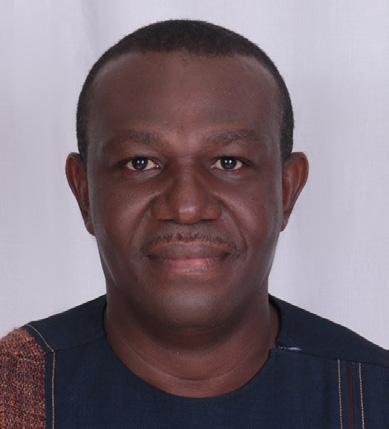
Bedzrah, MP is a Member of the Ghana Parliament for the Ho West Constituency for four consecutive terms. He is Chair of the Volta Caucus; the African Parliamentarian Network Against Corruption (APNAC) and the Parliamentary Christian Fellowship. He is the CEO & founder of KEB Health Foundation, an NGO formed to promote and provide quality healthcare, especially to people in rural communities.
the Electoral Commission – 10%.1 The low trust ratings of citizens in democratic institutions point to the former’s dissatisfaction with the performance of the latter’s functions. In effect, it is not the case that citizens do not support democracy, rather democratic institutions have failed to deliver democratic dividends, much to their dissatisfaction.
Ghana’s Constitution (1992) establishes a democratic order that vests the sovereignty of the state in citizens. The three Branches of Government – the Executive, Legislature and the Judiciary – are, therefore, required to exercise their powers in the interests and for the welfare of the people.
The current dissonance between duty bearers and rights holders can partly be attributed to the lack of (or limited) engagements between citizens and these democratic institutions. For instance, in a representative democracy like Ghana, Members of Parliament are elected to represent their constituents. By necessary implication, the MPs are required to take decisions on behalf of the people. The quality of representation depends on the ability of MPs to engage with their constituents in order to represent their views adequately. Unfortunately, such systems are either non-existent or ad hoc in nature. In the face of the continuous decline of citizens’ trust in democratic institutions, it is imperative now more than ever that institutions explore innovative ways to engage citizens. One such approach is through institutionalised engagements with CSOs.
The Importance of CSOs’ Participation in Decision-making
The participation of CSOs in the policy process addresses the representation gap as it ensures diverse perspectives are taken into account. CSOs also offer specialised expertise that institutions may be lacking. The involvement of CSOs in the legislative process, for instance, promotes openness, transparency and public accountability. It also bridges the gap between citizens and duty bearers while driving policy innovation and social change.
Prosper Hoetu is a Senior Research Officer to the Speaker and also heads the Citizens’ Bureau in the Parliament of Ghana – an office that coordinates civil society engagements with Parliament to achieve a more open, inclusive and responsive Parliament. He is a lawyer and governance expert who has consulted for both local and international organisations. He recieved the 2015 Commonwealth Youth Worker Award.
20 | The Parliamentarian | 2023: Issue Three | 66th Commonwealth Parliamentary Conference
THE COMMONWEALTH CHARTER
YEARS
FOR
10
ON: VALUES AND PRINCIPLES
PARLIAMENTS TO UPHOLD
The role of the Parliament of Ghana's Citizens' Bureau.
According to the 2022 Global Parliamentary Report published by the Inter-Parliamentary Union and the United Nations Development Programme, effective engagement with the public through CSOs facilitates sharing of critical information and ideas that enhance the representation, law-making, public policy formulation and oversight that meet the expectations and aspirations of citizens.
Civil Society Organisations and the media play very important roles in a representative democracy. While CSOs serve as an interface between citizens as right holders on the one hand and duty bearers on the other, they also aggregate the views of citizens and undertake research on important policy issues, which serve as critical feedback to Parliament in the exercise of its legislative, deliberative, accountability and oversight functions. Further, since CSOs undertake public education and sensitisation on many issues of concern to the public, partnership between Parliament, CSOs and the media will enhance public awareness of Parliament’s work and to help address long-held misconceptions about the functions of Parliament and Members of Parliament.
In recognition of the above, the Parliament of Ghana took a proactive step to mainstream CSOs and media engagements in its work by providing in Goal 3 of its Corporate Strategic Plan (20202024), a proviso that aims at ‘strengthening the representational role and public involvement in the work of Parliament’. One of the proposed mechanisms for achieving this goal is to institutionalise Parliament-citizens’ engagement through partnerships with CSOs/ think-tanks and the media.
Since assuming office, the Speaker of the Eighth Parliament, Rt Hon. Alban Sumana Kingsford Bagbin, had several engagements with CSOs/think-tanks as part of efforts to institutionalise CSOs’ engagement with Parliament.
To ensure that the appropriate mechanism is put in place to facilitate Parliament–citizens’ engagement through CSOs and the media, a survey was commissioned by the Speaker in 2022 to better appreciate the experiences of CSOs in their engagements with Parliament over the years, with the view of applying the recommendations to strengthen Parliament’s engagement with the CSOs and think-tanks. The result of the survey shows that 80.9% of the respondents (CSOs) favoured the establishment of an office in Parliament to facilitate engagement between Parliament and CSOs/ think-tanks.
About the Citizens’ Bureau in the Parliament of Ghana
The Citizens’ Bureau is, therefore, an office recently established in Parliament to facilitate effective engagements between Parliament and CSOs/think-tanks. Fully inaugurated on 31 July 2023, the bureau will specifically undertake the following functions:
• Develop and maintain a database of CSOs/think-tanks operating in Ghana in accordance with their respective areas of work.
• Provide the media and CSOs with the opportunity to easily share information and their research findings with Parliament and also obtain relevant information from Parliament to support their work.
• Facilitate capacity-building for the media and CSOs on how Parliament works and the entry points that exist for collaborations with Parliament.
• Collaborate with the media and CSOs to support public education and sensitisation on the work of Parliament and the duties of Members of Parliament.
• Facilitate effective engagements between the Speaker, Parliament, CSOs and the media, including their participation in the work of relevant Committees of Parliament.
• Facilitate the development and implementation of Open Parliament initiatives.
• Assist in the formulation and implementation of Open Parliament initiatives.
Ultimately, the office will not only serve as a one-stop shop for the information needs of CSOs on Parliament, but it will also enhance CSOs-Parliament engagement, to enable CSOs to better appreciate the work of Parliament and to effectively publicise the same to the citizenry across the length and breadth of the country.
The bureau will also be a repository of all relevant information on the work of CSOs, including their reports, to feed into the deliberations of Parliament and its Committees. It will further facilitate access to research materials by Members of Parliament and their staff, Committees of Parliament, academia, think-tanks and the general public, among others.
While the office is open to the public and members of the CSOs who may want to physically visit the office for one piece of information or another, there is a webpage on the website of Parliament through which the said information can be obtained by CSOs and Parliament.
Conclusion
With Ghana’s Parliament being adjudged the most open parliament in Africa in the 2022 Africa Open Parliament Index, partly due to efforts it has made to promote the values of the Open Government Partnership – transparency, civic engagement and public accountability – the establishment of the Citizens’ Bureau is another novelty that will expand the frontiers of good governance. It is envisaged that through the bureau, Ghana’s legislative process will become more inclusive, democratic and effective in addressing the needs and aspirations of Ghanaians.
References:
1 Afrobarometer (Round 9), 2022 - Ghana Center for Democratic Development
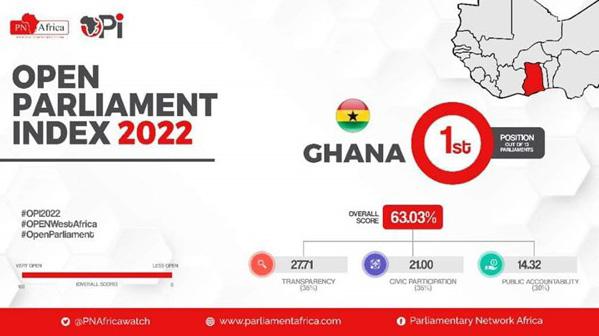
The Parliamentarian | 2023: Issue Three | 66th Commonwealth Parliamentary Conference | 21
THE COMMONWEALTH CHARTER 10
YEARS ON: VALUES AND PRINCIPLES FOR PARLIAMENTS TO UPHOLD
Image: Open Parliament Index 2022.
THIRTY AND COUNTING: DEEPENING REPRESENTATION IN THE PARLIAMENT OF GHANA THROUGH INFORMATION, COMMUNICATION AND LANGUAGE
It is three decades since parliamentary democracy was given a fourth birth in this sovereign country, and Ghanaians should be proud of this legacy of deliberative governance. While commending the successive Parliaments of the Fourth Republic and the parliamentary leadership as a whole for taking our Legislature this far, it is only appropriate to indicate that there is so much room for improving upon the status quo. Some sober reflection on the journey so far might help the institution to improve the pace at which it is representing and defending Ghanaian citizens.
Representation
The role of representation is one on which such a reflection would be most beneficial. Fortunately, it is one area that the Speaker of the House, Rt Hon. Alban S. K. Bagbin, places a premium on. Speaking at the Speaker’s Breakfast Forum in Kumasi on 21 November 2021, Hon. Alban Bagbin indicated, among others, that the Eighth Parliament under his leadership prioritises the strengthening of its representational role. This declaration is very much in line with the modern trend in governance, where emphasis is placed on participatory rather than representative governance. In this respect, Mehmet Zahid Sobachi (2012) writes that the role of citizens in a democracy is not exhausted by the act of electing a government; they need to be continually engaged by government if it is to remain in touch with the people and their needs.
To make relevant progress in deepening representation, there is definitely the need to step up engagement with citizens. Without prejudice to the Speaker’s declaration, it should be placed on record that Parliament has been in touch with Ghanaians in so many ways. There have been various forums such as the Speaker’s Breakfast Forums, roadshows and town hall meetings by various Parliamentary Committees. There are also students’ Parliaments established in collaboration with the Public Affairs Sub-Division, encouraging pupils and students to visit the House regularly to
observe proceedings. The live webcast of proceedings, and the opportunity it gives citizens to make comments on the performance of their representative institution and its Members is probably the most prominent signpost on the Legislature’s engagement with Ghanaians. There is room, all the same, for improving upon every aspect of such public engagement activities.
It is commendable, therefore, that the Speaker recognises this need for the Legislature and its Members of Parliament to deepen engagement with Ghanaians and has been putting measures in place to support this process. In recent times, the creation of a department responsible for public engagement, and the appointment of a director to spearhead the process is an indication of a desire to move the engagement process from the piecemeal approach of the past to a formal approach. This will not only make many Ghanaians more interested participants in the affairs of their elected representatives, but also make the Legislature more relevant to the needs of citizens. The recently established Citizens’ Bureau is expected to further broaden the Parliament-citizen engagement process.
It is significant that the Speaker’s efforts are in tune with the focus of the Inter-Parliamentary Union’s (IPU) Global Parliamentary Report, 2022, which emphasises improvement in Parliament-citizen engagement. The profound outreach process in our Parliament would benefit immensely from the best practices proposed in this report. The report proposes improved dissemination of information among citizens; improved exchange of communication between Parliament and citizens; and the enhancement of educational activities among school children and the general public. The report also proposes broader consultations with relevant stakeholders in the consideration of draft legislation while getting the public to participate actively in the process. As outlined in this report, efforts aimed at deepening the engagement process should start from improving information dissemination and communication with citizens.
Harold Wilson Hubert is the Editor of Debates of the Parliament of Ghana. He has been working with the Parliamentary Service since December 2002 and has risen through the ranks to his present position. Previously, he had worked with the Armed Forces Public Relations Directorate for close to 19 years. In addition to his present position, he is a member of the Management Committee of the Parliamentary Service of Ghana. He holds master’s and bachelor degrees in English from the University of Ghana. He also holds a diploma in Journalism from the Ghana Institute of Journalism.
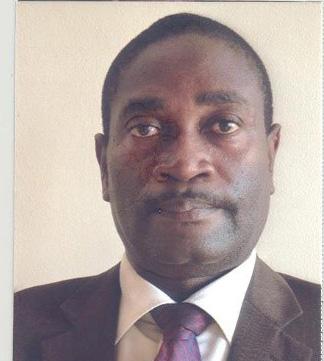
THE COMMONWEALTH CHARTER 10 YEARS ON: VALUES AND PRINCIPLES FOR PARLIAMENTS
22 | The Parliamentarian | 2023: Issue Three | 66th Commonwealth Parliamentary Conference
TO UPHOLD
Improved Dissemination of Information
As already mentioned, the Parliament of Ghana has not lagged behind with the most basic form of engagement, which is disseminating information among Ghanaian citizens. In particular, the institution continually uses online tools to inform citizens of its activities and has, for several years, maintained an active website that regularly publishes information on its activities.
Parliament also maintains active social media platforms. Created in January 2018, the Parliament of Ghana’s Facebook page (as at 6 June 2023) had 243,000 followers, representing 93% of Parliament’s social media audience, as against 4,707 for Twitter (X) followers (1.8%) and 13,500 followers on YouTube (5.1%). Secondly, the Facebook handle is used to transmit live videos of daily proceedings of the House which are streamed on YouTube
In spite of the live broadcast and regular updates that these online media platforms provide on governmental and other issues of public interest, information on the Legislature’s own businesses are not forthcoming. The daily proceedings of the House are recorded in two documents: the Votes and Proceedings, and the Official Report, otherwise known as the Hansard. They are supposed to be published as soon as possible after the House adjourns, and Ghanaians will no doubt want to see the two documents published more often on Parliament’s website.
Improved Communication with Citizens
Another step that needs to be taken is to expand the scope of interaction on Parliament’s online media platforms, especially the website. The online pages are usually alive with very critical comments on debates of national interest, and it is a testimony of the interest that Ghanaians have developed in the business of the Legislature. The House can leverage this interest by creating
an interface on the website for collecting public inputs into the business of the House.
Parliamentary websites all over the world have become the platform for reaching out to citizens and sampling opinions on very critical businesses before the Legislatures. For instance, the website of the Parliament of the Republic of South Africa has an interface titled ‘Have Your Say’ that is purposely for receiving inputs from the public. E-petitions and memoranda on various business are presented by the public through this platform and passed on to the Committees or functionaries on whose laps they sit. On its part, the Parliament of Kenya has on its website an interface titled ‘Get Involved’, and citizens have the opportunity to petition both the National Assembly and the Senate, even urging them to enact, amend or repeal some legislation.
The Parliament of Ghana should take a cue from best practices in other Parliaments to encourage citizens’ participation in its work. Online forums could be established to open up the exchange of information with citizens, even on various businesses before the House. To make such exchanges fruitful, Parliament should consider appointing an online administrator to collect, process and table relevant views to the appropriate quarters.
Use of Multiple Languages
At age 30, the time is ripe for Parliament to introduce a multilingual platform for deliberations in the House. To discriminate positively in favour of linguistically-challenged persons, Section 33 of the Declaration on Parliamentary Openness makes room for Members of Parliament to use multiple national or working languages in debates. Even though the official language of Ghana is English, Standing Order 47 of the House makes provision for the use of seven other indigenous languages, namely: Akan, Nzema, Ga, Ewe, Hausa, Dagbani and Dagaare, “or any other local language”.
The only condition precedent to using such alternative native languages is that there should be facilities for their interpretation. The Declaration reinforces this caveat by calling upon Parliaments in such a situation to “make every reasonable effort to provide for the simultaneous interpretation of proceedings and rapid translation” of Members’ contributions into the official language. In other words, while Members may use any of the alternative languages, their contributions would be published in the Official Report on the proceedings of the House in the official language of the country concerned.
When conditions are created for our representatives to address the House in such indigenous languages, they are empowered to better advocate for their constituents. It also gives them the opportunity to reach out to the numerous Ghanaians who are not proficient in the use of the English Language. Beyond these linguistic advantages, the introduction of indigenous languages into parliamentary debates would convey the very essence of being Ghanaian to the larger world.
Attaining three decades in the democratic world is coming of age, and there is no better proof of this than for our elected representatives to advocate for us in our own languages. The time for the Parliament of Ghana to operationalise this provision in its Standing Orders is now.

THE COMMONWEALTH CHARTER
The Parliamentarian | 2023: Issue Three | 66th Commonwealth Parliamentary Conference | 23
“ This will not only make many Ghanaians more interested participants in the affairs of their elected representatives, but also make the Legislature more relevant to the needs of citizens. ”
10 YEARS ON: VALUES AND PRINCIPLES FOR PARLIAMENTS TO UPHOLD
10 YEARS ON: VALUES AND PRINCIPLES FOR PARLIAMENTS TO UPHOLD
ROLLING BACK DESERTIFICATION AND REPAIRING DEGRADED LANDS IN AFRICA
Putting National Commitments made under the Great Green Wall and Afr100 back on the front burner.
Over the years, the alarm bell has been sounding about desertification and land degradation in Africa. The results of a study published on 1 May 2018 by the University of Maryland (available online) suggest that the Sahara Desert, the world’s largest hot desert, has expanded by about 10% since 1920.1
Currently, it is estimated that 45% of Africa’s land area is affected by desertification while 65% of productive land is degraded.2 The Sahel, the Horn of Africa and the Kalahari, located further south of the continent, exemplify the meaning of land degradation, that is “the loss of the productive capacity of the soils for present and future use” 3 Desertification has also been defined as “land degradation in arid, semi-arid and dry sub-humid areas resulting from various factors, including climatic variations and human activities” 4
Observers make the point that desertification and drought have remained formidable factors undermining lasting development in Africa and that they pose a veritable existential threat, given their potency to wreak “far-reaching adverse impacts on human health, food security, economic activity, physical infrastructure, natural resources and the environment, with incidence in national and global security” 5
In a quest to restore degraded landscapes in the Sahel zone (an area with a population size currently estimated to be well over 100 million), the African Union, in the year 2007, launched the Great Green Wall (GGW) Initiative. Eleven states (Senegal, Mauritania, Mali, Burkina Faso, Niger, Nigeria, Chad, Sudan, Eritrea, Ethiopia and Djibouti) agreed to pioneer the implementation of the GGW Initiative in their territories.
The Goal of the Great Green Wall Initiative
At its inception, the goal of the GGW Initiative was to create a 15km-wide wall of trees in the literal sense which would stretch across the width of the continent from Senegal on the Atlantic to Djibouti on the Red Sea, covering a distance of over 7,775km. Once complete, the initiative would be expected to attain the following milestones by the year 2030: restoration of 100 million hectares of degraded land; sequestration of 250 million tonnes of carbon; and the creation of 10 million green jobs. Communities living along
the wall of trees would be supported to grow fertile land, create economic opportunities and develop climate change resilience.
With time, however, the vision of the creation of a wall of trees has evolved into “an integrated ecosystem management approach, striving for a mosaic of different land use and production systems, including sustainable dryland management and restoration, the regeneration of natural vegetation as well as water retention and conservation measures”6
Partnership
The GGW Initiative has received support from foreign organisations and institutions such as the European Union (EU), the Food and Agriculture Organization of the United Nations (FAO), the Global Mechanism of the United Nations Convention to Combat Desertification (GM-UNCCD), the United Nations Environment Programme (UNEP), and the World Bank.
Key Achievements under the GGW Initiative
Some notable country-specific achievements reported on by the 11 founding states since the launch of the initiative in 2007 until the year 2019 are listed in Table 1 7
Challenges
The implementation process of the GGW Initiative has been criticised for being slow. The initiative continues to encounter institutional difficulties, some of which influenced the decision to modify the initial target of the creation of “a wall of trees” to the creation of “a mosaic of sustainable land use practices”. Disappointed at the lack of progress in the attainment of a number of implementation targets, some observers have speculated that the initiative is failing.8 It would appear that given the sheer magnitude of the initiative, much more work needs to be done in the province of monitoring and advocacy by political leaders, preferably the elected representatives of the people.
Enter AFR100
Motivated by successful outcomes of restoration projects undertaken elsewhere, as well as by the keen interest that foreign
Pius Acolatse is a Senior Public Affairs Officer with the Parliamentary Service of Ghana. From November 2008 when he joined the Service until October 2020, he was responsible for undertaking civic education programmes for youth groups in his capacity as a Public Affairs Officer. In his present role as Information Officer, he handles and responds to requests from the general public for access to parliamentary information. Prior to joining the Parliamentary Service, Pius had a two-year stint at The IEA Ghana, a not-for-profit public policy think-tank, where, as a Research Officer, he was involved in the implementation of good governance projects.
24 | The Parliamentarian | 2023: Issue Three | 66th Commonwealth Parliamentary Conference
THE COMMONWEALTH CHARTER
THE COMMONWEALTH CHARTER
10 YEARS ON: VALUES AND PRINCIPLES FOR PARLIAMENTS TO UPHOLD
partners had taken in the GGW Initiative, the African Union, in October 2015, endorsed a political declaration for the creation of the umbrella African Resilient Landscapes Initiative (ARLI), which event preceded the December 2015 launch of the African Forest Landscape Restoration Initiative (AFR100).
AFR100 is primarily conceived as a partnership to boost the contribution of Africa to global initiatives on forest landscape restoration. As the acronym suggests, AFR100 aims to restore forests and tree cover on 100 million hectares of land in sub-Saharan Africa by the year 2030.9 It is widely anticipated that the restoration of productive landscapes through AFR100 will yield enormous benefits such as helping to lift people out of poverty, stabilising food production, protecting biodiversity and mitigating climate change.
Seen as African-owned, AFR100 thrives on country-level drive and grassroots mobilisation. The African Union Development Agency-NEPAD (AUDA-NEPAD) serves as the secretariat of the initiative - providing support services and promoting best practices.
Partnership
AFR100 has received support from foreign organisations and institutions such as the German Federal Ministry for Economic Cooperation and Development (BMZ), the Swedish International Development Cooperation Agency (SIDA), the Global Environment Facility (GEF), and the World Bank. The initiative is supportive of the Bonn Challenge - a global goal to bring 150 million hectares of degraded and deforested landscapes into restoration by the year 2020, and also of the New York Declaration on Forests that extends the goal to 350 million hectares by the year 2030.
Participation
As of June 2022, 32 countries had committed to restore over 127 million hectares of land under AFR100, thus exceeding the original 100 million hectares target.10 Table 2 identifies the countries and their commitment pledges.
Identified Challenges
Country Some key achievements under the Great Green Wall Initiative
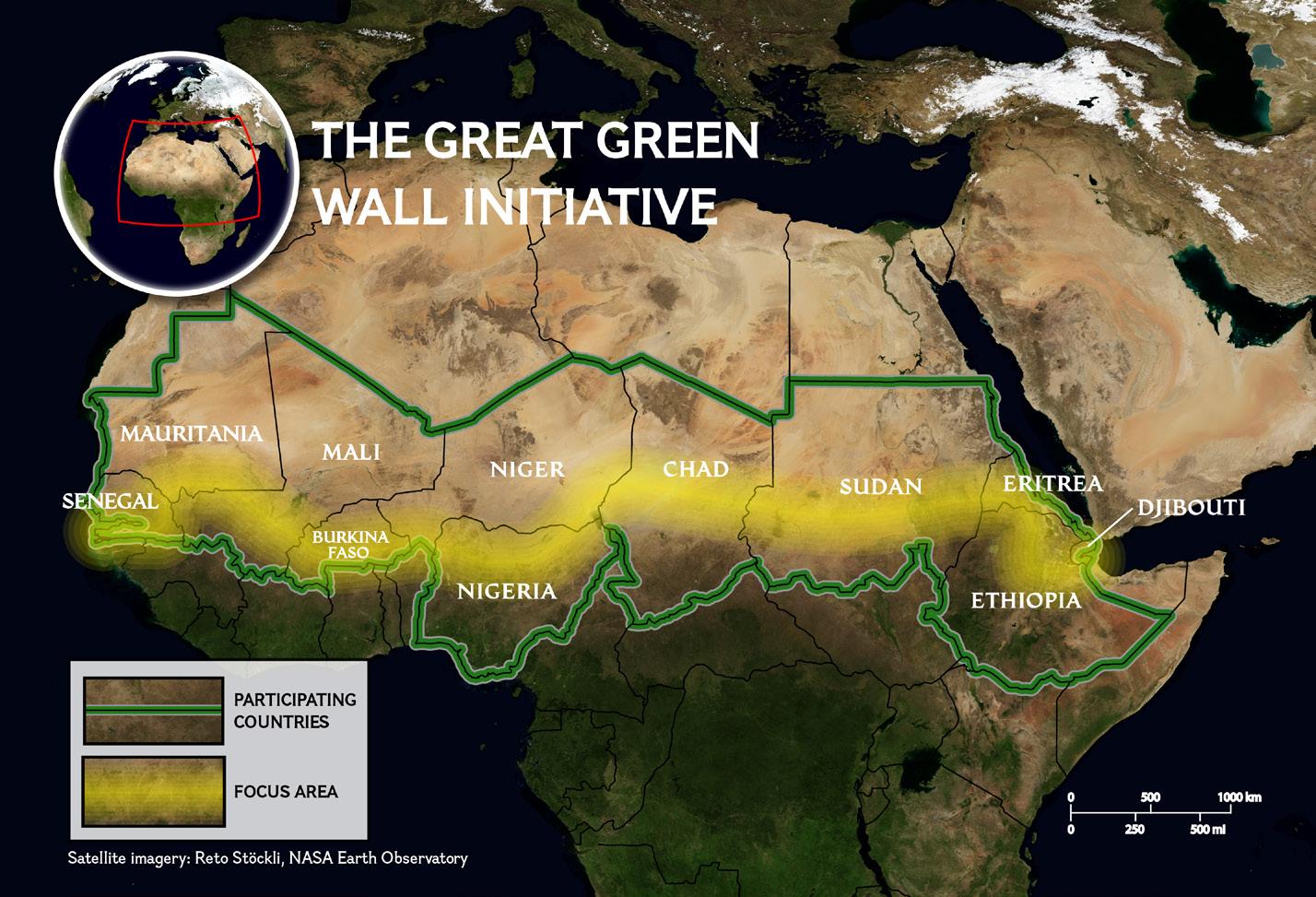
It has been noted that while commitment pledges made under AFR100 reflect a high political will, redeeming the pledges and tracking progress on the ground have remained a challenge. The African Forestry and Wildlife Commission*, on its part, has sought to engage with African countries on the need to halt deforestation by strengthening forest governance, among others.11 The commission has encouraged debate on the effectiveness of AFR100 in addressing forest degradation while calling for increased funding allocations for forest restoration and for addressing drivers of forest degradation such as unsustainable timber and fuel wood harvesting.12
Burkina Faso 20,383 hectares of reforested lands; 29,602 hectares of restored lands; 45,383 jobs created.
Chad 994 hectares of reforested lands; 12,755 hectares of dune fixing; 307 jobs created.
Djibouti 90 hectares of reforested lands.
Eritrea 52,930 hectares of degraded area afforested.
Ethiopia 151,448 hectares of reforested lands; 96,774 hectares of restored lands; 218,405 jobs created.
Mali 6,297 hectares of reforested lands; 120 hectares of restored lands.
Mauritania 2,860 hectares of dune fixing.
Niger 364,615 hectares of reforested lands; 363,928 hectares of restored lands; 80,040 hectares of dune fixing; 21,487 jobs created.
Nigeria 2,801 hectares of reforested lands; 1,396 jobs created.
Senegal 72,452 hectares of reforested lands; 119,202 hectares of restored area.
Sudan 85,000 hectares of restored lands.
Ghana’s Experience
The Forestry Commission of Ghana is the agency responsible for regulating the utilisation of forest and wildlife resources, the conservation and management of those resources, and the coordination of policies related to them. It was established by the Forestry Commission Act, 1999 (Act 571) and reports to the Ministry of Lands and Natural Resources for policy direction. The Commission is responsible for implementing international agreements to which the Ghana Government is committed. Such agreements include the UN SDGs, the Paris Agreement on Climate Change, the Bonn Challenge, AFR100, the New York Declaration on Forests, and the United Nations Strategic Plan for Forests.
National policies and strategies crafted to support forest landscape restoration in Ghana include the Forest
The Parliamentarian | 2023: Issue Three | 66th Commonwealth Parliamentary Conference | 25
Image: Great Green Wall/National Geographic/John Kappler.
TABLE 1: Some notable country-specific achievements.
THE COMMONWEALTH CHARTER
10 YEARS ON: VALUES AND PRINCIPLES FOR PARLIAMENTS TO UPHOLD
not progressing quickly enough and that there was the need for meaningful inclusion of all sectors of the economy and full participation of everyone to ensure the success of the initiative.16
Food for Thought
It is an established fact that land degradation and desertification pose an enduring challenge to economies in sub-Saharan Africa. The loss of forests in this part of Africa is also a source of concern. An observation that has been made in regard to the implementation of proposed remedial actions is that framework conditions such as governance of natural resources often fail at achieving restoration at scale.17 Weak institutional coordination, a failure to devolve resource management authority to local resource users, and insufficient economic incentives for local and foreign investments in sustainable land management also constitute barriers to the achievement of restoration goals.18 Contributing to the concerns raised about the need for accelerated progress in the implementation of stated restoration activities, such as those identified under the GGW Initiative and AFR100, the international scientific community has floated the idea of exploring the use of drones in planting tree seeds on a large scale.19
Scope for Parliamentary Action
Seven years hence, the world is expected to attain the promised benefits of the Sustainable Development Goals, which benefits include no poverty, zero hunger, good health and well-being, and sustainable communities. Africa’s contribution to the attainment of the benefits that the world is looking forward to includes the successful implementation of the GGW Initiative and AFR100. At the moment, however, the implementation activities planned for under the initiatives appear bogged down with institutional challenges. This article submits that a missing link in the implementation efforts has been the rather low-key involvement of Parliamentarians. Both at the state and regional levels, conspicuous parliamentary action by way of advocacy work and monitoring services is likely to inspire renewed confidence and provide the needed fillip to implementation works.
Conclusion
and Wildlife Policy (2012), the Forestry Development Master Plan (2016-2036), and the Ghana Forest Plantation Strategy (2016-2040).13 Notable catalytic landscape restoration initiatives implemented quite recently in the country include the Youth in Afforestation/ Restoration Project and the Green Ghana Day Initiative.14
The implementation of these policies and strategies have not been very effective in preventing deforestation in Ghana. Credible information shows that Ghana’s primary rainforest decreased considerably in 2018.15 In a related development, the AFR100 Secretariat and partners, at the conclusion of a working visit paid to Ghana in 2020, reached a joint decision that land restoration was
The alarm bell has long rung about the hydra-headed threat posed by desertification and land degradation in Africa. In fulfilment of plans to deal with the persistent menace, the African Union launched two grand initiatives: the Great Green Wall (GGW) and AFR100, both of which have received substantial support from reputable organisations and institutions abroad. Implementation activities under the initiatives have run into difficulties, mostly attributable to institutional weakness. These challenges notwithstanding, optimists associated with respected international institutions and organisations unfailingly encourage African states to remain committed to attaining the goals of the initiatives. This article has sought to contribute to the ongoing discussion by submitting that African Parliamentarians, with their tremendous experience in advocacy and monitoring, be encouraged to play a more visible role in the implementation of the initiatives.
26 | The Parliamentarian | 2023: Issue Three | 66th Commonwealth Parliamentary Conference No. Country Restoration commitment pledges (in hectares) 1 Benin 0.5 million 2 Burkina Faso 5.0 million 3 Burundi 2.0 million 4 Cameroon 12.0 million 5 Central African Republic 3.5 million 6 Chad 1.4 million 7 Côte d’Ivoire (Ivory Coast) 5.0 million 8 Democratic Republic of Congo 5.0 million 9 Ethiopia 15.0 million 10 Ghana 2.0 million 11 Guinea 2.0 million 12 Kenya 5..1 million 13 Liberia 1.0 million 14 Madagascar 4.0 million 15 Malawi 4.5 million 16 Mali 10.0 million 17 Mozambique 1.0 million 18 Namibia 0.07 million 19 Niger 3.2 million 20 Nigeria 4.0 million 21 Republic of Congo 2.0 million 22 Rwanda 2.0 million 23 Senegal 2.0 million 24 Sierra Leone 0.7 million 25 South Africa 3.6 million 26 Sudan 14.6 million 27 Eswatini 0.5 million 28 Tanzania 5.2 million 29 Togo 1.4 million 30 Uganda 2.5 million 31 Zambia 2.0 million 32 Zimbabwe 2.0 million TABLE
as of June 2022.
2: Countries’ restoration commitments under AFR100 (AUDA-NEPAD)
THE COMMONWEALTH CHARTER
10 YEARS ON: VALUES AND PRINCIPLES FOR PARLIAMENTS TO UPHOLD
References:
1. Journal of Climate, Volume 31, Issue 9 (May 2018). Available at: https://journals.ametsoc. org>31
2. FAO (2021).
3. Available at https://www.thegef.org>topics
4. UNCCD (2016).
5. AGNES (Africa Group of Negotiators Experts Support, 2020. Policy Brief No.1. Desertification and Climate Change in Africa, page 1. Available at agnes-africa.org
6. UNCCD (2020). The Great Green Wall Implementation Status and Way Ahead to 2030, page 4
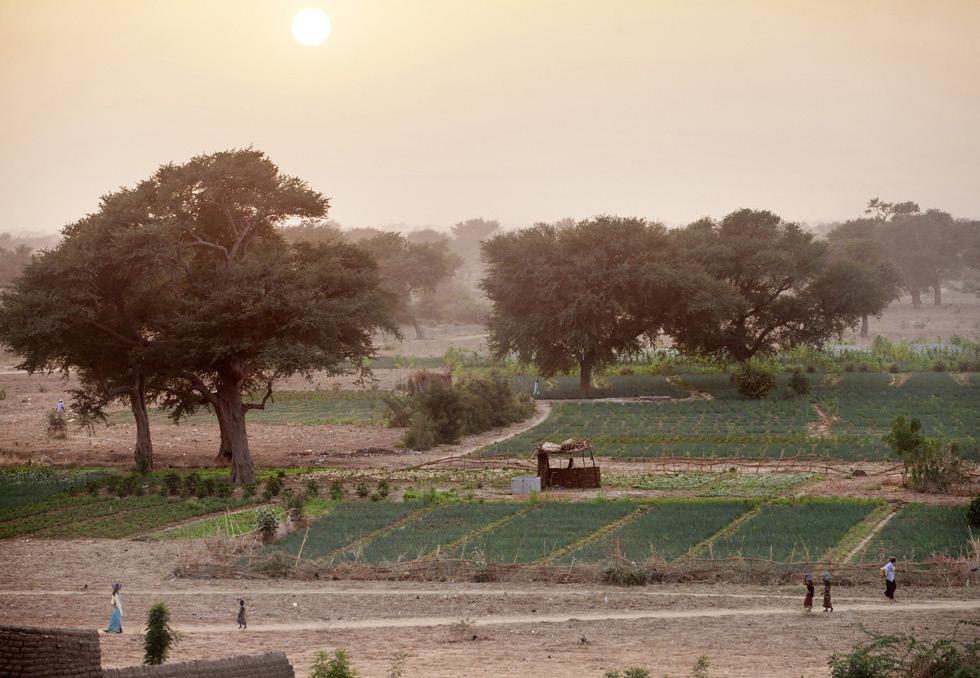
7. ibid. (p.16). Indications are that some data collection details are lacking on aspects of the current state of implementation of the GGW initiative in the eleven countries reported on in Table 1 - a shortcoming occasioned in large part by the disruptive effects of the COVID19 pandemic.
8. Tristan Bove (2021). The Great Green Wall is Failing, but its legacy could still be a Success. Published online 24 March 2021. Available at earth.org.
9. AFR100 Goals. Available at afr100.org.
10. Africa Union Development Agency - NEPAD (2022.) The State of AFR100: The Progress of Forest Landscape Restoration by Implementing Partners, page 16
11. African Forestry and Wildlife Commission calls for increased push to halt deforestation and enhance restoration. FAO forestry newsroom item on the 23rd Session of the African Forestry and Wildlife Commission held from 22 to 26 August 2022 in Kinshasa, Democratic Republic of the Congo. Published online 1 September 2022 and available at www.fao.org
12. ibid.
13. Forest Landscape Restoration Interventions. A document of the Forestry Commission of Ghana and available at fcghana.org.
14. ibid
15. Updated data from the University of Maryland released on 25 April 2019 and cited at www.wri.org
16. Four lessons from the Fourth Annual AFR100 Partnership Meeting. Available at www. afr100.org
17. AFR100 Overview_ENG (1). pdf page 3. Available at afr100.org.
18. ibid
19. Eric Stone (2017). Drones Spray Tree Seeds from the Sky to fight Desertification. Published online 28 November 2017. Available at www.nationalgeographic.com
*The African Forestry and Wildlife Commission is one of the six Regional Forestry Commissions established by the Food and Agriculture Organization (FAO) of the UN to provide a policy and technical forum for countries to discuss and address forest issues on a regional basis.
PROFILE OF HON. DR CASSIEL ATO FORSON, MP, MINORITY LEADER IN THE PARLIAMENT OF GHANA
Hon. Dr Cassiel Ato Baah Forson, MP, is the Minority Leader in the Parliament of Ghana. He has been the Member of Parliament for the Ajumako Enyan Essiam Constituency in the Central Region of Ghana since 2009 and is in his fourth term.
Until he assumed office as the Minority Leader in February 2023, he was the Ranking Member of the Finance Committee of Parliament, where he applied his professional and public service experience to enforce the constitutional oversight obligation of Parliament over the use of public funds, and the operations of Ministries, Department and Agencies (MDAs). He was a member of the Parliamentary Committee on Finance (2009-2012) and he also served as the Vice-Chairperson of the Parliamentary Committee on Foreign Affairs (2009-2011).
He was the Deputy Minister for Finance from April 2013 to January 2017, overseeing budget preparation and implementation, debt management, external resource mobilisation and tax policy. As Deputy Minister, he also served as a member of the Board of Directors of the Bank of Ghana and Ghana Cocoa Board. He was a member of Ghana’s Economic Management Team and was Ghana’s Alternate Governor at the International Monetary Fund (IMF) and the World Bank.
Prior to his election, he was an economist, a chartered accountant, a tax professional and an entrepreneur with professional experience spanning nearly 20 years in the private and public sectors. His professional expertise covers macroeconomics, fiscal policy, tax policy and administration, finance and business management, with a focus on real estate and oil and gas.
He holds a Ph.D. in Finance, and he gained a Master of Science degree in Taxation from Oxford University in the United Kingdom. He is a fellow of the Chartered Institute of Taxation of Ghana. He also studied for a Master of Science degree in Economics from Kwame Nkrumah University of Science and Technology in Ghana and a Bachelor of Science degree in Accounting from London South Bank University in the United Kingdom. He is a chartered accountant and a member of the Institute of Chartered Accountants of Ghana.
The Parliamentarian | 2023: Issue Three | 66th Commonwealth Parliamentary Conference | 27
IN THE BELLY OF GHANA’S POLITICS: SAVOURING THE ROLE OF WOMEN OVER THE YEARS
Introduction
A cardinal principle of good governance is the participation of all categories of persons in the governance process. As such, when women, men, the youth, and the physically challenged are made to participate in the decision-making process in the country, it facilitates inclusive development because the decisions made are reflective of the needs of society. Women constitute over 50% of the population of most countries, including Ghana (50.7%).1 In spite of that, women in Ghana are not proportionally represented in decision-making and leadership positions, even though they have made their mark on the political landscape of the country. This article brings to the fore the role of women in the political life of Ghana, beginning from the independence struggles to the Fourth Republic.
Independence Struggles
Ghanaian women contributed immensely towards the independence struggle in the 1940s and 1950s. These contributions were in the form of financial support for political campaigns, design of the national flag and political activism to compel the colonial authorities to grant independence. Women who contributed in diverse ways during the independence struggle include Madams Rebecca Aryeetey, Susanna Alhassan, Mabel Dove Danquah, Theodosia Okoh and Gloria Amon Nikoi, to mention a few.2 In recognition of the role played by women in attaining independence, ten women were appointed to the First Republican Legislature based on the introduction of the Representation of the People (Women Members) Bill in 1960.3 This was Ghana’s first experience with a ‘quota system’ for women. This Bill raised awareness about the need to include women in the political process.
Military Era
Ghana’s political landscape changed in 1966 when the country experienced its first military coup d’état. Subsequently, the country experienced a series of coups d’état from 1966 to 1981. Characteristically, the military juntas were not gender sensitive; hence, very few women could participate in decision making. In all the military regimes, there were no records of women’s participation at the highest political decision-making level. The closest the military juntas came to promoting women’s participation in governance was in 1975 when Ghana established the National Council on Women and Development (NCWD) to be the national machinery to promote women’s empowerment.
Also, the PNDC promoted the ‘31st December Women’s Movement’, an NGO established by the then First Lady of Ghana to empower women to participate in national development. The movement engaged women in small-scale economic activities such as the operation of daycare centres and gari (roasted cassava flakes) processing to enhance their economic status. Many of the women who later emerged to contest in the 1992 general elections had been involved in the activities of the ‘31st December Women’s Movement’.
The Fourth Republic
Prior to the return to constitutional rule in 1992, the nine-member Committee of Experts set up to frame the 1992 Constitution had two women members. The Consultative Assembly that drafted the Constitution had women participants from women’s associations and groups such as women traders, hairdressers, dressmakers, chop bar (local restaurants) operators, the ‘31st December Women’s Movement’, and the National Council for Women and Development (NCWD), which continued to be the national machinery for empowering women.
As a result, when Ghana returned to democratic rule after the general elections held in 1993, 16 women (8%) out of a 200-Member Parliament were elected. This number increased to 18 women (9%) out of a 200-Member Parliament in 1996. In 2000, of the 95 women who contested the election, 19 (20%) won their seats in Parliament. Women also played key political roles at the level of the Metropolitan, Municipal and District Assemblies (MMDAs). For instance, in 1994, out of the 348 women who contested the district assembly elections, 94 (27%) were elected. Similarly, in 1998, out of the 580 female contestants, 199 (34%) were elected, and in 2002, out of the 981 female contestants, 368 (38%) won the district level elections.4
As the years progressed, the number of women vying for political positions increased, although at a slow pace. This may, perhaps, be attributable to the implementation of the UN Convention on the Elimination of Discrimination Against Women (CEDAW) and the outcome of the Beijing Conference in 1995.
The Current Political Situation of Women in Ghana
In the Fourth Republic, women continue to play key roles in the democratic governance of Ghana in the Executive, Legislative and Judicial spheres.
Currently, at the level of the Executive, there are 104 Ministers and Deputy Ministers overall. Thirty out of this number are Ministers
Ms Judy Aikins is a Senior Research Officer at the Parliament of Ghana. She has served in the Research Department of the Parliamentary Service for the past 20 years. She provides research services to MPs, Committees and the leadership of Parliament. She is currently a Senior Research Officer responsible for the Social Policy Desk of the Research Department and specialises in social policy issues, including gender and development, health, water and sanitation. She holds a bachelor’s degree in Political Science and master’s degree in Business Administration.
28 | The Parliamentarian | 2023: Issue Three | 66th Commonwealth Parliamentary Conference
THE COMMONWEALTH CHARTER
FOR
10 YEARS ON: VALUES AND PRINCIPLES
PARLIAMENTS TO UPHOLD
of State, six of whom are women, representing 20%. There are 39 Deputy Ministers, with nine of them being women, which is 23.1%. With regard to the 19 Cabinet Ministers, only three are women, and this represents 16%. There are also 16 Regional Ministers, with two of them being women, representing 12.5%.
The Eighth Parliament of the Fourth Republic has no female representation at the level of the Speakership. The Parliamentary Leadership of ten Members has only two women Members (20%), who are Deputy Whips of the two parties represented in Parliament. Of the 275 MPs, 40 are women, which represents 15% of the total number. This is an improvement over the last three Parliaments, which witnessed a steady increase in women’s representation from 8.7% in 2008 to 11% in 2012, and 14% in 2016.
In the local government sector, of the 260 Metropolitan, Municipal and District Chief Executives, 38 (15%) are women, while the 28-member Council of State, the main advisory body to the President, has four (14%) women members.
Over the years, successive governments have made efforts to increase the appointment of women to high-ranking positions in government. This includes the appointment of the first female Chief Justice in 2007, Justice Georgina Theodora Wood; and her immediate successor in 2017, Justice Sophia Abena Boafoa Akuffo; the first female Speaker of Parliament in 2009, Rt Hon. Justice Joyce Adeline Bamford-Addo; the first female Chairperson of the Electoral Commission in 2015, Mrs Charlotte Osei; and her immediate successor in 2018, Mrs Jean Adukwei Mensa; the first female Chief of Staff at the Office of the President of the Republic, Mrs Akosua Frema Osei-Opare; and the current Chief Justice, Justice Gertrude Torkornoo.
The existing numbers of women in Ghana’s politics are far below acceptable international thresholds for women’s participation in politics. The minimum proportion of women in leadership positions set by the UN is 30%. Recent IPU rankings indicate that Ghana is ranked 147th out of 193 countries in the global ranking of women representation in Parliaments.6 Again, Ghana’s ranking on the Global Gender Gap Index of the World Economic Forum has not been encouraging. In the 2022 report7, Ghana ranked 108th out of 146 countries, an indication that we need a strategic intervention to consciously move the country towards achieving gender equality, which is also one of the UN Sustainable Development Goals (SDG5).
In spite of the low levels of women’s participation in politics, the few that have had the opportunity to serve have left an indelible mark in promoting women’s rights and addressing the problems facing women and children in Ghana. For instance, in 2015, the then Ministry of Women and Children’s Affairs, led by a woman, in collaboration with women NGOs, pressured government to pass the Domestic Violence Act, which was to protect the increasing number of women suffering from spousal abuse. Their efforts resulted in the establishment of the Domestic Violence and Victims Support Unit (DOVVSU) of the Ghana Police Service. Since then, there has been a considerable decrease in spousal abuse and more women have been made aware of their rights under the law.
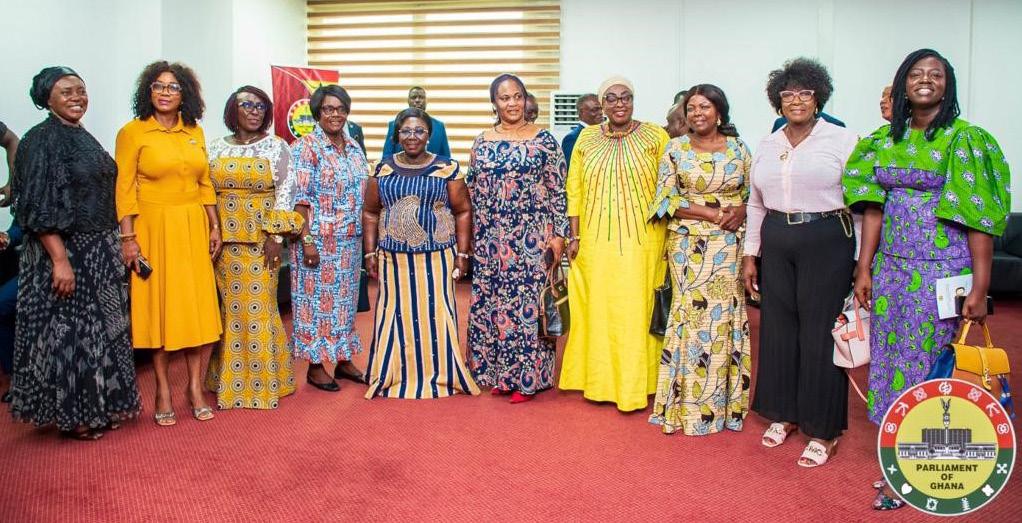
THE COMMONWEALTH CHARTER
10 YEARS ON: VALUES AND PRINCIPLES FOR PARLIAMENTS TO UPHOLD
Factors Hindering Women from Competing for Political Positions
Inhibiting factors such as patriarchal and cultural stereotypes, discrimination by party officials, poor campaign coverage by the media, lack of funding, reproductive roles/domestic chores, harassment and abusive behaviour suffered at the hands of men, women’s psychological make-up, making them averse to public ridicule and insults, et cetera, have impacted negatively on the willingness of women to put themselves up for elections. African women are socialised to be homemakers and caregivers, not leaders and change agents; thus, they do not aspire to take up leadership roles. Further, the fear of public ridicule and intrusion into women’s private life results in making politics less attractive to most women. Those who venture into politics in spite of the numerous challenges are subjected to character assassinations and labelled as ‘man woman’, prostitutes, and women with low morals in society.
Financing of political campaigns also poses a challenge to most women as most of them are not financially independent. Due to the dominance of males in the formal economic sector, as well as inheritance rights that usually favour sons and uncles as opposed to daughters and nieces, more men tend to have the financial muscle for undertaking such campaigns.
The existing electoral system (First-Past-The-Post), coupled with the above factors, does not favour women’s participation in elective positions.
Strategies to Increase Women’s Political Participation in Ghana
To ensure gender balance in political leadership positions, the Gender Ministry formulated the National Gender Policy in 2015 to address gender inequality and women’s empowerment in Ghana. The third policy commitment of the Gender Policy aims at promoting leadership and accountable governance for women. It plans to achieve this by supporting the passage and implementation of an Affirmative Action Law and put in place transformative measures (including leadership development) that will enable women and men to participate equally in achieving, at least, the 40% women’s representation in politics, on governing boards of institutions and at all levels of decision-making.
Ghanaian society needs more awareness about the importance of involving more women in decision-making. This sensitisation should go down to the grassroots, especially in the rural areas, where cultural
The Parliamentarian | 2023: Issue Three | 66th Commonwealth Parliamentary Conference | 29
Above: Members of the Women's Parliamentary Caucus attend the Presidential Address at the Parliament of Ghana.
Image: Parliament of Ghana.
10 YEARS ON: VALUES AND PRINCIPLES FOR PARLIAMENTS TO UPHOLD
biases are rife. For example, an attempt by the NPP to retain all sitting women parliamentary contestants in the 2020 general elections was met with disapproval by the rank and file of the party such that the decision was withdrawn. That was a clear indication that the intended objective was not understood by the majority of people.
Economic empowerment for women is an indirect means of empowering women to aspire to leadership roles. Higher education and promoting female businesses create the enabling environment for women to acquire financial capabilities to sponsor electoral campaigns. To this end, Microfinance and Small Loans Centre (MASLOC), a government-funding agency in Ghana, provides private capital for women businesses.
Perhaps, a far-more-reaching intervention would be a constitutional reform in our electoral processes which would make it mandatory for more women to be fielded as candidates. Electoral systems existing in some jurisdictions, such as proportional representation and affirmative action strategies, create a more enabling environment for women to participate in the electoral process. Government must exhibit political will by pushing through these reforms in order to ensure an appreciable increase in the number of women in politics.
Further, political parties should implement electoral reforms by instituting quotas in their registers for women candidates while reserving safe seats for such women. This would directly increase the numbers of women in politics.
Finally, local government elections should be the platform for nurturing young female politicians. Women should be sponsored
and encouraged to contest in district level elections. Government’s resolve to allocate 50% of MMDAs seats to females should be vigorously pursued. MMDAs should increase their sitting allowance to sustain the women in the assembly and also to attract more women.
Conclusion
We cannot deny that when women participate in decision-making, the decisions are balanced and reflect the real needs of the people. Ghana needs strong political commitment to address the structural imbalances that hinder women’s political participation. Perhaps, this is an opportune time for the Women’s Caucus of Ghana’s Parliament to employ all powers within their means to increase awareness and call on the government to pass the Affirmative Action Bill.
References:
1 PHC 2021, Ghana Statistical Service
2 https://africa.businessinsider.com/local/lifestyle/here-are-7-women-who-played-arole-in-ghanas-independence-struggle/mc93yhh
3 Women In Politics And Public Life In Ghana, Beatrix Allah Mensah, FES, https://library. fes.de/pdf-files/bueros/ghana/02989.pdf
4 Women In Politics And Public Life In Ghana, Beatrix Allah Mensah, FES, https://library. fes.de/pdf-files/bueros/ghana/02989.pdf
5 The UN Economic and Social Council resolution 1990/15
6 https://data.ipu.org/women-ranking?month=1&year=2023, ranking as of 1st January 2023
7 https://www3.weforum.org/docs/WEF_GGGR_2022.pdf
PROFILE OF CYRIL KWABENA OTENG NSIAH, CLERK TO THE PARLIAMENT OF GHANA
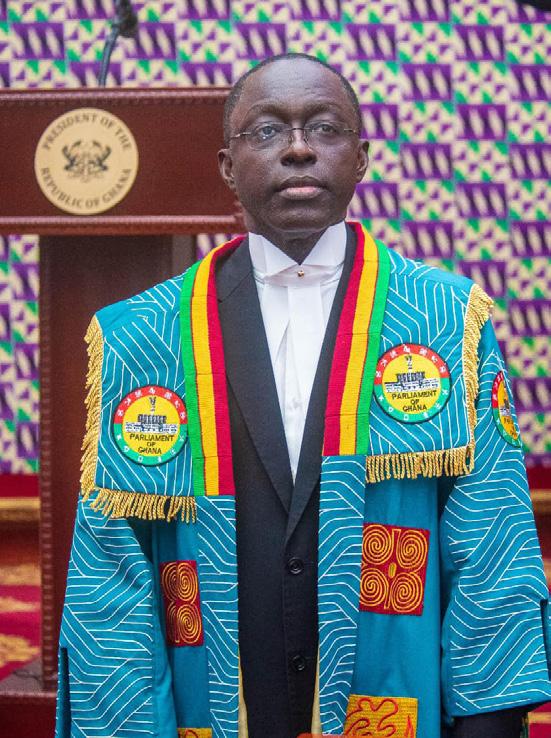
Mr Cyril Kwabena Oteng Nsiah is the Clerk to the Parliament of Ghana. He was appointed to the post in January 2020. Prior to this, he served in various capacities in Parliament including Deputy Clerk in charge of the Legislative Management Division as well as the Finance, Administration, Human Resources and General Services Division; Head of Speaker’s Secretariat and Secretary to the Parliamentary Service Board; Principal Assistant Clerk and Special Assistant to the Speaker of Parliament; and Clerk to several Parliamentary Committees.
His first encounter with the Parliament of Ghana was between September 1993 and August 1994 when he served in the Parliamentary Service on a secondment as part of his national service. In September 1994, he became an Assistant Director IIB in the Ghana Civil Service and served in the General Administration Division of the Ministry of Health. Subsequently, he was appointed into the Parliamentary Service as an Assistant Clerk (Grade I) from January 1996.
He has served as the Parliament of Ghana’s Desk Officer to various international interparliamentary organisations/associations including the African Caribbean Pacific-European Union Parliamentary Assembly and the National Conference of State Legislatures (USA). He is the Commonwealth Parliamentary Association (CPA) Ghana Branch Secretary and is a member of the Society-of-Clerks-at-the-Table (SOCATT), the Inter Parliamentary Union (IPU) and the Association of Secretary-Generals and Clerks of Parliament (ASGP).
He had a brief stint with the Ghana Education Service as a pupil teacher (1983-1986), and proceeded to the University of Ghana, Legon where he was awarded a Bachelor of Arts Honours Degree in Geography and Economics in 1990. He was posted on National Service as an Assistant Planning and Budget Officer at the Dangme West District Administration (1990-1991) and he subsequently obtained a Master of Arts Degree in International Affairs (1994) from the Legon Centre for International Affairs at the University of Ghana. He holds a Qualifying Certificate in Law from the Ghana School of Law, and he was called to the Ghana Bar in 1999.
He presented a number of papers on parliamentary practice and procedure as well as parliamentary administration at conferences around the world.
30 | The Parliamentarian | 2023: Issue Three | 66th Commonwealth Parliamentary Conference THE COMMONWEALTH CHARTER
PRIVATE MEMBERS’ BILLS: KEY TO PARLIAMENTARY EFFECTIVENESS
Parliament is said to be the sanctum sanctorum of the temple of democratic edifice the world over. The integral role that Parliaments play in the governance of modern democratic states cannot be discounted. In democratic states, the powers of government are often distributed among the Executive to exercise Executive power, the Judiciary to exercise judicial power, and the Legislature to exercise legislative power. Of these organs, it is Parliament that bears the direct and vast representational mandate. Ghana’s governance architecture reflects this governance model.
Like other Parliaments, the Parliament of Ghana synthesises and synchronises the diverse interests of the population to contribute significantly to good governance and the sustainable development of our country. Law-making is one of the ways by which the House discharges this mandate, and the House continues to excel in this endeavour. Over the years, the Executive body introduced all Bills passed by the House until the ‘jinx was broken’ in December 2020, when the first Private Member’s Bill was passed into law.
The purpose of this article is to highlight the nature and prospects of the enactment of Private Members’ Bills in Ghana and to lay out
some of the current efforts initiated by Parliament to consolidate the 2020 feat.
Nature and Legal Bases for the Enactment of Private Members’ Bills
A Private Member’s Bill is a proposed legislation introduced by a Member of Parliament in their capacity as a Parliamentarian, as opposed to a Public Bill introduced by a Minister of State on behalf of the Executive (or Government). Although the 1992 Constitution does not expressly confer power for the enactment of Private Members’ Bills, there are sufficient provisions in the Constitution that impliedly confer this power. These provisions include Articles 93(2), 108, 22(2) and 185(3) of the Constitution. It is a phenomenon that the enactment of the Private Members’ Bill is an entrenched feature of most Parliaments in the Commonwealth: New Zealand, Australia, Canada, the United Kingdom, India, Nigeria and Kenya, among others.
The Article 108 Obstacle
Over the years, the Parliament of Ghana has felt restrained by Article 108(a) of the Constitution in exercising its powers to enact Private Members’ Bills. However, this position changed in June 2020 when the House passed a resolution to commence the passing of Private Members’ Bills. The House anchored its resolution on the reasoned opinion of Nana S. K. B. Asante that: 'Article 108 of the Constitution does not impose an omnibus prohibition on the initiation of all legislations by a Private Member, since every Member of Parliament can introduce legislation which does not have specific financial implications spelt out under the Article.'
Prospects of Private Members’ Bills
Private Members’ Bills offer enormous prospects. First, they help deepen democratic culture by empowering citizens, civil society organisations (CSOs) and other private organisations to
Mr Benjamin Tachie Antiedu has worked with the Parliamentary Service of Ghana for the past 16 years, where he assists in the administration of Parliamentary Committees. He also practises law at a firm in Accra. He has a Bachelor of Law (LLB) from Ghana Institute of Management and Public Administration and a Qualifying Certificate in Law (QC) from the Ghana School of Law. He was called to the Ghana Bar in 2016. He wrote 'Reading the Law' and has authored several articles covering in law and governance as well as appearing on TV and radio.
Goodnuff Appiah Larbi is the pseudonym of a prolific writer on legal affairs in Ghana. He has twice received the Best Student Author award (2020 and 2021) under the National Students’ Award. Currently, pursuing a PhD in Development Administration and expanding his thesis ‘A Comparative and Theoretical Analysis of Judicial Review in Constitutional Interpretation, Administrative Action and Human Rights Dispute: Ghana in Perspective’.
The Parliamentarian | 2023: Issue Three | 66th Commonwealth Parliamentary Conference | 31 THE COMMONWEALTH CHARTER 10 YEARS ON: VALUES AND PRINCIPLES FOR PARLIAMENTS TO UPHOLD
“
It is a phenomenon that the enactment of the Private Members’ Bill is an entrenched feature of most Parliaments in the Commonwealth: New Zealand, Australia, Canada, the United Kingdom, India, Nigeria and Kenya, among others. ”
10 YEARS ON: VALUES AND PRINCIPLES FOR PARLIAMENTS TO UPHOLD
participate actively in the law-making process. Second, they offer Minority Members of Parliament the opportunity to initiate Bills and, thereby, contribute towards addressing the winner-takes-all syndrome. Third, they empower constituents to properly assess the performance of their MPs based on the core mandates of the latter. Fourth, they deepen consensus building in Parliament as a sponsoring MP needs to get other MPs along to pass a Bill introduced by them. Last, they improve the capacity of Members of Parliament and parliamentary staff towards the enactment of effective legislation.
The Icebreaker and Current Efforts
As earlier indicated, the first Private Member’s Bill was passed by the Seventh Parliament on 29 December 2020. This law is the Road Traffic (Amendment) Act, 2020 (Act 1054). The law amended the Road Traffic Act, 2004 (Act 683) to “proscribe acts that constitute dangerous driving that result in the injury or death to the human foetus”.
The writers further note the ongoing efforts to initiate Private Members’ Bills in the current Parliament. One such effort is the establishment of the Legislative Drafting Department, staffed with a team of expert draftspersons to facilitate the drafting and processing of Private Members’ Bills and Motions. Following this, a number of Private Members’ Bills are at various stages of the legislative process.
One example of a Private Members’ Bill presented to Parliament was introduced by Francis-Xavier Sosu, MP in June 2021 to repeal Ghana’s death penalty. The Bill, which removed the death penalty from the 1960 Criminal and Other Offences Act and the 1962 Armed Forces Act, was passed by the Ghana Parliament in July 2023.
Conclusion
The writers are optimistic that the enactment of Private Members’ Bills by Parliament holds the key to achieving the autonomy and effectiveness of Parliament that Ghanaians yearn to see. We are also optimistic that the current efforts made by the House would consolidate and sustain the enactment of Private Members’ Bills in Ghana to achieve innumerable benefits. Accordingly, we commend the Speaker of Parliament, Rt Hon. Alban Sumana Kingsford Bagbin; his predecessor, Prof Aaron Michael Oquaye; and the entire House for the giant feat.
References:
1 Antiedu B T, Reading the Law (Pentecost Press 2019).
2 Ayensu K B and Darkwa S N, How Our Parliament Functions (Revised edition) (University of Ghana Printing Press 2018).
3 Ayensu K B and Darkwa S N, The Evolution of Parliament in Ghana (Revised edition) (University of Ghana Printing Press 2018).
4 Bimpong-Buta S Y, The Role of the Supreme Court of Ghana in the Development of Constitutional Law in Ghana (Advanced Legal publications 2007).
5 Kaul M N and Shakdher S L, Practice and Procedure of Parliament (7th edition) (New Metropolitan Book Company Limited 2016).
EMPOWERING GHANAIAN CITIZENS: TRANSFORMING PARLIAMENT THROUGH DIGITAL CHANNELS FOR TRANSPARENCY AND ENGAGEMENT
Introduction
Information and communication technologies (ICTs) have revolutionised the way institutions function. The use of ICT in deepening citizen engagement and transparency has been a priority for Ghana’s Parliament in recent years as evidenced by the implementation of a range of online platforms and mobile applications. This article shares how the Parliament of Ghana has utilised digital media to deepen citizen engagement and promote transparency.
Digital media refers to electronic content that can be created, viewed, distributed and stored through digital devices. This includes various forms of multimedia content such as text, images, audio and video. Digital media is used for a variety of purposes such as entertainment, education, communication and information dissemination. Digital platforms enable individuals and organisations to present their products, services or ideas to a worldwide audience, interact with customers and communicate with the public.
Digital media has become an integral part of our daily lives, transforming the way we interact with one another and consume information. Examples of digital media include websites, social media platforms and mobile apps.
Parliament’s Website
The website of the Parliament of Ghana plays a crucial role in enhancing citizens' accessibility to the institution. It achieves this by facilitating access to crucial information concerning its activities, such as Bills, Committee reports and other legislative documents. Additionally, the website enables citizens to monitor the actions of their representatives, fostering accountability and good governance. For anyone interested in participating in and understanding the democratic process in Ghana, Parliament's website is an indispensable resource.
The website's livestreaming of parliamentary proceedings is one of its most important features as it enables citizens to monitor the actions of their elected representatives in real time. Additionally, the website offers a comprehensive database of all Members of Parliament, complete with their contact information and constituency details. This feature empowers citizens to hold their representatives accountable for their actions and provides them with a means of communication.
Apart from these features, the website contains a vast amount of information regarding the history and operations of Ghana’s Parliament. This encompasses details about the composition and structure of Parliament, as well as its role in the democratic
THE COMMONWEALTH CHARTER
32 | The Parliamentarian | 2023: Issue Three | 66th Commonwealth Parliamentary Conference
process. Furthermore, the website provides a trove of resources for students and researchers who wish to expand their knowledge of the Ghanaian political system.
Websites are crucial for connecting with target audiences. Recent improvements in digital technology enable features like chatbots, arti fi cial intelligence (AI) and augmented reality (AR), which are altering the way users engage with the digital world. Much more, however, can be accomplished with the platform.
Social Media
Social media has become an important tool for deepening citizen engagement. In Ghana, Facebook and YouTube, in particular, have facilitated a more direct and open relationship between citizens and their representatives.
Facebook is a widely used social media platform that has become an essential tool for communication and engagement with constituents. The Parliament of Ghana’s official Facebook page boasts of 241,204 followers as at the time of writing this article (see Figures 1 - 3 for breakdown of demographics). It features photos, videos and livestreaming of parliamentary sessions, thereby enabling citizens to follow proceedings remotely and engage with their representatives in real time. Through Parliament's Facebook page, citizens can express their opinions, ask questions and make suggestions on a range of issues.
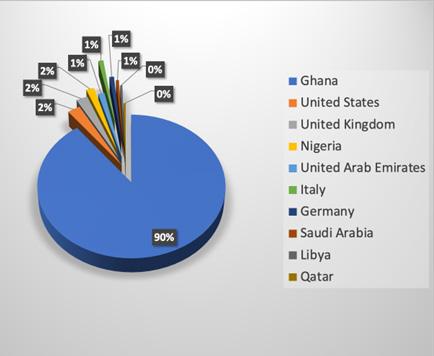
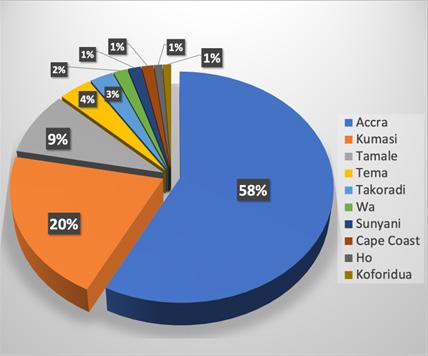
The use of Facebook has facilitated a more direct and open relationship between citizens and their representatives, improving transparency and accountability in the legislative process. The platform has made it easier for Members of Parliament to receive feedback from their constituents and for citizens to access information about parliamentary proceedings,
including debates, Committee meetings and votes. The use of Facebook has also enabled MPs to reach a wider audience, which is particularly important in a country where access to traditional forms of media, such as newspapers and television, is limited.
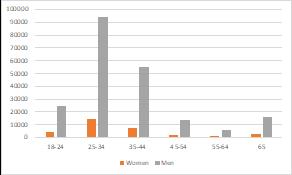
Further, the Facebook page has become a platform for civic education, where citizens can learn about the legislative process, the role of MPs and how they can engage with their representatives.
Similarly, Parliament's YouTube page has become a valuable resource for improving transparency and citizen engagement in the country's legislative process. One of the main benefits of the YouTube page is its accessibility.
The page provides a platform for people to engage with their elected representatives from anywhere and at any time as it provides access to live and recorded parliamentary proceedings. This allows citizens to follow debates and keep up with legislative action. Viewers can engage in real-time interactions with their representatives and one another through comments and questions during livestreams, and petitions and other citizen-led initiatives can be shared and discussed.
Additionally, the YouTube page also provides resources for researchers, journalists and students who want to learn more about Ghana's legislative process.
Overall, Parliament's official social media platforms have become important tools for deepening transparency and improving citizen engagement in the country's legislative process. By providing accessible information, Parliament has empowered citizens to participate more actively in governance, thereby promoting transparency and enhancing democratic governance.
Mr Ernest Taanu Berrick, PMP, MBCS is a Senior ICT Officer in charge of the Chamber Support, Network and Infrastructure Units. He joined the Parliamentary Service of Ghana in 2014. He is a member of the Project Management Institute (PMI) USA and Ghana Chapter, the British Computer Society (BCS), Chartered Institute of IT (UK), the Institute of Electrical and Electronic Engineers (IEEE) USA, and the Institute of ICT Professionals Ghana (IIPGH). He is a seasoned solutions architect and project manager who specialises in project management, IT solutions design and implementation, IT governance and cyber security. He holds degrees from Henley Business School (University of Reading) and Ghana Communication Technology University.
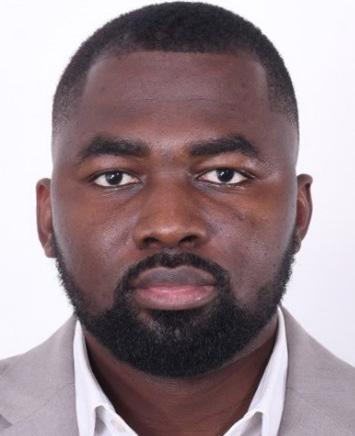
THE COMMONWEALTH CHARTER 10 YEARS ON: VALUES AND PRINCIPLES FOR PARLIAMENTS TO UPHOLD The Parliamentarian | 2023: Issue Three | 66th Commonwealth Parliamentary Conference | 33
Figure 1: Ghana Parliament’s Facebook page followers by top cities in Ghana.
Figure 2: Ghana Parliament’s Facebook page followers by top countries.
Figure 3: Ghana Parliament’s Facebook Page Followers by Gender and Age.
THE COMMONWEALTH CHARTER 10 YEARS ON: VALUES AND PRINCIPLES FOR PARLIAMENTS TO UPHOLD
Challenges
Even as Parliament seeks to engage citizens and deepen transparency, there are several challenges associated with the use of social media and other online sites:
• Digital divide: Not all citizens have equal access to the internet or the technological literacy needed to participate in online engagement activities. As a result, it can be difficult to ensure equal representation and participation of all groups.
• Misinformation: The spread of misinformation and disinformation on social media and online sites can undermine trust in the information being presented. This can create challenges for transparent communication and effective engagement.
• Cyber security: The use of social media and online sites for citizen engagement can pose a risk to cyber security. As a result, it is crucial for Parliament to take appropriate measures to protect sensitive citizen data and ensure that the platform is secure.
Parliamentary Watch
Parliamentary Watch is a mobile application available on Google Play Store and App Store. It provides citizens with up-to-date information on parliamentary proceedings, including Bills, Committee reports and voting records. Citizens can also use the app to access information on their MPs, including their attendance records, voting history and Committee memberships.
One of the key features of Parliamentary Watch is the ability it affords users to track the progress of Bills through the legislative process, providing greater transparency and encouraging citizen participation. Citizens can receive noti fi cations when Bills are being debated, enabling them to follow proceedings and engage with their representatives.
Furthermore, Parliamentary Watch provides citizens with tools to engage directly with their MPs, including the ability to send messages and report issues related to their constituencies. The app also includes a feature that enables citizens to provide feedback on the performance of their MPs, enhancing transparency and accountability in the legislative process.
The Parliamentary Watch has improved transparency in the legislative process by providing citizens with access to key information about parliamentary proceedings. Citizens can now monitor their MPs more closely when they are in plenary or in Committee sittings, ensuring that their representatives are accountable to them.
• Lack of accountability: Finally, there can be challenges in tracking the impact of citizen engagement activities and ensuring that elected officials adequately respond to public input. As Parliament seeks to engage citizens and deepen transparency, it is essential to establish clear mechanisms for tracking and evaluating engagement efforts. This will help to ensure that citizens’ input is meaningfully incorporated into the legislative process and that Parliament is held accountable to the public.
Recommendations
Several measures can be taken to address the challenges that confront social media usage and online participation in the work of Parliament. First, initiatives should concentrate on closing the digital divide by increasing internet access and offering programmes for technology literacy for Members and officials of Parliament.
Second, encouraging media literacy and fact-checking among citizens and Members of Parliament and ensuring the implementation of moderation regulations are necessary in the fight against disinformation.
Cyber security measures, including robust data protection and public awareness initiatives, are essential to secure the data of citizens and Members.
Last but not least, guaranteeing accountability calls for open reporting, evaluation processes and opportunities for direct interaction between elected officials and the general public via town hall meetings and public hearings. By putting these suggestions into practice, citizen engagement initiatives will benefit from more equal representation, trust, security and accountability.
Conclusion
The use of ICT in deepening citizen engagement and promoting transparency in the Parliament of Ghana has been a signi ficant step in improving democratic governance. The effective use of social media platforms such as Facebook and mobile applications such as Parliamentary Watch has provided citizens with a platform for communication and dialogue with their representatives. It has also increased transparency in parliamentary proceedings, enabling citizens to monitor the actions of their MPs and hold them accountable.
As ICT continues to evolve, it is likely that these tools will play an even greater role in transforming the future of Parliament-citizen engagement.
“ Encouraging media literacy and factchecking among citizens and Members of Parliament and ensuring the implementation of moderation regulations are necessary in the fight against disinformation. Cyber security measures, including robust data protection and public awareness initiatives, are essential to secure the data of citizens and Members. ”
34 | The Parliamentarian | 2023: Issue Three | 66th Commonwealth Parliamentary Conference
ENGAGING YOUNG CITIZENS IN PARLIAMENTARY DEMOCRACY
Assessing the Functionality of Parliamentary School Tours, Parliamentary Youth Clubs and Youth Parliaments in Ghana.
Introduction
Children and the youth constitute an important caucus among Parliaments of the world. According to the Global Parliamentary Report, 2022, which is entirely devoted to Parliament-public engagement, the global population of young persons between the ages of 15 and 25 years old is around 1.2 billion people, constituting 16% of the world’s population (p. 60). This figure is projected to reach 1.4 billion by the year 2065 (Ibid). The report indicates that in spite of their significant numbers, the youth in most parts of the world feel that “they are not being listened to” by their political leaders and they “can do things by themselves”. This has culminated in the formation of youth movements such as ‘Not Too Young to Run’ in Nigeria and the United Kingdom Youth Climate Coalition (UKYCC). To address this situation, the IPU proposes in its report that Parliaments should take the engagement of the youth seriously (p. 60).
Educational programmes for school children and the youth are the most common public engagement tools among the world’s Parliaments, according to a poll conducted by the IPU and published in the Global Parliamentary Report (p. 24). Such educational programmes among the youth take several forms: school tours, role plays, youth Parliaments, workshops, forums and round table deliberations (p. 60). The Parliament of Ghana, for its part, has put in place the school tours programme, parliamentary youth clubs and student Parliaments.
This article will assess the school tours, youth clubs and student Parliaments, which are the activities through which the Parliament of Ghana engages young citizens in the country.
Harold Wilson Hubert is the Editor of Debates of the Parliament of Ghana. He has worked with the Parliamentary Service since 2002. Previously, he worked with the Armed Forces Public Relations Directorate for 19 years. He is also a member of the Management Committee of the Parliamentary Service. He holds master’s and bachelor degrees in English (University of Ghana) and in Journalism from the Ghana Institute of Journalism.
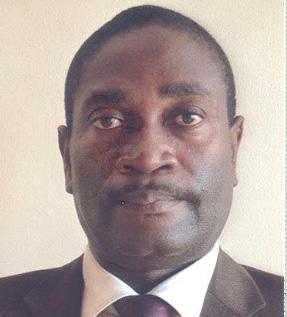
School Tours of Parliament House
Under this programme, schools, colleges and universities are given the opportunity to tour the Parliament of Ghana. Interested schools are required to fill in an online application form. There is usually a quick response by the Parliamentary Service and a date is fixed for the visit to take place. Usually, five to eight schools visit the House, and each delegation comprises 50 pupils or students, with the first and second-cycle school delegations accompanied by a number of teachers.
During their visit, the delegations are addressed by the designated officials of the Parliamentary Service and, oftentimes, by the Members of Parliament in whose constituencies those schools are located. After that, they are ushered to the public gallery of the Chamber, from where they witness live debates on the floor of the House. Thereafter, the school visitors are given a tour of some of the major installations and facilities within Parliament, such as the library and the Job 600 tower block, where Members of Parliament have their offices. The pupils and students are sometimes refreshed with drinks and water provided by the Member in whose constituency the schools are coming from.
Asked of their impressions of the tour, a cross-section of pupils and student beneficiaries described the programme as an eyeopener, and urged that it should never be discontinued. One of them whose school is in the Upper West Region and had travelled to Accra, a distance of over 700km, only for the first time, courtesy of the programme, suggested that MPs should also visit schools that are unable to travel to Accra to see their representatives at work in the Chamber.
Ms Akosua Opoku is a Parliamentary Reporter with the Parliament of Ghana. Prior to her current position, she was a media practitioner for over 12 years. She holds an International Master's in International Communication degree from the Communication University of China, Beijing, and a bachelor's degree in English from KNUST, Kumasi.

THE COMMONWEALTH CHARTER 10 YEARS ON: VALUES AND PRINCIPLES FOR
UPHOLD The Parliamentarian | 2023: Issue Three | 66th Commonwealth Parliamentary Conference | 35
PARLIAMENTS TO
THE COMMONWEALTH CHARTER
10 YEARS ON: VALUES AND PRINCIPLES FOR PARLIAMENTS TO UPHOLD
A case study from the UK Programmes that enable school children and students to tour Parliaments and interact with MPs are very popular across the globe. The UK Parliament is a leading promoter of this initiative. In 2015, the UK Parliament’s Education Centre was launched, and its major activity is encouraging interaction between the Parliament and school pupils and students, who visit Westminster regularly. To motivate participation in the tour, pupils and students on each tour are awarded travel stipends.
The UK Parliament’s Education Centre has made commendable progress with educational programmes for children and the youth over the years. In the 2019/20 school year, the centre engaged with 41% of schools nationally. For schools that are unable to visit Westminster, there exists the option of receiving digital content. In addition, Members of Parliament and the outreach team visit such schools. A member of the UK House of Commons said of such a visit, “It is important for them to see us, rather than for them to say from the distance, ‘Oh, that’s Parliament over there,’” (IPU, p. 18).
Besides welcoming visiting schools, the UK Parliament, during its annual UK Parliament Week, lends support to institutions and other organisations involved in organising activities to develop democracy. Further, the Education Centre runs an initiative called the ‘Loan Box Scheme’, which supports debates on democracy and law making in schools. Furthermore, there is also a dedicated training centre for teachers in the UK Parliament. Teachers who graduate from the training programme become teachers of parliamentary practice in their respective schools. The centre also offers courses on legislative practices for trainees of teacher training universities, with a view to raising ‘force multipliers’ in the schools to which they would be posted after their graduation.
The British educational programmes are evaluated regularly, and 96% of teachers rated the programme as excellent in a recent poll, and 87% of students, on their part, rated it the same way (IPU, p. 20).
Taking Parliament to the Ghanaian Youth: Parliamentary Youth Clubs and Student Parliaments
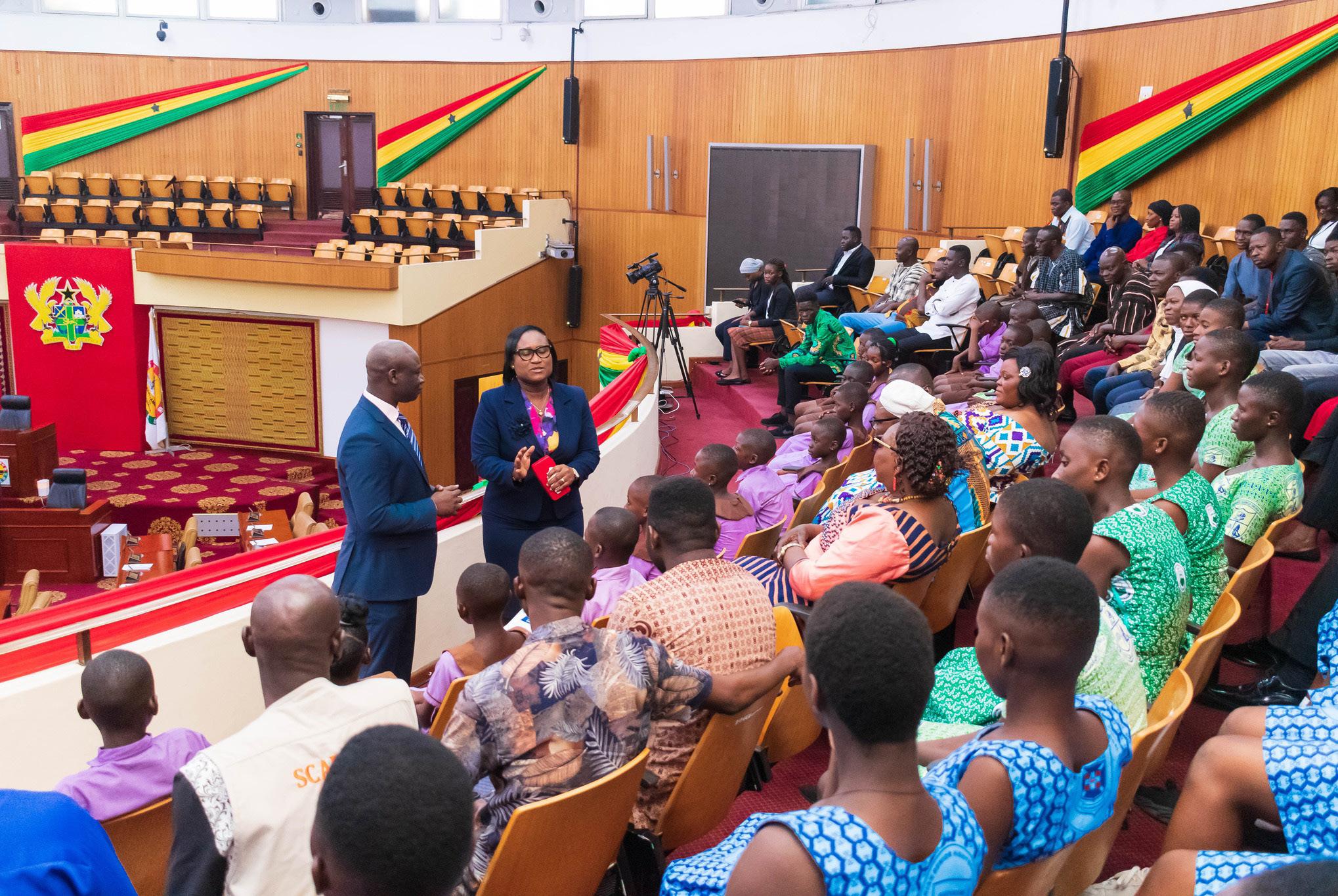
Over the years, the Public Affairs Department has embarked on the establishment of Parliamentary Youth Clubs (PYCs) in second-cycle institutions across the country. The objective of the programme, just as with the school visits, is to inculcate the values of parliamentary democracy in students of second-cycle institutions. Officials of the department visit and lecture students in second-cycle institutions to encourage them to form youth clubs. On some occasions, students of these institutions form these clubs by themselves and formally inform the department. The department in turn pays visits occasionally to these clubs, during which they organise quizzes and similar competitions among the members of the clubs to test their knowledge on Parliament. In so doing, they pass on information about the workings of Parliament to the clubs. Regrettably, for reasons of budgetary constraints, the visitations of the department have slowed down in recent times.
Youth Parliaments
Apart from the two programmes outlined above, Student Parliaments (SPs) have existed in tertiary institutions across the country since 2005. There are presently 25 of them in existence. According to the Schedule Officer of the programme, Ms Nellie Akwele Abbey, these ‘youth’ Parliaments hold sittings just like any national Parliament does, but they mainly debate issues of concern to them as students.
On the role of Parliament’s outreach team in the running of the PYCs and SPs, Ms Abbey said that they mentor the two to ensure their growth. Towards this, the team organises seminars and a lecture series for the groups. The team also facilitates study visits to Parliament and courtesy calls on the Speaker and the Leadership of the House.
To raise funds for their activities, applicants to the youth Parliaments pay application fees before they are admitted into the
36 | The Parliamentarian | 2023: Issue Three | 66th Commonwealth Parliamentary Conference
Above: School groups visit the Parliament of Ghana and are shown the main Chamber.
Image: Parliament of Ghana.
“ Educational programmes for school children and the youth are the most common public engagement tools among the world’s Parliaments. Such educational programmes among the youth take several forms: school tours, role plays, youth Parliaments, workshops, forums and round table deliberations. ”
various SPs. They are also supported by various donors, especially for the purpose of organising specific activities.
On the impact of the youth Parliaments on the development of democracy in the country, Ms Abbey intimated that some former youth Parliamentarians have since become members of the Parliament of Ghana, notable among them being the Member for North Tongu, Hon. Samuel Okudzeto Ablakwa; and the Member for Kintampo North, Hon. Joseph Kumah. Some have played various roles in either the New Patriotic Party (NPP) or the National Democratic Congress (NDC), the two dominant political parties in the country, while others have become vocal opinion leaders in society.
Ms Abbey expressed appreciation to the leadership of the Parliament of Ghana and the management of the Parliamentary Service for their appreciable support for the two programmes. In future, according to Ms Abbey, Parliament hopes to establish more PYCs and SPs across the country. To make them impactful, efforts would be made to bring their leaders into regular contact with the Leadership and Members of Parliament. More interactive programmes such as mock Parliaments, lectures and seminars will also be held for them.
Room for Improvement
Having sustained these youth engagement programmes for over a decade, it is only appropriate that Parliament’s public relations team be ‘patted on the shoulder’ for their efforts. However, there is definitely room for improvement. To improve upon the performance of the existing PYCs, the newly established Department of Public Engagement may intensify its organisation of teams of Members of Parliament to visit such schools regularly. Interactions with MPs should motivate pupils and students, the same way that the UK Parliament is doing.
For the school tours programme, there is the need to provide a bit more motivation and support for potential students. The stipends that the UK Parliament offers to visiting children and
PARLIAMENT OF GHANA HOSTS STUDENT PARLIAMENTS TO MARK COMMONWEALTH DAY 2023
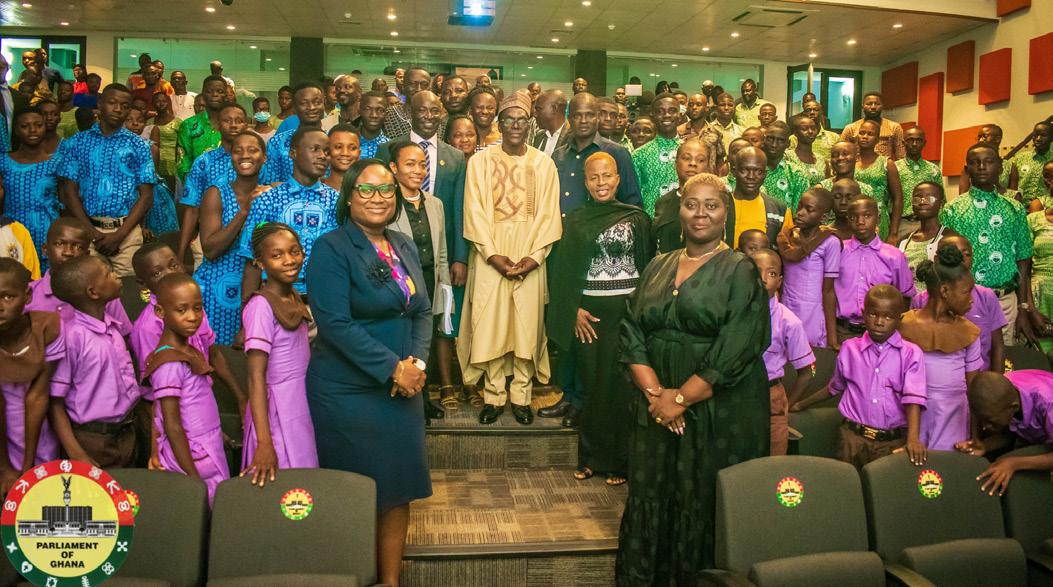
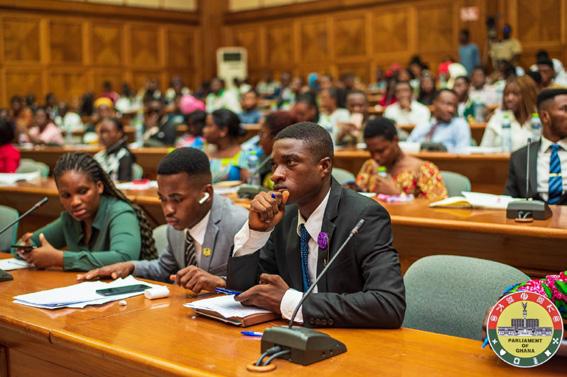
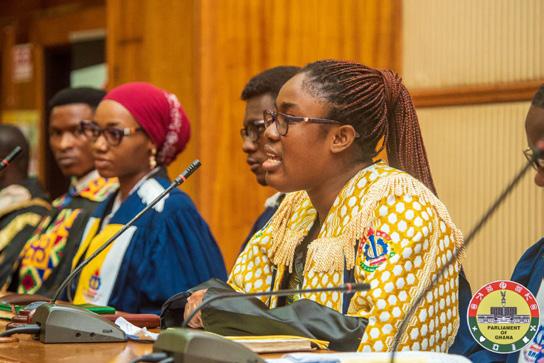
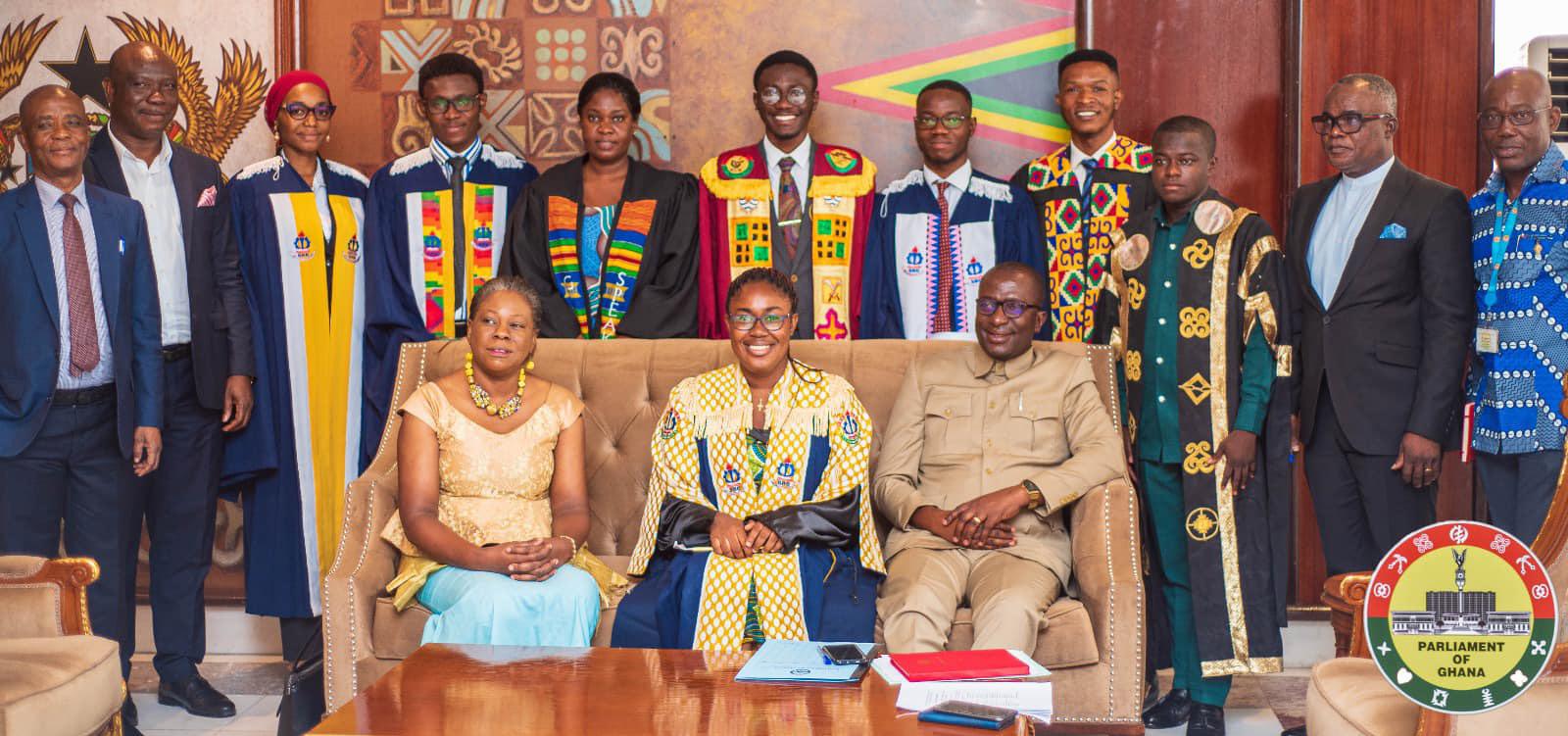
The Parliament of Ghana held twelve student Parliaments to observe Commonwealth Day 2023 with mock parliamentary sittings and debates. The Second Deputy Speaker of Parliament, Hon. Andrew Amoako Asiamah, addressed students on the tenets and ideals of parliamentary democracy ahead of the debates and also highlighted this year’s theme of ‘Forging a Sustainable and Peaceful Common Future’. He said that the theme combines the active commitment of member states to support the promotion of peace, prosperity, and sustainability, especially through climate action, to secure a better future for our young people and improve the lives of all Commonwealth citizens.
youth is definitely a motivator for making the journey, especially to candidates who may be financially vulnerable. Can Ghana afford to emulate their example? Even if Parliament cannot afford expensive motivation as paying travel stipends, can something more beyond the water and soft drinks help?
Talking about mobilising MPs to support such outreach brings to the fore the role that Ghana’s Members of Parliament could play in the process. Every MP has schools in their constituency, and the basic schools in their constituencies accessing the tours should be important to them. MPs and their colleagues from constituencies nearby could constitute a ‘team’ and visit schools in their ‘catchment’ constituencies. Such visits could take place when MPs are on recess and could be considered part of their representative roles.
Conclusion
One can only hope that with the establishment of the Department of Public Engagement, these activities would be expanded and given adequate support in order to maximise their impact on the development of parliamentary democracy among future generations of Ghanaians.
Students debated the topic of ‘30 years of uninterrupted parliamentary democracy; active citizen participation, an attainable feat or a political slogan’. The debate was won by the returning champions, KNUST Parliament.
The Parliamentarian | 2023: Issue Three | 66th Commonwealth Parliamentary Conference | 37
COMMONWEALTH CHARTER 10
THE
YEARS ON: VALUES AND PRINCIPLES FOR PARLIAMENTS TO UPHOLD
Images: Parliament of Ghana.
Above: The Speaker of the Parliament of Ghana meets with school groups as they visit the Parliament for an educational programme.
Image: Parliament of Ghana.
Ghana: Key Facts
Introduction
Ghana’s capital city is Accra, and the country has a total population of 33,846,114. Its currency is the Ghanaian Cedi.
History of Ghana
The earliest known kingdoms to emerge in modern Ghana were the Mole-Dagbani states. The Bono state existed in the area that is modern day Ghana during the 11th century. Kingdoms and empires such as the Kingdom of Dagbon in the north and the Ashanti Empire in the south emerged over the centuries.
Beginning in the 15th century, the Portuguese Empire, followed by other Europeans, contested the area for trading rights, until the British established control of the coast by the mid-19th century. During this colonial period, there were four separate British territories: Gold Coast, Ashanti, the Northern Territories and Togoland. These were unified as an independent dominion within the Commonwealth of Nations. On 6 March 1957, Ghana became the first country in Sub-Saharan Africa to achieve its sovereignty. This was completed under the Ghana Independence Act 1957
The flag of Ghana, consisting of the colours red, gold, green, and a black star, dates back to independence. On 1 July 1960, following the Ghanaian constitutional referendum and Ghanaian presidential election, Ghana was declared a republic and the first President was installed. The Sixth March is the nation's Independence Day, and 1 July is celebrated as Republic Day.
Ghana’s governance Ghana is a unitary presidential constitutional democracy, with a parliamentary multi-party system that is dominated by two parties - the National Democratic Congress (NDC) and the New Patriotic Party (NPP). Ghana alternated between civilian and military governments until January 1993, when the military government gave way to the Fourth Republic of Ghana after presidential and parliamentary elections in late 1992.
The 1992 constitution of Ghana divides powers amongst the Commander-in-Chief of the Ghana Armed Forces (the President of Ghana), the Parliament of Ghana, the Cabinet of Ghana, the Council of State (Ghanaian Council of State), and an independent Judiciary. The President of Ghana is elected very four years with an incumbent allowed to be re-elected only once.
Members of Parliament are elected by universal suffrage every four years in singleseat constituencies by simple plurality vote. Presidential and parliamentary elections are held alongside each other, generally on 7 December. Legislative functions are vested in Parliament, which consists of a unicameral 275-member body plus the Speaker. To become law, legislation must have the assent of the President, who has a qualified veto over all Bills except those to which a vote of urgency is attached.
International diplomacy
Ghana is highly integrated in international affairs, being a founding member of the
Non-Aligned Movement, the African Union and a member of the Economic Community of West African States (ECOWAS), the Group of 24 and the Commonwealth.
Ghana has a strong relationship with the United Nations. Ghanaian diplomat, Kofi Annan was a SecretaryGeneral of the United Nations.
Ghanaian people and culture
Ghana is a multi-ethnic country with different linguistic and religious groups; while the Akan are the largest ethnic group, they constitute a plurality. Most Ghanaians are Christians (71.3%); almost a fifth are Muslims; a tenth practise traditional faiths or report no religion.
English is the official language of Ghana, however there are eleven languages that have the status of governmentsponsored languages including Akan languages, Dangme, Ewe, Ga, Guan, Kasem, Mole-Dagbani languages (Dagaare and Dagbanli).
As Ghana is surrounded by many French-speaking countries, French is widely taught in schools and used for commercial and international economic exchanges. Since 2006, Ghana has been an associate member of the Organisation Internationale de La Francophonie.
Economy
Ghana possesses industrial minerals, hydrocarbons and precious metals. It is an emerging designated digital economy with mixed economy hybridisation and an emerging market. Plans envision Ghana as the first African country to become a developed country by 2029 and a newly industrialised country between 2030 and 2039.
The Volta River Authority and the Ghana National Petroleum Corporation, both state-owned, are the two major electricity producers. The Akosombo Dam, built on the Volta River in 1965, along with the Bui Dam, the Kpong Dam and several other hydroelectric dams, provide hydropower.
The Ghana Stock Exchange is the 5th largest on continental Africa and 3rd largest in subSaharan Africa with a market capitalisation of GH¢ 57.2 billion.
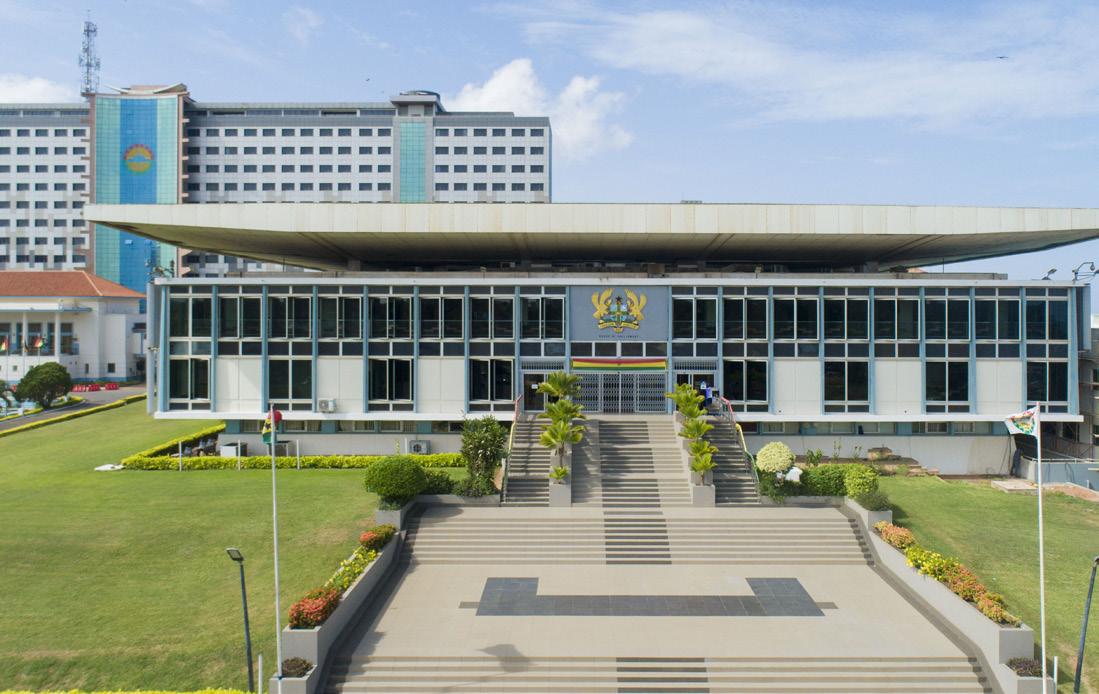
Ghana produces highquality cocoa and is the 2nd largest producer of cocoa globally. Services account for 50% of GDP, followed by manufacturing (24.1%), extractive industries (5%), and taxes (20.9%).
Ghana has an increasing primary manufacturing economy and export of digital technology goods along with assembling and exporting
Ghana: Key Facts
38 | The Parliamentarian | 2023: Issue Three | 66th Commonwealth Parliamentary Conference
The Parliament of Ghana is located in the capital city of Accra.
automobiles and ships, diverse resource rich exportation of industrial minerals, agricultural products (primarily cocoa), petroleum and natural gas, and industries such as information and communications technology. Urban electric cars have been manufactured in Ghana since 2014.
Ghana is one of the largest producers of gold in the world. In addition to gold, Ghana exports silver, timber, diamonds, bauxite and manganese, and has other mineral deposits. Ghana ranks 9th in the world in diamond export and reserve size.
Tourism
In recent years, over 1,087,000 tourists visited Ghana. Tourist destinations include many
natural wonders such as waterfalls (Kintampo waterfalls and the largest waterfall in west Africa, Wli waterfalls), the coastal palm-lined sandy beaches, caves, mountains, rivers, and reservoirs and lakes (such as Lake Bosumtwi and the largest human-made lake in the world by surface area, Lake Volta).
Ghana has dozens of forts and castles, many of which mark the entry point for the slave trade in West Africa. As a result of this, the World Heritage Convention of UNESCO named Ghana's castles and forts as World Heritage Monuments.
Tourism is the fourth highest income stream for the country.
Geography and landscape
Ghana is located on the Gulf of Guinea, a few degrees north of the Equator. It spans an area of 239,535 square kilometres (92,485 sq. miles) and has an Atlantic coastline that stretches for 560 kilometres (350 miles) on the Gulf of Guinea, with the Atlantic Ocean to its south. The Prime Meridian (zero degrees) passes through Ghana, specifically through Tema. Ghana is geographically closer to the ‘centre’ of the Earth than any other country, since the notional centre, (0°, 0°) is located in the Atlantic Ocean approximately 614 km (382 miles) off the south-east coast of Ghana.
Grasslands mixed with south coastal shrublands and forests
Ghana: Key Facts
dominate Ghana, with forest extending northward from the coast 320 kilometres (200 miles) and eastward for a maximum of about 270 kilometres (170 miles) with locations for mining of industrial minerals and timber. Ghana is home to five terrestrial eco-regions: Eastern Guinean forests, Guinean forest–savanna mosaic, West Sudanian savanna, Central African mangroves, and Guinean mangroves.
The White Volta River, and its tributary Black Volta, flow south through Ghana to Lake Volta, the world's thirdlargest reservoir by volume and largest by surface area, formed by the hydroelectric Akosombo Dam, completed in 1965. The Volta flows out of Lake Volta into the Gulf of Guinea. The northernmost part of Ghana is Pulmakong and the southernmost part of Ghana is Cape Three Points.
Climate of Ghana
The climate of Ghana is tropical, and there is wet season and dry season. Ghana sits at the intersection of three hydroclimatic zones. Changes in rainfall, weather conditions and sea-level rise affect the salinity of coastal waters. This is expected to negatively affect both farming and fisheries.
In 2015, the government produced a document titled ‘Ghana's Intended Nationally Determined Contribution’. Following this, Ghana signed the Paris Climate Agreement in 2016.
Sources: Wikipedia.
The Parliamentarian | 2023: Issue Three | 66th Commonwealth Parliamentary Conference | 39
Map of Ghana showing the country's 16 administrative areas.
Image: Shutterstock_1820731508.
Ghana and the Commonwealth Parliamentary Association
• Ghana first established its CPA Branch on 1 January 1946, eleven years before joining the Commonwealth on 6 March 1957.
• The CPA Ghana Branch is part of the CPA Africa Region and is a member of the West sub-Region.
• The CPA Africa Region has hosted the annual Commonwealth Parliamentary Conference a total of sixteen times. The 66th Commonwealth Parliamentary Conference will be the first time that the CPA Ghana Branch has hosted the event.
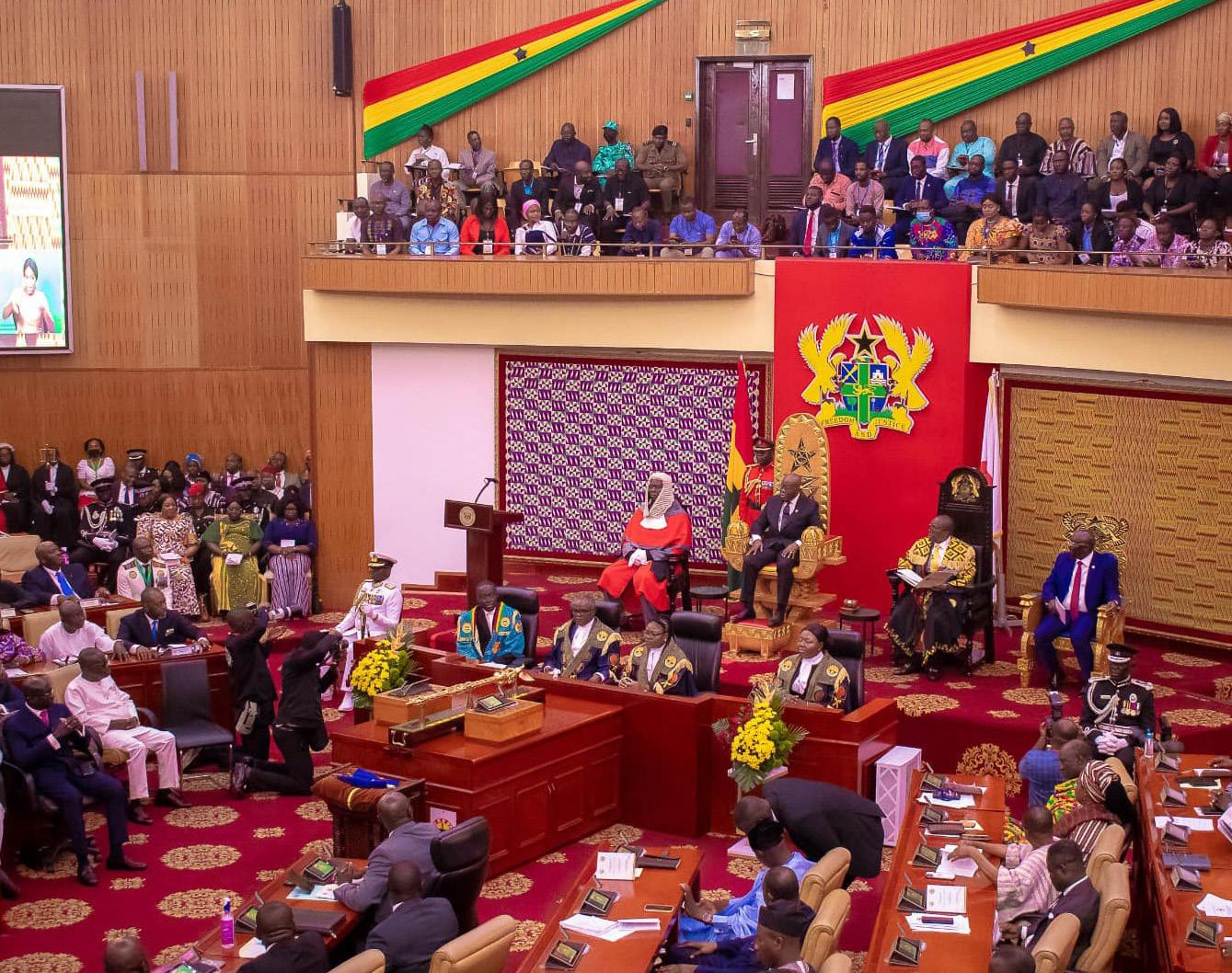
• The Speaker of the Parliament of Ghana, Rt Hon. Alban Sumana Kingsford Bagbin, became the CPA President, on behalf of the CPA Ghana Branch, ahead of the 66th Commonwealth Parliamentary Conference, held in 2023 in Accra, Ghana. He was previously the CPA Vice-President (2021-2022) and he was also a Member of the CPA International Executive Committee as a representative for the CPA Africa Region (2012-2015).
• Hon. Osei Kyei-Mensah Bonsu, MP, Majority Leader in the Parliament of Ghana, is a CPA International Executive Committee Member for the CPA Africa Region and in 2021, he was elected the Vice-Chairperson of the Commonwealth Parliamentary Association by the Executive Committee, a position he still holds today.
• As hosts of the 66th Commonwealth Parliamentary Conference, the CPA Ghana Branch also nominated Hon. Patricia Appiagyei, Member of the Parliament of Ghana, as the President of the Commonwealth Women Parliamentarians (CWP) network for the term 2022-2023.
PRESIDENT OF GHANA BECOMES CPA VICE-PATRON
AHEAD OF 66th COMMONWEALTH PARLIAMENTARY CONFERENCE IN GHANA
The President of Ghana, His Excellency Nana Akufo-Addo has agreed to become the Vice-Patron of the Commonwealth Parliamentary Association for 2023, ahead of the 66th Commonwealth Parliamentary Conference due to be hosted by the Parliament of Ghana and CPA Ghana Branch from 30 September to 6 October 2023 in Accra, Ghana. Since 1989, the Vice-Patron of the Commonwealth Parliamentary Association has traditionally been the Head of State or Government of the CPA Branch hosting the forthcoming annual Commonwealth Parliamentary Conference.
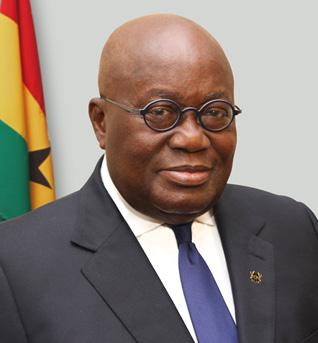
The President of Ghana has served in the role of Head of State since 2017. He previously served as Attorney General (2001 to 2003) and as Minister for Foreign Affairs (2003 to 2007). He worked as a lawyer and was called to the Ghanaian bar in July 1975, having previously been called to the English Bar in 1971.
One of the largest gatherings of Commonwealth Parliamentarians, the 66th Commonwealth Parliamentary Conference will bring together over 500 Parliamentarians, parliamentary staff and decision makers from across the Commonwealth for this unique conference and networking opportunity. The 66th CPC will be hosted by the CPA President (2022-2023), Rt Hon. Alban Bagbin, MP, Speaker of the Parliament of Ghana and will be attended by Speakers, Presiding Officers and Members of Parliament from across the membership of the Commonwealth Parliamentary Association (CPA).
During the 66th Commonwealth Parliamentary Conference, there will also be a number of additional conferences and meetings including: 39th CPA Small Branches Conference; meetings of the Commonwealth Women Parliamentarians (CWP) and Commonwealth Parliamentarians with Disabilities (CPwD) networks; 66th CPA General Assembly; meetings of the CPA Executive Committee; and the 57th Society of Clerks at the Table (SOCATT) meetings.
Information about 66th Commonwealth Parliamentary Conference (CPC) can be found at the CPA website www.cpahq.org/66-cpc
CPA Ghana Branch
40 | The Parliamentarian | 2023: Issue Three | 66th Commonwealth Parliamentary Conference
Commonwealth Parliamentary Association
The Parliamentarian Journal of the Parliaments of the Commonwealth
This series of articles from the CPA Ghana Branch is published as a supplement to: Vol. 104 2023: Issue Three

The Parliamentarian ISSN 0031-2282
Issued by the Secretariat of the Commonwealth Parliamentary Association (CPA), CPA Headquarters Secretariat, Richmond House, Houses of Parliament, London SW1A 0AA, United Kingdom
Tel: +44 (0)20 7799 1460
Email: hq.sec@cpahq.org www.cpahq.org
Publisher: Stephen Twigg CPA Secretary-General
Editor and designer: Jeffrey Hyland editor@cpahq.org
With special thanks to Members of Parliament and parliamentary staff from the Parliament of Ghana who have contributed to this issue and to the team at the CPA Ghana Branch for assistance with co-odinating these articles and images.
Images: Parliament of Ghana, Shutterstock and CPA Headquarters Secretariat.
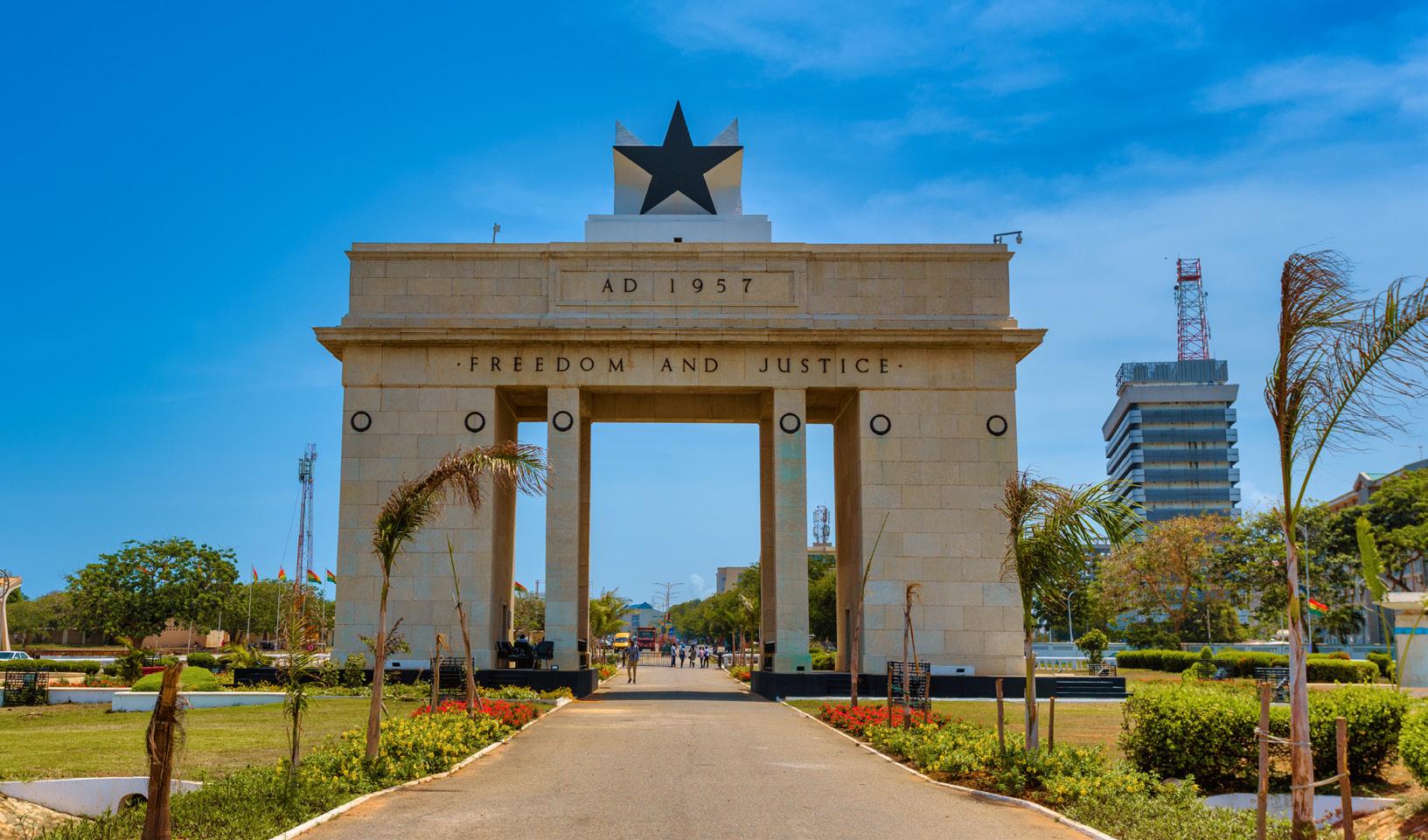
Printed in: United Kingdom by Warners Midlands, PLC; and Singapore by Times Printers Private Limited.
Published in September 2023 as a supplement to The Parliamentarian, the Journal of Commonwealth Parliaments. Available at www.cpahq.org and ISSUU.
 View of Fort St Jago from Elmina Castle in Ghana.
Images: Shutterstock.
View of Fort St Jago from Elmina Castle in Ghana.
Images: Shutterstock.
THE PARLIAMENTARIAN
To subscribe to The Parliamentarian, please email editor@cpahq.org Members of Parliament: Please contact your CPA Branch Secretary for print and digital copies. Individual subscriptions also available.
CPC HOST BRANCH PROFILES
