The Editor’s Page in is almost totally devoted to humor and wisdom and this is a collection of some of the best of them.
The Best Diversions
Give yourself the gift of smiles. J
A handsome, artbook-style volume with the best Diversions to appear in over the last decade. A compendium you will treasure for years to come.
"This collection is laugh-out-loud funny!"
Kirkland Review of Books "Prescription: Read 3-4 pages a day for a month. It’ll brighten your day! And make it last a month."
Susan Carnegie, The Montreal Voice
Vertical Lines I, II, III and IV
Compilations of Sarcasm, Word Play, and Witticisms from the pages of
"This is simply genius. I kept on laughing the whole day when I read it."
Maria Tariq
"...absolutely hilarious! I laughed so hard that it brought tears to my eyes."
Randal Maynard
also from The CREST Publications Group
My Hand Book
"Incisive yet expansive - as if the psychology of R.D. Laing encountered the self-exploration of Hugh Prather to help readers delve into their own thought, experiences and behaviours."
The Rockford Tribune
"Curiously intense and ironic. This is a work that will make you think and feel and you will revisit it over and over.
Marion Danziger, The Toronto Town Crier
S.H.I.T. from the Internet
“An often off-color (but always entertaining and almost always hilarious) collection of jokes that you will read, enjoy – and probably tell –over and over.”
Joey Cousins, The Greenwich Times
Leading With My Heart
"It matters not who we have been, or why, with whom, or how. What matters is that we have met and who we are from now."
Original reflections on new love, its flame, intensity, and all-consuming spirit. Short, poetic expressions of heartfelt longing, passion, and desire. Intimate expressions of tenderness and adoration, accompanied by romantic pictures. A wonderful gift for someone you love.
Available at your favorite online bookstores –click on the links at the top of the page.
“So simple. So eloquent and beautiful. Absolutely wonderful!”
Allison Templeton
A Book
"A perfect companion to Vertical Lineshumor in bite-sized pieces.”
Ellen Campbell, Sinclair Book Reviews "Dyslexics of the world, untie!”
L. Bartow. The Network Bookshelf unite! this!
Punsters of the world, read shit!"
22
TR E DAT
MARK TWAIN, KNEECAPS, DINOSAUR POOP, THE SCISSORS, PILOERECTION, DOGS’ TILTING HEADS, A JIFF, SNEEZING, DREAMPT, NO FULL MOON, DOMESTICATED ANIMALS
23 TRENDI G
THE PURCHASING POWER OF $100 IN EACH U.S. STATE
13 FACTOIDS
MAKE A BEE LINE, FIRST STRING, HENRY, ESSAY, STOOL PIGEON, HIT THE AVENUE, JACK, WHY SOME COINS HAVE RIDGES, ALFORD PLEA, COLD TURKEY, MOMENT, DIZYGOTIC TWINS, ROLAND GARROS
18
AGOSTO CREATIVE STUDIO
The design firm behind 's design.
OLGA ZAVERSHINSKAYA— THE AESTHETICS OF VISUALIZATION
29 TRENDI G
THE HAPPIEST STATES IN AMERICA (2024)-A WALLET HUB STUDY
39 TRENDI G
DISCRETIONARY SPENDING IN THE U.S. –A STORAGECAFE STUDY
CONTRIBUTING EDITOR T.J. EDWARDS LOOKS AT COLIN POWELL’S 13 RULES OF LEADERSHIP AS APPLI9ED TO TODAY’S REAL ESTATE ENVIRONMENT
SOCIAL MEDIA
CONTRIBUTING EDITOR ROXANA TOFAN LOOKS AT THE IMPACT OF SOCIAL MEDIA ON MENTAL HEALTH
MARKETPLACE, BIDDER’S LIST & DIRECTORY 56
CONTRIBUTING EDITOR ROSE-MARY RUMBLEY RELATES THE STORY OF THE CORNY DOG AND BIDS A FOND FAREWELL
OUR ADVERTISERS, WINNERS FROM LAST’S ISSUES CONTEST, BOLO (COMING NEXT ISSUE)
FAMOUS LAST WORDS
MANAGEMENT
WORDS WITH NO ENGLISH EQUIVALENT
SEXUAL RELATIONS THE BALD EAGLE TOLKEIN COKE VS. PEPSI THE NAME GAME LEAVE IT TO BEAVER
MOMMY SAID WE SHARE THE SAME JEANS
17 THE 100 MOST EXPENSIVE ZIP CODES IN THE U.S. A PROPERTY SHARK STUDY
18 THE WONDERS OF THE WORLD OUR SECOND INSTALLMENT –THE 7 ADDITIONAL ANCIENT WONDERS
28 THE MOST DYNAMIC U.S. REAL ESTATE MARKETS OVER NEARLY 5 DECADES A STORAGECAFE STUDY 34 DOWNSIDE RISKS THREATEN TO DELAY CRE RECOVERY A STUDY BY OXFORD ECONOMICS
FACTOR
42 THE FUTURE OF URBAN LIVING FABIO ZANIBONI OF BUBLYNET EXAMINES THE DRIVING FACTORS IN TODAY’S REAL ESTATE MARKET
44 TRENDI G
LARGEST ANNUAL REAL INCREASE IN GROSS RENTAL COSTS SINCE 2011 –A STUDY BY THE U.S. CENSUS BUREAU
26 CRYSTAL BRIDGES MUSEUM OF AMERICAN ART
48 THE GREENEST CITIES IN AMERICA A WALLETHUB STUDY
45 PROPERTY TAXES BY STATE A STUDY BY THE U.S. CENSUS BUREAU
46 THE BEST REAL ESTATE MARKETS (2024) A WALLETHUB STUDY
52 EGAL VIEW THREE ATTORNEYS FROM PARKER & POE EXAMINE THE ‘INDEPENDENT CONTRACTOR’ (AS CONTRASTED WITH THE ‘EMPLOYEE’) CLASSIFICATION
54 THE REME AWARDS THE INSTITUTE FOR REAL ESTATE MANAGEMENT ANNOUNCES ITS 2024 HONOREES
IN THE N WS THE HISTORY OF ARLINGTON NATIONAL CEMETERY
Now in our 32nd year, reaches millions of architects, engineers, developers, brokers, construction managers, property and facility managers, bankers, lawyers, appraisers, investors, service providers, and many more throughout the U.S. via subscription and social media! We proudly serve and service any and all real estate associations bimonthly. If your group would like to be included, please let us know. Email: aafelder@thenetworkmagazine.org or call the number above.
CREST Publications Group EXECUTIVE STAFF
ANDREW A. FELDER: Publisher/Managing Editor. aafelder@thenetworkmagazine.org
XENIA MONTERO: Associate Editor and Art Director. hello@agosto.studio
ANNETTE LAWLESS: Social Media Manager. annettelawless@hotmail.com
MARK ANGLE: National Sales Manager. mark@thenetworkmagazine.org
MARIA TARIQ: Technical Director, Book Division. mariatariq237@gmail.com
SHUMALIA REHMAN: Cover Designer, Book Division. shumailarehman3225@gmail.com
ROXANA TOFAN: 6Q –Who, What, When, Where, Why and How. T. J. EDWARDS : Whatever Happened To...?
Rose-Mary Rumbley
Anthony Barbieri Roxana Tofan
T. J. Edwards
WHAT OUR READERS ARE saying
ADVISORY BOARD
LINDSEY KOREN, Director of Communications, American Society of Interior Designers.
JONATHAN KRAATZ, Executive Director, USGBC Texas. Rick Lackey, CEO, REAL Professionals Network.
AIMÉE LEE, National Accounts Director, Recycle Across America.
LESLIE ROBINETT, Marketing and Communications Manager, International Facility Management Association.
LAURA MACDONALD STEWART, RID, FASID, IIDA, LEED AP, Editor of Plinth & Chintz.
JESSICA WARRIOR, Director of Property Management, Granite Properties.
Maria Tariq Mark Angle Mukul Tripathi (Sam)
THE PARACHUTE
An AirplAne wAs About to crash. There were four passengers on board, but only three parachutes. The first passenger said, “I am LeBron James, the best NBA basketball player. The Lakers and my millions of fans need me, and I can't afford to die.” So he took the first pack and left the plane.
The second passenger, Donald Trump, said, “I am the US president, and I am the smartest president in American history. So my people don't want me to die.” He took the second pack and jumped out of the plane.
“My son, I am old and don't have many years left, you have more years ahead so I will sacrifice my life and let you have the last parachute.”
The little boy said, “That's OK, Your Holiness, there's a parachute left for you. America's smartest president took my school bag...”
THAT'S NOT MY JOB!
This is a story about four people named: Everybody, Somebody, Anybody, and Nobody. There was an important job to be done, and Everybody was sure that Somebody would do it. Anybody could have done it, but Nobody did it. Somebody got angry about that, because it was Everybody's job. Everybody thought Anybody could do it, but Nobody realized that Everybody wouldn't do it. It ended up that Everybody blamed Somebody when Nobody did what Anybody could have done.
Editor’s note
WE’RE IN TROUBLE
The population of this country is 327 million.
76 million are retired.
That leaves 251 million to do the work.
There are 48 million people who are permanently disabled.
Which leaves 203 million to do the work.
There are 74 million children younger than six years old.
Which leaves 129 million to do the work.
There are 95.2 million children and young adults in school.
Which leaves 33.8 million to do the work.
At any given time, there are roughly 4 million people on vacation.
Which leaves 29.8 million to do the work.
Of this, there are 15,000,000 employed by the federal government, not including the military.
Leaving 14.8 million to do the work.
2.8 million are in the armed forces.
Which leaves 12 million to do the work.
Take from that total the 10.8 million people who work for the state and city governments.
And that leaves 1.2 million to do the work.
At any given time, there are 188,000 people in hospitals.
Leaving 1,012,000 to do the work.
Now, there are 1,011,998 people in prisons.
That leaves just two people to do the work.
You and me.
And there you are... sitting on your ass... at your computer... reading jokes.
BY ANDREW FELDER Managing Editor & Publisher aafelder@thenetworkmagazine.org
NEW BOOTS
An elderly couple from Vermont was vacationing in the West. Sam had always wanted a pair of authentic cowboy boots and, seeing some on sale one day, he bought them and wore them home. He walked proudly into the room and said to his wife, “Notice anything different? Bessie?”
Bessie looked him over and said, “Nope.”
Sam said excitedly, “Come on, Bessie. Take a good look. Notice anything different about me?”
Bessie tilted her glasses down on her nose and looked at Sam again. “Nope,” she said.
Frustrated, Sam stormed off into the bathroom, got undressed and walked back into the room completely naked, except for his boots. “Notice anything different now?” he asked demandingly.
Bessie looked up and said, “Sam… what’s different? It’s hanging down today. It was hanging down yesterday. And it’ll be hanging down tomorrow.”
Furious, Sam yells, AND DO YOU KNOW WHY IT’S HANGING DOWN, BESSIE? IT’S HANGING DOWN BECAUSE IT’S LOOKING AT MY NEW BOOTS!”
Bessie shook her head and replied, “Shoulda bought a hat, Sam. You should bought a hat.” n
DEBBIE EDNEY (P. 52) has nearly 20 years of experience representing corporate, financial, and individual clients in all aspects of complex commercial litigation. Her experience includes managing, trying, and arbitrating cases involving independent contractor classifications. She can be reached at debbieedney@parkerpoe.com
BRIGADIER GENERAL
THOMAS J. EDWARDS (P. 49) recently retired from the Army after 30 years of service and moved to San Antonio, Texas in May of 2022. He is a life member of the Veterans of Foreign Wars, the American Legion, the Military Officers’ Association of America, and the 82d Airborne Division Association. He holds a bachelor’s degree from the University of South Carolina, and master’s degrees from Oklahoma University, the Naval War College, and the Army War College. He is also a Contributing Editor of and his Thinking Out Loud feature appears in every issue.
MARIA GATEA (P. 29) is a real estate and lifestyle editor for StorageCafe with a background in journalism and communication. After covering business and finance-related topics for 15 years, she is now focusing on researching and writing about the self storage industry. You may contact Maria via email: maria.gatea@yardi.com
Contributing Writers
ADAM MCCANN (P. 29, 46 and 48) is a personal finance writer for Wallet-Hub who also helps produce WalletHub's weekly 'Best and Worst' studies. At Hopkins he took a wide variety of classes in writing, English, economics, political science, history, and language. While pursuing his education, Adam worked part-time in the Special Collections department of JHU's Milton S. Eisenhower library, where he helped out with the university's collection of rare books and manuscripts.
FABIO ZANIBONI (P. 43) is a technology leader with over two decades of experience in sustainable innovation, digital transformation, and the Internet of Things (IoT), particularly in the lighting industry. His career, including key roles at Emerson Electric and Comau Robotics, has provided him with a global perspective and deep market insights. Leading an R&D team, Fabio focuses on integrating advanced technologies to drive energy efficiency and sustainability in buildings. His research on how factors like light, sound, and air affect wellbeing is driving smarter, more sustainable building solutions. Known for transforming complex technologies into scalable applications, Fabio partners with global organizations to foster digital innovation and sustainability in the built environment. bubblynet.com
AMANDA WILLIAMS (P.52) defends employers on a range of employment issues involving claims of discrimination, harassment, wrongful termination, retaliation, and wage and hour disputes. Amanda regularly defends employers in litigation pending in both state and federal courts, as well as in administrative proceedings. She can be reached at amandawilliams@parkerpoe.com
JENNA MCGEE (P. 52) regularly represents public and private entities on their real estate and construction needs. Jenna has served as trial counsel for companies in federal and state court proceedings, defended a variety of companies in regulatory actions, and conducted internal investigations for clients. She can be reached at: jennamcgee@parkerpoe.com
ROSE-MARY RUMBLEY (P. 56) holds a Ph.D. in communications from the University of North Texas. She is a well-known speaker in Texas and enjoys researching each and every topic. She is a Contributing Editor of and Herstory appears in every issue.
ROXANA TOFAN (P. 50) is the owner of Clear Integrity Group in San Antonio, Texas and the company’s principal broker in Texas, Ohio and South Carolina. Her main focus is multifamily commercial brokerage in San Antonio area and property management. She enjoys taking over nonperforming properties and turning them around. She is also a Contributing Editor of and her 6Q feature appears in every issue. In addition to her company, her passion is giving back to the community as she volunteers for various support organizations such as Boy Scouts of America, Special Olympics, Alzheimer’s Association and supporting the military. She loves to travel with her teenage children and supporting their extra-curricular activities.
THE UPSIDE OF DOWNTIME...
Fans of will love these compilations of humor from the last decade. The Best of Diversions is just that –the very best of the hilarious Diversions that have appeared on the pages of the magazine. Each Vertical Lines book is over one hundred and fifty pages of wit, witticisms and sarcasm that have appeared between the pages (”in the gutter”, as they say). They are both available at your favorite online bookseller and you can see samples at the link here My Handbook is... well... look at the cover comments and a few sample pages. You’ll know soon enough if it’s for you. bookshelf on days off on off-days on rainy Sundays if you’re alone if you need a break to pass the time to brighten your day to sharpen your skills to open your mind to make you smile turn to thenetworkmagazine.org
I hate negative numbers. I’ll stop at nothing to avoid them.
I got a new car for my wife; it was a great trade!
Note from the Editor
INB X ON THE COVER
Last month we received a request from one of our affiliates to “cease and desist” promoting its award program which we had featured in a five-page spread (provided by the organization itself) in the September-October issue. They said that was because “some of the content… do(es) not align with the values“ of that federation and pointed to two pages of humor in the magazine (one of which was the Editor’s Note) which were allegedly found offensive by more than one of the group’s chapter leaders.
The ‘woke’ individuals who expressed that sentiment must never have read the publication before because (as regular readers of know) the humor there was no different than it has always been. This publication is distributed or made available to every real estate organization that we know of and not one has ever had anything but positive things to say (no less one with which I’ve had a 30+ year relationship).
Perhaps needless to say, we will not remove the five-page spread, which was given to the organization (no charge, no fee, no cost) and which has been given to them for many many years. In fact, this is the largest number of pages we have ever given any group. (Aside: In this issue IREM’s REME awards are presented on page 54.)
‘PARALLAX’ by OLGA ZAVERSHINSKAYA
“This work is a part of my ‘Paperwork’ series, which is all about geometry, the perfection of the human body and the contrast between soft curves and sharp lines. This is my personal favorite and “signature” series. “Parallax” was created during my workshop in Bucharest with one of my favorite models. I used paper background to cut the shapes, and it was challenging for me to fix them in the exact place and even more challenging for my model to keep the pose. J” [Ed.’s Note] Parallax is defined as the effect whereby the position or direction of an object appears to differ when viewed from different positions (e.g., through the viewfinder and the lens of a camera). What you see in the viewfinder won't be quite what you get in the photograph because of parallax error.
I suspect that the he or she who lately became ‘woke’ (as we discussed in our July-August issue earlier this year) is like a Southern Baptist who says publicly that he doesn’t drink but aside adds ‘except on Monday, Tuesday,’ etc. Do they even have cable tv? (If so, nothing in these jokes should be offensive to them or anyone.) Are they reading this now, despite the fact that they found the publication so at odds with their ‘values’ that they contacted the national leadership to demand (for them) that we remove the content which the federation itself wrote and submitted?
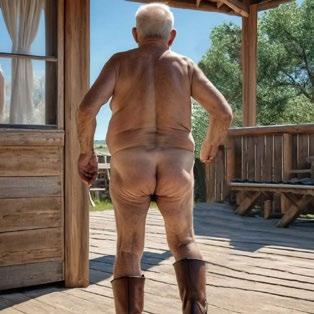
These ‘woke’ individual(s) who feign(s) offense at free expression which supposedly offends some vague and unspecified values should not be in positions of leadership. Fearing the federation would be perceived as guilty by association (with a publication which has fully supported it for the 30+ years it has been around) is foolish and self-righteous. By seeking reasons to be outraged, such individuals create a culture of fear, where people are afraid to express themselves lest they be branded as complicit in some imagined wrong. Worse, their penchant for guilt by association is intellectually lazy, equating proximity to words or ideas with endorsement, leaving no room for nuance or critical thinking. In the end, their indignation serves only to elevate their moral superiority complex. Ask yourself this: What ‘values’ could even by challenged by humor? Image what they think of the cover of this issue! Yikes! Nudity! That’s not art –let’s ban it!
We live in a time when intelligent people are being silenced so that stupid people won't be offended. Don’t let blind people tell you what you see... and remember, arrogance is a camouflage for insecurity. When people are unhappy with themselves, they create a problem with everything and everyone around them.
Thank you for taking the time to read and consider this.
CORRECTIONS & AMPLIFICATIONS
The height of Mt Everest (in TruDat) was mistakenly listed as 16,100 feet; it should have been 29,032 feet.
A NON-TRADITIONAL APPROACH TO BUSINESS COLLECTIONS
Business-to-business debts require special, focused expertise and finesse... and the selection of your commercial collection service is an important decision. It revolves around Service, Trust and Recovery. Rates are important, and recovery is the objective (the bottom line)... but there is more to it.
The company you choose will be handling your money, talking to your customers, and representing you in the marketplace. You want your money as soon as possible – but you don’t want to lose clients.
At Arsenal Business Collections (ABC), you’re never out-of-pocket for our services. We collect (at prearranged terms) and when – and only when – we succeed (i.e., once we collect money owed to you), do we get paid. There is no fee UNLESS and UNTIL we collect!
Our payment is contingent upon your recovery – so our success is integrally tied to yours.
As a privately-owned company, we make decisions based on what is best for clients, not shareholders or outside investors. Our focus is exclusively on improving your bottom line, and we have the knowledge and experience to deliver exceptional results.
FACTOIDS
WHERE DID THAT COME FROM?
MAKE A BEE LINE
A beeline is the swiftest, most direct route between two points. The word combines ‘bee’ and ‘line’. The origin of this phrase can be traced to the habit of bees taking the shortest straight path to its hive, without meandering. Beeline not only denotes a direct route, but it also hints at some sort of haste.
FIRST STRING
Today, the first, second and third strings are the first, second and third players chosen to represent a team in any event. But the term goes back to the time of medieval archery when a person needed more than one string for his longbow in competition. If his first string broke, he could take out his second (or reserve) string and proceed.
HENRY
The term HENRY (high earner not rich yet) refers to individuals who earn substantial salaries but aren't actively leveraging it to build wealth. HENRYs are typically younger people who may be just getting started in their careers but are already earning six-figure salaries; however, they lack the assets you'd typically expect a high earner to have such as a home, retirement accounts or other investments.
ESSAY
The word ‘essay’ comes from the French word 'essayer' meaning 'to try' or 'to attempt'. A French writer (Michel de Montaigne) invented the essay in Europe as his 'attempt' to write about himself and his thoughts. He invented the essay genre after deciding he wanted to write a literary self-portrait of himself. This turned out to be an impossible task. [Michel de Montaigne (1533-1592) is one of France's most celebrated literary giants.]
An essay is a piece of writing that is written to convince someone of something or to simply inform the reader about a particular topic. In order for the reader to be convinced or adequately informed, the essay must include several important components to make it flow in a logical way. Arguably the most common essay format is the standard five-paragraph essay— which devotes a paragraph each to the introduction, conclusion, and three different supporting details
STOOL PIGEON
The term "stool pigeon" comes from the practice of hunters tying a pigeon to a stool or similar perch as a decoy to attract other pigeons for shooting or trapping. Hunters would tie a pigeon to a stool or a tree stump to lure other pigeons to their deaths. Today, the term is used to refer to someone who is a decoy or spy or informant
COLD TURKEY
A quick-fix method to quitting tobacco, alcohol, or drugs. Rather than gradually tapering off the substance, you stop taking it immediately. The term comes from the goosebumps people sometimes get in the days after they quit, which look like the skin of a “cold turkey” in the fridge.
HIT THE AVENUE, JACK!
The basic premise behind naming roads and streets and avenues, etc. is that the name should depends upon its size and function. Should—and usually does. (Note the operative word there— usually. Not always.)
A road is a path that connects point a to point b. It’s a general classification that allows for vehicle or horse travel, and it’s often named for a geographical feature or a person. A street is a route, usually with sidewalks that run along buildings and houses. They usually run east to west, opposite of avenues, which usually run north south, often have medians and are generally wider than streets,
Each municipality decides in which direction to place its streets and avenues. In New York, for example, avenues run north and south; streets run east and west. In Denver, it's the opposite.
Boulevard: A wide street with trees and other vegetation on one or both sides and, often, a median to divide traffic.
Court: A street ending in a loop or a circle, a/k/a a cul-de-sac.
Crescent: A winding, curved road that typically attaches to another road at each end.
Drive: A long road that winds around a geographical feature such as a river or mountain.
Freeway: A part of a highway with 2 or more lanes on each side, no tolls, sometimes called an expressway. It has no intersections or cross streets.
Highway: a major public road, usually connecting multiple cities I
Interstate: a highway system connecting usually connecting multiple states, although some exist with no connections.
Lane: A narrow road that typically leads to a residential zone. Lanes are often found in rural areas. In cities, Lane is sometimes used as a better sounding name for an Alley
Parkway: A major public road, usually decorated, sometimes part of a highway, sometimes has traffic lights.
Place: A road or street with a dead end that's not a loop or circle.
Plaza or square: usually a wide-open space.
Run: usually located near a stream or other small body of water
Terrace: A street following the upper portion of a slope.
Trail: Applies to a road in or near a wooded area that was used before automotive travel.
Turnpike: Commonly associated with toll roads, the term ‘pike comes from the pike weapon which was used to block access to the road until the toll was paid.
Way: A small street branching off a road. These passages are usually short and often feature a dead end. Also used in housing subdivisions
These aren’t hard and fast rules, and this is far from a complete list. Most cities define these words in their own way — but it is interesting. Most towns have a Main Street, for instance, which is traditionally populated by local retail shops. In the United Kingdom, the name ‘High Street’ is often given to this street. By the way, surprisingly, ‘Main Street’ is NOT the most popular street name in the United States. According to the National League of Cities, it’s actually the seventh-most popular. The first is ‘Second Street,’ followed by ‘Third Street,’ and ‘First Street.’
ROLAND GARROS
Eugène Adrien Roland Georges Garros (1988-1918); was a French aviation pioneer and fighter pilot. He began a career in aviation in 1909 and performed many early feats such as the first-ever airplane crossing of the Mediterranean Sea in 1913. He joined the French army and became one of the earliest fighter pilots during World War I. He was shot down and died on October 5. 1918. In 1928, the Roland Garros tennis stadium was named in his memory; the French Open tennis tournament officially takes the name of Roland Garros, which is held in this stadium.
WHY SOME COINS HAVE RIDGES
Pictured are the four most common U.S. coins (from top to bottom: a dime, a penny, a nickel, and a quarter) seen from the side. The edge of both the dime and quarter have ridges, little grooves running perpendicular to the coin face. The penny and nickel, though, have smooth edges. There are 118 ridges on dimes, 119 on quarters, 150 on half dollars, and 133 on Susan B. Anthony dollar coins
Sir Isaac Newton is the one responsible for the ridges. Most famous as a physicist (articulating rules about gravity, force, motion, inertia, etc.), towards the end of his career, Newton became the Warden and then the Master of the Royal Mint. Seeing that the UK had a massive counterfeit coin problem, Newton took the role seriously.
The problems began with something called ‘coin clipping.’ For centuries, coins were made of precious metals (often gold or silver) — and they therefore had an intrinsic value beyond their
stated denominations. You could shave a bit off the edge of a coin, keep the clipped-off piece for yourself, and use the almost-complete coin in a subsequent transaction. With each change of hands, the coin’s change in size and shape would hardly be noticeable. But in time, it became obvious. Here are three similar coins showing the effect of coin clipping.
That’s the situation which Newton encountered as the 1600s came to a close: coin clipping had created a culture of counterfeiting. The ridges (or the ‘reeded edge’ as it’s sometimes called) were part of the solution going
forward. By adding an identifiable feature to the edges, clippers could no longer remove part of the coins subtly. Anyone receiving the clipped coin would, nearly instantly, know that it had been altered. This innovation carried over into the U.S. and other nations as well.
The penny and nickel don’t have this security feature because they were never minted from precious metals; they were never worth clipping. While quarters and dimes were, at times, made from silver, the smaller-denomination coins have generally had a melt value too small to warrant tinkering with their edges. None of the coins produced today contain any precious metals but the ridges are still being added to the coins because it's a useful feature for the visually impaired.
Bonus fact: In the late 1200s, coin clipping was used as the pretext for a rarely told incident of government-driven anti-Semitism. Clipping was very common at the time, with people of all backgrounds participating in the fraud, but a British crackdown targeted Jewish families. Israel’s daily newspaper Haaretz explains: “On November 17, 1278, all the Jews of England were subjected to arrest and search of their homes on suspicion of coin clipping and counterfeiting. Eventually, some 680 were imprisoned in the Tower of London, where it is believed that more than 300 were actually executed in 1279. At the time, the Jewish population of England is believed to have been some 3,000.” By 1290, almost all Jews were expelled from Britain.”
é Portrait of Sir Isaac Newton, 1689.
The shinbone is a device for finding furniture in a dark room.
ALFORD PLEA
On September 5, 2024, Hunter Biden pleaded guilty to nine charges of tax evasion charges (for failing to pay at least $1.4 million in taxes over four years). Before that plea, however, his attorney said he would like to make an Alford plea and not go to trial. The prosecutors objected and Biden's lawyers dropped the effort. In the end, Biden pleaded ‘guilty.’
The name ‘Alford plea’ comes from the 1969 Supreme Court case North Carolina v. Alford. Also known as a ‘best-interests plea,’ it registers a formal admission of guilt to criminal charges, while the defendant simultaneously expresses his/her innocence toward those same charges. Like the similar nolo contendere plea, an Alford plea skips the full process of a criminal trial because the defendant agrees to accept all the ramifications of a guilty verdict (i.e., punishment)
The main difference between a nolo contendere plea and an Alford plea is that, in an Alford plea, the defendant formally pleads guilty while, in a nolo contendere plea, the defendant refuses to assert either guilt or innocence. This distinction is relevant because unlike a nolo contendere plea, a formal admission of guilt under an Alford plea can be used against the defendant in future suits.
An Alford plea is not a right; it is ultimately up to the prosecutor and judge to decide if they will offer it. A few states (e.g., New Jersey and Indiana) expressly forbid Alford pleas.
MOMENT
A moment is a very brief period of time: she was silent for a moment before replying | a few moments later he returned to the office. • an exact point in time: she would always remember the moment they met. • an appropriate time for doing something; an opportunity: I was waiting for the right moment. • a particular stage in something's development or in a course of events: one of the great moments in aviation history
2 formal importance: the issues were of little moment to the electorate.
3 Physics: a turning effect produced by a force acting at a distance on an object. • the magnitude of a turning effect produced by a force acting at a distance, expressed as the product of the force and the distance from its line of action to a given point.
4 Statistics: a quantity that expresses the average or expected value of the first, second, third, or fourth power of the deviation of each component of a frequency distribution from some given value, typically mean or zero. The first moment is the mean, the second moment the variance, the third moment the skew, and the fourth moment the kurtosis.
DIZYGOTIC TWINS
There are two kinds of twins: identical twins (called monozygotic, or MZ) and fraternal twins (called dizygotic, or DZ). Identical pairs have identical DNA, while dizygotic twins are no more alike than any other brothers or sisters, genetically. Twin births occur only in fraternal twins where two different eggs are fertilized by different sperm. The rate of fraternal twins tends to rise with the use of certain fertility assistance drugs. n
Relationships are like algebra. You look at your X and ask Y.
THE 100 MOST EXPENSIVE ZIP CODES IN THE U.S.
AnAlyzing closed home sAles, PropertyShark found that after last year’s widespread price contractions, 2024 was a year of cautious recovery for the country’s leading luxury markets. In fact, 67% of the country’s most exclusive zip codes saw prices rise and multiple locations set new pricing
records, including New Jersey and Arizona. Meanwhile, price gains in Newport Beach made this the first city ever to rank a record three zip codes among the country’s 10 most expensive.
See the complete list, the methodology, the complete study , and an interactive table and anaylsis <HERE> n
Are you a fan of the design of ?
Well, you're in luck, because
Agosto Creative Studio, the graphic design firm behind this magazine since 2019 , is willing to work with you on the design of your next project!
With eleven years' experience in communication, our Studio can help you take your brand to the next level .
CREATIVE AND DESIGN SERVICES
BRANDING + LOGO
SOCIAL MEDIA + EMAIL CAMPAIGNS
BUSINESS CARDS
BOOKS + MAGAZINES + FLYERS
CATALOGUES + NEWSLETTERS
PACKAGING
NEWSLETTER CAMPAIGNS
WEBSITE (RE)DESIGN + MANAGEMENT
PHOTOGRAPHY + VIDEO
Based in Barcelona, Spain we work with clients from around the world and can't wait to work with you, too! Tell us what you need or want
We'll come up with a no cost/no obligation proposal you’ll love!
I’ve thought of buying a burial plot, but it’s really the last thing I
The Seven Additional Ancient Wonders
in the lAst issue, we presented The Original Seven Wonders of the Ancient World. This is part 2 of our series—200 Wonders!
STONEHENGE, UNITED KINGDOM
Stonehenge is a prehistoric megalithic structure on Salisbury Plain in Wiltshire, England It consists of an outer ring of vertical standing stones, each around 13
feet high, seven feet wide, and each weighing around 25 tons, topped by connecting horizontal lintel stones, held in place with mortise and tenon joints, a feature unique among contemporary monuments.
The whole monument, now ruinous, is aligned towards the sunrise on the summer solstice and sunset on the winter solstice. The stones are set in the middle of the densest complex of Neolithic and Bronze Age monuments in England, including several hundred burial mounds.
Radiocarbon dating suggests that Stonehenge was constructed in several phases beginning about 3100 BC and continuing until about 1600 BC. One of the most famous landmarks in the United Kingdom, it is regarded as a British cultural icon and it has been a legally protected scheduled monument since 1882 when the Ancient Monuments Protection Act was passed in the UK. [A scheduled monument is a nationally important archaeological site or historic building, given protection against unauthorized change.] The site and its surroundings were added to UNESCO's list of World Heritage Sites in 1986.
THE GREAT SPHINX OF GIZA, EGYPT
The Great Sphinx of Giza is a limestone statue of a reclining sphinx, a mythical creature with the head of a human and the body of a lion. Facing directly from west to east, it stands on the Giza Plateau on the west bank of the Nile in Giza.The face appears to represent the pharaoh Khafre. It measures 240 ft long from paw to tail, 66 ft high from the
GLOSSARY
A megalith is a large stone that was used to construct a prehistoric structure or monument. There are over 35,000 structures or arrangements in Europe alone.
A trilithon is a structure consisting of two large vertical stones (posts) supporting a third stone set horizontally across the top (lintel).
A lintel is a type of beam (a horizontal structural element) that spans openings such as portals, doors, windows and fireplaces.
Stonehenge is owned by the Crown and managed by English Heritage; the surrounding land is owned by the National Trust. Stonehenge could have been a burial ground from its earliest beginnings. Deposits containing human bones date from as early as 3000 BC, when the ditch and bank were first dug, and continued for at least another 500 years.
base to the top of the head and 62 ft wide at its rear haunches.
It is the oldest known monumental sculpture in Egypt and one of the most recognizable statues in the world. The archaeological evidence suggests that it was created by ancient Egyptians during the reign of Khafre (c. 2558–2532 BC). The circumstances surrounding the Sphinx's nose being
broken off are uncertain, but close inspection suggests a deliberate act using rods or chisels. [Contrary to a popular myth, it was not broken off by cannon fire from Napoleon's troops during his 1798 Egyptian campaign. Its absence is in fact depicted in artwork predating Napoleon and referred to in descriptions by the 15th-century historian al-Maqrīzī.]
The name 'Sphinx' was given to it about 2,000 years after the commonly accepted
date of its construction by reference to a Greek mythological beast with the head of a woman, a falcon, a cat, or a sheep and the body of a lion with the wings of an eagle (although, like most Egyptian sphinxes, the Great Sphinx has a man's head and no wings). The English word sphinx comes from the ancient Greek from a verb which (in English) means ‘to squeeze’, after the Greek sphinx who strangled anyone who failed to answer her riddle.
THE TEMPLE OF KARNAK AT LUXOR, EGYPT
The Karnak Temple Complex, commonly known as Karnak comprises a vast mix of temples, pylons, chapels, and other buildings near Luxor. Construction began during the reign of Senusret I (1971–1926 BCE) and continued into the Ptolemaic Kingdom (305–30 BCE). The original name was the ancient Egyptian Ipet-isut ("The Most Selected of Places") and the main place
LUXOR TEMPLE, EGYPT
The Luxor Temple is a large Ancient Egyptian temple complex located on the east bank of the Nile River in the city today known as Luxor (ancient Thebes). It was constructed around 1400 BCE, and it was known as ‘the southern sanctuary’. It was one of the two primary temples on the east bank, the other being Karnak. Unlike the other temples in Thebes, Luxor temple is not dedicated to a cult god or a deified version of the pharaoh in death. Instead, Luxor temple is dedicated to the rejuvenation of kingship; it may have been where many of the pharaohs of Egypt were crowned.
To the rear of the temple are chapels built by Amenhotep III of the 18th Dynasty, and Alexander. Other parts of the temple were built by Tutankhamun and Ramesses II. During the Roman era, the temple and its surroundings were a legionary fortress and the home of the Roman government in the area. During the Roman period a chapel inside the Luxor Temple originally dedicated to the goddess Mut was transformed into a Tetrarchy cult chapel and later into a church. Along with the other archeological sites in Thebes, the Luxor Temple was inscribed on the UNESCO World Heritage List in 1979.
of worship of the 18th Dynastic Theban Triad, with the god Amun as its head.
It is part of the monumental city of Thebes, and in 1979 it was added to the UNESCO World Heritage List along with the rest of the city. Karnak gets its name from the nearby, and partly surrounded, modern village of El-Karnak, which means "fortified village".
THE VALLEY OF THE KINGS, EGYPT
The Valley of the Kings a/k/a the Valley of the Gates of the Kings, is an area in Egypt where, for a period of nearly
500 years from the Eighteenth Dynasty to the Twentieth Dynasty, rock-cut tombs were excavated for pharaohs and powerful nobles.
Women might be able to fake orgasms, but men can fake a whole relationship.
It is a river valley sitting on the west bank of the Nile, opposite Thebes (modernday Luxor). There are two main sections: the East Valley, where the majority of the royal tombs are situated; and the West Valley, otherwise known as the Valley of the Monkeys.
With the 2005 discovery of a new chamber and the 2008 discovery of two further tomb entrances, the Valley of the Kings is known to contain 65 tombs and chambers, ranging in size from a simple pit (with pottery, animal bones and linen containing text dated to the
final years of the then littleknown pharaoh Tutankhamun to a complex tomb which alone has over 120 chambers for the sons of Ramesses II. It was the principal burial place for the New Kingdom's major royal figures as well as a number of privileged nobles.
The royal tombs are decorated with traditional scenes from Egyptian mythology and reveal clues to the period's funerary practices and afterlife beliefs. Almost all of the tombs seem to have been opened and robbed in antiquity, but they still give an idea of the opulence and power of Egypt's pharaohs.
THE TEMPLE OF RAMESSES AT ABU SIMBEL, EGYPT
Abu Simbel is an historic site comprised of two massive rock-cut temples in a village near the border with Sudan. It is located on the western bank of Lake Nasser, about 140 miles southwest of Aswan. The twin temples were originally carved out of the mountainside in the 13th century BC, during the 19th Dynasty reign of the Pharaoh Ramesses II. Their huge external rock relief figures of Ramesses II have become iconic. His wife, Nefertari, and children can be seen in smaller figures by his feet.
THE STAIRCASES OF PERSEPOLIS, IRAN
Persepolis was the ceremonial capital of the Achaemenid Empire (c. 550–330 BC). It is one of the key Iranian cultural heritage sites and a UNESCO World Heritage Site since 1979.
The earliest remains of Persepolis date back to 515 BC. The city, acting as a major center for the empire, housed a palace complex and citadel designed to serve as the focal point for governance and ceremonial activities. The complex was taken by the army of Alexander the Great in 330 BC, and soon after, its wooden parts were completely destroyed by fire.
Sculptures inside the Great Temple commemorate Ramesses II's heroic leadership at the Battle of Kadesh.
During his reign, Ramesses II embarked on an extensive building program throughout Egypt and Nubia, which Egypt controlled. Nubia was very important to the Egyptians because it was a source of gold and many other precious trade goods. He, therefore, built several grand temples there in order to impress upon the Nubians Egypt's might
The function of Persepolis remains unclear. It was not one of the largest cities
and Egyptianize the people of Nubia.There are two temples, the Great Temple, dedicated to Ramesses II himself, and the Small Temple, dedicated to his wife Queen Nefertari.
Construction of the temple complex started in c.1264 BC and lasted for about 20 years, until 1244 BC. It was known as the Temple of Ramesses, Beloved by Amun.
Coming in the January-February issue: The
The
and
in ancient Iran, let alone the rest of the empire, but appears to have been a grand ceremonial complex that was only occupied seasonally; the complex was raised high on a walled platform, with five "palaces" or halls of varying size, and grand entrances. Until recently, most archaeologists held that it was primarily used for celebrating Nowruz, the Persian New Year, held at the spring equinox, which is still an important annual festivity in Iran. The Iranian nobility and the tributary parts of the empire came to present gifts to the king, as represented in the stairway reliefs. It is also unclear what permanent structures there were outside the palace complex; it may be better to think of Persepolis as only one complex rather than a "city" in the usual sense.
The complex was relocated in its entirety in 1968 to higher ground to avoid it being submerged by Lake Nasser, the Aswan Dam reservoir. As part of International Campaign to Save the Monuments of Nubia, an artificial hill was made from a domed structure to house the Abu Simbel Temples, under the supervision of a Polish archaeologist, Kazimierz Michałowski. n
Additional Wonders Of The
Seven
Hellenic/Hellenistic World: The Parthenon of Athens (Greece),
Oracle of Apollo at Delphi (Greece0, Petra (Jordan), The Fortress of Masada (Israel), The Ruins of Heliopolis of Baalbek (Lebanon), The Catacombs of Kom el Shoqafa of Alexandria (Egypt)
The Hagia Sophia of Istanbul (Turkey).
é The Palace of Darius the Great, was the exclusive building of Darius I at Persepolis.
é The Great Temple of Ramesses II (left) and the Small Temple of Nefertari (right).
TR E DAT:
Mark Twain was born on the day when Halley’s Comet flew by Earth. He famously said, “I came in with Halley’s Comet in 1835… and I expect to go out with it.” Halley’s Comet next appeared on April 21, 1910—which is the day Mark Twain died.
In the last 4000 years, no new animals have been domesticated
A ‘jiff’ is an actual unit of time –1/100th of a second.
The largest piece of fossilized dinosaur poop ever discovered is over 1 foot long and over 4 pints in volume. Believed to be a Tyrannosaurus rex turd, the dino dung (also named a 'coprolite') is helping scientists better understand what the dinosaur ate. Coprolites can range in value from a few dollars to many thousands of dollars. In 2014, one of the longest-known coprolites sold at auction for more than $10,000. Size, distinct impressions, and ripples.
Newborn babies and young infants do not have bony kneecaps; they have cartilage (which doesn’t show up on x-rays) that will change to bone over time (2-6 years) as a baby's skeleton matures.
Leonardo da Vinci invented the scissors
‘Dreamt’ is the only English word that ends in the letters ‘mt.’
It’s impossible to sneeze with your eyes open
Dogs tilt their heads when you speak to them to better understand familiar words (e.g., walk, treat), to pinpoint where noises are coming from, and to better understand the tone of your voice.
—also known as goosebumps or goose pimples— is the contraction of small muscles at the baseof hair folliclesresulting in visible erection of hair. This process is present in all mammals.
As soon as you’re doing what you wanted to be doing, you’ll want to be doing something else.
Stealing ideas from one person is plagiarism; stealing ideas from many people is research.
TRENDI G
By Bruno Vendetti Graphics/Design—Miranda Smith
while $100 mAy seem like it holds the same value across the U.S., that’s far from the reality. The purchasing power of a dollar can vary significantly— by as much as 26% from state to state, influenced by factors such as the cost of food, utilities, taxes, housing, and transportation. California has the lowest purchasing power ($87.50), while Arkansas has the highest ($113.40). This map illustrates the purchasing power of $100 by state, using data from GOBankingRates compiled as of February 19, 2024.
Methodology: GOBankingRates compiled data from the 2022 Regional Price Parities reported by the U.S. Bureau of Economic Affairs. It then used factors such as median household income, sourced from the 2022 American Community Survey, annual cost-of-living expenditures, sourced from the Bureau of Labor Statistics, and typical home value for a single-family residence, sourced from Zillow. n
THE HISTORY OF ARLINGTON NATIONAL CEMETERY IN THE N WS
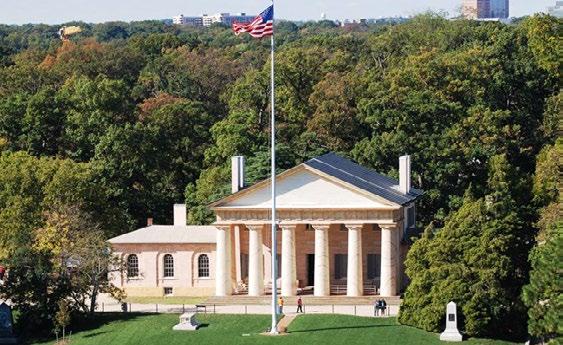
Arlington nAtionAl cemetery in Arlington, Virginia, is one of the United States' most hallowed grounds, serving as the final resting place for over 400,000 military personnel, veterans, and their families. It is not only a symbol of sacrifice and national service but also holds a rich and complex history intertwined with the Civil War, slavery, and the nation's evolving identity.
On August 26, 2024, Donald Trump held a photo-op there, and, adding insult to the outrage which the event caused, his campaign staff had an altercation with a cemetery employee, On Truth Social, the former president complained that reports of the incident were a “made up story by Comrade Kamala and her misinformation squad.” However, The New York Times reported that the employee (a woman) declined to press charges out of fear of “retaliation from Trump supporters.” Politico also reported that the decision was “due to concern over retaliation.”) That employee’s fear is even more chilling when you consider Arlington’s history. And the bottom line: Trump closed out any doubts about the purpose of the cemetery visit and photo shoot when it used footage from Arlington in a post on its TikTok account.
The land that would eventually become Arlington National Cemetery originally belonged to George Washington Parke Custis. Born in 1781, Custis was the grandson of Martha Dandridge Custis Washington through her first marriage. After his natural father died in the year he was born, he went to live at Mount Vernon where George and Martha Washington raised him as their own son. The land was part of a 1,100-acre estate inherited by him, and it was Martha Washington who built the mansion known as Arlington House. After Custis's death in 1857, the estate passed to his daughter, Mary Anna Custis Lee, the wife of Confederate General Robert E. Lee. The Arlington estate became a cherished family home for the Lees, but this legacy would soon take a dramatic turn with the onset of the Civil War.
When Virginia seceded from the Union in 1861, Robert E. Lee resigned from the U.S. Army and took command of Confederate forces. Soon after, Mary Custis Lee fled Arlington House as Union forces advanced on Northern Virginia. The federal government quickly seized the property, initially for military purposes due to its strategic location overlooking Washington, D.C. In 1864, the U.S. government, under Secretary of War Edwin Stanton and Quartermaster General Montgomery Meigs, began using the estate as a burial ground for Union soldiers.
The decision to convert the Arlington estate into a cemetery was partially strategic. General Meigs, who had a personal grudge against Lee for his role in the Civil War, wanted to ensure that the Lee family could never reclaim the land. By 1864, the Union was suffering heavy casualties, and existing cemeteries in Washington, D.C., were becoming overcrowded. Arlington was chosen as a solution, and the first military burial took place on May 13, 1864, for Private William Christ-
We live in a society where pizza gets to your house faster than the police.
é George Washington Parke Custis.
é Arlington House.
Whoever said nothing’s impossible has never tried slamming a revolving door.
man. By the end of the Civil War, nearly 16,000 Union soldiers had been buried at Arlington.
Despite its origins as a cemetery for Union soldiers, Arlington would eventually become a national burial ground for veterans of all U.S. wars. After the Civil War, the government consolidated the cemetery, and it gradually expanded. In 1882, the U.S. Supreme Court ruled that the government had illegally seized the land from the Lee family without due compensation and it ordered the government to purchase the land, which it did for $150,000. Despite the lawsuit's outcome, the Lees never returned to live on the property, which continued to develop into a prominent national cemetery.
Over time, Arlington National Cemetery became a symbol of national honor and veterans from subsequent conflicts were buried there. In the early 20th century, the cemetery also expanded to include memorials and monuments, most notably the Tomb of the Unknown Soldier, dedicated in 1921 to unidentified soldiers from World War I. This solemn structure became a focal point for national mourning and respect for fallen servicemen, embodying the idea that every soldier deserves recognition, even in death.
Arlington National Cemetery is one of 164 national cemeteries established by Congress and administered by the federal government. They were first created in 1862, and most have been transferred to the auspices of the Department of Veterans Affairs or the National Park Service. Arlington National Cemetery remains under the control of the Department of the Army—because it is not an ordinary cemetery. Federal law says it is “a national shrine to the honored dead of the Armed Forces.” Therefore, the law says, “certain acts and activities, which may be appropriate elsewhere, are not appropriate” at Arlington.
Throughout its history, Arlington has become the final resting place for numerous prominent figures, including military leaders, U.S. presidents, and notable Americans. Perhaps the most famous burial is that of President John F. Kennedy, who was laid to rest in Arlington in 1963. His grave, marked by an eternal flame, has become a site of pilgrimage for many Americans. Kennedy’s choice of burial site reinforced Arlington's role as a place of national significance, linking the cemetery with broader ideas of leadership and sacrifice.
Other significant figures buried at Arlington include General John J. Pershing, the commander of American forces in World War I; astronauts from the Space Shuttle Challenger and Columbia disasters; and renowned Supreme Court Justices like Thurgood Marshall. Additionally, sections of Arlington are reserved for Medal of Honor recipients and service members who were killed in action, symbolizing the nation's commitment to honor all those who have served.
Today, Arlington National Cemetery is a living tribute to the men and women who have served in the U.S. military. Every
year, more than three million people visit Arlington to pay their respects and to witness ceremonial traditions like the Changing of the Guard at the Tomb of the Unknown Soldier. The cemetery continues to conduct approximately 27 to 30 funerals per day, ranging from veterans of World War II to soldiers from more recent conflicts in Iraq and Afghanistan.
As Arlington approaches capacity, discussions about its future have intensified. The cemetery’s expansion projects, including the Millennium Project and the Southern Expansion, seek to ensure that Arlington can continue serving as a burial ground for future generations of veterans. However, even with these expansions, it is expected that Arlington will eventually reach its limit in the coming decades, prompting broader discussions about how the nation will continue to honor its military dead. As the cemetery continues to evolve, it remains a powerful reminder of the cost of freedom and the importance of national memory.
For the most part, cemetery owners (religious organizations, local governments, nonprofits, for-profits and families) decide who may be interred on their land. They regulate the size and configuration of burial plots, determine the rights of plot owners., establish a visitor code of conduct and decide what activities can take place there. They can regulate the sizes and shapes of headstones and even bar the placement of items at the gravesites. These rules supersede the wishes of the family members of those interred there.
In addition to prohibiting running, cycling, picnicking and animals other than service animals or military working dogs, Arlington specifically prohibits “disrespectful and disorderly” conduct. No one may film in the cemetery for “partisan, political or fundraising purposes” and headstones may not be filmed without written authorization from the deceased’s next of kin. Trump’s campaign did not get permission from all of the families associated with all of the headstones visible in the footage. Not surprisingly, he called the cemetery employee who tried to prevent the filming a “despicable individual,” and linked her to people he says have it out for him. n
é Tomb of the Unknown Soldier.
CRYSTAL BRIDGES
MUSEUM OF AMERICAN ART
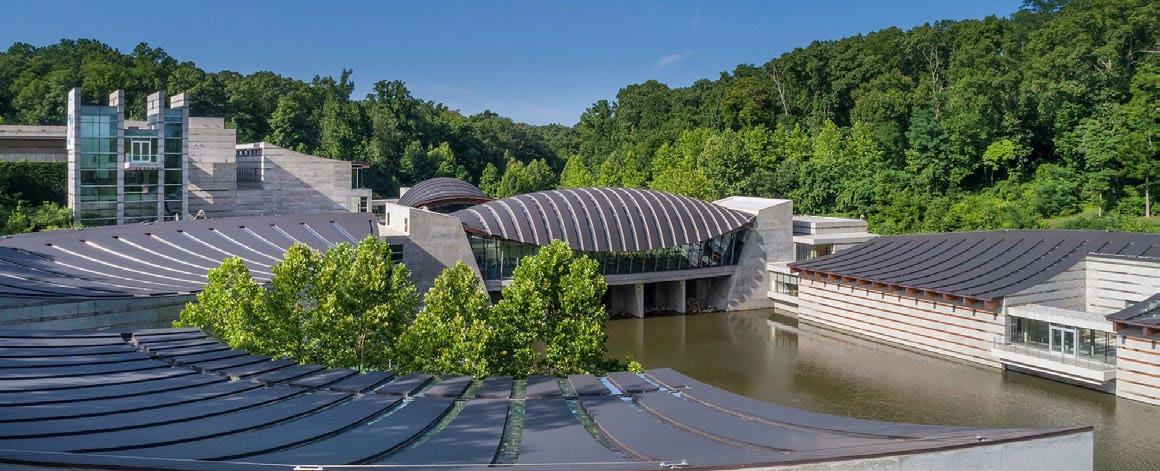
the crystAl bridges museum of American Art in Bentonville, AK was founded in 2005 as a non-profit charitable organization by arts patron and philanthropist, Alice Walton. The collection spans five centuries of American masterworks from early American to current day and is enhanced by temporary exhibitions. The museum is nestled on 120 acres of Ozark landscape and was designed by world-renowned architect Moshe Safdie. A rare Frank Lloyd Wright-designed house was preserved and relocated to the museum grounds in 2015.
The Museum offers public programs including lectures, performances, classes, and teacher development opportunities. Some 418,375 school children have participated in the Willard and Pat Walker School Visit program, which provides educational experiences for school groups at no cost to the schools. Additional museum amenities include a restaurant, gift store, library, and five miles of art and walking trails.
é Architect Marlon Blackwell designed the museum store at Crystal Bridges to be an organic complement to the museum’s natural setting and distinctive architecture. Under a living green roof, the interior ceiling and walls are lined with undulating Cherrywood ribs that mimic the fluting on the underside of a mushroom. Blackwell practices architecture in Fayetteville, Arkansas, and serves as distinguished professor at in the Fay Jones School of Architecture + Design at the University of Arkansas. His design received an American Institute of Architects Honor Award for Interior Design in 2015.
é The 50-foot diameter Fly’s Eye Dome, designed by American architect and inventor Buckminster Fuller, has been installed on the museum’s Orchard Trail. This is one of only three prototypes fabricated in Fuller’s lifetime and had spent nearly three decades in storage.
ç Crystal Bridges was designed by internationally renowned architect Moshe Safdie, who envisioned a building that would complement the surrounding Ozark landscape. Nestled into a natural ravine, the museum integrates the element of water on the site through the creation of two spring-fed ponds that are spanned by two signature bridge structures and surrounded by a group of pavilions housing museum galleries and studios.
é In 2013, Crystal Bridges acquired a classic “Usonian” house designed by celebrated American architect Frank Lloyd Wright and constructed in 1954. Known as the Bachman-Wilson House, the structure was dismantled at its original site in Somerset County, New Jersey, and reconstructed on the museum grounds overlooking Crystal Spring.
The mission of Crystal Bridges Museum of American Art is to welcome all to celebrate the American spirit in a setting that unites the power of art with the beauty of nature. Since opening in 2011, the museum has welcomed more than 12.2 million visitors across its spaces, with no cost for admission.
Listen in on a conversation between Moshe Safdie and Alice Walton: youtube.com n
BY MARIA GATEA
The Most Dynamic U.S. Real Estate Markets Over Nearly 5 Decades
storAgecAfe AnAlyzed 44 yeArs of data* (1980–2023) to rank the top 108 cities for new construction highlighting those that have had the greatest impact in reshaping the American urban landscape. Houston remains unrivaled, emerging as the undisputed leader in new development and setting a benchmark for real estate activity across the nation. Meanwhile, unexpected contenders like Jacksonville, FL, and Las Vegas, NV, have broken into the top 10, alongside steady performers like San Diego, CA.
Between 1980 and 2023, over 60.2 million building permits were issued in the U.S. — 41.2 million for single family homes and 19 million for multifamily units. However, during the same period, the population grew by 100 million, intensifying the pressure on a housing market already grappling with rising prices and economic fluctuations. The multifamily sector is experiencing one of its most active construction booms, yet it still falls short of addressing the ongoing housing deficit. Over the 44 years analyzed, the number of renting households has surged by 76%. Driven by high demand, multifamily permits have reached record levels, averaging over 600,000 annually in the early 2020s — 50% more than the averages of the previous two decades and even surpassing the construction peaks of the 1980s.
The industrial sector is experiencing one of its strongest periods of construction to date. Retail and office construction continue to face significant challenges. Self-storage has surged and emerged as a notable player in the real estate landscape.
The top markets for new development in each sector: Single family: Phoenix, AZ; Houston, TX; Jacksonville, FL; Fort Worth, TX; San Antonio, TX
Multifamily: New York City, NY; Los Angeles, CA; Houston, TX; Dallas, TX; Austin, TX
Office: New York City, NY; Houston, TX; Atlanta, GA; Washington, D.C.; Chicago, IL
Retail: Houston, TX; San Antonio, TX; Las Vegas, NV; New York City, NY; Miami, FL
Industrial: Houston, TX; Fort Worth, TX; Phoenix, AZ; Dallas, TX; Las Vegas, NV
*About the data: This report was compiled by StorageCafe’s research team using data from the U.S. Census, as well as our sister research divisions, CommercialEdge and Yardi Matrix. It covers real estate activity across six major sectors — single family, multifamily, industrial, office, retail, and self-storage — between 1980 and 2023, focusing on 108 cities.
Access the full study <HERE> n
Gatea is a real estate and lifestyle editor for StorageCafe. maria.gatea@yardi.com
Love is telling someone to go to hell and worrying about them getting there safely.
Maria
Why is it that most nudists are people you wouldn’t want to see naked?
The Happiest States in America (2024)
with A recent gAllup poll showing only 47% of Americans are “very satisfied” with the way their life is going, the personal-finance website WalletHub released a report on the Happiest States in America in 2024, as well as expert commentary, to identify the places that create the best conditions for life satisfaction. They compared the 50 states across 30 key indicators of happiness, ranging from the depression rate and the share of adults feeling productive to income growth and the unemployment rate
To view the full report, an explanation of the methodology used, expert commentary, and an interactive map <HERE.> n
BY ADAM MCCANN
REALITY CHECK: RACE
the prActice of referring to anyone with even a small amount of Black heritage as "Black" is rooted in historical and social contexts, particularly in the United States, where the "onedrop rule" historically classified individuals with any African ancestry as Black. This rule was part of the larger system of racial segregation and discrimination that sought to reinforce racial hierarchies and control social status
Whether this practice is racist today depends on how it's framed and the perspectives of those involved. Some key considerations include:
1. Historical Legacy: The one-drop rule was clearly racist in origin, as it was designed to maintain white supremacy and the social exclusion of people of African descent. Even today, its legacy influences how racial identity is constructed.
2. Self-Identification: Many people of mixed heritage may identify as Black, biracial, or multiracial based on their personal experiences, cultural connections, and how society treats them. Imposing an identity on someone without considering how they identify can be problematic, as it dismisses their autonomy.
3. Social Reality: Racial identity often plays a role in how people are perceived and treated in society. In many cases, individuals with Black heritage may be viewed and treated as Black, regardless of how much of their heritage is African. This can affect their lived experiences with discrimination, privilege, or inclusion.
4. Cultural Contexts: In some cultures/countries, racial categories are more fluid, and people may identify in different ways based on their appearance, heritage, or personal choice. In other places, race is more rigidly defined, which can perpetuate outdated or simplistic ideas about identity.
It's important to acknowledge the complex nature of race and identity. While recognizing someone's heritage can be a point of pride or community for some, rigidly categorizing people based on race without considering their self-identification or the nuances of their experience can be limiting and potentially harmful. Therefore, the key is to respect individual identities and understand the history behind racial categorizations.
Mom: What did you learn in school today, sweetheart?
Son: Obviously not enough. I have to go back tomorrow.
ARTCH TECTURE
OLGA ZAVERSHINSKAYA
“Art has always been indispensable way to express one’s thoughts and ideas, a reflection of processes happening with personality and environment.
My work is not an exception. This is how I communicate with society; this is a way to share my vision of beauty and aesthetics. It is reflection of my mind through the prism of my vision.”
olgA zAvershinskAyA is A world-renowned photographer and digital artist with a style that is instantly recognizable. She lives and works in the Czech Republic (Czechia) having started her photography career in 2007. In everything about photography, she is self-taught.
Her eye-catching and provocative work is highly sought after. She has been in more than 20 international exhibitions all over the world and won her a number of prestigious art and photography awards.
Olga is focused on digital art and fine art photography. The basis of her work is an idea closely associated with the method of realization, emotional and aesthetic principles. The balance between concept and method of expression is the most significant characteristic for her. Olga combines lines, form and light in order to
convey the idea to the viewer, while maintaining the aesthetics of visualization.
“I have had a desire to create since early childhood but only photography gives
me the opportunity to see the results immediately. This is very important for me because my muse moves too fast. If I were a painter, I would never finish my paintings. J” n
Many of Olga’s works can be seen on her website or her Instagram: @olgazavershinskaya.
Limited edition prints which can be ordered using Olga's email on her website: armene.com.
WHY ARTCH TECTURE?
Great art is among the most sublime, meaningful, and redeeming creations of all civilization. Few endeavors can equal the power of great artwork to capture aesthetic beauty, to move and inspire, to change perceptions, and to communicate the nature of human experience. Great art is also complex, mysterious, and challenging. Filled with symbolism, cultural and historical references, and often visionary imagery, great artworks oblige us to reckon with their many meanings.
Architects and designers (many of our readers) have a lot of influence on the way we perceive the world. A structure often plays a significant part in how we experience a place. (Think of a restaurant, a museum, an arena, a stadium... even an office building - virtually anywhere!) The interior design impacts our sensory perception, our comfort, and our physical connection and there is also artistry in the exterior design. (That’s why we call it artchitecture.)
DOWNSIDE RISKS THREATEN TO DELAY CRE RECOVERY
Our latest baseline forecast is for world GDP growth of 2 7% in 2024 and 2025 We still anticipate solid growth next year in the US , but we revised our eurozone fo recast down amid signs of fading momentum. In our baseline, we predict world GDP growth in 2024 and 2025 will be comparable to 2023's 2.7%. A gradual pace of policy rate cuts is expected from the Fed eral Reserv e, starting in Septem ber The European Central Bank, as expected, cut rates for a second time by 25bps in September. The People's Bank of China embarked on a series of unexpected rate cuts in June; we expect more cuts to benchmark rates in Q4 and Q1 2025.
We forecast CPI inflation to continue to fall back, but with services inflation typically slo wing less sharply and wage growth remaining relatively high, there is uncertainty over how quickly inflation will reach target. We anticipate, in the medium to long term, central banks will keep inflation close to target on average
Global risk survey: near-term downside risks % of respondents citing as top risk
As detailed in our latest Glo bal Risk Surv ey, businesses are increasingly focused on the potential fallout from the fo rthcoming US presidential election. Around half of the respondents named a Trum p presidency as one of the top two near-term threats to the global economy. Even as a higher portion of respondents see risks weighted to the upside ( 23%) , more businesses continue to perceive risks to growth as skewed to the downside (4 0% ) In addition to a Trump presidency , geopolitical tensions and sticky inflation triggering higherfor-longer interest rates are still seen as the top global economic risks ( Chart 2).
A key potential upside for the global economy, according to respondents, rests on more substantial monetary policy easing than expected. Consequently, our upside scenario continues to center on policy easing that bolsters the global economy while inflation returns to target. Overall, risks to growth remain tilted to the downside this quarter
Continued economic growth and gradually reducing rates will help stabilize commercial r eal estate ( CRE) performance o ver the next two years. We expect the impact to vary across regions, and project that the Asia-Pacific region will be hit the hardest, as we forecast capital value returns to decline by 1.6% Globally, we expect all-property capital values to decline peak to trough by 9.9%, with a recovery starting in 2 025 This year, we think net operating income ( NOI) yields will continue to rise but start to stabiliz e in 2025 Total returns will be in positive territory this year, earlier than values, as cuts to interest rates begin We forecast global all -property returns will average 5.7% per year over the five-year forecast period
Over the next two years, we forecast that every property sector will record positive total returns, on average ( Chart 3) . Still, the outlook for the office sector remains weighed down by the ongoing, significant impact s from the work-fromhome shift and the drive toward energy efficiency W e anticipate a 2 % growth in total returns for offices over the next t wo years –significantly below hotel, the top-performing sector with growth of 6.9%.
Chart 3: The office sector is likely to suffer the biggest hit to returns
Chart 2: Businesses are concerned about geopolitical tensions and the US election
Source: Oxford Economics
Risks tied to a second Trump presidency, inflation, and geopolitics
This quarter, we examined four main scenarios to quantify the key global risks to our forecasts: a full-blown Trump presidency, higher-for-longer interest rates, a Middle East escalation, and an inflation victory In addition to our Trump scenario, we included a Harris presidency, Democratic Congress alternative scenario. This time, we assigned a higher probability to the Trump scenario while the probability of a higherfor-longer scenario diminished slightly
For real estate, the risk-weighted performance over the first two years of the forecast period is significantly weaker – down 204bps from the baseline However, results differ significantly between scenarios, as well as acro ss sectors and regions. Overall, the greatest risk to real estate performance is the possibility of interest rates remaining higher for longer .
In our baseline, we expect the Fed to start cutting in September following rate cuts from the ECB in June and in September Our higher-for-longer scenario assumes stickier core inflation and a temporary rise in oil prices driven by increased tensions in the Middle East These factors cause monetary policy to tighten and rate cuts to be delayed. The potential damage to CRE performance is significant, dragging all-property returns down by 3.7% in 2025, compared to our baseline.
Conversely, in a scenario where policy easing boosts the global economy while inflation returns to target, and policy shifts to a stance more supportive of growth in the major economies , global all-property total r eturns are lifted 1.9ppts above our baseline by the end of 2025 ( Chart 4)
Chart 4: The higher-for-longer scenario poses the most risk to property returns
Source: Oxford Economics/MSCI
Trump presidency, Republican Congress
We included a scenario that gauges the impact of a Trump presidency and a Republican Congress this quarter. In our Full-blo wn Trump scenario, the global economy is hit b y heighted protectionism, elevated interest rates, and a weakening US economy am id curbs on immigration and fading fiscal stimulus.
The short-term and long -term implications of a full-blown Trump presidency diverge from our other scenarios. The impact of this scenario builds much more slowly, and the medium-term impacts are far more pronounced and even greater than our most severe downside scenario of higher-for-longer interest rates.
Chart 5: Long-run hit to GDP is more severe
Source: Oxford Economics/Haver Analytics
The US and China are the hardest hit in this scenario ( ) Chart 5 Despite an initial boost to the US economy from loosened fiscal policy and improved investor sentiment, higher tariffs on China and other major trading partners would cause price pressures to rise and US monetary
policy easing to be halted. In the US, GDP is 0.9% below baseline in 2029 , and the hit is even greater in China, at 1 6%.
These effects would filter down to our propertysector forecasts. We downgraded our capital value forecasts across most regions, and expect value growth in 2025 to not be enough to reverse declines recorded in 2024 The only exception to this trend is the eurozone, where we anticipate growth in values over the next two years. W e project declines in capital returns would be greatest in the Asia-Pacific region, driven by China ( Chart 6) The trade sanctions force capital returns into negative territory across all major economies under the Full-blown Trump scenario.
Chart 6: A second Trump presidency wo uld negatively impact capital returns
Source: Oxford Economics/MSCI
The net result of our Harris presidency, Democratic Congress alternative scenario is a minimal impact to US GDP growth in 2025 but faster growth in 2026 of 0 6ppts above baseline Total returns in the US would be 0. 2% above baseline in 2025 and 0 3% in 2026 Outside of the US, financial market, econo mic, and commercial real estate effects are relatively limited.
Elevated interest rates scenario
Inflation risks still lie to the upside in the near term. In three of our scenarios, near -term inflation matches or is greater than in our baseline forecast. In our baseline, we expect headline inflation to fall back this year But with services inflation typically slowing less sharply and wage growth rem aining relatively high, there remains uncertainty over how quickly inflation will reach target. We expect central banks to keep inflation close to target on average in the medium-to-long term.
Our higher-for-longer interest rate scenario, the most severe of the four, assumes that the period of high interest rates is prolonged, which weighs on stock markets and house prices. This would result in tighter credit conditions and years of subpar growth. Global inflation is 80bps higher by mid-2025 and US core inflation is 40bps above our baseline forecast next year In this scenario, bond yields are 70 bps above baseline by late 2025, and yields in the US are almost 70bps above the baseline ( Chart 7)
Chart 7: US policy rates remain above the baseline throughout the scenario
Source: Oxford Economics/Haver Analytics
The impact from rising bond yields on real estate NOI yields is likely to be the greatest in the US ( Chart 8) In the eurozone, NOI yields would be hit hard with bond yields close to 100bps above their baseline in 2025 The office sector would record the most significant increase in global NOI yields compared to the baseline in 2025, while industrial yields would be impacted the least.
Chart 8: Higher-for-longer interest rates cause US NOI yields to increase the most
Source: Oxford Economics/MSCI
Energy disruption scenario
The effect from a broadening in the regional conflict in the Middle East remains a downside scenario this quarter. In this scenario, the IsraelHamas war escalates, disrupting oil production significantly. World GDP is 0.5% below the baseline forecast by Q4, and growth is 40bps below the baseline by the end of 202 5 The Gulf Cooperation Council suffers most of the hit to GDP, which would be 1 5% below the baseline this year. Other areas are affected but not as severely and more delayed
Chart 9: An oil price spike forces consumption lower
growth, 2025
Source: Oxford Economics/Haver Analytics
Under this scenario, oil prices peak in Q 4 at $135 per barrel. This squeez es incomes and drags down consumption in the near term ( Chart 9) Compared to the baseline, private consumption in 2025 would be most impacted in Canada, the UK, and the US. W e project France's consumption growth would fall even more from the baseline of sub-1% growth and be the lowest in 2025
The effects of a Middle East escalation on regions and individual global real estate sectors would delay the timing of a recovery in values . Over the next two years, the Asia-Pacific region would record the most severe drop in values, followed by the US Values in the eurozone, on average, would be improved and slightly positive over the next two years
Weaker consumption would acutely impact the retail sector, on average, over the next two years, causing returns to drop into negative territory , whereas the residential sector would be mainly flat Meanwhile, worsening business confidence would hurt the office sector , which is already struggling to grow values Over the next two years, office would likely record the largest drop
on average ( Chart 10) Conversely, we think industrial, a better-insulated sector, would record a slight increase of 0 3%
Chart 10: Office property values would decline the most if the Israel-Hamas war escalates
Global capital return by sector , 2024-2025 % per year
Source: Oxford Economics/MSCI
Inflation reduction scenario
Our upside scenario this quarter continues to be based on a central bank victory over inflatio n. In this scenario, the impact from inflation pressures eases and inflation quickly returns to target. In the near term, the expected inflationary impact of shipping disruption fails to materialize as fears of a Middle East escalation fade ( Chart 11). Inflation expectations would edge lower and policy rates would be cut substantially. Core inflation is 20bps-40bps below the baseline in 2025 in the US and eurozone, and in the first year of the scenario, the US, UK, and eurozone policy rates are cut by 25bps more per quarter than in the baseline
We project this would cause global GDP to strongly recover – world GDP would be 0 4% higher in 2025 compared to our baseline. The greatest gains to GDP are experienced by those countries able to significantly loosen monetary policy as inflation falls from recent peaks The GPD in the UK would be up 0.4% and in the US by 0.8% above the baseline in 2025
Hote l In du strial Residential Retail Office
Middle East escalation Baseline
Chart 11: Inflation lower than the baseline in only the upside scenario
the baseline forecast failing to materialize, industrial would log the biggest increase in total returns compared to the baseline The UK would record returns of 7.9%, outperforming other regions and countries This growth would be well above the expected returns over the next two years.
Chart 12: Strongest total returns in the UK
Source: Oxford Economics/Haver Analytics
As inflation falls in the near term and central banks cut policy rates, the cost of capital would fall. This would cause total all-property returns to be higher over the next two years ( Chart 12). Globally, all sectors including office, would see a boost to total returns. Due to the inflationary impact of the shipping disruption incorporated in
Source: Oxford Economics/MSCI 17 September 2024 Reprinted with permission.
DIVERSI NS: PROPERTY MANAGEMENT
WHEN THE LANDLORD’S FINALLY HAD IT
My landlord walked in the other day, threatening to kick me out. Her reason?
I hadn’t made a single rental payment in years. Just listen to what she had to say: “Come on, son – you’re 35. Don’t you think it’s time you found a place of your own?”
DO NOT DISTURB
Recently, my tenant called me over to his apartment for some repairs. In the process, he mentioned that the occupants of the upstairs apartment were rather noisy.
“Most nights,” he said, “they make a scene and stomp on the floors until well after two AM.”
“Wow,” I said. “And that doesn’t bother you?”
“Not really,” said the tenant. “I’m usually up that late anyway, practicing my trumpet.”
EVEN LANDLORDS SEEK HELP
Q: Why was the landlord seeing a psychiatrist, a clinical psychologist, and a licensed counselor?
KING OF THE CASTLE
Recently, a tour guide was leading a group of tourists through a famous, ancient castle in Germany.
A: He had an apartment complex! I
“This castle was built nearly eight hundred years ago. All features are original – not one stone has been changed, not one wall has been altered, and not one upgrade, superficial or functional, has occurred in all these years.”
“Wow!” interrupted a woman, rolling her eyes. “They must have the same property manager I do.”
THE YOGA INSTRUCTOR
Q: What did the yoga instructor say to her property manager after receiving an eviction notice?
A: “Namaste.”
I met a girl on a dating site, and we just clicked.
Discretionary Spending in the U.S.
we All work hArd for our money and enjoy spending it differently—whether on vacations, dining out or that daily coffee. Whatever your indulgence, chances are it eats up a large chunk of your earnings. But who spends more, and where does the “you only live once” dollar stretch the furthest? StorageCafe zoomed in on spending behavior and analyzed all U.S. states and D.C. to assess financial well-being and the impact of discretionary spending on personal finances.
Their key findings:
• In 2022, Americans spent an average of $12,000 per year on nonessential items, up 32% from 2018. This includes instant gratification through goods and experiences such as streaming services, specialty coffee, impulse buys, and the latest fashion items. While these might seem like small expenses, they can add up to a million dollars over a lifetime.
• Discretionary items account for an average of 23% of the total spending budget.
• Most nonessential spending goes toward eating out and vacations, up 27% since before the pandemic. Additionally, spending on magazines, newspapers and stationery increased by 60%.
Colorado and Utah, along with coastal states like Washington and California, top the list in discretionary spending, likely driven by higher household incomes and strong economic growth. [Utah’s income grew by 25.2% from 2018 to 2022, with a 12% rise in high-income earners—the nation’s highest. This surge likely explains why residents allocate up to 27% of their spending to
TRENDI G
nonessential items, especially recreational goods.]
• At the other end of the spectrum, residents of some southern states struggle to find the capital for nonessentials. Mississippi, Arkansas and Oklahoma have some of the lowest household incomes in the country, with their average income growth lagging behind.
According to Doug Ressler, business intelligence manager at Yardi Matrix, ”We’re currently witnessing a rise in consumer spending in the U.S., which overall rose by 24% in 2022 compared to 2018, according to BLS data, along with a rise in renter incomes. The average monthly income of apartment tenants has surged nearly 4% annually, reaching an all-time high in the second quarter of this year. Strictly referring to the mul-
tifamily market, the rise in income has significantly expanded the renter pool, driving the number of occupied rental units to more than 160,000 nationwide — the strongest quarterly net absorption volume in nearly three years. The absorption volume in the first half of this year surpassed the total for 2023 by almost 35,000 units.
Curious about where people are spending the most on nonessentials? You can find a detailed look at the spending habits of Americans across the country in the complete article here: www.storagecafe.com/blog/.
Here are the ten states with the highest financial well-being and the ten with the lowest, based on a mix of high incomes, smart spending, and manageable costs:
USHUAIA
THE FACTOR
ushuAiA is the cApitAl of Tierra del Fuego (an archipelago off the southernmost tip of the South American mainland,) in Argentina. It is commonly regarded as the southernmost city in the world. While there are settlements farther south, the only one of any notable size is Puerto Williams, a Chilean settlement of some 2,000 residents. As a center of population, commerce, and culture, and as a town of significant size and importance, Ushuaia, with a population of 82,615, clearly qualifies as a city.
Ushuaia is bounded on the north by the Martial mountain range, and on the south by the Beagle Channel. It was founded on October 12, 1884, by Augusto Lasserre, an officer in the Argentine Navy, and besides being an administrative center, it is a light industrial port and tourist hub. It is about 680 miles from the Antarctic Peninsula.
MEANING
The word Ushuaia comes from the (now extinct) Yaghan language: ush and waia ("bay" or "cove") and means "deep bay."
CITY MOTTO
"Ushuaia, fin del mundo, principio de todo." ["Ushuaia, end of the world, beginning of everything."]
CLIMATE
Temperatures at the Ushuaia –Malvinas Argentinas International Airport average 34.3°F in the coolest month (July), and 49.5°F in the warmest month (January).
MANUFACTURING
The industrial sector, led by the Grundig Renacer electronics factory, is among the largest in Patagonia.
ARTS AND CULTURE
Since 2007 the city has hosted the Biennial of Contemporary Art at the End of the World bringing together a hundred artists from five continents addressing the motto "think at the End of the World that another world is possible."
MAIN ECONOMIC ACTIVITIES
Fishing, natural gas and oil extraction, sheep farming and ecotourism.
TOURISM
Attractions include the Tierra del Fuego National Park and Lapataia Bay. The city has a museum of Yámana, English,
I did have a joke about vacuums, but it sucked.
Panorama of Ushuaia
é Martial Glacier.
and Argentine settlements, including its years as a prison colony. Wildlife attractions include local birds, penguins, seals and orcas, many of these species colonizing islands in the Beagle Channel.
SPORTS
As in most of Argentina, soccer (called football there) is a popular sport as are ice hockey and skiing.
GOVERNMENT
The city government consists of a Mayor (executive), City Council (seven members, legislative) and the Tribunal de Faltas (small court, judicial).
EDUCATION
Ushuaia has twelve secondary schools, four of which also provide adult education. The National University of Patagonia San Juan Bosco[61] operates a campus in Ushuaia, with Faculties of Engineering, Economics and Humanities, and Social Sciences. The National University of Tierra del Fuego, inaugurated in 2010, has its headquarters in Ushuaia.
MEDIA
Ushuaia has two television stations, two main newspapers and several other minor publications. n
é View of the port.
é City view.
é Government Building (with typical local architecture.)
é Downtown Ushuaia in the evening.
BY FABIO ZANIBONI
As urbAn populAtions rApidly grow, the need for sustainable living solutions has never been more pressing. Smart buildings are at the forefront of addressing the urgent challenges posed by urbanization, thanks to technological advancements and a global push for sustainability. By leveraging the Internet of Things (IoT), automation, and data analytics, smart buildings are redefining energy consumption, occupant well-being, and environmental impact, paving the way for sustainable cities
Recent climate science indicates that the world is not decarbonizing quickly enough, leading to significant climate risks. Although the business community is recognizing this crisis and engaging with stakeholders, a gap remains between current corporate actions and the changes needed to achieve Net-Zero emissions and meet the United Nations Sustainable Development Goals. Notably, only 33% of C-level executives link compensation to environmental performance. (1)
Integrating sustainability into operations requires a deep understanding of relationships with people and the planet, often necessitating investments in data collection, quality assurance, and governance. Companies must focus on obtaining the right data to identify sustainability risks and opportunities. By understanding key environmental, social, and governance (ESG) factors, businesses can create frameworks for assessing risks and aligning objectives, requiring tailored strategies and open dialogue among stakeholders. (1)
SMART BUILDINGS: HARNESSING IOT AND DATA ANALYTICS FOR ENERGY EFFICIENCY, SECURITY, AND SUSTAINABILITY
Smart buildings leverage innovative technologies like IoT sensors and cloud computing to optimize energy use, enhance occupant comfort, and bolster security. These technologies contribute to energy efficiency improvements of 10-30%, which are crucial as urban populations are expected to rise from 56% to 70% by 2050. Given that buildings account for over one-third of global energy consumption and around 30% of greenhouse gas emissions, smart
THE FUTURE OF URBAN LIVING
buildings play a critical role in combating climate change. (2)
IoT devices such as smart meters, cameras, and sensors collect real-time data to optimize systems, leading to improved energy efficiency, security, and comfort. Smart thermostats, lighting systems, air quality monitors, and occupancy sensors work together to reduce energy consumption and enhance overall building performance. Furthermore, smart buildings integrate advanced security features like surveillance cameras, biometric access controls, and intrusion detection systems. Building Automation Systems centralize the management of HVAC, lighting, and security, while AI-powered data analytics platforms monitor sensor data for real-time efficiency adjustments, ensuring safer, more energy-efficient, and sustainable environments. (1)
This synergy of technologies transforms smart buildings from conceptual innovations into practical, sustainable solutions for urban living, with benefits that extend beyond energy savings to encompass enhanced safety and operational optimization.
ECONOMIC AND ENVIRONMENTAL ADVANTAGES OF SMART BUILDINGS: COST SAVINGS, SUSTAINABILITY, AND ENHANCED PRODUCTIVITY
Smart buildings deliver an array of benefits that extend beyond mere convenience. The integration of advanced technologies leads to: (1)
• Cost Savings: Enhanced energy efficiency translates into reduced operating costs for building owners. This not only lowers utility bills but also improves the overall financial performance of the property, allowing owners to reinvest savings into further sustainability initiatives.
• Increased Property Values: As sustainability becomes a key focus for tenants and investors, properties with smart building technologies command higher market values. This premium is driven by the growing demand for environmentally friendly spaces that align with corporate social responsibility goals.
LEVERAGING SMART TECHNOLOGY FOR SUSTAINABLE DEVELOPMENT
• Proof of Sustainability Efforts: Smart buildings can assist organizations in achieving green certifications, such as Leadership in Energy and Environmental Design (LEED), which are becoming increasingly important in the real estate market. These certifications not only validate a building's commitment to sustainability but also enhance its appeal to eco-conscious tenants and investors looking for responsible investment opportunities.
The commitment to sustainability is further bolstered through better resource management, tax incentives, and future-ready infrastructure.
Smart building technologies significantly enhance the work environment by improving air quality, lighting control, and temperature regulation, all of which contribute to increased employee satisfaction and productivity. For instance, a study published by Harvard University found that increases in indoor pollutants like PM2.5 and CO2 led to slower cognitive response times and reduced accuracy. Specifically, a 10 μg/m³ increase in PM2.5 resulted in 0.8-0.9% slower response times, while a 500 ppm increase in CO2 led to 1.4-1.8% slower response times and a 2.1-2.4% decrease in throughput (correct responses per minute). Additionally, smart lighting systems that adjust to natural light levels can boost mood and focus, while advanced temperature regulation systems create a more comfortable workspace, leading to a reported 20% increase in productivity. These examples demonstrate how investing in smart building technologies not only fosters a healthier work environment but also directly benefits organizational performance. (3)
OVERCOMING KEY CHALLENGES IN THE ADOPTION OF SMART BUILDINGS:
COSTS, CYBERSECURITY, AND INTEROPERABILITY While smart buildings offer significant benefits, their adoption faces several key challenges: (4)
• Initial Costs: Implementing smart technologies requires an upfront investment
in advanced sensors, automation systems, and software. This financial barrier can particularly impact small and medium-sized enterprises (SMEs), even though long-term savings from energy efficiency and operational improvements can help offset these costs.
• Privacy and Cybersecurity Risks: As smart buildings rely on interconnected IoT systems, they become more vulnerable to privacy breaches and cyberattacks. The integration of various technologies increases the number of potential access points for cybercriminals. To mitigate these risks, building owners need to implement robust cybersecurity measures, which require ongoing updates and staff training.
• Interoperability Issues: Smart technologies from different manufacturers may not always be compatible, leading to operational inefficiencies. To avoid these problems, building owners should select vendors that prioritize interoperability and seamless integration between systems.
Addressing these challenges involves careful planning, investment, and collaboration with technology providers. Proactive efforts, such as cost-benefit analyses, adopting best cybersecurity practices, and ensuring seamless integration, are essential for maximizing the efficiency, sustainability, and satisfaction of smart buildings.
Opting for wireless systems can significantly reduce upfront installation costs— sometimes by as much as 50%. Moreover, solutions that can easily disconnect from the cloud and operate locally are generally preferred over strictly cloud-based systems. Distributed networks inherently offer greater resilience to cybersecurity threats than centralized ones. Using well-established, open protocols like Bluetooth® Mesh is often more secure than relying on branded, proprietary alternatives.
Selecting systems that are broadly compatible with standard protocols, such as BACnet, and support open APIs is crucial. This approach ensures flexibility and interoperability, reducing the risk of vendor lock-in while promoting a more integrated and efficient smart building ecosystem.
ADDRESSING THE DEMAND-SUPPLY GAP FOR LOW-CARBON BUILDINGS: STRATEGIES FOR 2030 SUSTAINABILITY GOALS
As companies navigate their sustainability goals for 2030, there is a heightened focus on low-carbon buildings. Recent research indicates a significant demand-supply imbalance in high-quality, low-carbon office space, with predictions that demand will exceed supply by 75% in major U.S. markets by 2030. (5)
The transition towards low-carbon buildings is essential for organizations aiming to meet their corporate sustainability commitments amid considerable market challenges. To address this imbalance, companies must invest in innovative building technologies and sustainable design practices. By prioritizing low-carbon solutions, organizations can not only enhance their environmental performance but also attract tenants and customers who value sustainability.
To effectively rethink their sustainability approaches, businesses should adopt a multi-faceted strategy that includes conducting thorough energy audits, setting measurable sustainability goals, and investing in employee training on sustainability practices. For instance, implementing smart building technologies such as energy management systems and advanced HVAC controls can significantly reduce energy consumption. A case in point is the Bullitt Center in Seattle, often dubbed the "greenest commercial building in the world," which utilizes smart sensors to optimize energy use, achieving a 75% reduction in energy consumption compared to typical office buildings. By adopting these strategies and leveraging smart technologies, businesses can significantly lower their carbon footprints while enhancing operational efficiency. (6)
DRIVING
CHANGE: THE IMPERATIVE OF SUSTAINABILITY IN REAL ESTATE AND OFFICE SPACE MANAGEMENT
As organizations reassess their office spaces, sustainability is becoming para-
4. “The Challenges and Opportunities Smart Buildings Face.” Sourceitright, asaad.taha https://sourceitright.us/wp-content/ uploads/2020/11/Source-It-Right-new-Logo.png, 19 Oct. 2021, sourceitright.us/the-challenges-and-opportunities-smart-buildings-face/ 5. Grainger, Guy, and Paulina Torres. “Soaring Demand for Low Carbon Offices Will Outstrip Supply.” Commercial Real Estate, 25 Sept. 2023, www.us.jll.com/en/trends-and-insights/research/soaring-demand-for-low-carbon-offices-will-outstrip-supply 6. Verdinez, Deisy. “Sustainable Building Groups Release Policy Recommendations for New Administration to Address Challenges in Commercial Real Estate.” U.S. Green Building Council, 24 Sept. 2024, www.usgbc.org/articles/sustainable-building-groups-release-policy-recommendations-new-administration-address
mount. The demand for low-carbon spaces reflects a broader trend where companies are seeking to decarbonize their real estate operations. Notable insights include: (6)
• Lease Requirements: A reported 75% of new lease requirements among the top 100 U.S. office occupiers will be linked to carbon commitments from 2023 to 2030.
• Focus on Building Performance: Companies are increasingly prioritizing detailed information on energy efficiency and clean energy procurement over traditional green certifications, which often fail to account for the full lifecycle emissions of buildings.
Investment in low-carbon spaces presents a compelling business case, enabling proactive owners to enjoy higher rents, reduced financing costs, and a competitive edge in attracting quality tenants.
As the urgency for sustainability escalates, collaborative models are emerging as key strategies in real estate. Green leases and partnerships between owners and occupiers encourage joint efforts to reduce emissions while sharing costs and benefits. By implementing effective decarbonization plans, building owners can maintain their competitiveness and appeal amid economic pressures and changing workplace dynamics.
SMART BUILDINGS: PIONEERING SUSTAINABLE SOLUTIONS FOR URBAN CHALLENGES
The adoption of smart buildings signifies a critical step toward addressing urban sustainability challenges. By integrating innovative technologies like IoT and data analytics, these buildings are more than just energy-efficient—they also enhance occupant well-being and safety. As businesses and cities alike increasingly prioritize sustainability, smart buildings offer a viable solution to reducing carbon footprints while improving overall operational performance.
In the face of growing urbanization and climate risks, the future success of smart buildings will depend on overcoming key challenges such as high costs and cybersecurity concerns. Collaborative efforts among stakeholders, alongside strategic investments in interoperability and data security, will be essential. With careful planning and innovation, smart buildings will play a pivotal role in shaping sustainable urban landscapes for generations to come. n
Fabio Zaniboni is the Founder and Chief Vision Officer of BubblyNet fabio@bubblynet.com
Largest Annual Real Increase in Gross Rental Costs Since 2011
Cost of Rent and Utilities Rose Faster Than Home Values in 2023
Rents increased 6.5% in Arizona, 8.2% in Florida, and 6.0% in Georgia (Arizona rent growth was not significantly different from growth in Florida or Georgia).
According to the u.s. Census Bureau, the real median gross cost of renting — rent plus the average monthly cost of utilities and fuels adjusted for inflation — grew faster annually (3.8%) than real median home values (1.8%) in 2023 for the first time in 10 years, according to the 2023 American Community Survey (ACS) released in September. This marked the largest annual real increase in rental costs since at least 2011.
The fact that the gross rent share of income did not rise nationally and in most states despite significant increases in rental costs could be due to higher renters’ incomes or to an increase in higher-income households joining the population of renters. Every year from 2011 to 2019, real rent costs increased less than 3.0%. In 2022, after the peak of the COVID-19 pandemic, rent grew 1.0% — only one-fourth of the 2023 increase (Table 1). Despite this large spike, the share of renter income spent on rent and utilities remained at 31.0% in 2023, an indication that renter household incomes kept pace with rent hikes. (See table 1)
Rent Costs by State
Most states saw no significant change in the ratio of gross rent to renters’ income (Figure 1). Six states saw a decline in the share of renters’ incomes going to rent: Illinois, Kansas, Minnesota, New Mexico, New York and West Virginia. Even as the rent share of income declined, rent increased by 1.6% in Illinois and 2.1% in Kansas (these growth rates were not significantly different), and by 9.1% in New Mexico.
In contrast, three states experienced a significant increase in the share of renters’ incomes going to rent in 2023: Arizona, Florida and Georgia.
Incomes Keeping Up With Rent Increases
The fact that the gross rent share of income did not rise nationally and in most states despite significant increases in rental costs could be due to higher renters’ incomes or to an increase in higher-income households joining the population of renters.
From 2022 to 2023, the number of renters grew, while median household income was not significantly different. However, this measure includes the income growth of non-renters, and the income growth of renters and non-renters may have differed.
The number of renter-occupied housing units increased by 0.9% in 2023. While changes to the cost of owning a home, such as higher interest rates or home values, could push households away from home ownership and toward renting, the share of households renting remained constant at 34.8% between 2022 and 2023. n
This study and report are by Jacob Fabina, an economist in the U.S. Census Bureau’s Social, Economic, and Housing Statistics Division.
The
Being popular on Facebook is like sitting at the ‘cool table’ in the cafeteria of a mental hospital.
TRENDI G Property Taxes by
State (2024)
depending on where you live, property taxes can be a small inconvenience or a major burden. The average American household spends $2,869 on property taxes for their homes each year, according to the U.S. Census Bureau, and residents of the 26 states with vehicle property taxes shell out another $448. Property taxes might appear to be a non-issue for the 35% of people who rent their homes, but that couldn’t be further from the truth. We all pay property taxes, whether directly or indirectly, as they impact the rent we pay as well as the finances of state and local governments. This is a WalletHub analysis of the 50 states and the District of Columbia in terms of real estate taxes. n
BY ADAM MCCANN
The Best Real Estate Markets in the U.S. (2024)
with home vAlues up around 3.3% in the past year and mortgage rates remaining high, WalletHub conducted a study on the Best Real Estate Markets in 2024, to identify the most attractive cities for home-buyers and real estate professionals. They compared 300 cities across 17 key metrics from median home-price appreciation to housing affordability to job growth. Here are the top- 50.
McKinney is a city in and the county seat of Collin County, Texas. It is the county's third-largest city (after Plano and Frisco). A suburb of the Dallas–Fort Worth metroplex, it is about 32 miles north of Dallas. Rich with history and home to a thriving historicv district, McKinney offers a warm community atmosphere with its mix of charming neighborhoods, growing business districts, serene natural settings and multiple recreational opportunities that all come together to form a balanced way of life.
Note: With the exception of “Total Score,” all of the columns in the table above depict the relative rank of that city, where a rank of 1 represents the best conditions for that metric category.
TRENDI G
Expert Commentary
IS NOW A GOOD TIME TO BUY?
“The answer is it depends. If you anticipate relocating in a few years, then you run the risk of a downturn in values that you do not have sufficient time to offset. Of course, there is also the issue of interest rates. They are significantly higher than they were just a couple of years ago. Couple that with the fact that values, while starting to show signs of softening on some markets, have generally not fallen as would be typical when interest rates are increased as rapidly as they were last year. Keeping all this in mind, if you are planning to stay in the house for a significant period and your budget is such that you can manage payments and continued upkeep, every dollar of your mortgage that goes into equity is building your wealth over what you are paying in rent... The trend in 2024 is generally more of the same. Nationally, prices started increasing in early 2012, following the financial crisis, and they have been rising since. As observed the rate of increase has been higher, since the reopening of the economy post COVID and, other than a small dip in 2022 the pace continues into this year. Will it crash or boom? Given sufficient time the answer is yes and yes. Will there be a collapse or price boom in 2024, so long as there are no dramatic events such as war, recession, pandemic etc., it is unlikely there will be any dramatic swings in the housing market over the next year.”
Last night the Internet stopped working, so i spent a few hours with my family. They seem like nice people. Adam McCann is a personal finance writer for WalletHub.
Dr. Brent Smith –Kornblau Scholar, Virginia Commonwealth University
For the full report, including the complete list of cities, expert commentary, detailed methodology and interactive maps, go to: wallethub.com/edu/best-real-estate-markets/14889 n
BY ADAM MCCANN
The Greenest Cities in America (2024)
TRENDI G
“green” living meAns engAging in cleaner, more sustainable habits in order to preserve the planet as much as possible, and around 52% of Amer-icans believe protecting the environment should be prioritized above economic growth Clean energy and other “green” practices, such as recycling programs and urban agriculture, help create jobs and benefit both the environment and public health, all of which contribute to America’s bottom line. Recognizing those advantages, cities across the U.S. have increased their sustainability efforts and benefited economically.
To identify the greenest areas of the country, WalletHub compared the 100 largest cities across 28 key “green” indicators. Their data set ranged from greenhouse-gas emissions per capita to the water quality to green job opportunities.
To view the rest of the list, the full report, an explanation of the methodology used, expert commentary, and an interactive map <HERE.> n
Adam McCann is a personal finance writer for WalletHub.
THINKING OUT LOUD
COLIN POWELL’S
13 RULES OF LEADERSHIP IN TODAY’S REAL ESTATE ENVIRONMENT
over the pAst 25 years, real estate has experienced significant transformations. Whether you are new to real estate or a seasoned veteran, the one thing you can always count on is “change”. In the past, various factors have influenced changes for the real estate industry. These include changes in technology, economic cycles, urbanization, globalization, sustainability and remote work. Currently, antitrust litigation against the National Association of Realtors (NAR) and other legal battles has the potential to reshape the real estate landscape, impacting everyone from consumers to agents and brokerages. But remember, the sky isn’t falling. Not yet. But change is happening.
I recently attended a real estate continuing education (CE) course in San Antonio. The “mood” among other real estate professionals in class reminded me of familiar feelings from military service. That feeling was “fear” – fear of the unknown in today’s real estate markets and environment. Successful military leaders consistently and effectively tackle unknowns. One leader who tackled the unknown better than most was four-star general and diplomat Colin Powell. General Powell passed away in October 2021, but he leaves a significant legacy as both a prominent American military leader and statesman.
Colin Powell’s 13 Rules of Leadership provide us with a framework that can be effectively applied across various industries, including real estate. The nature of real estate—characterized by its dynamic market conditions, complex transactions, and interpersonal relationships—makes these prin-
ciples particularly pertinent. Below, we explore how each rule relates to the real estate sector, offering insights for agents, brokers, investors, and leaders alike.
1. IT AIN’T AS BAD AS YOU THINK. IT WILL LOOK BETTER IN THE MORNING
The real estate market can be volatile, with sudden shifts that create uncertainty. Whether it’s a declining market, a tough negotiation, or a challenging client relationship, it’s easy to feel overwhelmed. Powell’s rule encourages professionals to maintain a positive outlook. Problems often appear less daunting with a fresh perspective, allowing agents to approach issues with renewed energy and clarity.
2. GET MAD, THEN GET OVER IT
Emotions can run high in real estate, especially when deals fall through or expectations are unmet. Powell advises acknowledging frustration but then moving past it. This principle is crucial for real estate professionals, who must remain focused and solution-oriented rather than dwelling on setbacks. Embracing this mindset helps maintain professional relationships and ensures continued progress.
3. AVOID HAVING YOUR EGO SO CLOSE TO YOUR POSITION THAT WHEN YOUR POSITION FAILS, YOUR EGO GOES WITH IT
Real estate transactions often involve personal stakes, leading to heightened emotions. Powell’s reminder to separate ego from position is vital. Professionals must be willing to adapt their strategies based on market conditions or client needs. Flexibility and humility in accepting feedback can lead to improved outcomes and stronger client relationships.
BY T.J. EDWARDS
4. IT CAN BE DONE!
The mantra “It can be done!” resonates strongly in real estate, where ambitious goals and challenging transactions are the norm. This mindset fosters creativity and resilience. When faced with obstacles, believing in the possibility of success encourages agents to explore innovative solutions, whether it’s finding financing options or overcoming regulatory hurdles.
5. BE CAREFUL WHAT YOU CHOOSE. YOU MAY GET IT
Real estate decisions often carry significant weight. From investment choices to selecting properties for clients, each decision can have long-term implications. Powell’s caution encourages professionals to think critically about their choices, conduct thorough research, and consider potential outcomes before acting. This careful consideration can help avoid costly mistakes.
6. DON’T TAKE COUNSEL OF YOUR FEARS OR NAYSAYERS
In a competitive industry, it’s easy to be influenced by fear or skepticism. Powell’s advice to resist such counsel is particularly relevant in real estate, where market trends and public sentiment can create uncertainty. Staying confident in one’s expertise and insights helps agents navigate challenges and seize opportunities without being deterred by negativity.
7. PERPETUAL OPTIMISM IS A FORCE MULTIPLIER
A positive outlook is contagious. In real estate, an optimistic attitude can motivate teams, enhance client interactions, and improve overall morale. Powell emphasizes that optimism not only benefits individuals but also amplifies team effectiveness. Cultivating a posi-
tive environment fosters collaboration and encourages creative problem-solving.
8. YOU DON’T KNOW WHAT YOU DON’T KNOW
The real estate landscape is constantly evolving, with new regulations, market trends, and technological advancements emerging regularly. Powell’s reminder about the limits of knowledge highlights the importance of continuous education. Real estate professionals should prioritize ongoing training, attend industry seminars, and stay informed about market dynamics to maintain a competitive edge.
9. BE KIND TO EVERYONE
Building strong relationships is fundamental in real estate. Powell’s rule emphasizes the importance of kindness and respect in all interactions. Whether dealing with clients, colleagues, or vendors, treating others with kindness fosters trust and cooperation. Positive relationships can lead to referrals, repeat business, and a supportive professional network.
10. NEVER GIVE IN
Persistence is a hallmark of success in real estate. Deals can take unexpected
BY ROXANA TOFAN
THE IMPACT OF SOCIAL MEDIA ON MENTAL HEALTH: A DOUBLE-EDGED SWORD
in recent yeArs, sociAl media has become an integral part of our daily lives, offering a platform for connection, information sharing, and selfexpression. While it can foster a sense of community and provide access to support networks, the impact of social
turns, and setbacks are common. Powell’s insistence on perseverance encourages professionals to remain determined, even in the face of challenges. This resilience often makes the difference between success and failure, helping agents close deals and achieve their goals.
11. TAKE CARE OF YOUR PEOPLE
In real estate, effective leadership involves supporting agents and staff. Powell’s principle of caring for team members underscores the need for strong mentorship and resource availability. Providing training, fostering open communication, and recognizing achievements creates a motivated and productive workforce, ultimately benefiting the organization and its clients.
12.
LISTEN TO YOUR PEOPLE
Open communication is vital in a collaborative environment like real estate. Powell’s rule to listen encourages leaders to value the input of their team members. Feedback from agents can provide insights into market conditions, client needs, and operational improvements. By fostering a culture
of listening, leaders can make informed decisions that enhance overall performance.
13. CELEBRATE SUCCESS AND LEARN FROM FAILURE
Recognizing achievements boosts morale and motivation within the team. Powell’s rule to celebrate success while learning from failures is crucial in real estate, where both victories and setbacks are part of the journey. Reflecting on completed transactions and analyzing unsuccessful deals provides valuable lessons that inform future strategies.
Colin Powell’s Rules of Leadership offer timeless guidance that can greatly benefit professionals in the real estate industry. By embracing these principles, agents and leaders can foster resilience, enhance relationships, and navigate the complexities of the market with confidence. Ultimately, these rules not only contribute to individual success but also promote a culture of excellence within the broader real estate community. n
T. J. Edwards retired from the U.S. Army after 30 years of service. He is a Contributing Editor of tjedwardsjr23@gmail.com
media on mental health is increasingly complex and multifaceted. Here we explore both the positive and negative effects of social media on mental well-being, drawing on current research and expert insights.
THE POSITIVE EFFECTS OF SOCIAL MEDIA
1. CONNECTION AND COMMUNITY BUILDING
Social media allows individuals to connect with others across the globe, fostering relationships that may not be possible otherwise. For people with disabilities, those living in remote areas, or individuals facing social anxiety, online platforms can provide a vital sense of belonging. Support groups
on platforms like Facebook or Reddit enable users to share experiences and coping strategies, promoting emotional support and reducing feelings of isolation.
2. ACCESS TO INFORMATION AND RESOURCES
Social media serves as a powerful tool for disseminating information about mental health issues. Campaigns that raise awareness about mental health conditions, such as depression and anxiety, help reduce stigma and encourage individuals to seek help. Additionally, platforms like Instagram have become spaces for mental health advocates and professionals to share valuable resources, tips, and personal stories that resonate with users.
There’s no lifeguard in the gene pool.
3. CREATIVE EXPRESSION
Many individuals use social media to express themselves creatively, whether through art, writing, or video content. This form of self-expression can be therapeutic, providing an outlet for emotions and thoughts. Sharing creative work can also enhance selfesteem and foster connections with others who appreciate and support one’s artistic endeavors.
THE NEGATIVE EFFECTS OF SOCIAL MEDIA
1. COMPARISON
AND SELF-ESTEEM ISSUES
One of the most significant drawbacks of social media is the tendency for users to compare themselves to others. The curated nature of social media profiles often presents an idealized version of reality, leading individuals to feel inadequate or unworthy. Research indicates that exposure to these idealized images can contribute to low self-esteem, body image issues, and even eating disorders, particularly among adolescents and young adults.
2. CYBERBULLYING AND HARASSMENT
The anonymity of the internet can lead to harmful behavior, including cyberbullying. Victims of online harassment may experience significant emotional distress, anxiety, and depression. The pervasive nature of social media means that individuals may feel trapped, as they cannot easily escape the sources
of their distress. This environment can exacerbate feelings of isolation and hopelessness.
3. ADDICTION AND DISTRACTION
Excessive use of social media can lead to addictive behaviors, impacting daily life and mental well-being. The constant need for validation through likes, shares, and comments can create a cycle of dependency. This addiction often detracts from face-to-face interactions, sleep quality, and overall productivity, contributing to increased stress and anxiety levels.
4. FEAR OF MISSING OUT (FOMO)
Social media platforms often promote a culture of FOMO, where individuals feel compelled to keep up with friends' activities and experiences. This can lead to anxiety and feelings of inadequacy, as users perceive their own lives as less exciting or fulfilling. FOMO can negatively affect mental health by perpetuating feelings of loneliness and dissatisfaction.
STRIKING A BALANCE
Recognizing the dual impact of social media on mental health is crucial for users seeking to navigate these platforms mindfully. Here are some strategies for maintaining a healthy relationship with social media:
SET BOUNDARIES:
Limit the time spent on social media daily and establish specific periods for checking platforms. This can help mitigate feelings of overwhelm and reduce addiction.
CURATE YOUR FEED:
Follow accounts that promote positivity, mental health awareness, and authentic content. Unfollowing or muting accounts that trigger negative emotions can create a healthier online environment.
PRACTICE MINDFULNESS:
Engage in mindfulness practices, such as meditation or journaling, to stay grounded and aware of your emotional responses to social media. This can help individuals recognize when their usage is becoming detrimental.
SEEK SUPPORT:
If social media use is affecting mental health, consider reaching out to friends, family, or mental health professionals for support. Open conversations about feelings and experiences can alleviate feelings of isolation.
Social media’s impact on mental health is a nuanced topic that encompasses both benefits and challenges. While it offers opportunities for connection, support, and self-expression, it can also lead to comparison, addiction, and negative self-perception. By adopting mindful practices and fostering a balanced approach to social media, individuals can harness its positive aspects while mitigating its potential risks. Ultimately, awareness and intentionality are key to navigating the complexities of social media in a way that supports mental well-being. n
Roxana Tofan is a commercial real estate and business broker and the founder and owner of Clear Integrity Group in San Antonio. She is also a Contributing Editor of roxana@clearintegritygroup.com
BY DEBORAH EDNEY
BY JENNA MCGEE
BY AMANDA WILLIAM
EGAL VIEW
REAL ESTATE COMPANIES CAN REDUCE RISKS
TIED TO INDEPENDENT CONTRACTOR CLASSIFICATION
misclAssificAtion of workers hAs increasingly become a target of the U.S. Department of Labor, the National Labor Relations Board, and plaintiffs' attorneys who believe that many companies incorrectly use and identify employees as independent contractors. The real estate industry, particularly in the South, has been flagged by the Department of Labor, and the former head of the department's Wage and Hour Division has written that "the problem has long been entrenched" in the construction industry in particular.
Whether a regulator takes action or an independent contractor sues claiming to be misclassified, these cases pose significant risks for companies. In late 2023, two national companies paid $55 million and $30 million to settle misclassification claims. In most cases, the settlement is just the start of the impact to the bottom line: fees, penalties — including criminal penalties — are possible, and reclassifying independent contractors as employees results in substantial increases in labor expenses going forward.
These disputes are likely to continue to rise after the release earlier this year of the Department of Labor's final version of a new rule that is considered "employee-friendly" in how it approaches classification.
From our experience litigating these kinds of disputes and advising clients on independent contractor agreements, companies can take several steps to limit or avoid these types of
cases. They include ensuring use of clear and up-to-date contracts, as well as training employees at all levels of the company (top to bottom) on how to interact with independent contractors.
AN "EMPLOYEE-FRIENDLY" RULE ON INDEPENDENT CONTRACTOR CLASSIFICATION
The Department of Labor's final rule, which took effect on March 11, may result in more independent contractors being classified as employees under the Fair Labor Standards Act. In turn, that will increase compliance and cost burdens on companies — even those using legitimate independent contractors.
The rule replaced a 2021 rule that never went into effect, but that emphasized two factors in determining whether workers are employees: the nature and degree of control the workers had, as well as their opportunity for profit and loss. The 2024 rule focuses on six factors that "do not have a predetermined weight and are considered in view of the economic reality of the whole activity...." They are:
1. The worker's opportunity for profit or loss
2. The worker's financial stake and investment in the work
3. The degree of permanence of the work relationship
4. The degree of control the potential employer has
5. Whether the work is essential to the potential employer's business
6. The worker's skill and initiative
These factors should be familiar as they essentially reinstate the Obamaera "totality of the circumstances" rule. Examples of what will be considered include:
• Whether workers can determine or negotiate the pay or charge for work provided, or choose the time the work will be performed
• Whether investments are capital or entrepreneurial in nature or simply imposed unilaterally on workers
• Whether the relationship between the company and the worker is exclusive or whether the worker is engaged in projects for other companies
• Whether the worker maintains control over the method and manner of the work performed
• Whether the work is critical, necessary, or central to the potential employer's principal business.
It remains to be seen how these factors will continue to evolve in the courts, which is where they were initiated in the first place. But, we expect to see more cases brought by workers seeking to shift from the independent contractor column to that of an employee with the attendant benefits.
LESSONS LEARNED
So how can companies avoid such a monumental shift? Our experience tells
Q: How many people are buried in the cemetery?
A: All of them.
us that to come out ahead of this rule — and misclassification claims — companies need to do the work up front. It is critical to have contracts that clearly demonstrate — in words and actions — that workers are independent contractors. And, almost as importantly, to make sure everyone in the management chain understands the legal distinction and basis for it.
When crafting contracts, it is important to understand that the test for independent contractor status also varies depending on which state you are in, and whether you are looking at classification under the FLSA, the Internal Revenue Code, the National Labor Relations Act, or ERISA. Thus, one size may not fit all. For a company working with a lot of independent contractors, looking at each contract anew can be time consuming and difficult, but the "bones" of the basic contract should be adaptable and flexible enough to address different issues appropriately in each signed agreement. Each agreement should also have a well-crafted arbitration clause consistent with cases in that area of the law, including language waiving class actions.
The contract is not the end of the story though. Courts look at the economic reality of the relationship, including the six factors the Department of Labor laid out in its "new" rule, and ask questions such as:
• Do the independent contractors control their own work environment?
• Can they hire people to work for them?
• Do they get to decide prices?
Not every answer has to be "yes" or "no" — but the totality must suggest that the worker is running their own business, not simply working for the company at issue.
Often, we see issues in litigation where a lower-level manager or new member of the team makes comments or behaves in a way that makes the relationship look more like an employee relationship. Thus, in addition to ensuring an up-to-date contract, it is important to train everyone who is
an employee — from senior managers to those on the front line — on what is required for non-employee workers to remain independent contractors. A simple example that has come up in court: senior managers telling independent contractors, "If you don't do what I'm asking, I'm going to fire you." That kind of language can provide a strong argument that a worker is really an employee and not "independent" at all.
Training employees on what it means to be an independent contractor — and how they should interact with independent contractors — is vital. Employees should have an arsenal of phrases such as: "You are an independent contractor, so you are able to make your own decision on that..." and they should repeat those phrases often so they stick in both the employees' and the independent contractors' minds.
FINAL TAKEAWAY
Companies that win misclassification fights are the ones that have a clear internal understanding of their independent contractors' roles, that support their flexibility, and that avoid taking or exerting too much authority and control over them. Companies can accomplish these goals by investing on the front end to develop contracts and provide training on how the independent contractors should — and should not — be treated. n
A version of this article appeared in Construction Business Owner in March 2024.
DIVERSI NS
WORDS WITH NO ENGLISH EQUIVALENT
Schlemiel and schlimazel (Yiddish) [Remember the Laverne & Shirley theme song?] Someone susceptible to bad luck. The schlemiel is the klutz who spills his coffee; the schlimazel is the one on whom it is spilled.
Gigil (Filipino) The urge to pinch or squeeze something that is irresistibly cute.
Tartle (Scotish) The panicky hesitation right before you have to introduce someone whose name you can't remember.
Shemomedjamo (Georgian) [Literally: ‘I accidentally ate the whole thing.’] When you’re really full, but your meal is just so delicious, you can’t stop eating.
Mencolek (Indonesian) When you tap someone lightly on the opposite shoulder from behind to fool them.
Bakku-shan (Japanese) The experience of seeing a woman who appears pretty from behind but not from the front.
Koi No Yokan (Japanese) The sense upon first meeting a person that the two of you are going to fall in love.
Zeg (Georgian) The day after tomorrow.
Cavoli Riscaldati (Italian) [Literally: Reheated cabbage] The result of attempting to revive an unworkable relationship.
Cafune (Brazilian Portuguese) Tenderly running your fingers through your lover’s hair.
Ya’arburnee (Arabic) [Literally: May you bury me.] The hopeful declaration that you will die before someone you love deeply, because you cannot stand to live without them.
Deborah Edney, Jenna McGee, and Amanda William are attorneys at Parker Poe in Washington, DC, and Charleston, SC.
debbieedney@parkerpoe.com
jennamcgee@parkerpoe.com
amandawilliams@parkerpoe.com
CELEBRATING THE 2024 IREM® REME AWARD WINNERS
reAl estAte mAnAgement is driven by the dedication of professionals who seek to innovate, initiate, and push the boundaries of excellence. Each year, IREM celebrates these remarkable achievements with the prestigious REME Awards, honoring the individuals and companies that exemplify the best in the industry.
At this year's IREM Global Summit Gala, held on October 9, 2024 at the J.W. Marriott in Indianapolis, the spotlight was on these inspiring leaders. Their achievements reflect mentorship, sustainability, professionalism, community involvement, and a commitment to lifelong learning as the pillars of success in the dynamic world of real estate management.
Their stories ignite a spark, challenging all of us to reach new heights in our own journeys. Values like integrity, empathy, and social responsibility are more than just ideals—they’re the cornerstones of real estate management’s future.
Here’s a closer look at the incredible 2024 REME Award winners:
AMO® OF THE YEAR — UNITED PLUS PROPERTY MANAGEMENT, LLC.
The AMO (Accredited Management Organization) of the Year is awarded to companies that set the standard for excellence in real estate management. United Plus Property Management, LLC, is a repeat honoree and continues to lead the industry with over 50 years of experience. They’ve developed more than 25,000 units, manage 28,000 units, and currently have over 2,000 under construction.
United Plus exemplifies a commitment to fostering vibrant, inclusive communities. Their mission? To create spaces where residents and tenants from
all walks of life feel connected and supported. Congratulations to United Plus Property Management for raising the bar yet again!
INNOVATOR AWARD — CBRE GROUP, INC.
IREM’s Innovator Award recognizes companies pushing the boundaries of real estate management. This year’s winner, CBRE Group, Inc., has redefined what it means to be a leader in the field. With a global presence and over 130,000 employees, CBRE integrates cutting-edge technology with sustainability initiatives to better serve clients. They provide a wide array of services, from facilities and property management to investment and project management.
Their innovation is more than just technological—it’s about shaping the future of our profession. Congratulations to CBRE Group for their vision and impact on the world of real estate management!
EXCELLENCE AWARD (CORPORATE) — WELLTOWER
Welltower earned the IREM Excellence Award - Corporate for their extraordinary contributions to real estate management and the communities they serve. As a leading real estate investment trust (REIT), Welltower’s focus on providing high-quality, affordable healthcare for seniors through their partnerships sets them apart. Their commitment to fostering an inclusive environment and giving back to the community exemplifies the core values of IREM.
We congratulate Welltower for making a lasting impact on the lives of residents and the broader community.
DEI EXCELLENCE AWARD (INDIVIDUAL) — SHARON TURNER, CPM®
Sharon Turner’s remarkable career has made her the winner of this year’s IREM DEI Excellence Award - Individual. Her tireless efforts to promote diversity, equity, and inclusion (DEI) in real estate management have transformed not only her organization but also the community at large. From educating the public on redlining practices to serving on DEI councils, Sharon’s contributions have opened doors for marginalized communities.
Currently a Senior Development Equity Manager at Enterprise Community Asset Management, Sharon’s advocacy for social justice is deeply inspiring. IREM thanks Sharon Turner for her unwavering dedication to a more equitable world.
EXCELLENCE AWARD (INDIVIDUAL) — JOSEPH RUBAY, CPM®, ARM®
A visionary in real estate management, with a deep commitment to shaping best practices and advocating for inclusivity, Joseph has left a lasting mark
It may look like I’m not doing anything, but in my head I’m quite busy.
intelligence is no match for natural stupidity.
on both his company and community. His innovative approach to property management and his contributions to social causes, including initiatives for the unhoused, reflect a holistic dedication to excellence. Joseph shines as a beacon of professional and personal achievement.
ACOM OF THE YEAR — TINE HELTON, ACOM®
ACoM of the Year recognizes excellence in commercial property management. As a Property Manager at First National Realty Partners, Tine has demonstrated resilience and expertise, helping building owners navigate both the highs and lows of the commercial real estate market. Her commitment to maximizing asset value while embracing innovation makes her a standout leader in the field.
Senior Director for Talent Development at Cortland, David has spearheaded transformative learning and development programs that elevate the multifamily sector. His efforts to build collaborative environments and enhance team performance have earned recognition from industry leaders like IREM and the National Apartment Association. David’s contributions extend far beyond his professional role, making him a true advocate for community and team growth.
CPM OF THE YEAR — PAUL NATHAN, CPM®
Tine earned a bachelor’s degree in history with an emphasis on communications from Juniata College, and a master’s in communication with a public relations emphasis from Southern New Hampshire University. She is currently pursuing CPM certification. Beyond work, Tina is a dedicated mother and sports enthusiast (Go Birds!). We congratulate Tine on this well-deserved honor!
ARM OF THE YEAR — DAVID SAYERS, ARM®
David Sayers embodies the heart of residential property management. As
The most coveted REME award of all, CPM of the Year, was awarded to Paul Nathan. A dedicated leader, Paul has served in numerous roles within IREM, including President of the Toronto Chapter and positions on three advisory boards. His leadership extends globally, having managed assets for highnet-worth clients and contributed to real estate management on a national scale.
Currently with JLL, Paul continues to define and shape the profession through his commitment to mentorship, ethics, and community service. Paul continues to inspire us with his remarkable contributions to real estate management.
These 2024 REME Award winners remind us of what is possible when passion meets purpose. IREM applauds every one of these champions for their dedication, leadership, and vision. Their achievements are a testament to the bright future of real estate management! n
BY ROSE-MARY RUMBLEY
In the 1930s, Vaudeville had pretty well died—no more cornball stand-up comics on stage. People were attending that new thing—motion pictures! However, there were still some live acting troupes traveling around the country and presenting some fairly funny shows. Dallas had an acting troupe called the Madcap Players headed by plays in a tent. Yes, at that time Dallas had a tent show on Haskell Avenue a little east of McKinney. Every week, the company presented a full-length play, funny and entertaining. My father loved live theatre, so I grew up on the first row of the Madcap Players theatre/ tent.
Besides, Neil Fletcher, the leading man, the company consisted of a leading lady, a funny guy, a dumb blond, an old lady, an old man, and someone who could play the maid, the nosy lady next door, or an old maid aunt. With those characters, one could cast any comedy of
THE CORNY DOG
the 1930s. It was depression times, so any fun/comedy was appreciated. "We're broke! Make us laugh!" the public chanted.
The Madcap players were on stage every evening during the 1930s and into the early
1940s. In 1942, the Dallas Fire Marshall shut them down. A tent was definitely a fire hazard. No more Madcaps!
Neil was an unemployed actor. Broke with no future— What to do? He was hungry
and went into his kitchen. There he found a wiener and some corn meal. He thought, "Now, if I could put these two ingredients together, I might just have something." It was then that he invented the corny dog! And as they say, "The rest is history!"
Fletcher's Corny Dog has dominated the food scene at the State Fair of Texas and any other fair since 1942. Neil became a millionaire! I can still see my father leaning against the counter of Fletcher's Corny Dog stand at the fair chatting with Neil. They were good friends. And Neil never quit working at "the stand at the fair." He loved people.
I got to know Neil very well later. I majored in Speech
Pollen is when flowers can’t keep it in their plants.
Demetri Martin
demetri mArtin is An American comedian, actor, writer, director, cartoonist and musician. He was a contributor on The Daily Show. In stand-up, he is known for his deadpan delivery, playing his guitar for jokes, and his satirical cartoons. He starred as Ice Bear in Cartoon Network's We Bare Bears
I used to play sports. Then I realized you can buy trophies. Now I am good at everything.
My favorite fruit is grapes. Because with grapes, you always get another chance. 'Cause, you know, if you have a crappy apple or a peach, you're stuck with that crappy piece of fruit. But if you have a crappy grape, no problem - just move on to the next. 'Grapes: The Fruit of Hope.'
Whenever I'm on my computer, I don't type 'lol'. I type 'lqtm' - laughing quietly to myself. It's more honest. I FOUND THAT DISAPPOINTING PEOPLE IS A GOOD THING, BECAUSE DISAPPROVAL IS FREEDOM.
I think it would be cool if you were writing a ransom note on your computer, if the paper clip popped up and said, 'Looks like you're writing a ransom note. Need help? You should use more forceful language; you'll get more money.' When you have a fat friend there are no see-saws, only catapults.
I noticed that there are no B batteries. I think that's to avoid confusion, cause if there were you wouldn't know if someone was stuttering.
'Yes, hello I'd like some b-batteries.'
'What kind?'
'B-batteries.'
'What kind?'
'B-batteries!'
and D-batteries that's hard for foreigners.
'Yes, I would like de batteries.'
I wrapped my Christmas presents early this year, but I used the wrong paper. See, the paper I used said 'Happy Birthday' on it. I didn't want to waste it, so I just wrote 'Jesus' on it.
Another term for balloon is bad breath holder.
Swimming is a confusing sport, because sometimes you do it for fun, and other times you do it to not die. And when I'm swimming, sometimes I'm not sure which one it is.
TAMMY LO FROM BROOKLYN, NY, CC BY 2.0,VIAWIKIMEDIA COMMONS
williAm clAude dukenfield (better known as W. C. Fields) was an American actor, comedian, juggler, and writer. He began his career in show business in vaudeville, where he attained international success as a silent juggler. He was a featured comedian in the Ziegfeld Follies for several years. He became a star in the Broadway musical comedy Poppy (1923), in which he played a colorful small-time con man. His tage and film roles were often similar scoundrels or henpecked everyman characters.
W.C. Fields
I spent half my money on gambling, alcohol and wild women. The other half I wasted.
I personally stay away from natural foods. At my age I need all the preservatives I can get.
You can fool some of the people some of the time -and that's enough to make a decent living.
If you can't dazzle them with brilliance, baffle them with bull.
Money will not buy happiness, but it will let you be unhappy in nice places.
I USED TO BE INDECISIVE, NOW I'M NOT SO SURE.
First prize was a week in Philadelphia. Second prize was two weeks.
I don't have to attend every argument I'm invited to.
If at first you don't succeed, try, try again. Then quit. There's no point in being a damn fool about it.
EVERYBODY'S GOT TO BELIEVE IN SOMETHING. I BELIEVE I'LL HAVE ANOTHER BEER.
Always carry a flagon of whiskey in case of snakebite, and furthermore always carry a small snake.
Reality is an illusion that occurs due to the lack of alcohol.
Some people are born losers; others acquire the knack gradually.
A woman drove me to drink and I didn't even have the decency to thank her.
Beer: Helping ugly people have sex since 3000 B. C.
It ain't what they call you, it's what you answer to.
I ONCE SPENT A YEAR IN PHILADELPHIA, I THINK IT WAS ON A SUNDAY.
I don't drink anymore, on the other hand I don't drink any less either.
Start every day off with a smile and get it over with.
I cook with wine, sometimes I even add it to the food.
Never try to impress a woman, because if you do she'll expect you to keep up the standard for the rest of your life.
The laziest man I ever met put popcorn in his pancakes so they would turn over by themselves.
I never drink water because of the disgusting things that fish do in it.
Trust everybody, but cut the cards yourself.
THE BACK PAGE
ANSWERS FROM THE SEPTEMBER/OCTOBER CONTEST: SEASON TICKETS
1. NFL (American Football): A. 17 games per team
2. NBA (Basketball): B. 82 games per team
3. MLB (Baseball): C. 162 games per team
4. NHL (Ice Hockey): D. 82 games per team
5. MLS (Soccer): E. 34 games per team
6. WNBA (Women's Basketball): F. 40 games per team
7. NWSL (National Women's Soccer League): G. 24 games per team
8. USL Championship (Soccer): H. 34 games per team
9. NBA G League (Basketball): I. 50 games per team
10. AHL (American Hockey League): J. 72 games per team
11. ECHL (East Coast Hockey League): K. 72 games per team
12. NASL (North American Soccer League): L. 32 games per team
13. MLR (Major League Rugby): M. 16 games per team
14. NLL (National Lacrosse League): N. 18 games per team
15. MLL (Major League Lacrosse): O. 10 games per team
16. IndyCar Series (Auto Racing): P. Approximately 17 races
17. NASCAR Cup Series (Auto Racing): Q. 36 races per season
18. ARCA Racing Series (Auto Racing): R. Approximately 20 races
19. NHRA (Drag Racing): S. Approximately 24 events
20. Monster Energy AMA Supercross (Motorcycle Racing): T. 17 races
21. Pro Bull Riders (PBR): U. Approximately 27 events
22. CFL (Canadian Football League): V. 18 games per team (includes U.S. teams)
23. PGA Tour (Golf): W. Approximately 48 events (individuals play varying numbers)
24. ATP Tour (Tennis): X. Approximately 63 events (individuals play varying numbers)
25. PLL (Premier Lacrosse League): Y. Varies (10-14 games per team)
DIVERSI NS
MOMMY SAID WE SHARE THE SAME JEANS
Jillian Spicer of Hanover, NH
Bill Valencia of Baton Rouge, LA Marie Horton of Scranton, PA Robert Singh of Sab Francisco, CA
Teresa Snyder of St. Paul, MN All will receive a copy of
BOLO (BE ON THE LOOK OUT) FOR WHAT'S COMING NEXT
Our cover and Artchitecture pages will be graced by Jim Cappelletti, an Ohio native now living in New York City and a photographer extraordinaire Contributing Editor T.J. Edwards Thinking Out Loud and Contributing Editor Roxana Tofan’s 6Q will provide insights and knowledge on topics not yet decided as we go to press.
In And Out is an upscale hamburger restaurant, but our Contest – On the Line / In Or Out will be fun—and it will test your sports knowledge, as well. Of course, we’ll have two more hilarious pages of quotations, and we’ll continue our new series on the Wonders of the World And, as always, we’ll have insightful charts and analyses from the Visual Capitalist, Point2, Wallet Hub and StorageCafe and we’ll present pictorials of the work of some of the finest architectural firms in the world.
Want more? Of course, there will be other specially contributed articles from various segments of the real estate industry as well as our affiliates, Factoids, Wow Factors, Real Estate of the Future, Diversions, Tru Dat, Vertical Lines, Trending, and much MUCH more. We get a lot into 64 pages!
C NTEST: FAMOUS LAST WORDS
These last words give us a glimpse into the minds of these individuals during their final moments, offering a mix of insight, humor, wisdom, and sometimes, profound sadness, adding a final layer of depth to their legacies. Match the words with the person who spoke them.
Scan or copy this page and send your entry to editor@thenetworkmagazine.org or fax it to 817.924.7116 on or before December 1st for a chance to win a valuable prize.
1/
2/
"Pardon me, sir. I did not do it on purpose."
"Friends, applaud. The comedy is finished."
3/ ___________________________ "Drink to me!"
4/ ___________________________"Tomorrow, at sunrise, I shall no longer be here."
5/
6/
"Et tu, Brute?"
"I only regret that I have but one life to lose for my country." 7/
"It is finished."
8/
"I'm bored with it all." 9/
"The sadness will last forever." 10/ ___________________________
"Oh wow. Oh wow. Oh wow." 11/
"I die hard, but I am not afraid to go." 12/
"I am dying with the help of too many physicians." 13/
"I see black light."
"Let’s cool it, brothers."
"Lord, help my poor soul."
"Last words are for fools who haven't said enough."
"I have offended God and mankind because my work did not reach the quality it should have."
"I am not the least afraid to die."
"It’s very beautiful over there."
"The taste of death is upon my lips... I feel something that is not of this earth."
"I hope I haven't bored you."
"I’m losing it."
"Dying is easy; comedy is hard."
"My God, what has happened to me?"
"Either that wallpaper goes, or I do."
Ludwig von Beethoven
Leonardo da Vinci
Nathan Hale
Frank Sinatra
Steve Jobs
Princess Diana
Vincent van Gogh
Malcolm X
Marie Antoinette
Elvis Presley
Pablo Picasso
George Bernard Shaw
Victor Hugo
Julius Caesar
Wolfgang Amadeus Mozart
George Washington
Karl Marx
Nostradamus
Oscar Wilde
Edgar Allan Poe
Charles Darwin
Jesus Christ
Churchill
Edison
Great
...BECAUSE SOMETIMES IT'S WHAT YOU KNOW
We Speak Real Estate
The Arsenal Companies are a diversified consulting, educational and publishing group, dedicated to service in the real estate industry. With national reach, regional strength and local sensibilities, we serve and service large and small companies as well as governmental entities in acquisitions, dispositions, leasing, licensing, contracting, procurement, insurance certificate tracking, educational program development, mediation services and collections.
Our Contracts and Procurement Services Division provides solutions and services that help real estate owners and companies effectively manage their contractual needs and commitments. We provide industry knowledge and we practice deal facilitation rather than obstruction. Whether you are a property, facility or asset manager, your functions are integrally related to real estate contracts. Quality management is all about contracts.
Leases are highly specialized documents. A few words can make a world of difference. Anyone with experience.
Leasing
Acquisitions, dispositions, renewals, surrenders, amendments, abstracting, administration, interpretation –our professionals are experienced in residential, commercial, industrial, professional and retail leasing issues of all kinds.
Don’t assume that problems won’t occur. Plan what you can do to avoid them. A small reduction in costs can be the equivalent of a substantial increase in value. We suggest ‘refinements’ to improve language and reduce direct and indirect costs. Our attorneys have successfully resolved leasing issues for both small and Fortune 100 corporations –effectuating $millions in savings.
Are the contracts for services and supplies which your organization uses prepared for your organization –or are they the vendor’s or contractor’s agreement forms? Wouldn’t you be better off if those agreements and purchase orders were revisited from your perspective? Isn’t it time you fortified your real estate related contracts?
Contract Negotiation and Drafting Services
Do you have contract issues that call out for review, interpretation and the advice of a specialist? Do you have a service contract which is about to expire and will need to be renewed or replaced? Do you have oversight of a real estate or facilities function which has been given savings targets? Have you considered ‘outsourcing’ this part of your real estate function but fear a loss of control?
We analyze the details of your proposed service contracts before they begin - while you still have leverage. Or, we can review your existing service contracts, help reveal cost efficiencies and/or savings opportunities. We look for pragmatic solutions that are sensitive to your business interests, anticipating issues that may arise, and we assist in minimizing those risks that cannot be avoided.
Business Collections 2537 Lubbock Avenue Fort Worth, TX 76109 Tel: 214-755-2277 Fax: 817.924.7116 www.thearsenalcompanies.com