themagdalen for students, by students issue 87
february 2021
The start of the second semester can bring a lot of optimism and delight. It is the time to flourish and you can easily do that with the help of LIVE Smart and LEARN Smart toolkits. https://libguides.dundee.ac.uk/livesmart https://libguides.dundee.ac.uk/learnsmart
REFRESH (verb) / rı`fresh/: give new strength or energy. Energize, reinvigorate, revive.
WHY ISN’T INSULIN “SO CHEAP IT’S LIKE WATER”? / writer discusses the economics and politics of insulin manufacture. Pg 06
ARE WE IN GOOD HANDS? / An article about the changes which are being introduced to and by DUSA. Pg 26
PRESIDENCY IN THE PANDEMIC: AN INTERVIEW WITH SCOTT QUINN, DUSA PRESIDENT / A deep chat with our DUSA President. Pg 29
Find us online The Magdalen Magazine @themagdalenmag @themagdalenmag
Get in touch editor.in.chief@dusamedia.com
A MESSAGE FROM YOUR EDITOR IN CHIEF
A MESSAGE FROM YOUR CREATIVE DIRECTOR
Welcome back (virtually, sadly)!
A new semester, and new Creative Directors!
In my last letter, I reflected on some of the great work of the last semester – the work that our societies did in continuing to provide a virtual space for us to interact with one another. These societies often re-invented what it meant to be a society; adapting what they do and how they do it for online platforms. It is clear that much of this great work will need to continue into this semester as we still face the impacts of the COVID-19 pandemic.
We are delighted to be leading a fantastic design team at the Magdalen! It is so exciting that even during these isolating times, we can come together to collaborate and create work. We couldn’t thank the Magdalen team enough for all the help and advice we’ve received during this first issue, it has made this process so enjoyable. Special thanks to Josh and Louise for answering every message and question. We anticipate great things continuing to create as a team.
Also in my last letter I wished you all a restful break and stressed the word restful. I hope you all had time to relax and recharge your batteries. We face another semester of great challenge, but great opportunity too. And like last semester I wish to stress how important it is that you reach out when you need help, and know that you are not alone as you pursue your studies during these times. “These times” will end. As I write, many millions in the United Kingdom have received a first dose of a COVID Vaccine. We will get through this… together. It seems fitting then that the theme words of this issue are: Return; Optimism; Refresh.
We have welcomed a lot of new faces to the design team this semester, and we would always love to add more! If you would like to help out on the creative side of the magazine, whether that’s illustrating, photographing, designing or doing anything creative, please get in touch. Designing for the mag is a fabulous way to brush up on your skills, interact with new people, feel inspired and create with a purpose.
We also have some personnel updates to give; our Creative Director terms expired over the Christmas break. Louise James successfully, and with great skill and vigour, steered the design work of The Magdalen solo, since Lisa Dyer’s departure after our Freshers’ issue was published. We, at The Magdalen would like to offer our thanks to both for their hard work during these challenging times. I am excited to announce that Zhaneta Zhekova, and Robyn Black, will succeed Louise and Lisa. We look forward to working with you both, and seeing your work! I wish you all the best for the semester ahead, Josh.
As we have moved into a new year, with the same old lockdown, it important to note the themes for this issue: Return, Optimism, and Refresh. It can seem impossible right now, but it is vital we remain optimistic about what the future holds. Although if you are struggling right now, always know you can reach out for help. It is normal to be feeling abnormal. Let the Magdalen provide you with some insightful, thoughtful words as you take some time for yourself. Zhaneta Zhekova and Robyn Black
ACKNOWLEDGEMENTS SENIOR TEAM CREATIVE DIRECTOR EDITOR IN CHIEF SENIOR DEPUTY EDITOR DEPUTY EDITORS
Robyn Black & Zhaneta Zhekova Joshua Harper James Kirkpatrick Finlay James Beatson, Erin Mckeown
CREATIVE TEAM PHOTOGRAPHY MANAGERS ILLUSTRATION MANAGER SENIOR ILLUSTRATOR SOCIAL MEDIA MANAGERS SOCIAL MEDIA FREELANCER EVENTS & PR MANAGER
Carlota Sainz, María Paula Huertas C. Cait Maxwell CL Gamble Emma Biggins, Katrina High Aylish Kelly Bethany Cameron, Orla Barr
EDITORIAL TEAM ARTS & ENTERTAINMENT ON/OFF CAMPUS CREATIVE WRITING CURRENT AFFAIRS FASHION INTERNATIONAL LIFESTYLE OPINIONS SCIENCE & TECHNOLOGY SOCIETIES COPY EDITORS
Mareth Burns, Jaime Aries, Fyfe Howard Barbara Mertlová, Marleen Käsebier Jennifer Gillespie, Katie Stewart, Andrew Young Fiachna Mac Carráin, Luiza Stoenescu Ellie J. Jamieson, Sophie Murray Amelia Carrothers, Luke Burr David Smith, Joanne Lam Andrew Elton Alex St. John, Flora Caldwell, Catherine Baxter James Kirkpatrick Niamh Alexander, Kyl Tan, Kathryn Boyle, Samantha King, Kirsty Bruce, Anna Campbell
SENIOR STAFF WRITERS
Lauren McDonald, Marcin Kielczewski, Sofia Rönkä
PUBLISHED BY PRINTED BY
Dundee University Students’ Association Magprint
CONTENTS 06
FEATURE
10
ARTS & ENTERTAINMENT
18
CREATIVE WRITING
26
ON/OFF CAMPUS
38
CURRENT AFFAIRS
44
OPINIONS
48
LIFESTYLE
52
FASHION
55
SCIENCE & TECHNOLOGY
62
INTERNATIONAL
66
SOCIETIES
FEATURE Design by Robyn Black
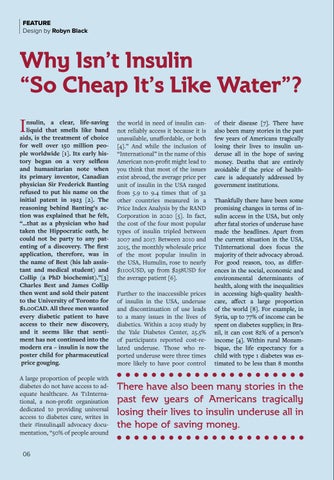
Why Isn’t Insulin “So Cheap It’s Like Water”? I
nsulin, a clear, life-saving liquid that smells like band aids, is the treatment of choice for well over 150 million people worldwide [1]. Its early history began on a very selfless and humanitarian note when its primary inventor, Canadian physician Sir Frederick Banting refused to put his name on the initial patent in 1923 [2]. The reasoning behind Banting’s action was explained that he felt, “…that as a physician who had taken the Hippocratic oath, he could not be party to any patenting of a discovery. The first application, therefore, was in the name of Best (his lab assistant and medical student) and Collip (a PhD biochemist).”[3] Charles Best and James Collip then went and sold their patent to the University of Toronto for $1.00CAD. All three men wanted every diabetic patient to have access to their new discovery, and it seems like that sentiment has not continued into the modern era – insulin is now the poster child for pharmaceutical price gouging. A large proportion of people with diabetes do not have access to adequate healthcare. As T1International, a non-profit organisation dedicated to providing universal access to diabetes care, writes in their #insulin4all advocacy documentation, “50% of people around 06
the world in need of insulin cannot reliably access it because it is unavailable, unaffordable, or both [4].” And while the inclusion of “International” in the name of this American non-profit might lead to you think that most of the issues exist abroad, the average price per unit of insulin in the USA ranged from 5.9 to 9.4 times that of 32 other countries measured in a Price Index Analysis by the RAND Corporation in 2020 [5]. In fact, the cost of the four most popular types of insulin tripled between 2007 and 2017. Between 2010 and 2015, the monthly wholesale price of the most popular insulin in the USA, Humulin, rose to nearly $1100USD, up from $258USD for the average patient [6]. Further to the inaccessible prices of insulin in the USA, underuse and discontinuation of use leads to a many issues in the lives of diabetics. Within a 2019 study by the Yale Diabetes Center, 25.5% of participants reported cost-related underuse. Those who reported underuse were three times more likely to have poor control
of their disease [7]. There have also been many stories in the past few years of Americans tragically losing their lives to insulin underuse all in the hope of saving money. Deaths that are entirely avoidable if the price of healthcare is adequately addressed by government institutions. Thankfully there have been some promising changes in terms of insulin access in the USA, but only after fatal stories of underuse have made the headlines. Apart from the current situation in the USA, T1International does focus the majority of their advocacy abroad. For good reason, too, as differences in the social, economic and environmental determinants of health, along with the inequalities in accessing high-quality healthcare, affect a large proportion of the world [8]. For example, in Syria, up to 77% of income can be spent on diabetes supplies; in Brazil, it can cost 82% of a person’s income [4]. Within rural Mozambique, the life expectancy for a child with type 1 diabetes was estimated to be less than 8 months
There have also been many stories in the past few years of Americans tragically losing their lives to insulin underuse all in the hope of saving money.
FEATURE Words by Alex St. John
[4]. Although insulin is listed as an essential medicine by the World Health Organisation (WHO), access to diabetes care worldwide is an on-going public health crisis. So, how does T1International attempt to make lasting changes to the global circumstances of diabetes care access? They’re focusing on sharing the voices of those living with type 1 diabetes around the world, providing educational resources and critical information related to type 1 diabetes, working toward a higher standard of research and statistics about the issues faced by those with type 1 diabetes, and campaigning for systemic and sustainable change for diabetics globally [4]. And its companies like T1International, International Insulin Foundation, World Diabetes Foundation, JDRF, and Diabetes Foundation that have been able to make changes for diabetics worldwide with their strategies, though its evidently still not enough. In the USA, insulin prices mainly come down to a lax regulatory environment around drug pricing coupled with corporate greed. “They’re doing it because they can,” Jing Luo, a researcher at Brigham and Women’s Hospital, told Vox in 2017, “and it’s scary because it happens in all kinds of different drugs and drug classes.” [2] The for-profit drug and device makers who sell insulins and
insulin delivery devices have not followed the example of Banting and his colleagues. Pharmaceutical companies have spent millions filing lawsuits that successfully keep competitors off the US Market [6]. One long-acting insulin in particular, Lantus, approved for use in the EU in 2014, saw a 2-year delay into the USA due to a lawsuit between two competing companies [9]. This lawless Wild West of a regulation system seen in the US is one of the main reasons for soaring drug prices. In countries such as the UK with single-payer systems, governments can exert much more influence over the entire healthcare process [10]. The UK government sets a maximum price that it will pay for a particular drug, and if a company doesn’t agree, it is merely not able to sell its product. This system puts drugmakers at a disadvantage, allowing for much lower prices. The US, on the other hand, has Wa much more free-market approach to pharmaceuticals. Drugmakers can negotiate over prices with a wide variety of private insurance companies as well as the government. Not surprisingly, Medicare, the government program that is the largest buyer of drugs in the US, is unable to negotiate drug prices [10]. So pharmaceutical companies within the US simply operate just as any other profit-maximising company would – they try to negotiate
07
FEATURE Design by Robyn Black for the highest prices possible to see the highest demand possible. Unchecked capitalism at its work. And aside from the obvious issues with capitalism within health care, there are fundamental problems that have been discussed for decades. It was way back in 1963 that the Nobel Laureate Kenneth Arrow described why a capitalist free market in health care fails [11]. His reasons include the presence of externalities (one person benefits from another receiving healthcare, especially in the case of contagious diseases). There is also an information asymmetry, where a health professional offering care knows more about what a patient need than they do themselves. Finally, and most importantly, the main issue is that those who are in most need of care are least able to afford it, and those that need care the least have plenty of wealth. This last issue was recognised in the 1920s in the USA when private insurance companies Blue Cross and Blue Shield were created by associations of doctors and hospitals, not because they were concerned about access to healthcare, but rather to ensure that they would be paid for providing it [11]. A British GP, Margaret McCartney, described her difficulties, even in the NHS, in getting appropriate care for her ill patients in 2012 [11]. She had particular difficulty with her patients with mental illness, as she would be repeatedly encouraged and incentivised to deliver services, such as ever-increasing va-
08
This lawless Wild West of a regulation system seen in the US is one of the main reasons for soaring drug prices. rieties of unevaluated screenings, to those who are well. Those with actual illnesses offer the smallest opportunities for profit by those who have been contracted, in the British internal healthcare market, to provide care. This issue is magnified at an international scale by neglected “orphan diseases”. An orphan disease is one that has not been adopted by the pharmaceutical industry because it provides little financial incentive for the private sector (due to its rarity, it affects fewer than 200,000 people, or it is far more prevalent in developing countries)[12]. The only hope that these diseases have are legislative developments in Western countries to introduce incentives for pharmaceutical companies to develop products (including extended market exclusivity, reduced regulatory fees, tax credits, and other subsidies for trials) [12]. These incentives, however, still haven’t stopped pharmaceutical companies from justifying obscene price tags like in the case of Spinzara, a spinal muscular atrophy drug that can cost up to $750,000USD for the first
year of administration and around $375,000USD annually afterwards [13]. A spokeswoman for Biogen, the company tasked with setting the listing price in 2016, cited several factors that went into their decision such as the cost to the health care system, or the clinical value it brought to patients [13]. And with a company’s extended market exclusivity backed by governmental legislation, what’s to stop them from continuing to hold profits well over the heads of the patients they claim to serve? With all of this said regarding an American laissez-faire approach to pharmaceuticals and unchecked capitalism, will insulin ever reach the price of water as Trump recently claimed back in the first Presidential election in November 2020? [14]. Much needs to be done to ensure equitable access to insulin for all diabetics. To make a difference in population health, the countries most affected by health inequalities need to tackle their fundamental causes. They need to understand that those with chronic illnesses shouldn’t be burdened with cost on top of the rest of their daily challenges. The last thing that any of us need is for scarce resources that could alleviate genuine suffering to be wasted.
FEATURE Words by Alex St. John
References
928–936. https://doi.org/10.1136/jech.2005.041954
[1] Garg, S. K., Rewers, A. H., & Akturk, H. K. (2018). Ever-Increasing Insulin-Requiring Patients Globally. Diabetes Technology & Therapeutics, 20(S2), S2-1. https://doi.org/10.1089/dia.2018.0101
[9] Lilly and Sanofi Reach Settlement Agreement in U.S. Insulin Glargine Litigation | Eli Lilly and Company. (2015). Retrieved January 13, 2021, from https:// investor.lilly.com/news-releases/news-release-details/lilly-and-sanofi-reach-settlement-agreement-usinsulin-glargine
[2] Belluz, J. (2019, April 3). The absurdly high cost of insulin, explained. Vox. https://www.vox. com/2019/4/3/18293950/why-is-insulin-so-expensive [3] Hegele, R. A. (2017). Insulin affordability. The Lancet Diabetes & Endocrinology, 5(5), 324. https:// doi.org/10.1016/S2213-8587(17)30115-8 [4] Advocacy Toolkit—T1International. (n.d.). Retrieved January 12, 2021, from https://www.t1international.com/toolkit/ [5] Mulcahy, A. W., Schwam, D., & Edenfield, N. (2020). Comparing Insulin Prices in the United States to Other Countries: Results from a Price Index Analysis. https://www.rand.org/pubs/research_ reports/RRA788-1.html [6] Rosenthal, E. (2019). When High Prices Mean Needless Death. JAMA Internal Medicine, 179(1), 114–115. https://doi.org/10.1001/jamainternmed.2018.5007 [7] Herkert, D., Vijayakumar, P., Luo, J., Schwartz, J. I., Rabin, T. L., DeFilippo, E., & Lipska, K. J. (2019). Cost-Related Insulin Underuse Among Patients With Diabetes. JAMA Internal Medicine, 179(1), 112. https://doi.org/10.1001/jamainternmed.2018.5008 [8] Ruger, J. P., & Kim, H.-J. (2006). Global health inequalities: An international comparison. Journal of Epidemiology & Community Health, 60(11),
[10] Belluz, J. (2016, February 4). Congress asked Martin Shkreli to defend prescription drug price gouging—He pleaded the 5th. Vox. https://www. vox.com/2016/2/4/10915190/congressional-hearing-drug-prices-shkreli [11] McKee, M., & Stuckler, D. (2012). The Crisis of Capitalism and the Marketisation of Health Care: The Implications for Public Health Professionals. Journal of Public Health Research, 1(3), 236–239. https://doi.org/10.4081/jphr.2012.e37 [12] Definition of Orphan disease. (2018). MedicineNet. Retrieved January 13, 2021, from https:// www.medicinenet.com/orphan_disease/definition. htm [13] Thomas, K. (2016, December 31). Costly Drug for Fatal Muscular Disease Wins F.D.A. Approval (Published 2016). The New York Times. https://www. nytimes.com/2016/12/30/business/spinraza-price. html [14] Murphy, T. (2020). Donald Trump took credit for making insulin “so cheap it’s like water.” Tell that to people paying for it. Mother Jones. Retrieved January 13, 2021, from https://www.motherjones. com/politics/2020/09/trump-took-credit-for-makinginsulin-so-cheap-its-like-water-tell-that-to-peoplepaying-for-it/
09
ARTS + ENTS Design by Louise James
Creators Spotlight: Len Pennie The Passionate Wee Linguistics Nerd Who’s Bringing Back Scots
Len Pennie is, among other things, a poet who writes and recites her work in both Scots and English. She is the creator of the Scots Word of the Day account on Twitter where she tries to make Scots more accessible. Len was kind enough to talk to us about her work, her relationship to Scots, and how the wider perception of Scots is changing.
Speaking Scots Today
“The way that I engage with the world is done first through Scots and then through English.” She hopes to change people’s perception of the language and “what that implies about a person”, saying that we should not and cannot infer class and intelligence from speech. According to her, Scots shouldn’t have to modify their speech “to be better understood by an Anglocentric society”.
Len developed an interest in Scots from a young age, being an active part of a Burns’ Society. Learning French and Spanish in school further fuelled her passion for languages and she eventually ended up studying Spanish at university. This also gave her the opportunity to study linguistics, which led her to consider Scots as a different language.
The Scots Renaissance
Len shared her thoughts on the debate over whether Scots is a dialect or a language. She believes that people should not be “trying to push a political agenda”. She herself often tweets in Scots and receives comments accusing her of promoting a political agenda. Len cites Hamish Chalmers, a professor of Applied Linguistics at Oxford University, who also shared his opinion on the topic via Twitter, writing that “the difference between a language and a dialect cannot be determined by objective linguistic criteria” but rather “on socio-political grounds”. Len explains that she uses Scots to celebrate her work and firmly believes that “it shouldn’t be a political statement to speak the language you grew up speaking.”
This has led to people “reclaiming their culture”. Len gives examples of other languages which have made a big comeback, including Welsh and Irish. Yet she still receives negativity online when sharing her passion for Scots and continuously fights to depoliticise the language.
Although Len has grown up speaking Scots with her family and friends, she still encounters difficulty in getting people to respect her choice to use Scots. “People think you’re inherently biased if you are Scottish and want to speak Scots.” She experiences similar difficulties in academia wherein she gets discredited for “being young and being a woman,” and goes on to criticise the way that one is expected to elevate their speech “to a level that’s almost unnatural”. Len denounces the view of Scots language as “unprofessional, unintelligible and uneducated,” which forces people to have to “codeswitch to be respected”.
10
We went on to speak about the resurgence of Scots on Twitter. Len spoke about the Scottish Cringe phenomenon which is a result of Scottish culture being repressed. Younger generations however, haven’t internalised this and have the freedom to express who they are on social media.
“I’m not attacking British culture when I’m celebrating Scottish culture.” In Len’s opinion, society is changing and she also receives a lot of support with increasingly more people going “against the homogenisation of British culture”. Her Scots poyums are marked with wit and wordplay. She genuinely believes that Scots is a funny language; “It doesn’t take itself too seriously.” However, she also thinks of it as an inclusive language, saying that Scots is for everyone, just like with other languages: “You’re only as Scottish as your soul feels.”
“You’re only as Scottish as your soul feels.”
ARTS + ENTS Words by Valerya Krumova
The Power of Poetry
Moving on from Scots to discussing her own work, Len said that she admires the brevity in poetry and its ability to elicit emotions in a snap. She believes you shouldn’t have to “get” poetry, that “you shouldn’t have to have an assumed level of education before you can access media”. She describes her poetry as being for the everyman and is of the opinion that “the more basic you make a concept, the more people you can connect with”. Some of her most compelling poems explore themes of suicide and depression. Len states her three reasons for writing about mental health. She uses it to help herself through her own mental problems, as an opportunity to educate, connect with, and help others, but also as a space to “memorialise and reflect on the people we’ve lost”. For Len, although we can’t help them, it is vital that we remember them. When Len found her own mental health wavering last year, being away from home at university and receiving negative comments, she questioned whether she wanted to go on and keep up with her Scots Word of the Day. In the end, Len tells us, the love and support of her family, along with her passion for Scots, are the single most important things for her and what keeps her going. Thanks to Len for her courtesy and honesty. You can find her, and her work, on Twitter @Lenniesaurus.
11
ARTS + ENTS Design by Calum Stevenson, Illustration by Jack Stamp
ACHILLES, PATROCLUS AND MAD MAX II A Love Letter to Sci-Fi
I stand by Mad Max II: The Road Warrior (1981) being one of the best films ever produced, full of all the 80s action many of us missed as we were too busy, uh, not being born yet. As the second film in the franchise, director and co-writer George Miller knows how to tell a story. With his filmography spanning from Babe (1995) to Babe 2: Pig in the City (1998) you might not expect our protagonists to have much in common. Babe might not be a road hardened cop fighting through dystopian Australia and his own trauma, and both Babe movies are lacking in extravagant villains, sick cars and an evil Tina Turner. However, they both face up against troubles and arise as heroes in their own sense. With the rise of Cyberpunk 2077 and the dystopian view of our own current climate, it might be helpful to look back and prepare for the inevitable dystopian future. Let’s just cross our fingers that it’ll be filled with assless leather chaps and pimped up rides, just like The Road Warrior. One of the reasons Miller is such a successful writer and director is because he follows the three act hero’s journey. Based on classical narratives, these 12 steps span from the all-important call to adventure, to
12
ordeals, change and return. It ensures the main characters are spat back out as a seemingly ‘better’ person, even if they’re not the gold standard for a good hero. All the historical epics follow this formula as it guarantees a successful story. If you’re a fan of Greek classics or the 2004 Orlando Bloom flick Troy, you can probably agree that Achilles isn’t a perfect guy. However, when he is thrown into the hero’s cycle after the death of his lover Patroclus he emerges as an admirable hero, even if his actions are out of revenge. I love sad homoeroticism as much as the next person, but Achilles and Patroclus have more in common than just leather armour with The Road Warrior. Miller makes room for love in the wasteland with bad guy Wez and his blonde twink lover having the same tragic story. After a friend of Max kills ‘blondie,’ Wez becomes his own version of Achilles and makes Max public enemy number one in his and Humungus’ gang’s quest for revenge. Although this revenge arc is slightly less dramatic and doesn’t cause the fall of Troy, it is a nice nod to the classics that shape these cinematic formulas. It also follows the general implied homoeroticism of 80s villains, such as David in The Lost Boys (1987). This villain queercoding may be a product of the times, but
through a modern lens we can decide for ourselves what makes these characters interesting. Demonstrated by Achilles / Patroclus character types, there really is no better place for love than in the wasteland. Although Wez and his lover were short lived, their motorbike gang were sympathetic to his loss. They’re painted as the villains but still understand how important these bonds are in the wasteland, more so than the ‘good guys’. The preservation of love is constant through almost all sci-fi - Blade Runner (1982) could easily be re-written as a cheesy romcom willing to risk everything for love with Rachael and Deckard running off together. At its core, sci-fi is all about finding meaning after the world has fallen apart and love is the one thing that holds it all together. It pains me to admit that sci-fi is more than just fast cars and guns, but I wouldn’t be opposed to a Love Actually (2003) style remake following everyone on their wasteland honeymoons. You’d think because his name is on the cover that Max is the all-important hero wandering the wasteland, but in reality he’s about as irrelevant as Mel Gibson is in 2021. Although he follows this big hero’s journey, his character is not developed much. By Fury Road (2015) he is still stubborn and refuses
ARTS + ENTS Words by Sophie Mudie
to let people in. The whole concept of the hero’s journey is for the main character to change, but as we see over the course of the franchise it is the secondary characters that follow this more so than Max. This prevents him from becoming the hero he desperately wants to be. But do
we really need a good hero in the wasteland? Max is just like the villains in Humungus’ gang: he’s fueled by revenge and has little regard for his life. The wasteland doesn’t have the black and white morality we’re used to and we shouldn’t hold Max to this hero standard.
So, maybe we shouldn’t be holding out for a hero and instead just do the best we can. If history is doomed to repeat itself through stories, at least we have a few more George Miller films to look forward to.
13
ARTS + ENTS Design by CL Gamble, Words by Kathryn Haddow
WOLFWALKERS
Released by Irish Animation studio Cartoon Saloon and set in an exquisitely stylized vision of medieval Ireland, Wolfwalkers (2020) tells the tale of a young girl named Robin, discontentedly relocated from England to an English settlement in Ireland. Robin’s father is tasked with wiping out the wolves in the local forest so that the land can be farmed, and Robin wants nothing more than to join her father’s hunt. However, when she encounters Mebh, a feral girl by day and wolf by night, an unlikely friendship blossoms between them that transgresses both circumstance and culture. Wolfwalkers brilliantly tackles the ever-relevant themes of humanity and nature as well as touching on real world history. The portrayal of the human relationship to nature is handled with intimate understanding and has its roots in real historical events. The last wolf in Ireland was killed in 1786 and huge portions of the country were indeed deforested. The film also touches on the English colonisation of Ireland and explores the ties this has to disregard for the natural land. The film centres the idea that fear and separation from the wild are far more dangerous forces than the natural world itself could ever be, whilst warmly embracing the importance of family, friendship, and understanding.
14
Wolfwalkers is just as intricate visually as it is thematically. The human environments are in the bold, rigid style of a woodblock print and often compositionally oppress the characters. In opposition to this, the natural environment is abstract and sweeping, making the freedom and wonder offered by the wild even more apparent. Each and every frame of the film looks as if it could have been taken from a beautifully illustrated fairy tale. The character animation, with its loose lines and free, fluid motion, is one of the standout features, along with the inspired visual portrayal of magic within the film. The colour palette throughout is also carefully designed to add emotion and impact exactly when needed, creating a gorgeous atmosphere as well as visually reinforcing the film’s thematic messages. The climax of the film is particularly stunning, bathed in contrasting stark reds and deep blues.
Wolfwalkers is a dynamic and fast-paced story with a touching, impactful message. There is a real depth to the narrative, yet it remains optimistic and lighthearted. It is a magnificent menagerie of expansive environments, enthralling characters, and spirited animation, culminating in an enchanting piece of cinema that marries innovative creativity with timeless folklore.
ARTS + ENTS Design by Zoe Arlidge-Lyon, Words by Jaime Aries Designed
g
nin Award-Win
n e m o W e t h W ryone else. e v e n e h t and
I take a strange delight in the Oscars. Each year around this time the nominations are released, and I revel in the indignation over the brilliant performances being snubbed, as well as celebrate in jubilant surprise when they actually get one right (but usually only ever just one). So as we roll around to the 93rd annual Academy Awards, something feels very different in a year in which the entertainment industry has been decimated and reformed into a battle of the streaming services. For the first time in almost a century, the tension around awards season does not lie in drumming up enough publicity to be noticed by the Academy, but rather in having enough films exist to fill the coveted nominations. And in a situation where the systems that have previously deemed non-white faces not profitable enough to lead their own movies are becoming increasingly irrelevant, I sit and wait to see if this is the year that women of colour finally get their moment at the Oscars.
Only 12 Black women have ever been nominated for Best Actress in a Leading Role, and no nonwhite actresses have ever received multiple nominations in this category. Meryl Streep, in the course of her stellar career, has received more nominations in this category than every non-white actress put together. So far the only Black woman, and incidentally the only non-white actress, to take home the award is Halle Berry for Monster’s Ball (2001). The only time in which two Black actresses have been nominated simultaneously was 49 years ago.
Outwith Black actresses, only three other actresses of colour have ever won Oscars and all were for supporting roles: Miyoshi Umeki, winning for her work in Sayonara (1957); Rita Moreno for West Side Story (1961); and Mercedes Ruehl for The Fisher King (1991). It is indeed this category that actresses of colour have had the most success, as Hattie McDaniel famously became the first Black actress to win an Oscar for her role as the patronising Mammie figure in Gone With The Wind (1939). Of course, this wouldn’t happen again until Whoopi Goldberg claimed her Oscar for Ghost (1990) a full 51 years later.
“Only 12 Black women have ever been nominated for Best Actress in a Leading Role.”
It is in this distinction between who is allowed to lead and who may support that we see this discriminatory practice of the film industry laid bare. It is in this routine refusal to allow any actress bar a white woman to lead a film, to have her story told. Perhaps this might change in the shifting landscape of entertainment, but I will not hold my breath.
It has been a long time coming.
15
ARTS + ENTS Design by Cait Maxwell
Film Review: Her ‘I’ve never loved anyone the way I love you’ ‘And now I know how.’ These are the words that echo throughout Spike Jonze’s Her (2013), an acutely modern love story which is not simply a plot about falling in love, but instead how to love, or indeed, love again. Her takes place in the nottoo-distant future in the city of Los Angeles. Theodore (Joaquin Phoenix) has split apart from his wife and, in dealing with the divorce, has found himself hiding from the world, alone in his own virtual cabin high above the city of LA. Theodore is a sensitive and hopeless romantic desperate to recreate the feeling of past romances, yet he simultaneously understands that the replication of feeling will only amount to something lesser than what he has experienced before. Theodore’s loneliness soon comes to an end, however, when he meets Samantha, a new and ever-evolving operating system he has acquired in order to ‘organise’ his life. However, as the two bond, Theodore and Samantha find solace in one another and soon fall in love.
take on mankind’s future. Jonze’s futuristic LA is infused with a warm, bright glow due to cinematographer Hoyte Van Hoytema’s use of natural lighting. Hoytema not only captures the scale of this futuristic LA, but also the minute details and temporal quality created with his use of closeup in the film’s more tender and emotional moments.
This is undoubtedly Phoenix’s best and most nuanced performance. The facial inflections and sensitivity he puts into his performance creates a character that feels so believable and relatable in this sci-fi world. Scarlett Johansson is also captivating as the voice of Samantha. Acting without a physical presence, Johansson still manages to capture a sense of raw humanity and displays a vast spectrum of emotion, making Samantha seem like a tangible being. There is a childlike quality to Samantha as she looks upon the world with amazement and a lust for life. She represents this idea of growth and how we grow through being with another person, whether for better or worse, which is accentuated when Theodore says: ‘That’s the hard part, growing apart or changing without it scaring the other person.’ Her delves into the fundamentals of love itself, its ability to heal and change.
Arcade Fire provides the synthetic, futuristic music to the film, in one of the most underrated scores in recent memory. Much like the depiction of technology in the film, the score’s electronic instrumentals never seem cold or robotic. Like Samantha, it carries with it a spirit of emotion. There is a versatility to the music, where diegetic pieces created by Samantha are classical and simple in nature, utilising the piano alone, immersing us in the intimacy between her and Theodore.
Jonze’s Oscar-winning script is heartfelt and oddly realistic for such a fantastical concept, while also providing some quirky and bizarre situations; but it is within these moments that the romance blossoms and the chemistry between the two makes this concept not only seem feasible, but one in which you as a viewer want to see succeed. It is akin to Richard Linklater’s Before Trilogy where the dialogue is so naturally written that it in itself becomes the spectacle. Whereas many sci-fi films relish in the failures of humanity with their dark dystopias, Her acts as a rather refreshing
16
The technology of this future has an inviting quality to it, with its vintage and uniform aesthetic and lack of cold, harsh lighting. Computers are framed like pictures; phones are small and thin resembling that of an old-fashioned cigarette case; while the office spaces and fashion are brightly colourful. The design of this not-too-distant LA is beautiful. In order to create this futuristic cityscape, production designer K.K. Barrett and Jonze amalgamated Shanghai and downtown LA to create a hybrid city of sorts, merging the architectures of east and west to create something totally unique.
Jonze has not directed a feature film since Her (save for a documentary on the Beastie Boys), and if this is the last fiction film he ever makes then he has ended on an unequivocal high. This is simply one of the most compelling love stories in modern cinema, one that highlights the necessity of love while also demonstrating the cost that comes with it. Her is a film that, in all its strangeness and technologically infused futurism, tells a touching and entrancing romance with more palpable chemistry than many films with two human leads. The believability of such a concept is a testament to Jonze’s writing and direction, which packs both clarity and subtlety as the film builds to a conclusion in which the true meaning behind this relationship comes to the forefront with a profound andpoignant climax. Love, like everything else, evolves with us and no film captures this quite like Her.
ARTS + ENTS Words by Lewis Gibson
17
CREATIVE WRITING Design by Lisa Dyer
Margaret and The Three Little Pugs
M
argaret was hurriedly walking down the streets of Edinburgh, murmuring “excuse-me” while passing ahead of other people. Her shoulders ached from the weight of two Tesco bags, and the plastic was digging into her skin, trying its best to support dinner and breakfast for five. Margaret had been doing perfectly fine during the lockdown, working her office job from home with her cat Millie to keep her company, but Jason had insisted on visiting her as soon as restrictions eased. Her brother’s family seemed always so keen to disturb her peaceful weekends – and now she’d probably get a permanent back problem, too! Mumbling to herself, Margaret turned around a corner, hit her foot against something, and tripped. She fell on top of the groceries, which softened the fall, but some packets and cans scattered across the pavement. Covered in dust and an unlucky banana, Margaret got up to stare furiously at the culprit of her tumble: a weathered cardboard box. She aimed a kick at it, but a small whimper stopped her. Slowly, she opened the soggy lid, revealing inside three tiny creatures. From their dark, wrinkly snouts and short, pig-like tails she gathered that they were pugs – probably only a few weeks old with their eyes still closed. Margaret eyed around her, but the closest bypassers were on the street ahead and nobody was looking her way. Getting her wits back about her, Margaret gathered the groceries and googled a phone number for an animal centre. She gave a worker the address but couldn’t wait around. She had dinner to prepare, and the guests were already on their way. Taking a last glance at the box, she joined the people on the street, her mind already preoccupied with a recipe for potatoes. That evening, Margaret was sitting at the dinner table listening to Jason, his husband, and their twin daughters enthuse about their lockdown activities. Margaret found herself smiling at how lively her house suddenly felt. One of the girls was telling her about their new pet, a small turtle named Hamish, when Margaret’s mind went to the pugs. “I wonder if they’re already at the shelter… the night is going to be cold.”
18
CREATIVE WRITING Words by Sofia Rönkӓ
“Why don’t you call them just in case?” Jason suggested. After a quick exchange on the phone, Margaret turned to her guests and told them that the workers had found the cardboard box — but it had been empty. “I should’ve stayed with them until the workers arrived!” Guilt washed over her. God knows what had happened to the dogs, or who could have taken them. Jason put a hand on her shoulder. “Let’s go look for them.” “Can we help, Aunt Margaret?” the twins jumped excitedly. And so, the whole family retraced Margaret’s steps. The wind bit their cheeks while they scoped the area, looking under parked cars, behind rubbish bins and anywhere else they could think of. Margaret was losing hope of finding the puppies, trying to convince herself that someone had simply taken the dogs to another shelter. She was about to suggest giving up when she heard Jason talking to a man holding shopping bags along with a young child. “Yeah, I saw some dogs today,” the man said. “My lad here had the genius idea of bringing some strays into the house. I told him to take them back to where he’d found them.” The boy told them how he and his friends had found the pugs, and, after not being allowed to keep them, had released them into the wild. Margaret and the others hurried to the nearest park and searched the bushes. Soon Jason’s husband and the twins gave excited shouts as Margaret and Jason ran to them. The three pugs whimpered on a bed of leaves with some berries left next to them. Filled with relief, Margaret and the adults carefully lifted a dog each and took them home where they called the appropriate authorities. Some months later, Margaret was cooking dinner for five again. The bell rang and she hurried to open the door, still wearing her apron and holding a spoon. Just when she managed to let her family in, she almost tumbled over three barking balls of fur that ran to welcome the guests. Parsnip, Parmesan, and Parsley were as excited to have people over as Margaret was. The only one staying afar and watching the hassle with quiet dignity was Margaret’s cat, but even Millie would eventually warm up to the merry company.
19
CREATIVE WRITING Design by Olivia Juliette Baird CREATIVE WRITING Design by Olivia Juliette Baird
This is my testament of a recollection you will surely not believe, but please heed this warning. That day, in the small and quiet village of Portglenone, in Northern Ireland, I remember as clear as the summer sky that was absent from the horizon. I was walking along the bridge over the River Bann, not particularly going anywhere. I recall the eerie silence, the stillness that seemed to appear so suddenly. I stared out at the river to my right. The plaintive water seemed vast, ever expanding, like the river was all that there was. I looked to the very centre of it and noticed what appeared to be a small woman huddled up in a heavy shawl, hunched over horribly, with long flowing grey hair, and old…no! Ancient…ancient in the literal sense of the word. It looked up at me and suddenly, I was paralysed. A heavy magnetism seemed to draw me towards the river, lure me, invite me. The night air chilled the blood in my heart and set my skin to pulsating shivers like errant flames lost in the wind. The thing moved, fast and purposeful, gliding across the river, the water undisturbed. The scream. That keening call that terrorised me. That blood-curdling, ominous and razor-sharp screech. I ran! I ran as fast as my legs would take me, until they were heavy as lead jelly with muscles on fire, I almost tripped over myself. With lungs bursting through my chest, I looked back with not a little trepidation. I saw the thing at the very edge of the bridge, just staring at me, looking right at me. I never should have looked. It was a warning, screaming, Never return here! I knew now what this thing was: a banshee. A herald of coming death. I’ve heard a lot about banshees and one thing I know for certain is: you never look one in the eye. What I saw in those cold, dead eyes was not the horror of an appearance separate from my own, but something deeper, more visceral, an insidious reflection of some secret, hidden part of my soul that I could not see without the dead mirror that stared back at me. The Bann that night became the house of Donn — the Irish realm of the dead.
20 20
When I got home, I didn’t have time to process what I saw. I received a phone call. The worst phone call of my life. In fact, I’ve hated the things that facilitated the horrific message ever since. My twin brother had died, twenty minutes ago. Sudden. Unexpected. Dead. Even the Banshee screeching in my ears settled for a second. I vowed never to return to that bridge. But I knew this was not possible because a part of me was lost there that night, some deep piece of me stayed with that thing. On the day of the funeral, I saw the Banshee reflected in the puddles on the ground. It was pursuing me. It was not done. It has been twenty years since I saw the Banshee on the bridge. I have never walked on that bridge since. The screaming keen of the banshee never left me. Sometimes, it was muffled and somewhat less obstructive, other times though, it was deafeningly loud and debilitating to the point of utter despair. Eventually though, I got accustomed to the noise. I was accustomed to the noise I should say. It stopped today. Just gone. Complete silence and tentative peace. I must admit, the silence terrifies me more than the screaming. I fear I will meet the banshee again very soon and that is the motivation for this missive. I don’t even know who I’m writing it for. Possibly as a last testament, maybe for myself. I’m not sure. Though, I am convinced I will find out before this night ends. It is not my life that I fear for, but my remaining family, for Banshees herald the death of loved ones (as I have found in my extensive research on the subject since my tragic meeting with one). But why has the screeching of the Banshee stayed with me all these years? And why has it just now stopped? I am afraid. I am truly afraid, just as I was that night. Aaron Tweed
SECTION TITLE HERE Words by Aaron Tweed
21
CREATIVE WRITING Words by Luke Perry, Design by Noni Farragher-Hanks
Old Summer Place Through a snowy land I tread and a nostalgic aura I trace to find the spirit I had left waiting back in that Old Summer Place How the summer sun bounced off every surface creating a feeling of the sublime so strong that resting under winter’s icy blanket this old place never lost its summer shine From its tall tilted trees to its vibrant building blocks and its precious people and spectacular scenery it is ingrained so deep into its core it can never truly fade to memory So even when the sun set on our city of hope our willpower did persevere as the sun shall rise again on our home as we begin a new year Now with the spark of our spirit in hand and a mind refreshed and new challenges to face let us thaw the ice of lost time and once again return to that Old Summer Place
22
CREATIVE WRITING Design by Norbert Lawniczak, Words by Danielle McFawns
A Sonnet for Winter Wind The claw of Winter Wind grazes your cheek And you lean into her raw, frigid palm You plead her to soothe your chattering teeth To blanket you in her air of calm ‘Oh, but what calmness?’ she asks, bewildered ‘My gusts would sweep you right off your feet!’ Perhaps it is not calm, but familiar For Winter Wind has never been discreet You two dance this waltz each year like clockwork Before you are released into the frost Your promenade step becomes less awkward And with each passing year, you feel less lost With each outside change, there is little to fear She whisked you into a beautiful year
23
CREATIVE WRITING Words + Design by CL Gamble
AN ELEGY ON THE DEATH OF HOPE (after Shelley)
O weep for Londoners - those poor bastards! I weep for now distant friends, though my tears fall not on soil which flies so white a flag... And red, bold red, brighter than spilled blood. We mourn “our” loss, mourn the fallen soldiers but I have my own sorrow too: Scrambling to survive as the future advances. Repeat the past? My fate and fame will be a mirror held up to Westminster from Dundee.
24
DON’T SETTLE NO ONE SHOULD SETTLE IN AN ABUSIVE RELATIONSHIP. RECOGNISE THE SIGNS AND KNOW WHERE TO SEEK SUPPORT WHEN YOU OR SOMEONE ELSE IS IN AN EMOTIONALLY, PHYSICALLY OR SEXUALLY ABUSIVE RELATIONSHIP ISOLATING YOU FROM FAMILY AND FRIENDS BEHAVIOUR THAT UNDERMINES, INTIMIDATES, HUMILIATES AND DEGRADES YOU PHYSICALLY OR VERBALLY ABUSIVE TOWARDS YOU ACTING OVERLY JEALOUS, AGGRESSIVE, UNPREDICTABLE OR UPSET TOWARDS YOU PRESSURES YOU TO HAVE SEX MONITORING YOUR SOCIAL MEDIA, CALLS AND TEXTS MANAGING AND EXPRESSING DISAPPROVAL OF HOW YOU SPEND YOUR TIME AND MONEY MANIPULATION OF YOUR FEELINGS MAKING YOU FEEL LIKE YOU ARE ALWAYS WRONG AND EVERYTHING IS YOUR FAULT Dundee University Students Association (DUSA) Registered Scottish Charity No. SCO16047
ON/OFF CAMPUS Design by Zhaneta Zhekova
RE WE IN GOOD HANDS? The pandemic has halted many ambitions of the Dundee University Students’ Association for this academic year. Yet, the organisation is undergoing its periodic review to reassess wider strategy and next steps. We speak to those at the heart of the proposed changes.
W
e’ve made it. The second semester has officially begun. Do you remember the plans you had made for this academic year? Be it city-breaks or more parties with friends. Perhaps you run a Society and had a list of vibrant brand-new events scheduled for this year or maybe you were the one looking forward to attending more of those events.
was elevated. Students liked the changes, and so the Terrace became a popular spot for students’ meetings. With serving premium alcohol range and better-quality cocktails, and the addition of genuinely delicious-tasting mocktails, the Terrace has also contributed to the creation of a more responsible drinking culture on our Campus.
When the reality struck, we had to readjust. We saved many of our ideas ‘for later’ as we all tried to make the most out of what was left. It was not only individuals but entire organisations that had to change. Dundee University Students’ Association (DUSA) has had to ensure prioritising students’ welfare while also undergoing an internal review.
Towards the end of last semester, feelings of insecurity intensified. Many of us were unsure if we’ll be able to return to our homes across Scotland, the UK, Europe and the world. Hence, DUSA organised a Christmas Dinner for all to enjoy. “The attendance was high and the event attracted both British and international students,” says Cheryl-Ann Cruickshank.
I spoke to the CEO of DUSA, Cheryl-Ann Cruickshank, about her opinion on the organisation’s performance throughout the first semester and their plans for the second one. Rebecca Johnston, the Vice President of Representation, provided me with some insightful information about the nature and stage of the mentioned review. Pauline Meikleham, the Organisational Change Consultant, told me more about the recently launched ‘Future Leaders Forum’ – initiated by Ms Cruickshank striving for positive change in DUSA.
Throughout the year, DUSA has made sure to not only provide for, but also to always represent the students. Following the announcement of the planned merger of the School of Social Sciences, School of Humanities, and the School of Education and Social Work, DUSA issued an open letter resulting in ongoing consultations between the University and Students. However, DUSA had not acted on its own.
LOOKING INTO THE PAST Cheryl-Ann Cruickshank, Chief Executive Officer of DUSA, argues that despite all the difficult circumstances, the Executive team and DUSA have performed ‘very well’. Many initiatives were put aside but the new ones emerged as the students’ needs had changed. According to Ms Cruickshank, it was not an easy task to ensure high staff morale. Nevertheless, DUSA has always retained full functionality. They made sure to utilise each moment of the relaxed restrictions, while maintaining a high sanitary regime. Hospitality was revitalised: new menus were introduced, and the quality of the Terrace beverages
26
“It is a representative body, so it will act when the students – the ones it represents – request it to act.” The first semester was one long experimental lesson. A lesson none of us signed up for, but the truth is, having gained all that experience, we have every reason to hope for this semester to be as good as possible.
ON/OFF CAMPUS Words by Marcin Kiełczewski
LOOKING INTO THE FUTURE It might be easy to associate our University with no more than Dundee-based undergraduates. However, there is more to that. Ms Cruickshank says that DUSA will continue the strategy to raise its presence on the Ninewells and Kirkcaldy campuses. There already is a kiosk in Ninewells and some space in Kirkcaldy which can both be used by DUSA. The plans, although affected by the pandemic-related restrictions, are likely to go on and
the message remains the same: Kirkcaldy and Ninewells are part of the Student Union.
Similarly, DUSA is planning to organise more events for postgraduate students, like the celebration with speeches and a virtual escape room they held in December. DUSA appreciates all students and postgraduates are also an invaluable part of our community. DUSA will further investigate tuition fees issue widely debated online. Many students feel that they were treated in an unfair manner and have requested partial refunds. According to the CEO, the President of DUSA Scott Quinn is working on the issue and remains in close contact with the University’s officials.
“Despite working as an independent organisation, DUSA is respected by the University and the two are practically interconnected. That is to stay: what DUSA says – matters.” Every five years, the Students’ Union undergoes an internally-led review. The needs of students change dynamically and so DUSA has to readjust to ensure that it fulfils its key commitments. “The main goal is to increase the stakeholder engagement,” says Cheryl-Ann Cruickshank. In July 2020, DUSA analysed its demographic data. It turns out that students are divided into certain groups: some of us are more socially-oriented, some are ‘fitness fanatics’, while others enjoy nothing more than nice food and drinks on DUSA’s premises. It therefore becomes a strategic imperative to diversify the activities DUSA offers. It is not just a nightclub, and so students need to experience more than a nightclub. Broader range of services will be introduced while ensuring that DUSA’s charitable goals are never taken over by the profit-making process. The VPR, Rebecca Johnston, says: “The review of the DUSA Executive roles is part of a wider review of our Constitution, which should be examined every 5 years.
27
ON/OFF CAMPUS Design by Zhaneta Zhekova, Words by Marcin Kiełczewski
Going forward, the plan is to do more regular reviewing rather than leaving all reviews to every 5 years. Ms Cruickshank says that student consultations are being scheduled throughout this semester for the new strategy to be implemented at the beginning of the next academic year. Rebecca Johnston adds that the data from the survey, focus groups and interviews are already being analysed. According to the VPR, the DUSA Executive team is one of the biggest Sabbatical teams in Scotland. In support of that, the Student Representative Council is undergoing restructuring. “This year we’ve introduced 4 sub-committees, facilitated by our Student Voice Support Officers. The purpose of this is to have more engaging meetings, especially with the challenges faced online, and for Representatives to have more of an opportunity to collaborate on ideas, projects and motions.” Cheryl-Ann Cruickshank has found a way to engage both staff members and students into the process of reshaping DUSA. The Future Leaders Forum aims to involve participants from a wide scope of University life into a collaborative group of change-makers. The proposals brought to the Forum aim to benefit both DUSA staff and students. The group is facilitated by Pauline Meikleiham, the Organisational Change Consultant, and Maciej Alexander, Head of Strategy, Performance and Impact Measurement at DUSA. “To me, the intention to set up
the Forum marks a culture shift within DUSA, from a hierarchical management led way of doing things, to one that is more collaborative, inclusive and democratic, and which makes use of all the talents and energies of the wider collective.” “It creates the possibility for a more collective approach to identifying needs, opportunities and making decisions.” “A key word in all of this is empowerment and the sharing of power and influence, but also responsibility,” says Pauline Meikleham. The time for a change has come. The Students’ Union has identified its main challenges and the efforts are being made to prioritise not only students’ but also staff members’ welfare. The priority is put on the charitable goals of the organisation. While we hope for the best, we must remember that none of us could have predicted the scale of the pandemic and even though many good ideas and plans had to be put aside, DUSA continues to work for the best interest of us - its stakeholders. The overall fine state of affairs and the continuous ambitions for improvement, make me confident to conclude: we are in good hands.
26
ON/OFF CAMPUS Words by Marleen Käsebier
Presidency in the Pandemic
An interview with Scott Quinn, DUSA President
Scott, in his home-office in Dundee, and myself at home in Germany, the two of us sat down for a Teams Call to talk about Scott’s role as Dundee University Students’ Association (DUSA) President and to reflect on how he and DUSA are emerging from this turbulent first Semester to face the next Corona-ridden one. MK: Hi Scott, thanks for Teams-calling! Did the Winter Break treat you well after the continuous craze of 2020’s Semester 1? How has this past year been for you? SQ: The winter break was nice, or at least the first four days until Nicola Sturgeon’s announcement. The last year has been a bit of a nightmare, as it has been for everyone. I ran for election in February, when the true impact of Covid wasn’t really known. All of our policies were designed for a pre-Covid world, so much of the work went into figuring out what is realistically achievable this year, and having to really find a balance of responding to Covid but also making sure we work towards meeting the commitments we made to students when we were elected. MK: This academic year has brought many challenges, from a global pandemic to the more University of Dundee-specific. How difficult has it been to balance addressing all prominent issues? SQ: It has been difficult. What I’ve noticed coming into this role is that we find problems which show us holes in the system, so we work to fix that system but also fix the problems. For instance, communication has been a key issue for students, both from the side of the University and from DUSA, as well as lacking an effective way to communicate questions. We
somehow have to find that balance between fixing our communication strategy and communicating important information at the same time. We’re spinning lots of plates, but I’m feeling really positive about the future of DUSA. A new Senior Management Team is coming with a different approach to priorities for the organisation, helping make some real change. MK: How has the pandemic shifted your role as DUSA President? What do your working days look like? SQ: This role is completely different from what I thought it was going to be - addressing student issues. Within the Covid environment, the key remit has shifted to a completely different end of the spectrum with health and safety meetings being top priority. The full-time Executive are contracted to work 35 hours per week. In a normal, full-time role you might expect three to four hours of meetings per day. There have been weeks where I was having 35 hours worth of meetings, left to do the rest of my workload on top of that. MK: In what ways does your DUSA Executive team support you the most? SQ: We are a united front. More than ever, we’re in this together - one person can’t split one hundred ways, so we each take leads on different tasks. Emotionally, we know what it’s like to go through this, that’s how we support each other. As we all have different areas of focus, we can spread the work and then just keep each other in the loop.
29
ON/OFF CAMPUS Design by Robyn Black, Illustration by Cait Maxwell
MK: How has the DUSA Executive team been able to help the communication flow between students, staff and the University during the recent proposal to merge the Schools of Humanities, Social Sciences, Education and Social Work?
“It can take a lot to take that step to write an e-mail, but it makes a big difference as it becomes something that we can use as evidence against the issue”
SQ: The communication can’t be perfect during Covid, but we are trying and learning as it’s an issue we’re passionately trying to push. We’ve found that people want sharp, concise, upfront information. Among the quantity of e-mails, social media, and updates on MyDundee, it’s very difficult to get the key message across. Similarly, we continue to focus this information to the University as the central actors, with the main intention being to start a constructive dialogue between them and the student body. My role is to meet with the University frequently to feed back opinions of students and then communicate relevant information back. This stands true for the restructure, the DJCAD resource fee, Brexit, and all other issues that arise. Many students may not engage with the Exec or the wider DUSA support structure, until a problem emerges. But our responsibility is to help students know how to reach out to us. A lot of people underestimate the simple act of sending an email or just using their voice - it can make a huge difference. We currently lack a feedback collection tool for big issues, which we are working to address. We appreciate people reaching out. It can take a lot to
30
ON/OFF CAMPUS Words by Marleen Käsebier
“Look out for one another, access the support services that are available and if you’re not happy with the support you’re receiving or the education you’re experiencing, please use your voice” take that step to write an e-mail, but it makes a big difference as it becomes something that we can use as evidence against the issue. MK: The University applied for the ‘Race Equality Charter’ last Semester - can you clarify what this means? Are there other steps taken by DUSA or the University towards race equality, particularly in light of the Black Lives Matter movement? SQ: The Race Equality Charter is a systematic process that higher education institutions can apply for which helps them identify barriers that people of color or any minority group may face going through their institution. The aim is to help remove those barriers. It’s a really positive step. Black Lives Matter stays at the front of our minds - in regular meetings, we’re working through an action tracker of issues that were identified during the initial conversations in summer. MK: You post regular ‘President’s Updates’ on your ‘Scott DUSA’ Facebook account. Has it achieved what you hoped it would? SQ: Yes and no. It no longer exists, for a start (laughs). What I real-
ly wanted it to do was to start a dialogue of: this is what the Exec do, these are the meetings I attend. I’ve found, though, that Facebook isn’t the right format going forward, so I am working on finding a more suitable alternative. MK: You came into the President role from Vice President of Fundraising (VPF) - how do they compare? SQ: They are very different, and I love this role. I really appreciate the vast range of things I do now, but charity work is what I want to do when I finally leave the University bubble. For me, VPF was such a fun role - putting on events, I got to hang out with Drag Queens one night and then plan an escape room the next. MK: DUSA hosted a Christmas Day meal for students and has organised other Covid-safe events. Are there any upcoming events that you’re particularly looking forward to? SQ: We’re cooperating with the University on LGBTQ+ history month, which will include online movie nights of Call Me by Your Name and Rafiki. It’ll be through
Box of Broadcasts that students get access to for free along with a chat on Microsoft Teams. It’ll be fun, something similar to Netflix Party. Excitingly, the VPF will be putting on a RAG (Raising and Giving) month full of digital events and activities to raise money for charity and to help beat those lockdown blues. MK: If you were a student right now, what message would you send yourself and the other students and readers of The Magdalen? SQ: Follow the government guidance and keep going. It’s been such a tough go this year. The fact that people are still going is honestly what keeps me going; it’s so inspiring. I think it’s very difficult to stay positive with all that’s going on right now, from Covid, to the University restructure, to Brexit. Look out for one another, access the support services that are available and if you’re not happy with the support you’re receiving or the education you’re experiencing, please use your voice, please contact us, please talk to your lecturers. We’re all in the same boat, but there is an end to this madness, just keep going. 31
ON/OFF CAMPUS Design by Katrina High
Tier 4 Tayside Guide This article provides a checklist of safe activities to consider during the strict rules of lockdown, all of which are located within the Tayside area. With some added tips on how to enjoy your time outdoors, you can feel totally prepared for your Tayside adventures. Are you settled in Tayside during lockdown? Do you feel you have exhausted all possible activities in the area? If so, this guide is perfect for you! Whether you are new to the University of Dundee or are returning for another semester, the following checklist will hopefully get you out of the house by providing you with fresh sources of entertainment. The activities are all within Tayside, the boundaries of which are defined on the map below. Although these activities are possible under Tier 4 restrictions, please remember to stay safe and responsible: try to avoid crowded areas, sanitise your hands and only meet one other person outdoors for exercise purposes.
32
Helpful Tips: Most of this checklist is composed of outdoor activities which can be done with one person from another household to keep you company. Count these activities as part of your daily exercise by walking, running or cycling etc., during your adventure. If you get bored during your walk, why not try… - listening to a podcast - taking photos - phoning a friend - or even Geocaching Have fun!
ON/OFF CAMPUS Words by Lisa Kilday
What to do... Further Afar:
On Campus:
(but still within Tayside!)
1
UoD Botanic Garden
2
Takeaway coffee (The Chaplaincy Centre)
Near Campus: 3
Riverside Nature Park
4
Riverside Walk
5
Balgay/ Lochee/ Victoria Park
6
Magdalen Park
7
Dudhope Park
8
The Law
9
Fairmuir Park
10
Baxter/ Stobsmuir Park
11
Camperdown Park
12
Finlathen/ Caird Park
13
Drumgeith Park
14
Dawson/ Claypotts
15
Templeton Woodland Walk
16
Clatto Country Park
17
Broughty Ferry Beach
18
Broughty Ferry Nature Reserve
19
Barnhill Rock Garden
16
Downfield
15
11
Rockwell/ 9 Fairmuir
8 5 Charlestone
Lochee 7
Stobswell
Douglas, Angus 13 and Craigie
Broughty Ferry 14
Craigiebank
19 18
17
City Centre
3
West End 6
Whitfield
Lochee
10
Hilltown
Blackness
1
12
Kirkton
Ardler/Blackshade
Kingsway West
Fintry
Caird
2 4
33
ON/OFF CAMPUS Design by Storm Dobson. Photography by Maria Huertas Caycedo and Carlota Sainz Cotera
New Lockdown, New Challenges Keeping safe as the New Year and Semester roll in. Now that the holidays have passed, some of us will be feeling post-Christmas blues. The new year is always a time of change; a chance to try out new ventures and activities, a time to put the memories of what was a difficult 2020 behind us, and a period where the new semester can unlock everyone’s potential through our studies. The new year will bring additional challenges, which will heavily impact our studies and social lives. New lockdown restrictions will once again prevent us students from experiencing ‘normal’ student life compared to years gone past. For first year students, joining student societies virtually might make them seem as far away as fourth year. For second and third year students, the difference between their freshmen year and the current semester will probably seem like polar opposites to one another. Fourth year students will feel the pressure of writing their dissertations without the aid of inperson meetings with their Supervisor, and completing their final undergraduate assignments will provide new challenges of their own accord. As students of one of the best universities in the country, it’s important for us to come together during these pressing times. It can be very easy to feel isolated, alone, scared or even fragmented over the coming weeks. The uncertainty of the near future, and the anxiety and stress which many of us feel, might never be as evident as in this academic semester. We are all in this together and we are all part of one of the best-rated higher education institutions in the nation. There has never been a time where the occasional ‘hello’ or even a passing conversation can mean so much more
34
ON/OFF CAMPUS Words by Benedict Jackson
than it appears on paper. We will all face our own challenges, and by helping each other we can build friendships that extend beyond our campus and into the heart of our beloved city. The weeks ahead will be full of deadlines, assignments, course work, and of course endless studying. Student mental health is always very important, and this academic year has been no different. It is important to be open about our emotions and feelings during these challenging times and bottling them up out of sight and mind can have negative effects on physical and mental wellbeing. We have amazing student body engagement at our University, and members of staff at the Student Mental Health service who are always on-hand to offer support and guidance to us students during difficult and pressing times.
Lockdown restrictions can make it excessively challenging for many of us to fill our days with meaningful, pleasurable, or enjoyable pursuits, and being cooped up inside can make the upcoming weeks seem monotonous and overly dull. The lack of social extracurricular activities will leave a seemingly empty, infinite void which needs desperately filled. Many of us enjoy a simple trip to a local coffee shop for a pick-meup, or even an evening out at an arts and entertainment centre for the latest theatrical release. Social life will be very different this academic semester but having an enriching experience at university doesn’t always occur outside.
“Our talents are what makes us the people we are … and there is still time to discover so many more,”
Being a student is also all about selfdiscovery. In the four short years which many of us will spend at university, there are always opportunities to try out unique and innovative activities. The time we spend at university can shape and prepare us for the years ahead -this is the beauty and wonder of student life. We all have our own interests and pastimes, some of them will have developed in childhood, others through our high school days, and some of them may have been sparked in recent years. Our talents are what makes us the people we are, we will always cherish our skills, and there is still time to discover so many more.
There are many possibilities to keep the mind fresh, and the body active. Whether it is putting together a seemingly impossible jigsaw, brewing a fresh cup of coffee with a cafetiere or coffee machine (there are loads of online coffee shops that sell beans and ground coffee from countries all around the world for charitable causes) or simply playing a board or card game can relieve the stress of studying, and give your brain a much needed rest. Your brain can be your best friend after all. The upcoming months are undoubtedly un-certain, and the pressures and modes of studying might require continual adjustments. Wherever the next few weeks take you, remember to stay safe and well.
35
ON/OFF CAMPUS Design by Anna Poehlman, Words by Emma Sturrock
Carnoustie’s Letter of Gratitude to
TECHNOLOGY 2020 was a unique year for University students as many of the traditional experiences were banned, such as going clubbing and attending oncampus lessons. With the majority of teaching now taking place online and many people away from campus, will the community spirit thrive?
Like many students, my second year at university has been transferred online with Blackboard becoming my new best friend. During the year of remote studying, I was located in Carnoustie, a nearby town around a 40-minute bus ride from Dundee, which meant that I have not been able to visit the University Campus or the city of Dundee as much as I’d like due to different tier rules.
Facebook was further utilised to with my team and read other create the Carnoustie Christmas writer’s articles. Contributing Page, which allowed members to The Magdalen has also to share arts and crafts activities helped me feel as though I am for community bonding. A contributing to the campus life Christmas themed Can You Spot that everyone is missing out on. It was also created, involving Within my degree, group chats local businesses decorating their through Facebook Messenger windows for Christmas, with allowed me to feel connected the participants having to find a to my coursemates as we bond Christmas themed item, such as over literature. an elf. The Can You Spot It forms were created as a digital download to ensure risk A positive that has emerged from was minimal. This safely the challenges and the tragedy of encouraged footfall “A positive that has Covid-19, has been people with a into the town, which emerged…has been common goal utilising technology provided support people with a common for the better. Carnoustie is one for small businesses, goal utilising technology example. There is a Christmas especially important Lights Switch On every year as lockdown prevents for the better” where people gather to watch the non-essential lights come on and participate businesses from in Christmas activities, such as opening, causing them to Santa’s Grotto. Covid-19 meant suffer devastating losses. that the Carnoustie Community Council had to find a different Technology has also enabled me Over the past year, my way to host the event. The personally to feel connected to gratitude for technology became show still had to go on, so the the Dundee community, despite infinite as I recognised the Community Council decided to the different location. I am a beacon of light that technology hold the Christmas Lights Switch new member of The Magdalen, brought as the world went on On using Facebook Live. The having joined this year. This has standby. live event had 1,800 views, an allowed me to learn more about impressive statistic for a small what is going on in Dundee town of around 10,000 people. during Covid-19 as I collaborate
36
DON’T SETTLE NO ONE SHOULD SETTLE IN AN ABUSIVE RELATIONSHIP. RECOGNISE THE SIGNS AND KNOW WHERE TO SEEK SUPPORT WHEN YOU OR SOMEONE ELSE IS IN AN EMOTIONALLY, PHYSICALLY OR SEXUALLY ABUSIVE RELATIONSHIP
ISOLATING YOU FROM FAMILY AND FRIENDS BEHAVIOUR THAT UNDERMINES, INTIMIDATES, HUMILIATES AND DEGRADES YOU PHYSICALLY OR VERBALLY ABUSIVE TOWARDS YOU MANAGING HOW YOU SPEND YOUR TIME AND MONEY ACTING OVERLY JEALOUS, AGGRESSIVE, UNPREDICTABLE OR UPSET TOWARDS YOU PRESSURES YOU TO HAVE SEX MONITORING YOUR SOCIAL MEDIA, CALLS AND TEXTS MANIPULATION OF YOUR FEELINGS MAKING YOU FEEL LIKE YOU ARE ALWAYS WRONG AND EVERYTHING IS YOUR FAULT
IF ANY OF THIS APPLIES TO YOU, OR SOMEONE YOU CARE ABOUT YOU CAN SEEK SUPPORT BY CONTACTING STUDENT SERVICES EITHER BY DROPPING INTO THE ENQUIRY CENTRE ON CAMPUS GREEN, CALLING ON 01382831900 OR EMAILING ENQUIRY@DUNDEE.AC.UK AND TITLE YOUR EMAIL “SUPPORT
Dundee University Students Association (DUSA) Registered Scottish Charity No. SCO16047
CURRENT AFFAIRS Design by Liam Palermo, Words by Cat Pritchard
IMMUNIZING AGAINST COGNITIVE DISSONANCE. Cognitive dissonance: “a state of mental discomfort that occurs when a person holds beliefs, opinions etc., which are inconsistent, or which conflict with an aspect of his or her behaviour”, according to the OED. Cognitive dissonance was something we all experienced last year. The pandemic gave us two ideas which were in direct conflict with each other:
advocating the restrictions were often the same ones breaking them. Instead of compartmentalising the life prepandemic and during pandemic, they had compartmentalised what should be the case for other people and what should be the case for themselves.
‘Staying two metres apart is unnatural, but it is the best way of keeping people safe’.
This behaviour removed personal responsibility and, as such, aggravated many people. In December 2020, a new potential for controversial inconsistency had arrived: the Covid-19 vaccine. Within the first week the UK announced that it had approved the German and American produced Pfizer-BioNTech vaccine. By the end of the month, the British Oxford-AstaZeneca vaccine was approved as well. The home-grown jab, along with other vaccines, is a powerful aid in our current situation and will save lives that the virus won’t spare.
However, in mainstream media, we saw many cases of the people who refused to resolve the internal dilemma. Officials
However, some attitudes towards the vaccine’s approval have overleaped national pride and fallen on British
‘Staying two metres apart isn’t natural human behaviour’ and If I don’t socially distance, I might spread the virus’. We could resolve this dissonance by bridging the gap with another belief:
38
Exceptionalism. According to Dr Paul Williams, who works in the NHS, some are refusing the Pfizer-BioNTech vaccine in order to wait for the “British” one. The may be carrying a nationalist view that the Oxford-AstraZeneca vaccine will be better than the latter because it is British, despite its marginally weaker effects. Cognitive dissonance like this was seen in the Windrush scandal of 2017. Between the 1940’s and 70’s, people who were supposed to move her from Caribbean countries with full British citizenship were wrongly imprisoned, forced out and disallowed their legal rights. In placing our doubt in people who weren’t of British origin, our behaviour had disastrous consequences. We must resolve the errors of our ways if we want to remain a relevant and dignified UK. The future calls for us to be more connected, we must have the courage to adapt.
CURRENT AFFAIRS Design by Gosia Kepka, Words by Dawid Czeczelewski
Bittersweet optimism While the hope of the entire world is currently placed in the ampoules filled with the COVID-19 vaccine, mother nature looks on distressed at the ticking clock signalling that the time of eco-disaster has to come. However, there are signs that 2021 can bring some optimism also to the matter of our environment. As of the 1st of January, the EU bans single-use plastic, such as plastic straws and plates. Nevertheless, what seems even more important is the fact that export of unsorted plastic waste outside of the OECD countries will be forbidden. Finally, the wealthy of this world will assume responsibility for the generated waste. Regular convoys of rubbish have been exporting wastage, produced by the prevalence of the consumerist European culture, to incinerate or dump them into landfills of the developing countries. The thousand-mile trash voyages resulted in polluting the soil and waters of the poor, as well as increasing carbon-dioxide emissions produced during the transport. In the famous book “Eco-Imperialism: Green Power, Black Death”, Paul Driessen argues that this process is a kind of colonial legacy, a hegemony of the most powerful using the land of the poor as a dump. Personally, I find the ban to increase the number of illegal dumps within the EU borders, such as these in Poland, which are
an on-going issue. With the appearance of mysterious lorries, illegal landfills arise to be then set ‘accidentally’ on fire and consequently realising tones of toxic fumes to the air. However, despite my scepticism the ban is surely an important step in changing global paradigms of power and hopefully will raise awareness of the Europeans to the matter of recycling. Our species has already left its footprint in nature. in the timescale of the Earth what is seen by an example of rocks cobbled together from plastic, volcanic rock, beach sand, seashells, and corals, which are observed along the Hawaiian shore. Our refuse left in large quantities will hibernate in the ice sheet of polar regions or on the ocean-bed for millennia until future archaeologists will find these artefacts. If the institution of museums will last for next centuries, I take it for granted that ‘The Museum of the 21th Century-human Trash’ would be a new addition, among museums of art, music or nature. Is it important for people of the future if the EU plastic-ban comes to force in 2021 or 2031? I guess on the timescale of millennia it does not. Is it important for the people of today? It is. Unless you are a fan of living in a global landfill.
39
CURRENT AFFAIRS Design by Oisean Burnett
Brexit Will Change the Character of Scottish Universities Scotland has long been an attractive higher education destination for students from countries across the European Union. Pre-Brexit, European students could study at any Scottish university with few or no tuition fees. In the 2018/19 academic year over 21,000 EU students were taking advantage of this opportunity and were taking either an undergraduate or postgraduate degree at a university in Scotland. This number is set to decrease dramatically as the UK is now officially separated from the European Union. Scottish ministers announced on July 9, 2020 that EU students starting university in 2021 would have to pay the international tuition fees, which are uncapped and can range from £10,000 to £30,000. On top of the financial issues Brexit brings many other uncertainties to potential applicants. Visa and “Leave to Remain” bureaucracy mean that studying anywhere in the UK, including Scotland, is a much more complicated process and thus less appealing. There are also still unanswered questions about students’ ability to work outside their studies, which students coming from the EU could previously do without much trouble. Travelling and settling in a new country can seem a lot more daunting for a first-year university student with all these new barriers. Also, throughout the EU there is still frustration and anger about the 2016 Brexit referendum in general as well as other new issues such as the UK’s
40
handling of the coronavirus crisis, and these will compound to make a lot of students in the EU think twice before applying or moving to the UK. Prime minister Boris Johnson recently announced that the UK would also stop participating in the European Union’s Erasmus Scheme which allowed UK students to travel and study in EU countries and vice versa. Since 2014 there have been over 930,000 UK participants involved in Erasmus programmes across the EU. Although some students and staff will be able to go ahead with Erasmus programmes up until 2022, the practical obstacles such as visas will still present an extra challenge. Although the effects of leaving this scheme cannot yet be seen in full, it has been warned that it will be extremely difficult to replicate the benefits that this programme brought to the UK. Not only is it disappointing for young people who are losing out on educational opportunities, but it was a symbol of the mission of the European Union to share resources, demonstrate unity and cooperation and improve research and education as a whole for all young European citizens. Brexit does not only spell trouble for students. Around one fifth of teaching and academic staff at universities in Scotland are EU nationals. Staff and students alike are worried about visa issues, residency permits and the ability to work outside the EU. It would be detrimental to universities to lose staff,
CURRENT AFFAIRS Words by Annika Hudson-Laursen
academics and researchers who have benefitted the system for many years so suddenly. As well as losing valuable workforce, Scottish universities are also set to lose the approximately 10.7% of their income that came from EU Commission sources. In a time where higher education institutions are already struggling for funds, the removal of this money is predicted to have an adverse effect on quality of teaching and learning. This can eventually lead to universities becoming increasingly unattractive study options for EU and other international students who may in a different time have eagerly come to UK or Scottish universities. Furthermore, because of Brexit, many European students who would have stayed, lived and contributed to the Scottish economy after graduation, will instead make the decision to move back to their home country or even a different EU nation. Moving and settling internationally is a lot more difficult than settling within the EU. The education they have gained in Scotland (or elsewhere in the UK) will thus not be used further in the workforce or economy there.
“
Moving and settling internationally is a lot more difficult than settling within the EU.
”
Another Scottish independence referendum is on the table. If Scotland independently became a member of the European Union again, this could mean they may go back to educational partnerships and free tuition for EU citizens. However, much is yet to be seen and until then there is set to be a significant impact on the diversity and character of universities across Scotland. As a European student myself I consider myself lucky to have started university before Brexit. Scotland was at the top of my list of places to study, and I was very grateful to come here to live and be able to study without a large financial burden. It is a beautiful country with world-class universities, and it saddens me that many young people going forward will not be able to have the chance I did.
41
CURRENT AFFAIRS Design by Liam Palermo, Words by Luiza Stoenescu
Are Centrists Allowing for the Far-Right to Flourish Politically? Fish-hook theory is the newest craze that is storming the political world as a replacement for horse-shoe theory. Progressive and liberal individuals have formed this concept to illustrate how centrists are closer to politically conservative ideologies than once thought, as the previous theory portrays the likeness in the extreme left and right wings. As researched by Dr Britt in 2003 for the Free Inquiry, fascist characteristics can be listed in 14 clear points; however, there are a handful of themes that are accepted in modern politics due to centralism. For instance, a typical feature of autocracy consists of politics and religion being intertwined where the church has significant political influence in the governance of a state. Romania could be labelled as a perfect case study due to its numerous inhibitory policies such as borderline illegal abortion and non-existent homosexual rights, which have been manipulated by the Orthodox Church since post-communism in 1989. As the church possesses over 16 million active members in Romania alone, it is evident that democracy is hindered despite the diligent activism that has occurred over the last few years. This is due to the centrists and politically passive individuals simply welcoming the relationship between the church and state, and their arbitrary rule. Another state that can be looked at through a magnifying glass in America. This is due to another fascist
42
characteristic where the governing body is obsessed with national security. Aforementioned, America is a fool-proof example as former President Trump utilized this attribute of fascism to control the masses and sway centrists voters towards republicanism. This was seen during his presidential campaign where he promised the construction of a wall between the Mexican and USA border. Additionally, altercations occurred with North Korean leader Kim Jong-un where the population feared a war could arise; thus, once again portraying the obsession of national security. Such fears and obsessions were only allowed to manifest due to a centrist ideology where significant political change is bypassed; thus, supporting the policies Trump fashioned. These significant case studies aid the understanding of fish-hook theory, which need to be brought to light to comprehend why centrists are indeed allowing for rightwing ideologies to flourish. Therefore, resulting in the normalisation of autocracy as centrists grant fascism a platform to speak up and gather members whilst pushing the agenda on politically passive groups. Consequently, we should begin to question if a centrist label results in hostility towards democracy instead of the radical left or right?
CURRENT AFFAIRS Design by Maddie Talbert, Words by Marcin Kielczewski
Welcome, Moldova Moldova is an Eastern European country which we do not hear much about. As a writer, I do not aim to do any country justice by talking about it. Yet in this particular case, I believe that this non-mainstream issue deserves significant coverage. Moldova, as a former Soviet Republic, had remained in close ties with Russia. On one hand, the separatists located in the Transnistria region remain in very close ties with the Russian regime; while on the other, some political movements long for reunification with Romania. The country seems to be torn between three political options: re-joining Romania, remaining pro-Russian (status quo) or joining the EU. Which one of those is most likely to triumph in the nearest future? In 2018, the Romanian Parliament legislators expressed their support for the reunification with Moldova. The vote, although merely symbolic, expressed the overall attitude the Romanian administration had towards its Eastern neighbour. Not surprisingly so, the Moldovan administration which was led by then-president Dodon opposed this idea.
What prompts the change? I believe it is safe to assume that with the estimated 45% of the population living abroad, mostly in the EU, the Moldovan electorate grew into an overall progressive pro-European mass. The country, despite not being a member of the EU, developed a very unique dependency on EU’s resources. Naturally, the Moldovans migrate mostly for economic reasons. Hence if so many of them live in the EU, earn their living there and send their money to their families back in Moldova, it should not come as a surprise that the said pro-European attitude is more than a political fad. The European Commission President, Ursula von der Leyen has congratulated Sandu on her victory but so did Putin. And whereas the EU’s message is clear: it is ready to support Moldova; we must remember that the Kremlin will not let go so easily and the pro-Russian propaganda is likely to continue to haunt this country.
The above attitudes have only recently changed. Maia Sandu, the pro-European winner of the 2020 presidential elections in Moldova brings something fresh to this landlocked country. Sandu openly expressed her willingness to negotiate closer relations with the European Union has been the main theme of her programme during the elections. The very same promise that made her victorious; thus, displaying that the Moldovans are ready to join the West.
43
OPINIONS Design by Caitlin McPhee
NEW YEAR, NEW MINDSET Last month, I wrote an article championing the positives of the festive period in spite of Covid-19. Now, after a New Year’s Eve full of celebration, I am ready to contemplate on the fresh start that 2021 will provide. The beginning of 2021 is still filled with hope, despite Covid-19’s reign over last year. With another lockdown in the UK and the breaching of the Capitol Building by supporters of Donald Trump, it is easy to see why many people already feel unhopeful about this year. One problem of being in lockdown during the New Year is the struggle of not having something to look forward to. Thankfully, the beginning of the second semester at the University of Dundee provides me with something I can focus my mind on and feel productive as I get the opportunity to expand my knowledge. The romantic optimism I have felt for the beginning of the new year has helped me to become inspired towards my articles as I reflect and
44
start to question when the world will become normal again. Last year, a lot of changes occurred but one example that I find interesting is the culture of work, which was one of the first articles I wrote for The Magdalen. Until the outbreak of Covid-19 many bosses saw working from home as a chance to be less productive in their work. Still, many national economies have survived because of the rapid and mostly smooth adjustment to remote working in part to the development of modern technology. The increase in remote working looks like it might become permanent as companies begin to understand the benefits that remote working brings (Forrest, 2020).
“With an increase in more people potentially working from home in the future, there could be a rise in achieving sustainable ways of commuting as lockdown has led to more people walking and cycling.”
OPINIONS Words by Emma Sturrock
There are many positives to this, including enjoying cleaner air and noticing the sounds of birds chirping, normally blocked out by traffic (Forrest, 2020). We also got to see celebrities doing good. Within the UK, we have witnessed Manchester United’s England striker Marcus Rashford force the UK Government to confront child poverty and reinstate free meals for under privileged children (Barkham, et al., 2020). Marcus Rashford, alongside other celebrities such as TV Chef Jamie Oliver, wrote a letter to Prime Minister Boris Johnson requesting an urgent review of free school meals, stressing that this reform should be resumed long term (Kennedy, 2021). This policy review should be debated in parliament before the summer holidays, examining eligibility thresholds for families below the poverty line, maximising nutritional value and eliminating the stigma surrounding free meals for the poorest pupils (Kennedy, 2021). The letter also highlighted the importance of
ensuring free school meal policies are continued for the next five years as the UK recovers from the Coronavirus pandemic (Kennedy, 2021). Although last year presented plenty of challenges, one thing it has taught me that we are more adaptable than we give ourselves credit for.
The last year has been hard on everyone but the refresh of a new year will help us reflect on the things we should be thankful for as we know how quickly events can change.
“With the possibility that remote working could become the norm for most businesses; Town centres can be transformed into a hub of community.” In my head, I picture this community as a community with lots of green space for people to enjoy and small businesses such as refill shops, green grocers and butchers. This will allow people to travel less distance to get their weekly shop which will reduce their carbon footprint due to the close proximity encouraging people to walk or cycle.
45
OPINIONS Design by Robyn Black
Rising to the Challenge of Online Teaching
A closer look into the value of independent schools When I say independent schools your mind immediately pictures the bastions of British education such as Eton or Harrow. However, these only represent the ‘tip of the iceberg’, and one would be foolish to consider these as the norm for independent schools on the whole. In recent times there have been some members of our political elite who have called into question the nature and value of independent education. Labour have continually called for the ‘integration’ of independent schools into the state sector, with their assets being redistributed alongside the loss of their charitable status. Fortunately, this rather socialist notion has made little headway in political reality. However it has opened up a symbolic battleground surrounding the value of independent education, the fundamental principle of a parents right to pay for the education of their choice, and its role in widening inequalities A series of nationwide lockdowns have brought with them a switch to online methods of learning for many pupils across the UK. This new challenge has been firmly grasped by many independent schools who have quickly demonstrated how it is still possible to deliver a first-class education albeit, through different forms. Their ability to continue to thrive both financially and socially in a time of such hardship for many demonstrates how a pragmatic approach, coupled with a better funding and utilisation of technology, and smaller class sizes, still provides value for money. Only 8% of state schools offered a full daily timetable of lessons during the summer lockdown. This slow,
46
OPINIONS Words by Andrew Elton
“The differences in the approaches to the challenges of online teaching have only furthered the socio-economic gap between independent and state school pupils.”
and rather laxed, approach by state schools must not be viewed as a reflection of the ability and motives of state schoolteachers, but more rather it shows the bureaucratic and inefficient way they are operated. Due to the fee-paying nature of independent schools, they must continue to invest in the latest technology to ensure high quality teaching. Afterall, they are reliant on the fee’s paid by parents, and therefore parents expect the best of teaching even at the worst of times. The differences in the approaches to the challenges of online teaching have only furthered the socio-economic gap between independent and state school pupils. As with many aspects of the pandemic, the gap of inequality between those on the lowest of incomes and those on the highest is only going to worsen if action is not taken to redress this situation. What must not happen in the aftermath of this pandemic is further calls to abolish the notion of independent education. While their role in wider society could be used to show the value of independent schools through their historical cultural place in British society, or the charitable endeavours
they support both nationally and globally, or even perhaps the bursaries and scholarships they provide. It is the notion of free choice which I think provides the most crucial and convincing argument to show the need for independent education. The concept of free choice is at the core of western society, we are free to decide who to politically support and we are free to choose what career to go after, these are just a few trivial aspects of the role that free choice has. Therefore, we must also be free to make choices over the education of our children. The Independent Schools Council have claimed that a decision to abolish independent education has the potential to breach the European Convention of Human Rights. I thereby suggest, that in a post-Covid-19 landscape, state schools must look to their counterparts in the independent sector as an example of how to efficiently run schools whilst also providing a high quality of teaching. What has set independent schools apart in this pandemic is their ability and willingness to embrace new technologies. Looking to the future, I hope state schools follow suit.
47
LIFESTYLE Design and Illustrations by Megan Hunter, Hunter, Photography by Maria Huertas Caycedo
Daily Rituals For The Soul It’s no secret— tidying and cleaning up aren’t the most exciting activities in the world. However, as I entered my twenties, I learned some tips and tricks that might spice up those survival skills we call “chores”; and I hope that they may work for you too! Firstly, I believe the best way to start your day is to make your bed. I know, it sounds simple, but it makes all the difference. Not only does your bed now look neat, but you will also feel less inclined to climb back into it throughout the day. Furthermore, it encourages the urge to keep the surrounding area tidy; since my bed looks so well presented, the rest of the room needs to match. Just like most, I have trouble getting out of my bed in the morning. My duck feather quilt and squishy pillows are just too warm and cosy to leave! The thought of even stepping foot out into the cold room has my eyes drooping again. How do I combat this? Well, call me excessive, but I lay out the clothes I want to wear the next day before I go to bed. Then, when I wake up in the morning I just slip into my outfit and stick the kettle on for my first of many cups of coffee. This may not work for everyone, as it is a tedious thing, but it helps to set up my day.
48
“when I wake up in the morning I just slip into my outfit and stick the kettle on for my first of many cups of coffee.”
Not too long ago I was a serial hoarder, my cupboards and drawers were filled to the brim with things I never wore or used. Unfortunately, dear reader, it all needs to go. Take a day to go through all your belongings and dig out the things you never bother with. You can then donate it to charity, or even make some cash by selling it on Depop. An uncluttered room is an uncluttered mind – don’t roll your eyes! It is the truth. After I began keeping my room tidy, my life truly took a turn for the best. Something which seemed so insignificant, allowed me to concentrate on other things.
“Prepping for meals and buying food which does not break the bank motivates me to try out new things and explore cooking.” Like many others, my mother and father tended to baby me slightly as I was growing up. For most of my life, I never really had to cook anything for myself and was quite literally spoonfed meals by my parents that, luckily for me, happened to be delicious. When I started to live at my University accommodation, however, I learned a tough lesson I had no clue how to cook or shop. However, now that I’ve racked up a few years of living away from home, I have some advice. One of my top tips is to always have the basics in your cupboard: tinned tomatoes, onions, garlic, pasta and herbs. Having these items at hand makes cooking so much easier as they never fail to add flavour to your meal, and by having these essentials stocked up, you always have a basic yet tasty option for dinner.
LIFESTYLE Words by Elan Baird
Something else that I must stress is that cooking does not have to be expensive! For students in Dundee who are looking to save money, doing your shopping at Lidl is a lifesaver. I can do a shop that lasts me over a week for just £26 – unbelievable! Prepping for meals and buying food which does not break the bank motivates me to try out new things and explore cooking. Creating a tasty meal is always fun and helps me to relieve stress, especially if I have been doing Uni work all day. Hot tip for washing up, do not let dirty dishes sit. When dealing with dirty pots and pans, rinse or soak them as quickly as possible; it is a lot harder to wash grease and food that has been left to dry out. Well, I hope the small tricks and rituals I have learned can be of use to you. However, always remember, it is okay if you cannot find the motivation to do these things, it is okay to take everything a little step at a time. Every small goal you reach is a step towards bigger achievements, nothing is ever out of your reach no matter how slowly you work towards it - you will get there. I promise.
49
LIFESTYLE Design by Robyn Black
chopSince surviving the lonely holiday season, I can’t help thinking about my rambunctious little family back in Hong Kong. In Cantonese, the pronunciation for chopsticks, “筷子” can be translated to “the swift arrival of sons”. This is the case with my grandmother, who could pick a steamed fish dry all by herself and her quick chopsticks, in just under five minutes. To her, her chopsticks were an extension of her fingers. No matter the dish, those chopsticks followed her every command, looting each plate of Dim Sum and Sui Mei. Whenever we visited her house, her Chopstick Marble picking trophies always loomed over me, their disappointment glistening over the dinner table as my chubby toddler fingers fumbled over a slice of fried tofu. “Only unmannered people hold them like that!”, my Grandma on my father’s side would joke at dinner time. She’d rearrange my fingers on the pink Hello Kitty practice chopsticks and give me a wink. Of course, my mother would shoot her mother-in-law a dirty look while her fingers were tangled up in the proper adult chopsticks. Not only was having a perfect chopstick technique a rite of passage, but it was also etiquette. It was an expectation a yellow child should comply with. To use them incorrectly was the greatest shame. Your incorrect technique told everyone you were uneducated. Or you had the embarrassing misfortune of being born into low class. Or,
50
at this particular family dinner, it was that Mother was all of the above. Furthermore, just to deepen that chopstick wound, she had passed down all her terrible traits to my grandmother’s dear grandchildren. It was a cold war. Disguised insult after another, back and forth, without any explosions of a real kind. Both Grandma and Mother did their best to offend each other politely until Father interrupts and comments how dark the sky is getting and if we don’t go now there’s going to be traffic. Despite the fact those two matriarchs were constantly at each other’s throats, shaming and disappointment was not a trait exclusive to my family. In Mary Jean Chan’s poem “//“, her chopsticks represent a similar family dynamic, as well as an almost unspoken part of the Asian sphere. In this poem, we follow a girl’s terrifying experience of bringing her white lesbian lover to have dinner with her old-fashioned Chinese family. Like I had learnt from all those tensions filled dinners with the two most powerful women in my life, Chan’s poem makes this clear— Chopsticks were not simply tools for eating, they were also tools to shame. In the poem, the narrator’s mother “expects” her Western lover to “fail at dinner”. She does this by laying the dinner table with booby traps for foreigners— a pair of “chopsticks” and a fat, “ceramic spoons”. Of course, these tools lay waiting, expecting the foreigner to humiliate herself with her terrible chopstick etiquette. Although my mother is neither white nor a lesbian, if they had no idea how to hold chopsticks properly, in “Old Money” Asian In-law’s eyes, they were a joke. A disappointment to us all. It is also crucial to note, although the poem itself is not named Chopsticks,
LIFESTYLE Words by Joanne Lam
the title surely does resemble a pair of them. Immediately, we’re presented with two slashes, “//“, its shape similar to chopsticks. However, these slashes are not straight— just like the poem’s speaker, and her lover. Chan explains homosexuality the best through this metaphor; “You and I are Chopsticks: Lovers with the same anatomies.” It is poignant and precisely a wholesome description of homosexual love. Just like chopsticks, homosexuals just get the job done! Unfortunately, as the poem goes on, this hardly seems like the case. Instead, this is a poem mired with expectation after expectation. There’s a sense of foreboding shame, as the narrator even describes “[two women] [two men]” as “expletives” as if they were unspeakable, and ultimately, a shameful “disgrace”. Even her father wryly comments that the new generations are simply “not as tough” as they were since there were “so many suicides in one week”. Again and again, there’s an air of superiority and shame, between her Chinese parents, and the young lesbian lovers. Especially with the speaker, like my mother with her wonky chopstick technique, the atmosphere at this family dinner gnaws at her, every jab reminding her that she has failed this family’s expectations, and disgraced them all. Perhaps they knew, or perhaps they didn’t, but family dinners with my Grandmother and my mother were always such high strung affairs. Perhaps being away from them for a while is much needed. Just like in Chan’s poem, a lonely holiday means a “dinner together won’t kill us all.”
51
FASHION Design by Amy Keir, Illustration by Kirsty Bruce
RETURN, OPTIMISM, REFRESH A collaborative article regaling the Fashion section’s revaluation of self-expression, the sociopolitical hurdles of 2021, our own personal optimism in regard to 2021 and how fashion interweaves our individual narratives into a collective.
52
FASHION Words by Thomasin Collins, Erin Mckeown Erin To occupy space within our society, one has to surrender themselves to the inevitability of what film theorist Laura Mulvey coined “looked-at-ness”, of subjection to scrutiny and objectification. Thus, fashion transcends from the simplicity of warmth, modesty, and function to a medium of self-expression and identification. To strip away the subjective lens through which individuals perceive themselves and others-- as isolation has done--raises questions as to how much of our taste and expressionism is instinctual and which is an extension of an orchestrated performance.
Lockdown has evoked an explorative wave of deconstructive critique in regard to how we as individuals perceive ourselves in the absence of company. An outburst of experimentation with clothing and makeup has become commonplace for individuals within the comfort of their own homes in the past year, with many re-evaluating their relationship with gender and their alignment to socially normative expressions of gender performance. Fashion and makeup have reverted to a primal expression of the self, echoing the sentiments of highbrow houses such as Alexander McQueen and Thierry Mugler. I cannot express how pleasurable it has been to scroll through a feed of bright eyeshadow, quirky earrings, and bold outfits which are normally amiss in favour of a catered uniformity.
I myself have had the solace and freedom to seriously contemplate my relationship with the mediums I use to mould my public image whilst interrogating which aspects of my apparel exist only in subservience to the male gaze. It has been refreshing to work through my day in comfort, to go hillwalking in the cold without worrying over my dishevelment nor what others will think of me as I trudge by them barefaced. The widespread exploration of what truly makes us as individuals feel content and authentic fills me with optimistic anticipation for society post isolation.
Thomasin This year we have seen a political shift, especially in America. Politics has become polarising and now it has swung the Democrats way. One of the most fascinating aspects of fashion is its ability to reflect social and political changes of the day. So, what can we expect in 2021 from the fashion industry?
I cannot predict the future, although many have the foresight and insight to predict trends. However, what I can say is what I am hoping for in this shifting climate. With Biden in office many are crossing their fingers and praying in the hopes that the devastating damage done by the Trump administration on Native American reservations and on public lands will be reversed. One clothing brand, Patagonia, has always been outspoken about its passion to preserve America’s natural wildernesses; they released a landmark documentary called ‘Public Trust’ in September 2020. On a similar train we have The North Face, which made the controversial decision in December 2020 not to sell its jackets to a Texan oil company because the business did not suit their standards of brand identity in what many have dubbed “virtue signalling”. The hypocrisies of a business that depends on oil in the manufacturing of their jackets has not gone unnoticed, but I find the bold political move to be a sign of further action to come. It is refreshing to see brands which have a strong presence in street wear and in outdoor adventuring step outside their comforts and denounce the oil industry. I only hope that they put their money where their mouth is in an effort to find an equally effective renewable source for their energy and textiles soon.
53
FASHION Design by Amy Keir, Illustration by Kirsty Bruce, Words by Sophie Murray Sophie
When deciding what to write about this month, we in the fashion team agreed to each pick a word from the title of this issue, return, optimism and refresh, and write a small piece about it. I chose return. Why? Well, I feel like it’s a word I’m all too familiar with these days. After many fruitless attempts to buy a winter jacket, I am more than comfortable with online returns. I have returned to Dundee, returned to quarantine, returned to stressing about university, returned to bills, to super noodles, to chain smoking and staying up late. It always goes without saying after the Christmas holidays there’s a slightly depressing air when putting the tree away and returning back to normal - but what even is the new normal?
For many people a return is a negative thing, to return to a previous self, almost as if one is going backwards. But what I have learned is that a return is also an opportunity. To return means to go back, which gives you space to improve, to revise and revisit something. In a personal aspect I’ve had to return again and again to my dissertation, to keep working on it in hopes that it will come out better than the draft before. Or when I’ve been sewing with my new machine (thanks Santa), and have had to revisit tutorials time and time again because I get confused. What I’m trying to say is, don’t be afraid of returning to something, of giving something another chance, whatever it may be. You never know what you might achieve.
54
SCIENCE AND TECH Design by Anna Montgomery, Words by Lisa Kilday
TRAVEL THE WORLD WITH GEOGUESSR Geoguessr is an online game which was released in 2013 by the Swedish IT developer, Anton Wallén. He enjoyed being able to highlight specific locations across the world and use street view on Google Maps to feel as if he were really there. By developing a gaming aspect to this hobby, he could add an extra dimension of entertainment to what he already found to be fascinating technology – and market it in the process. The game challenges the player to guess a specific worldwide location based on an aerial image or Google Street View, and then pinpoint the location on a map. The player’s score is based on how close, in yards, their guess is to the actual image location. Multiple gaming options available on the site: all games include difficulty settings and a wide range of places to find. The games vary between single city spots, famous landmarks and randomized images from around the world. There is also the option of paying (£2.99/month) for a membership to the site for added features such as playing unlimited games, tracking progress and creating your own challenges. One of their newest games, Battle Royale, allows players to compete against one another, knocking someone out in each round. The aim is to correctly guess the country you have been placed in before the others beat you to it. This format has propelled the game to popularity amongst many
online influencers including the ‘Sidemen’ – a popular YouTube channel. The web game uses two different platforms to obtain images for players: members use Google Street View, and non-members use Mapillary. The Google Maps API forms 360o street views from a mix of satellite imagery, aerial photography and street photography. On the other hand, Mapillary connects single crowdsourced images to develop a street-level map. Geoguessr offers its players the chance to see the world from home. Not only might this satisfy your travel cravings, but it could also help you create a bucket list of interesting cities or landmarks you want to visit in the future. Its competitive nature can be addictive as not only does it challenge your geography knowledge, but it connects you with a community of likeminded people with similar interests. You can become a member of this unique and challenging game at: https://www.geoguessr.com/ Enjoy travelling the world!
55
SCIENCE + TECH Design & Photography by Ana Vich
THE SCIENCE OF CHANGE Radical adjustment is a reality we have all succumbed to over the last 12 months, creating a new dynamic we hoped would have run its course by the 2021 New Year’s bells. An overly optimistic sentiment, as it turned out. Less than a week into January, and we were plunged back into total isolation, dislocated from society by unemployment, visitation bubbles and furlough. Whilst the world has faced, and is facing, many other large-scale crises, few have created such an inauspicious, seemingly fruitless, stagnated way of life. Businesses, large and small, collapse around us, by a sentence of redundancy. Many are out of work, on decreasing government payments or inadequate emergency food parcels, while NHS/care workers, delivery drivers and supermarket assistants become the only secure lines of work. Service-based economic activity, a prominent part of the UK economy, has also been eviscerated. While high streets are emptied of their commerce, cafes close their doors, and the tourism industry is told to reschedule once again for next year.
“...what of the psychology of our locked-down lives, the daily confusion of regulations, of tier systems and new restrictions?”
56
SCIENCE + TECH Words by Raye Ward
But what of the psychology of our locked-down lives, the daily confusion of regulations, of tier systems and new restrictions? It is an ongoing shell shock, that keeps us reeling, many of us have become trapped in a mental inertia, in a disabling, disorientating sense of unreality. In September, The Times wrote of a 33% increase in deaths from suicide and substance abuse. Patients are flooding to mental health and addiction services as fast as the beds are filling in COVID wards, only to be put on what seems to be an indefinite waiting list. Furthermore, women and children have been hit with disproportionate impacts on their mental health – perhaps you have noticed the domestic violence helplines dotted around the supermarkets. Before the pandemic we might have criticized modern, western society for its isolated lack of community, but now we see a dire amplification of this model. Our lifestyles have led to smaller family units, single households, and older adults often living alone, isolation has often been total. There have been surges in depression, psychological disturbance, insomnia and even symptoms of PTSD among the public, and if the infection continues to follow the pattern of SARS, we can expect these ailments to become a longterm symptom of COVID-19 survivors. Unfortunately, there is also increasing evidence to suggest that preexisting mental disorders and substance misuse can create an increase in vulnerability towards the virus. Without better care and more resources, the mental health crisis will continue to exacerbate itself, and its impact will be felt long after the virus is gone. Economic turmoil will not be the only pit society needs to dig itself out of. As in any other catastrophe, it is essential to deal with the crisis under our noses. However, while putting out the fire, we must also mitigate from serious collateral damage to hold our society together.
57
SCIENCE + TECH Design by Zhaneta Zhekova
Post-Trauma Rehabilitation Almost everyone in higher education has likely encountered the word ‘trauma’, whether that’s through their GP or a specialist physician, their counsellor, from a family member or a close friend, or somewhere on the web. Like many words concerning mental or physical health, the word is sometimes used comically in everyday conversation, such as “the haggis, neeps and tatties at that restaurant were traumatising,” albeit in a way that downplays the seriousness of the subject even if, as in most cases, no offence is intended.
ditions are known to cause more than physical health problems. It is nevertheless obvious that the experience of bodily harm as a consequence of the event is not necessary for the event to be traumatic. Living through war or natural disasters, childhood abuse, violent personal assault such as mugging and rape, and childbirth are all potential causes of trauma. It is not difficult to see that many people who have been victims of trauma will benefit from rehabilitation.
The ultimate aim of rehabilitation is to maximise a person’s independence and participation in everyIn physical medicine, trauma is a severe bodily injury day life such as work, education, and other meaningcaused by an external factor or force. In psychology and ful roles and activities. Rehabilitation’s variability is psychiatry, the term similarly means mental damage accounted for by the fact that the process must be suffered by an individual, caused by one or more deeply tailored to the individual’s needs and preferences. As distressing, disturbing or harmful experiences or events. such, rehabilitation can take the form of post-brain trauma speech-language therapy or adjustments Trauma often goes hand in hand in an older adult’s home with another well-known but somewhat to minimise their risk poorly understood word: rehabilitation. of falling. More commonly known examples are making and eduThe World Health Organization (WHO) defines reha- cating a person on using a prosthesis after limb ambilitation as “a set of interventions designed to optimize putation or counselling following substance abuse. functioning and reduce disability in individuals with It can be delivered in various settings ranging from health conditions in interaction with their environment”. the individual’s home to a rehabilitation facility, and it almost always involves a multidisciplinary team Both trauma and rehabilitation can be quite varied of health professionals, such as occupational therain form. Trauma is the global sixth leading cause of pists, prosthetists, counsellors and physical medicine morbidity and death. It is seen mostly as blunt traudoctors. The process works by addressing the funcma, in which injury usually results from motor vehition-limiting health complications of the person’s cle accidents, but also from direct blows, assaults, or condition by certain therapies, and equipping them sporting accidents. Falls also constitute a common with knowledge, and where applicable, with assistive cause, especially in the elderly. Penetrating trauma, technologies to manage their daily activities. Specific while less common, tends to be more severe and crecomponents may include a progressively intensified ates open wounds on top of physical impact, usually regular exercise regimen and physiotherapy in the resulting from stabbing or gunshots. Perforating traucase of any of the numerous sports-related injuries ma essentially means the impalement of a body part. or cognitive behavioural therapy to address the negaWork accidents may fall under any of these categotive behavioural patterns of a person with anxiety. In ries. Most people are aware that psychological trauma practice, it may begin as soon as a disabling condition has a subjective nature and that different people will, is diagnosed and continue alongside and beyond any more likely than not, react to similar events in difother medical interventions. ferent ways. Road accidents and serious health con-
“
58
SCIENCE + TECH Words by Emre Berk
The idea that rehabilitation is practised for only chronic The inability to meet the demand for rehabilitation in or physical conditions, that it is a luxury and a matter of many countries stems from several factors, encomwhether one can afford it or not, or that it is a last resort passing a lack of prioritisation and funding for rehain any treatment plan are all myths. Rehabilitation of- bilitation at the national level and a serious need for fers cost benefits for both the individual and society. It more research into rehabilitation. Yet another factor promotes individual indepenis the scarcity of trained dence and reduces the potenrehabilitation professiontial need for hospital care. It is als with different roles, Furthermore, therefore listed as one of the with estimates for some the demand for core strategies for the attaincountries as grim as less rehabilitation is ment of a key sustainable dethan ten skilled rehabilvelopment goal by the WHO. itation workers per millikely to increase lion of the population. as the global life It is estimated that there are currently 2.4 billion peoIn response to this situaexpectancy is higher, ple worldwide who would tion, the WHO launched but at the expense of benefit from rehabilitation the Rehabilitation 2030 greater incidence of in their current condition, Initiative in 2017. On the yet more than half of those part of countries, active chronic diseases. in need of rehabilitation participation means acare deprived of it in some knowledging the signifilow-income countries and middle-income countries. cantly unmet rehabilitation demand, the foreseeable The WHO also estimates that the COVID-19 pandem- changes in it and the present barriers to the developic has hindered the provision of existing rehabilita- ment of rehabilitation services. Participating countries tion services in a significant proportion of the world’s are expected to commit to ten goals identified in the inicountries while also creating more need for them. tiative with the aim of enhancing rehabilitation services.
“
“
59
SCIENCE AND TECH Design by Amy Keir, Photography by Lottie Belrose
T
he start of a new year calls for some climate optimism. In the case of Dundee and new eco-friendly initiatives, with lockdown being in place once again, there’s all the more reason to give the new bike-sharing program a test run for your allotted hour of exercise outside and have some fun. They’re an electric bike sharing scheme that allows you to pick the bike up from one location and drop it off at another bike station around town; making them a perfect option if you’re in a pinch and need to get somewhere across town quickly. As for something to try out when cafes open once more, there’s the Orbit Cups network. This is a reusable cup scheme that allows you to borrow a cup when ordering a takeaway hot drink for a pound and then return the cup and get your pound back. You can also deposit your cup in any business that holds these cups, you don’t have to return to the same place. It’s a one-woman show and a fantastic option for those not wanting to buy a reusable cup, or if you’re simply in a stitch and need an easy sustainable option to take your hot drink with you/ for your coffee fix. There are also some great low waste stores and grocers in Dundee such as The Little Green Larder (272 Perth Road) and Birchwood Food Emporium (28-32
60
SCIENCE AND TECH Words by Niamh Gernot Commercial Street) if you’re interested in reducing waste in your lifestyle. This may seem like old news, but let’s not forget that the University of Dundee has agreed to divest from fossil fuels too. These are just a few examples, but they’re reflective of the exciting direction Dundee appears to be heading in. What’s important is that we support this sustainable direction, in whatever way we can. Regarding the wider context of climate optimism, there are some wonderful initiatives cropping up such as the ‘Earthshot Prize’, a prestigious global prize aiming to incentivise solutions to the pressing environmental issues we face, and the ‘Terra Carta’, a recovery plan for businesses to become more eco-friendly by putting, “sustainability at the heart of the private sector”. These two examples don’t encompass all the effort that hard-working individuals put into fighting for the climate and holding nations to account, but they’re representative of what mass movements can do, which is to inspire and encourage positive change. These initiatives would not have been possible without all the small, seemingly unnoticeable steps along the way.
There are many things to learn from 2020, and just because we’ve entered a new year doesn’t mean that everyone has left their baggage behind and turned a new leaf. That’s just unrealistic. But if you’re feeling hopeless, scared, or worn down, and you have a right to feel that way, don’t forget that as heart-breaking as many events were in 2020, individuals showed up. It’s difficult to not feel helpless in our current political, socio-economic and environmental climate, but the mass movements of 2020 also shed a light on the sheer fighting power of individuals and the power we can wield as a collective force. We don’t hold all the cards, but we’re capable of creating positive change.
The successor to the Paris Climate Agreement meeting in 2015, will be held in Glasgow in November this year, perhaps the most crucial climate conference to date. This will be timely considering the Intergovernmental Panel on Climate Change will be releasing a ‘tricklings/snippets’ report of updated findings to governments around the world for what needs to be done to mitigate climate change between July 2021 and June 2022. Their findings will most likely be anxiety-inducing, but if we can hold onto the knowledge that we as individuals hold a lot more power than we give ourselves credit for, we may emerge on the other side of this year, no less battered, but with a touch more resolve.
61
INTERNATIONAL Design by Militsa Ruseva
VACCINE INEQUALIT Y: Vaccinations against COVID-19 have officially begun in various countries, bringing some light to the end of the tunnel. However, the same thing cannot be said for those living in poorer countries, who currently only have enough resources to vaccinate just one in ten people until the end of 2022, according to a report issued by the People’s Vaccine Alliance. This is happening because richer countries h ave bought enough doses to vaccinate all their populations almost three times over, leaving developing countries with nothing more than hypocritical promises of global solidarity. Right now, the right to life of millions of people depends on their country’s socio- economic status.
62
The COVID-19 vaccine distribution mirrors and deepens the high level of inequality affecting our wor ld, showing how poorer countries are often left behind in the effort to protect the economic interests of the wealthier. As stated by Achal Prabhala, Coordinator of Access IBS A Project, who campaigns for access to medicines in India, Brazil and South Africa, over 90% of the Pfizer’s vaccine doses have been sold out to the United States of America (USA), the United Kingdom (UK) and the European Union (EU). It is evident how the pandemic has affected every one of us, but it is also crucial to recognise how disadvantaged countries and lower social classes have had it worse than others. W hile most people living in richer countries have had to adapt to a new way of living, like working from home or following classes online for example, those living in developing countries have had to face death every single day.
For the more fortunate, the vaccine is a fast - track route to normalcy. For people living in poorer countries, it is survival. As Steve Cockburn, Amnesty’s International’s Head of Economic and Social Justice stated:
Rich countries have clear human rights obligations not on ly to refrain from a ctions that could harm access to vaccines elsewhere but also to cooperate and provide as sistance to countries that need it. It is clear and evident that rich countries have not provided sustainable aid to poor countries as while there may be examples of ‘global solidarity’ these actions are outweighed by their failure and refusal to provide meaningful support and assistance to countries in need. This is demonstrated when looking at, as highlighted earlier, the unequal distribution of vaccines, with richer countries hoarding life-saving vaccines. To put this into perspective, rich countries make up
INTERNATIONAL Words by Sehar Mehmood, Elena Gastaldo
POOREST COUNTRIES LOSING OUT 14% of the world population, less than a quarter, but have bought up 53% of all promising vaccines. To combat unequal vaccine distribution, a free vaccine is needed with information behind development and production freely available and widely shared. This is currently not the case, according to a New York Times article by Peter S. Goodman, developing countries led by India and South Africa want to produce their own vaccines, hoping to partner with pharmaceutical companies in a bid to increase supply, and to secure leverage. The leading developing countries proposed to the World Trade Organization, asking them to waive the traditional protections on intellectual property, allowing poor countries to make affordable versions of the vaccines. However, this proposal was blocked by the USA, the UK , and the EU, where Goodman states: “ pharmaceutical companies wield political influence.” In this single act, the USA, UK and the EU have revealed their top priority - not saving and immunising millions of disadvantaged people, nor fostering a strong global alliance, rather, their priority is profit
and gain. Profit has been chosen over a proposal that has the potential to help poor and developing countries manufacture vaccines and immunise billions, in a faster, more affordable manner. In this historic crisis, how can profit still be placed first after so much has already been taken and threatened: livelihoods, lives, mental and physical wellness? Is this really a time for profit? Is this not the time to come together? As said by Tedros Adhanom Ghebreyesus WHO Director General:
This is a g lobal crisis and the solutions must be shared equitably as global public goods, not as private commodities that widen inequalities. Various international aid organisations and philanthropists have made promises to provide poorer countries with medical gear and vaccines.
However, many of these organisations have barely generated sufficient funds to help poorer countries, the leading programme the Act Accele rator Partnership, acting as a prime example, was created by the World Health Organisation and other partners has out of their targeted £38 billion only managed to secure less than £5 bill ion. This example demonstrates the seriousness of the vaccine inequality issue and shows that these international organisations are not enough to guarantee the vaccination and the support of poorer countries during their fight against COVID-19. As stated in Article 1 of the Universal Declaration of Human Rights, ‘‘ […] all human beings are born free and equal in dignity and rights.’’ It is time for wealthy countries to act and prove this true.
63
INTERNATIONAL Design by Eirinn Leigh Reay, Words by Sofia Rönkä
Virtually ANYWHERE As the world continues to battle COVID-19, it is still important to stay inside as much as possible. However, modern technology offers us ways to travel to locations we can only dream of, and witness some of the most wonderful things on Earth from our own couch.
Museum Visits
Street Views
Underwater Wonders
Even if you cannot go to a museum in person, these keepers of history, art and knowledge have opened their doors for an online audience – for free! For example, on their official website, the museums of Vatican City in Italy present a range of 360° video tours of the Sistine Chapel, Raphael’s Room and many others. In the UK, the British National Museum in London has created an interactive online experience, the Museum of the World tour, where you can choose an era and theme of your liking and explore objects found in the museum.
Many of us have at some point played around with Google Street View. There are many amazing destinations that Google can take you with the power of an internet connection. Among other things, the destinations include Japan’s famous Cat Island, Aoshima, or a tour of the abandoned Chernobyl city, Pripyat, in Ukraine. Mimicking Google Street View, some famous landmark areas, such as the Paris Catacombs, have also published picture tours online.
Earth is full of beautiful surprises, but some of them are not on land. Divers with 360° cameras have made it possible for anyone to visit the wonderland that is the Red Sea in Egypt. The Dolphin Swim Club has also recorded a virtual diving experience with dolphins – they’re everywhere you look! And if ocean creatures aren’t fascinating enough, there are narrated virtual explorations of shipwrecks, such as the SS Thistlegorm, a Merchant Navy ship bombed in 1941.
Extreme Sports
Animal Cams
If simple tours are not exciting enough, you can visit locations such as snowy Norwegian mountains through the eyes of a wingsuiter. Extreme sports enthusiasts have recorded many of their experiences for us to safely watch from home. Could you imagine yourself doing a canyon swing in Moab, Utah? I think the 360° video experience of the nearly 400ft drop is good enough for me.
For animal lovers, WWF Finland has launched a website, WWF Wildlife, to raise awareness of nature and endangered or rare animals. Depending on the time of year, you can watch live how the Saimaa ringed seals bask in the sun, how vipers slither about their day, or how winter birds survive the cold and snow.
64
51°24’29.28”N 30°3’25.65”E Google Maps Street View Ferris Wheel, Pripyat Amusement Park
POST-ERASMUS BRITAIN Design by Tessa Minshull, Words by Marcin Kielczewski
Post-Erasmus Britain Brexit has introduced a period of uncertainty and instability. Programmes such as Erasmus+, funded by the EU, are no longer available for British students (with an exception for NI). Instead, the British government seeks to introduce its own programme. It is not merely an attempt to fix what is not broken, but a full-on operation of replacing a well-organised international programme with its own fledgling one. The new Turing scheme will be launched in September 2021. It is supposed to give British students access to universities all around the world. The programme will be backed by just over a measly £100 million and it will only serve students. In comparison, the Erasmus+, with a budget of nearly £4 billion a year (a total of £26.7 billion for 2021-2027), provides each participating country with opportunities for students, teachers, trainers, and trainees alike. In 2019 alone, the UK spent £200 million on Learning Abroad and Strategic Partnership – both being the focal points of Erasmus+. The austere Turing scheme feasts on the popular belief that Erasmus+ is no more than a programme for students’ exchange. The Turing scheme does no justice
to teachers who will lose access to invaluable training abroad. Neither does it support the trainees nor trainers, all those seeking vocational education. Despite it being too early to examine the functionality of the Turing scheme, as it hasn’t been launched yet, there is already enough data on the subject to presume it will not provide British citizens with the same experience as the Erasmus+. Moreover, Scottish universities (UoE and UoG) are among the ‘TOP 3 Sending Institutions’ which means that the Scottish students will disproportionately suffer from losing access to the Erasmus+ programme if compared with their English counterparts. Despite the already official withdrawal of the UK from the EU, there are still some remaining programmes that can be joined by the British participants. The European Solidarity Corps, another initiative of the European Commission, can be accessed at https://europa.eu/ youth/home_en. Brexit is not the end of the world. It has a deteriorating effect on British students’ experience, but attempts are made to mitigate it. While raising awareness, British students can and should lobby for the best arrangements possible. Brexit is a fixed political reality and all there is left to do is to work around it.
65
SOCIETIES Design by Robyn Black, Words by Dundee OpSoc
Dundee OpSoc Over 50 years of musical theatre, friendship and fun!
Do you love singing, dancing and acting? Then why don’t you join OpSoc, the University of Dundee’s only musical theatre society? Renowned around campus for our annual full-scale production performed in March, some of our previous productions include ‘9 to 5: The Musical’, ‘Loserville’ and ‘Legally Blonde: The Musical’! For 2021, OpSoc will be staging ‘Made in Dagenham’ based on the 2010 film of the same name! Drawn from the real-life 1968 sewing machinists strike at the Ford factory, ‘Made in Dagenham’ is an uplifting British musical comedy about friendship, love and the importance of fighting for what is right! As well as producing a major musical, OpSoc also stages several concerts throughout the academic year ranging in theme from an acoustic night to a Eurovision party! While we might not be able to host our concerts in person for the first semester, at least, we are confident that we can successfully adapt our performances for a digital format - especially after winning the RAG Event of the year for our first ever online concert in aid of Versus Arthritis! We also aim to produce one fully realised weekend show which we cast, rehearse and perform in the space of just one weekend! Last year, we performed our first ever student written weekend show ‘In Transit’, which followed a group of performers in the London Underground. This year, some of our members have been writing non-stop all summer to follow up on its success. However, due to the restrictions imposed by COVID-19, this year’s weekend show is unfortunately postponed until second semester when (fingers crossed!) constraints against live performances will have been lifted. While it is an intense weekend, we promise it is a great opportunity to experience performing with the society as well as getting to meet lots of new people! But OpSoc is not all work and no play, with serious rehearsals being balanced with a whole host of social events! While we might not be able to meet in person for the time being, OpSoc is determined to fill up our members’ social calendars with fun and unconventional online events! From watch along parties, to speed friending, to an online freshers welcome night, we can guarantee that you’ll never be bored in OpSoc! Interested? Then why not virtually ‘come along’ to our first rehearsal on Monday the 12th of October to see what OpSoc is all about! And don’t worry- no auditions are necessary! Everyone is welcome here at OpSoc! For more information about how to get involved in our upcoming productions, you can find us on facebook and Instagram as ‘Dundee OpSoc’ or you can email us at opsoc@hotmail.com!
66
SOCIETIES Design by Zhaneta Zhekova, Words by Marketing Society
T
he University of Dundee Marketing Society has only been established for one year but has already been a majorly successful society within the Dundee Uni community. Thanks to the amazing efforts of last years’ founding committee, we have a strong foundation to work upon and we are looking forward to welcoming new members this year from a wide range of backgrounds.
and ‘public relations’. ensuring we had a varied collection of marketing ideas to present to Alexander McCabe himself. Looking back on the project, we are really pleased with the level of engagement from participants and are certainly hoping to host another similar project in the near future.
Talking of future plans for UDMS, we are excited to announce that we will be starting a blog that will highlight all of Prior to kicking off our first semesour important events, as well as marter this October, UDMS has already keting tips and tricks for students and been busy hosting a designated a summer project in area in which our It lasted 5 weeks and collaboration with members can Alexander McCabe, gave the participants an put themselves the author of the in the spotlight well-renowned chil- exciting opportunity to get and write their involved in developing own posts about dren’s Christmas book, ‘The Christ- marketing strategies for a work they have mas Present’. Withcarried out. This real-life project! in the project, we is an exciting offered participants new venture for the choice of three groups to join inus and we are hoping it will keep stucluding ‘social media’, ‘web design’, dents motivated through this difficult
and strange time at university. It will also be a useful resource for those students who are looking to start a future career in marketing. In addition to our blog, we will also be hosting online masterclasses for our members, held by some of the most creative and innovative minds in the current marketing sector. These will be run both independently by UDMS and also in collaboration with other Scottish university marketing societies. This will encourage networking between students, allowing them to develop important connections and strengthen their confidence in doing so. Overall, everyone in the newly appointed UDMS committee is eager to get started in the new semester and we can’t wait to welcome some new and familiar faces to the society. We have lots of fun things planned and are looking forward to sharing this with our members in the near future.
67
DESIGNERS CHOICE STORMME WEIR W DOBSON @hues_storm
During these uncertain times, please look to the Scottish Government website for up to date news.
www.gov.scot/coronavirus-covid-19/