MACMAG 48 {1}
48
MACKINTOSH SCHOOL OF ARCHITECTURE
EDITORS:
EWAN BROWN
FELICITY PIKE
LUCY FAIRBROTHER
YAN PRZYBYSZEWSKI
MACKINTOSH SCHOOL OF ARCHITECTURE
GLASGOW SCHOOL OF ART 167 RENFREW STREET GLASGOW G3 6RQ
ALL RIGHTS RESERVED ISSN 1363-3155
MACMAG 48
48
MACMAG
DEDICATED TO EMMA BURKE NEWMAN
MACMAG 48
This year the Mackintosh School of Architecture has fully opened its studio doors once again. We arrived to our new desks, unpacked and there was a very clear sense of excitement and new energy about the year that was about to start. With the enforced separation of the last few years, this has given time for reflection and provided new perspectives. We were, once again, back in place not only surrounded by aspiring architects, but other creatives too.
This idea forms the focus of the 48th edition of MACMAG. Titled Creative Allies, through a collection of interviews, articles and work produced by the school, we have explored both within and outside of the school, how architecture sits amongst the creative fields and this manifests itself in practice.
As with every year, MACMAG48 relied heavily on the support of the students and staff of the school, as well as the generous support of our sponsors. We would particularly like to highlight some individuals, without whom this edition would not have been possible.
Thank you especially to Sally, Craig, Jack, Vivian, Sam, Pauline, Clem and Johnny.
We really hope you enjoy reading this edition and looking through all the wonderful work produced by the school, as much as we have enjoyed making it.
MACMAG48 EDITORS
EWAN BROWN
FELICITY PIKE
LUCY FAIRBROTHER
YAN PRZYBYSZEWSKI
MACMAG 48
FOREWORD
All images by Vivian Carvalho unless stated otherwise.
Creative Allies: So what difference does it make?
The MACMAG 48 team have chosen to explore creative allies, a subject both appropriate to the here and now but one that will probably have re-occurring resonance with anyone involved in creative practice.
Thinking about now, we find ourselves post-covid in a contact both familiar but different. We have got used to looking at work, structuring our time and dealing with each other in different ways, some productive and enjoyable, others limiting and obtrusive - awkward even.
Over this year we have moved closer to understanding how to work beside each other once again, and to understand how we see the potential in the connections co-operating, collaborating and finding our creative partners can have, and what is missing when these are not there.
For me as a Head of School, this has meant meeting, yes actually meeting, colleagues I have known again, and recognising very quickly the gaps that opened up when talking and sharing ideas and problems with these supportive partners was not possible, and when these allies were not part of my regular head space and practice space. But then I know I’m fortunate, to have what I can consider to be creative allies forged over time. For many students who have had their education disrupted during covid, these allies are only just beginning to form.
So looking ahead and into the pages of MACMAG 48, there are some simple obvious things worth saying. There is no single model for a creative partnership, (as the articles and interviews you will read show). They involve all sorts, operating in many different ways and contributing different things to the creative process. Architecture is seldom realised by a lone person, so the sooner you find the people that compliment your thinking and skill set the better. Not necessarily your tribe only, but a wider ecosystem. Allies work both ways as do supportive communities, we learn from each other even when we are in competition.
The context and circumstances we operate in now and in the future will need us to imagine and bring to life, forms of allies we haven’t thought of before, to answer problems we don’t yet understand.
Enjoy seeking out those partnerships, alliances and allies. Make new friends, but keep the old.
Sally Stewart
MACMAG 48 LETTER FROM HEAD OF SCHOOL


MACMAG 48 23 13 32 45 56 66 93 79 74 TABLE OF CONTENTS 08


MACMAG 48 INTRODUCTION STAGE ONE A MATTER OF NATIONAL TRUST MATERIAL CHOICES FRIDAY LECTURE SERIES STAGE TWO BACK TO THE DRAWING BOARD BOURDON TO BIENNALE ARCH AND CRAFTS STAGE THREE CONFORMING TO UNCONFORM NEW PRACTICE EMMA BURKE NEWMAN
FOUR IN SEARCH OF CONNECTION
OF THE OBSCURE
TO THE INTERIOR
FIVE ARCHITECTURAL STUDIES EQUALLY GENEROUS: EPILOGUE 08 13 23 32 38 45 56 66 74 79 93 98 106 111 126 129 134 145 163 170 TABLE OF CONTENTS 98 111 126 129 134 145 TABLE OF CONTENTS
STAGE
AESTHETICS
EXTERIOR
STAGE
INTRODUCTION
Creative Allies
This year’s edition of MACMAG seeks to explore the relationship between the arts and architecture. Through a range of conversations and articles we explore the interdisciplinary nature of contemporary practice, showcasing a celebration of diversity in our architectural education and industry.
The Mackintosh School of Architecture sits within a unique context both geographically and socially; the art school’ s presence poses as an intrenchment on the architecture school’s values. This enrichment for the school comes from a reliance on the arts, both academically and in an informal social relationship. MSA prides itself on it' s contextual relationship with the art school. Our building, the Bourdon, sits with other studios filled with artists,
photographers and fashion designers across the street. As students, it is inevitable to be immersed in a diverse array of creative disciplines, whether consciously or subconsciously. This exposure has a profound impact on students' perspectives, their creative output, and the trajectory of their professional journey beyond academia. Our interviews with Will Knight, former MSA student turned artist, and Andy Summers, an architect, educator and curator, explore this idea further.
Charles Rennie Mackintosh, who our school is named after, is a prime example of where this collaboration between the arts can be seen working at its best. Charles, and fellow architecture student James Herbert MacNair, formed a creative alliance with sisters Margaret and Frances Macdonald, day
students at GSA, to produce an innovative and distinctive design style which came to be known as the ‘Glasgow style’. We are reminded of Mackintosh’s legacy every time we pass by the Mackintosh Building. We delved into his work and his approach to the arts and architecture in our conversation with Liz Davidson
The school’s ability for dawning professional and social relationships with the arts is clear. Though can we assume this is carried through to practice?
As students of the Glasgow School of Art we pose the question: what is the interdisciplinary nature of contemporary practice? How do the arts manifest in this? We ask, where is the line between arts and architecture and is this line continuously moving?
MACMAG 48 {8}

MACMAG 48 {9}


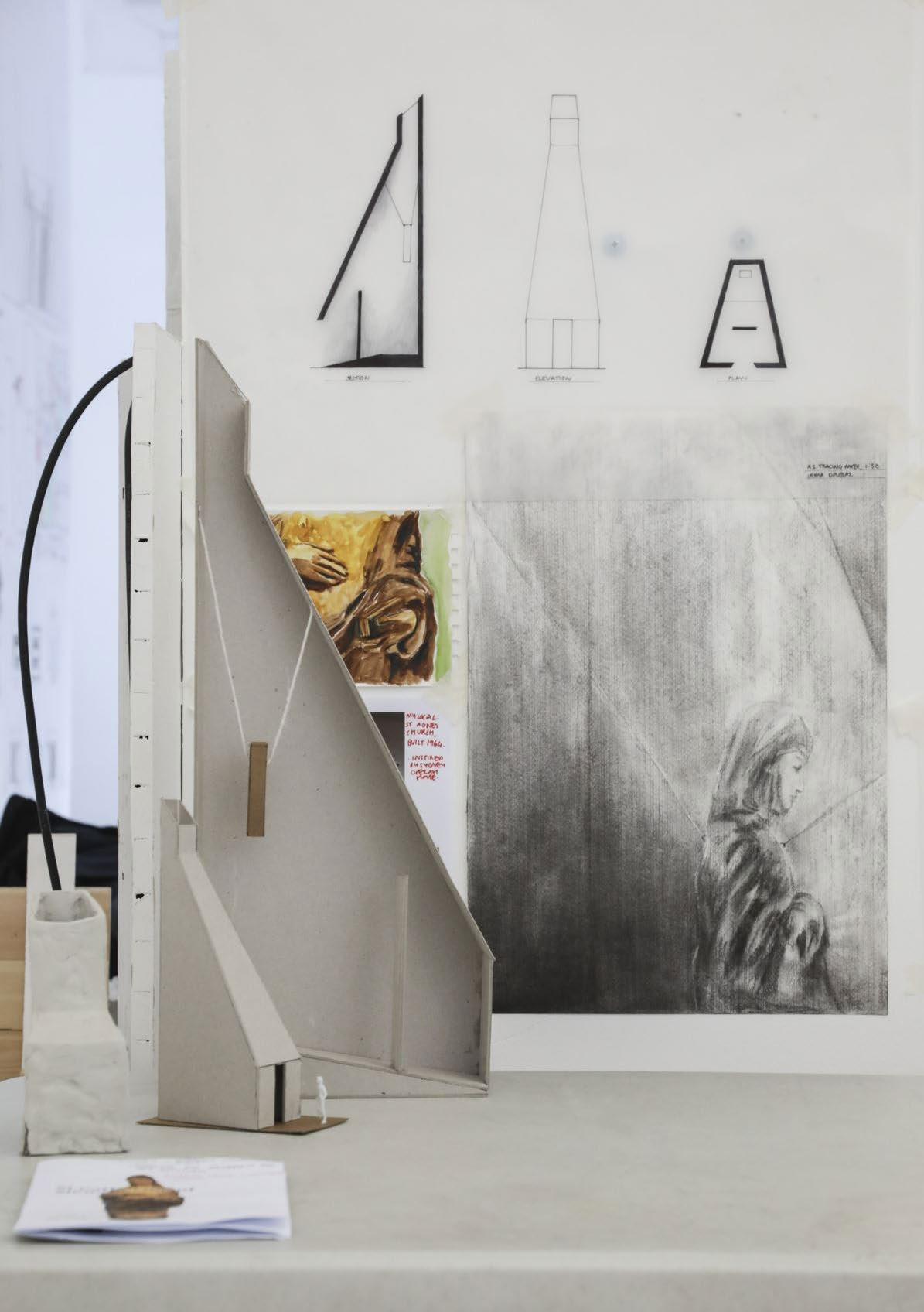
In a period of post pandemic global uncertainty the urgent concerns of climate change were again on our minds, so in Stage 1 for 2021-22 we continued our preoccupation with the future inhabitation of the planet. Our core ethos, taken from RIAS’ Sustainability Policy 2016 ‘Maximum Architectural Value - Minimum Architectural Harm’ was our guide as we explored architecture under a series of historical and contemporary lenses.
‘Architecture & HUMANS’ was a 5 week critical enquiry into ethical and equitable design for people of ‘difference’. We investigated aspects of space, light, comfort and wellbeing to redesign a familiar space for people of physical and neurological divergencies.
‘Architecture & VALUES’ moved us to an urban scale to undertake a 3 week investigation of Olympia House in the East End of Glasgow. Through drawing this existing building, inside and out, at a variety of scales we probed what can be ‘valued’ in architecture. This project developed into ‘architecture & PLANET’, a design proposal for the adaptive re-use of Olympia House with an emphasis on low
STAGE ONE
energy, loose fit and ambitions of architectural atmospheres.
‘Architecture & ME’ was an innovation for Stage 1. We introduced for the first time a long span, self- directed research project, which introduced themes given in the RIBA’ s 'The Way Ahead'. Our students were given freedom to follow their individual interests within these parameters.
In our cross school CoLab courses, we speculated in Semester 1 about ‘Being an Architect in The Anthropocene’ as COP26 was held in Glasgow. Starting from a study of global vernacular architectures our students speculated with manifestos and designs for a better future. In Semester 2 our students worked in interdisciplinary teams, drawn from across the whole of GSA first year, to continue to probe and evolve projects around the Anthropocene.
These investigations were an opportunity for our students to explore, experiment and communicate their ideas, learn to embrace mistakes, be challenged by uncertainty, and enjoy their first foray into architecture.
MACMAG 48 {13} STAGE ONE
Stage Leader
Kathy Li
Co-Pilot
James Tait
Tutors
Chris Platt
Sam Brown
India Czulowski
Iain Monteith
Student works featured in this segment are from 2021/ 2022

MACMAG 48 {14} STAGE ONE
Olympia House OWEN HOURSTOUN
This project focuses on adapting the existing building of Olympia House in Bridgeton, Glasgow. Through close analysis of the local context, I tried to create an elegant, fitting design whilst creating a loose-fit interior which utilises a playful use of light. The proposal' s development was achieved through hand drawing and sketch models to gain a thorough understanding of daylight features.


MACMAG 48 {15} STAGE ONE
House Within A House
AILSA HUTTON

In a period of post pandemic global uncertainty the urgent concerns of climate change were again on our minds, so in Stage 1 for 2021-22 we continued our preoccupation with the future inhabitation of the planet. Our core ethos, taken from RIAS’ Sustainability Policy 2016 ‘Maximum Architectural Value - Minimum Architectural Harm’ was our guide as we explored architecture under a series of historical and contemporary lenses.

‘architecture & HUMANS’ was a 5 week critical enquiry into ethical and equitable design for people of ‘difference’. We investigated aspects of space, light, comfort and wellbeing to redesign a familiar space for people of physical and neurological divergencies.
MACMAG 48 {16} STAGE ONE

MACMAG 48 {17} STAGE ONE
The Public in the Urban Aspect
DANIIL SOLOMOU
Exploring the idea of a genuinely public space in the urban aspect through various Nolli-styled maps.

A Nolli map is a type of ichnographic map focusing on open civic spaces. Showing the plans of public spaces and blacking out other privately owned buildings.
Studying three vastly different cities across Europe (Nicosia, Amsterdam, Glasgow) and exploring what the public means. Through this exploration, you can identify a city's values and socioeconomic history and how it morphed into what it is now.

MACMAG 48 {18} STAGE ONE

MACMAG 48 {19} STAGE ONE
Floating House On The Clyde CHARIS RITCHIE
For this project I decided to tackle the imposing local threat of flooding to Glasgow and discovered there was a danger zone determined across the area of the River Clyde, estimating which landmasses will be underwater in the next 3 decades. Through physical experimentation, I came up with a ‘floating’ modular structure inspired by pontoons used in the ‘Floating House’ design in Canada. My design would adapt to the changing water levels over time and spark a change to adapt larger scaled structures using the same method. The modular structure would exist to educate the local community on gradual flooding.


MACMAG 48 {20} STAGE ONE
The name of the project is the “Wellbeing Garden”. Reflecting upon my experience with nature and its impact on me as I came to Glasgow as a student led me to studies on the impact of nature to the mind. Namely, the Stress Reduction Theory, the Biophilia Hypothesis and the Attention Restoration Theory. This prompted me to consider how making a nature space available to students at the Glasgow School of Art in the city centre would contribute to their wellbeing.
After suffering two devastating fires, the shell of the beloved Mac posed itself as a perfect host for the garden. It offers plenty of light as it has no roof, it creates an opportunity for the garden to have multiple levels, and it allows garden users privacy, as its walls act as a barrier from the outside world. The garden features meandering paths, an abundance of vegetation, calming water features, a greenhouse and a view over the city from the top floor.


MACMAG 48 {21} STAGE ONE
EMILY EARSMEN
Wellbeing Garden

A MATTER OF NATIONAL TRUST
In
conversation with Liz Davidson
Liz Davidson graduated from Edinburgh College of Art as a post graduate in Architectural Conservation. Since then Liz has held a number of senior posts including leading the Heritage Lottery funded Townscape Heritage programme to regenerate the Merchant City; as director of Glasgow Building Preservation Trust, a charitable property developer rescuing and bringing back to life numerous historic buildings and head of Heritage and Design at Glasgow City Council with an active statutory role in maintaining the highest standards of historic building repair and maintenance.
Liz was senior project manager on the Glasgow School of Art Regeneration project from 2014 through to 2022 and has more recently been involved with the Hill House Project
MACMAG spoke to Liz in April 2023 to discuss her work on the Mackintosh regeneration project and on the Hill House, working alongside Sarah MacKinnon on both projects. Sarah is currently Head of Conservation of Properties for the National Trust for Scotland.
MM: To begin with, could you tell us a little bit about yourselves and how you came to be involved with the Mackintosh restoration?
LD: Prior to my work on the Mackintosh Building, I had been the Director of the Building Preservation Trust in Glasgow and in 2014, when the fire occurred, I was Head of the Conservation Department and Head of City Design. Sarah was the Director of a different trust in the West of
Scotland so we both came from a building preservation trust background. Following the fire, Glasgow School of Art advertised for people to work on the restoration, repair and conservation of the building and I was appointed. I was lucky enough to get involved at the tail end of 2014 and my first job was to advertise for an assistant. Sarah came and was easily the best person to come on board. Very quickly there were two people whose background was
MACMAG 48 {23} A MATTER OF NATIONAL TRUST
coordinating building projects, pulling together all the briefs, procurement, with the skill set for running a building project. I must say the school was an absolutely fantastic place to work at that point. The Reid had opened in 2014. It had a great Estates Department that knew how to get exhibitions put up and move students around.
Working on the Mackintosh was the best privilege of both our lives, we would both say that no matter what job we have done previously or have gone on to do, the Mackintosh was something out of the ordinary as a project to work on, with fantastic consensus, support, energy, and creativity throughout all
levels of the school. It was a real delight as a project, until sadly the 2018 fire and everything came to a juddering halt

MM: What led you into this field of work?
LD: I did History and English as my background, but I did a postgrad in Edinburgh in Architectural Conservation because my interest was in the hands-on aspect of history, rather than just teaching or reading about it. It was about the architecture, but also about the place. When I was at the Building Preservation Trust (BPT), we launched something called Doors Open Day. It was the first one in the
UK at that point and it is still running in Glasgow. It was all about engaging people in their neighbourhoods and in the quality of the built environment. The BPT was very much about taking on buildings at risk, but only if you had a good reason to restore them and put them into use, in terms of the social capital of putting a building back into use in a community and society. It was that mixture of the fact that every city in Scotland, or town or countryside, has got extraordinary wealth from the past, both in terms of the embodied energy that you have got in existing buildings but also the craftsmanship and what they mean to a place. There was never a project that did not have
MACMAG 48 {24} A MATTER OF NATIONAL TRUST
somebody that felt really dear about a building or that meant a lot to a local community to have that building back in use. Bringing a building back into use has so much repercussion in terms of how people feel about a place, especially if you can get it into public and social usage as well. I think it is just an amazing profession to be in because you learn about a building, how it has been put together in the past and then you combine it with the fact that this country has amazing skills in terms of design and that there is more sustainable and ecological technology that is coming forward. That all coming together and fusing creates brilliant moments of drama in architecture and places, and that is what interests me the most. I can never be an architect but I do love historic buildings.
The Mackintosh is probably the best case I have ever come across. There was not a day in the four years, before that second fire, that Sarah and I would not have been walking in that building and spotted something we had not seen before. You just thought, oh, how clever was that to think about doing it like that. The way that the building, uniquely in my experience, used light; how cleverly it bounced light around and used light to create mood and atmosphere. It really did affect your soul. Which is why the second fire was such an extraordinary tragedy. I hope that is what the Mackintosh School of Architecture and School of Design still retains – it is that transformative power of great design from the past and how it inspires the future. It all came
together for us in that place.
MM:That leads perfectly on to the next question, could you tell us a little bit about your specific role pre 2018 and what that would involve?
LD: My role title was Senior Project Manager, but I was really more a project director or co-ordinator, pulling together the other streams. Sarah came on to work with me as the project manager. She is, arguably, one of the best project managers in Scotland and she has now gone on to something much higher and much more important in the National Trust for Scotland, handling one and a half thousand buildings. My initial job was to write the brief for the restoration and in that triangle of any job, when you have got cost, quality and time, it was all about time. Get it back for the students as soon as you can. Quality was not really even in the triangle, that was non-negotiable. Quality had to be at the level that Mackintosh had built it, and more, because we wanted to do extra in terms of digital enabling and sustainability. Quality was not a factor, programme was, so I was on a fairly fast track to write the brief, get it through procurement, appoint the team and then assemble the contractor, put it out for tender and get the works underway. We were pretty well on target, which would have been Easter 2019 for a soft opening and then a full opening to the students in September 2019. But then the fire occurred in June 2018.
At that stage the work was pretty far advanced because we had been on site for the best part of
three years. It was coming out of the ground looking absolutely extraordinary. What was really thrilling was the knowledge that the craftsmanship had not been lost. Sometimes it was just one or two guys, they might been plasterers, joiners or carpenters, but the work was absolutely extraordinary and as good as of its day. That was the really rewarding part, working with that level of craftsperson. The job was obviously the building and to get it going there was a bit of fundraising involved. We personally did not have huge amounts to do in terms of the main funding, which would have been from the insurance, but we were at all the meetings with the insurers, assuring them that this is how it was going to be done. Then there was a huge amount of public speaking and just making sure that people were engaged.
Something that we actually got criticised for at the time by the press, was the sheer amount of people that we took through the building, including students. We felt it was really important to make sure as many of the GSA students, in particular, saw the building. We did not want it to be something that you put the shutters up for four years and then opened it and had a ta-da moment. We wanted people to see the works in progress at all stages because the majority of the building after the 2014 fire was not damaged. The loss was about 17% of the building. The library was the main tragic loss and then a lot of it was smoke damage or water damage on the West side. But over 2/3 of the building really was not affected at all. So you could still take people
MACMAG 48 {25} A MATTER OF NATIONAL TRUST
in and talk about the building and just see the beauty of it.
We took one elderly married couple in their mid 90s, Tom and Audrey Gardner, wonderful Fine Arts students who had studied there before the Second World War, and had remained students during the war, and who had been on the roof of the building during the Clydebank Blitz, where their romance had possibly kindled. They came back and walked right way up to the top, which is a lot of staircases. After their visit they wrote in the visitor’ s book something like ‘We are glad we have seen the building and she is being healed’. I think most people who knew the Mackintosh before the fire and had studied there or been part of it, really felt it was a kind of living organism – it had soul. It is as if it were alive and had been badly hurt by the fire but it was being beautifully hospitalised and was coming out of it looking absolutely magnificent. The other joy that would have happened if it had got through to completion was that we were discovering so much. The building over the years had had masses of well meaning janitorial coats of paint and varnish. A lot of the building was very black and white before the first fire; all the woodwork was very, very dark, if not black. When you look back at the original photographs, early drawings or images of the building, all the wood was much lighter and you can always see the grain of the wood. We took down a moulded architrave that was damaged and we found the original colours of something that had been there previously. Mackintosh was a
great believer in not hiding the material he used. The building would have come back in a much lighter form, through the woodwork in particular and the wood he used was just beautiful. It would have just been outstanding as a space to be in.
MM: You worked on the building both before and after the second fire – how did it differ the second time around?
LD: The fire in June 2018, was a massive trauma for everyone - the school and the local community were absolutely stunned and horrified because it affected everybody so badly. The first thing that we had to do as a team was, overnight, become not a building restoration team, but a school recommissioning team because for two and a half months all the buildings in the immediate vicinity were evacuated. The next thing we had to do was to make the building safe as quickly as possible to allow people into the streets around the area, hence the mass of scaffolding on the building which was the quickest way to stop the Council from saying ‘this is dangerous, we are going to demolish it’. This meant we did not have the luxury of doing something like we did with The Hill House where you have a very beautifully framed steel box over the building protecting it.
The engineers and the contractors had to come in and were immediately faced by the building control department, saying this is dangerous we are bringing it down if you cannot prove to us this is not going to fall into the street and destroy other properties. We had to use
drone flights and cherry pickers and monitor the situation. Here, again, the school was very helpful. We had them on board from day one, taking point cloud imagery to compare with the point cloud imagery we already had, to show if there had been any movement and where it had occurred. We were able to take a scientific case back to the Council to say there have only been areas of movement in the library and in the northeast corner at top of Dalhousie Street and in those areas we are going to throw scaffolding on right now to stop any further movement. Eventually we had to go around the whole building and just prop it up and brace it from the inside. That took up all the next three or four months, and in the meantime, what we were doing was coordinating all the visits into The Reid and The Bourdon to ensure that we could get the building decontaminated because the smoke would have got into ventilation systems or water systems. We were managing a huge amount of decontamination work and safety checks. In The Reid the glass was cracked so we were having to monitor that and put safety barriers behind it, just so we could get the buildings back in use. The returning students had to do work off site for the first week and then we did get the students all back in by a hairs breath, pretty well, for the start of term. Having said that, you know it was a disruptive experience for any student to come back into, whatever stage they were at.
We were immediately no longer in charge of the project, the project stopped that night. The
MACMAG 48 {26} A MATTER OF NATIONAL TRUST
contractor KEIR could no longer do a job that was a restoration job, so the next thing we had to face was getting involved at every level, with dealing with the insurance, the fire service, the investigation. There were all the contractual legalistic issues that have to be dealt with to stop a contract that has still got a year to go. We had to work solidly alongside what was the Scottish Fire and Rescue Service, painstakingly looking at the archaeological salvaging of what was in the building. The fire service wanted to do a forensic examination of the building to find out how the fire started and they never actually did find the root cause, but it took them three years to painstakingly sift through the building. Every time we moved into a corridor or into a studio, you first of all had to send the engineers in and the contractors in to say, is this safe? That was finished in June 2021. More or less every working moment was to do with making sure that we could keep the building safe and constantly try and put more strength back into it, while the school was running a business case for a feasibility study to look at what was the right thing to do on the site: Is it to keep the building? Is it to restore it? Luckily that was the end decision, so doing that painstaking work was correct because if the conclusion at the end had been to demolish it, then that would have been quite a lot of wasted effort in the way that it was gone about. At the moment the school is looking to start the process of appointing a team to look at the restoration again. That will be a long haul job, which is why in the summer of last year, I figured that it was the right time to leave the project – Sarah having left already - because it will be another length of time before the restoration building

MACMAG 48 {27} A MATTER OF NATIONAL TRUST
works can start properly.
MM: Could you give. us a bit of background on The Hill House Project, how you got involved and what your roles were?
Sarah left GSA around December 2021 and went to a big job in the National Trust. She is now Head of Conservation of Properties for the entirety of the National Trust for Scotland. I left in the summer of 2022. Sarah has oversight of all the buildings and their repair maintenance needs. The Hill House is a specific project. It has been in the trust ownership since 1982, and it is a phenomenal building. It is Mackintosh at his finest, a most mature, domestic work, comparable to Windy Hill which was an earlier work of his. What the client here was really saying to Mackintosh was we want an iconic Mackintosh building. We want you to design a building for us at one of the prime sites in Helensburgh, which in itself was a smart, Victorian Glaswegian suburb. The building was in one family's ownership, the Blackie’ s (as in the publishers) for something like 60 years, and then they passed it to a like-minded architect and their family. It would have been at a good price at the time because even then, there were known issues with the fabric of the building. They owned the building for another 20 years or so, and at that point it passed to the Royal Corporation of Architects, who looked after the property for the next 10 years.
In 1982 the National Trust for Scotland took it into their guardianship and have had it for just over 40 years now
and I think there has not been a quinquennial survey that has not thrown up the issues that it has always had, which is to do with the Portland cement material that wraps around in the building.
The building was built between 1902 and 1904, about the same time that the second phase of the Mackintosh Building was getting built and the material that Mackintosh uses here, and the detailing is very similar to what he ended up using in the second-half of the Mackintosh Building. For Mackintosh one of his great stylistic drivers was the whole issue of the sculptural form of the building. He was a great innovator and very early adopter of modern technology, modern materials and the new developments that were coming forward, and Portland cement at the time was the absolute wonder material and it did do a lot of what it said on the tin. So the issue we have got with combining his stylistic forms at The Hill House and this wonder material was the fact that he, unlike other arts and crafts architects of the day, was one of the first to really do away with all the traditional detailing that you need on a building, particularly in the West of Scotland, to shed water. If you were in the South of France, this might be fine. You could have a flat roof and hardly any drip mouldings and overhangs and gutters, but we are in the West of Scotland and that has got worse rather than better with climate change.
So the issues we faced at The Hill House are that for decades that building has managed to let in moisture and water, trapped it into the stone substrate of
the building, and because of the concrete it is not very easy to get the water to evaporate out and the water over the years has been tracking into the building to come out through the plasterwork and through Margaret McDonnell stencils, the painted finishes, the panelling and the plasterwork generally. It has had a history of just flaking paint and plaster and rot in some places and ceiling collapses. The moisture readings of the building over the last decade have been taken very scientifically, using all kinds of gizmos - thermography and microwave readings, and many other forms of scanning of the building to record just where the moisture is and it is still very much in the core of the building, in the chimneys and everywhere basically.
What Mackintosh did was do away with sills, with any drip mouldings, any hoods over the windows. When he had a Gable head, he did not put lead on it; he did not put stone on it - he just wrapped the material up and over so it went vertical, wrapped into the reveals of the windows, wrapped over the parapets, over the wall heads, over the chimney heads, and in all those areas that water may get in. When it is coming onto a flat surface, it is finding its way in. The Portland cement itself has developed shrinkage over the years. It has not had enough flexibility to avoid the kind of hairline cracking that you get and that of course has a wonderful effect - capillary action of taking water in very slowly, quite deep into the core of the building and then, moving around but not finding its way back out.
MACMAG 48 {28} A MATTER OF NATIONAL TRUST
Our job at the Hill House is to find a material that will create this unifying effect that Mackintosh was seeking to do.
I think if you look at the survey work on the building, about 80% of the Portland cement has been at least changed over the last 120 years of its existence. People have systematically and regularly found areas too damp and they have taken it off. Different approaches have been used over the years. There is been waterproofing to stop water getting in but that has only served to trap water in rather than to stop it getting in. It has had treatments where it has actually taken off the render and put brick behind it instead of stone because the stone is quite porous. A lot of it is face bedded as well, which is
a problem. The stone has lost compressive value because it has been put on end and not laid in the correct bedding strata for how it should work in a sandstone building and it has had other experimental things done to it, such as carbon rods behind the render to actually pin it back and then grouted and things like this to try and keep the render on. The big decision that has been taken over the last decade was to decide that it is not about material, it is about the design. That is a big relief for the trust to know that it has not got to work through something like the Venice Charter, which would say materiality is everything. It is not all about keeping that piece of wood or that piece of glass. We have now got beyond that philosophical debate and
decided it is the appearance and it is the style and it is the modelling of the building that is important. It is all about Mackintosh's vision for the design not that particular piece of portland cement. We will have findings here at The Hill House that will have implications, hopefully beneficial, for the Mackintosh because it is exactly the same material, albeit on brick rather than stone, and we can share any findings with the school on that which we would really hope to do.
At the moment we have got a plan that looks at about four years work. Mackintosh has got 2 anniversaries in 2028, one is the 160th anniversary of his birth in June of 2028, and the other one, sadly, is the 100th anniversary of his death

MACMAG 48 {29} A MATTER OF NATIONAL TRUST
in December. We are going to hit 2028 as our date for the opening. If earlier that would be great. I do not really like long programmes because it only costs more and the building stands around getting damper. In 2019, Carmody Groarke, a London architect, erected the box over The Hill House. It is a fairly extraordinary structure, and at the time, probably drew a lot of criticism from some quarters, who felt that spending the 4 million or whatever it cost in the end, could have been used on the building, but I think it was, with hindsight, a great decision because it has dried out the building, so it has now got a relative humidity that is quite stable. It stands off the building by about 3 metres, 4 metres in some areas and it allows a natural ventilation, so there is no forcing of moisture. It is all naturally just airing and drying out. With COVID and everything running slow for the best part of two years the building has had time to recover. We would have hit more problems if we had fired in and there has been more research and the buildings is now sound. It has a protective big cloak
over it, which means we can work within that box to do the restoration. This protective shield over the building can remain while we are doing the work on the building and opening it up. Unlike the poor old Mack, which is covered in scaffolding, although I think they are going to get a roof over the Mack which is great.
The Trust is good at getting visitors through and what has been wonderful about the project is over the last 10 years they have really gone to town in terms of the research about the building and the materials and the technology used. We have a massive foundation that will form the basis of the tender that will go out this year to a design team to come on board to take this on because the new design aspect of this is going to be that there will be a visitor centre. We want to make sure that it is a striking, stunning piece of architecture, of the same quality but of a modern design, as Mackintosh's vision for The Hill House. It will be a two headed project with the garden wrapping in as part of it. I am hoping we can move
the project really fast because again, it is one of those buildings that is a real victim of climate change, particularly in that part of Scotland. How do you deal with water and how do you deal with an ecological solution that is net carbon as far as we can and a net zero carbon building in the longer term?
MM: Can we ask you a little bit about your team?. The projects that you work on must require specialist knowledge. What skills or experience do you look for when assembling your wider team?
LD: There is an incumbent team at the moment that has done the work to date which is LDN architects in Edinburgh and Narro who are the engineers. Narro are the engineers on the Mack so there is a link there immediately between both buildings, which is nice because they really know their Mackintosh structures and his idiosyncrasies. We would always look for architects or engineers that had a conservation accreditation through the RIBA, the RIAS or through consulting engineers institutes.

MACMAG 48 {30} A MATTER OF NATIONAL TRUST
Narro are one of the few that have that. It is wonderful to have a really strong design ethos and it's important to be abreast of all the developments in technology, particularly in sustainability but we also are looking for a company that has that kind of youth coming through and that knowledge and that adventurousness and being right at the forefront and cutting edge of innovation. Having said that we also want to know that the architects know about traditional building and how older materials work and function and perform and the idiosyncrasies of how a building like this will have been put together. So they need to have both sides of that knowledge base really within the practice. That is what we are looking for. We do not want a practice that can only do conservation. They can happily re-render the building for us but that is not enough because we need to know that we can make it much more environmentally efficient and we are going to put this building back so how can we accommodate
insulation? What about low VOC paint? Somebody that has a very strong ecological bent will be essential for any job in the trust and we would be looking for somebody who has a desire to utilise the latest technology in terms of energy saving measures and things like that, so that is important.

We will also be looking for a team that can handle the new visitor centre and have a really holistic approach to something that works. Some bids might come in with two halves.. You could have two architects, with one main architect for design and another architect for conservation. I think it would be wonderful for the scale of this building to think about a practice that had all of that in house and had the sensitivity to do a really brilliant job with really skilled craftspeople and know how to detail that instruction to those people, but also to come up with something that really reflects The Hill House but is a is a strikingly modern building because that is exactly what Mackintosh would do if he were
still alive. He would not design in an older style, he would design in the style that he had grown into. We will be looking to find the best we can and we may have to go out of Scotland, in terms of the craftspeople we may need and that's a shame because, for instance, for paint analysis there are no companies now really up in Scotland. Most of it is South of the border. I am not being overly nationalistic about this, but it is just nice to know that there are people, in terms of the economy, who are setting up in Scotland and doing this work. I will obviously make it an open competition and we will see who comes through on it, but the practices we have had working on it so far have really done superb work on the research of the building and in their knowledge of it. We know we have got the depth of experience and ability in a Scottish sense, which is reassuring.
MACMAG 48 {31} A MATTER OF NATIONAL TRUST
MATERIAL CHOICES
A Whole-life design approach at Hawkins\ Brown
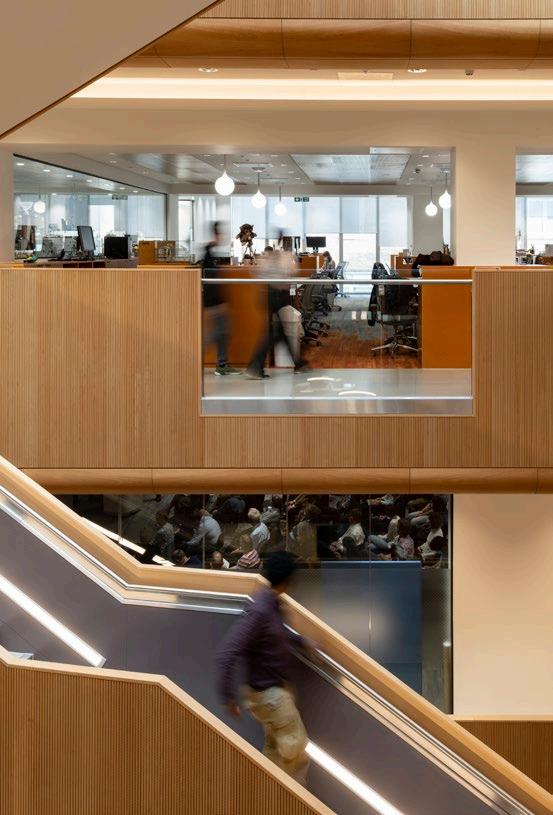
Louisa Bowles was a student at the Mackintosh School of Architecture from 2002-2004. She is now a Partner and Sustainability Lead at Hawkins\Brown. Since joining Hawkins\ Brown in 2004, she has led several complex architectural projects from concept to completion in a range of sectors including education, science, research, commercial and civic. She led the co-funded research with a UCL EngD that resulted in the concept for H\B:ERT, the in-house Whole Life Carbon design tool and subsequently led the launch and ongoing development of the tool. She has worked full time in her sustainability focused role since 2019 and was the AJ 2022 Sustainability Champion and is a Mayor’s Design Advocate.
Hawkins\Brown is an internationally renowned practice of architects, designers and researchers, based in London, Manchester, Edinburgh, Dublin and LA. We work across a range of different sectors and at a variety of different scales from school pavilions to large city-wide infrastructure projects and masterplans. This has meant our approach to sustainable design needs to respond to a range of different clients, context and scales.
However, what unites our range of projects can be filtered down into a simple concept that is flexible enough to apply to all sectors, scales and easy for people with little specific training to explain. Reducing carbon, improving society. This is an evidence-based design approach to ensure our
buildings enhance the lives of the future generation.
To embed these principles across the practice Hawkins\ Brown created the Specialist Design Studio to spread best practice expertise from people with all kinds of specialist skills including digital design, BIM, visualisation, technical and delivery skills. Sustainability sits within this group and the power of this is the ability to spread the knowledge, approaches and milestone checkpoints among a greater number of people, so having more impact.
One of the questions we are regularly asked is how did the HB Sustainability team and effort start or evolve. Formal staffing started late 2017 and the size of the team and the range of in-house skills has
MACMAG 48 {32} MATERIAL CHOICES
"flexible enough to apply to all sectors, scales and easy for people with little specific training to explain."
Louisa Bowles
been gradually increasing. This has been as a result of a number of external stimuli including various industry initiatives, regulation and an awareness that the situation is getting more complex with increasing client, media and planning demands. We believe Architects have a real place in leading this as we are often the Lead Consultant or Designer, so the more we can do in-house the smoother our processes will be.
It’s always good to remind ourselves why we are concerned with sustainable design and specifically carbon emissions and material specifications. Globally, we need to limit the average increase of temperatures to 1.5deg. Nationally we have legal commitments to be Net Zero Carbon by 2050 with a 78% reduction by 2035. If we keep spending our carbon budget to 2050 at the current rate we will run out many years before this. The UKGBC roadmap to Net Zero project indicated the work required and policies required to maintain the reduction trajectory required to meet the 2050 target.
To support, we have standard resources, support networks and data collection processes to track performance. These have evolved and been updated and expanded on numerous occasions to improve them and as new people enter the team. The more we learn on one project the more we can transfer to another within tight programmes.

We advocate for Whole Life Carbon to be integrated into

MACMAG 48 {33} MATERIAL CHOICES
the design process where possible. Starting with benchmarking, a rough idea of the aspirations, outline material palette and project abnormals will usually indicate whether it will be possible to meet the most onerous performance or not. We can then optioneer to prove this and track through whole building analysis at key milestones.
We recognize that there are always more drivers than carbon so we often group information on material choices into matrices so carbon, cost, aesthetic, buildability and other factors can be weighted. It is rare there is one perfect answer. And we know from our own analysis and industry benchmarking etc that the structure and facade are often the key indicators of meeting one target over another in regards embodied carbon.
So in regards to structure there are three key material options, concrete, steel and timber or a hybrid of the two. A decision will most likely be made based on function, clear span, material efficiency and hence cost, speed of construction and potentially embodied carbon. However, as you can see here many of our projects expose the chosen material where we can, for joint aesthetic and efficiency reasons. The IStructE guidance has had a huge influence over the recent years and we are seeing more attention to optimization before specification changes, but this is still a key lever to reducing.
In regards facades the situation is more complex as a


case study later will show. We have almost infinite finishes and window configurations but also need to adhere to noncombustibility and thermal performance requirements. Broadly there are some rules of thumb we propose to our teams early on as much of the embodied carbon is still in the sub-framing on most buildings at scale. So, reduce the cladding weight, reduce the use of metals. Where you can use recycled products. And in regards the finish itself, review the replacement cycle and really consider how that will be done.
Case Study 1: TEDI CAMPUS
Our first case study looks at re-use, modular construction and design for deconstruction. TEDI-London, is an HE engineering enterprise, cofounded by three global universities: King’s College London, Arizona State University and UNSW Sydney. Phase 1 is now complete at British Land’s Canada Water development, constructed from volumetric modules and is designed to be deconstructed at the end of life for further re-use. Phase 2 has used preloved modular frames.
The deconstruction is a planned for event as the campus will only be here for up to 7 years but effort was also spent ensuring an overall enhancement of the site and student experience. All materials can be stripped off and separated for use elsewhere. Built in the UK, the building itself took just six weeks to construct once the modular components had
MACMAG 48 {34} MATERIAL CHOICES
"
A decision will most likely be made based on function, clear span, material efficiency and hence cost, speed of construction and potentially embodied carbon. "
arrived on the site, minimising disruption to the local area. Each module uses lightweight steel frame boxes clad with insulation and requires no deep piles or concrete.
Case study 2: 55 Great Suffolk Street
This project was featured in the recent RIBA Exhibition; Long Life, Low Energy: Designing for a Circular Economy. The original brief from Fabrix for the refurbishment of 55 Great Suffolk Street included the need for steel re-use and circular economy strategies.

What struck the whole team was how beautiful and raw the original building was so that design concept was always to retain as much material as possible but the means of access was tricky to provide without damaging the existing integrity. What transpired was a weather-protected circulation core that sat outside of the main building volume.
The inspiration for the materilaty of this key addition was the refence to the original warehouse as storage for paper and resulting exploration of pattern generated from
corrugations.
However, it is the steel reuse that has been of primary interest so far on the project due to the current rarity, but increasing interest and need, of this occurring. We have just undergone RIBA Stage 4 including a lot of detailed collaborative work together with Fabrix, Cleveland Steel and our structural engineers Symmetrys. Part of the building has been designed to work with existing steels from another site. This required some reciprocal work up front. Instead of choosing sections from a
MACMAG 48 {35}
MATERIAL CHOICES
catalogue, an inspection was taken of what was available. The spec of the steel was generated, a testing regime for the sections deemed most suitable was devised and then the results compared to the spec. Adjustments made where required or alternates found.
Case study 3: Two science and research buildings compared

A few quick observations about how all can sometimes not be what it seems with embodied carbon and material choices. We compared two of our recently completed life sciences buildings; IBRB at the University of Warwick and the Dorothy Crowfoot Hodgkin Building for the University of Oxford. The material choices were carefully considered based on the scientific requirements, long term flexibility, construction methodology and health and wellbeing but not in regards embodied carbon per se at the time. Both of these were designed around 2015.
Our thought was that the timber structure used for 50% of the IBRB should have resulted in a figure that reflected a reduction. But in fact the DCHB came out lower. We have attributed this to a few factors including the steeply sloping IBRB site requiring far more piles than in Oxford where the ground conditions enabled a hybrid raft and piled solution. Both concrete structures were pre-fabricated and designed to similar loadings and spans but a higher % of cement
replacement used in the DCHB. And the form factor on the DHBC was more efficient as the building is deeper plan with a central toplit atrium. So often factors other than pure material choice massively affect the carbon emissions.


Case study 4: St Mary’ s Catholic Academy
And finally an example of a project that has focused on both embodied and operational carbon from the start. St Mary’s Catholic Academy in Derby is an example of a very low energy, low carbon proposal which we’ve been working on for the Department of Education based on their GenZero principles. The scale has enabled the use of primarily natural materials and modular SIPS panels. Biophilic design is really important here so every wing of the school looks out onto carefully crafted external spaces that create distinct characters through the seasons. Some are functional or productive or educational and some of them are obviously for play.
So the natural materials obviously help as you can see from the embodied carbon figures at around 440kgco2e/ sqm. This principle has been used for the majority of building elements except for the polished concrete floor aimed at ensuring thermal mass while reducing the embodied carbon of sheet floor finishes and short replacement cycles. But the timber is doing more than contributing to a nice number. It is embedded in the principle of providing supportive, calm, healthy learning environments
MACMAG 48 {36} MATERIAL CHOICES
with good air quality, acoustics and connections to external spaces.
So our conclusion - there is no right answer, we must think through our choices at each design stage and life cycle stage through a number of lenses. And we can advocate for Architects as Lead Consultants to take control of each design. Drive through passive design, fabric first and energy efficiency measures. And lead the conversation on materials. While the sub and super-structure is the largest proportion of embodied carbon in a building the Architect is still the curator of the design and has the widest influence over a holistic decision, balancing all factors. It also has to be recognised that there is no perfect answer – the lowest carbon option is not to build at all, but that is unlikely the full answer. So we build less by retrofitting and re-using and we are efficient with material by using the right thing for the right job. One of the focusses of the Environmental Audit Committee which resulted in the recommendation for a national policy on Whole Life Carbon reporting is that there is not much to be gained through demonising specific materials but that all materials need to be used efficiently and decarbonised versions made more available.

MACMAG 48 {37} MATERIAL CHOICES
FRIDAY LECTURE SERIES
“Re-establishing Identities” Mackintosh School of Architecture's Lecture Series
Why do we need to re-establish Identities in Architecture? Identity expression has been illustrated physically by many art forms throughout generations, for instance artists like Diane Arbus in the 1960’s, whose compassionate photographic lens included those otherwise excluded from mainstream physical and economic norms, and more recently Lubaina Himid whose work foregrounds black people and black identities within the context of white history or in contrast to cultural stereotyping. This same expression is not often found in Architecture, and in this Lecture series we wanted to focus on people who have been denied the opportunity to articulate their needs, voices, feelings in the spaces they reside in.
Architects, urban designers and city planners are starting to realise that our cities have been, and continue to be, built largely for a single identity, White men. Feminist geographer Kim England notes that ideas men have about the city are “fossilised into the concrete appearance of space. Hence the location of residential areas, work-places, transportation networks, and
the overall layout of cities in general reflect a patriarchal capitalist society’s expectations of what types of activities take place where, when and by whom.” This approach has caused architecture and urban environments to be exclusionary and representative of a very singular way of thinking and being. There is an understanding that the lack of diversity in our built environment professions is partly to blame, researchers quoting that ''architecture is the creative industry where it' s least likely to find working-class people as well as having only 9% people of colour involved'' . Academics are making headway in articulating inequalities in lived experiences within built environment, Leslie Kern chews over many of these issues in her book Feminist City in 2020, but cities are hugely diverse, with shifting needs and populations, as well as, different degrees of privilege, barriers, and social assets, so there is still a considerable task ahead. A good way to combat this is broadening out the profession, but if we are going to address these imbalances in the city, our Friday lecture series highlighted that to truly re-establish
MACMAG 48 {38} FRIDAY LECTURE SERIES
Ollie Simpson & Gilda Plati
Identities in architecture and urbanism we need to go one step further, we need citizen participation.

Contemporary academics are illustrating the need for listening to a much broader range of people, In the book, Complaint! Sarah Ahmed introduces us to a term that she calls a ‘feminist ear ’, she describes this as “to hear with a feminist ear is to hear who is not heard, how we are not heard.” It is the process of retraining our ears to pay attention to people or experiences we haven't listened to before, and unpacking how they have been previously silenced. In the built environment, How do we ‘hear who is not heard’?

Sherry Arnstein in her journal ‘A Ladder of Citizen Participation’ suggests that participatory decision making could be this answer. She provides a ‘ladder’ that is a guide to levels of citizen involvement, rating it from ‘ nonparticipation’ (no involvement at all) all the way to ‘citizen control’ (full power to the community) This can be related to the development of a built project, with degrees of community and user involvement from no consultation at all, to tokenistic informing, to co-design and vetoing powers given to communities.
Identity expression in architecture has been very limited. In Feminist City, Leslie Kern writes ‘All forms of urban planning draw on a cluster of assumptions about the ‘typical’ urban citizen: their daily travel plans, needs, desires, and values. Shockingly, this citizen is a man. ’ This assumption created a lot of inappropriate housing, infrastructure and public
MACMAG 48 {39} FRIDAY LECTURE SERIES
spaces. Expressing Identities in Architecture is slowly improving, but not drastically. Laws like the Equalities act in 2010, do set out 9 protected characteristics, but its impact on de facto equality within the architecture profession and the wider built environment has been limited. New construction in urban or suburban areas in the UK also continues to be poor, with the majority of suburban new build housing has been described as “soulless” by Richard Vize in 2019. Large quantities of bland boxes that developers have assumed people want to live in, often based on old-fashioned attitudes to the nuclear family, which are at least 50 years out of date. The lack of reflection or appreciation of the local and diverse lived experience is what makes so much speculative development feel cold and alienating. The bland, identikit tower blocks filling up central London and Manchester seem to be designed with only one customer in mind - affluent young professionals. The new development at Battersea Power Station in London is a particularly potent example, Olly Wainwright called the new starchitect housing a “characterless playground for the super rich”
Some developers are starting to recognise the importance of engaging with communities to create a more appropriate and valid identity, developers websites claiming they are consulting with ‘key community stakeholders’, but many just treat it as a tick box exercise, organising tokenistic events. A recent survey found that only a shocking 2 percent of the population in the UK
said they trusted developers. The overall state of a plural expression of Identities in our built environment is generally poor. There is a definite need for more genuine participation to inject life into future projects.
There is a growing number of practitioners who are making headway in this area, however. We invited Dr Joshua Mardell, Resolve Collective, Austris Mailitis, Dr Adele Patrick, In The Making and Nick Newman to speak as part of the 2023 Mackintosh School of Architecture Friday Lecture Series. They Illustrated how they’ve better established Identities and brought a much broader diversity of voices forward through participatory architecture.
Joshua Mardell spoke to his experience of writing “Queer Spaces” published in 2022, a book co-edited by Adam Nathanial Furman, which attempted to reconcile the absence of queer Identities in architecture across the globe. Joshua’s work focuses on historiographical reflection. Reflecting on the way architectural history has been written, what has been chosen and by who, critiquing authors, and finding the missing sections in order to reconcile specifically queer and feminist absences. Specifically in this case, rediscovering undocumented queer identities. To find these absences, it's a key part of Mardell’s process to turn to collaborators to co-author missing histories. In his lecture he quotes Brown and Nash, who describe the research of queerness as “fluid, unstable, and perpetually becoming”
Queer identities are constantly evolving, so having a single person ’s definition will miss a whole host of voices. In turn suggesting that if you want to get a truer, more holistic picture of these Identities, there is a need for multiple authors from multiple viewpoints to capture the truest sense of this evolving narrative.
Instead of curating the book with queer spaces they knew about, and writing from their own personal experiences, Joshua and Adam reached out to collaborators from across the globe. Joshua told us they “Left it to the authors, there are 55 of them, to decide what constitutes a queer space, we ’ve honoured their definitions. Thus we hope to be sensitive to a whole host of cultural traditions.” By writing the entries in this way, commissioning ‘experts’ (people who lived, worked, visited, heavily researched) to write the extracts, they gave the atlas even more truth and identity. This resulted in a variety of voices and short pieces of over 90 ‘ queer ’ spaces.
A Participatory process can also be applied to more traditional architecture projects, another one of our invited guests, Resolve Collective, Illustrate this, who practice what they call ‘Community Mining’. They were invited by Southwark council to take on an engagement role alongside DSDHA who were creating options for the masterplan for Tustin Estate in South London. Their approach manifested in both general engagement events, to ‘mine’ community knowledge, feelings and opinions, as well as series
MACMAG 48 {40} FRIDAY LECTURE SERIES
of more tailored events. The general engagement consisted of pulling up in front of the school on the estate with coffee and food, giving information about the redevelopment process, when and where important meetings were, and starting the conversation. The second approach which was to expand the ‘community mining’ beyond the set brief, they began to work on projects that used the newly tapped resource to create projects that were unrelated to the redevelopment, but enabled the residents to have more autonomy over their space. These events included a Youth workshop which was a knowledge exchange; the kids that attended were taught the basics of a design process, and then tasked with designing a small light hearted intervention they felt their neighbourhood needed. They also collaborated with residents on the estate to design and deliver a community Garden that any resident could use, once completed
the organisation of the garden would be handed over to a resident steering group, which would give them full autonomy.

This project illustrates how Resolve took a deep dive into helping residents have their identities heard. It's interesting how they acted in two ways, one by plugging people into the decision-making process, but also by taking the funding they had to create third spaces for residents that they would have more autonomy over. Unfortunately, the project was halted by the outbreak of Covid19, so its had to discuss the long term impact, but after presenting a lecture for the Architecture Foundation, residents and a senior councillor from Southwark praised the project because the architect and council team had consistently shown that they’d taken on resident' s feedback and adjusted the scheme accordingly. This is an important part of the process,
as without this the engagement would not have instilled the project with any more of an identity, the cross collaboration and listening with a ‘feminist ear ’ is key.
These are just two examples of how beneficial citizen participation can be to establish Identities. Our speakers and many more practitioners like Glasgow’s own New Practice and Green party’s Holly Bruce are paving the way to a much more collective expression of architecture and urbanism. All of this term's Lectures are accessible to students on GSA’s planet E Stream.
MACMAG 48 {41} FRIDAY LECTURE SERIES


Stage Leader
Luca Brunelli
Co-Pilot
Neil Mochrie
Tutors
Graeme Armet
Jonny Fisher
Colin Glover
Alan Hooper
STAGE TWO
Stage 2 Studio Work continues to ask students to explore the convivial potential of architecture to foster a community’s freedom to interact and to contribute creatively to the environment in which they live, outside the dominant forms of production and consumerism. The entire year’s work is set in Bo’ness, a small commuter town on the shore of the Firth of Forth.
Semester 1 focuses on housing typology and terraced housing in particular, as a generative tool to explore spatial organisations that can support new forms of living and working together, those which
promote sustainable lifestyles, reduced transport needs, lower energy use and the sharing of resources.
Semester 2 is informed by the material harvesting approach developed in the urban mining exercise examined in the collaborative Studio Practices exercise with Product Design Engineering students. The final project of the year asks students to become acquainted with the contemporary debate on adaptive reuse through intervening on the existing local library building, carefully crafting a tectonic strategy to reimagine the nature of this public institution for the future.
MACMAG 48 {45} STAGE TWO
Student works featured in this segment are from 2021/ 2022

MACMAG 48 {46} STAGE TWO
A Warehouse and a Social Condenser
STEFANS PAVLOVSKIS
In the place of Bo’ness library stands a pool of shared knowledge and resources.
The existing library premises are reduced in size and, by the creation of a new spatial order, turned into a warehouse fit for anything, open to anyone. The library as a repository is liberated from its social duties; those are greatly exaggerated and moved elsewhere - to the High Street, where their presence contributes towards a social condenser - the centre of exchange, work and leisure.
The vacant High Street retail premises are taken as found, fitted with simple interventions ensuring spatial and programmatic affordances and enabled with active objects- risographs, hearths and extremely long tables dismantled and reused due to minimal adhesives and mechanical fixings.


MACMAG 48 {47} STAGE TWO
ADAM WALSH
The aim of this project was to create a new extension for the library in Bo’ ness, accommodating a pair of old industrial buildings that make up a portion of the existing library’ s footprint.


My design tried to connect Bo’ ness ’ old industrial harbour and shipbreaking history to the town that it is today. The new extension, reminiscent of a ship’s skeletal keel and clad in pre-rusted Corten steel, protrudes out towards the old quay and the Firth of Forth beyond that. The spaces created inside and around the new build aim to draw in visitors, turning the waterfront into a hub of activity once again.

MACMAG 48 {48} STAGE TWO Library
A Modular Manifestation
 JAKE STEWART
Bo’ness library, a hidden public space. The missing element to the existing building is its very existence, The clarity of public is not made as the library is lost in its inability to architecturally communicate itself as such. Conviviality within the library space thus needs a welcoming architectural language promoting a collectiveness within Bo’ness. Working within the briefs specification of sustainable adaptability, modular elements developed as a solution in creating a needed expansion of the existing buildings footprint and circulation but importantly to project outwards the ongoings within the building. This being phase 4 of Bo’ ness libraries historical development, the modular block network proposal seeks to adapt with time and not remain stagnant, providing a future development strategy/blueprint.


MACMAG 48 {49} STAGE TWO
Bo' ness
MILES WILTSHIRE
The proposed structural columns are designed as a latticework with the walls serving as bookshelves to create the library function. The library is mostly secluded with little glazing which creates privacy and tranquillity. The restaurant draws people into the building encouraging them to engage with the facilities. The restaurant straddles between the existing tavern and the new canopy which hangs within the double-height library space. The book-filled walls provide acoustic attenuation for the sound permeating from the busy restaurant.


MACMAG 48 {50} STAGE TWO


MACMAG 48 {51} STAGE TWO
Re-Assembling The Library Of Bo'Ness
 JULIETTE DE METZ
The new library retains three elements of the old library independents, as historic prints: the tobacco warehouse, the tavern and the staircase, part of the extension built in the 1980’s. The intervention consists of linking these parts together with an open space that contrasts with the existing. The existing is characterised by defined and closed spaces, whereas the extension is a polyvalent open space allowed by the curtains. The landscape influences the project: the extension seems to expand towards the open view, the entrance interacts with the street and creates a feeling of enclosure that welcomes people in the library.


MACMAG 48 {52} STAGE TWO

MACMAG 48 {53} STAGE TWO
Re-assembling the library of Bo' ness
RONNELL CALIWAG
The project is to analyse and understand the presence and quality of Bo’ness library’s materials and develop a strategy of alteration, addition and occupation. Develop the existing library with the design proposal of reuse and expansion, and the physical presence of the existing building and its part should be carefully considered. The final design combines traditional stone structure and modern structure style. The new proposed extension building was inspired by a sailing ship because Bo’ness has been known for ports since the 18th century. There is a space for informal assembly or exhibition on the ground floor, and on the first floor is a space for meeting other activities. There is a large window between the old and new buildings so that people can see the connection between the two buildings. On the second floor, there is quiet reading and research with an extended Lozenge or stairs to access the new building. There is a skylight on the single storey of the building and a glass wall that can provide natural light and minimise the number of artificial lights.


MACMAG 48 {54} STAGE TWO


MACMAG 48 {55} STAGE TWO
BACK TO THE DRAWING BOARD
In conversation with Will Knight
Will Knight is a freelance artist who studied at the Mackintosh School of Architecture between 2007 and 2014 before working for Carson & Partners and StudioKAP. He is known for his drawings of domestic, industrial and commercial buildings which he investigates through recording, measurement and drawing by hand. In 2022 he was commissioned by the Glasgow City Heritage Trust to draw a contemporary bird’ s eye view of Glasgow as part of the Gallus Glasgow project.
MacMag interviewed him at his flat in March 2023 to talk to him about how he developed his individual style, how training as an architect influenced that style and about how he approached his recent work.
MACMAG: To begin with, could you give us in your own words an overview of what your work entails?
Will Knight: My studies in architecture definitely informed my approach to drawing and my approach to looking at the world around me. It was my Masters by Conversion that led me to begin to draw in this way of accurately representing the world in scale and through plan, section, and elevation. It is a way of interpreting existing architecture through drawing and then helping us, through the drawing, to look again at what is around us.
MM: If you had not decided to
study architecture do you think you would have still considered being an artist and would you have been as interested in the arts?
WK: I have always had a love of drawing. It started as a child and then in school which probably led me into architecture. I have always liked the idea of working in the realms of reality. As a kid I forensically drew pirate ships and then football stadiums, and then obviously played with Lego where you're being creative but within a sort of programme or within a boundary and a certain limitation. The way I draw buildings and the way I interpret the world has been massively informed by
MACMAG 48 {56} WILL KNIGHT
studying architecture. I think that the education taught me to think about buildings in a way that I would not have before. Although there is a shift, a lot of the education is about designing, whereas I am now recording. Though even in the way that I am looking at things would be the same way that a designer would look at things, rooms or spaces that inspire me or qualities of a space or a certain aesthetic, so I think, certainly, I would not be creating these drawings were it not for studying architecture. Absolutely not.
MM: And following on from this, how would you say that your time in practice working as an architect informed your perspective?
WK: In terms of the drawing, I have not really considered it. I think I often saw the two as so different. My time in practice gave me a greater appreciation of any architecture that does get built in terms of how complex buildings are and how the journey from paper to a building is an exercise in collaboration. I think it maybe gave me a sort of greater zeal to enjoy drawing and to enjoy the freedom of creativity and it maybe gives me more confidence in a sort of professional sense as well. As I was once in the world of work you have an experience and I think perhaps having had that experience, that benefits me in terms of ‘I've worked in architecture and now I do these drawings’. I think in terms of the sort of aesthetic of the drawing it’s probably quite different to what is produced in CAD in practice. Certainly


MACMAG 48 {57} WILL KNIGHT
some of the qualities are there. I worked at Studio KAP and their survey drawings were always pretty detailed. Certainly in terms of practically doing surveys, that has helped going into drawing. I suppose in the way that an architect wants to ideally cover everything, I think there was maybe that obsession with recording and covering everything too, but there is definitely a difference in the, perhaps to my detriment, idea of when an architect produces a drawing in the office there is time and a cost of that drawing, and sometimes I approach these drawings as if there is limitless time and the hourly rate would not necessarily be what you would get as a Part I. There is a great essay by Helen Thomas about the idea of non-productive expenditure. The idea that you can produce something beautiful that you cannot measure in monetary terms but there is something about the practice of drawing that is not necessarily about getting it in for planning, getting it printed and getting it sent off to the client.
MM: How did the transition from drawing as an architect to drawing as an artist come about
and was it a gradual process?
WK: I think it was a gradual process. I started doing these sorts of drawings in my Master’s project. I was drawing bakeries in Glasgow. I think they are still in the Bourdon, at the Mack, and they were quite well received by tutors. And I enjoyed the process of making them, and I enjoyed the idea of a research project where I am effectively an architect and these bakeries were the clients, and you are bringing people with you. So I think it is far more collaborative than I thought it would be in terms of you are not just producing something for yourself, you are taking someone on the journey and showing them, and they are welcoming you into their world, for you to record though drawing.

MM: Would you say there is a particular drawing that you ’ve done that you would say encompasses what your practice represents?
WK: I do not think I could say that because they are all real spaces; they all have their own qualities that I appreciate. I think it comes back to enjoying
the whole process and I think each of them do that which sounds highfalutin, but I think it is down to the fact that you are drawing everything and you are spending time in the place to survey it. One of the key things about drawing is I never make a drawing without the stakeholder’ s permission. I never just turn up and start walking around bars, cafes, shops or people’ s houses. Each of the drawings has a person behind it, which maybe sometimes is lacking in exhibitions where people want to know who owns this place, who lives there and what is the story of this place. I guess each of the drawings has that so I think it is very difficult to say one particular one. It is probably drawings that I enjoy the aesthetic of, but whether that is about it encapsulating my whole practice, probably not, but more about enjoying the interior; somewhere like the Laurieston Bar, for example, which I am working on at the moment and I am really enjoying recording that through drawing. There is a brilliant tea and coffee shop in Dundee called J.A Braithewaites and it has been in the same family since 1924 and I drew that. It has all
MACMAG 48 {58} WILL KNIGHT
these tea caddies and I guess it is places that are beautiful and full of life, but not necessarily in the way that we would design as architects - places that have layers of history. But I could not pick one.
MM: What are the steps that go into your drawing process? Could you run through how you would begin a piece?
WK: Absolutely. I would start with going to the place and then doing some quick sketches in my sketchbook of what the client or what I would see if I got the section in a certain way or a plan or elevation. Then from that, we would make a decision and then use that drawing to then make a survey. I am only ever surveying to make a drawing, which is probably quite different to how an architect would survey where they are having to make a whole suite of drawings. That survey drawing is then translated usually at 1: 20 scale, which I find is a scale that is manageable in terms of paper size but also enables
you to capture the detail of the flotsam and jetsam of life - tea cups, fire extinguishers, plug sockets and all these things. From there I am then pencilling out the key elements and then using ink to produce a line drawing and then applying watercolour to show depth and light and shadow and texture. For the technically minded amongst us, I only use one line weight which is 0.2. I know in art school line weights are the thing that students struggle with but I think because you then have the pen and watercolour you can show shadow and depth through that. I am lazy, I am not changing line weight for a window. Then I head to Craig Laurie at the Mack to get it scanned as soon as possible.
MM: We are particularly interested in the drawing you completed for Glasgow Heritage, could you talk to us a little about that?

WK: So that was a bit of a step change for me because it was not a conventional drawing in
terms of the approach that I discussed before and in terms of the steps to do it. I would not normally engage with the idea of an aerial drawing or a bird' s eye view, I could maybe do it, but it would not be something that would necessarily float my boat. Though the idea of looking at the original drawing by Thomas Sulman from 1864 and seeing his approach and looking at OS maps and seeing how forensic and considered he was really energised me and enthused me for the project itself. To follow his hand, which I think is effectively what I am doing in terms of the fact that someone has drawn these places before. The learning opportunity of looking at that drawing in such focus and time was an exciting challenge and unpicking his drawing and his method and then applying my own hand to it. It would have been very difficult to have approached it without the existing drawing being around. I certainly feel that, although it's an analogue approach again and it is pen and watercolour, I
MACMAG 48 {59} WILL KNIGHT

MACMAG 48 {60} WILL KNIGHT

MACMAG 48 {61} WILL KNIGHT
think there is something that we can still learn from that drawing that you cannot quite capture if you were to pan across Google Earth. It does not quite have the same impact on the viewer. I hope my drawing is valid, not just as a drawing, but as a tool for designers and architects to see the whole city as one city.
The other thing I like about it was that we are familiar with routes through Glasgow and our areas of Glasgow as architects, always looking around, but I was drawing bits of the city I have never been to before which I think is interesting. Sulman gives as much value to engine sheds and wasteland and the East End which I think is something that in my drawing is the same. It is not editing anything out; it is all part of the whole thing that helps you understand the city as a whole. It is far richer and far more valuable to see the impact of things like the motorway or train lines or gap sites or to question the river from a way you might not have seen it. The drone footage was helpful in that it was a moment in time because the city has changed so much, and it has changed from when I was completing the drawing to today. The drone footage enabled me to be sure that it was accurate for 2022. Though it is already outdated. There are now big buildings by the River Clyde that have appeared since. The sort of realms of the drawing came from layering the existing drawing, but then the information was kind of infilled. It was an exercise in tracing the boundary of the work so I knew geographically where everything was going to be. It was harder to work out
going North of the city as the skyline has changed. The city has expanded North so it is hard to know what the impacts on the drawing would bechimneys have been replaced by tower blocks. There was a bit of creative licence there. The original timescale was ten weeks, I took about six to seven months. People kept asking me about it and I felt like an athlete in my response. I just ‘trust the process ’. I do not know if I would have done it in a different way but it is a crazy drawing and I am looking forward to exhibiting it in May. It was quite an effort.
MM: As an artist how important is it for you to have conversations with others in creative industries or conversations with architects? We know you sometimes work in the same space as an architectural practice.
WK: I really enjoy working up the road, with Nathan Cunnigham and Andy Gower of Soma Studio. They have a Part 2 working there, Andy Lang, who was at the Mack three years ago, I think. Well, primarily socially, it helps and also having two kids rattling around my flat is sometimes a challenge. I have hardly worked at home since March. In terms of creatively, I think it is helpful to have their input and their help with some of the technical aspects and just having someone else to sort of witness your progress and encourage it along the way is helpful. I do sometimes help them with surveys. Occasionally I will stand by their computer and chip in. There is definitely a professional separation, but I think, not just creatively and socially, it is helpful to be with
others and there is obviously a massive crossover. We do not get too involved in each other' s work but I think just also to have somewhere else to go. I think it maybe makes you feel a little bit more professional to be in an office environment where phones are ringing and occasionally people come into the office. Although the people there are a similar age and it is not shirts and ties, it maybe helps to get away from home. I definitely would be up for continuing that if I can.
MM: If you had any advice for anybody interested in branching into another creative field or collaborating with another field, what would you say?
WK: I think I have done well, no that is wrong, that sounds terrible; what I mean is, I think I have always been quite clear about what my process is, and I have stuck quite rigidly to that so I think I would say not to take shortcuts. I am quite clear about the fact that my work is to scale and this is the process and this is effectively what you are buying into. I always appreciate anyone who does one thing well. I did a residency at Dumfries House and another artist who was there used watercolours in the morning and wax crayons in the afternoon and then photography and I was impressed by that. Obviously as architects you are used to using different skills, model making and computer drawing and she said she feels like once she has finished something, she wants to move onto something else. I am very different, I am quite linear and quite fixed in my targets and goals. The process does not really change, but the
MACMAG 48 {62} WILL KNIGHT

MACMAG 48 {63} WILL KNIGHT
subject matter does and I think that is the refreshing thing for me. The personal relationships also change and I think that helps as well. So I think, do one thing well. It is probably from art school, I am quite stubborn and once I have started something I will finish it. I sort of stick through with the hard bits. But yes, do one thing well and stick to your guns.
Website: willknightdrawings.co.uk
Instagram: @willknightdrawings

MACMAG 48 {64} WILL KNIGHT


MACMAG 48 {65} WILL KNIGHT
Drawing made in collaboration with Rachel Duckhouse for Laurieston Arches
www.pagepark.co.uk @pagepark @pageparkarchitects
We are an employee owned architecture practice where collaboration and process are celebrated
BOURDON TO BIENNALE
In conversation with Andy Summers
Andy Summers is an architect, educator, curator, and public programmer specialising in architecture and the built environment. He is currently the Co-Pilot for Stage 4 at the Mackintosh School of Architecture. He also teaches at the University of Edinburgh and is a co-founder and co-director of the Architecture Fringe.
He’s interested in developing and contributing to a pluralised, progressive culture of architecture which seeks to support a just common good, and his work questions and explores the conditions within which architectural cultures emerge, often challenging existing structures and cultural norms.
MACMAG (MM): Could you tell us a little bit about why and how you started the architecture fringe?
Andy Summers (AS): There was the Scottish Government’s Year of Innovation, Architecture and Design in 2016 led by the Royal Incorporation of Architects in Scotland and part of the main flagship of that was there was a Festival of Architecture. Just previous to that, for context, was the Scottish independence referendum. There had been a great upswell in civic engagement and society talking about what you want to do together as a group of people that live on an island. We had done quite a lot of work in the referendum campaign
on architecture and designing. So we were up and running with regards to public engagement and talking about architecture and the public sphere. When the festival of architecture was announced, which is great, it’s like 'that’s interesting' Us, as a few individuals could not understand how we were going to participate in that.
Being inspired by the Edinburgh Festival fringe model, we have decided to create a fringe to the festival of architecture. We did not ask to do that, we just did it. Myself, Akiko Kobayashi, Dr Stacey Hunter and Ross Aitchison were the original four and grew with the addition of Neil
MACMAG 48 {66} BOURDON TO BIENNALE
McGuire. That was February 2015. The idea was to have a more Open Access pluralised way of exploring architectural culture in Scotland. Getting to the 2016 edition was an epic amount of work. I think I had about 40 different conversations with people with regards to, should we use an architecture fringe? Do you see any value in it? We did a lot of work to try and make sure it was going to work on the launch. In the first edition we had about 38 different projects and events on the platform. The success of that then snowballed. We began to get public funding and began to produce a core programme. We are just moving into our 6th edition this June, which is under the provocation of revolution
MM: The Architecture Fringe collaborates with artists, activists and, as you were saying, a plurality of people in the industry, how is it working with such a variety of different people? How has that affected your work or your outlook on architecture?

AS: Pretty critically and pretty fundamentally. You cannot necessarily make change on your own, and everyone has different perspectives, so working with other people is critical in terms of encapsulating and reflecting a cross range of experiences and allies. Part of the great joy of the Architecture Fringe really is that it is the best excuse to talk to anybody. We have got this platform of the festival and if you just approach people when you have something behind you, it is a great excuse to begin a dialogue.

MACMAG 48 {67} BOURDON TO BIENNALE
Ever since the start, we have always tried to programme quite plurally and part of that is also being able to support people financially. A big part of our learning through the years, has been to apply for public funds and not rely on in-kind labour for the people we are commissioning. That does not reflect, sadly, in the team yet who are still mostly volunteers.
The core programme is a huge part of what we do. The kinship and allyship with the open programme is so critical because if they were not there, then we would just be talking to ourselves. What is so nice about the model is that if we take / other, for example, the people of colour collective who came out of the Glasgow School of Art, and the current team are
Mia Pinder-Hussein, Alyesha Choudhury and Carl Jonsson, they began to self-produce work and use the Architecture Fringe open platform to amplify their work and that is the whole point. We don’t gatekeep access to the platform. We don’t have a curatorial committee that sanctions if you can do that or not, as long as it’s safe and it’s going to happen, then it’s not actually our business about what your approach to that culture is.
In terms of working with other people, it is really amazing and what was nice about the 2021 edition was we were going through the pandemic, which was hard for everybody, but because we were mostly online, through necessity, our programme internationalised.

Unlearning was our provocation theme then. We were learning about biases and how different people’s lived experiences are affected by the systemic structures that are inherent within society. It was so great because we worked with people in Detroit, New York, Calcutta, people here in Glasgow as well. That was quite liberating.
MM: In October it was announced that the Architecture Fringe, along with -ism magazine and /other was to represent Scotland at the 2023 Venice Biennale. Your proposal is titled, 'A Fragile Correspondence'. Could you tell us a little bit about that, and what your involvement entails?
AS: The Venice Biennale is the world’s largest art and architectural exhibition, a fully
MACMAG 48 {68} BOURDON TO BIENNALE
internationalised exhibition based in Venice, I think since 2000 Scotland has had an independent representation there. The Biennale flips between art and architecture. There was an open call this year and we have already worked very closely with /other and -ism magazine before through the Architecture Fringe, so we were already up and running with regards to exploring ideas in response to Lesley Lokko’ s overall provocation which is The Laboratory of the Future.
A kinship between all our work with three curatorial teams is really about language a lot of the time, and we’ve been really interested in the land in terms of the land reform movement in Scotland which is critically important. About 456 people own over half of Scotland. It is quite an institutionalised and internationalised financial tool. What we are doing with

our fragile correspondence is looking at how language overlays upon the land and the many different nuances from different languages that are placed as a lens upon that topography. If we take the Gaelic language, for example, a lot of the time the Gaelic language will directly describe characteristics of the landscape. But in English it is just a phonetic translation and all the connections lost. There are three locations we are exploring:
Loch Ness through the Gaelic lens. In essence how land is heavily internationalised with the financial model on the South bank but in the North bank there’s community buyout land, such as the Breaking Forest Trust. So different models and different ways of engaging with trees and forests and the culture associated with that.
Then Orkney, and we are
exploring the Norn language which was in Orkney for about 800 years but is now defunct. Interestingly, the kind of contemporary culture in Orkney is one of a Norse lineage. They are living through a language culture that they don’t speak or use anymore.
Lastly, in Ravenscraig, near Motherwell, which used to be Europe’s largest steelworks, we are exploring Scots and English and how we can try and recognise the contemporary landscape as a place of authenticity.
It is really interesting exploring the three different locations together because, for example, Ravenscraig is just a blip in time, it was only open for 30 years, a human endeavour, an investment to create Europe’ s largest steelworks and then there is nothing. In comparison to the community in Orkney,
MACMAG 48 {69} BOURDON TO BIENNALE
which has a lineage of 10,000 years because most of the previous structure of built stone is still physically there. There is a real different time aspect to how the communities have used the land that we are exploring. In summary, all that work is reoriented to how we can better engage and work harder towards the climate emergency. That is the ultimate aim of the work.
MM: You mentioned -ism and /other. How did these groups come about and what roles do each of them play?
AS: /other emerged from the Glasgow School of Art People of Colour Collective. They began to self-propel and selfproduce cultural responses to architecture. We have worked very closely with /other for quite a while. Mia is in Stage 5, Carl just finished his Masters
at MSA, and Alyesha has just graduated from the Mack. Similarly at the University of Strathclyde in terms of selfpropelled work four students: Aoife Nolan. Kristina Enberg, Amy McEwan and Alissar Riachi came together to form -ism magazine. We had a really nice, tested relationship with regards to how we have worked together before, and we decided to then, through the Architecture Fringe invitation, work together for the response to the Venice Biennale open call.
MM: What is the process of creating a proposal for the Venice Biennale?
AS: This is where all one’ s learning comes into play. Because there’s nine of us, there are three different curatorial teams. We all have different perspectives and different realms of work, even though
we come into some kinship with regards to the language. How we work is quite democratic for nine people. It has been a really interesting mix where we are all different. We are all looking after different parts. For example, the main curatorial push: The Architecture Fringe is leading on Ravenscraig, /other is leading on Loch Ness and -ism magazine is leading for Orkney. We are working with local collaborators and visiting collaborators there. Then we will have our own curatorial response to each of those locations, which will be in the exhibition, but importantly, where we also come together within the creative production. We have lexicon for the project, which kind of redefines existing terms and proposes new terms for how we look at language and the land. It is a big learning process for us all and we are really enjoying it so far.

MACMAG 48 {70} BOURDON TO BIENNALE

MACMAG 48 {71} BOURDON TO BIENNALE
MM: The Mack is unique to a lot of other architecture schools as it sits within an art school. How do you think this then impacts the teaching and learning experience?
AS: I studied at Edinburgh College of Art for my Part 1. Within the art college it was very celebrated and acknowledged that we were in a wider environment of creative production, you were integrated with furniture makers, jewellery makers, landscape architects. Academically, one of the most interesting things we did at the Art College was when we had an afternoon of multidisciplinary reviews. All you did was present what you were working on at that time. There were no staff, it was student led. It was like a review, a friendly one to talk about people’s work and what was really wonderful was that the painters, who were not necessarily used to quite acute criticism were with the architects who were just giving it out. What was great was to recognise that other people were invited to talk about architecture, and they had really wonderful thoughts on it because the creative process for constructing a piece of furniture, for example, is about materialities, about connection, space. There is lots of kinships with architecture, even for jewellery. Looking at how materials go together and design. These are different disciplines, though they share such a wonderful departure point about how you create and form materials in a particular. manner.
I had a real kinship for art skills
going into teaching. Being in the Glasgow School of Art, I do some days kind of pinch myself in a way that I actually teach here because I did not ever come here as a student. The culture at GSA was such a special place in terms of even the way the campus is set up, it has very close together buildings. Before the Mackintosh building burnt down it had internationally known spaces for art. Being in an Art School, you have to take advantage of the different departments because that’s the most wonderful thing about it.
MM: How does your work, particularly in terms of The Architecture Fringe, feed back into how you teach or approach teaching?
AS: I got into teaching a little bit randomly. I did know some people, so I approached them and said, ‘are you looking for any staff? I have moved back up from London, here is my CV’. I got an interview, and I got a job teaching Art Design on a Monday and Architecture studio on the Friday. Ten years later I’m still ESALA, which I absolutely adore. I had never really thought about teaching, in the first year it was a real bonfire of experience, because you don’t get any training. It was really interesting to selflearn, so I committed to trying to explore my own approach to pedagogy because it is vital.
In tandem with the work of the Architecture Fringe being a plurality and widening culture of architecture, empathetically realising that obviously people do not experience life in the city the same way as myself.
It is really invested in trying to work out how we teach. We used the Architecture Fringe 2021, for example, the (Un) Learning provocation. We had a whole education strand where we tried to reimagine first year architecture, we worked very closely with Kathy Li and some of the third years who are now Stage 4. We had an international symposium online, we had a full publication, 'Education in Architecture'. Part of my work here in terms of equity, engagement and supporting more people to come in and talk about architecture, is trying to get our guests and reviewers paid. Currently the school doesn’t pay for guest reviewers
MM: We spoke about architecture and that collaboration with other creative fields, how does that present itself in architectural practice in your experience?
AS: That is a hard one because that depends on each office. Architecture itself is quite a wide discipline in terms of response and each are authentic. If you are only interested in aesthetics, that is fine but other people need to be interested in other things and so practice also reflects that - different practices have different areas of focus. I think what the best thing to do in practice is if you are very upfront about your ethics and your values and what you are interested in then every client who comes towards you does not have an excuse to say I did not know you are into that. Architecture is a great excuse to collaborate with other people. The end result is trying to also enjoy the process of working with people because
MACMAG 48 {72} BOURDON TO BIENNALE
it doesn’t always manifest into something physical.
MM: In terms of both teaching and work in practice, do you see an increase in, to quote our title ‘Creative Allies’ being formed in the future? Do you think architecture is becoming more interdisciplinary?
AS: I think it is. definitely becoming more recognisable with regards to acknowledging other people exist. The issue that I have is that even with the new proposals from the ARB, for example, about how we might reimagine our
education, is that everything works back from getting your part three and being registered as an architect in the UK.

A lot of people will never get to Part three because they do not want to or something else might come up, so that then can have the effect that says then your educational learning is not valid if you are not going to hit this endpoint. What I think we have to do is acknowledge that this is a space of authentic learning. Our training has to see beyond Part three registration, because we have such wonderful variety of skills and
what we do here together can be taken into local government, into community groups, into many different areas of civic and public life that don’t rely on someone doing a Part three exam. Some people do not want to do Part three and it is making sure that their contribution and education can go somewhere authentically without feeling that they have not achieved something just because they did not get the same qualification.
MACMAG 48 {73} BOURDON TO BIENNALE
ARCH AND CRAFTS
The polarity of Architecture within the world of Ceramics.
Architecture is without a doubt an interdisciplinary subject. I find daily that other interests and activities in my life, whether it be politics, music, art or ceramics, effects the way in which I design within architecture. Ceramics in particular effects my architectural design process.
Working in Glasgow Ceramic Studio, in Glasgow’s East End WASPS Studio, I regularly make and form ceramic pieces, from tableware like mugs and plates to more experimental forms like vases and pots. In addition to providing a healthy creative outlet besides studio work, I have found working with ceramics incredibly helpful when thinking in 3D, something which is essential within architectural design.
Working by hand, as well as on the wheel, has allowed me to explore different forms that the clay can take. Working by hand allows for a more organic form, whereas using the wheel creates a centred ‘perfect’ piece of pottery. Different potters have different preferences
and I often choose to work on the wheel opposed to hand building. I have found this has been useful when exploring different architectural forms, both organic and seamless, that spaces can make.
The unpredictability of working with ceramics - from the initial stages of moulding to bisque firing and eventually glazinghas also enabled me to become less precious about my work within architecture. The need to re-work, test and deploy ideas within ceramic design is essential when working with different clay bodies, glazes and kiln loads. I have learnt that it is often not the first approach that is the most successful – something which is also true when considering building design. This method of testing and deploying different ideas through model making has been a transferrable skill when testing different design approaches within architecture.
Similarly, to the unpredictability of ceramics, I have also found that the patience needed when working with ceramics has given me patience within

MACMAG 48 {74} ARCH AND CRAFTS
"I wanted something radically different, something to kickstart and revive the passion"
Nancy Marrs
(Current stage five)
architecture. Sometimes things take longer than expected when designing, and the same occurs in the ceramic’s studio. Clay undergoes at least two firings (one bisque and one glaze) as well as numerous drying stages before it reaches its final state. As it passes each stage some processes become irreversible, adding to the unpredictability and patience needed when working with clay. Problems arise and solutions aren ’t always as straight forward as you may think. Furthermore, problem solving in each craft is crucial when reaching a finished product.
Once the clay has been bisque fired, then the ceramicist glazes the now solid and fragile clay piece. This stage of design allows for another level of creative expression. Similarly, to architecture, the artist has the freedom to represent their idea and vision in whatever way they see fit. Underglazes, slips, glazes, oxides (and more) can be used to change the visual quality of the clay. In architecture, pencil, pen, computer software’ s, rendering techniques (and more) can be used to represent an architectural idea. What I have found when working in both the GSA studio, and the Glasgow Ceramics studio, is that everyone has a different unique style which sets themselves and their work apart from everyone else, encapsulating their ideas, preferences, and beliefs. This is something I love about both ceramics and architecture, the freedom of expression during the last stages of design.

Once the production is

MACMAG 48 {75} ARCH AND CRAFTS
complete both professions produce a functional piece of art, whether it be a building design or a piece of ceramics.
I often find myself producing functional pieces of tableware in ceramics and wonder whether this is linked to my experience of producing functional structures within architecture. I find it enjoyable and rewarding to design products which people use in their everyday life afterwards – from a glazed mug to a new theatre design.


Lastly, the studio culture present in both art practices is one of support and community. Regularly people and students are inspired by one another’ s work and can ask each other for advice and guidance. Regular exhibitions and markets within the ceramic community help artists support one another whilst also giving them a local platform within the art community. Lectures and extra circular activities which occur regularly throughout GSA also provide this opportunity for architecture students.
Ways of working with ceramics and the knowledge I have gained through this discipline has branched into, and enriched, my 5 years of architecture study.
MACMAG 48 {76} ARCH AND CRAFTS

www.jmarchitects.net jmarchitects Edinburgh Glasgow Manchester London

Stage Leader
Tilo Enert
Co-Pilot
Georgia Battye
Tutors
Adrian Stewart
Henry McKeown
Isabel Garriga
Ian Alexander
The aim at the end of Stage 3 is for students to exit the undergraduate course with strong design, representational and technical skills to enter the PPYO (Professional Practice Year Out) with confidence, intellectual maturity and environmental literacy. These skills are refined and strengthened through a design project exploring the key themes of “Energy, Landscape, Culture” at different scales. To cultivate a holistic approach to architectural design, the disciplines of Architectural Technology and Interdisciplinary Design are integrated into and influenced by the studio project.
‘Feeding cities ... arguably has a greater social and physical impact on our lives and planet than anything else we do.’ (Steele, C. Hungry City. London: Vintage, 2008)
By 2050 the urban population is expected to have doubled to what it is now. In preparing our cities for the future we must not only consider the regeneration of the existing infrastructure, but also develop and implement new infrastructures, capable
STAGE THREE
of creating smart, empowered, and resilient communities.
The two-semester studio project in 2021-22 engaged with the development and testing of a framework and typologies for an Urban Food Exchange (UFEx). The concept was explored at the urban and the building scale in two different locations along the Glasgow canal network.
The UFEx is a concept for a facility for horticultural and nutritional production, learning and knowledge exchange. It is meant to be a place where hand, mind and spirit are brought into creative collaboration, a place that brings together people from near and far interested in learning from one another the skills and knowledge needed to engage with the art of growing, cooking, and healthy living. UFEx accommodates spaces where raw produce is prepared, processed, shared and distributed with local and wider communities, with the longterm goal of contributing to a sustainable urban food supply and distribution to support the city's nutritional needs.
MACMAG 48 {79} STAGE THREE
Student works featured in this segment are from 2021/ 2022
UFEx Applecross


ALEXANDRA GROENBURG

MACMAG 48 {80} STAGE THREE


MACMAG 48 {81} STAGE THREE


MACMAG 48 {82} STAGE THREE
Energy, Landscape, Culture
HAMID HABIBI
This project aims to develop architectural concepts for an Urban Food Exchange (UFEx). The UFEx is a place where hand, mind, and spirit come together to accomplish the long-term goal of sustainable urban food production and distribution to meet the city’s nutritional needs. It brings people together from near and far who are eager to learn the skills and knowledge involved to achieve the art of producing, cooking, and living on a healthy diet. The function of the project is going to be three separate buildings. The Hub is for food production, a workshop, and a learning kitchen. The Assembly is used as a gathering space, food consumption, indoor market, community functions with some classrooms, and a study area. The House will accommodate a max of 20 people to live and study.


MACMAG 48 {83} STAGE THREE
Urban Food Exchange

LUKE COWEN
The Urban Food Exchange investigates locally growing and distributing organic produce along the banks of Glasgow’s Forth and the Clyde Canal.
Celebrating the arrival of the barge, the Hub immerses the users in the process of growth while fostering social exchange through the invitation towards, under, and along the previously inaccessible canal front.


MACMAG 48 {84} STAGE THREE


MACMAG 48 {85} STAGE THREE


MACMAG 48 {86} STAGE THREE
Maryhill Food Exchange
PHILIPPA COOK
The Maryhill Food Exchange positions urban farming at the heart of a new sustainable food plan for Glasgow. Using growing sites along the canal network as well as Temple Gasworks vertical farm and the Applecross hub, the food exchange provides fresh produce to local communities year-round, feeding up to 15,000 people annually.
The central hub at Maryhill Locks is a residential college, processing hub, growing site and community assembly space. Its tectonic form borrows from monastic culture, positioning the hub as a centre for learning, growing, and living – spiritual in its connection to nature. The courtyard and cloister act as a device that simultaneously connects and separates the House and Hub, providing both moments of seclusion and opportunities to come together.

Natural materials connect the occupants to the tactility of their surroundings where planted orchards, vegetable gardens and wildflowers spread along the canal. The use of local stone and dowel-laminated timber, combined with natural insulations creates a healthy indoor environment whilst also minimising embodied carbon. Materials have been selected for their ability to be dismantled and reused due to minimal adhesives and mechanical fixings.


MACMAG 48 {87} STAGE THREE
A New Industrious Hub in a PostIndustrious Landscape RYAN WOODS

The Urban Food Exchange is a project aimed at combining agricultural practices and production with the pressing demand for sustainable food growth and distribution in rapidly expanding urban environments.
Informed by the studio catalysts of ‘Energy, Landscape and Culture’, the proposal investigates the idea of collective memory through the site’s industrial vernacular and cultural identity.
The communal heart of the proposal, The Hub, is constructed from modular structural components. The kit-of-parts assembly allows the building to grow and adapt over time; securing the longevity of the building even after it has outlived its context.

The campus style, House, accommodates the residential quarters, yet also combines the rejuvenation of existing buildings with gardens and productive urban farming. This tangible experience of being amongst agricultural practices whilst partaking on a short course intends to leave a lasting impression on the participants.

MACMAG 48 {88} STAGE THREE

MACMAG 48 {89} STAGE THREE
Glasgow Food Exchange
JOESPH GABRIEL MURRAY
The proposal aims to holistically help all areas of life for residents of Maryhill.

A community hub that incorporates an assembly hall, food processing plant and residental cookery school, the GFE will raise the standards of living for residents currently experiencing a food desert by provifing an affordable source of fresh produce and access to nutrional education.

Crops, grown locally on a nutrionally diverse topsoil produced from seaweed harvested on Scotland's coasts (free from the chemicals which the city's brown sites have been exposed to) will be transported along the canal to the hub. The harvest will be sold at markets with the excess being naturally preserved through pickling and fermentation processes so that the community has access to a healthy locally sourced diet all year round.
Fermented foods are rich in bacteria that aid gut health, boosting one's physical and mental health.
Being a traditional part of food cultures globally, fermentation also presents an opportunity to celebrate the areas multiculturality, the lab will explore diverse techniques to create new products from local produce with community members.

MACMAG 48 {90} STAGE THREE

MACMAG 48 {91} STAGE THREE
B E L V E D E R E
Introducing a young interior design collective based in Glasgow and Milan, specialising in retail, hospitality and residential projects in the UK and internationally. www.houseofbelvedere.com

info@houseofbelvedere.com
IG: @houseofbelvedere
MACMAG 48 {92} CONFORMING TO UNCONFORM H O U S E o f
CONFORMING TO UNCONFORM
Exchange to Accademia di architettura, Mendrisio, European Architects Students Assembly and Internship in Zurich.

In search of something new, an attempt to find an alternative architectural education, I found myself packing my bags just a few weeks prior to departing for Beijing, where I was headed to complete a semester’s exchange at the Central Academy of Fine Arts in China. At this point, I was entirely naive and unsure about the route I wanted to take in architecture. I was only using this as an excuse or reason to get as far away from Glasgow as possible. In hindsight, it was to prove to myself and others that I was capable of something so eccentric and extravagant, and a desperate attempt to escape the miseries and headaches of trying to absorb and learn architecture during a period of isolation due to the pandemic. From having a very disappointing education up until this point due to Covid-19, I wanted something radically different, something to kickstart and revive the passion that I once had for architecture.
Within a day, my place at CAFA was cancelled due to the country's worsening conditions, and a few hours
later, I found myself with a place at the Accademia di Architettura in Mendrisio, Switzerland. Unbeknown to me, I had just been accepted into one of the most notable and exciting architecture institutions in Europe and maybe the world, where I quickly realised, I would be closely surrounded by architects such as Shelly McNamara, Yvonne Farrell, Valerio Olgiati, Jonathan Sergison and Bijoy Jain to name a few. I had come to this newfound realisation of my naivety, in pure disbelief that this wasn't my original choice, to begin with. The prospect of practising architecture in the mountains of sunny Ticino was enough for me to complete any remaining exams and submissions as fast as I could and book the next one-way flight to Milano.
My time at the AAM couldn't have been more successful in fulfilling my original motive of reviving my lost passion for architecture. I found myself in a situation learning more about what I don't like or appreciate as opposed to discovering new qualities in architecture. Albeit
MACMAG 48 {93} CONFORMING TO UNCONFORM
"I wanted something radically different, something to kickstart and revive the passion"
Joesph Crawley
even though the AAM was a precious experience which I will always appreciate, it first-hand showed me the architectural route I want to avoid falling into going forward. The institution' s mode of practice seemed to focus more on how well you could build a model or how tall you could make it. Therefore, at the end of the semester, when everyone was pulling all-nighters trying to complete their models for the morning, I found myself experiencing this very intense situation where everyone was competing to have the tallest and widest ostentatious model in the room. Of course, this is a highly skilled way of representation which can be admirable; however, it seemed that the architectural intent was never there from the outset – a sad realisation that most of the beautiful projects on display for the final critiques were only successful in representational bluffing rather than a display of architectural quality and intent. This is something that I realised the Mackintosh School of Architecture holds a great deal of importance for, detaching young architects from the attractive side of representation, which can stray anyone away from what is important within architecture and design. It took me to experience an alternative mode of architecture to realise I was looking in all the wrong places.
In saying that, I learned a lot of skills and methods for architectural representation that I wouldn't have gained elsewhere. I carried my semester out in Studio Sergison under the weekly scrutiny of Jonathan Sergison.


MACMAG 48 {94} CONFORMING TO UNCONFORM
This honourable experience gave me a great introduction to Renaissance architecture and how to approach a beautiful city such as Florence with social and contemporary standards whilst paying homage to the great architectural past that allowed such a place to exist. Working together in such a prestigious studio allowed me to meet and receive criticism from some well-respected names in the profession, allowing for the finalised project to be highly deliberate and sensitive.
My experience at the AAM was entirely invaluable, and I would never change it for the world. The decision to go on exchange has opened many doors for my architecture career. I found myself in Romania directly after Mendrisio, where I

represented Scotland in the European Architects Students Assembly. I participated in many conversations and workshops, which helped widen my perspective and priorities within architecture, almost bringing me back down to earth from my intense experience in the mountains. I am writing this from my office in Zürich, Switzerland, halfway through my Part 1 Internship. The decision to return to Switzerland was not a light-hearted one. I figured my experience in academia in Southern Switzerland was highly effective in unintentionally teaching me the wrongs of architecture; I may as well continue that and expand my inventory of dislikes in an attempt to strengthen my critical and censorious
qualities so that when the time comes to re-enter education, I would be more deliberate and conscious with my approach to architecture.
I believe at this point in my architectural education its important to open myself to anything that is presented to me, almost acting as a sponge to all things relative, conforming to modes of practice or idiosyncrasies which I may have disregarded otherwise. Ultimately forever widening the scope of what I think is wrong in architecture to then make the choice for right more apparent and achievable.
MACMAG 48 {95} CONFORMING TO UNCONFORM
All photography, models and works by Joesph Crawley.

MACMAG 48 {96} CONFORMING TO UNCONFORM
Clockwise from top: The Broadway, a one million sq ft residential-led development in Westminster completed in 2022; Landmark Pinnacle, the UK’s tallest residential tower in Canary Wharf completed in 2022; Space House, a Grade II listed Seifert & Partners building in Covent Garden being sensitively refurbished and extended into contemporary workspace, currently on site.


MACMAG 48 {97} CONFORMING TO UNCONFORM Proud supporters of MacMag www.squireandpartners.com @squirepartners
© Jack Hobhouse
© Gareth Gardner
© Jack Hobhouse
Landmark Pinnacle, Canary Wharf
Space House, Covent Garden
The Broadway, Westminster
NEW PRACTICE
MACMAG: To begin, could you give us an overview of you and your work as a practice?
Marc Cairns: We are New Practice. We are a women and LGBTQ+ led architecture practice based in Glasgow and London. We have a team of ten staff in Glasgow and two in London. All of our work across the built environment concerns enabling, supporting, and building on the community, creative and cultural capacity of places. We do that through meanwhile use projects, through projects that focus on spaces for communities, through retrofit projects, and through community engagement. Everything we do is about bringing people closer to that decision making process, which inevitably underpins their lived experience of the built environment and the world around them. We have been doing that as New Practice since April 2019, so we are almost four years old!
Becca Thomas: And we have been doing that more widely, working together since 2011, with previous practices and previous explorations in similar types of practice or similar types of ways of using our architectural education in that space, more as allies in that earlier bit of our careers.
MM: Could you also give us a quick overview of yourselves as individuals as well?
BT: I am Becca Thomas; Creative Director at New Practice and I am an architect. I work with our team to make sure that what we are doing is really exciting and interesting and that we have a shared creative direction, if not a shared individual practice style.
MC: I am Marc Cairns; I am Managing Director at New Practice. I am responsible for overseeing the day-to-day delivery and management of the practice, which includes both
MACMAG 48 {98} NEW PRACTICE
In conversation with Marc Cairns and Becca Thomas.
operations and portfolio as well as leading our business.
MM: A few months ago, you came to GSA for a Friday Lecture which we thoroughly enjoyed, and you spoke a lot about community engagement in particular. Could you tell us a bit about how this works practically - in terms of working with community?
MC: New Practice is a business. We are not a community interest company, we are not a charity, we are not a volunteer organisation. Everyone who works here is paid and remunerated and it is their job, their chosen space to work in in practice. In terms of community engagement, we work nine times out of ten as a paid consultant to either the public sector or the private sector. With that comes conditions and a scope of work and an expectation of data information, conversations, outcomes, and outputs that are coming from that community engagement. Lots of other people and different businesses do that and where we have always seen the advantage of New Practice doing that, is we make it a process that is not only creative in terms of the way that we author that process but is about how you make it a mutually beneficial experience for that community.
Our real focus is about making it a creative experience. Doing that actually drills down into some really interesting information that can help influence and reform decisions that are being made within design teams around the built environment. Using that
architectural experience and knowledge to make sure that the information we are bringing from communities, back to either our own design team or to wider design teams, is actually well articulated. Often, we work a lot with bringing advocacy groups into those processes. For example, with Buchanan Galleries and George Square, we have been working with different disabled rights advocacy groups, women's rights groups and youth rights groups to make sure they have a seat at the table and their voices are being heard. Broadly, that is our approach to community engagement but the way in which we deliver it is quite bespoke to every project depending on the character of the community and of the client.
BT: Community engagement work is the core way that we bring people closer to those decisions. Those decisions are happening at scales of; local, national, or corporate. The changes that happen to cities or towns or town centres or neighbourhoods, those are really the processes by which we can make sure that the people who will experience that change can say “I think this is where my experience will be made better if this can happen”. I think for us, that is the balance for community engagement. It is making sure that there is a route. It might not be a direct connection to a decision maker, or it might not be getting to make final decisions about everything, but there is an understanding about why decisions have been made the way they have been made, and there is a clear route through from the conversations
we have been having to what might happen at the end.
MM: How does your approach differ when your role in the project is that of an architect or a community engagement role?
BT: The difference is in the continued authorship. Our work around retrofit, around spaces for communities or in the built architecture field includes that engagement work so we make time for it. We create spaces to have it. But we are then able to take those conversations and do that design work. We are not going to be passing that over to a third party who may or may not listen or who may not be able to take that on board with all the other constraints and everything else they have got to deal with. But then we can try really hard to continue that thread and be that single author, and I think that is where we try and connect those two spaces. For projects like Kinning Park Complex, for instance, that is a really good example of starting from an engagement space, starting with lots of conversations, talking about needs and what they want, and moving that through into a built outcome that works really well for that community and is delivering on the outcomes. For us, that is the role of architecture, that is the role of an architect. It is that journey more than the pretty picture at the end. Actually bringing people along with you on that journey, making sure that there is a shared understanding, shared learning and knowledge being developed is a much more powerful outcome.
MACMAG 48 {99} NEW PRACTICE
MC: I think what happens a lot in our industry is this idea of “what's more valuable? What's more important? What's better to be doing?” And often in our industry, a project architect spending two months doing a door schedule is seen as doing better work than someone who is doing community engagement on the ground, talking to people. That is a problem because actually, what the industry should all be doing, is everyone should be working across that matrix of skills and interest. So when we position it, what is the difference or who has the power or the ownership? Is it the architect or the person asking the questions? That should not be split, it should be about where practices should have true intersectionality in how they think about that. I think it is about where we establish our barometer of what is deemed as a successful practice outcome for practitioners as well.
MM: Is there more of a conversation to be had in the industry of what a practice is and does?

MC: The first point to that question is probably what industry are we talking about? And I think geographically the UK is quite problematic as an industry. There is London and there is the rest of the UK. There is beginning to be some of that interesting, good growth by design, process driven place making outside of London and beginning to come into Glasgow on a kind of local and national government level, but I think there are some very poor examples of practice and creative authorship in Scotland. They are still doing far too much work within the built environment, and, predicating the same poor processes lacking

MACMAG 48 {100} NEW PRACTICE
Credit: New Practice
Credit: New Practice
directionality, lacking diversity in their team, lacking morals, lacking standards, lacking quality. That is beginning to be challenged a lot more proactively in London, as much as I hate to do that comparison. We have far more complex, nuanced conversations about what is the role of an architect, what is the role of a commission, when we are working in places like London or Cambridge, than we do probably have in Scotland. I think there is a kind of movement coming off the back of intense global changes in perspective across 20202021. If that is penetrating Scotland yet, I am not sure.
MM: What could be the change in the industry?
MC: I think unfortunately the problem that exists is around nepotism and privilege within practice. The conversation needs to extend from the importance of equality and diversity to cover privilege and intergenerational wealth, access, nepotism, people whose parents are developers.
BT: It is much easier to start a traditional architecture practice if Mummy and Daddy are going to give you 400 units, or even let you build their own house. Even at that single house scale, you are starting from a different space. We are sitting in our first building. It took us six years to get to that point where we could take a risk to do a building ourselves, because no one else could take that risk on us, because we were a very young practice at the time. We were doing a lot of this really exciting work around engagement and around master planning
and urban planning all across Scotland and into the UK but no one could say, “Oh yeah, we know you can do that, so if we give you half a million pounds of public funding, this is not going to go wrong.” Great things did land on us in that first year of practice, we got to represent Scotland at the Venice Biennale, and deliver public art projects for the Commonwealth Games in Glasgow. We got to do really amazing things, but those do not get you the same “Oh yes, you're a successful practice” .
MC: Most projects are now procured through the Excel framework, which is engineer led. Multidisciplinary FTSE 100, NASDAQ companies are the ones that tender for these projects, and it is in their gift to invite a diverse practice to join them. I think the answer is actually at a quite significant senior government executive level, to have vision and promote change, to recognize the way that top-down thinking about the built environment in this country and (by this country, I mean Scotland) is not working. We have talked a lot about place, and people, and place-based practice and the importance of community led design and we have the Community Empowerment Bill, which is an incredible piece of legislation which does not exist anywhere else in the UK, but it is not being used.
BT: I think the vision is there, legislatively, but there is that gap in the middle. You do not end up with those interesting practices delivering work. I think that we will see change, but it is going to take a decade. If it is legislative, it is going to take time to resolve
it. In the meantime, you have to figure out: how do you do the interesting projects? How do you make sure that you do not just fold under that pressure that exists?
MM: You described in the Friday Lecture about the work with Buchanan Galleries. Is it one of the things that it' s better to be in the tent than out the tent?
MC: All of our work as a practice sits predominantly in the grey space, nothing we do is black or white. You cannot have a fully altruistic approach to anything as an architect, or as a practitioner in that field, and you should not have to because you live in a capital society.
It is why I began this conversation by saying “we are a business”. It is my responsibility as managing director to remunerate my staff, my employees, etc. You can do that by working as a profit focused architecture practice, but you can also choose to do that in a way that is nimble enough that you can have as much influence and as much input in the things that are actually impacting long term change within the build environment. There is often this conversation about what is good, what is bad, and beyond just aesthetic, beyond what is deemed “good architecture” or “bad architecture” , “what's a good client? A bad client?”
- “Who's a good developer or bad developer?” That is all just like semantics and marketing rubbish and it is actually the understanding of where young people like yourselves, who are graduating, who have to think smarter than that, and figure
MACMAG 48 {101} NEW PRACTICE

MACMAG 48 {102} NEW PRACTICE
Credit: Will Scott
out where they can work as allies to each other in that kind of grey space to eventually subvert the system.
BT: I think grey space is a really interesting space to be in because you can be in it for a public sector client as much as you can be in it for a private sector client and I think it is always that balance, particularly in community engagement, is having clients who come to us and say, “this is the answer I want”. That is not how we do community engagement.
That is fine if that is the answer you are seeking. I am not going to ask questions that are going to lead us to that answer. I am going to ask the open questions that you have hired me to ask because that is the right, ethical, moral thing to do. If we come to that answer, that is great and I am really glad it supports your position, but if it does not come to that answer, I am going to push back on every change you make to that report to make sure that we are balancing needs and wants against each other. I think that is a really powerful thing for our clients to understand. Even if they choose to ignore our input entirely.
When someone says at a later date “we got 20 million planning objections” at least someone will be able to trace that back and understand the decision they made, and what the impact is, and that is as powerful as a client understanding when and how they have made good decisions and that they should keep making them. They can also learn from bad decisions and where they are messing up.
MM: It was interesting to hear how you were saying you were sharing space with other people. How does that influence your way of working?
MC: What you have is access to a trusted network of collaborators. There are a couple of different practitioners who we often bring into projects if we need a graphic design agency or if we need an illustrator because we know they are a trusted friend and Creative Ally. But I think in the reality of being an architecture practice, probably punching above our weight for our scaling of resources quite often, it means we are all heads down, focused unfortunately. What Becca and I have to do is, as practice leaders, is to make sure that that creative discourse is not coming from a conversation with latent bystanders over lunch, that we are making space for it within the calendar week. We do quite in-depth update meetings, and we have design reviews every second week, and we do a lot of “during work time but non work activity” as well, like social creative thinking. I think I would rather be here than in a kind of soulless “WeWork” space. That is why we built this studio space (Many Studios, 3 Ross Street). I think the real usefulness about being in this building is living in that live act of Stage 7 of the Plan of Work, and taking a lot of lessons learned from what does not work well about this building, or is not successful about it, or is not conducive for creative community, cultural, shared, thinking and trying to avoid that in the future.
BT: I guess it gives us another avenue by which to explore the things that we want to explore, place and people and bring them together. We are also directors of the studio, who run the space, and that avenue allows us to be a client. At the moment, we are working together with Many Studios at New Practice to look at alternate spaces or other properties in the city where we might expand and think about how that will impact other neighbourhoods. It gives us a chance to have a different ‘hat’ within that built environment space, we get to be the client and the person who gets to make the decisions and understand the money side of it, more so than the architect often. Bringing that together with our architect ‘hat’ and sitting the two of them next to each other and just seeing where we can take that next thing. Obviously this is our first one, and we are working on a second, which will happen at some point in the next 5 to 10 years. It's a good way for us to think about the challenges or the ways to brief now, versus when we were doing this. It is a nice way to exist, not just as the architect always, but also as a person who can do that other side of the project.
MM: I resonate with what you said about “junior designers just do as they’re told” does that translate into your practice that the conversation should be less hierarchical
BT: We do have a hierarchy, we need one. It makes sense for us to understand where legal and financial pressures lie, and there has to be some decision
MACMAG 48 {103} NEW PRACTICE

MACMAG 48 {104} NEW PRACTICE
Credit: Alexander Hoyles
making that happens top down, but we try and make as much flat conversational space as possible so that if anyone has an idea, they can bring that to the table and we try and make sure that we have those spaces so that it is not scary to bring an idea to the table either. We have some “Show & Tells” and we have Design Reviews and we have big update meetings. All those as a big team and each of those are a place to really say “actually I think we could be doing this a bit better” or “we could change this or we could move this” and as long as we cannot see a really good reason why we are not going to do it, we can always test that out. We have been going through a process of looking at our own internal well-being and resource management and making sure that is as good as we can make it. Lots of those ideas come from people who work for us in graduate positions because Marc and I have not been employees, we have not worked for someone else for a really long time, we are not the best placed to say “actually it would really help if my boss did this”. I do not remember the last time I had a boss where I had to sign things off, so it is making sure that that space is actually open to say, “actually this is what would be really helpful in my workplace” and that is a thing that can be influenced everywhere.

so I understand why it takes a bit of time for people to experience that as being a positive thing. It is important that we are a responsible employer and that people have mechanisms to have executive decision making. I think the second thing is, I am all for there being a flat hierarchy, but I am not just for there being an abundance of opinions with no action on how to implement them. I am not a sponge for just hearing everyone's ideas. If those ideas do not come with, “how are we actually going to do it?” So, I think that is something that needs to be a focus as well, because that is quite an important practice and life skill. If something is not working or you have an idea, great. But why? And how do you do that? They should not expect the opinions to be flat and all the solutions to come top down, they have to be flat solutions as well. I think that is something that as an employer and someone with power, that I think is still important. It is not just always; opinion, opinion, opinion.
MC: There are two things to sum up: A lot of places where people have worked before having that hierarchy

MACMAG 48 {105} NEW PRACTICE
Credit: Will Scott
Credit: Will Scott
Credit: Will Scott
Emma Burke Newman, a Stage 2 at the Mack, was involved in a road traffic accident earlier this year. It was later confirmed that she had died.

Though Emma was a relatively new addition to the school, having started in September 2022, she had already made an impact and had made a number of close friendships. We will all miss her.
As well as being a student Emma also worked at New Practice. This is how they remember her.
MACMAG 48 {106} EMMA BURKE
Emma Burke Newman
We ♥ Emma Burke Newman
At New Practice, we mostly knew Emma through times spent together at work. When we come together and recall them, finding that all our memories of her are joyous and radiant is the greatest honour: she enjoyed her time with us, and invited us to share in the joy within her life. In sharing these memories together, and coming to understand them in the context of those who also loved her, something that has emerged is a constant reference to colour – her love of bold colour, and her radiant, bright personality embodying this colour. This has revealed a collective truth for us we already intuitively knew separately: she was someone who embodied colour, and radiated joy through it.
There was such depth to her joy; it almost seems we can’t represent it without short-changing her complexity as a person, as if we are sitting perched together looking through a kaleidoscope, describing what we can see in detailed recollections but never in totality –one aperture of a mosaic of staggering and elaborate beauty. It is with this acceptance that we offer our memories, the fragmentary mosaic of our perspective, to take a step back and remember the kaleidoscopic vibrancy of Emma.
“She was the first person to speak to me and get to know me at New Practice, easing my nervousness. I think that says a lot about her personality, how she always made people feel included. I also just think her smile was great, every single photo she's in she always has a big beamer over her face.”
“When she first joined the practice I took her name down in our systems as Emma Newman; she later very gently pulled me aside and asked if I could change it all to Emma Burke Newman. When I asked her why, she said it was as a mark of respect to her mother; she wanted to have both her mother’s and father’s name with her each day.”
“I remember being struck by the joyous strength in her own resolve over a pint one day; I asked her about her decision to study architecture, and despite naysaying from those suggesting it was too long of a degree, she was so confident in making the choice and knowing it brought her joy. She helped me understand that joy isn’t just something neutral that you have or you don’t - it can be enacted, you can bring it to life for yourself.”
Feeling the gap that she has left, being able to describe it, to define it seems impossible. However, when we think of the work we do, and when we hear from others how much she enjoyed her time with us, it seems so clear now how effortlessly vital she was to our shared joy and passions as a team. That she offers us her continued joy through colour, truly is the greatest gift – she’s now in all that we do. She’s in the mustard and teal that we just can’t help ourselves from specifying for paint emulsions. She’s in the hot pink of our characteristically camp hi-vis site equipment. She’s in the orange of the sunflowers adorning Becca’s jacket hanging on the back of the store cupboard’s door, and in the red of the Barra’s Markets gates standing a block over from the bright yellow door of our office. But she’s not just here, in our work; she’s in everything. We can look to the abundant late spring foliage of the trees in Glasgow Green, heralding summer’s joyous times. We can look to the gold of the sun, to the blue sky of day, and to the pin pricks of aqua and orange light thrown across the inky field of night. We can look down to the muddy signatures of nature, coating tyres and shoes after a long day conversing with wild ground, and to the effervescing copper of a full pint at its end. With these memories, these flares of colour, any time we seek her presence, we need now just open our eyes.
“When she would walk into the office with a beaming smile, Emma radiated self assuredness. She gave me permission to be myself at work, to be goofy and natural. Snacks and giggles and drawing little people just for the fun of laughing at them together. She was kind and cool and full of life – I cut my hair to look like hers!”
“She struck me as someone with a type of quiet confidence, unusual for someone of her age, that’s both reassuring and calming. I was impressed with her foresight to do her architecture degree part time, keeping a foot in industry for additional learning and perspective. It’s the type of decision that you can only make if you don’t view life as a progressive ladder to ascend as fast as possible.“
“Emma and I more or less had the same top three favourite pubs in North London. We actually talked about pubs a lot, we also talked about where we watched women’s football, and the feta and honey pastries from the Dusty Knuckle on Green Lanes. It was pretty surprising that we didn’t bump into each other in London when she lived here – it seemed like we were always in the same places at the same times. I don’t have memories with Emma in those places, as we didn’t get around to going to any of our favourite pubs together, but it’s nice that all of my favourite places in North London remind me of Emma now.”
“The first time I met Emma I instinctively just hugged her, as I would do with a friend. I then realised, that’s odd, I don’t usually go about hugging my colleagues, but it just felt the right thing to do. It just shows how approachable and trustworthy she was. I also remember her New Year’s resolution was just to read more music magazines. I found it so cool that she was always pushing herself to learn new things, and for the pleasure she took in learning.”
“Outside of work, Emma and I would run into each other more than usual. Frequently enough that on the last few occasions we would simply approach each other grinning, with no words of surprise necessary. She was almost always with her bike, en route somewhere new and exciting. Emma’s awe for exploring her new city was contagious, and her go-getter attitude is something I continue to be inspired by.”
“On return from parental leave, I was looking forward to meeting and getting to know Emma. As photos started coming in from events, I remember thinking how tall she was, and how long her legs were. A total surprise when you’ve only seen someone’s head and shoulders online. That was the start of me building a picture of Emma that was filled in over the next few months with a great laugh, her intelligence and her curiosity for the world, and of course long legs and a wicked smile.”
MACMAG 48 {107}
♥EmmaBurke Newman 2000-2023♥
info@mcginlaybell.com


www.hlmarchitects.com

Stage Leader
Kirsty Lees
Co-Pilot
Andy Summers
Tutors
Nick Walker
Sonia Browse
Isabel Deakin
Robert Mantho
Rory Corr
Stage 4, is, and always has been concerned with the relationships between architecture and the city; engaging students in a dialogue with the city of Glasgow to explore urban reconstructions in the form of housing and urban interventions in the form of public buildings. This offers an opportunity to develop responses to the city that range in scale from the restructuring of an urban quarter to the impact of the individual building.
The relationship of domesticity, labour, and urban form has framed Stage 4’s investigations in recent years, proving to be a particularly prescient theme as we navigated our relationship with the domestic realm and working habits during Covid. Academic session 2021/22 saw restrictions to our daily lives and working environments gradually ease, and Stage 4 challenged the emerging landscape of hybridity and its influence on domesticity and labour.
STAGE FOUR
The study is premised on the idea that productive activity (the exchange of labour, service, and knowledge) and domestic provision are the enduring and underlying motivation for collective living in the city. The cultural production that results from the interface between domestic life and productive activity is of particular interest in contemporary society. Recent exchange models and global networks are generating distinct versions of the key aspect of human existence, with physical and non-physical production influencing both domestic patterns and working habits
Collectively, we conducted research and developed speculative designs based in Glasgow’s Barras Market, a significant historic area of culture and exchange, and an emerging live/work/creative industries node expected to transform over the next decade.
MACMAG 48 {111} STAGE FOUR
Student works featured in this segment are from 2021/ 2022
Barras Play Centre ANDREEA STANUTA


Over 1 in 3 children in Glasgow are living in poverty, with the highest rates in the ward of Calton, where this project is located. Calton is lacking safe and engaging spaces for children. It has been proven through numerous studies that play is essential to cognitive, physical, social, and emotional well-being – it also boosts confidence, self-esteem, and improves social skills in children. As we are approaching a post pandemic society, these skills are critical points of development that children have been deprived of in the past two years. Within this context, this project proposes a play centre for children aged 2 designed to offer a space that children feel comfortable and safe in to encourage and facilitate curiosity through independent exploration, and a sense of ownership over the space. The building is located next to housing for single mothers within my housing project), further making the building appropriate in the context.

MACMAG 48 {112} STAGE FOUR


MACMAG 48 {113} STAGE FOUR
Housing Project: A manifesto for the Productive City
MARIA KINASH
The users of the Post Pandemic City have challenged designers to reconstruct domestic dwellings to suit contemporary living and labour. Users have questioned the social ability of interactive spaces within the home and now require physical connections to people and nature for healthy living. As working users adapt to the digital age, we require a new type of livework facility that support our mental wellbeing. As labour evolves through time, our buildings require flexibility to ensure reuse is available in the long term. The newly established domestic space is also an opportunity to bring the ambitions of the city into the home. These aspirations of a functioning city in which resources are delegated between districts sustain the networks of diverse communities within the street neighbourhoods it embraces. Jane Jacobs has presented in her work the requirement of these street neighbourhoods to be enriched spaces with mixed programmes and typologies to encourage a multiplicity of users and strengthen their connection with the city. An enriched district with a focus on production rather than consumption presented within the city can become a model for a sustainable working district. The district should be a thriving, colourful, diverse space that promotes productive programmes which will connect it with the city. The successes of a productive district will ensure it sustains its longevity.
Within the proposed scheme, a thriving district with mixed typologies and programmes with an approach to living within high-quality domestic spaces can ensure a thriving district within its labour programmes. This thesis presents the typology of housing within the labour for exchange and labour without exchange typologies.


MACMAG 48 {114} STAGE FOUR
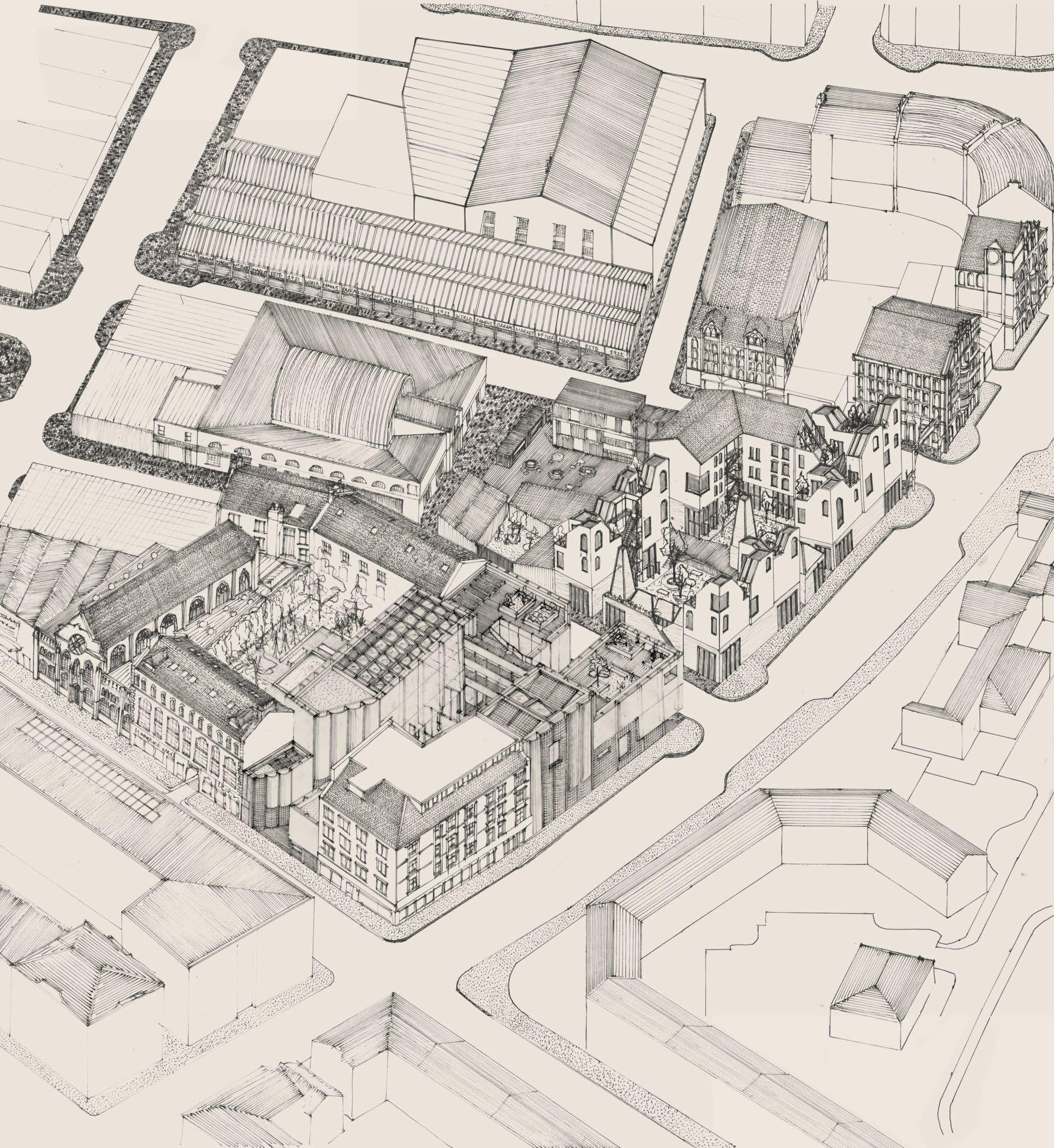
MACMAG 48 {115} STAGE FOUR
The Glowing Network NANCY MARRS
Intertwining food within labour will restore Glasgow as a food and produce market town by increasing its on-site production and exchange of food between its residents, the public and the market stalls/commercial outlets. Both the public and private spaces within the scheme celebrate the rituals of cooking, eating and growing. Recreating a community who grow, eat, and cook together will help build a lively, sustainable, and selfsufficient community on site at the Barras.

This way of living aims to re-instate the historic links to water and agriculture in Calton as well as re-connecting us to the origins of what we consume. Creating a new network based around food production will help re-educate a population on healthier diets during an obesity crisis, reduce plastic waste production during a global plastic pollution crisis and help cut carbon emissions during a climate crisis – all problems which are at tipping point in today’s global society.

MACMAG 48 {116} STAGE FOUR
Calton Climatrium NANCY MARRS
Calton’s Climatorium, consisting of a school and cultural centre, will teach Calton, Glasgow, and the wider country context, the importance of green spaces and urban biodiversity when looking into the climate crisis.


Coronavirus has prompted increasing studies which highlight the lack of green, accessible space within our cities, especially in deprived areas, and its consequential negative impacts on our health and well-being. This building will give the power of regeneration back to the community by educating the users on how to redevelop nearby vacant plots of land to increase urban biodiversity. It will also strive to provide more opportunities for children within the area through outdoor learning spaces which teach a new generation the importance of climate change mitigation.
The programme aims to expand the current climate change education programme for all whilst giving back to the immediate surrounding population by providing a wider range of good quality green spaces which positively impacts their health and wellbeing.
MACMAG 48 {117} STAGE FOUR
Urban Building: A Gallery in the East End
OLIVIA BISSELL
This Gallery in the East End of Glasgow explores the celebration of a culture of art and making in the East End of Glasgow.
Taking influence from other civic exhibition spaces around the city, cultivating an accessible space for the showcasing of local and current art, whilst supporting the archival experience of the historic memory of artistry in the East End. The GIA festival supports the scheme on a nationwide scale, with the building acting as a hub space for this event, as well as the rich artistic heritage of the East End grounding it into its site in the Barras. Although it’s core purpose is in showcasing varied and relevant exhibits from local artists and community projects.
The footprint of the building infills the site amongst a collection of existing buildings, completing the corners of the block whilst maintaining an accessible and permeable facade. Hosting a series of gallery spaces, interweaving lobby spaces, archival rooms on upper levels, a theatre and humble courtyards creating space for the gallery experience to flow into.
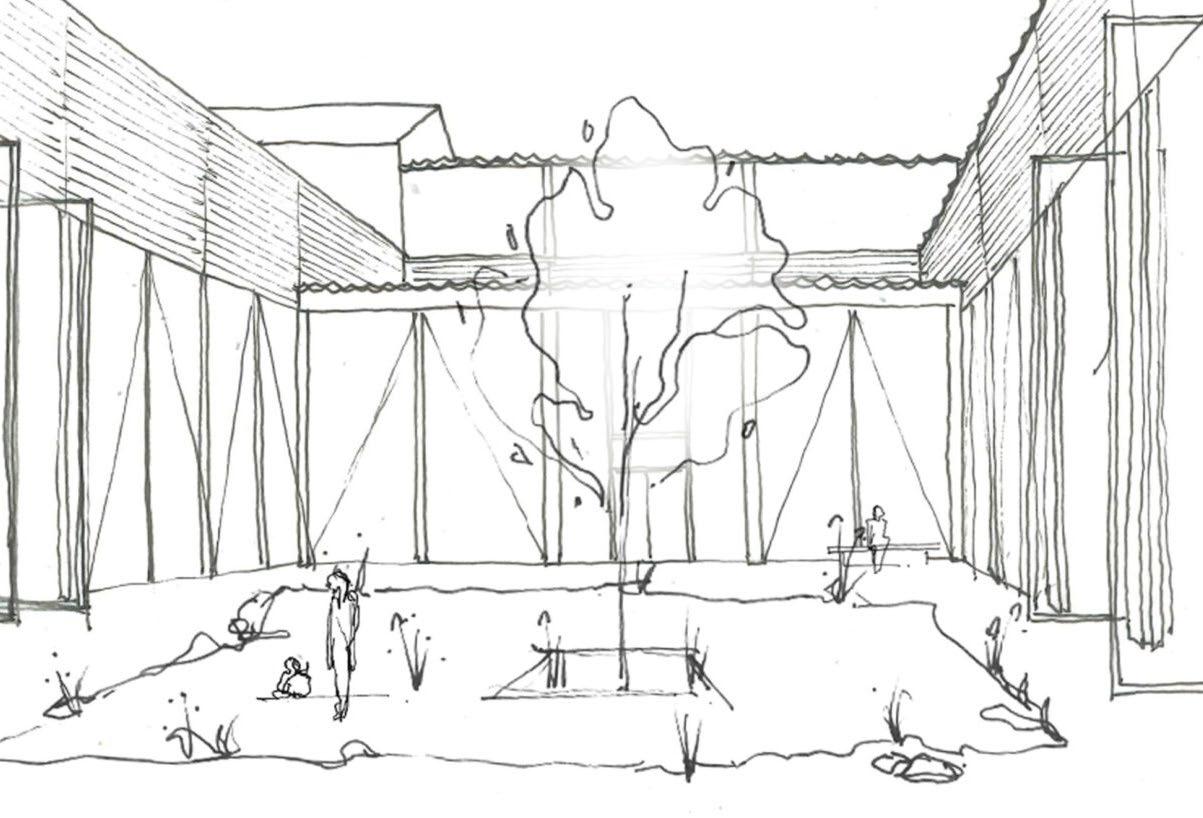


The programme of past and present is echoed in the contrast of lightweight and monolithic structure, and the lightness and darkness of space. Contrasting atmospheres arranged programmatically create a journey through the scheme as inspiring as the experience of the art, media and artefacts displayed within it; with ground floor galleries capturing bright and ethereal space in contrast with the archival and theatre spaces capturing darker, moodier atmospheres.
The scheme’s ethereal and intimate atmospheres contrast with the vibrancy and buzz of the Barra’s Market and music venues, celebrating the beauty the climate has on the built environment.
MACMAG 48 {118} STAGE FOUR


MACMAG 48 {119} STAGE FOUR
The Barras Story Telling Archive' RACHEL CROOKS
The Barras Market in Calton, Glasgow is not just a place for buying and selling. It has become a culture in itself. A microcosm, separate from the centre of Glasgow, where the idea of the civic, of interaction and of story telling is almost more important than the physical aspects of the city itself.
Therefore, in recognition of this and to further my project three thesis which focused on passing knowledge down through the generations I have investigated this exchange of stories that accompanies the exchange of goods at the Barras Market through a proposal for a Barras Story Telling Archive.
This analyses the architectural interface of Performing, Exchanging and Memorialising stories.


The Concrete poetry ‘Archives’ by Edwin Morgan became integral to the concept of my building as the letters of Generation upon Generation, fade out in recognition of a forgetfulness that accompanies story telling by word of mouth. I propose to counteract this through my Barras Archives.
A proximity to Glasgow Green saw the opportunity for a reintegration with the city. Upon tracing this route on an initial site visit, the lack of intent this connection currently has was made obvious at the corner of London Road and Bain Street. This is the first point of contact with the Barras upon emergence from the green, it is disheveled and off putting- making it clear that there is impetus for development here.
The green not only connects the Barras to the city physically but notionally through its centrality to Glasgow’s historic industries at the time of the highland clearances. It therefore layers a cross cultural and recreational story telling back onto the Barras via proximity. This layering of stories and connection to industry underpins the key concepts of my proposal.
MACMAG 48 {120} STAGE FOUR
'


MACMAG 48 {121} STAGE FOUR
'Archive of Lost Glasgow'

 HARRY BAKER
The concept of the brief is structured around opposing the functional city, opposition is asserted because this method of city planning is centered around stripping out the effects of time and regards history as an obstacle to optimisation. However, it is not just for things to be beautiful or for history to be continued but, it’s for them to be possessed of a spark of authentic life and character fullness. Instead, the presence of buildings and even a city, should not be interpreted as an element that appears as such but is understood as a note, record, information or continuity with the existence of aspirations in society. The city is not only seen as the physical artefacts, but also as a representation of human aspirations in time and space. The form of these buildings and the city that persists through time is a product of history and is something accreted over countless generations and infused with presence and sensation of memory. Lost Glasgow is an organisation devoted to the documentation, discussion and appreciation of Glasgow’s changing architecture and its community throughout the last few centuries. Acting as a multi-media, interactive archive ‘Lost Glasgow’ allows its followers to share, discuss and learn from the city’s colourful past through like minded individuals and even the city’s own residents.

MACMAG 48 {122} STAGE FOUR
The Intersection of City and Landscape'
TIM LEWIS
An analysis of the central belt of Scotland reveals that there is an extensive and diverse range of outdoor venues: from rock climbing to mountain biking to cold water swimming. Although it is critical to recognise that access to these venues is considerably harder when relying solely on the use of public transport. The outdoors isn’t open to everyone. There is a cultural and financial deficit in communities like Calton. Opportunities to experience the release of the outdoors simply aren’t available, and furthermore, outdoor spaces within the city are sparse and often without purpose or activity.

I would propose an outdoor centre in the Barras, with follies in outdoor locations within Glasgow and the southwest of Scotland. With the aim to provide opportunities where they would otherwise be unavailable, and develop a greater conversation about the way we inhabit the world. A space for physical exertion, for contemplation and learning, and a place of departure to the outdoors.


The building does not seek to bring the landscape into the city, the two are seen as distinct and inimitable. Instead through the programme, the spatial organisation, and the tectonic language, the project expresses the relationship between the two.
Within the programme, there is a curious juxtaposition between physical activity: climbing walls and skate parks – and learning: a lecture hall, classrooms and library. The two often overlook each other or even occupy the same room. A third significant part of the programme is spaces dedicated to observing the views of the Campsies, Old Kilpatrick Hill, Whitelee Windfarm and on a clear day: the Arrochar Alps.
MACMAG 48 {123} STAGE FOUR
'
Barras Youth Hub' REECE OLIVER
The Barras Youth Hub provides a much-needed respite and opportunity space for the young people of Calton and the Barras. As part of Glasgow City Council’ s ‘Integrated Children Plan’ , the council-funded scheme will offer accessible space for young residents aged between 10-19 years. The hub offers a variety of learning, leisure and performance environments to cover a wide scope of non-curriculum and creative interests the young user group may have, to encourage alternative modes of learning alongside and after their school life.
The Barras Youth Hub provides an open programme of education and activities designed for the purpose of enhancing the personal and social development of young persons through their voluntary participation.


With the lowest average tariff score in Glasgow, there is a clear issue with the education and learning opportunities being provided in the district. Levels of deprivation and child poverty are significantly higher than average, and youth unemployment is the 2nd highest in Glasgow. In comparison to education performance levels in the city of Glasgow, Calton is ranked the worst, having the lowest Key Stage 4 tariff grades by a significant margin. Of those leaving school aged 16, 73% are found to be heading in a ‘positive’ direction, which is also the lowest percentage across Glasgow.

MACMAG 48 {124} STAGE FOUR '
In the Calton Area Partnership Profile, published by Glasgow City Council, the two issues highlighted as a priority were the aid of Vulnerable People and Youth Unemployment. A 2015 survey from the residents of Calton identified ‘the lack of activities at community facilities’ as the main local issue, as well as services for young people and lack of health and wellbeing centres accessible in the area. There is currently no community outlet in Calton which offers the residents any kind of relief from the labours of the domestic environment. Aligning with the Studio theme of ‘Domesticity and Labour’, my thesis explored the ideas of ‘Leisure’, as defined by the philosopher Joffre Dumazadier.
In relation to Dumazadier’s theory, the Barras Youth Hub therefore sets out to establish all four capacities of leisure for the modern youth generation of Calton, as a response to the crucial need for youth support in the district.


‘Imagine a space where reading, performance, lectures, exhibitions, research and learning happily co-exist under one roof and the door is open to everyone. ’
The Barras Youth Hub provides a respite to the labours of living, offering activities defined by all aspects of Joffre Dumazadier’s 4 forms of leisure.
These educational categories have been defined architecturally by four distinct buildings enclosing a publicly accessible courtyard space.

MACMAG 48 {125} STAGE FOUR
The office block as a typology consists of two architectural devices, the façade and the core. A typology of spatial, economic and construction efficiency. Where value is derived per rentable m2. Thus, the architecture of the office block is an architecture of the limit, with one goal, to maximise the space within it’s perimeter. The project seeks to explore the office block as a site for the polis, a physical space contained for discussion and connection. For one evening the office block denies its original economic agenda, its space appropriated as a field in which people move through and interact within. The external facade presents a limit from which a landscape of situations to make connections presents itself.
Within the landscape of situations a table is laid for a meal, the table becomes a spatial catalyst for connection, an object-island in the space-sea.
For one evening a group of creative actors from across Glasgow’s cultural sector came together to share the pinnacle of office cuisine, the sandwich banquet, and connect with friends and strangers to open up a dialogue between artists, architects, producers, designers, and students which seldom exists outside of institutions. With no rigid agenda, chance encounters happened, and conversations across the arts and architecture took place as we all searched for connection.
The conversations were refreshingly centred away from architecture, when architecture did enter into the conversation it did so as the background to a story. A kind of ancillary architecture which enabled galleries, studios and cultural spaces to function, but that was always secondary to the activities and services themselves. The
MACMAG 48 {126} IN SEARCH OF CONNECTION IN SEARCH OF CONNECTION
Thomas Whiting & Fraser Whiting
conversations wandered through individuals’ practices, current work, setting up galleries and managing studio spaces, prospective shows, influences, and cross-overs between institutions and organisations.

All the while, the facade of the office sat silent, a perimeter wall enclosing a space-sea in which people interacted and in doing so, a network was made visible. The evening served to render for a few hours an ecology surrounding part of the cultural scene in Glasgow, in which architecture plays a supporting, but lesser role to the individuals themselves.

MACMAG 48 {127} IN SEARCH OF CONNECTION
Image: Walk-Up Avenue
Craigmillar, Edinburgh
Completed 2022


Photography: Will Scott
London
Manchester
Glasgow
New Practice is an architecture practice.


We exist to develop the creative capacity of cities and to connect people with the decision making processes that underpin the urban experience.
@_newpractice new-practice.co.uk
Kings Building Nucleus, University of Edinburgh
Photography by Keith Hunter
AESTHETICS OF THE OBSCURE
Aesthetic: noun
/iːsˈθetɪk/, /esˈθetɪk/
1. the qualities and ideas in a work of art or literature that relate to beauty and the nature of art
2. aesthetics the branch of philosophy that studies the principles of beauty, especially in art
Aesthetic: adjective
/iːsˈθetɪk/, /esˈθetɪk/
1. connected with beauty and art and the understanding of beautiful things
2. made in an artistic way and beautiful to look at
Define Beauty?
The definitions of Aesthetic(s) as defined by many dictionaries are all related to beauty. On the other hand, in an artistic sense, beauty is often defined by what is not. But ultimately, it is rather meaningless to define beauty or ugliness. It is as unquantifiable as it is ever transforming. Nevertheless, there are also other kinds of beautycontrasting to the beauty in the apparent sense. It is the beauty in the idea of something, in the thought and effort behind its
creation and function, in the stories and time it has stored, in its imperfection and faults, in its unrefined and raw truth, in its potential of becoming something else.
This piece of work looks into these genres of beauty - The Obscure Aesthetics; hidden within the urban spaces of Glasgow City Centre’ s laneways - ignored and not necessarily deemed desirable or paid attention to at all.
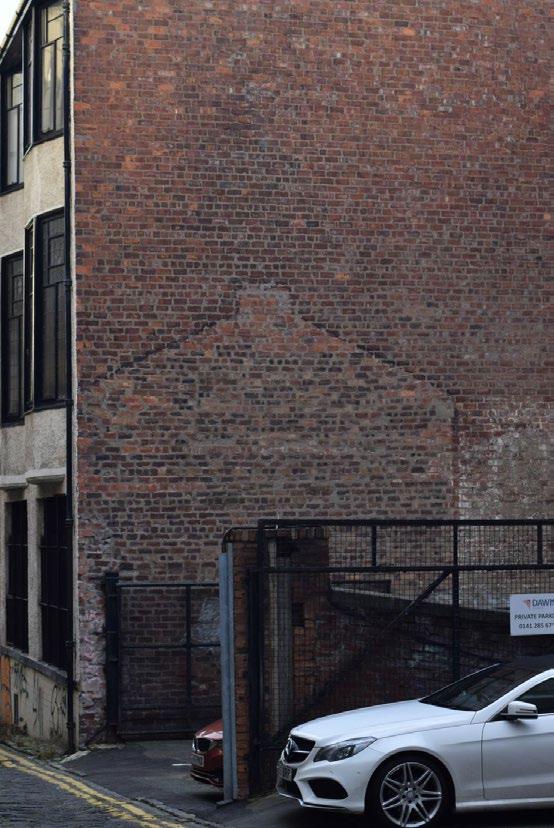
Through the lens of different eyes, photography is used to investigate this alternative way of seeing. It has the ability to present an unprocessed set of information that allows each audience’s attention to independently observe and interpret freely. Photography is a more truthful and less guided way of presenting - especially in the highly curated world of architecture.
The photographic analysis is juxtaposed in parallel to the selected works of three photographers and artists; Thomas Annan, Jonathan Miller, and Chris Leslie.
MACMAG 48 {129} AESTHETICS OF THE OBSCURE
"Photography is a more truthful and less guided way of presentingespecially in the highly curated world of architecture. "
Siripat Rojnirun
Thomas Annan: The Old Closes and Street of Glasgow (1868-1900) Commissioned by The Glasgow City Improvement Trust in 1866, Thomas Annan recorded the old Glasgow before most of it was demolished due to the congested and poor living condition. In the series, the images not only capture the spatial quality of the narrow and dim-lit closes and streets, but also manage to illustrate life within the slum and how the space was used and occupied, reflecting social quality at the time.

Jonathan Miller: Nowhere in Particular (1999) For over 30 years Jonathan Miller has produced photographs of fragments and details of negligible objects in everyday life, bits and pieces of the unusual and overlooked things in the street that caught his eye. The images are closely framed, making it impossible to perceive its context - or meaning. The works attempt no intellectual interests, but represent an opportunity to see ordinary things that might escape our attention in a new intriguing way.
Chris Leslie: Disappearing Glasgow: A Photographic Journey (2016) The works document the infamous demolition of Glasgow’ s tower blocks - once a utopian housing solution to mass demolition between 1960s70s. Behind a desolate and haunting photographic series of ruins and abandoned rooms, the now disappeared legacy and community of the people who once lived there was depicted. Despite the issues of


MACMAG 48 {130} AESTHETICS OF THE OBSCURE

MACMAG 48 {131} AESTHETICS OF THE OBSCURE
a housing solution gone wrong, the nostalgia of a happy home and memories of the residents was expressed and reminisced, along with the hopeful talk and promise for what is to come.
All three works by these photographers are not of what society deems beautiful, but from them - their true condition, their histories - we learn to appreciate the city, the architecture, the community, and its livelihood, particularly the ones that are negligible and precarious or have now disappeared. From them, we are prompted to discern the mirage of the emerging future.
Leading the same thought process in parallel to the above photographic works, the produced photographs of laneways are analysed and curated into three series to highlight the beautiful liminality of the neglected urban space.

1. What it is: Urban Reality
2. What it is not: Abstract Negligibles
3. What it could be: Tracing Future
Urban Reality
In the first instance, the true condition of laneways needs to be depicted and understood as is, revealing what is normally unseen from the public. The spatial quality and the raw experiential aesthetics are captured and presented as unprocessed truth.
Abstract Negligible
In order to develop closer understanding, the negative preconceptions need to be disassociated. By framing the
MACMAG 48 {132} AESTHETICS OF THE OBSCURE
existing mundane, negligible objects into an abstract composition, the produced scenes are detached from its context, along with the negative associations embedded within, enabling the aesthetic quality to be clearer appreciated.
Tracing Future
To accelerate the train of thought into the possible future of laneways, this series tries to shine lights onto traces and marks as the evidence of life and storage of time, in an attempt to unveil the existing connections between its past stories and future potential.

Candidness
The true nature of its aesthetics. The same allure as seeing a person being at ease in the comfort of their own home - unguarded, with no pretence and free of any expectationunseen and hidden but laid bare.
This exploration initially aims to reveal its unseen aesthetics and advocate for its sustainable potential for future urban development. In spite of this, the work remains as subjective as the idea of beauty and ugliness itself.
However, these series of photographs have captured moments that ultimately exhibit architecture in a way that other forms of representation might not be able to - candidly. Throughout the photographic process as a photographer, an archivist, an urban planner or an architectural artist - layers of life and urban interactions are witnessed as palimpsest in the weathered bricks, cracked walls or marks on the ground. The obscure aesthetics of laneways are, hence, revealed. Neither positive nor negative, but it takes the audience in and sparks sensibility that puts in motion the fantasy of beautiful possibilities.
MACMAG 48 {133} AESTHETICS OF THE OBSCURE
FROM THE EXTERIOR TO THE INTERIOR
In conversation with Architect / Interior Designer, Marco Emilio di Mario
Marco Emilio di Mario: qualified as an Architect (trained at the Mack) now works as an Interior Designer and teaches at the Glasgow School of Art's School of Interior Design.
Marco has an in-depth level of work experience for someone of his age, spanning three different countries: Scotland (Glasgow), England (London) and Italy (Rome and Milan). Within the Creative Allies context of MACMAG 48, Marco has worked within various interlinked sectors including Architecture, Interior Design, Theatre Set Design and marketing cosmetics. He has also worked in a freelance capacity for private clients.
MACMAG: Hi Marco, could you tell us a little bit about yourself?
Marco Emilio di Mario): I am Italian-Scottish and grew up in Glasgow. My family are all from Rome and I studied at GSA for five years. I did my Part 1, worked in practice for a couple of years and then came back to GSA to do Part 2. After graduating, I moved into a variety of different things and ended up focusing on Interior Design as my main career path, and that's what I have been doing for the last 10 or 11 years. I
returned to GSA four months ago to undertake a position as a tutor.
MM: Could you tell us about your process of transitioning from one role to another?
MEM: It was quite natural. A lot of the time it was purely circumstantial that I ended up working on projects in those fields. I think that modelling part time for quite a number of years, whilst studying, ended up being quite influential in the path that I took. It really helped me to
MACMAG 48 {134} FROM THE EXTERIOR TO THE INTERIOR
develop an interest in fashion, in the industry and that culture. Of course, one of the main places where all of that happens is Milan, and that is where I ended up moving to and then getting into Interior Design.
In terms of the freelance work, whether that has been theatre set design or marketing for cosmetic companies, that was also quite natural because the education I received at GSA taught me to be very versatile, and taught me a wide range of skills, which I was able to then apply in various contexts. With the type of work that I was doing at The Mackintosh School of Architecture for my fourth and fifth year projects, there was a big focus on imagery and telling the story of your projects. With that you become very proficient in programmes like Photoshop, InDesign and Illustrator. These can then be used and applied to other sectors, which is how I ended up doing some work with Cult Beauty many years ago, working with their marketing team to prepare images for the relaunch of their website.
MM: What influence, if any, did studying Architecture have on your career? In particular at GSA?
MEM: I would say that GSA, as a school, prepares you for that kind of versatility. I remember thinking that at the time. Sometimes the review formats, that GSA is quite well known for, could be really brutal, but looking back now, it really made me realise that it was preparing me for going out into the real world. I think whenever you are educated in that way and when there is a big focus on
you presenting your work and standing there as people either praise it or tear it to shreds makes you tough. It makes you prepared to go out there and deal with different types of situations. I think that is one of the most valuable things that I learned at the Mack because it allows you to sell yourself; not just in architecture, but in various other related fields.
MM: You mentioned working in Italy. What were the differences in work culture in the different countries you’ve worked in?
MEM: The working culture in Italy is very different, in some ways for the better, in many ways, its worse. I think that what has been really interesting for me is to really experience the “made in Italy” culture. We collaborate with so many artisans and smaller skill manufacturers and carpenters that still work with their hands, and have been working in that way for hundreds of years. Whereas, in countries like the UK, Ireland, Scotland, and the US because of the economic changes that have taken place in these countries over the last 50 years many of these skills have died out.
MM: So, you are saying there was more focus on traditional skills over production linestradition versus industry?
MEM: Exactly, I think that there is a sort of mass production of many components now in interior design and architecture as well. It is quite prevalent in northern European countries and in the US. I feel as though in Italy it is something that
we have managed to keep at bay, and we do focus on the traditional craftsman artisan way of working. I would argue that it leads to a much stronger collaborative team. I think it is something that is still very much in demand from clients, hence why we are commissioned to work all over the world.
MM: Having been to Italy a few times, it is something that you feel within the culture itself. The idea of things being done a certain way and respecting that tradition. Would you say that you have found that Italy has more of a collaborative mindset than you have seen in the UK?
MEM: Not necessarily a more collaborative mindset but I think it is a more collaborative process. In my experience working with English clients, people are very much in their roles. They are not willing to step out of that role, whereas I think in Italy because of the way in which we develop a project, we require the collaboration and input from the carpenters, the artisans, the lighting designer, or even the 80 year old furniture restorer. We recognise their value, and that is why it becomes a team effort. We are obviously in charge of the concept, but we need these skilled workers and artisans to help realise our concept for us. I think that in the UK there is maybe less crossover and the rules are very defined. I would argue people are maybe a bit afraid to step outside of that.
MM: Was it difficult to transition back to working in the UK?
MACMAG 48 {135} FROM THE EXTERIOR TO THE INTERIOR
MEM: Well it has been four months, so it has been fairly recent. Obviously I am in Glasgow and in a teaching capacity for the moment. Myself and my business partner launched our own studio last year, called House of Belvedere. We have a couple of projects in London, but again we are following that same format. We are using an Italian millworker, we are sourcing a lot of our pieces in Italy and it is really about us bringing that “made in Italy” brand to other parts of the world.
In terms of the transition, it has been fine. I have been really enjoying working here again over the last couple of months. One thing I will say about Northern Europe, in a working context, is the efficiency. It is fantastic compared to other southern European countries, the efficiency is really great here. I feel as though there is a lack of excess bureaucracy here, which in Italy can sometimes hinder projects and really slows things down, and so that has been a quite enjoyable aspect of working here again. Things just seem to be done a lot more quickly.
MM: How would you say your range of experiences in modelling and designing have influenced you as a designer, as a teacher or even as a person?

MEM: I think that my design style is quite eclectic, which might be a reflection of having had quite an eclectic career over the last 10 or 11 years. It has given me a stamina and an ability to work with clients and sites all over the world and to deal with difficult situations because I have moved around and learned a lot over the last decade. It has influenced me, making me quite a strong character, and I think a lot of people that are close to me would describe me like that

MACMAG 48 {136} FROM THE EXTERIOR TO THE INTERIOR
as well. I am not the kind of person that gives up or throws the towel in.
MM: Would you say it is also a self-confidence thing as well, that you know you can do it because of your experience?
MEM: Yes, but again I would have to thank GSA for having taught me about selling yourself and really standing up for your design and for the work that you are putting up on the wall. Something that I have been really urging my Master of Interior Design students to do is to really get involved in the review process, not to just sit there staring at the floor when their colleagues are presenting their work because the studios are a safe space. You know you are not going to get fired from your degree or find yourself in a really difficult situation, so I think in that sense I really urge all of them to use that process, and to do so in this space as it is a really great opportunity to hone these skills, to become a good communicator and to become good at selling your concept, your brand and your design.
MM: Was it ever your plan to be working in education, in particular in interior design?
MEM: I was keen to pursue the path of interior design because I feel as though some of the creativity from architecture is becoming lost. Architects now have got so many different stipulations that they have to follow that there is less creative control over a project. Some of those restrictions do exist in Interior Design but I do not feel as though it is to as great an extent. I feel as though you have got much more creative freedom working in

MACMAG 48 {137} FROM THE EXTERIOR TO THE INTERIOR

MACMAG 48 {138} FROM THE EXTERIOR TO THE INTERIOR
the world of Interior Design as opposed to Architecture.
I ended up teaching in Interior Design rather than in an Architecture school because I very much identify as being an Interior Designer now, rather than being an architect. Whilst I did my five years of architecture at GSA, it has not been my job title over the last number of years, so this is very much the profession I identify with. I would not ever rule out working in an architecture school because I think that there is a lot of crossover. One thing that I would be keen to see would be more collaboration between Interior Design and Architecture students in various schools. I know there has been some collaboration at GSA in the past.
MM: How does it feel coming back to GSA after 11 years?
MEM: It has been very different, the building that we are sitting in now did not exist. Obviously, the fire in the Mackintosh building was major. In subsequent visits after the fire, I did not ever come anywhere near Garnethill because I could not bear to even walk past it. On my first day here in a tutoring capacity, I was being given a tour around the Reid Building. Having avoided seeing the kind of charred, blackened scaffolding covered remains I was suddenly been led through the building, and having it right in my face.
In some respects I think it feels a bit like a homecoming. I started at GSA when I was only 17 years old, so I did a lot of my growing up in this school. It has been a really positive experience so far.
I have been really enjoying it.
MM: Our edition is titled “Creative Allies”, in your opinion, do you think architecture is becoming more interdisciplinary?
MEM: That is quite a tough one to answer. In certain situations, I would say no - in others I would say yes. That is purely based on my career experience so far. Within a lot of our projects, especially the ones that we undertook abroad, we would have a local architect in place that would oversee the site when we could not be there, and some of these local architects would also have their own design practices with their own concepts, proposals and their own visions. In that sense I would say yes, it is becoming more interdisciplinary, the architects that I have been in contact with and worked with over the years have got this kind of vision of their own studio I suppose, but then also have the project management side of things that they would do on our behalf. So, in that context I would say yes.
MM: Then would you say that Interior Design is becoming more interdisciplinary in comparison?
MEM: I would say that Interior Design has become more interdisciplinary compared to architecture, and the reason that I am saying that is because I think within Interior Design you have now got a whole host of different genres. I am aware that obviously certain architects will also design certain typologies of buildings but I think Interior Design is being pushed more
into embracing technology, social media, and virtual reality in a way that architecture is not. Because of that, we need to be more on our toes in order to satisfy. This is purely my experience, but I think that clients of architecture would not really expect to put on a VR headset and go for a tour around their building, I may be wrong about that. Whereas, increasingly with Interior Design clients they want to put on a VR headset and walk around what is going to be their brand's boutique, hotel, restaurant or home.
MM: Would you say the new technologies such as VR and renderings, that are getting better, are pushing people to be more creative? Do you think technology is a tool towards more creative practice?
MEM: I would argue that it is actually going to hinder creativity because I think the expectation from clients now is moving more and more towards a photographic type render. That is what they expect. Designers might be less daring, because it could be more important to have the photographic render which the client expects, as opposed to a client seeing a rendering and going: “what on earth is that?”
One thing that I really advocate, and I am a bit of an old soul and a bit old fashioned, but I really advocate the use of more traditional methods. With any projects that I am doing we still work a lot of the time using watercolours, which I think is a really important tool. I think that with watercolour you are not going to have the realism
MACMAG 48 {139} FROM THE EXTERIOR TO THE INTERIOR
necessarily of a render, but you are going to have the atmosphere and soul which you might not necessarily have otherwise. I also believe that it gives you more creative license when looking at the design of a space or of a building for that matter as well.


MM: What advice would you give to students that are doing architecture or another course that doesn’t necessarily fulfil enough of their creative purpose in practice?
MEM: Especially in the last couple of years of my education, and I think I speak for everybody when I say at times, as we all do, you can feel a bit disillusioned from a process. I think with architecture education in particular, it is a long process and a lot of the time you can really doubt whether or not you are doing the right thing. Ultimately my advice to my younger self and to anybody that is at that point in their education, is to persevere and to really embrace the aspects of the education at the Glasgow School of Art. Things like the studio culture, the review culture as well, they are so important because they teach you life skills that are invaluable whenever you are out there working in practice and because it is a creative degree, I think you are able to use those skills and apply them in a whole host of different situations Even if you do not graduate and go into a studio, because a lot of people including myself, do
not go down that path, you can still end up with some really interesting experiences that you might not have imagined having at the start of your study.
MM: As you have experienced the school from both a student and staff perspective, do you think that there is enough exchange or alliances being formed within GSA as an art school and in particular, between the art and the architecture students?
MEM: It is one thing that I would like to see more of, especially across the different schools. The biggest difference that I have noticed in the School of Design is that it is really fantastic for these cross collaborations. I have only been here for four months and I have already seen the School of Design organise workshops with people in practice, with developers that are undertaking major projects in Central Glasgow. So many of the electives and workshops are attended by not only interior design students, but students from fashion, textiles and silversmithing.
@houseofbelvedere / www.houseofbelvedere.com
MACMAG 48 {140} FROM THE EXTERIOR TO THE INTERIOR

MACMAG 48 {141} FROM THE EXTERIOR TO THE INTERIOR
• BCO National Innovation Award
• Glasgow’s first Net Zero Carbon office building


• BREEAM Excellent
• EPC A
• AirScore Gold
• WiredScore Platinum
• Scotland’s highest ever ActiveScore rating
Cooper Cromar has a long history and deep respect for the Mackintosh School of Architecture as many of our staff including Directors Graham Forsyth and Steven Carroll are former graduates.
We are proud to sponsor MacMag 48. We are looking for talented Part I and Part II’s to join our award-winning team.
Please send a covering letter, CV and condensed portfolio to recruitment @coopercromar.com
MACMAG 48 {142}


MACMAG 48 {143} STAGE FIVE

Miranda Webster
Jonny Fisher
Tutors
Stacey Philips
Tom Woodcock
Graeme Massie
Charlie Sutherland
Finding meaningful architectural expression which harnesses anticipated change is one of the most creative challenges of any urban architecture, one which is truly relevant to the planet, place, purpose and people. The final year of architectural education is a chance to determine for the students as to what constitutes an Ethical City.
Glasgow offers a rich political, economic, historical, cultural and environmental framework from which to examine its International and metropolitan relationships as well as the everyday life of the city.
Implicit in the Design Thesis lies the evidencing of its impact on the urban environment. The form it takes, the spaces it creates and the character it assumes are to be critically informed by the geographic, topographic and climatic situations as well as the prevailing cultural, political, economic and social circumstances previously noted. Through a city investigation task at the start of the academic year, the students sifted through these complexities in the search and the opening up of architecturally related opportunities within the fabric of Glasgow.
The Design Thesis is a self-
STAGE FIVE
directed piece of work and provides an opportunity to define an individual ethical standpoint and to pursue and find expression for personal architectural interests and preoccupations. Students are expected to regularly bring together an iterative series of exploratory drawings, models and digital representations that objectively test the relative value of an architectural idea from a critical standpoint.
The resultant Design Thesis are intellectually adventurous, imaginative, intrinsically compelling and thought provoking. They each offer some form of commentary which expands upon aspects of contemporary architectural theory and debate, and, of course, issues of ethics in design.
The academic year was about Glasgow's future, and the future of the people who live here. What does the city need, what do people need from their city, how ought the future to be?
Climate change is happening. Glasgow needs to act. As architects, we need to act. What can we offer? What can the architect and urbanist bring to the table? What are our solutions?
MACMAG 48 {145} STAGE FIVE
Stage Leader
Co-Pilot
Student works featured in this segment are from 2021/ 2022
Remnants of a Vernacular CHARLES DUNN
Taking existing patterns of both urban and cognitive fragmentation, the thesis seeks to repackage these in a newly conceived architectural proposition; instead considering industrial infrastructure and the non place as artefacts within the city – the non place becomes a place with the ability to evoke and engage.


The architectural approach takes phenomenology and the poetic image as a starting point to engage with both the intimate and collective memory within the city while also interrogating this in its current form.
The thesis proposes an architecture which works to engage with the distinct tectonics of the landscape, spatial qualities of the River Kelvin and character of those remaining remnants in order to engage with both the intimate and collective poetic image, thus creating a repository of collective memory in the city.
The proposition of a hybrid typology; a museum of industry with a direct air capture plant, seeks to reshape our conception of production and industry and instead present an architectural offering which is to be celebrated and which demonstrates a thriving urban coexistence with productive, functional architecture.
A locus within the city, the museum sits at the intersection of numerous key routes while exploiting the polarity of a striking vertical landscape, both natural and built. Mindful of this, the architecture references the spatial conditions present along the river; exploring notions of constraint, enclosure, expanse and threshold to construct an interior landscape and tectonic approach which speaks of the environment it finds itself in, punctuating the visitor experience.

MACMAG 48 {146} STAGE FIVE


MACMAG 48 {147} STAGE FIVE

MACMAG 48 {148} STAGE FIVE
Nature and human society are generally regarded as separate entities. We sit in a manmade room and look at a photo of nature that is somewhere else. We take a walk into nature, and ‘leave the manmade behind’, even if that walk is through a reservoir or park. But nature is not independent from us, and the notion that we are absolves us from our responsibility of the current climate crisis. This project seeks to navigate this ‘post-natural world’ and explore the spatial and visual conventions through which we relate to nature.
This project seeks to “explode” the program of the museum out and so draw the visitor out into the lanwdscape to experience it more directly. The brick for the proposal is taken from the existing museum (the old hydroelectric power station) which is very large and mostly unused.


MACMAG 48 {149} STAGE FIVE The Folies
EMILY DAN


MACMAG 48 {150} STAGE FIVE

MACMAG 48 {151} STAGE FIVE
'Let Water Flourish' ERYN McQUILLAN
The design for a Museum of the Clyde challenges how Glasgow, a city shaped in many ways by the river, accommodates water in the built environment and the existing dichotomy between wet and dry landscapes.

Contemporary architecture often battles to keep water out, resisting the elements and time through hard, impermeable surfaces and “waterproofing”. In contrast, Scotland’s traditional architecture accepted the process of weathering, utilising porous materials and crafted weathering details.
Traditional detailing, exhibited in the collection of existing buildings retained for permanent museum collections, is used as a lens to reconsider contemporary relationships between water and the built environment.
Water in the form of both river and rainfall is celebrated through the design of the riverfront interventions which includes temporal gallery spaces, a sculpture garden and reinstated saltmarsh landscape. The river links old and new via an excavated canal running below the busy thoroughfare which currently disconnects the city from the Clyde.
The design emphasises the phenomenological experience of water in an urban context, highlighting the power that the weather and climate has on the built environment.

MACMAG 48 {152} STAGE FIVE


MACMAG 48 {153} STAGE FIVE
Climate
The thesis is a reflective statement about the approaches we take towards rising sea levels –is it pushing the water away like we always used to, or is it inviting water into cities, adapting and learning to live in coexistence with the future of wetness? Criticizing and reflecting on the current condition in which the rich pay to escape and build shelters, while the vulnerable are left to fight for themselves, the thesis speculates a new relationship with the rising water body, meandering through possibilities of using architecture as an expression of adaptation to the extreme consequences of climate change while simultaneously promoting equity by working to protect the most severely impacted communities in Glasgow. While it sets out practical design approaches, the thesis is not a technical manual but an ambition to change the way people perceive climate change, climate justice and to emphasize the urgency of taking actions to combat global warming now.
The project timeline is set in a hypothetical near-future scenario of 2050-2100. Drawing on climate change and climate inequalities, The Climate Apartheid – A Tale of Two Cities tells a cautionary tale of two cities divided by a wall which was erected by the historically wealthy communities residing on the northern banks of the river Clyde, to protect and keep themselves dry from the rising flood. The construction of the wall has led to a destructive flooding on the southern banks of the river which is home to the 10% most deprived communities of Glasgow.

Upon constructing the fortress of dryness, the rich continue to burn and pollute, carrying on with their old ways of trashing the earth looking down on the other side of the Wall. The flooded communities started an elevated layer of city network above water, an approach to discover a new relationship of coexisting with climate change, working with the resources that they had. Initially built as a protestant response to the erection of the wall, the floating city is an ever expanding and organically growing piece of fabric to counter-address the outcomes of climate inequality. It is an idea laboratory to encourage the shift from being consumers of water to become stewards of water.

MACMAG 48 {154} STAGE FIVE '
The
Apartheid' JUNE GOH
What if we harnessed the extremeties of the weather and farmed it into resources?
What if we realize a new relationship with water, using water as a healer, water as an equalizer, water as connection, water as religion, water as celebration? Water is an agent of transformation, of fluctuations. Water rejects lines – the edge of water is always gradation of moisture, rising and falling to the daily tidal rhythms.
The proposal seeks to embrace new ideas and technologies to transform our increasingly dense and climate-stressed cities to become both more resilient and more of an acceptable condition to live in.


The Tale of Two Cities explores the ambiguity of every day life between living behind the Wall on dry protected land versus the precariousness of living on the floating grid. The project uses water as a patching, healing and connecting tool between dry and wet, ground and river, and attempts to reimage the fluid margin of the city where sociological density meets hydrological intensity. Portrayed through a progression of futuristic timeline, the Two Cities undergo degradation, adaptation and finally rebirth, as the beginnings of the new hydro-age Glasgow. How can Glasgow utilise the extreme weather conditions and use it to its advantage, to channel it into fuelling a utopian city in a dystopian future?

MACMAG 48 {155} STAGE FIVE
KARLIS KUKAINIS
Supported by the research on the superior environmental benefits of quality reuse this thesis explores a renovation strategy of a problematic and vacant mid-20th century building estate of Yorkhill Hospital in Glasgow through testing the limits of different reuse practices of reclaimed materials from demolished modern buildings nearby. It addresses numerous issues faced by many similar estates around Europe – the high cost of renovation and maintenance, unpopularity and tainted collective memory, inefficient floor planning not fitting contemporary requirements, unattractive aesthetics, secluded urban placemaking, poor detailing and energy efficiency. Careful programming is used to explore creative reuse methods on 2 scales – large commercial and community use redevelopment models. Reuse and preservation methods of the catalogued reclaimed materials are utilized to inform the building’s programme as well as the architecture itself by proposing a 20thcentury heritage and reuse institute (‘‘Landfill’’), public workshop, affordable rent studios and commercial spaces and an innovation centre.
The proposal seeks to foster reuse practices in Glasgow and Scotland and becomes an architectural manifestation of reuse itself by embracing imperfect materials over immaculate surfaces and challenging the public’s view of decay as a sign of sustainability through longevity. The institute explores larger-scale reuse practices for a commercial setting, while the smaller community use proposal explores a less profitable, but more accessible long-term scenario. It involves local communities to promote the reuse of 20thcentury heritage, bringing awareness of the environmental benefits of high-quality renovation and creating an exemplary long-term sustainable ownership model for other problematic vacant buildings.


MACMAG 48 {156} STAGE FIVE
'Finding sustainability in problematic mid-20th century heritage'


MACMAG 48 {157} STAGE FIVE
JOE SAMPEY
Exploitation of the Earth and the environment has occurred since humans first walked the Earth and are now at levels never before seen. The adverse affects of these goals is the damage on the environment, and the removal of humans from planetary systems which is threatening the species and systems in place as well as our presence on the Earth. A massive upheaval in the collective understanding of our connection with the Earth is needed in order to reverse the damage created by humans on the world. Architecture has its role to play in this reversal, as not only one of the biggest contributors to global emissions, but also changing perceptions of life within the environment.
The aim is to create a way of doing architecture which challenges the current anthropocentric view, to focus on the environment as a finite entity and a system of relationships. This way of making architecture is predicated on aims of gentle, caring and conscientious construction, and an architecture that focuses on the needs of animals, flora and fauna, and humans in a connected balance. An architecture that is open to the variations of seasons and climate, of the night and day transitions, of the relationship with the ground and the intricate systems of soils, roots and ecology, of the sky, clouds and all natural phenomena.

The project hopes to expand what architecture means and achieves. A line of trees, rows of stone walls, enclosed spaces for non-human activities, growing spaces for trees and plants, and buildings for human inhabitation are all treated as equal in an Earthly Architecture.
The thesis project was developed through an exchange in Mendrisio, Switzerland and Glasgow School of Art

MACMAG 48 {158} STAGE FIVE 'Above/ Below'


MACMAG 48 {159} STAGE FIVE
'Performance of Craft' TOM ASHURST
This thesis aims to find a connection between craft and performance. How can craft become a performance?
Modern construction no longer relies so heavily on local material resources. Timber being the focus of this thesis. It’ s being looked upon as a renewable material that could replace the high emissions materials such as steel. However, timber is of course not instantly renewable. It takes time to grow and mature to suitable harvesting size, and currently forests are disappearing quicker than they are appearing. Therefore, timber is not entirely sustainable unless we slow down and use only what we have, not reaching out across the globe and importing for convenience. How can architecture be designed alongside the cycle of a tree? A naturally slow architecture.

Glasgow was an industrial revolution powerhouse. The city exporting skilled work people, and material. Explosive expansion of industry required extraction from nature to power and grow itself further and as it grew, mass production became a necessity which began the downturn of traditional building techniques and materials.
This theme of continual renewal lends itself to a temporary architecture. Assembly and disassembly. Glasgow’ s is constantly changing yet the buildings were designed with permanence in mind. Designing in an ephemeral way could reduce the number of redundant buildings that have outlived their purpose.
Overall, this thesis aims to explore how to utilise locally resourced timber, providing a programme that facilitates both craft and performance to make a spectacle of construction and inspire the city of Glasgow to build using sustainable materials and give the public an insight to timber craftsmanship.

MACMAG 48 {160} STAGE FIVE


MACMAG 48 {161} STAGE FIVE

Stage Leader
Isabel Deakin
Tutors
Sally Stewart
Chris Platt
Graeme Massie
ARCHITECTURAL STUDIES
The Master of Architectural Studies course gives students a unique opportunity after the completion of their Diploma to extend their design, organisational and research skills after gaining exemption from the ARB Part II accreditation.
The course is set within a rigorous creative studio environment and allows students to explore architectural concepts and methods by extending the study of an aspect of their self-directed Final Design Thesis or an aspect of their Architectural Technology five or Professional Studies
five course to produce work at a postgraduate level.
The course runs through one semester for full time students or two semesters for part time students and provides students with freedom to be develop creative outputs, focusing either on a written output or a design output.
This space and a focused approach have opened up many opportunities to students to consider alternative futures within the field of architecture.
MACMAG 48 {163} ARCHITECTURAL STUDIES
Student works featured in this segment are from 2021/ 2022
A Horizon of Possibility: The ImageArchitecture of Mies van der Rohe and Beyond
 CARL C.Z. JONSSON
TThrough writing and image-making, the particular legacy of Mies van der Rohe concerning his approach to the architectural image is analysed, situating a selection of his collages and associated imagery alongside those of the contemporary Belgian practice Office KGDVS.

The title of the project, borrowed from queer theorist David M. Halperin, presents the conceptual guideline of the horizon, which explains the potency within a Miesian image as providing an architecture native to the page, and independent from its built counterpart, if there is one. This built counterpart, in turn, may have its own architecture reappraised, due to the new understandings of experience or formal language an image, be it a collage or a photograph, reveals of the subject matter. This interchangeability between image and material reality, what can be called an “image-architecture”, applies just as much to the work of Office KGDVS, giving us an opportunity to critically revisit the functionings of Mies’ architecture in the 21st centurythe city's nutritional needs.

MACMAG 48 {164} ARCHITECTURAL STUDIES
Fixing Societal Issues
HELENA WAGG
For the Masters by Conversion I produced a series of articles, exploring some of the most prevalent issues facing society today, and some of the ways that space and place can potentially provide some solutions to help ease these issues.
Through this research project I found a greater understanding of the reasons for these issues and the impact they have on society, and I was able to question the role that architecture has within the sphere of “fixing” societal issues, and to what extent it can even do this.
The articles reflect on the ways that people currently come together and how these experiences aren’t currently enough to sustain the level of social bonding and ties that we need, how place can provide a sense of belonging, giving people an attachment to place and tying them to localised community, and how space can provide certain opportunities and affordances for forming social bonds.
While there are many other agencies that are relevant in assisting the easing of these issues facing our society, this project has allowed me to explore some of the ways architecture can assist with this, through facilitating the forming of social bonds and attachments, and the creation of sense of belonging to place.
See right: Scan to open a collection of articles by Helena Wagg.
gather here. bond here. belong here.
MACMAG 48 {165} ARCHITECTURAL STUDIES
Rammed Earth IMRAAN SMITH
My project looked at my Final Design thesis of stage 5 on how the building will be realistically constructed with Rammed Earth. I researched various case studies to demonstrate an adequate amount of resource and information into various construction techniques that are used in today’s era. Precedents like the CAT building, Ricola Herb Centre and the Narbo Via History Museum. Techniques that relate to the context of the building’ s scale, typology, and environmental climate. Using the research from these case studies, I implemented the most effective techniques together to create a Structurally Insulated Rammed Earth Panel, showing how it will be constructed off site and transported. The project also covered how the building would have to be amended to make it work, adjusting the walls openings and size for the standardisation of panel sizes; reducing the amount of earth required with internal timber frame kit, and how the panels connect to a timber façade frame.


MACMAG 48 {166} ARCHITECTURAL STUDIES

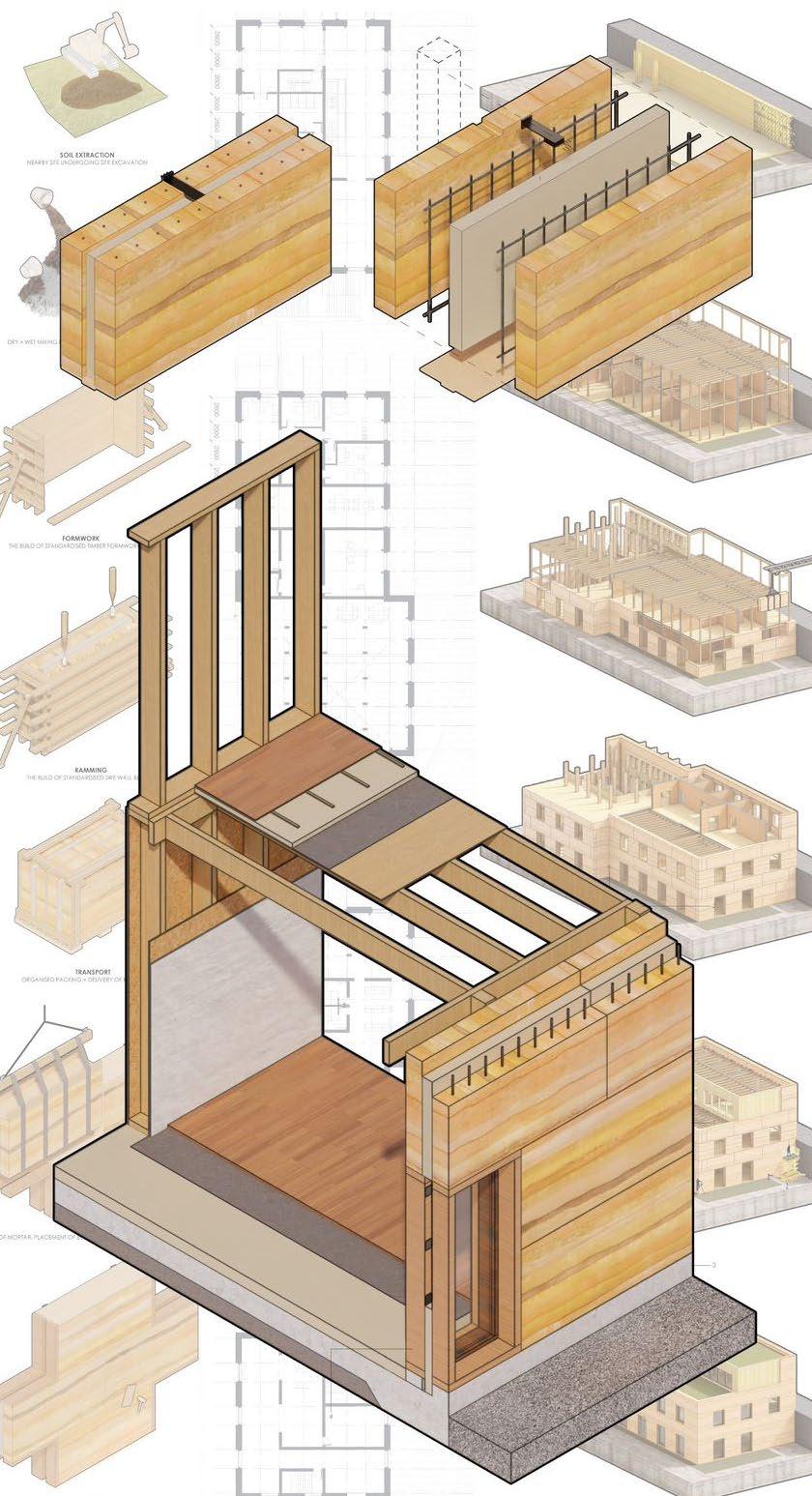
MACMAG 48 {167} ARCHITECTURAL STUDIES
Pedestrian Priority
ISLA ROBINSON
This thesis aims to find a connection between craft and performance. How can craft become a performance?


Modern construction no longer relies so heavily on local material resources. Timber being the focus of this thesis. It’s being looked upon as a renewable material that could replace the high emissions materials such as steel. However, timber is of course not instantly renewable. It takes time to grow and mature to suitable harvesting size, and currently forests are disappearing quicker than they are appearing. Therefore, timber is not entirely sustainable unless we slow down and use only what we have, not reaching out across the globe and importing for convenience. How can architecture be designed alongside the cycle of a tree? A naturally slow architecture.
Glasgow was an industrial revolution powerhouse. The city exporting skilled work people, and material. Explosive expansion of industry required extraction from nature to power and grow itself further and as it grew, mass production became a necessity which began the downturn of traditional building techniques and materials.
Timber and skill go hand in hand. This project also aims to encourage the continuation of the passage of traditional timber construction knowledge by creating a programme that requires continual renewal, just like a forest cycle through the life and death of its trees.

MACMAG 48 {168} ARCHITECTURAL STUDIES

MACMAG 48 {169} ARCHITECTURAL STUDIES
EQUALLY GENEROUS: AN EPILOGUE
‘Creative Allies’ is an astute and timely theme for the type of exposition of architectural culture that we see in annual iterations of the MacMag. It’s a modest theme, yet both broadly descriptive and gently proscriptive. And that forthright, outspoken tone of those two latter qualities sits in lively and dynamic tension with the quiet determined tone of the former.
The notion of ‘Allies’ itself has had a rebirth for our epoch. Time has shorn it of its mid-20th century associations with the military and geopolitical power (WWII !), and it comes to us now redolent of humane support, the communal, the collaborative, the joint effort, the selfless help and the gift.
And that’s where the modesty comes in. No-one refers to architecture nowadays as ‘The Mother of all the Arts’ – Why would you? Quite apart from that sexist
objectification of woman there, the daft idea, in this day of diversity, globalisation, intersectionality and multiculturalism, that architecture could stand as a matriarch, at the peak of some hierarchy, towering over a brood of minors, of less mature arts, is more laughable than despicable.
This year alone I’ve received research projects ranging from designing a space to host the micropolitics of communal eating in a retrofitted community facility, to a spatial study of the evolution of a queer venue on a tough street in the medieval heart of the city. That’s only a snapshot of the welcome broadening of contemporary concerns in the school oeuvre, and with that expansion of concern comes a new texture of sensitivity in the modes and approaches of the art and discipline of architecture, and a plasticity to its reach and receptivity.
MACMAG 48 {170} EPILOGUE
Johnny Rodger
Thus, the probing, at length in this issue of MacMag, of the ethico-aesthetics of how an architectural education has informed the further successful fine art career of Will Knight; the work in ceramics of Nancy Marrs; and the international interior design trajectory of Marco Emilio di Mario. Coupled with the engagements by year and tutor in questions of
sustainability, environment, conservation, performance and social engagement, it all sets out an ad-hoc territory, like the Barras Market, which is improvised, open, incorporated in the everyday urban texture, receptive, humane and ready above all, for regular exchange. It’s only such an ambitious, frank and generous self-reflection on the scope of architecture in its
engagements, as we see here, that can reveal strengths and limits, and open up to equally generous, understanding and promising engagements from creative allies.

MACMAG 48 {171} EPILOGUE
Credit: Ewan Brown


Cooper Cromar
Foster + Partners
HLM Architects

Hoskins Architects
House of Belvedere
jmarchitects
MAST Architects
McGinlay Bell
Narro
New Practice
Page\Park Architects
Sheppard Robson
Squire and Partners
Studio KAP Architects

Printed by Pureprint Group Thank you to Derek Fulton Printed by Pureprint Group Paper kindly supplied by Fedrigoni Papers
48 Ed. EWAN BROWN FELICTY PIKE LUCY FAIRBROTHER YAN PRZYBYSZEWSKI
