THE FUTURE OF CLEANING IS TODAY WITH HAKO Innovative solution specialist for Cleaning & Municipal Technology DIRECTORY INSIDE September 14-15 DELIVERING SUSTAINABLE HYGIENE INFORMATION www.incleanmag.com.au September / October 2022


H576-22E&OE LIMITED W ARRANTY* YEAR *Makita.com.au/MyMakita for details, terms & conditions Makita 5 year limited warranty on new cordless skins* REGISTER YOUR TOOLS FOR EXTRAWITHOUTPOWERPROTECTIONLIMITS


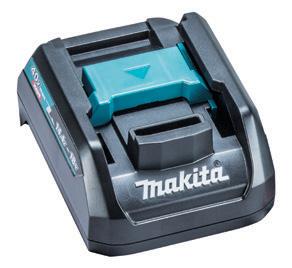
The enlarged and raised LED light provides clearer indication of charging status. DC40RA 40V Max Rapid Charger ADP10 18V ChargingBatteryAdaptorAllowsfor charging of LXT 18V Li-ion Batteries Max. sealed suction 18kPa Max. air volume 2.4m³/min Continuous Runtime (BL4050F) 14 minutes (Max suction) 110 minutes (Min suction) Suction power (4 Modes) 195W, 100W, 55W, 25W 40V Max Brushless Backpack Vacuum VC008GZ07 Capacity 2L Skin weight 4.0kg Weight (with battery) 5.3kg (BL4050F) Voltage 40V Max 2L Reusablebag40L/sFilterHEPAMaxairflow40VMAX LI-ION BATTERIES Battery Charging Time BL4025 2.5Ah Battery 28 min BL4040 4.0Ah Battery 45 min BL4050F 5.0Ah Battery 50 min BL4080F 8.0Ah Battery 76 min DC40RB 40V Max Dual Port Rapid Charger




Phone 1800 861 030 | www.i-teamanz.com faster cleaner greener safer better Scan for more info Scan the QR code or contact us to get in touch with an i-team partner near you. Say hello to generationnextbackpackvacuuming i-move 2.5B


PRODUCTION MANAGER: Jacqui Cooper PRODUCTION ASSISTANT: Natasha Jara GRAPHIC DESIGNER: Sanja Spuzanic Print Post Approved Publication No. PP: AUSTRALIAN255003/09765SUBSCRIPTION RATE 12 months (6 issues) - $66 (inc. GST) To subscribe call 1800 651 422 subscriptions@intermedia.com.au INCLEAN is owned by ISSA ABN: 44 617 407 020 P: +61 2 9890 4951 A: Suite 1, Level 1, 52 O’Connell Street, Parramatta, NSW, 2150 W: www.issa.com www.incleanmag.com.au 5
A s we go to print on our biggest edition of the year, we’re only a few weeks away from the highly anticipated ISSA Cleaning & Hygiene Expo. After a number of postponements because of COVID-19, the ISSA Cleaning & Hygiene Expo shapes as a chance for exhibitors and attendees to reconnect and celebrate the industry’s crucial health and hygiene role during the past two years of the pandemic.
INCLEAN’s Excellence Awards, which showcase the latest innovative products and services, will also be presented at the conclusion of the tradeshow’s first day. Participating in the Excellence Awards allows you to highlight your outstanding achievements, biggest successes, and most creative initiatives and innovations over the past two years. Check out the entire event program, including the tradeshow exhibitor directory and speaker sessions, from page 39. To register to attend, visit www.issacleaninghygieneexpo.com.Wewisheveryoneasuccessfultradeshow and look forward to seeing you there!
MANAGING DIRECTOR: Simon Grover PUBLISHER: Simon Cooper MANAGING EDITOR Claire Phone:Email:Hibbitchibbit@intermedia.com.au0285866140
Exhibitors will showcase their latest products, services, and innovations at a time when many businesses are battling labour shortages and seeking innovative technologies and processes than can boost productivity.
Claire ManagingHibbitEditor
The Intermedia Group takes its corporate and social responsibilities seriously and is committed to reducing its impact on the environment. We continuously strive to improve our environmental performance and to initiate additional CSR based projects and activities. As part of our company policy we ensure that the products and services used in the manufacture of this magazine are sourced from environmentally responsible suppliers. This magazine has been printed on paper produced from sustainably sourced wood and pulp fibre and is accredited under PEFC chain of custody. PEFC certified wood and paper products come from environmentally appropriate, socially beneficial and economically viable management of forests. The wrapping used in the delivery process of this magazine is 100 per cent recyclable.
Additionally, the event’s education program will ensure visitors from all areas of the cleaning and hygiene industry can receive practical advice from industry experts. It will cover a wide range of important topics, including corporate social responsibility; technology and innovation; aged care cleaning and hygiene; the risk of working with chemicals; the importance of collaboration; coping with change; and delivering successful tenders and quotes.
DISCLAIMER: This publication is published by The Intermedia Group Pty Ltd (the Publisher). Materials in this publication have been created by a variety of different entities and, to the extent permitted by law, the Publisher accepts no liability for materials created by others. All materials should be considered protected by Australian and international intellectual property laws. Unless you are authorised by law or the copyright owner to do so, you may not copy any of the materials. The mention of a product or service, person or company in this publication does not indicate the Publisherís endorsement. The views expressed in this publication do not necessarily represent the opinion of the Publisher, its agents, company officers or employees. Any use of the information contained in this publication is at the sole risk of the person using that information. The user should make independent enquiries as to the accuracy of the information before relying on that information. All express or implied terms, conditions, warranties, statements, assurances and representations in relation to the Publisher, its publications and its services are expressly excluded save for those conditions and warranties which must be implied under the laws of any State of Australia or the provisions of Division 2 of Part V of the Trade Practices Act 1974 and any statutory modification or re-enactment thereof. To the extent permitted by law, the Publisher will not be liable for any damages including special, exemplary, punitive or consequential damages (including but not limited to economic loss or loss of profit or revenue or loss of opportunity) or indirect loss or damage of any kind arising in contract, tort or otherwise, even if advised of the possibility of such loss of profits or damages. While we use our best endeavours to ensure accuracy of the materials we create, to the extent permitted by law, the Publisher excludes all liability for loss resulting from any inaccuracies or false or misleading statements that may appear in this publication.
Copyright © 2022 - The Intermedia Group Pty Ltd.
Editor’s letter
NATIONAL ADVERTISING MANAGER: Samantha Ewart Email: Phone:sewart@intermedia.com.au0285866106
INCLEAN is published by The Intermedia Group Pty Ltd on behalf of ISSA – The Worldwide Cleaning Industry Association. 41 Bridge Road, Glebe NSW 2037 Australia
This year’s event, which is the only show in the southern hemisphere that is dedicated to the cleaning and hygiene industry, will feature more than 3000 attendees, 70 exhibitors, more than 40 speakers, 16 free-to-attend speaker sessions, plus four workshops.
EDITOR’S LETTER
ISSA, the worldwide cleaning industry association, is hosting the event at the Sydney International Convention Centre (ICC), where commercial and industrial cleaners, building services contractors, facility managers and healthcare and government and education facility representatives will be among the crowd.
FOR MORE INDUSTRY NEWS FOLLOW US ON CHECK WWW.INCLEANMAG.COM.AUOUT


The international conference and trade show will be in Berlin.
14-Interclean2024www.cms-berlin.deAmsterdam17May2024
6 INCLEAN
25-26Cleanwww.issashow.comNZOctober2022
ISSA2022Cleaning & Hygiene Expo 14-15 September 2022
ISSA2023www.intercleanshow.comPulire–TheSmart Show 9-11 May 2023
GJK Facility Services announces partnership with Pro1 GJK Facility Services announces joint partnership agreement with property maintenance and de-fit company. ServiceFM acquires naming rights for football stadium ServiceFM secures naming rights for Adelaide’s newest football stadium. Gausium teams with Diversey Gausium announces global partnership with Diversey-TASKI. New research centre to improve indoor air quality in buildings QUT Professor to lead $5m training centre to reduce airborne infections through improved indoor air quality.
Australia’s premier event for the cleaning industry will be held at ICC Sydney.
10-13ISSAwww.issacleaninghygieneexpo.comShowNorthAmericaOctober2022
The ISSA Show North America will take place in Chicago.
Clean NZ is New Zealand’s only dedicated trade event for the cleaning industry.
ISSA Cleaning & Hygiene Expo welcomes Abco as Gold Sponsor
ON THE COVER Read about the latest innovations from Hako Australia, including the RoboScrub 20 Autonomous Scrubber-Drier, in this edition’s cover story from page 16. www.incleanmag.com.au
23-24Intercleanwww.cleannzexpo.co.nzChinaNovember2022
The world’s leading trade show for cleaning and hygiene professionals. www.intercleanshow.com Wed 15 - Thu 16 September 2021 Newmarket Room, Ellerslie Racecourse, Auckland, New Zealand September / October 2022
What’s on
The international trade show will be staged in Hangzhou.
19-22CMSwww.issapulire.comBerlinSeptember2023
MOST CLICKED
The ISSA Cleaning & Hygiene Expo is the industry’s leading trade event. Quayclean secures Melbourne & Olympic Park contract Quayclean Australia awarded cleaning services contract for the Melbourne and Olympic Parks precinct.
The largest professional cleaning and sanitisation industry trade show in Italy.


find out more at sabcoprofessional.com.au On display at the Sydney Cleaning & Hygiene Expo - Stand 10 NEW GREENER CLEANING SOLUTIONS Leading the way with cleaning products that deliver performancesuperiorand are kinder to the environment! UP TO 75% RECYCLED MATERIALS PLATINUM RANGE Brix Platinum Janitor Cart Deluxe Brix Platinum Janitor Cart Janitor Cart












34 The acid test – does your sustainability strategy pass the test? How cleaning companies are taking their environmental commitments to the next level 39 ISSA Cleaning & Hygiene Expo Directory What’s on at this year’s ISSA Cleaning & Hygiene Expo in Sydney 60 Clearing the air: What’s your plan? Why facilities need to implement a definitive indoor air action plan 70 Staying profitable – and safe – in a hybrid working world Key considerations that should be front of mind for a hybrid workplace model 80 When planning for sustainability, remember the flooring Three ways facility managers can protect the environment by renovating rather than replacing floors 84 Conducting a product audit Tips to help streamline your purchasing 88 Water damage mishaps Industry pros weigh in on how to avoid potential issues 94 Q&A: Slips, trips, and falls Solutions to prevent harmful and expensive falls in your facility 96 Set up your cleaning program for success How you set up your cleaning program from the start will have a lasting impact on your end results 98 Enhancing employee retention Retaining employees through incentives that work 66 03Regulars Editor’s letter 14 Industry news 16 Cover story 100 Opinion 105 Products 98 7670 SEPTEMBER / OCTOBER 2022ISSUE #5 VOLUME 35 IN THIS ISSUE 8 INCLEAN September / October 2022


10 INCLEAN September / October 2022 SPONSORED
“We are excited to bring Excentr to the Australian market,” says Joe Camilleri, Managing Director of Central Cleaning Supplies.
The innovative Excentr range is coming soon and will be available exclusively from Central Cleaning Supplies. Headquartered in the Netherlands, and operating in more than 40 countries, Excentr has fast become a market leader in orbital and eccentric working cleaning machines. Unlike other machines in the market, Excentr machines are largely made of stainless steel and are developed to provide durability, solidity, andUniqueefficiency.toits design, machines are also fitted with wheels on the ground, which makes it easier to operate. Users can also connect Excentr machines, allowing multiple machines to work across large surfaces, just connect your Excentr machines and work at 110 or even 165 cm width.
Now, Excentr will be available to the Australian market thanks to its exclusive partnership with Central Cleaning Supplies, one of the largest distributors of cleaning materials, chemicals, andCentralequipment.Cleaning Supplies has been in operation for more than 30 years and provides an extensive range of products and services catering for the professional, commercial, industrial, and domestic cleaning industry.
Central Cleaning Supplies brings world-class innovation to the Australian market with Excentr floor cleaner range

Those who work correctly with the Excentr Method can reduce their consumption of cleaning agents by 95 per cent. Excentr has developed systems that make the use of cleaning agents and chemistry unnecessary. To achieve this, Excentr add particles to the pads. Diamonds, aluminium oxide particles, pieces of (recycled and biodegradable) plastic, etc. Pads are also Full Cycle® products and are certified by Green Seal™ for Environmental Innovation based on faster biodegradation in landfills and 100 per cent recycled material/natural fibre. In many cases, Excentr pads are made from recycled PET bottles.
For more information or to book a FREE demonstration, contact Central Cleaning Supplies on 1300 347 347 or sales@centralcleaning.com.au.email www.incleanmag.com.au
THE EXCENTR METHOD
The Excentr Method is connected to the Excentr machines. Here are the five main benefits of the Excentr Method: 1. Four times faster
The machines are safe, simple, and ergonomic to operate from the first minute. This simple concept is developed for cleaning, deep cleaning, stripping, polishing and renovation of the floors are chemical-free and based on one or a few steps (pads). This makes it very simple and responsible to put people with no or less experience to work! Finally, the method is recommended for people with physical disabilities because it puts minimal strain on the body.
4. Environmentally friendly
The Excentr Method is based on a short, small movement of 7 mm in a circle. This movement in combination with its specially developed Excentr Fiber Pad guarantees deep cleaning. ■
5. Deep cleaning Hard to clean joints? Or problems with cleaning structured floors? More and more floor manufacturers are moving from smooth floors to structured floors.
3. Ergonomic and user-friendly
The Excentr Method is based on a different movement than traditional cleaning machines make. The Excentr Method is based on 2850 rpm in small circles of 7 mm. 2850 rpm means the Excentr machines generate 15 times more movement than traditional cleaning machines. Because the mechanical effectiveness on the floor (surface) is much higher, results are achieved much faster. This ensures that generally three to four times faster work can be done.
Think of PVC floors with a wood look, etc. Beautiful, but a challenge for those responsible for cleaning and maintenance!
2. Unique design Excentr produces rectangular machines and a number of other machines with special shapes in order to always offer the right solutions for any challenge. Its rectangular machines clean up to the skirting board and into corners – in both cases without space in between. In addition, it has a special solution for places that are difficult to reach: the Excentr 30-50. The only cleaning machine with a pointed shape, the Excentr 30-50 is ideal for cleaning under radiators or under hanging toilet bowls, but also in swimming pools or public transport. In these environments, everything is designed so that everything hangs free from the floor. With the pointed shape of the Excentr 30-50, you can get everywhere perfectly between and under.
11 SPONSORED
“Excentr machines have been ergonomically designed with the user in mind. The Excentr Method is also an effective way of floor cleaning and floor maintenance and makes machine cleaning smarter.”
“Central is a trusted industry brand for many cleaning companies. We pride ourselves on offering our customers the latest products from around the world and we believe that the addition of Excentr to our already extensive range of machinery gives our customers even more choice and innovation,” says Camilleri.


Central Cleaning Supplies, one of the largest distributors of cleaning materials, chemicals, and equipment, is headquartered in West Footscray, Victoria.
With the continued success of site expansions, Central Cleaning Supplies is in the advanced stage to open its next store later this year in Perth. It will be the first store in WA for the Victoriabased business. “We look forward to soon be able to provide our customers in Perth the same expertise, great service, and innovative products that we offer customers across the country.” ■
Central Cleaning Supplies to expand retail footprint after SA success
ollowing the highly successful opening of its first South Australian store, Central Cleaning Supplies will soon open its first site in WesternCentralAustralia.Cleaning Supplies opened its first Adelaide store, located at 113 – 115 Sir Donald Bradman Drive, Hilton, Adelaide, earlier this year in May, taking the total number of sites across the country to 14. “The opening of our first South Australian store was a milestone for us as well as our customers. It has been more successful than we had expected, so much so that we are looking for a second larger site. Thank you Adelaide for welcoming us to your great city, ” said Joe Camilleri, Managing Director of Central Cleaning Supplies.
Central Cleaning Supplies has been in operation for more than 30 years and provides an extensive range of products and services catering for the professional, commercial, industrial and domestic cleaning industry.
12 INCLEAN September / October 2022
F
SPONSORED
“The feedback from customers has been extremely positive. Our South Australian customers can come in-store and speak to our staff, view our extensive product range, and be given equipment demonstrations.
In 2021, Central Cleaning Supplies opened three new sites in Victoria including Footscray, Ballarat, and“OurCampbellfield.nationalfootprint of outlets continues to provide greater coverage, convenience, and service for our customers. We are delighted to be opening new stores and creating jobs. We have a strong focus on growth and we will continue to look at further expansion,” said Camilleri.
“Additionally, having a distributor centre on-site means we can stock a greater range of products and will be able to deliver products quicker to our locally based customers. We also provide customers on-site training and technical seminars, such as safety training, chemical handling, as well as new product and equipment training.”
Helping customers succeed:
wouldwillingnessincleaningonsiteourshowroomsupport.toas“CCSisseenwithinthecleaningindustryaleaderbringinginnovativeproductsmarketandprovidingvalueinmanywaysprice,qualityandmostimportantlyTheopeningoftheirAdelaidehasfurtherstrengthenedrelationshipwithCCSprovidingsupportandtrainingtonewstaffinthemobilisationoffourrecentcouncilcontracts.CCSsupportreviewingthescopeandassistinginproductandequipmentselectionhasbeenappreciatedbackedbythetoprovidetheresourcesthatarerequiredforasuccessfultransition.IhighlyrecommendJimmyandtheCCSteam.”
DAMIEN MILLS Business Development Manager Pickwick Group


www.centralcleaning.com.au sales@centralcleaning.com.au

i-team ANZ hits the road in mobile showroom
“Since the launch of i-team ANZ in July 2020, we have seen a rapid growth in the establishment of our i-partner network across ANZ,” said Tim Pugh, i-team ANZ sales director. “It has been challenging to be able to get face to face with many of our i-partners due to COVID, so it’s great to be able to get hands on and bring the full i-team innovative experience to the hands of i-partners and endTheusers.”i-van has already travelled more than 10,000km, from Sydney all the way up to Cairns and back down again to Melbourne. The i-team plan to add further i-vans to the Australian fleet as well as one in New Zealand.
Leading the charge on battery performance Resourcing and programming of cleaning times and limited windows of productivity make it critical to ensure equipment and tools used to do the job are reliable and ready to be deployed.
14 INCLEAN September / October 2022 INDUSTRY NEWS
“Essentially, having the right battery for floor scrubbers and sweepers means easier maintenance and care, increased ROI, increased battery life reduced downtime, and increased productivity and efficiency”, said Trigona.
The i-van is fitted with the complete range of products from i-team, making it a showroom on wheels.
“Cleaning staff can get more done in less time by not having to spend time on battery maintenance or delays in replacement batteries due to improper care. This means cleaning quality will never be compromised.”
Batteries are now at the heart of these workhorse machines and it is critical the right type and quality is selected to deliver the best performance, according to Federal Batteries, the exclusive importer of Rolls batteries in AccordingAustralia. to Federal product manager, Anthony Trigona, Anthony Trigona, battery life is directly related to increased amounts of floor space cleaned in less time, which makes it even more important to understand how to keep floor cleaning machine batteries running optimally and cleaning schedules on time.
The Rolls brand of batteries and distinctly red cases are well-recognised around the world and represent quality, dependability, and performance. Offering a wide range of capacities in 6V, 8V & 12V models, the Rolls AGM range feature a heavy-duty plate structure and high density paste in durable sealed ABSAvailablecases. in standard industry sizing for drop-in replacement ensures seamless installation in a wide range of industrial equipment such as floor scrubbers, sweepers, and large-scale cleaners.
i-team ANZ has launched a mobile showroom called the i-van. With the i-van, the team from i-team has travelled up and down the east coast of Australia, visiting partners and end-users.
Everything from ride-on floor scrubbers, air purifiers, the i-mop family, disinfectant pray machines, fogging machines, vacuum cleaners and more; it all fits into the i-van.


As part of its science-led approach, Reckitt and Dettol Pro Solutions provided hygiene protocol guidance to the Birmingham 2022 Commonwealth Games for athletes, spectators, and officials. Dettol Pro Solutions’ offering uses sciencebacked measures to enhance hygiene standards and help reduce the spread of Dettolgerms.Pro Solutions has already delivered successful programs for iconic organisations including Cricket Australia, the MCG, Uber, Accor, the Sydney Opera House, as well as shopping centres operated by Australian property group Mirvac, where Dettol germ protection products and hygiene education signage have been installed to help stop the spread of germs.
As an official partner of the Birmingham 2022 Commonwealth Games which took place from 27 July to 8 August, Reckitt, together with its Dettol brand, served as the official hygiene partner, and its Durex brand as the official intimate wellness provider for the event.
[1] Reckitt Toluna Tracker, Wave 16 (07/06/2021-13/06/2021) (v1.0)
[2] Health Direct, Sport and Recreation – Queensland, Accessed 16 May 2022 at: https://www.
In May 2021, Reckitt research conducted overseas demonstrated that 76 per cent of people across the globe were concerned about venturing into crowded places [1]. A year on, this partnership came at an important time as many countries sporting stadiums and events have returned to 100 per cent capacity, including in Australia [2]
Dettol Pro Solutions, Dettol’s business-to-business offering, supported athletes and spectators over the 12-day event, bringing hand sanitiser dispensers, disinfectant products, and educational hygiene messages to the 15 competition venues across the UK, as well as Dettol hygiene kits for all athletes and volunteers in Thisattendance.partnership followed the launch of the Dettol Pro Solutions program in December 2021, which also supported the Queen’s Platinum Jubilee Pageant in DettolJune. was also the hygiene partner at COP26, the UN’s global climate change conference in 2021, which played host to more than 25,000 delegates. Building on this, the Birmingham 2022 Commonwealth Games celebrated human achievement, perseverance and dedication, attributes that Reckitt champions in its purpose to protect, heal and nurture in the relentless pursuit of a cleaner, healthier world.
[2]healthdirect.gov.au/covid19-restriction-checker/sport-and-recreation/qldHealthDirect,SportandRecreation–Queensland,Accessed16May2022 at: https://www. healthdirect.gov.au/covid19-restriction-checker/sport-and-recreation/qld www.incleanmag.com.au
Dettol Pro Solutions supports athletes and spectators as official hygiene partner of 2022 Commonwealth Games
15


Simple Training
By Alexandra Dominguez, Marketing Executive at Hako Australia Pty Ltd
Our innovative feature equipping the tank with antibacterial properties reduces the development of bacterial and fungal growth, helping eliminate odors and makes the machine more hygienic after use Dust Stop
AUTONOMOUS20CLEANING
Up to 90 % less dust and fine particulate emissions during dry sweeping, with our innovative side brush jacket. Dust Stop can be retrofitted easily – no technical installation required! Unlike conventional dust control systems, Dust Stop uses no water, which means: no streak marks on the floor! Innovation in Simplicity!
THE FUTURE IS TODAY WITH HAKO ROBOSCRUB
The RoboScrub 20 autonomous scrubber-drier has already proved its worth to hundreds of end users across different cleaning applications including health-care, education, production, warehousing and retail. This compact scrubber-drier reliably and safely navigates around obstacles and provides excellent cleaning results. The flashing beacon indicates a working machine. In addition, the machine is particularly user-friendly, both in autonomous and manual operation. To carry out quick in-between cleaning jobs, RoboScrub 20 can be used as a conventional ride-on scrubber-drier.
FREE DEMO
It is 2022, Can you continue to afford all this WASTE and its impact on yourenvironmenttheandpocket?l
With Hako, we help reduce waste in materials and waste in time that is currently costing you. Hako's TUV certified Aqua-Control Brush System can reduce waste by up to 50%, with no compromise in performance Hako AntiBac Tanks Equipping the solution and recovery tank with Hako AntiBac® protects its operators and helps eliminate odors.
With on-board training modules, a few minutes is all it takes for a new operator to become a Roboscrub 20 champion. Cleaning routes can easily be trained by either showing Roboscrub 20 what to do, or by defining an area perimeter and auto-filling!
Aqua Control Brushes


SCAN TO LEARN MORE
T H E F U T U R E I S T O D A Y W I T H H A K O
C L E A N I N G T E C H N O L O G Y B E C O M E S
M U L T I F U N C T I O N A L
Ride-on-Scrubmasters: Award-winning ergonomic solutions! To provide maximum comfort for the user, Hako’s ride-on Scrubmasters have been designed as ergonomic, mobile workplaces. These machines have now been awarded the AGR certification for their back-friendly overall machine ergonomic design In situ Hako QR Training: ust one scan of the QR code on the machine and your operators will be trained via their smartphone. Hako keep it simple! Helping keep your team working and updated anytime day or night!
Q U I C K - C O N N E C T S Y S T E M
Hako’s innovative Quick-connect system allows fast and easy upgrading of selected Scrubmaster scrubber-driers to extend the machines’ application versatility. Areas littered with light debris often require additional cleaning time and effort. Hako ride-on scrubber-driers can be equipped with pre-cleaning tools or tools for special applications to ensure more efficient and cost-effective working. This is made possible by Hako’s quick-connect system, which allows uncomplicated super quick, tool-free adding or swapping of additional tools for multi-functional Dependingapplications.on the application, choices of scissor mopping, scissor brooms, litter picking, pre-sweeping with dust control or adding disinfecting systems, each can be changed over in under 1 minute! Hako equipment with genuine on-site solutions for you the user! Saving time and money.
More than sweeping or scrubbing and drying Hako’s quick-connect system enables multifunctional working in the Cleaning Technology sector. Only one machine carries out different cleaning tasks in a single working step.


According to the company, Invisi Shield has been fully scientifically tested at an independent UK laboratory and proven effective against the germs we are facing in the world“Wetoday.haveused breakthrough technology to combine plant extracts that work synergistically to achieve a formula that provides skin protection naturally,” the company said.
18 INCLEAN September / October 2022 INDUSTRY NEWS
Victory Innovations incorporates a patented double charge technology that positively charges particles through the pump and then via the charging ring before dispensing. Double charge technology ensures all particles are positively charged resulting in complete coverage on surfaces.
ACCO Brands Australia currently supplies both the retail and commercial sectors with more than 10,000 product lines for use in the home, office, and school.
Blue coloured products are designed for low-risk general cleaning, green coloured products are suited to kitchen and catering areas, yellow is ideal for use in infectious areas, and red is suited to toilets, washrooms, bathrooms, and utilityVictoryrooms.Innovations is a global leader in patented electrostatic sprayer technology. The range allows the user to sanitise and disinfect surfaces up to up to 90 per cent more efficiently than traditional cleaning methods, derived from research conducted by ISSA.
Shield Yourself launches new all-natural hand sanitiser Shield Yourself has launched a new all-natural hand sanitiser Invisi Shield.
Cleanlink products are designed to make cleaning easy. A select range of Cleanlink products incorporate an industry standard colour coding system, this system makes it even easier to allocate the correct cleaning tool in your establishment.
For more than 25 years, Northfork has been manufacturing quality cleaning chemicals at its facility in NSW. Included in the Northfork Chemicals portfolio is an environmentally preferable range of cleaning chemicals and personal care certified by Good Environmental Choice Australia (GECA).
Invisi Shield is organic and is an effective and safe alternative to alcohol-based and chemical hand sanitisers.
As part of the diverse portfolio, ACCO Brands offers a complete cleaning and janitorial range. This range incorporates Northfork, Cleanlink, and Victory Innovations.
According to the company, Invisi Shield is ideal for use around children because it is alcohol free, chemical free, and suitable for sensitive skin Invisi Shield is also hypoallergenic, does not sting and is not drying. It can be used safely by children with eczema, psoriasis, and other skin conditions. Invisi Shield offers extended longer-term protection after application, which reduces cross contamination, and is also biodegradable and environmentally friendly.
ACCO Brands offers janitorial solutions from Northfork, Cleanlink, and Victory Innovations


Bruce Lees, RapidClean GM, said the new RapidClean products are cost effective and high performing with supporting material including a complete package of educational material, safety data sheets, risk assessments, product information sheets, and online training courses.
The RapidClean Group also continues to expand its footprint, welcoming four new member stores; RapidClean Pilbara in Karratha, WA; PFI Cleaning Supplies, located in Bunbury, WA; Down South Wholesalers, Margaret River, WA; and its newest member, Absorb in South Australia.
20 INCLEAN September / October 2022 INDUSTRY NEWS
Solaris Paper has welcomed Mark Sivyer to the away from home team as the business development manager for Victoria and Tasmania.
Domchlor is recommended for use after cleaning to disinfect hard surfaces that have been affected with COVID-19, and for environments where disinfection is required to maintain a high standard of hygiene. Placing portion control as the focus, Domchlor ensures an exact measured dose of the product for effectiveness, safe product handling and effective cost per use.
According to Dominant, Domchlor has been designed to combat hard surface bacteria with convenience. The 5g sachet allows for easy storage and aims to reduce the risk of Itscontamination.singlesachet form eliminates exposure to external elements before use – compared to a jar or bag that would be frequently opened and exposed to light and air, risking reduced efficacy.
“Dominant continues to strive to reduce the environmental impact of our business using latest technology and continuous improvement to create a more sustainable future,” said Morton.
“Sachets follow a simple-to-use approach: Add water to your labelled 750mL bottle, rip the 5g sachet, add, stir until dissolved and apply to hard surface. Rip-tip-stir-use,” said Sean Morton, Dominant national sales manager.
“All RapidClean stores are locally owned, and we pride ourselves on providing the best products and the best service in the cleaning supplies industry. We are very proud of the new stores that have joined our RapidClean team,” said Lees.
“We have added 10 new products and already in high demand is our very effective Mould N Moss, which is both powerful and fast acting. We will continue to build the range and strive to meet all of our customers cleaning supply needs.”
Solaris Paper appoints business development manager for Victoria and Tasmania
“Our new products include Crystal, which is the best glass cleaner that we have ever produced, a stainless-steel polish called Bright, and a new Eucalyptus scented disinfectant called, Eucalypt,” said Lees.
Dominant disinfectant receives label claim against COVID-19
RapidClean introduces new products, adds new stores
Sivyer, who has many years’ experience in sales and managing national and state accounts, replaces Mark Fleming, who the company thanked for his “three years of service during the most challenging time of a global pandemic and toilet paperSivyerfrenzy”.saidhe is looking forward to meeting Solaris Paper’s Victorian and Tasmanian customers and building strong partnerships into the future.
Dominant has announced its Domchlor hospital grade disinfectant is now proven to be effective in killing SARS-CoV -2 (COVID-19) and is listed on the Australian Register of Therapeutic Goods (ARTG), AUST 388764.
RapidClean stores stock major brands of industrial, commercial, and environmentally friendly cleaning and packaging products.
RapidClean has added more products to its cleaning supply range, with new chemicals designed to give professional cleaners the products they needs to solve problems and achieve great results that get noticed.


Bringing COMFORT to your EVERYDAY HYGIENE www.solarispaper.com.au




The business recognises that pursuing a sustainability strategy (which this building is part of) will result in additional costs while bringing about tangible benefits.
This range is ideal for high touch surfaces and frequently visited areas such as hospital beds, bedside tables, sinks and taps, bathrooms and toilets, tabletops, benchtops, chairs, and door handles.
GAMA Healthcare has announced the launch of its new Clinell Environmental Cleaning Range. According to GAMA Healthcare, the new range delivers superior cleaning and is clinically proven to prevent infections by killing viruses, bacteria, and fungi.
In other states, Bunzl will make environmentally friendly changes and retrofit sites where it can across existing facilities that have long-term leases which are still active, including negotiating with landlords to install solar capabilities and LED lighting. The emphasis will be on incorporating commercial and environmental terms into any lease extensions.
The 23,442sqm distribution centre will integrate a 300kW solar system, LED light fittings, solar hot water, rainwater harvesting and smart electricity and water metering.
Bunzl ANZ is a specialist distribution group that supplies businesses with hospitality, healthcare, hygiene, cleaning and safety products.
Later this year Bunzl Australia & New Zealand will move into a new 6-star GreenStar-rated headquarters in Sydney.
Shifting from Enfield, Bunzl will relocate to Elevation at Greystanes estate, a $200 million facility at Pemulwuy, 30km west of Sydney.
A vital part of Bunzl’s sustainability push is the move. The new headquarters and distribution hub will showcase the considerable efficiencies that good design and focus can achieve.
The other major benefit of such moves is that ethical commitments to people, the environment and communities help boost the morale of employees and contribute to superior recruitment and retention outcomes.
“Our hospital-grade and instrument grade disinfectants kill harmful bacteria and viruses such as COVID-19, MRSA, VRE, CRE, norovirus and more. Our superior disinfecting range helps keep you and your patients safe.”
22 INCLEAN September / October 2022 INDUSTRY NEWS
Bunzl ANZ to move into new 6-star GreenStar-rated headquarters
GAMA Healthcare launches new Clinell environmental cleaning range
Even though the company’s decision to retrofit facilities and move into a new 6-star GreenStar-rated headquarters in Sydney will inevitably cause some short-term increases in operational expenses, the Bunzl APAC leadership team has backed the move all the way.
“Our 2-in-1 detergent and disinfectant is easy to use. It enables faster cleaning of dirty surfaces and removes the need for dilution, or use of multiple products. This saves valuable time by removing the need for staff to pre-clean with a detergent, rinse and then disinfect,” said Suzanne Hammouche, CEO of GAMA Healthcare in Australia and Pacific RCD.
The Australian and New Zealand arm of the business is embracing a science-based commitment to be net zero by 2030, in part by minimising emissions from its facilities (these cover Scope 1 emissions that the company makes directly) and vehicle fleet (these include Scope 2 emissions from indirect sources).


23 INDUSTRY NEWS
DEEP TMAINTAINCLEANRANSFORM
Krystalshield launches eco premium range Cleaners Own www.incleanmag.com.au
The DMT system provides an unbeatable solution for all possible precision cleaning sitiuations. Deep Clean periodically with the industry leading JET3 or SHOCK. Maintain daily with the revolutionary STORM and BLADE. Transform your spaces and cleaning regimes with the DMT System from MotorScrubber. +61 459 269 988 | ausorders@motorscrubberclean.com | www.motorscrubberclean.com
Krystalshield has launched a new, ecopremium range, Cleaners Own. Cleaners Own by Krystalshield has been developed by cleaners for cleaners with a vision to deliver affordable cleaning products that use highquality solutions and environmentally sustainable ingredients. “Having been in the cleaning industry for 40 years, we have seen every aspect of the industry from being the cleaner, the contractor to the person that awarded the contract explains Robert Diaz, managing director of Krystalshield and Shield Chemicals, Shield Chemicals is a subsidiary brand of Krystalshield, which manufacturers environmentally sustainable chemicals and coatings to help provide cleaner, safer, and more durableShieldsurfaces.Chemicals’ products include cleaning and maintenance chemicals, industrial, hospitality, automotive, graffiti removal and prevention, specialty coatings, specialty cleaners and pest control. “When we started Krystalshield, our vision was to make quality products that are highly concentrated and have multiple uses. Having worked as cleaners, we saw how inefficient, unsafe, and environmentally harmful some mainstream formulas can be. Our products use eco-friendly solutions that make results last longer. Our commitment to quality has seen us develop more than 90 products across our premium brands Eco-Shield, Shield Pro, and Sanicare Plus,” says“However,Diaz. we identified a gap in the market for cost-effective products that still deliver on quality and are environmentally friendly. Cleaners Own provides the same quality ingredients and formulations at an accessible price point and has a product for almost any cleaning task.” Products in the Cleaner’s Own range include surface cleaners, glass cleaners, bathroom cleaners, disinfectants, and floorcare.


Two Good Co launches new sustainable products Two Good Co and Charter Hall have begun installing 3000 touch-free soap dispensers in offices around the country, made with recycled ocean waste by women who have survived domestic violence andProtecthomelessness.andConnect
“Now, with the launch of Protect and Connect Soap, we are anticipating Two Good will be able to reach our target of employing 36 women in 2022, but we are planning to see this figure double in years to come,” said Caslick.
Soap is the latest initiative from Two Good’s ongoing collaboration with Charter Hall, to support, empower, and employ women who have survived domestic violence and homelessness. This initiative is part of Two Good’s Work Work program, which has helped 65 women. Protect and Connect Soap has also removed more than 1.25 tonnes of plastic from the ocean, given vulnerable women on-the-job training and employment, while creating a locally sourced, sustainable soap andFounderdispensers.andCEO of Two Good Co, Rob Caslick, said the organisation’s ongoing collaboration with Charter Hall has provided resources significant enough to give vulnerable women the support, independence, and self-confidence to thrive.
Joe Poovaiya, director of food and beverage, Sheraton Grand Sydney Hyde Park, said the company has been using robotic technology and solutions to increase productivity, and has now introduced Keenbot to its customerfacing food service operations. With self-developed indoor navigation technology, Keenbot can map delivery routes to use the shortest path. Inbuilt shock absorbers and a real-time collision detection sensor help Keenbot avoid obstacles and unexpected situations reducing the risk of trips, bumps, and spills.
Keenbot also features a cruise delivery mode making it convenient for customers to take meals from the tray themselves, and with auto-charge functionality this server can operate 24 hours a day, seven days a week.
Kenichi Yoshida, chief business officer, SoftBank Robotics Group Corp said, the company is excited to introduce Keenbot in Australia to help support the hospitality industry. We believe the hospitality industry is set to unlock new potential in the use of AI, robotics, and automation to accelerate the service standard.”
SoftBank Robotics introduces tray delivery robot Keenbot to the Australian market
Charter Hall is now installing Protect and Connect Soap across its national office portfolio, including No.1 Martin Place and 333 George Street in Sydney, 130 Lonsdale Street in Melbourne, GPO Exchange in Adelaide and 175 Eagle Street in Brisbane.
As the official Keenbot supplier in Australia, GERMii Australia is working closely with customers across the hospitality industry to help fill serviceEquippedgaps.with multi-point delivery modes, Keenbot can deliver four dishes at one time and its maximum tray loading capacity takes the weight off human wait staff, freeing them up to manage other tasks and focus on serving customers. Prior to its official launch, GERMii Australia deployed Keenbot at the Sheraton Grand Sydney Hyde Park.
Derren Wong, head of sales, Keenon Robotics, Australia, said the dynamic hospitality landscape has propelled the demand for contactless service.
“We are delighted to be part of the Australian hospitality industry transformation with the complimentary collaborative approach of cobots, from waiters in restaurants to robotic concierges in hotels, leading to improvements in terms of speed, cost-effectiveness, and overall guestHaroldexperience.”VanHaltren, CEO, GERMii Australia, said the company is thrilled to be helping the Sheraton Grand Sydney Hyde Park supplement their teams to provide outstanding service to guests. “Our customers are all very happy with the outcomes of increased productivity and service delivery. Happy customers are return customers.”
24 INCLEAN September / October 2022 INDUSTRY NEWS
SoftBank Robotics Group Corp (SBRG) has announced the launch of tray delivery robot designed to automate food service, Keenbot by Keenon Robotics, in Australia.
The partnership will also extend to a further 34 managed assets covering more than 600,000 sqm of workspace across Charter Hall’s $23b officeCharterportfolio.Hall’s chief experience officer, Natalie Devlin, said, the partnership allows Charter Hall to sustainably scale its programs while leaving a positive legacy for the environment. “We look forward to extending our partnership with Two Good to supply its premium amenities across our office portfolio while supporting their critical work, helping disadvantaged women in our communities.”


INDUSTRY NEWS
LEARN 1800MORE226 T290COMEcontactus@tennantco.com843www.tennantco.com.auSEEUSATTHEISSACLEANING&HYGIENEEXPO!&T390WALK-BEHIND&T581MICRO-RIDERSCRUBBERSGETCONSISTENTPERFORMANCEANDPRODUCTIVITYWITHTHENEWT290 T390 T581
Then you can choose to make a final repayment to own it outright or take advantage of our Guaranteed Future Value to trade it in on a new van, or just hand it back. The new Expert Van is reliable and super capable with innovative City, Pro or Premium models, plus a limited Special Edition Sport model –and both short and long body versions to choose from.
A van and a finance deal that make great business sense
Zip between jobs with the fuel efficient, yet responsive Peugeot 2.0L HDi turbo diesel engine–plus your choice of 6-speed manual or 8-speed automatic transmission. Jump behind the wheel and you’ll discover the ergonomically designed i-Cockpit with intuitive dashboard layout and compact steering wheel. Expert Van gives you easy accessibility to all the gear you need with 180 degree opening swing rear doors and dual sliding doors on most models. Inside the practical design takes a1.4 tonne payload, with up to 6.1 cubic metres of cargo space in long bodyPeugeotmodels.Expert Van is also a handy office, thanks to the smart Moduwork mobile office system. Comfort and safety have also been built in, with advanced safety features, seamless technology and driver and passenger airbags. All models feature Electronic Stability Control and a wide-view reverse camera and sensors and every van comes with a 5-year/200,000 KM Warranty*+ 5-year Roadside Assist* *Full terms and conditions can be found here or contact your participating Peugeot Professional dealership
A busy cleaner’s best friend, the new Peugeot Expert Van, is now even more appealing with a competitive finance offer available until 30 September 2022. From $257 per week for three years* and $0 deposit, you can discover why cleaners love this economical mid-size van.
The offer applies to eligible ABN holders when purchasing the Expert Pro Van SWB Auto, with finance at 8.99 per cent p.a. and 20,000km annual allowance.


Products certified under GECA’s Cleaning Products standard can contribute toward credit points for projects under the Green Building Council of Australia’s Green Star Performance tool. The standard also contributes to meeting WELL features under the WELL Building
According DEMA, Pinnacle is designed for longevity, reliability, and simplicity with installers and users in mind. All Pinnacle series dispensers use DEMA’s peristaltic quick-change pumps for liquid applications and our solenoid valves for dry detergent applications. With built in on-board programming using a large multi-line display or the DEMA SmartTech app on a smartphone, programming can be done quickly and efficiently, according to the company. In the app, user can view dashboards featuring rack counts, concentration points, temperatures, and alarms. SmartTech allows users to develop programs for future installs that can be shared with team members. Other features of the Pinnacle series come from DEMA’s warewash dispenser lines, such as DEMA pioneered Auto Switchover mode with Titan. Auto Switchover keeps the dispenser up and running, switching between probe and probe less mode when conditions change.
GECA is an independent not-for-profit organisation with a vision to achieve a sustainable future for people and planet. GECA has 20 years of experience engaging with stakeholders across the cleaning supply chain.
AccordingCertificationtoKendall Benton-Collins, strategic communications manager at GECA, “Sustainability is an increasingly important driver, particularly for the public sector. The pandemic has also made it abundantly clear that your cleaning products and services are not somewhere you should be cutting corners. “ “For manufacturers, GECA’s ecolabel makes it easier for individuals and procurement teams to identify your leadership. You will be ahead of the game to win over more business! And for procurement teams, when creating requests for tenders and developing contracts, specifying GECA certification means you can rest assured you are purchasing a third-party verified product. “ Contact us: www.geca.eco
According to the company, the Pinnacle series dispensers are compact, pre-wired, and economical. Electrical controls are installed in a heavy-duty plastic housing with a sealed cover keeping moisture out of electronics and dispensers up and running.
On the front of the dispenser, it has a durable membrane switch label with easy to navigate visual indicators for quick programming. DEMA’s color-coded quickchange pumps are available with a variety of motor choices, 15, 60, and 105 RPM.
GECA’s lifecycle ecolabelling program looks at impacts across a product or service’s entire lifecycle, from the extraction of raw materials to the end of its life. In 2021, GECA released the latest version of its Cleaning Services (CSV2.0-2021) standard. This year, the organisaton has launched the revised Cleaning Products (CPV3.0-2022) standard.
The future of cleaning is transparent and accountable Cleaning products remain essential for healthy and appealing living and working conditions. The pandemic has only highlighted further how proper cleaning can make a difference in stopping the spread of infection. More and more organisations are looking to procure independently assessed cleaning products and services to ensure their staff and customers’ wellbeing.
Here’s a snapshot of how GECA’s standards benefit people and planet
26 INCLEAN September / October 2022 INDUSTRY NEWS
GECA certification is a significant achievement, with certified products and services needing to meet criteria for a wide range of environmental issues, human health and social impacts while proving that they perform as promised.


ISSA Cleaning & Hygiene Expo
After extensive testing and certification by an international laboratory, the active enzymes present are Lypase, Cellulase, Protease, Amylase, Invertase, and Polygalacturonase (PG).
Raymond Subel, Technical Director of Enzyme Wizard noted, “Being plant derived and non-bacteria based, it allows more flexibility when dealing with pH ranges of 3, right up to a pH of 12. This in turn gives greater confidence and scope for the cleaners and property managers. This is a huge added value in all commercial kitchens and domestic applications where certain caustic chemicals may be Accordingpresent,”toSubel, an important feature of Enzyme Wizard’s technology is understanding how each product reacts with various“Enzymesurfaces.Wizard products are specifically designed to clean in the most efficient way. Specific surfactants have been included to achieve the best results in removing biofilm and maximising cleanliness.”
WWW.RAPIDCLEAN.COM.AU RapidClean stores are owned and operated by cleaning supply experts with extensive industry knowledge and high quality products. Empowering professional cleaners for over 35 years
Enzyme Wizard’s range of products have been reformulated to now carry six active enzymes. Enzyme Wizard’s products are specifically designed to clean safely and effectively, without caustic chemicals.
“The inclusion of Invertase enzyme means our formula can now break down tissue paper (pulp). This would be quite unique in the sense that in any Septic tank system we not only breakdown all the organic material but potentially tissue paper as well.”
Exhibiting at the VISIT US A T Stand 192
“Polygalacturonase (PG) is the major enzyme responsible for softening ripening fruit. This means that this enzyme would assist all our formulas in softening the organic matter which in turn assists the cleaning action.
Enzyme Wizard raises the standard with enzyme cleaning technology
“Through testing, the answers to better and safer cleaning were developed with our unique and certified proprietary six active enzyme formulations,” said Jamie Flinkier, Director, Enzyme Wizard.
According to the company, an important additional advancement in the Enzyme Wizard range is its ability to remain stable and active across a wide pH range.
“This unique six active enzyme formula means that our formula will have the ability to breakdown all organic matter and some nonorganic material,” said Flinkier.
INDUSTRY NEWS


“RCP has a heritage of developing highly durable products that stand the test of time. This equates to less re-manufacture, less transport and less storage than lower quality alternative products that frequently need replacing. All of which is better for the planet. We know, as a manufacturing business, we can’t stop there,” said McDermott.
RCP releases new sustainability vision and roadmap, the Love Sustainability Journey
His family released the following in memory of the man who they said “was an integral part of the Cleanstar family for the past 15 years”.
Kimberly-Clark Professional launches
“Con’s contribution was significant as a leading member of the warehouse team and could always be relied upon to do all the little tasks that needed doing and took great pride in keeping the warehouse looking clean and orderly, both inside and out. We will all miss Con greatly. May he rest in peace.”
Newell Brands’ packaging goals, for example, include a 2025 target for 100 per cent of direct-sourced paper-based packaging to come from certified, verified or recycled sources. This specific goal sits alongside six key sustainability actions for product design, which include ‘system efficiency’, supporting the reduction of resource waste throughout each phase of a product’s lifecycle.
ICON collection
Con was father of Lisa Michalson and Chris Terpos; and father in-law of Garth Michalson.
Reducing waste to landfill by 90 per cent is another ambitious Newell Brands 2025 target, which RCP plans to support at its own operations“Newell’slocations.valuesconstitute truth, transparency, teamwork, and trust, all of which we intend to provide through our journey. Investing in sustainable solutions is not only the right thing to do but is imperative to the long-term value and viability of our resources, our people, our communities and our business.”
The new ICON collection was designed by hygiene and innovation experts, with the aim of delivering unmatched confidence in the washroom, according to KimberlyClark Professional. It combines nearly 150 years of hygiene innovation and is Kimberly-Clark Professional’s most significant upgrade in hygiene technology in more than a decade. The collection’s design and innovation process evolved over various stages, and inspiration was sought from cutting-edge industries and architects, including the automotive sector. According to Kimberly-Clark Professional, ICON is designed around the cleaner, facility manager, and most importantly theThecustomer.ICONcollection is Kimberly-Clark Professional’s most advanced innovation to-date. The collection was created to their guiding human-centric design principles: it should be intuitive to the user, the design should complement the physical environment, the technology should anticipate the needs of the user, it must deliver consistent performance, communication should be clear and easy to understand, it should be easy to fault-find, and the design must enhance the user experience. These design principles make a difference to how the user experiences ICON products. The ICON collection offers three touchless solutions for paper towels, toilet tissue and skincare options such as soap and sanitiser.
28 INCLEAN September / October 2022 INDUSTRY NEWS
“Our Love Sustainability Journey is the first step to engaging our customers, regarding everything that Rubbermaid Commercial Products is doing globally to ensure we operate as sustainably as we can,’’ said Mike McDermott, CEO of the commercial group at Newell Brands.
Rubbermaid Commercial Products LLC (RCP), part of the Newell Brands global portfolio of brands, has launched its brand sustainability vision with a roadmap outlining global, tangible pledges the organisation is making as it continues its journey toward operating as sustainably as Throughpossible.its Love Sustainability Journey, RCP is creating transparent conversation around sustainable practices and goals. The Love Sustainability Journey charts a plan for progress.
Vale Con Terpos Con Terpos, part of the Cleanstar family, has passed away.


Scan to view our entire green range GREENOUR RANGE KEEPS GROWINGON BathroomCleaner Our green range contains GECA certified products that are better for the environment and have a reduced impact on human health. CERTIFIEDGECA Made from renewable and regrowable raw materials, our green products have a naturally derived power that is expertly formulated for highly effective cleaning solutions. POWERDERIVEDNATURALLY Our highly concentrated formulas reduce water waste and deliveries needed, and are stored in reusable and recyclable packaging. FOOTPRINTREDUCED The green range is specially formulated without any harmful toxins, and is chlorine and phosphate free. TOXICNON We continuously improve our formulas to be safe to use for our people, property, and the planet. TOSAFEUSE DishwashManualDrainOpener NeutraliserOdour |1800 301 302 agar.com.au sales@agar.com.au|


6 SPONSORED 30 INCLEAN September / October 2022
loors are often the first thing that your customers and visitors notice when entering yourFloorsfacility.that are stained, scratched and covered in dirt and debris send the wrong message and may even discourage guests from spending time and money.
3 Using too much or too little chemical
Using the right amount of chemical is crucial for a number of reasons. For example, using too much chemical is wasteful and can result in sticky residues or a hazy appearance. Using too little chemical will likely require employees to clean floors again, which drives up labour costs.
1Neglecting daily floor maintenance
A FIX FOR EVERY FLOOR CARE FAIL Understanding frequent floor care mistakes can help organisations avoid them entirely or take corrective action if they’ve occurred in the past. Consider the following errors and solutions to keep floors looking their best:
Employees should quickly address spills and do visual inspections for spots on a daily basis. Keep a variety of microfiber cloths and mops, carpet spotters and floor cleaners in your supply room to address these oftenunavoidable spills and keep them from impacting floor fibres and finishes.
Many of Diversey’s TASKI floorcare machine range come complete with intelliDose, delivering the perfect dose of chemical for the speed of the machine, thus avoiding wet patches or over/under dosing chemical.
There are several common floor care mistakes that can impact the look and lifespan of floors. Facility managers should understand these and how to solve them to ensure guests are always greeted with clean and safe floors.
2 Not cleaning spills immediately Spills from beverages, greasy food and even paint can turn into permanent stains if left on floors for too long.
Consider the following errors and solutions to keep floors looking their best.
Floors need attention every day, not just when they appear visibly dirty. Plus, spending time each day to address floors can save time and money in the long run by prolonging their life. Regular vacuuming helps remove dirt, dust and contaminants like sand and salt. Vacuuming also helps prepare floors for tasks like daily floor cleaning. Today, floor care pads constructed with billions of microscopic diamonds can simultaneously clean and polish floors with just water, making floor care faster and easier. These pads can also revitalise the look of floors that have been neglected, as they remove scratches and bring shine back to dull surfaces.
To remove guesswork from floor care, consider chemical-free options like Twister diamond pads or use a floor care machine that accommodates pre-portioned pouches of chemical and doses solution according to the speed of the machine to avoid overwetting floors.
common floor care mistakes to avoid F

Organisations can avoid many of the above issues if employees are trained in proper floor care. Make training part of the onboarding process for new employees and provide refresher training for seasoned employees so that they understand cleanliness standards and expectations, as well as how to operate equipment and use tools and chemicals correctly. When employees are confident in how to perform floor care, they are more likely to complete the necessary tasks.
5
Failing to train employees
6 Ignoring the investment required
There’s a reason that floor care products are specially formulated for wood, carpet or tile. Using a product on the wrong type of substrate can result in visible damage such as etching and wear on the finish. Know your environment and make sure to use products that are compatible with your floors. Then, follow the manufacturer’s instructions on how to apply the product.
Find out more Customer Service: 1800 647 aucustserv@diversey.com779diversey.com.au productivityIMPROVE with NEWfromInnovationsTASKI® TASKI IntelliSweep TASKI AERO 3500 Micro TASKI 250 Micro NEWNEW NEW SPONSORED www.incleanmag.com.au 31 “ With the youryouryouandmachines,products,rightpads,procedures,canalignrealitywithexpectations. ”
4 Using the wrong product
It’s important to assess if you are truly willing to invest in the amount of maintenance that is required to achieve the level of appearance you desire. There are different programs available today and the right partner can help you determine the one that best fits your needs and budget. With the right products, machines, pads, and procedures, you can align your reality with your expectations. Clean floors lay the groundwork for a successful business. To avoid customer complaints, floors should always be free of contaminants like dirt, dust and debris, scratches and unsightly stains. By addressing the above lapses in floor safety and applying best practices, organizations can maintain cleanliness and protect their flooring investment. Diversey offers a variety of machines, tools and chemicals to help you build a floor care program that fits your needs. Diversey’s facility management solutions save time and increase profits while creating greater value for your customers. ■ Contact your Diversey Representative on 1800 647 779 to find out more.


For added assurance when considering which product to use for disinfecting of high touch surfaces it is preferable to use disinfectants that are listed on the Australian Register of Therapeutic Goods (ARTG) for legal supply in Australia. Look for products listed to kill viruses including, H1N1 (Influenza) Rhinovirus (common cold), Norovirus & Rotavirus (Gastroenteritis) and SARS-CoV-2 (COVID-19).
Also look for a one-step disinfectant with a shorter contact time. The shorter the contact time – 15 seconds or less – the better for inactivating viruses. Also ensure you choose hospital grade disinfectants (such as Oxivir® Excel Wipes from Diversey with a 15-30 second kill time) which are rapidly becoming the new normal in disinfection. Cleaning and disinfecting in one step will accomplish your goal without sacrificing performance and a short contact time helps ensure the product is used in compliance.
Prioritise hand hygiene
Disinfect high touch surfaces
Reducing thistransmissionviruspathwayswinterseason
SPONSORED 32 INCLEAN September / October 2022
In order to protect facilities as we move further into rising COVID-19 cases, we need to work together to reduce the spread of viruses. Pathways of infection may include person to person contact, touching contaminated surfaces and breathing in airborne droplets (produced when infected people cough, sneeze, or breathe). With 2 easy steps: hand washing and disinfection of high touch surfaces, building service contractors and facility managers can work together to reduce virus transmission pathways and assist in breaking the chain of infection.
High-touch surfaces such as keyboards, desks, door handles, table-tops, light switches and taps may become contaminated directly with bodily fluids or indirectly with hands not properly washed. As an example, studies show that SARS-CoV-2 (the virus that causes COVID-19), can remain on surfaces for up to several days, including 48 hours on stainless steel and 72 hours on plastic*. This highlights the importance of routine disinfection of high touch surfaces to assist in preventing the risk of transmitting viruses. Commonly touched surfaces should be put on a cleaning schedule to ensure they are disinfected frequently throughout the day.
Hands are one of the main routes for personal infection and the spread of pathogens. Thus, regular hand washing procedures and the use of hand sanitiser are key to limiting exposure. You may also use an alcohol hand rub in addition to hand washing as an extra precaution in case any virus is still on your hands. Alcohol can kill the germs on your hands but it cannot clean them. If your hands are soiled, you must perform a full hand wash.


Look for a product range that offers solutions in wipe, concentrate and ready-to-use formats to meet a variety of needs. Not all product forms are appropriate for all situations. Having flexibility in how the product is applied is important.
“ To reduce pathways for the spread of viruses building service contractors and surfaceirritationlikelyeffective,thatpickmanagersfacilityshouldadisinfectantisfast-acting,andlesstocauseanddamage. ”
SPONSORED
The best products are gentle on skin and surfaces while tough on pathogens. Products with technologies like Accelerated Hydrogen Peroxide (AHP) are markedly safer for people and surfaces while still being tough on pathogens. These disinfectants are also more efficient than the existing slower Quatbased (quaternary ammonium compounds) products, or those formulated on Hypochlorite (Chlorine) or Peracetic acid. AHP achieves the balance of maximising potency while minimising toxicity, breaking down into water and oxygen just minutes after use.
To reduce pathways for the spread of viruses this winter season building service contractors and facility managers should pick a disinfectant that is fast-acting, effective and less likely to cause irritation and surface damage. ■ If you have questions about any aspect of Diversey Australia’s hygiene programs, services, products or infection prevention visit our website at diversey.com.au or call 1800 647 779 to speak to our friendly Customer Service to and find out more.
All logos and trademarks are owned by or licensed to Diversey, Inc. © 2021 Diversey, Inc. All Rights Reserved. These materials are provided for general information purposes only and do not replace each user’s responsibility to assess the operational, legal and other requirements applicable to each facility. *Under dirty Killsconditions. COVID-19 in 15 seconds* Kills COVID-19virus15SECS Want to know more? 1800 547 779 aucustserv@diversey.com.auor Visit our stand to view OXIVIR at the ISSA Tradeshow 190 STAND Effective against a wide range of viruses &Killsbacteriain 30 seconds* - H1N1 - Rotavirus - Rhinovirus - Norovirus - Poliovirus *Contact Kerry.bear@diversey.com for supporting data. www.incleanmag.com.au 33


Call 1800 314 580 or emailStandcommercial@godfreys.com.au196ISSA Cleaning & Hygiene Expo


Visit us at stand 196 and speak to an expert about your cleaning challenges. We’ll share expert advice and show you our range of solutions. Demonstrations will be running across our range of Pullman Backpack vacuums, highly efficient walk-behind and ride-on machines from Comac and the Rosemor Rotomatic Escalator cleaning system.

Sustainability is a buzz word that many cleaning and hygiene companies have embraced, but as an industry it is crucial that the claims around it can be backed up with substance Words Cameron Cooper – does your sustainability strategy pass the test?
The challenge, however, is to limit “sustainability washing”, just as “greenwashing” has been an issue in the past.
The founder of The Ashkin Group, who is known as the father of green cleaning in the United States, draws comfort from the fact that many players in the cleaning and hygiene industry are now taking their environmental commitments to the next level and embracing sustainability.
Steve Ashkin is pleased the days of blasting bathrooms with hydrochloric acid are no longer seen as best practice.
“There are lots of companies whose marketing people want to differentiate their businesses and highlight their use of green chemicals, toilet paper with recycled content and that kind of stuff,” Ashkin says.
The acid test
Whereas the term “green” typically refers to environmentally friendly products, “sustainability” has a far broader reach and takes in how an organisation acts and operates. Ashkin points out that a terrible company can make a green product.
SUSTAINABILITY 36 INCLEAN September / October 2022
“So, now they’re just slapping the word ‘sustainable’ on things and often times I don’t really think they understand what it means.”
“They could be abusing workers, they could be polluting the air and water, but they have a green product,” he says.

MEASURING SUCCESS
COMMUNITY COMMITMENTS
“Social mobility is at the heart of our company – we believe in building a culture where everyone can thrive,” says Marriott, adding that this pledge includes contributing to local economies and creating opportunities for great careers.
SUSTAINABILITY www.incleanmag.com.au 37
One of those causes is NRL Cowboys House in north Queensland, which provides supported accommodation for Aboriginal and Torres Strait Islander students from remote communities, enabling them to access secondary education.
“With true sustainability, yes, tell us about your environmentally friendly products, but let’s also talk about the energy consumed by your buildings, your water-conservation efforts, and the fuel efficiency of your delivery fleet.”
Commercial cleaning specialist Vivid Property Services is another company that is practicing what it preaches. Environmental, social and governance (ESG) issues are firmly on the agenda for Vivid, including support for causes that address the social and economic inequality of Australia’s First Nations People.
Vivid and VIS also back the Happy Boxes Project, which supplies toiletries and self-care items to women living in remote communities in the Northern Territory.
“OCS aims to be a genuinely inclusive employer, focusing on meaningful workplace diversity and gender parity among all levels of ourInbusiness.”2022,the company has committed to growing its partnerships with organisations that support vulnerable communities. In that vein, OCS already partners with The Salvation Army in Australia and New Zealand, offering support such as volunteering for various appeals and helping to prepare food for the homeless.
As the green cleaning and sustainability movements continue to grow, Ashkin believes measurement of outcomes will become ever more crucial. In that sense, many markets could take their cues from a nation such as Japan, which is a leader in monitoring elements such as air and water quality, while also implementing technology that places a premium on cleaning effectively at the right“Theyfrequencies.havealot of expectations and requirement for their facilities that we don’t have in the US,” AshkinAlthoughsays.in some countries there has been talk of moving from cleaning for appearances to cleaning for health, Ashkin believes that without adequate measurement such claims run the risk of merely being“Wegreenwashing.cansaytheright things, but we’re not necessarily including any performance requirements to determine if we’re really protecting occupant health and doing a good job removing soils and those sorts of Ashkinthings.”addsthat such advances will inevitably be driven by the marketplace, rather than governments or“Governmentregulators. regulations are good at raising the bar by setting the minimum requirements. They’re not so good at creating and driving innovation.”
” Gareth Director,ManagingMarriott,OCS
Through its Vivid Indigenous Services (VIS) arm, the business also provides employment, training and education opportunities for Indigenous people and support for Aboriginal and Torres Strait Islander-owned businesses.
Ashkin also wants to hear if companies are paying appropriate wages and promoting diversity and inclusion “because those sorts of issues become a company’s most material impact”.
GREEN PUSH Although broader sustainability issues are in vogue, Ashkin says ensuring cleaners and facilities have access to truly green products remains important. During COVID-19, he has been working with the US Green Building Council to introduce a new pilot credit in the LEED green building rating system called Safety First: Cleaning and Disinfecting Your Space The credit provides guidance on effectively cleaning and disinfecting buildings using green cleaning best practices that also meet US Environmental Protection Agency (EPA) guidelines. Ashkin says one of the benefits of the initiative has been to draw up a list of approved chemical products and active ingredients that building owners, facility managers, building services providers and cleaners can rely on. “Let’s face it, service providers and facility managers are not chemists, toxicologists or industrial hygienists, so this really helps them move forward with confidence.”
Three pillars – social mobility, the environment, and health and safety –provide the framework for OCS to achieve sustainable outcomes.
“ As a theourcan’tstake,planetfuturelofty,ambitionssomecompany,ofourarebuttheofourisatsowerisktakingeyeoffball.
“These products provide women with a sense of pride and cleanliness,” says Vivid CEO, Dan Carpenter.
For its part, OCS is developing systems and processes and adopting technological innovations to reduce its own and its customers’ energy consumption, water usage, carbon emissions and“We’rewaste.also working on initiatives with our supplier partners, team members and our local communities to help reduce our impact,” Marriott says.
Gareth Marriott, managing director of facilities management and commercial cleaning provider OCS Australia and New Zealand, agrees that sustainability transcends environmental issues.
The OCS Group has set a net-zero carbon target commitment date of 2040. At the heart of the company’s efforts, Marriott says, is the knowledge that “we must make a change to help protect our environment for generations to “Ascome”.acompany, some of our ambitions are lofty, but the future of our planet is at stake, so we can’t risk taking our eye off the ball.” Ultimately, Ashkin says the clear impacts of climate change should help convince all players in the cleaning and hygiene space to embrace green cleaning and sustainability. In a practical sense, he urges cleaning companies to train their frontline workers on what they can do to help facilities reduce energy and water consumption and improve wasteminimisation and recycling measures. Simple actions such as reporting dripping taps and toilets, or alerting facility managing to lights being left on, can help. “I’m a true believer,” he says. “Climate change is real. We’re seeing it across the globe. And while the cleaning industry is not the primary cause of climate change, we need to do our part.” ■
Part of a group of companies that includes The Sorbent Paper Company and Cottonsoft in New Zealand, Solaris Paper is an Australian-operated and managed company that manufactures highquality away-from-home washroom paper products such as toilet paper, hand towel and facial tissues.
SUSTAINABILITY 38 INCLEAN September / October 2022
MAKE A DIFFERENCE
“Each year, our mills undertake independent auditing both for our sustainability and social responsibility practices through PEFC and ethical trade group
Today, Nicholson says APP has a strong commitment to sustainable supply from its vast plantations, where “zero deforestation” is practiced in the supply of 100 per cent Program for the Endorsement of Forest Certification (PEFC)certified virgin fibre for conversion into the many tissue-finished goods that Solaris Paper supplies to business customers through a range of brands.
tochange,causetheindustrytheAndglobe.whilecleaningisnotprimaryofclimateweneeddoourpart.
Acting CEO Steve Nicholson admits that 15 years ago the business came in for criticism after its supply partner Asia Pulp & Paper (APP) – a familyowned Indonesian business – earned the wrath of green groups such as Greenpeace and WWF over forest destruction. “As a result of the injuries sustained at that time, we’ve had to be even more transparent and proactive in sustainable supply than any other of our competitors,” he says.
Locally,issues.Solaris Paper is responding by examining carbon-neutrality strategies for its paper and tissue products. It is also recycling paper and replacing plastic packaging where possible with biodegradable and compostable alternatives.
• Sustainable procurement – wherever possible, Vivid looks for products that are Forestry Stewardship Council (FSC) or Good Environment Choice Australia (GECA) certified.
“ Climate change is real. We’re seeing it across the
Ultimately,Sedex.”heishappy to stand on his company’s record. “We have zero acceptability of deforestation or destruction of habitat or old-growth forests. We do more for habitat protection and fire protection and prevention than local government and agencies, simply because we have the resource on the ground. And with our plantations of fastgrowing eucalypt and acacia trees growing in a tropical environment, we are planting one million tress a day every day.” While admitting that his claims sound “cavalier”, Nicholson is proud that the enterprise has rebounded to become a sustainabilityenhanced operation. In modern business, he says sustainability is “by a considerable margin the most important thing on consumers’ and businesses’ minds at the moment” because of climate change
Through the development of its green and sustainability strategies during the past 15 years, Vivid has rolled out some key programs that are delivering cleaning and community gains. They include:
For Nicholson, it all comes down to creating the right culture from senior management and clearly communicating sustainability goals.
” Steve AshkinFounder,Ashkin,TheGroup
Clean sheet
“It’s all about cascading the right information and facts to your people, who can then take ownership of the facts and spread them further. But you’ve got to have very credible, fact-based material.”
• Environmentally preferred cleaning products – one of Vivid’s chemical suppliers is ABCO. Carpenter says Vivid aligns itself with ABCO due to its mission of change for Indigenous communities. When Vivid buys a selection of GECA-certified products, ABCO donates a portion of its profits to the Indigenous Literacy Foundation, a not-for-profit charity focusing on empowering and improving Aboriginal and Torres Strait Islander children’s literacy skills. Carpenter is proud “this collaboration has a ripple effect across our Vivid sphere of influence”.
When it comes to sustainability, Solaris Paper knows better than most that companies need to get it right.
• Waste and recycling – before disposing of clients’ recycled waste, Vivid’s cleaners weigh paper, cardboard, PET plastic and glass and record the data in its CleanTrak system. This then provides clients with meaningful reports on elements such as the percentage of total waste retrieved from the waste stream; the weight and type of waste diverted from landfill; and the environmental and cost benefits achieved per month, or per waste collection.
September 2022 14-15 14WEDNESDAYHOURS:OPENINGSeptember 10:00 AM – 4:00 PM Networking drinks and INCLEAN Excellence Awards from 4:00 PM THURSDAY 15 September 10:00 AM – 4:00 PM Networking drinks 4:00 PM Owned by: Silver OrganisedSponsors:by: Media Partner: Coffee Sponsor:CartEducation Seminar Sponsor: Platinum Sponsor: Gold Sponsors: Silver Sponsor:Premium DIRECTORYNETWORKLEARNGROWSHOW14-15 SEPTEMBER 2022


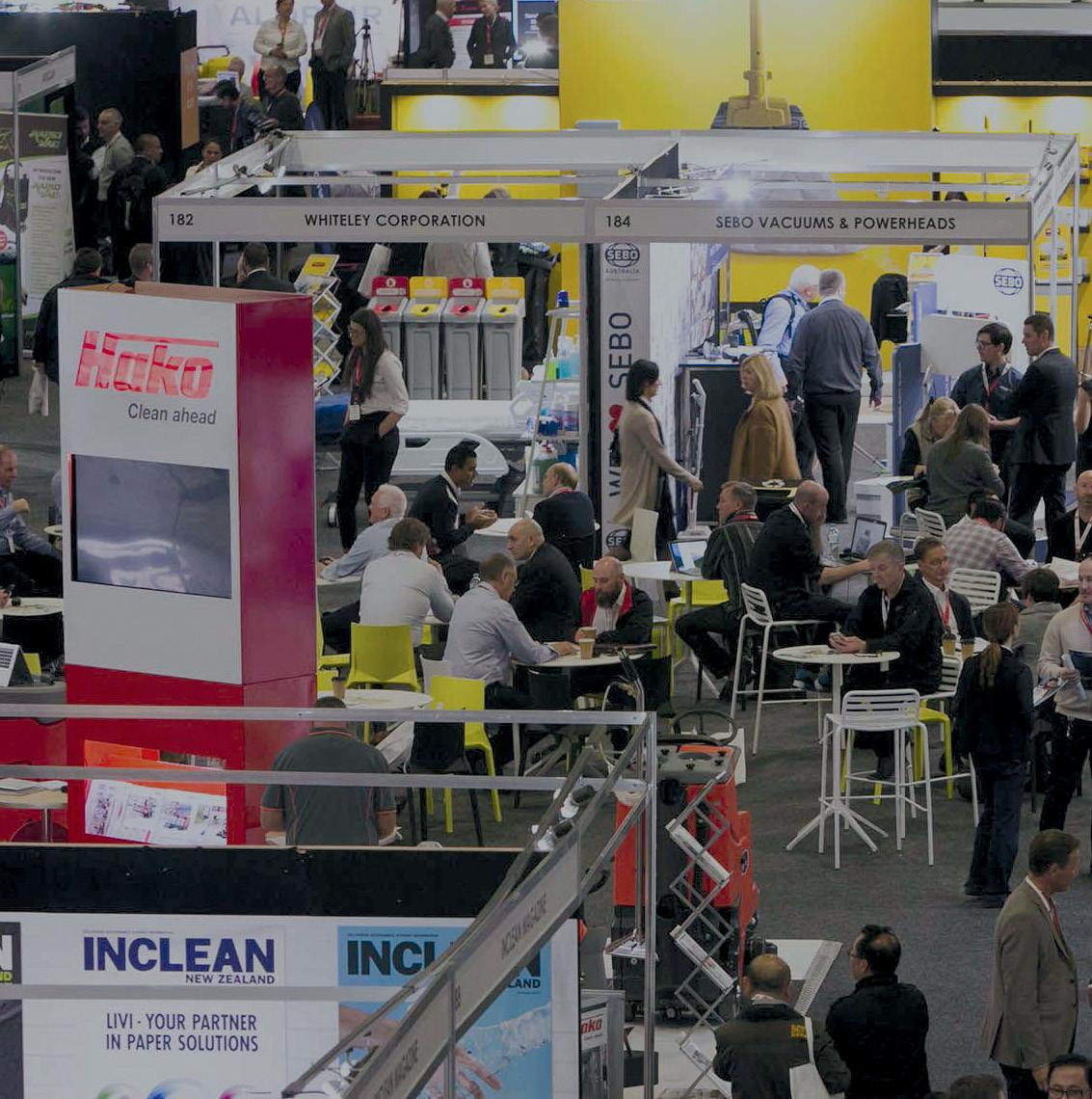


Thank you for participating in the Show and being part of the ISSA family.
On behalf of ISSA, it is my great pleasure to welcome you to the 2022 ISSA Cleaning & Hygiene Expo.
In preparing for this event, it’s been impossible not to reflect on the challenges and achievements of the last couple of years. Much has changed since we were all physically together as an industry.
At ISSA, the worldwide cleaning industry association, we are incredibly proud to both represent this essential industry and support such a diverse community.
Innovation in the cleaning and hygiene space will be of particular interest to attendees, with the best manufacturers and distributors in the industry exhibiting the latest products, technologies, and solutions to emerging problems. Moreover, the Expo is a great educational opportunity for attendees. Over 40 thought leaders will cover a range of important topics including corporate social responsibility; technology and innovation; the risk of working with chemicals, and specialised cleaning, such as healthcare, aged care, hospitality and more.
JOHN H. ExecutiveBARRETTDirector, ISSA
Welcome 40 INCLEAN September / October 2022
The 2022 ISSA Cleaning & Hygiene Expo is set to be the biggest and best in the event’s history. We hope you will leave enriched with new ideas and meaningful connections.
The constraints on our sector have been significant to say the least – from supply chain and procurement issues to staffing shortages, cost increases and shipping restrictions. Yet on a positive note, look at the remarkable response of the cleaning sector throughout this period – an invaluable contribution that has won the world’s respect. Our industry has been at the forefront of saving lives and safeguarding facilities. Moments like we have experienced can bring about change and as a result, this year more than ever shapes as an important opportunity to examine the latest cleaning products and services


10:45am – 11:30am
10:00am – 10:45am
Michael O’Loughlin, Managing Director and Founder, ARA Indigenous Services; Rohan Tobler-Williams, General Manager, ARA Indigenous Services; Adam Mercer, Director of Business Development ARA Indigenous Services
Rob Caslick, CEO, Two Good Co; Gareth Marriott, Managing Director, OCS Australia & New Zealand Building service contractors and facility managers are seeking to ramp up corporate social responsibility outcomes. The focus is on innovation, society, values, responsibility, trust, and collaboration. The market is tough, budgets are tight and priorities and perspectives have been reset because of the pandemic. Join this panel as they discuss the notion that people are looking to organisations that will shape a better society and provide employees with a sense of wellbeing, connection, and engagement now and into the future.
Cleaner air in cleaner buildings –A dream or a controllable reality?
Jason Green, Principal Consultant – Occupational Hygiene, Greencap, Associate Professor Dr Gavin Macgregor-Skinner, Senior Director, GBAC; Dr Claire Bird, Technical and Managing Director, LITMAS
Former Sydney Swans AFL legend Michael O’Loughlin brings his passion and team spirit to the building services industry. As the pandemic-era cleaning industry booms, O’Loughlin and ARA Indigenous Services’ Adam Mercer and Rohan Tobler will join the discussion to hear how Michael is driving commercial growth in the sector while supporting, training, and employing First Nations peoples. Hear real, candid discussion as the panellists share their life experiences as business leaders and mentors within the Indigenous community.
42 INCLEAN September / October 2022
Mark Phelan, Commercial Director, Freudenberg Home & Cleaning Solutions; Dr. Tony Peacock, Chairman, Wintermute Biomedical Australia; Thomas Culver, Founder, The Robot Factory
1:00pm – 1:45pm Harnessing technology, innovation, and development – What’s next for the cleaning industry?
Ensuring business resilience – The value of a pivot
WEDNESDAY, 14 September 2022 FREE TO ATTEND SPEAKER THEATRE INCLEAN EXCELLENCE AWARDS & NETWORKING DRINKS
12:15pm – 1:00pm
11:30am – 12:15pm
FOR MORE INFORMATION about the workshops and presenters, www.issacleaninghygieneexpo.com/visit:education-program – 4:00 PM
This presentation will cover the emerging technologies, innovations, and developments that are set to make a difference in the cleaning industry, along with its most critical challenges and changes to be faced in the future. Join the panel as they consider the next big thing.
Wayne Hill, Managing Director, Diversey ANZ; Oliver Lazarevic, CEO, Supply Clusters; Tim Edmondson, Managing Director, Edco Cleaning Products
This panel session will discuss old, new, and future approaches to identifying, measuring, eliminating and controlling the sources of indoor air quality problems, the challenges of poor indoor air quality and available solutions.
Social enterprise and sustainability –How to do good with CSR
Michael O’Loughlin’s journey from AFL to the building service industry
There’s nothing quite like global turbulence to really test the endurance and agility of an organisation and its team. Join this panel as it discusses the issues that members have faced and embraced and what it has taken for their companies to adapt, persevere, and thrive during an uncertain and ambiguous time.
A growing body of scientific evidence has indicated that the air in buildings can be more seriously polluted than the outdoor air. Other research indicates that people spend approximately 90 per cent of their time indoors. Thus, for many people, the risks to health may be greater due to exposure to air pollution indoors than outdoors.




The cleaning industry has its challenges with quotes, tenders, and tight margins in a hyper-intensive competitive market. This session will allow you to build a go-to-market strategy that will work. This workshop will provide you with the tools to give your company the edge, differentiate itself from the competition, and improve your overall operations. Within this interactive session Susan will provide you with ideas and tools on how to increase your win rate; by being competitive and effective through good business practice whilst enabling you to maximise margins.
3:15pm – 4:00pm
Presenter: Susan Crane, Director, Crane Consulting
Monique Welsh, Divisional General Manager, Alsco; Bronwyn Capanna, Executive Director, Accord Australasia Limited; Greg Crisp, Sector Manager, Facility Management, Bunzl ANZ; Jennifer Devine, Group Purchasing Manager, Legend Corporation
Maja Baska, Nikki McLennan – Lion & Cub Photography
Cost: AUD $68pp 11:00am – 1:00pm Linkedin: Boost your brand awareness
A corporate headshot is simpler than you think with ISSA Oceania’s award-winning professional photographer to help you put your best face forward. Photography will take place between 10am and 4pm during both days of the expo. Each photo session is 10 minutes. Receive a colour photo and black and white photo. Images will be processed and emailed within two days.
43
2:30pm – 3:15pm Closing the gaps in aged care cleaning and hygiene
Cost: AUD $47pp (ISSA members) AUD $65pp (non-members)
The risk of working with chemicals –Are you exposed?
Complacency can be the biggest risk in aged care. If infection gets into an area, lockdown procedures must be enforced. At the same time, aged care cleaning is not simple. Some of the challenges are similar to hospital cleaning, but the fact that residents are often in attendance and enjoy the company of a non-authoritarian friendly person only adds to the complexity. Join this panel as they consider why it is essential that cleaning staff should not be overlooked when it comes to training and updates on regulations and procedures.
One of the most important commercial lessons to emerge from COVID-19 is the heightened importance of supply chain management and procurement. Resilience and agility have become part of the discussion for every organisation. Diversifying, innovating, and exploring new technologies throughout the supply chain is also crucial. Join this session as the panel examines the risks associated with not adjusting business behaviours accordingly to social, sustainable, environmental, and corporate governance sourcing.
Cost: AUD $55pp (ISSA members) AUD $70pp (non-members)
Lorraine Rogic, Director, Logic Business Resources, Theo Oostveen, Manager, Marketing and Business Development, Ansell; Mark West, General Manager ENPAC Australia Chemical risks can expose all levels of a business, including employers and employees.This panel will cover the areas of chemical containment, disposal, personal protective equipment (PPE), legislation, and more. Covering industries from commercial, industrial, government, through to healthcare, panellists will be discussing some key topics and issues surrounding chemical management. www.incleanmag.com.au
2:00pm – 4:00pm Differentiate and elevate your business in a hyper intensive market
LION & CUB PHOTOGRAPHY
Presenters: Sean Matthews, Managing Director, Banksia Consulting Group; Michelle J Raymond, Chief LinkedIn Social Strategist, Good Trading Co With more than 500 million users LinkedIn is exploding right now with activity for business professionals. There’s never been a better time to position yourself as a thought leader, trusted advisor, and expert for your future customers. In this workshop you will gain a better understanding of key metrics, how to attract attention, develop thought leadership, and increase sales.
1:45pm – 2:30pm How COVID-19 has shone the light on supply chains and procurement
Wednesday, 14 September 2022 Workshops EDUCATION SEMINAR SPONSOR
Lesley Jones, Head Trainer, Smarter Skills; Sean Matthews, Managing Director, Banksia Consulting Group
10:00am – 4:00pm — WEDNESDAY & THURSDAY Expo photo booth


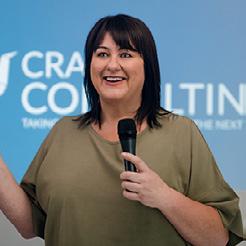


Scott McFadzen, WLS, IICRC Instructor, Coach8
10:00am – 10:45am
On the money – Tips on how to create successful tenders and quotes
Why is it when you ask people to do something differently that they stick to the way they have always done things? Is it sabotage, or laziness, or is there more to getting teams and people to adapt, change and be agile? Never has it been more important for teams to improve their processes and take on new ways of working as we rise to the challenges that COVID-19 has thrown at businesses. In this session, we consider why we need to engage our people to be part of the solution, rather than just part of the delivery, and explain how we can use our business culture to reinforce change through new norms.
Associate Professor Dr Gavin Macgregor-Skinner, Senior Director, GBAC; Associate Professor Dr Greg Whiteley, Executive Chairman, Whiteley COVID-19 highlighted the need for validating cleaning procedures. This virus and many others remain infectious in the environment and cleaning for health must focus on removal and disinfection. But how do you know that the surface has been cleaned and the risk of infection mitigated? Will ATP testing be sufficient? What about fluorescent marker technologies? How can you be certain that the built environment has been cleaned for health and safety? This talk will review the technical issues on cleanliness testing, cleaning challenges, and the appropriate methods of disinfection.
The cleaning industry has many challenges when it comes to quotes and tenders. Margins are tight in a competitive market, which can make financial management seem impossible to most. To increase your win rate, it is important you understand how much it costs to serve the audience you are addressing, the client outcome that needs to be achieved, and how your company will get them there. This session will explain how to present your business more professionally by being able to show clients you understand your costs and can demonstrate the value-add you bring to projects. These tips will be paramount in increasing your win rates.
Navigating the insurance maze – How to save money through effective claims management
10:45am – 11:30am How unseen is now the seen in cleaning, disinfection, and infectious disease prevention for facilities
Hugo Dessens, Head of Client Services (NSW) – Corporate Insurance & Risk Solutions, Honan Insurance Group; Poppy Foxton, Head of Corporate Insurance and Risk Solutions, Honan Insurance Group; Sharon Rutherford, Head of Risk Consulting, Honan Insurance Group; Maja Vujinovic, Head of Risksmart, Risksmart Claims Solutions
Amanda De Haas, People, Culture & Change Professional
THURSDAY, 15 September 2022 FREE TO ATTEND SPEAKER THEATRE NETWORKING DRINKS
Susan Crane, Director, Crane Consulting
44 INCLEAN September / October 2022
The Institute of Inspection, Cleaning and Restoration Certification (IICRC) recently published the newly revised, ANSI-approved ANSI/ IICRC S500 Standard for Professional Water Damage Restoration (5th edition, 2021). This standard describes the procedures to be followed and the precautions to be taken when performing water damage restoration in residential, commercial and institutional buildings, and the systems and personal property contained within those structures. In this session, we consider how the revised standard improves the organisation and clarity of the information, while addressing industry changes and the most up-to-date best practices for water damage jobs.
1:00pm - 1:45pm
12:15pm - 1:00pm
11:30am - 12:15pm Engaging people in change
Cleaners and facility managers are on the front line of public liability claims. In a highly litigious country, the cost of claims and the flowon effect to premiums can erode profit margins and put businesses under significant pressure. In the face of onerous contractual terms, strict rotation times and limited staff numbers, businesses need to adopt proactive and targeted strategies to reduce their overall insurance spending. In this session, Honan Insurance Group and Risksmart Claims Solutions experts outline effective and practical strategies to protect your business.
FOR MORE INFORMATION about the workshops and presenters, issacleaninghygieneexpo.com/visit:education-program/ –4:00 PM
Beyond the theory – What the changes to the Standard for Professional Water Damage Restoration really mean for you


The packaging challenge: Towards packaging waste circularity solutions for the cleaning and hygiene industry
During this session, the panel will address the need for an open, symbiotic working relationship between the two entities and a greater focus on cleaning and hygiene. They will also examine the challenges facing the sector such as government regulation, single touch payroll, and the Modern Slavery Act.
www.incleanmag.com.au
Presenter: Associate Professor Dr Gavin Macgregor-Skinner, Senior Director of Global Biorisk Advisory Council, a division of ISSA
Professor Brett Mitchell, Professor Health Services Research and Nursing; Editor-in-Chief, Infection Disease and Health; Joanna Corrick, National Portfolio Manager, Integrated Investment Portfolio, Mirvac; Jonathan Weiss, Commercial Director at Reckitt for B2B in EUANZ Businesses have never been under more scrutiny than today to ensure spaces are protected from the spread of germs. However, even with the marriage of efficacious products, intense training, and enhanced cleaning protocols, it can all come tumbling down if consumers don’t do their part. In this session, panellists will unpack the psychology of consumer behaviour, how people instinctively interact in shared spaces, alongside actionable advice to ensure patrons and staff remain vigilant at the last mile of a comprehensive hygiene solution.
The packaging space in Australia is abuzz. We have national packaging targets, a national plastics plan, and states and territories have their eyes firmly fixed on ‘problematic plastic packaging’. How is your business responding to these developments? In what future directions will we be expected to head? Are you worried that all forms of plastics may be on the hit list or simply that the changes are coming too fast to keep up with?
Cost: AUD $160pp (ISSA and Accord members) AUD $235pp (non-members)
1:00pm – 4:00pm GBAC Risk Management Approach: Who, What, When, How
Thursday, 15 September 2022 Workshops EDUCATION SEMINAR SPONSOR
9:30am – 12:00pm
Cleaning and consumer behaviour: The last mile of a comprehensive hygiene solution
In an ideal world, commercial cleaning companies and facility managers should work closely together to achieve mutual outcomes. However, while collaboration is key, it cannot be denied that each party often has its own targets and objectives.
2:30pm - 3:15pm
Why it’s more important than ever for facility managers and building service contractors to collaborate
Hosted by Accord Australasia, the packaging challenge is a sector-specific deep-dive into this highly topical sustainability issue for the cleaning and hygiene products industry.
45
Why investing in post-pandemic safety, mental health, and wellbeing is worth it
MC: Craig Brock, Director, Policy and Public Affairs – Accord Australasia Ltd. Presenters: Jennifer Semple, Manager, Sustainability & Education Programs, Accord Australasia Limited; James Wiltshire, Technology & Sustainability Leader, Dow Australia & New Zealand; John O’Donnell, Technical Manager, Albright & Wilson Australia; Peter Tamblyn, Chairman, Australian Council of Recycling (ACOR); Ashleigh Gay, Head of Sustainability Leadership & Communications, Edge Environment
3:15pm - 4:00pm
Khadijah Bouabdullah, Divisional CEO, Ozland Group Solutions; Matt Marsh, Managing Director, Sebastian Group; Steven Kulper, Consultant
1:45pm – 2.30pm
The goal of this workshop is to offer a more complete understanding of the risk characterisation and evaluation processes within a risk management system. This workshop focuses on understanding risk characterisation and evaluation processes within a Risk Management System as part of the ‘Cleaning for Health’ curriculum. Through guided discussion and interactive exercises, students will be offered an introduction and review of risk and risk assessment in the context of ‘Cleaning for Health’ followed by a discussion of the process of risk characterisation. Risk evaluation and its importance within risk assessment and the acceptance of risk will also be covered.
Cost: AUD $85pp (ISSA members) AUD $100pp (non-members)
Lorraine Rogic, Director, Logic Business Resources; Libby Roberts, Founder and Managing Director of Workplace Rehabilitation Management Mental health and wellbeing in the workplace have become a growing focus in the aftermath of COVID-19. This was particularly evident during the pandemic, with a growing number of employees working from home and others having to work on the front line. In this session, you will learn where responsibilities lie for employers and employees with regard to wellbeing issues, and what changes we can expect in the future.


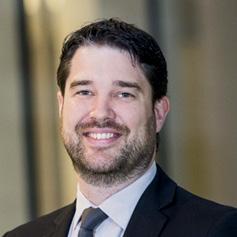


StandARAwww.airhygienetraining.com.auIndigenousServices204
StandSILVERAirhygienewww.agar.com.auTrainingSPONSOR186
ARA Indigenous Services use the wider ARA Group to position candidates from our Wiimali Program into the wider business using cleaning as a valued employment segway.
3M provides facility managers and contract clears with innovative, sustainable high-value solutions to help protect a building’s life and enhance the performance and productivity of 3Memployees.facilitiescare and cleaning solutions enhance protection, performance and productivity for the life of a building. Whether you need cleaning supplies or janitorial supplies, facility maintenance materials or specialty items from floor mats to safety tapes and treads. 3M products deliver. We also provide industry-leading Scotch-Brite products for food services cleaning needs, from griddle cleaning to appliance cleaning, as well as food quality and food safety products.
Abco Products is more than just a supplier of cleaning products and equipment. We have been empowering cleaners and by extension the whole community for decades through innovative cleaning equipment, expert cleaning advice and investment in sustainable cleaning solutions. Our online ordering system “Abconet” is a revolutionary tool that sets Abco apart in the industry. With site templates, budget management, permissions control and consumption reports we are helping customers centralise their purchases and making their life easier! Located nationally across Adelaide, Brisbane, Melbourne, Perth, and Sydney, Abco have been servicing contract cleaners and facility managers for over 20 years.
Agarwww.aeris.com.auCleaning Systems
3M Cleaning and Workplace StandSafety153
StandsGOLDAbcowww.3m.com.auSPONSOR29and37
The company has always invested heavily in research and design, resulting in its long-standing reputation for products that do the job and can be relied upon.
Aeris Environmental Ltd are leaders in breakthrough technology that helps keep our living and working environments free from germs, bacteria, viruses, mould and other fungi, while stopping surfaces from degrading. Our team of world class scientists have developed a number of unique breakthrough formulations that have been patent protected. Our mission is to keep everyone safe and healthy.
• Split system hygiene is becoming increasingly important with many consumers searching for a cost-effective way to clean their systems and reduce the risk of microbial growth to improve their indoor air quality.
StandAeriswww.abcopro.com.auEnvironmental40
• Learn inside secrets from the professionals • Learn to work safely on air-conditioning equipment
ARA Indigenous was formed by Michael O’Loughlin and Paul McCann in 2016 and in 2017 took out Supply Nations Indigenous Supplier of the Year. ARA Indigenous Services specialises in cleaning services nationally where we can be found both supporting and engaging Indigenous staff members from cleaning through to management positions.
StandBrainwww.longservice.nsw.gov.auCorp124andPodB
StandAUSLEAVE150
Airhygiene Training is a boutique RTO, delivering a studentcentric experience, ensuring students gain the knowledge and confidence to actively apply their new skills.
Brain Corp is the global leader in robotic AI software that powers the largest fleet of autonomous mobile robots (AMRs) operating in commercial public spaces. Global OEM partners use the company’s cloud-connected platform, BrainOS, to create scalable, self-driving robots that are used by end customers to clean floors and sense environmental data - turning manual
Agar is at the leading edge of environmental sustainability and care, with select products accredited through the Good Environmental Choice Australia (GECA). The company has always taken a total approach to the future, effectively implementing strategies to reduce harm to the environment and its product users.
2022 – Exhibitors 46 INCLEAN September / October 2022
10829NAT Certificate II in Air Conditioning Hygiene – Australia’s only nationally recognised competency in Air Conditioning Hygiene developed and delivered by HVAC Technicians.
• Learn to clean and sanitise air-conditioning split and ducted systems
Four Australian states and territories provide portable long service leave schemes for workers and employers in the contract cleaning industry. Workers earn long service leave entitlements based on their service to the industry, rather than service with one employer. If you engage workers to perform cleaning work, in one of these jurisdictions, you must register with the relevant scheme and record your worker’s service. In NSW, contact LSC on 13 14 41 or www.longservice.nsw.gov.au. In QLD, contact QLeave on 1300 QLEAVE or www.qleave.qld. gov.au. In ACT, contact ACTLeave on (02) 6247 3900 or www. actleave.act.gov.au. In VIC, contact PLSA on 1800 517 158 or www.vic.gov.au/portable-long-service
Agar is renowned within the industry for its technical knowledge and high-performance range which ensures its customers are always able to clean efficiently and effectively.
Stand 7 Agar Cleaning Systems takes pride in manufacturing the highest quality cleaning chemical products for the commercial industry. Based in Melbourne, Ross Agar began formulating cleaning solutions for the family-owned business over 50 years ago.


Contractors Association of Australia Pod(BSCAA)D
CleanLIFE provides hygiene product solutions that are Australian made, offering reliable supply and quality reassurance for every day needs in the home, community, and business. We are helping to restore Australia’s sovereign capability with our operation that services industry and consumers across the country. Backed by a team of chemists, product innovators, and manufacturing specialists, CleanLIFE delivers high quality products for everyday needs. The world has taught us that hygiene health is a responsibility for everyone, so we’re here to help.
SILVER PREMIUM SPONSOR Stand 178 CloroxPro offers some of the industry’s most recognised and trusted brand names for commercial cleaning, including its Clorox Healthcare products and technologies for healthcare facilities. Whether it is schools, offices, restaurants, hotels, hospitals or other commercial facilities, CloroxPro is committed to meeting the demands of industry professionals.
StandCallingtonwww.bscaa.com142
Conquest was born from the belief that high quality and reliable equipment should be backed by equally exceptional service and support. As Australia’s leading supplier of industrial and commercial floor cleaning equipment, Conquest offers flexibility to purchase machines on terms which suit you, from short term hire to fully maintained no-risk rentals. With proven reliability and flexibility to suit your needs, you can rest assured that Conquest is behind you all the way.
Daniels Associates is a registered training organisation and HR solutions developer. Our products and services include:
operations into automated workflows. Brands across the world benefit from the growing portfolio of BrainOS-powered robots and our industry leading privacy, safety and efficiency tools that make managing and scaling automation easier.
StandCoach8www.cloroxprofessional.com.au189
• Learning management software and content for the cleaners and cleaning managers. Over 100 online courses available.
StandDEMAwww.danielsassociates.com.auAustralia139
StandConquestwww.coach8.com.auEquipment52
Cleanstar/XPOWER is Australia’s leading brand of cleaning equipment, machinery, vacuum cleaners, vacuum bags and filters, spare parts and accessories, along with sanitary hygiene supplies and equipment for restoration and remediation. www.cleanstar.com.au
DEMA is a leading supplier of chemical dispensing systems, fluid control devices and industrial solenoid valves, strainers, pumps and injectors for virtually any industrial, institutional and professional market. With a rich heritage in design and manufacturing, combined with knowledgeable staff and support teams DEMA can provide the best solution for each and every requirement. www.dema.com.au REGISTER NOW: www.issacleaninghygieneexpo.com www.incleanmag.com.au 47
Buildingwww.braincorp.comService
Established in 1964, the BSCAA is Australia’s peak industry representative body for the building services industry. We support members within the cleaning, security, facilities management, and grounds maintenance industries by providing leadership and a range of relevant and quality services, including industrial relations advice and support, industry-relevant online resources, education, training, information, news, and support services. Our purpose is to foster and encourage the growth and development of the contract cleaning and building services industry and to promote and protect the interests of members. We aim to shape a better future for the industry.
At Callington, we combine technological innovation with world class manufacturing and process excellence. Callington is a 100% Australian owned OEM company with global businesses in more than 10 countries around the world. We are a preferred global partner to the aerospace, defence, manufacturing, health, and retail markets. Our specialty chemical solutions improve life quality by preventing the spread of diseases, protecting valuable assets, improving manufacturing processes, enabling healthier lifestyles, and supporting a safer world. Our range of COVID-19 outbreak solutions including broad spectrum disinfectants, to cleaning and personal protection products, which help to eliminate a wide range of viruses, germs, and bacteria.
StandLANYARDCleanstar/XPOWERwww.cleanlifeaus.com.auSPONSOR50
Coach8 delivers IICRC courses live streamed online, live in the classroom and private customised courses nationwide and throughout the Asia-Pacific region. Coach8 will be hosting the inaugural Australasian Indoor Building Management Symposium featuring Spring Break in 2022.
Coach8 is an approved IICRC school offering training for the cleaning and restoration industry such as water damage restoration, structural drying, mould, crime and trauma and fire remediation.
• Certificate III in Cleaning Operations • Certificate IV in Cleaning Management • Certificate III in Health Support Services
Clorox Australia
• Integrated police checks through our association with CTW
StandCleanLIFE38
StandDanielswww.conquestequipment.com.auAssociates56
• Corporate branded learning management systems


2022 – Exhibitors 48 INCLEAN September / October 2022
Sirron Group Holdings exists to support the vulnerable through charity and reward the efforts of our staff and shareholders. We achieve this by profitably manufacturing and distributing sustainable products and equipment of high quality and performance. We consider this intrinsic to outstanding operational conduct. By 2023, our brands will be accepted as the best value and quality available in Australia and our service and warranty as second to none. Our long term goal is to be the first choice for every commercial and care establishment in Australia and New Zealand.
Dettol Pro Solutions GOLD SPONSOR Stand 85 Reckitt’s Dettol Pro Solutions harnesses the power of the same trusted Dettol products to help protect businesses and public spaces from the spread of germs. In today’s world, consumers have increased hygiene expectations which makes germ-protection more critical than ever. The comprehensive approach from Dettol Pro Solutions incorporates protocols and training, Dettol and Dettol branded marketing materials and signage. Dettol Pro Solutions empowers businesses to demonstrate to their staff and customers a commitment to providing a trusted standard for protection.
StandDominant26
For over 60 years, Australian businesses have entrusted Dominant with delivering the highest quality cleaning and hygiene solutions, tailored to their unique industry. We pride ourselves on being a 100% Australian-owned and operated family business, along with our strong commitment to acting sustainably for our future generations. Our experienced team of experts provide unique, tailored solutions across a wide range of industries and applications we specialise in. Our overarching goal is to protect your brand like it’s ours. A partnership with Dominant is safeguarding your brand and your people, in the best hands possible.
StandDiverseywww.sirronholdings.com.au190
A trusted partner at nearly three million customer locations, Ecolab is the global leader in water, hygiene and infection prevention solutions and services. Protecting people and businesses is what we do, but our greater purpose is to help people lead safer, healthier and cleaner lives whilst protecting our planet’s vital resources. Customers in the food, healthcare, hospitality, and industrial markets across the world in more than 40 countries choose comprehensive Ecolab solutions, data driven insights, and personalised service to advance food safety, maintain clean and safe environments, operate efficiently, and achieve sustainability goals. Ecolab is everywhere it matters, because what we do and how we do it, matters everywhere. www.ecolab.com
StandEclipsewww.dominant.com.auFloorSolutions30
StandECOLABwww.ecofy.net.au12
StandDitch3www.linkedin.com/showcase/dettol-pro-solutions-australia/ProfessionalCleaningTablet6
StandDolphywww.diversey.com3
Dolphy Australia is an Australian brand and offers a range of commercial and residential bathroom and hygiene maintenance accessories to many different businesses. The company was established in late 2017 in Melbourne and has been growing rapidly since. Our range includes commercial hand dryers, sanitiser/soap dispensers, air fresheners and other bathroom fittings such as paper towel dispensers and toilet roll dispensers. We pride ourselves in bringing an innovative and quality range of products to the market as well as providing outstanding service aftersales. Our products are based on the latest technology and made from the highest quality materials, designed to look sleek and stylish so they can help add a touch of class to your workplace. www.dolphy.com.au
Eclipse Floor Solutions is the Australian distributor for Pioneer Eclipse floor care systems, which include propane and battery burnishers ranging from 21” to 40”, the Barracuda 38” stripping machine and various grinding and polishing machines. The chemical systems are designed for vinyl, terrazzo, marble, man-made stones and concrete. They are complimented with regular speed, UHS speed and diamond pads. We recently added the Gausium range of robots to our line including the Vacuum 40, Scrubber 50Pro & 75. The Gausium range is arguably the most technologically advanced on the market today with its simple and efficient mapping and performance features
Ecofy are industry leaders in chemical free Cceaning technologies and quality microfibre systems. Ecofy have partnered with Tersano Inc and Greenspeed to bring safer, healthier, quality cleaning products for people and planet to the Australian and New Zealand markets. Products include Tersano SAO cleaning and sanitising system and portable iClean mini. Greenspeed microfibre systems including the revolutionary Re-Belle 100% recycled and 100% recyclable microfibre cloths.
Harnessing 95 years of expertise and knowledge, Diversey develops cleaning technologies that save lives, providing a tailored, customercentric approach that empowers sustainable solutions. Protecting and improving the environment, we operate with our customers’ needs at the heart of everything we do. Diversey’s ethical commitment is implicit in all our products and everyday relationships with our staff, our customers, and our planet. These ethics drive our commitment as pioneers of the future and creators of connection and innovation.
StandEcofywww.eclipsefloorsolutions.com.au74


StandGausiumwww.tennantco.com.au102
Federal Batteries Stand 151 Federal Batteries has serviced automotive, commercial and industrial customers in the Australian battery market for over 30 years. Our team of technical and application experts, sourcing and products specialists ensure customers receive high quality, fit for purpose solutions on time Every. Single. Time. To deliver on our promise, we utilise best practice charging systems and methodologies, a national network of service centres and highly trained staff. With over 100 years of combined experience, our sales, customer service and management teams are second to none.
StandSILVERFreudenbergwww.federalbatteries.com.au–OatesSPONSOR172
Godfreys Commercial Stand 196 Godfreys Commercial is a dedicated business unit of Godfreys, established to provide innovative and exclusive products, and specialist commercial floorcare solutions to key industry segments - BSC market, aged and healthcare, education, logistics, warehousing, manufacturing, retail, and accommodation. We proudly provide clients with industry leading brands, heavy duty equipment, including our company-owned brand, Pullman, and exclusive international third-party brands Comac and GodfreysRosemor.Commercial prides itself on superior customer service, aftersales care, product training and ongoing education, all available at our new DC. Each service is tailored specifically to the unique requirements of our diverse client base.
Freudenberg Home and Cleaning Solution (FHCS) is a leading international company for branded cleaning products and systems. The Professional products and solutions are sold under the brand names Vileda Professional, Oates and Research Products. With an extensive national warehousing network and over 1100 products, Oates prides itself on delivering the highest level of quality products with national service for over 90 years. Research Products range ensures that a complete cleaning solution is available for commercial cleaners, and it has been recognised as an innovator in the supply of hard floor and carpet cleaning solutions. Vileda Professional is recognised as an international leading innovator and technology company, providing professional cleaners with cost-efficient and highperformance cleaning solutions, supported by intelligent, valueadding services, to make customers more efficient.
Manufacturer and servicing of quality, environmentally friendly cleaning machines, including sweepers, scrubbers, vacuums, and city cleaning machines.
Gausium (alias “Gaussian Robotics”) is a leading smart solutions provider of AIintegrated autonomous service robots. Currently, Gausium’s products and services include commercial floor cleaning robots, indoor delivery robots and supplementary accessories like docking stations, cloud platforms and application software. www.gausium.com
Ridiculously, we are still using plastic bags in wet weather for umbrellas even shopping plastic bags are banned in Ecosupermarkets.Umbrelladryer provides a simple and cost effective solution to wet umbrellas. We provide umbrella dryer units that quick and easy, wet umbrella in a dryer unit as you walking pass and it dries the umbrella, no more plastic bag. It will also give you militate against the hazards caused by wet floors. It will encourage people who walking in to any property without the worry of damaging goods or their own clothes and floor. According to the Health and Safety Executive website ‘90% of slips happen when the floor is wet with water or contaminated with food product.’ Managing these risks is the first step you can take to preventing slips and falls in your premises.
49
Tennant Company a world leader in designing, manufacturing, and marketing of solutions that help create a cleaner, safer, healthier world, acquired GAOMEI Cleaning Equipment Company in 2019. GAOMEI is based in Hefei, China, and is a recognised leader in the development and production of smallto mid-sized cleaning equipment and solutions for commercial and industrial applications.
StandHOGATEwww.hakoaustralia.com.au136
REGISTER NOW: www.issacleaninghygieneexpo.com www.incleanmag.com.au
“A smarter clean, a better world” ” is GAOMEl’s commitment to the global cleaning industry. Established in 1997, GAOMEI Cleaning Equipment Company is a renowned professional cleaning equipment manufacturer.
StandPOPCORNHOSPECOwww.hogate.com.auCARTSPONSOR15
StandGaomeiwww.oates.com.auAustralia164
StandHakowww.godfreys.com.auAustralia84
Hospeco Pty Ltd is a leader in hygiene and washroom for over 20 Manufacturingyears. quality in-house products & representing premium international brands, including HospiPlus, HospiCare, Maxdry, Maxtrap, Extra Pro, Best, FDT, Bobson, Freshening & many more. Our diverse range covers odour control, hand care, urinal and washroom maintenance, insect control, hand dryers, chemicals, PPE products, cleaning accessories, wet wipes, paper products, and an extensive range of dispensers in auto, manual, plastic, and stainless steel. Expert knowledge, commercial quality products, competitive pricing, vast local stock holdings, and a friendly team. www.hospecoonline.com





The Interclean Group works to create and implement best practice cleaning systems and training programs in facilities for a wide range of industries including commercial, retail, education, hospital, and aged care. An industry leader, Interclean has always been on the cutting edge of quality products, technology and innovation creating auditing apps, cleaning management systems, and disposable microfibre cleaning systems. Having recently launched the iClean Hospitality Suite internationally, the Interclean Group will be showcasing this intuitive and dynamic digital supervisor that is a game changer in cleaning management.
In 2020 JTY was appointed the exclusive distributor for Scot Young Research (SYR) products. SYR products manufacture innovative and quality commercial cleaning tools that have been used and tested in the most challenging environments of fast food, hospitals, and aged care since 1954. Visit our stand to see how we can improve your cleaning game www.whitemagic.biz
iClean Australia’s business model is founded on supporting a national body of distributors that are capable of offering advice, service and support when and where it is needed.
With a proud history of scientific innovation that’s friendly on the planet, Hygieia-San is your gateway to a suite of products that unites high efficacy with a desire to nurture the future, putting your good intentions to work; keeping your clients and customers safe so your business can focus on service and success. Technically advanced products for use in any environment using eco-friendly, 100% biodegradable and nonstaining ingredients. It’s fast-acting and highly effective on all types of bacteria and viruses. Our products work to 99.999% efficacy across many application fields disinfecting surfaces, tools, water, and even large areas through vaporisation.
iClean Australia is proud to offer a complete line of premium cleaning equipment that includes vacuums, polishers, carpet extraction machines, sweepers and floor scrubbers in both walk behind and ride on models. All our machines are well designed at a sensible price. iClean is constantly improving and updating our product range to meet our customers current and future needs.
StandJUICEi-teamwww.hygieia-san.com.auANZCARTSPONSOR72
i-team are world leaders in innovative solutions to make cleaning faster, better, safer, greener and cleaner. We are stoked about cleaning, thrilled about sustainability and wholeheartedly dedicated to keep on innovating.
INCLEAN is published by The Intermedia Group, Australia’s leading B2B publishing, event management and technology business, on behalf of ISSA, the worldwide cleaning association.
PodHygieia-SanC
Interclean Group Stand 8
ISSAwww.interclean.com.au–TheWorldwide Cleaning Industry Association EXPO OWNER Stand 270
ISSA is the leading worldwide association for the cleaning industry and represents all the professions it encompasses and allies with other trade organisations that share members’ common goals. We support the industry and our members through driving connections, education and training, and offering various tools and resources that specifically focus on the professional cleaning industry. We keep the market updated and connected through the industry’s leading trade publication INCLEAN and the ISSA Cleaning & Hygiene Expo. Our mission is to change the way the world views cleaning – increasing the appreciation for cleaning as an investment in human health, the environment and an improved bottom line.
INCLEAN’s bi-monthly magazine (six issues per year) is essential reading for those in the commercial cleaning industry and reaches all major professionals in the sector. Incleanmag.com.au provides readers with quality content on the latest news and developments in contracting, carpet and restoration, general management, product and technology, healthcare, as well as legislative changes. The website is complemented by a weekly newsletter.
For 40 years JS Hayes have provided Australian workplaces a wide range of hygiene and cleaning essentials to keep your teams safe and healthy. We are dedicated to sustainable sourcing and offer our customers brands that our customers trust and find value for money. Our aim is to be an enabler of supplier diversity and play our part to help deliver positive social change for Aboriginal Australians. Together our full catalogue of quality brands includes Tork, Deb, Regal, Tru-Soft, Enviro-Saver, Cultural Choice, Wirrpanda, Oates, Tasman & Chemform.
www.incleanmag.com.au
INCLEAN is the leading trade publication for the Australian commercial cleaning industry. Published for more than 30 years, INCLEAN delivers high quality, dedicated industry content.
StandMEDIAINCLEANwww.elitecleaningsolutions.comSPONSOR122
StandSILVERJSissa.com/oceaniaHayesSPONSOR92
JTY Australia is the official distributor of both White Magic and SYR products for the Australian and NZ commercial cleaning market. White Magic has pioneered the use of “just add water” melamine sponges in the commercial cleaning arena since 2003.
2022 – Exhibitors 50 INCLEAN September / October 2022
StandJTYwww.jshayes.com.auAustralia68
StandiCleanwww.i-teamanz.comAustralia31


Northfork Chemicals is committed to providing you a range of products suitable for any situation. From food service hygiene and washroom products, to housekeeping, personal hand care and laundry washing products, Northfork is ideal for the home and workplace environment. For over 25 years, Northfork has been manufacturing quality cleaning chemicals at our manufacturing facility in Queanbeyan, NSW.
StandMasterwww.makita.com.auAustralia138
StandMEDICOMwww.masteraustralia.com.au108
Karcher bring quality, German engineered cleaning solutions to your doorstep. With over 80 years’ experience designing purpose-built machines that provide excellent results, we are the global leaders in cleaning.
www.pacvac.com
The last decade has seen the growth of environmental and sustainable cleaning technologies and we are proud to be at the forefront of the latest available in equipment and consumables. At Master, we are committed to ensuring that our customers receive the best in service, advice and products!
Makita is leading the way in cordless commercial cleaning, power garden, and power tool solutions. Makita’s 18V LXT & 40V Max XGT battery platforms deliver market leading performance and the dual battery ‘X2’ technology provides even more power.
Makita has the cordless solution you need to get the job done safely, efficiently and effectively. Paired with market leading rapid charge technology, Makita cordless tools are ready to work when you are!
StandKärcher146
Our range includes Steam Cleaners, Puzzi Spray Extractors, Scrubber Driers, Dry Vacuum Cleaners, High Pressure Washers and Sweepers.
Master Australia has long been established as a supplier of quality cleaning equipment and products to our commercial, industrial, hospitality and healthcare customers. We align ourselves with industry leaders in cleaning machinery and general cleaning supplies and support our customers with the best of personal service and backup.
Motorscrubber products are continually fine-tuned and adapted to ensure they are the best fit for purpose for each application. Quality, innovation, and the highest level of customer service are the core values of Motorscrubber. Motorscrubber are on a mission to reinvent the cleaning experience giving you the highest quality commercial quality compact machines, disinfecting and cleaning systems in the world.
PodLOTUSwww.karcher.com.auCOMMERCIALE
StandPLATINUMMakitawww.lotuscommercial.com.auAustraliaSPONSOR157
Nilfisk is a leading global provider of professional cleaning products and services including floorcare equipment, vacuum cleaners, high pressure washers and robotics. The company was founded on a vision of producing and selling products of the highest quality worldwide and for more than a hundred years, Nilfisk has adapted to the changing needs of our customers with innovative solutions.
StandACCONorthforkwww.nilfisk.comChemicalsBRANDSSILVERSPONSOR42
Australia’s leading commercial kitchen exhaust and specialist cleaning company.
BuisnessBUSINESSPACVACwww.northfork.com.auLOUNGESPONSORlounge
Let’s change it for the better.
Pacvac began operating in Perth, WA in 1978, manufacturing and supplying vacuum cleaners. It didn’t take long to recognise a gap in the market, and within the first two years of the business’s inception, we developed a productivity-focused vacuum cleaner - the backpack vacuum. This visionary decision remains at Pacvac’s core, and gave rise to the Superpro 700 Series backpack vacuum cleaner; widely regarded as an industry benchmark. Our ever-expanding range of products includes canisters, wet and dry machines and most recently cordless backpack like Velo. Pacvac remains 100% Australian owned after 43 years, with distributors in over 23 countries worldwide.
Medicom has operations in over 95 countries and 8 manufacturing plants in North America, Europe, and Asia. At Medicom Australia we are committed to making the world a safer and healthier place by using carefully selected materials, cutting-edge technology, and continuous innovation to provide protection that you can count on. au.medicom.com
Motorscrubber Australia Stand 206 Motorscrubber is a leader globally in compact scrubbing machines, disinfecting and cleaning systems producing the highest quality, most powerful machines and innovative disinfecting and cleaning systems on the market.
Founded in 1988, Medicom is one of the world’s leading manufacturer and distributor of high-quality infection control, single-use and PPE for the medical, dental, industrial, laboratory, and beauty Headquarteredmarkets.inCanada,
REGISTER NOW: www.issacleaninghygieneexpo.com www.incleanmag.com.au 51
StandNilfiskwww.motorscrubberclean.com54
COVID-19 has put a focus on cleanliness and hygiene, making it a business-critical focus for all industries. Nilfisk is committed to helping our customers navigate the changing demands, needs and Cleanstandards.ischanging.
Northfork Chemicals is owned by ACCO Brands Australia, along with other market leading brands such as TruSens, Cleanlink and others. Our house of brands command instant recognition from consumers and are essential in offices, schools, and workplaces everywhere.




Rubbermaid Commercial Products (RCP) has a portfolio of leading brands known for superior performance, design and innovation. We strive to provide innovative, high-quality, cost-effective, and environmentally responsible products. Our “Work Smarter” philosophy is incorporated into all our products. We consistently develop solutions that are best-inclass in durability, ergonomics, and sustainability.
Powerblast Global Stand 195 At Powerblast we supply and service premium pressure washing equipment to industry where quality and uptime is essential Home of Kranzle, Powershot and Hotwash. Offering a wide range of high-pressure cleaners and sweepers. We also stock a large range of accessories and spare parts backing up our quality range to ensure your machine is always operating at its peak capabilities.
StandSILVERRubbedinwww.robots4good.com.auSPONSOR202
Rubbedin is excited to be a Silver Sponsor at the ISSA Cleaning & Hygiene Expo. Founded in 1979 by the late Dr Donald Lakeland, a metallurgist and lecturer. We manufacture Australian made and owned , premium, sustainable cleaning and surface protection solutions. The ISSA expo is the perfect place to launch our new magic commercial grade disinfectant cleaner 6in1 concentrate. Breaking tradition, this product harnesses the power of a naturally derived biosurfactant called Surfactin, uniquely sourced from our own probiotic bacterium. Visit our stand and learn about our latest technology and brands Magic, InvisiGarde, PuraChoice, and Firewise.
Established in 1995, R&J Batteries has built a strong reputation for being a leading battery distributor with 27 company-owned branches and over 8000 stockists throughout Australia and New Zealand. We pride ourselves in sourcing the highest quality products worldwide to offer customers the very best in battery technology and expert advice. Our comprehensive portfolio consists of world-class products from brands such as U.S Battery, Fullriver, RELiON and Lester which are best suited for cleaning and hygiene applications.
Established for over 30 years, RapidClean is an Australian and New Zealand owned national company with over 65 stores. Our business is made up of cleaning supply experts managing their owner-operated stores. RapidClean’s aim is to provide our customers with the support of a national organisation while providing a local service, offering a cost effective one-stop-shop solution. Our stores stock major brands of industrial, commercial and environmentally friendly cleaning and packaging products. Our collective buying power gives us the ability to offer our customers quality products at the best prices.
PodRobots4Goodwww.risksmartclaims.com.auF
Established in 2006, Risksmart Claims Management is a third-party claims administrator and subsidiary of Honan Insurance Group, which is an Australian founded leading risk and insurance broker.
Sabco (South Australian Brush COmpany) was established in Adelaide in 1892 making it one of the world’s oldest cleaning tool Today,companies.Sabcois still a family-owned business that is dedicated
StandCOFFEERapidCleanwww.rjbatt.com.auCARTSPONSOR192
PodRisksmartwww.recordtime.com.auA
Risksmart’s key purpose is to assist clients with any claims that fall under a significant policy deductible or self-insured risk. This relieves the internal administrative burden from our clients, avoids the excessive costs incurred in outsourcing to a law firm, and ensures claims are resolved for the best commercial outcomes. Our team is comprised of legal professionals and claims specialists with the expertise and negotiating skill required to achieve results.
Since 2019, Robots4Good has been a leader of robots-as-a-service across Australia and is the exclusive supplier in Australia and New Zealand for Silicon Valley Robotics company, OhmniLabs, which has deployed over 3,000 service robots to over 48 countries. We offer a new-to-market innovation through a fully autonomous, ultra-lightweight UV-C disinfecting robot.
StandProductsRubbermaidwww.rubbedin.com.auCommercial86
OhmniClean rapidly delivers medical-grade disinfection and nearly zero cleaning downtime in hospitals, education settings, aged care facilities, tourism situations, transportation and work environments. Ideal for deep cleaning in high-touch, hard-to-reach places, OhmniClean targets risk elimination from bacterial and viral transmission and can disinfect a 278m2 space in less than 15 minutes.
StandRecordwww.rapidclean.com.auTIME24
2022 – Exhibitors 52 INCLEAN September / October 2022
Record TIME is a digital management system that will streamline your business. Record TIME allows you to create custom digital dockets, checklists, forms and replicate any paperwork into a digital format that is linked to a QR code. Record TIME’s job site manager, allows your staff to sign in and out using a unique QR code that can be geofenced and made time sensitive. Using our scheduling feature, you can easily schedule your staff and know where and with who they are working. Record TIME is also used to manage safety and compliance. Using our template builder, you can create pre-start checklists, SWMS and risk assessments keeping your auditors happy and ensuring your staff are operating safely. Record TIME has be built ensuring a simple and efficient operation system for the user. Record TIME will be the most import mobile app your business will ever have.
StandSabcowww.newellrubbermaid.comProfessional10
StandR&Jwww.powerblast.com.auBatteries78


StandSEBOwww.scjp.com184
Made in Germany – SEBO upright and barrel vacuum cleaners, power brushes, polisher and dry powder carpet cleaner provide complete floorcare maintenance for all types of industries. Recommended by looring manufacturers world-wide for their deep cleaning capabilities plus positive indoor air qualities. There is a lightweight SEBO machine to suit every type of operator whether they be working in public areas or congested rooms. SEBO will be demonstrating live the SEBO ET Series of Power Brushes – a must for improved efficiency for backpack operators. Plus, the new SEBO Professional G5 the ultimate cleaning contractor’s machine, low service costs, and no downtime. www.sebo.com.au
to providing the highest quality, leading edge cleaning products that are at the forefront of innovation.
Simpple is an award-winning facilities management system that streamlines daily operations by eliminating opportunities for miscommunication or misallocation of work, resulting in increased productivity, efficiency and accountability. It integrates sensors (IoT devices, CCTV and robots), software (deep learning methodologies) and robotics to accurately observe, analyse and deploy the workforce to the problem area all within one single dashboard. It is available on both desktop and mobile and can be accessed through browsers or via an app.
SoftBanksimpple.com.sgRobotics and GERMii Australia Stand 193 SoftBank Robotics Group Corp. SoftBank Robotics is driving technology forward by becoming a worldwide leader in robotics solutions. Rapidly expanding with offices in Tokyo, San Francisco, Boston, London, Paris, Hamburg, Amsterdam, Copenhagen, Singapore, Sydney, Shanghai, and Hong Kong. GERMii Australia GERMii is an Australian headquartered engineering science and innovation company, driving exciting change in the fight against pathogens such as COVID-19 through the design, development, manufacturing, and distribution of market first UV-C technology.
Speco is an Invironment Protection company that keeps you safe from viruses, bacteria, and other types of invisible dangers. Our proprietary, Made-in-Singapore, antiviral coatings are certified by independent labs and the National University of OurSingapore.SpecoProprietary Active Ingredient:
• Provides long-lasting protection for up to 180 days
Sampsonwww.sabco.com.auChemical Products Stand 125 Sampson Chemical Products is a privately owned and operated Qld based company that was established in 1985 with its humble beginnings on the veranda of the family home. Sampson Chemical Products specialises in private label with around 85% of our business coming from companies that have their name on our products. Sampson Chemical Products has a comprehensive range of very high quality products that are competitively priced. Saving you time, money and peace of mind. We have a reputation for no back orders. Back orders can suck the life out of your business. Your customers don’t get their products when they need them and you look bad. How much do back orders cost your business?
SC Johnson Professional are market leaders in specialist cleaning and hygiene. Combining Deb skin care products along with wellknown SC Johnson consumer brands, our expertise extends to all occupational sectors as a total solutions provider for industrial, institutional and healthcare users. With a long history in the professional market, since the 1930’s and with deep category and technical expertise, the SC Johnson Professional product range provides solutions ranging from skin care and surface care, through to air care, storage and pest control. Visit our stand to see our consumer brands and innovative specialist professional cleaning and hygiene products.
StandSolariswww.softbankrobotics.comPaper66
• Is non-cytotoxic and does not harm human cells even with long term use
In 2019, the Sabco Professional brand was re-launched to better service and meet the high expectations of professional cleaners and other end users. This included the recruitment of additional, experienced and dedicated account managers that are actively engaged with our key supplier partners and end users. Our professional range of products are made to an even higher quality specifications then our premium consumer products. This ensures an even longer usage life and a superior performance. At Sabco Professional, we continue to develop innovative products for the professional cleaning market with a high emphasis on products from sustainable resources.
StandSCwww.sampsonchemicalproducts.com.auJohnsonProfessional194
StandSIMPPLE188
Solaris Paper is a leading Australian managed and operated provider of innovative kitchen and bathroom hygiene solutions for both businesses (B2B) and households (retail). Along with our sister, The Sorbent Paper Company, we are one of the largest tissue paper suppliers in Australia. Our market leading brands of Livi, Sorbent, Sorbent Professional and Handee provide quality and cost-effective solutions in toilet paper, facial tissues, hand towel, wipes, soap, sanitiser, and dispensers.
Sustainability and responsible sourcing are at the heart of what we do: 100% of our fibre is PEFC certified with zero deforestation and zero illegal logging.
StandSpecowww.solarispaper.com.au198
• Neutralises 99.9999% of viruses within 1 minute
REGISTER NOW: www.issacleaninghygieneexpo.com www.incleanmag.com.au
53


For almost 50 years, Symbio has dedicated itself to locally manufacturing high-quality cleaning detergents, chemicals and support equipment. Supporting a range of industries, from complex to simplistic, Symbio strives to know the need, present the solution and deliver the expectation in every single interaction. But we don’t just stop there, along with thousands of cleaning solutions to choose from, the team at Symbio will help you utilise your products through our expert training and services platform, CTS. At Symbio, we believe everyone should have access to the best cleaning solutions to keep their environment clean, and that’s the Symbio advantage. www.symbio.com.au
StandSymbiowww.steri-7.com.au2
Spitwater is the largest Australian manufacturer of quality high pressure water cleaners as well as importer of vacuum cleaners, scrubber dryers and industrial space heaters. The group distributes its commercial and industrial cleaning and heating equipment through capital city distribution centres as well as authorised dealer network throughout Australia. Spitwater pressure cleaner range includes electric, petrol and diesel powered models in cold as well as hot/cold water versions. The group’s vacuum cleaners, scrubber dryers and industrial heaters are high quality, Italian made. The LPG heaters are AGA approved in Australia. Spitwater is focused on providing solutions to customers’ cleaning and heating problems.
Tennant Company is a recognised leader in designing, manufacturing and marketing solutions that help create a cleaner, safer, healthier world. With a vision to become a global leader in sustainable cleaning innovation that empowers our customers to create a cleaner, safer and healthier world, Tennant creates solutions that are changing the way the world cleans. Tennant products include equipment used to maintain indoor and outdoor surfaces, as well as TennantTrue financing solutions, equipment parts, service, and maintenance to help ensure superior cleaning performance from your Tennant machines.
Steam Australia are experts in dry steam cleaning systems. We are a leading supplier of high-quality European steam cleaning equipment, established for over 17 years. We are the go-to company in Australia for quality advice and provide improved cleaning and sanitising solutions. Dry steam dramatically reduces chemical and water usage and overall cleaning times. Our clients include companies in hospital, health and aged-care, quarantine hotels, food service and production, commercial cleaning, auto detailing and hospitality sectors. We import and stock a wide range of Italian made domestic, commercial and industrial machines, with a national network of distributors and service agents.
StandTerraCyclicwww.tennantco.com.au1
TEAM Software by StandWorkWave65
2022 – Exhibitors 54 INCLEAN September / October 2022
Steri-7 is an Australian company. We are distributors of the S-7XTRA range of products for cleaning and disinfection. Our products are manufactured in Australia. Biocidal products with wide ranging efficacy and long lasting protection simplifying your cleaning and disinfection protocols in every environment.
The Power Source is a family-owned business working directly with overseas manufacturers to stay at the forefront of battery technology for the Australian market. As the market leader for battery & charger supply and support for industrial & motive applications, TPS is extremely proud to offer the very best in products such as Trojan, Discover, Deltec Batteries, Delta-Q, and S.P.E chargers. This is backed with true wholesale support providing every opportunity for long-term success and mutual growth for our network of business partners.
TerraCyclic’s unique sanitary waste disposal unit has a totally disposable lid and liner cartridge system, which means, no cleaning, less waste,cost savings and an overall reduction of energy use. No other sanitary waste disposal unit offers so much, our unit has a streamlined design, a unique biodegradable and disposable cartridge system and offers a range of retrofit components to deliver a solution that is perfect for your requirements.
StandSTERI-7www.steamaustralia.com.au132
TEAM Software by WorkWave develops market-leading financial, operations and workforce management solutions for contractors with distributed workforces, with a focus on the cleaning and security industries in the North American, AsiaPacific and EMEA regions. TEAM provides cleaning and security contractors in North America with the only award-winning fully integrated ERP that reduces risk and costs and drives efficiency, profitability and growth. More than 750 companies and nearly 1 million end users rely on TEAM’s solutions globally, with well over 450 companies and half a million end users in North America alone. Founded in 1989, TEAM is headquartered in Omaha, Nebraska. TEAM was acquired by WorkWave in September 2021.
StandSteamwww.spitwater.com.auAustralia168
StandThewww.terracyclic.comPowerSource43
StandPRODUCTSILVERTennantteamsoftware.com/en-au/Australia&NZSPONSOR&PLACEMENTSPONSOR76
StandSPITWATER48
The units can be either wall mounted or free standing, white or black, either manual, or add a foot pedal or auto sensor the choice is yours!
www.thepowersource.com.au


StandTorkwww.therobotfactory.com.au90
StandVictorywww.truebluechemicals.com.auInnovations140
Whiteley™ is an Australian, family owned manufacturer of disinfectants and cleaning products. ‘Best practice’ is what Whiteley™ does; when it comes to cleaning and infection control, best practice saves lives and livelihoods.
Tork helps you think ahead so you can stay ahead.
ZOONO’s long-lasting sanitisers stop germs in their tracks. Our innovative technology is backed by over 150 lab reports, so you can trust ZOONO to keep you, your family, and your business protected. www.zoono.com
Whiteley™ has been making innovative cleaning and disinfection products for over 85 years. Proudly based in the Hunter Valley, Whiteley™ has been recognised for its commitment to developing cutting edge technologies that help create safer, cleaner environments. With the rapid spread of infectious disease, improving cleaning practices and infection control has never been more important.
As global experts in professional hygiene, Tork has been delivering hygiene solutions for over 50 years. We empower you with the right knowledge, hygiene products, and services to prepare you for what your business does best. Together with Tork, your business can improve efficiency by lowering consumption, protect staff and customer health and well-being, and enhance the image of your business by delivering a great experience. Our commitment to sustainability can help you meet your sustainability targets. Tork products have a lower climate impact, reduce waste and are ethically sourced.
StandEDUCATIONWhiteley™www.vvipcleaningaustralia.com.auSEMINARSPONSOR182
7 years ago our three founders combined years of hands-on experience, technical expertise and market know-how to create the best cordless electrostatic sprayer on the market. And with locations and distributors across multiple regions and in over 40 countries, we’re creating positive change everywhere. Creation, connection, transaction — a lot happens on surfaces. That’s why it’s important that transmission doesn’t. With electrostatic sprayers from Victory Innovations you can get the complete surface disinfection solution you need to help protect the people and spaces that matter most.
StandTruewww.tork.com.auBlue47
VVIP Cleaning Australia
True Blue are an Australian owned and manufactured business, with over 30 years of industry experience. We manufacture premium cleaning and hygiene products, with a focus on hospitality, healthcare, and industrial market sectors. Our premium product range provides solutions in areas of janitorial, food processing, laundry, housekeeping, degreasing, odour control, and hand & body care. We are dedicated to exceeding customer expectations with a range of value add services, and most importantly a focus on amazing partnerships, best in class products, and incredible performance.
The Robot Factory Stand 144 The Robot Factory is “powered by Armaguard Robotics.” We are a proud tier one master distributor of Gausium cleaning robots. We are Australia and New Zealand’s only robot service provider that can offer “Bank Grade” service and support in every city in each country. Our goal is to be the number one service robot company in Australia and New Zealand. You will receive the absolute best human service possible while taking your robotic journey. From your first inquiry thru the sale and service of your first robot you will be delighted with our friendly and genuine quality service. We will not sleep unless we put a smile on your face! We sell great robots!
StandWinc.www.whiteley.com.au22 Winc is a workplace supplies company. We free up companies to do what they do best by taking care of everything a workplace needs to work - all in one place and delivered. This includes a vast offering of cleaning and facilities supplies. We’re here for all organisations, whether they’re an SME or large enterprise, in education or health, private sector or government, delivering next business day in major metro areas. Our customers are supported by our team of ISSA Accredited health, hygiene, and safety experts who specialise in delivering tailored solutions for our customers.
Stand 83 VVIP Cleaning is a residential and commercial cleaning service provider offering high-quality services at a cost-effective price. With our years of experience and expertise, our team of cleaning experts are always prepared to reinvigorate your bathroom, kitchen and restore your bedroom to ensure you are left with a clean and hygienic home that is spotless and healthy. We offer flexible scheduling at your convenience to ensure minimal disruption to your business. Upon hearing your cleaning requirements, we offer a customised solution that is appropriate to your needs that falls within your budget. Our technical support is available 24/7 to answer your queries and provide any technical support to meet your needs.
StandZOONO®www.winc.com.au159
REGISTER NOW: www.issacleaninghygieneexpo.com www.incleanmag.com.au 55
www.victoryinnovations.com


www.issacleaninghygieneexpo.com Subject to change Call Samantha Ewart on (02)8586 6106 for information GOLD SPONSORSPLATINUM SPONSOR INNOVATIONINCLEANZONE ENTRY/ EXIT 2229 5068 7672 102 92 86 61 65 566664 78 52 42 54 90 146 182184168172178 194157 159186190192 SEMINAR THEATRE142140139 138 108112213218 ISSA CAFÉ 3130 SILVER SPONSORS BUSINESSPACVACLOUNGE196 206270 202 174 150 164 LINKEDIN PHOTOS 151153 152 JUICEI-TEAMCARTAB PREMIUM SILVER SPONSOR POPCORNHOSPECO15CART 484 7 3 40 Ice Cream 189 1314587 6 147 108 COFFEE CART 38 12 74 188 125 24 195 2 144 84 26 43 154 193 124 161 37 C 85 83 Pod A Pod B Pod C Pod D Stand 1 Stand 2 Stand 3 Stand 6 Stand 7 Stand 8 Stand 10 Stand 12 Stand 15 Stand 22 Stand 24 Stand 26 Stand 29 Stand 30 Stand 31 Stand 37 Stand 38 Stand 40 Stand 42 Stand 43 Stand 47 Stand 48 Stand 50 Stand 52 Stand 54 Stand 56 Stand 65 Stand 66 Stand 68 BrainRisksmartCorp Stand 72 Stand 74 Stand 76 Stand 78 Stand 83 Stand 84 Stand 85 Stand 86 Stand 87 Stand 90 Stand 92 Ditch3DolphySymbioTerracyBSCAAHygieia-SanclicProfessional Cleaning Tablet InterAGARclean Group Sabco Professional EclipseADominantRecordWincHospecoEcolabTIMEbcoFloor Solutions iClean Australia JTorkHumiscopeRubbermaidDettolHakoVVIPR&JTennantEcofyi-teamJTYSolarisTEAMDanielsNilfiskConquestCleanstarSpitwaterTruePowerNorthfoAerisCleanLIFEAbcoEnvironmentalrkChemicalsSourceBlue/XPOWEREquipmentAssociatesSoftwarebyWorkWaveAustraliaANZBatteriesCleaningCommercialProductsSHayes Stand 102 Gausium Stand 108 Medicom Stand 122 INCLEAN Stand 124 Brain Corp Stand 125 Sampson Chemical Products Stand 132 Steri-7 Stand 136 Hogate Stand 138 Master Australia Stand 139 DEMA Australia Stand 140 Victory Innovations Stand 142 Callington Stand 144 The Robot Factory Stand 146 Kärcher Stand 150 AUSLEAVE Stand 151 Federal Batteries Stand 153 3M Cleaning and Workplace Safety Stand 157 Makita Stand 159 ZOONO® Stand 161 Fellowes Stand 164 Gaomei Australia Stand 168 Steam Australia Stand 172 Freudenberg - Oates Stand 178 Clorox Stand 182 Whiteley™ Stand 184 SEBO Stand 186 Airhygiene Training Stand 188 Simpple Stand 189 Coach8 Stand 190 Diversey Stand 192 RapidClean Stand 193 Softbank Robotics and GERMii Stand 194 SC Johnson Australia Stand 195 PowerBlast Stand 196 Godfreys Commercial Stand 198 Speco Stand 202 Rubbedin Stand 204 ARA Indigenous Services Stand 206 Motorscrubber Stand 270 ISSA DE 198 Pod E Pod F Lotus Robots4GoodCommercial 204 F 138 HALL 6 56 INCLEAN September / October 2022


Managing Director Kim Hetherington that pursuing a sustainability strategy will result in additional costs while bringing about tangible benefits. “But he just said it’s the right thing to do,” Calzado-Munoz says. “And I thought it was a wonderful sentiment coming from the leader of our company. It shows where our principles lie. It’s not only about the bottom line.”
From an embrace of GreenStar-rated facilities to net-zero emissions commitments, Bunzl is demonstrating that it is serious about sustainable and environmentally friendly business practices.
RESPONDING TO SCIENCE
58 INCLEAN September / October 2022 SPONSORED
For companies to truly pursue a culture of sustainability, they need leaders who practise what they preach. Bunzl Australia & New Zealand, a specialist distribution group supplying businesses with hospitality, healthcare, hygiene, cleaning and safety products, is a case in point. Even though the company’s decision to retrofit facilities and move into a new 6-star GreenStarrated headquarters in Sydney will inevitably cause some short-term increases in operational expenses, the leadership team has backed the move all the way.
Sustainability
Ferm Calzado-Munoz, Bunzl Asia-Pacific’s Group Real Estate Manager, recalls advising
The global Bunzl plc group is a FTSE 100 company with more than 20,000 employees and significant operations across the Americas, Europe, the AsiaPacific region and the United Kingdom. goals get the green light at Bunzl

Sustain wooden cutlery is stylish and functional with a light beeswax coating for an improved eating experience. They are made of Forest Stewardship Council® (FSC®-C117930) certified wood. Sugarcane salad and noodle bowls are made from sugarcane pulp (bagasse), and are strong, water resistant and microwavable.
Made Contact Bunzl for more information Browse the full www.bunzl.com.au/sustainrange:
Kelly says the Australian and New Zealand arm of the business is embracing a sciencebased commitment to be net zero by 2030, in part by minimising emissions from its facilities (these cover Scope 1 emissions that the company makes directly) and vehicle fleet (these include Scope 2 emissions from indirect sources). It will also encourage decreases in Scope 3 emissions related to its wider value chain and suppliers. “The overarching aim is to help minimise biodiversity loss and contribute to the creation of a net-zero economy,” Kelly says. With its vehicles, Calzado-Munoz says Bunzl is phasing out vehicles with low fuel efficiency and switching to Toyota RAV4 hybrid vehicles and fuelefficient Skoda Octavia cars. “We’ve been running that program since last year and gradually transferring over to the new fleet,” he says. Although supply-chain bottlenecks have delayed the changeover, the wait will be worth
Sustain offers an extensive range of disposable food packaging solutions.
DistributedExclusivelybyBunzl MKT-1243 SPONSORED
Renewablefrom Sources CompostableCommercially
“But we’ve also set our own targets regionally as well,” she says. “We want to support the business’s global ambition, but then also help reduce the carbon emissions of our value chain here locally for our customers, too.”
The solution is in your hands
Disposable Food Packaging
Sustain offers an extensive range of sugarcane bowls and birchwood cutlery for commercial use.
With that in mind, Bunzl plc has committed internationally to several targets, including: • a 25 per cent improvement in carbon efficiency by 2025 and 50 per cent by 2030 (against a 2019 baseline) • 100 per cent group-wide renewable energy procurement by 2030 • being net-zero by 2050 at the latest Felicity Kelly, Bunzl Australia & New Zealand’s Head of Sustainability, says a materiality assessment a couple of years ago with more than 100 stakeholders, including customers, identified climate change as an issue of importance for the group. That led to the international targets.
“ The Australian and New Zealand arm of the business is embracing a sciencebased commitment to be net zero by It views climate change as one of the biggest environmental challenges the world faces, while knowing that environmental impacts can also detrimentally affect the company’s direct operations, distribution network and supply chain.
As a member of the Business Ambition for 1.5°C campaign, Bunzl has joined the call for companies – across all sectors and geographies –to set science-based, net-zero aligned emissions reductions targets.


A vital part of Bunzl’s sustainability push is the move later this year into the new GreenStaraccredited building in Sydney. The new headquarters and distribution hub will showcase the considerable efficiencies that good design and focus can achieve.
In addition to its sustainability features, the new site delivers additional warehouse footprint to accommodate growth, as well as providing better outbound dispatch functionality.
While Bunzl is transitioning to more sustainable products and packaging to support a circular economy and reduce waste to landfill, Kelly says the move to reduce carbon emissions is alsoFromcrucial.2020-2021 alone, the consolidation of sites and efficiency improvements across Bunzl Asia-Pacific’s broader network enabled a cut to carbon emissions of about 3 per cent. The business is also embracing renewable electricity while investing in credible carbon-offsetting programs to combat emissions that cannot be removed at this stage.
it, with Calzado-Munoz saying that when all the new cars come on board the new fleet will reduce Bunzl ANZ’s carbon emissions by 45 per cent.
BUILDING A GREEN FUTURE
“We’re growing all the time and we needed additional space to support our business plans,” Calzado-Munoz says. vital part of sustainabilityBunzl’spush is the move later this year into the GreenStar-accreditednewbuildinginSydney.
” 60 INCLEAN September / October 2022 SPONSORED
The facility represents Bunzl’s first logistics and warehouse facility that aims to achieve 6-star GreenStar Design & As Built certification.
Shifting from Enfield, Bunzl will relocate to Elevation at Greystanes estate, a $200 million facility at Pemulwuy, 30km west of Sydney. The 23,442sq m distribution centre will integrate a 300kW solar system, LED light fittings, solar hot water, rainwater harvesting and smart electricity and water metering.
Calzado-Munoz says the old Enfield facility, which Bunzl occupied for almost a decade, was constrained and no longer suitable from an operational perspective.
“ A


The Total Washroom Solution
SPONSORED
“There’s definitely been support from our local senior leaders for our sustainability objectives within the business. We have a fortuitous situation whereby sustainability proposals get signed off quickly. It’s a real positive.”
Delivering value with high-quality hygienic paper solutions
CREATING A CULTURE OF SUSTAINABILITY
Individually wrapped single rolls are convenient and hygienic, providing a premium feel and superior softness enhancing comfort to the user.
“In the past, companies left it to somebody else to sort out environmental and sustainability outcomes. At Bunzl, our leaders and employees are engaged with sustainability issues and recognise that it is within our control to make a difference. And that’s what we’re doing.” ■
The Pristine range includes toilet paper, facial tissue and hand towel. Elevate your washroom experience and ensure your customers, guests and staff always feel comfortable. Maximise efficiency and reduce waste with Pristine washroom paper products.
In other states, Bunzl will make environmentally friendly changes and retrofit sites where it can across existing facilities that have long-term leases which are still active, including negotiating with landlords to install solar capabilities and LED lighting. The emphasis will be on incorporating commercial and environmental terms into any leaseKellyextensions.sayspart of the overhaul of sites will ensure that smaller, less sustainable sites are brought up to speed.
Contact Bunzl for more information Browse the full www.bunzl.com.au/pristinerange: MKT-1244
“Employees love working in a company that is being positive and adding value, rather than having a negative impact,” Kelly says.
Pristine hand towels promote good hygiene practices and a healthier washroom, with folded stack paper ensuring minimum touch and optimum hygiene and safety.
As part of its sustainability drive, Bunzl plc will publish its global net-zero roadmap by the end of 2023. That will help inform the actions of the team in Australia and New SpecificZealand.emissions targets aside, CalzadoMunoz says with the commitment from the company’s C-suite to a sustainable future “the big thing is that we have total buy-in from the highest levels of the organisation”. Kelly agrees that any business which wants to pursue a sustainable agenda must have leaders who create a culture in which sustainability is a must-have, not a nice-to-have.
The other major benefit of such moves is that ethical commitments to people, the environment and communities help boost the morale of employees and contribute to superior recruitment and retention outcomes.
“Now we’ll have highly efficient distribution centres in each state andTheterritory.”effortsto promote sustainability do not stop at the gates of Greystanes, however. Bunzl is in a unique position within a supply chain where it can work with suppliers to minimise environmental impacts and assist customers with product transitions.
Jumbo toilet rolls are ideal for large venues and high volume facilities, reducing maintenance time and risk of run-out during peak times.
DistributedExclusivelybyBunzl
Pristine specialises in quality virgin, sugarcane and recycled washroom paper for commercial use.
Kelly believes there is a greater maturity today between business partners with regard to sustainability objectives. In the past, most companies focused only on matters over which they had direct operational control. “Now we’re talking with our peers and other businesses about how we can work together to reduce emissions.”

Clearing the air:
Before going on a run, Dr Gavin Macgregor-Skinner clicks on a weather app on his phone to get a quick analysis of the quality of the outside air to ensure it is safe for him to exercise at that time.
“We have to be better in terms of community engagement, communication and education,” Dr Macgregor-Skinner adds.
INDOOR AIR QUALITY 62 INCLEAN September / October 2022
“But we just don’t have the culture yet to use it more Althoughwidely.”some facilities are starting to introduce public dashboards which provide a snapshot of IAQ, they are few and far between, despite the fact that the spread of infectious airborne diseases has become one of the defining issues relating to health and hygiene during the COVID-19 pandemic.
“The technology exists,” says Dr MacgregorSkinner, director of the Global Biorisk Advisory Council, a division of ISSA.
While he marvels at such easy-to-access technology, as well as other air-monitoring devices that he uses in his home, the infectious diseases expert admits to beingWhy,frustrated.heasks,don’t more hospitals, convention centres, offices and other facilities properly advise people about the status of the indoor air quality (IAQ) in their buildings.
What’s your plan?
COVID-19 has brought home the importance of indoor air quality to everyone from facility managers and cleaning companies to the general public – but education is required to ensure that effective solutions are affordable and sustainable.
Words Cameron Cooper

A vast range of air-purification devices and disinfection and sanitisation products have been promoted during the pandemic as building owners and cleaners have sought to target viruses, mould andOnebacteria.solution is the brainchild of Daniel Massaioli, a chemistry expert who for more than 35 years has been developing pharmaceutical and cleaning agent formulations, among others.
Over the course of almost a decade, he trialled and fine-tuned the non-toxic product after discovering that his boys were suffering from asthma because of mould exposure from air-conditioning in their family home. “I couldn’t work out what was happening at first,” Massaioli says.
“But I put two and two together and it turned out that our air-conditioning unit was dirty and introducing a high level of mould and bacteria into the Unimpressedairstream.”with “feelgood products” on the market at the time, or those which relied on aggressive chemicals, he drew on his chemistry skills to create a new option.
Delivery X1 SoftBank Robotics Australia Pty Ltd Tower 2, Darling Park Level 16, 201 Sussex Street, Sydney, New South Wales 2000, Australia
https://apac.softbankrobotics.com/apac/
INDOOR AIR QUALITY
“ Dirty air leads to dirty surfaces, but surfacesdirty lead to dirty air – and that’s thinkpeoplewhatdon’tabout. ” Dr CouncilBioriskofSkinner,Macgregor-GavinDirectortheGlobalAdvisory(GBAC)
Meet us at
ATTACKING MOULD, BACTERIA AND VIRUSES
As founder and director of SAN-AIR Australia, he distributes an air-purifying reactive gel that is inserted into air-conditioning units to prevent mould and bacteria infestations. The business’s product range also includes a surface mould remover and surface sanitiser.
VISIT US AT 193BOOTH
“That journey took nine years before I decided to go to Today,market.”SAN-AIR is being distributed as a solution for everything from hospital and commercial facilities to homes. Given that it is a natural product which is easy to use or deploy, while being effective for at least three months, Massaioli is confident SAN-AIR provides a proven and human-friendly alternative to other mainstream solutions.
“You don’t have to use it again tomorrow or the day after. It gives you extended surface-infection control and air purification and that’s what is critical. We need to stop trying to hit everything with harsh chemicals which have to be reused frequently,” he says. “
SoftBank Robotics Asia Pacific SoftBank Robotics Asia Pacific E-mail: whiz-apac-sales@softbankrobotics.com


“Dirty air leads to dirty surfaces, but dirty surfaces lead to dirty air – and that’s what people don’t think about. They don’t realise that vacuuming without a HEPA filter is creating a dust cloud that is harmful for occupants of buildings and the cleaners themselves.”
Viola agrees that “toxic dust” has become an issue. In the aftermath of COVID-19, many facilities and cleaners have again resorted to the use of harsh bleaches that ultimately dry out after use and become part of the dust that people breathe in.
Too often, he says, organisations have spent considerable sums of money on unproven or environmentally harmful products.
During the pandemic, there has been minimal discussion about the risk that floors and poor floorcare present in potentially spreading the SARS-CoV-2 virus that causes COVID-19, according to Dr Macgregor-Skinner. He notes the case of an event at a convention centre in the United States, where an ill attendee vomited on the carpet in a hightraffic area.
At a time when there are a lot of claims and counterclaims around IAQ and airpurification and sanitisation solutions, Viola advises governments, businesses, cleaners and facility managers to do their homework before adopting certain products or technology.
“This is the problem with bringing back things that we know are bad for the environment and us as humans,” he says. “It’s a kneejerk reaction and shows that we haven’t learnt during this COVID period.”
FLOORCARE A FORGOTTEN ISSUE
RISING DEMAND FOR SOLUTIONS
Facility services business ServiceFM is also distributing air-purification and anti-mould and anti-virus products, with demand on the rise in response to COVID-19 and the recent eastern seaboardExecutivefloods.director Mauro Viola says inadvertent inhalation of airborne mould spores can have extremely harmful health impacts – and even be a killer – while particles settling on to walls and ceilings can be both unsightly and damaging to a building’s internal structures. ServiceFM distributes the Airofresh air-purification system, which uses water vapour – rather than harsh chemicals – to clean air and stop airborne pathogens.
Viola says testing through Flinders University confirms the product eliminates 99.99 per cent of airborne viruses.
“ Decision-makers need to do their research and understand how they can manage air quality without spending hundreds of thousands of dollars on systems. ” Mauro Viola, Executive Director, ServiceFM
INDOOR AIR QUALITY 64 INCLEAN September / October 2022
As a result of poor cleaning procedures that kept disturbing but not eliminating highly contagious noroviruses, scores of people across a number of subsequent events had to beFloorshospitalised.areanotorious breeding ground for germs and contaminants, so appropriate cleaning, sanitising and disinfecting is required to mitigate infection risks. Among other solutions, Dr Macgregor-Skinner advocates using high-grade HEPA filters in vacuums.
We need to slow down and use solutions that work over a longer period of time.”
“Decision-makers need to do their research and understand how they can manage air quality without spending hundreds of thousands of dollars on systems,” he says.
While the pandemic has caused much heartbreak around the world, Massaioli says COVID-19 has been a “blessing” in the sense that it has given chemists and other infectious disease experts an opportunity to explain the importance of IAQ. “It’s a topic that was largely ignored until COVID-19 became a problem.”
Dr Macgregor-Skinner agrees that more facility owners and managers need to look at the science before rolling out IAQ solutions. He is aware of some places that have spent close to $1 million on products that he does not believe will work.


Cleaners Own is a range of high-quality products made for cleaners by cleaners. No fuss, just products that work at an affordable price. Come see the full range at the ISSA cleaning & hygiene expo Stand 64. MEET THE NEW KIDS ON THE BLOCK!
Doing so can prompt a more informed debate and also alleviate some justifiable concerns among work-from-home employees as they transition back into traditional office spaces.
Ultimately, according to Massaioli, the goal must be to provide air-purification and surface-cleaning systems that reduce the impact of germs and viruses and deliver better health outcomes. To that end, SAN-AIR has conducted research that indicates its products are dramatically driving down sickness rates in “Iworkplaces.hopethat we come to encourage people to adopt a mindset that if they take preventative actions, they’ll stop those infections.” Dr Macgregor-Skinner believes it is crucial for all parties dealing with IAQ issues to appreciate that “whatever we do doesn’t eliminate or decrease all theHerisks”.wants to help foster an environment in which facility managers, cleaners and the community can understand and access the best combination of actions to improve IAQ monitoring, and outcomes based on their specific locations and circumstances.“Wewantthis indoor air quality issue to move away from being a challenge to being a culture.”
■ INDOOR AIR QUALITY
“The messaging is the key,” he says. “Provide the support and information that companies and facility managers can send to their staff who have been working from home for the past two years in the pyjamas. That’s critical if you want to get them to come to the office and feel safe and supported.”
InClean Half Page Advert Cleaners Own 2022 august updated.pdf 1 4/08/2022 2:15:18 PM
DON’T JUST HIT AND HOPE To really make advances in the IAQ space, Dr Macgregor-Skinner insists that facilities should implement a simple, but definitive actionThatplan.plan can run to just one or two pages and cover elements such heating ventilation and air-conditioning (HVAC) strategies, mould and moisture control, pest management, chemical choices and surface-cleaning options.
“We need to measure the air quality and then work out how to maintain it or improve it,” Dr Macgregor-Skinner says. “And to do that everyone needs a clean air indoor action plan.” At the same time, he wants to discourage a do-it-yourself or bring-your-own-device mentality whereby people adopt new HVAC or ultraviolet germicidal irradiation (UVGI) systems with getting expert advice. Such an approach may lead to a scenario of “we’re not sure how it works, but we hope it does”.
“There are solutions that are scientifically and evidence-based with a proven ROI,” he says. “So don’t just go out and do a google search and buy something offViolaAmazon.”agrees that education is important because “people are often swayed by the noise”. In that regard, all players in the cleaning and hygiene sector have a role to play in disseminating useful and accurate information.
BETTER OUTCOMESHEALTHTHE GOAL
66 INCLEAN September / October 2022 SPONSORED
Efficient, autonomous
The Kärcher KIRA B 50 cleaning robot is a practical addition to any cleaning team. Intelligent and autonomous, this innovative floor scrubber delivers maximum efficiency, and consistent cleaning results. he perception around autonomous machines changes daily. With the advancement in technology, autonomous machines are becoming more frequent in daily living, like self-driving vehicles and delivery robots. The pandemic has fast-tracked the use of automation, with the cleaning industry no exception, and it is now ready for the adoption of advanced, robotic cleaning machines like the KIRA B 50. ADVANCED AUTOMATION Kärcher’s new KIRA B 50 cleaning robot provides efficient cleaning with every use and offers cost savings in areas such as labour, detergents andThewater.KIRA B 50 delivers, with consistently outstanding cleaning results within a predeterminable time frame. The water volume, detergent dosing and speed of cleaning can be pre-set. This allows you to accurately calculate the consumption of resources and costs for each cleaning process. The KIRA B 50 scrubber dryer cleans floor areas independently and fully autonomously. This reduces labour and enables cleaning tasks to be performed in parallel. As the machine cleans floors without any decrease in quality, this significantly frees up floor cleaning with Kärcher
T

67 SPONSORED
The contra rotating twin roller brush system, with a pre-sweeping function for coarse dirt and a side brush for cleaning up to the edge, ensures excellent cleaning results every time.
2. Cost-effectiveness: the ability to perform cleaning tasks in parallel saves time and increases productivity.
When in autonomous mode, the environment detected by the sensors can be visualised using a multi-sensor system during set-up. This allows you to see precisely what the cleaning robot detects and where it has already cleaned.
As needed, the KIRA B 50 docks at the docking station, and everything else happens autonomously – from emptying the dirty water and rinsing the dirty water tank, to refilling the freshwater tank and charging the lithium-ion battery.
The KIRA B 50 offers a comprehensive range of standard features including a high-performance lithium-ion battery.
4. Safety: safety certified for public areas thanks to the excellent perception of the environment.
A time-saving auto-fill function and automatic dirty water tank rinsing system maximise water efficiency. The speeddependent dosage system is designed to conserve water and detergent, further increasing productivity and cost efficiencies. The compact, manoeuvrable scrubber dryer robot is impressive in environments
3. Intuitive Operation: easy to configure, operate and maintain via the easy to use touch display.
The intelligent docking station enables fully autonomous resource replenishment. What’s needed? Connections for fresh water and electricity at the planned docking station site, plus a floor drain.
Five advantages of the Kärcher KIRA B 50 Scrubber Dryer Robot
Several docking stations can also be used to optimise processes for cleaning very large areas.
Partial areas can also be cleaned individually instead of entire surfaces, and cleaning sequences can be adapted to current, day-to-day needs.
All the settings on the KIRA B 50 are easy to use thanks to an intuitive menu, user guidance, and straightforward set-up.
5. Autonomy: the docking station facilitates the fully autonomous replenishment of resources.
www.incleanmag.com.au
1. Efficiency: cleaners no longer have to perform monotonous tasks, instead taking on more complex work.
SIMPLIFIED SETUP Thanks to its easy operation, setting up the machine for your intended purpose is a breeze and can be done without needing expertWhetherknowledge.itbecleaning large areas or quick use as a manual scrubber dryer, the intelligent concept allows for both options and everything in between.
Clear instructions and straightforward illustrations ensure that operation is simple, whether you are setting up the machine for autonomous or manual cleaning tasks.
In this way, people and machines can work productively together, ensuring that cost-effectiveness is significantly higher for floor cleaning than it’s ever been.
team member time which can then be spent performing more challenging tasks in other locations.
Cleaning professionals in areas such as airports, supermarkets, or manufacturing, know that floor cleaning is a labour and time intensive task with a number of associated risks and high costs. Often, qualified cleaners are called on to carry out simple floor cleaning tasks, diverting them away from doing more complex cleaning tasks. Cleaning floor areas autonomously using the KIRA B 50 cleaning robot means that the cleaning team no longer have to perform monotonous tasks, which increases productivity.
CONSISTENT RESULTS
COLLABORATIVE INTELLIGENCE
The interface offers various languages that can be selected via a large, central touch screen display.
ENERGY EFFICIENT AND TIME SAVING

FLEET MANAGEMENT Full visibility and control of your fleet of cleaning machines is extremely important.
to 68 INCLEAN September / October 2022 SPONSORED
CSA_22.2 No. 336-17 and IEC 63327 for use in public Severalareas.userprofiles with different authorisation levels can be assigned which means you decide who can access and adapt settings for added security.
Kärcher’s KIRA
COMPLETE SOLUTION No matter what the industry or the size of the space, the KIRA B 50 is up for the task. It provides fully automated, efficient, wellthought-out cleaning from start to finish. ■ Kärcher offers a wide range of products and services. For more information, visit: karcher.com.au where space is limited or the area is large. This makes it ideal for floor cleaning in the transport sector (airports, stations, logistics warehouses), retail and shopping centres, healthcare settings (hospitals, care facilities), public buildings (schools, universities, museums, sports halls) or for manufacturing areas.
The KIRA web portal details information regarding the device cleaning reports, notification logs and machine status at any point in time. This way you can have full transparency and proof of cleaning, knowing immediately when the robot has finished it’s tasks or needs support.
CERTIFIED SAFETY Safety is paramount. That is why the KIRA B 50’s environment perception system is designed for optimal navigation, with a particular focus on guaranteeing the safety of people in the area. Integrated laser scanners plus 3D and ultrasound sensors help ensure optimal 360° detection of the working environment. The sensors reliably detect environmental changes, even transparent obstacles such as glass doors, allowing for avoidance manoeuvres where necessary. Thanks to intelligent recovery manoeuvres, the KIRA B 50 quickly finds its own navigation solutions, even in tricky situations such as dead ends. Integrated warning lights safely inform people in the area that the robot is changing direction. B 50 safety certified
is


WORLD’S INBACKPACKLIGHTESTVACITSCLASS The BVL 5/1 Bp battery-operated backpack vacuum is made of innovative and ultra-lightweight expanded polypropylene materialthe lightest in its class. Extremely robust and up to 50% lighter*, you can work effortlessly and freely, whenever and wherever you want. karcher.com.au *Compared to previous models


in
“To do this, you need to know your account and how much time it really takes to clean that account.” a working worldsafe–
As the market evolves as a result of the pandemic, Segura says cleaning companies also need to understand in great detail the contracts they have with customers. That includes the extent to which their cleaning staff may be under-utilised, and what capacity they have to make additional service offers.
A s many companies embrace a hybrid model whereby more employees work from home and office space is scaled back, some cleaning companies may be weighing up the prospect of doing less-frequent cleans and trimming staff numbers.
“That’s an opportunity, for example, to really sell them on a disinfection program,” Segura says. “They already have scope in their budgets, and now you’re not selling a disinfection program as a luxury, you’re selling it as a necessity.”
However, industry veteran Ron Segura, the founder and president of Segura & Associates in the United States, is urging cleaning operators to be more innovative and forward-thinking.
If an eight-hour cleaning shift at night has been reduced because of the work-from-home trend, he says there may be ways to fill the gap, including offering facility managers other services to combat COVID-19.
Words Cameron Cooper
70 INCLEAN September / October 2022 FUTURE OF WORK
A hybrid workplace model in the aftermath of COVID-19 means building services contractors have to apply extra rigour with hygiene standards, contracts and relationships when dealing with commercial office clients. Here, industry experts outline some of the key considerations that should be front of mind.
hybrid
Staying profitable –and

“ As ofhighdoingtheirandtheiswantfirstbuildings,tohavepeoplestartedreoccupythethingtheytoknowhowsafeisbuilding,whatiscompanytoensurestandardshygiene.
With survey respondents raising health and safety concerns over the return to office-based working, three-quarters say enhanced cleaning – as well as installing hand-sanitiser stations – is crucial to encouraging employees to embrace offices again.
“It really informs us about when workspaces need to be cleaned,” she says.
” Ron AssociatesSeguraPresident,Segura,&
The key in office environments and elsewhere, according to Dr Ackerley, is to adopt “targeted hygiene”*. This involves washing hands and using hand sanitisers at key moments and in places where it matters most for health, rather than indiscriminate disinfecting. In turn, this makes the use of chemicals and hygiene products more effective and“Thatsustainable.minimises the excess use of chemicals and reduces the cost because you’re not throwing chemicals in the wrong places,” Dr Ackerley says.
“Some areas may only need an evening clean, but during the day other high touchpoints such as lift buttons might need cleaning more often. It may be, too, that employees would feel happier if they are
Dr Lisa Ackerley, the director of medical and scientific engagement, hygiene, at Reckitt, the parent company of Dettol Pro Solutions, says now is not the time for complacency. “We really want to keep it in people’s minds that hygiene is not just for COVID-19, it’s for life,” she says.
FUTURE OF WORK
“Therefore, in an office environment, for example, make sure the hand sanitiser is located where people are going to use it as they walk into the office, and near their desks before they sit down after touching many high-touchpoints on the way through the office.”
Through her engagement with the International Scientific Forum, Dr Ackerley is well versed in hygiene trends in both the office and home. She says the group’s work in analysing the transfer of germs from the hands to locations such as toilets and elevator buttons can provide a guide for facility managers and commercial cleaners.
TARGETED HYGIENE TO THE FORE Segura’s comments come as companies in Australia and around the world contemplate appropriate postpandemic workplace and staffing models. According to a survey by the Cleaning Coalition of America, 76 per cent of c-suite executives in New York believe in-person work remains critical to their company’s bottom line and revenue, even though many workers continue to work remotely.


“The reality is that there’s potentially, for a while anyway, a downsizing in the market,” Marsh says. “At some point, I think the money aspect is going to kick in, with people wanting cheaper rent, which will then flow through to what we do as a property services team.”
involved in protecting their own work areas, so you can provide them wipes to enable them to do that.”
A recent survey by the Victorian Chamber of Commerce & Industry provides a snapshot of workfrom-home trends involving CBD-based businesses in Melbourne. It reveals that 42 per cent of employees are working in the office one to two days each week, and 25 per cent are in the office for three to four days. Overall, the survey results highlight a gradual return to the office under a primarily hybrid working approach.
A silver lining could be that more businesses move into shared workspaces, which often require more frequent cleaning as people move in and out of the“There’spremises.ahigher onus to ensure the cleanliness and hygiene is very good in those spaces,” MarshSegurasays.has no doubt that greater education during the pandemic around the importance of cleaning has seen it go from being “a necessary evil We really want to keep it in people’s minds that hygiene is not just for COVID-19, it’s for life. Lisa
72Hygiene,Engagement,ScientificMedicalDirectorAckerley,ofandReckittINCLEAN September / October 2022 FUTURE OF WORK
For instance, with many staff hot-desking in a hybrid working environment, it is important to encourage proper cleaning etiquette, including getting users to wipe down their desks before they use it and at the end of the day, so it is ready for the next“That’sshift.not excessive. That’s targeted hygiene,” Dr Ackerley says. While getting hygiene maintenance right in the workplace should be a key goal, she adds that it may count for little if work-from-home staff do not practise good hygiene when they walk back into their“Onehomes.ofthe things we really need people to think about is “destination hand hygiene”, Dr Ackerley says. “Whether arriving at the office or when you get home, you need to wash or sanitise your hands. Put hand sanitiser near the front door to act as a reminder to wash your hands. It’s all about keeping up that rhythm because people are forgetting it.”
RESPONDING TO CHANGE
“Most tenants are just trying to get back to normal,” he says. Hybrid or not, Marsh says the frequency of cleans in most offices has remained similar. “The reality is that most businesses have got people going into the office every day. So, they’re wanting their offices to beAserviced.”potentially significant long-term change, according to Marsh, is the shift by some businesses to a smaller office floor plate as they seek rental cost relief and allow more staff to work from home. That could ultimately have flow-on effects for building service and cleaning volumes.
Matt Marsh, managing director of Sebastian Property Services in Victoria, says he expects most businesses to push for the return of workers to their offices as soon as its safe and practicable.
“
” Dr

to a necessity”, while cleaning staff who were once undervalued are now viewed as being important cogs in enterprises.
The result is that facility managers, cleaners and office staff increasingly understand the difference between sanitation and disinfection.
HYGIENE HABITS IN THE SPOTLIGHT
FUTURE OF WORK
With the market now being more familiar with discussions about disinfection and high-touchpoint cleaning, Segura says outsource providers such as cleaners should value their“Peopleservices.arenow paying more attention to these cleaners who were once invisible.”
“Sick people who are not working can cost a business a lot of money,” WeissDettolsays.Pro Solutions’ research indicates that 91 per cent of people expect businesses to implement additional hygiene measures because of the effects of COVID-191.
Jonathan Weiss, commercial director of B2B for Europe, Australia and New Zealand at Reckitt, says in this new work environment the smartest companies are embracing proper cleaning and hygiene as a cultural strength. It can also assist businesses operationally and financially because strong hygiene standards can keep people healthy and safe at work.
“And all of those people who have been working from home during the pandemic, watching the news channels, have become very educated on disinfection,” Segura says. “As people have started to reoccupy buildings, the first thing they want to know is how safe is the building, and what is their company doing to ensure high standards of hygiene.”


*Bloomfield SF, Rook GA, Scott EA, Shanahan F, Stanwell-Smith R, Turner P. 2016. Time to abandon the hygiene hypothesis: new perspectives on allergic disease, the human microbiome, infectious disease prevention and the role of targeted hygiene.
“ indicatesResearch that 91 per cent of people
“People now expect businesses to act,” Weiss says.
4. Insist on using trusted sanitisers and disinfectants.
COVID-19effectsbecausehygieneadditionalimplementbusinessesexpecttomeasuresoftheof1.
”
“If I am a customer, I want my partner to bring the new technologies and come to me and say, ‘Hey, here are a couple of new things on the market and this is how they’ll benefit you.’ In the cleaning industry, we’re still weak in that area of the contract side, so it’s something where you can set yourself apart.” Marsh agrees that clarity and communication will be ever more crucial between building services providers, cleaners and customers.
On that front, Dettol has introduced a hygiene desk kit that includes hand sanitiser, disinfectant wipes and surface spray to safeguard workers.
3. Appreciate that timing is everything and you do not need to clean hourly when no one is in the office.
Perspectives in Public Health.
1hygiene/targeted-hygiene.aspxhttps://www.aise.eu/our-industry/health-and-onIFHcenturyDevelopingInternationaldoi:10.1177/17579139166502252016;136(4):213-224.ScientificForumonHomeHygiene.householdhygienetomeet21stneeds.(InternationalScientificForumHomeHygiene);2021.Availableat:FleishmanHillardSurvey,March2020
FOCUS ON COMMUNICATION
“Desks are actually one of the germiest spots in the office,” Weiss says. “You don’t know who has used that keyboard before you.” He advocates a four-step safety program.
1. Make sure cleaners and office workers are trained to clean and disinfect.
2. Use targeted hygiene to attack hightouchpoint areas.
As the pandemic continues to play out, Segura urges cleaning and hygiene providers to pay attention to detail in request-for-proposal (RFP) documentation and clearly outline service offerings to “Oneclients.of the things I stress to contractors is the need for communication,” he says. “This communication between your management and their frontline people must be very clear.” He also advises identifying any likely new technology that your business uses and showcasing it as a point of difference.
“In the end, we’re all providing a service,” he says. “Therefore, communication is the key. We’re helping them deliver their services as best as possible, but it’s a two-way street. If we don’t communicate, we won’t get the right outcomes for our stakeholders or tenants in buildings, and that’s more important than ever because there’s going to be a lot of change over the next couple of years with regard to people’s needs.” ■
74 INCLEAN September / October 2022 FUTURE OF WORK


www.vileda-professional.com.au

The Clorox Total 360® System pairs an electrostatic sprayer with a portfolio of Clorox disinfectants and sanitisers to ensure all surfaces — even those hard-to-reach, difficult-to-clean areas — are properly treated. The superior
The Clorox Total 360® System offers superior surface coverage that helps provide better protection from the spread of germs. “A lot has changed in the last 24 months, the way you work, the work you do, and what essential mean to us all,” explains McLean Barnett, Commercial Manager Australia and New Zealand at “DisinfectionClorox.isnow an important part of clean, and clean means confidence, safety, and peace of mind for everyone who walk through their customer’s door.”
The Clorox Total 360® System is a revolutionary new way to get the job done right.
SPONSORED
76 INCLEAN September / October 2022 In facilities where people work, live, and play, illness-causing germs can quickly spread on surfaces. Manual cleaning methods and traditional disinfecting tools aren’t designed to effectively reach all areas, leaving facilities and tenants at risk of illness.
Clorox Total 360® System delivers superior results

Are
•
•
•
•
•
•
•
•
•
•
•
•
•
•
•
•
•
•
•
•
•
What is the main reason you would recommend the Clorox Total 360® System? Ease in use of machine Non-toxic or no smell of disinfecting chemical No wastage of disinfecting chemical No WHS risk with use of this equipment and chemical The chemical has the ability to get into tiny places (door handles, bed wheels etc.)
•
SPONSORED
•
•
•
www.incleanmag.com.au 77
•
•
•
•
•
INCLEAN speaks to Altaf Ahmad, Manager Domestic Services, Corporate Services, Justice Health and Forensic Mental Health Network. What was the challenges you were facing prior to implementing the Clorox Total 360® System? To clean porous and non-porous surfaces in the patient room Disinfecting roof, vents, exhaust were challenge Disinfecting of bed frame, wheels Disinfecting of room fixtures, patients’ equipment Disinfecting of yards, activity areas in shortest time. What were the main reasons for selecting the Clorox Total 360® Electrostatic Sprayer? Quick service • Easy to operate • Easy to assemble Nontoxic while using/ spraying – no odour TGA approved Cover large surface area due to pressure. How was the setup process? Easy to setup • Easy to use Easy to connect chemical Easy to move unit from room to room or in the ward. How has it helped you to overcome the challenges you had before? More areas get sanitised on daily basis Comply with cleaning guidelines Minimised WHS risk due to disinfecting(mixinghandling/preparationofchemicals)ofchemicals Minimised staff incidents/ accidents due to chemicals getting in eyes or damaging uniform due to oxidising agents Easy to sanitise high surface or confined area such as doors hinges, vents etc Eased staff workflow and cleaning plan – saved time of disinfecting room. What have been the benefits or improvements for the business since using the Clorox Total 360® System? Quick disinfecting process Cover larger area Sanitised high surface, permanent fixtures or surfaces which is not cleaned due to height, confinement but get sanitised Saving of labour cost Improved WHS risk due to chemical mixing or handling Improved staff morale as job get done in quicker way No chemical wastage – saved chemical cost No environmental hazard Nontoxic smell in ward Whole hospital get sanitised in a day (which was not possible in past). there canTotalsincemeasurableanybenefitsusingtheClorox360®Systemyoushare? Boosted staff morals Saved disinfecting time Saved chemical cost – in term of wastewater No environmental hazard or impact on marine life Efficient way of disinfecting, all wards including all rooms get sanitised on daily basis which was not possible in past.
The Clorox Total 360® Electrostatic Sprayer case study
•
•
•
•
•
•
•
•


THE CLOROX TOTAL 360®
The Clorox Total 360® Electrostatic Sprayer is suitable for use in a variety of facilities and environments including hospitals, aged care, quick service restaurants, health and dental clinics, and grocery and retail.
The Clorox Total 360® Electrostatic Sprayer, with the PowerWrap nozzle, is an efficient, reliable and powerful method to ensure all surfaces — front, back, and sides — can be properly disinfected and sanitised.
78 INCLEAN September / October 2022 coverage helps keep facilities healthier, while also saving time and money.
“Clorox is committed in helping our customers in order to keep disinfection under control, with our trusted education, training, evidence-based protocol and scientifically proven products. As a solution provider we need to rise to meet every challenge and redefine what it means to be essential.”
ELECTROSTATIC SPRAYER
The Clorox Total 360® Electrostatic Sprayer delivers more uniform, wraparound coverage to the targeted surfaces than current sprayers on the market today. “The advance nozzle provides highly reliable atomisation and particle size that delivers uniform wraparound overage on all sides of target,” says Barnett. “Our powerful dynamic air compressor enables fast, efficient delivery of charged particles to targeted surfaces, cover more intended surface in less time. It has brilliant surface compatibility.”
Key features and benefits of the Clorox Total Electrostatic360®Sprayer • Requires minimal training to use • You can disinfect an average sized room (32m²) with bathroom in approximately two minutes • 0-minute re-entry time • 4 time less labour* • One step disinfecting • Sanitises soft surfaces • Product is listed in the Australian TGA ARTG • Products used are classified as Non-DG and non-hazardous • Chemical dispensing is via a closed loop system where staff will not come in contact with any neat chemical • No closing/covering of vents/fire alarm sensors • Kill claims against more than 53 pathogens.
■ TAKES LESS 75%TIMEUp to faster* 1670COVERSMORETreatuptosqmper hour REDUCES COST Uses less 65%solution* SPONSORED
“The industry needs to look at innovative systems that protects not only their customers but their staff members as well,” says “PandemicsBarnett.docome and go, for example the Spanish flu, Covid-19 has now changed the world, and it has opened our eyes in regard to sanitation and“Itdisinfection.issoimportant that the industry partner with organisations such as Clorox to understand how to better support their business. It is vital that these businesses understand the importance of cleaning and how best to meet industry standards. An organisation such as Clorox is happy to support and work with the industry to achieve these goals and objectives.”


www.incleanmag.com.au 79 For more information orwww.cloroxprofessional.com.auvisitcontactuson1800314767 **When paired with Clorox Total 360® Disinfectant Cleaner (ARTG No. 332715), Spore Defense™ (ARTG No. 343630), or Clorox Anywhere® Daily Disinfectant & Sanitizer (ARTG No. 341270) ©2021 Clorox Professional Products Company Kills SARS-CoV-2 and COVID-19** Now available in a comfortable backpack and handheldportabledevice. Clorox Electrostatic Technology ANZ_00031 GET SUPERIOR COVERAGE WITH TRUSTED DISINFECTING SOLUTIONS


• A 95 per cent savings in energy resources, measured by transportation, electricity use, consumables, and materials.
When
flooring
One of the first decisions to be made during a building overhaul is, “Do we keep the floors or scrap them and install new?”
80 INCLEAN September / October 2022 FLOORCARE
Words Kirk Roberts planning for sustainability, Facility management professionals in industries such as health care, retail, education, and government are often involved in the process of renovating their existing facilities or moving into historical buildings that require renovation.
• Up to a 92 per cent reduction in a facility’s carbon footprint when compared to floor replacement
ways facility managers can protect the environment by renovating rather than replacing
remember the
The IVL Swedish Environmental Research Institute (IVL) recently conducted a study to better understand the environmental impact of refinishing compared to replacing hardwood or resilient (i.e., linoleum, rubber, vinyl) flooring materials. The study found that renewing resilient floor surfaces can offer:
Three floors.

“The norm today is new and fresh, and refinishing is often perceived as more difficult,” said Maria Ahlm, author of the report at the IVL Swedish Environmental Institute.
In addition to creating more landfill waste, replacing flooring surfaces is expensive and time consuming. Add the current pandemic-related supply chain issues to this list, and facilities could be facing a long wait to achieve safe and attractive replacement floors.
However, renovating existing surfaces is an innovative, growing option with many benefits, including a reduced environmental impact.
www.incleanmag.com.au 81
Here are three key actions shaping floor renovation that offer cost-effective, time-saving, and stylish solutions.
For example, the sheet vinyl flooring in North Carolina-based Kadlec Regional Medical Center’s medication room was worn from heavy foot traffic, medical equipment transportation, and harsh chemical cleaningReplacementprocesses.costs were estimated at US$7,000 and included three days of
In today’s reality of new flooring trends, floors can be successfully renovated – regardless of their existing condition – and efficiently maintained for a long-lasting life.
Sustainability is a key driver in construction today. Many architects, designers, and facility managers are now converting dilapidated, scratched, faded, and just plain ugly flooring into beautiful, environmentally safe, durable, and budgetfriendlyHowever,showpieces.projectstakeholders
Progenics® Cuff DispensingGloveFirstSystem • Fast and easy to use • Reduce cross contamination by 96% • Reduce glove waste by up to 30% • Reduce packaging waste by 50% Available in: Nitrile Gloves - Blue and Black Vinyl Gloves - Clear and Blue Wall mounted single and triple brackets available 1300 522 645 sales@bastionpacific.com.auwww.bastionpacific.com.au “ As the resilient industry evolves and our focus on sustainability continues to grow, facilities will need to change renovation, replacement, cleaning, maintenanceand practices. ”
KEEP FLOORING OUT OF THE LANDFILLS
As a result, companies contribute to overflowing landfills, lengthen the construction timeline, ruin their budgets, and subject those nearby to harmful fumes.
The IVL study found that 27 million square feet (25 million square meters) of flooring is replaced annually in Swedish public and commercial buildings, and other countries see similar numbers.
When it’s time to remodel the facility, or if the resilient flooring is damaged to the point of being hazardous, the historic tendency is to tear the flooring out. Landfills receive the majority of this non-biodegradable material.
– upon seeing the condition of some facility flooring surfaces – often consider a renovation to be an unsurmountable challenge and opt to replace instead.

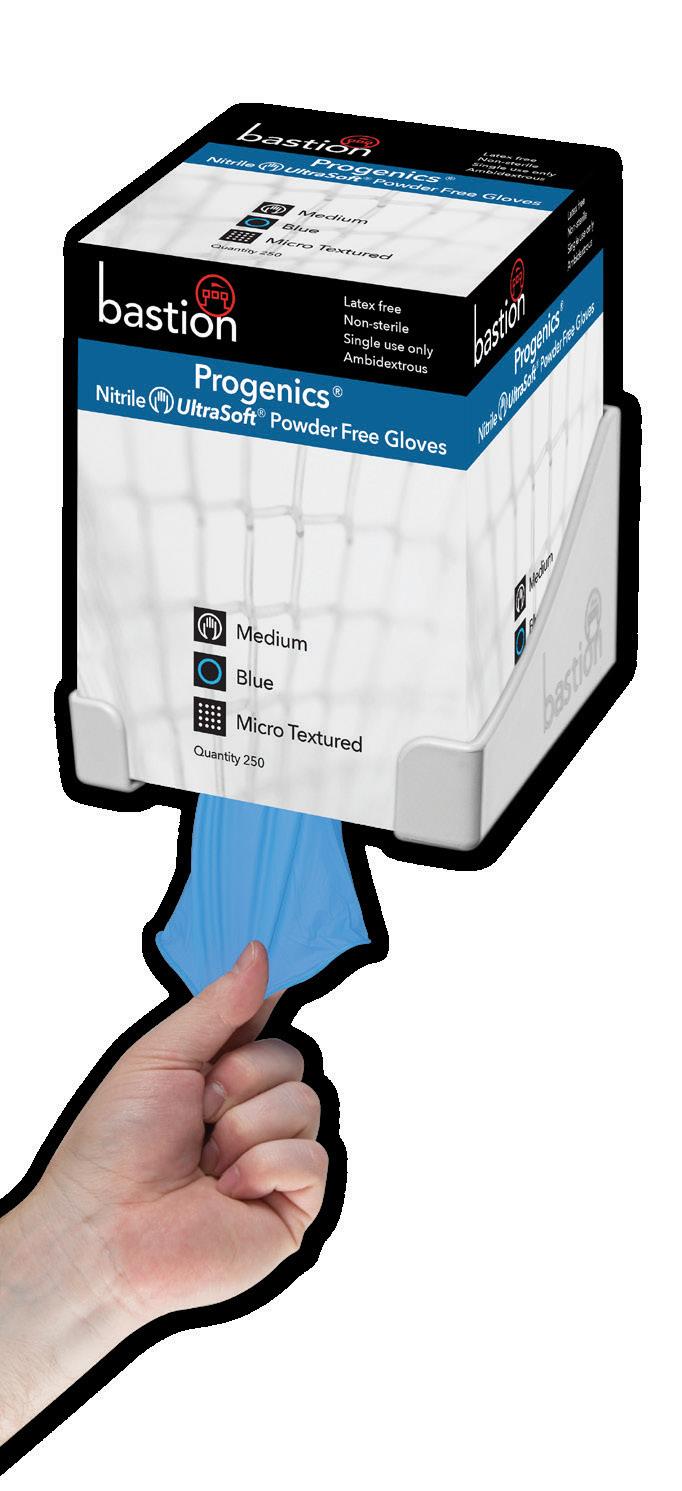


Resilient flooring is a steadily growing
Durable Waterborne solutions are now an industry standard for durable, long-lasting floor surfaces. Additionally, most resilient renovation systems offer a clean, non-yellowing formula to keep the floor looking new for years with the ability to also change the color and design of the floor. Resilient flooring is a steadily growing market.
IMPROVE AIR QUALITY WITH WATERBORNE CHEMISTRIES
AVOID TOXIC FLOOR STRIPPING
New options to fully renovate and transform resilient surfaces eliminate the need to endure the time-intensive and highly toxic stripping process, after the initial system application.
Long-term benefits include minimised facility downtime (often cut by 50 per cent), less labour costs for polish upkeep, and extended life of the resilient surface.
Environmentally friendly
We’ve all seen resilient flooring that becomes dull, slippery, or damaged with wear and tear. At this point – and when budgets allow – most facility managers either choose to polish or replace theTheflooring.polishing process is labour intensive and involves the use of harmful chemicals that can end up in the air and waterways. For these reasons, often facilities teams must close the area to be renovated to staff, guests, and business operations, or wait until a holiday or weekend and pay maintenance teams overtime to complete the work.
resilientTheAccordingmarket.toastudybyFreedoniaGroup,globaldemandforflooringwillgrowto3.9billionsquarefeetin2022.
downtime. Seeking a budget-friendly solution, the facility maintenance team decided to renovate the existing floor. The process – which included abrading, cleaning, applying a base colour and a design with colour chips, then adding a finish coat– took fiveThehours.room was back in service the following day, with a monolithic floor surface that prevents germs, contaminants, and other materials from seeping into cracks or dulling the appearance.
Identifying solutions that allow maintenance teams to efficiently and safely maintain resilient flooring is top of mind for facility managers. They realise flooring is susceptible to deterioration from heavy traffic, spills, extreme heat, excessive moisture, and harsh cleaners. It can be scratched or dented from furniture and heavy equipment. Therefore, evaluating the cost of the flooring throughout its lifetime, as well as the environmental impact of frequent stripping, are both important considerations.
This article first appeared in CMM magazine and has been republished with permission.
Not only do waterborne products eliminate the need to strip resilient flooring surfaces, but they are also less likely to emit volatile organic compounds (VOCs) into the air, making them safer for maintenance teams and others in the building.
According to a study by The Freedonia Group, global demand for resilient flooring will grow to 3.9 billion square feet in 2022. As the resilient industry evolves and our focus on sustainability continues to grow, facilities will need to change renovation, replacement, cleaning, and maintenance practices. New products and techniques will allow them to make these changes without compromising the quality of their floors. ■ Kirk Roberts is the senior vice president, strategic development, for Bona AB.
” 82 INCLEAN September / October 2022 FLOORCARE
Budget-friendly Renovation saves time and dollars compared to a new floor installation. New resilient finish systems available today will provide a durable surface with minimal downtime for facility staff and guests, and help facilities avoid a lengthy and costly construction process.
“
Waterborne floor renovation systems are a viable solution for facility managers seeking practicality and sustainability in floor care. These products are:

1 PER WEEK FOR 3 YRSEXPERT$257PROVAN SWB AUTO 8.99% 20,000 PAYMENT/GFV$20,205FINALKM ALLOWANCEANNUALP.A. INTERESTRATE DEPOSIT$0 WITH A PEUGEOT GUARANTEED FUTURE VALUE (GFV2) FOR ELIGIBLE ABN HOLDERS 2 1. 8.99% P.A. finance to approved ABN holders only (excluding government, fleet and rental buyers) with a Guaranteed Future Value (GFV) of $20,205 and loan term of 3 years based on a 20,000km annual allowance. The advertised rate applied to non-homeowners with an ABN which has been active for less than two years. A different rate will apply if your circumstances are different. Finance applications must be received by 30th September 2022 and vehicles must be delivered by 30th September 2022. Credit criteria, fees, charges and terms and conditions apply. Only available at participating Peugeot Professional dealers. 2. GFV is a loan feature which provides greater certainty about the minimum future value of your vehicle at the end of the loan term. Approved applicants only. Finance is provided by IFSA Pty Ltd ABN 39 651 319 774 trading as Peugeot Financial Services, managed by Allied Retail Finance Pty Ltd ABN 31 609 859 985 Australian Credit Licence 483211. 3. 5-year /200,000km (whichever occurs first) warranty on all new PEUGEOT LCV vehicles. Subject to terms, conditions and exclusions. Visit peugeot.com.au/aftersalesservices/warranty. 4. 5-year roadside assist on all new PEUGEOT vehicles. Visit peugeot.com.au/aftersales-services/roadside-assist. Overseas model shown. FOR THE DAY AHEAD EXPERT VAN With 5-year/200,000 KM Warranty3 + 5-year Roadside Assist4 Ends 30th September 2022. Contact your Peugeot Professional dealership today


Words Michael Wilson
CARPET CLEANING 84 INCLEAN September / October 2022
How to conduct a product audit
Product audits can help clarify which products are best suited to your needs, streamlining your purchasing.
• Allow enough time to conduct a product audit thoroughly. Important decisions can come from a product audit, which can impact your business for several months, or even years, into the future.
PRODUCT AUDIT PROCESS
Usually, these are best performed with three or more people who are familiar with the products being analysed and who use them regularly.
They are evaluating them based on several criteria, including which are best at protecting occupant health (a top consideration during the ongoing pandemic), which are safest for technicians to use, which perform well, and also which are most cost-effective. Examining such issues subjectively is not always beneficial. We need a formal investigation, and in most cases, this is accomplished by conducting a product audit.
O ne of the impacts of the pandemic is that all cleaners, including carpet cleaning professionals, are taking a second look at the products and cleaning solutions they use.
• While those involved in the product audit should be familiar with the products, it may be warranted to get additional product feedback from clients where the product is used.
There are a few basic steps and best practices to follow to ensure an objective product audit. Before conducting the evaluation, consider the following:
• Price and performance often do correlate (you typically get what you pay for), but this is not necessarily true in all cases. Price should not sway the evaluation of a product’s effectiveness, so focus first on objective product performance when conducting a product audit. Consider the costs of the product later.

• As they are evaluated, each product is given a score indicating effectiveness, ease of use, and overall performance. A typical scoring method is a rating in each category of one to five with one being poor and five being excellent.
Once you have selected the products to be evaluated, assembled your audit team, and set aside the necessary time, follow these basic steps for conducting a product audit:
”
• After the performance evaluation is complete, reveal the price of each product and rate according to cost-effectiveness with a one being very costly and a five being very cost-effective. Be sure to account for any differences in concentration so that the price per volume is consistent across products.
CARPET CLEANING
“ One of impactstheof the pandemic is that all cleaners, including carpet theycleaningattakingprofessionals,cleaningareasecondlooktheproductsandsolutionsuse.
• All products used for the same or similar purpose are evaluated at the same time. However, to make the process easier, limit yourself to four products at a time. An example would be a comparison of four different spotters from four different manufacturers.
• All scores are then averaged for all products being evaluated.


• Product B is green certified, whereas product D is not. Because many clients want environmentally preferable cleaning products, this gives product B the upper hand.
OTHER BENEFITS In our scenario, the company decides to purchase and use only product B. Making such a decision has several benefits.
“
”
product B can result in possible discounts from the manufacturer or supplier. Additional benefits include the following:
Michael Wilson is AFFLINK’s vice president of marketing and packaging. This article was first published in Cleanfax magazine and has been republished with permission
• Product D is sometimes in short supply, which could pose problems in the future. Adding these factors to the evaluation makes clear that product B is the best choice for this company.
Conducting an audit with multiple users brings more experience to the table and helps broaden the scope of the evaluation.
When this happens in a product audit, we must investigate other factors that could influence which product is best for the company. In this case, the company considered the following: • Product B has been used for several years by all the technicians. No additional training is required to use this product.
PRODUCT AUDIT IN ACTION
• More closet/truck space: Storing one brand of cleaning solution takes a lot less space than four different ones.
• Revelation: Often when a product audit is conducted, it is the first time we actually evaluate the products used in our everyday work. Expect a few surprises to be uncovered in the process like technician dissatisfaction with a product’s performance.
■
The first is cost savings: Eliminating the purchase of the other products will help reduce costs. Further, purchasing large quantities of
Products B and D both perform and cost about the same. However, the auditor wants to select only one of these two products.
• Greater safety: Different cleaning solutions may have different safety concerns. Minimising the number of products used helps workers know their products, ensuring worker safety.
Four products, A, B, C, and D have been analysed. Products A and C receive low (poor) evaluations, while products B and D have comparable high evaluations. The company chooses to stop purchasing products A and C due to their poor appraisals.
CARPET CLEANING 86 INCLEAN September / October 2022
KEEP AUDITING As to how often a product audit should be conducted, the answer is that it can vary. If no new products are selected or used after completing one product audit, another product audit may not be necessary. However, new products are often introduced over time. When this happens, companies find they are in the same boat as before, purchasing several products, all used for the same or similar purposes. That’s when it’s time to conduct another product audit and refocus product purchasing once again.
Now that we know the basics of conducting a product audit, let’s take a look at possible results using the following scenario.
• Less confusion: Fewer products means minimising the likelihood of selecting the wrong product for a specific purpose.

BiggerBCW100AUS&strongerwipe CW200AUS For cleaning non-invasive medical equipment FoamingCDS500AUSspray That’s why Clinell is used by 7 out of 10 public hospitals across Australia. Giving you the solution to keep you and your patients safe. gamahealthcare.com.au GHA220282 Let’s talk! Scan the QR code or visit qrstud.io/hhfwjjt 03 9769 6600 | info@gamahealthcare.com.auGet in touch Use Clinell green for a superior clean. The #1 choice for infection prevention professionals. *Always review equipment manufacturer’s guidelines. 1-step clean & disinfect Our 2-in-1 detergent & disinfectant is easy to use, enables faster cleaning and removes the need to use multiple products. Kills 99.99% of germs Our hospital-grade disinfectant kills pathogens such as COVID-19, MRSA, VRE, CRE, norovirus and more. Fast contact time Clinell Universal kills germs fast and is effective from 30 seconds, helping you reduce the risk of infection in your facility. Surface compatibility With near neutral pH, Clinell Universal is safe for surfaces and compatible* with a large range metal, rubber and plastic.


A s restoration companies gear up for water damage jobs, it’s important to consider what training or operating procedures in your company may need to be refreshed or reinforced to ensure your staff, along with your equipment, is in tip-top shape.
WHAT WATER DAMAGE RESTORATION MISTAKES DO YOU SEE MOST OFTEN FROM TECHNICIANS AND/OR COMPANIES?
Cleanfax asked five industry experts to share the most common on-the-job mistakes they see water damage restoration technicians making.
Richard Driscoll, IICRC master restorer and approved instructor, says the mistakes often begin with the inspection.
Industry pros weigh in on how to avoid potential mishaps and empower your techs to do the job right.
The common mistakes our experts pointed to tended to highlight a need for some back-tobasics refreshers on water damage restoration procedures and priorities.
Water damagemishaps
RESTORATION 88 INCLEAN September / October 2022

”
Are you a cleaning company, looking for machinery to save labour hours, time, and therefore money? As pictured, see redundant cleaning machines available for sale For more details scan QR code above or contact David
scan here for full list
Bruce DeLoatch, IICRC master restorer and approved instructor, says his chief concern is a “lack of safety training and attention to health andHesafety.”points out that OSHA guidelines are there for our protection on the job. However, restoration professionals sometimes have a habit of “viewing OSHA as the enemy or thinking, ‘It won’t happen to me.’”
He pointed out that without a “thorough investigation of the site, including where the water has gone, what materials have been affected, and proper moisture/atmosphere readings,” technicians don’t have the information they need to address the loss. This leads to other mistakes early in the job.
“ Jobsite safety is so important for relatedinsuranceoccupants,workers,staff, technicians.contractorsrestorationignoredoverlookedyetsubcontractors,anditisoftenorbysomeand
WHAT IS ONE THING YOU MOST WISH TECHNICIANS WOULD STOP DOING?
SALE SALE
Oakes and Driscoll agree that a big problem in the industry is demolition and removal of salvageable materials. Technicians often assume that materials like tile, grout, and subfloor are contaminated without conducting a thorough inspection or considering whether the material can be cleaned, dried, and disinfected. Oakes asserts that “the floor will tell you if the floor needs to be removed: loose tiles, hollow sounding tile, buckled floors, damaged grout, etc.”
R E D U N D A N T C L E A N I N G E Q U I P M E N T S A L E !
Scrubbers, Sweepers, Carpet Extractors, Plus, much, much more!
RESTORATION www.incleanmag.com.au 89
davidc@incognitus.com.au
David Oakes, IICRC master restorer and approved instructor, commonly sees technicians who fail to install enough air movement on day one of theBarryproject.Costa, managing partner/educator for Costa Group Education LLC, explains that as manufacturers have begun developing smaller and lighter equipment for ease of use, the newer equipment may not offer the same drying power as the heavier duty models. Restorers must take all this into account when calculating the equipment needs of a Jessikaproject.James, IICRC-approved instructor with LearnToRestore.com, agrees, noting that improper equipment calculations in the initial stages can lead to longer drying times and secondary damages.


“
FINAL THOUGHTS
Driscoll agrees, noting that “We still have too many restoration companies and technicians whose first course of action is to grab the crowbar and start demolition—rather than investigating the loss first, then evaluating the drying options, and then doing demo if needed.” Oakes adds, “Anyone can remove wet materials; it takes a true professional to dry material in Andplace.”speaking of being a true professional, Costa sees too many technicians performing services without proper training and professional certification. “We have so many companies that go into water damage and they might get their education on forums. Well, the problem with getting it only on a forum is the person giving information has not necessarily been vetted for their expertise,” Costa explains. This is not to say that all information on forums is bad, but an untrained technician will not be able to discern accurate from inaccurate information. “You need formal training to be in this industry,” Costa asserts, “and it doesn’t stop at WRT [Certification]. You need to continue your training.”
At the same time, the job can be emotionally demanding with technicians servicing clients on some of their worst days, when they may be dealing with unthinkable losses.
WHAT DO YOU WISH MORE RESTORATION TECHNICIANS KNEW?
Oakes and Driscoll also note that a true understanding of psychrometry and the science of drying is often lacking in the industry.
So, when we go in, we have to heal two losses: the physical loss and the emotional loss.”
To dry structures effectively and efficiently, technicians must understand how to balance humidity, airflow, and temperature, and how to manage the changing balance throughout the drying cycle. Thoroughly assessing a water loss, calculating the equipment needs, addressing hazards, and properly disinfecting a jobsite all require an in-depth knowledge of the science behind cleaning and drying materials.
Before you send your techs out into the field this season, take the advice of our industry experts and address these common mistakes. Spend some time reviewing and reinforcing the training, procedures, safety precautions, and core values you expect to be reflected on every job and in every interaction with a client. ■
Several of our experts pointed again to safety concerns among the things they want more techs to know. Driscoll highlighted proper use of PPE, noting that he still sees technicians in the field using a respirator over a full beard, which can’t achieve a proper seal to keep the wearer safe fromJamescontaminants.suggeststhat more techs should know how to perform a proper hazard assessment and use the Hierarchy of Hazard Controls to reduce or eliminate hazards. “Jobsite safety is so important for workers, occupants, insurance related staff, and subcontractors, yet it is often overlooked or ignored by some restoration contractors and technicians,” James explains.
Costa wishes more technicians recognised the larger significance of their jobs in not just physically drying a building, but in bringing their clients’ lives back in order. He explains that especially for homeowners, “This is one of the worst things that’s happened to them in the most expensive thing they’ve ever purchased—their home. And they’re worried about their kids, the soccer game coming up, they have family coming this weekend—and they now have a swimming pool that they didn’t pay for within their home.
DeLoatch adds that technicians need to be aware of the long-term health effects of the work they do and take proper precautions now. “You are going to age,” he explains. “You will need your lungs, back, knees, and hearing when you get older. What you do now will dramatically affect the length and quality of your life.”
As our industry experts point out, restoration is simultaneously a highly technical and highly emotional field. It can be physically demanding and hazardous, and technicians must care for the physical health and safety of themselves and their clients.
” RESTORATION 90 INCLEAN September / October 2022
This article was first published by Cleanfax and has been republished with permission Restoration is simultaneously a highly technical and highly physicallyfield.emotionalItcanbedemandingandhazardous,andtechniciansmustcareforthephysicalhealthandsafetyofthemselvesandtheirclients.
In these moments, what your staff has to offer is a supportive, professional demeanor paralleled by the technical expertise that will allow them to restore clients’ homes and businesses as quickly and efficiently as possible.


The Standards Association segregated products by their overall performance expressed as bar/litres per minute. In other words, the classification of the machine’s pressure rating, as marked on the machine in bar, multiplied by the flow of the high-pressure pump’s rating expressed in litres per minute. For example, a machine of 140 bar (2,000 psi) with a flow rating of 10 lpm, has a bar lpm rating of 1,400 bar/litres. As such, it is a Class A machine.
Keeping pressure cleaner operators safe
NEW SAFETY RULES APPLY
UNDERSTANDING THE DIFFERENT BETWEEN CLASS A AND CLASS B MACHINES
T he cleaning industry is becoming specialised,increasinglyparticularly when it comes to both expensive and sometimes complex equipment. High pressure water blasters are now considered to be normal pieces of kit for cleaners as vacuum cleaners. Safety is mandatory in all equipment used but, in high pressure cleaning equipment, it is quite specialised with even small machines sourced from hardware stores being potentially dangerous.
The Australian/New Zealand Safety Standards were presented to the market back in 2018. It was a result of a number of years of work by the association to come up with rules that set out to impose protective measures to reduce injuries in cleaning and other industries. Hence the Standards Association broke the performance figures of the machines into two categories, Class A and Class B, in an attempt to segregate machines of higher capacity, and therefore deemed to be more dangerous, than the Class A units. In this article, I will discuss the differences of Class A and B machines, bearing in mind that most cleaning operators will end up using Class A machines, rarely Class B units.
Class A pressure washers are rated as operating between 800 bar/litres per minute up to 5,600 bar/litres per minute. Thus, a pressure cleaner with a flow of 20 lpm and 4,000 psi (275 bar/litres) is rated as a Class A machine. It should be noted that any higher than that combination of flow and pressure makes it a Class B Operatorsmachines.ofmachines in this class, which can obviously be quite high performance units, are required to be trained and competent in identifying hazards, accessing and controlling the risks of the job and using a safe working procedure. They must be familiar with the operation and maintenance of machine and use suitable PPE. They must also be
CLASS A HIGH PRESSURE MACHINES
Words: Warwick Lorenz
PRESSURE CLEANING 92 INCLEAN September / October 2022

” equipment, identify and rectify potential issues, before use. Operation of the machine must be carried out by two people, rather than one operator, unless the operator has a barrier between the machine and any people including themselves. Where two people are required, where there is no barrier, one will be using the gun and the other is stationed by the machine ready to shut it down in the event of an accident. This presupposes if the machines are equipped with E-stops to facilitate the shutdown.
familiar with the equipment and able to identify the components and potential issues before they become dangerous.
The above outline is an abbreviated version of the Safety Standards ASNZ/4233. It is recommended that employers utilising operators with high pressure water blasting equipment, regardless of their classification, should familiarise themselves with the rules. Incidents of injury from Class B machines have resulted in legal action and compensation claims as well as major legal costs and financial settlements. You can see this is serious for anybody marketing or using high pressure water blasters. Part two of this series will examine the need for operator training not just for Class B machines, but also for Class A units.
■ Warwick Lorenz is owner of Australian Pump Industries (Aussie www.aussiepumps.com.auPumps) www.incleanmag.com.au 93
These machines being where the Class A units end. The category includes machines up to 30,000 or even 50,000 psi machines, not what we would expect people in the cleaning industry to use, unless they have graduated through to operating big machines on construction sites, mine sites or shipyards. It’s obvious this is a huge band of performance criteria with Class B operator certification procedures significantly more comprehensive than Class A. non-compliance with the Standards can result in the operator of Class B machines having work insurance made invalid or even injury compensation claims denied.
“ The equipment.sometimesexpensiveitparticularlyspecialised,increasinglyindustrycleaningisbecomingwhencomestobothandcomplex
PRESSURE CLEANING
It also should be noted that operators who are no certified or don’t have evidence of certification, may be denied access to industrial worksites, if unable to provide verification of competency. The mandatory safety course is valid for two years, after which the operator must go through the refresher training to maintain the validity of the certification. The operator must also be familiar with the operation of the equipment in a more detailed manner than is required for Class A units. For example, the operator should be trained to carry out daily inspections on the
CLASS B HIGH PRESSURE MACHINES
THE SAFETY CHALLENGE

WHAT NEW TECHNOLOGIES HELP MAKE FLOORS SAFER?
• Specialty products—Many newer cleaners and topical treatments increase shoe-to-floor traction.
• Floors that are dirty, have worn finish, or are in poor shape (loose, cracked/ chipped tiles, ripped vinyl)
WHAT FACILITY CONDITIONS CAUSE STFS?
• Slippery floors due to oils and grease, melting snow or ice, and other wet or dry spills
• Traction changes in connected flooring types (from wet to dry floors, tiles to carpeting, etc.)
• Improperly covered or secured electrical cords, cables, and other wires
• Change in flooring elevations or walkway/ramp slopes, improperly sized step risers, and uneven or poorly spaced steps
• Lack of handrails. WHAT ARE THE BEST WAYS TO KEEP FLOORS DRY, CLEAN, AND SAFE?
Some of the most common causes of STFs include:
Solutions to prevent harmful and expensive falls in your facility
WHAT TIME(S) OF THE YEAR ARE STF ACCIDENTS MOST LIKELY TO HAPPEN?
• Elevators misaligned with the floors
STFs occur throughout the year. However, STFs are typically higher in winter and during rainy seasons. It is vital to make people aware of potential STF hazards with signage to minimise incidents and mitigate potential liability when incidents occur.
• Internet of Things (IoT)—Increasingly, manufacturers and other businesses are deploying IoT technology to send realtime alerts to identify fall hazards. GPS also can alert cleaning crews where a spill has occurred, track workers to expedite a
SAFETY 94 INCLEAN September / October 2022
• Floor mats that are unsecured or have high edges
The National Institute for Occupational Safety and Health (NIOSH) reports that among the 888,220 nonfatal work injuries in 2019 that resulted in lost workdays, 27 per cent were STF-related. STFs suffered by U.S. workers cost an estimated US$70 billion per year, NFSI figures reveal. As the statistics show, the problem is pervasive. Fortunately, facility managers and building service contractors (BSCs) can help prevent STFs. This article provides solutions to protect facility occupants and visitors from harmful and expensive falls.
Q&A:Slips,trips,andfalls
• Clutter on floors or bottom cabinet drawers left open
When it comes to slips, trips, and falls (STFs), the statistics are scary.
Consider that globally, an estimated 684,000 people die each year from falls, with STFs the second-leading cause of unintentional on-the-job fatalities, according to the World Health Organization (WHO). Although most falls don’t lead to death, 3.7 million of the falls that occur annually worldwide are severe enough to require medical attention, WHO reports.
DO CERTAIN TYPES OF FLOORING CAUSE STF ACCIDENTS?
Facility managers must ensure the conditions above do not exist or are remedied quickly. An ongoing quality floor
care program is a must, along with yearround placement of quality scraper and wiper mats in adequate lengths.
All flooring has the potential to contribute to STFs. However, floors with a poorly applied or inappropriate finish, or that are badly worn or dirty, may be most risky. Also, polished concrete, terrazzo, and ceramic tiles can be slipperier than other floorings and, therefore, prone to causing more STFs.
In the United States alone, falls account for more than 8 million hospital emergency room visits, representing nearly one-quarter (21.3 per cent) of all visits, according to the National Floor Safety Institute (NFSI). In addition to causing injuries, falls cost money and result in lost work productivity.
• Poor lighting, excessive glare or shine on floors, and obstructed views

An STF risk assessment plan helps identify areas that pose a higher STF risk and ensures maintenance personnel know the proper procedures for preventing and reporting incidents. At a minimum, an effective STF risk assessment plan should training on how to
SAFETY www.incleanmag.com.au 95
• Defines
WHAT KIND OF TRAINING SHOULD FACILITY MAINTENANCE STAFF UNDERGO TO HELP REDUCE STFS? All
• Ensures
• Promotes
actions include: • Keeping
• Always
• Emphasises
“ It is vital to make people aware of incidentsliabilitymitigateincidentstowithSTFpotentialhazardssignageminimiseandpotentialwhenoccur. cleanup, and warn occupants to avoid the area. Robotic floor machines—Automatic floor scrubbers can clean floors while workers perform more complex floor tasks, such as wet/dry vacuuming entrance matting and cleaning spills. slip-resistance testing services and equipment—More distributors and manufacturers use this equipment to assist facilities in verifying/ validating slip coefficient (amount of friction) at different times, such as before and after refinishing. team members should receive comprehensive STF training that: that all floors and areas have the potential for STFs potential STF hazards team members understand and follow defined floor safety practices a “safety first” culture roles and responsibilities to hold people a review of the risk assessment plan workers in how to report any incidents that occur. STFS? cleaning methods and products can increase or decrease the risk of STFs. preventative matting clean and dry Using slip-resistant flooring products certified by the UL or NFSI using
•
a quality floor cleaner with a neutral pH on floors with finish • Modifying walking surfaces by recoating, replacing, or installing abrasive slip-resistant strips or finishes.
accountable • Includes
avoid accidents • A list of approved floor care equipment and products, including safety data sheets • Floor maintenance schedules • Work orders for nonroutine maintenance • A timeline for project follow-through and completion • Forms to capture critical information when an incident occurs • A method to collect suggestions for process and protocol improvements ■
• Identifies
CAN CLEANING METHODS OR PRODUCTS CONTRIBUTE TO — OR HELP PREVENT —
”
•
include: • Basic
Mike Sawchuk is owner of Sawchuk Consulting. This article was original published by CMM and has been republished with permission.
• Instructs
Yes,
WHAT IS AN STF RISK ASSESSMENT PLAN, AND WHAT SHOULD IT INCLUDE?
• Floor
Some

MANAGEMENT 96 INCLEAN September / October 2022
A
Set
S etting up your cleaning program is no easy task. Whether you have an in-house team or you outsource work to a contracted service provider, the responsibility to nail the details of your cleaning program is up to you. With so many chemicals and tools to choose from, it’s easy to get overwhelmed. Worse, sometimes you don’t even have a say in what equipment and products the facility will use. Despite all these challenges, how you set up your program from the start will have a lasting impact on your end results. Selecting the right tools and equipment that are specific to the needs of the building, the desired outcome of the work, and that are safe and ergonomic for cleaning workers is a great foundation for a successful cleaning program. solid foundation yields desired results
UNDERSTAND YOUR NEEDS AND WANTS
You can’t communicate what cleaning outcomes you want if you aren’t sure about them either. A scope of work document helps your team understand what a project does and doesn’t cover. I have found that a typical scope of work document does a great job of defining tasks and frequencies, but not a great job at explaining the desired results. Take time for success up your cleaning program

environment and its occupants with the properpersonal protection equipment (PPE) per your company standards. Make sure employees are trained and qualified not only to use the equipment, but also to identify safety hazards, report them, and correct them professionally.
I know this may sound silly but avoid using the word “clean” as an outcome of the results without further definition. Clean can mean so many things to different people, even in our industry.
to determine what you expect to achieve. The results should include the cleaning outcomes (appearance, tolerance, efficacy, floor traction, etc.).
Tim Poskin is the director of ISSA Consulting, providing systems integration and consulting solutions for the cleaning industry. He can be reached at timp@issa.com. This article first appeared in CMM magazine and has been republished with permission MANAGEMENT www.incleanmag.com.au 97
Efficiency Employees know exactly where everything is and how to do their job, no matter which plane or flight they’re working, supporting, or servicing. Maintenance Mechanics are trained to service one type of plane. The capital (cash) tied up in parts inventories and tools is much lower than that of other airlines because there are fewer required parts. This standardization also makes it more likely a needed part will be available, reducing the amount of time planes are on the ground not producing revenue. Take some cues from Southwest when it comes to standardizing your equipment and processes and you should gain similar efficiencies for your cleaning program.
MAKE YOUR VALUES CLEAR
“ When you are clear about how you set up your cleaning program and what kind of values you operate by, your program will be stronger.
ESTABLISH YOUR CLEANING BUDGET
STANDARDISE CLEANING PRODUCTS, EQUIPMENT, AND PPE
”
Be clear from the beginning on how much money you plan to invest in your cleaning program. A common, but big, mistake is expecting a steak dinner on a hot dog budget. Develop a custom cleaning plan at a fair market—including current salary demands—that will deliver what you want. Exceptional service outcomes will depend on matching your expectations with your budget.
Take time to establish what you value most. The number one priority is to provide a clean, healthy, professional working environment. Place great emphasis on hiring practices and employee retention. Third party accreditation can help you communicate the value of cleaning and provide transparency on your cleaning investment. If you value cleaning methods that reduce your environmental impact, include that component in your cleaning plan as Whenwell.you are clear about how you set up your cleaning program and what kind of values you operate by, your program will be stronger. You will build more trust with your stakeholders, resulting in more reliable cleaning performance andGoodoutcomes.communication, accountability, safety while cleaning indoors, and training good leaders will increase the value of your contracting outcomes. In this new cleaning-focused environment, a strong foundation with clear expectations will help you achieve your cleaning program’s performance goals. ■
Instead, review your existing scope of work and update it to represent current requirements, changes, and cleanliness expectations. This is also a good time to ensure your cleaning program meets current local department of health regulations.
If your building requires specialised chemicals, equipment, and safety procedures make sure that you define those needs. Fully protect your
One great example is Southwest Airlines’ standardisation model. Have you noticed how this airline generally does well year after year, regardless of how the economy is doing or even when its competitors lose money? There are a number of reasons for its success, but one is based on its standardised equipment. The airline flies only one type of aircraft, the Boeing 737, which creates considerable efficiencies. For example: Training Staff training involves only one aircraft. This applies to pilots, cabin staff, ground staff, baggage handlers, mechanics, accountants, marketing managers, cleaning workers, and maintenance staff. Scheduling All staff can work on any aircraft. For example, if a pilot is sick, any other pilot can do the job without additional training or instruction. This reduces the odds of having to cancel a flight when the scheduled staff members aren’t available. Additionally, any Southwest plane can taxi up to any airport, terminal, or gate from which Southwest flies.

At the same time, some of my old workers would be walking out the door. I was fortunate that many stayed for years. But all too often, new hires were off and looking for new jobs almost as soon as they started.
I was not alone in this struggle. Employee retention has always been a problem in the professional cleaning industry. And, from what I hear from those in the business today, things have only gotten worse since the pandemic.
Enhancing employee retention
OPINION 98 INCLEAN September / October 2022
A s the owner of three contract cleaning companies between the 1970s and 1990s, I never had a problem getting new clients. Cold calling, including walking the streets, and knocking on doors, was very effective in those days. However, one problem that repeatedly resurfaced throughout my years in this industry was the inability to find enough adequate workers. Since my business kept growing, I was always in need of new workers.
Employee retention as a cleaning contractor may seem frustrating and costly—that is, if you don’t know the right strategies. Learn how to retain employees through respect and incentives that work.

BUILDINGSUCCESSFULTEAMSwithWayneBennettCOST@TheMarquee,VictoriaPark 309 Herston Road, Herston, QLD INCLUDES BSCAA Members $160/each Non-Members $180/each Bookings via bscaa.com/Events Registration closes 18.10.22 Friday 28 October 2022, 1200pm -300pm QLD EVENT 2 Course Lunch, comprising Main + Dessert 3 Hour Drink Package Coaching with Super-coach Wayne Bennett $1800 (General Admission) or $1600 (BSCAA Member) TABLE OF 10 “ Employee retention has always been a problem in the cleaningprofessionalindustry. ” Historically, the professional cleaning industry has had as high as a 300 per cent turnover rate. That means a cleaning contractor may need to hire three people to fill the same position over the course of one year. Putting it in even more dramatic terms, if you have 20 people leave their jobs in one year, you’ll need sixty people to replace them. This makes it hard for a janitorial contractor to succeed today. Not only do they have trouble finding new workers, but once they have them, contractors have to do everything they can to hold on to them. So, how can we turn this around? According to a recent study, it all comes down to this: keeping them happy.
•
•
•
OPINION
HAPPY EMPLOYEES = EMPLOYEE RETENTION
Conducted in 2020 and published in July 2021, an analysis compiled by the Manufacturing Institute’s Center for Manufacturing Research and the American Psychological Association involved structured interviews with 14 HR professionals and top executives in the manufacturing industry – as well as 578 employees in five companies. Although the study focused on manufacturing, most of the findings apply to all segments of the professional cleaning industry: manufacturers, distributors, and cleaning contractors. Reasons the employees cited for staying with one employer and not drifting from one job to another included the following: They enjoyed the work (83 per cent) They had job security and job stability (80 per cent) Their employers maintained a “familyoriented culture” (70 per cent) jobs fit in well with other life demands (69 per cent) employer offered training and career opportunities (65 per cent)
• Their
• Their

“ Historically, the professional cleaning industry has had as high as a 300 per cent turnover rate. That means a cleaning contractor may need to hire three people to fill the same position over the course of one year.
• If workers thought they were being mistreated, they were more than four times as likely to report being stressed out on the job and almost ten times as likely to say they intended to look for another position.
As you may have noticed, there’s something clearly and obviously missing from this analysis, however. The study did not indicate pay was a reason for staying on the job.
Promote from within
Aware of these studies, if I were a cleaning contractor today, I would do the following: Stress the importance of our work I don’t believe cleaning workers years ago really valued their work. For many, it was just considered a job – until something better came along. It was not until green cleaning surfaced, ISSA promoted the value of cleaning, and of course, the pandemic, that cleaning workers finally realised their value: they keep people healthy.
Before analysing these results, let’s take a look at two more points in the study:
Some cleaning contractors have turned to training videos viewed on monitors, smartphones, or systems attached to cleaning equipment as a way to train their workers.
For more than 20 years, Robert Kravitz and his firm, AlturaSolutions Communications, have been collaborating with people and organisations, helping them become and then excel as thought leaders in their respective industries. He can be reached on LinkedIn.
HOW CAN CLEANING CONTRACTORS USE THESE RETENTIONEMPLOYEESTATISTICS?
100 INCLEAN September / October 2022 OPINION
”
Although getting workers today is more difficult and is requiring employers to pay their staff more, it does not appear to play a role in employee retention once they are hired.
Encourage employee retention through employee connections
In the contract cleaning industry, by comparison, many workers go directly to their job sites and never see other people who work for the same company. This needs to change. If I were in the industry today, I would try to emulate Google and build a family environment where all workers feel they belong and are valued.
When told to learn cleaning from the video, some cleaning workers interpret this to mean, “Don’t bother me, watch the video.” That won’t work today. Personal, one-on-one training is needed. It builds a connection with the company, allows the company to share its culture with the workers, and shows workers they are valued since someone is actually taking the time to train and work with them. These acts of consideration and respect are important and appreciated.
With all of this in mind, I leave you with this final quote from British entrepreneur and billionaire, Richard Branson: “Clients do not come first. Employees come first. If you take care of your employees, they will take care of theWhenclients.”itcomes to the professional cleaning industry, I don’t believe a truer statement has ever been made. ■
As the study pointed out – especially for younger workers – people need to know there is a future in the company. If not, it’s viewed as a ‘dead-end job.’ Promoting from within is key to conveying this.
This was reflected in another study conducted some years ago and published in Psychology Today. That study concluded the following: “Workers of all ages, especially younger workers, are motivated by real-time feedback; [a] fun, engaging work environment; and statusbased recognition over tangible rewards.”
• Nearly all the respondents (97 per cent) who felt valued by their employers were satisfied with their jobs. Not only that, but virtually all of those valued workers said they would recommend the company as an excellent place to work.
In other words, being recognised and appreciated for their efforts, along with the many points uncovered in the manufacturing study, were more important than tangible (monetary) rewards.
Finally, I would find ways to get all employees together. Googlers, as Google employees are called, are often involved in a wide array of company events, including sporting, family, travel, and retreat events. These events build connections among workers and strengthen the bond between workers and the company as well.
Treat training as an investment


• It could be due to a sustained period of growth or scaling the business back up after years of lockdowns. Growth and scaling up requires an investment in equipment and time which impacts your cashflow. It is very easy for business owners to throw their hands in the air when considering all of the reasons. It’s often deemed too complex, or the future is too uncertain to do much about it. This results in many business owners taking the ‘let’s see how this plays out approach’ and reacting when issues arise. But from experience, there is a better way.
Importantly, businesses and families change over time, so the plan also needs to change. To enable this, you should be monitoring, managing, and refining your cashflow constantly throughout the year. Make sure you meet with your advisor regularly to get feedback. The more you do this, the more accurate your forecasts will become and the more confident you will be in managing the future.
This article outlines some practical tips for you to avoid ‘getting caught short’.
THE RESULT
• Due to you withdrawing too much from the business to spend on personal items,
N ot having enough cash in the bank, or seeing your cash balance decline over time, is one of the more stressful things that a business owner can go through. Unfortunately, this is a reality for many business owners at the moment.
As a starting point you need to understand your fixed costs. What are they? Are they going to change at all in the coming year? Has anything changed from last year? You may have been advised by some of your suppliers that costs are increasing.
START WITH WHAT YOU KNOW AND WHAT YOU CAN CONTROL
UNDERSTAND YOUR STRATEGY
The next step is to understand what your strategy is for the year ahead and beyond.
MONITOR, MANAGE, AND REFINE
In order to answer these questions, you need to be clear on where you are going and what you are trying to achieve for the business and as owners. Once you know what you are trying to achieve you can then start to consider how your fixed and variable costs will change based on your strategy. You can then start to understand how your business will fund your strategy which can have a big impact on cashflow.
Do you have a growth strategy? Are you in a period of sustain and defend? Are you in a period of transition? Do you have a strategy regarding your margins?
• It could be that you or your industry is being disrupted by a competitor, • It could be as a result of taking on too much debt,
You know that interest rates are on the way up. You can see if your debtor days are growing or if your competitors’ prices have changed. You know when your Business Activity Statements are due and as a business owner you know roughly what you need from a personal perspective. There are a lot of things that you know and that you can control, so start there.
If you create a forecast, put together a plan to manage the unexpected, review it continuously, don’t overextend yourself, get advice, and build a buffer, then you will be on your way to never being caught short again. If you need any help, get in touch. ■ Andrew Ash is director - accounting and tax at Accounting and Tax at HLB Mann Judd www.hlb.com.au
102 INCLEAN September / October 2022 OPINION
According to a recent survey conducted by Xero, nine out of 10 small businesses struggle with negative cash flow at least once a year and one in five are plagued for six months with expenses greater thanFurthermore,revenue. the survey found 92 per cent of small businesses experienced at least one month of negative cash flow in 2021, and for 20 per cent, it lasted more than six months. The average small business went through 4.2 months of negative cash flow in 2021. What is causing business owners to be caughtThereshort?aremany reasons that this occurs.
Once you understand your fixed and variable costs and how they will be impacted by your strategy, the next step is to put it all together with what you know about the timing of your cashflow to create a forecast.Theforecast will tell you the future. It will tell you if you have negative cashflow at certain times of the year and it can be adjusted to see how changes to your strategy impact your cashflow. The forecast can then be used to help you plan and address the challenges you may be facing now and those you potentially will face along the way. An advisor should be utilised for this process as they can look at your situation independently. Advisors will help you get an understanding of where you, your business and your family stand and what you can do to improve your situation.
USE YOUR FORECAST AS A CRYSTAL BALL
• Inflation may have reduced demand for your products or services, or it may be causing your costs to increase, • It could be an inventory management issue,
• It could be a result of issues with collecting your debtors, • Maybe it’s a pricing issue; or
Don’t get caught short:
Practical tips to manage cash in uncertain times
So, what can be done about it?

OPINION
Innovation is fantastic but it must deliver against some of the following key sustainable determinant areas:
8. Are there any long-term impacts from the use of the product or technology?
6. How will these product or technology reduce environmental impact?
There is no doubt the level of technological advancement and change will speed up in the coming “
In waste management, one could see that a robotic system that uses AI and machine learning to automatically detect, classify, and sort recyclable materials from mixed waste can help reduce the need for onsite waste storage, with the capacity to process up to 700kg of waste into compost per hour.
4. Is the product or technology environmentally safe?
3. Has the product or technology been proven by evidence or case studies?
1. What is the problem the technology is aiming to solve?
Technology has also been applied to a variety of existing devices and machines, such as soap and paper dispensers, that either advise via data when dispensers are empty and need changing. Real-time data from dispensing machines from local or remote locations means efficient stocking and use of labour for many cleaning clients andRecently,contractors.atthe Waste Technology Expo in India, thousands of visitors explored and experimented with an unmatched range of cleaning solutions from futuristic robotic machines using AI to enzyme-based ecofriendly cleaning chemicals.
A winning formula in the cleaning industry
It’s clear that the advancements in technology are helping to enhance sustainability and limit the impact that we have on the planet whilst providing efficient and effective cleaning.
9. Will it keep clients safe and provide an efficient clean better than previously?
Many organisations are now measured on corporate and environmental responsibility, and so many cleaning product manufacturers, technology innovators, cleaning contractors, distribution companies are also now focused on ensuring they innovate to compete in an industry sector that needs to meet or exceed environmental targets implemented by their customers, or face becoming irrelevant.
T
The introduction of new, innovative products during the pandemic has highlighted how important and specialised the cleaning industry has become over the past two and half years. ” years and so too will the focus on environmental sustainability.
The solutions included measurable air quality systems, intelligent machines, robotic waste segregation, as well as efficient solutions for hygienic linen and everything that one needs for meeting sustainability goals and net zero targets.
In the laundry segment, there was the launch of a laundry machine that reduces water consumption by up to 70 per cent and power and chemical consumption by 50 per cent, helping to increase the linens, life while reducing water and energy consumption.
Technology sustainability:and
7. What is the return on investment and overall impact on the cleaning business and clients?
Sean Matthews is managing director of Banksia Consulting Group. He can be contacted at banksiaconsultinggroup.comsean.matthews@ www.incleanmag.com.au 103
2. Is the technology energy/water efficient and safe?
5. What could be the long-term environmental impacts from using it?
10. Are you a member of any environmental groups or have certification to support the technology or products?
he technological change that has entered the cleaning industry has been fast tracked by the pandemic. The introduction of new, innovative products, such as disinfection with UV technology and robotic floor scrubbers, during the pandemic has highlighted how important and specialised the cleaning industry has become over the past two and half years.
The ISSA Cleaning and Hygiene Expo taking place on Wednesday 14 September and Thursday 15 September in Sydney will provide an amazing opportunity for the cleaning industry to see the latest and greatest in best practice products and technology. ■

The FitForFood content and site structure were developed by Accord Australasia, with input from member companies in the commercial food hygiene sector.
Dr Jennifer Semple is manager, sustainability and education program at Accord
The content and site were also reviewed by experts in environmental health/food safety—Andrew Davies (NSW Food Authority), Dr Andrew Mathieson (First for Training) and Chris Healey (NSFFoodInternational).safetyisashared responsibility and Accord member companies take seriously their obligations for product quality and correct use advice.
New industry resource to identify suitable cleaning and hygiene products for food contact applications.
Accord has developed and funded this new website in keeping with this commitment. There is no cost, branding or commercial interest associated with using FitForFood—it is simply a tool to assist our industry in upholding its performance and reputation as a trustworthy supplier of essential products. ■
If you are an auditor/environmental health officer, FitForFood can help you assess the evidence provided of product suitability for food contact – such as a manufacturer’s claim/Vendor Declaration – or consider the product formulation against the list of widely used chemistries, ‘red flags’ and external resources on efficacy and chemical residues. “ Hygienic practices are essential in all food premises to ensure that food is safe for consumption and of suitable quality. ”
H
FitForFood is a new online resource, launched in August 2022, on cleaning and sanitising in food premises. Its key purpose is to provide an approach and detailed resources for determining the suitability of commercial cleaning and sanitising products for food contact applications. This is done in the context of food law in Australia.
The site provides a comprehensive and tiered approach to providing assurance that your product, or verifying that any product, is indeed suitable for food contact applications. Both in terms of its efficacy and any residues remaining on a surface.
So, if you are a product supplier, you can see what kinds of assurances to provide, check the list of widely used chemistries and access a comprehensive suite of external resources to support a food contact claim.
Is that product ‘FitForFood’?
104 INCLEAN September / October 2022 OPINION
ygienic practices are essential in all food premises to ensure that food is safe for consumption and of suitable quality. And, of course, cleaning and sanitising products –supplied by our industry – are essential in achieving this.
But as well as effectively achieving their cleaning or sanitising function, it is also essential that cleaning and sanitising products themselves do not make food unsafe or unsuitable for consumption.
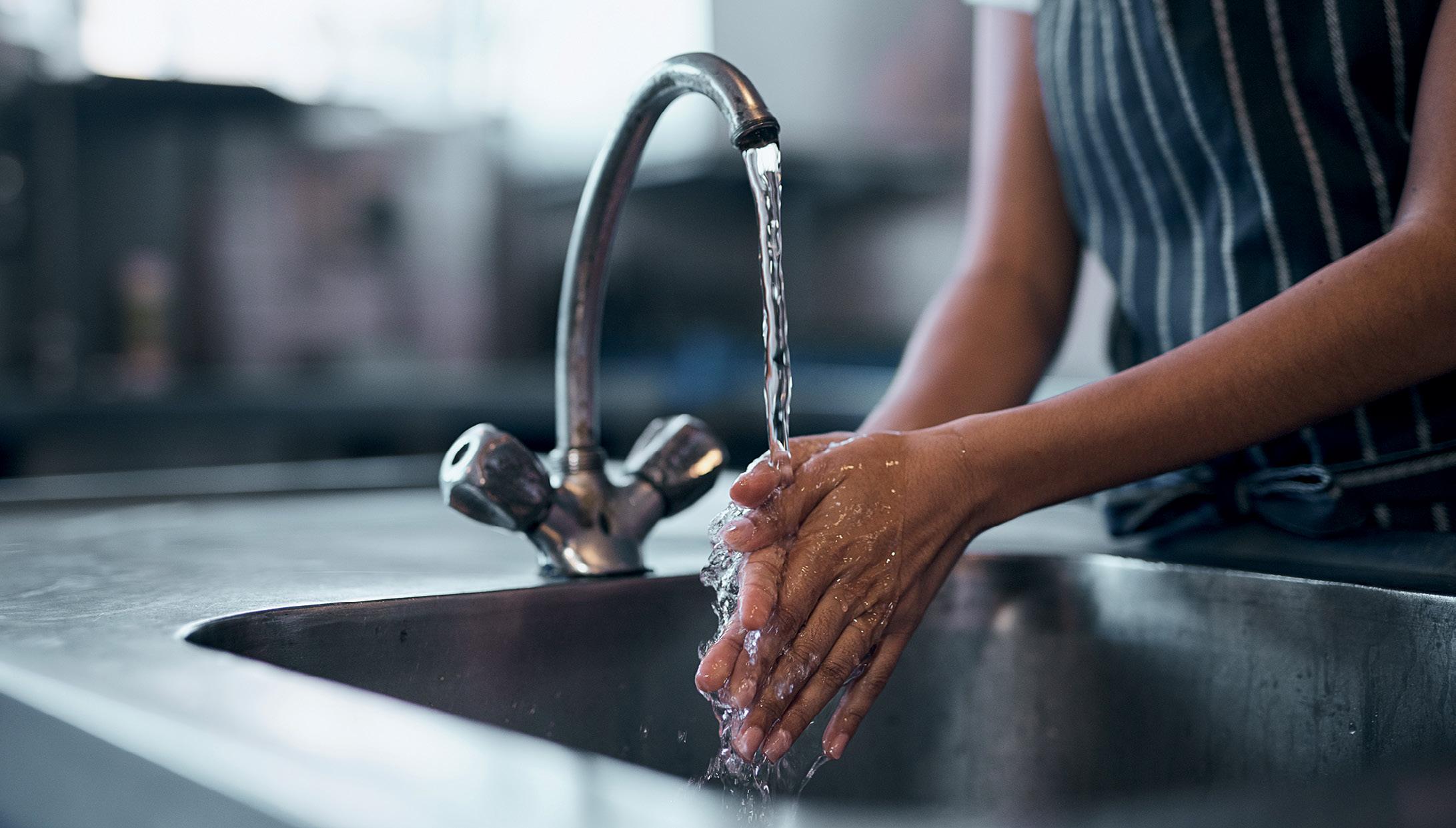
PRODUCTS
Hako Aqua Stop
` Reduce unproductive empty and refill cycles
https://apac.softbankrobotics.com/apac/au/Australia
Spitwater rolls out the Rolly Scrubber Dryer
` Increase polish life ` Reduce chemical and water consumption by up to 50 per cent
The Rolly Scrubber Dryer will be on display at the ISSA Cleaning & Hygiene Expo.
Hako Aqua Control Brushes will: ` Reduce pad consumption by up to 90 per cent (brushes can last for more than 300 hrs before requiring replacing)
Spitwater has launched the new, Italian made, Rolly Scrubber Dryer as a part of its Vacstorm line of products. New Rolly Generation (NRG) compact, lightweight, walk behind scrubber dryers are designed for better performance and increased reliability.
Superbowl
The Rolly is whisper quiet, at 54 dB(A). Main machine functions can be managed by the intuitive control panel. The electric version is offered with a 15m cable.
Initially, two models will be offered: Rolly NRG 11 E 33, electric, 240 V and Rolly NRG 11 M 33 BC, 20 Ah Lithium battery powered. Cleaning solution tank has 11-litre capacity and recovery tank has 12-litre capacity. The cylindrical brush deck, with three adjustable pressure settings, allows for greater flexibility.
Hako www.hakoaustralia.com.auAustralia
Delivery X1 Delivery X1, the latest X series introduced from Gausium is a new product line dedicated to autonomous indoor delivery. With automatic map construction using precise positioning, Delivery X1 performs basic point to point autonomous delivery of food, beverages, or various cargos. Delivery X1 can hold up to 30kg payload and design for indoor food delivery at any environments such as a restaurant, hotels, hospitals, office cafeterias etc. It performs up to 14 hours on a single charge, with automatic charging, fulfilling as a handy 24/7 helper.
Hako Aqua Control Brushes for scrubber-driers: Save up to 50per cent water and detergent. Many companies promise savings in terms of water and cleaning agents, however very few deliver on that promise, and/or you have to pay extra for the option to achieve the savings.
SoftBank Robotics
` Reduce water usage, waste, landfill, material use, equipment wear and tear, and emissions
Superbowl has been designed to easily remove soils and stains, including rust, scale, and algae growth from toilets and urinals. Benefits: ` Cleans and deodorises ` Leaves the toilet smelling clean and refreshed ` Septic safe ` Available in various pack sizes Whiteley Corporation 1800 833 www.whiteley.com.aumarketing@whiteley.com.au566
www.spitwater.com.au1800Spitwater172005
www.incleanmag.com.au 105


i-spraywash i-spraywash is a simple, easy to use solution for faster and better cleaning of washable surfaces. i-spraywash uses unique chemical tablets in the specially designed i-spraywash foaming gun which cleans at up to 1 sqm per second, reducing labour time by up to 48 per cent compared to a traditional foaming gun. i-spraywash creates a very fine active foam which clings for longer on vertical surfaces, allowing maximum dwell time for the cleaning solution. i-spraywash can also reduce water usage by up to 50 per cent, reduces plastic waste due to the concentrated tablets, also reduces the carbon emissions from the transport of bulky liquid cleaning chemicals!
Polivac www.polivac.com.auContactInternationalNearestDistributor
`
free ` V-Wipes
PRODUCTS 106 INCLEAN September / October 2022
` “Euro-style” fibreglass body body, with 50-litre solution and 50-litre recovery tank, and aluminum frame
The unique formula of V-Wipes is proven to kill a broad variety of bacteria and viruses, including SARS-CoV-2 (COVID-19) Virus which is killed in 60 seconds. The formulation is pH neutral and they feature a high quality apertured fabric perfect for fast, effective cleaning and disinfection of all surfaces within the healthcare environment. V-Wipes are an instrument grade disinfectant – low level and can be used on environmental surfaces and non-critical medical devices such as hospital beds and theatre trolleys. V-Wipes are available in 80-piece flatpack and 100-piece cannister. pH neutral – safe for use on most surfaces and equipment Highly absorbent apertured fabric Leaves surfaces streak are 100 per cent free from Poly Hexa Methylene Biguanide Corporation 1800 833 www.whiteley.com.aumarketing@whiteley.com.au566
` 7.5m solution, vacuum hose (Optional 15m hose available) and a 12” 3-jet
` Versatile carpet extractor with fully adjustable pressure with thermostatically controlled heater element designed to maintain water temperature up to 70°C)
` This machine is spring-mounted on rubber seals vacuum motors deliver vibrationfree, low-noise extraction power in a minimum profile body (2 x vacuum motors: 3 stage 1100W each)
Contact i-team to book a free demo. i-team www.i-teamanz.comANZ
Predator MK3 Introducing the Australian designed and built, Predator MK3. Designed for maximum performance and total portability for large- or small-scale carpet cleaning. The heart of the Predator is a powerful 2000 psi max rated HYPRO pump, driven by 1500kw (2 HP) Marathon motor.
`
`
(PHMB) Whiteley
` Optional booster box to increase vacuum power (2 x vacuum motors: 3 stage 1100W each)
` Optional lightweight Spinner Tool (tile cleaner) Max Pressure adjust to 1400 PSI
V-Wipes


CLEANER FASTER SMARTER Maintenance Free & Fast Charging Technology Rolls Battery Engineering are experts in designing and manufacturing reliable and durable solutions specifically for commercial and industrial cleaning applications. Higher productivity rates and longer operational times keep your cleaning services more profitable. > Longer lasting for larger cleaning areas > Maintenance free, spill & leak-proof > Higher capacity for hard wearing usage > Superior uptime with faster recharging to reduce downtime > 18 Months Warranty COME AND SEE US AT THE ISSA CLEANING & HYGIENE EXPO @ STAND 151 Call us on 1300 133 980 Melbourne | Sydney | Brisbane | Perth | Adelaide | Newcastle | Townsville | Darwin New AGM Range DC 18 Sabco Professional BRIX Platinum Janitor Cart Made from recycled plastics, Sabco Professional’s new Platinum range of BRIX carts are an extension from the current BRIX cart model. With an introduction of two new models, Sabco Professioanl’s new platinum range is made in Italy from strong, sustainable, and quality material. Including many occupational health and safety features throughout, 360 degree turning wheels, 120 litre bags with foot pedal lid, and easy to reach compartments. Its quality anti-scratch lockable doors keep dangerous chemicals and cleaning products safe, with mop, handle, spray bottle, and glove holders featured around the janitor cart. See Sabco Professional at Stand 10 at the ISSA Cleaning & Hygiene Expo. Sabco Professional 1800 066 www.sabcoprofessional.com.aucustomerservice@sabco.com.au522 Leobots and LeoRayCleaning and disinfection robots LeoBots and LeoRay are specialised robots, crafted to perform specific tasks so as to achieve maximum efficiency in its cleaning or disinfecting operations. The LeoRay can be deployed to disinfect surfaces using high concentration UV-C radiation and the LeoBots are a family of four robots that are experts in their cleaning tasks and can also collaborate as a team. ` LeoScrub: Scrubbing expert - Uses up to 70 per cent less water with high cleaning results ` LeoVac: Vacuum genius -comes with Optional HEPA filter for cleaner air ` LeoMop: Silent mopper - leaves behind much drier floors ` LeoPull: Small but strong worker - able to pull 450kg bin ` LeoRay: Autonomous UV-C Disinfection Robot ` Free demonstration available Central Cleaning Supplies 1300 347 www.centralcleaning.com.aulionsbot@centralcleaning.com.au347 www.incleanmag.com.au 107 PRODUCTS


R&J Batteries to showcase range at ISSA Cleaning & Hygiene Expo
R&J Batteries will showcase its line-up of US Battery, Predator, Fullriver, and RELiON batteries suitable for popular commercial and industrial cleaning equipment at the upcoming ISSA Cleaning & Hygiene Expo. The RELiON InSight Series 24V-60Ah battery which has made waves in the industrial applications landscape recently will also be on display. The lithium iron phosphate battery is a GC2 sized drop-in replacement battery that delivers exceptional performance, power and precision. The 24V-60Ah battery is specially designed to meet the power and energy requirements of floor machines, electric motorised hand trucks and other material handling applications. Visit Stand 78 at the ISSA Expo to find the right battery for your application and power requirements. R&J rjbatt.com.auindustrialsales@rjbatt.com.au1300Batteries769282
More than just a simple paper towel dispenser, the Kimberly-Clark Professional ICON Hard Roll Towel Dispenser takes hygiene to new heights. The touchless technology and seamless design can reduce the number of touch point, lessening potential risk of cross contamination. With a stylish modern design, the ICON dispenser looks as impressive as it works and it can enhance any space. What’s more, it’s thoughtfully engineered and features direct drive technology and dual sensor technology for 99.99 per cent jam-free dispensing, with virtually noiseless operation for a truly delightful customer experience. Kimberly-Clark Professional 1800 647 www.kcprofessional.com.au994 Makita’s 40V
Max XGT battery platform delivers AC equivalent suction, no cords attached! ` 18kPa & 40L/s Max air flow to power through tough applications ` Continuous operation of 14 – 110 minutes with 5.0Ah battery ` 2-litre dust capacity with washable cloth filter bag and HEPA filter ` Lightweight at 4.4kg with battery ` Market leading charge time of 50 minutes with Makita rapid charger Makita Australia 1300 361 www.makita.com.auenquries@makita.com.au690
108 INCLEAN September / October 2022 PRODUCTS
KCP ICON Hard Roll Towel Dispenser
COMING SOON Makita 40V Max Brushless Backpack Vacuum Cut the cord with new levels or cordless power -


1800
www.bscaa.com
ACT, NSW QLD SA TAS VIC & WA
ADVICECERTIFICATIONLEGISLATION,COMPLIANCE, 24/7 ACCESS TO ONLINE RESOURCES TRAINING, WEBINARSEDUCATION, REGULAR UPDATES ON INDUSTRYCHANGESLEGISLATIVEANDNEWS
FREE ACCESS TO LEGALRELATIONSINDUSTRIALADVICE
Looking for a green carpet cleaner that is gentle on your carpets, but still effective? Look no further than Green ‘N’ Gold. Our pH-controlled HWE carpet detergent is planet-friendly and is safe for all carpet fibres, including 100per cent wool and Persian rugs. The fast-acting cleaning agents encapsulate dirt for easy removal and the fresh citrus perfume dispels any wet carpet odours. With this environmentally preferable, GECA-certified product, you can refresh your carpets with peace of mind knowing there is absolute minimal impacts to people and the planet. agar.com.ausales@agar.com.au302 PRO offers a wide range of valuable membership services that suit your needs.
Enquire now about becoming a BSCAA member by visiting our website www.bscaa.com or contact us.
FREE ACCESS TO WECOMPLY A HUMAN RESOURCE SUITE OF TEMPLATES PERSONALISETO
building services industry in cleaning and affiliated services since 1964. 1800 312 national@bscaa.com970 Australia’s industry.buildingassociationleadingfortheservicesMembershipisavailabletobusinessesregisteredin ACT, NSW, QLD, SA, TAS, VIC & WA Enquire now about becoming a BSCAA member by visiting our website www.bscaa.com or contact us. ATTEND EVENTSANDNETWORKINGEXCLUSIVEMENTORING ADVICECERTIFICATIONLEGISLATION,COMPLIANCE, 24/7 ACCESS TO ONLINE RESOURCES TRAINING, WEBINARSEDUCATION, REGULAR UPDATES ON INDUSTRYCHANGESLEGISLATIVEANDNEWS FREE ACCESS TO WECOMPLY A HUMAN RESOURCE SUITE OF TEMPLATES PERSONALISETO INVISI SHIELD IORGANICS NVISI SHIELD ORGANICS ZERO ALCOHOL ZERO CHEMICALS EFFECTIVE LAB RESULTS MADE IN AUSTRALIA info@shieldyourself.com.au www.shieldyourself.com.au INVISI SHIELD IORGANICS NVISI SHIELD ORGANICS ZERO ALCOHOL ZERO CHEMICALS EFFECTIVE LAB RESULTS MADE IN AUSTRALIA info@shieldyourself.com.au www.shieldyourself.com.au INVISI SHIELD IORGANICS NVISI SHIELD ORGANICS ZERO ALCOHOL ZERO CHEMICALS EFFECTIVE LAB RESULTS MADE IN AUSTRALIA info@shieldyourself.com.au www.shieldyourself.com.au INVISI SHIELD IORGANICS NVISI SHIELD ORGANICS ZERO ALCOHOL ZERO CHEMICALS EFFECTIVE LAB RESULTS MADE IN AUSTRALIA info@shieldyourself.com.au www.shieldyourself.com.au
Green ‘N’ Gold
1800 312 national@bscaa.com970
FREE ACCESS TO WECOMPLY A HUMAN RESOURCE SUITE OF TEMPLATES PERSONALISETO
Australia’s industry.buildingassociationleadingfortheservicesMembershipisavailabletobusinessesregisteredin
Join us to receive: CONNECT WITH US: Supporting the
ATTEND EVENTSANDNETWORKINGEXCLUSIVEMENTORING
ADVICECERTIFICATIONLEGISLATION,COMPLIANCE, 24/7 ACCESS TO ONLINE RESOURCES TRAINING, WEBINARSEDUCATION, REGULAR UPDATES ON INDUSTRYCHANGESLEGISLATIVEANDNEWS
FREE ACCESS TO LEGALRELATIONSINDUSTRIALADVICE us to receive: the building services industry in and affiliated services since 1964. 312 national@bscaa.com970
` environmentallyGECA-certified preferable ` Excellent cleaning power ` pH-neutral – safe for all fibres ` Biodegradable surfactants and low VOCs ` Fresh citrus scent Agar Cleaning Systems 1800 301
FREE ACCESS TO LEGALRELATIONSINDUSTRIALADVICE
www.bscaa.com
www.bscaa.com
Australia’s
industry.buildingassociationleadingfortheservices
Supporting the building services industry in cleaning and affiliated services since 1964.
CONNECT WITH US:
1800 312 national@bscaa.com970
ATTEND EVENTSANDNETWORKINGEXCLUSIVEMENTORING
EVENTSANDNETWORKINGEXCLUSIVEMENTORING ADVICECERTIFICATIONLEGISLATION,COMPLIANCE, 24/7 ACCESS
ADVICECERTIFICATIONLEGISLATION,COMPLIANCE, 24/7 ACCESS TO ONLINE RESOURCES TRAINING, WEBINARSEDUCATION, REGULAR UPDATES ON INDUSTRYCHANGESLEGISLATIVEANDNEWS
Join
Supporting
Australia’s
industry.buildingassociationleadingfortheservicesMembershipisavailableto
Supporting the building services industry in cleaning and affiliated services since 1964.
FREE ACCESS TO LEGALRELATIONSINDUSTRIALADVICE Join us to receive: CONNECT WITH US: Supporting the building services industry in cleaning and affiliated services since 1964. 1800 312 national@bscaa.com970
BSCAA member benefits from unique services that give your business a competitive advantage and the opportunity to contribute to the betterment of the industry. Whether you are a sole trader, SME, or a large business, the BSCAA offers a wide range of valuable membership services that suit your needs.
www.bscaa.com
ONLINE RESOURCES TRAINING,
ATTEND TO WEBINARSEDUCATION, REGULAR UPDATES ON INDUSTRYCHANGESLEGISLATIVEANDNEWS FREE ACCESS TO WECOMPLY A HUMAN RESOURCE SUITE OF TEMPLATES PERSONALISETO
BSCAA member benefits from unique services that give your business a competitive advantage and the opportunity to contribute to the betterment of the industry. Whether you are a sole trader, SME, or a large business, the BSCAA offers a wide range of valuable membership services that suit your needs.
FREE ACCESS TO LEGALRELATIONSINDUSTRIALADVICE Join us to receive: CONNECT WITH US:
industry.buildingassociationleadingfortheservicesMembershipisavailableto
cleaning
SPRiNTUS ERA PRO 13-Litre Dry VacuumCommercialCleaner Available from Cleanstar, the ERA PRO dry vacuum cleaner by SPRiNTUS is made in Europe and sets a new benchmark in professional cleaning. The ERA
ATTEND EVENTSANDNETWORKINGEXCLUSIVEMENTORING
BSCAA member benefits from unique services that give your business a competitive advantage and the opportunity to contribute to the betterment of the industry. Whether you are a sole trader, SME, or a large business, the BSCAA offers a wide range of valuable membership services that suit your needs.
www.bscaa.com
Australia’s
Join us to receive:
is the world’s first digital dry vacuum cleaner with integrated Bluetooth connection and a cloud-based fleet management system. The SPRiNTUS browser-based fleet management system allows you to centrally manage all ERA PRO dry vacuum cleaners. The ERA PRO 13-Litre Dry Commercial Vacuum Cleaner features: ` Powerful and energy saving 700-watt motor ` H13 HEPA filtration ` Quiet operation - 49-54 LpA (dB) ` Lightweight at 5.7kg See the ERA PRO range at Stand 50 at the ISSA Cleaning & Hygiene Expo. Contact Cleanstar for nearest in-store or online distributor. www.cleanstar.com.ausales@cleanstar.com.au(03)Cleanstar94605655 www.incleanmag.com.au 109 PRODUCTS INVISI SHIELD IORGANICS NVISI SHIELD ORGANICS RO ALCOHOL RO CHEMICALS FECTIVE LAB RESULTS ADE IN AUSTRALIA info@shieldyourself.com.au www.shieldyourself.com.au INVISI SHIELD IORGANICS NVISI SHIELD ORGANICS RO ALCOHOL RO CHEMICALS FECTIVE LAB RESULTS ADE IN AUSTRALIA info@shieldyourself.com.au www.shieldyourself.com.au BSCAA member benefits from unique services that give your business a competitive advantage and the opportunity to contribute to the betterment of the industry. Whether you are a sole trader, SME, or a large business, the BSCAA
FREE ACCESS TO WECOMPLY A HUMAN RESOURCE SUITE OF TEMPLATES PERSONALISETO BSCAA member benefits from unique services that give your business a competitive advantage and the opportunity to contribute to the betterment of the industry. Whether you are a sole trader, SME, or a large business, the BSCAA offers a wide range of valuable membership services that suit your needs.





The Dettol Refresh Instant Hand Sanitiser 5L is formulated to kill 99.99 per cent of germs whilst also leaving hands feeling refreshed. Rinsefree, hand sanitiser is ideal for those on the go. Available via Winc or to Dettol Pro Solutions program members, the 5L size is designed for refilling hand sanitiser dispensers stationed throughout offices, public spaces, and hospitality venues. Dettol Pro Solutions 13 26 customerexperience@winc.com.au44
XPOWER XD-165L Dehumidifier
Fusion Pro Fusion Pro is the next generation housekeeping chemical dispensing system, and the evolutionary step in DEMA’s innovative housekeeping technology platform, to the Fusion single product chemical dispenser. The modern and clean design makes it ideal for a variety of applications and installations. It uses DEMA’s pilot activated water valve, a unique design with less parts and maintenance, built to operate like a traditional valve but with minimal service requirements. Configurations available for any application, and any requirement. Internal flow disk regulates flow, more accurate dilutions.
The XPOWER XD-165L Dehumidifier achieves maximum humidity control and water removal efficiency. The new ‘XXL’ category unit is capable of removing up to 78 Litres per day at AHAM (26.7°C, 60 per cent RH) and 132 Litres per day at full saturation (32.2°C, 90 per cent RH). The unit has an electronic display that assists in monitoring the temperature and humidity at the exhaust, as well as recording the total operating life of the dehumidifier. Weighing 55kg with rugged wheels and telescoping handle, the ultra-mobile XD-165L gives you class leading LGR performance. See the XPOWER XD-165L Dehumidifier at Stand 50 at the ISSA Cleaning & Hygiene Expo. Contact XPOWER for nearest in-store or online.
www.xpoweraustralia.com.auSales@xpoweraustralia.com.au03XPOWER94605655
110 INCLEAN September / October 2022 PRODUCTS
Dettol Instant Hand Sanitiser Refresh 5L
DEMA Australia 02 9525 www.dema.com.ausales@demaust.com5177


The XPOWER F35B battery-powered cold fogger can disinfect large areas and offers up to 85 minutes run time. The cordless, batteryoperated fogger ensures maximum coverage with minimal solution use. The system features a brushless DC motor, two-speed switch, fogging volume control, and adjustable flow rate/droplet size. It also includes a portable carry handle and shoulder strap for added convenience. It is ideal for use in disinfection, pest, and odour control applications. See the XPOWER F35B battery powered fogger at Stand 50 at the ISSA Cleaning & Hygiene Expo. Contact XPOWER for nearest in-store or online distributor. www.xpoweraustralia.com.auSales@xpoweraustralia.com.au03XPOWER94605655
Shower Star
make cleaning your bathroom
` environmentallyGECA-certified preferable ` No scrubbing needed! ` Kills mould and mildew ` Rinsing not normally required ` Fresh citrus scent Agar Cleaning Systems 1800 301 agar.com.ausales@agar.com.au302 www.incleanmag.com.au 111 PRODUCTS FOR YOUR REQUIREMENTS CONTACT: dispensers@durolla.com or visit www.durolla.com Durolla Products NZ Ltd QUALITY WASHROOM PAPER DISPENSERS
XPOWER F35B Battery Powered ULV Fogger
Shower Star is the perfect solution for anyone who is looking for a planet-friendly and safe way to clean their bathrooms. This powerful cleaner is ultra-concentrated and made with plant-based organic acids that make it tough on soap scum, mould, and mildew, but gentle on the environment. It’s also super easy to use – simply spray it on and let it do its work without needing to rinse it off. Plus, your bathroom will smell amazing afterwards thanks to the fresh citrus fragrance. So why wait? Get your hands on Shower Star and a breeze.


SMARTCLEAN Rubbermaid Commercial Products’ SMARTCLEAN is designed to help your facility manage cleaning practices to remain safe and compliant. An all-in-one, intuitive, cloud-based operational software, designed for commercial facilities, to easily optimise current cleaning processes, efficiently manage cleaning staff and increase operational efficiencies.
With SMARTCLEAN you can:
` Monitor live: Get insight into the completion of each cleaning task
` Report issues: Make it easy for cleaners to report a potential problem
TruSens Performance Series Air Purifiers deliver complete coverage with powerful CADR performance designed to improve indoor air quality in professional large spaces. Z-7000 is recommended for spaces up to 186sqm at two air changes per hour (ACH). For a cleaner and more comfortable indoor environment, the dual-sided, combination True HEPA filter captures airborne viruses and bacteria, including 99.99 per cent of airborne Coronavirus (SARS-CoV-2) in your indoor space. Results from independent third-party testing using aerosolised airborne concentration of human Coronavirus 229E over a two-hour period in a sealed 30m3 test chamber. HCoV229e is a well-established surrogate for SARS-CoV-2 (the virus that causes COVID-19).
ACCO Brands 1300 278 www.trusens.com/en-au/www.accobrands.com.au546
112 INCLEAN September / October 2022 PRODUCTS
` Schedule: Give staff visibility of daily/ weekly/monthly cleaning schedule
` Give instructions: Help new staff members or staff unfamiliar with a task Rubbermaid Commercial www.rubbermaidcommercial.com.auProducts
TruSens Z7000 Performance Air Purifier
` Audit: Conduct and record pre/post clean audits in one location
NEW RapidClean Contract Pro Backpack Vacuum RapidClean is excited to announce the launch of the Contract Pro backpack vacuum cleaner. The Contract Pro provides strong suction power, driven by a 1300W motor generating high productivity and when combined with excellent user comfort and high levels of air filtration, it is perfect for use in commercial environments. The Contract Pro has been designed in partnership with leading ergonomists to design a lightweight body moulded frame and an extra comfortable well fitted harness with thick padding in all the right places. Fitted with an 18m long cord and all the accessory tools that a good cleaner needs, you can power through your day with a Contract Pro. Visit the team at Stand 192 at the ISSA Cleaning & Hygiene Expo. www.rapidclean.com.ausales@rapidclean.com.au02RapidClean47211993


SoftBank Robotics https://apac.softbankrobotics.com/apac/au/Australia
Scrubber 50 Scrubber 50, from Gausium Robotics will be made available by SoftBank Robotics in the Australia market. Gausium’s advanced AI navigation engine based on deep-learning algorithms allow for continuous operation even in dynamic and challenging environments. It creates cleaning paths with advanced AI to maximize productivity. With its seamless auto spot cleaning mode, no waste will be left behind as and when waste and stains are detected. This unique technology is the first of its kind, to elevate efficient cleaning to new heights and reduce energy consumption at the same time.
|
Solaris Paper 1300 832 www.solarispaper.com.auenquiries@solarispaper.com.au883 www.incleanmag.com.au 223 www.powerblast.com.au
NEW Sorbent Professional Facial Tissue Cube
113 PRODUCTS LESS DOWNTIME . MORE WASHTIME 1800 812
Sorbent Professional Facial Tissue Cube contains 90 premium, hypoallergenic, soft and absorbent tissues for sensitive noses. The cube has an appealing design and compact footprint for locations with limited space. The Sorbent Professional range brings a touch of home when away from home, for those that expect a little more. Sorbent Professional is designed specifically for businesses, with a range of toilet paper (traditional and jumbo) and hand towels with matching dispensers, and facial tissues. All Sorbent Professional tissue products are independently certified for sustainability and responsible sourcing by PEFC and SEDEX.
IS ESSENTIALWASHTIMEQUALITYTOYOU? SALES . SERVICE . SUPPORT 195SITE


Motorscrubber DMT System
Convenient commercial cleaning with Pullman backpack vacuums
114 INCLEAN September / October 2022 PRODUCTS
Godfreys Commercial 1800 314 commercial@godfreys.com.au580
The Pullman backpack vacuum range is designed to maximise convenience and comfort without compromising on performance. Models like the cordless Advance PL950 and high-powered Commander PV900 are equipped with a world-first comfort system harness with three height settings to facilitate a more comfortable cleaning experience for any user. As well as offering efficient, reliable dirt pickup, both backpack cleaners also feature HEPA filtration to improve air quality and the ability to transform into a powerful blower for easy versatility.
The Kranzle K2160TST-10A-QC is designed to ensure you have less downtime and more washtime. A single part roto-moulded chassis and two wheels makes this machine extremely durable and stable with easy manoeuvrability. Featuring a 4-pole slow revving motor for extra-long life and a brass pump head with an industry leading 10-year warranty. Ideal for commercial use with built-in accessory storage, integrated 15m hose reel with a folding handle and continuously adjustable pressure. Made in Germany. ` Operating Pressure 1740psi/120bar ` Water output 11Ltr/min ` 10amp plug 240V Powerblast Global 1800 812 www.powerblast.com.ausales@powerblast.com.au223
Kranzle K2160TST-10A-QC
Motorscrubber www.motorscrubberclean.comAustralia
The DMT System, now with added virus control will transform the way you clean, saving you time, effort, and cost. The DMT system makes cleaning faster and safer whilst achieving outstanding hygiene results on all floors and surfaces. The combination of the JET3, BLADE, and STORM cleaning tools gives you an incredibly efficient suite of products to deep clean, dry floors, clean and disinfect with minimal fuss and 100 per cent effectiveness. Contact Motorscrubber for a free demo.


Australian Pump’s new Python Deluxe drain cleaning Jetter is powered by a Honda iGX800. It comes in a stainless-steel frame that is super compact for mounting on back of a ute. The Bertolini pump does 31 lpm and 4,300 psi, with the machine capable of clearing drains up to 9” in diameter (230 mm). A Stainless steel high pressure reel, 60m of super flexible 3/8 “ sewer hose is included. Pump aussiepumps.com.auIndustries
NEW Aussie Python Deluxe Jetter
Australian
Sabco Professional UltraClean Microfibre Antibacterial Flat Mop Pads Microfibre presents many cleaning benefits – it effectively lifts and traps, dust, dirt, microbes, grime, and moisture resulting in a more hygienic clean and drier finish than traditional cotton fibre alternatives. Using reusable MF floor pads is not only more sustainable for the environment but can assist in lowering cleaning costs by reducing need for chemicals and water. They also lift productivity by improving floor drying time and reducing down-time required for filling and replacing dirty water in traditional mop buckets. Sabco Professional 1800 066 www.sabcoprofessional.com.aucustomerservice@sabco.com.au522 www.incleanmag.com.au 115 PRODUCTS POWERHEADS | CRB MACHINE | UPRIGHTS | BARRELS | POLISHER sebo.com.au STAND 184 / R&J Batteries PTY LTD / www.rjbatt.com.au / 1300 769 282 SUMMIT SERIES II 650W and 1050W LESTER BATTERYINDUSTRIALCHARGERS • Bluetooth Communication • Cloud Connectivity • Best in Class Efficiency • Intelligent Performance • Extended Warranty • Versatile Use


` Kills cold and flu viruses in 15 seconds ` Kills Covid-19 in 30 seconds
` Product is listed in the ARTG CloroxPro Australia 1800 314 www.cloroxprofessional.com.aucloroxpro.anz@clorox.com767
116 INCLEAN September / October 2022 PRODUCTS
Pristine Premium Through-Air-DriedPlusrange
Pristine, the total washroom hygiene solution specialist, has just released its Premium Plus Through-Air-Dried (TAD) range. The Premium Plus washroom range includes TAD hand towels – a highquality softer paper product. With a unique dimpled pattern for extra absorbency, Premium Plus hand towels reduce waste and are a cost-effective solution for high traffic washrooms. TAD technology is a process used in tissue manufacturing. It spreads fibres that create absorbency pockets to draw water in, providing up to twice the bulk and absorption capacity for the same basis weight. With superior strength, this reduces consumption and wastage through more efficient hand drying. Bunzl www.bunzl.com.au/pristineANZ
Willmop 50 Vertical Scrubber-Dryer
Attack multiple surfaces and messes with one efficient wipe. These bleach-free disinfecting wipes kill 99.9 per cent of viruses* and bacteria including cold and flu germs, MRSA, staph, E. coli, strep, salmonella and the organism that can cause whooping cough. Use in high-traffic areas such as bathrooms, break rooms, and workout facilities, and hot spots such as doorknobs, phones, and keyboards. Wipes are also HACCP FZS certified as food-safe and suitable for use in food handling facilities. These wipes are also tough on common allergens, grease, grime, and soap scum.
` Fully 360° rotatable steering guarantees revolutionary manoeuvrability
Willmop 50 is a light and extremely manageable vertical scrubberdryer, combining the high performance of a professional machine with the flexibility of a traditional mop. Perfect for crowded spaces.
` When hands are removed, the machine will remain upright and automatically enters the stand-by mode
` Interchangeable lithium battery ` 50cm scrubbing paths, 2100m2/hr coverage and ~1h 15 mins working time ` Free demonstration available Central Cleaning Supplies 1300 347 www.centralcleaning.com.ausales@centralcleaning.com.au347
Clorox Disinfecting Wipes
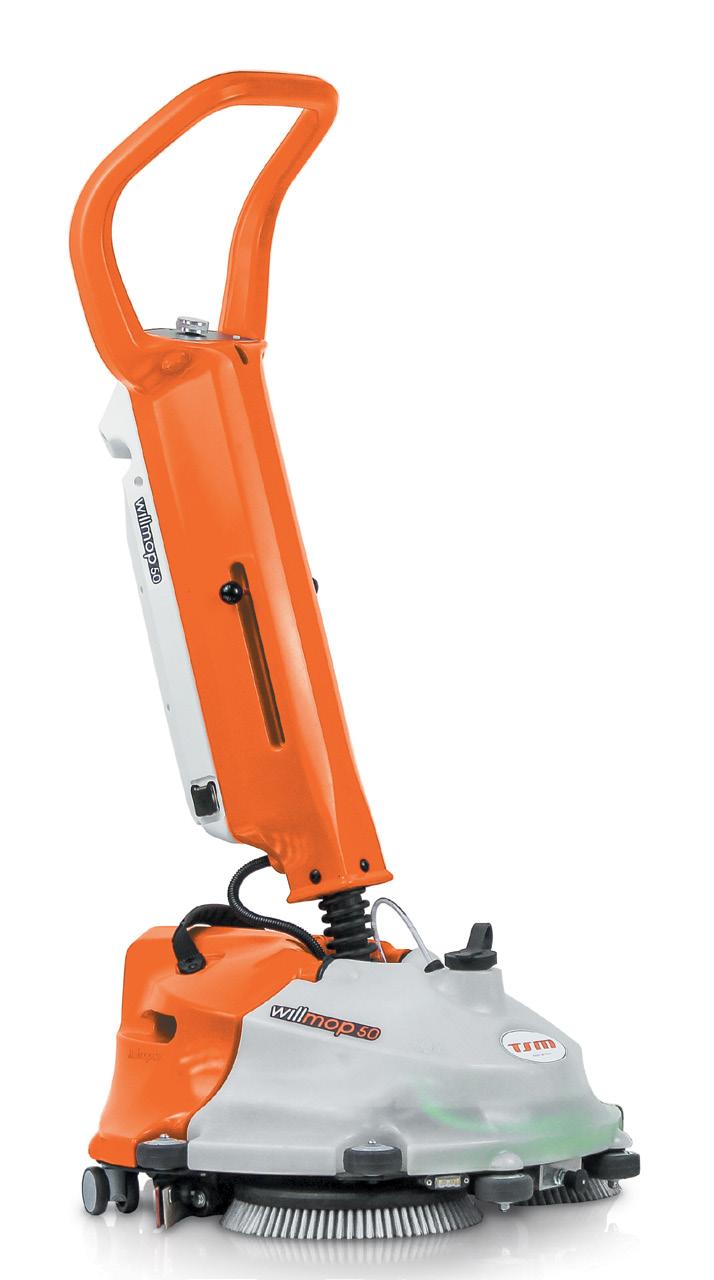


www.incleanmag.com.au www.whiteley.com.au
™
117 PRODUCTS Experience the best commercial cleaning Standequipment196 ISSA Cleaning & Hygiene Expo
Faster escalator cleaning with Rosemor Cleaning escalators and travelators has never been easier thanks to the Rosemor Rotomatic Escalator Cleaning Machine. A process that could have taken 5-7 hours can now be achieved in as little as 2-3 hours, offering a thorough clean of both the vertical and horizontal surfaces of each step. Equipped with touch screen controls, a rapid 10-second cleaning cycle and two-stage, energy-efficient drying, the Rosemor Rotomatic brings new life and unparalleled hygiene to any escalator. Godfreys Commercial 1800 314 commercial@godfreys.com.au580
Natural hand sanitiser safest option for all skin types Hand sanitisers are an important part of preventing the spread of Coronavirus in Australia. Shield Yourself has launched an all-natural hand sanitiser Invisi Shield formula that has been scientifically tested at an independent UK laboratory and proven effective against the germs we are facing in the world today. It has used breakthrough technology to combine plant extracts that work synergistically to achieve a formula that provides skin protection naturally. Invisi Shield is organic and is an effective and safe alternative to alcohol-based and chemical hand sanitisers. Shield Yourself 0412 026 info@shieldyourself.com.au744


LionsBot Rex – Large scale cleaning robot
Luna Hand Care
The next time you take a moment for hand hygiene, discover fragrance layering with Luna Hand Care. Start by choosing between a sweet and sophisticated French Pear, or a clean and zesty Grapefruit & Lemon Verbena fragrance. Then indulge in complete hand care with a selection of complimentary hand washes, lotions and sanitisers. Refresh and protect your skin with a fragrant moment.
NEW Sorbent Professional Compact Hand Towel
Sorbent Professional Compact Hand Towel is made with the technologically advanced TAD paper that is more absorbent and softer, meaning less towels needed, saving money and providing a better user experience, improving hand hygiene compliance. The Sorbent Professional hand towel range is made in Australia and now proudly carries the official Australian Made logo and is also HACCP certified for safe use in food preparation areas. The Sorbent Professional range brings a touch of home when away from home, for those that expect a little more. Sorbent Professional is designed specifically for businesses, with a range of toilet paper (traditional and jumbo) and hand towels with matching dispensers, and facial tissues. All Sorbent Professional tissue products are independently certified for sustainability and responsible sourcing by PEFC and SEDEX. Solaris Paper 1300 832 www.solarispaper.com.auenquiries@solarispaper.com.au883
118 INCLEAN September / October 2022 PRODUCTS
Introducing Rex - a robot designed specifically for cleaning large commercial spaces. It’s fully autonomous, built from high-quality, durable materials and is packed with innovative features.
` Clean up to 4,032m² in one hour ` Eight to 10 hours runtime ` Precision lidar, multiple depth cameras, and sonar scanners ` Two 16-inch brushes, with a total coverage of 81cm. 80kg of downward cleaning pressure ` 140-litre wastewater tank and a 140-litre solution tank ` 2.5m turning circle ` Free demonstration available Central Cleaning Supplies 1300 347
www.centralcleaning.com.aulionsbot@centralcleaning.com.au347
1300enquiry@dominant.com.auDominant.com.au789852


Adiatek Quartz Range
Sorbent Professional Compact Hand Towel Dispenser has a stylish Italian-made appearance and a smaller footprint, making it ideal where space is limited. The single sheet dispensing provides a more hygienic and effective solution, that is easy to load. The Sorbent Professional range brings a touch of home when away from home, for those that expect a little more. Sorbent Professional is designed specifically for businesses, with a range of toilet paper (traditional and jumbo) and hand towels with matching dispensers, and facial tissues. All Sorbent Professional tissue products are independently certified for sustainability and responsible sourcing by PEFC and SEDEX. Solaris Paper 1300 832 www.solarispaper.com.auenquiries@solarispaper.com.au883
www.incleanmag.com.au 119 PRODUCTS ai166071089739_3080 CCS Juma Inclean September QP Ad Final.pdf 1 17/8/22 2:34 pm
NEW Sorbent Professional Compact Hand Towel Dispenser
The new generation, battery powered Adiatek Quartz Auto Scrubbers offer unbeatable cleaning performances and deliver the comfort of a ride on machine with unmatched manoeuvrability and visibility. The Quartz range come in three models, Quartz 50, 66, and 80. They provide a flexible and compact solution with cleaning widths from 508mm to 785mm, battery autonomy of up to four – five hours, and a working capacity up to 4710 m²/h. Like all Adiatek machines, the Quartz range is simple and cost effective to use and come with a twoyear warranty. Free demonstration available. Central Cleaning Supplies 1300 347 www.centralcleaning.com.ausales@centralcleaning.com.au347


www.centralcleaning.com.aulionsbot@centralcleaning.com.au347
Enviro Wizard Oven & Cooktop Cleaner
Cleaners Own C12 Bathroom Plus
R3 Scrub – Your everyday cleaning companion
Enviro Wizard Oven & Cooktop Cleaner by Enzyme Wizard is a non-caustic industrial strength oven, cooktop, grill, and rangehood cleaner. This is a unique surfactant technology that is naturally derived, biodegradable and renewable. Contains a proprietary surfactant-based solvent free formula designed to break down fats, greases, and oils safely. The fats and greases simply lift off the surface once the surfactants have penetrated the soil. Biobased and naturally derived product with no harsh fumes. Low VOC, biodegradable, solvent free and high boiling point makes it safe to use. Not classified as DG.) For use on ovens, grills, BBQs, splash backs, rangehoods, floors, and cooktops. Enviro Wizard 03 8555 120www.enzymewizard.com.ausales@enzymewizard.com.au4844INCLEAN
Cleaners Own C12 Bathroom Plus is a multi-purpose bathroom cleaner made with environmentally sustainable ingredients, its unique formulation easily removes a number of different soils and stains from toilet bowls, urinals and sinks both ceramic and stainless steel leaving a clean, shiny odour free surface. ` Violet formula with a powder puff fragrance ` Easily removes stains from toilet bowls, urinals, sinks ` Can be used on both ceramic and stainless-steel surfaces ` Environmentally sustainable Krystalshield & Shield Chemicals 1300 519 www.krystalshield.com.au074
Meet the personal cleaning revolution you’ve always dreamt of. But better. Up to seven hours runtime. Super dry scrubbing. 21-litre water tank. Designed to pick up cigarette butts, leaves, and small debris. Discover the nimble cleaning robot that everyone can use, anywhere – high-performance cleaning in a compact package. ` Automatic or manual mode ` Scrub mode or dust mop mode ` 1,200m² of cleaning coverage per hour ` Low running noise ` Charging time: Two hours Free demonstration available. Central Cleaning Supplies 1300 347
September / October 2022 PRODUCTS


The new Peugeot Partner Van boasts cutting-edge tech, safety, flexibility and car-like driving dynamics. Choose from the innovative City, Pro, or Premium models, in short and long body versions. Driving around town is effortless due to the fuel-efficient Peugeot 1.2L turbo petrol engine, while compact dimensions make city parking easy. Partner has up to3.9 cubic metres of cargo space and can take a full 1.2m x 1.2m Australian pallet. The dual rear swing doors and optional dual sliding side doors allow easy access when loading all your gear, while the ergonomic i-Cockpit layout makes driving smooth and effortless. www.peugeot.com.auPeugeot www.incleanmag.com.au Contact Agar now for more information. 1800 301 302 www.agar.com.au
WITHOUTWORKS SCRUBBING RINSING &KILLSNORMALLYNOTREQUIREDMOULDMILDEW Learn More SHOWER STAR Renewable ingredients • Plant-based • Organic acids • Biodegradable
Peach Disinfectant can be used in any area where soiling is a problem, including floors, walls, bench tops, doors, etc. Peach Disinfectant passes TGA option C at 500ml water. Peach Disinfectant is available in a 5-litre bottle and has a refillable 500mL trigger spray bottle. Whiteley Corporation 1800 833 www.whiteley.com.aumarketing@whiteley.com.au566
Peach Disinfectant
Peugeot Partner Van is keen and lean
Peach Disinfectant is a commercial grade disinfectant and multipurpose cleaner designed for use in healthcare, institutional and commercial facilities. Being pH neutral and solvent free, Peach Disinfectant is safe for use on most surfaces including: plastics, metals, stainless steel, ceramics, glass, enamels and painted surfaces.
121 PRODUCTS


A complete solution for superior cleaning and infection prevention
` Kills 99.99 per cent of germs, including COVID-19, MRSA, VRE, Norovirus, and more
GECA ecolabel certification
Oates is pleased to announce the launch of its new website: professional.oates. com.au. The Oates Professional new look website is designed to be faster, easier to navigate, and more user-friendly with new features and content focused on our practice and team excellence to assist you in finding the best cleaning solution. The new website is creative, interactive, and gives better access to our products, innovations, industry solutions, latest news and events. Oates 122www.professional.oates.com.auProfessionalINCLEAN
` Superior formula kills germs fast from 30 seconds
` One-step to clean and disinfect
Australia’s only not-for-profit lifecycle ecolabelling program, GECA, has taken the hard work out of finding better cleaning products for people and planet! When products are certified against GECA’s Cleaning Products standard, they’re independently assessed against criteria for a wide range of environmental issues, human health and social impacts while proving that they perform as promised. GECA certification removes doubt and confusion and makes identifying environmentally and socially preferable products easier. Discover GECA certified cleaning products suited to home and commercial use, including general purpose cleaners, sanitary cleaners, laundry cleaning agents, and dishwashing detergents. 02GECA9699 www.geca.eco/product-finder2850
*Always review equipment manufacturer’s guidelines
NEW ProfessionalOates website
GAMA Healthcare Australia (03) 9769 info@gamahealthcare.com.au6600
The Clinell environmental range offers superior cleaning to help prevent infections in healthcare facilities, helping keep you and your patients safe. That is why Clinell used by 7 out of 10 Australian public hospitals.
September / October 2022 PRODUCTS
` Near neutral pH makes Clinell safe and compatible* with a wide range of surfaces


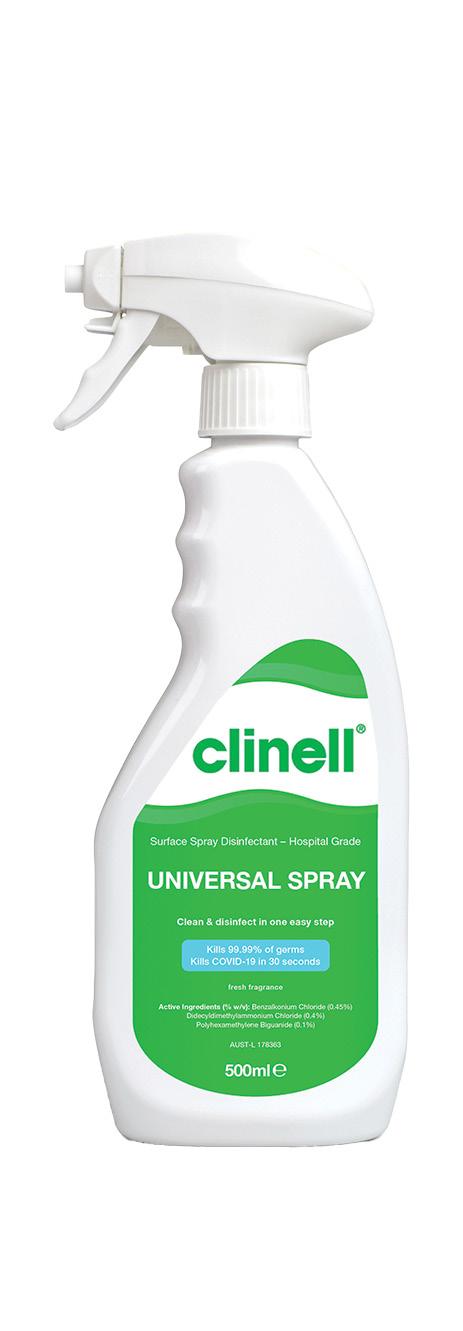


60secondskilltime