THE
GROUNDSMAN WWW.IOG.ORG
JULY 2018 £4.00
ACHIEVING EXCELLENCE IN GROUNDS MANAGEMENT UNSUNG HEROES
AGAINST ALL ODDS
How groundsmen beat the Beast from the East page 32
Meeting demand and battling the weather at Wembley
FORWARD THINKING The award-winning grounds team at Leeds Rugby
I N SIDE
REAL REWARDS WITH ARTIFICIALS PLANNING YOUR PITCH RENOVATION PRODUCT SHOWCASE: FERTILISERS AND COMPACT TRACTORS NOMINATE NOW FOR THE IOG AWARDS
Contents REGULARS
July 2018 AWARD WINNERS!
05 Welcome
Long may our parks remain
How the University of Nottingham team pick up accolades page 20
06 Update
Top industry news
12 SALTEX news
Lawn Care Legends LIVE
15 GaNTIP update
Combatting chafer grubs
37 Product showcase
Compact tractors and fertilisers
45 Tools & guidance
Weather and maintenance
20
FEATURES 16 Best practice: rugby
The Leeds Rugy grounds team
20 Best practice: artificials Nottingham University
24 Award sponsor GrassMaster
25 In action
Pitch perfect at Hyde
26 Best practice: Wembley
How Karl Standley and team meet all demands
29 In action
The Bank of England Sports Centre’s top products
ON THE COVER
32
30 Tech update
Joel Moon of Leeds is tackled by Jake Connor of Hull FC during a match between Leeds Rhinos and Hull FC at Emerald Headingley Stadium Photo:
Planning a pitch renovation
32 Unsung heroes: football
How Cambridge United beat the Beast from the East
34 New appointment
Alan Ferguson is FIFA’s senior pitch management manager
50 Grow with the IOG
AELTC intern Amy Wilbur
Getty Images
37
50
THE GROUNDSMAN
Editorial address: 28 Stratford Office Village, Walker Avenue, Wolverton Mill East, Milton Keynes, MK12 5TW t: 01908 312511 Managing editor Karen Maxwell e: kmaxwell@iog.org t: 01908 552987 Features editor Colin Hoskins e: editor@iog.org t: 01634 832 221 Product editor Charlie Lyon e: charlie.lyon@jamespembrokemedia.co.uk t: 01225 337777 IOG membership and general enquiries t: 01908 312511 e: membership@iog.org Magazine subscriptions Sue Fernandes t: 01908 312511 e: accounts@iog.org Subscriptions £72 UK, £82 Europe, £112 rest of world Publisher James Houston Head of design Simon Goddard Advertising Jasper Keeling e: sales@jamespembrokemedia.co.uk t: 0203 859 7097 Published by James Pembroke Media The Groundsman is published monthly by the Institute of Groundsmanship. All material is copyright of the Institute of Groundsmanship and may not be reproduced without permission. The publishers do not accept responsibility for any advertisement appearing in the journal and cannot be held liable for editorial omissions or errors. The views expressed in the journal are not necessarily those of the Institute of Groundsmanship.
KEEP IN TOUCH
www.iog.org
www.facebook.com/theIOG
Institute of Groundsmanship
twitter.com/the_iog
www.iog.org THE GROUNDSMAN 3
Welcome
Contributors
Karen Maxwell Managing editor
A fitting tribute Having recently paid a visit to Regent’s Park where I met assistant park manager Mark Rowe – who I am grateful to for his time and hospitality – I was struck by the passion and dedication that he and his team put into this Royal Park. I was there to see a glimpse of the future as they trial a hybrid pitch in a community park setting. Early signs are positive. It seems to me our parks are in good hands – whether we’re talking sports pitches or rose gardens – because there is a clear drive to test new approaches and to embrace and trial new technology by Mark and his team. I also learned a lot. We need, though, to invest more widely in this profession at every level. Across sport, our groundsmen deliver against all the odds – be it a budget cut, a lack of resources or whatever nature throws at them. This highlights how groundsmanship in all its forms helps to promote the very best our country has to offer, creating a hub for tourism (for example, the wonderfully presented lawns at Windsor Castle for the royal wedding) or staging a sporting spectacle. Both contribute to the economic success of our country, and this is against a backdrop of austerity, which for the parks sector has led to the recent launch of a Charter For Parks. This calls on our nation’s leaders to take action to safeguard our parks. It is something the IOG fully supports. Perhaps our leaders should take a lead from a unique and thought-provoking tribute for the RHS Hampton Court Palace Flower Show? The Feature Garden forms part of the wider Battlefields to Butterflies WW1 commemorative project, created by Mike Fitt OBE of the Royal Parks Guild. The aim of the initiative is to commemorate all those parks, gardens and grounds staff, from across the UK and its allies, who lost their lives in the First World War. Integral to this journey of remembrance are a group of horticultural apprentices, gathered from various organisations including historic royal palaces, working alongside Chelsea Pensioners from the Royal Hospital Chelsea, to help inform the overall scheme and its lasting message.
Colin Hoskins Features editor
Blair Ferguson Freelance journalist
Marc Vercammen General manager, Tarkett Sports
Dan Prest IOG head of member engagement
The work of groundsmanship deserves recognition, and our parks, which help to sustain an active life or provide an outlet for relaxation and recreation, require the skills and resources to keep them at optimal level. The Battlefields to Butterflies memorial is a fitting tribute to our profession. Let’s hope our politicians realise the value and important role our parks play in the health of the nation.
Simon Johnson Regional pitch advisor
Geoff Webb Chief Executive The Institute of Groundsmanship Tom Stewart KEEP IN TOUCH
www.iog.org
www.facebook.com/theIOG
Institute of Groundsmanship
twitter.com/the_iog
Media and communications manager
Update
THE LATEST HEADLINES FROM THE IOG AND THE INDUSTRY
READ MORE
IOG NEWS
Read all the latest news and updates, and discover what members are entitled to www.iog.org
EMERGENCY MEASURE
INSECTICIDE APPROVAL
AN EMERGENCY AUTHORISATION has been granted for the use of insecticide Acelepryn until 30 September, for the control of chafer grubs and leatherjackets on golf course greens and tees, horse racing courses and airfields. Use is permitted where there is an acknowledged instance of economic damage and where the product has been recommended by a BASIS qualified advisor. www. icl-sf.com
HSE REPORT RELEASED CALL TO ACTION
Countryside coalition claims parks are ‘in crisis’ A COALITION OF countryside groups and environmentalists is calling on the government to protect the UK’s parks and green spaces which are at ‘crisis point’ following years of swingeing budget cuts. The group has put forward a Charter for Parks, which calls on ministers in England, Wales and Scotland to make it a legal requirement for all parks and green spaces to be maintained and managed to a ‘good standard’. It also calls on them “to recognise the right of every citizen to have access within walking distance to a good-quality public green space”. Dave Morris, chair of the National Federation of Parks and Green Spaces, said time was running out for the UK’s parks. “Budget cuts to staffing and maintenance are leaving them vulnerable to neglect and deterioration, or even sell-offs. Many people think local councils are
6 THE GROUNDSMAN July 2018
“Budget cuts to staffing and maintenance are leaving them vulnerable to neglect and deterioration, or even sell-offs” legally responsible for maintaining local parks and open spaces but unfortunately, unlike waste collection, that’s not the case yet.” He said the charter called on politicians “to take action to ensure these essential and highly-popular public resources are properly funded, managed, maintained and protected for current and future generations”. In 2017 an inquiry into the future of parks by MPs found that they were at a “tipping point”, and in 2016 a separate study from the Heritage Lottery Fund found the UK’s parks risked falling into disrepair and neglect as a result of budget cuts.
PESTICIDE UPDATE The Health & Safety Executive’s Pesticides in the UK, the 2017 report on the impacts and sustainable use of pesticides, is now available to download as an interactive PDF. The report outlines progress made with activities promoting the sustainable use of pesticides, and identifies issues needing further monitoring or work. www.hse.gov.uk
CLUB BREAK-IN
DEVASTATED BY THEFT NANTWICH TOWN FC has been targeted by thieves for the second time in two years. Bosses at the club say they are devastated after the theft of thousands of pounds worth of groundscare equipment. Much of the stolen equipment had been donated by supporters to replace items taken in the previous breakin. A ride-on John Deere mower and a Hayter mower were less than two years old.
U P D AT E
NEWS
NEWS IOG AWARDS DINNER
BOOK YOUR PLACE!
RESEARCH DAYS
STRI TO UNVEIL LATEST TECH STRI GROUP HAS announced the dates for its free annual Research Day event, hosted at its base in West Yorkshire. Greenkeepers, grounds staff, course managers, stadium managers and other sports turf professionals are all invited to attend the open days on the 19 and 20 September. STRI researchers will present the latest trials and technology, sponsored by STRI’s research partners, that will benefit the sport industry in the future. STRI’s consultancy team will be giving attendees a guided tour around the STRI research grounds.
The event is supported by ICL, Syngenta, Sherriff Amenity, Bernhards, Aquatrols and MLR Sports, which are all currently investing in R&D projects to help improve the quality and management of sports surfaces. Dr Christian Spring, research operations manager at STRI, said: “STRI’s research days are interactive and informative, and allow groundsmen to keep abreast of the latest developments and concepts in the sports turf industry.” To book your place, call 01274 565131 or email enquiries@strigroup.com
NOMINATE A WINNER!
WAR MEMORIAL dd
TRIBUTE TO WW1 FALLEN
ngsta e
KEEP IN TOUCH
www.iog.org
an
TO MARK THE centenary of the end of the First World War, Historic Royal Palaces has partnered with the Royal Parks Guild to create a tribute garden at the RHS Hampton Court Palace Flower Show. Battlefields to Butterflies will commemorate the 24 Royal Parks and Palaces gardeners and park keepers who lost their lives. The Feature Garden will portray two very differing scenes, each reflecting the stark realities of war: from the ugly and desolate trenches, to a landscape restored by nature to peace, realised in a tranquil display of wildflowers and trees.
Designed by Todd LongstaffeGowan and created by the palace’s own gardeners and volunteers, the layout and planting scheme will demonstrate how nature’s healing powers and the passage of time recovers and transforms a damaged landscape. The Feature Garden forms part of the wider Battlefields to Butterflies WW1 commemorative project created by Mike Fitt OBE of the Royal Parks Guild. Hampton Court is on from 3-8 July; visit www.rhs.org.uk/shows-events/rhshampton-court-palace-flower-show
www.facebook.com/theIOG
MAKE SURE YOU secure your place at the biggest celebratory event in groundsmanship – the 10th Anniversary IOG Awards 2018. Bookings are now open for the event, at the Hilton Metropole, near the NEC on 31 October. Prices are £95 for IOG members and comedian Tom Allen (below) will be providing the entertainment. Email events@iog.org or call 01908 312511.
Institute of Groundsmanship
DON’T LEAVE IT too late to nominate a deserving team or individual for one of the 21 categories at this year’s awards. Call 01908 312511 or visit www.iog.org/awards
GLOBAL VOICE
THE IOG ABROAD
IOG CEO Geoff Webb will be a guest speaker at the National Sports Convention (NSC) in Melbourne, Australia from 16-18 July. Geoff will be presenting at the National Sports Surfaces Conference (NSSC) within the NSC educational programme. He will be discussing the UK’s approach to groundsmanship, including the UK Hybrid Experience, the IOG’s National Framework for Sport Turf, Pitch Grading and the Need for Education. www.nationalsports convention.com.au
twitter.com/the_iog
www.iog.org THE GROUNDSMAN 7
U P D AT E
NEWS
MOVERS & SHAKERS Meet the people taking on new challenges in the industry
1 NIGEL LOVATT & MIKE TURNBULL REESINK
NIGEL LOVATT has retired from Reesink Turfcare after 17 years with the business. Nigel joined the company when it was Lely UK, as retail sales manager. He grew the golf business from almost nothing to £1m in his first couple of years and was promoted to regional manager. Mike Turnbull will now take responsibility for Reesink customers, the dealer network and retail partners from the north east to the north west of England. Mike covered the same area, spanning Nottingham to North Wales, in his long 20-year role with Toro Spellbrook.
Nigel Lovatt
Mike Turnbull
2 KEITH McCORMICK MAJOR EQUIPMENT
Keith McCormick
3
MAJOR EQUIPMENT HAS announced the appointment of Keith McCormick as its new Scottish and North of England sales representative, replacing Ivor Dobson who is retiring after 14 years with the company. Keith joins Major Equipment from Walter Watson where he was responsible for sales throughout Ireland and the UK. “We’re delighted Keith has joined the Major team,” said general manager Eoin Murphy. “He brings a wealth of technical and industry knowledge and we’re very much looking forward to working with him.”
PITCHMARK
NEW DIRECTORS
MARKETING MANAGER Darren Rodman, general manager Tim Rodman and production manager Jon Griffiths have become shareholders and directors at linemarking firm Pitchmark, alongside existing directors Mark and Sue Rodman. The team has also been joined by Dave Blanchard. Pitchmark was also named Business Exporter of the Year for the South West in the regional FSB small business awards. The firm is also shortlisted for the Bristol Post Business Awards in the Small Business of the Year category, and Tim Rodman has been shortlisted for the Young Business Person of the Year award and appeared on Insider Media’s ‘42 under 42’ list for the south west. www.pitchmark.com
8 THE GROUNDSMAN July 2018
Pitchmark’s newest directors (from left) Darren Rodman, n ri t s and i d an
U P D AT E
NEWS
HANDY RESOURCE
NEW GOOD HYGIENE FOR SPORT AND PHYSICAL ACTIVITY GUIDE THE IOG HAS supported the development of the new Good hygiene for sport and physical activity guide, which is now available for download along with accompanying materials at: www.groundsmanship. co.uk/sportshygiene It has been developed in conjunction with Public Health England, Sport England, the National Centre for Sport & Exercise Medicine in Sheffield, and The Centre for Sport and Exercise Science at Sheffield Hallam University; as well as The Football Association, Football Foundation, Rugby Football Union, Rugby Football League, England Hockey, the Institute of Groundsmanship, The Sports and Play Construction Association, Premier League and The Department for Digital, Culture, Media & Sport (DCMS).
There are a number of images available for download that can be printed and displayed at your facility, or shared digitally on your website or social media channels. These materials are available to any organisation in your network to download as many times as they like, so please do share with others in the industry who you think may benefit from their use.
unable to put anything by for savings or emergencies. The new tool is available on the Perennial website and can be used on a desktop computer, tablet or smartphone. It is very easy to use and does not require any technical or financial expertise. Matthew Cooper, debt advice manager, said: “Creating a budget is important because it helps you understand how you are using your money and where your biggest expenditure is. Seeing this written down is the first step towards making changes.”
Find out more at www.perennial.org.uk/ budgeting-tool
i
www.iog.org
BALMERS GM HAS joined GKB Machines’ network of groundscare dealers. One of the largest new and used groundscare businesses of its kind in the north, Balmers has been in business in Burnley for more than 30 years, providing sales, spares, service and hire, and covering an area from Lancashire down to North Manchester and across to West Yorkshire. www.balmersgm.com
FIRST FOR WOMEN
Online budgeting tool
KEEP IN TOUCH
BALMERS JOINS GKB
IN THE FRAME
FINANCIAL ADVICE
PERENNIAL, THE CHARITY that supports the UK horticulture industry, has launched an online budgeting tool to help people understand their financial position and plan ahead. The charity says more and more people working in the sector are struggling to make ends meet or are
NEW DEALER
www.facebook.com/theIOG
Institute of Groundsmanship
ANITA CORBIN, the daughter of IOG stalwart Bob Corbin, is hosting a First Women UK photographic exhibition at The Royal College of Arts from 20 July to 22 August. The decade-long project to capture the portraits of 100 pioneering women of the 21st century includes Hope Powell, the first woman to obtain a UEFA Pro Licence, and Elizabeth Banks, the first female president of the Royal Horticultural Society. www.1stwomenuk.co.uk
OBITUARY
GEOFF LAKE
IT IS WITH REGRET that we announce the death of Geoff Lake, 70, a long-standing treasurer of the IOG Leicester Branch. Geoff worked for Leicester City Council’s Parks Department for more than 36 years. He started as a tractor driver and was later promoted to chargehand and then area manager before retiring in 2011.
twitter.com/the_iog
www.iog.org THE GROUNDSMAN 9
U P D AT E
PRODUCT UPDATE
S H OWC A S E
In our product roundup this issue we focus on compact tractors and fertilisers page 37
The latest developments in sand, irrigation, turf tech and battery-powered tools
1 RYDER
SYNGENTA
ENHANCE THE COLOUR and visual appearance of turf while protecting leaves from excessive sunlight with the latest pigment technology from Syngenta. Ryder is a highly concentrated and stable green pigment designed for use on managed turf to improve its appearance and to help protect against UV radiation and high light intensities. Plants can only absorb so much light; too much stresses the plant and can lead to reduced photosynthetic activity (photoinhibition) and even harmful damage within cells. Ryder mimics the plant’s natural pigment defences, while controlling the
2 PRO PITCH ELITE
AGGREGATE INDUSTRIES
Pro Pitch Elite has some of the best drainage rates available in the UK
ULiB 1200 BATTERY 3 AND HARNESS PELLENC
LOOKING FOR LONGER battery life? The Pellenc ULiB 1200 battery and harness lasts 20 per cent longer than its predecessor – that’s up to five hours’ work with the most energyconsuming Pellenc tools. The new harness distributes the weight more evenly and allows for better movement, making the machines more comfortable to operate. The battery is waterproof to IP54 standards and an HMI display details working time per tool, maximum power delivered by the battery and fault alerts. www.etesia.co.uk
The blinking screen mode and re e re ect rs allow the operator to view the display even in dim light
trials s ing e ects f Ryder within hours of application
green colour. Unlike existing water-soluble turf dyes, Ryder is a concentrated 70% pigment; once dry on the leaf, it is not washed off by rain or irrigation and is stable in light. Ryder is available from ICL and leading distributors. www.greencast.co.uk
A RECENT STUDY found that extreme weather is having a detrimental impact on the UK’s favourite sports. Certain areas of the UK experience rainfall at 300 per cent of the national average, yet pitch design and infill materials do not reflect the variations. Unveiled by the Garside Sands division, Pro Pitch Elite infill sand includes larger rounded particles in order to provide superior void space through the playing surface of synthetic sport pitches exposed to extreme weather. The new product will be sold alongside the company’s existing Pro Pitch 2EW sand. www.aggregate.com
NEWS
4 OPERATED CONTROLLER RAIN BIRD
IT’S NOT ALWAYS possible to have a mainspowered irrigation controller, which is when Rain Bird’s 9v WPX battery-operated controller comes in handy. IP68 compliant and 100 per cent water and dust proof, the WPX is fully submersible and ideal for installation in a valve box. The WPX can perform the same functions as a wired controller and can provide irrigation over one, two, four or six zones. You can set multiple run times by zone and access all functions via a larger-than-average LCD screen. www.rainbird.eu
The WPX can be used anywhere, including wet or muddy conditions
www.iog.org THE GROUNDSMAN 11
U P D AT E
S A LT E X
A few members of the Lawn Legends group at a recent workshop
By Chris Bennett SALTEX press officer
LAWN CARE LEGENDS LIVE COMES TO SALTEX A fantastic networking opportunity for landscapers and gardeners will be available at SALTEX 2018
T
HE LAWN CARE LEGENDS Facebook group is a thriving online community with more than 3,000 members worldwide. It is primarily for landscapers and gardeners to showcase their work and knowledge, and support for one another. Most of the members are based in the UK, Ireland, USA, Australia and Canada and the group sees, on average, 40-60 individual member posts and about 4,500 engagements every day. “Topics of conversation can be anything from recommendations on products, machines or brands to marketing your business or pricing a job. It is open to professionals and aspiring professionals and the group encourages the positive aspect of sharing information,” said founder John Ryan. “Social media is much more than sharing pictures and talking about lawnmowers; it’s a way of connecting with people who have the same interests and passions and, ultimately, who face the same difficulties as you. “I have experienced and seen mental health issues in the industry and that 12 THE GROUNDSMAN July 2018
has commonly derived from being a solo operator or a small business owner. The difficulties and the challenges we face can be overwhelming and if we don’t have somewhere to turn to for advice or encouragement, it can be really tough. Social media breaks down those barriers and can make you feel less alone.”
POSITIVE THINKING
Lawn Care Legends LIVE will take place on the first day of SALTEX 2018 and John, who is hosting the event alongside Landscaping YouTubers Curtis Jones and Jason Groom, said he wants to encourage more people to get involved. “Ultimately, we are trying to build on a positive movement that has driven many people to develop their skills and deliver a higher service to customers, while at the same time gaining more passion and appreciation for their own businesses.” Ahead of the event, Curtis and Jason are also asking attendees to submit up to 10 pictures showcasing the quality of their work. “It might be beautiful stripes on a
lawn, a crisp edge between a flower bed and a lawn or topiary cutting – anything at all,” said John. The pictures can be posted on the group’s Facebook page or on Twitter or Instagram. The winner, who will be selected at random from all the entries that make it onto the shortlist, will be announced on the first day of SALTEX at the Lawn Care Legends LIVE event. Prizes include a shaft drive professional lawnmower, a professionally built website worth about £1,500 and Lawn Care Legends clothing. To enter the competition, join the Lawn Care Legends Facebook group at www.facebook.com/groups/ lawncarelegends or use the hashtag #LCLSALTEX18 on Instagram or Twitter. SALTEX 2018 is at the NEC, Birmingham on 31 October and 1 November. Lawn Care Legends LIVE will take place on 31 October at 2pm in concourse suites 22 and 23 by the SALTEX entrance. Visitors can register to attend for FREE at www.iogsaltex.com. You can also follow SALTEX on Twitter: @IOG_SALTEX and Facebook: www.facebook.com/IOGSALTEX
i
an ydr c ric et lu s ut�eld is now in much better condition after surface removal and reseeding in February (above right)
ROOKS ARE STUMPED AT LANHYDROCK When rooks feeding on chafer grubs created havoc at a cricket club outfield, the only way to ensure a playable pitch was to remove the surface
I
n September 2017 I was contacted by the worried chairman and groundsman at Lanhydrock Cricket Club in Cornwall, who said the outfield was being torn apart by rooks. He asked if I would visit to see what the problem was. The ground, which is in the boundaries of the National Trust’s Lanhydrock House in Bodmin, had several patches in its treelined outfield where turf had been removed by the birds, which were obviously after chafer grubs. Severe amounts of moss were contributing to the problem.
The outfield had not received any maintenance over many years – which could be said of lots of village cricket clubs where finances are tight – and the lack of fertiliser combined with no aeration, plus being a tree-lined site, meant that a lack of airflow has contributed to the mossy surface which formed an ‘incubation blanket’ for the grubs. Even during cold weather, the grubs did not go any deeper into the soil profile (which is expected) and stayed at around 50mm from the surface, devouring any roots that the sparse grass cover produced.
“The lack of fertiliser combined with no aeration meant poor airflow contributed to the mossy surface”
DRASTIC ACTION
If left untreated, the two successful adult teams and more than 100 youth players regularly using the ground would not have been able to play there for the 2018 season. With no chemical treatment for chafer grubs, it was suggested that nematodes be used to control the chafers. This was tried,
By Simon Johnson Regional pitch advisor
but the sheer amount of the grubs meant it was ineffective so the answer was to remove the grubs and moss. The plan was to use a fraise mower to remove the top 50mm of the surface then to reseed. But with it now being late February and the season only eight weeks away, there wasn’t a lot of time to get the seed in and germinating. Then, surprisingly, Cornwall suffered a period of snow and ice, which caused further delay. The seed was, however, drilled as soon as the outfield was dry enough in order that play could commence in early June. Now, the club is committed to looking after the outfield by regular deep aeration and fertilising, to improve the health of the sward. The only losers are the rooks, which have since found somewhere else to feed. Visit www.iog.org for more information about the Grounds and Natural Turf Improvement Programme
i
www.iog.org THE GROUNDSMAN 15
RUGBY
BEST PRACTICE
NO STANDING STILL FOR LEEDS RUGBY
A relentless desire to produce high-standard playing surfaces has earned the Leeds Rugby grounds team another IOG Award – its fifth since 2009 – and the latest accolade has been achieved while two stands at the stadium are undergoing massive redevelopment
16 THE GROUNDSMAN July 2018
BEST PRACTICE
RUGBY
By Colin Hoskins Features editor
T
he Leeds Rugby grounds team continued their winning ways last year, adding the IOG GrassMaster Professional Rugby Football Union Grounds Team of the Year Award to their previous IOG Award successes – in 2016 and 2015, the Professional Rugby Football League Grounds Team of the Year Award and in 2013 the IOG Young Groundsman of the Year Award. Their Emerald Headingley stadium also won the 2009 IOG Award for Spectator Sports Ground of the Year. The same grounds team (head groundsman Ryan Golding, assistant head groundsmen Dan Connor and Leon Pearson, along with apprentice Joe Sutcliffe) undertake pitch maintenance at the stadium and at satellite grounds for the dual rugby code club (the Yorkshire Carnegie rugby union team and the Leeds Rhinos rugby league squad). Considering the situations they have been – and still are – confronted with, it’s no surprise they have such an impressive IOG Award cabinet. The team manages and maintains almost 50 acres, with not only the stadium’s fibresand pitch under their remit, but also: The Kirkstall Academy ground (two natural turf pitches and a synthetic surface); The Abbey Fields training area (four turf pitches, currently been repaired after flooding); The natural grass pitch at Stanningley ARLFC, which is home to the amateur Rugby League club. “Working with such varied playing surfaces enables my team to continually widen their knowledge and skills,” says Ryan. He adds: “When Rugby Union Cup games are scheduled, I travel to the various grounds to ensure the surfaces (all natural grass) are of the correct standard. I liaise with the clubs and incumbent groundsmen to formulate plans for pitch improvements. For example, the Huddersfield ground is 232m above sea level and the night before a game it was forecast to be -2°C, so we took our frost sheets over.” The Emerald Headingley stadium is a true multi-use site, seeing most usage from February to May and in September and October, the rugby league and rugby union
The building of the new stands hasn’t fazed Ryan and his team
crossover periods. Other events extend from local school and amateur club finals through to international games, as well as accommodating TV and film productions, weddings, concerts, disability rugby festivals and an annual children’s day. There are usually 90-110 events on the pitch in a calendar year.
DEALING WITH DISASTER
The latest tests of the team’s mettle have been: the construction of two new stands (north and south) at the stadium, a demolition and construction project that began in March 2017; there was also the flooding at Abbey Fields and Kirkstall Academy in winter 2015/16. The River Aire burst its banks and ruined the training ground, medical centre, two first-team pitches, four Kirkstall Academy ground pitches, a full-size 3G surface and 30 acres of surrounding land. “We were effectively carrying out major repair work in the middle of winter,” explains Ryan. “One of the main challenges was the weight of the wet silt deposits all over the surfaces, which meant the Koro was sometimes struggling. It was a tough period and we learned a lot, but I have a great young team with a tough and resourceful attitude.”
As far as the rebuilding project goes, the stadium’s south stand has now been demolished and replaced by a new stand (scheduled to be completed this September) which adjoins the north stand at Headingley stadium (Yorkshire County Cricket Club), while Emerald Carnegie stadium’s main (north) stand is also being renewed. Both new stands are higher than those they replace and to counter the effect of shade, which will encroach 50m onto the pitch in winter, Ryan is investigating the use of lighting rigs. “Aside from moving and repositioning the pitch irrigation tanks with perimeter pipeworks, main drainage outlet and an undersoil heating boiler, the pitch has been relatively unscathed by the major upheavals, despite the influx of cherry pickers and diggers,” says Ryan. “One of the main issues with removing the stands has been how to prevent dust and debris settling on the pitch. Water curtains were used successfully, but we found we couldn’t use these when we were getting extremely low temperatures as the watery dust was settling on the leaf and turning the pitch completely white.” The disruption doesn’t seem to faze Ryan, who was promoted to head groundsman www.iog.org THE GROUNDSMAN 17
RUGBY
From left, assistant head groundsman an nn r apprentice e utcli e ead groundsman Ryan Golding and assistant head groundsman Leon Pearson
“We used a Bomag roller (with vibrate function) to bind the surface. It may sound unethical, but it worked for us” in February 2014 at the age of 27 (he joined the club from school in 2002, aged 16). The rebuilding project, which includes a new ecofriendly wash-down area, is scheduled for completion by spring 2019. In the meantime, Ryan and his team continue to ensure the pitch is presented in a first-class condition for the games staged on Thursday and Friday evenings and Sundays, plus the training sessions on Thursdays and Saturdays. “We are carrying on with our usual pitch maintenance regimes,” he says, “although with five 19-tonne cherry pickers currently on the pitch [June 2018], pitch care is quite a balancing act. Anything we need to do has to be done after 5pm and completed before 7am, and this can be particularly difficult between games when we have other tasks, like changing the sponsor boards, to add in. “While regular pitch irrigation and renovation are problems – the pitch is now entering its third year without a major annual renovation – another area of concern is the concentrated areas of compaction being caused by the cherry pickers, which are sitting on ground guard boards on the pitch. It is a case of using aeration to create enough heave to reinstate levels – but not 18 THE GROUNDSMAN July 2018
too much that we end up with a surface that is very ‘soft’ where the cherry pickers could subsequently create even more damage.” The lack of annual renovation has not, however, made a significant impact on pitch performance, notes Ryan, who is now questioning whether fibresand surfaces do actually need to be fully turned over on an annual basis. “The second year is always better than the first with the root mass and playability, with no real build-up of algae or thatch if this is controlled properly.”
GETTING ON WITH THE JOB
Despite everything seeming to conspire against them, the stadium has not lost a game due to the building work. Two matches were moved to Elland Road, however, due to the reduced spectator capacity levels. The adjacent Headingley cricket ground has remained unaffected. Ryan remains steadfast on the importance of playability and presentation: “We cut in 2.5m bands during the summer months and 5m bands during the winter. The result is an appealing pitch and, during winter especially, it makes it easier and saves time for routines like vertidraining and heavy raking.
“Also, we apply a level of practicality; if we were to simply just roll during December (to put the pattern in) this would create too much compaction. So, instead we dragbrush to ‘stand up’ the grass and achieve the pattern while, at the same time, produce a surface that gives the players more cushion and purchase. That said, our regimes may be tweaked based on feedback from coaches and players to help us ensure we consistently achieve the correct levels of playability.” Ryan’s not afraid to think outside the box. One situation concerned the aftermath of stadium pitch renovations in 2016. “The surface was extremely destabilised with shallow root growth,” he says. “We used a Bomag roller (with vibrate function) to bind the surface. It may sound unethical, but it worked for us.” In another instance, “when we were going into winter and certain high-wear areas were being damaged, we successfully used a 100kg roller just before the games and at half time”. He adds: “It’s always fantastic to see people trying new and different things and if it works, it works. I believe you can’t just stand still or just do what others do.” With such an outward-looking approach there is no doubt Ryan Golding and the Leeds Rugby team will continue to add awards to their trophy cabinet. Nominate now for the 2018 IOG Industry Awards. Visit www.iog.org/awards
i
ARTIFICIAL SU R FAC E S
By Colin Hoskins Features editor
BEST PRACTICE
NOTTINGHAM’S FOREST OF AWARDS The skill of the University of Nottingham’s grounds team at maintaining synthetic playing surfaces was recognised for the second successive year at the 2017 IOG Industry Awards, with the team again collecting the accolade for Best Maintained Artificial Pitch
20 THE GROUNDSMAN July 2018
BEST PRACTICE
W
ith two successive IOG awards for their skill at managing and maintaining synthetic pitches, the University of Nottingham’s grounds team obviously has artificial pitch care down to a fine art. “There’s no real secret to our success,” says sports ground manager, Greg Smith. “The key is regular maintenance – if you look after the surface properly, it will look after you.” With this in mind, five of the team – “a group led by my very able assistant, head groundsman Pete Bullimore,” adds Greg – are fully trained in the maintenance of the five artificial playing surfaces. These
are used regularly by the university’s 33,000 students and 5,000 staff, as well as ‘outside’ partners such as Beeston Hockey Club, Notts County Ladies, the Nottingham Outlaws rugby league team and the Notts County FA Academy. In addition, the university’s facilities are also used for local Rugby Football Union and Football Association courses, as a Notts County Centre of Excellence and by Notts Schools FA, as well as by community teams and local schools. They have also hosted FA referee courses. “During this past season, all the pitches – natural as well as artificial – have performed brilliantly and, in terms of the natural surfaces in particular, this is
A R T I F I C I A L S U R FAC E S
despite one of the wettest winters and springs we’ve ever seen,” says Greg. Both surfaces were particularly busy in March this year when the site hosted the Big BUCS (British Universities & Colleges Sports) Wednesday, a day-long, multi-sports event including football, hockey, lacrosse, as well as rugby league and union games, opened by Princess Anne and attended by university teams from throughout the UK.
LOCAL HEROES
It is events such as this that continue to showcase to visitors the abilities of the university’s grounds team, while the appearance and performance of the www.iog.org THE GROUNDSMAN 21
ARTIFICIAL SU R FAC E S
Princess Anne attended the university’s Big BUCS Wednesday event when sports were held on both natural and arti�cial playing surfaces
Greg and his team of seven groundsmen are responsible for 60 hectares of sports surfaces at the University of Nottingham
”We’re trying to not only maintain the surfaces to the highest level but also to extend their working lives“ playing surfaces – and the two IOG awards – have also earned the grounds team campus-wide recognition from university staff and students. “Training is critical to the success of the operation,” says Greg, “with ongoing tuition of the team via the university and with training providers such as Replay Maintenance and Nottinghamshire FA in partnership with the IOG. This includes the latest recruit to the team, who will soon be undergoing an IOG course being run in conjunction with the local FA.” Greg’s training remit extends beyond the maintenance of artificial surfaces, of course, with the latest examples being the organisation of tuition for the team in the use of a recently acquired Spider bank mower – “to eliminate strimming” – and the 18 Case IH tractors that were delivered this summer. The new tractors will be used across the site, including on and around the artificial surfaces – the main campus has a sand-based surface and one 3G rubber crumb surface, Jubilee campus has a 3G rubber crumb pitch, Highfields Sports has a water-based surface and the Sutton Bonington campus has a 3G rubber crumb pitch. All surfaces are approved 22 THE GROUNDSMAN July 2018
for FA use, and the Sutton Bonington and Jubilee Campus pitches also have rugby accreditation. These surfaces, which are used for a mixture of American football, rugby and lacrosse (3G surfaces), as well as sand- and water-based hockey, occupy four hectares of the university’s 60 hectares of sports surfaces. There is also a number of soil-based pitches within the remit of Greg and his seven-strong grounds team – 28 football, nine rugby, two cricket squares and a bowls green. All the artificial surfaces are used daily from 6.30am to 10pm, and a weekly maintenance schedule is block-booked every Thursday. Any rubbish is collected and the pitches are regularly brushed in different directions using a Kubota B20 50 tractor and Redexim 1200 brush/ cleaner, which helps keep them free from weed, moss and algae while also de-compacting the surfaces. A Sisis brush and groomer, a Greentech brush and a small Westwood ride-on complete the team’s armoury of kit for maintaining these surfaces. A pedestrian brush is used to clean the pathways. The goals and nets are
inspected every week to check for damage. Also weekly, the pitches are re-marked or marked out, while litter is removed and the bins emptied on a daily basis by external cleaners. Even when students are on their summer and winter breaks of eight and three weeks, respectively, the grounds team continues to clean the surfaces every week to keep them free of contamination and debris. This routine is backed up by a deep clean every other month by Replay Maintenance, which also performs an annual deep clean routine.
HIGH STANDARDS
Greg is adamant that regular maintenance is the key to the playability and longevity of the artificial surfaces. “We’re trying to not only maintain the surfaces to the highest level but also to extend their working lives,” he says. “This year when the surfaces were being tested, we were told that even the nine-year-old pitch is having its life extended thanks to our regime.” That says so much about the grounds team’s standard of maintenance on these artificial surfaces – which not only underpins their two IOG awards but also explains why Greg’s advice on the subject is in regular demand by other users of artificial surfaces. For more information about IOG Maintaining Artificial Surfaces training courses, visit www.iog.org/learning
i
IOG INDUSTRY AWARD SPONSOR
By Marc Vercammen General manager, Tarkett Sports
MAINTAINING A HYBRID PITCH
STABLE SOLUTION FOR AVIVA STADIUM The Aviva Stadium in Dublin is a true multi-purpose venue, hosting international rugby and football, as well as music concerts, business events and conferences. Such a busy schedule demands a highquality and durable pitch, and the stadium fulfills these requirements with its use of a GrassMaster hybrid surface – which not only provides four times more playing hours per year than a natural grass surface but is also proven to last for 15 years or more. Majella Smyth, the stadium’s grounds manager, says: “We changed to GrassMaster five years ago and the surface stability has been a saviour – for example, we had 67 scrums from November to December and I could sleep at night knowing that the surface would hold up!”
GrassMaster Solutions offers advice on how best to extend the life of a hybrid pitch
T
he maintenance of a hybrid pitch is similar to that of a natural grass surface and will vary at different sites, with ‘closed’ stadia and ‘open’ training grounds having differing needs. That said, grounds managers must always consider a number of factors, such as the availability of natural light, air movement, climatic/micro-climate conditions and frequency of use. Annual renovation and professional pitch consultancy are also mandatory if a stable pitch quality is to be maintained. Wind, air, light and temperature play a major role in grass development, and many innovative tools are available to strengthen grass growth factors and to sustain grass health throughout the year and in all climates: Soil/sub-air systems provide underground ventilation that manage the air/moisture ratio within the rootzone; Grow lights offer photosynthetic lighting and can be used with heating systems to provide the correct combination of temperature and light. Lighting rigs stimulate plant growth and improve surface quality and performance; Pitch covers protect and maintain the grass and allow the pitch temperature to be raised, to reduce the cost of using undersoil heating systems. In warmer
24 THE GROUNDSMAN July 2018
climates, undersoil cooling systems prevent wilting and retard pitch dehydration; Mowing, aeration, scarifying/raking, irrigation, plant nutrition, disease and pest management are also important maintenance procedures to be carried out regularly.
ANNUAL RENOVATION
To maintain pitch performance and to ensure the longevity of hybrid grass pitches, annual renovation is highly important. This includes the following: Remove all vegetation, including organic build-up and any thatch layer as well as undesirable plants; Create a clean and healthy growing environment for the grass; Aerate the soil profile; Ensure good drainage, surface levels and pitch playability; Tease the fibres up above the top dressing to ensure surface stability and optimum performance; Establish a healthy new grass sward.
PROFESSIONAL PITCH MONITORING
Continuous monitoring is essential to assess pitch condition and determine issues concerning maintenance, performance and playability. GrassMaster Solutions provides
professional pitch consultants for such a task, and the company’s Solutions Team trains, guides and assists the people responsible for the pitch with the aim of maintaining a perfect pitch – anytime, anywhere. GrassMaster Solutions is the hybrid grass division of Tarkett Sports. The stitched hybrid grass system GrassMaster is 100 per cent natural grass reinforced with 20 million in-house produced PP fibres. PlayMaster is a carpet-based hybrid technology that ensures instant playability. Visit www.grassmastersolutions.com
i
IN ACTION
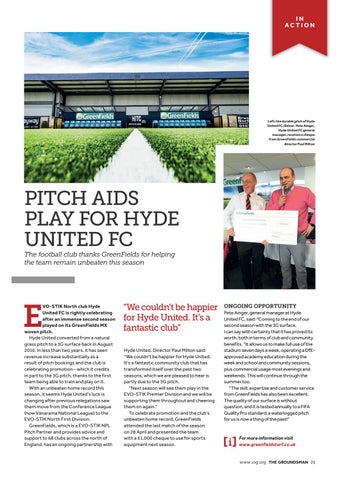
Left: the durable pitch of Hyde United FC; Below: Pete Ainger, Hyde United FC general manager, receives a cheque from GreenFields commercial director Paul Milton
PITCH AIDS PLAY FOR HYDE UNITED FC The football club thanks GreenFields for helping the team remain unbeaten this season
E
VO-STIK North club Hyde United FC is rightly celebrating after an immense second season played on its GreenFields MX woven pitch. Hyde United converted from a natural grass pitch to a 3G surface back in August 2016. In less than two years, it has seen revenue increase substantially as a result of pitch bookings and the club is celebrating promotion – which it credits in part to the 3G pitch, thanks to the first team being able to train and play on it. With an unbeaten home record this season, it seems Hyde United’s luck is changing after previous relegations saw them move from the Conference League (now Vanarama National League) to the EVO-STIK North First Division. GreenFields, which is a EVO-STIK NPL Pitch Partner and provides advice and support to 68 clubs across the north of England, has an ongoing partnership with
“We couldn’t be happier for Hyde United. It’s a fantastic club” Hyde United. Director Paul Milton said: “We couldn’t be happier for Hyde United. It’s a fantastic community club that has transformed itself over the past two seasons, which we are pleased to hear is partly due to the 3G pitch. “Next season will see them play in the EVO-STIK Premier Division and we will be supporting them throughout and cheering them on again.” To celebrate promotion and the club’s unbeaten home record, GreenFields attended the last match of the season on 28 April and presented the team with a £1,000 cheque to use for sports equipment next season.
ONGOING OPPORTUNITY
Pete Ainger, general manager at Hyde United FC, said: “Coming to the end of our second season with the 3G surface, I can say with certainty that it has proved its worth, both in terms of club and community benefits. “It allows us to make full use of the stadium seven days a week, operating a DfEapproved academy education during the week and school and community sessions, plus commercial usage most evenings and weekends. This will continue through the summer too. “The skill, expertise and customer service from GreenFields has also been excellent. The quality of our surface is without question, and it is tested annually to a FIFA Quality Pro standard; a waterlogged pitch for us is now a thing of the past!”
i
For more information visit www.greenfieldsturf.co.uk www.iog.org THE GROUNDSMAN 25
SPORTS
Karl Standley and his team have their work cut out preparing the pitc f r ultiple di erent uses
26 THE GROUNDSMAN July 2018
BEST PRACTICE
M U LT I - S P O R T S
BEST PRACTICE
THE WEMBLEY WAY… The Wembley Stadium grounds team has experienced its busiest season ever but head groundsman Karl Standley managed to meet that demand, deal with some challenging weather conditions and consistently produce a first-class playing surface By Colin Hoskins Features editor
T
he groundscare skills of Karl Standley’s Wembley grounds team have been fully tested this season, with a record 73 pitch usages. These included rugby and American football as well as England national team football, plus Tottenham Hotspur’s home, Emirates FA Cup and Champions League games. Some extreme weather conditions arose during that period, not only caused by the Beast from the East – just before the England versus Nigeria friendly in early June, the stadium witnessed 34mm of rain in 30 minutes!
RAIN DOESN’T STOP PLAY
“To say this season has been a special challenge is probably an understatement,” says Karl, who has just completed 12 years at the stadium. “We looked at the schedule and pencilled in when we thought we could get onto the pitch for pre- and post-match maintenance. But, of course, that regime had to fit in with the weather, and we had to work with whatever we encountered. We effectively utilised windows of opportunity whenever we could after each fixture and, especially with evening games, that often meant hoovering and divoting immediately after each final whistle before we were able to, for example, reseed, feed
”Thankfully, our drainage worked well and the sub-air system played a key role in removing a lot of the moisture” and apply the grow lights. These latter tasks were often carried out at midnight.” The Beast from the East’s extreme cold, frost, snow and ice did not, however, necessarily present the most challenging conditions for Karl and his team. He describes the events during the build-up to the England-Nigeria game. “All week we were carefully watching the weather patterns, which included severe electrical storms for several days before the game, and all the forecasters and radar systems were finding it very hard to predict any logical pattern to what might happen. Having a Desso pitch, we know we need moisture on the surface – but nothing prepared us for what we got. O was initially showing 2mm of rain. Then it kept jumping – to 3mm then 4mm and so on – until the downpour of 34mm in just 30 minutes. I don’t think any surface could handle a constant 1mm of rain every minute for an extended period but, thankfully,
ABOUT KARL STANDLEY
Karl began his career at Southampton Football Club in 2002, while studying Horticulture at Sparsholt College in Winchester. After more than four years at Southampton, he joined Wembley as a junior groundsman. He has been at the stadium for 12 years and became head groundsman in 2015.
our drainage worked well and the sub-air system played a key role in removing a lot of the moisture. The Nigerian players were, however, in the stadium and wanted to train – they were here to prepare for the game; I was here to ensure the pitch would be firstclass for the game.
A FIRST FOR WEMBLEY
“The Nigerians were very understanding and between us we agreed on a number of training areas behind the goal lines – something I’ve never experienced before – and the game went ahead successfully.” With the sports fixtures completed, Wembley then entered its four-week concert season with the pitch covered. Karl scheduled the summer renovation to start during the last week in June, giving the pitch five weeks’ ‘grow-in’ in readiness for the FA S will herald the start of another busy year for Karl and company. www.iog.org THE GROUNDSMAN 27
IN ACTION
The Bank of England Sports Centre hosts the Wimbledon Championships uali�ers
PRODUCTS WITH A RETURN ON INVESTMENT Ian Wall, grounds manager at the Bank of England Sports Centre, needs products and suppliers he can count on
I
an Wall is a busy man. As grounds and facilities manager at the Bank of England Sports Centre – the Roehampton-based facility that is open all year round for a range of outdoor (and indoor) sports but especially football, rugby, cricket and tennis, including an intense period for the Wimbledon Championships qualifiers for both seniors and juniors – he needs products and suppliers he can count on to enable him and his grounds team of six to keep all the surfaces looking pristine and playing well. Rigby Taylor is included here, supplying a range of products for the five winter pitches (three football, two rugby), 14 permanent match-standard tennis courts, plus an all-weather pitch that is used for hockey, tennis and football and rugby fitness training, as well as six all-weather tennis courts. This portfolio increases for the preWimbledon qualifying period – which is immediately followed by ITF international events as well as Wimbledon juniors
Above: England players enjoying a game of cricket at Roehampton during their 1966 World Cup campaign. Below: one example of the Bank of England cricket pitches
qualifiers – to include temporary (converted football pitch) grass match tennis courts. During this period, the team has a total of 28 grass courts to prepare and manage. In addition, Ian and team also maintain four grass courts for the adjacent Lawn Tennis Association.
RISE TO THE TOP
Now 55, Ian has been at the site for 39 years, joining initially as a summer casual. He was appointed as assistant groundsman and progressed to head groundsman before taking on his current role in the mid-2000s, which also includes responsibility for all building maintenance as well as site security, cleaning, and health and safety. Time, understandably, is at a premium so Ian says he must have products that perform on whatever playing surface they are applied to (the Roehampton site comprises a top layer of silt on London clay). This is where the Rigby Taylor supplies come into play, with a variety of the ‘R’ range of grass seed being used as well as Greenor selective systemic herbicide and the RT Outfield range of granular fertilisers. Also, Duraline and the award-winning Impact XP line marking paints are used (applied using an iGO
“We get great results using R140 tetraploid perennial rye seed” machine) and Rigby Taylor also supplies cricket netting and football goal nets. Cricket, however, is also a major participation sport for the centre. “We get great results using R140 tetraploid perennial rye seed for the outfield and R9 dwarf rye on most of the squares,” says Ian, “while the chemicals are also applied successfully on all the grass surfaces [except the Wimbledon courts]. “At the end of the day, it’s all about value for money. I need to be assured that everything I buy and use gives us the best return on investment.”
i
For more information visit www.rigbytaylor.com www.iog.org THE GROUNDSMAN 29
Photo: Head groundsman Dan Ross
MAINTENANCE
T E C H N I C A L U P D AT E
PLANNING YOUR PITCH RENOVATION
What does pitch renovation time mean to your club? A considered plan will ensure you can maximise a pitch’s carrying capacity – and with that comes the need for skilled professionals to maintain the playing surface Renovations underway at Sheepmount Athletics Stadium
F By Dan Prest IOG head of member engagement
30 THE GROUNDSMAN July 2018
aced with an increase in turf maintenance activities, machinery and technology, grounds managers have an ever-more important role. Not only should they have great technical expertise but they should also be able to plan projects and manage resources, and implement these skills to maximise financial return. A grounds manager needs to plan and organise work effectively to ensure tasks are completed efficiently and at the correct time of year. If a work programme is in place, it can help with setting staffing levels, machinery requirements, contract hire operations, material requirements and budget cashflow forecasting. This is useful when discussing matters with line managers.
The information collected by the grounds manager could support either side of the discussion and might make the difference between winning or losing the debate.
DEFINING OBJECTIVES
The grounds manager should have concise objectives. For example, “at the beginning of May we will start and complete a major renovation of a football pitch within a twoweek period”. There must be a good reason for making that decision, because it will have to be defended in discussions with the club secretary, coaches and other managers. The grounds manager may find that, following justifiable comments from users and a detailed pitch assessment, many areas (not necessarily all) have issues, such as:
MAINTENANCE t Head groundsman Dan Bunce
t Head groundsman Dan Ross
T E C H N I C A L U P D AT E
t Head groundsman Callum Robinson
ylde ill ar p rts illage e pitc is c ing al ng nicely in preparati n f r ne t seas n
e life at ran ere ers rent n ar
cari�cati n seeding and t p dressing at eep unt
“A grounds manager needs to plan and organise work effectively to ensure tasks are completed efficiently and at the correct time of year” Heavy compaction Disease Poor root development Presence of undesirable grass species Excessive and costly water requirements to maintain an adequate surface.
and work this in to ensure it is fully incorporated into the aeration tine holes Apply a fertiliser/turf tonic to assist in the establishment of the seed Overseed Apply a liquid conditioner or seaweed extract Irrigate, if required Ensure staff will not be on holiday Analyse and sequence the tasks.
However, it may be that soil particle size analysis of soil beneath the compacted surface layer indicates that with correct management a good growing medium can be provided. Consideration of such aspects will dictate the required level of renovation work. This, of course, should be planned with appropriate regard to health and safety, including risk assessments and safe systems of work.
It is vital to determine the sequence of work, as well as when materials and machinery are required. Material will most likely have to be purchased or hired some time in advance to ensure it is available on site before work commences.
AS SIMPLE AS A LIST
SUITABILITY FOR THE TASK
The grounds manager, possibly liaising with his manager, should draw up a list of proposed actions, such as: Hire appropriate machinery Scarify the pitch in several directions (let’s say this is to be done twice) Apply a suitable sand to the pitch
Work equipment must be suitable for the task and must: Be intrinsically safe to use, ie compliant with current EU and UK standards Have suitable and sufficient written operator instructions Have guarding of moving and hot parts,
ie PTO covers, belt covers, ejection deflectors and blade guards If powered, have suitable provision to provide for emergency stops using mushroom buttons, dead man handles or switch locks and seat switches If ride-on, be fitted with rollover protection or suitable cabs where it is assessed that there is a likelihood of overturning, eg when using any equipment on slopes and uneven terrain, or using equipment with a high centre of gravity, such as ride-on rotary mowers. If the club and the grounds manager consider all of the above, it should make for an effective, safe project that will hopefully meet budget requirements and at the same time fulfil the requirement of improving the playing surface and thus improve kerb appeal and participation. This information comprises excerpts from the IOG’s Technical Resource Library. Examples of work programme templates are available, along with safe systems of work and risk assessments, for a small fee. The IOG provides a range of training courses and qualifications to suit all levels of experience and all of which touch on renovation and works, as well as cover work planning and sequencing. Visit www.iog.org
i
www.iog.org THE GROUNDSMAN 31
UNSUNG HEROES
The game against Luton Town FC went ahead, despite the freezing conditions
UNSUNG HEROES
BEATING THE BEAST FROM THE EAST Cambridge United groundsman and IOG award winner Ian Darler along with assistant Mick Brown became the first non-players to be awarded the club’s Man of the Match award after refusing to be beaten by the weather
O By Tom Stewart Media and communications manager, Cambridge United
32 THE GROUNDSMAN July 2018
nly two fixtures in League Two and a handful of games in the entire Football League were played on Saturday 3 March, when the Beast from the East brought snow and freezing conditions to the UK. Cambridge United’s grounds team, led by groundsman Ian Darler and his assistant Mick Brown, refused to be defeated by the weather and wrote themselves into the history books, becoming the first non-players to be
awarded the club’s Man of the Match award at the end of the game at the Abbey Stadium against Luton Town FC.
INCOMING STORM
Ian called on his 40-year experience and led the titanic effort from a score of volunteers and club employees to ensure that the fixture went ahead. “We always work with a 10 to 14-day weather forecast in advance of any game,” he explained. “On 21 February, I could see that the Beast from the East was on its
UNSUNG HEROES
FOOTBALL
IAN DARLER Ian received the IOG Unsung Hero Award in 2015 and has been awarded a host of other accolades, including the Cambridge News Lifetime Achievement award 2015 for service to sport and local charity work, and in 2016, the Football League Special Award for Service to Football. He was also inducted into Cambridge United’s Hall of Fame on the same evening as former England player Dion Dublin. Ian has devoted hours of his time to charity work, raising more than £32,000 for charities including Cancer Research UK, East Anglia’s Children’s Hospice, Arthur Rank Hospice, Road Victims Trust and Tom’s Trust. He is releasing a book about his 40 years as a groundsman in professional football, which will be released later this year.
Ian Darler (left) and Mick Brown (right) receiving their Man of the Match award after the game
”I was up at 3.15am, checking to see if the temperature had risen above freezing. My heart was pounding as I drove to work” way and we had to be ready for a battle with the weather.” The surface was mowed and marked out to ensure it was match ready. This was followed by a light application of liquid feed, as the team knew the surface could suffer if the covers were on for nine days. The frost sheets went on the pitch early on 22 February to seal in what warmth there was in the playing surface.
TO THE RESCUE
“The volunteer troops were called in and we set about getting the sheets laid and pegged down,” said Ian. “We constantly monitored the temperatures for the next few days and all was going well until 28 February, when overnight winds ripped the pegs out, allowing the -11° frost with wind chill to penetrate the turf. “We revisited the frost depth under the sheets on 2 March and found the pitch to be very hard in a number of places. The
sheets were now insulating the frost in the ground. Another check on the weather gave us hope: the forecast for Friday evening was just -2°. We also had the hope of 5-10cm of snow, which meant we had to get the sheets off to stand a chance of getting the frost out the ground and allow the snow to warm the surface.” A call went out to volunteers to help remove the sheets, which revealed that the two goal mouths were frozen solid and a large area of the pitch was unplayable. “We set about setting up what could only be described as a makeshift camp in each goal, made up with the picnic tables from around the stadium, some heavyduty canvas tarpaulins and the convector heaters from the offices,” explained Ian. Now it was up to Mother Nature, who delivered with a blanket of snow. “I was up at 3.15am, checking to see if the temperature had risen above freezing. My heart was pounding as I drove to work
knowing the pitch had to be cleared of snow for the inspection at 9.30am. Even after nearly 40 years, the club can feel like a strange place at 4am. It was around 4.10am when I got my first look at the playing surface. I brushed away the first patch of snow and knew straight away that we were in business. “I sent texts to my troops at 5am saying ‘help needed ASAP’. All the volunteers, along with a number of my fishing mates and club staff arrived from 7.30am and worked like a well-oiled machine.
AMAZING TEAM
“I was confident our long-term plan gave us a chance of a game and that couldn’t have been done without the most amazing team of grounds staff, stewards, volunteers and friends. It was a collective team effort to get the game on. “It would have been easy to turn a blind eye and the game would have been off, but I think you must do your duty. It’s your professional pride at the end of the day.” To nominate someone you think needs recognising in the IOG Industry Awards 2018, go to www.iog.org/awards
i
www.iog.org THE GROUNDSMAN 33
ELITE FOOTBALL
APPOINTMENT
ALAN IS ON TOP OF THE WORLD!
In a historic move, FIFA has appointed an in-house pitch manager to oversee all pitch-building activity for future World Cups. Respected groundscare expert Alan Ferguson talks from Russia about his new role
I By Blair Ferguson Freelance journalist
34 THE GROUNDSMAN July 2018
n September, Alan Ferguson starts a new full-time job with FIFA, the international governing body of association football, becoming the organisation’s first ever in-house senior pitch management manager. It’s a position he is flattered to have been offered. “What can I say? If I thought my previous role for The Football Association [at the National Football Centre, St George’s Park] was off the scale, this is off the planet!” He continues: “FIFA has undergone a huge transformation in the last two years, which has included FIFA Congress and advisors recommending that pitch management comes in-house. My role will
be to oversee all the pitch-building activity for pitches to be used in the 2022 World Cup in Qatar and now 2026 in USA, Canada and Mexico. I will also support all other FIFA World Cups. “I will relocate to Zurich but will be on the road for much of the year. It is a huge privilege to have been selected to head up this global operation, and I have many
“It is a huge privilege to have been selected to head up this global operation”
FI FA
ELITE FOOTBALL
Images, from left to right: Alan takes time out of his busy schedule to do the tourist thing at St Basil’s Cathedral in Moscow; with German manager Joachim Löw; stopping for a photo at the Luzhniki Stadium; Alan posing at the sponsor’s board; and with BBC presenter Dan Walker
partners around the world who will help me deliver this for FIFA.” In the meantime, Alan is enjoying the current World Cup, having been commuting to Russia for one week per month since September last year as consultant groundsman with SIS Pitches. “I have been overseeing the maintenance through the grow-in of the six World Cup pitches built by the company at Saransk, Samara, Kaliningrad, Rostov, Spartak and the Luzhniki Stadium [see ‘World Cup Winners’ article in last month’s The Groundsman],” he says. The company also built the pitch at Krasnodar, which is a reserve stadium.
NEW TASKS
He continues: “The main challenge has been the Russian winter, which at times saw temperatures down to -20 for several weeks. The pitches are all heated, which
“The main challenge has been the Russian winter, which saw temperatures down to -20 for weeks” included SISAir on two, and in conjunction with covers this helped keep a spring-like root zone allowing a fast take-off into this year’s spring. Now, after having handed four of the six pitches back to the Russian Ministry of Sport, my role is to deliver the pitch and training pitches at the Luzhniki Stadium, and support Spartak with advice. “The Luzhniki pitch has the added challenges of the opening and closing ceremonies. In the run up to start of the World Cup we had 20 hours of use on the
pitch, 16 of which were for the opening show with Robbie Williams.” Alan, 58, started his groundsmanship career at Rangers FC in his native Scotland, before joining Ipswich Town FC in 1996, then moving on to the National Football Centre in 2011. Having won Groundsman of the Year on seven occasions during his spell at Portman Road, he continued to work for the Football Association until setting up his own consultancy, Premier Sports Turf Maintenance, a year ago. He continues: “I was already a natural turf expert for UEFA and this, combined with the SIS Pitches work, has kept me really busy. I currently have UEFA projects in Kosovo and Croatia, with a busy renovation season with SISGrass coming to an end across Europe and beyond.” From September, however, Alan’s expertise is set to impact playing surfaces on a global scale – and only for the better. www.iog.org THE GROUNDSMAN 35
Product showcase
READ MORE
IOG NEWS UPDATES Go to the IOG website www.iog.org
COMPACT TRACTORS AND THE LATEST DEVELOPMENTS IN FERTILISERS
SMALL WONDER The Groundsmaster 360 Quad-Steer from Toro
FLEXIBLE FRIEND
All the right moves MOWING IS A skill, but here’s a machine that will definitely make the job easier. Toro’s super-manoeuverable Groundsmaster 360 Quad-Steer could be the answer to your prayers. Powered by a beefy 36hp/26.8kW Kubota four-cylinder engine, it gives you maximum productivity over undulating terrain, and helps make tricky turns a thing of the past. It boasts Toro’s Quad-Steer all-wheeldrive steering, which means it can climb hills without slipping as well as hug turns and side hills. And, thanks to this innovative zero-turn steering geometry, you can make 180-degree turns without tearing turf. The liquid-cooled diesel engine has a hydrostatic transmission, which makes the Groundsmaster 360 very simple to drive (maximum speed 14mph), and the controls are intuitive too. The mower has an 183cm width of cut and you can choose between side discharge, rear discharge or Toro’s Guardian Recycler KEEP IN TOUCH
www.iog.org
configuration. The height of cut can be set from 25-152mm and is adjustable in 6mm increments. The Groundsmaster 360 comes in either two- or four-wheel-drive models, and has a 145cm wheelbase. It is available with an optional all-season safety cab, complete with heating and air conditioning. All models come with a limited two-year warranty and are distributed through Reesink Turfcare. Get in touch to book a demo, and the Groundsmaster 360 will be delivered to you so you can see how it performs on your own turf. www.reesinkturfcare.co.uk
MULTITASKING MINI MACHINE standard tractors boast more power, comfort and versatility to tackle a wide variety of tasks. The B1820 is an 18hp compact tractor equipped with rear and mid PTO to power Kubota’s 48in side discharge mid-mounted mower. The hydraulic three-point linkage has a lift capacity of 540kg, and a hydraulic changeover valve is standard. Power steering is also standard on this Kubota mini tractor. Optional extras include an EC-approved rear-mounted ROPS kit, back mirror kit, rear work light kit, front hitch kit and beacon lamp switch kit. www.kubota.com
“Powered by a beefy 36hp/26.8kW fourcylinder engine, the GM 360 gives maximum productivity over undulating terrain”
www.facebook.com/theIOG
Institute of Groundsmanship
The B1820 from Kubota
twitter.com/the_iog
www.iog.org THE GROUNDSMAN 37
PRODUCT SHOWCASE
CO M PAC T T R AC TO R S
MULTI-PURPOSE MACHINE
STABLE AND COMFORTABLE THE 1026R COMPACT utility tractor from John Deere offers perfect stability and ride comfort, and is ideal for confined areas as it is so easy to park and store. Designed for a wide range of tasks, this sub-compact tractor lets you switch tools or attachments easily and quickly. Standard features include a hydrostatic transmission, 4WD and power steering for smooth operation – plus a deluxe seat and suspension, tilt steering and deluxe lighting kit for all-day productivity. A reliable high-torque threecylinder diesel engine with large cooling surface area offers sustained performance and the 1026R now has an easy-lift bonnet with standard twin gas-charged lift struts. Just flip the latch for
John Deere’s 1026R compact tractor
wide-open access to the engine bay. Tilt steering lets you keep your arms in a natural position for less fatigue and a more comfortable operator station. The tractor also features spur gear final drives for durability and wet disc brakes for no-nonsense stopping power. www.deere.co.uk
“Standard features include a hydrostatic transmission, 4WD and power steering – plus a deluxe seat and suspension, tilt steering and deluxe lighting kit for all-day productivity”
PRODUCT SHOWCASE
KEY NUTRITION
Headland to the rescue at Hazlegrove
SPORT PLAYS AN integral part of the school day for pupils at Hazlegrove Preparatory School in Somerset. Head of grounds Graham Kitley and his team of four maintain nearly 200 acres of parkland and facilities and have transformed the site in less than 18 months. A complete Headland Amenity nutritional programme was key to Graham’s approach. “When I joined Hazlegrove in January 2017 the site was in need of considerable work,” says Graham. “We had a problem with weeds and our cricket squares were 4in long.” He turned to Alex Hawkes of Headland Amenity. “I’ve been working with Alex and Headland products for the past five or six years and, after
analysing some soil samples, we formulated a plan.” In the autumn of 2017 Graham began a programme of Headland’s 20-20-30 enhanced plant health strategy across the six golf greens, four cricket squares, outfields and five rugby pitches. “As the temperature rises we also apply, among others, Multigreen Granular on our winter sports pitches and cricket outfields, and C-Complex on the squares. Our ornamental lawns and gardens, which line the entrance to the school, are real showpieces. For these we use a tankmix of Elevate Fe – a clean source of iron – with Clipless NT helping to maintain presentation without the need to cut every day.” www.headlandamenity.com
FERTILISERS
Graham Kitley, head of grounds at Hazlegrove Prep School
PRODUCT SHOWCASE
FERTILISERS
The root system after seeding fertilised with Symbio MycoGro
GOLD STANDARD
Biochar boosts soil fertility
TAKING ROOT
MYCROGRO HELPS PLANT GROWTH THE SYMBIO MYCOGRO range of fertilisers supplies the soil biology as well as the chemistry needed for healthy plant growth. Combining a range of organic and inorganic nutrients in slow and fast release form, with a range of microbes to perform specific functions, the MycoGro range performs many jobs in one application. All the MycoGro products contain bacteria that solubilise phosphate and help recycle available nutrients from the fertiliser and root exudates to help the fertiliser last longer. To reduce thatch without aggressive physical removal, some contain thatch-reducing bacteria and fungi. This degrades thatch as it forms and converts it to humus, releasing locked up nutrient for plant growth, while raising CEC and improving soil quality. For rapid renovation and regrowth, the MycoGro range contains mycorrhizal fungi, which extend the plant’s root system by up to 300 times, to make water and nutrient more available to the plant. Mycorrhizal grass requires less water and added nutrient, but more importantly helps new grass establish quicker with a stronger root system. In cool conditions and shade, combine the power of mycorrhizae with Symbio Caviar 10.0.4, which provides all the carbohydrates young grass needs for fast regrowth. www.symbio.co.uk
CARBON GOLD’S ENRICHED Biochar aeration, lessening the risk of drought Turf Improver aims to increase soil and waterlogging. It also improves fertility and improve turf health the cation exchange capacity of the through the use of biochar-based soil, influencing its ability to hold onto products and projects. Its blends are essential nutrients. approved by the Soil Association Thanks to its microscopic for organic growing and honeycomb-like structure, certified by the FSC. biochar provides Biochar is a highly the perfect habitat SEE MORE porous, high carbon P R O D U C T S for beneficial soil form of charcoal used to microorganisms – such Find out what’s new this month improve soil nutrition, as mycorrhizal fungi and page 11 growing conditions and actinomycetes bacteria turf health. It is made from – to flourish, encouraging untreated waste woody increased root growth and biomass that has been charred at plant vitality. a low temperature with a restricted Carbon Gold’s Turf Improver supply of oxygen, a process called enriches biochar with optimum pyrolysis. levels of beneficial fungi, bacteria and Biochar improves the physical trace minerals for optimum soil and nature of soils by increasing their sward health. water holding capacity and improving www.sherriffamenity.com
GROUND ADVICE
Summer turf health course BY SUMMER, THE turf plant should be growing well, but routine applications of fertiliser need to be applied to ensure plant health. On wellestablished surfaces, certain weather conditions may determine the kind of analysis. If prolonged dry conditions are forecast, a higher potassium content fertiliser is recommended. Potassium aids osmoregulation in the plant, ie the opening and closing of the stomata to control transpiration, so low levels of K may lead to more drought stress. If irrigation is an issue, or drought conditions are already an issue, applying a high K liquid fertiliser, mixed with amino acids will aid plant uptake, and help reduce stress. In drought conditions, when using a fertiliser with a high urea content, irrigation is very important. Urea relies on the urease enzyme to make it plant available, and in the process the urea is broken down into carbon
dioxide and ammonia, if there is insufficient moisture, the ammonia, a gas, will volatilise and rise up into the atmosphere. If conditions are encouraging rapid growth and excess mowing, applying a liquid fertiliser such as MicroflowCXS, mixed with a plant growth regulator containing trinexapacethylm, such as Maintain NT, will slow the growth down, and particularly in rye grass swards will thicken up the sward and increase root mass. Maintaining a new sward might require slightly different analyses. Applying a fertiliser containing P will ensure optimum plant establishment, as it will encourage root development and maturation of new seed. If overseeding in summer, particularly wicket ends, to get the most out of the seed it is imperative to apply a high P fertiliser, to ensure full germination and establishment. www.rigbytaylor.com
www.iog.org THE GROUNDSMAN 41
PRODUCT SHOWCASE
FERTILISERS
GOOD BACTERIA
NON-CHEMICAL SOLUTION TO FIGHT DISEASE AS THE NUMBER and scope of fungicides continues to decline, turf professionals must look to nonchemical measures to prevent and control diseases such as fusarium: preventative fertiliser programmes which provide grass plants with a full array of nutrients and trace elements will prevent key diseases from taking hold and enable plants to cope with existing infections. Vitanica RZ 5.0.5 is a liquid organic mineral NK-fertiliser which contains the Bacillus amyloliquefaciens rhizosphere bacterium, Ba R6-CDX. This seaweed-derived bacterium delivers a two-fold benefit by promoting strong plant and root growth and inhibiting pathogens: Ba R6-CDX actively outcompetes
Promote good growth with Vitanica RZ
harmful pathogens for space around the roots and produces antifungal substances which deliver an antibiotic effect that further deters pathogens. This results in increased plant vitality and reduced susceptibility to disease and abiotic stress. Ba R6-CDX is more effective than other Bacillus strains as it penetrates deep into the rhizosphere, forming a barrier around the entire root structure through which soil borne fungi
cannot penetrate. At the same time, it produces antifungal substances that give an antibiotic effect that further deters pathogens. www.germinal.com
“This seaweed-derived bacterium delivers a two-fold benefit by promoting strong plant and root growth and inhibiting pathogens�
PRODUCT SHOWCASE
FERTILISERS
YEAR-ROUND PLAN
Wolves put faith in ICL
WAYNE LUMBARD, head groundsman at Wolverhampton Wanderers FC, has reason to celebrate. Not only has the team been promoted to the Premier League, but he thinks the pitch is the best it has ever been throughout his 13-year tenure at the club. Last year, a state-of-the-art Desso Grassmaster hybrid pitch was installed at the Molineux Stadium and the owners then agreed to build three more at the Sir Jack Hayward Training Centre in Compton Park. With a completely new stadium pitch to work with, Wayne chose to adhere to a granular fertiliser programme from ICL. “Straight from renovation and two weeks after seeding, I applied SierrablenPlus Renovator 20-20-8 as a base feed at a rate of 30 g/m² and continued to apply this until the final game of the season.
Wayne Lumbard, head groundsman at Wolves
“After the initial base feed, it was a case of applying the spring and summer fertilisers at the correct time. We had huge success with Greenmaster Pro-Lite NK 12-0-12 before we moved into autumn with Greenmaster Pro-Lite Double K at 30g/m2 because we needed more potassium. Into winter, we decided
to go with a Greenmaster Pro-Lite Invigorator 4-0-8 at 30g/m2 while still continuing with regular feeds of ProTurf 20-0-7 at 25g/m2 – which we had been applying since June. “It is all about applying the right products at the right time and in the right place.” https://icl-sf.com/uk-en
Tools & guidance MAINTENANCE CALENDAR AND WEATHER UPDATE
MEMBER BENEFITS
Top tips and advice for planning a pitch renovation page 30
AUGUST OPERATIONS BOWLING GREENS
Irrigation will be a key component in ensuring good playing surfaces are maintained, but be careful not to apply too much otherwise the surfaces will still be wet for the morning start of play. Continue to mow at 5mm and include a double cut for important matches. When conditions allow, aerate and irrigate first. Good green speeds can be achieved by consistent mowing at 5mm. Rotate rinks and sides regularly to accommodate high levels of use, ensuring wear is spread as evenly as possible over the green. An application of fertiliser will invariably take place this month. Typically this will be an 8-0-0 (inorganic nitrogen) product applied at 34g/m2. P and K will depend on soil analysis and sward assessment results. Plan so that work does not interfere with play. Consider an evening application with a good watering in; then it has all night to wash into the surface and aerate beforehand.
CRICKET SQUARE
The ends can be lightly forked over to a depth of 50mm or so to produce a fine seed bed and a suitable grass seed applied. The body of the renovated wicket can be scarified, aerated and spiked with a sarel spiked roller then oversown with a suitable grass seed mixture. The mixture
RUGBY LEAGUE
TENNIS
Continue to mow as required, removing the clippings. If the outfield surface is dry or there is a prolonged dry spell, lift the height of cut slightly to reduce sward stress. The standard height of cut will be 12-18mm. Ensure the outfield is checked regularly for worn areas and, if required, carry out repairs.
The playing season has been going on for seven months so the pitch may be getting tired. Communication with the coaches is vital as bare areas can appear if the rotation of drills is not advised. Mowing – at 30mm every day, plus a once weekly cut at 25mm to cut off the annual meadow grass seed heads. Aeration – vertidrain bi-weekly to a maximum depth of 12 inches with four-inch spacings to aid drainage and root development. Fertilising – generally using 12+0+9 or a 14+2+4, 12 x 25kg. Brush every morning using a tractor-mounted dragbrush: this will help stand the grass up and eliminate morning dew. Spraying – an application of wetting agent will be required. Do this just after a vertidrain then water in afterwards. Fertiliser could also be applied.
FOOTBALL
RUGBY UNION
content will depend on the level of cricket being played. Apply a suitable fertiliser to those wickets which have been taken out of use, to aid seed germination and sward establishment.
CRICKET OUTFIELD
Keep moisture levels up to encourage good growth. Feed the pitch with a liquid nitrogen fertiliser to help improve sward density. Thin areas may also benefit from a light seeding and topdressing, though care will need to be taken if a herbicide is being applied. Keep up aeration to encourage moisture penetration into the soil profile; this will also reduce the chance of surface rooting. August is also a good time to apply a fertiliser. An 11-6-9 or a similar type at 34-50g/m2 could be considered. For local authority pitches, a 20-10-10 or similar fertiliser is just as effective and will be cheaper, too.
Mow at 30mm every day plus a once weekly cut at 25mm to remove annual meadow grass seed heads. Aeration – vertidrain bi-weekly down to a maximum depth of 12 inches with four-inch spacings. Fertilise – generally with 12+0+9 or a 20+10+10 if a flush of growth is needed, 12 x 25kg. Brush every morning to help stand the grass up and eliminate morning dew. Repairs – walk over and divot every day. Spraying – an application of wetting agent plus liquid fertiliser. Irrigate as often as training times allow – higher temperatures mean more water.
Now is typically the time that a fertiliser with a lower percentage of nitrogen is applied, especially on more lightly used courts. Continue with routine maintenance, which will include mowing, grooming, brushing, irrigation and overmarking. Where there are multiple tennis courts on site, try and take some out of use and renovate them prior to September.
HORSE RACECOURSE
Routine maintenance work over the summer months will include: Artificial/specific use of irrigation will be more frequent to produce a suitable firmness of ground for a race meeting. Continue to divot and repair after each meeting. Continue to mow regularly. Don’t neglect mowing on courses that are rested over the summer. A fertiliser application might also be given to all, or part of, the course, dependent on need and following a nutrient analysis.
GOLF COURSE
A fertiliser application will most likely be given during this month. Typically one would be an 8-0-0 @ 34g/m2 nitrogen only. A gradual process of renovation can start now. The extent of the work will depend on matches, but operations such as microsolid-tining, with 6mm diameter tines, should be considered. This results in a minimally affected playing surface for a short period of time. Make use of this month to do some renovation because after September the soil and air temperatures drop rapidly.
www.iog.org THE GROUNDSMAN 45
TOOLS & GUIDANCE
• Be aware of Anthracnose and Dollar spot outbreaks during hot weather • Manage summer soil moisture with Qualibra programmes • Watch for local weather and disease risk warnings on the free GreenCast turf management website
HISTORIC DISEASE RISK FOR GUILDFORD Anthracnose foliar risk
Dollar spot risk
Take-all patch risk
Historic disease risk
3.5 3 2.5 2 1.5 1 0.5 0 1 Jul
3 Jul
5 Jul
7 Jul
9 Jul
11 Jul 13 Jul
15 Jul 17 Jul 19 Jul 21 Jul 23 Jul 25 Jul 27 Jul 29 Jul
HISTORIC DISEASE RISK FOR HEXHAM
Anthracnose foliar risk
Dollar spot risk
Take-all patch risk
4 3.5
Historic disease risk
T
his season’s weather experienced the bizarre transition from winter to summer heat with barely a week of spring. Flowering of plants and trees that would normally last months was truncated into a few short weeks. Turf has been equally stressed through a huge growth surge after the slow start, and then record temperatures in May and early June, with drying winds that have further challenged drought conditions. In recent years, July temperatures have hit over 25°C daily for more than 50 per cent of days. That can have severe effects on the UK’s cool-season grasses, affecting leaf quality and colour, but also causing significant root dieback as plants struggle to survive. New Ryder pigment technology, to protect from harmful rays and restore turf colour, could play a major part in turf presentation under these conditions (see page 11). Coupled to these prolonged hot periods has been the increasing incidence of intense summer thunderstorms. July downpours have seen over 100 per cent of the month’s rainfall in just 48 hours every year for the past four seasons in some areas. Nutrient leaching can compound the problem of turf fertility imbalances and increase stress on plants – and susceptibility to disease, particularly Anthracnose that thrives in warm temperatures and wet leaf surfaces. The GreenCast Historic Disease records also highlight the importance of adapting strategies to local conditions. In Surrey, Anthracnose pressure has been seen to increase dramatically in July, with severe risk of outbreaks without preventative measures. However, the corresponding
TOP TIPS
Photo: Shutterstock/MonoLiza
HUMID HIGH FOR SUMMER DISEASE
W E AT H E R
3 2.5 2 1.5 1 0.5 0 1 Jul
3 Jul
5 Jul
7 Jul
9 Jul
11 Jul 13 Jul
records for Hexham in Northumberland for the same period, show the inverse of lower Anthracnose pressure in the cooler temperatures. For fungicide selection and timing, knowing what disease is to be expected and precisely when the risk occurs is crucial to pick the appropriate product and to employ all turf management practices to minimise the risk of infection and damage.
15 Jul 17 Jul 19 Jul 21 Jul 23 Jul 25 Jul 27 Jul 29 Jul
JULY 2017: KEY FACTS
• UK average of 15.1°C – 0.7°C above the long-term average • Eastern counties were 1.4°C hotter than average • Rainfall was nearly 40% above average • South-east and central England had nearly double normal rain • The average daily high for eastern and south-east England was over 22°C.
www.iog.org THE GROUNDSMAN 47
IOG
IOG
CLASSIFIEDS
RECRUITMENT
To advertise in the classi�ed secti n f The Groundsman please contact: Jasper Keeling T: 0203 859 7097
E: sales@jamespembrokemedia.co.uk
TO ADVERTISE IN THE GROUNDSMAN CONTACT JASPER KEELING:
E sales@jamespembrokemedia.co.uk
0203 859 7097
www.iog.org THE GROUNDSMAN 49
GROW WITH THE IOG
NEXT MONTH
Carl Reeves from Eton College
AMERICAN INTERN
LESSONS FROM WIMBLEDON Amy Wilbur from Ohio State University discusses the benefits of her internship at the All England Lawn Tennis & Croquet Club in Wimbledon
How did you get involved with the internship opportunity at the AELTC? I became involved through the Ohio Programme at the Ohio State University, with help from Mike O’Keeffe and my professor, Pam Sherratt. By Karen Maxwell Managing editor
What has been your career pathway? I grew up on a family farm that grew and sold bent grass, Bermuda grass, zoysia and tall fescue. Aged 13, I visited the University of Maryland football stadium to see the grass and I was fascinated to find that taking care of the playing surface was a real job. From then I knew exactly what I wanted to do! I have just finished my second year of university and have taken courses in plant and turf grass management. I’m also involved in the Ohio State Turf Club, serving as president last year, and for the past two years I have attended the Sports Turf Managers Association (STMA) Conference. Last summer, I worked at a golf and country club to try golf turf management, and during the school year I worked at the Ohio Turfgrass Foundation research facility in Ohio State maintaining plots for golf and sports turf research. I also helped plan a summer day camp for middle schoolers to introduce them to STEM in turf grass science, including site visits to local sports stadia. What qualification do you hope to achieve? I’m striving to become a Certified Sports Field Manager (CSFM), a recognition awarded by STMA. What are your and your team’s main responsibilities in the lead up to the Wimbledon Championships? So far, we have been working on preparing the courts for opening to the AELTC members. Our main responsibilities are mowing and marking, honing our skills to prepare for the tournament tasks. We make sure the presentation of the grounds is up to the standards of the club, and try to create the healthiest and strongest surfaces going into the tournament.
KEEP IN TOUCH
www.iog.org
50 THE GROUNDSMAN July 2018
www.facebook.com/theIOG
Amy is learning a lot during her internship at AELTC
I have done various tasks at the club to give me a wellrounded experience and a taste of all the possible jobs. What are the different challenges encountered in UK and US turf management? The work environment in the UK is a lot more relaxed but the certification system has provided challenges. In the US, under the supervision of a trained or certified adult, interns are allowed to do basically any task. Simple things, like driving a buggy, I can do in the US but in the UK I need certification. One of the challenges working at the AELTC is the cross-departmental planning that makes day-to-day operations work, such as planning which courts are in play. The attention to detail is something I will take back to the US – everything is noted and addressed. With over 200 employees, seeing good communication in such a large organisation illustrates its importance. For more information on how to engage with the Ohio State University intern programme, visit www.ohioprogram.org or email Mike O’Keefe at okeeffe.1@osu.edu
i
Institute of Groundsmanship
twitter.com/the_iog