TECHNOLOGY
“
The calculator did not destroy math, and AI will not destroy learning.
”
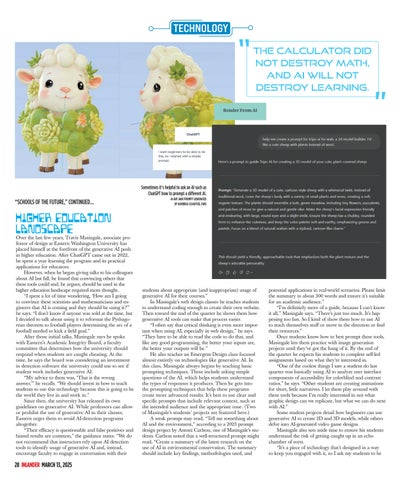
Sometimes it’s helpful to ask an AI such as ChatGPT how to prompt a different AI.
“SCHOOLS OF THE FUTURE,” CONTINUED...
AI ART AND PROMPT GENERATED BY KAMBRIA SCHAFFER, EWU
HIGHER EDUCATION LANDSCAPE
Over the last few years, Travis Masingale, associate professor of design at Eastern Washington University has placed himself at the forefront of the generative AI push in higher education. After ChatGPT came out in 2022, he spent a year learning the program and its practical applications for educators. However, when he began giving talks to his colleagues about AI last fall, he found that convincing others that these tools could and, he argues, should be used in the higher education landscape required more thought. “I spent a lot of time wondering, ‘How am I going to convince these scientists and mathematicians and engineers that AI is coming and they should be using it?’” he says. “I don’t know if anyone was sold at the time, but I decided to talk about using it to reformat the Pythagorean theorem to football players determining the arc of a football needed to kick a field goal.” After those initial talks, Masingale says he spoke with Eastern’s Academic Integrity Board, a faculty committee that determines how the university should respond when students are caught cheating. At the time, he says the board was considering an investment in detection software the university could use to see if student work includes generative AI. “My advice to them was, ‘That is the wrong answer,’” he recalls. “We should invest in how to teach students to use this technology because this is going to be the world they live in and work in.” Since then, the university has released its own guidelines on generative AI. While professors can allow or prohibit the use of generative AI in their classes, Eastern urges them to avoid AI-detection programs altogether. “Their efficacy is questionable and false positives and biased results are common,” the guidance states. “We do not recommend that instructors rely upon AI detection tools to identify usage of generative AI and, instead, encourage faculty to engage in conversation with their
28 INLANDER MARCH 13, 2025
students about appropriate (and inappropriate) usage of generative AI for their courses.” In Masingale’s web design classes he teaches students to understand coding enough to create their own website. Then toward the end of the quarter he shows them how generative AI tools can make that process easier. “I often say that critical thinking is even more important when using AI, especially in web design,” he says. “They have to be able to read the code to do that, and like any good programming, the better your inputs are, the better your outputs will be.” He also teaches an Emergent Design class focused almost entirely on technologies like generative AI. In this class, Masingale always begins by teaching basic prompting techniques. These include asking simple questions of the AI, which helps students understand the types of responses it produces. Then he gets into the prompting techniques that help these programs create more advanced results. It’s best to use clear and specific prompts that include relevant context, such as the intended audience and the appropriate tone. (Two of Masingale’s students’ projects are featured here.) A weak prompt may read, “Tell me something about AI and the environment,” according to a 2023 prompt design project by Antoni Carlson, one of Masingale’s students. Carlson noted that a well-structured prompt might read, “Create a summary of the latest research on the use of AI in environmental conservation. The summary should include key findings, methodologies used, and
potential applications in real-world scenarios. Please limit the summary to about 300 words and ensure it’s suitable for an academic audience.” “I’m definitely more of a guide, because I can’t know it all,” Masingale says. “There’s just too much. It’s happening too fast. So I kind of show them how to use AI to teach themselves stuff or move in the direction or find their resources.” Once students know how to best prompt these tools, Masingale lets them practice with image generation projects until they’ve got the hang of it. By the end of the quarter he expects his students to complete self-led assignments based on what they’re interested in. “One of the coolest things I saw a student do last quarter was basically using AI to analyze user interface components of accessibility for colorblind and contrast ratios,” he says. “Other students are creating animations for short, little narratives. I let them play around with these tools because I’m really interested in not what graphic design can we replicate, but what we can do next with AI.” Some student projects detail how beginners can use generative AI to create 2D and 3D models, while others delve into AI-generated video game designs. Masingale also sets aside time to ensure his students understand the risk of getting caught up in an echo chamber of sorts. “It’s a piece of technology that’s designed in a way to keep you engaged with it, so I ask my students to be