Tackling racial disparities in AP classes
By Karuna Chandran, Madhavi Karthik and Macy LiBlack and Hispanic students are underrepresented in all 17 AP courses offered at HHS, according to data provided by principal Greg Giglio. While Hispanic students make up 20.55% of the student population, only 5.7% of students enrolled in AP science classes are Hispanic— and senior Esmeralda Villalobos Soriano is one of them.

Villalobos said she often feels secluded in her AP biology class due to the lack of diversity.
“Sometimes I feel a bit intimidated because I feel the majority of people are white, and they seem to know what they’re doing,” Villalobos said. “And then, when I feel confused, I’m like, ‘Is it just me?’”
Junior Montse Tapia, who identifies as Hispanic, said she hoped to enroll in AP statistics her senior year, after taking algebra 2 as a sophomore. However, she was advised against choosing this course, because she was not enrolled in math as a junior.
“Yes, they’re encouraging [students] to take AP classes, but they also say ‘it’s really hard,’ and it pushes away people from taking those classes,” Tapia said. “I think the support is really missing there.”
Fellow AVID student, junior Kennya Solorzano said she faced similar obstacles when trying to enroll in AP Statistics, which prevented her from taking the class.
“I’m Hispanic, and when I went to the course selection fair, I felt a little out of place,” Solorzano said. “They asked who was taking which classes, and I was in the lower range, which made me feel a little doubtful. That was another factor that made me feel like I shouldn’t take it.”
Marissa Yáñez, a STEM workforce specialist at Foothill College, said underrepresented and low-income students lack equal access to academic resources and external support.
This resonates with Villalobos, who said it was challenging to enroll in an advanced biology class without prior knowledge or additional support, unlike some of her peers.
“In some units, students [understand the content] really quickly,” Villalobos said. “They’ll say, ‘it’s because my tutor said this,’ and I am completely lost. They have all this support, and then there’s me coming in and learning it from scratch.”


Some teachers and counselors are working to tackle ongoing disparities, while administration is working to identify the root causes of this issue, Giglio said.
For instance, Carrie Nakamura, who has been teaching AP U.S. government for eight years, said the number of Hispanic and Black students in her classes tends to be disproportionately low in comparison to the overarching demographics at HHS.
Along with the other social studies teachers, she has been working to encourage more students to enroll in her class.
“Over the years, we’ve been trying to make a conscious effort to put up less barriers to AP classes in the social studies department,” Nakamura said. “Part of that is [eliminating] pretesting or extra meetings — things that might put people off from joining the class. Junior year teachers try to encourage students they see who have potential to do well in an AP class to consider it as an option.”
In AVID, a class that aims to close opportunity gaps, students discuss this lack of racial diversity and strive to develop healthy academic mindsets, AVID teacher James Aguirre said.
To get their graduation sashes, AVID students are required to take two AP and honors courses. Easing the transition from regular to AP classes, AVID teachers work with students to advance their study skills and time management.
“We do chat in class about being ‘the only Mexican kid’ in an AP class, which is
very often at Homestead,” Aguirre said. “On the one hand, it really matters, because people need to feel like they belong. On the other hand, it doesn’t really matter, because if your goal is to get a B or a C in this class, you do whatever it takes to achieve that goal. That’s also why AVID is called ‘Advancement Via Individual Determination’ — it’s about the individual.”
As an AVID student, junior Alexa Ochoa said she feels supported by the existing resources provided to underrepresented students, and she believes HHS has improved in diversifying enrollment in accelerated classes. As a result, Ochoa said her Hispanic background does not impede her performance in AP biology.
While racial disparities and unequal access to advanced coursework remain ongoing issues, it is essential for schools to actively support underrepresented students and
combat the lack of diversity in classrooms, Yáñez said.
“It’s not an even playing field, so let’s stop pretending that it’s an even playing field [where] you treat everyone the same,” Yáñez said. “If you see students who come from a different background, encourage them to come to your office hours and really show them that you care about their success. We have to start being proactive about seeking out the students that are vulnerable and providing them with extra support.”
In spite of the challenges she faces in her AP biology class, Villalobos said she hopes to inspire other underrepresented students to enroll in AP courses.
“It gives me motivation to keep going,” Villalobos said. “I’m part of that few percent, so I should work harder and show other people it is possible, and hopefully that percent will go up.”

Ethnic studies set to pilot next year
By David Lin and Zeinab RakhshandehrooIncoming freshmen for the 2023-24 school year can sign up to participate in a trial run for the new ethnic studies and health class, principal Greg Giglio said.
The school is adopting the class in compliance with the state of California requirement that all high schools implement an ethnic studies class by 2029. The first semester of the class will cover ethnic studies and the second semester will go into health, Giglio said. Next year will serve as a pilot to test out the structure and curriculum of the course.
The upcoming semester-long course on ethnic studies will concentrate on issues of race and intersectionality, math teacher Rohan Prakash, a member of the ethnic studies advisory committee, said. The course is also expected to examine facets of identity beyond race, including gender and social identity. Additionally,
Prakash said the course will soon become a graduation requirement.
FUHSD social studies curriculum lead Vivianna Torres said in addition to the one semester ethnic studies class, the second semester health class will combine the sex education unit of biology with the drug and alcohol unit of PE. And although ethnic studies is similar to social studies, Torres said it is important to understand the difference.
“Social studies teachers are not supposed to specifically be teaching about intersectionality and systems of power,” Torres said. “They’re supposed to teach historical thought, cause and effect and compare and contrast. Some of that requires that they also teach about people of color in history, but it’s not explicitly part of it.”
Torres said separating history and identity into separate courses will allow identity to take a spotlight in classrooms.
Homestead High School 21370 Homestead Rd, Cupertino, CA 95014 · Volume 60 · Issue 5 · March 10, 2023 e PAGE DESIGN BY JOSS BROWARD AND ANUSHRUTI NAGARAJAN
Seeinside: AI DESTROYS ETHICS pg 6 | SERVING UP SISTERHOOD pg 11 | NEW YORK FASHION WEEK pg 12 hhsepitaph.com @hhsepitaph The Epitaph The Epitaph The Epitaph @epitaphHHS f e
See Ethnic Studies, Page 2 “
Montse Tapia (11) Kennya Solorzano (11) James Aguirre Alexa Ochoa (11)
I think the support is really missing.” I was in the lower range, which made me feel a little doubtful.”
We chat in class about being ‘the only Mexican kid’ in an AP class.”
“ “
“
It’s not a surprise to me that the statistics [of Hispanic students] are that low for STEM classes.”
“
They’ll say, ‘it’s because my tutor said this,’ and I am completely lost.”
Esmeralda Villalobos (12)
Community discusses reasons, ramifications for underrepresentation of minority studentsPhotosbyJossBroward
District to discontinue College Now program
By Anushruti NagarajanThe long-standing districtwide College Now program was discontinued for the 2023-24 school year due to a decline in enrollment rates, FUHSD director of educational options Alison Coy said. Starting in the 1990s, the program has been around for more than 20 years, allowing seniors to take college-level classes off campus in addition to their literature and history courses at HHS.
As the popularity of dual enrollment and middle college increased, the district began to see a decrease in enrollment in the College Now program, Coy said. Last school year, only 17 of the 11,000 senior students in the district enrolled in the College Now program.
Typically, seniors in College Now have already completed their college application or high school requirements, so taking courses at the De Anza College campus helps students get accustomed to college life, principal Greg Giglio said.
“What made it special [in earlier years] was that most students in dual enrollment could only take 11.5 credits, but College Now and middle college students could take up to 21 credits,” Coy said. “But in October 2020, De Anza announced that any student can take over the 11.5 credit limit.”
Due to this announcement, Coy said the benefits and advantages of College Now were diminished.
Now all students, whether they are at comprehensive high school or an alternative program like College Now, all high school students have access to a school counselor and a college and career adviser.
“Students can request their high school guidance counselors, who are [well versed] in this [subject], take fewer classes on campus
Ethnic studies
A LOOK INTO ETHNIC STUDIES
and then [sign up for] whatever De Anza allows under the credit limit,” Coy said. “Really, we got rid of the program because students can do the same thing without the College Now [program].”
However, senior Ritaja Subrahmanya said she is one of the many seniors who has benefitted from the College Now program. Unlike dual enrollment, this program is a form of guided instruction that allows students to take only two high school classes, dedicating the rest of their time to college-level classes.
As a result, being part of the College Now program has helped Subrahmanya narrow down her interests and expand her knowledge of her preferred field of interest.
“I finished [calculus] BC at HHS in sophomore year and there were not a lot of [math] classes I could take after that,” Subrahmanya said. “With [College Now], I have been able to take more calculus courses, but I have also gotten to take finite mathematics, which is more [finance focused]. It is interesting because these math topics are ones I would not really get to learn at HHS.”
Subrahmanya said she enrolled in College Now because she felt the rigor of classes at De Anza would better prepare her for future college courses.

“College Now has been a really good experience for me because I can get an idea of how hard the classes are going to be and what sorts of things the professors are looking for,” Subrahmanya said.
“It [also offers] a lot of independence because your parents don’t see your grades and can’t talk to professors for you — you have to advocate for yourself and ask questions.”
News in a minute
By Erin Loh Local: Cupertino launches online storeThe city of Cupertino launched its online Cupertino Store on Feb. 15. By offering products such as Cupertino-themed reusable water bottles and solar power banks, the store encourages customers to adopt sustainable practices, according to the city of Cupertino.
Cupertino’s store further aligns with the city’s broader environmental goals of reducing greenhouse gasses to net zero by 2040.
In addition to offering environmentally friendly items for purchase, the city is combating its carbon
An overview of key topics and possible lessons in the ethnic studies course.
GENERAL ETHNIC STUDIES
Sample lesson: migration stories and oral history
Students will:
- Explore their personal family stories about migration.
- Learn how their family’s migration history is connected to their local history.
ASIAN AMERICAN AND PACIFIC ISLANDER STUDIES
Sample lesson: Cambodian Americans — deportation breaking families apart
Students will:
AFRICAN AMERICAN STUDIES
Sample lesson: an introduction to African American innovators

Students will:
- Analyze the ways African Americans have made contributions to the United States.
- Share the achievements of African Americans in various fields
NATIVE AMERICAN AND INDIGENOUS STUDIES
CHICANA/O/X AND LATINA/O/X STUDIES
Sample lesson: Salvadoran American migration and collective resistance
Students will:
- Discuss the surge of migration from El Salvador to the U.S. in the 1980s.
- Allow students to research the immigration policies that have regulated immigration from El Salvador since 1965.
INTERETHNIC BRIDGE BUILDING

Sample lesson: introduction to Arab American studies
Sample lesson: Native American mascots
Students will:
- Examine the use of Native American iconography and culture as mascots for U.S. sports teams.
- Learn about Cambodian Americans with felony convictions who face deportation.
- Be exposed to organizations raising awareness of this human rights issue.
- Discuss whether these mascots are negative or prideful, and research to determine whether their use should be continued or banned.
Information from the California State Board of Education
“Having a course where intersectionality and systems of power are the focus makes it a lot easier to build the course from the ground up,” Torres said. “I think it is going to make it far more effective. I believe that students deserve to see themselves reflected in the curriculum. Unfortunately, with the way standards were formed in history, there isn’t always space and time for that.”
Ethnic studies is a course that many students and teachers have been pushing for, Giglio said.
“[The class] will start to address some of the things that we’ve been trying to cover in advisories, such as social justice,” Giglio said. “I think we can all say that health, mental and physical, is an important thing, so educationally, it’s a great option and opportunity for us.”
Though the state has provided a framework for the ethnic studies curriculum, Torres said the content of the class is dependent upon the school community.
“One of the tenets of ethnic studies is that [the class] is responsive to the community in which it is being taught,” Torres said. “Students need to see themselves represented in the curriculum, and that requires different schools to have different curriculum because there are different students at every school site. There are some aspects of the class that are going to be the same across the district, such as essential questions, but
footprint by implementing more electricity-dependent appliances over gas-dependent appliances, reducing waste and planting more trees.
National: Train carrying hazardous materials derails
After a train carrying hazardous chemicals derailed in East Palestine, Ohio on Feb. 3, local residents experienced poor health symptoms and voiced concerns over the safety of their environment, according to USA Today.
As responders battled the ensuing fire, local residents were
Students will:
- Examine biased stereotypes and listen to the authentic voices of Arab Americans.
- Be introduced to the diversity of experiences of Arab Americans.
- Learn the history of Arab immigration to the United States.
InfographicbyDavidLinandZeinabRakhshandehroo
the specific content and materials that will be used to explore those essential questions might vary by site.”
Led by a selected advisory and curriculum-development team, Torres said the district has been planning the ethnic studies portion of the class for two years.
The district established provisions to ensure the class is as inclusive as possible, such as holding public sessions in board meetings to collect community feedback.
“There are groups at FUHSD schools for Spanish-speaking parents, Korean parents and Filipino students and their parents,” Torres said. “We intend to use these networks that already exist across all five sites, as well as looking at target populations that we know don’t always feel included in the curriculum, such as students in the ELD population and students with IEPs.”
In addition to consulting these groups, Torres said schools will interview students from different populations and create a reflection document for teachers to critique their own and other teachers’ curricula.
FUHSD Board of Trustees president Rosa Kim said she feels the ethnic studies class is a beneficial addition to FUHSD schools. By teaching about the diverse groups in the area, Kim said the class will encourage understanding and trust within school communities.
“We have a diverse student
ordered to evacuate. Since the spill, residents have reported headaches, sore throats and eye irritation, all which can be attributed to the volatile organic compounds released.
The spill has also taken a toll on the environment, with about 3,500 fish ranging across 12 species dying in local streams due to water contamination. To prevent further contamination, the Ohio Environmental Protection Agency has removed nearly 500 cubic feet of polluted soil.
Thus far, the spill has not been reported to affect land animals.
population, and learning about and understanding different backgrounds is essential,” Kim said. “It makes students with that background have more confidence in themselves, and it encourages students to respect each other, which is critical to create a more inclusive environment on our school campuses. Ethnic studies is helpful for our minority communities to make their voices heard.”
When students take ethnic studies freshman year, Kim said they start their education in ethnic studies, which marks the initial step toward promoting inclusivity and expanding knowledge of diversity within their community.
However, Kim said ethnic studies is too complex of a topic for students to learn in just one semester.
Kim said she hopes that students will build upon what they learn in the ninth grade ethnic studies classroom and broaden their understanding.
Ultimately, this course serves as the groundwork for students to develop a more comprehensive perspective throughout their high school careers.
“This class is the beginning of the journey to learn more about diversity in our community,” Kim said. “So I hope our students can expand their learning experience based on what they learn from the ethnic studies class. This is the foundation for our students to have a more inclusive point of view.”
International: Earthquake strikes Turkey and Syria
Over 50,000 people have been confirmed dead after 7.8 and 7.5 magnitude earthquakes struck Turkey and Syria on Feb. 6. In what CNBC describes as Turkey’s worst modern disaster, 264,000 apartments have collapsed.
Over 100 countries have aided rescue efforts, sending more than 9,200 personnel, according to CNN. As the country shifts from finding victims to aiding survivors, WHO has emphasized providing mental health services for traumatized members of the population.
March 10, 2023 The Epitaph PAGE DESIGN BY HOPE SAENA AND GABRIELA SALAZAR 2 News
SeniorRitajaSubrahmanyapreparesforadulthoodbybalancinghigh schoolandcollege-levelclasses.(PhotobyAnushrutiNagarajan)
Continuedfrompage1
Teachers, students discuss increase in D’s, F’s in Algebra 2
By Lia Klebanov and Erin LohData shows that after the 2020-2021 school year, the percentage of Algebra 2 students receiving D’s or F’s in first semester doubled. Algebra 2 teachers, students and local experts said reasons for the difference in proficiency may include impacts of the pandemic and class structure.
During the 2019-20 and 2020-21 school years, the percentage of students receiving D’s and F’s in first semester hovered around 7.7%. Since the 2021-22 school year, this number has jumped to around 19.2%.
In an email from the Algebra 2 team, math teacher Andrea Westgate said a majority of current Algebra 2 students took Algebra 1 remotely, and as a result, have had more trouble recalling Algebra 1 skills. Another reason for the increase in D’s and F’s could be attributed to grade adjustments made during the pandemic, in which D-earning Algebra 1 students received a ‘pass,’ allowing them to move forward instead of retaking the class.
Junior Sangeeta Vaidya said she learned a lot while taking Algebra 1 remotely, but after a year of geometry, she would have benefitted from a more thorough review of Algebra 1 at the beginning of the year. Throughout the year, Vaidya has said she has taken more charge of her own learning, such as establishing her own method of note-taking.
“I honestly don’t know why I’m struggling. I think it’s also just the different teaching methods [from previous math classes],” Vaidya said. “We’re all lost. You just see ev-
eryone staring at their paper, and they don’t know what they’re doing.”
Algebra 2 student, junior Swikriti Adhikari said she has always felt confident in her math abilities before this year. For Adhikari, the frequent quizzes following each lesson are one of the hardest aspects of the class, especially since she does not feel there is enough time to understand the content.

“The structure of the class is the main thing that’s causing everybody problems,” Adhikari said. “My teacher has their own agenda that they have to go through. When you’re starting a new unit that builds up from the previous chapter, you get stuck, because you don’t understand the last one.”
Westgate said quizzes are used as a quick method of assessment to judge students’ level of mastery. Based on results, teachers may decide to reteach topics. Additionally, students who do not do well on quizzes have the opportunity to retake them in class.
Westgate also said half of D- or F-earning students received a failing grade in one or more other courses in first semester, showing that the challenges students are facing are not isolated to Algebra 2.
Data starting in 2019 shows that 75% to 85% of the D’s and F’s in Algebra 2 have belonged to upperclassmen, and this trend has not changed over the pandemic. Principal Greg Giglio said Algebra 2’s jump in difficulty often creates adjustment challenges for upperclassmen. Such trends also appear in courses with similar rigor increases, such as language classes.
Speaking on national trends, Foothill College child development and education department chair Nicole Kerbey said students have fallen four months on average behind in math during the pandemic, compared to only 1-2 months behind in English and history. This is due to advanced math courses building upon previous skills.
Additional factors contributing to this trend, Kerbey said, are the fact that mathematics was not as well supported by virtual teaching platforms as other subjects were. Additionally, many parents feel less comfortable helping their children with math than with humanities.
Westgate said the Algebra 2 team supports students through opportunities to make up quizzes and homework, and with the scheduling of one-on-one appointments outside of class.
Adhikari said she feels her teacher can further support her by providing answer keys after she receives her tests back, further direction on test preparation, as well as walking students through the steps to understanding commonly-missed problems.
Westgate said the Algebra 2 team has met during the summer and throughout the year to discuss student performance, create feasible solutions for struggling stu-
dents and form plans with the Precalculus team to streamline class transitions.
Echoing Giglio’s statement, Vaidya said that ultimately, the jump from lower level math classes to upper level classes like Algebra 2 can feel challenging because of the increased levels of independence they require of students.
“Maybe it’s because you’re growing up and you’re a junior, and you have to hold yourself accountable,” Vaidya said. “In some classes, you have student tutors, and then paraeducators. But in our class, we have just one teacher.”
Recent club adviser shortage affects student body, teachers
By Saira AhmedWith over 90 ASB-approved clubs, students hoping to start new clubs are having trouble finding advisers, as many staff members advise other clubs already, or do not have the time to advise a club, ASB club commissioner, junior Elisa Floyd said.
This adviser shortage is a result of an increased number of clubs on campus, Floyd said. ASB has become more flexible with approving new clubs, she said, with the application process being open year-round. In the past, ASB allotted a certain period of time in which clubs had to apply.
“When students think of an idea, they’re welcome to apply,” Floyd said. “We also try to accept as many clubs as we can because we believe there should be space for all students to explore their interests on campus.”
Every club is required to have at least one adviser, so with more clubs, there is a higher demand for advisers, ASB club commissioner, junior Alex Zhang said. Zhang said there are a limited number of teachers willing to advise a club, further contributing to the adviser shortage.
As a Tri-M club adviser, music department lead John Burn said he ensures the club is receiving the information they need from ASB and presides over meetings and official activities. He said he enjoys seeing
what the club officers and members do within the club, but acknowledges that being an adviser can be a large time commitment.
“Teachers are busy people, and they have lives outside of school,” Burn said. “I respect teachers’ decision to be an adviser. [There is also a] perk that you get from it. All teachers are supposed to sign up for four extra duty events, like being chaperones, but if you’re a club adviser, you only have to do two.”
Burn said he can understand the club adviser shortage issue, as at least once every year he gets asked by students to be an adviser for a new or existing club and has to say no.
Model U.N. outreach officer Kyle Krisdakumtorn said the club had two advisers last year, but one of them left HHS. This year, the remaining adviser was unable to attend all their conferences. The club has been unsuccessful in finding another adviser so far, Krisdakumtorn said.
“It’s definitely difficult because we want to find an adviser, but it’s a never-ending search,” Krisdakumtorn, a junior, said. “We keep asking people, and they keep saying no. We’re hoping to find a new teacher next year because those teachers will not have that many clubs already on their hands.”
Krisdakumtorn said advisers aid the club in a variety of ways, such as providing a room to meet in and attending conferences.

“Somebody needs to be there [to supervise],” Krisdakumtorn said. “We want to have trainings in order to train the delegates on how to succeed in these conferences.”

One way ASB is combating the adviser shortage is by reducing the number of clubs through club merging. Chemistry and chemistry olympiad both applied to be clubs this year, and were merged together due to their common interest, Zhang said. However, the club commissioners have not implemented merging with existing clubs yet, Zhang said.
Floyd said they are open to all sugges-
tions to solve the club adviser shortage, and implemented a feedback form to collect feedback from existing clubs.
“We are currently in the process of getting input because a lot of different clubs have different cases,” Floyd said. “It is important to hear those specific situations and figure out what the solutions are that will suit everyone.”
News 3 The Epitaph March 10, 2023 PAGE DESIGN BY BRIAN LING AND FAITH WATTERS
Tri-MadviserJohnBurnhelpshostaQ&Aforclubmemberswithmusiciansfromthe PeninsulaSymphony.(PhotobyManyaGirivasan)
JuniorSangeetaVaidyaworksonmathhomeworktoprepareforhertest.(PhotobyErinLoh)
Teachers say advising clubs can be time consuming
The Epitaph
Editors-in-Chief
Madhavi Karthik
Macy Li
Managing Editor
Karuna Chandran
Production Manager
Hope Saena
Senior News Editor
Erin Loh
Junior News Editor
Nicole Kim
Senior Opinion Editors
Keshav Kumar
Anushruti Nagarajan
Lindsey Steel
Senior Lifestyles Editor
Lia Klebanov
Junior Lifestyles Editors
Saira Ahmed
Brevin Reed
Senior A&C Editor
Amber Birrell
Junior A&C Editor
Rajiv Venkatesh
Senior Sports Editor
Niyatee Jain
Junior Sports Editor
Harshitha Vijayakumar
Senior Design Editors
Seoyoung Hwang
Christine Kim
Junior Design Editor
Mackie Vu
Senior Multimedia Editor
Zeinab Rakhshandehroo
Junior Multimedia Editor
Veronica Zhao
Senior Social Media Editor
Saira Ahmed
Junior Social Media Editor
Annabelle Yip
Photo/Illustration Editor
Joss Broward
Web Manager
Seoyoung Hwang
Copy Editors
Joss Broward
Rajiv Venkatesh
Reporters
Ella Chan
Parth Dhaulakhandi
Manya Girivasan
Nathan Gu
Patrick Hao
Nicole Pimenta Innecco
David Lin
Brian Ling
Anderson Picone
Gabriela Salazar
Helen Tam
Evelyn Wang
Faith Watters
Emma Yu
Adviser
Natalie Owsley
Mission Statement
The Epitaph is a non-profit publication at Homestead High School, 21370 Homestead Rd., Cupertino, CA 95014. The Epitaph is a forum for student expression and not subject to prior review, in accordance to Education Code 48907. The staff is comprised of HHS Journalism students. Views expressed do not necessarily represent views of the school, its staff or the district. Editorials are opinions of the editorial board. The Epitaph welcomes letters to the editor but reserves the right to edit submissions. Letters should be limited to 300 words. Include contact information.
Unsigned letters cannot be published, but names will be withheld upon request. Send via homestead.epitaph@ gmail.com, or drop letters in the newsroom or the office mailbox.
If The Epitaph has made an error, please send corrections to homestead.epitaph@gmail.com. The corrections will be published in the corrections box for the next issue.
To reach the Epitaph staff in C102, call (408) 5222572 or fax (408) 738-8531.

Advertising
One email and you can reach over 2,400 students, teachers, administrators and community members from Northern Sunnyvale to Southern Los Altos. If your target market is between the ages 14 to 18, contact The Epitaph at epitaph.ads@gmail.com, and we can make it happen.
The rampant inequities in our society are often perpetuated by our education system. Education has the power to shape our futures, which is why all students deserve the same opportunities to succeed. At HHS, racial disparities in advanced classes are a barrier to success for students of color.
Black and Hispanic stu dents are underrepresented in AP and honors courses. Only 66 of the 476 Hispanic stu dents at HHS are taking an AP class, which is 13% of all Hispanic students at HHS. For Black students, only 12% are in AP classes. On the other hand, 36% of white students and 54% of Asian students at HHS are enrolled in these advanced courses, according to data from Unified Insights, FUHSD’s stu dent data analytics platform.
Access to advanced course work helps students gain ad mission to selective universities and employment in high-pay ing professions. Colleges con sider the rigor of an applicant’s coursework, and students tak ing advanced classes are often more likely to gain admission, according to the Center for American Progress.
In addition, greater diversity in advanced humanities classes is essential, because it exposes
Staff Editorial
Racial disparities in advanced classes must be addressed grade, they are pressured to focus on their test grades, instead of learning new concepts. Shifting the emphasis of these classes from testing to activities and projects will allow for more comprehensive learning, while also making them less intimidating to students.
students to a wide range of perspectives. Discussions are the cornerstone of courses like AP Literature and AP US History. However, when these advanced classes are socially, ethnically and socioeconomically homogeneous, a very narrow range of viewpoints is circulated. To ensure diverse perspectives are
Another reason why stu
pairs juniors and seniors in advanced courses with underclassmen. Mentors can share their experiences, offer advice to younger students and prepare them for the rigor of the course. If students want to take a class, but are afraid of the heavy workload or tough grading, their mentor can help them develop the habits they need to succeed.
While FUHSD is an open enrollment district, HHS currently requires signed recommendations and waivers to take AP classes, which can hinder students from enrolling in these courses. Instead, HHS must allow students to make decisions about their own class enrollment and education, without having to sign a waiver.
Administration must provide underrepresented and socioeconomically disadvantaged students with equal access to educational opportunities and address disparities in advanced courses. By pushing for these changes, we can set all students on a path to success, regardless of their backgrounds.
in AP Physics C, and these percentages are unnecessarily high. When exams are worth the vast majority of a student’s

America’s next target
By Erin LohDuring his State of the Union address, President Joe Biden called for the ban of all assault weapons when referencing the Monterey Park shooting on Jan. 21 that killed 11 people. This critical step would advance the nation’s battle against gun violence.
‘Assault weapons’ has a vague meaning in the United States. They include both automatic and some semi-automatic firearms, according to ABC. Due to their large bullet size and ability to fire quickly, assault weapons are too dangerous to be distributed to the general public.
Some of the deadliest mass shootings, including the Uvalde shooting in May 2022, involved assault weapons, according to ABC. No weapon with the capability of killing 19 children in the span of minutes should fall into the hands of civilians.
However, it is important to note that a ban on assault weapons is not a ‘new and novel’ idea, as a similar ban was passed in 1994. Studies on the 1994 ban, which terminated in 2004, do not demonstrate a definitive decrease in gun fatalities during that time period, which many gun rights lobbyists reference to argue that a new ban would be comparably ineffective.
Rather than neglecting action on a new ban, the United States should reinstate the
Warning: graphic content ahead
By Emma Yuact and implement a new bill that closes previous loopholes.
The 1994 ban assigned a concrete definition to ‘assault weapons’ by identifying specific models and features that would be banned. Consequently, gun manufacturers only had to make minor tweaks to banned models to produce equally destructive yet legal weapons. By expanding the types of prohibited guns to all semi-automatic weapons, a ban on assault weapons would be more effective.
One country the United States should look up to is Australia, who initiated its National Firearms Agreement in 1996 after a mass shooting claimed 35 lives. The policy’s buyback program imposed a mandate requiring firearms deemed illegal to be collected by the government in return for monetary compensation. Since then, there have been three mass shootings in Australia, compared to 13 mass shootings in the 18 years prior to the ban.
While a mandatory buyback program would be nearly impossible to implement in the United States, even a voluntary one may save hundreds of lives.
By citing past legislation as an excuse to not pass better laws, the government fails to uphold its duty to protect its people. The government must confront the gun crisis and expand the reach of an assault weapon ban.
An image I will never forget depicts a brutal lynching from the Jim Crow era. I still recall the chill running through me, the blood rushing to my face and the feeling of terror. I saw this photo not in a museum or documentary, but in my American studies class, displayed on the projector to a room of students.
Itisimportanttoremainmindfulofeachstudent’sboundarieswithgraphiccontent.(IllustrationbyEmmaYu)
Seeing this image deeply disturbed me, but more importantly, instilled in me a deeper understanding of the Jim Crow era’s evils. The memory has stuck with me ever since, and it has raised larger questions for me about the place of violent images in the classroom. Does showing violent and disturbing images truly aid in the learning process?

Showing accurate depictions of history is undoubtedly important. Human history is gruesome and horrifying, and downplaying the truth would be doing both our past and future generations a great disservice. And, from a pedagogical perspective, images and video can easily reach students in a more powerful way than textbook readings. Processing these images, while difficult, can be a formative part of a student’s educational and emotional development.
However, not every student responds to graphic images the same way. What is mildly disturbing to one student can be potentially traumatizing to another — each person has a limit to the gore they can tolerate.
Moreover, students who have suffered from and survived trauma enter classrooms every single
day. For these students, seeing disturbing images of their personal or generational trauma can be deeply overwhelming, according to City University of New York history professor Angus Johnston. As a result, it can be harmful to force these students to view potentially triggering images.
Moreover, there is a point when repeatedly seeing gruesome images desensitizes students to their weight, instead becoming an act of voyeurism. Teaching these materials without sensationalizing them is equally important.
Teachers have a responsibility to ensure students’ well-beings in the classroom, as students cannot learn in an environment where they are actively distressed. At the same time, teachers have a responsibility to teach history accurately.
Therefore, the context, meanings and implications of these images must be thoroughly discussed beforehand. Additionally, teachers should allow students who do not wish to view graphic content to step out of the classroom and engage in alternate lesson plans.
That being said, there is no definitively correct way to teach history. But if we can learn anything from our past, it is that our history, especially its ugly parts, must be confronted, not glossed over.
4 Opinion The Epitaph March 10, 2023 PAGE DESIGN BY NICOLE PIMENTA INNECCO
Volume 60 · Issue 5 March 10, 2023
Banningassault weaponswillcombatgunviolence in the United States and save lives. (IllustrationbyErinLoh)
Asian (64.48%)
White (19.5%)
Hispanic(5.7%)
Multiple(7.68%)
Racialdemographics in AP classes
Other(2.64%)
Stop whitewashing education
Debunking debates over AP African American studies
By Macy LiHistory is under attack, and it is time to take a stand. As Republican leaders attempt to erase Black history, we must counter their efforts to whitewash education and protect the voices of marginalized communities.
This year, College Board unveiled the official framework for its new AP African American studies course, which offers an evidence-based introduction to Black history and culture. In this course, students explore a vast array of topics, ranging from the origins of the African diaspora to the civil rights movement.
When designing this course, College Board collaborated with over 300 professors from U.S. universities, in hopes of replicating an introductory college curriculum. After a decade of development, it is now being piloted in 60 high schools nationwide, according to The Washington Post.
Fueling a centuries-long effort to obscure history, Republican leaders immediately scrambled to suppress this curriculum. Florida
Gov. Ron DeSantis outrightly rejected the new course and refused to incorporate it into his state’s directory, claiming it was “inexplicably contrary to Florida law” and “significantly lacked educational value,” according to The New York Times.
DeSantis’ actions cast light on a dangerous trend: the rewriting of history and the suppression of marginalized voices, perpetrated by Republican leaders. Their fierce opposition to the new AP African American studies course stems from their ingrained prejudices and political motives. Ultimately, they seek to silence perspectives that contradict with their own conservative rhetoric.
When teaching students about history, accuracy is vital. A curriculum that excludes the experiences of marginalized individuals, such as Black Americans, is simply inaccurate.
It portrays incomplete, decep -

tive narratives and prevents students from engaging with diverse perspectives.
Although DeSantis asserts that the AP African American studies course is devoid of educational value, the exact opposite is true. History is intertwined with modern-day society, so by studying our past, we can learn to navigate the present and build a better future.
Black American history is an integral part of our past, and exploring this subject allows us to understand the systemic racism that lingers in society today. It teaches us about the stories of people from all walks of life — not just the filtered versions of history that conservatives want us to recognize.
When criticizing the AP African American studies curriculum, DeSantis attacked topics including Black queer studies and the Black Lives Matter movement. Since then, College Board has revised the framework of the course, removing a series of “controversial” topics and diluting the curriculum, according to Vox. These revisions undermine College Board’s goal of launching a course that truly captures the breadth of Black American history, especially as challenges to the discussion of race and identity in classrooms proliferate.
White men in positions of privilege must stop erasing the voices of marginalized communities and dictating what stories deserve to be heard. It is simply abhorrent to see conservative leaders undermine the significance of Black history and brush these narratives under the rug.
In spite of DeSantis’ bigotry, the AP African American studies course will be expanded next fall, reaching hundreds of high schools nationwide. It will be available to all schools in 2024, and the first AP exams will commence in spring 2025, according to The Washington Post.
The expansion of this course is a step in the right direction and advances our fight for greater diversity in education, even with College Board’s revisions to the curriculum.
Yet, with Black history still under fire, we must continue to condemn the actions of Republican leaders and fight for change.
Police reform will save lives
By Keshav KumarTyre Nichols was stopped by police for alleged reckless driving. Five officers held him down, gave him contradictory orders and beat him as he called for his mother. Three days later, Nichols died from his injuries, according to The New York Times.
This tragedy is a harrowing reminder that our police system perpetuates institutional racism, disproportionately targeting and killing Black Americans. Departments must rein in their officers, as well as build greater trust between police officers and the communities they serve. These steps will prevent the wrongful death and suffering caused by police brutality.
Nichols’ murder proves that past reforms have been woefully inadequate. For instance, police departments believed increased diversity among officers would reduce police brutality. However, all five officers involved in Nichols’ killing were Black, according to the Christian Science Monitor. Simply changing the individuals within a flawed system is not enough. The system itself must be changed.
One way we can create this change is by disbanding specialized police units.
The officers who murdered Nichols
were members of the Scorpion Unit, which used unmarked cars and plainclothes policemen to stop violent crimes in Memphis. This group was known for employing violence against people suspected of minor infractions, which created fear within low-income communities, according to The New York Times.
Organizations like the Scorpion Unit are incompatible with healthy community-police relations. When police officers unnecessarily escalate violent situations, people will not trust them, which only makes their job more difficult. Ultimately, keeping order through fear does not solve crime or police brutality.

Instead, police departments must gain the trust of those they are charged with protecting. In 2018, Pittsburgh’s police department created a Group Violence Intervention Unit, which uses community volunteers who observe street life to identify those at risk of committing violent crimes. This allows police officers to reach out
the unit’s operation, the city’s gun crimes fell by 25%, according to Rand.
Employing groups like this on a greater scale will save lives. When communities feel comfortable discussing their problems with the police, officers are better equipped to keep people safe. This not only reduces crime, but also eliminates the need for police to use violence, which will prevent police brutality.
We can start on the path to reform by focusing on our own communities. We must ensure law enforcement respects our rights and consults us when crafting policies related to our public safety.
Furthermore, we must apply constant pressure to our leaders until these changes materialize. After a publicized incident of police brutality, there is always an outcry, but the drive for reform fades before a real impact is made. We cannot let this happen again, and we cannot turn our attention away until action is taken. That is the best way to honor Tyre Nichols’
Tocombattheharrowingimpactsofpolicebrutality,weneedtoapplypressuretoour legislatorsuntilreformsareimplemented.(IllustrationbyFaithWatters)
Empowering youth to stand up, speak out
Dismantling the bystander effect, one step at a time
By Anushruti NagarajanCOLUMN — I often find myself taking on the role of an observer. I am not the one entangled in the conflict, nor the one doing anything to resolve it. Rather, I find myself simply staying quiet while events unfold. But over the years, I have realized that being a bystander is almost as harmful as being the instigator.


The bystander ef fect occurs when individuals be lieve the re sponsibility to act is shared among all of those present, ac cording to Psychology To day. However, if everyone assumes someone else will act, no one actually will.

Whether you are in a small group or on the world stage, it is important to channel your courage, speak out and stand up for what you believe in.
An example of a courageous person who defied the bystander effect is Malala Yousafzai, a Paki stani education activist who won
the Nobel Peace Prize. Growing up, Yousafzai realized that women in her country were being denied the opportunity to pursue an education. Instead of remaining silent, she chose to act and challenge the status quo. At the age of 15, Yousafzai was nearly assassinated by the Taliban. Even after being shot in the head, she refused to stop fighting.
Although we may not all face problems of this magnitude or experience such danger, we all have a responsibility to stand up for what is right.
In seventh grade, I found myself in a position where I had to choose
between maintaining a friendship and doing what was right. A close friend of mine was struggling with her mental health, and as I was debating whether to keep my friend’s trust or speak up, I realized that by staying quiet, I was saving myself from discomfort at the expense of my friend’s safety. Eventually, I chose to seek help for her, discovering that it was better to protect the safety of my friend.
Although it is difficult to speak out — especially when the matter involves your loved ones — it is always better to do what is right. Actions speak louder than words, and rather than sitting on the sidelines, it is important to stand up
Opinion 5 The Epitaph March 10, 2023
PAGE DESIGN BY NIYATEE JAIN AND HARSHITHA VIJAYAKUMAR
Tyre Nichols’ murder exposes need for systemic changes
Thewhitewashingofeducationexcludesmarginalizedcommunities fromhistory.(IllustrationbyMacyLi)
Right-wing hypocrisy threatens true accountability
Removal of Rep. Ilhan Omar exposes bigotry of Republican party
By Lindsey SteelBigotry is no stranger to the Congress floor. From hurling homophobic slurs to supporting white supremacists, numerous Republican representatives have been guilty of appalling conduct in recent years.
While prejudice is present in both political parties, the removal of Rep. Ilhan Omar reveals the blatant hypocrisy of the GOP, demonstrating that in the face of bigotry, they will turn a blind eye unless their own political agenda is threatened.
Rep. Ilhan Omar of Minnesota was removed from the powerful House Foreign Affairs committee on Feb. 2, according to NPR. Calls for her removal came from House Republicans after she had made antisemitic and anti-American remarks, according to The Washington Post.
The resolution to reject Omar cited her 2019 tweet, which stated the U.S.’s relationship with Israel was “all about the Benjamins,” according to Forbes. Although Omar’s use of antisemitic tropes must be condemned, the removal of Omar was an act of
political revenge. To strip Omar of her committee positions on the grounds of bigotry, while simultaneously elevating Republicans with a history of antisemitism, exposes the true intentions of the Republican party.
Despite ousting Omar from the Foreign Affairs committee because of her past comments, the GOP has recently rewarded Rep. Marjorie Taylor Greene and Rep. Paul Gosar with highly prestigious committee assignments. Both Greene and Gosar are notorious for spewing crazed right-wing rhetoric and conspiracy theories, yet their hateful remarks have been overlooked by Republicans.
Greene, for instance, has an extensive history of making antisemitic comments. Greene has previously blamed wildfires in California on “Jewish space lasers,” and claimed these “state-of-the-art Jewish lasers” were being used to “shoot down Santa,” according to The New Yorker. In addition, Greene has repeatedly equated COVID-19 safety measures to the treatment of Jews during the Holocaust, according to NPR.
Similar to Greene, Gosar has a past of engaging with antisemitic figures, including those who have expressed admiration for Nazi Germany, according to CNN. But instead of being reprimanded for their actions, Greene and Gosar now sit on some
RepublicanstargetedOmarforherpastremarkswhilestillpromotingantisemiticpoliticiansintheirownparty.(IllustrationbyFaithWatters)
of the most influential committees in Congress, including the House Homeland Security committee and the Oversight and Accountability committee, according to NBC.
By choosing to overlook the abundance of offensive comments made by members
Inevitable takeover of AI destroys ethics
By Lia KlebanovAs technological growth continues to revolutionize the world as we know it, there is one digital innovation leading the charge: ChatGPT.
Launched in November 2022 by Open AI, the free tool has garnered over 1 million users in the span of four months, according to Entrepreneur. With this latest development in technology, everything we ever knew about the possibilities of AI is inevitably being upended, sounding an alarm for concern.
As students, we are constantly looking for ways to complete our everyday tasks more efficiently — which may mean looking into shortcuts. After a long day of school, staying up to conduct research and write an essay is the last thing anyone wants to do. Now, all students have to do is input a directory sentence such as “write an essay about the impacts of the Amer-
ican Revolution” into the online AI — a quick and easy way to finish a daunting task. But, where should the line be drawn?

The diverse variety of functions ChatGPT offers is incredible and truly shows our global progress. Writing, concise database searches and coding assistance are only some of the tools available at any user’s fingertips. This helpful online chatbot generates information in either a bullet point list or paragraph form, saving us hours of research. For the longest time, it all seemed too good to be true, until I began noticing severe flaws in some of the chatbot’s abilities.
Complex tasks, such as writing, utilize a large online database to develop anything from poems to short stories. I found that using the tool was beneficial when generating ideas and writing samples, but not advanced enough to completely overtake human capabilities. Furthermore, since it relies upon online information, the possi-


bility of misinformation is a risk too dangerous to take.
ChatGPT lacks the complexity of human intellect, since it merely strings sentences together in a robotlike manner. The large amounts of fluff infused in the writing is easily spotted, making it difficult to wholeheartedly trust ChatGPT.
The new technology presents unprecedented dilemmas regarding plagiarism, which leaves many teachers to quickly adapt to combat student usage. Student dependency on online chatbots is concerning, since it promotes unethical behavior and deprives many of the opportunity to improve crucial skills.
Seeing as schools play an important role in shaping values, young adults must be reprimanded for abusing “helpful” tools. We must teach tomorrow’s independent thinkers to remain moral, leading to a generation of more ethical citizens.
Establishing good learning habits is es-
Writing for publication: a transformative class
Writing for publication prepares students for journalism, yearbook
By Seoyoung HwangIn my freshman year, I took writing for publication, an intro-level writing class for freshmen or sophomores interested in joining journalism or yearbook. Writing for publication was available at HHS for only two years, and it was terminated in 2020.
Many of my peers said they enrolled in the class because they thought it was a mandatory prerequisite for journalism. However, we soon realized this was not true, since students could join journalism without taking writing for publication.
Journalism is a fast-paced environment where new students are
required to develop skills in a limited period of time, before working with the rest of our staff to produce issues. Throughout the year, we dedicate a significant amount of time to workshops and presentations to help new students strengthen their skills.
However, most of the material we cover should have been taught in the writing for
publication course. The content also gets repetitive over the years to the returning staff members. Instead, the time could be used for something more productive for the paper. The class time in journalism should be used to collaborate with the other reporters and editors to produce high-quality content for the publication, rather than listening to
Ultimately, requiring students to take writing for publication would help them develop the skills required for journalism prior to taking the class, which would allow journalism students to use their class time more efficiently.
Writing for publication played a big role in helping me decide whether journalism or yearbook was the right class for me, without actually having to take the class and make the commitment. Initially, I joined the class without knowing it was a preparatory course for journalism or yearbook, but solely to improve my writing skills. Through the class, however, I learned the beauty of journalism and expressing my voice through writing. If I did not take writing for publica-
of their own party, Republicans have proven their disregard for bigotry. If we want to promote accountability, hate must be condemned at all levels, whether it is within our own communities or on the steps of the Capitol.
sential, since ChatGPT will not be able to save anyone during a timed, in-class essay.
However, banning AI chatbots entirely in schools is simply not feasible, since it will only further encourage academic dishonesty. Instead, the core issues must be tackled. Efforts to ensure integrity are already underway, with Turnitin currently in a testing stage for a new AI-detecting function, according to The Tab.
Such advancements give me hope that genuine work will continue to be preserved and valued in our fast-paced world.
The rise of ChatGPT is only the beginning of the technological revolution ahead of us. While such tools may seem enticing, we must remain ethical while using them.
Cheating is ultimately a disservice to the ones committing the offense, and it deprives us of the opportunity to succeed the right way.
Keep in mind that while AI is here to stay, it does not extend beyond the screen.
tion, I would not have joined journalism and found my passion for writing and designing — a passion I will now carry into college. This was not the case for everyone, however. A couple of my friends decided not to enroll in either of the courses due to the time commitment and workload.
In the past few years, I have seen many people join journalism without knowing how much work is required to produce a cohesive paper, which causes some students to end up dropping the class.
If we were to bring back writing for publication, students would gain insight into journalism and yearbook, as well as what these student-run classes entail without the need to fully commit themselves to the heavy workload and collaboration involved.
Writing for publication is no longer offered at HHS due to a lack of enrollment. However, if we implement it as a prerequisite for journalism or yearbook classes, the class would gain enough students, especially since there has been a significant increase in enrollment in these two classes in recent years.
Ultimately, writing for publication was the perfect course for students to prepare themselves for journalism and yearbook, mentally, emotionally and academically. This class must be brought back for the greater quality and efficiency of our school publications.
The Epitaph 6 Opinion March 10, 2023
PAGE DESIGN BY EVELYN WANG
Writingforpublicationequipsstudents with valuable skills and provides them withinsightintofuturecourses.(Photo illustrationbySeoyoungHwang)
Dreaming of sunshine
By Lia KlebanovCOLUMN — On a fateful October day, the dreaded time has arrived — having to wear jeans to school.
Even though this may be what others have been waiting for all summer long, it pains me to see the leaves fall o their branches, reminding me of a once-lively community eating ice cream all day.
Now, the countdown begins until I can bask in the warm sunlight once again.
When I was younger, I could not exactly place my fi nger on why getting through fall and win-
ter days was di cult. It seemed deeper than a simple dislike for cold weather since I would often feel sluggish by lunchtime.
After a deep dive on Google, I discovered winter-pattern seasonal a ective disorder, which is a change in mood and behavior during the shift from spring and summer to fall and winter, according to the National Institute of Mental Health.
Spending my summer days lounging in the sun provided me with a certain boost of power that radiated throughout my body and was di cult to explain, until now. We produce
Vitamin D from sunlight exposure, combating the vitamin deficiency that causes fatigue and other various health conditions, according to Live Science.
After spending a full day out in the sun last summer, I suddenly “awoke” and completed my assigned tasks for an internship in the span of an hour, which would have normally taken much longer.
I was truly amazed by the improvement in my performance, and vowed to continue soaking in all the Vitamin D I could get. However, this became more dicult as the days shifted to a significantly shorter length and I often long for the boost of seratonin.
Additionally, the beginning of warmer weather signifies the end

of the school year, which is always a gratifying occasion.
The feeling of accomplishment after having completed a year fi lled with tests, AP exams, homework and presentations is di cult to compete with the tiring never ending December fi nals.
There is no single cure that works for all when it comes to seasonal depression, and I have tried a million di erent strategies to bring up my mood when feeling glum. Whether it be anticipating warm weather by watching an episode of “Outer Banks” and living vicariously through the characters’ summer adventures, or relishing in the winter tradition of drinking a rich hot chocolate with floating marshmallows, I aim to
Journey to in nity
Winter percussion works on this season’s abstract show concept
By Manya Girivasan and Veronica ZhaoPercussionists assemble in geometric patterns and shapes in the gym, morphing from one to another on their “Journey To Infinity,” this year’s winter percussion show theme.

fi nd the positives at all times of the year.
Seasonal changes can mean a new beginning where we have the opportunity to create new habits. During the summer, for example, it is easy to fall out of daily routines such as taking care of our skin, but the dryness of cold temperatures creates the need to lather on essential moisturizer. Using winter to curate new skincare practices has helped me in feeling more composed and at ease during a time of academic chaos while also improving my mental state.
The mind and body connection is truly powerful, and a change in attitude can be the greatest medicine of all.
LAW
“I’ve learned that law isn’t something really niche, and I can use it every day. It’s useful to know because I’m now more careful about what I choose to do, and I can [make sure I’m safe].”
STAGECRAFT
“I’ve learned that it’s okay to ask for help if you need it. The class feels welcoming and open, so it doesn’t feel scary to talk to others. If I want help with painting the sets or need something like a screwdriver or a drill, I can just ask anyone and they will help me.”
“[The show] borrows from the artwork of MC Escher. A lot of his artwork includes repeating patterns that slowly morph from one thing to another,” drumline co-caption head Kyle Wong said. “The abstract concept is carried throughout the show with a constant arc of repeating patterns.”
Cymbal section member, junior Hannah Fenton said the show further depicts this vision by focusing on the start and end of the performance and the way they connect with each other.
“[The beginning] goes from a very simple design where we’re in a box to opening up and taking over the entire floor,” Fenton said. “But in the end, we bunch up again, so we’re right back where we started.”
abundance of props that relate to the show’s theme and Escher’s art, including red birds inspired by Escher’s “Day and Night,” and a white trampoline structure that represents the never ending series of staircases from Escher’s “Relativity,” Wong said.

DIGITAL MARKETING

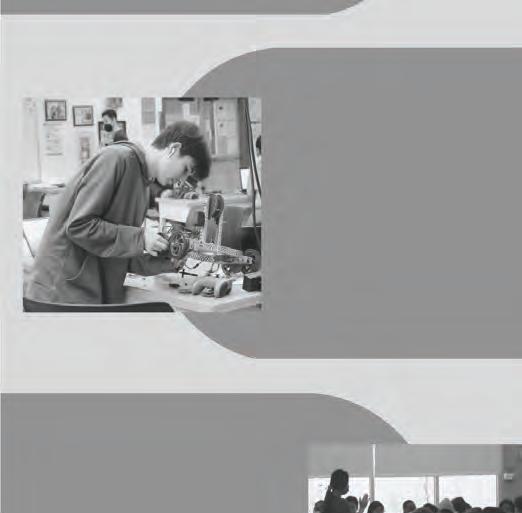
“The class has helped me to be more cautious and I’ve learned some life lessons from it. For example, I’ve learned a lot about how you should always be careful when going shopping and allowing a lot of stores to have access to your credit card information, because their systems can get hacked and your account can get compromised.”

ENGINEERING
“I learned to fi nd different ways to solve problems I’m facing. The class pushed me to think outside of the box and use different methods to build something or to make something work. I [have developed] a growth mindset from these experiences.”
These patterns are conveyed not only by the ensemble’s physical formations but all throughout the music, Wong said. When starting with a pattern, the drumline slowly intensifies the sound through layering parts until the music evolves into a completely new rhythm. At the end of the show, the ensemble reaches infinity after moving through a series of patterns and imitating a transcendence of time.
The show also involves an
“In the first movement, the trampoline is stationary in the corner, and in the second movement, it starts moving around,” quad section leader Wyatt Oates said. “Then, in the third movement, people start bouncing on it, so the evolution of the use of a trampoline symbolizes the journey to infinity.”
During the show, the ensemble plays Claude Debussy’s Clair de Lune — a soft piece that symbolizes the journey to introspection and the understanding of soul, Wong said. The calming music is juxtaposed with the animated movement of the ensemble members who are bouncing on the trampoline, resembling a floating sensation.

Oates said this season’s show is one of the most challenging to date because of the fast tempo, di culty of the music and losing skilled players during the pandemic. However, he said the percussion instructors are excited to challenge the students by giving them a demanding piece and look forward to seeing how they perform it.
“We finish o [the show] with a fast and bombastic movement,” Oates said. “Performing [the piece] feels very energetic. You can really get into the music and [connect with] the audience.”
For Oates, this show has been especially memorable because the gradual overlay of music feels like a metaphor for the percussion program building back to their pre-pandemic glory, he said.
“We are building upon ourselves for future generations,” Oates said. “We definitely have some really skilled players this year. [This show] will inspire future generations of kids to come into the program.”
The Epitaph 7 Lifestyles March 10, 2023
PAGE DESIGN BY HELEN TAM
Winterpercussionexpressesthethemeofinfinityandbeyondthroughcaptivatingvisualmovementandplayingdynamicmusic.(PhotobyManyaGirivasan)
Percussionistsrehearsefrequently tobringtheirshow’sthemeto life. (PhotobyManyaGirivasan)
Students share lessons they have learned from their career technical education classes- DEVISHI MISHRA (10) - ARINA SHPIN (11) - LAURYN BLAKE (11) - ADNA PASIC (9) Infographic by Zeinab Rakhshandehroo Photo by Zeinab Rakhshandehroo Photo by Zeinab Rakhshandehroo Photo by Crow Hutchinson Photo by Helen Tam
With the Academy Awards coming up on Sunday, March 12, let’s take a trip down memory
The first movie of a trilogy centered around a Mafia kingpin and his family, “The Godfather” stands as a defining American film, according to the BBC.


The Godfather (1972)


Seeing one’s identity represented in media can provide an immeasurable sense of pride, even hope. However, U.S. history teacher Nicholas Neese said when he was younger, a lack of representation of his mixedrace and queer identities in the media made him question if he was accepted. As diversity in the film industry continues to grow, Neese said he hopes it helps young people devel-
Freshman Shaurya Prayag said she became more confident in her own identity after watching an episode of “She-Ra and the Princesses of Power” that featured a kiss be-
“For me, it’s important to have representation because I didn’t know I was bisexual until I’d seen bisexual people on screen,” Prayag said. “It was really important for me to know that was an option, rather than just living my entire life thinking I was weird.”
On the other hand, inaccurate representation can influence how people view themselves and, crucially, how others view them, clinical therapist


“Film is meant to describe the human experience with stories that shape our perceptions of ourselves and others,” Pinneke said. “Film introduces or affirms ideas that can change our worldview, so it is essential that it conveys accurate represen-
Junior Gabi Cristancho said she feels movies oversexualize Latinas instead of giving them real storylines. As a result, there are few Latina characters to look up to, Cristancho said.
laneandrevisitthe
ForrestGump(1994)
“I love Sofia Vergara, but every character she plays is hot, sexy and dumb with an overexaggerated Spanish accent,” Cristancho said. “It would be great if the people who make these films actually show a personality and go beyond stereotypes.”
As a Filipino American, chemistry teacher Chris Nafrada said he is disappointed by the lack of Filipino representation in U.S. cinema, which is limited to only a few movies such as 2022’s “Easter Sunday.” Filipino cinema is a huge industry, Nafrada said, but American cinema barely showcases these movies.


“The Philippines is a third-world country where the rich get richer and the poor get poorer,” Nafrada said. “Many movies you see that come from the Philippines depict that struggle. When you see someone on the big screen and know that they [were able to] get there, it provides hope.”
Due to this, Nafrada said it is discouraging that these movies are not in the mainstream, instead being available only on streaming platforms.
In addition, Pinneke said many popular movies are produced without careful research that includes the perspectives of marginalized groups, which could negatively affect viewers.
“Adequate and accurate representation in film begins with an earnest effort to understand the complexity of the lives of those from different cultural groups,” Pinneke said. “If we truly want these voices and experiences represented in film, there must be a sincere invitation for these groups to share perspectives and be present in all facets of film.“


it can be a good way to advocate your own beliefs.”
After discovering her passion film, Richardson said she has delved deep into the art of ing over the span of two years.
“I only decided to major the summer before I had to colleges,” Richardson said. “I my first short film during that and it really appealed to me, made me realize I want to career with it.”
Photo from Paramount Pictures Photo from Paramount Pictures“Forrest movie veranceabout atunification, forviewers’decades, the Los Angeles
most Iconic Bes
“Forrest Gump,” a about perse- and cultural unification, has pulled viewers’ decades,heartstrings according to Angeles Times.
GET READY FOR THESE HOT TAKES
‘Puss in Boots: The Last Wish’ is pretty overrated. Death, as a villain, never really established himself as a threat. Every time he is on screen, the movie is acting like we are supposed to be really scared, but it’s not scary at all because every time he comes on, nothing happens.

- Yoni Savransky (10)

The ‘Avatar’ movies are not interesting. The visuals are nice, but they try to use CGI to make up for [the plot].
- Kiara Artola (11)


advocate for passion for has quickly filmmakyears. in film apply for “I made that time me, which pursue a

‘Titanic’— I hate that movie. I think it’s stupid because Leonardo DiCaprio looked like he was twelve and I’m like, ‘why would anybody be attracted to him?’
- Principal Greg Giglio

‘Twilight’ is underrated. It’s really bad, but you can’t go into it thinking that it’s good. You just need to dive into the movie and imagine you’re a teenager and you have to choose Edward or Jacob. You can’t just watch it, you have to dedicate part of your life to it.
- Caitlyn Cox (12)
“Lord of the Rings: The Return of the King” captivated audiences with its tale of inspiring heroes saving their world from evil, according to the Guardian.
Parasite(2019)
types of media.” Film is special to Dobbelaere because it provides an outlet for creative storytelling, she said.
“Films can change perspectives and tell a story in a really unique way,” Dobbelaere said. “The way a director chooses to make a film influences how people perceive it. You can see the world in a new way through different shots and angles, playing around with lighting and other creative choices.”
ILLUSTRATIONS BY FAITH WATTERS
The Lord of the Rings: The Return of the King (2003)
Photo from Warner Bros
PhotofromBarunsonE&A
PhotobySeoyoungHwang
PhotobyHopeSaena
PhotobyRajivVenkatesh
PhotosbyZeinabRakhshandehrooandAnnabelleYip
OVERRATED UNDERRATED OR _ _ _ _ _ _ _ _ _ _ _ _ _ _ _ _ _ _ _ _ _ _ _ _ _ _ _ PAGE DESIGN BY ZEINAB RAKHSHANDEHROO, RAJIV VENKATESH AND ANNABELLE YIP
toforeignThefirstfilm award,receivethe ”Paraaccordinginequality,site”highlights to theBBC.st Picture winners
Purposeful piercings
Students, staff discuss self-expression through piercings
By Niyatee JainGetting a piercing can be a form of self-expression, from a nose piercing with a small stud to a large industrial bar adorning each ear. For others, such as senior Hannah Riggins, getting piercings can be a hobby or something done simply for their love of earrings.
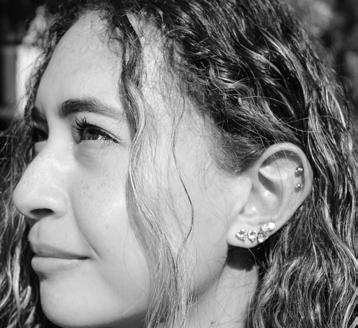
Riggins has 13 piercings in both of her ears combined. She said she likes how they look, especially because she does not wear other jewelry, like rings. Riggins received her first earlobe piercings in third grade, and over time, she has accumulated more.
“During the pandemic, I wanted to get more piercings, but obviously, no piercing stores were open,” Riggins said. “So I was like, ‘I’m just gonna do it at home’ and got piercing guns and then my mom went ahead and pierced them for me. My parents have
Articulate and enunciate
been accepting of them and my friends like them too.”
Riggins said she believes many people may hesitate to get piercings because they can be painful. However, the most difficult part of getting piercings is the aftercare, she said. For example, Riggins has to do a soft wash for new piercings, which requires cleaning the piercings with a saline solution to prevent infections.
Principal Greg Giglio has one piercing on his left ear. He said his piercing was something he did for fun in college. Though Giglio has friends and family members with multiple piercings, he said he was content with his single one.

“I’m old school,” Giglio said. “The first time I got [the piercing] was in college and I didn’t like it so I took them out. And then I got them [pierced] again when I was 40 for fun, because why not?”
Similar to Riggins, senior Claire Oh said she decided to get more piercings over the pandemic. Oh currently has 11 piercings –with 10 in her ear and a belly button piercing. She also pierced most of them herself.
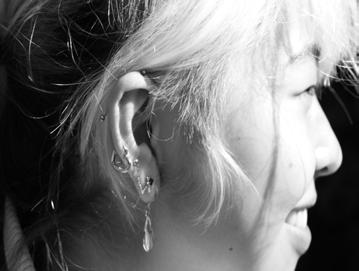
“I’ve always wanted to have more piercings, but I didn’t really know how I would get them because my mom didn’t like me having more piercings,” Oh said. “In sophomore year. I decided that since it was the pandemic and I have all this time, I might as well pierce my own ears.”
To those thinking about getting their first piercing, Oh recommends starting with the earlobes and working up to more painful piercings, like the nose, especially because piercings are reversible, she said.
“If you’re on the fence about [getting a piercing], I would definitely try it out,” Oh said. “It costs a little bit of money, and it hurts just a little, but then you have this piercing that you can remove if you don’t like it and keep it if you do. It’s okay to be reckless with piercings when I’m really young because I know I won’t regret it when I’m older since I can just take them out.”
POV: Tapping into my roots
Connecting with my ancestors through the art of tatau
By Hope SaenaThe first tap struck a thunderbolt through my body. As the excruciating pain spread, I eased the torture by putting my mind elsewhere. Hours before, I was not even thinking of getting a tattoo. But there I was, lying on the fala, a Samoan mat, fighting the urge to scream.
Tatau, the Samoan word for tattoo, is an art form deeply rooted in the heart of the South Pacific. According to legend, it was introduced to Samoa thousands of years ago by two goddesses who had witnessed the beauty of the art in Fiji. Since then, high chiefs of villages and their daughters, known as taupous, have received tataus to mark their status.
Growing up, I was fascinated by the tatau designs my family members wore. As a high chief in the village of Solosolo, my uncle wears a tatau covering most of his body. Each segment is highly detailed, inspired by the nature that inhabits Samoa. While tatau is fascinating
in all aspects, I am most intrigued by the fact that those designs were worn by my ancestors.
Designs are passed down from generation to generation. Because of this, every tatau is unique as many combine designs from multiple ancestors.

As a Samoan living away from Samoa, I wanted something that could remind me of my home. Oftentimes, I cannot bear being so far away from the place that is the most comforting to me. So when my cousin invited me to be her tatau partner, I was overjoyed. Although I knew the pain would be insufferable, I was ecstatic to finally have a lifelong keepsake that could console me during my time away from Samoa.
When we were minutes away from starting the ceremony, I glanced over to my uncle’s tatau and was captivated by the fish that swam up his leg. While it was a simple design, fish have various meanings in my life: they are a significant symbol in my religion and remind me of the ocean, a place I consider my second home. So, getting two fish felt right at that moment.
Traditionally, tatau is done in pairs, as they say recipients can share the pain of the harsh tap -
 By Evelyn Wang
When Abigail Song attended a debate summer camp in 2021, the junior said she remembered feeling intimidated by the other attendees. However, after lots of practice, Song said she was able to improve her public speaking skills immensely.
“Because debate is a lot like formal arguing, I now feel more comfortable backing up my opinions,” Song, a speech and debate club public forum committee leader said. “With a lot of research before the debate tournaments, I am less nervous because I know that I have done the [work] and I know what I am talking about.”
Aside from building her confidence, Song said debate has also improved her research and writing skills.
“Having a lot of knowledge on the topic is a really important part [of debate],” Song said. “It has helped me with my persuasive writing skills because the whole point of debate is to persuade the judge that your side is better.”
For sophomore Anthony McDonald, Model United Nations has taught him to pay more attention to the news and use the information to improve his performance and to educate himself.

“In Model U.N., you have to research a topic and then debate it from a country’s point of view,” McDonald, Model U.N. training director, said. “The career path that I’m trying to go down, [likely relating to law or working as a clergyman], involves public speaking and awareness of the world around me, and Model UN has really helped with that.”
Hoping to improve her public speaking skills, mock trial member, sophomore Trisha Liu said she decided to join the club in her freshman year, which helped her become more open to new experiences.
“Everyone’s really great at public speaking in the club so you can learn a lot, and it’s extremely inspiring,” Liu said. “It has taught me how to [articulate] and how to
ping. Luckily, my cousin was the first to go. As I held my cousin’s hand, the tattoo artist explained the history between our families. It was touching to hear that his father gave my mother her tatau. I felt immense pride learning I would be the next to continue our century-long friendship with the Sulu‘apes, a renowned family of tatau artists.
As my cousin finished up her faailoa malu, a hand tatau many taupous receive, I was overjoyed to finally experience such a unique tradition.
While I could have gotten a tatau in America, nothing beats the tra ditional methods moa. To artists use natural remains such as turtle shells and horse tusks to im print the design. For the ink, they utilize candle nuts to create the iconic green color.
insignificant, utilizing these cultur al relics meant the world to me. My ancestors, uncles, aunts and mother all used this remarkable technique, so experiencing the rig-
speak louder because that was something I had trouble with [before joining the club].”
Because Model U.N. requires collaborating with others and examining situations comprehensively, McDonald said the most valuable lesson he has learned is to become more aware of other perspectives.
“When I’m looking at a topic, I see one point of view,” McDonald said. “When I’m assigned to my country, I can see why those people would have a different point of view which is really important because it’s necessary to see all aspects of a problem before making a decision.”
Aside from improving in writing and research, Song said debate has allowed her to become a better public speaker. Numerous hours of practice have gone into such refining, but Song said she was passionate to keep persevering.
“I wanted to improve my public speaking because I thought it was important going into high school,” Song said. “Debate forces you to act confident, even if you aren’t. In reality, everyone is nervous when there’s a large audience, but it’s important [to learn] how to suppress that.”
orous tapping made me feel closer to my family.

While the abrasive tapping made those two minutes of my life unbearable, tears streamed down my face, not from the pain, but from the emotional aftermath of receiving the tatau. Every detail
was perfect — receiving the tatau from the Sulu‘apes, getting it with my cousin and the design. It was a cultural experience that I will never forget. As long as my fish swim across my side, I know my family and ancestors are with me wherever I go.
March 10, 2023 The Epitaph 10 Lifestyles
PAGE DESIGN BY MANYA GIRIVASAN AND PATRICK HAO
Public speaking clubs build confidence, foster growth
Experiencingthisculturalceremonyfilledmewithimmensepride.
Riggins(topleft),Giglio(bottomleft)andOh(right)makeastatementwiththeirunique piercings.(PhotosbyNiyateeJainandEmmaYu)
(PhotobyHopeSaena) Publicspeakinghelpswithconfidence,
McDonaldsaid.(PhotobyEvelynWang)
ELD program builds bridges
Students, staff work to close cultural, language gaps
By Brevin ReedWhile language can be a powerful tool of communication for some, it presents a barrier to others. The goal of ELD is to overcome this, senior Jiwoo Kim said.
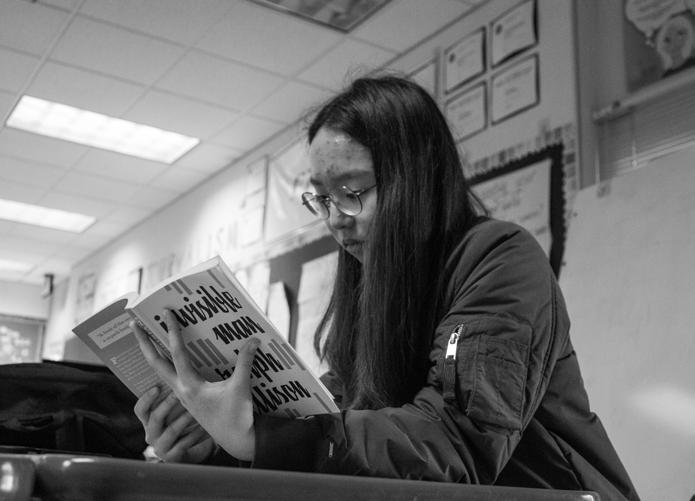
Students like Kim, whose first language is Korean, are brought into the program to improve their comprehension skills and succeed in their classes.
“I moved here from South Korea, where the style of speaking
is really different,” Kim said. “People in Korea don’t talk loudly, and there’s this hierarchy based on age that does not exist here.”
High school culture and norms were not the only things Kim initially struggled to grasp. At school, language barriers made previously easy subjects difficult to understand, Kim said.
“I was really good at science in Korea, but scientific words like ‘kinematics’ or ‘velocity’ are so different here,” Kim said. “Even math, which I thought would be the same since it just involves numbers, gets difficult when I have to explain my answers.”
While ELD classes were helpful in strengthening Kim’s under-
standing of the English language, she said she felt the program was initially a little overprotective of her capabilities.

“They were afraid of ELD people going to the higher math classes because there is no shelter program there,” Kim said. “I am able to speak well, but thinking back, it was good protection overall, because younger people in ELD are sometimes overly confident in their ability.”
To ease the transition of English language learners into HHS academics, ELD students take sheltered classes ranging from science to history, which include modified curriculum and slightly different teaching styles, English teacher Christina Graham said.
Graham is currently the only sheltered teacher of literature and writing for all grade levels. Graham said she also teaches other support programs for ELD students, like the ELD summer academy, and global literature, which was a sophomore-level sheltered English class HHS used to offer.

with students who need technical help with literature.”
Watching these students build off each other’s ideas and demonstrate a genuine interest in the course material provides Graham with the greatest sense of joy, she said.
“I can observe this amazing rapport between students, where they are clearly discussing something interesting in their own language but aren’t ready to do that in English,” Graham said. “They are still doing the critical thinking work, and they’re able to push their own thinking in their own way.”
When planning her lessons, Graham said one concept she keeps in mind is cognitive load, the brain’s ability to keep track of multiple things at once. For non-native English speakers, constantly translating words in their heads takes up part of this load, she said.
As commissioner, she said her job is to host activities and mentoring sessions during tutorials, as well as plan multicultural week. Most recently, Hamano said she helped organize a Lunar New Year celebration and a Diwali celebration in partnership with IndoPak.
It is important for ELD students to maintain a balance between assimilating into American culture and staying connected to their own culture, she said. This allows students to still feel a sense of belonging, even when they are far from their homeland.
“I can observe this amazing rapport between students, where they are clearly discussing something interesting in their own language.”
Inhersparetime,KimreadsbooksinEnglishtobetterherunderstandingofthe language.(PhotobyKeshavKumar)
Serving up sisterhood
Food service staff share importance of team chemistry
 By Hope Saena
Time is valuable – especially for the food service staff. With only 45 minutes on the clock, they work endlessly to feed every student who walks through the cafeteria doors. While it may seem like an unattainable goal for some, service manager Terri Fortson and her team strives to accomplish this task every day, she said.

“It’s overwhelming at first, but once we get into the groove of things, we have fun with it,” Fortson said. “If we don’t get over 1,000 students during a lunch period, we’re like, ‘what a slow day we have, isn’t that amazing?’”
Before serving for the past 20 years as HHS’ service manager, Fortson gained an abundance of experience by working at multiple restaurants and a middle school, she said. While food service can be difficult at times, Fortson’s team helps ease the stress of overcoming challenges, she said.
“When we have changes, they roll with the punches and go with everything that I ask of them,” Fortson said. “They’re loyal and have helped me in every aspect.”
As service manager, Fortson said creating a comfortable and positive environment for her team is a priority.
“I’ve always been told that a strong house has a strong foundation, otherwise, the house will fall,” Fortson said. “When I look at my team, they are the house and I am the foundation it is built on.”
From food and staff shortages to late deliveries, Fortson said she could not tackle any of these chal-
lenges without the support of her team.
“Even when we have catastrophes in the back, my team always pulls through,” Fortson said. “Some days, I don’t know where they get the energy, because I don’t have the energy, but they continue to push.”
To Lupe Martinez, who has been a cook at HHS for over a decade, Fortson and the team mean the world to her, she said.
“In the last 13 years, Terri has taught me so much,” Martinez said. “Working with her and our team makes me happy to be here, and nothing is possible without them.”
While Martinez has many meaningful memories with the team, one of her favorites was working in trucks for two years, she said. Martinez said the team used food trucks to cook when the kitchen was being renovated.
“When we cooked in the trucks, we had to serve in the kitchen, and that took much time from preparation,” Martinez said. “Though loading and unloading was hard work, we made sure to always be ready
“I have always liked a challenge to teach new things, but I’m not personally called to teach honors or AP courses,” Graham said. “I’m most interested in working
for when that first kid came into the cafeteria.”
Similar to Martinez, Claudia Villagomez, who has been working at HHS for three years, said she is grateful for having the chance to work with such a supportive manager.
“She’s always motivating us, and her positive energy rubs off,” Villagomez said. “I’m thankful for everything she has done for me.”
“To alleviate this, I might try to simplify directions or use more pictures,” Graham said. “Students are also allowed to read in their native language during independent reading time. They are still developing the same skills, but in a manner that’s easier for them.”
The ELD program extends beyond the classroom, ELD commissioner, senior Satomi Hamano said.
Besides helping each other improve at food service, Villagomez and the team are constantly uplifting one another, she said.
“We don’t know what others go through in their lives, so when someone is feeling down, we do our best to make that person’s day a good day at work,” Villagomez said. “They’ve always been there for me, making sure I feel comfortable and loved.”
“We have football games, rallies and proms, but it can be scary walking into a gym full of energetic people,” Hamano said. “One of the first things we do is try to get ELD students involved in these activities. We also host cultural events and invite them to join.” Participating in these spirited events and cultural activities has given Kim a better understanding and appreciation for others’ customs, she said, despite the places and languages being vastly different.
“Because the way of talking is so different, it has actually helped me understand other languages better,” Kim said. “Language connects people, and the more languages I know, the more people I get to meet.”
Because of the warm, welcoming atmosphere in the kitchen, Villagomez said she would not want to work anywhere else with any other team.
“Even though we’re only here for four hours of the day, I appreciate the time I get to work with my team,” Villagomez said. “They’re co-workers, friends, sisters and mothers. They mean so much to me.”

Lifestyles 11 The Epitaph March 10, 2023 PAGE DESIGN BY NICOLE KIM
ServicemanagerTerriFortson,cookLupeMartinezandfoodstaffassistantHossnaJoyaworkalongsideeachothertofeedthefloodofstudents. (PhotosbyHopeSaena)
Christina Graham English teacher
A glimpse into New York Fashion Week
Fashion designers unveil bold, creative designs
By Gabriela SalazarAs the seasons change, New York fashion designers seize the opportunity to showcase their new collections to the pub lic.
This year, three dif ferent designers left a lasting impression on me, as their collec tions are unique, bold and beautiful in often overlooked ways.
Three of the best shows I saw for the spring and summer collection were the works of Viktor and Rolf, Sherri Hill and Dennis Basso.
Viktor and Rolf:

Viktor and Rolf took a very conceptual approach. Unlike normal dresses that are designed to flow down models, this collection featured dresses turned at the oddest an-
gles. They were sideways, crooked and upside down, sometimes with the skirt blocking any view of their head.

The wide variety of angles were fascinating to me and reminded me of “Alice in Wonderland,” since both the movie and the collection featured bizarre designs and colors. From bold colors to mermaid-like skirts, they incorporate a variety of courageous, creative designs, evoking feelings of nostalgia for a movie I watched when I was much younger.
The models were also interesting to see — unlike in regular shows, their hair was either dyed, cut short or a combination of both.
Viktor and Rolf described their inspiration for the col lection as channel ing an “abstract sense of sur realism,” which calls attention to the mid-20th centu ry. Unlike most designers who created a spring and sum-
mer collection, Viktor and Rolf were the first I had seen use these kinds of surreal designs.

Sherri Hill:
Sherri Hill crafted a refreshing collection with silky designs and oceanic undertones. This collec tion featured dresses with flowing fabrics that moved like waves as the models walked.
Delving into dupe culture
Rise of dupe culture benefits consumers, transforms fashion
By Harshitha VijayakumarImagine coveting a luxurious designer item for months, envisioning how it would make you feel and look, but ultimately discovering that it just does not fit your body or price range. Frustrating, right? Well, thanks to the rise of dupe culture, this does not have to be the case anymore. You can still indulge in your favorite fashion trends without breaking the bank.
While some may view this trend as a negative force in the fashion and beauty industry, dupe culture is actually a positive development that benefits consumers and promotes a more accessible fashion industry.
Dupe culture provides more affordable options for consumers who may not be able to afford ex-
pensive designer items. Dupes allow consumers to participate in the latest fashion trends without having to spend exorbitant amounts of money on designer items. For instance, Dior’s Addict Lip Glow Oil costs around $35, while IBCCCNDC’s Lip Glow Oil, which is a dupe for the Dior product, costs only $7.99.
In the past, high-end fashion brands exclusively catered to a wealthy and privileged few. However, with the rise of dupe culture, more people can purchase trendy items and express their individuality through their clothing choices.
Another benefit of dupe culture is that it encourages innovation and competition in the fashion industry. When designers know their designs can be easily replicated, they are motivated to create new and innovative ideas that cannot be easily duplicated. This leads to a more dynamic and exciting fashion industry that is constantly evolving and pushing the boundaries of what is possible.
A designer who has realized the importance of innovation and creating designs that cannot be easily duplicated is Virgil Abloh, the creative director of Louis Vuitton’s menswear collection and the founder of the fashion label OffWhite.
formed a captivating color palette, creating a pattern I can only describe as satisfactory. It was like
one of my favorites, since his collection is the only one featuring different styles of wear
Just (don’t) do it
Could this collab be one of Nike’s biggest flops?
By Ella ChanFrom streetwear to fitness shoes, virtually everyone has owned a pair of Nike sneakers at some point in their lives. Nike products have always been my favorite because of their durability and longevity, making them suitable for different activities like sports or everyday wear.

brands’ logos on it and shoelaces in Tiffany’s signature blue color, according to Retail Dive.
However, the overall execution of the Air Force 1 sneaker left me unimpressed and dissatisfied. I had hoped to see an effortless, creative combination of Nike’s sports technology and Tiffany & Co.’s elegance, but when I clicked on the launch page, I was proven wrong.
Abloh’s designs often feature bold and unique design elements, such as intricate embroidery, unconventional silhouettes and unexpected color combinations. He has experimented with new materials and techniques, such as incorporating recycled fabrics into his designs or using 3D printing to create elaborate details.
Abloh’s approach to design has helped make Louis Vuitton and Off-White two highly innovative and sought-after brands in the fashion industry and has inspired other designers to think creatively.
Furthermore, dupe culture allows for greater accessibility and inclusivity in the fashion industry. It is common for designer brands to have limited size ranges, which can exclude individuals who do not fit into their size charts.
Dupes, on the other hand, are often produced by brands that of fer a wider range of sizes, allowing more people to participate in fash ion trends and express themselves through their clothing choices. This also promotes body positivi ty and helps break down societal beauty standards that have long been perpetuated by the fashion industry. By offering more inclu sive and accessible options, dupe culture is helping to create a more diverse and accepting fashion in dustry that is representative of a wider range of people.

Ultimately, dupe culture is a beneficial force that has trans formed how we think about fash ion and beauty. As consumers in creasingly demand affordable and sustainable options, dupe culture has the potential to create a better industry.

Over the years, Nike has worked with various brands, such as Louis Vuitton and Off-White, according to FarFetch. I have always loved seeing brands create unique items together, especially when Nike is involved in the collaboration.
Last month, Nike and Tiffany & Co. revealed their first official collaboration. The joint project features a black Air Force 1 sneaker with Nike’s swoosh logo in Tiffany’s signature robin egg-blue color.
The collaboration with Nike is part of Tiffany’s efforts to modernize its image and appeal to younger consumers, which the company has been pursuing through various collaborations since being acquired by LVMH in 2021. This includes working with Beyoncé and Jay-Z.
This partnership commemorates the 40th anniversary of Nike’s Air Force 1 and serves as a unique blend of two brands with distinct styles.
Unfortunately, Tiffany’s luxury style clashed with Nike’s urban fashion focus. These two brands are not a good fit. The sneakers do not embrace Tiffany’s unique branding. Instead, I would have preferred an all-blue shoe without the prominent black accents on them.
In April 2022, Nike collaborated with Comme des Garçons and created a chic black shoe. The shoes featured a spring sole and a gold chain, creating an artistic masterpiece. This product elevated my perception of Nike’s reputation, given the creativity and innovation infused with the products.
When I heard about Nike’s collaboration with Tiffany & Co., I expected the same level of artistry. I envisioned a beautiful combination of blue and white — maybe even a charm hanging off the dubrae or shoelace, as Nike has done in the past with other brands.
Although both Tiffany and Nike referred to these shoes as “the legendary pair,” the lack of creativity present in the product has made the collaboration a shocking disappointment.
However, while the execution
12 Arts and Culture The Epitaph
March 10, 2023
Manydupesaresuperiortoname-brandcompet-
itors.(IllustrationbyHarshithaVijayakumar)
NewYorkFashionWeekfeaturedanarrayofabstractand eye-catchingdesigns.(IllustrationsbySeoyoungHwang andGabrielaSalazar)
‘Beyoncé should have won’
Award show winners deserve respect
By Lia KlebanovMy eyes were glued to the TV screen in anticipation. Who would be announced as the winner of Album of the Year at the Grammy Awards?
Fully expecting the crowd to erupt in chants of Beyoncé’s name, I sat in utter shock when Harry Styles’ album “Harry’s House” was announced as the winner.
Still reeling from the unexpected turn of events, I could not help but notice the lack of applause from the crowd as the shocked Styles walked to the though it was not captured on the broadcast, Be yoncé fans in the audience were heckling Styles to “get off the stage,” with one fan claiming “Be yoncé should have won,” according to Elle.
Although the re sults were largely unexpected, fans’ re actions were complete ly unacceptable, as Styles undoubtedly heard them from the stage. His entire mantra consists of “treating
‘The Last of Us’ adaptation breaks new ground
people with kindness,” which, unfortunately, was completely shattered when it mattered most.
Singers work their entire lives for a moment like this, and they deserve the respect of the audience — an opportunity Styles was robbed of.
One celebrity who truly embodied peer empowerment was Taylor Swift. Videos of her giving Styles a standing ovation during his acceptance speech circulated on TikTok, and I applaud her for doing that.
During the 2009 MTV Video Music Awards incident with Kanye West, Swift was also berated by haters, who rudely interrupted her milestone moment on live television. Swift set an example for the rest of us to uplift others’ achievements and recognize the hardships they endured to reach such heights.
It is our responsibility, as fans, to support our favorite artists both in their wins and snubs while remaining courteous. Awards show organizers must take precautions, such as instructing the audience not to heckle, so everyone behaves appropriately when someone’s once-in-a-lifetime experience comes around.
Live-action TV series successfully balances horror and heart
By Veronica ZhaoZombie apocalypse. For me, those two words bring overused tropes and cliché storylines to mind. However, “The Last of Us,” a riveting HBO show released on Jan. 15, transcends these stereotypes through complex backstories and heartbreaking scenes.
Adapted from a 2013 PlayStation game, the live-action show explores a desolate, fungi-ridden world full of the Infected — zombie-like creatures whose only goal is to spread their disease as far as possible. The raw emotion, detail and depth portrayed by each of the characters draw the audience into this chilling world.
The show’s action unfolds when a mutated Cordyceps fungus contaminates the American food supply in 2003, converting its human hosts into zombie-like monsters. 20 years later, a cure is still nonexistent, and humanity is at its limit. Joel Miller, a middle-aged smuggler, is tasked with delivering a young girl named Ellie Williams across the country. Ellie is immune to the fungus, and her DNA provides a glimmer of hope for the rest of humanity.
I was thoroughly impressed by the striking similarities between the TV series and the original
“The Last of Us” game. By sticking to the source material, co-creators
Craig Mazin and Neil Druckmann executed the drama flawlessly. The lines, scenes and even songs are almost an exact replica of the depictions in the game.
Although I appreciated the similarities, there was one notable difference that elevated the original plot and served as a worthwhile addition. In the third episode, titled “Long, Long Time,” the storyline strays from the initial action, as viewers are introduced to Bill and Frank, a queer couple surviving on the cusp of the apocalypse. Although the pair was briefly mentioned in the game, the show dedicates an entire episode to them, transforming their tragic love story into a true heartache. Ultimately, I was excited to see the show take


a leap of faith and adapt from the source material in bold ways.
One of the notable strengths the game possessed was the depth of its characters, which was only amplified in the series. The Last of Us” does not focus on the superficial gore and horror of the Infected, but instead reels viewers in through heartwarming scenes and human interactions.
I would highly recommend this show to apocalypse lovers, or anyone who’s looking for a fast-paced and addictive series. “The Last of Us” is a stunning example of how to produce a successful adaptation, elevate original plots and dazzle viewers with bold changes.
TV Show: “The Last of Us.”
Grade: A. Rated TV-MA. Watch on HBO.
‘Good Riddance’: an essential companion for a sob fest
Gracie Abrams creates a lyrical masterpiece
By Madhavi KarthikA phrase that carries oceans of angst and catharsis, yet consists of only two words: good riddance. Shout it at the top of your lungs as a coping mechanism, or whisper it to yourself once that unsavory person leaves the room.

“Good Riddance,” pop singer-songwriter Gracie Abrams’ debut album, interlaces sentiments of bitterness and agony, perfectly capturing the calamitous aftermath of a breakup.
When the album’s lead single, “Where do we go now?,” was released in January, I instantly fell in love with Abrams’ lyricism. She laments the troublesome intricacies that come with unrequited love, unsure of whether the best
choice is to sustain the relationship or move on. Although the chorus simply consists of the song’s title repeated over and over, Abrams effortlessly conveys a distinct emotion with each line she sings, from grief to curiosity, emulating the multifaceted nature of romance.
As one does, I burrowed under my covers and listened to the album on release day. I was not disappointed, and I found Abrams’ evocative songwriting especially noteworthy.
The third track, “Full machine,” is a heart-wrenching ballad about the seemingly everlasting stage of codependency in a relationship. It features metaphors highlighting Abrams’ unfiltered emotions, as she sings, “I’m a shameless caller/ You’re a full machine/ But won’t you answer tonight/ And say something nice to me?”

As a people-pleaser myself, I resonated with this verse in par-
ticular. Abrams analyzes this never-ending search for validation in a poetically haunting manner, making this track one of the most memorable.
What stole the show, however, was “I should hate you,” a delicate yet powerful guitar ballad revealing Abrams’ internal turmoil from the betrayal she has experienced
Book bans undermine American ideals
By Macy LiAmerica: it is time to stop banning books. In recent years, a sharp rise in censorship has set forth a dangerous precedent and silenced marginalized voices. The freedom to read remains in peril, as book bans sweep the country.
A twisted political agenda lies at the heart of book-banning campaigns. These censorship efforts are often led by Republicans, who claim to be safeguarding the innocence of children and shielding them from indoctrination, according to The New York Times.
In reality, book banning is not about protecting children. For many Republicans, it is about sheltering youth from perspectives that
challenge their own. Ultimately, attempts to erase authentic, unfiltered stories about the past and present are forms of indoctrination — the same process Republicans claim to be fighting against.
In 2022, over 1,600 different books faced censorship — the highest recorded number in history, according to the American Library Association. Out of all these titles, books about LGBTQ+ and Black American communities were most frequently targeted by book-banning campaigns.
The most contested novels in 2022 were “Gender Queer: A Memoir” by Maia Kobabe and “All Boys Aren’t Blue” by George M. Johnson. Both of these books are rooted in themes of gender identi-
ty, and they cast light on the experiences of LGBTQ+ youth.
Throughout history, novels that feature daring depictions of injustice have been frequent victims of censorship. Toni Morrison’s “Beloved,” for instance, captures the destructive legacy of slavery and the harsh realities of Black Americans in the post-Civil War era.
Issues of race and identity have impacted the United States for centuries, yet still shape society today. By attacking books and purging them from shelves, Republicans are preventing these topics from being recognized and discussed. They are robbing us of the opportunity to engage in meaningful discourse and lay the groundwork for positive change.
Controversial literature empow ers us to think critically about the world. By reading books, we hear the voices of those who have been historically silenced, and we gain valuable insight into the challenges faced by marginalized com munities, instead of indulging in white washed accounts of history.
Literature is not only a form of creative expression — it can be a courageous type of activism that cultivates empathy and raises awareness for injustice. In a coun try that prides itself on freedom, book banning is a shameful attack on this ideal.
in previous relationships. The song’s simple chorus quickly became my favorite part, as Abrams hits stunningly high notes, shining against the mellow instrumentals. While I adore her poignant songwriting, I wish the album further showcased Abrams’ vocal range. To create a sorrowful tone, Abrams sings with the same lowpitched, hollow voice throughout the album, leaving me wanting more of the dynamic, silvery voice that she showcased in her 2021 EP, “This Is What It Feels Like.”
Still, with her incomparable lyricism, Abrams delivered a euphonious fix to all of my problems. Without a doubt, I will be singing my heart out to this album the next time I am in need of a good old-fashioned cry.
Album: “Good Riddance.”
Arts & Culture 13 The Epitaph March 10, 2023
EllieWilliamstouchedmyheartwithhersharpcomebacksandheadstrongmindset.(PhotofromWarnerBrosDiscovery)
GracieAbramsevokesheartacheandvulnerabilityinherdebutalbum, “GoodRiddance.” (PhotofromInterscopeRecords)
Bybanningbooks,Republicans aresilencingmarginalizedvoices. (IllustrationbyMacyLi) PAGE DESIGN BY ANDERSON PICONE
Stylesdeservedrespectduringhisspeech. (IllustrationbyLiaKlebanov)
Baseball players are out of your (Little) League
By Amber Birrell, Seoyoung Hwang and Christine KimThe baseball team has gained a new advantage this year: multiple players on the varsity and frosh-soph team won the Little League Northern California State Championship last July — the first time in 40 years a team from Sunnyvale went to regionals.

The championships start at the district level, then advance to section, states and lastly regionals, where the Sunnyvale Juniors placed third, outfielder and pitcher Jayden Duong said.
“We won state two years ago,” Duong, a freshman, said. “But since COVID was during that time, we couldn’t go so it was disappointing. It felt amazing that we finally got another chance.”
With a shutdown score of 11 to 0 against Rincon Valley during states, the Sunnyvale Juniors earned the winning title. To prepare for the championships, the team practiced three times a week, so the players expected to win, freshman, third baseman and pitcher Howard Cheng said.
Duong made it onto varsity as a freshman, and plans to use his experience in Little League to transition to high school baseball.
“Compared to Little League, high school baseball is a lot [more fast paced],” Duong said. “I am looking forward to learning from the older kids because it is really fun playing [on varsity].”
Similarly, Cheng also gained important skills from competing, including the importance of communication, and hopes to apply it on the frosh-soph team, he said.
“Without communication, ev-
A slam dunk season
Girls basketball reflect on growth as a team
By Manya Girivasan, Anushruti Nagarajan and Faith WattersThroughout their season, the junior varsity girls basketball team experienced both individual and unified growth, ultimately resulting in being crowned the 2022-23 JV league champions, captain and point guard Lior Ofek said.
Ofek said she walked out of this season feeling proud of the team and their accomplishments. Being a captain comes with a lot of responsibility, the sophomore said, but after bonding with the team and evaluating their strengths and weaknesses, she was able to build her leadership skills.
“Because most of these girls have never played basketball before, I was able to help motivate and improve the team’s coordination,” Ofek said. “I would tell them if they did something good, and when we had timeouts, I would point out what we [as a team] should keep doing and improve [upon]. I tried to keep constant communication with them on the court as well.”
Not only did Ofek fulfill her job
as a captain, she was also the top scorer of the entire JV team. This personal accomplishment, Ofek said, coupled with the team’s effort to do well in the season made for a successful finish in league championships.

“I could see each person get better and [make progress] throughout the season,” Ofek said. “We got better at communicating on the court, being [more involved] during defense and overall, the movement on the court got much better [by] the end of the season.”
Guard, sophomore Shannon Kunz said she agreed with this sentiment as she experienced the feeling of slowly improving her basketball abilities firsthand.

erything can just go wrong, and you could just lose,” Cheng said. “[During regionals,] we were all pretty tired, so our communication lacked and the team fell apart, so we ended up losing.”
After playing Little League baseball for five years, Cheng said he has valued his time on the team. Going to regionals was also a particularly gratifying experience, since he could bond with his teammates, he said.
As the season begins, frosh-soph coach Curtis Currier said he is looking forward to seeing the team chemistry the Little League players have already built in action.
“I think the best thing about having a group of six guys that have played together is that they know the ins and outs on and off the field,” Currier said. “They know what buttons to push and
what buttons to avoid to get their guys motivated or focused on the game.” Although playing baseball in high school will be a new experience for the freshmen, Currier said he thinks the team is capable of winning at least 50% of their games.
Freshmanmembersbringexperiencefromwinning theLittleLeagueNorthernCaliforniaStateChampionship.(PhotobyAmberBirrell)
However, Currier wants to focus on having fun with the players first.
“[Being on the frosh-soph team] really is about making memories
with their friends,” Currier said. “To look back at all the memories I was able to make [when I was on the HHS team], I certainly hope these guys are able to have same level of fun that I had.”
Approaching coaching
New boys volleyball coaches discuss goals
By Ella Chan and Helen TamAs the frosh-soph and varsity boys volleyball teams head into the new season, they hope to repeat last year’s successful season with the help of their two new coaches on frosh-soph and varsity. After varsity won first place in the CIF Division III NorCal Regional Finals and frosh-soph had a strong season the previous year, both coaches said they are eager to see what the new and returning players have to offer.
Steve LeeThis season, Frey said she was able to achieve her goals of getting more playing time and improving her shooting.
“At the beginning, we were awkward and didn’t play well together, but by the end [of the season,] we all understood how each other played,” Kunz said. “I also definitely got a lot more confident in my basketball-playing ability.”
Additionally, center, sophomore Libby Frey said a significant part of her experience with the team
Working in tandem
By Karuna Chandran, Madhavi Karthik and Lia KlebanovAt the beginning of the game, the frosh-soph boys soccer team gets into formation, ready to start the play. While every game is a new opportunity, one thing never changes: all 11 players, whether they are the goalkeeper, defender, midfielder
or forward, have to present a united front.
As a defender, freshman Kota Kixmoeller said his primary goal is to keep the ball away from their goal, while also trying to pass the ball to the midfielders, so they can get it up to the strikers.
“Sometimes you have to make a foul just to save the play,” Kixmoeller said. “Or sometimes there are some strong forwards, so there’s a
was the strong bond they developed on and off the court.
“Our coach is super funny, [and] we have our inside jokes,” Frey said. “Even if we don’t have a lot of players [and] don’t know how the season will go, we can still do it and [ultimately], we did come in first.”
physical aspect involved [in moving the game up the field].”
As a midfielder, freshman Timothy Rossett said the team has had a strong defensive game overall, but they could improve at connecting the midfielders and forwards.
“[Being a midfielder involves] a lot of decision making,” Rossett said. “You have to decide who to pass it to, whether to dribble or pass. Generally, there’s a lot of pressure and you have to run up and down the field.”
Sophomore Siddharth Garimella is the striker for the team. Because practices during the week typically focus on all positions, Garimella said he utilizes time outside of school to improve his shooting technique.
As an integral player to the team’s attacking unit, Garimella said there is stress that comes with the position because his teammates rely on him.
“It’s a lot of pressure because you’re the one who is expected to score all the goals,” Garimella said.
“Your teammates might get mad, but they’re just doing it to push you.”
New head frosh-soph volleyball coach Steve Lee has taught volleyball for over 15 years to kids in second grade through high school. He has also played for 40 years and participated in numerous tournaments.
“I’m excited to use my involvement in volleyball to help the team thrive,” Lee said. “I also have two children that attend HHS who are on the varsity girls and boys volleyball teams, so I feel like I’m already part of the school community.”
The new coach said he hopes to improve his coaching skills and grow with the team.
“I want to expand their knowledge of volleyball and hopefully they can have the passion that I do to play,” Lee said. “It would be cool to see them use it many years to come when they go to college and their adult working life.”
Though winning is ideal, Lee said he is not worried, as frosh-soph does not track their winloss record as closely as the varsity team. Lee said he is most eager to see the team have fun and grow as players.
“I want to see them enjoy it as much as I do,” Lee said. “I have so much passion for volleyball, and I just want to see that passion being stitched into all the kids.”
Danny Chan
As the new varsity boys volleyball head coach Danny Chan said he is excited to begin this season. Chan is a returning HHS coach, as he was the head coach for the JV girls volleyball team and an assistant coach for the varsity girls team in 2008.
“Homestead has always had a very rich [sense of] tradition in the volleyball program, so when the opportunity [to coach again] came up, I decided to try what I could to keep that tradition going,” Chan said.
Other than coaching at HHS, Chan said he has a lot of coaching experience in all levels of volleyball. Chan coached at West Valley College for a couple of years, before becoming an assistant coach at Archbishop Mitty High School for their varsity team. Chan has also coached both girls club and boys club at Vision Volleyball Club and Mountain View Volleyball Club.

With his return to HHS, Chan said he wants to be a role model for student-athletes by leading by example and setting the tone early in the season. His ultimate goal, however, is to qualify for CCS through lots of practice and preparation. Winning the Division III NorCal Regional Finals is a huge accomplishment, and it is good for the returning players to have that experience so that it can carry on into this year’s games, he said.
“[I am looking forward to] working with a group of guys who want to get better,” Chan said. “That’s why I coach — I want to make sure they have a positive experience playing and [continue their passion] after high school.”
March 10, 2023 The Epitaph 14 Sports
New head coaches Steve Lee and Danny Chan said they are excited to begin the season and support players. (Photo by Annabelle Yip)
Players have to earn their time on the field and there is a great emphasis on the overall record, Kota Kixmoeller said. (Photo by Madhavi Karthik)
(Photo from Edmond Kwong)
PAGE DESIGN BY DAVID LIN AND ERIN LOH
ATHLETE OF THE MONTH
Nathan Juillard excels as varsity goalie
By Faith WattersFor freshmen athletes, landing a spot on varsity is a daunting task, often reserved for the most determined and talented athletes, varsity boys soccer coach Adam Clarke said.
As the varsity boys goalie, freshman Nathan Juillard is an integral player, co-captain Leo Janson said. This month, Juillard has been recognized as athlete of the month due to his impactful role on the team.
“Nathan saved us in a bunch of games, and I don’t think we would have done as well as we did this season without him as a goalie,” Janson, a senior, said.

In addition to Juillard’s contributions, Janson said he admires the freshman’s ability to adapt and persist throughout the season.
“As a freshman on varsity, he stood up to the challenge of being a goalkeeper, even with everyone constantly shouting at him about what to do,” Janson said. “He adapted very well to the environment, and by the end of the season, he improved a lot.”

Similar to Janson, Clarke said he is impressed with Juillard’s achievements, especially since this is his first year on the team.
“It’s [already] rare when a freshman makes varsity, and not only did he make varsity, [but] he made it as a goalkeeper, which is even rarer,” Clarke said. “To do it all as a freshman is truly phenomenal. Nathan even had five or six shutouts against quality opponents.”
Clarke said he has high hopes for Juillard and looks forward to what he will accomplish in the following seasons.
“I’m excited to go on this ride with him because I plan to be at Homestead for a couple of years,” Clarke said. “He’s [motivated] to grow in all the different aspects of the game.”
Reflecting on his first season, Juillard said playing on varsity was one of his most memorable experiences, and it taught him perseverance.

“[I learned that] once you make a mistake, you still have to keep going,” Juillard said. “You have an important job, and if you’re too focused on [the mistake], the whole game is going to be terrify-
Next athlete of the month
Scan the QR code to nominate someone for the next athlete of the month, who will be featured in our next issue.
Juillard’s skills as goalie are especially impressive because he is a freshman, Clarke said. (Photo by FaithWatters)
WINTER SEASON RECAP
Winter season athletes reflect on achievements, shortcomings
Girls Soccer


JV 7-8-1 Varsity
6-10-3
“Our season went a lot better than it looks like. We’re in a really good league, and we were able to compete with a lot of the top teams. Overall, the season was really fun.”
—Boys Basketball
Frosh/soph 13-11 Varsity 9-15
“We had a losing record, but I think we had fun. We originally wanted to get the seniors to CCS one last time, but we just weren’t as good as we hoped we were, and I hope that the seniors were happy during the season.”
— Ishaan Musunuri (11)
“I thought we did a lot better as the season went on. The underclassmen were exceptional, and many were vital to the team. I think next season, the team is going to be really strong.”
— Leo Janson (12)Boys Soccer
Frosh/soph 12-5-4 Varsity 13-11
“I felt pretty okay going into CCS. I was nervous, because I don’t want to lose, [especially] to a lower-league team [like Santa Clara High School]. We let them have fun the whole game, while we didn’t have our fun.”
—Girls Basketball

JV 16-4 Varsity 11-13
COLIN LOU GOES TO CCS
Lou is one of four wrestlers who made it to CCS this year.
Although Lou did not meet his goals, he feels hopeful for a more successful season next year, he said.
By Nathan GuCramming into one car, wrestling members who qualified for CCS headed to Watsonville to compete, varsity wrestling captain, junior Colin Lou said.

“I know I could have done a lot better, but it is what it is,” Lou said. “I felt confident and excited because I really wanted to place, but that didn’t happen. I look forward to doing better and making CCS, but I also want to make states.”

The Epitaph 15 Sports March 10, 2023 PAGE DESIGN BY NATHAN GU, MACY LI, BREVIN REED AND HOPE SAENA
ty
Varsity midfielder, senior Leo Janson
“ “
Varsity centerback, junior Jamie Nguyen
“ “
Jamie Nguyen (11)
Varsity guard, senior Xochitl Neely
“ “
Xochitl Neely (12)
Varsity guard, junior Ishaan Musunuri
“ “
Photo by Zeinab Rakhshandehroo
Photo by Karuna Chandran
Photo by Zeinab Rakhshandehroo
coachmotivatedhimtocontinuepersevering,althoughhewasunabletoadvancetothe secondround.(PhotoscourtesyofEdmondKwong)
Photo courtesy of Edmond Kwong
VarsitycaptainColinLousaidtheencouragementhereceivedfromhisteammatesand
Wrestling captain reflects on experiences competing at CCS
BRAIN TEASERS
Grab a pencil and unwind with some fun games!

Talking with game lovers on campus
“[Table top club] is a nice break. It’s a time where we don’t worry about studying and you can chill
White to mate in three moves
Crossword

Things you’ll find in Edmond Kwong’s classroom, or what you might order at McDonald’s...
French wine region north of Bordeaux
P.E. teacher currently on maternity leave


Professional boxer Álvarez
“Class is in _______!” (What Louise might say to stragglers after the bell rings)
Jumping track-and-fielder type
Freudian alternatives to egos, as taught during “Lord of the Flies”
Homestead Mustangs, ____ ____
Twice fan
Percy ______ Shelley, Romantic poet that AP Literature students might learn about
NYC subway system
Camera type that uses physical film (unlike the ones found in photography class)
Two-word connector of a vowelly simile



Colson whose contemporary novel was recently added to some American Literature curricula
One who entices and attracts
Lovely sounding, like the harmonies sung in choir
Comforting phrase that might be said after a bad test
What one may do to a towel or hands
The best high school of all time, and coincidentally the patron of this newspaper
Eye infection type
Group whose studies on the supply chain you might reference for a research paper (abbr.)
Church for many BYU students
Minecraft blocks that can sense sound
Minor or major constellation

Cars you might aptly see in the HHS
parking lot
Biology class concept
A rival of a Soc in “The Outsiders”
Phrase that might be printed on a Father’s Day mug gift Physics SI unit (Br.)
C3H6O, or what’s commonly known as nail polish remover
Objectives
Real name of famed quad horse
Subjects of many Insta stories on Oct. 3
Anger
Expense for most HHS drivers
_____ genesis, a class for aspiring composers
Thespian’s address to the audience
Business higher-up positions who might hire developers, as all FBLA members are familiar with What Wyatt Hook is to Shawn Hook, for example
Store similar to Ross or T.J. Maxx
Final outcome
Lunch menu category that includes sandwiches and wraps
LCD alternative
New senior humanities course
Post-tryouts sports happenings
“___ so tall and handsome as hell / ___ so bad, but he does it so well”
Teal-colored “My Little Pony” character who plays a certain stringed instrument
Those outside of your group
What you do when you ace a presentation
“Eugh”
Letters that squiggle
Is, as taught by Ju Laoshi
What they call gymnastics flips under the sea?
Neighboring state that many travel to during ski week
Robert Downey Jr.’s Marvel persona
Possibilities that AP computer science students should be testing for

“[I like how chess] requires strategy and ing, and I like how it involves pure skill and
Coins worth a tenth of a dollar
Rs of RGBs
Michele who supposedly can’t read
Acorn dropping trees
Imm___ _ystem
YouTube channel for slothful gamers


New A-building bathroom type - i = ?
English and AVID teacher James Aguirre, né _____
Indie rock band known for songs like “Little Dark Age”

Chemical culprit of many smelly bathrooms
Beginnings of volleyball attacks Nomenclature prefix indicating 10 of something Rhyming synonym of “wham”
Sub counterpart
Nagarajan who’s in The Epitaph Tinker v. ___ Moines, key Supreme Court case showing that expression = speech (as seen in AP U.S. government)


The Epitaph March 10, 2023 PAGE DESIGN BY AMBER BIRRELL, LINDSEY STEEL AND EMMA YU
ACROSS 1. 8. 13. 14. 15. 16. 17. 18. 19. 21. 22. 23. 24. 27. 31. 33. 34. 36. 37. 39. 40. 41. 42. 45. 47. 50. 51. 52. 56. 57. 58. 59. DOWN 1. 2. 3. 4. 5. 6. 7. 8. 9. 10. 11. 12. 14. 16. 18. 19. 20. 21. 22. 23. 25. 26. 28. 29. 30. 32. 35. 38. 43. 44. 45. 46. 47. 48. 49. 50. 52. 53. 54. 55.
PUZZLE BY EMMA YU
START END