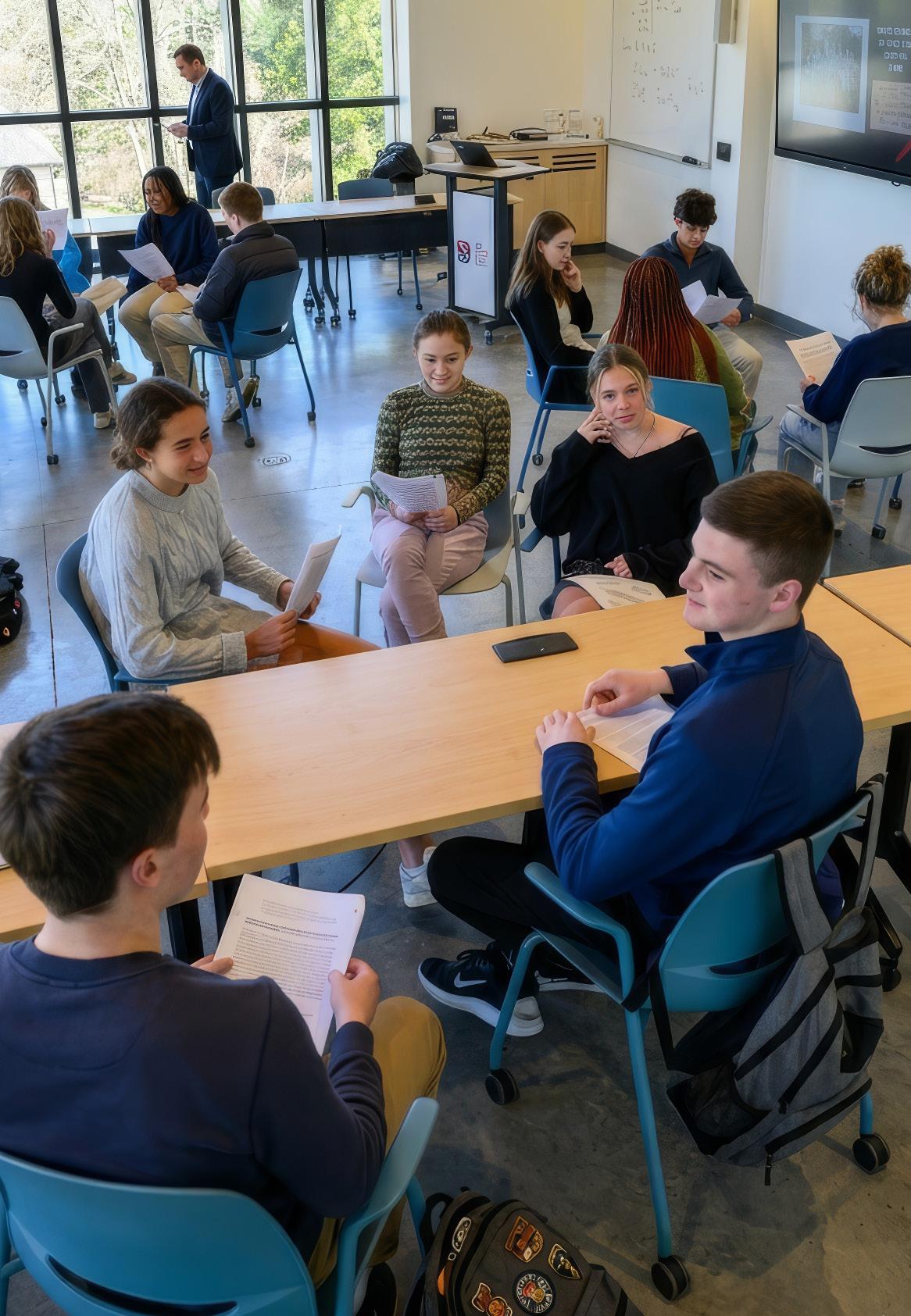
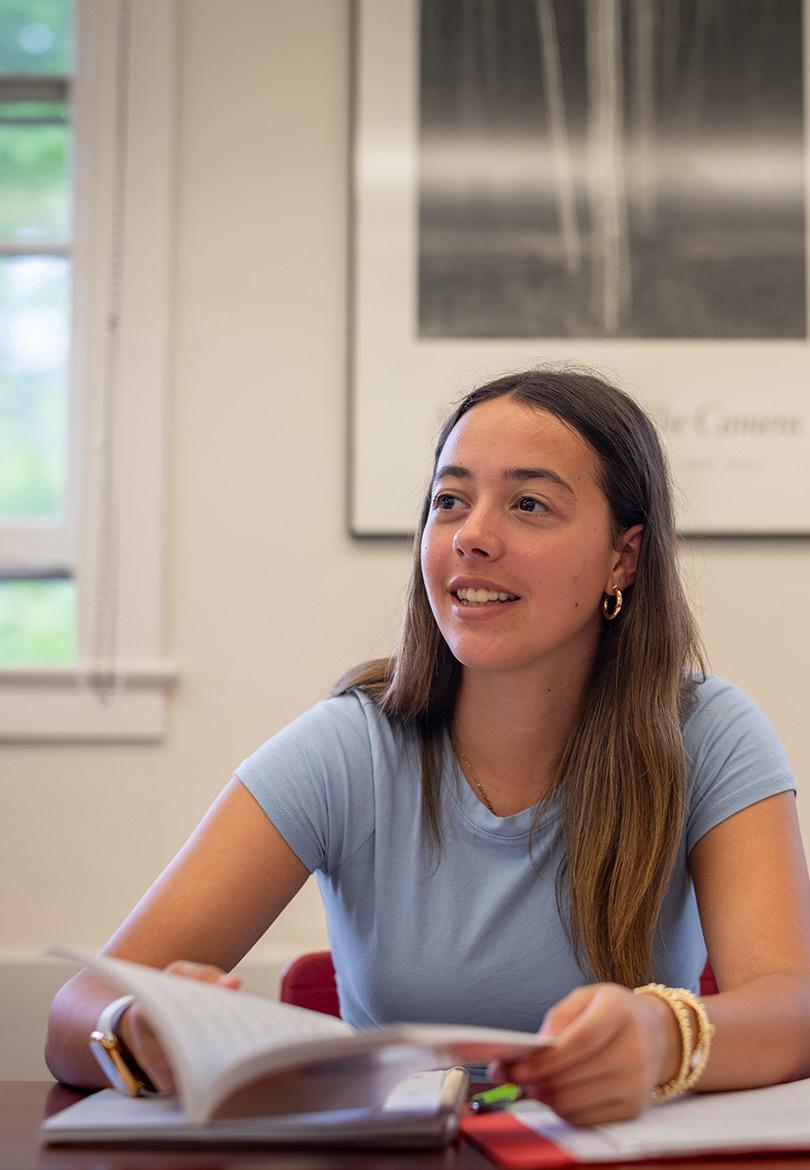
On behalf of the Academic Office and our faculty, we are delighted to share with you our Curriculum Guide for the 2026-27 academic year. School, and learning in general, should be an adventure. We cannot know how it will unfold until we embark upon the journey, which is precisely what makes it so exciting. In these pages, you will discover Gunn’s 150 course offerings, including more than 40 advanced classes across the disciplines. Our hope is that you will use this as a map to chart a course that will enrich and challenge you over the coming years.
One of our core aims at The Frederick Gunn School is to keep the sense of wonder and delight alive in you as a learner. We will provide all the support and structure you need along the way, and we will also challenge you to take agency over your learning and to expand in the independent pursuit of your passions. The way we grow is by finding objects of study towards which we wholeheartedly turn our attention, effort, intelligence, and imagination. Our hope is that you will take with you from Gunn a sense of confidence and an understanding of how you learn that will serve you throughout your life.
We live in a time when technology raises many questions about what it means to be successful and to live a good life. At The Frederick Gunn School, our interest in your future prompts us to turn with renewed focus to the skills and qualities that are distinctly human. Highlanders are always learning, and our immersive boarding school environment means that you will learn, lead, and flourish not only in the classroom, but also in athletics, the arts, the outdoors, and our residential life program. What is wonderful about the human skills that you will further develop at Gunn is that pursuing them not only helps you practically, in your work and your studies, but also enriches your experience of daily life and offers you a deeper way of engaging with the world around you.
Mentorship is central to everything we do at Gunn. Like our co-founders, Frederick and Abigail Gunn, who believed that strength of character is the goal of education, we seek to develop the full character of our students. This means that all of the adults in our school care about how you can deepen your perception, build your confidence and intelligence, find yourself within your friend groups, house, team, class, and community, and develop a moral core oriented around being honorable, compassionate, and open to viewpoints that may be different from your own.
Whichever path you set out on, our community of teachers and learners will be there to guide you. If you have questions about our curriculum, please contact the Academic Office at academics@frederickgunn.org.
Sincerely,
Dr. Katie Fleishman Assistant Head of School for Academics
Dr. Jack Fuller Chief Education Officer
DIPLOMA REQUIREMENTS
FOR ALL STUDENTS ENROLLED AT THE FREDERICK GUNN SCHOOL, 18 CREDITS ARE REQUIRED FOR A DIPLOMA.
THE DIPLOMA REQUIREMENTS INCLUDE:
4 ENGLISH (required every year)
3 HISTORY (including U.S. History)
3 LAB SCIENCE
3 WORLD LANGUAGES (through Level III)
3 MATHEMATICS (through Algebra II)
1 VISUAL AND/OR PERFORMING ARTS
(This can be accomplished through three single-term courses or one full-year course.)
IN ADDITION, STUDENTS MUST SUCCESSFULLY COMPLETE AND ADHERE TO*:
1 TERM OF PATHWAYS (as a first-year student)
1 TERM OF CITIZEN GUNN (as a sophomore)
1 TERM OF THE DECLARATION (as a junior)
THE CIVIC CHANGEMAKERS PROJECT (CCP) (30-hour service commitment as a senior)
GOOD CITIZENSHIP (civility and law-abiding behavior)
*Together Pathways, Citizen Gunn, and The Declaration constitute one credit.
Seniors must earn a final average of 70 or above and pass all cumulative final exams in diploma requirement courses to earn a diploma. Seniors on Academic Warning at year’s end do not receive an official diploma. The school reserves the right to withhold a diploma from students with poor citizenship. In such cases, a student receives a Certificate of Attendance and may petition the Head of School in writing for a diploma upon successful, documented completion of one year of college.
WHAT MAKES ACADEMICS AT THE FREDERICK GUNN SCHOOL DIFFERENT? PROGRAMS
THAT CHALLENGE. TEACHERS WHO INSPIRE.
Beyond core coursework, all students at The Frederick Gunn School are required to take one course per year in the Center for Citizenship and Just Democracy and choose one course during Highlander Term. These are just two of our six Signature Programs outlined below that help Highlanders develop the lifelong learning and leadership skills they need to thrive at Gunn and beyond.
THE CENTER FOR CITIZENSHIP AND JUST DEMOCRACY
Our four-year citizenship curriculum is based on the mission of the school and encourages students at every level to engage in topics and projects of interest that foster self-awareness and responsibility. In Pathways, the focus is self-awareness — emotional, physical, and intellectual — to help all first-year students adjust seamlessly to The Frederick Gunn School. In Citizen Gunn , sophomores explore the legacy of Frederick Gunn while developing the relational and communitybuilding skills that define active citizenship. The Declaration helps all juniors prepare to deliver a speech to the entire school, a rite of passage for every Highlander. As seniors, students complete their journey with the Civic Changemakers Project, a diploma requirement, applying their skills and passion to make a meaningful impact.
THE CENTER FOR ENTREPRENEURSHIP
At Gunn, we empower students to be creators and problem-solvers. Elective courses such as Sports Business Seminar and Becoming an Entrepreneur foster a mindset we call self-starterism Its premise: challenges are best faced with initiative and action. Rather than waiting for solutions, students learn to take ownership and create meaningful change. This is where students can fuel their desire to make a mark by building something great.
GUNN OUTDOORS
Deeply rooted in our history and traditions, this program offers opportunities to engage with the natural world, develop leadership skills, and gain independence. Students can expand their knowledge and view of the world, and their place in it, by spending time outdoors — hiking, camping, canoeing, backpacking, or taking a Nature Writers class. We believe, as did our co-founders, that education should not be bound by the walls of the classroom, and that experiencing the outdoors contributes to the development of character.
GUNN SCHOLAR
Gunn Scholars don’t just study history — they write it. Through this yearlong program, students have the opportunity to investigate original topics tied to our school, our region, and the people and forces that shape our experience. This is a select group, but students who are accepted can choose the topic they want to study, develop a proposal, conduct primary-source research to support their thesis, and present their findings to the community.
HIGHLANDER TERM
Highlander Term offers students an immersive, 10-day journey of experiential learning. Students can choose from more than 20 on- or off-campus experiences, offering them the chance to dive deep into new and exciting passions while exploring one of Gunn’s four Pillars. Course offerings include a variety of extended travel experiences as well as the option to craft a unique internship experience.
IDEAS LAB
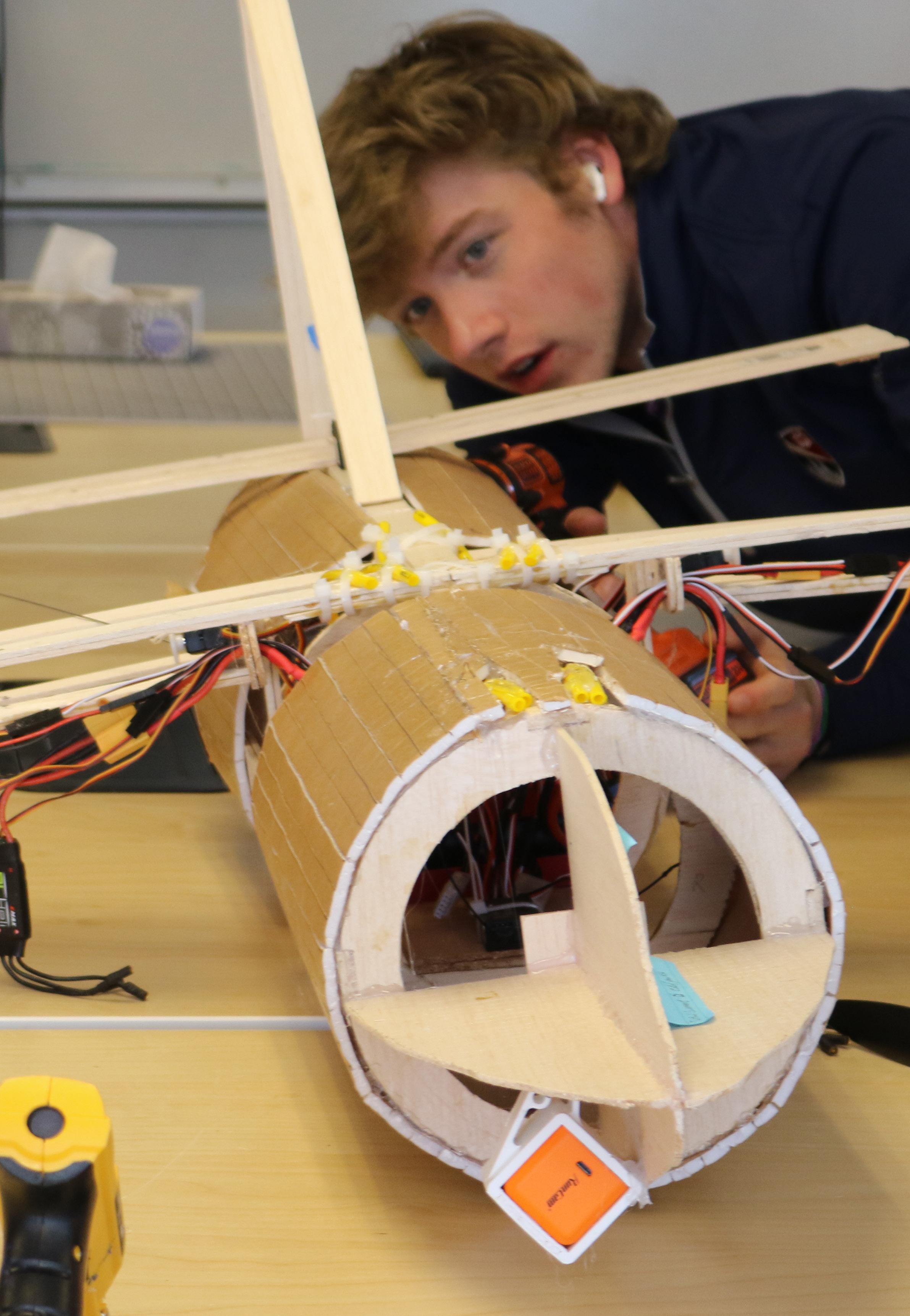
Explore our courses in engineering and robotics as a first step toward pursuing these passions in college and in life. The IDEAS Lab offers hands-on experience and the chance to put engineering design principles into practice. Students have access to the tools and technology to build a remote-controlled hovercraft, an FPV racing drone, a series of projects using Arduino and Raspberry Pi, and more. IDEAS Lab is where students combine STEM skills with innovation and entrepreneurship to enact positive change in the world.
ENGLISH
DIPLOMA REQUIREMENTS:
4 ENGLISH (required every year)
Each junior/senior course is labeled with a number (1-4), indicating its level of rigor or challenge (with 4 being the most challenging). Any Honors students in their junior or senior year who are interested in taking the AP Language and Composition exam should speak to their teacher.
REQUIRED COURSES
ENGLISH LANGUAGE AND COMPOSITION
English Language and Composition is an intensive course for new international students needing a thorough preparation in English listening, reading, writing, and conversation for successful academic work in a U.S. college preparatory program. Students review verbs, verbals, and syntax for both formal and informal English to address English grammar skills. They also study academic and idiomatic vocabulary. The course is open only to new international students.
ENGLISH I
English I seeks to establish a solid foundation for subsequent study in both literature and composition. Through an examination of a range of literature, students are encouraged to consider other perspectives, reflect on their own perspective, and begin to recognize patterns in literature. Class discussions and group work help to facilitate these explorations. Writing assignments are creative, expository, and critical in nature. In addition, instruction in advanced reading skills and grammar gives students a sense of the structure and the patterns found in various literary forms, including short stories, novels, poetry, and drama.
ENGLISH II
English II sets forth to explore the enduring and evolving power of literature. In this journey, students read epic poetry, novels, drama, and short fiction, pairing older and more contemporary texts to examine the human condition through subjects such as heroism, villainy, otherness, identity, loyalty, honor, and power. Through class discussions and written reflections, students learn to engage with the assigned readings from an increasingly analytical perspective. In addition, students review grammatical concepts in order to improve their writing skills, study vocabulary in context, and continue to develop as critical thinkers.
ENGLISH II HONORS
Students in this class move into independent analytical work earlier than those in the regular course, are expected to play an active role in student-driven discussions, and will be asked to examine additional and alternative readings. Admission is based on past performance, teacher recommendations, and approval of the Academic Office and English Department Chair.
LOOKING FOR AMERICA (2)
This course explores an American landscape, literally and imaginatively, and considers how the idea of America shapes and is shaped by the stories we tell about it. Students will read a selection of fiction and non-fiction with a particular focus on the perspectives of immigrants, dreamers, outcasts, and wanderers, keeping in mind the literary and historical contexts in which they are grounded. As in English I and English II, students will continue to develop their skills as close readers, critical and creative thinkers, and analytical writers.
HONORS ENGLISH: THE SOCIOCRITICAL ESSAY (3)
This yearlong Honors English course, open to juniors and seniors, is designed to explore and practice the personal essay within the context of a larger society. It explores concepts of self and society through a variety of specific topics, including literacy, education, identity, and ethics. Students will engage in class discussion led by their own critical thinking and critical questioning while also centering their own lived experience. Through that process, they will learn to examine their own ideas as they work toward developing a more fully formed written voice. This course contains a robust writing component that focuses on and encourages the writing process as much as, or more than, the final written product. At the end of the fall and spring terms, students will be expected to develop portfolios showcasing their written work.
HONORS ENGLISH: LITERARY CRITICISM AND CRAFT (3)
This yearlong Honors English course, open to juniors and seniors, is an intensive examination of literature from the writer’s perspective. Students will assume the roles of writers, learning from other writers, analyzing critically the formal elements of poetry, drama, and literary short fiction to understand how those elements combine to form a fully-realized work of literature. While establishing this theoretical foundation, students will take up the pen and create original works of poetry, drama, and short fiction in their own right. Assignments will include daily reading assignments, critical essays, and opportunities to craft and workshop original works of poetry, drama, and short fiction.
CRITICAL READING AND COMPOSITION (1)
This course takes a deep dive into basic approaches to critical reading, thinking, discussion, and composition. Over the course of the school year, students will explore a variety of literary forms — including short fiction, the novel, drama, and poetry — with a strong emphasis on close reading skills. Writing assignments will include journal responses as well as longer, more formal essays, and time and attention will be devoted to each stage of the writing process: from pre-writing through drafting and revision. We will also invest time in grammar and usage topics specifically related to the construction and revision of sentences.
LITERARY GENRES (2)
Literary Genres focuses on the close reading of a variety of forms of literature and the ways in which their structures help to create meaning. The class will examine scripts for stage and screen, novels, short stories, and poetry/music, spanning the 16th through 21st centuries, with each term focusing on a particular form. Students will be expected to read and engage with texts through formal and informal discussion, journal writing, and essay writing. They will also give presentations on course-appropriate topics. As in English I and English II, students will continue to develop their skills as close readers, critical and creative thinkers, and analytical writers.
ADVANCED PLACEMENT ENGLISH LITERATURE AND COMPOSITION (4)
The AP English Literature course focuses on the careful reading, critical analysis, and enjoyment of imaginative literature. It includes the close reading of selected works of fiction, drama, and poetry from the 16th to the 21st century; the development of critical thinking skills; formal essay and informal journal writing; and AP practice exercises. Because a high score on the AP exam may earn college credit, the course may be considered equivalent to college firstyear English. A supplementary reading assignment will be required over the summer for review in the fall. Admission is based on past performance, teacher recommendations, and approval of the Academic Office and English Department Chair.
NATURE WRITERS (2)
This is a writing-intensive course for students interested in nature. New England is famously home to some of the most well-respected nature and environmental writers, and Highlanders can join in that tradition! We will read and write both poetry and nature essays while also spending time outside observing, hearing, and touching the natural world of which we are all a part. Whether on or off campus, students can expect to experience their external — and internal — worlds in new ways, and learn how to communicate their new perspectives through a variety of written genres, including a long-form, personal, scientific narrative, local history essays, and creative research projects.
HONORS ENGLISH: READING AND RHETORIC (3)
This yearlong Honors English course, open to juniors and seniors, is designed to help students make the shift from reading and writing as skills to reading and writing as art forms. Students will explore and practice rhetorical analysis both in its classic context of speech/essay critique as well as using it as a lens for reading literature. By expanding their notion of “text” to include more than just essays, poems, and stories, students will think critically about the world around them as they observe advertisements, social media posts, posters, songs, and more. The overall goal of this course is to provide students with the skills and tools necessary to be careful, considered, and persuasive readers, writers, and thinkers.
THE DEATH OF THE AUTHOR: HUMAN EXPRESSION IN THE AGE OF ARTIFICIAL INTELLIGENCE (2)
This course seeks to track down and unmask the complicated, shadowy figure of the author by interrogating the notion of authorship itself. What, for instance, does it mean to be original? What does it mean to be creative? Where does inspiration come from, and what is the relationship between an idea and the expression that follows from it? What, ultimately, can it mean to claim ownership of an essay, a poem, a song, a story? Students will complete a number of short- and long-term creative projects and read a broad range of texts, including essays, fiction, poetry, articles, and legal opinions, to explore the above questions and the implications they have for human expression today.
DYSTOPIAN LITERATURE (2)
This course is an in-depth study of dystopian literature with intentional focus on close reading, in-class discussion, and analytic writing. Students in this class will strengthen their critical and creative thinking skills, as well as their discourse and writing skills, and participate in regular in-class discussions, written responses, and creative projects. Throughout the course, students will read literature about imagined realities in which characters face extreme challenges because of deprivation, oppression, or both. Students will be asked to apply real-world exploratory and reflective thinking in connection with their interpretation and analysis of literary texts.
WORLD LANGUAGES AND CULTURES
DIPLOMA REQUIREMENTS:
3 WORLD LANGUAGES (through Level III)
REQUIRED
COURSES FRENCH LANGUAGE
FRENCH I
This course provides students with an introduction to the four basic skills of language learning: listening, speaking, reading, and writing. Students are introduced to basic French syntax and structures, verb forms, and extensive vocabulary via thematic units. They develop an awareness of Francophone culture through exposure to a variety of authentic sources. Students must earn a passing grade in the course and a minimum score of 50% on the cumulative final exam in order to receive credit and advance to the next level.
FRENCH II AND FRENCH II HONORS
In these courses, students will continue to hone their listening, speaking, reading, and writing skills. Thematic units serve as the vehicle for expanding the students’ vocabulary and exposing them to a wider variety of grammar structures. Cultural context will continue to be a key factor in increasing the students’ knowledge and understanding of the Francophone world. Students must earn a passing grade in the course and a minimum score of 50% on the cumulative final exam in order to receive credit and advance to the next level. The materials for these courses are from D’accord 2 (Vista), original materials generated by the teacher, and culturally authentic sources that are adapted by the teacher.
FRENCH III AND FRENCH III HONORS
In these courses, students will build upon the skills they have developed over the past two years. They will continue to acquire a wider variety of verb tenses and more advanced grammar structures, expand their range of vocabulary and idiomatic expressions, and further their knowledge and understanding of the Francophone world. Students will also enhance their reading skills by reading longer passages from the text as well as a short reader. Students must earn a passing grade in the course to receive credit and fulfill their graduation requirements.
ELECTIVE COURSES FRENCH LANGUAGE
FRENCH IV: UNDERSTANDING OF CONTEMPORARY FRENCH CULTURE
“Liberté, égalité, fraternité” define the French spirit and the core values and fundamental principles of French society. These three words also apply to French culture, free, diverse, but always unified. This course will introduce students to contemporary French culture by studying modern French literature, fine arts, architecture, cinema, music, sport, fashion, and gastronomy. Students will practice listening, reading, writing short paragraphs, and reviewing basic grammar concepts. This course’s primary focus will be developing speaking skills through group and individual projects. Admission is based on past performance, teacher recommendation, and approval of the Department Chair.
ADVANCED PLACEMENT FRENCH LANGUAGE
This course is conducted entirely in French and prepares students to take the AP French Language and Culture Exam in the Spring Term. Students develop proficiency in listening, speaking, reading, and writing through a study of six cultural themes: les défis mondiaux, la science et la technologie, la vie contemporaine, la quête de soi, la famille et la communauté, et l’esthétique. Video clips, songs, online sources, and newspapers supplement the required texts and are used weekly to explore the Francophone world. Expectations of student participation are high. All students are required to take the Advanced Placement exam. Admission is based on past performance in French IV, teacher recommendation, and approval of the Department Chair.
REQUIRED COURSES MANDARIN LANGUAGE
MANDARIN I
This course in Mandarin (Pǔtōnghuà) is designed for students with minimal to no prior exposure to the Chinese language. The emphasis of this course is to develop listening, speaking, reading, and writing skills using simplified Chinese characters. These will be taught using course materials, including the textbook, Integrated Chinese: Level 1 textbook (4th Edition), which students will progress halfway through by the end of the year, learning approximately 150 words and 175 characters. Students will develop the ability to make introductions, discuss family, schedule appointments, and share hobbies, likes, and dislikes. Cultural lessons will also complement language instruction to help students gain a broader understanding of the Chinese-speaking world. Students can certify their interpersonal language abilities by taking the AAPPL exam in the spring. A passing grade in the course and a minimum score of 50% on the cumulative final exam is required to receive credit and advance to the next level.
MANDARIN II
This course in Mandarin (Pǔtōnghuà) is designed for students who have had one full year of study or equivalent in Chinese. Students will study more complex grammar and specialized vocabulary to further develop their listening, speaking, reading, and writing skills. Greater emphasis is placed on speaking and writing at length, with the goal of practicing paragraph-length discourse. Course materials include the textbook, Integrated Chinese: Level 1 textbook (4th Edition), which students will study during the second half of the academic year, learning over 200 new words and characters. Cultural lessons will complement language instruction to help students gain a broader understanding of the Chinese-speaking world. Students have the option to certify their interpersonal language abilities by taking the AAPPL exam in the spring. A passing grade in the course and a minimum score of 50% on the cumulative final exam is required to receive credit and advance to the next level.
MANDARIN III
This course in Mandarin (Pǔtōnghuà) is designed for students who have had two full years of study or equivalent in Chinese. Students will continue to study more complex grammar and specialized vocabulary to further develop their listening, speaking, reading, and writing skills. Greater emphasis is placed on listening to and reading longer-form materials as well as speaking and writing at length, with the goal of achieving comfort in producing and engaging with paragraph-length discourse. Course materials include the textbook, Integrated Chinese: Level 2 textbook (4th Edition) as well as supplementary, authentic reading and listening materials. Students will learn hundreds of new words and characters and be expected to communicate almost entirely in Mandarin in the classroom. Cultural lessons will also complement language instruction to help students gain a broader understanding of the Chinese-speaking world. Students have the option to certify their interpersonal language abilities by taking the AAPPL exam in the spring. A passing grade in the course is required to receive credit and fulfill graduation requirements.
Elective Course Mandarin Language
MANDARIN
IV
This elective course in Mandarin ( Pǔtōnghuà) is for students who have had three full years of study or equivalent, or greater, in Chinese. Students will attend class in an immersive language environment in order to best improve their listening, speaking, reading, and writing skills. This course has no designated textbook, but will instead pull authentic language materials from a variety of sources to expose students to a more diverse spectrum of the Chinese language. Students will continue to study more complex grammar structures and specialized vocabulary, including idioms, and will routinely be expected to produce longerform compositions and spoken presentations to improve their ease of expression in both speaking and writing. Cultural lessons and discussions will also complement language instruction to help students gain a greater understanding of the Chinese-speaking world. Students are encouraged to certify their interpersonal language abilities by taking the AAPPL exam in the spring. Admission to the course is based on past performance, teacher recommendation, and approval of the World Languages Department Chair.
REQUIRED COURSES SPANISH LANGUAGE
SPANISH I
This course provides students with a foundation in the four essential skills of language learning: listening, speaking, reading, and writing. Thematic units serve as the vehicle for introducing students to basic Spanish syntax and structures, verb forms, and extensive vocabulary. Students also develop an awareness of Hispanic culture through exposure to a variety of authentic sources. Students must earn a passing grade in the course and a minimum score of 50% on the cumulative final exam in order to receive credit and advance to the next level. The materials for this course are from Senderos, Level 1 (Vista) and original, culturally authentic materials generated by the teacher.
SPANISH II AND SPANISH II HONORS
In these courses, students will continue to hone their listening, speaking, reading, and writing skills. Thematic units serve as the vehicle for expanding the students’ vocabulary and exposing them to a wider variety of grammar structures. Cultural context will continue to be a key factor in increasing the students’ knowledge and understanding of the Hispanic world. Students must earn a passing grade in the course and a minimum score of 50% on the cumulative final exam in order to receive credit and advance to the next level. The materials for these courses are original materials generated by the teacher and culturally authentic sources that are adapted by the teacher.
SPANISH
III AND SPANISH III HONORS
In these courses, students will build upon the skills they have developed over the past two years. They will continue to acquire a wider variety of verb tenses and more advanced grammar structures, expand their range of vocabulary and idiomatic expressions, and further their knowledge and understanding of the Hispanic world. Students will continue to enhance their reading and listening skills through various activities and projects. The materials for this course will be Senderos, Level 2 (Vista), emphasizing and refining grammar learned in Spanish II while incorporating materials from the second half of the book. Additionally, students will engage with original, culturally authentic materials created by the teacher. Students must earn a passing grade in the course to receive credit and fulfill their graduation requirements.
Elective Courses Spanish Language
SPANISH IV
POPULAR CULTURE IN LATIN AMERICA
This course will embark on historical moments vital to understanding the shaping of Latin America today. It will explore social and cultural identities crucial to understanding Latin American cultures. Taught primarily in Spanish, it will seek to refine and expand the basic skills of listening, reading, writing, and speaking. Students will research, read, and discuss various works, including music, poems, online resources, excerpts from interviews, short stories, and novels grouped into thematic units. In addition, students will screen and discuss films relevant to the themes. The course will provide students with a review and expansion of essential grammar concepts, intending to develop the student’s ease of expression in conversation and writing.
ADVANCED PLACEMENT SPANISH LANGUAGE
This course is conducted entirely in Spanish and prepares students to take the AP Spanish Language and Culture Exam in the Spring Term. Students develop proficiency in listening, speaking, reading, writing, and culture through the study of six themes: global challenges, science and technology, contemporary life, personal and public identities, families and communities, and beauty and aesthetics. Video clips, songs, online sources, and newspapers supplement the required texts and are used to explore the Hispanic world. Expectations for student participation are high, and the Advanced Placement exam is required of all students. Admission is based on past performance in Spanish IV, teacher recommendation, and approval of the World Languages Department Chair.
World Language Department Elective Course
WORLD LANGUAGE CULTURES
In this course, students will explore a comprehensive understanding of diverse cultural elements from French, Mandarin, and Spanish backgrounds. They will delve into the historical and geographical contexts of countries where these languages are spoken, engage with classic literature, including novels, and analyze related films and video clips. Additionally, students will learn about and commemorate typical holidays, develop fundamental grammar and vocabulary skills, and examine various art forms. Those with prior language experience will take on leadership roles during language basics. This course is designed to cultivate and enrich students’ cultural awareness within the languages offered by the World Languages Department. Prerequisites include teacher recommendation and approval from the World Languages Department Chair. Texts include The House on Mango Street, by Sandra Cisneros, Colors of the Mountain, by Da Chen, and Waiting for Godot, by Samuel Beckett.
NOTE: THE DEPARTMENT RESERVES THE RIGHT TO OFFER ONLY THOSE ELECTIVE OR ACCELERATED COURSES THAT MEET MINIMUM ENROLLMENT REQUIREMENTS.
INDEPENDENT STUDY PROJECT
The Frederick Gunn School supports the study of languages not offered by our faculty through our Independent Study Project (ISP) option. Students with a foundation of study or speaking in a language other than French, Spanish, or Mandarin can be supported through an online learning platform and supervised by the World Languages Department Chair. Please follow the ISP process at the end of this guide and note that an exemption can be made to the prerequisite of ISPs only being open to returning students.
NOTES
MATHEMATICS
DIPLOMA REQUIREMENTS:
3 MATHEMATICS (through Algebra II)
REQUIRED COURSES
MATHEMATICS 10
ALGEBRA I
This is an introductory course in algebra. Topics include field axioms, operations on real numbers, solving linear equations and systems of linear equations, graphing linear equations and inequalities, exponents, radicals, polynomials and factoring, and quadratic functions. There is a heavy emphasis on problem-solving strategies. A TI-84 Plus graphing calculator is required. Students must pass both the course and the cumulative final exam in order to receive credit in this diplomarequirement course.
MATHEMATICS 20 GEOMETRY
This course emphasizes problem-solving in real-life situations using geometric concepts. Formal proofs are introduced, but greater attention is devoted to practical applications, such as perpendicular lines and area, as well as the language of geometry. A TI-84 Plus graphing calculator is required. Students must pass both the course and the cumulative final exam held at the end of the Winter Term in order to receive credit in this diploma-requirement course. Students will study algebra during the Spring Term.
MATHEMATICS 21 GEOMETRY
This course stresses the language of geometry, the development of proof, and the appropriate applications from algebra. The use of definitions, postulates, and theorems to justify conclusions will be emphasized. A TI-84 Plus graphing calculator is required. Admission is based on past performance, teacher recommendation, and department chair approval. Students must pass both the course and the cumulative final exam in order to receive credit in this diploma-requirement course.
MATHEMATICS 29 TOPICS IN ALGEBRA II
MATHEMATICS 30 ALGEBRA II
This is a second course in algebra. Topics include natural numbers and integers, rational numbers, linear equations, polynomials and factoring, coordinate geometry, complex numbers, relations and functions, exponents and logarithms, quadratic relations, and word problems. A TI-84 Plus graphing calculator is required. Students must pass both the course and the cumulative final exam in order to receive credit in this diploma-requirement course.
MATHEMATICS 32 ALGEBRA II HONORS
This is a second course in algebra. Topics include an in-depth look at linear, quadratic, and rational functions. Other topics may include: statistics, probability, and trigonometry. Students will be asked to analyze problems analytically, numerically, and graphically. A TI-84 Plus graphing calculator is required. Students will be placed in this course based on placement test results, current teacher recommendation, and department chair approval. Students must pass both the course and the cumulative final exam in order to receive credit in this diploma-requirement course.
This is a more demanding and enriched Algebra II curriculum with additional topics that include transformations of functions, exponential and logarithmic functions, and complex numbers. This class brings together talented students who enjoy math and whose scholarship indicates a strong sense of responsibility. Enrollment is based upon past performance, teacher recommendation, and department chair approval. A TI-84 Plus graphing calculator is required. Students must pass both the course and the cumulative final exam in order to receive credit in this diploma-requirement course.
ELECTIVE COURSES
MATHEMATICS 40
TOPICS IN MATHEMATICS
This course is open to any student who has completed Algebra II. Throughout the year, students will tackle various concepts related to financial literacy. Some of the main topics include financial responsibility, credit and privacy concerns, exploring insurance, taxes, saving for retirement and investing. Various projects will be given so that students can explore these topics relevant to their own experiences and interests. This course allows students to see practical applications of mathematics in their future.
MATHEMATICS 41 STATISTICS
This course is for students who have completed Algebra II. The course is intended to expose students to a selection of fundamental concepts in statistics while making the underlying, implicit assumptions of the field about the relationship between math and the world explicit. The fall will focus on the nature of measurement. The winter will concentrate on what “data” means, and statistics’ methodological framework therein. In the spring, students will do a variety of projects to make use of the stats knowledge they have gained. The course will explore these topics and themes through a mixture of primarily class discussions and in-class activities.
MATHEMATICS 45 PRECALCULUS
This course is intended for students who have completed Algebra II and want to continue their study towards calculus. Topics include: analysis of polynomial functions, exponential and logarithmic functions, trigonometric functions, complex numbers, translating graphs, and applications. Heavy emphasis is placed on trigonometric concepts and graphing. Admission is based on past performance, teacher recommendation, and department chair approval. A TI-84 Plus graphing calculator is required.
MATHEMATICS
50
HONORS PRECALCULUS/CALCULUS A
This course is open to students who have completed Algebra II and received a recommendation from their previous teacher and the department chair. During the Fall Term, students will review functions while discussing new calculus concepts such as limits, maximum and minimum values, and concavity. During the Winter Term, students will
dive into exponential, logarithmic, and trigonometric functions. During the Spring Term, students will tackle additional topics in calculus, and other topics chosen by the teacher. The course will tackle all problems with a similar approach that will be used in the AP Calculus curriculum. A TI-84 Plus graphing calculator is required.
MATHEMATICS 51 CALCULUS AND ANALYTIC GEOMETRY
This course is intended for students who have completed Precalculus and have a knowledge of college preparatory mathematics, including algebra, axiomatic geometry, trigonometry, and analytic geometry. It does not assume that they have acquired a sound understanding of the theory of elementary functions. The development of this understanding is the first priority of the course. Differentiation and integration techniques and applications will be studied. Admission is based on past performance, teacher recommendation, and department chair approval. A TI-84 Plus graphing calculator is required.
MATHEMATICS 52 ADVANCED PLACEMENT CALCULUS AB
This course follows the AP syllabus for Calculus AB. The course is intended for students who have completed Precalculus and have a thorough knowledge of college preparatory mathematics, including algebra, axiomatic geometry, trigonometry, and analytic geometry. Heavy emphasis is placed on the development of differential and integral calculus. Admission is based on past performance, teacher recommendation, and department chair approval. The Advanced Placement exam is required of all students enrolled in this course. A TI-84 Plus graphing calculator is required.
MATHEMATICS 53 ADVANCED PLACEMENT CALCULUS BC
This course follows the AP syllabus for Calculus BC and is for students who have completed Calculus AB. After the introduction to differential and integral calculus, topics discussed include analytic geometry, polar coordinates, differential equations, parametric equations, and infinite series. Admission is based on past performance, teacher recommendation, and department chair approval. A TI-84 Plus graphing calculator is required. The Advanced Placement examination is required of all students enrolled in this course.
MATHEMATICS
54
ADVANCED PLACEMENT STATISTICS
This course is for students who have completed Algebra II in good standing. Topics include: exploring data using various graphical and numerical methods, data collection and analysis, probability, statistical inference, using appropriate models, and tests of significance. Admission is based on past performance, teacher recommendation, and department chair approval. A TI-84 Plus graphing calculator is required. This course will follow and complete the Advanced Placement curriculum. The Advanced Placement exam is required of all students enrolled in this course.
MATHEMATICS 55 ADVANCED MATHEMATICS POST CALCULUS
This course is for students who have completed one or more years of AP Calculus and seek to deepen their engagement with college-level mathematics. Advanced Mathematics offers students the opportunity to design and pursue an independent project that bridges advanced mathematical concepts with their personal interests or future academic goals. Each student will submit a detailed proposal outlining a project that demonstrates a strong mathematical foundation while integrating real-world applications or interdisciplinary connections. The teacher will provide independent consultations with each student throughout the class period to make sure students are on task. Throughout the course, students will engage in regular consultations, collaborate with peers for feedback, and present their findings in both written and oral formats. This course challenges students to think creatively, apply mathematics beyond the classroom, and take ownership of a substantial, selfdirected learning experience.
ADVANCED COMPUTER SCIENCE
Advanced Computer Science is a course designed to provide students with a comprehensive understanding of computer science concepts and their applications. The course covers topics such as algorithms, data structures, programming, and problem-solving. Utilizing the Java programming language, students will apply their knowledge to create original programs. Emphasis is placed on the development of critical thinking skills, creativity, and the ability to design and analyze algorithms. Students will be expected to participate in group projects, problem-solving activities, and individual programming assignments. Although not a requirement, this course is designed to prepare students for the AP Computer Science exam, as well as for further study in computer science or related fields.
IDEAS LAB
ONE-TERM COURSES
INTRODUCTION
TO ENGINEERING
This course is designed to provide students with an introduction to the engineering design process, and provide hands-on experience using Onshape, a cloud-based, computer-aided design (CAD) software. The main focus of the course will be on a one-term project, where students will work in teams to design and build a remote-controlled hovercraft. Throughout this project, students will learn the principles of engineering design, including conceptualization, prototyping, testing, and iteration. By the end of the course, students will have a deep understanding of the engineering design process and the skills needed to use computer-aided design software to begin designing and building their own projects. No prior experience necessary.
INTRODUCTION TO ROBOTICS
This course will use the Vex Robotics platform as a way for students to learn the fundamental concepts of robotics and programming. Students will work in teams to design, build, and program robots using Vex Robotics kits and software. Through hands-on projects and challenges, students will learn about mechanical design, electronics, sensor integration, and programming concepts such as control structures, loops, and functions. Additionally, this course will cover the use of VEXcode, a text-based programming language that allows students to write programs to control their robots. A strong emphasis will be placed on problem-solving, critical thinking, and collaboration, as students work together to design and program their robots to complete various challenges and competitions. By the end of the course, students will have gained a solid foundation in robotics and programming, and will be able to apply what they have learned to design and build robots for various applications. No prior experience necessary.
INTRODUCTION TO CAD
This introductory course provides students with the fundamental skills and knowledge needed to create 3-D models using Onshape, a cloud-based CAD platform. Students will learn key concepts in parametric modeling, sketching, constraints, assemblies, and technical drawings. Through hands-on projects, they will develop problem-solving and design-thinking skills applicable to engineering, architecture, and
manufacturing fields. By the end of the course, students will be able to create precise digital models, collaborate in a cloud-based environment, and understand the role of CAD in modern product development. No prior experience is required, making this an excellent starting point for students interested in engineering, design, or related careers.
ADVANCED CAD
This course builds on foundational CAD skills, providing students with advanced knowledge and techniques in Onshape. Students will deepen their understanding of parametric modeling, multi-part design, complex assemblies, and technical drawings while exploring real-world applications in engineering and product design. Emphasis will be placed on efficiency, design intent, and collaboration using Onshape’s cloud-based tools. Throughout the course, students will complete industry-relevant projects, which will demonstrate their proficiency in professional CAD workflows. By the end of the course, students will have the skills and confidence to create intricate 3-D models and assemblies, preparing them for careers or further studies in engineering, architecture, and manufacturing. Successful students will have the opportunity to become a Certified Onshape Associate.
MAKERS AND MICROCONTROLLERS
This hands-on course introduces students to the world of Raspberry Pi, Arduino, and simple circuits, empowering them to design and build interactive projects. Students will explore the fundamentals of electronics, coding, and hardware integration while developing problem-solving and creative thinking skills. Using Python and Arduino programming, they will bring their ideas to life through projects such as LED displays, sensor-based systems, motor controls, and basic automation. Through a project-based learning approach, students will gain experience in circuit design, microcontroller programming, and real-world applications of embedded systems. By the end of the course, students will have a portfolio of working prototypes and a deeper understanding of how technology powers the world around them. No prior experience is required — just a passion for making, coding, and exploring technology!
FULL-YEAR COURSE
ADVANCED ENGINEERING
Advanced Engineering is a challenging course that combines hands-on engineering projects with entrepreneurship skills. The course focuses on the design, development, and commercialization of innovative engineering solutions. Students will work in teams to complete a capstone project that integrates engineering principles with business strategies. The project will require students to identify an engineering problem, conduct market research, and create a product that addresses the problem. This course is designed for students with a strong background in engineering, who are interested in applying their skills in a real-world setting. Students will develop a deep understanding of how to create and launch a successful engineering-based start-up, and will gain valuable experience in product development, market analysis, and business planning. The course is an excellent opportunity for students who are interested in entrepreneurship, innovation, and the commercialization of technology. Prerequisite: Introduction to Engineering, CAD 1, and Makers and Microcontrollers.
NOTES
SCIENCE
LABORATORY COURSES
BIOLOGY
This course introduces students to the fundamental principles of life science. Through engaging lessons, hands-on labs, and interactive activities, students will explore topics such as biochemistry, microbiology and cellular biology, genetics, evolution, and ecology. Students will develop skills in data analysis, laboratory techniques, and scientific communication. By the end of the course, students will have a strong foundation in biology and an appreciation for the living world around them. Prerequisite: one year of high school-level lab science or permission of Science Department Chair for concurrent enrollment as a 9th grade student.
BIOLOGY HONORS
This course introduces students to the fundamental principles of life science with greater depth and expectation for student-driven projects and learning than the non-honors section. Students should expect to engage with the course as active contributors to discussion. Through engaging lessons, hands-on labs, and interactive activities, students will explore topics such as biochemistry, microbiology and cellular biology, genetics, evolution, and ecology. Students will continue to develop skills in data analysis, laboratory techniques, and scientific communication. By the end of the course, students will have a strong foundation in biology and an appreciation for the living world around them. There will be regular discussions and presentations on topics related to our course material. This course is intended for students who have demonstrated strong independent learning skills and are looking for a more rigorous challenge as they delve into these topics. Prerequisites: one year of high school-level lab science and recommendation of the Science Department.
ADVANCED PLACEMENT BIOLOGY
This course follows the Advanced Placement curriculum and is a rigorous, full-year, college-level biology course. The curriculum focuses on the four Big Ideas of biology: Evolution, Energetics, Information Storage and Transmission, and System Interactions. Subtopics include: genetics, ecology, cell structure and function, and biological diversity. Twenty-five percent of class time is dedicated to inquiry-based lab activities. The Advanced Placement Biology examination is required of all students enrolled in this course. This course is ideal for those students who have a strong foundation in chemistry, are comfortable with academic independence, enjoy collaborative problem-solving, and are eager to uncover the intricate biological processes that sustain life. Prerequisites: Chemistry (with a grade of 85% or higher), a year of first-year Biology is preferred as well, and recommendation of the Science Department. Any waiver of a prerequisite must be approved by the Science Department Chair.
HUMAN ANATOMY AND PHYSIOLOGY
This course provides students with an understanding and appreciation of the major body systems, their structures, and their functions. Clinical consideration and its impact are covered. This course is intended for students who are interested in careers in health-related fields, or who simply possess a curiosity to learn more about the human body. Labs and class activities are used for reinforcement of core concepts. Prerequisite: Biology (Note: This course is open to 11th and 12th grade students only).
ENVIRONMENTAL STUDIES
This course will consider the environment from the perspective of local ecology. It will be a laboratorybased course focused on learning the principles of ecology (the study of the interaction between organisms and their environment) and applying them to our local area. In this course, we will cover topics such as animal behavior, population biology, life histories, landscape ecology, and more. We will use the scientific method to understand and discover information about the space we live in. This course shows us that the fascinating phenomena of nature do not only happen in documentaries in far away places — they happen in our own backyard! Open to 11th and 12th grade students only.
ADVANCED PLACEMENT ENVIRONMENTAL SCIENCE
This full-year laboratory course in environmental science will provide students with the scientific principles, concepts, and methodologies required to understand the interrelationships of the natural world; to identify and analyze environmental problems, both natural and human-made; to evaluate the relative risks associated with these problems, and to examine alternative solutions for resolving or preventing them. Environmental science is interdisciplinary; it embraces a wide variety of topics from different areas of study. Yet there are several major unifying constructs, or themes, that cut across the many topics included in the study of environmental science. These topics include: energy conversions underlying all ecological processes; the earth as one interconnected system (biogeochemical systems); human impact on the environment, including technology and population impacts; the role of cultural, social, and economic factors in developing solutions; achieving sustainable systems and management of common resources. Prerequisites: two years of lab science, including Biology and/ or Chemistry, Algebra II (completed or concurrent), and recommendation of the Science Department. Any waiver of a prerequisite must be approved by the Science Department Chair.
PREMED
This course has a lab/practical component and thus qualifies as a lab science. The objective of this one-year course is to expose highly motivated high school students, who are interested in pursuing a career in medicine, to an introduction to clinical methods with hands-on experience in medical techniques (such as taking vitals) and a brief exploration of topics such as anatomy, histology, embryology, physiology, cardiology, neuroscience, pathology, immunity, and endocrinology, among others. Only one section of this course will be offered and priority will be given to those students who have demonstrated success in our department’s more rigorous courses as well as an interest in the content. Prerequisite: English II or higher and at least one of the following: Chemistry, Biology, Physics, Human Anatomy and Physiology, or Environmental Studies.
CHEMISTRY
The objective of this first-level chemistry course is to provide students with an understanding of basic inorganic chemistry. Through lectures, problem-solving, and experimentation, students will learn the fundamentals involved in changes to matter and energy. Topics include: measurement and calculation techniques, what is matter, the elements, atoms and ions and how they interact, nomenclature, chemical composition and reactions, solutions, states of matter, bonding, and how these relate to energy. Experiments are used to familiarize students with the scientific method and good lab practices, and to relate theory to practice. Prerequisite: completion of one year of high schoollevel lab science.
CHEMISTRY HONORS
The objective of this first-level honors chemistry course is to provide students with an understanding of basic inorganic chemistry. Through lectures, problem-solving, and experimentation, students will learn about the changes that occur in matter and energy. Topics include: chemical composition, reactions, and quantities, measurement and calculation techniques, what is matter, the elements, atoms and ions and how they interact, nomenclature, solutions, states of matter, bonding, acids-base behavior, and how these relate to energy. Experiments are used to familiarize students with the scientific method and good lab practices, and to relate theory to practice. Students will work towards proficiency in all aspects of quantitative analysis along with enhanced problemsolving skills. This course utilizes more math in both the content and to support data analysis than the non-honors section. This course is intended for students who are seeking a more rigorous delivery of first-year chemistry and who have demonstrated significant academic independence in their prior courses. Requirements: Students should be enrolled in Algebra II or a higher math course.
ADVANCED PLACEMENT CHEMISTRY
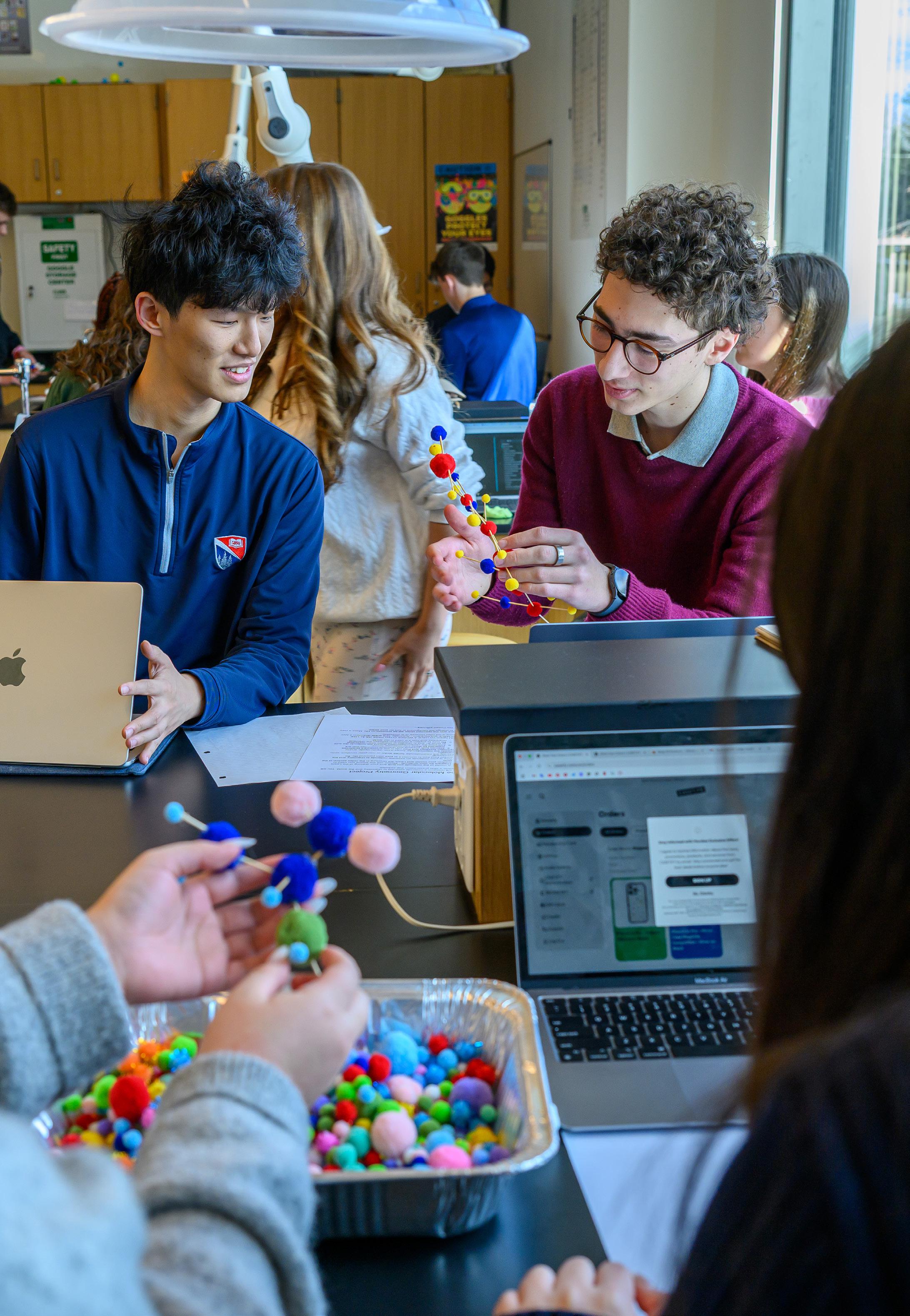
Advanced Placement Chemistry is a rigorous, fullyear, college-level course. Students in this course will attain a depth of understanding of fundamentals and a reasonable competence in dealing with chemical problems. Topics include: chemical bonding, molecular models (geometry), atomic structure and theory, states of matter (gas, liquid and solid), chemical reaction types, solutions and equations, equilibrium, chemical kinetic theory, and stoichiometry. The topics covered emphasize chemical calculations and mathematical formulation of basic chemical principles. The increased quantitative emphasis beyond that conducted within the first-level chemistry class appears both in each of the topics and in the time spent by students in laboratory analysis and calculations. Prerequisites: Chemistry Honors (with average grades of 85% or higher), completed Algebra II, and recommendation by the Science Department. Any waiver of a prerequisite must be approved by the Science Department Chair.
PHYSICS 9 (9TH GRADE)
This course surveys major topics in physics: laws of motion, universal gravitation, heat transfer and thermodynamics, electricity and magnetism, vibrations and waves, sound, light, color, optics, and atomic and nuclear physics. While the course emphasis is on conceptual knowledge of physics, manipulation of algebraic equations will be taught and included where appropriate and weekly analysis of laboratory data. The course will also teach and emphasize data analysis and the scientific process. This course is a requirement for all incoming 9th grade students who have not already taken a first year physics course in high school.
PHYSICS
This course surveys major topics in physics: laws of motion, universal gravitation, heat transfer and thermodynamics, electricity and magnetism, vibrations and waves, sound, light, color, optics, and atomic and nuclear physics. While the course emphasis is on conceptual knowledge of physics, there is a high level of routine manipulation of algebraic equations and weekly analysis of laboratory data. An online instructional tool will be utilized throughout the course. Prerequisites: Algebra II (completed or taken concurrently), one year of a lab science completed, and Science Department recommendation.
ADVANCED PLACEMENT PHYSICS 1
This full-year laboratory course is equivalent to a first-semester college course in algebra-based physics. The course covers Newtonian mechanics (including rotational dynamics and angular momentum), work, energy, and power, mechanical waves, fluids, and simple harmonic motion. The Advanced Placement Physics 1 final examination is required of all students enrolled in this course. An online instructional tool will be utilized throughout the course. Prerequisite: Algebra II (concurrent or completed with final average of 85% or higher), and recommendation of the Science Department. No prior physics course is required for this class.
ADVANCED
PLACEMENT PHYSICS 2
This full-year laboratory course is equivalent to a second-semester college course in algebra-based physics. This course covers thermodynamics, electricity and magnetism, optics, sound, and atomic and nuclear physics. The Advanced Placement Physics 2 final examination is required of all students enrolled in this course. An online instructional tool will be utilized throughout the course. Prerequisite: Algebra II completed plus enrollment in Precalculus or a higher-level math class (with average grades of 85% or higher); completed AP Physics 1 or an equivalent (with average grades of 85% or higher), and recommendation of the Science Department.
ADVANCED SCIENCE RESEARCH
An authentic, year-long laboratory experience is typically found at the college level. In this class, students will have the opportunity to design, propose, and execute an independent research project under the guidance of a dedicated teacher. Students will conduct original research in biology, chemistry, physics, engineering, or the social sciences, utilizing our world-class, on-campus laboratories. Students in the ASR program make real-world contributions through authentic, collegelevel research that addresses complex scientific questions. Each student will submit a detailed proposal outlining a project that demonstrates a strong science foundation while integrating realworld applications or interdisciplinary connections. Students will be encouraged to connect with professional scientists and to formalize their research in accordance with the Connecticut State Science Fair guidelines for submission. The teacher will provide independent consultations with each student throughout the class period to make sure students are on task. Throughout the course, students will engage in regular consultations, collaborate with peers for feedback, and present their findings in both written and oral formats. This course challenges students to think creatively, apply science beyond the classroom, and take ownership of a substantial, self-directed learning experience.
SCIENCE ELECTIVES (NON-LAB COURSE)
ABNORMAL PSYCHOLOGY
This is an introductory, one-term course in clinical psychology and human psychopathology. This course introduces students to vocabulary and fundamental diagnostic procedures of people with cognitive, mental, and emotional disorders. The major classes of mental disorders are reviewed as guided and diagnosed by the DSM-5. The course material is interdisciplinary; it examines biological, medical, psychological, social, cultural, and political aspects of mental illness. Students are taught ways to formulate and analyze psychopathology, with the purpose of helping them develop an introductory but integrated understanding of mental disorder and intervention. Focus will be on diagnosis, epidemiology, course of the disorder, etiology, and treatment issues. We will also briefly examine ethical and legal issues pertaining to psychopathology. A major goal of the course is to promote greater awareness and knowledge of psychopathology in hopes that we can reduce the suffering and stigma associated with mental disorders.
NOTES
HISTORY AND SOCIAL SCIENCES
DIPLOMA REQUIREMENTS
3 HISTORY (including U.S. History)
UNDERCLASSMEN REQUIRED COURSES
WORLD HISTORY, MODERN WORLD HISTORY, AND U.S. HISTORY (TAKEN JUNIOR YEAR) ARE REQUIRED FOR GRADUATION. STUDENTS MUST EARN THREE HISTORY CREDITS TO MEET THE GRADUATION REQUIREMENT.
WORLD HISTORY
First-year history is a big picture, thematic, and systematic examination of the past, from the early humans to modernity. As a class, we will seek out common themes and patterns that can help us better understand people, civilizations, and the world we live in. Our focus will include our human connection to all that is around us, both environmental and cultural, and as such the class will draw on many disciplines to inform our historical analysis. Students will encounter challenging ideas and difficult questions, and through these they will learn to make multidisciplinary connections. In engaging new ideas and information from a variety of sources, students will learn how to hypothesize, ask useful questions, seek out appropriate resources, analyze documents and content, make and support specific points, and write a clear and cogent argument.
MODERN WORLD HISTORY
Sophomore history builds on the topics studied in World History by exploring important themes and historical turning points, and assessing their impact on the modern world. Students will explore the Renaissance, the Age of Exploration, the Enlightenment, the Industrial Revolution, the World Wars, and the Cold War. The course will also cover the rise of nationalism, imperialism, and decolonization as well as globalization. Students will analyze the complex and ongoing conflicts in the world with particular focus on selected tensions in the Middle East, Asia, and Africa. Emphasis is given to the continued instruction and the practice of essential skills such as research, evaluating the credibility of sources, analyzing primary sources, developing historical arguments, and respectful debate and discussion.
MODERN WORLD HISTORY HONORS
Sophomore history builds on the topics studied in World History by exploring important themes and historical turning points, and assessing their impact on the modern world. Students will explore the Renaissance, the Age of Exploration, the Enlightenment, the Industrial Revolution, the World Wars, and the Cold War. The course will also cover the rise of nationalism, imperialism, and decolonization as well as globalization. Students will analyze the complex and ongoing conflicts in the world with particular focus on selected tensions in the Middle East, Asia, and Africa. Emphasis is given to the continued instruction and the practice of essential skills such as research, evaluating the credibility of sources, analyzing primary sources, developing historical arguments, and respectful debate and discussion. This particular course differs slightly from Modern World History in both its pacing and in its conceptual rigor. Expectations in various themes and skills will be significantly increased from the Modern World History level. Students must be recommended for this course.
UNITED STATES HISTORY
This course covers specific themes in U.S. History. In the Fall Term, the course focuses on the American Revolution, looking at its causes and impact, and explores the Constitution and the Bill of Rights, historically, and in the contemporary context. The Winter Term covers the antebellum era, the Civil War, Reconstruction, and explores how this divisive time in American history affected our national and social identity. In the Spring Term, the 1960s as a defining moment in American history is the focus. Topics include the Cold War, the Civil Rights movement, and the Vietnam War. The interdisciplinary Junior Research Paper and formal (and informal) debates provide students with opportunities to sharpen research, writing, and communication skills. Other projects call upon students to work in groups and to become more creative historians. In addition, students will develop active reading and analytical skills to aid in constructing incisive research questions about United States history.
ADVANCED PLACEMENT UNITED STATES HISTORY
The goal of this course is to provide preparation for the successful completion of the AP examination in American History. Selected documents pertaining to key economic, political, and social developments are discussed and analyzed. The Junior Research Paper, independent research projects, class discussion, and the use of primary material are included. The AP examination is administered to all students enrolled in this course. Enrollment must be approved by the Academic Office, in consultation with the department and using criteria that take into account grades, comments, and intellectual maturity.
UPPERCLASSMEN ELECTIVE COURSES –FULL YEAR
THE FOLLOWING ELECTIVE COURSES ARE OPEN TO JUNIORS AND SENIORS UNLESS OTHERWISE NOTED IN THE COURSE DESCRIPTION. THE DEPARTMENT RESERVES THE RIGHT TO OFFER ONLY THOSE COURSES THAT MEET MINIMUM ENROLLMENT REQUIREMENTS.
ECONOMICS
This yearlong course for juniors and seniors offers an introduction to key business concepts, financial literacy, and entrepreneurship. This course begins with a focus on the basics of business and economics. Students will explore different business structures, marketing strategies, management practices, and global commerce. The emphasis will then shift to corporate finance, covering financial statements, incentives, risk management, and capital budgeting. The course will conclude with an introduction to entrepreneurship, with a focus on identifying business opportunities, understanding the entrepreneurial mindset, conducting market research, developing business models, and learning about start-up ecosystems. During the course, students will learn the basic vocabulary and concepts to understand economic current events. Throughout the year, students will participate in hands-on projects, case studies, and discussions with guest speakers. Designed to provide a background in economics and develop an entrepreneurial mindset, this course provides the knowledge and tools students need to understand how to start and grow a business, making it perfect for those interested in business, innovation, and creative problem-solving.
ADVANCED PLACEMENT MACROECONOMICS
What can governments do to make their societies more prosperous? How can they escape economic depressions, shorten recessions, and make their economies more productive while avoiding inflation and unemployment? What concerns should we have about large trade deficits with other countries? Macroeconomics explores such questions by applying principles of economics to the economic system as a whole. The course gives special attention to understanding money and the financial system and how Congress and the Federal Reserve Bank can alter the economy. We also examine international trade and consider how monetary differences between countries can influence their trade. All students are required to take the AP Macroeconomics exam in May. In addition to preparing for the exam, students will engage in projects to examine important events in economic history, and they will join ongoing debates about macroeconomic policy. Enrollment must be approved by the Academic Office, in consultation with the department and using criteria that take into account grades, comments, and intellectual maturity. The AP exam emphasizes creating and interpreting graphs, so students considering this class should be confident in their ability to work with graphs.
AMERICAN GOVERNMENT AND POLITICS
This yearlong course guides students from the foundations of the United States to the practical application of governmental and political policy in the United States today. The curriculum begins with an analysis of democratic principles and foundational documents, featuring an in-depth study of federalism through independent research on state versus federal jurisdiction. As the year progresses, students explore the mechanics of the American political system, including political parties and ideologies, the roles of the Legislative and Executive branches, and the evolving landscape of voting rights and participation. The course concludes with an examination of the Supreme Court and the protection of civil liberties, requiring students to synthesize their knowledge through a “personal political profile” and a final cumulative project that applies constitutional frameworks to contemporary domestic news.
PHILOSOPHY SEMINAR HONORS
This course introduces key philosophical, moral, economic, and political concepts from the Ancient Greeks to the 21st century. The class follows a seminar format, where students will be expected to undertake weekly reading of primary sources
and engage in informed classroom discussion. Assessment will be based on participation, weekly short writing assignments, and longer essays, where students take a stand on philosophical issues.
GUNN SCHOLAR
The Gunn Scholar program is an endowed program that offers selected students opportunities to pursue research topics of their own choosing in the Paula and George Krimsky Archives and Special Collections. Students may apply to the program at the end of the junior year and complete a yearlong research project in senior year. Gunn Scholars finalize the scope of their thesis, develop a written record of their research, and present their findings at a conference in the spring. Students conduct primary-source research and place-based learning within the school’s archives. In previous years, Gunn Scholars have had opportunities to expand their research to other archives and collections, including those at the National Baseball Hall of Fame and Museum in Cooperstown, New York, the National Archives Museum in Washington, D.C., and the Beinecke Rare Book & Manuscript Library at Yale University Library. A generous gift from the Class of 1957 has assured the annual publication of Gunn Scholar research and each student’s illustrated paper is added to the archives, thereby enriching the school’s history and creating opportunities for further study. Since 2018, Gunn Scholars have presented their papers at the annual Highlander Summit, hosted by The Frederick Gunn School.
AP EUROPEAN HISTORY
In AP European History, students investigate significant events, individuals, developments, and processes from approximately 1450 to the present. Students develop and use the same skills, practices, and methods employed by historians: analyzing primary and secondary sources; developing historical arguments; making historical connections; and utilizing reasoning about comparison, causation, and continuity and change over time. The AP examination is administered to all students enrolled in this course. Students must have completed a full-year course in U.S. history, and be approved by the Academic Office, in consultation with the department and using criteria that take into account grades, comments, and intellectual maturity. Summer work is required.
CONTEMPORARY WORLD HISTORY HONORS
This is a rigorous, yearlong course for juniors and seniors that examines the pivotal events and shifting power dynamics defining the 21stcentury global landscape. The curriculum centers around three critical pillars of modern geopolitics: the post-9/11 evolution of the Middle East, the resurgence of Russian imperialism under Vladimir Putin, and China’s rapid ascent from a regional power to a global economic powerhouse. Students will investigate the historical roots of current conflicts, while comparing competing models of democracy, authoritarianism, and capitalism. Through the analysis of diverse primary sources, seminar-style discussions, and independent research, students will develop a sophisticated understanding of how ideological struggles and foreign policies contribute to international geopolitics.
ADVANCED PLACEMENT HUMAN GEOGRAPHY
This AP course introduces students to the systematic study of patterns and processes that have shaped human understanding, use, and alteration of Earth’s surface. Students employ spatial concepts and landscape analysis to examine socioeconomic organization and its environmental consequences. They also learn about the methods and tools geographers use in their research and applications. The AP examination is administered to all students enrolled in this course. Enrollment must be approved by the Academic Office, in consultation with the department and using criteria that take into account grades, comments, and intellectual maturity.
UPPERCLASSMEN ELECTIVE COURSES –ONE TERM
THE FOLLOWING ELECTIVE COURSES ARE OPEN TO JUNIORS AND SENIORS UNLESS OTHERWISE NOTED. THE DEPARTMENT RESERVES THE RIGHT TO OFFER ONLY THOSE COURSES THAT MEET MINIMUM ENROLLMENT REQUIREMENTS.
PSYCHOLOGY
ELECTIVES
SOCIAL PSYCHOLOGY
This one-term course explores how social contexts influence human behavior, attitudes, and beliefs, centering on the core themes of social thinking, social influences, and social relations. Throughout the term, students will examine topics such as conformity, obedience, group think, group polarization, the formation of interpersonal relationships, prosocial and antisocial behavior. There are no prerequisites for this course.
DEVELOPMENTAL PSYCHOLOGY
This one-term foundational course in psychology provides an overview of human development, exploring the physical, cognitive, and socioemotional changes that occur at each stage of growth. Students will examine the interplay between genetics and environment while considering the impact of culture and parenting. The curriculum covers a broad range of topics, including prenatal development, infancy, childhood, and the transition through adolescence into adulthood. Special emphasis is placed on cognitive evolution and socioemotional development, including attachment and the broader cultural and social influences that shape the individual. There are no prerequisites for this course.
COGNITIVE PSYCHOLOGY
This one-term course in cognitive psychology explores the mental processes that underlie human thinking, learning, and memory. Students will examine how individuals acquire, process, store, and retrieve information, including the fallibility of human memory. The curriculum also investigates the complex factors influencing motivation, attention, and decision-making, as well as the roles of judgment, problem-solving, and reasoning. There are no prerequisites for this course.
CENTER FOR ENTREPRENEURSHIP ONE- AND
TWO-TERM
ELECTIVES
SPORTS BUSINESS SEMINAR
This one-term class will look at how the sports business industry works and how to plan for a career in the industry. The class will follow a workshop format as the various business topics that are studied will be applied to understanding the structure and revenue flows of the U.S. and global sports business markets. We will have speakers with relevant industry experience come to class and share their real-life experiences with the students. At the end of the term, students will develop a business case covering one of the major sports leagues of their choosing and analyze one of the major franchises of that league, understanding the profit and loss statements, the human resource requirements, talent management, growth plans, marketing efforts, and competitive positioning. Students will be required to write, to use spreadsheets, and to use graphical displays in presenting their business plan. Students will also be required to present their arguments orally. Both verbal and written communication is a must! This class will look at successful leagues and franchises and ask what made them successful in their chosen path. Students in this class will focus on being independent problem-solvers. This class will also focus on exposing students to some of what they will see in the real world of sports business and equip them with an understanding of recruiting practices and how to maximize their chances of getting a job in the industry. Speakers, videos, discussions, and project work will make up a majority of this class, and class participation is expected. Students who sign up for this class must be ready to be proactive and try new things. No prior knowledge is required!
BECOMING AN ENTREPRENEUR
This is a one-term class that will explore the building of a business through case studies. This course is inspired by the NPR podcast, “How I Built This.” Students will explore business case studies across multiple industries. This course will provide students with background information about how a business is built, the challenges of start-ups, and business operations. Guest speakers will provide opportunities for students to engage with, interact with, and ask questions of real-life entrepreneurs. Students will be introduced to a diverse group of entrepreneurs, including a prominent casting director in the fashion industry, a YouTube/social influencer, a founder of a leveraged buyout firm, an entrepreneurial artist, a food company founder, a co-founder of an investment bank, an online retail CFO, and the founder of a large-event emergency care team. Assignments for this course will include presentations on each case study. These will require students to work on both their visual and oral presentation skills. Students who sign up for this course should be ready to engage in discussion daily and be eager to explore pushing the boundaries of the business world. No prior knowledge is required.
ENTREPRENEURSHIP AND ETHICAL BUSINESS SEMINAR (TWO-TERM)
Entrepreneurship is much more than simply starting a business. It requires innovation and risk, teamwork, and organizational skills. Entrepreneurship is impactful, political, and passionate. Entrepreneurship is one of the most effective ways to address social, environmental, and economic issues in our modern economy. In the Fall Term, we will start the class by learning the foundations of entrepreneurship. This will include finances, investing, marketing, legal matters, and professional development. The majority of the work will be student-driven. Students will partake in hands-on projects that teach the importance of raising capital and engaging with the community. In the winter, we will transition to the study of corporate social responsibility and how to develop a business that is a force for good. We will explore different industries in order to identify ideas that equally balance profits with social impact and sustainability. This class will regularly feature speakers, giving students the opportunity to learn from experienced entrepreneurs. The focus will be on project work, class discussions, and written assignments. Students who sign up for this class must be ready to be proactive, try new things, and learn from their failures. No other knowledge is required!
NOTES
THE ARTS
DIPLOMA REQUIREMENTS: 1 CREDIT VISUAL AND/OR PERFORMING ART
(This can be accomplished through three single-term courses or one full-year course.)
PERFORMING ARTS
MUSIC – JAZZ BAND (JB)
This ensemble rehearses and performs an eclectic variety of band music, including jazz, funk, blues, rock, popular, symphonic, holiday, film, and more. All band instruments are welcome! Brass and woodwind players must have at least one year of previous experience. All new students are required to complete an audition and/or submit a video recording of their playing for placement. Students should possess a basic skill level in reading music. Obligations include rehearsals during and after school (if applicable) and attendance at all performances (on campus, local, regional, and national). Students will learn how to work together to perform professional-level music as an ensemble while developing individual fundamentals toward a mastery of skills. For audition information or to submit a video, please contact Ron Castonguay, Director of the Arts and Music Director, at castonguayr@frederickgunn.org. Prerequisites: Previous instrumental experience and/or audition. Full year, one credit; entry into a second term is possible with permission of the instructor (2/3 year, 2/3 credit).
MUSIC – JAZZ BAND ADVANCED (JBA)
Requirements for students continue to increase dramatically from this level through the Conservatory level, including a more advanced skill level requirement, enhanced performance achievement tests, mandatory personal repertoire, higher individual expectations, and increased extracurricular and leadership responsibilities. Prerequisites: JB or teacher recommendation; must fulfill requirements specified by the instructor. A contract must be signed for this level; full year, one credit.
MUSIC – JAZZ BAND CONSERVATORY (JBC)
This is the highest level for this course and is geared toward preparing students for a college music experience. A high level of musicianship is expected, including a more advanced skill level, mandatory personal repertoire, higher musical performance, and individual expectations for assessments, increased extracurricular and leadership responsibilities, mandatory weekly private lessons, and possible individual conducting performances. Prerequisites: JBA Honors or teacher recommendation; must fulfill requirements specified by the instructor. A contract must be signed for this level; full year, one credit.
MUSIC – CHAMBER ORCHESTRA (CO)
The instrumentation for this small, symphonic ensemble includes violins, violas, cellos, double basses, flutes, oboes, clarinets, bass clarinets, bassoons, French horns, mallet/percussion, piano, and harp. Any player with at least one year of experience and proficiency in reading music is welcome. All new students are required to complete an audition and/or submit a video recording of their playing for placement. Additionally, all pianists and harpists must audition for acceptance into this ensemble. The repertoire is primarily classical in nature, though the curriculum may also explore film and popular music. Obligations include rehearsals during and after school (if applicable) and attendance at all performances and competitions (on campus, local, regional, and national). Students will learn to work together as a professional-level ensemble while mastering individual fundamental musicianship. For audition information or to submit a video, please contact Ron Castonguay, Director of the Arts and Music Director, at castonguayr@frederickgunn.org. Prerequisites: Previous instrumental experience and/or audition and recommendation from the instructor. Full year, one credit; entry into a second term is possible with permission of the instructor (2/3 year, 2/3 credit).
MUSIC – CHAMBER ORCHESTRA ADVANCED (COA)
Requirements for students continue to increase dramatically from this level through the Conservatory level, including a more advanced skill level requirement, enhanced performance achievement tests, mandatory personal repertoire, higher individual expectations, and increased extracurricular and leadership responsibilities. Prerequisites: CO or teacher recommendation; must fulfill requirements specified by the instructor. A contract must be signed for this level; full year, one credit.
MUSIC – CHAMBER ORCHESTRA CONSERVATORY (COC)
This is the highest level for this course and is geared toward preparing students for a college music experience. A high level of musicianship is expected, including a more advanced skill level, mandatory personal repertoire, higher musical performance, and individual expectations for assessments, increased extracurricular and leadership responsibilities, mandatory weekly private lessons, and possible individual conducting performances. Prerequisites: COA Honors or teacher recommendation; must fulfill requirements specified by the instructor. A contract must be signed for this level; full year, one credit.
MUSIC – VOCAL ENSEMBLE (VE)
Anyone who loves to sing can enter this ensemble! No audition required! Performing will be the primary objective of this ensemble, known at most schools as Chorus. Music will consist of classic choir repertoire, including sacred, secular, and spiritual as well as popular and jazz music sung in ranges from unison to six-part harmony. Obligations include rehearsals, both during the day and after school (if applicable), and attendance at all competitions and performances (on campus, local, regional, national, etc.). Proper vocal technique, choral balance in combination with healthy singing and sight-reading will be important facets of the curriculum. Students will learn how to work together to perform professional-level music as an ensemble while developing individual fundamental musicianship towards a mastery of skills, including a basic understanding of reading music. For information, please contact Ron Castonguay, Director of the Arts and Music Director, at castonguayr@frederickgunn.org. Prerequisites: none — just love to sing in a group! Full year, one credit; entry into a second term is possible with permission of the instructor (2/3 year, 2/3 credit).
MUSIC – VOCAL ENSEMBLE ADVANCED (VEA)
Requirements for students continue to increase dramatically from this level through the Conservatory level, including a more advanced skill level requirement, enhanced performance achievement tests, mandatory personal repertoire, higher individual expectations, and increased extracurricular and leadership responsibilities. Prerequisites: VE or teacher recommendation; must fulfill requirements specified by the instructor. A contract must be signed for this level; full year, one credit.
MUSIC – VOCAL ENSEMBLE CONSERVATORY (VEC)
This is the highest level for this course and is geared toward preparing students for a college music experience. A high level of musicianship is expected, including a more advanced skill level, mandatory personal repertoire, higher musical performance and individual expectations for assessments, increased extracurricular and leadership responsibilities, mandatory weekly private lessons, and possible individual conducting performances. Prerequisites: VEA Honors or teacher recommendation; must fulfill requirements specified by the instructor. A contract must be signed for this level; full year, one credit.
ADVANCED PLACEMENT MUSIC THEORY
This full-year Music Theory Advanced Placement course is intended for advanced music students who plan to continue their musical endeavors in college. This course is designed to prepare them for the AP Music Theory Exam administered in the spring. Students must have prior musical experience, including participation for a minimum of two years in a performing ensemble, and/ or they must have taken a private or classroom music theory course within the past two years. The instructor may grant special permission for entry. All topics covered in a first-year college music theory course will be included as well as the following: notational skills, scales and keys, chords and chord progressions, metric organization, rhythmic patterns, realization of Roman numeral chord progressions, repertoire identification and analysis, small musical forms, listening and dictation, sight-singing, and basic compositional techniques. Prerequisites: must have two years of previous experience in a performing ensemble and/or in a private or classroom music theory course within the last two years, or permission from instructor. An entrance exam may be required. AP Credit will only be granted once the course is successfully completed and the AP Exam is administered.
THEATRE
INTRODUCTION TO ACTING: BASICS AND BEYOND
This active and exploratory one-term acting course introduces students to the essential tasks of the actor’s imagination and technique. Students will apply this exploratory work to improvisations, open scenes, monologues, scenes, text analysis, and reading of plays. Students develop vocal, physical, and emotional techniques and confidence, and engage in exercises that enhance creativity, characterization skills, and empathy. No previous acting experience is necessary.
INTERMEDIATE ACTING: THE ACTOR’S TOOLBOX
This active, one-term course continues the training of the student-actor with a deeper focus on scene work, script analysis, voice, and movement. It allows students to develop an approach to character, text, and story beyond their own culture and experience. Exercises build on Introduction to Acting and encourage in-depth interpretation and character choices. Students in this course will gain a well-rounded understanding of acting, theatre, plays, and theatremaking. No previous acting experience is necessary. Entry into a second term is possible with permission of the instructor.
ADVANCED ACTING/GUNN THEATRE COMPANY
This one-term course, offered in the spring, continues the training of the dedicated studentactor with a deeper focus on scene work, devised material, voice, and movement. Exercises build on Introduction to Acting and Intermediate Acting, and students are introduced to heightened language and style. Vocal and physical training focuses on developing techniques to explore heightened language and theatre material. Students develop and workshop various pieces of work to be presented to The Frederick Gunn School community. Prerequisite: an earlier department acting course, involvement in a Frederick Gunn School Theatre Program production, or permission of the Director of Theatre Arts. Entry into a second term is possible with permission of the instructor.
IMPROVISATION AND THEATRE SPORTS
This introductory course will explore the elements of improvisation with a focus on spontaneity, flexibility, and fun. Life is made up as it happens, and improv is no different. Students heighten their observation, listening skills, and ensemble building through various theatre exercises and improvisational games. Explore foundational improv tools to understand the principles of how improv works and why it works. Experience how improvisation is a way to discover more freedom, confidence, and positivity. Entry into a second term is possible with permission of the instructor.
ACTING THE SONG/ACTING FOR MUSICAL THEATRE
Acting the Song is a class designed to train students to incorporate strategies to connect to songs in new and more meaningful ways. Students will learn how to analyze the text and score of a song, engage their bodies to enhance storytelling, and manage performance anxiety. Students will delve deeper into the craft of acting, and transfer their work from the realm of the monologue/scene into the realm of musical theatre. Assessment is based on one- and two-person scenes and written assignments. Entry into a second term is possible with permission of the instructor.
COMBAT FOR STAGE AND SCREEN
Stage combat is the illusion of violence on the stage or screen. Classwork is active, engaging, and movement-based. Students will learn and develop safe and dramatically effective techniques of choreographed violence, along with pieces rooted in movement and storytelling. Students will be introduced to safe and compelling portrayals of violence for the stage and camera. The class focuses on training and practicing unarmed and sword-and-dagger stage combat skills. Entry into a second term is possible with permission of the instructor.
ADJUNCT COURSES
PRIVATE DANCE INSTRUCTION
This course provides students with the opportunity to work one-on-one with a professional dance instructor. Private instruction in dance is excellent for beginning students, students who have previous dance experience and are looking to improve their technique and artistry, but also for actors, skaters, and athletes who are looking to improve their technique — or who need specific coaching on technique, choreography, or audition preparation. In Private Dance Instruction, students can expect to work on basic skills — stretching, positions, technique, precise foot placement, and stage character — as well as musicality, strengthening of the legs and feet, and balance. Private lessons are scheduled once or twice per week for one hour. A yearlong commitment is required. The cost of Private Dance Instruction is billed home. Full year, one day per week, 1/3 credit; credit earned for this course may not be used to fulfill the diploma requirement in Visual or Performing Arts.
PRIVATE MUSIC INSTRUCTION
Students are encouraged to pursue private study of an instrument at The Frederick Gunn School. These lessons offer students an individualized learning experience with a private instructor. Lessons are given in all orchestral and keyboard instruments. Students may also study voice, composition, jazz, popular, and folk instruments. Students receive one 40-minute lesson per week, and are expected to practice for a minimum of two hours per week. Students who are interested in private instruction should contact the Academic Office well in advance of the beginning of the academic year, so that appropriate scheduling arrangements can be made. A yearlong commitment is required. The cost of Private Music Instruction is billed home. Full year, one day per week, 1/3 credit; credit earned for this course may not be used to fulfill the diploma requirement in Visual or Performing Arts.
VISUAL ARTS FULL-YEAR COURSES
AP STUDIO ART
This yearlong course is for highly motivated junior and senior art students. The scope of work is equivalent to that of an introductory college course in studio art, providing a special opportunity to prepare a portfolio for admission to art schools and to acquire knowledge of the professional art world and careers in the visual arts. Students work in both traditional and experimental media. AP Studio Art students are required to document their work photographically, and to present a portfolio that demonstrates their proficiency. Students have the opportunity to submit materials to the College Board AP Studio Art Exam as well as National Open Portfolio Review Day and the Scholastic Art Awards competition. Prerequisites: Drawing and a portfolio review by the instructor.
YEARBOOK EDITOR
This course is a full-year, visual arts course dedicated to the production of the school’s yearbook, the main chronicle of student life at The Frederick Gunn School. Students work as a team to organize pages, design layouts, and gather photos that represent their year at The Frederick Gunn School. Three to four yearbook editors will be selected each year and fulfill a leadership role in the yearbook class. Prerequisite: approval by the instructor.
VISUAL ARTS ONE-TERM COURSES
BLACK-AND-WHITE PHOTOGRAPHY
Step back in time and embrace the timeless elegance of black-and-white photography, where every frame tells a story in shades of gray. In this class, students will unravel the mysteries behind the lens as they explore the fundamentals of traditional analog photography. From the click of the shutter to the development of film, they’ll learn the art of capturing moments in stunning contrast. During darkroom sessions, students will transform their negatives into beautiful prints, watching as the images magically emerge from the blank paper.
CERAMICS I
This course includes basic techniques and understanding of clay as an art medium. Coil, slab, and other hand-building techniques are introduced, followed by the opportunity to work a potter’s wheel. A historical and cultural perspective is explored through slides, video, and discussion. Surface decoration is explored through glazing and firing techniques. No previous experience is required.
CERAMICS II
This course is designed for students who are proficient on the potter’s wheel, and who are interested in continuing to improve their techniques. Lid and handle-making techniques are introduced. Altered forms on the wheel area are investigated and incorporated into final pieces. High fire glazes are used for surface decoration, and students learn kiln stacking and firing procedures. Prerequisite: Ceramics I.
DIGITAL PHOTOGRAPHY
For novice students, this course is an introduction to the camera, the photographic process, and digital software. The emphasis is on the artistic qualities of composition and image content. The course includes camera handling, exposure, darkroom techniques, and exploring the potential of digital photography. Students will master skills that will apply to all forms of image-making, and will gain an understanding of basic camera operations.
DRAWING
This introductory drawing class is based on the Betty Edwards workbook, “Drawing on the Right Side of the Brain.” During this class, students explore line, shading/tonal values, positive/ negative space, and the principles and elements
of design. Students work with a variety of media, including graphite pencil, charcoal, pastels, colored pencil, and mixed media. A historical and cultural perspective is explored through slides, visual aids, and discussion. No previous experience in art is required.
FILM STUDIES
Welcome to the mesmerizing world of film through the ages! During our exciting cinematic journey from the silent masterpieces of the early 20th century to the dynamic blockbusters of today, we will explore the captivating history of the silver screen and discover how cinema has shaped and reflected the world around us. From the groundbreaking techniques of pioneering directors to the evolution of storytelling through the decades, we will uncover the secrets behind film’s greatest moments. Whether you’re a die-hard movie buff or a casual viewer, prepare to be inspired, challenged, and utterly captivated by the power of the silver screen.
INTRODUCTION TO PRINTMAKING
Like drawing? Photography? Or just want to try something hands-on and different? Printmaking meets at the crossroads of art and experimentation. This class is all about creating bold images, getting inky, and discovering creative techniques students have yet to explore. This journey will introduce a variety of printmaking processes, including monotype, linoleum, woodcut, drypoint, and etching. Draw and paint with ink on Plexiglas® to pull one-of-a-kind prints, or scratch lines into metal or Plexiglas® plates, ink them up, and run them through a real printing press on beautiful handmade paper. Every process creates a totally different look — and no two prints are exactly the same. By the end of the trimester, students will have experimented with multiple techniques, built serious studio skills, and taken home a stack of original prints they’ll actually want to keep. Students who like creating, experimenting, and getting their hands dirty will love this class
PAINTING
In this class, students learn color theory and explore color relationships in their paintings. Students explore various techniques in watercolors, oils, and acrylics. Landscape, portrait, self-portrait, and abstract expressionism are covered from a historical as well as a technical point of view. Methods of painting are introduced through examining the work of master painters. Prerequisite: Drawing.
MOBILE MASTERCLASS: PRO TIPS FOR PHONE PHOTOGRAPHY
Go beyond point-and-shoot picture-making and learn pro-level strategies for smartphone photography. From advanced camera settings to mastering complex editing tools, students will learn composition techniques, lighting tricks, and editing tips that will turn their everyday moments into stunning works of art. This masterclass will equip students with the skills to take their mobile photography to new heights.
GRAPHIC DESIGN
This studio art course introduces students to the basics of graphic design using publication and digital-imaging software. With text and scanned graphics, students will solve design problems to create and print business cards, stationery, brochures, newsletters, and school posters. Students will explore the artistic possibilities of Adobe Photoshop. Class critiques and discussions are held at the conclusion of each project. No previous experience in art is required.
POTIONS AND PICTURES: HANDMADE PHOTOGRAPHIC PRINTS
Step back in time and have fun creating handmade photographic prints on paper, fabric, and other materials. Expect sunshine, chemistry, and a bit of surprise as we print on all kinds of surfaces — from fine art papers to fabric and unexpected materials that are not typically thought of as “photographic.”
We’ll dive into magical, 19th-century processes like cyanotype, kallitype, and photogravure, turning modern images into beautifully tactile, old-school prints. Whether a photo was made on an iPhone, a digital camera, or good old-fashioned film, they’ll learn how to translate it into a handmade print with serious character. Prior experience is helpful but absolutely not required; curiosity and a willingness to experiment are far more important. Come for the history, stay for the alchemy, and leave with unique prints that feel equal parts science experiment and art object.
YEARBOOK
This course is a one-term, visual arts course offered in the fall and winter terms, dedicated to the production of the school’s yearbook, the main chronicle of student life at The Frederick Gunn School. Students work as a team to organize pages, design layouts, and gather photos that represent their year at The Frederick Gunn School. Students from any class year may take this course.
NOTES
THE CENTER FOR CITIZENSHIP AND JUST DEMOCRACY
DIPLOMA REQUIREMENTS:
1 TERM OF PATHWAYS
1 TERM OF CITIZEN GUNN
1 TERM OF THE DECLARATION
THE CIVIC CHANGEMAKERS PROJECT
PATHWAYS — (FIRST-YEARS)
Pathways is a mandatory, one-term diploma requirement for all first-year students. All sections of Pathways meet in the fall. The focus during the first year of our citizenship curriculum is self-awareness — emotional, physical, and intellectual — so that first-year students may adjust seamlessly to The Frederick Gunn School. Students have conversations about making healthy choices and behaving responsibly, and they learn executive functioning skills to become more intentional in their approach to learning. We also orient students to help them understand the value of our Academic Merit system, the Character Statement, our discipline system, and the Honor Code. The final project is a “Letter to Self,” which is completed at the end of the trimester. Students will read the letter during their senior dinner. Essentially, students have the opportunity to take stock of themselves and find their footing on campus. Grading in this course will be on a Credit/ No Credit basis.
CITIZEN GUNN — SOPHOMORES
Citizen Gunn is a one-term course that is required of all sophomores in the winter or spring term. This course will focus on helping students to become active citizens at The Frederick Gunn School through an in-depth study of Frederick Gunn’s life, coupled with relational and community-building initiatives to encourage students to accumulate superior interpersonal skills. Students will grow to understand the morality of our founder to help them explore their own personal moral code and reflect upon the deeper meaning of their individual life as a member of our learning community. Service to others and promotion of the common good inform many of the course activities and discussions. Civic Online Reasoning lessons will help students navigate their digital world in order to become engaged, well-informed citizens, who desire to build trust within their future communities and champion a just democracy. During the conclusion of the course, each student will develop a personal statement of moral principles, which they will deliver to their class at the end of the term. Grading in this course will be on a Credit/No Credit basis.
THE DECLARATION — JUNIORS
The Declaration is a one-term course that is required of all juniors. Through an in-depth study of our country’s seminal documents and speeches, students will explore the ideas of liberty and equality
as they pertain to citizenship. Students will study the art of rhetoric and the vital role language plays in building political friendships in our democracy. Through dialogue and discussion, students construct and frame their perspective concerning democratic citizenship. Over the course of the trimester, students will prepare and give a speech to the entire school community. In the final weeks of the course, students begin constructing their Civic Changemakers Project proposal.
THE CIVIC CHANGEMAKERS PROJECT — SENIORS
The Civic Changemakers Project (CCP) is a diploma requirement for all seniors that must be completed by the end of the senior winter trimester. The CCP emphasizes civic action and acting on convictions. The project may involve a range of activities, including civic media-making, alliance building, participation strategy development (e.g. contacting political officials or interest groups), or a meaningful and intentional service project.
CIVIC JOURNALISM AND MEDIA MAKING
In this course, students learn and practice the skills of civic journalism across a variety of media platforms. Civic journalism refers to the integration of journalism and democracy: students learn how to use news and media outlets to facilitate healthy public engagement, conversation, and debate. They work together to publish our student newspaper, The Highlander; record and produce The Highlander Podcast on Spotify; and film, edit, and broadcast The Highlander News Network on YouTube. This course is open to all students and may be taken for one or more terms for 1/3 art credit per term.
STRATEGIC LEADERSHIP: VALUES, RISK, AND THE PUBLIC GOOD
Leadership is more than a title — it’s about influence, vision, and the ability to inspire and guide others toward success. This 10-week interactive course is designed to help 10th and 11th graders develop essential leadership skills that will serve them in school, extracurricular activities, and beyond. Through engaging discussions, hands-on activities, case studies, and real-world applications, students will explore different leadership styles, learn effective communication and decision-making strategies, and discover how to build strong teams and resolve conflicts. By the end of the course, students will have a deeper understanding of their own leadership potential and will put their skills into action through a collaborative community project. Whether aspiring to lead in student government, sports, clubs, or future careers, this course will empower students to become confident, ethical, and impactful leaders.
INDEPENDENT STUDY PROJECT
THE PROCESS FOR ESTABLISHING AN ISP IS AS FOLLOWS:
1 Interested students should approach the Academic Office with their ideas for the coming year by the midpoint of the Spring Term by requesting a meeting with the Academic Office. (email academics@frederickgunn.org).
2 If the project seems possible, the interested student will be asked to complete an ISP form and submit a proposal. This will include meeting with the appropriate department chair and working with both the department chair and the Academic Office to describe the learning outcomes and educational material that will be used for the ISP, to be detailed in the proposal.
3 The Department Chair and Academic Office will then approach a suitable faculty advisor. Assuming the right match can be found between student interest and faculty availability, the ISP will then be approved and added to the student’s course load for the following year.
Prerequisites: ISPs are only open to returning students. Students in their first year should follow a standard course load at The Frederick Gunn School.