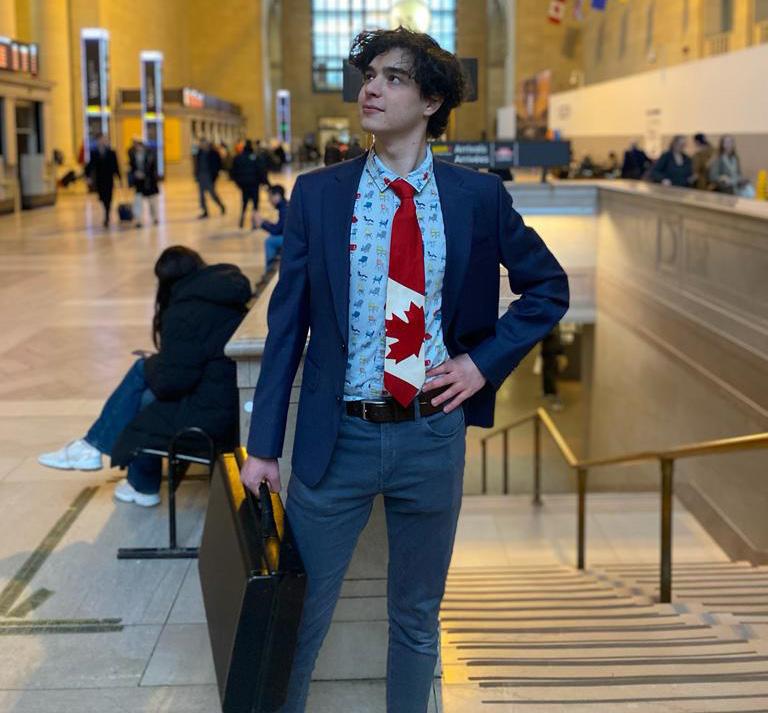
The role Meir Straus was named to play—a teenage candidate for Toronto’s chief magistrate
/ Josh Lieblein
Meir Straus was genuinely excited to see himself as a top headline on the website for Toronto news channel CP24—even if it was on a Sunday without much else going on.
As the youngest candidate who paid $200 to enter the race to replace John Tory, the freshly 18-year old North York resident—and Jewish-private-school student—can always pray that a wave of positive media coverage will catapult him into the role he’s been prepared for since 2005.
After all, it’s right there in his name, and his website: Meir4Mayor. ca.
“The local community has been super-indispensable,” he says. “When I wanted to get my endorsement paper filled out, I ran around from class to class at school and had the 25 signatures before I knew it. As it happens, those are the only people I know over 18.”
As befitting a young member of Generation Z, Meir’s campaign is mostly online, consisting of his website, an Instagram account where his teenaged friends make references that are incomprehensible to anyone over 30, a campaign launch video featuring a questionable cover version of the Who’s song about a teenage wasteland.
Meir has also been advertising his campaign on whiteboards at his school—although the average voter doesn’t see a lot of the attention he’s receiving in the hallways, because the teenagers of today know it’s better to keep their accounts out of public view.
“The website went up during the first night of Passover,” he explains, “and people were texting me and telling me how they were reading out all my policies at the seder. It feels like everyone in my community is part of the team.”
Meir’s campaign team is pretty lean—the only verifiable human being seems to be his former Grade 6 class representative, Talia Kirshblum. But, according to his website, Meir has endorsements from his mom, his zayde, Jewish rapper Drake, and a mysterious Rabbi Gemara who may or may not be the vice-principal of TanenbaumCHAT.
If that’s not enough, Meir is on the radar of at least one frontrunner.
“I met Josh Matlow in person and was excited to see him on the campaign trail. I showed him my campaign, and while I can’t confirm an official endorsement, he is possibly the only other candidate who knows me.”
Meir is interested in attending debates and giving speeches, but he reminds me that he’s also a busy high school student, and will be right up until the school year ends—a period that overlaps with the campaign for the June 26 byelection.
“After that, I’m going feral,” he says. “What does that mean? I have absolutely no idea.”
When asked to comment on the race itself, Meir has some actual
thoughts: “It’s a pretty diluted race and I know I’m not helping when it comes to that, but the fact that there are many candidates in the race means more issues being raised and much more of the city will show up. I’m glad to see that there is a lot of public safety focus, but I’d like to see more people talking about the homelessness crisis and affordability, because those are two of the root problems.”
Nonetheless, when the candidate did a live Monday morning interview with Newstalk 1010, host John Moore wasn’t too impressed with the lack of political subtext to this satire.
“Strong mayor powers are great, but omnipotent powers are better,” says Meir about the new clout afforded to the city’s mayor. “You can become unto a god and influence world events at your will. For example, I will continue the process of amalgamation and amalgamate the entirety of Canada into Toronto.”
When asked how this would affect the various Canadian NHL teams currently contending in the playoffs, Meir clarified that he would amalgamate all the hockey teams, too. While the name of this Canadian superteam is TBD, Meir assures me that the team would demolish everyone else and secure the Stanley Cup continuously for the next century.
Meir also plans to deal with the city’s out of control raccoons by laying off the entire first responder force and replacing them with raccoons. He also wants to make Canada geese part of his inner circle and they will poop on the lawns of anyone who opposes him.
Finally, he plans to create a special youth outreach program, not for youth themselves, but for all the boomers and millennials who don’t understand Gen Z.
“The Meir4Mayor campaign has representation from all generations, from my Gen X/milliennial mom, my boomer Zeyda Steve, and my baby cousins who are even younger than me.
“We’ll definitely be getting the word out through my baby cousins—as soon as they are able to actually say words.” n
Israel’s rookie Aliyah Minister Ofir Sofer tells Canadian Jewish leaders
Ofir Sofer spent nine hours in Toronto last week on his first visit to Canada as the newly minted Israeli minister for aliyah and absorption.
Sofer is the first member of Prime Minister Benjamin Netanyahu’s four-month-old coalition government to set foot in Cana-
2 | T HE CJN.CA
Josh Lieblein writes the Doorstep Postings political column for The CJN.
he’s still making up his mind on changing the Law of Return
/ Ellin Bessner
da, in the wake of massive pro-democracy street protests that have engulfed the Jewish state for weeks.
He began his North American tour April 17 at the Chabad Lubavitch world headquarters in New York. His whirlwind jaunt to Canada ended April 19, ahead of ceremonies marking Israel’s 75th birthday.
Several Canadian Jewish leaders raised their concerns with him about the situation in Israel and the political crisis, as well as over contentious proposed changes to the Law of Return that would tighten up who Israel considers Jewish enough to receive automatic citizenship.
Sofer declined to do an interview with The CJN, citing his runins back home with Israeli journalists who he described as “fake news.” He said he didn’t want any bad headlines to destroy “his newly built and important relationships with local Jewish communities.”
But according to Rabbi Jarrod Grover of Beth Tikvah congregation, who attended a meeting with him at Yeshivat Or Chaim, the minister downplayed the effects of the current political crisis on people who are considering moving to Israel. Instead, Sofer stressed his goal is to boost levels of immigration to Israel by expanding opportunities for young Canadians to spend time in Israel.
“This is an internal crisis that will be resolved,” Sofer reportedly told Rabbi Grover and other invited guests Wednesday afternoon.
Sofer, a father of seven, is a member of Israel’s right-leaning Religious Zionist Party led by extreme right-wing settler Bezalel Smotrich, a key partner in the governing coalition.
One of Smotrich’s key conditions for entering into a coalition with the Likud party in December was to tighten up Israel’s historic Law of Return. For decades Israel has granted automatic citizenship to anyone who has at least one Jewish grandparent or who has converted to Judaism, or is married to a Jew.
But religious parties, including Sofer’s and the United Torah Party, contend that the “grandparent clause” needs to go. They worry about increased assimilation and diluting Israel’s Jewish identity in the wake of an influx of newcomers who have tenuous ties to Judaism and little interest in living an Orthodox Jewish life. Of particular concern are the tens of thousands of new arrivals from Ukraine since the Russian invasion in 2022, as well as Russians who have come wanting to avoid persecution, or forced conscription.
Although Israel’s courts have recently ruled the country must now also accept Conservative and Reform Jewish conversions (Reform Jews recognize patrilineal descent, not just children born to a Jewish woman), in practice the country’s Orthodox-controlled rabbinate makes it difficult for non-Orthodox Jews to marry in Israel.
However, during his brief stay in Toronto, Sofer did not weigh in on where he stands on the question of changing the Law of Return.
He told Jewish leaders that he is still making up his mind, according to Rabbi Steven Wernick, who heads Beth Tzedec synagogue, Canada’s largest Conservative congregation. Rabbi Wernick was one of about 35 rabbis and lay leaders invited by UJA Federation of Greater Toronto to meet the minister at its headquarters in North York.
Rabbi Wernick told the minister that changing the Law of Re-
turn would “decimate” the popular Israeli-government supported gateway programs designed to encourage young, mostly non-Orthodox Jews to discover Israel, including the ten-daylong Birthright trips, and MASA, which runs gap-year work and study streams.
These programs accept applicants who only have Jewish fathers, even if the mother was not Jewish, he said.
“It will certainly slow down aliyah from every place because the aliyah from the West is not an aliyah of rescue, it’s an aliyah of choice,” Rabbi Wernick told The CJN in an interview in the lobby of the Lipa Green Building after the meeting ended.
“So if you’re going to change all that, then you’re going to see a drop in Birthright because why should people come to Israel, if it’s no longer their birthright, right? If I can’t make aliyah, then why should I come?” he said.
Wernick also opposes restricting automatic citizenship, citing the fact that Hitler included people with only one Jewish grandparent as targets for the Holocaust.
While Netanyahu originally proposed setting up a commission to study the Law of Return issue, he has also hinted there would be no changes made, for now.
Sofer’s visit to Toronto included friendly meetings with students and staff at two modern Orthodox high schools: Ulpanat Orot for Girls and Yeshivat Or Chaim. He also attended a falafel and french fries dinner with Orthodox university-aged students who are interested in immigration. That event was held at the Beth Avraham Yosef congregation in Thornhill, and was organized by the Jewish Learning Initiative on Campus, an Orthodox Union-affiliated outreach group operating at York University, Toronto Metropolitan University and the University of Toronto.
Despite his itinerary’s exposure to mainly Orthodox settings while he visited Canada, his ministry did hint he is willing to put out the welcome mat to newcomers from other streams of Canada’s Jewish community, too.
“My goal is to strengthen aliyah and assist any Jew looking to build their new home in Israel,” Sofer said in a written statement provided to The CJN.
It’s a view echoed by Rabbi Elan Mazer of Mizrachi Canada, which represents religious Zionists. Rabbi Mazer organized the Israeli politician’s tour to Toronto.
Rabbi Mazer described the minister’s Canadian visit as a tremendously moving and meaningful gesture for his community, who are already strong supporters of Israel.
“And that’s really a very special time in history to see how strong Israel is and how much they care about the Diaspora communities as a whole,” Rabbi Mazer said. “But I also think that it’s a transformative and revolutionary place that we are in in history where for so many generations, it was the Diaspora communities looking out and trying to see how they can support the State of Israel. Now this State of Israel is putting in time, effort and funding into Diaspora communities.”
According to Rabbi Wernick, while the discussions with Sofer were respectful and cordial, if brief, it doesn’t paper over the obvious divide between the Canadian Jewish community and the current direction the Israeli government is taking.
Rabbi Wernick left the meeting disappointed, particularly because Sofer told them his coalition government has a majority of 64 seats in the Knesset, and is serving all Israelis and all Jews around the world.
3 | T HE CJN.CA
“I would say overall it feels like we’re living in two separate worlds, the way in which we understand how things are unfolding and what their impacts are, and they’re difficult to reconcile,” he said.
That was the same feeling Gail Adelson-Marcovitz was left with, after participating in the same meeting on behalf of the Centre for Israel and Jewish Affairs. The Montreal-based national chair of CIJA flew in to Toronto specially for the meeting, but didn’t get to ask any questions in the limited time allotted.
Adelson-Marcovitz was rankled by the minister’s assertion that his government has the mandate to make policy changes. Although CIJA has previously called for patience –not public protests– when it comes to expressing concerns about the current situation in Israel, Adelson recognized that they have to double down on their efforts.
“So it was an opportunity to reinforce the need to continue to press that message despite the pause that has been taken, and that we need to make sure that that message is heard, loud and clear,” she said, referring to Netanyahu’s announcement in April he would call a temporary halt to moving judicial reform legislation through the Knesset, until May 1.
A small group of Canadian protesters did try to get their pro-democracy message across through chanting and placards as they gathered Wednesday afternoon outside the Jewish Federation building. They carried Israeli flags and chanted “Shame! Shame!” in Hebrew. The protest was hastily organized by the pro-democracy Canadian chapter of an Israeli group of expatriates known as UnXeptable, who hold rallies each Sunday at Toronto’s city hall.
“I’m a little bit disappointed that the Jewish Federation doesn’t come with a more harsh message,” said organizer Yael Meiri, an Israeli who has lived in Canada for 12 years. The group was also critical of the decision by some Canadian Jewish leaders to travel to Israel and attend the General Assembly of Jewish Federations of North America, where Netanyahu was supposed to address the audience.
“They shouldn’t give a stage to the people that are trying to sabotage and do everything in order to destruct, basically, the Israeli democracy,” she said. Netanyahu would later cancel his planned appearance.
As for the Aliyah minister, Sofer did not emerge from the Federation building to interact with the protesters. His staff ushered him out by a different exit, and he gave the group the slip as his entourage headed off to the next event.
In an email to The CJN before the minister’s visit, Steve McDonald, a spokesman for UJA’s Toronto Jewish Federation explained that Wednesday’s meeting was initiated by Sofer’s staff, not them.
“We responded that we’d welcome the opportunity, and shared that we recently convened various Jewish community leaders from across the denominational spectrum for a discussion on the current Israeli political debate – and we would very much like to invite them to join us to be a part of the conversation,” to which McDonald said the minister quickly agreed.
However, UJA Federation declined to comment after the meeting itself.
Sofer did promise to return to Toronto in the future, after his brief getting-to-know-you tour, according to Rabbi Samuel Kaye, who attended a meeting on behalf of the Reform move-
ment’s Holy Blossom Temple. The rabbi wasn’t able to ask a question during the formal session, but he buttonholed Sofir on the way out to express his concerns.
“I told him ‘I want you to hear that we’re not only just angry, that we’re also very scared’,” Kaye said, referring to whether people who are Reform Jews or converted by a Reform rabbi would be welcome in Israel under the changes to the Law of Return.
“These changes that you’re making to who is a Jew and who is not: if there’s antisemitism in the world, we’ll turn to you in Israel and you won’t be there for us, and that’s a fear that we have.”
Since 2001, some 6,000 Canadians have immigrated to Israel under the auspices of the government-supported Nefesh B’Nefesh organization, which specifically works with Jews from Canada, the United States and the U.K.
Rabbi Grover told the minister his department needs to improve financial assistance for Jews who move to Israel, including providing tax cuts.
But he also asked for more Israeli government support for the Toronto Jewish community when it comes to strengthening their connection to Israel and their Jewish identity here on the ground, as most people in Toronto are not going to make aliyah, he said.
“Toronto is in a fight like everywhere else,” Rabbi Grover said. n
Israel
Lila Sarick
Rabbi Susan Tendler is still jet-lagged after returning from a congregational trip to Israel a few days ago, back to her home in Richmond, B.C.
But it was an ideal time to be in the country, which was roiled by protests over judicial reforms proposed by the right-wing government. Congregants from her Conservative synagogue, Beth Tikvah, wandered among the protestors outside their Tel Aviv hotel—whose signs displayed a diversity of socio-political concerns, not just the judicial reforms.
After witnessing the situation, she wants to explain to her synagogue how the situation in Israel is far more complex than is often portrayed by the mainstream media.
While she often speaks about Israel from the bimah, she rarely discusses politics, although occasionally as a rabbi she says it’s her job to ruffle feathers.
“When I speak about Israel, I don’t always try to speak about things that are quite as controversial. It’s not controversial to say that the reform bill that was brought forward by the Knes-
4 | T HE CJN.CA
All in the family:
How these 4 rabbis from across Canada have been talking to their congregants about
/
set is much more complex than we tend to give it credit.
“Whether people are left-wing or they’re right-wing, I tend to focus on what people can be united on when I speak about Israel, furthering and deepening a love for Israel, giving people reasons that we should continue to feel connected (to Israel)… why the world is better with Israel in it.”
The unprecedented protests and civil upheaval in Israel have highlighted a divide among Canada’s rabbis, particularly in non-Orthodox synagogues, over how to speak about their Zionism from the pulpit. They wonder if Disapora Jews—not to mention their religious leaders—have the right to comment and even criticize Israeli politics.
The issue is not an academic one, either.
Canadian Jews are tightly connected to Israel, far more than their American counterparts. The 2018 Survey of Jews in Canada found that 79 percent of Canadian Jews were very or somewhat attached to Israel, compared to 69 percent of American Jews. Nearly eight in ten, 79 percent, of Canadian Jews have been to Israel at least once, compared to just 43 percent of American Jews.
Inevitably, both religious and secular Jewish leaders fall back on a relative metaphor.
“I’m always clear that there’s complexity,” says Rabbi Tendler. “Yet at the same time you don’t always get along with your siblings but you can still love them as family.”
A statement issued by the Toronto Board of Rabbis on March 27 uses the same analogy. “We believe Diaspora Jewry and the state of Israel have a shared destiny, and like family, we are inextricably bound to one another,” the statement begins.
“We believe we have the right and responsibility to speak about Israel when there is pride and joy as well as when there is concern and distress,” continued the letter signed by the city’s Reform, Conservative and Reconstructionist rabbis, as well as some whose congregations are not affiliated with any movement.
But there are some rabbis who suggest that family relations are getting so strained that it’s time for an intervention.
“Israel is part of our family, and like any family member we will always love them, but we also want them to be the best that they can be,” says Rabbi Boris Dolin of Montreal, who leads the Reconstructionist synagogue Dorshei Emet. “To ignore them and not help them become better, to ignore Israel and not help them become stronger, more ethical, that is being a bad member of the family.”
Dorshei Emet is one of the few liberal voices in a city where more conservative attitudes about Israel have dominated the conversation.
“We represent something unique in Montreal, really in Canada, which is a much more traditional Jewish community. I feel an obligation to have a viewpoint that would be considered a little more left. We’re a Zionist community, we love Israel, but we’re also proud of how we can question and challenge and work together to make Israel a better place,” he says.
“If there’s not a place for people who are left and centre and everything in between in one place, then I’m not fulfilling my duty as a rabbi to this congregation. Many of the other synagogues follow the same viewpoint and I think we need to represent something different.”
Rabbi Dolin meets regularly with members of T’ruah: The
Rabbinic Call for Human Rights where they attend monthly lectures and discuss what it means to be a Zionist today.
“We can’t just say we’re Zionists when the country is not necessarily representing the values of the Jewish community in general, in Israel and the Diaspora community.”
Israel was not a controversial topic not so long ago—but now it has the potential to be divisive, notes Rabbi Jarrod Grover, who leads Toronto’s Conservative Beth Tikvah Synagogue.
He draws a line between speaking publicly about what he feels are Israeli domestic issues, from those that affect the Jewish Diaspora.
The judicial reforms are an issue to be resolved by Israelis “in a democratic way,” he says. “I think my congregants are smart enough to read the blogs and the articles that defend both sides and make a determination for themselves.”
On the other hand, he spoke out not long after the current coalition was elected, when changes were proposed to the Law of Return, which was an issue that would have directly affected Diaspora Jews.
And like Rabbi Tendler, he believes that a rabbi’s mission is ultimately to strengthen the community’s connection with Israel.
“I am deeply concerned about rabbis who are promoting division and not unity around Israel and rabbis who are becoming increasingly distant from Israel,” he says.
He’s working on a program with JNF that will bring American rabbinical students to Israel to “counter some of the slanted views of Israel that some well-funded left-wing organizations are organizing.”
“I’m not an extremist who believes that criticism of Israel makes you an enemy or makes you anti-Zionist. It is not a perfect country, it is not immune from criticism,” he says.
“For me, it’s about when we’re criticizing and what we’re criticizing and the loving tone behind the criticism. The criticism that also affirms the dignity of Israel’s Jewish citizens and not just its Palestinian ones and understands the complexity of the conflict.”
The debate over Israel’s politics and the role Diaspora Jews should play isn’t just taking place in hushed chapels. At a rally organized by an Israeli grassroots group on March 26 at Toronto City Hall, Rabbi Yael Splansky, senior rabbi at Holy Blossom Temple, Canada’s largest Reform congregation, addressed the matter head on.
Rabbi Splansky told the crowd that while Israeli Jews have the direct responsibility for the direction of the state, Jews in the Diaspora have a voice as well.
“Canadian Zionists are very respectful that they’re not voting citizens of Israel, so I think there’s this polite Canadian thing at play, which I appreciate,” she said in an interview as the rally concluded.
“But that’s why I turned to this prayer (Cause a new light to shine on Zion and let us all soon be worthy of its light) , that the state of Israel and the character of the state of Israel is for all of us to shape and for all of us to build together.”
And, while some in the community have said that only those who have made aliyah and live in Israel, can criticize Israel, she disagrees, returning once again to a familiar analogy.
“This is a conversation of family-to-family. And when there’s a concern in the family, we have to look each other in the eye
5 | T HE CJN.CA
and say hard things to each other.
“I’m not interested in talking to anyone other than my family right now.” n
B’nai Brith Canada’s annual audit finds that antisemitic incidents remained near record high levels in 2022 due to increasing reports of online hate
/ Lila Sarick
The number of antisemitic events recorded in Canada in 2022 dropped by an “almost insignificant” one percent from the previous year—but the situation is still disturbing, representatives of B’nai Brith Canada said at the release of the organization’s Annual Audit of Antisemitic Incidents on April 17.
B’nai Brith documented 2,769 incidents, compared with 2,799 in 2021.
“We don’t take a great deal of joy in that. It is the second-highest number of incidents we have reported in the 41 years we have been auditing,” Marvin Rotrand, national director of the League for Human Rights, B’nai Brith’s advocacy arm, said at a press conference.
“A decade ago, in 2012, the number of incidents was 1,345. In a decade, the number of incidents increased by nearly 106 percent.”
Nearly three-quarters of the incidents reported last year occurred online, the audit found.
“The haters have discovered anonymity and the ability to reach a large audience and spread misinformation and disinformation,” Rotrand said. “The level of online hate underscores the need for legislation that can effectively blunt online hate.”
Canada should consider law reforms similar to those adopted by Germany and France, the audit states.
The number of antisemitic incidents dropped in every province in 2022, compared to 2021—except in Saskatchewan, and in Ontario, where it grew from 821 to 1,353. While any increase is “worrisome” Rotrand said the increase in Ontario, was in part due to greater recognition of what constitutes antisemitism by law enforcement officers and civil servants, after Ontario adopted the IHRA definition of antisemitism in 2020. Violent attacks decreased significantly from 75 in 2021 to 25 in 2022, but are still higher than numbers that had been recorded previously, Rotrand said.
The 2021 war between Israel and Hamas was a trigger for many of the physical confrontations in Canada, while the following year was notably more peaceful. Incidents of vandalism, which includes graffiti, and destruction of property, however, increased from 264 in 2021 to 404 in 2022.
Antisemitism is a growing global concern, according to a report released by Tel Aviv University’s Center for the Study of Contemporary European Jewry and the U.S.-based Anti-Defamation League. Numbers of antisemitic incidents soared in 2021, triggered by COVID conspiracies and the war in Gaza.
However, even as those crises abated in 2022, the number of incidents remained high, according to the report, released the same day as B’nai Brith Canada’s.
“In 2021, antisemitism reached new highs; 2022 did not mark a universal reversal of the trend, and in some countries, most alarmingly the United States, it intensified. This is despite significant and welcomed legislative, judicial, and educational efforts by governments and NGOs worldwide to fight antisemitism,” the report from Tel Aviv University stated.
In the United States, antisemitic incidents increased from 2,721 in 2021 to 3,697 in 2022, the ADL reported.
In Canada, MPs at the B’nai Brith press conference spoke about a worrying complacency about antisemitism and the fact that social media has become an unrestricted platform for online hate.
“The Jewish community often feels that others don’t recognize anti-Jewish racism or antisemitism in the same way that other types of racism or other types of hate are easily identified and easily condemned,” Liberal MP Anthony Housefather said.
He referred to the controversy surrounding consultant Laith Marouf, who was awarded federal government contracts to conduct anti-bias training, but was found to have made vile and violent remarks about Jews on social media.
“The Laith Marouf incident this year was one example where Jewish MPs were calling upon our colleagues to condemn something and it took much too long for it to be condemned,” Housefather said.
The Montreal-area MP also mentioned the annual Al-Quds Day rally in Toronto, which occurred on April 15, where speakers called for an end to the State of Israel.
“It’s perfectly okay to criticize Israel, to criticize its government, but to call for its destruction is antisemitism,” he said.
NDP MP Alistair MacGregor, who sits on the Standing Committee for Public Safety and National Security, which recently released recommendations on combatting radicalism said that “the online space is not a safe space for Jews.”
Governments must do more to hold social media companies accountable for how their algorithms “push this hate onto people’s screens,” he said.
Conservative MP Melissa Lantsman, who represents Thornhill, Ont., the riding with the largest Jewish population in Canada, said the audit provides the statistics for what residents are experiencing.
“There are some bright spots in these numbers, but overall, they are extremely concerning and alarming,” she said.
“Tonight marks the beginning of Yom ha-Shoah the remembrance of the Holocaust. We need to recognize the same forces of intolerance… continue to rear their ugly heads in our com-
6 | T HE CJN.CA
munities, they are on our streets, they are in our schools, they are in our unions and they are even in these hallways here in Ottawa.”
Lila Sarick is news editor of The CJN.
Tariq Khan, a member of Alberta’s new multicultural council, resigns after a history of antisemitic posts are revealed
/Jeremy Appel
Three days after Alberta Premier Danielle Smith unveiled an advisory council on multiculturalism, a member resigned after the opposition party revealed his history of antisemitic social media posts, including Holocaust denial.
Smith announced the 30-member Premier’s Council on Multiculturalism on April 14, co-chaired by court interpreter Sumita Anand and University of Alberta women’s studies academic Philomina Okeke-Ihejirika.
The council includes lawyer Jackie Halpern, who sits on the board of directors of the Jewish Community Foundation of Calgary and previously served on the Calgary-Glenmore PC Constituency Association.
Until April 17, it also included Tariq Khan, a Calgary realtor who unsuccessfully ran for city council in the 2021 municipal election.
The Opposition NDP, which is running neck-and-neck with Smith’s UCP in next month’s provincial election, demanded Khan’s removal after revealing a 2018 letter from the UCP rejecting his candidacy that referred to a video where he called the Holocaust a hoax.
“As has been repeatedly made clear, we will take appropriate action to protect the Party and its many members from serious reputational harm. As such, I must inform you that the Nominations Committee has determined that you are ineligible to stand for a UCP nomination contest,” reads the letter from UCP executive director Janice Harrington, dated Oct. 26, 2018.
The opposition party also provided a screenshot of a 2014 Facebook post from Khan featuring an image of Israeli Prime Minister Benjamin Netanyahu with a Star of David on his head as he feasts on a child’s blood, captioned “Can’t get enough.”
Harrington’s letter also notes this “highly offensive image,”
which “appears to invoke the pernicious anti-Semitic [sic] falsehood of the blood libel.”
More recent posts on Khan’s Facebook profile indicate continued involvement with the UCP. He posted a photo album from last year’s UCP annual general meeting, including a photo with his “great friends” Minister of Children’s Services Mickey Amery and Minister of Municipal Affairs Rebecca Schulz.
In an email to The CJN, two days after he submitted his resignation, Khan said he apologized to the Jewish community for “sharing a hateful post on my personal social media over 10 years ago.”
“At the time, I was new to social media and did not fully understand the consequences of my actions. I shared many posts that came across my social media feed without considering the impact it could have on others.”
Khan said he did not recall sharing a video that denied the Holocaust, but said he had always viewed it as “a real and terrible tragedy.”
Smith’s office told The Canadian Press that she accepted Khan’s resignation and condemns “all forms of intolerance and hate.”
Deputy Premier Kaycee Madu told reporters that the government intends to “close whatever gap that existed that made it impossible for us to catch this serious error.”
“We are humans. I think what is important is that when… it’s brought to our attention, we will fix the problem,” he added.
NDP leader Rachel Notley said Khan’s appointment was “beyond odd.”
“It’s either demonstrative of next-level incompetence from the premier’s office … or it’s demonstrative of a genuine desire to divide and discriminate and promote racism,” Notley said.
Jewish Federation of Edmonton CEO Stacey Leavitt-Wright didn’t respond to an email request for comment.
On Twitter, the federation shared an April 17 statement from Smith commemorating Yom ha-Shoah thanking the premier “for standing in solidarity with the Jewish community.”
Smith, a former broadcaster, newspaper columnist, school board trustee and corporate lobbyist, has been repeatedly criticized for her embrace of online conspiracy theories, especially those related to the COVID pandemic and vaccination.
In March 2021, she wrote a Calgary Herald column comparing mandatory vaccines to Nazi medical experiments during the Holocaust.
Shortly after she narrowly defeated former finance minister Travis Toews for the UCP leadership, she was revealed to have twice linked to a blog known to publish antisemitic material.
The links she shared, which were about digital banking and Russia’s war in Ukraine, weren’t themselves antisemitic, but elsewhere the blog references “Rothschild Zionism” and “global Jewish banking mafia families.”
In response to the CBC’s request for comment on the blog’s contents, Smith said antisemitism “has no place in society.” n
7 | T HE CJN.CA
n
FOR MORE STORIES GO TO WWW.THECJN.CA
Jeremy Appel is a Calgary-based freelance news reporter for The CJN.
at the Canadian Society for Yad Vashem
/Ellin Bessner
This past week was Shael Rosenbaum’s first Yom ha-Shoah as new national chair of the Canadian Society for Yad Vashem (CSYV), and the Toronto real estate developer spent it attending two major Holocaust commemoration events.
A Yom ha-Shoah v’Gevurah ceremony was held April 17 at Toronto’s Holy Blossom Temple, and saw over 1,000 people mark the 80th anniversary of the Warsaw Ghetto Uprising in 1943. Earlier, Rosenbaum joined major donors at a preview of the soon-to-be opened Toronto Holocaust Museum, for which he was one of the founders and is immediate past chair.
Rosenbaum took over at the helm of the CSYV in January from Fran Sonshine, who stepped back after 14 years as the face of the Canadian education and commemoration arm of Israel’s Holocaust museum in Jerusalem.
“I think he’s going to be just great and he knows his way around what my husband calls ‘this Holocaust business’, ” Sonshine told The CJN, in a recent joint interview.
While Sonshine, 75, was born to Holocaust survivor parents in a British internment camp in Cyprus, Rosenbaum, 36, is considered part of the 3G or third generation of survivors. His four grandparents were Holocaust survivors. Like Sonshine, the younger leader has made the Holocaust the major focus of his lifelong community and philanthropic work.
He feels it is his duty and responsibility.
“You know, when my friends were going to Ibiza and partying, I don’t know why my interest or my passion, morbid in a way, was to go back to Europe and find out and discover things about my family,” Rosenbaum said, recalling a long-ago trip to Dachau concentration camp in Germany where his paternal grandfather Sam had been a tailor for SS guards.
Before taking on his new role as CSYV chair, Rosenbaum, the scion of the founder of the Great Gulf Homes real estate development giant, was associate producer of the 2018 Canadian award-winning documentary The Accountant of Auschwitz. It covers the war crimes trial against a former German SS bookkeeper Oskar Groening.
Rosenbaum previously chaired the young adult division of the March of the Living, which takes adults under 40 to Poland for a three-kilometre march of remembrance at the Auschwitz death camp every year on Yom ha-Shoah.
He’s also done volunteer work for the Shoah Foundation, based in California, which houses a collection of tens of thousands of survivor testimonies originally recorded under the
auspices of American filmmaker Steven Spielberg.
“A lot of the 2Gs are in their retirement phase with regards to their work with Holocaust survivors, not just because they created such a footprint in the work being done, but they’ve also lived with it their whole lives, with their parents,” said Rosenbaum, who was born the same year as the Canadian branch of CSYV was founded, in 1986. “So, it’s our turn now to basically carry on this legacy.”
Rosenbaum inherits an organization based in Toronto that sticks to fundraising, remembrance and education. It leaves the crowded space in Holocaust-centred work to other groups to focus more on advocacy work fighting antisemitism, he said.
The CSYV’s ongoing programs include: an annual fall tribute ceremony held at Queen’s Park, the Ontario legislature, to honour a select group of survivors, (it continued as a virtual event during the pandemic); a twinning program for b’nai mitzvah students who select the name of a child murdered in the Holocaust; a series of portable educational displays used across the country; ceremonies that honouring Righteous among the nations who saved Jews during the Holocaust; summer Holocaust training programs for educators at Yad Vashem in Jerusalem; and the Ambassadors for Change cohort of students who travel to Ottawa to meet with survivors and hear their stories first hand.
That last prong of Holocaust education—meeting with survivors—is now in jeopardy with the reality of losing so many of Canada’s 40,000 survivors, including Rosenbaum’s paternal grandmother Helen, who was 12 when she was deported and survived four camps, working as a cook. She died in February 2021.
Without that first-hand opportunity for audiences to hear and see a survivor speak about their testimony, those in “the Holocaust business” have to find different avenues to get their messages across.
“It’s an issue for every Holocaust organization,” Sonshine acknowledged.
She thinks future programs will rely partly on the 55,000plus existing videos of survivors that were filmed over the past three decades by the USC Shoah Foundation in California. The initiative was founded by Hollywood director Steven Spielberg after he finished filming the award-winning movie Schindler’s List in 1993.
More recently, that centre has been using special digital technology to capture the testimony of 25 survivors, including the late Max Eisen of Toronto, and Pinchas Gutter, also of Toronto, who survived a half dozen death camps. Their interviews were filmed in a way that will allow students and researchers to interact with the survivors’ digital holograms, in real time, long into the future.
But there is also still a role for analogue storytelling, Sonshine believes.
“I think you’re going to have to have the stories being told by the second and the third generations. They can tell their parents’ and their grandparents’ story,” she said.
Which is where Rosenbaum feels he comes in, as an example of the next generation taking up the mantle—although he is already looking to encouraging the great-grandchildren of survivors to get involved.
8 | T HE CJN.CA
Shael Rosenbaum, a member of the third generation of survivors, takes over ‘the Holocaust business’
He thinks other groups such as March of the Living can benefit from Yad Vashem when there are no survivors left to accompany the annual trips. He envisions the agency accessing the Jerusalem centre’s vast repository of Holocaust resources. Indeed, one of his main goals since taking over at CSYV is to collaborate more with community agencies who do similar work. This is very much in keeping with the priorities set by Yad Vashem’s new world chair, Dani Dayan.
For example, Rosenbaum feels there is an important place for the written word in transmitting Holocaust education, pointing to the books and manuscripts preserved in the collection of Yad Vashem in Israel. He also praises Canada’s Azrieli Foundation for its efforts to publish Holocaust survivors’ memoirs annually—including for the first time in 2023, five audiobook versions read by the survivors themselves.
That initiative, he feels, is “at the forefront of writing different novels with the survivors and actually putting their stories into updated versions that really speak to the new generations.”
On April 16, Rosenbaum and Sonshine attended a gala reception at the site of the soon-to-be-opened Toronto Holocaust Museum, located next door to the original premises of what used to be known as the Sarah and Chaim Neuberger Holocaust Education Centre. Rosenbaum is the immediate past chair and Sonshine is on the advisory board.
The $27.5 million facility in North York, which opens June 9, is being touted as one of the most important weapons which the Ontario Jewish community will have to combat rising antisemitism and Holocaust distortion.
Some critics, including American author Dara Horn and Canadian-born professor Ruth Wisse, argue that Holocaust museums have not been successful in fighting antisemitism. Horn’s book People Love Dead Jews acknowledges the postwar need to honour the experiences of the survivors who came to Canada after the Holocaust, but suggests museums are the wrong way to tackle the surge in online Jew hatred and in popular culture.
Rosenbaum says museums can still play an important role, by teaching the broader context for the industrial murder of six million Jews by the Nazis during the Second World War. Sonshine agrees.
“To understand the Holocaust, you also have to understand, as Shael says, the context of it and the history of it and what actually happened. We can’t just forget about it. Part of our being is to remember,” she said.
During her tenure, Sonshine was instrumental in the expansion of the CSYV’s signature outdoor memorial: the striking Holocaust installation in Toronto’s Earl Bales Park.
First opened in 1991, the site now lists nearly 5,000 names of victims, survivors and Righteous persons who helped save Jews. One panel at the entrance is entitled The Ed and Fran Sonshine Children’s Wall.
Like Sonshine, her husband Ed is also a child of survivors. A lawyer and founder of the RIOCan Real Estate Investment Trust, Ed was born in a displaced persons camp near the site of the former Bergen Belsen concentration camp in Germany. Their wall lists 365 names of Jewish children who were murdered by the Nazis—one for each day of the year. They were among the 1.5 million children who perished. Sonshine feels this site is her greatest legacy at the CSYV.
“We made it so that the city and the community and the country can actually go there and we can be proud of it.”
She is also gratified with her work that helped establish Canada’s National Holocaust Monument near Parliament Hill in Ottawa. It was inaugurated in 2017, after six years in development and construction.
Sonshine remembers being asked by then-Conservative cabinet minister John Baird to join a collective of prominent Jewish Canadians in order to raise over $4 million privately, which the federal government would then match, plus donate the land near LeBreton Flats.
“We were the only country, the only western country, that did not have a Holocaust monument, and the time had come that we would have one and I was very happy to do it,” Sonshine said.
However, the monument, located just west of Parliament Hill, has not been without its troubles.
Right at its opening, it was discovered that a key descriptive plaque did not mention that Jews had been the main victims of the Nazis’ Final Solution.
“I think the government was in a hurry and they just didn’t do it properly, but it got corrected immediately and they were really good about it,” Sonshine said.
Other problems saw cracks develop in the cement. Also, planners decided not to install heaters, which means the monument cannot remain fully open during the winter, due to snow and ice on the walkways of the Daniel Libeskind-designed structure.
The site has also attracted notoriety for being vandalized and also for being used inappropriately over the years by skateboarders and even by fashion photographers, who either didn’t know or didn’t care to treat the monument as a place of mourning and reverence. There are no security guards or on-site guided tours. (A downloadable app with a digital interactive walk for the site is now being developed by the Centre for Holocaust Education and Scholarship in Ottawa and Liberation 75).
During the pandemic, Sonshine worried that the monument was not being used to its fullest capacity to hold events and ceremonies.
“We used to call it our orphan,” Sonshine said. However, since the fall of 2021, a local committee in Ottawa has now taken over programming.
“They’re doing an amazing job.”
For years, from 2003 to 2019, the CSYV’s signature event used to be the national Canadian Yom ha-Shoah ceremony, usually held at the Canadian War Museum in Ottawa.
During the first two years of the pandemic, in 2020 and 2021, it was held online.
This past week, on April 18, it was held outside at the National Holocaust Monument for just the second year in a row. Prime Minister Justin Trudeau delivered a keynote speech. Other dignitaries spoke, including members of the Opposition, the Centre for Israel and Jewish Affairs, the Israeli and Polish Ambassadors to Canada, Ottawa Jewish federation head Andrea Freedman and Rabbi Idan Scher. High school students recited the names of young victims of the Warsaw Ghetto Uprising and survivors lit memorial candles.
Shael Rosenbaum was supposed to speak. At the last minute,
9 | T HE CJN.CA
however, he could not attend. The CSYV’s executive director, Jonathan Allen, travelled from Toronto to deliver Rosenbaum’s remarks.
However in January of this year, as one of Rosenbaum’s first duties as incoming CSYV chair, he flew to the United Nations in New York with Toronto survivor Joe Gottdenker, for the launch of Yad Vashem’s new Book of Names exhibit.
Measuring eight metres long and two metres high, the exhibit comprises 30 large books whose pages contain the names and other information on 4.8 million known Jewish victims of the Holocaust. There are blank pages left for the 1.2 million others still to be researched, although Yad Vashem officials admit these may never all be completely identified.
“People never had an opportunity to say Kaddish for any of these names and here we’re going to have an opportunity to actually know the person’s name, possibly know a little bit about who the person was, their background, and for the first time, in almost 80 years, talk about the person,” Rosenbaum said, adding that it will also help refute Holocaust deniers who contend only a few hundred Jews died.
The exhibit spent a month in New York, before being returned to Yad Vashem in Jerusalem, where it will be on permanent display starting this week. An earlier version of the book is part of the Yad Vashem exhibit in Auschwitz, Poland in one of the barracks of the former death camp. At the time, that first book had identified 4.2 million names. The new one contains 600,000 additions. Officials say there are plans to bring the exhibit to Canada in the future.
Seeing the names upon names at the exhibit in New York was particularly poignant for Rosenbaum. Although the names of his great-grandparents and extended family members are listed in the book of names, his mother’s older sister is not. Malka Rosenbaum learned only when she was already a teenager in Toronto that her survivor parents had had a daughter before her, who didn’t survive the Holocaust.
Malka’s parents had been hidden by a Polish family and gave birth to the baby while in hiding. The girl, named Esther, was taken away and given to another Christian family for safekeeping, Rosenbaum explained, because his grandparents feared her crying would have alerted the Nazis to the presence of Jews. They also didn’t want to endanger their rescuer.
In 2017, a Canadian filmmaker documented the Rosenbaum family’s efforts to learn the true story of what had happened to Esther. They travelled to Poland with genealogists and researchers and located the family that took care of this baby.
It was determined the baby had died of typhus after a week, and had been buried in a Catholic cemetery, which the Rosenbaums visited.
“And for the first time, somebody could say Kaddish for my aunt,” he said.
While Holocaust remembrance takes up most of Rosenbaum’s spare time, he also volunteers with other charities, including the Canadian Friends of Tel Aviv University. On May 7, he and his father Harry, who was born in Germany after the war, are being honoured at a gala fundraising dinner in Toronto. Proceeds will go towards nanoscience research at the Tel Aviv institution. n
Ellin Bessner is chief correspondent of The CJN Daily.
Photo exhibition of Hasidim aims to build bridges in Montreal and recover Polish Jewish past
/Janice Arnold
Mayer Feig held up an old black-and-white photo. It was of his paternal grandparents and their three children taken in prewar Poland. Only his grandfather would survive the near-annihilation of the Jews in that country.
Feig, a member of the Quebec Council of Hasidic Jews, showed the picture at the opening of an exhibition of photographs of contemporary Hasidim being held at the municipally-owned Galerie d’Outremont until May 28.
These artistically rendered pictures by Agnieszka Traczewska., a Catholic Pole, provide a rare glimpse into the daily lives and celebrations of Hasidim in several countries. The photographs are a testament to the fact that Hasidim are flourishing despite being decimated in the Holocaust.
A World Rekindled is presented jointly by the Polish consulate in Montreal and the borough of Outremont, which has experienced tensions between its large Hasidic community and other residents for many years.
With relations now less strained, borough Mayor Laurent Desbois said that the aim of the exhibition is to demystify the Hasidim and promote better understanding among Outremont residents, as well as the other visitors it is hoped it will attract.
Traczewska, a film producer, began photographing Hasidim in 2006, starting with those from abroad who made pilgrimages to the Polish gravesites of revered spiritual leaders. Everyone told her it would be impossible to get their consent; she being a non-Jewish woman wielding a camera at a sacred ceremony, no less.
Traczewska, 54, who was present for the opening, which was held on Yom ha-Shoah, said she grew up under communism knowing nothing about her country’s Jewish history, not even in her native Krakow, home to a vibrant Jewish community for hundreds of years.
Gradually, however, she gained the trust of the Hasidim. The photos are intimate yet respectful, with a painterly quality, often taken in homes and synagogues.
The Quebec Council of Hasidic Jews welcomed Outremont’s gesture. Hasidim account for about one-quarter of Outremont’s population today.
Feig said he hopes that exhibition will provide a window into how the community lives and applauded Traczewska’s sensitivity.
Over the years, Traczewska extended her range beyond Poland. The images in A World Rekindled were taken in Brooklyn, N.Y.; Israel; Sao Paolo, Brazil; and Antwerp, Belgium.
Her goal, she said, is to “rekindle” the memory of communities that were almost erased, and document their flourishing today. “I am trying to keep alive the memory of those who disappeared in my country,” she said.
“When you cross the boundary and immerse yourself in the
10 | T HE CJN.CA
Hasidic culture, you discover a completely different world than what you see from the outside.”
Similar exhibitions of her work have taken place in several countries, including the United Nations headquarters in New York in 2019. A book of the same name was published in 2020.
“Hosting this exceptional exhibition in Outremont demonstrates our desire to build bridges between the different communities,” said Mayor Desbois, who was elected in November.
“It is a great opportunity to learn more about the lives of members of the Hasidic Jewish community, with whom we cross paths regularly. In addition, A World Rekindled and its related activities show that our gallery can host world-class events.”
The Polish consulate’s co-sponsorship speaks to that country’s desire to show that it is mindful of remembering its Jewish history. The Polish Ministry of Foreign Affairs provided much of the financial support that made the exhibition possible.
Polish Consul General Dariusz Wisniewski said Traczewska is “an exceptional artist who has been documenting the life of Hasidic communities around the world for years. I am delighted that her photos will be exhibited at Galerie Outremont so that everyone can be inspired to better understand and develop greater harmony among neighbours.”
He added that until communism ended in Poland in 1990, the government downplayed the 1,000-year history of the Jews in that country.
“We are trying as a state, as a society, to give the right place to all aspects of our history, including the most difficult times,” Wisniewski said. “The Jewish community was erased from Polish history despite their presence for over nine centuries. We are trying today to recognize their presence and rediscover this lost time.” n
Janice Arnold has been reporting for The CJN from Montreal since 1976.
Theatre on Winnipeg’s Asper Jewish Community Campus. It tells the story of a character named Sholem who transitions genders while discovering Orthodox Judaism.
“It was very moving to see it,” said Baader, 64, who teaches European and Jewish history at the University of Manitoba. “It tells the story of what it’s like to come out as trans and fall in love with Torah and with God.”
Originally from Germany, Baader’s trans journey began as a child when he felt gender ambiguous while growing up. He lived for years as a lesbian before coming out as trans while studying for his PhD in New York in the 1990s.
When he interviewed for the job at the University of Manitoba, he was in the midst of his transitioning journey.
“They were completely lovely about it,” he said of the history department. “Very generous and understanding, welcoming and thoughtful.”
When his stepmother died in 2008, and his mother in 2010, he was deeply impacted by their deaths.
“Through their deaths, I began to experience light,” he said, adding it was like they were “channelling light” to him.
Through that experience, he began to embrace religious practices such as daily prayer and ritual observance. At the same time, his studies in Judaism became less academic. “The more I read Torah and Talmud, the more I felt that ocean of light coming from between the letters in the texts,” he said.
“I started to fall in love with the text. There was a depth of radiance. I was moving from the academic to the experiential.”
Unlike with his transitioning genders, at first Baader didn’t tell anyone about his newfound religious practices and observances; he kept that in the closet. But once he started keeping Shabbat, more people knew.
“If you have to be home on Friday nights and you can’t go to meetings on Saturday, you can’t keep that quiet,” he said.
When it came to choosing a Jewish tradition, Baader decided on Orthodox Judaism. “For me, that’s the place where there’s the most light and devotion,” he said, adding he attends an Orthodox synagogue in Winnipeg and sits on the men’s side.
But not all trans Orthodox Jews are so lucky while transitioning, he said. Many stop attending services until their transition is complete.
“Most disappear, go underground, move and show up somewhere else later,” he said. “There is a huge amount of loneliness.”
As for the play itself, Baader noted it was impossible to compress his whole story into a short, fictional production.
“But it reflects my experience,” he said, adding there was “an extremely positive reception to the play. It seemed very timely as synagogues and other places of worship struggle to integrate trans people. It seemed to hit a nerve.”
Of his moving from non-practicing Jew to Orthodox Judaism, Baader said it has helped make him be more alive and awake.
“I have such a deep awareness of the Divine presence, it’s become so visceral,” he said.
Ben Baader found it wonderful to see a play based on his own extremely unique experiences.
“The actors did an outstanding job,” he said about Narrow Bridge, which chronicles the transitioning of the main character from female to male—and from being a secular Jew to living in the framework of Orthodox observance and practice.
Written by Winnipeg playwright, performer and director Daniel Thau-Eleff, the play ran in March 2023 at the Berney
Quoting a verse from the Koran, he said: “’Wherever you turn, there is the face of God.’ I feel connected to the light that flows all around me.”
While there are no plans currently to stage the play again, playwright Thau-Eleff is open to mounting another production.
11 | T HE CJN.CA
Winnipeg’s Ben Baader saw his life pass before his eyes, when his journey as a trans Orthodox Jew was made into a play
/John Longhurst
John Longhurst is the religion reporter for the Winnipeg Free Press.