T H E P U B L I C AT I O N F O R N U R S I N G A N D R E S I D E N T I A L C A R E H O M E S
W W W. T H E C A R E R U K . C O M
The Carer Digital
THECARERUK
THECARERUK
Issue 40
COVID Jab “Milestone” Reached in Every Care Home in England
A Covid vaccine has been offered to all older residents at eligible care homes in England, the NHS has announced. Prime Minister Boris Johnson described the achievement as a "crucial milestone". In a major achievement for the NHS vaccination programme, nurses, GPs and other NHS staff have offered the life-saving jab to people living at more than 10,000 care homes with older residents. The small remainder have had their visits deferred by local directors of public health for safety reasons during a local outbreak. Those homes will be visited and jabbed as soon as NHS staff are allowed to do so. While in a small number of cases a severe outbreak of COVID-19 will have prevented a team from visiting, any care home yet to be visited for a vaccination clinic is going to have one booked in as soon as it is deemed safe by local public
health protection clinicians to do so. Vaccination staff are also returning to homes that have been covered to jab any resident who was unable to have it during the previous visit because they had recently had COVID or for other clinical reasons. The vaccination programme, the biggest in NHS history, has got off to a strong start with more than eight million doses administered. Dr Nikki Kanani, NHS England’s primary care director, as a practising GP has also been personally delivering vaccines to care home residents and staff, said: “I want to thank my colleagues, and everyone involved in the vaccine rollout for their extraordinary work in recent weeks, as it is because of their tireless efforts that millions of people have already been vaccinated, including hundreds of thousands of care home residents, and as a result we are a vital step further in our fight against COVID-19."
(CONTINUED ON PAGE 3...)
PAGE 2 | THE CARER DIGITAL | ISSUE 40
EDITOR'S VIEWPOINT Welcome to the latest edition of The Carer Digital! “There are only four kinds of people in the world. Those who have been caregivers. Those who are currently caregivers. Those who will be caregivers, and those who will need a caregiver.” ROSALYN CARTER
Peter Adams
TELEPHONE: (6 lines)
Fax: 01202 552666 Email: sales@thecareruk.com
It would be an understatement to say that it has been a difficult time for any government with the devastation Covid has brought to the population, businesses, our freedoms and the wider economy, just coming off the back of one of the most contentious political debates in modern history (Brexit). However, there is light at the end of the tunnel. The government has now reached the milestone of being able to offer all care home residents of a vaccine and once again we are delighted to publicise care homes up and down the country who are embracing
the programme. That said, visitation rights surrounding care home have been extremely contentious leading to heartache residents and their families. I have always felt that the government will find itself between a rock and a hard place on this issue - a damned if you do and damned if you don’t choice. Nevertheless, I suspect it will have to make a decision soon. Legislation is being drafted making the banning of care visits illegal. Labour MP Harriet Harman, chairman of the Commons joint committee on human rights, warned that outright visiting bans are a breach of the Human Rights Act. We all understand the government’s reluctance given what happened within care homes when the pandemic first broke. Coronavirus is a major threat to vulnerable care home residents as well as a risk to visitors and staff. Throughout the pandemic, care homes have had to be cautious about letting relatives or friends visit. However, families are now being told that they will be unable to see loved ones in care homes, having received the first dose of the vaccine, with a 12 week wait for the 2nd dose. The government does need to provide clarity. I do understand there are exceptional circumstances end-of-life visitation rights that clearly far too late for families and the designated visitor scheme discussed last November would be a sensible solution.
RBC Publishing Ltd Roddis House, Old Christchurch Rd, Bournemouth, Dorset, BH1 1LG
01202 552343
I believe one of the most difficult decisions facing the government now will be that surrounding care home visits.
Editor
PUBLISHED BY
WEBSITE: www.thecareruk.com EDITOR Peter Adams SALES EXECUTIVES Sylvia Mawson David Bartlett Guy Stephenson TYPESETTING & DESIGN Matthew Noades We do hope in next week’s issue to have some thought led article surrounding this issue, and if there are any other issues would like us to include please do not hesitate
PRODUCTION ASSISTANT Shelly Roche
to contact us. I could not finish without paying tribute to Sir Tom Moore. I do not think I can add much to what has already been said. Sir Tom was an absolute inspiration, and having edited this title for 13 years I can only say that he was a fine example of his generation. To raise funds Sir Tom completed 100 laps around his garden raising over £32 million for the NHS. We have always been delighted to include the many stories of fundraising by care home residents and staff similar to Sir Tom’s, they might not get national recognition, but they are equally important, which, as I say, is a credit to that generation! I can always be contacted at editor@thecareruk.com
Published by
THE CARER DIGITAL | ISSUE 40 | PAGE 3
COVID Jab “Milestone” Reached in Every Care Home in England (...CONTINUED FROM FRONT COVER) “It has been a privilege to vaccinate some of the most vulnerable people and the wonderful people who look after them. Many have had little contact with the outside world throughout the pandemic and so it has been truly humbling for all, giving them hope and importantly protection against the disease.” “I would urge anyone who is offered the vaccine to come forward.” Prime Minister Boris Johnson said: “Today marks a crucial milestone in our ongoing race to vaccinate the most vulnerable against this deadly disease. “We said we would prioritise and protect care home residents, and that is exactly what we have done. “There will be difficult moments to come, and the number of cases and people in hospital remains dangerously high. “But vaccines are our route out of the pandemic, and having protected 8.9 million people with a first dose so far, our rollout programme will only accelerate from here on.” Professor Martin Green OBE and Chief Executive of Care England said: “The delivery of the vaccine to all care homes for older people is a wonderful achievement and one that pays testament to the hard work of care home staff and our colleagues in the NHS and Local Authorities. “We now look forward to working in partnership to deliver the government’s ambitious programme for administration of the second dose and rolling the programme out to people with learning disabilities living in care homes and supported living settings.” Sir Simon Stevens, NHS chief executive said: “This important milestone in protecting the vulnerable is the result of amazing partnership working between our GPs, community nurses and care homes. And with over 2 million more people vaccinated in communities across England this past week, the NHS’s COVID vaccination campaign is off to a flying start – with nearly nine out of ten people aged 80 and above, and over three quarters of people aged 75 and over, now having had their first jab.” Health and Social Care Secretary, Matt Hancock said: “Our priority has been to protect care home residents throughout this pandemic, and I’m delighted we have reached this monumental milestone to protect the most at risk. “This achievement to deliver a safe, effective vaccine has only been made possible by the remarkable scientists, our dedicated care home staff and volunteers and our incredible NHS all working together. “While we celebrate this success, we will never forget the loss of life and my thoughts are with all those who have lost someone close to them.
“We cannot be complacent, and it is absolutely imperative everyone continues to play their part by staying home and protecting the NHS while the rollout continues.” Vic Rayner, Executive Director, National Care Forum said: “This is an amazing outcome – and a clear example of care and health working together to achieve the best for the most vulnerable members of society. It is partnership that has got us to this place, with everyone doubling down to get the job done. It is a testament to both the care homes who have managed to ensure all available residents and staff were supported to receive the vaccine and the fantastic team of NHS community health colleagues who delivered in record time.” Andrew Knight, Chief Executive of Care UK said: “We are delighted with the progress of the vaccination programme and the teamwork that has ensured that almost all of our residents have now been offered their first vaccination. “The majority of our colleagues have also now been vaccinated and colleagues and residents are now looking forward to receiving their second vaccination. “Thank you to all of those involved in this incredibly fast programme of successfully providing vaccinations that will provide protection for our residents and colleagues in our homes. This is a major step forward in our fight against the virus.” Minister for Care Helen Whately said: “This is a fantastic achievement and I pay tribute to all our health and social care staff and providers who work so hard every single day and have been essential in the roll out of our life-saving vaccines. “This pandemic is so cruel to older people and rightly those whose lives are most at risk are receiving the vaccine first. I know that care staff have gone the extra mile to support the vaccine process and get the first jab to their residents so quickly. “My thoughts are with everyone who has lost a loved one and I hope and believe vaccination is the way out of the pandemic and the way we will be able to bring families back together. “Our world-leading vaccination programme will continue at pace making sure we offer the first dose to the top four priority groups – including health and social care staff – by mid-February.” ICG Chair Mike Padgham said: “Credit where credit is due, the Government is to be commended for the swift way they have rolled out the vaccine to people in care and nursing homes. This is a tremendous step forward in our fight to protect the most vulnerable. “But we must stay on our guard as most of those people will only have had the first dose of the vaccine and their immunity will not be full at this stage.
And where homes have not had their vaccines yet because of outbreaks, we must ensure that they are picked up as soon as it is safe. “People will understandably be looking to homes to resume normal visiting again soon, and I know that all homes will want that to happen as soon as possible. But we must tread carefully until all our residents and staff have had the second dose and are fully protected. “Even then, we will need to be careful as there will still be risks and so protective measures will need to be in place. “Today’s news is wonderful, but we still have a long way to go, not least in also ensuring that all people who receive care in their own home and other vulnerable groups, along with those who care for them, are also fully protected against Covid-19. “ Social Care Institute for Excellence (SCIE) Chief Executive Kathryn Smith says: This is really encouraging news and I’m sure it will be a huge relief to many people living in care homes and their relatives. We’ve said from the start of the pandemic that all care settings are likely to be supporting people who are the most vulnerable to the effects of Covid-19. The sooner that all care home residents and staff can get a vaccine the better, so
that Covid-19 cases can start dropping as soon as possible. However, we are still calling for vaccinations in all care settings, including home care, where the consequences of infection can be just as devastating as in care homes. The Joint Committee of Vaccinations and Immunisations (JCVI), who set the priority groups for vaccination, made older adult care home residents and their staff high priority groups due to being at particular risk from COVID-19 because of their age and frailty. NHS England offered GPs up to £30 extra to vaccinate care home residents in January to cover the increased time and logistics required in bringing the vaccine to care homes. Vaccinations are now being administered at more than 250 hospitals, over 1,000 GP-led services, 117 High Street pharmacies and 47 large-scale vaccination centres across the country with more coming online over the coming days and weeks. The NHS made history when Maggie Keenan received the Pfizer vaccine at Coventry Hospital on the 8 December 2020. The NHS was also the first health system to deliver the new Oxford AstraZeneca coronavirus vaccine when Brian Pinker, 82, was jabbed on 4 January 2021.
10% OFF g hen orderin
W 0" quote "CR1
Adapted Clothing for Independent & Assisted Dressing
• Ladies & Men’s Daywear and Nightwear • Open Back & Front Fastening Clothing • Ideal for Arthritis, Stroke, Parkinson, Incontinence and Dementia Patients
PAGE 4 | THE CARER DIGITAL | ISSUE 40
Transforming Social Care Provision with 5G
While care homes brace for the impact of the third national lockdown amid the latest surge in Coronavirus cases, the need to safeguard and provide effective healthcare to vulnerable care home residents remains a priority. Adrian Smith, Health and Social Care Lead at West Midlands 5G (WM5G) - www.wm5g.org.uk - explores how the next generation of internet connectivity could play a crucial role in improving patient safety and transform provision of care to residents. The availability of GPs can be a very literal lifeline to help identify, treat, and manage the often complex and varied needs of care home residents. Over the years, figures from across care homes continue to show that nearly 90% of residents have high support needs. This is defined as requiring care for dementia, confusion, challenging behaviour, dual incontinence, severe hearing/visual impairment, or dependence in mobility.
Balancing the requirements of residents with high support needs while mitigating the risk of Covid-19 has been a challenge which has required rapid changes to our ways of working. The issues we are currently facing – or more importantly how we tackle them – will inevitably shape how we solve some of the industry’s long-term challenges, such as meeting the needs of a growing and aging population. When it comes to health and social care innovation we are at a key point in history, with the industry waking up to the need for smart connected technologies. While it has long been a topic for discussion, 2020 forced the rapid and widescale implementation of digital technology in a bid to keep residents safe and healthy during the pandemic. 5G’s enhanced connectivity capabilities hold the power to unlock Internet of Things (IoT) devices and tools that will allow staff and resources to stretch further, and for quality of care to improve. Of course, it can also help to reduce social isolation and allow residents to stay in touch with their loved ones. Over the next five years, the digital health market is expected to exceed over £384bn, a figure almost equal to that of the global smartphone market. The fifth generation (5G) internet network will support business innovation and new technologies thanks to its faster speeds, greater capacity for more devices and reduced latency (the speed from action to reaction). Healthcare organisations and mobile network operators (MNOs) are partnering to test scenarios where 5G can provide solutions. Projects include the Liverpool 5G Health and Social Care’s digital pharmacy partner, PAMAN, allowing pharmacists to observe patients taking their medications remotely via video/audio link. In Scotland, the NHS is unveiling a new, 5G-powered, Covid-19 testing unit, which will be trialled in six Scottish care homes during a threemonth period, before potentially being deployed across the whole
country. This approach of connecting staff with community-based healthcare teams such as district nurses has provided another layer of monitoring and support to help identify residents at risk. Meanwhile in The West Midlands, in a trial by WM5G, five care homes have been able to receive full GP consultations and assessments remotely. Through connected diagnostics tools GPs are able to view and record clinical information and check residents’ vital signs remotely in the same way as they would face to face. So far the technology has helped safeguard patients during the pandemic while improving access to GPs and opens the possibility of remote ward rounds. Speaking to Marilia Correia, the Manager of Eden House Care Home in Coventry – one of the five participating in the trial – she highlighted how the 5G-enabled diagnostics tool had proven incredibly valuable to resident safety. Residents felt safer in the knowledge they had the best possible access to care, while staff valued having the experience and assistance of GPs at their fingertips. 5G has also made it possible to conduct more complex procedures and assessments remotely, such as an ultrasound scan conducted by a doctor supporting a paramedic miles away. It may sound like fiction, but the reality is that devices such as these are increasingly accessible and ready to be put into practice. Internet connectivity is at the heart of powering this health and care revolution, enabling staff to provide superior patient care whether in person or remotely, save time, resources, and access to expertise. Of course, remote care is never going to be a one size fits all solution. A blended, digital first approach tailored to individual care homes is critical. 5G may seem like a small change to connectivity but will ultimately play a major part in allowing people to live independently at home for longer, stay in better health and remain connected to expert care. Something which will help reduce health inequalities and democratise care.
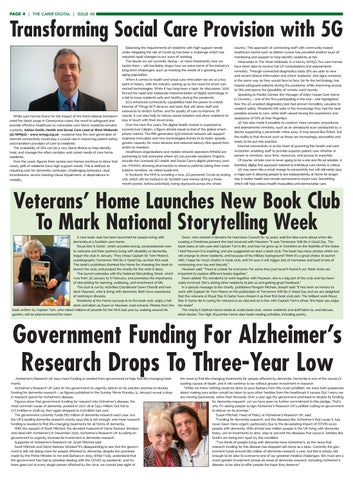
Veterans’ Home Launches New Book Club To Mark National Storytelling Week A new book club has been launched for people living with dementia at a Surbiton care home. Royal Star & Garter, which provides loving, compassionate care to veterans and their partners living with disability or dementia, began the club in January. They chose Captain Sir Tom Moore’s autobiography Tomorrow Will Be A Good Day as their first read. The book’s publishers thanked the Home for choosing the book to launch the club, and praised the charity for the work it does. The launch coincides with the National Storytelling Week, which runs from 30 January to 6 February, and promotes the importance of storytelling for learning, wellbeing, and enrichment of life. The club is run by Activities Coordinator Dawn Cherrill and resident Maureen, who is living with dementia. Both have experience of working in libraries. Residents at the Home can pop in to the book club, enjoy a hot drink and listen as Dawn or Maureen read extracts. Photos from the book written by Captain Tom, who raised millions of pounds for the NHS last year by walking around his garden, will be placed around the room.
Dawn, who worked in libraries for Hounslow Council for 19 years, said the idea came about when discussing a Christmas present she had received with Maureen: “It was Tomorrow Will Be A Good Day. The book looks at 100-year-old Captain Tom’s life, and how he grew up in Yorkshire on the foothills of the Dales. I told Maureen it is inspiring, and she suggested we start a book club. The book has many photos which we will enlarge to show residents, and because of his military background I think it’s a great choice to launch with. I hope for much chatter in book club, and I’m sure it will trigger lots of memories and lead to lots of reminiscing over tea and biscuits.” Maureen said: “There is a book for everyone. For some they just haven’t found it yet. Book clubs are important to explore different books together.” Dawn added: “It’s wonderful to work together with Maureen, she is a big part of the club and has been really involved. She’s asking other residents to join us and getting great feedback.” In a special message to the charity, publishers Penguin Michael Joseph said: “It has been an honour to work with Captain Sir Tom Moore on the publication of Tomorrow Will Be A Good Day and we are delighted that the veterans at Royal Star & Garter have chosen it as their first book club pick. The brilliant work Royal Star & Garter do in caring for veterans is so vital and so in line with Captain Tom’s ethos. We hope you enjoy the book!” The charity’s Solihull Home holds an audio book club, where residents and staff listen to, and discuss, short stories. The High Wycombe Home also hosts reading activities, including poetry.
Government Funding For Alzheimer’s Research Drops To Three-Year Low
Alzheimer’s Research UK says more funding is needed from government to help find life-changing treatments. Alzheimer’s Research UK calls on the government to urgently deliver on its election promise to double funding for dementia research – as figures published in the Sunday Mirror (Sunday 31 January) reveal a drop in research spend for Alzheimer’s disease. Figures show that government funding for research into Alzheimer’s disease, the most common cause of dementia, peaked in 2017-18 at £49.1 million, but fell to £27.7million in 2018-19, then again dropped to £22million last year. The government currently funds £83 million of dementia research each year, but the UK’s leading dementia research charity says this is not enough, and more research funding is needed to find life-changing treatments for all forms of dementia. With the support of Scott Mitchell, the devoted husband of Dame Barbara Windsor, who died with Alzheimer’s in December 2020, Alzheimer’s Research UK is calling on government to urgently increase its investment in dementia research. Supporter of Alzheimer’s Research UK, Scott Mitchell said: Scott Mitchell and Dame Barbara Windsor“It’s disappointing to see that the government is still not doing more for people affected by dementia, despite the promises made by the Prime Minister to me and Barbara in 2019. While I fully understand that the government has had to prioritise dealing with the COVID-19 pandemic, and my heart goes out to every single person affected by the virus, we cannot lose sight of
the need to find life-changing treatments for people affected by dementia. Dementia is one of the country’s leading causes of death, and it will continue to be without greater investment in research. “While we knew nothing could be done to save Barbara from this cruel condition, we were both passionate about making sure action would be taken to save other families from the heartbreak it causes. But I worry we are moving backwards, rather than forwards. Over a year ago the government promised to double its funding for dementia research, yet we have seen no further commitment to this pledge. That’s why I’m asking people to sign Alzheimer’s Research UK’s petition calling on government to deliver on its promise.” Susan Mitchell, Head of Policy at Alzheimer’s Research UK, said: “Funding for dementia research, and the diseases like Alzheimer’s that cause it, has never been more urgent, particularly due to the devastating impact of COVID-19 on people with dementia. With almost one million people in the UK living with dementia today, yet no treatments to slow, stop or prevent the diseases that cause it, families like Scott’s are being torn apart by this condition. “Two thirds of people living with dementia have Alzheimer’s, so the news that research funding for this disease has dropped will come as a blow. Currently the government funds around £83 million of dementia research a year, but this is simply not enough to be able to overcome one of our greatest medical challenges. We must see a much greater investment across all areas of dementia research, including Alzheimer’s disease, to be able to offer people the hope they deserve."
THE CARER DIGITAL | ISSUE 40 | PAGE 5
MPs Call on Care Home Visitation Bans to Be Made Illegal A parliamentary human rights committee has called on ministers to legislate against banning care home visits in England, which relatives say are having a devastating effect on the well-being of residents and instances causing deaths through loneliness and isolation. Harriet Harman, the chair of the cross-party joint human rights committee of MPs and peers, has asked the health secretary, Matt Hancock, to require care homes to permit face-to-face visits, including visits without screens, unless an individual safety assessment judges it to be unsafe New legislation would adopt a similar system in Canada of allowing entry to care homes by a specified care-giver, provided they test negative before each visit for COVID-19. The new law would require care homes to only block a visit 'if they can prove it is unsafe'. Harriet Harman, the chair of the cross-party joint human rights committee of MPs and peers, is urging health secretary, Matt Hancock, to tell care homes to allow face-to-face visits without screens. ‘We have continued to hear far too many examples of people being denied meaningful visits, where these might be safely facilitated,' wrote
Harriet Harman in a letter to Matt Hancock. ‘Failure to adopt an individualised approach to the safety of visits risks breaching the right of patients, residents and their families to family life. ‘We urge you to look at how other countries are tackling this, such as Canada, where in Ontario they have changed the law to allow access to care homes for a relative who is a designated caregiver, provided they test negative before each visit. ‘I would be very grateful if you could consider our proposal as a matter of urgency and respond to us by 17 February.’ In a letter to Hancock, Harman said: “We urge you to look at how other countries are tackling this, such as Canada, where in Ontario they have changed the law to allow access to care homes for a relative who is a designated caregiver, provided they test negative before each visit.” Fiona Carragher, a director of the Alzheimer's Society, said: 'It's great to see the milestone met to protect care home residents and we applaud all those who have worked tirelessly to meet it. 'The most pressing question now is how and when can care homes restart safe, meaningful visits. Combined with PPE and testing, isn't one
jab enough? If not, what else needs to be in place? Another 12-week wait is unacceptable for people dying of loneliness. We need a swifter rollout of the second jab, as well as ensuring all staff receive it.' Liz Kendall, Labour's social care spokesman, called for an urgent plan to reunite families. She said: 'After almost a year of this pandemic, many families are desperate to visit their loved ones in care homes. The news of the vaccine has offered hope to many – but the Government is still unable to tell us when families will be reunited.' A Department of Health spokesman said: 'Care home visits can continue to take place with arrangements such as outdoor visiting, substantial screens, or visiting pods. 'Close-contact indoor visits are not currently allowed. While the vaccines provide protection from serious disease, we do not yet know if they prevent someone from passing on the virus to others. This means it is still important to follow the visiting guidance. 'We will be looking to ensure that a wider range of visiting arrangements are made available when it is safe to do so. We will publish updated guidance as this period of national lockdown ends.'
Tributes Paid to NHS Champion and WW2 Veteran Captain Sir Tom Moore Captain Tom Moore who captured the hearts of the nation with his incredible NHS fundraising during the coronavirus pandemic, has died after a short battle with Covid and pneumonia. The WW2 veteran and NHS champion lost his life having been taken to Bedford Hospital on Sunday. Sir Tom became a national treasure and a household name after raising more than £32m for the health service by walking 100 laps of his garden with his zimmer frame and was knighted for his fundraising efforts by the Queen at Windsor Castle last July. He had been receiving treatment for pneumonia tested positive for Covid-19 last week. Captain Sir Tom compared the coronavirus pandemic to wartime."We're a little bit like having a war at the moment," he said. "But the doctors and the nurses, they're all on the front line, and all of us behind, we've got to supply them and keep them going with everything that they need, so that they can do their jobs even better than they're doing now. "A statement from his daughters, Hannah and Lucy, said "It is with great sadness that we announce the death of our dear father, Captain Sir Tom Moore. "We are so grateful that we were with him during the last hours of his
life; Hannah, Benjie and Georgia by his bedside and Lucy on FaceTime. "We spent hours chatting to him, reminiscing about our childhood and our wonderful mother. "We shared laughter and tears together. "The last year of our father's life was nothing short of remarkable. He was rejuvenated and experienced things he'd only ever dreamed of. "Whilst he'd been in so many hearts for just a short time, he was an incredible father and grandfather, and he will stay alive in our hearts forever. "The care our father received from the NHS and carers over the last few weeks and years of his life has been extraordinary. "They have been unfalteringly professional, kind and compassionate and have given us many more years with him than we ever would have imagined. "Over the past few days our father spoke a great deal about the last 12 months and how proud he felt at being able to leave behind the growing legacy of his Foundation. "We politely ask for privacy at this time so we can grieve quietly as a family and remember the wonderful 100 years our father had."
PAGE 6 | THE CARER DIGITAL | ISSUE 40
Isolation And Loneliness – The Ignored Epidemics Ravaging the Lives of Older Adults Shainoor Khoja, CEO and founder of Thrive-Community (www.thrive-community.com) outlines the role technology can play in overcoming this growing problem, if it’s built right
Loneliness and isolation are taking their toll on people of all ages right now with older people being impacted the most. Life was hard enough for many of them in a pre-Covid-19 world given limited support from friends and relatives, housebound challenges due to diminishing health or other mobility issues, NHS (National Health Services) staff shortages or the accessibility and affordability of adequate care in the first place. The pandemic has only exacerbated an already dire situation. Almost 12 months on and older adults living independently are still being advised to minimize contact outside their respective support bubbles. Those living in residential care are only permitted virtual contact with close relatives. When they are allowed real world visitors, it’s behind Perspex screens with friends and family members obliged to wear PPE so they look like spacemen. Such foreboding conditions can be intimidating at best, for some older adults it can be very frightening indeed. Research is showing that reduced social contact is detrimental to the physical and mental wellbeing of many, and the continued virtual appointments/checkups combined with constantly changing social distancing guidelines (intended to keep them safe), are exacerbating the problem further.
DIGITAL DIVIDE IS NOT ACCEPTABLE IN A MODERN WORLD Considering we live in a digital world, it begs the question as to why
do older adults feel lonely, isolated, and removed from society? Afterall, PCs, laptops, Smartphones and tablets are widely available, most areas of the UK have adequate broadband and 4G coverage, and platforms like Zoom, Skype, FaceTime are providing some semblance of normality by allowing us to see the people we’re talking to. Sadly, many older people lack the skills, confidence and motivation to take advantage of these platforms and other digitized service due digital poverty and/or poor system design. Such a state of affairs is not really acceptable for a country aspiring to eradicate digital poverty and for an NHS wanting to implement a long -term digital transformation plan with a mobile first strategy and connectivity at its core. There is an international shortage of technology built specifically for older adults which is a concern as this demographic is growing faster than any other. The lack of intuitive technology for this age group makes it all the more difficult for overstretched healthcare professionals to benefit from the value that well designed technology could bring. In many instances, digital devices and the services they support are hindering rather than helping overburdened social workers and other outreach teams. Smartphones should be serving as a “go to” communications and patient management tool, but this isn’t happening in reality and older people are becoming more and more isolated as a result.
TECH CAN ONLY SOLVE PROBLEMS IF THE ADOPTION BARRIERS ARE PROPERLY UNDERSTOOD The downfall of many handsets and other consumer electronic devices, along with the health and wellbeing services they power, is that a certain amount of knowhow is needed to get them up and running in the first place. There are browser issues and settings menus to contend with, seamless experiences are not always that seamless because you’re obliged to juggle between services and platforms, depending on what you’re trying to do. Grappling with tech, remembering the multiple steps needed to join a Zoom call, for example can be overwhelming for some older adults, especially if there’s no one close by to help them get started in the first place. Small displays don’t make things any easier either, especially for those who are short sighted or arthritic.
Switching between different technologies is just as frustrating for professional carers. They have no control over what systems or device types their patients are using. Some may have Zoom set up, others may prefer Skype, or Facetime. Chances are that their patients don’t have anything at all which makes virtual caring impossible. As a result, social services and community care workers are losing contact with those who are reliant on these services the most because they’ve given up trying to engage with tech.
NEW PLAYERS ARE TAKING THE TIME TO GAIN A BETTER UNDERSTANDING OF THE SITUATION Covid-19 has caused anguish across the board, but a positive outcome has been an advancement in the usability of many healthcare systems/technologies/platforms. This holds particularly true for the newer players who are taking the time to better understand the requirements of the different user groups, with more intuitive applications coming online as a result. Many of these services are leveraging capabilities such as machine identification, facial recognition and sound recognition to overcome accessibility challenges by streamlining processes and removing the need for usernames and passwords. The key failing of all digitized healthcare systems, old and new, however is not understanding the importance of mood. Erratic mood changes provide a pretty reliable indication that something is amiss among older adults. Equally as important, a subtle change in mood over time can indicate the onset of different medical conditions. Staying on top of these early warning signals makes diagnosis and treatment easier, which in turn improves overall quality of life and helps to combat feelings of loneliness and isolation. There is no going back to a pre-Covid world. Even with the development of breakthrough medicines and nationwide vaccination projects, there is still a long way to go before everyone is inoculated and protected. We also live in a digital age and whilst we have to adhere to social distancing and other safety measures, the different technologies needed to facilitate digitized healthcare must be accessible and available to all, especially to those isolated and lonely older adults who need them the most.
Westgate Healthcare Extends their Big Wish Initiative to Support the Wellbeing of Their Staff Care home group Westgate Healthcare have extended their ‘Big Wish’ campaign to employees, as a thank you for their commitment and dedication throughout the pandemic. The ‘Big Wish’ initiative was originally created by the care group to support residents living within their homes, by granting the dream of one lucky resident, every six months. Following the Coronavirus pandemic and the commitment and resistance of their workforce, Westgate made the decision to extend the initiative to their staff to support their wellbeing following an unprecedented year. The ongoing pandemic has been difficult for many who work in the healthcare sector, including care workers and nurses who have made sacrifices to commit to their work, even if that means living separately from their loved ones and moving into the care home. As a family-run care organisation, Westgate Healthcare understands the importance of support, care and celebrating milestones together with their staff and residents. The extension of the ‘Big Wish’ initiative to staff is their way
of extending their gratitude back to their teams. Westgate Healthcare have said they intend to grant one wish per care home in January and will continue to grant wishes periodically in 2021. Tara Teubner, Westgate Healthcare Director, said: “The past year has made us reflect on the importance of remembering and rewarding the people who inspire us and make a difference each day to our residents’ lives. We are deeply grateful to every team member across our homes.” The care home group offers exceptional person-centred care to all its residents, across seven care settings. Their services include residential, nursing, respite and palliative care for people over and under the age of sixty-five. As a care provider with two ‘Outstanding’ rated homes from CQC (Care Quality Commission), Westgate Healthcare’s success is down to their loyal and committed workforce, and they want to ensure their staff continue to feel rewarded and supported for their hard work. To find out more about the campaign, visit www.westgatehealthcare.co.uk/news-article/staff-wellbeing-campaign/
Image Based on the Touching Photo ‘Forever Holding Hands’ to Raise Funds for the NHS An image based on the moving photograph ‘Forever Holding Hands’ which formed part of the National Portrait Gallery’s Hold Still exhibition is to raise funds for NHS Charities Together. The granddaughter of an elderly couple who spent their last days holding hands in hospital after contracting Covid 19, commissioned Worthing artists Stella and Gem Stevens to recreate the photo in the colourful style, depicting the fun side of her much missed grandparents. The artists from Worthing, moved by the heart-breaking story, offered to paint the image for free suggesting an opportunity to raise funds for the NHS who cared for them in their last days. NHS Charities Together will use some of the funds to purchase electronic tablets to enable vulnerable patients, families and carers to connect with one another, plus provide bereavement support for families who lost loved ones; and counselling for staff to protect their mental health.
The artists behind the painting have joined with the granddaughter who took the moving photograph – Hayley Evans, to create a donations page where people can give to the Holding Hands – Urgent Appeal for NHS Charities Together. Hayley said “We were so lucky that we could Facetime my grandparents when they were in hospital and they said how comforting it was to see us. However we know many people are not able to and feel so isolated. Some of the donations to the Appeal will go towards the purchase of electronic tablets which will help others less fortunate. I saw my grandparents once in hospital, which is when I took the photograph through a visor. It was the last time I ever saw them." The couple – Pat and Ron Wood aged 91 and 94, who had spent 71 years together, had been admitted into Worthing Hospital a few days apart with Covid 19 and were originally nursed separately. After realising the couple’s health situation, the kind nursing staff moved their beds together so they could hold hands. Pat sadly died in her sleep and Ron died five days later. The moving photo was submitted along with over 31,000 others to the National Portrait Gallery to capture the spirit of the UK during the first national lockdown. The photograph called ‘’Forever Holding Hands” was one of the 100 final images selected by the judges and forms part of the National Portrait Gallery’s Hold Still online exhibition.
Granddaughter Hayley Evans approached the identical twin artists – Two Faced Twins, Stella and Gem Stevens as she loved their colourful style, The artists originally quoted a price for reproducing the photograph as art, but the next day rang Hayley to say they would do it for free as they saw it could be an opportunity to raise funds for the NHS who cared for the elderly couple in their last days. Working with a friend, they researched the various needs of the NHS and found the perfect cause to raise funds for and set up a Collection Pot for donating online. A print of the original art will be given to Hayley, with the original which they framed in a platinum colour to represent the couple’s recent platinum wedding anniversary, being presented to Worthing Hospital where Ron and Pat were cared for. Hayley said “The photo depicts my grandparents' love for each other right up to the end. To think it will lead indirectly to bringing comfort and support to others through the fundraising appeal is more than my family and I could ever hope for.” The artists want the image to pay tribute not only to the couple who lost their lives but to the 100,000 plus lives that have been lost due to covid 19. To donate to Holding Hands – Urgent Appeal go to: https://www.collectionpot.com/pot/holding-hands/
THE CARER DIGITAL | ISSUE 40 | PAGE 7
Stay Vigilant to Protect the Most Vulnerable Care Homes Urged The death toll in care and nursing homes is continuing to rise, prompting providers to urge the public to keep following the rules to protect the vulnerable. Figures from the Office for National Statistic show that 1,817 people died from Covid-19 in care and nursing homes in the week up to 22nd January – up from 1,271 the week before and 960 the week before that. According to these figures 24,709 people died from Covid-19 in care and nursing homes between 28th December 2019 and 22nd January. The Independent Care Group (ICG) said the continuing death toll was
alarming. ICG Chair Mike Padgham said: “We can never forget that every number represents the loss of loved ones across the country and we cannot become complacent. “We are getting mixed messages from the Government and some people might get the impression that the worst is now behind us and we can start to return to normality. “The vaccine is only half the solution; we must all remain on our guard and do everything we can as a country to get these numbers down. We
must be patient, keep following the rules and get on top of Covid-19. “We must also ensure that the vaccine is reaching all the people who need it – people being cared for in their own home and in other care settings like sheltered accommodation, for example. “The vaccination programme is a success so far, but it must not lead to people thinking we are out of this, because as these figures show, we certainly aren’t.”
Epsom Care Home Donates To Junior School Following Heartfelt Card Exchange Staff at Tadworth Grove Bupa Care Home have raised £250 for a local junior school in Surrey, after pupils kindly sent lots of Christmas cards to residents. The Epsom-based care home put out a plea last December for the local community to help raise residents’ spirits over the festive season by sending joyful messages and cards. Staff were blown away by the generosity of pupils at Warren Mead Infant and Junior School when they received ninety-nine handmade cards. To say thank you, for the time and effort the pupils put into their kind messages, staff wanted to give back by raising money that they hoped would benefit the children’s studies. A resident at the Tadworth Grove Bupa Care Home, Doreen Kirk, was once a teacher at Warren Mead and so the relationship between the school and the home is very close to her heart. Commenting on the cards she and the other residents received over Christmas, Doreen said: “The handmade cards from the children were just wonderful, so creative and well-made, they had clearly put in a lot of effort. “Working at the school was such a pleasure and I look back on that time in
my life very fondly. That’s why being able to maintain a close relationship with the teachers and pupils is very important to me and I like to support them when I can.” The school’s headteacher sent the home a thank you message following the donation and confirmed that they will be using the money for supplies and educational decorations for the children’s classrooms when they return to school. However, the final decision on what the money should be spent on will be left to the children who spent their time making the cards for Tadworth Grove residents. Soonita Shaw, Home Manager at Tadworth Grove Bupa Care Home, said: “We were so thrilled when we received all of the Christmas cards from the children and it was lovely to see our residents’ faces light up when reading them. “We wanted to give back in a meaningful way and hope that the donation will be put to good use for the children’s time in the classroom. We are so proud to be able to support our local school in this way.”
Deferred Care Payment Agreements Published New statistics on deferred payment agreements with local authorities for adult social care have been published by NHS Digital. A deferred payment agreement is an arrangement with the local authority that enables people to use the value of their homes to help pay for care home costs. If eligible, the local authority will help to pay a client’s care home bills on their behalf. The client can delay repaying the
local authority until they choose to sell their home, or until after their death. The Deferred Payment Agreements (DPA) Report, England 2019-20 provides information on the number and associated monetary value of adult social care deferred payment agreements in England for 2019-20. It also includes the number and value of DPAs ended, written off and
recovered. There is also information on the type of DPA, the reason for a DPA being requested and the duration of the agreement. Due to coronavirus (COVID-19) and the extra pressures felt by local authorities, collection deadlines for information about DPAs were extended from August to October 2020. A number of local authorities have also advised that it was not possible to quality assure adult social care submissions to the same extent as in previous years, so it is important to consider this when reviewing this year’s data and changes over time.
PAGE 8 | THE CARER DIGITAL | ISSUE 40
Vaccination and Visitation in the Care Setting Vanessa Latham, partner and employment law expert at BLM (www.blmlaw.com), discusses the rules on vaccination and visitation for care providers As we experience continued restrictions as the Government attempts to control the spread of COVID-19, the rolling out of the vaccine programme gives us all hope for the future. However, the availability of the vaccine gives rise to a new set of challenges for care settings in relation to staff and family visits. Can and should care homes prevent staff from working or family for visiting if they refuse to have the vaccine? Could care homes make it a requirement for a person to be vaccinated before entering a care home? One of the first arguments that will no doubt be raised is that, if all the residents and most of the staff have been vaccinated, what is the harm? We know that the vaccines are not 100% effective and there is still increased uncertainty at the time of publication of this article around the decision to delay the second dose. There is a risk of contracting COVID19 even after vaccination, particularly to care home residents who are likely to be elderly or clinically vulnerable. Little is known about the risks of transmitting the virus after vaccination. Care homes still have an obligation to continue to reduce the risk to residents and staff to the lowest reasonable level. Recent research by the National Care Association (NCA) suggests that, whilst 50 to 60 per cent of care home workers are likely to consent to being vaccinated, 17 to 20 per cent will not, and the remainder are
undecided. If this proves to be accurate, it means as many as one in five care home staff will not be vaccinated, presenting a significant challenge to care providers. Requiring an employee to be vaccinated on a mandatory basis raises a number of contentious legal issues. Under the Health and Safety at Work Act 1974, employers have a duty to ensure a safe working environment and must take reasonable steps to reduce workplace risks. Citing this guidance, businesses such as Pimlico Plumbers, a large London-based plumbing firm, have plans to rewrite workers’ contracts to make a vaccination a requirement for continued employment. As it stands, an employer cannot force a member of staff to undertake a medical procedure. Whilst it may be considered reasonable management instructions to ask staff to be vaccinated, some individuals may have perfectly legitimate reasons for refusing the vaccine, for example, the current guidance is that pregnant women or those intending to get pregnant should not be given the vaccine. There may be other medical or religious reasons for refusing and care homes could fall foul of discrimination legislation if they take any action to require those staff to be vaccinated. Any care home dismissing or disciplining a member of staff for refusing the vaccine is likely to face an Employment Tribunal claim so before any such action is taken, a home must be certain that they have taken every possible step to ensure that individual can continue to work safely without the vaccine. The NCA has recently indicated that it is seeking legal advice on whether (and presumably in what circumstances) staff can be required to have the vaccine. It will be important to remember that some employment law protection applies to workers as well as employees, so the same approach must also be applied to agency and bank staff. When recruiting new staff, it will be crucial to know whether they have had the vaccine. However, if the potential staff member has not been vaccinated, care
homes will need to be careful they do not breach discrimination law by refusing employment to someone who has declined the vaccine. The issue therefore remains contentious and in the meantime care homes should consider what steps can be taken to allow staff to continue to work safely without the vaccine, such as: • Can the strict use of PPE and social distancing be implemented? • Could testing be undertaken on a regular basis, for example lateral flow tests that provide results in under 30 minutes? • Could work be modified to avoid or minimise direct contact with residents or other staff? A person’s role cannot be unilaterally changed by an employer, but small changes can be made to duties or the way in which those duties are undertaken. If a significant role change would be required, an employee should be invited to agree to it. For visitors, the difficulties are less likely to be legal, but will be similarly contentious. The upset and distress caused if relatives are unable to visit loved ones and inevitable negative press and social media attention can be just as difficult to deal with. The first challenge will be in determining whether visitors have been vaccinated; a reasonable step would be to ask visitors to bring their NHS card confirming that they have been vaccinated when they visit. A blanket ban on visitors who have not been vaccinated would be unreasonable. As with staff, there may be perfectly legitimate reasons why a visitor has not been vaccinated, so care homes should consider whether any individual who has not been vaccinated can continue to visit safely through use of PPE, social distancing and lateral flow testing. It would only be if a visitor refused to comply with those safety requirements that a care home should, as it stands, reasonably prevent them from visiting.
Quality Compliance Systems And Napthens Agree Health And Safety Partnership Quality Compliance Systems (QCS), the UK’s leading provider of content, guidance and standards for the social care sector, has further enhanced its Health & Safety compliance credentials by agreeing a long-term partnership with Napthens Health and Safety The agreement, which was forged this week, is an extension of a fruitful strategic relationship struck between QCS and Napthens, which has seen Napthens provide support and expert advice to QCS’s employment law policy team. In the same way, Napthens Health and Safety will strengthen QCS’s Health & Safety capability by reviewing all H&S content, which not only covers policies and procedures, but includes risk assessments, audits and check-lists. Napthens Health and Safety will also assist QCS by producing cutting-edge video and audio H&S tools. Philippa Shirtcliffe, QCS’s Head of Care Quality, said, “We’re delighted to be working alongside Napthens Health and Safety. We already have a very strong Health & Safety poli-
cy writing team but Brexit, the Grenfell disaster and the Covid-19 pandemic have brought about profound and irrevocable change, which is likely to have a significant impact on Health & Safety regulation for the social care sector. Going forward, Napthens Health and Safety’s specialist skillset will add an exciting new dimension to our team, which will enable us to continue producing specially curated content, guidance and standards that our customers so badly need.” Chris Walker, Head of Health and Safety at Napthens, added, “The partnership that we have forged with QCS is very exciting. Our primary goal is to ensure that the H&S advice we offer is not just legally compliant and up-to-date, but is practical and workable on a number of different levels. That means working with QCS to create tailored policies, risk assessments, blogs and e-learning resources that can be easily understood and implemented by managers, administrators, frontline workers and service users.”
Case Study: How Visioncall Saved Jean’s Sight, And Turned Her Life Around “Your sight is precious, isn’t it?” These are the words of Jean*, an 85-year-old care home resident who underwent lifechanging cataract surgery in 2019, following diagnosis from Visioncall, a leading eye healthcare provider to the care home sector. Formerly almost completely blind, Jean’s carers say that she is now “a whole new woman” since her treatment. Jean came to Cherry Lodge in Birmingham in October 2018, after a fire in her home. She’d been living alone since her husband passed away several years before, and according to carers, was in ‘a state of serious self-neglect’. In those early months at Cherry Lodge, Jean required 24-hour one-to-one assistance, because of her sight issues. “When Jean first came here, she couldn’t see at all,” explains Lauren Kavanagh, Jean’s carer at Cherry Lodge. “She couldn’t see shadows; she couldn’t see if you placed your hand in front of her face – she just couldn’t see a thing. She was very timid and withdrawn. She would be very wary, shouting out to see if someone was there; sometimes, she’d stand up from her chair and start shouting for help, that she couldn’t see.” It was particularly sad for Jean to lose her sight, as she’d been an avid reader, with a particular love of crime stories. “Jean told me that she used to meet her sister in Birmingham city centre every Thursday, and that they’d go to the library together,” says Lauren. “But that all stopped
when her sister died. She sometimes says that she thinks her eyesight went downhill because she read too much.” After her arrival at Cherry Lodge, Jean was diagnosed with dementia, which made things more complicated: “Jean would insist that she could see,” explains Lauren. “When her dementia was at its worst, she would say things like ‘I’m not blind – I don’t know what you’re talking about, I can see everything’. She was in complete denial.” Carers were concerned about Jean’s sight, so they asked Visioncall to visit Jean and make a professional diagnosis. Vic Khurana, Visioncall’s lead optometrist, diagnosed Jean with bilateral cataracts and inflamed eyelids, and referred her to her GP and SpaMedica, a specialist eye hospital in Birmingham. Within a week, Jean had an appointment for cataract surgery. “The surgery was amazing – out of this world,” says Lauren. “I was allowed to be in the operating room with Jean, because of her dementia, and I watched the whole surgery. When it was done, the surgeon asked me to stand beside her, and I said ‘hello’ to her. Jean looked at me, straight in my eyes, and asked how I was! She could see me straightaway.” The changes didn’t stop there, according to Lauren. “I remember coming home with her that day, and she didn’t hold my hand – she got out of the car and walked into the building on her own. This was only one eye that had been treated at this stage, and she’d never seen the
building before, she didn’t know where her room was, but she walked straight in. She immediately began using the bathroom on her own and eating her food by herself – we didn’t need to help her with anything. She got her independence back that day, and it was lifechanging – for Jean, of course, but also for the staff.” Lauren is adamant that it was Cherry Lodge’s partnership with Visioncall that turned Jean’s life around, saying: “I think if Jean had been here at Cherry Lodge sooner, her eyesight and her independence would never have been so badly affected, because Visioncall would have been there to help her before it got to that stage. Visioncall is brilliant; they understand the needs of a care home, the needs of residents, the needs of people with dementia, which is amazing. It’s such a good service.” These days, Jean is very much enjoying her new lease of life at Cherry Lodge. “She’s got a 42-inch TV in her room!”, laughs Lauren. “She watches TV every day, and she reads again too, which is lovely. She enjoys her food again, and she’s much more sociable now, having conversations with everyone. Jean still has some struggles with her dementia, and some days she won’t remember a time when she couldn’t see, but it’s sometimes just nice to sit back and observe her in the communal areas, and remember how far she’s come.” “I honestly think that this experience will be something that I will remember for the rest of my life,” Lauren says. “I’ve never seen such a turnaround on somebody before, how something so small can make such a difference. It helped Jean so much, it has changed her whole life.” To find out more about Visioncall, please visit: www.vision-call.co.uk *Name has been changed to protect privacy.
THE CARER DIGITAL | ISSUE 40 | PAGE 9
COVID Emergency Means Government Must No Longer Delay Its Promise Of Fixing Social Care The social care system must be drastically overhauled, and the Government urgently needs to deliver on its manifesto commitment to fix the failing social care sector. Launching its new report, Let’s do this: The promise of fixing social care, the Health for Care coalition is calling on the Government to deliver on its promise to address the failures of the social care system. The COVID-19 pandemic has served to highlight again the important relationship between health and social care. The NHS relies heavily on its social care colleagues, including in helping to ensure timely hospital discharge to community settings, and in guarding against unplanned emergency admissions. More crucially, social care provision is an essential ingredient in supporting independence and quality of life for our family members of all ages. There are 1.4 million older people currently estimated to have unmet need for social care, yet without a comprehensive and properly funded long-term plan for the sector, this important infrastructure is jeopardised. Health for Care – a coalition of 15 national health organisations, led by the NHS Confederation – warns that the COVID-19 pandemic has thrown into stark relief the failings and underlying weaknesses of the social care system, which have left health and social care services struggling to cope. Central to the report are proposals for a better funding model and a restructured social care system. Report authors lament the ongoing repercussions of the failure to plan properly for vital services and the dramatic falls in spending on social care in England, with figures showing a 12 per cent decrease per person over the decade to 2018/19. They also warn of very high staff vacancy numbers, with 112,000 social care posts left empty, and very low pay, status and career opportunities. Danny Mortimer, chair of the coalition and chief executive of the NHS Confederation, said: “When Boris Johnson delivered his first speech as Prime Minister on the steps of Downing Street eighteen months ago, he promised to ‘fix the crisis in social care once and for all’, but despite decades of delay, the Government has not made any visible or tangible
progress on this issue. “While addressing the immediate COVID emergency has rightly been the Government’s top priority, there is a real risk that allowing the current circumstances to excuse further delays to social care reform will mean that an opportunity is missed once again. “The NHS and social care are sister services and have been supporting one another and working closely together throughout the pandemic. However, when one service does not work, the other suffers, and the past few months have brutally exposed how fragile and underresourced England’s social care system has become. “The Government must now deliver legislative proposals to fix social care, once and for all. A well-funded and good quality social care sector is fundamental to a healthy nation and a well-performing NHS. Without social care reform, with a clear and transparent timetable for delivery, backed up by a long-term funding settlement, not only will the NHS and social care continue to run at near breaking point through the pandemic, but they will struggle to address the long-term health and social care issues the crisis leaves in its wake.” Commenting on the report, Professor Helen Stokes-Lampard, chair of the Academy of Medical Royal Colleges, said: “The Academy of Medical Royal Colleges strongly supports the drive to fix social care once and for all. It is imperative that we engage with this as a matter of urgency, because high quality social care is vital for so many people and has been neglected for decades. If we don’t have effective social care, we cannot have an effective, efficiently functioning NHS.” Rachel Power, chief executive of the Patients Association, said that the social care system is “simply not set up to meet people’s needs today.” “More people are living for longer with conditions that can’t be treated by the NHS, and they rightly expect care and support to allow them to continue to live well and play an active role in society. The current system creates an enormous disparity between people with some health conditions who are treated for free on the NHS, and others who struggle to access care at all and are charged when they do. A clear, equitable offer that people can count on to provide care and support when they are in need is absolutely imperative,” she added. Imelda Redmond CBE, national director at Healthwatch England, said: “The provision of social care services is crucial in helping disabled people and frail older people live the best life they possibly can. Yet under the current system, many people’s needs are not met and services remain underfunded, with the COVID-19 pandemic having laid bare deep fault lines. We must see the promised significant reform if we are
to tackle this.” Isobel McMillan, a retired teacher, said: “I’m ardent about the care system and linking it up into an integrated system, ever since I had my own experience of it. “The social care system and how it joins up with health is a complicated puzzle and so difficult to navigate. We need a properly integrated system that is well-funded so that both carers and health care staff are properly paid.” Anna Severwright, who uses social care services, said: “For too long, myself and many others I know have described social care as a fight to get the support needed to be able to live the life we want and do the things that matter to us. But I am also aware that the NHS sees the negative impacts of the current social care system – whether hospital admissions due to lack of support or adaptations, or delayed discharge as support is not in place – health and social care are interdependent to our health and wellbeing. We need brave and radical reform now.” Professor Andrew Goddard, president of the Royal College of Physicians, said: “There are no two ways about it – social care needs funding now, not least so more staff can be hired, better paid and better supported. The impact of the pandemic is a reason to find a sustainable solution as quickly as possible, not to delay reform that has been needed for years. “Only when we have an agreement on how we are going to fund social care can we develop new models of care that ensure people get the joined-up care they need. The NHS Bill expected later this year will be an important step towards greater integration, and social care cannot work as an equal partner to the NHS unless it is recognised and funded as such. “But something the government could do immediately is extend the health and care worker visa to include social care staff. It’s the least they can do in recognition of their critical role in keeping people safe and healthy.” James Bullion, president of the Association of Directors of Adult Social Services, said: “It’s great to have such solid support for social care from our health colleagues. Some people may be surprised to see one sector campaigning so passionately for another, but we are both part of a single care and health system and each depends utterly on the other. “The case for significantly increased long-term funding to enable us to access the care we want was clear before the pandemic, but is now even more stark. Those of us with care and support needs, families, carers and all who work in health and social care urgently need the government to bring forward its promised plans.”
THE CARER DIGITAL | ISSUE 40 | PAGE 11
New Trial to Test Drugs for Preventing Covid-19 in Care Homes
A new trial, led by experts from the University of Nottingham, will look at reducing the transmission of Covid-19 and its severity in care homes, thanks to funding from the National Institute for Health Research (NIHR). The team are initially looking for up to 400 care homes to take part in the ground-breaking trial – called PROTECT. As part of the trial, researchers will test drugs that already show promise for treating Covid-19, but will use them to prevent Covid-19 instead. The team will focus on care home residents because they are at high risk from Covid-19, and although priority has been given to them for vaccination, the effectiveness of vaccines in this group has not yet been fully established. The aim is to reduce the number and severity of Covid-19 cases in those homes. The UK has more than 21,000 care homes looking after 420,000 residents, many of whom have dementia or physical care needs. Up to half of all Covid19 deaths in the UK have occurred in care homes. If PROTECT can identify an effective drug to reduce the severity of Covid-19, and the likelihood of transmission, then this, alongside other measures, could help enable a return to a more normal life for care home residents and their families, including more liberal visiting policies. The lead researcher, Professor Philip Bath from the University of Nottingham said: “Apart from vaccines, there are no drugs for preventing serious Covid-19 and we believe that the PROTECT trial has a good
chance of finding one or more drugs that might reduce the awful death rates seen in care homes.” The trial will have a “platform” structure like the RECOVERY trial, which has rapidly evaluated candidate treatments for Covid-19. However, PROTECT will randomise care homes (rather than individual residents) to one of up to three drugs or no additional treatment, in a cluster randomised controlled design. This design allows several drugs to be tested in parallel and then for new drugs to be added once the first candidates have been shown to be beneficial or have no useful effect. Treatment will be given alongside the ongoing vaccination programme. The trial will be coordinated from the University of Nottingham working with colleagues from the Universities of Edinburgh, Cambridge, Cardiff, Surrey and Warwick and Queen’s University Belfast and University College London. Professor Adam Gordon, President-Elect of the British Geriatrics Society and co-chief investigator at the University of Nottingham said: “Having worked closely with care homes throughout the pandemic, I have seen how hard it has been for residents, their families and staff to deal with the high rates of illnesses and deaths, and the associated loss of routine, including visiting. The announcement of PROTECT is an important step towards finding preventative treatments that might help restore normality. The agents investigated may have important protec-
tive effects in future virus outbreaks, even after the pandemic has passed.” Vic Rayner, Executive Director of the National Care Forum, said: “This trial is hugely important on so many levels. Firstly, it will enable detailed research with the intention of identifying lifesaving interventions that could prevent some of our most vulnerable citizens from contracting Covid-19. And secondly, because it recognises that those living within care homes continue to have a vital contribution to make towards society, and prioritises medical research which puts their health and wellbeing front and centre of scientific considerations.” Minister for Innovation Lord Bethell said: “Vulnerable care homes residents have been disproportionately impacted by this virus and we are working tirelessly to find effective ways of protecting those most at risk.” “This is a very promising development for the UK and I actively urge as many care homes as possible to get involved with this trial, which the government is backing through the National Institute for Health Research. Together, we can play a part in helping to ensure the most vulnerable in our society are given every possible form of defence against the virus.” Care homes interested in taking part in the trial should contact the researchers via the website at www.protect-trial.net or by email protecttrial@nottingham.ac.uk.
Cornish DJ Swaps Night Clubs For Night Shifts Having lost his job as a nightclub DJ due to the pandemic’s shut down of the hospitality and leisure sectors, Camborne resident Samuel Barnes took a drastic change in career. After Samuel’s mum passed away at the start of the year, and with pandemic induced lockdowns closing the hospitality and leisure sectors, he was inspired to change occupations, switching the excitement of nightclubs for the challenge of care homes. Barnes followed his mother’s wish and became a support worker at Rosewarne, a residential care home for disabled adults with complex care needs in Camborne, Cornwall, in August 2020. Since then, Samuel has been taking part in all aspects of Rosewarne life,
including the care home’s Christmas party and bake off, and has bonded with both residents and fellow carers. Samuel Barnes, support worker at Rosewarne, said: “The Rosewarne team are amazing, so caring and down to Earth, as are the residents. My favourite thing about working at Rosewarne is the way that the team do their absolute best to provide the best care for the residents. “I loved the job from the minute I started, and I was able to transfer skills such as listening and patience from my job as a DJ. I’m so glad I changed career and would like to thank Salutem for the opportunity you have given me in this role.”
H.W. PICKRELL Amanda Waring - (award winning dignity campaigner, trainer, filmmaker, author and well- being expert )is providing so much invaluable help to Carehome managers and staff around the UK at this time. Please see how she may help your home with her award wining online dignity trainings and self care programmes and books and films on caring for others whilst caring for ourselves.
NEW & USED ACCESSIBLE TRANSPORT AT AFFORDABLE PRICES • We specialise in the sale and purchase of quality used wheelchair accessible vehicles and ambulances. • They can be bought as seen or refurbished and sign-written to your own requirements. • 12 months M.O.T/Class 5 and 12 months warranty. • Engineers inspection supplied if required.
Please visit her website www.theheartofcare.co.uk. She is also offering a £100 discount for her WHAT DO YOU SEE training pack that includes over 50 hours worth of innovative person centred training. Her online uplifting and inspirational self care and recovery masterclasses for all who work in care are proving incredibly powerful and helpful. To book your sessions please email Amanda at amandawaringfilms@gmail.com. Essex County Council have ensured every carehome and staff member receive Amanda’s unique trainings.
• Free delivery service available • All buses comply with new legislation • Lease hire and purchase available • Always large stock of accessible vehicles
Tel: 01268 521033 Mobile: 07860 894331 Email: sales@hwpickrell.co.uk Gardiners Lane North, Crays Hills, Billericay, Essex CM11 2XE All current stock available to view at www.hwpickrell.co.uk
PAGE 12 | THE CARER DIGITAL | ISSUE 40
Mental Health and The Care Sector
By Andre Radmall MA MSc BA, Psychotherapist and Life Coach (www.andreradmall.com)
The long term impact of the pandemic on the care sector is as yet to be measured. We know however that already there is widespread sickness, burn out and possibly signs of PTSD. Staff in care homes will be very affected by the high mortality rate in their homes. Covid has in some cases decimated care homes. Unlike hospital wards these are small communities where long standing relationships are built up over long periods of time and in some ways they can be like an extended family. Losing members of the home to Covid will mean the loss of friends and long term relationships. Some care workers will also have been ill themselves and possibly experienced the death of their colleagues. Care staff will probably need long term support with their mental health. Issues may include depression, anxiety and trauma. The signs of this can be difficulty sleeping, irritability, low tolerance for stress and mood swings. Even though staff may seem OK that doesn't mean they
are. It will be important to invest in staff taking the time to receive the support necessary to recover their sense of balance and resilience. It may be necessary for staff to access therapeutic support. This may take the form of cognitive therapy or in some cases targeted therapies with which to address PTSD symptoms. There may be a lot of anger, guilt and even shame in staff who will need professional treatment if they are not to suffer long term mental health issues. This could be a challenge to managers and the wider service as psychological treatment in the NS may be very oversubscribed in the coming year or so. Going forward, another problem may lie in recruitment to the sector given the impact of the serious effects of Covid in the media. An important aspect of care home workers’ own mental health recovery will be the support of their work colleagues and friends. This is partly because these people will have an understanding of the trauma they have been through. I think self help groups of care workers facilitated by a professional could be valuable in helping workers recover from their experiences of the pandemic. It is often the case that the people working in a similar situation will be able to share tips and advice to help maintain mental health. These groups can also be a way of preventing the isolation that often accompanies depression and stress related reactions. Workers will also need support from groups like family and nonwork friends. One reaction to low mood is social isolation and of course this is made worse at this time by the social distancing restrictions. So it
becomes more important than ever that friends check in on those working in this sector and if necessary have the discussion with them about seeking medical support if necessary. The nature of care sector workers is often to put others' needs before their own so it is helpful if those close to them can encourage them to share their feelings and take some time and space for themselves. A helpful tool for care workers may be to practice compassionate mindfulness. This is an approach whereby physical and emotional feelings are acknowledged, observed without judgement and accepted. It is often helpful to support this kind of approach with a general attitude of being kind to oneself and taking time for self care. Walks, exercise and getting enough sleep can be very helpful in supporting this mindful approach. In summary, it is helpful to consider the long term effects of working through a pandemic in the care sector. It is likely to impact mental health and appropriate long term therapy and support will need to be considered across the sector. Andre was formerly Manager and Group Therapist at Priory Hospital North London and a Psychotherapist at Rafan House in Harley Street. For the last twenty years he has worked in private practice specialising in depression, anxiety and stress, family therapy, addictions and issues of self worth. His new book on 'How to pivot your life story' is due to be published May 2021.
A Plum Idea For Keeping Spirits Up Discovering that many more plums are grown in Romania than the UK was a surprise to residents of a Wellington dementia care home – one surprise among many in store for them during a recent Romania ‘theme’ day. Residents of Camelot House and Lodge said they felt as if they had been transported to the Balkans for the day with many authentic touches made possible thanks to staff at the home who originate from Romania. Activities co-ordinator Richard Dempslake said: “A national theme day is a great way to entertain our residents, and gives them chance to engage in familiar activities with a novel twist – a real boon in the current climate, given that we can’t take them out of the home for the local visits that they enjoy in normal times. “One of the games they enjoyed playing was ‘higher and lower’ which is a guessing game, and we included some Romanian-themed questions. That’s how they learned that Romania is the fourth largest producer of plums in the world! I think some of them would have liked to sampled some țuică – Romanian plum
brandy – which my colleagues tell us is delicious. “They really enjoyed looking at lovely photos featuring Romanian countryside, cities, culture and native animals, and these sparked a lot of chat, with them making comparisons with customs and wildlife they came across personally in their younger days. “And some of them were keen to hear the myths and legends about Transylvania and Romania’s medieval cities. “We ended the day listening to Romanian traditional folk music and did the traditional circle dance called Hora Romaneasca – all with appropriate social distancing, of course. Richard said: “It takes some imagination to keep coming up with new and engaging activities that can be carried out in a Covid-safe way, but it means such a lot to our residents, and thankfully we’re not short of imagination.”
DO YOU HAVE A SPONSOR LICENCE IN ORDER TO RECRUIT UNDER THE NEW SKILLED WORKER ROUTE? TAKE ACTION NOW! APPLY FOR A SPONSOR LICENCE ALLOWING YOU TO EMPLOY EU NATIONALS AND OVERSEAS MIGRANTS
• Advice on CQC Regulation
• Sponsor Licences
• Skilled Worker Visa Queries
• Buying & Selling Care Homes
• EU Settlement Scheme
Get the right legal advice – call us on 020 3475 4321 for a free initial consultation A S TON BR OOKE S OLI C I TOR S – working with you to deliver the best results for your care home
PAGE 14 | THE CARER DIGITAL | ISSUE 40
Covid-19 Vaccines – Will This Good News Story Cause A Headache For Employers? By Andrea Thomas, Partner at HCR Law (www.hcrlaw.com) The roll out of the Covid-19 vaccines is now gathering pace and, despite a slow start, it is now looking as if the government may meet its target of delivering the vaccine to the most vulnerable groups and front line health and social care staff by mid-February. This is undoubtedly great news and we hate to look at the downside. However, as predicted in our earlier articles, the “anti-vaxx” movement has had an impact and a sizeable minority are rejecting the vaccination. The Times has recently reported that as many as one in six people are opposed to having the vaccination and that increases significantly amongst ethnic minority groups and in the 18 to 24 year old age group. This is of universal concern as it puts the goal of herd immunity in jeopardy. However, this is of particular concern to the care sector where employees are likely to be working with the most vulnerable groups and where infection rates in care homes are again rising sharply. The Times reports that the National Care Association is seeking a legal opinion on whether care home workers can be forced to have the vaccination. So, what is the position of an employer faced with employees who refuse to have the vaccination?
CAN AN EMPLOYER REQUIRE EMPLOYEES TO BE VACCINATED AGAINST COVID-19? For some employees, this will be a sensitive issue that will require careful communication with both the employees and (where applicable) their staff representatives. The government has not legislated that the Covid-19 vaccine is mandatory, so it is risky for employers to insist on vaccination, even in an environment where there is often close contact and social distancing can be difficult. ACAS has produced guidance which advises that employers should support staff in getting the vaccine but cannot force them to be vaccinated. However, it acknowledges that it may be necessary to make vaccination mandatory where it is required for someone to do their job, for example where they travel overseas and need to be vaccinated. We look at some of the issues in more detail below.
ENCOURAGEMENT AND SUPPORT Undoubtedly, the best outcome for both parties is for employees to agree to vaccination without the employer having to resort to a policy of mandatory vaccination. But a great deal of misinformation is being spread about the vaccine, particularly on social media and this may be influencing employees. It is perhaps no coincidence that the youngest age group is the most hesitant, as they will be the most frequent users of social media. Misinformation is also being spread about the use of certain animal products in vaccines, which will be of particular concern to some religious groups. Employers should therefore engage with those employees who are refusing the vaccine in order to address and overcome their fears. As part of this process, they may wish to consider involving an independ-
ent party, such as a medical professional, to give informed and unbiased advice on the vaccine itself and the benefits of having it.
THOSE WHO STILL REFUSE There may still be employees who refuse the vaccine despite the best efforts of employers to persuade them otherwise. Can employers force these individuals to have the vaccine? In reality, they cannot, as the administering of a vaccine is a medical procedure which can only be performed with an individual’s genuine consent. However, could an employee be disciplined for refusing? We would suggest not, as it is not a legal requirement for anyone to be vaccinated and it is most unlikely that current employment contracts would contain a provision requiring an employee to be vaccinated. A refusal to have the vaccine is therefore unlikely to amount to misconduct. Some employers may want to consider whether existing employment contracts can be amended to include a provision that requires employees to be vaccinated as a condition of employment. However, as with any significant amendment, this will require employee consent. As consent is unlikely to be given, the change would probably have to be imposed and employers may have to dismiss the employees and offer to reengage them on the new terms. This is not without risk and employers would have to establish a fair reason for dismissal in order to avoid unfair dismissal claims by those employees with more than two years’ service. In these circumstances ‘some other substantial reason’ (SOSR) is likely to be the fair reason relied upon. It is possible that some employers would be able to establish that the need to ensure that all employees are vaccinated does amount to SOSR, particularly where employees work with vulnerable groups such as in the health or care sector. However, we would emphasise that at present this point is completely untested and it is difficult to predict what view a tribunal would take. Employers would also need to demonstrate that they had followed a fair process before imposing the change. Depending on the circumstances there may also be additional risks which we consider briefly below.
OTHER RISKS Where employers are considering a policy of mandatory vaccination, other risks could include: • Collective consultation – if employers need to dismiss 20 or more employees, the statutory consultation requirements are likely to be engaged and the employer would also need to inform the Secretary of State within the statutory timescales (which depends on the number of affected employees). • Any available vaccine may not be suitable for all e.g. those with suppressed immune systems. In order to avoid arguments of disability discrimination (where an employee is unable to get the vaccine because of a health condition) any requirement would therefore need to allow for exceptions. • It is also possible that certain religious or moral objections to the vaccine could come under the protected characteristic of religious or philosophical belief. There may also be a question as to whether ‘anti-vaxxers’ are covered by philosophical belief. • Human rights arguments – it is possible that employees forced to have the vaccine could bring a challenge under the Human Rights Act.
SUMMARY For employees who are eligible for the vaccine, introducing a contractual requirement that they have it would amount to a change in terms and conditions and so has added complexity and risk. An ‘encouragement and support’ approach is therefore favoured wherever possible, rather than insisting upon it as a contractual term.
RCGP and Marie Curie Launch New ‘Daffodil Standards’ for Care Homes The Royal College of GPs, in partnership with the end of life charity Marie Curie, has enhanced the ‘Daffodil Standards’ to support GPs and their teams in providing consistently high-quality palliative and end of life care specifically focusing on older patients living in care homes. The new guidance, specifically relating to older people living in care homes, has been co-developed with frontline GPs, members of the multi-disciplinary practice team and other relevant care providers as a free, quality-improvement programme. The care home standards were already in development before the outbreak of COVID-19 and their use is not limited to the care of patients during the pandemic. They build on the success of the wider Daffodil Standards programme, launched last year by the College and Marie Curie, offering a set of standards that GP practices can sign up to as a commitment to continuously improve the quality of palliative and end of life care they deliver for patients. So far, approximately, one in six practices in the UK have signed up. The new additional Daffodil Standards complement the original programme but are standalone and tailored to the care of patients in care homes who are coming to the end of their lives. Engagement with the original standards is not a prerequisite to signing up. Recognising the intense pressures currently facing general practice, the new standards are designed to be as streamlined and supportive as possible for GP practices. They focus on continuous improvement by providing GPs and members of the practice team involved in supporting older patients living in care homes with an easy-to-navigate framework to build on the care their practice already provides. Daffodil Standards for Older Patients Living in Care Homes is free to sign up to and available as a downloadable, self-assessment tool. It consists of two levels – the first looking at processes in place and the second looking at whether these deliver what patients and their families want and need. The two levels are: • Level 1: Core Essentials – Internal practice systems to enable consistency of care Providing guidance on implementing robust processes to best support patients in care homes, as well as their families. The framework emphasises the importance of extending the multidisciplinary team to include those who work within care homes and taking a holistic approach to determine what matters most to individual care home residents.
• Level 2: Enhanced – Improving communication, shared planning and compassionate care This level encourages reflection to ensure that the processes in place meet the needs of older patients and their families, and that the most appropriate professionals are involved. This framework also supports the involvement of robust planning and communications with family members of care home residents. Each level is tiered to accommodate every GP practice, regardless of the point it is starting from, and its capacity to make quality improvements. This aims to encourage a consistency of care amongst care homes, supporting all GPs and their teams to reach the same objective. Practices that sign up to the new Daffodil Standards will be encouraged to feedback in real time in order to assess how the standards work in practice and based on that feedback, the Standards will be reviewed within three-to-six months. Dr Catherine Millington-Sanders, RCGP and Marie Curie National Clinical Champion for End of Life Care, said: “All patients who require palliative and end of life care are vulnerable, but those who live in care homes are some of our most vulnerable, which is why Marie Curie and the RCGP have created a focus of the Daffodil Standards, tailored to their needs, and the needs of their family members. “The Standards have been developed by a diverse group of organisations, all committed to delivering the best possible care to older
patients who live in care homes. Our aim is to minimise variation in the end of life care they receive – and to support GPs and their multidisciplinary teams who are delivering their care, in partnership with care home staff. “General practice plays a crucial role in delivering high quality end of life care to their patients in care homes. Prior to the pandemic, we planned to develop the Daffodil Standards to enable a focus on older patients in care homes and the pandemic has brought the importance of this work into sharp focus. As GPs and their teams press on in managing COVID-19 and delivering vital general practice services under difficult circumstances, this framework aims to support GP practices by confirming robust leadership and systems to support the individual older patient’s health – this should reassure both care home residents and their families alike.” Simon Jones, Marie Curie Director of Community Engagement, said: “We have always known how important care homes are in end of life care for very many people and that has been brought home to us even stronger this year. But care homes should not be places where people go to die but rather to squeeze every scrap of life out the time they have left. The role of the GP and their practice staff is central to care and support in care homes. These new Standards builds on the existing Daffodil Standards in a way that will help GPs and practice staff in a crucial part of their work.” Dr Dawne Garrett, RCN Professional Lead for the Care of Older People and Dementia, said: “Delivering high quality end-of-life care is a fundamental role nursing staff play in care homes. It will remain essential to the work of the nursing team in care homes. “Nursing staff ensure older patients in care home settings receive the best possible care. These new standards will allow everyone working in care to ensure the quality of their care remains high. We hope nursing staff will be able to use these resources to see ways to innovate the care they give to benefit all service users.” Ian Turner, Executive Chair of the Registered Nursing Home Association, said: “Care Homes will wish to work with their clinical lead and other GP’s to use the daffodil standard to encourage more personalised care for their residents. I therefore welcome the introduction of this standard and look forward to its widespread implementation across the UK. For those in England this also aligns with the Enhanced Health in Care Homes initiative.”
PAGE 16 | THE CARER DIGITAL | ISSUE 40
The Five Biggest Employee Relations Challenges For Care Homes Managers By Sarah Dillon, senior solicitor and director for ESP Law (www.esphr.co.uk) • The requirement to self-isolate due to coming into contact with Covid • Staff members contracting the virus and being away from work for a minimum of two weeks. The high level of staff absence has meant there has been a greater reliance on agency workers. These individuals have been in high demand – and therefore less available. Additionally, infection control requirements, to ensure that Covid is not passed between settings, means that businesses have been required to ’block book’ agency workers. Without this option, the care industry would not have been able to function at this time. It has never been more important for managers to communicate with their employees to reassure them and underline the steps the business is taking to protect health. Additionally, robust sickness management systems have also been vital when dealing with non-Covid-related absence swiftly.
2. STAFF TESTING FOR COVID-19 The Covid-19 pandemic has amplified many of the troubles the care home sector was already dealing with. From staffing concerns to keeping safe from infection and protecting mental health – while battling ongoing pressures of caring for vulnerable individuals – these are all obstacles that continue to impact employers and their workforces. With so many issues to face, how can they tackle some of the most challenging employee relations matters during a global crisis? Sarah Dillon, ESP Law director, provides guidance to help managers face each complexity head-on.
Following the introduction of weekly testing and temperature checks for care sector staff, this has allowed some organisations to quickly identify asymptomatic and Covid-positive employees and reduce the spread of the virus. Issues are emerging of employees refusing testing. Employers should explore the reason and evidence behind such requirements before carefully considering what action, if any, to take. Any action could be challenged on discriminatory or unfairness grounds and so taking legal advice is critical.
1. ENSURING THAT SERVICES ARE ADEQUATELY STAFFED
3. STAFF VACCINES
There have been many reasons why staffing is a particular issue during the pandemic, which include: • Some employees being classed as clinically vulnerable and are therefore advised, by the Government, not to work at certain times and for prolonged periods • Some employees who live with clinically vulnerable individuals feeling too anxious to attend work due to the high rate of infections in care settings
The authorisation of various vaccines is seen as the single biggest health management tool available to the Government in the fight against the virus. However, some staff members do not wish to receive it. If this is the case, managers should explore: • Open forums where those who have been given the vaccine can discuss side effects or how they felt about obtaining the vaccine • Communication with employees as to the perceived risks versus the ben-
efits • Highlighting senior staff who have been vaccinated. Currently, the decision on whether or not to take the vaccine is a personal choice and people must consent. Where an employer acts against an employee – who refuses the vaccine on the ground of any ‘protected characteristic’ – this may leave the company open to discrimination claims. If an employer dismisses an employee because they refused to be vaccinated, the employee could pursue a claim for unfair dismissal.
4. CLINICALLY VULNERABLE EMPLOYEES WHO HAVE NOT BEEN ASKED TO SHIELD Employers should be having open discussions with their employees about the steps being taken to protect them, and PPE information and risk assessments provided. Ultimately, employees refusing to return to work – either because of safety concerns or vulnerability if they contracted Covid – means employers can either furlough or allow the individual to stay home without pay.
5. PROTECTING EMPLOYEES’ MENTAL HEALTH Pre- pandemic, mental health issues were an increasing concern in the care sector. The strain has magnified since March 2020 too, with people working in heavy, and hot, PPE all day long. High demands, combined with insufficient time also continue to be a challenge alongside dealing with clients, patients and deaths. To address wellbeing, organisations have taken various steps which have included: • Improved staffing levels wherever possible during peak hours • Establishing a communication protocol for situations that could pose health and safety risks • Promoting employee participation through meetings • Improving relationships between colleagues and managers at work • Establishing support groups and providing Employee Assistance Programmes for counselling • Adopting coping strategies.
IT Whizz Running 100 Miles For Hospice That Looked After His Grandad Lewis Watson will be covering 6km every day to hit his 100-mile target, all in support of St Gemma’s Hospice in Leeds, who looked after his grandad Robert for 7 weeks whilst he struggled with bowel cancer. The help provided by the hospice was vital for Lewis and his family, who wouldn’t have been able to cope without St Gemma’s assistance. When Robert was given the news of his terminal bowel cancer, he didn’t want to go to a hospice and instead wanted to spend his time at home with family. St Gemma’s Hospice leaped into action, providing a medical bed to use at home, as well as daily visits from nurses and all the medication he needed to control the pain. When Robert passed away on 17th June 2020, they also helped with funeral arrangements. This has spurred Lewis on to raise money for the hospice. He’s so far smashed his £250 target and the donations currently stand at £455 – with help from the care homes in which Lewis works. Lewis Watson said: “This was a really tough time for my family and me. It’s the worst news anyone can ever receive. Grandad’s health took a sudden turn, and it was really hard for us
all to cope. Thankfully, St Gemma’s Hospice supported us throughout and helped to ease the pain for everyone. We couldn’t thank them enough.” “St Gemma’s are a charity funded hospice and rely on donations to be able to look after people with cancer. I hope that my fundraising will help them to provide the same support we received to others during the most difficult period for anyone.” Lewis works as an IT Field Engineer for two leading care homes in the area; Corinthian Care Home and Willowbank Care Home, both homes are supporting Lewis’s fundraising. Interim Care Home Manager of Willowbank, Sheila Murray says “We’re so proud of Lewis and what he’s doing in memory of his Granddad. We’re totally behind him in raising this money and we will be cheering him along! We try and support our team members when they’re looking to raise money for great causes in our communities.” Interim Care Home Manager of Corinthian Home, David Hutton says “Go Lewis! You can do it! We always look to support any of our team members if they want to do something so worthwhile as this.”
Nurse Who Almost Died from COVID-19 Gets Pay Guaranteed Until Retirement A nurse who almost lost his life to COVID-19 has been guaranteed his salary until the day he retires. Raymond Mwasaru, 64, from Bedford, spent 45 days on a ventilator in an induced coma and suffered kidney failure after contracting the virus in May last year. His wife had been told to come to say goodbye because doctors didn’t think he would survive. Yet he miraculously turned a corner and, after leaving hospital in July, he is recovering at home. Now his employers, specialist neurological care providers, PJ Care, have told him they will continue to pay his salary until his retirement in two years’ time, whether he’s able to return to work or not. “I’m so grateful, it has really helped us as a family,” said Raymond. “PJ Care have been so supportive the whole time I’ve been unwell. They would ring my wife, Alice, every couple of weeks, and even now they still call to see how I am doing.” Raymond has been a staff member at Bluebirds care centre in Shenley Lodge for six years. A registered learning disability nurse, he works with residents who have degenerative neurological conditions such as Parkinson’s disease, Huntington’s and various forms of dementia. PJ Care runs a second care centre in the city, Mallard House, and a third in Peterborough. It’s Chairman, Neil Russell, said supporting Raymond was the right thing to do.
“Raymond has given so much to our residents here, he’s a very valued member of the team,” said Neil. “We named him ‘Clinician of the Year’ in our internal staff awards two years ago. He has been through the most awful experience and we felt we couldn’t add to his concerns. Giving him financial peace of mind was something we could do and we had to do.” Raymond’s wife, Alice, is also a nurse and said the effects of COVID are still with him. “When he left intensive care, he couldn’t sit up, he couldn’t walk, and I had to be there every day from 2pm to 7pm to encourage him and motivate him with his physiotherapy. He was very frustrated but our grand-daughter, Naima, wanted him home for her ninth birthday at the end of July. He made it with two weeks to spare! “He gets short of breath and can’t talk for too long. He struggles to lift his arms above shoulder height and he still experiences coughing episodes because of scarring to his lungs. He also worries about being reinfected.” Raymond has no current plans to go back to work as he still has some way to go in his recovery, but if he does return, it will be to a non-clinical role. “Nurses are very valuable and we would love to see Raymond back but it will be his decision,” added Neil. “All our staff have gone to massive lengths to keep our residents, and each other, as safe as possible. They are an incredible team and we take great pleasure in returning the care by looking after them in any way we can.”
THE CARER DIGITAL | ISSUE 40 | PAGE 17
Keeping Your Weight In Check Could Protect Your Brain From Damage Scientists from the University of Sheffield have found that obesity is linked with poorer brain health in people with and without memory and thinking problems. The research is published in the Journal of Alzheimer’s Disease Reports. Researchers collected brain scans from 47 volunteers diagnosed with mild Alzheimer’s disease, 68 with mild cognitive impairment (MCI), and 57 cognitively healthy people. They looked at these scans for key markers of brain health. The scientists also calculated people’s body mass index (BMI). BMI is used to measure a person’s size relative to their height. It is commonly used by doctors to help assess whether a person is a healthy weight or obese. In the UK, a BMI score above 25 may indicate that a person is overweight, whereas a score of below 18.5 may suggest that a person is underweight. The researchers also measured people’s waist sizes. The study found in cognitively healthy individuals’ and in those with earlystage memory problems or mild cognitive impairment, obesity was linked with reduced brain structure and reduced blood flow. The researchers think being overweight or obese could contribute to brains becoming more vulnerable to disease in people with no or early-stage memory problems. They also suggest that in people with mild Alzheimer’s disease, main-
taining a higher body weight within the normal range and with better nutrition could help preserve brain health. Dr James Connell from Alzheimer’s Research UK said: “Obesity is a risk factor for dementia and this study is further evidence that keeping our weight in check helps keep our brains healthy as we age. While BMI can be a crude measure and not necessarily a good indication of our general health, limiting the amount of body fat we carry is important for body and brain alike. “This study cannot show how body mass and fat can impact disease onset and further research is needed to look at how obesity might cause dementia. The good news is that while there is no sure-fire way to prevent dementia, research suggests that 40% of cases could be down to factors that we may be able to influence. “We must do all we can to help reduce the number of people who will go on to develop dementia in future. That’s why Alzheimer’s Research UK has launched the Think Brain Health campaign as an important first step. “As well as maintaining a healthy weight, the best evidence suggests that staying mentally and physically active, not smoking, only drinking in moderation, eating a healthy diet, and keeping blood pressure and cholesterol in check can help us to keep our dementia risk as low as possible.”
Plymouth Resident Swaps His Job as Cabin Crew for New Chapter In Care Once flying high, Matthew Kavanagh left his cabin crew job to take on a new challenge and is now working as a support worker at Plymouth based care home, Kanner Project. Matthew worked as cabin crew for British Airways back in the late 2000s and at the same time was volunteering at SCOPE (now Ambito) day services in Brighton. He found that a care role was more rewarding and joined SCOPE full-time. After a couple of years Matthew left the UK to teach English to pre-school children in Cambodia, which he enjoyed for two years. Upon his return to the UK, Matthew was keen to work in care and applied to become a support worker at a Salutem day care facility in Plymouth.
Due to COVID-19, the facility Matthew worked at was closed in May 2020, and the staff dispersed to other services under the Salutem umbrella. Matthew was sent to Kanner Project, which provides specialist residential care for up to five residents with complex needs, including those with autistic spectrum disorder, learning difficulties and challenging behaviours. Matthew Kavanagh, support worker at The Kanner Project, said: “I loved my new post so much that I sought after a permanent transfer. Since May 2020 I have been part of the team at Kanner Project, and I have never been happier in my life.” Vic Brelsford-Ward, manager of The Kanner Project, said: “Matthew
has quickly become an essential member of our care team and the residents love having him around. He is an excellent carer and we are glad that he joined us in May.”
PAGE 18 | THE CARER DIGITAL | ISSUE 40
Can We Give Learning and Development in Social Care the ‘Tomorrow’s World’ Treatment? Jane Brightman, social care lead at the Institute of Health and Social Care Management gives some practical advice to help modernise approaches to learning and development. Hands up if you remember the BBC programme Tomorrow’s World? Back in the sixties and seventies it was accurately predicting that we’d all have home computers, mobiles phones and the information superhighway. In one episode in 1989, they told us that in 2020 we would have smart homes. Impressive to be predicting this pace of advancement 30-60 years before it happened. It leads me to think – what could happen if we gave the ‘Tomorrow’s World’ treatment to social care; in particular to learning and development in the sector? It’s an area we have allowed to become stale and outdated whilst the world that has changed so much. I’m really talking about all learning and development for everyone working in social care, but for the purpose of this article, let’s narrow that focus down to leadership and management. Firstly, we should ask why leadership and management development is seen as something important for those in charge only? Everyone, at every level of an organisation, should be supported to be a leader. If we only ever provide management development when people become managers, how on earth can we identify potential and expect people to be able to do a great job from the off? If we really examine the current offering for our social care leaders and managers, it is fairly limited. We also know that many managers struggle to find the time (and sometimes budget) to undertake training and development for themselves. They often feel responsible for ensuring the boxes are ticked for their staff to be trained, leaving little room for their own personal development. I’d go even further and say that many programmes available, for example qualifications and apprentice-
ships, are no longer fit for purpose, both being around five years old now. There are big gaps in content – digital and technological skills, entrepreneurial knowledge, confidence to support workforce wellbeing and a better understanding of green and sustainability issues to name a few. Training programmes can also fail to support innovation, creativity, collaboration, and often don’t look outside of the sector or explore the future. It’s time to remedy this and to demand more from learning for our social care leaders and managers, at all levels. And there are actions we can take in social care now: Spend time reviewing your current programme of leadership and management development, be brutally honest, what impact is it really having? Have conversations internally and externally. Talk to other care providers or leaders. Listen to staff teams, the people using your services and their loved ones. Find out what people want from learning and development in 2021 and beyond. Seek out learning opportunities that are different. Talk to training providers, colleges and universities but widen that field too, learning can be found in many places such as webinars, conferences, blogs and podcasts. Identify the things that people need to learn and then search for the solutions. For example, reverse mentoring, where someone in a junior role mentors a colleague more senior to them. This works really well for topics such as using technology or social media. Remember that often the best learning comes when things go wrong. Learning from mistakes (events, incidents, or failures) is incredibly powerful. Consider future skills and development needs. The past year has taught us to be prepared for the unexpected and unprecedented. It’s time to gaze into the future of social care. What do you want it to look like? Resolve to stop repeating training. It’s expensive, time consuming, frustrating and has no impact on practice or confidence. Look for different ways to reinforce or build on learning. Let’s apply the ‘Tomorrow’s World’ lens to social care learning and development and grow our ambition for the sector, its workforce, and the people we support.
Derbyshire Hospice Provides End of Life Care Guidance to Colleagues A leaflet filled with advice and guidance about palliative and end of life care is being distributed to support primary care staff during the COVID-19 pandemic. Janet Dunphy, CEO at Blythe House Hospicecare in the High Peak, Derbyshire, has drafted the document to offer advice and support to local colleagues, who may be experiencing more conversations about death and dying due to the cur-
to expect when someone is dying, as well as medication and treatment issues. There is also some mental health and well-being guidance, which could not be more important now. I sincerely hope local healthcare professionals have and will find the leaflet helpful.’ Dr Louise Jordan, from Baslow Health Centre in the Derbyshire Dales, said: ‘Both clinical and admin staff at the surgery have found the leaflet to be incredi-
rent situation. Janet, who has over 35 years of experience as an end of life care specialist,
bly useful; we have downloaded and printed further copies from the hospice’s
said: ‘Originally I devised the leaflet with care home staff in mind, but having writ-
website. Not only do I believe it’s valuable to healthcare staff, but members of
ten it, I hope it will be beneficial to colleagues across the healthcare sector dur-
the public may find it of interest, especially during the unprecedented times we
ing the current times.
find ourselves in at the moment.’
‘I just wanted to share some useful phrases that I have learnt over the years of
Read and download a copy of the booklet:
working with dying people and their families. The leaflet has advice on having
https://blythehousehospice.org.uk/wp-content/uploads/2020/02/Thinking-of-
difficult conversations and answering tricky questions on subjects including what
you-booklet-for-care-homes.pub_.pdf
Covid: Staff Fears Allayed As They Explain Why They Had Vaccine Staff at Royal Star & Garter have been giving their reasons why they opted to have the Covid vaccine. One revealed she had initial reservations due to a food allergy, which were dispelled by medical experts, while a fitness fanatic said he would never take anything that would harm his body, and felt assured that the vaccine was safe. The blogs are from staff members across Royal Star & Garter’s three Homes in Solihull, Surbiton and High Wycombe. The charity provides loving, compassionate care to veterans and their partners living with disability or dementia.
Aylona Dael, a nurse at the Surbiton Home, said she was harbouring fears when she went for her first jab, but was reassured by staff at the hospital: “I had been scared before going for the vaccine because I had seen in the news that a few NHS staff had suffered side effects. I spoke to the doctor about my concerns and she explained to me if you’re a healthy person, you won’t be having these side effects. I was OK then, I was put at ease and confident everything would be alright. And it was!” Aylona said she has no w convinced her elderly mother-in-law to be vaccinated. Self-confessed fitness fanatic Louis Laleye is a physiotherapist at the High Wycombe Home.
He was vaccinated along with his wife, also a physiotherapist, and said: “I’m a fit and healthy person, I take care of my body and look after it. I have no doubt that the vaccine is safe. If I had any concerns that it would be harmful to my health, I wouldn’t have had it and neither would my wife.”
Lisa Hutchins, receptionist at the Solihull Home, was able to have the vaccine despite having a shellfish allergy. She said: “I was a bit nervous, but I was reassured that unless I have severe reactions to food and medication, I could have the Pfizer vaccine.”
And Liz Donaldson, Dementia Care Manager at the Surbiton Home, said it was an easy decision to be vaccinated: “There’s a lot of myths and nonsense on social media about the vaccine, but I don’t believe it. I believe this is the most effective way we have of returning to normality… hopefully the vaccine will change things.” The blogs are available to view on the Royal Star & Garter’s blog page. Also there is the charity’s ‘Covid: Life on the frontline’ series, which captured the accounts of its staff and residents during the pandemic.
THE CARER DIGITAL | ISSUE 40 | PAGE 19
Care Home Vaccination Achievement Should Be Celebrated, But Long Way To Go Responding to the news that a COVID jab has now been offered at every eligible care home in England, Danny Mortimer, chief executive of the NHS
everyone, and unless staff are also protected, the threat from the virus will remain. “While cases may be coming down, infection levels and demands on the NHS are
Confederation, said: “That the COVID jab has been made available to so many older care home residents is an amazing achievement and should be celebrated. The efforts of the whole NHS, and especially primary care, to ensure those who are most vulnerable are protected first have been truly humbling. “However, the figures only show how many care home residents have been offered a jab, not how many have been vaccinated. We’re still a way off protecting
still high overall, including as a result of new variants. Today, we have learned that door-to-door COVID testing is being rolled out in some parts of the country to try to halt the further spread of the South African variant. It is imperative that we get a grip on this, especially as we seek to establish whether the approved vaccines are as effective against some mutated COVID strains.”
Channel 4 News Highlights “the Lengths Lilian Faithfull Care are Going to Protect Their Staff and Residents” Lilian Faithfull Care have stated that it was a privilege to be featured in a special report on Channel 4 news highlighting how residents and staff are being kept safe during this pandemic, commenting "This sensitive and thoughtful film focused on Faithfull House, but the same excellence in care and infection control measures are found throughout all of our homes." Victoria Macdonald visited Faithfull House with two crew after careful planning with staff. They had their temperature taken and completed lateral flow tests before entering the home. They wore PPE, followed hand sanitising/washing protocols and maintained safe social distancing during filming. As Channel 4’s Health and Social Care editor, Victoria Macdonald’s deep understanding of care settings and empathy with staff and residents was plain to see during her visit. Her film helps to start to build trust in the public for the excellent care provided and dispels many of the fears people have when considering how to meet their own care needs, or those of a loved one. As she explained the report “shows the lengths they are going to to protect their staff and their residents from this virus”. 97% of residents have chosen to be immunised and it was wonderful to hear from the residents how safe they feel, their growing confidence as the first dose of vaccination takes effect and the support of the measures being taken to keep them safe.
“I am aware of the great care the staff here take” said Rev Susan Emtage. “We’ve had the first jab …I have got that security and knowledge that I am safe to some extent” commented John Crick. The filming captured the work of so many parts of Faithfull’s strong staff team including housekeeping, catering, activities, as well as day and night care staff. It was also wonderful to see the woodland mural painted by Gregg in the Estates team - little did he know when he created the restful scene for the Garden room that it would be featured on national television! The pressing issue of when visiting can restart was highlighted by Vic Raynor, Executive Director of the National Care Forum who said that “We are pushing for government to come up with a timetable or route map when visiting can happen again in a meaningful way, indoors, when they can be in close contact with those they love.” In the meantime, it was good to see the tangible benefits of virtual visits with Joyce Wray’s video link with her daughter “it’s nice to see one another and have a chat. It’s magic, it’s absolute magic.” To see the full report visit: www.channel4.com/news/vaccineoffered-to-every-older-resident-at-eligible-care-homes-in-england
MAG OZONE GENERATOR Emits ozone through the air sanitising surfaces and killing bacteria, microorganisms and viruses including COVID-19 while eliminating unpleasant odours
GET IN TOUCH FOR YOUR FREE DEMO OR TRIAL
01451 604708
APPROVED PRODUCT
PAGE 20 | THE CARER DIGITAL | ISSUE 40
Little Things Can Make A Big Difference with Post-Covid Care
By Michál Cohen of Walters & Cohen Architects (www.waltersandcohen.com)
Shortly after my mum died in 2018, I read a book that touched me deeply, Being Mortal: Medicine & What Matters in the End, by Atul Gawande. The book covers many subjects around end-of-life care, and the key message I took was that quality of life is more valuable than quantity. This article is about my personal and professional experience of care homes, assisted living and end-of-life care. When my mum was diagnosed with Alzheimer’s, our priority was that she and my dad should continue to live together in South Africa, where my sister still lives. We settled on a development with 150 bungalows
for individuals or couples able to look after themselves for the most part. The site also offered frail care support and more intensive medical care – almost a small hospital – plus some shared facilities, such as a restaurant. I appreciate that South Africa has space and sunshine that are not always available in the UK, but this model of living has transferable benefits that are already happening in the UK and elsewhere. My mum and dad were devoted to each other, and having their own two-bedroom bungalow meant that mum’s last years were as good as they could possibly be. My parents kept their beloved dogs, made friends with their new neighbours, and had friends and family to stay; eventually the second bedroom was used by their wonderful live-in carer. I visited often and would spend hours cooking up a storm, my mum sitting near me in the kitchen, the two of us talking the whole time as I filled their freezer. What a privilege to have this time with my mum and nourish her and my dad as best I could. What would my experience have been if I’d visited her in a care home where residents are seated in a circle around a too-big room, without her familiar belongings around her, and no kitchen? Where it didn’t feel like her home? I know there are financial and practical issues around care homes and assisted living, but I also know that good design doesn’t have to be pricey. Best practice around the world can inform our buildings, and conversations about the future of care homes should involve those who live and work in them, those who visit, and local authorities among others. I believe the design response to the variety of needs in a gradually
ageing population is rich with possibilities. Some of the things I’ve been thinking about are materials, layout and facilities. Can we use timber to warm up a space? Can we make a bathroom feel like a sanctuary? How about having a series of smaller living rooms instead of one big space? Would you like to offer visitors a variety of spaces so that they can choose a cosy nook, or hold a family celebration? What scope is there for encouraging birds and other wildlife into the garden, and making sure residents can see? Can we make better use of your outdoor space? What about opportunities for biophilic design, bringing the outdoors to the indoor environment? Would more able residents like to be able to fetch themselves a cup of tea or bake some cookies for their grandchildren? What if we could avoid long, windowless corridors? These improvements don’t have to be luxuries. Some small interventions can make a big difference, and I am always delighted when our clients tell us they didn’t know just how much they could get for their budget. I’ve scratched the surface here – I’ve not even talked about the design response to Covid, for example. But I am excited and optimistic about the future. I think there is a lot that can be done to ‘design in’ features that can make care homes excellent places to live and work. My mum benefitted from the care she experienced in her final years, and this was a comfort to everyone around her. Architects can be part of the movement towards improving quality of life for older people and everyone who cares for them.
Downton Abbey Inspires Day of Mystery and Fun at Dorset Care Home An art deco-themed Dorset care home turned the clock back a whole century with a Downton Abbey-inspired day of fun. Residents and team members at Colten Care’s Bourne View in Poole dressed as characters from the popular TV drama series set on a country state in the post-Edwardian era. The day began with a 1920s-style cocktail reception featuring Mimosas – champagne and chilled orange – with sherry and soft drink options. It was followed by lunch in the home’s glitzy Hepburn restaurant consisting of recipe ideas from a Downton Abbey cookbook specially prepared by Chef Lorna Parsons. On the menu were quails eggs, stuffed tomatoes, pork chops with mustard sauce, rustic potato cakes, Budapest cabbage and fruit and mint jelly. The lunch whetted appetites for a murder mystery afternoon involving staff
playing Downton characters and residents working through clues to solve the crime. Among the roles featured were Lady Violet Crawley, the family matriarch played on screen by Maggie Smith, and the Earl and Countess of Grantham, played by Hugh Bonneville and Elizabeth McGovern. Bourne View resident Judy Lynall said: “I thought it was great that all the staff dressed up for the occasion. Everyone pulled out the stops. We had a wonderful day.” Karen Grant A’ Court, Companionship Team Leader, said: “This was a marvellous excuse to dress up and play aristocrats for the day. “While observing all the rules around social distancing and Covid prevention, everyone had great fun playing members of the 1920s landed gentry and the domestic servants who worked for them.”
Care Home Group Launches Initiative to Donate Repurposed Laptops to Schools in Leeds Maria Mallaband Care Group (MMCG) has reached out to schools in Leeds offering its repurposed laptops to support children learning at home during the lockdown. The national care home group, which has its headquarters in Leeds, has already donated two laptops to Park Spring Primary School in Swinnow Lane, and another two to Parklands Primary School, Dufton Approach. And they are hoping to help many more, inviting schools’ IT departments to get in touch at schools@mmcg.co.uk to apply for laptops that they may need. Rachel Horan, headteacher at Park Spring said: “Ensuring children can work and learn effectively at home so important right now, but a shortage of laptops is one of the biggest challenges we’re encountering. “We are so grateful to Maria Mallaband for reaching out to support us in this way. This donation will make an enormous difference and help us support our pupils to continue to achieve their best despite the circumstances we all find ourselves in at the moment.” Chris Dyson, headteacher at Parklands, said: “No one wants to see children being left behind during this time, but we know that not every family has sufficient laptops to go around, especially when there are several children at home all trying to keep up with online learning. “Sadly the school just doesn’t have enough computers and tablets for everyone who needs them, so we’d like to say a big thank you to Maria Mallaband for these additional laptops, which will make the home learning experience so much better for children in two more of our families.”
The Maria Mallaband Care Group has more than 80 homes across the UK, and being part of the communities they serve is central to their ethos. So when their IT helpdesk supervisor Chris Holland suggested helping schools in desperate need of more laptops, they jumped at the chance. Chris Holland said: “With children once again homeschooling due to the national lockdown, having the right laptops at home has never been more important. When you hear about children having to share phones to try and keep up with their studies – or being stuck without any laptops at all – your heart goes out to them. “I knew we could do something to help, and I was so pleased that my suggestion to donate our old laptops was picked up so speedily.” John Housecroft, MMCG IT Director, who with Chris has led on the project, said: “Many of us know children are struggling at home with home schooling, and in some circumstances don’t have adequate laptops to work from. “A large organisation such as ours invariably has laptops no longer being used or no longer up to spec, but which would be more than adequate for children accessing learning on-line. “Our IT team are doing a brilliant job getting our old laptops cleared of data and files, and ready for a new life. Getting these laptops into schools and into the hands of the children who need them is a great result all around.” Schools in need of laptops for pupils during lockdown should email: schools@mmcg.co.uk or use the hashtag #laptopsforschools
THE CARER DIGITAL | ISSUE 40 | PAGE 21
Care Minister Praises Royal Star & Garter’s Covid Vaccine Success During Virtual Solihull Visit Care Minister Helen Whately met staff and residents at Royal Star & Garter in Solihull during a virtual tour of the care home. Royal Star & Garter provides loving, compassionate care to veterans and their partners living with disability or dementia at three homes. She discussed the successful Covid vaccine roll out at the Tudor Coppice home, which has seen every current resident vaccinated, and 89% of staff - a figure expected to rise further. Ms Whately spent 45 minutes talking to Home Manager Cheryl Harbourne, staff and residents on Monday 1 February. The Minister was also told about the lock-ins at the Home, where staff moved in for twoand one-week periods respectively, to help keep residents safe; and how they had coped when a few residents did test positive with the virus. Ms Whately said afterwards: “We have now offered the COVID-19 vaccine to residents and staff at every eligible care home for older people in England – that’s over 10,000 care homes across England. This is a fantastic achievement and I pay tribute to all our health and social care staff and providers who work so hard every single day and have been essential in the roll out of our life saving vaccines. “I know that staff at Royal Star & Garter care homes have gone the
extra mile throughout the pandemic and now supporting the vaccine roll out. That was abundantly clear when I dropped in for a virtual visit, and spoke to some of those residents and staff myself. I want to thank them for their incredible dedication and hard work. The vaccination programme is continuing at pace to offer the first dose to all in the top four
priority groups – including health and social care staff – by midFebruary.” The charity’s Home in Solihull is regarded as one of the best nursing homes in the country, following a Care Quality Commission inspection in January 2020, where it was rated outstanding across all five tested areas. At the time, only ten other nursing homes in England had achieved this exceptional standard. Home Manager Cheryl said: “We’ve put in a lot of effort explaining to staff the importance of the vaccine. There were some that needed more support, but we were able to provide them with lots of information and leaflets to put their mind at ease, and our GP wrote to staff as well. I’m expecting the 89% staff vaccination figure to rise because I know there are some who have now decided to have it. It’s so important to me as Home Manager. It means that we all feel a bit safer and have hope for the future.” Chief Executive Andy Cole said: “I’m delighted that such a high percentage of our staff team have had the vaccine. We’ve worked hard to reassure and support those who were initially unsure, and we were pleased to share this success story with the Minister for Care.”
Scottish Care Provider Completes Vaccine Roll Out Across 11 Care Homes A care provider which operates care homes across the country has completed its Covid-19 inoculation programme - with residents already talking about how their lives are set to be transformed. Mansfield Care has successfully offered the vaccine to all of its frontline staff and residents, and have carried out the procedure to all those who have requested the vaccine. Mansfield Care operates 11 care homes across Edinburgh, Borders and the West of Scotland, specialising in small homes which offer bespoke, friendly care and boast state of the art facilities. 99-year-old Alexander Brown, from Galahill House in Galashiels, hopes for normality as soon as possible after receiving the vaccine last month. Alex said: “Physically I felt no different, I never felt the needle going in. I have missed my family, and so they were very glad when they found out I had received my first dose. “I hope we can get back to normal as soon as possible.” 88-year-old resident, Katherine Flavel of Pine Villa in Loanhead, Midlothian received her vaccine on January 14 and hopes to see her family of four children, seven grandchildren, and 12 great grandchildren soon. Katherine said: “I received my vaccine a few weeks ago and it went very well. The process went smoothly and all the staff worked together to support us through it. We
all enjoyed a nice cuppa afterwards. “I miss my family, and I hope this vaccine will mean I get to see them soon. I would recommend everyone to get the vaccine.” Similarly, Kilmarnock’s Argyll House resident and former security liaison officer, Charlie Dean, said: “The more people who get that jag the greater chance we have of eradicating the virus from our daily lives. “I’m delighted to have received the vaccine and get to spend time with my wife Jean, it is the longest amount of time I have spent apart from her.” Chief Executive Officer, Andrew Hume said: “It’s been a difficult year for everyone, so to have the vaccination programme fully completed with the full support of our staff and residents has been an incredible lift. “Our philosophy that ‘small is key’ has been integral to keeping our residents and staff safe, while maintaining an optimal level of care throughout the pandemic. “At this stage we cannot predict how the virus will mutate, and what impact that will have on our community, but we are determined to cover all bases and maintain the safety of everyone in our care homes. “Again we would like to thank our incredible staff who have worked tirelessly over this turbulent period, and our residents for their continued diligence and patience.”
Read all the latest stories online at: www.TheCarerUK.com Visit The Carer website to see all the very latest news and developments from the care sector as it happens! Sign up to get the latest stories delivered directly to your email at:
thecareruk.com/signup
@TheCarerUK
www.facebook.com/TheCarerUK
PAGE 22 | THE CARER DIGITAL | ISSUE 40
COVID-19 Vaccine Roll Out-Call to Prioritize People with Learning Disabilities Care England, the largest representative body of independent adult social care providers, has been very supportive of the speed and manner in which COVID-19 vaccines have been rolled out to priority group one; however, it remains concerned that individuals with a learning disability have not been given a higher priority. Professor Martin Green OBE, Chief Executive of Care England, says: “We hold that the Government should remove the arbitrary distinction between prioritising those with a severe or profound learning disability and those with a mild or moderate learning disability, and place all those with a learning disability in Priority Group 4. These vaccinations must be administered in the individual’s place of residence, as opposed to in vaccination hubs”. People with learning disabilities fit in different cohorts of priority depending on how their learning disability has been classified according to the priorities set out by the JCVI in the Green Book on vaccines. Based upon the current cohorts outlined in the Green Book, individuals with severe and profound learning disabilities are placed under Priority Group 6, whilst only individuals with Down’s Syndrome are listed as clinically extremely
vulnerable and thus placed under Priority Group 4. There are of course other health conditions that someone may have that will change their priority grouping. The Public Health England (PHE) report ‘COVID 19 deaths of people identified as having learning disabilities’, published in November 2020, outlined how deaths from Covid-19 amongst those with learning disabilities was up to six times higher than the rate experienced by the general population in the first wave of the pandemic. Whilst those with a learning disability aged between 18 to 34 were up to thirty times more likely to die. Care England called for lessons to be learned from the from the first wave of the pandemic by prioritising individuals with a learning disability for the Covid-19 vaccine and other public health measures will help safeguard some of society’s most vulnerable. Although those with a severe or profound learning disability have been prioritised, we would have anticipated that given the increased risk of mortality, they would have subsumed a higher priority. Martin Green continues: "Unfortunately people with learning disabilities have been disproportionately affected by this dreadful virus and we want to do all that we can to protect care home residents and staff. We have seen that an incredible scale of mobilisation is possible for the vaccination and we want to harness this to protect the 1.5 million people with a learning disability”.
Residents and Colleagues at HC-One Care Homes Have Fun Participating in Burns Night Celebrations HC-One care homes across the UK celebrated Burns Night on Monday 25th January. Burns Night is a celebration of the life of the bard Robert Burns, his Scottish poetry, legacy and contribution to Scottish culture. Residents at HC-One’s Douglas View care home in Hamilton celebrated Burns Night with Residents and Colleagues enjoying a wonderful day of goodies, including some Scottish samples such as Irn-Bru along with other refreshments throughout the day including scrumptious home-made shortbread. For dinner, Residents enjoyed a famous Haggis dish with neeps and tatties, after addressing the haggis. Residents ended the night with a Scottish sing-along and a tipple to drink, listening to tunes from the good old days to bring the famous Scottish celebration to a close. Sarah Keltie, a Resident at Douglas View care home said: "I love to sing all the old Scottish songs! My favourite is 'Bonnie Scotland.” In celebration of Burns Night, Averill House care home in Newton Heath crafted their own Nessie, the Loch Ness Monster, using papier mâché and paint. The creation became the central feature piece of the home taking pride of place, amongst other Burns Night and Scottish themed decorations. Marjory Burke, a Resident at Averill House care home commented: “Wow, it looks so good with the room all decorated and the Loch Ness Monster is great.” Residents enjoyed a beverage tasting session tasting Irn-Bru and a glass or two of Scottish whisky, as a treat to wash down their haggis meal and homemade Scottish shortbread. Residents and Colleagues delighted in reading Scottish poetry and watching televised bagpipe bands, with some Colleagues attempting to do Scottish country dancing to the music, much to the Residents amusement. Newlands care home in Heaton Moor, Stockport celebrated the day with a variety of fun-filled activities. Everyone enjoyed reciting the Scottish bard’s famous poetry and a themed quiz was held. Residents also enjoyed participating in arts and crafts sessions creating their own Scottish decorations to enhance the aesthetic appearance of the home for the occasion. Residents also sampled traditional Scottish delicacies including haggis.
At Eastbank care home in Shettleston, Colleagues had decorated the home with Scottish bunting in celebration of Burns Night. Residents and Colleagues enjoyed a day of singing on the karaoke to their favourite Scottish tunes including breaking into a chant of the Flower of Scotland whilst enjoying a wee drop of whisky for Burns Night this year. Residents went on to devour a traditional Burns supper of haggis, neeps and tatties, followed by a glass of whisky. Avandale Lodge care home in Cheshire took part in Burns Night celebrations as they flew their Scottish flags and tucked into a classic supper. Residents took part in a wellbeing activity involving colouring in Scottish flags with the traditional blue and white colours and displaying the Saltire, which were then cut out and transformed into bunting to decorate the dining room. Residents delighted in enjoying a home cooked Burns Supper with traditional Scottish fare, including haggis. For some Residents, it was their first taste of this Scottish delicacy. Home Manager at Avandale Lodge Care Home, Stephen McCarthy, remarked: “We love Burns Night and it really does give us something different to celebrate, especially as many Residents have enjoyed spending time up in Scotland throughout their life.” At Daneside Court care home in Northwich, Residents enjoyed an evening of food, poetry and music. To celebrate the day, Residents and Colleagues came together to discuss and read a rendition of Robert Burn’s poems. Residents and Colleagues sang along to folk music and Auld Lang Syne, and listened to traditional bagpipe music. As part of the Burns Night celebrations, Residents enjoyed a classic meal of haggis, neeps and tatties, as well as raising a glass of their favourite tipple to toast Robert Burns and hosting a theatrical reading of Burns’ ‘Address to a Haggis’ by Wellbeing Co-ordinator, Sharon Lelonek. Daneside Court’s Home Manager, Samantha Farahat said: “It was so lovely to see the Residents engaging and celebrating the tradition of Burns Night. A special thank you to Gavin for bringing his bagpipes into work and playing for our Residents. We were well and truly spoilt.”
New Covid-19 App Enables Care Homes and Primary Care Providers Comply with Hazardous Waste Audit Requirements Remotely A new app, which gives Care Homes and primary care providers the ability to conduct compulsory clinical waste pre-acceptance and duty of care audits without the need for third-party on-site visits, has been launched by leading independent healthcare waste management company Anenta. Designed to provide a Covid-19 compliant solution that ends the need for on-site reviews by external bodies, the app simplifies the process, saves time and dramatically cuts the cost of audits required by producers of healthcare waste in order to operate. The app, which can be operated from a desktop as well as a range of mobile devices, takes the user through the audit process, covering duty of care and waste pre-acceptance in one go. Taking around 40 minutes to complete, the app streamlines a process that can take up to six days - including expensive on-site visits consuming the valuable time of staff and management. Costing just £200 per site, the Anenta audit app saves between £300 and £800 on physical audits. It identifies and records details of training undertaken linked to duty of care, keeping a record for compliance purposes. It also identifies if the correct waste management policies are in place and records details for assessment, including whether hazardous consignment notes are kept for three years – a compliance requirement - and in what format. The app enables details of all internal waste containers to be recorded, including their location and content, and whether these are correctly labeled. Images are uploaded as a point of reference using mobile devices, enabling multiple site assessments to be undertaken; colleagues can be emailed with a link to the section of the waste management audit that they need to complete. Once done, Anenta assesses the audit and provides a report with advisory notes and actions to be taken covering: missing policies, segregation requirements, and areas where action needs to be taken to comply
with regulations; be that in terms of duty of care or the clinical waste pre-acceptance audit process. This enables clients to quickly and easily address aspects of the audit that will enable them to continue operating. Graham Flynn, Managing Director of Anenta, commented on the app launch, saying: “Business operating in the healthcare sector have a duty of care to their staff within the Environmental Protection Act 1990. “Those that fail to demonstrate proper measures face potential enforcement action by the Care Quality Commission. Those same organisations also have an obligation to complete clinical waste pre-acceptance audits, without which hazardous waste including healthcare items cannot legally be removed from site. Without this being in place, care homes could face the prospect of being temporarily closed until the audit is completed.” “Understandably, many care home producers of clinical waste are looking to avoid third parties from coming on site during the current pandemic, yet they still have audit responsibilities. It is for this reason that we have developed the Anenta audit app, allowing healthcare settings to fulfill their duties faster and more cost-effectively than has previously been possible, so that they can continue operating unincumbered. We view this as a win, win solution for all concerned and a transformational development for the care home and healthcare sector.” All audits undertaken using the Anenta app are stored electronically, are readily accessible by the user and can be used to track remediable actions providing a breadcrumb trail for compliance purposes and CQC checks. To gain access to the Audit app, healthcare settings need to set up an account with Anenta: visit www.anentawaste.com or call 03301222143.
THE CARER DIGITAL | ISSUE 40 | PAGE 23
The Changing Risk Landscape for Care Providers and its Impact on Insurance It is common knowledge that the coronavirus pandemic has brought huge challenges to the UK care sector. The increased demand for care across all sectors and the change to the way in which it is delivered means operators have had to become more flexible and responsive. This has only been possible by the hard work and dedication of those working within the industry. Significant change have been experienced across all sectors of the care industry, but it’s only the elderly care sector that has seen a change in the insurance landscape as a direct result of COVID-19. There have been increases in the premiums required by insurers for many insurance packages as potential risk increases and appetite for the sector diminishes. We have taken a look at the challenges facing providers of elderly care in the UK and why these increased risks have had such an effect on the insurance market.
THE SITUATION
We know that at the beginning of the outbreak back in March, many companies operating care facilities were not included in vital government plans to provide suitable PPE, financial support and workforce planning. Many UK care homes in the elderly care sector struggled to control outbreaks within their facilities as COVID began to sweep across the country. By the very nature of the working conditions and relationships between patients, families and staff, it was easy for the virus to spread causing worry. PPE was a cause for concern; locating the right type and in the right quantities left many care providers without the right protection. Staffing has been challenging with vulnerable team members shielding, and isolating colleagues leaving a temporary gap in staff levels following a holiday or from exposure either inside or outside of the care home. But the biggest ongoing challenge facing elderly care home operators was and remains regular testing and speedy results. Testing is vital to stop the spread of infection and is the best weapon to keep it under control, until the approved vaccine programme is well underway. As restrictions change across the country on a regular basis, care providers have had to adapt and implement new ways of working. This constant change adds additional stress to the workforce and brings increased potential for something to go wrong. All of the issues above will have been closely moni-
tored by the insurer market as they weigh up the exposure to risk for care providers.
INCREASED POTENTIAL RISKS – A CONCERN FOR INSURERS
Care facility proprietors will always put the care and wellbeing of their patients and residents at the heart of everything they do; reputations are built on the exceptional care that is delivered. We should remember that care home settings have always been open to potential risk. Claims can arise for a myriad of reasons, from a claim of medical malpractice to a claim under Employment Liability for an employee fall or injury, but COVID-19 has brought its own set of risks which have increased the potential for insurance claims. Insurers have been watching the unfolding care sector situation closely as they decide on their response and how or rather if, they have an appetite for cover moving forward.
Matthew Dale, from Barnes Commercial, an expert adviser who specialises in insurance for the care sector has spoken to a number of A rated insurers to understand why there is a decreased appetite for the elderly care sector. Matthew said: “Whilst insurers haven’t actually seen an increase in claims so far, the apprehension appears to be around the potential for claims under Employment Liability cover for COVID-19. There is concern about the possible emergence of companies that may offer a ‘no win no fee’ for anyone who has contracted Covid whilst working in a care home, creating a claim culture. Should this scenario arise it could lead to significant reserves having to be put aside for potential claims. It sounds unlikely but this is exactly what happened with PPI only a few years ago. The reasons for claims are certainly very different but we could see the claim culture it invoked replicated for this pandemic.” Claims may arise from employees, residents or the families of either, if something should go wrong. This could be as the result of inadequate PPE or robust procedures to stop the spread of infection within a facility. The potential for claims is high, but without adequate cover in place care homes will be unable to operate. Matthew continued: “We are an independent broker and look across the insurer market to find the optimum insurance programme for our clients. It’s becoming increasingly difficult to place business, which is a problem for everyone. A number of insurers have pulled out of the elderly care market completely and those remaining have increased their premiums to accommodate for an anticipated rise in claims.”
INSURANCE ADVICE FOR PROVIDERS OF ELDERLY CARE
Thankfully there are still some insurers who will provide insurance for the care sector and at affordable premiums. Packages are available for care homes in any setting, including elderly care, with a turnover of up to £5M and can be purchased via reputable brokers. Barnes Commercial offer a Business Essentials package which has been specifically created for the care home sector, and includes cover for management liability (Director’s and Officer’s insurance) which is quite hard to come by these days. Care homes can expect to see broader insurance packages returning as the pandemic abates and the approved vaccines are rolled out. Advice to care homes owners during these extraordi-
nary times to mitigate risk, is to ensure that you keep up to date with government and CQC guidelines. Create safeguarding practices, write them up and share with all members of your team so everyone knows the procedures to follow and how to manage a crisis effectively. If following an inspection any issues are raised, ensure an action is put in place and any remedial actions are taken immediately. Review and improve cleaning regimes to ensure they are robust and comply with government guidelines. Consider hiring the services of companies with specialist air purifying machines to help with air circulation and ventilation. Try to avoid using agency staff if possible because the change can be unsettling for elderly residents and there is more potential for the virus to be brought into your workplace. If you do use a care agency, make sure you carry out due diligence and check they have employment liability and medical malpractice insurance for their staff. If you employ new staff, ensure they are fully trained and put procedures in place to facilitate ongoing training for all employees. Make sure you carry out thorough background checks for new team members, or suppliers. In summary, it’s all about general good management and an ability to manage risk effectively. Take the time to look at all areas of your business and identify where you are open to risk, putting measure in place to allow business continuity should the unexpected occur. Barnes Commercial Insurance Broker is a specialist independent broker offering guidance and advice on managing risk within the care sector. For more information please visit their website at www.barnesinsurancebroker.co.uk
PAGE 24 | THE CARER DIGITAL | ISSUE 40
PRODUCTS AND SERVICES Rapid Testing During Lockdown - NEW Panodyne Combined COVID-19 & Influenza Flu Virus Test Kit
With the increased infection rates across the UK and the new lockdown restrictions, early detection of the virus through rapid antigen testing is more crucial than ever in controlling the spread of the virus to save lives. Multibrands International Ltd is now launching a new combined Panodyne COVID-19 & Influenza Flu virus Antigen Test Kit to help test against both viruses and provide clear results with up to 98% accuracy within 15 minutes. As we are in the middle of winter, this is particularly helpful in the vulnerable section of the population susceptible to the influenza flu virus. Multibrands International Ltd already supplies a growing number of care homes and healthcare facilities with its Panodyne COVID SARS-CoV2 Rapid Antigen Test Kit alongside its Panodyne Rapid Antibody test kit, which helps assess the body’s immune response to the virus by detecting the presence of antibodies after the infection has gone. With the Government’s plan to roll-out LTF rapid testing to schools and secondary schools in January, the Panodyne range of rapid Covid-19 tests can help make the numbers.
The company has also registered interest from local councils who feel that essential workers such as bin collectors, cleaners and other service providers who are working throughout the pandemic, need rapid testing to carry on safely. Equally, food stores and supermarkets along with a lot of businesses, large and small are still operating during lockdown such as the Royal mail, banks and construction industry to name a few. As the New business secretary Kwasi Kwarteng said in his open letter to the construction industry yesterday 12/01/21 in the Construction Enquirer: “I would like to take this opportunity to restate the Government position, which is that firms and tradespeople in the construction sector and its supply chain, including merchants, suppliers and product manufacturers, should continue to operate during this national lockdown.” Hence, rapid test kits such as the Panodyne COVID-19 Antigen test kit or indeed the new combined Covid-19 & Flu virus test kit is a vital screening tool for businesses and schools that have to remain open during and beyond lockdown. There’s no doubt that early detection through rapid testing will help keep staff, students and customers safe until the vaccine is rolled-out to the rest of the population. All Multibrands COVID-19 test kits are CE certified and approved for use by healthcare professionals and trained staff. For further information call 01274 307310 or visit https://panodyne.eu.com/test-kits/
Adaptawear’s Magnetic Shirts - Helping Independent & Assisted Dressing Adaptawear’s men’s magnetic shirts provide an easy dressing solution for people who struggle with tiny shirt buttons or who need a helping hand when getting dressed. This unique men’s magnetic shirt incorporates specially hidden magnets along the front panel that fasten effortlessly and removes the need to struggle with buttons. Perfect for customers who suffer with limited mobility or dexterity including Arthritis and Parkinson’s. Available in choice of sizes: Small – XX Large in smart light blue check or black check. Please note that the magnetic shirt is unsuitable for Pacemaker users and suffers from Deep Brain Stimulation. Adaptawear provides adaptive clothing that are spe-
cially designed to making dressing easier and the elderly and disabled; both for independent dressing and assisted dressing. Adaptawear clothes are ideal for arthritis, stroke, Parkinson, incontinence and dementia sufferers as well as people of all ages who struggle with fastenings, buttons and zips. They also offer a choice of men’s open back shirts, men’s magnetic shirts and men’s open back polo shirts as well as ladies open back blouses and tops.
CARER OFFER: SAVE 10%
Do go and visit online at www.adaptawear.com to buy adapted clothing online. Carer readers please quote CR10 for 10% discount off your first order. See the advert on page 3 for details.
Why Specify a Yeoman Shield Fire Rated Door Edge Protector? When specifying for a structure, it’s important to be aware of the level of wear and tear a door can be exposed to in a public building. Door edges, in particular, can be easily damaged or worn down by regular use – which can then render them non-compliant for fire safety regulations. To ensure that a project remains compliant, an architect can specify durable door edge protectors to add durability and longevity to doors. Not only will specifying edge protectors increase the longevity of doors, they will enhance the cost efficiency of a project by reducing maintenance demands and the possibility of having to replace unsafe fire doors. Yeoman Shield fire rated Door Edge Protectors are unique with a 2.0 mm Vinylac outer and a specially formulated 9mm PVCu reinforced core. They are FD30 (1/2 hour) and FD60 (1 hour) rated
with intumescent seals that are in accordance to the fire door’s specification. Fire rated Door Edge Protectors are suitable for commercial applications such as residential blocks, schools and hospitals etc. Door Edge Protectors can also be specified with different fire seals, from a plain intumescent fire seal to a brush, fire and smoke variant. Of course, for doors that are non-fire rated in an architect’s project Yeoman Shield also provide quality edge protectors without seals to enhance durability and reduce wear. Source a full range of door protection panels and kick plates from a single supplier by choosing Yeoman Shield. Our door protection panels and kick plates offer the same lasting durability and quality as our door edge protectors. See page 10 or visit www.yeomanshield.com for details.
CareZips Dignity Trousers C & S Seating Postural ™
CareZips™ preserve dignity and privacy of people receiving care during diaper changes. CareZips™ make diaper changes easier and faster, reducing workload, saving efforts, and saving time! CareZips™ help to deliver better standards of care! Fitted with unique 3-zip fastening system, the CareZips™ make changing of incontinence diapers more dignified and comfortable for the patients and easier and faster for the carers. CareZips™ feature 3 strategically positioned zips, 2 of which run from the waist to the knees on both sides of the body. The 3rd zip goes from the inside of one knee up to the crotch and down to the second knee on the inside of the other leg. This zip facilitates total opening of the trousers at the crotch during diaper changes. The 3-zip system ensures fast and easy access to the abdomen and crotch without having to undress the patients or pull their trousers down. CareZips™ are suitable for men and women. They
Management
are available in 7 sizes for perfect fit. CareZips™ are soft and wrinkle resistant with stretch and give for extra comfort. Practical, durable, washable and noniron, the CareZips™ trousers are the perfect choice for daily use. Contact Win Health Medical Ltd - 01835 864866 www.win-health.com or see the advert on page 5.
C & S Seating has been providing postural control equipment to hospitals, nursing homes, hospices and medical equipment services nationwide since 1991. With 9 different sizes of T-Rolls and Log Rolls in a removable and machine washable, waterproof Titex or Soft Knit material. These rolls are used to control posture and position of the body in either supine or side lying. Our Knee & Leg support wedges are available in 2 sizes. C & S Seating is the sole manufacturer of the Alternative Positioning Support (APS) system. Ideal when more control of the abducted lower limb is required (See photo) which has
removable side cushions and middle pommel; this is available in small or large. Our popular range of Soft Knit covers in a choice of 5 vibrant colours provide a softer alternative that fit easily over our standard waterproof rolls. It is recommended you seek professional advice to select the correct product depending on your needs. Contact us on 01424 853431 or visit us at www.cands-seating.co.uk to request or download a brochure, pricelist or order form, request an individualised quotation, speak to an advisor or to place an order. See the advert on page 12.
Heanor Park Care Home - Winner of Client of the Year at the Lux Awards* 2020 The Circadian Plus solution includes bespoke lighting design, smart lighting software and spectrum-controlled lights – creating a truly revolutionary solution that has resident health and wellbeing at the forefront. The impact of the lighting at Heanor Park has significantly reduced resident falls, increased engagement, and has improved sleep-wake cycles. Check out our case study video to understand more at www.circadianplus.com/heanor-park-case-study The term Circadian Lighting is defined as lighting that replicates natural light (as closely as possible) to support human circadian rhythms, otherwise known as our internal body clock. We are all governed, to some degree, by our internal body clock - the timing, intensity and colour of light are key factors in regulating our sleep and wake patterns. Disturbances
in the circadian rhythm can have a physiological and mental impact, and often causes poor sleep patterns. Many factors can influence our circadian rhythms, such as exercise/movement and food intake. However, by combining them with new interactions with our non-image forming light receptors, we can achieve excellent results in the care home setting where residents tend to struggle to spend time outdoor where they can be exposed to the benefits of natural light. Some of the main benefits of circadian lighting are: • Improved sleep • Improved mood • Less risk of developing certain mental and physical health conditions • Reduction in errors and accidents
• Faster cognitive processing • Increased alertness at the right times of day • Can aid with the rehabilitation of certain medical conditions e.g. brain injuries • Can be beneficial for elderly residents and people with Alzheimer’s disease To understand more about the importance of care home lighting visit www.circadianplus.com/news/care-home-lighting ‘We’re seeing a greater level of engagement from the residents during the day because the lighting is helping their body clock become alert and ready for the day…we’re not seeing people falling asleep in their chair or not wanting to engage in activities’. - David Poxton, Managing Director of Heanor Park Care Home * The Lux Awards are designed to celebrate and reward both creativity and sustainability, recognising clients and end-users that have used lighting in exceptional ways to improve their lit environment, reduce energy and achieve business objectives.
THE CARER DIGITAL | ISSUE 40 | PAGE 25
HYGIENE & INFECTION CONTROL
Cleanliness and Hygiene: Continuing Care place for staff and regular visitors, unless it is used correctly and uniformly, there’s still potential for viruses and bacteria to make their way into the building. Positioning dispensers, ideally hands free, immediately at the home’s entrance, exits and key doorways is the best way to remind all visitors to sanitise their hands. And don’t be afraid to insist gels are used before allowing entry, or check later that hands have been definitely sanitised – it’s always better to be reassured. Posting clear signage throughout the care home that reminds visitors and staff to clean their hands regularly and properly also helps, as well as emphasises that they are in a vulnerable environment and extra vigilence is required.
CHECK THE QUALITY
With a new, more contagious strain of COVID spreading across the UK, cleanliness and hygiene has never been more critical. Here, Anica Detic, Head of R&D at Zidac Laboratories discusses how care facilities must go above and beyond on their hygiene policies to keep staff and residents protected. With the UK placed under another lockdown as cases rise dramatically due to the emergence of a new, more contagious variant of COVID, care homes are under increased pressure to uphold even stricter hygiene standards to keep staff and residents safe. The new restrictions have brought with them a ban on close contact visits, as well as an optimistic pledge from Government to vaccinate all elderly care home residents by the end of January. Yet the new COVID variant is still driving a surge in cases, with the latest figures from Public Health England showing that in the first week of January, there were 503 reports of COVID-19 outbreaks in English care homes, up from 304 the week before. It is clear that staff and visitors alike must continue to go above and beyond in their diligent cleaning and hygiene measures, to ensure residents are protected in time for the vaccine. And, even if vaccinations have taken place it is still not the time to relax standards or procedures. By staying aware of the below, care home managers can be reassured they are doing all they can to protect residents.
As well as ensuring sanitiser is available, care home managers should check that they are providing hand gels that are powerful enough to kill viruses. There is now a huge range of hand sanitisers on the market but not all formulations are fully effective. The most important factor to consider when buying hand sanitiser is alcohol content, which kills germs by protein denaturation and dissolving the lipid membrane. For sanitiser to be fully anti-microbial (or effective on germs) it must contain at least 70 per cent alcohol, yet many off-the-shelf sanitisers that are currently being produced do not contain this. Care home managers would be advised to use products which contain more than 70 per cent alcohol, as well as state they have been tested to kill at least 99.9 per cent of germs – or 99.99 per cent for the most powerful sanitisers. Where possible, managers should also look for labelling proof thataproduct has been tested to a minimum of European Standards EN
1276 and EN 1500. Products which advise accreditations of EN 14476 and EN 13727 also certifies them as suitable for use in medical and contaminated areas and guarantee the highest standard of protection.
REGULARLY CLEAN FREQUENTLY TOUCHED SURFACES The increased contagiousness of the new variant means that areas that are hot spots for bacteria must be given even more attention when cleaning – relying on sanitiser is not enough. Surfaces that are often touched by multiple people, such as door handles, door bells and desks with sign in books or screens, will need to be cleaned far more regularly than before. This should be with high quality multipurpose disinfectants to help minimise the chance of cross contamination, as viruses can stay on surfaces for 1-2 days. Again, it’s vital to look for medical-grade products which provide the most reassurance that potential viruses lurking on surfaces are killed. And while it is recommended to place sanitiser bottles and pumps near high risk areas to reduce hand-to-surface contamination, they can also be a hotbed for germs. Sanitiser stations are often missed during regular cleaning regimes, however it’s vitally important they are regularly disinfected all over to kill any residual bacteria or viruses which may then transfer back to hands.
MAINTAINING HIGH-STANDARDS With a vaccine being offered around the UK, it seems that the ending may be in sight. However, the new variant has meant that there is no time for complacency. With a final concerted effort from all towards the vigilant cleaning of surfaces and hands, ideally with medical-grade products, care home managers can help contain the spread of the virus in time for the widespread introduction of the vaccine.
FIRST DEFENCE Hand sanitiser remains one of the best defences against COVID – and indeed other germs. While its use in care homes has become common
In 2020, TC Facilities Management (TCFM) completed over 500 nationwide Covid-19 decontamination and electrostatic sprays, in 4-hour response times. As we enter Lockdown 3.0, TCFM is continuing to keep their customers’ sites safe across the UK with their Covid-19 decontamination solution. The electrostatic spraying technology that TCFM offers provides 360° coverage to the premises, in contrast to traditional fogging methods which only protect surfaces. Environmentally f riendly, human and food-safe chemicals kill Coronavirus on con-tact, offering up to 4 weeks’ protection f rom pathogens. This solution provides TCFM’s customers with: A safe working environment;
Credibility with their clients;
Employees who feel valued;
Peace of mind.
Working tto Working o Minimise Disruption A Across cross a National Portfolio P ortffolio TCFM is proactively working with a diverse portfolio of national customers to keep their sites safe including: Tesco, Yodel, Makro, RS range of industries including distribution, retail, telecommunications and finance. TCFM’s national coverage is key to responding promptly to calls for the Covid-19 decontamination solution, which mitigates disruption to BAU at even their most remote sites.
Ho How w TCFM TCFM Can Can Suppor Supportt Y You ou Thr Through ough The Th e Developing Developing C Covid-19 ovid-19 Cr Crisis isis TCFM is committed to supporting customers across the country to safeguard sites against Coronavirus as the situation continues to develop. To ensure they can deliver a solution tailored to the requirements of your premises, TCFM offers a f ree site visit and quote for their Covid-19 decontamination solu-tion and a certificate on completion. As many of your colleagues will be site-based, this will give them the peace of mind that you are committed to safeguarding their health and safety. This identifies TCFM as a trusted partner in the fight against Coronavirus. Haris Niksic, TCFM’s Head of Specialist Services, comments: “Our specialist service colleagues wor work extremely hard to prevent disruption d to y your our business while saffeguarding a saffe e wor working environment for for your colleagues and customers.”
To book your free site assessment & Covid-19 quote please visit: https://tcfm.online/return-to-work-safely-with-covid19-decontamination-cleans/ or contact Nicola Heywood directly on: 07920 539 265
PAGE 26 | THE CARER DIGITAL | ISSUE 40
HYGIENE & INFECTION CONTROL UK Company Develops Anti-Viral Facemask Believed To Kill Covid-19 SCIENTISTS at Cambridge University are testing a facemask that has an anti-viral fabric coating that they believe may kill Covid-19. The reusable mask was developed by British company LiquidNano and has already been shown to kill a coronavirus that is genetically and structurally very similar to SARS-CoV-2, the pathogen that caused the pandemic. The fabric of the mask contains a unique nano-coating called DiOX 4, which has strong anti-viral properties, according to an initial study by the University of Cambridge. Further testing has now been commissioned to evaluate the efficacy of the mask directly on Covid-19.
Andy Middleton of LiquidNano said: "We have created an antimicrobial face mask that is environmentally friendly and ergonomically designed to be worn comfortably for long periods. The mask can be washed up to 20 times, which is a major positive for anybody who is concerned about the environmental impact of disposable masks." The initial study of the DiOX 4 facemask was overseen by Dr. Graham Christie, Senior Lecturer at the Department of Chemical Engineering and Biotechnology at the University of Cambridge. Dr Christie commented: "Our study showed that the coating on this facemask has strong anti-viral properties, which are likely to be effective against all types of coronavirus. We initially tested it on a pathogen called MHV-A59, which is genetically and structurally very similar to the causative agent of Covid-19 (SARS-CoV-2). We found that the mask killed almost 95% of the test virus within one hour." "We followed the industry standard testing for viruses on material (ISO18184:19) but made some critical adaptations to give it a more ‘realworld’ relevance. This included conducting splash tests to mimic sneezing to ensure the tests were as rigorous as possible. Therefore, there is evidence to suggest that this mask could be beneficial in helping to prevent human to human transmission of Covid-19, and we are now scheduled to conduct further tests using the SARS-Cov-2 pathogen." A number of commercial companies, including those within the hospitality and retail sectors, are currently trialling the mask with a view to rolling-out its use for employees. The study showed that 95% of viral pathogens introduced to the fabric surface were killed within one hour and almost 100% after four hours. The study concluded: "Box fresh DiOX coated fabric is associated with strong viricidal activity with respect to the control material, with a near 95% (1.25 log) reduction in viral titre after a 1 hour contact period. The murine
MAG Launches Ozone Generator Proven To Kill Covid–19 Are your rooms 100% free of germs and smells? Clean, fresh air has never been more important and ozone is being used in care homes across the UK as a new safety standard for infection control. The MAG Ozone Generator emits ozone through the air to sanitise surfaces and kill bacteria and viruses including Covid–19. Proven to eliminate SARS coronavirus, norovirus, E.coli, salmonella and more than 99% of harmful bacteria and viruses, ozone is recognised as the strongest and fastest method of destroying microorganisms. With cycle times as quick as 15 minutes the MAG Ozone Generator is the quick & easy way to sanitise any indoor environment including care homes, pods, rooms, offices, toilets, canteens,
storage areas and more. Ozone is also extremely effective at removing unwanted smells from rooms. Rather than masking unpleasant odours with air fresheners and chemicals you can permanently remove smells with the MAG Ozone Generator. Available for less than £5.00 per day MAG Ozone Generators can be purchased outright or paid for monthly via lease or rental. Separate to ozone generators MAG Equipment Ltd also supply and service all leading brands of commercial washing machines, tumble dryers and ironers should you require any assistance. To find our more visit www.maglaundryequipment.co.uk or telephone 01422 244734. See the advert on page 11 for details.
Coronavirus inoculum is undetectable in eluates after a 4 hour contact period, representing an 8 log reduction in titre (although there is no formal definition or standard, we would consider a 5 log reduction to be indicative of significant viricidal activity)." The study found that the mask maintained its antiviral properties after repeated washing, albeit at a reduced rate when compared to a box-fresh mask. For further information, please visit www.liquidnano.com
Sheffcare Teams Up with Haigh Sheffcare continue to stay at the forefront of resident health, safety, and care. With ten homes across the city of Sheffield, Sheffcare a leading care charity, serves the needs of more than 500 older people and is strongly committed to providing high quality, compassionate care which enhances quality of life. Like a clean kitchen, often the most important aspects of infection prevention are out of sight. Best in class providers continue to invest in their facilities, ever-improving client health and experience. Most recently, Sheffcare has upgraded its waste management to Haigh's disposal units. These allow the hygienic disposal of disposable toileting items, simplifying and improving a challenging task for staff, reducing cross infection risks, and helping drive down long-term costs. Sheffcare noted "Investments like this are taken only once we have strong evidence. We trialled the
Haigh Quattro and Haigh Incomaster at several of our sites. The improvement was noticeable, improving resident experience and for our care staff." Haigh has been designing bed pan disposers since the 1950s, supporting hospitals across the UK and worldwide, while investing in the UK economy. For further information, visit www.haighmed.com
THE CARER DIGITAL | ISSUE 40 | PAGE 27
HYGIENE & INFECTION CONTROL
SanOZone Deep Cleans Indoor Spaces of All Sizes for Covid Safety Ozone sanitising is the most effective way to deep clean residential environments. It is easier, quicker and more cost-effective than manual cleaning or fogging.
The main benefits of SanOZone are:
Once in position, an easy to use key-pad enables the operator to set the optimal ozone concentration for the size of the room. The system then automatically converts the ambient air into ozone that fills the room, sanitising floors, walls, ceilings, surfaces and equipment.
•
Quicker and more effective than fogging
•
Highly efficient in the fight against Covid viruses
•
Effective against the majority of microorganisms tested
•
Requires only low volumes of ozone to kill bacteria, fungus, parasites and viruses
•
A standalone system that eliminates the need for chemical substances
•
More cost-effective than traditional cleaning operations or materials SanOZone units are fully mobile, easy to programme for hourly or daily cleaning
The complete sanitisation of an average sized room will take approximately two hours. This includes the production of ozone, maintaining the required concentration for total cleaning and then returning the room to its usual habitation state.
ongoing costs.
“SanOZone offers many benefits over manual cleaning and is three times quicker and more efficient than alternatives like fogging.”
visit the website at www.barbel.net.
and have acoustic and visual warning indicators for safe operation. As it creates its own ozone, no chemicals or additional cleaning products are required. There are no
For more information, contact Barbel on 01629 705110, email info@barbel.net or
Portibac - Making The Places You Live and Work Safe PORTiBAC is the answer to the quick and effective sanitisation for care homes. Choose the PORTiBAC system that fits your needs. All come with our unique sanitising solution produced in the UK. PORTiBAC 800ML SPRAY GUN The entry level member of the PORTiBAC family has a simple mission - to sanitise the spaces you care about within minutes making the environment safe for staff and residents. Powered by a rechargeable battery and with its easy custom carry case, the PORTiBAC 800ML SPRAY GUN is ready to go anywhere. What could be more satisfying than taking aim with this handy spray gun at the places
you need to make safe? Filled with exclusive PORTiBAC Tropical Citrus solution - certified to kill Covid-19 on surfaces – the fine mist produced by the gun gets the job done in minutes. The PORTiBAC 800ML SPRAY GUN is available in, Metallic gold, Brushed silver & Brilliant white. Comes complete with 800ml of PORTiBAC Tropical Citrus solution all for just £125 PORTiBAC - the essential tool in the fight against the spread of Covid19 15% discount to all care homes, please see www.Portibac.com or call 03430 442 442
Please Please mention mentionTHE THE CARER CARER when when responding responding to to advertising. advertising.
PAGE 30 | THE CARER DIGITAL | ISSUE 40
THE CARER DIGITAL | ISSUE 40 | PAGE 29
HYGIENE & INFECTION CONTROL Rentokil Initial Launches VIRUSKILLER Air Purifier That Kills Coronavirus in the Air* TM
Rentokil Initial has announced an agreement to distribute VIRUSKILLERTM, air purification technology which is proven to kill 99.9999% of viruses with a single air pass, including Coronavirus. It comes as the World Health Organisation (WHO) recently updated information on its website that recognises Coronavirus can be transmitted from person to person via aerosols in the air[1]. The VIRUSKILLERTM technology will hopefully play an important role in the nation’s Coronavirus recovery, helping businesses and public facilities minimise the risk of airborne transmission when they are allowed to resume normal operations. Despite WHO recognition of Coronavirus transmission (air to person) via aerosols, research commissioned by Rentokil Initial[2] reveals a lack of awareness of this risk amongst the British public. Just over one in five (22%) of Brits revealed they are concerned about catching Coronavirus from contaminated air. Interestingly, the research did find that over three in five (64%) were more concerned about the air quality in indoor environments now, than they were prior to the pandemic. As a result of these concerns, 59% of consumers believe air purification systems should be mandatory in public buildings and educational facilities. Additionally, 41% believe that facemasks do not do enough to protect them against catching Coronavirus from contaminated air.
Unlike traditional air purifiers that can ‘trap’ airborne particles and microbes, the VIRUSKILLERTM also decontaminates the air, by not only trapping but also killing airborne viruses, bacteria** and fungi. When placed correctly the unit takes control of the airflow in a room, drawing contaminated air in from the ‘breathing zone’ and then releasing fresh, clean air back into the breathing zone. As well as deploying carbon and HEPA filters, VIRUSKILLERTM uses patented ultraviolet-C (UVC) lamps, surrounded by a mesh of chromed nano titanium dioxide tube filters that are polished with activated carbon. The emitted UV light reacts with the mesh, and in a process called ‘photocatalytic oxidation’ produces hydroxyl radicals, which acts as a disinfectant and breaks down the organic molecules. This all in one solution effectively filters dirty air, neutralises toxic air and decontaminates sick air. Dr Colm Moore, Area Technical Manager UK, Ireland and the Baltics, Rentokil Initial says: “Unlike traditional air purification systems, the UVC technology provides a photochemical deconstruction of the RNA and DNA of microorganisms, deactivating their reproductive processes so that the Coronavirus, and other viruses, can no longer spread, before the air is released back into the room. “Its ability to kill 99.9999% of viruses with a single air pass, including Coronavirus, is what really sets this technology apart. Take the following scenario for example, if you had one million viruses passing through a
OneSpray - Reduces the Spread of Harmful Bacteria and Viruses
Throughout the course of the 2020 pandemic, the Care Home sector has undoubtedly endured a challenging period. With an increased risk to staff and residents, there has been a lack of fundamental government support at all levels, leaving owners and managers with increased challenges. Infection control is naturally a top priority for Care Homes but never before has the risk been so acute. With a lack of direction and support from government, the onus is left to the individual homes to determine the best course of action. An obvious change has been to implement either significantly increased or continual cleaning procedures. However, as Channel 4’s Dispatches showed on 26 October 2020, whilst this can be effective if carried out perfectly, the results can be highly inconsistent in reality, as that policy is susceptible to human error. It also comes at a cost, in terms of both product and labour. Dispatches looked at continual cleaning procedures under-
taken in Tesco, Costa Coffee, hotels and public transport, using ATP testing in a number of sample areas to determine the presence of organic material. The results were very mixed with an unsettlingly high number of samples showing very high counts of bacteria, despite supposedly being clean. The conclusion was that whilst the process can work, it leaves open the risk of human error, whether that be missing an area or it simply not being feasible to continually clean every surface. OneSpray offer a solution to help mitigate that risk, with innovative antimicrobial technology that is proven extensively to protect surfaces for up to 30 days from application. Groups of Care Homes are already using their solutions, alongside major transport networks, airlines and airports amongst others business worldwide, across multiple sectors. Containing no alcohol or harmful chemicals, and proven against EN14476 and EN1500, the unique longevity of the products will help protect staff and residents alike. For more information, contact info@onespray.com or 03400 577 148. Alternatively, you can visit their website at www.onespray.com
VIRUSKILLERTM, just a single virus would be recirculated, compared to the 500 viruses that would pass through when using a traditional filtration device (99.95%).” Jamie Woodhall, UK Technical & Innovation Manager, Rentokil Initial comments: “Following the positive news surrounding several Coronavirus vaccines on the near horizon, VIRUSKILLERTM is another landmark development in the ongoing effort to battle Coronavirus. “VIRUSKILLERTM could play an important role as people look to resume their normal lives, providing confidence and peace of mind that airborne transmission is far less likely in indoor environments where the technology is installed. It could also help eliminate scenarios that we see in so many schools across the country, where students have to sit in cold classrooms because the windows must be kept open to maintain airflow. “This solution will play a crucial role in helping to break the ‘chain of infection’, by taking control of the airflow in a room – drawing contaminated air out of the breathing zone and releasing fresh, clean air back into the environment. Once installed, businesses should still ensure that proper hand hygiene is encouraged among workers and visitors, and that social distancing measures are practiced.” For further information, please visit www.rentokil-initial.co.uk * When independently tested against Coronavirus DF2 (a surrogate for Coronavirus), Adenovirus, Influenza and Polio, the unit was found to kill 99.9999% of viruses on a single air pass. [1] https://www.who.int/news-room/q-a-detail/coronavirus-disease-covid-19-how-is-it-transmitted [1] Research conducted by Opinium LLP for Rentokil Initial. Conducted 20-22 November 2020 sampling 2,000 adults in the UK **When independently tested against reference bacteria (Klebsiella pneumoniae, Mycobacterium tuberculosis, Staphyloccus aureus subsp. Aureus, Streptoccocus pneumoniae, Streptococcus pyogenes, Escherichia coli), the unit was found to kill 99.9999% of bacteria on a single air pass.
Clean Air Solutions There are a lot of cost-effective equipment that could be put in place quickly and easily to actively assist in lowering or eliminating the virus contaminated particles of any room helping eliminate the spread of viruses. Air and Surface Treatments are the most effective method for treating all manner of smells, viruses, volatile organic compounds and all other airborne and surface contaminants. These type of unit utilise either O³ (Ozone) or OH (Hydroxyl) Ozone is created when the kind of oxygen we breathe O² is split apart into single oxygen atoms. Single oxygen atoms can re-join to make O², or they can join with O² molecules to make ozone (O³) when the energy is available to do so. Ozone breaks down when it reacts with other compounds, harmful viruses included. The machines that produce Ozone in higher effective concentrations must be used in unoccupied spaces, high concentrations of Ozone can cause issues with the respiratory sys-
tem, with this said they are extremely effective at sanitising a space (airborne and surfaces) after a manual clean down. Hydroxyl machines are by far the most user friendly, firstly because they’re more adaptable and easily integrate into our normal daily lives. Much like the Ozone units, a volatile OH compound is produced which reacts with all airborne contaminants. The OH compound reacts by oxidizing and this cascade reaction will continue until the area is free of contaminants, the OH particles will then simply become H²O once there is nothing left to react with. Hydroxyl units are safe for use in constantly occupied rooms and will provide the constant decontamination required in a busy office. For more information please contact Axair Fans to discuss your requirements. www.axaironline.co.uk sales@axair-fans.co.uk 01782 349439
PAGE 30 | THE CARER DIGITAL | ISSUE 40
HYGIENE & INFECTION CONTROL Edge Protect Giving Care Homes the Tools to Manage Infection Control In-House Edge Protect have been providing care groups throughout the pandemic with their own Fogging equipment and revolutionary 3-1 TriGuard solution to enable homes to effectively manage hygiene and infection control inhouse. Owning their own fogging equipment allows care homes to maintain the safety and wellbeing of both residents and staff whilst also having best laid plans in place when opening back up for outside visitors. The process can be managed in-house, with a quick and simple process treating all visitation areas both inside and outside the home along with other communal areas and bedrooms. Owning your own fogging equipment has been advised by councils as an essential
purchase, and one of which can be claimed back through the infection control funds. It ensures your home has a robust Covid prevention process in place whilst also having all the tools necessary for immediate treatment in the event of any outbreaks.
BENEFITS OF TRIGUARD AND FOGGING TO CARE HOMES • A quick and easy to use in house Covid19 decontamination solution • Significantly reduce likelihood of outbreaks and spreads with one simple weekly treatment • Save 000’s of pounds on specialist cleaners • Fogging cost at £0.30p per room, based on an average care home room size of 20m2 • Non time consuming – Fogging takes 30 second per room. Up to 20 x cheaper than employing external specialists (based on a 40 room care home) • TriGuard forms an antimicrobial coating on surfaces, which continues to protect against biocides residually when dry • A comprehensive sanitising method, protecting employees, residents and families for complete peace of mind • TriGuard does not use aggressive chemicals, alcohol or bleach and is non-toxic, and safe on skin. “ We are delighted to have the Edge Protect team in our corner supporting providers through this pandemic” Nadra Ahmed OBE Executive Chairman – National Care Association Visit www.edge-protect.co.uk or call 01179 214 1109 for more information and an obligation free quote.
A More Hygienic Lighting Solution Designed and manufactured by COCO Lighting after many months of development, Bio-Luminaire™ is a new range of surface, recessed and pendant LED luminaires. The unique benefit is that they offer a more hygienic alternative to traditional and existing lighting options. With light fixtures often being overlooked due to inaccessible high ceilings and walls they can, however, still harbour hidden and harmful bacteria. The spread of bacteria is naturally a major concern in every environment, especially care homes where hygiene is of paramount importance. With the surface of the entire luminaire armed with BioCote® technology, Bio-Luminaire will continue to protect 24/7 against bacterial growth, as well as provide a reliable and maintenance-free light source. The proven and safe BioCote® technology is not a coating but impregnated into the diffuser sheet and paint of the luminaire at the time of manufacture so will not wear away over time. Independently tested in a UK laboratory, Bio-Luminaire™ has been proven to kill over 99% of bacteria within 2 hours upon the surface on the luminaire and effective against MRSA, E.Coli and Influenza as well as some common viruses, making it an ideal addition or replacement to your existing lighting. Not only can Bio-Luminaire™ help reduce your energy
consumption but also reduce any ongoing maintenance costs thanks to its high-quality construction and LED light source. Designed and manufactured in the UK, the standard ceiling luminaire comes in both recessed and surfacemounted versions. The Bio-R version developed for quick and easy installation into popular 600x600mm ceiling grid systems and the surface-mounted option (Bio-S) for installation on standard ceilings. The recent addition to the range is the wall-mounted version (Bio-W) offers a rugged yet modern design ideal for illuminating walkways, corridors, and stairwells. Finished with a tough powder coated white finish as standard with your choice of coloured trim options to match your environment if required. To ensure compatibility across all technological platforms the Bioluminaire™ range is designed to work with Fixed Output/DALI/1-10V dimmable drivers or having an integral standard, Self-Test and DALI addressable emergency functionality. We can also incorporate a wide variety of sensors that can communicate via Bluetooth technology. For more information on the Bio-Luminaire™ range please visit www.bio-luminaire.co.uk or email more@bio-luminaire.co.uk or call us on 01376 331 515.
PAGE 34 | THE CARER DIGITAL | ISSUE 40
CATERING FOR CARE
Dysphagia Patients’ Emotional Health - How Can We Reduce The Stress Right Now? By Sumathi Sinnappan, dysphagia specialist and speech and language therapist. With three quarters of care home residents reported to suffer from dysphagia, these are worrying times. Not only are patients having to come to terms with their swallowing difficulties, they’re also hungry for information and in many cases, in need of urgent treatment. Yet compared to other conditions, readily accessible details, beyond a cursory internet search, remain relatively sparse. Left untreated, dysphagia can lead to possible malnutrition and that can also mean an increased chance of clinical depression. As a pandemic takes hold, some dysphagia patients may confuse their symptoms with a much more serious condition, leading to even more stress. People are understandably anxious faced with an overworked NHS that can’t see them or adds them to a monumental waiting list. Or, due to their age, they may feel they don’t want to make a fuss or a be burden. That’s on top of the demands of living with a condition that’s perceived as a decline in dignity, and for some, still a bit of a taboo. In my work with dysphagia patients, under normal circumstances, sessions are repeated between three and five times a week until swallowing patterns have improved and restored to a near normal or normal level. Sufferers see improvements in six to 20 daily sessions, sometimes, thanks to specialist VitalStim technology, in as little as three days. As a specialist in dysphagia since 2005, I’ve seen the massive difference the right help can bring, changing lives for the better, finding new joy for people who feared they may never swallow properly again. I’ve worked diligently with this advancing technology to improve things greatly. I’ve watched with pride as patients go on to enjoy a hearty meal without a feeding tube.
I’m not the only one. Without the current pressures and national lockdown to contend with, there’s good medical provision in place. But as an independent consultant specialising in dysphagia and acquired neurological conditions, I fear for the effect of the pandemic and lockdown on patients’ emotional health. Would you want to spend this time concerned by a declining ability to communicate? Was there ever a worse era for this to happen? My heart goes out to patients who’ve been unable to access the help they undoubtedly need. ‘Nobody is listening to me, my family don’t want to know,’ one patient confided. Who could blame them? Bafflingly, for the general public at least, the term dysphagia and its symptoms are not as widely known as they could be. This also adds to uncertainty and fear from a newly-identified sufferer or for all of those in the limbo of waiting a diagnosis and appropriate rehabilitation therapy, monitoring of patients, or intervention. The fact that swallowing difficulties have also been identified as potential signs of Covid-19 is even more frightening for people of an advancing age or with other underlying health conditions. Being confined to lockdown and not being able to see loved-ones is bad enough, or being hit by bereavement.
HOW CAN WE HELP? Awareness and peace of mind:
Patients need to feel listened to and access reliable information about the severity of their dysphagia. I’d advise limiting online research and self-diagnosing or ‘doom scrolling’ Stick to trusted sites such as the NHS or find support groups online. Identifying those most at risk: Older adults are undoubtedly more at risk due to an ageing body. Certain diseases of old age can cause dysphagia. Up to half of stroke patients are reported to develop some degree of dysphagia. A fifth of vascular dementia patients experience dysphagia. This suggests that around 37,000 people suffer dysphagia due to vascular and mixed dementia in the UK. Patients with degenerative central nervous system disease often develop some degree of dysphagia. Dysphagia also commonly occurs following radiation therapy for head and neck cancer, traumatic head or spinal cord injury, tracheotomy, burns and meningitis. It is also common in people with congenital or degenerative neurological diseases, such as Parkinson’s disease, Multiple Sclerosis, Cerebral Palsy and Chronic
Obstructive Pulmonary Disease.
Knowing the signs
The NHS says: Some people with dysphagia have problems swallowing some foods or liquids, while others can't swallow at all. Other signs of dysphagia include: • Coughing or choking when eating or drinking • Bringing food back up, maybe through the nose • Sensation that food is stuck in throat or chest • Continuous drooling • Inability to chew • 'Gurgly' wet sounding voice when eating or drinking • Weight loss • Repeated chest infections • Breathing difficulties These can also be signs of aspiration pneumonia which occurs when food, saliva, liquids, or vomit are breathed into the lungs or airways, instead of being swallowed into the oesophagus and stomach.
Urgent medical attention is needed.
This can also lead to malnutrition which has additional symptoms of: • Reduced appetite • Lack of interest in food and drink • Feeling tired all the time • Feeling weak • Getting ill more often, and taking longer to recover • Depression or low mood • Sensitivity to cold temperatures • Poor concentration • Wounds take longer to heal The following are recommended: • Changing consistency of food and liquids to make them safer to swallow – there are seven levels of how solid foods and liquid should be, formulated by the International Dysphagia Diet Standardisation Initiative (IDDSI). • Other forms of feeding – such as tube feeding through the nose or stomach • Surgery to widen the oesophagus, by stretching it or inserting a plastic or metal tube (stent)
Nutritional requirements and adjusting texture
It can be difficult to meet your body’s need for good nutrition when you have swallowing difficulties. It may take longer for you to finish a meal and sometimes soft
meals. Food becomes less appealing with no appetite. If you have been sick, it’s particularly important to make sure that you eat and drink enough every day. This is important to help prevent unnecessary weight loss and to help regain any weight you may have lost already. Hydration is another important factor.
SOME GOOD ADVICE: • Try adding extra calories and protein to meals to make them as nourishing as possible. A nutritionist can give the right advice based on the patient’s condition. • You may be recommended to take oral nutritional supplements. These are high in calories, protein and other important nutrients and can help you meet your nutritional requirements.
Treatment may include: • • • • •
Oral exercises to improve swallow muscles. Medicine Changing texture and consistency of food Dilation Surgery.
I help patients by: • Teaching exercises to improve swallowing ability • Training how to eat and drink in a safer and more comfortable way. • Showing how to make foods and liquids easier to swallow. • Neuromuscular electrical stimulation to the oral and pharyngeal muscles to re-educate and strengthen the swallow muscles.
TIPS FOR PATIENT MANAGEMENT AND TRAINING: Posture: Sitting upright when eating or drinking is key. If that’s not possible, adjusting their back or helping them hold their head up when eating and drinking is important. Eating: To avoid the exhaustion a normal length mealtime may bring; I’d advise eating little and often throughout the day. We may not be able to wipe out all the frightening emotions sparked by dysphagia right now, but a knowledgeable and empathetic approach will help soothe understandable fears. A listening ear and a supportive caring presence go a long way. Let’s be there for each other, even if we have to be physically distant. Read more about the IDDS here: https://iddsi.org/
Are You in Need of Dysphagia Training ? *
*This training is intended for healthcare professionals only. Did you know that between 50-75% of nursing home residents suffer from dysphagia1? Nutricia has a training solution for you, a FREE e-learning covering the fundamentals of dysphagia management using Nutilis Clear. The training is divided into 4 sections and has been specially designed for busy health and social care staff caring for people living with dysphagia. It takes 60 minutes in total to complete, however you can complete one section at a time. How can this training help you? • Easy & convenient online solution to dysphagia training • Visibility to track progress in your care home • Raise the quality standard of dysphagia care in a consistent way The quality standards aim is for all new health and social care staff members caring for
patients with Dysphagia to complete the modules as part of their induction programme. Existing health and social care staff members should also complete the learning to support their continuing professional development. There is a certificate that can be downloaded once the training has been successfully completed. Use the camera on your phone to scan the QR code to access the e-learning and get started! For any questions contact your local Nutricia sales representative or our Resource Centre at resourcecentre@nutricia.com. Nutilis Clear is a Food for Special Medical Purposes for the dietary management of dysphagia and must be used under medical supervision. Reference: 1. O’Loughlin G, Shanley C. Swallowing problems in the nursing home: a novel training response. Dysphagia 1998; 13, 172-183.( https://www.rcslt.org/speech-and-language-therapy/clinical-information/dysphagia)
EF Group Launches CaterCloud - The Secret Ingredient for Menu Management Success Manchester-based, EF Group has announced it is offering free for life access to its new cloud-based, menu management platform, CaterCloud, which launched this week. The easy-to-use, next generation allergen, nutrition, menu planning and costing system offers a wealth of enhanced functionality to help caterers gain significant efficiencies in their operations, to control costs and increase profits. CaterCloud helps businesses ensure food safety remains a key focus. With food labelling regulations set to change in October 2021, as a result of Natasha’s Law, all England-based businesses working in the food industry will be required to clearly label all foods produced and packed on their premises with a full list of ingredients detailing the full allergen profile. Designed to help businesses prepare for this upcoming regulation, CaterCloud provides sub-allergen information and tagging; QR Code scanning for live allergen and nutritional information, along with the ability to print Natasha’s Law compliant food labels. CaterCloud also offers customers access to a range of accredited training for allergen awareness and food safety. CaterCloud’s innovative functionality also boasts many other benefits to enable simple menu management for caterers across the hospitality, healthcare, education and retail sectors. It offers effective menu planning with dish and menu costings; access to a nutritional database with 1,000s of ingredients and customisable dashboards to record KPIs. Users of CaterCloud can also join the e-foods’ Buyers’ Club and benefit from its substantial buying power. The Buyers’ Club is made up of a net-
work of trusted accredited suppliers across the UK. Users can purchase food and non-food goods from these suppliers with savings of between 5 to 10%. Paul Mizen, Chief Executive, EF Group said: “The service industries are
moving at pace towards technology to help meet their stock ordering, menu planning and compliance challenges. Our experience shows that there is increasing demand for more advanced dish and menu costing tools, as well as detailed, easy to use product data. “Catering managers require their menu management software to seamlessly integrate with their ordering systems and demand best value from their food suppliers. With CaterCloud, we will remain at the forefront of delivering the innovative features the industry needs. “The entire catering industry has been heavily impacted by the Coronavirus pandemic and as businesses work hard to recover, we are providing CaterCloud for free to help maximise efficiencies and reduce costs. This is our way of giving something back to the industry upon which our business is founded.” CaterCloud is a web-based menu planning, nutrition, allergen and costing system which is part of the E-F Group. CaterCloud helps hundreds of hospitality businesses deliver performance and control costs while reducing food safety risks. CaterCloud is committed to innovation in food management, its leading-edge platform helps to manage food offerings from front desk to kitchens, with the aim of improving efficiency in catering operations. Live menu costings help businesses to see how their business is performing every day, enabling them to focus on producing quality food and increasing profitability. CaterCloud’s clients are mainly in the following sectors: healthcare, education, hospitality and retail. For more information, see the advert on page 22 or visit www.CaterCloudCare.com
CATER FOR ALL
WITH THE UK’S NO.1
GLUTEN FREE GRAVY
^
Find out more at ufs.com/knorrprofessional Support. Inspire. Progress. ^Aggregated wholesaler data. Gravy Report UK (Latest Period 52WE 11 Oct 2020). *Department on Health UK 2017 salt targets. **This product does not contain allergenic ingredients which require declaration under EU regulation 1169/2011 (Annex II)
PAGE 36 | THE CARER DIGITAL | ISSUE 40
CATERING FOR CARE
Parkinson’s and Mindful Eating By Jane Clarke, BSc (Hons) SRD DSc, Founder of Nourish by Jane Clarke (www.nourishbyjaneclarke.com)
eating challenges – whether caused by Parkinson’s or another health condition – can experience the pleasure, ritual and sensory and emotional fulfilment provided by sitting down to a meal.
MINDFUL EATING
Eating is such a simple joy, and such a loss when a condition such as Parkinson’s Disease makes it difficult. There are a number of factors that can make mealtimes a struggle. Parkinson’s can affect the muscles in the jaw, face and tongue, meaning that biting, chewing and swallowing food is a challenge. Even when a mouthful is swallowed, diminished strength and movement in the muscles along the intestine results in food taking longer than usual to travel from mouth to stomach. As mealtimes become prolonged, the appetite can wane and food goes cold on the plate, leaving the individual hungry and dissatisfied. A dry mouth can be a problem for people living with Parkinson’s, making chewing and swallowing uncomfortable, and meaning they don’t experience the full flavour of food. Conversely, producing too much saliva is another common problem. Drooling, choking and spitting doesn’t just make eating difficult, it can lead to social embarrassment and a reluctance to sit down to a meal with others. These issues don’t mean that, as carers, we must default to the plainest purees and synthetic meal replacements to provide the nourishment a person needs. There are ways to savour real food and to ensure those facing
One of the joys of food – and it’s something that so-called ‘mindful eating’ reminds us of – is a pleasure that goes beyond flavour. It’s the feel of food in our mouth and the sensory tingle as even the smallest amount hits our taste buds, whether that’s the sweet chill of a lick of ice cream or a sip of warming broth. Sadly, that feeling isn’t easily available to all. Over the years I’ve been in practise, I’ve worked with many people who have found it difficult to chew and swallow in order to eat and nourish themselves, due to conditions such as Parkinson’s. It has been noticed that patients who are unable to eat whole foods, love to hear about the food you have been eating, as if they could enjoy it by proxy – you may find that those you care for ask what you’ve had for dinner, or want to watch food programmes on TV. I would always indulge this desire, as talking about food can waken the appetite, and tempt someone reluctant to eat to perhaps try a few mouthfuls. Take the time to discover the flavours that someone enjoys most, and see if you can incorporate them into their mealtimes. That might mean taking the same ingredients and enjoying them in a new way – a soft chowder rather than fish and chips, for example; or poached blackberries with Greek yoghurt instead of blackcurrant crumble. Present dishes such as purées with love and care. Instead of a plate with dollops on, ramekins or even a soup served in a little espresso cup can feel and look far more appetising. Remember, we eat with our eyes so the way food looks has an enormous impact on how tempted we feel to eat it.
CONSISTENCY & FLAVOUR There are some easy tips that reduce the choking and swallowing hazards in a meal. • Find alternatives to liquidised meals. Rather than simply pureeing meals, which can make a person feel disempowered and dispirited, try to find softer alternatives. Try an appetising shepherd’s pie served in a small ramekin instead of struggling with the classic Sunday roast. • Slow-roasting meat such as lamb in a good stock alongside root vegetables until they all melt in the mouth and become less challenging to swal-
Can Food Boost The Immune System? Since Covid-19 came into our lives, focus on the immune system and suggestions regarding immuneboosting food has been rife. Tess Warnes, BSc RD, Registered Dietitian at independent food procurement experts allmanhall, provides advice… Important nutrients for effective immune function are: • Copper – bread, fortified breakfast cereals, meat, fish, beans, pulses, seeds, and nuts • Folate - bread, fortified breakfast cereals, citrus fruits, beans pulses • Iron - fortified breakfast cereals, wholegrains, meat, pulses, green leafy veg, nuts, eggs, dried fruit • Selenium - bread, nuts, seeds, seafood
low can be delicious for everyone to eat. • Spread a soft crumpet with butter or soft cheese, rather than serving crisp and crumbly toast. • Serve easy to swallow puddings such as mousse, lemon pudding and trifle. With cakes, think a moist ginger cake instead of a flapjack or a rich fruit cake, which often contains nuts and more challenging ingredients. Or try bread and butter pudding if the dried fruits have been cooked so they are really soft. • Thicken liquids as some people find thin fluids trickier to swallow. Soups, a smoothie given body with ingredients like avocado, banana or a dollop of nut butter can be a good way to ensure they have enough fluids. Italianstyle soups which have soaked bread in them, such as ribollita, can be gorgeous and much easier to swallow than a thin consommé. If you have a thinner soup and want to thicken it, then adding some mashed potato, cream or Greek-style yoghurt is another idea. • Don’t be afraid of using spices and more intense flavours such as garlic, a little chilli or fresh ginger. They not only stimulate the taste buds, but they can activate the brain’s response and encourage swallowing. You can, for instance, stew fruits such as apricots in cardamom and a little orange – delicious not only from the spice, but also because stewing the fruit will really intensify the flavours.
PEG TUBES Some people who cannot swallow easily may require a PEG, which is a tube inserted directly into the intestine or stomach, sometimes via the nose, through which nourishing liquids can pass. In this way, the body can receive all the nutrients it needs. What it can’t do is provide the sensory joy of food and eating. Sometimes, it simply isn’t possible to attempt chewing and swallowing at all. But there are many people who, with a PEG to take away the stress of trying to eat enough, can still enjoy the sensation of food in their mouths. It could simply be a sip of soup or a smidgen of Greek yoghurt. Taking a moment really to savour the taste and sensation of food when in the company of others, can do so much to make the person you care for feel a part of the world and not isolated or defined by their illness. Even when they have difficulty eating or need a PEG tube to deliver the majority of their nourishment, every mouthful matters.
• Zinc - fortified breakfast cereals, meat, fish, wholegrains, beans, nuts • Vitamin A – milk, eggs, orange coloured fruit and veg • Vitamin B6 – meat, fish, milk, cheese, seeds, eggs, wholegrains • Vitamin B12, - eggs, milk, cheese, meat. Fish marmite, fortified breakfast cereals • Vitamin C – fruit and vegetables, potatoes • Vitamin D - fortified breakfast cereals, eggs, oily fish No one food is recommended over another – balance is key. The immuno-protection of many of these nutrients is based on their antioxidant capacity which is lost if consumed in excess. Beneficial bacteria (probiotic bacteria) ensure good health and prevent diseases. To support good gut health, ensure residents eat a wide range of foods, high fibre foods and live foods. In case of specific challenges in meeting the dietary
requirements, supplements can be used to add nutrients to a resident’s diet. Unfortunately, the complexity of the immune system means that it cannot be modified acutely by a specific nutritional intervention. Rather, ensuring residents adhere to a healthy diet is important and may even delay the process of immunosenescence (the natural gradual deterioration of the immune system as people age). There is no convincing evidence that any food or dietary pattern can ‘boost’ the immune system and prevent or treat Covid-19. Find out more at www.allmanhall.co.uk/blog
British Lion Eggs Crack On With Extensive 2021 Marketing Campaign British Lion eggs has launched a £1.3m marketing campaign for 2021 to drive awareness of the Lion mark and capitalise on unprecedented consumer demand for eggs in retail. With retail sales growing by 18.4% in the last year (52 w/e 27 Dec 2020), the equivalent of around 1.2billion extra eggs, this year’s campaign will focus on keeping eggs top of mind and maintaining the sales boost delivered by lockdown and consumer desire for quick, healthy meals. In addition to inspiring recipe content, targeting millennials in particular, the campaign will also seek to build pride in the Lion against the backdrop of Brexit and the expected rise in demand for British produce. Olympic diver, foodie and parent, Tom Daley, will continue his role as the figurehead for British Lion eggs as he builds towards representing Great Britain at the Olympic Games this year. Daley, an advocate for healthy living, will front a digital ad campaign in partnership with health and food media outlets including BBC Good Food and Men’s Health, as well as creating and sharing Lion egg recipes with his 7 million+ social media followers. British Lion eggs is also tapping into the huge popularity of podcasts, sponsoring various food and health focused series, which will generate an estimate of 400k weekly impressions and reach an audience of which 70% are aged 18-34. A partnership with inspirational digital food platform Tastemade will help to encourage consumers to experiment with new ways to enjoy this versatile food. Respected nutritionists and dietitians will continue to work with British Lion eggs to leverage their food safety and nutritional benefits, targeting health professionals and consumers, across health professional and consumer media. To communicate and educate new audiences about the FSA advice that only British Lion eggs should be consumed runny by vulnerable groups, a new partnership is being launched with Charlotte Stirling-Reed, a Registered Nutritionist and high-profile influencer with 204k followers on Instagram, as well as an advertising campaign with
top parenting sites, including netmums.com. The long-standing partnership with Annabel Karmel, the best-selling author on baby food and nutrition, will also continue. Seasonal, calendar and health opportunities, including British Egg Week, will be maximised year-round across digital, social and print media. The campaign will also have a strong foodservice focus, with food safety professional Dr Lisa Ackerley continuing to work with British Lion eggs to highlight their benefits to EHOs and hospitality through social content, training and liaison with key industry influencers. This messaging will be shared through partnerships with respected industry bodies including The Royal Society of Public Health and Chartered Institute of Environmental Health. Social and digital media partnerships targeting caterers with food safety messaging will follow. Andrew Joret, Chairman of the British Egg Industry Council, says: “While retail sales have been on the up for more than a decade, last year we witnessed an incredible increase in egg sales, due to lockdown. Healthy, quick and easy to cook, as well as versatile, consumers are using eggs as a meal solution throughout the day, which gives us a fantastic opportunity to try to maintain those consumption levels throughout this year and beyond. “Conversely, there have been huge challenges for hospitality as a result of lockdown but we are optimistic the sector will start to recover when lockdown eases and our marketing programme will highlight the benefits of British Lion eggs and encourage increased usage. “We enter a post-Brexit world expecting increased demand for British produce and with huge confidence that we can continue to inspire customers and end consumers with motivating messages around the nutrition, versatility and affordability of eggs produced in the UK and educating all stakeholders about the highest safety and quality standards that British Lion eggs offer.” British Lion eggs will continue to inspire retail, foodservice and care home channels with new research, motivating experts, ambassadors, education, training and advertising across print, digital and social media as well as at exhibitions and events in the latter part of 2021. For more information visit www.egginfo.co.uk
THE CARER DIGITAL | ISSUE 40 | PAGE 38
LAUNDRY SOLUTIONS Forbes Professional Provides Critical Laundry Appliances to the Care Industry
Effective laundry and dishwashing processes have always been vital to the efficient running of any care environment. This has never been more critical than in this COVID era, where infection control is absolutely paramount. Throughout the pandemic, Forbes Professional has provided an uninterrupted provision of essential services to the healthcare sector. We have been approached by hospitals and care homes from across the UK requir-
ing compliant solutions with a rapid turn around and a swift, reliable service support. We have implemented the requisite enhanced hygiene measures to ensure that we are COVID-secure, and continue to deliver the same/next day response that our clients depend upon. Our National Account Manager, John Dobbs, says ‘Throughout the pandemic, demand has been extremely high from hospitals and both national and local care home operators. Miele’s hygiene dishwashers and washing machines provide a fully compliant solution to the healthcare sector and our first-class engineer response has been utterly invaluable.’ Never before has the importance of finding a trusted service partner been so underpinned. The care sector need to know that they can deliver continuous and hygienic decontamination and laundering, and that relies on having fully-functioning commercial grade machines at all times. Conact Forbes Professional 0345 070 2335 info@forbes-professional.co.uk www.forbespro.co.uk
5 Reasons Why You Should Choose LaundryTec Chester based LaundryTec since its foundation in early 2016 has become one of Alliance Internationals major UK distributers. Founded by Jeremy Hartigan, the team of industry professionals with the backing of the Alliance Lavamac brand and supported by its service partner PDS Laundry based in Nuneaton. They supply a significant number of the UK’s leading health care operators with equipment, installation and after sale support. The LaundryTec designs offer not only washing, drying and ironing equipment but a full range of handling, distribution, folding and identification systems, to create a fully functioning laundry complete with all items necessary for efficient operation. Every LaundryTec machine includes full installation options, including the removal and disposal of an existing machine. A training program and a minimum of 24
months part and labour warranty. The environment is at the forefront of every operator’s mind. Standard specification on a Lavamac machine includes functions that automatically weigh and control the energy input into the machine and store the data in the machines memory. Our LS range of electric heat pump dryers require no ventilation or gas services and operates at 3kw per hour.
5 REASONS WHY YOU SHOULD CHOOSE LAUNDRYTEC 1. Cost 2. Efficiency 3. Service 4. Design 5. Innovation Telephone 0151 317 3127 Web www..laundrytec.com
Please Please mention mention THE THE CARER CARER when when responding responding to to advertising. advertising.
0151 317 3127
www.laundrytec.com
info@laundrytec.com
5 REASONS WHY YOU SHOULD CHOOSE LAUNDRYTEC 1. 2. 3. 4. 5.
Washer Extractors
Tumble Dryers
Cost Quality Service Design Innovation
Flatwork Ironers
Other Equipment
PAGE 40 | THE CARER DIGITAL | ISSUE 40
MEDICATION MANAGEMENT
Managing Medicines In Care Homes. Effective Remote Consultations. By Steve Turner, nurse prescriber and Managing Director of Care Right Now CIC It is now common for clinicians to carry out consultations with patients over the ‘phone or online. Here are some simple suggestions to help staff in care homes prepare for an effective consultation. Our patient led clinical education work is showing that this can greatly improve the effectiveness and outcomes, even to the extent that an online or ‘phone consultation may be preferable in cases where a hands-on clinical examination is not required. Whether you are assisting the resident to have the consultation or carrying it out on their behalf I recommend that you write some notes beforehand. Here is a brief guide to producing a simple checklist that will help you prepare for the consultation and lead to an agreed plan for what to do next. In preparation, you may need to take some observations, e.g., temperature, blood pressure, heart rate, weight, and other measurements, including the resident’s feelings, behaviour changes, mood, cognition, mobility, and areas such as sleep & appetite. If the problem is something visible (like a rash for example) send pictures & monitor changes over time. Use early warning scoring systems where appropriate. Think particularly about what the resident would like to have happen. This is a question you may well be asked.
If you are speaking to clinician who does not have the person’s records to hand, be sure to have a list of their previous illnesses, long term conditions and treatments, plus a list of all clinicians and therapists they are currently seeing. The person’s preferences and beliefs about treatments, including on resuscitation & end of life care (often called advanced decisions or advance care plans), and whether anyone has Power of Attorney is a ‘Deputy’ in relation to their health and care need to be included. You also need details of the person’s (current and past) medicines. This must include details of any allergies, sensitivities of previous adverse reactions. This may be critical. This list should include prescribed medicines; over the counter medicines; as required (prn) medicines, including the effect these have; herbal medicines; complementary medicines; vitamins and supplements and any other therapies they are receiving. In addition, diet, smoking and alcohol intake can affect medicines. You also need to have information on the person’s beliefs and ideas about medicines, and anything they do not want to take. At the end of the consultation, you should confirm that all concerns have been listened to and have an agreed action plan , to be documented in the resident’s notes. This plan may be ‘watch and wait’ or may involve a change. You should also be clear on what to look for if the situation deteriorates, including who to call, and have access to related support and information for the resident. I believe taking time to prepare for consultations and insistence on having a clear agreed plan as the product of the consultation will help improve outcomes & may even save someone’s life. There is emerging evidence that good remote consultations, where applicable, save time
and can sometimes be preferable to face to face consultations when all factors are considered. About the author: Steve Turner is a nurse prescriber, Managing Director of Care Right Now CIC, Head of Medicines and Prescribing for MedicineGov.org, Information Governance Lead for CareMeds Ltd and Associate Lecturer at Plymouth University. You can find more on this, & related topics, at Steve’s blog site: https://medicinegovorgmedlearn-innovation-event-nhs.blog/ Contact steve@carerightnow.co.uk 07931 919 330.
ATLAS eMAR - The Only Proven eMar for Care Homes in the UK
ATLAS eMAR is the only independently evaluated medication administration system that has been shown to eradicate 21 out of 23 medication error types, save 65 staff hours per month on medication, representing over £1500 savings per month and improve accountability by reducing missing entries by 85%. There are four unique features of ATLAS eMAR: 1. Use of barcode validation to ensure all the rights of medicine administration are checked. This feature eradicates most common medication errors. 2. Automatic two-way link between the pharmacy and care home. This ensures that the pharmacy is aware of therapy changes made at the home and can sort out discrepancies with prescriptions before they become errors. The pharmacy can also see all prescription requests and the actual stock counts of each medicine at the care home. This leads to efficiencies in ordering, booking in and returning of medicines.
3. The data from ATLAS eMAR on medication administrations can now be viewed on most e-care planning platforms through our open API. This means that all aspects of resident care including medications can now be viewed in one place. 4. ATLAS eMAR can now be used on any suitable android device. This means that if you already have an android device for e-care plans, then you can run ATLAS eMAR on it, making it a very cost effective option. ATLAS eMAR has a national network of enabled pharmacies and can work with any pharmacy, as long as they agree to support the care home with the technology. The implementation is detailed and fully supported. Training is via on-line elearning and webinars. Over 95% of care homes who implemented ATLAS eMAR indicated that they would never go back to their traditional medication system. Visit www.atlasemar.com or see the advert on page 34 for further details.
everyLIFE’s PASS and NHS Digital’s GP Connect join up Health & Social Care Information sharing and interoperability between Health & Social Care took a significant step forward today with an industry first integration between GPs and social care providers through the implementation of GP Connect Access Record: HTML with everyLIFE’s PASS digital care management system. Taffy Gatawa, everyLIFE’s Clinical Safety Officer said, “Ensuring that the right information is in the right hands at the right time to deliver safe care and the best possible care outcomes has been at the core of what everyLIFE was set up in 2014 to achieve. With real time sharing from today of clinically relevant data such as Problems and Issues, Allergies and Adverse Reactions, Acute and Repeat Medication between GPs and authorised social care clinicians, the provision of person-centred care takes a milestone leap forward. Michelle McDermott, Programme Manager in GP Connect at NHS Digital, said “This is a really important step in more joined up care and we’re thrilled
to be working with the social care suppliers to allow access to the GP Patient record for clinicians working with social care settings. everyLIFE’s enthusiasm for this project has been great to see and we look forward to continuing to work with them in the name of better patient care” Juliette Millard, Head of Clinical Governance, Newcross Healthcare Solutions commented, “We are really excited about GP Connect within PASS, it will have a positive impact for our clinicians and how we manage medicines for our service users living in the community. It will also enable us to access changing information about the health and wellbeing of the people we support in a timely way, ensuring that we work in true partnership with our medical and healthcare colleagues to achieve the best outcomes possible.” For further information visit everyLIFE Technologies Limited t. 0330 094 0122 w. www.everylifetechnologies.com
THE CARER DIGITAL | ISSUE 40 | PAGE 43
TECHNOLOGY AND SOFTWARE
Why Technology Enabled Compliance Systems Are The Future Home health care provider Cera Care recently chose QCS to assist it with compliance. In doing so, a member of the Cera Care team became the 100,000th user to access the QCS system. In this case study, Cera Care’s Regional Director, Theresa Cull, reveals how the QCS platform is helping Cera Care to manage its compliance requirements. What is the greatest barrier to delivering outstanding domiciliary care? Ask any experienced Registered Manager and they're likely to list recruitment and retention as the top challenge. But the Pandemic has also demonstrated the value of embedding a culture of technology within care services – something which is still relatively rare in the care sector. It is, however, what sets Cera Care, a London-based technologyenabled domiciliary care company, apart from other providers. Launched in 2016, Cera, which operates a nationwide home care service, has been using technology to help its frontline carers plan and deliver an outstanding package of person-centred care.
TECHNOLOGY-DRIVEN COMPLIANCE But Cera Care understands that innovation comes in many different forms. Take compliance, for example. Cera Care is using technology to revolutionise compliance by providing care workers with the latest guidance in the form of curated, easy-to-read content - as and when it is required. Cera Care approached QCS, which operates the UK’s leading content platform for the healthcare sector, to help it with its compliance needs. Cera Care had begun to acquire a number of traditional care businesses across the UK. In February, it purchased Mears Care, which has operations in England, Wales and Scotland. With each nation governed by a separate regulatory body, it began tailoring compliance for each country. Quality Compliance Systems, has assisted Cera Care in helping it to deliver the right content, to the right worker, at the right time regardless of which country they are operating from.
CERA CARE: TAKING COMPLIANCE TO A NEW LEVEL Theresa Cull, the Scottish Regional Director of Cera Care believes that Cera Care’s approach to compliance, and its partnership with QCS is a potential game-changer for her staff and the people they care for.
She explains, “The system will save us time, as we’ll no longer have to trawl the Care Inspectorate’s or the Scottish government’s websites for the latest changes in protocol. At the peak of Pandemic, when guidance was changing several times each daily, simply updating policies and procedures was incredibly time consuming. Now, however, the new system will give us the peace of mind that the policies we’re accessing are not only up-to-date, but have been individually tailored to the needs of service users in the country that we’re operating in. That’s incredibly important – especially for new starters who might confuse the Mental Capacity Act (England) with the Adults with Incapacity Act (Scotland).”
INCREASED ACCESSIBILITY Mrs Cull, who has worked in the care sector for over 30 years, also believes that the culture of innovation that Cera Care has instilled within its staff, will also increase accessibility and engagement. She says that the content, which is divided into a number of different formats, such as policies, guides, checklists and audit tools, is not only “very easy to understand, but the QCS platform that supports it is highly scalable”. “Care workers can access QCS on their desktops, smartphones and tablets. For anybody in home care, this is essential as if they’re caring for a client, and want to check on a policy, instead of ringing the office, they can check the policy by typing the QCS platform URL into their device.”
PROMOTING EVEN GREATER ENGAGEMENT AND UNDERSTANDING In terms of promoting even closer engagement, Mrs Cull says that the bespoke reading lists that Cera Care and QCS partnership will allow her to create for staff could prove a great way of “checking understanding and also reinforcing any knowledge gaps”. She explains, “We find that there are one or two recurring policy areas – such as the ‘No Access Policy’ and medication protocol - that staff find particularly challenging. When we begin using the new system, however, it will not only tell me that my staff have read a particular policy, but it will also let me know how long they've spent reading it. If, for example, a care worker has only spent a few seconds reading the update, it will immediately flag on my dashboard.”
CERA CARE: CHAMPIONING BETTER COMPLIANCE UNDERSTANDING While carers from the UK account for the vast majority of domiciliary care staff, there are a minority of workers – around 20 percent – who have come from overseas. Cera Care recognises that care workers, who receive policies and procedures in their native tongue, can understand and implement compliance much more easily. Working with QCS, it has ensured that its staff policies and procedures have been translated into over 100 different languages. Mrs Cull adds, “While it’s important to say that most domiciliary care
policies are from the UK, we do employ care workers from abroad. No matter how fluent a person is in English, I think it’s both reassuring and comforting that that they can access new guidance in their first language. From an efficiency perspective, it’s also likely to save us time because previously we hired translators to translate complex guidance into English.”
VIDEO-BASED TRAINING But Cera Care, which invests heavily in staff training and development, also recognises that everybody learns differently. Theresa Cull thinks that taking a multi-faceted approach to professional development will add great value. “We’ve already witnessed the role that video-based training can play. Every care worker at Cera Care can access it. It is particularly useful when it comes to a procedure such as preparing, changing and disposing of a stoma bag, as seeing a stoma for the first time can be quite frightening for inexperienced staff. Having read the policy, and checklist, we find that having access to a video as the final preparatory step is the best ways to mentally prepare staff before they undergo practical training.”
EMBRACING COLLABORATIVE COMPLIANCE Cera Care has always practiced outstanding compliance. It is firmly built into its DNA. But what separates it from other homecare providers is a desire to use technology to explore new ways to continuously improve person-centred compliance. While Cera Care’s compliance and technology teams have - and always will - lead the way in this respect, Theresa Cull says that QCS’s digital platform has added value. She concludes, “We pride ourselves on always being able to supply frontline workers with the right compliance tools which enable them to provide outstanding care. By providing us with templates, care plans, audit and surveying tools, QCS, however, will make that task a little bit easier for us. It will save us time. In the future, it ought to be possible to use the time saved to lay the groundwork for new policies, such as protocols around car sharing, for example. And we know we can always approach QCS for best practice guidance and advice and they’ll come back to us in 24 hours with the information we need.” For further information on Cera Care visit www.ceracare.co.uk For further information about QCS visit www.qcs.co.uk or see the advert on the back cover.
Turn To Tech To Relieve Pressure and Improve Experience By Stephanie Vaughan-Jones, Moneypenny (www.moneypenny.com) those in need. Here, Stephanie Vaughan-Jones, Head of Healthcare Sector at Moneypenny – the leading outsourced communications provider – explains how.
ALWAYS BE AVAILABLE
The care sector has faced enormous pressures this year – all under the spotlight of the world’s media. The outbreak of Covid-19 has rewritten the rules and for care homes, it’s been a battle to protect residents and staff, while continuing to provide quality care and communicate clearly with concerned families. The pandemic has had an impact on communications habits, too. During times of unrest, people naturally want to reach out for support so the phone has become a lifeline for many seeking updates on loved ones that they’re unable to visit. Living in a 24/7 society, there’s round the clock demand and care staff are forced to juggle external communications with delivering care which can be extremely overwhelming – particularly out of hours. Technology has the power to help overcome this mounting pressure and leave carers to focus on what’s really important – looking after
Being accessible for residents’ families is a crucial part of running a care home – it’s what helps to make people connected with their loved one’s care givers. The telephone is the primary means of communication and has been critical during the pandemic with call volumes increasing significantly. It’s not just about maintaining a family connection, there’s an important commercial benefit to being readily available. Covid-19 means there’s an increased demand for care services and the phone is a major channel for new enquiries. If you’re accessible, friendly and professionally over the phone, it gives an indicator as to the values you have as a care home – you can not only put families at ease but also fill vacant beds quickly. Society has adapted to digital communication but there’s no replacement for human interaction. The introduction of alternative methods has simply rendered ‘real life’ conversation even more valuable. A phone call offers assurance and familiarity that you only get from speaking with a human being – particularly during times of need. That’s why being able to answer and handle calls quickly and efficiently is essential – it’s unacceptable to let the phone ring out or leave callers on hold for extended amounts of time. If this happens, messages aren’t relayed or calls missed – it starts to impact reputation and this can be hard to come back from. By outsourcing telephone answering – either on an overflow basis or entirely – care homes can rest assured that they’ll never miss a call – no matter how busy staff get. Callers will always get through to someone friendly and professional, who understands and represents a care
home’s individual brand.
PUT YOUR WEBSITE TO WORK Another way of streamlining customer experience is through the inclusion of live chat on a website. Consumers carry out lots of research online and there’s a growing expectation that they can communicate with your brand this way. The instant nature of live chat is what has made it so popular. Web visitors appreciate the opportunity to ask quick questions, right there and then, whilst browsing online. Others simply prefer not to talk on the phone and favour the messenger-style experience live chat offers. People expect a wide variety of channels through which they can communicate – live chat is still a relatively untapped area for care homes but it can be a valuable part of this solution. It provides an instant and easy way to get in touch and triages enquiries to keep volume away from the phones. Live chat technology generates six times more website engagement and encourages visitors who wouldn’t otherwise take the time to email or call, to engage with you. The solution also stores important details securely, allowing for a more informed and seamless follow-up. The reality is that we’ll be feeling the impact of the pandemic for months to come, so increased pressure on phones and other channels will remain. If standards are slipping, care homes can address these issues easily by looking to outsourced tech. Telephone answering support allows care providers to focus on the clinical aspect of their role and live chat is proven to improve digital presence and keep call volumes down. In difficult times, communicating well with the outside world offers an opportunity to stand out. It goes hand in hand with customer care and gives people confidence in the efficiency and quality of the service you provide.
THE CARER DIGITAL | ISSUE 40 | PAGE 45
TECHNOLOGY AND SOFTWARE Evaluation of Remote Reliant Care Solutions Ltd WHY SHOULD CARE HOMES MOVE FROM PAPER TO ELECTRONIC TIME SHEETS The industry is under considerable financial pressures. An efficient electronic booking on/off system that will schedule, provide budgets, calculate hours worked, overtime and absence such as sickness and holiday entitlement will save Time and Money.
HOW IS TIME AND MONEY SAVED BY DOING THINGS ELECTRONICALLY? Collecting payroll information from paper timesheets can be slow, prone to errors, and very labour intensive. Staff rosters can be produced as far in advance as practical and accurate within budgeted hours. Staff book on and off-duty electronically, thus eliminating any time errors. Wage queries are virtually eliminated and immediate checks can be made without wading through reams of paper which invariably are inaccurate, misfiled or even 'lost".
THERE ARE MANY SYSTEMS ON THE MARKET WHY FACIAL RECOGNITION IS IMPORTANT AND
HOW IT WORKS
Some systems use tokens, which can be lost or left at home, requiring management involvement in the booking on/off procedure. Fingerprint systems can be beaten and Social media is awash with ways to copy fingerprints. Face recognition combined with a staff PIN is simple to use and manage using touch screen technology and web cams. Staff see their image displayed immediately when booking on or off and confirms their identity visually. It provides the best deterrent available as it builds a greater 'image knowledge’ of each employee, a picture is worth a thousand words. Eliminates 'buddy punching' where employees can book colleagues on/off duty using someone’s tokens, swipe card or even fingerprint.
HOW IS DATA PROTECTED?
With the correct security setup computer systems provide more data protection than paper-based records which can be easily removed or stolen. GDPR covers all data including paper records and therefore the chances of infringing the rules and incurring fines is greater with paper. For further information visit www.rcscare.net or call 03333 444 562.
Mainteno Facilities Maintenance and Management Software Whether it’s managing planned maintenance or dealing with fault repairs, Mainteno simplifies the day-to-day maintenance of almost any organisation. Mainteno also seamlessly incorporates asset management and tracking. Mainteno streamlines every aspect of the maintenance management process, saving your organisation time and money.
USABILITY MADE AFFORDABLE Mainteno was designed with practicality in mind. The interface is so intuitive that basic operation can be learned in minutes, and you can be a power user in one afternoon. Elegant usability usually means a hefty price tag. However, our pricing structure means that for small organisations, Mainteno can cost as little as two cups
of coffee a month. No set-up fees, no lengthy contracts and a free trial, all mean that the system starts paying for itself straight away. Dr Asif Raja, Bsc MBBS Summercare Managing Director says “Facing significant challenges of ever increasing quality and compliance demands upon time and resources as well considerable economic pressures, Summercare, an award winning provider of residential care and housing related support, sought to upgrade their systems for managing the property and environmental aspects of its service delivery. After an extensive period of investigation and research Mainteno was selected as the platform of choice for the entire organization based on its ease of use, very short-term contract, quick set up and ongoing support.” Visit www.mainteno.com, Tel: 020 8798 3713 or email sales@redro.co.uk
Watch the short video at https://vimeo.com/425488696
web: www.mainteno.com email: sales@redro.co.uk
Monitoring Technology Begins In Derbyshire Care Homes
Following pressures of the COVID-19 pandemic in care homes, Derbyshire health and care system partners are evaluating the impact of new digital monitoring technology that helps to detect the deterioration of care home residents to support care home staff with timely escalation. Joined Up Care Derbyshire, the county’s Integrated Care System (ICS) which brings together health and social care organisations in Derbyshire, and the East Midlands Academic Health Science Network (EMAHSN), the region’s innovation arm of the NHS working to test and spread innovative health and care solutions, are working with innovator Spirit Digital to introduce their remote monitoring platform, CliniTouch Vie, as part of a trial for Derbyshire care homes. The platform is designed to identify early signs of deterioration in care home residents, enabling care home staff to escalate and communicate this in an appropriate and timely manner. Catching deterioration of care homes residents early can significantly improve resident outcomes and will create better ways of working for care home staff, making the most of their time and skills. Leicester headquartered Spirit Digital’s remote monitoring platform, CliniTouch Vie, has been augmented with functionality to meet the specific needs of care home residents and staff. Using the platform, carers will take residents’ regular vital signs readings (including respirations, oxygen saturations, blood pressure, heart rate (pulse), temperature and assessment of their consciousness level including any new onset or worsening confusion) and answer personalised questions to identify changes in residents’ everyday wellbeing on a digital device. These readings are provided directly to specialist clinical staff who can then remotely connect with the care home staff to provide health and wellbeing advice for residents, and intervene when more urgent care is needed. As part of the trial, an education and training portal will be provided for all care home staff using the technology. The evaluation will last 6 months and work has started with the early adopter care homes, with others being contacted through December and into the New Year. The results will be used to provide evidence as to whether a large-scale deployment of this digital approach would be beneficial to the health and care
system in Derbyshire, the East Midlands and potentially nationally. Dawn Atkinson, Head of the Derbyshire Digital Workstream, Joined Up Care Derbyshire says: “This project is an exciting opportunity to test and evaluate how a digital solution can help care home teams to feel more supported by health services as they monitor the health and wellbeing of their residents. “We look forward to working with EMAHSN and Spirit Digital to test whether a digital platform can impact on the dual challenges of identifying deteriorating care home residents early, enabling care home staff to escalate residents to the correct and appropriate service, and providing a solution for Primary Care Networks to fulfil the ability to perform remote home rounds in a structured way. We aim to ensure high-quality, consistent care to residents within care homes whilst also ensuring the safety of residents, carers and clinicians.” Simon Applebaum, Managing Director, Spirit Digital, concludes: “We have been working over the last few months to make this latest technology available to help the NHS with its COVID-19 response, and enhanced it to help medical teams quickly identify when a person exhibits health deterioration so they can intervene earlier. We are proud to be in a position to support both the NHS and vulnerable people in Derbyshire through the development of CliniTouch Vie specifically for care home residents and carers. Being able to identify early warning signs of deterioration and intervene accordingly is key to keeping people safe in their environment and prevent avoidable hospital admissions, critical in today’s environment.” For further information please visit www.spirit-digital.co.uk, call 0800 881 5423 or email info@spirit-digital.co.uk
PAGE 46 | THE CARER DIGITAL | ISSUE 40
TECHNOLOGY AND SOFTWARE
Why eLearning Is Part of the ‘New Normal’ The rapid turnover of staff in the care sector is an established and unfortunate fact. A state of play that care providers are forced to contend with constantly. Not only is this the cause of countless lost hours, but it also takes a hefty financial toll too. Skills for Care have estimated the cost to recruit, train and induct new carers at £3,642 per care worker. With a significant portion coming directly from training costs. Prior to COVID-19, forward thinking care providers were already starting to use eLearning instead of or as a compliment to face to face training. The current situation has compelled care providers eLearning the most sensible way to go for most if not all care providers.
able, flexible and efficient way to train staff. In 2007 he founded eLFY. Thirteen years later and eLFY is now used in over 5,000 registered care locations care across the UK and is the leading eLearning system for social care in the UK. What people love is the interactive learning, the ease of use and access anywhere, the comprehensive course library and of course, the much fairer pricing model. In the intervening years, the eLFY team have worked with experts in care sector training, regulations, and compliance and in eLearning design. develop a truly unbeatable learning library. Here are just some of the course categories on offer: • Mandatory courses (including infection prevention and control) • Care Certificate • Managerial courses • Clinical courses
WHAT’S eLEARNING FOR YOU AND WHY IS IT DIFFERENT?
While most eLearning platforms charge by the individual, eLearning for You, or eLFY for short, charges by the course or for an allocation of transferable user licenses. Crucially, this means that when a new carer replaces an outgoing one, they simply take on the leaving carer’s learning license, so you don’t need to pay again. That’s because we understand how the care sector works at the levels of senior management and the day-to-day, on the ground. eLFY’s founder, Rob Cousins, has operated his own care homes for over 17 years. Relatively soon after entering the care sector Rob saw the need for a more afford-
WristPIT from Pinpoint The WristPIT from Pinpoint,is a bespoke patient call transmitter designed to be worn on the wrist. This wrist-worn personal infrared transmitter (WristPIT) is easily accessible and allows patients to activate a call for even if they are away from their bed or a fixed call-point. Pinpoint’s renowned PIT technology (usually worn by staff for personal safety) has, for the first time, been designed around patient use. The WristPIT can withstand showering and brief submersion in water and also incorporates antimicrobial product protection, reducing the ability for bacteria to grow. According to figures published by the National Reporting and Learning System, around 250,000 incidents where patients required assistance in hospital were reported in 2015/16. In many cases, nursing staff remained unaware that a patient had had a fall for quite some time.
• Non-clinical courses • Ancillary courses • Advanced care courses
NEW HORIZONS A more recent addition is eCompetency. Designed by social care experts, eCompetency uses gamification to create a virtual and interactive environment. Learners are presented with real-world scenarios to properly assess their decision making and competency. eLFY’s rapid growth and reputation among care providers led them to be acquired by the Access Group earlier this year. eLFY is now delivered through Access Workspace, the unique single sign-on system that brings all your care software together in the same place. This joining together of forces will make it easier for Access’ 8,000+ care locations to take advantage of eLFY, particularly at a time when distanced learning seems like the only sensible option. Meanwhile care providers using eLFY are seeing exactly what else Access can do for them, whether it is electronic care plans, scheduling, medicine management, compliance, recruitment, screening, or something else, Access should have what you need. What eLFY users say: “We have been using eLearning For You for several years now and it’s helped to change the way we manage our training and develop our staff teams.” – Frank Walsh, Workforce Development Manager, Potens “Very easy online platform to use, especially on mobile. The content of the course was well presented and comprehensive.” – Iona Cioaca, Registered Manager, Runwood Homes Find out more about eLFY or book a demo at www.theaccessgroup.com/hsc or call 01202 725080 (Option 4).
Pressing the clearly labelled call button on the WristPIT notifies the personnel on duty that a patient is requesting help and informs staff exactly where the patient is. The call button is recessed and surrounded by a bump guard to prevent false alarms. Pinpoint Alarm Systems are installed in thousands of medical facilities throughout the UK and USA. The new WristPIT is backward compatible and easily integrated into existing Pinpoint Systems. A green LED indicates the WristPIT is ‘activated’ with good battery level. When the battery requires changing, the LED flashes red until the battery is changed and the device has been retested. In addition to being water-resistant, the WristPIT has been designed to withstand harsh environments and user tampering, meaning suitability for facilities where service users may be at risk of self-harm. For more information: www.pinpointlimited.com or see the advert on this page.
PINPOINT WRISTPIT The WristPIT is a wrist worn Personal Infrared Transmitter designed exclusively for patient use. The latest call button is recessed and surrounded by a bump guard to prevent false alarms. It is also backward compatible, allowing seamless integration into existing Pinpoint Systems.
DID YOU KNOW? Biomaster Technology is incorporated into all surface areas of the product during manufacture, inhibiting the growth of contaminating bacteria 24/7 for the lifetime of the product.
www.pinpointlimited.com
THE CARER DIGITAL | ISSUE 40 | PAGE 49
TECHNOLOGY AND SOFTWARE Strong Case For Digital Care Planning CARE VISION Switching from one digital system to another is a big decision. But Tim Whalley and the rest of the team at Birtley House Nursing Home knew what they wanted. The award-winning Surrey nursing home, Birtley House, is a family-run operator that’s been about since 1932. You could say that the nursing home tradition is in their DNA. They know what they need and why they need it. Even when it comes to technology. Just like empowering their residents to make their own choices, they were looking for a digital care planning system to empower staff delivering care effectively and safely. New Generation Supplier Unnecessary complexity and old school software were a regular nuisance for staff. Creating more problems than it solved. And if there’s one thing staff don’t need in the care sector it’s to be obstructed by the very thing designed to help them. Birtley House also wanted a solution they could customise to the scale of their home. To support how they deliver care. Tim Whalley, Director & Nominated Individual, elaborates: “We are now generating a
quality of care records that we never had before. It gives our staff the information they need quite literally in the palm of their hands.” Implementation Time: Smooth Sailing Or Windy Seas? Implementation is always a worry. You introduce fundamental changes to working routines for staff and residents. It’s not something that’s done by the flick of a switch. Every home would need to spend a bit of time configuring and setting up their system. For it to be a successful transition one would even need staff to lean in:
Care Control Systems Care Control Systems Ltd is proud to create the UK's best Care Management Software designed for use within all standard, niche and complex care settings. Care Control has been in constant development since 2010 and was made commercially available in 2016. Since then we have expanded across hundreds of providers within the UK and are well recognised as leaders in our field. Care Control is used by over 15,000 care professionals daily across the UK in multiple service types ensuring their services have
live, up-to-date essential information. Located in Tavistock, Devon our expert team is comprised of numerous industry specialists with many years of direct, hands-on care experience. This is one of our key USP’s. Our Managing Director, Matt Luckham started the creation of the original Care Control Software in 2010 with the aim to provide essential, accurate information for Spring House Care House in Devon. Matt had purchased Spring House in 2010. Matt developed the software and then spent 6 years proving its functional-
“Implementation was easier than expected. Excellent engagement from our staff helped a lot and I think everyone sensed this was a great opportunity to improve things.” Being available for questions and advice during the first period and on the go-live day is of essence. And onwards of course. That’s why some suppliers like Sekoia offer to stay the night. Onsite or online. So, the night shift is also comfortable with the new changes. Julie Eagleton, Care Delivery Coordinator at Birtley House elaborates: “From the start, it was just easy to use, even for me as one of the older members of the team I can find my way around it! Even those staff members who were originally advocating a return to pen and paper are now fully on board.” Luckily, Birtley House is already seeing promising signs with Sekoia. Tim concludes: “I think it is extremely powerful that the care staff can access the detail of a residents care plan directly from their mobile device in realtime.” Call (0)20 7751 4010, email contact@sekoia.co.uk or see the advert on the facing page for further details. ity within Spring House. It soon became apparent the software could add real value to other service providers and after numerous requests we decided to commercialise the software. In 2016 Care Control Systems Ltd was founded and since then has gone from strength-tostrength with exponential growth. We now have an exceptional team of more than 20 staff who have over 70 years of direct hands-on care experience between them. On top of this our team of Software Developers are experts in their field and are constantly developing our products to ensure they offer everything our customers expect in what is a particularly complex sector. 2020 has been a record year for Care Control with record numbers of customers choosing us, office expansion, overseas sales and an ever growing team to name just a few things. We are so excited for the future! Visit www.carecontrolsystems.co.uk or see the advert below for further details.
At Care Vision we believe care may never be the same again. Outstanding care truly is at the heart of everything we do, with a clear purpose of Less Admin, More Care. Growing up and working in a family owned care home, Rishi Jawaheer saw at first hand the main needs in the care sector; to cut down on the burden of manual paperwork while maintaining good practice and to encourage people to become more involved in care. Using his experience as a registered manager, with some of the smartest minds in tech, Rishi was driven to create Care Vision, an all in one cloudbased care management, system incorporating all your care and admin into one easy to use system. Presently the care industry has our work cut out to keep in line with statutory and legislative compliance in addition to the essential everyday tasks of looking after our clients. Care Vision acts as a bridge which uses technology that organises care work, ensures a safer, better and more intimate experience for every member of the community, from administration, the carer to family, friends and the people we care for. Care Vision provides An easy to use system for carers, managers, relatives; bringing care and admin into one platform; to manage time, attendance, rota, HR, housekeeping, maintenance and much more An E-mar system, fully compliant with NICE, reducing medication errors and keeping people safe An intuative daily notes section that can be completed at the point of service quickly and accurately A pictorial food order system that allows the individual to choose from a menu even if they forgot what a meal looks like Daily reminders in the form of care routines which reminds staff of key aspects of care for the individual
Care Plans / Risk assessments/ Life stories which allows you to customise care plans to specifically suit the person’s needs. Reminding all about one’s history and who Is important in one’s life A family app that allows families to keep track of their loved one’s wellbeing through videos and pictures, which has been essential during the pandemic. Care Vision gives you the freedom to access it using mobile, tablet, laptop, or pc in real time whilst safely securing and storing data. within the platform. Built flexibly to adapt to services of any size, large or small, Care Vision’s structured, interactive features engage carers in sharing information with the end-user and their family. Registered manager and director of Summerhayes Care says “The carers have taken to Care Vision like a duck to water and the information that we are gathering is streets ahead of the previous system we used we are very impressed. They make it easy to understand and nothing is any trouble. I highly recommend taking a look at this system if you are wanting to meet your quality standards and CQC requirements”.
Nationally our data has shown that working with homes Care Vision can save 2-4 hours every week per carer by reducing tasks that could be better spent with the people we care for. As both carers and developers, we are unique in our focus on developing software that benefits the care sector. This allows us to continually develop and update software for our clients. The Care Vision team would love to talk to you about what the system can do for you, come and join us, we believe the future of Social care is in good hands with “Care vision” Contact us at info@care-vision.co.uk or call 0208 768 9809
PAGE 50 | THE CARER DIGITAL | ISSUE 40
NURSE CALL AND FALLS PREVENTION
The Ageing Population: Tackling the Challenge of Falls By Barak Katz, VP and GM Essence SmartCare (www.essencesmartcare.com) It is no surprise that populations around the world are ageing dramatically, with citizens living far longer than ever before. Indeed, the UK Office of National Statistics (ONS), reveals that a quarter of the population will be over 65 by 2045 (1). While this reflects improved health and welfare standards, such an ageing population presents the NHS and social care services with a number of challenges, with perhaps none more important than dealing with the aftermath of life-changing falls. The Public Health Outcomes Framework (PHOF) showed that between 2017-2018 there were around 220,000 emergency hospital admissions related to falls among patients aged 65 and over(2). Dealing with these falls is estimated to cost NHS England £435m a year alone (3). Whilst our own research, conducted in late 2020, showed around 75 percent of all falls go unreported, as people are often embarrassed about falling and don’t want to be ‘told off’ by family members and carers. Put simply, if individuals are not reaching out and raising the subject with their families or carers, care teams will struggle to prevent such incidents from happening again. What’s the answer? To focus on preventing falls, and when they do happen, to be better at detecting, and responding to them.
FALL PREVENTION REQUIRES GREATER ACCURACY AND MORE DATA INSIGHT Preventing falls requires multi-disciplinary teams who have access to behavioural information about the situation just prior to the fall. Whilst there have been some developments within social care, where technology such as smart sensors and other telecare solutions have been added to the home to track elderly subjects, there are too many gaps in the data. Most current fall detectors are based on accelerometer technology, which only detects certain types of incidents and only the fall itself. Teams need to consider the accuracy of what is being reported and verify
whether the incident was indeed a fall. This represents a serious challenge, and our research suggests, less than half of those in residential care actually wear fall detection devices even when provided to them. To some, they represent a ‘badge of vulnerability’. Elderly care needs to be far more proactive and respectful, and there needs to be greater visibility across the whole home. Relying on legacy technology that only confirms whether a fall indeed took place and calls for help, is clearly not working. Care teams need insight into the events that led up to the fall. A more non-linear approach to falls management is needed, but this requires far more effective fall detection technology.
BUILDING A NON-LINEAR APPROACH TO MANAGING FALLS Clearly to be better at falls management, more information needs to be recorded and shared. For example, consider an appraisal of a victim’s situation leading up to the fall, telecare solutions can now report on the circumstances leading up to the incident and care teams can retrace their steps. In fact, whilst multiple sensors could notice an individual’s movement within the household, more recent developments such as machine learning, can analyse trends and patterns in behaviour. It could highlight whether the individual moved suddenly following a long period of seated rest, or whether they were in fact in a darkened room. These seemingly small factors could greatly inform how care teams and families plan proactively for future events. Teams would have the insight leading up to event enabling future prevention. Once teams can improve the accuracy of recorded falls with an increase in incident logs and case history and gain real insight into what led to the fall, they can put more preventative measures in place. With greater data on high-risk individuals, they can personalise their social care programme, providing specific prevention and management help. Whether grab rails, improved flooring, or lighting, or even reconsidering the resident’s current home setting. By assessing the circumstances and identifying all risk factors for that individual, teams can make widespread changes. Using such techniques as described above will help older people feel more comfortable discussing a fall incident. Whilst falls cannot be entirely stopped from happening, we can deploy more appropriate technology, gather and share the right data, and in so doing help mitigate the risks that falls bring, leading to better health and living conditions. (1)https://assets.publishing.service.gov.uk/government/uploads/system/uploads/attachment_data/file/545605/PHOF_Part_2.pdf (2) https://www.england.nhs.uk/south/wp-content/uploads/sites/6/2017/03/falls-fracture.pdf
THE CARER DIGITAL | ISSUE 40 | PAGE 51
NURSE CALL AND FALLS PREVENTION Edison Telecom We here at Edison Telecom Ltd have been providing specialist solutions to your call system requirements tailor-made to each customers needs for over 25 years, says director Bob Johnson. Is your current Nurse Call “legacy”, obsolete, so full of software bugs or commercially not viable for your current supplier/maintainer to maintain? We may have just the part and expertise that you are looking for to give your nurse call a further extension to
life, adds Bob, “Edison will treat your nurse call with the same compassion that you give to those in your care. There will come a time when your equipment is beyond repair but Edison are experts in extending the life of obsolete systems.” www.edisontelecom.co.uk
Fall Savers - Affordable Fall Monitoring Solutions Fall Savers®, are an experienced market leading healthcare provider of resident safety solutions for over 15 years.
FALL SAVERS ® WIRELESS MONITOR
Eliminate all cables with our new generation falls management solutions! Upgrade your falls programme with the latest technology from Fall Savers®. The NEW Fall Savers® Wireless eliminates the cord between the monitor and sensor pad. This results in less work for nursing staff, improved safety for patients and reduced wear and tear on sensor pads. Wireless advantages include the ability to use one monitor with two sensor pads simultaneously and support for many new wireless devices.
Benefits include: Safer for patients; less work for staff Bed and chair pads available One monitor works with two sensor pads Integrates with most nurse call systems A variety of options, including: Call button Pager Floor sensor mat
Wireless door/window exit alerts
TREADNOUGHT ®FLOOR SENSOR PAD
The TreadNought® Floor Sensor Pad is built to last with a durable construction that far out lasts the competition. Our anti-bacterial floor sensor pad is compatible with most nurse call systems or can be used with a portable pager to sound an alert when a person steps on to the sensor pad. Caregivers typically place the sensor pad at the bedside, in a doorway or other locations to monitor persons at risk for falls or wandering. An optional anti-slip mesh reduces the potential for slippage on hard surface floors.
NURSE CALL
IT’S NOT OBSOLETE UNTIL THE OPERA LADY SINGS
EDISON TELECOM LTD (IN BUSINESS SINCE 1984)
have spares, enhancements and expertise for wired and wireless systems abandoned by the original manufacturer, whoever they are.
Call us on 01252-340220 We can give most systems a new lease of life and maintain them into the future.
Features include:
Connects directly to most nurse call systems High Quality anti-bacterial Floor Sensor Pad Large Size Pad: Measures (L) 91cm x (H) 61cm Options (sold separately): Anti-slip mesh for hard surface floors
www.edisontelecom.co.uk
See the advert on this page for further details.
Please Please mention mention THE THE CARER CARER when when responding responding to to advertising. advertising.
PAGE 52 | THE CARER DIGITAL | ISSUE 40
NURSE CALL AND FALLS PREVENTION
Wireless Fall Prevention TumbleCare A New Brand of ®
By Ben Kilbey – Business Development Manager, Spearhead Healthcare The last thing any care home wants to have to deal with is an elderly resident falling in their home. However, with over 255,000 hospital admissions in England a year relating to the elderly suffering injury after a fall, being alert and aware as soon as a fall happens is critically important in the administration of aid; as well as helping reduce emotional distress. For years, the care industry has used a tremendous range of call alert solutions to help care home staff respond to these falls quickly and easily. The most popular and regularly used of these are systems which plug in to nurse call systems. Nonetheless, these come with their own issues and can often create their own risks in regard to falling; largely in the use of trailing cables that need to be plugged in to make them work. These potential trip hazards can cause the exact issues they are trying to prevent. But with new innovations come new solutions, and we are increasingly seeing a range of wireless solutions that provide a variety of benefits. Below we list things to look out for when selecting these systems:
NO LOOSE WIRES When looking at a wireless solution, make sure it truly is wireless and that any receivers, or sending features on the items are contained and are not left loose where someone can catch a foot on it, or accidently rip it out.
WIRELESS CALL BUTTONS Care home staff cannot be chained to their desk and need to be checking on residents and conducting all the duties that are required to create a smooth-running home, filled with happy residents. A wireless alert that can be carried in a pocket allows the user to respond as swiftly as possible to potential falls, helping homes provide the highest level of care. A centralized alert system is an option that also presents many benefits, as homes can ensure that the right person in the right place is alerted in a timely manner. Making sure that a system works both centrally and on the move, giving you the best range
Falls Management Products by Medpage Limited
Medpage has launched a comprehensive range of fall detection/prevention products under the brand TumbleCare. The products are designed to deliver reliable performance at manageable prices. For home carers the products provide a simple, effective solution for preventing falls in the home. For professional care, the products provide a means of serving more people for less. For more than 25 years, Medpage/Easylink has manufactured and distributed bed and chair occupancy monitoring products and have an unrivalled reputation for supplying quality product at affordable
of options to help provide a high level of care.
PLUGS While this might very well be viewed as a smaller issue, nurse call systems come with a huge variety of plug types; and ensuring that your receivers have the correct plugs for your call system is key.
LOOK AND FEEL Make sure the system you choose is as unobtrusive as possible. Often fall prevention equipment is designed to be as hidden as possible. Should the item be particularly obvious make sure you are happy it fits as well as possible into the decor of the room it sits in and think about choosing a floormat that corresponds with the flooring in the room e.g. wood effect vinyl or carpet. Spearhead are proud to distribute the entire Alerta wireless range that has been launched this year. See the advert on this page for details.
prices. The TumbleCare brand will group together the most popular options for the detection and prevention of falls including; bed, chair and floor pressure sensor pads, movement and proximity sensors and a choice of carer alarm receiver options. Investing in a new product brand can be a risky business, but through a pandemic, we are really proud of our achievement. You can view the available products at https://www.easylinkuk.co.uk/index.php?route=product/search&search=tumblecare See the advert on page 2 further details.
How Flexible Is Your Nurse Call System? Fitting a nurse call system can often be disruptive, time consuming and expensive; but not with Aid Call’s wireless system. Aid Call utilise wireless technology because there is no need to install cables to any of the call points and the impact is minimal, which is reassuring at a time of increased pressure on resources and environments. Wireless systems also have lower installation and operating costs over a traditional hard-wired system, as well as being quicker and easier to install. Wireless configuration offers complete flexibility and mobility, which makes our system infinitely changeable and expandable, allowing for the constant ability to deal with ever changing priorities and demands. Our system is safe, reliable and cost-effective. It can be designed to suit individual requirements and needs and adapted to work within your budget. It also has a variety of features which can help to maximise
staff efficiency and improve the overall quality of care offered to your clients and patients.
TOUCHSAFE PRO DISPLAY PANEL
The Display Panel conveys a mass of important information at a glance. This includes call type, call location, patient name, nurse identity and call response time. Varying colour displays and alarm tones correspond to different call types to help staff to easily identify priority levels. All calls will display on the panel. In the event of multiple calls, automatic system triage will display the calls in order of urgency. On multiple-panel systems the panels can be set up with zones so only calls from specific areas are displayed on the panel located within that area. See the advert on page 15 or visit www.aidcall.co.uk
THE CARER DIGITAL | ISSUE 40 | PAGE 53
NURSE CALL AND FALLS PREVENTION
A Digital Future of Care in a Post COVID-19 Era The New Year brings good news and light at the end of the COVID-19 tunnel with the roll out of vaccination programs, despite this the UK has been forced into stricter lockdown regulations. Health and care sectors are acutely aware of their responsibilities and the importance to look after technology that is fundamental to caring for the vulnerable and their carers. Should systems fail, technology suppliers should provide help and assistance remotely with telephone support and using remote diagnostic tools. At Courtney Thorne we find that most issues are resolved over the phone, where this proves difficult and further checks or reconfiguration is necessary this is done by remotely accessing systems and running diagnostics. 95% of the service inquiries we receive are resolved this way reducing the need to physically attend the site. Inquiries that cannot be rectified remotely will require an engineer to visit. To ensure the safety of residents, staff and the engineers themselves, service providers need to adopt stringent policies with rigor-
ous clarification processes concluding with written confirmation that there is no COVID-19 on site or where there is, that those suffering are suitably isolated. In the case of Courtney Thorne our process includes asking authorised care home management to fill out a questionnaire prior to our engineer turning up. We also insist that our staff are regularly checked, including logging daily body temperature. Finally equipping field staff with necessary PPE, making sure it is always used and includes a hand washing regime before, during and after any site visit. Courtney Thorne provides our field-based engineering staff with overalls, gloves, face masks and plenty of hand sanitiser. By diligently observing these protocols, and despite our staff visiting care homes and hospitals on a daily basis throughout the pandemic, not one of them has developed any COVID-19 symptoms at any time. For further information visit www.nursecallsystems.co.uk or see the advert on this page.
PLEASE MENTION THE CARER WHEN RESPONDING TO ADVERTISING
www.nursecallsystems.co.uk
PAGE 54 | THE CARER DIGITAL | ISSUE 40
PROFESSIONAL AND TRAINING How Does the New UK Points-Based 2021 is the Year to Take Stock of Training Following COVID-19 Restrictions Immigration System Work? Is There Any Benefit to the Health Care Sector?
By Peter Bewert, Managing Director of Meaningful Care Matters
The UK's new points-based immigration system ('PBS') is now operational from the 1st January 2021. It will apply to non-EEA nationals; EEA and Swiss nationals (who do not qualify under the EU Settlement Scheme). EU and EEA citizens resident in the UK before 31 December 2020 will have the right to settle, if they apply to EU Settlement Scheme before 30 June 2021. When the UK was an EU member, people from EU countries had an automatic right to work in the UK but this is no longer the case.
WHY HAS IMMIGRATION TO THE UK CHANGED?
Tier 2 has been rebranded the Skilled Worker route. Employers are required to have a sponsor licence in place in order to sponsor employees through this route. This will include nurses and other healthcare professionals including the senior care worker position. A significantly larger range of jobs will be eligible for sponsorship than is currently the case meaning that an increased number of employers are likely to be involved in the sponsorship process. Business should look to benefit from changes in the UK’s 2021 system with thoughtful planning. Employers who intend to recruit migrants from the EU or elsewhere will require a Skilled Worker Sponsor Licence. Employers intending to sponsor those from outside of the UK should apply for a sponsor licence now if they don’t already have one in order to avoid any delays.
HOW WILL POINTS BE AWARDED?
To qualify for a visa, migrant workers who want to move to the UK will have to qualify for 70 points. If you have a job offer from an approved employer (sponsor licence holder) for a skilled job you will earn 40 points. Demonstrating the ability to speak English will give another 10 points. The applicant can achieve the remaining 20 points if they are paid at least £25,600 per annum.
HEALTH AND CARE VISA
The events of recent months have illustrated just what a crucial role the care sector plays in UK society. The Home Secretary and Health and Social Care Secretary have together developed the Health and Care Visa to demonstrate the government’s commitment to deliver for the NHS and wider health and care sector. The Health and Care Visa will come with a reduced
visa application fee compared to that paid by other skilled workers, including exemption from the Immigration Health Surcharge. Health and care professionals applying on this route can also expect a decision on whether they can work in the UK within just three weeks, following biometric enrolment. However, the independent care sector has serious concerns with the Governments view. Concerns have been raised over the exclusion of social care workers from the health and care visa, which will not apply to care staff because they are classed as unskilled. Moreover, the Migration Advisory Committee recommended that the senior carer position should be placed on the shortage occupation list thus allowing the salary threshold to be lowered to £20,400 for sponsorship. However, the Home Office did not adopt MACs recommendation and kept the salary threshold at £25,600 per annum. Professor Martin Green, chief executive of Care England, said that despite calls from adult social care and the NHS’ own representative bodies, including the Cavendish Coalition, the government has “failed to pay any dues to the sectors specific needs”, thus leaving it “out in the cold. This is particularly worrying given the wider context of the instability, which COVID-19 has placed upon the adult social care sector. The impending threat of the international workforce supply being turned off has the potential to de-stabilise the sector even further with potentially disastrous consequences”. In short, the PBS has some benefits for the social care sector pertaining to the recruitment of nurses as the abolition of the RLMT reduces the timeline for recruitment and migrants are able to work immediately after the certificate of sponsorship is assigned and do need to wait for a decision on their applications. However, although the skill level has been reduced to RQF Level 3 (equivalent to A level) there is no immediate benefit to the sector. In this regard, Aston Brooke Solicitors is initiating a legal challenge on behalf of Care England to determine the reason the Home Office did not adopt MACs recommendation to place the senior carer position on the shortage occupation list. If you wish to support this legal challenge, please contact the firm by emailing km@astonbrooke.co.uk. See the advert on page 13 for further details.
As we enter a new year full of hope and possibility, it is the optimal time to reflect and learn from the experiences of the year that has just passed, which, for all the care sector, was filled with challenges brought on by the coronavirus pandemic. Working closely with our partners undertaking Butterfly Projects in Canada, the UK and Ireland, we found that one of the biggest challenges was coping with the stringent infection control restrictions in a person centred care culture where human touch is so meaningful. Unfortunately, the restrictions have caused some confusion in social care and has led to some care providers and individuals to wonder what is acceptable in the ‘new normal’. At Meaningful Care Matters, our ultimate goal is to create person centred care cultures that allow the caregiver and care receiver to thrive. Following the restrictions of 2020, we believe now is the perfect time for providers to take stock and review their training to ensure all practices are in place to maintain and safe, meaningful space for people to live in. As a leading care and organisational development group that specialises in helping health and social
care providers and individuals to access a variety of support services, we can help to facilitate the creation, reinvigoration and sustainable implementation of person centred care cultures, where people matter, feelings matter, and we are ‘Free to be Me’. Providing services in the UK, Ireland, Australia, and Canada, we offer a comprehensive range of development tools, each uniquely laying the foundation for a powerful story of ‘Meaning and Mattering’. Each care model has been designed by an experienced team of people who care, and can be implemented into all health, social/aged, and disability care settings. Being CPD accredited with the CPD Standards Office, we deliver the highest quality of training and support available to enhance the skills of care providers. Using the core values of purpose, value, transformation, freedom, engagement, and love, we want use 2021 to empower those working in care by helping them to get the best out of themselves and those around them. Our goal is simple; to improve the quality of life and lived experience for all people in health and social care services; bringing meaning and mattering to the forefront of interactions by connecting through powerful and emotive stories, heart to heart and person to person. For more information on our training and services, please visit www.meaningfulcarematters.com
Care Home Finance from Global Business Finance Global assists clients throughout the U.K. who specialise in the healthcare sector to achieve their objectives of purchase, development and refinance. We have organised over £1.8bn for clients in the past 30 years, providing clients with competitively priced funding to refinance existing debt, ease cashflow and develop businesses further. From helping clients make their first purchase through to allowing groups to grow significantly in
size we assist at every stage of your business expansion. Every proposal is individual and deserves to be treated that way, so we hope you will allow us to be of assistance to you and call us to chat through your plans and requirements, I am sure we will be able to tailor a facility to your requirements. Call us on 01242 227172 or e-mail us at enquiries@globalbusinessfinance.net
Buying A Care Home – Issues To Look Out For By Derek Ching, partner in the commercial property team at Boyes Turner (www.boyesturner.com) The care home market is expected to be buoyant in 2021. If you are considering buying a care home, there are various issues you should consider. Derek Ching partner in the commercial property team at Boyes Turner explains more. Anyone who is considering buying a care home needs to undertake thorough due diligence. This is always time well spent and will minimise the chance of potentially expensive surprises happening later on in the purchase process, or even after the deal has completed.
OVERHEADS
An obvious starting point is for a potential buyer to look at the overheads of a care business. In doing this, it is important to look ahead and think about the impact that rising compliance standards may have. Staff overheads also need to be factored in, including increases in the minimum wage and other employment overheads. Will these increases be matched by an increase in income?
STAFFING
Take time to consider staffing generally, including the impact of TUPE – the rules governing the transfer of staff – on the acquisition of a care business. Other questions to ask are if the business will be affected by changes to the immigration rules post-Brexit. Consider the impact loss of key staff could have on the business. This will require contingency planning to ensure that key people don’t leave the business on day 1. Losing key staff could affect continuing Care Quality Commission registration and may also have a major impact on operational effectiveness. A key manager may hold the keys – both literally and metaphorically – to understanding how the business operates. A great way to understand a care business before buying it is by speaking to the manager, who may not be the owner. This may be delicate commercially, but without that opportunity, your understanding of the business may be impaired.
PROPERTY AND PLANNING ISSUES
Another item on your due diligence list should be to review the adequacy of any planning consents and issues over securing planning for any building improvements or extensions that you may be thinking of carrying out. A review should be undertaken into the scope of the property title to ensure that no adverse third party
rights or covenants exist, and that title restrictions do not impede any plans you may have for improvements. If the care home is held under a lease, it is important to thoroughly understand the controls imposed by the lease covenants on the operator of the business. This should include permitted use, controls on alterations, dealing with assignments, transfer of licences and the scope of repairing obligations. Where landlord’s consent to assignment is needed, does the entity acquiring the lease have the financial strength to satisfy their requirements? Ensure all necessary insurances can be put in place when required.
FINANCE
If you are relying on bank or other external investment be aware that the lenders’ legal requirements will be uncompromising and allow no room to sort things out afterwards. This makes it imperative that sellers are required to supply every piece of supporting documentation needed by the lender, even if you don’t consider them of immediate concern. Approval in principle for funding is never unconditional. The problems and delays in the purchase process usually come in satisfying lenders pre-conditions. Demands for personal guarantees or secondary security often add to the timescale before funds can be released as well as add to the expenses of the transaction overall.
LOOK OUT FOR UNDERINVESTMENT
When looking around the premises, look for signs of underinvestment or cost cutting, which may mean expensive catch-up investment later. This could include lack of maintenance and decoration, poor record keeping, inadequate support and training for staff, poor management, reduction in purchasing of supplies. Other issues to look out for are excessive dividends or repayment of director loans at the expense of reinvestment into the business. A detailed survey of condition is crucial. The survey should encompass asbestos, DDA compliance, electrical and gas safety and energy performance. Many deficiencies can be swept under the carpet and only get picked up later when major spending becomes necessary.
PLAN FOR AHEAD FOR CQC REGISTRATION
Take time to understand any areas of improvement identified or outright non-compliances identified by CQC inspection reports and the implications for a new owner. This could be a sign of wider issues. Plan ahead for the CQC registration process to run smoothly. There are a lot of issues to consider before buying a care home but taking time to do this thoroughly at the start of the process will save you time and money later on.