The Campus February 13th, 2023

Page 8

8

FEATURES

THE CAMPUS FEBRUARY, 13TH 2023

Christina Lépine, Features Editor » thecampus.features@gmail.com

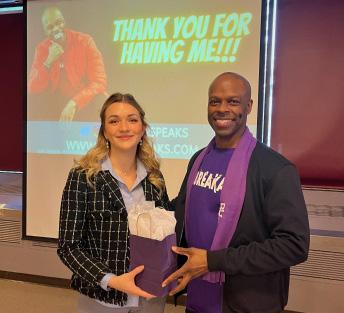
Kwesi Millington talks resilience during Mental Health Week Gabrielle Liu - Junior Copy Editor

K

wesi Millington, former RCMP officer turned public speaker, delivered the keynote speech for Bishop’s Mental Health Week on Feb. 3. Millington shared techniques of mindfulness to improve confidence and mental health, drawing upon his lessons from his childhood, early career, and incarceration. Dean of Student Affairs Dr. Stine-Linden Anderson acknowledged the traditional territory of the Abenaki and reflected on their knowledge and ability to survive off the land – temperatures scraped a frigid -31 degrees that day. She then passed the floor on to Sophia Stacey, Health and Wellness Representative of the SRC, who introduced Millington to a gathering of mixed ages at the Gait. Millington spoke of three techniques: release, relinquish, and reserve and rejoice, preluding each practice with an anecdote. He recounted having a crush on a girl named Rita while in university. He would often come close to speaking to her in class or at the gym, but would end up thinking, “Maybe next time.” “We’re our own worst critics when

it comes to our mental health,” he said, speaking of how thoughts of being too tall, too dark, or too dumb held him back when he was younger. Millington then asked audience members to share what they admired about themselves, to release their obsession over their imperfections. When he graduated from Toronto Metropolitan University, then known as Ryerson University, he took up a temporary office job. When the role turned into a permanent position, he was denied the job by a hiring manager. However, three years later, he earned his RCMP badge. Feeling proud, he went back to the firm to look for the manager, only to find out that she had been promoted and was no longer there. “I’m not very mature,” he joked. “I held on to a grudge for three years over someone who probably didn’t even remember me,” Millington said. He asked audience members to think of what they had to accept about themselves to move on, to relinquish the past. “I had to accept that I could no longer be a police officer.” Millington served 12 years in the RCMP. It was a career where he met

celebrities and served as a bodyguard to presidents and prime ministers. Six years into this career, he was involved in what he described as “one of Canada’s largest police cases.” He testified in court and was later informed that he had been charged with perjury. He was convicted and sentenced to 2.5 years in prison. According to Millington, when he was put in jail, the guards placed him in solitary confinement. Solitary confinement is usually reserved as punishment, but for Millington, as a former policeman, it was for protection from other inmates in the general population. He asked the audience to imagine a 7x11 foot room, being kept there 23.5 hours per day, with just 30 minutes reserved to shower, change and walk in a gated yard. “How many of you have ever felt overwhelmed and alone?” he asked. “One blessing of being in a solitary cell was no technology,” Millington recalled, describing how he could focus on the present. When he was given access to the library, he delved into a book each day. Recounting the joyful tears he shed after receiving chapstick after three weeks in prison, he asked the audience to begin

a practice of appreciation each day, to reserve happiness and to rejoice. One of the greatest challenges transitioning into his current career as a resilience coach and public speaker was learning the business and how to find hosts. Millington mentioned he first joined Toastmasters, a nonprofit organization that builds public speaking skills, before finding out he had a talent. For Millington, the greatest reward from this career is hearing from students who write to him about practices he taught them, and he plans on working with youth for as long as he can.

Photo Courtesy of Sophia Stacey

Sexual culture and violence: Offering an opportunity for an inclusive dialogue Christina Lépine - Features Editor

O

n Monday Nov. 21, Bishop’s University hosted CTV and TSN journalist Rick Westhead for a screening of his documentary Broken: Inside the Toxic Culture of Canadian Gymnastics following a period of discussion involving all students and faculty members present. During the one and a half hour time slot allotted for this conference, Westhead presented this documentary and talked about his career as a journalist. This documentary, released in 2022, dives into the Brubaker and Gymnastics Canada scandal in which former gymnasts Abby Spadafora and Mel Hunt talk about their experience training competitively under Bluewater Gymnastics’ head coach Dave Brubaker. In 2019, Spadafora and Hunt, along with 11 other gymnasts, filed a complaint against Brubaker with abuse allegations. This documentary follows these two former athletes as they heal and recover from many years of abuse. During the time allotted for questions after the screening of Westhead’s documentary, the TSN journalist had a chance to talk about his most recent work reporting about abuse in sports including Hockey Canada’s abuse scandal, amongst others. Rick Westhead

was asked about reporting on the delicate topic of abuse in and outside of sport and on ways to improve on current systems and organizations in which victims fear seeking help. Westhead said that the best way to enforce change is to “challenge organizations, to be active, to know what the policies are.” This message is important for many students who fight to enforce change at Bishop’s in light of noteworthy events from the past years. On Nov. 3, 2021, as the independent review of Bishop’s University’s Practices and Policies related to Sexualized Violence states, an anonymous message was left on the bridge connecting the Bishop’s University campus with the community of Lennoxville. This message said: “He raped me, I reported, he’s still in my class, BU take action.”

This message caused a wave of reaction through the small Bishop’s community which influenced the university to take prompt actions such as organizing town hall meetings to discuss the issue and to find solutions and the establishment of an Ad-Hoc Committee on the Prevention of Sexual Violence in Nov. 2021. The Sexual Culture Committee (SCC) works to open the dialogue on abuse and sexual violence, to educate all students and faculty members, to destigmatize the topic of sexual culture, to facilitate the reporting of sexual assault, and to make sure every individual feels safe and comfortable on campus and in the Bishop’s community. Ever since its foundation, the committee has organized a series of forums, meetings, and marches to take action and be heard

by all. During their Take Back The Night forum that took place on Oct. 19, 2022, co-founder of the committee Anika Malone said: “Let’s empower more people to scream and raise their voices!” The SCC’s main goal is to enforce change and to make sure the student community is a safe place for all. To achieve this goal, the committee asks all participants to share their opinion on ways to improve reporting techniques to make it easier for victims and for loved ones to report on assault, violence, and abuse. Since Nov. 3, 2021, the reporting and information gathering at Bishop’s University has also transferred online to offer privacy to all users. To find information regarding sexual violence, mental health, and how to report events that made you feel uncomfortable, consult the Bishop’s website in the “view all resources” section, which includes the Respect Educate Empower Survivors (REES) website, or at the link https://reescommunity.com/campus.

Photo Courtesy of Christina Lépine


Turn static files into dynamic content formats.

Create a flipbook
The Campus February 13th, 2023 by The Campus Newspaper - Issuu